

BY DENIS PEREZ-BRAVO
L
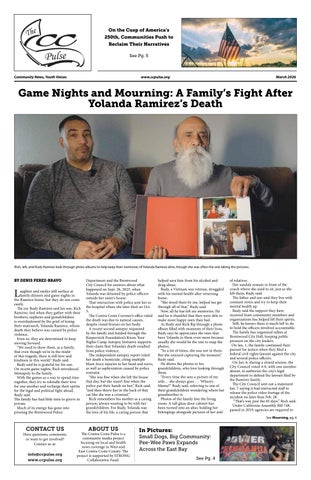
aughter and smiles still surface at family dinners and game nights in the Ramirez home, but they do not come easily.
The joy Rudy Ramirez and his son, Rich Ramirez, feel when they gather with their brothers, nephews and grandchildren is overshadowed by the grief of losing their matriarch, Yolanda Ramirez, whose death they believe was caused by police violence.
Even so, they are determined to keep moving forward.
“We need to show them, as a family, that even though we’re in the midst of this tragedy, there is still love and kindness in this world,” Rudy said. Rudy said he is grateful for his son. On recent game nights, Rich introduced Monopoly to the family.
With the games as a way to spend time together, they try to rekindle their love for one another and recharge their spirits for the legal and political fight ahead, Rudy said.
The family has had little time to grieve in private.
Much of its energy has gone into pressing the Brentwood Police
CONTACT US
Have questions, comments, or want to get involved? Contact us at:
info@ccpulse.org www.ccpulse.org
Department and the Brentwood City Council for answers about what happened on Sept. 26, 2025, when Yolanda was detained by police officers outside her sister’s house.
That interaction with police sent her to the hospital where she later died on Oct. 3.
The Contra Costa Coroner’s office ruled the death was due to natural causes, despite visual bruises on her body.
A recent second autopsy requested by the family and funded through the Kaepernick Foundation’s Know Your Rights Camp Autopsy Initiative supports their claim that Yolanda’s death resulted from police violence.
The independent autopsy report ruled her death a homicide, citing multiple blunt-force injuries to her head and torso, as well as asphyxiation caused by police restraint.
“She was fine when she left the house that day, but she wasn’t fine when the police put their hands on her,” Rich said, “and then threw her in the back of that car like she was a criminal.”
Rich remembers his mother as a caring person, always wanting to be with her grandchildren. For Rudy, Yolanda was the love of his life, a caring person that
The Contra Costa Pulse is a community media project focusing on local and health news coverage in West and East Contra Costa County. The project is supported by STRONG Collaborative Fund.
helped save him from his alcohol and drug abuse.
Rudy, a Vietnam war veteran, struggled with his mental health after returning home.
“She stood there by me, helped me get through all of that,” Rudy said.
Now, all he has left are memories. He said he is thankful that they were able to make more happy ones than bad.
As Rudy and Rich flip through a photo album filled with moments of their lives, Rudy says he appreciates the ones that have Yolanda in them even more because usually she would be the one to snap the photos.
“So a lot of times, she was not in them. But she enjoyed capturing the moment,” Rudy said.
He shows the photos to his grandchildren, who love looking through them.
“Every time she sees a picture of my wife… she always goes … ‘Where’s Mama?” Rudy said, referring to one of their grandchildren wondering where her grandmother is.
Photos of the family line the living room. A tall glass-door cabinet has been turned into an altar, holding her belongings alongside pictures of her and
of relatives.
Her sandals remain in front of the couch where she used to sit, just as she left them, Rudy said.
The father and son said they live with constant stress and try to keep their mental health up.
Rudy said the support they have received from community members and organizations has helped lift their spirits.
Still, he knows there is much left to do to hold the officers involved accountable.
The family has organized rallies at Brentwood City Hall, keeping public pressure on the city leaders.
On Jan. 1, the family continued their pursuit for justice when they filed a federal civil rights lawsuit against the city and several police officers.
On Jan. 6, during a closed session, the City Council voted 4-0, with one member absent, to authorize the city’s legal department to defend the lawsuit filed by the Ramirez family.
The City Council sent out a statement Jan. 7 saying it had instructed staff to release the police video footage of the incident no later than Feb. 28.
“That’s way past the 45 days,” Rich said.
Under California Assembly Bill 748, passed in 2019, agencies are required to



Scan the QR code above to go to our donation page.
Publisher
Malcolm Marshall
Editor Danielle Parenteau-Decker
Denis Perez-Bravo
Samantha Kennedy
Zoe Meyer
Arianna Caramagno
Vernon Whitmore
Sandy Close
Michael J. Fitzgerald
The Contra Costa Pulse is a community media project founded by New America Media, focusing on local and health news coverage in West and East Contra Costa County.
The project is supported by The California Endowment and the STRONG Collaborative Fund.
Have questions, comments, or want to get involved? Contact The Contra Costa Pulse at info@ccpulse.org www.ccpulse..org
BY SAMANTHA KENNEDY
In Antioch, up to 50 people could land themselves on a list that identifies those most at-risk of shooting someone or being shot. At least, that’s one of almost a dozen recommendations to reduce gun violence in the city.
The Hope and Heal Fund, which presented recommendations to the City Council on Jan. 27, said similar strategies reduced gun violence by up to 55% in other cities. Many of the recommendations are already in motion, said council member Tamisha TorresWalker.
“It would be great to be able to get the full package [of recommendations], and what works in another city might not work here in Antioch, but to try nothing would be ridiculous,” said Torres-Wallker.
The organization’s recommendations suggest banning “ghost gun” parts and kits, which are privately made and don’t have a serial number, meaning law enforcement can’t trace them; providing those on the at-risk list with “intensive” mentorship; and converting the Sycamore Corridor — considered one of the most, if not the most, violent areas in the city — into a thriving business district. It comes on the heels of the city’s lowest number of homicides since 2011, according to data from the Antioch Police Department, but that was only a year after Hope and Heal found the city had also recorded the highest number of gun violence incidents in the last decade.
Dubbed the “new Oakland” by one business owner due to an uptick in shootings in 2024, Antioch’s reputation of being unsafe due to gun violence has persisted for years. The city started the year off with two shootings in January;
one involved an 11-year-old girl being shot in the head.
A decrease in homicides is happening statewide as well, including in cities — Oakland and Richmond — where gun violence intervention frameworks have been adopted. Richmond recorded its lowest homicide number on record and Oakland recorded its lowest in over 55 years.
But while homicides overall dipped last year, Torres-Walker said “violence is never down” for some areas.
Data collected by the Hope and Heal Fund shows that “hot spots” for gun violence are in the north-central and central parts of the city, accounting for 44% of gun violence incidents between 2014 and 2024.
“From our standpoint, Antioch doesn’t have a gun violence problem. There is a particular two square mile radius that has consistently, for the last 10 years, suffered the vast majority of gun violence,” said Refujio Rodriguez of the Hope and Heal Fund.
Adult residents reported feeling unsafe in areas like the Sycamore Corridor and Cavallo Road, according to survey results presented by the nonprofit research firm Evident Change.
The city committed to bringing a police substation to the Sycamore Corridor last year to increase the visibility of police, though the area is still underresourced in other ways. For that, the county’s African American Holistic Wellness and Resource Hub has been proposed to be located on Cavallo Road.
And residents’ health isn’t just impacted by gun violence. Economically, gun violence can hurt the creation and growth of business and development.
“I can go two blocks and a house
is $600,000, then a condo is under $300,000,” said Rodriguez. “I’m pretty sure that’s associated with gun violence.”
Mayor Pro Tem Don Freitas and Torres-Walker noted that they will have to take into consideration the budget deficit the city is facing when deciding how to move forward with anything.
One of the programs already in place to respond to conflict before it escalates to gun violence is the Angelo Quinto Community Response Team, which in part provides community conflict mediation, received an additional $408,984 in American Rescue Plan Act funding. That’s months after council members cut those services in half because of a budget deficit.
Because the presentations and recommendations were informational, council members did not vote on the gun violence recommendations.
Council member addresses hit-and-run that killed teenage girl
Council member Tamisha TorresWalker reassured residents that work is being done “behind the scenes” that they don’t see, after one resident raised concerns about the city’s silence on a recent hit-and-run that killed a teenager.
A resident who only identified herself as Ashley expressed frustration with council members for not making any public statements about the 17-year-old girl who was found dead on the side of the road on Jan. 20.
“We look like nobody cares here and that we are a lawless city where children now are either killed or shot,” said Ashley, who also referred to the 11-year-old girl shot in the head on Jan. 5.
Officials said that the teenager in the hit-and-run, Jeana Flores, was killed as a result of the incident, which was first
See Antioch, pg. 6
BY SAMANTHA KENNEDY
Pittsburg police have generated hundreds of reports during the early rollout of a controversial artificial intelligence tool for law enforcement agencies, according to a presentation to the City Council.
Lt. James Terry told council members Feb. 2 that the Pittsburg Police Department’s use of A.I. tools from Axon Enterprise, including Draft One, which generates reports based on bodycam audio, and a real-time translator, has improved its efficiency.
“With A.I. being in the title, we wanted to do a deep dive to make sure it’s not thinking for us or rationalizing decisions or giving us ideas on what we’re doing out there,” said Terry.
From September through November of last year, officers used the translation tool more than 2,700 times, and Draft One helped generate just over 600 police reports, according to department data. Terry said the report-writing tool alone has saved officers an average of 3.25 hours per day.
Draft One, he said, has especially helped efficiency by creating “a foundation” for the reports.
“All it does is it processes the audio from our body cameras and it provides a draft narrative police report,” said Terry. Officers have to verify the information
and supervisors have to approve the reports.
Axon is already a popular provider of body cameras, Tasers and other tools to law enforcement agencies, but Pittsburg is one of the first in the Bay Area, and the first in Contra Costa County, to use the Draft One and translation tools. San Francisco, San Mateo and East Palo Alto also use the Draft One technology.
Axon markets the technology as a way to improve efficiency, describing Draft One as a “force multiplier” that helps “accelerate justice.”
The translation tool, which is integrated into Axon body cameras, can provide real-time translation in more than 50 languages. Terry said it offers a more “personable” option than traditional translation methods.
Mayor Dionne Adams and council members Juan Antonio Banales and Arlene Kobata were impressed with the tools.
“I love the intersection of technology and serving the public, keeping everybody safe,” said Adams.
Not everyone is convinced. Advocates like the Electronic Frontier Foundation have concerns about transparency and accountability with Draft One, saying that there is no “meaningful way” to audit the reports and concerns of reports lacking context because it does not process the video.
California and other states have tried
to address some transparency concerns. This year, California started requiring disclosures if A.I. is used in police reports and a draft history of those reports. Axon did not include the ability to retain a record of the first draft created by Draft One, but in December launched a feature that would.
A study from Axon, the company that developed Draft One, found that its police reports were as good as or the same as officer-only written reports when it came to objectivity and neutrality and that the A.I. tool’s use of terminology and its overall coherence was “significantly better” than those from officers. However, company-funded studies are not independent and should be treated cautiously.
Pittsburg had already welcomed A.I. into the city before the implementation of the Axon tools. In 2024, council members OK’d the Pittsburg Technology Park Specific Plan, where a 76-acre data center will sit.
Elsewhere in East County, residents have voiced their criticism of A.I. in policing and otherwise. Some Antioch Police Oversight Commissioners have mentioned a need for transparency efforts when asked if the Antioch Police Department had plans to use A.I. tools. In January, Oakley residents pushed back on a possible data center at a site about 15 miles away from the Pittsburg data center. •
BY ARIANNA CARAMAGNO
R
eselling clothes, selling art, walking dogs, working for UberEats, braiding hair on weekends — if you know a college student right now, chances are they have a side hustle.
Side hustles can be a source of financial empowerment and a great way to make some extra money. But closely examining the prevalence of side hustles among Gen Z paints a much darker reality for how young adults experience the economy.
For college students in 2026, side hustles have become more of a necessity than a choice.
According to the U.S. Bureau of Labor Statistics, in December 2025, the overall unemployment rate was 4.5%. For people between the ages of 16 to 19, it was much higher at 15.7%. The Bureau of Labor Statistics also reported that same month that the total number of jobs was down by 966,000 from the previous year.
For young adults, finding a job comes with its own unique set of challenges. Having less experience and more academic responsibilities puts Gen Z at a disadvantage. Even if employers are able to accommodate the busy schedule of a college student, students usually only can work part-time and get paid minimum wage.
Being in college isn’t exactly cheap either. Students often end up spending a majority of their paycheck on tuition, food, rent and textbooks. In the Bay Area, where the cost of living is already high, it is not surprising that many students turn to alternative ways of earning money.
Side hustles offer variety and flexibility. Students can work on their own time and find jobs that interest them. This freedom is part of what draws students to side hustles and makes them so convenient.
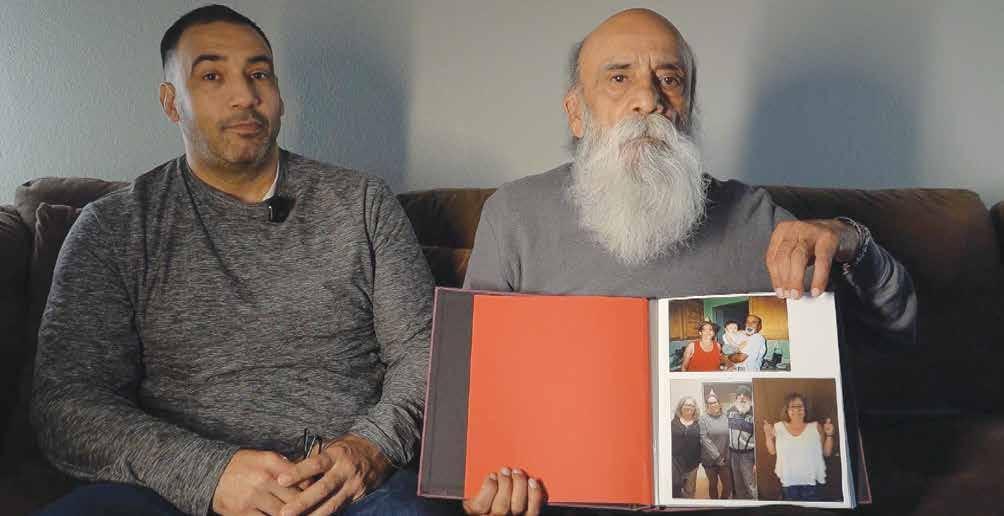
UC Berkeley students Aidan Henriques and Mihiro Okubo, facilitators of the student-run course Side Hustles for SkillBuilding and Extra Income, have both navigated that reality themselves.
“I want to help students find a midpoint between a full-on A.I. startup and driving DoorDash for extra income, something that helps them build relevant skills while making a good and scalable amount of money on the side,” Henriques said.
Henriques has resold electronics and clothing and done stock photography
and affiliate marketing, while Okubo spent time over the summer selling her old clothes online. Their experiences are part of what inspired them to help other students start their own side hustles.
But managing a side hustle while simultaneously balancing the academic life of a student can be particularly challenging. Okubo added that time management plays a big role in how students navigate side hustles alongside their studies.
“The biggest challenge that most students have come across is the lack of time that they have to dedicate to a side hustle. It can take quite a bit of time and effort to sustain a side hustle alongside other commitments and academics,” said Okubo.
While having a side hustle as a college student might seem great on the surface, they are interwoven with an intense pressure to succeed. U.S. work culture frequently equates productivity with worth, making rest feel like failure.
But this notion of extreme productivity is an extreme burden on students who are just beginning to enter the workforce. In a world where productivity is highly valued and jobs are hard to find, side hustles become less of a fun way to make extra money and more an example of the obligation to be productive.
Henriques said that the current job market and UC Berkeley’s intense startup culture were some of the reasons that students felt the need to start their own side hustles.
“Many students want to have a backup, while simultaneously looking for the next million-dollar opportunity, ” he
said.
For many students, working toward a degree often just doesn’t feel like enough to be considered successful anymore, especially in a day and age where social media changes the idea of what success should look like. Frequently looking at others with more “successful” lives can make your own achievements feel much smaller in comparison.
Over time, juggling multiple side hustles alongside school, internships and personal responsibilities can take a heavy toll on mental and physical health.
“Success” by societal standards can often involve pushing yourself past your limits until you reach your breaking point. Still, side hustles are unlikely to go away anytime soon And for some students, they do provide genuine empowerment.
Okubo said side hustles can offer confidence and a sense of accomplishment beyond financial gain.
“I don't necessarily want to make millions of dollars from this, but rather I wanted to prove to myself that I can start something and succeed (e.g. make my first sale),” said Okubo. “It's an incredibly satisfying feeling, and it leaves you feeling confident after getting past the hardest part, which I think is planning and getting started.”
Side hustles can be both freeing and exhausting. While not everyone has the privilege of choosing whether to take one on, it’s important to remember they don’t have to define a person’s value. Success doesn’t have a single shape, and rest is
See Hustles, pg. 6

BY SAMANTHA KENNEDY
In the same month Antioch Unified learned that the Contra Costa County Office of Education had downgraded its budget certification, the district is making moves to solve its approximately $30 million deficit.
But many community members say the proposed solution is the wrong one.
During a tense Feb.19 meeting that included nearly three hours of public comment, school board members narrowly approved initial cuts to around 300 positions, many in special education, which reportedly could save AUSD upwards of $37 million.
“We’re not choosing whether we get rid of people or whether we cut centralized staff, whether we cut programming — all of that will have some amount of cuts,” said board member Antonio Hernandez. “What we’re trying to do here is preserve that choice that we have here as a community.”
In two 3-2 votes, members passed two resolutions that could allow cuts to the equivalent of 185.725 classified staff and 114 certificated staff. Layoff notices were approved for around 50 paraeducators, who support teachers and students in special education, 20 custodians and 35 teachers.
Hernandez and Superintendent Darnise Williams emphasized that approval of the resolutions does not mean all listed positions will ultimately be eliminated. The district must still determine which positions will actually be cut, in addition to any other reductions that may be made.
Like many districts across the Bay Area, AUSD’s declining enrollment, expiration of one-time COVID funding and rising costs — including those related to special education programming — have largely been the cause of its multiyear deficit.
Districts in Pittsburg, West Contra Costa and San Francisco have also proposed or already made cuts to their budgets to remain financially solvent. After entering into new labor agreements, those districts anticipated more cuts.
AUSD officials projected during their first interim budget report that the deficit over two years was already $14.7 million. That deficit doubled after reaching a tentative agreement with the teachers’ union.
The deal is expected to cost $27.26 million over three years, according to the district. Prior to that tentative deal, AUSD dedicated over 76% of general funding — or about $248.9 million of a $321.6 million general fund — to salaries and benefits for employees, based on data from last summer’s preliminary budget.
Special education positions make up large share of proposed cuts
The bulk of the approved cuts are to special education educator positions, which the district has struggled to staff. District data shows that Antioch Unified employed 472 paraprofessionals during the 2024-25 school year. As of the beginning of the 2025-26 school year, the district reported at least
What started as a simple way for two Chihuahua owners to help their dogs socialize has grown into a multi-city small-dog community stretching across the East Bay.
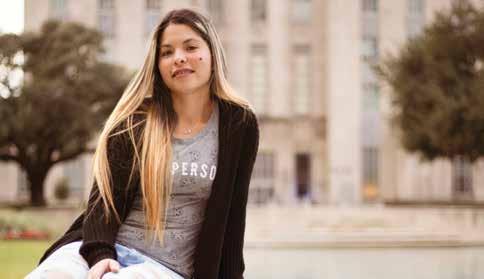
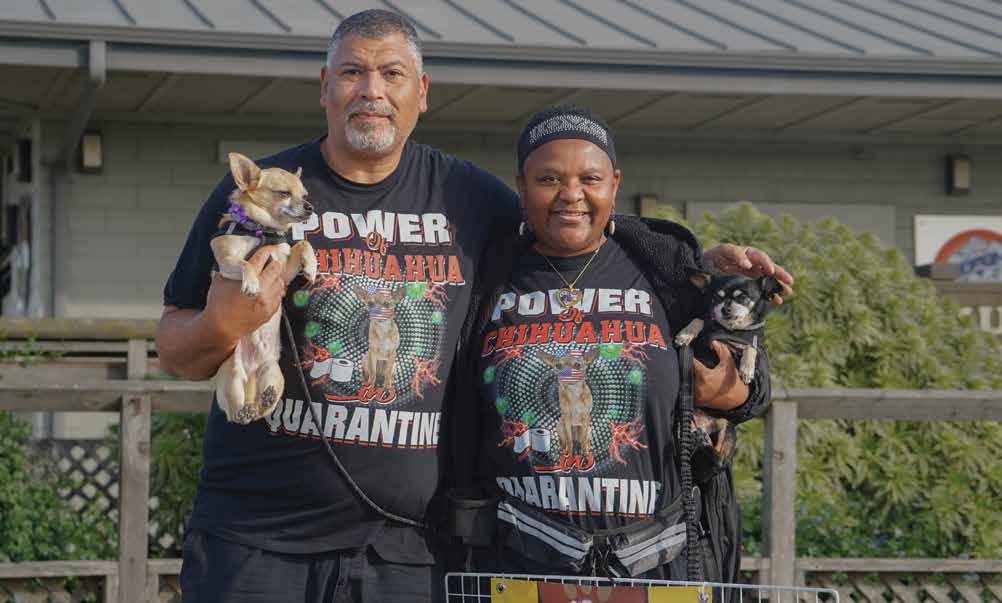
The Pee-Wee Paws Small Dog Meetup, founded by San Pablo residents Jason and Darlene Young, hosts strolls and social gatherings for small dogs and their owners, at first in Oakland, Berkeley and Alameda.
More recently, the couple has expanded the group’s reach, organizing monthly meetups at Pinole Valley Park, Richmond’s Point Isabel and Baldwin Park in Concord.
“Our love for our dogs, Kilo and Celine, turned into wanting to share that love with other people,” Darlene Young said at their second Point Isabel dog park walk on Feb. 13. “People love their dogs, and when all of us get together, it really becomes a community.”
At the meetups, the Youngs hand out cards with information about Pee-Wee Paws, chat with small-dog walkers and invite passersby to join future events.
After hearing about the dog park at Point Isabel from many previous visitors and seeing online posts about it, the couple decided to launch a meetup there.
“So I was like, let’s bring this here to the love here with
the dogs,” Darlene said.
The group launched in Alameda, where it continues to hold monthly meetups on the first Sunday of each month at a dog park near the beach. Owners and their small dogs gather to let the animals run, play and socialize while the people connect.
“It’s an enclosed park by the beach, and they run around and they play together and people come and talk and interact,” Young said.
Pee-Wee Paws has also hosted themed events around Halloween, Thanksgiving and Christmas.
“We had a Halloween special and a Christmas,” Jason Young said. “I was dressed up as Santa Claus; she was Mrs. Santa Claus. People come out with their ugly sweaters, and the dogs dress up too.”
Jason said the idea for Pee-Wee Paws came from seeing how difficult it can be for small dogs to find safe, welcoming spaces to socialize.
“Chihuahuas, in general, have issues of hanging out with other dogs, so most of these are by themselves,” he said. “We just wanted something for them to do, for people to come out and enjoy a nice area and have fun.”
Chihuahuas are also known for forming strong bonds with their owners. Jason said the breed typically attaches closely to one person, though every dog is different “They’re friendly, but they’re also very protective,” he

said.
The Youngs said owning two Chihuahuas can be especially beneficial. Dogs that live in pairs often rely on each other for comfort, which can help reduce separation anxiety.
“They enjoy their interaction between each other,” Darlene said. “It also helps when you’re not there.” Because of the dogs’ size and temperament, the Youngs say Chihuahuas thrive best in environments designed for small, friendly dogs — spaces where they can safely play, socialize and build confidence without being overwhelmed.
Pee-Wee Paws meetups are open to small, friendly dogs, generally under about 20 to 25 pounds. The group promotes responsible pet ownership and a welcoming environment for both dogs and people.
As Pee Wee Paws continues to grow in Contra Costa County, the founders say their goal is simple: bring more people and pets together.
“We love bringing people and dogs together,” Darlene said. “It’s good for the community. Come out and have fun.”
People can find Pee-Wee Paws Small Dog Meetups on Facebook, Meetup or Instagram or email PeeWeePawsFun@gmail.com. •

BY SELEN OZTURK AMERICAN COMMUNITY MEDIA
As the Trump administration pushes to rewrite the nation’s history, communities across the country are pushing back against who gets to tell it.
“It’s a push we are witnessing not only on the streets of Minneapolis, but in efforts to resist an escalating series of executive orders to cancel exhibits at national museums, rename national parks and censor school curricula,” said ACoM Co-Director Sandy Close, introducing a briefing highlighting these efforts as July 4th approaches.
Nor are these orders limited to this second administration. Two in 2020 alone include Executive Order 13950 (“Combating Race and Sex Stereotyping), restricting federal agencies, contractors, and grantees including museums and schools from using frameworks associated with systemic racism or “divisive concepts,” and Executive Order 13958 (Establishing the President’s Advisory 1776 Commission), signaling federal pressure on schools, museums and cultural institutions to abandon critical historical narratives in favor of a “patriotic” version of American history.
“We’re nearing the 250th anniversary of the United States, and it requires all of us to ask a fundamental question: Who gets to decide what this country remembers, and who gets to decide what it forgets or erases?” said Ann Burroughs, CEO of the Japanese American National Museum and chair of the International Board of Amnesty International.
For Burroughs, the institutional stakes hit close to home.
The Japanese American National Museum was founded to document the incarceration of more than 125,000 Japanese Americans during World War II: “They were imprisoned without due process. Communities were destroyed. They were dispossessed, and essentially had to rebuild themselves,” she said, adding that the museum exists “to ensure that the history of the incarceration of Japanese Americans is never forgotten, but also that it never happens to anybody else.”
As museums face federal pressure, “What we’re seeing today are the echoes of that history,” Burroughs continued: “We’ve faced incredible pressures as museums to alter interpretation, avoid histories, conform to political expectations. We’ve also been further weaponized by having our funding threatened … When civic space is shrunk, one of the first things that goes is First Amendment rights.”
Margaret Huang, senior fellow for The Leadership Conference on Civil Rights and Human Rights and former CEO of Southern Poverty Law Center, highlighted another field where this civic pressure is mounting: public monuments.
Despite the Civil War being fought largely in the South and along the East Coast, “there are Confederate memorials in nearly every state in the country … and these memorials were put into place not after

the war but “60, 80 years later, when the narrative of white supremacy was very much at the forefront in fighting back against the Civil Rights Movement,” as activists nationwide demanded that Jim Crow laws be overturned, she explained.
Though over 100 Confederate memorials have been removed since 2015, over 2,000 still remain nationwide.
Huang also pointed to U.S. Army’s decision last June that military bases that had been changed to remove references to Confederate generals have these names reverted: “This administration has decided to revert back to people who actually fought against our country.”
As a case of resistance in Montgomery, Alabama, she highlighted the work of artist Michelle Browder, who has campaigned to remove a statue of J. Marion Sims, a 19th-century doctor who developed modern gynecological surgical techniques by operating without anesthesia on enslaved women.
“He developed the tools of this practice. He developed the procedures and surgeries of this practice, and he did so by abusing women, enslaved women who he specifically chose because of their inability to reject or demand that they not be included in his efforts,” Huang said.
After failing to persuade lawmakers to remove the statue, Browder built the Mothers of Gynecology Monument, a memorial to three of the women subjects — Anarcha, Betsy and Lucy — using welded metal, including metal from gynecological tools.
Proceeds from visitors now fund a mobile health clinic providing care in a state where, Huang noted, “44 counties offer no obstetric or gynecological care at all.”
Journalist Ray Suarez described this current moment’s clash of narratives as a broader attempt to redefine who qualifies as American.
He cited the 2017 Unite the Right rally in Charlottesville, Virginia, where marchers chanted “You will not replace us.” That phrase, he said, captures a deeper “anxiety that being able to dictate who is American, being a gatekeeper to say ‘Yes, this person is one of us, and this person isn’t.’ ”
Suarez also pointed to the recent popularization of the term “Heritage Americans” by conservative commentators.
Explaining the term, he said “If you’ve been here
for a couple of generations, your Americanness is more valid, more real, your story is more notable and honorable than mine.” But, he argued, “America has been multicultural since day one. It always has been. It always will be.”
“If you think of this as a canvas on which three empires fought a multi-century shoving match … you think of American history as a different thing,” he added. “Latino history is American history, and American history is Latino history … The idea that we’re just Johnny-come-lately to the American story is one that’s very convenient for this project of creating this new white centrality.”
Anneshia Hardy, executive director of Alabama Values, described this project as a coordinated effort to “control historical meaning.”
“We’re seeing national museums being pressured to cancel or sanitize their exhibits. We’re seeing school curricula being restricted in the name of neutrality or limiting ‘divisive concepts,’” Hardy said. “None of this is described as erasure … Instead, it is being framed as common sense or patriotism.”
“In practice, this is narrative governance … It is an attempt to reassert a version of America that is whitecentered, orderly, unbothered by the violence and exclusion that made this nation possible,” she continued, noting as example that in Alabama “there isn’t a single state-funded museum dedicated to documenting the full history of slavery.”
To counter this, Hardy has launched her own project, “This Is America,” bringing together historians, political scientists, journalists and community storytellers to document U.S. realities in advance of the semiquincentennial.
“The goal is not to produce a single sanitized story of the nation. It is to tell the full story honestly, rigorously, in community,” she said. “Every expansion of freedom that we point to today exists because people forced the country to move … When we stop pushing, the nation doesn’t stand still. It slides backwards.”
“This country is not going to turn the corner on its own,” Hardy added. “It only moves when enough people decide that maintaining humanity is worth more work than maintaining power.” •


BY ZOE MEYER
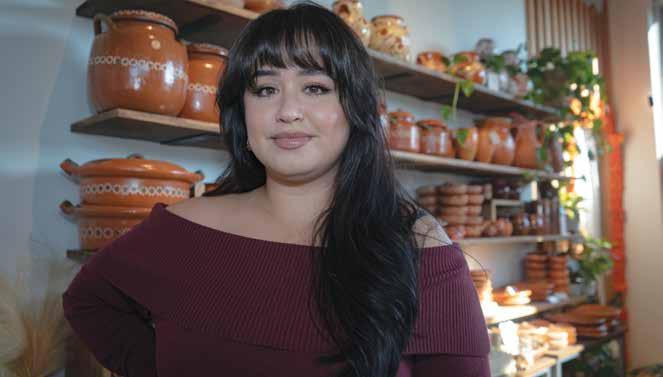
As a little girl, Natalie Reyes split her time between Richmond and Jalisco, a western Mexican state along the Pacific. She remembers peering outside the window of her Richmond home and wishing Jalisco and her 32 cousins would appear in the backyard.
“Growing up, the moment school let out, we were on a plane to Mexico,” Reyes said. “The day before school started, we were on a plane back home.”
With roots in Jalisco spanning at least four generations, Reyes’ parents taught her about her culture, in part through Mexican music and movies starring noted Mexican actor and singer Pedro Infante, and from that, a deep love for her homeland grew.
“You go out there, and things are different. The life out there is so much slower, so much more intentional. You’re walking by people in the street; you’re saying, ‘Hi, how are you?’” Reyes said.
Over the years, Reyes has felt the ache of her heart split between two places. She’s always loved Richmond, which she describes as “such a diverse bubble with a little bit of everything everywhere.” 23rd Street, for example, is known as a Latino hub with heavily Latino stores. Eventually, she decided to bring a little bit of Jalisco to Richmond.
In August of 2023, she opened Metztli, her own tiendita (Spanish for “little shop”) completely by herself. While daunting, entrepreneurship runs in her blood. In Jalisco, her family has run a barbershop called Reyes Barberia for 100 years and her cousin owns a hotel there. In Richmond, her dad owns a plumbing business.
“The love from the arts comes from my mom, and then I feel like the hustle and wanting to have something and make something comes from my dad’s side,” Reyes said. Whenever Reyes feels doubt creeping in, she listens to Mexican artist Natalia Lafourcade’s song “Hasta La Raíz,” meaning “to the root.” The song keeps her rooted in her mission: helping people connect to where they came from.
“If you don’t know where you come from, how do you know where you’re going? If you’re not connected to your roots, then how do you know who you are?” Reyes said.
Metztli features traditional home and kitchen goods, such as pottery, textiles and aprons, handcrafted by Jalisco’s artisans themselves. Reyes said she particularly loves the botellones, ceramic water jugs that infuse earthy flavors into water and date back over 2,000
Continued from page 2
considered a “suspicious death.”
Torres-Walker said that she has plans to attend a meeting where she’ll be asking questions about capital improvement projects involving traffic calming measures.
“I would like to ask for grace, consideration because I know these things aren’t easy. When you often think that nothing is happening, it’s just because you don’t see it, and it’s also not being written on the blogs,” said TorresWalker.
In 2023, the City Council approved a number of traffic calming improvements to reduce traffic fatalities. •
Continued from page 3
Starting small, setting realistic expectations, and giving yourself room to slow down can make all the difference. •
years to Mesoamerican civilizations like the Maya and Zapotec.
To appeal to younger customers, the store carries millennial/xennial art, which often involves nods to specific pop culture references, as well as stickers, greeting cards, key chains (the ones modeled after conchas, the shell-shaped Mexican sweet bread, are particularly popular), tote bags, cups, candles, clothing, and even a Mexican version of bingo called Loteriá. Reyes also stocks her shelves with the works of local vendors and Latino/a-owned businesses.
“It’s just a mixture of the newer generation being able to connect to their roots and the older generation feeling that nostalgia of returning,” Reyes said.
Reyes said her favorite moments are when customers walk in and say something like, “I used to use this when I was in Mexico. This is what we used to cook with,” pointing to the warm, earth-toned pottery, Barro Canelo cookware. And then she’ll overhear younger people saying, “Oh my god, remember when Mom used to say that?” gesturing to a sticker or tote bag.
Located at 12478 San Pablo Ave. in Richmond, the storefront’s windows are lined with traditional Talavera designs.
For many, Reyes said, Metztli functions as a safe space. She shared a story about one customer who works from home and sees the store as their getaway when life gets too overwhelming. Walking around the store helps calm them.
Reyes also sees Metztli as a sanctuary during a
Continued from page 3
eight paraeducator I vacancies and 16 paraeducator II vacancies, previous job postings show.
It remains unclear how many of the other positions approved for cuts may be vacant and otherwise covered by other contracted service providers, but some of the initial layoffs appear to eliminate the same amount of special education staff as those on the district’s publicly listed staff for its behavior team, special education leadership, and program specialists for elementary, middle and high schools.
“If you take this away, you’re taking away their opportunities,” said parent Theresa Celestine. “They get connected to these paras. These paras become a part of their family.”
Board member Dee Brown, who voted against the cuts, said she could not support them as a parent of a child in special education. Board member Mary Rocha also opposed the move, calling for an audit of district subcontractors and a freeze on high-level hiring.
Continued from page 1
terrifying time for immigrant communities.
“If you’re getting chased, run in here and run to the back. I don’t mind going to jail,” Reyes said.
She also hopes the connection to roots will “fuel their stubbornness to be exactly who they are and to not try to hide it just because it’s a time when they are being persecuted.”
Since opening, Reyes has put her all into Metztli. She has not paid herself in two years. Running a shop on her own has been a tremendous undertaking, and she’s still learning every day.
“To be your social media manager, to be your marketing person, to be the janitor, to be the admin, to be the accountant — it’s everything in one,” Reyes said. And as of right now, bringing an employee on is impossible financially.
But it’s all worth it for Reyes, even if the shop is barely breaking even.
Reyes believes supporting small businesses is important because their products are not mass-produced and reflect the heart and soul of the people who made them.
“The fact that, you know, another human made it, not a machine,” Reyes said. “They’re imperfect, just like us.”
If You Go:
According to the store’s Instagram page, Metztli is open “10ish” to 5 p.m. Wed.-Fri. and “9ish” to 4 p.m. Sat.Sun. Its address is 12478 San Pablo Ave., Richmond, CA 94805. •
release the recordings from body-worn camera within 45 days when an officer discharges a weapon or when use of force results in death or serious bodily injury.
The family is urging City Council members to call for a coroner’s inquest, which can only be requested by the sheriff’s office or a city council member.
For decades in Contra Costa County, a death involving law enforcement set in motion a coroner’s inquest automatically.
A civilian jury would hear evidence and decide how a person died, whether by natural causes, accident, suicide or at the hands of another.
This policy has since been scaled back.
In January 2025, the Contra Costa Police Chiefs Association amended its Law Enforcement Involved Fatal Incidents Protocol, reshaping how such deaths are reviewed.

inquiry. Brentwood Police declined to comment due to the ongoing investigation.
“If there was something that clearly showed he was acting by policies and procedures… they would have dismissed it and said there’s nothing to see here,” Rudy said. “But they’re still investigating it — so that kind of gives me a little hope.”• not failure.
Hernandez said services required under students’ individualized education plans are still legally mandated. District employees who may be affected by the cuts are expected to receive layoff notices by March 15. •
Under the revised, two-page amendment, a process that once served as a routine layer of public oversight is now optional because it is left to the discretion of the coroner or to be requested by officials such as the attorney general, district attorney, sheriff, city prosecutor, city attorney or a police chief.
While hopeful, Rudy and Rich are skeptical a city official will speak up to request an inquest.
The district attorney’s office is currently investigating the case and announced in December 2025 that it had opened an

BY DENIS PEREZ-BRAVO
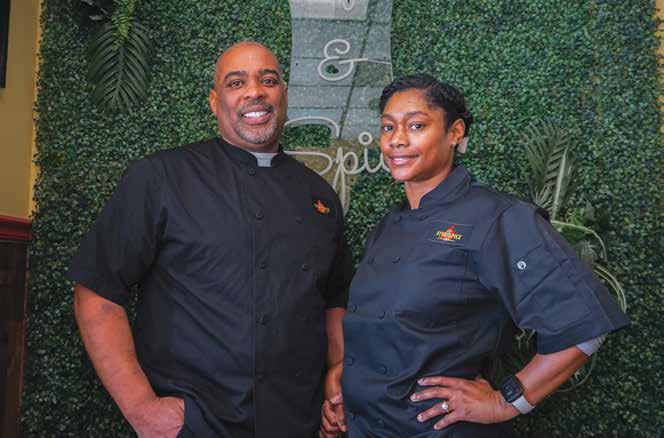
A food-loving family has built a Jamaican and soul food menu rooted in family recipes and shared experiences at Fiya Spice Caribbean in Pittsburg.
Porsche and Everick Wilkins met while enrolled in the culinary arts program at Diablo Valley College, where they made a lasting impression on each other, then went their separate ways before ultimately reuniting.
Everick returned to his native Jamaica to complete his culinary education in a Jamaican cuisine program, while Porsche launched her dessert catering company, KR Kakes.
Their shared passion for food brought them back together during the COVID-19 pandemic, when Everick invited Porsche to sell her pastries from his food truck. That partnership grew into a romantic relationship, and the couple married Feb. 26, 2023.
In April of the same year, they opened Fiya Spice Caribbean’s brick-and-mortar location.
Located at 1343 Buchanan Road, the restaurant serves a range of Caribbean dishes alongside ready-to-go items such as patties, sea moss drinks and pastries.
“We offer the main dishes that they would experience when they go to Jamaica, you know, like the oxtail, the escovitch (red snapper), the curry goat, the jerk chicken, of course, which is a staple,” said Everick, who is also the head chef. “We make everything in-house. Even the seasoning we use, it’s made fresh.”
That approach reflects how he was raised in the countryside of St. James Parish, Jamaica, where his mother cooked exclusively from scratch. Everick said she harvested vegetables she grew herself, prepared meat from animals they raised, and relied on fresh ingredients.
He continues that practice at Fiya Spice Caribbean alongside his wife, Porsche, a trained pastry chef.
One of her most popular offerings is a red velvet cake made from her great-great-grandmother’s recipe.
“I went all the way to Chattanooga, Tennessee, to get that from her,” Porsche said. “She lived to about 104, so she’s got a rich history.”
Other staples include sweet potato pudding, banana bread, Oreo cake and chocolate cake.
Porsche also makes a pear bread pudding that is offered only on weekends and regularly sells out once it’s available. The dessert begins with in house made cocoa bread. It’s seasoned with a mixed spice blend, then layered with sautéed pears and golden raisins, and finished with a butter toffee sauce.
The collaboration between the couple extends beyond recipes and into shared traditions. Porsche’s family introduced Everick to American soul food dishes.
“(Everick) wanted to know how to make candied yams, you know,” Porsche said. “And so my mom pretty much came down here and taught him that process.”
Those experiences led to the creation of Soul Food Sunday at Fiya Spice, held every third Sunday of the month.
“We started that — I want to say that was in 2024,” Porsche said. The event has since become one of the restaurant’s most popular days.
“Ever since I’ve encountered their food, I’ve been coming here all the time,” Pittsburg resident Chimere Surratt said.
Surratt said she has introduced the restaurant to her boss and co-workers.
“And she sneaks up here just to get an oxtail plate and
eats it in the car at work,” Surratt said. “So I’m telling you they got the best food in town, the best Jamaican food in town.”
Surratt has been a loyal customer since Fiya Spice Caribbean operated as a food truck parked outside Everick’s home in Oakley.
Before that, Everick said, the business began as a delivery-only ghost kitchen. One of his first regular clients was a group of women at a salon in Oakland, where he would deliver Jamaican plates on Fridays.
As word of mouth spread, Everick purchased a food truck and continued operating during the pandemic from outside his home. The reach of the business surprised him.
He recalled a customer who flew into Los Angeles and heard about Fiya Spice in Southern California, then stopped to eat there on their way to Sacramento.
“If I could reach people like that, and we had just started out, what’s the possibility?” Everick asked.”Why stop here?”
Fiya Spice Caribbean fiyaspice.com
1343 Buchanan Road, Pittsburg, CA 94565
(510) 686-3325
Open 11 a.m.-8 p.m. daily •

BY ZOE MEYER
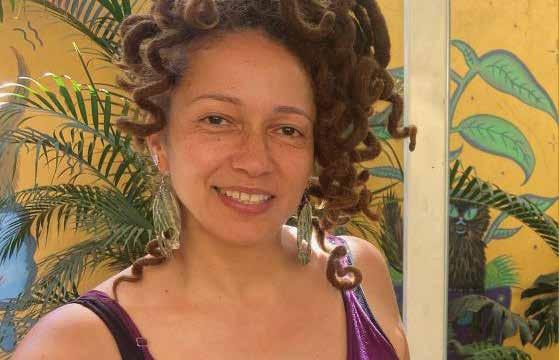
Andrea Sexton-Dumas wakes many mornings to the sound of a familiar voice dulcetly singing: “Rise and shine and get out of bed, Andrea / I said, rise and shine, and get your butt out of bed for the Lord.”
It’s her mom, Bev.
But Bev died in 2003. And a decade before that, she had lost her ability to speak, let alone sing.
Now, in 2026, Bev’s voice often acts as Sexton-Dumas’ gentle morning alarm — and she still finds humor in her dutifully Catholic mom ordering her “butt out of bed for the Lord.”
Sexton-Dumas was born in West Oakland to two disabled parents, both diagnosed with multiple sclerosis. She was 8 when her dad, Mitchell, died from complications associated with the disease. Later that week, her Uncle Charles died.
Death and Sexton-Dumas became acquainted very early in her life.
At any age, death is impossible to comprehend. But at not even a decade old, it was a completely foreign concept.
“I didn’t know what grief was,” she said.
In her 20s, Sexton-Dumas was hit with a string of unbearable losses: At 22, her grandmother, Mother Dumas, died; at 24, her mom died; and at 26, her aunt, Ophelia, died.
“After seeing the life leave my mom’s body — for like a week or two — everywhere I went, everyone looked dead to me,” she said.
Sexton-Dumas recalled that around that time no one was naming or acknowledging grief. And without any means to process her pain, she moved to New York, numbing the ache with distance from home and alcohol. She believes that the first 26 years of her life, and the agony she experienced, was a byproduct of grief avoidance.
“When you become really close with death, you find ways to live better,” she said.
In 2007, she decided to do just that, returning to the Bay and moving in with her now-husband, Sean, completely revamping her life.
But in 2018, a close friend of hers she called “Dragonfly” died from cancer. During Dragonfly’s fight, Sexton-Dumas constructed her very first intentional altar to honor her–a tradition she’s carried forward. The altar consisted of a small spider plant clipping, a statue of Buddha to honor her friend’s Buddhist faith, and vibrant Mangaeon Calcite and Green Aventurine crystals.
Sexton-Dumas had the privilege of acting as her dear friend’s unofficial death doula during that time, supporting her throughout her diagnosis and battle with cancer.
Shortly before the COVID-19 pandemic, SextonDumas rescued a Ridgeback Lab she named Churro — because he was “sweet and crunchy.”
During the pandemic, she was paralyzed by fear and dread and could barely eat. And on top of that, she was suffering from crippling endometriosis pain and ongoing infertility issues. Still, Churro needed to be walked every day, three times a day.
For the first few months of lockdown, Sexton-Dumas and Churro often basked side by side in the sun on her lawn and gazed at the tree overhead. A pair of great horned owls stared back at them, eyes wide and unblinking. Slowing down in this way helped SextonDumas “attune to nature,” forging a stronger connection to her surroundings and herself.
Churro also helped Sexton-Dumas survive the loss of her niece, Nayeli, later in 2020. Nayeli used to sing “Baby Got Back” by Sir Mix-a-Lot in the style of Kiss, belting the lyrics in a hard-rock rendition, Sexton-Dumas said.
In 2022, inspired by Dragonfly, Sexton-Dumas decided to complete the Going with Grace End-of-Life Training.
Having spent most of her life by her loved ones’ bedsides, this was a natural progression in her life.
“The work is new, but the experience is not,” SextonDumas said.
After Churro died in 2024, shattering her, SextonDumas began working with a hospice patient whom she worked with for two years up until she died late this January.
“Churro prepared me for my hospice patient,” she said. “I feel like he prepared me for the rest of my life.”
Now 47, and having endured a tremendous amount
of loss, Sexton-Dumas refers to grief as a friend of hers. In fact, she and grief “hang so tough” that she found her calling in supporting others through loss. She refers to herself as a death and grief doula, grief gardener, and spiritual companion.
“The garden metaphor has really served me in my own grief experience,” Sexton-Dumas said. “We’re composting our feelings. We’re watching things bloom; we’re watching things die.”
A core part of Sexton-Dumas’ philosophy is allowing grief in and embracing it — living alongside it while channeling it to find deeper meaning in life.
“I’ve had friends tell me, ‘I won’t ever recover.’ Well, maybe you shouldn’t,” Sexton-Dumas said. “You will stop crying one day. I promise that will happen. But what would happen if you let grief change you?”
Death, she believes, is a possibility for all of us at any moment. A reality Sexton-Dumas uses as an opportunity to attack life, full-throttle.
She sees this idea of death awareness as particularly important during these perilous times in our country. “If you are really going to fight this administration, then babe, you gotta get comfortable with death,” she said. “Cause it might just cost you your life.”
Looking ahead, Sexton-Dumas hopes to “serve people in having a soulful death.” •
In the meantime, she’ll continue tending to her “illegal” daffodils out front, planted against HOA guidelines as a grief ritual. They are blooming and alive, marking the end of the dark days of winter and the continuing of life, grief and all. •
“ Hands that once picked cotton can now pick presidents.”
When the Rev. Jesse Jackson delivered those words during the 1984 Democratic National Convention and throughout his 1988 presidential campaign, he shifted how Black political participation was publicly imagined. He placed the descendants of enslaved laborers at the center of American democracy and spoke about
power as something to be claimed rather than merely petitioned for.
Jackson, who died Feb. 17 at the age of 84, carried the moral authority of the Civil Rights Movement into a rapidly changing political and cultural era.
As the country moved through the Reagan years, widening economic divides and intensifying debates over urban policy, a new generation of Black Americans was coming of age. Hip-hop was emerging as both cultural force and political commentary. Global attention to apartheid and the eventual release of Nelson Mandela deepened international awareness within Black communities. Films such as “Do the Right Thing” and “Malcolm X” — amplified through the lens of Spike Lee — helped shape political identity through art.
Jackson spoke directly into that moment.
His presidential campaigns mobilized voters across racial and economic lines, building the Rainbow Coalition around economic justice, voting rights, labor, and human rights. He won primaries, amassed delegates, and demonstrated that a Black candidate could compete vigorously on a national stage. His campaign stops became civic classrooms, introducing policy conversations to communities that often felt overlooked in traditional political discourse.
What resonated most deeply with young African Americans was the way he sounded. His delivery carried the rhythm of the Black church and the cadence that felt culturally fluent in the hip-hop era. Politics did not feel distant when Jackson spoke; it felt accessible. He communicated with clarity and urgency, bringing
governance into everyday conversation rather than leaving it confined to Washington.
That generational connection extended into popular culture. When Jackson appeared on “A Different World,” the “Cosby Show” spinoff centered on life at a fictional historically Black college, he stepped into a cultural institution shaping the political literacy of Black youth in the early 1990s. The series addressed apartheid, economic disparity, and civic engagement, and Jackson’s presence reinforced the idea that cultural identity and political responsibility moved together.
For many who grew up during that era, myself included, Jackson represented the first time they saw a Black presidential candidate command national attention with authority and competitiveness. Before the term “swag” entered popular vocabulary, Jackson embodied it — confidence grounded in conviction, style inseparable from substance.
America watched him debate policy, build coalitions, and energize crowds. Even those too young to grasp electoral mechanics understood the significance of visibility.
The Rev. Jesse Jackson marched with Martin Luther King Jr. and helped pave the way for the first Black president. When Barack Obama mounted his historic presidential campaign, it unfolded in a country that had already witnessed what was possible — and what would become reality.
The iconic civil rights leader’s death on February 17, 2026, left the nation in mourning, but his legacy endures with a charge that still resonates: “Keep Hope Alive.” •