
















































By Laura Anders Lee
On a recent long flight, my two teenage boys completely ignored me — hoodies up, headphones in, consumed by their screens. I reached over to pat my youngest son on the knee, and he quickly swa ed my hand away.
Meanwhile, a few rows up, a baby slept on her mother’s shoulder. She was about a year old, with plump cheeks as rosy as the strawberries printed on her so footed pajamas. I wished, just for a moment, to have a snuggly infant again.
But soon the baby woke up with a loud cry, which continued for most of our way home. Desperately trying to console their daughter, the parents took turns bouncing her while pacing up and down the aisle. Just as I was pining
for the past, they were likely wishing to fast-forward to a time where their daughter could entertain herself.
Being around others in di erent parenting stages gives us the gi of perspective; we can be er appreciate where we’ve been and more clearly understand where we’re going.
In my neighborhood, I’ve befriended a group of fellow dog owners who are a decade or two above me in age. With adult children in their 20s and 30s, they o en impart wisdom and nuggets of truth when I share a particular challenge going on with my boys.
They remind me with humor that teenagers are infamously difficult — they bomb tests and trash their rooms; they go through breakups, get into car accidents and get into trouble. And
despite all of these instances, their teenagers have grown into gainfully employed, responsible adults in healthy relationships.
“ ey won’t think you’re dumb forever,” Kevin says.
“When you’re going through hell, keep going,” Charlo e advises.
“Family vacations are so much more enjoyable now,” John reassures.
I try to o er the same support and encouragement to my friends with younger children. I promise that they’ll eventually sleep through the night again, that the terrible twos are just a phase and that kids we ing their pants in kindergarten is temporary.
My best friend has a 6-year-old daughter, and each time I’m with her li le girl, I get to relive those precious







Virginia is on the cusp of establishing a long-awaited retail market for marijuana. Will it work?
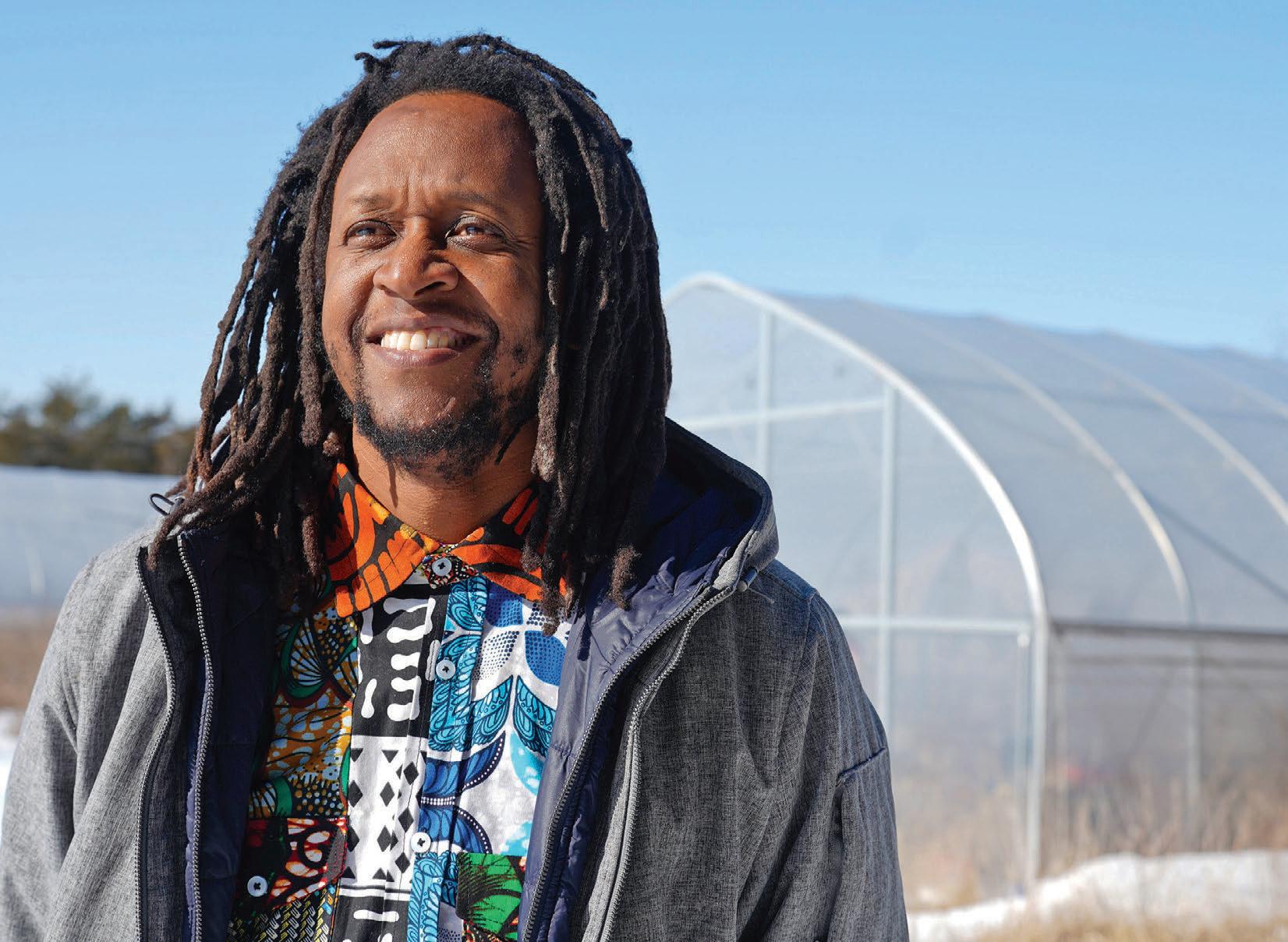
y almost every measure, Michael Carter Jr. is the perfect candidate to kick o Virginia’s new retail marketplace for cannabis.
An 11th-generation Black farmer from Orange County, Carter, 47, is a practitioner of what’s known as Africulture, the plantings and techniques of African-descended farming. He’s a leader in agricultural equity and sustainability, and an educator who teaches at the University of Virginia. In 2019, Carter was one of a thousand or so farmers permi ed to grow commercial hemp a er it was legalized in Virginia.
Carter’s farm is small, roughly 2 acres, and part of a 150acre property that his great-great-grandparents purchased in 1910. It’s one of approximately 1,200 Black-owned farms still operating in Virginia. It’s also one of the reasons thenGov. Ralph Northam tapped Carter in 2020 to serve on the Virginia Marijuana Legalization Work Group.
In the realm of Virginia’s budding, equity-minded marketplace, Carter brings a wealth of knowledge and much-needed know-how. ere’s only one problem: State policymakers don’t seem interested.
“Legislators don’t understand the needs of the farmers when they create these bills,” Carter explains. He recalls that, during a recent trip to Richmond, he found lawmakers knew next to nothing about how cannabis is grown and harvested. “Farmers? No one is looking out for our business interests. ey’re much more concerned about the revenue coming in than having a long-term, successful industry.”
As Virginia prepares to enter a brave new world of cannabis retail sales, one that could generate upward of $100 million in annual tax revenue, Carter’s story serves as a cautionary tale. He’s seen what happens when good intentions go awry, like the ill-fated industrial hemp market introduced seven years ago. “I grew two seasons, 150-200 plants. It was a wise test run, because a lot of farmers still have hemp in their farms,” Carter says. Most struggled to find buyers for nonpsychoactive weed. “ ere was no market available for us.”
Hemp, however, was just the appetizer. After four years of political exile (former Gov. Glenn Youngkin didn’t support legalization and vetoed bills creating a retail market in 2024 and 2025), the long-awaited regulatory
By Scott Bass / Illustration by Richie Pope
structure to establish retail marijuana sales in Virginia is finally within reach. As of press time, the finer details, such as when the market would o cially open — likely Nov. 1 of this year or Jan. 1, 2027 — were still being negotiated.
Regardless, it’s only a ma er of time. With Democrats controlling both houses of the General Assembly and newly elected Gov. Abigail Spanberger having pledged her support, Virginia is set to become the 25th state in the union to fully legalize marijuana.
ere is no magic switch, however. Legalizing weed doesn’t mean consumers will rush in. e illicit market, capitalizing on confusion over Virginia law, is already thriving by o ering easy access to inexpensive cannabis.
While marijuana was decriminalized and possession legalized in 2021 (up to 1 ounce in public, four plants at home), the regulatory structure for selling the plant was not. is le Virginia in limbo, with recreational marijuana legal to consume yet still illegal to purchase.
Ironically, decriminalizing cannabis fueled enormous growth in the illicit market. From 2020 to 2023, the black market for marijuana in the commonwealth grew more than 40%, from $1.8 billion to $2.4 billion, according to New Frontier Data’s U.S. Cannabis Report.
Tobacco and vape shops discovered that many customers had no idea they weren’t supposed to buy marijuana and products laced with THC, the psychoactive ingredient in cannabis. ese shops have proliferated over the last few years, o en stymieing local enforcement, Richmond Police Chief Rick Edwards told City Council last year. In fact, he said at the time, most of the city’s 87 tobacco stores sold illegal cannabis and THC products.
The rise of illicit, unregulated marijuana is the primary reason many advocates want to push up the opening date of a retail marketplace. e sooner the market opens, the sooner Virginia can ensure that safe, third-party-tested cannabis is more readily available to consumers. e illegal stu o en includes dangerous chemical agents, such as pesticides, heavy metals and even fecal ma er, researchers have found.
“In general, when you’re
legalizing cannabis, you’re trying to balance three di erent priorities: safety, a fair market structure and optimizing tax revenue,” says Ngiste Abebe, a Richmond-based cannabis policy expert and co-founder of consulting firm KND Group. Abebe prefers opening the market as soon as July 1 of this year. “Of those three priorities I described, July 1 firmly addresses two — safety and the tax revenue — and it leaves all of the groundwork and does no harm to the third one, which is a fair market.”
When the marketplace will open has long been a sticking point. Some, like Carter, want the state to wait until next year to give the Cannabis Control Authority time to get properly sta ed and its regulatory process in place. With the legislation focused on giving smaller, minority operators a head start, timing is everything. e primary House bill, carried by Del. Paul Krizek, D-Fairfax, calls for awarding up to 100 microbusiness licenses by Oct. 1, a month before the new market would o cially open. A microbusiness license allows smaller operators to cultivate, process and sell their own product.

“ e idea is that the Cannabis Control Authority, which will be the regulator, will start accepting applications for this license right away, with 100 spots open as soon as possible,” Krizek said on Jan. 23 during the first subcommi ee hearing on House Bill 642. “ at will allow the market to get going as quickly as possible.”
Included in early versions of Krizek’s bill and companion legislation in the Virginia Senate carried by Lashrecse Aird, D-Petersburg, are limits on the medical cannabis operators in the state. ere are five medical licenses, one for each of the state’s five health districts, currently operating a total of 23 locations. Under the bills, the larger medical dispensaries would be required to pay a $5 million to $15 million conversion fee to sell adult-use marijuana. Each of the existing medical operators would receive up to eight or nine licenses for cultivating, manufacturing and retail sales. Including the medical operators and microbusinesses, both bills cap the number of cannabis retail stores in the state at 350.
e fee is likely to decrease by the time the final bill is approved, but the policy goal is clear: Restricting the larger medical cannabis operators from

dominating the market is necessary to allow smaller dispensaries to compete.
Prioritizing smaller license holders, however, comes with considerable risk.
“ e medical guys have to come up with [$5 million to $15 million], but everybody else has to at least deploy, you know, $2 million to $3 million just to get their businesses open,” explains Beau Whitney, an economist from Portland, Oregon, who specializes in the cannabis industry.
Because cannabis is still considered a Schedule I narcotic by the federal government, meaning it is deemed to have no accepted medical use and a high propensity for abuse, businesses that sell the drug aren’t allowed to deduct business expenses, according to the IRS. at leads to e ective tax rates of between 50% and 80%.
President Donald Trump’s recent executive order to expedite reclassifying marijuana as Schedule III, which would recognize accepted medical uses for THC and significantly reduce the federal tax rate, likely won’t be in place in time to benefit Virginia’s new cannabusinesses.
In late January, during the 2026 Virginia Cannabis Conference in Richmond, Morgan Fox, political director for the National Organization for the Reform of Marijuana Laws, or NORML, explained that reclassifying cannabis would likely lead to a lengthy court ba le.
“I think the last time that there was litigation involving a petition-scheduling decision, the court cases dragged on for between six and 10 years,” Fox said, “so we might be looking at quite a long wait until cannabis is moved
to Schedule III.”
In the meantime, the taxes will be brutal. In addition to the feds, most states also collect enormous sin taxes on weed sales. As of mid-February, Krizek’s bill called for a tax rate of between 12% and 15%, which is considerably lower than most states but still more than double Virginia’s 5.3% sales tax. And then there’s the high cost of adhering to strict regulatory guidelines, which have yet to be finalized.
New businesses must also contend with the domino e ects of selling a product that the federal government deems illegal and dangerous. Most major banks and credit card companies won’t process transactions involving cannabis, forcing dispensaries to operate as cash-only businesses. Running entirely on cash can make it more di cult to obtain insurance coverage and startup financing. In other words, there aren’t a lot of banks willing to lend money to cannabis entrepreneurs.
“ ere’s very few lenders. And so, as a result of that competition for financing, there’s going to be a lot of risk associated with it,” Whitney explains, “and that’s going to drive up your risk premium, or the percentage of interest that’s charged for those loans.”
Translation: 100 or more new businesses fighting for financing will lead to higher costs and higher debt, which ultimately leads to higher prices. At the same time, deploying too many microbusiness licenses out of the gate may oversaturate the market, Whitney says, leading to more business failures.
In a national survey of cannabis businesses in 2024, Whitney found that just 27% were profitable, with a wide disparity between white (33.7%) and minority (17.5%)
operators. Despite the focus on social equity in many states, minority businesses struggle even more due to systemic barriers, Whitney says, particularly in banking.
Coupled with the current oversaturation in the national market — prices have been falling across the country as supply outstrips demand, which is good for consumers but terrible for businesses — pushing the li le guys to the front of the line could backfire.
“ at’s like throwing those smaller businesses to the wolves,” Whitney says, explaining that microbusinesses, which are easier to deploy because of their smaller footprints, o en have a bigger learning curve. “Usually, microlicenses are ine cient at the beginning. It takes a while for them to ramp up and get up to speed, just like the bigger ones. And, so, you’re forcing the microlicenses to bear a lot of the risk in the start up of the market when you still have high levels of competition from the unregulated market.”
And that’s if you’re one of the lucky ones. A national decline in marijuana sales, down 32% since 2021, according to Cannabis Benchmarks, along with the current oversupply means startup financing is even more di cult to obtain.
“Right now, there’s so much uncertainty in the marketplace that financing is harder to come by. ere’s still money out there, but it’s usually [available] to those that have the greatest creditworthiness. And that’s not a smaller operator, that’s a larger operator,” Whitney says. “ is is tilting the entire market in favor of the larger operators.”
On the heels of the Black Lives Ma er movement, which morphed into a national reckoning on systemic racism a er George Floyd was killed by Minneapolis police in 2020, Virginia’s push to legalize marijuana is rooted in social justice.
at same year, the Joint Legislative Audit and Review Commission, the General Assembly’s research and investigative arm, found that Black and white Virginians consume cannabis at about the same rate, but Black users were 3.5 times more likely to get arrested and 3.9 times more likely to be convicted of marijuana-related o enses.
e push to legalize marijuana, in fact, has as much to do with decriminalization as it does with capitalizing on an emerging market. Virginia can expect more than
“THOSE FIRST INNOVATORS TAKE SOME OF THE RISK. … BUT PROTECTING US FROM FAILURE IS NOT ALLOWING US TO GROW FROM OUR MISTAKES.”
—MICHAEL CARTER JR., FARMER AND PROSPECTIVE MARIJUANA GROWER
$400 million in tax revenue from cannabis sales in the first five years, Krizek said last year, but his bill, devised a er several years of study, meetings and input from community stakeholders, is really about providing a pathway to “restorative justice.”
Figuratively and literally: Like other states, including New York, both Krizek’s and Aird’s bills prioritize cannabis license applicants from disenfranchised communities, so much so that marijuana convictions are actually among the qualifications for new applicants.
To help the social equity license holders get o the ground and stay in business, both bills would also funnel 60% of marijuana tax revenues into a Cannabis Equity Reinvestment Fund, being created to support “persons, families, and communities historically and disproportionately targeted and a ected by drug enforcement,” in addition to providing new scholarship opportunities, grants for workforce development, and job training to those historically disadvantaged by drug abuse and the so-called “war on drugs.” e percentage may change in final negotiations.
Paul McLean, founder of the Virginia Minority Cannabis Coalition, a nonprofit that promotes economic empowerment and provides training for entrepreneurs in the marijuana industry, says the biggest challenge might be who’s calling the shots.
“ ere’s too many people that don’t really understand how the cannabis economy works, so they just dig into wanting what they want,” McLean says, adding that it’s be er to let the market grow organically and adjust and
pivot as it changes. In addition, he says, there should be “multiple lanes” for di erent types of cannabis businesses, including the larger medical and big-box-style operators.
McLean says prioritizing small operators is the right strategy because of their flexibility and ability to respond to local cannabis consumers, typically a finnicky lot. “You cannot have success in this industry without the small businesses,” he says, adding that it won’t be easy. “ e bulk of the people that would want to pursue those 100 microlicenses, … they’re never going to get to that point because they’re going to get so frustrated just trying to get good at ge ing the business set up, because there’s a clock ticking.”
e brutal reality, says Ngiste, the policy consultant, is that operators from marginalized communities must overcome bigger obstacles than most. e new bills a empt to address this by establishing a business loan fund specifically for disadvantaged licensees.
But that alone won’t be enough, Ngiste says. “I think one of the things that we get excited about in cannabis is supporting and fixing past wrongs, but we have to remember that, at the end of the day, it’s still a business. e cannabis industry is di cult, … [it’s] especially hard in these current economic times, and even more hard for people from marginalized communities. A cannabis program can do its absolute best to address and minimize these risks, but it is still going to be really, really hard.”
Still, both Ngiste and McLean like the overall approach that Virginia is taking. e delay in se ing up the retail marketplace might have allowed the illegal market to flourish, but it gave Virginia lawmakers time to dig into the particulars and incorporate lessons learned from other states. For example, keeping the tax rate at roughly 12% to 15% is almost universally lauded as one of the best ways to keep prices in check; it’s also within the price di erential that most consumers are willing to pay to shi from illicit to regulated weed, Whitney says. Too many states made the mistake of overtaxing marijuana.
For Carter, the farmer from Orange, all he wants is a fair shot and the same advantages that everyone else has access to.
“Most farmers already know how challenging it is,” he says. “You risk every season, so we’re used to loss. We have crop failures, we’ve had commodity prices go up and down. If you want to make sure that we’re successful, you have to work with us.”
Carter is planning to apply for a microbusiness license, and he would prefer to be at the starting gate for this new industry — whenever the market opens.
“ ose first innovators take some of the risk. ey may even create a faulty crop,” he says. “But protecting us from failure is not allowing us to grow from our mistakes.” R





e Steward Summer Experience
More than 100 camps, including academics, arts, innovation and sports. Full-day or half-day options. Grades JK-12. 11600 Gayton Road; 804740-3394; stewardschool.org
Summer Camp at Lourdes
Full- and half-day camps hosted by Our Lady of Lourdes Catholic School featuring sports, arts, humanities, science and more. Grades K-5. 8250 Woodman Road; 804-262-1270; lourdesrva.org
*Summer School at Fork Union Military Academy
A nonmilitary program of leadership and athletic activities for boys, including a father-son weekend. Boarding and day options. Grades 7-12. 4744 James Madison Highway, Fork Union; 434-842-4205; forkunion.com
Summer Spectacular Camps
Programs at St. Michael’s Episcopal School teach STEAM concepts including coding and engineering; sports; baking; and outdoor activities. Half-day and full-day options. Ages 4-14. 10510 Hobby Hill Road; 804-272-3514; stmschool.net
Trinity Summer Discovery Program
Weekly day camps in sports, music, art and academic enrichment. Grades 1-12. 3850 Pittaway Drive; 804-272-5864; trinityes.org
YMCA of Greater Richmond Branch locations o er full-day camps, specialty and sports camps. Ages 2-13. 804-649-9622; ymcarichmond.org
SPORTS & ADVENTURE
Benedictine College Preparatory Summer Athletic Camps
Programs in basketball, wrestling, football and soccer for boys. Grades rising 5-9. 12829 River Road; 804-708-9610; benedictinecollegeprep.org
Golf Camp at Magnolia Green Golf Club
Full- and half-day camps with coach Leighann Albaugh; spring break camp and several oneweek summer camp sessions o ered. Ages 4-15. 7001 Awesome Drive, Moseley; 804-639-5701; magnoliagreengolfclub.com
James River Association Summer Camps and Expeditions
Half- and full-day camps immerse kids in paddling, fishing, river science and nature play to build water skills, confidence and conservation awareness on the James River with expert instructors. Ages 5-18. James A Buzzard River Education Center, 2825 Dock St.; camps@ thejamesriver.org; thejamesriver.org/camps
Level Green Riding School
Spring and weeklong summer day camp riding program open to all skill levels. Ages 7-16. 3350 John Tree Hill Road, Powhatan; 804-794-8463; levelgreenriding.com
Martial Arts of West End Summer Camp
Martial arts lessons from expert instructors with an emphasis on fitness, positive praise and encouragement, and leadership skills. All ages. 10454 Ridgefield Parkway; 804-673-5200; mawestend.com
Own Touch Summer Camps
A di erent soccer and futsal camp each week for beginner, intermediate and advanced soccer players. Ages 7-14. 2101 Maywill St.; 804-7741390; owntouchcentral.com
Passages Adventure Camp
Day camps include climbing, kayaking, zip lining, river swims, mountain biking and more. All gear provided. Ages 5-17. Locations in Richmond and Midlothian; 804-897-8283, ext. 310; passagesrva.com
Richmond Ice Zone
Basic skating skills camp. Ages 5-12. 636 Johnston-Willis Drive, North Chesterfield; 804-
378-7465; richmondskating.com
Richmond United Summer Camps
Day camps for all skill levels teaching soccer skills. Ages 6-19. Locations vary. richmondunited. com/camps
Richmond Volleyball Club
Volleyball camps for all skill levels. Grades 5-12. 2921 Byrdhill Road, Henrico, and 200 Karl Linn Drive, North Chesterfield; 804-358-3000; rvc. net/camps
Riverside Outfi ers
Day camps focusing on outdoor adventure at various locations. Ages 6-16. 325 S. 14th St.; 804560-0068; riversideoutfitters.net
Robins Junior Golf
Summer golf camp held at Independence Golf Club. Full- and half-day options. Ages 5-14. 600 Founders Bridge Blvd.; 804-601-8612; independencegolfclub.com
RVA Paddlesports Pipeline Adventure Camp
Weeklong summer adventure camp on the James River includes kayaking, rafting, rock climbing, stand-up paddleboarding and swimming. Ages 9-14. 1511 Brook Road; 804898-0697; rvapaddlesports.com
Saint Gertrude High School Summer Athletic Camps Sports camps in strength and conditioning, volleyball, basketball, field hockey, and softball. Girls grades rising 1-9. 12829 River Road; 804708-9610; saintgertrude.org
SkateNation Plus
Basic skating lessons, hockey and figure skating. Eight-week sessions. All ages. 4350 Pouncey Tract Road; 804-364-1477; richmondskating. com/skp
Sports Center of Richmond (SCOR)
Full- and half-day sports and soccer camps. Ages 3-13. 1385 Overbrook Road; 804-257-7267; scor-richmond.com
SwimRVA Camps
General and specific skills-based camps feature water safety, team-building, fitness programming, water sports and more at locations in Richmond and North Chesterfield. Ages 6-15. 5050 Ridgedale Parkway; 804-2718271; swimrichmond.org
University of Richmond Spiders Sports Camps
A wide range of sports camps, including baseball, football, basketball and field hockey. Ages 5-17. richmondspiderscamps@richmond.edu; richmondspiderscamps.com
VCU Sports Camps
Basketball, soccer, field hockey, baseball and volleyball camps. Ages 8 and up. 1200 W. Broad St.; 804-828-4000; vcuathletics.com
*Virginia Outside Mountain biking, fishing, fly fishing, water activities and outside adventure. Ages 7-14. Multiple locations; 804-272-6362; virginiaoutside.com
XL Sports World
Multi-sport camps with full- and half-day sessions. Ages 5-12. 2300 Oak Lake Blvd., Midlothian; 804-744-4600; xlrichmond.com
ARTS & HUMANITIES
ArtVenture Summer Camp
Classes at the Visual Arts Center of Richmond. Ages 5-14. 1812 W. Main St.; 804-353-0094; visarts.org
Bella Ballerina
Storybook and fairytale-themed dance classes. Ages 3-8. Locations in Chesterfield and Short Pump; 804-601-6993; bellaballerinarva.com
Cadence Camps Jammin’ 2026 Weeklong full-day camps in contemporary
theater, culminating in a musical performance. Ages 6 to rising ninth grade. Half-day mini programs for ages 4-5. Held at Midlothian Middle School and Maggie L. Walker Governor’s School; 804-233-4894; cadencetheatre.org/ jammin2026
Camp ComedySportz
Day camps on improvisation and collaboration, basic acting, and sketches. Grades rising 2-12. 8906-H W. Broad St.; 804-266-9377; cszrichmond.com
Camp Half-Blood
Campers explore the myths of di erent cultures around the globe, from the story of Zeus to tales of Eastern deities. Grades 2-8. Forest Hill Park, 4021 Forest Hill Ave.; 929-397-9393; mythikcamps.com
CharacterWorks
Day camps in musical theater production, performance and more. Ages 6-18. 2216 Perl Road; 833-296-7571; cworkstheater.org
e Cultural Arts Center at Glen Allen
Camps and programs that allow children to flourish in the performing and visual arts. Summer and private classes are also available. Ages 7-15. 2880 Mountain Road; 804-261-2787; artsglenallen.com
Greater Richmond School of Music
Summer music camps for beginner to advanced levels, including piano, guitar fundamentals, chorus, musical theater and more. Grades JK-12. Camps held at 9109 Dickey Dr., Atlee, and St. Christopher’s School, 711 St. Christopher’s Road; 804-442-6158; grsm.net
*GreenSpring Summer Music Institutes
Intensive instruction in a variety of instruments at all skill levels. Ages 8-18. 4101 Grove Ave.; 804353-7001; greenspringmusic.org
Latin Ballet of Virginia Arts in Education Summer Day Camp
Full- and half-day camps help students connect dance forms to language and culture. Ages 4-13. The Cultural Arts Center at Glen Allen, 2880 Mountain Road; 804-356-3876; latinballet.com/camp
Marianne Kelley’s School of Dance
Dance instruction in ballet, mixed dance (jazz, hip hop, modern, etc.) and “Nutcracker” choreography. Ages 3 and up. 1807 Huguenot Road, Suite 115; 804-292-5917; mksdance.com
e Music Tree
Three one-week summer camps include various musical activities and conclude with a performance. Ages 6-13. 3046 Stony Point Road; 804-571-1973; themusictreeschool.com
Patrick Henry’s Scotchtown Kids Day Camp
Three-day history camp with archaeology, 18thcentury food and traditional camp activities. Ages 11-14. Scotchtown, 16120 Chiswell Lane, Beaverdam; preservationvirginia.org
Puppets O Broad Street RVA Circus Arts Camp
A four-day camp teaching puppetry, juggling, aerial silks, masks and more. Ages 9-15. P.O. Box 26366; 804-358-3377; puppetso broadstreet.org
Richmond Young Writers
Creative writing camps on various genres and topics, plus author appearances, one-day experiences, activities such as virtual D&D, and more. Ages 9-18. 2707 W. Cary St.; 804-2505022; richmondyoungwriters.com
School of Rock
Jam out on guitar, bass, keys or drums; work on vocal skills; or explore songwriting. Seven unique camps; no experience needed. Ages 5-18. 4300 Pouncey Tract Road, Suite G, Glen Allen; 804212-3900; schoolofrock.com

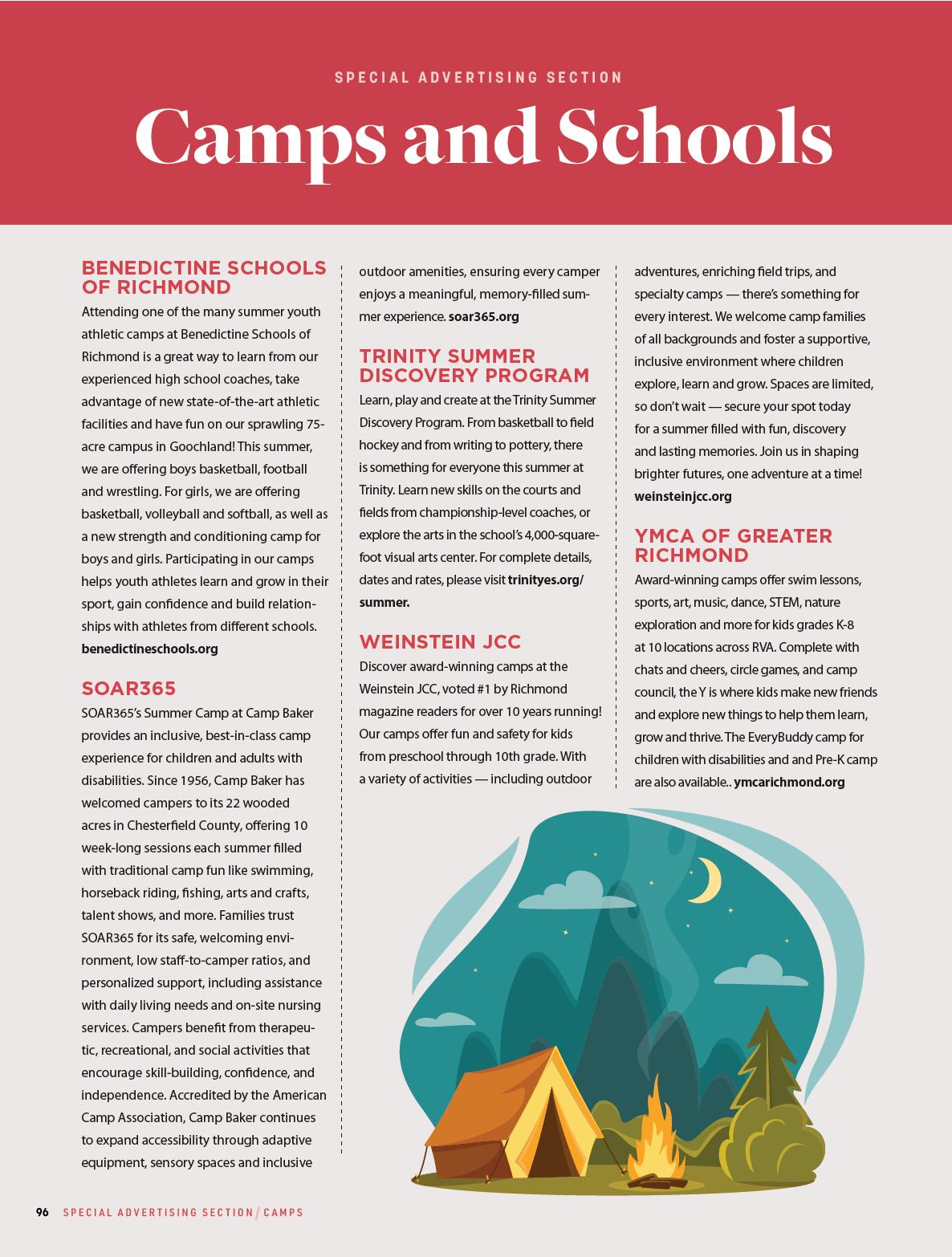



Meet Chris Lambton of DIY Network, Discovery Plus and HGTV. Chris hosts DIY Network’s “Lawn and Order” and “Yard Crashers,” is a judge on Discovery Plus’s “Clipped,” and appears with his wife on HGTV’s “Going Yard.” He will be on the Fresh Ideas Stage presented by JDS Bath on Friday, March 6, at 4 p.m. and Saturday, March 7, at 12 p.m.
Learn valuable tips from Tamara Day of Magnolia Network, DIY and HGTV. The designer and host of HGTV’s “Bargain Mansions” will be on the Fresh Ideas Stage presented by JDS Bath on Saturday, March 7, at 3 p.m. and Sunday, March 8, at 1 p.m.
Stroll through two Feature Gardens presented by Ashland Berry Farm in Building 4 and Schultz Lawnscapes in Building 3.
New this year! Check out the goats in Building 4 from RVA Goats.
Shop The Marketplace for a variety of items, from tasty treats to unique home decor.
Take a break in the Coffee & Music Lounge with live music and a tasty creation from Coalesce Coffee.
Plus, much more!












Floor Coverings International offers thousands of options — and peace of mind

WHILE THE DAYS OF MILLENNIAL GREY and white subway tile haven’t gone away, Laura and Stephanie Rebling, the owners of AKB Kitchen, Bath & More, say color is coming back in a big way in both the kitchen and bathrooms.
“We’re seeing a lot more people go with medium to darker woods, bold colors, texture and patterns,” Stephanie says. “Color has made a comeback — lots of warm colors, like cabernet red, along with organic and neutral colors. People are getting more creative and want to make the kitchen feel like an artsy space.”
Beyond aesthetics, Laura says, AKB can help solve common space challenges, such as a lack of storage or an inefficient layout. “Our design team is really good at figuring out the best use of space,” she says. “We
“ MOSTPEOPLEDON ’ TREALIZETHIS , BUT there are hundreds of thousands of different flooring types,” says Shaun Mealy, the president and owner of Floor Coverings International of North Richmond. “To narrow that down is a true process, and it really helps to have somebody who’s experienced and knowledgeable to guide you.”
The company offers a range of carpet, wood, tile, laminate and vinyl options. Mealy says hardwoods are always a classic choice, particularly in Richmond’s older homes. He’s also seeing hardwood floors in new builds, but with a modern twist. “We still do a ton of 2 1/4-inch planks, especially when we’re patching existing floors,” he says, “but more people are looking for 5-, 6- even 7-inch-wide planks.”
The team helps clients identify the best flooring options for their lifestyle. For example, Mealy says, FCI has several new lines of carpet and luxury vinyl planking with added protection against pet messes and damage. “There are carpets with stain
protection where spills just bubble up and sit on top of the surface,” he says. “And while some LVP scratches easily, we have some options with an extra layer of finish that is more resistant.”
FCI offers additional benefits that make choosing and installing new flooring easier for homeowners. To help customers understand their options and find the right fit, FCI has a mobile showroom that can bring 3,000 samples directly to the homeowner. The company’s installation crew moves heavy furniture; homeowners just need to clear out smaller items. And FCI’s warranty offers extended coverage compared to industry standards.
“We stand behind what we do,” Mealy says. “We’re not the cheapest company out there, but we go above and beyond, and we have more knowledge. Having somebody with our experience is like an insurance policy that it’s going to be done properly.” —KC
maximize what we can to make a space that’s comfortable and [easy to use].”
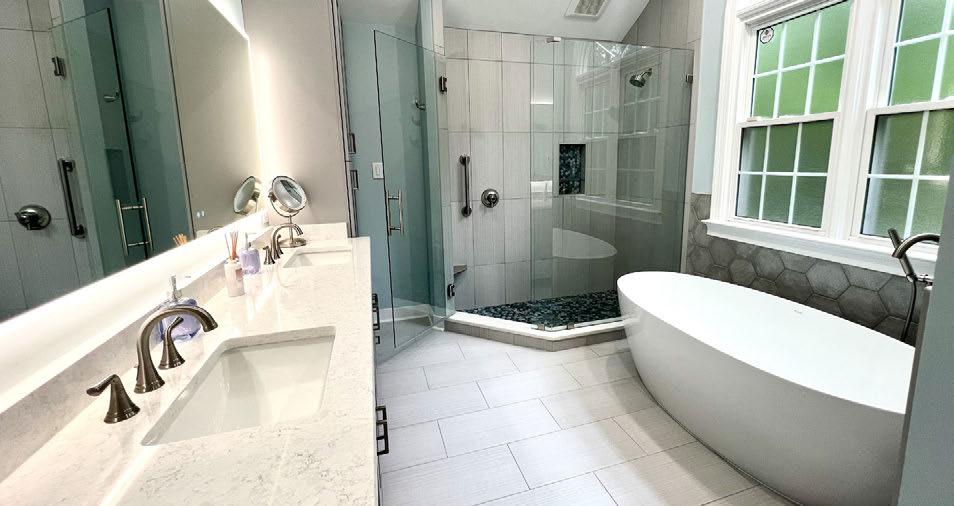
In the bathroom, Stephanie says, customers are looking to create a spa-like environment with luxurious marble and stone and cool colors. For one recent client, AKB designed an oversized shower with angled green tile and a hand shower on a slide bar. The bench seat, accents and cascading shelves matched the countertop stone for a cohesive look. “Niches are great inside a shower, but building a shelf
across a back or side wall can feel like an upgrade,” Stephanie says.
While updating the kitchen and bathroom can offer a strong return for those looking to sell, Laura says, homeowners who plan to stay long-term should focus more on what they like rather than what’s trending. “Put your money into a design that you want,” Laura says. “Make it what you want, not what someone else is going to want. Because 10 years, 15 years down the road, trends might change.” —KC