BAMBOO’S LAST STAND
The invasive, all-consuming plant is suddenly dying off. Why?
By D. Hunter Reardon
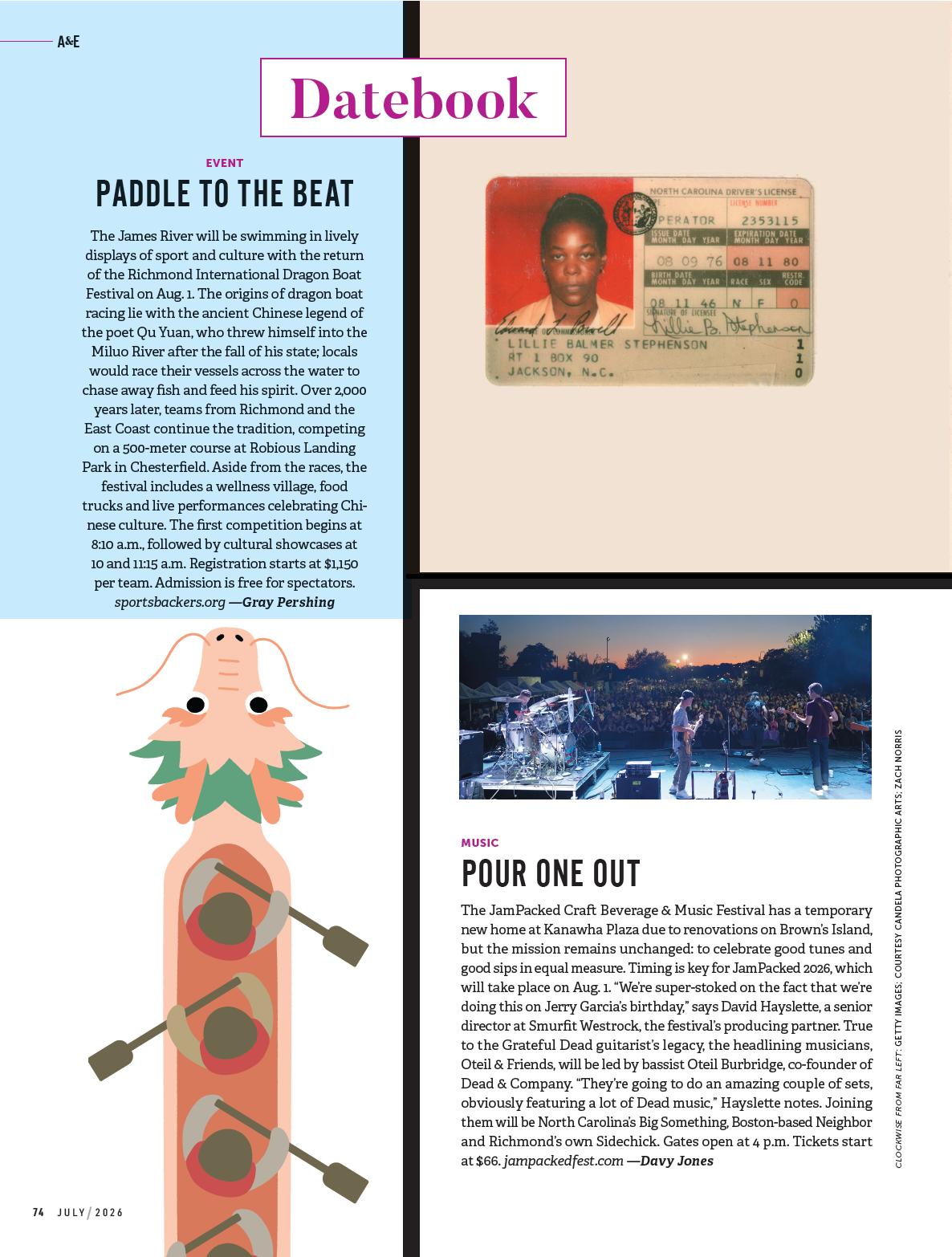
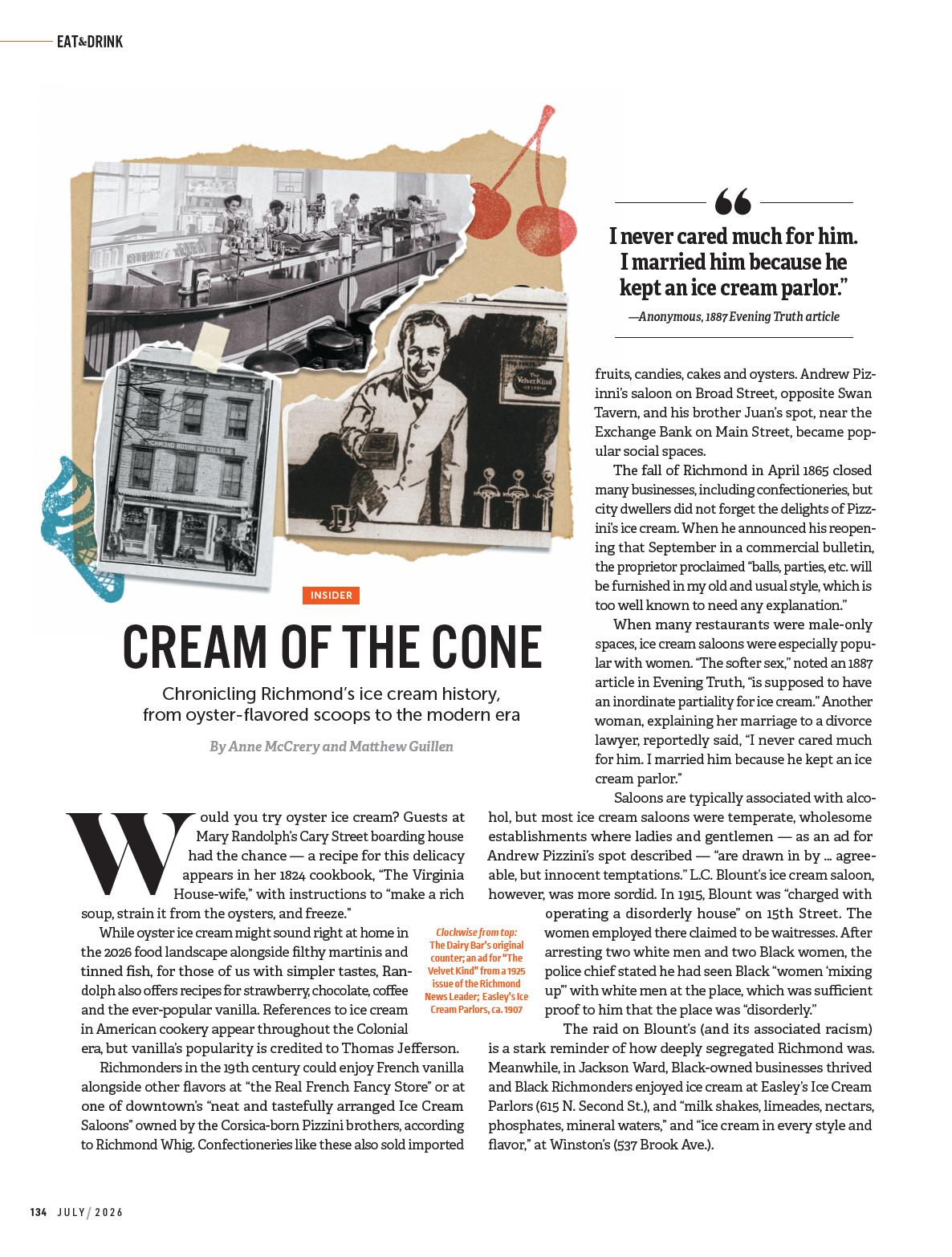
Michael Byrne, a resident of Stratford Hills in southwest Richmond, has been battling a bamboo grove in his backyard since 1996.
“My house backs up to Rattlesnake Creek, which is basically 30 acres of undeveloped wetland,” Byrne says. “You walk through there, and it’s so thick with bamboo you can’t see 3 feet away. It’s like being in southeast Asia.”
Bamboo native to Asia was first introduced to the United States in 1882 as an ornamental plant and quickly spread throughout the Mid-Atlantic and Southeast. For 30 years, Byrne and his neighbors have fought what he calls a “losing battle” with the invasive species.
“It can grow through concrete, through asphalt. During growing season, you can measure it by the hour. And to get rid of it, you have to get big equipment and dig down 2 feet,” he says. “If you cut down the stalks, it’s like the movie ‘Alien’ — it just gets stronger.”
Then in mid-March, something unexpected happened: The bamboo in his backyard began to turn brown and die. “I thought it was because of the drought or because we had a really cold winter,” he says.
The real reason is part of a deeper trend in the life cycle of bamboo stands across the state.
The species of bamboo that has bedded down in Virginia is Phyllostachys aurea, or “fishpole bamboo,” which flowers roughly every 35 years. When the bamboo stalks flower, all of the plant’s energy goes into producing that flower; its leaves drop, no new leaves form and the mother plant usually dies.
John Hayden, a biology professor at
the University of Richmond, says that the process often occurs simultaneously in a geographic region. “The idea is that by flowering all at once — using decades’ worth of stored food reserves and flowering in a massive and coordinated way — there is no possibility that birds and small mammals could possibly consume, completely, the tremendous number of seeds produced,” Hayden explains.
“Predators eat all the seeds they can,” he says, “but there are always seeds left unconsumed that then have the opportunity to germinate and start a new colony.”
Hayden says it is difficult to know for sure whether the new seeds will be successful — or even whether the mother plants will die, although it is likely.
“There is a clump on Route 60 in Powhatan that I drive past rather frequently that flowered two years ago. That clump is mostly dead,” he says. “But there are a few short, green shoots at the periphery of the clump — so perhaps some small fraction of that clump will persist.”
To be absolutely certain that bamboo is eliminated, Hayden says, wait until the end of the flowering season to cut down the stalks. This ensures that the plant’s food resources have been fully spent.
Bamboo’s dense underground root system — the plant’s rhizome stems and roots grow laterally — should be greatly weakened at the end of the flowering season, Hayden adds. If there are any signs of life, the rhizomes should be destroyed, too.
For Byrne, the sudden flowering of his bamboo means a surprise victory in a territorial war he has been slowly losing for decades. “I’m ecstatic,” he says. “I don’t know what I’m going to do with an acre of dead bamboo. It’s a problem I never thought I would have.” R
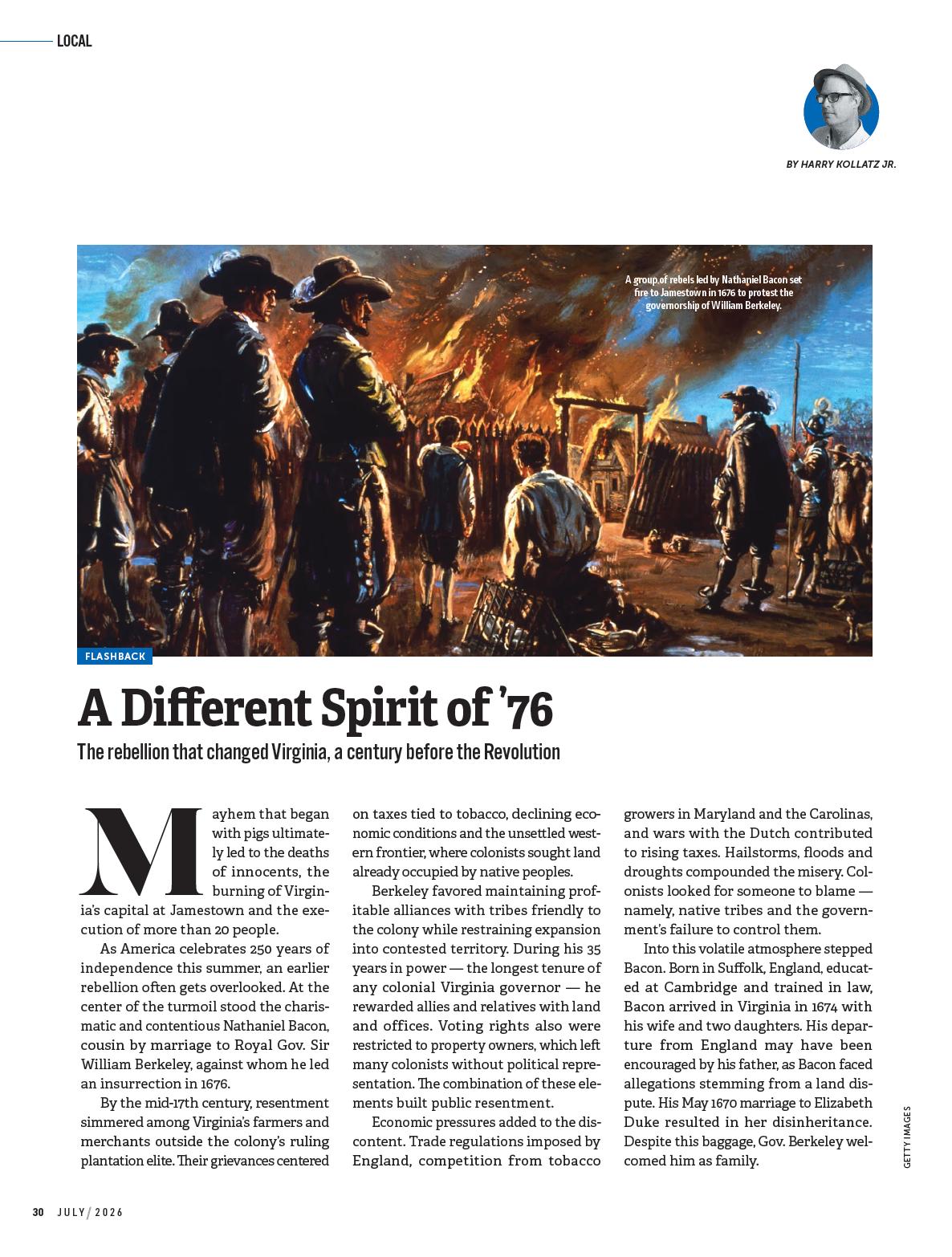
Berkeley appointed Bacon to the Council of State and granted him land, including 820 acres at Curles Neck in present-day Henrico County. Bacon also acquired a plantation and maintained a trading post near Bacon’s Quarter Branch, a stream that later marked Richmond’s northern boundary. The site is near present-day West Bacon Street.
Bacon partnered with the ambitious trader William Byrd, whose operations at the Falls of the James generated wealth through commerce with the tribes, tobacco farming, land speculation, and the importation of indentured servants and enslaved Africans. Berkeley’s own interests in the beaver pelt trade competed directly with those of Bacon and Byrd.
The crisis erupted in July 1675 on the Northern Neck plantation of Thomas Mathew. Members of the Doeg tribe, reportedly seeking compensation for unpaid goods, seized some of Mathew’s pigs. Violence followed, and several Doegs died.
Outraged colonists demanded retaliation. A Virginia militia instead attacked a group of Susquehannocks, killing 14 people who had no connection to the dispute. The Susquehannocks, themselves displaced from Pennsylvania, fought back and frontier violence ensued.
Berkeley sought restraint and diplomacy. Bacon preferred war. As he later wrote, his aim was “to ruin and extirpate all Indians in General.”
In September 1675, Bacon accused friendly Appamatuck Indians of stealing corn. Berkeley rebuked him for the action. The following spring, the General Assembly met in Jamestown to address frontier security while preserving relations with allied tribes. Plans included a chain of frontier forts and a temporary suspension of trade.
Then, an attack on Bacon’s trading post killed an overseer. Bacon demanded authorization to lead a punitive
expedition, but Berkeley refused.
Bacon recruited roughly 150 followers anyhow, including farmers, free Black people and indentured servants, gathering them near Bacon’s Quarter Branch. Encouraged by Byrd, he initiated unauthorized attacks against native groups.
Berkeley responded by removing Bacon from the Council and publicly denouncing him as a rebel. The governor offered pardons to Bacon’s followers if they returned home and called for elections to a new House of Burgesses.
The conflict instead widened. Bacon manipulated the Occaneechi tribe into helping him attack Susquehannocks. When the alliance collapsed, Bacon’s men massacred the Occaneechi chief and several hundred men, women and children. Berkeley again declared Bacon an outlaw.
The governor’s denunciation galvanized Bacon and his supporters. Henrico County voters, some under the influence of violence or alcohol, elected him and his ally James Crewes as burgesses. Arriving in Jamestown accompanied by armed followers, Bacon was arrested and appeared before Berkeley. He knelt and requested forgiveness.
The governor pardoned him and restored his seat. Yet when Bacon insisted on a commission to wage war on the tribes, Berkeley withdrew his prior agreement.
So, Bacon fled to Henrico. On June 23, 1676, he returned to Jamestown with some 500 people eager to fight. Berkeley, age 70 at the time, stood in the doorway of the statehouse, opened his shirt and dared Bacon to shoot him.
Bacon did not fire, but Berkeley yielded. Charges were dropped and the House of Burgesses passed a series of reforms later known as “Bacon’s Laws,” including restoration of voting rights to landless white men.
The awkward truce failed. The governor withdrew to the Eastern Shore, while
Bacon established headquarters at Middle Plantation, today’s Williamsburg.
On July 30, 1676, Bacon issued his “Declaration in the Name of the People,” condemning unfair taxation, political exclusion and Berkeley’s alleged corruption. He accused the governor of failing to protect settlers from attacks and signed the document, “Nathaniell Bacon Generall, by Consent of the People.”
In August, prominent Virginians called for a new assembly under Bacon’s authority. Berkeley returned to Jamestown. Bacon’s force occupied Berkeley’s nearby Green Spring estate before marching on the capital. After a siege and stalemate, Berkeley’s group departed Jamestown by boat on Sept. 18, 1676.
Bacon realized he could neither defend nor abandon the place. He instead burned Jamestown to the ground. He died a month later, on Oct. 26, 1676, at Gloucester Hall plantation.
Berkeley, his reputation in tatters, returned to England. William Byrd, who first encouraged Bacon toward conflict, successfully distanced himself from the rebellion and rose within Virginia’s colonial establishment.
“Bacon’s Laws” were repealed, but his legacy remains. In 1916, the National Society of The Colonial Dames of America in Virginia honored Bacon with a plaque in the Virginia House of Delegates. The United Daughters of the Confederacy also that year dubbed him “the First American Rebel.”
Yet Bacon’s motives and his significance are debated. As scholar Brent Tarter observes in Encyclopedia Virginia, Bacon’s Rebellion brought closer English supervision of Virginia and sped the colony’s reliance on enslaved labor. More than three centuries later, “Bacon’s Rebellion” remains one of the most important — and controversial — episodes in Virginia history. R
in periodontics, and they look forward to having the opportunity to provide your care. They welcome new patients to their practice. For more information, call 804-355-6593 or visit richmondperioonline.com.
RICHMOND PEDIATRIC DENTISTRY & ORTHODONTICS
Experience the future of orthodontics at RPDO Orthodontics, where cutting-edge technology transforms every smile. Our expert orthodontists, Dr. Kevin Bibona and Dr. Payton Cook, use the latest digital imaging, 3D scanning and AI-enhanced treatment planning to deliver exceptional precision and comfort. With modern options like clear aligners and advanced braces, we create more efficient and beautifully predictable results for children, teens and adults. Families love our seamless, tech-forward approach that makes treatment easier, clearer and more enjoyable. At RPDO, innovation meets compassion — helping every patient achieve a confident, healthy smile with the most modern tools available. RPDO.com
RIVER RUN DENTAL SPA
Celebrating 20 years of service, River Run Dental is one of Virginia’s most trusted dental practices with seven locations
serving patients across the commonwealth. Known for combining advanced dental care with a spa-like experience, River Run prioritizes patient comfort at every visit through thoughtful amenities, modern technology and personalized treatment plans. Serving children, teens and adults, River Run Dental offers comprehensive dental services tailored to each patient’s unique needs and smile goals. Whether seeking routine care or cosmetic treatment, patients can expect exceptional care in a welcoming, stress-free environment. Visit riverrundentalspa.com to learn more.
VIRGINIA FAMILY DENTISTRY
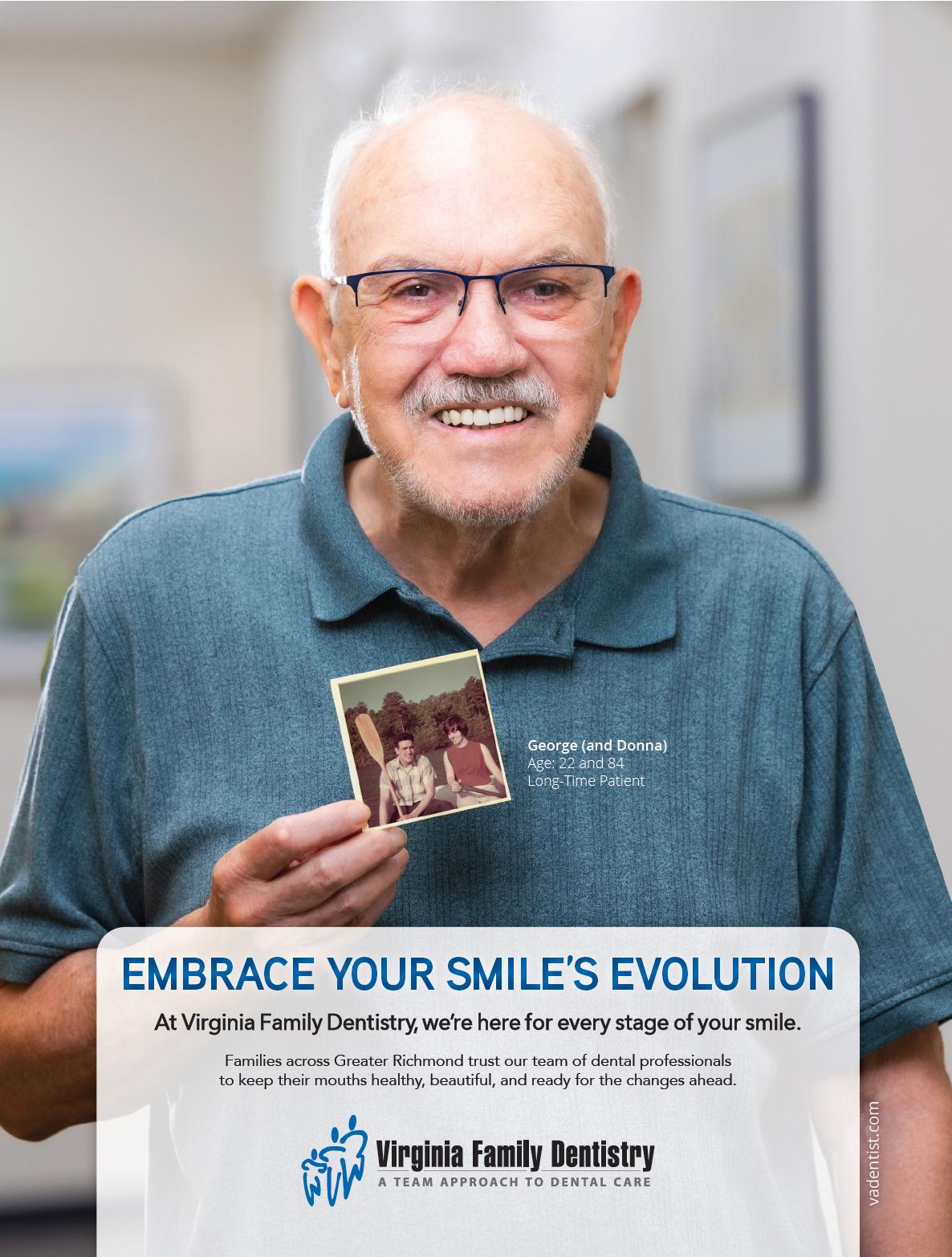
Celebrating over 50 years in business, Virginia Family Dentistry has served the Richmond area since 1974. Our doctor-owned practice consists of 17 locations and over 70 general dentists and specialists, including orthodontists, periodontists, prosthodontists, endodontists and pediatric dentists. We provide comprehensive care for lifelong patients, and with a dedicated team of over 400 dental professionals and staff, we proudly support generations of families across Central Virginia. Our commitment to excellence and personalized care remains as strong as ever. Discover the difference 50 years of trusted service makes by visiting vadentist.com.
VIRGINIA ORAL & FACIAL SURGERY
For over 40 years, the goal at VOFS has always been simple: to bring excellence in oral and maxillofacial surgery to the greater Richmond community. Drs. Keeney, Harris, Dymon, Wlodawsky, Watson, Agnihotri, Wheeler, Phelps, Herrera and Gardner are dedicated to patient safety, predictable outcomes and great communication. We are specialists of the face and focus on procedures like dental implants, wisdom teeth, bone grafts, facial reconstruction, sedation and much more! We are now excited to offer a same-day surgery consultation for your convenience. Visit oralfacialsurgery.com
DR. GLORIA WARD
Dr. Gloria Ward earned her first D.D.S. and Master of Science Degree in Periodontal Prosthesis from CES University in Colombia, South America. She moved to Virginia in 1999 and obtained a Master of Science in Dental Materials and later earned her second D.D.S. degree from VCU in 2003. Her practice mainly focuses on dentures, implant restorations and cosmetics. Dr. Ward is certified in oral conscious sedation and speaks Spanish fluently. She also has a special interest in sleep apnea. Visit advanceddentistryva.com or call 804-270-7940 to learn more.
Rolling on the River
Whitewater guides help Richmonders enjoy an urban natural wonder
By D. Hunter Reardon
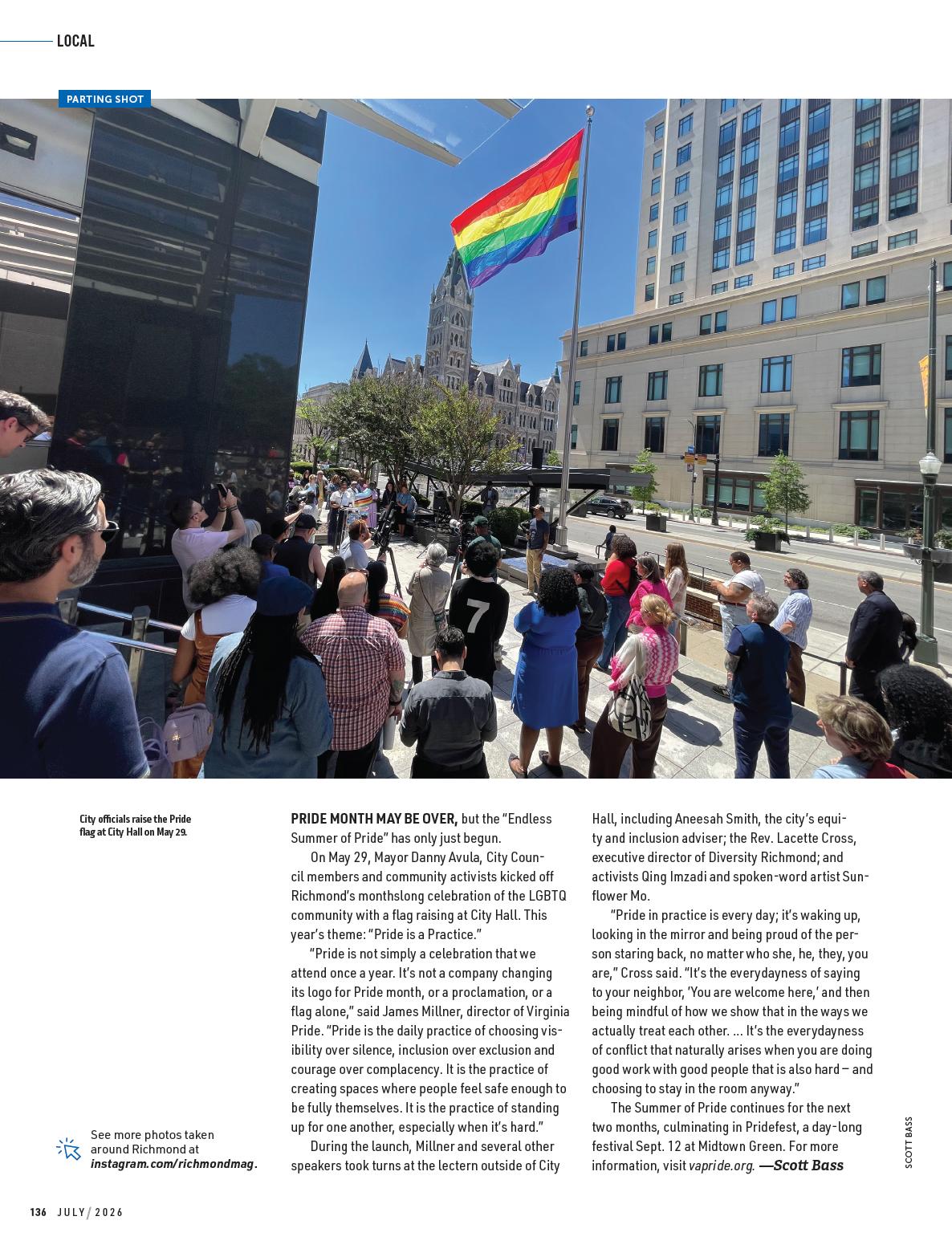
There aren’t many places in the world where Class III and IV whitewater rapids run through a bustling downtown. In fact, according to National Geographic, Richmond is the only such place in the United States.
“Most people expect a fun day on the river, doing something they don’t normally do,” says Matt Perry, owner
of the Richmond-based Riverside Outfitters. “What they don’t expect, even though they’ve read about it, is to be in big whitewater in the middle of the city.”
Perry calls out the popular route from Boulevard Bridge to 14th Street as a good example of the city’s unique selling point for the sport. “You start off in a pretty forested setting. Then, you turn the corner at Belle Isle, there’s the city skyline and big whitewater, and people are like, ‘What?!’”
Riverside Outfitters is among the businesses that run guided rafting and kayaking trips through downtown and farther out on the James. Another is RVA Paddlesports, which was founded in 2014 to take advantage of the natural features that the Fall Line provides.
Kayakers and rafters flock to these rare rapids year-round, creating a culture that suits all experience levels, even more demanding whitewater trips. “Just be a good listener — our guides will tell you what to do,” Perry says. “Just plan
on getting wet.”
Riverside Outfitters and RVA Paddlesports offer kayaking and rafting; both vessels can navigate all classes of rapids, although kayaks are typically paddled individually or in pairs, while rafts are steered collaboratively by teams of six or more.
At certain water levels — measured multiple times a day at the Westham gauge near the Huguenot Bridge — trips may be canceled or moved upriver away from the splash zone (where the rapids reach Class III-IV). Perry says the Riverside Outfitters cutoff is a depth of 11 feet; the RVA Paddlesports cutoff is 15 feet.
The juxtaposition of the city and the wild river is a unique opportunity to get away without going too far, says RVA Paddlesports owner Patrick Griffin. “The escape to nature is the key thing for a lot of people,” Griffin says. “As for the thrill? Well, it depends on who you ask. But everyone enjoys getting out on the water.” R