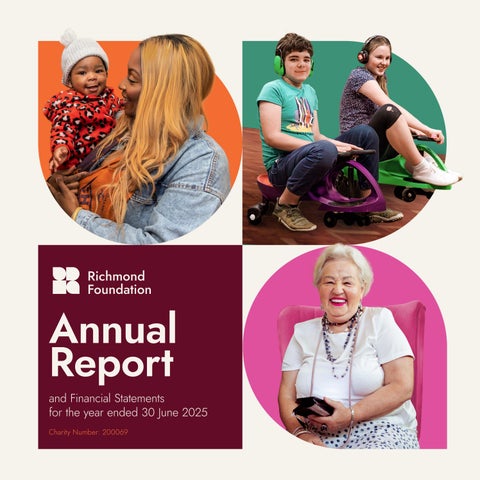
Report and Financial Statements for the year ended 30 June 2025
Charity Number: 200069
Front Cover Photos: Homestart Richmond and Hounslow, TAG Youth Club, Ukrainian Social Club
We are an independent charitable foundation that has existed in Richmond since 1786.
Our substantial financial endowment allows us to support local residents through our grant making to individuals and organisations, and through our subsidised housing.
Our vision is that everyone in Richmond has opportunities to build healthy and fulfilling lives.
Our mission is to be a trusted and collaborative partner, embracing bold ideas and responding flexibly to change.
Our partnership projects ensure Richmond’s residents can access high quality support and have fair access to opportunities
Our vision, mission and values
Multicultural Richmond
Future Leaders Launch: Phil & Sarah Narrowing the Gap Partnership
OUR VALUES Integrity Excellence
Collaborative Agile
Ambitious
We are a trusted partner and do what we say we will
We are experts in our field and actively share good practice
We embrace partnership working and make a collective impact with our partners
We are flexible and responsive to changing needs
We support innovative ideas and practice
An introduction from our Chair and CEO
The last three years have marked an important transition for the charity. We were excited to reveal our new name Richmond Foundation at our Annual General Meeting in November 2024. Our name reflects our dynamic and inclusive vision for the future. Our refreshed identity is built on our core values and reinforces our commitment to collaboration, innovation, and amplifying our impact.
Over the past year, we have both made it a priority to get out and visit our partners. We have enjoyed and benefitted greatly from meeting colleagues across the sector and the people that they are supporting. Richmond is fortunate to have a vibrant mix of charities and social enterprises, each providing innovative approaches to address community challenges.
We have continued to provide core and project funding to long-term partners while also awarding five new Gateway grants. In this report
we showcase our funded partners with case studies, spotlights and some fantastic video content – follow the links to see the difference our partners are making in the borough.
We are proud of the progress made through our ambitious partnership projects. We share an update on the Narrowing the Gap programme, which helps address the educational attainment gap. We also share information on our Catalyst Grants, providing a new approach to individual grants.
In engaging our partners, we have increasingly taken on a convening role through hosting events for professionals in the sector. These include panels around volunteer management and lived experience, networking socials for emerging leaders as part of our Future Leaders programme, and a steering group to guide Narrowing the Gap.
Our redesigned website and enhanced social media presence have made
it easier for people to discover and engage with our funding opportunities, and for us to celebrate valued partnerships, and showcase the impact of our funded partners. Our social media following has increased by 261%, expanding our reach and engagement across the community.
The team has also ensured we network beyond Richmond, actively learning from best practice from the wider foundation sector. In the spirit of collaboration, we hosted a webinar for fellow funders as part of the London Funders’ Festival of Learning.
As an organisation distributing resources, we are aware of the power imbalances in grant-making and look to ensure our funding empowers people. We are committed to ongoing learning and inclusive governance and have undertaken an in-depth Diversity Equity and Inclusion (DEI) review involving an organisational audit, benchmarking and training for our Trustees
and our team. This has resulted in our new DEI Framework which you can read more about in the report. We are committed to continue learning, listening and evolving to create a sense of belonging for everyone.
Our fantastic team has worked incredibly hard over the last year to deliver our programmes, collaborating with our partners and ensuring that our funding is directed where most needed. The dedication, care and creativity of each of the team is reflected in the quality of the projects reported on. We would like to place on record our gratitude for their contribution throughout the year.
We are also supported by a terrific and committed group of Trustees who have had a busy year engaged in our improvements around DEI and governance. This includes significant changes to how our endowment is invested with a focus on ensuring our investments have a positive social impact
An introduction from our Chair and CEO
We set out in the report a number of commitments for the coming year. We will consult on a new partnership grant and continue to strengthen the local voluntary sector by bringing partners together to build capacity and focus on impact. Internally we are focusing on developing a net zero strategy, artificial intelligence and exploring social investing.
We are grateful to our partners for their ongoing collaboration and look forward to continuing this journey together. Here’s to building healthy and fulfilling lives for everyone in Richmond.
Phil Barron CEO
Jerome Misso Chair
Homestart Richmond Integrated
1 July 2024 to 30 June 2025
YEAR AT A GLANCE
Our combined financial direct and indirect impact investment figure was
£3.9m in grants to individuals and 72 funded partners
£2.66m in rent subsidy on residential charitable properties
£99k
£1.1m in rent subsidy on commercial charitable properties
BY GRANT PRIORITY
£78,048
£517,756 BY GRANT STREAM to individuals in Crisis and Catalyst Grants £283,169 in Child Support Grants in Individual Education Grants £175,383 £59,204
BY
GRANT STREAM
£2,138,066
to funded partners
in Core Grants
£1,302,759 in Gateway Grants £171,090 in Project Grants £352,519 in Partnership Grants £311,698
An overview of our grantmaking FiSHNeighbourhood
Care
dAfternoon Cho
OtakarKrausMusic
Trus t
Our grant-giving has grown by over 50% since 2020, reaching £2.66m in 2024/25.
81% of our funding was granted to 72 organisations through our Gateway, Core, Project and Partnership grant steams. 19% of funding was awarded through our individual grant programmes.
Strategic grant making
Our first tranche of three-year Core grants came to an end this year. These were launched in 2021 and were awarded £3.2m in total to support strategic development and strengthen Richmond’s voluntary and community sector.
In 2024/25, 27 organisations received their second three-year Core grant and three organisations were awarded a Core grant for the first time. Our Core grants are open to charities located in the borough with strong community links and usually a turnover of less than £1 million.
Our three-year Project grants support 18 partners who deliver specific activity within our benefit area but either are based outside of the borough or have a higher turnover.
Supporting new and emerging partners
We are pleased to welcome Glass Door Homeless Charity, Oxygen, Refugee Action Kingston, The Harlequins Foundation, and GoodGym as first-time recipients of our Gateway Grants. These grants are designed to support newer partners or pilot projects for a time limited period.
This year, one-third of applications from first-year Gateway applicants were successful, reflecting our commitment to accessibility, building new relationships while maintaining alignment with our charitable goals.
GoodGym is a community of runners, walkers and cyclists who combine regular exercise with helping community organisations and isolated older people. They do short, practical tasks such as cleaning up community centres and helping with home maintenance.
Our grant enables GoodGym to grow its activity in Richmond by increasing its Volunteer Taskforce of local residents who are trained to set up and manage projects in the community. Activities are friendly, welcoming and proven to increase connection, belonging and wellbeing. They aim to connect with 20 new community partners and deliver 2,000 hours of work for community projects. GoodGym was awarded a £11,500 Gateway grant.
Investing in long-term impact
Over the next five years, we have identified £1 million in grant funding to help narrow the education attainment gap between disadvantaged children from low-income families and their peers.
Our first Partnership grant, Narrowing the Gap, was launched in January 2025. Our Partnerships grants fund collaborative programmes which we co-develop to meet a specific need, and they can be used to fund support for the local voluntary and community sector.
Enhancing support for individuals
We have undertaken a comprehensive review of our individual grants, resulting in the launch of our new ‘Catalyst’ approach in Summer 2025. Catalyst grants have greater flexibility and ensure our support is more targeted and impactful for individual needs in our community.
Transparent grant making
We are committed to transparency in our grant making. Our grant priorities are clearly communicated and are integrated into our grant assessment and monitoring processes. We publish our application success rates and provide detailed guidance for each of our application streams. This year, 93% of our funded partners rated their experience of Richmond Foundation as excellent. We have also joined Grants Advisor to collect independent feedback on our whole grant-giving process.
In March 2025, we successfully applied to the Institute for Voluntary Action Research (IVAR) to join their Open and Trusting community of funders. We had already committed to working toward their eight open and trusting commitments, and this formally recognised the progress we’ve made in improving our grant processes.
Joining communities like IVAR, 360 Giving and London Funders, and becoming a Living Wage Funder has improved our practices and also set a standard to influence our partners’ work.
of funding applications from organisations were successful in 2024/25.
The success rate of applications differed between grant streams:
“You’re
communicative,
helpful
and
happy
to
answer
any questions,
and if something in the project changes
or
goes wrong, you are fair and realistic about the situation, understanding that life is not always simple!”
The Purple Elephant was awarded a three-year Project grant of £60,000 with £19,000 granted in 2024/25
Strengthening the local voluntary and community sector
This priority is integral to all our work
Future Leaders: Kita Ikoku
Since July 2023, 20 more of our funded partners have moved from annual funding to one of our threeyear grants, as we work towards our objective to increase the proportion of longer-term grants we award. We also provided £78,048 in grants to help strengthen the local voluntary and community sector.
Our funded partners reported the difference that a Core grant had made after three years of funding. Consistent feedback is that it:
• Helped transition after Covid19 to meet increasing need as people returned to in-person activities and support
• Provided security and enabled strategic planning
• Gave financial stability which enabled them to invest in staffing infrastructure, especially of senior leadership
• Enabled growth and the introduction of new services
“The Core grant provided financial security to sustain and deepen our services and respond to each family’s specific needs and circumstances. It allowed us to offer free summer events for families as well as retain staffing levels and accept every appropriate referral. Core funding provided capacity so we could develop and implement projects to further benefit families.”
Home-Start Richmond, Kingston and Hounslow was awarded a three-year Core grant of £150,000 with £50,000 granted in 2024/25
“We often have gaps between funding so the Core grant allows us to provide a consistent service even when the income is not regular. The grant allows us to have flexibility in how we direct the funds and if we are able to raise funds for a particular service we can direct the funds to a new area.”
Richmond AID was awarded a three-year Core grant of £180,000 with £60,000 granted in 2024/25
Together with Hampton Fund we have continued to support OneRichmond’s development as this new charity seeks to unlock new funding and encourage our community to give locally.
Our Future Leaders programme, delivered from September 2024, was designed to support the next generation of voluntary sector leaders. As part of our ongoing commitment to strengthening local leadership, we are continuing our partnership with Richmond Council for Voluntary Services (Richmond CVS) by funding Trustee Forward.
Trustee Forward will support new trustees and aspiring Chairs through personalised learning shaped around their individual priorities and lived experience. It will also provide practical insights into governance and leadership, with a strong focus on supporting people who have faced barriers to trusteeship or come from backgrounds currently underrepresented in charity leadership.
To complement this programme our CEO has delivered coaching and mentoring to four leaders from our funded partners. We are committed to supporting our funded partners to share their impact in a variety of engaging ways. This year, we have co-created high quality films with funded partners including Knots Arts, Dose of Nature, Richmond Borough Mind and Richmond Furniture Scheme. These films not only celebrate the work of our partners but also reflect our ongoing commitment to amplifying their voices and sharing impact through authentic and resonant storytelling.
Richmond Furniture Scheme
Richmond Furniture Scheme was awarded a three-year Core grant of £54,000 with £17,500 granted in 2024/25.
“Our grant helped provide capacity to support a 52% increase in customers receiving discounted goods, increase discounts from 15% to 25%, and expand our product range.
It gave us the breathing space to develop new offerings, enhance the service, and create capacity to do even more.”
Watch the RFS film
“The film is excellent.
Sometimes, words and still images aren’t enough to portray everything that we do.
The film helps bring the Scheme to life and we are extremely grateful to have this resource as another string to our bow.”
Future Leaders
Our Future Leaders programme started in September 2024.
In partnership with Richmond CVS, ACEVO and Clear Thinking Consultancy, Future Leaders was designed for senior managers and deputy CEOs from local charities.
The programme included:
• Enrolment on a three-month ACEVO Aspiring CEO course and ACEVO Associate membership
• Group coaching tailored and facilitated by Kita Ikoku at Clear Thinking Consultancy
• In person socials to bring Future Leaders and their line managers together to strengthen local peer networks.
Our 11 Future Leaders were overwhelmingly positive in their feedback stating that the benefits exceeded expectations. One of the programme’s most valuable aspects was that participants felt connected to a peer community and valued the ability to learn from each other.
Our Future Challengers web series and leadership vlog helped amplify the programme and raise the profile of local leadership.
View our Future Leaders webpage
“
The peer group is made of a diverse group of individuals from a variety of charitable organisations. I’ve learned something from each of them and we’re continuing to support each other.”
Place-based approaches require sensitivity to organisational relationships and resource competition.
Key learnings Here’s how we’re responding
It must align with organisational infrastructure and succession planning. Leadership development is essential for sector impact and sustainability
Hybrid delivery, combining online learning and in-person collaboration, works best.
The capacity to engage was variable and reliant on employer support
A diversity, equity and inclusion lens is essential when supporting leaders from underrepresented communities.
Funders must stay flexible and allow time for reflection, planning and leadership transition.
1. New programmes
Co-developing initiatives like Trustee
Forward with Richmond CVS and local funders to strengthen the voluntary sector.
2. Shared learning
Publishing summary reports to refine and share our evolving approach
3. Follow up
Nine-month check-ins with Future Leaders to assess impact
Community GrowingProjectBarnesCommon
4. Supporting smaller charities
• Encouraging Core funded learning partners to make space to reflect, plan and prepare for leadership transition
• Offering Third Sector Catalyst grants to build sector skills and capacity
• Developing Richmond Foundation work placements to attract new local talent and improve representation
• Facilitating peer learning through hosted events and active peer network participation
• Expanding staff development to include mentoring, coaching or trusteeship
“ The training provided a strong peer network and greater understanding across the local voluntary and community sector of shared and unique challenges.”
Our Future Leaders programme has deepened our understanding of how we can invest differently in the sector. Richmond Foundation has developed a new focus on leadership development and succession planning as part of supporting sustainability. We are committed to learning from this experience and continuing to work with partners to build an even stronger, more resilient voluntary sector in Richmond.
Grant Priority
Accessing support and advice
with guidance from trained support workers to access benefits, grants and other support services for issues such as debt, homelessness, bereavement, food security, and special educational needs.
We provided £732,779 of funding to help local people access support and advice. Of this, £449,610 was granted to our funded partners and £283,169 was distributed in Crisis and Catalyst grants to individuals.
Over the year, we’ve consulted with local advice and support organisations to review our Crisis grants. This resulted in the expansion of our Catalyst grant approach to 11 additional local partners and the phasing out of Crisis grants.
Catalyst Partners, who are experts in providing tailored advice and support, now have the autonomy to directly award Catalyst grants to individuals, enabling more responsive and impactful support based on individual needs.
Our first tranche of three-year Core grants concluded this year, and we were pleased to award five organisations with a second round of Core funding. These organisations – Citizens Advice Richmond, Richmond AID,
Richmond Carers Centre, Richmond Furniture Scheme, and Vineyard Community Centre and Richmond Foodbank each received a new threeyear Core grant to continue their essential work in the community.
We also awarded new three-year Core grants to two organisations: one to support Ruils’ children’s services which assist families of young people with special educational needs and disabilities, and another to enhance the services provided by TW Money Advice.
Our pilot with Greater Change Foundation operated over a 10-month period to March 2025. This match-funded personalised cash grants to help people move on from temporary to permanent accommodation. Five local partners accessed these larger grants for individuals, which ranged in size from £500 to £2,500, and supported 24 individuals.
Ruils Family Matters Film
Case Studies
The Real Junk Food Project
A volunteer observed a visitor eating leftover food during a sitting at the Community Cafe. A volunteer with Citizens Advice training approached her and offered her a takeaway in addition to her meal. She was overwhelmed by the offer, not realising this was available.
A trusting relationship began, and she shared she was a passionate food warrior and was experiencing financial problems due to probate issues relating to her late husband’s estate.
We introduced her to the Bereavement Cafe, which is held at the same venue. We now prepare a care pack for her and her family which includes fresh fruit and vegetables and takeaway meals. She can relax and enjoy her meal in the knowledge that additional food is available to her.
The visitor said: ‘’I thank everyone at The Real Junk Food Project for the continual support, emotionally with advice and practically with food. I feel cared for by the team at the Community Café.‘’
The Real Junk Food Project was awarded a three-year Core grant of £124,086 with £44,019 awarded in 2024/25 (their second year).
TW Money Advice
Ms M is a single mum and a carer for her niece. She had debts of £37,000 with 52 creditors. We had nine appointments with her over an 8-month period. During this time, we supported her with foodbank vouchers, and gave energy and council tax arrears advice, as well as bailiff advice as 31 of her debts related to parking offences.
We found out that she was spending a lot on takeaways and discovered her cooker had stopped working six months before. We applied to Richmond Foundation for a cooker to help her cut down on her food spending and she signed up for cooking lessons with Cooking Up.
We are working with her towards a debt relief order (DRO) so that the debts are written off. There is no
way she can afford to pay her creditors the money she owes them.
Ms M is committed to improving her situation, and once the DRO has lifted the burden of debt, she will sign up for our budget coaching programme, which should equip her with the skills to manage her finances in the future.
TW Money Advice was awarded a three-year Project grant of £41,000 with £10,000 granted in 2024/25.
Watch TW Money Advice Film
Accessing support and advice
Greater Change Foundation
Sophie became homeless and was placed in a hostel, but the shared environment was unsuitable for her and her young child. She was later placed into a one-bedroom flat, however this was completely unfurnished. Due to financial hardship, Sophie couldn’t afford essentials and was also struggling with significant debts, meaning that she and her young child were not able to live in a comfortable environment. This felt overwhelming for Sophie and affected her mental health and wellbeing.
Greater Change were able to provide over £2,000 to help furnish Sophie’s home with a bed, sofa, and children’s and household essentials, as well as to help clear her debts.
This support turned Sophie’s flat into a safe and comfortable home, reduced the financial pressure she was under, and had a positive impact on her mental health. With greater stability and peace of mind, Sophie has been able to focus on building a secure future for her family and is now in a position to start working towards her aspirations.
Greater Change Foundation was awarded a £15,000 Gateway grant in June 24 which was matched with £15,000 from Greater Change.
In Summer 2025 we launched Catalyst – a new grant designed to unlock opportunities for individuals, and which replaces our Crisis grants.
Catalyst grants can fund activities and resources, provide critical support, and enhance wellbeing. The grant can be used to fund anything that positively impacts the individual, enabling them to build a healthy and fulfilling life and address personal challenges.
Our 13 approved Catalyst Partners are local support organisations, such as Citizens Advice Richmond, The Vineyard Community Centre and Richmond Food Bank, and Richmond Housing Partnership. They have flexibility in the value and use of a Catalyst grant allowing them to provide tailored support
“It challenged staff to think differently about what they are applying for. Instead of applying for a blanket amount, they are spending more time with clients thinking through what will make the most difference.” Ruils
View our Catalyst partners
Inside the Ruils office
based on what will have the biggest impact on the individual’s circumstances. There is a focus on creating sustainable, long-term change.
An analysis of our Crisis grants showed that over 40% of applicants had applied multiple times, suggesting that the grants are increasingly being used not just for one-off emergencies but to address persistent challenges and support longer-term stability. Applications were also being made for a broader range of needs many of which fall outside the traditional definition of a crisis. This reflects the growing economic vulnerability faced by many individuals.
Our one-year Catalyst pilot ran from Autumn 2023 with two local charities that were referring the most people to our Crisis grants. The pilot explored alternative ways to support low-income individuals, with a focus on improving their overall wellbeing and circumstances. Feedback from the pilot was very positive. The shift from the more
negative ‘Crisis’ branding to the empowering ‘Catalyst’ name encouraged advisers to take a longer-term view. Removing the previous grant caps (£300, £500, £600) enabled more meaningful conversations with their users about what they need and how much that costs.
Taking our learning from the pilot, we now provide an upfront annual budget to each of our Catalyst Partners equivalent to the Crisis grants they received from us in previous years. This budget allows them to allocate unrestricted Catalyst grants of any amount, based on individual needs. With full autonomy over how the grants were used, advisers who have a deeper understanding of their clients’ circumstances can allocate support in ways they felt would have the greatest impact.
“Beneficiaries were encouraged to move out of survival mode and imagine the future for a moment” Riverbank Trust
Grant Priority
Improving health outcomes
to reduce inequalities and encourage good mental and physical health for everyone
We awarded £589,137 of funding to organisations that provided support to improve health outcomes. We continued to fund a wide range of support under this priority. This includes addiction support, neurological services, end of life care, cancer care, dementia, sight loss services, targeted mental health support, support for carers, domestic violence and healthy eating. Our grant funding supports early intervention and preventative services which raise awareness as well as targeted responsive support.
“Our core services continue to provide bespoke home and community respite care and support, tailored to individual needs. In 2024/25, we delivered 49,467 hours of care and support to 1,434 carers and cared-for individuals, exceeding expectations.”
Crossroads Care was awarded a three-year Core grant of £180,000 with £58,000 awarded in 2024/25
“
Last year we supported 4,611 people, many of whom say they wouldn’t be here today without our support. Our crisis support is open 365 days a year. Over the past 12 months we have supported a 25% increase at our Journey Recovery Hubs.
One in four users reported that, without this service, they would have gone to A&E underscoring the Hub’s critical role in crisis intervention. Our Peer Support service delivered 1,300 one-toone sessions and held 122 support groups. 99% of service users were able to maintain or improve their mental health and wellbeing.
“I felt heard and understood and I very much appreciate it. You have completely changed my life.”
Richmond Borough Mind was awarded a three-year Core grant of £180,000 with £60,000 awarded in 2024/25
The Purple Elephant Project
Watch The Purple Elephant Project Film
After two years of successful Gateway funding to the new charity, The Purple Elephant Project, we awarded a £60,000 three-year Project grant as the growing charity moves to its next phase. Using approaches including play and art therapy, The Purple Elephant Project works to transform the lives of children and families across Richmond, affected by difficult life experiences, enabling them to overcome mental health challenges and trauma and work towards achieving brighter futures.
Cooking Up
Supporting another start-up, we funded Cooking Up for a second year. Running group cookery lessons from their mobile kitchen, they enhance the health and wellbeing of local people facing challenging circumstances, by enabling them to cook healthy, tasty food for themselves and their families.
Watch Dose of Nature Film
Watch Cooking Up Film
Dose of Nature
Richmond Foundation was one of Dose of Nature’s founding funders in 2019, and we were pleased to award their first Core grant in September 2023. Working with people with mental health problems, their Dose of Nature Prescriptions encourages everyone to connect with nature in order to improve their mental wellbeing.
Spotlight Princess Alice Hospice
Princess Alice Hospice was awarded a three-year Project grant totalling £81,135 of which £26,250 was granted in 2024/25
We support Princess Alice Hospice by part-funding their Clinical Nurse Specialists (CNSs) who are central to the delivery of their Hospice at Home service. These skilled nurses bring expert, compassionate care directly to people’s homes or care setting, helping patients remain where they feel most comfortable and in control.
As families navigate one of life’s hardest chapters, a CNS is often the first person they meet from the hospice. Their role extends beyond medical care and provides a holistic approach to end of life care. They offer calm and comforting support, taking time to listen and understand each person’s needs. They become the hub of each patient’s care, connecting families with doctors, therapists and support services to ensure that care is personalised and responsive.
In Richmond Foundation’s benefit area, 145 patients received Hospice at Home support this year, exceeding the annual target of 125. This led to 516 meaningful
consultations and providing an opportunity to manage symptoms and receive comfort and clarity at a crucial time.
One of the biggest challenges Princess Alice Hospice continues to face is reaching those who do not yet realise this kind of care is available, or who feel it is not meant for them.
Misconceptions persist that hospice care is only for the final moments of life rather than being a source of support throughout the course of a life-limiting illness. This misunderstanding, along with stigma and lack of information, means some people may miss out on care that could make a real difference to their lives.
To address this, the hospice is strengthening its presence in the community. In Richmond and Kingston, they have recruited new Community Connectors to lead proactive engagement and explore new ways of delivering care. Princess Alice Hospice under-
stands that collaboration is essential to building the capacity needed to meet growing demand. CNSs have partnered with SPEAR to reach those experiencing homelessness, frailty, and social isolation. These are people who too often fall through the gaps of traditional healthcare. Forging new partnerships with local organisations remains a key priority for the year ahead.
For Princess Alice Hospice, it is about helping people feel truly supported and able to spend meaningful time with their families in the way that matters most to them. As Michelle Gulliver, Head of Philanthropy reflects, “It’s those moments – a grandfather playing with his grandson in the garden –that stay with you. We’re here to make those special moments possible”.
Reducing inequalities in education
for better outcomes for disadvantaged children and young people, and low-income adults
In the London Borough of Richmond, children have very high education attainment. However, there is a significant disparity.
Young Catalyst
Our Child Support Grants, rebranded as Young Catalyst in July 2025, helped 21 schools in our benefit area to subsidise activities for pupils from the lowest income families. We awarded Child Support grants totalling £175,383.
55% of children with Free School Meal status obtain a good level of development by the end of reception, compared to 80% of their peers. This gap doesn’t narrow as children get older, with a 28 percentage point difference at age 19.
During our strategic review in 2023/24, we identified that, despite great need, a lower proportion of our funding was directed toward reducing inequalities in education. We agreed that our first Partnership grant, Narrowing the Gap, would tackle this issue. In 2024/25, we awarded £695,027 to help reduce inequalities in education. This is a 65% increase compared to the previous year.
Like Catalyst grants, headteachers are awarded an annual grant and have the autonomy over how the funds are used to support disadvantaged children in their school. Reporting on the previous year, Headteachers had prioritised funding to subsidise residential and day trips for disadvantaged pupils. 15 schools invested 45% of the total funding in this area.
“As the economic gap grows, the ability to share in things that their school peers do is vitally important for their confidence and general emotional health.”
Barnes Primary School was awarded a Child Support grant of £2,834
These grants made a difference across several areas. Pupils benefitted most from social inclusion and improved social, emotional and mental health. For schools, the most significant impact was seen in stronger relationships with families and improved staff morale. The most widely shared benefit for pupils and schools was improved attendance.
For the year ahead, schools anticipate the areas of highest need to be Special Educational Needs and Disabilities, and Social, Emotional and Mental Health.
“For those in receipt of Chromebooks we have seen increased engagement and academic progress. Children feel comfortable and ready to learn. Parental engagement has improved, with an increase in trust in the school.”
Kew Riverside Primary School was awarded a Child Support grant of £7,630
“ We are noticing more pupils starting school with limited language and vocabulary, and a widening gap between disadvantaged and nondisadvantaged pupils. Poorer language skills also impact social skills.”
St. Mary Magdalen’s Primary School was awarded a Child Support grant of £3,706
Education Catalyst and Third Sector Catalyst
In 2023/24 we undertook a review of our Individual Education grants. These are grants to adults who cannot afford to pay the full cost of courses of study or training, and grants for staff training for our funded partners. Grants can include course fees and costs associated with study, such as equipment, books, transport, childcare, clothing and other living expenses.
We surveyed recipients of our Individual Education grants over the last five years and received a strong response rate. Encouragingly, 85% of respondents had completed their course. The survey also provided a rich source of qualitative data about the grant’s impact.
In line with our branding for our other individual grants, we have relaunched Individual Education grants as Education Catalyst and Third Sector Catalyst. We
are focusing on how we can develop equity of access to these grants. We are working closely with our new Catalyst Partners who can refer the people they support to apply for Education Catalyst grants of over £1,000.
“The course has been invaluable in terms of enhancing my skills and confidence in my mental health support worker role with Richmond Borough Mind. Thanks to the course I am currently volunteering in a counselling placement with the YMCA and am supporting clients weekly.”
Anoush received a grant of £1,146 to complete level 3 CPCAB in Counselling
“
I’m working now as a full-time writer and received just yesterday the most money I’ve ever made from writing. It’s really made me happy to be able to report back how different things are. It’s made me appreciate how far I’ve come since doing the course.”
Ric is an ex-offender who received a grant of £1,650 to attend a course in Screen Writing for TV.
Over the next five years, Richmond Foundation has committed £1 million in grant funding to help narrow the attainment gap between disadvantaged children from low-income families and their peers.
Narrowing the Gap, takes a holistic approach focusing on embedding family support in schools, enhancing teacher training and strengthening community partnerships.
This is Richmond Foundation’s first partnership grant developed in collaboration with schools, Achieving for Children (AfC), and voluntary and community organisations.
We are in a fortunate position to be able to provide a long-term grant and we expect that our support will have a significant impact on children, young people and families.
Watch our interview with Joe Porter here
“Many of our families face challenges and are often unable to access the support they need. This can have a profound impact on children’s education and well-being. This project will break down these barriers by embedding family support within a network of six schools, ensuring help reaches those who need it most. I am inspired by the potential of this programme to transform lives across our schools and borough.”
Headteacher, Darell Nursery and Primary School
“It’s exciting to see AfC working in partnership with Richmond Foundation to trial additional ways of working to tackle educational disadvantage. If school staff can develop their relationships with harder-toengage parents, support families to access wider local support, and bring more equity to the classroom, it could begin to shift the dial for disadvantaged children in Richmond.”
School Improvement Adviser for Pupil Premium Provision at Achieving for Children (AfC)
Launched with a focused two-year phase in January 2025, we have awarded three grants to local schools.
Darell Primary and Nursery School is leading work to integrate dedicated family support services across six primary schools. By embedding family support within school, they aim to address underlying socioeconomic challenges that impact children’s education and well-being, working toward reducing inequality.
Richmond Park Academy is developing activities to improve family support, with a focus on Year 7 pupils and their transition from primary to secondary school. Outcomes include improvements in attendance, an increase in families accessing support and services, and increased staff awareness of voluntary and community support.
Barnes Primary School is expanding its staff training offer around early intervention and Special Educational Needs and Disabilities to all 18 east Richmond primary schools. It addresses the growing need to develop expertise within schools to support vulnerable and disadvantaged children.
Grant Priority to reduce isolation and loneliness by providing inclusive community spaces and activities
Enhancing community cohesion
Reducing inequalities in education
Cambrian Community Centre Choir
In 2024/25, we awarded £560,831 in grants to enhance community cohesion.
Grant awards under this priority include core grants supporting local centres such as the Cambrian Community Centre and Castelnau Community Centre, as well as support for older people through Age UK Richmond and our local network of Neighbourhood Care Groups.
We also fund a range of inclusive activities for children and adults with special educational needs and disabilities. Richmond Mencap, Skylarks, Otakar Kraus Music Trust and TAG Youth Club were all awarded a second tranche of three-year Core funding.
Knots Arts
This film shows the impact that Knots Arts’ drama club has on neurodiverse children and young people in and around the SW14 area.
In September 2024, Knots Arts was awarded it’s first three-year Project grant from us, with £17,505 granted in 2024/25.
Watch Knots Art Film
Otakar Kraus Music Trust
The Otakar Kraus Music Trust (OKMT) was awarded a three-year Core grant of £105,000 with £35,000 granted in 2024/25
“ We have built new partnerships with Achieving for Children in our work in Children's Centres. This work has reached over 100 toddlers in the past three years, providing early intervention to improve their outcomes in education, health and giving them better life chances.”
Castlenau Community Centre
Castelnau Community Centre was awarded a three-year Core grant of £135,000 with £44,000 granted in 2024/25
“Our grant funds both weekly Community Children's Club sessions, engaging children from the age of 4–7 years and 8–10 years.
Kew Neighbourhood Association
Kew Neighbourhood Association was awarded a three-year Core grant of £60,000 with £20,000 granted in 2024/25
“KNA’s involvement in my life has opened a window of opportunities.
The sessions provide the children with high quality play opportunities, whilst also contributing to their social development, growth in confidence, fine and gross motor skill development and reinforcement of the community centre as a space that belongs to them and their families.”
It enhanced my experience in the desperate days following my illness. While it was unlucky to be diagnosed with Stage-4 cancer, I consider myself lucky to receive such life-changing support from KNA. KNA has helped me every step of the way. I’ve received help with weekly shopping, and frequent
hospital and medical appointments. They’ve also provided companions who visit for a talk, outing, or walk. They’ve provided light gardening. I really enjoy this; by putting fantastic colourful flowers and plants in my back garden, the gardener lady has brought beautiful nature to me.”
Spotlight Ukrainian Social Club
Ukrainian Social Club was awarded their first three-year Core grant of £60,000 with £20,000 granted in 2024/25.
Over the past three years, the Ukrainian Social Club has grown into a vital home-from-home for hundreds of Ukrainians rebuilding their lives in Richmond and the surrounding areas.
Founded by Alina and Maria, the Club has become much more than a place for advice and support. It is a cultural hub, a space for connection, and a source of comfort for the community.
“ We thought that this would be a temporary project,” reflects co-founder Alina. “But maybe for many families, it will be their home for forever. We’ve become a key point of contact for thousands of people.”
As needs have evolved, so has the Club’s response. This year alone, they have delivered over 20 advice sessions on housing and benefits in partnership with Citizens Advice Richmond. These have been invaluable in helping families transition from sponsor housing to more permanent accommodation.
Language barriers are often a major challenge, but this support has helped bridge the gap by supporting families to understand tenancy agreements, contact landlords, and navigate council systems.
“A huge problem is the language barrier”, explains Maria. “I’ve spent a lot of time helping with housing. At the Club, I realised that my dream came true. I was helping people by organising something very important, both to me and the community.”
Job-seeking support has also been a priority, with sessions on CV building, interview preparation, and finding local opportunities. Immigration remains a source of anxiety for many, and the Club has hosted sessions with lawyers, including Ukrainian-speaking specialists, to provide clear and trusted advice.
The Club also provides essential support for older people. The over-60s group, now 85 members strong, meets regularly to social -
ise, share experiences, and support one another through the challenges of displacement and resettlement.
Young people are at the heart of the Club’s vibrant community. Weekly sessions for teenagers offer the chance to connect with their culture while building friendships and confidence in their new surroundings. Drama classes have proved hugely popular, culminating in a Ukrainian-language play performed at the Independence Day celebration. Young people have also taken the lead in organising fundraising events in schools.
“Ukrainian culture is a very important part of our lives,” says Alina. “It connects us to our country and to our roots.” This year, the Club hosted and took part in four major cultural events, each attracting more than 200 people. These events have brought the Ukrainian community and local residents together through music, dance, food, and storytelling.
Looking ahead, the Club has recently registered as a Charity, marking a significant milestone in their journey. “It’s important for us, to bring more recognition to our work, open doors for more financial support, and help us collaborate with other local organisations. We want to deliver our services to everyone that needs help and support in our community.” Watch The Girls of
The Girls of Stefania
Public Benefit Statement
We exist and operate for the public benefit. The Trustees have referred to the Charity Commission’s general guidance on public benefit when reviewing the Charity’s aims and objectives and in planning future activities.
The aims of our organisation continue to be charitable. Through our grant making strategy, provision of charitable rents and partnership initiatives the Charity is focused on creating positive social impact. The work creates identifiable benefits for the charitable sector and both indirectly and directly benefit individuals in need. Our grant making is based on transparent published criteria with robust assessment and monitoring procedures. Decision making is consistent with our grant priorities and purpose.
The public benefit created by the Charity’s grant-making and other activities is detailed through this report.
Diversity, Equity and Inclusion
Our DEI Commitment
We recognise that there are intersecting inequalities in our community. These are shaped by layers of structural disadvantage and discrimination, which lead to financial hardship and social exclusion. As an organisation distributing resources, we are aware of the power imbalances in grant-making and are committed to ensuring our funding empowers people with opportunities and support to unlock their full potential. We are committed to ongoing learning and inclusive governance internally, through DEI training and resources, and by listening to our partner organisations and the communities they serve. We strive towards embedding DEI in all our work and partnerships, guided by our values. We uphold our value of “integrity” by doing what we say we will and by making our DEI action plans and progress, as well as all our grant data, accessible to the public. We drive external change by supporting our partners through sharing good practice.
Diversity, Equity and Inclusion
Our commitment to DEI, alongside insights from our strategic review prompted us to partner with a DEI consultancy. Our journey began with an in-depth DEI audit, which provided recommendations for advancing DEI. Following these recommendations, we are pleased to have launched our DEI Framework.
The framework is structured around the ACF’s 2019 report on Diversity, Equity and Inclusion: The Pillars of Stronger Foundation Practice. Within the framework, we have committed to: investing time and resources in understanding and defining DEI; producing and reviewing strategies that will implement DEI in our practices and funding activities; collecting, tracking, and publishing DEI data on our practices and performance; working towards a diverse trustee board and staff team, both in terms of demographics and experience; expressing our DEI commitment, policies and practises publicly and making ourselves accountable to others;
and using our influence to collaborate, advocate for and advance DEI practices.
Guided by the action points in our framework, the team and trustees have undertaken DEI training to support more inclusive practices. We have enhanced our collection of DEI data, by asking partners to indicate in their application and monitoring and evaluation, whether more than 50% of trustees and 30% of their staff are from the communities they serve or have lived experience of the issues they address, in addition to collecting information using the DEI Data Standard.
We have reviewed and streamlined our application questions and now share application success rates and common reasons for rejected applications to improve transparency.
Supporting partners through our property portfolio
Our plans to enhance the community of the Queens Road Estate came together over the last year. Following a sale of land to The Richmond Charities, the Elizabeth Doughty Almshouses were recently completed comprising 12 flats for older Richmond residents. This has been complemented with a new community space between the almshouses and the Cambrian Community Centre, comprising a garden, courtyard, chess board and table tennis table.
We have provided reduced commercial rents at Vestry House and Dickson House for charity partners including the Cambrian Community Centre,
Vineyard Community and Foodbank, Home-start Richmond Kingston and Hounslow, and My Life Films. We have also provided reduced rent to SPEAR and to families in need. Progress has been made developing and implementing plans to maximise the use of our property assets. This includes commissioning architects to look at development plans for the Cambrian Community Centre (CCC) and forming a working group between Richmond Foundation and the CCC.
On the Queens Road Estate we have further developed our relationship with L&Q Housing and the Richmond Council Housing Team to ensure that we can direct those most in need to housing on the estate.
Our commitments for 2025/26
We have six core objectives which remain the same as last year. We held our annual review day where we evaluated progress against our objectives and refined our strategic priorities for the new year.
Chair JeromeMissoatour2024AGM
Be an effective values-led organisation
• Enact our new Diversity, Equity and Inclusion Framework.
• Deliver our communications strategy that engages key audiences and amplifies our values and impact.
• Address Artificial Intelligence developments and produce a policy.
• Enhance our training and development programme for trustees.
• Create a net zero policy.
Responsibly maximise and protect our endowment
• Develop strong relationships with our new investment managers.
• Produce a new policy around Environmental, Social and Governance aspects of our investments.
• Explore social investing and impact investing models.
Deliver
impactful and innovative grant giving
• Improve grants processes and governance, embed grant streams and improve the transparency and impact of our grant giving.
• Implement our Catalyst grants programme
• Manage implementation of the Narrowing the Gap programme.
• Consult on and plan a further partnership grant which addresses our grant priorities.
Influence locally and unlock resources
• Investigate opportunities for co-funding from local and regional funders.
• Continue to review and apply best practices in grant making to help strengthen local charities
• Support OneRichmond’s development and sustainability.
• Maintain positive relationships and collaborations with local partners and funders as well as partners across London.
Strengthen the local voluntary and community sector
• Support collaboration by bringing our partners together to share skills, knowledge, and resources, and to learn from each other.
• Support our partners to measure and demonstrate their impact.
• Encourage our partners to build capacity and develop strong governance structures, including through Trustee Forward.
• Provide equitable opportunities for communications support for our partners.
Actively manage our property portfolio
• Ensure high quality service provided to tenants.
• Ensure our approach to reduced rents is fair, transparent, and financially sustainable.
• Progress plans on long-term future of commercial properties.
• Collaborate with strategic partners to address homelessness.
The Real Junk Food Project
Our team
Phil Barron CEO
Amy Vogel Grants Manager
Sarah Wilkins Grants Director
Ballack-Naudé Grants Officer
Elizabeth Oliva-Hauxwell Finance & HR Director
Alex Powell Digital Communications Manager
Cally
2024/25 Grants awarded
Achieving
£30,000
£30,000
£19,000
Barnes
£20,000
Barnes
Citizens
Cooking
Darell
£30,000
£44,000
£57,000
£20,000
£58,000
£150,000
£40,000
Embracing
RE N-GAGE
Refugee Action Kingston
£20,000
£15,000
Richmond Advice and Information on Disability (RAID) £60,000
Richmond Borough Mind
Richmond Carers Centre
Richmond CVS
Richmond Furniture Scheme
Richmond Mencap
Richmond Music Trust
Richmond Park Academy
River Thames Boat Project
Riverbank Trust
Ruils
SEEN
Skylarks Charity
Southwark Diocesan Welcare
£60,000
£57,800
£30,000
£17,500
£35,000
£25,000
£45,000
£10,000
£50,000
£38,114
£5,000
£43,000
£24,177
Space2grieve £22,000
SPEAR
Sub-total of grants to individuals £517,756
Grants £2,655,822
Financial Review
Overview
Richmond Foundation is a permanently endowed charity that receives its income from property and listed assets. This income together with gains generated from adopting a total returns approach are used by the Charity to make grants to individuals and organisations in the London Borough of Richmond upon Thames. The Charity also provides private rental accommodation at subsidised rents.
Total income for the year was £2.3m (2024: £2.6m) a reduction of 11% on the previous year. This decrease was expected following the changes during the year to our investment holdings (see investment section below).
The overall gain on revaluation of our investments and property was £0.8m (2024: £4.8m). This was against the backdrop of a challenging economic environment for global equities. Total funds at the year-end
were £117.8m compared with £118.8m for 2024, a decrease of 1%.
Our grants awarded during the year increased by 7% to £2.7m from £2.5m in 2024.
Financial Objectives
The Charity’s ongoing objective is to generate a stable and sustainable return from its permanent endowment. Through prudent management, we aim to maximise our grant-making impact and preserve the endowment for future generations.
The year’s financial objectives included implementing the recommendations of our investment review (outlined below) and increasing our cash deposit to enhance the stability of our cashflow.
At the year end the cash deposit had increased £200k from the previous year.
All expenditure remains aligned with our vision: that everyone in Richmond has
opportunities to build healthy and fulfilling lives. Total expenditure increased to £4.2m from £3.9m, mostly because of a £0.2m increase in grants awarded.
Achievements and Performance
The overall income of £2.3m (2024: £2.6m) was made up from property income of £1.2m (2024: £1.2m), investment portfolio income of £1.1m (2024: £1.3m) and other income of £26k (2024: £118k). The reduction in the Charity’s investment portfolio income is a direct result of our new investment structure explored below.
Property Portfolio
The Charity’s property portfolio makes up 60% of its endowment. The income generating elements of the portfolio are the two commercial buildings and residential properties. The total property income for the year was £1.2m (2024: £1.2m).
Our Commercial buildings are The Vestry House where the Charity team are based and Dickson House. Both have commercial tenants and not-forprofit tenants who receive a discounted rent. The income from these properties was £159k (2024: £153k).
Our residential property is split between 10 investment tenancies and 56 charitable tenancies. The charitable tenancies are rented at reduced rental values. During the year the Charity sold two residential properties receiving £1.4m in proceeds. At the year-end there were two further residential properties on offer or being marketed for sale. The income from the investment properties was £361k (2024: £340k) and charitable properties £679k (2024: £679k).
The rental subsidy on our charitable residential housing was £1.1m (2024: £1.1m) which averages at £20k per household. This has significantly increased over the last nine years, when it was reported as £9k per house -
hold. As part of a comprehensive review of the Charity’s property portfolio during the next financial year we plan to develop a policy to determine reasonable and sustainable rents for our charitable residential tenancies. In determining these rents, the Charity will need to balance its duty to responsibly manage charity assets with fulfilling its charitable aims of benefiting Richmond residents who are disadvantaged by age, ill-health, disability or financial hardship.
Investments
At the year-end our investments were valued at £46.3m (2024: £46.1m). The Cash Deposit account held £1.4m (2024: £1.2m) at the year-end giving combined assets of £47.6m (2024: £47.3m).
During the year the Charity engaged PMCL Consulting to review all aspects of our investments and management of our endowment.
The key outcomes of this review were:
• Total return target for our endowment (investments and property) to be revised from 4.5% above inflation to 3.5%, split 2.5% on property and 5.5% on listed investments.
• Listed investments would be 100% in equities to generate an increased return with our large property portfolio acting as a hedge against the increased risk.
• The introduction of a passive element to the investment portfolio. It was agreed that 50% of the listed investments should be transferred into a passive fund. The remaining 50% would be with an active manager.
The Charity formed an Investment Working Group comprising Trustees and team members, guided by PMCL Consulting. They selected Legal and General Investment Management (LGIM) as a passive fund manager and W1M (formerly Waverton Investment Management) as an active fund manager offering a fully discretionary fund.
Going forward the lower income generated by our listed equities will result in the Charity’s investment income reducing by around 1% per annum. As the investment changes were made in quarter three of 2024/25 the impact to investments income was to reduce it by £200k. The estimated reduction for 2025/26 is £500k. Based on historic returns, it is expected our total return from investments over time should increase under the new arrangements.
The objective of the investment portfolio is to produce long-term capital and income growth. Transitioning to two distinct portfolios has enhanced our diversification, providing stronger protection against future market volatility.
We are committed to a proactive approach to Environmental, Social and Governance (ESG) investing. Our choice of Investment Managers was informed by their performance on ESG. We recognise the huge opportunities for investment to transform
the global economy to net zero.
W1M aims to create long term value for clients while also contributing to better corporate behaviours and positive change. Assessment of ESG factors is an integral part of the W1M’s research and acquisition strategy. Stewardship is key to understand the sustainability strategies of companies with an element of managing climate related risk and capturing opportunities for the transition to a net zero economy. Engagement encourages positive behaviours and W1M exercise voting rights to influence positive outcomes; this includes participating on collaborative engagements.
LGIM is one of the largest global managers and can create substantial impact through its stewardship, voting and overall practices. LGIM is one of the best ranked global managers on their ESG policies, process and voting records. Richmond Foundation’s holding sits within the L&G Future World ESG Tilted and Optimised Development Index Fund.
LGIM’s Climate Action Strategy focuses on setting companies’ clear objectives to reduce carbon dioxide emissions and seeking opportunities to help companies reach or contribute to the transition to Net Zero. Responsible investing and stewardship are core to their approach, engaging with companies with the aim of raising market standards and driving long-term value creation.
Reserves policy
The Charity’s free reserves at the year-end were £1.1m (2024: £0.6m). The Trustees set the required reserves level by taking the following six-month budgeted cash requirement from year end. Trustees have considered internal and external factors affecting the Charity’s income, returns and expenditure when setting this policy.
Total Returns
Under the Total Returns policy we transferred £3.5m (2024: £3.1m) from the Endowment Fund to the Income Fund of which £2.3m (2024: £2.5m) was endowment income accrued in the year. To maintain the value of the Trust for Investment, Trustees approved the transfer of £3.3m (2024: £2m) from the Unapplied Total Return. This represented 4.1% inflation figure (CPIH) for the year to June 2025.
Risk Management
The overall responsibility for risk management is with the Board of Trustees.
Each Committee reviews relevant risks and reports to the Board. During the year a revised set of risk registers were introduced to help this process with risks monitored by the CEO and Directors at their Strategy Meetings.
A summary of key risks and their mitigations are shown here.
Key Risk
Finance and operational
Temporary falls in value of investments/property
Mitigation(s)
IT Data Loss and cyber security
Loss of employees
Economic, Social and Governance (ESG) investment policy that is not aligned with our values
Fluctuations of property and investments uncorrelated so each can act as a buffer for the other. Cash reserves equal to 18 months trading requirements held for short term liquidity.
Both financial and grants systems are cloud based with multi-factor authentication and their own back-up systems. Outsourced IT provider manages and mitigates risks to our IT environment.
All role responsibilities documented along with internal process manuals to allow business continuity. Employee retention through training, development and wellbeing.
Investment review scrutinises ESG credentials of investment managers and their performance.
Key Risk Mitigation(s)
Grants
Grant-holder safeguarding incident and grant-holder procedures or policy were inadequate or not followed
Personal Data Breach
Low impact of grant making
Grant commitments exceeding Charity income and impact on endowment
Property
Legislation changes to include changes to Energy Performance Certificate requirements
Safeguarding of tenants
Investment properties vacant for long periods
Fluctuations of property and investments uncorrelated so each can act as a buffer for the other. Cash reserves equal to 18 months trading requirements held for short term liquidity.
Total Returns approach adopted since 2017. The implementation of a cash reserve has mitigated risk to loss to income and allows the charity time to respond to the loss if longer term.
All role responsibilities documented along with internal process manuals to allow business continuity. Employee retention through training, development and wellbeing.
All finance IT systems are cloud based. IT provider manages and mitigates risks to our IT network.
Build-up of arrears
Management of properties delegated to property managers who are informed of up-coming legislation requirements.
New safeguarding policy in place covering our tenants. Ensure managing agents adhere to policy.
Ensure managing agent are ahead of curve and good marketing of vacancies.
Regular monitoring meetings with the managing agent, fortnightly meetings to check on progress.
Future financial plans
Following a focus on our listed investments during 2024/25 we will be reviewing our property portfolio in 2025/26. This will include a review of how we set rent values for our charitable housing.
Over the next 12 months we will agree our sustainable grant spend for the three-year period from 1 July 2026. The Charity calculates sustainable spend on a three-year rolling basis to give the Grants team a known stable basis for their planning. With input from our investment consultants, we have developed a new sustainability model to assist us with financial planning.
Structure, Governance and Management
Richmond Foundation is a registered charity with charity number 200069 (England and Wales). The Charity was created by a gift of land made by King George III and Queen Charlotte in
1786. King George granted Pesthouse Common on Richmond Hill to the Richmond Vestry in perpetuity and instructed that the land be used for the ‘employment and support’ for the poor of Richmond Parish. The Richmond Vestry was, up until 1890, the equivalent of today’s Council and acted as the original Trustees of the Charity.
The Charity was reconstituted in its current form in 1968 and is governed by a Charity Commission Scheme sealed on 13 May 1991 and amended on several occasions since that date.
In October 2024, the Charity’s name was changed with the Charity Commissions consent from Richmond Parish Lands Charity to Richmond Foundation. The current Charity Scheme includes the following objects:
• The relief of the inhabitants of the London Borough of Richmond upon Thames who are poor or otherwise in need by reason of their youth, age, ill-health, disability, financial
hardship or other disadvantage.
• The relief of distress and sickness among the said inhabitants.
• The provision and support (with the object of improving the conditions of life for the said inhabitants in the interests of social welfare) of facilities for recreation or other leisure-time occupation.
• The provision and support of educational facilities for the said inhabitants.
• Any other charitable purposes (whether or not of a nature similar to any of those hereinbefore specified) for the benefit of the said inhabitants.
Richmond Foundation has a Board of 13 Trustees made up of 10 elected Trustees and three nominated: two by the London Borough of Richmond upon Thames and one by The Richmond Society. There was no change in Trustees during the year.
The Board is supported by committees and working groups who are able to discuss and advise on more
detailed areas of the Charity’s operations. The Board retains approval responsibility for all strategic decisions, budgets and CEO remuneration.
The Board of Trustees and the committees below all meet every quarter throughout the year. The committee members are all members of the Board of Trustees.
Finance and HR Committee
The Finance and HR Committee reviews quarterly accounts and Financial Statements. It agrees the appointment of auditors and investment managers and oversees the effectiveness of financial governance, internal controls and risk management. As part of the budget process, it recommends team remuneration and benefits to the Board for approval.
Grants Committee
The Grants Committee approves grants
in line with the Scheme of Delegation and Grants Policy. It adheres to grant making principles for Trustees to have ultimate responsibility for decisions on grant making. The Grants Committee annually reviews and recommends approval of the Grants Policy to the Board, ensuring it is aligned with our Strategic Framework and Charity Objects. It agrees effective criteria for grant making processes. The Committee reviews grant expenditure and reports to the to the Board on the impact of grant making.
Property Committee
The Property Committee reviews and approves the Charity’s property strategy to ensure our investment assets are protected as capital assets and incomes maximised. It also oversees the management of the residential and commercial charitable rentals. The committee reports to the Board with advice and recommendations in relation to major projects and divestments.
Working Groups
For specific projects such as the Investment Review, DEI Review and Vestry House Development, working groups were formed to provide the required focus and detail to advice the Board of Trustees in any decisions required. Following each project comprehensive reports were produced to clearly document the process and rationale behind all decisions taken.
The day-to-day administration of the Charity is undertaken by a small, dedicated team of seven employees. They operate in line with the Charity’s scheme of delegation which is reviewed annually. Operational management is broadly delegated to the CEO, who leads a team to develop plans, policies and process to fulfil the objects of the Charity.
Team member salaries are benchmarked to available data on similar charities and roles. Annual inflationary increases are
agreed by the Board of Trustees. These are also benchmarked to similar charities and considered with inflation rates.
The Charity is a London Living Wage accredited employer and funder. This means all our team and contractors are paid at least the London Living Wage and our grants team support organisations we fund to work towards them doing the same.
For ongoing development of skills and knowledge, Trustees are encouraged to attend partner events and visits and refer to the Trustee Handbook while exercising their duties. During the year the team have arranged for our funded partners to present to and take question from the Trustees at Board meetings.
As part of our continued commitment to good governance and inclusive practices, we implemented a DEI strategy that aligns with Richmond Foundation’s broader strategic objectives. This work was informed by an in-depth
DEI audit which provided actionable recommendations to embed DEI across all levels of the organisation.
A key outcome of this process was a focused effort to enhance our recruitment practices. We developed a mitigation plan to minimise bias and promote transparency, including measures such as sharing recruitment timelines and interview questions with candidates in advance. These practices have been formally integrated into our updated Recruitment Policy, supporting our commitment to inclusive hiring and governance.
We also introduced an Anti-Harassment Policy in compliance with the Worker Protection Act 2023, which is now included in our Employee Handbook. To support a safe and inclusive environment, we conducted an anonymous temperature check with both staff and Trustees. The team and Trustees are undertaking tailored DEI training organised in sessions.
Statement of Trustee Responsibilities
Trustees are responsible for the preparation of this Annual Report including the financial statements in accordance with applicable law and UK Accounting Standards. They are required to prepare the financial statements for each financial year which give a true and fair view of the state of affairs of the Charity.
In preparing these financial statements, the Trustees are required to:
• Select suitable accounting policies and then apply them consistently
• Observe the methods and principles of the Charities SORP (statement of recommended practice)
• Make judgements that are reasonable and prudent
• State whether applicable accounting standards have been followed, subject to any departures disclosed and explained in the financial statements; and
• Prepare the financial statements on the going concern basis unless it is
Review
inappropriate to presume that the Charity will continue in business
The Trustees are responsible for keeping accounting records which disclose with reasonable accuracy the financial position of the Charity and enable them to ensure that the financial statements comply with the Charities Act 2011, the Charity (Accounts and Reports) Regulations 2008 and the provisions of the Charity Scheme. They are responsible for safeguarding the assets of the Charity and hence for taking reasonable steps for the prevention and detection of fraud and other irregularities.
Each Trustee confirms that:
1. So far as the Trustees are aware, there is no relevant audit information that the Charity’s auditors are unaware of; and
This Annual Report including financial statements will be published on our website in accordance with UK legislation governing the dissemination of financial information. The Trustees are responsible for the maintenance and integrity of the Charity and financial information included on the Charity’s website.
Adopted and signed for and on behalf of the Trustees.
2. The Trustees have taken all the steps that they ought to have taken to make themselves aware of any relevant audit information and to establish that the auditors are aware of that information.
Jerome Misso Chair of Trustees
Owen Carew-Jones Vice-Chair of Trustees
Reference and administrative details
Our Trustees
Sarah Franke
Owen Carew-Jones Vice-Chair
David Herring
Mary Henes (as the Richmond Council nomination)
Our Trustees
Carol Fletcher Finance Committee Chair
Jerome Misso Chair
Joanna Nakielny
Duncan Richford
Chris Phillips Property Committee Chair
Stephen Speak
(as the Richmond Society nomination)
Claire O’Donnell
Ruth Scott Grants Committee Chair
Councillor
Richard Pyne
(as the Richmond Council nomination)
Visit our website for more Trustee information
Richmond Foundation Team
CEO
Philip Barron
Finance & HR Director
Elizabeth Oliva-Hauxwell
Grants Director
Sarah Wilkins
Grants Manager
Amy Vogel
Grants Officer
Cally Ballack-Naudé
Digital and Communications Manager
Alex Powell
Reference and administrative details
Registered office and operational address
The Vestry House 21 Paradise Road
RICHMOND TW9 1SA
Registered charity number: 200069
Website: www.richmondfoundation.org.uk
Independent Auditors
Critchleys Audit LLP
Beaver House 23-38 Hythe Bridge Street
OXFORD OX1 2EP
Bankers
Barclays Bank PLC
8 George Street
RICHMOND TW9 1JU
Property Valuations
Michael Rogers LLP
Watermill House
Chevening Road
SEVENOAKS TN13 2RY
Residential Property Management
Jackson-Stops Wimbledon 17-21 Church Street
WIMBLEDON SW19 5DQ
Investment Managers (until Jun 2025)
Sarasin & Partners LLP
Juxon House
100 St Paul’s Churchyard
LONDON EC4M 8BU
Investment Managers (from Jan 2025)
Legal & General Investment Management Ltd
One Coleman Street
LONDON EC2R 5AA
Investment Managers (from Jan 2025)
Legal & General Investment Management Ltd
One Coleman Street
LONDON EC2R 5AA
Investment Managers (from May 2025)
W1M Wealth Management Ltd
16 Babmaes Street
LONDON SW1Y 6AH
Solicitors
Russell Cooke LLP 2 Putney Hill
LONDON SW15 6AB
Investment Consultants
Portfolio Manager Consultancy Ltd
100 Liverpool Street
LONDON EC2M 2AT
Independent auditor’s report to the trustees of Richmond Foundation
Opinion
We have audited the financial statements of Richmond Foundation (‘the charity’) for the year ended 30 June 2025 which comprise the statement of financial activities, the balance sheet, the statement of cash flows and notes to the financial statements, including significant accounting policies. The financial reporting framework that has been applied in their preparation is applicable law and United Kingdom Accounting Standards, including FRS
102 The Financial Reporting Standard applicable in the UK and Republic of Ireland (United Kingdom Generally Accepted Accounting Practice).
In our opinion, the financial statements:
• give a true and fair view of the state of the charity’s affairs as at 30 June 2025 and of its incoming resources and application of resources for the year then ended;
• have been properly prepared in accordance with United Kingdom Generally Accepted Accounting Practice; and
• have been prepared in accordance with the requirements of the Charities Act 2011
Basis for opinion
We conducted our audit in accordance with International Standards on Auditing (UK) (ISAs (UK)) and applicable law. Our responsibilities under those standards are further described in the Auditor’s
responsibilities for the audit of the financial statements section of our report. We are independent of the charity in accordance with the ethical requirements that are relevant to our audit of the financial statements in the UK, including the FRC’s Ethical Standard and we have fulfilled our other ethical responsibilities in accordance with these requirements. We believe that the audit evidence we have obtained is sufficient and appropriate to provide a basis for our opinion.
Conclusions relating to going concern
In auditing the financial statements, we have concluded that the Trustee’s use of the going concern basis of accounting in the preparation of the financial statements is appropriate.
Based on the work we have performed, we have not identified any material uncertainties relating to events or conditions that, individually or collectively, may cast significant doubt on the Charity’s ability to continue as a
going concern for a period of at least 12 months from when the financial statements are authorised for issue.
Our responsibilities and the responsibilities of the directors with respect to going concern are described in the relevant sections of this report.
Other information
The other information comprises the information included in the annual report, including the trustees’ report, other than the financial statements and our auditor’s report thereon. The trustees are responsible for the other information contained within the annual report. Our opinion on the financial statements does not cover the other information and, except to the extent otherwise explicitly stated in our report, we do not express any form of assurance conclusion thereon.
Our responsibility is to read the other information and, in doing so, consider
whether the other information is materially inconsistent with the financial statements or our knowledge obtained in the course of the audit, or otherwise appears to be materially misstated. If we identify such material inconsistencies or apparent material misstatements, we are required to determine whether this gives rise to a material misstatement in the financial statements themselves. If, based on the work we have performed, we conclude that there is a material misstatement of this other information, we are required to report that fact.
We have nothing to report in this regard.
Matters on which we are required to report by exception
In the light of the knowledge and understanding of the charity and its environment obtained in the course of the audit, we have not identified material misstatements in the trustees’ report.
We have nothing to report in respect
of the following matters in relation to which the Charities (Accounts and Reports) Regulations 2008 require us to report to you if, in our opinion:
• the information given in the trustees’ report is inconsistent in any material respect with the financial statements; or
• sufficient accounting records have not been kept; or
• the financial statements are not in agreement with the accounting records; or
• we have not received all the information and explanations we require for our audit.
Responsibilities of trustees
As explained more fully in the trustees’ responsibilities statement, the trustees are responsible for the preparation of the financial statements and for being satisfied that they give a true and fair view, and for such internal control as the trustees determine is necessary to enable
the preparation of financial statements that are free from material misstatement, whether due to fraud or error.
In preparing the financial statements, the trustees are responsible for assessing the charity’s ability to continue as a going concern, disclosing, as applicable, matters related to going concern and using the going concern basis of accounting unless the trustees either intend to liquidate the charity or to cease operations, or have no realistic alternative but to do so.
Auditor’s responsibilities for the audit of the financial statements
We have been appointed as auditor under Section 144 of the Charities Act 2011 and report in accordance with the Act and relevant regulations made or having effect thereunder.
Our objectives are to obtain reasonable assurance about whether the financial statements as a whole are free
from material misstatement, whether due to fraud or error, and to issue an auditor’s report that includes our opinion. Reasonable assurance is a high level of assurance, but is not a guarantee that an audit conducted in accordance with ISAs (UK) will always detect a material misstatement when it exists.
Misstatements can arise from fraud or error and are considered material if, individually or in the aggregate, they could reasonably be expected to influence the economic decisions of users taken on the basis of these financial statements.
Irregularities, including fraud, are instances of non-compliance with laws and regulations. We design procedures in line with our responsibilities, outlined above, to detect material misstatements in respect of irregularities, including fraud. The extent to which our procedures are capable of detecting irregularities, including fraud is detailed below:
• the engagement partner ensured that
the engagement team collectively had the appropriate competence, capabilities, and skills to identify or recognise non-compliance with applicable laws and regulations;
• we identified the laws and regulations applicable to the company through discussions with trustees and other management, and from our knowledge and experience;
• we focused on specific laws and regulations which we considered may have a direct material effect on the financial statements or the operations of the Charity, including Charities Act 2011.
• we assessed the extent of compliance with the laws and regulations identified above through making enquiries of management and inspecting legal correspondence where applicable; and
• identified laws and regulations were communicated within the audit team regularly and the team remained alert to instances of non-compliance throughout the audit.
We assessed the susceptibility of the charity’s financial statements to material misstatement, including obtaining an understanding of how fraud might occur, by:
• making enquiries of management as to where they considered there was susceptibility to fraud, their knowledge of actual, suspected, and alleged fraud; and
• considering the internal controls in place to mitigate risks of fraud and non-compliance with laws and regulations.
To address the risk of fraud through management bias and override of controls, we:
• performed analytical procedures to identify any unusual or unexpected relationships;
• tested journal entries to identify unusual transactions;
• assessed whether judgements and
assumptions made in determining the accounting estimates were indicative of potential bias; and
• investigated the rationale behind significant or unusual transactions.
In response to the risk of irregularities and non-compliance with laws and regulations, we designed procedures which included, but were not limited to:
• agreeing financial statement disclosures to underlying supporting documentation;
• reading the minutes of meetings of those charged with governance;
• enquiring of management as to actual and potential litigation and claims;
• reviewing relevant correspondence.
There are inherent limitations in our audit procedures described above. The more removed that laws and regulations are from financial transactions, the less likely it is that we would become aware of non-compliance. Auditing standards also limit the audit procedures
required to identify non-compliance with laws and regulations to enquiry of the Trustees and other management and the inspection of regulatory and legal correspondence, if any.
Material misstatements that arise due to fraud can be harder to detect than those that arise from error as they may involve deliberate concealment or collusion.
A further description of our responsibilities for the audit of the financial statements is located on the Financial Reporting Council’s website at: www. frc.org.uk/auditorsresponsibilities.
This description forms part of our auditor’s report.
Gravita Audit Oxford LLP is eligible for appointment as auditor of the charity by virtue of its eligibility for appointment as auditor of a company under section 1212 of the Companies Act 2006.
Use of our report
This report is made solely to the charity’s trustees, as a body, in accordance with section 144 of the Charities Act 2011 and the regulations made under section 154 of that Act. Our audit work has been undertaken so that we might state to the trustees those matters we are required to state to them in an auditor’s report and for no other purpose. To the fullest extent permitted by law, we do not accept or assume responsibility to anyone other than the charity’s trustees as a body, for our audit work, for this report, or for the opinions we have formed.
Gravita Audit Oxford LLP
Statutory Auditor
First Floor, Park Central, 40 – 41 Park End Street, Oxford, OX1 1JD
3 November 2025
Statement of financial activities
(incorporating an Income and Expenditure account)
Year ended 30 June 2025
Reconciliation of funds
All amounts relate to continuing activities. All recognised gains and losses are included in the financial activities. Notes 1-19 on pages 93-114 form part of these financial statements.
Balance Sheet as at 30 June 2025
Approved and authorised for issue by the Trustees on 14 October 2025 and signed on their behalf by:
Jerome Misso, Chairman Elizabeth Oliva-Hauxwell, Finance & HR Director
Notes 1-19 on pages 93-114 form part of these financial statements.
Statement of cash flows Year ended 30 June 2025
Cashflows from investing activities:
Notes 1-19 on pages 93-114 form part of these financial statements.
Notes to the Financial Statements
1. Accounting policies
The principal accounting policies adopted by the Charity, which is a public benefit entity, in the preparation of the financial statements are included in this note. Legal status
The Charity is an unincorporated charitable trust registered with the Charity Commission of England and Wales, number 200069. The Charity is governed by the Charity Scheme dated 1991.
Basis of accounting
The financial statements have been prepared under the historical cost convention, as modified by the inclusion of the charitable properties, fixed asset investments and investment properties at valuation.
The Financial statements have been prepared in accordance with Accounting and Reporting by Charities Statement of Recommended Practice 2019, effective 1 January 2019 (Charities SORP) and Financial Reporting Standard 102.
Going concern
The financial statements are prepared on a going concern basis. Income for the charity is derived from investments and property rentals. The rental market in Richmond is very strong. The Trustees ensure through the Charities Total Returns and Reserves policies that grant giving is made on a sustainable basis. The adoption of a Total
Returns policy ensures the value of our Endowment for future generations. Given this strong position in a challenging macro environment the Trustees believe a going concern basis continues to be appropriate.
Income
Income is recognised in the Statement of Financial Activities in the period in which the Charity becomes entitled to receive it. Donations are recognised when received and allocated to restricted funds if given for a specific purpose. Investment income is received quarterly in arrears. It is recognised in the quarter it became due or was accrued in. Property income is recognised for the period it relates to. All interest income is recognised when received.
Expenditure
Direct costs of generating funds, charitable activities and support costs are charged to the relevant category or activity according to the area to which the expenditure relates. Support costs incurred that relate to one or more cost area are apportioned based on staff time allocated to that activity.
Allocation of expenditure
Support costs are allocated to the activity to which they relate on an agreed percentage basis – see note 3a below. Governance costs are the costs associated with the constitutional and statutory requirements and strategic management of the Charity’s activities.
Pension
The Charity contributes to a defined contribution pension scheme for its employees. The assets of the scheme are held separately from those of the Charity in independently administered funds. The contributions and administrative fees due in respect of this scheme for the financial year are charged to the Statement of Financial Activities.
Irrecoverable VAT
All irrecoverable VAT is included in the Statement of Financial Activities within the expenditure to which it relates. Fund accounting
Permanent endowment – these funds represent assets that must be retained and invested by the charity. They are made up of the Trust for Investment and the Unapplied Total Return. Income arising from the permanent endowment accumulates in the Unapplied Total Return and can be transferred, with Trustee approval, using Total Return accounting to the general funds within the Income fund
Restricted Funds – are funds which must be used in accordance with specific restrictions imposed by the donor.
General Funds – are unrestricted funds that are available to be used at the discretion of the Board of
Trustees to further the charitable objectives of the charity.
Designated funds – are general funds that have been set aside by the Board of Trustees for a particular purpose. Where applicable these are explained in the notes of the financial statements.
Investments
Listed securities and unit trust investments have been valued at mid-market prices at the year end. Any gain or loss on revaluation and disposal in taken to the Statement of Financial Activities. Dividends on ordinary stocks, including special dividends where appropriate, and preference shares, are accrued to revenue on the dates when the investments are first quoted ex-dividend. Interest on Government and other fixed interest stocks and bank deposits is accrued on a daily basis. Unit trusts are included in the income accounts for the period up to 30 June. In November 2017 Trustees adopted a
Notes to the Financial Statements
total return approach to investments.
Current Asset Investments
The Liquidity account is a cash deposit account managed by W1M and recognised as a shortterm investment. It is valued at the funds fair value at the year end.
Investment Properties
Investment properties are independently valued every five years at open market value with ‘desktop’ valuations done in between. Expenditure which enhances, rather than maintains, the properties is capitalised. Investments are held for long-term rental income and capital appreciation.
Freehold charitable properties
The Charity follows the same valuation process for freehold charitable properties as investment properties and also capitalises
any enhancement expenditure.
Capitalisation and depreciation of tangible fixed assets
The charity capitalises fixed assets over £1,500 at the following rates. Expenditure under £1,500 is written off in the period incurred. Computer equipment – 25% straight line. Furniture, fixtures and fittings – 10% straight line.
Grants
Grant expenditure is recognised where there is a legal or constructive obligation for it to be paid. All grants, both single and multi-year, are recognised as a liability once they have been approved and no further terms or conditions need to be met.
Related party transactions
Transactions with related parties are disclosed in the notes of these financial statements. The Trustees and
Executives of the Charity are required to declare any interests and recuse themselves from discussions and decisions which may involve a transaction with a related party or in which they have a conflict of interest.
Total Returns
A Total Return approach was adopted for this fund in 2017 which means it is made up of a permanent endowment fund and an unapplied total return fund. The permanent endowment fund cannot be spent as income. The unapplied total return fund comprises part of the permanent endowment that has yet to be allocated to either the permanent endowment or general reserves.
The value of the trust for investment was established on 30 June 2009 as being £54.5m.
For the year ended 30 June 2025 the Trustees approved the decision to transfer £3.3m (2024: £2.0m)
from the Unapplied Total Return fund to the Trust for Investment to maintain its value against inflation.
Significant judgements made by management in the financial statements
In the application of the Charity’s accounting policies, the Trustees are required to make judgements, estimates and assumptions about the carrying value of assets and liabilities that are not determined by other sources.
The estimates use underlying assumptions based on experience and other factors considered relevant. The estimates and underlying assumptions are reviewed on an ongoing basis.
There were no material judgements, estimates or assumptions made in the preparation of these financial statements.
Notes to the Financial Statements
2. Income
a. Donations
b. Charitable property
c. Investment property
d. Investments
All investment income is allocated to unapplied total returns in our endowment fund and then allocated to our Income Fund for use in support of Richmond Foundation’s charitable activities. Management charges are taken from the capital by our investment managers and are therefore from the endowment fund.
e. Other
Notes to the Financial Statements
3. Expenditure
a. Analysis of support costs
i. Allocation basis for support costs
b. Investment property and investment management costs and losses on disposal
c. Charitable Activites
i. Grants
ii. Charitable properties
The calculated rent subsidy on our charitable properties based on Market Value rents from Michael Rogers is £1,121,789 for 2025 (2024: £1,100,762).
iii. Governance
d. Grants
i. Grants analysis
iii. Grant Reconcilliation
4. Staff
a. Staff costs
The full time equivalent average number of staff was 6 (2024: 7). The average number of staff employed was 7 (2024: 8). During the year redundancy payments of £11,989 were made (2024: £9,010).
b. Salary levels
The number of employees receiving emoluments (salary, allowances and benefits in kind, excluding pension contributions) greater than £60,000 p.a. are as follows:
Total remuneration received by key management personnel being the CEO and three Directors, was £367,440 (2024: £332,668). The Trustees did not receive remuneration or received benefits in respect of their position as Trustees of the Charity (2024: nil). No expenses were claimed by Trustees during the year.
5. Fixed Assets
All fixed asset properties were valued at 30 June 2025 by Michael Rogers LLP, Watermill House, Chevening Road, Sevenoaks, TN13 2RY, a Chartered Surveyors, the basis of valuation being market valuation.
Fixed assets non-residential properties have been valued based on income yields, local property rents and conditions and lease details.
a.
Freehold land and building - charitable properties
b. Other fixed assets
6. Investment properties
The Vestry House is partly used as the Charity’s offices. All investment properties were valued at 30 June 2025 by Michael Rogers LLP, Watermill House, Chevening Road, Sevenoaks, TN13 2RY, a Chartered Surveyors, the basis of valuation being market valuation.
7. Investments
a. Movements in the investments have been as follows:
b. Investment portfolio
The historical cost of the investments at the Balance Sheet date was £46,072,163 (2024: £37,969,535).
8. Statement of investment total return
The Trustees have adopted a policy of total return accounting for the Charity’s endowment investment returns from July 2017. The Trustees review annually how much unapplied total return should be applied to the permanent endowment, to maintain its value using CPIH, and the income fund to be used as unrestricted funds for our charitable activities. Endowments
9. Debtors
10. Current asset investments
11. Creditors and accruals
12. Statement of funds
13. Analysis of net assets between funds
14. Capital commitments
There are no capital commitments.
15. Contingent assets
The Charity has a legal charge dated 1 February 1991 on the Vineyard Congregational Church, Richmond. As at the Balance Sheets date, this interest has a nil market value, unchanged from last year.
The Charity has covenant dated 7 February 1983 with London Borough of Richmond upon Thames regarding the use of Queen Charlotte’s Hall, Parkshot. As at the Balance Sheet date, this interest has nil market value, unchanged from last year.
16. Reconciliation of net expenditure to net cash flow from operating activities
17. Reconciliation of net debt
18. Related party transactions
Some of the Charity’s trustees are connected with one or more voluntary organisations which receive grants from the Charity. When the possibility of awarding a grant to such an organisation is being considered, the Trustee declares the interest and does not take part in any final decision making. No Trustee receives any remuneration or expenses reimbursed from the Charities Richmond Foundation supports. Grants for the previous financial year are shown.
Charity 2025 Funding 2024 Funding
SPEAR Housing Association
• To enable homeless people in South and West London find secure accommodation & address isolation, hopelessness or self-doubt
• Rent subsidy (unpaid)
Duncan Richford is a Trustee.
The Real Junk Food Project
• The Real Junk Food Project provides healthy and affordable food using surplus food at venues in Richmond to support individuals and families who are experiencing food insecurity and isolation.
Claire O’Donnell is a Volunteer.
One Richmond
OneRichmond is the place-based giving charity for the borough
Stephen Speak is the Chair of Trustees. Sarah Wilkins is a Trustee.
£17,536
£46,600 £38,500 £44,300
£44,019 £36,125
£45,640 £76,977
19. Statement of financial activities, year ended 30 June 2024