RICHLAND AREA CHAMBER & ECONOMIC DEVELOPMENT
CHAMBER LINK APRIL 2020
STRONG BUSINESS, STRONG COMMUNITY
Letter from Jodie
STAFF Jodie A. Perry, CCE, IOM, CCEO-AP President/CEO Phone extension 102 Patrick Clinage Executive Assistant & Sector Coordinator Phone extension 101 Lisa Duckworth Programs & Events Manager Phone extension 105 Angie Fanello Marketing & Communications Coordinator Phone extension 104 Jessica Gribben Economic Development Liaison Phone (419) 342-4159 Kathy Fox Front Office Coordinator Clint Knight Workforce Development Director Phone extension 112 Nikki Lewis Chamber Foundation Manager Phone extension 103 Ashley Meyer Member Services Coordinator Phone extension 110 Barrett Thomas Economic Development Director Phone extension 111 55 N. Mulberry St. Mansfield, OH 44902 Phone: (419) 522-3211 Fax: (419) 526-6853 info@richlandareachamber.com
2
Dear Members, The saying is that March comes in like a lion, and out like a lamb. This year, I’m thinking it went out more like a tyrannosaurus rex – yikes! I remember first reading about the novel coronavirus on the BBC news app way back in January, starting to hear how it was disrupting life in China and thinking to myself – I hope that doesn’t happen here. And just a couple months later, here we are. While this is new territory for all of us, I wanted to take a few moments to just summarize how the Richland Area Chamber & Economic Development is responding to best help you through this time. • Keeping you up to speed on the most important news that could affect you and your business. If you’re not getting our (nearly) daily email updates, please drop me a line. We’re taking a lot of time to pack them full of helpful information! • Providing ways for you to connect with peers. One of the hardest things about this situation is that we all have to stay apart to protect each other. Luckily, we live in a day and age with technology that can keep the ties together. We’re doing semi-weekly calls with manufacturers, next week we’re launching a weekly call with small businesses, we’ve partnered with Shelby Foundation to do a weekly call with Shelby businesses, and we’re investigating other groups. These are opportunities for you to interact with peers and learn from each other. • Providing training on relevant topics. We’ve hosted training sessions for businesses for years in a variety of ways. Now, we’re doing it virtually through the recently launched “Chamber Digital Academy”. We’ll be lining up different speakers to help you navigate this uncharted territory. (If you have suggestions for topics, we’re all ears!)
STRONG BUSINESS, STRONG COMMUNITY
• Highlighting positive contributions by the business community. Our social media and emails are also trying to share the great things that many of you in the business community are doing right now to help those around you. We’re honored to help tell your story. • Reminding people about our local businesses. Shopping local is even more important these days. We have a great list of local food places that are open for carry out and delivery right now. We’re also trying to share information on our social media channel to highlight the other local businesses that we have so people are ready to come support you when you are able to open. • Providing “business triage” to help you think through next steps. Our staff has taken countless calls to answer a myriad of questions to help our local business community. • Be a beacon of hope during a trying time. No one has ever been through this. The numbers and the news can be scary. We want to face it with a realistic mindset but also remind people that there will be an end to this. We will emerge, and we will need to work together to rebuild. I can assure you that the Chamber & Economic Development staff are working harder than ever to support each of you during this time. Please don’t hesitate to reach out if there is a way we can help. We’ll continue to remain nimble to respond as we need to throughout this crisis. Don’t forget – we’re #RichlandCountySTRONG! Onward!
ARE YOU GETTING MY CHAMBER EMAILS?
I have sent over a dozen updates via email in the last couple of weeks containing important COVID-19 information for your business. If you or someone you know in our business community is not getting our emails, be sure to request to be added. Email us here with the subject line “include in email list”.
3
The Chamber is launching two new online programs to help our business community at no charge. RACED CHAMBER LINK
|
JANUARY 2020
Coping with the Stress of COVID-19 We’re living in a time of great uncertainty. While it is natural to feel unsettled, there are many things you can do to help maintain a good balance during this time. Psychologist Dr. Blake Wagner will share some ideas to help you through this time and will demonstrate for us some practical techniques to calm both your mind and body. He’ll also talk about things that employers can do and ways they can encourage their employees to stay on top of mental health during this time. Viewers will learn how to: Increase your sense of safety ~ Stay connected ~ Cultivate ways to be more calm ~ Improve your sense of control and ability to endure ~
Remain hopeful
A zoom invitation will be emailed to you before the event or you can check for the information using this link.
Our other new program, Small Business Conversation Series, will take place every Monday at 1pm on Zoom throughout the month of April, starting April 6th. This series will give you a chance to connect virtually with other small business owners in the area and hear more about resources that are available to help you. The Chamber staff will facilitate these conversations, and you can feel free to drop in on weeks that you have availability. No need to register, simply click this Zoom link to participate at 1pm on Monday and use Meeting ID: 264 713 780 Password: 385257 As always, our staff is available to answer questions or connect you to resources that are available, don’t hesitate to reach out. Our COVID-19 resource page tracks all the emails and resources we are sending out. We’re here to help you through this time!
9
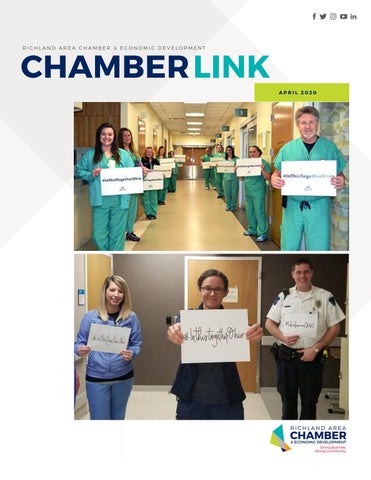
#INTHISTOGETHEROHIO Thanks to our business community for leading the way with your generosity!
10
Do you have #INTHISTOGETHER photos to share? Send them to afanello@richlandareachamber.com
Prepared by the U.S. CHAMBER OF COMMERCE
CORONAVIRUS EMERGENCY L ANS
Small Business Guide and Checklist Updated: April 1, 2020
The Coronavirus Aid, Relief, and Economic Security (CARES) Act allocated $350 billion to help small businesses keep workers employed amid the pandemic and economic downturn. Known as the Paycheck Protection Program (PPP), the initiative provides 100% federally guaranteed loans to small businesses. Importantly, these loans may be forgiven if borrowers maintain their payrolls during the crisis or restore their payrolls afterward. The administration has released initial guidelines; they are available at www.treasury.gov. The U.S. Chamber of Commerce has issued this guide to help small businesses and self-employed individuals check eligibility and prepare to file for a loan. Small businesses and sole proprietors can begin applying on April 3. Independent contractors and self-employed individuals can apply beginning on April 10.
Here are the questions you may be asking—and what you need to know. You can apply through any existing SBA 7(a) lender or through any federally insured depository institution, federally insured credit union, and Farm Credit System institution that is participating. Other regulated lenders will be available to make these loans once they are approved and enrolled in the program. You should consult with your local lender as to whether it is participating. While the program is open until June 30, 2020, the government is advising borrowers to apply as soon as possible given the loan cap on the program.
STRONG BUSINESS, STRONG COMMUNITY
1 Am I ELIGIBLE? You are eligible if you are: • A small business with fewer than 500 employees • A small business that otherwise meets the SBA’s size standard • A 501(c)(3) with fewer than 500 employees • An individual who operates as a sole proprietor • An individual who operates as an independent contractor • An individual who is self-employed who regularly carries on any trade or business • A Tribal business concern that meets the SBA size standard • A 501(c)(19) Veterans Organization that meets the SBA size standard
In addition, some special rules may make you eligible: • If you are in the accommodation and food services sector (NAICS 72), the 500-employee rule is applied on a per physical location basis • If you are operating as a franchise or receive financial assistance from an approved Small Business Investment Company the normal affiliation rules do not apply REMEMBER: The 500-employee threshold includes all employees: full-time, part-time, and any other status.
2 What will lenders be LOOKING FOR? Borrowers will need to complete the Paycheck Protection Loan Application (which is available HERE) and payroll documentation
What lenders will
NOT LOOK FOR
Lenders will also ask you for a good faith certification that: 1. The uncertainty of current economic conditions makes the loan request necessary to support ongoing operations 2. The borrower will use the loan proceeds to retain workers and maintain payroll or make mortgage, lease, and utility payments 3. Borrower does not have an application pending for a loan duplicative of the purpose and amounts applied for here 4. From Feb. 15, 2020 to Dec. 31, 2020, the borrower has not received a loan duplicative of the purpose and amounts applied for here (Note: There is an opportunity to fold emergency loans made between Jan. 31, 2020 and the date this loan program becomes available into a new loan) If you are an independent contractor, sole proprietor, or self-employed individual, lenders will also be looking for certain documents (final requirements will be announced by the government) such as payroll tax filings, Forms 1099-MISC, and income and expenses from the sole proprietorship.
5P repared by the U.S. CHAMB E R OF COMME RCE
• That the borrower sought and was unable to obtain credit elsewhere. • A personal guarantee is not required for the loan. • No collateral is required for the loan.
3 How much can I
BORROW?
Loans can be up to 2.5 x the borrower’s average monthly payroll costs, not to exceed $10 million. NON SEASONAL EMPLOYERS:
How do I calculate my average monthly
PAYROLL COSTS? sum of INCLUDED payroll costs
sum of EXCLUDED payroll costs
Maximum loan =
PAYROLL COSTS
INCLUDED Payroll Cost: 1. For Employers: The sum of payments of any compensation with respect to employees that is a: • salary, wage, commission, or similar compensation; • payment of cash tip or equivalent; • payment for vacation, parental, family, medical, or sick leave • allowance for dismissal or separation • payment required for the provisions of group health care benefits, including insurance premiums • payment of any retirement benefit • payment of state or local tax assessed on the compensation of the employee 2. For Sole Proprietors, Independent Contractors, and Self-Employed Individuals: The sum of payments of any compensation to or income of a sole proprietor or independent contractor that is a wage, commission, income, net earnings from self-employment, or similar compensation and that is in an amount that is not more than $100,000 in one year, as pro-rated for the covered period.
EXCLUDED Payroll Cost: 1. Compensation of an individual employee in excess of an annual salary of $100,000, as prorated for the period February 15, to June 30, 2020 2. Payroll taxes, railroad retirement taxes, and income taxes 3. Any compensation of an employee whose principal place of residence is outside of the United States 4. Qualified sick leave wages for which a credit is allowed under section 7001 of the Families First Coronavirus Response Act (Public Law 116– 5 127); or qualified family leave wages for which a credit is allowed under section 7003 of the Families First Coronavirus Response Act P repa red by th e U.S. C HA MB E R OF COMME RCE
2.5 x Average total monthly payroll costs incurred during the year prior to the loan date For businesses not operational in 2019:
2.5 x Average total monthly payroll costs incurred for January and February 2020 SEASONAL EMPLOYERS:
Maximum loan =
2.5 x Average total monthly payments for payroll costs for the 12-week period beginning February 15, 2019 or March 1, 2019 (decided by the loan recipient) and ending June 30, 2019 • Payments deferred for six months • 0.50% fixed interest rate • Loan is due in two years
4 Will this loan be
WHAT'S NEXT?
FORGIVEN?
Borrowers are eligible to have their loans forgiven.
How Much? A borrower is eligible for loan forgiveness equal to the amount the borrower spent on the following items during the 8-week period beginning on the date of the origination of the loan:
Look out for more information about eligible lenders and additional guidance from the SBA soon.
• Payroll costs (using the same definition of payroll costs used to determine loan eligibility) • Interest on the mortgage obligation incurred in the ordinary course of business • Rent on a leasing agreement
For more guidance and resources for small businesses, visit uschamber.com/co
• Payments on utilities (electricity, gas, water, transportation, telephone, or internet) • For borrowers with tipped employees, additional wages paid to those employees NOTE: The government is now advising that because of high participation, it is anticipated that not more than 25% of the forgiven amount may be for non-payroll costs. The loan forgiveness cannot exceed the principal.
How could the forgiveness be reduced? The amount of loan forgiveness calculated above is reduced if there is a reduction in the number of employees or a reduction of greater than 25% in wages paid to employees. Specifically:
Private lenders will ultimately issue PPP loans based on guidance from the SBA and Treasury Department. More information, including from lenders, should be available once the guidance is issued.
Reduction based on reduction of number of employees
PAYROLL COST Calculated on page 2
Average Number of Full-Time Equivalent Employees (FTEs) Per Month for the 8-Weeks Beginning on Loan Origination
Option 1: Average number of FTEs per month from February 15, 2019 to June 30, 2019 Option 2: Average number of FTEs per month from January 1, 2020 to February 29, 2020 For Seasonal Employers: Average number of FTEs per month from February 15, 2019 to June 30, 2019
Reduction based on reduction in salaries
PAYROLL COST Calculated on page 2
For any employee who did not earn during any pay period in 2019 wages at an annualized rate more than $100,000, the amount of any reduction in wages that is greater than 25% compared to their most recent full quarter.
What if I bring back employees or restore wages? Reductions in employment or wages that occur between February 15, 2020 and April 26, 2020 (as compared to February 15, 2020) shall not reduce the amount of loan forgiveness IF by June 30, 2020 the borrower eliminates the reduction in employees or reduction in wages.
Prepa red b y the U.S. C HA MB E R OF COMME RCE
STRONG BUSINESS, STRONG COMMUNITY
Prepared by the U.S. CHAMBER OF COMMERCE
GUIDE TO SBA'S ECONOMIC INJURY DISASTER LOANS The Coronavirus Aid, Relief, and Economic Security (CARES) Act expands the Small Business Administration’s long-standing Economic Injury Disaster Loan Program (EIDL). The EIDL program was created to assist businesses, renters, and homeowners located in regions affected by declared disasters.
Who is ELIGIBLE?
In general, all of the following entities that have suffered substantial economic injury caused by a disaster provided they were in existence on January 31, 2020: • Businesses with fewer than 500 employees • Cooperatives, ESOPs, and tribal small businesses with fewer than 500 employees • Sole proprietors • Independent contractors • Most private nonprofits
What are the LOAN PARAMETERS? • The maximum EIDL is a $2 million working capital loan at a rate of 3.75% for businesses and 2.75% for nonprofits with up to a 30-year term • Payments on Coronavirus EIDL loans are deferred for one year • Up to $200,000 can be approved without a personal guarantee • Approval can be based on a credit score and no first-year tax returns are required • Borrowers do not have to prove they could not get credit elsewhere
12
• No collateral is required for loans of $25,000 or less. For loans of more than $25,000, general security interest in business assets will be used for collateral instead of real estate • The borrowers must allow the SBA to review its tax records
How can I access an EMERGENCY $10,000 GRANT? • Eligible applicants for an EIDL can receive a $10,000 emergency grant within three days of application (through Dec. 31) • There is no obligation to repay the grant. To receive the $10,000 emergency grant, it is not necessary to have an approved EIDL loan. However, if you are able to secure a PPP loan, the $10,000 grant will be subtracted from the forgiveness amount NOTE: The Paycheck Protection Program (PPP) created by the CARES Act prohibits borrowers from taking out two loans for the same purpose. For more information on PPP loans, visit uschamber.com/sbloans
How do I APPLY? Apply online at SBA.gov/disaster
The SBA administers the EIDL program. Please contact the SBA with specific questions.
RACED CHAMBER LINK
|
JANUARY 2020
Prepared by the U.S. CHAMBER OF COMMERCE
GUIDE TO THE
EMPLOYEE RETENTION TAX CREDIT For COVID-19 Impacted Employers The Coronavirus Aid, Relief, and Economic Security (CARES) Act created a new employee retention tax credit for employers who are closed, partially closed, or experiencing significant revenue losses as a result of COVID-19.
Who is ELIGIBLE?
Private employers, including non-profits, carrying on a trade or business in 2020 that: • Have operations partially or fully suspended as a result of orders from a governmental authority due to COVID-19, or • Experience a decline in gross receipts by more than 50% in a quarter compared to the same quarter in 2019 (eligibility ends when gross receipts in a quarter exceed 80% compared to the same 2019 quarter)
How much is the TAX CREDIT? This new employee retention tax credit is a 50% tax credit for the first $10,000 of compensation, including the employer portion of health benefits, for each eligible employee. • Compensation does not include paid sick or family leave for which the employer is reimbursed under the Families First Coronavirus Response Act • The credit only applies to wages paid after March 12, 2020 and before January 1, 2021
WHICH EMPLOYEES COUNT toward eligibility?
• For employers with more than 100 employees: Full-time employees who are (i) being paid but (ii) not providing service due to either a full or partial shutdown or a reduction in gross receipts count toward eligibility • For employers with 100 or fewer full-time employees: All employees, regardless of whether those employees are providing service, count toward eligibility
With respect to tax-exempt organizations under 501(c) of the tax code, the requirement to be partially or fully suspended applies to all operations of the organization.
• Employers may not claim the same employee for this credit and the Work Opportunity Tax Credit for the same period. In addition, employers may not claim the same wages for an employee under this credit and also under the employer credit in section 45S for FMLA
Employers who receive a Paycheck Protection Program (PPP) loan are not eligible for a tax credit. To learn more about PPP loans, visit uschamber.com/sbloans
How is the CREDIT PAID?
The refundable credit is applied against the employer portion of payroll taxes. The Treasury Department will develop a process for employers to receive an advance payment of the tax credit.
The Internal Revenue Service will issue further guidance and mange the ERTC process. Please contact the IRS with specific questions.13
STRONG BUSINESS, STRONG COMMUNITY
Prepared by the U.S. CHAMBER OF COMMERCE
CORONAVIRUS PAID LEAVE PROGRAMS Employer Guide
The Families First Coronavirus Response Act created new temporary paid sick leave and paid Family and Medical Leave Act (FMLA) programs that are 100% reimbursable by the federal government. The effective date of both programs is April 1 and they expire on December 31. Both programs are in addition to any leave you already offer.
The key numbers to remember with these paid leave programs are 500 and 50. • If you have fewer than 500 employees, your business is required to provide paid leave under both programs • If you have fewer than 50 employees, though, you may be exempted from the requirement to provide leave under both programs (see p. 2) The Department of Labor has issued clarifying guidance (available at www.dol.gov/agencies/whd/pandemic) and will continue to publish more information. In the meantime, here is the information you need to know now. 14
PAID SICK LEAVE Program CUTTINGS RIBBON Which employees are eligible?
Eighty hours of paid sick leave is available to any employee without regard to duration of employment if they are unable to work or telework because they: • are subject to a government quarantine or isolation order; • have been advised to self-quarantine; • are seeking a medical diagnosis; or • are caring for someone with one of those three conditions. Leave can also be taken if an individual cannot work or telework because of a need to care for a child whose school has closed or whose regular caregiver is unavailable because of Coronavirus.
DENIM N LACE
Shelby
How much will employees receive? While taking paid sick leave, employees will receive their regular rate of pay up to a maximum of $511 per day or $5,110 in the aggregate. This is reduced to 2/3 their regular rate of pay if they are caring for a family member or child whose school is closed or caregiver is unavailable with a maximum of $200 per day (or $2,000 in aggregate).
FAMILY and MEDICAL LEAVE ACT Program
PANDA EXPRESS
Ontario
Which employees are eligible? To be eligible for paid FMLA leave, an employee must have been on your payroll for 30 days prior to taking leave. In addition, paid FMLA leave is only available if an employee is unable to work or telework because of a need to take care of a child because of a school closure or their regular child care provider is unavailable due to Coronavirus.
How much will employees receive? Eligible employees may take up to 12 weeks of leave. WRP SHELBY OFFICE
Shelby
YMCA ROCK WALL • The first two weeks of that can be unpaid (presumably the employee would Mansfield be covered under paid sick-leave for those two weeks) • After that, the employee is eligible for 10 weeks of paid FMLA While taking paid FMLA leave, the employee will receive 2/3 of his/her regular rate of pay up to a maximum of $200 per day (or $10,000 in aggregate). For more guidance, please click here to visit the IRS website.
CHERRY HILL YOUTH HOME
Restoration to Previous Position: For businesses with fewer than 25 employees, it is not necessary to restore the employee to his/her previous position after paid FMLA leave is taken if the position no longer exists because of the public health emergency and the employer makes reasonable efforts to restore the employee to a similar position.
Mansfield
P repared by the U.S. C HA MB E R OF COMME RCE
EXEMPTIONS What if I have fewer than 50 Employees… Am I exempt? Under current Department of Labor guidance, you can be exempt only if leave is being requested because of a school closure or because the child’s regular caregiver is unavailable due to Coronavirus and if this leave would jeopardize the viability of the small business as a going concern. This exemption is available if an authorized officer of the business certifies that at least one of the following is true: • Providing leave would result in expenses and financial obligations exceeding existing revenues and cause the business to cease operating • The absence of the employee would entail a substantial risk to the operation of the business because of their specialized skills, knowledge of the business, or responsibilities • You cannot find other workers to perform the work of the employee, and that work is required for the business to operate at a minimal capacity
What if I am in the health care business… Am I exempt? Businesses whose employees are healthcare providers or emergency responders may elect to exclude such employees from paid sick leave and paid FMLA leave. The definition is fairly broad. Visit www.dol.gov/agencies/whd/pandemic/ffcra-questions for specific definitions of those terms.
Do I have to provide paid sick or paid FMLA leave if my business is closed? No. If you close due to a lack of business or because of a federal, state, or local directive, you do not have to provide paid leave. In this case your employees would likely be eligible for unemployment compensation. This is the case whether you lay off or furlough employees.
REIMBURSEMENT How will my business be reimbursed for this leave? Costs associated with the paid sick and paid family leave programs are 100% reimbursable by the federal government through a refundable tax credit up to the maximum wages allowed (e.g. $511 or $200 per day), which is also applicable to the self-employed. • The Treasury Secretary is provided with regulatory authority to help with cash flow issues, for example by waiving penalties for failing to deposit payroll taxes in anticipation of the credit and by providing advances to employers
For questions, please call the Department of Labor help line at (866)487-9243 (866-4US-WAGE). P repared by th e U.S. CHAMB E R OF COMME RCE
THANK YOU TO OUR CATALYTIC LEADER INVESTORS
ADENA CORPORATION • NANOGATE NORTH AMERICA LLC & JAY INDUSTRIES • MEDICAL MUTUAL • MILLIRON AUTO PARTS FIRSTENERGY CORP • HAMILTON INSURANCE GROUP, INC • HUNTINGTON NATIONAL BANK NEWMAN TECHNOLOGY • STARTEK