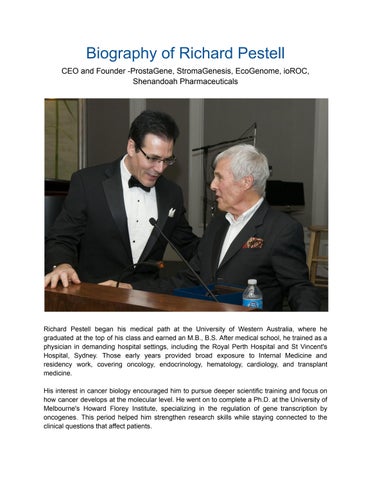
Biography of Richard Pestell CEO and Founder -ProstaGene, StromaGenesis, EcoGenome, ioROC, Shenandoah Pharmaceuticals
Richard Pestell began his medical path at the University of Western Australia, where he graduated at the top of his class and earned an M.B., B.S. After medical school, he trained as a physician in demanding hospital settings, including the Royal Perth Hospital and St Vincent's Hospital, Sydney. Those early years provided broad exposure to Internal Medicine and residency work, covering oncology, endocrinology, hematology, cardiology, and transplant medicine. His interest in cancer biology encouraged him to pursue deeper scientific training and focus on how cancer develops at the molecular level. He went on to complete a Ph.D. at the University of Melbourne's Howard Florey Institute, specializing in the regulation of gene transcription by oncogenes. This period helped him strengthen research skills while staying connected to the clinical questions that affect patients.
His academic record earned national scholarships and multiple competitive fellowships, including a Winthrop Fellowship and an NHMRC postgraduate award. These opportunities supported his move to Harvard Medical School and Massachusetts General Hospital, where he continued training as a clinical and research fellow. Through this work, he developed further expertise at the intersection of care delivery and biomedical research.
Academic Leadership and Scientific Influence Richard Pestell continued his academic career at Northwestern University and later at the Albert Einstein College of Medicine. Over time, he became a Professor, served as Chair of the Division of Endocrine Dependent Tumor Biology, and worked as Co-Director of major cancer research programs. Alongside these responsibilities, he held positions at multiple hospitals in New York, which allowed him to remain actively engaged in patient care and medical education while advancing research priorities. During this phase, he contributed to scientific work that informed cancer therapeutics. His research on cyclin D1 was cited in seminal publications that supported CDK inhibitor clinical trials and their adoption as a standard therapy for breast cancer globally. He approached this work with an emphasis on careful evidence and clinical relevance, aiming to strengthen what physicians and researchers could rely on. He also researched CCR5, providing a scientific context for current oncology clinical trials using CCR5 inhibitors. Across his career, he has published over 700 works, accumulated more than 110,000 citations, and achieved an h-index of 162. He has also given numerous invited lectures around the world, reflecting the ongoing reach of his scientific contributions and collaborations.
Directing Major Cancer Centers Richard Pestell became the Director of the Lombardi Comprehensive Cancer Center at Georgetown University in 2002. He also served as Chair of the Department of Oncology and Associate Vice President at Georgetown University Medical Center. In these roles, he held responsibility for research direction, clinical operations, and faculty development, while also contributing to institutional restructuring and growth across the medical center. In addition, he worked to build community partnerships, strengthen research programs, and expand clinical services across the Georgetown and MedStar systems. His responsibilities required coordination across clinical teams, research groups, and administrative leadership to support patient care while developing the cancer center’s long-term capabilities. Richard took on additional leadership roles in 2005 as the Director of the Sidney Kimmel Cancer Center, Chair of the Department of Cancer Biology, and head of the Oncology Service Line at Thomas Jefferson University. In these positions, he supported both scientific strategy and
clinical delivery, with a focus on sustainable program development and collaborative execution across departments. He later became the Executive Vice President, charged with enterprise-wide strategic decisions across a system of 30,000 employees. At Jefferson, he directed an overall cancer enterprise with an annual budget of> $350 m and led efforts in clinical care, research infrastructure, regional expansion, and team building. During his tenure, the cancer center rose from 64 to 17, reflecting a period of structured change and organizational improvement.
Academic Appointments and Global Engagement Richard Pestell has also served in academic and leadership roles beyond the US, helping connect institutions through research, education, and outreach initiatives. He was a founding Director of the Delaware Valley Institute for Clinical and Translational Science, supported the development of new education pathways for historically black colleges, and led global cancer outreach through the International Network for Cancer Treatment and Research. He has served on faculty or advisory boards with the University of Melbourne, the University of Western Australia, Nanyang Technological University, Xavier University School of Medicine, Kazan Federal University, and several European institutions. Through these affiliations, he has supported training, institutional collaboration, and shared research goals across different educational systems. Richard’s election to and service with prominent scientific organizations reflect international recognition of his work. He has served at the Academia Europaea, the Hungarian Academy of Sciences, the American Society for Clinical Investigation, and the Royal Society of Biology, among others. His awards include the RD Wright Medallion and the Eric Susman Prize in Medicine, culminating in his being made an Officer of the Order of Australia in 2019.
Building Companies and Advancing Innovation Richard Pestell has also been active in entrepreneurship and innovation within biotechnology. He is the founder of six biotechnology companies: LightSeed, ProstaGene (acquired in 2018), EcoGenome, StromaGenesis, ioROC, and Shenandoah Pharmaceuticals. Along with these ventures, he has raised nearly 50 million dollars from investors and has obtained more than 80 million dollars as a principal investigator on NIH research grants. His patent portfolio has included discoveries in molecular diagnostics, cancer prognostics, therapeutic methods, and novel technologies that have influenced academic and commercial drug discovery and development. He has also served in advisory capacities for organizations such as the National Academy of Inventors, CytoDyn, Novartis, Deloitte, and numerous health technology companies. Across these roles, he has focused on translating research into practical tools that can support better clinical and scientific decisions.
Philanthropy, Community Service, and Cultural Engagement Richard Pestell has treated service and philanthropy as an ongoing responsibility alongside his professional roles. At Georgetown and at Jefferson, he led philanthropic efforts that produced transformational gifts and established approaches to sustain ongoing fundraising in support of cancer care, wellness centers, and community outreach initiatives. These efforts were aimed at building long-term resources that could strengthen patient support programs and clinical services. He has also served on different boards, including the National Museum of American Jewish History, the Chamber Orchestra of Philadelphia, the Jewish Federation of Greater Philadelphia, the Historic St. Peter’s Church Preservation Corporation, the American Cancer Society committees, and several university societies. In each setting, he has supported civic and cultural work that connects communities with education, history, public health, and the arts. Richard also supported the Olivia Newton-John Wellness Center through a fundraising trek on The Great Wall. This effort aligned personal commitment with public fundraising goals and reinforced the importance of community-backed support for wellness and cancer-related initiatives.
A Continuing Commitment to Science and Human Health Richard Pestell now serves as President of the Pennsylvania Cancer and Regenerative Medicine Center, Blumberg Distinguished Professor of Translational Medical Research at the Baruch Blumberg Institute, and a member of the Wistar Institute Cancer Center. He continues to support global cancer programs, mentor scientific leaders, and help develop technologies intended to improve diagnostics and treatment. His current work emphasizes translation, collaboration, and advancing research toward practical medical use. He continues to apply scientific insight with a practical approach that supports patient care, strengthens institutions, and expands the reach of modern oncology. Richard’s work continues to influence cancer research, education, and biotechnology on a global scale through sustained leadership, research, and a commitment to clinical impact.
Resources The Lankenau Institute for Medical Research Wynnewood, Pennsylvania
Animal: The Lankenau Institute for Medical Research has a Central Animal Facility accredited by AAALAC. The transgenic and knockout mice used in this project have been generated and well characterized in the preliminary studies. The Proteomics Facility used for the preliminary studies is located at the Wistar Institute and accessible by user fees. This Facility consists of multiple sections, for protein sequencing, amino acid analysis, protein/peptide purification by HPLC or electrophoretic techniques (e.g. electro blotting), peptide synthesis, and mass spectrometry. Other facilities are located at the Lankenau Institute for Medical Research (LIMR) and include Bio imaging, Biostatistics, Cytogenetics, Flow Cytometry, Pathology, and X-Ray Crystallography and other facilities located at the Wistar Institute. The services of the facilities are provided on a charge-back basis. LIMR (affiliated with Thomas Jefferson University) is a state-of-the-art research facility located in a modern, 53,000-square-foot three-story building contiguous with the Lankenau Medical Center, which contains a 320-bed tertiary care teaching hospital in Wynnewood, PA. All equipment required for the project is available at LIMR. Laboratories & Major Equipment: Within LIMR are sixteen 1,137-square-foot laboratories designed and equipped for the latest molecular and biochemical techniques. All labs include at least one fume hood and one to two laminar flow hoods, and shared/core resources include extensive microscopy (including confocal), HPLC, flow cytometry, sequencing and genetic analysis instruments, centrifuges, imaging, histology, liquid nitrogen freezers, and other centralized support areas and cores (Histology, Imaging, Transgenic Mouse). Learn More about LIMR: http://www.limr.org/ WEBSITES RELEVANT TO TRANSGENIC STUDIES: Non-murine transgenics: ● Genome Technology Core (formerly MIT/Whitehead Center for Genome Research): https://wi.mit.edu/core-facilities/genomecore ● Agrigenomics Information database; Animal Genome Database: https://agrid.dna.affrc.go.jp/index.php?page=animal_db&lang=en ● Flybase (D. melanogaster): https://flybase.org/ ● The Zebrafish Information Network (ZFIN): https://zfin.org/ ● Yeast Genome Database (S. cerevisiae): https://www.yeastgenome.org/
Murine Transgenics: ● ● ● ●
The Jackson Laboratory (JAX): https://www.jax.org/ Mouse Genome Informatics: https://www.informatics.jax.org/ eMouseAtlas: https://www.emouseatlas.org/emap/home.html The Whole Mouse Catalog: https://norecopa.no/norina/the-whole-mouse-catalog/
Knockouts: ● Knockout Mouse Project: https://www.jax.org/research-and-faculty/resources/knockout-mouse-project ● Cre Transgenic database: http://www.mshri.on.ca/nagy/ Crossing Organisms: ● National Center for Biotechnology Information: http://www.ncbi.nlm.nih.gov/index.html ● Genbank: https://www.ncbi.nlm.nih.gov/genbank/ ● OMIM – Online Mendelian Inheritance in Man (Human Genes & Genetic Disorders): https://www.ncbi.nlm.nih.gov/omim Mapping and Sequencing: ● ● ● ●
National Center for Genome Resources: https://www.ncgr.org/ Laboratory of Statistical Genetics: https://lab.rockefeller.edu/ott/ Stanford Genome Technology Center: https://med.stanford.edu/sgtc/general/history.html Genethon: French Gene Therapy Research and Genomic Center: https://www.genethon.com/
Publications Richard G. Pestell, AO, MD, PhD, MBA, MB, BS, FRACP, FACP, FRCP (London), FRCP (Ireland), MAE
STATUS Richard Pestell, AO, MD, PhD, MBA, MB, BS, FRACP, FACP, FRCP (Ireland), FRCP (London), MAE, is a clinician scientist who currently serves as President of the Pennsylvania Cancer and Regenerative Medicine Center, and Member of Wistar Institute Cancer Center (Associate), in Philadelphia, USA. He was previously Executive Vice President, Thomas Jefferson University, Philadelphia, USA (30,000 employees, $5.6B USD annual budget). BACKGROUND Dr. Pestell trained in medicine, cancer research, and business (M.D./Ph.D., Melbourne University; MBA, NYU Stern; M.B., BS, University of Western Australia). He completed clinical training in Internal Medicine, Oncology, and Endocrinology, was the Winthrop Fellow at Harvard Medical School, and a Clinical Fellow at Massachusetts General Hospital. He has ~20 awards/elected memberships and was appointed Officer of the Order of Australia (2019) for “distinguished service to medicine, and to medical education…in the fields of endocrinology and oncology” (https://en.wikipedia.org/wiki/Richard_Pestell). He has served on 14 journal editorial boards, reviewed for 18 funding agencies in 9 countries, and consults for research organizations and governments (including Hungary). He founded six biotechnology companies (LightSeed, Shenandoah, ioROC, StromaGenesis, ProstaGene, EcoGenome) and sold ProstaGene in 2018. He has been PI of >$86mMM USD in grants (primarily NIH), raised ~$50MM USD from investors, published >700 works with >99,000 citations (H index 159), holds multiple patents, and has authored 1 book, 52 book chapters, with 294 invited lectures and 236 meeting presentations. KEY SCIENTIFIC IMPACT His work identified genetic targets including cyclins and CCR5: (1) cyclin D1 breast cancer studies cited as basis for CDK inhibitor trials (FDA-approved therapies); (2) CCR5 inhibitor studies cited as basis for current CCR5 cancer trials; (3) discovery that nuclear receptors are acetylated, shaping hormone signaling and cancer. CONTRIBUTIONS TO SCIENCE (AREAS) Prostate cancer (murine metastatic model; cyclin D1 roles), Dach1 in tumorigenesis, androgen/nuclear receptor acetylation, cancer stem cell gene requirements, and cyclin D1 non-canonical functions in gene regulation and cancer biology. LINKS https://pubmed.ncbi.nlm.nih.gov/?term=Pestell+R
https://scholar.google.com/citations?hl=en&user=6icYuFsAAAAJ&view_op=list_works&sortby=p ubdate
SELECTED PUBLICATIONS 1. Ju X, Ertel A, Casimiro MC, Yu Z, Meng H, McCue PA, Walters R, Fortina P, Lisanti MP, Pestell RG Novel oncogene-induced metastatic prostate cancer cell lines define human prostate cancer progression signatures. Cancer Res. 2013 Jan 15;73(2):978-89. doi: 10.1158/0008-5472.CAN-12-2133. Epub 2012 Nov 30. PMCID: PMC3561759. 2. Ju, X. and Casimiro, M.C., Gormley, M., Meng, H., Jiao, X., Katiyar, S., Crosariol, M., Chen, K., Wang, M., Quong, A.A., Lisanti MP, Ertel A, Pestell RG. Identification of a cyclin D1 network in prostate cancer that antagonizes epithelial-mesenchymal restraint. Cancer Research. 2014 Jan 15; 74(2):508-19. PMCID: PMC3914674. 3. Casimiro, M.C., Ju, X., Gormley, M., Meng, H., Jiao, X., Katiyar, S., Crosariol, M., Chen, K., Wang, M., Quong, A.A., Lisanti MP, Ertel A, Pestell RG. Cyclin D1 promotes androgen-dependent DNA damage repair in prostate cancer cells. Cancer Research, 2016 Jan 15;76(2):329-38. PMCID:PMC4715975. 4. Ju X, Jiao X, Ertel A, Casimiro MC, Di Sante G, Deng S, Li Z, Di Rocco A, Zhan T, Hawkins A, Stoyanova T, Andò S, Fatatis A, Lisanti MP, Gomella LG, Languino LR, Pestell RG. v-Src oncogene induces Trop2 proteolytic cleavage. Cancer Res. 2016 Sep 15 PMID:27634768 5. Wu K, Katiyar S, Li A, Liu M, Ju X, Popov VM, Jiao X, Lisanti MP, Casola A, Pestell RG. Dachshund inhibits oncogene-induced breast cancer cellular migration and invasion through suppression of interleukin- 8.. Proc Natl Acad Sci USA. 2008 May 13;105(19):6924-9. PMCID: PMC2374551. 6. Zhou J, Wang C, Wang Z, Dampier W, Wu K, Casimiro MC, Chepelev I, Popov VM, Quong A, Tozeren A, Zhao K, Lisanti MP, Pestell RG. Attenuation of Forkhead signaling by the retinal determination factor DACH1. Proc Natl Acad Sci USA. 2010 Apr 13;107(15):6864-9. doi: 10.1073/pnas.1002746107. Epub 2010 Mar 29, PMCID: PMC2872468. 7. Chen K, Wu K, Wang L, Jiao X, Ju X, Li Z, Ertel A, Addya S, McCue P, Lisanti MP, Wang C, Davis RJ, Mardon G, Pestell RG. The endogenous Cell-Fate Factor Dachshund restrains prostate epithelial cell migration via repression of cytokine secretion via a CXCL Signaling Module. Cancer Research. 2015 2015 May 15;75(10):1992-2004. PMID:25769723. 8. Ozcan L, Ghorpade D, Cristina de Sozua J, Chen K, Bessler M, Bagloo M, Schrope B, Pestell RG, Tabas, I. Hepatocyte DACH1 is Increased in Obesity Via Nuclear Exclusion of HDAC4 and Promotes Hepatic Insulin Resistance. Cell Rep. 2016 May 26. un 7;15(10):2214-25 PMID:27239042
9. Fu M, Wang C, Reutens AT, Wang J, Angeletti RH, Siconolfi-Baez L, Ogryzko V, Avantaggiati ML, Pestell RG. p300 and p300/cAMP-response element-binding protein-associated factor acetylate the androgen receptor at sites governing hormone-dependent transactivation. J Biol Chem. 2000 Jul 7;275(27):20853- 60, PMCID: Identifier absent. 10. Wang, C., Fu, M., Angeletti, R.H., Siconolfi-Baez, L., Reutens, A.T., Albanese, C., Lisanti, M.P., Katzenellenbogen, B.S., Kato, S., Hopp, T., Fuqua, S.A., Lopez, G.N., Kushner, P.J., and Pestell, R.G., Direct acetylation of the estrogen receptor alpha hinge region by p300 regulates transactivation and hormone sensitivity. J Biol Chem. 2001 May 25; 276(21): p. 18375-83, PMCID: Identifier absent. 11. Fu M, Wang C, Wang J, Zhang X, Sakamaki T, Yeung YG, Chang C, Hopp T, Fuqua SA, Jaffray E, Hay RT, Palvimo JJ, Jänne OA, Pestell RG. Androgen Receptor Acetylation Governs Transactivation and MEKK1-Induced Apoptosis Without Effecting In Vitro Sumoylation and transrepression Function. Mol Cell Biol. 2002 May;22(10):3373-88. 12. Fu M, Rao M, Wang C, Sakamaki T, Wang J, Di Vizio D, Zhang X, Albanese C, Balk S, Chang C, Fan S, Rosen E, Palvimo JJ, Jänne OA, Muratoglu S, Avantaggiati ML, Pestell RG. Acetylation of the androgen receptor enhances coactivator binding and promotes prostate cancer cell growth. Mol Cell Biol. 2003 Dec;23(23):8563-75, PMCID: PMC262657 13. Liu, M., Casimiro, M.C., Wang, C., Shirley, L.A., Jiao, X., Katiyar, S., Ju, X., Li, Z., Yu, Z., Zhou, J., Johnson, M., Fortina, P., Hyslop, T., Windle, J.J., and Pestell, R.G., p21CIP1 attenuates Ras- and c-Mycdependent breast tumor epithelial mesenchymal transition and cancer stem cell-like gene expression in vivo. Proc Natl Acad Sci USA. 2009 Nov 10; 106(45): p. 19035-9. PMCID: PMC2776463. 14. Genander, M., Halford, M.M., Xu, N.J., Eriksson, M., Yu, Z., Qiu, Z., Martling, A., Greicius, G., Thakar, S., Catchpole, T., Chumley, M.J., Zdunek, S., Wang, C., Holm, T., Goff, S.P., Pettersson, S., Pestell, R.G., Henkemeyer, M., and Frisen, J., Dissociation of EphB2 signaling pathways mediating progenitor cell proliferation and tumor suppression. Cell. 2009 Nov 13; 139(4): p. 679-92, PMCID: PMC2786256. 15. Liu, M., Sakamaki, T., Casimiro, M., Willmarth, N., Quong, A., Ju, X., Ojeifo, J., Jiao, X., Yeow, W-S., Wang, C.,Katiyar, S., Shirley, L., Albanese, C., Joyce, D., Pestell, R.G. The canonical NF-κB pathway governs mammary tumorigenesis in transgenic mice via tumor stem cell expansion. Cancer Res. 2010 Dec 15;70(24):10464-10473.,k, PMCID: PMC3010731. 16. Jiao , X., Katiyar, S., Willmarth, N.E., Liu, M., Ma, X., Flomenberg, N., Lisanti, M.P., and Pestell, R.G., cJun induces mammary epithelial cellular invasion and breast cancer stem cell expansion. J Biol Chem. 2010 Mar 12; 285(11): p. 8218-26. PMCID: PMC2832973. 17. Lee RJ, Albanese C, Fu M, D'Amico M, Lin B, Watanabe G, Haines GK 3rd, Siegel PM, Hung MC, Yarden Y, Horowitz JM, Muller WJ, Pestell RG. Cyclin D1 is required for
transformation by activated Neu and is induced through an E2F-dependent signaling pathway. Mol Cell Biol. 2000 Jan;20(2):672-83. PMCID: PMC85165. 18. Neumeister P, Pixley FJ, Xiong Y, Xie H, Wu K, Ashton A, Cammer M, Chan A, Symons M, Stanley ER, Pestell RG. Cyclin D1 governs adhesion and motility of macrophages. Mol Biol Cell. 2003 May;14(5):2005-15. Epub 2003 Feb 21. PMCID: PMC165093. 19. Wang C, Li Z, Lu Y, Du R, Katiyar S, Yang J, Fu M, Leader JE, Quong A, Novikoff PM, Pestell RG. Cyclin D1 repression of nuclear respiratory factor 1 integrates nuclear DNA synthesis and mitochondrial function. Proc Natl Acad Sci USA. 2006 Aug 1;103(31):11567-72. Epub 2006 Jul 24. PMCID: PMC1518800. 20. Casimiro MC, Crosariol M, Loro E, Ertel A, Yu Z, Dampier W, Saria E, Papanikolaou A, Li Z, Wang C, Fortina P, Addya A, Tozeren A, Knudsen ES, Arnold A, Pestell RG. ChIP sequencing of cyclin D1 reveals a transcriptional role in chromosomal instability in mice. J Clin Invest. 2012 Mar 1;122(3):833-43. doi: 10.1172/JCI60256. Epub 2012 Feb 6. PMCID: PMC3287228. 21. Polepallia S, George SM, Sri Vidyaa RV, Rodrigues GS, Ramachandra L, Chandrashekar R, Nayak D, Rao PPN, Pestell RG, Rao M. Role of UHRF1 in Malignancy and its Function as a Therapeutic Target for Molecular Docking Towards the SRA Domain. Intl J of Biochem & Cell Bio 2019 Sept Vol 144 105558. Link to article available on Elsevier at https://authors.elsevier.com/c/1ZIFA4qcwYO5Yj