
Richärd Kennedy Architects: Gateway Library

Page 1


Gateway Library

Set at the edge of a public park in a growing community, Gateway Public Library resists the conventional image of the civic building as object. Instead, it operates as an extension of the landscape, more pavilion than building, defined less by enclosure than by shade. Its organizing idea is direct: a single open hall conceived as a contemporary market, where knowledge and social life unfold within a shared, legible interior.

The plan is structured as one continuous volume. Program is organized as a series of discrete volumes set within this hall, carefully placed to establish hierarchy, orientation, and use. Gathering spaces are treated as freestanding elements, or “market stands,” distributed across the interior. A teen area occupies the center as a more defined mass, while enclosed program rooms and support spaces are positioned along the perimeter. The central space emerges as a void defined by the spacing and orientation of these volumes, preserving continuity while allowing the interior to be read at a glance.

Access reinforces this reading. Entries from multiple sides align with park paths and an adjacent school, allowing the building to be approached and entered without a singular front. Movement through the library is flexible and multi-directional, supported by clear visual alignments between volumes. The threshold between exterior and interior is deliberately softened; one moves under the same continuous roof plane, from open park into shaded enclosure, without a fixed point of transition.

The roof, a folded plane spans the hall, its geometry calibrated to admit diffuse light while limiting direct solar gain. Deep overhangs extend outward, producing a perimeter of shade that mediates between interior and exterior. Within, daylight is evenly distributed, reducing contrast and glare. The effect is less that of an interior illuminated by apertures than of a shaded exterior brought inside.

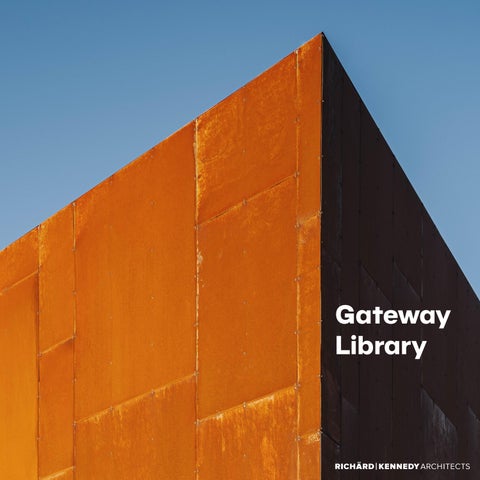
Materially, the project is grounded in a restrained palette of weathering steel, wood, concrete, and glass. These materials are deployed with an emphasis on continuity and durability, extending from exterior surfaces into the interior without change. The approach avoids applied finishes in favor of materials that can weather and wear without loss of character, an appropriate response to both climate and use.

Acoustically, the open volume is moderated through section rather than enclosure. Sloped ceiling planes diffuse sound across the space, while absorptive surfaces are integrated into the ceiling and select vertical elements. This allows active and quiet uses to coexist within a single room without reliance on physical separation.

The library’s program extends beyond collection and reading. A maker space, community room, and digital art wall introduce spaces of production and display, while a certified sensory room provides a controlled environment for neurodiverse users. These elements are embedded within the larger composition, reinforcing the library as a shared civic interior.

Gateway Library aligns spatial clarity with social openness. Rather than a sequence of enclosed rooms, it operates as a single, adaptable interior defined by structure, light, and use, capable of supporting the evolving role of the public library.

Conceived as a series of open-air “market hall” volumes unified beneath a folded roof, the building extends shaded reading rooms and community spaces into a porch-like landscape. A weathering steel rainscreen and deep overhangs temper the desert climate while framing views to the surrounding park.

Main entry, a shaded forecourt framed by palms and a deep, folded roof canopy creates a civic threshold.

staff building 3. program room

4. children’s library

5. teen zone

6. maker-space

7. multi-purpose room

8. huddle rooms

9. reading deck

PHYSICAL MODEL, building form

PHYSICAL MODEL, plan organization

Plaza and parking forecourt, Rows of date palms organize the arrival sequence, transitioning from parking to a shaded civic plaza, where the folded roof and weathering steel volumes frame a porous, pedestrian-oriented entry.

AXONOMETRIC

ELEVATIONS, above south, below east
Main reading room: A folded wood ceiling and slender steel columns define a light-filled interior, where low stacks and large glazing extend views to the landscape, reinforcing the building’s open, porch-like connection to the desert.

BUILDING SECTIONS

Teen zone: Color-blocked volumes act as an organizing device within the open plan, using saturated hues to define program zones—here, a bold red enclosure signals the teen area while maintaining visual connection through glass and low stacks.

Children’s area: Within the weathering steel volumes, interiors unfold like geodes—lined with faceted surfaces and saturated color—creating an immersive, light-filled environment scaled to young readers.

Entry portals: Black-clad portals mark three entry points along the building, creating a porous wayfinding strategy that aligns with park paths and draws visitors seamlessly from landscape into the interior.

Client: City of Mesa | Mesa Public Library

Architect: Richärd Kennedy Architects

Design Lead: Kevin Kolden, AIA

Interiors: Kelly Bauer, FIIDA

Structural Engineer: Kimley-Horn & Associates

MEP Engineer: Energy Systems Design

Landscape Architect: Dig Studio

Civil Engineer: Dibble

Experiential Graphic Design: Knot Studio

General Contractor: Willmeng Construction

Photography: Jason Roehner

Mesa, Arizona

5036 S Eastmark Pkwy, Mesa, AZ 85212

28,250 square feet

Completed December 2025

Turn static files into dynamic content formats.
Create a flipbook