Sociology students dive into real case files to produce true crime documentaries
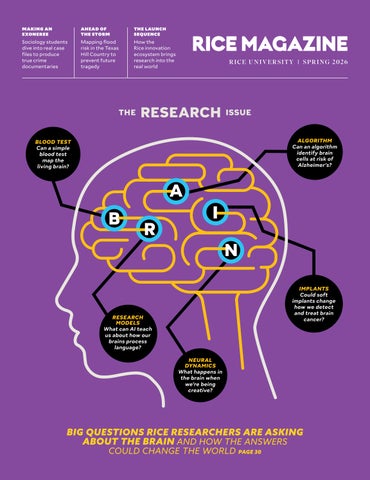
BLOOD TEST
Can a simple blood test map the living brain?
AHEAD OF THE STORM
Mapping flood risk in the Texas Hill Country to prevent future tragedy
THE LAUNCH SEQUENCE
How the Rice innovation ecosystem brings research into the real world
RICE UNIVERSITY SPRING 2026
THE RESEARCH ISSUE
ALGORITHM
Can an algorithm identify brain cells at risk of Alzheimer’s?
R
RESEARCH MODELS
What can AI teach us about how our brains process language?
IMPLANTS
Could soft implants change how we detect and treat brain cancer?
NEURAL DYNAMICS
What happens in the brain when we’re being creative?
BIG QUESTIONS RICE RESEARCHERS ARE ASKING ABOUT THE BRAIN AND HOW THE ANSWERS COULD CHANGE THE WORLD PAGE 30
On view at the Moody Center for the Arts through May 9, “Imaging after Photography” explores how AI and evolving technologies are reshaping our understanding of images and their relationship to reality. Featuring contemporary artists (including Moody artist-in-residence Sofia Crespo, whose work is pictured here), the exhibition questions authenticity, perception, and how we navigate the blurred line between the physical and the imagined.
Photo by Frank Hernandez
30
Why
Study the Brain?
Across Rice, researchers are asking big questions about the brain to advance health, strengthen society and shape the global brain economy.
38 After the Storm Rice’s SSPEED Center is designing a better flood forecasting system for the Texas Hill Country.
45 From Lab to Launch
Inside the Rice innovation ecosystem that helps big ideas go from research to reality.
PHOTO BY JORGE
Sallyport 7
A road trip with Rice’s outdoor program, an Olympic architect, the history of buckyballs, an Owl’s MFAH installation, the students making an exoneree, a gully gone wild, going to the chapel
Wisdom
19
Colombia’s hotly debated hippos, labor history in the Rio Grande Valley, Scott Solomon’s deep dive into life on Mars, Rice’s new pathway for community college transfers
Owlmanac 51
Classnotes, Glenn Youngkin ’90 leaves the governor’s mansion, Jen Cooper ’90 finds her footing in women’s soccer stats, Miriam Yoo ’05 uncorks a new career, World Cup fever arrives at Rice
Last Look 80
Rice’s OG alumni
CONTRIBUTORS
Lars Leetaru
(“Colombia’s Unexpected Inheritance”) is a Philadelphia-based illustrator whose work has appeared in The New York Times, The New Yorker and Rolling Stone. His work has been recognized by the Society of Illustrators and American Illustration. When not in the studio, he enjoys cooking, playing the banjo and drawing with his son.
Rafael Rojas
(“Way, Way Beyond the Hedges,” “Now Reading” and “Fever Pitch”) is a Houstonbased photographer and videographer at Rice, crafting compelling visual stories that capture campus life, culture and community through creativity, authenticity and a passion for meaningful storytelling.
Kat Cosley Trigg
(“Colombia’s Unexpected Inheritance,” “The Case, Reconsidered,” “From Classroom to Combine Champion” and “Why Study the Brain?”) is a multimedia journalist and media relations specialist at Rice. An Emmy Awardwinning television host and executive producer, she also teaches at Syracuse University’s S.I. Newhouse School of Public Communications.
Alex Becker (“After the Storm”) is a writer and media relations specialist for the News and Media Relations team in Rice’s Office of Public Affairs. She specializes in transforming complex research into compelling feature stories with a focus on engineering, climate and global health.
Bethany Nauert (“A New Ambition, Uncorked”) is a professional photographer based in Los Angeles. Born in Seoul, South Korea, and raised mostly in San Diego, she has always been drawn to visual storytelling. Bethany’s photography has been featured in Architectural Digest, Elle Decor and The New York Times.
Brandi Smith (“Moody Fellowship Brings Research Close to Home”) is an awardwinning multimedia journalist who escaped TV news after 23 years and now covers the School of Humanities and Arts, Shepherd School of Music and Moody Center for the Arts for Rice News.
RICE MAGAZINE
Spring 2026
PUBLISHER
Office of Public Affairs
Melinda Spaulding Chevalier, vice president
CREATIVE DIRECTOR
Alese Pickering
INTERIM EDITOR
Sarah Rufca Nielsen ’05
ART DIRECTOR
Amy Kinkead
GRAPHIC DESIGNER
Jackie Limbaugh
EDITORIAL DIRECTOR
Tracey Rhoades
COPY EDITOR
Deverly Pérez
PROOFREADER
Jenny West Rozelle ’00
PHOTO/VIDEO
Jared Jones
Rafael Rojas
CONTRIBUTORS
Alex Becker, Andrew Bell, Sam Byrd, Silvia Cernea Clark, Marcy de Luna, Jeff Falk, Jeff Fitlow, Autumn Horne ’22, Ishani Kaul ’25, Jennifer Latson, Rachel Leeson, Lars Leetaru, Brandon Martin, Bethany Nauert, Gustavo Raskosky, Robyn Ross, Brandi Smith, Kat Cosley Trigg, Jorge Vidal
Rice Magazine is published three times a year and is sent to Rice alumni, faculty, staff, parents of undergraduates and friends of the university.
Robert T. Ladd, chair; Elle Anderson; Bart Broadman; D. Mark Durcan; Josh Earnest; Michol L. Ecklund; George Y. Gonzalez; Jennifer R. Kneale; Patti Lipoma Kraft; Holli Ladhani; Elle Moody; Asuka Nakahara; A. Lanham Napier; William “Bill” V. Neville III; Vinay S. Pai; Byron Pope; Cathryn Rodd Selman; Gloria Meckel Tarpley; Jeremy Thigpen; Claudia Gee Vassar; Charlos C. Ward; James Whitehurst; Lori Rudge Whitten; Randa Duncan Williams; Michael B. Yuen.
ADMINISTRATIVE OFFICERS
Reginald DesRoches, president; Amy Dittmar, provost and executive vice president for Academic Affairs; Stephen Bayer, vice president for Development and Alumni Relations; Melinda Spaulding Chevalier, vice president for Public Affairs; Kelly Fox, executive vice president for Operations, Finance and Support; Terrence M. Gee, vice president for Technology Solutions and Services and chief information officer; John D. Lawrence, chief investment officer and president, Rice Management Company; Caroline Levander, vice president for Global Strategy; Tommy McClelland, vice president and director of Athletics; Yvonne M. Romero, vice president for Enrollment; David Sholl, executive vice president for Research; Omar A. Syed, vice president and general counsel; Adrian Trömel, interim vice president for Innovation and chief innovation officer.
POSTMASTER
Send address changes to: Rice University
Development Services–MS 80 P.O. Box 1892
Houston, TX 77251-1892
EDITORIAL OFFICES
Creative Services–MS 95 P.O. Box 1892
Houston, TX 77251-1892
Phone: 713-348-6768 ricemagazine@rice.edu
BRAIN POWER
WHEN WE STARTED imagining a feature about studying the brain at Rice, we ran into a problem: How can you separate anything studied at Rice from the brain?
Architects figuring out how spaces shape our mood? That’s definitely about the brain. Education researchers looking at what classroom factors support learning? Extremely brain. What about computer classes about UX? Economists discussing consumer behavior? Artists exploring color theory?
You get the gist. The brain is everywhere.
That lens is clearly visible in our cover story, where we somehow drilled down to a handful of the most interesting and most important questions about the brain being explored by scholars across campus, from learning to predict which brain cells are at risk of Alzheimer’s to what linguists are learning from AI about how we process language.
This interdisciplinary approach also mirrors the structure of the new Rice Brain Institute, where researchers across engineering, natural sciences and social sciences are studying the brain from every angle. At the Baker Institute’s Neuro-Policy Program, those connections extend beyond the lab, linking brain science to the systems that shape how people live and make decisions. And through Rice collabora-
tions like the Global Brain Economy Initiative — launched earlier this year at Davos by Rice and UTMB — that work is scaling outward, connecting research to broader questions of public health, economic growth and quality of life.
Across this issue, Rice research shows up in ways that have nothing to do with staying in a single discipline, and everything to do with what happens when ideas are put to use.
For example, students producing documentaries about potential wrongful convictions are poring over hundreds of pages of case files, going beyond coursework to contribute to real cases that could change lives. Scientists at Rice’s SSPEED Center are building data models to prevent future flooding disasters in the Texas Hill Country. One student’s deep dive into a museum acquisition has become an exhibition tracing Houston’s 1970s art scene, while another’s quest to recreate a 170-year-old Thomas Edison experiment could lead to more affordable methods of producing graphene.
These stories span disciplines, but they share a common pattern. Ideas move — from one field into another, from theory into practice, from campus into the world. They begin to matter in ways that are harder to measure, but easier to recognize. The throughline is not just inquiry, but impact — the recognition that understanding how we think, learn and behave carries its greatest weight when it shapes the world around us.
Which is to say: The brain may be everywhere, but at Rice, so is what we do with it.
Sarah Rufca Nielsen ’05
We love reader feedback. Kindly write to us at ricemagazine@rice.edu
PRESIDENT DESROCHES
UNDERSTANDING THE
BRAIN AND IMPROVING LIVES
WE ARE EXPERIENCING
extraordinary moments in neuroscience, including advances in neurotechnology, artificial intelligence, imaging and computational tools, that are expanding what we know about the brain at an unprecedented pace. These discoveries hold tremendous promise for improving brain health, diagnosing and treating neurological disorders, and deepening our understanding of human cognition.
They also raise important questions: How will new insights into the brain influence medicine and education? What will they mean for the way we work and learn? And how should society think about the opportunities — and responsibilities — that come with these powerful new approaches and tools?
These aspects are especially urgent when we consider the growing global challenge of brain health. Neurological and psychiatric conditions affect hundreds of millions of people worldwide and represent one of the fastest-growing drivers of disability and health care costs. Dementia alone is projected to affect more than 150 million people globally by 2050, with economic costs expected to reach tril-
lions of dollars annually. Addressing these challenges will require not only scientific breakthroughs but also new ways of connecting research, policy, education and public engagement.
At Rice, we are stepping up to help lead these efforts in innovative and responsible ways. Our 10-year strategic plan, Momentous, calls for Rice to become the top nonmedical institution in health research and technologies. Advancing brain health through discovery, collaboration and real-world application is a central part of that vision.
In recent years, neuroscience and neuroengineering research has accelerated rapidly. Scientists can now interface with the brain with remarkable precision, collecting extraordinarily rich datasets about neural activity and behavior. At the same time, new computational and analytical tools are allowing researchers to interpret this information in ways that were unimaginable just a decade ago. These advances are opening the door to transformative possibilities from next-generation therapies for diseases like Alzheimer’s and Parkinson’s to brain-machine interfaces that may one day restore lost abilities or expand how humans interact with technology.
Recognizing both the promise and the demands of this work, Rice recently launched the Rice Brain Institute. The institute brings together faculty across three intertwined pillars: neuroengineering, neuroscience, and brain and society. It connects scholars from across the university, including the schools of engineering, natural sciences, social sciences, humanities, architecture, business and music, to explore how discoveries about the brain can translate into meaningful benefits for people and communities.
Rice is fortunate to be part of a region uniquely positioned to lead in this area. Houston’s Texas Medical Center is providing unmatched opportunities
Last November, Texas voters overwhelmingly approved the creation of the Dementia Prevention Research Institute of Texas, committing $3 billion to research on the treatment, mitigation, and prevention of dementia and related disorders.
for collaboration between researchers, clinicians and industry partners. And last November, Texas voters overwhelmingly approved the creation of the Dementia Prevention Research Institute of Texas, committing $3 billion to research on the treatment, mitigation, and prevention of dementia and related disorders. In December, the Center for Houston’s Future, with Rice as a key partner, launched Project Metis to position our region as the global leader in brain health and the emerging brain economy.
Rice is also helping lead international conversations about how brain science can shape the future. Through the Global Brain Economy Initiative and in partnership with the World Economic Forum’s Brain Economy Action Forum, we are working with international partners to translate insights about brain function into strategies that improve well-being, productivity and quality of life.
The brain is the most complex system we know. But by boldly studying and deepening our understanding of it, we also expand our understanding of ourselves and open new pathways to improving human lives around the world.
Way, Way Beyond the Hedges
Rice Outdoor Programs and Education creates accessible adventures where students can unplug, discover new skills and venture farther than expected .
BY AUTUMN HORNE ’22
A s triking view from a ROPE backpacking trip in Paria Canyon , located along the Arizona and Utah border.
ON A COOL SUNDAY morning in February, a group of students are threading along a treelined trail in Pedernales Falls State Park, tucked into the bucolic folds of the Texas Hill Country about an hour west of Austin. Backpacks shift. Water bottles pop open. A laugh carries up the hill toward me as I walk near the front of the pack. After about an hour of hiking, we reach a natural spring bubbling up through the Texas limestone — one of many small discoveries our group has made over the weekend.
The day before, we hiked to the park’s namesake falls, spilling over a vast limestone expanse that we explored until sundown. Later, as dusk settled in, we learned how to pitch a tent and inflate a sleeping pad with a
pump sack. “It works best if you blow into the bag from further away,” trip leader Kate Miller ’28 explained with a grin, “because of Bernoulli’s principle.”
Our trip was one of many each year organized by Rice Outdoor Programs and Education, known as ROPE. At our pre-trip meeting, participants shared their reasons for signing up. Some needed a mental break from classes or research. Others were new to Texas and wanted to explore more of its natural beauty with friends or partners. And most did not have extensive experience with camping or hiking.
ROPE trips are designed to make the
ROPE provides low-cost camping and outdoor gear rentals to the Rice community in addition to leading trips.
Rice students exploring the limestone expanse of Pedernales Falls State Park
Trip participants set up camp in Paria Canyon.
outdoors accessible to Rice students, faculty and staff. Almost all excursions are open to beginners, and gear is provided so participants do not have to invest in expensive equipment. Revenue from gear rentals, another ROPE service for Rice community members, helps offset costs and keeps trips affordable.
When Kris Cortez, who has led ROPE for 11 years, arrived at Rice, the program was offering a handful of trips each semester. Today, ROPE offers multiple trips almost every weekend and during academic breaks, from hiking day trips and weekend excursions to kayaking along the Gulf Coast to bucket-list trips to Big Bend and the
Grand Canyon. It’s still not enough to keep up with the demand from students. “At an urban school like Rice,” Cortez explains, “if we’re not here, there’s a lot less students getting off campus and trying outdoor adventure.”
Behind each trip is a team of nearly 20 student leaders who plan and facilitate every detail. Cortez provides guidance, especially on risk management, but leaders are responsible for designing routes, facilitating transportation and meals, and deciding how they will build in time for reflection and connection once they are on the trail.
Many leaders were drawn to ROPE because they had previous outdoor experience, but it’s not a prerequisite. Regardless of background, leaders train over long weekends and breaks. They practice kayaking techniques in the Rec Center pool, study Leave No Trace principles and complete wilderness first aid certifications. Technical competence is emphasized because leaders are responsible for the safety of participants, but every leader I talked with said that these are not the program’s most important lessons. Those emerge in less predictable conditions.
Our Pedernales Falls trip was well outfitted with sturdy tents, winter layers and cold-weather sleeping bags. Still, the temperature dropped off sharply after sunset. Lying in my tent trying to read by headlamp, gloved fingers stiff in the cold, I heard my fellow campers admiring the stars. Later, disoriented on a 4 a.m. walk from the bathroom, I was suddenly grateful for the steady sound of a fellow camper’s snores which led me back to our site.
In the small moments of discomfort, I started to understand what trip leader
Benjamin Kwait-Gonchar ’27 told me earlier that week, “You can be freezing in some random woods and you’re a little bit miserable, but it brings everybody much closer together.”
Over the course of the weekend, I watched that closeness take shape. A leader slowed their pace to match a first-time hiker. Conversations moved easily between majors, hometowns, research interests and the future. I learned about the process of writing an artist’s manifesto, energy transition in Uzbekistan and that I share remarkably similar taste in novels with a senior electrical engineering major.
“One day of backpacking together feels like weeks of knowing someone outside the wilderness,” trip leader Justin Impelman ’27 says.
What felt organic was, in fact, intentional. ROPE leaders have real responsibility to make decisions under pressure, cultivate appreciation for the outdoors and build community. For William Clarke ’28, that responsibility has been central to his personal development. “When you’re in charge of people’s safety,” he says, “it’s almost like you don’t have a choice but to be a leader.” In addition to safety, leaders are responsible for building in pauses to appreciate nature — time to explore limestone formations, linger at an overlook or sit quietly under the night sky. For Aidan Allen-Lyons ’26, a trip leader pursuing environmental law, these moments matter. “A huge part of our job at ROPE is to expose people to nature in a way that they want to protect it,” she says.
We returned to campus with phone notifications buzzing and inboxes filled, but before we departed, we gathered in a circle and shared what we were taking away from the trip: the pleasure of disconnecting from technology, stronger friendships, confidence setting up a campsite. We also carried back a reminder to look around, look out for one another and shoulder a little more responsibility than we arrived with.
ROPE offers trips almost every weekend and during academic breaks, from kayaking along the Gulf Coast (above) to hiking through Big Bend National Park (left).
For William Clarke ’28, being a ROPE team leader is central to his personal development.
Color Field
MFAH intern Will Marsden conceived a new display highlighting a major moment in Houston’s art history.
FOR RICE University senior Will Marsden, a summer internship at the Museum of Fine Arts, Houston turned into a rare opportunity to help shape a historically resonant gallery installation that’s now on view.
Marsden, a business and art history major who interned in the museum’s modern and contemporary art department, spent months assisting curators with research, writing and collection work. The position exposed him to the behind-the-scenes curatorial process that determines how artworks are studied, interpreted and ultimately displayed for the public.
“In a curatorial office you’re working on everything that might come into the museum — gifts, potential loans and donations — as well as planning for
upcoming exhibitions,” Marsden says. “Everything you see in the mu seum is very intentionally placed and interpreted for visitors.”
Marsden’s work included researching provenance, helping draft object labels and contributing to reports about works entering the museum’s permanent collection. When the MFAH was gifted “Milkwood” (1973), a painting by Black American artist Peter Bradley, through a museum exchange program, Marsden was asked to design a potential gallery layout that could incorporate the work as a hypothetical exercise. Drawing on the research he had already conducted, Marsden proposed an installation that would not only feature Bradley’s work but also connect it to a pivotal moment in Houston’s art history.
It highlights Bradley’s role in the groundbreaking 1971 “De Luxe Show,” an exhibition held in Houston’s Fifth Ward that brought together artists of different racial backgrounds at a time when the art world was often segregated. The show took place at the DeLuxe Theater and was organized with support from patrons associated with the storied Menil Collection.
“It was one of the first racially integrated art exhibitions in the United States,” Marsden says. “It brought together artists from all over the country who were making some of the most innovative abstract work of the time.”
Marsden’s installation revisits that legacy by pairing Bradley’s signature canvases from the early 1970s and two recent, untitled lithographs with works by Anthony Caro, Sam Gilliam and Larry Poons — creative minds all connected to the same artistic moment. Many of them were associated with the Color Field movement, a style of abstract painting characterized by large areas of color meant to evoke emotion and contemplation, made famous by abstract painter Mark Rothko. Through his research, Marsden encountered influential Houston art initiatives such as Rick Lowe’s groundbreaking Project Row Houses and the lasting cultural impact of “The De Luxe Show,” giving him a deeper appreciation of Houston’s art community.
“I had traveled a lot and seen museums in Europe,” he says. “But I didn’t really know the history of Houston’s art scene before this.”
The experience has shaped his career aspirations as well. Marsden now works as a gallery assistant in Houston and hopes to pursue a career in the commercial art world, potentially working with galleries or auction houses.
His concept ultimately became a real installation, “Peter Bradley and ‘The De Luxe Show,’” on display in the MFAH’s Law Building through May 31.
“Working at a museum of that caliber was a huge moment for me,” he says. “It showed me how dynamic the art world is and how many opportunities there are to connect artists, history and the public.”
— SAM BYRD
ART HISTORY
Peter Bradley’s “Salmon Spray” (1972) is displayed to the left of two of Bradley’s untitled lithographs, c. 2022, at the Museum of Fine Arts, Houston.
ARCHITECTURE
Built for Speed
Barbora Malikova balances elite sprinting and marathon studio sessions in a schedule that doesn’t slow down.
BY THE TIME Barbora Malikova ’29 arrived at Rice to begin her Master of Architecture, she had already competed on the world’s biggest athletic stage: representing the Czech Republic in the 400-meter race at the 2020 Tokyo Olympics.
Enrolling in one of the country’s most rigorous, studio-heavy architecture programs, she was ready to put aside her athletic career to focus on her studies. But in exploring the architec-
ture program at Rice, she realized she wouldn’t have to choose.
“At Rice I found the right coach and team to keep pushing my limits without compromising my education,” Malikova says.
Intrigued by the prospect of an athletic program that would also allow her to prioritize her academic goals, she joined the Owls’ NCAA Division I track team. The architecture program covers her tuition; athletics picks up her living expenses.
During the season, Malikova trains seven to eight times a week — sprint work, lifting, recovery — then heads to studio, where projects stretch late into the night.
“Track and field has taught me discipline,” she says. “Architecture requires the same mindset — consistency, resilience and staying on top of my schedule.”
If that sounds like a lot, it is. But
Malikova is quick to point out that the culture at Rice makes it possible.
“At a bigger school, you can feel like one of many,” she says. “Here, coaches and professors genuinely care how you’re doing — not just your performance, but how you feel.”
And Malikova is not just making it work — she’s excelling. Competing at the Tyson Invitational in February, Malikova ran the indoor 400 meters in 51.84 seconds, breaking a 23-yearold Rice record and setting a new American Athletic Conference mark in the process.
With two years of NCAA eligibility left, Malikova isn’t choosing between identities anytime soon. She’s building both at once, one race and one studio project at a time.
“You can push yourself to the limits athletically,” she says, “and still shape environments with intention and meaning.”
—
BRANDON MARTIN
RICE BUSINESS WAS RANKED NO. 1 for the seventh year in a row in graduate entrepreneurship by Princeton Review and Entrepreneur // THE KINDER INSTITUTE FOR URBAN RESEARCH RECEIVED A $55 MILLION GRANT from the Kinder Foundation to continue its research for many years to come // The Texas Space Commission approved $14.2 MILLION FOR RICE TO LAUNCH A CENTER FOR SPACE TECHNOLOGIES within the Rice Space Institute // The GRAMMY AWARD FOR BEST OPERA RECORDING went to Jake Heggie’s “Intelligence,” recognizing the work of producer Blanton Alspaugh ’87 (his 12th Grammy win!) and bassbaritone Nicholas Newton ’19 // Connor Heggie ’18, the co-founder and CTO of AI sales software company Unify, was named to FORBES’ 30 UNDER 30 LIST, the 22nd Owl to make the list since 2011
THE RICE TICKER
SPACES
Going to the Chapel …
A stunning space for contemplation, community and all that glitters.
CONSTRUCTION ON the Moody Center Complex for Student Life is well underway, expected to provide a vibrant, new place for students to gather starting in 2027. But one neighboring space — the Rice Chapel — remains relatively unchanged. Steeped in history, the chapel (originally the Memorial Chapel) has been a beautiful, almost mystical campus gathering spot since its dedication in 1959. From art exhibits to conferences and countless weddings, the chapel’s golden entryway has welcomed visitors for nearly 70 years.
Nestled in the cloisters of the RMC, the Romanesque-style building was made possible by a gift from Eugenia and Newton Rayzor, Class of 1917, the first alumnus to serve on the Rice Board of Trustees (then the Board of Governors) and a member of the institute’s second graduating class. Inspired by Rome’s Archbasilica of Saint John Lateran, architect Harvin Moore, Class of 1927, enhanced the nondenominational space with abstract stained-glass windows, wooden pews adorned with carvings of the university seal, a marble altar, and the unforgettable gold-leaf columns and gilded apse that bathe the space in a majestic glow, day or night.
The chapel is anchored by an Opus 1 Baroque-style organ consisting of 17 ranks and 1,120 pipes, providing a rich, resonant sound for services and events, including memorial remembrances for many renowned faculty members and, notably, one for John F. Kennedy following his assassination. In 1962, the system was bolstered by the installation of an electronic carillon, enabling sound to be broadcast through speakers located in the adjacent bell tower. For about two decades, until the early 1980s, the carillon chimed the hours daily.
“Save for minor repairs and a significant overhaul of the organ in 2012, there haven’t been any major changes to the chapel,” says Tim Abraham, assistant director of student services and the chapel’s reservation manager.
Around 100 events are held in the chapel each year, in addition to free guided meditation sessions held Thursdays at noon. So even though the bells no longer chime, the chapel beckons.
— TRACEY RHOADES
Do you have a meaningful memory in the Rice Chapel? Tell us about it at ricemagazine@rice.edu
PHOTO BY JEFF FITLOW
ENGINEERING
From Classroom to Command
Rice’s NROTC executive officer has secured an elite Navy nuclear engineering commission, one of the military’s most technically demanding roles.
MATTHEW DEVERELL ’26 HAS known since grade school that he wanted to be a nuclear engineer. Now the Will Rice senior has earned one of the rarest early-career distinctions in his field — one of only eight nuclear engineering officer positions awarded each year by the U.S. Navy.
A mechanical engineering major and Midshipman 1st Class in Rice’s Naval ROTC unit, Deverell also serves as the unit’s executive officer. After graduating, he will commission as an ensign and report to Naval Reactors Headquarters in Washington, D.C.
“I’ve been interested in nuclear engineering since elementary school,” Deverell says. “By the time I was applying to colleges, I knew it was a career path I would be happy in. NROTC was a great way to get started in that field, and it provides incredible opportunities for training and professional development.”
At Rice, that early interest found structure and challenge. Deverell said he first learned about the naval reactors engineer role during his time on campus, drawn to its responsibility for the entire life cycle of every naval
The Navy’s nuclear power program has a long and successful history of safe reactor operation, and I’m excited to be part of that tradition of engineering excellence.
nuclear reactor, from design to longterm oversight.
“As an NR engineer, I’ll get to use my engineering expertise to help develop and maintain the Navy Nuclear Propulsion Program,” he says. “The Navy’s nuclear power program has a long and successful history of safe reactor operation, and I’m excited to be part of that tradition of engineering excellence.”
His selection followed an intensive, multistage interview process at Naval Reactors Headquarters, culminating in a final interview with Adm. William Houston, director of the Naval Nuclear Propulsion Program.
“It’s a great honor to be selected for such a prestigious program,” Deverell says. “Rice has been very important in my journey — the courses I’ve taken here have been essential to my success.”
Capt. Mike Kinter, commanding officer of Rice’s Naval ROTC unit, sees both aptitude and leadership in Deverell.
“From my interactions with him, I’m very impressed,” Kinter says. “He’s definitely ready to enter the Navy as an officer. He’s wicked smart — an engineering type through and through — and I think his leadership skills will continue to grow with time.
“It just speaks to the quality of education the students are getting here, especially in engineering,” Kinter adds. “The Navy values institutions like Rice because of that strong foundation in math, physics and chemistry. The fact that one of only eight slots in the country went to a Rice student is something the university can absolutely take pride in.”
— ANDREW BELL
Deverell aboard the USS Curtis Wilbur during summer training.
SOCI 433
Making an Exoneree
DEPARTMENT
Sociology
DESCRIPTION
The Case, Reconsidered
SYLLABUS THREE STUDENTS gather around a phone, waiting for it to ring. Laptops and case files are strewn across the table — court transcripts, police reports and witness statements they have spent weeks combing through line by line.
Then the silence breaks. “You have a call from a prisoner at the Texas Department of Criminal Justice.”
The automated voice echoes through the room before continuing with the name they now know well: Jacob Bryan Cobb.
The line opens with a burst of static crackling through the speakerphone. Cobb’s voice fades in and out, a reminder that this is no ordinary phone call. The line is monitored, the connection imperfect.
For senior Jessaly Chavez and freshmen Olivia Brazier and Ariana Gauba, the call has become a weekly routine. The discussion flows easily: Cobb talks about his prison work assignment and earning money for the commissary.
He asks the students about their classes and what they have been working on.
For the Rice students, the call is more than a conversation. It’s part of an investigation. Chavez, Brazier and Gauba are members of one of four teams in Rice’s Making an Exoneree course, where students examine potential wrongful conviction cases in an effort to determine whether someone may have been unjustly imprisoned.
Students spend weeks going through the case files, searching for inconsistencies or details that may have been overlooked. In some instances, students learn crucial details about their cases and program participants by interviewing them in person, as well as speaking to their family and friends. In many of the cases, there is no dramatic new DNA evidence waiting to overturn a conviction and no single smoking gun. Instead, the work requires careful scrutiny of the legal record to determine whether
This experiential course provides a select group of students the opportunity to spend a semester reinvestigating likely wrongful conviction cases of people in prison with the ultimate goal of creating a public documentary, website and social media campaign for their program participant. Depending on the case they work on, students will travel to meet and interview their program participant, family members and friends to learn more about their cases and develop their advocacy strategies.
something might have been missed.
Because students are not attorneys, much of their work focuses on advocacy and storytelling that can help bring attention to the cases they investigate. Alongside the investigative work, students also learn the fundamentals of documentary filmmaking, and their research ultimately becomes part of a film designed to bring broader public attention to the case.
“It wasn’t even something I had to think about. It was a class that I knew I wanted to teach immediately,” says Kavya Padmanabhan, a lecturer in Rice’s sociology department who leads the course. “Sometimes teaching in academia can feel removed from people’s daily lives, and this class is the bridge.”
Marty Tankleff speaks to students during a Making an Exoneree class session. Tankleff, who was wrongfully convicted and later exonerated, co-developed the program with Georgetown professor Marc Howard.
Cobb was convicted of murdering his grandmother at age 16 and has now spent nearly two decades in prison serving a 40-year sentence. A suicide note was found with his grandmother’s body, but during his case prosecutors argued that he had written it himself. With Cobb eligible for parole in July, if the team can uncover something overlooked in the thousands of pages of records, it could change the course of his life.
“The exciting thing is that the students can create this really convincing and important narrative and hopefully be able to sway the parole officers, [or] at least get a lawyer attached to the case,” says Padmanabhan.
The course is part of a national program of the same name created by Georgetown University professor Marc Howard and criminal defense attorney Marty Tankleff. When Tankleff was 17, he was convicted of murdering his parents and sentenced to 50 years to life in prison. Howard, who grew up alongside Tankleff on Long Island, never believed his friend was guilty. While continuing his academic career, he went to law school in hopes of helping challenge the conviction.
In 2007, after nearly two decades
behind bars, Tankleff’s conviction was overturned and he was released. A few years later, he earned his law degree.
Together, the two created Making an Exoneree at Georgetown University in 2018, building a program that allows undergraduate students to reinvestigate possible wrongful conviction cases while producing documentary storytelling that can help amplify those potential miscarriages of justice.
Howard says the program grew directly out of the experience of fighting for his friend’s freedom.
“What we’re doing is having undergraduate students fight for freedom and justice for people who may have been wrongfully convicted,” Howard says.
Since then, the course has expanded to universities across the country through a franchise model, allowing faculty to adopt the curriculum on their campuses. This year Rice became the fifth university to offer the course, alongside Princeton, New York University and the University of California, Santa Cruz. Since its launch, the program’s combined student investigations have helped free 13 incarcerated individuals.
“We strive to engage our students in real-world experiences that connect what they are learning to tangible,
Since its launch, the program’s combined student investigations have helped free 13 incarcerated individuals.
societal challenges,” says Rachel Kimbro, dean of Rice’s School of Social Sciences. “Making an Exoneree is an excellent model that tasks students with a human- and justice-centered objective and makes a meaningful impact on the world.”
For Chavez, the work carries personal meaning. Now a senior studying political science and Latin American studies, she hopes to pursue a law degree and build a career in criminal justice. During the call, Cobb asks how preparations for her upcoming LSAT are going.
The question catches her slightly off guard, as the students are used to asking him about his life in prison. Instead, the man whose case they are investigating is asking about her future.
“You have one minute remaining.”
The automated voice returns suddenly to warn them about the time, prompting the trio to hurry through a few final questions for Cobb.
Just before the call cuts off, Cobb pauses, thanking them from the bottom of his heart for everything they are trying to do.
At that, the line goes silent.
Next week they will call again.
— KAT COSLEY TRIGG
Rachel Kimbro is the Herbert S. Autrey Chair in Social Sciences, professor of sociology and dean of the School of Social Sciences at Rice. Marc Howard is professor of government and law and the founding director of the Prisons and Justice Initiative at Georgetown University. Martin Tankleff is the current Peter P. Mullen Distinguished Visiting Professor at Georgetown University and an adjunct professor of law at Georgetown Law School.
Marc Howard speaks with students in the Making an Exoneree course during a visit to Rice University.
PHOTO BY KAT COSLEY TRIGG
ON CAMPUS
Prairie Revival
A former detention basin becomes a living laboratory as Rice students restore one of Texas’ most endangered ecosystems.
WHEN THE CURRENT Wiess College building was built on the southern edge of the residential college corridor, Rice turned the neighboring green space into a detention basin to capture water runoff. While necessary, this wasn’t an easy decision: As the campus’s last uncultivated green space, it was valued by community members seeking or studying nature.
“We had this incredible, student-led push to take this area and turn it into a historic coastal prairie, a highly endangered ecosystem native to the Houston area,” says Cassidy Johnson, director of Rice’s arboretum and assistant teaching professor of biosciences.
Thus, in 2018, the Harris Gully Natural Area was born. When the first efforts to reseed it failed, Mia Peeples ’22 led a multiyear soil testing project that determined the top four inches of soil were too tightly compacted for native plants. Cover crops including daikon radishes, legumes and canola
were planted to break up the soil and improve its quality.
In 2023, the detention basin itself was turned into a pond that would serve as a wetland, a common feature of coastal prairies, and planted with cover crops. Earlier this spring, the cover crop was removed from the pond’s banks and native wetland grasses were planted instead. The inner prairie will be reseeded in fall 2026 or 2027.
In 2023, a shaded pavilion designed by Rice Architecture associate professor Jesús Vassallo’s wood seminar class was installed on the site, hosting birdwatchers, open-air classes and other members of the community looking for a natural respite.
That’s the point of Harris Gully’s slow, patient return to a native ecosystem. It’s a place to see what this land was like before Houston, before Rice, before the allées of oaks that shade the campus.
It’s a more subtle kind of natural beauty than the azaleas that coat the campus in pink every spring, but for those who stop and look, it is there in abundance. — RACHEL LEESON
SOCIAL MEDIA
MUSICOWLOGY
What does a study session sound like in 2026? Earlier this year, Rice’s social media team wandered campus with a microphone and a simple question for students: What’s playing on your headphones right now? The answers span eras and genres to create a playlist as eclectic as Rice itself.
—DEVERLY PÉREZ
“LES” Childish Gambino
“Where’s My Love” SYML
“I Want You (She’s So Heavy)” The Beatles
Madison Beer
“Pure/Honey” Beyoncé Radiohead
A rendition of Michael Jackson’s “Dirty Diana” Jackson State Sonic Boom of the South
“Wavy” Karan Aujla
“S-Class” Stray Kids
Piano Sonata No. 4 Alexander Scriabin
“All That She Wants” Ace of Base
“Lord Knows” Drake feat. Rick Ross
“Couldn’t Make It Any Harder” Sabrina Carpenter
“Going Bad” Meek Mill feat. Drake
To explore these songs on our specially made Spotify playlist, scan the code above in your Spotify app.
The Birth of the Buckyball
Richard Smalley and Robert Curl’s Nobel Prize-winning discovery led to a scientific and technological revolution.
IN 1985, SCIENTISTS working out of a lab in Rice’s Space Science and Technology Building stumbled upon a strange, soccer-ball-shaped molecule. Their discovery, made after a whirlwind two weeks of experiments, culminated in a journal article barely two pages long that revolutionized nanotechnology and earned them the Nobel Prize in chemistry in 1996. The discovery of C60, also known as buckminsterfullerene or the “buckyball,” marked a defining moment in scientific history — and in the scientific legacy of Rice.
At the time, graduate students Sean O’Brien ’88 and Jim Heath ’88 were working in the lab of chemist Richard “Rick” Smalley, a hub of activity known for its cutting-edge cluster machine, AP2. O’Brien and
Heath were initially focused on metal clusters, but with the arrival of Harold “Harry” Kroto in late August 1985, everything changed. Kroto was a British chemist from the University of Sussex and a friend of Robert Curl ’54, Smalley’s senior colleague at Rice. Full of enthusiasm for carbon research, Kroto persuaded the Rice team to explore carbon clusters, as he was particularly interested in seeing whether vaporized carbon would condense into clusters consistent with the carbon material observed in interstellar space.
Despite initial reluctance, the team began experimenting with carbon under Kroto’s guidance. The breakthrough came when O’Brien’s new nozzle design allowed them to produce carbon clusters in a way that scientists
had not been able to before. Heath worked extensively to create carbon clusters of various sizes, but one cluster in particular was remarkable for its stability and ease of creation: C60.
After a week of intensive experimentation, Smalley assembled the team to reveal a cut-out paper model of a soccer ball — the shape of C60. “We all showed up at his office, and he had this cut-out paper model of a buckyball, and we just knew, ‘This has to be right,’” Heath says. Although they had identified the buckyball, proving its structure to the scientific community was another challenge. The concept of a stable, hollow carbon structure was radical, and many doubted the team’s findings until 1990, when physicists Wolfgang Krätschmer and Donald Huffman were able to make C60 in bulk.
In his speech at the 1996 Nobel Banquet, Smalley reflected on the unique contributions each member brought to the team. “We had evolved one of the most intellectually demanding and penetrating styles of research I have ever witnessed in any research group,” he said. “Sean O’Brien had evolved just the right version of the cluster nozzle … and Jim Heath had developed an amazing talent for making ‘science happen’ on the machine. When Harry Kroto came, his intensity and scientific background blended in perfectly.”
The discovery of C60 was more than just a scientific breakthrough — it opened up an entire research ecosystem. Proving that atoms can be assembled into stable, functional, nanoscale machines provided the basis for everything from carbon nanotubes to graphene, molecular electronics, nanomedicine and quantum materials. It also ignited a legacy of groundbreaking research within the Wiess School of Natural Sciences that continues to this day. As Rice continues to push the boundaries in nanoscience and nanotechnology research, the story of the buckyball remains an inspiring milestone in the history of the university.
—ISHANI KAUL ’25
LORE
Sean O’Brien, Richard Smalley, Robert Curl, Harold Kroto and Jim Heath outside the Space Science and Technology Building shortly after the discovery of C60 in 1985.
Richard Smalley atop the AP2, the apparatus used to find C60, c. 1986.
RESEARCH
Colombia’s Unexpected Inheritance
Along the Magdalena River, a wild herd of hippos is a controversial reminder of the country’s troubled past.
BY KAT COSLEY TRIGG
ALEJANDRA Osejo
Varona ’24, ’27 stands at the edge of Colombia’s Magdalena River, headphones on and field recorder in hand, scanning the surface for movement. Her gaze sweeps the broad ribbon of water, as fishermen cast their lines and the current carries decades of memory downstream. Her goal is to understand life along the mangrove-bound river that serves as Colombia’s commercial and ecological backbone.
A Rice Ph.D. candidate in anthropology, Osejo Varona searches for wide, pink-gray snouts popping up above the surface of the water. She is hoping to glimpse some of Colombia’s most unlikely and controversial residents — hippopotamuses.
Growing up in southwestern Colombia, Osejo Varona was captivated by what she calls “the diversity of beings, animals and plants woven into human life.” The Magdalena River and its tributaries weren’t just landscapes, they were living systems shaped by biodiversity, commerce and the long shadows of conflict. That proximity to both ecological richness and political violence now informs her research in deeply personal ways.
In the early 1980s, the infamous drug trafficker Pablo Escobar brought four hippos from Africa to Colombia as part of a private zoo on his Hacienda Nápoles compound, alongside giraffes, elephants, zebras and ostriches. After Escobar’s death in 1993, most of the zoo animals were relocated, but the hippos remained on the property, too difficult and expensive to move. Eventually they dispersed into nearby wetlands and riverways, thriving in an adopted home that provided abundant habitat and no natural predators. Today, more than a hundred hippos live in and around the Magdalena River basin.
Biologists classify them as a nonnative species, meaning they evolved elsewhere and arrived through human intervention. In many parts of the world, invasive species are aggressively removed to protect native ecosystems. But hippos are not insects or plants — they are large, charismatic mammals deeply entangled with Colombia’s history.
And that is where the question emerges, the one Osejo Varona is asked again and again: What should Colombia do with the hippos? “It is the most difficult question,” she says. “If you take a side too quickly, you close the door.”
The Magdalena River is Colombia’s principal waterway, a corridor of trade, culture and memory. It is also a river that has witnessed profound violence. During decades of armed conflict linked in part to narcotrafficking, communities along its banks endured displacement, fear and loss. The river’s story cannot be separated from that past, nor can the hippos’.
Some scientists and policymakers argue that the hippos should be culled or sterilized to prevent further ecological disruption. Others see economic opportunity in their presence, pointing to tourism drawn by the novelty of hippos roaming South American rivers. Many local residents occupy a quieter middle ground. Some have adapted to living alongside them and no longer react with alarm. Others worry about safety but see the animals as only one of many daily challenges.
“This is not only an ecological problem,” says Osejo Varona. “It is social, historical and ethical.”
The hippos represent what she calls the environmental afterlife of violence — the way human decisions reverberate through ecosystems long after headlines fade. The animals were transported across continents as symbols of excess and power. Today, their presence forces Colombia to confront questions about responsibility, memory and coexistence.
PHOTOS BY ALEJANDRA OSEJO VARONA AND BRANDON MARTIN
Hippos near a village located on the site of Pablo Escobar’s former residence, Hacienda Nápoles.
Alejandra Osejo Varona
When Osejo Varona arrived at Rice in 2021 as a Fulbright Foreign Student Award recipient, she envisioned a different research topic. But her previous work at the Alexander von Humboldt Biological Resources Research Institute, where she led research on environmental governance and equity, had exposed her to the growing debate. Osejo Varona realized the controversy was not simply about animal management. It was about how scientific expertise, government policy and local knowledge intersect — and whose voices are heard.
Her fieldwork reflects that intersection. She has lived for more than a year alongside rural communities in the Magdalena basin, listening to fishermen describe disappearing fish stocks, residents explaining how they have adapted to the hippos’ movements and tourism operators who see opportunity in these odd new mascots.
She also listens in another way. Working with scientists who use hydrophones and acoustic analysis, Osejo Varona studies how sound travels
through the river. What does a hippo hear in a Colombian amusement park filled with music and tourists? How does underwater noise shift when large mammals enter an ecosystem? What changes in the river’s acoustic landscape when environments are altered?
By combining ethnography with sound technology, Osejo Varona invites collaboration across disciplines and across species. Her work is not about defending the hippos, nor condemning them. For her, the goal is not to settle the question of what should be done, but to widen the frame around how it is asked.
“One thing I am sure about,” she says, “is that the people who live with the hippos every day must be part of the decision.”
The story is far from finished. The hippos continue to reproduce and migrate into new stretches of the Magdalena, reshaping both ecosystems and conversations. The research continues as well: Osejo Varona is now writing her dissertation, with plans to defend in 2027, and will return to Colombia this summer to share her sonic and visual work with the communities who helped shape it.
Standing by the river, it is hard to separate the hippos from the water that carries them. They move slowly and deliberately, seemingly indifferent to the debates that swirl around their existence. And the river keeps moving, as it always has.
Colombia’s Magdalena River is now home to more than 100 hippopotamuses.
Osejo Varona interviews Eliseo, a fisherman who lives along the Magdalena River.
A team member recording underwater sounds with a hydrophone.
Alejandra Osejo Varona recording a soundscape of the Magdalena River.
The Big Number
THAT’S HOW MUCH ASSAULTS increased during the time periods around professional sports events after sports betting was legalized across the U.S.
In the years since the Supreme Court struck down the federal ban in 2018, states across the country have legalized sports betting, transforming game day into a multibilliondollar industry fueled by smartphone apps, real-time wagers and endless parlays. But new research suggests the rapid expansion of sports gambling may also carry social consequences that are only beginning to come into focus.
A new study co-authored by Hua Gong, assistant professor of sport analytics at Rice, and Wenche Wang, a former assistant professor of sport management at the University of Michigan School of Kinesiology, analyzed national crime incident data from 2017 to 2021. Looking at states that legalized sports betting after the Supreme Court ruling, the researchers tracked four types of crime reports during a key window of heightened fan and betting activity: from the start of a professional sports game to four hours after it ends.
The pattern that emerged was striking. In the time period when betting activity tends to peak, states with newly legalized sports betting experienced notable increases in
several types of crime. Assaults rose the most, but larceny and vehicle theft also increased during that window, particularly on days when local teams were playing.
“Sports gambling is exciting for fans and financially attractive for states, but our findings show it can also lead to more crime,” says Gong. “When people lose their bets or go through very stressful game moments, that emotional volatility can translate into aggressive behavior.”
The pattern of violence becomes even more pronounced under two common scenarios. When teams were playing at home, the increase in assaults climbed to 77.23%, and when home games ended with outcomes that contradicted sportsbook predictions — the kind of upset that can wreck a carefully placed wager — the jump reached 93.42%.
Since 2018, 38 states (plus Washington, D.C., and Puerto Rico) have opened legal betting markets, often emphasizing the potential tax revenue and economic growth associated with the industry. But Gong and Wang’s research suggests that those benefits may come with less visible trade-offs.
“Legal betting brings in revenue, but there are serious social consequences we cannot ignore,” Gong says.
— SARAH RUFCA NIELSEN
Moody Fellowship Brings Research Close to Home
For Michael Garcia, researching labor history in the Rio Grande Valley is also an act of recognition.
MICHAEL GARCIA’S thesis research began in the archives, but its roots run much closer to home.
A senior majoring in history and business with a minor in politics, law and social thought, Garcia has spent his final year reconstructing the lives of agricultural workers in the Rio Grande Valley, tracing stories of labor, migration and survival that echo his own family history. He presented his thesis in April at the Humanities and Arts Festival, where students from across disciplines share original research and creative work.
Garcia’s research path began with the Elizabeth Lee Moody Undergraduate Research Fellowship in the Humanities and the Arts, which supports Rice students dedicated to pursuing critical humanities-based research and innovative creative work. His Moody stipend enabled him to spend a summer in Spain studying Mexican volunteers in the Spanish Civil War. There, in letters, hospital records and commendations, he found voices often left out of dominant historical narratives.
“We tend to forget that this was a
war happening in Spain, and yet Latin American voices are almost entirely absent from the way it’s discussed,” Garcia says.
That archival work laid the foundation for his senior thesis. Garcia now focuses on agricultural labor in the Rio Grande Valley during and after the Bracero Program, the binational agreement established in 1942 that brought millions of Mexican men to the United States as temporary workers. His project examines how those labor systems and migration patterns persisted long after the program officially ended in 1964.
“My job was to really analyze the archives,” Garcia says. “It was to go back into those libraries, back into those boxes and boxes and boxes of paperwork, and really get to see what their lives were like.”
To answer those questions, Garcia spent months in regional archives, including the Museum of South Texas History in Edinburg and special collections at the University of Texas Rio Grande Valley.
“Michael is such a brilliant and thoughtful student,” says Laura Correa
Ochoa, assistant professor of history in the School of Humanities and one of Garcia’s advisers. “Ever since he took my first class several years ago, I’ve been so impressed by his intellectual rigor, curiosity and work ethic. His enthusiasm for archival research and historical analysis has been wonderful to see. He works so hard and cares deeply about everything he works on.”
For Garcia, the project is also personal. His parents worked as field laborers in the same region he now studies.
“All I can think of is my parents,” he says. “All I can think of is my sister and my brother and myself and realize that [the braceros], in so many more ways than I can possibly know, are like me.”
The work, Garcia says, feels especially urgent now. “I think that in today’s political climate, it’s so important to uncover these stories of endurance and durability and survival because we need those, too.” — BRANDI SMITH
Moody Experience
The Elizabeth Lee Moody Undergraduate Research Fellowship in the Humanities and the Arts is one of 12 endowed funds that comprise the Moody Experience at Rice University. It offers humanities majors the tools, resources and opportunities to experience and conduct humanities research in a wide array of disciplinary and interdisciplinary pursuits.
2022
Year that Moody Fellows was established
60-plus
Number of past and current Moody Fellows across humanities, the arts, natural sciences, business and social sciences
$125 million-plus
Amount that the Moody Foundation has contributed to Rice since 1964
A Light Bulb Moment
What if one of history’s most famous inventions held the key to making graphene more affordable?
LUCAS EDDY ’25 SPENT his years at Rice looking for inspiration. A lightning strike, if you will. And when lightning strikes didn’t work out, he turned to light bulbs. Specifically, the light bulbs Thomas Edison developed to produce the first stable source of electric light.
In 2024, Eddy was a Ph.D. student looking for ways to improve the production of graphene, a carbon-based nanomaterial with a wide variety of uses in modern technology. In a lab, graphene is created with flash Joule heating, where a carbon-based substance is rapidly heated to between 2,000 and 3,000 degrees Celsius. Eddy, an energetic scientist with an easy smile, wanted to create graphene using accessible and inexpensive materials.
He first looked to nature, trekking out into fields to sample trees struck by lightning. “A complete dead end,” he says. “We couldn’t find any graphene.”
Then he thought about arc welders, which produce electrical arcs somewhat like tiny versions of lightning. They could produce graphene “better and more effectively than anything I’d ever built,” he says. But the process was not, unfortunately, cheaper or more accessible. Back to the drawing board.
When lightning, natural or manmade, didn’t pan out, Eddy tried another tack. “I was trying to figure out the smallest, easiest piece of equipment you could use for flash Joule heating,” he says, “and I remembered that early light bulbs often used carbon-based filaments.”
Filament-based light bulbs, more commonly called incandescent light bulbs, rapidly reach 2,000–3,000 degrees Celcius when turned on. While modern filament light bulbs typically use a metal filament made of tungsten, the early prototypes Thomas Edison used were carbon-based, made
from Japanese bamboo. Eddy realized that in Edison’s quest to provide stable electric lights, the prolific inventor might have also unknowingly produced graphene.
So Eddy set off to find a light bulb with a carbon-based filament. He started by ordering carbon filament light bulbs from light bulb retailors, but what arrived wasn’t carbon — they were all tungsten filaments. “You can’t fool a chemist,” says Eddy, who studied in chemist James Tour’s lab despite earning his Ph.D. in applied physics.
Eventually, Eddy found a specialty art store in New York City offering artisan Edison-style bulbs with filaments made of carbon-based Japanese bamboo. They were virtually identical to Edison’s original bulb, with a difference in diameter of less than 5 micrometers. Eddy attached the light bulb to a 110-volt DC electricity source, the same type Edison had used in his famed 1879 experiment, flipped the switch on, and then switched it back off after 20 seconds. (Any longer and he risked potential graphene turning into graphite.) Then he carefully collected samples from the filament and tested them.
The tests came back positive. Eddy had replicated Edison’s 19th-century experiments and created graphene, a 21st-century material. To say he was excited is an understatement — Eddy brought the experimental setup to his thesis defense and produced graphene right in front of his audience.
Of course, there is no way to really know what happened during Edison’s experiment nearly 150 years ago. Even if the original light bulb he used was available to analyze, any graphene produced likely would have turned to graphite during its first 13-hour test.
But Eddy says that’s okay. This experiment wasn’t about certainty. It was about connecting with science history; revisiting old experiments with new curiosity and techniques, exploring the past through a modern scientific lens to find inspiration for the future.
— RACHEL LEESON
PHOTO BY BRANDON MARTIN
Lucas Eddy in the lab demonstrating how graphene is created with flash Joule heating.
From Classroom to Combine Champion
Rice senior Lucca Ferraz won the NFL’s Big Data Bowl with a new metric that measures defenders’ unseen influence.
IN THE MODERN NFL , games are decided not only by the talent on the field but by the data teams use to understand it. Every snap produces a stream of information — player speed, route depth, defensive positioning — that front offices increasingly rely on to evaluate strategy and gain an edge.
This year, one of the league’s most coveted analytics honors went to a Rice University senior.
In February, Lucca Ferraz won the 2026 NFL Big Data Bowl, earning the top prize in the league’s annual sports analytics competition. Now in its eighth year, the Big Data Bowl draws students, analysts and aspiring frontoffice talent from across the country to the league’s combine week, tackling strategic questions using the NFL’s advanced Next Gen Stats tracking data.
Participants are given access to the same type of data used by professional teams: movement information collected through chips embedded in players’ shoulder pads and inside the football. The challenge is to use those numbers to uncover patterns that traditional statistics might miss.
Competing independently, Ferraz, who is double majoring in sport analytics and statistics, developed a defensive framework that introduces a new metric designed to better measure the impact of pass coverage. His model analyzes how defenders influence passing plays — even when they don’t record a pass breakup or interception — capturing the subtle ways defensive coverage can disrupt timing, alter quarterback decisions or reduce passing windows.
In a league where the difference
between winning and losing often comes down to small margins, teams increasingly rely on analysts who can identify competitive advantages hidden within that data.
“Sport analytics is fundamentally about winning,” says Scott Powers, assistant professor of sport analytics at Rice. “You’re always trying to find ways to maximize your edge.”
during nationally televised games.
Ferraz’s win also reflects Rice’s growing footprint in professional football analytics. Last year, he was part of a team that reached the competition’s finals. Another Rice graduate, Jonah Lubin, was named a 2025 semifinalist and now works full time with the Las Vegas Raiders as a football data science assistant focused on player evaluation.
Rice has been ranked the No. 1 best college for sports management in the United States by Niche since 2020.
The Big Data Bowl has quickly become one of the NFL’s most visible talent pipelines. Finalists present their work in front of league executives, scouts and analytics directors during combine week, and several past projects have later appeared as broadcast features
“This competition is one of the biggest hiring pipelines in professional sports,” Ferraz says.
“It’s an incredible opportunity to showcase your work at the highest level.”
With the 2026 title now secured, Ferraz joins a new generation of analysts shaping how the NFL evaluates talent, strategy and performance — where data, more than ever, helps determine who wins on Sunday.
— KAT COSLEY TRIGG
UNDERGRADUATE PROGRAMS
Soaring to Greater Heights
High-achieving transfer students from local community colleges are changing their educational outcomes as part of Rice’s Take Flight program.
SINCE 2022, the Take Flight Scholars program has given more than a dozen honor students from two Houstonarea community colleges, San Jacinto College and Lone Star College, the tools to transition to and complete their bachelor’s degrees at Rice. This year, the program expanded beyond its initial focus on STEM-focused majors — it was previously called the Take Flight STEM Pathway — to include students pursuing humanities, business and social sciences.
Led by the Office of Strategic and Educational Initiatives in the provost’s office, the program includes a wide range of programming designed for community college honors students to explore the opportunities that Rice and other four-year institutions offer, including on-campus events, online
workshops and information sessions, and summer research and projectbased experiences.
“Working on the Take Flight Scholars program has been one of the most rewarding experiences of my career,” says Andy Osborn, program manager of educational initiatives. “It’s incredibly inspiring to watch such motivated, resourceful and dedicated students seize the opportunities provided by the program as they journey toward their destinations at four-year institutions.”
Osborn says it’s been especially encouraging to see Take Flight students who have transferred to Rice commit to “paying it forward” to other San Jacinto and Lone Star students hoping to follow in their footsteps by serving as Take Flight Alumni Ambassadors. Several of them have gone on
to receive prestigious scholarships, research awards from noted professional organizations and top honors at research symposiums.
Read what three current ambassadors have to say about Take Flight and the opportunities it has afforded them at Rice.
Chaianan Pongprasert ’28
MAJOR: Business Finance
COLLEGE: Hanszen
Tell us about your journey from Lone Star College to Rice. My first year at Lone Star was a stage in my life where I was trying to figure out what I really wanted to pursue for my future. I slowly started realizing that I wanted to aim higher for myself. I then joined the Honors College, where I was first exposed to undergraduate research and I had the opportunity to be a part of the Rice Take Flight program. Being a part of the honors community and being around so many other smart and talented students really inspired me to
Prospective community college transfer students participate in daylong information sessions, tours and academic conferences at Rice.
improve myself and encouraged me to transfer to Rice.
What has been the most rewarding part of transferring to Rice?
The most rewarding part has been proving to myself that I belong in a place like Rice and being able to give back in the same spaces that helped me. I know how overwhelming the transfer process can feel, so being able to encourage [transfer students] and share my story has been very full circle for me. I have grown a lot more confident since coming to Rice. Being here has pushed me outside of my comfort zone in the best way.
is incredibly rare to see this level of intentional investment in community college transfer students pursuing the humanities. It offers a ready-made community. Students have the chance to connect with others not only in their field of interest but with people who share the same life experiences. It recognizes that transfer students have distinct experiences and ensures they are not navigating Rice alone. Being surrounded by people who share your same ambition and experiences is empowering in a way. It creates a network of scholars, alumni and mentors who understand the transition process and actively invest in students’ success, and the intention behind that makes a world of difference.
Saylor Robinson ’28
MAJOR: Sport Analytics and Statistics
COLLEGE: Jones
As an ambassador, what do you think is important to convey to transfer students interested in coming to Rice? It’s important to take advantage of the opportunities that are available. Work hard, because once you transfer to a university like Rice, the academic expectations get a lot more challenging. Beyond academics, build relationships with other students, alumni and professors. Having a strong support system makes a big difference. And be willing to ask for help, stay open to learning and keep pushing yourself. If they can do those things, then they are already putting themselves in a great position, not just to get to Rice, but to succeed once they are here.
Gwendolyn Crain ’28
MAJOR: Communications Studies COLLEGE: Jones
What makes the Take Flight program unique? Honestly, I feel like there is nothing else that exists like it. In a higher education landscape where STEM-focused transfer pathways are more common, it
What are your plans after Rice? I plan to attend law school and pursue a career in international law or diplomacy. I’m particularly interested in global affairs and the intersection of law and foreign policy. Long-term, I hope to serve in a role that strengthens international cooperation, whether as an international attorney, policy adviser or ambassador.
What has been the most rewarding part of transferring to Rice? Having access to specific opportunities that can boost readiness for your path of study and for your potential career in the future. I am a part of the student-run sport analytics team at Rice. I work with the baseball team to produce scouting reports on opposing teams to better prepare Rice for their season. It has been amazing to work and learn from such amazing faculty who have established themselves in the sport analytics industry prior to teaching at Rice. I feel [it’s] prepared me for a future career in the industry.
What memorable experiences have you had since transferring to Rice? I have had so many. Rice may be small, but there are opportunities everywhere regardless of your interests. I particularly enjoyed the Center for Civic Leadership’s Moody Civic Immersion program, which allowed me to volunteer with different community partners across Houston and explore how I can contribute to the community that I grew up in. I have also thoroughly enjoyed working with the Office of Undergraduate Research and Inquiry, which has offered me opportunities to engage in independent and collaborative research, helping me find what niche of research I enjoy the most.
What makes the program unique? It is a unique avenue to really discover what your academic career can look like at a four-year university. The lectures that Rice makes accessible to potential transfer students through the program really shed light on the kind of opportunities you’ll have.
What memorable experiences have you had since transferring to Rice? I had the opportunity to attend the Society for American Baseball Research Analytics Conference and compete in the Diamond Dollars Case Competition. The competition challenges a team of five students to solve a baseball operations case problem, a similar kind of problem that you would face if you worked for an MLB team in a baseball operations capacity. My team was first out of 17 teams, and we got to give an encore presentation. This opportunity would not have been possible without Rice’s support.
— TRACEY RHOADES
Now Reading
AS A BIOLOGIST, Scott Solomon’s career has taken him to the rainforests of Central and South America, studying the complex societies of ants. Now he’s imagining living environments even further afield, shifting his focus from Earth-bound to extraterrestrial, asking big questions about how humans will evolve after we leave our home planet in his new book, “Becoming Martian.” It’s a line of inquiry that has allowed Solomon to collaborate with researchers, astronauts and even a Rice alumna who pioneered space medicine — connections that have shaped the science behind the story.
What first got you thinking about humans living on Mars — not just getting there, but staying there? I got interested in this topic once it became clear that people were serious about the idea of living beyond Earth. As an evolutionary biologist, my question was: What if they are successful? Do we really understand what the consequences of space settlement would be for the settlers? And not just the first people who travel to Mars (or anywhere in space, including the moon), but their children, grandchildren and later generations.
Becoming Martian How Living in Space Will Change Our
Bodies and Minds
Scott Solomon
The MIT Press, 202 6
changes is to astronauts’ vision. Body fluids that are normally found mostly in the lower body are redistributed in microgravity, and one of the effects of these fluid shifts is an increase in pressure on the eye. That can cause the sensitive membranes in the eye to buckle and fold, causing vision deterioration.
know is based on studies in weightlessness — essentially zero G. But Mars has one-third the gravity of Earth. Is that enough gravity for our muscles and bones to remain strong? Would vision loss continue to be a problem, or is partial gravity enough to retain normal function? We don’t yet know.
When people imagine life on Mars, they often picture futuristic technology. You focus instead on the human body. What changes to our bodies do you think would surprise readers the most? Being in space has profound effects on the human body. Lower gravity and higher radiation are two of the biggest challenges. Astronauts lose muscle tone and bone density the longer they are in space. But one of the more concerning
You write about gravity’s effects on humans as one of the biggest unknowns. Why is partial gravity such a profound question for scientists? We know a lot about what being in space does to the human body from studying astronauts for the last six decades. But what might be surprising is that we cannot necessarily apply all of what we know to what would happen to people living their entire lives on the moon or Mars. For one thing, most of what we
If humans were to live on Mars for generations, do you think we would eventually become physically different from people on Earth? What might that look like? Assuming that it is possible to reproduce in space — another unknown — future generations born on Mars are likely to become increasingly different from people on Earth. We know that plants and animals on islands diverge from their relatives on the mainland or on other islands. Future generations of people on Mars might become shorter, as commonly happens to island animals. Bone density loss could make childbirth more dangerous for Martian mothers, so C-section births could become the norm. If so, the head would no longer be constrained to fit
PHOTO BY RAFAEL ROJAS
through the birth canal. That could lead to the evolution of big-headed Martians, not unlike some depictions from science fiction.
Beyond the science, your book raises ethical questions about settling another planet. What conversations do you hope readers start having after reading “Becoming Martian”? In this book I wanted to help start what I think are very important conversations about the reality of what it would be like to live in space. There are so many questions that we don’t yet have answers to, like whether a child born on the moon or Mars could ever come back to Earth, or whether genetic engineering would be necessary to help people survive in the conditions on other worlds. To me, the ethical questions are at least as important as the engineering and biological challenges of getting people to the moon and Mars, and I think we should be addressing them before the first settlers start boarding rockets.
How has being in Houston, so close to the space industry, shaped your work
or influenced how you think about the future of human evolution? Houston is at the heart of humanity’s expansion into space, and it has been since the early days of human space exploration. There were so many ways in which being in Houston — and being at Rice — helped me to research this topic. I sat in on Professor Stephen Bradshaw’s astronomy course. I joined Professor Kirsten Siebach as her team made daily decisions about where to send the Mars Perseverance rover. I’ve been able to get to know people at NASA and at several of the commercial space companies that operate in the area. I got to meet astronauts and watch them train; I also connected with many of the researchers in the field of space medicine, which Houston and the Texas Medical Center in particular are known for. And I went down to South Texas to watch a test launch of SpaceX’s Starship rocket, which is designed to carry people and supplies to Mars.
Your book is deeply scientific, but it unfolds in a very narrative, story-driven way. Why was storytelling so important to you? As an educator and a science communicator, I’ve seen how stories help people to connect with a topic and make it meaningful. I wanted to show not just what we know about how living in space will change our bodies and minds, but how we know it. I wanted to take readers to the places where the research is happening, to meet the researchers who are doing this work and to tell their stories. Science is a human endeavor, and it’s one that can sometimes seem mysterious or distant, but when you get a glimpse into the lives of researchers and see their work firsthand, it helps you not only to understand it but also to appreciate and value it. And I think that’s really important.
—DEVERLY PÉREZ
Scott Solomon is a teaching professor of biosciences in Rice’s Wiess School of Natural Sciences.
Life After Epidemics
Ebola Survivors and the Social Dimensions of Recovery
Kevin J.A. Thomas
Johns Hopkins University Press, 2026
In “Life After Epidemics,” Rice sociologist Kevin J.A. Thomas examines the overlooked crisis that begins after patients are declared Ebola-free. Based on 250 interviews with survivors in Liberia and Sierra Leone, the book reveals how, despite being medically cleared, many people grapple with chronic post-Ebola syndrome, severe social stigma and economic distress. Thomas contends that humanitarian efforts fail by prioritizing immediate care over the long-term support needed for true recovery. Yet, amidst these hardships, the book uncovers profound resilience, showing how many survivors forge new roles in their communities, becoming agents of support and awareness in the wake of tragedy. —DEVERLY PÉREZ
Kevin J.A. Thomas is a distinguished professor of sociology in the School of Social Sciences and director of the Kinder Institute’s Houston Population Research Center, Demography at Rice.
Why Study the Brain?
The brain is both essential and elusive. It governs movement, language, emotion and decisionmaking, but it is also one of the least understood organs in the body.
When it begins to fail — through Alzheimer’s disease, depression, anxiety, traumatic brain injury, or a host of other neurological and psychiatric conditions — the effects are rarely neat or contained. They unfold across cognition, behavior and personality, often altering not just health but the very sense of self.
And the scale of that disruption is growing. By 2050, nearly 130 million people worldwide are expected to be living with dementia. Mental health conditions are rising across age groups, shaping how children learn, how adults work and how people age. These issues sit at the center of modern medicine’s biggest challenges — and some of its biggest unknowns.
But the real story doesn’t stop at the hospital. Brain health shapes how people learn, how they work, how they relate to one another and how they participate in society. That’s why researchers increasingly talk about “brain capital” — the combination of brain health and the cognitive skills that make modern life possible: adaptability, creativity, attention, problem-solving.
At Rice, that idea is reflected in a deeply interdisciplinary strategy around brain science and brain health. The Rice Brain Institute, launched in 2025, brings together more than 65 faculty members across engineering, natural sciences, social sciences and policy to study the brain from molecules to behavior and from laboratory discovery to large-scale intervention. Its three pillars — neuroscience, neuroengineering, and brain and society — reflect the view that no single field can solve the challenges of brain disease on its own.
“Brain health is one of the defining challenges of our time — not only for individuals and families, but for the long-term strength of our economy and society,” Rice President Reginald DesRoches says. “At Rice, we are uniquely positioned to lead because of our ability to bring together world-class research, data science and policy expertise in one place. Through partnerships and initiatives like DPRIT and Project Metis, we are not working in isolation — we are building a collaborative ecosystem that accelerates discovery, translates insight into action and ultimately delivers impact at a scale few institutions can match.”
By 2050, nearly 130 million people worldwide are expected to be living with dementia.
The RBI’s goals include reducing mortality from neurodegenerative diseases, lowering rates of mental health disorders, improving quality of life for people with brain injuries and expanding opportunities for individuals with neurodevelopmental conditions. Its first round of seed grants supports projects aimed at controlling seizures without surgery, developing a blood test for patients at high risk of brain hemorrhage, improving outcomes in brain tumor surgery and creating longer-lasting treatments for abnormal blood vessels in the brain. These are the kinds of advances that can change clinical care one patient at a time while also building the scientific foundation for broader impact.
The Rice Brain Institute, launched in 2025, brings together more than 65 faculty members across engineering, natural sciences, social sciences and policy.
“Brain health is deeply personal to me — my mother lived with dementia in the final years of her life, and my grandfather lived with it for almost a decade,” says Amy Dittmar, Rice’s Howard R. Hughes Provost and executive vice president for academic affairs. “I know how profoundly neurological diseases affect not only the individual but the family and caregivers who support them. For me, that experience brings both urgency and clarity to this work.”
It goes without saying that brain research is about care: earlier diagnoses, better treatments, fewer invasive procedures, improved recovery. But brain health is not only a medical priority, it’s a social and economic one. Brain disorders cost the global economy an estimated $5 trillion each year, with projections climbing as high as $16 trillion by 2030.
That’s why the Global Brain Economy Initiative, which Rice unveiled in January at the World Economic Forum in Davos, Switzerland, aims to position brain health and human cognitive skills at the center of global economic development, especially as artificial intelligence transforms work and as societies confront the realities of aging.
“Making meaningful advances in a topic like brain health requires connections that span far beyond the boundaries of traditional academic disciplines,” says David Sholl, Rice’s executive vice president for research. “Rice’s amazing research strengths across science, engineering, the social sciences and beyond give us a wonderful opportunity to lead in this important area.”
If scientists can better understand how attention develops, how stress affects cognition or how environments
shape learning, that knowledge can influence how schools structure curricula, how cities design public spaces and how governments allocate resources for mental health services. It can lead to policies that prioritize early childhood development, reduce cognitive strain in high-risk professions, and expand access to interventions that support emotional and psychological well-being.
“The human brain is one of our most critical assets, but we are only just starting to understand how it truly functions and how our environment or systems impact the brain’s health,” says Harris Eyre, the Harry Z. Yan and Weiman Gao Senior Fellow in Brain Health at Rice University’s Baker Institute for Public Policy. “When we invest in brain health and brain skills, we contribute to long-term growth, resilience and shared prosperity.”
To study the brain, then, is to engage with a problem that is at once biological, psychological and social. Because it is where health and identity meet. Because its disorders are among the most complex — and most personal — challenges we face. And because understanding it offers something bigger than treatment — it gives us a road map for building systems that actually support how people live.
— SARAH RUFCA NIELSEN
What happens inside the brain as creativity unfolds?
For centuries, creativity has carried an aura of mystery — something spontaneous, intuitive and difficult to pin down. But in the Music, Mind and Body Lab at Rice, researchers are beginning to map what happens inside the brain as imagination unfolds in real time.
The lab, a collaboration between the Shepherd School of Music and the Medical Humanities Research Institute, brings artists and scientists together to study music and creativity as lived, embodied experiences. Instead of asking performers to complete simplified tasks
in tightly controlled settings, researchers design experiments around real performance, capturing the neural dynamics of creativity as it happens on stage.
Their most ambitious project so far is “Free Rein,” a collaborative performance merging dance, music and neuroscience that premiered in January 2026 and turned a dance performance into a neuroscience experiment. Created by Anthony Brandt, professor of composition and theory at the Shepherd School, with NobleMotion Dance, Musiqa and multimedia artist Badie Khaleghian, the 35-minute work featured five dancers and four musicians moving between fixed choreography and improvisation.
During performances, two dancers and one musician wore wireless mobile brain-body imaging equipment, allowing researchers to track neural activity as the performance unfolded. The goal was to identify the brain’s signatures of creativity — the patterns that emerge when artists improvise rather than execute a rehearsed sequence.
Across nine performances, “Free Rein” became one of the most extensive
neuroimaging studies of creativity ever staged. Real-time projections translated neural data into visual imagery, giving audiences a glimpse of the brain at work during acts of creation.
Earlier Music, Mind and Body Lab projects have also pushed performance into the realm of experiment, including concerts in which pianist Chelsea de Souza ’24 performed improvised and prepared variations on classical and jazz themes, and collaborations in Bali where dancers and musicians wore mobile brain-imaging equipment while rehearsing and performing new work in the traditional gamelan style.
Performance-based experiments introduce a degree of unpredictability that traditional laboratory settings avoid. But Brandt argues that the trade-off is essential if scientists hope to understand creativity in its natural environment.
“Scientists often want the music to be well behaved,” he told The New York Times. “But music isn’t designed to be tame. It’s meant to be a representation of human expression in all its full-bodied glory.”
—SARAH RUFCA NIELSEN
Real-time
projections
translated neural data into visual imagery, giving audiences a glimpse of the brain at work during acts of creation.
Can a simple blood test map the living brain?
For decades, understanding what genes are doing inside the living brain has required difficult trade-offs. Imaging techniques offer indirect clues. Tissue samples provide detail but capture only a single moment in time. Researchers have long sought a way to track the brain’s molecular activity continuously without invasive procedures.
Rice bioengineers are working toward that goal with an approach that may sound surprisingly simple: a blood test.
Their work centers on released markers of activity, or RMAs — engineered proteins produced by targeted brain cells. These synthetic markers are designed to cross the blood-brain barrier and circulate in the bloodstream, where they can be detected through a routine blood draw. Each marker corresponds to gene activity in specific neurons, offering a potential window into the brain’s inner workings without surgery or complex imaging.
But early versions of the technology had a limitation. Once released, RMAs lingered in the bloodstream for hours, creating background noise that could obscure new signals.
The Rice team devised a solution that functions like a molecular reset. In a study published in Proceedings of the National Academy of Sciences, researchers engineered RMAs that can be erased inside the bloodstream. A targeted enzyme — acting like molecular scissors — cuts the markers apart, clearing old signals and allowing scientists to measure new changes more precisely.
“The key advance here is a new way of thinking about serum markers — that we can modify them inside the bloodstream when we need to,” says Jerzy Szablowski, assistant professor of bioengineering at Rice and a corresponding author on the study. “This broad concept has many potential applications, ranging
PHOTO BY LYNN LANE
“Free Rein,” a collaborative performance merging dance, music and neuroscience, premiered January 2026.
from extending the marker’s half-life to improve detectability, or erasing them to remove the background signal and improve temporal resolution. Currently, markers are usually extracted from the body and interpreted ‘as-is,’ which limits their usefulness.”
In animal models, a single injection of the enzyme removed about 90% of the background signal within half an hour. With the signal cleared, researchers could detect subtle changes in gene expression that had previously been difficult to observe.
The technology builds on earlier work showing RMAs function not only in mice but also in monkeys — an important step toward clinical use.
For neuroscience, the promise is straightforward: the ability to watch the brain change over time.
“Our study shows it is fairly easy to translate this noninvasive technique between species,” Szablowski says. “This is exciting because RMAs are an extremely sensitive tool that could be used to track as few as tens to hundreds of neurons at a time with the potential for highly multiplexed readout — no existing noninvasive imaging or monitoring technique can give us that capability.”
For neuroscience, the promise is straightforward: the ability to watch the brain change over time.
“In brain research, longitudinal monitoring is especially important,” Szablowski says. “To understand conditions like addiction, you need more than a single snapshot of the brain. We need to see the movie, not just a photograph. Tracking the living brain over time lets us watch which genes drive these changes as they happen.”
— SILVIA CERNEA CLARK
Could soft implants change how we detect and treat brain cancer?
For patients with glioblastoma, the most common and aggressive form of adult brain cancer, time is often measured in weeks and months. After surgeons remove a tumor, clinicians typically rely on MRI scans every two months to see whether the cancer has returned. But by the time imaging reveals new growth, the disease may already be advancing.
Rice assistant professor of materials science and neuroengineering Christina Tringides is working on a technology that could change how that monitoring happens — and potentially how the disease is treated. Her team is develop-
ing Conductive Hydrogel Arrays with Multiple ELEctrodes Optimized for Neurons, or CHAMELEON — soft, sensor-filled brain implants designed to monitor glioblastoma from inside the brain.
“My group works with hydrogels, very soft materials that match the properties of the brain exactly,” Tringides says. “Most existing implants are made from rigid materials like the ones used in regular electronics, which do not embed well with the brain and can cause tissue damage or stop working over time. Our goal is to develop implants that work seamlessly with the tissue.”
By embedding carbon nanomaterials such as nanotubes and graphene flakes into the gels, Tringides’ lab creates flexible, conductive electrode arrays that can drape over — or even flow into — delicate brain surfaces without damaging them. Implanted in the cavity left after tumor removal, the devices could track electrical signals associated with cancer progression in real time.
Beyond monitoring, Tringides’ team hopes to one day integrate drug-delivery nodes directly onto the electrodes,
By embedding carbon nanomaterials into the gels, Tringides’ lab creates flexible, conductive electrode arrays that can drape over — or even flow into — delicate brain surfaces without damaging them.
BY
PHOTO
JORGE VIDAL
allowing clinicians to both detect disease activity and deliver therapies using the same platform. If successful, Tringides’ soft implants could offer clinicians a new way to watch — and respond to — one of the most difficult cancers to treat.
— SILVIA CERNEA CLARK
What causes our brains to lose focus?
From phone notifications to crowded screens, modern life bombards us with visual distractions. But for Rice assistant professor of psychological sciences Kirsten Adam, the question isn’t willpower — it’s what the brain is doing when attention falters and how it recovers.
“At any given moment, there’s far more information in the world than our brains can process,” Adam says. “Attention is what determines what reaches our awareness and what doesn’t.”
Adam is studying how irrelevant visual information interferes with our ability to stay on task — and why some distractions slow us down more than others. Her research examines how attention is captured, how it lingers and how the brain regains control.
In Adam’s lab, participants complete visual search tasks while researchers record brain activity using electroencephalography. The method captures attention shifts in real time, revealing the
precise moment focus is pulled away and the effort required to refocus.
By pairing neural data with subtle behavioral changes — especially moments when people slow down — Adam is testing competing theories of distraction. One suggests attention must be disengaged from irrelevant information before returning to the task. Another proposes that distractions compete directly with relevant information for limited mental resources.
Though grounded in basic science, the work has practical stakes. Lapses in attention contribute to errors in highrisk settings such as medical imaging, airport security screening and driving.
A clearer understanding of attention’s limits could inform the design of technologies that support decision-making instead of overwhelming it.
How do protein clumps damage the brain?
For decades, the sticky protein plaques associated with Parkinson’s disease have been treated as the brain’s harmless debris: toxic, but essentially inert. But new Rice research suggests they play a far more damaging role, actively draining cells of energy when they accumulate in the brain.
Brain disorders cost the global economy an estimated $5 trillion each year, with projections climbing as high as $16 trillion by 2030.
“We’re not trying to make attention limitless,” Adam says. “We’re trying to understand how it actually works, so we can stop designing environments and expectations that fight against it.”
As artificial intelligence-assisted tools become more common, understanding how attention truly functions may help ensure technology works with the brain — not against it.
— KAT COSLEY TRIGG
In a study published in Advanced Science, Pernilla Wittung-Stafshede and her collaborators found that amyloid clumps made of alpha-synuclein — a protein closely linked to Parkinson’s disease and other neurodegenerative disorders — can break down adenosine triphosphate, or ATP, the molecule that powers nearly every cellular process. That means the plaques may function less like waste and more like tiny destructive machines.
“We were astonished to see that amyloids, long thought to be inert waste, can actively cleave ATP,” says WittungStafshede, the Charles W. Duncan Jr.Welch Chair in Chemistry and a Cancer Prevention and Research Institute of Texas Scholar. “The protein folds around ATP and essentially transforms the plaque into a molecular machine.”
The team first created uniform alpha-synuclein clumps in the lab, then successfully attempted to accelerate chemical reactions. When the researchers moved to ATP, they found the clumps broke it apart, releasing energy in a process that resembled enzyme activity.
To understand why, the team turned to cryo-electron microscopy, working with collaborators in Switzerland. The images showed that when ATP binds to the clump, a floppy region of the protein folds over it like a lid, creating a small pocket lined with positive charges that help drive the reaction.
“That folding over, or forming a lid, is what transforms a passive aggregate into a reactive enzymelike structure,” Wittung-Stafshede says.
When researchers removed those positive charges one by one, the clumps still formed but lost their ability to break down ATP, confirming that the structure itself is key. The findings suggest these plaques may worsen disease by starving cells of energy and interfering with the systems meant to clear them away.
If confirmed in living cells, the discovery could reshape how scientists understand neurodegenerative disease — and how they fight it, WittungStafshede says.
“We want to learn how to stop neurodegenerative diseases at the source, directly detoxifying damaging species, instead of just treating symptoms as we do today.”
— MARCY DE LUNA
If confirmed in living cells, the discovery could reshape how scientists understand neurodegenerative disease — and how they fight it, Wittung-Stafshede says.
What can LLMs teach us about our own brains?
Large language models — the artificial intelligence systems behind tools like chatbots and automated writing assistants — are built to predict and generate language. Trained on vast collections of text, they learn patterns in how words relate to one another and can produce responses that often feel strikingly human. For scientists studying the brain, that capability raises a provocative question: What can these systems reveal about how people think?
Benjamin Hayden, professor of neurosurgery at Baylor College of Medicine and adjunct professor of electrical and computer engineering and linguistics at Rice, believes the comparison could offer a powerful new window into human cognition. Though artificial and biological intelligence operate very differently, the fact that both systems produce language makes LLMs a useful tool for investigating how the brain organizes meaning.
“LLMs are basically computers that generate language,” Hayden says. “Remarkably, when you look inside of them, you see a lot of processes that look a lot like what the brain is doing as well.”
For neuroscientists, that resemblance provides something rare: a model system for studying language. Investigating how people process words and ideas inside the brain is notoriously difficult, requiring complex experiments and limited opportunities to record neural activity during real-world communication. Artificial models, by contrast, can be examined in detail.
“As a neuroscientist, you always want model organisms that are easier to study than humans,” Hayden says. “For neuroscience of language and neuroscience of concepts, LLMs are basically a model organism.”
The work, however, demands collaboration across disciplines. Computer
scientists design and interpret the models, linguists analyze how language is structured and used, and neuroscien tists compare those findings to patterns in the brain. In service of bringing these perspectives together, Hayden and Rice associate professor of linguistics and cognitive sciences Suzanne Kemmer recently convened researchers to explore the emerging connections between AI and brain science.
“We invited a range of speakers with different disciplinary backgrounds but who are already all facing in the same direction,” Hayden says.
Kemmer sees the moment as a turning point in the study of language and cogni tion. “Combined with recent technologi cal developments in brain research, some pioneered here in Texas, we are truly at a new jumping-off point,” she says.
The implications extend beyond theory. Because language reflects subtle shifts in cognition and emotion, researchers believe AI systems capable of analyzing language could eventu ally help monitor brain health or detect neurological conditions earlier.
“LLMs can analyze language use and may be able, if programmed the right way, to give a measure like blood pressure,” Hayden says.
For now, the science is still developing. But by placing artificial language systems alongside the human brain, researchers are beginning to illuminate how both learn, process and produce meaning.
— SILVIA CERNEA CLARK
Can an algorithm identify brain cells at risk of Alzheimer’s?
Alzheimer’s disease presents scientists with a frustrating paradox. Genetic studies have long pointed to one type of
brain cell as a likely driver of the disease, while examinations of patients’ brains tell another story. Reconciling those two pictures has become a central challenge in understanding how dementia begins.
A new computational tool developed by computer science researchers at Rice, in collaboration with researchers at Boston University, may help close that gap. The algorithm, called the Singlecell Expression Integration System for Mapping genetically Implicated Cell types, or seismic, is designed to identify which specific cell types are genetically linked to complex diseases. When the researchers applied it to Alzheimer’s data, the tool highlighted neurons involved in memory formation — the very cells that deteriorate as the disease progresses.
The finding matters because Alzheimer’s research has often focused on microglia, the brain’s immune cells. Genetic evidence has repeatedly tied those infection-fighting cells to the disease, yet brain tissue from patients tends to show the most dramatic loss in memory-related neurons.
In testing, the system outperformed existing tools, detecting disease-relevant cellular signals that had previously been difficult to isolate.
“As we age, some brain cells naturally slow down, but in dementia — a memoryloss disease — specific brain cells actually die and can’t be replaced,” says Qiliang Lai ’25, a Rice doctoral student and first author of the study. “The fact that it is memory-making brain cells dying and not infection-fighting brain cells raises this confusing puzzle where DNA evidence and brain evidence don’t
To investigate the discrepancy, the researchers built seismic to combine two powerful types of biological data. Genome-wide association studies scan human DNA to identify genetic variations associated with disease, while single-cell RNA sequencing measures which genes are active in individual cells across the body. By integrating the two, the algorithm can link genetic risk to specific cell types with greater precision than earlier methods.
“We built our seismic algorithm to analyze genetic information and match it precisely to specific types of brain cells,” Lai says. “This enables us to create a more detailed picture of which cell types are affected by which genetic programs.”
In testing, the system outperformed existing tools, detecting disease-relevant cellular signals that had previously been difficult to isolate. The work suggests a way forward not only for Alzheimer’s but for many complex diseases. As vast genetic datasets continue to grow, the hope is that tools like seismic will help researchers pinpoint the earliest cellular vulnerabilities of diseases like Alzheimer’s — and, eventually, learn how to stop them before memory begins to fade.
— SILVIA CERNEA CLARK
Heavy
A destroyed motor home sits on the riverbank next to the Guadalupe River on July 5, 2025, in Kerrville, Texas.
rainfall caused flooding along the river in central Texas with multiple fatalities reported.
Rice’s SSPEED Center and the University of Texas at Arlington’s Water Engineering Research Center are designing a flood warning system for the Texas Hill Country in hopes that it can save lives.
by Alex Becker
Search and rescue personnel looking for missing people along the Guadalupe River on July 7, 2025, in Hunt, Texas.
When people talk about flood warnings, they often picture a siren or a text alert, but what SSPEED is designing starts much earlier, providing one to three hours of advance warning of a flood. It’s a framework that can take radar-derived rainfall data, run it through hydraulic and hydrologic models to predict future water depths at specific locations, and relay those predictions to emergency officials and communities while there is still time to act — and save lives in the process.
It is not a brand-new idea. SSPEED has already built and refined a version of this approach in Houston — specifically, around the Texas Medical Center, one of the most flood-prone and high-stakes locations in Texas.
For more than 20 years, SSPEED’s technology has monitored rainfall and response in watersheds like Brays Bayou to protect the medical center. In 2020, SSPEED helped develop the Flood Information and Response System for the city of Houston, an endto-end, radar-based flood assessment and mapping tool meant for critical infrastructure, including hospitals, nursing homes, fire stations and shelters. FIRST allows users to see real-time visualizations of flooding hotspots and inundated areas during rain events, supporting emergency closures, evacuations and rescue operations.
In the Hill Country, the SSPEED Center will interpret advanced stream gauges at various locations in addition to the radar rainfall data. These measurements will feed into an integrated framework managed by WERC, strengthening accuracy and ensuring continuous system performance during fast-moving storm events.
In Houston, the large, mostly flat urban watershed offers a healthy amount of lead time, Bedient says, but in the Hill Country, the window for emergency operations is narrower. That time pressure means the warning system has to be fast, automated and easy to interpret.
In a perfect world, a computer model would take real-time data on the amount of rainfall falling over a river basin, run a full hydraulic simulation and output precise predictions of water depth across the region, instantly. But for an area like the Hill Country, that method is not practical or realistic during a fast-moving storm.
“That’s why we create the floodplain map library,” Bedient says. “In the midst of a storm, when you’re getting unleashed with rain, you don’t have time to sit there and have a particular individual making data runs while the rain is happening. With our
Because the steep, rocky terrain along the Guadalupe River allows for little rainfall to infiltrate the soil, storms can quickly send large volumes of water downstream. When that runoff converges, it can trigger sudden surges and dangerous flash flooding.
TEXAS
Houston
GUADALUPE RIVER
San Antonio
Hunt
Kerrville
FLASH FLOODS
Philip Bedient, director of Rice’s Severe Storm Prediction, Education and Evacuation from Disasters Center, stands next to the Guadalupe River.
system, those runs have all been made ahead of time.”
Instead of running enormous models live during a storm, the team precomputes a “library” of flood scenarios in advance. Then, when storms arrive, the system matches the current rainfall pattern to the closest pre-modeled scenario and displays the corresponding inundation maps immediately. WERC will operationalize this library within a decision-support interface designed for use by local officials during active emergencies.
The basis for this modeling is something called HEC-RAS — the River Analysis System developed by the U.S. Army Corps of Engineers’ Hydrologic Engineering Center. The tool has existed in various forms since the 1960s, and WERC and the SSPEED Center are working with the latest HEC-RAS generation, alongside a model built by the state of Texas and other partners that serves as a starting point.
What the SSPEED Center Does
Established in 2009 as a university-based research and education center, the Severe Storm Prediction, Education and Evacuation from Disasters Center at Rice University advances research and practical solutions to reduce the Gulf Coast’s vulnerability to severe storms, flooding and coastal surge. Its work integrates engineering, nature-based approaches and predictive technologies to strengthen regional resilience. The center also convenes experts and decision-makers through workshops and conferences and partners with government, industry and community organizations to translate science into real-world risk-reduction strategies.
Flagship Initiatives
GALVESTON BAY PARK PLAN
An innovative regional solution that pairs coastal protection with public and environmental benefits, the Galveston Bay Park Plan proposes a system of engineered barriers and parkland across Galveston Bay to significantly reduce hurricane storm surge risk while enhancing navigation, recreational access and natural habitats — complementing broader federal protection plans.
FLOOD WARNING AND RESPONSE SYSTEMS
The SSPEED Center develops advanced real-time flood warning tools, including the Flood Information and Response System — a radar-based forecasting and mapping platform that continuously ingests rainfall and watershed data to predict inundation and warn emergency managers and critical infrastructure operators hours before flooding occurs. FIRST supports planning and response across major Houston watersheds and helps decision-makers determine when to close roads, evacuate or protect facilities during heavy rain events.
NATURE-BASED CARBON CREDIT RESEARCH AND PROGRAMS
SSPEED is advancing nature-based carbon credit systems that link ecological stewardship with climate and flood resilience. This includes research to develop monitoring, reporting and verification systems for carbon credits and to evaluate nature-based practices (like coastal wetland and prairie restoration) that sequester carbon while contributing to flood protection and watershed health.
The immense scale of the Hill Country demands fine-grained modeling. To capture the complexity of the terrain, the team will divide a region of more than 1,000 square miles into a grid of cells just under an acre each. The model then translates rainfall into water flow and surface elevations across an immense number of points, allowing researchers to simulate how floods move across the landscape.
The FEWS framework does not treat rainfall as uniform. The Hill Country is hydrologically diverse, and storms rarely distribute rain evenly across its terrain, creating spatial differences that can heavily influence flood behavior.
To account for that variability, researchers are simulating a wide range of rainfall scenarios, from 4 inches to as much as 18 inches in a single day distributed across different parts of the watershed. Each configuration will produce a distinct inundation pattern.
The SSPEED Center will ultimately generate about 125 of these flood inundation maps, forming a precomputed library of realistic storm outcomes. As weather radar provides new updates every five to 15 minutes, the system will evaluate where rain is falling and how intensely, and then select the map that most closely matches current conditions.
In this framework, radar serves as the system’s real-time vision, continuously tracking storms as they develop and move across the basin.
“The radar is remarkably accurate,” Bedient says, explaining that the technology measures precipitation in the atmosphere and calculates how much rainfall is actually reaching the ground. Rather than relying on assumptions or delayed reports, the system observes conditions as they unfold and then uses the library to convert those measurements into clear, color-coded anticipated flood maps designed to support rapid decision-making.
Those visualizations allow emergency managers to quickly interpret evolving threats, anticipate where flooding is likely and respond before conditions worsen. The overarching objective, Bedient emphasizes, is to provide communities with one to two hours of advance warning of potential flash floods.
“When a storm hits, you don’t have time to wait for a model to finish running,” says Fang. “The system instantly matches
live radar rainfall to the closest pre-modeled scenario, so users can see flooding impacts almost immediately.”
The program is also working in close collaboration with another project led by Texas Tech University, which was awarded a $24 million grant by the state to install additional weather stations along with two new radar systems in the region. Expanded radar coverage will sharpen the rainfall picture across the Hill Country. Fang and Bedient’s teams are also collaborating with environmental engineer Jacob Torres ’16 of Torres & Associates, who will manage gauges and sensors to confirm model predictions and improve system accuracy over time. Together, these efforts will form a high-resolution monitoring and forecasting network centered in Texas and built specifically for Texas watersheds.
Notably, both Fang and Torres received their doctorate degrees from Rice, studying under Bedient.
“Gaining experience on flood warning and disaster mitigation with Bedient was inspiring and rewarding,” Fang says, explaining that it was his time at Rice that set his career interest in developing flood early warning systems to save people’s lives and minimize damage from disasters.
FEWS represents a Texas-built response to a distinctly Texan challenge, a reality that carries weight in a state long shaped by cycles of flood and recovery. Communities have always clustered near water, drawn by beauty, opportunity and growth, even as history shows how quickly those waters can turn destructive. Disasters arrive with force, recede and, too often, fade from public memory until the next storm revisits the lesson.
No forecasting system can reverse the tragedy that unfolded along the Guadalupe last July. It cannot return lives lost or rebuild what was swept away. But it can alter what happens when the next storm forms. It can render risk visible before rivers rise, transforming uncertainty into actionable information. It can give local officials the confidence to act earlier and residents the time to move out of harm’s way. And in that margin, measured not in data points, but in minutes and decisions, systems like FEWS hold the potential to change the future.
Philip Bedient is the Herman and George R. Brown Professor of Engineering in the George R. Brown School of Engineering and Computing at Rice.
At Rice, a good idea rarely stays in the lab for long.
Discover the vibrant on-campus ecosystem where inquiry becomes invention, venture and impact.
FROM LAB TO LAUNCH
By Sarah Rufca Nielsen
AT
Rice, students are not just thinking big. They are building companies, designing tools and taking on problems that resist easy answers. The university has built more than a culture of inquiry; it has created the infrastructure to help ideas go somewhere. “Undergraduate research gives students a chance to move beyond mastering what is already known and begin exploring what is not,” says David Sholl, Rice’s executive vice president for research. “More than 70% of Rice students graduate with research experience, building skills like confidence, creativity and persistence that serve them well no matter where they go next.”
A concept that begins in the classroom or the lab can be prototyped in the engineering design studio, gain traction in a startup accelerator, be strengthened through mentorship and connections at the Ion, tested in high-stakes competitions and supported with specialized resources to make a real-world impact. What follows is a guide to the programs that make this matrix work: less of a map with clearly defined paths and more of a directory of how ideas at Rice can grow and move. Organized into five hubs, we’re highlighting the role each one plays, the opportunities each creates, and some of the most promising projects and companies to emerge from this growing innovation ecosystem.
Mentors and Makerspace
Oshman
Engineering Design Kitchen
The Oshman Engineering Design Kitchen is Rice’s hub for undergraduate engineering innovation, giving students from all academic disciplines the tools, space and mentorship to design, prototype and test solutions to real problems. Through OEDK, students can take advantage of hands-on fabrication workshops and summer programs in which teams develop innovative solutions for community and clientbased projects both at Rice and abroad, making it a key bridge between classroom learning, research and entrepreneurship.
Dialysafe
An independent OEDK project from Jaehyun Nam ’26, DialySafe’s noninvasive magnetic biosensing system is designed to detect early signs of infection for patients using peritoneal dialysis at home. By catching problems before symptoms become obvious, the technology could reduce complications, hospitalizations and disruptions to a therapy many patients rely on.
Programs represented throughout Rice’s undergraduate research ecosystem:
Engineering Design Showcase
This showcase is Rice engineering’s annual big reveal: a chance for student teams to show off the prototypes they’ve spent months building. Because many of these projects are backed by industry or community partners, the event is more than a public-facing class final — it’s a chance to get student work in front of sponsors, judges, alumni and the industry leaders who might help carry it into the real world.
Designed specifically for lowresource hospitals, the Pumani bubbleCPAP gives breathing support to babies experiencing respiratory distress It began with a prototype created in the OEDK by five undergraduate students in 2010 and was developed by the Rice360 Institute for Global Health Technologies and its partners into a clinically approved medical device. With a cost about 15 times less than a traditional CPAP, the Pumani bubbleCPAP has been recognized by the Million Lives Collective for its health impacts on over a million babies across 35 countries.
Over 1,950 teams and 20,000-plus students have worked on projects in the OEDK since its inception.
ApolloBVM began in 2018 as the senior design project “Take a Breather” and became one of the university’s most visible real-world engineering responses during COVID-19: a bag valve mask automation device created as an emergency bridge when full ventilators were scarce. In addition to winning two major awards at the engineering showcase, an enhanced manufacturer-built version later received FDA Emergency Use Authorization, and the device’s open-source plans were downloaded around the world.
Oshman Engineering Design Kitchen
ApolloBVM
The Serious Science Fair Huff OEDK
Pumani bubbleCPAP
The Cream of the Crop
From Curiosity to Discovery Office of Undergraduate Research and Inquiry
OURI is Rice’s central hub for helping undergraduates move from curiosity to serious research, supporting students through fellowships, workshops, mentor databases, research fairs and presentation opportunities. Just as importantly, it works with faculty to build more inquiry-rich courses and classroom experiences, making research a central part of the university’s academic culture.
Writing to Heal
Shapiro Showcase
The Shapiro Showcase is Rice’s top stage for undergraduate research — a cross-campus competition that highlights some of the university’s strongest student scholarship and creative work. Faculty-nominated students deliver eightminute presentations on advanced projects for a panel of judges — less poster session than polished public debut, and a chance for undergraduates to present serious work with clarity, ambition and range.
The FacultyLed Foundation Vertically
Integrated Projects
VIPs bring together students at different stages of their college careers to work on long-term research projects, with mentorship from professors and graduate students built into the process. The model allows undergraduate students to join early, deepen their involvement over time and contribute to work with real continuity — a structure that not only enriches their studies, but also gives them a clearer path toward graduate school, research and other professional futures.
Space Wearables @ Texlab
The Space Wearables project at Texlab explores what it would take to make wearable technology actually work in space. Led by assistant professor of mechanical engineering Vanessa Sanchez, the project develops devices and materials for human spaceflight, with a focus on thermal regulation, mobility, exercise and vital-sign monitoring. Bringing together mechanical design, mechatronics, textiles, soft robotics and computational fabrication, the team is working on systems that can hold up in extreme environments while also being flexible, functional and comfortable enough for people to wear.
Created by Maya Harpavat ’26, Writing to Heal explored how expressive writing could support the mental health of cancer patients and their caregivers, recognizing that emotional well-being can shape treatment and recovery. Supported by the Elizabeth Lee Moody Undergraduate Research Fellowship in the Humanities and the Arts, Harpavat led a four-week writing workshop at Halo House, which houses cancer patients being treated in the Texas Medical Center, and developed a writing guidebook that’s now in use.
Developed by a team of undergraduate bioengineers, UroFlo is a device designed to improve postoperative urological care and make treatment more effective and less uncomfortable. In 2024, it won the top prize in the National Institutes of Health and VentureWell’s Design by Biomedical Undergraduate Teams Challenge.
Archaeology and Cultural Heritage
VacuTrac takes a stubborn surgical bottleneck and treats it like a design problem. The device combines tissue retraction and suction into a single tool for spinal surgery, helping reduce instrument changes, surgeon fatigue and procedure time. The project earned an Honorable Mention at the NIH’s 2025 DEBUT Challenge and was named a finalist in the Collegiate Inventors Competition.
Through archaeological excavation, archival research, mapping and public history work, this VIP team, led by assistant teaching professor
of anthropology Molly Morgan, studies Brazoria County sites such as plantations, churches, schools and freedom colonies to better understand the lives of enslaved and post-emancipation Black Texans . The project then turns that research outward, working with families, congregations and heritage groups to make these histories more visible, accessible and meaningful to the public.
Spawned a Fondren Fellows research project to find and map archival images of Brazoria County’s historical plantations
UroFlo
VacuTrac
Business Ideas in Bloom
Liu Idea Lab for Innovation and Entrepreneurship
Rice’s Liu Idea Lab for Innovation and Entrepreneurship, or Lilie, is the university’s main hub for student entrepreneurship and innovation. Founded in 2015, Lilie was created to strengthen Rice’s startup landscape and help students turn ideas into budding businesses. With a mix of classroom and hands-on programs, Lilie offers everything Rice entrepreneurs need to go from idea to real-world impact.
HEXAspec
Founded by Ph.D. candidates Chen-Yang Lin ’18 and Tianshu Zhai ’19, ’25 out of the lab of materials science and nanoengineering professor Jun Lou, HEXAspec is developing advanced thermal interface materials that improve heat management for semiconductors, helping data centers cut energy use and water consumption with its proprietary inorganic fillers. HEXAspec was named a U.S. finalist for the MIT Climate and Energy Prize in 2024, won the TEX-E Prize at CERAWeek 2025 and raised $810,000 as of July 2025.
Solidec
Solidec is using chemistry to solve one of the biggest climate challenges. Founded by Ryan DuChanois, Yang Xia ’23 and associate professor Haotian Wang, the venture is developing electrolyzer technology that turns captured carbon dioxide and water into useful chemicals using renewable energy. Solidec has earned a spot in Chevron Technology Ventures’ Catalyst Program, won the TEX-E Prize at CERAWeek and received a U.S. Department of Energy voucher as well as raising over $2.1 million as of July 2025.
Labshare
The Big-Idea Incubator Innovation Fellows
Lilie’s Rice Innovation Fellows program helps Ph.D. students and postdocs move promising research toward the real world. Launched in 2022, the program supports deep-tech founders as they explore how lab-based discoveries can become viable ventures. Fellows receive equity-free funding, coworking space, tailored mentorship and a year of entrepreneurial training through Lilie. The goal is giving researchers the structure and support to turn high-risk, highimpact ideas into solutions.
The Startup Proving Ground Napier Rice Launch Challenge
Open to Rice undergrads, grad students and MBAs, this annual venture competition gives founders coaching, a big-stage pitch moment and a shot at more than $100,000 in equityfree funding. In other words: pressure, polish and enough momentum to turn a student startup idea into something much bigger.
Kinnections
Co-founded by undergrads Emmie Casey ’27 and Tomi Kuye ’26, Kinnections is focused on improving quality of life for people with Parkinson’s via a lightweight glove that uses targeted vibrations to reduce tremors and support motor control. After bringing in $100,000 in preorders, in 2025 Kinnections became the first nonprofit to reach the NRLC championship round, winning both the Outstanding Undergraduate Award and the Social Impact Prize.
Labs often don’t know exactly what equipment they have, what they need or what nearby teams could share.
Founded by Rice students Julian Figueroa Jr. ’25, Mingyo Kang ’26, John Tian ’27, Arnan Bawa ’27 and Daniel Kuo ’27, Labshare combines resource sharing with AI-powered inventory management for research labs.
The Founder Fast-Track Summer Venture Studio
The Summer Venture Studio is Lilie’s flagship accelerator: a full-time, 12-week summer program that helps student founders make rapid progress on their ventures. With milestonedriven mentorship, weekly pitch practice and non-dilutive funding, SVS helps students move from prototype to traction in a highly focused, supportive environment.
Veloci
Founded by Rice student-athlete Tyler Strothman ’25, Veloci is redesigning running shoes to reduce foot and leg strain without compromising performance. Veloci quickly moved from idea to serious retail business, becoming the first undergraduate-led venture to win the Napier Rice Launch Challenge in 2025 with nearly $600,000 in revenue.
Haast Autonomous
Founded by Jason Chen ’26, Santiago Brent ’26 and Ege Halac ’27, Haast Autonomous is developing long-range, unmanned vertical takeoff and landing aircraft designed to transport organs, blood and lab samples with tightly controlled pressure, temperature and vibration. The goal is simple: move life-saving medical supplies roof to roof faster, safer and more reliably.
Helix Earth Technologies
Helix Earth grew out of the Dan Preston Lab, where founder and CEO Rawand Rasheed ’24 developed a NASA-originated technology that pulls humidity from the air before cooling, making commercial air conditioning far more efficient. Since then, the company has built steady momentum: It won first place at the 2022 Napier Rice Launch Challenge, earned the inaugural TEX-E Prize at CERAWeek in 2023 and has raised $6.5 million as of May 2025.
RBL With a Cause
Rice Biotech Launch Pad
The Rice Biotech Launch Pad is where promising Rice research starts looking a lot more like real medicine. It works with discoveries coming out of Rice labs — especially in the life sciences — and helps figure out which ones have the best shot at making a difference for patients. Then it helps push those ideas forward through development, testing and the early work needed to move beyond the university.
The Biotech Startup Studio RBL Ventures
Launched in 2024, RBL takes the strongest technologies from the Launch Pad and builds companies around them. In other words, the Launch Pad creates a pipeline of well-developed Rice technologies, and RBL gives them a clearer path to investors, clinical partners and, ultimately, patients.
SteerBio
Led by CEO and co-founder Martha Fowler ’25, SteerBio was the first student-led venture accepted into the Biotech Launch Pad incubator before being launched by RBL in March 2026. Based on research from bioengineering professor Omid Veiseh’s lab, the company is developing a onetime implant for patients suffering from pediatric and adult lymphatic disorders, helping the body restore healthy lymphatic function and relieving patients from a lifetime of compression and surgical interventions.
Motif Neurotech
Created through the Rice Biotech Launch Pad, Motif Neurotech is developing minimally invasive devices to treat psychiatric conditions, including treatment-resistant depression, OCD and PTSD. The company, which closed a Series A fundraising round of $18.75 million in 2024, was co-founded by Rice professors Kaiyuan Yang, Sunil Sheth, Sameer Sheth and Jacob Robinson, who also serves as CEO. Its lead technology is the digitally programmable over-brain therapeutic, or DOT, a wireless, battery-free brain stimulator designed to deliver precise neuromodulation without requiring brain surgery.
Where Ideas Meet Investors
Rice Alliance for Technology and Entrepreneurship
Since 2000, the Rice Alliance for Technology and Entrepreneurship has been one of Rice’s clearest expressions of what happens when big ideas get real support. While the Ion is Rice’s physical innovation hub, the Rice Alliance powers much of its programming and activations, connecting entrepreneurs with capital, mentors, customers and programming for founders at every stage. Together, these programs turn research, ambition and good instincts into companies with a shot at lasting impact.
The Room Where It Happens Rice Nexus
Launched in 2025, Rice Nexus serves as a hub for Rice-founded startups, researchdriven ventures and emerging technologies with artificial intelligence at the center of their strategy. Located in a 10,000-square-foot, two-floor space at the Ion, it brings together entrepreneurs, researchers and industry leaders to turn promising ideas into practical, high-impact solutions that advance discovery, growth and meaningful change.
The Big Kahuna Rice
Business Plan Competition
Known as the world’s largest and richest intercollegiate student startup contest, the Rice Business Plan Competition is where student ventures get a market-focused stress test. In 2026, it brought together 42 teams from universities around the world to compete for more than $1.5 million in cash and prizes. But the real value goes beyond the awards: RBPC gives founders direct access to mentors, investors and experienced entrepreneurs.
Rebellion Photonics
Founded in 2009 by Allison Knight ’10 and Robert Kester ’11, Rebellion Photonics developed portable, real-time optical technology for detecting chemical gases and earned second place at the 2010 Rice Business Plan Competition. In 2019, the company was acquired by Honeywell for an undisclosed amount.
Starling Medical
Founded by Drew Hendricks ’19, Sylvie Kalikoff ’19 and CEO Hannah McKenney ’19, neurogenic bladder management company Starling Medical has raised $14.75 million since winning the Texas A&M New Ventures Competition in 2019 and earning a spot at Y Combinator in 2022.
Topl
The Tech Boot Camp OwlSpark
Open to Rice students, faculty, staff and recent alumni, the 12-week OwlSpark accelerator has spent more than a decade helping founders turn ideas into viable ventures. In 2022, it expanded beyond the tech ecosystem to serve a broader range of entrepreneurs, adding a tailored track to support non-tech small businesses. The program culminates each August with the Bayou Startup Showcase at the Ion, connecting founders with investors and mentors.
Founded by Christopher Georgen ’15, James Aman ’11, ’16, ’19 and Kim Raath ’19, ’20, Topl creates blockchain technology that helps companies track and improve how products and materials move through complex supply chains. In 2022, it raised $15 million to advance blockchain that tracks and monetizes corporate ESG initiatives.
Since 2001, 910 participating startups have gone on to raise more than $6.9 billion in capital.
Pattern Materials
Founded by Alexander Lathem ’24, Lucas Eddy ’23, ’25 and chemistry professor James Tour, Pattern Materials is built around laser-induced graphene technology, a fast, one-step manufacturing process that could make highperformance sensors and medical devices cheaper and easier to produce at scale. Representing Rice at the 2025 Rice Business Plan Competition, it placed fourth and brought home more than $134,500 in prizes.
Tierra Climate
Tierra Climate, founded by Emma Konet ’24 and Jacob Mansfield ’16, is building a marketplace for verified carbon offsets that helps sellers boost revenue while helping corporate buyers move closer to net-zero goals. The venture placed fourth at the 2023 Rice Business Plan Competition and won major prizes, including the $200,000 Softeq Venture Fund Prize and the $75,000 OWL Investment Prize.
An Owl in Office
Glenn Youngkin, the Rice-educated former governor of Virginia, reflects on ambition, accountability and the weight of public service.
INTERVIEW
BY
JEFF FALK INTRODUCTION AND EDITING BY SARAH RUFCA NIELSEN
Virginia Gov. Glenn Youngkin gave his final State of the Commonwealth address from the Capitol building in Richmond on Jan. 14, 2026.
BEFORE HE WAS governor of Virginia, Glenn Youngkin ’90 was a Rice student balancing engineering problem sets with basketball practice. The Virginia Beach native went on to build a career in finance, eventually rising to co-CEO of the Carlyle Group. His support of Rice has included serving on the board managing Rice’s endowment as well as significant philanthropy, recognized by the Tudor Fieldhouse training complex that bears his name.
In 2021, he carried his private-sector résumé into politics, becoming the first Virginia Republican elected to statewide office in over a decade. As governor, Youngkin issued tax cuts and regulatory reform, bringing billions in capital investment to the Commonwealth. His sweeping policy changes in K-12 education made it one of the most defining— and contentious — issues of his tenure, while he also made headlines for his efforts to significantly reshape the state’s public universities, notably the University of Virginia’s governing board.
In January 2026, during his final week as governor, Youngkin spoke with Jeff Falk, assistant vice president for stra-
tegic communications in the Office of Public Affairs at Rice, about his years as an Owl and how the lessons he learned as an undergraduate carried through his career and his leadership in office.
What instantly comes to mind when you think about your experience at Rice? I loved my time at Rice. I was a varsity basketball player and a mechanical engineering and managerial studies major, so I was busy. Many of my most vivid memories are being in Fondren Library, sitting in front of those big windows, cranking through calculus sets.
I also viscerally remember our home basketball games. In those days we were in the Southwest Conference, so we were playing [the University of Houston’s] Phi Slama Jama, the University of Texas, SMU, A&M and Arkansas, which was ranked No. 1 in the country. Autry Court, which is now Tudor Fieldhouse, was just rocking.
So you’re a double major, a standout forward — a lot going on. Looking back, how did you balance all that? Let me begin with — you’re very kind to call me a standout. I was good at my role, which was to be on the bench. I was not
quite a standout. And as you said, we were busy. I had a huge academic load that I was carrying and a more than full-time job of practice and traveling and all of the things that come with being a Division I athlete.
And I have to say, I learned how to work hard, how to manage my time, and I very much learned the power of friendships. There were two other guys on the team who were going through the mechanical engineering curriculum with me, and the three of us did everything together.
What professors or classes were particularly formative for you? My favorite professor, without a doubt, was Alan Chapman. He was a thermodynamics professor and the Rice faculty adviser to the NCAA, so he loved sports and understood Division I college athletics. He designed spacesuits for NASA, and it was just so awesome to hear his stories about all of the early NASA missions. I will always be deeply grateful for the interest that he took in me — as a college athlete but even more so as an engineer.
Glenn Youngkin on the court for the Rice men’s basketball team in 1989.
Gov. Youngkin helping to package Thanksgiving meals at Richmond nonprofit Feed More in 2025.
And, of course, we all loved [Gilbert Cuthbertson, popularly known as] Doc C. He was a resident associate at Will Rice College, and nothing was better than sitting around in the evenings shooting the breeze with him.
Talk about coming from business, being co-CEO, and then all of a sudden you have to navigate a divided government. Virginia is a divided state politically; we’re very purple. The general assembly has always had Democrat control in either one house or both while I’ve been governor. And yet, we’ve been able to achieve an extraordinary amount.
And I think that’s because I firmly believe that common sense leads the way, and when we’re able to agree on what the problem is then we can get to the work of solving it.
That’s why it was so important for us to establish upfront that economic growth and job growth was foundational to the future of the Commonwealth, and therefore we needed to deregulate, to invest in shovel-ready sites and workforce development, and to recruit companies. And guess what? Record job growth and record economic development.
Did anything about the job of governor surprise you? Two big surprises: Number one, how much you can get done, even in divided government. It does require a relentless pursuit of results. You can’t be distracted by thinking that activity is the objective. You can tackle economic growth, education, mental health, broaden Medicare, and make sure you take care of God’s gifts to the Commonwealth, our rivers and streams and bays. We can make government work more effectively and fix our
DMV and our Virginia Employment Commission. We can lead the nation in providing a parent choice model. And we can reduce maternal mortality rates and have healthy moms and healthy babies. You can do it all. You just have to have a relentless pursuit.
And my second big realization is how much I have loved working with my wife, Suzanne, who has been an amazing first lady. She’s led our initiatives to reduce fentanyl overdoses, where we led the nation. And so, to see how much we can get done, and to be able to do it with the love of your life, has been an amazing experience.
Education has been a big part of your focus in office. How would you describe your views of higher ed and why it matters to our country? We have to recognize the role higher education plays in our future — to educate the next generation of leaders so that we can match great skills and capabilities with great opportunities and challenges. And our institutions have to rise to that challenge.
What that means is that first, we have to have educational institutions that foster skill development that is dynamic and evolving to meet tomorrow’s needs. Second, public institutions need to be accessible and affordable. That’s why I worked so hard to keep tuition flat in my term, or at least at a very low tuition increase. And finally, the environment has to be safe, open and fair, and that means freedom of speech has to be upheld and championed, and that upholding Title IX and civil rights protections has to be foundational.
And finally, since this is your last week in office, are you ready to talk about any plans for the future? I believe the job of an elected leader is to do the job that they are elected to do now. So I will finish strong this week, and then I’m going to take my wife on vacation.
This interview has been condensed and edited for length and clarity.
Gov. Glenn Youngkin and first lady Suzanne Youngkin pose for the unveiling of the governor’s official portrait in December 2025.
Gov. Youngkin signs a beam at the topping out ceremony for a new LEGO manufacturing facility near Richmond.
SPORTS
Field Notes
Jen Cooper has built a career tracking the rise of women’s soccer.
IN 2024, as the U.S. women’s national soccer team was vying for Olympic gold against Brazil, NBC commentators Julie Foudy and Jon Champion paused to note how many members of both teams also played for the U.S. National Women’s Soccer League.
“I did the math on that,” Foudy said. “61%, when you add in the alternates, of the 44 players . . .”
“Julie, Julie, can I stop you there?” Champion interrupted. “You didn’t do the math on that. Our researcher, Jen Cooper, did the math on that.”
The shoutout wasn’t a surprise for many who knew Jen Cooper ’90 at Rice, who has long been known for her soccer fandom and for her research prowess. Now the broadcast stats manager and historian for the NWSL, she has also worked as a soccer researcher for NBC, Fox Sports and other media outlets. This summer she’ll be covering her third World Cup for Fox, having previously traveled to Russia and France with the network in 2018 and 2019.
Although Cooper played soccer recreationally in the early 1990s, she was lukewarm about the sport until she watched the 1994 World Cup. “That was my first time seeing truly competitive professional soccer, and it flipped the switch for me,” she says. “Just the intensity that comes with it, and the fierce devotion different countries had to their teams. It caught me.”
Though she also covers men’s soccer, the women’s game is her primary passion. She produces an annual women’s soccer almanac and maintains a website, Keeper Notes, that chronicles the history of women’s soccer in the U.S.
“I’ve always been an archivist,” she says. “At Rice, I kept a notebook where I was making notes on every Beer Bike race; that prepared me to be the ‘Keeper of Notes’ for women’s soccer.”
When Rice introduced women’s soccer in 2001, Cooper became a booster for the team. She successfully lobbied the Women’s United Soccer Association — the first women’s professional soccer league — to play an exhibition game on campus, which is how two of Cooper’s idols, Mia Hamm and Briana Scurry, came to play on the Rice pitch in 2002.
The WUSA folded after three seasons, but when the NWSL formed in 2012 — and Houston got its first professional women’s soccer team, the Houston Dash, a year later — Cooper was all in. While also working for the Houston MLS team and hosting a soccer radio show, she signed on as the broadcast
analyst for the Dash. Once there, she realized that if she wanted stats about the team and its competitors, she was going to have to compile them herself.
“The league started on a shoestring. Of all the things you need to pay for to get a league started, the last thing you’re thinking about is stats,” Cooper says. “I started charting a lot of things just out of my own curiosity [and] building spreadsheets.”
Those spreadsheets evolved into her annual almanac of NWSL data. Cooper says it’s been a labor of love more than a lucrative business venture, but it opened doors for her to build a career as a full-time broadcast researcher — as has the explosion in popularity of women’s soccer in recent years.
“The growth of the women’s game in all areas is amazing,” she says. “and I am so thrilled.” — JENNIFER LATSON
Jen Cooper and Jonathan Yardley ’05 hosting the broadcast of the 2016 NWSL College Draft.
PHOTO BY MICHELLE MORRISON
Keeping Up With Classmates
Submit news and updates to your class recorder listed below or owlmanac@rice.edu.
1953
Class Recorder:
Peter Shannon 972-239-3227 newpeterb@gmail.com
Class recorder Pete Shannon (BA) writes:
Many thanks to this Owlmanac space and especially to Shirley Machocky Nelson ’59 (BA) with whom I’ve recently became acquainted by email. Shirley has thus learned of some of my experiences (what I studied, where I traveled and what I
Guess Who?
Three Baker College pals sharing laughs (and brews) at a legendary pub night, circa 2001! Do you recognize this merry crew? Find them on Page 74!
No classnotes for your year?
Become a class recorder and keep classmates informed. To volunteer, email owlmanac@rice.edu.
did for a living). And I’ve discovered that Shirley loved teaching, became a wine writer, and traveled far and wide. She’s also lived in a self-constructed A-frame house in the countryside outside Las Vegas, NM, for over half a century. Take a look at the Classnotes for the Class of 1959 for more from her.
Rice people: Take a lesson from Shirley! Like her, reach out and learn about your fellow Rice “alums” no matter what their year. Hey, especially us old folks — who have lots of memories to share.
And on the subject of longevity, here are a few more entries for our ongoing contest about how to tell
you’re getting really, really old:
Your class is the first one in the notes section of Owlmanac.
You don’t care who the president is as long as the nurse doesn’t call you honey.
You can’t remember that cute little great-grandkid’s name or who she belongs to.
Somebody told you Rice once beat Texas and you believe them because you were there.
What’s that pill for? I already took one yesterday and it didn’t do any good at all.
They took away my walker and put me in a wheelchair.
ENTREPRENEURSHIP
A New Ambition, Uncorked
Miriam Yoo found her calling when she opened Flask & Field in downtown Los Angeles.
MIRIAM YOO ’05 VIVIDLY recalls the moment she placed her first order for natural wine. It was summer 2018 and Flask & Field, her indie wine shop, had just opened in downtown Los Angeles. With her liquor license finally in hand, she could exhale knowing the shelves would soon be filled with bottles of wine alongside Yoo’s curated selection of glassware, candles and chopsticks.
Now in its eighth year, Flask & Field is an established purveyor of natural wine, spirits and elegant kitchenware. It’s a neighborhood fixture brimming with understated California cool, with bottles sporting handwritten labels listing each wine’s name, grape varieties, region and “vibe.” It’s also the product of Yoo’s deliberate quest, undertaken in her 30s, to create her own definition of career success.
Yoo’s family immigrated to the U.S. from Korea when she was a baby, and she grew up in Muskogee, Oklahoma, chosen by her physician father because he dreamed of raising his family in a “small, wholesome American town.” Her parents pushed her toward Rice and a career in law or medicine, and Yoo complied.
After moving to L.A. to study at Southwestern Law School, Yoo worked at a production company, then a talent agency and ultimately the respected firm Ziffren Brittenham, where she served on teams representing talent including Oprah Winfrey, Tyler Perry, LeBron James and Sandra Bullock. But after nine years in the industry, Yoo realized that she was living out her parents’ ambition for her life, not her own.
She began to spend her free time meditating, journaling, and listening to TED
Talks and self-help books. “I wanted to give myself space to get to know myself,” she says. She decided that her next job needed to feel meaningful, creative and connected to community. She wanted to spend her days in a beautiful, inspiring space. Developing her big idea for Flask & Field was a rush: “I felt alive — like my cells were excited — and I followed that feeling.”
Once she’d been approved for her small business loan, Yoo and her husband finally told her parents her plan. “What they heard was that I was opening a liquor store,” she remembers. “They were imagining a corner store with bars on the windows.”
But when Flask & Field opened, they understood. Located in the 32-acre ROW DTLA campus, where the husks of century-old industrial buildings have been retrofitted into high-end retail, restaurants and art galleries, the shop boasts 17-foot ceilings and banks of windows that give it an airy feel. Yoo decorated the space with framed art from Etsy and objects sourced at flea markets and estate sales, giving it what she calls a “high-class grandma” aesthetic.
Yoo describes natural wine as focused more on farming and sustainability, less on standardization and predictability. Most of the grapes are hand harvested, and the winemakers eschew chemicals and pesticides. The approach is especially popular with younger customers, she says. “Those 30 and younger do not care about classic regions. They care about labor practices, chemical additives, sulfites and sustainability.”
There are moments when Yoo misses having a predictable paycheck and employer-sponsored health insurance. But “as long as I’m running a business that reflects my values and keeps me creatively stimulated, I’m happy,” she says.
Behind the counter are two signs that read “Be true to yourself” and “And you will never fall.” “They’re a reminder to myself,” Yoo says, “and to everyone else.”
— ROBYN ROSS
2026 Association of Rice Alumni Laureates
The laureates recipients will be honored at a ceremony Thursday, May 7. Visit alumni.rice.edu/laureates for additional information.
Letter From the ARA President
Dear Rice Community,
It has been a privilege to serve as president of the Association of Rice Alumni during 2025–26. This experience has strengthened my gratitude for the extraordinary work the university is doing to ensure we are at the forefront of innovation, academic excellence and bold new ideas that shape the future of this institution.
It’s also been a pleasure getting to know many of you through various programming. Alumni Weekend was a powerful reminder of the strength of our community, drawing more than 3,000 attendees back to campus to reconnect with classmates, explore new spaces and celebrate how far we’ve come together. And it was especially meaningful to see alumni engage in thoughtful dialogue about the university’s future during the town hall with President DesRoches.
I encourage each of you to stay connected and involved in ways that feel meaningful to you. The Office of Alumni Relations offers programs throughout the year in Houston and across numerous domestic and international alumni networks. If there is not currently an alumni group in your area, virtual programming provides meaningful opportunities to stay connected from wherever you are.
For those who wish to make an even greater impact, I invite you to consider hosting externships, serving as an associate to one of our residential colleges or supporting one of Rice’s many funds during the annual 24-Hour Challenge. Your time, energy and generosity help create lasting opportunities for generations of Rice students to come.
It is truly inspiring to witness the passion, loyalty and vision of our alumni. The deep care the alumni community shows for Rice and its continued success is a testament to the lifelong bond we share and to the remarkable momentum carrying the university forward.
Go Owls!
David Leal ’03
Gold Medal Award
The highest award given, the Gold Medal recognizes outstanding service in promoting Rice’s ideals, deep dedication to and advancement of academic excellence, and uncommon generosity of time and means in support of the university.
Distinguished Alumni Awards
Recipients of the Distinguished Alumni Award are Rice alumni who have advanced the interest and standards of excellence of the university through distinctive professional or volunteer careers.
Meritorious Service Awards
The Meritorious Service Award is given to those who have rendered significant and sustained voluntary contributions toward the advancement of the university, including employees of Rice.
Mark S. Scheid ’67, ’72
Michael D. Maher ’75, ’79, ’80
Ed K. Biegert ’74, ’76, ’78
David M. Eagleman ’93
Caroline A. Shaw ’04
Stan Williams ’74
1956
Randal Hall ’97 (MA; PhD, 1998) submits the following obituary:
“James Pierce Barefield (BA; MA, 1958) was born Aug. 23, 1934, in Jacksonville, FL, and died Oct. 28, 2025, in Winston-Salem, NC. He earned his undergraduate degree from Rice, studied in England as a Fulbright Scholar and received his doctorate from Johns Hopkins.
“James Barefield served Wake Forest University as a history professor from 1963 until his 2004 retirement as University Professor Emeritus. He founded and led the Interdisciplinary Honors program and directed the university’s Venice program for over 20 years, also teaching six semesters at Casa Artom in Venice, and one semester at Worrell House in London. He was instrumental in forming postgraduate scholarship programs for Wake Forest students and later assisted the Office of Admissions. In 2017, he received the university’s highest honor, the Medallion of Merit.
“Throughout his career, Professor Barefield devoted his life to the craft and purpose of teaching as well as to the intellectual and personal development of his students. Over decades, he developed his courses in the Renaissance and Reformation, alongside interdisciplinary explorations of writers, musicians, artists, scientists and social scientists. Professor Barefield often taught in his home over Coca-Cola and mint Milanos. He used historical fiction, humor and keen intellect to guide generations of students.
“He was preceded in death by his parents, Richard James and Lilla Mae Pierce Barefield, and his brother, Thomas William Barefield. He is survived by his paternal aunt, Ann Barefield of Winston-Salem; sister-in-law, Brenda Barefield of Tucson, AZ; niece, Shannon Barefield Zemlicka ’93 (Jones: BA); nephew, Scott Barefield; and many cousins.
“The family and friends wish
to thank the staff at Salemtowne Retirement Community, especially Jennifer Mabe and Daniel Rainey, for their generous support of Jim during his final years.”
Philip Jenkins ’21 (MBA) submits the following obituary: “Gretchen Frye McClenny (BA), 91, passed away peacefully at home Nov. 25, 2025, surrounded by her adoring husband of 61 years, Carl, her children and grandchildren. Born in Lake Forest, IL, Feb. 16, 1934, to Arta and Jason William Frye, she grew up in Fort Worth, graduating from Paschal High School and then Rice in 1956. At Rice, she was a member of the Owls Literary Society, selected as a Rice beauty and forged lifelong friendships.
“While attending Rice, she met Frank King Bruce Jr. They married in 1956 and had two children, Frank and Laura. After Frank’s tragic death in a 1962 car accident, she later reunited with and married her high school sweetheart, Carl McClenny, in 1964. Together they had a daughter, Mary, completing their family.
“Gretchen and Carl built a beautiful life in Houston’s Briargrove neighborhood, surrounded by friends. They were founding members of St. Martin’s Episcopal Church, where Gretchen served on the Altar Guild and Carl sang in the choir. She volunteered with the Assistance League of Houston and cherished her lifelong friendships from two different bridge clubs that played monthly for over 30 years.
“Her finest role was as ‘Mimi’ to her 10 grandchildren and five greatgrandchildren. She lovingly doted on them, creating needlework treasures and making precious memories. She took her abilities as a mom to the next level with the grandkids. Precious memories were made and will be cherished forever. She had a great love of animals, and she passed with her pup, Lily, literally by her side.
“Gretchen is survived by her husband, Carl; her children, Frank Bruce (Karen), Laura Jenkins
(Steve) and Mary Schneider (Greg); and her 10 grandchildren and five great-grandchildren. She was preceded in death by her parents and her brother, Jason ‘Bill’ Frye ’55 (BS). God truly blessed her with a large, greatly loved family, and she was a cherished blessing to us all.
“The family extends heartfelt thanks to her personal caregiver, Donna Elcar, the staff of Angels Over Us, Doctor’s Choice, and her hospice nurses, Chelsea and Michelle, for their extraordinary and compassionate care. Thanks also to John Roff for his spiritual guidance and for providing communion for Carl and Gretchen at home over the last year.
“A private graveside service will be held, with a celebration of life to follow. In lieu of usual remembrances, donations in Gretchen’s memory may be made to St. Martin’s Episcopal Church, 717 Sage Road, Houston, TX 77056, or to a charity of your choice.”
1957
Class Recorders: Anne Westerfield Brown brownaw57@gmail.com
LaNelle Ueckert Elston elstonl@att.net
Shirley Dittert Grunert sdgrunert@sbcglobal.net
Class recorder LaNelle Ueckert Elston (BA) writes: In August 2025, a surprise
birthday party was held honoring our classmate, Elaine Schwinger England (BA). Elaine was recovering from a broken leg, the result of a fall in her home. The party was held at the home of Elaine’s son, Michael England. Her daughter, Marsha, was planner and hostess at the surprise event. During the 1958–59 school year, Elaine shared an apartment with Rice classmates Lillian Elaine Illig Davis (BA), Florence Gray Helm (BA) and yours truly, LaNelle Ueckert Elston, located at a popular apartment development informally called “Sin Alley.” Now, before you grab your pearls and gasp, please note that there was no known sin element where we lived. However, there was an alley where young, single neighbors gathered regularly for a lively game of volleyball. When the weather grew colder, the game was moved to the gym at St. Luke’s United Methodist Church. It was at the St. Luke’s gym where Elaine met Bill England, a handsome young man with whom she would enjoy a long and happy marriage. These days, Elaine lives in an assisted living residence, and she misses her home gardening. Get well soon, Elaine.
In December 2025, the last surviving Rice Literary Society OWLS (Owen Wister Literary Society) gathered for their annual Christmas party at the home of Linda Woolley Petersen ’56 . Absent was classmate Mollie Edgar Hill , who passed away August 2025.
Patricia Sheehan McGee passed away Nov. 7, 2025. When I think of Pat, I see that ever-present smile and a bundle of enthusiasm. Pat attended Reagan High School and was a Reagan Red Coat. She followed her brothers to Rice and became a member of OWLS Literary Society. It was at Rice where she met the love of her life, Donald McGee ’54 (BA; BS, 1955). Don and Pat were married Sept. 15, 1956, with Pat’s brother, Fr. John Sheehan, officiating. After Don served on active military duty in Norfolk, VA, he and Pat returned to Texas.
CONTINUED ON PAGE 60
Gretchen Frye McClenny
Private Equity Mastery
The Ultimate Playbook for Investors, Executives, and Entrepreneurs
Robert Foye ’88, ’90 Author.Inc, 2025
Veteran investor Robert Foye pulls back the curtain on one of the business world’s most powerful and least transparent industries.
Drawing on three decades in boardrooms and deal negotiations, Foye walks readers through how private equity actually works, from raising funds and acquiring companies to managing portfolios and engineering exits. Cleareyed and pragmatic, “Private Equity Mastery” translates the jargon and mystique of private equity into a straightforward playbook for understanding the dealdriven world behind it.
Now Reading
BY SARAH RUFCA NIELSEN
The Seeds
Poems
Cecily Parks ’99
Alice James Books, 2025
Longlisted for the 2026 PEN/Voelcker Award for Poetry, “The Seeds” finds poet Cecily Parks, whose work has appeared in The New Yorker, turning her attention to the uneasy terrain where domestic life meets the natural world. The collection traces the frictions between care and control, from rats in the attic to droughtstrained creeks. Drawing on sources as varied as nursery rhymes and “The Odyssey,” Parks reflects on humanity’s persistent effort to shape nature — and nature’s equal insistence on resisting it.
Unassimilable
An Asian Diasporic Manifesto for the 21st Century Bianca Mabute-Louie ’22, ’26 Harper, 2025
In “Unassimilable,” sociologist and activist Bianca Mabute-Louie challenges the longstanding expectation that Asian Americans must fold neatly into mainstream culture. Blending memoir, history and manifesto, the book traces how communities — from Los Angeles’ San Gabriel Valley ethnoburbs to immigrant churches — have built belonging on their own terms. Mabute-Louie interrogates the “model minority” myth and the politics of assimilation, arguing for a broader vision of identity rooted in diaspora, solidarity and collective care.
Letters to the Jungle
A Memoir of My Family’s War Alison Whittemore ’78, ’80 BookWrinkle, 2025
“Letters to the Jungle” revisits the turbulent year of 1965, when the author’s father left Oklahoma for a tour in Vietnam and 9-year-old Whittemore, along with her mother, grandmother and sisters, formed a weekly ritual of sending him letters. The surviving epistles — over 250 of them — form the backbone of the book, in which everyday life unfolds alongside the era’s darker headlines of war and other acts of violence. The result is an intimate portrait of a family navigating fear, faith and uncertainty as America changed around them.
The Work and the Water
Labor and Landscapes Along the Erie Canal
Matthew López-Jensen ’02 Inventory Press, 2025
As the Erie Canal’s first artist-in-residence in its 200-year history, Matthew López-Jensen traveled its 524 miles, photographing locks, levees and working landscapes. In “The Work and the Water,” he thoughtfully documents the overlooked labor that keeps the Erie Canal running. His meditative images are paired with handwritten notes from the canal’s workers who maintain the system year-round, often in harsh conditions. The result is part photographic archive and part oral history of one of America’s most consequential waterways.
ALUMNI BOOKS
They designed and built their home in Las Colinas, where they lived for the next 56 years.
Pat taught school at St. Monica Catholic School in Dallas and preschool at the Greenhill School for over 26 years. Her favorite times were the production of “The Nutcracker” with all the preschool students. Away from school, she was active in the Irving Garden Club, her book club and Bible studies. Pat and Don enjoyed traveling throughout the U.S. and abroad. They particularly enjoyed their trip to Ireland, including a visit to County Cork. There, they met many other Sheehans. In her leisure times, Pat enjoyed golf and became a certified scuba diver. Most of all, she loved to play the piano and time with her family. Her sense of humor, laughter, and love of family and friends will be missed. The McGees were married for 69 years.
1958
After six years of service as class recorder for the Class of 1958, Jim Greenwood is going to step back from that role. If anyone from the Class of 1958 would like to take over, please contact Owlmanac at owlmanac@rice.edu.
Dr. Ben Orman (BA) submits the following obituary for his classmate and close friend: “ Fleming Wood Smith Jr. (BA; BS, 1959) of Nashville, TN, passed peacefully Oct. 15, 2025, at the age of 89.
“Born in 1936 in Nashville, Flem attended Woodmont Elementary and Battle Ground Academy, where he was the valedictorian of the class of 1954. He earned his BA in 1958 and BS in architecture in 1959, both from Rice. He served in the U.S. Army Corps of Engineers as an engineering officer at Fort Hood, TX, from 1959 to 1961. He earned his Master of Fine Arts in architecture from Princeton in 1963.
“In 1967, Flem co-founded Gresham and Smith Architects
(now Gresham Smith), where he devoted four decades to establishing and leading the firm. As a member of the American Institute of Architects, he served as president of the Tennessee Society of Architects, president of the AIA Middle Tennessee and was elevated to the AIA College of Fellows, the organization’s highest honor.
“Flem served his community through various organizations, including the Middle Tennessee American Cancer Society, where he served as president. He was an active member of the Nashville Downtown Rotary Club. Flem was deeply committed to his Christian faith and was an active member of Calvary United Methodist Church for over 60 years. He greatly enjoyed serving his church family through a variety of leadership and volunteer roles.
“He left an indelible mark on his profession and community.
“Flem had a quiet confidence, generosity of spirit and curious mind that turned naturally to everything around him. He delighted in sharing his knowledge and creativity with his family, sailing, making and playing dulcimers, and painting watercolors. While he was very well travelled, he was happiest backpacking and exploring hiking trails like the Blue Ridge, Zion and beyond.
“Flem met Judy, the love of his life, 71 years ago. He cherished her and the life they built together. Flem and Judy were married for 66 years.
“He is preceded in death by his parents, Fleming Sr. and Adele Smith, and his grandson, Ben. He is survived by his wife of 66 years, Judy, whom he adored; their three children, Fleming III (Sonya), Jennifer (Tim Farley) and Allison (Greg Blandford); nine grandchildren, Fleming IV (Ashley), Sherridon, Ashton (Blanca), Chelsea (Nate), Chase (Ashton), Will, Kate (Ben), Reid and Taylor; five great-grandchildren, Adele, Fleming V, Lillian, Hayes and Lyla; and by his brother,
Gilbert (Mary Jane), and his family.
“In lieu of flowers, the family asks that you please consider making a donation to Calvary UMC, Second Harvest Food Bank or Siloam Health.”
1959
Class Recorder: Marilynn Revis Wait mwrice1959@gmail.com
Class recorder Marilynn Revis Wait (BA) sends the following:
Shirley Machocky Nelson (BA) writes: “Howdy, fellow classmates, from the cool Rocky Mountains of New Mexico.
“When I went to Rice, I lived at home and basically just attended classes. So, it has been interesting — and fun — to ‘meet’ someone because of Owlmanac. I don’t usually read Classnotes from other years, but I noticed a 1953 entry in which Peter Shannon ’53 (BA) wrote about meeting a Rice graduate from a later year. Pete’s email address was in the magazine, and on a whim, I contacted him. We have exchanged memories of Rice (Pete’s first major was architecture) and current interests. I learned that he had traveled in Europe and played both the violin and viola.
“So, I’m here to remind you that Classnotes in Owlmanac contain some interesting possibilities. Read
them all and consider emailing somebody from another class in your era. You’d be surprised what you might discover. Take a look at the Class of 1953 herein, for an example.”
Roberto Dopson (BA) writes:
“Greetings from Marfa!
“What a wonderful life. Thank you so much to our 1959 class reporter! Gosh, 65-plus years ago that we graduated! Wow, so much change at Rice, the U.S. and our lives! So fortunate to still be upright and mobile. My freshman year living in West Hall is a distant memory.
“At Rice, I was consumed playing tennis — yes, I made the team as a walk-on and proceeded to win the Southwest Conference team championships 1958 and 1959! See photo above.
“Graduated from University of Texas dental branch. Created successful practice in Austin. Married the most beautiful girl in the UT Longhorn Band! We sold dental practice in 1995. Moved to Alpine, TX, to attend Sul Ross. Became ac -
From L–R: Art Foust ’60, Ronnie Fisher ’61, coach George Richey, Tommy Roberts ’58 and Roberto Dopson
Roberto Dopson with his pottery
complished potters? Taking master classes in Japan and Italy. For five years, I have been honored to be featured at Garza Marfa. This photo was in a New York Times article titled, ‘36 Hours in Marfa, Texas’ published April 24, 2025.
“This summer, I met some Rice students walking in Marfa. Study and work hard, in 50 years, maybe you will be a successful potter in Marfa!
“Stay centered. We must cherish each day. I recommend ‘How We Learn to Be Brave’ by Mariann Edgar Budde.
“Thank you and pray for continued good health.”
1960
Class Recorders:
Barbie Scott McKittrick bmck4827@comcast.net
Trudy Abel Hester TrudyHester@alumni.rice.edu
Class recorder Barbie Scott McKittrick (Jones: BA) writes: Jerry Paine (Hanszen: BA) sent notice that John “Bob” Hudspeth (Will Rice: BA) died Dec. 6. Those of us who knew Bob remember that jokes and puns were his favorite way of communicating. After the Navy, Bob’s banking career took him and his wife, Frieda, to the Philippines, Singapore and Saigon before they finally returned to Dallas.
Jerry sent this story which is indicative of Bob’s style: “I lived in New York for about six months after I got out of the Navy, and met several people there, including Frieda. Around Labor Day 1966, I went up to NYC for a visit and contacted Frieda and another girl I knew. Bob had accepted a position with Citibank to be stationed in Manila but was in NYC then for an extensive training program. I asked Bob to go out with me and the two ladies. Bob and Frieda hit it off and dated until Bob left for Manila several months later. Shortly after he left, he proposed to her in a letter, requesting that
she go to Manila to marry him. She accepted, got a ring in the mail and flew to Manila to be married. After that, Bob sometimes referred to her as his ‘mail order bride.’”
We also send our condolences to Terry Koonce (Will Rice: BA; PhD, 1964) whose wife, Carole, died in November. Terry and Carole split their time between Austin and Nashville, TN.
Alexander “Larry” Dean (Baker: BA; BS, 1961) and Annelies Hamilton wrote Galloway Hudson (Wiess: BA; BS, 1961) that 2025 was their “slow up” year after Larry damaged his hand and wrist in an auto accident December 2024. But their “slow up” year began with a cruise to Japan and Korea in March, followed by almost monthly trips around the U.S. An extended family reunion at an old farm in Banner Elk, NC, was followed by trips to Boston for Wellesley graduation and family visits, another family gathering in Lake Tahoe, then Las Vegas for “gorging and gambling,” culminating with Christmas in San Francisco. Larry can be emailed at deanfamily@pacbell.net.
Bob Oaks (Will Rice: BA) is another classmate that remains on the move. In June, he went to the Galapagos with his daughter, Kathy Oaks ’92 (Hanszen: BA), and two grandsons. (He and I commiserated about entering and exiting zodiacs before and after my Rice/National Geographic trek to Alaska with my daughters, Kimberly and Melanie, in August.) Bob remains busy mapping geologic formations in Utah and other mountain states to assist in searching for water to accommodate our growing demand. Bob writes that the electron microscope, well logging, C14 age dating and newer technologies have led to far more sophisticated lab results through time. Seismic techniques have matured to allow us to see things in 3D, identifying buried river sands structures beneath thick salt deposits worldwide. Electrical methods have revolutionized finding water in arid regions. “It is a very
exciting time to be a geologist.” Bob also is active supporting a coed scout troop in Utah.
A few of us — Ellen Cartwright May (Jones: BA), Dorothy Wilson Blodgett (Jones: BA), Polly Philbrook Lewis (Jones: BA) and husband Mike Pierson, Alice and Roy Lively (Hanszen: BA), Hilary and Clarence Miller (Baker: BA; BS, 1961), and myself, Barbie Scott McKittrick — attended the Platinum Brunch during Rice Homecoming. We listened to John Boles ’65 (Will Rice: BA) discuss the many changes at Rice since we graduated. One item of interest — he said that teaching ability and interest in teaching is a significant factor in hiring new faculty and faculty promotions. And now Rice policy is to retain its students, not chase away two of every three freshmen.
1961
Class Recorder: Nancy Thornall Burch 713-781-3634 nburch2@juno.com
Class recorder Nancy Thornall Burch (Jones: BA) writes: We continue to lose classmates as the years pass. Earl Vanzant (Will Rice: BA; BS, 1962) died in October. He was a lifetime devoted Rice supporter, a generous donor across the university, a faithful Owl football attendee and probably the record holder for Traveling Owl trips around the world. He, Wendy Rainbow Germani (Jones: BA) and I cochaired the ROMEOs for years until the numbers on our list dwindled. We reached out to the alumni office for support in generating a new list of older, Houston area alumni but weren’t able to get the needed support to keep the luncheon meetings going.
Earl was a native Houstonian, a Lamar honor graduate and the grandson of Almeron Earl Amerman, mayor of Houston from 1918–21.
Another fellow Lamarite, David Hamilton (Will Rice: BA), died earlier last year in Chicago. Following Rice and an MBA from Harvard, he had a long career, first in finance and then leading several companies in different industries. He and his wife, Catherine, loved France, where they spent time in their Paris apartment and owned their own chateau. For his time and effort in preserving French history and Franco-American relations, he received the French Legion of Honor.
Thankfully, I can count on Dr. John Wolf (Baker: BA) to stay active and entertaining. At 86, he still works as professor of dermatology at Baylor College of Medicine, now focusing on medical humanities and global health. He also is publishing a chapbook of ekphrastic poetry and working on a book about skin and the arts.
He says as a young man, he dreamed of retiring to beachcomb on an idyllic tropical island. He did spend two years as a Peace Corps physician on Majuro, a coral atoll in the Marshall Islands.
Pat Groves ’62 (Will Rice: BA and BS; MS, 1964; PhD, 1967) sent a photo from a postcard, showing the original five colleges. He said a big perk was a slot in the college parking lot between Wiess and the student center. He has fond memories of the clay tennis courts, located in front of the original baseball field.
Darryl (Will Rice: BA) and Karen Albertson (Jones: BA) report they are alive and well in Pleasanton, CA, and send regards to classmates.
I continue to work on numerous historical projects, currently a documentary on the Julia Ideson Building, which was the original Houston Public Library, and will celebrate its 100th anniversary this year. It now houses the library’s archival collections. The architect was Ralph Adams Cram, the architect who designed Rice’s original buildings. It should air on PBS soon.
1962
Class Recorder: Eleanor Powers Beebe
713-526-5424
ebeebe@yahoo.com
Class recorder Eleanor Powers Beebe (Jones: BA) writes:
Gail Gale Rosenthal (Jones: BA) passed away March 12, 2025. She was preceded in death by her beloved husband, David Rosenthal. The Rosenthals made their home in Houston. In addition to her Rice degree, Gail obtained a Master of Education at the University of Houston in 1974. She was a Lamar High School graduate and returned to serve the Houston Independent School District as a history teacher and school counselor.
While at Rice, Gail appeared in CLLS musicals, showing her enthusiasm and talent for singing and dancing. Gail and David enjoyed attending our class reunions and when the music started, they were often the first to take the dance floor. They will be missed.
Susan Thompson Bagby ’67 (Jones: BA) sends this sad news: “ Richard Bagby (Will Rice: BA; MA, 1965; PhD, 1968) died Sept. 11, 2025, of pancreatic cancer. After leaving Rice, he joined the Department of Mathematical Sciences faculty at New Mexico State University and taught there, focusing on real and harmonic analysis, until his retirement in 2002.
“In addition to his interest in mathematics and the natural world, Dick loved puzzles of all kinds, Beethoven, the blues and a good IPA. He always rooted for the Astros. He was a runner for nearly 50 years, a good pool player and a mean hand at frisbee. He built beautiful objects out of wood, as well as a large collection of one-off tools, adhering to the principle that every project, no matter how small, deserves a tool of its own. He remembered his Rice years with great fondness.
“He leaves his wife, Susan, two daughters, two grandchildren and many fine friends.”
Dick Bagby
Each fall the Department of Humanities and Arts at Rice presents the Campbell Lectures, coordinated by Dean Kathleen Canning with support from the Campbell Foundation. Roger and I have attended almost every series. Among the outstanding speakers we have heard over the years are Imani Perry, Masha Gessen, Robert Wilson and Patrick Summers. In November 2025, Jelani Cobb, a Peabody Award-winning journalist and writer for The New Yorker, presented two lectures, “American Exceptions: Notes on Race and the Crisis of Democracy” and “Back Where You Came From: Immigration, Nativism and Anti-Democracy in the United States.” The lectures were held in Rice’s new center for the visual arts: the magnificent Susan and Fayez Sarofim Hall.
Mary Kay Manning Smith (Jones: BA) and Louis E. Smith ’61 (Wiess: BA; BS, 1962) are dividing their time between their Memorial area residence in Houston and a lakeside home in Minnesota. They will celebrate their 63rd wedding anniversary this spring. During their married life, they have lived in France, England, Norway (where Mary Kay learned Norwegian) and Saudi Arabia, plus the “foreign” assignment to Miami, and have traveled to dozens more. Both their sons were born in England, and
both their grandchildren were born in Minnesota. After negotiating for petroleum rights in more than 30 countries, Louis retired from Exxon in 1999. Mary Kay has chronicled their life along the way with many beautiful photographs, some of which have been published. The Smiths are very active in their church and have been choir participants for many years. They still enjoy travel, especially to their “past” in England, France and Norway.
1963
Class Recorder: Kathleen Much much.bookdr@gmail.com
Christine Green submits the following obituary for her late husband, Claude Cordell Green (Will Rice: BA; BS, 1964): “Cordell Green, a notable early pioneer of modern computer science and artificial intelligence, passed away after a long illness Feb. 12, 2025, with family by his side.
“Cordell obtained his undergraduate degree in engineering at Rice and went to Stanford for his doctorate in electrical engineering, the computer science of the day. Cordell’s 1968 doctoral thesis at Stanford, ‘The Application of Theorem Proving to Question-Answering Systems,’ is widely credited with creating the foundational theory for logic programming and deductive databases, and with establishing much of the groundwork for formal, inference-based AI systems. Early
in his career, Cordell worked on the creation of the ARPANET (a key precursor to the internet) with Larry Roberts, Bob Kahn, Vint Cerf and others. He was one of the first DARPA Program Managers for Artificial Intelligence and Speech Understanding. Acknowledgement of Cordell’s contributions to AI include being presented the Grace Murray Hopper Award by the Association for Computing Machinery for establishing the theoretical basis for the field of logic programming. In addition, Cordell was named the recipient of the eight International Stevens Awards for contributions to methods for software and systems development.
“In 1981, Cordell went on to found Kestrel Institute, which continues today to foster an environment that allows researchers to explore, focus on basic science, and create collaborative projects leading to seminal contributions in the areas of program synthesis, expert systems and artificial intelligence.
“Cordell spearheaded the establishment of a yearly conference, titled ‘New Directions in Software Technology.’ The conference continues today, bringing together experts from different fields. He created interactive exercises, having scientists from different disciplines compete in solving a problem at the workshops. New directions and solutions resulted and collaborative associations between academic, government and industrial teams led to advancements in the field.
“Cordell had a musical background. His father was a radio man in the Navy and worked with some of the early sound systems and promoted events.
“His family had a record store in downtown Fort Worth called Radio Center, which became a storied home over the decades for all types of music. In the days when radio, disc jockeys and jukeboxes ruled the music business, DJs would congregate at Radio Center and stars would perform in the store to promote their records.
Mary Kay and Louis Smith
“As a child, Cordell accompanied his father on the job to many classic public performances of the day such as Ella Fitzgerald, Hank Williams, Lionel Hampton, Billie Eckstine and Nat King Cole.
“At just 6 years old, Cordell was able to find customers the records they wanted, if they only hummed a bit of the tune.
“He started a band with his friends at Rice called The Bedbugs (no relation to The Beatles!), and while his career led him elsewhere to Stanford and landmark research in AI, he remained a dedicated music lover throughout his life.
“Cordell delighted in his three children and wife. He enjoyed the outdoors, and the family’s adventures included bike expeditions, attempts at in-line skating, skiing, backpacking and more. He was a family man with strong ties to his brother, sister and many in-laws. His curiosity knew no bounds, and he delighted in exploring nature, posing, and thinking through problems and ideas with family and friends. Life with Cordell was never boring.
“Cordell created a rose garden in his front and back yard that won many prizes at local rose growing competitions. When family members were ill, he figured out how to send his cut roses to distant cities, claiming that scent of the roses could bring not only joy but also cure the incurable.
“He is survived by his wife, Chris; sons, Jeff and Nick; daughter, Laura; grandchildren, Rowan, Luca, Yura and Oak; sister, Yvonne; nephews, Steve, Peter, Josh, Ben and Ian; nieces, Jenny, Kelsey, Caitlin and Alison; and great-nieces and nephews, Dakota, Brooks, Johanna, Zen, Jack and Leon.
“We miss him.”
1964
Class Recorder: Lucy Meinhardt
510-220-3459 lmeinhar@pacbell.net
Class recorder Lucy Meinhardt (Jones: BA) writes:
Thank you to those who dropped me a line since the last Owlmanac. Perhaps some readers from our Class of 1964 would like to send me news for the next issue. Its due date is near June 1, 2026. Send me your news by then and they’ll be in the next issue!
The first person I heard from was Elizabeth Baird Saenger (Jones: BA). She wrote, “61 years out, I am ever more grateful for my Rice education. My own parents both graduated from Rice, in 1938 and 1940, respectively. My youngest grandchild is a junior there now. When I started in 1960, the first students benefitting from the college system that began in 1957 were beginning their senior year. But I lived nearby at home, so that scarcely affected me. I was in Jones College, as were all undergraduate women. When my husband told his MIT classmate that his girlfriend went to Rice, the response was, ‘Well, she must be a genius if she goes to Rice!’ Though far from any sort of genius, I loved Rice!
“Robert Saenger and I are still very happily married after more than 60 years. And we are still left/ liberal politically. (I’ve even served as chair of the town’s Democratic party. How could Obama have won Westchester County, NY, without all my work?) I know I arrived at Rice hungry for learning. But Rice gave me the confidence to ask questions, to risk hard work pursuing further questions and to speak out. Certainly, Rice deepened my humility and helped broaden my respect for difference. Yes, my gratitude to Rice is boundless.
“Feel free to contact me at saengereb@aol.com, or 702 Hall St., Mamaroneck, NY 10543.”
The next email came from Dr. Louis Giron (Will Rice: BA). Louis wrote: “I am a fellow classmate and have an abiding interest in following the happenings in our class. I have no organizational skills, negative secretarial inclinations, have
moved quite a few times since Rice, have lost three or four hard drives along the way, so any kind of information of our classmates that I possess is minimal to none. That brings me to: Would there be any way to put together a compendium of the Classnotes for the Class of 1964 in a single volume, PDF or whatever?” (I shall look into this, Louis. That sounds like a good idea.)
Louis continues: “On another painful account, and as an increasingly frequent and familiar duty, I report the loss this year of my Rice roommate David Gilliam (Will Rice: BA; MS, 1967), who enjoyed a distinguished career as a nuclear engineer and physicist. For the most succinct personalized account of his career and life, you may wish to correspond with Peggy Gilliam, his wife of many years. Her email is mmgilliam@aol.com.” Louis’ email is elgiron@aol.com.
Every so often I get an email from John Bassler (Wiess: BA) who sends snippets of information he would like to bring to our attention. Most recently he wrote: “Once a wonder of the world (the eight, some said), the storied but moldering stadium has long been part of life in Houston. Is it worth saving?”
He attached a link to a New York Times story from July 26, 2025, titled, “Houston’s Astrodome Was a Vision of the Future. It’s Past Its Prime.” https://nyti.ms/4aHGGkD
I recall when the Astrodome was a new, beautiful and amazing thing. I remember being there to see my first major league baseball game, the Houston Astros vs. the San Francisco Giants, I think in 1966. I got to see baseball great Juan Marichal. Who knew then that the Giants would be my team today?
I’d like to encourage John and the rest of you to let us know more about you.
1965
Class Recorder: Cordell Haymon cordell.haymon@pscgroup.com
Class recorder Cordell Haymon (Will Rice: BA) writes: I was pleased to run into Bart Rice (Hanszen: BA) at Homecoming. I remember Bart as the catcher on the Rice baseball team, and he was also in graduate school at LSU while I was at law school there. I encouraged him to submit something for Owlmanac and he sent the following message: “I just returned from 2025 Homecoming. I was reminded how special a place that Rice is. Much has changed, but there are places where it is just the same as when we left. I walk through them and 60 years melt away.
“I retired in 2019, at age 76, after more than half a century never missing a paycheck. After Rice, there was a PhD in mathematics from LSU, the U.S. Navy, the National Security Agency, Lockheed Missiles and Space Company (later Lockheed Martin) and finally Rincon Research Corporation. I also picked up a couple of master’s degrees (computer science and electrical engineering) at Johns Hopkins. I was unsuccessful in achieving my early goal of becoming a mathematics professor (largely because of the Mansfield Amendment, which vastly reduced the post-Sputnik money flowing to math, science and engineering departments), but I taught evenings as an adjunct professor at a number of universities.
“My first marriage failed, but the second one keeps going after 55 years. I can count multiple occasions when I have been lucky beyond reason. Along the way, I have had family, friends, good health, travel, career, softball, golf and the Dodgers. Rice was the foundation for most of that. As we try to manage encroaching dotage,
I almost understand what Casey Stengel meant — ‘There comes a time in the life of every man, and I’ve seen plenty of them.’”
I also recently learned of the death of Marvin Spivey (Will Rice: BS). He was outdoor editor for The Highlander and Texas Fish & Game Magazine.
Please consider sending me something about yourself, where you are living now, what you are interested in, or basically, any news about yourself or others in our class. I know that I and others will be interested in whatever you might care to communicate.
1966
Class Recorder:
Jim Bearden jbearden@ieee.org
Class recorder Jim Bearden (Will Rice: BA) sends the following:
Robert “Chip” Travis (Will Rice: BA) continues his life story: “My next memory is Georgia’s voice. The Navy had contacted her at the Rice registrar’s office where she was working while continuing her studies. The military always sends two members, usually one officer and one enlisted person to break the bad news face to face. Georgia feared the worst because nobody survives a jet crash. The information the officer had about my accident was only that I had two broken legs. Georgia was relieved. The Navy transported her up to Seattle via a Continental Airlines champagne flight. She was in a good mood thinking I had escaped relatively unharmed and probably would be normal again (maybe even be released from the Navy and able to try a normal life with her).
“She read the doctor’s exam and diagnosis report before entering the intensive care unit. She fainted from shock, but someone caught her before she hit the floor. Georgia remained at the hospital for over a month, as there were relatives’
quarters for long-term inpatients, which I certainly was. She was great. When I eventually got moved to a private room, she would sneak Colt 45 malt liquor in for us to enjoy while talking for hours every day.
“Before the private room, I spent a month in the ICU with my head in a halo device to stop head and neck movement. To prevent bed sores from the constant pressure on my back side, another mattress attached to a frame would be lowered onto my front, then the whole assembly would rotate 180 degrees head over feet until I was face down, with a cut out for my face for breathing. Then, at some specified time the process was reversed, endlessly for weeks. I was so doped up with morphine that I only remember that about my ICU time. Which is good, because in the private room the intravenous morphine drip was stopped. Injections were not as long lasting. Every three hours was the schedule, and the pain relief only lasted about two and a half hours. I would call on the intercom and ask when it was coming; when I heard the nurse’s footsteps approaching, I would roll onto my stomach and point to one butt cheek or the other. Instant bliss!
“After a few months as an inpatient, I was released to Georgia’s care while my legs were healing to be ready for rehabilitation exercise for my whole leg. I had to be able to stand and crutch walk before I could get a prosthetic leg for my amputated one.
“Next: Hospital rehab and living with Georgia again.”
1967
While preparing our Winter 2026 Rice Magazine issue, we were saddened to learn of the passing of the Class of 1967’s class recorder Michele Stojan Roberts (Brown: BA) on July 12, 2025. We extend our heartfelt condolences to her family, friends, classmates and all who knew her, as well as to the
wider Rice alumni community.
With Michele’s passing, the class recorder position for the Class of 1967 is now vacant. Classmates who may be interested in serving in this role are encouraged to email owlmanac@rice.edu for more information.
1968
Class Recorder: Bruce Morris blmorris46@gmail.com
Richard Hollas ’74 (Lovett: BA) co-authored a book about his late brother, Hugo Hollas (Wiess: BS), who played football as a defensive back under Jess Neely and Bo Hagan from 1965 to 1967, earning all-SWC honors his senior season. Although the Owls were not very successful in the win-loss column in that era, they won some big games during Hugo’s college career, defeating UT in Austin and LSU in Baton Rouge, LA. They also suffered several last-second, heartbreaking losses to nationally ranked teams, but the Owls never quit. Titled, “From High Hill to the NFL,” the book highlights the unusual career path that Hugo, who grew up as the son of a poor farming family in a small community, took to finally achieve his dream of playing in the NFL. After his football playing days at Rice, he was signed as a free agent by the Dallas Cowboys in 1968 but was released at the end of training camp. After sitting out football in 1968 (teaching and coaching in high school), he played minor league football with the Richmond Roadrunners in 1969, and finally got another tryout with an NFL team, this time with the New Orleans Saints in 1970. He made the team’s “taxi squad” for three games and finally got his break to play, leading the team in interceptions as a rookie. He became a fan favorite with his aggressive blitzing style and hard hitting from his safety position.
Hugo played for three full seasons, suffering a serious knee injury his fourth year, but was able to finish his NFL career as a San Francisco 49er in 1974. He later returned to his hometown of Schulenburg, TX, owned an insurance and real estate agency, but more importantly, became an active citizen in several civic associations and organizations. Sadly, he died unexpectedly in 1995, leaving his widow and four sons with his legacy.
Hugo was the first of five family members who attended Rice and played football for the Owls, including brother, Richard; son, Shane Hollas ’93 (Lovett: BA); and nephews, Dr. Will Hollas ’90 (Sid Rich: BA) and Donald Hollas ’91 (Lovett: BA). The paperback book can be ordered by emailing richardhollas@ hotmail.com with the request. The cost is $25 and $7 for shipping.
1969
Class Recorder: Linda Wald Gibson lindawgibson@gmail.com
Class recorder Linda Wald Gibson (Jones: BA) sends the following: Conrad Boeck (Baker: BA; MEE, 1970) writes: “Hi to all my Baker classmates of 1969. I really enjoyed my years at Rice, especially my
Richard Hollas’ new book
senior year when I was editor of the Campanile. There were many challenges during those turbulent years, which I attempted to mirror in the yearbook, producing a unique book to fit the times. That was also the year I married my sweetheart, and we are still together after 56 years.
“After graduation, I spent a few years with IBM as a systems engineer and account rep for Shell Oil before deciding to shed the white shirt and dark tie to take over the family egg business in San Antonio. Yeah, chickens and eggs! We were able to build it into the largest integrated egg operation in the south Texas area at that time, complete with feed mill, laying hens, processing plant and delivery fleet.
“We raised two sons of whom we’re very proud: one is now a pediatric neurologist in Austin, and the other is a lawyer in Dallas, serving as general counsel for a leading firearms related business. They’ve blessed us with five grandsons — quite a surprise since I grew up with four sisters!
“My wife and I returned to San Antonio after Rice and have called it home ever since. Now retired after selling the business, my wife and I have continued our love of travel with adventures around the world — including Japan, China, Australia, Europe, and many islands in the Caribbean, Pacific and Atlantic. This past July, we took a three-week road trip up the West Coast on Hwy 1 from La Jolla, CA, to Portland, OR.
Then, in September, we spent four weeks in Europe, visiting several countries, traveling by train and enjoying a Mediterranean cruise.
“I would love to hear from any Rice classmates to catch up and compare memories from ‘those times’ of long ago in Houston (fond memories of water balloon fights, the ‘UFO’ launch, nudes in the Campanile, no AC in the dorm, keg and mattress parties, and so much more). Cheers! My email is Boeckeggs@gmail.com.”
1970
Class Recorders: Ann Olsen ann.olsen@alumni.rice.edu Mike Ross 408-221-3359 mikeross2@prodigy.net
Class recorders Mike Ross (Baker: BA; MS, 1974) and Ann Olsen (Jones: BA) write:
Your Owlmanac recorders enjoyed the Nov. 6–9 Rice Alumni Weekend, where we celebrated our class’s 55th reunion. Along with other classmates, we enjoyed the Platinum Reunion Brunch on Sunday for members of the 1960, 1965 and 1970 classes, and attended Friday’s Golden R Luncheon for graduates of the classes of 1975 and earlier. We also enjoyed learning at academic school receptions, President DesRoches’ Town Hall, and other interesting presentations and events available to alumni. Saturday’s alumni tailgate and Rice’s football win against UAB were joyous events. Among those we saw and conversed with were Rod Crowl (Baker: BA), Charles Szalkowski (Baker: BA; BS, 1971), Bethany Ramey Trombley (Jones: BA), Eralyn McLarty (Jones: BA), Dr. Kirt Walker (Lovett: BA; MEE, 1971), Patricia Dawson Journeay (Jones), Jackie King (Jones: BA), Michael Donegan (Baker: BA; MS, 1972; PhD, 1973), Dr. Rachel Adams Thompson (Jones: BA), Yvonne
Marcuse (Jones: BA), Larry Flournoy (Wiess: BA), Mark Much (Baker: BA), Steve Bradshaw (Will Rice: BA) and Dr. Ron Zweighaft (Baker: BA).
Margie Burns (Jones: BA; PhD, 1975) has been quite productive lately. Her second book on the early-19th-century British novelist Jane Austen came out August 2024 (“Jane Austen, Abolitionist: The Loaded History of the Phrase ‘Pride and Prejudice’” https://bit.ly/ jane-austen-abolitionist), followed by several related articles and conference presentations. Then, she contributed to the May 2025 book “Ages and Stages: Glimpses into the Lives of Women in the Academy” with a chapter titled, “Can’t We Hire a Few Housewives to Teach Composition?” In December, a chapbook of Margie’s poetry,
“Renaissance Honky-Tonk Women,” was published.
A part-time assistant teaching professor of English literature at the University of Maryland, Baltimore County since 1997, Margie says she became hooked on Austen after reading “Pride and Prejudice” for her freshman English class at Rice. She now considers herself a “superfan” of Austen’s six novels.
After getting her PhD, Margie taught English full time at Delta State University in Cleveland, MS, then relocated to the Washington, D.C. area.
We learned of the loss of two classmates last fall, Joe Pratt (Wiess: BA) and Chini Streitwieser (Jones: BA; MAcc, 1976).
Pratt’s former roommate, Bob Stalker (Wiess: BA), worked with Joe’s family to write this remembrance: “Joe Pratt passed away Sept. 20 in Colorado Springs, CO. He grew up in Port Neches, TX. After Rice, he received his PhD in history from Johns Hopkins and had a distinguished career in academia, teaching at UC Berkeley, Harvard Business School and Texas A&M before his 1986 appointment as the Cullen Professor of History and Business at the University of Houston. Joe received numerous awards for teaching excellence and authored several books, primarily regarding the energy industry. Two were Rice-related: ‘Builders:
Margie Burns with her new book
Conrad Boeck and his wife
Jones College friends Bethany Ramey Trombley, Eralyn McLarty and Ann Olsen
Herman and George R. Brown’ and ‘Baker & Botts in the Development of Modern Houston.’ He was history department chair for several years and interim dean of the College of Liberal Arts and Social Sciences. In his spare time, Joe was editor-inchief of Houston History Magazine.
“Joe took pride in his efforts to increase diversity at UH and especially enjoyed mentoring and inspiring students who, like Joe, were first-generation college students. A popular professor, he was known for his irrepressible wit, as well as his insightful grasp of the oil industry and its effects on the nation. Joe will also be remembered for his good humor, his devotion to his family, and his love for country music, the Astros and Blue Bell ice cream.”
Chini Lee Streitwieser died peacefully Oct. 11, 2025, in Houston from complications of a stroke. She is survived by her sister, Mary, and many dear friends.
Born an Air Force brat, she lived in many places and was a pro at packing and moving. If rule one was Chini was always right, then rule two was Chini’s spatial aptitude was always right.
She graduated with a degree in history, but when she was accepted into Rice’s new Master of Accounting program, she found her life’s work. Her exceptional pattern recognition made Chini the consummate CPA. She enjoyed working on oil and gas, trusts, estates, and forensic accounting.
A fiercely independent woman, Chini had many interests. She loved esoteric conversations, reading, writing, history, the arts and cats. Chini was always happy out in nature and particularly loved the beach and Texas bluebonnet season. She adored Christmas — the decorations, family traditions, food, music and The Revels. Chini was a deeply caring woman and was always willing to help anyone who needed it. Read her full obituary at https://bit.ly/chini-streitwieser.
1971
Class Recorder: Ann Patton Greene
713-899-7433
annpgreene@gmail.com
Class recorder Ann Patton Greene (Brown: BA) writes:
This past fall, Rice athletes began a new tradition of touching the “Bucky Owl” before taking the field. The bronze sculpture outside the player entrance of Rice Stadium was dedicated Sept. 6 in honor of former football standout and lifetime trustee, Bucky Allshouse (Wiess: BComm), whose service to the university has spanned decades. Bucky arrived at Rice with us in 1967 as a defensive back for the Owls, earning induction into the Rice Athletic Hall of Fame. But his greatest contributions came as an alum. He led the Owl Club, the “R” Association and the Association of Rice Alumni, chaired galas and scholarship fundraisers, and served 33 years as a Rice trustee. He also played a pivotal role in supporting the Baker Institute for Public Policy and the Shepherd School of Music. Tommy McClelland, vice president and director of athletics, said the statue will create a living tradition linking Rice athletes across generations.
David Klein (Will Rice: BA and BS; MAcc, 1976) and wife Mary were featured in a Rice publication about how their twins’ Rice internship experiences inspired them to establish the Klein Family Summer Opportunity Grant, which provides immediate-use funding to support Rice’s Owl Edge internships on an annual basis. David says that his Rice education laid the foundation for a dynamic career spanning real estate, banking, venture capital and more. Today, he continues to give back, serving on the Board of Advisors for Rice Business, as a Will Rice community associate and as a judge for the Rice Business Plan Competition.
Several classmates have passed away since the last Owlmanac. I’ll summarize here and refer you to their full obituaries.
Margaret Alexander (Jones) died Nov. 18, 2025. Born in Oklahoma, she grew up in Maryland and joined our class in 1967. During first semester, she met senior Michael “Mick” Alexander ’68 (Wiess: BA) on a blind date. When he graduated, she followed him to California and transferred to Stanford for her bachelor’s. In 1975, she earned a Master of Engineering from Vermont College. She worked 25 years for Bolt Beranek and Newman and later became involved with nonprofits for 15 years. She is
survived by Mick; sons, Mark and Grant (Ashley); and granddaughters, Finley and Zadie. Her brother, John Alexander ’67 (Wiess: BA), predeceased her. Margaret was “funny, light-hearted and generous.” Please see her obituary at https://bit.ly/margaret-annalexander to read more about her life and personality.
Ed Schorr (Baker: BA) died Dec. 9, 2025. He earned a bachelor’s degree in classics from Rice, magna cum laude and Phi Beta Kappa, and a master’s in classics from the University of Cincinnati in 1978. Ed wrote his own obituary, and it is fascinating reading (https://bit. ly/ed-schorr). He was a follower of the controversial author Immanuel Velikovsky, whose work, among other things, endeavored to show the historical accuracy of the Old Testament. That relationship had a profound effect on Ed’s career. Ed spent 25 years as a paralegal in the City Attorney’s Office in Houston. He cited his greatest achievement as “his key role in rescuing old, original, detailed, irreplaceable real-property maps from imminent destruction.”
Frank Whitington (Lovett: BA) died Aug. 30, 2025. He was born in Dallas and grew up in the White Rock Lake area. He earned a degree in architecture from Rice and worked for Trammell Crow, the U.S. Postal Service, Fischer-Spillman and the U.S. National Bureau of Standards as a project manager, building inspector and, in retirement, a handyman. Frank found a spiritual home in the Disciples of Christ Church and was known for his good humor, steadfastness, joyful energy and reliable work. Frank looked back on his life as one that had been so full of blessings. He was particularly grateful for a loving family, good health, the realization that “being gay was a blessing not a curse,” opportunities to travel, interesting work, the years of love he shared with Mike, and for the love of Christ as his savior. Frank is survived by his partner
Bucky Allshouse with the “Bucky Owl” statue
of over 27 years, Michael Raines; brother, David Whitington; and beloved nieces and nephews. See his obituary at https://bit.ly/frankwhitington.
There’s so much going on at Rice but read about the new Gateway Project — revitalization of Rice Stadium and connection to Rice Village at www.rice.edu/gateway.
1972
Class Recorder: Tim Thurston 614-486-4846 timthurston@hotmail.com
Class recorder Tim Thurston (Lovett: BA) sends the following: John Turner (Hanszen: BA) writes that his partner of 16 years, Nancy Stanford, died last summer after a (too) brief bout of cancer. John has now moved to northern Virginia to be close to his daughter, Sarah Turner Woessner ’00 (Will Rice: BA), who also happens to be a doctor. John is continuing the hospital chaplain work he started on the eastern shore of Maryland and is now serving Fair Oaks Hospital in Chantilly, VA. Rob Quartel (Hanszen: BA) and George Ruhlen (Hanszen: BA) submit the following: “As many of you may know, particularly if you are among Hanszen alumni, Ira Gruber passed peacefully in Charlottes -
ville, VA, Sept. 24, 2025, followed just 10 days later by his wife of 67 years, Pat Gruber. Their health declining, Ira and Pat moved last May from their retirement home in Rice Village with a view overlooking the Rice campus to Charlottesville to be closer to their daughters, Talarah and Anna.
“We attended the joint service held in Charlottesville on a sunny day on Oct. 25. Their children, Talarah, Anna and Conrad, together with other family members and friends, gathered for an intimate and uplifting service. The last time we had seen any of the kids, Conrad was 10 and the twins just a couple of years older, so it was amusing to say the least to see them all in their successful 60s!
“Over their almost 60-year association with Rice, Ira and Pat built a remarkable legacy. Ira, the Harris Masterson Jr. Professor Emeritus of History, was a leading scholar on the American Revolution, and a teacher and mentor to Rice students, both undergraduates and advanced degree and doctoral candidates, for over half a century. Ira and Pat were generous benefactors to Rice, establishing the Ira and Patricia Gruber Research Fund, the Ira and Patricia Gruber Award for Best Honors Thesis and the Friends of Fondren University Librarian’s Endowment Fund. They were part of the fabric of Rice life. Their lifelong dedication and contribu -
tions to Rice helped make Rice the remarkable university it is today.
“A couple of Ira’s longtime golfing partners from Champions Golf Club were there. We learned from Talarah in the days leading up to the service that Ira was an accomplished amateur golfer. As a Duke sophomore in his opening match in the 1952 U.S. Amateur, he beat the defending champion, and he had notable results in the Pennsylvania state championships and regional tournaments. He didn’t play for decades thereafter; his academic career, writing and teaching occupied all his attention and time. He picked up his clubs again late in life. The golfers among you will appreciate this — his golf buddies told us that Ira, the purist, played only with forged irons, and he carried a 1 iron in his bag (and Jack Nicklaus). Who knew?!
“From 1968–73, Ira (we include Pat equally) was our resident Hanszen master (‘magister’ today). At the service, we represented the Hanszen ‘boys’ (no coed colleges back then) and introduced ourselves as such. We fondly remember Ira and Pat’s enthusiastic embrace of their role and enjoyed reliving with the family and friends their days as our Hanszen magisters, our formative years, when Ira and Pat were newly arrived on campus and just beginning to build their Rice legacy. After their resident tenure at
Hanszen, they more or less adopted Hanszen, continuing to attend Hanszen events, welcoming new Hanszen students as they arrived at Rice and otherwise acting as ex officio magisters.”
From George: “I hadn’t kept in touch with Ira until a little more than 15 years ago, when Ira called and recruited me to help launch his and Pat’s undergraduate history research fund.”
1973
Class Recorder: Mike Alsup malsup2020@outlook.com
Class recorder Mike Alsup (Wiess: BA) sends the following: Deborah Waldman Carrithers (Jones: BA) writes: “Life in New England continues to delight and gratify. I look forward to our second Christmas in Pioneer Valley, gathering with the extended family (four families, three little-uns) for caroling, brunching and gifts. I am busy with volunteer work for Threshold Choir and directing a weekly Women’s Song Circle. May you find light, connection, music and fulfillment in the new year.”
Stan Joynton (Will Rice: BA) writes: “I have lived in San Angelo, TX, since 1978. After retiring from law practice a few years ago, I
Ira Gruber circa 1969
Rob Quartel; Conrad, Talarah and Anna (the Grubers); and George Ruhlen
have audited several courses at Angelo State University, mostly in the Department of Physics and Geosciences. It has been great fun mixing with those 20-year-olds and nourishing my latent love of science (I was an English major at Rice). Two of my best classes were taught by Joe Satterfield ’80 (Lovett: BA; PhD, 1995), professor emeritus of geology, who recently retired and moved to Houston. Joe holds undergraduate and PhD degrees in geology from Rice and was a truly excellent teacher. Another friend at Angelo State is David Bixler ’95 (MA; PhD, 1999), dean of the College of Graduate Studies and Research and interim dean of the College of Science and Engineering. David holds master’s and PhD degrees in physics from Rice. Above is a photo of the three of us at Joe’s retirement reception. L–R are Joe, David and me.”
James Lawler (Baker: BA) writes on his continuing-to-accelerate writing career: “Michael Morell, the former CIA Deputy Director, hosted me in February in Middleburg, VA, for a book launch of ‘The Traitor’s Tale,’ and I gave book talks in Houston; Gulfport, MS; Jackson Hole, WY; McLean, VA; and Las Vegas. I’m tentatively scheduled to give a talk at the Baker Institute in late March 2026 on my career as a CIA case officer.”
Denise Reineke Fischer (Brown: BA) placed Best of Show in the 2025
national American Needlepoint Guild exhibition in New Orleans. The owl mask canvas attracted her immediately and presented the challenge to make it come to life.
David Dyson (Baker) is once again teaching at the collegiate level, this time at Northeastern State University in Oklahoma. He has presented at several conferences, including one on teaching with avatars utilizing AI and human intelligence.
Dr. Frank Orson (Wiess: BA) and wife, Dr. Lillian Wang Orson ’78 (Brown: BA), write: “We continue to hunker down in California trying to ignore the inanity of federal health policy as best we can. We occasionally escape to far flung locales, while also making gold medal winning wine (a Southern Rhone blend). A store in Lafayette, CA, (Local Vines) has just
opened and features our wine and other high-level wines from the Lamorinda AVA. Golf continues to be a struggle, but a hole in one last month and a few wins in our club tournaments does ease the pain somewhat.” (I tried the wine in Austin, and it was excellent.)
Tom Lancaster (Lovett: BA; BArch, 1975) writes: “I am still practicing architecture but plan to retire next year. Though my work keeps me busy, I still have time to teach two Bible classes each week, which I really enjoy. Since our children and grandkids live in Houston, Fort Worth, and Littleton, CO, we tend to travel frequently. Our oldest grandchild just graduated from the University of Tulsa. How time flies!”
Bob Bridge (Hanszen: BA) writes: “In addition to being a managing partner in a small venture capital fund focused on climate tech and remaining active in the angel investment network, which I founded and formally led, this year I became the treasurer of a Democratic Political Action Committee in Dripping Springs, TX, a suburb of Austin. Since April, Lynn and I have helped organize and participated in weekly Saturday protests along Highway 290, which passes through Dripping Springs.”
1974
Class Recorder: Cathy Cashion cathy.cashion@gmail.com
Class recorder Cathy Cashion (Brown: BA) sends the following: Mary Lund (Brown: BA) writes: “Rice is a magical place where one incident, or one teacher, can change your life. I was a sophomore in 1972 when I was lucky enough to get into a challenging, 12-student upper division Psychology of Perception class taught by Professor David Schum. I also had a 25-hour/ week job in the Lovett kitchen that year, one of the few work-study jobs offered at Rice at that time.
“One afternoon in class, I must have nodded off because I awoke to see Professor Schum shaking me and saying, ‘I’m sorry my lecture was so boring that I put you to sleep.’ I jerked myself upright, red in the face and babbled, ‘Oh no, sir. You aren’t boring at all. It’s just that I’m carrying a heavy load and working in the kitchens, and I have to admit that I keep up a pretty active social life, too. So, I just get so tired.’ My babbling did not seem to impress him.
“I made sure I stayed awake the rest of the term, aced his tests, worked my tail off on the term paper and ended with an A in the class. That summer Professor Schum called me to ask if I wanted a job as his research assistant. From then on, I worked as a research or teaching assistant in the psychology department until I graduated and got into the UCLA Clinical Psychology Graduate Program, the top program in the nation that year. It was a long shot to get into that program, and the experience and references made all the difference. Professor Schum, like so many other Rice professors, did not just teach, he cared, and he sprinkled his fairy dust on my life.”
Kathleen Ford Bay (Brown: BA) writes: “Greetings to all and thanks to Cathy Cashion for being class recorder. Short update: One daughter, Annabelle Bay ’08 (Will Rice: BA), graduated from Rice, lives in the Austin area, and is a web designer and developer: Bei Bay Productions. I am still lawyering. My specialty is estate planning and probate, and the firm has offices in Houston, Fort Worth and the Austin area, two attorneys and two paralegals.
“Goals for 2026: Find a new home in a suburban area with a fenced yard (for the golden retriever and a friend’s two dogs that stay with us while she is out of town). Sell the current home, which has lots of stairs, is surrounded by many trees on a steep hill and located in the nation’s fifth worst fire hazard area
Denise Reineke Fischer’s winning owl mask
Three Rice Owls at ASU
(the first four are in California). Best wishes to all for 2026. Take care!”
Richard Hollas (Lovett: BA) served in the Houston Fire Department for 36 years, 20 years as a District Chief, retiring in 2011. He recently co-authored a book about his late brother, Hugo Hollas ’68 (Wiess: BS), titled “From High Hill to the NFL.” See the Class of 1968 section in Owlmanac for more information about the book.
1975
Class Recorder:
Tom Gehring 619-206-8282 tom@tsgehring.net
Class recorder Tom Gehring (Hanszen: BS; MEE, 1976) writes: It’s not too late to update or view the 50th Reunion Photobook at https://bit.ly/1975-50th-reunion. Lots of great photos and stories. My thanks and recognition to now-retired co-recorder Sharon Readhimer Kimball (Jones: BA) for her years of service to the class. Now, I’m flying solo!
Susan Alexander (Hanszen: BA) writes: “I want to thank everyone in the Class of 1975 who participated in our reunion and made it such a success. Obviously, I’m thinking of the folks who put aside their busy lives for a weekend and attended the reunion in person, but also the classmates who helped the reunion committee spread the word via emails, filled out their online profiles for the memory book and donated so generously to our class gift. Thank you very much! In case you did not pick up your printed copy of the memory book at Friday night’s dinner, you can still obtain one from the Association of Rice Alumni. Contact Tyvia Chandler, 713-348-2856, to receive a copy by mail.”
1976
Class Recorder: Michael Hindman 615-370-3252 (office) 615-373-1450 (fax) mhindman@hmharchitects.com facebook.com/ groups/349670321737395
1977
Class Recorder: Connie Dressner Tuthill connie.tuthill@gmail.com
1978
Class Recorder: Chris Lahart clahart@earthlink.net
Class recorder Chris Lahart (Lovett: BA) sends the following: Toshiko Ichiye (Hanszen: BA) passed away Oct. 12, 2025. She is survived by her two daughters, Monica Pate and Marina Pate, and her sister, Keiko Ichiye ’88 (Lovett: BA).
Toshiko attended A&M Consolidated HS (1974), received a BA in physics from Rice (1978) and a PhD in biophysics from Harvard (1985). At the time of her passing, Toshiko was a professor of chemistry at Georgetown University.
1979
Class Recorder: Terrell Benold tbenold@ricealumni.net
1980
Class Recorder: Kathy Behrens 310-871-3791 kathybehrens@verizon.net
1981
Class Recorder: Gloria Meckel Tarpley 214-763-0008 gloriameckeltarpley@ricealumni.net
1982
Class Recorder: Susan Stone Woodard 270-303-1173 suz.woodard514@gmail.com
1983
Class Recorder: Jennifer S. Sickler 713-665-7469 j.sickler@hotmail.com
Class recorder Jennifer Sickler (Will Rice: BA) writes: I am excited to share that I transitioned my intellectual property law practice from Holland & Knight LLP to Sickler Law PLLC in November 2025. My new firm offers comprehensive IP work, including trademarks, copyrights, patents, trade secrets, licensing, IP enforcement, and litigation at the Trademark Trial and Appeal Board.
1984
Class Recorder: Gretchen Martinez Penny gretchen.penny@gmail.com
Class recorder Gretchen Martinez Penny (Wiess: BA; MBA, 1990) sends the following: Jeffrey Zweig (Wiess: BS), age 62, succumbed to pancreatic cancer Aug. 28, 2025, after a 10week battle with the disease. He is survived by his parents, Judith and Howard Zweig; sisters, Andrea Lee Zweig and Risa (David) Seelenfreund; and numerous nieces and nephews.
Jeff was born in Teaneck, NJ, and moved to Houston with his parents in 1976. He attended Rice, graduating in the Class of 1984 with a bachelor’s in chemical engineering. While there, he was president of Wiess College. Upon graduation, he joined the Arthur Anderson Computer Division. In 1993, Anderson assigned him to a project in Kuala Lumpur with the Malaysian Oil and Gas Company. At the end of that assignment, he resigned from Anderson and spent the next 32 years in Kuala Lumpur, where he created his own digital marketing company. If you so desire, the family would appreciate any donations in Jeff’s memory be made to the Lustgarten Foundation for Pancreatic Research.
1985
Class Recorder: David Phillips 202-374-4787 (cell) 929-432-4453 (office) bigolpoofter@alumni.rice.edu david@agilelama.com
Karen Kossie-Chernyshev (Jones: BA; MA, 1996; PhD, 1998) submits the following: “Friends, I just experienced the collaboration of a lifetime as a Rice alumna and professor of history at Texas Southern University. I served on the planning committee for ‘Second Foundings: Universities Studying Slavery, Segregation, and Racial Injustice in Texas and Beyond,’ which convened Oct. 10–13, 2025, at Rice and TSU. I had an awesome time collaborating with a dynamic committee led by Caleb McDaniel, Pulitzer Prize-winning historian and incoming editor of the Journal of Southern History. I could never have imagined this moment 44 years ago, when I entered Rice as a freshman. But here I am, ‘Dr. K’ overseeing a student-led pop-up exhibit on the Texas Slave Trade Papers (1818–86), which was presented at the ‘Second Found -
ings’ conference. I also screened a documentary that I wrote and produced with Aume Media titled, ‘O God, Please: The Life and Afterlife of Lillian Jones Horace, 1880–1965’ that examines the life and works of Lillian Jones Horace, Texas’ earliest known African American female novelist. Life is sweet!”
Karen Kossie-Chernyshev with student preparing a poster for the conference at TSU
Kathy Broussard (Brown: BA) submits the following: “After many years at the University of St. Thomas in Houston, I have returned to my hometown of Kansas City, MO, where I am the learning coordinator of the Health Resource Center at the Health Sciences Institute of the Penn Valley campus of Metropolitan Community College, Kansas City’s oldest institution of higher education (since 1915!). Ah, the versatility of a PhD in applied linguistics!
“Even though I was born in Kansas City, my family moved to Houston when I was in middle school, so I haven’t lived in Kansas City since the early 1970s. I love being closer to my extended family, and the slower pace of life is wonderful! When I hear folks complain about ‘KC humidity’ or ‘KC traffic,’ I think to myself, ‘If they only knew what *real* humidity or what *real* traffic is!’
“I am enjoying getting reacquainted with the area. I remembered reading an article in Rice Magazine some years ago about the former Martina Snell, now Mother Cecilia Snell ’99 (Brown: BMus), a Shepherd School graduate and professional French horn player who became a cloistered Benedictine nun at a monastery in the KC metro
area. I was able to make an appointment with Mother Cecilia, and when my daughter, Claire Noel ’22 (Brown: BA), visited me recently, we drove out to the Monastery of Mary, Queen of Apostles, at Ephesus in Gower, MO. Claire and I and had a delightful meeting and lovely chat with Mother Cecilia who recently celebrated her 15th anniversary as Mother Abbess!”
1986
Class Recorder: Greg Marshall 713-666-RICE (home) 713-348-6782 (office) gm@rice.edu
1987
Class Recorder: Syd Polk sydpolk@alumni.rice.edu
1988
Class Recorder: Sonu Thukral Keneally 713-432-7668 sonuk@alumni.rice.edu
1989
Class Recorder: Sten L. Gustafson 281-701-4234 stengustafson@icloud.com
Christine Stammer sends the following information about Kirsten
Stammer Fury (Lovett: BA): “Kirsten passed away peacefully Sep. 22, 2025, supported by those who loved her. She received her undergraduate degree in English from Rice in 1989. Later, she earned a master’s from Harvard Divinity School in 1994, as well as a doctorate from NYU in 2004. Kirsten worked for the law firm of White & Case LLP, where she worked to advance the global legal industry.”
1990
Class Recorder: Gilbert Saldivar 832-341-0694 saldivar@alumni.rice.edu facebook.com/ groups/294713521722
Class recorder Gil Saldivar (Sid Rich: BA) writes: This year’s 35-year reunion has yielded the following updates: Many thanks to Rudy Elizondo (Sid Rich: BA; MA, 1994) and Wendy Kajiwara Jenkins (Sid Rich: BS) among many others for their work on the reunion committee. Rudy works at Occidental Petroleum in Houston, and Wendy serves as an elder in her Presbyterian church in Tigard, OR. Her husband, Robert “Ben” Jenkins (Sid Rich: BS), retired from Tektronix and advises executives when their entreaties and inspiration strike.
In the wake of her beloved father’s passing, Elise Perachio (Baker: BA) found herself at the center of a warm circle of old friends, including the radiant Dominique Reat (Baker: BA) and Julia Amborski (Baker: BA). When not annihilating cancer, Elise is completing 20 years at the University of Washington’s marketing and communications department, currently as director of digital engagement in Seattle.
Angela Berry Roberson (Hanszen: BA) made an expectedly dazzling celebrity appearance from Dallas. After fulfilling her work in civil rights and compliance with the U.S. Department of Transportation under Secretary Buttigieg, Angie has launched an advisory practice as she continues to bend the arc of the universe. Deo Gratias!
Dr. Elise Harper (Jones: BA) has relentlessly been doing her chosen work as an OB-GYN in the north-ofDallas area for nearly 30 years.
Alexandra “Leli” Simpson Borodin (Baker: BA) arrived from Virginia with all-around favorite husband Marc. The U.S. Department of Veterans Affairs remains in her thrall. By Saturday afternoon, her lifelong exuberance finally began to exhaust itself while listening to one of my stories (a coincidence, I’m sure).
Cattle baron Barry Donovan (Will Rice: BA) took a break from teaching to help raise the roof at
Mother Cecilia with Kathy Broussard and her daughter, Claire
From L–R: David Nathan ’89, Lara Allen Powers ’91, Elise Perachio, Dominique Reat and and Glenn Perachio
1993
Class Recorder: Jamie Nelson 646-505-9990 jnelson0612@hotmail.com
1994
Class Recorder: Tom Harris 205-721-3713 wthmd@yahoo.com
1995
Class Recorder: Francisco Morales texasliberal@hotmail.com
Friday night’s gathering.
Beyond Rice Football’s 24-17 victory over the University of Alabama at Birmingham, Chris Godinich (Sid Rich: BS) and Dr. Anne ChangGodinich (Sid Rich: BA) enabled us to experience their daughter’s longawaited field hockey state championship with Kincaid over rival St. John’s. Chris manages VeriTrust, the document storage/shredding firm he founded in 2009; Anne has served as a nationally recognized ophthalmologist and eye surgeon for nearly 30 years. Condolences to Jean-Pierre Baizan (Sid Rich: BA), whose daughter fought on the St. John’s team.
Dan Cheyette ’91 (Sid Rich: BA) and Yarom Polsky ’91 (Sid Rich: BA; MS, 1994) made cameo appearances throughout the weekend. Finally, we recalled with affection the memories of Greg Kahn (Sid Rich: BA), Meredith Ridge (Baker: BA), Margaret “Meg” Perkins ’91 (Brown: BA), Rosalva “Rosie” Perez ’91 (Hanszen: BA) and Jan Casto Stavinoha ’91 (Jones: BA and BS). May their memories remain a blessing.
1991
Class Recorder:
Phil Miller 612-385-5891
phil_miller_98@yahoo.com
Class recorder Phil Miller (Baker: BA) sends the following:
B.K. “Binkley” Oxley (Baker: BA) writes: “I’m presently a staffer in the Transformational Technology and Innovation group, which recently merged with Office of Information Technology at Rice. This is new for me after a career in investment banking and software consulting. I love that I was able to circle back to my roots.
“TTI is in the process of bringing on interns from current students. What goes around comes around and always gives back. I appreciate being an associate at Baker and watch with interest as BakerShake develops for the spring. If you have others interested in theater, please pass those along.
“I live again in Houston, not far from campus. My previous work took me to life in the Philippines and Singapore, and travel in the U.S.”
1992
Class Recorder: Alison Cohen 909-213-7789 (cell) ERISAgirl44@yahoo.com
Class recorder Tom Harris (Brown: BS) sends the following: Chad Fargason (Sid Rich: BA), Jason Richardson (Sid Rich: BA), Robert “Shane” McFarland (Wiess: BA), Clint Patterson (Lovett: BA), Peter Howley (Sid Rich: BA), Michael Woodbury (Lovett: BA) and Dr. Tom Maddox ’93 (Brown: BA) tackled a five-day, 40-mile backpacking trip in Yosemite National Park. They enjoyed 45# packs(!), an 11 km mountain pass(!), a great guide, reconnecting with one another and spectacular views.
Steven Fleming (Sid Rich: BS) submits the following: “Jenny and I celebrated our 25th wedding anniversary at the Oregon coast. People I remember from Rice 25 years ago include Terri Shefelbine (Sid Rich: BS), Debashis Ghosh (Sid Rich: BA), Dr. Suzanne Chan Koopmans ’94 (Sid Rich: BA) and Rebecca Hindman (Sid Rich: BS; MEE, 1996).”
From L–R: Clint Patterson, Shane McFarland, Michael Woodbury, Jason Richardson, Chad Fargason, Peter Howley and Tom Maddox in Yosemite
Steven and Jenny Fleming
Front (L–R): Gil Saldivar, Leli Simpson Borodin, Evy Kontos and Dr. Tristen Eckersberg Rhodes Back (L–R): Mark Matteson ’88, Mark Ullmann, Cinda Kassing Lack, Marta Fonseca ’91 and Sue Dimenn Deigaard ’91
OWLMANAC
1996
Class Recorder:
Brooke Johnson Borden 919-455-1057 borden.brooke@gmail.com
1997
Class Recorder: Sara Chiu drsarachiu@gmail.com facebook.com/RiceUniversity1997
1998
Class Recorders: Ria Papageorgiou Stella Hines ricegrad98@gmail.com
1999
Class Recorder: Stephanie L. Taylor 415-350-0467 whereisstephanietaylor@gmail.com
2000
Class Recorder: Felisa Vergara Reynolds felisavr@gmail.com
Hello, Class of 2000! It was so nice to see so many of you for our 25th reunion (gasp!). I can only speak for my Will Rice people, but we looked fantastic. Also, it was really something to see the campus so changed yet still feel like home. Some of us (names redacted to protect the guilty) took a tour through an old Will Rice dorm and revisited some fond and funny memories. I can’t believe Esmeralda is still there! Why did the hallways seem so much smaller? So many feelings of nostalgia after all these years!
We also said goodbye to Lovett as it breathes its last breath. I have to admit, it’s not just Jay Reynolds (Lovett: BA) that is sad to know it will be torn down. It feels like Rice is losing an iconic part of campus. But hey, at least we’re getting a brand-new football stadium! Anywho, having beers and catching up at Valhalla was a blast. The highlight of reunion was the party at President DesRoches’ house. I
have enclosed some pics with all of us looking our best, and not from when we were stuffing our faces at Chuy’s. As always, your humble class recorder.
2001
Class Recorder: Kristin Johnson Aldred kris.layne@gmail.com
2002
Class Recorder: Scott Berger csberger@gmail.com
2003
Class Recorder: Julie Yau-Yee Tam 713-828-4062 julietam@alumni.rice.edu https://bit.ly/rice-class-2003
2004
Class Recorder: Kate Hallaway katehallaway@gmail.com facebook.com/ groups/1425217191026994
2005
Class Recorder: Alex Sigeda alex.sigeda@gmail.com
2006
Class Recorder: Hugham Chan hugham@gmail.com
Class recorder Hugham Chan (Lovett: BS) sends the following: Melissa King Ruths (Brown: BS) supports sister-in-law Mitali Banerjee Ruths ’04 (Jones: BA)
From L–R: Joe Rozelle ’99, Jenny West Rozelle, and Felisa and Jay Reynolds
Will Rice alumni at reunion event
Melissa King Ruths and Mitali Banerjee Ruths at an author school visit
at an author school visit for her Scholastic chapter book series, “The Party Diaries.” It’s about a girl named Priya who starts her own party-planning business. The two main characters, Priya and Melissa, are inspired by younger Mitali and Melissa. “The Party Diaries: Glam Popstar Surprise” (book 6) comes out December 2026.
2007
Class Recorders: Clint Corcoran clintc@alumni.rice.edu
Class Recorder: Gina Cao Yu 713-870-9218 ginacaoyu@gmail.com
2010
Class Recorder: Emily Zhu Haynie emilyahaynie@gmail.com
2011
Class Recorder: Alex Wyatt 281-623-8438 awyattlovett@gmail.com
Hi, classes of 2001–2025! We haven’t heard from you in a while! We encourage you to submit an update to your class recorder or directly to us at owlmanac@rice.edu.
2012
Class Recorder: Daphne Wert Strasert 832-986-3210 daphnestrasert@gmail.com
2013
Class Recorder: Matt Mariani-Seltz 908-328-6632 mmariani16@gmail.com
2014
Class Recorder: Molly Richardson Krueger Mollykrueger03@gmail.com
2015
Class Recorder: Qizhong Wang qizhong.wang2011@gmail.com
2016
Class Recorder: Michaela Dimoff 414-629-5270 michaeladimoff@ricealumni.net
2017
Class Recorder: Margaret Lie margaret.lie@ricealumni.net
2018
Class Recorders: Meg Brigman 713-569-7015 megbrigman@alumni.rice.edu
Class Recorder: Catherine Soltero cat.soltero19@gmail.com
Class recorder Catherine Soltero (McMurtry: BA) writes: Hi, everyone! I’m Catherine, and I’m happy to be stepping into the role of class recorder for the Class of 2019. After graduating from Rice, I completed my master’s degree in geopolitics and strategic studies at Carlos III University of Madrid. Since then, I’ve spent time living in Miami, and these days I split my time between Puerto Rico and the Washington, D.C., area, working remotely as an editor at Control Risks, a global risk and security consulting firm. I’m looking forward to helping keep our class connected and sharing updates along the way.
Sydney Stocks (Lovett: BA) married Chris Leonard on Sept. 27, 2025.
Molly Richardson Krueger’14 (McMurtry: BS) submits the fol-
lowing obituary: “ Daniel Gardner Weinberg (Wiess: BS) died peacefully the evening of Wednesday, Oct. 15, 2025, in his Oakland, CA, apartment. He died from natural causes, just shy of his 29th birthday.
“Daniel lived life fully, always ready to embark on an adventure, launch into a debate or care for a friend. He was unafraid to love and laugh, and he made new families everywhere he went. He loved the outdoors but could happily spend a weekend curled up with a book or plotting a new Dungeons and Dragons campaign. He smoked brisket but also cooked for his vegan friends. He was a beloved son, brother and friend.
“Daniel was born Oct. 19, 1996, in Austin. He attended Travis Heights Elementary School, Kealing Middle School, and the Liberal Arts and Science Academy in Austin, where he graduated as a Presidential Scholar. He earned a BS degree in chemical physics from Rice in 2019, received his PhD in theoretical chemistry from the University of
Sydney Stocks and Chris Leonard at their wedding
California, Berkeley, in 2023 and worked for two years as a postdoctoral researcher in the Lawrence Berkeley National Labs. He was a postdoc unit chair for Local 4811 of the United Auto Workers.
“A scientist and mathematician from an early age, Daniel dreamed big. He collected seeds as a toddler, fell asleep manipulating numbers and schemed about making lightsabers. In elementary school, he puzzled his teachers by developing his own algorithm for subtraction. By high school, he was studying differential equations and number theory. At Rice, he explored the photocatalytic properties of nanoparticles; at Berkeley he investigated the optical and electronic properties of nanomaterials; and at the Lawrence Berkeley National Labs, he worked as a computational chemist, studying new materials for renewable energy and building supercomputing tools. He contributed to 17 scholarly articles and presentations, and his colleagues and teachers continue to build on the ideas that he left behind. He elevated everyone around him with his commitments to rigorous science and to building a more inclusive and equitable academic community.
“Daniel was deeply involved in politics and fought for social justice. The eight weeks he spent in the highlands of Peru with Amigos de las Americas in the summer of 2013 taught him much about global inequities. As a graduate student, he played pivotal roles in the campaign to unionize the student researchers at the University of California and the 2022 Fair UC Now strike. He once said proudly, ‘What Robert Oppenheimer started, we finished.’ As a postdoc, Daniel led organizing efforts at the Lawrence Berkeley National Labs. He helped enforce the rights of his coworkers and fought to protect funding for research and higher education on campus and in Sacramento.
“Daniel loved hiking, climbing,
skiing and baseball; he dreamed of building a sailboat. He was a four-year varsity baseball player and team co-captain at LASA-LBJ, known for his wicked slider and an intensity that could turn an infield dribble into a triple. With family and friends, he hiked in California, Colorado, Texas, Wyoming and the Pacific Northwest. In summer 2024, he completed the John Muir Trail, hiking from Yosemite Valley to Mount Whitney.
“Daniel is survived by his parents, Martha Newman and Andrew Weinberg; his brother, Matthew; his grandmother, Janet Weinberg; and his uncles, aunts and cousins. He is remembered by his many friends from London to California. Some have known him since birth and others for a shorter time. We all miss him.”
2020
Class Recorder: Adria Martinez 713-459-4483 adria@texascres.com
2021
Class Recorder: Kevin Guo guokevin1@gmail.com
2022
Class Recorder: Ben Li Zaltsman zaltsmanben@gmail.com
2023
Class Recorder: Jonathan Lloyd 914-217-5568 jonathan.sc.lloyd@gmail.com
2024
The Class of 2024 needs a class recorder. To learn more about this volunteer position, please email owlmanac@rice.edu.
2025
Class Recorder: Martalisa Tsai martalisa@duck.com
Guess Who?
Frederick Lamar White ’04 (Baker: BA)
Ta-Shina Williams Ramirez ’04 (Baker: BA) Mark Davenport ’04 (Baker: BA and BS; MS, 2007; PhD, 2010)
GRAD NOTES
Graduate School Alums: We Want to Hear From You, Too!
Submit news and updates to grad notes coordinator Jose A. Narbona at janv@rice.edu or owlmanac@rice.edu.
George R. Brown School of Engineering and Computing
Jun “Jay” Kim ’20 (PhD) has been selected for the Fulbright Specialist Program by the U.S. Department of State. He is excited to join this extraordinary network of scholars and to have the opportunity to represent the U.S. and share his expertise in water research. He is actively looking forward to collaborating with host institutions and fostering inter-
national partnerships to advance cross-cultural understanding and innovation.
Jones Graduate School
of Business
Yuzhu “Ever” Zhang ’19 (MAcc) recently opened her own CPA firm, YZ CPA LLC, where she provides individual and business tax preparation as well as consulting services. She can be reached at 713-585-0741, 320-205-1905 (fax) or ever.zhang@yz-cpa.com (email).
Sharon McNerney ’20 (MBA) recently acted in the short film “The Sanguine,” which is currently in the international film festival circuit earning selections and laurels. “The Sanguine” is a medieval fantasy film spun around
Jay Kim
a feudal family’s warlord. Updates on the film’s journey can be found at www.TheSanguineFilm.com.
Sharon entered Rice’s full-time MBA program with an acting background, a BA in film production, a passion for interior design/ real estate, and a desire to merge her love for the arts with growth strategy and entrepreneurship.
In 2025, Jeff Price ’20 (MBA) founded Texas Slab Guys (texasslabguys.com), a Houstonbased concrete company specializing in concrete repair and new concrete construction for residential and commercial projects. In its first year of operation, Texas Slab Guys acquired a direct competitor, SafeLift-HTX (safelifthtx.com), expanding its service footprint across the Houston area.
Separately, Jeff is also the founder of Pronto Pay, Inc. (prontoservices.io), launched in 2021, which operates in the emerging Earned Wage Access space, helping workers access earned wages with greater flexibility.
Jeff is happily married to his best friend and wife, Kennedy. They have two young sons and are expecting their third boy this summer.
Chris Wang ’21 (MBA) is the founder and CEO of Liniotech Energy Inc., a renewable energy company launched in 2022 from an idea developed during his MBA studies at Rice. The company provides scalable energy storage solutions for residential and commercial applications across the U.S., Canada, Mexico, South America and the Caribbean.
Under Chris’ leadership, Liniotech Energy has reached approximately $3.5 million in annual revenue, with projected growth to $5 million by 2026. His work reflects a strong commitment to innovation, sustainability and advancing global clean-energy adoption.
School of Humanities and Arts
The latest poetry collection, “We the People: Confessions of a Caucasian Southerner,” by
Harry Moore ’70 (MA), was recently named 2024 Book of the Year by the Alabama State Poetry Society. Retired from a 40-year career teaching English in community college, Harry lives with his wife, Cassandra, in Decatur, AL.
The cover of Harry Moore’s latest poetry collection
Jaysankar Lal Shaw ’70 (PhD), 84, died in his sleep Aug. 29, 2025, surrounded by his immediate family. Shaw outlived his initial cancer prognosis but later died of jaundice and lung complications. He was born in Kolkata, India, on Jan. 9, 1941, and received his PhD from Rice, where he was a Fulbright and Rice University Fellowship scholar. He completed his PhD in two years. Shaw received his BA with honors in 1959 and MA in 1961 from Calcutta University, winning two first class medals. He was fluent in English, Hindi, Bengali, German and Sanskrit.
Shaw taught at the University of Alabama (1969–70), University of Hawaii (1982–85) and Victoria University of Wellington (1970–2015). He taught a range of courses on Western philosophy and comparative philosophy, including Indian philosophy, Māori philosophy, Confucianism and Buddhism. His work in the field of Indian and comparative philosophy was pioneering; he sought to solve Western philosophical issues using Indian philosophy.
He presented over 200 research papers and received funded invitations from over 130 institutions and universities around the world.
He was honored with two Festschrifts, becoming the first New Zealand philosopher to receive such recognition and was described as one of the most eminent and internationally acclaimed comparative philosophers of our times. He published 15 books, most recently “Mind, Body and Self” (Springer, 2024), which he co-edited.
He was deeply involved in local networks, including the Wellington Indian Association, and he founded the Society for Philosophy & Culture.
Shaw often said, “Failures are pillars of success,” in reference to Swami Vivekananda, whose teachings emphasized that failures are not the end but a vital part of the journey to success. He also played out Abraham Lincoln’s maxim, “With malice toward none, with charity for all,” in all his works. Students were the heart of all his messages. His vision was not of east versus west or north versus south, but of an integrated philosophy in which all traditions could learn from one another.
His daughter, Natalie Shaw, shares, “Dad was known for his kindness, generosity and love of knowledge. He was a gentleman of his generation who mentored many students and adults. He will be dearly missed.” He is survived by his wife, Shipra; daughter, Natalie; and granddaughter, Maya, whose hearts are broken.
Shepherd School of Music
Alicia Valoti ’11 (MMus) is an associate professor of viola at Central Michigan University, where she has taught since 2016. She recently received a Fulbright U.S. Scholar Award to Italy for the 2025–26 year.
The Price Family
Sharon McNerney (second from left) in “The Sanguine” short film
NEW ARRIVALS
From the Nest
We love baby Owls! Send your birth announcement and baby photo to your class recorder or owlmanac@rice.edu.
Faith Stovall James ’78 (Jones: BA) is overjoyed to announce the birth of her second granddaughter. Isabel June Davis was born Oct. 18, continuing the Stovall all-girls tradition of three generations. Isabel was excitedly welcomed by mom, Evan; dad, Barry; and big sister, Maya — who takes her new role very seriously. Maya runs to the baby’s room every time she hears a cry because “She needs me!”
Isabel June Davis with big sister, Maya
Kendall Post ’15 (Lovett: BA) and T.C. Weinlandt ’14 (Hanszen: BA; BS, 2015) are proud to announce the birth of William Frederick Weinlandt on Aug. 6, 2025. They met as “Screw-Yer-Roommate” dates in 2014, proving that it’s technically possible to find love dressed in ridiculous costumes, no matter how unlikely.
Alex Clouse ’15 (Baker: BMus) and Cassy Gibson Clouse ’17 (Duncan: BA) welcomed a new owl to their roost! Elliot Gary Clouse was born June 28, 2025, in Denver, CO. Elliot loves hikes, trips to the grocery store and sitting in the “big people chair.” He can’t wait to visit campus and watch his first Shepherd School performance … once he’s a less fussy audience member!
Lucía Celeste Donatti
Marisa Hudson Donatti ’18 (Martel: BA) and husband Michael Donatti ’16 (Duncan: BS) are excited to share that they welcomed a baby girl, Lucía Celeste Donatti, Dec. 26, 2025.
Franklin Edward Atkinson Jasensky
Josh Atkinson ’19 (PhD) and Camille Jasensky ’19 (MMus) welcomed their first child June 28, 2025, in Princeton, NJ. Franklin Edward Atkinson Jasensky was born weighing 9 pounds and measuring 22 inches.
Aitash Deepak ’19 (Duncan: BS) and wife, Kari Leigh Brinkley Deepak ’19 (Duncan: BA), share that their baby, Zico Nova Deepak, was born Thanksgiving Day, Nov. 27, 2025, weighing 7 pounds, 1 ounce, and measuring 19 inches. They’re excited to welcome another Duncaroo to the family. Go Owls!
Rebekah Wang ’26 (PhD) and Ben Wang ’23 (MBA) are excited to announce the birth of their baby boy, Leo Wang. He was born Aug. 23, 2025, and is now 7 months old. He is a healthy and happy baby who has brought his parents immense joy. Rebekah writes: “Rice holds a very special place in our family’s story. My husband and I met at a Rice event during our studies, were married during my time there and welcomed our son while I’m still pursuing my PhD.”
William Frederick Weinlandt
Elliot Gary Clouse
Zico Nova Deepak
Leo Wang
IN MEMORIAM
Owl Passings
Submit remembrances to owlmanac@rice.edu.
1951
ALUMNI
1945
Edmund Arthur Hartsook , July 27, 2015
1946
John Kenneth Wimpress , Dec. 31, 2025
1947
Ross Erwin McKinney (PhD), Sept. 18, 2021
1948
Louise Marie Lupin Ruisinger, March 28, 2022
1949
Bess Rich Dorfman , Dec. 28, 2015
Carolyn Delhomme Jackson , Dec. 16, 2025
1950
Mary Louise Rousseau Chambliss , Nov. 22, 2025
Dr. John Yerkes Harper, Jan. 27, 2023
Lawrence Gilbert Katz , Nov. 26, 2025
Lewis Lanier Williams , Jan. 2, 2022
Doris Ruth Jaffe Allen (PhD), Aug. 19, 2021
John Howard Churchwell , Nov. 29, 2015
1952
James R. Hooker, March 31, 2022
1953
Tommy Ray Burkett (MA; PhD), Nov. 15, 2021
Margaret Anne Hayden Fuess , Nov. 12, 2025
Jackie Darden Rundstein (MA), Dec. 11, 2025
Hubert Loniel Stewart , Feb. 7, 2026
1954
Robert A. Garbrecht , Dec. 13, 2025
Julia Claire Walker Grooms , Dec. 14, 2025
Richard Norman Meinert , Feb. 22, 2021
1955
John Louis Merian , Jan. 12, 2022
John Ernest Olson , Oct. 24, 2025
Tom Scott , Feb. 1, 2026
1956
James Pierce Barefield (MA; PhD), Oct. 28, 2025
Rob S. Bruce (MS), Oct. 27, 2025
Marcus A. Halepeska , Oct. 28, 2021
Dr. James M. Keeley, Dec. 28, 2022
Barbara E. Hannsz Maness , Feb. 18, 2026
Gretchen Frye McClenny, Nov. 25, 2025
Robert A. Muckelroy, June 26, 2021
Barbara Kay Bush Nix , May 14, 2022
William B. Oelfke , Dec. 5, 2025
1957
David Ray Coterill , Jan. 11, 2022
Anita Frances Moore Doyle , Nov. 5, 2025
Robley Knight Matthews (MA; PhD), Sept. 30, 2015
Pat Sheehan McGee , Nov. 7, 2025
William C. Montgomery (MS), Jan. 27, 2021
Bill Osborn Morgan , Jan. 1, 2021
Dorothy Dell Dobbins Nevill (PhD), May 5, 2022
John J. Paul , Nov. 26, 2021
Reverend James E. Scott April 23, 2025
John David Shoemaker (PhD), Aug. 2, 2022
1958
Sylvia Theresa Chaput Del Castillo , Nov. 13, 2025
Creston Alexander “Mickey” King (MA; PhD), Nov. 11, 2025
Rex Lyon Tidwell , Dec. 29, 2015
1959
Ramsey Larach Cronfel , April 11, 2023
Asa Howell Ellis Jr. , July 22, 2022
Sam E. Haddon , Nov. 26, 2025
Robert V. Haynes (PhD), Oct. 23, 2021
Nancy Mauney Mafrige , Feb. 13, 2026
James David Pinkerton (MS; PhD), Feb. 9, 2025
Tom D. Wilson , Nov. 1, 2022
1960
Lee Edward Baker (MS), Feb. 7, 2021
John Rozier Cannon (MA; PhD), March 15, 2021
Dr. Allen M. Donnelly (PhD) (Will Rice), Jan. 6, 2023
Gerald Richard Gusler (Will Rice), Dec. 21, 2025
Marcia Kent Holden (Jones), Nov. 6, 2020
John Robert Hudspeth (Will Rice), Dec. 6, 2025
Mary Margaret Durbeck
Russell (Jones), Sept. 18, 2015
OWLMANAC
1961
John Hyde Fowler (Hanszen), Feb. 2, 2022
Patrick A. Nitsch (Baker), May 12, 2017
David Roland Squire (PhD), Nov. 19, 2025
Earl A. Vanzant (Will Rice), Nov. 4, 2025
1962
Richard Julian Bagby (MA; PhD) (Will Rice), Sept. 11, 2025
David Merritt Mims (MBA) (Sid Rich), Nov. 11, 2025
2001
Dr. Pierre Nabil Azzam (Wiess), Feb. 13, 2026
Zacary Paul Samuel Menerey Sr. (MBA), Sept. 9, 2022
2004
John Ryan Loscutova (MA; PhD), Feb. 8. 2022
2005
Jeffrey Austin Dyck (MS), Sept. 4, 2021
2014
Trevor Quinn Hudson (PhD) (Duncan), Dec. 15, 2025
2019
Daniel Gardner Weinberg (PhD) (Wiess), Oct. 15, 2025
2028
Claire Adele Tracey (Wiess), Dec. 7, 2025
FACULTY
Joyce Farwell (MMus; PhD), professor emerita of voice, Jan. 21, 2026
Lars G. Lerup (MArch), professor emeritus of architecture, Nov. 5, 2025
Larry V. McIntire (MS; MA; PhD), E.D. Butcher Professor Emeritus of Bioengineering and Chemical Engineering, Jan. 23, 2026
Frank Klaus Tittel (MA; PhD), professor emeritus of electrical and computer engineering, Feb. 17, 2026
STAFF
Gary L. Cisneros , research specialist, Department of Materials Science and NanoEngineering, Nov. 27, 2025
Tornes B. Mock , photographer, Department of Art History, July 12, 2025
LAST LOOK
Turning Potential Into Possibility
Internships empower students to discover career paths that truly fit their passions and strengths. David Klein ’71, ’76 saw this impact firsthand when his own children attended Rice, and their internship experiences helped guide their futures.
In 2019, David and his family created the Klein Family Summer Opportunity Grant to open those same doors to more Owls. Their generosity fuels Rice Owl Edge internships by helping students cover transportation, living and other essential expenses — ensuring more students pursue transformative, career-defining experiences.
Read more about this inspirational gift at giving.rice.edu/internships-inspire.
ACCELERATE THE VISION
Scan the QR code to read the latest issue of Accelerate, Rice’s philanthropic magazine, and see how the Rice community is advancing research, academics and the student experience.
From left to right: Mary, Dawson, Shannon and David Klein
Rice University, Creative Services–MS 95
P.O. Box 1892 , Houston, TX 77251-1892
Texas
BY
Fever Pitch
In March, Rice’s Brockman Hall for Opera hosted a live recording of the “Men in Blazers” podcast, celebrating soccer and all things Houston 99 days before the FIFA World Cup arrives. Podcast host Roger Bennett led conversations with guests that showcased the city’s reach: Texans legend J.J. Watt, Rockets icon Hakeem Olajuwon, Houston Dash standouts Jane Campbell and Yazmeen Ryan, and NASA astronaut Shane Kimbrough — a grouping spanning from the pitch to the stars.
The evening also underscored Rice’s place in this global moment as the only higher education institution designated an Official Houston World Cup 2026 Host City Supporter. “We’re honored to host this event and to welcome the world to our wonderful city for this historic moment,” President Reginald DesRoches told the crowd. “Houston is ready.” The event affirmed Rice’s commitment to serving as a civic gathering place as Houston prepares to welcome the world, offering a preview of the energy that will soon sweep across the city.