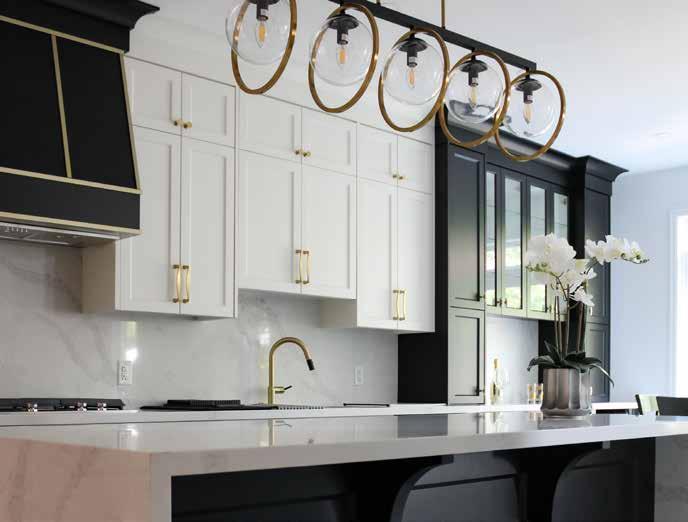
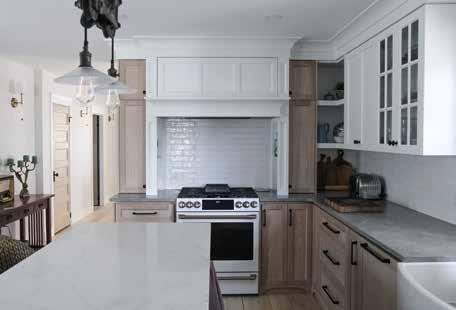
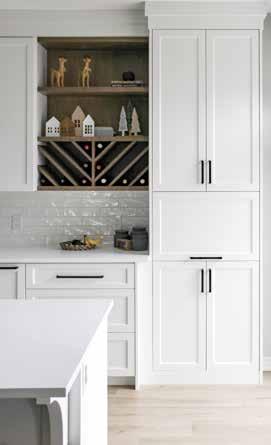
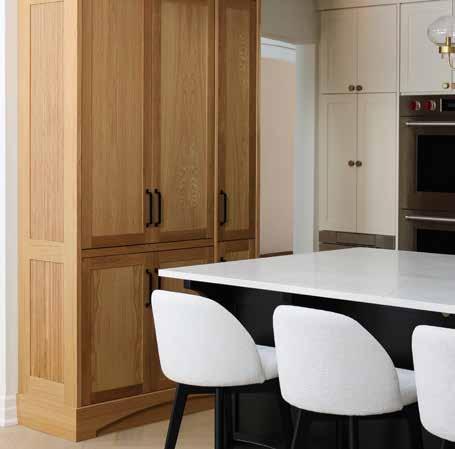
Interior Woodcraft Design keeps custom cabinetry moving through close coordination between design, fabrication and installation. Its use of 2020 Design software, fabrication packages and shop review helps preserve flexibility while reducing rework.
32
AKHURST: WHEN CNC MAKES SENSE
Akhurst examines the CNC router purchase as a timing decision. Labour availability, software workflow, vacuum hold-down, tooling, machine construction and support all determine whether automation will improve throughput or simply add complexity.
38
MARKETS BEYOND BORDERS
ThermalWood Canada is responding to tariffs, trade instability and shifting buyer expectations by building new market relationships. Its work shows that diversification depends on standards, product credibility and the ability to explain performance clearly.
42
SELLING WITHOUT FRICTION
Freya Hannah’s sales column treats emotional intelligence as a production safeguard. Clearer communication, better follow-up and stronger expectation-setting can prevent customer misunderstandings from turning into estimating, fabrication or installation problems.
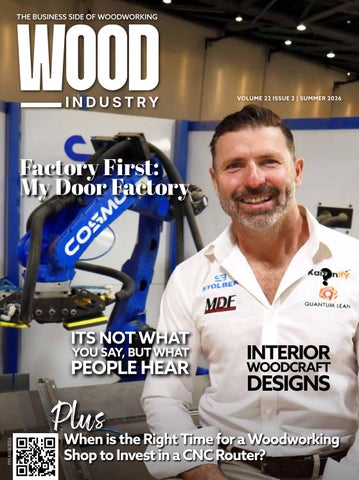
MY DOOR FACTORY: FACTORY FIRST
My Door Factory shows how process discipline comes before automation. The company uses daily improvement time to identify friction, narrow constraints and make equipment decisions around measured production needs rather than broad efficiency promises.
CONTROL POINTS FOR A BUSY SEASON
Dear Industry Partners, Summer has a way of showing where a shop is running smoothly and where it is simply running hard. Labour pressure, uncertain markets, rising imports, customer expectations and equipment decisions all become visible in the same places: lead times, quoting, sanding, installation schedules and the handoffs between departments. In this issue, we look at how wood product manufacturers are trying to regain control over those pressure points. The common thread is not growth for its own sake. It is the practical work of improving workflow, protecting margin, using technology carefully and making decisions before small problems become production delays.
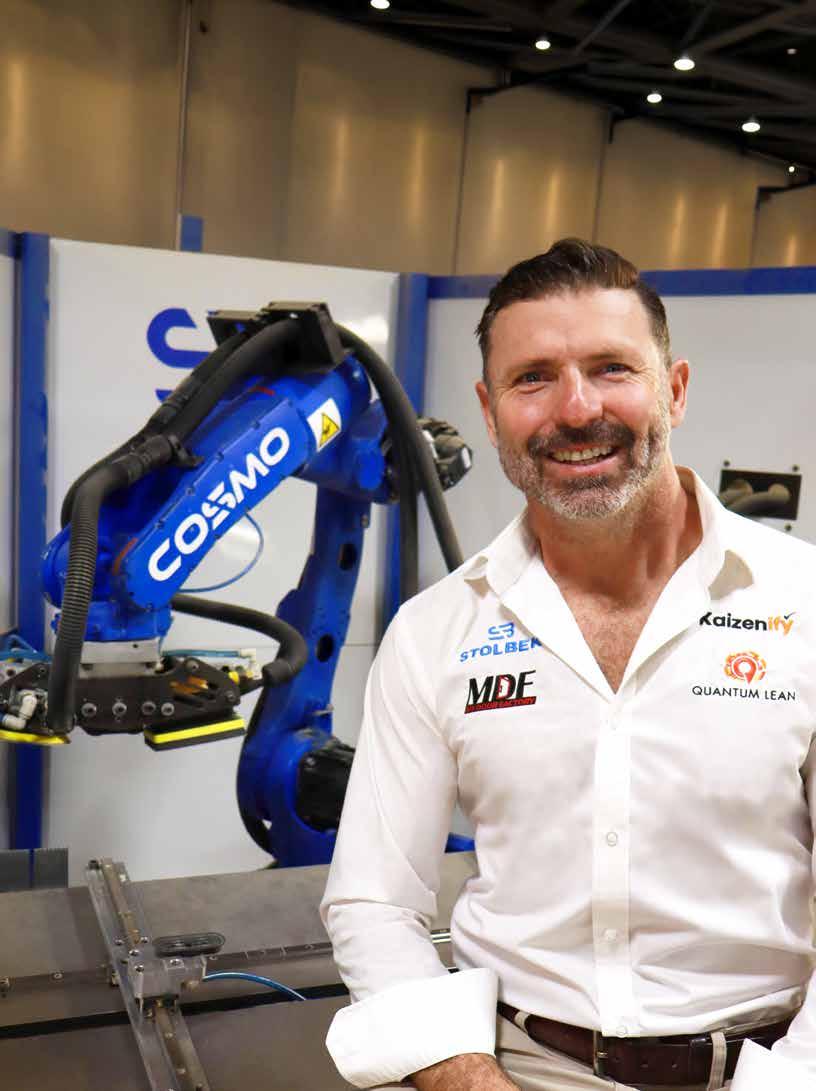
My Door Factory’s profile starts with the first hour of the day. Employees use that time to review problems, improve the factory and make small changes before regular production begins. Its move into sanding automation followed the same discipline: narrow the product mix, measure the constraint and automate the work that was actually limiting output. For shop owners, the lesson is direct. Equipment works best when the process around it is already understood.
Interior Woodcraft Designs offers another view of control. The Oshawa custom shop keeps designers, fabricators and installers closely connected throughout the job, rather than treating each step as a separate handoff. Its use of 2020 Design software, detailed fabrication packages and direct shop review helps protect the flexibility customers expect from custom cabinetry. The company has invested where needed, but it has also kept proven methods in place where they still produce reliable results.
ThermalWood Canada brings the discussion into the market. Tariffs, trade instability and changing buyer expectations have pushed the company to deepen relationships beyond traditional channels while maintaining long-standing U.S. business. Its work in thermally modified wood depends on standards, sustainability expectations and customer education. Diversification is not just a sales decision. It requires product credibility, quality control and the ability to explain performance in markets that may judge value differently.
This edition also looks at equipment decisions through Akhurst’s CNC article. A router purchase is not only about machine price. It involves labour availability, software workflow, vacuum hold-down, tooling, construction quality and supplier support. The real question is whether manual methods are already limiting throughput, consistency or the ability to take on work without adding more people.
Standards receive similar attention in Kasia Robinson’s article on NAAWS 5.0. Many architectural woodwork problems begin before fabrication, when drawings, hardware expectations or compliance requirements are interpreted differently by estimators, project managers, production staff and installers. Moving standards toward searchable operational tools can reduce interpretation drift before it becomes rework, RFIs or disputes.
CKCA’s update places shop-level decisions within a broader industry picture. Canadian cabinet manufacturers are facing housing slowdowns, rising imports, U.S. tariff exposure and unused domestic capacity. Advocacy around safeguards, Buy Canadian procurement and federal housing programs matters because manufacturing capacity is difficult to rebuild once skilled people, equipment utilization and supplier networks are weakened.
Freya Hannah’s sales column returns the focus to communication. In a reputation-driven business, what a customer hears often matters more than what a salesperson meant to say. Vague follow-ups, missed specifications and poorly matched communication styles can all become production problems. Good sales habits protect the shop as much as the relationship.
Across these stories, the central issue is how deliberately companies respond when pressure reaches the floor. Some narrow their work. Others automate, digitize standards, build new markets, strengthen advocacy or tighten customer communication.
As you move through the summer season, consider where your own operation is absorbing avoidable friction. The strongest shops know where the constraint is, what it costs and what decision comes next.
Thank you for reading. We hope this issue gives you something useful to bring back to your own shop.
PUBLISHER
Jake Blanchard jakeb@mediaedge.ca
EDITOR Tyler Holt tylerh@mediaedge.ca
PRESIDENT Kevin Brown kevinb@mediaedge.ca
Published by
ISSN 1715-507X
PUBLICATIONS
PRODUCTION MANAGER
Ines Louis
SENIOR GRAPHIC DESIGNER
Roxy Huynh-Guinane
GRAPHIC DESIGNER
Amanda Spearman
CIRCULATION circulation@mediaedge.ca
Tyler Holt
Wood Industry is published four times annually, Spring, Summer, Fall, Winter, for the secondary wood products manufacturing and marketing industries in Canada. Subscriptions are free to qualified participants in Canada’s secondary wood processing industry. Subscribe at www.woodindustry.ca. Paid subscriptions rates: $40 to Canadian addresses, $60 U.S. and foreign, $20 student rate. Please mail payment to Wood Industry, 251 Consumers Road, Suite 1020, Toronto, Ontario M2J 4R3. For subscription inquiries, e-mail circulation@mediaedge.ca.
All rights reserved. MediaEdge Communications and Wood Industry disclaim any warranty as to the accuracy, completeness or currency of the contents of this publication and disclaims all liability in respect to the results of any action taken or not taken in reliance upon information in this publication. The opinions of the columnists and writers are their own and are in no way influenced by or representative of the opinions of Wood Industry or MediaEdge Communications.
MERIVOBOX: New Additions
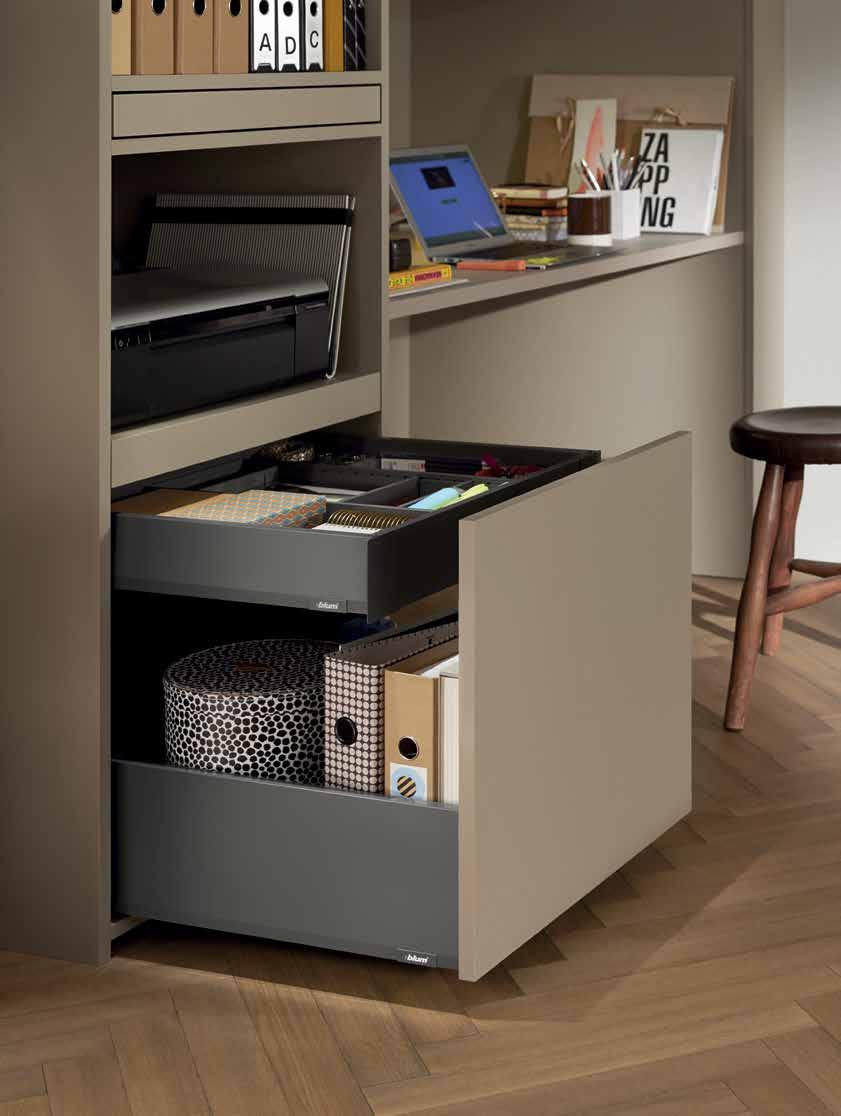
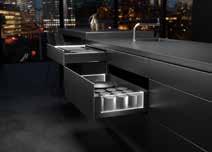
MERIVOBOX is raising the bar with exciting updates. Introducing a new E height option, it offers even more flexibility to fit your unique style perfectly. The standout addition is the monolithic side - a smooth, flush surface that brings a bold, contemporary edge to any design. To top it off, MERIVOBOX now comes in the sophisticated orion grey finish.
www.blum.com/merivobox
Ryan Akhurst Named President of CWMDA
Ryan Akhurst, vice-president of Akhurst Machinery Ltd., has been elected president of the Canadian Woodworking Machinery Distributors Association (CWMDA) following the organization’s annual general meeting. He succeeds Murat Dogan of IMA-Schelling Canada, who completed a seven-year term leading the association.
The CWMDA credited Dogan with helping expand the association’s visibility and industry presence during his tenure. Akhurst represents a long-established family business in Canada’s woodworking machinery sector.
Founded in 1988, the CWMDA promotes industrial woodworking machinery sales and service standards across Canada. Its members also organize Woodworking Technology Days, an annual event focused on machinery, automation, tooling, software and related manufacturing technologies.
McFaddens Names Pascali Margetis Quebec Branch and Brand Manager
McFaddens Hardwood & Hardware has appointed Pascali Margetis as Quebec branch and brand manager, strengthening the company’s leadership presence in the province. Margetis will oversee branch operations while supporting brand development and customer relationships across Quebec. The company said Margetis brings experience in sales, business development and the woodworking sector, positioning him to support continued growth in the region. His role will include coordinating with suppliers, customers and internal teams to expand market reach and service capabilities.
McFaddens supplies hardwood lumber, panels, hardware and related products to cabinetmakers, furniture manufacturers and woodworking businesses across Canada.
Biesse Appoints Stefano
Porcellini
Deputy CEO and CFO
Biesse has appointed Stefano Porcellini as deputy chief executive officer and chief financial officer, expanding the executive leadership team at the Italian machinery manufacturer.
Porcellini brings experience in finance, corporate strategy and international business management. In his dual role, he will oversee financial operations while supporting strategic development initiatives across the company’s global operations.
Biesse manufactures machinery and automation systems for woodworking, glass, stone and advanced materials processing industries. The company said the appointment is intended to support operational efficiency and long-term growth objectives as manufacturers continue investing in automation and digital production technologies.
Manufacturing
Veteran Aaron Perryman Takes Operations Role at Black Bros.
Black Bros. Co. has appointed manufacturing veteran Aaron Perryman to lead company operations as the woodworking and laminating equipment manufacturer continues to focus on production efficiency and growth. Perryman brings more than 20 years of manufacturing and operational leadership experience to the role. The company said his background includes process improvement, team development and operational strategy across industrial manufacturing environments.
Black Bros., based in Mendota, Illinois, manufactures roll coating, laminating and adhesive spreading equipment used in woodworking and related industries. The company said Perryman will oversee operational performance and support long-term manufacturing objectives. Founded in 1882, Black Bros. serves customers across North America and international markets.
WoodLore Expands Leadership Roles for Henseler and Rooker
WoodLore International has expanded the leadership responsibilities of Bjoern Henseler and Robin Rooker as the Greater Toronto Area manufacturer continues to strengthen its operational and strategic capabilities.
Henseler will assume broader responsibilities tied to company operations and long-term planning, while Rooker’s expanded role will focus on business development, customer relationships and organizational growth initiatives. The company said the changes are designed to support collaboration and future expansion.
Based in the Greater Toronto Area, WoodLore International manufactures laminate office furniture and casegoods for commercial and institutional markets. The company said the leadership changes support its ongoing growth and operational development strategy.
AWMAC Ontario Adds Patricia Muncan and Rick Hurst to Board AWMAC Ontario has appointed Patricia Muncan of CCW Architectural Millwork Casework Inc. and Rick Hurst of Richelieu Hardware Ltd. to its Board of Directors following elections held during the association’s annual general meeting on March 26. The association said the appointments add experience in architectural millwork, casework manufacturing and distribution to the board. Muncan represents CCW Architectural Millwork Casework Inc., while Hurst brings industry knowledge from Richelieu Hardware, a supplier serving cabinetmakers and woodworking manufacturers.
AWMAC Ontario said both appointees will support the organization’s efforts in industry standards, workforce development and member engagement across the province’s architectural woodwork sector.
Bestar Restarts
Production as Quebec Furniture Sector Faces Mounting Closures
Bestar has resumed production at its LacMégantic facility following a restructuring effort, even as Quebec’s furniture manufacturing sector continues to face plant closures and financial pressure linked to rising costs and global competition.
The company said the restart will gradually return employees to production while stabilizing operations after creditor protection proceedings. Bestar manufactures ready-to-assemble residential furniture for North American markets.
The reopening comes as several Quebec furniture manufacturers have announced closures, layoffs or restructuring measures in recent months. Industry pressures include weaker consumer demand, higher operating costs, imported product competition and ongoing trade uncertainty affecting manufacturers across the province.
Industry observers say the developments reflect broader challenges facing Canada’s secondary wood manufacturing and furniture sectors.
Gorman Group
Names Ashlee Cribb
Incoming CEO
The Gorman Group has appointed Ashlee Cribb as incoming chief executive officer, with current CEO Nick Arkle set to transition to board chair as part of a planned leadership succession.
Cribb currently serves as president of Gorman Bros. Lumber Ltd. and has held senior leadership roles across the company’s operations.
The company said the transition supports long-term continuity and future growth across its forestry and manufacturing businesses.
Arkle has led the company for more than two decades and will continue supporting strategic direction in his role as board chair.
The Gorman Group operates lumber manufacturing, remanufacturing and forestry operations across Western Canada and the United States.
Quebec Students Win International Furniture
Innovation Competition
Students from Université Laval’s School of Design in Quebec City earned first place in an international furniture innovation competition organized by the International Wood Culture Society and the National Interior Furniture Design and Research Institute of China.
The winning project, developed by students Charles-Antoine Dubé, Florence Gagné and Laurence Lemieux, focused on sustainable and adaptable furniture design. The competition attracted submissions from design schools in several countries and
Cefla’s
Woolwich Fire Disrupts Operations at Elbru Distributors
Elbru Distributors is recovering after a fire at its Woolwich, Ontario facility that also left one youth injured. Emergency crews responded to the fire, which caused damage to the building and disrupted operations at the woodworking supply distributor.
Local reports said the injured youth was transported to hospital with non-life-threatening injuries. The cause of the fire remains under investigation.
Elbru Distributors supplies woodworking materials and related products to manufacturers and contractors in Ontario. The company said recovery efforts are underway as it assesses damage and works to resume normal operations.
The incident highlights ongoing safety and operational risks facing industrial and warehouse facilities in the secondary wood manufacturing supply sector.
IWF Atlanta 2026 Set for August Return
IWF Atlanta 2026 will take place Aug. 25-28 at the Georgia World Congress Center, bringing together woodworking machinery manufacturers, suppliers and secondary wood manufacturers from across North America and international markets.
The biennial International Woodworking Fair is expected to showcase machinery, automation systems, software, tooling and manufacturing technologies for cabinet, furniture, millwork and flooring producers. Educational sessions, live equipment demonstrations and networking events are also planned throughout the four-day event.
IWF is widely regarded as one of the woodworking industry’s largest trade events, attracting thousands of attendees and exhibitors focused on production efficiency, automation and advanced manufacturing solutions.
in Ontario
Woodworking Technology Days will return to Ontario in October 2026, bringing together machinery distributors, equipment manufacturers and woodworking professionals for a multilocation industry showcase.
Organized by members of the Canadian Woodworking Machinery Distributors Association (CWMDA), the event allows attendees to visit participating companies and view demonstrations of woodworking machinery, automation systems, software and manufacturing technologies.
The event is designed for cabinetmakers, furniture manufacturers, millwork shops and other secondary wood manufacturers seeking updates on production technology and process improvements.
CWMDA said additional details, including participating locations and schedules, will be announced closer to the event date.
Woodworking Technology Days has become a recurring industry event focused on innovation and manufacturing efficiency.
Woodworking Technology Days 2026 Scheduled for October
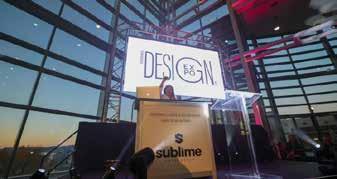
Expo Design and AFMQ Partner to Support Quebec Manufacturing
Expo Design and the Quebec Furniture Manufacturers Association (AFMQ) have formed a partnership aimed at strengthening connections between Quebec’s design community and furniture manufacturing sector.
The organizations said the collaboration will promote greater integration between designers, manufacturers and suppliers while supporting innovation, product development and local production capacity. The initiative is also intended to increase visibility for Quebec-made furniture and encourage closer collaboration across the province’s design-to-manufacturing ecosystem.
AFMQ represents Quebec furniture manufacturers, while Expo Design focuses on promoting design excellence and industry collaboration. The partnership comes as Quebec manufacturers continue adapting to changing market conditions, global competition and growing demand for locally designed and manufactured products.
Ontario Millwork Apprentice Earns Spot at National Competition
An Ontario apprenticeship contest winner will advance to the 2026 AWMAC National Apprentice Competition following top honours at the provincial event organized by AWMAC Ontario. The competition evaluates participants on woodworking, architectural millwork and installation skills through hands-on challenges designed to reflect industry standards and jobsite requirements. Organizers said the event supports workforce development and promotes skilled trades careers within the architectural woodwork sector.
The Ontario winner will represent the province at the national competition in 2026, where apprentices from across Canada will compete in technical and practical woodworking disciplines.
AWMAC said apprenticeship programs and skills competitions remain important tools for addressing labour shortages and supporting the next generation of skilled woodworkers.
Chaulk Acquires All About Kitchens
Chaulk Woodworking has acquired All About Kitchens, expanding its production capacity and regional presence in Ontario’s cabinetry and millwork market.
The company said the acquisition will strengthen manufacturing capabilities while increasing service coverage and customer reach across the province. All About Kitchens specializes in custom kitchen cabinetry and related residential woodworking products. Chaulk said the integration of operations will support growth opportunities and improve production efficiency as demand continues for custom and semi-custom cabinetry solutions. The acquisition reflects ongoing consolidation and capacity investment within Ontario’s secondary wood manufacturing sector as companies look to strengthen market position and operational scale.
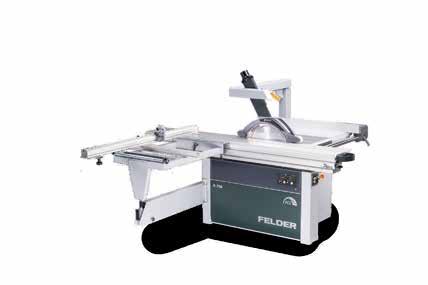
K700S PCS SLIDING TABLE SAW
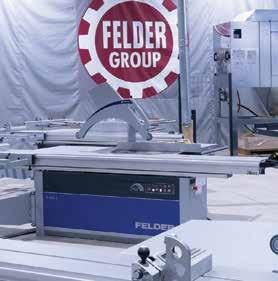
PCS® Safety system • Cutting length: 2500–3700 mm • “X -Roll” sliding table, 10 year guarantee • Rip capacity: 800–1250 mm • Cutting height: 104 mm• Control system: Power-Drive (Optional)
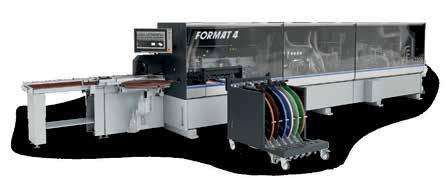
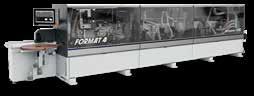
Installation length: 8000mm • Edge thickness 0.4–12mm • Workpiece height: 8–60mm • Feed speed: 12–25m/min • Top-mounted application-controlled glue pot • Automation: e-motion • Corner rounding unit (CNC controlled) • Complete edge processing • Top pressure belt • Premilling unit “professional” • Multifunction trimming unit “professional” • Radius scraping unit “professional” • Twin-engine linear end trimming unit
RL 350 DUST EXTRACTION
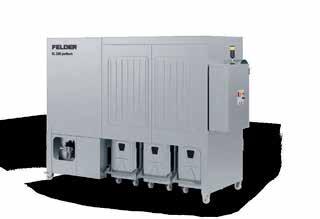
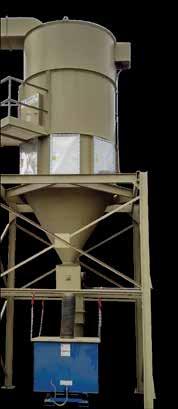
Max. air flow rate: 8000m³/h • Nominal air flow rate: 20m/ sek, 6920m³/h • Vacuum: 2630 Pa • Filter (surface) area: 71 m²• Extraction port diameter: 350mm • Remaining dust concentration, returned airflow quality: <0,1mg/m³
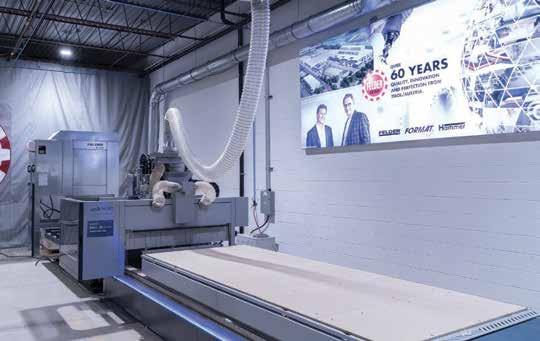
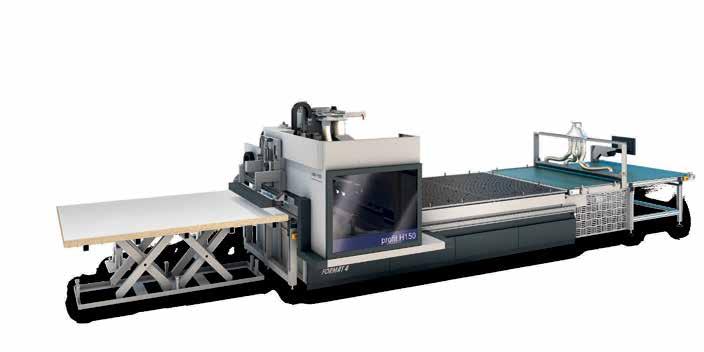
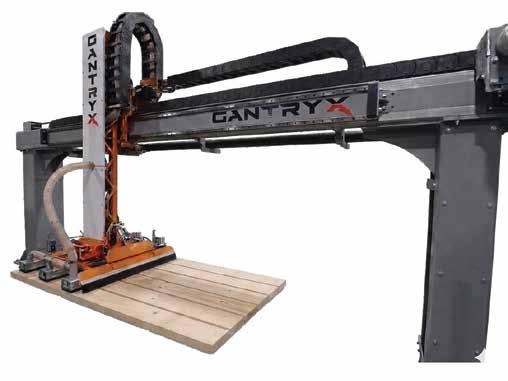
5-axis nesting CNC with Smart Zoning• automation options• 200 mm Z passage• Up to 35 tool positions for productive panel processing.
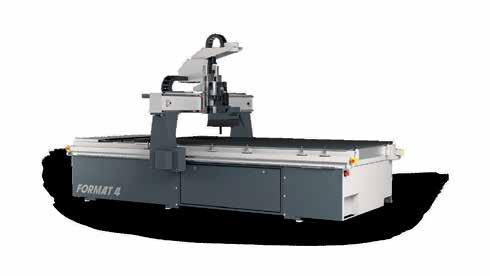
Flexible nesting CNC with Smart Zoning• 330 mm Z-axis clearance• Gantry-driven precision for efficient panel processing.
BURNABY, BC
BURNABY, BC
BURNABY, BC
Ultimate Tools
Ultimate Tools
Ultimate Tools
1-866-971-9663
1-866-971-9663
1-866-971-9663
felder@ultimatetools.ca
felder@ultimatetools.ca
felder@ultimatetools.ca
FELDER GROUP MONTRÉAL, QC
FELDER GROUP MONTRÉAL, QC
FELDER GROUP MONTRÉAL, QC
1-514-673-9090
1-514-673-9090
1-514-673-9090
info@felder-group.ca
info@felder-group.ca
info@felder-group.ca
August 25-28th 2026
WALLACE MACHINERY & TOOL CO. LTD.
WALLACE MACHINERY & TOOL CO. LTD.
WALLACE MACHINERY & TOOL CO. LTD.
OAK BLUFF, MB 1-204-788-1199
OAK BLUFF, MB 1-204-788-1199
kevin@wallacemachinery.com
OAK BLUFF, MB 1-204-788-1199 kevin@wallacemachinery.com
PROFIT 60NZ CNC
Q1 2026 HOUSING CONSTRUCTION
SOFTENS
:: By Tyler Holt, Editor of Wood Industry
NATIONAL OVERVIEW
Canada’s housing-start figures remained positive through the first quarter of 2026, but the underlying construction cycle continued to lose momentum beneath the headline totals.
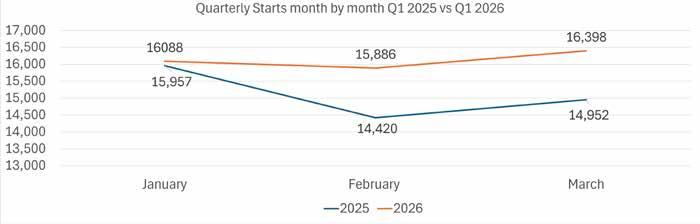
Actual housing starts in centres with populations above 10,000 increased from 45,329 units in Q1 2025 to 48,372 units in Q1 2026, a gain of roughly 6.7%. January was effectively flat year over year before activity strengthened in February and March.
• January: 15,957 → 16,088 (+1%)
• February: 14,420 → 15,886 (+10%)
• March: 14,952 → 16,398 (+10%)
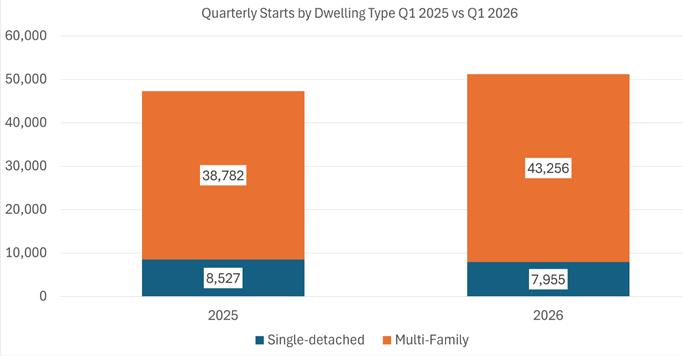
The quarter’s gains were concentrated primarily in multi-family construction.
• Single-detached starts decreased from 8,527 units in Q1 2025 to 7,955 in Q1 2026, a loss of roughly 7%.
• Multi-family starts increased from 38,782 units to 43,256, up nearly 11%.
That product mix continues reshaping how national housing data should be interpreted.
Canadian residential construction is now increasingly dominated by apartment and large-scale multi-unit projects rather than detached housing. That transition matters because apartment construction behaves differently operationally and financially. Projects move through longer approval cycles, require more extensive financing arrangements, and often depend on preleasing or presale thresh-
olds before construction can begin.
The result is that housing starts increasingly reflect decisions made many months earlier rather than current market sentiment.
That lag is visible throughout the first-quarter data.
Construction activity remained elevated because projects financed and approved during stronger market conditions continue moving into active development. At the same time, CMHC and industry participants have increasingly pointed toward weakening forward conditions driven by softer condominium presales, rising inventories, elevated borrowing costs, and more cautious lender underwriting.
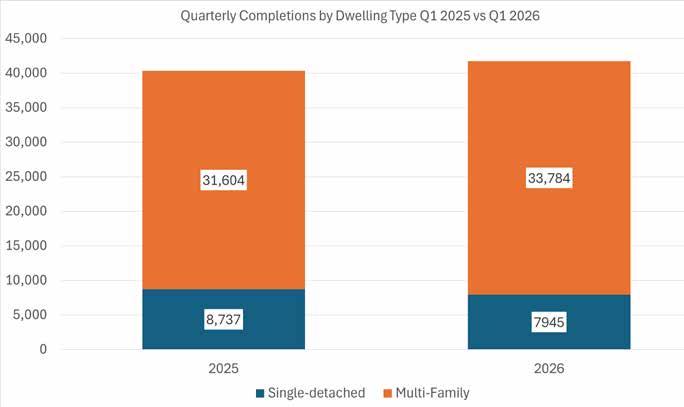
Completion data reinforces the distinction between current activity and future momentum.
In population centres above 100,000, single-detached completions declined from 8,737 units in Q1 2025 to 7,945 in Q1 2026, a drop of just over 9%.
Multi-family completions increased from 31,604 units to 33,784, up nearly 7%.
Those units largely represent projects conceived and financed under materially different market conditions than exist today.
The industry is therefore operating through two overlapping phases simultaneously: a high-volume completion cycle tied to earlier financing conditions and a weaker future pipeline shaped by today’s tighter economics.
That distinction matters operationally. De-
velopers may continue advancing projects already under construction even while delaying new launches or revising future development plans.
The first quarter therefore reflected a market that remains visibly active while becoming more selective beneath the surface.
PROVINCIAL AND CMA BREAKDOWN BRITISH COLUMBIA
British Columbia recorded a modest decline in starts during the quarter.
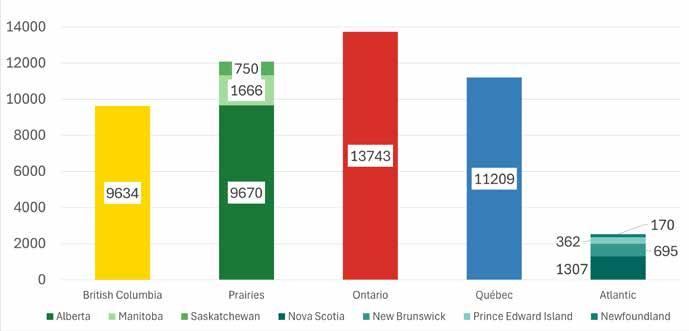
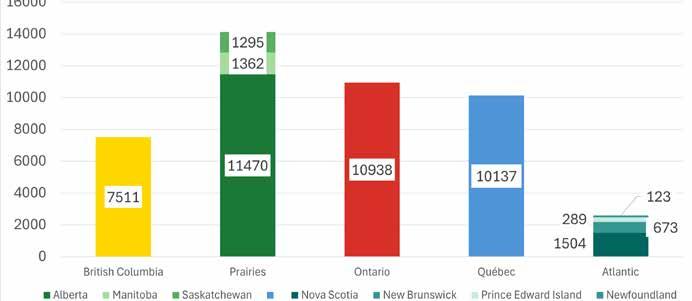
• British Columbia: 9,965 → 9,634 (-3%)
The provincial slowdown contrasted somewhat with stronger activity within Metro Vancouver during parts of the quarter.
• Vancouver: 4834 → 6706 (+39%)
• Abbotsford: 682 → 70 (-90%)
• Chilliwack: 143 → 52 (-64%)
• Kamloops: 135 → 472 (+250%)
• Kelowna: 541 → 559 (+3%)
• Nanaimo: 107 → 84 (-21%)
• Victoria: 612 → 692 (+13%)
The divergence between Vancouver and several secondary British Columbia markets reflects the uneven nature of the province’s current construction cycle.
A relatively small number of high-density projects entering construction in Metro Vancouver can materially affect provincial totals, particularly in quarters where activity slows elsewhere.
Vancouver’s construction pipeline continues to rely heavily on apartments and purpose-built rental projects. But the region also remains exposed to many of the pressures now affecting high-density development nationally: weak condominium presales, elevated construction costs, expensive land, and increasingly cautious financing conditions.
CMHC’s recent analysis noted signs of stabilization in both permits and starts in Vancouver rather than outright expansion. Construction
activity remains substantial because projects already in the pipeline continue advancing, but the pace of new viable project formation appears slower than earlier in the cycle.
Outside the Lower Mainland, activity across British Columbia has become increasingly uneven. Kamloops posted a sharp increase from a relatively small base while several Fraser Valley markets moved materially lower.
The province’s first-quarter totals ultimately reflected both the scale and volatility of
apartment-driven construction activity.
ALBERTA AND THE PRAIRIES
Alberta posted one of the more notable reversals in the country after several years of unusually strong housing activity.
• Alberta: 11,470 → 9,670 (-16%)
The province had previously benefited from rapid population growth, interprovincial migration, and comparatively affordable housing relative to Toronto and Vancouver.
That earlier momentum drove a substantial expansion in both detached and multi-family construction across Calgary and Edmonton. By early 2026, however, rising inventories and the large volume of units already under construction appear to be moderating the pace of new starts.
• Calgary: 6271 → 5005 (-20%)
• Edmonton: 4095 → 3401 (-17%)
• Lethbridge: 184 → 244 (+33%)
• Red Deer: 46 → 162 (+252%)
The decline in Calgary and Edmonton suggests the province is transitioning away from the accelerated growth phase seen over the past several years.
CMHC’s broader commentary has noted that Prairie markets generally contain a larger share of low-rise and detached housing relative to Toronto or Montréal, where highrise apartments dominate. That shorter construction cycle can cause Prairie markets to respond more quickly to changes in financing conditions and buyer demand.
Saskatchewan also recorded one of the sharpest declines nationally.
• Saskatchewan: 1,295 → 750 (-42%)
Regina: 511 → 172 (-66%)
• Saskatoon: 707 → 575 (-19%)
While smaller in absolute terms, the decline reinforces the broader softening trend across parts of the Prairie region.
Manitoba moved in the opposite direction.
Manitoba: 1,362 → 1,666 (+22%)
• Winnipeg: 1189 → 1410 (+19%)
The increase suggests more stable project flow in Winnipeg relative to the sharper slowdown occurring elsewhere in the Prairies.
ONTARIO
Ontario accounted for much of the national increase in starts during the quarter.
• Ontario: 10,938 → 13,743 (+26%)
The province’s gains were large enough to offset substantial declines elsewhere in the country.
Toronto’s activity fluctuated throughout the quarter but strengthened meaningfully in March.
• Toronto: 5072 → 4889 (-4%)
• Barrie: 80 → 70 (-13%)
• Belleville: 186 → 16 (-91%)
• Brantford: 360 → 401 (+11%)
• Guelph: 5 → 40 (+700%)
• Hamilton: 487 → 698 (+43%)
• Kingston: 212 → 53 (-75%)
• Kitchener-Cambridge-Waterloo: 859 → 1288 (+50%)
• London: 296 → 998 (+237%)
• Oshawa: 88 → 109 (+24%)
• Ottawa-Gatineau: 2609 → 2989 (+15%)
• Peterborough: 20 → 24 (+20%)
• St. Catharines-Niagara: 411 → 800 (+95%)
• Thunder Bay: 23 → 101 (+339%)
• Windsor: 123 → 56 (-54%)
The provincial figures show just how uneven Ontario’s market has become.
Large multi-tower apartment and condomini-
um projects continue dominating the Greater Toronto Area pipeline, and the timing of a relatively small number of projects entering construction can materially alter quarterly totals.
At the same time, Toronto remains one of the markets facing the greatest pressure on future project viability.
Weak condominium absorption, rising unsold inventory, elevated borrowing costs, and high construction pricing continue affecting
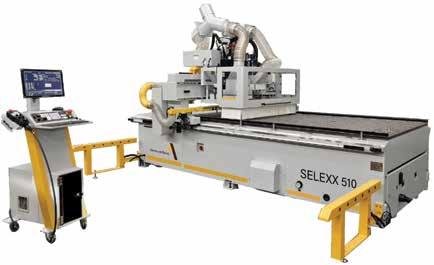
SELEXX SERIES CNC ROUTERS
High-performance nesting CNC router for maximum output.
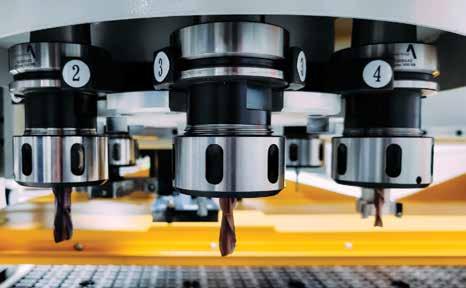
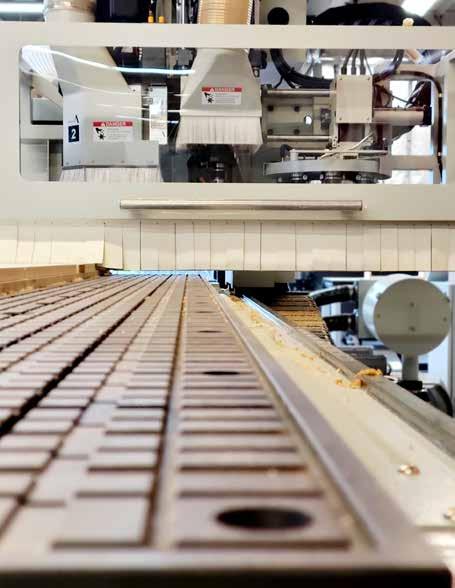
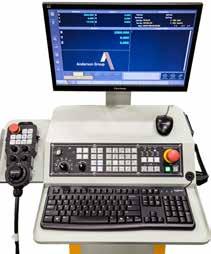
The Anderson Selexx Series CNC Router has been developed specifically with higher production CNC router requirements demanding the utmost precision and accuracy, all within a cost-effective investment. The Selexx is the ideal CNC router for nesting applications as it is packed with standard and optional features to maximize output.
Building Trust. Creating Together.
the economics of new development. Several industry participants have already slowed launches or revised project timelines while reassessing financing assumptions and achievable pricing.
Elsewhere in Ontario, several mid-sized markets posted substantial percentage gains from smaller bases, including London, St. Catharines-Niagara, and Kitchener-Cambridge-Waterloo. Ottawa-Gatineau also continued showing comparatively stable activity.
The province’s stronger first-quarter starts numbers therefore do not necessarily indicate improving market sentiment.
Instead, the data more likely reflects projects already financed and approved moving into
active construction despite softer current conditions.
That distinction increasingly defines Ontario’s housing market. Construction sites remain active, but the future pipeline appears thinner than current activity alone would suggest.
QUÉBEC
Québec posted moderate first-quarter growth supported largely by multi-family activity.
• Québec: 10,137 → 11,209 (+11%)
Montréal contributed significantly to that increase.
• Montréal: 5327 → 4870 (-9%)
Drummondville: 243 → 225 (-7%)
• Québec City: 1477 → 1740 (+18%)
• Saguenay: 167 → 368 (+120%)
• Sherbrooke: 255 → 716 (+181%)
• Saint-Jean-sur-Richelieu: 49 → 59 (+20%)
• Trois-Rivières: 189 → 247 (+31%)
As in Toronto and Vancouver, Montréal’s construction cycle is increasingly shaped by apartment development rather than detached housing.
The city continues seeing substantial multiunit activity, particularly in rental-oriented construction. But Québec developers also face many of the same pressures affecting major urban markets nationally: rising labour costs, financing constraints, and more cautious in-
vestor assumptions.
Several secondary Québec markets posted strong percentage increases during the quarter, particularly Sherbrooke and Saguenay, though both grew from comparatively smaller bases.
CMHC’s recent analysis suggested that permit activity in Montréal has begun stabilizing even while starts remain relatively elevated.
That divergence points toward a broader pattern now visible across several major Canadian markets. Projects already underway continue supporting active construction levels, but fewer projects appear positioned to replace them at the same pace over the next several years.
Québec’s first-quarter numbers therefore reflected resilience in the current construction pipeline rather than a fully expansionary market.
ATLANTIC CANADA
Housing activity across Atlantic Canada remained comparatively small in national terms, though conditions varied across the region.
• Nova Scotia: 1,504 → 1,307 (-13%)
• Halifax: 1361 → 903 (-34%)
• New Brunswick: 673 → 695 (+3%)
• Fredericton: 145 → 110 (-24%)
• Moncton: 436 → 443 (+2%)
• Prince Edward Island: 289 → 362 (+25%)
• Newfoundland and Labrador: 123 → 170 (+38%)
• St. John’s: 122 → 117 (-4%)
Nova Scotia’s decline is notable because Halifax had previously experienced substantial housing pressure driven by migration and population growth.
At the same time, the Atlantic region’s smaller market size means percentage changes can appear dramatic even where underlying unit volumes remain comparatively limited.
Prince Edward Island and Newfoundland recorded sizeable percentage increases from relatively small bases. Those gains were not large enough to materially affect national totals, but they reinforce the increasingly fragmented nature of Canadian housing activity.
Rather than moving in a synchronized national cycle, regional markets are now responding differently depending on migration patterns, construction composition, financing conditions, and the maturity of their existing development pipelines.
dence of a broad construction collapse.
National starts remained above year-earlier levels. Multi-family construction continued dominating both starts and completions. Large apartment projects remained active across most major urban markets.
But the quarter also reinforced the growing disconnect between visible construction activity and future development momentum.
The housing market is now adjusting through lag.
Projects already approved, financed, and underway continue supporting current starts and completion data. Meanwhile, the conditions required to launch the next generation of projects have become materially more difficult.
That distinction increasingly shapes how housing data should be interpreted.
Purpose-built rental projects continue carrying much of the construction pipeline because rental fundamentals remain comparatively stable and several governments continue supporting rental production through financing and tax programs.
Condominium-oriented development appears more vulnerable.
Developers across Toronto and Vancouver increasingly face pressure from weaker absorption, rising inventories, elevated construction costs, and financing structures that no longer support aggressive expansion assumptions.
Ontario and Québec helped sustain national growth during the quarter while Alberta and Saskatchewan moved lower after several years of unusually strong activity. British Columbia remained relatively stable overall but showed increasing divergence between Vancouver and the rest of the province.
Those differences matter because the national market is becoming more dependent on a smaller number of urban apartment markets and a narrower range of viable project types.
For now, construction activity remains supported by projects already moving through the system.
The more consequential question is whether enough financially viable projects are entering the pipeline to sustain today’s activity levels several years from now.
The first-quarter data suggests that answer is becoming less certain.
Custom Cabinetry for Everyday Life at Interior Woodcraft Designs
:: By Joy Doonan, Wood Industry Writer
KEEPING CUSTOM MILLWORK PERSONAL
In custom millwork, repeat customers often tell a deeper story than any showroom could. Interior Woodcraft Designs in Oshawa, Ontario, has been building custom kitchens and millwork for homeowners for four decades, with many clients returning across generations.
Today, the company is owned by siblings Lindsay Wright and Matt Henderson. The pair purchased the business from its original owners, whom Lindsay had worked alongside for years. Although it is technically a different business entity since Lindsay and Matt took over, Interior Woodcraft Designs has always maintained a business philosophy that involves careful listening and a close synergy between design and fabrication processes.
“We kept the name because it just has such a good history,” she said. “A good name and a good client base. People still come around that we have already done kitchens and other work for years and years ago because they know who we are.”
Many homeowners comparing custom cabinetry with lower-cost prefab alternatives value the consistency that comes from working with the same shop from design through installation. Interior Woodcraft Designs leans into the flexibility and personal touch that a small custom shop can offer.
FROM DESIGNER TO OWNER
Lindsay Wright’s path into cabinetry was not originally tied to business ownership. After
studying interior design at Fanshawe College, she worked in a variety of industry roles, including independent contracting and positions connected to kitchen and bath projects. This work introduced her to Dale Harris, one of Interior Woodcraft Design’s original owners. At the time, Harris would occasionally send clients to Wright for design-related purchases connected to renovation projects. Over time, the professional relationship developed into a friendship, and eventually into a longterm working arrangement. Wright joined Interior Woodcraft Designs in 2007 and remained there for 13 years before purchasing the company with her brother.
For much of that period, Wright handled nearly all of the company’s design and sales
work herself. Because she was already deeply involved in day-to-day operations, the eventual ownership transition felt relatively natural.
“Dale and I used to always laugh that it would be such an easy transition for me to run this business,” she said. “I was kind of doing it anyways.”
Her brother Matt came to the business from a different direction. A longtime general contractor, he had spent years working hands-on in construction and renovations before partnering with Lindsay on various projects. Where Lindsay focused on design and client interaction, Matt brought installation and site experience.
“He’s one of those guys that needed to be in a trade, working with his hands,” Wright explained about her brother’s background.
The siblings had collaborated successfully for years before ownership ever became part of the conversation. When the original owners began discussing retirement, Matt was the one who suggested buying the business together. By that point, the transition felt less like a leap into ownership and more like a continuation of work they were already doing side by side.
SYNERGY BETWEEN DESIGN AND PRODUCTION
Interior Woodcraft Designs operates out of approximately 6,000 square feet in Oshawa’s south end. The facility includes a small showroom, fabrication and finishing operations, and assembly space. The shop currently operates a CanTek panel saw, Kremlin finishing systems, and dado saws.
The company has continued investing
selectively while holding onto methods that have consistently produced dependable results. Wright says, “we joke that at a certain point we won’t be able to get replacement parts for the CanTek saw anymore because we’ve kept it for so long!”
“We still do dado joinery for all of our cabinets and our cabinet boxes because it’s never done us wrong,” she said. “There are certain things that you just don’t change when they work.”
The company’s workflow also reflects a highly collaborative relationship between design staff and shop personnel. Once a project is approved, designers use 2020 Design software to prepare detailed fabrication packages that include floor plans, elevations, 3D renderings, and specialty notes for production staff. Before fabrication begins, the team gathers to review the project together.
The shop’s lead carpenter plays a particularly central role in the process. Wright says everyone playfully refers to him as the company’s “human CNC” because of his ability to execute complex custom work manually.
“There’s no real official training I give to my designers,” Wright explains. “It’s more of a probationary period where we’re just observing and learning from each other.” Wright says this approach helps new staff better understand how design decisions affect fabrication, installation, and customer experience across the entire project lifecycle.
Designers regularly communicate directly with installers and fabricators throughout a project’s lifecycle, especially when unexpected site conditions or custom details arise. The close integration helps preserve
the flexibility customers expect from a custom operation.
LISTENING FIRST, DESIGNING SECOND
Instead of approaching projects primarily from a stylistic perspective, Lindsay Wright focuses heavily on understanding how clients actually live within their spaces. Conversations about cooking habits, family routines, storage frustrations, and traffic flow all influence the final layout.
“I always say read between the lines and start listening to all the things that don’t work for them,” she explained. Wright noted that the company routinely designs seating areas, specialized storage solutions, and unconventional layouts tailored to specific homes.
The process remains intentionally person-
al from consultation through installation. Customers often interact with the same people throughout the entire project, including site visits, design revisions, fabrication reviews, and final hardware selections.
Wright believes that consistency is one reason many customers return years later for additional work, whether kitchens, vanities, entertainment units, closets, or bars.
“It’s been generational,” she said. “When you do good work for someone, they do come back.”
PRESERVING HUMAN DESIGN
Like many manufacturers and design firms, Interior Woodcraft Designs is also evaluating how newer technologies may affect future operations. Wright said the company is actively considering equipment upgrades to improve production speed while maintaining the intimate small-shop environment customers value. At the same time, she expressed mixed feelings about the growing role of artificial intelligence in design work. Her concerns were less about efficiency and more about the changing role of the designer.
“The design process is long and really takes
a while before we get to that place where we have the perfect layout, and to alleviate some of that would be wonderful in some cases. I could probably buy an AI program and have it do all the design for me,” she says. “But that’s my job.” She expresses that an overreliance on automation within the creative process
“gets rid of a critical component and changes the human role from creation to just quality assurance.”
STAYING HANDS-ON
As Interior Woodcraft Designs continues evaluating further equipment investments and
evolving design technologies, Wright says the company remains focused on preserving the responsiveness and close communication that customers associate with smaller, custom shops. The business’ main prerogative is to create spaces tailored to the routines and priorities of the people using them every day.
From Insight to Action: Building a Measured Path to Sustainability
Across the wood products sector, sustainability is no longer a separate conversation. It is increasingly becoming a core part of how manufacturers and distributors operate and plan for the future.
For Upper Canada Forest Products, this shift has not required a reinvention of purpose, but a deeper commitment to understanding impact and making more informed decisions across the business.
Like many in the industry, the company has long recognized the role wood plays as a renewable material in a lower carbon economy. But translating that belief into measurable action required greater clarity.
To establish a clear baseline, Upper Canada Forest Products partnered with the University of British Columbia Sauder School of Business through the Centre for Climate and Business Solutions. The collaboration focused on measuring Scope 1 and Scope 2 greenhouse gas emissions, examining energy use and fuel consumption across all eighteen facilities in Canada and the United States.
The outcome was more than a technical exercise. It provided a consistent, data driven view of where emissions originate, and where the most meaningful improvements can be made. Just as importantly, it established a standard approach that can be applied year over year,
enabling the business to track progress, refine strategies, and support more confident decision making.
With this foundation in place, the focus has shifted toward practical action. Across multiple locations, Upper Canada Forest Products is advancing targeted initiatives designed to improve efficiency and reduce its overall footprint.
These include converting to LED lighting to lower energy demand, installing solar panels at its Mississauga facility to reduce reliance on grid power, and optimizing fleet routing to limit fuel use and idle time. While each initiative is incremental, together they represent a disciplined approach grounded in data, where operational improvements and environmental outcomes move in the same direction.
This reflects a broader trend across the wood industry, where sustainability is increasingly integrated into day-to-day operations rather than treated as a standalone objective. For manufacturers, the value lies in approaches that improve efficiency, reliability, and cost control, while contributing to long term resilience.
The work undertaken with UBC has also reinforced the importance of alignment across teams. By engaging employees in understanding emissions data, the company has strengthened internal collaboration and made sustainability part of everyday decision making.
Establishing a baseline is only the starting point, but it is a critical one. It enables Upper Canada Forest Products to prioritize future initiatives, evaluate new technologies, and continue to integrate sustainability into its long-term growth.
In an industry defined by long cycles and lasting partnerships, a measured, informed approach positions the business to adapt, improve, and create value over time.
Looking ahead, the focus will remain on building this foundation. With a clearer understanding of emissions, Upper Canada Forest Products is better equipped to identify opportunities across its operations, strengthen supplier collaboration, and respond to evolving customer expectations, while maintaining the consistency and reliability that have defined its role within the Canadian wood products sector today and beyond.
Sawing and Cutting SAWTEQ S-320 FLEXTEC
SAWTEQ S-320
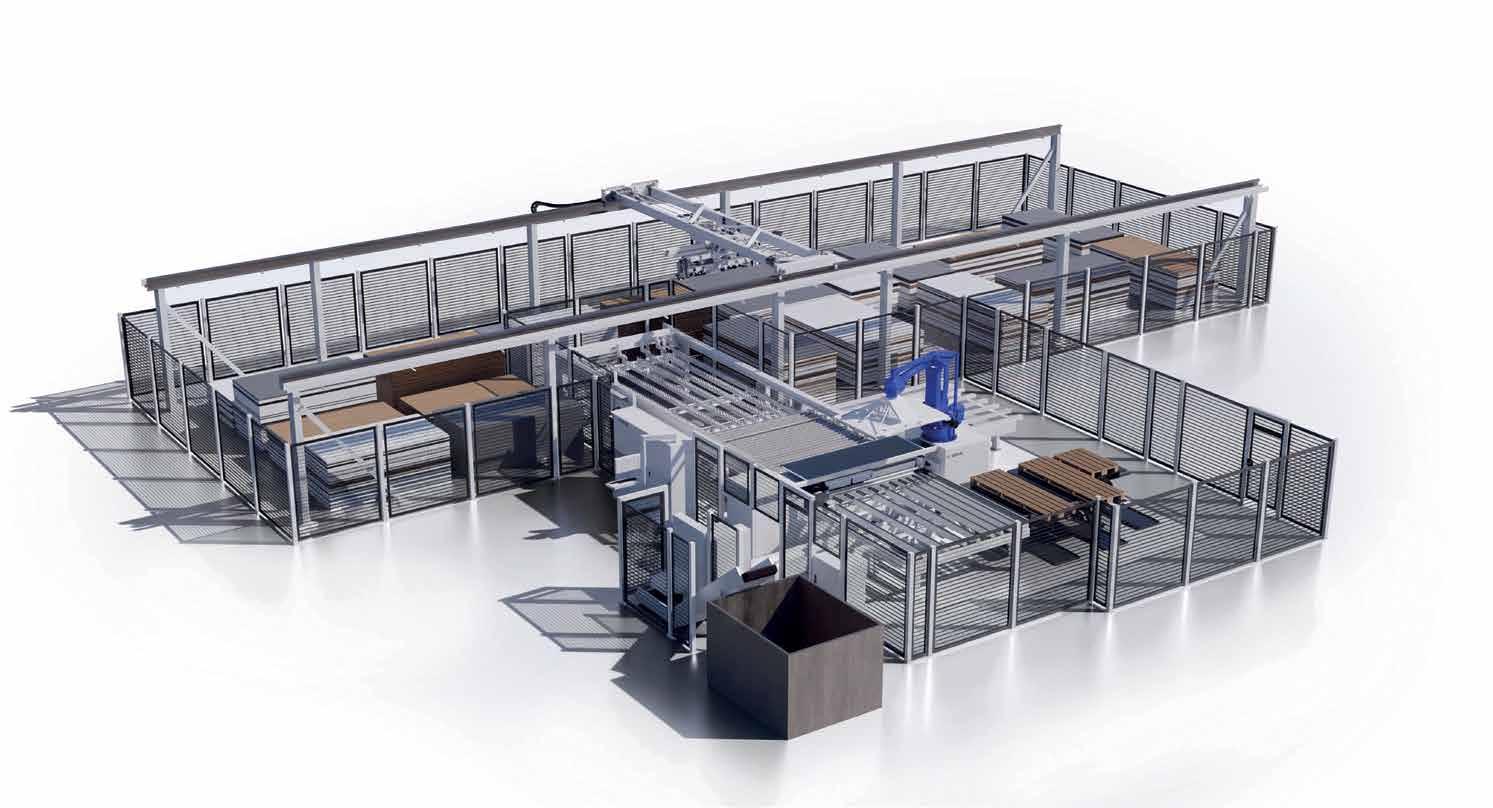
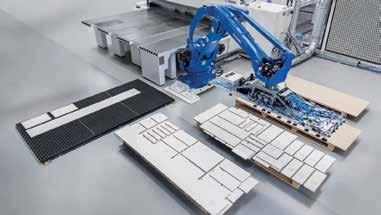
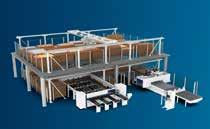
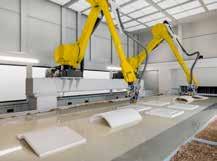
The SAWTEQ S-320 flexTec is a revolutionary cutting cell that pairs a high-performance saw with a built-in robot for automated parts handling. This innovation totally redefines the parts flow in orderbased production and allows single panels to be custom-cut under batch production conditions.
• Multiple recuts completed fully automatically with a flexible cutting pattern layout thanks to leadingedge robotic technology.
• High production capacity with exceptional quality.
• High material yield due to a workflow optimized for custom-cutting single panels.
Panels are aligned by the robot, placing them precisely into the clamps to ensure accurate cuts every time.
LEARN MORE
The robot can be customized with floor-level destacking, lowering overall height and increasing flexibility.
My Door Factory’s Operating Discipline Starts Before the First Door Is Made
:: By Tyler Holt, Editor of Wood Industry
The first hour of the day at My Door Factory is not reserved for cutting, sanding or shipping doors; it starts with improvement work. Employees get time in the shop to fix what made yesterday harder than it needed to be. After, The group meets, reviews improvements, talk through issues, express gratitude, discuss what they are reading and, more recently, make room for a “confession” segment where people identify mistakes or decisions they would handle differently next time.
For Brad Cairns, who founded the company after earlier work in custom carpentry, commercial millwork and cabinetry, that hour is not a cultural add-on, but a part of the operating system. My Door Factory’s position in the MDF door market has been built around a relatively narrow question: how much work can be removed from the customer’s shop by changing the way doors are produced before they leave the factory?
Cairns began building for local customers as a teenager under the name Brad’s Custom
Carpentry. He later attended Conestoga College, where access to the school’s shop gave him space to build for a small but growing customer base. His early business life moved through the familiar path of custom work, commercial jobs and cabinet-related production. The turning point came after yet another dispute with a general contractor. The money involved was in excess of $100k, a lot of money for a small business. This pattern had become familiar enough that Cairns knew something had to change. Control needed to be established.
The shop did not immediately arrive at MDF doors as a fully formed plan. It looked at the machines it already had, the skills in the building and the process knowledge accumulated from consulting with companies that made doors. Doors fit the kind of work Cairns found more interesting: higher-volume, repetitive production with room for process control. The company began making doors and, by his estimate, is now around the ten-year mark under the My Door Factory model.
WHEN SPECIALIZATION WAS STILL TOO BROAD
My Door Factory initially tried to supply both doors and countertops on the assumption that customers buying one would buy the other. Operationally, the products did not belong together. A single countertop could interrupt nearly a full day of door production. Cairns now describes the lesson plainly: the countertop work had to go. The company narrowed further and stayed with doors.
That decision influenced much of the company’s later improvement work depends on repetition. A shop building a wide range of products can improve, but the signal is noisier. At My Door Factory, repeated work made waste easier to see. It also made small changes compound. Cairns says the company spends the first hour of every day improving the factory and the people in it. The point is not a monthly lean initiative or a manager-led project. The practice is daily, company-wide and owner-led.
THE FIRST HOUR OF THE DAY
Cairns is direct about that last part. Lean, in his view, does not survive if ownership treats it as something for the shop floor but not the office. A messy owner’s office undercuts a clean-workstation instruction. A weekly meeting is not enough. Cairns compares it to going to the gym once a week: the intent may be present, but the repetition is not.
The company’s morning routine shows how that thinking is put into practice. For 30 minutes, employees work on improvements. If no specific improvement has been assigned, the instruction is simple: make the job easier. Then the company gathers for another 30 minutes. Cairns says one common mistake in morning meetings is talking only about work. My Door Factory does discuss immediate company issues when needed, but the meeting is designed around improvements, gratitude, learning and mistakes.
TREATING MISTAKES AS EXPERIMENTS
The “confession” element is a useful window into the shop’s management style. Cairns frames mistakes as experiments rather than failures. He frequently tells employees to “run the experiment.” When someone proposes a change,
the shop is expected to test it rather than argue endlessly from opinion. The result either works or teaches the group something.
This operating style requires tolerance for controlled mistakes. Cairns says younger workers, including co-op students, sometimes have to be allowed to run into the consequence of a bad decision. A warning from the boss may not stay with them, but making the wrong part usually does. The lesson is not theatrical. It is part of how the shop builds judgment while avoiding the chilling effect that may come with the shame and guilt accompanying the making of a mistake.
FROM BOTTLENECKS TO CONTROL POINTS
The same preference for observation over assumption shapes how Cairns talks about bottlenecks. He avoids the term when describing his own factory. A bottleneck, to him, suggests a choke point outside the company’s control. He prefers “control point.” Once the factory establishes a control point and subordinates the rest of production to it, management does not have to chase every station at once. It watches the control point.
That distinction affects how capacity is in-
creased. Cairns describes the process as “establishing flow, monitoring for stability, raising the target, watching what breaks, fixing the feeding or following operation, and then raising the target again”.
If the control point is producing 10 pieces an hour, the company tests 11. If another operation cannot support that pace, the target drops back while the weak point is improved. Then the shop tests again.
It is a measured way to grow capacity. The shop is not simply asking every station to move faster but instead opting to change one variable, watching the system respond and using the result to determine where the next improvement belongs. In a door operation, that makes a big difference cutting, machining, sanding, priming, labeling and shipping are connected. Speed in one area does not help if it only pushes unfinished work into another.
MEASUREMENTS THE SHOP CAN ACT ON
Cairns is also skeptical of improvement work that is not measured. He says many factories look first to financial statements, which he considers a poor shop-floor management tool. Employees do not usually feel they can affect
broad financial numbers, and the numbers arrive too late to guide daily decisions. He argues instead for interconnected operational measurements that can be seen and influenced closer to the work.
“Everybody’s kind of looking for that one measurement to run their business,” Cairns said. “We always say it’s impossible. It’s like flying an airplane with one gauge.”
The four measurements he emphasizes are daily throughput, throughput dollars per labour hour, minutes per unit and units per day. Daily throughput shows whether the company is on track and whether it is making more money than it is burning. Throughput dollars per labour hour works as an efficiency measure and, in his words, a decision checker. If a CNC is purchased, the number should show whether the shop is producing more value with less labour input. If new employees are hired, the same measurement should help reveal whether the decision improved performance or simply added cost.
Minutes per unit becomes an estimating check. If the shop is actually taking 12 minutes per unit to ship work, the estimate should be tested against that reality. Units per day helps calculate lead time by comparing what is coming into the plant against what is going out. Kaizenify.app offers woodworking businesses a factory performance dashboard designed to bring key production data into one place. The tool focuses on ease of use, simple updating, accurate reporting, and performance visibility for shop managers looking to track operations more consistently.
SOLVING SANDING FIRST
Cairns’ measurement discipline also shaped the company’s move into automation. My Door Factory offered priming, and at one point Cairns had 12 people sanding primer. The work was dusty, repetitive and difficult to staff. He describes the sight of a line of people sanding in masks as one of the most difficult and depressing experiences in the shop. The company
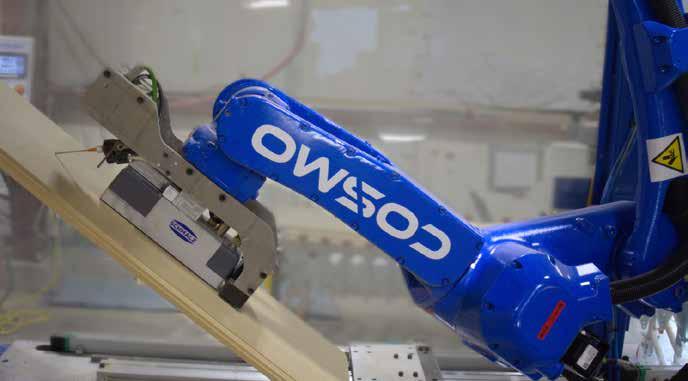
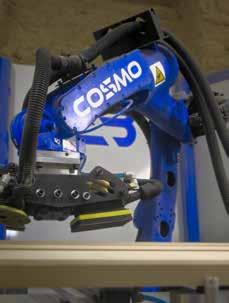
decided to solve the problem internally. Cairns mortgaged the building and put money into research and development for a sanding robot. The technical problem was not just moving abrasive over a surface. Primer sanding requires judgment. A human can feel and see the difference between removing enough material and sanding through. Teaching a machine to avoid sanding through primer took about two and a half years, according to Cairns. Once the robot worked in his own factory, the company showed it publicly. That led to Stolbek machinery sales beyond My Door Factory, and Cairns says the machines are now sold globally. The system is aimed at reducing the sanding workload for shops of different sizes. “We have installed them in factories that do $5M a week down to 1-person shops; story is always the same: sanding sucks.” That idea has also become part of the company’s tagline.
MACHINES DESIGNED FROM THE WOODSHOP OUT
The edge sander followed a similar path. My Door Factory wanted to remove edge sanding from the manual process but could not find a machine that handled the work the way the shop wanted. Cairns questioned why edge sanders were built around belts when workers sanding by hand would normally use palm sanders. The company developed an edge sander using five palm sanders inside the machine, designed around the sanding progression the shop wanted.
That origin explains the difference between Cairns’ machinery business and a more general automation supplier. Stolbek’s machines were not designed first as automation platforms and later adapted to wood. They came from a woodworking production problem. Cairns had sanded for decades before trying to automate sanding. He argues that matters because sanding is often underestimated by people who have not done it.
Building machines also changed how he thinks about return on investment. Cairns says woodworkers often look at the price of a machine and conclude they cannot afford it because the bank account does not contain the full amount. Instead, he suggests that companies compare that cost against the monthly labour already being spent on the task. In sanding, that may mean several employees doing repetitive work that a financed machine could replace or stabilize. He is not dismissing ROI calculations, but thinks many shops fail to count the longterm and peripheral benefits of automation.
The connection between lean practice and automation is important. My Door Factory did
not automate to avoid process discipline. It automated after measuring and controlling the process enough to understand where automation would matter. In Cairns’ view, the more robots he puts into the shop, the more money the company makes. That is not a universal rule for every factory, but in his operation it reflects a specific sequence: narrow the product mix, establish flow, measure the work, improve daily, then automate the work that still constrains the system.
DOING THE CUSTOMER’S NEXT STEP
The same logic extends to customer service. Cairns says the company continually asks what the customer must do next when the product arrives. If the next step is sanding, My Door Factory tries to do the sanding. If the next step is measuring or labeling, the company looks for ways to handle that before shipping. The goal is not to add a small charge for every added service, but to remove waste internally so the added work can be absorbed without raising the price to the customer.
That is the company’s clearest competitive position. It is not only selling MDF doors; it is trying to sell less downstream work. A cabinet
shop receiving fully sanded, measured and labeled doors can move those parts into its own process with fewer interruptions. For a customer, the value is not abstract. It shows up in less sanding time, fewer handling steps and cleaner scheduling.
SHARING THE PLAYBOOK
Cairns is open about sharing these systems, even with other manufacturers. He says the information did not originate with him, citing lean thinkers and mentors who shaped his own practice. He also believes many companies will listen but not execute. His stated mission is to prove that woodworkers can make money, and he sees systems, software and machines as tools toward that end.
My Door Factory’s development is therefore less a story about a company discovering one breakthrough than about a shop narrowing its work until the work could be studied closely. Countertops left because they interrupted the door process. Morning improvement stayed because it made daily waste visible. The control point replaced the wandering search for bottlenecks. Sanding robots appeared only after manual sanding became too costly,
dusty and difficult to sustain.
The company’s operating discipline is not hidden in a slogan. It is visible in the hour before production starts, in the measurements Cairns expects every shop to understand, and in the decision to keep taking work out of the customer’s hands. For a door supplier, that is a practical form of integration. The factory improves its own process, then uses the gains to absorb the next task the customer would otherwise have to do.
MURPHY MEANS
MORE
QUALITY
1943.
430 Franklin Blvd., Cambridge, ON N1R 8G6 E-mail: 4nodust@nrmurphy.com (519) 621-6210 www.nrmurphy.com
SILICONE-FREE WAXILIT TABLE LUBRICANTS, RELEASE AGENTS, COOLANTS, AND CLEANERS
Promotes high-quality finished products
Extends the longevity of machinery and equipment
Ready to use
Environmentally friendly
Water-based formulations
Recommended by machine manufacturers
Prevents glue build-up and reduces clean-up time for PVA, PUR, formaldehydes, hot melts, resins, and more!
Supports many woodworking applications. Moulders, table saws, edge banders, hot/cold press plates, radio frequency equipment, clamps, glue spreaders, spray booths, and more
WWW.ACMOS. COM |
NOT JUST A SURFACE
How Finishes are Redefining Plywood’s Role in Design
:: By Meghan Bell, Product Specialist with Garnica North American
Plywood has long been valued for its structural properties, but less so for its appearance. In cabinetry, furniture, and architectural applications, it has often served as the hidden layer beneath veneers, laminates, paint, or other decorative finishes. However, recent technological innovation has made that distinction less relevant.
Today, advances in decorative surfaces and factory-applied finishes are changing the way plywood is specified. Rather than functioning solely as a substrate, plywood is increasingly being used as the finished material itself. Natural wood faces, decorative laminates, and UV-treated coatings are allowing architects, designers, and manufacturers to combine aesthetics and performance in a single panel solution.
FROM STRUCTURAL CORE TO FINISHED SURFACE
The technical advantages of plywood are well established. By layering thin veneers with alternating grain directions, manufacturers create panels that are lighter and more dimensionally stable than many solid wood alternatives. This cross-laminated structure helps reduce warping and supports consistent performance in demanding environments —particularly when high-quality raw materials and precise manufacturing processes are applied. Because plywood panels are engineered
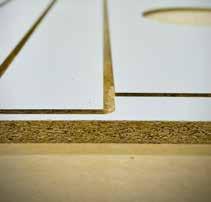
for stability, strength and machinability, they have the potential to support a wide range of decorative finishes while maintaining structural integrity during fabrication. When produced to a high standard, panels allow millworkers to route, cut, drill and edge components with confidence that the finished surface and the underlying core will perform as an integrated system. However, performance can vary significantly across manufacturers. Some producers go further by controlling the growth of their raw material and applying advanced production techniques to achieve exceptional consistency. These approaches can result in lightweight, virtually void-free panels with tighter tolerances and fewer core splices—factors that directly contribute to superior stability. Companies such as Garnica exemplify this level of quality, pairing responsible forestry practices with precision manufacturing to deliver panels that meet both ESG goals and the highest performance expectations.
THE RISE OF TFL AND HPL
One of the most significant developments in engineered wood panels has been the evolution of decorative surfaces. Thermally fused laminates (TFL), high-pressure laminates (HPL), and other engineered finishes allow the panels to take on a virtually unlimited range of colors, textures, and patterns while adding resistance to wear, scratching, and impact. These materials are increasingly used in commercial interiors, retail fixtures, educational facilities, and other environments where durability and appearance are equally important.
For specifiers, the value is practical as much as visual. A finished plywood panel can reduce the need for additional finishing steps, improve consistency across projects, and support more efficient fabrication and installation.
THE MANY FACES OF PLYWOOD
Decorative hardwood faces such as white oak, maple, walnut, and cherry allow plywood to deliver the warmth and variation of natural timber while preserving the technical advantages of engineered wood. These qualities make it especially valuable in applications where designers want the appearance of natural wood without the movement, weight, or variability associated with solid lumber.
UV-treated coatings add another layer of functionality. Applied under controlled manufacturing conditions, these finishes enhance the natural appearance of wood while increasing resistance to scratches and surface wear. For architects and designers, pre-finished panels provide a more consistent finish than many field-applied alternatives. The result is a material that arrives ready to install, with both aesthetic and performance characteristics already built in.
In many applications, a single plywood panel may provide the structural support, finished surface, and the durability required for everyday use. This versatility is particularly valuable in modular construction, transportation interiors, furniture, retail environments, and compact living spaces, where reducing material weight can simplify fabrication and improve efficiency.
THE ENGINEERED WOOD EVOLUTION
Plywood is no longer simply the material behind the finish. With decorative laminates, natural hardwood faces, and factory-applied coatings, it has become a visible and intentional part of the design process. Architects and designers can now specify panels that deliver structural reliability and aesthetic impact at the same time. In many projects, the panel itself is the finished product and that shift is redefining plywood’s role in architecture, furniture, and interior design.
Meghan Bell is a dedicated Product Specialist with Garnica Plywood’s North American team. In her role, she is committed to visiting GPC member locations to provide comprehensive product knowledge training. She also collaborates with customers, architects, and designers to generate interest in Garnica’s innovative plywood solutions.
When is the Right Time for a Woodworking Shop to Invest in a CNC Router
:: By Alex Colic, Akhurst CNC Product Manager
WHEN IS THE RIGHT TIME FOR A WOODWORKING SHOP TO INVEST IN A CNC ROUTER?
For many woodworking shops, there comes a point when manual production methods begin to limit growth. Lead times increase, labour becomes harder to find, and production bottlenecks start appearing throughout the shop. At that stage, many businesses begin asking the same question: Is it time to invest in a CNC router?
While CNC technology was once reserved primarily for large manufacturers, modern machines and software have made CNC production accessible to shops of almost any size. Today, even small operations are using CNC routers to increase efficiency, improve consistency, and expand their capabilities.
WHY MORE WOODWORKING SHOPS ARE ADOPTING CNC
Two major factors are driving CNC adoption in the woodworking industry today.
Labour shortages are making it increasingly difficult for shops to find skilled operators. CNC machines allow businesses to automate complex machining tasks and maintain productivity with fewer people.
At the same time, competition has increased dramatically. Shops equipped with CNC technology can often produce parts faster and with greater precision than those relying solely on manual machinery. As a result, CNC routers are becoming an important tool for shops that want to remain competitive and scalable.
CNC IS NO LONGER JUST FOR LARGE MANUFACTURERS
Historically, CNC machines required significant investment and specialized programming knowledge. Today, both machine design and software platforms have evolved to make CNC much more accessible.
Modern CAD/CAM and design software can automate much of the programming process, allowing shops to move quickly from design to finished part.
Because of this, many smaller woodworking businesses including cabinet shops, furni-
ture manufacturers, and architectural millwork producers are successfully integrating CNC technology into their operations.
CNC MAY BE MORE AFFORDABLE THAN MANY SHOPS EXPECT
One of the most common misconceptions about CNC equipment is that it requires a large upfront investment.
In reality, many businesses finance or lease their machines, spreading the cost over time. In some cases, the monthly payment for a CNC router can be comparable to the cost of a single employee.
This allows shops to improve production capacity while preserving cash flow and avoiding large capital expenditures.
KEY FACTORS TO CONSIDER BEFORE PURCHASING A CNC ROUTER
For shops evaluating their first CNC investment, several factors deserve careful consideration.
1.Software Workflow
Software is the digital backbone of CNC production. The software you choose determines how designs are created, programmed, and sent to the machine. Different industries may require different software capabilities. For example:
• Cabinet manufacturing often uses specialized design software with nesting automation.
• Furniture or millwork shops may use more general CAD/CAM systems. Choosing software that fits your production style can be just as important as selecting the machine itself.
2.Machine Construction and Durability
CNC routers vary significantly in their construction and engineering. Machine rigidity, frame design, and overall build quality all affect performance. A well-built machine typically provides:
• Better cutting accuracy
• Improved surface finish
• Longer tool life
• Greater long-term reliability
For shops planning to run machines daily in production environments, build quality becomes especially important.
3.Workpiece Holding and Material Stability
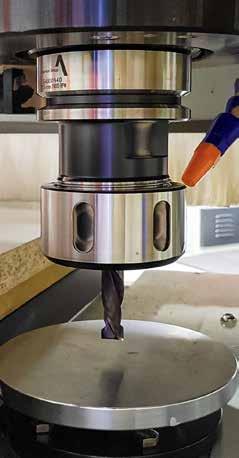
Most CNC routers use vacuum systems to hold sheet materials securely on the machine table. Effective vacuum performance ensures that parts remain stable during machining. If material moves during cutting, it can affect accuracy, tool life, and surface quality. Understanding how the vacuum system is designed, and how it performs during real production conditions, is an important part of evaluating a machine.
4.Tooling and Operating Costs
Machine stability and design also affect tooling performance. When a machine holds material securely and cuts smoothly, tools tend to last longer and produce more consistent results. Over time, improvements in tooling life can significantly reduce operating costs for shops producing high volumes of parts.
5.Training and Support
For first-time CNC users, the quality of supplier support can make a major differ-
ence. Installation assistance, operator training, and ongoing application support help reduce the learning curve and allow shops to begin production more quickly. Shops that receive strong support often find that CNC integration is far easier than expected.
PLANNING FOR FUTURE GROWTH
When investing in a CNC router, it is important to think beyond current production needs.
A machine that works well today should also be capable of supporting higher production volumes in the future. Choosing equipment that can scale with your business helps ensure the investment remains valuable for many years.
Many shops that adopt CNC technology share a similar reaction once the machine is installed: “We should have done this sooner.”
Once integrated into the workflow, CNC routers often become one of the most valuable tools on the shop floor. They allow woodworking businesses to increase efficiency, improve consistency, and expand their production capabilities.
For many manufacturers, adopting CNC technology is not just an equipment purchase, it is a step toward modernizing the entire production process.
From Reference Manual to Operational Tool
Why modern manufacturing requires more than static standards
:: By Kasia Robinson, Director, Standards, Inspections & Assurance, AWMAC National
Most manufacturing inefficiencies in architectural woodwork do not begin in production.
They begin in interpretation.
A specification is read differently by two stakeholders. A hardware expectation is assumed rather than defined. A project team references different versions of the same standard. An estimator interprets a requirement one way while installation crews apply it another.
None of these issues appear significant in isolation. Yet collectively, they create one of the most expensive and persistent risks facing modern manufacturing operations: interpretation drift.
In today’s construction environment, manufacturers are operating within increasingly compressed schedules, tighter margins, more layered contractual structures, and significantly greater scrutiny around compliance and documentation. At the same time, projects are becoming more technically complex, involving advanced materials, integrated hardware systems, delegated design responsibilities, and cross-disciplinary coordination that extends far beyond the shop floor.
The result is an industry where consistency
of interpretation matters just as much as quality of execution.
And that reality is changing the role standards must play within manufacturing operations.
For decades, technical standards have functioned primarily as reference manuals — consulted when questions arose or disputes occurred. But in a modern manufacturing environment, standards can no longer operate as static documents sitting on a shelf or buried within folders on a shared drive.
They are becoming operational tools.
The shift is not simply technological. It is structural.
Manufacturers today rely on standards at nearly every stage of project delivery:
• Estimating and bid qualification
• Shop drawing review
• Material and hardware verification
• Quality assurance procedures
• Inspection readiness
• Deficiency resolution
• Compliance documentation
• Staff onboarding and training
When standards are difficult to navigate, inconsistently interpreted, or disconnected from day-to-day workflows, the operational conse-
quences are immediate. Rework increases. RFIs multiply. Internal alignment weakens. Administrative burden grows. Disputes become more difficult to defend.
In many cases, the cost is absorbed long before a formal deficiency is ever identified.
This challenge is becoming even more pronounced as the industry experiences a significant generational transition. Many organizations still rely heavily on institutional knowledge carried by experienced personnel — estimators, project managers, production staff, and installers whose understanding has been developed over decades of practical experience.
But as experienced professionals retire, manufacturers face a critical question: How is that knowledge transferred consistently and at scale?
If interpretation exists primarily within individuals rather than systems, inconsistency becomes inevitable. Two project managers may apply the same requirement differently. New employees may struggle to locate critical guidance efficiently. Teams working across multiple offices or project sites may unintentionally drift toward different internal standards.
This is where the conversation around mod-
ernization becomes far more important than simply “going digital.”
Digital transformation within standards management is not about aesthetics or convenience. It is about operational consistency.
Searchable, dynamically maintained standards allow organizations to reduce interpretation variability by creating a more accessible and unified reference point across teams and project stages. Clarifications become easier to locate. Navigation becomes more intuitive. Information can evolve alongside industry practices rather than waiting for lengthy publication cycles.
Most importantly, accessibility improves adoption.
Emerging professionals entering the industry expect information to function the same way the rest of their professional environment functions — searchable, connected, current, and available in real time. Static PDFs and fragmented reference systems no longer align with how modern teams consume and apply technical information.
If standards fail to evolve alongside the workflows they support, the gap between expectation and usability continues to widen.
This broader industry shift is part of the reason the North American Architectural Woodwork Standards are evolving through the launch of NAAWS 5.0.
The significance of NAAWS 5.0 is not simply that a new edition is being released. The more meaningful evolution lies in how the standard functions within the construction and manufacturing ecosystem itself.
By moving toward a digitally accessible platform, NAAWS 5.0 supports faster navigation, improved usability, and a more responsive framework for future clarification and refinement. Rather than functioning solely as a static reference document, the standard becomes better positioned to support real-world operational workflows across estimating, production, specification review, inspection, and compliance verification.
Importantly, this evolution does not replace craftsmanship. It protects it.
“Consistency of interpretation matters just as much as quality of execution.”
Architectural woodwork has always been defined by precision, coordination, and accountability. Clear standards strengthen those outcomes by reducing uncertainty before fabrication begins. Accessible standards improve consistency across project stakeholders. Current standards help manufacturers defend the quality and compliance of their work within increasingly complex contractual environments.
As the pace of construction continues to accelerate, the ability to operationalize knowledge
will become a defining competitive advantage within manufacturing.
The next generation of industry leaders will not be distinguished solely by production capability or craftsmanship alone. They will be distinguished by how effectively they create alignment across people, systems, processes, and expectations.
Because in the end, standards are no longer just technical references.
They are operational infrastructure.
STRONGER JOINTS. SIMPLER
CANADIAN CABINET MANUFACTURING
It’s Time to Speak Up!
:: By Sandra Wood, CKCA Executive Director
CKCA recently hosted our Spring Regional event in Hamilton, Ontario. The province has been feeling the effects of housing slowdowns, tariffs, and the ongoing market pressures caused by increasing imports. CKCA President Amrita Bhogal (Sunrise Kitchens, Surrey, BC) and Vice President Luke Elias (Muskoka Cabinet Company, Alfred, ON) provided an update on CKCA’s advocacy work and spoke to an industry audience of more than 120 kitchen cabinet manufacturers and suppliers.
What Amrita and Luke understand well is the urgency of the situation because their own businesses are living through these market conditions firsthand. While they are actively speaking up for our industry, they are
also encouraging others to do the same.
Please consider this your call to action. Contact your MP and invite them into your shop. Show them what you do, how many people you employ, and why we need help from the federal government now. If you need help reaching out to your local MP, contact CKCA at info@ckca.ca and we’ll send you advocacy tools to help guide the conversation.
Before doing that, here is what Amrita and Luke recently shared with members.
Amrita: One of the most important priorities for the CKCA right now is advocacy. Our industry is facing real pressure, and the CKCA Board has been very active on two major fronts.
• First, raising awareness in Ottawa about
the challenges facing Canada’s kitchen cabinet industry and the need for stronger support for domestic manufacturing.
• Second, supporting the safeguard initiative that addresses unfair trade pressures and import issues impacting our members.
Over the past several months, CKCA has been working closely with a government relations firm in Ottawa. This work is only possible because of the additional advocacy contribution members paid during renewal earlier this year. That investment is already making a difference.
Together, we’ve participated in more than a dozen meetings with elected officials and government departments, with many more still to come. We’ve also had several CKCA members directly involved in those conversations, and we sincerely thank everyone who has contributed their time and expertise.
Luke: Our message to government has been very clear.
Canada’s wood products manufacturers, including cabinet manufacturers, are under serious pressure from extraordinary levels of low-priced imports, particularly from Asia.
What we are seeing is not just a cyclical slowdown. It is a structural shift in global trade. Today, Canada’s kitchen cabinet industry has the capacity to produce approximately 1.62 million cabinet units annually. But current production is only about 756,000 units. That means more than 53% of our manufacturing capacity is sitting idle.
At the same time, imports have risen roughly 36% over the past two years and now account for nearly half of the Canadian market. Domestic manufacturers now account for only about 44% of the market.
The reality is simple: Canada already has the capacity to replace imported cabinets using existing domestic production capacity.
Amrita: We’ve also been emphasizing that there are important gaps in current federal programs. The federal Buy Canadian strategy is a positive step, but it needs to go further.
We are asking government to specifically
include value-added Canadian-made products like cabinetry within federal housing and procurement programs.
At our National Forum last fall, the CKCA Board made a clear statement that homes built under federally supported housing programs should include Canadian-made products, including Canadian-made kitchen cabinets.
Luke: If taxpayer dollars are being used to build homes in Canada, then Canadian manufacturing jobs should benefit from those projects as well. This is not about supply shortages or inflation risk. In fact, the industry currently has approximately 860,000 units of idle production capacity, which exceeds the total volume of imported cabinets entering Canada today.
Including cabinetry in federal housing programs would immediately support Canadian jobs, Canadian factories, and Canadian investment.
Amrita: The second major area of advocacy is the safeguard initiative.
CKCA is supporting the work being led by an expert trade law firm and a government relations firm through the Canadian Wood Products Alliance. Many CKCA members are also directly involved in that alliance effort.
Luke: As many of you know, the industry has been heavily impacted by U.S. Section 232 tariffs on timber, lumber, and derivative wood products. Last fall, exports of cabinets to the United States were hit with a 25% tariff. That has now increased to 50%.
This came as a major shock to the industry because we believed we were protected under CUSMA.
Today, we estimate that roughly 20% to 30% of our industry depends on U.S. export business. The impact won’t stop with exporters. As companies lose U.S. business, more production from around the world is being redirected into Canada.
Global overcapacity, particularly from Asia, combined with weakening foreign demand, is pushing more low-priced product into the Canadian market because Canada remains a relatively low-barrier market.
Amrita: That’s why CKCA welcomed the Government of Canada’s decision to launch a global safeguard investigation into imported kitchen cabinets. It’s an important step toward restoring a fair and level playing field.
But we’ve also made it clear that timing matters. A safeguard investigation can take more than a year, and many manufacturers simply do not have that kind of time.
Luke: Without immediate action, we believe there will be further closures, layoffs, and permanent loss of manufacturing capacity. Industry forecasts are already pointing toward an additional 20% revenue decline in early 2026, representing roughly half a million fewer cabinets produced annually.
That is why CKCA is calling on government not only to move the safeguard investigation forward urgently, but also to implement interim tariffs now while the investigation proceeds. A safeguard measure would help stabilize pricing, restore domestic production, put existing idle capacity back to work, and prevent further plant closures.
Amrita: CKCA will continue advocating strongly
on behalf of this industry. We’ll continue meeting with government, working with our partners, and keeping pressure on the issues that matter most to our members.
Luke: CKCA will continue keeping members informed along the way through CKCA’s weekly news, and you can always find our media releases and advocacy updates on the CKCA website. This is ultimately a timing issue. If manufacturing capacity is lost, it will not easily return.
Now more than ever, we need this industry’s continued support. Take a look at the Canadian Wood Products Alliance website, sign up, and then speak up by sending letters to your Members of Parliament.
Every effort to raise awareness helps strengthen the industry’s position. To those already taking action, we are very grateful for your continued support. This is going to take a strong industry effort — don’t wait, act now and speak up!
Sandra Wood is the Secretary and Executive Director for the CKCA. She enjoys “connecting the dots” and facilitating strong networking opportunities to engage members. She believes associations are about fostering strong business relationships fueled by an empathic and sound business approach.
WOOD...
PURPOSE
way, we help you and your team operate with confidence and efficiency.
As Canada’s leading distributor and importer of hardwood lumber, specialty softwoods, and panel products, we deliver consistent supply, deep product knowledge, and exceptional service to customers in the cabinet, millwork and furniture industries.
Finding Opportunities During Global Uncertainty
:: By Eric Johnson, Brand Strategist at ThermalWood Canada
FINDING OPPORTUNITIES DURING GLOBAL UNCERTAINTY
The threats and implementation of tariffs have sent a shockwave of uncertainty through market predictions, forcing many companies to realign their business strategies and seek trading partners in foreign markets. Now, with another Middle Eastern conflict causing the closing of the Strait of Hormuz — a water passageway responsible for transporting one fifth of the world’s oil supply — it can be easy for businesses to fall into a state of dissolution.
President and CEO of ThermalWood Canada, Bob Lennon, refuses to give in to negativity despite the ongoing tensions around the world. “I was sitting at a roundtable with pro-
vincial politicians, where they were asking businesses how the current state was affecting people,” says Bob. “Then when they got to me, I said there’s an opportunity in this.”
BUILDING THROUGH A RECESSION AND LOCKDOWN
Bob and his business partner, Pierre Friolet, are no strangers to pivoting their business strategy in reaction to global events. The company opened its doors in May of 2008, right at the onset of the market crash. “When the crisis hit, we went to Europe and found the technology for our Snap-To-It hidden fastener system and brought that to Canada. It also led us to look at transforming ourselves into a manufacturing
company and not just a service company.”
Then, in 2020, as the business was experiencing consistent growth, another global event rocked the world. With the COVID lockdown in place, ThermalWood Canada had to shift yet again—this time in the form of placing calls all around the world, not to discuss business, but simply to have human conversations about the weight of the crisis. Building relationships not through an immediate need for a transaction, but through an understanding of the uncertainty ahead. People were frightened, and Bob leveraged the opportunity to check in and make sure they were alright.
LEVERAGING RELATIONSHIPS WITH THE MIDDLE POWERS
Now, six years later, ThermalWood Canada is facing another change — one that doesn’t depend solely on a main trading partner, but rather on finding common relationships within the turmoil.
Bob spoke about the impact of Canadian Prime Minister Mark Carney’s speech at the World Economic Forum in Davos, Switzerland. The speech focused on the middle powers and a new world order that doesn’t depend on mutual benefit through integration, as Carney said: “When integration becomes the source of your subordination.”
Through this economic instability, trading partners from different parts of the world found ThermalWood Canada. The mentality was the same: we simply can’t put all of our eggs in the same basket. It’s time to search elsewhere.
Bob and ThermalWood Canada Project Manager Jason Martell credit the company’s marketing efforts for providing targeted strategies, with an effort to reach different parts of the world that are seeking trade relations with Canada.
Jason says, “We leveraged the ‘buy Canadian’ sentiment that was out there because customers are saying we want Canadian-made products, we want Canadian-made timber that’s milled and processed in Canada, right down to who is trucking it to me.”
Trading with sustainability-minded partners across the globe
This ties into building relationships with
Europe and Asia in markets that are highly eco-conscious. Jason and Bob took part in a decarbonization panel discussion organized by the Chaleur Chamber of Commerce, and the University of New Brunswick, that focused on global net-zero emission targets, where Canada and the U.S have fallen behind Europe and Asia.
“We were all supposed to be there by 2030,” says Jason. “And Canada and the U.S. aren’t going to be there until at least 2050. So if you’re trying to go into those countries now and sell a non-sustainable, non-green-related product, you’re dead in the water.”
Being a part of the International ThermoWood Association — the only governing body for quality control of thermally modified wood in the world — and operating European-made technology, ThermalWood Canada has already built that trust within European markets, and now it’s time to create even more chatter around thermally modified wood through education, and dependability.
NOT WALKING AWAY FROM IMPORTANT RELATIONSHIPS
However, as Bob and Jason mention, that doesn’t mean disbanding relationships with U.S. customers.
“You’re not going to walk away from customers that have been your partners forever. They don’t want to walk away either. When you’ve been building components for these companies for the better part of 15 years, that means more than politics.”
Bob adds, “We’re also in a niche industry and one of the only thermally modified wood manufacturers in North America that are part of the
International ThermoWood Association.”
Now, Bob serves on the board of directors for the International ThermoWood Association, as well as a task force as part of the North American Hardwood Lumber Association, where he, along with other members, are working on a system of quality control standards in North America, that mirror the European standards already set by the ITWA.
A MORE UNITED CANADA
“Another opportunity has arisen in the form of a more united Canada,” says Bob. “It didn’t exist before. We were totally ununited when it came to supporting ourselves and our businesses.”
Now, the sentiment has shifted. When potential clients are reaching out, they’re saying the customer specifically wants Canadian-made products. Back in November of 2025, an agreement between all Canadian provinces and territories was put in place to drop all interprovincial trade barriers. While there were ex-
clusions to this agreement, it certainly showed a step in the right direction. One that says: It’s time to look at the resources, and the vast amount of experience that Canadians have in their own backyard.
SILVER LINING
The silver lining in this current state of global instability is to find your footing wherever that may be. It may involve shifting your mindset and looking elsewhere, but the truth is this: there are a lot of good people out there looking to do business with trustworthy companies. “There’s always something that leads to something else,” says Bob. “You’ve got to be paying attention, and if you don’t acknowledge that and you say this is the end, then you’re shooting yourself in the foot. You’re exactly what your competitors want.” Focus on research, targeting different areas, and educating those who don’t know what you have to offer. It’s a big world out there, and partnerships are essential.
IWF 2026 EXPANDS BEYOND MACHINERY MARKETS SHIFT TOWARD INTEGRATED CONSTRUCTION
:: By Tyler Holt, Editor of Wood Industry
The International Woodworking Fair enters its 2026 cycle with a noticeably broader definition of what now constitutes the woodworking business.
For decades, IWF’s center of gravity has been machinery, tooling, materials handling, panel processing, and production equipment. Those categories remain dominant on the show floor, but the organization is increasingly positioning the event around adjacent sectors tied to construction systems, interior specification, prefabrication, software, and architectural manufacturing workflows.
The shift is visible in the show’s new programming, particularly the addition of a dedicated Mass Timber Showcase and the expansion of its design-oriented exhibitor grouping under the “IWF Design” banner. Both additions reflect larger changes already underway inside North American manufacturing shops, where traditional cabinet, millwork, and component producers are being pulled into projects that involve broader coordination with architects, general contractors, developers, and
engineered construction systems.
IWF 2026 will take place August 25–28 at Atlanta’s Georgia World Congress Center. Organizers continue to position the event as North America’s largest woodworking technology and design exhibition, with attendance historically drawing buyers from all 50 states and more than 90 countries.
The language surrounding the event has also evolved. Earlier versions of the show leaned heavily on production capacity, machinery scale, and manufacturing throughput. Current messaging places equal emphasis on “the built environment.”
Mass timber illustrates the point clearly. The category has expanded well beyond engineered lumber producers themselves. Shops supplying CNC processing, fasteners, coatings, automation systems, adhesives, software platforms, and prefabricated subassemblies increasingly view the sector as a long-term growth market. IWF’s new mass timber collection appears designed to consolidate those overlapping interests onto the show floor rath-
er than treating timber construction as a separate industry altogether.
The exhibit category also reflects a practical reality inside many woodworking operations: project scale is increasing faster than labour availability.
Prefabrication and panelized construction systems reduce on-site labor exposure while shifting more work into controlled manufacturing environments. The transition places additional pressure on production scheduling, machining accuracy, digital coordination, and finishing consistency — all categories heavily represented at IWF already.
The design-focused expansion follows a similar logic. Organizers describe IWF Design as a curated grouping of finishes, surfaces, lighting technologies, cabinetry, and specification-oriented products primarily located in Halls C and BC.
That may sound cosmetic at first glance, but the business implications are operational.
In many custom manufacturing sectors, design revisions now continue deeper into the
AS WOODWORKING CONSTRUCTION AND DESIGN
production process than they did a decade ago. Shops are holding engineering windows open longer, revising materials later in quoting cycles, and coordinating more frequently with outside design teams using cloud-based approval systems. Product categories once considered decorative now influence manufacturing timelines directly because specification changes can affect machining programs, lead times, hardware sourcing, finishing schedules, and installation sequencing simultaneously.
The show floor itself increasingly reflects that overlap between manufacturing and specification work.
IWF exhibitor categories range from cabinetry and millwork to renewable energy, plastics fabrication, engineering, software, retail fixtures, and 3D imaging. The breadth suggests how difficult it has become to draw clean boundaries around the woodworking sector itself. Many shops now function as hybrid manufacturers combining wood, composites, metals, laminates, digital systems, and outsourced specialty components inside the same production stream.
Canadian exhibitors expected at the 2026 show reinforce that trend toward operational diversification.
Companies listed in the preliminary exhibitor material include machinery firms such as Akhurst Machinery Group and Doucet Machineries, panel and materials suppliers including
Tafisa and Uniboard Canada, coatings manufacturers like Canlak and Envirolak, tooling companies including FS Tool Corporation and Royce-Ayr Cutting Tools, along with automation, dust collection, and software-oriented suppliers.
The range mirrors the purchasing behavior of many mid-sized manufacturers. Shops attending IWF are no longer sourcing isolated pieces of equipment. They are evaluating production ecosystems — finishing systems tied to drying capacity, software integrated with CNC workflows, tooling matched to automation cells, and materials selected around labour efficiency or installation requirements.
The continued emphasis on live demonstrations at IWF reflects that environment. Machinery demonstrations remain one of the few places where production managers can observe throughput, setup times, tooling changes, dust extraction performance, or software usability under operating conditions rather than through marketing material alone.
Education programming appears increasingly tied to those practical concerns as well.
IWF’s conference material emphasizes operational efficiency, profitability, market expansion, and contemporary business management rather than purely technical instruction.
That framing aligns with what many manufacturers now face internally: labor shortages, uneven project flow, installation coordination is-
sues, and rising customer expectations around customization and turnaround times.
In many shops, the constraint is no longer simply machine capacity. It is coordination capacity.
Production bottlenecks increasingly occur at transition points — engineering approvals, finishing queues, delivery sequencing, outsourced components, or installation scheduling — rather than at a single piece of equipment. The growing presence of software vendors, automation suppliers, and integrated workflow systems at woodworking trade shows reflects that shift.
Even the event’s networking structure continues to lean toward relationship maintenance rather than simple product discovery.
IWF Night at the Tabernacle, the show’s large after-hours gathering, attracted more than 1,000 attendees during recent editions according to event materials. While trade-show social events are standard industry practice, their importance has grown as supply chains and production partnerships become more collaborative and interdependent. Many manufacturing relationships now involve ongoing technical coordination after the initial sale, particularly with automated equipment, finishing systems, and software integration.
The student-focused Design Emphasis competition also continues to occupy a strategic role inside the event. Although presented publicly as a showcase for emerging talent, these competitions also function as a visible response to long-running workforce concerns across the woodworking sector. Recruiting skilled labour remains difficult across machining, finishing, engineering, and installation trades, particularly as experienced workers retire faster than replacements enter the industry.
IWF 2026 recognizes that the woodworking business now extends well beyond standalone production equipment. The show still depends heavily on machinery and manufacturing technology, but its expansion into design, prefabrication, construction systems, and integrated workflows suggests an industry reorganizing around broader project coordination rather than isolated fabrication tasks.
The machinery remains central.
The surrounding business environment is what’s changing.
IT DOESN’T MATTER WHAT YOU SAY. WHAT MATTERS IS WHAT PEOPLE HEAR.
:: By Freya Hannah, Head of Business Development and Partnerships for the Cieblink
The term and awareness of Emotional intelligence (EI) came into my life about ten years ago and quietly became the sharpest tool in my kit for dealing with humans (and humans who make cabinets). EI is simply noticing your feelings, managing them, and tuning into everyone else’s. Self awareness, self regulation, empathy and social skill all rolled into one polite handshake. In the reputation-driven world of woodworking sales, a little EI keeps morale high, quarrels low, and deals moving.
Thomas Erikson’s “Surrounded by Idiots” gives us a handy map: four colours: red, yellow, green and blue. I think of them as lenses, not labels.
Reds can be terrifying if you take any thing personally. Handshakes are brisk and the floor manager will likely be growly and want to know if you will save him 10% and ship in six weeks. Always go toe to toe with a red and ask for a yes/no when you give a few options. If he likes it, he will nod, sign the PO and vanish into the next decision. No small talk, no donuts. Be careful though, you may get a fast close, but you may miss a hidden spec if you rush.
I love yellows! Lots of banter, brainstorming and you leave with sketchy scribbles and a promise to “make it amazing.” Although you have fun, stir up your creative side and will likely walk away with referrals you will need to capture the chaos into a spec sheet as soon as possible to get approval.
Our woodworking industry is full of green personalities. Quiet shop owners who just want a steady supply and guaranteed consistency. You need to reassure him, email the schedule and backup plan, and he quietly orders a steady monthly run. Greens give reliable repeat business; however, they make slow decisions and polite “yes” that masks hesitation unless you confirm.
And then there’s blue. He is the engineering manager who sits behind three monitors and asks for CAD files, tolerance tables, and test data before he’ll even consider a sample. He wants only numbers and no relationship. He thanks you then takes a long pause that feels eternal. You will get precise orders and fewer surprises; however, if you delay or slow the stream of data your orders may dry up.
Most salespeople I’ve met are yellow. Yellows are energetic, creative and people-first: we tell stories that light rooms up, we make connections fast, and we can sell a concept before the coffee cools. Unfortunately, we’re also disorganized, optimistic to a fault, and confident that ev-
ery joke lands. Left unchecked, those same traits that win meetings can trip you up later like missed specs, forgotten follow-ups, and an empty CRM. The fix is simple in idea and hard in practice: keep your sparkle and add discipline.
If you’re a yellow, your charisma gets the meeting; structure closes the deal. Two rituals will change your life: log every commitment in the CRM the same day and leave every meeting with a single written next step and a deadline. Those tiny habits make you look blue-level reliable while you remain yellow in the room.
Hopefully your employer doesn’t expect you to become office clerks. We need structural tools like templated follow-ups, paired partners (a blue or a green) for onboarding, and short, enforced CRM windows after meetings. Coaching beats chastising.
A short field story: I used to drop by an office pod maker every few weeks with donuts and a genuine interest in their lean manufacturing. The team was full of yellows who were friendly and curious, so they let me in. For months I asked, “Can I sell you anything today?” before I left but each time received polite no’s because their US parent company specified US materials. Over time, they decided to test Formica HPL to be able to buy something from me. Approvals rolled through, and over time they adopted Formica Compact, Helmitin glue, Sia sandpaper and Baltic Birch. A tiny account became my first million dollar client because I cared, I stayed, and yes, the donuts didn’t hurt. My manager looked after the warehousing requirements with stocking programs that rarely went dry. It takes a team to create success.
Practice EI like you’d tune a planer: gently, regularly, and with respect for the grain. Learn to pause. I call it the “pregnant pause.” This silence would make my mind go crazy, sometimes it still does, however, I know I have lost deals because I talked more than I listened.
I have learned to ask one clarifying question, hold a five second pause, match the person’s tempo, and log the next step in the CRM before the coffee wears off. ( Just kidding, I still suck at the CRM entries).
Overall, we all need to incorporate small moves that will create big returns. And when all else fails, stop by Timmy’s to bring coffee and donuts because relationships don’t happen in spreadsheets, but they often start with a warm cup and a friendly face.
We choose to participate in CKCA because it provides us with a wealth of knowledge on various topics. It helps us to develop long lasting relationships with suppliers, associates and other manufacturers across the country who speak our language and share a common goal – to continuously improve all aspects of our business.”
Sugatsune LIN-X600 — Concealed Lateral Opening Hinge System for Premium Cabinetry
The Sugatsune LIN-X600 is a concealed hinge system engineered to create smooth lateralopening motion without visible hardware. Unlike traditional hinges, the LIN-X600 guides doors outward and sideways through a synchronized mechanism that preserves tight reveals and uninterrupted surfaces. Designed for contemporary cabinetry and architectural millwork, the system supports large-format doors while maintaining a clean, handle-free appearance. Built-in damping contributes to controlled movement, while the concealed structure minimizes visual clutter. For premium residential interiors and integrated appliance applications, the LIN-X600 offers a refined motion solution aligned with growing demand for minimalist cabinetry and concealed functionality.
Hettich AvanTech YOU Illumination — Integrated Drawer Lighting System
Hettich’s AvanTech YOU Illumination system integrates lighting directly into the AvanTech YOU drawer profile. Using a slim LED system housed within the drawer side, the illumination activates automatically as drawers open, improving visibility while adding a premium visual effect to cabinetry applications. The system relies on a rechargeable battery platform that eliminates complex hardwiring during installation. Different lighting temperatures and diffuser options allow designers and manufacturers to customize the appearance according to project requirements. For cabinet manufacturers serving higher-end residential markets, integrated drawer illumination offers an accessible upgrade path into luxury-oriented storage and furniture design.
Mirka Cordless Sanders and Polishers — Portable Surface Finishing Without Air Lines
Mirka’s cordless sanding and polishing platform expands the company’s finishing ecosystem into portable battery-powered operation. Designed around compact ergonomic housings and brushless motor technology, the systems provide mobility for sanding, polishing, and detail finishing tasks without pneumatic air lines or extension cords. The cordless lineup supports a range of abrasive applications including surface preparation, fine finishing, and paint correction across cabinetry, furniture, and millwork environments. Integrated Bluetooth connectivity allows pairing with Mirka’s digital workflow systems for vibration monitoring and usage tracking. For shops balancing flexibility and finishing consistency, cordless sanding systems provide increased mobility while reducing workspace congestion.
Dustpipe Nordfab Quick-Fit ducting systems provide a modular approach to industrial dust collection infrastructure. Built around a clamp-together design, the system allows shops to install, expand, or reconfigure layouts rapidly without welding or complex fabrication. Constructed from galvanized steel, Quick-Fit ducting supports efficient airflow while maintaining durability in demanding woodworking environments. The modular format simplifies future machinery additions and layout changes, making it valuable for growing cabinet, furniture, and millwork operations. For Canadian shops facing increasing automation and evolving production requirements, the ability to modify dust collection infrastructure quickly has become an important operational advantage.
FORMAT4 tempora F1000 — Automated Edgebanding for Continuous Production
The FORMAT4 tempora F1000 is Felder Group’s high-capacity automated edgebander designed for demanding production environments. Built on a rigid industrial frame, the machine combines high feed speeds with CNC-controlled processing units engineered for continuous operation. Automated setup functionality, precision corner-rounding technology, and integrated glue management help reduce downtime while maintaining consistent edge quality across large production runs. Available in multiple configuration levels, the tempora F1000 is designed to scale from advanced small-shop production to larger industrial cabinet and millwork operations requiring repeatable edge quality and reduced operator intervention.
Riveo Oasis Kit — Frameless Sliding Shower Door Hardware System
The Riveo Oasis Kit from Richelieu Hardware is a frameless sliding shower door system engineered for modern bathroom environments emphasizing minimalism and clean architectural lines. Designed around concealed mounting and refined hardware geometry, the system supports smooth sliding motion while minimizing visible mechanical components. The Oasis Kit incorporates tempered glass compatibility, corrosion-resistant finishes, and soft operating characteristics suitable for residential and hospitality applications. Available in multiple finishes and configurations, the system allows designers and millwork contractors to integrate contemporary glass enclosure solutions into higher-end bathroom projects where spa-inspired design continues influencing residential interiors.
Festool ExoActive Exoskeleton — Wearable Ergonomic Support for Overhead Work
The Festool ExoActive Exoskeleton is a wearable support system developed to reduce fatigue during overhead and repetitive work applications. Using an active battery-powered assist mechanism, the exoskeleton redistributes arm and shoulder load during sanding, finishing, installation, and assembly tasks. Operators can adjust the support level according to the task and movement requirements, allowing the system to adapt between dynamic motion and sustained overhead positioning. As labour shortages and workforce retention remain major concerns throughout manufacturing and trades sectors, ergonomic technologies such as powered exoskeletons are increasingly being explored as tools for improving workplace sustainability and reducing physical fatigue.
HOMAG STORETEQ P-310 — Automated Panel Storage and Retrieval System
The HOMAG STORETEQ P-310 is an automated material storage and retrieval system developed to optimize panel handling workflows within nested manufacturing environments. Using a gantry-based handling structure, the system automatically stores, retrieves, and delivers sheet goods to connected machinery including CNC routers and beam saws. Designed to reduce manual handling and improve material organization, the STORETEQ P-310 supports inventory tracking, production scheduling, and workflow automation within digitally connected manufacturing environments. Automated storage systems also help maximize floor-space efficiency while minimizing handling damage and forklift traffic.
Blum ECODRILL — Compact Hinge Boring System for Shop and Installation Work
The Blum ECODRILL is a portable hinge-boring system engineered for fast and accurate drilling of hinge cup and mounting-hole patterns using standard cordless or electric drills. Designed for both workshop and on-site installation environments, the system allows operators to position and bore hinge locations consistently without requiring large stationary equipment. Each drill bit operates independently and retracts automatically, helping maintain clean bores and repeatable positioning across cabinet-door production. Compatible with multiple Blum hinge systems, the ECODRILL supports flexible boring distances and rapid setup changes for varying hardware applications.
The Cefla iGiotto App is a compact robotic spray-finishing system engineered to automate coating application for woodworking and industrial finishing operations. Built around a six-axis robotic arm integrated within a self-contained spray enclosure, the system automates complex spray paths while maintaining finish consistency across varying part geometries. The iGiotto App supports staining, priming, and topcoat applications while reducing overspray and improving material efficiency. Designed for flexibility rather than ultra-high-volume production alone, the compact system allows smaller and mid-sized finishing operations to adopt robotic spraying without requiring large-scale finishing lines.
TAFISA’s ICONIQ collection introduces synchronized embossing technology designed to align decorative surface texture precisely with printed woodgrain visuals. The result is a highly tactile panel surface that reproduces the appearance and feel of natural wood with increased realism across thermally fused laminate applications. The collection emphasizes contemporary oak-inspired visuals combined with low-sheen finishes and textured surface depth intended for cabinetry, furniture, and architectural millwork applications. Produced in Canada, the synchronized embossing system reflects growing demand for realistic matte surfaces and Europeaninspired decorative materials within residential and commercial interiors.
Sivam Interior Wood Coatings — Advanced Surface Systems for Contemporary Millwork
Sivam’s interior wood coatings portfolio focuses on highperformance finishing systems developed for contemporary cabinetry, furniture, and architectural millwork applications. The company’s coating technologies include waterborne, polyurethane, acrylic, and specialty-effect systems engineered to balance durability, appearance, and production efficiency. Particular emphasis has been placed on ultra-matte finishes, soft-touch surfaces, and coatings designed for modern decorative panel systems. These finish technologies respond to increasing demand for low-sheen contemporary aesthetics while maintaining resistance to scratching, chemical exposure, and daily wear in demanding residential and commercial environments.
stats and facts
14.5% — The percentage of Canadian firms planning to adopt AI within the next 12 months climbed from 10.6% to 14.5% year over year. (StatCan)
74.0% — Wood product manufacturing’s industrial capacity utilization rate stood at 74.0% in Q4 2025, down from 75.4% in Q3 amid softer manufacturing activity. (StatCan)
105,000 — Canada’s wood product manufacturing sector employed approximately 105,000 people in 2023, accounting for roughly 5.8% of total Canadian manufacturing employment. (ESDC)
15.5% — Capital spending across Canadian manufacturing industries is expected to rise 15.5% in 2025 to approximately $38.4 billion. (StatCan)
50% — Approximately half of Canada’s wood product manufacturing output is exported, with the United States accounting for roughly 88% of export destinations. (ESDC)
1.6% — Canadian GDP growth is projected at 1.6% for both Q1 and Q2 2026. (CFIB)
44.8% — Nearly half of firms in Canada’s household furniture and kitchen cabinet manufacturing sector employ fewer than five people. (ISED)
22 — Since 2022, Canada has lost 22 lumber mills while another 50 operations have reduced production due to trade pressure and market weakness. (Canadian Press)
700,000 — Nearly 700,000 Canadian skilled trades workers are expected to retire by the end of the decade, intensifying labour shortages across manufacturing and construction industries. (StatCan)