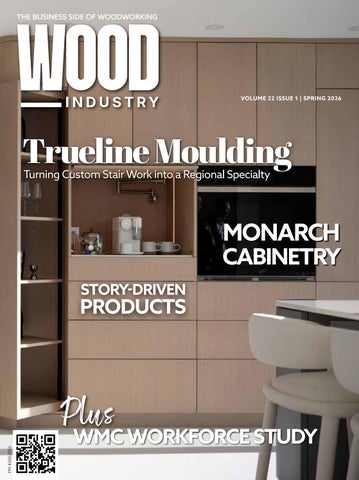
Trueline Moulding
Turning Custom Stair Work into a Regional Specialty


DECORATIVE HARDWARE TO WIN ANY ROOM
High-end craftsmanship by world-renowned designers that level up any space. Our unique cabinet hardware blends innovation with tradition, creating a wide selection of finishes, materials, and design combinations.

MONARCH CABINETRY
Monarch Cabinetry translates jobsite experience into a tight, contractor-driven operation, where in-house installation, direct communication, and a small team structure support consistent execution and steady workflow in custom residential cabinetry.
26
WMC WORKFORCE STUDY
A Wood Manufacturing Council pilot outlines practical, shop-level strategies to improve workforce attraction and retention, focusing on onboarding, workspace design, reporting systems, and clearer pathways into and within wood manufacturing careers.
STORY-DRIVEN PRODUCTS
An analysis of how storytelling reshapes product marketing in woodworking, helping manufacturers connect with architects and designers by translating technical features into real-world applications, design context, and user-focused solutions.
SALES IN WOODWORKING
An examination of how honesty, accountability, and industry understanding shape effective sales practices in woodworking, emphasizing the importance of relationships, clear communication, and evolving tools in supporting long-term customer success.
TRUELINE MOULDING
Trueline Moulding Group demonstrates how disciplined specialization in stairs, railings, and mouldings, supported by engineering rigor, climate control, and steady reinvestment, drives resilient growth in a custom, relationshipdriven regional market.


ANOTHER NEW SEASON.

Hello Industry Partners,
In a market defined by pressure to expand, adapt, and differentiate, the most effective manufacturers are not those doing more. They are the ones doing the right things with greater clarity, control, and intention. Across this issue, that idea takes shape through specialization, structure, shared standards, workforce strategy, and communication.
At Trueline Moulding Group and Monarch Cabinetry, two very different operations point to the same underlying discipline. Trueline has built its business by narrowing its focus to stairs, railings, and mouldings, expanding capability within that lane while tightening its control over engineering, materials, and installation. Monarch, by contrast, operates as a small, contractor-driven shop, where continuity of relationships and in-house installation reduce variability and keep quality tied directly to execution on site. In both cases, growth is not defined by scale alone, but by how tightly the work is controlled from conversation through completion.
That same emphasis on structure extends into the role of industry organizations. Sandra Wood of the Canadian Kitchen Cabinet Association highlights how plant tours create practical, peer-driven learning environments where manufacturers exchange real operational insight, not theory. At the Architectural Woodwork Manufacturers Association of Canada, Kasia Robinson outlines how standards function as operational infrastructure, shaping estimating, quality control, and project alignment long before issues arise. Together, these perspectives reinforce a shared principle: consistency across the industry is built through participation, shared language, and deliberate systems.
Workforce development is examined through a different lens in the Wood Manufacturing Council’s pilot study. Rather than treating labour challenges as abstract shortages, the research breaks them down into shopfloor decisions—how roles are defined, how onboarding is structured, how workspaces are designed, and how advancement is communicated. The findings are direct. Recruitment, retention, and performance are shaped less by broad initiatives and more by clear, practical systems that make entry, learning, and progression visible.
On the commercial side of the business, two perspectives address how manufacturers connect with the market itself. Freya Hannah of Cieblink draws from her experience across distribution and software to argue that credibility in sales is built on clarity, follow-through, and an understanding of how shops actually operate. Her perspective reframes sales not as persuasion, but as alignment with the realities of production and procurement. Linda Farha of Zenergy Communications extends that idea outward, showing how storytelling has become a critical tool in translating technical capability into relevance for designers and specifiers. In a crowded market, products alone no longer differentiate. Context, application, and narrative are what make them usable and memorable.
Across these stories, a consistent pattern emerges. Performance in this industry is not driven by any single factor, whether it is technology, labour, or market demand. It is the result of how well systems are defined and how clearly decisions are communicated — internally and externally.
As you move through your own operations this season, consider where clarity can replace assumption. Whether in production flow, workforce structure, or customer communication, the shops that move forward are the ones that reduce ambiguity before it becomes cost.
Thank you for reading, and for continuing to build that clarity into your work.
PRODUCTION MANAGER
PUBLISHER
Jake Blanchard
jakeb@mediaedge.ca
EDITOR Tyler Holt tylerh@mediaedge.ca
PRESIDENT Kevin Brown kevinb@mediaedge.ca
Published by
Ines Louis Inesl@mediaedge.ca
SENIOR GRAPHIC DESIGNER
Roxy Huynh-Guinane roxyh@mediaedge.ca
CIRCULATION circulation@mediaedge.ca
Wood Industry is published four times annually, Spring, Summer, Fall, Winter, for the secondary wood products manufacturing and marketing industries in Canada. Subscriptions are free to qualified participants in Canada’s secondary wood processing industry. Subscribe at www.woodindustry.ca. Paid subscriptions rates: $40 to Canadian addresses, $60 U.S. and foreign, $20 student rate. Please mail payment to Wood Industry, 251 Consumers Road, Suite 1020, Toronto, Ontario M2J 4R3. For subscription inquiries, e-mail circulation@mediaedge.ca
© 2026 by MediaEdge Communications
All rights reserved. MediaEdge Communications and Wood Industry disclaim any warranty as to the accuracy, completeness or currency of the contents of this publication and disclaims all liability in respect to the results of any action taken or not taken in reliance upon information in this publication. The opinions of the columnists and writers are their own and are in no way influenced by or representative of the opinions of Wood Industry or MediaEdge Communications.
Tyler Holt

Blum’s MINIPRESS top is now available in Canada - a compact, all-in-one drilling machine that delivers precise vertical and horizontal drilling (up to 350 mm depth). MINIPRESS top allows tool-free drill-head changes and EASYSTICK automation for automatic x/y positioning, on-machine planning, and easy data transfer from the Cabinet Configurator, speeding set up and boost productivity.
www.blum.com/mptop

Jartek Establishes U.S., Canadian Subsidiaries; Appoints North America Sales Manager
Jartek has established new subsidiaries in the United States and Canada and appointed Jeroen Hinnen as Sales Manager for North America as the Finland-based company expands its presence in the region.
The company formed Jartek US Inc. and Les Entreprises Jartek Canada Inc. to provide a clearer structure for serving customers and supporting project delivery across the continent. CEO Juho Luoranen said the move reflects a longterm commitment to the North American market and will help strengthen collaboration with customers.
Hinnen joins with experience in the wood industry, industrial automation, and international sales.
Jartek currently has two projects underway in North America, including a thermal modification kiln installation for Arbor Wood and a kiln project with Western Forest Products scheduled for installation in May 2026.
Garnica Names New CHRO, Promotes Jaime Alvarez Bandres to CMO
Garnica has appointed Jonathan Martinez Fernandez as Chief Human Resources Officer and promoted Jaime Alvarez Bandres to Chief Marketing Officer as the company continues to strengthen its leadership team.

Martinez Fernandez will lead the company’s global human resources strategy, focusing on aligning talent development with Garnica’s long-term business goals. The company said the role will emphasize supporting sustainable growth while reinforcing organizational culture as operations expand. Bandres, previously part of Garnica’s marketing leadership, will now oversee the company’s global marketing strategy. His responsibilities include brand development, market expansion, and strengthening how Garnica communicates with architects, designers, and industry partners.
The leadership changes reflect a dual focus on talent alignment and brand positioning as Garnica advances its international growth strategy.
Metrie Marks 100 Years of Family Ownership and Industry Growth
Metrie is celebrating its 100th anniversary in 2026, marking a century as a privately held, family-owned millwork manufacturer serving customers across North America.

Founded in Vancouver in 1926, the company has remained under the ownership of the Sauder family for four generations. Metrie said its longevity reflects a focus on long-term relationships with employees, suppliers, and customers, along with a values-driven approach to growth and investment.
CEO Kent Bowie said the centennial represents both a milestone and a commitment to continue investing in people, partners, and operations. The anniversary also coincides with increased involvement from the fourth generation of the Sauder family at the board level.
Today, Metrie operates seven manufacturing facilities and 26 distribution centers across Canada and the United States, producing solid wood and MDF mouldings, doors, and prefinished millwork products.

Biesse Appoints Caterina De Rossi as CHRO; Enrico Tinti to Lead Biesse Academy
Biesse has appointed Caterina De Rossi as Chief Human Resources Officer and named Enrico Tinti as Director of the newly established Biesse Academy as the company strengthens its global people and skills development strategy.
De Rossi will lead the evolution of Biesse’s HR function, aligning talent strategy with the group’s business priorities and organizational development. She joins the company with HR leadership experience in multinational environments including BMW, Tetra Pak, and Champion, where she supported corporate transformation and change management initiatives.
Tinti, who previously led Biesse’s HR function and training initiatives, will now head the Biesse Academy, a global hub focused on developing employee competencies across the organization. The appointments reflect Biesse’s effort to reinforce the strategic role of HR while expanding structured skills development across the group.

AWFS Opens 2026 Design-it-Digital Student CAD Competition
The Association of Woodworking & Furnishings Suppliers (AWFS) has opened the 2026 Design-itDigital Student Competition, an online CAD-based challenge aimed at introducing students in the United States and Canada to careers in woodworking, manufacturing, and product design. This year’s theme focuses on table design, with separate challenges for middle school, high school, and post-secondary students. Participants must design a wood-based product using professional CAD and rendering software, with entries required to incorporate at least 67 percent wood products and be manufacturable in a standard woodworking shop.
Submissions must include technical drawings, a bill of materials, labor estimates, and pricing.
Entries are open through November 1, 2026, with winners announced December 31. Winning designs will be displayed at the Fresh Wood booth during the 2027 AWFS Fair in Las Vegas.

Palliser Appoints Cary Benson as President and CEO
Palliser has appointed Cary Benson as President and Chief Executive Officer, effective January 19, 2026, marking his return to the role after previously leading the company from 2010 to 2017.
Benson most recently served as President and CEO of Encore, Palliser’s cinema seating division, where the business achieved significant growth and record results in 2025. During his earlier tenure at Palliser, the company strengthened sales performance, improved profitability, and expanded relationships with retail partners.
In his new role, Benson will focus on improving operational performance and reinforcing Palliser’s relationships with retail and cinema customers.
The leadership change comes as furniture manufacturers continue to address cost pressures, shifting demand, and the need for operational efficiency across domestic and export markets.

Beaubois Acquires New York Millwork Firm Four Daughters
Beaubois has acquired Four Daughters, a New York-based custom architectural millwork firm, in a move aimed at expanding its presence in the U.S. market and strengthening its North American operations.
The acquisition combines Beaubois’ largescale manufacturing capacity with Four Daughters’ expertise in high-end, custom architectural millwork. The companies said the partnership will enable them to pursue larger and more complex commercial projects while serving a broader client base across North America.
Beaubois described the transaction as part of its long-term strategy to strengthen its position in the architectural millwork sector and enhance project execution capabilities. Four Daughters said the partnership will allow it to continue serving existing clients while gaining access to expanded resources, technical expertise, and production capacity through Beaubois’ manufacturing platform.
Richelieu Acquires Klassen Bronze, Expands Private Brand Portfolio
Richelieu Hardware has acquired Klassen Bronze, expanding its retail hardware offering and bringing its total number of private brands to 10.

Klassen Bronze supplies a range of products for residential and commercial markets, including letters, numbers, mailboxes, signage, keys, and key-cutting machines. Richelieu said the acquisition strengthens its retail market portfolio and supports its strategy of offering a comprehensive “one-stop shop” for hardware retailers and renovation centres.
The addition of Klassen Bronze follows the earlier acquisition of Ideal Security and expands Richelieu’s private brand lineup, which also includes Richelieu, Reliable, Onward, Mibro, Task, Nystrom, Madico, and Cedan.
The company said the expanded portfolio will be supported by its service centre network in Calgary, Kitchener, and Chicago, enhancing distribution across Canada and the United States.
Akhurst Named Exclusive Canadian Distributor for Bürkle Finishing Systems
Akhurst Machinery has been appointed the exclusive Canadian distributor for Bürkle North America, expanding access to advanced finishing, laminating, and coating technologies for manufacturers across the country. Under the agreement, Akhurst will represent Bürkle’s full portfolio of surface finishing systems, supported by its national sales network and technical service teams. Bürkle, founded in 1920, is known for precision-engineered equipment used in woodworking, engineered surfaces, furniture manufacturing, and automotive component production. Akhurst President Ryan Akhurst said Bürkle’s technology aligns with the company’s focus on delivering advanced manufacturing solutions to Canadian customers. Founded in 1938, Akhurst Machinery supplies industrial equipment, training, parts, and service to woodworking and manufacturing sectors nationwide. The partnership strengthens Bürkle’s North American footprint while expanding Akhurst’s finishing technology offerings.


G&S Woodworking Earns 2026 Consumer Choice Award for Cabinetry and Millwork
G&S Woodworking has received the 2026 Consumer Choice Award in the Cabinetry and Millwork category, marking its 13th year earning the recognition in the London and Southwestern Ontario market.
The custom cabinetry and millwork manufacturer serves both residential and commercial clients, producing tailored cabinetry and architectural woodwork designed to meet project-specific requirements. The company said its approach emphasizes precision craftsmanship, quality materials, and detailed project execution from design through installation. Consumer Choice Award organizers cited the company’s reputation for translating design concepts into functional, high-quality finished products that integrate seamlessly into interior spaces.
G&S Woodworking said the recognition reflects the trust of its clients and the company’s continued focus on craftsmanship, service, and customer satisfaction across the region.
Metrie Acquires Three Door Distribution Businesses From Owens Corning
Metrie has acquired BWI Distribution, Louisiana Millwork, and Florida Made Door from Owens Corning, expanding its door solutions capabilities across the Eastern United States.

The transaction, Metrie’s eighth acquisition since 2020, extends the company’s presence further along the door supply chain, adding capabilities in pre-hanging, fabrication, finishing, and project coordination. The businesses will support both residential and commercial markets, including interior and exterior doors, custom frames, hardware installation, and job-site delivery.
CEO Kent Bowie said customers have increasingly asked Metrie to provide more integrated door solutions, similar to capabilities developed on the West Coast through its EL & EL business. The acquisition also builds on a more than 40-year relationship between Metrie and the Owens Corning doors business and strengthens the company’s East Coast distribution platform.
UCS Forest Group Promotes Eric Larson and Jeff Floyd to COO Roles


UCS Forest Group has promoted Eric Larson and Jeff Floyd to Chief Operating Officer roles at its U.S. and Canadian distribution businesses, strengthening leadership focused on regional market dynamics. Larson has been named COO of Sierra Forest Products, overseeing operations across the United States, while Floyd becomes COO of Upper Canada Forest Products, responsible for Canadian operations. The company said the appointments are intended to sharpen focus on the distinct housing cycles, regulatory environments, and supply chain conditions in each country while maintaining a unified North American structure. Both executives will focus on operational performance, including supply chain reliability, inventory management, and customer service. UCS Forest Group said the leadership changes support longterm growth while reinforcing consistent delivery, logistics efficiency, and market-specific responsiveness.
Haworth Acquires Majority Stake in Toronto Furniture Manufacturer Tayco
Haworth has acquired a majority shareholding in Tayco, a Toronto-based manufacturer of office furniture and casegoods, expanding its Canadian manufacturing presence.
Tayco will continue operating independently under President Bill Melnik and its existing management team. The company said customers and dealer partners will see continuity in product lines, services, and market programs following the transaction.

Haworth President and CEO Franco Bianchi said the investment strengthens the company’s Canadian supply chain and adds manufacturing capacity to its global network. The Toronto facility specializes in precision casegoods production, including work systems, storage, tables, and seating. Founded in 1975, Tayco is marking its 50th anniversary this year. Haworth said the partnership supports long-term investment in Canadian manufacturing while improving supply chain resilience and lead times for customers.


Weston Forest Names Mike Loizides VP of Sales – Canada, Appoints Adam Nolasco Distribution Sales Director
Weston Forest has appointed Mike Loizides as Vice President of Sales — Canada and Adam Nolasco as Director of Distribution Sales, strengthening its commercial leadership team. Loizides brings more than 18 years of senior commercial leadership experience across manufacturing, distribution, and building materials. In his new role, he will oversee sales strategy and customer development across Canada. Nolasco will focus on expanding Weston Forest’s retail and distribution customer segment across Eastern Canada. He will work closely with Loizides and the broader sales organization to align customer needs with the company’s manufacturing, packaging, and logistics capabilities.
CEO Doug Robinson said the appointments support Weston Forest’s strategy of delivering scale and consistent service to retail and distribution partners.


Expo Design Partners With INT. DESIGN for 2026
Montreal Show
Expo Design has formed a strategic partnership with INT.DESIGN, the flagship platform of PID Agency, ahead of the tradeshow’s 11th edition scheduled for October 7–8, 2026, in Montreal.
Produced by Design Spec Rep (DSR), Expo Design connects architects, designers, cabinetmakers, woodworkers, manufacturers, and contractors through a materials-focused showcase for interior and exterior design. Organizers said the alliance with PID Agency will expand the show’s reach within the design and architecture community while strengthening programming and content for attendees.
As part of the collaboration, one of the annual GRANDS PRIX DU DESIGN galas will be held on October 8 immediately after the event, drawing more than 550 industry professionals.
Organizers said the partnership will help position the 2026 edition as a stronger platform for presenting new materials and product innovations to specifiers and decision-makers.
Uniboard Launches New Particleboard Production Line at Val-d’Or Plant
Chemcraft Marks 50 Years Serving North American Wood Finishers
AkzoNobel’s Chemcraft brand is celebrating its 50th anniversary, marking five decades of supplying industrial wood coatings to furniture manufacturers, cabinetmakers, and finishing operations across North America.

Since its launch, Chemcraft has expanded its product portfolio to meet evolving production demands, efficiency goals, and regulatory requirements. The brand has built its reputation on consistent product performance supported by technical expertise and distributor partnerships. AkzoNobel said collaboration between Chemcraft specialists and local distributors has played a key role in supporting wood finishing operations across a range of industrial environments. The company added that ongoing product development has focused on improving application efficiency, reducing waste, and maintaining reliable finishing results as manufacturing processes and market requirements continue to evolve.

AWMAC 2026 Convention to Feature NAAWS 5.0 Launch in Québec City
The Architectural Woodwork Manufacturers Association of Canada (AWMAC) will host its 2026 National Convention in Québec City, highlighted by the official launch of NAAWS 5.0 and a program focused on industry strategy and operational leadership.
The three-day event will bring together manufacturers, suppliers, and industry leaders for sessions exploring technology, data, artificial intelligence, materials innovation, and evolving standards in architectural woodwork. Marc Sanderson, CEO of INNERGY, will participate in multiple discussions on how digital tools and manufacturing systems are shaping operations across the sector.
Saturday’s agenda will focus on association governance and member engagement, including the Annual General Meeting and a production-focused “Inside the Craft” session. Organizers said the convention is designed to connect strategic discussion with practical execution across member companies.

Uniboard has produced the first panels on a new particleboard production line at its Val-d’Or, Quebec facility, completing a multi-phase modernization project valued at more than $350 million.
The final phase included installation of a 10-foot continuous press and finishing line designed with high levels of automation and artificial intelligence to improve productivity and process control. The upgrade also added more than 300,000 square feet of warehouse space, positioning the site as a consolidated distribution hub.
The new line increases annual capacity to 272 million square feet from 170 million previously. Uniboard said the added output strengthens its position as the largest particleboard producer serving Canada, the northeastern United States, and the Midwest.
The Val-d’Or facility uses 100 percent post-industrial wood residuals and is FSC chain-of-custody certified.
WEINIG Canada
Names Marc Forbes and Mace Yenicare as Regional Account Managers
WEINIG Canada has appointed Marc Forbes and Mace

Yenicare as Account Managers for Ontario and British Columbia, expanding its regional sales coverage and customer support network.
Forbes, based in Ontario’s Niagara region, brings more than 20 years of manufacturing and technical sales experience, including time managing CNC-based production and operating a custom cabinetry business. Yenicare, based in Vancouver, joins with more than six years of B2B sales and territory management experience, including work with a woodworking equipment manufacturer.
The company said the appointments strengthen localized service in two of Canada’s most active woodworking markets.
WEINIG Canada said expanding its account management team will help manufacturers address challenges such as labour shortages, rising material costs, and increasing demand for automation and digital integration.


A STRONGER QUARTER, UNEVEN GROUND: WHAT Q4 HOUSING DATA MEANS
National and quarterly review
:: By Tyler Holt, Editor of Wood Industry


Canada’s 2025 housing starts increased year over year on a raw annual basis, rising from 245,367 in 2024 to 259,028 in 2025 (+5.6%). That is a meaningful improvement, but it is not, on its own, a signal of broad-based acceleration. For operators who depend on residential construction for demand, the more practical question is how much of this improvement shows up in the late-year pipeline, and where the activity is concentrated.
In population centres above 100,000, Q4 starts rose from 51,348 in 2024 to 57,746 in 2025 (+12.5%). Month-by-month, the quarter strengthened as it progressed, with the most pronounced year over year lift occurring in December. This kind of year-end acceleration can reflect multiple forces, including project timing, financing decisions made earlier in the year, and developers pushing to break ground before year-end thresholds. It is a signal worth tracking, but it should be interpreted as momentum that requires confirmation in subsequent quarters.
Completions in those same large population centres also rose, but more modestly. Q4 completions increased from 52,493 in 2024 to 56,320 in 2025 (+7.3%). A rising starts line can be encouraging, but com-

HIGH QUALITY EDGE BANDING
With the new Canduro 2, you achieve precise and consistent PUR adhesive application for high-quality edge banding. Its low-maintenance design and intuitive operation ensure efficient processes and clean, nearly invisible joints.
robatech.com/canduro-2


pletions are the nearer-term confirmation that projects are actually moving through to the stages that generate purchase orders for interior components.
PRODUCT MIX SHIFT
Across Q4 data the clearest structural signal is a shift toward multi-family construction. This is not a minor compositional detail. It changes the type of work in the pipeline, the procurement ecosystem, and the timing profile of demand for interior components. And we are seeing a continued shift towards more multi-family versus single and semi-detached starts.
In Q4 starts by dwelling type, single and semi-detached starts fell while multi-family rose:
Single/Semi: 21,578 → 19,783 (-8.3%)
• Multi-Family: 37,222 → 43,355 (+16.5%)
Even if one ignores the absolute totals and focuses only on direction, the message is consistent. Starts growth is being carried by multi-family formats, while low-rise starts are contracting.
Completions reinforce that point in large population centres. Q4 completions by dwelling type show single and semi-detached completions essentially flat, while multi-family completions increased:
• Single/Semi: 18,046 → 18,043 (flat)
Multi-Family: 34,447 → 38,277 (+11.1%)
This pairing is important. It is one thing to see more multi-family starts, and another to see more multi-family completions. When both are moving up, it suggests that higher-density production is not just being initiated, but is also being delivered at a higher rate in the most relevant urban markets.
For secondary wood manufacturing firms, a multi-family tilt tends to reshape opportunity and risk in three practical ways.

First, multi-family often brings a greater degree of standardization. Unit layouts repeat, specification books are more rigid, and submittals, documentation, and quality control processes are more formalized. That can reward shops that have invested in repeatable manufacturing processes, controlled tolerances, and strong coordination with installers. It can also expose shops that rely on high customization and informal field-driven adjustments.
Second, the delivery cadence differs. Multi-family interiors are frequently scheduled in waves, aligned to floor-by-floor turnover and occupancy milestones. This can produce compressed production periods with higher volume over shorter windows. Capac-
ity planning becomes less about average weekly output and more about the ability to absorb peaks without sacrificing quality or delivery performance.
Third, customer concentration increases. Multi-family packages tend to flow through a smaller number of developers, general contractors, and large installation partners. That concentration can stabilize demand when relationships are strong, but it can also compress margins when bidding becomes commoditized. In that context, reliability, documentation discipline, and defect control can be as important as unit pricing.
The product mix shift, in other words, is not merely about “more housing.” It is about a different housing workload. The next question is where this workload is concentrating geographically.
PROVINCIAL AND CMA BREAKDOWN ONTARIO
Ontario’s Q4 2025 starts total 16,450, placing it at a scale comparable to Québec. However, Ontario’s CMA-level performance is not uniform and instead looks more like a set of distinct sub-markets moving in different directions.
Key Ontario CMAs include:
• Toronto: 5,770 → 5,958 (+3.3%).
• Ottawa-Gatineau: 3,305 → 4,032 (+22.0%).
• Hamilton: 686 → 1,081 (+57.6%).
• Kitchener-Cambridge-Waterloo: 1,059 → 781 (-26.3%).
• London: 1,169 → 703 (-39.9%).
• Barrie: 747 → 174 (-76.7%).
• St. Catharines-Niagara: 445 → 1,013 (+127.6%).
• Windsor: 428 → 391 (-8.6%).
• Guelph: 67 → 180 (+168.7%).
• Kingston: 695 → 233 (-66.5%).
• Peterborough: 98 → 25 (-74.5%).
• Thunder Bay: 114 → 32 (-71.9%).
• Belleville - Quinte West: 101 → 168 (+66.3%).
• Brantford: 152 → 130 (-14.5%).
• Oshawa: 119 → 229 (+92.4%).
The operating takeaway is that Ontario cannot be treated as one demand line. Toronto is essentially stable in Q4, Ottawa-Gatineau strengthened, and several mid-sized markets moved sharply in either direction. For a shop serving Ontario, the risk is not simply “Ontario up or down,” but customer concentration in specific CMAs that may be contracting even while others expand. The opportunity is
similarly local, with certain corridors showing meaningful gains that can support selective growth.
QUÉBEC
Québec’s Q4 2025 starts total 16,438, essentially equal to Ontario’s total in the provincial context. Within Québec, the standout is Montréal, which drives the provincial story in Q4.
Québec CMAs show:
• Montréal: 5,081 → 8,446 (+66.2%).
• Québec City: 1,659 → 1,963 (+18.3%).
• Sherbrooke: 759 → 628 (-17.3%).
• Saguenay: 541 → 288 (-46.8%).
• Trois-Rivières: 255 → 400 (+56.9%).
• Drummondville: 314 → 448 (+42.7%).
Québec’s pattern is best described as concentrated strength. Montréal’s increase is large enough to influence provincial totals and supplier prospects, while secondary markets are mixed. For manufacturers and distributors, this argues for a Montréal-centered strategy if Québec is a priority, with a cautious approach to smaller centres where starts may be contracting.
BRITISH COLUMBIA
British Columbia’s Q4 2025 starts total 9,946. The CMA data shows a market that is mixed, with softness in key coastal markets and high volatility in several interior centres.
B.C. CMAs include:
• Vancouver: 7,609 → 6,812 (-10.5%).
Victoria: 1,119 → 1,088 (-2.8%).
• Abbotsford-Mission: 281 → 313 (+11.4%).
• Chilliwack: 251 → 137 (-45.4%).


• Kelowna: 123 → 468 (+280.5%).
• Nanaimo: 245 → 94 (-61.6%).
• Kamloops: 366 → 77 (-79.0%).
The provincial total can obscure the practical reality that Vancouver remains the dominant market and that it weakened in Q4. At the same time, Kelowna’s increase is large in percentage terms, and it may be locally meaningful for suppliers positioned for the Interior. Still, base effects matter. Percentage gains on small starting values can look dramatic without necessarily translating into sustained, broad demand. For firms considering B.C., the conclusion is not “B.C. down.” It is “B.C. uneven, with coastal softness and interior volatility.”

PRAIRIES
The Q4 2025 Prairie subtotal is 15,763, broken out as Alberta 12,470, Manitoba 1,922, and Saskatchewan 1,371. The CMA breakdown shows that Prairie performance is stable overall, but with important differences between Alberta’s largest markets and some smaller Prairie centres.
Prairie CMAs include:
• Calgary: 6,955 → 6,791 (-2.4%).
• Edmonton: 5,025 → 4,853 (-3.4%).
Lethbridge: 116 → 145 (+25.0%).
• Red Deer: 40 → 68 (+70.0%).
• Saskatoon: 781 → 1,051 (+34.6%).
Regina: 285 → 282 (-1.1%).
• Winnipeg: 1,466 → 1,538 (+4.9%).


Alberta’s annual starts are reported elsewhere as very strong, but in Q4 the two largest Alberta CMAs were slightly down year over year. That does not negate Alberta’s importance, but it does suggest that late-year momentum in the major Alberta metros was not as strong as in some eastern markets. Meanwhile, Saskatoon strengthened, Winnipeg was steady, and smaller Alberta centres posted increases from small bases.
For manufacturers, the Prairie picture supports a cautious, selective approach. The region offers scale, particularly through Alberta, but the Q4 CMA data suggests mixed near-term conditions in the largest metros and pockets of growth elsewhere.
ATLANTIC CANADA
The Q4 2025 Atlantic subtotal is 4,541, with Nova Scotia 2,186, New Brunswick 1,820, Prince Edward Island 194, and Newfoundland and Labrador 341. In absolute terms the region is smaller, but the CMA data indicates strong dynamism in specific markets.
Atlantic CMAs include:
• Halifax: 795 → 1,659 (+108.7%).
• Moncton: 815 → 704 (-13.6%).
• Saint John: 163 → 247 (+51.5%).
• Fredericton: 243 → 526 (+116.5%).
• St. John’s: 287 → 291 (+1.4%).
Halifax is the clear growth engine in Q4, with Fredericton also posting a sharp increase from a smaller base. Moncton declined, and St. John’s was essentially flat. For suppliers, the Atlantic region can be attractive when aligned with the right sub-markets and customer networks, but it requires precision. The region’s smaller totals also mean that a single project cycle can materially influence quarterly numbers.
WHAT THE DATA SIGNALS
The Q4 2025 data points to a stronger lateyear construction pulse in large population centres, but it does not support a simple national narrative. Starts in population centres above 100,000 rose 51,348 → 57,746 (+12.5%), while completions rose 52,493 → 56,320 (+7.3%), suggesting an expanding pipeline. The composition of that pipeline is increasingly multi-family, with starts shifting away from single and semi-detached formats and completions growth dominated by multi-family delivery.
Geographically, the province-led view highlights both scale and divergence. Ontario
and Québec are nearly equal in Q4 provincial totals, but their CMA patterns differ sharply. Québec’s strength is concentrated heavily in Montréal, while Ontario is a mosaic of stable, expanding, and contracting CMAs. British Columbia shows coastal softness alongside interior volatility. The Prairies remain substantial in volume but mixed in the largest Alberta metros in Q4, while Atlantic Canada is smaller in absolute terms but highly dynamic in specific CMAs led by Halifax.
Product mix is changing the nature of demand, and geography is determining whether demand exists at all in the near term. Firms will be better served by planning province-by-province, then CMA-by-CMA, aligning capacity and product strategy to multi-family workflows where the data indicates growth, and avoiding assumptions that a national increase will translate evenly into every local order book.


ROBUSeco Spray Coating Machine


The perfect entry-level solution for automatic spray applications.
The Bürkle ROBUSeco Spray Coating Machine is the perfect solution for small to medium production capacities. Thanks to its compact design and easy operation, it enables precise coating application with minimal overspray. The system works with high-quality spray guns, offers optional colour circuits and impresses with its energy-efficient air flow – ideal for trade businesses or companies with flexible production requirements.

Integrate the spray coating machine into a fully customizable modular line design for maximum flexibility and performance.
Building Trust. Creating Together.
Monarch Cabinetry : From the jobsite to the shop floor
:: By Joy Doonan, Wood Industry Writer

FROM THE JOBSITE TO THE SHOP FLOOR
Monarch Cabinetry is a cabinet shop in the Kelowna area of B.C., where owner Nick Koenig has turned years of jobsite experience into a small, contractor-focused operation. Koenig launched Monarch in June 2025, after nearly 15 years with Terry Harris Cabinets, where his role grew into a start-to-finish mix of building and installation. Today, Monarch operates out of a 2,500 sq. ft. shop with two employees, focusing on custom cabinetry for single-detached homes. Koenig’s contractor relationships, hands-on workflow, and inhouse installation have shaped the company’s day-to-day operations and how it sustains steady work at a small scale.
A LAUNCH BUILT ON CONTINUITY
Monarch Cabinetry’s origin story is about carrying forward a working reputation. Koenig spent roughly 15 years with Terry Harris, “working [his] way up the ladder,” and for about eight years he was effectively the main installer, while also building much of what went through the shop. When Harris moved toward retirement, Koenig launched Monarch through an asset sale rather than purchasing the former business as an ongoing entity. The brand name changed, but the day-to-day relationships were already established through years of jobsite coordination, installations, and repeat work.
That continuity matters because cabinetry
is rarely a one-off purchase for the people who drive volume. Homeowners might only renovate once in a long while, but contractors need dependable partners across multiple builds. Koenig describes a workload anchored by a small circle of contractors, and at Monarch’s current size it does not take many projects to keep the calendar full. He works with two to three contractors, and if those builders complete a few houses per year, that pace is enough to sustain a two-person operation. In terms of market conditions, Koenig describes the local environment as stable based on his years working in the Okanagan region. For a 2,500 sq. ft. shop with two employees, that stability shows up in practical ways. A

steady builder network reduces volatility, helps with scheduling, and keeps attention on execution rather than constant prospecting.
INSTALLATION CONTROL, MINIMAL TRANSLATION LOSS
A defining feature of Monarch’s operating model is that the shop installs its own work. The company has been approached by subcontractors who have offered to install for the company, but Koenig prefers to keep installation in-house.
“Installing our cabinetry and millwork ourselves is a form of quality control and customer assurance”, Says Koenig. “We are a small shop, but we use that to see the product all the way to the end, where the final result is judged in the field.”
As he puts it, “Anyone can build a nice cabinet but if it isn’t installed correctly, then it isn’t truly delivering or representing the quality that we want to uphold here.”
For a small shop, installation becomes part of quality assurance, and it keeps the builder’s experience consistent from delivery through completion. Contractors value that consistency because it reduces jobsite uncertainty. Koenig recounts that builders prefer knowing exactly who is arriving to install, rather than dealing with a rotating crew. “They have the assurance of knowing, ‘Nick’s coming. He’s going to put the kitchen in. He always does a great job.’” That predictability also aligns with Monarch’s customer mix. Koenig estimates that most work comes through contractors, while roughly a quarter to a third comes directly from homeowners.
Koenig also describes a second source of value that comes from how small the opera-

tion is. “Nothing’s getting lost in translation; it’s me and two guys,” he says. The person discussing the details is the same person who understands how those details will be built and installed. Koenig describes it as a process where the build is “almost taking shape during the conversation,” which is another way of saying there are fewer handoffs where details can drift.
On the equipment side, Koenig points to the tools that keep production moving. Monarch’s CanTech panel saws are, in his words, his “bread and butter.” The emphasis here is on dependable core machinery that supports repeatable results in a small footprint.
When asked what he would do differently as he moved into ownership, Koenig answered that he would “take the leap sooner.” The step into ownership felt larger before he made it, and once he did, it felt more manageable than


expected. For a hands-on shop owner balancing production, installs, and administration, that kind of confidence shift can matter as much as any operational tweak because it shapes how decisively the business is built.
STAYING CLOSE TO THE WORK
Monarch Cabinetry’s early profile is rooted in continuity and control. Koenig carried forward contractor relationships built over years in the field, and he has kept the shop small enough to stay directly involved from build through installation. The company’s value proposition is tied to consistency on site and clear communication during planning, supported by a tight team in a 2,500 sq. ft. facility. In the near term, Monarch’s direction is straightforward, continuing to “put out good quality kitchens and cabinetry” while keeping pace with a steady builder network.
Clear vision, clear solution:
When things get complex, we make it smart and successful
Our networked production combines storage, handling, transportation and processing of workpieces to offer you maximum flexibility for a high number of variants or efficiency through series production.
From individual machines to fully interlinked systems – we help you to find the optimum solution for your individual production requirements to ensure your long-term success. With a large number of variants, market-driven production costs and optimum resource utilization are crucial. With our industry knowledge and many years of experience, we can offer you the right solution for batch size 1 production and commission production.
High-performance, reliable machines are essential in today‘s panel furniture production. Our systems are the optimum solution for the reliable production of series furniture with a perfect price/performance ratio.
Among other things, we offer 3D concept visualization and simulations at the highest level.


POWERFUL: > 15.000 parts/shift.
From batch size 1 to series production.
From cell to production line.
From ground level to multi-storey.
From centralized to location-independent networked production.


BUILT TO FIT: HOW TRUELINE TURNED CUSTOM STAIR WORK INTO A REGIONAL SPECIALTY
:: By Tyler Holt, Wood Industry Editor

In a sector where many shops are under pressure to widen their offer, Trueline Moulding Group has taken a narrower route. The Kelowna, B.C.-based manufacturer, incorporated in 2012 after acquiring Rise & Run Manufacturing, has built its business around three categories: stairs, railings, and mouldings. That focus sounds simple. In practice, it has required the company to adapt to changing design tastes, tighter engineering requirements, and the material realities of wood manufacturing in Interior B.C.
The company is led by owner-manager Colin Fitchett, who describes the business in direct terms: “We do stairs, mouldings, and railings. That’s pretty much what we do.” That plain definition is useful because it captures both Trueline’s discipline and its operating logic. The company has expanded within its category, not away from it.
That distinction matters. In secondary wood manufacturing, growth often comes with the temptation to chase adjacent work. Trueline suggest a different pattern: broaden the solution set for existing customers, but keep the production model anchored to core competencies.
FROM ACQUISITION TO OPERATING BASE
Trueline’s current structure grew out of a practical decision. Fitchett
says he and his partners had already spent more than two decades in the trade before the business was formed. When their previous employer went into receivership, the issue was not market access. It was manufacturing capacity.
“Really, all we needed at the time was equipment,” he says. “We already had sales because we had been in the industry for a long time. We had relationships. We just needed somewhere to manufacture.”
That led to the purchase of Rise & Run Manufacturing, a local company with equipment and a facility that could serve as a launch point. Trueline operated there for roughly five years, outgrew the building in about four, and then moved into its current site after purchasing land and constructing a new facility.
This origin story is worth noting because it reflects a common but underappreciated pattern in custom manufacturing. The commercial value often sits less in a logo than in relationships, trade knowledge, and the ability to turn drawings into installed product. Equipment matters. So does floor space. But the article’s source material makes clear that Trueline’s real starting asset was accumulated industry experience.
ADAPTING TO METAL AND GLASS, WHILE STAYING IN LANE
Next, the company’s product evolution shows how specialty manufacturers can respond to shifting design preferences without abandoning their identity. Fitchett says Trueline has “had to lean out of wood a bit” as local demand moved toward welded metal and glass. Yet he does not frame that change as a departure from the business. He frames it as a variation within railing and stair work.
That is a useful distinction for the trade. In many custom shops, product categories are less rigid than the production processes behind them. A railing may include wood, steel, glass, or cable, but it still requires templating, fit-up, coordination, finishing decisions, and installation discipline. Trueline appears to have built its offer around that broader understanding.
The company manufactures its wood products in-house. It brings in glass components, but handles templating and installation itself. For metal work, the interview describes a workflow that includes templating, drawing, fabrication coordination, and installation. The through-line is not material purity. It is control of the finished assembly.
Fitchett is explicit about the company’s limits: “We don’t go too far beyond that because we believe in doing what we do well.” For small and mid-sized manufacturers, that may be one of the more important lessons in the story. Adaptation does not have to mean sprawl.
The regional context supports that approach. The Okanagan market is prime for a high level of custom residential work and a relationship-driven contractor network. Fitchett contrasts that environment with more standardized housing markets, arguing that e-commerce does not fit a business where much of the work remains bespoke and site-specific.
CLIMATE CONTROL IS NOT A SIDE ISSUE
For any wood manufacturer working in a dry climate, material behavior is not a background concern. It is a production variable. That comes through clearly in the Trueline interview.
Fitchett says the company humidifies its building during winter and tries to hold conditions at about 35 percent humidity. In January and February, when outside temperatures can drop sharply, wood dries quickly. He also notes that locally appropriate sourcing can help, because material brought in from the coast may move as it adjusts to Interior conditions.
The numbers in the interview are specific enough to be useful. Most eastern hardwoods, he says, arrive at about 6 to 9 percent moisture content. Softwood from Vancouver tends to come in at roughly 10 to 11 percent. Both may be workable, but each requires attention.
Just as important, Trueline’s experience suggests that site conditions can be more dangerous than plant conditions. Fresh drywall, trapped humidity, poor sequencing, and inadequate sealing can all affect installed performance. That creates a familiar problem for custom wood shops: the manufacturer may control machining and assembly, but not the environment the product enters.
Fitchett’s answer is part process control and part customer education. “Wood is still a living, breathing material,” he says. The company has expanded its documentation over time to explain care requirements and set expectations with clients. That is not just a service gesture. It is a risk-management measure.
For stair and railing shops, this point deserves emphasis. Material movement is often discussed as a technical issue, but it is also a communication


“Wood is still a living, breathing material.”
issue. If the customer, builder, and adjacent trades do not understand what wood needs, the manufacturer may end up defending a product that was never given stable site conditions.
THE STAIRCASE AS ENGINEERED PRODUCT
Moving on to production discipline, one of the strongest themes in the source material is the way stair work has become more engineered and document-intensive. Fitchett offers a concise description: “A stair is basically a piece of furniture that you can walk on.” It is a useful line because it captures both the craft side and the performance side of the work.
He also says the regulatory environment has changed substantially. Municipalities increasingly want engineering, documentation, sign-offs, and inspection compliance. In mixed-material systems, the complexity can multiply. A stair’s wood structure may be engineered separately from a glass railing assembly, leading to multiple review streams and added cost.
That shift has operational consequences. Informal handoffs from field measure to shop floor no longer suffice. Trueline now measures jobs, produces CAD drawings, and sends defined drawings into pro-


duction so the shop knows exactly what it is building. That reduces ambiguity, limits rework, and supports downstream installation.
The company also prefers to install its own work rather than leave that step to others. From a trade perspective, this may be one of the most practical insights in the article. Self-installation is not only about service quality. It is about protecting engineered intent. When the same company controls measurement, drawing, manufacturing, and installation, there are fewer opportunities for a field error to become a product dispute.
That closed-loop approach seems especially important in Trueline’s category mix, where curves, custom geometries, and combinations of wood, glass, and steel require careful coordination. The interview suggests the company is often working on complex projects long before fabrication begins, particularly where custom slopes and engineered interfaces are involved.
REINVESTMENT AS OPERATING ROUTINE
Technology is another recurring theme, though not in a flashy way. Fitchett describes equipment investment as continuous rather than transformational. “There’s always reinvestment happening. Machinery upgrades never really stop.”
That comment aligns with the company’s reported investments in a newer moulder and both 3-axis and 5-axis CNC capacity. In the interview, the newer moulder is described as faster, more accurate, and easier to change over. That matters in a custom environment, where profile changes, short runs, and operator training can all affect throughput.
The broader point is that modern equipment changes more than cycle time. It can tighten repeatability, reduce setup friction, and make it easier to translate design intent into finished parts. When combined with stronger CAD workflows, those investments support a more disciplined production system.
At the same time, Trueline’s growth path appears measured. The company has added offerings such as exterior railing and serves a regional footprint stretching from Kamloops to Osoyoos, indicated a common and successful SME pattern: deepen service to existing customers first, then extend geography or adjacent offerings as capacity allows.
PEOPLE, CULTURE, AND STAYING POWER
The final point is about management. Fitchett says he wishes he had started his own company earlier, but his more developed observation concerns people. “If you bring in good people, they create good culture,” he says, pointing to a core group of long-term staff who have stayed with the business over time.
That is not incidental. In custom stair and millwork production, tacit knowledge remains central. Machines matter, drawings matter, and engineering matters. But many small and mid-sized firms still depend on experienced employees who can interpret nuance, see installation risks early, and solve problems before they become delays.
Trueline is a company that has built its position less through scale than through disciplined specialization. It operates in a custom regional market, has widened its material mix without losing its manufacturing identity, and has tightened its process around CAD, engineering, climate control, and installation. For trade readers, that may be the clearest takeaway: in a fragmented specialty market, focus is not the opposite of adaptation. Done properly, it is what makes adaptation manageable.
ACMOS
SILICONE-FREE WAXILIT TABLE LUBRICANTS, RELEASE AGENTS, COOLANTS, AND CLEANERS
Promotes high-quality finished products
Extends the longevity of machinery and equipment
Ready to use
Environmentally friendly
Water-based formulations
Recommended by machine manufacturers
Prevents glue build-up and reduces clean-up time for PVA, PUR, formaldehydes, hot melts, resins, and more!

Supports many woodworking applications. Moulders, table saws, edge banders, hot/cold press plates, radio frequency equipment, clamps, glue spreaders, spray booths, and more
WWW.ACMOS. COM | 724-220-6644 | INFO@ACMOSINC.COM

STRENGTH IN NUMBERS
Our cluster thrives on the collaborative model of sharing best practices, gathering new ideas, and working together.
Join us and become part of a dynamic and supportive community dedicated to helping each other succeed.
TO LEARN MORE VISIT
www.wmco.ca

Turning Workforce Research into Shop-Floor Strategy

Employment in goods-producing industries remains heavily male-dominated. Men are far more likely than women to work in sectors such as construction and manufacturing, where most skilled trades jobs are concentrated. Because so few women currently work in these industries, even modest increases in female participation could significantly expand the available workforce and help address labour shortages in the skilled trades.
Source: Statistics Canada, Labour Force Survey, Table 14-10-0023-01: Labour force characteristics by industry, annual; distribution of employment by sector and gender.
Arecent pilot project supported by the Government of Alberta and led by the Wood Manufacturing Council (WMC) set out to answer a practical question for the woodworking industry: what actually helps attract and retain a broader workforce in small and mid-sized manufacturing shops?
The initiative, titled Building a Substrate for Diverse and Welcoming Woodshops, was conducted in between April 2024 and March 2026. The project used a mixed, participatory approach that included interviews with prospective and early-career tradeswomen, co-creation workshops in Calgary and Edmonton, and walkthroughs of operating woodshops that examined facilities, workflow, equipment, and communication systems within Alberta.
Participants ranged from newcomers and recent training graduates to career-changers already working in the trades. Employers were also involved through shop visits and training-environment discussions. The goal was not to produce abstract commentary on workplace culture. Instead, the project translated findings into operational practices that companies can implement and measure.
Across interviews and workshops, researchers identified a cluster of barriers that affect workforce entry and retention: unclear hiring pathways, outdated onboarding practices, poorly fitted safety equipment, weak reporting systems, and limited visibility around advancement. These issues often interact to discourage capable workers from entering or staying in the industry. The report organizes solutions into five practical levers that shop owners can control: visibility and navigation for entrants, structured onboarding and mentorship, ergonomic design and PPE fit, clear reporting pathways, and transparent advancement systems.
Making Entry Points Visible
One of the clearest findings from the pilot was that interest in woodworking jobs exists, but the pathway into the industry is often difficult to see.
Hiring in the trades frequently relies on informal networks and word-of-mouth referrals. While this works well for established insiders, it unintentionally reproduces the demographics of the existing workforce. Many women interviewed during the project said they were interested in hands-on shop work but were unsure where to begin.
Simple changes in recruitment practices can make a significant difference:
• Write job postings that clearly describe daily tasks rather than vague personality traits.
• Avoid insider language that assumes prior shop experience.
• Use gender-neutral language when advertising general labour or entry-level roles.
• Include a woman in the interview process
when possible to give candidates a clearer picture of the workplace.
These adjustments require little investment but signal that a shop is serious about welcoming new entrants.
Stabilizing the First 90 Days
The research also highlighted the importance of structured onboarding. Many small shops rely heavily on supervision rather than formal training. While experienced employees can often infer expectations through observation, new entrants — particularly those without prior shop exposure — may struggle to interpret informal rules.
A structured first-90-day framework can stabilize the learning process.
Effective onboarding systems often include:
• A buddy or point-of-contact for routine questions
• A simple learning sequence that introduces machines and tasks gradually
• Clear explanations of shop norms, safety expectations, and workflow
• Opportunities for peer connection, not just supervision
When new employees know where to turn for help and how their skills will develop, technical learning becomes much easier.
Designing Workspaces That Fit the Worker
Physical safety discussions in manufacturing often focus on large equipment investments, but the pilot found that smaller ergonomic adjustments frequently deliver broad benefits.
Many shops discovered that standard safety equipment does not fit the full range of workers on the floor. Providing properly sized gloves, adjustable workstations, and ergonomic lifting aids reduces fatigue and injury risk for everyone.
The research also emphasized the operational importance of basic facilities. Lockers or private storage space, and provision of adequate women’s washroom facilities on site.
Turning Reporting into a Workflow
Psychological safety — the ability to raise concerns without fear of retaliation — was another consistent theme across interviews.
In many shops, reporting mechanisms exist informally but rely on personal relationships. New employees must figure out who to approach, when to speak up, and whether raising an issue might harm their standing.
Clear systems reduce that uncertainty.
Practical examples include:
• A confidential reporting pathway for workplace concerns
• A peer-nominated safety representative
• Short respectful-workplace refreshers that

The apprenticeship pipeline shows both a participation gap and a structural opportunity for the skilled trades. Women account for a relatively small share of new apprentices and complete programs at slightly lower rates than men, which limits the number reaching certification. Because the starting pool is so small, however, even modest increases in female participation or completion could significantly expand the supply of certified tradespeople over time. In an industry facing growing retirement pressure, attracting and retaining even a few more women could have a disproportionate impact on workforce renewal.
Source: Statistics Canada, Registered Apprenticeship Information System
clarify expectations
• Anonymous pulse surveys to identify problems early
These tools do not lower performance standards. Instead, they remove ambiguity around how concerns are handled.
Clarifying Advancement Pathways
Retention also depends heavily on whether employees can see a future in the industry.
The pilot found that advancement is often framed too narrowly as moving into management. Many skilled workers instead want deeper technical capability, broader machine expertise, or opportunities to mentor others.
Clear progression systems can make these possibilities visible.
Examples include:
• Publishing a simple role ladder (labourer apprentice journeyperson)
• Providing a one-page apprenticeship quickstart guide explaining registration, funding, and exams
Assigning mentors to apprentices for logbook completion
• Offering paid study time where feasible
When progression pathways are transparent, employees are more likely to remain and build longterm expertise within the shop.
Policy Often Matters More Than Equipment
One unexpected insight from the pilot was that retention decisions often hinge more on policies than equipment.
Scheduling flexibility emerged repeatedly in in-
terviews. Many workers — particularly those balancing caregiving responsibilities — said that rigid scheduling made long-term employment difficult. Shops that acknowledged these realities through clear policies tended to retain employees more successfully.
Similarly, transparent expectations around progression, mentorship, and communication proved more influential than isolated workplace upgrades.
The common thread is clarity. When employees understand how the workplace operates and how their role can evolve, stability improves.
Building Stronger Wood Manufacturing Workplaces
The Wood Manufacturing Council’s Alberta pilot did not uncover a long list of revolutionary ideas. Instead, it demonstrated how everyday operational decisions shape who enters the industry and whether they stay.
Recruitment language, onboarding systems, workspace design, reporting structures, and advancement pathways all influence workforce participation. When these systems are intentionally designed, shops become more accessible to a broader range of skilled workers.
For an industry facing ongoing labour shortages, these changes represent more than diversity initiatives. They are practical strategies for building stable, high-performing teams.
Through projects like this pilot, the Wood Manufacturing Council continues to highlight how diversity and inclusion can strengthen the long-term competitiveness and resilience of Canada’s wood manufacturing sector.


The Big Picture
• Women = ~48% of Canada’s total workforce
• But only ~29% of manufacturing workers
Wood & Forestry Sector (Even Lower Representation)
• Women make up only ~17–19% of the forestry/wood sector
• Sector remains heavily male-dominated across roles and leadership
Alberta Snapshot (Manufacturing Context)
• Women represent <29% of manufacturing workforce in Alberta
• Yet industry faces major labour shortages (9,000+ workers needed by 2032)
What This Means
• Underutilized talent pool
• Missed opportunity to address labour shortages
• Limited diversity in innovation & leadership
Opportunity
Increasing women’s participation =
• Stronger workforce supply
• Improved innovation & performance
• More inclusive workplaces
One-Line Takeaway
Women are nearly half the workforce — but less than one-third in manufacturing and under one-fifth in wood/forestry — highlighting a significant and untapped opportunity in Alberta’s wood manufacturing sector.

Using Standards as a Business Tool
Not Just a Specification Reference
:: By Kasia Robinson, Director, Standards, Inspections & Assurance, AWMAC National

In our industry, standards are often treated as something you pull off the shelf when there is a question in a specification or a disagreement in the field.
They become reactive.
That is not what standards are designed to be.
As Director of Standards, Inspections & Assurance at AWMAC National, I see every day how reference standards influence not only project outcomes, but business performance, professional credibility, and industry stability. When properly understood and intentionally applied, standards are not simply compliance documents. They are operational infrastructure.
And that infrastructure matters — to manufacturers, to architects, to general contractors, and to owners alike.
WHY REFERENCE STANDARDS MATTER TO THE ENTIRE PROJECT TEAM
Architectural woodwork is not commodity manufacturing. It is custom, highly interpretive, and built at the intersection of design intent, material science, fabrication capability, and site conditions.
Without a shared benchmark, each stakeholder defines “acceptable” differently.
• Architects design to an aesthetic vision.
• General contractors manage schedule and risk.
• Owners expect durability and performance.
• Manufacturers fabricate within physical and material constraints.
Reference standards create alignment across those perspectives. They establish a neutral, documented baseline for:
• Material performance
• Fabrication methods
• Joinery expectations
• Finish characteristics
• Installation tolerances
• Environmental conditions
They protect manufacturers from undefined expectations.
They protect designers from inconsistent interpretation.
They protect owners from variable quality.
And they provide general contractors with measurable criteria.
In other words, standards are not there to police projects. They are there to stabilize them. When firms move from simply referencing standards to intentionally integrating them into their operations, they begin to see measurable business advantages. Below are four

practical ways architectural woodwork companies can leverage standards strategically within their organizations — not just within their contracts.
1.Estimating With
Defined Assumptions — Protecting Margin Before It’s Lost In custom millwork, margin erosion rarely happens on installation day. It begins in estimating — when assumptions are made but not explicitly anchored.
Standards provide a defined baseline for what is included.
When estimators align pricing to an established reference — and clearly document that alignment — they eliminate ambiguity before a number is ever submitted.
Instead of relying on “standard industry practice,” a firm can state:
• The grade of materials assumed
• The performance expectations included
• The fabrication tolerances referenced
• The finish quality defined
That level of clarity transforms standards from passive background documents into active commercial tools.
Clarity on day one protects profitability on day one hundred.
2.Strengthening Submittals — Moving From Opinion to Reference
The submittal phase is where design intent meets fabrication reality. It is also where subjectivity can quietly enter.
When discussions are based solely on visual interpretation or personal preference, misalignment grows.
When discussions are anchored to a defined reference standard, the tone changes.
The conversation shifts from: “I think it should look like this.” to:
“This is the acceptable range defined by the standard.”
This does not eliminate professional dialogue — nor should it. But it grounds that dialogue in something measurable and industry-recognized.
That distinction becomes critical when schedules compress and pressure increases.
3.Scaling Internal Quality Control — From Craft-Based to System-Based
Craftsmanship remains the backbone of architectural woodwork. Experience and skill will always matter.
But as companies grow, craftsmanship alone is not scalable.
Standards provide an objective internal framework for:
• Shop sign-offs
• Supervisor inspections
• Field verification
• Training new employees
• Cross-location consistency
When internal QA processes mirror recognized industry standards, firms build repeatability into their operations.
This is not about diluting craftsmanship. It is about reinforcing it with structure.
The companies that scale successfully are not the ones with fewer challenges — they are the ones with clearer systems around how challenges are managed.
4.Managing
Expectations Proactively — Before They Become Disputes
One of the most common project risks in custom woodwork is expectation mismatch.
“Ambiguity is one of the most expensive variables in any custom manufacturing environment.”
Lighting conditions change perception. Natural materials vary.
Site conditions affect installation.
Humidity influences performance.
If these variables are not discussed early, evaluation becomes subjective at the end.
Proactive firms use standards to frame those conversations at the beginning:
• What level of natural variation is inherent in this material?
• What tolerances are achievable in custom fabrication?
• What site conditions are required for performance?
• What constitutes acceptable finish characteristics?
When expectations are defined before fabrication begins, evaluation becomes measured — not emotional.
And that shift protects relationships.
BEYOND COMPLIANCE: STANDARDS AS INDUSTRY INFRASTRUCTURE
At AWMAC, we view standards as more than a specification reference. They are part of a larger assurance ecosystem that supports national consistency and professional credibility.
Reference standards:
• Elevate the reputation of compliant manufacturers
• Provide architects with defensible documentation
• Give general contractors measurable acceptance criteria
• Deliver owners greater confidence in long-term performance
In a fragmented construction environment, shared standards are one of the few stabilizing forces available to all stakeholders.
They do not eliminate risk.
They reduce ambiguity.
And ambiguity is one of the most expensive variables in any custom manufacturing environment.
FROM REACTIVE TO INTENTIONAL
The most resilient firms in our industry are not those who encounter fewer issues.
They are the ones who build structure around how those issues are interpreted, documented, and resolved.
Standards are not there to be pulled out when something goes wrong. They are there to guide decisions before something does.
In Canada, the primary reference standard for architectural woodwork is North American Architectural Woodwork Standards (NAAWS). Developed collaboratively with industry stakeholders across North America, NAAWS establishes the technical framework that defines acceptable materials, fabrication methods, performance expectations, and installation tolerances for custom woodwork.
For manufacturers, it provides a defensible benchmark.
For architects, it provides a consistent reference for specification writing.
For general contractors, it offers measurable acceptance criteria.
For owners, it establishes predictable performance expectations.
Most importantly, it creates a shared language.
In a highly customized, design-driven sector, shared language reduces interpretation risk. And reduced interpretation risk strengthens trust across the project team.
And that is where they create real value for the entire industry.
PLANT TOURS - ATTEND ONE - HOST ONE
:: By Sandra Wood, Executive Director, Canadian Kitchen Cabinet Association

CKCA is excited to be hosting our Spring Regional Event in Hamilton, Ontario May 1214, 2026. For those who have attended a CKCA event, they know that we pack a lot of value into these events because getting kitchen cabinet manufacturers to leave their shops for a few days of learning and networking can be challenging. So we’d better deliver!
But the truth is, the hosts of the plant tours are the ones who deliver. These companies graciously agree to open their doors and invite industry into their shops to see their operations and yes that includes letting their competitors walk through.
WHY DO THEY DO IT?
Well, CKCA asks them to. But really that’s only a small part of the process. Many shops agree to open their doors because they have attended a plant tour and have learned something or taken an idea back to their own shop which may have resulted in them saving time and money. We had a member tell us recently they picked up many ideas, but there was one idea in particular they now use and it is saving them $thousands. They are now one of the 7 companies we are touring in May because they have benefitted from the plant tours and now they’re looking forward to hosting a tour. Some hosts really want to get the input from the industry or they are looking to build contacts and having a group tour their facility. It’s


an excellent way to get input from their peers. Some tour hosts have picked up more business as a result of hosting a tour. No matter the reason, the bottom line is plant tour hosts are an integral part of how the industry progresses because it creates a unique learning opportunity you just don’t get anywhere else. What is also important to know is that not all industries are willing to open their doors and let their industry and their competitors walk through. The fact that this industry does that speaks volumes about the level of skill and confidence this industry possesses.
As one member who hosted a plant tour a few years ago said “We are competitors, we are not enemies”. Another recent plant tour host said “We used this tour opportunity to clean up our shop and the staff really got excited, we’re keeping these practices in place.”
From CKCA’s perspective we see a lot of learning on the tours. Attendees are looking for the big and the small ideas such as how people design their carts to move product around or what cleaning systems are used on the paint nozzles or what software systems and machinery they are using. Plant tours are important and as long as they offer value to help the industry advance, CKCA will keep organizing them.
We’d like to thank these 7 tours plant tour hosts who are opening their doors for us in May. We look forward to visiting and learning from you.


PRODUCTS DON’T SELL. STORIES DO.
:: By Linda Farha, Founder and President, Zenergy Communications

In today’s woodworking and manufacturing landscape, quality is no longer a differentiator. Precision, durability, and innovation are expected. Whether you’re producing cabinetry, furniture, or architectural components, chances are your competitors are working with similar materials, comparable technology, and equally skilled craftsmanship.
So, what actually makes one brand stand out while another blends into the background?
Increasingly, the answer isn’t the product itself, it’s the story behind it.
THE SHIFT FROM FEATURES TO MEANING
For years, product marketing in the woodworking and manufacturing space focused on specifications: dimensions, finishes, load ratings, installation methods. While those details remain essential, they rarely spark interest on their own.
Today’s architects, designers, and specifiers want to understand how a product fits into
a broader design narrative. They want to see how it behaves in real spaces, how it solves everyday challenges, and how it supports the way people actually live.
That’s where storytelling becomes powerful. Not as a marketing tactic, but as a way to translate technical innovation into something relatable, visual and human.
WHY STORYTELLING RESONATES IN DESIGN
Storytelling in manufacturing isn’t about marketing hype. It’s about translating innovation into real-world relevance.
A well-told story does three important things:
• It shows application, not just capability
• It humanizes technical innovation
• It helps designers imagine possibilities, not just products
This is especially important in today’s design environment, where spaces are becoming more multifunctional, footprints are shrink-
ing, and expectations around flexibility and usability continue to grow.
When storytelling is done well, it doesn’t distract from the product — it clarifies its purpose.
SHOWING, NOT SELLING
This shift is evident in how design-forward brands are presenting their work. Rather than leading with product sheets, they’re leading with context: real homes, real constraints, and real design decisions.
Design Chronicles, by Hettich for example, is a video series that takes viewers behind the scenes of actual renovation projects where space, movement, and functionality are central to the design challenge. Instead of highlighting hardware in isolation, the focus is on how thoughtful engineering enables better living.
In compact interiors, for instance, cabinetry that can disappear when not in use becomes more than a clever mechanism; it becomes a way to reclaim space and reduce visual clutter.
A door that retracts smoothly into a cabinet frame or a unit that rotates to reveal hidden storage isn’t just an innovation; it’s a solution to a very real design problem. By embedding these details within a broader story about how people use their homes, the technology becomes intuitive rather than technical. The product supports the story instead of competing for attention.
WHY THIS APPROACH WORKS
Storytelling reframes how products are perceived. Instead of asking designers to imagine possibilities, it shows them. Instead of listing benefits, it demonstrates outcomes.
This matters because today’s design professionals are:
• Evaluating products within the context of lifestyle and experience
• Looking for solutions that support flexibility and smarter use of space
• More likely to engage with brands that understand design thinking, not just manufacturing
When products are presented through nar-
rative,
ARCHITECTS AND DESIGNERS HOLD THE KEYS
In today’s market, architects, designers and specifiers play a decisive role in what gets selected, sourced, and ultimately built. Their influence extends far beyond aesthetics; they shape functionality, performance expectations, and long-term material choices.
Earning their attention involves more than a strong product. It requires making that product easy to understand, easy to specify, and relevant to real design challenges. Physical sampling platforms such as Material Bank help demonstrate quality and performance, while strategic communication frameworks like A&D Link help bridge the gap between innovation and specification. When brands focus on supporting the design process rather than selling into it, they become part of the decision-making conversation.
FROM PRODUCTS TO POSSIBILITY
The most successful brands in the manufac-

turing and interiors space are no longer competing on features alone. They’re competing on perspective.
They show how their products fit into a bigger picture how they enable creativity, solve
spatial challenges, and elevate everyday environments. And in doing so, they move from being suppliers to becoming partners in design.
In a crowded market, that shift makes all the difference.
Linda Farha is Founder and President of Zenergy Communications and a communications and marketing executive with more than 30 years of experience helping Canadian organizations build brands, drive media visibility, and support business growth.


I’M DOUG
The Sales Career I Never Planned
:: By Freya Hannah, Head of Business Development and Partnerships for the Cieblink

At one point in my life, I rejected the idea of sales completely. I believed success in sales meant manipulation — stretching or bending the truth just to close a deal. That never sat well with me.
I’m an annoyingly honest person. Some people say I have no filter. Believe it or not, what comes out of my mouth is the filtered version.
Over the years I’ve learned that honesty has been my greatest advocate in sales within the building industry.
This industry suits me. I belong here with the blue-collar, hard-working clients and coworkers who value straight answers and follow-through. I love the smell of fresh-cut wood in a shop. I love the humour that lives in woodworking shops: slightly dark, full of puns, and powered by an endless supply of dad jokes.
My favourite example is the legendary “Nine Finger Club,” an unofficial badge of honour in many shops. Membership requires only one small lapse in attention around a machine and earns you a lifetime pass with no annual fees.
CLASSIC WOOD INDUSTRY HUMOUR.
My introduction to this world came unexpectedly.
At the time I was working for a recruiting company in Peterborough, Ontario, searching for clients to service. One of those companies was Robert Bury, a woodworking supply distributor whose Peterborough branch happened to be looking for a female salesperson comfortable working in a male-dominated industry.
I visited the branch to understand the role so I could find the right candidate.
The place immediately caught my attention — the dated interior, the relaxed culture, and the sassy chatter coming from the inside sales team.
I told myself I would find them the perfect sales candidate.
After multiple interviews and a lot of searching, I realized something.
The person I was looking for… was me.
So I booked another meeting with the branch manager, walked in with one résumé, placed it on his desk and said, “I found your girl.”
There was a pause.
“It’s me.”
I will always be grateful to Mike Vanderpost and Mike Graham for giving me the opportunity to enter such an incredible industry. From that moment on, I never looked back.
LEARNING THE CRAFT
One of my professors at Trent University once said something that stayed with me: “Don’t choose a job because you know someone or understand the work already. Choose the culture that fits you. You can learn everything else.”
He was right.
Woodworkers and builders value straight talk. They don’t need a speech. They need someone who gets the materials they need and follows up with answers.
Yes or no doesn’t matter.
Tell them when and if so they can keep doing their job.
There is always something new to learn in this industry. Canadians tend to prefer TFL cabinet boxes, while many American shops lean toward plywood. Some woodworkers swear by 5/8-inch material, while others won’t touch anything but ¾-inch. Hettich hardware uses a 52 mm pattern, while Blum uses 45 mm.
Over the years I sold everything from Helmitin adhesives to Tafisa, Uniboard, Baltic birch plywood, Formica, and Garnica, working with customers on a local, regional, and national scale.
Today my role has shifted. Instead of selling materials, I sell software to the building industry—tools designed to help shops get organized and prepare for the AI-driven changes already reshaping manufacturing.
Woodworkers love to talk about wood. Software is a harder conversation, even though it is becoming essential for survival.
Sometimes it feels a bit like giving medicine to a reluctant patient.
THE PEOPLE BEHIND THE WORK
One of my long-time clients, Peter Scott of Mill Line Woodworking, tells a story about the first time we met.
He and his team were outside the shop early one morning supervising the loading of a job for delivery when a van pulled up. A woman stepped out and walked over.
Peter assumed I was a potential client.
Instead, I introduced myself as the new sales representative for his main supplier of wood and sheet goods.
Peter looked a little confused.
“My sales rep is Doug,” he said.
Without missing a beat I replied, “I’m Doug.”
I was not Doug in many ways.
But Peter later told me that what mattered was simple: if I didn’t have the answer, I found it. If they didn’t have the product, I figured out why or worked out how to get it.
A CAREER WORTH BUILDING
What I’ve come to appreciate most over the years is that the wood industry is an incredible place to build a lifetime career.
Whether you’re a man or a woman, what matters is that you care. Show up. Follow up. Take responsibility for helping your clients succeed.
If you do those things, this industry will welcome you.
You get to work with skilled craftspeople, problem solvers, and entrepreneurs who build things that last.
And if you stay long enough, you’ll collect a lifetime of stories, great friendships, and maybe even a few members of the Nine Finger Club willing to share a cautionary tale or two.
Some days in this industry can feel intense, but at the end of the day no one is dying.
They’re just not getting their kitchen by Christmas.
Looking back, it’s funny to think that I once believed sales wasn’t for me.
As it turns out, I simply hadn’t discovered the wood industry yet.
Freya Hannah is Head of Business Development and Partnerships for the Cieblink platform at Cienapps. With experience across distribution, materials supply, and software platforms serving the woodworking and building sectors, she has worked with manufacturers, distributors, and millwork companies throughout Canada and the United States.


FORMAT4 Kappa 450 x-motion with PCS® — Felder Group
Using magnetic fields and high-speed sensors, PCS® retracts the blade in milliseconds before skin contact occurs, avoiding both injury and machine damage. For production environments balancing speed and risk, the Kappa 450 offers a 24” touchscreen interface, programmable rip fence, digital outrigger stops, and workflow-oriented automation normally found on industrial-scale equipment. With PCS® now available across multiple Felder and FORMAT4 price tiers, this technology has become far more accessible to small Canadian shops and school programs seeking elevated safety without compromising cut quality.

Stolbek Highlights Cosmo XL Wide-Belt Sander for HighCapacity Sanding
Stolbek continues to expand its sanding technology offering with the Cosmo XL wide-belt sander, designed for manufacturers requiring consistent surface finishing across high production volumes.

Built for industrial woodworking environments, the Cosmo XL supports sanding of solid wood, panels, and veneered components, helping manufacturers achieve uniform surface quality across large panel formats. The system is engineered to maintain stable performance during continuous operation while supporting efficient material processing.
According to the company, the Cosmo XL combines robust construction with advanced control features that help optimize sanding precision and production efficiency. The machine is intended to support modern manufacturing requirements where reliability, throughput, and finish quality remain critical to downstream processing and final product performance.
Castaly 5×10 CNC Router with Integrated Labelling System — Castaly
Castaly’s 5×10 CNC demonstration featured a combination of power, precision, and process efficiency aimed at high-mix panel production. Equipped with a 16-station automatic tool changer and an optional 12-spindle drill bank, the machine targets shops that need flexible routing capability without sacrificing throughput. The standout innovation is its built-in automatic labelling system mounted directly on the machine bed — eliminating the typical 8–10 feet of floor space required for an external labeler. By cutting, routing, and labelling parts in a single uninterrupted cycle, the system reduces handling, improves job accuracy, and fits especially well into nestedbased manufacturing workflows. For growing shops looking to automate intelligently, Castaly’s latest platform bridges the gap between manual CNC operation and fully integrated cell production.

Nanxing NB5XE Inclined-Edge Edgebander — Nanxing (CNC Automation)

With designers increasingly requesting handle-free, beveledge, and sharknose door fronts, the Nanxing NB5XE provides automated processing for what has traditionally been a manual, labour-intensive task. Distributed in Canada by CNC Automation, the NB5XE uses a specialized back-cut and folding process to apply edge tape that forms a continuous 45° finger-pull profile. Offset trimming stations allow the machine to complete both the flat and angled surfaces cleanly, ensuring consistency across large production runs. For multiresidential cabinetry, condo casework, and contemporary kitchens, this machine eliminates days of bench time while enabling shops to offer premium styling without outsourcing. Its feed speed, precision, and profile repeatability make it one of the most specialized yet commercially relevant edgebanders at the show.
Casadei E321 Automatic Edgebander — Casadei (Taurus Craco Machinery)
The Casadei E321 remains one of the most dependable “first step into automation” edgebanders on the Canadian market. Fully built in Italy, the E321 offers reliable glue application, end trimming, and top/bottom trimming in a compact, easy-to-service frame. Its simplicity is its strength: quick warm-up, straightforward adjustments, and consistent results when switching between batch sizes. Taurus Craco frequently positions the E321 as part of an upgrade path—ideal for shops transitioning from hand-banding or budget imports into a machine that can run daily production without excessive operator skill. For many builders, the E321 is the gateway into Casadei’s larger automated lines as production demands scale.

Lekon LEF363R Compact Edgebander — Lekon Group Inc.
Lekon’s LEF363R compact series edgebander represents a hybrid of affordability and industrialgrade componentry.

Assembled in Canada with Italian spindles, German Becker vacuum pumps, and Japanese servomotors, the machine provides a stronger build quality than typical economy-class units. PUR capability, upgraded trimming stations, and reliable glue-pot performance position the LEF363R as a smart progression for shops moving beyond entry-level edgebanders but not yet ready for fully automated return-conveyor systems. At WMS, the machine impressed with its rigidity, finish consistency, and valuedriven design — appealing to small-to-mid shops seeking dependable daily production without a large capital footprint.
BLUM REVEGO
BLUM REVEGO includes an integrated pocket module that allows full overlay fronts to retract into a dedicated structure engineered specifically for this function. REVEGO is available in two variants known as REVEGO uno and REVEGO duo. Both are designed so that cabinet shops can plan around a consistent footprint instead of creating custom pocket architecture for each application.

The newest configuration lowers the minimum installation height to approximately 1140 millimeters, while maximum installation heights approach 3 meters.
The advantage lies in the predictable geometry of the module. A known footprint reduces design complexity and supports repeatable processes. REVEGO can serve applications such as concealed preparation zones, appliance storage, or compact workspaces.
Transformable Systems by Salice and Atim
Transformable furniture systems by Salice and Atim offer a different approach to functionality. Atim, an Italian manufacturer operating within the Salice group, produces mechanisms built around engineered aluminum extrusions. These mechanisms permit surfaces to slide, extend, fold, or convert into secondary work areas. Product categories include pull-out tables integrated into drawer spaces, sliding countertop systems for islands, work surfaces that emerge from cabinets, and specialized solutions intended for compact living environments.

For Canadian shops that work in condominium or urban renovation markets, transformable systems provide a practical means of addressing limited square footage. Many designers and clients now request surfaces that perform multiple functions, and these mechanisms offer a reliable path to meeting that demand. They also allow shops to introduce specialized features without developing custom components for every project.
Richelieu Expands Ergonomic Solutions with Granberg BaseLift System
Richelieu Hardware continues to broaden its ergonomic hardware offering with the BaseLift system from Granberg, designed to improve accessibility and functionality in modern kitchen cabinetry.

The BaseLift system allows countertops to be raised and lowered electronically, bringing stored items to a comfortable working height. Designed for accessibility and universal design applications, the mechanism helps users reduce bending and reaching while maintaining full use of cabinet storage space.
Granberg developed the system with a focus on safety, stability, and smooth operation, making it suitable for residential kitchens, accessible living environments, and aging-in-place renovations.
FurnSpin by Hettich
FurnSpin by Hettich introduces a motion concept based on turning and swiveling an entire cabinet body within its own footprint. Instead of using hinged or sliding doors, the cabinet rotates to present its interior and then turns back to reestablish its external surface. The system is available in two sizes known as FurnSpin small and FurnSpin large. Both rely on controlled paths that maintain alignment throughout the rotation, which requires careful case construction and adherence to Hettich’s specifications.

The Canadian rollout is scheduled for early Q1 2026. For shops that serve premium residential or architectural markets, FurnSpin supports designs that prioritize uninterrupted surfaces and distinctive motion features.
Swing Lift Up and Swing Lift Down Systems by Sugatsune (SLUL / SLDL)
Sugatsune’s SWING LIFT UP SLUL and SWING LIFT DOWN SLDL form a coordinated system for tall flap doors that open either upward or downward. These products are designed for larger and heavier fronts than typical stays in this category, and that they do so without any electric motors. Instead, the mechanisms combine spring power and damping to make the door feel lighter during movement while still closing softly.

SLDL is configured for downward opening flaps and uses a unique swing down motion that guides the door forward and down while a built in damper controls closing speed. In both cases, the lift assist strength can be tuned to match different door weights.
Profile and Gola Systems by Rincomatic (Available Through Berenson)
Rincomatic, available through Berenson Hardware, offers a set of profile handle and Gola systems that rely on a universal clip method. This clip system removes the need for milling or specialized machining. Installers place the clips along the top of the drawer or door, then attach the chosen profile. The system supports approximately ten finishes and multiple profile forms including topmounted, partially integrated, and fully integrated options. By pre-drilling consistent hole patterns across all fronts, shops can delay final profile selection until later in the project. This supports efficient programming and organized assembly. For smaller firms, Rincomatic provides a structured approach to handleless cabinetry that avoids complex tooling while meeting the expectations of contemporary design.

stats and facts
250,900 — Canada’s total monthly seasonally adjusted annual rate of housing starts rose 4.5% in February 2026, up from 240,148 in January. (CMHC)
$13.3 billion — The total value of building permits issued in Canada increased 4.8% in January 2026, led by gains in the nonresidential sector. (StatCan)

10% — Actual housing starts in centres of 10,000 or more people were up 10% year over year in February 2026, reaching 15,886 units. (CMHC)
$23.4 billion — Investment in building construction fell 1.9% in January 2026, as weaker residential spending was only partly offset by a slight gain in non-residential construction. (StatCan)
74.0% — Wood product manufacturing’s industrial capacity utilization rate stood at 74.0% in Q4 2025, down from 75.4% in Q3. (StatCan)
78.5% — Canadian industries operated at 78.5% of production capacity in Q4 2025, down from 78.9% in Q3. (StatCan)
$2.749 billion — Canadian wood product manufacturing sales fell 19.2% year over year in January 2026. (StatCan)
58.9% — Nearly six in 10 Canadian businesses expected cost-related obstacles over the next three months in Q1 2026, down from 61.5% in Q4 2025. (StatCan)
$401.2 billion — Non-residential capital expenditures in Canada are expected to rise 3.7% in 2026, with Ontario alone projected at $132.4 billion, up 7.0%. (StatCan)
Up to $17,000 — Ontario’s Achievement Incentive Program offers eligible employers up to $17,000 as apprentices progress through training and certification milestones. (Ontario.ca)
55.8 — CFIB’s long-term small business confidence index dropped 9.5 points in March 2026, slipping back below the 60-point mark. (CFIB)
12% — The share of Canadian businesses using AI to produce goods or deliver services doubled from 6% in 2023–2024 to 12% in 2024–2025. (StatCan)


TO THE NEXT LEVEL TAKE YOUR BRAND & MARKET SHARE


We can provide you with industry specific, cost effective & highly targeted digital marketing. Get your message in front of the Home Goods Online audience everywhere online through our 360° marketing solutions Engage the largest community of furniture, appliance and mattress retailers across Canada with an effective omni channel marketing strategy.


GOOGLE ADWORDS

Connect your business with a targeted web audience.
Key benefits:


SOCIAL MEDIA MANAGEMENT


PROGRAMMATIC SOLUTIONS

• Programmatic advertising drives interested prospects to the right place - your website
• Geo-targeting produces quality leads and delivers real results
• Analytics reports provide real-time data and insight
• Campaigns are flexible and can be changed at any time to maximize results
• Complimentary consultations are available
Build your online presence and reap the rewards.

Key benefits:


Instantly connect with prospects seeking your services.
Key benefits:


• Businesses and potential customers are instantly connected
• You control your advertising costs with a predetermined budget

• An active social media presence builds brand awareness

• Both customer and advertiser benefit
• The Search Ads program has guaranteed results


• It’s fast and effective

• Quality posts and regular interaction shows a commitment to your customers
• Platforms like Twitter and LinkedIn are great vehicles for sharing news and successes


• A balanced campaign reaches a variety of professionals and decision-makers


• Existing content can be refreshed, reissued, and maximized at no additional cost


After six months utilizing MediaEdge’s social media program, we have generated sales leads and received a significant amount of exposure across five platforms.”


R.W. (Bob) Storey, P.Eng., MBA General Manager - Sto Canada Ltd.
Let’s set up a time to discuss your 2024 marketing strategy! Contact Kris McFadden, Publisher, at 416-512-8186 ext. 240, 416-979-8929 or krism@mediaedge.ca


Nova Pro Scala Moved
by Art
VITRUM ARTE
Art by Valcucine Printed designer panel