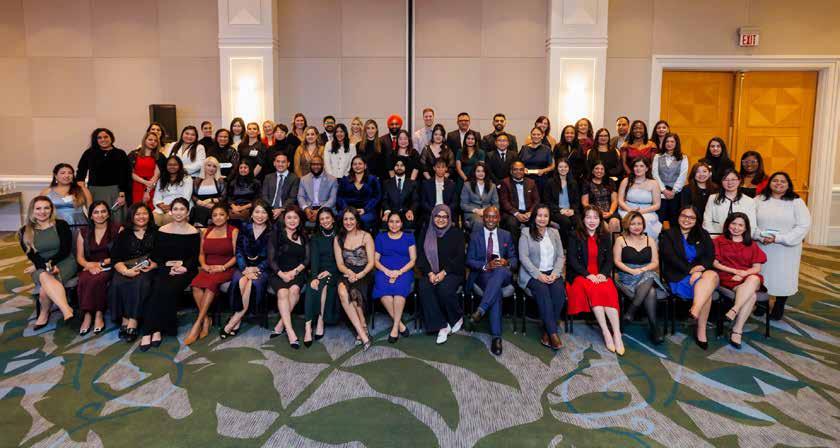
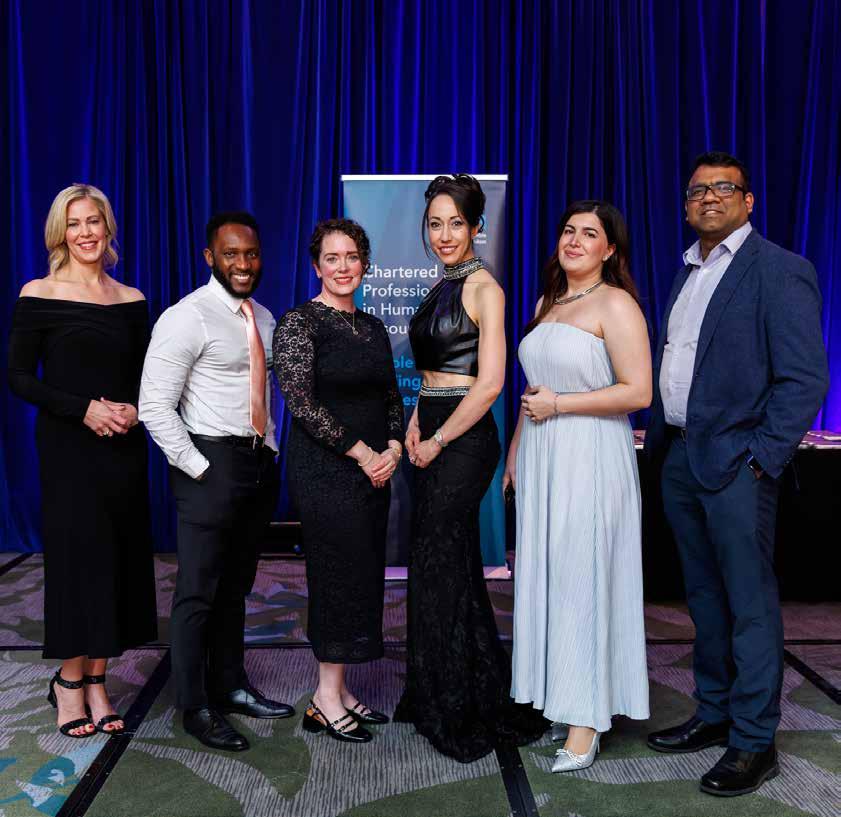
AN INCREDIBLE 532 MEMBERS REACHED THIS ACHIEVEMENT IN THE PAST YEAR. The CPHR Class of 2025 celebration is warmly supported by Simon Fraser University Continuing Studies.
1101 – 1111 W. Hastings St. Vancouver, B.C. V6E 2J3
Tel: 604-684-7228 | Fax: 604-684-3225
Canada toll-free: 1-800-665-1961 www.cphrbc.ca
Marketing & Communications Manager
Peopletalk Online Editor
Carma Chan
cchan@cphrbc.ca | 604-694-6930 ext. 115
Senior Director, Marketing, Communications & Member Affairs
Kara Douglas kdouglas@cphrbc.ca | 604-694-6947 ext. 129
Please return undeliverable copies to: CPHR British Columbia & Yukon 1101 – 1111 W. Hastings St. Vancouver, B.C. V6E 2J3
We acknowledge that CPHR BC & Yukon’s main office located in downtown Vancouver operates on the traditional, ancestral and unceded territory of xwmǝθkwǝỷǝm (Musqueam), Skwxwú7mesh (Squamish), SǝỈílwǝta (Tsleil-Waututh) nations. We thank their people and the elders who continue to live on these lands and care for them, along with the waters and all that is above and below.
Chair’s Message
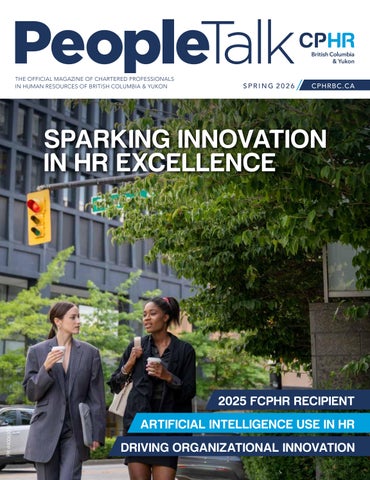
Sparking Innovation in HR Excellence
8 Your HR Function Isn’t Ready For AI (And What To Do About It) By Robyn Agoston
16 A Transformational Shift: Turning Organizational Change into Opportunity By Siva Chandran Ramakrishna, CPHR
18 2025 FCPHR Recipient: David McCoy
IGNITING THE SPARK OF TOMORROW
The theme for this year’s HR Conference & Expo is ‘Spark.’
It invites attendees to explore how imagination can illuminate transformation, and to envision how HR leaders can channel their energy into human-centred change that makes a positive and lasting impact.
The theme is apt in light of the strong headwinds we continue to face in Canada — from the cost of day-to-day living, including basic groceries, to the affordability of housing — and the many geopolitical tensions and crises around the world that show no signs of abating. It is also topical because of the radical, ongoing change in the world of work, including the growing conflict with caregiving obligations and other personal and family commitments, and increased frequency of mental health problems and burnout.
As CPHR BC & Yukon’s CEO, Anthony Ariganello, recently stated in a PeopleTalk op-ed, burnout is one of the most significant threats to workforce well-being and Canada’s productivity, with nearly half of the country’s workers reporting they feel burned out.
And that troubling number is on the rise.
Now is the time all of us must double down and find a ‘spark’ wherever we can.
For us in HR, we are uniquely positioned to do so. Leadership in business, government, regulatory bodies and quasi-governmental agencies is realizing, post-pandemic, the importance and significance of proper and effective people management.
We are lucky to have a large canvas with which we can work. We can be creative in how we approach the recruitment, engagement, remuneration and retention of people. We have the opportunity to introduce meaningful and effective flexibility to the workplace, and strike a proper balance between the needs of the organization and those of the workforce. In an environment that is being very rapidly modified and shaped by artificial intelligence, we have the chance to help our team members grow, develop and contribute while becoming meaningfully enriched by the work they do. In short, we can help leadership capitalize on workforce strengths, and find efficiencies, drive output and optimize productivity as they relate to return on investment.
This is where our HR Conference & Expo comes into play. It really is a thrilling time and we have a great opportunity to surround ourselves with hope and positivity, and to come away with new learnings, valuable connections and a strong network of support as we focus on driving that spark in our organizations.
I look forward to seeing all of you there.
James D. Kondopulos, CPHR Chair, Board of Directors
CPHR BC & Yukon
Doaa Sharaf, Graduate
WITH CONTINUING EDUCATION
Bridge capability gaps, maintain your CPHR CPD, and prepare for the NKE® exam with UCalgary Continuing Education’s HR Professional Development Hub. Discover flexible online courses now at conted.ucalgary.ca/cphr
Looking to train a group in your company? Courses can be tailored to your team’s needs. Visit conted.ucalgary.ca/corporatetraining for details.
Explore programs at: conted.ucalgary.ca/cphr
HEADING
Subheading
BY LINE
Step into a space of curiosity at our annual conference and learn how to supercharge your talent alongside your peers. Let’s explore how imagination can illuminate transformation, and how HR leaders can channel that energy into lasting, human-centred change.
LRobyn Agoston
AI & Future of Work Strategist
orem ipsum dolor sit amet, consectetuer adipiscing elit. Aenean commodo ligula eget dolor. Aenean massa. Cum sociis natoque penatibus et magnis dis parturient montes, nascetur ridiculus mus. Donec quam felis, ultricies nec, pellentesque eu, pretium quis, sem.
Robyn is the Founder of Work
Evolved and a recognised expert helping organisations navigate the human side of AI transformation. With over 20 years of experience leading digital initiatives and organisational transformation across global enterprises, she brings a rare combination of deep HR knowledge, OD and Change Management expertise and hands-on AI/digital leadership to all her work.
Nulla consequat massa quis enim. Donec pede justo, fringilla vel, aliquet nec, vulputate eget, arcu. In enim justo, rhoncus ut, imperdiet a, venenatis vitae, justo. Nullam dictum felis eu pede mollis pretium. Integer tincidunt. Cras dapibus. Vivamus elementum semper nisi. Aenean vulputate eleifend tellus. Aenean leo ligula, porttitor eu, consequat vitae, eleifend ac, enim. Aliquam lorem ante, dapibus in, viverra quis, feugiat a, tellus. Phasellus viverra nulla ut metus varius
Fenton Jagdeo, Jr.
Strategist, Innovation Catalyst & Advocate for Radical Curiosity
laoreet. Quisque rutrum. Aenean imperdiet. Etiam ultricies nisi vel augue. Curabitur ullamcorper ultricies nisi. Nam eget dui. Etiam rhoncus. Maecenas tempus, tellus eget condimentum rhoncus, sem quam semper libero, sit amet adipiscing sem neque sed ipsum. Nam quam nunc, blandit vel, luctus pulvinar, hendrerit id, lorem.
Fenton transforms how organizations think about innovation by championing what he calls “radical curiosity”— the ability to challenge conventional thinking and turn uncertainty into competitive advantage. An Ivey HBA graduate who originally attended one of the roughest schools in Toronto, Fenton brings authenticity and lived experience to conversations about resilience, equity, and breakthrough thinking.
Maecenas nec odio et ante tincidunt tempus. Donec vitae sapien ut libero venenatis faucibus. Nullam quis ante. Etiam sit amet orci eget eros faucibus tincidunt. Duis leo. Sed fringilla mauris sit amet nibh. Donec sodales sagittis magna. Sed consequat, leo eget bibendum sodales, augue velit cursus nunc, quis gravida magna mi a libero. Fusce vulputate eleifend sapien. Vestibulum purus quam, scelerisque ut, mollis sed, nonummy
David Frum
Social & Political Commentator and Staff Writer at The Atlantic
With over a million followers online worldwide, this is the voice many Canadians and Americans turn to when looking for current political insight. Whether it is the latest foreign policy debate or the inner workings of the White House, David Frum offers refreshing and clear insights of complicated issues of the day.
id, metus. Nullam accumsan lorem in dui. Cras ultricies mi eu turpis hendrerit fringilla. Vestibulum ante ipsum primis in faucibus orci luctus et ultrices posuere cubilia Curae; In ac dui quis mi consectetuer lacinia. Nam pretium turpis et arcu. Duis arcu tortor, suscipit eget, imperdiet nec, imperdiet iaculis, ipsum. Sed aliquam ultrices mauris. Integer ante arcu, accumsan a, consectetuer eget, posuere ut, mauris. Praesent adipiscing. Phasellus ullamcorper ipsum rutrum nunc. Nunc nonummy metus. Vestibulum volutpat pretium libero. Cras id dui. Aenean ut eros et nisl sagittis vestibulum. Nullam nulla eros, ultricies sit amet, nonummy id, imperdiet feugiat, pede. Sed lectus. Donec mollis hendrerit risus. Phasellus nec sem in justo pellentesque facilisis. Etiam imperdiet im-
Featuring original digital illustration by Kourtni Gunn.
PRE-CONFERENCE WORKSHOPS
MONDAY, MAY 4, 2026
Where is the HR for the HR? Understanding the Resiliency Playbook
Adaptive Leadership: Collaborating & Anchoring in Times of Change
Welcome Reception sponsored by Fairleigh Dickinson University of British Columbia, Foundation
TUESDAY, MAY 5, 2026
Morning Coffee Lounge sponsored by Harris & Company LLP
perdiet orci. Nunc nec neque. Phasellus leo dolor, tempus non, auctor et, hendrerit quis, nisi. Curabitur ligula sapien, tincidunt.
Robyn Agoston
From Hype to Human: The Future of Work In the Age of AI Starts With HR
LOREM IPSUM DOLOR SIT AMET
Expo Open: 9:30am–5:30pm
Networking Coffee Break
Aenean massa. Cum sociis natoque penatibus et magnis dis parturient montes, nascetur ridiculus mus. Donec quam felis, ultricies nec, pellentesque eu, pretium quis, sem. Nulla consequat massa quis enim. Donec pede justo, fringilla vel, aliquet nec, vulputate eget, arcu. In enim justo, rhoncus ut, imperdiet a, venenatis vitae, justo. Nullam dictum felis eu pede mollis pretium. Integer tincidunt. Cras dapibus. Vivamus elementum semper nisi. Aenean vulputate eleifend tellus. Aenean leo ligula, porttitor eu, consequat vitae, eleifend ac, enim. Aliquam lorem ante, dapibus in, viverra quis, feugiat a, tellus. Phasellus viverra nulla ut metus varius laoreet. Quisque rutrum. Aenean imperdiet. Etiam ultricies nisi vel augue. Curabitur ullamcorper ultricies nisi. Nam eget dui. Etiam rhoncus. Maecenas tempus, tellus eget.
Confidence at Work: How Visibility Fuels Inclusion, Retention, and Leadership
Data-Driven Benefits: Turning Group Plan Data Into Smarter Decisions sponsored by HUB International
Navigating WorkSafeBC Claims: Practical Advice for HR Professionals
Onboarding for Success: How to Embed Culture from Day One to Day Ninety sponsored by O.C. Tanner
Women’s Longevity at Work: Menopause to Healthy Ageing sponsored by WELL Health Medical & Longevity Centres
Networking Lunch sponsored by BCIT School of Business + Media
Beyond the Balance: Designing the Next Evolution of Hybrid Work
Building Resilience: HR Actions That Attract, Engage, and Retain Canada’s Frontline Workforce sponsored by UKG
Nulla consequat massa quis enim. Donec pede justo, fringilla vel, aliquet nec, vulputate eget, arcu. In enim justo, rhoncus ut, imperdiet a, venenatis vitae, justo. Nullam dictum felis eu pede mollis pretium. Integer tincidunt. Cras dapibus. Vivamus elementum semper nisi. Aenean vulputate eleifend tellus. Aenean leo ligula, porttitor eu, consequat vitae, eleifend ac, enim.
Driving Business Growth: Positioning HR as a Strategic Partner sponsored by University of Calgary Continuing Education
Future-Proof Pay: Building Compensation Programs for a Multi-Generational Workforce
Psychological Safety in Action: Replacing Blame with Accountability and Collaboration sponsored by ACHIEVE Centre for Leadership
Networking Coffee Break
Maecenas nec odio et ante tincidunt tempus. Donec vitae sapien ut libero venenatis faucibus. Nullam quis ante. Etiam sit amet orci eget eros faucibus tincidunt. Duis leo. Sed fringilla mauris sit amet nibh. Donec sodales sagittis magna. Sed consequat, leo eget bibendum sodales, augue velit cursus nunc, quis gravida magna mi a libero. Fusce vulputate eleifend sapien. Vestibulum purus quam, scelerisque ut, mollis sed, nonummy id, metus. Nullam accumsan lorem in dui. Cras ultricies mi eu turpis hendrerit fringilla. Vestibulum ante ipsum primis in faucibus
HR Happy Hour sponsored by Science & Humans
HR After Hours Reception
WEDNESDAY, MAY 6, 2026
Morning Coffee Lounge sponsored by Harris & Company LLP
David Frum
Navigating Global Trends
Expo Open: 9:30am–1:30pm
Networking Coffee Break sponsored by Johnston Group
Cultural Well-Being at Work: From Collective Care to Distinctions-Based Inclusion
Developing Talent in the Age of AI:
Practical Frameworks for a Human-Centered Workforce Strategy
Inside Out: Conducting Internal Investigations and Working With External Investigators
Strategic Career Navigation: Designing Your Next Chapter With Purpose
What’s in Your AI Suitcase? HR’s Survival Kit for the Future of Work sponsored by Kidney Foundation of Canada, BC & Yukon Branch
Lunch sponsored by Mercer
Networking Break
Canadian and BC Economic Outlook: Navigating Uncertainty
orci luctus et ultrices posuere cubilia Curae; In ac dui quis mi consectetuer lacinia. Nam pretium turpis et arcu. Duis arcu tortor, suscipit eget, imperdiet nec, imperdiet iaculis, ipsum. Sed aliquam ultrices mauris. Integer ante arcu, accumsan a, consectetuer eget, posuere ut, mauris. Praesent adipiscing. Phasellus ullamcorper ipsum rutrum nunc.
Building Burnout-Resistant Leadership Systems: Strategies for Sustainable High Performance
Connect, Captivate, Convince: Communication in a World of AI
Moving Reconciliation Forward
LOREM IPSUM DOLOR SIT AMET
Open Forum: Where Is the HR Profession Heading?
Quiet Data: What Employees Aren’t Saying and Why That Matters More Than Ever
Retirement Reimagined: Empowering Employees
Beyond the Financials
Ten(ish) New Developments in Labour & Employment Law You Should Be Aware Of
Nunc nonummy metus. Vestibulum volut pat pretium libero. Cras id dui. Nullam nulla eros, ultricies sit amet, nonummy id, im perdiet feugiat, pede. Phasellus nec sem in justo pellentesque facilisis. Etiam imperdiet imperdiet orci.
From Strategy to Structure: Building Organizations for AI Impact
Gen Z at Work: Attracting, Engaging, and Retaining the Next Generation of Talent
HR Conversation Café: People-First Solutions for Today’s Workplace Challenges
Investigations: The Bully, the Bullied and the Better Way
Fenton Jagdeo, Jr.
Leading Transformation with the Curiosity Compass
Aenean massa. Cum sociis natoque penatibus et magnis dis parturient montes, nascetur ridiculus mus. Donec quam felis, ultricies nec, pellentesque eu, pretium quis, sem. Nulla consequat massa quis enim. Donec pede justo. Cras dapibus. Aenean leo ligula, porttitor eu, consequat vitae, eleifend ac, enim. Aliquam lorem ante, dapibus in, viverra quis, feugiat a, tellus. Phasellus viverra nulla ut metus varius laoreet. Quisque rutrum. Etiam ultricies nisi vel augue. Curabitur ullamcorper ultricies nisi. Nam eget dui. Etiam rhoncus. Maecenas tempus, tellus eget.
Aenean massa. Cum sociis natoque penatibus et magnis dis parturient montes, nascetur ridiculus mus. Donec quam felis, ultricies nec, pellentesque eu, pretium quis, sem. Nulla consequat massa quis enim. Donec pede justo, fringilla vel, aliquet nec, vulputate eget, arcu. In enim justo, rhoncus ut, imperdiet a, venenatis vitae, justo. Nullam dictum felis eu pede mollis pretium. Integer tincidunt. Cras dapibus. Schedule and sessions subject to change. For the latest details, visit CPHRBC.CA/Conference.
YOUR HR FUNCTION ISN ’ T READY FOR AI (AND WHAT TO DO ABOUT IT)
By Robyn Agoston HR Conference & Expo Keynote Speaker
Just over three years ago, generative artificial intelligence (AI) entered the public discourse. Many businesses were quick to invest and deploy AI-enabled tools, expecting a true AI transformation by focusing solely on the technology itself. Like many other functions, HR responded by deploying AI into their own processes: chatbots for employee queries, AI screening for recruitment, AI-enabled self-service portals, and co-pilot licences for all. It’s a great start but the impact is limited.
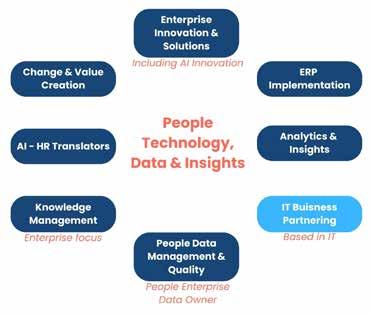
Few HR functions have recognized the need to build the foundations in their own operating model — foundations that will allow their people to truly leverage AI and enable a new way of working. In the first quarter of 2023, a global life sciences firm — ahead of any major tech company or multinational corporation — decided to take action. The firm ambitiously created a new organizational capability within HR to own the space where people, technology, data and insights meet.
THE PROBLEM
The chief human resources officer (CHRO) recognized HR was not ready to respond to the moment. AI was top of mind for everyone, but it was scattered across leadership and hidden within teams, diluting accountabilities and lacking cohesive governance.
Analytical capabilities were embedded in the different domains, such as talent and organizational analytics. Technology decisions were taken in silos, with no single view across the HR function available. The quality and management of people data were lacking, exacerbated by an enterprise resource planning migration. And many domains were signing on to AI solutions without the diligence and vendor rigour that was needed to make the technology work, let alone drive a new way of working.
This was an organizational design problem. The capabilities HR needed for AI transformation existed in fragments, but nobody had intentionally designed how they should operate or work together.
DESIGNING FROM CAPABILITIES, NOT ORGANIZATIONAL CHARTS
To address the problem, we started with first principles: What is the work that needs to be done? What capabilities are required to do it? What are the internal and external challenges this solution should address?
Those were the only questions that mattered, rather than focusing on who and what was in existence already.
We assembled a design authority with the CHRO and senior HR leaders, and IT was at the table from the start. We mapped in-scope and out-of-scope capabilities before we thought about any roles. A two-day multi-stakeholder workshop co-created and pressure-tested the capability-focused design. Within about 2.5 months, we had a roughly 100-person function designed, detailed and ready for deployment.
Centralization was the right answer here, but it might not be for everyone. Federated models, centres of excellence or hub-and-spoke structures could serve the same purpose. In adapting this for your own context, the key takeaway is these capabilities exist with intentional design and clear ownership, regardless of the shape they may take. The critical factor is you start with capabilities instead of roles.
SIX CAPABILITIES FOR AN AI-READY PEOPLE FUNCTION
The final design centralized six core capabilities that the HR function needs to successfully enable an AI-forward organization. Some were focused exclusively on HR, while others are leading this capability for the enterprise.
1
Data. HR owns people data for the wider organization. This means data quality, governance and management are foundational for your company’s AI strategy. We built a dedicated capability around data infrastructure, governance frameworks and ongoing quality monitoring. It’s tedious, unglamorous work, but it must come first. Without high-quality data, you won’t get anywhere with AI, so it’s essential to focus on and invest in data capabilities in HR.
2Knowledge management. This is the capability most HR functions overlook but is probably the most critical for making AI sustainable. AI is only as good as the content it can access, so capturing, structuring and maintaining organizational knowledge is essential for AI outputs that are relevant and accurate. Like data, knowledge management is unglamorous but is an essential foundation for AI to work well.
3
Insights and analytics. These capabilities enable HR to use data for decisions: advanced analytics, workforce intelligence and strategic insights about roles, skills and talent. In addition to centralized work, this team is focused on building analytical capability across the HR function, so people leaders can make data-informed decisions and evolve to be more strategic, insights-enabled in everything they do.
4Technology. This team manages legacy systems effectively and deliberately introduces new AI-enabled technologies, all while reducing tech debt. The goal for this capability is consolidation: fewer, better connected systems instead of a growing patchwork of point solutions.
No new technology is approved without going through this team, which is the single point of contact for IT.
5
Translators. Perhaps the most distinctive capability, this team speaks the language of technology, AI and HR fluently, and helps HR leaders articulate real problems before connecting them to the right solutions. Without translators, HR has the potential to chase shiny AI tools they don’t fully understand — or let existing solutions go unused. This is a non-traditional role but is essential to make AI work in your domain.
6
Change management and value delivery. This is a dedicated capability focused on enabling adoption and augmentation, and tracks if the promised value actually materialized. While this capability can sit elsewhere in HR, the answer here was to bring it close to the investments and solutions deployed.
WHY THIS MATTERS NOW
Leaders are not seeing expected returns from their AI investments because AI is not a technology problem; it’s an organizational challenge in
ADDICTION, MENTAL HEALTH & TRAUMA TREATMENT
Sunshine Coast Health Centre and Georgia Strait Women’s Clinic are licensed, accredited B Corp mental health facilities. We offer a non-12-step, evidence-based approach that integrates medical withdrawal, anger management, rTMS, trauma therapy, and PTSD treatment. Contact us or visit our websites to learn how we can support your employees. schc.ca gswc.ca
which HR is best placed to lead this conversation. However, HR needs to sort its own house first: technology, data and insights capabilities cannot stay fragmented and ungoverned. Getting HR’s infrastructure and foundations sorted for AI is the prerequisite for everything else.
HR leaders have a choice to make. Keep operating with scattered capabilities and no clear ownership or intentionally build the function that brings technology, data and insights together in a cohesive operating
model. And it doesn’t have to take forever. We proved how you can design, build and operationalize these capabilities in months.
This is one piece of a much larger puzzle about how HR shapes the future of work in the age of AI. These capabilities are the infrastructure. What you build on top of them, how you redesign work, develop talent and create the conditions for humans and AI to do their best work together, is where the lasting AI transformation happens. And there is no better function able to lead than HR.
Robyn Agoston is the Founder of Work Evolved and a recognized expert helping organizations navigate the human side of AI transformation. With more than 20 years of experience leading digital initiatives and organizational transformation across global enterprises, she brings a rare combination of deep HR knowledge, organizational development and change management expertise, and hands-on AI/digital leadership to all her work. Robyn has spent her career at the intersection of technology and people. She held several pivotal leadership roles at Novartis, where she led the reimagining of the HR function during its digital transformation, drove the organization-wide shift to data, digital and AI, and redesigned the organization to become AI-first. Today, Robyn partners with leaders to design work for the AI era. She focuses on facilitating operating models that make the most of both AI and human capabilities, building adaptive teams ready for technological change, and creating cultures where both people and technology can thrive.
SPARKING INNOVATION IN HR EXCELLENCE
By Gary Carr
When Laura Wait, CPHR, joined Sunrise Farms in 2022, as Vice-President of People and Culture — its first strategic HR leader — she was well aware she was joining an organization overdue for some innovation. She knowingly inherited a situation she describes as, “a beautiful mess.”
At the time, the organization was far less integrated and struggling valiantly to recruit employees to fill dozens of positions, spending hundreds of thousands of dollars on external agencies and recruiting firms without great results.
INNOVATING ON THE FLY EARLY ON
In fact, the opportunities to innovate were one of the very reasons Wait took the role, on top of the opportunity to work with a large, family-owned organization with strong leadership that had successfully grown organically for the previous 20-plus years.
Describing herself as someone who’s “invigorated by the process of cleaning up a mess,” Wait didn’t have much time to design a “perfect plan.” She needed to build some equity with her new CEO, and quickly.
Her first innovation: taking back control of the recruiting process by centralizing all hiring for the 13 Sunrise Farms locations across Canada. Within six months, she and her team had filled 80 per cent of available roles and reduced spending on external recruiting by 90 per cent, while returning the company to normal, healthy turnover rates.
With a near-crisis situation back under control, Wait was able to turn her attention to the next round of innovation, confident her organization had a new foundation to build upon.
INNOVATING ON A SHOESTRING
While many HR professionals can struggle with innovating, it can be even more challenging when you’re trying to do it on a tight — or non-existent — budget.
That reality is what Amber Brown, CPHR, Director of People and Culture at Consumer Protection BC, faces on a daily basis. Working for a small, not-for-profit organization that performs regulatory functions, Brown takes pride in devising smart, low-cost methods of innovating.
“For us, innovation can’t be big budget, ground-shifting activities,” she says. “It’s about being intentional with what we have available.”
Having spent most of her career in not-forprofits, innovating on a shoestring now comes second nature to Brown. And she’s clear that low-cost innovation isn’t always going to be like “hitting a home run” every time, so HR professionals need to be willing to stay humble and flexible when trying something new.
Her plan for a Next Steps program is the kind of situation she’s referring to when she reminds her HR colleagues to stay nimble. Imagined as a progressive program that would help current employees tap into skills development and industry mentoring, Brown had put plenty of planning into program rollout and execution. She’d imagined a leading-edge program that would help current employees explore and discover their “next position or next employer” as a perk that potential Consumer Protection
BC employees would take note of when they were considering joining the organization.
Unfortunately, the program didn’t unfold as she had hoped and limited resources dashed her hopes to keep it afloat.
But like numerous experts have stated over the years, leadership phenomenon Brené Brown summed it up as, “There is no innovation and creativity without failure. Period.”
Some of the takeaways for her?
While the program was rooted in trust and aligned with the organization’s values, it may have been an overreach for an organization of Consumer Protection BC’s size. And while it would have been highly innovative for a small nonprofit, the scope of work required for successful implementation, plus the significant time diverted from core responsibilities, made it impractical.
LEANING INTO AI AN AVENUE FOR INNOVATION
For some HR professionals, technology can be a shortcut to innovating, particularly if they’re comfortable learning and trialing new tools.
Paris Pishyari, CPHR, Classification Advisor at Northern Health, is one HR professional who hasn’t shied away from exploring how technology like artificial intelligence (AI) can help her innovate, particularly as she and her small team need to stretch their limited resources across the more than 10,000 healthcare colleagues who serve British Columbia’s northern communities.
As someone who has spent time experimenting with AI tools like Microsoft Copilot, she is excited by their potential, citing her experience conducting job description and classification comparisons across organizations, typically a
data-heavy and detail-oriented exercise.
“When I’ve used Copilot for challenging tasks like comparing job descriptions, my productivity has increased,” she says. “Doing a comparison can take days sometimes, but I can do one in a few hours using AI tools.”
Pishyari credits Northern Health for providing her with support to learn and experiment, including free courses and training delivered both by Northern Health Information Technology colleagues as well as their Microsoft partners.
From assisting with prompts to the basics of assisting employees craft e-mails, Pishyari sees this kind of training and support as key to helping employees make the most of the new tools and stretching themselves in the process. But ensuring people aren’t using the technology blindly is a key lesson for all new users.
“We can’t fully rely on AI because it can’t replace human judgment, but I love changes and challenging myself, learning something new,” says Pishyari. “At the end of the day, I’m still responsible for the results of my comparison, but the time I save I can use for dealing with grievances or coaching leaders.”
“As we struggle to support thousands of Northern Health employees and leaders, AI is like an HR assistant I don’t have,” she concludes.
BUILDING CULTURE ON TOP OF INNOVATION
While Wait’s proud of the accomplishments of her first six months at Sunrise Farms, she’s more animated about the innovations she was able to tackle after establishing that foundation. When she saw the need for a mission, vision
and values that reflected more of the perspectives of fellow employees, she jumped into action, engaging employees at every level and location to participate in the grassroots development of a new culture and values. In the midst of the outreach to all 13 locations, a few key findings began to emerge. A central one was the inclusion of ‘caring’ as a top five value by every employee who participated.
This clarity enabled her to begin building a culture guide, where employees and leaders could find their values clearly detailed and see those values brought forward in each new program that was implemented — from recognition ideas to communication channels to an annual employee survey.
From Wait’s perspective, innovation can be as much about listening and learning as it is about taking action.
“Seeing their own ideas come to life and
“SEEING THEIR OWN IDEAS COME TO LIFE AND HAVE AN IMPACT IN THE WORKPLACE IS INCREDIBLY IMPACTFUL FOR OUR EMPLOYEES, WHO ARE THEN MOTIVATED TO JOIN OUR INNOVATION EFFORTS, BOTH IN HR AS WELL AS ACROSS OTHER FUNCTIONS.”
Laura Wait, CPHR
have an impact in the workplace is incredibly impactful for our employees, who are then motivated to join our innovation efforts, both in HR as well as across other functions,” says Wait, who is now Chief People Officer.
Employees are invited to participate in an engagement survey each year, and Wait uses the results to drive innovation over the next year.
As a result, the Sunrise Farms culture is now more clearly articulated, and Wait’s colleagues guide their new ideas so they align with that culture. Regular feedback from an annual employee survey has sparked further innovations, including several new communications channels, an area that employees had been somewhat critical of at times.
Based on feedback, and a little trial and error, Sunrise Farms now supports The Roost — the organization’s first intranet portal — with a wide range of employee-focused information,
plus regular company-wide town halls and annual fireside chats at each location. Each of these new channels delivers complementary but distinct communication benefits that Wait says employees have appreciated.
Similar to Brown’s perspective, Wait is clear that HR innovation can reflect where a company is in their evolution. So, while a particular HR strategy may not seem ‘innovative’ to one company, it can be for another.
Case in point: Wait recently worked to introduce Microsoft Teams software, a tool that’s been standard practice for many organizations since the pandemic. However, for organizations with employees engaged in manufacturing and outdoor operational activities like Sunrise Farms, this kind of interconnection isn’t common. Employees have welcomed the new tool, which has elevated even more connection and engagement across the 4,000-person organization.
“IT TAKES A CONCENTRATED EFFORT TO MAKE INNOVATION HAPPEN, OTHERWISE YOU’RE JUST GOING TO KEEP GOING THROUGH THE DAY-TO-DAY.”
Amber Brown, CPHR
“WE CAN’T FULLY RELY ON AI BECAUSE IT CAN’T REPLACE HUMAN JUDGMENT, BUT I LOVE CHANGES AND CHALLENGING MYSELF, LEARNING SOMETHING NEW.”
Paris Pishyari, CPHR
Once a weakness, these innovations have transformed communication into a strength, and Wait now uses the corporate transparency of Sunrise Farms’ culture as an employer advantage when recruiting employees and leaders looking for more input into the direction and operations of their employer.
EVOLVING AN EMPLOYER BRAND RANKS HIGH
Similar to Wait’s experience, Brown is clear that HR innovations are typically most effective when there’s an opportunity for employee engagement and listening. One of her top-ranked innovations was revamping Consumer Protection BC’s employer brand, a project she undertook as a partnership with a communications colleague.
“We don’t hire a lot of people in a typical year, but some of the candidates we did hire weren’t an ideal fit,” she says.
From her perspective, clarity in illustrating the organization’s brand offerings would improve the fit and increase employee satisfaction and retention as a result.
After conducting research with a wide employee cross-section followed by targeted interviews, Brown and her communications partner were able to distill Consumer Protection BC’s attributes into a clear brand, one that would attract the kind of person the organization is looking for.
“The program has attracted candidates that understand we want them to come because they believe in our mandate, and that we’re collaborative and caring and we want them to be as well,” she says.
The program has stuck true for the more than five years since implementation, which was done with no budget beyond staff time.
“In this case, the innovation was cultural and relational not technology oriented, and it has
TAKING YOUR TIME CAN PAY DIVIDENDS
While there are no silver bullets when it comes to organizational innovation, it’s clear HR professionals would do well to pay attention to a few lessons learned from our three practitioners.
1. Know your workforce. Are your employees flexible and open to significant changes? Or do you need to space things out?
2. Take time to listen before you leap. Whether through regular surveys or smaller, more targeted discussions, take the time to do the groundwork with your employees and make sure the innovation is an organizational fit.
3. Be flexible and humble. Be open to moving more slowly or shifting your program if you receive signals from your employees. Choosing to stick with a rigid timeline can endanger your intent and hard work.
4. Look for clues. As you plan and roll out your innovation, ask “Do my employees need more training or support along the way?”
helped us recruit consistently good people,” she says.
Brown adds that one of the products of this exercise is a ‘Day in the Life’ feature on the company’s The Right Fit: HR & Culture blog on its external website. The Day in the Life videos clearly describe a typical day for employees doing their core regulatory roles. With almost every new applicant commenting on the helpfulness of these videos, it’s clear they strike a valuable chord, illustrating aspects of these key jobs that many applicants wouldn’t likely have access to before a job interview.
From her perspective, mining the employee research done and combining it with insights from the annual employee survey were vital to their branding success. Without gathering the data and analyzing it, she wouldn’t have been so confident of their success.
And while this type of culture building needs to be built on bottom-up input, there also needs to be buy-in from organizational leaders as well.
“It takes a concentrated effort to make innovation happen, otherwise you’re just going to keep going through the day-to-day,” says Brown.
“We also need people who are open to change, because innovation almost always involves change,” she adds. “So, when we can hire people who understand our culture and are willing to be flexible, we know our branding has been successful.”
Gary Carr is a North Vancouver communications professional with more than 25 years of writing experience in topics as varied as healthcare, insurance, environmental engineering and HR.
A TRANSFORMATIONAL SHIFT
Turning organizational change into opportunity
By Siva Chandran Ramakrishna, CPHR
Innovation in human resources often emerges not during periods of stability, but during moments of significant organizational change.
Throughout my career in HR, I have observed that innovation is most meaningful when it addresses real organizational needs while supporting employees through transitions. Whether implementing new systems, supporting workforce expansion or navigating structural changes like unionization, HR plays a critical role in ensuring innovation strengthens both organizational effectiveness and employee experience.
Currently, in my role as Director of Human Resources, I am responsible for ensuring strategic, effective and legally compliant HR practices while serving as a trusted advisor to the CEO and senior leadership team. One of the most defining experiences in my career was supporting the organization through its transition to a unionized environment. This was not simply a procedural change; it was a transformational shift that required HR to rethink existing processes, redesign policies and establish new frameworks that supported both operational continuity and employee trust.
I clearly recall the early stages of this transition. There were many questions, both from leadership and employees. Leaders were focused on ensuring operational stability, while employees sought clarity on how their roles, expectations and career progression would be affected. This
was a moment where HR had the opportunity to provide structure, clarity and reassurance.
Supporting unionization required collaboration with external partners and internal stakeholders to ensure compliance with collective agreements while maintaining organizational effectiveness. This included benchmarking roles, aligning job classifications and ensuring compensation structures were consistent with industry standards. It also involved working closely with leadership to interpret collective agreement language and integrate it into existing HR processes.
Rather than viewing unionization as a compliance exercise, I approached it as an opportunity to strengthen HR systems and create greater transparency. We developed structured job descriptions, established consistent staffing models and implemented clear communication processes to ensure alignment across the organization. This resulted in improved clarity for employees and managers, and strengthened trust in organizational processes.
This experience reinforced an important lesson: Innovation in HR is not always about introducing new tools, but about redesigning systems to better support people and organizational goals.
Another significant innovation involved workforce planning and establishing staffing models for new operational programs. Supporting
2025 HR Spotlight Recipient
the development of two transition housing projects required creating staffing frameworks from the ground up. This included designing job roles, developing schedules, and ensuring compliance with occupational health and safety requirements and collective agreements.
This process required collaboration with operational leadership and finance and external stakeholders to ensure staffing models aligned with both budget and service delivery requirements. By taking a strategic approach to workforce planning, HR was able to ensure the organization was prepared to support new programs while providing employees with structured, sustainable work environments.
In addition to workforce and structural innovation, technology has played a critical role in transforming HR functions. During my time working in public education, I had the opportunity to work closely with human resources information systems (HRIS) platforms to improve onboarding and workforce reporting processes. At the time, onboarding involved multiple manual processes, which created inefficiencies and delays. There was an opportunity to improve both efficiency and employee experience.
Working collaboratively with technology partners and internal stakeholders, we implemented an enhanced onboarding module that streamlined the hiring process and improved the consistency of onboarding for new employees. This innovation allowed HR to reduce administrative workload and ensure that new hires had access to the information and resources they needed from their first day.
I still remember feedback from managers after implementation. Hiring managers expressed they had greater visibility into onboarding progress and new employees were able to transition into their roles more smoothly. This demonstrated how technology-driven innovation, when implemented thoughtfully, can improve both operational efficiency and employee experience.
In addition to onboarding improvements, developing workforce reports and dashboards enabled leadership to make informed decisions based on accurate data. Instead of relying on manual data collection, leadership teams were able to access real-time insights related to workforce trends, recruitment and staffing needs. This helped position HR as a strategic partner in organizational planning.
Beyond systems and processes, innovation also requires fostering a culture that supports continuous improvement. One of the most effective ways to achieve this is through collaboration. Throughout my career, I have worked closely with leadership teams, finance departments, operational managers and external partners to ensure HR initiatives align with organizational goals.
Innovation requires listening, understanding challenges and working collaboratively to develop solutions. It also requires trust. Employees and leaders are more likely to embrace change when they understand its purpose and see its benefits.
Another important aspect of HR innovation is supporting employees during organizational change. Change can create uncertainty; HR plays an important role in providing clarity and stability. Transparent communication, structured processes and consistent support help ensure employees feel valued and supported.
Reflecting on my career, I have seen how HR innovation can transform organizations. Whether implementing unionized workforce frameworks, improving HRIS or developing workforce strategies, innovation enables organizations to operate more effectively while supporting employees. One of the most valuable lessons I have learned is that innovation is
not a one-time initiative. It is an ongoing process that requires adaptability, collaboration and strategic thinking. Organizational needs evolve and HR must continuously evolve alongside them.
HR has a unique opportunity to bridge strategy and people. By aligning workforce planning, technology and organizational objectives, HR can contribute directly to organizational success.
Innovation in HR is ultimately about creating systems that support both organizational goals and employee well-being. When HR approaches innovation with a people-centred mindset, it creates lasting value for both employees and organizations.
As organizations continue to navigate change, HR will play an increasingly important role in shaping the future of work. By embracing innovation, strengthening collaboration and maintaining a focus on people, HR can help organizations build resilient, effective and supportive workplaces.
Siva Chandran Ramakrishna, CPHR, is Director of Human Resources at Phoenix Society in Surrey, B.C. Siva has more than 17 years of experience in human resources leadership, labour relations, HR operations and HRIS transformation across public, non-profit and global organizations. He is currently pursuing a doctorate in human resources management and is passionate about building strategic HR practices that align organizational goals with employee experience.
2025 FCPHR RECIPIENT
DAVID McCOY
We’re pleased to announce David McCoy as the FCPHR for 2025.
The Fellowship Chartered Professionals in Human Resources (FCPHR) program is a prestigious award that recognizes CPHRs who have made exemplary contributions to the HR profession.
David is a highly respected HR leader whose career spans more than 30 years of public sector service and organizational leadership. Recognized for his strategic insight, integrity and unwavering commitment to fairness, David has made a profound impact on how people are recruited, developed and supported across government and beyond.
As Merit Commissioner for British Columbia, David serves as an independent officer of the provincial legislature, ensuring that hiring, promotion and just-cause dismissal decisions in the B.C. Public Service are based on fairness, transparency, best practice and principled process. Under his leadership, the Office of the Merit Commissioner has strengthened accountability through rigorous merit performance audits, staffing review investigations and just-cause dismissal investigations. His work has enhanced transparency, reinforced public trust and modernized HR systems that uphold equity and ethical governance.
Over the course of his distinguished career, David has led transformative initiatives in human capital management — designing competency-based recruitment frameworks, advancing diversity and inclusion strategies, and embedding organizational values into leadership development programs. His balanced approach combines policy acumen with a deep understanding of people and culture, consistently resulting in more engaged, high-performing workplaces.
Beyond his public service role, David contributes his expertise to the Canadian Mental Health Association, B.C. division, where he serves as a board director. In this capacity, he advocates for workplace psychological health and safety, helping to build supportive, stigma-free environments where employees can thrive. His leadership has influenced programs that align wellness, performance and organizational sustainability.
A CPHR Fellow and Society for Human Resource Management Senior Certified Professional (SHRM-SCP), David exemplifies professional excellence and mentorship. He is deeply committed to advancing the HR profession through education, ethical practice and the development of future leaders. Colleagues and peers regard him as a principled voice for fairness, accountability and human dignity in the workplace.
David holds undergraduate degrees from the University of Alberta and has served in senior HR leadership roles in both Alberta and British Columbia. His career reflects the core values of the CPHR Fellowship — dedication to the profession, service to others and leadership that leaves a lasting positive impact on people and organizations.
“Human resources, at its best, is about creating trust — ensuring that every person, process and decision reflects fairness and respect. That trust is what strengthens organizations and sustains public confidence.”
We are proud to congratulate the 2025 HR Spotlight recipients.
Amber Brown cphr
Director of People & Culture, Consumer Protection BC Victoria, BC
Paris Pishyari cphr
Classification Advisor, Northern Health Authority Chilliwack, BC
Laura Wait cphr
Chief People Officer, Sunrise Farms North Vancouver, BC
Nominations for the 2026 HR Spotlight program will open in Summer 2026. CPHRBC.CA/HRSPOTLIGHT
Basil Onyia cphr
Manager of People Operations & Development, Redbrick Technologies Inc. Victoria, BC
Siva Chandran Ramakrishna cphr
Director of Human Resources, Phoenix Society Maple Ridge, BC
Nicole Whitaker cphr
Director of Talent & People Experience, Prospera Credit Union Coquitlam, BC
Your organization could save with 5,000+ exclusive perks from Perkopolis Explore our turnkey, zero-cost perk program! Exclusive Perks Include