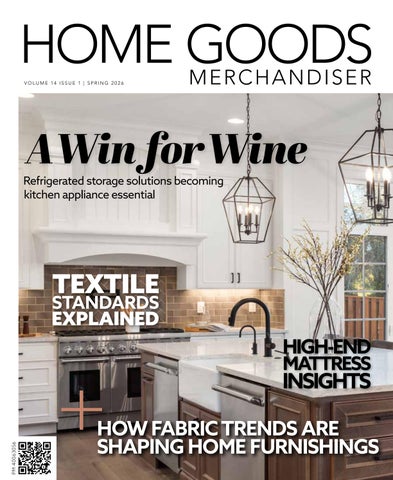
Trends that will shape the look and feel of interiors for the foreseeable future made their debut at the recent Interwoven Textile Fair, which brings new upholstery designs to market, setting the tone for the next season of home furnishings. Some classic styles are on the rise but reimagined to give designs a fresher approach.
10
THE AI-ENABLED HOME SHOPPER
As technology reshapes shopping behaviours, Canadian home goods retailers must understand how consumers interact with digital tools and platforms to make smarter decisions that enhance engagement and position their brands for future success.
29
MASTERING DECISION-MAKING
Every action in business starts with a choice. Making strong decisions is essential, as nearly all outcomes stem from leaders and teams picking one option over another. Here’s how to master this critical skill and help your organization succeed.
16
CHEERS TO THE PERFECT CHILL
The wine fridge market has grown considerably due to the rising global consumption of wine and increasing household wine storage needs. Consumers are prioritizing advanced features, prompting manufacturers to innovate with new technologies.
36
PROTECTING YOUR FREIGHT
Shipping problems can affect more than a business’ bottom line. In today’s review-driven retail environment, even a single delivery issue can damage an e-commerce brand’s reputation, making shipping insurance an important consideration.
SOUND SLEEP ESSENTIALS
My kids are getting older, which means it is time to consider moving them to bigger beds. Growing up, I shared a room with my sister and slept in a twin bed — the same one my daughter has — only transitioning to a double in my early 20s, after she left home. The extra space made a significant difference, allowing more room to move and stretch, and improving my sleep quality. That said, the mattress likely played an even bigger role. Unlike past purchases, my parents invested in a higher-end model and it was well worth the price tag. Not only did it outlast a lower priced mattress, it was more comfortable and provided enhanced support. I would definitely purchase a premium product again like many others planning to buy a mattress within the next three years, according to a Better Sleep Council survey. The findings, which also include feedback from recent purchasers, are highlighted in Rest Easy
Two other sleep industry-related articles are included in this issue. Conscious Convert explores bedding certifications Oeko-Tex and Global Organic Textile Standard, more commonly known as GOTS. With consumers increasingly interested in learning where and how bedding is made, retailers should fully understand these standards. Don’t Sleep on Selling Mattresses outlines the case for why appliance retailers should incorporate this bedroom essential into their showrooms.
A major focus of the spring edition is artificial intelligence (AI), with about 25 per cent of the issue dedicated to this single topic. The technology is gaining traction in the big-ticket home goods industry, and it’s becoming abundantly clear that businesses that don’t adopt AI risk being left behind. However, simply adopting this tool without a strategy is not enough.
In Focus, typically devoted to a company profile, showcases trending upholstery fabrics from North America’s largest market for textiles and leather. Insights are provided by Carrie Dillon of the International Textile Alliance and Future Snoops’ Jaye Anna Mize. The twice-yearly Interwoven Textile Fair sets the tone for the next season of home interiors.
Our panel of four regular experts — Eric Buchfink, Andrew Tepperman, Darryl Sherman and Scott Reid — return with their observations on the past year and what lies ahead. Some of their responses may be surprising given all that has transpired since Donald Trump returned to the White House as president of the United States, and its impact on the Canadian economy.
PUBLISHER
Kris McFadden krism@mediaedge.ca
PRESIDENT Kevin Brown kevinb@mediaedge.ca
PRODUCTION
MANAGER
Ines Louis Inesl@mediaedge.ca
PROGRAMMATIC
ACCOUNT MANAGER
Rhea Sood rheas@mediaedge.ca
Published by
EDITOR Clare Tattersall claret@mediaedge.ca
SENIOR GRAPHIC DESIGNER
Roxy Huynh-Guinane roxyh@mediaedge.ca
SOCIAL MEDIA DIRECTOR Steve Chester stevec@mediaedge.ca
CIRCULATION Adrian Holland circulation@mediaedge.ca
Home Goods Merchandiser is published four times annually — Spring, Summer, Fall and Winter — for Canada’s bigticket home goods industries. Subscriptions are free to qualified participants in Canada’s big-ticket home goods industries. Subscribe at www.homegoodsonline.ca. Readers from outside Canada may purchase subscriptions for $40 Cdn. For subscription inquiries, e-mail circulation@mediaedge.ca. Return undeliverable Canadian addresses to: Home Goods Merchandiser 251 Consumers Road, Suite 1020, Toronto, Ontario M2J 4R3. MediaEdge Communications and Home Goods Merchandiser disclaim any warranty as to the accuracy, completeness or currency of the contents of this publication and disclaims all liability in respect to the results of any action taken or not taken in reliance upon information in this publication. The opinions of the columnists and writers are their own and are in no way influenced by or representative of the opinions of Home Goods Merchandiser or MediaEdge Communications.
Canada Post Canadian Publications Mail Sales Product Agreement No. 40063056
Premium materials, leading technology, and advanced support system combined to create the most luxurious sleep experience.
AI IN THE WORKPLACE
What employers in Ontario need to know
BY STEVEN DICKIE, SAM IP, MELANIE SIMON & CHLOE JURCZYK
ARTIFICIAL
INTELLIGENCE (AI) TOOLS ARE changing how employers are making decisions and managing their workforces. As AI becomes increasingly integrated in the day-to-day operations of the modern workplace — used for recruitment, performance management, workplace investigations and more — employers in Ontario should be aware of their legal obligations, best practices and the potential risks.
In the employment context, what makes AI unique is it generates probabilistic outputs without revealing how those conclusions were reached. This unpredictability is giving rise to familiar issues but in unfamiliar forms, especially with respect to bias, privacy, fairness and accountability.
Against this backdrop, Ontario has begun to take incremental steps toward regulating how AI is used in the workplace.
AI UNDER THE EMPLOYMENT STANDARDS ACT
Unlike federally regulated employers and provincially regulated employers in British Columbia, Alberta and Quebec, Ontario does not currently have private sector privacy legislation. However, the province’s Employment Standards Act includes requirements
that relate or potentially relate to the use of AI in the workplace.
Employers with 25 or more employees are required to maintain a written policy on the electronic monitoring of employees. If an employer uses AI to monitor employees, which could include monitoring productivity, performance, attendance, communications and internet activity, the policy must describe how and under what circumstances the employer conducts such monitoring and the purposes in which the information collected may be used by the employer.
Effective Jan. 1, 2026, employers who use AI to screen, assess or select job applicants must disclose the use of AI in publicly advertised job postings. Together, these requirements signal Ontario’s employment law framework is beginning to recognize and regulate practical ways in which AI intersects with the workplace, even in the absence (or in addition to) dedicated AI or privacy legislation.
ACCURACY AND FAIRNESS MATTERS
At common law, employers owe employees an implied duty of good faith, which includes mak-
ing employment decisions based on accurate and complete information. What is changing with AI is not this duty itself but the manner in which it can be affected through the use of AI. As AI becomes embedded in tools used by employers, there is a growing potential for those systems to distort, omit or misrepresent information upon which human decision-makers rely. Employers should accordingly be alert to potential inaccuracies or omissions with the use of AI to ensure the tool is being used fairly in the workplace.
For example, an employer may use an AI tool to assist with recording, summarizing and analyzing an interview with an employee during the course of a workplace investigation. The AI output may contain errors based on an incorrect interpretation of slang, tone or idiomatic expressions, resulting in summaries that are inaccurate or misleading. Further, the AI output could fail to capture non-verbal relevant information, such as the employee’s tone, facial expressions or general demeanor, all of which may be critical in an assessment of the employee’s remorse for misconduct or their credibility. These errors could also undermine fairness or reduce the evidentiary value of such outputs in the event they are introduced as evidence in potential litigation. For these and other reasons, AI outputs should be reviewed by an informed human decision-maker before they are used to inform any employment decisions on record. In this example, the investigator who conducted the interview would be an appropriate person.
INTERNAL POLICIES AND CONTRACTS
Employers should ensure their use of AI is consistent with existing internal policies, employment contracts and collective agreements (if applicable). If it is not, the use of AI could be subject to challenge, even if it is otherwise consistent with recommended best legal practices.
Before implementing AI systems, employers should review these documents to confirm the introduction or use of AI does not conflict with existing rights, obligations or processes, particularly where AI may influence monitoring or evaluation. Employers should consult with legal counsel to discuss any risks before changing existing policy, procedures or contractual terms.
In particular, employers with unionized employees may be subject to grievances over whether the use of AI in the workplace is reasonable. For example, if AI tools are introduced to monitor productivity or evaluate performance, unions may argue these AI systems amount to increased surveillance,
which could be viewed as infringing privacy rights, particularly as the arbitral jurisprudence in the unionized context has developed case law related to employees’ right to privacy. If AI is intended to be used in a way that could implicate employees’ privacy, employers should proactively consult with legal counsel before deployment.
AI AND HUMAN RIGHTS
Employers must not use AI in a way that contravenes the Ontario Human Rights Code, whether directly or indirectly.
AI systems are only as effective as the datasets on which they are trained, which means bias or discrimination can arise in numerous ways throughout the training process, including if datasets are incomplete or contain biases. For example, a resume screening tool might inadvertently favour candidates listing traditionally gender-specific or demographic-specific work experiences, or an application sorting program may inadvertently rank candidates lower due to language patterns associated with a prohibited ground of discrimination.
In November 2024, the Ontario Human Rights Commission published the Human Rights AI Impact Assessment (HRIA). This is a practical question-based framework to help organizations identify, assess and mitigate human rights risks across the AI life cycle. The framework emphasizes that consideration for possible discrimination and bias in AI systems be integrated into every stage of AI de-
of Jan. 1, 2026,
to screen, assess or select
As
employers with 25 or more employees must disclose in any publicly advertised job posting whether artificial intelligence is used
sign and implementation. The HRIA further underscores the importance of reviewing AI systems for discriminatory effects, even where the analysis is seemingly neutral at face value. Employers should exercise caution when relying on AI-generated information and be alert to the possibility of inherent bias in the AI system. Incorporating tools like the HRIA into procurement and governance processes also helps build trust with employees and the public that AI is used responsibly.
OTHER BEST PRACTICES AND TAKEAWAYS
The risks of deploying AI in the workplace are real but manageable. Employers can meaningfully reduce legal and reputational exposure by embedding responsible AI practices into procurement, governance and day-to-day operations.
Start with procurement. Understand the AI tools you are acquiring, including what data they use,
how they generate outputs and what steps vendors have taken to test for bias, accuracy and security. Procurement is the best stage to establish accountability and set expectations for responsible AI use.
Next, strengthen AI governance. Oversight of AI should not rest solely with information technology or legal teams. Human resources (HR) plays a central role in understanding how AI systems affect employees, privacy and fairness. HR should be involved in both governance and procurement decisions to ensure tools align with organizational values and employment obligations.
Then, adapt clear controls. Update existing policies on monitoring, privacy and data use to explicitly address AI. Maintain an internal inventory of AI systems, assign clear accountability for oversight and regularly review AI outputs for accuracy, bias and fairness.
Finally, invest in training. Even the best policies, controls and processes are only as effective as the people applying them. Provide ongoing training for HR professionals and teams on how AI tools work, their limitations and best practices.
Together, these practices signal to employees, unions and regulators that the organization is approaching AI adoption with accountability.
AI AS A PARTNER
AI systems should be used as a complement to human judgment, rather than a substitute. While AI can improve efficiency, it lacks the contextual understanding and judgment that human decision-makers bring to the workplace.
Employers should treat AI as one component within a broader decision-making toolkit and ensure important decisions, particularly those that are or could be adverse to employees, involve meaningful human oversight. HR professionals, who tend to be the stakeholders most familiar with internal policies, workplace culture and compliance requirements, should have a seat at the table when it comes to procurement and implementation of AI systems that could affect the employer’s potential risks and liabilities.
Steven Dickie is an employment and labour partner, Sam Ip a technology partner, Melanie Simon an employment and labour associate, and Chloe Jurczyk an articling student at Osler, Hoskin & Harcourt LLP. Osler is a leading business law firm advising Canadian, U.S. and international clients, with offices in Toronto, Montreal, Calgary, Ottawa, Vancouver and New York.
Human resources plays a central role in understanding how artificial intelligence systems affect employees, including impacts on privacy and fairness.
TO THE NEXT LEVEL TAKE YOUR BRAND & MARKET SHARE
We can provide you with industry specific, cost effective & highly targeted digital marketing. Get your message in front of the Home Goods Online audience everywhere online through our 360° marketing solutions Engage the largest community of furniture, appliance and mattress retailers across Canada with an effective omni channel marketing strategy.
GOOGLE ADWORDS
PROGRAMMATIC SOLUTIONS
Connect your business with a targeted web audience.
Key benefits:
SOCIAL MEDIA MANAGEMENT
• Programmatic advertising drives interested prospects to the right place - your website
• Geo-targeting produces quality leads and delivers real results
• Analytics reports provide real-time data and insight
• Campaigns are flexible and can be changed at any time to maximize results
• Complimentary consultations are available
Build your online presence and reap the rewards.
Key benefits:
Instantly connect with prospects seeking your services.
Key benefits:
• Businesses and potential customers are instantly connected
• You control your advertising costs with a predetermined budget
• Both customer and advertiser benefit
• The Search Ads program has guaranteed results
• An active social media presence builds brand awareness
• Quality posts and regular interaction shows a commitment to your customers
• Platforms like Twitter and LinkedIn are great vehicles for sharing news and successes
• A balanced campaign reaches a variety of professionals and decision-makers
• It’s fast and effective
• Existing content can be refreshed, reissued, and maximized at no additional cost
After six months utilizing MediaEdge’s social media program, we have generated sales leads and received a significant amount of exposure across five platforms.”
R.W. (Bob) Storey, P.Eng., MBA General Manager - Sto Canada Ltd.
Let’s set up a time to discuss your 2024 marketing strategy! Contact Kris McFadden, Publisher, at 416-512-8186 ext. 240, 416-979-8929 or krism@mediaedge.ca
THE AI-ENABLED HOME SHOPPER
How artificial intelligence is reshaping consumer behaviour, redefining the modern retail journey
BY MICHAEL SCIDA & SOPHIE MARAI
CANADIAN HOME GOODS SHOPPERS NO longer discover products the way they once did. They are moving away from exploratory weekend store visits and printed catalogues toward a more personalized, intuitive and visual experience. Artificial intelligence (AI) is now becoming part of how people plan decor and research products before making purchasing decisions. For retailers, this shift represents one of the most significant changes in consumer behaviour in more than a decade.
According to Environics Analytics’ ClickScapes and Opticks datasets, AI usage among Canadian consumers has surged dramatically over the past two years, outpacing global growth rates. Nearly half of shoppers use AI tools at some point in their purchase journey, whether renovating their homes or looking for decor that reflects their personal style.
Behind this shift are distinct consumer groups that identify as the most open to using AI. Environics Analytics has segmented the groups as young urbanites and suburban sophisticates. These leading AI adopters are diverse, technology-embracing shoppers who often live in condominiums, townhomes or multigenerational households where making the most of space and design choices matters. Many are using AI to synthesize reviews, compare prices to decide whether a purchase is of value and fits their budget, and to see how furniture or decor will look in their homes before they buy.
But the most important change is to how shoppers feel. AI helps reduce the uncertainty that often comes with home goods purchases: Will this fit? Will it match? Will it look the way I imagine? By removing friction and building confidence, AI tools are changing not only how Canadians shop but how they feel about investing in their homes.
While adoption is growing, more than 80 per cent of Canadians still prefer to complete purchases instore, according to the most recent IBM consumer retail study. Digital tools may guide the process, but the
majority of consumers prefer to evaluate furniture, lighting, appliances and decor in-store before buying. This reinforces the continued importance of physical retail, even as shoppers arrive better informed, more confident and with higher expectations.
The result is a hybrid journey that retailers need to support. Shoppers expect seamless transitions between online research, AI-driven inspiration and in-store experiences. They want to know what is in stock, receive relevant recommendations, and understand product quality and longevity. AI can now help retailers deliver these expectations at scale.
AI MEETS CUSTOMER EXPERIENCE
AI adoption is reshaping expectations at every stage of the home goods journey, from discovery through to making a purchase.
During discovery, Canadians are increasingly turning to conversational search and visual tools powered by AI. A single image of a room can now generate curated decor suggestions, colour palettes, guidance on storage ideas or furniture size. Many shoppers use these tools to make the most of small or unusual spaces, while families utilize them to picture renovations or shared multigenerational living layouts.
Amid consideration, AI plays the role of an informed advisor. It helps shoppers understand product specifications, spot meaningful differences in quality and assess durability. AI also assists with identifying the best value across retailers. Tools that summarize large volumes of reviews are particularly influential when people are evaluating higher priced items, such as sofas, mattresses and appliances.
At time of purchase, AI helps remove uncertainty. ‘Try on’ technology allows shoppers to preview rugs, wall art, paint colours and furniture in their space. Measurement tools confirm whether items will fit. Recommendations adjust based on budget, household needs and design preferences.
After purchase, AI encourages further personal engagement. Predictive tools can signal when shoppers may be ready to refresh decor, replace appliances or restock small household items. Loyalty programs can then reflect real usage patterns rather than generic rewards.
Even as AI becomes embedded in home goods shopping, privacy remains a key concern. About 60 per cent of Canadians worry about how retail companies use their data. For home goods retailers, earning trust means being clear about data handling practices and opt-in choices, and reassuring that personalization will not put consumers’ information at risk.
For brands, AI innovation with consumer values has enormous opportunity. Retailers can build stronger engagement through more intuitive journeys, tools and communications that support confident decisions. Manufacturers can use AI to highlight craftsmanship, sustainability and quality with more compelling storytelling. In turn, consumers can feel more empowered and inspired as they shape the spaces they call home.
AI is not replacing the brands, showrooms or expert staff that define the home goods sector. Instead, it is enhancing them — making home improvement more accessible, more personalized and more enjoyable for every type of Canadian household.
Michael Scida is vice-president of retail business development, and Sophie Marai is vice-president of account management at Environics Analytics. The company’s segmentation system was used to identify key consumer groups cited in this article. Environics Analytics is a premier marketing, information and analytical services company in Canada, helping thousands of customers across every industry sector turn data and analytics into strategy, insights and results. Michael and Sophie can be reached at inquiries@environicsanalytics.com.
The Textile Touch
Trends shaping the future of furniture design in Canada
BY CARRIE DILLON & JAYE ANNA
MIZE
TWICE YEARLY, THE INTERNATIONAL TEXTILE
Alliance transforms High Point, N.C., into a global centre for textile innovation through its flagship event, the Interwoven Textile Fair. What was once a primarily U.S.-focused sourcing destination has evolved into an essential strategic stop for furniture manufacturers, retailers and designers worldwide. That includes a growing number of Canadian companies seeking early insight into the materials, colours and constructions that will shape consumer demand 18 to 24 months ahead.
This past November, the trend directions presented at Interwoven — Expressionism, Preserve, Bare and Drench — closely align with Future Snoops’ fall/ winter 2026/2027 macro theme, The Renaissance of Real. As digital acceleration and artificial intelligence continue to reshape daily life, consumers are rebalancing with a renewed desire for tactile materials, emotional connection, handcrafted detail and in-person experience. This shift does not reject innovation but instead re-centres design around what feels grounded, human and lasting — an evolution that is already shaping the future of furniture design across Canada.
PERSONAL STORYTELLING TAKES CENTRE STAGE
One of the most visible directions at Interwoven for the coming seasons is Expressionism. Homes are increasingly becoming curated reflections of the people who live in them — layered with personality, nostalgia, humour and a sense of play. This direction embraces imagination and individuality, transforming living spaces into personal galleries filled with meaning and emotion.
Manufacturers: This theme creates growing demand for statement textiles — hand-drawn motifs, painterly patterns, dimensional jacquards and richly tactile surfaces. Upholstery programs that allow for mix-and-match customization are becoming increasingly important as consumers seek pieces that reflect their identity rather than a single showroom look. Textures like bouclé, chenille, brushed twills and sculptural weaves reinforce this expressive, art-forward direction.
Retailers: Expressionism encourages floor presentations that celebrate individuality rather than uni-
formity. Unexpected pairings, layered silhouettes and artistic accents allow consumers to visualize how expressive fabrics can live on familiar furniture frames. This trend aligns strongly with younger Canadian consumers who value in-person gathering spaces that feel joyful, social and emotionally resonant.
GROUNDED BEAUTY AND THE RETURN TO CRAFT
A second major theme woven throughout Interwoven is Preserve, reflecting a desire for permanence, groundedness and connection to nature. Canadian consumers, increasingly saturated by digital life and fast turnover cycles, are seeking interiors that feel rooted in heritage, craftsmanship and organic materiality.
This shows up through softened earth tones, botanical influences, stone and wood-inspired textures, and fabrics that celebrate subtle irregularity. Ornamentation is returning in refined ways — through florals, carved motifs and layered surface detail — after several seasons of pared-back minimalism.
Manufacturers: Velvety chenilles, brushed cottons and cut velvets create plush, approachable luxury for sofas, lounge chairs and drapery. Refined accent applications using silk damask, brocade-inspired jacquards or dimensional headboard fabrics introduce heritage richness without overwhelming the space. Pairing these with slubby wools, stonewashed linens and puckered leathers adds depth, honesty and tactility.
Retailers: Preserve offers compelling storytelling around longevity, craftsmanship and material authenticity — values that resonate strongly with Canadian shoppers seeking lasting beauty rather than fleeting trends.
PURPOSEFUL RESTRAINT, ELEVATED SIMPLICITY
In contrast to ornament, Bare represents the growing desire for visual and mental clarity in an overstimulated world. This is not minimalism for its own sake but a more meaningful form of editing — spaces that feel restorative, intentional and grounded.
Performance-forward luxury sits at the heart of this trend for the Canadian market. At Interwoven, performance fabrics achieved new levels of soft-
ness, drape and aesthetic sophistication while continuing to deliver real-world durability. Recycled fibres and low-impact dye processes are increasingly becoming standard expectations rather than premium features.
Manufacturers: This theme encourages the use of tactile but visually quiet materials — washed linens, brushed cottons, bouclé, airy gauze and lightly slubbed weaves. Layering contrasting fabric weights adds depth without clutter. Sustainable construction is becoming integral to product development rather than simply a marketing message.
Retailers: Bare supports strong merchandising around longevity, versatility and investment buying. In family-centric homes and climate-variable regions across Canada, consumers value products that perform beautifully without feeling visually heavy or overly precious.
SENSORY LUXURY AND EMOTIONAL COLOUR
Where Bare speaks to restraint, Drench introduces drama through contrast. This new vision of luxury is rooted not in status or logos, but in material sensuality, emotional colour and expressive tension between surfaces.
At Interwoven, Drench revealed itself through crushed velvets, tonal embossing, satin finishes, moiré effects and sculptural furniture forms layered with rich, saturated hues. Colour becomes not just decoration but a mood-setting tool — deep berries, denims, clays, terracotta, russet and jewel tones created emotional impact across the show. Manufacturers: This theme translates to elevating core offerings with bolder tones, tactile contrasts, and finishes that feel both classic and edgy. Pairing glossy surfaces with matte, nubby or raw fabrics creates visual tension that feels modern and expressive. Retailers: Drench supports high-impact moments on the floor — accent chairs, drapery, ottomans and tufted pieces that draw the eye and invite touch. Lux-
ury, in this context, is measured by sensory experience and originality rather than prestige.
IMPERFECTION AND JOY AS DESIGN DRIVERS
Interwoven also reflected the rise of intentionally imperfect aesthetics, often described as Pretty Ugly — alongside the mood-boosting energy of Dopamine Decor. Within the Future Snoops framework, these movements live at the intersection of Expression, Preserve, Bare and Drench.
Irregular stripes, wobbly forms, organic colour bleed, artisanal textures and unexpected pattern pairings introduce humanity back into design. Rather than striving for algorithmic perfection, consumers are embracing objects that feel handmade, emotional and collected over time.
Manufacturers: This opens opportunities to experiment with warp variation, slub yarns and organic transitions that feel authentic without compromising commercial appeal.
Retailers: These expressive details help consumers personalize neutral spaces with personality-driven accent pieces that spark joy and emotional connection.
THE TAKEAWAY
The story emerging from Interwoven’s November 2025 show is clear. Canadian consumers are craving environments that feel real, expressive, emotionally grounded and materially rich. From the heritage warmth of Preserve and the purposeful clarity of Bare to the joyful individuality of Expressionism and the sensory drama of Drench, the future of furniture design is defined by balance between restraint and ornament, durability and indulgence, innovation and authenticity.
For Canadian furniture brands and retailers, the opportunity lies in integrating these directions early, translating trend intelligence into product development and in-store storytelling that meets consumers where their tastes are heading next.
Carrie Dillon is managing director of the InternationalTextile Alliance, where she leads strategic initiatives supporting textile suppliers, furniture manufacturers and design professionals across the global home furnishings industry. Carrie oversees the Interwoven Textile Fair and works closely with industry partners to advance innovation, education and collaboration. Jaye Anna Mize is vice-president of advisory and partnerships at Future Snoops, a global trend intelligence and forecasting consultancy, where she specializes in cultural analysis, consumer behaviour and forward-looking design strategy. Jaye collaborates with leading brands and organizations to translate emerging shifts into actionable insights for product development and merchandising.
Expressionism
Preserve
Bare
Drench
Reach 7000+ floor covering manufacturers, installers and retailers across Canada through our industry-leading print and digital marketing vehicles!
SCAN HERE
To promote your products, service and for general business inquiries, please contact Dan Gnocato at 604 549 4521 or dang@mediaedge.ca.
to subscribe to our bi-weekly E-digest and stay connected to the latest industry news, design trends and market analysis!
Cheers to the Perfect Chill
Wine fridges gain popularity as consumers (and connoisseurs) look to elevate at-home entertaining experience
BY VALENTINA SILOVIC
NIGHTS IN ARE HAVING A MOMENT, WITH more people choosing to host guests rather than go out. As home entertaining becomes increasingly fashionable, consumers are seeking stylish wine storage solutions to preserve the quality of their favourite bottles while integrating with their kitchen design. These specialized appliances are particularly appealing to those living in smaller urban homes, where traditional wine cellars aren’t an option.
COOL OPTIONS
Wine refrigerators, also known as wine coolers or centres, come in a range of types and styles to suit
different preferences and storage needs, from builtin to freestanding units and single- to dual- or multizone models. Countertop fridges are compact and ideal for smaller spaces, while under-counter models are designed to chill single wine bottles quickly for serving rather than long-term storage. Some fridges feature vertical storage, allowing bottles to stand upright when horizontal space is limited.
A wine cabinet, though not a fridge, is specialized furniture for storing and showcasing wine. Temperature and humidity control, ultraviolet (UV) protection and ventilation ensure optimal wine conditions, and it is available in various sizes and styles for
short-term storage and long-term aging.
A WIN FOR WINE
A wine fridge offers multiple benefits, making it a worthwhile investment. It preserves wine quality by maintaining optimal temperature and humidity levels, ensuring proper maturation over time and preventing spoilage or flavour loss. It also offers a convenient, organized way to store and display a wine collection.
Wine fridges are generally energy-efficient, using insulation and temperature controls to consume less energy than a regular refrigerator. This helps re-
duce home energy costs and carbon footprint and minimizes excess heat, maintaining an optimal environment to protect wine from premature aging.
FRIDGE FEATURES
When shopping for this appliance, customers should take several factors into account.
One of the most important is the number of temperature zones. Different types of wine require different storage temperatures. Single-zone fridges feature one temperature setting, making them suitable for storing a single type of wine at a consistent temperature. Dual- or multi-zone models, on the other hand, offer two or more separate temperature zones, keeping red, white and sparkling wines at their respective optimal serving temperatures. These types of fridges have a temperature range between 7 C and 18 C (45 F and 65 F).
Humidity control is another consideration. Wine should be stored in a humid environment to prevent the cork from drying out and to keep the wine from oxidizing. The fridge should include a built-in humidifier or be able to maintain humidity around 70 per cent.
Exposure to light, particularly UV rays, can be harmful to wine, so a fridge with a tinted or UV-resistant glass door is ideal.
Vibrations can disturb the sediment in wine, affecting its flavour and the aging process. A fridge with a quiet, low-vibration compressor is recommended.
Thought should also be given to noise level and cooling components. Models that have a noise level of 40 decibels or lower are comparable to a library or quiet conversation. The fridge should have a reliable, efficient compressor, an evaporator for consistent temperatures and a fan to circulate cool air evenly. Compressor-based systems offer consistent temperature control, ideal for long-term storage, while thermoelectric cooling models are recog-
nized as quieter and better suited for smaller wine collections.
THE RIGHT STORAGE CHOICE
Before making a purchase, consumers should determine how many bottles they intend to store. Wine fridges vary in size, with capacities ranging from a few dozen to several hundred bottles. For a beginner with a modest wine collection, a 30- to 40-bottle unit may be sufficient, while a more seasoned collector who buys in bulk may need a larger unit that can hold 100 to 150 bottles. Small to medium-sized units (20 to 50 bottles) can range from $500 to $2,500, depending on size, capacity and features, while medium to large-sized units (50 to 100-plus bottles) can cost between $1,000 to $6,000 or more. Less expensive units may need replacement sooner, potentially costing more over time, whereas premium models may have a higher upfront cost but tend to last longer and require less maintenance.
Outside budget, available space in the home will determine a size that fits seamlessly into the consumer’s lifestyle. Some models may require extra clearance for proper airflow.
Consumer design and aesthetic preferences should not be overlooked, as ignoring them can lead to dissatisfaction with the purchase. Built-in fridges are designed to fit seamlessly into cabinets or walls and can be customized to match the space, such as with matching wood doors and shelves, while freestanding models, often more affordable, can be placed anywhere in the room.
Features like interior LED lighting, digital controls, adjustable shelves for various bottle sizes and alarms for temperature or humidity fluctuations contribute to the overall user experience. Some advanced models include smart technology, allowing remote monitoring and control of temperature and conditions through a mobile app.
Valentina Silovic is a sommelier and content creator with more than a decade of experience in the wine industry. She is a regular contributor to Wine & More, a website devoted mainly to the wines of the Balkan countries. A longer version of this article was originally published on Wine&More.
CONSCIOUS CONVERT
What sustainably-minded consumers need to know about bedding certifications
BY JESSICA MONTFORD
WHEN CONSUMERS BUY SUSTAINABLE BEDDING, they’re not just choosing colour or thread count — they’re selecting how the sheets were made, what they’re made from, and how they’ll impact their health and the planet.
But not all eco-friendly or organic claims are created equal. That’s where textile certifications come in.
Certifications help cut through marketing jargon and verify that a product truly meets high environmental and ethical standards. Without them, it’s difficult to know whether textile products are genuinely sustainable or simply greenwashed.
When it comes to bedding, certifications like Oeko-Tex and GOTS are trusted worldwide. Both tell consumers the materials are safe for skin and health; the production process is environmentally responsible; and workers are treated fairly and ethically
throughout the supply chain. However, Oeko-Tex and GOTS serve slightly different purposes.
THE OEKO-TEX STANDARD
Oeko-Tex, pronounced eco-tex, is a globally recognized certification system that ensures textiles are safe from harmful substances.
The most common standard, Oeko-Tex 100, tests every component of a product, from the fabric to the threads, buttons and zippers, for more than 100 harmful chemicals, including pesticides, heavy metals, formaldehyde and allergenic dyes.
If a product carries the Oeko-Tex label, it means it’s proven safe for human use, including babies and those with sensitive skin.
Other benefits of Oeko-Tex certification are it ensures clean, chemical-free manufacturing, it’s
applicable to both natural and synthetic fibres, and it’s recognized in more than 100 countries.
In short, Oeko-Tex focuses on what’s in the bedding and what’s not.
ALL ABOUT GOTS
GOTS, short for Global Organic Textile Standard, goes beyond just testing for chemicals — it governs the entire journey of a textile, from farm to finished fabric.
To carry the GOTS-certified organic label, a product must be made with at least 70 per cent certified organic fibres (95 per cent for full certification); contain no toxic dyes, bleaches and finishes; meet strict environmental criteria at every production stage; and uphold fair labour practices and safe working conditions.
That means GOTS doesn’t just ensure the end
product is safe; it guarantees it was produced responsibly, both socially and environmentally.
GOTS certified bedding contains organic fibre content like cotton, linen and wool; no synthetic pesticides or genetically modified organisms; is made with socially responsible and fair labour; and contains environmentally friendly dyes and processes. There is also comprehensive traceability across the supply chain.
Put simply, GOTS focuses on how the bedding is made from the ground up.
DIFFERENCES ASIDE
Which certification matters most for bedding?
The short answer: both. But for different reasons.
For consumers choosing eucalyptus bedding, for example, Oeko-Tex is paramount. It confirms the material is completely free from toxins, making it ideal for sensitive skin and allergy sufferers. If looking for organic cotton bedding, GOTS is the gold standard. It ensures sheets were made sustainably, ethically and organically, from seed to shelf.
Together, however, these two certifications create the perfect harmony: Oeko-Tex equals safe to sleep on; GOTS equals sustainable to produce.
BETTER NIGHT’S SLEEP
While certifications focus on ethics and safety, they also influence sleep comfort in subtle yet important ways. Chemical-free fabrics are gentler on the skin and reduce irritation. Natural fibres like organic cotton and eucalyptus regulate temperature better than synthetics. Cleaner production methods preserve the fabric’s natural softness and breathability.
In other words, sleeping in certified bedding
Made of 100 per cent eucalyptus silk, the pillowcase pair from Ethical Bedding is exclusively made from Oeko-Tex certified fibre. They are cool to the touch, breathable and designed to get even softer with every wash.
doesn’t just feel better morally — it genuinely feels better physically, too. Fewer skin reactions, steadier body temperature and the kind of softness that comes only from truly natural fibres.
THE FUTURE OF SUSTAINABLE BEDDING
As awareness around ethical production grows, certifications like Oeko-Tex and GOTS are shaping the future of the textile industry. They push brands to eliminate toxic chemicals and microplastics, prioritize renewable fibres and closed-loop produc-
tion systems, support fair wages and safe working environments, and build transparency across the entire supply chain.
Both Oeko-Tex and GOTS matter — not as competitors, but as partners in creating bedding that’s safe for people and kind to the planet. If priority is chemical-free comfort, consumers should look for Oeko-Tex. If the focus is organic farming and ethical sourcing, they should select GOTS. Either way, they’re making a better choice for their home, health and the environment.
Jessica Montford heads up business operations and market development at sustainable sleep specialist Ethical Bedding. The company is known for its award-winning eucalyptus silk, bamboo and organic cotton bedsheets, bamboo-blended duvets and pillows, mattresses made from non-toxic fabrics, and upholstered beds crafted from Forest Stewardship Council-certified wood. Ethical Bedding’s mission goes beyond bedding to inspire healthier sleep and a more sustainable world for future generations. Jessica can be reached at hello@ethicalbedding.com.
Which Bedding Certification Matters Most: Oeko-Tex versus GOTS
Oeko-Tex GOTS
Primary focus
Material type
Chemical testing
Labour and ethics
Product safety (chemical testing)
Any fibre (natural or synthetic)
Extensive testing for harmful substances
Optional add-on (STeP certification)
Environmental impact Tests end product
Scope Safety certification
Full supply chain sustainability
Organic fibres only
Limited testing (focus on organic standards)
Mandatory fair labour standards
Audits entire production process
Organic and ethical certification
REST EASY
New research uncovers what’s motivating higher-priced mattress purchases BY
CLARE TATTERSALL
THE PREMIUM MATTRESS CATEGORY HAS taken off in recent years, as people increasingly prioritize quality sleep and recognize the value of investing in products that last. With interest in high-end options continuing to grow, the Better Sleep Council, which leads consumer research for the International Sleep Products Association, surveyed about 500 U.S. adults who had recently purchased or were planning to purchase a mattress that costs $2,500 or more.
According to the research data, those who bought or planned to buy a higher-priced mattress are college educated (68 per cent), married or co-habiting with a partner (74 per cent), and live in the suburbs (50 per cent). Older consumers, particularly those aged 55 and over (55 per cent), are most likely to spend more on a mattress, followed by those between the ages of 30 and 44 (31 per cent). Most respondents reported not having children under 18 at home (58 per cent).
Income plays a significant role as well: More than 65 per cent of respondents have household incomes of $100,000 or more, with nearly one-third earning $150,000 or higher.
Among recent purchasers, 43 per cent spent between $2,500 and $3,499, while nearly four in 10 paid $5,000 or more. Most bought the mattress for themselves (84 per cent) and favoured king or California king-sized mattresses (55 per cent), though queen sizes remain a popular choice at 28 per cent. Hybrid mattresses, combining springs and foam, topped the shopping list (39 per cent), followed by all-foam models (26 per cent). Purchasing intentions among those planning to buy were largely in line with these trends.
Respondents said issues with their current mattress (75 per cent), along with the desire to find something new (70 per cent) — whether in size, type or features — were the main reasons they began shopping. The research shows similar motivations among those planning to buy.
Purchasers overwhelmingly pointed to comfort, support or health benefits (83 per cent), such as firmness, temperature control or body contouring, as the main reasons for choosing a high-end mattress over a lower priced one. Brand or retailer reputation (59
per cent) and technology or innovative materials (52 per cent) were also important factors. Other considerations included customer service or delivery options (42 per cent), mattress construction or materials (41 per cent), appearance (40 per cent), where it was made (31 per cent), available discounts or financing (27 per cent), and customization options (23 per cent). Respondents were able to select all that applied. Among those who spent at least $5,000, mattress construction and technology were even more likely to drive their decision to invest more.
Those planning to buy a higher-priced mattress in the next few years also ranked comfort, support or health benefits as their top priority. However, technology edged out brand or retailer reputation (61 per cent versus 59 per cent). Other factors followed the same pattern seen among recent purchasers.
When researching their purchase, recent buyers said the most helpful sources of information were in-store displays, customer reviews, and recommendations from friends and family. Those planning to purchase a high-end mattress said they’re most likely to use customer reviews, in-store displays, web searches, manufacturer information and professional reviews or ratings.
Two-thirds of recent buyers of higher-priced mattresses made their purchase in a brick-and-mortar store, most often at a mattress specialty store or furniture retailer. That figure rises to nearly 90 per cent among those planning to buy in the near future. Of those who shopped online (34 per cent), purchases were typically made through a general e-commerce retailer like Amazon or from a mattress retailer that sells primarily online like Casper.
After spending a significant amount on a mattress, many shoppers also upgraded their bedding accessories. One-third purchased a new adjustable foundation, with that number rising among those who spent more than $5,000 — 44 per cent compared with 23 per cent of those who spent between $2,500 and $3,499. Another third opted for a new box spring or foundation. Of those intending to purchase a new mattress in the next few years, 37 per cent said they also plan to buy a new box spring or foundation, while 20 per cent expect to buy an adjustable base.
Eighty per cent of purchasers also bought top-ofbed products at the same time and from the same retailer, most commonly a mattress pad or protector (50 per cent) or pillows (46 per cent). Sheets (37 per cent) and mattress toppers (37 per cent) were also add-ons. Only 18 per cent did not purchase anything extra. Eight in 10 recent and prospective premium mattress buyers described the amount spent or plan to spend a special ‘splurge.’ Even so, consumers recognize that paying more for a mattress is often necessary to get exactly what they want. And with a higher price tag comes higher expectations. Shoppers expect a luxurious feel, an improved sleep experience and long-lasting durability, and a mattress made from high-quality materials and designed with ergonomics and innovation in mind. These features allow for customization of comfort and positioning, as well as enhanced control over factors like temperature and motion isolation.
“Two-thirds of recent buyers of higher-priced mattresses made their purchase in a brick-andmortar store.”
Better Sleep Council data shows 80 per cent of high-end mattress buyers also purchased bedding, with 37 per cent adding a mattress topper.
Don’t Sleep on Selling Mattresses
Why appliance stores should carry this bedroom essential BY
ALYKHAN SUNDERJI
IN TODAY’S EVOLVING RETAIL LANDSCAPE, appliance stores face increasing pressure to differentiate themselves, expand margins and deepen customer relationships. Consumer purchasing behaviour is shifting toward convenience, bundled solutions and one-stop shopping experiences. In this context, appliance stores should consider carrying mattresses as part of their retail offering. Doing so is not simply an incremental product addition — it is a strategic extension that aligns naturally with existing operations, customer demographics and long-term growth objectives.
CATEGORY ADJACENCY
Appliance stores already specialize in durable household goods: refrigerators, ovens, washers, dryers and other large items that are essential to daily life. Mattresses fall into the same ‘home essentials’ category. They are high-involvement purchases, infrequent but meaningful, and closely tied to life events like moving homes, renovations, marriage or family growth. These same life events often trigger appliance purchases. When a customer walks into an appliance store during a home transition, they are already in a buying mindset for
King Koil’s showroom at Las Vegas Market.
major household upgrades. Offering mattresses allows the retailer to capture more of that wallet share in a single visit.
BOTTOM DOLLAR
Mattresses are a high margin product category relative to many traditional appliances. While appliances can be competitive and price-transparent due to online comparison tools, mattresses often carry stronger gross margins. Branding, perceived comfort differentiation and in-store trial experiences reduce pure price competition. For appliance retailers operating in a margin-compressed environment, mattresses offer an opportunity to improve blended gross margin without drastically altering the business model.
BUSINESS LOGISTICS
There are operational synergies that make mattresses a natural fit. Appliance retailers already manage warehousing, last-mile delivery, installation logistics and in-home service scheduling. Mattresses are bulky but operationally simple: they require delivery but no complex installation. In fact, they can often be delivered alongside appliances in the same truck, improving route density and cost efficiency.
Further, sales teams trained to talk about appliance features can easily adapt to explaining mattress materials, support systems and warranty structures. The incremental training required is modest compared to launching an entirely new product category.
CONVENIENCE SHOPPING
From a customer experience perspective, adding mattresses enhances convenience. Consumers increasingly value efficiency in their shopping journey. If a customer can purchase a washer, dryer and mattress in a single transaction, with coordinated delivery, that creates a smoother and more compelling experience. It also strengthens brand loyalty. The retailer becomes not just an appliance store, but a trusted home solutions provider. Over time, this positioning can increase repeat business and customer lifetime value.
COMBAT COMPETITION
There is also a defensive element to consider. Pureplay mattress retailers and online bed-in-a-box brands are aggressively targeting consumers with simplified marketing and competitive pricing. By carrying mattresses, appliance retailers prevent leakage of potential revenue to specialty stores. Instead of losing a portion of the home upgrade budget to another retailer, they keep that spend within their own ecosystem.
BRICK BEATS CLICK
Importantly, the in-store advantage remains powerful in the mattress category. While appliances are increasingly researched online, mattresses still benefit from physical testing. Many customers want to lie down, feel firmness levels and compare options before committing. Appliance showrooms already have the square footage and customer traffic patterns to support mattress displays, especially if underperforming floor space can be reallocated.
RETAIL SALES BOOST
Mattresses create cross-selling opportunities. Financing plans that bundle appliances and mattresses can increase average transaction size. Promotional events, such as seasonal sales or home refresh campaigns, can feature both categories, improving marketing efficiency and return on advertising spend.
DIFFERENTIATION IS KEY
Instead of selecting to sell common brands, consider those that aren’t as active in the local market. This will help further differentiate your business from competitors. Additionally, offer price protection and products that complement your appliance brand tiers (for example, mid- to high-end), and look for dealer protection for margins and cross shopping. Avoid the race to the bottom — it’s a losing strategy. Focus on finding a place in the market that allows you to be competitive and protected and offers great sleep solutions to your customers. You will be better positioned to grow revenue and strengthen long-term customer relationships.
Alykhan Sunderji is vice-president at King Koil Canada, a family-run mattress company with factories in the Greater Toronto Area and Calgary. For King Koil Canada, limited distribution, dealer margin and price protection are important offerings in addition to its wide range of products. Alykhan can be reached at 1-800-6614369 ext. 2232 or alykhans@pafgroup.com.
“For appliance retailers operating in a margincompressed environment, mattresses offer an opportunity to improve blended gross margin without drastically altering the business model.”
FRANCHISE FAILURE
Why this business model struggles to scale sales consistently BY BOB PHIBBS
RETAIL FRANCHISE SYSTEMS HAVE DIFFICULTY
scaling sales consistently because they standardize operations, not selling. Most franchisors document how to buy, order, staff, and both design and open stores. What they rarely define is how selling actually happens on the sales floor, step by step, in a way that can be taught, reinforced and held accountable across locations. As brands grow, this gap creates inconsistent execution, frustrated franchisees, stalled conversion, flat units per transaction and stagnant average cheque. That gap is where conflict begins.
WHEN ‘FOLLOWING THE SYSTEM’ BREAKS DOWN
Every franchisor has heard the promise, “I’ll follow the system.”
During the discovery process, franchisees mean it. But retail is unforgiving. When sales lag, instinct takes over. Franchisees reach for anything visible that looks like progress — promotions, events, signage, discounts.
What’s missing is rarely effort or commitment. It’s a shared, repeatable way to sell when no one from corporate is watching. Without that, improvisation fills the gap. That isn’t defiance — it’s pressure.
MONEY PRESSURE THE FIRST TO SHOW UP
Some franchisees want to run advertisements in movie theatres. Others pay someone to stand at an intersection twirling a sign. Those ideas don’t come from creativity. They come from cash flow stress. When franchisees reach for tactics like that, it’s rarely because they lack imagination. It’s because they aren’t making enough money and don’t have a clear, repeatable way to drive sales inside the store. Without a selling system, marketing gets asked to fix what selling was never taught to do.
That’s not innovation. It is pressure looking for relief.
THE SILENT COST OF INCONSISTENT SELLING
Inconsistent selling rarely looks dramatic. One associate engages, while another stays behind the counter. One store confidently guides customers, while another waits to be interrupted. Over time, those differences compound.
In retail franchising, selling effectiveness shows up in three places: conversion rate, units per transaction and average cheque. When selling isn’t defined, all three stall.
Discounting becomes the default close. Franchisors see uneven performance across locations. Franchisees feel frustrated but can’t pinpoint why they’re not making the money they expected.
By the time it surfaces in calls or conversations, trust has already eroded.
WHY MANUALS DON’T PREVENT DRIFT
Most retail franchise manuals read like cookbooks. They outline standards, list expectations and describe outcomes. What they rarely do is teach behaviour.
Recipes fail when steps are skipped, timing is off or measurements are left to interpretation. Selling works the same way.
You cannot expect consistent conversion, higher units per transaction or stronger average cheque when execution lives only on paper. Without a method that shows people how selling actually happens, manuals become reference material, not operating systems.
THE MISSING LEARNING CURVE
Company founders had to figure out how things worked their own way. They learned through real wins and real failures. They learned what worked on the sales floor and what didn’t. They learned how to guide customers, recover from mistakes and build confidence through repetition.
A new franchisee doesn’t have that learning curve. And that’s exactly what they believed they were purchasing. They assumed the trial and error phase was behind them because that’s the promise of franchising.
Most systems do a solid job transferring operational knowledge — how to buy, order, manage inventory, open and close. What rarely gets transferred is the step by step execution of how selling and customer experience actually happen on the floor.
Franchisees are left asking a quiet but dangerous question: Why did this work for the founder but not for me?
Without a clear way to execute, they’re forced to rebuild the learning curve themselves — under financial pressure, with staff turnover and with expectations attached.
WHERE LANGUAGE CREATES BLIND SPOTS
Many retail franchise systems avoid the word selling. They prefer customer service. It sounds safer. More brand-friendly.
But customer service does not pay the bills. Only selling does — higher conversion, higher units per transaction, higher average cheque.
When associates are trained only to be polite and helpful, many don’t engage at all. They wait. They stay behind the counter. They look busy. They avoid interaction.
That behaviour feels safe. It produces nothing. Selling, done correctly, isn’t pressure. It’s stepping forward, starting a conversation and helping customers make confident decisions.
Franchisees don’t fail because they don’t care about customers. They fail because no one taught their staff how to sell in a way that is human, consistent and repeatable.
ACCOUNTABILITY WITHOUT A FRAMEWORK
This is where systems fracture. Franchisors expect accountability. Franchisees expect support. Both believe they’re being reasonable.
But if customer success isn’t clearly defined through a framework, accountability feels arbitrary.
Franchisees hear what they’re doing wrong without being shown how to do it right.
When they don’t make money, frustration turns outward. They don’t blame the system. Rather, they blame the franchisor.
That’s how relationships fracture. Not because standards were too high, but because execution was never clearly taught.
ADDRESSING SELLING INCONSISTENCY
Retail franchise systems typically choose one of three paths: accept variability and live with uneven results; rely on field teams, adding cost and complexity; or standardize selling as a system that can be taught and reinforced.
The goal isn’t control. It’s clarity.
When franchisees know how success is created, accountability feels like support instead of pressure.
Bob Phibbs, known as the Retail Doctor, is a renowned expert in brick-and-mortar retail. As CEO, he provides international business strategy, customer service expertise, sales coaching and marketing mentorship. Bob is also an author, motivational speaker and creator of the online retail sales training program SalesRx. The on-demand platform has led 83 per cent of clients to achieve double-digit growth within six months.
Applying the Brand Report Card
Ten metrics for managing your furniture retail image
BY TYLER HOLT
IN THE INDEPENDENT FURNITURE INDUSTRY,
brand-building is rarely dismissed outright. On the contrary, many small business owners recognize its importance but lack a structured framework to evaluate and manage their branding efforts. They often find themselves navigating branding intuitively — relying on product quality, referrals or reputation. However, as markets grow more competitive and customer expectations evolve, intuitive branding alone may not be enough.
Kevin Lane Keller, a professor at Dartmouth College’s Tuck School of Business and authority on
building, measuring and managing brand equity strategies, offers a practical, 10-point diagnostic tool to help businesses assess brand performance and identify opportunities for growth. Originally intended for global consumer brands — he has consulted some of the world’s most successful ones — its core principles translate remarkably well to the operational realities of small to mid-sized businesses, offering both context and application.
1Deliver benefits customers truly desire. Furniture shoppers rarely purchase based on material
specifications alone. What they actually seek is peace of mind: confidence in durability, aesthetic harmony and on-time delivery. According to Keller, brands must understand and fulfill the deeper benefits customers value, even those they may not articulate directly.
Take Starbucks, which evolved from selling beans to creating immersive coffee experiences. The lesson for retailers: product quality is essential, but sensory and service experiences matter just as much.
Do your showrooms feel inviting? Is your delivery team clean, punctual and professional? Does your
post-sale service reinforce your values?
Delivering on these unspoken needs builds lasting equity. Establish feedback channels that go beyond the sale — follow-up calls, surveys or customer reviews that reveal the full retail experience.
2
Stay relevant amid changing tastes. Strong brands evolve alongside their customers. Gillette, notes Keller, continually refreshes both products and advertising to remain technologically current and culturally resonant. In the furniture industry, relevance might mean highlighting mid-tone wood pieces one year and darker finishes on lighter woods the next. It could involve pivoting to integrated mixed-material shelving or minimalist European hardware.
Consider the shift toward sustainable sourcing. Companies that now tout Forest Stewardship Council-certified materials or finishes with low volatile organic compounds aren’t simply catering to environmentalism — they’re staying relevant to a client base that increasingly weighs such factors.
When was the last time your product catalogue or showroom evolved to reflect current design language or lifestyle trends?
3
Establish a value-based pricing strategy. Pricing is a strategic signal. Keller explains that pricing should reflect the value customers perceive, not just what a product costs to make.
In the 1990s, Procter & Gamble’s mishandling of Cascade detergent pricing backfired when performance dipped. In contrast, their success with ‘everyday low pricing’ illustrated the benefit of aligning pricing with perceived reliability.
Retailers can learn from this. A $7,000 new bedroom set shouldn’t feel like a commodity transaction. Pricing should mirror the emotional assurance, customization and service reliability that consumers associate with your name.
Conduct regular interviews or surveys to understand how customers evaluate your price relative to their perceived value.
4
Properly position your brand. According to Keller, successful positioning hinges on two things: establishing parity with competitors in essential areas, and creating points of difference elsewhere.
“Pricing should mirror the emotional assurance, customization and service reliability that clients associate with your name.”
This balance allows customers to understand both how you’re similar and why you’re better.
Visa positioned itself as both prestigious (like Amex) and more widely accepted. Similarly, a local furniture store might match competitors on selection but differentiate via brands offered, quality, sustainability or design collaboration.
Create a grid comparing your key offerings with competitors’. Identify where you’re clearly different and where you need to achieve parity.
5 Ensure consistency across touchpoints. Keller stresses consistency. Without it, customers become confused and disengaged. Beer label Michelob’s branding woes in the ’80s and ’90s — from “Weekends were made for Michelob” to “Put a little weekend in your week” — show how conflicting messages can erode identity.
For a retailer, inconsistency could look like outdated website copy or customer service that contradicts your brand promise.
Is your branding coherent across showroom signage, invoices, packaging and social media?
Even tone of voice matters.
6
Develop brand architecture and portfolio logic. Multiple product lines need clear relationships. As Keller explains, companies like BMW design brand hierarchies that make it easy for consumers to understand price and quality differences. In contrast, GM’s overlapping brands led to internal competition and consumer confusion.
For retailers, this means separating high-end furniture lines from mass-market offerings with distinct naming, presentation and messaging. Use naming conventions or visual cues to signal tiers like ‘signature series’ versus ‘essential line.’
7
Coordinate marketing activities. Every element of a brand — logos, showrooms, packaging, vehicles — should reinforce your identity. Coca-Cola’s unified approach, spanning sponsorships, contour bottles and global slogans, shows how consistency across varied media builds equity.
Retailers can apply this by ensuring branding extends beyond business cards. Your brand should appear on packaging, shipping paperwork, delivery crew attire and digital contracts.
Do all physical and digital assets align with your brand colours, tone and positioning?
8
Understand what your brand means to customers. Managers must grasp not just what they want their brand to represent but how customers actually perceive it. Bic’s failure with disposable perfume stemmed from misunderstanding its utility-driven brand identity.
In contrast, a retailer that sees itself as ‘elegant and traditional’ may be perceived by customers as ‘pricey and rigid.’ This disconnect can limit growth. Conduct interviews to ask: What comes to mind when you hear our company name?
Use this to realign messaging or correct false perceptions.
9
Sustain support over time. Brand-building is a long game. Keller illustrates how Shell Oil and Coors undermined themselves by cutting marketing during downturns. In retail, scaling back showroom upkeep, catalogue photography or digital content may yield short-term savings but lead to long-term erosion.
Allocate a budget annually for branding assets: professional photos, refreshed displays or consistent digital engagement.
10
Monitor and measure brand equity.
Keller concludes with measurement. Disney, faced with character overexposure, initiated a full audit to recalibrate its brand use. Monitoring systems, however simple, help keep strategy on course.
For retailers, this might involve quarterly brand check-ins: review of net promoter scores, customer testimonials, social media sentiment and product type trends.
INTEGRATION, NOT PERFECTION
No brand aces all 10 metrics — nor must it. The goal is balance and awareness. A retailer may score high on touchpoint consistency but lag in brand architecture. Another may have an excellent pricing model but underinvest in messaging.
Keller’s brand report card offers more than an evaluation tool; it encourages deliberate, reflective brand stewardship that should be conducted biannually with your leadership team. In an industry where legacy and reputation are everything, integrating these principles can yield not just market differentiation but long-term resilience.
And that’s a brand worth building.
Tyler Holt is the editor of Wood Industry magazine. He has a master’s degree in literature and publication, and years of experience in the publishing and digital media industry. His main area of study is the effect of digital technologies on industrial and networked production.
Cutting showroom upkeep, catalogue photography or digital content may save money now but cost you later.
MASTERING DECISION-MAKING
Tips to approach this all-important process in your business
HOW ARE VARIOUS LEVELS AND TYPES OF decisions made in your business? And is the current way the best way?
These are critically important questions to ask and think about. However, most businesses never do. Making good decisions quickly, at every level of your business, is key to efficiency, effectiveness and success. Yes, there are some key decisions that need to be mulled over and thoughtfully considered, but every day there are countless decisions that need to be made quickly or the business grinds to a halt and top-performers leave in frustration.
Here are 10 typical ‘decision scenarios.’
For major decisions, a ‘management committee’ openly and respectfully discusses the options. Decisions are then made by a majority vote or a trusted,
competent leader. Next, a detailed implementation plan is created and effectively communicated, listing outcomes, actions, responsibilities and timelines. Specifically, what will be done, by whom, by when, at what cost, with what outcomes, measured how, rewarded how and followed up by whom. This is the process and discipline by which things actually get done.
Decisions are made but there is no effective and well-communicated implementation plan. Because of this, nothing actually happens most of the time.
BY DONALD COOPER
All managers or shareholders must agree on any big decision before proceeding. Management is by consensus and it is slowing down or resulting in mediocre, compromise decisions that give no clear competitive or operational advantage.
Decisions are made by authoritarian rule. One person makes all decisions and everyone must get in line or else. Respectful debate and courageous conversations are not allowed.
Every decision is over-researched to avoid making any decision.
The business is a partnership or family business and the chosen leader is trusted to make most decisions. It’s clear what level of decisions must have wider approval.
The business is a partnership or family business and decisions are fraught with politics, drama and not-so-hidden agendas. The rest of the management team hides when disputes are underway. This is one of the reasons top-performing managers and supervisors don’t stay very long.
All decisions are made at the top, causing a huge bottleneck and frustration. This micro-managing has resulted in many good people leaving the business.
Routine decisions are made far down the organization because the team has been coached, trained, empowered and encouraged to get on with it. Team members understand company values, standards and commitments, and successfully make decisions within those agreed boundaries.
Many decisions don’t get made or take forever because of any number of reasons.
Which of these scenarios sounds most like your business? And what can be done so better decisions can be made more quickly and more often?
Ask team members in various roles and levels of your business. They may see things you’ve missed.
Donald Cooper has been both a world-class manufacturer and an award-winning retailer. Now a Torontobased business speaker and management coach, he helps business owners and managers rethink, refocus and re-energize their business to create compelling customer value, clarity of purpose and longterm profitability. Donald can be reached at donald@donaldcooper.com.
BROWSING TO GUIDED BUYING
Artificial intelligence agents no longer supporting shopping tool but active collaborator
BY JAYME JOHNSON
ARTIFICIAL INTELLIGENCE (AI) IS RESHAPING how Canadians shop, influencing everything from product discovery to decision-making. According to a recent IBM consumer retail study, nearly half of Canadian consumers now use AI tools during their shopping journey, and AI-driven app usage has grown 82 per cent over the past two years. At the same time, more than 80 per cent of Canadians continue to shop in physical stores, signalling a blended retail reality where digital convenience and in-store experiences operate together rather than in competition.
DRIVERS
OF INNOVATION
Brands that stand out tend to express their identity boldly through design, curation and in store storytelling that feels like a destination, not just a transaction. For example, destination-style flagships that curate hard to find assortments, layer hospitality
and design detail and invite lingering (cafes, events, services) demonstrate how authenticity becomes the value proposition rather than decor.
Intelligent recommendations, automated discovery and personalized experiences can strengthen loyalty when they align with the values and expectations that already define the customer relationship.
EVOLVING ROLE OF STORE ASSOCIATES
The most effective teams act as guides on a journey, curating options, translating specs into benefits and making complex choices simpler. AI enhances this human connection when used to streamline operational tasks, efficiently surface information and enable real-time problem-solving.
When routine processes like inventory checks, product comparison or eligibility queries are automated, store teams can focus on higher value en-
gagement. Think less time on terminals and more time with people.
Empowered retail teams that translate AI-driven insights into personalized empathetic interactions will define the in-store advantage.
HYBRID RETAIL THE CONSUMER DEFAULT
Canadian shoppers want the convenience of digital tools without losing the tactile, sensory and relational elements of in-store shopping. To meet consumers where they’re at, leaders are re-imagining stores as curated hubs and hospitality-infused spaces where physical design, service rituals and digital touchpoints work in concert.
The IBM consumer retail study underscores this shift. Canadian consumers increasingly express interest in AI-enabled ‘super apps,’ integrated smart home shopping, autonomous delivery and simpli-
fied social commerce transactions.
What matters now is how seamlessly these touchpoints connect. Success depends on treating digital and physical as complementary elements of a single, orchestrated journey.
A NEW PARTICIPANT IN THE JOURNEY
One of the emerging trends is the rise of AI agents as active participants in consumer decision-making. While today’s consumers use AI as an assistant, the next evolution points toward AI systems that evaluate trade-offs, analyze alternatives and make recommendations on behalf of shoppers. In effect, AI becomes a new customer segment with distinct needs for data quality, context and guardrails.
reliable outcomes. For home goods and big-ticket categories, the implications are immediate: AI agents will increasingly help consumers evaluate durability, sustainability, delivery timelines, warranty terms and total cost of ownership. Retailers prepared for this evolution will be better positioned to influence future buying decisions.
Serving AI agents requires high-quality product data, consistent attribution, transparent decision frameworks and governance models that support
TRUST THE CURRENCY OF AI-ENABLED RETAIL
Even as Canadians adopt AI more readily, trust remains a critical barrier. More than half of consumers are willing to share data, but concerns around privacy, misuse and data resale remain substantial. Only a
small portion trust AI generated recommendations without seeking confirmation from additional sources. Retailers must build and reinforce trust through transparency and responsible AI practices. This includes clear communication about how data is used; strong governance to ensure accuracy, fairness and accountability; secure systems that protect sensitive information; explainable AI outputs that help consumers understand recommendations; and loyalty programs that reward participation without compromising privacy.
TO
Done well, trust compounds into loyalty, advocacy and long-term value.
Jayme Johnson, partner at IBM Consulting Canada, spearheads retail and consumer sectors. With more than 25 years of experience, Jayme drives change into business with technology, focusing on finance, supply chain, customer service, marketing and human resources. She champions diverse teams, contributes to IBM’s women executive council, and has shared insights at the Think Conference.
SUBSCRIBE
Responsible Innovation
Designing for tomorrow’s consumer by balancing AI opportunities and risk
BY CHARLOTTE SOBOLEWSKI & SAFIA RAHEMTULLA
IN TODAY’S RAPIDLY EVOLVING HOME GOODS landscape, innovation is no longer a luxury — it’s a survival imperative. But as brands race to meet the expectations of tomorrow’s consumer, they must confront the risks that come with unchecked transformation. The future belongs to those who innovate boldly while governing responsibly.
Tomorrow’s consumer is not a distant concept. They’re already shaping today’s market and are digitally fluent, ethically conscious and deeply invested in personalization. They expect more than beautiful furniture or high-performance appliances; they want transparency, sustainability and experiences that reflect their values.
TRUSTWORTHY PERSONALIZATION AT SCALE
A new frontier in personalization is emerging through neuro-symbolic artificial intelligence (NSAI).
This blends the statistical power of neural networks with the structured logic of symbolic reasoning. Unlike traditional generative AI (GenAI), NSAI delivers explainable, context-aware recommendations that are auditable and repeatable. For executives, NSAI offers a pathway to build AI systems that meet regulatory standards while enhancing consumer confidence, especially in environmental, social and governance (ESG) sensitive categories.
HARNESSING AI TO MEET EVOLVING DEMANDS
AI is transforming how brands engage with consumers and operate behind the scenes. Today’s AI solutions go far beyond automation; they enable tailored experiences, operational agility and data-driven decision-making. For example, GenAI-powered product listing tools can create compelling search engine optimization descriptions, accelerating time to mar-
ket, whereas conversational chatbots equipped with advanced natural language processing can guide customers through product selection based on preferences, behaviours and sustainability values.
Across the supply chain, AI optimization tools help anticipate disruptions, balance inventory and streamline logistics. Predictive demand forecasting models leverage real-time data to respond proactively to shifting trends, and agentic AI systems coordinate complex tasks across procurement, merchandising and fulfillment, ensuring seamless performance even under volatile conditions.
To maximize impact, brands must assess their AI maturity across the value chain, identifying capability gaps, mapping strategic imperatives and activating use cases with precision. Partnerships with technology providers and sector-specific accelerators can help scale solutions rapidly, keeping pace with regulatory shifts and consumer expectations.
Imagine a smart home platform that not only recommends a mattress based on purchase history but explains its choice using sleep data, ergonomic needs and sustainability preferences. This level of transparency builds trust and loyalty, turning onetime buyers into lifelong customers.
THE FOUNDATION OF SCALABLE INNOVATION
Innovation without governance is a risk few brands can afford. As AI becomes more embedded in the home goods experience, from personalized shopping to predictive maintenance, the stakes are rising. While executives are fully invested in the technology’s potential, about half admit it is challenging to develop governance frameworks for current AI technologies and that their frameworks aren’t ready for the next generation of AI technologies. This gap is not just operational — it’s reputational.
Like any new technology, AI carries inherent risks. These include bias within AI systems, lack of transparency and inconsistent performance against stakeholder expectations, and related compliance or reputational concerns. Even well-designed models can fail to deliver value if they don’t align with real-world needs. For example, false positives in a predictive maintenance model causing unnecessary downtime and costs, or false negatives in machine press moni-
toring leading to catastrophic failure.
AI models can be vulnerable to manipulation, unauthorized access and data tampering. For instance, cybersecurity risks can arise if AI is not secured, such as hackers altering production instructions, sabotaging outputs or leaking intellectual property. As more operational processes become AI-driven, the stakes get higher.
AI can play a significant role in development, security and operations by enhancing security, efficiency and collaboration throughout the software development life cycle. Risks are inevitable; the key is managing and mitigating them through structured processes. That includes model risk tiering, ongoing monitoring, security and privacy assessments, and robust change management for employees.
Responsible AI is more than a safeguard — it’s a strategic enabler. Embedding ethical principles, data protection, algorithmic fairness and accountability into every AI-powered interaction enables trust, transparency and resilience. It also positions brands to scale innovation safely, not just quickly.
BRIDGING INNOVATION AND GOVERNANCE
To lead in the home goods sector, brands need to do more than experiment with AI; they must align innovation with governance and consumer insight. While nearly all leading retail and consumer packaged goods (CPG) companies are testing GenAI, most remain in the use case phase. The pressure to demonstrate AI proficiency is mounting but without strategic investment and robust governance, these efforts risk stalling before they scale.
Progress requires mapping AI solutions directly to strategic imperatives like sustainability, supply chain resilience and digital transformation. Equally important is tailoring engagement to key buyer personas: the chief executive officer focused on competitive advantage and risk mitigation; the chief marketing officer driving consumer engagement and brand differentiation; and the chief operating officer prioritizing operational efficiency and agility.
Across the industry, AI is already reshaping the value chain. Many use predictive analytics to optimize inventory and reduce waste. Quick service restaurants have AI-powered drive-thru systems to stream-
“Today’s AI solutions go far beyond automation; they enable tailored experiences, operational agility and data-driven decision-making.”
“AI models can be vulnerable to manipulation, unauthorized access and data tampering.”
line customer interactions and accelerate service. Manufacturing companies apply biometric data and NSAI to recommend products tailored to customer needs. These examples show how AI can deliver both immediate operational gains and long-term strategic value. To unlock this potential, brands must bridge innovation and governance to ensure every AI initiative is not only technically sound but also ethically grounded and consumer-centric.
Governance is not a barrier — it’s the foundation for scaling innovation with integrity. Brands that invest in responsible AI are better equipped to adapt to regulation, mitigate reputational risk and earn longterm consumer trust.
LEADING WITH PERFORMANCE AND PURPOSE
AI is no longer a future consideration; it’s the engine of sustainable transformation across retail and CPG sectors. It drives operational efficiency, strengthens resilience and enables proactive ESG management, but success demands more than technical deployment. It requires a dual focus: investing in responsible AI practices that keep pace with innovation and building experiences that reflect the values of tomor-
row’s consumer.
To lead with impact, brands must align AI initiatives with strategic imperatives while engaging the right stakeholders across the C-suite. This is not just about optimizing sales; it’s about reshaping how trust, transparency and purpose show up in every consumer interaction.
Home goods leaders must embrace a future-back mindset. This means they should be designing for tomorrow’s consumer who is already shaping today’s market by integrating GenAI, NSAI and governance into every decision. It involves being bold in innovation, deliberate in oversight and relentless in relevance.
As technologies evolve and expectations rise, agility becomes non-negotiable. Leaders must continuously learn from data-driven personas and global trends to anticipate behavioural shifts, adapt to regulation and deliver meaningful values aligned with experiences.
The opportunity is clear: Set a new standard for responsible innovation, one where performance and ethics aren’t trade-offs but twin engines of growth. The brands that succeed won’t just meet expectations, they’ll redefine them.
Charlotte Sobolewski is a partner at EY, and the digital transformation leader for consumer products and retail. Safia Rahemtulla is a partner on the company’s consulting team. EY provides consulting, assurance, tax and transaction services that help solve its clients toughest challenges and build a better working world for all.
Imagine a smart home platform that recommends a mattress and explains its choice using price history, sleep data, ergonomics and sustainability preferences.
Cuisine et salle de bains Chervin : 30 ans dʼexistence
Cʼest en 1991 que Kevin Bauman a transformé sa passion pour le travail du bois en une entreprise dʼébénisterie personnalisée à Waterloo, en Ontario. Des décennies plus tard, Chervin Kitchen & Bath a étendu ses racines pour ...
Plus de 110 millions de vues en une semaine : Transformer Table
Une simple vidéo montrant lʼensemble innovant table à manger extensible et banc de Transformer Table prend le monde dʼassaut après avoir amassé 250M de vues sur ... Lire la suite
Over Half of SMEs Still Making Less Than Normal Revenues
Avec la rentrée parlementaire, les deux tiers (66 %) des petites entreprises souhaitent que le gouvernement fédéral se concentre sur la réduction du fardeau fiscal ... Lire la suite
Job Vacancies Across Canada
Les employeurs de tous les secteurs au Canada ont cherché à combler près dʼun million de postes vacants au deuxième trimestre, soit le nombre trimestriel le plus élevé jamais enregistré. Les postes vacants ont augmenté ...
Office Furniture Market – Growth, Trends, Forecasts Le marché canadien du
connaître une croissance de 4,2 % au cours de la période de prévision entre
Une ballerine devenue ébéniste soutient les femmes de métier
Depuis son premier cours de danse à lʼâge de huit ans, Brandy Kawulka dit quʼelle était destinée à devenir une danseuse de ballet. Grâce à son engagement et à son ... Lire la suite
PROTECTING YOUR FREIGHT
The case for insuring shipped goods so you stop losing money in transit BY
ZAC ISFJORD
FOR CANADIAN E-COMMERCE RETAILERS, shipping isn’t ‘just shipping’ anymore. It’s a major part of your brand experience, arguably as important as the product itself. Customers expect fast, smooth, drama-free delivery, and with online shopping continuing to surge, retailers feel the pressure to get every package right.
But more packages on the move also means a higher chance something goes wrong: damage, loss, theft, delays, customs issues, you name it. And for home goods retailers shipping fragile or high-value items, even one mishap can mean a costly headache.
That’s where shipping insurance shifts from a nice extra to a smart, strategic safety net.
DELIVERY RISK REALITY CHECK
Canadian retailers face a uniquely challenging shipping landscape.
The country’s geography means parcels routinely travel thousands of kilometres through extreme weather, multiple hubs and many carrier hand-offs. Even the best systems can’t eliminate breakage or loss entirely.
Shipping volumes are on the rise, which means even a small percentage of damaged, lost or delayed packages can translate into big dollar losses every month.
Package theft also continues to climb. And when a carrier marks a parcel ‘delivered,’ the retailer is usually on the hook to replace it — unless insurance steps in.
Delivery risk multiplies with international shipping that includes customs inspections, misrouting, longer transit times and cross border hand-offs.
Home goods retailers feel this more than most. Fragile decor, glassware, kitchen items, furniture and electronics simply face increased opportunities to break, crack or get damaged.
A WORTHWHILE INVESTMENT
Shipping insurance should be on each retailer’s priority list for a multitude of reasons.
Every damaged or vanished parcel means money out-of-pocket, product cost, reshipping, refunds, discounts and labour spent fixing the issue. If even one to two per cent of monthly orders run into problems, your annual losses can reach into the tens of thousands of dollars. Insurance flips that financial burden to the insurer, protecting your margins. Without insurance, a single shipping problem can turn into hours of back-and-forth e-mails, carrier calls and frustrated customers. Having an insurance partner cuts down on customer service chaos. Claims can be resolved quickly and the process is simple, often automated and low friction, keeping customer relationships intact. Your team gets valuable time back while customers get answers faster.
When something goes wrong, customers don’t just want help; they want instant help. Shipping insurance enables you to offer hassle-free replacements or refunds, a no drama claims process and reassurance built right into the order. This kind of service is the difference between a one-time buyer and a loyal, repeat customer.
Even great packaging can’t prevent vibration damage, pressure in transit, temperature changes and conveyor drops. For retailers in the fragile home goods category, insurance fees are almost always lower than the annual cost of replacing broken goods.
Shipping into the United States or overseas is an incredible opportunity, but also a risk-heavy one. Insurance helps protect your margins as you expand into new markets.
In a world of ‘fast and free,’ service is the new competitive edge. Promoting insured shipping shows professionalism, confidence and differentiates your brand. Being able to say, “Your order is 100 per cent protected — if anything happens, we replace it immediately,” builds trust before the package even ships.
CHOOSING THE RIGHT PARTNER
Not all shipping insurance providers are created equal, and the right partner can make a meaningful difference in day-to-day operations. For Canadian e-commerce retailers, the ideal insurance solution should integrate seamlessly with existing tools, connecting directly with platforms like Shopify, ShipStation or your order management system so every shipment is automatically protected without adding manual work.
Strong coverage is also essential, especially protection that extends beyond delivery scans. Many traditional carriers stop coverage once a package is marked ‘delivered,’ leaving retailers exposed to porch piracy. A modern provider should cover theft from doorsteps, mailrooms and common areas where losses frequently occur.
When claims do happen, speed matters. Look for an insurer known for fast, uncomplicated claims handling that resolves issues in days, not weeks, and with minimal paperwork. Transparent, predictable pricing is critical, too, whether a flat rate or value-based model. Clear costs make it easier to budget and avoid unwelcome surprises.
If you ship internationally, confirm that your coverage follows the parcel end to end, including customs transitions. Retailers who manage fragile or high-value goods should also ensure their insurer doesn’t limit or exclude these items and can accommodate the realities of a more delicate product catalogue.
Beyond the mechanics of coverage, expertise matters. Choose a partner who understands e-commerce logistics, the complexities of home goods fulfillment and the operational pressure retailers face. An insurer with real industry knowledge can anticipate challenges, tailor coverage and guide you with best practices rather than taking a one-size-fits-all approach.
Above all, look for a company that genuinely prioritizes customer service.When something goes wrong in transit, you need clear communication, quick answers and support that protects your brand’s reputation.
Zac Isfjord is director of commercial sales at Western Financial Group, a diversified insurance services company headquartered in High River, Alta., that has provided insurance protection for more than 100 years. Zac helps retailers modernize operations and drive predictable growth. Known for his practical, customer-first approach, he works closely with furniture businesses to streamline processes, elevate the in-store experience and unlock new revenue opportunities. Zac can be reached at zachary.isfjord@westernfg.ca.
“Even a small percentage of damaged, lost or delayed packages can translate into big-dollar losses every month.”
A TALE OF TWO STORIES
What 2025 really meant for four independent retailers
2025 was a year for the history books, as U.S. President Donald Trump shed global norms. His ‘America first’ policies and aggressive use of tariffs disrupted the rules that have long governed trade. The impact has been significant, creating uncertainty for businesses, disrupting supply chains, weakening the labour market, eroding consumer confidence and slowing economic growth, among other effects. Yet, despite the shakeup — aimed broadly at reviving declining American manufacturing — some Canadian businesses have fared well. As in years past, we brought together our expert panel to discuss how their retail operations performed in 2025, and what they expect for 2026.
ERIC BUCHFINK, MATTRESS MATTRESS
2025 was an exceptional year for Mattress Mattress. Strong population growth in Alberta provided meaningful tailwinds, and our early commitment to ‘Made in Canada’ advertising resonated powerfully with consumers. November marked the strongest same-store sales month in our company’s history by a wide margin. Although severe weather slowed traffic in December, demand quickly rebounded in January, restoring our growth trajectory. Looking ahead, we are highly optimistic. January and February have already posted substantial gains, setting the tone for what we expect to be a banner year. Growing consumer focus on health and wellness, particularly the importance of quality sleep, continues to support our category. Additionally, reduced U.S. travel may mirror past staycation trends, benefitting domestic retail. While economic conditions always present variables, we believe the outlook for both our business and the mattress industry remains very promising.
ANDREW TEPPERMAN, TEPPERMAN’S
2025 was Tepperman’s 100th anniversary. Each department, backed by solid global supplier partnerships, came together to celebrate and sell. We experienced the impact of the U.S. government’s tariffs and trade changes. We quickly pivoted away from the U.S. to avoid the tariffs, expanding our business with existing suppliers and new partnerships. One of the most complicated projects ever executed was re-platforming our technology and website to NetSuite (Oracle). The future is exciting as we leverage new artificial intelligence tools and gain access to the top global retail and operations apps like our new consumer credit platform and phone system. We completed our 2025 vision plan and have recently kicked off our 2035 vision plan. The future is both terrifying and exciting, and we’re still having fun.
DARRYL SHERMAN, WILSON FURNITURE
Our 2025 sales were weaker than 2024. We attribute this to a number of factors, including political uncertainty caused by imposed tariffs, a weakening housing market and a postal strike in September that began a day after we did a private mailing for our semi-annual sale. We are optimistic that sales will improve in 2026, with stable mortgage rates and a moderate improvement in home sales at lower prices. We will continue to focus on providing furniture customization, superior quality, products and customer service, as well as more ‘Made in Canada’ options. Refreshing our product mix is key, too. We will also continue to reach out to our existing customers directly with special offers via direct mail and e-mail. Challenges this year will include political uncertainty, which may impact consumer confidence, and finding new ways to reach potential customers.
SCOTT REID, REID’S FURNITURE
All of our stores saw double digit growth in 2025. Because tariffs began at the start of the year, we significantly raised our prices; therefore, the same unit sales will result in more sales dollars. With a noticeable shift to more Canadian goods, we also grew our units and average ticket. We are moving through 2026 with optimism; however, we fully expect the government to throw us another curveball or two to keep us on our toes. Remaining competitive and maintaining a consistent cost of goods will be our biggest challenge for 2026.
MARGINS BY AT LEAST 25%
CHAMPIONS ELEVATES YOUR TEAM’S SKILLS AND CONFIDENCE, WITHOUT PULLING THEM OFF THE FLOOR.