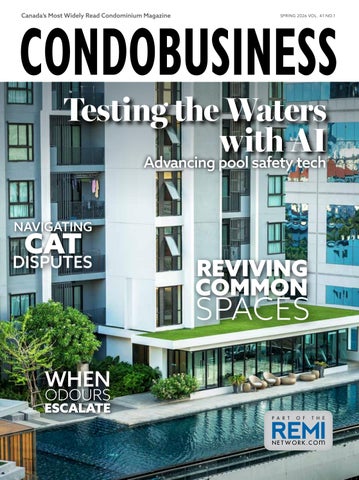
CondoBusiness Spring 2026

Page 1


Current Shifts

LONG VIEWED AS RISKY AMENITIES, pools are being transformed through smarter monitoring and data-driven oversight. Behind the scenes, industry professionals are developing AI systems that can reduce the risk of liability and support day-to-day maintenance tasks. As larger facilities adopt this technology, the innovation is expected to eventually trickle down into multi-residential settings.

Condo life is always evolving, and technology is just one inevitable shift. As communities redefine what it means to modernize shared spaces, this spring issue helps navigate ambitious renovations and smaller design upgrades, exploring both legal and operational challenges.

On the legal side, we look at shifts in legislation. The anticipated expansion of the CAT’s jurisdiction strongly suggests the next phase may include disputes relating to owners’ meetings. Condo lawyers at Cohen Highley say this possibility matters because “meeting disputes are often as much about governance friction and competing narratives as they are about technical compliance.” These disputes can create major administrative work. More about that on page 24.

Condo buildings continue to grapple with a variety of challenges across Canada. While one seasoned manager writes about innovating Ontario’s outdated governance model, yet another perspective comes from British Columbia, where the Strata Property Act is also facing scrutiny due to ongoing accountability gaps.

Also in this issue, we look at what’s ahead for investors in the condo market, temperature issues in common areas, and the ramifications of garbage odours.

As always, check out the REMI Network for ongoing news!

Happy spring,

rebeccam@mediaedge.ca

Editor Rebecca Melnyk

Publisher Andrea Almeida

Senior Graphic Designer Roxy Huynh-Guinane

Graphic Designer

Amanda Spearman

Production Manager Ines Louis

Advertising Sales

Sean Foley Ron Guerra

Contributing Writers

Megan Alexander, Dimitri Chris, Dan Eisner, Laura Gurr, Shane Haskell, Murray Johnson, John Margaritis, Neha Mehta, V. Platek and Ryan Stenquist.

Subscription Rates

Canada: 1 year, $30*; 2 years, $55*

Single Copy Sales: Canada: $10*. Elsewhere: $12 USA: $85 International: $110 *Plus applicable taxes

Reprints: Requests for permission to reprint any portion of this magazine should be sent to info@mediaedge.ca.

Circulation Department Adrian Holland circulation@mediaedge.ca

CONDOBUSINESS is published four times a year by

President Kevin Brown

Director & Group Publisher Sean Foley

Accounting Manager Michele Therien

251 Consumers Road, Suite 1020 Toronto, Ontario M2J 4R3 (416) 512-8186 Fax: (416) 512-8344 e-mail: info@mediaedge.ca

CONDOBUSINESS welcomes letters but accepts no responsibility for unsolicited manuscripts or photographs.

Canadian Publications Mail Product Sales Agreement No. 40063056 ISSN 0849-6714

All contents copyright MediaEdge Communications Inc. Printed in Canada on recycled paper.

Return Undeliverable Canadian Addresses to Circulation Dept: 365 Evans Avenue, Suite L10, Toronto, Ont. M8Z 1K2

/condomediaedge /condobusiness /condomediaedge

The Hot and Cold Hallway Problem

How multi-residential buildings are addressing temperature imbalances in common areas.

Temperature imbalances in multiresidential buildings are a common issue in Ontario, often referred to as the “hot hallway” problem. Residents may encounter hot, humid air in corridors even when their own units are adequately cooled. Lobbies can become greenhouses. This isn’t just a comfort issue; it is an operational failure. Ironically, the ventilation systems intended to maintain air quality and safety cawn exacerbate the problem.

THE SOURCE OF THE HEAT:

THE

MAKEUP AIR PARADOX

Many multi-residential buildings rely on rooftop Makeup Air Units (MAUs). These units are mandated by building codes to draw fresh outside air into the building to pressurize corridors and prevent odours from migrating between suites.

Traditionally, these units were only designed for heating. They perform effectively during -20 C winter conditions,

but on a summer day that exceeds 30 C, MAUs continue to pull in hot, humid outside air and pump it directly into corridors. The ventilation system is effectively heating the common areas in the summer.

THE MODERN SOLUTION: ROOFTOP HEAT PUMPS

Replacing single-function MAUs with modern rooftop heat pumps addresses both heating and cooling needs. A heat pump is a high-efficiency, two-way energy device. In winter, it pulls heat from the outside air to warm the building. In summer, it reverses the process, removing heat and humidity from the incoming air before it enters hallways. This approach maintains code-compliant ventilation while improving thermal comfort year-round.

CONSIDERATIONS FOR CONVERSION

Upgrading common area ventilation to a heat pump system can provide multiple operational benefits:

1. Solves the comfort complaint: It immediately eliminates the “hot hallway” phenomenon. Common areas finally match the comfort quality of the suites.

2. Operational savings: Heat pumps move heat rather than creating it by burning gas. Modern units can operate at 300 to 400 per cent efficiency, significantly lowering operational costs compared to gas-fired equipment.

3. Decarbonization and value: Replacing gas-burning equipment with electric heat pumps aligns with net-

zero goals, improves the building’s ESG profile, increases asset value, and often qualifies for significant government incentives.

For decades, common area cooling was treated as a luxury. With today’s rising summer temperatures and energy concerns, it is a necessity. Upgrading from a heating-only ventilator to an all-in-one heat pump is a strategic investment that provides year-round thermal regulation and operational efficiency. Evaluating existing rooftop systems can help building operators determine whether a heat pump conversion is appropriate for their facilities.

V. Platek, P.Eng, is president of Platek Engineers Inc. He can be contacted at (905) 290-2625.

The CAT Addresses Hoarding-Related Odour Nuisance

In a recent case, Oxford Condominium Corporation No. 24 v. Post, 2025 ONCAT 192, the Condominium Authority Tribunal (CAT) found that persistent garbage odours from a hoarding unit constituted a nuisance and warranted structured relief to protect a neighbouring owner.

The respondent had a history of hoarding that previously required his unit to be emptied and rebuilt. After he returned, an adjacent neighbour complained of a pervasive garbage smell infiltrating his unit for months, despite spending hundreds of dollars on air purifiers.

Management later attended and observed a strong garbage odour upon entry and items stacked to the ceiling, indicating renewed hoarding. The condo corporation pursued a graduated response: letters, emails, calls, and four legal compliance letters, along with information about community support services. The respondent did not meaningfully engage, did not remedy the odour, and did not participate in mediation or the written hearing.

Relying on section 1.44 of the Condominium Act, 1998, the corporation alleged a breach of section 117(2), which prohibits activities that create or continue a nuisance, including by odour. The CAT accepted evidence from the condo manager and the neighbour and concluded that the accumulation of garbage had created an unreasonable, ongoing odour that materially interfered with the neighbour’s use and enjoyment of his unit.

The Tribunal linked this nuisance finding to the statutory duty to maintain the unit. It interpreted the obligation to “maintain” under the Act and the declaration as including a basic level of cleanliness such that unreasonable odours do not emanate into neighbouring units. The Tribunal also noted that the Act permits the corporation to per-

form necessary work (with the related costs to be charged back to the owner) where an owner fails to maintain within a reasonable time.

Given the persistence and recurrence of the odour problem, the CAT granted a structured remedy. It directed the owner to remove garbage and other items causing odour and to clean the unit within 30 days so that odours no longer migrated to other units. If, after 30 days, an inspection on notice revealed that the unit remained in an unacceptable state and the odour persisted, the corporation was then authorized to hire a third-party contractor to clear and clean the unit, with those costs added as common expenses payable by the owner, subject to fairness, reasonableness and notice safeguards. The Tribunal acknowledged that such orders are relatively rare but found them justified given the history, the duration of the odour, and the owner’s complete non-engagement.

The corporation sought more than $7,400 in legal fees plus the CAT filing fee, effectively asking for full indemnity. The Tribunal distinguished pre-application enforcement costs from the costs of the proceeding (ie. In-CAT costs) and applied a proportionality lens. While it commended the corporation’s patient and sensi-

tive approach, it emphasized that some enforcement expense is an ordinary incident of condominium governance. It ultimately awarded a reduced amount in compensation and costs, declining full indemnity as a remedy reserved for exceptional circumstances.

This decision illustrates that persistent odour migration from hoarding or garbage can satisfy the statutory nuisance threshold, that the duty to maintain a unit encompasses maintaining it in a condition that does not emit unreasonable odours, and that corporations which carefully document complaints and staged compliance efforts may obtain structured orders permitting entry, professional clean-up, and chargebacks, tempered by a strong proportionality lens on both remedies and costs.

Neha Mehta is an articling student at Davidson Houle Allen LLP. She is an Internationally Trained Lawyer from India and has completed her LL.M. at the University of Ottawa. Neha takes a keen interest in condominium law, particularly governance and compliance.

Condominium management built to support your board

Ontario condominiums face unique challenges; aging buildings, rapid growth, and rising expectations.

That’s why our approach is rooted in local expertise and strengthened by the industry experience of our leadership team and management professionals.

Whether it’s financial oversight, capital planning, or day to day operations, we provide the clarity, communication, and support your board needs to thrive.

Let us introduce you to a smoother, more supported experience.

Say hello to, Life, simplified.

Visit: bit.ly/lifesimplified-ON

Or scan to discover how we can help make your community thrive.

STAYING AHEAD OF THE SEASONS:

Practical Maintenance, Landscaping, and Tools to Keep Managers Grounded

Seasonal change is one of the few constants in condominium management. With each shift in weather comes a predictable set of maintenance demands, landscaping considerations, and operational pressures. While experienced managers know the rhythm well, the cumulative impact of seasonal transitions: tight timelines, vendor coordination, budget constraints, and resident expectations can create significant stress. The good news? A proactive, organized approach—supported by the right tools and education—can turn seasonal maintenance from a source of strain into a manageable, even confidencebuilding, part of the job.

Start with a Seasonal Maintenance Mindset

Effective seasonal maintenance begins long before the first heat wave or snowfall. The most successful condominium managers think in cycles, not emergencies.

A high-level seasonal maintenance framework typically includes annualized tasks tracked for each site and may include:

Spring: Post-winter inspections, roofing and envelope checks, landscaping restoration, irrigation start-up, and mechanical system assessments.

Summer: Preventive HVAC maintenance, cooling system monitoring, exterior cleaning, pavement repairs, and garden upkeep.

Fall: Boiler and heating system servicing, gutter and drainage clearing, leaf management, and winter readiness planning

Winter: Snow and ice management, emergency preparedness, monitoring of heating systems, and ongoing safety inspections. By mapping these activities in advance, managers can better align vendor availability, manage budgets more predictably, and reduce the risk of reactive decision-making when issues arise.

Landscaping: More Than Curb Appeal

Seasonal landscaping is often viewed primarily through an aesthetic lens, but its operational importance should not be underestimated. Healthy landscapes support drainage, protect building foundations, and contribute to resident satisfaction—

particularly during peak spring and summer months.

Key considerations include:

• Coordinating seasonal planting and pruning schedules

• Monitoring irrigation systems for leaks or inefficiencies

• Planning for fall leaf removal to protect drains and walkways

• Selecting plantings that balance appearance with longterm maintenance requirements

Clear landscaping scopes and timelines also make it easier to manage contractor expectations and communicate effectively with boards and residents.

Organization as a Stress-Reduction Strategy

One of the most common stressors for condominium managers is the feeling of being “behind” the season. Organization is one of the most effective antidotes.

Tools such as maintenance calendars, standardized inspection checklists, and recurring task reminders can significantly reduce mental load. When expectations are documented and timelines are visible, managers spend less time reacting and more time overseeing.

This is where shared resources and industry-specific tools can make a meaningful difference.

Additional mindfulness management strategies are available from ACMO and include an advanced program to assist managers in staying grounded.

Leveraging ACMO Resources to Support Seasonal Planning

ACMO has continued to expand its library of practical tools and educational resources designed specifically for the lived reality of condominium managers.

One example is ACMO Tech, which has evolved into a continually updated resource hub offering concise, real-world content on technical and operational topics relevant to condominium management. These short presentations, checklists, and videos are designed for “need-it-now” moments—when managers are preparing for seasonal system changes, troubleshooting issues, or refreshing their knowledge ahead of inspections.

In addition to technical resources, ACMO’s broader education programs support managers in building confidence across core competency areas, including building systems, planning, communication, and risk management. By strengthening foundational knowledge, managers are better equipped to anticipate seasonal challenges rather than respond under pressure.

Education That Reduces Pressure, Not Adds to It

Continuing education is often framed as a regulatory requirement, but its real value lies in stress reduction. Knowing what to look for during a seasonal transition—and understanding when to escalate, delegate, or seek expert input—reduces uncertainty and decision fatigue.

ACMO’s educational offerings are designed to be practical, relevant, and respectful of time constraints. Whether through structured courses or short-form resources, the goal is to support managers with information that is immediately applicable to their day-to-day responsibilities.

Supporting Manager Well-Being Through Better Systems

Seasonal maintenance will always require effort, coordination, and vigilance. However, it does not have to come at the expense of well-being. By:

• Planning seasonally rather than reactively

• Using standardized tools and checklists

• Leveraging trusted educational resources

• Sharing knowledge within the professional community Managers can reduce unnecessary stress and focus on what matters most: maintaining safe, functional, and well-run communities.

ACMO remains committed to supporting condominium managers with tools, education, and resources that help them stay organized, informed, and grounded—no matter what the season brings.

Refreshing Common Areas Without Construction

Most condominium boards delay upgrading their common areas because they assume it requires construction, but that isn’t always the case. Surface layers, not the structure, make a building appear dated. Lighting that feels cold, paint that flattens the space, hardware that signals age, and inconsistent furniture are details residents experience every day. They are also the easiest to fix.

When approached strategically, even minor updates can dramatically shift how a building feels without the cost, disruption, or timeline of a full renovation.

START WITH EVALUATION, NOT REPLACEMENT

When approaching an existing condominium, the instinct is often to replace everything. That’s where budgets get wasted.

The first step is always evaluation. Not everything needs to go. In most cases, the structure is sound; it’s the visible layer that’s working against it.

Start by understanding how these high-traffic spaces are actually used, not how they were intended to be used.

• How do residents move through the lobby?

• Where do they naturally slow down or gather?

• Which areas feel active, and which are consistently ignored?

When condos retain what is working and upgrade selectively, they can redirect the budget toward the elements people actually notice. That’s how to create a cohesive transformation without overextending.

PRIORITIZE HIGH-IMPACT, LOWDISRUPTION UPDATES

If the goal is to create real impact without construction, focus on three features first: lighting, paint, and hardware.

These are the most efficient levers in a space. They’re relatively simple to update, but they immediately change how people experience a building.

Corridors are usually where condos fall short. They’re treated as circulation, rather than a part of the design experience. Defaulting to beige or white keeps them flat and forgettable.

Introducing colour creates rhythm, energy, and a sense of movement through the building. When that’s paired with thoughtful lighting and updated hardware, even a standard hallway begins to feel intentional.

LIGHTING DEFINES THE EXPERIENCE

Too many condominium lobbies rely on flat, overly bright overhead lighting in cooler tones. It reads as harsh and uninviting, more commercial than residential.

The shift isn’t complicated, but it requires intention. Layered lighting changes how a space is immediately perceived. Wall sconces, floor lamps, and table lamps introduce warmth, depth, and contrast. They also allow key features like millwork, textures, and artwork to stand out instead of getting lost. Lighting shouldn’t be treated as a utility. It’s one of the primary tools for defining atmosphere, and sets the tone from the moment someone enters the condo.

USE PAINT TO MODERNIZE AND UNIFY

Paint is one of the fastest ways to shift how a building feels. Many older interiors rely on stark whites and cool greys. They read as flat, sterile, and dated.

Moving toward warmer neutrals, layered tonal palettes, or full colour drenching immediately adds depth and presence. It gives the space a point of view instead of defaulting to something safe.

Common areas shouldn’t feel clinical. They should feel considered. The mistake is treating paint as a standalone decision. Colour needs to work in relation to everything around it: flooring, lighting, furnishings, and artwork. When those elements are aligned, the space reads as intentional and cohesive rather than pieced together.

HARDWARE: SMALL DETAILS, BIG PERCEPTION SHIFT

Door handles, elevator surrounds, mailbox fronts. Individually, they seem minor, but together they define the level of finish. This is where people subconsciously judge the quality of a space. Outdated metals, generic profiles, or inconsistent finishes quietly age a building. Updating these details to more refined materials or textured finishes immediately shifts that perception and delivers a strong return on investment.

“Surface layers, not the structure, make a building appear dated.”

LAYERING CREATES WARMTH AND IDENTITY

Once the foundational elements are in place, layering is what gives a space its depth. Without it, even well-designed interiors can feel flat or incomplete.

Artwork plays a central role. It introduces character and establishes a point of view. From a large-scale lobby piece to curated moments along corridors, it shifts the space. Texture is just as critical. Hard surfaces like stone or tile can feel cold without contrast. Bringing in rugs, textiles, and natural materials softens the environment and adds dimension.

This is where a building starts to move away from a generic finish. It begins to reflect a sense of identity, something that feels specific to the space and the people who use it.

WHERE MOST GO WRONG

A lack of consistency, not budget, is what holds buildings back. Updates are made in

WINDOWS & DOORS ALUMINUM & VINYL

phases, often by different decision-makers, without a clear direction. Lighting is replaced without considering surrounding finishes. Furniture is updated without aligning to the overall palette. Over time, the space feels disjointed rather than improved. This is where costs quietly add up — changes get revisited, corrected, and replaced again.

Another mistake is chasing trends. Common areas aren’t meant to turn over every few years. They need to endure, both functionally and visually. Prioritizing what’s current over what’s thoughtful usually leads to quicker obsolescence.

WHY STRATEGY MATTERS

Without a clear direction, even well-intentioned updates tend to work against each other. A defined design approach ensures that every decision, down to the smallest detail, contributes to a cohesive outcome. That level of coordination also allows improvements to be

phased over time without losing clarity or intent.

THE BOTTOM LINE

Refreshing a condo’s common areas doesn’t demand a full renovation — it requires clarity on where to focus. Lighting, paint, hardware, and layering carry the most impact. When those elements are addressed with intention, the shift is immediate and noticeable without the disruption of construction.

The difference comes down to how decisions are made. Clear evaluation, disciplined prioritization, and a cohesive direction. Get those right, and even modest updates can completely shift the condo community experience.

Dimitri Chris is the founder of Interiors by Dimitri Chris. Based in Toronto, he designs experiential, residential, and corporate spaces that continuously respond to his customers’ evolving needs.

Bulk Section 98 & Indemnification

Why agreements matter more than ever for condominiums.

Owners are personalizing their condo communities like never before, adding deck expansions, landscaping upgrades, EV chargers, hot tubs, pergolas, hardscaping, basement walkouts, and beyond. Yet every improvement that touches the common elements brings legal and operational consequences.

In Ontario, these changes fall under Section 98 of the Condominium Act, 1998, which requires two criteria before an owner can alter the common elements: board approval and a registered indemnity agreement between the owner and the corporation. This agreement defines who maintains, repairs, insures, and pays for the alteration, thereby protecting the corporation and ensuring fairness between owners.

But what happens when a corporation has dozens of historical alterations, incomplete records, or owners eager to make improvements? That’s where bulk indemnity agreements have become a powerful, cost-effective solution.

WHY SECTION 98 AGREEMENTS EXIST

An indemnity agreement ensures the corporation isn’t stuck repairing or replacing owner-installed improvements. Without one, courts have consistently ruled that if an alteration sits on the common elements, even if made by a previous owner, the condo may be on the hook for costs.

Here is a classic example shared by condominium lawyers:

A beautifully designed but unauthorized decorative feature was installed on an exclusive-use common element backyard space. When it later deteriorated and caused damage, the new owner demanded repairs, and without an agreement in place, the corporation was liable.

TYPES OF INDEMNITY AGREEMENTS INDIVIDUAL AGREEMENTS

Individual agreements are prepared and registered for each unit whenever a change is approved. They are useful for one-off requests but can become costly, repetitive, and difficult to manage if the number of requests increases.

BULK AGREEMENTS

Bulk indemnity agreements allow a corporation to register one agreement on all units, even if not all owners are altering the common elements that day. This provides blanket coverage for historical improvements, future alterations, turnover of unit ownership, and long-term risk management.

Economies of scale also make it more affordable than processing dozens of individual agreements.

HOW A SAMPLE BULK INDEMNIFICATION PROCESS COULD WORK?

1Board

decision plus management initiates the process

Once a board chooses to proceed, management contacts the law firm to prepare draft materials and confirm the condo’s unit count.

2Law

firm prepares the package

Drafts typically include owner correspondence, the indemnity agreement, and unit-specific signature forms. These are reviewed by the board and revised as needed.

3Owner notification and partici‑ pation window

Owners receive an explanation of the bulk agreement and a deadline to return their signature form. Condos often increase participation by mentioning the initiative at AGMs or in newsletters before the law firm’s mailing goes out.

4Collection, follow‑up and reminders

After the deadline, management reports who submitted the forms. The board may choose to register the agreement with participating units only, issue legal reminders, and have management conduct follow-ups.

5Final checks and registration

The law firm will confirm current ownership, which is important if a unit is sold mid-process. The firm then prepares final documents, registers the agreement on title and sends the corporation a copy of the registered notice.

“Every improvement that touches the common elements brings legal and operational consequences.”

BENEFITS FOR BOARDS, MANAGERS, AND OWNERS

Bulk agreements can reduce future legal exposure for boards, ensure compliance with the Condominium Act, and standardize approval requirements.

For condominium managers, these agreements minimize administrative burden, simplify status certificate disclosures, and improve record-keeping.

Once the bulk agreement is registered, no additional units can be included. Any future additions would require individual agreements.

WHEN BULK AGREEMENTS ARE ESPECIALLY VALUABLE HISTORICAL CLEAN‑UPS

Many condos discover old alterations that were approved but undocumented, unapproved changes still present, and unclear Section 98 compliance on status certificates. Bulk agreements help bring the community back into compliance efficiently.

COMMUNITIES WITH RECURRING ALTERATIONS

Bulk agreements greatly benefit townhome complexes, communities with rear yards, units with outdoor spaces, and buildings with high demand for EV chargers.

BOARDS WANTING STRONGER GOVERNANCE AND CLARITY

A bulk agreement ensures consistency, reduced legal risk, clear enforcement mechanisms and simpler resale processes.

They also speed up alteration approvals for owners, clarify maintenance and insurance responsibilities, and make the resale process smoother.

COST CONSIDERATIONS

A typical fee depends on the number of participating units (e.g., $2,500 to $5,000) plus disbursements and taxes. The fee includes preparation and registration. Compared with issuing 20 to 50 individual agreements over several years, bulk agreements often represent substantial savings.

KEY TAKEAWAYS FOR CONDO CORPORATIONS

Every change to the common elements requires a Section 98 agreement. Bulk agreements offer long-term protection and cost-efficiency, help resolve historical issues, and streamline future requests. Clear communication boosts owner participation and reduces delays. Once registered, only participating units are covered, making thorough outreach essential.

Shane Haskell is the owner/founder of Lionheart Property Management Inc., where he is responsible for the day-to-day operations. Lionheart is an ACMO2000 organization.

Shane has several years’ experience in the financial industry, marketing, project management, real estate and property management industry. He is a principal condominium manager (PCM) and general licensed manager (OLCM)

with CMRAO, a registered condomin-

The CCI Eastern Ontario Conference Committee is excited to bring the condominium community together in Kingston for a full day of education and connection. We look forward to welcoming returning attendees and new participants alike.

Condominium Institute Toronto Chapter.

The Door the Smart Lock Couldn’t Handle

Millions of condo units have exterior-facing front doors. Until recently, none of them had a smart deadbolt that could handle the weather.

Not every condo unit sits behind a climate-controlled corridor. Garden-style complexes open directly onto landscaped courtyards. Walk-ups with exterior breezeways expose every landing and doorframe to the sky. Ground-floor units have patio entrances a few steps from the parking lot. Townhome-style stacked condos, bungalow clusters, casita communities, cabinstyle resort properties. Across Canada, millions of residential front doors face the reality of harsh weather conditions. Rain hits the lock. Snow and ice freeze on it. Sun bakes it for months at a time. These buildings are not niche. Garden-style apartments represent one of the fastest-growing segments of new multiunit construction, favoured by developers for faster approvals and lower build costs, and by residents for ground-level access and private entries. Walk-up buildings of three and four stories dominate suburban rental corridors from the southeast United States through the Canadian prairies. In resort markets, casita and cabin-style layouts are standard. What they share is an access control problem the industry has been working around for years.

The Gap at the Building Envelope

Inside these same properties, smart locks are everywhere. Lobbies, amenity rooms, mail centres, fitness areas, parking garages. Cloud-managed platforms issue and revoke credentials remotely, log every access event, and eliminate rekeying costs at turnover. The technology works and residents want it. NMHC reports that 67 per cent of renters now expect keyless entry.

But most electronic deadbolts are engineered for interior conditions. Their temperature ranges assume a heated corridor. Their housings are not sealed against moisture. Install one on a door facing a parking lot in Edmonton or a courtyard in Houston and you are gambling on how long the electronics survive. Property managers who tried it found corroded circuit boards, frozen keypads, and warranty claims that went nowhere because the lock was never rated for outdoor use.

The result has been a split system: electronic credentials inside the building, brass keys outside. Residents carry two forms

of access. Management runs two workflows. And the exterior door, often the most vulnerable to forced entry, remains the least monitored point on the property.

Why Outdoor Took So Long

Building a weather-resistant smart lock is not just a matter of adding a rubber gasket. The electronics have to function reliably from minus 35 to plus 60 degrees Celsius, a span that stresses batteries, displays, and wireless radios differently at each extreme. The housing needs an IP55 rating to resist dust and water from any angle. And the lock still has to meet fire door assembly standards, because many exterior-facing unit doors sit on rated openings. ANSI/BHMA Grade AAA certification and a UL 10C fire rating of 180 minutes on metal doors are code requirements in commercial multifamily, not optional upgrades.

The lock also has to fit. Condo retrofits do not get the luxury of reframing doors. Whatever goes on needs to drop into the existing deadbolt door prep, the standard bore and backset that mechanical deadbolts have used for decades. A product that requires new holes or hardwired power is a non-starter on a property with 80 exterior doors and residents living behind them.

A Lock That Fits the Hole and the Weather

Salto has addressed this challenge with the newly announced DBolt Touch Outdoor, a smart deadbolt built for exterior residential doors. It meets the benchmarks above: IP55, the full temperature range, BHMA AAA, UL 10C. It runs on three AA batteries rated for up to 85,000 operations and fits a standard deadbolt prep with no drilling or door modification. A maintenance tech can swap out a mechanical deadbolt with a screwdriver.

The touchpad accepts RFID cards and fobs, NFC credentials, Bluetooth digital keys, and PIN codes. That credential range ties the outdoor doors back into the rest of the building. A resident with a single card or phone can move from lobby to elevator to fitness room to their exterior-facing front door without carrying a separate key.

Closing the Last Gap

For property managers running garden-style communities, walk-ups, or any site where unit doors face the outdoors, the practical change is simple. The exterior door joins the same managed ecosystem as every other access point. Credential issuance, revocation, and audit logging happen in one platform. Rekeying disappears.

The less obvious change is to the resident experience. A condo owner in a bungalow-style complex or a renter in a garden walkup gets the same keyless convenience that a high-rise corridor resident has had for years. Their front door works the same way as the amenity room door and the lobby door. The fact that theirs faces a snowstorm instead of a hallway no longer matters.

Navigating Disputes with the CAT

Anyone who regularly attends owners’ meetings will recognize this scenario: the meeting is tense, the chair’s procedural rulings are challenged, and an owner or group of owners threatens to litigate. Historically, the cost of court proceedings has been a meaningful barrier preventing disputes about owners’ meetings from turning into formal litigation. That may be changing. Owners may soon be able to take certain owners’ meeting disputes to the Condominium Authority Tribunal (CAT).

The CAT was built to be faster and more accessible than court, but accessibility can also invite boundary-testing. It shifts the cost and time burdens onto boards and managers responding to applications from one owner or small group of owners.

A condo corporation cannot stop someone from filing a CAT application, but it can increase

the odds of early dismissal and cost consequences by making disputes easier for the Tribunal to screen quickly and by not giving in to attempts at “scope creep” by an owner.

WHAT MAY CHANGE: POTENTIAL

EXPANSION OF THE CAT’S JURISDICTION While change may be on the horizon for Ontario’s

first fully online condominium tribunal, the key details remain unsettled. The CAT plays a central role in resolving disputes as an alternative to the traditional court system. Any expansion of its jurisdiction has practical consequences: increased application volume, more self-represented parties, and more disputes that can consume board and management resources. To understand what may change, it helps to start with what is currently within the CAT’s jurisdiction. As of today’s date, the CAT can hear disputes relating to:

• Disputes regarding condo records;

• Noise, vibration, light, odour, vapour, smoke, and nuisance complaints;

• Provisions in the governing documents (declaration, by-laws or rules) about unreasonable nuisances;

• Disputes involving pets, vehicles, parking, and storage; and,

• Disputes related to indemnification and chargebacks related to the above disputes.

The CAT is widely expected to undergo a further expansion of jurisdiction through amendments to the Condominium Act, 1998 and Ontario Regulation 179/17. No formal timeline has been announced and the scope remains uncertain. There is, however, a strong indication that the next phase may include disputes relating to owners’ meetings. For industry professionals, that possibility matters because meeting disputes are often as much about governance friction and competing narratives as they are about technical compliance. These disputes can generate significant administrative work, even when the remedy sought is unrealistic or outside the CAT’s authority.

SCREENING AND CASE MANAGEMENT: HOW THE CAT CONTROLS IMPROPER APPLICATIONS

For boards, managers, and other condominium professionals, that key risk is not simply that more disputes may be filed (although this seems likely, as the CAT has a low barrier to starting an application). The key risk is that the CAT process will be used to delay the implementation of decisions that one owner or small group disagrees with, re-litigate governance disagreements, pressure boards into settlements, or expand a narrow dispute into a broader campaign against the corporation. The CAT’s rules of practice are intended to keep proceedings proportionate through early screening, active adjudicator control of issues and evidence, and the ability to dismiss proceedings that are outside jurisdiction, disclose no reasonable cause of action, or are brought for an improper purpose.

In practice, these tools only work as well as the record put before the Tribunal. A well-organized evidentiary record (clear correspondence, minutes, notices, internal memos) makes it easier for the CAT to identify when an application is really a governance grievance dressed up as a CAT dispute. Conversely, inconsistent documentation and informal communications can give an applicant room to reframe events and prolong proceedings, even when the legal outcome should be straightforward.

COSTS: REALISTIC EXPECTATIONS AND WHEN THEY MATTER

The CAT’s process is designed to be accessible, but it is not meant to be a vehicle to bypass statutory governance requirements or to pursue personal campaigns against directors, managers, or neighbours. The rules require parties to act in good faith and permit the CAT to control proceedings, narrow issues, and address misuse of process. From an industry standpoint, the practical takeaway is that boards should assume some applicants will push beyond jurisdictional boundaries, and plan for early, record-based responses that keep the dispute constrained.

Costs are discretionary. In many cases, even a successful condominium corporation should not assume it will recover legal fees for the CAT process. The CAT commonly orders reimbursement of CAT fees to the successful party, and may order additional costs where a party’s conduct is unreasonable, undertaken for an improper purpose, or causes delay or additional expense. For boards and managers, this makes documentation of procedural fairness and a log of avoidable work (late evidence, shifting allegations, repeated non-

RECENT DECISIONS: IMPROPER PURPOSE, SCOPE CREEP, AND COSTS

Recent caselaw illustrates how the CAT applies the above-noted principles to prevent and address frivolous or improper applications. In Akash v. York Condominium Corporation No. 78, 2025 ONCAT 59, the applicant filed a records application that the CAT found was primarily intended to advance broader grievances against the condominium corporation rather than resolve the records dispute. The applicant persistently focused on governance issues, made defamatory allegations, and sought the removal of specific directors despite being warned that these issues were beyond the scope of the application and the CAT’s jurisdiction. The CAT determined that the application was brought for an improper purpose and/or that it lacked jurisdiction over the issues raised, and dismissed the application under Rule 34.3 during Stage 2 (Mediation).

In Russell v. Simcoe Condominium Corporation No. 8, 2025 ONCAT 51, while the application itself was not dismissed as frivolous, the decision illustrates the CAT’s approach to costs where a party’s conduct causes unnecessary expense. The applicant submitted late documents and raised governance-related matters that were outside the scope of the records issues the CAT had indicated it would address. This created extra work for the respondent condominium corporation. Although the corporation sought more than $18,000.00 in legal fees, the CAT exercised its discretion and awarded a nominal $1,000.00 in costs due to the applicant’s conduct. The case is a reminder that even where an application proceeds, “scope creep” and non-compliance can translate into cost consequences — though typically far short of full indemnity for legal fees.

The CAT will dismiss or constrain proceedings where the application is being used to advance broader governance grievances, and it may award costs where a party’s conduct materially increases the time and expense of the process.

PRACTICAL PLAYBOOK FOR BOARDS, MANAGERS, AND CONDOMINIUM PROFESSIONALS

There should be a presumption that CAT appli-

cations are filed in good faith by owners. However, industry professionals have valid reasons to be skeptical about how an expanded CAT jurisdiction (including potential owners’ meeting disputes) could be used in practice. The most effective protection is a clear, contemporaneous record that shows the corporation acted reasonably and in good faith. This allows the CAT to quickly see when an application is outside jurisdiction, discloses no reasonable cause of action,

Where Condo Pros Level Up

Join Ontario’s only professional association dedicated to supporting Condominium Managers through free continuing education for members, valuable resources, strong advocacy, and a collaborative network that promotes excellence in the condominium management profession. Elevate your professional edge. Visit acmo.org today!

or is being used for an improper purpose. The following practical documentation steps may be used support early dismissal and/or a costs request:

1

Before the meeting, prepare a record of the processes followed. Keep a dated package that includes: (i) the notice of meeting and method of delivery; (ii) the agenda; (iii) the information circular/ management package; (iv) language for proposed motions; (v) the proxy form and any proxy instructions; and (vi) the list of those entitled to vote (and how it was compiled). Where there are known “repeat dispute” issues, document the proactive steps taken (e.g., clarification emails to owners on proxy requirements, voting eligibility, or meeting procedure). Have a meeting with the manager and the proposed chair to review this information before the meeting. If the by-laws do not specify, have the chair confirm which rules of procedure they will be using during the meeting (e.g., Nathan’s Rules, Robert’s Rules).

2

During the meeting, document rulings and objections in a structured way. In addition to traditional minutes, consider maintaining a separate “chair’s rulings log” that records: (i) time and the issue raised; (ii) the procedural ruling (e.g., proxy accepted/rejected, point of order allowed/denied); (iii) the basis for the ruling (by-law, statute, meeting rules); and (iv) the outcome (e.g., vote proceeded; motion amended; recess). If an owner alleges bias or impropriety, capture the allegation neutrally and record the chair’s response and any corrective steps taken (e.g., recess, consultation with counsel, rereading the meeting rules). If there is a serious issue in dispute, or a significant likelihood of litigation, a recess or brief adjournment to obtain legal advice may be more cost-effective than forging ahead despite objections.

3

Confirm key numbers on the record. Ensure the minutes clearly record quorum, opening/ closing times, vote tallies (where applicable), and the identity/role of the chair and scrutineers. If proxies are controversial, record the number received, the number accepted/rejected, and a brief categorization of rejection reasons (without including personal information).

4

Keep communications professional and “CAT-ready.” Assume emails and meeting correspondence may become exhibits. Avoid editorial commentary about an owner’s motivations: stick to facts, procedural rules, and governing document references. Where a complaint is clearly outside the CAT’s jurisdiction, say so plainly and early, and di-

rect the owner to the appropriate process (mediation, Superior Court, etc.).

5

After the meeting, create a contemporaneous “meeting file memo.” Shortly after the meeting, ask the chair to prepare a short internal memo (dated, author identified) summarizing any flashpoints: what was raised, what was decided, what materials were relied upon, and what follow-up steps were offered. This can be particularly helpful where an applicant later reframes the dispute or adds new allegations not raised at the meeting.

6

If a CAT application is filed, build the record for dismissal and costs from day one. Where appropriate, respond early and narrowly: (i) identify jurisdictional limits; (ii) highlight where the application is really a governance grievance rather than a dispute within scope; and (iii) point the Tribunal to the documentary trail showing procedural fairness and good faith. If you seek costs, document the specific conduct that caused delay or additional expense (missed deadlines, late evidence, expanding issues beyond scope, refusing reasonable resolution efforts), and keep a running log of incremental time and disburse-

“These

ments incurred in response.

The recent cases show that the CAT is committed to preventing misuse of its process. However, if the CAT’s jurisdiction expands into additional governance disputes (including owners’ meetings), boards and managers should expect that some applicants will test the boundaries of jurisdiction and procedure.

A practical way to reduce the risk and cost of these disputes, whether currently within the CAT’s jurisdiction or anticipated owners’ meeting disputes, is to: (i) keep clear, contemporaneous meeting and decision records (as outlined above), and (ii) consistently demonstrate reasonableness and good faith in communications and process.

The CAT can dismiss frivolous or bad-faith claims, so not every application will result in a lengthy process; and where a party’s conduct causes delay or unnecessary expense, the CAT may order

reimbursement of CAT fees and, in limited circumstances, other costs. Condo boards can also use resources from the Condominium Authority of Ontario and seek legal advice when disputes arise to support timely, informed decision making.

Laura Gurr is a partner with Cohen Highley LLP in London. Cohen Highley LLP has offices in London, Kitchener, Windsor, Strathroy, and Sarnia. Laura provides risk management and regulatory compliance advice to condominium corporations, unit owners, and property management companies.

Megan Alexander is a licensed paralegal who works within the Commercial Litigation and MultiResidential Housing Groups at Cohen Highley LLP in London, Kitchener, Windsor, Strathroy, and Sarnia. Ms. Alexander’s main areas of practice are within the Ontario Small Claims Court (including enforcement) and the Condominium Authority Tribunal.

Condo Market Collapse Brews Change

Delivery costs, financing risk and product format get critical scrutiny.

Untenable pro formas, skittish lenders and reluctant buyers are intertwined features of a condominium market collapse destined to further complicate Canada’s already perilous affordable housing shortage. As the shortfall to a targeted 4.8 million new dwelling units by 2035 grows wider, the bad news is, the delivery pipeline is more sluggish than it may appear.

Canada Mortgage and Housing Corporation (CMHC) tallies housing starts at the point that a construction project emerges above grade. A wide range of necessary advance inputs into future housing supply — development approvals, unit pre-sales for condo projects and financing — aren’t captured, but, recently, a lot of projects have dropped out of the pre-construction queue.

“The housing starts that you’re seeing reported reflect decisions that were made in 2024,” Benjamin Tal, deputy chief economist with CIBC Capital Markets, advised while speaking at the Real Capital conference in Toronto earlier this week. “What’s happening right now is zip. Nobody’s building anything, but you don’t see it in the headline numbers.”

“Unfortunately, condominium starts are going to be particularly weak here in Toronto where pre-construction sales fell to multi-decade lows in 2025. We’re seeing projects delayed and we’re seeing them cancelled as financing thresholds are just harder to meet,” concurred Jessica Harland, a senior vice president with CBRE Capital, who, along with her colleague, Joshua Sonshine, presented newly released findings from her firm’s annual survey of lenders’ views on opportunities in commercial real estate.

Responses from 47 financial entities that collectively hold more than $200 billion worth of Canadian commercial real estate loans are generally upbeat for 2026. Survey participants confirmed plans to increase their loan books relative to 2025 for almost every asset class except high-rise condo construction and development land.

For those two asset classes, it’s the third consecutive year a reduction in available capital is envisioned. As well, 89 per cent of surveyed lenders now deem that development land poses an elevated or significantly elevated credit risk on refinancing — up from about 68 per cent who expressed that opinion last year.

Margins have been squeezed particularly tight for developers who acquired land at peak prices in 2020-21 then encountered rising interest

rates and climbing construction costs soon after. Meanwhile, federal legislation has been in effect since Jan. 1, 2023, placing a four-year moratorium on non-Canadians buying residential real estate (with some exceptions).

“Those purchase prices haunt pro formas to this day,” Sonshine submitted. “Once interest rates and construction costs are inclining, the models for condo sales, construction and the related financing were essentially broken. Not to mention that we have a lack of foreign inves-

PERFECT TIMING

tors in the condo space and student immigration is falling.”

While there’s little momentum for project launches right now, there is building consensus that market recovery will require a reapportionment of costs and risk, and greater diversification of product. Tal hypothesizes that senior levels of government are getting ready to offset many of the costs that development charges cover. He also projects that a current Canada-wide glut of nearly 19,000 recently completed, unsold

One-third of Canadians plan to purchase a house or condo within the next two years. According to RBC’s Spring Home Ownership Poll, an estimated 44 per cent of respondents constantly worry about the cost to achieve this dream — up from 37 per cent in 2025. The majority are ready to buy, but are waiting to move into the market once their finances are in order.

The online survey of 1,719 Canadians, aged 18 to 64, was conducted between January 7 and January 25, 2026. Among those planning to buy their first home, 62 per cent feel closer to their goal and 71 per cent have a savings plan in place, with an average of $110,339 saved. Seven-in-10 are aiming to use the tax-free First Home Savings Account. The majority of respondents will continue living with parents, delay having children, or pursue second jobs to achieve their ownership dream by 2028.

“You cannot go through this kind of shock without change.”

condo units — of which, roughly 9,000 are located in Vancouver and Toronto — should be absorbed over the course of the next two years.

“Prices are still too high to buy, but too low to build. The market is broken, and without reducing significantly the cost of delivery of new housing, we’re not going to move in the right direction,” Tal asserted.

In the existing condo stock, crash-triggered price drops will open up ownership possibili ties to more buyers, including one of the fastest growing segments of the recent housing market — households that have doubled up. “With prices going down, some of them will be decoupling and that will be another source of demand,” Tal said.

For the future, pro formas free from develop ment charges would give builders more room to manoeuvre and lenders more confidence that they could do so. Developers will also have to of fer prospective buyers a product that they want to buy, which Tal characterizes as family-sized units that can be delivered on a timely schedule.

“If you’re a family, you need larger units and you cannot wait five years from pre-sale,” he said. “This business of 80 per cent pre-sale will not be the future, I believe. We’re going to see a situation where developers will need to put more equity in the project. Banks will have to take more market risk and spreads will be different. That will be a new emerging condo market.”

As for the likelihood of lenders coming on board, Harland highlighted the quick turnaround in the office sector’s prospects. In the 2024 edition of the survey, zero lenders reported that they in tended to increase loan allocations for office, while, two years later, 45 per cent of respondents are

planning to expand loan books for office relative to last year. Lenders’ assessment of all categories of office except suburban Class B has grown rosier, with downtown Class A office properties boasting the most improved profile among the 22 categories of assets the survey monitors.

“In 2025, lenders proved that they would be there for strong projects, and, in my experience, that even applied to condo project financing if the project made sense and it was in the right market,” Harland reported. “The office sector was in the same place (as condo construction and development land) two years ago, and look how sharp a turnaround is possible with lenders’ intentions. All is not lost, but we certainly aren’t going to see a shift in 2026.”

However, Tal foresees an ultimate transformation.

“The condo market is going to change dramatically in a very significant way. You can not go through this kind of shock without change,” he maintained.

WHY US?

With

Making Waves With AI

Swimming pools come with all kinds of liability concerns. Emerging technology aims to dive deeper into monitoring and managing these amenities for safer, more efficient data-driven oversight.

Pool safety is under renewed scrutiny after two recent incidents occurred at condominiums in the Greater Toronto Area, one involving a chemical mishap and the other a fatal drowning.

In January, eight people were sent to the hospital with minor injuries from noxious odours at a three-tower condo complex in North York. The culprit was attributed to pool cleaning supplies in the pool maintenance area. Last summer, Toronto police confirmed a man who didn’t know how to swim had drowned in the deep end of a condo pool in Scarborough.

Although such events seem to be uncommon in condos due to enhanced technology and strict regulation laws that govern these amenities, the true scope of risk is difficult to measure. Many incidents, particularly near-misses, go unreported. Some experts say artificial intelligence (AI) could serve as an additional safety tool while also helping property managers oversee pool maintenance tasks.

Richard Webster, operations manager and senior pool tech at H2O Amenity Group, a provider of amenity management solutions for condominiums, hotels, and commercial properties in Ottawa, explains that while AI cannot physically save a life, it can monitor conditions in real time to help prevent hazards.

“AI never rests, never looks at its phone, and never gets distracted,” says Webster.

He envisions the near future where a pool quietly monitors itself, where headcounts are logged automatically, incidents are timestamped the moment they occur, daily checklists are completed through verified activity, and alerts surface only when something requires attention.

This kind of system is no longer theoretical. Along with the company’s CEO, Justin Dyer, who is also a professional condo manager, Webster is part of a team developing a proprietary AI platform. The system can be layered

LEGAL OBLIGATIONS FOR OPERATING CONDO POOLS

Here is a brief list of responsibilities under Regulation 565 of Ontario’s Health Protection and Promotion Act. Note: many more precise requirements are contained in the legislation.

• Required notices to public health authorities. (Pools are also subject to routine and complaint-based inspections by public health inspectors; and deficiencies identified by the inspectors must be promptly corrected.)

• Mandatory standards in terms of water quality, chemical composition, and clarity as well as daily operation of the pool.

• Requirements related to supervision and lifeguards (depending primarily upon the pool size and bather load). Most swimming pools in condominiums do not require a lifeguard, but then require mandatory “unsupervised pool” signage.

• Mandatory additional signage and pool rules. (This includes posting of: age limits for use of the pool unless the bather is accompanied by a supervising adult, behavioural rules, bather limits, depth markings, diving restrictions, shower notices, health notices, etc.)

• Minimum requirements in terms of available rescue and emergency equipment (e.g., reaching pole, buoyant throwing aid, first aid kit, emergency telephone).

• Minimum maintenance requirements. Among other things, the pool, deck, enclosure, change rooms, lighting, drains, suction systems, and related equipment must be maintained in clean and safe working order at all times.

Source: Nancy Houle and James Davidson of Davidson Houle Allen LLP.

onto existing camera infrastructure without requiring a complete hardware replacement, and it can be configured to send instant alerts. It is designed to detect drowning, monitor activity in real time, and generate data-driven insights for pools, aquatic facilities, and shorelines where traditional surveillance falls short.

Even in supervised settings, the consequences can be serious. At large Class A facilities, such as water parks with sprawling pools and lazy rivers, incidents can go unnoticed. Lifeguards, despite their training, remain vulnerable to human error. Statistics from the World Health Organization indicate that at least 1,000 people drown in waterparks every year worldwide, while in the United States, around 10 fatalities happen annually — most involving children.

Across all water-related activities in Canada, the LifeSaving Society reports an average of 442 deaths occur annually. Non-fatal drownings happen far more frequently, with 5,684 emergency department visits reported in Ontario last year alone. The majority of fatalities occur in lakes and ponds, while an estimated 90 per cent of pool-related deaths happen in private pools. Few incidents take place in lifeguardsupervised settings.

However, the majority of condo pools are unsupervised. AI could send an alert to the condo manager, superintendent, and security concierge staff all at once, increasing the positive response outcomes.

CON DOLAW.TO

With over 45 years of experience in condominium law, DSFM is legal counsel to over 500 condominium corporations, as well as condominium purchasers and homeowner groups, across Ontario.

This is the next wave in the evolution of pool technology. Many widely-used tools — from variable-speed pumps and salt pouring generators to automated sensors and computercontrolled chemical dosing — maintain water flow, balance and chemical sanitation levels. At one point in time, these were all novel advancements in the industry.

As large operators begin to adopt AI, and as it’s successfully applied to high-stakes situations, Webster believes it will eventually trickle down into smaller Class B facilities like condominiums, where it will not only address safety but simplify a property manager’s day-to-day responsibilities.

“It might help save lives by notifying building staff of an event, but I think what we’ll most likely see are applications around slips-and-falls,” he predicts. “For a condo manager, that’s the biggest concern, as it opens them up to lawsuits. If someone slips and falls, AI can’t magically prevent that from happening, but it could observe wet spots on the floor and notify maintenance of a potential spot.”

AI could also track and immediately record slip-and-falls into a report, while monitoring headcounts in a swimming zone or on the pool deck. Maintenance routines would also be less cumbersome.

“What if reports were created in real time, where, at the end of your shift, you could see the swimming pool was vacuumed at 11 a.m., or that tests were all completed? If no one tested the water in four hours, it would flag that and send out a notice to the manager.”

The technology also could spot changes in water colour, such as the green tinge of an algae bloom, much quicker than a human. As well, an AI system could learn to recognize pool chemicals and immediately warn of potential mishaps, such as incompatible substances being stored too close together. The system could also be individualized to suit unique needs of a condominium.

“I talk to condo managers who are still running their pools the same way they did fifteen or twenty years ago,” says Dyer. “Insurance premiums are up, the lifeguard labour market is brutal, and the facilities are older. AI monitoring gives you another set of eyes on the water. It works with your staff, not instead of them, and it catches things faster than any one person can on a twelve-hour shift.”

About 80 per cent of the pools that H2O Amenity Group oversees are guarded. The greater concern lies in unguarded pools, where concerns are often tied to liability. In that case, due diligence is key, and the ability to quickly scope through automated detailed records is significant.

“The pool is probably the single-highest liability amenity in any condo building, and most boards don’t budget for it that way,” says Dyer. “They’ll spend on chemicals and mechanical, but the safety side gets treated like an afterthought until something goes wrong. By then you’re dealing with lawyers, not line items.”

LEGAL OBLIGATIONS FOR OPERATING CONDO POOLS

It’s a property manager’s job to designate someone to maintain the pool, but it’s also important for them to understand the legalities of this amenity.

According to Ottawa-based condo lawyers Nancy Houle and James Davidson of Davidson Houle Allen LLP., there are numerous obligations that apply to condo corporations operating pools.

If the condominium contains six or more units, the pool qualifies as a “Class B Public Pool” under Regulation 565 of Ontario’s Health Protection and Promotion Act. This legislation contains a lengthy list of responsibilities that apply to the owner and operator of a Class B pool.

More generally, they say, the condominium corporation must ensure (as occupier under the Occupiers Liability Act, and per Section 26 of the Condominium Act) that the pool and related features are maintained and operated in a reasonably safe condition at all times.

As well, there are specific physical requirements that must be met under the Building Code. For instance, lockable doors and other barriers must be present to prevent public access to the pool. Also, features to allow for installation of a buoy line (between shallow and deep water) are required in some cases.

“Many condo corporations hire pool maintenance firms to assist with fulfillment of the various requirements,” says Houle. “This is an excellent idea because it allows the condominium corporation to rely upon, and benefit from, the experience and expertise of the pool maintenance firm.”

Yet another issue is the obligation under the Human Rights Code to accommodate any needs of residents with disabilities so they can access the pool. Most of the complaints the law firm deals with pertain to human rights issues, such as the inability to properly access the pool and complaints about “adults only hours,” particularly for lap or lane swimming.

Another issue relates to having an Automated External Defibrillator (AED) in a pool area. “This question arises for many condominium corporations simply because sudden cardiac arrest is a leading cause of death in aquatic settings,” says Houle. “An AED is not mandatory for Class B pools, but they are still often considered because of their added life-saving potential.”

“Ontario Regulation 565 is massive and outlines everything that has to be followed for pools,” notes

“The pool is probably the single-highest liability amenity in any condo building.”

Webster. “If you’re out of sync with any of this stuff, they can shut down your pool quickly. A good manager should know how pools work, what systems are in place, and the regulations and safety requirements.”

Tools that automate oversight can help managers keep pace with these demands and reduce the risk of something being missed.

“Property managers are responsible for dozens of contractor relationships, and the pool is one of the hardest to oversee because

you can’t always be on-site when the work is being done,” says Dyer. “Residents notice when it’s not done right, and the complaints land on the manager’s desk, not the contractor’s. With AI-assisted monitoring, you’ve got a record. You can see activity, you can confirm service was performed, and you’ve got something to point to when a contractor says the work was completed and a resident says it wasn’t. That changes the conversation entirely.”

DITCHING THE DIRT:

THE PRACTICAL PERKS OF ARTIFICIAL GRASS

The yearly battle to grow a “perfect” lawn is a fiscal and logistical nightmare for many condominiums.

Managing expectations around weed growth, mysterious brown spots, and the realities of pest damage is close to impossible despite best efforts by landscapers to fertilize, over-seed and top-dress. Add to this the financial burden of adequate watering to keep lawns as green-as-can-be, and it is easy to understand why the landscaping contract is one of the “big ticket” items in any condominium budget.

Once viewed as an asset to property value, natural grass is increasingly being seen as a maintenance liability. As an alternative, properties choosing to install artificial turf can effectively remove the entire lawncare portion of their landscaping budget. While traditional seasonal landscaping upkeep requires seven to eight months of a strict mowing and fertilization regime, artificial turf requires minimal labour, making it a tempting prospect for boards looking to reduce budget costs while providing a durable solution to turf care.

High quality artificial turf is designed to withstand severe weather conditions, including heavy rain, snow and hail, without becoming waterlogged or damaged.

ENGINEERED FOR ULTIMATE DRAINAGE

“Modern turf systems have evolved enormously over the last decade and are now engineered to outperform the drainage capabilities of natural grass,” says Bran Lakoseljac, President of Toronto-based Lazy Lawn®, who notes that a well-installed lawn can last up to 20 years.

“A professional installation involves excavating three to four inches of soil and replacing it with ‘high-performance bedding”—a specific type of porous stone. This bedding creates a base as stable as concrete but with a drainage rate of approximately 60 inches per hour,” Bran explains. “This system ensures water stays on-site and filters through the stone rather than overwhelming municipal sewer systems.”

The turf is anchored using 10-inch non-galvanized nails around the perimeter. These nails are designed to rust

once underground, creating a permanent bond with the earth that firmly fixes the turf in place, even in areas of heavy foot traffic.

BEYOND THE REGULAR BLADE

Advances in the design of the grass itself have helped with historical issues with heat retention. Models like “Lemongrass®” have adopted a specialized W-shaped blade which ensures that as the sun moves, the blade casts a shadow on itself, keeping the surface significantly cooler than traditional, flat-bladed products.

Modern turf is also built for resilience, with blades manufactured to be thicker in the middle ensuring they spring back to an upright position after being compressed. After a heavy winter season, maintenance is simply a matter of “combing” the lawn with a brush machine or broom once the snow has melted away.

Safety and fire code compliance are also of high importance in building envelopes. While the turf itself is plastic, it is engineered with fire retardants to meet building and fire codes.

“If a lit cigarette is dropped, the turf will melt at that particular site, but will not ignite or spread flames,” Bran says.

For many properties, the first consideration of artificial lawns has been in areas designed for pet-friendly spaces, where natural grass is easily damaged. Artificial turf features an antimicrobial sand infill which helps neutralize ammonia in pet urine, reducing unpleasant odours associated with pet-relief areas. For contained areas, specialized scented washing systems are available.

INTRODUCING “AWESOME” ARTIFICIAL GRASS

Transitioning to artificial turf does not require a total site overhaul. A phased rollout method allows boards to target high-impact areas first. Lazy Lawn® recommends a three-step implementation strategy:

 High-Traffic Areas: Focus on “nuisance” areas first, specifically parking lot medians and common areas where pet traffic is concentrated.

 Developer Integration: For new builds, artificial turf integration during the construction phase using heavy machinery already on-site reduces mobilization and excavation costs.

 Selective Preservation: Maintain natural grass for low-traffic areas while converting smaller highmaintenance locations to artificial turf.

Looking ahead, Bran envisions large-scale turf installations which serve as filtration beds, purifying water within the stone bedding and redirecting it back into the building for non-potable uses like plumbing or plant irrigation.

“Particularly in cases such as schools or universities with large, open sports fields, I believe these institutions will be able to hold water underneath those fields, purify that water and send it back into the school,” Bran suggests.

By utilizing the stone bedding beneath artificial turf installations to purify and redirect water for non-potable building uses, condominiums can transition their landscapes into a sustainable asset that supports the building’s overall efficiency.

Lazy Lawn® offers a 25-year warranty on the artificial turf product, providing long-term security for boards considering the investment.

To learn how artificial grass can transform your landscaping, visit www.lazylawn.ca

B.C.’s Strata Sector Overdue for Reform

Effective legislative updates are needed to address ongoing accountability gaps.

Some members of British Columbia’s strata sector are raising the alarm about depleted reserve funds and looming special levies, while also calling on the provincial government to undertake a full review of the Strata Property Act.

Some of their points are valid, some require more context, and some come from voices who offer valuable perspectives but are not the primary stakeholders in strata governance and, therefore, should be considered alongside other input.

THE NUMBERS ARE REAL, BUT THE STORY IS MORE COMPLICATED

With an estimated 1.5 million British Columbians living in strata properties, the stakes of this conversation are significant. A recent report from Vancouver software firm OctoAI Technologies painted a stark picture: more than 100,000 B.C. condo owners face an average special levy of $8,000 this year, with owners needing to budget $2,000 to $3,000 annually for the next decade. However, that number represents approximately 13 per cent of B.C.’s estimated 778,000 strata lots, and should be considered as part of the overall picture. The comparison to Ontario — where average monthly reserve contributions are $238 versus B.C.’s $77 — has been used to suggest B.C. owners are heading for a financial reckoning.

For additional context, after completing more than 4,500 strata document reviews in B.C. and tracking similar data for the past few years, findings from Condo Clear Services are largely consistent with OctoAI’s — the financial pressures facing some B.C. stratas are real. But the data also tells a more nuanced story.

Data drawn from 2,742 strata document reviews in B.C. suggests that over ten years, 21 per cent of stratas face no projected special levy at all, 29 per cent face levies under $5,000, 10 per cent fall between $5,000 and $10,000, and 16 per cent between $10,000 and $20,000. In other words, 76 per cent of stratas face levies of $20,000 or less over a ten-year period. The $8,000 figure represents a single-year levy, not a ten-year projection. The framing makes an enormous difference to how alarming the situation appears.

There are outliers: 9 percent of stratas face levies exceeding $50,000 more than ten years, and 2.3 per cent face six-figure levies. Based on extensive experience reviewing strata documents across B.C., these cases are most commonly associated with older buildings that failed to obtain or act on depreciation report recommendations, or with properties still carrying unresolved issues from the leaky condo crisis.

Both patterns appear regularly in the data. These cases are serious and deserve attention; however, as mandatory depreciation reports and

Strata corporations are the legal entities that govern the shared ownership of condominiums, townhomes, and other multi-unit properties in British Columbia. They are responsible for managing common areas, collecting fees, and maintaining the long-term financial health of the building.

higher reserve fund contributions take effect across B.C., the conditions that produce these extreme outcomes should become less common over time. They should not define the narrative for the entire sector.

Comparing B.C. to Ontario has limitations. Unlike Ontario, where strata-style ownership applies primarily to condominiums, B.C.’s strata system encompasses a much wider range of property types, including townhomes, duplexes, bare land stratas, and detached homes. Add to that meaningfully different building ages, ownership cultures, and legislative frameworks, and presenting raw dollar averages as a direct comparison, risks generating anxiety that is disproportionate to the actual risk most B.C. owners and buyers face.

RECENT LEGISLATIVE CHANGES ARE A GOOD START — BUT NOT FAR ENOUGH

The direction the B.C. government has taken is a meaningful step forward. Mandatory depreciation reports on a five-year cycle, removing the ability to indefinitely defer them and requiring a minimum 10 per cent annual contribution to contingency reserve funds (CRF) — these are substantive improvements that will no doubt show results. Stratas that previously had no depreciation report are now obtaining them, and reserve funds that were dangerously thin should grow as a result.

But 10 per cent is still insufficient. A more feasible standard would involve higher minimums based on age and/or the strata’s current financial status. For instance, if a strata corporation

is below the 50 per cent funded level, they must contribute a minimum of 30 per cent of their operating budget to the CRF annually until they reach at least the 50 per cent level; then it can drop to 10 per cent. That way, the strata should be able to minimize most catastrophic levies, while continuing to give them meaningful freedom to choose the funding level that they deem appropriate for themselves.

Mandating that stratas be fully funded to the level prescribed by their depreciation reports, however, would go too far. One of the foundational strengths of the Strata Property Act is that it creates small democracies. Some of that owners’ democratic authority has been eroded by legislative changes in recent years — changes which, on balance, represent necessary improvements — but no legislation can account for every strata’s unique circumstances.

What is right for one strata is not necessarily right for another. The diversity of B.C.’s strata landscape, in terms of building age, type, location, and ownership profile, makes a one-size-fits-all funding mandate difficult to justify. Owners have the right to make informed decisions about their own financial futures, including accepting a higher level of risk if they choose to do so. The government’s role is to ensure they have the information to make that choice, not to remove the choice entirely.

Another practical improvement would be to require that, at every Annual General Meeting, councils present a summary of any capital expenditures projected within the next five years as identified in the current depreciation report and the impact that will have on their current CRF level. Right now, many owners have no idea what is coming. Making this requirement a mandatory agenda item would go a long way toward keeping owners informed without stripping them of their democratic authority.

DOCUMENT DELIVERY CHALLENGES

When purchasing a strata property in B.C., buyers are entitled to request a package of documents from the strata corporation, including, but not limited to, the Form B Information Certificate, council and AGM minutes, financial statements, the current budget, and the depreciation report. These documents are essential for buyers to understand the financial health and governance history of the building they are purchasing.

Based on a review of thousands of strata document packages, the 95 per cent incomplete document rate observed by Condo Clear Services is not

primarily a technology problem or a legislative drafting problem. It is a combination of management companies and strata corporations not fully understanding what they are required to provide and, in some cases, a failure to disclose information that reflects poorly on the building.

The per-page fee structure, meanwhile, has outlived any legitimate justification. The $0.25 per page charge was originally designed to recoup the actual cost of printing and photocopying documents. In 2026, when virtually every strata document exists, or ought to exist, in electronic form, there is no meaningful cost being recouped. In practice, this has evolved into a source of revenue that is difficult to justify as a legitimate cost-recovery mechanism in the digital age. Rush fees that reach $500 to $600 for documents that could be delivered digitally in minutes are unreasonable. This should change through legislation, rather than voluntary compliance.

MANDATORY COUNCIL TRAINING ADDRESSES THE WRONG PROBLEM

A proposal released by the BC Real Estate Association (BCREA) in February 2026, calling for mandatory education for strata council members modeled on Ontario’s director train-

ing program, is well-intentioned, but may misdiagnose where the real gap is.

The data cited in support of this change is pulled from surveys of people who have already completed the training, which entirely misses the people who may not have run for the council/board in the first place because of the training requirement. That is the more important number, and one that has not been measured.

It is also worth noting that the BCREA’s own proposal acknowledges that Condominium Home Owner’s Association’s (CHOA) existing voluntary education programs, supported by BC Housing and endorsed by the Minister of Housing, are considered by some stakeholders to be sufficient. The Vancouver Island Strata Owners Association (VISOA) offers similarly valuable voluntary education resources for strata council members across B.C. Before mandating training, it is worth asking whether the problem is truly a lack of available education, or a lack of engagement with what already exists.

The more pressing issue is accountability, both for councils and strata managers. While strata managers are licensed under the Real Estate Services Act, the BC Financial Services Authority does not enforce the Strata Property Act.

BCFSA has stated on its website that it “does not provide legal advice and does not play a role in enforcing the provisions of the Act”, referring specifically to the Strata Property Act. This means that disputes about strata manager conduct that fall outside BCFSA’s licensing mandate under the Real Estate Services Act may leave consumers and strata owners with limited regulatory recourse. Managers are contractually obligated to follow council direction rather than the Act. In practice, many are reluctant to push back on councils — even when the council may be in the wrong — because doing so risks losing the contract. This creates a precarious position for managers who recognize a contravention but have limited authority and significant financial incentive to remain silent.

On the council side, when a council willfully contravenes the Act, for example, by refusing to provide documents that authorized persons are legally entitled to under Sections 35 and 36, the only recourse is the Civil Resolution Tribunal. This applies whether the request arises in the context of a real estate transaction or simply in the ordinary course of ownership.

According to the CRT’s own 2024-2025 Annual Report, the average time to resolution for strata disputes is 352 days. Even when the owner prevails, the remedy is usually an adjudicator ordering the strata to provide the documents, by which point, in a transaction context, the deal has collapsed and the damage is done. While monetary awards for significant unfairness are available through the CRT, they are rarely claimed. There is, in practice, no meaningful punitive consequence for willful non-compliance.

This is the accountability gap that needs to close. Mandatory training for volunteer council members does not address it and may actually make the problem worse. It is already difficult for strata corporations to attract capable, committed council members. Volunteering is time-consuming, stressful, and largely thankless. Adding a mandatory education requirement risks shrinking the pool of willing candidates further, leaving some stratas unable to meet the minimum council membership required under the Act.

“A strata council with fewer members than required by the bylaws cannot legally function — it cannot hold meetings, pay bills, or fulfill document requests,” adds Wendy Wall, president of the Vancouver Island Strata Owners Association (VISOA). The very problem we are trying to solve could be made significantly worse. The cure could be worse than the disease.

If training is to be mandated, there should be a greater focus on licensed strata managers — the professionals who are paid to understand, advise the strata, and apply the Act — not the volunteers who are simply trying to serve their communities.

SHAPING THE CONVERSATION ABOUT REFORM

The recent discourse around strata reform has been shaped largely by voices from the real estate trading and technology sectors. The BCREA and local real estate boards do important work, but their mandate is the buying and selling of property, not the governance of strata corporations. Data-driven analysis must be considered alongside the on-the-ground experience of those working directly within the strata governance system, and any meaningful reform should be driven first and foremost by the actual stakeholders in strata governance.

Organizations like the VISOA and Condominium Homeowners Association represent the people who actually live in and govern these buildings. Their voices, and the voices of experi-

enced strata managers and those working daily inside the document review process, should be at the centre of any policy reform discussion. The Strata Property Act is 25 years old and overdue for modernization. The reserve fund rules have been strengthened, and more is still needed. Document delivery needs to be updated. Buyers and owners need transparency. But the most important change is creating meaningful accountability for councils and strata managers who willfully fail to follow the law. Until there are real consequences for non-compliance, no amount of training, technology, or legislative tinkering will fix the underlying problem.

Ryan Stenquist is the founder of Condo Clear Services, which specializes in strata document review and summarization for buyers and realtors, strata corporation consulting, and Realtor education. He has been involved in every aspect of strata living and business over the last 20 years, including being an owner, council member/president, strata manager, and owning a real estate brokerage.

Reimagining Amenity Spaces

In Toronto, a common area refurbishment at a 239-unit condo has created new opportunities for residents to connect with their community.

Condo living has evolved into a lifestyle with thoughtfully designed amenity spaces. Fitness facilities, lounges, co-working areas, guest suites, and multi-purpose gathering spaces are now integral to the resident experience. They also influence property values and can distinguish buildings in a crowded listing market.

The Party Room at 319 Merton.

At 319 Merton Street in Toronto, the condominium board recently completed a comprehensive refurbishment of its nearly 20-yearold amenity floor. Rather than focusing solely on cosmetic upgrades, the board approached the project as an opportunity to reimagine how shared spaces could better serve the building’s residents.

The project demonstrates how careful planning, extensive resident consultation, and a collaborative design process can transform existing amenities into vibrant community spaces.

ESTABLISHING CLEAR GOALS

At the outset, the board established several guiding objectives for the project. These included addressing wear and safety concerns, updating outdated interior finishes, improving accessibility, and enhancing amenities to better meet the needs of residents.

Equally important was the board’s desire to create spaces that fostered community interaction while supporting the long-term value of the property. Modernized amenity areas can significantly influence how residents experience their building and how prospective buyers perceive it.

With these goals in mind, the board committed to a planning process that placed resident input at the center of decision-making.

ENGAGING WITH RESIDENTS FIRST

Before any design concepts were developed, the board undertook an extensive consultation process to better understand how residents were using the building’s amenities.

An online survey gathered detailed feedback about which spaces residents valued most, how frequently they used them, and what improvements they would like to see. The board validated these findings using FOB data to track actual usage, including the frequency and number of units accessing specific amenities. Together, this analysis provided clear insight into both heavily utilized amenities and those that were underused.

To deepen this understanding, the board also organized targeted meetings with groups such as regular gym users and residents with mobility or visual challenges. These discussions helped identify practical improvements related to accessibility, equipment needs, and spatial layout.

Resident engagement continued throughout the design phase, with six information sessions where residents reviewed renderings and material samples, helping shape final decisions. Ongoing communications through monthly board updates and clear construction messaging kept residents informed and minimized rumors and misinformation.

BUILDING PRIDE. ENHANCING VALUE.

Condo projects come with pressuretight budgets, strict timelines, and high expectations.

ArmourCo delivers reliable, fully managed solutions designed specifically for occupied buildings.

RETHINKING UNDERUSED SPACES

The survey results revealed that some existing amenity rooms were no longer serving their intended purpose.

The billiard room and executive dining room ranked among the least used spaces. Rather than simply refreshing them, the board supported a redesign that prioritized flexibility.

By removing the wall between the two spaces, the project created a larger multi-purpose room — now known as the Common Room. The space now functions as a social lounge, games room, media space, and informal gathering area.

Flexible furnishings, integrated media equipment, and a convertible billiards/table-tennis table allow residents to adapt the room to a variety of ac-

tivities. The space is often left open and accessible, encouraging residents to drop in and use it throughout the day.

A MORE FLEXIBLE PARTY ROOM

The party room also underwent a significant transformation. Residents had indicated that they wanted the space to accommodate a wider variety of gatherings, from casual social events to larger celebrations. To support this flexibility, the previously enclosed kitchen was replaced with an open-concept kitchen anchored by a large island.

Movable furniture now allows the room to shift easily between formal dining setups, movie nights, yoga sessions, or larger gatherings. Design elements such as a fireplace, stone feature wall, and large television screens help create a comfortable and inviting atmosphere.

The design also incorporates black-and-white photographs of the nearby Beltline trail, adding a local connection to the space.

UPGRADING A HIGHLY VALUED FITNESS CENTRE

The fitness centre was considered to be the second most valued amenity. Feedback from regular users highlighted opportunities for better ventilation, reduced noise transmission, additional equipment storage, and more exercise choices.

The renovation introduced noise-reducing rubber flooring, improved natural lighting through added windows, upgraded cardio equipment with integrated wireless technology, and expanded range of weight-training options.

MODERNIZING GUEST SUITES

The condo corporation also refreshed its two guest suites — a key amenity

that generates revenue to support the operating budget.

They were updated with new finishes and furnishings, additional electrical outlets, improved storage, small refrigerators, and a convertible chair-bed to increase sleeping capacity. Accessibility considerations were incorporated into bathroom design to better support residents and visitors with mobility challenges.

THE IMPORTANCE OF BOARD LEADERSHIP AND COMMUNICATION

The board of directors played a critical leadership role in shaping the vision, driving the agenda and translating resident feedback into clear priorities and direction. They also approached the project through a risk management lens, ensuring decisions protected long-term value while meeting resident needs.

Melissa Minor, senior condominium manager and vice-president of pre-construction services at Icon Property Management, emphasizes the importance of board involvement in guiding complex projects like amenity refurbishments.

“Board involvement is essential — not just in approving a project, but in shaping it,” she says. “When the board is engaged, informed, and aligned, the entire process becomes more efficient and transparent. For our building, the amenity project wasn’t just about updating a space; it was about understanding what our residents needed and ensuring the final result reflected those priorities.”

Throughout the renovation, residents were kept informed about project timelines, expected disruptions, and progress updates through regular communications. This transparency helped manage expectations so residents understood how the improvements were unfolding.

STRENGTHENING COMMUNITY CONNECTIONS

Since the completion of the renovation, the building’s amenity spaces have become an active centre of community life.

The social committee has welcomed new events such as wine socials, trivia nights, and a book club. Long-standing movie nights now feature improved seating and updated audio-visual equipment.

According to the board, resident response has been overwhelmingly positive. The refreshed design and flexible layouts have created welcoming spaces that encourage residents to spend more time in the building’s shared areas.

LESSONS FOR OTHER BOARDS

Condo corporations considering similar projects should begin with meaningful resident consultation to guide the design and ensure the final results meet the community’s needs.

Prioritizing flexibility allows spaces to evolve as resident interests change over time. And strong communication throughout the process helps maintain trust and support among residents.

As condo living evolves, thoughtful planning and collaborative decisionmaking can transform aging amenities into dynamic spaces that strengthen both property value and community life.

John Margaritis is a principal at Armourco Solutions, a condominium refurbishment and restoration firm serving the Greater Toronto Area. He works closely with condominium boards and property managers on corridor, lobby, and amenity renewal projects, helping buildings modernize shared spaces while supporting long-term asset value and resident satisfaction.

Expertise. Insight. Trust.

Mechanical Electrical Sustainability Decarbonization

Having the technical expertise and insight to conduct retrofit projects in established buildings without affecting the day-to-day business of occupants is our specialty. It’s what sets us apart.

The truth is, existing buildings are far more complex and challenging than new construction, and require a unique game plan every time. It’s why the process for delivering mechanical and electrical engineering solutions requires more than a cookie cutter approach – it demands that you have a deep insight into the building and how new systems can be integrated into existing systems seamlessly.

All of our projects are reviewed by senior engineers, each with over 30 years of experience in their respective fields, ensuring that our clients always receive engineering services of the highest quality.

Condo Investors Adjust Strategies

Financial considerations in today’s market.

Toronto’s condo market is no longer the fast track to easy profit it once seemed to be. Higher borrowing costs, softer rental demand, and the abundance of smaller units have made investing more risky and complex.

THE CONDO BOOM YEARS

Toronto’s condo market has changed dramatically over the last decade. During the COVID-19 pandemic, condos attracted significant investment. Historically low interest rates made borrowing cheaper, while strong population growth ensured ongoing demand for rental housing. Pre-construction presales offered a way to secure units at lower prices, with potential for appreciation and then rental income upon completion. Resale prices also surged, with the average GTA condo price peaking at a record of $799,966 in February 2022, highlighting just how lucrative condo investing had become.

THE MARKET TODAY

Rising interest rates post-pandemic have increased borrowing costs, making it more expensive to finance condo investments and reducing potential profits. Affordability constraints and slower population growth have weakened demand, while the 2021 to 2022 construction boom has added supply, putting downward pressure on both resale prices and rents today.

At the same time, pre-construction presales, once a key source of early profit and financing for developers, have collapsed, dramatically slowing the construction of new condos.

Investors can no longer rely on steady appreciation or quick resale.

Condos are now selling for under $400,000 for the first time in years, while carrying costs rise, and cash flow tightens, causing many to be underwater on their mortgages.

With resale values below expectations, investors are facing higher carrying costs, tighter cash flow, and fewer options to exit their investments quickly, making condo ownership far more complex and risky than before.

Many investors entered the condo market on the assumption that historically low interest rates would continue. At the height of the condo market boom, five-year fixed-rate mortgages could be secured as low as 1.43 per cent, while five-year variable-rate mortgages were around 0.90 per cent. Today, variable rates sit at approximately 3.49 per cent, and many of the low fixed-rate mortgages taken out during the boom are now coming up for renewal at significantly higher rates.

For some, borrowing costs have more than doubled, creating an immediate and significant strain on cash flow. But the challenge extends beyond higher rates.

Much of the recent supply consists of small, investor-focused studio and onebedroom condos — the very units seeing the weakest demand. Lower immigration targets and fewer international students have reduced rental demand, while rising inventory has given tenants greater negotiating power, keeping rents flat or even pushing them down. Carrying costs in Toronto have risen 29 per cent, while average rent has increased by only 12 per cent since 2022, leaving many investors, particularly owners of smaller units, facing negative cash flow.

THE DISAPPEARANCE OF TRADITIONAL EXIT STRATEGIES

In the past, struggling investors had clear exit options: sell to recover equity or hold the property, confident that appreciation or strong rental demand would cover short-term losses.

Today, those options have narrowed. For many condo owners who are underwater on their mortgages, selling may not recoup their original investment, and they could still owe money to the lender. As a result, the traditional exit strategies that once provided a safety net for investors are now largely unavailable, leaving investors with fewer and riskier ways to manage cash flow and market pressures.

INVESTOR CONSIDERATIONS IN TODAY’S MARKET

Prospective investors need to understand available financing solutions in advance. One option is refinancing, which can allow investors to consolidate debt or access additional funds to ease short-term cash flow pressures. Another tool is to extend the amortization period, lengthening the repayment schedule to spread mortgage payments over a longer term and lower monthly obligations.

Selecting units likely to perform well in both rentals and resales is essential. Looking ahead, the condo market may shift as no new units are being built, meaning existing inventory will eventually be absorbed, and prices could rise. Larger, well-designed condos of 750 square feet or more are

expected to attract investors first. Choosing these more livable, in-demand units increases the likelihood of stable rental income, positioning investors to benefit first when the market begins to recover.

A critical consideration is also whether investors can comfortably cover mortgage payments, condo fees, taxes, insurance and other carrying costs without relying entirely on rental income. Investors should stress-test their finances to ensure they can absorb periods of vacancy, rent reductions or unexpected expenses without jeopardizing their financial position. Prospective investors need to maintain a realistic view of return on investment (ROI). In the current environment, calculating ROI requires factoring in higher borrowing costs, potential vacancies, and slower appreciation. With no clear market bottom in sight, investors need to maintain a patient, long-term approach.

A NEW APPROACH TO CONDO INVESTING

Success now requires careful property selection, a clear understanding of financing options, and the ability to independently cover costs without relying on rental income. For investors willing to plan strategically and take a long-term view, opportunities remain, but only for those who approach the market with patience and realistic expectations.

Dan Eisner is the founder and CEO of True North Mortgage.

On the Peak of a New Era

Ontario’s condo industry may soon face more pressure to modernize its outdated governance model in the midst of advancing innovations.

Ontario’s 1.7 million condo residents live under a governance model that was designed more than 50 years ago. Although legislation has evolved, it was never created to handle the scale, complexity, or financial demands of today’s condo communities.

The industry must now reimagine outdated systems and leverage innovations like artificial intelligence (AI) and clean energy, instead of only tweaking its existing frameworks. The licensing of condominium managers was a good start, but managers are not the decision-makers.

Attention now needs to turn to the volunteer directors with stronger oversight. Condos need to consider shared facility agreements and how complicated they have become in the past ten years. Ontario should follow the success of other provinces and implement standardized declarations and by-laws. Once a declaration is understood at one Ontario condo, that understanding would transfer to another condo that a resident might purchase or move to.

OUT WITH THE OLD. IN WITH THE NEW

Some futurists believe we are entering an era that will force us to rethink many long-standing structures. Technology analyst Peter Leyden argues that history moves in 80-year cycles with roughly twenty-five years of rapid innovation followed by a longer period of stagnation in which older systems struggle to adapt.

According to his view, 2025 was the turning point when emerging technologies and new social expectations began to collide with outdated institutions. Three developments illustrate this current shift: advances in bioengineering, the rapid rise of AI, and the global transition to clean energy. Each has the potential to reshape economies, governance, and how communities function.

Leyden believes society is on the brink of a new cycle of disruption and will reach its peak wave of advances by 2037 — just eleven years from 2026. Those breakthroughs will become routine before a new generation of innovations begins to emerge.

If that transformation unfolds as predicted, sectors that rely on archaic structures, including condo management companies, developers, condo lawyers and other industry experts, may face increasing pressure to reconfigure how they operate.

The industry will need to evolve moving forward, including shared facility agreements and the method of constructing how two condo communities share physical assets, complicated declarations that differ from community to community, volunteer director oversight, and putting enforceable teeth into those parts of the Condominium Act that will survive any transition.

More than 55 years ago, when condominiums first began to rise in Ontario, it became clear that volunteers often lacked the time and experience to oversee all aspects of large-scale asset management.

This led to the rise of condominium management companies. As needs were realized, the industry implemented a patch-work of changes. Over time, most adjustments were ground-level tweaks to a model that seemed to work.

Today, a review of Ontario’s condo management market shows that most companies operate in essentially the same way.

PARTNERING WITH AI

AI is one major breakthrough that is expected to ignite a new era of technological change, and it could be a partner in building a new governance model that addresses the complexity of the condo market.

As it stands, AI is used primarily as a machine-learning tool that analyzes data and automates tasks, but as these systems evolve, they may play a larger role in planning, design, and complex decision-making.

In Ontario, condo corporations are generally treated as individual entities, each responsible for its own governance and operations. Yet in large urban centres like Toronto, thousands of these corporations collectively make up a major share of the housing system.

Focusing solely on the internal operations of each building overlooks the potential of creating an integrated system that connects communities on a national scale.

Before long, AI may be able to turn ideas into actionable models. Is the industry prepared to ask the right questions to help solve existing challenges?

Developers can build stand alone communities with lower legal costs based on standardized documentation and eliminate shared facilities to make governance easier to navigate. Management companies would then be able to look at aspects like remote or virtual management based on standardization.

CLEAN ENERGY EXPECTATIONS

Cities are placing new expectations on buildings, particularly around energy

efficiency and sustainability. By 2040, Toronto may require condos larger than 10,000 square feet to achieve net-zero carbon emissions or face significant penalties. Meeting those requirements will necessitate new planning, financing, and operational strategies across the sector.

Reserve fund studies may no longer focus solely on the like-for-like replacement of critical building systems. Instead of merely planning for endof-life replacements, these studies will need to predict emerging trends and technologies. Industry can set aside existing paradigms and allow AI to help design a whole new model.

The condo industry may look very different in the future as innovations shape digital democracy and lead to a more sustainable economy. If the coming decades generate the kind of technological and environmental changes analysts predict, the condo sector may need to do more than simply adjust a decades-old framework. Policymakers and industry leaders may eventually have to consider whether a new model of governance and management is needed — one that reflects the scale and interconnected role of condominium housing.

Murray Johnson is the senior director of condominium services at ARS Responds Canada. He returned to the property management industry as an independent consultant after retiring in May 2025. Johnson has more than 27 years experience in the industry. He has held multiple executive roles and has supervised, mentored, and trained thousands of property managers across Canada. His work in energy reduction and collaboration with provincial ministries has helped improve condominium living standards and reduce energy costs.

New & Notable

RENOVATION MARKET INDEX LAUNCHES

The Canadian Home Builders’ Association (CHBA) has released a new research product focused on Canada’s residential renovation industry. Called the CHBA Renovation Market Index (RMI), the product provides a new indicator of the current and future health of a sector that employs more than half a million Canadians and represents over $107 billion in investment nationwide.

Modelled on the success of CHBA’s Housing Market Index (HMI), the RMI measures current renovation activity, activity expectations for the next six months, and the volume of client inquiries and project pipelines. As per CHBA, it was designed to inform policymakers, economists, financial analysts, industry stakeholders, and media about evolving market conditions.

“CHBA’s new Renovation Market Index fills a gap in the data about Canada’s residential construction industry,” said Kevin Lee, CHBA CEO. “It goes beyond the limits of available macroeconomic data to capture a more accurate view of the health of the sector. For example, while investment value in renovations appears to have increased slightly, when we take into account inflation, we see that renovation investment is actually down to levels not seen since 2013. Having this data will help provide a more accurate assessment of the industry, and where it can be supported.”

The inaugural release shows that renovators anticipate challenging market conditions in the first half of 2026. The RMI for the second half of 2025 posted an initial reading of 48.3 out of 100, indicating neutral overall conditions. Current activity is steady, but expectations for the near future are significantly weaker, with the Future Conditions Index averaging just 35.2.

Regional results reveal stronger sentiment in the Prairies and Atlantic Canada, while Ontario and British Columbia posted notably lower scores. These findings mirror trends in the HMI and underscore the connection between renovation activity and broader housing affordability challenges — particularly acute in Ontario and B.C.

Meanwhile, more than 70 per cent of renovators reported concerns about their business outlook for 2026, aligning with Canadians’ broader uncertainty about their economic future. This uncertainty also tends to increase the prevalence of “fly-by-night” contractors who undercut legitimate businesses by avoiding taxes. As such, residential property owners are urged to always obtain a written contract for any renovation project, ensure proper permits and inspections are in place, and confirm that their contractor carries appropriate insurance.

CHARGING STATION BOOST

Condominium and strata corporations have received a sizeable share of newly allocated funds through the ongoing federal zero-emission vehicle infrastructure program (ZEVIP) to support the installation of electric vehicle (EV) charging stations. The commitment of nearly $6.2 million to underwrite 2,067 EV chargers in 25 different condo/strata buildings comes just after the Canadian government announced a pending new national strategy for charging infrastructure late last week.

That new strategy will inject an additional $1 billion into Canada Infrastructure Bank’s financing pot for private sector developers of large-scale EV charging and hydrogen refuelling depots as part of the promise to “focus on better attracting private equity”. Meanwhile, Natural Resources Canada continues to oversee ZEVIP, which has budgeted funding until March 31, 2027.

Funding for the 25 condo/strata buildings is part of an $84.4 million allocation, which was also dispersed to private companies, various municipal governments, a health care facility and a university. Among the condo/strata recipients, Yaletown Park 3 in Vancouver garnered the most generous grant — more than $2 million to subsidize the installation of 899 EV chargers. All are located in Ontario (16), British Columbia (8) or Alberta (1).

Turn static files into dynamic content formats.

Create a flipbook
CondoBusiness Spring 2026 by MediaEdge - Issuu