
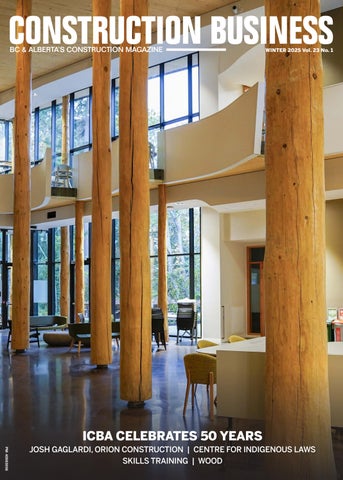
ICBA CELEBRATES 50 YEARS
JOSH GAGLARDI, ORION CONSTRUCTION | CENTRE FOR INDIGENOUS LAWS
SKILLS TRAINING | WOOD
![]()

JOSH GAGLARDI, ORION CONSTRUCTION | CENTRE FOR INDIGENOUS LAWS
SKILLS TRAINING | WOOD

Your projects. Your people.
All in one place.
Construction projects face unique challenges, but your tech stack doesn’t have to be one of them.
Procore connects your people, projects, and financials on a single platform, helping you manage 49% more construction volume per person* and achieve a 16% average reduction in rework*. Stop losing time and money. Start streamlining your projects and increasing profitability with a single source of truth.


*Based on a Procore study of its customers. Results are not guaranteed and may vary. 2022.

Josh Gaglardi, president of Orion Construction, has grown and expanded his company exponentially since he founded it only seven years ago.
The Centre for Indigenous Laws at the University of Victoria is a groundbreaking project for its architecture, sustainability, and commitment to Indigenous legal systems.
11 Open Shop
ICBA At 50: Growing With Purpose
The Strength of Open Shop
16 Skills Training
Supporting Indigenous Trades Talent
The Need For Safe Diverse Workplaces Strengthening the Skilled Trades Pipeline
19 Wood
Reducing Sustainable Construction Barriers The Best in Architecture Wood Design
04 Message from the Editor 22 The Legal File
Problematic Contract Provisions

Photo: The Centre for Indigenous Laws at the University of Victoria is a landmark project.
REPRINTS: No part of this magazine may be reproduced in any form — print or electronic — without written permission from the publisher. Requests for permission to reprint any portion of this magazine should be sent to the publisher.
Circulation Inquiries: 416.512.8186 ext. 232 circulation@mediaedge.ca


ICBA is celebrating its 50th anniversary, marking five decades of championing open shop construction. Since a small but passionate group banded together to advocate for the “right to work,” ICBA has grown and flourished to meet member needs through advocacy, training, group benefits, HR tools and more.
The milestone brings up my own memories of covering the ICBA for the first time under the leadership of Phil Hochstein, when construction relations were far more contentious than today. As a young reporter, it was trial by fire keeping up with someone who was never shy about sharing his views. We celebrate the anniversary by taking a look at ICBA’s success.
A big supporter of ICBA is Josh Gaglardi, president of Orion Construction. Ambitious,
young and with a clear vision, he has grown his company dramatically in only seven years. Read about his impressive achievements in our profile story.
On our cover is the Centre for Indigenous Laws at the University of Victoria. Opened this fall, the project is a landmark space that honours truth, reconciliation, and legal innovation.
Also inside this issue is our feature on skills training. While labour shortage solutions are not easy, building a more diverse workforce will be key, and that means increasing efforts to encourage women and Indigenous youth to explore the opportunities available in the sector.
Needless to say, 2025 was a challenging year but the industry is and always will be resilient. And with the Construction Payment Act receiving royal

assent in B.C., at least payment certainty is one step closer to reality.
Finally, as this is our last issue of the year, we want to wish everyone a great holiday season and let’s keep the industry growing in 2026.
Cheryl Mah Managing Editor


BY CHERYL MAH

Every true entrepreneur has a passion that becomes the driving force behind their vision. For Josh Gaglardi, it’s construction.
“I have a great passion for construction. I started working on construction sites when I was 13 and never thought of doing anything else,” he says. “My family is full of entrepreneurs. I always knew I wanted to start my own business one day.”
The Calgary native grew up in the Okanagan surrounded by a family of contractors and developers before attending the University of British Columbia. After graduating with a degree in economics in 2010, he spent two years at Northland Properties (founded by his uncle Bob Gaglardi) and began his career in project management. He then joined Integrated Construction in 2012 to build his skill set with a smaller company, eventually becoming director ofdevelopment.
In2018 — just before his 30th birthday — Gaglardi realized his vision by founding Orion
Construction, a design-build firm specializing in light industrial and commercial projects. He explains that he saw an opportunity in the industrial market to improve the traditional project delivery method with an integrated design-build approach.
“There weren’t really any contractors providing design-build in our market,” he says, who started the company with a team of four. “By being an expert at design-build and mastering it has given us a competitive edge. We control more of the process, so we can plan better and adapt faster.”
Since then, Orion Construction has grown exponentially, building projects from business parks to distribution centres and multi-tenant industrial.
Gaglardi credits timing, luck and the design build model, which includes design, permitting, preconstruction and construction all under one roof, as being pivotal to the company’s rapid growth. That success culminated in Orion being named Canada’s fastest growing company in 2022 by The Globe and

“Our strategy has allowed us to grab market share early and keep it,” says Gaglardi, whose business
acumen and achievements have also been recognized with multiple awards including EY Entrepreneur of the Year and Surrey Business Person of the Year.
Based in Langley, Orion is currently a team of 75 and service offerings have expanded into office, tenant improvement and multi-family throughout the Lower Mainland, the Interior and on Vancouver Island. The company has more than 10 million square feet of projects in the pipeline and hit $215 million in revenue.
“We’ve also expanded geographically. Last year we opened a 5,000 square foot office in Langford and we’re expanding to Calgary with that office opening in 2026,” says Gaglardi, adding he is also a principal of Astria Properties, a sister company that was named Small Business of the Year by the Greater Langley Chamber of Commerce. “Our focus is growing market share on the island, Lower Mainland, the Interior and Alberta.”
The company’s first multi-family projects in Langford are Aura, an 84-unit wood frame rental building and Impera, a 131-rental unit, six-storey wood frame building. They are also working on a new commercial retail centre called Arbutus Landing.
Other projects keeping the company busy include a 330,000 squarefoot automated food processing facility for Indian diary supplier Nanak Foods in Surrey in Campbell Heights; a 470,000 square foot. new selfstorage development in Langley; and the 243,000 square foot Bridgeport Central in Richmond.
Some signature completed projects are the Coastal Heights Distribution Centre in Surrey, Astria Hollywood in Kelowna and Holland Imports in Chilliwack.
“We have some very large, technically unique and complex projects. I’m involved from the start to the finish of each project,” says Gaglardi. Mentorship is also a big part of what he does. “I spend a lot of time mentoring and coaching our next generation of leaders. Seeing our people grow into leadership roles is one of the best parts of this job.”
Orion prides itself on its workplace culture which is centred on core values of accountability, unity, innovation and shared success. The company’s workplace excellence was recently recognized at the 2025 Greater Langley Chamber of Commerce Awards of Excellence.
Attracting and retaining good people has never been more critical, as the industry continues to struggle with a labour shortage.
“The shortage isn’t just about finding skilled trades; it’s about keeping good people and giving them a reason to stay,” says Gaglardi, pointing out their retention rate is 94 per cent. “We have a tremendous team and work culture here that is conducive to long term growth and opportunity.”
Gaglardi also gives back to the industry, sitting on the City of Surrey development approval task force and having served on the boards for NAIOP Vancouver and the Independent Contractors and Businesses Association (ICBA).
“These groups connect me with other leaders who care about moving the industry forward. It’s about sharing ideas and pushing for better standards across the board,” he says.


The ICBA is celebrating its 50th anniversary in 2025, and Gaglardi comes from a family with longstanding ties to the association. His grandfather “Flyin’ Phil” spoke at ICBA’s inaugural meeting in Trail in 1975 where more than 150 contractors gathered to form the association and champion the open shop model.
“My family has always been proponents of open shop construction and our support goes a long way back. My dad and uncle built the first open shop tower in downtown Vancouver in 1976,” he says. “Chris Gardner and his team do a fantastic job of advocating and addressing issues that benefit the industry, and there are a lot of risks and pressures right now.”
Gaglardi says the industry is facing a convergence of issues: interest rates, inflation, financing,
tariffs, supply chain and steep increases in development cost charges that impact the ability of projects to move forward.
“If builders, municipalities and associations can work together, we can fix a lot of the pain points that slow down housing and infrastructure delivery,” he says.
With so many challenges, what keeps him motivated?
“Connection — to my family, to my team, to the work and to the communities we build in. That sense of purpose is what drives me every day,” says Gaglardi. “There are so few opportunities where the work you do impacts the environment like construction. When you can drive by a project you built — nothing is more rewarding than that.”
BY CHERYL MAH

The Centre for Indigenous Laws (CIL) at the University of Victoria is a groundbreaking project. Opened in September 2025, the building — formerly known as the National Centre for Indigenous Laws — sets a benchmark for how thoughtful design and construction can bring the truth and legacies of Indigenous peoples to life.
Spanning 26,000 square feet, the new wing of the Fraser Building is culturally significant — built in the spirit of truth and reconciliation principles to house the world’s first joint degree in Indigenous legal orders and Canadian common law. The CIL will serve as a hub for critical engagement, debate, learning, public education, and partnerships centred on Indigenous legal traditions while also addressing legacies of past injustices. The design honours Indigenous values while using modern prefabricated building practices.
“This physical structure is a space where our laws, which enable us to be peoples, may be explored, taught and argued by Indigenous and non-Indigenous learners,” said Val Napoleon, Law Foundation chair in Indigenous Justice and Governance.
“Students are receiving a legal education like no other — they are critically engaging with, practising and theorizing about our laws, and in doing so, they are continuing to build the foundation for a multi-jurisdictional Canada.”
Chandos Construction worked closely with the university and the consultant team to reflect its Indigenous Plan in the design and construction of the building.
“There’s a purpose behind every detail of this building, which is dedicated to the study and practice of Indigenous laws,” says Tim Laronde, national director, Indigenous Strategies, Chandos Construction. “The team focused on inclusivity, sustainability and local needs to create a project
that benefits the community now and in the future.”
The project prioritized collaboration with local Indigenous communities, including the Esquimalt, Songhees, and W_SÁNEC Nations; hiring Indigenous contractors and incorporating sustainable practices that align with the Truth and Reconciliation Commission’s calls to action. Indigenous perspectives were integrated at every stage through extensive consultation.
The building incorporates mass timber construction, including exposed cross-laminated timber (CLT) panels and Douglas-fir glue-laminated timber beams. Trees felled were blessed by local Elders to honour their significance and connection to the land before being reused as mass timber columns for the building. Yellow cedar, western red cedar and Douglas-fir are used extensively in detailing and millwork.
To execute the complicated hybrid mass timber and steel structure, Chandos used BIM tools to identify any conflicts ahead of time to avoid delays. For example, OpenSpace, a 360-degree photo documentation tool, allowed remote consultants to track progress and resolve issues quickly.
For the erection process, Chandos developed a comprehensive moisture management plan to mitigate water ingress or moisture issues.
“The hybrid mass timber and steel structure required precision and innovation, and tools like BIM and OpenSpace allowed us to address challenges early, ensuring the project stayed on track. From moisture management plans for mass timber to designing ventilation systems for smudging ceremonies, every technical decision was made with care to honour the building’s purpose and the community it serves,” says Thomas Oster, senior project manager, Chandos Construction.
The design team of Two Row Architect in partnership with Teeple Architects and Low Hammond Rowe Architects played a large role in ensuring the project respected Indigenous knowledge and traditions.
The building features a prominent, double-storey atrium that connects to the existing Fraser Build-


The project is an example of what can be achieved through meaningful Indigenous engagement and community partnerships...
ing, creating a cohesive flow and integrated environment. There are public lecture theatres, faculty offices, classrooms, meeting spaces, a creation space, a sky classroom, a 150-seat lecture hall, an Elder’s room, and an outdoor learning classroom. The exposed timber structure and sloping roof mimics the height of the surrounding forest, connecting the building to its natural context while minimizing environmental impact.
Mohawk architect Matt Hickey of Two Row Architect says the new wing is infused throughout with Coast Salish teachings and legal principles. “The flora and fauna, the relationship to water, the importance of languags and how we speak to the world around us. There’s also witnessing, which is of Coast Salish culture and very much connected to law and the judicial system.”
The importance of honouring the land where the building is situated was at the forefront of all design decisions.
“As Indigenous leadership at UVic instructed us, ‘The building has to be a teacher, it has to be one of the professors.’ This building is already teaching, not only through its form, materials, and relationship to the land, but also through the collaborative process that brought it into being,” says Brian Porter, principal, Two Row Architect.
The project is targeting LEED Gold certification, reflecting the university’s commitment to building sustainably on campus. Features include: rain gardens, stormwater management, maximizing solar orientation, utilizing below slab HVAC, and ensuring the building uses 100 per cent electric energy. Additional energy savings are achieved through a high-performance building envelope and highly efficient mechanical and electrical systems. Chandos also diverted 83 per cent of waste from this project.
Another special feature is the building’s ventilation that has been designed to accommodate
smudg-ing ceremonies. It offers integrated controls with equipment designed to allow for quick filtration of smudging fumes following these ceremonies. The atrium space also offers natural ventilation.
“We have worked to create a structure that, like the natural world, offers guidance, stories and lessons to those who enter. Seeing the design principles from those first conversations now realized in construction is a powerful reminder that buildings can be living expressions of Indigenous knowledge, and that true collaboration — grounded in respect and reciprocity, is itself a form of learning and teaching,” says Porter.
The project is an example of what can be achieved through meaningful Indigenous engagement and community partnerships, and an important step towards calls to action.
“We’re thrilled to see the building come to life,” says Freya Kodar, Dean of Law. “The space will support our students and community by integrating Indigenous knowledge and legal traditions, helping enrich our programming and create a more inclusive learning experience, serving as a centre for conversation, research, education and training about Indigenous Law.”
It has already been recognized with an industry award, earning a 2023 Canadian Architect Award of Excellence for its Coast Salish design elements and focus on bringing the surrounding forest into the building. CIL also earned an Honourable Mention in the 2024 Architecture MasterPrize.
BY JORDAN BATEMAN

Here’s the truth about construction right now: nothing is simple, and everything is urgent. Housing shortages, stubborn permitting delays, inflation that squeezes every bid, a wave of retirements cresting just as demand for skilled people surges — our industry is being asked to build more, faster, and for less, with fewer people. That kind of pressure either breaks you or forges you. At ICBA, it forged us into Canada’s largest construction association.
Fifty years ago, on April 26, 1975, a small group B.C. contractors and entrepreneurs — open shop, independent, resourceful and determined — decided they were done being told to stand in the hallway while someone else got the contracts and carved up the work. They wanted opportunity and a level playing field, not special treatment. They wanted to compete. That impulse, born in a little hotel in Trail in 1975, still runs through everything we do. The open shop’s rise in British Columbia didn’t happen by accident; it happened because thousands of builders proved, project by project, that openness and competition creates opportunity and produces better value, safer sites, and faster delivery.
Today, 85 per cent of all construction workers in B.C. are employed by open shop companies. You can feel that shift on job sites, in the boardrooms of owners, and in the expectations of the public: more bidders, more ingenuity, more accountability. As the open shop grew, ICBA grew with it — with relevance and purpose.
When Chris Gardner became ICBA’s third president in 2017, he inherited that stubborn streak — and doubled down on it. “Independence means everything to us,” Gardner often says in his speeches. “In 50 years, we’ve never taken a dollar of government funding. Our credibility comes from telling the truth about what’s working and what’s not, and then providing the services our members actually need.” It’s hard to overstate how unusual that discipline is in an era when organizations too often chase grants before they drive results. The market is our report card. If what we offer helps contractors win work, train people, support their teams, and grow stronger businesses, we expand it. If it doesn’t, we kill it and try something better. That approach turned a plucky advocacy group into a modern, leading-edge business association —
one that moves at the speed of construction, not the speed of government. It also mirrors the open shop story. Independent firms grew because they were wired to adapt; ICBA grew because we wired ourselves the same way.
“We want to be the easiest ‘yes’ on a contractor’s desk because of our ability to help solve our members’ problems,” says Gardner. “If you call us with a challenge on a Tuesday, your team should feel the difference by Friday.”
Training is the clearest example of that mindset. Walk any busy site and you’ll hear the same plea from superintendents and project managers: give me people who can read the spec, manage the schedule, and solve problems without creating five more. ICBA training is our answer — a practical catalogue that shifts with the industry. Project management and construction law for folks trying to keep change orders from eating the margin. Estimating and cost control for sharpened bids. Leadership courses for people stepping into bigger roles. Digital tools and

...no company, union or association sponsors more apprentices in B.C. than ICBA.
workflows because BIM and field mobility are no longer “nice-to-haves.” And delivery that fits construction life in person when that’s best, live online when teams are spread thin, on-demand for the 9 p.m. “I need this now” crunch. The open shop needs upskilling at scale; so we built the pipeline for that. Apprenticeship sponsorship is the companion piece. Everyone has a speech about the shortage of people; we prefer paperwork and phone calls — the unglamorous work that helps our members turn “we should hire an apprentice” into “we registered three this quarter.” Small and mid-sized firms, the backbone of the open shop, don’t have a spare administrator to shepherd hours and records. We take that on so owners and apprentices can focus on learning, earning, and progressing. Layer in mentoring and clear pathways, and something powerful happens: apprentices become tradespeople, tradespeople become leaders, and companies gain the capacity to say “yes” to more work. The compounding effect is real, and it’s how an industry renews itself one person, one credential, one promotion at a time. And we now sponsor more than 3,000 apprentices; in fact, no company, union or association sponsors more apprentices in B.C. than ICBA.
Construction is also a culture — proud, resilient, and, at times, private. Too private when it comes
to mental health. ICBA Wellness exists to break that silence with practical tools that fit the job site: toolbox talks, supervisor guides, conversation starters that aren’t preachy or corporate, and confidential supports that people can actually use. We centre everything on this idea: a strong safety culture includes psychological safety. Burnout, addiction, and despair rob our industry of skilled people and families of loved ones. “If we can help one person take a step toward support, that’s a huge win,” says Gardner. “If we can help thousands, that changes our industry.” We’re pushing hard for the latter.
Benefits matter in that equation, too. Construction is mobile and cyclical; hour banks and seasonal rhythms are features, not bugs. ICBA Benefits was built for that reality, with plans contractors can use to recruit and keep talent, protect families, and promote wellness — without forcing a shop-floor business into an office-tower mold. The point is to remove friction. When benefits work in the background, owners can focus on bids and builds, and their teams can focus on work and life.
“We obsess over the customer experience because these are our members — the heartbeat of our association,” says Gardner. “Speed, clarity, and solutions. No waiting for hours for a service rep, no bad surprises.”
Of course, all the training and benefits in the world won’t fix a broken permitting system or a procurement policy that excludes the majority of the workforce. This is where ICBA’s advocacy still looks a lot like our founding moment — undaunted and unapologetic. We push for faster approvals, predictable and practical codes and standards, competitive tendering, and modernized procurement that maximizes competition. We call out rules that drive up costs, stall projects, or reward incumbency over performance. And we back it up with solutions, research, and coalitions — because government moves when broad alliancesof credible people agree on practical steps. “Our industry builds things,” says Gardner. “It’s time our policy and regulatory systems learned to build, not block.” If you want to see how far the open shop has come, just scan the community. The companies building towers, hospitals, schools, roads, and homes across B.C. are overwhelmingly independent contractors playing at the highest level. Owners learned that open competition produces sharper pencils and better outcomes. Taxpayers learned that value isn’t a slogan — it’s the difference between a project delivered and a project delayed. Meanwhile ICBA grew from a B.C. upstart into Canada’s largest and most dynamic construction association, andpushed east into Alberta. We employ more than 60 people — a
talented team fully dedicated to serving and supporting our members and clients. The parallel with the way open shop has grown isn’t accidental; it’s by design with our purpose in mind.
That growth also changed how we show up. We still take the tough meetings and make the tough cases, but we also build community. Events that bring ideas and people together. Research that gives our members and policymakers a clear view of what’s happening on the ground. Communications that cut through the noise and focus on outcomes. When the industry is this complex and the stakes are this high, being loud isn’t enough — you have to be relevant.
There’s a temptation, at an anniversary like ICBA 50, to wander through the museum of memories. We’re more interested in what comes next: demographics are shifting, technology is accelerating, capital is choosier. Communities expect more — and they should. Governments face fiscal constraints and should demand better value for every public dollar.
“Open shop is all about competition, fairness and performance,” says Gardner. “Fairness means everyone qualified gets a shot; performance means the best value wins. That’s how you build an industry, a community, and a country.”
That’s the thread that ties our history to our future. The handful of contractors that met in Trail 50 years ago didn’t set out to start a movement; they set out to win fair access to opportunity and

to work. In doing so, they unlocked a more dynamic, competitive, and innovative construction economy. Fifty years later, the open shop they championed is the centre of gravity in B.C., and the association they founded has grown into a modern partner that trains people, supports families, builds careers, and stands up for the conditions that let builders build.
At ICBA, we don’t know everything the future will throw at us, but we know who we are and how we help construction companies succeed.
We are clear-eyed about the challenges, impatient for solutions, allergic to complacency, stubborn about independence, and relentless in service of the people who put on boots, pick up tools, manage risk, and get things built. That’s ICBA — growing as open shop grows and inspired by our members’ grit and ambition.
Jordan Bateman is vice president - communications and advocacy at the Independent Contractors and Businesses Association.

BY JOCK FINLAYSON

As the Carney government works to accelerate the development of residential housing, industrial projects, and infrastructure across the country, the construction industry is in the spotlight. Construction is both a foundational industry and one Canada’s biggest, directly accounting for 7.58.0 per cent of economic output or GDP (depending on the year).
According Build Force Canada, in 2024 some 1.6 million Canadians earned their living in construction. Of these, Statistics Canada reports that approximately 1.2 million are “payroll” employees, with the rest consisting of independent contractors and small business owner-operators. It is sometimes overlooked how many people involved in construction fall into the latter category. For example, in 2024 there were 158,000 construction “employers” in Canada — defined
as businesses with regular payroll employees. In the same year, the federal government counted more than 250,000 “non-employer” construction businesses. Most of these are self-employed contractors, subcontractors and professionals or other small business owners.
An important feature of the construction industry is that outside of Quebec, a large majority of both employment and overall business activity takes place in the “open shop” sector. The term refers to labour models where businesses are not obligated to hire through unions or to follow contracts negotiated by legacy unions that once held sway over most of the Canadian construction industry — but no longer do so today. Open shop construction companies may have non-union work forces or have agreements with progressive, Canadian-based unions that aren’t part of the traditional group of Building Trades Unions (BTUs).
Using Statistics Canada data on union coverage by industry (see Statistics Canada, Table 14-10007001, Union coverage by industry, annual), ICBA estimates that roughly 80 percent of the national construction workforce outside of Quebec is non-union. (In Quebec, the comparable share is 38 per cent.) In B.C., around 80 per cent of construction payroll workers are non-union. In Alberta, the share is similar.
Generally, open shop construction dominates the residential segment of Canadian construction (90% plus of all construction workers), except in Quebec. Open shop also has a substantial presence in other parts of the construction sector — industrial, commercial, institutional and engineering/civil — in most provinces.
Research confirms that open shop construction has numerous economic advantages and provides sizable benefits for the purchasers of construction
and its members believe in opportunity for all, free enterprise, and fair competition.
services — whether they are private sector customers or operate in the broadly-defined public sector (e.g., government ministries and agencies, health care and education institutions, Crown Corporations, etc.). Lower direct costs — open shop contractors are more successful in containing total construction labour costs — resulting in savings for clients and taxpayers.
Flexible work arrangements — because they are not forced to rely on union hiring halls, open shop construction businesses can hire based on skills and experience. They also have greater scope to tailor crew sizes to maximize efficiency.
Specific training open shop construction companies can adopt training approaches that align with project needs, make use of in-house apprenticeship programs where appropriate, and build nimble partnerships with technical colleges and other training institutions.
Faster delivery the evidence shows that more flexible deployment of labour in open shop construction settings means fewer work stoppages along with more efficient project sequencing. The net result is faster delivery. Again, the clients benefit.
Increased competition — economists recognize that in any market, robust competition and wide choice in the provision and pricing of goods and services yields significant benefits for buyers and customers. Open shop construction embodies and embraces this basic principle. Encouraging competition in the bidding for construction work is far superior to the “closed tendering” models favoured by legacy unions and some large construction companies. This is especially true if those procuring construction services want to keep costs under control or — in the case of public sector buyers — are committed to protecting the taxpayers who ultimately pay for construction projects initiated by government-controlled institutions.
ICBA and its members believe in opportunity for all, free enterprise, and fair competition. The open shop construction sector lives these
values every day. When it comes to public sector procurement, ICBA opposes restrictive tendering, sweetheart deals, and other special arrangements that end up stifling competition and granting unwarranted commercial advantage to particular construction suppliers. As governments across the country grapple with large deficits and steadily mounting public sector debt, ensuring maximum value for hard-pressed taxpayers is vital and should be at the heart of smart public sector procurement policies and practices.


Canada today looks to be poised for a decade or more of increased investment to build new industrial projects, advance and refurbish infrastructure, and expand the supply of homes. In this environment, it is more important than ever that decision-makers across our economy leverage the commercial and operational strengths of open shop construction.
Jock Finlayson is chief economist at the Independent Contractors and Businesses Association.


BY LYNN WHITE

Across British Columbia, Indigenous apprentices are becoming a powerful force in the skilled trades sector, playing a vital role in shaping the province’s future workforce.
As major infrastructure and industrial projects continue to grow across B.C., demand for a diverse and skilled labour force has never been higher. In this changing landscape, supporting Indigenous apprentices requires breaking down systemic barriers, and partnering with industry to create meaningful career pathways.
With ongoing discussion about a shortage of trades talent, it’s important to consider Canada’s growing Indigenous population and potential talent from within this demographic. According to Statistics Canada, young people make up a larger proportion of the Indigenous population than in the non-Indigenous population. Also, the Indigenous population living in large urban centres grew by 12.5 per cent from 2016 to 2021 and the Indigenous population was 8.2 years younger, on average, than the non-Indigenous population overall.
A valuable resource that supports urban Indigenous Peoples build careers in skilled trades is ACCESS (Aboriginal Community Career Employment Services Society), an Indigenous led organization in Metro Vancouver.
Clients are supported with a culturally grounded model, hands on training, and strong partnerships with trade unions, certified training institutions and industry partners and organizations in construction and development industries. ACCESS guides participants from entry- level exploration to Red Seal Certification.
Indigenous Peoples are entering the trades at increasing rates. Data from Skilled Trades BC shows steady year over-year growth, with Indigenous apprentices now
making up a significant portion of active apprentices across the province. Even more inspiring is the rise in Indigenous women pursuing apprenticeships, challenging gender norms and leading change in traditionally male-dominated industries.
Fostering Indigenous apprentices requires more than registering students — it requires removing structural and personal barriers and creating culturally safe, supportive learning environments. Indigenous apprentices face challenges that impact their ability to complete training such as financial constraints and transportation barriers. Apprentices need to focus on learning and career advancement rather than worrying about basic survival needs.
Presenting opportunities to Indigenous Peoples is the first step toward building careers in the trades.
The ACCESS “Try-a-trade” programs and trade job fairs play a key role in recruitment by increasing awareness, while demonstrating that Indigenous participants can succeed in these fields. Ultimately, the promise of meaningful employment provides significant motivation — helping move the needle from poverty to economic stability.
Partnering with leading training institutions and offering structured apprenticeship pathways adds to the success of the students.
Embedding culture into training for Indigenous apprentices strengthens identity, belonging, and resilience leading to higher success and completion rates. When people ask how our non-profit team manages such a high success rate of 49 per cent of Indigenous trade apprenticeships in B.C., we tell them it’s all about providing culturally rooted training and support. By creating a space that honours and celebrates Indigenous identity, we give our clients the environment they need to learn, grow and succeed.
Creating partnerships with training institutes, industry, and unions ensure that Indigenous apprentices have access to:
• Apprenticeship seats.
• Job placements and hire-on opportunities.
• Union pathways and sponsorship.
• Culturally safe workplaces.
Employers benefit from a skilled, reliable, and diverse workforce, while apprentices gain access to longterm career opportunities with ample opportunity for advancement.
Indigenous apprentices are not only building careers— they are strengthening their families and communities. Apprenticeship roles provide strong wages, benefits, and clear pathways to advancement, including Red Seal Certification and supervisory positions. Many graduates return as mentors, instructors, and leaders in their fields and communities, inspiring younger generations to pursue trades careers.
The ripple effect is significant, resulting in increased financial independence, multigenerational household stability, greater representation in high-demand sectors, role models for youth and community members, while every successful apprentice contributes to breaking cycles of poverty, advancing Indigenous workforce sovereignty, and building longterm community prosperity.
By supporting Indigenous apprentices through culturally safe training, we are contributing to reconciliation in action ensuring that Indigenous people are represented, respected, and supported in the trades sector.
As demand for skilled trades rises—with tens of thousands of job openings forecasted over the next decade — Indigenous participation in apprenticeships will be essential to meeting labour market needs. ACCESS is committed to expanding programs, deepening partnerships, and ensuring that Indigenous apprentices have access to the full spectrum of opportunities.
With every successful Indigenous apprentice — every Level 1 completer, every Journey person, and every Red Seal — we strengthen not only the trades sector but also the cultural and economic fabric of Indigenous communities across B.C.
ACCESS is honoured to stand beside Indigenous apprentices as they build strong careers, healthier communities, and an enriched future for all.
Lynn White is president and CEO of Aboriginal Community Career Employment Services Society (ACCESS), a non-profit organization providing training and employment opportunities for Urban Indigenous Peoples across Metro Vancouver.
BY KRISTEN KEIGHLEY-WIGHT
On November 11, 2025, a Minnesota welder named Amber Czech showed up to work, as it if was any other day. But it wasn’t any other day, because this passionate 20-yearold woman never made it home. In the early hours of her shift she was brutally killed by a 40-year-old coworker who had been cited as saying he had been planning to do it because he “didn’t like her.”
Amber Czech’s death has reverberated across communities of trades workers, across borders, and, in particular, across networks of tradeswomen and gender-diverse workers in the trades.
This news has shaken the community because tradeswomen and gender-diverse trades workers know all too well what it feels like to work with the type of men who have made them feel unsafe.
As news of this event has spread, many have been reminded of the range of hate, harassment, discrimination, and violence they have faced. It has resurfaced challenging memories of the comments they’ve tried to ignore, the jokes they’ve had to call out, the bullying they’ve fought back against, the jobs they’ve left, and in some cases, it’s brought back memories of the incidents they couldn’t get away from.
Amber’s death was an extreme example of workplace violence, and of gender-based violence. It’s something no worker, no company, and no community should ever have to face.
This tragic event calls on every one of us to be accountable for the deeply challenging issues that continue to exist in the industry — that means doing more to prevent these extreme situations by addressing the smaller daily conditions that lead to incidents like this.
There are many layers to unpack. That includes needing to do more about workplace culture, mental health, psychological health and safety, and harassment and bullying.
It’s also about the numbers.
There’s an adage that comes to mind: there is safety in numbers. The flip side of that shared wisdom is that there’s also risk in isolation. And women and genderdiverse folks in the trades are regularly isolated.
According to the B.C. Construction Association’s Fall 2025 statistics, women still only represent 5.3 per cent of the construction trades workforce here in B.C. That’s a problem on many fronts.
First and foremost: the lack of gender diversity is a safety issue.
Being alone in a training classroom or on a worksite is hard. Sometimes it’s also dangerous — both physically and psychologically. Either way, both those realities are occupational health and safety issues that need to be addressed.
Whether it’s the tragic example of a workplace death, or the slow building trauma that comes from being made to feel different, or unwanted on a worksite, the isolation is hurting people we care about and causing the industry a lot of harm.

Secondly, there’s an economic argument to be made for more diversity, especially around hiring more women.
As we look at current workforce shortages, the anticipated impact of the looming waves of retirements, and the growing demand from federal and provincial commitments to invest in affordable housing and infrastructure, the construction industry needs people. And it needs people quickly.
Women and gender-diverse folks represent the largest untapped source of skilled trades workers. In fact, it’s hard to argue that we can meet both current needs and future targets without hiring more women and building a more diverse workforce to meet the demands.
Building that more diverse, stable, and profitable workforce means opening doors wider, and doing some tough work to help make it safer to help keep people working. But it’s worth it.
Study after study shows us that more diverse workplaces are more prosperous. They tend to report being more innovative and productive. They also attract and retain qualified and experienced workers more easily…and that saves money. Because constantly needing to hire and train people is costly, as is dealing with high absenteeism — especially when workforce shortages can lead to project delays.
So, investing now to make workplaces more diverse and safer for everyone is actually a long-term growth strategy…just as it is also fundamentally the right thing to do.
The companies who get in front of these issues first will prosper the most.
These companies become the preferred employers, and they spend less money on finding and training qualified and experienced workers. They’ll run their businesses with less absenteeism and lower turnover. They are more likely to have happier, healthier workers showing up each day.
So here’s the pitch: hire more women and genderdiverse workers. But don’t just hire one. Hire five, or 10, or 100… whatever matches the scale of your business. Make it the norm that every year you have more hardworking tradeswomen and gender diverse trades workers on your sites. Invest now in building this internal pool of diverse workers, knowing you’re building your organization’s future opportunities too.
Why? Because it matters and it makes sense.
The construction industry knows how to build structures, and it can also build lasting careers and communities for people. In fact, it’s been doing that, for some, for a long time. But now, in this moment of crisis and need — here in 2025 — companies have a choice, an opportunity, and a responsibility to be more inclusive. There’s a call out to everyone: create more diverse workplaces, where every single person can safely show up and put in a hard day’s work, knowing they will also make it home to their families at the end of the day.
Kristen Keighley-Wight is executive director of the BC Centre for Women in the Trades. At BCCWITT the goal is to support tradeswomen and gender-diverse workers in the trades, from the time they consider entering a trade through to the last day of their careers.
BY RORY KULMALA

British Columbia’s construction industry is a cornerstone of our economy and essential to the growth of our communities. Whether we’re building homes, hospitals, schools, or the infrastructure that supports everyday life, the skilled trades are at the centre of this work. Yet across Vancouver Island and throughout the province, we continue to face labour shortages that affect our ability to keep pace with demand.
The numbers are clear. The British Columbia Construction Association (BCCA) reports that more than 52,000 construction job openings are projected over the next decade. At the same time, more than 38,000 workers, nearly a quarter of the current workforce, are expected to retire. The industry is growing, but the workforce supporting it is aging, and incoming workers are not arriving quickly enough to replace those leaving.
Here on Vancouver Island, this challenge is amplified by demographics, cost of living, and competition for talent across sectors. Contractors see the impact directly: longer timelines, difficulty maintaining crews, and pressure on productivity. The ripple effects extend beyond our industry. When construction slows or becomes more expensive, housing supply tightens, infrastructure projects are delayed, and community development is constrained.
The skilled trades are not simply labour; they are a professional workforce with deep skill and pride. To sustain that workforce, we must attract, train, support, and retain people more effectively than we are today.
A longstanding perception challenge continues to limit recruitment. For too long, the trades were viewed as a second choice, an option outside of the post-secondary “default” pathway. Yet the reality is the opposite. Skilled trades careers offer stability, strong wages, entrepreneur-
ship opportunities, and the ability to meaningfully shape the communities we live in.
Today’s construction landscape is highly technical. Trades professionals work with digital modelling tools, advanced building systems, energy-efficient technology, and automation. These are careers that require problem-solving, precision, leadership, and a high level of expertise.
We need to tell that story more clearly, especially to youth, parents, career advisors, and educators. The trades should not be introduced as a fallback. They should be introduced as a competitive, rewarding firstchoice career.
VICA’s Construct Your Future program is one example of how we’re working to reshape this understanding. The program connects youth and career-seekers with apprenticeship pathways, work experience, job placement, and mentorship. We are seeing strong interest from young people who want hands-on work and the satisfaction of building something real and lasting. But awareness still varies widely, and we need to connect more consistently with schools, communities, and families to ensure young people understand the full scope of opportunities.
Apprenticeship is the foundation of skilled trades development, but it depends on employers who have capacity to train. Many contractors today are stretched thin. Training takes time and reduces immediate productivity, and for small and medium firms, who make up the majority of the industry, that can be a real challenge.
Government incentives are helpful, but apprentices also need support to stay in the industry. Cost of living, transportation, tools, and jobsite culture all play a role in whether someone sticks with the trades
long-term. Apprentices need mentorship, inclusion, and a sense of belonging, not just a pay cheque. This is why workplace culture and mental health matter. Our Tailgate Toolkit program, developed with Island Health and supported by the Ministry of Mental Health and Addictions, provides on-site training and resources to address substance use, stigma, and psychological safety in construction environments. Since its launch, the program has reached thousands of workers. It has made one message clear: retaining people is not just about wages, it’s about supporting people as whole human beings.
Immigration will continue to be essential in closing the labour gap. Many construction companies rely on internationally trained workers to maintain project schedules and workforce stability. Yet for both workers and employers, the credential recognition and settlement process can be slow and complicated. We need clearer, more efficient pathways so that skilled workers can contribute faster and employers can onboard them with confidence. The construction sector is ready to welcome newcomers; our systems need to better enable that transition.
No single group can solve the skilled trades shortage alone. Sustainable solutions depend on collaboration among industry, government, educators, and communities. The good news is that progress is already underway. Across Vancouver Island, we are seeing partnerships between industry, schools, and training providers expand. Dual credit programs are giving high school students a head start. Career fairs are growing. Job placement pipelines are strengthening. These are meaningful steps, but they must be continued and scaled.
The future of construction on Vancouver Island will depend on our ability to grow and sustain a strong skilled trades workforce. The challenges are real, but so are the opportunities. By elevating the perception of the trades, strengthening apprenticeship supports, fostering healthier workplaces, and improving pathways for internationally trained workers, we can build a workforce that is resilient, skilled, and ready.
The infrastructure we build today will support our communities for generations. The people who build it deserve our respect, our investment, and our support.
At VICA, we’re committed to ensuring they receive exactly that.
Rory Kulmala is CEO of the Vancouver Island Construction Association.
BY MATTHEW REID
Red tape has long been one of the biggest cost drivers in British Columbia’s construction industry. Now with housing demand at record highs, the province’s new permitting and prompt payment initiatives are giving builders a clearer path forward. These changes are more than just administrative fixes; they signal a positive shift that will lead to more definite timelines for project starts. This marks the beginning of a needed cultural shift towards efficiency, innovation, and collaboration in how multiresidential projects are approved, built and delivered.
For builders, predictability is everything. When approvals are delayed or payments lag, the entire construction ecosystem, from subcontractors to suppliers, feels the impact. By streamlining regulatory processes and introducing legislation that ensures faster payment cycles, the provincial government is taking tangible steps toward a more stable and transparent construction environment. This shift allows builders to plan with confidence, allocate resources effectively, and deliver housing more efficiently across British Columbia.
For multi-residential builders, time is often the most critical variable. Lengthy approval processes can add months or even years to project timelines, driving up costs and creating uncertainty for both developers and tenants waiting on new housing. The province’s new permitting initiative has the potential to dramatically reduce these bottlenecks by simplifying review stages, improving interdepartmental coordination, and cutting unnecessary duplication.
By reducing administrative delays, projects can move from design to construction faster, giving builders the ability to plan resources, secure financing, and lock in costs earlier in the process. The ripple effect is significant: fewer stalled projects, greater housing supply, and more confidence across the construction ecosystem.
These policy shifts signal an important step toward accelerating housing delivery and a more streamlined regulatory environment. The real impact will depend on how these policies are implemented. Sustainably built projects, using mass timber, often face higher upfront design and coordination costs, longer permitting reviews, and more complex approval processes. Efficient permitting and transparent, predictable regulatory processes can help reduce those initial barriers, making it easier to bring lower-carbon buildings to market.
What we hope to see now is follow-through, where these policy announcements translate into real outcomes on the ground: clear and consistent requirements across municipalities, dedicated permitting pathways that support sustainable construction methods like mass timber, and early coordination between builders, developers, trades, and regulators so these policy changes lead to real results.

A clearer, more predictable regulatory framework allows builders to innovate and integrate sustainable construction methods more efficiently...
Late payments remain one of the most persistent challenges in construction. They create cash flow strain across the supply chain and can slow or even stall project progress. The new prompt payment legislation is a welcome step toward improving financial stability across the industry by ensuring that contractors, trades, and suppliers are paid on time for completed work.
Predictable payment cycles allow builders to maintain momentum on-site, retain skilled trades, and strengthen relationships across the industry. For multi-residential projects that rely on coordinated schedules and overlapping scopes, this stability can be the difference between staying on track and falling behind.
The introduction of prompt payment reinforces collaborative partnerships and transparent communication, allowing all contributors, from subcontractors to suppliers, to plan more effectively and deliver higher-quality work. When payments flow reliably, trust follows, and that strengthens the entire ecosystem supporting housing delivery.
Together, streamlined permitting and prompt payment mark a meaningful shift in how British Columbia builds. By addressing long-standing barriers that have slowed project delivery and strained industry resources, these reforms create the foundation for a more resilient and efficient construction landscape. A clearer, more predictable regulatory framework allows builders to innovate and integrate sustainable construction methods more efficiently, including standardizing mass timber details that speed up manufacturing and installation, and plan with greater confidence. The impact is amplified through increased prefabrication, reduced rework on site, and faster structural assembly, resulting in multiresidential housing that meets both economic and environmental goals.
Matthew Reid is chief operating officer at Kindred Construction, a full-service construction company known for its experience managing complex multi-residential builds.
Projects are increasingly showcasing wood design, driven by advancements in mass timber technology, a strong focus on sustainability, and a growing appreciation for the material’s aesthetic and biophilic qualities. Architects are pushing the boundaries of wood design including two award-winning projects in B.C.
Designed by Patkau Architects and built by StructureCraft, the Fraser Mills Presentation Centre in Coquitlam is the gateway to a transformative 96acre mixed-use development.
It integrates a master plan info hub and two display homes under a sweeping, free-flowing roof form. The objective is to create an iconic destination that merges heritage with forward-thinking design, welcoming visitors to discover the future of Fraser Mills.
The centre serves as the sales hub for a new 5,500 home community along the Fraser River. Open for the next decade, the 660-square-metre building also anticipates a second life as a community amenity, extending its impact well beyond the initial development phase. Its design draws from the site’s legacy as the location of a sawmill, embedding references to timber, craft, and sustainability throughout.
The meticulously detailed wood structure serves as the centre’s primary aesthetic, enhancing the building’s appeal and promoting a sense of wellbeing of occupants.
The structure’s form responds directly to programmatic and site needs. A flexible, column-free interior accommodates evolving functions, while the roof’s undulating profile defines spaces for sales and display suites. Externally, a continuous westfacing porch and a 60-metre canopy create a welcoming presence, culminating in a dramatic cantilevered terrace to the south.
A robust wood structure anchors the project, realized through readily available materials including mass timber, lumber, and plywood. The roof geometry was rationalized into 26 unique glulam frames extending from a central spine to splayed columns of varying heights, refined through parametric modelling to balance structural efficiency, cost, and constructability. Prefabricated in one-bay modules, the system allowed for rapid and economical assembly on site.
In response to considerable seismic demands, the building incorporates an innovative structural solution — first of its kind in North America - that uses the building’s eight primary columns. Cantilevering from large concrete footings, these columns have substantial depth to counter the significant lateral forces. To counteract overturning moments and facilitate prefabrication, long threaded rods tie the columns to the footings. Composite construction


enables these rods, along with rainwater leaders, to be concealed within the column forms.
Parametric modeling was integral to the design and fabrication process, carefully balancing proportions, structural and material constraints, cost and constructability. The project leveraged a wide variety of software platforms to achieve this.

The Fraser Mills Presentation Centre in Coquitlam earned two 2025 Wood Design & Building Awards from the Canadian Wood Council (CWC): the Honor Award and a WoodWorks BC Wood Design Award. The Centre also won the inaugural 2025 Bing Thom AFBC Award.
Located on the UBC Okanagan campus n Kelowna, B.C., sʔitwənx is a 37-space child care centre whose name means “crane” in the Syilx language.
Inspired by Friedrich Froebel’s concept of “kindergarten” — part garden, part schoolroom — the design by Public Architecture creates a continuous edge to an indoor–outdoor play environment. Within this landscape, children encounter space at their own scale, moving between discovery zones that blend play, learning, and rest. A skylit timber structure evokes branching canopies, while Syilx artworks in the windows connect interiors to Okanagan stories and wildlife.
The site came with challenges, including mature trees and many underground services. The solution was a long, narrow building aligned east to west.
Wood was chosen for wellness, sustainability, and constructability. Its warmth, scent, and ability to moderate humidity create calming, healthy environments — important given children’s elevated sensitivity to air quality. Exposed timber minimizes the need for applied finishes and exterior insulation prevents thermal bridging, ensuring efficiency while allowing the wood structure to remain visible.
The 3,660 square-foot structure employs exposed pre-engineered wood trusses paired with conventional timber detailing. Organized on a 610 mm module, six truss types articulate primary and secondary spaces. Dimensional lumber walls and trusses provided flexibility during construction, enabling carpenters to accommodate mechanical systems, while their exposed finish creates durable surfaces for children’s activity and display. The system was erected in just three weeks, underscoring both efficiency and long-term adaptability.
By distributing the program into overlapping discovery zones beneath a rhythmic timber roof, sʔitwənx transforms a cellular child care model into an immersive, flexible environment where wood supports both architectural expression and child well-being.
Public Architecture + Design received double honours for the project with a 2025 Wood Design & Building Award citation and a WoodWorks BC Wood Design Award.


Other 2025 WoodWorks BC Awards winning projects:
• Adams Lake Health + Wellness Centre (Chase, BC) | Unison Architecture Ltd.
• Kin Park Pavilion and Ice Rink (Fort St. John, BC) | Public Architecture + Design
• Point Grey House (Vancouver, BC) | Patkau Architects.
BY J. MARC MACEWING
Construction contracts and subcontracts contain similar provisions addressing critical matters such as scope of work, payment and scheduling. However, the format and wording of contracts and subcontracts vary widely, because not every project utilizes standard forms such as the CCDC or CCA sets of documents. The range of alternative contractual documents stretches from the simple formats of letter or other short form agreements, to more or less detailed purchase or work orders, to customized and specialized forms, of varying lengths and detail.
Construction contract documents that are not standard forms also vary in their levels of clarity and completeness, usually depending in part on whether legally trained persons have been involved in drafting them. Their content may also be affected by the intentions of the parties that prepare them, if they seek to reallocate the usual distribution of construction risk in a manner favourable to the drafting party.
Unclear or one-sided contracts can result in unanticipated and undesirable risks of liability. It is preferable that they be avoided. If they cannot, a party that is having such a contract imposed on it should try to negotiate mitigation of the contract’s most problematic aspects. At the least, it is strongly advisable that proposed contracts and subcontracts be closely considered and analysed prior to signing them, so that it can be determined whether their potential benefits are worth the risk, so that if signed, it will be in full knowledge of the liabilities that they entail. Care and if necessary the willingness to incur legal expense to assess such risks proactively before signing a construction contract can avoid exposure to liability and even more legal expense if contractual disputes arise later.
Certain types of contractual provisions perennially give rise to unbalanced construction risk, potential complications and liability exposure in disputes. They include:
1. Indemnities with broad scope in favour of the payor, including those requiring the payee’s indemnity of third parties such as consultants and payment of an indemnified party’s full legal expenses.
2. Limitations of liability that favour the payor, including the exclusion of consequential damages such as loss of profit in the case of termination without cause by the payor or termination with cause by the payee.
3. Unrealistically short notice periods, in particular with respect to delay claims.
4. Purported exclusion of builders lien rights, typically by way of a provisions requiring the discharge of all liens including the contracting party’s own lien (although such a provision will be unenforceable under the British Columbia Builders Lien Act).

Unclear or one-sided contracts can result in unanticipated and undesirable risks of liability.
5. The imposition of holdbacks additional to builders lien and deficiency holdbacks, usually intended to obtain additional security for performance by the contractor or subcontractor.
6. Imposition of criteria additional to the requirements of the Builders Lien Act for recognizing substantial performance of the contract or subcontract.
7. Pay when paid and pay if paid provisions in subcontracts, which intend to make a subcontractor’s entitlement to payment conditional on circumstances existing between the contractor and the owner, with which the subcontractor has no involvement nor control.
When faced with a problematic contractual provision, it is recommended that it be analysed to identify how it varies from the provisions of standard form contracts, to consider why such variance may or may not be reasonable in the circumstances of the project, and to assess whether the provision may be acceptable even if it is not strictly speaking reasonable. Whether or not an unreasonable provision can be negotiated away or its negative effect reduced by amendment will of course be a function of the willingness of the other party to be flexible. If neither of those goals can be achieved, then a knowledgeable business decision can be made as to whether it is worth the risk to take on the contract.
The inclusion of problematic provisions in construction contracts will play out in accordance with the operation of the following principles of contract law:
1. An unambiguous contractual provision will be enforced, unless it involves illegality. That is, the arguable unfairness of a clearly worded contractual provision freely entered into by a commercial entity with unimpaired contractual capacity will not provide a basis for it to avoid the enforcement of the provision. This approach will apply, for example, in the case of a subcontractual pay when paid or pay if paid clause, if it is interpreted as clearly showing the parties’ intention to make the contractor’s liability to pay the subcontractor conditional on the contractor’s receipt of payment from the owner.
2. Generally, schedule extension or additional compensation for delays caused by reasons not attributable to the claiming party will in principle require not only that party’s entitlement on the merits of the claim, but also its compliance with the prescribed procedural requirements for making such a claim, in particular the provision of timely notice of claim as specified by the contract or subcontract.
J. Marc MacEwing is associate counsel at Clyde & Co Canada LLP in Vancouver.


A valuable BCCSA platform for new applicants and designation holders. Join us monthly for expert support, industry updates, and networking to stay current in construction health and safety.

• Welcome & Introduction
• CONNECT Session Topic
• Industry Updates (WorkSafeBC) & Trends
• Best Practices in Health & Safety
• Tailored Advice & Support
• Q&A
