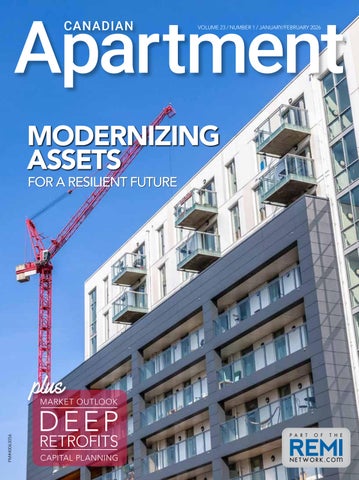
CAM Jan/Feb 2026

Page 1


MODERNIZING ASSETS

FOR A RESILIENT FUTURE

Yes, we can !

Since MetCap Living established itself as a leader in property management, we have routinely been asked one, simple question; “Can you help us run our property more effectively?” And, for well over thirty years, the answer has remained — Yes, we can! Our managers are seasoned professionals, experienced in every detail of the day to day operations and maintenance of multi-unit rental properties. From marketing, leasing, finance and accounting, to actual physical, on-site management, we oversee everything.

We concentrate on revenue growth, controlling expenses, and strategic capital investment in your property to maximize your profitability over the long term when you’re ready to discuss a better option; we’ll be there. You can count on it.

Office: 416.340.1600

Cell: 647.887.5676

k.m.shahnewaz@metcap.com

www.metcap.com

/cammediaedge

/cdnapartmentmag /mediaedgecam

STABILITY THROUGH EFFICIENCY

The Canadian rental housing market is entering unfamiliar territory as we begin 2026. Rent growth has cooled, demand has softened, and economic uncertainty continues to weigh on new development. At the same time, the country’s apartment stock is aging at a pace that can no longer be ignored. Decades of deferred investment have left many buildings struggling to meet today’s expectations for comfort, efficiency, and resilience.

In this environment, retrofits and asset improvements are no longer discretionary — they are fundamental to the sector’s stability and competitiveness. In our cover story on page 16, Skyline Apartment REIT discusses how a sustained commitment to portfolio modernization helped it maintain stability in 2025 and will continue to drive its longterm performance in the years ahead. Not only do strategic upgrades extend the lifespan of aging assets, but they also improve operational performance, enhance resident satisfaction and position owners to navigate regulatory change with confidence — all wins, especially in the current market. But just as importantly, modernization helps support housing affordability: more efficient buildings are cheaper to operate, which helps stabilize rents over time.

In this issue, we also feature some of the award-winning renovation projects honoured at last year’s FRPO MAC Awards and share tips and strategies for keeping your insurance premiums from rising. We hope you enjoy the issue and look forward to keeping you informed of all the daily news impacting the sector at RemiNetwork.com.

Sincerely,

Editor Erin Ruddy

Art

Graphic

Production

Contributing Writers Drew Fenton

National Sales Andrea Almeida Ron Guerra

Digital Media Director Steven Chester

Circulation Adrian Holland For sales information call (416) 512-8186

Group

Subscription

for permission to reprint any portion of this magazine should be sent to Erin Ruddy.

Authors: Canadian Apartment Magazine accepts unsolicited query letters and article suggestions.

Manufacturers: Those wishing to have their products reviewed should contact the publisher or send information to the attention of the editor. The opinions expressed are those of the authors of articles and do not necessarily reflect the views of Canadian Apartment Magazine. This information is general and is not a substitute for legal advice.

Sworn Statement of Circulation: Available from the publisher upon written request. Although Canadian Apartment Magazine makes every effort to ensure the accuracy of the information published, we cannot be held liable for any errors or omissions, however caused. Printed in Canada.

rent trends TOP 5 REASONS TO INVEST IN BUILDING UPGRADES

91 Pippin Road, Concord, ON L4K 4J9

91 Pippin Road, Concord, ON L4K 4J9

Tel: 905-660-2353 / 905-669-8888

Tel: 905-660-2353 / 905-669-8888

Toll Free: 1-888-660-2353

Toll Free: 1-888-660-2353

Fax: 905-660-8390 / 1-888-660-8390 sales@multitech2000.com

Fax: 905-660-8390 / 1-888-660-8390 sales@multitech2000.com

Ruddy

RENTAL MARKET INSIGHTS

Investor interest remains resilient despite softer demand

Rental housing demand has moderated across most major markets in Canada, influenced by lower federal immigration targets and ongoing economic uncertainty related to tariffs. According to Keith Reading, Director of Research at Morguard, tenants are increasingly prioritizing affordability, prompting some owners of newly built properties to reduce asking rents.

“As in 2025, landlords in key markets are offering incentives to attract prospective tenants, who now have a wider range of options,” he said. “In cities like Toronto, the balance has shifted in favour of renters, with more available units and softer rents.”

Tenant turnover also remains low, as many existing renters choose to stay put to avoid higher rent costs. Even so, overall market conditions remain relatively healthy, despite rising vacancy rates and more moderate demand.

Investment trends

Investor appetite for purpose-built rental properties continues to be strong, supported by expectations of solid medium to long-term performance. Acquisition pricing has largely stabilized, with premium values still being paid for new developments and well located concrete high-rises. Demand for high-quality, stabilized assets continues to outpace supply, sustaining a competitive bidding environment.

Source: Morguard

Yardi

forecasts stable yet vulnerable market in 2026

According to a new report from Yardi, Canada’s multifamily housing sector entered 2026 on unsteady footing after a year marked by slowing rent growth, softening demand and persistent affordability pressures. High prices and economic uncertainty kept overall housing activity muted; single-family home values declined in expensive markets like Toronto and Vancouver, while multifamily rent growth slowed sharply across most of Canada, rising just $9 on average in Q4 2025. Halifax, Montreal and OttawaGatineau posted the strongest gains, while Calgary saw a 1.3 per cent decline.

Housing supply trends offered mixed signals. Deliveries in the six largest metropolitan areas totaled 94,611 units through November 2025, up slightly from the previous year but with notable declines in several major markets. That said, apartment construction starts surged, with more than 122,000 units underway in the first three quarters of 2025, representing an 8.1 per cent increase and positioning the country to surpass 2024’s record pace. Apartments accounted for 68.5 per cent of all housing starts, underscoring the sector’s long-term importance despite its near-term fragility.

To download the full report, visit https://info.yardi.com/multifamily-marketreports-for-canada.

Consider the following:

• Who will represent your best interests?

• Who will give your property maximum exposure?

• Who will deliver the highest value for your Property/Portfolio?

With over 35 years of experience, tens of thousands of units sold, and hundreds of clients represented, we have consistently delivered superior results. Through our local and national coverage, we create maximum exposure, ensuring maximum value for your property.

For more information on recent transactions and active listings, please reach out to a member of our team.

For more info, please contact: David Montressor Vice Chairman

Sales Representative (416) 815-2332 david.montressor@cbre.com Tom Schuster Director Sales Representative (416) 847-3257 tom.schuster@cbre.com

FUNDING REPAIRS THROUGH FLEXIBLE LOANS

Tools and resources for deep energy upgrades

Canada’s push toward a more sustainable and climate resilient housing sector is gaining momentum through the Canada Greener Affordable Housing (CGAH) program — an ambitious $1.2 billion federal initiative launched in 2023 to help community housing providers modernize aging buildings while keeping rents affordable for low and moderate income households.

CGAH supports deep energy retrofits in multi-unit residential buildings, enabling housing providers to reduce energy consumption, cut greenhouse gas (GHG) emissions, and prepare homes for the growing impacts of climate change.

“Canada Greener Affordable Housing is the kind of program we need more of,” said Majid Jowhari, Member of Parliament for Richmond Hill. “With this program, the Government of Canada is, at once, strengthening our country’s affordable housing stock while also getting us closer to net-zero carbon emissions.”

The program offers a flexible mix of funding tools designed to help non-profit and community housing providers undertake deep energy retrofits. Support includes contributions for pre-retrofit planning — such as energy assessments and project preparation — along with forgivable loans that reduce financial barriers and low interest loans that help finance major retrofit work and long-term climate adaptation measures.

CGAH can cover 100 per cent of eligible retrofit costs, up to $170,000 per unit through a combination of low interest repayable loans and forgivable loans. The forgivable portion is capped at the lesser of $85,000 per unit or 80 per cent of eligible retrofit costs, with low interest loans available to finance the remaining amount. For pre-retrofit activities, the program provides up to $130,000 per project.

Upgrading Squamish’s Tantalus Manor

Benefitting from the program, Tantalus Manor — a 40-unit affordable housing building at 1098 Wilson Crescent in Squamish, BC — recently received more than $4.9 million in CGAH funding for upcoming critical upgrades. According to Hiýáḿ ta Skwxwú7mesh Housing Society and Squamish Community Housing Society, the retrofit project represents a comprehensive overhaul of the building’s energy systems and envelope. Planned upgrades include: converting the building from gas to electric heating and hot water; installing energy recovery ventilators and heat pumps in every unit; replacing all windows and doors to improve insulation and reduce heat loss; and enhancing overall air circulation, humidity control, and cooling capacity.

Once complete, tenants will benefit from improved indoor comfort, better temperature regulation, and access to air conditioning — an increasingly important feature as extreme heat events become more common. The upgrades

Raising the Bar on Energy Efficiency

Trilogy on King, managed by Rhapsody Property Management Services, earned a standout achievement at last year’s National BOMEX Conference in the Multi-residential Buildings category. This distinction highlights more than just operational success. According to Scott Rouse, Managing Partner at Energy@Work, the award reflects a deep commitment to environmental responsibility, resident well-being, and industry-leading building performance.

“Winning at the national level signals that Trilogy on King in Toronto not only meets the current standards but exceeds them in ways that now sets the benchmark for residential property management across the country,” he said. “It’s a testament to the collaboration between management, staff, and residents, all contributing to a healthier, more efficient, and more resilient living environment.”

As one of Canada’s most respected sustainability certifications for buildings, the BOMA BEST program evaluates everything from energy efficiency and water conservation to waste reduction, indoor air quality, and community engagement. The award also shines a light on the proactive approaches to innovation — which in Trilogy on King’s case, included implementing sustainable building upgrades, optimizing day to day operations, and fostering a culture where environmental stewardship is part of every decision.

“Achievements like this don’t happen by accident,” Rouse said. “They’re the result of vision, consistency, and a genuine commitment to modernization and doing things the right way. A well earned congratulations to everyone involved.”

Save on Energy Retrofit Program

For multi-residential property managers looking to implement a retrofit project, Rouse suggests seeking out financial incentives available through Save on Energy. Eligible projects are generally those that provide sustainable, measurable and verifiable reductions in peak electricity demand and electricity consumption. Examples include:

ƒ Existing building commissioning (EBCX)

ƒ solar photovoltaic systems

ƒ computer room air conditioners

ƒ industrial energy management information system

ƒ network lighting controls

ƒ HVAC redesign

ƒ chiller replacement

ƒ variable-speed drive installations

ƒ custom equipment retrofits

Visit Save on Energy today or email Scott.Rouse@Energy-Efficiency.com to discuss opportunities for your property.

are also expected to reduce operating costs, helping the non-profit owners maintain long term affordability.

The Tantalus Manor project is supported not only by CGAH federal funding but also by local partners committed to preserving affordable housing. Vancity, through its Non-Profit Housing Retrofit Program, provided grants for retrofit planning and implementation support.

“Preserving existing affordable housing is just as critical as building new homes,” said Wellington Holbrook, President and CEO

of Vancity. “Vancity was proud to support Squamish Community Housing and Hiýáḿ ta Skwxwú7mesh Housing Society on the Tantalus Manor project. Significant programs like the Canada Greener Affordable Housing Fund play a vital role in enabling non-profit housing providers to move retrofit projects forward, and we’re pleased to complement that investment with flexible, stackable funding that helps protect long-term affordability while improving the sustainability and comfort of homes for residents in Squamish.”

Repairing homes in Metro Vancouver

Meanwhile, the federal government and Metro Vancouver announced nearly $36 million in combined funding to repair and renew 715 homes across the Metro Vancouver Housing portfolio. The investment is being delivered through the Affordable Housing Fund (AHF), a $16.1 billion program under the National Housing Strategy that supports both the construction of new affordable housing and the repair and modernization of existing units.

According to CMHC, the funding will support

repairs across nine properties — three in Surrey, two in Richmond, and one in Burnaby, North Vancouver, Port Coquitlam, and Coquitlam. Eleven projects all-tolled will deliver high performance building envelope upgrades, deep energy retrofits, improved community spaces, and replacement of cladding, windows, balconies, roofing, mechanical systems, and common area flooring.

Work is expected to be completed between 2026 and 2028, extending the lifespan of these homes while improving comfort and energy efficiency for residents.

Accelerating housing supply through HAF

Over the last two years, funding agreements through the Housing Accelerator Fund (HAF) have incentivized and rewarded local governments for being ambitious in their approaches to increasing housing supply and accelerating development timelines.

Local governments who received funding in the first year of the program issued 160,585 residential building permits — 22,000 more than expected — illustrating the potential of HAF to cut through red tape and fast-track housing development.

In January, the government launched the HAF Progress Tracker to enhance transparency and accountability. The new tool allows the public to monitor HAF progress in communities across Canada, offering a comprehensive overview of results. Building on the publication of HAF Action Plan Summaries for large and urban municipalities, the HAF Progress Tracker further increases visibility into the work local governments are undertaking to meet the commitments outlined in their HAF agreements.

Visit www.cmhc-schl.gc.ca/professionals/ project-funding-and-mortgage-financing to access the tracker.

CANADA’S NATIONAL LEADER IN COMMERCIAL CLEANING

For nearly 40 years, WhiteRose Janitorial has been a trusted name in commercial and condominium cleaning across Canada. What started as a family-run business in 1986 has grown into a national provider, delivering reliable, high-quality cleaning and superintendent services from coast to coast.

WHAT SETS US APART?

At WhiteRose, we don’t believe in one-size-fits-all solutions. We work closely with our clients to develop customized cleaning and maintenance programs that meet the unique demands of each property. With a focus on e ciency, quality, and environmental responsibility, we ensure every space is maintained to the highest standards.

Our team is trained to handle complex cleaning challenges, rapid response needs, and day-to-day property maintenance, making us a preferred partner for property managers and owners nationwide.

PARTNER WITH US

WhiteRose Janitorial enhances cleaning standards while optimizing schedules to reduce costs compared to your current service provider. Better cleaning, smarter savings. Contact us today!

4.8

450+ reviews

• Janitorial & Floor Care – Tailored cleaning schedules, floor maintenance, and sanitation programs

• Specialty Cleaning – Garage cleaning, pressure washing, postconstruction cleanup, and more

• Superintendent Support – Livein & live-out services, emergency response, minor repairs, and building maintenance

Winning approaches to capital upgrades in rental housing Reinvesting for the future

The winners of the 2025 FRPO MAC Awards, announced in Toronto during The Buildings Show in December, offer a clear snapshot of how capital upgrades are reshaping the province’s rental housing landscape. Last year’s standout projects highlight a defining reality as we head into 2026: strategic capital improvements are essential to sustaining long-term asset performance in this era of economic uncertainty and heightened competition.

Across the renovation and capital investment categories, leading rental housing operators were recognized for projects that not only modernized their aging apartment buildings but also fundamentally repositioned them. The initiatives demonstrate how targeted spending on suite upgrades, infrastructure, amenities, and building systems can extend asset life, elevate the resident experience, and strengthen competitiveness in a tightening market.

Fitzrovia won two awards for Best Amenities – Renovation for Maddox in Cabbagetown and Best Amenities – New Development for Sloane in Toronto, reflecting the company’s focus on curated, lifestyle-driven spaces that enhance property value.

According to Adrian Rocca, CEO & Founder of Fitzrovia, the company’s modernization efforts reflect a broader industry shift toward capital improvements that enhance functionality, efficiency, and resident appeal.

“We are reimagining the rental housing experience by creating purpose-built rental communities that elevate everyday life,” he said. “The work we do for our valued residents is guided by a clear philosophy: thoughtful design, long lasting quality, and exceptional service drive everything we do. These three pillars represent The Fitzrovia Standard. This commitment has shaped our award-winning renovation program at Maddox Cabbagetown and our standout amenity program at Sloane.”

Greenwin, in collaboration with GWL Realty Advisors, earned the Best Lobby Renovation award for recent work completed at 2160 Lakeshore Road. The revitalized space now features a warm and inviting fireplace, upgraded elevator corridors, contemporary lighting, durable finishes, and a bright, welcoming atmosphere, with the award marking an exciting milestone for its newly established Capital Projects and Asset Enhancement Department. For Best Suite Renovation Over $50,000, Minto Yorkville took home the prize — an achievement that underscores the rapidly rising expectations for upgraded spaces that best meet the needs of today’s residents. Collectively, these winning projects demonstrate how strategic capital investments are a priority in today’s market characterized by modest growth and elevated operating expenses. Rather than pursuing comprehensive, large-scale overhauls, building owners are advised to consider focusing their efforts on the following key areas:

1. Energy efficiency & utility reduction projects

These improvements support the industry’s shift toward disciplined, long-term cash flow management. Common investments include high-efficiency HVAC replacements, LED lighting retrofits, low flow plumbing fixtures, smart thermostats, and building-wide energy management systems.

2. Building envelope & structural improvements

As many markets absorb a wave of new deliveries, older assets must compete on durability and comfort. Typical projects include roof replacements, window upgrades, insulation improvements, and exterior repairs. Municipalities such as Toronto continue to emphasize state of good repair (SOGR) spending, further reinforcing this trend.

3. Targeted unit interior modernizations (not full gut)

These upgrades are typically completed during natural turnover rather than through large-scale repositioning. Investors are opting for surgical interior improvements that boost rent without overspending — such as upgrading to stainless-steel appliances, solid surface counters, modern cabinet fronts, LVP flooring, and in-unit laundry where feasible.

4. Technology & automation enhancements

Driven by labour shortages and the need for operational efficiency, more owners are investing in technologies that help properties stay competitive as renter expectations evolve. Self-guided touring systems, smart locks and access control, package lockers, and delivery management solutions are all gaining traction.

5. Amenities that support tenant retention

With tenant retention becoming increasingly valuable, older properties must compete with newer, purpose-built rental developments that offer state-of-the-art amenities. Popular upgrades include fitness centre refreshes, co-working lounges, outdoor social spaces, and improved WiFi infrastructure.

6. Safety, security & compliance upgrades

To maintain insurance coverage and meet rising security standards, many owners are investing in enhanced lighting, security cameras, access-controlled entries, and modernized fire/life safety systems.

7. Affordability driven renovations

In markets facing affordability pressures, some investors are prioritizing upgrades that reduce their long-term maintenance needs, support moderate rent increases, and align with available government incentives.

Congratulations to the 2025 MAC Award Winners:

Best overall developments:

ƒ Rental Development of the Year –Secondary Market Homestead Land Holdings Limited, The Shipman II, St. Catherines

ƒ Rental Development of the Year –200 Units or Less The Rose Corporation, The Bakerfield II, Newmarket

ƒ Rental Development of the Year

– Over 200 Units Dream Asset Management Corp, Kilmer Group & Tricon Residential, Birch House at Canary Landing, Toronto

ƒ Best Amenities – New Development Sloane by Fitzrovia, Toronto

Marketing & Communications:

ƒ Social Media Award of Excellence Fitzrovia — Sloane by Fitzrovia

ƒ Best Advertising Campaign Minto Apartments — “At 88 Beechwood, people are welcome, too”

ƒ Best Property Management Website Fitzrovia — www.sloanelife.ca

Renovation & Capital Improvements:

ƒ Best Suite Renovation Under $50,000 Dream — 177 St. George, Toronto Contractor: Sky Group of Companies

ƒ Best Suite Renovation Over $50,000 Minto Apartments — Minto Yorkville, Toronto Contractor: Sky Group of Companies

ƒ Best Lobby Renovation of the Year Greenwin Corp. & GWLRA — 2160 Lakeshore Road, Burlington

ƒ Best Amenities – Renovation Maddox by Fitzrovia — Cabbagetown, Toronto

People & Professional Excellence:

ƒ Leasing Professional of the Year Marlene MacFarlane — Canadian Apartment Properties REIT

ƒ Resident Manager of the Year Adam McGuin — Equiton Living Corporate & Community Awards:

ƒ Company Culture Award of Excellence Skyline

ƒ Customer Service Award of Excellence Tricon Residential

ƒ The Impact Award Starlight Investments

RESILIENCE BY

How a focus on modernization continues to drive Skyline Apartment REIT’s long-term performance

DESIGN

The past year tested the fundamentals of Canadian multi- residential real estate. Slower population growth, federal immigration reductions, and a surge of newly completed rental supply softened demand and pushed many markets closer to equilibrium. Yet even in this more challenging environment, Skyline Apartment REIT continued to show resilience, supported by what it calls “a disciplined approach to property acquisition and management.”

The REIT’s long standing strategy — refined over nearly two decades — remains anchored in a sustained commitment to portfolio modernization.

According to Skyline Apartment REIT’s leadership team, the approach centres on several core principles: maintaining a carefully curated portfolio, investing in retrofits and property level improvements, and continually enhancing the tenant experience.

“Despite the trade-related uncertainty and broader economic challenges of 2025, we saw that purpose-built properties in many smaller markets maintained solid performance, posting strong annual rent growth,” said Matthew Organ, President, Skyline Apartment REIT. “For us, it reinforces the importance of focused asset selection over time.”

That focus — combined with the REIT’s broader modernization efforts — not only helped the REIT maintain stability through 2025 but outperform many of its peers. Occupancy remained strong at 95 per cent, and in-place rents across the portfolio rose 5.89 per cent by the end of Q3 2025, outpacing the national multifamily average of 4.8 per cent recorded the previous quarter. Today, with more than $5.2 billion in assets under management and plans for further growth in 2026, the REIT emphasizes modernization as a key part of its success.

Positioning the REIT for resilience

To the Skyline Apartment REIT team, modernization begins at the portfolio level. Acquisitions focus on new-build assets, value-add

opportunities, and selective development or intensification projects. With this balanced strategy, Skyline asserts it can modernize its portfolio while preserving strong performance for its investors.

“We’re constantly looking at how each decision contributes to the REIT’s long-term resilience and adds value for our investors,” said Organ. “That includes expanding in markets that demonstrate sustainable growth.”

The REIT’s acquisition strategy is rooted in:

• Buying in markets with favourable demographics and supply–demand balance

• Overall geographic diversification to strengthen economic resilience

• Geographic centralization in select areas where it enhances operational efficiency

• Attracting and retaining high-quality tenants through portfolio modernization

Reflecting this approach, in 2025, Skyline added properties in Nanaimo, British Columbia; Guelph and Windsor, Ontario; and Mascouche, Quebec — all communities with strong demographic trends and rising rental demand. In some cases, new assets expanded existing properties, such as North Point Apartments in Nanaimo (now five buildings and 300 suites) and Quartier 7 in Mascouche (now eight buildings and 657 suites), reinforcing the REIT’s confidence in those markets.

Strategic dispositions also remain an important tool for the REIT, allowing it to free up capital and redeploy it toward stronger, longterm prospects. In 2025, Skyline sold properties in Edmonton and Sherwood Park, exiting Alberta in October. Its most recent sale in January was Carlsie Tower, a 34-suite property in Windsor, where it remains a prominent rental housing provider with 31 properties and 2,254 suites.

“Although we plan to maintain a large footprint in key growth markets like Windsor, our sale of Carlsie Tower exemplifies how we evaluate each property individually and will sell when doing so optimizes the portfolio,” Organ said — adding that this acquisition strategy plays a key role in modernization. “By concentrating on markets with proven resilience and growth potential, we are better positioned to weather uncertainty and capitalize on opportunities as they arise.”

Retrofits and enhancements

Beyond strategic acquisitions and dispositions, property retrofits and enhancements play a critical role for the REIT, extending asset lifespans,

North Point Apartments at 6971, 6973, 6975, 6981 & 6985 Island Highway North, Nanaimo, BC. In September 2025, Skyline Apartment REIT purchased an expansion of the complex, which now totals five buildings with 300 suites.

reducing operating costs, and improving tenant comfort. In 2025, Skyline completed a series of retrofits focused on technology integration, energy efficiency, and sustainability, including:

• Installing Building Automation Systems (BAS) at four properties with high natural gas consumption. These systems intelligently adjust heating and domestic hot water in real time, factoring in building demand, outdoor weather conditions, and equipment performance.

• Acquiring a rooftop solar system as part of a Nanaimo property purchase.

• Installing more than 75 EV chargers across properties in British Columbia, Ontario, and Nova Scotia.

Looking ahead to 2026, the REIT plans to:

• Install BAS at four additional properties in Ontario and Nova Scotia.

• Add rooftop solar systems at five properties across British Columbia and Ontario.

• Install over 100 additional EV chargers across Ontario and Quebec (which would bring the REIT’s total EV chargers portfolio-wide to 1,170).

• Introduce smart heating systems at five buildings in Windsor.

• Implement demand-controlled ventilation systems at four Sarnia properties.

“We view these initiatives as important investments in our assets,” said Organ. “Upgrading building systems, improving energy efficiency, and integrating sustainable technologies supports our operating performance and ultimately contributes to the REIT’s longterm portfolio value.”

Enhancing the tenant experience

The REIT also modernizes its portfolio by

enhancing how tenants experience their apartment communities. Skyline Living, the REIT’s property management company, invests in technology and partnerships that support tenant convenience and financial wellness.

A key example is Skyline Living’s partnership with Zenbase, a Canadian financial wellness platform. Tenants have the option to split their rent into two payments per month and can strengthen their credit by reporting on-time rent payments to major credit bureaus. These programs reduce financial stress for tenants while supporting timely rent collection for the REIT.

Skyline Living also partners with APOLLO Insurance to make tenant coverage more affordable. Tenants can get online quotes in minutes, receive instant proof of coverage, and benefit from a Best Price Guarantee and exclusive discounts.

“When tenants feel financially secure and genuinely supported, they’re far more likely to stay longer, engage positively with their community, and take pride in their homes,” said BJ Santavy, Vice President, Skyline Living. “That kind of engagement directly supports stronger property performance through improved retention, more stable operations, and ultimately a healthier, more resilient portfolio.”

Skyline Living is continuing to explore tenant service enhancements in 2026, including potentially integrating AI into its tenant experience practices.

“Tenant expectations don’t stand still, and neither can we,” said Santavy. “We’re continuously evaluating how new tools and service enhancements can elevate our resident experience while also supporting operational efficiency and long-term value creation.”

2026 and Beyond

What Skyline Apartment REIT expects next:

ƒ Near-equilibrium supply-demand dynamics driven by immigration cuts and new supply — likely to persist until the projected population growth rebound in 2027–2028.

ƒ Regional divergence as affordable markets with strong economies tighten, while higher-cost areas with exposure to student housing could weaken further.

ƒ Segment risk in markets heavily reliant on temporary resident and international students amid expected admission declines in 2026.

ƒ Overall strong fundamentals supporting stable performance now, with rents and asset values expected to rise as population growth turns positive.

Modernization as a long-term discipline

As Skyline Apartment REIT approaches its 20th year in business, modernization remains a core component of its portfolio strategy, guiding everything from asset acquisitions to day-to-day property management.

The REIT’s commitment to modernization helped it navigate the challenges of 2025 — and positions it to capitalize on opportunities well into the future. By focusing on meticulous portfolio design, property-level retrofits and upgrades, and tenant experience, the REIT continues to deliver what it was built for from the beginning: stable performance for investors and long-term resilience. s

Skyline Apartment REIT plans to have a total of 1,170 EV chargers at its properties across Canada by year-end 2026.

Industry hot topics

Rental construction surged in Q4-2025

New data from Urbanation Inc. shows rental construction accelerated sharply in Q4 2025, with 9,821 purpose-built rental units breaking ground—up 42 per cent from 2024 and the highest annual total since the 1970s. By year-end, the number of purpose-built rentals under construction across the GTHA climbed to 27,815, a 77 per cent increase over the past five years.

“Some developers are looking past the current softness in the market by starting construction on new rental projects, with an understanding that conditions will improve in the years ahead as condo supply dries up,” said Shaun Hildebrand, President of Urbanation. “But even with rental starts reaching nearly 10,000 units last year, it won’t likely be enough to move the needle on improving affordability. The GTHA currently has over 150,000 approved rentals in the pipeline waiting to become economically feasible.”

The acceleration in development occurred despite the rental market being at its weakest point since the pandemic. The vacancy rate for buildings completed since 2000 rose to 3.7 per cent in Q4, up from 3.4 per cent a year earlier and the highest level since Q4 2020 (5.5%).

Purpose-built rental completions also reached a more than 40 year high, with 6,379 units delivered in 2025. More than half of these units (59%) remained available for lease at year-end. In total, 44 buildings were still in their initial lease-up phase and had not yet reached stabilization (defined as 95% occupancy). This included 23 buildings completed in 2025, 14 completed in 2024, and seven completed between 2022 and 2023.

The softening in the rental market was driven not only by rising purpose-built supply but also by sustained high levels of condo completions — about half of which typically enter the rental pool — alongside slowing population growth, increased economic uncertainty, and ongoing affordability challenges. Among purpose-built rentals completed since 2000 and available for lease in Q4, average asking rents were $2,916 per month for an average unit size of 720 square feet. While this represented a 2 per cent annual decline, rents remained 16 per cent higher than five years earlier.

To attract tenants, rental operators continued to rely heavily on incentives. Two-thirds of buildings completed since 2000 offered some form of concession in Q4, with two months of free rent emerging as the most common incentive, offered by 35 per cent of buildings. After adjusting for incentives, effective rents averaged $2,565 — down 5.5 per cent from the incentive-adjusted average of $2,713 in Q4 2024.

Purpose-built rentals also faced mounting competition from the condo rental market, where rents continued to fall. Condo rents declined by an average of 4.0 per cent in 2025, the steepest drop since 2020, when rents fell 6.7 per cent. This occurred despite a record 64,531 condo lease transactions last year. Investor-owned supply continued to grow even as many units generated deeply negative cash flow. For condo units completed in 2025, monthly ownership costs — including mortgage payments, condo fees, and property taxes — exceeded achieved rents by an average of $1,338.

FRPO launches Proud to Rent campaign

The Federation of Rental Providers of Ontario (FRPO) has officially launched Proud to Rent, a new campaign celebrating today’s rental lifestyle and the professionalism of Ontario’s rental housing providers. Through targeted digital advertising and authentic, resident focused storytelling, the initiative intends to highlight the “flexibility, financial freedom, and sense of community” that professionally managed rental housing can offer.

“For millions of Ontarians, renting is a preferred and empowered choice — not a fallback,” said FRPO President Tony Irwin. “Yet outdated stigmas about our sector persist. To help shift this narrative, we are proud to introduce Proud to Rent, a new digital initiative under our Let’s Build Ontario campaign.”

Irwin noted that the campaign aims to strengthen public perception of renting, ultimately helping create a more constructive environment for advocating the supply and policy solutions the sector needs.

“We encourage everyone to follow along on our social channels and help share the message that renting is a vital, valuable choice for Ontarians,” he added.

CO alarm safety updates

Ontario’s updated carbon monoxide (CO) alarm requirements took effect on January 1, expanding where alarms must be installed in residential buildings. These rules, found in Section 2.16 of Division B of the Ontario Fire Code (O. Reg. 213/07), apply to any home or residential suite that contains a fuel burning appliance — such as a natural gas, propane, oil, or wood burning furnace, boiler, water heater, stove, or fireplace — or that is connected to an attached garage. They also apply when a suite receives heating air from a fuel burning appliance located outside the unit, such as a central furnace in a mechanical room.

The changes align the Fire Code with recent updates to the Ontario Building Code, extending CO alarm requirements to existing multi-unit residential buildings, including apartments, condos, retirement homes, and rooming houses.

In rental homes, landlords are responsible for ensuring compliance. It is therefore recommended that they check for updates and examine each building and suite to identify where alarms must be installed, ensuring that only compliant devices are used and maintained following the Fire Code. Additionally, tenants should be informed about how to properly test and care for alarms within their units.

Canada and Quebec unite to fast-track housing

In January, the governments of Canada and Quebec announced a strengthened partnership aimed at accelerating housing construction and ensuring the coordinated rollout of Build Canada Homes in Quebec. Through a new joint Collaboration Table, the two governments will work together to fund affordable housing projects aligned with shared priorities, streamline and accelerate approval processes, and improve coordination among government, municipal, and community partners.

“Too many families in Quebec are still searching for a home that meets their needs,” said Gregor Robertson, Minister of Housing and Infrastructure. “Municipalities need reliable, well adapted infrastructure to make that possible. By working closely with the Government of Quebec, we’re creating the conditions to speed up homebuilding, remove barriers, and deliver real solutions for communities. Thanks to these investments, we’re supporting sustainable development and giving communities the tools they need to build homes and neighbourhoods where everyone can thrive.”

Recognizing that faster residential construction requires major infrastructure investments, Canada and Quebec also announced the signing of the Agreement on the Canada Housing Infrastructure Fund (CHIF). Under this agreement, the federal government will invest nearly $1 billion, which Quebec can allocate according to its own guidelines and regional needs to modernize and expand essential infrastructure — particularly drinking water, wastewater, and stormwater systems — needed to support new housing developments.

This integrated approach is expected to boost housing supply, support municipal growth, and strengthen economic vitality across the province.

“The agreement announced today is a major step forward for housing,” said Caroline Proulx, Minister Responsible for Housing. “It is significant and fully respects Quebec’s jurisdiction, priorities, and legislative framework. It builds on the various agreements reached in recent years between our two governments which, taken together, form a comprehensive package designed to deliver the fastest possible support to low and modest income households seeking housing in Quebec. Above all, this latest agreement reaffirms our shared commitment to act quickly, decisively — and to do even more.”

Killam acquires 13-storey Halifax apartment

Kon January 27, 2026, for a gross purchase price of $29.6 million. The going-in capitalization rate on the purchase is 5.0 per cent and Killam anticipates placing a new CMHC-insured mortgage on the property.

“This acquisition represents a strong addition to our Halifax portfolio and aligns directly with our long-term strategy for growth in our core markets. The large suites and affordable in-place rents position us well to meet the strong demand for this product,” said Philip Fraser, President and CEO. “This is a well-located property that has been well-maintained and which offers additional opportunities to reduce operating costs through energy-efficiency upgrades. With these enhancements, we see potential to strengthen the asset’s performance within our portfolio.”

Forrest Green was constructed in 1973 and comprises exclusively large suites: two-thirds are 3-bedroom, 1,400 square foot suites, and the remaining one-third are 2-bedroom, 1,150 square foot suites. The average in-place monthly rent is $1,860.

Killam Apartment REIT currently owns and operates a $5.6 billion portfolio of apartments and manufactured home communities. More info on the company’s acquisition strategy is available at: https://news.killamreit.com.

illam Apartment REIT has acquired Forrest Green Apartments, a 13-storey, 109-unit apartment building located in the Clayton Park neighbourhood of Halifax, Nova Scotia. The acquisition closed

Surrey cuts building permit timelines by 75 per cent

The City of Surrey has hit a major milestone in its plan to accelerate housing delivery across the city, cutting residential building permit timelines from 16 weeks to just four. For residential builders, predictable timelines mean projects can start sooner and move forward with confidence at a time of rising construction and financing costs.

“Last year, the city cut permit processing times, lowered costs for the development community, and delivered real results — 4,280 net new dwellings and over $2 billion in construction value,” said Mayor Brenda Locke. “As Surrey continues to grow rapidly, we are committed to creating more homes in every neighbourhood and making it easier to build in our city.”

Security deposit return times have also dropped dramatically — from six months to an average of six weeks — helping builders move projects forward faster. Reviews for minor tenant improvement permits are now typically completed within one day, and the Development Approvals Process Improvements Task Force has been made permanent for its role in streamlining approvals.

Other key improvements include faster reviews for minor tenant improvement permits, now typically completed within one day. Also, the Development Approvals Process Improvements Task Force has been made permanent in recognition of its important role in streamlining city approvals.

“I would like to acknowledge the incredible work done by staff to reduce the processing times,” said Ron Gill, General Manager of Planning and

Development. “Now that the timelines are below the target, we will continue improving the process to help deliver homes for residents.

It’s important that we celebrate the successes of 2025 and look forward to the improvement opportunities of 2026.”

Navigating the Uncertain Market

Why risk-savvy real estate owners will lead in 2026

As we enter the new year, there is no shortage of challenges for real estate owners and investors to navigate — but there are also reasons for optimism. Those who respond thoughtfully to emerging risks will be best positioned to come out ahead.

Uncertainty will persist through 2026, driven by pressures on profitability, ongoing talent shortages, catastrophic weather events, and rising cyber threats. Yet some relief is beginning to take shape. The Bank of Canada’s two reductions to the overnight lending rate last fall will help ease financial strain, but the most meaningful advantage for many owners may come from potential reductions in insurance premiums. Competition for favourable policies will remain intense, but well maintained buildings and carefully managed risk exposures will give owners a clear edge.

Staffing issues

At the same time, property owners are struggling to find qualified property managers in both the rental and the condo markets.

With nearly half of property managers at or above 50 years of age, it can be a challenge to find an experienced professional to manage multi-residential buildings. Creative employee benefits packages may be the best way to attract experienced professionals to the team, but not without improved training opportunities and stronger compensation.

Cybersecurity

Cybersecurity is another major risk facing real estate owners in 2026. Although many building owners say they are confident they can protect their holdings — and their tenants — the truth is that real estate companies are prime targets for cyber risk, including business email compromise and wire fraud schemes. Real estate owners and investors will need

your bottom line, support your employees and build resilience in the coming year:

1. Accelerate your risk maturity.

With so many growing threats to real estate investments, owners and investors have to look carefully at their holdings and make educated decisions. Consider taking on higher deductibles to reduce premiums and alternative risk transfer vehicles.

2. Analyze loss trends.

Scrutinize any large losses and craft a risk story to share with carriers. Focus on what you’re doing to prevent future claims and revisit alternative risk vehicles regularly.

3. Increase workforce engagement through benefits.

Attract and retain employees by introducing a benefits strategy based on personalized benefits. Work with your benefits expert to identify the right ways to attract and retain those employees.

4. Treat your broker like a team member.

Your broker can be your biggest asset. But don’t spring new information on them at the last minute. Share major business changes, exposures and insurance needs well ahead of the renewal cycle so they can identify the best options and help you secure appropriate coverage — even within your budget.

to learn how to manage these risks to avoid falling victim to a potentially catastrophic scam.

Risk management

Underwriters will look favourably on properties with updated valuations and accurate cost projections, as well as a strong risk story and demonstrated risk management strategies. The key will be the degree of competition from underwriters and understanding which class of real estate they are targeting. Consulting with a local broker can help deliver optimal results in 2026.

Best practices to protect your business

For apartment owners, here are four strategies that can help protect

Drew Fenton is the real estate practice leader for global insurance brokerage Hub International in Toronto.

TIME-SAVING SOLUTIONS

…to speed up construction projects

New Canadian-made proptech solutions are reshaping the development landscape, helping builders and property owners accelerate timelines and reduce costs. Three emerging platforms — Trax, Phil, and Adaptis — are tackling long-standing bottlenecks in compliance, construction logistics, and decarbonization planning.

Trax: Untangling Regulatory Compliance with AI

Regulatory complexity is one of the biggest drags on project timelines. Trax streamlines this process with an AI-powered platform that consolidates and continuously updates design and construction regulations. By giving municipalities and industry professionals a single, authoritative source of truth, Trax enables faster, more accurate compliance — reducing delays and lowering administrative burden.

Learn more: www.traxsolutions.ai

Phil: Eliminating the Excess Soil

Bottleneck

Across Ontario, excess soil from housing and civil projects often ends up in landfills, even when nearby sites could reuse it. This inefficiency drives up costs and slows construction. Phil solves this by connecting builders and municipalities to local soil sharing opportunities, removing the logistical and financial hurdles of moving material long distances. The result is shorter project timelines and more sustainable construction practices.

Learn more: www.meetphil.com

Adaptis: Data-Driven Retrofit and Decarbonization Decisions

Retrofits and decarbonization efforts often stall due to fragmented data and unclear priorities. Adaptis brings financial, sustainability, and operational information into a single platform, making it easier for real estate teams to identify opportunities, fill data gaps, and align stakeholders around actionable plans. The platform supports any level of building data and integrates insights directly into capital planning, enabling faster decision-making, smarter investments, and greater confidence in a rapidly evolving market.

Learn more: www.adaptis.io

Key stats from the BOMA BEST 2025 Buildings Report

Certified buildings use 21–52% less energy than the national average

→ Lower EUI means lower operating costs

Silver certified buildings delivered the biggest energy savings in 2024

→ Early upgrades often produce the highest returns

Certified buildings cut water use by up to 77%

→ Critical for regions facing increasing water stress

Find out why there’s a growing focus on risk mitigation download the 2025 BOMA BEST Buildings Report today!

Change will always whether it’s AI, or the shifting industry. What manageable, even strength of our BOMA BEST remind every great building of people working progress possible.

Change will always be the constant — whether it’s AI, climate impacts or the shifting economics of our industry. What makes change manageable, even meaningful, is the strength of our teams. Programs like BOMA BEST remind us that behind every great building is a community of people working together to make progress possible. Victoria

Victoria

H&S Building Supplies Ltd. offers a comprehensive range of MRO products for commercial, multi-unit, and rental properties, supporting your maintenance, repair, and operational needs. With over 8,500 items regularly in stock, we provide competitive pricing, reliable service, and prompt delivery.

Count on us for the supplies and expertise you need to maintain and enhance your properties—year-round, with reliable service you can trust.

Turn static files into dynamic content formats.

Create a flipbook
CAM Jan/Feb 2026 by MediaEdge - Issuu