Next steps for Cambridge and cleaning up our rivers
Cambridge Architecture
Cambridge Architecture is a review produced by the Cambridge Association of Architects, the local branch of the Royal Institute of British Architects. The views in this magazine are those of individual contributors (named and unnamed), and not of the Association.
ISSN 1361-3375
Any comments or for a copy of the magazine, contact editors@cambridgearchitects.org
EDITORS Talia Friedland, Tonia Gkougkouli, Susie Lober and Susie Newman
ADVERTISEMENT SALES Marie Luise Critchley-Waring (advertising@cambridgearchitects.org)
Published by CPL One www.cplone.co.uk
Use of generative AI in this publication
While generative AI tools may have been used to support the initial research of features, all information has been verified by a human, and the final text and composition crafted by the author with reference to original sources.
4-5 News
Christ’s College Library+ Project; Sir Arthur Marshall visiting professor; Inclusive Design Festival; events
7 Rights of the river
Reshaping our relationship with water, with CAA chair
8-9 Pure Clean Water
How architects are part of the solution to save rivers
10-11 A minimalist monolith
CAA members take a rare tour of Mill Hide
12-13 Shaping spaces
Transforming estates at the University of Cambridge
15-17 Reviving the power of the Cam
Understanding the significance of the river
18-19 The current of change
Darwin College’s pioneering pump house
20-21 A vision deferred
Consequences of cancelling a wastewater project
23 Winning designs
The RIBA East walking tour of Young’s Court
24-25 All aboard
Preview of the new Cambridge South rail station
26 Specifying regenerative soils
Soil biology for drought-ready design
28-29 Field tested
Natural materials for high-performance homes
30-31 Your view
Letters to the editors on water use and rain harvest
32-33 Work in progress
Spotlight on projects by Chartered practices
34 Drain by drain
Maintaining connections for a healthier environment
The CAA thanks the following sponsors
AC Architects Cambridge Ltd
Archangel Architects
BCR Infinity Architects
Borough Architects
Caroe Architecture Ltd
Chadwick Dryer Clarke
Cowper Griffith Architects
DaltonMuscat Architects LLP
Easy house
EIKON Architecture and Design
Emma Adams Architect
Feilden + Mawson
Freeland Rees Roberts
Frank Shaw Associates
George Davidson
Graham Handley Architects
Haysom Ward Miller
Helene Kotter Architects
Lanpro
Mart Barrass Architect Ltd
MCW Architects
As a publication, our mantra is 'human first, human last'. Any pictures employing AI tools will be clearly marked as such.
CA89 cover correction:
We would like to apologise for an omission on the cover title description in our CA89 edition, which should have read: Close up of Mirror Pod Extension by Mart Barrass Architect. Shortlisted for the Greater Cambridge Design and Construction Awards 2025 and the 2025 RIBA East Award.
CA90 was made possible by generous grants from the Cambridge Forum for the Construction Industry and the RIBA Local Initiative Fund
Cover photo:
Rachael Smith Photography
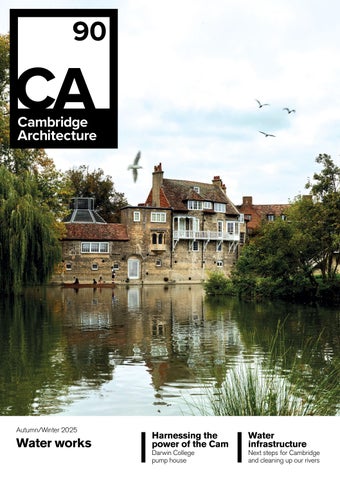
Darwin College facing onto the River Cam, with the recently completed Allies and Morrison’s pavilion in the background.
Welcome
Welcome to CA90, our final issue of 2025. This year, we welcomed Tonia Gkougkouli and Talia Friedland to the Gazette editorial team, which, for the first time in 10 years, is all-female, including our cover photographer for this issue, Rachael Smith, and advertising lead Marie-Luise Critchley-Waring.
The theme of this edition is ‘water’. Our chair, Patrick Usborne, outlines why we need to prioritise our rivers, and filmmaker Tony Eva discusses the importance of clean-water efforts amid summer droughts. There is also an account of the CAA visit to Mill Hide, a house situated between two rivers.
Andy Levy, head of capital projects in the University of Cambridge’s Estates Division, explains the estate’s evolution. Meanwhile, February Phillips and Joel Gustafsson look at the history of the River Cam and efforts to decarbonise the riverbed at Darwin College’s pump house.
Meanwhile, Richard Owers discusses the recently deferred Honey Hill wastewater treatment development and the impact on our city.
Finally, we have letters from a homeowner who harvests rainwater and saves on energy bills, and a local architect concerned about the rate of water consumption in the city.
New Sir Arthur Marshall visiting professor in sustainable urban design
The University of Cambridge welcomed Tina Saaby as its new Sir Arthur Marshall visiting professor in sustainable urban design for 2025-26. Saaby is a distinguished architect and urban planner, known for her leadership in shaping sustainable and healthy cities for people. A graduate of the Royal Danish Academy of Fine Arts, she served as the city architect of Copenhagen from 2010-19 and the city architect of Gladsaxe from 2020-23. She has been CEO of the Danish Town Planning Institute since 2023. Working closely with Greater Cambridge Shared Planning and the Cambridge Room, Saaby will champion the importance of design in making Cambridge a great city for people. She gave her inaugural lecture in October, at Jesus College, and we look forward to seeing her collaboration with the city unfold.
The Greater Cambridge Inclusive Design Festival
Join leading voices celebrating diversity and creativity, at this one-day festival in January 2026. Hosted at The Fellows House Cambridge, Curio Collection by Hilton, the festival will celebrate the power of design to break down barriers and bring people together, promoting sustainable growth.
Meet leading voices in the field of inclusive design, and experience thought-provoking talks, interactive panel discussions and networking opportunities with like-minded individuals. Learn how inclusive design can transform the way we interact with the world around us.
The editors
There will be talks on inclusive playspaces, maximising social impact in projects, public art conditions in Greater Cambridge and best practice in community engagement.
The 2026 Greater Cambridge Design and Construction Awards are now open
The awards celebrate projects completed within the past five years in the Greater Cambridge Shared Planning Service area – including Cambridge City and South Cambridgeshire – and they are open to anyone.
From thoughtful retrofits to ambitious new builds, the judges are looking for design quality, creativity and a positive contribution to place.
The deadline for entries is 10 January. For more information, visit: zealous.co/cfci/opportunity/2026-awards
Christ’s College receives planning permission for Library+ Project
Cambridge City Council has granted planning permission and listed building consent to Christ’s College for the Library+ Project, designed by Dublin-based firm Grafton Architects. The project will introduce a new library and upgrade the college’s kitchens and dining facilities, with improved accessibility and a sustainable approach.
Library+ will feature a new study space and extended working library, as well as an informal study hub and a multi-faith room. The project is ‘inspired by the historic landscape of the city’, and will help the College meet its updated sustainability and environmental targets on the net-zero carbon emissions pathway.
The college intends to begin the next stage early in 2026, with alternative kitchen and dining facilities to be installed in Second Court for the start of Easter term and the existing 1970s library demolished during the summer of next year. The interim Third Court Library will operate for the duration of the project.
For more information, visit: www.christs.cam.ac.uk/news/planning-permission
Market Square evolution
Cambridge City Council has recently unveiled changes to the plans for Market Square, as part of the wider Civic Quarter. This follows feedback from traders, experts and the public. A spokesperson said its vision is for a ‘bustling seven-day market that is an accessible, attractive, welcoming, exciting and safe place to visit, shop and gather during the day and into the evening’. The changes include increasing the number of trader stalls and permanent stalls, and replacing fixed canopies with trees and temporary parasols, because many traders had security concerns over a permanent canopy.
Events
CFCI Lego competition
9 December from 5.30-9pm
Elena Hall and Sibilla Room, Jesus College, Cambridge
More information and booking can be found at bit.ly/43ns3Qp
CAA Christmas party
17 December from 6pm
Grape Britannia, Cambridge
CFCI Talk From fume hood to carbon good: decarbonising the research lab
19 January, 6-8pm
Jesus College, Cambridge
More information and booking can be found at bit.ly/CFCIevent
The Greater Cambridge Inclusive Design Festival
23 January, 11:30am-4:30pm
The Fellows House Hotel, Cambridge Tickets: £45/£30 concessions
CAA – monthly social
First Wednesday of the month, from 6pm
The Architect, 43 Castle Street, Cambridge, CB3 0AH
We need
We are looking for trustees!
The Cambridge Room would welcome applications for trustee positions.
We are particularly in need of trustees with financial and legal expertise, and people who are keen to be active in working on the development of the Cambridge Room, as well as people with diverse perspectives currently underrepresented on the trustee group.
If you are interested in the role, please get in touch for an informal chat in the first instance by emailing thecambridgeroom@gmail.com
About the Cambridge Room
The aim of the Cambridge Room is to raise the quality of the built environment for the benefit of all through collective action. It supports the development of pragmatic, cutting-edge research in this area and plays an active role in the development of the UK-based Urban Rooms Network. It explores subjects relevant to the built and natural environment locally, informed by global studies and ideas.
Currently, the Cambridge Room is based in the City of Cambridge, but it encompasses temporary pop-up engagement events across Cambridgeshire and Peterborough Combined Authority to allow for sharing of knowledge
We are looking for volunteers!
We are also looking for enthusiastic volunteers to help out in the Cambridge Room. Whether you are great at organising or welcoming guests, or just want to lend a hand, your support would be greatly appreciated.
What you’ll do:
● Assist with set-up and clean-up
● Greet and guide visitors
● Help maintain a welcoming and organised space
Why volunteer?
● Be part of a vibrant community
● Gain experience and meet new people
● Make a meaningful contribution
● Use the co-working space for free
If you’re interested, please reach out to thecambridgeroom@gmail.com
across rural and urban areas. The Cambridge Room takes a big-picture approach to built and natural environment issues across the area, fostering debate and helping communities and others make sense of – and bring order to –the many types of initiatives that are on the go.
It is an independent, neutral and trustworthy one-stop shop for members of the public who want to understand what is happening in the local environment, who want to influence decision-making and planning, and who want to see their input translated into action. The charities and the public sector that support us do not influence our impartiality. We
wish to help delivering inclusive engagement services for a variety of organisations based on our core values.
A central aim of the Cambridge Room is to widen participation in planning consultation. It is an inclusive and accessible physical and digital space, where communities, universities, schools, local authorities, businesses, industry and practice can come together to share knowledge on an equal basis. Although its focus is the built environment, the Cambridge Room supports the development of inclusive governance and transparent decision-making across the region.
Rights of the river
Cambridge’s identity and growth are tied to the River Cam. As we face a future of scarcity and strain, how can design and community reshape our relationship with water?
WORDS PATRICK USBORNE
There was just one book I really wanted for my birthday, although I hadn’t told my partner. While a present laid wrapped on the kitchen table, I didn’t want to upset her by revealing the book I most wished for. She shouldn’t have been worried. Robert Macfarlane’s Is a River Alive is a seminal account in transforming our understanding and relationship with rivers, water and, more broadly, nature.
In this edition of Cambridge Architecture, we talk all about water. Cambridge (which, incidentally, is where Macfarlane lives) has been defined by the Cam – not just the medieval crossing point, but an entity that provided prosperity for the city and helped shape its culture and people.
In Macfarlane’s book, he mentions Nine Wells, to the south of Cambridge, which fed the city clean water via Hobson’s Conduit for centuries. The Cam itself originates from myriad tributaries further south, and only relatively recently have we fully understood the harm inflicted by us on its flows and ecosystem. Monitoring stations report poor water quality, and our thirst for growth in our regional cities and towns is only increasing the burdens we place on the Cam.
Unquestionably, we have reached a point where the Cam can no longer accommodate our relationship with it. Water scarcity is one of the top infrastructural priorities in unlocking the provision of more homes for The Cambridge Growth Company. New reservoirs are only part of the solution. We need to prioritise the fundamental relationship we have with our rivers, as they give us far more than we give back. Reliance and enjoyment of the Cam, while supporting its ecology, could be radically altered if we could prevent sewage overflow, agricultural waste and over-abstraction.
Macfarlane noted examples from across the world of local communities coming together and taking a stand, providing legal rights to local rivers. Closer to home, campaigners in Wales are taking the local water provider and a poultry farmer to court for polluting the rivers Wye, Lugg and Usk. And, in 2021, Friends of the River Cam made the first public declaration in the UK of the rights of the river, at Jesus Green, linked to the Universal Declaration of River Rights. Soon afterwards, Cambridge City Council acknowledged that the Cam and its tributaries should have symbolic rights arising from their existence in nature, including the rights to flow and be free from pollution.
Maybe in the future, the Cam will get its own legal rights, although this will be down to continued pressure from the local community, with support from the council, to obtain the legal powers required.
“Only relatively recently have we fully understood the harm inflicted by us on the Cam’s flows and ecosystem”
Back on dry land, one place where the community can come together to shape the future of the city and the region is the Cambridge Room, which re-opened in September after being closed for the summer break. The room is again attracting local community groups to host events and exhibitions, and is being kindly staffed by local volunteers, including CAA members.
The CAA is beginning a series of monthly CPD events at the Cambridge Room, so be sure to sign up for our fortnightly newsletter (visit www.cambridgearchitects.org) to be
kept up to date. A more permanent home is being found and we’re keen for this to become a thriving hub for continual debate, to help shape the ambitions of the local community and local authorities, and the drive from The Cambridge Growth Company.
If you want to have your own say, please visit the Cambridge Room – details are available at www.cambridgeroom.org. And if there are any events you would like us to host at the Cambridge Room in 2026, please get in touch at thecambridgeroom@gmail.com
The Cambridge Room, a place where communities can come together
Reading of the declaration of rights for the River Cam by Friends of the River Cam
Pure Clean Water
A season of drought and record heat has created a water crisis. How can architects be part of the solution to save our rivers?
WORDS TONY EVA
After the driest spring in half a century and the warmest summer on record, East Anglia received a mere 62 per cent of its usual rainfall this summer. Official drought status was narrowly avoided, but warning signs were there to see. We had a false autumn as trees dropped their leaves early, a sign of stress that will make them more susceptible to pests and diseases. Chalk-stream flows dwindled – and in some cases disappeared. It took me back to a similar drought in 2019 that resulted in my film Pure Clean Water
That summer, the Cam Valley Forum raised urgent concerns about the desperate state of local chalk streams. Its petition to city councillor Katie Thornburrow resulted in a Water Crisis Forum, which is where I first heard about Hobson’s Conduit. For more than two centuries, this fully sustainable public water system supplied free drinking water to Cambridge residents. Stream-fed conduit systems were once common across England, but Hobson’s Conduit now appears to be unique. It struck me that this was an underappreciated piece of Cambridge heritage, and the perfect subject for what I hoped would be my first short film.
Hobson’s Conduit is fed by chalk springs at Nine Wells. For me, this site has a primeval, almost mystical feel, which only became enhanced when I learned that this had been a site of human occupation for many thousands of years. While filming there, however, I was also very aware that, at nearby Babraham, there was a borehole pumping water from the underground chalk aquifer. Every litre extracted for human use is a litre lost to the springs, streams and wildlife that depend on them. What began as a fascination with heritage soon grew into a broader concern about the availability of water.
When water is discussed in the media, it usually focuses on the issue of pollution. Privatised water companies have been rightly criticised for the way in which they have come to casually treat our waterways as their dumping ground. Water pollution measurements by the Environment Agency at Sheep’s Green since May 2024 show that this section of the River Cam, now an officially designated bathing area, has repeatedly failed to meet the minimum
“That the iconic River Cam cannot be considered safe for swimming shames us all”
standard for water quality. That the iconic River Cam cannot be considered safe for swimming shames us all.
Part of the reason for this poor water quality is that there is now a muchreduced amount of water entering our rivers and streams, so pollutants are not so diluted. In South East England, most of our water supply is groundwater taken from subsurface aquifers. While providing naturally clean water, usually requiring little processing before being sent to our taps, this source is under immense pressure.
Since the 1960s, personal domestic water use in England has risen by around 60 per cent, alongside a population increase of 13 million. The result is billions of litres more being extracted each day, which is water that is no longer available to feed chalk streams or support fragile ecosystems.
Working with cinematographer Nigel Kinnings and his partner Christine Lloyd-Fitt1, we began to turn the film into a wider story of water availability, the environment and growth. By March 2022, we had nearly 10 terabytes of camera footage and archival material, and I was teaching myself film editing techniques from YouTube videos.
The film premiered to a sold-out audience at the Cambridge Film Festival in October 2023 and won the award for Best Feature Documentary. Since then, the film has been shown more than 30 times, mainly in and around Cambridge, in cinemas, community halls and seminar
Hobson’s Conduit flowing. The runnels along Trumpington Street are Grade II-listed and a glorious sight when in full flow. Unfortunately, the much-reduced amount of water now leaving Nine Wells is a real headache for the Hobson’s Conduit Trust. Increasingly, it has insufficient water to operate the runnels. In recent years, mechanical failure and runnel blockage, probably the result of much heavier vehicles entering the city, has also limited the operation of the runnels.
This image of the dried up River Granta at Stapleford helped bring home to people the severity of the 2019 drought, which led to the Chalk Streams Crisis forum in November that year. At the time of writing (September 2025), the water level at this location is just 4cm – well below normal for this location.
rooms. At most screenings, audiences have stayed long beyond the allotted time in order to discuss their own concerns. That response has been the most rewarding aspect for me. I look upon it as evidence of a deep public interest in where our water comes from and deep concerns about how future supplies can be ensured without devastating fragile freshwater ecosystems. People want to help contribute to a sustainable future if they can be given a chance.
Flow deflectors with no flow. Chalk streams are special habitats that we should do our utmost to protect. The current intervention of choice is installing gravel banks and tethered logs to narrow the channel and enhance turbulent flow. Yet the futility of this approach until the problem of overabstraction is addressed is clear in this image of the Cherry Hinton Brook in summer 2022.
In the short time since I completed the film, there have been some significant changes. Christ’s College has thrown in the towel on ever again having a spring-fed rill. The creep of buildings and tarmac onto the doorstep of Nine Wells has continued unabated – and central government appears to have doubled down on the amount of new homes, laboratories and data centres that it wishes to see built in Greater Cambridge. Objections by the Environment Agency to new developments on the grounds of insufficient evidence of available water have been largely overruled.
We appear to have become habituated to a lack of water around us. We meekly accept that the fountain in the market square has no water, that the runnels along Trumpington Street will have no flow, that the Cam has become a sickly trickle and that ‘lesser’ chalk streams will run dry in summer. Amid this gloom, where is the hope?
Dry stream, summer 2022. Many chalk streams in and around Cambridge ran dry in summer 2022 because of over-abstraction of the chalk aquifer. Are we really taking sufficient care of these delicate ecosystems?
When the film was recently screened, courtesy of LDA Design, to an audience including architects, the conversation turned naturally to design’s role in addressing water scarcity. The RIBA 2030 Climate Challenge sets ambitious targets for water use. Architects have a crucial role to play in helping secure our future supplies. They can encourage uptake of low-flow or waterless appliances, greywater recycling, rainwater harvesting, and green infrastructure such as roofs, walls and sustainable drainage. Such measures can reduce consumption, restore biodiversity and make buildings more resilient.
Water deserves to be valued and used wisely. From influencing government policy through to working with individual clients, architects can help ensure that future generations inherit adequate supplies of this most vital of resources.
Pure Clean Water will be shown on Tuesday 2 December at U3A, bit.ly/U3AScreening
References:
1 Their work will be well known to Cambridge audiences with an interest in environmentalism through films such as Waterlight and Fugolburna
A minimalist monolith
On a dry and sunny day in September, CAA members had a rare opportunity to visit Mill Hide, with a private tour led by the architect and homeowner, Tim Poulson
Tim Poulson is a wellestablished architect whose career spans more than five decades.
Upon graduating in the mid-1960s from Sheffield University, Poulson joined the modernist architectural practice Yorke Rosenberg Mardall (YRM). During his time at YRM, he was responsible for a wide range of projects, including universities, healthcare, commercial buildings and airports. In 1974, he set up the first YRM office in Southeast Asia, which grew to a team of 650 architects and engineers.
After his successes at YRM, Poulson returned to the UK and set up Poulson Architecture to focus on private
housing. Most of his projects have been developed and constructed under Poulson Development through management contracting, including his own home, Mill Hide.
Mill Hide is akin to a piece of sculpture. Measuring 44 x 22m and constructed in Corten steel, it sits in the open English countryside. The house received planning consent in 2021 under the exemption clause Paragraph 79 for exceptional houses in the countryside and was completed on site in the summer of 2024.
About the site
On a dry and sunny day in September, CAA members had a rare opportunity to visit Mill Hide, with a private tour by Poulson. As we entered the site and drove closer to the house, we could see a sculptural object hidden away in the background. ‘Is it a sculpture by Richard Serra?’ one thought.
As we made our way and the view opened, we were met with the pure form of a Corten object tucked modestly into the landscape. The single-storey volume is divided with a cut, an opening inviting visitors and cars into a generous square courtyard that sits between the garage/ studio and the house.
The site for the project is in South Cambridgeshire, adjoining an RSPB Nature Reserve of 40 hectares, and lies between two chalk streams, the River Shep and Guilden Brook. It sits on four acres of lightly wooded and chalkland meadow falling gently to reedbed wetland. The new house
WORDS RISA NAGASAKI
Approach to Mill Hide, looking towards the Corten colonnade
Entrance, view from the piazza looking along the Corten façade
is placed on the higher ground, northeast of an established avenue of ash and willow trees.
A bridge between Poulson and his wife, Elizabeth, gave us a warm welcome. We started our tour in the courtyard, walking around the house to admire the beautiful Corten rainscreen cladding. The attention to detail is rigorous; the cladding has concealed fixings and finely detailed façade corners to create the appearance of the building being sculpted from a single ingot of steel.
Fixed and sliding windows appear to be the same, giving a balance and pleasing consistency to the exterior elevations. The entrance of the house has a small ‘bridge’, a platform over a water feature as one crosses the threshold from the courtyard into the house, a nod to the location of the house sitting between two rivers.
The setting is stunning, with natural surroundings that stretch beyond the adjoining nature reserve, offering a true countryside vista. One can imagine the house is a retreat away from the city and back into nature. The beautiful colonnade that wraps around the southeast and southwest elevations is made of fin-shaped columns, allowing the surrounding wildlife to be viewed from inside the house, while the screen provides concealment in a way similar to hides on the adjoining nature reserve. The clever design of the triangular columns means that, when you are standing inside, the columns appear slim and help focus the attention on the scene; when standing outside, looking back at the house, they appear thick, like the tree trunks surrounding the home.
Vision for living
The inside of the house is just as impressive and the attention to detail continues. When entering the house, you are greeted by a bright 20sqm glazed skylight ‘square’. The square is open to the sky and, looking up, it feels as if you are looking through a James Turrell Skyspace. The glazed ceiling literally opens to the sky: with just a slim edge line of the white ceiling visible, the boundary with the sky blurs, creating a mesmerising feature. The walls enclosing this square have panels that pivot to create openings, providing a passage, a view. When the room needs privacy, these wall panels can be pushed to close.
Throughout the home, traditional architectural elements, such as skirtings and architraves, have been deliberately omitted, creating a refined and minimalist aesthetic.
“The setting is stunning, with natural surroundings that stretch beyond the adjoining nature reserve, offering a true countryside vista”
PROJECT INFORMATION
Construction commenced on site:
May 2022
Construction completed: April 2024
Gross internal area (GIA): 580m2
Procurement:
Through a management contract
Construction cost: Not disclosed
Architect: Poulson Architecture
Client:
Tim and Elizabeth Poulson
Structural engineer: Davies Maguire
Mechanical and electrical
engineering consultant: Atamate Consultancy
Landscape consultant: Robert Tregay
Ecology consultant: MKA Ecology
Building control: LBA 3C Shared Services, South Cambridgeshire
Management contractor: Poulson Development
ENVIRONMENTAL PERFORMANCE
Annual mains water consumption: 106.3 litre per person per day
Airtightness: @ 50pa 2.86 m3(h.m2)
On-site energy generation: 100 per cent (PV panels on the garage)
Upgraded with stone wool slabs
A door is full height, a simple cut on a wall with Bauhaus 1935 handles.
A bathroom is kept pure, as if it were moulded out of a single material, and the fittings are kept minimal. The living room can be divided with a moving wall to cater for flexibility. Bookshelves are not just furniture, but also function as dividers to the space. The stainless steel kitchen is in its purest form and resembles a highly functional commercial kitchen.
The whole house incorporates sustainable and energy-efficient systems using a single air source heat pump discreetly positioned behind cladding, a mechanical ventilation unit with heat recovery system, and smart-home applications controlled with KNX, to name but a few. Mill Hide is not only sculptural, but also high-tech, adaptable and deeply functional – an architecture that recalls Le Corbusier’s vision of the house as ‘une machine à habiter’, a true machine for living.
Transforming how the University of Cambridge designs, delivers and uses its estates for the future
WORDS JILL BORTEN
As head of capital projects in the University of Cambridge’s Estates Division, Andy Levy is the ‘delivery man’ within the estate’s ‘plan – deliver – operate’ model, managing the university’s capital projects from RIBA Stage 0 through to Stage 7. The ‘plan’ refers to property development and ‘operate’ is the facilities management side of the estate.
Levy joined in 2022 and now oversees construction projects across the university’s operational estate, comprising 375 teaching, research and administrative buildings, as well as some on the non-operational estate, including a data centre, rugby ground and developments at the new Cambridge West Innovation District.
From site to strategy
When asked about his journey to Cambridge, Levy jokes that it’s far too long to relay. His first job was in the building control department at his local council. This meant that when he started his architecture degree at the University of Liverpool, he already knew plenty about building regs and the Disability Discrimination Act (DDA) (superseded by the Equality Act 2010). Given the same plot of land as his peers to design something amazing, he recalls that all of his buildings were really boring – but worked. He loves architecture and visiting buildings all over the world, but admits he probably should have done engineering: ‘It’s less subjective.’
After university, Levy gained work experience with Allford Hall Monaghan Morris (AHMM) and other practices, but it was his earlier experience in building control and being out ‘on site’ that he found more dynamic and exciting. He went on to cut his teeth in construction management
with contractor Laing O’Rourke, working on the London 2012 Olympic venues, The Leadenhall Building (the Cheesegrater), and Heathrow Terminal 2. He describes that experience as being a small cog in a big wheel and learned a lot – including that he was better at communicating in client-facing roles than he was out on site. Roles in property development and project management consultancies followed, across a variety of sectors, and taking that experience ‘client side’ became inevitable. When he spotted the Cambridge position, Levy knew it was the right fit. As one of the largest higher education estates in the UK, it presented an exciting opportunity to help shape the evolution of the diverse estate, in line with the university’s new strategic estate framework and supporting long-term capital plan. These set out long-term visions for the estate, with objectives and principles
guiding all future developments. This includes: creating high-quality spaces to benefit staff and students; reusing existing buildings before building new, where possible; supporting teams to find new ways of working; developing a financially and environmentally sustainable estate; protecting and promoting the university’s built heritage; and developing a smaller estate – fewer buildings, better used.
Delivering better projects
All the university’s capital projects go through a framework for contractors and consultants, which are grouped by value into lots for major projects and minor works (projects less than £3m). Levy explains that projects selected for the five-year framework have to show a local presence – whether that’s an office or staff, or work on previous projects in and
around the city – and to demonstrate they can service their projects from Cambridge. The university particularly wanted local and smaller consultancies on minor works and he says ‘it’s a superb list of architects, and we’re really happy with the framework’. It includes R H Partnership, 5th Studio, MCW Architects, Saunders Boston Architects, AMA Architects, Burwell Architects, Purcell Architecture, BDP, Hawkins\Brown, Jestico + Whiles, Perkins&Will, NBBJ, Stride Treglown and HLM. For Levy, a key consideration in the selection was how they would collaborate with the others on the framework and raise each other’s game.
Project teams are assembled in a unique way. The consultant frameworks for architects, engineers, project managers and cost managers are organised on a taxi-rank basis, with companies queuing and projects allocated in order of position in the queue. Consultants are paired with the corresponding counterpart in the other discipline queues. (Contractors go through a tendering process.) This system removes the need for a mini-tender for each project, speeding up the process and distributing work fairly, while also enabling everyone to look ahead to see what’s coming and set aside resources in preparation.
Over the next five years, the priority is for projects to enable a ‘leaner, meaner, greener’ estate – cutting carbon and getting
better use out of existing buildings. For example, creating flexible collaborative spaces that can be used year-round for different activities, and moving away from siloed working towards faculties and departments sharing facilities.
Cambridge is in a water-scarce region, so efforts are being focused on how to better plan and manage water usage. Water initiatives include work to improve water efficiency through data gathering and the use of automated water metering systems across the estate. There is also a project planned at the Grade II* Cambridge University Botanic Garden to introduce a new irrigation system and rainwater harvesting, to better safeguard the precious living collection of 8,000 plant species.
“Over the next five years, the priority is for projects to enable a ‘leaner, meaner, greener’ estate”
Architecture and impact Levy’s favourite building – probably in the world – is the Natural History Museum (Alfred Waterhouse, 1880). He’s also a fan of the refurbished Warburg Institute (designed by Charles Holden, 1958; renovation project led by Haworth Tompkins, 2024), and thinks that Pembroke College’s new auditorium in the Grade II-listed former Emmanuel United Reformed Church (James Cubitt, 1874; Haworth Tompkins, 2025) is ‘pretty cool’. He misses going to the art-deco masterpiece that is Highbury Stadium (Archibald Leitch, 1913), although the newer Emirates Stadium (HOK Sport/ Populous, 2006) is finally growing on him! His love of architecture extends to his concern for the profession. He’s vehement about the inadequacy of pay for Part 1 and 2s, and wants a more serious industry conversation about paying more so that new architects can afford to stay in the profession, rather than leaving to become design managers at a contractor or project managers for consultancies. He would like to see the industry and the RIBA do more to ensure that new architects’ pay rises in line with other professional degrees.
Andy Levy, head of capital projects at the University of Cambridge
A new irrigation system is being planned for the Botanic Garden
Springstead Village Centre - Cambridge
Springstead Village The Optic Swiss Laundry
Reviving the power of the Cam
The historical and mythological significance of the River Cam, and Darwin College’s recent efforts to decarbonise and restore the site with its pump-house project, led by 5th Studio project architect Nicola Blake
WORDS FEBRUARY PHILLIPS, 5TH STUDIO
The River Cam is peripheral to the lives of most Cambridge residents.
Something to pass over on their route from one place to another, to occasionally punt on or swim in, or to stroll beside on a summer’s day. Over time, however, the river has had a significant influence on the city and its occupants, and a new type of sustainable use is emerging that has the potential to revive the historic power of the Cam.
The Cam has been navigable since at least Roman times and, up until the mid19th century, was an important route for the transportation of people and goods. In the late 1700s, there were even proposals to connect the Cam to London by canal, plans that became redundant with the arrival of the railways.
The river wasn’t just a way of moving around; it was a place of productivity and exchange. In medieval times, the four
The water from the River Cam, which flows through Darwin College, will be used as the source of low-temperature heat to generate the heat required for the main site’s space-heating and hot-water demand
fairs of Garlic, Reach, Midsummer and Stourbridge (the largest fair in Europe at its peak) were linked to the wealth of the city brought about by the Cam. While the river itself provided a fresh source of fish, the wider network of waterways made the surrounding farmland fertile for fruit growing and supported Cambridge’s jam industry, while clay deposits enabled the production of bricks and tiles.
It was also used as a source of physical energy, whereby the flow was converted to operate machinery, irrigate land and grind grain for food. The romantic power of the Cam was immortalised in poetry, prose and painting by, among others, Lord Byron, Rupert Brooke, Xu Zhimo and J M W Turner.
The river’s power was also manifest in folklore, with the supernatural power of the Cam being felt in the eerie presence of will-o’-the-wisps, beckoning into the mist above marshy ground on the meadows and commons on a cold moonlit night. There were also tales of legendary pickerels, so
big they would devour ducklings from the river’s surface, with teeth so sharp they could remove a human’s finger; swans so strong they could break the arm of a fully grown man; and underwater plants so dense they could drag you into the muddy depths to drown. The legacy of the river’s power was something to be feared and respected.
The river today
By contrast, the primary fear for anyone using the Cam today is of contracting E. coli, erupting in part because of overflowing excrement from our outdated sewerage systems. The River Cam has lost its magnificence and, in the city centre, it is reduced to a densely occupied field of punt poles and tourists, playing out a nostalgic simulation of a sanitised past, somewhat akin to the Las Vegas replica of a Venetian canal and gondolas.
Of course, there have been efforts to conserve and restore the River Cam, despite the culture shift around the importance of waterways. It is a sign of the times that the Conservators of the River Cam, which has been the main guardian of the river – including its banks and locks –for more than 200 years, recently declared that it does not have enough money to repair critical, ageing infrastructure and has asked the local authority for funding.
Other, more grass-roots community initiatives, such as Friends of the Cam, hold an annual River Rights Festival celebrating the Cam and declaring its right to:
● Flow and be free from over-abstraction
● Be free from pollution
● Perform essential functions of flooding, moving sediment, recharging groundwater and sustaining biodiversity
● Feed and be fed by sustainable aquifers
● Native biodiversity
● Restoration
● Maintain its connection with other streams and rivers.
It may seem absurd that these basic principles need iteration, but with prevalent ongoing concerns about water companies over-abstracting and discharging effluent, granting the Cam legal personhood could be one way of restoring its power.
Harnessing the power
Meanwhile, there is a new type of project in Cambridge harnessing the power of the river in ways that neither pollute nor deplete it, while supporting biodiversity.
Earlier this year, Darwin College obtained planning permission for a project that sought to decarbonise its main riverside site. The decarbonisation involves moving the provision of heating and hot
“The project is a magnificent fusion of historic references, new technology and ecological sensitivity, providing the fundamental need for warmth as well as habitats for plants and creatures”
water from gas boilers to heat pumps that use electricity, as well as carrying out works to improve the thermal performance of existing, historically significant, buildings. Several college decarbonisation projects in the city have involved the installation of ground source and air source heat pumps (ASHPs), with the latter facing the major challenge of where to locate unsightly equipment that requires air, but also produces fan noise, in compact historic urban settings.
Darwin’s main college site, with its attractive buildings and gardens along a tight strip, visible from one of the few locations in the city centre where the public can freely access the river, called for a
Indicative view from Sheep’s Green across the Mill Pond towards the pump house, with Newnham Terrace in the centre and The Granta pub to the left
different solution; an alternative type of heat pump, using the river.
The new pump house – designed by 5th Studio, with support from JG Consulting, MHA, Mott MacDonald and Trigon – houses a new river-source heat pump. The basement of the proposed building is for water intake, with filters, including a fine rotating mesh screen, to prevent small and large plants, fish, eels and animals being sucked in. Just like the air in ASHPs, the water is used with refrigerants, compression and expansion to heat up water in a separate circulation loop. The river water, without encountering any contaminants or other water sources along its path, is gently returned back
into the river at a slightly lower temperature. Without a detailed understanding of the science and engineering of water source heat pumps there is something magical about this process. A whole Cambridge college warmed by the River Cam.
The basement inlet structure has the quality of a lock or sluice gates, present along the Cam. The pump-house building itself, somewhat surprisingly, is a threestorey structure on the riverbank. This gives it the presence and importance of historic structures that used the flow of the river and converted it into physical power for grinding and pumping, while also providing a ‘book ending’ with the college, mirroring the existing study centre. The proposal is to
clad the structure, which nestles next to a yew tree (with its own powerful mythology of death and resurrection), in locally sourced larch shingles and climbing plants.
Nesting boxes for birds and bats, and habitats for bees that will help pollinate the plants in the neighbouring allotmentstyle beds, tended by students, have been carefully integrated into the delicate façade.
Three large buffer vessels, reminiscent of giant casks from medieval fairs, hold the hot water produced by the heat pumps until there is demand from the building users.
The project is a magnificent fusion of historic references, new technology and ecological sensitivity, providing the fundamental need for warmth as well as habitats for plants and creatures. It has the potential, alongside other similar projects along the river, to contribute to reviving the historic power of the Cam as a productive force in the life of the city.
February Phillips is an associate architect at 5th Studio and teaches architecture and design at the University of Cambridge. This article draws on research by first-year undergraduates into the River Cam, and on the Design and Access Statement submitted for the Darwin College decarbonisation project.
Larry-D-Moore
Indicative view of the pump house from the garden of No.12 Newnham Terrace, towards the river
Bat roost that influenced the form of the pump house
Sketch view of Darwin College from the east, with the proposed pump house (dark green) to the south, along the boundary wall with The Granta pub, and the Study Centre (light green) to the north, marking the extent of Darwin’s main site
Newnham Mill’s chimney is still visible today
King’s Mill and Bishop’s Mill
EmilieMontgomeryGardner
Water source heat pumps
The current of change at Darwin College
JGC engineers explain how Darwin College’s pioneering pump house harnesses water to heat heritage buildings
The 18th- and 19th-century buildings that make up Darwin College were built at a time when heat was evolving from a luxury into the commodity it is today. Coal was transformative – it was energy dense and the pace of industrial revolution made it cheap and plentiful.
Similarly, at the college’s formation in
1964, the benefits of oil over coal were sufficient to initiate a transition to oil –liquids are easier to handle than solids, air quality improved and heat was more readily available. Gas was simply an expansion of these benefits and followed the introduction of natural gas to the streets of Cambridge after 1971.
Past energy transitions arose because they offered improvements in amenity and efficiency – more for less. As new fuels
became available, technology evolved to use them more effectively. To the first occupants of our existing buildings, the comfortable environments that we provide would be unrecognisable.
The transition to electricity for heat is different – this time, there is not an amenity incentive. Efficiency is important, but invisible to most. So why now?
In time, gas will run out and the transition away from its use is an inevitable technical challenge. The motivation to consider alternatives today comes from placing an intrinsic value on environmental impact. The burden of assessing the technical considerations, accepting the risks and delivering the precedents falls to those brave enough to do so. In this regard, the Darwin College pump house project is leading by example.
Heat pumps are the most efficient way to make usable heat from electricity. Consider the UK heated only by using electricity directly for heat – it would need three to four times the entire electrical infrastructure. Not just the transformers and cables, but the wind turbines, solar farms and nuclear power plants. For this reason, the Committee for Climate Change (CCC) is clear that a cost-effective, low-carbon energy system relies on heat pumps.
Why water?
Air source heat pumps are becoming a welcome and increasingly common sight.
It is cheaper and easier to use the air than the river. The Erasmus Building at Queens’ College is adjacent to the river, yet uses air source heat pumps. The river is needed when other options aren’t available or the negative impacts of using the air (visual, spatial, noise or cold air) can’t be managed.
Darwin College, bounded by a public highway and the River Cam, has limited capacity for air source equipment.
Interfacing with the river presents challenges, but it is far from unprecedented. Many industries have long relied on drawing water from natural waterways, from agricultural irrigation to cooling in power stations. In the latter case, the vast quantities of abstracted water are heated and returned.
Given the enormous quantity of thermal energy contained in natural waterways, their use as a source of environmental heat is a practical means of using existing resources in a novel way.
The public is rightly concerned about the long-term impacts on our natural
WORDS JOEL GUSTAFSSON AND RUPERT VARLEY
Darwin pump house mechanical and electrical plant render
Water source heat pumps
waterways caused by abstraction. For heat extraction, the ecological impact is low.
When extracting thermal energy, water source heat pumps lower the temperature of the source water, increasing dissolved oxygen concentrations. This action has a positive impact on the aquatic ecology. The overall environmental impact of using river water as a source of heat is substantially lower than continuing to burn gas or rely on direct electric heating. This is especially true when considering the broader effects these conventional systems themselves have on natural water resources.
There are already examples of water source heat networks operating in the UK, such as Mersey Heat in Liverpool, which has the capacity to provide heating and hot water to up to 6,700 homes1, or Queens Quay on the Clyde, serving 1,200 homes2
At Darwin College, the proposed pump house heat network is on scale, providing approximately 300kW (40-50 homes by the metric above). The project will eliminate all
Image showing an aerial shot of central Cambridge. Distinct in the background (centre left) is the original electric power station, right on the banks of the Cam. The power station would have used the river not only for the transportation of coal, but also to directly condense superheated steam in the steam-turbine cycle
onsite gas infrastructure and, by using heat pumps instead of direct electric boilers, will greatly reduce the college’s dependence on renewable electricity.
The heat within the River Cam is finite.
Is there enough?
Using the river for heat pumps doesn’t consume water — all water taken is returned. The amount required depends on river temperature and level, which, together, determine the available heat. In the case of the River Cam, Mott MacDonald measured flow and temperature data, and reviewed historic records, to assess this, while riparian colleges and landowners evaluated their own needs.
On a ‘normal’ cold winter’s day, the River Cam has many times (5-10x) the peak demand of all riparian colleges considering using it. Darwin’s demand is <5% of this flow.
Demand increases in colder periods,
but these are rarely accompanied by low river flow. In the extreme (low flow, low temperature), the availability of heat reduces by about two-thirds and the answer to the question of availability is more nuanced.
In extremely cold weather, such as the cold snap in December 2022, the river develops ice on the surface and the water temperatures are too low to extract anything. The availability of heat is zero and users rely on an alternative heat source –either fuels or direct electricity. This resilience measure is needed infrequently and is not significant on the overall energy use of river source heat pumps – the winters of 2023/24 and 2024/25 were not cold enough to restrict use.
However unlikely, extreme cold does happen and the system designed to accommodate this can readily be used to support anomalously low flow coinciding with high heat demand.
In summary, the supply of heat in the River Cam is well matched to the demands of the challenging city centre buildings.
Beyond the city centre
In a wholly decarbonised Cambridge, could the river’s heat be another source of ‘town vs gown’ friction? Probably not.
Upstream, Grantchester has progressed feasibility studies to inform its own decarbonisation plans. The headline conclusion is that the air is a more appropriate source of heat for any centralised heat source – if, indeed, this is deemed preferable to smaller-scale systems. Downstream, the river warms up as it receives rain and runoff from the green spaces and streets of Jesus Green, Midsummer Common, and so on. Additionally, the buildings downstream of the city centre are lower density and lower demand (boathouses, private dwellings), and have opportunities to use the air.
The buildings on the banks of the River Cam existed long before gas was brought to them and they will persist for centuries after it is no longer available. The heat within the river that they frame will become an important part of marrying historic architecture with contemporary expectations for thermal comfort, without the carbon emissions that enabled it in the 20th century.
References
1 Mersey Heat (2024), see bit.ly/CA90HP1 (Accessed 9 October 2025)
2 Vital Energi (2025), see bit.ly/CA90HP2 (Accessed 9 October 2025)
The air exchange louvres at Dolby Court, Pembroke College, Cambridge: a 350kW air source heat pump system serving the student accommodation court
Owers Warwick Architects worked in close partnership with Anglian Water to develop plans for a new wastewater treatment plant at Honey Hill, a project intended to unlock one of Cambridge’s most significant development opportunities. With the recent cancellation of the scheme, what are the consequences for not investing in our vital infrastructure?
Cambridge is under pressure to grow. The Greater Cambridge Shared Planning service has committed to delivering approximately 50,000 new homes by 2041 – a target viewed by local leaders as ambitious yet achievable. This sits in contrast to the UK government’s far more expansive vision of 150,000 to 250,000 homes, part of a strategy to transform Cambridge into the ‘Silicon Valley of Europe’.
Yet the challenge remains: where will all these homes go? Cambridge is not blessed with an abundance of large brownfield or greyfield sites. One of the few viable options is the land north of Cambridge North railway station, a prime location, with the potential to accommodate more than 8,000 homes and one million square feet of commercial space, and support up to 20,000 jobs over the next two decades. However, this land is currently occupied by the city’s existing wastewater treatment facility.
The Honey Hill proposal
In April 2025, the government approved the relocation of the treatment plant to Honey Hill, recognising its strategic importance in enabling housing and economic growth. The new facility was designed to deliver modern, resilient infrastructure, with integrated environmental enhancements, such as renewable energy generation and biodiversity improvements.
By August, however, the project had been abruptly shelved after the withdrawal of the Housing Infrastructure Fund, a casualty of escalating costs. The decision
has left the future of north Cambridge’s development in limbo.
Implications for the region
The cancellation of the Honey Hill project has far-reaching consequences. Without a new facility, it becomes increasingly difficult to secure planning permission for developments reliant on the existing plant, which is reportedly operating at, or near, full capacity. While precise figures on its current service load are unavailable, the underlying issue is clear: without new infrastructure, Cambridge’s growth, both residential and commercial, is at risk.
Designing for a sustainable future
Appointed in early 2020, Owers Warwick Architects served as master planners for the Honey Hill scheme, working alongside Anglian Water to guide the site selection process and shape a visionary plan for the new facility.
The proposed plant was to be located on farmland within the green belt, occupying 22 hectares within a broader 94-hectare landscaped setting. The design embraced a landscape-led approach, integrating pedestrian, equestrian and cycle routes to enhance public access and recreation. The facility was engineered to handle current wastewater volumes while providing additional capacity to support future growth, all under stricter environmental discharge standards.
Consultation and community engagement
Anglian Water undertook a comprehensive, multiphase public consultation process.
“The new facility was designed to deliver modern, resilient infrastructure with integrated environmental enhancements”
The initial phase, in 2020, narrowed more than 30 potential sites down to three, based on capacity studies and a strengths, weaknesses, opportunities and threats (SWOT) analysis. Selection criteria included environmental and heritage considerations, accessibility, operational efficiency and community feedback.
The chosen site, located north of the A14 between Fen Ditton and Horningsea, was selected for its technical suitability and reduced environmental and community impact.
Subsequent consultation phases, in 2021 and 2022, introduced the design vision, including a circular earthwork bank inspired by medieval Fen-edge earthworks and hill forts, extensive wildlife habitats, and an administrative ‘gateway’ building, incorporating an education space. The final consultation phase presented detailed environmental impact assessments, addressing traffic, odour control, landscape integration and sustainable transport.
A holistic and sustainable masterplan
The project was built around ambitious sustainability goals: a 70 per cent reduction in embedded carbon compared with 2010 levels, a minimum of 20 per cent biodiversity net gain, negligible odour emissions and a commitment to achieving net zero carbon by 2030.
The facility’s circular layout – the ‘rotunda’ – was designed to optimise gravity-fed processes, reduce energy consumption and shield the plant using excavated spoil. But the vision extended beyond engineering. The masterplan proposed a rich mosaic of habitats, including woodland blocks, avenues of native trees and hedges, grasslands and bee banks, managed under a long-term ecological and recreational strategy.
Odour control and visual screening were prioritised, particularly for nearby villages, such as Fen Ditton, Horningsea and Stow-cum-Quy. New public rights of way, bridleways and permissive paths were integrated to improve connectivity and encourage outdoor activity.
A broader view
The challenges of limited infrastructure capacity, more frequent extreme weather events and growing housing demand are increasingly acute across the UK. Many wastewater treatment works are already operating near capacity and new developments risk overwhelming systems that were not designed to meet today’s population pressures or climate realities.
In some regions, housing projects are being delayed or restricted because of concerns over sewage pollution and compliance with environmental regulations. Expanding treatment capacity is essential, but constrained by space, funding and complex planning requirements, and exacerbated by mounting cost pressures.
Water companies face the difficult task of investing in vital infrastructure while also meeting public expectations around affordability. To address this, innovative funding approaches are needed. These could include joint ventures and crosssector partnerships involving developers, local authorities and private investors. Broader stakeholder engagement with agriculture, industry and conservation groups can also play a crucial role. By contributing to funding and coordinating delivery, such collaboration can ease financial burdens on the public sector and water companies, while helping to meet environmental and sustainability goals.
Why it matters in Cambridge
The Honey Hill site was selected for its balance of technical feasibility, environmental sensitivity and community benefit. Of the 94 hectares, only 22 were allocated to the plant itself, the remainder dedicated to ecological mitigation and enhancement.
Ultimately, the Honey Hill scheme was more than a wastewater project. It was a bold, integrated vision for a greener, smarter and more connected Cambridge. Its cancellation leaves not only a gap in infrastructure, but a missed opportunity to redefine how cities grow sustainably.
A sculptural landscape setting for the plant
View from the main access road of the ‘Gateway’ building Site plan showing the relationship of the proposed and existing plant
Diagram illustrating the functions within the plant
Award-winning project is largest college development in 100 years
The RIBA East walking tour of Young’s Court at Emmanuel College, Cambridge
On 18 September, the RIBA organised a tour of the Young’s Court development at Emmanuel College. This 2025 RIBA East Building of the Year award-winning project was designed by Stanton Williams, and the tour was led by Alex Buckland, senior associate, who explained the project’s history, challenges and successes. Buckland followed this with an informative slide presentation, held below the large roof light in the newly created basement events space.
The work represents the largest development at Emmanuel College in the past 100 years.
Existing site photos, provided by Buckland for comparison during the tour, revealed an impressive transformation away from a car-centric zone to a thoughtful series of interwoven courts and gardens. He explained that the new courts were developed using massing studies, where size and proportion were interrogated against some well-known Cambridge spaces, including comparable mid-size college courts and the small Eagle pub terrace. Our sense was that the surface car parking removal had given the college a welcome new face to Park Terrace and successfully tied the project back to the historic core of the city centre.
On a relatively tight site, the development weaves together social spaces, residential blocks, new and redeveloped courts, and practical requirements, such as underground parking.
Interactive spaces include a new social hub – a fully glazed single-storey pavilion nestled between Chapman’s Garden and the redeveloped South Court – along with teaching and study spaces, a multipurpose events space, a new Middle Combination Room, a double-height student bar, and works to the Grade II-listed Furness Lodge. Residential accommodation includes three-storey buildings forming a new court, with 48 student rooms and several fellows’ sets.
The choice of materials throughout the redevelopment, such as red brickwork, timber glulam and glass, has created a softer, less formal character than the stone used in the historic heart of the college. In addition, elements such as the oculus roof light to the college bar courtyard have introduced a playfulness into the contemporary spaces. This approach evoked in us a feeling of calm and fun as we moved through the series of intimate, yet relaxed, spaces.
Three new artworks are seamlessly integrated into the project. At the Park Terrace entrance, a letter-cut panel by the Cardozo Kindersley Workshop displays a quote by the
“This scheme successfully knits together many complex new elements with a series of quiet and sensitive interventions”
college’s founder, Sir Walter Mildmay. Forming the corner at the extension to Furness Lodge, Susanna Heron’s relief panel captures changes in light throughout the day with its light-sensitive surface. Finally, installed at the Furness Lodge, Turner Prize-nominee Lucy Skaer has created an enamelled cast bronze, reinterpreting the college’s iconic symbol of the blue lion rampant on a silver field. It was a great opportunity to explore this
award-winning project, enriched by the insight shared by its lead architect into the design process and its distinctive character. We enjoyed leaving the bustle of the city centre behind for a few hours and experiencing the new Young’s Court development’s still atmosphere. This scheme successfully knits together many complex new elements with a series of quiet and sensitive interventions that are sure to enhance and support Emmanuel’s vision for the future.
WORDS KELLY O’DOHERTY AND MONICA AUSTIN
The residential court built of red brickwork, timber glulam and glass
A multipurpose events space is part of the new development
Is Cambridge South the blueprint for future local train stations?
WORDS MAJA WOODLAND-HILL
The global patterns of how we commute, live and work change continuously. As we think more consciously about sustainability, while also quietly noting the rising cost of fuel, fewer people seem interested in spending their mornings and afternoons sitting in traffic. Among younger generations, ownership and everyday use of a car are decreasing, while good transportation links are higher on the agenda when purchasing a house and looking for a new workplace. This is especially the case in places such as London and Cambridge.
Transport-hub typologies are also changing. With the addition of the new South Station, Cambridge could be one of the trailblazers. CAA had the pleasure and privilege of visiting the site for a sneak peek into one of the region’s most innovative infrastructure projects.
Background
Central Cambridge train station served more than 10 million passengers in 202324, with a daily average of almost 30,000 travellers passing through. Most of the trips are made to and from London – 1,419,804 journeys to King’s Cross and 321,828 journeys to St Pancras during 2023-241 Considering that Cambridge’s population is below 200,000, this confirms the city’s importance as a transportation hub for the region, and even the capital.
It’s no coincidence that Cambridge South Station is being built adjacent to the Cambridge Biomedical Campus (CBC), the largest medical research and healthcare hub in Europe. The site is classified as an ‘area of major change’ in the local plan and is rapidly developing, with Phase 2 scheduled for 2026. It is expected to provide 27,000 jobs by the end of 2031, blossoming into something of Cambridge’s version of a Silicon Valley.
‘Cambridge Biomedical Campus is
a global centre for health, education and life sciences,’ says Nick Kirby, managing director at CBC. ‘It is vital that more people can get here on public transport, as it cuts our carbon footprint and reduces traffic on local roads. This new station is an important step in achieving these goals. It promises to be an exemplar for the role infrastructure investment has in promoting environmentally sustainable and inclusive economic growth.’
The budget for the development is quoted at £211m of government funds, which includes signalling modernisation works for the wider network, 5.7km of new train tracks and the building itself. The entire project is realised under the Combined Authority of Cambridgeshire and Peterborough.
Scheduled to open in early 2026, under Greater Anglia’s management, the four-platform station will handle an average of nine trips per hour. It will serve thousands of scientists, medical professionals and academics commuting to the campus daily, as well as the local community.
Sustainability
The station actively supports green transport strategies for the region. The decision was taken to provide no car parking spaces other than for Blue Badge holders and staff, although there are drop-off zones. The cycle park, for 1,000 bike spaces, helps to promote car-free commute options.
MILESTONES:
Early 2026
Scheduled opening
July 2024
Primary structure complete June 2024
Main building and link structure complete; modifications to overhead lines complete March 2024
First steels for the building go up December 2024
Line closure to accommodate modification to Shepreth Junction (to allow speed of train to increase from 30mph to 50mph), and additional two tracks laid at Cambridge South to make a four-platform station December 2023
“This new station promises to be an exemplar for the role infrastructure investment has in promoting environmentally sustainable and inclusive economic growth”
Hobson’s Park habitat restoration and local biodiversity net gain of 10 per cent targets confirmed October 2023
Main contract awarded to South Systems Alliance June 2023
Government announces plans for new train station in Cambridge December 2022
Green light given from the Secretary of State for Transport
The environmentally conscious design thinking did not stop there, however. The platforms’ canopies are glass-embedded photovoltaic panels that allow natural light through while achieving passive methods of generating power. The canopies also collect rainwater, which is channelled down the columns and under the tracks to an underground store that disperses the rainwater slowly into the local waterways.
The building
The site is a constricted, narrow piece of land, slotted between Hobson’s Park and the site that had been allocated for AstraZeneca expansion. The station building comprises two separate parts, joined by a link bridge, with two entrances – the eastern one aimed at the CBC and the western one serving the nearby residential area.
The schedule of accommodation includes concourse ticket offices, staff areas, retail units and public toilets. The most striking design statement is the curved roof that, with one sweep, encompasses the two-storey volume of the main station and seamlessly swoops down to become the canopy for the platforms. This is achieved with a parametric hybrid of a glue-laminated timber (GLT) and cross-laminated timber (CLT) structure, a pioneering vision for construction methodology for a station building. Because of the exposed nature of the pavilion, European larch was used as a durable material. It is estimated that 424m³ of GLT larch and 366m³ of CLT larch were used.
The concourse hall sits beneath the main sweeping curve of the zinc roof fascia. Rather than using a standard curtain wall, a glazed louvre system has been installed with large gaps in between, making it largely open to the elements. A feature serpentine stair wraps around the concrete lift shaft and below the parametric roof. The ribbon-like balustrade will feature the public art element, with a Together We poem by appointed artist Mark Titchner.
Architect firm Fereday Pollard was involved as early as 2016 and was keen to advocate for the sustainability-led design, which was met with enthusiasm by the client. The result is a Breeam Excellent building, with a roof that is not only constructed from renewable timber material, but that is also covered with a blanket of meadow planting.
Biodiversity
Network Rail and Cambridgeshire County Council ensured the project offsets the impact of construction and provides a 10 per cent increase in biodiversity in its locality. Restoration of local Hobson’s Park through planting of new trees and meadows, as well as its extension of 21,000m2 of new green area, will benefit the local wildlife and community. It is hoped varieties of shrubs, meadows and ponds will provide habitats for native bats, birds and reptiles. Additional land was required to achieve the 10 per cent increase goal and 140 hectares of land was also earmarked in Fulbourn.
Why understanding and supporting soil biology is essential for drought-ready design
WORDS DANIEL LEE
Water is a finite resource and our use of it within the landscape must adapt. With prolonged periods of drought and stress becoming the norm, we need to change how we work – from design workflows to specifications.
Drought tolerance isn’t simply held within the plants – true drought tolerance lies in the soil. More specifically, it’s rooted in the life of soil microbes. Healthy soil, rich in fungal and bacterial activity, enables plants to access water and nutrients, maintain structure and survive drought. Lifeless soil, no matter how well planted, cannot. Our specifications must reflect this.
Most soil specifications default to the British Standard (BS 3882), which focuses on texture, pH and chemistry, but says little about biology. Soil that meets the standard may be uniform and sterile, unable to support microbial networks or root health. By specifying to a standard rather than to a place, we create landscapes that fail under stress – especially drought.
Design teams should challenge standardised, generic approaches. Even at RIBA Stage 3, architects should liaise with the landscape architect or garden designer to discuss the soil and, by extension, the wider landscape strategy. A well-designed and thriving landscape
complements the architecture, while a considered soil strategy can save the client money in the long term through reduced plant losses and lower maintenance costs.
Using the same soil specification for every project, regardless of site geology or existing ecology, is a mistake. Ask early questions:
● How will the soil be protected and managed?
● Can existing soil be retained and improved, rather than replaced?
“Designing slow, living landscapes is the only sustainable path forward”
● Are microbial health and structure considered in the specification?
A robust, site-specific specification should always include measures to minimise compaction and disturbance, avoid unnecessary topsoil replacement, and incorporate materials or inoculants that support microbial life.
Architects should also advocate for local provenance within the landscape specification. Locally adapted plants are better suited to native soils and microclimates. Plants grown in distant nurseries under artificial conditions often struggle to establish in living soils.
Landscapes established through direct seeding or bare-root nursery stock are more drought-tolerant than those created with container plants. Seed-grown plants form deeper roots and connect naturally with soil microbes, while container-grown plants often sit in sterile media that resist integration. Seeding can therefore reduce costs and irrigation needs while improving resilience.
As the climate changes, we are moving towards conditions similar to the steppe – semiarid regions with hot summers and variable rainfall. Mixed planting schemes, combining native and non-native species adapted to both drought and temporary flooding, will become essential. Such plants often thrive in mineral soils, which can be created on site from construction waste such as crushed brick, concrete, sand and gravel, turning waste into a resource. Another reason early discussions within the design team at RIBA Stage 3 are vital is that they can highlight these opportunities for design and client benefit.
Drought-tolerant landscapes are slow landscapes; they evolve over time. Instant landscapes, made for immediate impact, are fragile and heavily water-dependent. Designing slow, living landscapes is the only sustainable path forward.
Ecological Building Systems and EcoCocon Join Forces
Combining EcoCocon’s certified straw panel system with Ecological Building System’s award winning products and technical expertise.
Bio-based, carbon-storing, MMC-ready solution
Project shows low-carbon, natural building materials can be combined to deliver a high-performing home
Field tested: a straw and timber home for the future
Hayrick house sits on the edge of a north Essex farm, overlooking fields of wheat, a fitting setting for a home built from straw panels. Designed for a young family continuing a long tradition of farming on this land, the project creates a house that is contemporary yet deeply connected to its rural setting.
Appointed in early 2023, Stanley Bragg Architects were tasked with delivering a highly sustainable home using the EcoCocon straw-panel system. Inspired by Old Holloway, the award-winning Passivhaus in Herefordshire that became the prototype for EcoCocon’s Kit H, the clients for Hayrick sought a house that could match its performance while responding to their own site and lifestyle.
Sustainable
materials
Straw is a fast-growing renewable resource and a by-product of agriculture in most parts of the world. As such, when adopted as a construction material, it provides a scalable solution for carbon sequestering and a great
alternative to producing new materials. It is beautifully poetic that the house made of straw panels is surrounded by fields on which wheat is grown.
EcoCocon panels are made of 98 per cent natural renewable materials – the remaining two per cent are screw fixings. Making them as close to nature as possible ensures high interior air quality with no harmful substances emitted. The entire wall system is fully vapour-permeable and creates a healthy microclimate with even temperatures: warm in winter and cool in summer. An integral part of the system is the use of an airtight, yet vapour-open, membrane on the outside of the panels. This membrane also provides weather protection during construction.
A layer of insulating wood fibre board is fixed over the membrane, providing protection for the airtight breather membrane and improving the overall thermal performance. The walls are finished externally with black timber-ventilated rainscreen cladding.
The wood and straw in the robotically prefabricated panels contain no glues and have not undergone any chemical treatment during the production process.
WORDS JAMES OSBORNE, BRANDON CLEMENSON AND GEORGE MIKURCIK
Interior clay plaster acts as an effective humidity regulator. It absorbs excess humidity and releases it when the humidity levels drop, keeping it close to the optimal level. It is a completely natural finish without any volatile organic compounds, and with low embodied energy and a high thermal mass. Warm, pale-coloured clay plasters used in the house are self-finished, not requiring any painting or decorating.
The wall system is airtight yet vapour permeable. It allows excess humidity to escape and, with no thermal bridges, it leaves no space for draughts, mould or condensation problems that are often present in modern sealed buildings.
Planning and performance
Although the plot carried a Class Q barnconversion approval, the existing structure was poorly orientated and unsuited to a low-energy home. A new planning application allowed us to rotate the house due south, maximising solar gain and daylight, and to propose a simple, black timber-clad, corrugated-roofed single-storey form that sits comfortably alongside the neighbouring listed barn and reflects the agricultural character of the site.
The design follows principles of eco-minimalism, which prioritises radical simplicity, efficiency and design constraints over unnecessary technologies. It focuses instead on proven, cost-effective methods, such as Passivhaus standards, and the use of natural, healthy materials to achieve sustainability. Einstein once said, ‘things should be as simple as possible, but no simpler’. This is aptly demonstrated by the apparent lack of rainwater goods. Here, rainwater is allowed to run off the long, lowpitched roofs, reminding the homeowners of the ever-changing British weather.
Kit H provided the starting point, which
was adapted for the site by developing and optimising a Passivhaus Planning Package model to suit the local climate and orientation. Because UK windows are slightly lower-performing than those used in the original kit, this was compensated for with additional insulation in the floor slab and the omission of a window to the plantroom, to reduce heat loss. Internally, partitions, doors and another window were repositioned to refine the relationship between kitchen, living and utility spaces. All these changes were seamlessly adopted into the panel project by EcoCocon, demonstrating the flexibility of the system.
Controlling unwanted solar gains was an important aspect of the original design. This is achieved by a combination of deep south-facing roof overhang and blinds integrated into the high-performance triple-glazed windows in the key locations. The roof overhang also provides extended external living space, accessible via generous sliding doors.
Passivhaus Plus
A major advantage of EcoCocon is that its Passivhaus component certification assured the building’s performance from the outset, simplifying modelling and giving confidence in the design. It is a wonderful combination of precision fabrication and natural materials: the panels were assembled quickly and accurately, while the breathable build-up, finished with clay plaster, creates a healthy interior environment.
Building services were designed for efficiency and simplicity. An air-to-water heat pump supplies underfloor heating embedded in the concrete slab, acting as a thermal store to deliver consistent warmth at an ultralow flow temperature of just 25°C. In peak summer, the system can, if required, circulate cool water through the slab to provide an additional level of comfort, maintaining a pleasantly stable indoor environment without mechanical air conditioning.
Construction began in August last year, with wet weather requiring daily moisture monitoring and careful protection of the straw panels. The contractor, new to the system, took a measured approach, gaining confidence as the panels went up and achieving excellent airtightness results at first test.
Now complete, Hayrick is a quietly contemporary home, bio-based and breathable, offering a healthy, light-filled environment and exceptionally low running costs. It has achieved Passivhaus Plus certification, marking the culmination of a carefully managed design and construction process.
The project demonstrates how low-carbon, natural building materials can be successfully combined with modern construction methods to deliver a high-performance home that is robust, elegant and designed to support family life for years to come.
Timber-clad Hayrick home, situated in a farm setting
Example of EcoCocon straw and timber prefabricated panelised system
Model of the home, and a clayplaster window reveal detail
In this letter to the editors, a reader reflects on the state of water usage, accessibility and demand in Cambridge developments
Investing in water
Cambridge has been experiencing an exciting period of growth since the government praised it for ‘supercharging Europe’s science capital’, referring to the plan to expand the city to become a leading global science and technology hub. However, concerns are rising around the need for sustainable growth, affordable housing, health and social care investments, and local planning.
Major water supply infrastructure represents a significant issue the region is facing, and the recent events may have the effect of slowing – if not restricting – the ambitions for fast growth.
The supply of water in East Anglia has been overstretched in the past few years, with unsustainable levels of water abstraction from the local chalk aquifer, which is damaging sensitive chalk streams. The combination of low rainfall, higher temperatures from climate change, and population growth have intensified the pressure on groundwater sources.
The plans to remedy this ongoing issue require immediate actions, but the risks of not being delivered on time – with the consequences of curtailing economic and housing development – are high. This is already the case in parts of Cambridgeshire, as Water Resources East (WRE) admitted.
The example of the new water reservoir proposed in the Fens has an estimated operational date between 2035 and 2037. However, Anglian Water and Cambridge Water recently requested more time to develop the preliminary plans. This request was ultimately rejected by the Regulators’ Alliance for Progressing Infrastructure Development (RAPID), a decision that echoes the words of the Friends of the Cam that the project is already too late.
It is difficult to blame the latter as, nationally, the Department for Environment, Food and Rural Affairs and water regulators have failed to deliver a trusted and resilient water sector. They have also failed to drive sufficient investment in the sector, according
area fundamental for the ambitious growing plan of Cambridge.
In the meantime, WRE is planning significant investments for further improvements to tackle leakage and reduce water demand in new and existing buildings. This has resulted in the adverse effect of increasing water bills more than the amount previously agreed by the regulator, Ofwat.
While the supply of water is under scrutiny, there is headway regarding promised solutions: the consented wastewater treatment plant was refused funding from the government in August, despite the Secretary of State’s initial approval in April. This U-turn puts in jeopardy not only the Hartree residential development and the life science developments that are in the pipeline, but also the other parks in the
The tension between growth and water infrastructure is evident in the region and, unfortunately, so is the lack of adequate and long-term planning. This would be catastrophic when developers invest elsewhere, impacting on the sustainable growth we have been hoping for.
NICOLA CARNIATO
CAMBRIDGE STUDIO
DIRECTOR
AT AKT II
Tell us your thoughts... ...on matters that concern, intrigue or make you think differently about the built environment in Cambridge
Supporting the inception, creation and execution of construction and property development
to a critical report published by the National Audit Office in April.
An illustrative visual of the new fen reservoir, currently out for public consultation until 10 December
Send letters to…
All contributions should be submitted via email to: editors@cambridgearchitects.org
Contributions may be edited on the grounds of style and/or length.
In this letter to the editors, one reader shares a positive experience with rainwater collection in her home
Rainwater harvesting
When we think of greening our homes, we think of energy use and all the related modifications needed. The advice on water is usually about having shorter showers and installing a water butt for the garden. It was probably in 2019 that I read a headline warning of water shortage in Britain in 25 years and then a provocation graffitied near a new development site, ‘What about water?’ a few years later.
Growing up in India, I know what it’s like to not have running water for hours over several days and it wasn’t to do with your socio-economic status – everyone in a locality faced that shortage. If water is commoditised, the quality is questionable, and while pollutants are allowed into our rivers and we’re going to face a shortage, shouldn’t we make the most of the free and pure water that falls on our roofs? This
is why rainwater harvesting (RWH) was embedded in our thinking when we bought our project house in 2021.
We had no-one with experience to guide us, none of the consultants and builders we spoke to knew much about it, and we faced doubts from everywhere, especially given the budget of the project and that it may not pay itself back over a long time. There were going to be two toilets fitted as part of the renovation and an updated utility space with a washing machine, so it felt right to install a RWH system, because it was now or never. It was less about the payback and more about making the best use of rainwater.
Right from the start we intended to keep the budget low by sourcing fittings on the second-hand market where possible. With the RWH added to the project, our motivation to source things that way grew stronger. We found most of the items –
including surplus building materials, such as tile adhesives and mats – for our project, which has given the interior design a unique story.
We’re yet to receive a water bill since using rainwater to water our plants, flush our downstairs toilets and wash our clothes, but it’s been a great feeling to know we’re not fully reliant on mains water in this household. The other advantage is that our plants are happier, our washing machine and toilets don’t need limescale removers, and we use less detergent for the washing. Growing up, I despised the monsoon in India and questioned my choice to live in a rainy country in my adulthood, but like a wonderful twist in a story, I now rejoice whenever it rains!
ANUSHA IYER
HOMEOWNER AND BUDDING INTERIOR DESIGNER
Tell us your thoughts... ...on matters that concern, intrigue or make you think differently about the built environment in Cambridge
@ Cambridge Association of Architects
editors@ cambridgearchitects. org
@riba_caa
Rainwater harvesting is a simple choice to save on water use
Work in progress
WORDS SUSIE LOBER
Reviving a timber-framed landmark in Woodbridge
Freeland Rees Roberts Architects
Freeland Rees Roberts Architects has secured planning and listed building consent for works to Grade I-listed, timber-framed St Mary’s House, Woodbridge. The project removes unsympathetic 1960s alterations, improves access and upgrades facilities while restoring the building’s historic character.
The ground floor will become a welcoming and fully accessible community space, with a new lift, level entrance, upgraded shop and meeting rooms. Offices and additional meeting spaces occupy the upper floors. The improved layout and accessibility will create a more inviting venue and encourage greater community use.
Designing for climate resilience
Ellis Miller
The Resilient House reimagines how homes can endure and adapt to a changing climate. Designed by Ellis Miller, the prototype prioritises longevity, simplicity and human agency over short-lived, tech-driven solutions.
Using robust, low-carbon materials and intuitive systems, it maintains comfort through passive means such as natural ventilation, thermal mass and solar orientation. Locally sourced materials ensure maintenance remains accessible, while adaptable layouts future-proof the home. By empowering occupants to understand and manage their environment, the project positions resilience as a democratic principle – creating buildings that foster connection, stewardship and lasting performance.
Rebuilding amenities with care and craft
Wilby & Burnett
Wilby & Burnett has nearly completed a new public toilet facility in March for Fenland District Council, working with Probus Construction. The project replaces outdated, non-compliant facilities that were recently demolished.
Located within a conservation area, the design was developed in close collaboration with the conservation officer to create a functional, yet distinctive, addition to the town.
The building includes an accessible WC/baby change, separate male and female facilities, and a service room. The reclaimed stone arches from the previous toilets have been reused above the entrances, preserving a link to the town’s heritage.
At St Andrew’s Church, Cherry Hinton, masonry repairs are under way –including reapplying a traditional hot limewash to the tower, built from local clunch stone. Church architect Ashley Courtney identified deterioration in the stonework and led the repairs.
All four sides of the tower were limewashed using quicklime, mixed and applied while still warm, tinted with copperas – a pigment historically used in the Middle Ages. Rope-access specialists carried out the work, saving the church significant costs.
With its traditional finish restored, the tower’s stonework is now protected and the church is delighted with its renewed appearance.
Sustainable living in the Ely Conservation Area
Mart Barrass Architect
Mart Barrass Architect has secured planning approval for the eco-refurbishment, remodelling and extension of a 1930s bungalow in central Ely. The project transforms a poorly altered property into a contemporary, energy-efficient home on a challenging site bordering the Ely Conservation Area, opposite a Grade II-listed building. Following detailed discussions with planners, the design reorganises the home into three distinct zones — sleeping, service and living — with strong visual and physical links to the garden.
Sustainability measures include natural, breathable insulation, an air source heat pump, solar panels, rainwater harvesting, a green roof and biodiverse landscaping. Archaeological investigations will need to precede construction because of the site’s historic context.
Renewing the legacy of the Smithsons
Jestico + Whiles, Purcell, Arup, DPP and Bowmer + Kirkland
Plans have been approved for the refurbishment of Hunstanton School, one of the UK’s most significant post-war buildings, designed by Alison and Peter Smithson in the New Brutalist style. Now known as Smithdon High School, it has served the Hunstanton community for more than 70 years, but faces major fabric challenges from its exposed structure and extensive glazing.
The project – led by Jestico + Whiles with Purcell, Arup, DPP and Bowmer + Kirkland – will comprehensively repair and conserve the Grade II*listed building, improving its usability, accessibility and energy performance. Work is due to start on site in 2026, with completion expected in 2028.
A smarter layout for modern living
AC Architects
AC Architects is transforming a 1930s house in Cambridge, extending and reconfiguring it at ground, first and loft levels to create better-quality spaces for family life and visiting guests.
Benchmark Building & Roofing is now on site, and the outdated rear structures have been demolished and the new single-storey extension framework is taking shape.
As well as improving layout and flow, the refurbishment will greatly enhance energy efficiency with new insulation, replacement windows and conversion to an all-electric system.
Purcell
Drain by drain
From design to discharge: maintaining proper connections for a healthier environment
WORDS NICK KENDALL, LABC
When travelling by train, it can be frustrating and disruptive when you miss your connection because of delays. Imagine, then, how much more serious it is if your drains are misconnected – how that impacts the environment and frustrates the utility companies that manage our sewerage systems.
This is particularly concerning when foul-water drains connect to a surface-water system. These are the misconnections that need to be resolved. Surface-water sewers often discharge directly to rivers or the sea, untreated. If foul water is connected, the consequential pollution can be very harmful.
According to The Rivers Trust, no stretch of river in England or Northern Ireland is in good overall health. Just 15 per cent of English, 31 per cent of Northern Irish and 50 per cent of Irish river stretches reach good ecological health standards.
Water pollution destroys aquatic habitats, reduces species diversity and can trigger eutrophication – which, according to the Environment Agency, is an excess of nutrients causing harmful algal blooms and oxygen depletion (dead zones) in lakes and rivers. This loss of biodiversity weakens ecosystems’ ability to provide essential services, such as water purification, flood control and carbon sequestration.
If these misconnections occur within the private drainage of a property – before they become shared public sewers or lateral drains – it is the responsibility of the homeowner to resolve these issues.
How big is the problem?
The Department for Environment, Food and Rural Affairs estimates that up to two per cent of households in the UK – more than 500,000 properties – discharge foul water indirectly into our rivers and seas.
One solution might be to try harder to follow the Building Regulations 2010 Requirement H3. For rainwater, it advises a hierarchy of disposal: first to an ‘adequate soakaway or some other
“Our industry needs to be more vigilant to ensure misconnections do not occur and we do not push our rivers beyond recovery”
adequate infiltration system’; second, to a watercourse; and third, to a sewer. If we disposed of rainwater locally and even reused it (where did all the interest in rainwater recycling go?), it might be easier to identify between surface water and foul systems and avoid misconnections.
The Met Office predicts warmer and wetter winters, hotter and drier summers, and more frequent and intense weather extremes. Our environment will be under enough strain without the built environment adding to the issue – especially as there will be an extra 1.5 million new homes by 2029 if the government achieves its goal. Our industry needs to be more vigilant to ensure misconnections do not occur and we do not push our rivers beyond recovery.
As designers, developers and regulators, we have an opportunity to ensure all new work is connected properly. We can also educate the public about these concerns. Together, we can – drain by drain – rebalance the environment so that it can operate as intended, to the benefit of us all. But we need to act now.
Surface-water sewers often discharge directly into rivers or the sea, untreated
HIGH-INTEGRITY BNG UNITS AVAILABLE NOW
DELIVER MEANINGFUL DESIGN OUTCOMES WITH MEASURABLE BIODIVERSITY IMPACT
Ground Control Evergreen is a leading landscaping and biodiversity expert dedicated to enhancing and improving the physical environment. We provide legally secured off-site habitat units that align with your Biodiversity Net Gain (BNG) goals and planning requirements.
Our available BNG units, based at our Cambridgeshire and Essex habitat banks, are certified to the Plantlife Standard for Biodiversity Improvement, ensuring ecological rigour, transparency, and long-term stewardship.
Off-site habitat types available
• Grassland and other neutral grassland
• Shrub and heath; mixed scrub
• Woodland and forest and other mixed woodland
• Hedgerow species: rich hedgerow with trees
• Grassland: traditional orchard
• Lakes and ponds (non-priority)
On-site biodiversity gain
We can also support you with:
• On-site habitat modelling and creation
• Biodiversity baseline surveys
• Habitat management and monitoring plans
Your BNG opportunity starts here
Learn how every BNG unit helps rebuild ecosystems and deliver measurable net gains for wildlife.