
A Case Study in Adaptive Reuse
Introduction
For several years, Crawford Partnership has been at the forefront of an ambitious project at 412 Muswell Hill Broadway, north London, set in a bustling high street shopping location, working directly with the client and main contractor, and a team of dedicated professional consultants and materials suppliers to transform what was originally a Woolworths store, which on our appointment had become run down and partly vacant, rented by Poundland. With the tenant’s lease set to expire, the client’s ambition was to upgrade the building into a vibrant mixed-use development of retail and residential uses.
Woolworths stores began to disappear from high streets on 27th December 2008, with the final stores closing their doors on 6th January 2009. With high street retail also being impacted by the increasing online retail market during this era, the demise of this iconic household brand signaled the passing of other high street brands.
Crawford Partnership was originally commissioned by Imrose Properties, the owners of the building, in 2017, with the task to upgrade the ground floor commercial space now leased to supermarket chain, Aldi, and to create modern apartments above utilising redundant spaces at first and second floor and with possible third floor residential accommodation added on the building frontage, and to the rear flat roof area. This case study briefly records the numerous challenges we have faced over its lengthy timeline.
A Brief History of the Building
The building at 412 Muswell Hill Broadway boasts an interesting past. Originally constructed in the early 20th century, it became home to a Woolworths store in 1929, which served the local community for many decades. The store, identified as Store 334, was a fixture of the Muswell Hill high street until its closure in 2008. Over the years, the building underwent several alterations, including the addition of a rather uninspired 1960s-style facade, which replaced much of the original architectural character with a more utilitarian appearance.


Muswell Hill Woolworths 1963
Muswell Hill Woolworths 1963


Muswell Hill Woolworths 2008
Muswell Hill Poundland 2018
TheMeritsofAdaptiveReuse
Adaptive reuse has revitalised and transformed historic and heritage buildings globally, a trend increasingly embraced by architects for its sustainability and aesthetic benefits. At Crawford Partnership Architects, we have maintained adaptive reuse as a key tenet of the 412 Muswell Hill Broadway project. By repurposing historic structures and implementing Permitted Development schemes that transform ex-commercial spaces into residential properties, we have a unique opportunity to futureproof and protect heritage buildings while upgrading them to modern performance standards.
This approach is particularly relevant in mixed-use scenarios like this one, where redundant upper floors of retail buildings on high streets are adapted for residential use. However, these adaptations come with their own set of challenges, including the need to install new services throughout the building. At Muswell Hill, we have successfully integrated new main services from street level to upper floor residential areas and threaded new drainage systems down from the upper levels to accommodate the residential units, all while preserving the building’s structural integrity and historical character.
In retaining much of the existing shell of the building, Crawford Partnership recognised the importance of both preserving and enhancing the historical essence of the building while adapting it to meet contemporary needs. One of the key architectural interventions we undertook was to replace the 1960’s facade with a new brick facade. This new facade is designed to be sympathetic to the earlier Victorian brick buildings that characterise Muswell Hill Broadway, but with a more contemporary idiom. By doing so, we sought to respect the historic streetscape while providing a fresh, modern aesthetic that blends harmoniously with the surrounding architecture.


Muswell Hill Broadway Preliminary 2019 Computer-Generated Images by Crawford Partnership


Muswell Hill Broadway 2024 Computer Generated Image (courtesy of Aldi)
Muswell Hill Broadway as built (courtesy Adam Butler)


Muswell Hill Broadway 2024 front façade remodeling drawing
Muswell Hill Broadway 2024 front façade remodeling as built (courtesy Adam Butler)


Muswell Hill Broadway 2024 new front façade as built
Muswell Hill Broadway 2024 new front façade as built


Muswell Hill Broadway 2024 first floor flats layout
Muswell Hill Broadway 2024 second floor flats layout
Tailoring Design with Precision
In designing the interiors of the new flats, we have introduced two distinct styles: ZEN and ART. These contrasting ‘boutique style’ interiors were developed by Crawford Partnership to provide potential homeowners with choices that align with their personal aesthetics while maintaining a consistent theme of harmony and balance throughout.
The ZEN style focuses on minimalist design with calming, natural materials, promoting a sense of peace and serenity. In contrast, the ART style features bold, expressive elements, creating dynamic living spaces infused with creativity.
Every detail has been carefully considered, from the selection of materials and finishes to the fixtures and lighting, ensuring that each apartment offers a cohesive, high-quality living environment. This comprehensive design approach reflects Crawford Partnership’s commitment to delivering spaces that are not only functional but also inspiring and inviting.


Muswell Hill Broadway 2024 Art & Zen Digital Mood Boards
Muswell Hill Broadway 2024 Art & Zen Samples Mood Boards
Specification of Fixtures and Finishes
Kitchen
• Fitted kitchens in Art and Zen styles designed by Crawford Partnership Architects with bespoke finishes and handleless cupboard doors and drawers
• Feature LED lighting to underside of wall units and full height back painted glass and mirrored splashback
• Integrated Bosch appliances including induction hob, extractor hood, fridge/freezer & dishwasher
• Composite stone worktops
• Bowl undermount sink & monobloc tap
Bathroom / Ensuite / Wc
• Interior designed Bathrooms by Crawford Partnership Architects in Art and Zen styles
• Terrazzo, porcelain and ceramic tiling to floor and selected walls
• Wood panel wall feature
• Mirrored cabinet with feature lighting, shelving, and shaver socket
• Vanity unit with basin and monobloc tap (black vanity and tap Zen style and green vanity and antique bronze tap Art style)
• White bath with glass bath screen, wall mounted shower and rail, concealed thermostatic mixer and bath filler
• White shower tray with glass screen, hand shower and concealed thermostatic mixer
• Heated towel rail
• LED feature dropped ceiling and niche
Interior Finishes
• Timber effect Impervia flooring throughout each flat (Zen bleached white oak, ART French grey oak)
• Black nickel door handles
• Black nickel power and light switch plates
• Plastered in trimless recessed LED ceiling lighting
• Deco style architrave and skirting
• Off-white painted internal walls and ceilings
General
• Underfloor heating throughout the whole apartment provided from roof mounted air source heat pumps
• Secure PAS 24 entrance doors
• Recessed coir mat in entrance hall to each flat
• Entryphone system to each flat
• Free-standing washer-dryer located in utility cupboard or kitchen
• Pendant lighting to kitchen islands and peninsulas
• Lighting to utility and coat cupboards
• Private patios to each flat
Kitchen Concept Visuals and As Built


Muswell Hill Broadway 2024 Computer Generated Image Art Kitchen
Muswell Hill Broadway 2024 Art Kitchen As Built


Muswell Hill Broadway 2024 Computer Generated Image Zen Kitchen
Muswell Hill Broadway 2024 Zen Kitchen As Built
Bathroom Designs Art Style


Muswell Hill Broadway 2024 Setting out drawing Art Bathroom
Muswell Hill Broadway 2024 Setting out drawing Art Shower Room
Bathroom Designs Zen Style

Muswell Hill Broadway 2024 Setting out drawing Zen Bathroom
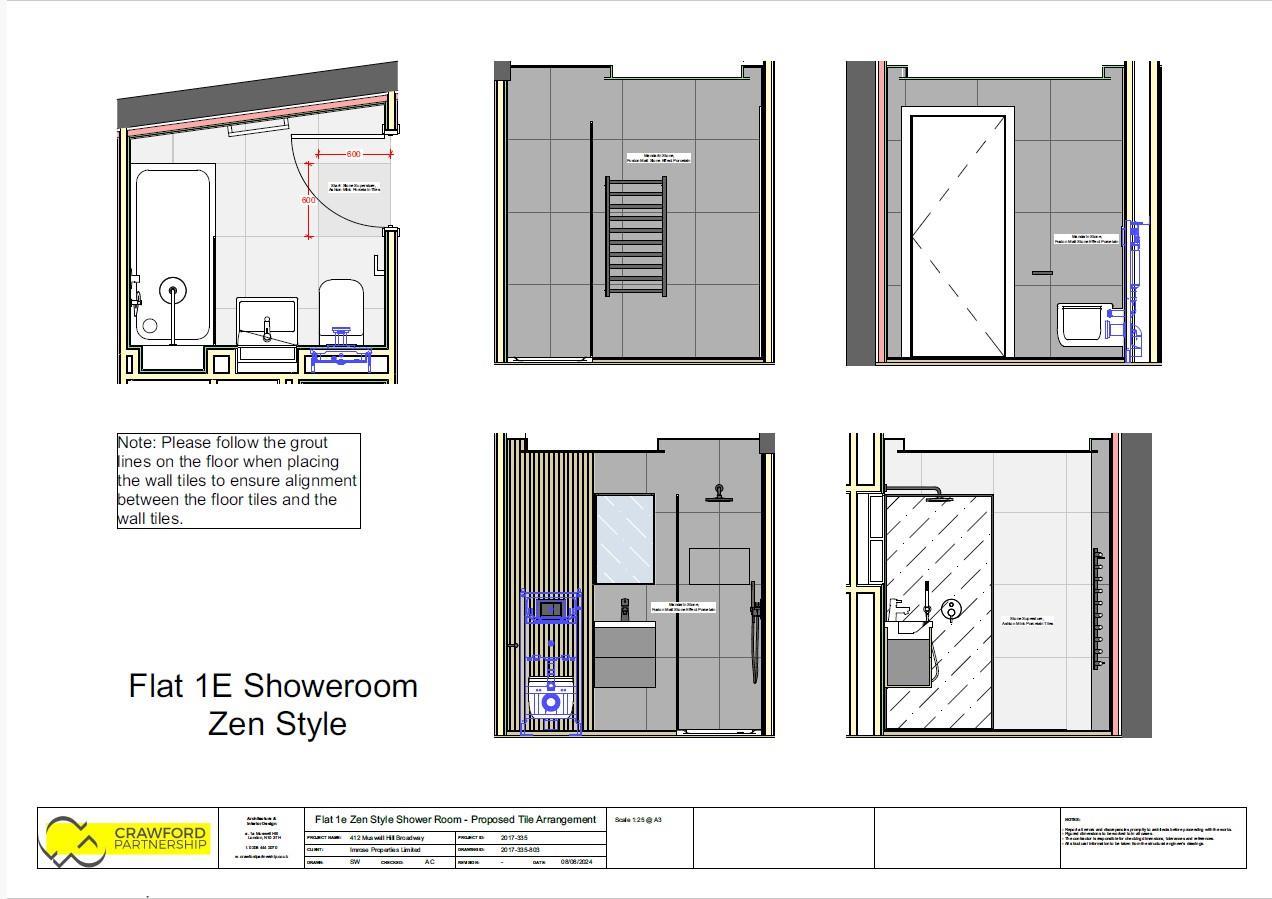
Muswell Hill Broadway 2024 Setting out drawing Zen Shower Room
Bathroom Designs Computer Visual and ‘as built’ Art Style


Muswell Hill Broadway 2024 computer visual Art Bathroom
Muswell Hill Broadway 2024 Completed Art Shower Room and Bathroom
Bathroom Designs Computer Visual and ‘as built’ Zen Style


Muswell Hill Broadway 2024 computer visual Zen Shower Room
Muswell Hill Broadway 2024 work in progress Zen Shower Room and Bathroom
Access, Circulation and Amenity Space
The entrance to the new first floor apartments is located at street level to the side of the new supermarket shopfront. Crawford Partnership’s design of the entrance area to the new flats incorporates a colour coated aluminum and glass entrance door and fanlight over, a video Entryphone system, and recessed letterboxes as part of the contemporary upgrade. On entering, the original staircase has been renovated to provide a welcoming approach to the first-floor apartments, with new terrazzo tiles as a finish, an LED illuminated stainless steel handrail, wall mounted lights and natural stone finished wallpaper.


Muswell Hill Broadway Entrance to Apartments
Muswell Hill Broadway New Staircase Finishes
At first floor level, the original fully enclosed floor area has had sections of the flat roof carved out to create 2 new open courtyards that are finished with porcelain tiles on raised access floors to provide access areas to all 7 apartments at first and second floor levels, ensuring views to the exterior environment and an abundance of fresh air daylight and sunlight to all apartments.
As part of the overall circulation and means of escape, new steel stairs, bridge walkways, and privacy screens have been integrated as part of the design.


MuswellHillBroadwayCrawfordPartnershipComputerVisualsShowingOpenCourtyardandEntrancestoApartments


MuswellHillBroadway2024newopencourtyardscreatedbycarvingouttheexistingflatroof


MuswellHillBroadway2024newopencourtyardscreatedbycarvingouttheexistingflatroof
Sustainableand Modern Performance
As part of our commitment to sustainability, the new flats at Muswell Hill will achieve an EPC ‘C’ rating, a significant accomplishment in a building of this age. This is made possible through the installation of new double-glazed windows, high levels of insulation in walls, floors, and roofs, and the implementation of modern energy systems. Each flat will have hot water and water based underfloor heating provided by Mitsubishi air source heat pumps, ensuring energy efficiency and comfort for future residents.
By integrating these modern performance standards, we are not only preserving the historical essence of the building but also ensuring that it meets the demands of contemporary living. This contributes to the long-term sustainability of the building and helps maintain the vitality of our local high street by attracting residents and keeping the area economically vibrant.


Overcoming Challenges
The project presented several main challenges, including:
• Structural Reinforcement: Necessary to support new residential loads while preserving the building’s historical character. Crawford Partnership worked closely with ENR structural engineers to knit all new steel structures into the shell of the existing building.
• Modern M&E Services: Integrated without compromising the building’s Fabric was a major challenge for the design team. Crawford Partnership worked closely with Synergy Consulting Engineers to integrate all new services without compromising the building design and aesthetics.
• FireSafetyand Acoustics: Advanced systems such as mist fire suppression to each flat were strategically installed to meet modern standards.
• Planning Hurdles: Securing the planning approvals required extensive collaboration between Crawford Partnership and Haringey Planning Department.
Construction Progress Photos


Muswell Hill Broadway 2024 Main Front Courtyard and Entrance to Apartments
Muswell Hill Broadway 2024 All New Mains Services from Street to Apartments
Completion and Future Prospects
The project achieved practical completion in November 2024, and following this milestone, we discussed with the client how to showcase the contemporary boutique style apartments by providing a show home furnished by a local Muswell Hill based company, Robinson Stone. Show homes enable potential buyers to better appreciate the scale and design of the interiors, helping them to visualise the living spaces to their best advantage. It was decided to provide the show home in the 3-bedroom Zen flat, and we discussed with the staging company and the client, an appropriate ’style’ of furniture to be installed, so that the furniture selections might enhance the Zen style interior.


Sales and marketing of the new apartments are underway, with Muswell Hill based estate agent, Barnard Marcus appointed by the client. Crawford Partnership has been in initial dialogue with the estate agents and the client to assist with the descriptive text input and specifications for digital online marketing.

Links to the marketing of the preliminary release of 4 flats are attached:
2 Bed Flat (Number 2):
https://www.barnardmarcus.co.uk/properties/20207460/sales/MUH105876
2 Bed Flat (Number 4): https://www.barnardmarcus.co.uk/properties/20207490/sales/MUH105878
2 Bed Flat (Number 6):
https://www.barnardmarcus.co.uk/properties/20207499/sales/MUH105879
3 Bed Flat (Number 3): https://www.barnardmarcus.co.uk/properties/20207464/sales/MUH105877
Our thanks to:
Adam Butler for the professional photography: https://www.adambutler.com/
Shelly Robinson for staging the show flat: https://www.robinsonstone.co.uk/showcase
Star Xing Sun for supplying diffusers for the show flat: https://www.inoasis.co.uk
This project stands as a testament to the power of collaboration with the many stakeholders involved who have contributed to the ongoing innovation and dedication in the face of complex urban challenges. It also highlights the critical role of adaptive reuse in preserving the character and vitality of our historic high streets.
Stay tuned for more updates on this exciting development.
For more information, visit Crawford Partnership - Muswell Hill Broadway
Project Team
• Client: Imrose Properties
• Lead Consultant and Architect: Crawford Partnership www.crawfordpartnership.co.uk
• Main Contractor: Championbuild www.championbuild.co.uk
• Quantity Surveyor: KM Dimensions www.kmdimensions.com
• Structural Engineer: ENR Consulting www.enrconsulting.co.uk
• M&E Consultant: Synergy Consulting www.synergyconsulting.co
• M&E: ENR Consulting www.enrconsulting.co.uk
Sub-Contractors & Suppliers
• M&E subcontractor: Cannock Building Services https://www.cannock.org/
• Flat Roof Waterproofing: Bell Asphalt https://www.bell-asphalt.co.uk/
• External Metalwork and Cladding: Porfan https://www.porfanmetalwork.co.uk/
o Kitchens: Design by Crawford Partnership with Championbuild supply and install www.brigitte-kuechen.de www.bosch-home.co.uk
o Bathrooms: Designed by Crawford Partnership www.theshowroomltd.co.uk www.vitra.co.uk
o Impervia Flooring: www.thesolidwoodflooringcompany.com