AUDUBON SOCIETY OF RHODE ISLAND
AUDUBON REPORT CONNECTING ALL PEOPLE WITH NATURE • SPRING 2026
standing strong
PROTECTING RHODE ISLAND FORESTS
AUDUBON SOCIETY OF RHODE ISLAND BOARD OF DIRECTORS 2025-2026 OFFICERS: President: David Caldwell Jr. Vice President: Richard Staples, Jr. Treasurer: Patricia Thompson Secretary: Katherine Burnham DIRECTORS: Charles Allott Stephanie Beauté Pierson Booher Jameson Chace Tina Duhaime Meg Kerr Thomas Lisi Kallie Longval Kathleen Melbourne Stephen Porder Emily Murphy Prior Leslie Samayoa Sara Sweetman Olinda Suchite-Mendez Carol Lynn Trocki Emily Westcott Shawen Williams COUNCIL OF ADVISORS 2025-2026
4
STANDING STRONG PROTECTING FORESTS
10
34
Habitat Restoration at Roger Williams Park Zoo
Making A Difference 2025 DONORS AND SUPPORTERS
President: Candace Powell Dickson Boenning Abigail Brooks Nicholas A. Califano Christian Capizzo Trudy A. Coxe Meghan Frost Joan R. Gardiner Christopher R. Greenman David Gumbley Samuel H. Hallowell, Jr. Don Heitzmann Owen Heleen Katherine Irving Keith Killingbeck A.Max Kohlenberg Laura Landen Deborah Linnell Terry Meyer Robert Parker Suzanne Paton Steven E. Reinert Frank Sciuto Julia Randall Sharpe Charlotte Sornborger Everett Stuart Frederick J. Vincent Michael Viveiros Cynthia J. Warren Kim Westcott John Woulfe
2
VOLUME 60 • NO. 1 • SPRING 2026 Spring at the Nature Center and Aquarium
14
Audubon Society of Rhode Island 12 Sanderson Road, Smithfield, RI 02917 401-949-5454 www.asri.org
Restoring Nature in Spring
16
Executive Director: Jeffrey C. Hall
Artist Aila Bally has Roots at Audubon
17
Managing Editor: Hope M. Foley
Chimney Swifts
18
Community Partnerships and Collaborations
20
Nature Tours and Programs
22
On the Wildlife Refuges
25
Kid’s Page: Spring Scavenger Hunt
26
New! Field Naturalist Series
27
Fort Wildlife Refuge
28
Through the Eyes of a Grandchild
39
Contributing Writers: Laura Carberry, Hope Foley, Sara Horvet, Abbie Lahmers, Lauren Parmelee, Scott Ruhren, Katie Schortmann, Betsy and Richard Staples Contributing Photographers: Rachael Bonoan, Cate Brown, Mary Ann Cofrin, Matt DiMaio III, Marina Flannery, Peter Green, Casey Johnson, Abbie Lahmers, Jason Major, Glenn Osmundson, Scott Ruhren, Richard Staples
Editorial
The Report is Audubon Society of Rhode Island’s newsletter, updating members and supporters on current news, policy issues, research and initiatives being led by the organization, staff, and volunteers.
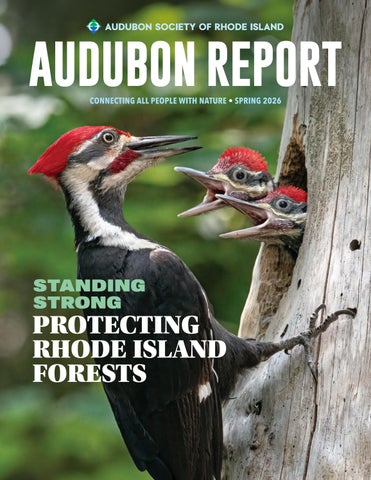
Cover: Pileated Woodpeckers by Matt DiMaio III. Please pass this copy on to a friend or recycle. Thank you.
We encourage your participation. Please send items that will be considered for publication to Managing Editor Hope M. Foley at hfoley@asri.org.
Audubon Society of Rhode Island • www.asri.org
FROM THE EXECUTIVE DIRECTOR
IS THE GLASS HALF FULL?
E
very day, the headlines seem to test us. Endangered species protections are challenged. Once-protected lands and even underwater sea canyons face renewed pressure for resource extraction. Climate impacts are accelerating and the tools to combat them seem to disappear with an executive pen. And here at home, I’m asking whether an uncertain economy will affect the loyal support that keeps Audubon strong. Is it fair to ask, "Is the glass half full?” As you read this Report, you will see both the urgency and the hope. You’ll learn why Scarlet Tanagers and Wood Thrush depend on large, connected forests, and about the layers of diversity found in woodland habitats. You’ll learn how to help turtles crossing busy roads, and pollinators that rely on native plants. You’ll see our work restoring water quality at Roger Williams Park Zoo and advancing bird conservation science. The threats are real. Forest fragmentation, invasive species, increased pesticide use, climate impacts, longer droughts and stronger storms, they are all challenging the delicate balance of nature. As I’ve said before, forests are the life-support system of Rhode Island’s ecosystems. They absorb floodwaters, filter drinking water, store carbon, and shelter biodiversity. If we are not vigilant, we risk losing not just the trees, but the very stability that forests provide to birds, wildlife, and ourselves. Just as forests are the life support for the natural world, you, and all our donors, are the life-support system of Audubon. With clouds on the horizon — environmental, political, economic — I wonder what the future holds. Will our support remain strong? Will there be grants available to fund the science and education crucial to our mission? Will Rhode Islanders continue to prioritize conservation even in uncertain times?
I believe the answer is yes, because our connection to nature is such a powerful force. Nature grounds us … it balances us … it reminds us that resilience is built slowly — tree by tree, habitat by habitat, generation by generation. When you hear a Wood Thrush for the first time, when a family discovers a frog or salamander on a refuge trail, when volunteers monitor migrating birds or help us clear trails, something steadily takes root. That is why we do this work, to conserve land for wildlife, to educate a generation of children, and to advocate for science-based policy. We invest in clean, renewable energy through RePower Audubon. We restore habitats to enhance their value for birds and all the species that live under the forest canopy. As the late President John F. Kennedy once said, we do these things, “not because they are easy, but because they are hard.” I will admit, there are days when the glass feels half empty. This will be a challenging year ahead. But when I look at the land and forests we protect, our donors standing beside us, and the community that rallies and supports our mission, I see something totally different … I see a glass that is still filling. Good birding,
Jeffrey C. Hall Executive Director
P.S. Thank you to every donor who contributed to Audubon’s success last year, whether that was in time or treasure. You make this organization stronger and ensure that there is a future for the animals and people we share our world with.
Audubon Report • Volume 60 • No. 1 • Spring 2026
3
Forests are the life-support system of Rhode Island’s ecosystems. – Audubon Executive Director Jeffrey Hall
4
Audubon Society of Rhode Island • www.asri.org
Standing Strong
PROTECTING RHODE ISLAND FORESTS In every layer of our woodlands, birds and wildlife thrive. It's evidence of the work Audubon is doing to preserve these vital habitats. “
T
By Abbie Lahmers
oo much of our life is seen at 60 miles per hour,” remarks Scott Ruhren, Audubon Senior Director of Conservation, during a walk in Fisherville Brook Wildlife Refuge. In the span of an hour, following the trail marked by blue blazes, there are both obvious and subtle shifts in scenery. We pass 100-year-old white pines and vernal pools that may soon hold spotted salamander eggs, cross a boardwalk where signs of beaver activity can be seen in the pond, enter a clearing with a Chimney Swift nesting tower, and then, as the trail nears wetlands, we begin to see Atlantic white cedars – identifiable by their tiny green needles and striated bark gradually spiraling up the trunk – and red maples, which will be the first trees to flower in the spring. These small details are part of the bigger narrative of the ecosystem. In the lifecycle of a forest, the earlier that any evidence of disturbance or disease is identified, the better that organizations like Audubon and their conservation partners can plan for the future. And though woodlands may appear abundant and impervious to threats, Ruhren emphasizes that they face “many of the large-scale challenges that all habitats face today, including warmer weather, shorter winters, and impacts from severe storms. Invasive plants, insects, and pathogens that native plants have no history or protective response to are also growing threats.
Continued on page 6
Audubon Report • Volume 60 • No. 1 • Spring 2026
Glenn Osmundson
"If we're not careful, we could lose large areas of the forested land we have.”
5
Abbie Lahmers
Jason Major Mary Ann Cofrin
Richard Staples
Clockwise from upper left: Forest trail at Fisherville Brook Wildlife Refuge in Exeter. Senior Director of Conservation Scott Ruhren walks the forest at Fisherville Brook. Scarlet Tanager (Piranga olivacea). A visitor on the trail at Fort Wildlife Refuge in North Smithfield.
THE CANOPY Preserving Connected Greenway In the canopy of a mature forest, you can hear the low rustlings of mature trees swaying in a breeze, especially the further you are from the single-note drone of traffic on the highway. In the spring, sounds of activity in the leaves and urgent trills of birdsong are added to this natural chorus, signaling the return of migratory species to the approximately 380,000 acres of woodland that make up over 55% of Rhode Island. The Scarlet Tanager is among these seasonal residents. A neotropical migratory bird (species that migrate from tropical areas in Central and South America, Mexico and the Caribbean), the male is known for its bright red plumage and black wings, contrasting the female’s subdued olive-yellow. They arrive in April and May, and some keep traveling north on their long voyage from wintering in South America, but many reliably stay here, especially in the western part of Rhode Island where larger forested areas provide the right habitat conditions. “Without large plots of mature forest, Scarlet Tanager populations can't succeed,” explains Audubon Director of Bird Conservation Sarah Deckel. Smaller, younger wooded plots lack crucial habitat features, such as tall trees where they breed, and food resources, which they forage for high above the forest floor. Deckel explains that the Scarlet Tanager and similar species can afford to be omnivorous, eating both fruit and insects, later in the summer, but when arriving in the spring, “they rely on very high-protein insects to give them enough energy to have a successful breeding season. If there's a cold snap, or if it's extremely hot or raining for many days, that can be energetically expensive.” The Scarlet Tanager is also on Audubon’s list of Responsibility Birds, a selection of species that researchers are actively monitoring, and Audubon is developing habitat management plans to reverse population declines. The conservation of these birds often indirectly
6
supports species with similar needs. “Forests play a really huge role in more than half of our Responsibility Birds,” says Deckel. Whether breeding, migratory, or overwintering, these species are already facing population declines due to human influence. Audubon manages almost 10,000 acres, of which about 90-95% is forest. “They are the life-support system of Rhode Island’s ecosystems,” says Audubon Executive Director Jeff Hall. “Rhode Island has a good thing going for the birds in terms of sheer breadth of forest. Preserving contiguous forests now is far more effective and affordable than trying to restore them in the future, once they’ve been fragmented or degraded.” Audubon Properties Director Laura Carberry describes the lay of the land: “In Exeter, we have Fisherville Brook, which is over 1,000 acres. North of that is a Nature Conservancy property and Big River Management Area, so it's this huge contiguous forest that is really good for biodiversity.” South of Fisherville is Audubon’s Eppley Wildlife Refuge, which covers another thousand acres, including a section of Queen River and also contains an Atlantic white cedar swamp. “It's a very different forest, with more pinewood conifers, whereas Fisherville is more upland forests with oaks and maples. There’s a lot of biodiversity between the properties, and they're connected by this corridor.”
UNDERSTORY Forests on the Frontlines of Climate Change Trace your gaze down from the top of the canopy to the acres of undergrowth ahead – the tree trunks, shrubs, and snags – and listen for the flutey notes of another bird on Audubon’s Responsibility Bird list: the Wood Thrush.
Wood Thrush (Hylocichla mustelina)
Audubon Society of Rhode Island • www.asri.org
Continued on page 9
“ The Eastern Towhee is one
of our Responsibility Birds that are in the steepest decline, and that’s partially because of forest fragmentation, invasive species, and disturbance. – Sarah Deckel, Audubon Director of Bird Conservation
“
Photos above: Director of Bird Conservation Sarah Deckel at Powder Mill Ledges Wildlife Refuge in Smithfield. An Eastern Towhee (Pipilo erythrophthalmus), one of Audubon’s Responsibility Birds.
Audubon Report • Volume 60 • No. 1 • Spring 2026
Mary Ann Cofrin
“When we work toward preserving forested plots for the Scarlet Tanager, we’re preserving it for the Wood Thrush, too,” says Deckel. “The Wood Thrush is another charismatic bird. People love their songs and the spotted pattern on their chest. If we want to continue hearing these songs in the forests in the spring and summer, the key is to preserve these large, forested plots.” The Wood Thrush primarily spends its time in the understory, the layer between the forest canopy and ground cover, and prefers mature forests, with a diverse range of food and habitat features. “We have a good population of Wood Thrush at Fisherville Brook,” says Carberry, “so that’s one way we know it’s a healthy environment, same with looking at spotted turtle populations that need really clean water – we have them on many of our refuges too. We can assess the health of our properties by looking at key indicators like these species over time. It helps us to identify trends.” Keeping records of changes and trends in these habitats provides a critical snapshot of the state of the forests. “Many forest bird species are declining, and scientists often record the loss of these populations before broader ecosystem impacts are visible,” says Hall. “Like the canaries in the coal mines, birds are an early warning system on forest fragmentation, wide-scale use of pesticides, and changes in the ecosystems due to a warming climate.” In a balanced ecosystem, parcels of forest can both withstand and combat increasingly severe climate change events, but only if they’re healthy and vigorous, allowing them to endure drought, winds, snow, and other threats. When preserved and managed effectively, forests will return the protection and resources we give to them. “The extreme storms, which used to be more historic, are more common now,” says Ruhren. “They used to be called hundred-year floods and now we’re getting them every 20 years. Open spaces like Fisherville can absorb the water, much better than a shopping mall parking lot.” When excess precipitation collects in the forest, it’s less likely to flood downstream into more populated areas. Carberry recalls a period of heavier than usual rainfall several years ago: “It flooded the road closest to Fisherville, but the water had dispersed enough throughout the forest that it didn’t make it to Route 102. If we didn't have this undeveloped land, all that water would run off and continue to flood roads and cause damage.” Bodies of water that flow through the forests of southwestern Rhode Island are all part of the Wood-Pawcatuck watershed, supplying a vital source of drinking water to many residents. Before the water gets to our faucets or wells, the forest – like wetlands – acts almost like a sponge, absorbing contaminants from the rainwater and capturing sediments on their roots, preventing pollution from ever reaching the watershed, and also reducing soil erosion.
VOLUNTEER FOR
AVIAN RESEARCH Breeding Bird Surveys* Early May through Late August Can you can identify RI breeding birds by sight and sound? We could use your help to monitor birds on our wildlife refuges!
Set up Audio Recorders for Migration Early April and Late May Volunteers are needed to put audio recording units (ARUs) on the refuges. Must be able to carry equipment into the field.
Invertebrate Surveys* Mid-April/Early May through August. Monitor what food is available for birds on our wildlife refuges. No prior identification experience is required.
Window Strike Surveys* Mornings in May Millions of birds face mortality every year due to window strikes. Walk a route in Providence in the early hours (6am) during spring migration to monitor the impacts of window strikes.
* High need Email Sarah Deckel at sdeckel@asri.org
Where Have (Most) Birds Been This Winter? April 15, 2026 6:00–7:00pm Audubon Nature Center and Aquarium, Bristol
Meet Dr. Sarah Deckel, Audubon Director of Bird Conservation, explore the mysteries of migration, and learn how research is tracking these perilous journeys. Details at asri.org/calendar.
7
For a small state, Rhode Island contains many types of forest. Defined by the dominant trees, you will find many other tree species coexist within these habitats as well.
Forests of Rhode Island
By Dr. Scott Ruhren, Senior Director of Conservation
Oak/Hickory
Maple/Ash
• The most common forest in Rhode Island, comprising 50-60% of all the state’s forests.
• Red maple is Rhode Island’s state tree, most likely the most common tree statewide. The species is the predominant member of this habitat.
• Dominated by red and white oaks with hickory species, it is more common in Northern RI. • Birds: Scarlet Tanager, Wood Thrush, Ovenbirds and Wild Turkey. • Audubon Wildlife Refuges: Found in the dry uplands at Maxwell Mays and Parker Woodland (Coventry), Powder Mill Ledges (Smithfield) and Fort Wildlife Refuge (North Smithfield).
• With the decline of ash species from invasive insect pests, this forest is changing. • Birds: Vireos, Black-throated Blue Warbler, Ovenbird, and Northern Saw-whet Owl. • Audubon Wildlife Refuges: Emilie Ruecker Wildlife Refuge (Tiverton).
Maple/Birch
Oak/Pine
• Birches, both black (aka sweet birch) and yellow, are common in this forest habitat.
• White pine, common in Rhode Island, coexists with oaks and other hardwoods in this forest community.
• Hemlock can grow in cooler and darker sections.
• Pines may form dense stands, occasionally with ancient trees older than 200 years.
• Birds: Yellow-bellied Sapsucker, Pileated Woodpecker, Blackcapped Chickadees and finches. • Audubon Wildlife Refuges: Parker Woodland Wildlife Refuge (Coventry).
8
• Birds: Pileated Woodpeckers, Pine and Black-throated Green Warblers, and Veery. • Audubon Wildlife Refuges: Most common in Central RI. Fisherville Brook (Exeter) and Powder Mill Ledges (Smithfield).
Audubon Society of Rhode Island • www.asri.org
Continued from page 7
Southern New England Mesic Forest
Silver Maple/Sycamore Floodplains
• A moist, yet not wet, cool and fertile forest.
• Influenced by their location along streams and rivers, these nutrientrich forests can withstand seasonal flooding.
• Black gum, red maple and pines mixed with oaks and other species. It is changing with the decline of American beeches. • Birds: Chestnut-sided Warbler, American Redstart, Eastern Woodpewee and many warblers. • Audubon Wildlife Refuges: Lathrop Wildlife Refuge (Westerly), Caratunk (Seekonk), and the Claire D. McIntosh Wildlife Refuge (Bristol). Atlantic White Cedar Swamp • Wet, dark and often impenetrable forest. • Birds: Woodpeckers, warblers, Wood Ducks, Hooded Mergansers and unique species including the rare Northern Parula. • Audubon Wildlife Refuges: Long Pond Woods (Rockville) has large stands of this rare forest. Smaller tracts at Fisherville Brook (Exeter).
• In addition to the maples and sycamores, large mature hackberry trees may also be found. • Birds: Wood Ducks, Yellow Warblers, flycatchers, Belted Kingfisher. • Audubon Wildlife Refuges: Davis Memorial Wildlife Refuge (North Kingstown). Pitch Pine/Scrub Oak • Dry, low fertility soils and fire, historically, drive the creation of this forest type where trees and other plants grow slowly. • Birds: Eastern Towhee, Whip-poorwill, Eastern Screech-Owl, Pine Warbler and Brown Thrasher. • This forest can be found in Western RI and on Audubon protected lands on Prudence Island.
Maritime Woodlands
• Birds: Migratory species as well as annual breeding birds such as warblers and sparrows. • Audubon Wildlife Refuges: Touisset Marsh (Warren), and Lathrop Wildlife Refuge (Westerly).
Richard Staples
• Coastal exposure to wind, salt spray, and storms influence these mixed-species forests with distinctive American holly and shadbush.
It’s well-known that forests produce oxygen that we breathe, and soak up carbon, which helps keep the climate cooler – all you have to do is stand on a piece of pavement for a few minutes during the summer, and then spend time in a forest to notice the difference in temperature. The mental health benefits of making time to take a walk in the woods can’t be understated, either. Hall says, “Centering forest preservation in climate conversations is essential if we want low-cost, nature-based solutions to the climate crisis.”
FOREST FLOOR Education from the Ground Up Not all birding happens above eye-level – denizens of the forest floor include the Eastern Towhee, which forages in the leaf litter and forest edges. Listen for the sound of rummaging in the undergrowth, and watch for the black head, throat, and back plumage of the male, with reddish sides. The female can be distinguished by brown upperparts instead of black. “They are one of our Responsibility Birds that are in the steepest decline, and that’s partially because of forest fragmentation, invasive species, and disturbance,” notes Deckel. Leaf litter in smaller, isolated patches of forest doesn’t provide enough nutrient-dense food resources for them. While walking through Fisherville, Ruhren points out some indicators of the health and vitality of the ecosystem that Audubon protects, such as layers of vegetation. Mixed ages and species exemplify strong biodiversity, but if an area is disturbed, a dominant species may take over, or it invites an opening for invasives to fill in, which disrupts the balance of the ecosystem. In the summer, you want to see lots of saplings and native shrubs – a good sign of regeneration and that deer pressure isn’t too high. These are the kinds of details Ruhren points out to those who participate in the Forestry for the Birds program. Through Audubon’s partnership with the Natural Resources Conservation Service, landowners can have their property assessed for biodiversity, with Ruhren and Carberry surveying the plants and birds present there. More and more people are motivated to do what’s best for wildlife, even if it means unlearning previously held beliefs about what a “pristine” landscape should look like. Continued on page 30
Audubon Report • Volume 60 • No. 1 • Spring 2026
9
Animals Love Clean Water Too Advancing Water Quality and Habitat Restoration at Roger Williams Park Zoo By Sara Horvet, Outreach and Engagement Program Manager
O
ne of Providence’s most beloved public spaces, Roger Williams Park Zoo, is taking steps to incorporate effective, natural solutions to improve water quality and protect the wildlife and natural habitat found within its wetland area. For many years, the pond in the Zoo has struggled with poor water quality. Excess nutrients in the water have led to cyanobacteria blooms, which can harm wildlife and disrupt the ecosystem. Nearby Polo Lake (which is connected to the Zoo pond through a culvert) also faces similar problems, including high levels of phosphorus and bacteria. A newly developed Stormwater Master Plan will help identify where this pollution is coming from and outline practical, long-term solutions to improve conditions in both the Zoo pond and Polo Lake. The Audubon Society of Rhode Island and the Stormwater Innovation Center are leading this effort in partnership with the Zoo and the City of Providence’s Public Works and Parks Departments. Funded by a 2023 Environmental Protection Agency Southeast New England Program (SNEP) Watershed Implementation Grant through a partnership with Restore America’s Estuaries, this work is an important step toward improving water quality, protecting wildlife, and strengthening the park’s ability to handle heavy rain and climate impacts.
Combining Green Infrastructure, Education and Outreach A major focus of the plan is the use of natural, environmentally friendly green infrastructure solutions to manage stormwater. These solutions fit well with the Zoo’s conservation mission and include ways to slow down, filter, and better direct rainwater. The plan will recommend strategies that work with the Zoo’s existing operations and maintenance abilities, including strategic routing of select flows into existing infrastructure where appropriate, while prioritizing on-site nature based treatment and infiltration. The project also creates opportunities for future education and outreach, helping visitors and community members learn more about how stormwater affects water quality and wildlife.
“
It’s an amazing opportunity for us to tell an important story about a part of our Zoo that many visitors may otherwise take for granted, and… encourage them to learn more about how to get involved in this type of work in their own communities. – Leigh Picard, Roger Willams Park Zoo Director of Guest Engagement
“
10
3
Audubon Society of Rhode Island • www.asri.org
Register now for these Audubon programs. Visit asri.org/calendar.
A Shared Vision for Urban Habitat Protection The team also worked closely with project partners to explore ways to reduce pollution, prevent erosion, improve land management, and enhance wetland habitat. These ideas were developed during a collaborative design workshop held in October 2025, where participants shared ideas and created early design concepts. These concepts do not directly lead to construction but provide the road map for phased future projects. This session helped build a shared vision for the future of the Zoo pond and will guide the final plan. The Principal Landscape Architect at Horsley Witten, Brian Kuchar, felt that “this hands-on approach [was] an efficient and inclusive way to develop the concepts and seemed to be well received by the zoo staff.” Audubon and the Stormwater Innovation Center are excited to complete the Stormwater Master Plan and use it to identify and implement future restoration and education projects at the Zoo. This work reflects Audubon’s and Roger Williams Park Zoo’s shared commitment to clean water, healthy urban habitats, and innovative solutions that benefit both people and wildlife – now and for generations to come. Photos at left from top: Jaired Flanagan, Seasonal Water Resources Monitoring Assistant, participates in water sample collection in the Zoo pond by canoe. Middle photo: Molly Welsh, Stormwater Research Program Manager, installs an overland flow collector to sample stormwater runoff. Bottom photo: Seasonal Water Resources Monitoring Assistants Jaired Flanagan and Jack Duncan conduct water testing.
Audubon Report • Volume 60 • No. 1 • Spring 2026
Free May Bird Outings: Celebrate Spring Migration Outings offered across the state, beginners welcome. Register early!
Early Morning Bird Walk, Spring Ephemerals and Breakfast
May 2, 2026; 8:00am-12:00pm Maxwell Mays Wildlife Refuge, Coventry, RI Start the morning off with an early bird walk to hear early spring warblers and explore the forest for spring flowers called ephemerals. Following the walk enjoy a scrumptious fireside breakfast at the lakeside cabin. Space is limited, register today!
May Birding Van Trip
May 11, 2026; 7:30am-4:00pm Climb aboard the Audubon van and explore many birding hot spots in Rhode Island during this exciting time of the year. Warblers, vireos and other spring beauties will make for an unforgettable trip. Pack a lunch and bring your binoculars. Departs from Fisherville Brook Wildlife Refuge, Exeter, RI. Ages 15+.
Spring Birding Spectacular Nine-day Van trip to Magee Marsh, Ohio and Beyond!
May 13–21, 2026; Register by March 31! Picture low trees with Prothonotary, Blackburnian, and Cape May warblers, White Pelicans and Caspian Terns flying overhead, Sora in the marsh, Yellow-headed Blackbirds and so much more! Enjoy a nine day/eight night van trip to Magee Marsh in Ohio and on to Michigan to search for rare Kirtland's Warblers. Visit asri.org/calendar for more information.
Cate Brown
The Director of Guest Engagement at Roger Williams Park Zoo, Leigh Picard, stated “We’re so excited about this project. In addition to the value of the project itself, it’s a great example of the wide variety of conservation work the Zoo is involved in but of which many of our guests are unaware. It’s an amazing opportunity for us to tell an important story about a part of our Zoo that many visitors may otherwise take for granted, and at the same time encourage them to learn more about how to get involved in this type of work in their own communities.” To support the plan, the Stormwater Innovation Center and Horsley Witten Group are conducting on-the-ground research and water testing throughout the Zoo wetland and Polo Lake. Their work has included studying drainage patterns, sampling water quality, and mapping how rainwater flows into the ponds. They identified several ways stormwater enters the area, including rainfall, surface runoff, and six stormwater pipes that discharge around the ponds.
Jason Major
BE AN EARLY BIRD
11
AUDUBON SOCIETY OF RHODE ISLAND
LEADING THE WAY TO A CLEAN ENERGY FUTURE
Thanks to your help, we have reached major milestones: • The heating and cooling systems at the Nature Center and Aquarium have been updated, eliminating 97% of our fossil fuel use at that facility. • All three HVAC units at headquarters in Smithfield will be replaced this winter, ending the use of fossil fuel in our building. • Two solar carports, in Bristol and Smithfield, will be constructed in 2026. After completion, we will produce all power we use at all our facilities with renewable energy.
12
By 2030, Audubon Society of Rhode Island will be one of the first environmental organizations to be completely net-zero. Help us keep this momentum going! We still need to raise $1 million to finish funding for both carports and to upgrade our other gas and oil heated buildings to electric. Your support brings a sustainable future closer for birds, wildlife and all of us.
Please consider a donation today. Visit asri.org/repower
Audubon Society of Rhode Island • www.asri.org
Rachael Bonoan
Richard Staples
H ABI TAT AT H O M E
Casey Johnson
Your Yard is Bigger Than You Think Audubon Can Help You Create Wildlife Habitat at Home
Y
ou’re standing at the kitchen window holding your coffee, looking out at the same lawn you’ve seen a thousand times. Neatly trimmed. Predictable. Quiet. And then you notice a flicker of movement — a goldfinch perched on a swaying branch in the corner, or a bumble bee hovering longer than expected over a new blossom in your patio planter. You consider for a moment, what if this space could do more? Most Rhode Islanders live surrounded by small patches of land— fenced in backyards, mowed front lawns, small islands of landscaping. They don’t look like wildlife habitat, and many people don’t feel these spaces are that important for nature. But taken together, they form one of the largest opportunities we have to help birds, pollinators, and other wildlife survive and thrive. Here’s the real question: can changing just a little in our yards, actually make a difference? At Audubon, we’ve spent the last 15 years answering that question— one yard at a time. From compact city lots to properties stretching over acres, we’ve seen the same thing happen again and again: when people rethink how their land functions, wildlife responds. Quickly. Small efforts can bring big results. And no—it’s not about transforming your yard overnight. It starts with simple shifts. • What if water were available for wildlife year-round? • What if leaves stayed where they fell through the spring? • What if “messy” edges became safe places for wildlife to hide, nest, and feed?
Audubon Report • Volume 60 • No. 1 • Spring 2026
And then there are the plants—the quiet powerhouses of it all. Native plants speak the same language as our birds and insects. Their fruits, seeds, and flowers evolved together over thousands of years. When you plant native, you’re rebuilding nature’s relationships. And the good news? You don’t have to rip everything out of your yard to begin. Many landscapes already have a foundation to work from. The trick is knowing what to keep, what to replace, and what to add next. That’s where most people pause. Where do I start? What should I change first? How do I do this without wasting money—and time? You don’t have to figure it out alone. Audubon’s Habitat at Home consultations give you a personalized plan tailored to your property, your goals, and your budget—so you know exactly what to do and when to do it. Spring is the ideal time to begin. Reserve your consultation early and be ready for spring planting and habitat improvements. Your yard is already part of the solution—let’s get it working for wildlife.
Book Early!
For more information on the Habitat at Home program and to schedule a private assessment of your yard, email Dr. Scott Ruhren at sruhren@asri.org.
13
Richard Staples
Sweet Spring is Here! Welcome spring at the Audubon Nature Center and Aquarium! Visit the Palmieri Pollinator Garden as bees and blossoms begin to emerge, join a celebration of the Downy Woodpecker, scan the skies for returning Osprey, meet some cool animal ambassadors and more!
Birds, Bugs, and Outdoor Fun!
April Vacation Week at Audubon
Signs of Spring on the Trails
April 20–24, 2026
Bring the kids for a bug trek, shore exploration, bird nest building, wetland discoveries, and more! Visit asri.org/calendar for details.
Exhibit Opening
Woodpecker Wings
They’re Back! Scan the skies for returning Osprey.
Croak! Listen for spring peepers in the wetlands.
Can you find skunk cabbage below the boardwalk?
April 18, 2026; 10:00am–3:00pm Join Audubon, Brown University, and RISD in celebrating the opening of the new Woodpecker Wings exhibit! With help from almost 200 visitors last fall, Nico Moody (PhD Candidate Brown University) and Stephanie Van Riet (MFA Candidate RISD) constructed and painted giant woodpecker wings at the Audubon Nature Center and Aquarium. Come learn about these fascinating creatures, look for the giant woodpecker wings along the trails, and take part in themed activities! Details at asri.org/calendar. No need to register.
14
Animal Ambassador Meet & Greets April 4, May 2, June 6, July 11, August 1, 2026; 11:00am–12:00pm
Meet one of Audubon’s animal ambassadors and make your own ambassador animal craft to take home! Each month will feature a different animal. No need to register. Free with admission.
Audubon Society of Rhode Island • www.asri.org
Richard Staples
SAVE THE DATES!
AUDUBON
SUMMER CONCERTS ON THE LAWN
Late summer brings live, relaxed outdoor concerts to the Nature Center and Aquarium. Bring friends, blankets or lawn chairs and enjoy fresh air and great music with Audubon.
Member Appreciation Night!
Concert with Atwater-Donnelly July 31, 2026 Audubon Nature Center and Aquarium, Bristol, RI
Discover more activities and family fun at asri.org/calendar.
Sensory Friendly Hours
For guests who would benefit from exploring the Nature Center and Aquarium with fewer guests, lower lighting, and a quieter environment, Audubon offers Sensory Friendly Hours each month. Visit asri.org/SensoryFriendlyHours for details.
FREE! Pop-up Programs
Follow Audubon on social media in late spring and summer for the latest on free pop-up programs! Tidepool touch tank experiences, crafts, nature stories, science experiments, and more will be available and are free with admission.
Full Moon Hikes
April 1, May 1, June 29, July 29, 2026 As the sun goes down, nature comes to life! Explore the wildlife refuge at night with a guided evening walk under the light of the full moon and search for nocturnal wildlife. Please bring a flashlight and dress for the weather. Visit asri.org for details and to register.
Come Celebrate at Audubon
Do you have a special birthday, shower, wedding, retirement or meeting in your future? The Audubon Nature Center and Aquarium provides a unique nature-inspired destination for group events. For rental inquires, email sbradley@asri.org.
Audubon Report • Volume 60 • No. 1 • Spring 2026
The traditional American folk music of acclaimed duo Atwater-Donnelly appeals to all ages with humor, audience participation, and a relaxed stage presence. Save the date and stay tuned for updates on food and beverage offerings, kid-friendly activities, and more! Registration required. FREE for Audubon Society of Rhode Island members. Limited tickets available for non-members ($20/non-member). Visit asri.org/calendar.
Fundraiser to Support Audubon
Concert for Conservation with Playing Dead (Grateful Dead Cover Band)
August 8, 2026 Audubon Nature Center and Aquarium, Bristol, RI Break out the tie-dye and relax to the tunes of Playing Dead, offering marathon sets featuring the music from the Grateful Dead catalog. Every show is unique, with different set lists and exciting improvisational jams. The evening includes a visit from an Audubon avian ambassador, sure to delight guests while educating about these amazing birds and how Audubon works to protect them. Watch for ticket info and details at asri.org and on our social media.
15
RESTORING NATURE IN SPRING By Katie Schortmann, Pollinator Outreach Coordinator and Master Gardener Look up for Inspiration
Register today
Willows & Maples
M
arch and early April can often bring a sense of frustration and impatience after a bitter, icy winter. Longing for a burst of bright color on the landscape leaves most in dreary anticipation, but rest assured, nothing can hold back spring. As you enjoy the spring ephemerals dotting the forest understory Top: Red maple buds emerge with color (trout lilies, Virginia blue- in spring. Bottom: A willow bells, fringed bleeding hearts), do not catkin filled with pollen. forget to look up! Maple trees and willows provide essential nectar and pollen to those native pollinators stumbling out of their shelters on sunny days. It’s important to remember to layer your landscape with flowers from canopy to forest floor to maximize the biodiversity of the habitat. This growing season, consider planting Rhode Island’s state tree, the red maple (Acer rubrum) or a willow (Salix) species that suits the space. Be advised not to plant any tree too close to pipes or home foundations - always choose “the right plant for the right place.”
What's the Rush: The Solution to the Biodiversity Crisis Video by Dr. Doug Tallamy of Homegrown National Park Free Video Presentation with Q&A Discussion May 2, 2026; 2:00–3:30pm Audubon Nature Center and Aquarium, Bristol, RI
B
y creating native habitat, whether it be in your yard, deck, or balcony, you can help restore nature while experiencing the joy and fulfillment of connecting with the world around you. Plan your spring garden with inspiring insights on how nature rebounds when we take steps to create habitat and support wildlife. A live Q&A will follow the video with free handouts listing the best native trees and plants for our area. Register at asri.org/calendar.
SUPPORT POLLINATORS AND NATIVE HABITAT
Visit asri.org/donate
Watch us grow!
Audubon Pollinator Alliance Thanks to members like you, the Audubon Pollinator Alliance now has over 120 registered pollinator sanctuaries, totaling 3,218,585 square feet of garden space!
R
egister your pesticide-free green space today to join like-minded gardeners and landowners in protecting habitat across the state. Connected habitat is essential for small insects, and connected people who support nature turn Audubon’s conservation efforts into lasting, positive impacts. For more information, visit asri.org/pollinators/alliance.html At right is a list of vetted plant sellers and partners that Audubon has worked with for habitat restoration and pollinator garden needs.
16
• Prickly Ed’s Cactus Patch Native Plant Emporium, Barrington, RI • Butterfly Effect Farm, Westport, MA • Blue Stem Natives, Norwell, MA • Homegrown, Pawtucket, RI • Native Plant Trust, nativeplanttrust.org • Rhode Island Wild Plant Society (native plant sales), riwps.org • For Seeds: Northeast Seed Collective, northeastseedcollective.com • Wild Seed Project, wildseedproject.net
Audubon Society of Rhode Island • www.asri.org
Richard Staples
a
FOUNDATION to draw from
Artist Aila Bally Has Roots at Audubon
S
he clearly remembers trekking down the long boardwalk, scooping for water bugs in the wetlands, and exploring the shore during summer camps in Bristol. And as a recent Colorado College graduate with a degree in studio art, Aila Bally still looks back at her original Audubon camp journals. Detailed sketches fill the pages, recording her nature discoveries.
Those early experiences made an impact – and a connection – that lasted. Bally returned to Audubon with the Youth Conservation League (YCL) in 2024 and 2025, working as a crew leader in city parks, land trusts, and wildlife refuges during the summer. She led a crew of YCL members as they removed invasive plants, constructed boardwalks and chimney swift towers, and worked to make city parks more accessible to the public. “The Youth Conservation League provided a wonderful opportunity to grow my leadership and communication skills, as well as develop my knowledge of ecology and conservation,” explained Bally. “Some of the teens I worked with held extensive knowledge about birds, snakes, frogs, or trees. Some exhibited impressive leadership and problem-solving skills. Ultimately, we all had opportunities to teach and learn from one another.”
Audubon Report • Volume 60 • No. 1 • Spring 2026
I was a very shy child, but I couldn't help but get involved in sorting through nets, doing science experiments, and drawing during Audubon Summer Camps. They solidified my love for animals and the outdoors and nurtured my curiosity regarding nature. – Aila Bally
These days, she’s back at the Audubon Nature Center and Aquarium in Bristol as a part time staff member, and this time her artistic talents are on full display. Bally recently enhanced the murals throughout the exhibit hall. One focuses on saltmarsh habitat with a stunning array of birds, another mural highlights ocean creatures, and in the Nature Nook, she painted charming animals to welcome children. “I had never made a mural before but have been painting animals and nature my entire life, so I was excited for the challenge,” said Bally. “I am proud of how these paintings turned out and will forever be grateful for this special opportunity.” Audubon thanks Bally for her many contributions to the organization and wishes her well on her next adventure, as she travels to Switzerland this year to learn about sustainable agriculture – and hopefully finds plenty of time to paint.
17
L E T’S G O B IRD IN G
By Laura Carberry, Director of Properties
CHIMNEY SWIFTS aerial acrobats of the sky
O
n warm, late spring evenings across Rhode Island, a curious sight can unfold above our towns and neighborhoods. Dark, fluttering cigar-shaped birds circle high in the sky, chattering softly as they swoop and glide. As dusk deepens, they may suddenly funnel downward, vanishing into a single chimney where they roost together. These are Chimney Swifts, aerial acrobats of the sky. Often mistaken for swallows, there are key differences between the species. Chimney Swifts (Chaetura pelagica) have long, sickle-shaped wings, short tails with tiny spines, and rapid wing beats. They spend nearly their entire lives on the wing—feeding, drinking, and even mating in flight. In fact, they can only perch by clinging vertically to rough surfaces. Historically, one pair of Chimney Swifts would nest inside large hollow trees during the breeding season (summer). As forests were cleared and towns developed, the birds adapted, moving into masonry chimneys that mimicked their natural nesting sites. This adaptability allowed them to thrive for generations—but modern changes are now working against them. Chimney Swifts typically return to Rhode Island in early May, departing again by late September. They are most active during warm, calm weather; especially on humid days when flying insects are abundant. The best time to watch swifts is just before sunset, when they gather at communal roosts. Look for large, uncapped brick chimneys on older schools, churches, factories, or historic homes. Known roosts may host
18
dozens—or even hundreds—of birds swirling overhead before dropping inside one by one in a dramatic “chimney dive.” Chimney Swift populations have declined sharply over the past several decades. According to long-term surveys, the species has lost more than half of its population since the 1970s. The causes are multiple and interconnected: • Loss of nesting and roosting sites as large, hollow trees become more scarce, and chimneys are capped, lined, or removed. • Declining insect populations due to pesticide use and habitat loss. • Changes to building designs, with fewer suitable structures for swifts. Because swifts return year after year to the same sites, the loss of a single chimney can impact an entire local population. The Audubon Society of Rhode Island with the help of the Youth Conservation League built three Chimney Swift towers in 2024. These structures that mimic chimneys are placed at Fisherville Brook Wildlife Refuge in Exeter, Caratunk Wildlife Refuge in Seekonk, and the Wanskuck Library in Providence. Each location is a known suitable habitat for the swifts to nest. Audubon refuges also provide a safe habitat for insects without pesticide use.
Chimney Swift tower at Caratunk Wildlife Refuge in Seekonk, MA.
Audubon Society of Rhode Island • www.asri.org
FREE MAY BIRD OUTINGS
R
egister for an Audubon Free May Bird Outing at Fisherville Brook Wildlife Refuge in Exeter or at Caratunk Wildlife Refuge in Seekonk to learn more about Chimney Swifts and the nesting towers built to support their populations. Visit asri.org/calendar for dates and locations.
SUPPORT BIRD CONSERVATION Visit asri.org/donate
HOW BIRDERS CAN MAKE A DIFFERENCE Birding is more than observation—it’s participation. Here are ways Rhode Islanders can help Chimney Swifts: • Protect active chimneys: If you know a chimney is being used by swifts, avoid capping or repairing it during nesting season (May–August). • Share what you see: Report any Chimney Swift activity you see at Audubon nesting towers at Fisherville Brook and Caratunk Wildlife Refuges, or the Wanskuck Community Library in Providence. Email lcarberry@asri.org. • Advocate for wildlife-friendly practices: Encourage building owners and municipalities to consider Chimney Swift habitat when renovating older structures. • Healthy habitat: Reducing pesticide use and planting native species on your property supports healthy insect populations that swifts depend on. Chimney Swifts are reminders that wildlife and human communities are deeply connected. Their presence above our streets and schoolyards tells a story of adaptation, resilience, and vulnerability. This summer, as the sun sets and the air fills with soft chittering calls, take a moment to look up. Watching Chimney Swifts is not only a memorable birding experience—it’s an opportunity to witness a species that has chosen to share our built-up world. Let’s go birding—and work together to keep Rhode Island’s skies full of swifts.
Audubon Report • Volume 60 • No. 1 • Spring 2026
NEW AUDUBON DIRECTORS Sarah Deckel
Director of Bird Conservation
S
arah Deckel was welcomed in December as the new Director of Bird Conservation. She will be leading science-based habitat management, and directing species protection and research-based projects, as well as driving community engagement. Sarah jump-started her career at the University of Rhode Island, where she earned a bachelor’s degree in Wildlife Conservation Biology in 2015. Sarah went on to work in a variety of field positions focused on birds, from the White Mountains of New Hampshire to West Virginia and Florida. In 2024, she received her PhD from the University of Massachusetts Amherst, where her dissertation examined the breeding biology of the Swainson’s Thrush (Catharus ustulatus) along an elevational gradient. More recently, she completed a postdoctoral position at Great Hollow Nature Preserve in New Fairfield, Connecticut, expanding her research to include montane birds, wood turtles, and conservation efforts for the New England cottontail. Outside of work, Sarah is a hobbyist at heart and enjoys skiing, reading, rock climbing, jiu jitsu, and training agility with her dog.
Maxwell McFarland Director of Advocacy
A
udubon welcomes Maxwell McFarland as the new Director of Advocacy. Max brings a background in environmental and climate policy, grassroots advocacy, and community engagement. His experience includes working directly with community advocates to advance equitable environmental solutions, drafting and promoting policy proposals to reduce pollution, support climate initiatives, and conducting renewable energy and decarbonization research. He has also led public engagement and marine debris efforts that contributed to local and municipal policy decision-making here in Rhode Island. In his role, Max will help strengthen Audubon’s advocacy efforts working across the organization and with environmental partners to advance policies that address climate, birds, wildlife, and biodiversity. He received a Master of Climate and Environmental Policy (MCEP) from Vermont Law and Graduate School, and a Bachelor of Arts degree in Environmental Studies from Salve Regina University.
19
CO M M U N IT Y PA RT NERSH IPS AND COLLABORATIONS
Kindergarteners with Binoculars!
A
udubon Senior Director of Education, Lauren Parmelee, has been leading kindergarten students on birding treks for over 10 years – instilling curiosity and wonder of the natural world to young students. In November, she led two classes of children from Matunuck Elementary in Matunuck, RI, around the schoolyard and down the school's nature trail to look for birds. Using the binoculars they had made from cardboard tubes and their excellent powers of observation, the students spotted more than a dozen birds from the Tufted Titmice at their feeders to Turkey Vultures soaring in the sky. Along the way, they also found evidence of the food, water and shelter that birds need to survive. This schoolyard adventure with Audubon enhances the science learning already taking place in the classroom about birds and other animals.
Providence Birding
L
et’s go birding in the city! Each month, Audubon educators team up with the Providence Urban Wildlife Conservation Partnership for community birding outings in Providence. Free and welcoming to all, different destinations provide community engagement, education on birds and their habitats, and tons of enthusiasm. Whether held at Blackstone Park to search for winter ducks, or on the forested campus of Rhode Island College to spot woodpeckers, these out-
ings bring together diverse community members with a common interest: birds. In April, the Providence Birding group will head to Neutaconkanut Park in Providence to search for neotropical migrants during spring migration. Watch Audubon social media for details and join the fun!
East Bay Pollineighbors
T
he East Bay “Pollineighbors” is a group of connected citizens: native plant sellers, entomologists, conservationists, landscape designers, and others concerned about habitat loss and pollinator health. Many are members of the Audubon Pollinator Alliance. Audubon provides a meeting place and leadership support for this active group and hosts important conversations about state legislation regarding invasive plants and pesticides. A joining of forces of the Warren, Bristol and Barrington Pollinator Pathways, this group is working to create wildlife gardens full of ecotypic plantings with local school districts and garden clubs. Audubon is pleased to partner with East Bay “Pollineighbors,” working together to build healthy habitat in our communities and using our voices for environmental advocacy.
SUPPORT OUR WORK Visit asri.org/donate
20
Audubon Society of Rhode Island • www.asri.org
SPRING IS TURTLE CROSSING SEASON
All About Migratory Birds Central Branch of the Cranston Public Library
A
udubon Associate Director of Education, April Alix, visited the Central Branch of the Cranston Public Library on January 31 and shared how to identify birds, presented a Red-tailed Hawk and had the audience practice identifying the hawk with their new skills. She also spoke to the audience about ways people can help birds, particularly migratory species with a focus on lights out campaigns and keeping cats indoors. She also highlighted planting natives that support local birds and pollinators, and alternatives to using rodenticides. The library received funding for this program from a Flight Path grant that creates opportunities for the public to learn about and help protect migratory birds. The audience was multigenerational and included 26 people, mostly families.
Please Slow Down and Let Them Cross Safely!
“
My four year old is usually very shy, so I was especially grateful for how welcoming and engaging the presenter was. They created such a comfortable environment that my son raised his hand, answered questions, and was beyond excited to see a real bird up close. I honestly almost cried the first time my son raised his hand, it’s rare for him to feel that confident in a group setting. – Program Participant, Cranston Public Library
I
n May and June, aquatic turtles such as the eastern painted turtle and the American snapping turtle will be leaving their watery habitats of ponds, rivers, and wetlands to set out and find suitable nesting sites to lay their eggs. For many, this includes crossing our busy roadways. According to the Wildlife Clinic of Rhode Island, they received 44 turtles in 2024 that had been hit by cars. This is why it is critical that drivers slow down when passing close to ponds, rivers, and wetlands in the spring. You can help alert drivers. Audubon is offering yard signs to alert drivers of potential wildlife crossings and asking them to lower their speed. If you live near a pond or wetland, help wildlife by placing a sign in your yard for the months of May, June, August, and September.
“
Purchase your sign today! Available at the Audubon Nature Shop in Bristol or order a sign online at asri.org/wildlife-crossing. Audubon is grateful for the support of an anonymous Audubon Board Member who has helped fund the Turtle Awareness program.
World Turtle Day Celebration Associate Director of Education April Alix presented a Red-tailed Hawk at the Central Branch of the Cranston Public Library.
Audubon Report • Volume 60 • No. 1 • Spring 2026
Learn more about our native turtles and get up close with several species on May 23, 2026, at the Audubon Nature Center and Aquarium in Bristol.
Visit asri.org/calendar for details.
21
CHOOSE YOUR OWN ADVENTURE Audubon Nature Programs and Events • April–July, 2026 For more information and to register, visit the events calendar at asri.org/calendar. Audubon Nature Center and Aquarium 1401 Hope Street (Route 114), Bristol, RI
For Adults
Spring Cleaning Workshop #2
Nature Tales Storytime
Nature's Thread: Fiber Art Inspired by the Natural World
Saving the Diamondback Terrapin
Froggy Night in Bristol
Art Exhibit by Rhode Island Threads Group March 1 thru April 30, 2026.
Adult Eco–Craft Series at Audubon
Unwind, create, and connect with nature in this new evening series for adults. Programs held 6:00–7:30pm. • April 2, 2026: Clay Pot Painting • May 7, 2026: Bird Strike Window Clings • June 4, 2026: Art in Nature Walk • July 2, 2026: Nature Collage Workshop • August 6, 2026: Recycled Candle Making Workshop
Where Have (Most) Birds Been This Winter?
Learn how to make your own eco–friendly cleaning supplies. May 17, 2026; 3:30–4:30pm. Film Screening and Q&A July 14, 2026; 5:30–7:00pm.
The Creative Naturalist Art Exhibit by Tracey Hall July–August 2026.
Concert for Conservation with Playing Dead (Grateful Dead Cover Band) Audubon Fundraiser August 8, 2026.
22
April 20–24, 2026; 10:00am–3:00pm Daily activities and nature discovery programs. Visit asri.org/calendar for the daily schedule.
Wetland Investigation
June 20, 2026; 8:00–9:00pm.
Coastal Exploration For Children & Families
The Art of Collage Exhibit by Tom Terceira
Camouflaged Egg Hunt March 28, 2026; 9:30–11:00am
What's the Rush: The Solution to the Biodiversity Crisis
Four Dates Offered. April 1, May 1, June 29, July 29, 2026; 8:00–9:00pm.
May 2, 2026; 2:00–3:30pm.
April School Vacation Week
Family Bat Walk
Four Dates Offered. April 23, May 28, June 25, July 23, 2026; 6:00–8:00pm.
(Video Courtesy of Dr. Doug Tallamy of Homegrown National Park)
Celebrate Woodpeckers with Audubon, Brown University, and RISD and look for giant woodpecker wings on the trail! Details at asri.org/calendar. April 18, 2026; 10:00am–3:00pm.
May 23, 2026; 10:00am–3:00pm.
Crochet your own eco-friendly dish scrubby. April 19, 2026; 3:30–4:30pm.
Free Video Presentation with Q&A Discussion
Woodpecker Wings Exhibit Opening
World Turtle Day Celebration
Spring Cleaning Workshop #1
May–June 2026.
April 17, 2026; 7:00–8:00pm.
Two Dates Offered. May 16, June 23, 2026;11:00am–12:00pm.
Migration Seminar with Dr. Sarah Deckel April 15, 2026; 6:00–7:00pm
Stamp & Sip Cardmaking Workshops
Monthly program for ages 3 to 5. April 16, May 14, June 11, July 9, and August 6, 2026; 10:00–10:45am.
Full Moon Hike
Animal Ambassador Meet & Greet
Free with Admission. April 4, May 2, June 6, July 11, August 1, 2026; 11:00am–12:00pm.
July 14, 2026; 11:00am–12:00pm.
World Snake Day Celebration July 16, 2026; 10:00 am–3:00pm.
Firefly Glow Party
July 18, 2026; 7:30–9:00pm.
Member Appreciation Concert with Atwater-Donnelly
July 31, 2026. FREE for Audubon Society of Rhode Island Members. Limited tickets are available for purchase by non-members.
Audubon Society of Rhode Island • www.asri.org
Caratunk Wildlife Refuge 301 Brown Avenue, Seekonk, MA
Camouflaged Egg Hunt April 4, 2026; 9:30–11:00am.
Croaks and Cider Frog Walk
April 16, 2026; 6:30–8:00pm. Ages 21+.
Purple Martins at Caratunk June 25, 2026; 6:30–8:00pm.
Fort Wildlife Refuge
1443 Providence Pike, North Smithfield, RI
Vernal Pool Visitors
April 17, 2026; 7:30–9:00pm.
Froggy Night at Fort Wildlife Refuge April 23, 2026; 7:00–8:30pm.
Parker Woodland Wildlife Refuge 1670 Maple Valley Road, Coventry, RI
Fiddle Squeak, Mud Snipe and Labrador Twister!
Observe the captivating flight patterns of the American Woodcock. April 10, 2026; 7:00–8:30pm.
Bat Walk at Parker Woodland June 12, 2026; 7:30–9:00pm.
Prudence Island
Narragansett Bay National Estuarine Research Reserve, Prudence Island, RI
'Spring' on Over to Prudence Island April 22, 2026; 9:45am–4:45pm.
Spring Birding on Prudence Island May 7, 2026; 7:30am–3:00pm.
Fisherville Brook Wildlife Refuge 99 Pardon Joslin Road, Exeter, RI
Maxwell Mays Wildlife Refuge and Art Studio
Ice Cream and Lightning Bugs
2082 Victory Highway, Coventry, RI
Bats and Beer
Studio Soirée
June 26, 2026; 7:00–8:30pm. July 24, 2026; 7:30–9:00pm.
Powder Mill Ledges Wildlife Refuge 12 Sanderson Road, Smithfield, RI
Dear Treefrog: A Story by Joyce Sidman April 21, 2026; 11:00am–12:00pm.
Discover a Hidden World on Earth Day! April 22, 2026; 10:00am–12:00pm.
Moonlight Stroll at Powder Mill Ledges July 29, 2026; 7:30–9:00pm.
Audubon Report • Volume 60 • No. 1 • Spring 2026
Birding with Audubon Advance registration is required for all programs.
Free! May Bird Outings
Celebrate Spring Migration! Outings offered across the state, beginners welcome. Details at asri.org/calendar. Register early!
Biweekly Bird Walk
Audubon Nature Center and Aquarium, Bristol, RI April 10, June 5, 19, July 3, 17, 31, August 14, 28, 2026; 9:00–11:00am
Birding for Beginners
Two Dates Offered Audubon Nature Center and Aquarium, Bristol, RI April 11, August 8, 2026; 9:00–11:00am.
Timberdoodles and Snickerdoodles
Observe the captivating flight patterns of the American Woodcock. Caratunk Wildlife Refuge, Seekonk, MA April 18, 2026; 7:00–8:30pm.
Early Morning Bird Walk, Spring Ephemerals and Breakfast Maxwell Mays Wildlife Refuge, Coventry, RI May 2, 2026; 8:00am–12:00pm.
Free! Birds Without Borders
Audubon and the Bristol Historical & Preservation Society offer unique bird walks in Bristol. May 9, 2026; 10:00–11:00am at Juniper Hill Cemetery August 22, 2026; 10:00–11:00am at Colt State Park
Three Dates Offered. Gather with local artists and musicians for an evening open studio. April 10, May 1, June 12, 2026; 5:00–8:00pm.
May Birding Van Trip
Walk and Watercolor Wednesdays
Van Trip: Spring Birding Spectacular
Three Dates Offered. Join a beginner Watercolor Painting Class. April 15, May 6, July 8, 2026; 9:30am–1:30pm.
Animal Atelier
Birding Destinations Across the State. May 11, 2026; 7:30am–4:00pm. Join a nine-day, eight-night Audubon van trip to Magee Marsh, Ohio and locations beyond! May 13–21, 2026. Registration closes March 31, 2026.
Teaching artist Linda McDermott instructs on how to capture the likeness of a pet or animal. April 25, 2026; 9:30am–3:30pm.
Horseshoe Crab Expeditions
En Plein Air Painting Workshop
Two Dates Offered.
June 13, 2026; 3:00–7:00pm.
3–D ‘Birdie' Needle Felting Discover the art of needle felting. June 25, 2026; 5:00–8:00pm.
• Conimicut Point Avenue, Warwick, RI. May 17, 2026; 6:30–8:00pm. • Napatree Point Conservation Area. May 31, 2026; 7:00–8:30pm.
23
AUDUBON SOCIETY OF RHODE ISLAND
LEAD
THE WAY
Become a Champion for Conservation Join the Audubon Leadership Circle with your annual contribution of $1,000 or more and support our critical work: • Reaching more communities to expand environmental literacy. • Acquiring land for vital bird and wildlife conservation. • Building on the Avian Research Initiative to support bird species in decline. • Promoting science-based advocacy to protect wildlife and support climate resiliency. • Repowering Audubon with renewable energy resources to power our buildings, vehicles and equipment.
Discover the impact you can make.
Lead the Way with Audubon Contact Audubon Director of Development Jen Cleland at 401-949-5454 ext. 3018 or jcleland@asri.org
Connect with Audubon. Facebook
Bluesky
@audubonri
@riaudubon
@riaudubon
Visit our website: asri.org
O N TH E WIL D L IFE R EF UG ES
New Touisset Boardwalk Keeps Boots Dry During High Tides
A
n impressive 150 feet in length, a new boardwalk has been installed at the Touisset Marsh Wildlife Refuge in Warren. With the ongoing rise in sea level, the trail often floods near the bridge during high tide. Built by Audubon properties staff under the direction of Matt Bradywood, Associate Director of Properties, the new addition helps hikers travel more comfortably and enjoy this beautiful marsh habitat.
Rent the
PERFECT SUMMER RETREAT
Best to Leave Tom Turkey Alone
F
isherville Brook has a flock of approximately 25 Wild Turkeys roaming around. Turkeys are also regular visitors to the Nature Center and Aquarium and can be found on many Audubon wildlife refuges. Male turkeys, called toms, can be territorial during breeding season in March and April, and while their displays and antics are fascinating to watch, this is when they can be protective and at times aggressive. Best to watch these fascinating birds from a distance.
2026 Youth Conservation League Now Accepting Applications
A
udubon is looking for high school students, new graduates, and early college students interested in environmental careers, forestry, or wildlife biology. The Youth Conservation League work as a team on land conservation and wildlife management for land trust partners across the state. Work includes controlling invasive species and improving wildlife habitat, light carpentry, native seed collection, community outreach, and more. July–August, 2026 • Mon–Thurs, 8:00 am–4:00 pm. Visit asri.org/YCL or contact Laura Carberry lcarberry@asri.org for more info.
Be a Community Science Volunteer! Help with Local Research Initiatives
G
et outside and learn about wildlife and natural spaces! Community science volunteers are involved in the research that helps fuel Audubon’s mission. They collect valuable data in the field, compile collected data, or manage projects. Join a team that monitors Eastern Bluebirds and Osprey nests, or volunteers for avian research. Or get involved with water quality monitoring with the Stormwater Innovation Center in Providence. Learn more and register at asri.org/lead/community-science.html
Eagle Scout Installs Nesting Boxes at Fisherville Brook
A
udubon thanks Eagle Scout Candidate Jonathan Wahl and Troop 45 Exeter for their hard work in completing the construction and installation of Kestrel and Wood Duck nesting boxes at Fisherville Brook Wildlife Refuge in Exeter. The scouts gathered this past winter and worked together for the completion of Jonathan’s Eagle Scout project. A job well done!
Audubon Report • Volume 60 • No. 1 • Spring 2026
Spend Summer on Carr Pond Rent the charming Maxwell Mays Lakefront Cottage for a weekend getaway or a family vacation. This beautiful fieldstone camp in Coventry has openings through October. For details and availability, visit asri.org/services.
25
KI DS PAG E
By Lauren Parmelee, Senior Director of Education
Spring Scavenger Hunt Nature is waking up after a long winter nap. Tree buds open and leaves unfold. Caterpillars hatch and nibble on new growth. Birds migrate north to feed on bugs and sing their beautiful songs. Queen bumblebees emerge from underground to gather nectar and pollen from early spring flowers. Frogs and salamanders gather in vernal pools to breed. Squirrels build leafy summer nests called dreys and garter snakes leave their hibernacula where they were cuddled together all winter. There is so much to see, hear, and smell! Explore an Audubon wildlife refuge or park on a scavenger hunt. You may be surprised at what you discover!
Cut this page out and take it on your walk.
26
snake sunning
bumblebee in a flower
leafy squirrel nest
bird singing
purple flower in the grass
worms wriggling
osprey returning
blooming trees
tadpoles swimming
spider weaving
caterpillar munching
groundhog sniffing
blue butterfly flitting
bird with nest material
ladybug with spots
Audubon Society of Rhode Island • www.asri.org
Spring 2026
SPRING NATURE EXPLORATION
Let the experts be your guide to the ecosystems, plants, and animals found in Southern New England.
The Audubon Nature Shop offers a wide selection of toys that encourage curiosity and nature discovery in parks, backyards, or at a wildlife refuge.
Explore Audubon wildlife refuges with scientists and skilled naturalists who will provide both indoor lectures and outdoor investigations. Each session provides a new layer of insight, culminating in a solid base of knowledge for beginner naturalists. Fee for six-session series: $300/member, $350/non-member. • Exploring Biodiversity Across Habitats Introduction to the Field Naturalist Series Caratunk Wildlife Refuge, Seekonk, MA. April 18, 2026; 9:00am–1:00pm. • Native Plants & Their Pollinators Audubon Nature Center & Aquarium, Bristol, RI. April 27, 2026; 9:00am–1:00pm. • Vernal Pools & Other Wetlands Marion Eppley Wildlife Refuge, West Kingston, RI. May 9, 2026; 9:00am–1:00pm.
• Spring Birding for Beginners Fisherville Brook Wildlife Refuge, Exeter, RI. May 16, 2026; 9:00am–1:00pm. • Investigating Insects Caratunk Wildlife Refuge, Seekonk, MA. June 20, 2026; 9:00am–1:00pm. • Coastal Ecosystems Exploration Audubon Nature Center & Aquarium, Bristol, RI. June 27, 2026; 9:00am–1:00pm.
TOYS FOR KIDS Discover Insects, Frogs, Birds and Blossoms This Spring! • Children’s Binoculars • Pocket Microscope • Field Guides • Fun Water Bottles • Critter Cases and More!
For details and to register, visit asri.org/calendar.
MEMBERS RECEIVE
10% OFF PURCHASE
All participants will receive a complimentary copy of Rhode Island Birding Trails.
Audubon Report • Volume 60 • No. 1 • Spring 2026
Audubon Nature Center and Aquarium 1401 Hope Street • Bristol, RI
27
L AN DS T H AT W E LOVE
FLORENCE SUTHERLAND FORT & RICHARD KNIGHT FORT
FORT WILDLIFE REFUGE 1445 Providence Pike (Route 5), North Smithfield, RI This 235-acre property includes miles of trails that lead to three idyllic ponds. Teeming with a variety of animals as well as beautiful wetland plants, these ponds provide visitors with scenic destinations for wildlife observation and photography.
Life in the Pond
Popular hiking destinations, the ponds at Fort Wildlife Refuge come alive in spring. Watch for beavers, painted and spotted turtles, and emerging wetland plants. Bring along your binoculars to spot migrating spring warblers along the trails.
Peepers and Vernal Pools
The sun starts warming the wet earth in early spring, causing vernal pools to form. Take an evening walk with Audubon on April 17, discover the importance of these critical habitats, and listen to the calls of spring peepers and wood frogs! Visit asri.org for details and to register.
28
Whooo Cooks for You?
Barred Owls are known to make their homes at Fort and can be heard calling in the woodlands. Listen for their distinctive hooting call, which is often described by naturalists as “Who cooks for you? Who cooks for you-all”.
Free! Sight Birding for the Hard of Hearing
Discover the world of birds through visual cues! Join Audubon for a morning of sight birding on May 23 at Fort Wildlife Refuge. Designed for beginner birders and the hard of hearing community, birding techniques will focus on identifying feathered friends by sight. Note this is not an ASL program. For details and to register, visit asri.org/calendar.
Audubon Society of Rhode Island • www.asri.org
Richard Staples
Stay a Little Longer!
Fort Wildlife Refuge offers a portalet for visitor comfort at the beginning of the trail. Help us cover the cost to keep all portalets clean on Audubon wildlife refuges. Visit asri. org/wishlist to donate or learn more about Audubon’s Wishlist.
Croak! Grunk! Froggy Night at Fort
Join an evening walk on April 23 at Fort Wildlife Refuge to learn about the frogs that live on the refuge and when they can be heard or sometimes seen. Review some native species and then head out for a hike to the wetland areas. For ages 10+. Visit asri.org for details and to register.
Responsibility Birds
Third Pond
R
Second Pond Segunda Laguna
Y R LINES POWE LÉCTRICAS AS E LÍNE
B
Blue Trail Sendero Azul
Trails Senderos
R
Red Trail Sendero Rojo
Wetlands Humedales
Y
Yellow Trail Sendero Amarillo
Pond/Lake Laguna/Lago
White Trail
Stream Arroyo
Orange Trail Sendero Anaranjado
Water Flow Flujo de Agua
O
Primera Laguna
W
LEGEND / LEYENDA
W Sendero Blanco
First Pond
B
= YOU ARE HERE
USTED ESTÁ AQUÍ
te 5
Audubon Report • Volume 60 • No. 1 • Spring 2026
Fort Wildlife Refuge
Rou
Look for Audubon’s Responsibility Birds this spring at Fort Wildlife Refuge. These are some of the species that we are monitoring closely and managing habitat for their survival. Watch for Red-winged Blackbirds, Wood Thrush, Eastern Towhee, Common Yellowthroat, and Prairie Warbler this spring.
O
B B
Parking Estacionamiento
asri.org Scan Code for Trail Info Escanee el Código para Obtener Información Sobre el Sendero
Audubon Society of Rhode Island
Bilingual Trail Signs and Maps
All Audubon public wildlife refuges have bilingual signs at key spots on the trails to welcome visitors and make their hike more comfortable. View or download these maps in advance of your visit at asri.org/hike.
29
Ed Hughes
FORESTS OF RHODE ISLAND Continued from page 9
“A lot of people are conditioned to want their land perfectly clean. I’ve seen people move into wooded areas and spend their life clearing the woods. They want to control it,” says Ruhren. He gestures to snags and leaf litter along a trail in Fisherville. “I don’t see this as mess – I see it as habitat. When people come out on an Audubon bird walk or other program, we talk about habitats and why protecting them is so important.” Because Audubon properties only make up a fraction of the forested land that covers Rhode Island, they rely on partnerships and education programs to limit fragmentation of the corridor of undeveloped greenway Rhode Island is fortunate to still have. “Forest conservation is increasingly about scale, connectivity, and long-term protection,” says Hall. “Audubon works with our state-wide partners to conserve land, inform policy, and partner to protect priority habitats that may cross municipal boundaries. Our focus is on keeping forests intact and contiguous for the highest quality habitat available for birds and wildlife. We also work to protect pockets of forest in urban areas to support communities and climate resilience. Protecting forests protects birds and people.” Deckel, who just started in her Audubon role earlier this year, is already engaging with land trusts and other organizations in an ongoing effort to get partners on the same page about preservation goals. “If we can combine our efforts with other agencies that own forested land, we can double our efforts – we're protecting these bird species twice over.” When it comes to habitat management, the focus is often on invasives. Audubon employs the Youth Conservation League, a paid program for high school and college students seeking experience in the field, to do a lot of this work, and they partner with land trusts, the Nature Conservancy, and the Rhode Island Department of Environmental Management. The work itself can be unglamorous and tedious, not always lending itself to immediate victories, but the birds take notice of these successes. “At the Eppley Wildlife Refuge, we were hoping to see more Prairie Warblers and Eastern Towhees,” says Carberry. “They weren’t there before our management efforts, but after, they did eventually arrive. Those are results you can clearly see.”
Left: Director of Properties Laura Carberry on the trails at Parker Woodland Wildlife Refuge in Coventry. Top right: Prairie Warbler (Setophaga discolor). Bottom right: Barred Owl (Strix varia).
“It's there for you, too,” says Deckel. “By preserving the trails and forests and diverse Rhode Island landscapes we all enjoy, it trickles down to the species that live there: the birds, the mammals, the insects, the plants, all of it.” • • • • •
Abbie Lahmers is a communications specialist for both the Metcalf Institute at the University of Rhode Island and Roger Williams Park Conservancy, as well as a freelance writer who enjoys hiking, camping, and birding around New England. She can be reached at amlahmers@gmail.com.
Joe Zbyrowski Thank You for 25 Years of Banding Peregrine Falcons
T
wenty-five years ago, former science teacher and volunteer Joe Zbyrowski began banding young Peregrine Falcons with the U.S. Fish and Wildlife Service and assisted in placing a little-known nesting box high atop the Superman Building in Providence. In 2010, with the help of Bank of America, a video camera and new nesting box were installed. Each year since, Zbyrowski has banded nestlings with Audubon’s assistance. To date, he has banded 80 young Peregrines, allowing scientists to track the birds’ life history, migration, and reproductive behavior. Audubon’s popular Providence Peregrines Live Stream, which records the life of these nestlings and their parents each year, now receives 100k–200k viewers each season, including students in Rhode Island classrooms. Audubon thanks Joe Zbyrowski for his years of service, advancing avian research, and introducing Audubon (and hundreds of thousands of people each year) to this unique nesting location and the Peregrine Falcons that have educated so many.
30
Audubon Society of Rhode Island • www.asri.org
CELEBRATIONS & HAPPENINGS Exhibit Opening
Mark Your Calendar!
Woodpecker Wings
Saving the Diamondback Terrapin
April 18, 10:00am–3:00pm Audubon Nature Center and Aquarium, Bristol, RI Peter Green
Join Audubon, Brown University, and RISD and celebrate the opening of the new Woodpecker Wings exhibit! See page 14 for details.
July 14, 2026; 5:30–7:00pm Audubon Nature Center and Aquarium, Bristol, RI
New Art Exhibit
Join Audubon and the Barrington Terrapin Conservation Project for an engaging lecture, film screening, and Q&A to learn about the fascinating life history and ecology of diamondback terrapins. Audubon’s diamondback terrapin ambassador will be available for a meet and greet.
Nature's Thread: Fiber Art Inspired by the Natural World March and April 2026 Audubon Nature Center and Aquarium, Bristol, RI
Rhode Island Threads is a group of seventeen fiber artists living in the Rhode Island area. Textiles are foundational to the creation of their art, often layered with painting, dyeing, and photography.
What's the Rush: The Solution to the Biodiversity Crisis Video by Dr. Doug Tallamy of Homegrown National Park with Live Q&A Discussion. May 2, 2026; 2:00–3:30pm Audubon Nature Center and Aquarium, Bristol, RI Plan your spring garden with inspiring insights on how nature rebounds when we take steps to create habitat and support wildlife. See page 16 for details.
Audubon Camouflaged Egg Hunt • March 28, 2026; 9:30–11:00am Audubon Nature Center and Aquarium, Bristol, RI • April 4, 2026; 9:30–11:00am Audubon Caratunk Wildlife Refuge, Seekonk, MA Children, ages 3–10, hunt for brown eggs in a natural setting and quickly learn how well the eggs camouflage. Special prizes go to the finders of the 'golden eggs.' For more info and to register, visit asri.org/calendar.
Have A Wild Time! Birthdays at Audubon What’s better than cool critters at a birthday party? Audubon offers birthday parties for children at four wildlife refuges. Invite an owl, turtle or snake to join the fun! Plan a celebration at asri.org/birthday-parties.
FREE! May Birding Outings
Audubon invites all Rhode Islanders to discover the joy of birding with free outings at locations across the state. Register early! Visit asri.org/calendar for dates, locations and details.
AUDUBON SOCIETY OF RHODE ISLAND
AUDUBON REPORT CONNECTING ALL PEOPLE WITH NATURE
Flip through past issues to see how far we’ve come, and more importantly, where we’re headed.
Audubon Report • Volume 60 • No. 1 • Spring 2026
Are you a new member, or would you like to refresh your memory and review Audubon’s work? Our newsletter, the Audubon Report, is published three times a year and filled with features on our priorities, accomplishments, perspectives on conservation, and community partnerships.
To read previous issues, visit asri.org/about/publications.html
31
THANK YOU PARTNERS IN CONSERVATION The companies listed below have demonstrated their significant commitment to the quality of life in Rhode Island and to conserving natural habitats through stewardship and education. Bank of America, Botanica Land Care, Caldwell Realty Rhode Island, JDRE Homes, NEC Solar, NOW 93.3, NRCS, Prickly Ed’s Cactus Patch, Sunflower Designs, Tupelo Design Studio, Woodscapes, Inc.
Audubon Receives $25,000 to Support the Palmieri Pollinator Garden at the Nature Center and Aquarium in Bristol
A
udubon thanks the Vivian Palmieri Trust for the generous support of the pollinator garden in Bristol. This funding allows for new plantings, garden maintenance, public programs and community outreach to support the health of pollinators in our communities.
GIFTS IN HONOR The people listed below have been honored by family and friends who found a gift to the Audubon Society of Rhode Island to be the most meaningful way to celebrate someone important in their lives.
In Honor of:
Constance Brines from Samuel and Barbara Bidwell Sue Cleland from Jen Cleland Linda and Russell Fugere from Faye Dvorchak Julie Fysz from Thomas Getz Anne Hird from Matthew B. Hird Leslie Pine and Bob Brier from Lacey Upton Charlotte Sornborger from Donna Bielefield Richard and Betsy Staples from Maureen Kelsey Peregrine Zawatsky from Peter Hull
MEMORIALS Memorials serve and support the conservation and protection of Rhode Island’s environment. The families and friends of people listed below have chosen to remember their loved ones through a gift to the Audubon Society of Rhode Island.
In Memory of:
Maurice Collins from Humberto Rodrigues Michael Hadala from Wendy Braga Ed Hughes from Hope and John Foley Kim Kane from Mary Caouette, Edward Duffy, William Fagan, Patricia Lachapelle, Barbara Lavallee, Bruce Silva, and Betsy Valle Sharon Matson from Adeline Rodrigues Kathleen Nicholls from Dorothy Nicholls Lucia Fellows Palmer from Anonymous, David Brown, Carolyn Melbourne, and Elizabeth Ripa Joel Silverberg from Patricia Brennan Linda Sutton from Murray McLachlan
A
udubon is grateful to Barbara Walsh and Earl Simson for supporting Audubon’s conservation and education initiatives with funding for two Terracorps Members, who will both provide a year of service working with Audubon in schools and city communities, and furthering conservation initiatives.
Anonymous Donors Fund an Electric Tractor for Fisherville Brook Wildlife Refuge
G
enerous donors have provided $16,000 toward the purchase of an electric tractor for Audubon’s conservation work. We thank these long-time friends of Fisherville for their ongoing support. With Audubon’s commitment to power all facilities, vehicles, tractors and tools with renewable energy by 2030, this gift assists with our transition to a clean energy future.
RePowering Audubon Together
O
Mark Your Calendar!
ver $1,550,000 has been raised to date by generous donors to support Audubon’s transition to a clean energy future. Audubon is grateful for the gifts from members, supporters, corporations, and grants that are helping us to reach our long term sustainability goals.
asri.org/401gives
Recent donations include: • Generous Anonymous Donor: $250,000 • Generous Family from Massachusetts: $30,000
Join the State-wide Day of Giving and support the Audubon Avian Research Initiative.
What Matters Most to You? 32
Audubon Thanks Generous Supporters Barbara Walsh and Earl Simson for Providing $38,000 to Support Two Audubon TerraCorp Service Members
Do you have an Audubon education program, research initiative, or conservation project that has special meaning to you? Our wish list is full of needed items, both big and small, that would support our work. To choose one item, or support an entire initiative, visit asri.org/wishlist. Thank you for your support!
Audubon Society of Rhode Island • www.asri.org
$5,000 Received from Ocean State Charities Trust for Accessibility Improvements
A
udubon thanks the Ocean State Charities Trust for the funding needed to build additional accessible seating and benches for visitors on the grounds and trails of the Audubon Nature Center and Aquarium.
Rhode Island Foundation / Community Priorities Grant Provides $35,000 for Audubon Conservation Initiatives
R
eceived through a new grant structure at The Rhode Island Foundation, an award of $35,000 will further Audubon’s habitat and bird conservation efforts across the state.
Bank of America Funds Free Family Fun Days at the Nature Center and Aquarium
T
hanks to Bank of America, Audubon offered free admission to the Nature Center and Aquarium in Bristol on three Saturdays this winter. With their generous funding of $2,500, families and individuals enjoyed animal discoveries, crafts, hikes, and more - all free of charge – making nature more accessible to all.
The Champlin Foundation Awards Audubon $110,000 to Install New HVAC System at Audubon Headquarters
T
hanks to the Champlin Foundation, Audubon is upgrading the HVAC systems at Audubon Headquarters in Smithfield to clean energy heat pumps. This will be completed before the installation of a solar carport over the parking area, both upgrades that assist with our transition to a clean energy future.
Funding of $11,000 Received from the Cornell Land Trust Small Grant Program on Behalf of the Northeast Bird Habitat Conservation Initiative Collaborative
A
udubon is grateful for this funding that will support a collaborative effort between Audubon and the RI Woodland Partnership to educate and assist forest landowners in protecting and managing bird habitat on their properties.
Audubon Report • Volume 60 • No. 1 • Spring 2026
Audubon Society of Rhode Island Named Endowment Funds
T
he Audubon Endowment is a permanently restricted fund that, by law, exists in perpetuity. Because the Audubon Endowment is invested, it allows for long-term stability, fiscal responsibility, and financial viability that keeps Audubon a vibrant and growing organization. It also enhances our credibility, relieves pressure on fund raising, allows program expansion, and provides independence. Donations of $10,000 or more to the Audubon Endowment can be recognized by a named designation, either for an individual, family, or a cause you believe in. Audubon Society of Rhode Island Named Endowments Aust-Capron Memorial Fund Barter-Moore Fund Edith Becker Fund Mary Catherine Rogers Beckett Fund John Brezinski Memorial Fund Bristol Education Center Fund Caratunk Fund Mary B. Cottrell Fund Severyn Dana Fund Davis Memorial Wildlife Fund Norman A. Deslauriers Fund Dickens Farm Fund Patricia Meagher Dwyer Conservation Fund John Raleigh Eldred Fund Bayard Ewing Fund Fisherville Brook Fund Fort Nature Refuge Fund Grout Memorial Fund Alice O. Harris Fund Jonathan H. Harwood Fund Hicks-Borden Fund Priscilla J. Hollis Fund Mary C. Kellermann Endowment Fund Walter Hammond Kimball Fund Crawford N. Kirkpatrick III Fund Margaret Robinson Knight Fund Kimball Memorial Garden Stewardship Fund Kay Kinsey Fund Kraus Wildlife Fund Henry J. Larkin Wildlife Preserve Fund Lorraine Leaney Fund Little Rest Bird Club Fund Lonesome Swamp Fund Edward B. and Phoebe W. McAlpine Memorial Preserve Fund Constance McCarthy Fund McKenzie Wildlife Fund George B. Parker Fund Powder Mill Ledges Fund Prudence Island Fund Susan M. Romano Memorial Fund Elton Sanford Fund Alicia Perry Seavey Family Fund South County Fund Everett F. Southwick Fund Touisset Marsh Fund Viall Memorial Library Fund Mrs. and Mr. Dudley A. Williams Memorial Fund
For more information contact Jeff Hall at jhall@asri.org or (401)-949-5454 ext. 3017.
33
2025 DONORS & SUPPORTERS
Y
We Couldn't Do It Without You.
our generosity has made a huge difference in Audubon’s ability to protect birds and wildlife, to bring environmental education to the next generation, and to continue our advocacy efforts to conserve our natural resources. We are deeply committed to ensuring that future generations will have the opportunity to experience the beauty and wonder of the natural world.
As we work to protect birds, wildlife, and our communities from the impacts of climate change, we are committed to making the most of every donation we receive and are grateful for each and every one of our supporters.
The 1897 Society honors those donors who annually give $1,000 or more.
William DeAngelus III Leslie Deardorff Tina Duhaime and Stanley Pelli Louise Durfee Esq. HLC Dutch Island Lighthouse Society Kathie R. Florsheim Katherine Flynn Maria Franzen Joan and George Gardiner HLC Elizabeth and Joel Gates Kate Gerencser Daniel Gilman Sarah Godfrey David and Jean Golden Green Century Capital Management David and Mary Gumbley HLC Mary Hall Jeffrey and Catherine Hall Owen Heleen Nancy and Douglas Hinman Lindsay Huffhines Peter Hull Pierre and Kathy Irving Sandra Jacobi Helen Jankoski Keith Killingbeck Robert and Connie Kok Nancy Lee Edward Lester and Sarah Yenson Thomas and Cheryl Lisi Leah and Joe Loberti Ronald Loeser and Doris Kirchner Kallie Longval John MacLennan Joseph and Kendra Marasco Linda Mathewson Robert and Theresa Mathiesen Frederick Mattis Peter and Susan McCalmont John and Karin McCormick Foundation Jerry and Christina McIntyre John A. Mertus Elizabeth and S. Clarke Moody Margaret Moone Patricia and Joseph Mundy
Visionary ($10,000+) Anonymous Gary and Dianne Abuelo Susan Balloch John and Daria Barry David and Christina Caldwell Citizens Community Foundation Mary Ann Cofrin Samuel and Elizabeth Hallowell HLC Don Heitzman HLC Howard Bayne Fund June Rockwell Levy Foundation Milly McLean and Dan Waugh Martha Milot Doug O'Brien Edward Pitoniak and Kate Barber Rhode Island Foundation Sandra Saunders and Fred Griffith Debbie and Robert Slotpole Betsy and Richard Staples HLC The Champlin Foundation Geoff Tuff Vivian J. Palmeiri Trust Barbara Walsh and Earl Simson Emily Westcott and Bill Carpenter HLC Conservator ($5,000+) Anonymous Gayle and John Amos Howard and Liani Balloch Bank of America Foundation Boston Foundation Arthur H Carr Fund Robert and Lisbeth Chew Lavinia Connors John E Fogarty Foundation Roy A Hunt Foundation Kimball Johnstone Foundation Laura Landen HLC Maria A. Masse Kathleen Melbourne and Lisa Close Adele Mouzon
34
Ocean State Charities Trust Barbara Seith Rebecca Silliman HLC Susan Tietze Deborah Venator Michael Viveiros and Suzanne Dunkl HLC Kathleen Wattles Kim and Jeff Westcott Shawen Williams and Andrew MacKeith Advocate ($2,500+) Anonymous Susan Ahnrud Dickson and Emily Boenning HLC Nicholas and Julia Califano Frank P. DiGregorio Lorraine Dimeo Michael and Susan Fox Donna and Paul Gricus Charles and Lory McCoy Deborah J. Mongeau Lindsay Neagle NEC Solar Anne and Meredith Pearson Redgate/Finnegan Charitable Fund Paul and Patricia Stadnick Stonehouse Mountain Family Fund Peter Tassia and Maija Lutz Deborah Tillotson James VanCleve and Claudia Strauss Leader ($1,000+) Anonymous Deborah Allen Ashaway Charitable Trust John and Janice Benda Bettina Baruch Foundation Molly Bidwell Jeff Blease Lizabeth Bourret and Patricia Harris Lila Boutin Susan Bowers David Buchholz Virginia Clappi Thomas and Maryann Correia
Thank You
Emily Murphy-Prior Ocean Reef Community Foundation O’Hanian-Szostak Fund Helen O'Malley Kevin and Amy Orth Ernie and Donna Panciera Kenneth Payne and Helen Drew Katherine Perry Janet Coit and Peter Regan Jan and Henry Rines Alan R. Rote Nancy D. Safer Denis McCool and Jackie Savoie Kristin Scharf and John Michopoulos Allen Schenck and Lavonne Davis-Schenck Rich and Jane Schweinsburg Martha Sherman George W. Shuster Jr. Adoniram Sides and Kara Zanni-Sides Jacqueline Spaulding Mary Speare David and Lisa Spencer St. Gobain Ann Taylor Pat and Rickey Thompson Charlotte Tracy Timothy and Patricia Tuff Cynthia Warren and Martin Bauermeister Kristine Waxman Ward Weathers and Renee de Montaigne Bryan White Wilcox Family Foundation Holly Williams Margaret Williamson Richard and Mary Worrell Linda and John Woulfe Maura Zimmer Trailblazer ($250+) Anonymous Bruce Ahern Peter and Janice Albertsen Dean and Suzanne Albro John Almeida Charlotta Anton
Audubon Society of Rhode Island • www.asri.org
Richard and Susanne Archambault Anne Archibald Ann and Norman Baker Glone Baker James H. Baker Michelle Baker Maria Barry Edwin and Janet Bartholomew Diane Bartlett G Bartlett Rene Bartos Beth Basile Charles and Sophia Bauer Diana Baxter and Thomas Krahn Laura Belleville Thomas and Kathryn Bendheim Dianne Berg Frances and David Bergeron Miriam Berkelhammer Ellen Berren Ed J. Bertozzi Jr. John and Patricia Biasuzzi Harold and Brenda Bibb Melinda Biernacki Keith Blackwell HLC Matthew and Marcella Blank Bloom Rhode Island Steven Bloomfield Carl and Nina Borromeo Aleesha Bostic Douglas and Wendy Brennen Sherri and Thomas Briggs Wayne and Eileen Browning Ralph and Rosemarie Bryden Thomas Bryson Adrian Burke Katherine Burnham Vicki Burns Christine Bush Robert and Ellen Bushnell Melissa Buttaro Loren Byrne and Kim Seymour Judith Byrnes Paula Carmichael and Richelle Russell Eric and Maria Carpenter John and Michael Casey David and Lorraine Casucci Max Christensen Mary L. Clark Christina Clayton and Stanley Kolber Jen Cleland Bradford and Cynthia Coates Sheryl Cohen Jacqueline Colbert-Muetterties and Mark Muetterties Susan Collins Joseph Conley Donna Conroy Philip Coombes Donald Cordner and Jean Cavanaugh Alfred Corso Wendy Crandall and Christopher D'Aguanno
Thomas Crawford and Gayle Burchfield Catherine Cressy and Mike Russo Linda Criniti Tim and Joy Csanadi Leon and Michele Danish Jerry and Janie Dauterive Julia Dearden Virginia Decker Doris DeFeo Eric and Ruthann DeLong Lazarus Demopoulos Michelle Denault and Mark Palmer Peter and Penelope Dennehy Carol DiCarlo Stan Dimock Thomas Doeppner and Nancy Bedard Carrie Drake and Richard Paull Norine Duncan Mary Earl Sally Easton Stephen Elman and Joanne D'Alcomo Sandra and Richard Fahey Bonnie Fairbanks Will Fazioli Lloyd Feit and Linda Nici Andrea Feldman Wenley Ferguson and John Wolf Marina and Brian Flannery Shirley Ann Flynn Nancy Fried Nancy and Greg Fritz Ann P. Gallagher Elizabeth Gallagher Thomas Gallagher and Marilyn Scoville Walt and Hollie Galloway Sandra Gardner Thomas Getz and Margaret Finn HLC Elizabeth Gibb Kate Gillis Carol Golden and Stuart Einhorn HLC Amy Goldfarb & Lisa Futado Deirdre J Good Pamela and Paul Goulet Glenn Graf and Mary Graf Ann Gray Patty and Britt Grealish-Rust Karen Gudmundson David Gwizdowski Katrine Hansen and Michael Sandfort Helen Hardy Jamie Harrower John Hartley Susan Hibbitt Mark Hilty and Maryanne Noris Peter A Hollmann Garry and Cathy Holmstrom Leigh and Rick Hood Jill and George Horruitiner John and Cynthia Hughes Angela Ionata Sarah Iwanski David Izzi George Johnson
Audubon Report • Volume 60 • No. 1 • Spring 2026
Mary Johnson Lorraine Joubert and George Loomis Mimi Karlsson Phillip Karlsson and Katie Ptak David Katzen and Barbara Binder Eric and Esta Kawaoka Michelina C Kelly Robert Kenney Margaret Kerr and Robert Vanderslice Clare Kirby and Jim Maxwell Ellen J. Kleinman Louise Knapp A. Max Kohlenberg and Rebecca Minard HLC Michelle Komar Brian Kortz Marjorie Lamphear John Laramee Suzanna Laramee Reynold and Marlene Larsen Jennifer Laurelli Stephanie Lawrence and Craig Rubens Ginny A. Leslie Ann and George Lewis Rebecca Lister and Norman Kelly Pete Lord Elizabeth Lorenc Agi Louria Beth Luckenbach and Kathleen Carey Emily Lyons Glenn and Ellen MacNaught Ken and Carol MacNaught Antonia Magliocchetti Melinda Mailhot Charles Mandeville Susan and Louis Mansolillo Ellen S. Mara Susan Marcus Geoffrey and Loretta Marion Juan Mariscal Eugenia S. Marks Daniel Maser and Jennifer Oswald Henry and Chris Matos John E Matthews Frank Mauran Gretchen E. Maurer Thomas Maynard Elinore McCance-Katz and Michael Katz Stephanie J. McGann Alan and Ann McKenzie Murray McLachlan Gisela Meyn Wendy Miller Blanche Milligan Kara and David Milner Rafaela Moore and Robin Hawkes Edmund Moura James and Carolyn Moy David and Cynthia Mullen Zev and Ari Murgai Theresa Murphy Dennis and Linda Murray Patricia Nanian David Nastro
David North Timothy and Jennifer O'Connor Judith Ode Peter O'Neill and Lindsay French Angie Pageler Lauren Parmelee Peter and Suzanne Paton Mark Pearlstein Ryan Peters Ashley Piacenza Richard and Deborah Pilotte Susan Pitt and Gregg Oehler Lisa Plante Brian Pletcher Bancroft and Mary Poor Alyson Powell Candace and Christopher Powell HLC Lisa A Procter William and Marilyn Pryor John and Janet Przygoda Albert and Karen Pytka Michael Quas and Sydney Montstream-Quas Thomas Quinney Donna-Jean Rainville and Richard Wilkins HLC Tim Rancourt Kathleen Redgate and Sheila Finnegan James Reynolds Barbara Rich and Roger Watson Melissa Ridolfi Barbara Robinson Derrick and Sarah Robinson Steven Rodrigues Megan Rok Robert and Anne Rothenberg Kathleen Rourke and Greg Gerritt David Rozendale Steve and Judith Ruscito HLC Lisa Russell Catherine Sabo HLC Wendy Lee Sabra James Sallinger Salten Weingrod Family Fund Vijaya & Sundaresan Sambandam John and Gail Sampieri Barry and Libby Schiller HLC Don Schim Walter Schumann Frank and Joanne Sciuto George Seavey HLC George & Theresa Seidel Donna Sempolinksi Dorothy Shackleton and David Abell Amanda Shannon and John Kennedy Richard and Trudy Sharpe Gardiner and Cynthia Shattuck Barbara Sherman Deming and Jane Sherman Karen Sherman and Michael Phillips Stephanie Sloman Deborah Smith Robert and Sarah Smith Edward Sneesby Hilary Spatz
35
John and Linda Stachelhaus Linda Stanich and Douglas Stephens HLC Audrey Staples Jane Steele William Stone and Carolyn Mark Megan Stradtman Jennifer Suellentrop Catherine and Peter Sullivan Marianne Sullivan Robert Swanson and Patti Smith Edward and Cynthia Szymanski Irma Tabellione John Tamul David Tapscott and Gail Epstein Susan J. Taylor Gisleine Tello Jo-Ann and Matthew Therien Thomas Esq. Dorothy J. Thornley Elaine Thorpe Anne and L. Michael Tierney Philip Tierney Sandra Tierney Karen and Pentti Tofte Jennifer Trachtman William Trimble Carol Lynn Trocki Bradford R. Turner Kerry Tyson and Zachary King Martha Ullman Carl and Susan Valenstein Teresa Valentine Robert VanDernoot & Betsey Matthiessen Frederick and Loraine Vincent Thomas and Linda Walden Courtney Walsh Tammy Walsh Linda Ward and John Leighton Gary Watros and Beverly Larson Thomas and Friend Waugh Richard and Tamar Wells Rosanna and James Wertheimer Barbara and Bob Westlake Dorothy A. Wilkes Stephen and Barbara Williams Jessica and Doug Wilson Bruce and Carolyn Winter Ina and David Woolman Michelle Wu Nathaniel Zane Carol and Harvey Zimmerman Bernard Zimmermann and Cheryl King Paul S. Zompa Michael Zucker Supporter ($150+) Lea Alexandre Lisa Me Allen Charles Allott Kimberly Amons Kenneth and Deborah Amylon Cassie Andrade Ann and Joseph Anesta Mark Angell Greg and Julie Anthony Molly Anthony Roxanne Arakelian Barbara Arditte Joanne Arsenault Kristen Atwood Elaine and Dennis Auger Carol Ann and Alfred Ayala Barbara Bachand Susan Payne Bacher Virginia Bainton and Meredith Artigas Nancy and Sarah Baldwin Nancy Baler
36
Carolyn Balinskas Luke and Kate Balleny Rebecca Ballou and Beth Schurman Taylor Baltzer Debbie R. Barchi Sarah Barker and Steven Hamburg Stuart Bargery Ryan Barker Sandra J. Barkley Paul Barlow Alexander Batten Kathryn Beauchamp Karen Beauchesne Patricia Becker Thomas Belleville Stephen and Deborah Bentz Karen Berman Mindy Berman Becky Berman Mercedes Bernal Courtney and Kai Bernal-Leclaire Michael Bernarsky Samuel and Barbara Bidwell John and Karen Biernacki Daniel Blackford William Blais and Wayne Leaver Jacob Blenkiewicz Charles Bluto Michael and Barbara Boday Kevin and Stephanie Bongiovanni Paige Bonn Pierson Booher Pam Coletta and Len Borges Barbara Bourgery Carolyn Bowles Cathleen and Eric Breitkreutz Jeremy and Sandi Brenner Jonathan Brooks Palmira Brummett David and Joanne Brunetti Linda Bruscato Diann Bryans Marylou Buyse Audrey Cabral Marjorie J. Caldwell Michael Callaghan and Mary DohertyCallaghan Karen Callan and John Winters Nancy Cassidy and Jeffrey Schreck Pamela Campellone Brenda and Thomas Cardullo Polly Carpenter Nathan and Gina Chaney Robin Cherenzia Peter Child George Christie Matthew Cichon Anne Ciresi Joey Clair Rick Claypool and Teresa DeFlitch Jeff and Amy Cohen Julie Colby Sarah Collins Charles and Joanne Compton HLC Karen Confort Jenica Conley Donald and Ellen Conner Claudia Cooper Leanne Cooper Ryan Cormack Kate Costantino Walter B. Cotter Dominique and Patrick Coulombe Susan Cournoyer Megan Couto Donna Couture Sharon and Julius Cresci
Dianne Curran Sharon Cutts Anna Cynar Kanaan Daher Ryann Damaso Emily Daniell Michelle Daniels Ashley DelCorno Carol A. Delisle Lynn DeLuca Katrina Demulling Jane and Allen Dennison Sonya and Jay Dent Sarah DeRosa Vaibhav Deshpande Carla B. Destefano Patricia Devereux Connor Devin Karen Griffith-Dieterich and Mark Dieterich Katherine Dika Danielle Dillon Matthew A. DiMaio III Shane DiMaria Linda Sable and Vivian Dionne Judy A. Doherty Karen and Peter Dorfman Diana Doyle Emlen and Elizabeth Drayton Robert and Judith Drew Elise Duffy Steven Dulude Katelyn Dumont Jocelyn Dunn Robert Dunn Laura Duquette Valerie Dymsza Nancy Eaton Amanda Eayrs Mary Ann Ebner William J. Eccleston Karen Edwards and Kenneth Ramsay Karen Elkins Matt Ellsworth Michael Emma and Wendy Davis Emily Enos Andrew and Mary Erickson Lori Esposito Sarah Evelyn Jessica Farrar Terry and Patricia Faulkner Jonathan Feinstein Kelly Fenton Robert and Heather Ferguson Mallory Ferreira Ms. Martha Fish and Ms. Adrian Boney Peter M. Fish* Heather Fitzgerald Alan Flam and Judy Semonoff Pamela Fleming Sara Fogarty John and Hope Foley Richard Foley Patti Folsom Donald W. Forsyth Laura Foss Edward Foss Catherine Foster Joanne Foster Robert Fouser Joanne Fowler Elizabeth Franks Carolyn Frayne Gregory Frazier Marion Freiberg Kathleen Frenette Brian Freyermuth and Amy Holden
Steven and Barbara Fuller Theresa Gallagher Ronald and Linda Gardrel Jennifer and Bud Geary Diane Gendreau Bill and Jennifer George Lawrence Geuss and Pamela Lenehan Elizabeth Gibbs and Eliot Raymond Thomas Gleason Stephen Glinick and Elizabeth Welch Frederick and Kathleen Godley Arthur and Marion Gold James Goldberg and Michelle Solis Katherine Golden Lenore Gonsalves Leandro Gonzalez Richard and Susan Graefe Lindsay Green Peter Green and Adam Olszewski Diane Greenwald Kristen Gross Lissette Guillermo and Ricardo Blancas Lindsey and Daniel Gumb John Gwynne and Mikel Folcarelli T. James and Dorothea Hallan Teresa Hamel Brendan Hammatt Michael and Peggy Hanney Leslie and Joan Harnish Ross and Lisa Harris Hilary and Ken Hartlaub Edward and Wendy Harvey Glen Hatfield Michael Hayes David Heaps Carla and Richard Heath Marguerite and Roland Hebert Justin Hedlund and Lila Sarwono Courtney Henderson Jim Hendrickson Jane Hennedy Linda V. Hennessey Harlan Hersey Sarah Hesson Marilyn Hewitt Jonathan Hicks John Hirschboeck Tiffany Hogan Kay Holland Rachael A. Holt Andrea Holt Emi Homura Janet and Jim Hosmer Alexia Hozella Joseph Hozempa Elizabeth Hubert and Ron Dumais Donna Hutchinson and Kitty Cook Elizabeth Hutton Elias and Kathryn Hyams Marilyn Ingham Walter and Eileen Jachna Diana and Leland Jackson Margaret and David Jackson Warren and Janet Jagger Mirvett Jaillet Bruce and Susan Jala Mark and Deborah Jennings Walter Jimenez Christine Jocelyn Elizabeth Johnson Douglas Jung Rebecca Kasdon Judy and Larry Katz Kathleen Kelleher Marilyn Kellogg John and Phyllis Kennally Elaine C. Kenney
Audubon Society of Rhode Island • www.asri.org
Barbara and James Kenney Judy Kerr M Siu-Li Khoe Susan and Robert Kieronski Michael Kirchner Cynthia Kirkhart Frank Kirstein Heidi Koehler Kathryn Kogan Melissa Kollitides Joel and Cynthia Kramer Kathryn Kulpa Peter and Margaret Lacouture John and Alexandra LaForce Susan and Paul Lague Ronald and Lorraine Laliberte Cindy Pierce and Joshua Lamb Robert and Judith Lambe George and Elizabeth Lamphere Paula and Bob Lang Barbara J. Lataille Berit Lavender Gayle and Chip Lawrence Leeds IV Sharon and Denis Lefebvre Stacey Lehrer Douglas and Carol Leith Nicole Lemay Victoria Leytin Moshe and Toby Liebowitz Randal and Cynthia Lilly Morgan Lindberg Christopher and Michelle Little Karla Little Rebecca Lowry Irene Lucarelli David and Diane Madsen Jed and Nicole Mahoney Kathleen Malin Courtney Maloney Joseph Mancuso Kathryn and Peter Mandel Louise Manfredi David Manning Marissa and Matthew Marcoux Kimberly Marion Lianna Maris and Henry Minardi Emily Markovitz Ellen Marschall Carole and Barry Marshall Tanya Martin Jessica and Jeffrey Martin Jill and Raymond Mathieu Michael Matias Charlie and Karen Maule William Mayer Laura Mayer Thomas A. McCarthy Colm McCarthy William McClintick Owen McEntee Diane McFall Nancy McGill Lisa McGreavy Jane E McIlmail Bruce McLeish Em McManamy Bill McManus Pamela Mead David Mehl and Lynne Seacord Carlo and Betty Mencucci David Mercier Peter and Wanda Michaelson Giuliana Micheletti Francesca Micheletti Christina Millar Lindsey Miller
Thomas and Deborah Miller Shelby Carpenter and Mark Miller Srilakshmi Mitta Crosby Modrowski Tara Moll Michael and Sharon Monsour Eliza Moore Savannah Moran Elizabeth Morancy Wendy Morgan Ann Morse Charlotte and Robert Morse S Mowrer Carol Murchie Xenia and Deron Murphy Ryan and Cailin Murphy Murphy Prior & Infantolino Kevin and Karen Murray Colin Nagle Robert Nagle Lindsey Nardolillo Mary M. Neil Kevin J. Nelson Greg Nemes JoAnne Neville Jennie Newkirk and Kennon Miller Herbert Nichelson Sheryl Noelte Wendy Norris Mary and Steve Nugent Alyssa Oliveira Michael and April O'Malley William O'Neill James and Carol O'Neill Cynthia and James Opaluch Suzanne and Peter Oppenheimer Linda Overton Aubrie Pace John and Cheryl Pace Barbara Pagh and Jeff Bartwell Adam Pallant and Elizabeth Toll Edward Paluch Richard and Carolyn Panofsky Elizabeth Paquette and Jacqueline Proulx HLC Donna and Joseph Pariseau Elizabeth Parker Elizabeth Paroli Mark and Lorraine Parsons Rachael Paull Susan and Joseph Peckham Annalisa Pederson Sarah Perrotta Georgia and Matthew Perry Christina Phipps Roni Phipps Rachael Pierce and Brian Adae Alex Pirri Mary Jane Pizza Yahaira Placencia Plum Beach Garden Club Karen Ponte Gigi Porcelli Leah Prats Timothy and Christina Pratt Stewart Pucci Robert Pump Judith Queen Petya Radoeva Jessica Ralston Thomas Ramotowski Barbara J. Ray Ryan Reed Victoria Reid Lucine and Scott Reinbold Steven and Beverly Reinert HLC Daniel Reis
Audubon Report • Volume 60 • No. 1 • Spring 2026
John and Marianne Renza Lisa Reynolds Donald Rice and Joella Adams Karen Rich David and Jennifer Riedel Amanda and Jim Rinderle Gary and Judy Ritts Katherine and Luna Roberts Denis Robichaud Stephanie Robillard Aimee Rocha Stephen F Rock Humberto Rodrigues Monica Rodriguez and Azikiwe Husband Linda and Makayla Rogers Alfred Romano Amanda Rondeau Francis T. Rose Tiferet and Brendan Rose Victoria Rosenbecker Linda Rouleau Brenda Rubadou Ellen and John Ruggiano John Runk Geoffrey and Jacqueline Russom Ashley Rutan Michele Ruttenberg Ray and Bonnie Sabourin Ellen P. Salvatore Justin Salvatore Laura Sanders Albert Sanford and Demi Delorme Patricia Sanford Cynthia Scheinberg and Eliahu Klein Robert and Mary Schmidt Thomas Schmitt Janet Schortmann John Seaboldt Nancy and Carl Seadale Mary Shapiro Katherine Sharp Joel Sheveck and Dawn Bourcier Richard and Elizabeth Shorrock Caroline Silva Deborah Silva Elizabeth Silva Dawn Silvia Jack Simonds Christine Skog HLC Barbara Slaight David Slipp and Nancy Hodd Nicholas Smith and Susan Pavlow Susan and Clifford Snow Amy Soares Joook Song Mary Jane Sorrentino and Richard Stahl Curt and Patrice Spalding Rick and Tracy Spates Mary M. Speakman Cindy Spurr and Chris Hubbard Richard and Emma St Germain Bruce and Carol Stevens Nick Stevens Timothy Stewart Ann and Roderick Stieg Donna and Phil Stiness Christine Stone and Christopher Howe Clare Stone and Martin Wencek Richard Strangman Joanne Stubbins Erin Stubbs Amy and Philip Swayze Sara and Richard Sweetman Marc and Leslie Tatar Elizabeth Taylor Lynn Taylor and Boris Bally Hazel Temple and David Whelan
Gary Theriaque Amy Thibeault Ann Telfer and David Thomas Trisha Thorme Becky Thorpe John C. Thresher Peter Tirrell and Heather Evans Judith A. Titzel Kelly Tocci and Bradley Grube Jayson Tolbert Chris Tompsett and Nancy Raposo Jessica Torres Darlene Towne HLC Jane Trehy Kevin Turbitt and Tomoko Shibusawa Jessica Urick John and Brandi Varlaro Robert and Jennifer Vergnani Jean Vinci Susan Viveiros Allison Voth Pamela Walker Merritt Walsh Donald and Taylor Warner Winston Webster Bethany Weinstein Steve G. Weiss David Welsh Meredith and Clark Wescott Rita Wheatley John Whelan Lee and C. Martha Whitaker David White and Denise Murphy Michael White and Jane Desforges William and Donna Wieters Lisa Wildman Ryan Wilkes Alyssa Wood Charles and Barbara Worcester Elsa Yeung Gerald and Mary Young Richard A. Younkin Michael and Anna Zaino Shanley Zeilstra Meredith Zenowich Lauren and Samuel Zurier
* = Deceased HLC = Hawkes’s Legacy Circle Audubon thanks the 2,033 donors who gave less than $150 in 2024. We appreciate support in any amount to protect birds, wildlife, and their habitats. Thank you. If you don’t see your name listed or a donor acknowledgment is missing, please contact our development office at jcleland@asri.org so we can thank you properly.
37
Weddings
In a Unique Setting Surrounded by Nature
Bringing a Juvenile Bald Eagle Home YOUR DONATIONS AT WORK
F
rom ceremonies in seasonal gardens to receptions in a historic barn or award-winning aquarium and natural history museum, Audubon has two locations available for unforgettable weddings. The Audubon Nature Center and Aquarium in Bristol, RI and The Barn at Caratunk in Seekonk, MA offer an extraordinary nature-inspired destinations for wedding receptions, ceremonies, and bridal showers.
Thanks to your generosity, Audubon has been able to confidently move forward in preparations to bring a juvenile Bald Eagle home to Rhode Island.
T
he wildlife rehabilitator in Indiana has sent updated photos and video that allow staff to study the Bald Eagle’s injuries and movements. This information has been used in designing the eagle’s new aviary. Your donations have already allowed the purchase of lumber, screening, a heated hose, perching materials, and a small pool. Construction of the aviary will begin once the warmer weather breaks. The timing of this raptor’s arrival depends on Audubon’s receipt of an eagle permit, which due to federal cuts, will most likely take longer to process than anticipated. We will provide updates on her arrival.
The juvenile Bald Eagle will require significantly more food than our other avian ambassadors. Please consider donating today to support her food, health, and veterinary expenses. Visit asri.org/eagle-fund.
38
Audubon Nature Center and Aquarium, Bristol, RI
Barn at Caratunk Wildlife Refuge Seekonk, MA
• Indoor capacity of up to 125 guests
• Indoor capacity of up to 100 guests
• Set on 28 acres with gardens, meadows, and a boardwalk trail to views of Narragansett Bay
• Surrounded by nearly 200 acres of serene forest and trails
RESERVE YOUR DATE TODAY To discuss additional details or reserve your date, contact Sarah Bradley at 401-949-5454 x3016 or sbradley@asri.org.
Audubon Society of Rhode Island • www.asri.org
SUPPORT AUDUBON Visit asri.org/donate
In 2021, Richard and Betsy Staples with their grandson, Reid, planted native species to beautify the area around the Nature Center and Aquarium signage that greeted visitors from the East Bay Bike path.
EDI TO R IA L
By Betsy and Richard Staples
Through the Eyes of a Grandchild
T
he name “Audubon” is familiar to many Rhode Islanders, and we are no exception. But, for a long time we thought Audubon here was part of a larger organization, and that Rhode Island was the lucky beneficiary of beautiful open space refuges we could explore—for free—while clutching Ken Weber’s Weekend Walks in Rhode Island as we wandered about. But then, in 2020, the pandemic hit and we began providing day care to our toddler grandson, Reid. The best place to be with him was outside. And while Audubon’s Nature Center and Aquarium in Bristol were closed, its walkways and gardens were accessible… and in need of care. So after his second birthday, we brought him and put him to work. He loved it, pulling on his little work gloves and pushing his tiny wheelbarrow around as he weeded, mulched, and raked alongside us. When the Center reopened, he marveled at the Rhode Island-centric exhibits and aquariums, and he continued volunteering outside. He enjoyed summer camps and school visits, and soon, his younger sister and two cousins became Audubon fans. Through Reid’s eyes, we learned more about what Audubon Rhode Island really is. It turns out our Audubon is an Ocean State native, founded here in 1897.
Audubon Report • Volume 60 • No. 1 • Spring 2026
Our Audubon is unwavering in its commitment to the environmental health of our state’s air, land and water, and of all species of birds, wildlife, and fish. Our Audubon offers accessible educational opportunities for all ages and especially to children in our cities. Our Audubon has permanently conserved nearly 10,000 acres of open space, providing bird migration pathways, pollinator havens for butterflies, vernal pools for small woodland creatures, and protected vital river watersheds. And our Audubon has made a landmark pledge to phase out its use of fossil fuel with solar through RePower Audubon. Thanks to Reid’s eyes, our own eyes were opened and we have become stronger supporters of Audubon Society of Rhode Island, both philanthropically through our United Way MyFund and with our time. And we encourage our friends and neighbors to do the same. Our state is small, so every action we take has a larger impact, and Audubon is always ready to do more. Reid is, too, but with bigger work gloves now. ***** This letter originally was published in the Providence Journal in December 2025 as part of a United Way partnership with the newspaper to promote and support the work of RI nonprofit organizations. Richard Staples currently serves on the Audubon Board of Directors.
39
Audubon Society of Rhode Island 12 Sanderson Rd, Smithfield, RI 02917
Non Profit Org US Postage Paid Audubon Society of RI
THE LAST WORD Send a Kid to Summer Camp!
E
Summer is right around the corner. Support Audubon Camp Scholarships today. Visit asri.org/sendakidtocamp.
Marina Flannery
ach year, Audubon provides over $8,000 in scholarships for families that cannot afford the cost of summer camp. Your donation allows even more children to explore forests, streams and shore, search for birds and insects, and make new friends on our wildlife refuges.