AUDUBON SOCIETY OF RHODE ISLAND
AUDUBON REPORT CONNECTING ALL PEOPLE WITH NATURE • SUMMER 2026
SPECIES ON THE CUSP
AUDUBON SOCIETY OF RHODE ISLAND BOARD OF DIRECTORS 2025-2026 OFFICERS: President: David Caldwell Jr. Vice President: Richard Staples, Jr. Treasurer: Patricia Thompson
4
SPECIES ON THE CUSP
Secretary: Katherine Burnham DIRECTORS: Charles Allott Stephanie Beauté Pierson Booher Jameson Chace Tina Duhaime Meg Kerr Thomas Lisi Kallie Longval Kathleen Melbourne Stephen Porder Emily Murphy Prior Leslie Samayoa Sara Sweetman Olinda Suchite-Mendez Carol Lynn Trocki Emily Westcott Shawen Williams
18
12
Audubon Interviews RIDEM Director Terry Gray
BIOPODS in Roger Williams Park
COUNCIL OF ADVISORS 2025-2026
VOLUME 60 • NO. 2 • SUMMER 2026
President: Candace Powell
Legislation Passes to Restrict Rodenticides
10
Metro Place Conservation Easement
11
Education: Minds in Motion
14
Summer at the Nature Center and Aquarium
16
Kid’s Page: Crabs
22
Fall is Wicked Fun at Audubon
23
Let’s Go Birding: Hummingbirds
24
Lewis-Dickens Farm
28
Community Partnerships and Collaborations
30
Chips, Calls and Songs: Bird Communication
35
Dickson Boenning Abigail Brooks Nicholas A. Califano Christian Capizzo Trudy A. Coxe Meghan Frost Joan R. Gardiner Christopher R. Greenman David Gumbley Samuel H. Hallowell, Jr. Don Heitzmann Owen Heleen Katherine Irving Keith Killingbeck A.Max Kohlenberg Laura Landen Deborah Linnell Terry Meyer Robert Parker Suzanne Paton Steven E. Reinert Frank Sciuto Julia Randall Sharpe Charlotte Sornborger Everett Stuart Frederick J. Vincent Michael Viveiros Cynthia J. Warren Kim Westcott John Woulfe
2
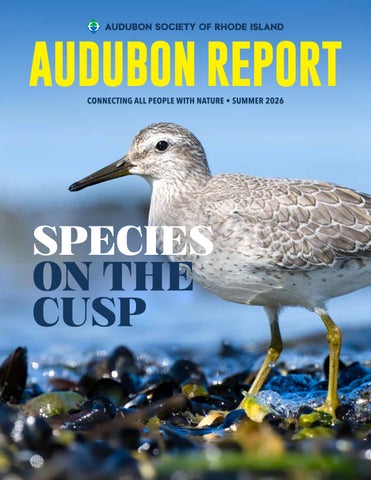
Cover Photo: Red Knot (Calidris canutus) nonbreeding adult by Mary Ann Cofrin. The State of the Birds Report (American Bird Conservancy, Partners in Flight) estimates the Red Knot has lost more than 50% of its population over the last 50 years, and has seen accelerated declines within the past decade due to commercial overharvesting of horseshoe crab eggs — a primary food source during migration — and warming temperatures in the Arctic, which negatively influences food availability and nesting sites. During migration, Red Knots can be found on Audubon properties in Southern RI: Quonochontaug Salt Marsh, Winnapaug Pond Salt Marsh, and the Pettaquamscutt River Wildlife Refuge. Due to fragile habitats, there is no public access.
Audubon Society of Rhode Island 12 Sanderson Road, Smithfield, RI 02917 401-949-5454 www.asri.org Executive Director: Jeffrey C. Hall Managing Editor: Hope M. Foley Contributing Writers: Laura Carberry, Sarah Deckel, Josephine Doucette, Hope M. Foley, Ryan Kopp, Lauren Parmelee, Scott Ruhren, Katie Schortmann, Ruthie Wood Contributing Photographers: Kelsey Alpaio, Ginger Brown, Mary Ann Cofrin, Christine Francis, Norm Grant, Peter Green, Sarah Horvet, Ed Hughes, Jason Major, Chris Raithel, Scott Ruhren, Betsy Staples, Richard Staples, David Uliss The Report is Audubon Society of Rhode Island’s newsletter, updating members and supporters on current news, policy issues, research and initiatives being led by the organization, staff, and volunteers. We encourage your participation. Please send items that will be considered for publication to Managing Editor Hope M. Foley at hfoley@asri.org. Please pass this copy on to a friend or recycle. Thank you.
Audubon Society of Rhode Island • www.asri.org
FROM THE EXECUTIVE DIRECTOR
IT’S NOT ONLY A DONATION, IT’S AN INVESTMENT IN OUR FUTURE
A
s I reflect back on the recently concluded General Assembly session, I am reminded that conservation isn’t only about rules and laws, it is ultimately a story about people. Since taking on the role of Executive Director, Audubon has made significant strides in removing deadly pesticides from our environment. The law restricting neonicotinoid pesticides took effect in 2024, and restrictions on anticoagulant rodenticides just passed on June 18; making Rhode Island the second state in the nation to ban these deadly chemicals. These legislative wins ride on the shoulders of the people who came before me. Those who worked to ban DDT in Rhode Island, a chemical so deadly that it nearly led to the extinction of Bald Eagles, Peregrine Falcons, and Ospreys. And people who worked to protect the Big River Management area from inundation and advocated tirelessly to pass the more recent Act On Climate. This is a story about you … individuals who care deeply about the future of Rhode Island’s wildlife and natural places. It is a story about people who understand that healthy forests, clean water, thriving marshes, and abundant bird populations do not happen by accident. And it is a story about people like you who choose to invest in that future. Every day, you, our members, partners, and staff are demonstrating what is possible when a community comes together around a shared commitment to conservation. Together, we are protecting critical wildlife habitat by advocating for more resources in the upcoming Green Bond. Restoring ecosystems at our wildlife refuges in Little Compton and Jamestown. Advancing science and nature-based solutions at our Stormwater Innovation Center. And inspiring future environmental leaders through our Youth Conservation League. Like our Responsibility Birds, this work extends far beyond any single refuge, program, or species. When we protect a marsh, we safeguard habitat for countless plants and animals while strengthening our communities
Audubon Report • Volume 60 • No. 2 • Summer 2026
against storms and flooding. When we restore a forest, we create healthier ecosystems for birds and wildlife while at the same time sequestering carbon that will help reduce the damage of climate change. When we engage a child in environmental education, we provide context on why nature is important and cultivate the next generation of community leaders, educators, scientists, landowners, and policymakers. We build the partnerships necessary to address complex environmental challenges. None of this happens without your support. Your commitment allows Audubon to act when opportunities arise, protect important habitat, advocate for stronger environmental protections, and expand educational programs that connect more people to nature. Your generosity provides the foundation that makes lasting conservation possible. Perhaps most importantly, your support, like the thousands of emails, calls, and letters that were sent to legislators advocating for passage our rodenticide bill, sends a powerful message to state officials. Rhode Islanders value wildlife, open space, clean water, and the opportunity for our kids and grandkids to experience nature, like you and I did when we were children. Throughout Audubon’s history, we have learned that meaningful conservation is not achieved through a single action, but through the steady commitment and investment of people like you who believe that nature is worth protecting. Thank you for being part of that commitment. Good birding,
Jeffrey C. Hall Executive Director
3
SPECIES ON THE CUSP By Ruthie Wood
4
Audubon Society of Rhode Island • www.asri.org
Habitats at the Touisset Marsh Wildlife Refuge are powerful ecological engines that support a large number of plant and animal species. But the habitats share a troubling reality with many of the species they support: they are also facing threats to their survival.
Jason Major
Above: Touisset Marsh Wildlife Refuge, Warren, RI. Far left with wings extended: Willet (Tringa semipalmata) and Saltmarsh Sparrow (Ammospiza caudacuta).
T
ucked behind a fire station in Warren, a well-worn trail runs through hardwood forests, gently sloping fields, across wooden boardwalks, and spills out onto a bridge that rises above brackish water, reeds, grasses, and dancing fiddler crabs. “The bridge,” Audubon’s Senior Director of Conservation, Scott Ruhren declares, “is the best spot to fully appreciate the salt marsh.” And the view is expansive. The water levels breathe with the changing tides, the crabs scuttle, the grasses bend and sway. Salt marshes are the interface between the terrestrial and the marine; they facilitate nutrient flow, provide a plethora of essential habitats, and they act as a storm surge buffer and carbon sink. But with the rapid rate of sea level rise and man-made barriers to pre-
vent salt marshes “migrating” and expanding up the coastline, this fragile ecosystem is under pressure, literally being squeezed into nonexistence. As wetland ecosystems like Touisset Marsh suffer, its denizens also decline. “Shorebirds, in particular, are in a crisis state,” says Ruhren. These birds “capitalize on the changing environment,” adds Sarah Deckel, Audubon's Director of Bird Conservation. The rise and fall of the water level impacts available sandbars, creates small marshy islands off the coast, and reveals resources normally hidden underwater that birds need to nest or feed. “Due to sea level rise and human impacts, these ecosystems are either being polluted, becoming unavailable, or they’re being flooded just too frequently.” Continued on page 6
Audubon Report • Volume 60 • No. 2 • Summer 2026
5
All of these [Responsibility] birds will significantly benefit now from conservation actions, but also, we can use their conservation plans as a framework to protect habitat, food, and environmental and ecosystem needs that other birds, plants, and wildlife rely on. – Dr. Sarah Deckel, Director of Bird Conservation
Richard Staples
The crisis is extreme for the Saltmarsh Sparrow. Exclusively found in salt marshes along the East Coast, including at Audubon’s Marsh Meadow Wildlife Refuge in Jamestown, this tiny brown bird nests just above the waterline. Rising tides have greatly reduced its slim nesting corridor, and high tides can flood the nest and drown the nestlings. The outlook is grim, says Deckel. The species is currently being reviewed by the U.S. Fish and Wildlife Service to determine if it meets federal qualifications to be protected under the Endangered Species Act and listed as either “endangered” (facing extinction) or “threatened” (likely to become endangered soon). States can also list species as endangered or threatened, and with an 84% total population decline since 1998 across the coast, the Saltmarsh Sparrow is currently listed as a species of greatest conservation need in Rhode Island, and a species of conservation priority with the US Fish and Wildlife Service. There are other laws aside from the Endangered Species Act that help conserve birds. The Migratory Bird Treaty Act (MBTA) is a federal law enacted in 1918 that makes it a crime to hunt, take, capture, kill, or possess any native migratory bird in the country – including feathers, eggs, and nests – without a permit. “The MBTA was put into place to protect all bird species,” summarizes Deckel. “It allows us to take the first step in conservation of birds.” In 2023, Audubon made their own specific list for avian conservation and research: the Responsibility Bird Species (RBS). There are now ten in total, as the Willet has been recently added (see page 7). All of these birds are facing decline and need conservation action but are not yet listed as a species of national concern. There are three main criteria that Audubon considers before a bird is added to the list: each species needs to be relatively easy to monitor on Audubon wildlife refuges, to have actionable and achievable steps to promote their populations, and critically, to act as an “umbrella spe-
6
cies” whose needs will overlap with and benefit many other species of wildlife. “They are birds that will significantly benefit now from conservation actions,” explains Deckel, “but also, we can use their conservation plans as a framework to protect habitat, food, and environmental and ecosystem needs that other birds, plants, and wildlife rely on.” By protecting the Scarlet Tanager and the Wood Thrush – two Responsibility Bird species – Audubon conserves different layers of the forest ecosystem, the canopy and the understory. “By protecting Common Yellowthroat and Prairie Warbler, we’re protecting different types of successional habitat,” Deckel adds. A common threat all birds face is a loss of the resources they need to survive. In Audubon’s work to support one species, many others are also uplifted. Eastern Towhees are also on the RBS list. Easily identified as they forage in leaf litter, these birds depend on the transitional space along the forest edge and are facing over 4% decline in their population. With a team led by Deckel, Audubon is collaborating with Dr. Scott McWilliams (University of Rhode Island), Audubon Board Member Dr. Jim Chace (Salve Regina University) and the Norman Bird Sanctuary to monitor Eastern Towhees. They will be evaluating food sources: what is available versus what the birds are actually eating. Researchers will be capturing Eastern Towhees and collecting fecal samples that will be analyzed to determine the invertebrate species the birds are consuming. Data will be collected at the Audubon Marion Eppley Wildlife Refuge in South Kingstown and the Norman Bird Sanctuary in Middletown as the properties offer different types of habitats. By comparing the prey available between locations, Deckel’s team will better understand a crucial piece for Eastern Towhee productivity: what available high-quality prey are the birds eating between two very different breeding sites? The answer could inform Audubon’s work in future management plans for the species.
Audubon Society of Rhode Island • www.asri.org
Mary Ann Cofrin
USFWS
Eastern Towhee (Pipilo erythrophthalmus)
Chimney Swift (Chaetura pelagica)
What’s Good for Insects is Good for Birds Habitat is not the only factor that binds types of birds together and affects conservation plans. Bird species can also be grouped together in “guilds” by diet, like aerial insectivores – birds that eat insects on the wing. This guild is rapidly declining due to habitat loss, forest fragmentation from urban sprawl, and, crucially, the continued use of dangerous pesticides. Chimney Swifts, one of the ten Responsibility Birds, are a part of the aerial insectivore guild that have seen a steep decline due to loss of historical nesting sites: old chimneys and hollow trees. Audubon began a pilot program in 2024 to offer alternative nesting and roosting sites in an attempt to bolster the population. Three Chimney Swift towers were erected at Fisherville Brook Wildlife Refuge in Exeter, Caratunk Wildlife Refuge in Seekonk, and the Wanskuck Community Library in Providence. All continue to be closely monitored for activity. “If successful, the towers could offer
Prairie Warbler (Setophaga discolor)
these birds an adaptive solution to a changing environment,” said Deckel. Insect decline is especially worrisome for conservationists as insects are a critical food source for many creatures. Aerial insectivores, in particular, rely on insects like mosquitoes and midges. “They are high in fatty acids,” explains Ruhren, “which birds need for brain development.” Ruhren is also working on the collection of insect data on Audubon properties. With traps placed in grasslands at Audubon’s Marion Eppley and Fisherville Brook Wildlife Refuges, he identifies the different invertebrate species and weighs their biomass by group. Heavier biomass is indicative of a more successful insect season, and, hopefully, may provide greater success for aerial insectivores. “A lot of what you do for the birds is going to be good for the pollinators, and vice versa,” Ruhren says.
WILLET
Audubon Adds a New Responsibility Bird
Continued on page 9
Audubon Responsibility Birds Common Yellowthroat Scarlet Tanager Eastern Towhee Red-winged Blackbird Black-and-white Warbler
Chimney Swift Prairie Warbler Barn Swallow Wood Thrush Willet
By Sarah Deckel, Director of Bird Conservation
*Learn more about this initiative at partnersinflight.org
Audubon Report • Volume 60 • No. 2 • Summer 2026
David Uliss
I
t’s important to remember birds do not live in a vacuum, and often times, they rely on more than one habitat type to survive. A perfect example of this is the Willet (Tringa semipalmata), a medium to large shorebird that forages in mud flats and tidal zones, breeds in salt marshes, and has a characteristic white band across its wings that can be seen when flying. Audubon protects wildlife refuges in several coastal regions of Rhode Island, including Marsh Meadows (Jamestown), Touisset Marsh (Warren), Emilie Ruecker (Tiverton), and Lathrop (Westerly) – and you can find Willet at all of these locations! Willet populations have experienced a variety of changes over time, particularly across the United States, where they are considered a conservation priority by the Partners in Flight* initiative. Warming climate, sea level rise, and human expansion are all factors that negatively impact the full annual cycle needs of the Willet. By adding Willet to Audubon’s Responsibility Bird list, we are actively protecting shorelines, marshes, and mud flats that this species and other shorebirds need to thrive in Rhode Island.
7
SPECIES ON THE CUSP
Malaclemys terrapin • RI conservation status: Endangered • Critical habitat: Lives in brackish coastal marshes, needs undisturbed coastline • Threats: Sea level rise, climate change, predation, collecting • Audubon Actions: Coastal marsh protection, invasive species management, monitoring, education initiatives
Christine Francis
Northern Diamondback Terrapin
IN RHODE ISLAND
Scaphiopus holbrookii • RI conservation status: Rare • Critical habitat: Stays buried in soil, breeds in shallow temporary pools • Threats: Habitat loss, climate change, predation • Audubon Actions: Habitat protection
All are listed as a species of greatest conservation need. We actively monitor many species in decline and work to protect habitats that support their populations. A number of rare Rhode Island native plants and animals are protected by state action, but may not be considered federally rare – so they are not protected by the Endangered Species Act.
8
American Ginseng
Panax quinquefolius • RI conservation status: Endangered, globally vulnerable • Critical habitat: Rich soil in deciduous forests • Threats: Habitat loss, collecting • Audubon Actions: Forest protection, invasive species management
Ringed Boghaunter
Williamsonia lintneri • RI conservation status: Endangered • Critical habitat: Acidic fens, bogs and cedar wetlands • Threats: Habitat loss, water level change • Audubon actions: Wetland protection, invasive species management
Ginger Brown
The following are some of the plants and animals found on Audubon wildlife refuges that are considered endangered, rare, or threatened in the state.
Chris Raithel
Eastern Spadefoot Toad
Audubon Society of Rhode Island • www.asri.org
Continued from page 7
Canada Warbler Cardellina canadensis
• –4.4% annual change between 1966–2018 • RI Conservation Status: Threatened • Critical habitat: Moist mixed forests with dense understory and ground cover, more than 300m (~985 ft) from paved roads. • Threats: Forest fragmentation, climate change, and degradation of wintering habitat • Audubon Actions: Protect wooded wetlands and the upland buffers associated with them, in addition to collaboration and supporting the Canada Warbler International Conservation Initiative.
Grasshopper Sparrow Ammodramus savannarum
• –4.8% annual change between 1966–2018 • RI Conservation Status: Threatened • Critical habitat: Fields exceeding 12 hectares (~30 acres) with well-drained upland soils • Threats: Agriculture and reforestation • Audubon Actions: Work with landowners of large pastures to protect grassland habitat during the breeding season.
American Black Duck
Anas rubripes
• –6.4% annual change between 1966–2018 • RI Conservation Status: Threatened • Critical habitat: Salt marsh (winter) and freshwater wetlands (summer) • Threats: Damming, degradation of salt marshes, overharvesting • Audubon Actions: Support ongoing conservation efforts in collaboration with Atlantic Coast Joint Venture, and conserve habitat for full annual cycle.
Eastern Whip-poor-will Antrostomus vociferus
• –4.2% annual change between 1966–2018 • RI Conservation Status: Near threatened • Critical habitat: Early successional habitat, open canopy • Threats: Habitat fragmentation (breeding) and degradation (wintering), lower availability of aerial insectivores due to pesticide use • Audubon Actions: Restoration at Marrion Eppley Wildlife Refuge to conserve “high-quality” habitat for this species, and continue to support ongoing research efforts.
Conservation Takes Collaboration Conservation is not a single-species effort. Likewise, protecting endangered and declining species is not the responsibility of any one organization. Audubon works with organizations like the Native Plant Trust and the Rhode Island Natural History Survey to monitor and protect rare plants, and partners with the State of Rhode Island’s Department of Environmental Management (RIDEM) to protect the state’s Species of Greatest Conservation Need. “[That] term is specific to the State Wildlife Action Plan,” RI Department of Environmental Management Herpetologist and Species of Greatest Conservation Need Coordinator, Chris Thawley, explains. These plans, required by Congress through a program called State and Tribal Wildlife Grants, allows money to be sent to the states to work with species that are not federally listed but still have conservation need. Rhode Island updated the state’s Wildlife Action Plan in 2025, and it is currently pending review by the US Fish and Wildlife Service. Over 500 Rhode Island species – spanning terrestrial, freshwater, and marine wildlife – are listed as species of greatest conservation need. Audubon staff contributed to the recent revisions. Plants are included in species that need conservation, as with the case of the federally listed Agalinis acuta, or, more commonly, sandplain gerardia. This delicate, pink annual is endemic to only a handful of states on the East Coast, and for a time, it was found at just one site – a cemetery in Richmond. After the discovery, two introduction sites were set up via seed transplantation, one at a field site monitored by the Richmond Conservation Commission, and one on an Audubon wildlife refuge in the southern area of the state. “The Audubon property has the biggest and most secure population,” Thawley says. “We go out and do surveys every year. In recent years it’s been in the hundreds of individuals that we find during our surveys, and some years it’s been in the thousands.” Isolated in the Atlantic Ocean, Lewis-Dickens Farm Wildlife Refuge on Block Island is protected by a partnership between Audubon, The Nature Conservancy, and RI DEM. This broad landscape is one of the last homes of the federally endangered American burying beetle. The insect used to be found across the Eastern U.S., but now “the only wild population east of the Mississippi is found on Block Island,” Thawley states. There is another island, just off the coast of Jamestown, that also provides critical habitat for two other species listed in the State Wildlife Action Plan: the American Herring Gull and the Great Black-backed Gull. These birds are common along Rhode Island’s coast, so for many, it may come as a shock that these gull species need protection. However, gulls have experienced a cumulative decline of 82% across North America from 1966 to 2021. Critical habitat on Gould Island is currently under threat after the Jamestown Town Council introduced a resolution that would open the island to recreational use. “For decades Continued on page 34
Audubon Report • Volume 60 • No. 2 • Summer 2026
9
A DVO C AC Y
By Maxwell McFarland, Director of Advocacy
A WIN FOR WILDLIFE
RHODE ISLAND TO RESTRICT DANGEROUS ANTICOAGULANT RODENTICIDES
W
hether leading the fight to ban the use of DDT in the 1960s or more recently advocating to restrict dangerous neonicotinoids, Audubon has long been on the front lines of fighting for stronger regulations on pesticides. This year, Audubon has led another historic win for the environment. With the signature of Governor Dan McKee on June 18, 2026, Rhode Island becomes just the second state in the country to place prohibitions on dangerous blood-thinning rat poisons: anticoagulant rodenticides (ARs). These dangerous poisons were first introduced in the mid-20th century. As their use became widespread, rodents began building resistance to the first-generation of these anticoagulants. This trend gave birth to the newer and deadlier second-generation anticoagulants (SGARs) in the 1970s. SGARs have remained the status quo in rodent management since their development. These rodenticides have alarmingly high rates of off-target species impact. An especially vulnerable population to these poisons is raptors. Hawks, owls, and eagles – capable of eating thousands of rodents each year – only need to ingest one or two poisoned rats or mice for it to wreak havoc on their bodies. As these anticoagulants accumulate in these birds of prey, it often ends in serious injury or death. Several children and pets are also hospitalized each year from these rodenticides and trace amounts of SGARs have been found in bears, fish, and water samples. This new legislation strengthens wildlife protections and effective rodent management. With a statewide prohibition in 2029, the law creates a voluntary Integrated Pest Management (IPM) program so that municipalities can promote predators that provide natural rodent management, and rollout proven, nonchemical alternatives to these ARs. Often overlooked measures like improved sanitation and exclusion practices go a long way in minimizing rodent populations. This has been a top legislative priority for Audubon since 2024. Each year, we have increased support from Rhode Islanders, wildlife rehabilitators, and municipalities who realize poison for rodent management is not working. We are grateful for the overwhelming support for this bill from the General Assembly. Audubon looks forward to assisting the broader Rhode Island community in finding the rodent management practices that work best for them; ensuring a sustainable, pesticide-free approach.
GREEN BOND
F
or many years, Audubon has advocated for the funding of Rhode Island’s Green Economy Bond, and Rhode Islanders have always overwhelmingly passed the bond and the environmental work it supports. One common inclusion in the bond serves as the lifeblood of conservation organizations: funding for land and water conservation. The 2026 legislative session presented another opportunity for Audubon to make the Green Bond Greener for 2027. The initial budget did not include any funding for conservation work. During this legislative session, Audubon and others worked to include $10 million in the state budget: $3M for State Open Space, $3M for Outdoor Recreation, $2M for Farmland Preservation, and $2M for Local Open Space.
10
Audubon emphasized Local Open Space Grants in particular. Since 1985, these grants have protected over 13,000 acres of land. When available, Audubon regularly benefits from this program – most recently with our acquisition of land along the Hunt River. Audubon is proud to say we helped make the Green Bond Greener for FY27. While we are disappointed that Local Open Space funding was not included, we are pleased to see the inclusion of State Open Space and Farmland Preservation funding. Audubon will continue to advocate for the inclusion of these important funds which allow us, other organizations, and municipalities SUPPORT OUR WORK to improve access to green space and recreation in Rhode Island Visit asri.org/donate communities.
Audubon Society of Rhode Island • www.asri.org
METRO PLACE Conservation Easement New Warwick Property Protects Wetlands and Bird Habitat
I
By Dr. Scott Ruhren, Senior Director of Conservation
n April, Audubon added 14 acres to protected space in Warwick, Rhode Island, not far from T.F. Greene Airport. The property contains a mix of forested and wetland habitat in a rapidly changing suburban landscape. Streams, open water, and swamp provide a home for year-round species as well as migratory birds like Swamp Sparrow, Red-winged Blackbird, and various ducks. “The new easement is important because it strengthens the protection of the vanishing woodlots and wetlands in the area,” explained Audubon Senior Director of Conservation Scott Ruhren. “People may not notice this strip of land as they head in and out of the airport, but birds and other wildlife depend on this corner of Warwick.” The landowner, Florida Solar Realty, LLC, wished to protect a portion of habitat, leaving it untouched for wildlife. Audubon worked to develop the best plan for protection of this valuable parcel, and the landowner chose to donate a conservation easement to Audubon and continues to own the property. “We were pleased to work with the Audubon Society of Rhode Island to establish a conservation easement on our property, which allows the land to be preserved for the benefit of wildlife, the community, and future generations,” explained the landowner. “We were able to maintain ownership of the property, preserve and protect it, and obtain a tax benefit at the same time. We highly recommend working with the Audubon Society of Rhode Island on conservation easements – ours was a very professional and transparent process.” “Conservation easements allow Audubon to permanently protect valuable conservation land that safeguard natural habitat and protect water quality,” said Audubon Executive Director Jeff Hall. “The new 14-acre parcel in Warwick is a valuable stopover for migratory species on their long journeys. We thank Florida Solar, LLC for the opportunity to work together and preserve this natural space.”
BIRDS OF SUMMER
Discover a wide range of birding supplies, toys, and nature-themed gifts for all ages. From water-proof monoculars and bucket hats to birding guides and more – stop in and celebrate shorebirds this summer!
• Carson Waterproof Monocular • Audubon Shorebird Bucket Hat • Puzzles • Field Guides • Stickers, Magnets and More!
Audubon Society of Rhode Island’s role in holding development easements does not mean the property is open to public access, the land is still owned by the donor but monitored by Audubon.
Talk to Audubon About Protecting Your Property For over 125 years Audubon has been a trusted partner to landowners, tailoring permanent conservation plans for families and businesses. Contact Scott Ruhren, Senior Director of Conservation, to discuss ways you can work with Audubon. Email sruhren@asri. org or call 401-486-1503 ext 3004.
Audubon Report • Volume 60 • No. 2 • Summer 2026
MEMBERS RECEIVE
10% OFF PURCHASE
Audubon Nature Center and Aquarium 1401 Hope Street • Bristol, RI
11
AUDUBON INTERVIEWS
TERRY GRAY
DIRECTOR OF RI DEPARTMENT OF ENVIRONMENTAL MANAGEMENT
T
erry Gray, Director of RI Department of Environmental Management (RI DEM), has spent nearly four decades working on environmental issues in the Ocean State. In a recent conversation with Audubon Executive Director Jeff Hall at Colt State Park in Bristol, Gray reflected on the challenges facing Rhode Island’s forests, wildlife, climate resilience, and environmental education — and the partnerships needed to protect the state’s natural resources for future generations. Gray began his career at RI DEM in 1987 as a hazardous waste inspector after graduating with a degree in chemical engineering. Over the years, his work expanded into site cleanup and remediation, water and air quality, and eventually leadership of the agency. Becoming director, he said, opened his eyes to DEM’s broader role in the protection of natural resources: forestry, parks, fisheries, recreation, and land management.
FORESTS UNDER PRESSURE Audubon: Rhode Island Forests are facing pressure from climate change, evasive species, and fragmentation. What do you see as the biggest threats to forest health right now, and how can organizations like Audubon help support healthier, resilient forests? DEM Director Gray: Well, I think you hit on two big ones, which are climate change and fragmentation. And when we talk about pressure on land in Rhode Island, it's pretty extreme. When you think about housing, you think about renewable energy, and solar development. You think about conservation, but also economic development. All these things are squeezing a very small amount of land that we have left. So, we need to be smart and think from a macro viewpoint, like, where are we really going to invest our conservation resources? Where are we going to focus on housing? What's the right place for renewables? And it's a hard conversation, because those are all different stakeholders. Trying to coordinate that on the macro level is critical, but it's also very challenging. Climate change, in particular, has created a real problem for our forests. And it's not the sea level rise or storm surge - things that people normally think about with climate change. It's these more frequent intense weather events: wind and rain, with cycles of rain and drought. That puts a lot of stress on our forests. It also opens the door for invasive species and invasive insects, which take advantage of weakened trees and forest, and all of a sudden, you have dead falls and wood out there that needs to be effectively managed, as it could become a forest fire danger. And you don't think about Rhode Island being a forest fire hotbed, but we're seeing more and more of them.
12
CLIMATE CHANGE AND RESILIENCE Audubon: As Chair of the Rhode Island Executive Climate Change Coordinating Council (EC4), where do you think we've made the most progress on climate, and what's the most urgent action that we need to take? DEM Director Gray: The area where we've made the most progress is educating the public on climate change, and it's really two parts. We have ongoing efforts to reduce greenhouse gas emissions on one hand, and on the other we have resiliency. Being on the ocean, Rhode Island is on the front line of climate, and we need to invest in preparing the state for the impacts that are coming. We could eliminate every molecule of greenhouse gas emissions that we have in the state, but we're still going to see the impacts of climate here. It's a worldwide atmospheric issue. The sea level is still going to rise and we need to be ready for it. I think the big conservation organizations, like Audubon and The Nature Conservancy, really need to jointly strategize with DEM as well. And we need to put our heads together on how to focus our efforts, and where collectively, we can make the biggest difference. Within DEM we have a Land Acquisition Committee. We have all the primary natural resource offices sit down when a property comes before us for potential acquisition and they really look at the benefits — recreational value, habitat value, conservation value, hunting value, even resilience value now, and put those together and make a decision as to whether or not we want to pursue that. I think just getting more parties to the table, and maybe using the same methodology, so that our efforts can be leveraged. I think that would be important.
ENVIRONMENTAL EDUCATION Audubon: How important do you think outdoor environmental experiences are, and their role in building the next generation? DEM Director Gray: We need to invest in the next generation of conservation leaders…and make people aware of the value of the work that we all do. And that starts with youth. We are trying to build a pipeline of future environmental leaders, not just for DEM, but also for organizations like Audubon or Save the Bay, environmental consulting firms, or places like the Narraganset Bay Commission. We really wanted to work with URI and move into the W. Alton Jones campus, and we've done that. Now we have access to almost 2,800 acres of beautiful property. One thing we really want to do is renovate the environmental center to serve as a venue, open to any education entity in the state. And as the state agency in the middle of environmental issues, we really want to provide a place, and sort of an umbrella, for people to coordinate.
Audubon Society of Rhode Island • www.asri.org
GOULD ISLAND Audubon: Audubon has taken a strong position to preserving Gould Island for wildlife. Where is DEM’s position and would the department ever consider making Gould Island a preserve that is left untouched? As noted in the new State Wildlife Action Plan, even gulls are in decline now, and that island is one of the last strong, undisturbed breeding locations. DEM Director Gray: The Wildlife Action Plan is a pretty interesting document because it looks at a macro scale of what animals or different wildlife are all over Rhode Island. And then it looks at threats, and opportunities. And I think the biggest threats are what you referenced in the forestry conversation that we had. It's things like climate change. Our environment is changing pretty quickly in the water and on land. There is forest and habitat fragmentation, and the other threat is pollution. The big thing about Gould Island right now is we want to clean it up. There's a legacy there from Navy operations. We really want to hold the federal government's feet to the fire and get the most stringent clean-up standards that we have, or the cleanest we're going to get it based on future human use. We want to have a very open and transparent master plan process to figure out what's right for the island. Right now, the point of departure is it's a habitat, right? And it's reserved for breeding and migrating bird habitat. And if there's going to be a change, then that needs to be talked through with all the stakeholders and needs to be looked at comprehensively, and a decision needs to be made. I don't want to look at Gould in a vacuum. I want to think about the whole Bay island system. And you know, maybe we reserve Gould as a habitat, and we refocus some of the other recreational interests on one of the other islands.
LOOKING AHEAD Audubon: What are your largest concerns about Rhode Island’s environment — what keeps Terry Gray up at night?
Climate change, in particular, has created a real problem for our forests. And it's not the sea level rise or storm surge - things that people normally think about with climate change. It's these more frequent intense weather events: wind and rain, with cycles of rain and drought. That puts a lot of stress on our forests.
– RI DEM Director Terry Gray
Audubon does some great environmental ed programs, and you can look at what's being offered next door here at Coggshell Farm. You've got Save the Bay and TNC, and then you go to all our Fish and Wildlife programs. You've got URI, we've got the Narragansett Bay National Estuary Research Reserve on Prudence Island. We have a lot of pieces that aren't necessarily all fitting together, yet.
Audubon Report • Volume 60 • No. 2 • Summer 2026
DEM Director Gray: We're trying to catch up on years of deferred maintenance in our parks system and be efficient and effective to get park facilities upgraded to meet public expectations. Climate change and renewable energy, having people accept the transition from fossil fuels into renewable energy is a long term challenge. It’s going to happen, and makes sense in the long run, it’s just the pace of that conversion. And, there's so much misinformation being spread around about forest health and forest management. I mean, we're not doing professional logging. We're trying to balance habitat for different types of animals as well. Before concluding, Gray offered a message to Audubon members and supporters: Continue to do the great work that you are doing right now, with educating the kids, really get them to understand how valuable our environment really is. Also, the land stewardship work that you're doing. Out my way, you’ve got the Parker Wildlife Refuge. You got the Maxwell Mays refuge. I mean, these are beautiful properties. Just getting people out and connecting with nature. I think it calms everybody down, provides a good mental health benefit, but it also provides that appreciation of what's out there.
13
MINDS IN MOTION Eco-Engineering at The Learning Community
A
By Josephine Doucette, Audubon TerraCorps Member and Community Engagement Coordinator
t first thought, building something out of items you would find in a household trash or recycling bin isn’t the most... appealing... project. Nonetheless, 14 sixth graders at Learning Community Charter School in Central Falls, spent a trimester with Audubon participating in a weekly eco-engineering elective focused on exactly that. As a long-time program partner, Audubon was invited to support The Learning Community by engaging their middle school students in electives that encouraged hands-on participation in STEAM (Science, Technology, Engineering, Art, and Mathematics). To start, students engaged in mini challenges to develop problem-solving skills as they constructed seeds that mimicked natural dispersion, wind turbines that could lift a pencil off the table, and nests that incorporated both natural and human-made materials to ensure the safety of a chicken egg. They then embarked on final projects: constructing a moving model of a local species that demonstrated an adaptation using only “junk” such as bottles, plastic containers, and cardboard. Students began by building prototypes based on example models including a Saw-whet Owl that turned its head 270 degrees, a praying mantis that beheaded its prey, and a box turtle that closed its shell. Once they developed a better understanding of the mechanics of each adaptation, each student designed their own eco-engineered project."
14
Trial and Error: Part of the Eco-engineering Process Everyone inevitably ran into problems during building, but one student, Caleb, had an interesting issue. He looked at the prototype, an Osprey that flaps its wings, and remarked on the tape that A Long-eared Owl that can turn its head 270 held it together. “I don’t think degrees, made by a student from a yogurt that’s sturdy enough.” He went container, cardboard, and popsicle sticks. to work using string to sew the wings to the body, then once configured, he noted that the wings didn’t balance and flap well. Audubon educators arrived at the next class with a change purse full of coins, which he taped onto the wings as counterweights, adjusting the position and weight until the flapping motion was perfected. Caleb’s Osprey is proudly displayed at the Nature Center and Aquarium this summer alongside his classmate’s painted owls, mantises, salamanders, turtles, and seed pods. While he never had the chance to paint the Osprey, Caleb’s project can help visitors understand that in matters of eco-engineering, the process is just as important as the final product!
Audubon Society of Rhode Island • www.asri.org
Supporting Student Engineers and Journalists through Community Partnerships Alfred Lima News Crew Reports on Reptiles
T
he Alfred Lima Elementary School in Providence is teeming with newsworthy events. So much so, that current topics, student stories, and even interviews with state and city leaders are covered by a team of young journalists. This fifth grade “News Crew” consists of five biliterate learners who have found their voices and used them to uplift their school community in both English and Spanish. And this spring, they had the unique opportunity to interview Darwin, Audubon’s Eastern Diamondback Terrapin. The News Crew collaborated with Audubon Associate Director of Education April Alix for an interview during Literacy Month and then invited her back again with Audubon’s turtle ambassador to learn more about this endangered species. “Through their creativity, collaboration, and commitment, they do more than report the news, they tell the story of who we are as a community,” explained Alfred Lima Library Media Specialist Natasha White. Their enthusiastic
Audubon Report • Volume 60 • No. 2 • Summer 2026
Audubon interview shared turtle facts and adaptations with classmates - and also highlighted how we can work together to help these vulnerable animals. “After my first visit to the school, I knew these young journalists were an exceptional group,” said Alix. “I couldn't stop talking about them! Their professionalism and their passion for keeping their communities informed is inspiring. I look forward to watching them continue to educate, enlighten, and empower both the next year's News Crew as well as the middle school communities they will be joining."
Watch the interview Scan the QR Code Students present their Audubon interview filmed in front of a live studio audience of third grade students!
Top, left to right: Keyshia Sophia Abad, Narella Andrea Estrada Guillen, Audubon Associate Director of Education April Alix, Jahzeel Denunez, Jayden Hernandez, and Andy Tebalan Morales. Bottom: Darwin the Diamondback Terrapin.
SUPPORT OUR WORK Visit asri.org/donate
15
Betsy Staples
This summer, discover
WILD
at the Audubon Nature Center and Aquarium in Bristol
Immerse Yourself in Nature! Come buzz through the pollinator garden, walk the trails to Narragansett Bay and search for birds, frogs, and turtles along the boardwalk. Then head indoors and marvel at seahorses, fish, sharks and other cool marine life in the aquarium.
August 1, 2026; 11:00am–12:00pm
Member Appreciation Night! Concert with Atwater-Donnelly July 31, 2026; 6:00-8:00pm
Meet one of Audubon’s animal ambassadors and make your own animal craft to keep! Free with admission.
Bird Banding August 8, 2026; 8:00-10:00am
Animal Ambassador Meet & Greet
Audubon Concert for Conservation with Playing Dead
FREE! Pop-up Programs Follow Audubon on social media for the latest on free pop-up programs! Tidepool touch tank experiences, crafts, nature stories, science experiments, and more are free with admission.
Outside with a Guide Small-group Tours Offered in Summer
Join a Biweekly Bird Walk and search for swallows nesting, sparrows calling, and woodpeckers in the wetland.
Plan a nature exploration with your own Audubon naturalist. Includes a close-up encounter with an owl or hawk.
Register at asri.org/calendar.
Learn more at asri.org/nature-center.
Beak Peek!
16
DON'T MISS THIS!
(Grateful Dead Tribute Band)
August 8, 2026; 4:00-8:30pm Edible and Medicinal Plant Walks August 22, 2026; 3:00-5:00pm September 29, 2026; 4:00-6:00pm
For details visit asri.org/calendar
Audubon Society of Rhode Island • www.asri.org
Richard Staples
Audubon is Committed to Increasing Access For All
Can You Spy a Dragonfly? Grab a nature or color-themed outdoor scavenger hunt from the visitor desk. Who knows what you may find?
Visit with Zach
Lemon Scented Leaves
Ravens are clever and curious! Visit Zach, Audubon’s Ambassador Raven in his large mew in the back of the Nature Center, overlooking the field.
Cool off in the spicebush tunnel in the pollinator garden! Scan the lemonscented leaves for spicebush swallowtail butterfly caterpillars.
Thanks to Ocean State Charities, Audubon now provides a Tina's Table for visitors on the back patio. An accessible picnic table designed by CEO of RAMP (Real Access Motivates Progress) Tina Guenette and the Steelyard in Providence, the table encourages function, accessibility, and inclusion while accommodating up to three wheelchairs. Other new mobility devices a rollator and seat stick - are also available to visitors on a first come, first served basis from the front desk.
Art At Audubon
Hele
Every two months the Nature Center gallery space transforms with rotating exhibits by local artists. To submit an art show proposal, visit www.asri.org/artists.
ozo nL
riti s
July & August: The Creative Naturalist by Tracey Hall. September & October: Drawn to Nature by Helen Lozoritis.
See page 23 for autumn programs. Fall is Wicked Fun at Audubon! Follow Audubon on social media:
Audubon Report • Volume 60 • No. 2 • Summer 2026
@AudubonRI
@RIAudubon
Tina’s Table can be found on the back patio.
17
BIOPODS Bringing Floating Wetlands to Roosevelt Lake
By Ryan Kopp, Director Stormwater Innovation Center
I
n Roosevelt Lake in Roger Williams Park, another pilot floating wetland is underway, bringing together living materials, native plants, volunteers, and water quality research to explore new ways of helping urban ponds recover. This collaborative project, led by BIOPOD Co. in partnership with BloomRI, the Providence Parks Department, and the Stormwater Innovation Center, uses small modular floating islands made from biodegradable materials, including reishi mycelium grown on hemp and wood shavings. Each pod holds native wetland plants whose roots extend directly into the water. As the plants grow, their roots can absorb excess nutrients, provide surface area for beneficial microbes, and create habitat for aquatic insects and other small organisms. Over time, the pods are intended to function like miniature wetlands, adding ecological complexity to a pond system affected by stormwater runoff, nutrient pollution, and periodic harmful algal blooms. Roosevelt Lake is part of the larger Roger Williams Park pond system, which receives water from the surrounding urban watershed, including upstream flows from Mashapaug Pond. Like many urban water bodies, these ponds face long-term water quality challenges. Excess nutrients can contribute to algae growth, reduced water clarity, and poor habitat conditions. The BioPods do not replace larger stormwater and restoration efforts, but they offer a creative, visible, and scalable demonstration of how nature-based solutions can complement broader watershed improvements.
Community Participation Every Step of the Way Two hands-on workshops were held in Roger Williams Park, giving volunteers and partners the opportunity to help build, plant, and launch the pods. Participants learned about mycelium-based materials, floating wetlands, native plants, nutrient pollution, and the role living systems can play in improving water quality. The result is not only a restoration installation, but also an educational experience that invites people to see the pond as an active, living system. The pods were planted with native wetland and pollinator species, including soft rush, woolgrass, common cattail, blue flag iris, monkey-flower, swamp milkweed, New England aster, and swamp rose mallow. These species were selected for their ability to thrive in wet conditions while supporting wildlife, pollinators, and habitat diversity. As the plants establish, their roots will hang below the pods, forming a living structure in the water column.
Monitoring Results with an Eye to the Future The project also includes monitoring to better understand how the BioPods perform over time. Plant tissue samples will be collected before and after deployment and analyzed in a laboratory to assess nutrient uptake. Visual assessments will track plant survival, growth, and establishment. This information will help partners evaluate the installation and guide future floating wetland projects. The Stormwater Innovation Center and Audubon Society of Rhode Island have supported the effort through coordination, permitting assistance, grant administration, workshop planning, and monitoring.
18
Bloom Rhode Island funding helped provide additional plants, materials, and logistical support, while Providence Parks continues to support water quality improvement projects throughout Roger Williams Park. In a park already known as a living laboratory for stormwater innovation, the BioPods offer an alternative and innovative tool for water quality restoration. This project shows how creativity, science, and community can work together to improve urban water quality.
Audubon Society of Rhode Island • www.asri.org
AUDUBON
FIELD NATURALIST SERIES Summer – Fall 2026 Let the experts be your guide to the ecosystems, plants, and animals found in Southern New England. Explore Audubon wildlife refuges and Prudence Island with scientists and skilled naturalists who will facilitate indoor presentations and outdoor investigations. Each session provides a new layer of insight, as you build your understanding and skills as a beginning naturalist. Fee for 5-session series: Audubon & RIEEA Members $300, Non-members $350; Ages 16 and up.
Stormwater Master Plan for Roger Williams Park Zoo Completed in May, the Stormwater Master Plan for RWP Zoo identifies potential sources of pollution, existing stormwater infrastructure, and potential future green infrastructure installations or retrofits. Visit stormwaterinnovation.org/ roger-williams-park-zoo-plan. The plan was developed in collaboration with the Roger Williams Park Zoo, Audubon Society of Rhode Island, Horsley Witten Group, the University of Rhode Island, the City of Providence and the Providence Parks Department.
For a tour of the BioPods project and other green infrastructure projects in the park, contact Sara Horvet at shorvet@asri.org.
SUPPORT OUR WORK Visit asri.org/donate
Audubon Report • Volume 60 • No. 2 • Summer 2026
All participants will receive complimentary passes to Audubon’s Raptor Weekend on September 12 or 13, 2026. • Exploring Biodiversity Across Habitats Introduction to the Field Naturalist Series Caratunk Wildlife Refuge, Seekonk, MA Saturday, August 29, 2026; 9:00am – 1:00pm • Exploring Coastal Ecosystems Narragansett Bay National Estuarine Research Reserve, Prudence Island, RI Saturday, September 26, 2026. Meet at the Bristol Ferry Dock at 9:30am, returning on 4:15pm ferry • Wildlife Tracks & Signs Powder Mill Ledges Wildlife Refuge, Smithfield, RI October 10, 2026; 9:00am – 1:00pm • Trees & Shrubs of Rhode Island Parker Wildlife Refuge, Coventry, RI October 17, 9:00am – 1:00pm • Introduction to Geology Powder Mill Ledges Wildlife Refuge, Smithfield, RI Saturday, November 7, 2026; 9:00am – 1:00 pm
For details and to register, visit asri.org/calendar.
19
CHOOSE YOUR OWN ADVENTURE Audubon Nature Programs and Events • August–November 2026
AUDUBON Field Naturalist Series
1401 Hope Street (Route 114), Bristol, RI
Summer – Fall 2026
For Children and Families August 1, 2026; 11:00am–12:00pm.
Nature Tales Storytime
August 6, 2026; 10:00–10:45am.
Bird Banding with Audubon August 8, 2026; 8:00–10:00am.
Bank of America Free Family Fun Day August 29, September 26, October 31, November 21, December 19, 2026.
Junior Naturalists
October 27, 2026; 6:00–7:30pm. November 24; 4:30–6:00pm.
Wildlife Pottery Painting
November 7, 2026; 1:00–2:00pm.
Veterans Day Nature Activities
November 11, 2026; 10:00am–3:00pm.
Day After Thanksgiving Nature Activities
November 27, 2026; 10:00am–3:00pm.
September 3, 17, October 1, 15, 29, November 12, December 3, 17, 2026; 10:30am–12:00pm.
Leaf Print Tote Bags
September 19, 2026; 12:00–1:30pm.
Preschool Adventures
September 22, 29, October 6, 13, 20, 27, 2026; 10:00–11:00am.
Lil’ Peeps
September 24, October 1, 8, 15, 22, 29, 2026; 10:00–11:00am.
Franklin’s Hatch Day Shell–ebration! October 3, 2026; 10:00am–3:00pm.
Indigenous People’s Day Nature Activities Happy Owl–o–ween!
October 24, 2026; 10:00am–3:00pm.
301 Brown Avenue, Seekonk, MA
Wednesday Morning Bird Walks
Full Moon Walk at Caratunk
Locations across Rhode Island. Each week a new birding destination is chosen. Location will be sent to registered participants. Every Wednesday, September 2026 thru June 2027; 9:00–11:00am.
August 22, 2026; 3:00–5:00pm. September 29, 2026; 4:00–6:00pm.
Let the experts be your guide to the ecosystems, plants, and animals found in Southern New England.
Learning Bird Conservation Techniques
Five sessions: August 29, September 26, October 10, 17, November 7, 2026.
Edible & Medicinal Plant Walks
See page 35 for details. September 10, 24, October 8, 2026; 6:00–8:00pm.
See page 19 for details or visit asri.org/calendar
Full Moon Owl Prowl
October 27, 2026; 6:30–8:30pm.
Birding for Beginners
Fisherville Brook Wildlife Refuge
Bristol Biweekly Bird Walks
Audubon Nature Center and Aquarium, Bristol, RI. August 14, 28, September 25, October 9, 23, November 6, 20, 2026; 9:00–11:00am.
Shorebird Van Trip
Locations Across the State. August 20, 2026; 7:00am–3:00pm.
Birds Without Borders
Colt State Park, Bristol, RI. August 22, 2026; 10:00–11:00am.
Learning Bird Conservation Techniques
Birds and Brews
Mushrooming, Owling and Elegant Dining
For Teens and Adults
August 28, 2026; 7:00–9:00pm.
Beaver Moon Owl Prowl
DIY Bird Strike Window Clings
October 24, 2026; 5:00–8:00pm.
Audubon Nature Center and Aquarium, Bristol, RI. Get up-close with owls, hawks, and falcons at Audubon’s annual celebration of birds of prey. September 12 & 13, 2026; 10:00am–4:00pm.
Bird Banding with Audubon
Audubon Nature Center and Aquarium, Bristol, RI. See page 35 for details. September 10, 24, October 8,2026; 6:00–8:00pm.
October 2, 2026; 6:00–7:30pm.
Raptor Weekend
November 23, 2026; 6:30–8:30pm.
99 Pardon Joslin Road, Exeter, RI
Sensory Hike
August 8, 2026; 10:00am–12:00pm.
Goats and Floats
October 3, 2026; 10:00am–12:00pm.
Felted Forest Animals
October 22, 2026; 6:00–8:00pm.
Spooky Tales and Trails
Powder Mill Ledges Wildlife Refuge
Beavers of Fisherville
12 Sanderson Road, Smithfield, RI
Owls and Tea with Audubon
Hunter Moon Owl Prowl
October 24, 2026; 6:30–8:30pm. November 7, 2026; 4:30–6:30pm.
October 26, 2026; 6:30–8:30pm.
November 21, 2026; 10:00–11:30am.
Needle Felted Owls
November 19, 2026; 5:30–7:00pm.
Maxwell Mays Wildlife Refuge, Coventry, RI. September 18, 2026; 3:00–8:00pm.
Supermoon Owl Prowl
November 24, 2026; 6:30–8:30pm.
Cape May Four–Day Van Trip Cape May, New Jersey. September 30–October 3, 2026.
Adult Eco–Craft Series at Audubon Recycled Candle Making Workshop. August 6, 6:00–7:30pm.
Owl Prowls
Birding for Beginners
Locations across Rhode Island
Concert for Conservation
Audubon Nature Center and Aquarium, Bristol, RI. October 27, 2026; 6:00–7:30pm. November 24, 2026; 4:30–6:00pm.
Bristol Biweekly Bird Walks
Caratunk Wildlife Refuge, Seekonk, MA. October 27, 2026; 6:30–8:30pm. November 23, 2026; 6:30–8:30pm.
Prudence Island
Narragansett Bay National Estuarine Research Reserve, Prudence Island, RI
Birding Hammonasset Beach, CT October 17, 2026; 7:00am–5:00pm.
August 8, 2026; 9:00–11:00am. See page 26 for details. August 8, 2026; 4:00–8:30pm.
August 14, 28, September 25, October 9, 23, November 6, 20, 2026; 9:00–11:00am.
Stamp & Sip
August 20, September 24, October 22, November 19, 2026; 6:00–8:00pm.
Powder Mill Ledges Wildlife Refuge, Smithfield, RI. October 26, 2026; 6:30–8:30pm. November 24, 2026; 6:30–8:30pm.
Mushrooms for Beginners
Nature Walks
September 24, 2026; 1:30–6:30pm.
Fall Hiking on Prudence Island
Night Singers at Parker Woodland
October 23, 2026; 9:45am–4:45pm.
Parker Woodland Wildlife Refuge, Coventry, RI. August 13, 2026; 7:00–9:00pm.
Exploring Rhode Island Geology
Second Beach, Purgatory Chasm, Middletown, RI. September 13, 2026; 10:30am–12:00pm.
Audubon Report • Volume 60 • No. 2 • Summer 2026
Peter Green
October 12, 2026; 10:00am–3:00pm.
Advance registration is required for all programs.
Audubon Nature Center and Aquarium, Bristol, RI. August 8, 2026; 9:00–11:00am.
Audubon Nature Center and Aquarium
Family Owl Prowls
Caratunk Wildlife Refuge
Audubon Nature Center and Aquarium, Bristol, RI. August 8, 2026; 8:00–10:00am.
For more information and to register, visit the events calendar at asri.org/calendar.
Animal Ambassador Meet & Greet
Birding with Audubon
Stewardship and Research Efforts on Prudence Island November 11, 2026; 9:45am–4:45pm.
Explore Prudence Island
November 25, 2026; 9:45am–4:45pm.
21
CHOOSE YOUR OWN ADVENTURE Audubon Nature Programs and Events • August–November 2026
AUDUBON Field Naturalist Series
1401 Hope Street (Route 114), Bristol, RI
Summer – Fall 2026
For Children and Families August 1, 2026; 11:00am–12:00pm.
Nature Tales Storytime
August 6, 2026; 10:00–10:45am.
Bird Banding with Audubon August 8, 2026; 8:00–10:00am.
Bank of America Free Family Fun Day August 29, September 26, October 31, November 21, December 19, 2026.
Junior Naturalists
October 27, 2026; 6:00–7:30pm. November 24; 4:30–6:00pm.
Wildlife Pottery Painting
November 7, 2026; 1:00–2:00pm.
Veterans Day Nature Activities
November 11, 2026; 10:00am–3:00pm.
Day After Thanksgiving Nature Activities
November 27, 2026; 10:00am–3:00pm.
September 3, 17, October 1, 15, 29, November 12, December 3, 17, 2026; 10:30am–12:00pm.
Leaf Print Tote Bags
September 19, 2026; 12:00–1:30pm.
Preschool Adventures
September 22, 29, October 6, 13, 20, 27, 2026; 10:00–11:00am.
Lil’ Peeps
September 24, October 1, 8, 15, 22, 29, 2026; 10:00–11:00am.
Franklin’s Hatch Day Shell–ebration! October 3, 2026; 10:00am–3:00pm.
Indigenous People’s Day Nature Activities Happy Owl–o–ween!
October 24, 2026; 10:00am–3:00pm.
20
301 Brown Avenue, Seekonk, MA
Wednesday Morning Bird Walks
Full Moon Walk at Caratunk
Locations across Rhode Island. Each week a new birding destination is chosen. Location will be sent to registered participants. Every Wednesday, September 2026 thru June 2027; 9:00–11:00am.
August 22, 2026; 3:00–5:00pm. September 29, 2026; 4:00–6:00pm.
Let the experts be your guide to the ecosystems, plants, and animals found in Southern New England.
Learning Bird Conservation Techniques
Five sessions: August 29, September 26, October 10, 17, November 7, 2026.
Edible & Medicinal Plant Walks
See page 35 for details. September 10, 24, October 8, 2026; 6:00–8:00pm.
See page 19 for details or visit asri.org/calendar
August 28, 2026; 7:00–9:00pm.
Full Moon Owl Prowl
October 27, 2026; 6:30–8:30pm.
Beaver Moon Owl Prowl
Birding for Beginners
Fisherville Brook Wildlife Refuge
Bristol Biweekly Bird Walks
Audubon Nature Center and Aquarium, Bristol, RI. August 14, 28, September 25, October 9, 23, November 6, 20, 2026; 9:00–11:00am.
Shorebird Van Trip
Locations Across the State. August 20, 2026; 7:00am–3:00pm.
Birds Without Borders
Colt State Park, Bristol, RI. August 22, 2026; 10:00–11:00am.
Learning Bird Conservation Techniques
DIY Bird Strike Window Clings Birds and Brews
Mushrooming, Owling and Elegant Dining
October 24, 2026; 5:00–8:00pm.
Audubon Nature Center and Aquarium, Bristol, RI. Get up-close with owls, hawks, and falcons at Audubon’s annual celebration of birds of prey. September 12 & 13, 2026; 10:00am–4:00pm.
Bird Banding with Audubon
Audubon Nature Center and Aquarium, Bristol, RI. See page 35 for details. September 10, 24, October 8,2026; 6:00–8:00pm.
October 2, 2026; 6:00–7:30pm.
Raptor Weekend
November 23, 2026; 6:30–8:30pm.
99 Pardon Joslin Road, Exeter, RI
Sensory Hike
August 8, 2026; 10:00am–12:00pm.
Goats and Floats
October 3, 2026; 10:00am–12:00pm.
Felted Forest Animals
October 22, 2026; 6:00–8:00pm.
Spooky Tales and Trails
Powder Mill Ledges Wildlife Refuge
Beavers of Fisherville
12 Sanderson Road, Smithfield, RI
Owls and Tea with Audubon
Hunter Moon Owl Prowl
October 24, 2026; 6:30–8:30pm. November 7, 2026; 4:30–6:30pm.
October 26, 2026; 6:30–8:30pm.
November 21, 2026; 10:00–11:30am.
Needle Felted Owls
November 19, 2026; 5:30–7:00pm.
Maxwell Mays Wildlife Refuge, Coventry, RI. September 18, 2026; 3:00–8:00pm.
For Teens and Adults
Supermoon Owl Prowl
November 24, 2026; 6:30–8:30pm.
Cape May Four–Day Van Trip Cape May, New Jersey. September 30–October 3, 2026.
Adult Eco–Craft Series at Audubon Recycled Candle Making Workshop. August 6, 6:00–7:30pm.
Owl Prowls
Birding for Beginners
Locations across Rhode Island
Concert for Conservation
Audubon Nature Center and Aquarium, Bristol, RI. October 27, 2026; 6:00–7:30pm. November 24, 2026; 4:30–6:00pm.
Bristol Biweekly Bird Walks
Caratunk Wildlife Refuge, Seekonk, MA. October 27, 2026; 6:30–8:30pm. November 23, 2026; 6:30–8:30pm.
Prudence Island
Narragansett Bay National Estuarine Research Reserve, Prudence Island, RI
Birding Hammonasset Beach, CT October 17, 2026; 7:00am–5:00pm.
August 8, 2026; 9:00–11:00am. See page 26 for details. August 8, 2026; 4:00–8:30pm.
August 14, 28, September 25, October 9, 23, November 6, 20, 2026; 9:00–11:00am.
Stamp & Sip
August 20, September 24, October 22, November 19, 2026; 6:00–8:00pm.
Powder Mill Ledges Wildlife Refuge, Smithfield, RI. October 26, 2026; 6:30–8:30pm. November 24, 2026; 6:30–8:30pm.
Audubon Society of Rhode Island • www.asri.org
Mushrooms for Beginners
Nature Walks
September 24, 2026; 1:30–6:30pm.
Fall Hiking on Prudence Island
Night Singers at Parker Woodland
October 23, 2026; 9:45am–4:45pm.
Parker Woodland Wildlife Refuge, Coventry, RI. August 13, 2026; 7:00–9:00pm.
Exploring Rhode Island Geology
Second Beach, Purgatory Chasm, Middletown, RI. September 13, 2026; 10:30am–12:00pm.
Peter Green
October 12, 2026; 10:00am–3:00pm.
Advance registration is required for all programs.
Audubon Nature Center and Aquarium, Bristol, RI. August 8, 2026; 9:00–11:00am.
Audubon Nature Center and Aquarium
Family Owl Prowls
Caratunk Wildlife Refuge
Audubon Nature Center and Aquarium, Bristol, RI. August 8, 2026; 8:00–10:00am.
For more information and to register, visit the events calendar at asri.org/calendar.
Animal Ambassador Meet & Greet
Birding with Audubon
Stewardship and Research Efforts on Prudence Island November 11, 2026; 9:45am–4:45pm.
Explore Prudence Island
November 25, 2026; 9:45am–4:45pm.
1
KI DS PAG E
By Lauren Parmelee, Senior Director of Education
RHODE ISLAND
CRABS
THEY ARE A
SHORE THING IN SUMMER!
Crabs belong to a group of animals called crustaceans. These creatures do not have bones like mammals do. Instead, they have a hard outer shell or exoskeleton that protects their body. As crustaceans grow, their exoskeletons do not grow with them. So, when a crab gets too big for its armor, their shell splits and they climb out! This is called molting. The skin underneath the shed is soft and takes a few days to harden up. That is a dangerous time for a crustacean, so they often hide to avoid predators. Look for crab shells on the beach to figure out who lives offshore!
Fiddler crabs – In a salt marsh, look for holes in the mud where colonies of fiddler crabs live. The male fiddler has one small claw for eating and one very big claw that he waves around to attract a mate and defend his territory.
Jonah crabs and rock crabs are harvested in New England for food. They are similar in shape, but the Jonah crab grows larger than the rock crab and lives in deeper water.
Hermit crabs live in empty snail shells, so
Mole crabs have a unique look, similar to a small egg. They are excellent diggers and live under the sand at the edge of the ocean. As the tide rises and falls, mole crabs move so they are always located where the waves are breaking.
Blue crabs and lady crabs are swim-
Spider crabs are also known as “decorator” crabs, because they place seaweed, sponge and bits of shell onto the fine, sticky hairs that cover their shell to help them camouflage. They also have very long legs compared to other crabs.
as they grow they have to move to larger homes. Like shopping for new clothes, sometimes they have to try on several shells before they find the right fit. Long-clawed hermit crabs are small, so they use periwinkle and oyster drill shells. Broad-clawed hermits are larger and are often found in moon snail or whelk shells.
ming crabs that have paddle-shaped back legs to help them move through the water. They also have strong claws and a crabby personality, so watch out for their pinch!
Resource Recommendation: Save the Bay’s An Uncommon Guide to Common Life of Narragansett Bay. 22
Audubon Society of Rhode Island • www.asri.org
FALL IS WICKED FUN AT AUDUBON! Raptor Weekend
Goats and Floats October 3, 2026; 10:00am–12:00pm Fisherville Brook Wildlife Refuge, Exeter, RI Audubon is now using the help of brushcutting goats to assist in habitat management. Learn all about this program and meet the goats! Take a short nature walk with them and have root beer floats!
Happy Owl-O-Ween!
October 24, 10:00am–3:00pm Audubon Nature Center and Aquarium, Bristol, RI Whooo wants to meet a live owl? Join a fun-filled day and discover all things owls – biology, behavior, adaptations and more – through hands on activities and crafts. Owl interview and activities are free with admission. View the schedule at asri.org/calendar.
Birds and Brews October 24; 2026; 5:00–8:00pm Audubon Nature Center and Aquarium, Bristol, RI Celebrate Owl-o-ween with adults! Join an evening of good music, cold brews, and delicious food while raising funds for Audubon's Bird Conservation program.
WE NEED YOUR PHOTOS Audubon 2027 Calendar Contest
A
udubon is looking for images of birds and wildlife for the 2027 calendar competition. Note that we need photos that reflect all four seasons. All submitted photos must be taken in Rhode Island. Deadline is September 15, 2026. For details visit asri.org/audubon-calendar.html
Audubon Report • Volume 60 • No. 2 • Summer 2026
September 12 & 13, 2026; 10:00am-4:00pm Audubon Nature Center and Aquarium, Bristol, RI Get up-close with owls, hawks, and falcons at Audubon’s annual celebration of birds of prey. Advance tickets on sale July 10, 2026 at asri.org/raptor-weekend. Tickets may also be purchased at the event.
Fall Owl Prowls! REGISTER EARLY AT ASRI.ORG Hunter Moon Owl Prowl at Powder Mill Ledges October 26, 2026; 6:30–8:30pm Powder Mill Ledges Wildlife Refuge, Smithfield, RI
Full Moon Owl Prowl at Caratunk October 27, 2026; 6:30–8:30pm Caratunk Wildlife Refuge, Seekonk, MA
Family Owl Prowls October 27, 6:00–7:30pm November 24, 4:30–6:00pm Audubon Nature Center and Aquarium, Bristol, RI
Spooky Tales and Trails
October 24, 2026; 6:30–8:30pm Fisherville Brook Wildlife Refuge, Exeter, RI Head to Fisherville Brook for fun tales and spooky stories that focus on the natural history and haunted history of Exeter. Ages 10 and up. (Nothing too spooky will be included.)
BIRTHDAY PARTIES
GO WILD! What’s better than cool critters at a birthday party? Audubon offers birthday parties for children at four wildlife refuges. Invite an owl, turtle or snake to join the fun! Plan a celebration at asri.org/birthday-parties.
23
L E T’S G O B IRD IN G
Ruby-throated Hummingbirds This summer season, keep an ear out for the soft hum of wings in your garden or on one of Audubon’s wildlife refuges. You may just spot one of Rhode Island’s most dazzling summer visitors.
By Laura Carberry, Director of Properties
Male Ruby-throated Hummingbird
Photos by Mary Ann Cofrin
E
very spring in Rhode Island, one of nature’s tiniest travelers returns with a flash of green and red. The Ruby-throated Hummingbird is the only breeding hummingbird in the eastern half of the United States. These hummingbirds arrive late in April and early May from their wintering grounds in Central America. I usually see them first when the bleeding hearts are in bloom, with males usually arriving first, followed by the females. For many Rhode Islanders, the first hummingbird sighting of the season feels like an unofficial start to summer. Males are especially striking, flashing an iridescent ruby-red throat that can appear black until it catches the sunlight. Females and juveniles lack the brilliant red coloration but share the species’ emerald-green backs. When the male is looking to attract a female, he does a pendulum dance, swinging in a U-shape back and forth in front of her. If she is impressed by his dance, she mates with him and he moves on without helping with nesting. She creates a nest out of dandelion or thistle down held together by spider silk. Inside her two-inch nest, she will lay 1-3 eggs. The eggs will hatch within 8-14 days. She feeds her young caterpillars, spiders and other insects for about 18 days before they will fly off on their own. One of the easiest ways to support hummingbirds is by planting native flowers that bloom from spring through fall. Native plants such as bee balm, cardinal flower, jewelweed, and columbine provide excellent food sources throughout the season. Avoid pesticides, since hummingbirds rely heavily on small insects for protein.
AUDUBON SOCIETY OF RHODE ISLAND
AUDUBON REPORT CONNECTING ALL PEOPLE WITH NATURE
Flip through past issues to see how far we’ve come, and more importantly, where we’re headed.
24
Feeders can also provide valuable supplemental food, especially during migration. A simple mixture of one part plain white sugar to four parts water closely mimics natural nectar. Avoid red Female dye, honey, or artificial sweeteners, and clean feeders regularly to prevent harmful mold growth. You will often see more hummingbirds later in the season when the young and their mother come to feed. If you’re hoping to attract hummingJuvenile birds this season, timing matters. Putting feeders out by mid-April in Rhode Island can help support early migrants arriving after their long journey north and leaving them out until October for late migrants headed south.
Go Plirding on Trails and in Parks This Summer What is plirding? Picking up trash while birding! Removing even a few pieces of trash while you bird can make a big difference. Individuals, birding club members, trip leaders and participants… all can go plirding and inspire others to do the same. Learn more at talkinbirds.com/plirding
Are you a new member, or would you like to refresh your memory and review Audubon’s work? Our newsletter, the Audubon Report, is published three times a year and filled with features on our priorities, accomplishments, perspectives on conservation, and community partnerships.
To read previous issues, visit asri.org/about/publications.html
Audubon Society of Rhode Island • www.asri.org
Weddings Meet
WILLOW! Audubon's Newest Educational Ambassador Over 350 votes were cast in the naming of our new American Kestrel, with Willow being the overwhelming winner.
W
illow was found with an injured left wing after a presumed vehicle strike. After months of rehabilitation, she is still unable to fly. As an animal ambassador at Audubon, she will accompany our educators on programs, creating memorable connections and inspiring people to protect birds and their habitats. While Willow only weighs 3 ounces, feeding her and keeping her healthy is expensive. With modified mews, special diets, and veterinary care, our Animal Ambassadors cost about $45,000 each year.
In a Unique Setting Surrounded by Nature
F
rom ceremonies in seasonal gardens to receptions in a historic barn or award-winning aquarium and natural history museum, Audubon has two locations available for unforgettable weddings. The Audubon Nature Center and Aquarium in Bristol, RI and The Barn at Caratunk in Seekonk, MA offer extraordinary nature-inspired destinations for wedding receptions, ceremonies, and bridal showers.
Please welcome Willow (and support our other ambassadors) with a donation: https://bit.ly/3SmiQFi
The Creative Naturalist Art Exhibit by Tracey Hall
Audubon Nature Center and Aquarium, Bristol, RI July–August 2026 Audubon Educator and Camp Director Tracey Hall has created popular and beloved pen and ink drawings of nature that appear on Audubon camp t-shirts each summer. A selection of her work will be on display in July and August.
Audubon Report • Volume 60 • No. 2 • Summer 2026
Audubon Nature Center and Aquarium, Bristol, RI
Barn at Caratunk Wildlife Refuge Seekonk, MA
• Indoor capacity of up to 125 guests
• Indoor capacity of up to 100 guests
• Set on 28 acres with gardens, meadows, and a boardwalk trail to views of Narragansett Bay
• Surrounded by nearly 200 acres of serene forest and trails
RESERVE YOUR DATE TODAY To discuss additional details or reserve your date, contact Sarah Bradley at 401-949-5454 x3016 or sbradley@asri.org.
25
AUDUBON IS GROWING. SO IS OUR COMMUNITY OF VOLUNTEERS.
W
hile spring brought early blossoms and migrating birds, it was also time for refuge maintenance and cleanups. Audubon thanks the corporate volunteers below who pulled on their gloves in April and May and worked side-by-side with
Audubon staff on the refuges. Individuals and groups of all ages, backgrounds and experiences share their time and talent to support Audubon. Join our community of volunteers and learn about ways that you can get involved at asri.org/volunteer.
Join the team!
Audubon Volunteer Opportunities • Crew Days Get outside and give Audubon a hand during volunteer crew days! Cut and remove invasive plants, prune trailside trees, weed gardens, and more! Six crew days are offered each month on several Audubon properties. For details, visit asri.org/volunteering.
Citizens
Ten volunteers from Citizens joined Audubon staff at Powder Mill Ledges Wildlife Refuge in Smithfield to prepare the refuge for spring. Volunteers filled post holes, mowed and trimmed, performed trail maintenance, picked up litter, and more. We cannot thank these volunteers from Citizens enough for their hard work. Audubon would not be able to fulfill our mission without dedicated volunteers.
AAA Northeast
A hardworking group from AAA Northeast aided staff at the Nature Center and Aquarium in Bristol in maintaining our meadow and preparing the grounds for spring. Volunteers laid weed barriers, removed invasive plants, and prepared paths for visitors. Audubon depends on volunteer groups to help maintain and protect native habitats for animals and plants. We thank AAA Northeast volunteers for a job well done!
• Raptor Weekend September 12 & 13, 2026. Audubon Nature Center and Aquarium, Bristol. Audubon depends on volunteers to fill many roles at our popular Raptor Weekend event: craft tables, games, parking, education tables, and more. For more information, email volunteering@asri.org.
AUDUBON CONCERT FOR CONSERVATION
PLAYING DEAD GRATEFUL DEAD TRIBUTE BAND AUGUST 8, 2026 4:00-8:30PM Audubon Nature Center and Aquarium, Bristol, RI We're Grateful for Nature! Join Audubon and Playing Dead for an evening of dancing, drinks, and fun—all to support Audubon's conservation efforts. Playing Dead is a tribute to the spirit and sound of the Grateful Dead and have been performing across New England for over 20 years. Pivotal Brewing will serve craft beers, and food trucks will be on-site. Make your own tie-dye shirts, meet a turtle at Audubon’s Terrapin Station, and enjoy up-close encounters with Audubon’s Avian Ambassadors. There will be plenty of opportunities to give back! Bid in the silent auction to win a Haunted Salem package (valued at over $800), gift cards to RI's best restaurants, EXCLUSIVE Audubon experiences, and more! For tickets, scan the QR code or visit asri.org/calendar. $30/member, $35/non-member. Sponsored by Eastern Bank Foundation, Ghost Town Studio, Pivotal Brewing, Prickly Ed's Cactus Patch and Native Plant Emporium, Lovewell Farms, NEC Solar
26
A FAMILY-FRIENDLY EVENT BRING THE KIDS!
Audubon Society of Rhode Island • www.asri.org
IT TAKES A VILLAGE… TO RAISE AN OSPREY PLATFORM They are familiar sights along Rhode Island’s coasts and waterways. Large platforms anchored on poles, often rising 20 feet in the air. Many locals keep an eye on them in spring, waiting for Ospreys to return from their wintering grounds.
nity of neighbors and supporters who were willing to donate and get their boots muddy, supporting these Osprey and rebuilding the nesting platform,” said Audubon Executive Director Jeff Hall. “Birds can bring out the best in all of us. In return, by working together in conservation, we can give our best right back to them.” Join the Audubon volunteer team today! Visit asri.org/volunteer.
Osprey by Norm Grant
V
isible from the Audubon boardwalk in Bristol, one such platform was used by a pair of Ospreys for years – and built an enthusiastic community following. Nature Center and Aquarium visitors, birders, and locals on the East Bay Bike Path all watched the nest-building in spring, scanned for nestlings in summer, and noted when the birds left to migrate in fall. That’s why, in July 2025, when an intense storm blew the platform down, word spread quickly. Ospreys are loyal to their mates - and nesting sites. They will return year after year to the same location, so a new pole and platform needed to be up in March 2026. The community rallied to rebuild. Devin Silversmith, a high school student from South Kingstown, had been involved with Audubon since his youth, including two summers with the Youth Conservation League. He jumped at the opportunity to design and build the structure for his senior project. “I am always thinking of ways to work with birds and support conservation,” he said. “As a member of my school’s carpentry and construction technology program, this project allowed me to use and expand my carpentry skills while helping our local Osprey.” And there was support from Audubon’s neighbors to the south, who have a direct view of the nest. North Farm resident and Audubon member Judy Byrnes with fellow resident Tim Gannon spread the word in that community. “So many of the North Farm Osprey watchers were devastated when it was lost,” said Byrnes. “Tim Gannon recruited me to take up a collection towards re-building the nest. That turned out to be very easy, as many at North Farm were such devoted fans.” Together, they raised $500 to support construction of the new platform. On March 20, Audubon staff led Silversmith, Byrnes, Gannon and six other North Farm volunteers to the salt marsh to construct the sturdy new pole and platform. “Audubon is grateful to our commu-
By Hope Foley
South Kingstown High School Student Devin Silversmith (left) constructs a pole to support the Osprey platform with volunteer Tim Gannon. Audubon Facility Manager Christian DeCataldo (kneeling at left) and Doug Hopper work to secure the structure.
To learn more about Audubon’s Osprey Monitoring program and the health of this raptor population, visit asri.org/osprey.
BIOBLITZ HELD ON AUDUBON KINGSTON PROPERTY
B URI CELS, Kathleen Carroll
ioBlitz is a 24-hour science event that occurs every year nationwide. Coordinated by the RI Natural History Survey (RINHS) in the Ocean State, BioBlitz enhances community engagement and increases scientific literacy as experts, beginners and general nature lovers work together identifying and documenting as many species as possible in a limited amount of time.
Audubon Report • Volume 60 • No. 2 • Summer 2026
This year, Audubon collaborated with RINHS, sharing Audubon’s Kingston Wildlife Research Station (KWRS) for exploration along with University of Rhode Island’s East Farm. Audubon’s KWRS, a site of ongoing scientific research including bird banding, is only open to the public through select programs. This year, more than 300 people participated and 1095 species were identified.
27
L AN DS T H AT W E LOVE
LEWIS-DICKENS FARM WILDLIFE REFUGE Cooneymus Road, New Shoreham, RI
Located on Block Island, this 120-acre gem provides beautiful panoramic views above the crashing waves of the Atlantic Ocean. Particularly popular with birders in summer and fall, visitors to Lewis-Dickens will find easy trails through acres of rolling pasture, small woodlands, and extensive stone walls.
28
Fall Birding at its Best
A Bit of Agricultural History
Over 70 bird species may be spotted in one day during fall migration on the island. Observe a flock of Cedar Waxwings one day, and six to ten different species of warblers and grassland sparrows the next. Ring-necked Pheasants still thrive at Lewis-Dickens.
A small herd of cows still grazes without hormones or pesticides in a private corner of Lewis-Dickens, preserving some of the agricultural history of this land. Fields are mowed before breeding season to reduce overgrowth of shrubs and support grasses and wildflowers.
Audubon Society of Rhode Island • www.asri.org
Flutters of Orange and Black
Safety on the Bluffs
Look for monarch butterflies! They traditionally lay eggs on milkweed and feed on nectar from goldenrods and other wildflowers every summer and fall at Lewis-Dickens.
Please stay well back from the bluffs as the land is soft glacial soils and subject to erosion from storms and human use. Enjoy the wonderful views without perching on the edge.
Getting There From the Block Island Ferry dock (check schedules on their website) Lewis-Dickens Farm is a short drive or scenic bike ride to Cooneymus Road, near the West Side Road intersection and past Rodman’s Hollow. Take the last left on Cooneymus before it turns north to West Side Road, then take the first right and continue straight until you see the sign.
Falcons Over the Bluffs Bring your binoculars! Falcons are frequently spotted or heard at LewisDickens, particularly closer to the bluffs above the Atlantic Ocean. Lucky birders may spot Peregrines, Merlins or Kestrels.
Jason Major
Lewis-Dickens Farm Wildlife Refuge Third Pond
Co
s Rd en ck
Di
SW R d
one
y mus
Road
Parking Estacionamiento
LEGEND / LEYENDA Trails Senderos Wetlands Humedales
Atlantic Ocean
Bilingual Trails Signs and Maps
Sunny…and Windy!
Bilingual trail maps in English and Spanish are posted on all Audubon wildlife refuges. You may view or download these maps in advance of your visit at asri.org/hike.
Because of the lack of trees and ocean-side location, the trail is exposed to sun and wind. Dress in layers and bring water and sunscreen as island weather may differ from the ferry dock in Point Judith.
Pond/Lake Laguna/Lago
Océano Atlántico
asri.org Scan Code for Trail Info Escanee el Código para Obtener Información Sobre el Sendero
Audubon Society of Rhode Island
Audubon Report • Volume 60 • No. 2 • Summer 2026
29
CO M M U N IT Y PA RT NERSH IPS AND COLLABORATIONS
Bringing GRINS to Providence Community Libraries Native Seed Libraries Encourage Healthy Pollinator Habitat
A
s many gardeners know, finding certain native plants and seeds can be challenging. Providing access to seeds in Providence communities was the goal of Audubon Terracorps Land Stewardship Coordinator, Abby Paull, as she collaborated with six Community Libraries of Providence and Grow RI Native Seeds network (GRINS). The GRINS initiative has put native seed libraries into public and community library spaces around the state – at no cost to library patrons – empowering community members to grow their own native plants and create pollinator habitat in urban, suburban, and rural areas. This project helps increase biodiversity, empowers local gardeners, and educates about the importance of wild plants. The librarians were taught how to clean and package the seeds and manage native seed libraries. They will continue to collaborate with GRINS, RI Wild Plant Society volunteers and Audubon staff to ensure the project's future success. Thank you to Tien Tran of GRINS, Audubon TerraCorps Member Abby Paull, and Woonasquatucket River Watershed Council TerraCorps Member Julia McGuigan for maintaining this partnership and expanding the reach of native plants!
Seeds of Collaboration
T
“
Seeing that wild seed o support populations of pollinators and other native plants, Audubon partnered with the Rhode amplified into so many Island Wild Plant Society (RIWPS) in 2024 to supmore seeds and plants port their ReSeedingRI initiative. This project has culmiis what it is all about. nated in ecotypic seeds available for purchase through the Northeast Seed Collective. – Sue Theriault, Vice President With tubular white flowers, Penstemon pallidus, comof RI Wild Plant Society monly known as pale beardtongue, is a favorite of bumblebees, hummingbirds, carpenter bees and other pollinators facing decline. Penstemon pallidus seed was ethically and responsibly harvested by RIWPS botanists and grown in “foundation plots” to maintain genetic diversity. Foundation plots allow volunteers to grow many plants of a select species with the goal of creating a living seed bank of wild plants, ecotypic to Rhode Island. Grown on Audubon wildlife refuges, half of the collected seed went to RIWPS for their seed starters and for the Northeast Seed Collective - a portion of that seed is now for sale! The other half was given to Audubon, with a quantity shared with student growers at SE New England Native Seed Exchange. Others were sown by Audubon staff this winter and have transformed into hundreds of tiny plants! Over the summer, the seedlings will be tended until they can be used in restoration projects across Audubon properties.
“
Special thanks to Peggy Buttenbaum for her dedication to the foundation plot that was so fruitful, even in the face of a hungry and determined woodchuck. Order ecotypic Penstemon pallidus seed at northeastseedcollective.com.
City Nature Challenge
A
udubon TerraCorps member Malia Cafasso galvanized over 500 people across Rhode Island in April to participate in the 2026 City Nature Challenge via events and individually. A global community science campaign that collects data on the world’s species in urban areas, hundreds of thousands of people take part in documenting species that live in their local areas. Over the ten years that the challenge has been held, more than 364,000 people have collected almost 13 million observations for science. These data are used by scientists and land managers to help stop biodiversity loss through conservation actions.
30
Audubon Society of Rhode Island • www.asri.org
Stormwater in Schools
O
ver 125 students from East Providence High School, Mount Pleasant High School, and Jacqueline M. Walsh School for the Arts engaged with Audubon staff this year through the Stormwater in Schools program. Green infrastructure and stormwater management concepts were the focus of lessons, field trips, and hands-on art projects. Students also took on the roles of various community stakeholders such as environmental nonprofits, housing developers, and energy companies in the interactive game “Ecological Issues” - to explore real-world environmental decision-making. In parks, students rotated through stations featuring green infrastructure activities, macroinvertebrate exploration, and water quality testing. They also created their own rain chains as an alternative to traditional downspouts to help capture and direct stormwater runoff and had the option to build miniature rain barrels to collect excess runoff from their systems. “Audubon transformed theoretical concepts andlearning into applicable community-based problems and solutions for my students,” said Liesl Woxland, a teacher at Mount Pleasant High School. “My students raved about their experience and felt they learned a great deal about stormwater infrastructure, water sampling and testing, and macroinvertebrates as indicators of clean water.” Audubon Stormwater in Schools program is led by Amanda Peavey, Sara Horvet, and April Alix, TerraCorps members Malia Cafasso and Josephine Doucette, with support from Emily Cornelison of the Providence Urban Wildlife Conservation Partnership. This program is made possible through funding from RIDOT.
GIVE WITH PURPOSE
Align your philanthropy with your values. Through your donor-advised fund or family foundation, you can make strategic, taxefficient gifts to Audubon that reflect your commitment to conservation.
We will work with you to ensure your giving creates meaningful, measurable impact for Rhode Island’s environment.
Plan your giving. Connect with us today. Email jcleland@asri.org or call 401-959-5454 x3018 Audubon Report • Volume 60 • No. 2 • Summer 2026
31
THANK YOU PARTNERS IN CONSERVATION
Funding of $5,000 Received from the John E. Fogarty Foundation to Support Taking Root: Nature Based Education for All
Bank of America Caldwell Realty Rhode Island Eastern Bank Foundation
unding from the John E. Fogerty Foundation will assist Audubon educators as they work with schools and organizations across the state to bring accessible nature-based programming to populations of students with special needs.
The companies listed below have demonstrated their significant commitment to the quality of life in Rhode Island and to conserving natural habitats through stewardship and education. Ghosttown Studios Lovewell Farms NEC Solar
GIFTS IN HONOR The people listed below have been honored by family and friends who found a gift to the Audubon Society of Rhode Island to be the most meaningful way to celebrate someone important in their lives.
In Honor of:
Sue Cleland from Jen Cleland Sharon Gold from Jessica Wilson Les Leister from August Twigg Eugenia Marks from Caroline Karp Martin Metzger from Brian Metzger Lauren Parmelee from Nancy Jacobs Meredith Plasse from Ellen Cosgrove Providence Peregrine Falcons from Sandi Brenner
MEMORIALS Memorials serve and support the conservation and protection of Rhode Island’s environment. The families and friends of people listed below have chosen to remember their loved ones through a gift to the Audubon Society of Rhode Island.
In Memory of:
Aslan from Jo-Ann Therien Martin Bauermeister from Martin Berwitt John Camara from Robert Camara Jean Celletti from Lori Esposito Francis D’Amico from Paula Anderson Ethel and Angelo DeCataldo from Anonymous Jack Doherty from Judith Doherty Lucia Fellows Palmer from Jill Rossi Andrew Ferranti from Lucy Burton Jean Gauvin from Catherine Foster Virginia Johnson from Anonymous Rami Khodarahmi from Gerald Cohen, Karen DelPonte, Fakhreddin Entezary, Diane M. Iannuccilli, Paul Pisano Lucinda Meehan from Robert Camara Bonnie Morgan from David Hallden, Peter Lacouture, Robert Scott Barry Murphy from Mary Smith Dianne Nanni from JoAnn Sine-Calise Red from Pamela Coletta Uncle Brad from Dana Goodman Laura Wildman from Lisa Wildman
What Matters Most to You? 32
F
Eastern Bank Foundation Provides $2,500 to Sponsor Audubon’s Concert for Conservation
A
udubon thanks Eastern Bank Foundation for sponsoring Concert for Conservation, to be held on August 8, 2026. Audubon’s largest fundraiser of the year will bring together people of all ages for a night of great music and will raise critical funds to expand Audubon’s conservation initiatives.
RePowering Audubon Together
C
lose to $1,600,000 has been raised to date by generous donors to support Audubon’s transition to a clean energy future. Audubon is grateful for the gifts from members, supporters, corporations, and grants that are helping us to reach out long term sustainability goals.
Recent donations include: • A family from Massachusetts has generously contributed $30,000 • A generous Audubon Board Member recently contributed $5,000
Audubon Thanks Generous Supporters Barbara Walsh and Earl Simson for Their Gift of $25,000 to Support Audubon’s Land Conservation Efforts
B
arbara Walsh and Earl Simson have provided generous funding to support Audubon’s mission to protect our state’s natural resources and further land acquisition and conservation efforts in Rhode Island.
Audubon Receives $5,000 for Summer Camp Funding
A
generous donor from West Warwick, Rhode Island has contributed $5,000 to support Audubon summer camp and other environmental education initiatives.
Do you have an Audubon education program, research initiative, or conservation project that has special meaning to you? Our wish list is full of needed items, both big and small, that would support our work. To choose one item, or support an entire initiative, visit asri.org/wishlist. Thank you for your support!
Audubon Society of Rhode Island • www.asri.org
Audubon Receives Generous Funding from Mary Ann Cofrin to Support the Youth Conservation League and Avian Research Initiative
A
udubon is grateful for a generous gift from Mary Ann Cofrin that will be used across two critical initiatives in 2026. Funding will provide paid positions this summer for members of the Youth Conservation League, as they gain valuable experience in the field of environmental conservation. This donation will also allow Audubon to expand vital field research in the Avian Research Initiative.
Anonymous Board Member Donates $28,000 to Support Audubon’s Mission
A
udubon is grateful for a donation of $28,000 from a generous Audubon board member that wishes to remain anonymous. This gift will provide funding for Audubon initiatives in environmental education, conservation, and advocacy, protecting Rhode Island’s valuable resources and providing environmental education to communities across the state.
Audubon Receives $500 from Litter-Free Rhode Island for Wildlife Refuge Clean-ups
T
he RI Department of Environmental Management (RIDEM) has awarded Audubon a grant of $500 for support of litter pick-ups events on the wildlife refuges.
Anonymous Foundation Provides $50,000 to Support Environmental Education Initiatives
A
udubon thanks an anonymous foundation for generously providing $50,000 to expand access to nature and environmental education across the state. This funding will allow Audubon educators to provide hands-on learning experiences in the field and classroom to Rhode island students in every school district in the state.
Bank of America Foundation Provides $8,500 to Fund 2026 Free Family Fun Days
T
hanks to the Bank of America Foundation, in 2026 Audubon will offer free admission to the Nature Center and Aquarium one Saturday each month. With this generous funding, families and individuals will enjoy animal discoveries, crafts, hikes, and more – all free of charge – making nature more accessible to all.
Audubon Report • Volume 60 • No. 2 • Summer 2026
Audubon Society of Rhode Island Named Endowment Funds
T
he Audubon Endowment is a permanently restricted fund that, by law, exists in perpetuity. Because the Audubon Endowment is invested, it allows for long-term stability, fiscal responsibility, and financial viability that keeps Audubon a vibrant and growing organization. It also enhances our credibility, relieves pressure on fund raising, allows program expansion, and provides independence. Donations of $10,000 or more to the Audubon Endowment can be recognized by a named designation, either for an individual, family, or a cause you believe in. Audubon Society of Rhode Island Named Endowments Aust-Capron Memorial Fund Barter-Moore Fund Edith Becker Fund Mary Catherine Rogers Beckett Fund John Brezinski Memorial Fund Bristol Education Center Fund Caratunk Fund Mary B. Cottrell Fund Severyn Dana Fund Davis Memorial Wildlife Fund Norman A. Deslauriers Fund Dickens Farm Fund Patricia Meagher Dwyer Conservation Fund John Raleigh Eldred Fund Bayard Ewing Fund Fisherville Brook Fund Fort Nature Refuge Fund Grout Memorial Fund Alice O. Harris Fund Jonathan H. Harwood Fund Hicks-Borden Fund Priscilla J. Hollis Fund Mary C. Kellermann Endowment Fund Walter Hammond Kimball Fund Crawford N. Kirkpatrick III Fund Margaret Robinson Knight Fund Kimball Memorial Garden Stewardship Fund Kay Kinsey Fund Kraus Wildlife Fund Henry J. Larkin Wildlife Preserve Fund Lorraine Leaney Fund Little Rest Bird Club Fund Lonesome Swamp Fund Edward B. and Phoebe W. McAlpine Memorial Preserve Fund Constance McCarthy Fund McKenzie Wildlife Fund George B. Parker Fund Powder Mill Ledges Fund Prudence Island Fund Susan M. Romano Memorial Fund Elton Sanford Fund Alicia Perry Seavey Family Fund South County Fund Everett F. Southwick Fund Touisset Marsh Fund Viall Memorial Library Fund Mrs. and Mr. Dudley A. Williams Memorial Fund
For more information contact Jeff Hall at jhall@asri.org or (401)-949-5454 ext. 3017.
33
SPECIES ON THE CUSP
Continued from page 9
these birds have thrived on Gould Island without disturbance,” emphasizes Audubon Executive Director Jeff Hall. “This is a perfect example of how critical it is to preserve important ecological spaces. By disturbing this site during breeding season, the state population of these birds could be severely impacted.” Audubon continues to work with partners across the state to make the preservation of Gould Island a top priority. One of Audubon’s most important goals is to acquire new conservation land and “connect the green dots on the map,” says Ruhren. Even small parcels of land can make the difference between a species continuing to decline or stabilizing. For example, vernal pools, small, seasonal depressions of water, provide critical habitat and breeding grounds for species of reptiles and amphibians. A buffer zone of conservation land can distance these pools safely away from roads and keep salt and polluted runoff from filling the depressions; and it can protect the trees around the pool to prevent the water from overheating and killing the vulnerable species within. For every species of greatest conservation need across Audubon wildlife refuges and throughout the state, species survival is as precarious a balancing act as a successful vernal pool – is there enough funding, enough knowledge, enough actionable steps, enough of a buffer, to stop their decline or reverse it? Is there enough umbrella protection from the species we can protect more successfully? The answer returns to the lists. “All along, our Responsibility Bird list was like a warning,” Ruhren says. “These species aren’t at risk of extinction tomorrow, but they need crucial steps taken today to address their decline. There’s hope that if we take action, we can make a difference.”
Member Appreciation Night!
Concert with Atwater-Donnelly July 31, 2026; 6:00-8:00pm Audubon Nature Center and Aquarium, Bristol, RI
Ruthie Wood is a publishing professional at Penguin Random House and a freelance writer who spends her time hiking, birding, gardening, and learning everything she can about the natural world; reach her at rewood73@gmail.com.
Rent the
PERFECT SUMMER RETREAT
Spend Summer on Carr Pond Rent the charming Maxwell Mays Lakefront Cottage for a weekend getaway or a family vacation. This beautiful fieldstone camp in Coventry has openings through October. For details and availability, visit asri.org/services.
34
Endangered Species Act
I
n 1973 the United States Congress created the Endangered Species Act (ESA) to protect endangered and threatened species. Many species are listed due to human impacts such as habitat loss and introduction of invasive species. Over five decades there have been many successful examples of the strength of the Act as 99% of species listed have been saved from extinction. Success stories seen in Rhode Island include the Bald Eagle, Peregrine Falcon, and Osprey. The US Fish and Wildlife Service (USFWS) and National Oceanic and Atmospheric Administration (NOAA) oversee the protection of species in the ESA and regulate and enforce the law. Currently in Rhode Island, there are ten federally listed ESA species: American burying beetle, hawksbill sea turtle, leatherback sea turtle, Roseate Tern, short-nose sturgeon and one plant, the sandplain gerardia. Listed as threatened are the small whorled pogonia, an orchid, northern long-eared bat, Red Knot and Piping Plover. There is a current effort to list the American bumble bee, now extinct in Rhode Island. As the pollinator crisis continues, the monarch butterfly has also been suggested. The Audubon Society of Rhode Island has been instrumental in protecting these species through direct action as well as by saving habitat that supports them. It is an ongoing effort strengthened by the ESA.
Enjoy an evening of live music from acclaimed local duo Atwater-Donnelly as we celebrate and thank our members for their support! Meet an Audubon Avian Ambassador, bring the kids for facepainting, and engage in family-friendly activities. Food truck offerings from The Perky Turkey, W's Wood Fired Pizza, and refreshments from Kristi’s Kraftails.
Free for Members Please register at asri.org/calendar.
Audubon Society of Rhode Island • www.asri.org
Chips, Calls and Songs
Inside the World of Bird Communication Hermit Thrush
By Sarah Deckel, Director of Bird Conservation
In the early morning hours of summer, you step outside and notice the sun rising, the tips of daylight breaching the horizon turning the tops of maples, oaks and beeches a golden brown. Now, listen closely. Do you hear the birds? How many are singing? Are they the same species? Do you hear small chip notes, variations of calls, or interrupted songs?
A
s humans, we use a variety of behavioral cues to communicate, from body language and facial expressions, to, of course, sounds and language. Similarly, birds use behavioral cues — however, they rely heavily on sound to communicate. Each sound you hear from the surrounding bird community has a purpose: whether that be to warn, to attract, or to declare. All their sounds are unique. Charismatic hawks and falcons can be identified by their sharp calls high in the sky. Crows and jays have loud distinguishable calls that are easier to identify. Waterbirds (such as ducks) tend to be on the quieter side, but their occasional whistle or quack still serve a purpose for communication. The most common group of birds that you may hear in your backyard are called passerines, but are more often known as… well, songbirds! Singing is a complex behavior and no easy feat for birds. For humans, vocalists train for years to achieve the perfect balance of breathwork while delivering lyrics. It is a well-timed art. Unlike humans, almost all songbirds are equipped with a two-sided vocal organ known as the syrinx. This allows them to have independent control over their vocal cords, not only allowing them to breath and sing at the same time, but it aids in the complexity of some of their songs. At right is a spectrogram of a male Hermit Thrush singing between 2-4 kHz, symbolized by the lighter colors on the figure. Look closely… can you see the notes highlighted at a higher frequency, up to 20 kHz? That is the male singing at both frequencies at the same time which is what gives them their flutey downward ethereal sound! Researchers at Audubon use Autonomous Recording Units (ARUs) to collect songs and calls of breeding and migratory birds across the refuges. These devices record for set periods of time in the early
Audubon Report • Volume 60 • No. 2 • Summer 2026
morning, and when observers analyze the data later, songs and calls are illustrated as spectrograms, similar to the one depicted here. Once analyzed, researchers will be able to determine which species use our refuges across the spring and summer months—stay tuned for more information on our findings. Next time you hear songbirds, I encourage you to pay close attention. The chattering of songs and call notes is an entirely different world of animals, communicating with one another, right before you.
Learning Bird Conservation Techniques Seminars with Dr. Sarah Deckel, Audubon Director of Bird Conservation Audubon Nature Center and Aquarium, Bristol, RI
• Nest Dissection: September 10, 2026; 6:00–8:00pm • Sound Analysis: September 24, 2026; 6:00–8:0pm • Feather Structure: October 8, 2026; 6:00–8:00pm Each two-hour seminar begins with a lecture on avian conservation techniques and how they are used in field research. Then YOU become the scientist! Follow a protocol and analyze field data as though you were conducting your own study.
Register for one or all three seminars at asri.org/calendar.
SUPPORT OUR WORK Visit asri.org/donate
35
Audubon Society of Rhode Island 12 Sanderson Rd, Smithfield, RI 02917
THE LAST WORD A WIN FOR WILDLIFE Rhode Island Becomes the Second State to Restrict Anticoagulant Rodenticides
W
ith the signature of Governor Dan McKee on June 18, 2026, Rhode Island has now passed legislation protecting birds of prey and other wildlife from dangerous blood-thinning rat poisons. A legislative win for Audubon, see page 10 for details.
At the Rhode Island Statehouse: Bill sponsors State Senator Melissa Murray (left) and State Representative Rebecca Kislak (right). Between them, holding a Barred Owl, is Audubon Animal Care Manager Kim Calcagno. Photo by Kelsey Alpaio.
Non Profit Org US Postage Paid Audubon Society of RI