Cherishingthe past, lookingtothefuture R G S ylimaFretsecroW fo
sloohcS
Welcome to the Inaugural Edition of the RGS Worcester Academic Journal
It is a profound privilege to introduce this milestone publication, which marks a significant celebration of rigorous scholarship and academic excellence within our Sixth Form community. At RGS Worcester, we have always aimed to foster an environment where students do not merely absorb information, but actively challenge ideas, synthesise original concepts, and engage deeply with the world around them. This journal stands as a visible marker of that ambition.
The papers selected for this inaugural volume span an extraordinary breadth of disciplines, showcasing the unique ability of our young scholars to approach complex, degree level topics with maturity and analytical rigor. From deep ethical crossexaminations of leadership and modern sportsmanship to precise investigations into organic chemistry, criminal jurisprudence, and classical literary reception, the intellectual scope demonstrated here is truly outstanding.
Producing work of this caliber requires immense dedication, intellectual bravery, and hours of independent research beyond the constraints of the standard curriculum. I would like to extend my heartfelt congratulations to each of our student contributors. Your work reflects the very best of an RGS Worcester education.
Finally, my sincere thanks go to our teachers, whose guidance and rigorous standards continuously raise the bar for our students’ academic achievements. I invite you to engage with these insights and enjoy the exceptional scholarship of our Sixth Form.
Hannah Talbot Deputy Head Academic
Dear Reader,
It is with a lot of pride in our school community that I welcome you to this inaugural edition of the RGS Academic Journal. This publication is a showcase of the vibrant academic interests of our Sixth Form students and testament to their application and intellectual curiosity.
When we first envisioned this journal, our goal was to provide a platform for high quality academic writing in the Sixth Form, be it part of EPQ research, the RGS Humanities Essay Prize or independent efforts as part of preparation for university study, such as the Oxford and Cambridge essay competitions. The essays featured here are just a sample of numerous high-level pieces of writing produced across the Sixth Form, selected for their breadth and quality. The insights, depth, and professionalism demonstrated across these submissions are truly outstanding, and it is a genuine joy to celebrate them in this format.
I would like to thank the student contributors for their bravery in sharing their ideas and their commitment to high-quality scholarship. You should be incredibly proud of what you have achieved here.
This journal would simply not exist without the unwavering support of our faculty and staff. Thank you for your tireless mentorship, guidance, and encouragement. By investing your time and expertise, you have not only made this project possible, but also elevated the quality of the students’ work.
Hannah Faddy-Widmann Head of Enrichment and Academic Scholars
‘A Giant’s Robe’: Should we care about the personal morals of politicians?
Zac Johnson
This Essay is an abridged version of Zac’s winning entry to the RGS Humanities Essay Prize
“Now does he feel his title Hang loose about him, like a giant’s robe Upon a dwarfish thief”, so spoke Angus, in Shakespeare’s ‘Macbeth’. The disparity between Macbeth’s moral character and the moral duties bestowed upon him had become stark. Shakespeare’s simile of the Giant’s Robe encapsulates the thesis of this essay: the personal morality of politicians, by virtue of their duty to work towards the good of the governed, ought to be cared about wholly. Firstly, this essay’s scope will be concentrated on liberal democracy, because it is shown by argument but also the warnings of history to be the political system wherein humans are best safeguarded, while the best outcome for all of society is produced. Next, by ‘personal morals’, both one’s beliefs about right and wrong, and also how these are outworked in one’s actions, are salient; by ‘politicians’, both elected and nonelected public officials are included, as both hold the power (and thus responsibility) to work toward the good of the governed. The key definition that defines the different views on this issue is what it means to ‘care’ about the personal morals of politicians: realists believe that we ought to care insofar as they allow political power to be advanced; virtue ethicists hold that we ought to care about them wholly; and proponents of role morality argue that we ought to care about them insofar as they impact the fulfilment of the moral duties of their public role.
Realists justify a viscerally repulsive approach to politics by overturning the moral framework of government so ubiquitous in the modern West: the standard of goodness is subjugated to the standard of power. Consequently, no matter what, the ends justify the means. This is demonstrated by Machiavelli’s prescription that “if you always want to play the good man in a world where most people are not good, you’ll end up badly. Hence, if a ruler wants to survive, he’ll have to learn to stop being good”. Machiavelli may have been the first overt realist, but the 20th century reveals that he was not the last. Morgenthau argued that politicians ought to take values of goodness, justice, and peace, and “subordinate these other values to those of politics”. Such a framework translates to the futility of the personal morals of politicians. Moreover, realists argue that actions otherwise heinous are in fact good. This subversive framework is crystallised by Weber, who distinguishes an “ethic of responsibility” from an “ethic of ultimate ends”: the former refers to expedient power and personal gain that are elevated as the highest moral standard; the latter refers to the absolute standard of goodness. Weber postulates that the “ethic of responsibility” ought to be subjugated to the “ethic of ultimate ends”. Politicians’ personal morals, therefore, only matter when they are instrumental in the accumulation of power. Therefore, we only ought to care about them when they serve the higher good of power; thus we ought not to care about them per se. This is flawed on numerous levels. Firstly, such a system justifies, even obligates, atrocities that have traumatised humanity. The Holocaust was the most merciless extermination scheme to ever have been enacted, and it stood upon a basis of
realism. Furthermore, realism is in principle incompatible with a liberal democracy: the inherent value of humans, a tenet of liberalism, is violated by a realist system, whereby political power is elevated above justice and equality. Thus, the notion that a politician’s personal morals do not matter both flawed and dangerous.
Diametrically opposed to realism is virtue ethics. The moral framework of realism is inverted, whereby the good of the governed is elevated to the highest position, and political gain is inferior. Aristotle posited that “the good of the state and not of the individual is the proper subject of political thought”: be it an individual citizen or ruler, the widespread good of the state takes precedence. This framework is established by Plato, who argues that the soul is comprised of certain constituent elements, and justice in the soul is achieved when these elements perform their function correctly. Then, he posits that the state is also compromised of constituent elements, and likewise, justice in the state is achieved when each of its elements fulfil their duties. Crucially, he argues that the constituent elements of the soul correspond directly to those of the state, explaining that “the elements and traits that belong to a state must also exist in the individuals that compose it. There is nowhere else for them to come from”. Importantly for this essay, injustice in the soul of the ruler becomes manifest in the state. Cicero proclaimed that “the character of our leading men has been reflected in the whole state”. “Blood will have blood”, Macbeth lamented. Highly theoretical though this may seem, the phenomenon can be witnessed across society. Trump is alleged to have sexually assaulted E. Jean Carrol, indicating cruelty to those less powerful than himself. Plato would argue that it is this same cruelty that motivated his closure of USAID, which Oxfam estimates will prevent ninety-five million from accessing healthcare. Therefore, we ought to care in totality about the personal morals of politicians, as they are directly reflected in society. Plato moves from this description, to a prescription that politicians ought to be “philosopher kings”, that is, the most virtuous in society ought to rule, thereby grounding legitimacy in morality. While the virtue ethical description is seen to be correct, the subsequent prescription is problematic. Firstly, deriving legitimacy from virtuousness is incompatible with democracy, whereby the majority will is the source of legitimacy. Secondly, it is simply impractical, as determining the relative virtuousness of individuals is impossible. Therefore, while the moral framework of the virtue ethicists is correct, the following prescription is unworkable. This, however, does not mean that it is impossible within a liberal democracy to care about the personal morals of politicians in a meaningful way.
The decision-making, ideas, and desires motivating politicians in their personal lives are the same ones dictating their political actions. Consequently, we ought to care wholly about the personal morals of politicians. Moreover, in a democracy, the “fiduciary bond” theorised by Locke that underpins society renders trust in politicians an end unto itself. A 2018 YouGov poll found that 68% of people believed that the private morality of politicians does matter. Trust in politicians is especially critical when considering lower-class members of society, who have been oppressed by the system and disregarded by elitist politicians, throwing illegal parties in ivory towers. Therefore, the personal morals of politicians do matter, even on the most basic of levels. Simultaneously, we as citizens must engage with a convoluted political system: how are we to care? This is where the theory of role morality is valuable. Locke argued in his ‘Treatise of Government’ that politicians have restricted
roles and accordingly the scope of personal morality salient in their duty is also limited. Furthermore, Thompson argued that in the bureaucratic jungle of modern politics, it is unrealistic to view politicians as all-encompassing ‘soul physicians’, and thus we ought to care about the personal morals of politicians when they impact the fulfilment of their function within the political machine. The distinction made between different areas of personal morality is illustrated by the Clinton-Lewinsky scandal of the late-1990s. Clinton had an affair with Monica Lewinsky, a White House intern. Morally corrupt though this act was, it was irrelevant in the impeachment case against him. Instead, it was perjury and the obstruction of justice, that is, the elements of the scandal related to his official duty to the public. However, this suggestion may be less substantive than it appears prima facie. Accepting the notion proposed by Plato that the desires of the soul are inextricably connected to the justice of the state, all areas of the personal morals of politicians must be salient. Thus, I propose a synthesis of the description of the virtue ethicists, and the grounding of this theory in role morality. While we cannot care about politicians’ personal morals in the dimension of legitimacy, we can nonetheless care within our democratic reality, such as by discriminating between candidates based on their personal morality. As citizens, we can, and should, wield our democratic power to enforce moral character in our politicians.
Henry Kissinger said “Ninety percent of the politicians give the other ten percent a bad reputation.” Indeed, trust in politicians is minimal: the 2025 Electoral Commission report found that 86% of UK citizens do not trust politicians. By employing our democratic power to hold the personal morals of politicians to account, we can meaningfully care, and in a world where the precedent of moral decency is dissolving, we must demand not just that politicians wear clothes in our preferred style, but that they fit the uniform of politics: the Giant’s Robe.
Swimming at the Enhanced Games
Anya Wood
The Enhanced Games are the first event of its kind: an event where doping is not only permitted, but even encouraged. It was announced in 2023, and was proposed as an annual event; however, the first event is taking place this May, in Las Vegas. It is comprised of three sports: swimming, track and weightlifting (although swimming will be the focus of this essay). The main difference between these games and games such as the Olympics is that World Anti-Doping Agency (WADA) restrictions are not applicable. So, what are the effects of the Performance-Enhancing Drugs (PEDs) that these athletes are likely to be taking? Are there any long-term risks? Are the athletes throwing away their health and safety for a bit of cash?
It is important to note that the taking of typically banned supplements and drugs is not compulsory. There is another way that swimmers can be enhanced or be breaking rules for all World Aquatics events: Through the use of super suits. Non-textile, polyurethane, high-tech racing suits (or more commonly coined ‘super suits’ among the swimming community) were developed with the assistance of NASA and debuted in 2008, before subsequently being banned following the 2009 World Championships due to them being too technologically advanced.
There are also some limitations on what the athletes are allowed to pump into their bodies. Only Food and Drug Administration (FDA) - approved substances are permitted to be taken. These precautions are supposedly keeping athletes safe, but how safe can doping be?
While no Enhanced Games athletes have come forward and openly stated what substances they are using, we can make some educated guesses. The first is anabolic steroids (which are synthetic versions of testosterone). Swimmers may take this PED as testosterone increases muscle mass and strength. Muscles grow through a process called hypertrophy - when strain and resistance is put on muscles, causing micro-tears in the fibres, the body responds by repairing the muscle fibres, and once they are repaired they are stronger than before. Testosterone increases muscle mass by increasing protein synthesis (the process by which the fibres are repaired and regenerated), allowing for more rapid recovery, and causing muscles to grow more. It also increases bone density and strength.
There are, however, a plethora of long term negative side-effects of using anabolic steroids, including: heart muscle damage, liver disease, high blood pressure and increased cholesterol. Increased cholesterol is incredibly dangerous because it can cause coronary heart disease, a condition where atheromas (fatty deposits) build up in the walls of the lumen of the coronary artery, restricting blood flow to the heart, and ultimately, this increases the risk of a heart attack. High cholesterol can also lead to strokes if atheromas build up in other arteries, such as those supplying the brain, restricting blood flow to a part of the brain, leading to an ischemic stroke - the most common type of stroke. Heart muscle damage is also potentially life-threatening, as it increases the likelihood of a heart attack.
Furthermore, another way that athletes may improve their performance is through the
use of blood boosters. These include synthetic erythropoietin (EPO) injections, blood transfusions and synthetic oxygen carriers. EPO is a hormone which is naturally produced by the kidneys and signals to bone marrow to produce more red blood cells. Synthetic EPO was originally used to treat anaemia (caused by kidney failure or chemotherapy); though since swimmers and coaches realised the benefits of increased red blood cells, it has become a common doping method. Blood transfusions are a physical means of increasing red blood cell count as swimmers actively inject more blood into their body, increasing the total volume of red blood cells in their body.
But why do swimmers want more red blood cells in their body? Red blood cells contain haemoglobin, a protein which binds to oxygen molecules in the blood and transports oxygen from the lungs to muscle cells to be used in aerobic respiration. Increased red blood cells means that during a race there can be more aerobic respiration (which is preferred to anaerobic respiration, as it releases more energy) and therefore it takes longer before the swimmer tires, as anaerobic performance can only be sustained for so long. Increased oxygen transport is also beneficial during training blocks, because it increases recovery, as oxygen debt is repaid more rapidly.
The main disadvantage of blood boosters is that they thicken blood, leading to hyperviscosity. Thicker blood is more difficult for the heart to pump around the bodythis can lead to heart disease and blood clots which can lead to strokes. Swimmers taking such enhancements also increase their risk of developing autoimmune diseases and a cerebral or pulmonary embolism.
Another drug which athletes may take is adderall, a nootropic. Nootropics are a large variety of substances which increase focus, creativity, motivation and more broadly enhance cognitive function. Specifically, adderall is a central nervous system stimulant, which enhances focus, alertness and energy levels. It does this by increasing the release of and reducing the reuptake of dopamine and norepinephrine (neurotransmitters) which stimulate the prefrontal cortex of the brain. The effects of adderall are greatly beneficial to swimmers, because increased alertness lowers reaction times; increased focus gives athletes an advantage in training when forming race plans, pacing and splits, as well as in executing those tactics in a race; and increased energy levels allow athletes to simply swim faster, especially in the back end of a race.
There are several negative side-effects of taking adderall, they include: increased blood pressure, increased blood flow, headaches, insomnia, dizziness, confusion and even seizures and tremors.
We must hope that athletes consider the harmful effects of these enhancements, instead of just the benefits they may have on their performances.
In addition to the taking of these substances, people have other concerns surrounding the morality of this event. Sports fans in general are worried about the message the event is sending, particularly to children. Perhaps normalising the use of PEDs, or making them feel that they will never be worthy or successful enough if they aren’t doping. On the other hand, the Enhanced Games was developed because its creators wanted to see true human potential, without any limitations: the phrase ‘Transforming Human Potential
Into Superhumanity’ is blazoned across their website. They don’t just mean through taking PEDs or using super suits, these games are designed for optimal performance. All athletes are on a training camp in Abu Dhabi, staying in a resort which has several pools, a gym built especially for the athletes (despite there being another public one in the room next door) as well as a buffet where athletes are able to request any food and be served it soon after. The cardboard beds, early call times and McDonald’s of the Paris Olympics are certainly nowhere to be seen. Despite this, many believe that this will eradicate all fair play or ethics of swimming, which is a valid concern. Moreover, many swimmers would argue that world records may even be set by people illegally doping, so it may be more fair to allow an athlete to try and break it with enhancements of their own.
The other factor to consider is money. Frankly, most professional swimmers don’t make enough to live on. Swimmers usually make most of their money from sponsors. Their salary depends on their speed, so only the top few athletes globally earn a comfortable living. Even if you are on that list, that status can be changed with only one bad performance. Unless your name is Michael Phelps or Katie Ledecky, your salary is constantly a worry. Yes, prize money is a thing, but never near enough to compensate the effort put in by the swimmer. Compare that with the Enhanced Games. They offer athletes $100,000 to compete. Yes, literally just to show up to the event. Not to mention the $1,000,000 prize money if you set a world record. It is speculated that Ben Proud (a specialist in the 50m freestyle and the first British athlete to join the Enhanced Games) was paid $500,000 to join. Most athletes would never dream of an opportunity like this.
What would you do?
‘The Feast’
Hope
Elizabeth Grace Bradley
The Feast
Feasting on the fruits,
Ripe and sweet, the juice
Of apples, plums, such, we feed;
All but the pits and cores and seed
All to the pyre below.
Flesh stewed. Blood boiled.
Teeth and Tongues ravage what’s spoiled.
Brazened figures,
Offering words out to names,
Just to stoke the cinders
Coaxing life into the flames.
Licks of flame, reached and reached, Curling softly up the bronze, suddenly.
Metalwork grasped in between teeth, Swallowed down flesh, sullenly.
“Neither the summer,” said he, “Nor are the winter sunrises close.”(Appleton. H, 2017)
Exhaled in breath, clouded, serpentine: Twisted, turned, Through tides of greying skies.
Eyes blazed. Face sunken.
Howling, crazed and drunken
Dark hands choked.
Fingers hooked and poked .
“The nighttime is crawling”, said she, “Climbing the cursed earth, it falls.” (Appleton. H, 2017)
Reaching out to gift brooches and beads
“This is all you owned,”
Flickering tongues licked dried weeds,
“In these brooches you walked, in these beads you roamed.”
Tearing searing Flesh. Gums pressed to mesh.
“Look!” said we,
“Snow-fall, mingled with heaven-sent hail.” (Appleton. H, 2017)
Shivered, sighed their last breaths:
With the dying light, dulled, And the last rites spoken,
“ — Goodbye, Goodbye”,
“ — Goodbye, again.”
So the sands of bones and flesh now collected, Weeping hilts, Shattered iron-frames:
Signs of life and signatures of death.
Flesh, Organs, Blood and Bone. Body piled on Body, where last it’s sown.
Youth will wither Sweetness shall rot,
And Tongue and Tooth shall
Feast on fruits spoiled.
My Flesh stewed
And Blood boiled:
The rest returned to the cooking-pot.
I wrote this poem in response to the Cambridge Girton College’s Humanities Writing Competition (2024 - 2025.) I was particularly interested in this due to its focus on Classical subject matter, which consisted of items from the Lawrence Room, Girton College’s own museum. Following the rules of the competition, it was required that I chose an item that didn’t crossover with my own studies. Therefore, I focused on the Anglo-Saxon Cinerary urn, which I knew would be a challenge, because I had never at this point studied pottery.
Furthermore, the reason I decided to enter this competition was due to its option of either an academic report or piece of poetry. Around the time I was researching, I had also begun practical work for my EPQ, and therefore, due to my schedule, I aimed to take advantage of this choice. Although I didn’t win, I appreciated this opportunity to enter: the research itself deepened my knowledge and interest for classical art, which I have later expanded on within my Personal Statement.
It was important, to ensure my poem was distinctive compared to other entries, that I had an academic level of understanding. Upon initial research, I learned about the nature of funerals, and the making of cinerary urns within the Anglo-Saxon period. The rite of cremation was common, so these vessels were made to hold burned remains. I was mainly inspired by this visual image of the funeral, and the process of cremation — instead of the vessel being the subject of my poem, I placed it within an active and emotive setting. Additionally, I read articles and clips of documentaries to expand my knowledge. I learnt that often the dead were buried alongside their possessions, such as jewellery or weapons. Additionally, the urn itself could’ve been repurposed as a domestic vessel, which foregrounded my theme of feasting. I found the imagery of identity fascinating, in which I made many direct references too.
Additionally, where urns were designed as final resting places, based on the individual, the process itself required bodies to be burned together on a pyre.
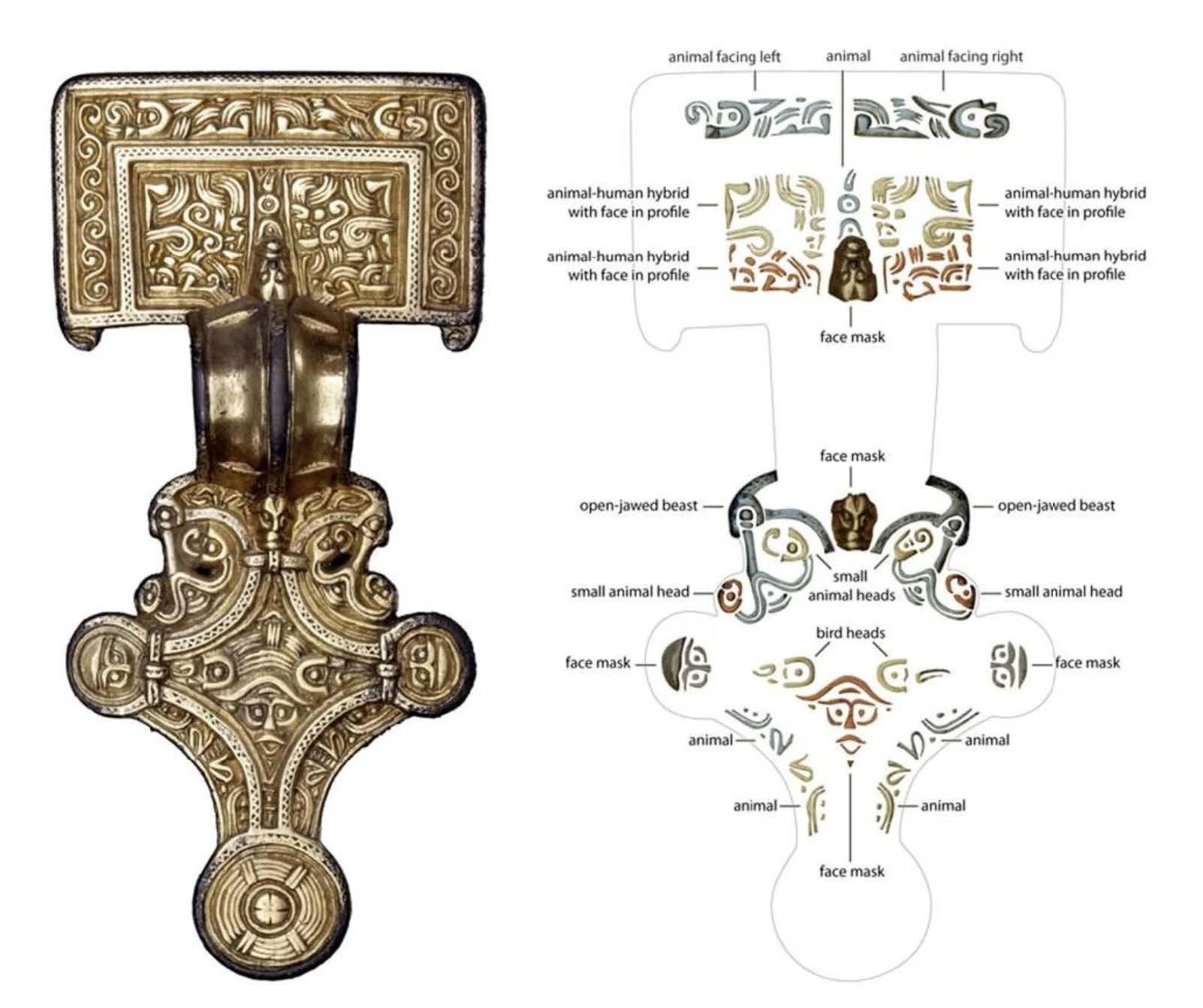
Alongside researching the urn and the process of typical funerals, I also was intrigued in Anglo-Saxon poetry. I wanted to make direct references to motifs or concepts that could be found, such as the serpent, which often corresponded with the theme of death. Often shown through displays of hostile behaviour or disease, I was inspired to create a secondary narrative voice. It is ambiguous who this voice belongs to, but I focused on the image of feasting — both a celebratory and destructive rite. The serpentine image links to my language focus on nouns like ‘Teeth’, ‘Blood’ and ‘Bones’: this centralises the untameable, wilderness of the animal, who is only interested in the consumption of ‘food.’ Therefore, I have shown a stark contrast to the civilised, human gathering, who celebrate life through material pleasures, that seem futile compared to the inferiority of human life. By referencing the cinerary urn as a ‘cooking-pot’, I have intentionally placed the domestic, common act of cooking alongside the concept of cremation. I have always been interested in the visual, graphic theme of eating in art. Goya’s painting ‘Saturn Devouring his Son’, albeit not an Anglo-Saxon piece, did aid my perception of consuming. However, when observing art pieces of the period, such as sword hilts and brooches, I noticed typical images I could include within my poem. This consisted of animals, such as the serpent, but also depictions of the four senses. I was inspired by this imagery, encouraging me to utilise sensory language. This included the capitalization of nouns like Teeth, Organ and Bone, allowing me to personify different aspects of the body. I found this important when exploring the process of ‘eating’ in detail. Additionally, by creating the comparison between eating and the decomposition of a body, I was able to explore unusual imagery evoking the Romantic trope of the sublime and insignificance of human life.
Decoded square-headed brooch, The British Museum.
Additionally, the all-consuming depiction of the fire was intentional: it devours what remains of the body, in a destructive yet predictable way. In addition to the exaggerated, vivid description of eating I created, it was paired with a regular rhythmic meter of AA. This choice encouraged a contrast between the different narrative voices: the stanzas on the left-side consist of an alternative structure, ABAB. However, if I was able to do this poem again, I would do more research into the typical metre found in Anglo-Saxon poetry, like Beowulf. This consists of a strict alliterative metre, with each line divided into half-lines, separated by a pause.
The poem ends by expressing the main message of my poem through a cyclical structure, where the idea of feasting is returned to. It summarises the futility of human mortality, where the domestic chore of ‘cooking’ is comparable to the burning of bodies at a religious funeral.
Cyclical in nature, like the Oroboros serpent — where life and death only end in each other; consumption (of food, by the body) results in more consumption (of the body, by decay.) Not only did I create a modern reception of Anglo-Saxon poetry, but also I aimed to create a timeless piece, with themes that any reader could relate to.
Bibliography
Anon, (2021). Mystical Life in Anglo-Saxon England - Father Eadred. [online] Available at: https://fathereadred.com/anglo-saxon-blog/mystical-life-in-anglo-saxon-england/.
Appleton, H. The Insular Landscape of the Old English Poem The Phoenix . Neophilologus 101, 585–602 (2017). https://doi.org/10.1007/s11061-017-9531-y
Ball, Charlotte Elizabeth (2017). ‘A creeping thing’: the motif of the serpent in Anglo-Saxon England. University of Leicester. Thesis. https://hdl.handle.net/2381/40702
Howard (2025). Early Anglo-Saxon Cinerary Urns at the Yorkshire Museum. [online] Archaeodeath Available at: https://howardwilliamsblog.wordpress.com/2025/02/02/ early-anglo-saxon-cinerary-urns-at-th e-yorkshire-museum/
Houghtonstmarys.org.uk. (2025). The Wall Paintings at St Mary’s Church Houghtonon-the-Hill. [online] Available at: https://www.houghtonstmarys.org.uk/wall-paintings [Accessed 22 Mar. 2026].
Medievalists.net (2015). Ceremonial Drinking in the Viking Age - Medievalists.net. [online] Medievalists.net. Available at: https://www.medievalists.net/2015/01/ceremonial-drinking-viking-age.
The British Museum. (2014). Decoding Anglo-Saxon art. [online] Available at: https://www. britishmuseum.org/blog/decoding-anglo-saxon-art.
Williams, H. (2014). A well-urned rest: Cremation and inhumation in early Anglo-Saxon England. In Kuijt, I. Quinn, C. P. & Cooney, G. (Eds.), Transformation by fire: The archaeology of cremation in cultural context (pp. 93-118). Tucson: University of Arizona Press.
Wikipedia Contributors (2025). Burial in Anglo-Saxon England. Wikipedia. Wikipedia Contributors (2024). The Phoenix (Old English poem). Wikipedia.
What is morphine and how can you alter it to change the way it acts?
Heidi Porter
I am firstly going to discuss what morphine is and mention the side effects of unaltered morphine. I will then talk about how you can successfully purify and isolate morphine and then discuss the four modifications you can make to alter the structure of morphine to change its effectiveness.
Morphine is an opioid agonist, which is a chemical that attaches itself to a receptor and causes an action that is comparable to that of a natural ligand. Morphine is also a complex alkaloid, with a tetracyclic structure characterised by a phenanthrene core. It has a molecular formula of C17H19NO3 and contains a hydroxyl group, a methoxy group and a tertiary amine. It is the main alkaloid in the mixture of over 20 alkaloids in opium and could act as the prototype μ-receptor agonist in the central nervous system, which is responsible for opium’s analgesic and sedative activities. It can do this in two primary ways: hyperpolarisation of interneurons, which makes it harder for neurons to transmit pain signals and then also depressing neurotransmitter release, which is where systems reduce the release of chemicals that carry pain signals. However, morphine has many side effects such as respiratory depression, vomiting, constriction, nausea, euphoria and addiction. This is why morphine must be chemically modified, not only to improve its effectiveness but to mitigate these side effects.
Morphine was originally successfully purified by German pharmacist Friedrich Wilhelm Adam Sertürner. He did this by using hot water to extract opium and ammonia to precipitate morphine. The first step in isolating and purifying morphine is extracting opium using an alkaline alcoholic solution; this is a key step as it will dissolve morphine and other opium alkaloids, which makes it easier to separate it from the solid components. The solution is then processed to filter and remove solid particles, and the alcohol is further evaporated from the filtrate leaving behind a residue that contains dissolved morphine and other compounds. This residue is then extracted by an alkaline aqua solution with a pH of 11 - a high pH is crucial to maintaining the solubility of morphine. The solution is filtered again to remove any last remaining solid matter. Then, to prevent the formation of emulsions during extraction, the solution is agitated with sufficient salt. The alkaline aqua solution is then further extracted with organic solvents like toluene or benzene. Lastly, the pH of the alkaline aqua filtrate is adjusted to between 8.5 and 9.5 allowing morphine to precipitate out of the solution to be collected and purified. Now the morphine can be modified to change its effectiveness.
The first modification that you can make is to the hydroxyl groups. The phenolic hydroxyl at position 3 or alcoholic hydroxyl at position 6 can be converted to an ether or an ester. If the change is at position 2, then the activity will decrease but then if the change is at position 6, the activity will increase by two or four times that of original morphine. If an ether or ester is formed at each position simultaneously, for example diacetylmorphine, codeine or methyl ether will decrease the effect of muzzling the phenolic hydroxyl. However, with diacetylmorphine, there will instead be a greater activity. This is due to how easily the acetyl group could be removed from the phenolic hydroxyl, which will most
likely allow the substance to act as 6-monoacetylmorphine and would therefore not be used due to its role as a metabolite of heroin. Benzylmorphine myristyl ester is an ester where analgesic activity is hugely reduced; this could possibly be due to a large fatty acid radical attached to alcoholic hydroxyl, which interferes with absorption.
The second modification is to the nitrogen; morphine has a tertiary nitrogen carrying methyl group in a piperidine-like ring structure. The tertiary character of nitrogen, the methyl substituent and ringlike structure are all intimately associated with the analgesic action and if any of these are disrupted it will hugely reduce and, in many instances, can remove the analgesic action. A tertiary nitrogen will be found in any potent analgesic, despite any other chemical characteristics present and the nitrogen cannot be made quaternary as an N-oxide or metho-chloride would be formed.
The third modification is a new substituent on the aromatic or alicyclic ring. Generally, the addition of new substituents to aromatic or alicyclic portions of morphine molecule will result in a decrease of analgesic effectiveness, for example a halogen of NH2 attached to the aromatic ring on position 1 or 2. Although, there are some exceptions to this. An alkyl group on the alicyclic ring on position 6 or 7 can be variable in its effects and if a methyl is added to dihydromorphinone at position 7 it will produce metopon and will significantly increase the analgesic action. Lastly, the addition of a hydroxyl at carbon 14 increases the analgesic effectiveness hugely and the new hydroxyl creates a tertiary alcohol and its acetylation increases effectiveness.
The final modification is opening the oxygen bridge. This will decrease the analgesic action of morphine, and a new hydroxyl group is formed at position 4.
To conclude, morphine, once isolated and purified, can be modified in a multitude of ways to increase or decrease its analgesic activity. This shows how making small alterations to the morphine molecules can hugely change the effect it has on people, and in some cases, means it can’t be used in the way we expect morphine to be used. For example, with the 6-monoacetylmorphine, which is a metabolite of heroin and is used as a biomarker in drug testing to indicate heroin usage.
Did Alexander the Great Succumb to his Own Propaganda Machine?
Henry De Bono
Alexander the Great created an ancient proto - personality cult which simultaneously manipulated the narrative yet also fused cultures, brought the world together, and built a powerful legacy. Did Alexander genuinely fuse cultures and craft a shared legacy, or did he cultivate a Hitler or Mao-esque personality cult and suppress dissent whilst morally decaying? I would argue that Alexander the Great ultimately fell on the sword of arrogance which was facilitated by court flatterers but also by the extremely effective exportation of Greek and Macedonian culture throughout his empire. Alexander the Great was certainly a public relations genius (his two biggest feats namely being his modern title (which has lasted about 2350 years) and his deification) even early on, when he is said to have embedded himself in Homer’s mythology, sleeping (according to Plutarch) with a copy of the Iliad below his pillow, and running naked around Achilles’s tomb - personifying himself as a Greek hero. He also laid the groundwork for the longevity of his own image, at the cost of diluting his native Macedonian culture with that of Persia - for proclaiming himself no longer the son of only Zeus but that of the Eastern god Ammon himself and coinage shows Alexander with divine horns (a Persian symbol) 34 years after his death in 290BC. Alexander also had a passion for naming cities after himself, founding at least 18 Alexandrias east of the Euphrates,and laying the foundations for the greatest Alexandria of them all in Egypt. The actual plans for the Library of Alexandria were then created and enacted by Ptolemy, one of Alexander’s close friends (and one of the diadochi) who set up the Ptolemy dynasty in Egypt, perhaps the longest lasting hereditary symbol of Alexander’s power. He laid the foundation for modern corporatisation and exportation of culture such as the placement of gymnasiums in every city (in a system similar to the spread of McDonalds outside of America by integrating the culture of burgers and fast food, or, in Alexander’s case, exercising naked, into other cultures) and the spread of Greek law and language as far as Ai Khanum - 3000 miles from the Aegean Sea. Koine Greek was formulated by Alexander so as to give all of his peoples one way of communicating. This was highly effective and eased trade and information channels throughout his empire, even later allowing the spread of Christianity by enabling disciples to spread the word of Christ - this is in itself arguably represented in the book of Luke in the Bible where the disciples are gifted languages by God himself on the day of the Pentecost (Acts 2:6-8).
A key part of Macedonian culture was drinking undiluted wine, and Alexander was no exception, killing Cleitus the Black (who had saved his life at Granicus) in a drunken frenzy, when he asked whether Olympias had betrayed Philip having Alexander with Zeus. This was later justified by court flatterers such as Anaxarchus stating that Alexander was a god, all of his actions were divine and righteous - for the greater good. Anyone challenging this narrative, such as Cleitus or Parmenion, was silenced or killed. Alexander became increasingly and more outspoken and hubristic (hubris was a particular enemy of Greek culture) - comparing his wound at the battle of Malli to that Venus sustained at the hands of Diomedes at Troy - this led to his massacre of women and children of Malli out of self righteous anger. Alexander’s crusade had turned from one on behalf of the Greeks to him seeking power and legacy for himself - to secure his own personal power he trained 30
000 Epigoni (Iranian youths loyal to Alexander alone) and sent the Greek Veterans home. When he stretched his empire too far at the Boas river his troops mutinied - Alexander had become too focused on himself and maintaining his own personal power to care about the structural integrity of his empire or even his own moral code. He was profligate in overspending, building a 290 foot high funeral pyre for his friend Hephaestion and trying to build another great pyramid tomb for Philip. He tried to introduce proskynesis (divine prostration) before himself - portraying himself as the first before equals (this metamorphosis is similar to that shown by George Orwell in Animal Farm, depicting the morphology of communism into dictatorship) - a title we later see Augustus using as princeps (first amongst the citizens).
Alexander the Great was truly excellent at putting forth his own image, whether as the son of Zeus Ammon or by naming cities after himself which later became hubs of cultural excellence. However, eventually he became so self involved and so accustomed to extravagance that he became increasingly brash - his creation of a global culture of shared ideas through the lingua Franca of Koine Greek was impressive, but in creating such cultural discipline, he had forgotten self discipline.
Bibliography
Bosworth, A. B., Conquest and Empire: The Reign of Alexander the Great, (Cambridge University Press, Cambridge 1993)
Bosworth, A. B., Alexander and the East: The Tragedy of Triumph, (Clarendon Press, Oxford 1996)
Lane Fox, R., Alexander the Great, (Penguin Books, London 2004)
Thanos matanis, Greek Reporter, ‘Alexander the Great and Jesus: Exploring the Comparison’, https://greekreporter.com/2025/12/25/alexander-the-great-jesus/, accessed 30 December 2025
A ‘Wrong Turn’ Corrected
or a Dead End?
Noting the Impacts and Extent of R v Jogee [2016] on the Doctrine of Joint Enterprise in the UK Criminal Justice System.
Joseph Andrew Kington
Pre-Essay Note: In an attempt to limit footnotes and meet the word limit, I have provided explanations only where crucial to the essay’s purpose and removed them from the introduction. I apologise if any unfamiliar concepts arise that I have not defined; the intuitive assumption of their meaning will often be correct.
The Doctrine of Secondary Liability has long grappled with the challenges of group criminality. Between 1985 and 2016, the system operated under a framework where an Accessory could be convicted of murder even if they lacked the Specific Intent required of the Principal to perform the Actus Reus. This Equivalence of Culpability was maintained by a common law rule known as Parasitic Accessorial Liability (PAL). While the Supreme Court’s ruling of a ‘wrong turn’ in R v Jogee allowed for a major return to Legal Positivism in the face of flawed judicial policy, the transition from a Substantive Rule to an Evidential Factor has been complicated by the persistence of Conditional Intent. Consequently, the doctrine’s pursuit of a marriage between Social Justice and Legal Positivism remains incomplete.
Prior to Jogee, the Joint Venture was governed instead by the decision in Chan Wing-Siu v R1. Under PAL2, if two parties agreed to commit a crime, the secondary party was equally liable for any ‘‘incidental” killing committed by the primary actor, provided the secondary party had Subjective Foresight3 that such an act was a possible contingency. This resulted in a significant Mens Rea dilution and dismissal of the principle of Correspondence4. The law also bypassed the requirement for murder’s Specific Intent, substituting it with mere foresight of a risk. Thus, the departure from the principle of Derivative Liability5 further meant that a secondary party could be convicted of murder on a lower mental threshold than the killer themselves, producing an apparent absurdity.
In R v Jogee6, the Supreme Court unanimously declared that the law had taken a “wrong turn.” The Court re-established that foresight is not a Substantive Rule of law,
1 Chan Wing-Siu v R [1985] AC 168.
2 A specific form of secondary liability where S’s liability for a secondary crime (Crime B) ‘attaches’ to their participation in an initial criminal venture (Crime A) based on foresight rather than intent.
3 The requirement that the specific defendant actually realized a particular outcome was possible, rather than what a ‘reasonable person’ would have seen.
4 The principle of correspondence dictates that the mens rea must relate to the particular outcome prohibited by the actus reus.
5 The principle that an accessory’s legal liability is not an independent wrong but is derived from the principal’s commission of the offence and requires matching intent.
6 R v Jogee [2016] UKSC 8, [2017] AC 387.
but rather an Evidential Factor7 from which a jury may, but need not, infer intent. To be convicted of murder, a secondary party must now be proven to have had the Specific Intent to assist or encourage the primary actor to kill or cause grievous bodily harm. This restored Derivative Liability , ensuring the accessory is only as liable as their own intent dictates. However, it is worth noting that the Court simultaneously set a high bar for appeals, requiring a Substantial Injustice to be proven for those convicted under the now defunct PAL standard, perpetuating the suffering of those already affected by a since-acknowledged, ‘‘wrong turn’’.
The most immediate positive effect of the reform is the restoration of Proportionality through the residual use of manslaughter. In the pre-Jogee era, the ‘all-or-nothing’ nature of PAL often resulted in mandatory life sentences for secondary parties8 who never intended for a death to occur. Post-reform, where an individual participates in a Joint Venture but lacks the Specific Intent for murder, a conviction for manslaughter is the standard technical outcome. This shift respects the gravity of murder as a crime reserved for those with the highest level of Culpability
Furthermore, the shift has increased the Probative Value of evidence required in court. Juries can no longer be directed that foresight equals guilt; instead, the prosecution must present circumstantial evidence- such as communications or the prior possession of weapons- to prove a “shared intention” which mandates a higher level of judicial rigour during trial directions9. By forcing the prosecution to prove an actual state of mind, the system has moved closer to the ideal that liability must be individual rather than collective.
Despite these theoretical gains, the injustice of joint enterprise has arguably evolved rather than disappeared. The primary technical “backdoor” is the doctrine of Conditional Intent10. Prosecutors frequently argue that if a secondary party went to a scene knowing the primary actor had a weapon, they possessed an “all-encompassing intent” to assist if things went wrong. High-profile cases such as R v Tas11 and R v Crilly12 demonstrate that while the labels have changed, the evidential burden often feels remarkably similar to the old foresight standard.
Moreover, the Equivalence of Culpability remains a systemic issue. Research from Manchester Metropolitan University (MMU 1)13
7 A substantive rule is a mandatory legal conclusion; an evidential factor is information from which a jury may, but is not required to, draw an inference of fact.
8 J Jacobson, Joint Enterprise (PRT 2016) 22-26.
9 Judicial College, The Crown Court Compendium Part I: Jury Directions ( July 2025 edn) s 16-3.
10 A mental state where the defendant intends to assist in a crime only if a certain condition arises (eg R v Taylor [2016] EWCA Crim 1495).
11 R v Tas [2018] EWCA Crim 2603.
12 R v Crilly [2018] EWCA Crim 168.
13 B Clarke, Joint Enterprise, ‘Gangs’ and Racism: Time to Halt This Continued Injustice (Institute of Race Relations 2023) 7-9. Supported by APPEAL, Joint Enterprise on Trial (Report, 2025) 25-26.
finds that the law continues to disproportionately affect young and Black men. This was also a central finding of The Lammy Review14, which identified the doctrine as a significant driver of racial disproportionality within the criminal justice system. In these trials, “gang narratives” are often used as a proxy for intent, allowing juries to infer a Specific Intent to kill based on cultural association rather than direct evidence of assistance.
As MMU 215 further observes, women are frequently swept into joint enterprise convictions not through active participation, but through their domestic or romantic proximity to primary offenders. In these cases, the “evidential factor” of foresight is often weaponised against women, where their failure to leave a relationship or their presence at a home is conflated with specific intent to assist. This creates another distinct form of injustice where Conditional Intent fails to account for the coercive or social realities of people’s lives, leaving them trapped in a doctrine that punishes status over individual culpability.
As MMU 215 further observes, women are frequently swept into joint enterprise convictions not through active participation, but through their domestic or romantic proximity to primary offenders. In these cases, the “evidential factor” of foresight is often weaponised against women, where their failure to leave a relationship or their presence at a home is conflated with specific intent to assist. This creates another distinct form of injustice where Conditional Intent fails to account for the coercive or social realities of people’s lives, leaving them trapped in a doctrine that punishes status over individual culpability.
Beyond specific groups being adversely affected, a study by Justice16 highlighted that juries often struggle to distinguish between “knowledge” and “intent” when presented with such prejudicial evidence. When combined with the mandatory life sentence for murder, the system still produces outcomes in the majority of cases where a non-striking secondary party receives the same sentence as a primary killer, with both applied as a ‘blanket penalty’- as shown by the aforementioned MMU 1 study17, and failing the ultimate test of Social Justice
14 D Lammy, The Lammy Review: An Independent Review into the Treatment of, and Outcomes for, Black, Asian and Minority Ethnic Individuals in the Criminal Justice System (2017) 18-23.
15 B Clarke and K Chadwick, ‘The Criminalisation of Women in Joint Enterprise Cases: Exposing the Limits to “Serving” Girls and Women Justice’ (2023) 12(4) International Journal for Crime, Justice and Social Democracy 80-91.
16 Justice, Juries and Joint Enterprise (London 2022) 12-14.
17 Which is consolidated by H Mills, M Ford, and R Grimshaw, The Usual Suspects (Centre for Crime and Justice Studies 2022) 24.
The Law Commission’s 2025/26 Review18 reveals the necessary next step: moving away from a ‘two-tier’ system toward a structure that can technically distinguish further between di ff erent levels of culpability. True reform requires a statutory framework that more closely reconciles Culpability with punishment, and so until the Mandatory Life Sentence is decoupled from secondary liability, the law remains a blunt instrument. By integrating the Law Commission’s structural proposals, the legal system can finally bridge the divide between intent and finding justice; this is a solution not limited in its necessity to the issue of Joint Enterprise, but represents a greater cause within English Law itself. However, until the time comes that these remaining grievances are addressed, it must be concluded that the judgment in Jogee represents a necessary but not sufficient step towards the union of Legal Positivism and Social Justice in the arena of Secondary Liability.
18 Law Commission, Law of Homicide (Call for Evidence, August 2025 ch 4). See also Law Commission, Fourteenth Programme of Law Reform (2025).
‘Irresistibly came they…’:
The Reception of Homer’s Iliad in Poetry of the First World War
Keira J. Mountford
Introduction
Homer’s Iliad, and, arguably, most classical epic poetry, is a writing of war. As Simone Weil foregrounds it: ‘L’Iliade ou le poème de la force’ 1, ‘The Iliad or the Poem of Force.’ Weil unapologetically dubs the overarching subject of this epic poem as Force. However, this view is simplistic and does not consider the universality and perpetuity of its themes that, despite the decay of a classical education, are ever prevalent in a mechanised and altering society. Writings of war have been in the foreground of history for millennia, leading to artists drawing on paradigms of warfare to express their own firsthand experiences. What this essay will focus on is the application of classical paradigms of thought to define subjective experiences of warfare, particularly those of a World War One soldier-poet.
The Homeric framework of war is one that prevails the entirety of the Iliad, alongside lesser themes which are also used by literary descendants: namely death, life, beauty, and horror also exemplify the universal humanity displayed in Homer’s writing. However, for the sake of this essay, warfare2 will be the epicentre. Matilda Hatcher notes that this particular Homeric framework demonstrates a ‘myriad of tropes and images’, which were used to both glorify and vehemently protest modern warfare. Undeniably, there are various factors which influence the use of these tropes to express experiences or views about war, especially the popular Public-School education of the poets who personally drew on the Iliad for reference. Whether these soldier poets are questioning the validity of traditional notions of honour and glory, asserting that classical traditions are made completely irrelevant by the conditions of modernised warfare, or seeking to compare the valiant experiences of modern soldiers with the achievements of the Achillean hero; The Iliad can always be returned to. These provoking themes culminate together into one resonant poem of humanity, suffering, and life, and thus there are no qualms in why World War One poets so frequently drew upon it: as a self expression of the educated elite3
a. ‘I saw a man this morning...’ - Patrick Shaw-Stewart Vandiver foregrounds the concept that most poets appropriated or refigured Troy to not critique the war, but rather as a mean of glorifying the modern battle and the efforts of the
1 Weil, S. (1939). The Iliad, or the Poem of Force. In The need for roots: Prelude to a declaration of duties towards mankind. (pp. 1-15). (Translation by A.W.A. Harter, 2001).
2 Hatcher, M. (2020, July 15). Stand in the trench, Achilles: The reception of the Iliad in twentieth century depictions of warfare. ANU College of Arts and Social Sciences. https://anucssxenia.wordpress.com/2020/07/15/stand-in the-trench-achilles-the-reception-of-the-iliad-in-twentieth-century-depictions-of-warfare/.
3 Goebel, S. (2011). WAR POETS [Review of Stand in the Trench, Achilles. Classical Receptions in British Poetry of the Great War, by E. Vandiver]. The Classical Review, 61(2), 627-629. https://www.jstor.org/stable/41301323.
British soldiers4. Shaw-Stewart’s poem is both exemplary and opposing of this concept, wherein resonances of the Troy-Gallipoli comparison used are unsurprising due to the poet’s habit of citing classical exempla. Depending on how the poem is viewed, these Iliadic allusions display either the idealistic achievements of the modern fighters, or the poet’s view that the reasons for the fighting itself have changed very little from the ways of Ancient Greece. Shaw-Stewart’s characterisation as a war poet rests solely on this singular poem, unknown in his lifetime, which yet remains a memorable one, especially when viewed with a Homeric lens5 .
‘Stand in the trench, Achilles,
Flame-capped, and shout for me.’ 6
To fully understand this poem, we must look at it from a two-dimensional perspective, the first of which is the intense glorification of war and its soldiers often seen in poems such as Julian Grenfell’s and Rupert Brooke’s. Shaw-Stewart’s aims of glorifying the efforts and achievements of the modern soldiers, as made evident by Vandiver, are particularly prominent in his use of the conception that the Ancient Greek warriors could interact with the modern British soldiers. The poem, unnamed, foregrounds Achilles as a still existent identity that lives within the gallant soldiers fighting on the Western Front. Throughout his poem, Shaw-Stewart lays bare the heart of a soldier who is soul-searching and examining himself, and we can view this from several angles. Beginning with analysis of the final stanza, it is clear to see this personal cross-examination as positive and an expression of valour. The speaker, pleading ‘Stand in the trench, Achilles…’ either wants the still-existent Achilles to stir him into even further heroism and endeavour, or Shaw-Stewart aligns the soldier with Achilles himself to present a recognisable theme: the soldier is infact, higher status than the Greek demi-god. Seen in both ‘Into Battle’ and ‘Gallipoli’, ShawStewart displays the power invoked in the modern soldier when placing the motivation of the Homeric warrior inside him. Much like Grenfell’s ‘Joy of Battle’, this is also extremely reminiscent of Achilles’ battle cry in Book 18.
‘There he stood and gave a shout […] Like the piercing sound that rings out from a trumpet when a town is surrounded by murderous enemies, such was Achilles’ piercing cry.’ 7
On the contrary, we can see a sense of longing to regain glory following a period of mindless suffering. Achilles is often considered a ‘tragic hero’, and Shaw-Stewart uses these facets of Achilles to face the inevitability of death and his helplessness in the face of superior military commanders.8 By commanding Achilles, the poem rather serves as
4 Vandiver, E. (2010). Stand in the Trench, Achilles: Classical Receptions of British Poetry of the Great War. Oxford: Oxford University Press.
5 Balliol College Archives & Manuscripts. (August 2014). Notable Alumni: Patrick Houston S-S, War Poet. Balliol Archives - PH Shaw-Stewart.
6 Shaw-Stewart, P. (1915). Poetry Foundation: ’I saw a man this morning...’.
7 Rieu, E. V. (1950). The Iliad: Book XXVIII: 215-221.
8 Hatcher, M. (2020, July 15). Stand in the trench, Achilles: The reception of the Iliad in twentieth century depiction of warfare. ANU College of Arts and Social Sciences.
an invocation of Achilles. The speaker places himself in the position of the dead Patroklus, now referencing the pain-wrought, as opposed to glorified, battle cry of Iliad 18, returning to battle after Patroklus’ death.
Between classical and modern, the line between myth and reality blurs as thoroughly as the line between life and death.9 Much like Achilles’ shout for Patroklus from the trench, Shaw-Stewart’s poem reveals the anger and lamenting of futile deaths fated to higher powers, whether that be Gods or senior commanders. The poet tacitly questions his own motivations for fighting through the question ‘why must I follow thee?’ Shaw-Stewart, like many other twentieth-century war poets – especially the likes of Wilfred Owen, reveals the ‘fated’ deaths of the soldiers and their subjection to higher powers by borrowing Achilles’ harsh subjection to fate throughout the Iliad. As readers, we are forced to question the pointlessness of human endeavour in the face of inevitable death.
‘But other shells are waiting Across the Aegean Sea, Shrapnel and high explosive, Shells and hells for me.
O hell of ships and cities, Hell of men like me, Fatal second Helen, Why must I follow thee?’
Shaw-Stewart’s question remains not only unanswered, but unanswerable: he finds no compensating motivation, either in the hope of glory or in the desire for personal vengeance.10 The poet invokes no citation of glory, honour or revenge. Stewart does not even connote the obvious answer of patriotic ‘duty’, contrasting the duty of kleos that Achilles would have felt as an archaic fighter. Stylistically, this stanza breaks the iambic tetrameter of the rest of the poem, mirroring the chaos and anguish of war: just as the ‘Fatal’ Helen’s abduction sparked the Trojan War, the events leading to World War 1 seemed to Shaw-Stewart equally arbitrary and destructive. The pun on the temptress’ name, ‘hell of ships and cities, // Hell of men like me,’ gets across not only the speaker’s anger at the modern chaos wrought which is reminiscent of the ancient, but also his ability to empathise with the hundred ships and thousands of warriors implicated in the 10-year mythical war. Shaw-Stewart’s unanswerable questioning of the purpose of war is a direct reference to Achilles’ own inquisitorial nature seen in Book 1.
‘It was no quarrel with Trojan warriors that brought me here to fight. They have never done me any harm.’ 11
9 Li Sui, G. (2008, June 15). ’I saw a man this morning...’: A commentary. gweek.wordpress.com.
10 Vandiver, E. (2010). Stand in the Trench, Achilles: Classical Receptions of British Poetry of the Great War. Oxford: Oxford University Press.
11 Rieu, E. V. (1950). The Iliad: Book I: 150-158.
Vandiver states that the entire context of the Iliad makes it clear Achilles was only willing to follow the tyrannous commander as long as he receives sufficient time (honour, that which Dr Emily Hauser defines as gifts of honour which contribute to status, such as Achilles’ prize-woman Briseis.12 ) and kleos (glory)13. This tension between duty and despair prevails through the epic poem as well as Shaw-Stewart‘s.
Finally, stanza 1 captures the conflict between the moral question and the answer he does not wish to provide: does he want to die? The exteriorisation of the answer he ends up stating, a desire to live on, brings clarity to the choice of death which the speaker does not understand, and yet Shaw-Stewart consistently employs his underlying criticism of the futile and countless deaths which war invokes. This ambiguity is one which Iliadic criticism has been asking for decades: did Homer create a critique or a romanticisation of war? The speaker in Shaw-Stewart’s poem is only able to make sense of the impending doom which the ‘morning’ on the front lines will bring with his doubts humanised in the form of the ‘man’.
‘I saw a man this morning Who did not wish to die: I ask and cannot answer, If otherwise wish I.’
b. ‘Strange Meeting’ - Wilfred Owen
Owen did not have the same Public School education as his fellow classically trained soldier-poets, and yet as classically inspired readers, it is clear to see that certain Homeric ideologies dominate ‘Strange Meeting’. On the surface Owen created a revelation into the countless lives lost at war, where modern warfare has created an impersonal environment wherein fighting feels fruitless. This is both counter and pro-Iliadic. It both foregrounds the futility of fighting which Homer subtly exhibits, arising from the mythological idea that the Gods were playwrights in the fated Trojan war, as well as countering Owen’s experience of impersonal modern warfare with Iliadic notions of hiketeia (battle supplication) and others. The ‘strange friend’ depicted in the final stanza – revealing that he was, in fact, an enemy soldier killed by the speaker – is a symbolic manifestation of what Owen deems as the meaningless of war which comes forth in death. Owen’s universal allegory of the ‘enemy you killed, my friend,’ underscores the idea that in death, all belligerence and overt jingoism dissipates. Every war-invoked death is of a ‘friend’, whatever loyalties possessed, and this is inevitable in the face of a futile and hierarchal war.
‘I am the enemy you killed, my friend. I knew you in this dark; for so you frowned Yesterday through me as you jabbed and killed.’ 14
12 Hauser, E. (2020, September 10). Homer – Heroism (Iliad) [Video]. Massolit. https://massolit.io/courses/homer heroism-iliad.
13 Vandiver, E. (2010). Stand in the Trench, Achilles: Classical Receptions of British Poetry of the Great War. Oxford: Oxford University
14 Owen, W. ’Strange Meeting’. Representative Poetry Online, edited by I. Lancashire. Toronto University Press. (2000). https://rpo.library.utoronto.ca/poems/owen1.html.
The physicality in ‘jabbed and killed’ is reminiscent of physical hand-to-hand combat described by Homer throughout the ‘Iliad’. However, the way in which the ‘friend’ is murdered lacks the personal aspect so paramount in Iliadic killings, where warriors fight as individuals in acts of aristeia. Here Owen subverts the personal prowess of both fighters typical of Homer, existing as another example of how modern war poetry used classical texts as ‘tragic frames of reference’ 15 to suggest how warfare has progressed inhumanely. This approach is also epitomised in Owen’s ’Dulce et Decorum est’, which asserts that classical traditions, such as that of Horace’s ‘old lie’, are made irrelevant by the conditions of modern warfare.16
Owen instills dialogue in the moving interaction between enemies, framing his belief that there is potential for friendship despite the brutalities of modern battle: everyone is equal in death, and therefore all patriotism is nullified.
‘Strange friend,” I said, “here is no cause to mourn.”
“None,” said that other, “Save the undone years, The hopelessness. Whatever hope is yours, Was my life also;’
This direct reference to the Greek idea of xenia recalls Diomedes and Glaucus’ moving conversation across the mythical battle lines. Xenia was vital to Greek tradition, being the act of hospitality, guest friendship and mutual respect to a stranger.17 Dr Hauser defines xenia as created across generations and strengthened by reciprocity in gift giving (geras).18
This is paralleled with another model of relationship that inform the way heroes act: Supplication, or hiketeia. This was self-abatement, clasping the knees of the superior in an act of supplication, and both secure mercy or favour and create a relationship between lower and higher – acting as another example of the individuality and personal nature of Homeric warfare.
Priam is seen to powerfully supplicate Achilles in Book 24.19 ‘Strange Meeting’, however, acts as a potent example of this ‘guest friendship’, paralleling Diomedes and Glaucus’ realisation that their shared connections outweigh the enmities of war.
‘So he spoke, and Glaucus’ tale delighted Diomedes, master of the battle-cry. He stuck his spear into the bountiful earth and warmly addressed this shepherd of the people. “Surely your family and mine are linked by old-established ties! [...] So now you will have a good friend in me in the heart of Argos...” 20
15 Hatcher, M. (2020, July 15). Stand in the trench, Achilles: The reception of the Iliad in twentieth century depictions of warfare. ANU College of Arts and Social Sciences.
16 Owen, W. (1921). ’Dulce et decorum est’ from Poems, ed. Siegfried Sassoon. New York: The Viking Press.
17 Watt, K. (November 2024). Understanding the concept of Xenia in Greek Mythology.
18 Hauser, E. (2020, September 10). Homer - War [Video]. MASSOLIT. https://massolit.io/courses/homer/war e0dc9bbc-9663-40c4-bc6b-847fa8e09fb2?autoplay=true.
19 Rieu, E. V. (1950). The Iliad: Book XXIV: 477.
20 Rieu, E. V. (1950). The Iliad: Book VI: 212-225.
This shared epiphany of how their families have ties of ‘guest friendship’ is also reminiscent of the friendship between Achilles and Patroklus.21 His care for Patroklus reveals his strong loyalties to his comrades, something that was seen as a desirable characteristic of an ethical soldier. Hatcher notes that ideal soldier-heroes of the First World War embodied crucial aspects of this Ancient Greek characterisation in particular22, and this was even used as a British recruiting tool.23
Lastly, Owen’s use of the motif of ‘chariot-wheels’ towards the end of the poem is a metaphor that directly resonates with the Trojan battlefields. Chariot wheels, with its classical associations of honour and glory, exist as an emblem for a type of warfare far more barbaric than the bolt-actions rifle and gas attacks. Martin Stephen declares that the chariots transfer the poem from one time to another, bringing us closer to some of the harsher aspects of war’s reality by paralleling them with archaic practices.24 This parallelism conveys the stark realities of one-on-one combat through Homeric imagery whilst paradoxically depicting a mythical distance between the truth behind war and the romanticisation of the ‘Iliad’.
‘Then, when too much blood had clogged their chariot-wheels, I would go up and wash them from sweet wells, Even with truths that lie too deep for taint.’
This serves as a reminder of the progression of warfare, creating a relationship with the destruction on battlefields so barbaric it can only be described as archaic: both the Trojan plains and the front lines of WW1 invoke pain and destruction despite the differences in warfare, and therefore Owen must revert back to clearly Iliad images. Homer’s description of Achilles’ mutilation of Hector’s body using a chariot following the former’s killing spree is a controversial aspect of Iliadic warfare, and exactly what Owen calls to mind in his poem.
‘He spoke and foully maltreated godlike Hector. [...] Dust rose from the body they dragged behind them; Hector’s sable hair streamed out on either side and his whole head, so graceful once, lay in the dirt.’ 25
21 The best examples of this is probably Book XVIII: Achilles lets out a mighty shout for the death of his friend.
22 Hatcher, M. (2020, July 15). Stand in the trench, Achilles: The reception of the Iliad in twentieth century depictions of warfare. ANU College of Arts and Social Sciences.
23 Arieti, J. A. (1985). Achilles’ Guilt, The Classical Journal 80, no. 3: 197; Vandiver: Classical Receptions, 237.
24 Martin, S. (1996). The Price of Pity: Poetry, History and Myth in the Great War. London: Leo Cooper.
25 Rieu, E. V. (1950). The Iliad: Book XXII: 396-404.
The Iliad’s literary influences on the Great War poets are not as clear-cut as one might think. Only when poetry is viewed with an analytical lens similar to that of a Homerist, can Iliadic themes be identified, and I argue that this is essential for a true understanding of the soldier-poet’s intention and experience. Even then, as a contemporary twenty-first century audience, we unfortunately remain unable to fully grasp the pain and suffering experienced throughout the War, even when described in classical terms that feel familiar. Much like us, the soldier-poets must paradoxically revert to an archaic lens to fully explain their own experiences which in time become both numbing and mind-bending. This is a natural human reaction, and thus a core factor leading to ‘classical receptions’ in the poetry discussed.
In summary, Homer’s Iliad is able to transcend a history pocketed with wars and battles, manifestations of mankind’s eternal urge to exist as superior to others. The Iliad is this constant battle in its raw and utmost form, able to exist in the minds of all who are classically educated, and sometimes not, due to the intense picture of humanity that it both addresses and creates. Encompassing our own experience at both its richest and lowest, Homer’s text has existed, and will continue to, in humanity’s literature and poetry.
Bibliography
Shead, E. (October 2, 2020). The influence of Homer on First World War Poetry. https:// www.academuseducation.co.uk/post/the-influence-of-homer-on-first-world-warpoetry. [Accessed 28/11/24].
Van Wees, H. (1994). The Homeric Way of War: The “Iliad” and the Hoplite Phalanx (I). Greece & Rome, 41(1), 1–18. http://www.jstor.org/stable/643127.
[Accessed 29/11/24].
McGee, T. The Iliad: Lectures on Book 4, 6, 16, 18, 22, 24. https://youtu.be/ mkXDUAFg7lM?feature=shared.
[Accessed 14/01/25].
Barbera, K. (November 24, 2024). I saw a man this morning: A WWI Soldier’s Reflection on War & Mortality. https://www.troubadour.studio/post/i-saw-a-man-this-morning-awwi-soldier-s-reflection-on-war-and-mortality.
[Accessed 23/01/25].
‘Behind Their Lines’. (April 24, 2015). Second-guessing the war with Achilles. https:// behindtheirlines.blogspot.com/2015/04/second-guessing-war-with-achilles.html.
Jones, D, et al. (2020). A Little Problematic: Julian Grenfell’s ‘Into Battle’. https:// reconstructionarytales.blog/2020/05/26/a-little-problematic-julian-grenfells-intobattle/.
[Accessed 25/01/25].
Scutts, J. (April 23, 2015). The True Story of Rupert Brooke. The New Yorker. https:// www.newyorker.com/books/page-turner/the-true-story-of-rupert-brooke. [Accessed 27/01/25].
War Poets Association. (n.d). Homer. https://warpoets.org/conflicts/other/homer/. [Accessed 29/01/25].
Malik, S. (n.d). Tragedy Beyond the Battlefield: Grief in Homer’s Iliad and WWI Poetry. Antigone Journal. https://antigonejournal.com/2023/10/grief-homer-wwi-poetry/. [Accessed 06/02/25].
Graziosi, B. (August 15, 2018). Homer: Iliad – The Composition of the Poem [Video]. MASSOLIT. https://massolit.io/courses/homer-iliad-graziosi/the-rage-of-achilles. [Accessed 09/02/25].
University of Pennsylvania. (n.d). Homer and Epic Poetry. https://www2.classics.upenn. edu/myth/php/homer/index.php?page=hande. [Accessed 03/03/25].
Fussell, P. (1975). The Great War and Modern Memory. Oxford University Press. [Accessed 05/03/25].
Brooke, R. (1915). ‘The Soldier’. 1914 and Other Poems. Sidgwick & Jackson, pp. 9-11. [Accessed 10/11/24].