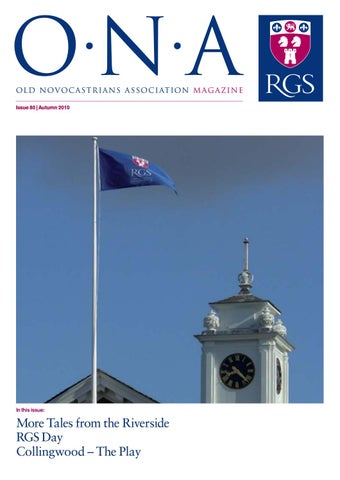
. . ONA Ol d N o v o c a s t r i a n s A s s o c i at io n M a g a z i n e Issue 80 | Autumn 2010
In this issue:
More Tales from the Riverside RGS Day Collingwood – The Play
ONA — Old Novocastrians Association Magazine
Contents President’s Welcome News 1948 Reunion Old Novo v RGS Cricket Match 1963 Reunion 50s Rowing Old Novos Boat Club RGS Day Collingwood Play Obituaries News from the RGS archive RGS Arts Diary 1 2 3 4 5 6 7 8
10 12 16 17
4
10
Contribute!
ONA Magazine Issue 80 | Autumn 2010
We are always looking for articles and news from Old Novos to include in the magazine, so send your contributions, via email (if possible) to: ona@rgs.newcastle.sch.uk or to the ONA Office at the school.
Editor: Tove Elander
Please include relevant pictures if possible. They will be returned as soon as the magazine has been printed. The deadline for acceptance of copy for the Spring 2011 issue is Monday 13 December 2010. Copy may be carried over to a future issue.
ONA magazine is the magazine for the Old Novocastrian Association
All correspondence should be addressed to: The ONA Office Royal Grammar School Eskdale Terrace Newcastle upon Tyne NE2 4DX Telephone, ONA office: 0191 212 8924 email: ona@rgs.newcastle.sch.uk The Editor reserves the right to edit, alter or omit all submissions to the magazine. Copy may be carried over to the next edition. The Editor’s decision is final. Designed and produced by www.infinitedesign.com
ONA — Old Novocastrians Association Magazine
1
Welcome
Welcome to the latest edition of our magazine The better weather in June allowed the cricket match against the RGS First Eleven to go ahead, and I am pleased to say that the ONA won by a considerable margin. You will find a report elsewhere in the magazine. It was nice to be able to welcome Fred Godson (51-58) as one of the umpires on the day, as well as those who came back to take part. We hope that, following their success this year, the football and cricket fixtures will become regular events in the calendar. Musicians from the ‘50s and ‘60s will remember Jack Wolstenholme, Head of Music, with affection. On a recent visit to School to play the organ, I gave Brian Varley (55-63) a pile of Jack’s music that had been passed on to me by his family. Amongst the printed volumes were some handwritten manuscript sheets, which were identified as the roughly worked score of a string quartet. With the assistance of Tom Banfield (51-62) one of the movements was transcribed, and the first performance is available at http://bvemv.orpheusweb.co.uk/JWLargo.html
for those who are interested to listen to it. My wife and I enjoyed meeting up with Rhys Harrison (55-65 ) and his wife on Vancouver Island this summer. He has retired there after spending his working life in Canada, and would be pleased to hear from any of his contemporaries, or indeed any Old Novos in the area. His email is rhysharrison@shaw.ca Details are still being finalised over possible events to celebrate the Centenary of the CCF, and it is hoped that a Mess Dinner can be one of these. I would like to thank the Committee for their work, and most particularly Adam Goldwater (87-97), my Vice President, for his efforts in raising awareness of the ONA amongst the current pupils. I wish him well as he takes over in October. Adam presented the most recent ONA prize for an essay on the Battlefields trip at RGS day, during the appropriate prize giving ceremony. I would like to thank the Headmaster for giving the Association the opportunity to do this. His report on the day appears on page 8. As a final footnote, could I once again ask for contributions for the magazine to be sent to the ONA office. In our meetings with those leaving over the last two years you expressed a wish to keep in contact. Please let us know how you are getting on.
Mike Barlow (53-64) ONA President
2
ONA — Old Novocastrians Association Magazine
News and Events
In the summer term, Bibek Banerjee (78-85) gave a talk to senior school students titled: From RGS CCF to Afghanistan – a surgeon’s tale. Congratulations to Claire Baudouin (06-08) on being awarded half blue in cross country running. Claire is currently studying history and economics at Pembroke College, Oxford. Chris Heaney (75-82) would love to hear from anyone who can bear to remember him! Please contact him via the ONA office.
Congratulations to Professor Ian Gilmore (55-65) who was knighted in the Queen’s Birthday Honours, and Sir Jeremy Beecham (53-62) was made Life Peer in the Dissolution Honours. Luke Roberts (96-03), also known as comedy writer and stand up comedian John Luke Roberts, made the short list for the Edinburgh Fringe Festival’s worst jokes with his joke “I made a Battenberg where the two colours ran alongside each other. I called it apartheid sponge.” John Liddicoat (66-73) writes: I am delighted to say that the school song was sung with great enthusiasm at the reception celebrating my daughter Jenny’s marriage to Old Novo Akshay Choudhry in February this year. hope this will start a new tradition at weddings to come!
From the left in the group photo: Gareth Rees, Chris Dix (95-02), Akshay Choudhry (95-02), Jenny, Will Anderson (92-02), James Lennard (97-02), Alastair Porteous (95-02), the father of the bride, John Liddicoat (66-73), Rob Gill (95-02), Ed Aldcroft (95-02), Tom Walker (95-02), Tom Lever (95-02).
Degree Results Alex Ramshaw (96-06) Geography, London School of Economics Rosalind Field (05-07) Natural Science, Durham University Dheeraj Chopra: (00-05) Bachelor of Dental Surgery, Glasgow University Rachael Jones (04-06) Bsc Geography, Glasgow Univeristy Timothy Pearson (96-06) Accounting, Glasgow University Andrew Walls (01-06) First, MA English, Glasgow University Jeffrey Li (02-07) First, BA (Hons) Economics, Trinity College, Cambridge
Join us on Facebook There are plenty of Old Novos Facebook groups around, but we have our own (official) group where we’ll post news, photos and information about events on a regular basis. Join us by becoming a fan of the Old Novocastrians Association page on Facebook.
A date for your diary The next London ONA Dinner will be held on Friday 4 March 2011. Details to follow in the next issue of the magazine.
Paul Campion (59-64) writes: The last ten years have proved a very exciting time, as I continue to live in London (almost 46 years now) and enjoy so much that life here affords.
I still write occasionally, for the CD and DVD company Naxos, principally opera résumés and historical notes; and a second edition of my book Ferrier – A Career Recorded was published in 2005 by Thames Publishing. From time to time I travel to lecture in different parts of the country and continue my work as a toastmaster and MC around the West End and further afield. In 2003 I was elected to the Court of the Worshipful Company of Musicians in the City and, all being well, I expect to be the Master for a year from November 2010. It will be a busy and stimulating time, promoting the work of the Musicians’ Company and visiting conservatoires, colleges and concert halls around the country. Maybe at last I shall get to attend a concert in The Sage! My predecessor as Master, Maurice Summerfield of Ashley Mark Publishing, is also a Newcastle man, though he attended a rival educational establishment down the road... However, his two sons are, happily, both Old Novos. My plan, hatched in 1976, to visit a different European capital city each year continues to operate successfully. Recent capitals have included Tirana (2007), Skopje (2008), Bratislava (2009) and Minsk (2010). There are about 12 left to visit, mostly in the former USSR and Yugoslavia. Does anyone fancy a week’s break in Tbilisi some time ? I’m closely in touch with my old schoolfellows Gilbert Short (54-64) and Peter Stobart (54-64) and also keep in contact with David Higginson (55-61) and Jim Rattray (57-64). In October I’m off to visit Jim in Germany, to sightsee and attend some operas and concerts around Mannheim. Looking forward to that!
3
News and Events
Class of 1948 Reunion by Donald Buchanan (48-56)
Left to right: Fred Edgar, Wally Robson, Mary Buchanan, Brian Heppell, Joyce Douglas, our new Roman friend Marcus, Ann Heppell, Donald Buchanan Rita Robson, Bob Douglas, Pat Edgar.
When I retired and had more time to ponder things, I realised that I had carelessly lost touch with very good friends I had had at the RGS and university. Brian Heppell (48-56) and I were still in contact, and he was himself in contact with Fred Edgar (48-56), but what had happened to Wally Robson (48-56) and Bob Douglas (48-56) – had they managed to overcome the handicap of an Oxford education? I remembered a school where Wally had taught years before, and that began a trail which led to his present home, in the street in Whitley Bay one along from the street where I had lived during my schooldays. With the cautious assistance of Bob’s Oxford college he was tracked down to another Whitley Bay address, barely two miles from Wally – they had had no idea of their propinquity (and I’ve waited a long time for a chance to use that word!). They now meet fairly regularly. The first reunion was in 1998, in Ennerdale Bridge in Cumbria, selected partly because it is roughly equidistant from the two farthest-flung homes – Brian’s near Bristol, and mine near Glasgow. This, and the following year’s meeting, was somewhat experimental, with only three couples involved.
By 2002 we had been joined, in Helmsley, by Fred and Pat, and by Bob and Joyce, whose family and canine responsibilities at the time permitted them only one day. A significant part of that was spent on the delightful steam train trip between Pickering and Grosmont, but the Yorkshire countryside went largely unnoticed, such was the intensity of catching up after three decades or so. The ticket-collector could not understand why ten of us were crammed into one compartment when there was plenty of room on the train! Since then the ten of us have met for two or three days every year, taking turns to arrange venues, from Derbyshire to the south of Scotland. It was a bit scary to discover that all the ladies and all but one of the men became teachers, the exception being Fred, who got a proper job. In 2008 the men celebrated the 60th anniversary of our first meeting, at the RGS; the four brainy types in II1, with me languishing in II2. We’ve all enjoyed our meetings, and can thoroughly recommend this kind of function to reunite friends who have lost touch. There is perhaps one caveat: we feel that five couples are an ideal number, and suspect that anything bigger risks losing the good group dynamics which we have.
There were three important questions to answer:
a) After such a long interval, would we still get on? b) How would the wives relate to us? c) How would the wives relate to each other? a) The years just slipped away, and we carried on from where we had left off. b) They loved us – how could they fail to? c) Brilliantly.
But first, you have to track down the lost sheep!
4
ONA — Old Novocastrians Association Magazine
Old Novo V RGS Cricket Match
June 2010 saw the return of the Old Novo versus RGS cricket fixture, played at the school’s cricket venue, the county ground, in Jesmond. The previous year’s fixture was sadly thwarted by the weather, however this year the sun shone and provided an excellent day for cricket. A youthful Old Novo team with many recent leavers won the toss and elected to bat on a typically fantastic batting track. Former 1st XI skipper Greg Applegarth (98-05) set about laying the foundations for a big total with some fine stroke play and aggressive hitting which the inexperienced RGS 1st XI struggled to cope with. Chris Marshall (03-08) proved an able partner for Applegarth as the two players scored freely and punished any loose bowling. All of the RGS bowlers struggled to contain the aggressive stroke play of the more senior, experienced players. Adam Pearson’s off-spin proved the most productive for the school team as he returned figures of 2 for 35 from his 6 overs. Greg Applegarth eventually holed out for a finely constructed innings of 64 and was swiftly followed by Marshall for a well made half-century. Old Novo Chris Goodfellow (02-09) picked up where the previous batters had left off and made a fine 38 not out to post a daunting total of 271 for the young 1st XI team. After early losses RGS’s young captain James Carding (Year 11) set about repairing the damage in typically aggressive fashion. The Old Novos bowling attack was excellently led by former bowler
Jamie Rutt (99-06) who bowled with good pace and control, causing the young batsmen all sorts of problems. Wickets continued to fall at regular intervals as the pressure of a big total began to take its toll. James Carding and Andrew Doig were the only two batters to show any real resistance as they provided brief hope of an RGS fightback.
The introduction of Chris Goodfellow’s pace and the swing of Old Novo Archit Israni (00-09) proved to be the straw that broke the camel’s back, as between them they removed the final seven wickets to ease the Old Novos to a comfortable victory. Goodfellow finished with excellent figures of 3 for 26 and Israni 4 for 19. Carding eventually fell for a well constructed 32 and Doig for a swift 22 including five boundaries. The game was played in an excellent spirit and proved hugely enjoyable for everybody concerned, and as a huge learning experience for the young RGS team who as a result of their experiences this year, will develop in to a fine team. Huge thanks must go to RGS’ Head Groundsman David Payne and his staff who produced excellent wickets all season for everyone to play on. The school is exceptionally fortunate to have such a fantastic facility at their disposal. Big thanks must also go to Old Novo Fred Godson (51-58) for kindly giving his time to umpire the game, and most importantly to all the Old Novos who came to play and support the fixture. Hopefully this will be the start of an annual fixture which we can promote through the Old Novo Facebook page, website and this magazine, and attract more players and spectators who have a history with the school.
5
Remember 1963?
Remember 1963? Whatever happened to the Likely Lads.... and Ian Lee? 1963 was a memorable year. Martin Luther King had a dream, the Beatles had their first number one and we had our first annual reunion. Forty six years later in a garden in Kent, ten of us were together to mark yet another annual get together: Bryan Wallace (57-64), Bert Entwistle (55-63), Tim Linton (53-63), Brian Briscoe (56-63), George Whales (56-64), Ian Cheyne (54-64) , Tony Coulson (54-64) , Keith Purves (53-63), Colin Ions (56-63) and Ken Warren (53-63). The eleventh man, Sunderland supporter Oz Watt (56-64), was the only absentee that day. The occasion was in the summer, only because Ian Cheyne is now resident in South Africa, and was visiting UK in summer 2009. The story began in 1963 when those who had left in the summer were reunited for talk of football and sundry other topics, with those spending a third year in the Sixth form. We met at Christmas in the (now long closed) Crown Hotel in Clayton Street. Since then, for two of us “ever presents” at least, and usually many more, there has been a reunion every year. In the early days we met outside the YMCA in Blackett Street, before tramping the streets in search of beer and food. Then as jobs and families intervened we moved south to Yorkshire (a meeting place for North and South), but by the eighties a big majority were domiciled within the sound of the M25. So for the past 20 years, London has been the venue. Sophistication and organisation now mean we book a table, so tramping the streets is a thing of the past.
After a tour of school and two pints at the Collingwood pub, we made a pilgrimage to St James’ Park to see the Champions defeat Blackpool (yes, it may be a Mickey Mouse league, but it is nice to win things again).Then a meal on the Quayside, and a trip to Gateshead to the Sage for a 60s concert with the Searchers, the Troggs, Dave Berry, Brian Poole and the Swinging Blue Jeans. As all of them have had their heating allowances for longer than us, we felt quite uplifted as we returned to Newcastle across the Millennium Bridge that night. 1963 was not an entirely positive year. Everyone, it is said, can remember where they were when JFK, the American President, was assassinated. We heard this incredible news as the RGS 1st XV dismounted a coach at St Bees on that November evening in 1963. If that was the time we moved from the innocence of youth to the harsh reality of the world, it was also the year when we began nearly half a century of reconnecting with our youth. No year has passed without memories of Jimmy Fell’s left boot, or queries as to the whereabouts of Ian Lee (56-63). The former, a Newcastle United winger with a legendary left footed shot, the latter our contemporary at the first dinner with whom we have lost touch. If anyone knows what happened to either of them…? Brian Briscoe (56 -63)
We are Newcastle and Sunderland supporters, former 1st XV, and 1st X1 players, boxers, athletes (one time High Jump record holder) and even non-swimmers! (No names, no tickle Toby...!). We have had careers in the private and public sectors, (and not by any means all retired despite the onset of pension age), a range of political and personal convictions which are deeply held and loudly argued, and a sense of humour, honed by the experience of North Eastern sporting achievement over the years. We are not alike, yet we have a bond of friendship, which resumes each year as if it were only yesterday and has continued unbroken since we were teenagers. And it in no way inhibits the cruel and unprovoked teasing of even the great men we have all become! The stimulus for this contribution to ONA Magazine was a weekend visit by five of us – Colin (North Yorks), Bryan (Edinburgh), George (Hertfordshire), Ken (Cheshire) and me (Kent) – to Newcastle, when we were kindly shown round the RGS by our contemporary and now ONA President, Mike Barlow (53-64). We were impressed by the magnificent sporting and cultural facilities at Eskdale Terrace. The achievement in becoming runners-up in the national schools’ rugby competition this year is a source of great pride and congratulation, even if the victors, Whitgift School, were soundly beaten by RGS back in 1962 when John Elders took us on the London Tour!
Left to right: Bryan Wallace (57-64), Bert Entwistle (55-63), Tim Linton (53-63), Brian Briscoe (56-63), George Whales (56-64), Ian Cheyne (54-64) , Tony Coulson (54-64) , Keith Purves (5363), Colin Ions (56-63) and Ken Warren (53-63).
6
ONA — Old Novocastrians Association Magazine
More Tales Of The Riverside – The Fifties Remembered
Reading David Henderson’s Along the Coaly Tyne (ONA Magazine Issue 77) made me realise just what a defining decade the ‘60s were – the almost revolutionary changes occurring in the wider world were certainly reflected in the development of the RGS and, as is clear from my experience of it ten or so years earlier, in the Rowing Club.
squads and, although the mists of time shroud the names attached to the faces, wins in heats and even a few pots were earned by those ahead of us and eventually by the crew I was proud to stroke. We managed some heat wins as ‘maiden’ rowers at Durham and Chester le Street and somewhere along the line a trophy was won and there were a few ‘lost’ finals also. Talkin Tarn was something else; to be David’s article sent me delving into my personal archives, and I hope two lengths ahead across the tarn and then to be two lengths down that the following snippets I have unearthed and my own reflections, after the turn to a ‘Talkin’ crew made us quickly realise there was a while in no way intended to upstage his offering, do in fact show up definite acquired skill in turning a four on axis at high speed. All our racing just how fast the school was changing along with the rest of society. as Maiden and Junior rowers was in ‘clinker’ boats but I well remember I think it’s safe to say that the passing of the ‘50s and the change of a few outings in a precious ’Tyne’ shell four and even one ‘run out’ in an Headmaster must have been one of the defining periods in the school’s ‘Eight’ with one of the Tyne crews. The only name –to my disgrace – life. I was a product of the Mitchell brand of liberalism and enlightened that I can remember in the photograph taken at Talkin, probably in 1956, freedom – and proud of it. We learned to bear the conformism required is O’Neill at three; yes I am the speccy toothy one at stroke. Anyone in corporate life in those days as a necessity to be treated with a steady recognize themselves or any of the others? My apologies in advance to dose of scepticism. them for my poor and increasingly suspect memory! Many of the staff were inevitably of the older school as the post-war ‘bright young things’ were still coming through and the likes of the Meakins’ Stoker and Spitty, ‘Slinker’ Owen and Bill Herdman represented I think a glorious, but slowly dating heritage. The father figure of the boat club at that time was the formidable Dickie Ackhurst ably supporting the two main characters, JC Nicholls and of course Joe (with the saintly ‘Bogs’ Cuthbertson in support – and I do not use my adjective disparagingly; that man was rightly surnamed as he lived up to the full the Christian mores of the Northumbrian saint). My arrival at the boat club was a bit similar to David’s; a potential ‘flying winger’ let down by poor eyesight was rapidly rumbled when very often he arrived at the touchline at high speed but with no ball! It was suggested gently that a sport without a ball where most of you couldn’t see anything because you were facing backwards was perhaps worth a try – and I was hooked. Saturday morning on the bus from Ryton, across the old Scotswood Bridge either in one of the ‘new’ United Bristol buses or better still on one of the very smooth ‘Venture’ Daimler buses (with fluid flywheel drive), off at the Ord Arms public house (of which more anon), and the first run-out with Dickie in the ‘pram’ a vintage (then) clinker built ’two man’ tank was the introduction to four happy years of endeavour and excitement, not to mention the building up of a strong resistance to the many foetid smell and sights then available on the river. Salmon – you must be joking – if you fell in – and we did once – you were threatened with a visit to the General and a stomach pump! The RGS had no boats at this stage if I remember rightly – we relied on Tyne ARC for boats, deluxe changing and shower facilities and transport. The boathouse built in the 19th century had earth floors, rats, and some windows sometimes depending on the attention of the local mini-yobs. As the years went by we developed a number of good
There were some disreputable moments and some that, under the next Headmaster’s regime, would not, I think, have happened. It was ‘de rigueur’ once in the Sixth that a refreshing beverage be taken at the Ord Arms at the conclusion of the Saturday session – I know Joe was very fond of the fairly vicious brand of Newcastle bitter they specialised in there and I certainly acquired a taste for it also. Polo Mints in the bus on the way home took care of any parental concerns. Another highlight was at a red – hot day at Talkin where we had had some success. The local pub by the tarn was heaving and sweaty in the evening and honest it wasn’t me that found the half dozen chickens around the back.The pandemonium which ensued after they were introduced through the bar and lounge windows was however very rewarding. I don’t remember how we got back to Tyneside that time. Our final year as a crew in 1957 was relatively successful and as a result I, and I guess the rest of the crew, were rewarded with our Rowing ‘Colours’ – some of the first I imagine that were awarded. A proud mum mounted the blazer badge on a shield – and I still have it! Sadly my rowing career – courtesy of the need to earn a living and being far from a suitable river hit the stops (sorry about the pun) at the end of my school time and, apart from the odd outing in a scull in various places it never revived, but you can be sure that the many experiences we shared – not least the sense of camaraderie and joint achievement – was undoubtedly amongst the highlights of my time at RGS. Perhaps if I had put the same amount of commitment to my school work and had spent less time playing cards in various parts of the building at Eskdale Terrace my academic career also might have been a little more distinguished. James Tweddle (53-58)
7
Old Novos Boat Club
Left to right: Philip Wilson (35-44), David Curd (44-51), Mike Porter, John Grieves (44-51). Seated: Scotty Usherwood (4853) with the Marshall Cup.
Referring to David Henderson’s article (issue 77), mention was made of the Old Novos Boat Club which by then existed mainly on paper. In the late fifties the Old Novos Boat Club which was located with the school boat club in the old wooden boat house on the north bank of the Tyne where the new Scotswood Bridge now stands, was a relatively thriving club. I joined circa 1956 having been taught rowing at school by Dicky Akhurst. In those days, the only boats on the river were wooden clinker fours or fine fours. We rowed all year and in season trained three nights a week and rowed competitively in regattas from Yarm in the South to Berwick in the north, and Talkin Tarn in the west. In 1957 the club won the clinker division of the Head of the River race, which was three miles from Scotswood Bridge to Newburn Bridge. The following year we rowed all season and at Berwick the last regatta of the season won the Marshall Cup for maiden oarsmen. The winning crew comprised of Philip Wilson (35-44) (bow), David Curd (44-51), John Grieves (44-51), Mike Porter (stroke) and Scotty Underwood (48-53) (cox). It is interesting
to note that there were three crews from the club at that regatta. The following year the same crew returned to Berwick and won the Tweed Challenge Cup for junior oarsmen. The club then purchased a fine four from Durham School and had it overhauled at Brown’s boatyard in Durham, as the following season we would have to row in both junior and senior events. The boat was difficult to “sit” and another problem was at the level we had attained we had to take our own boat which meant hiring a lorry which we couldn’t afford. Added to which the crew broke up with Mike Porter moving emigrating to Hong Kong, John Grieves worked in London, Scotty Usherwood resigned and Philip Wilson and David Curd took up sculling, but were never very successful. We trained hard and had a lot of fun on regatta evenings, win or lose. I often walk along the river and watch the latest generation of rowers, and whilst we may never see the scarlet blades with black and white stripes of the Old Novos again, it would be very pleasing to see the royal blue blades of the school on the water. David Curd (44-51)
8
ONA — Old Novocastrians Association Magazine
RGS Day
For the first time in the school’s history, students, teachers, parents and Old Novos came together to celebrate all that is great about RGS. Headmaster Bernard Trafford reports on the new event in the school calendar: RGS Day.
We approached Saturday 3rd July, the first ever ‘RGS Day’, with some trepidation. We knew we needed to do something about prizegivings in the Senior School. A few years ago it was agreed, by common consent, that the old autumn prizegiving in the City Hall had lost its way and needed to be replaced. The replacement, four separate minor prizegivings between July and September, were not entirely satisfactory. As occasions they were mercifully short, but arguably had lost the status that a major prizegiving confers on prizewinners. The school had also lost that major occasion when, once in the year, the whole school family comes together to congratulate itself on the past year’s achievements, remind itself of the importance of striving for excellence (which is, above all, why we reward excellence in individual students), and renew its collective determination to continue aiming high. In addition, as a new arrival in the school, I found it strange that the school had not in living memory included its academic sharp end, the Upper Sixth, in any formal prizegiving ceremony. Thus the idea of a celebratory summer event started to grow. We wanted to do it on home territory, rather than going outside. We wanted to do prizegiving in the traditional and formal way but to combine it with a feeling of celebration, conversely of informality, and of having fun. A number also felt that a summer event demanded things like marquees, strawberries and cream!
9
RGS Day
Then along came Collingwood! Our plans for RGS Day, prizegivings plus that celebratory element, were already well formed when we became aware of the anxiety of the City and the Collingwood Festival Committee to mark Collingwood’s Bicentenary on a grand scale. We were delighted to be involved in the Cathedral Ceremony on 7th March, the actual anniversary of Collingwood’s death, and to be present at the Tynemouth commemoration and nineteen-gun salute, not to mention the splendid civic banquet the night before, courtesy of the Lord Mayor Councillor Mike Cookson. Naturally the question was asked by the organisers, what is the RGS going to do specifically about its eminent old boy? The logical solution was to roll it all up into RGS Day: we were celebrating so much that is good about the school, why not include the celebration of Collingwood at the same time? And so the day gained its final shape. In the morning, we had four prizegiving ceremonies; one of those even had ONA’s Vice President Adam Goldwater announcing the winner and runnerup of the annual ONA History essay competition! Each ceremony was around half an hour long, in the main hall redolent as ever of history and academic endeavour. After each ceremony students and parents alike went out on to the school field for refreshments in the large and splendid marquee. There was plenty of music: the orchestra played in the hall (rather atmospherically from the balcony) before each ceremony, adding dignity with movements from Handel’s Royal Fireworks Music, while in the marquee there was almost non-stop jazz. With ceremonies starting an hour apart there was even time for those of us involved on the stage to mingle with students and guests before the next ceremony started. The school wasn’t completely spared formal speeches! On such an occasion there is an expectation that the Headmaster will make some kind of ‘State of the Nation’ (or, at least, state of the RGS) address, so I gave it before the Upper Sixth Prizegiving. I was flattered that around 150 people bothered to come and listen: I had vowed that I was prepared to speak to an empty room if necessary, but was spared that ordeal! After the Upper Sixth ceremony, which was a little longer an the others, there was more substantial food as well as wine available in the marquee, and Head Boy Drew Harding made a presentation on behalf of the Sixth form to Howard Baker, who was standing down from his role as Head of Sixth Form at the end of term.
long thin performing area running from the dais the full length of the hall. That was for the first performance of a piece of street theatre simply called Collingwood, a 40-minute dramatic account of the hero’s life written by Chris Goulding, member of staff and local author, and brought vividly to life by director Trevor Walters. For some of us it was then a quick change from play mode into the military. The school’s Cadet Force marched past in tribute to Collingwood: Lt Cmdr Jon Dando, from the Newcastle Royal Naval Reserve base HMS Calliope, kindly took the salute. Even that wasn’t the end! Finally, back in the Main Hall (astonishingly, with all the seating facing the right way again), Max Adams, author of the most recent and excellent biography of Collingwood, gave the school’s inaugural Collingwood Lecture. Calling it The 54-gun floating classroom, Max concentrated on Collingwood’s passionate commitment to bringing on young and talented officers, regardless of background and blind to privilege, and developing the talents of the best. Max is deeply attached to his subject, and spoke movingly of Collingwood’s great humanity, as both leader of men and teacher of the young and, indeed, as father figure to the many thousands of sailors who served under him in his long career. So that was the first RGS Day! And I haven’t even found space to mention all the other peripheral events going on to enrich the day. There was, as I have said, music, two outstanding physics demonstration lectures, the Junior School students taking part in a variety of sports, the Design and Technology department’s exhibition and so on. What of the future? Next year, on Saturday 2nd July, we shall hold the 2011 RGS Day. We may not extend so far into the afternoon, but we will certainly keep to a similar format for the morning of prizegivings: and, having now been through the experience of the first, we will undoubtedly be able to make more of the peripheral entertainments and exhibitions that significantly enrich the day. I have a personal hope that we may be able to reach out more strongly to Old Novos, and also perhaps to the donors who so generously support our Bursary Campaign. Perhaps we shall manage something more formal for both categories, more focussed on them than this year’s general invitation to join us on the day (which people did, I am pleased to say, in good numbers). It was a great start. And future RGS Days will only be better still. Bernard Trafford, Headmaster
At that stage, we might have been forgiven for breathing a sigh of relief and putting our feet up for the afternoon. But no! That was when Collingwood took over. While the Upper Sixth, their parents and teachers were mingling in the marquee, an extraordinary transformation was taking place in the Main Hall. The heavy oak benches were turned to face inwards, creating a
10
ONA — Old Novocastrians Association Magazine
The Celebration of Admiral Lord Collingwood
Collingwood – The Play
Collingwood – The Play
11
‘Row, boys!’ punctuated our main school classrooms for a week, as Tom Rowarth expertly led the chorus; as the rehearsal days went on this also seemed like an urgent directorial imperative. And row they did. When the première performance arrived it was a superb experience. The cast included some faces familiar to the RGS stage, some much less so. The great thing about the script and its realisation into performance was that your leading player here becomes your Corsican bandit and Tea Party protester elsewhere: there was the best of ensemble feels to the experience, a real company spirit and sense of eager participation. Saturday 3 July 2010: the first RGS Day and also the occasion I’ve only once before seen such an imaginative use of the school of school’s contribution to the bi-centennial celebration of Admiral hall as a performance space. The music was lively and enlivening: Lord Collingwood, illustrious (some would say, the illustrious) I lost count of just how many instruments Dr Trafford played on Old Novo. The English Department’s Chris Goulding wrote a fine stage; he was joined at regular intervals by members of the cast, short play specially for the event, which he describes as ‘a free reinforcing the collective dynamic. The atmosphere (created by interpretation of the early life and naval career of Collingwood’. set, costumes, choreography) couldn’t have been better; the Collingwood’s biographer, Max Adams, writes of the tendency acting had raw energy and power: clearly a creative process to paint the relationship between Collingwood and Nelson ‘as a which the actors had found thrilling and this communicated itself sort of Holmes-Watson partnership, with Collingwood cast as in the evident enjoyment of the audience. the doughty but dull Watson to Nelson’s brilliant Holmes’. Collingwood seeks to redress the balance. Chris Goulding’s programme note says ‘On RGS Day, this play is a fitting celebration not only of the role that this school and its Trevor Walters, the director, was setting himself and his cast of students sustain in our city’s rich history, but also of the twenty the tallest of orders: even the RSC allows itself a six-week contribution that Newcastle and its people make to our national rehearsal period! The benches were pushed to the side and the story’. The intention was that this short play would be performed school hall became performance space and theatre workshop in other venues in the North East. I hope that will happen but I for an entire week; the cast was taken off timetable and had five doubt that the experience can be as special as the one beneath days, working from scratch, to bring the production together. Collingwood’s portrait on RGS Day. The script lends itself flexibly to a variety of performance spaces. Here, it was transformed into a ‘street theatre’ style: packing cases, figureheads and rigging filled the main strip of the full school hall, a brilliant use of the space, evoking naval frigate to fourteen gun sloop.
As part of RGS Day, the school celebrated its famous Old Novo by producing and performing a play about his early life. Head of English Simon Barker reviews the play:
The audience would eventually sit on benches in the two long sides of the hall. The Headmaster composed and arranged the music and was also in the hall energising the music for the entire week of rehearsals. It was a curious pleasure to linger on the balcony, no doubt to the irritation of those below, and watch an ambitious and exciting project take shape. In the play, young Collingwood writes home from Corsica. ‘Cuthbert writes so well,’says mother; ‘Aye … that’s the Grammar school for you,’ replies father. That’s a delightful imaginative fiction or/and a tribute to the education the RGS provided in the eighteenth century. Max Adams cites a personal communication with school archivist and historian, Brian Mains, who ‘insists’ that Collingwood attended the RGS for no more than six months; the Mains & Tuck history of the school describes an eighteenth century curriculum where Latin was the ‘meat course and salads and desserts were few’. There’s an enjoyably literary Classics lesson in the play, with Headmaster Hugh Moises, which tantalisingly suggests the impact of the RGS on the young seaman.
12
ONA — Old Novocastrians Association Magazine
Obituaries
Val James Junior School Teacher 1944-2010 In life, you meet people who leave a lasting impression on you, perhaps because of a talent they have, or because of the kindness they show. It could be because of their determination, or their generosity. Val was one of those rare people who possessed all of those qualities and more. She was the kind of person who made you think, “I wish I was more like that”. A huge part of Val’s life was the RGS. She started work there in 1983, and spent the next 22 years helping over a thousand boys settle into school. Dr Spencer, Mrs Joy and I were lucky enough to teach Year 4 in the class alongside Val, and she helped us all to find our feet, and certainly taught me a great deal about teaching. During her time here, Val was in charge of art for the Junior School, the standard of which was frequently commented upon, and it was due to Val’s influence and her shared enthusiasm for the subject, that many boys continued to develop their art work in the senior school and beyond. Val was also a very kind and generous lady. It was the little things that she did that said so much about the way she cared about those around her, be that friends, colleagues or pupils, such as the lemon drizzle cake she made for the staffroom, or the hand painted cards she made to say thank you. But, she was no push over. She was feisty with a steely determination. She could stun a boy into silence with a well delivered glare. She would give her opinion, but respected the opinions of others. Most of all, she demanded great things from all her pupils and was willing to work alongside them to help them achieve this both in and out of the classroom. Even after her retirement, Val continued to support the school and its pupils through her work as a supply teacher until this year. Sadly, after a period of illness, Val passed away at the end of the summer holidays. She will be sorely missed as both a colleague and friend, but will long be remembered as an inspirational teacher and passionate artist. Claire Biggins, Junior School Teacher.
Painting by Val James
13
Obituaries
Christopher Sibson (52-56) John Sibson (53-56) writes: It is with great regret that I have to report the death in January of my brother Christopher Sibson after a long illness. Chris and I lived in Gateshead and both left to go to King Edwards Birmingham in 1956 when our parents moved to Birmingham from the North East. Chris left Birmingham in 1960 with an Exhibition at Queens College Oxford where he read Modern Languages. He then came back north to Newcastle to study for a Diploma in Education and went on from there to teach modern languages at Dulwich College.
After two years he decided that teaching was not for him and went off to Geneva as a translator in Bernie Cornfields ill fated insurance venture. Just before it folded he went north to be a translator to the Dutch Government, and a little later on to Luxembourg to join the translating department of the European Investment Bank. There he had a long and distinguished career becoming increasingly involved in banking which included a spell in London as Director of an Association of Bond Traders and eventually retired as head of the whole European Investment Bank administration. Chris was a great archivist and collector, a keen diarist and member of the Samuel Pepys Society in London to which he travelled regularly from Luxembourg, a great humorist and a great lover of football and cricket, of which when times were not good he once said he was “cursed by being a fan of both English cricket and Newcastle United!” He was also a keen bird watcher and photographer in his later years and was very keen on his walking and regularly covered miles around the Luxembourg country with his bank colleagues. He is survived by his wife Ruth and sons David and Robert.
Michael John Hill (35-37 and 40-46) Michael John (Micky) Hill, who shared my billet from 1940 until the end of the Penrith evacuation, died on 29th June. He was a year my junior. We lived at Sparkenhoe: a big, red-sandstone house at the northern end of Beacon Road, after it had been vacated as a school hostel and during the tenancy of the Richardson family. From our bedroom window Lakeland’s eastern fells were spread in glorious panorama. Less distantly we looked across the town to the LMS main line, with its white plumes pointing toward Glasgow or Euston, and telling of a wider world. Our situation brought us, by a narrow margin, into the zone of the coveted “cycle permit”, allowing us to peddle to assembly and school. Indeed we lived on our bikes and the view from our bedroom was a perpetual incitement to cycle to the foot of one or other of the mountains and climb to its summit. Michael shared this excitement and, though the youngest, joined my classmates in many such outings. Michael had two spells at the RGS: the first, when he lived at The Wynd, Kenton, was pre-war and the second – when his parents had moved to Hexham – was during and shortly after the war. On leaving school in 1946 he followed his father into banking, becoming a deputy manager and later manager or Barclay’s Carlisle and King’s Lynn branches. He retired to Burnham Thorpe on the north Norfolk coast (Nelson’s birthplace) in 1984. As with so many Old Novos of the Penrith days, his fondness for the Lake District never left him, and much of each summer was spent at his Langdale cottage. He leaves a wife Janet, a son and daughter and three grandchildren. Derek Williams (39-48)
14
ONA — Old Novocastrians Association Magazine
Obituaries
He designed a three-day course for analog engineers in industry, which he delivered all over the United States and in many other countries, estimating that he had initiated over 3000 students into his theories and ideas in 40 years. Among many awards he received testifying to his achievements were the Richard Feynman Prize for excellence in teaching at Caltech, the highest distinction the university could confer, and the prestigious Edward Longstreth Medal of the Franklin Institute in 1991. David had clearly shared an ability to explain and communicate with his father. He was unquestionably among the most eminent Old Novos of his generation. After settling in California his visits to Britain were infrequent, but he kept up contact with many old friends, and will be sadly missed by those of us who knew him. Rodney Turner (36-46)
David Middlebrook (36-47) died 16 April 2010, aged 80. David was the son of “Sammy” Middlebrook, for many years the much respected head of the history department at the RGS. David excelled in sciences at school. He had no interest in sporting activities but was a proficient performer on the clarinet and saxophone. Although he ceased playing after leaving school, he acquired a lifelong interest in classical music and jazz. After two years of national service in the Royal Air Force he went to Cambridge, where he completed a degree in electrical engineering. Following this he was awarded a scholarship to the United States and sailed there on the Queen Mary in 1952. He used to joke that one reason for his moving to the USA was to see Stan Kenton, the noted jazz musician, but on arriving in California he discovered that Kenton and his band had gone to Europe! He completed a PhD at Stanford University, California, and in 1955 joined the staff of the California Institute of Technology (Caltech), as assistant professor. In 1965 he became professor, a post he held until his official retirement in 1998, although as professor emeritus he retained an office at the university and continued to work until shortly before his death. David’s initial work was concerned with semi conductors, but he developed a parallel interest in electronic circuits. He founded Power Electronics at Caltech for a group of PhD students, and wrote several books, but it was through teaching and lecturing that his reputation grew. He had an ability to make complex subjects understandable, and his lectures were praised for their clarity, precision and humour.
Derek Williams (39-48) writes: David Middlebrook, sorely missed by many in England and the USA, was the most distinguished and successful scientist of his RGS generation – and perhaps far beyond his generation. Furthermore he was, like his father, a great teacher. On retirement he told me he had held the chair of electrical engineering at Caltech for longer than “Sammy” had taught history at the school, which seemed to me a long time indeed!
His exceptional teaching capability is proven by the esteem in which he was held by thousands of former students from all parts of the globe. He received many decorations and distinctions, among which – in a White House investiture – was the Benjamin Franklin Medal, sometimes known as “the American Nobel prize”. I did not really know David at school. Not only was he a year senior to me, his Sixth form years were largely spent in the science block, while I was a pupil of his father’s. We became more closely acquainted at Cambridge, where we found ourselves in almost adjacent colleges and began to exchange tea-time visits. Those post-war years were not Britain’s best. The country was bankrupt and industry timid in all matters of investment and risk. The universities too were cash-strapped and battered down. The chances of being asked to proceed to a second degree were almost neligible. David liked to relate that during his third year at Peterhouse he made the customary visit to Chaucer Road: the Cambridge careers advisory service, where all they could offer him was a job on Pye’s factory floor, helping to assemble radios. This strengthened his resolve to advance his career in America, where at Stanford University, rather than facing an uphill task to be accepted for a PhD course, it was automatically assumed he would follow one. In the early 1950s electrical science stood on the verge of solid state technology. The stroke of good fortune which now followed for David was therefore amazing: the tutor assigned to him was none other than
15
Obituaries
the instigator of the transistor, whose invention was about to consign the era of valve electronics to history. So guided, he was able to produce a cutting-edge thesis. A brilliant future then beckoned and David was determined to seize it. So, when the space age began, it was hardly suprising to learn of his major contribution to solar panel technology. During the 1960s to 1980s I had the pleasure of visiting David three times in Los Angeles and to hear something of his prowess in the lecture room, in the laboratory and in the expanding sphere of industrial consultancy. Indeed, until his seventies, he remained in demand by both US industry and on the international lecturing circuit, in which connection he visited London and Newcastle and looked up old friends on several occasions. It is my great regret that I have little understanding of David’s field and am not qualified to give a dependable or more detailed account of his professional advievements. I can, none the less, couch for his exceptional brilliance, his modesty, quiet humour, gentleness and charm. I rate him as one of the most impressive and least forgettable of Old Novos. Certainly the school owes much to this father and son. He loved America, especially Southern California. Though brought up in our stormy Northern land he took to that hot, dry climate with exceptional ease; an indeed he and his second wife, Val, purchased a second home in the Mojave Desert. She has our special sympathy at this sad but proud time. Further, more specialised information, may be found on Professor Middlebrook’s website: www.ardem.com
David Farthing (35-40) died 18 November 2009, aged 86. John Edmond Charlton (50-60) died 4 April 2010, aged 67. Ed Charlton was well respected and revered within the medical profession, becoming the founder of one of the first clinics devoted to the management of chronic pain in the UK, based at the RVI.
He was president of the British Pain Society, a founding member of the International Association for the Study of Pain and honorary secretary of the Council of the Association of Anaesthetists of Great Britain and Ireland. In 2003, the Royal College of Anaesthetists awarded him its gold medal in recognition of his tireless work in developing the subspecialty of pain management. Robert William Rennison (44-48) died 11 April 2010 aged 80. Formerly chief civil engineer, Northumbria Water, and author of Water to Tyneside. WD McRitchie (49-59) died April 2010, aged 69. Vikas Agni (98-08) died 1 May 2010, aged 20. David John Iley (39-46), died 7 May 2010, aged 81. Peter Keith Wheeler (45-49) died 18 May 2010, aged 75. Peter was a radio and television presenter, and a voice-over artist. Gordon Rowell (41-47) died 3 June, 2010, aged 79. Gordon was Past President of Novos RFC. Francis J G Robinson (46-57) died 3 June 2010, aged 71. Joseph W N Petty (44-52) died 4 June 2010, aged 76. Max De Redder (39-42) died June 2010, aged 81. Michael J Hill (37-46) died 29 June 2010, aged 80. Malcolm Stuart Lawson (44-50) died 27 July 2010, aged 77. John Speed Applegarth (35-45) died July 2010, aged 83. Robin Mackley (58-65) died July 2010 aged 64. Brian Stuart Airey (51-63) died 16 August 2010, aged 67. George Ian Rawling (44-49) died 19 August 2010, aged 79. Donald Peden, retired RGS Master. Died 29 September 2010, aged 82.
16
ONA — Old Novocastrians Association Magazine
News from the RGS archive
News from the RGS archive The RGS Archive has been through a difficult period in recent years. In 2005-06 the Archive was exiled to a Portakabin on the hard play area during the demolition of the old South Block and the construction of the Performing Arts Centre (PAC). It was then given a new home in a spacious room in the basement of the PAC in 2006. Unfortunately the area suffered flood damage at the start of the school year in 2008 and items stored at lower levels were saturated. Some sadly could not be rescued, others were salvageable. The contents of the Archive had to be temporarily relocated to two changing rooms adjacent to the Sports Hall for more than six months. It was at this point that Brian Mains, formerly Head of History and Archivist at the RGS and editor of the history of the school, came to our rescue. He manfully undertook the sometimes unpleasant task of sifting through a mass of damp and rotting documents, quickly identified what was worth saving and the drying out process. The most precious of the damaged books and papers were sent to Harwell Document Restoration Services in Oxfordshire. These included specifications for the building of the RGS in Jesmond in 1904, minutes of Governors’ meetings from the nineteenth century and admissions registers belonging to the Edwardian era. At Harwell these were subjected to freeze-vacuum drying, cleaned and beautifully re-bound. All the items were returned to us in June 2009 in immaculate condition. The Archive as a whole was repatriated to the PAC in 2009 in a refurbished room with new shelving and Brian Mains put together a revised catalogue. So the story has a happy ending. Throughout this period we continued to receive gifts. The following items were donated: — Photographs of Arthur Taylor at RGS (Maureen Taylor, 2007) — An Officer Training Corps cap badge from the 1930s (Mr J.C. Emmerson, 2009) — Gold Medal, 1792 (Mr Harry Martin, 2009) — Class Photo 1947-48 (Mr Keith Scott, 2009) — Framed prints and past editions of ‘Novo’ (Audrey Perry, 2010) — Photograph of Winston Churchill visiting the RGS 1940-41, (Pat McCowan, 2010) — School Reports from the 1930s, (Mr Richard Moyes, 2010) — Past editions of ‘Novo’ and past Yearbooks (Peter Nicholls, 2010) The School would like to thank those named above for their generosity. I apologise if anyone has been omitted from the list. Please let me know of any errors. Of the items donated the Gold Medal is of particular interest. It is made from ‘German silver’, bears the legend ‘Given as a Reward for superiority in Translation, 27th Sept. 1792 and becomes one of the oldest items in our possession. Thanks to John Gibson, we have also been lucky enough to receive on permanent loan a collection of medals belonging to his father Wing Commander Wesley Milum Gibson ON, among them a Military Cross with Bar awarded to him following a successful raid at Armentieres on December 10th 1916 when he was serving as a Second Lieutenant in the 20th Battalion of the Tyneside Scottish Regiment. O L Edwards
ONA — Old Novocastrians Association Magazine
Arts Diary
17
RGS Arts Diary Autumn 2010 Lemington Male Voice Choir in Concert
New Tyneside Orchestra
Saturday 9 October at 7 p.m. Lemington Male Voice Choir is delighted to be returning to the RGS to present “An Evening of Song”. They will be joined on this occasion by Naomi Harvey – a Soprano soloist with an international reputation, thrilling audiences in both UK and Worldwide concert halls. So come along and hear Naomi and one of the North East’s leading male voice choirs. Tickets £8
Saturday 20th November at 7.30 p.m. Stephen Pettitt conducts the New Tyneside Orchestra as it celebrates its 40th anniversary with a special commission by Alistair Anderson as well as Rachmaninov’s Symphonic Dances and Respighi’s Pines of Rome. Leader Dawn Allen also performs Mozart’s E major Adagio for Violin. Tickets £9/£7/£4 RGS Strings Starters Evening
Junior School House Music
Thursday 21 October 5.30 – 6.30 (Years 3 & 4) 7.00 – 8.00 (Years 5 & 6) A chance to hear the best musicians in the Junior School performing their pieces and songs. Every Junior School pupil joins in the house songs – so the evening is always very popular. Tickets allocated through the Junior School The National Children’s Orchestra of Great Britain: Auditions for 2011
Saturday 23 October (all day) Calling all talented young musicians aged 7-13 for the chance to take centre stage, benefit from first rate tuition and play with like-minded individuals; this is your opportunity to audition for the NCO. The NCO has begun the search to find the very best musical talent the UK has to offer, to populate its 5 age-banded orchestras in 2011. Talented instrumentalists who gain a place with NCO attend exciting residential courses where they gain access to the highest standard of tuition. Each course culminates in a performance, with the older participants playing at major concert venues. Audition places must be booked – for further information or to obtain an application form visit http://bit/ly/aG3SoA or contact the NCO office on 01934 41 88 55 House Drama – Years 7 and 8
Wednesday 3 November at 7 p.m. A new concept for RGS House Drama. We are asking students to show us their devising and improvisation skills. Anything could happen! Please book through the PAC Autumn Recital in The Recital Room
Tuesday 9 November at 7 p.m. An informal music concert when Junior and Senior School musicians perform their latest pieces. Tickets not required. RGS Open Morning
Saturday 13 November 9.30 – 12.30 A chance for parents and students who are considering applying to the RGS to come along and see exactly what the school has to offer. We guarantee you will be impressed.
Thursday 2 December at 6.30 p.m. in the Recital Room. An opportunity for students who have just started learning stringed instruments to show off their skills for the very first time. Tickets not required RGS 6th Form Show – Oklahoma!
Wednesday 8 - Friday 10 December 7 p.m. By arrangement with JOSEF WEINBERGER LIMITED. Oklahoma! is set in the Indian territory at the turn of the century when cattlemen and farmers were fighting over fences and water rights. In the middle of that controversy are two more rivalries. One between a cowboy called Curley and a hired hand named Jud, both in love with Laurey. The second involves Ado Annie, Will and Ali Hakim, a trio that will provide plenty of laughs. The music and lyrics have proven to be some of the best in musical theatre with songs that include “Oh What a Beautiful Morning”, “The Surrey with the Fringe on Top”, “People Will Say We’re in Love,” “I Can’t Say No”, “Oklahoma!” and many more, making this a musical treat for all the family. Tickets free but do please book early to avoid disappointment. Ceremony of Carols at Newcastle Cathedral
Monday 13 December at 7 p.m. Come along and enjoy Britten’s exquisite Ceremony of Carols performed by RGS Senior Choirs in the candlelit beauty of the Cathedral. Plus traditional carols and readings. Tickets not required. NSPCC Carol Concert
Tuesday 14 December at 7 p.m. RGS Junior Choir performs alongside choirs from Westfield and Archbishop Runcie schools in this annual favourite which is, to many, the beginning of the festive season. Tickets £5/£3 – please book early as tickets are limited. RGS Junior School Carol Service at Newcastle Cathedral
Thursday 16 December at 2.p.m. The whole Junior school tells the Christmas story in words and music. Tickets not required.
ONA Merchandise Cufflinks £10 Enamelled cufflinks (presentation box included)
Polo Shirt £18 Canterbury polo shirt with embroidered crest. 100% cotton. Available in black, navy or royal blue, in sizes M, L and XL.
Tie £10 Polyester tie, striped with crest.
Hooded Sweatshirt £35 Canterbury hooded sweatshirt with embroidered crest. 60% cotton 40% polyester. Available in black or grey, in sizes M, L and XL.
Wall Plaque £25
The new ONA merchandise is now for sale To order any of the items, please send a cheque (payable to ONA) to: ONA Office Royal Grammar School Eskdale Terrace Newcastle upon Tyne NE2 4DX
Remember to include your name, address, phone number and/or email, and to indicate which item you are ordering. Please include phone number and/or email so we can contact you if delivery is likely to be delayed.
The ONA accepts no responsibility for nondelivery via standard post. If you would like your order to be sent by special delivery, please contact the ONA office for a price list. All goods are sold subject to availability.