ONAmagazine O l d N ov o c a s t r i a n s A s s o c i a t i o n
Issue 68 Autumn 2005
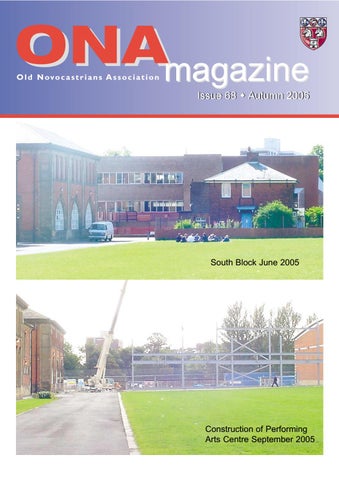
South Block June 2005
Construction of Performing Arts Centre September 2005
Dear Sir, I notice with a considerable r dito e E nostalgic envy the The azin DX 4 prominence now played by To : M a g 2 NE A e e football in school activities. c k n a ON u Ty err S ch. Along with about 90 RG dale T upon e.s l t s e a others I was in the intake c Esk castl w ne w . e s of September 1946. g N @r a n Many of us came from staunch o ail: Newcastle United footballing em
Dear Sir, I was delighted to read W.G. Elliott's article RGS in the 1950s and 60s. I left in 1957. I well remember all the masters mentioned, especially Sammy Middlebrook who I still look upon as my number one academic mentor ever. He single handedly got me into Oxford. I played only a supporting role! For years I have been trying to get hold of his book (first edition), Newcastle upon Tyne. It's Growth and Achievement. If any Old Novo has one they will part with I would be happy to pay a fair price and shipping costs. David Selley (52-57)
backgrounds. It was with an initial sense of disappointment that we learned that football was not on the school curriculum, and may well have been officially frowned upon at that time, but none the less many of us embraced with enthusiasm, the game I now know to be played in heaven, - rugby, whilst still retaining our passion for the round ball game. During the rugby season, unofficial football matches were played nearly every lunch time on a plot of ground farthest away from the school building bordering on the North Road. It was conveniently shielded from view of the school building by a row of very tall trees. This activity no doubt was officially discouraged, especially by Mr Thomas who ran the school rugby programme, but
tolerated with a benign indifference; we probably received more retribution from our parents than the school because of the damage done to our shoes and trousers as this activity was conducted in our school clothes, minus jackets, four piles of which formed the goal posts. Amongst the 15-20 regular participants, names I recall are Jim Watson, Alan Ritchie, David Douglas, Ken Reid, Doug Hutchinson,...oh, and all the rest! In addition to rugby, the only other sports I recall being in the curriculum were, of course, cricket, swimming, boxing and athletics. But, alas, no football. Neil H. Turnbull (46-50)
Dear Sir, I was amused to read Mr Elliot’s description of how the school bell was manually rung when he first joined the school. In my day the bell gave three protracted rings, then broke off a fraction of a second into the fourth ring. Can anyone explain to me why it did so rather than simply stopping after the three whole rings? Michael Grant (81-91)
Retirements The following staff retired in July 2005: Mrs Val James (Junior School) Mrs Pat Sainsbury (Modern Languages) Dr Brian Mains (History) Mr Dave Walton (Modern Languages) Mr Gerry Keating (Policitcs and Latin)
Degree Results Michael Alan Forwood (94-01) B.Engineering, University of Glasgow Andrew Dickson (92-02) BA English, University of Leeds. Andrew recently started a training contract with KPMG in London. William Butler (91-01) First class degree in History, University of York Daniel Jewell (97-02) First class degree in History, University of York Joseph Smith (95-02) History and Politics, University of York Graham Shields (89-99) BSc Applied Biology (with Commendation), University of Northumbria Stephen March (93-00) MEng Mechanical Engineering with First Class Honours, University of Southampton Keith Noble-Nesbitt (97-01) Graduated with a BA Hons (1st Class) in Economics, University of Cambridge, in 2004. and recently completed an MPhil in Economics as a Research Scholar at Trinity College, Cambridge. Alexander Bonner (93-00) Medicine MB, ChB, University of Leicester James Corris (91-01) Architecture, Oxford Brookes University
ONAmagazine ONAmagazine
2 24
Welcome!
4
News
the beginning of
6
Novo Day
7
RGS in the 1980’s
8
After Trafalgar
9
Bad Behaviour
AT
September I returned to School to take part in
NOVO Day, an activity run by the school for Old Novocastrians, to enable them to meet fellow ONs and look at the changes since they were last there. It was a very successful day, and I would like to take this opportunity to thank the School for putting the event on, and recommend the next one to you. Building work continues apace, the new Dining Hall and Junior School extension is most impressive complete with the Penrith
10
Penrith Recalled
11
The Festival of Britain
12
Obituaries
seminar room which has a superb panoramic view over the school sports field. There is a large hole where the technology and music departments (and latterly economics and politics) used to be, as work gets underway for the new performing arts centre. Plans are afoot to organise a 25th anniversary reunion next summer, for those who left in 1981. John Duns (76-81) and Richard MacAlister (74-81) are, together with the ONA office, coordinating this. If you want to find out more, please contact the ONA office. The reunion for the 1978 leavers was very successful, and I hope this one will be too. I would hope to make ‘notable’ reunions part of the ONA calendar in years to come. The committee are now looking for volunteers from 1982 leavers for an event in 2007! Finally, this year marks the bi-centennial of the battle of Trafalgar, the defining moment in the career of possibly our most famous ON, Admiral Lord Collingwood, and inside you will find an article about Cuthbert Collingwood and his career and time at the school. I hope you’ll enjoy reading this magazine.
We are always looking for articles and news from Old Novos to include in the magazine, so send your contribtutions, via email (if possible) to: ona@rgs.newcastle.sch.uk, or on disk to the ONA office at the school. Please include relevant pictures if possible. They will be returned as soon as the magazine has been printed. The deadline for acceptance of copy for the Spring 2006 issue is Monday 13 February 2006. Copy may be carried over to a future issue.
Robert Newton (68-78), ONA President
ONAmagazine Issue 68 Autumn 2005 ONAmagazine is the magazine for the Old Novocastrian Association Editor: Tove Elander Designed and produced by the ONA office at the Royal Grammar School Printed by Pattinson and Sons Printers 94-102 Blandford Street Newcastle upon Tyne NE1 3BT Tel: 0191 232 0379 All correspondence should be addressed to: The ONA Office Royal Grammar School Eskdale Terrace Newcastle upon Tyne NE2 4DX Telephone, ONA office: 0191 212 8924 email: ona@rgs.newcastle.sch.uk The Editor reserves the right to edit, alter or omit all submissions to the magazine. Copy may be carried over to the next edition. The Editor’s decision is final.
ONAmagazine
3 24
Euan Menzies (76-86) I am currently working in London as Chief Financial Officer for Actix, an international Wireless Performance Engineering software company, following roles at Sema, BT and Price Waterhouse and having read Classics at Oxford. I have lived in Sussex since 1990 apart from a two year stint in Zambia, have four children and play cricket locally. Stuart Bage (80-90) I am currently UK Human Resources Manager for GE Water and Process Techology. I was married in 2002 to Jenny and we had a daughter, Izzy, in November 2003. I spent the first half of 2003 living in Saddam Hussein's palace in Basrah while mobiled on OP TELIC with the TA, and responsible for the civilian water utilies network in Southern Iraq until the civilian authorities took over in the summer of 2003. Since then I have been concentrating on the intergration of my old company Ecolochem into a new division of General Electric. Two ONs have joined the teaching staff at RGS: Graham Mason (8996) teaches art, and Michael Smalley (85-95) is the new economics and politics teacher. Richard Hogg (79-84) Richard recently oversaw the induction of Australia's largest independently owned sports betting company, SportOdds, into the competitive UK market under the brand name, SuperOdds. In 1999 Richard moved back to the UK after a 7 year spell in Hong Kong to head the business operations for Inside Track Ltd who were focused on supplying consultancy, operations and systems management to companies looking to expand into the e-gaming online sportsbooks and casinos market. Drawing on his experience working in Asia, he helped to establish a number of British companies in a new and foreign market place with consistent success. Having worked with some of the biggest companies in the business and travelled extensively throughout the Americas and Asia gaining a valuable insight into interactive gaming, Richard established himself as an authority on the industry and a key-player in the implementation of web-based services for the sports betting industry. Richard has spent some time in Costa Rica working for one of the largest US facing sportsbooks and is currently working in London where he is a Director of a company which provides a consultancy service and managed gaming solutions to those who wish to enter the market place. You can contact Richard on: richard.hogg@insidegaming.co.uk. John Briggs (78-85) I'm living on Anglesey, still single, enjoyable job as a Landscape Architect in Bangor, walking on the hills and coast almost every night after work these last few sunny hot weeks - gives me the inspiration for my job. I have fond memories of the North East and RGS but they now seem very distant. Douglas Kinghorn (56-66) recently took up an endowed chair at The Ohio State University. Malcolm Clarke (71-78) writes: I have moved from Budapest in Hungary to Aire in Switzerland. Aire is essentially a suburb of Geneva, where my employer, Procter & Gamble's European headquarters is situated, so I'm very much in the French speaking part of Switzerland. Amazingly, 28 years after finishing my French studies at RGS, and having hardly used French in the meanwhile, I find it all comes flooding back. A true testimony to the quality of teaching at RGS!
ONAmagazine
4
Derek Cooke (33-40) writes from Australia: Just after three years ago, I was found by the Old Novocastrians Association as a result of the efforts of a niece (and was able to recruit another ON who lived fairly near in the Blue Mountains of New South Wales). Soon after a telephone contact with him, I moved across the continent for family reasons, arriving in a Perth suburb just before my 80th birthday. Recently the Spring 2005 ONA Magazine arrived; I spent my last few months with the RGS as a resident of Sandath. I remember the redheaded John Scouler Davison whose obituary appeared therein. It was a happy house, and I don’t remember Miss Bullock as a Tartar. She “big-sistered” us rather nicely. I had been persuaded to stay on and complete a Higher School Certificated which gave me exemption from first year Vet, and after a few weeks helping with the local harvest, I toddled off andjoined King George’s army, and was commissioned in the Royal Artillery (Field Branch) shortly before my 19th birthday. Evenutally I washed ups as a second year vet student in Edinburgh. And now, in my 84th year, I potter in my workshop making gadgets, as a volunteer with Technical Aid to the disabled. Since qualifying, I had two spells in rural veterinary practice in UK, broken by a couple of tours in the colonial veternairya service. On the second of thesek I met my wife who was meant to open a hospital down the coast. The building wasn’t finished, so Elizabeth was sent up-country, and we met, married, started a family and returned to Britain. In the late 1960’s, my battered old carcase was looking for a kinder job and climate and Australia was desperate for vets, so thither we went with our three young children. And I became a public servant. Not a very imressive curriculum vitae, but it covered four continents! Nick Miller (80-87) has moved to Cologne, Germany, where he is working for Ford Europe as New Model Introduction Manager for all Focus class vehicles. Toby Starr (81-88) Toby married in 2000 and has two young daughters. He set up Starr & Partners LLP (details at www.Starrlegal.com), a City law firm, in 2000 and has recently extended its reach with an alliance with a northern English firm, a Scottish firm and an Irish firm. On the personal front, Toby recently attended the marriage of his RGS friend Antoine Tinnion (81-88) at DisneyWorld in Florida – thankfully it was no Mickey Mouse affair. Rev Canon C M Smith (52-62) has been made Honorary Chaplain to the Queen. Proferssor D J Hayton (53-63) has been appointed Justice of the New Caribbean Court of Justice. Derek Wanless (59-66) received a knighthood for public services in the New Year Honours. Greg Brown (91-96) graduated in Medicine from Sheffield University (with Honours and a finals distinction) this summer and is now working as a doctor at the Royal Hallamshire Hospital in Sheffield. Greg and his wife Julie are expecting their first baby. Christopher Mansi (96-03) has been elected into Senior Exhibition at Emmanuel College, Cambridge. Alex Johnston (96-03) has been granted a Short Service Commission with the Royal Logistics Corps.
LONA
Annual Dinner
March 2005 Above: ONA President Robert Newton (second left) with friends. Left: Jack Messing (29-40) and Lawrence Shurman (38-50) Right: Geoff Orde (4049) and fellow diners
David Boll (38-49), guest speaker Paul Haggie (60-67) and Arthur Taylor (33-41)
Malcolm Staig (51-61) and David Goldwater (51-62)
Andrew Beattie (76-86) : “I have been living in the Netherlands for
and also the legendary D'Ostuni (hope this is correct) ice cream van
the last five years in Rotterdam. I am working with Unilever,
at the top of the school field which was always an eventful time -
marketing their ice cream and frozen foods brands across Europe. I
people will know what I mean by that! I remember great teachers like
am married to Alexis and have two daughters (Caitlin is four years
Mr Laine (French), the legendary Mr Rhodes, and of course the great
old and Emilie one). Life in Holland is pretty similar to that of the UK.
man himself Mr Squires will also stick in the memory, but the one
They are somewhat more liberal in attitude, great English speakers
thing I will never forget is all the great times I had there. Even
and obsessed with football. Our UK home is in Surrey; we get back
detention was fun!
there once in a while as my wife’s family lives in the area. Gerry Cawson (85-89) has moved with his family to Adelaide and Andrew Hunns (79-86) I am currently residing in sunny Brighton
joined Minter Ellison as a partner in their corporate and commercial
with my lovely wife Claire. I have my own creative agency in London
group.
(yes, I commute every day!) called Small Japanese Soldier and we've been going for nearly six years now so cross fingers we are
Congratulations to Alex Griffiths (94-02) on being elected
going to be fine. Our clients include Orange, Sony Playstation, HMV
Nottingham University’s student law society President for 2005 - 06.
and Universal Records to name a few so the 'yoof' is our speciality. Memories of RGS include camping trips to Wensleydale, especially
Alistair Harrison (64-72) has been appointed as the new British
being there the week JR got shot in Dallas which was memorable!
HIgh Commissioner in Zambia.
ONAmagazine
5
NOVO DAY Saturday 10 September AS AUTUMN TERM BEGAN, the RGS welcomed Old Novos and their partners to another NOVO DAY, giving them an opportunity to have a look at buildings both familiar and entirely new. As the centenary of the R.G.S’s tenure in Eskdale Terrace approaches, there is more activity on its Jesmond site than since 1906, when the School left Rye Hill where the School had been situated since October 1870. NOVO Day commenced with coffee in the Sixth Form coffee bar, once part of the old Junior School and where pre-Thatcher milk used to be taken at morning break. The tours , conducted by the very informative and friendly Prefects, around the new buildings, including the new Junior School extension, demonstrated the huge amount of demolition and reconstruction which is taking place over this and next year. However, for the large number of Penrith veterans, out of an impressive total attendance of over 130 guests, the focal point of this NOVO Day was the dedication of a room in the new Junior School with the very best view in the whole RGS. The Penrith Room will allow visitors to watch various sporting fixtures from the imposing bay window which overlooks the School Field from the North. Officially opening the Penrith Room, Geoff Orde (40-49) paid tribute to
the present Headmaster for his great support for the ‘Penrith spirit’ which had come down through all these years. All the staff, including Mr. Anderson, Mr Padgham and many others had acted brilliantly not
The Headmaster, James Miller, and Geoff Orde at the opening of the Penrith Room.
ONAmagazine
6
only in the ‘amo, amas, amat’, but also ‘in loco parentis’, and despite the enormity of the task, it had all worked. Over 600 boys, in fact had been successfully billeted to Penrith after plans had been laid by the Governors as early as February 1939. Lunch was up to usual high standard in the Dining Hall, where guests viewed a selection of photographs from the School Archive. Despite the somewhat damp conditions, a good number watched the Rugby 1st XV beat the RGS Bursar’s very own School, Queen Elizabeth Grammar School Wakefield, by 21-3. A wholly successful day concluded with tea and biscuits in the Dining Hall and a significant number of ON’s had enjoyed their first visit back to the School for very many years. Hasten ye back! D F Goldwater (51-62)
Twenty Years On am sitting at my desk in a Melbourne news room and it suddenly dawns on me that it is almost 20 years since I left school. Twenty years. It was early July, 1985, when I ran out of the sixth form common room wielding my stone coloured canvas backpack around my head. They were the rage in those days and we lovingly painted Black Sabbath, Deep Purple or the name of some other heavy metal band on top of our backpacks. It was not so by Tim much the excitement of finally leaving school that day as much as the thought of charging into the Collingwood for a few beers with characters like Larry the Lamb, Snoopy, Uncle, and Titch. I remember the day well. The sky was led grey and the 12.35pm dinner bell had just gone. I couldn't find my metro pass and I briefly entertained taking some geography books home. No, I thought, I wouldn't be needing those any more. Drumlins, hanging valleys and lateral moraines were now, officially, all things of the past. Academically speaking, I was a walking disaster. In fact, I probably received the worst O and A-level grades for my year. I'm not proud of the matter, it's just simply fact. Indeed, as I sit writing I feel a wave of nausea, churning away, deep in the pit of my stomache. I will never, ever forget the cruelty, nevermind hoplessness, of searching for my grades pinned to the notice board. For the record, I made it into higher education - by the skin of my teeth I might add, and came out the other end with a degree. A 2:2. Nothing fancy, but a degree all the same. The rest, academically speaking, is history. But that's exactly it. For me, my shocking grades are inconsequential compared to the memories, the camaraderie and tears of laughter I enjoyed in the seven years leading to 1985. Margaret Thatcher was warring with the miners, the French had bombed Greenpeace's ship Rainbow Warrior in Auckland Harbour, and Iraq and Iran were locked in their bloody eight-year war. But what did we care. We had more important things on our minds. Do I join the navy or army section of the combined cadet force? And was Richard Harpin selling his cheap, but beautifully hand-made fishing
I
there, or will there ever be, a teacher more feared - and respected - in the long history of the RGS? The brown brogues, grey flannel trousers and tweed jackets were the hallmarks of his dress code. Sometimes he would burst into the classroom, all smiles and one instinctively knew one could relax. Then, there were days when one wouldn't dare breath. Sitting with back straight, eyes to the front, noone spoke. There rules of engagement were clear. Piles of books from various year groups sat on the shelf nearest to the door. All waiting to be marked. If there were 27 boys in the class then one could be sure there were 27 books waiting to be marked. If one dared to be late with homework, nobody was coming to help you.
Memories of RGS in the 1980s
Jamieson (79-85) The Sixth Form common room in 1981 flies in the school hall? OK, I'll admit it Richard. I dishonestly dropped a few behind the pew and returned later to pick them up. I reckon I owe you 25p. Forgive me. Perhaps I needed the money to buy a cone from Dostuni's (I am sure that's what we called him) ice-cream van. Remember him? That poor man whose pastel coloured vehicle was beseiged by an over excited mob of blue and black blazers. We violently rocked the van from side to side as a po-faced Mr Dostuni discharged hundreds of chocolate bars, packets of crisps and icecream cones into grasping hands. Of course, he never complained. And why would he? The profits clearly offset the spurts of motion sickness. ecisions, decisions. I was too uncoordinated to play rugby and cricket and, by the time I was 16, I had lost the fat which made me an effective prop in my first year. I discovered if I could sit and concentrate on the upper-body then everything would be OK. Rowing it was, then. And off to the stinking, mud lined banks of the River Tyne we went. Physics teacher Roger Tarry was our coach. As Mr Tarry barked orders from his rubber inflatable we carved our way through a toxic, creamy film of industrial and domestic effluent. I avoided skulling becuse the chances of being unceremoniously dumped into a sea of floating turds were extremely high. Suffice to say my enthusiasm for rowing far outweighed any skill. I won't register on Mr Tarry's radar. Nor, come to think of it, will my name be recalled by many other masters of that time. But I remember them. Take the legendary geography teacher Alan ``Dusty'' Roades. Is
D
elp was always on hand at school camp, however. Ryedale camp in 1980 was particularly memorable. No, it wasn't the luke warm porridge or sitting atop wooden boxes precariously positioned in the open air latrines. The walks were long but memorable, and the clay pipes we fashioned out of modelling clay to smoke tea, of all things, were harmless enough. Rather, it was the late-night evacuation French teacher Alan Hall orchestrated after heavy rain caused the river to rise. And dramatically so. Having been ordered to roll up our sleeping bags we marched out of our tents and across a wooden footbridge which spanned the raging torrent. The blackness of the night only served to amplify the roar of water some feet below us. We spent the night in a village hall. No lives were lost that day. The camp survived and Mr Hall was able to returned to Eskdale Terrace with the same number of boys he left with. And finally, while we stood by one another, how, in a blink of an eye-lid, could we become so cruel. Pity the poor boy who left his dessert - or his chips for that matter - while fetching seconds for us all at lunch time. There would be left nothing left on his return. Having sucessfully completed his cadetship at The Journal, Newcastle, Tim worked on The Sydney Morning Herald, Sydney, Australia, and is now working at the Herald Sun, Melbourne. He is married to Jo and together they have two children, Madeleine, four, and one year old Hamish.
H
ONAmagazine
7
AFTER TRAFALGAR: A Tribute to Collingwood H M Page (1951-1959) uthbert Collingwood (1748-1810) was a distinguished naval officer and public servant. His well-known role as Nelson's second-in-command at Trafalgar has diverted attention from his other achievements. In the difficult years after the battle, Collingwood bore very heavy responsibilities, and successfully wielded both military and political power to an extent that few Englishmen and no other Old Novocastrian can rival. Collingwood attended the RGS when Hugh Moises, a renowned scholar and teacher, was headmaster. The curriculum was mainly Latin, but English prose composition was also taught. Collingwood's official writings are remarkably forceful and clear. His reports on the battle of Trafalgar, written in the most difficult circumstances, are masterpieces of English prose. His private letters show a dry wit and a self-deprecating sense of humour. He read widely, taking a strong interest in modern history. This was very useful to him when negotiating with diverse foreign governments in the last years of his career. Collingwood joined the navy at the age of twelve and served a long apprenticeship at sea. It took him thirteen years to achieve his promotion to lieutenant, awarded on the battlefield for bravery and efficiency in the American War of Independence. Although he had relatives in the navy, Collingwood had no influential patrons to advance his career, and all his promotions were achieved on merit alone. He attributed most of the ills of the navy to the harm done by incompetent officers promoted by influence. Collingwood was famous in the navy for his humanity and efficiency. He took great care of the health and welfare of his men, and insisted that sailors should be spoken to by name, and treated with respect. They were not threatened, bullied, sworn at or struck by his officers, and were almost never flogged under his command. Collingwood trained his gun crews to achieve the fastest rate of fire in the fleet. The navy had fewer ships and guns than its opponents and relied on superior seamanship and gunnery to reduce the odds. French gun crews could fire once in five minutes. Skilful British crews could fire three times in five minutes, and Collingwood's managed three times in three and a half minutes. At his preferred range of five yards, this had a devastating effect in battle. In 1805 Collingwood both created the opportunity for the battle of Trafalgar, and saved the fleet after it. In August he was blockading Cadiz with three ships of the line when an enemy fleet of twenty-six ships appeared from the west. By pretending to attack while signalling to a non-existent British fleet over the horizon, he tricked the French admiral into taking refuge in Cadiz, where no supplies were available, and then resumed the blockade. Two months later, after Nelson and reinforcements had arrived, the enemy tried to break out and was heavily defeated. After the battle, more than half the British ships were dismasted, most were too damaged to anchor, and all were in peril on a lee shore in a great storm. Despite this, under Collingwood's command the entire fleet returned safely to harbour. After Trafalgar Collingwood was made Commander-in-Chief in the
C
ONAmagazine
8
Mediterranean, with 80 ships and some 25,000 men. The French naval threat had certainly not been ended by Trafalgar. There were French squadrons in ports along the Atlantic and Mediterranean coasts. French armies confirmed their supremacy on land by inflicting heavy defeats on Austria, Prussia, and Russia. For five crucial years, Collingwood frustrated Napoleon's plans to dominate the Mediterranean and to control the land route to the Indian ocean. This was achieved by preventing the French from using their sea power, and by mounting numerous small actions by sea and land to harass French positions and help allies. Collingwood also acted as the representative of the British government in its dealings with foreign powers. These included the Moslem states of north Africa, Egypt and the Ottoman Empire as well as Spain, Austria, Sicily and Russia. Communications with London were slow, and events moved fast. Collingwood took decisions, acted on his own initiative and earned the trust and admiration of British ministers. His approach to international relations was unconventional. In a letter to his sister he wrote that "there cannot be a greater error than to introduce chicane and deceptions into politics," and he communicated with foreign governments in an honest and straightforward way which won respect for his decency, tact and firmness. He was remarkably successful in persuading allies and neutrals not to go over to the French, and helped to keep alive the hope that one day resistance to French military dictatorship could succeed in continental Europe. He moved rapidly to support the rebellion in Spain which led to the first defeat of French armies on the continent and marked the beginning of the end for Napoleon. Collingwood died at sea in 1810, worn out by his exertions in the service of his country. He had spent one year of the previous seventeen on land, and had last seen his family in 1803. Anyone wishing to read more about Collingwood is recommended to consult the entry in the new Oxford Dictionary of Biography and the recent book by Max Adams, Admiral Collingwood: Nelson’s Own Hero.
Is Bad Behaviour Going To The
Dogs?
by Nick Brownlee (76-86)
ccording to the newspapers, yob culture has got so bad that teachers are now arming themselves with air rifles. But has behaviour really disintegrated to such an extent that classrooms have become lawless ghettos? Or is it the case that, like asylum seekers, global warming and Celebrity Love Island, misbehaving schoolkids are just something else to blame for the imminent collapse of Western society? It is nearly 20 years since I left school, yet whenever I meet with contemporaries the conversation soon turns from malepattern baldness, mid-life crises and Mondeos to the thrilling juvenile delinquency of our youth. I am sure the same is true of ONs of all vintages, because once all that education has been forgotten (approximately six hours after leaving), glorious memories of breaking the rules are all that remain. If kids today really are dull-eyed sociopaths then I pity them. Maybe it was because there was no gangsta rap, text messaging or mind-rotting video games to influence us, but back then being inventive was all part of the fun. Even now I still gasp at the twisted genius of 11-year-old Jeremy “Fatty” Rowarth who, noticing that dear old Mr Shipley always sat on the same corner of his desk during double Latin, successfully glued him there one hot July day using a Pritt Stick. Or “Shorty” Neil, who for the duration of that same torpid 80 minutes remained concealed within the desk cupboard with only a rugby sock down his throat to stop him from laughing. Then there was the great Martin Lowery, who came in especially early one snowy winter’s morning and spent more than two hours tracing out an anatomically-precise phallus on the school field so big it was visible from the motorway flyover, if not space. The last I heard of Rowarth, he was a teacher; Neil and Lowery, I have no doubt, are either captains of industry or men of the cloth.
A
Yet in today’s climate they would have been vilified as yobs, appearing on the front of the Daily Mail wearing hoodies, their future prospects in ashes. The same would surely be true of the wag who pulled off one of the great stunts in RGS history when, with military precision, he managed to install a whoopee cushion under the headmaster’s chair during the Lord Mayor’s visit. And what of the legend who managed to outwit the tactical might of the Combined Cadet Force and make off with their entire supply of dummy grenades while they were on parade? hese boys were giants, role-models for those of us who would never make Head Prefect or 1st XV captain. And these are just the ones I can remember off the top of my head. Anyone reading this will surely have their own. Of course things could sometimes get out of hand: I recall one student teacher – nicknamed Troy Tempest because of his puppet-like demeanour – being driven to the verge of a nervous breakdown by a relentless six-month campaign of fourth-form mickey-taking of which I confess I was a ringleader. Similarly it cannot have been much fun for those teachers who were female, gay or, like Troy, perceived as weak to endure constant baiting every time they stepped out of the staff room. But hey – at least they had board-rubbers to throw, the threat of detention or the slipper to dish out or – the ultimate sanction available to RGS teachers in those days – a visit to Dusty Rhodes in their armoury. According to the newspapers, teachers can’t touch kids these days without risking million-pound compensation claims. And maybe that’s the problem. Most of the fun was in getting away with it without being punished. When you can get away with it as a matter of course, no wonder bad behaviour is going to the dogs.
T
ONAmagazine
9
Reading Laurence Shurman’s it from time to time where I found Penrith Recalled (ONA, Spring that the original sticky mass had 2005), brings memories flooding acquired a furry mouse-like mould back. My memories, however, are that gradually transformed itself rather different from his, reflecting into an all-encompassing fungal what would appear to have been growth. two very different experiences. He And so the weeks passed with was one of the 1939 evacuees; I me still wearing the same clothes arrived two years later. But what that I had worn when my mother mainly differentiates our had bravely waved me off at experiences was our billeting. He Newcastle station. I wrote no lived in the town of Penrith itself letters home because I didn’t with a succession of families who, know my address. Nor could I tell judging from his account, were the time, but that didn’t seem to kindly and supportive. Between matter because our days followed billets, however, he spent two a regular pattern. And always periods in hostels, an there was the horror experience of which of what was he was later reminded happening inside when he came to read my trunk. What Lord of the Flies. My eventually brought it Howard Temperley (41-51) three years were to light was the spent entirely in preparation of the hostels, mostly well outside Penrith, and persuade me that Golding laundry bills for us to take home at Christmas and the belated knew just what he was writing about. discovery that the only article I had sent to be laundered was the On the eve of my departure, my father, worried about how I would handkerchief I had used in the course of my surgical operations. I still cope away from home, gave me a little lecture: I was to stand up for recall the heavy tread of the posse that followed me upstairs, the myself and not go complaining to teachers when things went wrong. dragging out of the trunk and the intake of breath that followed the My mother, more concerned about my physical welfare, thoughtfully flinging open of the lid. packed a large jar of malt in my trunk. Bless them, they meant well. I was duly cleaned up and sent home, but it was plain to my parents Our departure from Newcastle Central Station was just as Shurman that all was not well and a letter was duly written. Anxious not to be describes. There were our mothers, smartly turned out for the returned to Penrith I sought ways to break my arm but to no avail. At occasion, and there were we in blue caps and blazers. Last hugs and Easter a letter from Tucker Anderson arrived saying a vacancy at kisses were exchanged and off we went across the Pennines to such Woodland House had occurred and so I could be transferred there. But fates as awaited us. In my case this meant being put on a bus for being put in a hostel designed specifically for Junior School boys Beaumont, on Beacon Hill, where, having lugged our trunks upstairs, looked to me like a demotion, so I refused we were put to work peeling potatoes, mine somehow disappearing in Why, at the age of eight I had been put in a hostel with boys whose the act of peeling. ages ranged from ten to eighteen I have never understood. Terrible Later that evening I made a horrible discovery – my jar of malt had bullying went on, mostly among the 11-to -13-year-olds. As I have shattered. I closed the lid of my trunk and said nothing. The following since observed with flocks of birds, those picked on were the weak and evening I suffered a further misfortune. On the waste land behind timorous. By way of proving that I was neither I performed acts of Beaumont there was a sten-gun firing range. Tucker Anderson, the lunatic bravery, climbing trees and jumping out of windows. master in charge of Beaumont, warned us strictly not to go there. But My decision to stay was affected by the fact that after the first term what possible danger could there be when they weren’t firing? we all moved to Hazelbank in Yanwath, on the road to Ullswater, two Besides, all that separated the Beaumont garden from the waste miles out of Penrith. Being in magnificent country and on the edge of ground was a straggly barbed wire fence. The wire broke as I climbed what was then a vast military training ground, this opened up all kinds over, cutting a deep wound in my thigh. Fortunately it was covered by of new possibilities. Sentries guarded the roads, but cutting across the my trousers. Again, I kept quiet. fields we found we could wander pretty much at will through a This second misfortune was more immediately inconvenient than the landscape scarred by tank tracks and careered over by armoured cars. first in that it meant that I couldn’t have a bath. Beaumont had only one The soldiers we encountered didn’t seem to mind. Later on there were bathtub for the thirty or so boys living there, who were accordingly Americans who gave us sweets and chewing gum, occasionally bathed in groups of eight or ten at a time, so my absence was never cigarettes. The command headquarters was Lowther Castle, its noticed. After a while another complication arose in that my wound Oriental gardens now neglected and overgrown, providing vantage turned septic and I developed a large lump in my groin. However, I had points from which we could watch the staff cars coming and going. a penknife and a handkerchief and when no one was looking I would Older boys had homework; we younger ones did not, or if we did I creep away and doctor it, either in the toilet or under the bushes. Thus, can’t recall spending any time on it. Ill prepared though I was in other from the very start, I had a secret life, concealed even from my respects, I did know how to snare and gut rabbits, my father, originally roommates. After three or four weeks my wound began to heal and the a country boy, having taught me. My first effort, to judge by the missing swelling in my groin went down. More alarming was what was peg and circle of trampled ground, had snared a cow. I expected happening inside my trunk. When no one was around I would peek in terrible repercussions but nothing happened. After that I had more
Penrith Recalled II
ONAmagazine
10
luck, selling my catch at half-a-crown each in Penrith market. With the proceeds I bought gin traps. Tucker Anderson caught me with my first and confiscated it; after that I was careful not to bring them anywhere near Hazelbank. In time two other boys, both somewhat older than me, Rex Tate and Fungus Young, joined in and together we went off on bushwacking expeditions, finding young woodpigeons, which we plucked and gave to the woman at the pub to cook for us, and hedgehogs which we sought (unsuccessfully) to cook Gipsy-fashion wrapped in clay. On one such expedition a rabbit in a trap alerted us to the fact that another trapper was at work. We took not only the rabbit but as many of his traps as we could carry. Of classroom instruction I have only the haziest of memories. Although I spent five days a week in class my mind was mostly elsewhere. The centre of my life was Hazelbank and the countryside beyond, which I had come to regard as one vast adventure playground. And adventures there were in plenty, as on the day an ammunition lorry blew up scattering shells in all directions. I managed to retrieve one, which we spent hours trying to take apart. Eventually we gave up and buried it in Hazelbank grounds, where presumably it still is. When the time came for us to depart we gathered up our traps and buried them. What we got away with still astonishes me. Tucker Anderson had a good idea of what was going on, but being in charge of billeting the entire school he already had more than enough on his plate. Mrs. Wood, the housekeeper, mostly sat in the kitchen with her cat, showing no inclination to bother us so long as we didn’t bother her. And so we enjoyed a kind of anarchic freedom which, were it to happen nowadays, would soon have the police and welfare services calling. But in wartime the authorities had better things to do than worry about our petty delinquencies. There were, to be sure, much nastier things that went on of a kind that Shurman only hints at and which I won’t go into here. True, I never learned my tables, and cannot to this day readily tell you the sum of 8 x 9. But what I got from Beaumont and Hazelbank was an education of quite a different sort. Partly it was a confidence that came from having survived; partly it was a matter of learning about human potentialities; and partly it was the sheer magic of being allowed to run wild in a way Wordsworth would have appreciated and which I daresay few were allowed even back in his day.
Congratulations to Richard Mountford (69-76) on his marriage to Minako Miyazaki. They met in Japan whilst Richard was working there. Attending the ceremony were fellow ONs Bill Lobb (69-76), Simon Wood (72-77) and Martin Smith (68-78).
This photo was sent in by Gordon Hutt (46-57) who writes: I was very sad to read the obituary of John Nixon (47-57). I remember him well and, as shown in the enclosed photo, his sparring prowess was not limited to outdoor activity or the boxing ring! Alongside John, and partnering me, is Brian Shallcross (50-57). Behind is, I think, Brian Heap, and John’s bridge partner would probably have been David Taylor (49-57).
I occasionally go out for a jog, to keep in reasonable shape between forays into the Scottish mountains. Not long ago I ventured out; it was cold so I donned both parts of my tracksuit. As I pounded along, musing about this and that, it occured to me to reckon how long I had owned that particular tracksuit. I concluded that I had almost certainly asquired it no later than the Fifth Form at the RGS, when I was a keen member of Bill Turnstall’s Newts. That would have been around 1952 or 1953. It is a bit the worse for wear, as the accompanying photograph shows, but still fairly serviceable – not unlike its owner, perhaps? My wife has frequently begged me to get rid of it, but they don’t make baggy, warm, cottono tracksuits anymore, so no chance! I wonder if any other ON is still using a 50year-old-plus piece of sportswear, or is this a record? Donald R Buchanan (48-56)
ONAmagazine
11
Brian Robert Reid (49-57) Brian Reid, a popular and outstanding allrounder in school life of the 1950s, died in Seattle on February 26 2005, aged 66. Many of his old friends will have had but fleeting news of Brian during the last forty five years as he lived on the west coast of America, initially in California and latterly in Washington State. There was something of a Reid dynasty at the RGS as three talented brothers, Don, Ken and Brian, passed through its portals. Brian entered the senior school in 1949 as one of the youngest in his year. Indeed when sport was organised into age groups he played with the year below his own bringing welcome maturity to the under 14s. This was how we first met and formed a friendship, which was to survive and bridge an ocean. Being the youngest of three no doubt had some disadvantages but on the plus side the earlier achievements of his brothers gave him an air of confidence coupled with a determination to succeed which never left him for the rest of his life. The only subject which caused Brian to struggle was Latin and he was frequently the butt of Slinker Owen's sarcasm – "of course Reid if you want to study naval architecture at King's..." (in those days Latin was a requirement for all Oxbridge entrants). But naturally Brian knew he would succeed in Latin just like his brothers. He sailed through all other lessons with the cultivated nonchalance of those who played sports (indeed most natural academic talent was acquired in secret, though in
ONAmagazine
12
Brian's case I have a feeling it was genuine). So he was able to devote much time and energy to sport where good ball sense and co-ordination was evidenced by his pivotal role as fly half for the 1st XVs of 1955-57 and his medium pace bowling for the cricket XIs of 1955 –57. He captained the school gym team and was head of Eldon. This was an enthusiastic, amusing, all round performer, always with an eye for those attending the other scholastic establishments of the immediate area. He was awarded a place at St. John's College, Cambridge to study Natural Sciences - again following in the footsteps of his eldest brother - and after completing his degree with a Part II in biochemistry he joined the fashionable brain drain of that period departing for the University of California, Berkeley to study for a doctorate. Before long he met Wendy Kohler, a charming Californian studying on the same campus, and they married in 1961. Brian completed his doctorate in 1965 and, after a brief stay at Dartmouth College, moved to a research post at University of California, Riverside. He was at Riverside for 13 years rising to a Professorship. Here it was that the scientist blossomed, and he poisitined himself at the cutting edge of biomolecular research. In the late 1970s the University of Washington in Seattle decided to establish a new research facility for NMR of biomolecules. The problem was that it needed considerable funding for equipment and someone with enough clout to attract it. That was a challenge that appealed to Brian; he was duly appointed Professor of Chemistry and jointly Professor of Biochemistry in the School of Medicine. His arrival in 1980 produced a whirlwind of activity and funding proposals of almost $1 million were assembled, allowing the purchase of two of the largest and up to date NMR machines. A multi-disciplined team was assembled and over the next decade the University of Washington became recognised as arguably the leading high field NMR team in that nation. The Reid laboratory delivered a number of outstanding accomplishments, and Professor Reid was awarded the Bijvoet Medal in the Netherlands for outstanding contributions to biomolecular research in
1991. By the end of his innings his name had adorned more than 150 publications. Throughout this period the Reid family, with two daughters Leslie and Yvonne, lived at the water's edge on Bainbridge Island in spectacular Puget Sound. Naturally in these surroundings sailing became a pastime and Brian raced with a crew largely drawn from members of his laboratory such that questions must have been asked about his recruitment policy. Brian cut a dash as the archetypal Englishman in west coast eyes (though in contrast his old pals thought he had been totally Americanised), and his clothes and cars, including at various times a Bentley and a Jaguar, fitted that bill. But predictable he was not : each morning the professor would don his leathers, mount his motor bike and ride to the ferry and then across Seattle to the campus. One of his many talents and loves was playing the piano; he was a skilled arranger and interpreter of modern music. When at Guy's Hospital for a spell, he lived in a Knightsbridge apartment without a piano. But Brian could cope with minor setbacks and was often to be seen playing a Steinway in Harrods music department to an appreciative audience of customers and assistants; the former thinking how lucky they were to hear a free recital and the latter wondering who on earth this guy was, who tinkled the ivories regularly but never expressed the slightest interest in making a purchase. Sadly, during the last few years of his life Brian experienced episodes of cluster strokes. Eventually he was forced to retire from the University on ill health grounds in 2002 and this was followed by the early onset of dementia. Latterly he lived in care, though with much support from all his family. Brian Reid was a Novocastrian of considerable ability who made the most of his talents and left his marks on the west coast of America and in the field of biomolecular structures. He retained an affinity with Newcastle and RGS memorabilia had pride of place in his study. His contemporaries at school will recall with affection his enthusiasm, sense of fun, team play and friendship, and raise their caps in wonderment at his distinguished scientific achievements. Frank Robson (50-58)
DECEASED
W B Macro (RGS Staff 1936-1964) Died 6 February 2005, 93 years old
R W Johnson (33-38) died 29 July 2004, aged 82 R B Thompson (30-36) died 14 October 2004, aged 86 D W Elliott (54-58) died in Cyprus December 2004, aged 63 D J Whillis (56-63) died 27 December 2004, aged 59
Mr Macro joined the school in September 1936 as Mathematics master after a distinguished career at Cambridge, where he was a scholar of St John’s College, and a Wrangler, and after teaching for three years at Great Yarmouth Grammar School. In 1939 he and Mrs Macro took part in the evacuation of the school to Penrith. The success of this evacuation, a model for the whole country, was in very large measure due to the careful supervision of the billeting of the boys, and
with the Running Club. His was a familiar figure in the winter months on some windy, rain-swept cross country track, stop watch in hand, giving a word of encouragement to the runners as they finished. He also played a large part in school music. He was a competent pianist and, as the school orchestra had no double bass player, he took up the double bass and played in school concerts ruing his years at the school, except for the war years. He was also, at the
here Mr and Mrs Macro played their part and were in charge of Beaumont, a school house, in the summer of 1940. Until the end of January 1941 Mr Macro supervised the mathematics of the middle school, which was taught in a separate building. Then came National Service and, until the end of the war, Mr Macro was on the staff of the Telecommunication Research Establishment, first at Swanage and then at Malvern. The results of part of his work there, on beam-approach aerial systems, were published in 1946 in the Journal of the Institute of Electrical Engineers. Bacon said that every man owes his debt to his profession; Mr Macro has repaid that debt handsomely. His work in the North-East branch of the Mathematical Association was recognised when he was elected President for 1951 to 1953. He was a member of the Oxford Conference for Industrialists and Mathematicians in 1957, when he was chairman of one of the discussion groups. A council member of the IAAM on several occasions, he was honorary treasurer of the Northumberland branch for many years. Many old boys, in particular those who have gone on to universities, will remember Mr Macro’s careful and rigorous work in the classroom. And many will remember his work
age of 11, the youngest church organist in the country and so was able to help out during school assembly when they were short of an organist. At a single school concert in the City Hall before the war he played wind, string and percussion instruments – organ, double bass and celesta. In the common room, where the second desk from the door was his by right, he was frequently interrupted in his work by colleagues seeking advice and help on matters, mathematical or professional – advice always patiently and efficiently given. After his retirement he bought a car (he always travelled by bicycle previously) and enjoyed trips out into the countryside with his wife and grandchildren. During his wife’s illness he was totally devoted to her care until she died in 1991. In 1993 he joined the Abbeyfield in Corbridge and took up playing bridge again which he was able to play weekly up until the age of 92. His last year was spent in Wentworth Grange Nursing Care and in February 2005 he passed peacefully away from old age. He leaves three children, ONs Raymond and Robin, and daughter Sylvia. He also had seven grandsons and eleven great grand children.
I M Irwin (41-48) died 29 December 2004, aged 73 N L Cummins (30-36) died 13 January 2005, aged 85 I R Veitch (31-37) died 18 January 2005, aged 83 P E Forster (42-50) died 5 February 2005, aged 72 R Davison (44-52) died 12 February 2005, aged 69 Neil W Murray OBE (32-40), formerly Governor of RGS, died 9 April 2005, aged 81 M G T Wilkinson (36-42) died 17 April 2005, aged 76 J W Warton (31-40) died 24 April 2005, aged 82 J A Summers (35-40) died 17 May 2005, aged 77 N R Bell (48-52) died 28 May 2005, aged 71 John Clark (19-26) died 18 June 2005, aged 96 Gordon Tate (31-37) died 21 June 2005, aged 85 Rodney Stuart Chrystall (47-55) died 9 August 2005, whilst on a walking holiday in Austria. Mat Thoppil (90-92) died 20 May 2005,whilst playing squash. He was 31 years old.
ONAmagazine
21 13
Derek Beattie (43-48) Old Novos of 1950’s vintage will wish to remember Derek Beattie, who died of lung cancer on 9th February 2005, aged 74 years old. He joined us at Penrith during mid-term, in the very depths of the war and left from the upper VIth, after five years back in Newcastle to read history at King’s. His career was in teaching and also in legal publishing. While a publisher he printed a number of Lord Chief Justice Taylor’s cases. Acquaintance with the texts, he told me, increased his admiration for Peter’s gifts even further. They had been exact contemporaries at school. Derek later became a captain in the TA and, towards the end of his life, studied world religions at the Open University. I was a year older than Derek and therefore not a classmate. In fact I confess to knowing him only slightly as a boy. One day, in 1946, his name appeared on the notice board opposite mine for the house boxing competition. Being of a similar, burly build and of matching weight, this was no surprise. I was, however, panicked by the vehement views of Peter Paxton, who had shared Derek’s billet in Arthur Street. “He’ll destroy you!” Paxton shouted, “In a fight he knows no fear. He just keeps coming on and on like a steamroller.” Fortunately I had taken more lessons in the noble art than he. Donald Meaken had taught me sufficient ringcraft to avoid actual destructions; but of fearlessness and forcefulness there was little doubt. Almost 50 years passed. Then, one evening in 1995, quite out of the blue, I bumped into him at a meeting of the Northumbria Club; a gathering of northeastern exiles in the south east, who dine every three months in a room just off Whitehall. Though grasping a walking stick, limping from an arthritic hip and hinting of heart troubles, he looked and sounded remarkably unchanged: gruff, craggy, Scottish and kindly; with a distinctive, if slightly rueful, sense of humour. “Let us sit together”, said he, “and exchange civil words.” So we did, and on several subsequent occasions. At that time I was looking for a publisher and
ONAmagazine
14 24
before long, with his encouragement and invaluable advice, I was able to find one. At a later meeting he gave a talk about Chile. I had been unaware of a connection and was surprised to hear he had been born there, and maintained a lifelong interest in its affairs. His discourse brilliantly evoked the land and its beauty. Finally he gave a perceptive interpretation of the region’s politics, explaining why South America, so blessed by climate and resources, has remained relatively backward and unable to advance toward fuller democracy. I last saw him, less than two months before he died, at the Club’s Christmas dinner; wearing a paper hat, pulling a cracker with twinkling eyes and deep chuckle, in a cloud of post pranidal pipe smoke. A fond memory. Derek lived at Twickenham, in the borough of Richmond upon Thames, of which he became Deputy Mayor for 2003 – 2004. He met Deana, companion of many years, in Birmingham, when he was lecturing at Wednesbury College of Commerce during the 1960’s. She was with him to the end. Old friends may be interested to hear of his unusual background, so I will try to interpret the jigsaw whose pieces include Penrith, Newcastle, Scotland, Chile and Richmond. He was born in Antofagasta, Northern Chile, where his father was an accountant for a copper consortium. With the great depression, mining ceased and when Derek was barely 18 months, the family returned to a village near Glasgow. In due course, employment brought his father to Tyneside where, in 1943, they settled in Forest Hall and Derek was despatched to the RGS, late in the school’s evacuation. Many years afterwards, during the Richmond days, he and Deana enjoyed wonderful holidays in Chile, touring the country, even locating the church where his parents were married and he had been baptised. One visit was as Richmond’s official representative to the Chilean independence celebrations. There a curious link is provided by Bernardo O’Higgins (1776-1842), Chile’s
national hero. Son of a colonial official of Irish descent, O’Higgins was born into a South America ripening towards rebellion against Spain. Having been shipped to London in the early 1790s to complete his education, Bernardo fetched up at the Roman Catholic Academy, Richmond, where he studied the liberal arts. In London he met and was deeply influenced by Venezuelan patriots; and after returning to Chile ultimately led his country’s bid for freedom and became its first president. A special relationship between Santiago and Richmond exists to this day; indeed I have since wondered whether it was Derek’s interest in the matter that first led him to settle in that borough. Derek was a quiet, modest, brave, thoughtful, highly intelligent and loveable man, who carried vivid and affectionate memories of the school into his seventies. He will be keenly missed by friends, fellow councillors and all who knew and loved him. Derek Williams (39-48)
IAN HEPPLEWHITE (77-84) Born 24 July 1966, died 23 July 2005 Born in Seaham, County Durham, Ian attended RGS between 1977 to 1984. After graduating in Politics from Sheffield University, he became a constituency assistant, and later a press officer for Lewisham Council. In 1993 he began working for the parliamentary Labour party (PLP). As an exceptionally gifted communicator, he was a key campaigner helping Labour to power. After Labour’s 1997 election victory, Ian moved to the Department of Culture, where he became head of news, and then director of communications at the Department of Trade and Industry. From 2003 he was head of communications at the UK Film Council. He is survived by his girlfriend, former wife and three children.
Joseph Frederick (Joe) Mills (31-40) Joseph was born in Gosforth on 1 May 1923. The son of Frederick and Muriel Mills he enjoyed a happy childhood with his elder brother Bernard. After evacuation to Penrith, and a stint as a head boy, Joe went to St Johns College, Cambridge where he completed a degree in Natural Science. On leaving Cambridge Joe immediately joined the war effort and became involved with operational research. Much of the work was highly secret and involved developing ways of improving the accuracy of defensive gun batteries using the new technology of radar and advanced calculation techniques. After VE day Joe joined the Air Defence Division of the Eisenhower’s Supreme Headquarters of the Allied Expeditionary Force in Paris. With his valuable knowledge of tracking rockets Joe became a member of the Special Projectile Operations Group. Joe was finally demobbed in 1946 and immediately joined the London Goldsmiths Institute and with their encouragement returned to Cambridge and completed a Master’s degree in Metallurgy in 1947. The following year Joe was offered and accepted a job with the metals division of ICI in Birmingham. In 1951 the government asked ICI to manage a project to set up a test facility and
pilot plant to develop solid propellant rocket motors and Joe was chosen as one of the original project team members. A suitable location for the facility was chosen and in 1952 the Summerfield Rocket Research Establishment was founded. These were exciting days and Joe worked with many like minded people whose friendship would last a lifetime but more importantly it was at Summer field that he first met Pauline Ingham of High Yeat, Witherslack. Pauline and Joe were married in Witherslack church on 16 May 1953. After the marriage they set up the first of many homes together in Clent, Worcestershire where their son Simon was born the following year. Soon after getting married Joe left Summerfield and returned to the mainstream of ICI’s metals division management. Regular promotions and changes in jobs within ICI brought moves from Clent to Reynoldston in South Wales, and back to Birmingham before he finally left ICI in 1962 and moved back to the North East. He worked for Pyrotenax, a copper cable manufacturing company in Hebburn, and lived in Stocksfield until 1979. Following a takeover, Joe’s final career move was to Prescott as a director BICC and yet another new home in Parbold.
Following his retirement Joe and Pauline returned to High Yeat. Always and interesting person to talk to Joe had many interests and made many friends. He was an avid reader of journals keeping up to date with scientific and medical advances but was just as likely to e found enjoying the arts, listening to music or reading poetry. He was particularly interested in ancient history and archaeology as well as being active in local politics. His most recent passion was for genealogy and he spent many hours tracing his family history both on the internet and by painstakingly going through census and parish records. Joe was a devoted husband to Pauline for over 50 years. It was a happy marriage and together they made a great team always getting great pleasure from socialising with family and friends and sharing many mutual interests including gardening, collecting antiques and travel, which they did extensively. They always took a keen interest in their two grandchildren Martyn and Miranda, who loved coming to stay. Joe’s life was full, happy, interesting and successful and he will live on forever in the thoughts and memories of his family and many friends.
Brian Astbury Holden (35-42) Brian died at his home in Washington, Tyne & Wear in October 2004. After school, then St John’s College Cambridge and service in the Royal Navy towards the end of the War, he pursued a career locally in design and development of electric equipment. In his retirement, he spent his summers for nearly 20 years on his motor boat in Norfolk. I first met Brian in 1953 when I attended Littondale Camp. His large, somewhat eccentric but essentially kindly presence stayed in my memory, as no doubt it did in many other memories. He was one of those whom once met was never forgotten. Brian continued to help at that Camp for many years, and later as a 6th form helper then an Old Boy I joined him there, and so got to know him better. Later our paths crossed more closely sailing with the Green Wyvern Yacht Club in Norfolk, and eventually I acquired his share in a Broads yacht, which I still own. It was from the stern of that yacht that his ashes were scattered into the River Waveney in May of this
year, on a beautiful sailing day, watched by many sailing friends. Brian had many leisure interests over the years. Anything he involved himself in – playing rugby for the Old Novos, school camps, photography, motor cycling, assisting with Bryan Stevens’ 1954 School Register, sailing, listening to the Proms on radio, tackling (usually successfully) The Times crossword, being a good friend and godfather – he did with enthusiasm and in his own inimitable, kindly though sometimes rather abrupt style. His funeral was well attended by representatives of all his interests. We smiled as we remembered him with affection, perhaps especially his inimitable singing of ‘King of the Road’, ‘My Way’ ‘Buddy can you spare a dime?’ and other such songs, into which he put heart and soul. Timothy Duff (51-59)
ONAmagazine
15 24