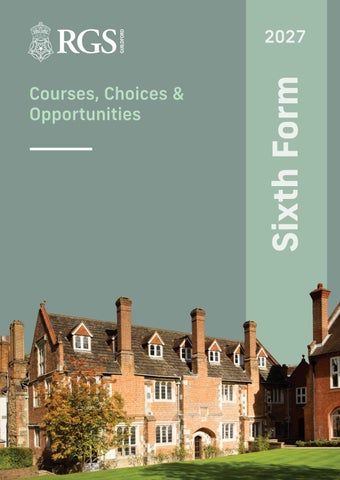
Courses, Choices & Opportunities
Sixth Form
2027
Contents • Welcome
3
• Entry Requirements
4
• A Week at the RGS
6
• Enrichment
8
• Subject Options
10
• Subject Guides:
“
Pupils succeed academically and make the most of the extensive range of opportunities. - ISI Inspection
2
”
Art Biology Business Chemistry Classical Greek Computer Science Design Engineering Drama Economics English Literature Geography History Latin Mathematics & Further Maths Modern Foreign Languages Music Physical Education Physics Politics Psychology Religious Studies
12 16 18 20 24 26 28 30 32 34 38 40 44 46 48 50 54 56 58 60 62
• Careers and Higher Education
64
• A Bright Future
66
Welcome
Unlocking Potential
Joining the RGS Sixth Form means embracing greater independence in your learning. Smaller classes, expert teachers and the freedom to pursue subjects you love make study more challenging and rewarding than at GCSE.
Jaime Lythgoe Head of Upper School
Preparation for Life
The RGS Sixth Form exists to support, challenge and prepare students as they take confident steps toward life beyond school. At its heart is a clear sense of purpose: to develop principled young people who lead lives of impact, responsibility and service. We offer a positive, aspirational environment shaped by our core values of inclusivity, scholarship, integrity, respect, courage and collaboration, which guide both academic work and how we contribute to the wider community.
Supportive Community
The Sixth Form represents the very best of the RGS experience. Students flourish academically while benefiting from a rich co‑curricular programme. High expectations, personal responsibility and mutual respect create a purposeful culture in which students strive for excellence and contribute meaningfully to school life.
You will be encouraged to think critically, question deeply and grow in confidence, resilience and intellectual curiosity, supported within a community grounded in respect and collaboration.
Broad and Enriching Journey All students in the Lower Sixth begin with four A Levels, allowing for academic breadth and the opportunity to explore new interests before most move to three subjects later in the year. Alongside academic ambition sits a vibrant culture of leadership, creativity and discovery, both inside and beyond the classroom.
Service
A defining feature of Sixth Form life is a commitment to service. Whether through leadership roles, mentoring younger students or engaging with the wider community, students are encouraged to make a meaningful contribution. Through these experiences, students develop integrity, respect for others and an understanding of their responsibility to contribute beyond themselves.
3
Entry Requirements 4
The Sixth Form is a vibrant and intellectually ambitious community, defined by students who are bright, curious and aspirational in equal measure. Rooted in a longstanding culture of academic excellence, the RGS nurtures a genuine love of learning, fostering independence, creativity and critical thinking through inspiring teaching and a scholarly environment. Our Sixth Formers are encouraged to take ownership of their studies, pursue the subjects they are most passionate about and develop the confidence and leadership skills needed for life beyond school. Within a supportive and close-knit community that values kindness, respect and collaboration, students flourish as engaged, ambitious young people, well prepared for the demands of leading universities and future careers.
Entry Expectations Strong GCSE profile including English Language and Mathematics.
Minimum of
6 grades at 7-9
“
Outstanding support and engaging, exceptional teaching.
”
- RGS Parent
Subject Requirements
Science A Level Guidance Sciences require strong foundations.
Grade 7+ in relevant GCSE subject
Below 7: requires a talk with Head of Department & Assistant Head (Curriculum). Below 6: only with Headmaster’s approval.
Students with less than Grade 8–9 in Science/Mathematics typically achieve no higher than B at A Level and competitive university courses usually expect A*AA/AAA.
Grade 8+
in Science/ Mathematics subjects
Computer Science A Level Guidance
You would be expected to have a solid foundation in GCSE Computer Science to pursue this subject at A Level. This will include a high degree of competence in programming in Python, something that is not a feature of all GCSE specifications.
Post‑Results Process • • •
•
GCSE results reviewed against A Level choices on Results Day. If needed, students are contacted for further discussion. Additional conversations take place at the A Level Consultation Evening at the beginning of the school year. Director of Higher Education available for guidance on subject choices and university pathways. 5
The school week consists of 40 periods of 35–40 minutes, spread evenly from Monday to Friday. Students have two periods each week for independent study. In Lower Sixth, students study their four chosen A Level subjects, with 8 periods a week dedicated to each subject. Most students move to three A Levels in the Lent Term of Lower Sixth. .
A Levels Co-curricular Activities
General Studies
On Monday afternoons, the last academic lesson is replaced by our co‑curricular programme.
The General Studies programme allows students to explore interests beyond the curriculum, develop new skills and try something new. Delivered in partnership with Guildford High School and Tormead, it offers a mixed setting and a broader range of perspectives.
Each year, the School holds five field days, where all students take part in alternative activities onsite, locally and further afield. These are linked directly to co-curricular groups. A wide range of options including CCF leadership, community volunteering, outdoor activities (such as hiking, climbing, lifesaving and mountain biking), and creative pursuits including drama, technical theatre, music and the student newspaper The 1509.
6
Option for private study for Upper Sixth Formers.
Students choose from a wide variety of half‑termly courses, including languages, community volunteering, ballroom dancing, cookery and academically enriching options. In the Trinity Term, Lower Sixth students also enjoy social events to mark the end of the school year.
Games
Rugby is the major sport in the Michaelmas Term, with netball introduced from September 2027 as girls join the Lower Sixth. Hockey and cricket lead the programme in the Lent and Trinity Terms. Students not involved in major sports may choose from a wide range of minor sports, including athletics, football, tennis, golf, sailing and squash. Major fixtures are played on Saturdays, with minor sports taking place after school. Talented athletes are encouraged to compete at county, regional and national level, and students are expected to represent the School when selected.
A Week at the RGS
Community Curiosity Challenge Ambition Leadership Adventure Creativity Teamwork Resilience Vitality Belonging Balance Confidence Perspective Purpose Momentum Wellbeing Pride Success Independence Stretch
7
Independent Learning Assignment (ILA) Most students reduce to three A Levels during the Lent Term, creating additional time for self‑directed study. This coincides with the launch of the RGS Independent Learning Assignment (ILA). The ILA is a flagship research project for the Lower Sixth and a key element of our Scholarship for All programme. It represents the culmination of the RGS learning journey. • • •
Students choose a topic of personal interest Research is conducted independently Guidance is provided by specialist subject supervisors
8
Enrichment
These skills are vital preparation for undergraduate study, and the ILA often becomes a strong talking point in university applications. Outstanding submissions are shortlisted, with finalists invited to present their work to a judging panel and compete for the ILA Award in either Sciences or Arts and Humanities. Recent project titles include: • Metal–organic frameworks and world hunger • The moral and economic case for sanctions on Russia • Emojis and their impact on intergenerational communication • The search for supermassive black holes • Catalan independence through cultural identity • Gene therapy in the treatment of Huntington’s disease
Mallison Library • •
• •
Extensive print and digital collections. Premium online resources: universitylevel databases such as JSTOR, Cambridge Companions, Drama Online, Science Reference Source and Very Short Introductions, plus A Level support from Hodder Review Magazines and Massolit. Fully accessible resources available on and off site. Dedicated Library staff on hand to assist with academic referencing and wider reading in a calm study space.
Sixth Form Enrichment Programme In the Upper Sixth, students not studying four subjects have one weekly period dedicated to preparing for life beyond the RGS. It is a flexible, discussion‑based programme that responds to current issues as they arise. The programme encourages students to: • Explore personal, social and moral issues • Think critically about contemporary values • Reflect on their own assumptions to shape a personal moral code Recent topics include: • • • • •
Public vs private health and education Consent and ethical issues in sex education Young people and political engagement Trans rights Sexual misconduct and accountability
Talk Consent Workshops
9
Subject Options 10
Each A Level subject we offer provides excellent preparation for higher education, while also nurturing the skills and confidence needed for life beyond school. Art
Biology
Business
Chemistry
Classical Greek
Computer Science
Design & Technology
Drama & Theatre Studies
Economics
English Literature
French
Geography
German
History
Latin
Mathematics
(Further) Mathematics
Music
Physical Education
Physics
Politics
Psychology
Religious Studies
Spanish
In addition to the above, some students study modern languages outside of timetabled lessons and may choose to take further qualifications (GCSE, A Level). These would usually be taken during the Fourth Form and/or Lower Sixth Form, so as not to disrupt their main GCSE and A Level preparations. Currently the extra-curricular languages we provide are: • Arabic • Japanese • Mandarin • Russian
“
...allows students to be creative and explorative when showing passion for their chosen A Level subjects.
”
- ISI Inspection
11
A Level Art at the RGS Fine Art is the expression of creative skill and imagination. It uses visual forms such as painting, drawing, photography, sculpture and printmaking, that are appreciated for their imaginative, aesthetic, or intellectual content. As part of the course, you will be exploring a variety of artistic styles and traditions from Europe and around the world, set in history and the present day. You will develop holistic skills such as creative problem solving; the ability to learn from criticism and be objective about your work; an openness to new influences and concepts, all of which support a wide range of university courses and careers.
Course Content OCR A Level in Art and Design Specification: Terms 1 and 2: Observation through various media with a focus on technical skills; one-on-one and group tutorials. Term 3: Begin final outcome (main artwork); Related Study (a written project linked to your work) is introduced. Term 4: Final outcomes are resolved for Personal Investigation (see assessment). Term 5: Personal Investigation and preparation for Externally Set Assignment (timed practical exam). Term 6: Course concludes with an Externally Set Assignment.
12
Assessment: Consists of a 60% Personal Investigation (practical coursework and a 2,500‑word illustrated essay) and a 40% Externally Set Assignment (practical coursework completed in a 15‑hour exam over three days).
Entry Requirements:
Beyond the Curriculum:
Degrees/Future Skills:
•
•
•
•
Grade 7 or above in GCSE Art and Design. Strong technical skills and critical thinking.
Encouraged to take part in RGS art competitions, field trips and the Young Artists Royal Academy Summer Exhibition.
“
Fine art plays a fundamental role in the world of Architecture, Illustration, Graphic Design, Fashion, the Gaming and Film Industries.
”
Students go on to do degrees in many fields, including Architecture, Fine Art, Design or Gaming Art.
Exciting techniques & use of a wide variety of mediums
Spacious facilities
Visiting Artists & Illustrators
Vast range of co-curricular art activites
- RGS Teacher 13
Connection Curiosity Imagination Aspiration Guidance Discovery Adaptability Exploration Ingenuity Collaboration Determination Energy Inclusion Progress Innovation Self‑belief Insight Empathy Drive Wellness Fulfilment Growth
“
The School fosters both academic and personal development through its curriculum and co-curricular activities.
”
- RGS Parent
A Level Biology at the RGS A Level Biology inspires curiosity about the living world while equipping students with the knowledge and skills needed for exciting, future-focused careers. Students explore cutting‑edge topics such as gene regulation, genetic engineering, immunology and animal physiology, with lessons enriched by the latest scientific discoveries. Biology complements subjects including Chemistry, Mathematics, Psychology, Geography and Physical Education and is an excellent choice for those aspiring to Medicine, Veterinary Medicine or Dentistry. It also appeals to students interested in Biomedical Engineering or those simply inspired by the natural world, making it a strong option as either a complementary or stand‑alone science.
Biology clubs, lectures, olympiads and trips
Leadership opportunities
University experience through research initiatives
Newly refurbished Science Labs Entry Requirements: • •
16
Grade 7 or above in GCSE Biology. An interest in the living world.
Degrees/Future Skills: •
Biology A Level often leads to degrees such as Medicine, Biomedical Science, Psychology, Environmental Science, or Veterinary Science.
“
Studying some of the most recent and exciting advances in the subject.
”
- RGS Teacher
Beyond the Curriculum: • • • •
Enrichment through clubs, trips, lectures and competitions, including the British Biology Olympiad. Support for university applications, including Medicine. The Independent Learning Assignment (page 8), where students research an area of personal interest. ORIS (Original Research in Science), in which students carry out first‑hand research at a university, often joining a real research group led by a senior academic, to investigate an original scientific problem and write it up as a report.
Course Content AQA A Level in Biology Specification: The course covers eight core topics over two years. •
Lower Sixth: Students study fundamental biological principles, including biological molecules, cells, transport and gas exchange, and biodiversity, alongside a four-day residential field course at Dale Fort Field Centre in Pembrokeshire, exploring marine and terrestrial ecosystems.
•
Upper Sixth: These foundations are developed in greater depth through the study of energy transfer, responses to stimuli, genetics and evolution and DNA technologies.
•
Practical work: A central feature throughout the course, including investigations such as genetic engineering of bacteria, DNA fingerprinting, chromosome extraction, and dissections.
Assessment: Consists of three written exam papers covering topics 1–8, plus a pass/fail Non-Exam Assessment based on completing 12 required practicals demonstrating practical and analytical skills.
17
A Level Business at the RGS
“
Many of life’s failures are people who did not realise how close they were to success when they gave up.
”
- Thomas Edison
Entry Requirements: • •
Grade 6 or above in English and Mathematics. Ability to complete some financial statements and calculate financial ratios.
Degrees/Future Skills: •
18
Business A Level commonly leads to degrees such as Business Management, Economics, Accounting and Finance, Marketing or International Business.
A Level Business offers an exciting insight into how businesses really work. You’ll explore how firms are organised, how decisions are made, and how strategies are used to achieve success in a competitive world. The course develops your understanding of key business theories and challenges you to apply them to real organisations, from local enterprises to global brands. Covering all industries, including profit and not‑for‑profit organisations, A Level Business is ideal for students who enjoy analysing real‑world issues, debating ideas, and keeping up with the latest business and economic trends.
National competitions
Create and run your own company
Residential trips
Beyond the Curriculum: • • • •
Building on the Enterprise Tycoon programme. Opportunity to create and run a company, and develop and launch a product for RGS and local Christmas Fairs. Opportunity to enter national competitions. Economics residential trips.
Course Content Edexcel A Level Business Specification: Lower Sixth Theme 1: Marketing and People Theme 2: Managing Business Activity These themes introduce the four key business functions: Marketing, Finance, Operations and Human Resources and explore how businesses coordinate and adapt them to remain competitive and profitable. Upper Sixth Theme 3: Business Decisions and Strategy Theme 4: Global Business This stage focuses on measuring performance, analysing external influences such as technology, competition, the economy and globalisation, and evaluating how businesses manage change, building on the Lower Sixth content. Assessment: Consists of three two-hour exam papers. Papers 1 and 2 (35% each) are based on different units and require written and some numerical responses to unseen case studies, while Paper 3 (30%) is a synoptic exam based on a single pre-released case study, supported by prior research that cannot be taken into the exam.
19
A Level Chemistry at the RGS Success in the Chemistry Olympiads and C3L6
Enhance logical reasoning skills
Develop practical skills
Research in a wide variety of universities around the country
Entry Requirements:
Degrees/Future Skills:
• • •
•
Grade 7 or above in GCSE Chemistry. Strong mathematics skills. Proficiency in several key topics such as moles calculations, formulae, balancing equations, and structure & bonding.
A Level Chemistry often leads to degrees such as Medicine, Chemical Engineering, Pharmacy, Biochemistry or Environmental Science.
Chemistry is the “central science” — the vital link between the physical and biological worlds. It explains life at a molecular level, underpins the development of life‑saving medicines, and drives innovations we rely on every day, from lithium‑ion batteries to modern plastics. A Level Chemistry pairs well with a wide range of subjects, most commonly Mathematics, Physics and Biology. The course offers greater depth, richer discussion and much more hands‑on practical work than GCSE. Curiosity sits at the heart of Chemistry. You’ll be encouraged to question constantly — asking “why?” — and to seek clear justification for every idea. Accepting an answer without understanding it should be the exception, not the rule. 20
“
“In one year alone, RGS students secured the global top eight places in the Cambridge Chemistry Challenge. - RGS Teacher
”
Course Content Edexcel A Level in Chemistry Specification: The course is divided into Physical, Organic and Inorganic Chemistry. •
Physical Chemistry explores atoms, bonding and the principles behind chemical reactions, including entropy as a driving force. You will apply mathematical logic to calculate equilibrium, pH and activation energy.
•
Organic Chemistry focuses on understanding reaction mechanisms rather than rote learning, using modern spectroscopy such as NMR, which has important applications in medicine.
•
Inorganic Chemistry develops your understanding of the periodic table, trends in reactivity and the properties of transition metals, including their colours, catalytic behaviour and importance in biological and industrial processes.
Assessment: Consists of three written exam papers covering topics 1–8, plus a pass/fail Non-Exam Assessment based on completing 12 required practicals demonstrating practical and analytical skills.
Beyond the Curriculum: • •
•
Opportunities to take part in a number of Chemistry challenges. The Independent Learning Assignment (page 8), where students research an area of personal interest. ORIS (Original Research in Science), in which students carry out first‑hand research at a university, often joining a real research group led by a senior academic, to investigate an original scientific problem and write it up as a report.
21
Student Insights
“
A Level Chemistry appealed to me because of its challenge and depth, and I find it rewarding to apply theory to solve complex, real-world problems.
”
- RGS Sixth Former
A Level Classical Greek at the RGS This course is divided equally between language and literature, offering students the chance to explore some of the most influential texts in Western civilisation while developing powerful analytical and problem‑solving skills. Students read the great epics of Homer’s Iliad and Odyssey in the Lower Sixth — dramatic stories of heroism, conflict, love and fate that still resonate today — alongside the pioneering prose of writers such as Plato, Herodotus and Thucydides. Through decoding ancient texts and re‑expressing them in clear, modern language, students gain a deep understanding of how language works and why stories endure, skills that will stay with them long beyond the classroom.
Improves language analysis and communication skills
Regular inspiring lectures
Develops Trips to the ability to Ancient World make strong, evidence-based Greece, Sicily and Italy arguements
Entry Requirements: •
•
24
Students need to have studied Classical Greek at GCSE and achieved a Grade 7 or above. For those students wishing to study Classics at university, Classical Greek is often studied in combination with Latin.
“
We are what we repeatedly do. Excellence, then, is not an act but a habit. - Will Duran
Degrees/Future Skills: •
”
Students go on to do degrees in many fields such as Classics, Philosophy, History, English Literature and Law.
Beyond the Curriculum: • • •
Senior Classics Society and regular lectures, from the students and outside speakers. Trips available to various parts of the Ancient World, including Greece, Sicily and Italy. Students are encouraged to take part in university essay and translation competitions.
Course Content OCR A Level Classical Greek Specification: Language • Develop advanced translation skills through regular unseen prose and verse passages. • English‑to‑Greek translation sharpens precision, problem‑solving and grammatical accuracy. • Students gain real satisfaction from unlocking an ancient text and expressing it clearly in modern English. Literature • Study both Greek prose and verse texts in the Lower and Upper Sixth. • Explore timeless themes such as power, conflict, identity and morality, which continue to resonate today. • Engage in thoughtful discussion, learning to interpret the ideas and emotions of writers from a very different culture. Assessment: A Level Classical Greek (OCR) is assessed entirely through four written examinations, covering unseen translation, prose composition or comprehension and in‑depth analysis of Greek prose and verse literature, with no coursework component.
25
A Level Computer Science at the RGS A Level Computer Science aims to develop your understanding of the theory of computers, as well as your ability to program in Python, well beyond GCSE level.
Entry Requirements:
On the programming side, the fundamentals of computational thinking learned at GCSE will still be applicable alongside the Python language. At A Level, different data structures will be encountered, such as stacks, queues and trees. Algorithms involving these data structures will be studied and implemented in code. The theory will probe deeper into computers, from the understanding of computer components and systems to a more detailed analysis of computer networks and cyber security.
•
•
Grade 7 or above in GCSE Mathematics is advisable. A high degree of competence in programming in Python.
There is a stronger mathematical focus, for example learning how binary is used to perform calculations and how we can store floating point numbers efficiently for these calculations.
Course Content AQA A Level in Computer Science Specification:
26
•
Builds on GCSE Computer Science while introducing new concepts.
•
Develops understanding of number systems, including binary and floating‑point representation.
•
Extends logic to include Boolean algebra.
•
Explores machine code and assembly language, with the ability to understand simple programs.
•
Examines computer architecture and computer networks in greater depth.
Assessment: Consists of Paper 1 (40%), an on‑screen programming and theory exam lasting 2 hours 30 minutes, Paper 2 (40%), a 2 hour 30 minute written theory exam and Paper 3 (20%), a non‑examined practical project.
Beyond the Curriculum:
Degrees/Future Skills:
•
•
•
Students are encouraged to take part in annual competitions for coding and computational thinking such as the Bebras Computational Thinking Competition which acts as a qualifying round for entry to the Oxford Computational Challenge. Opportunities for the most able students to take part in the British Informatics Olympiad British Algorithmic Olympiad.
“
The skills you develop in Computer Science will reflect those required in both the present and future economy.
”
- RGS Teacher
Develops advanced computational thinking
Strengthens logical problem‑ solving skills
Students go on to do degrees in many fields such as Software Engineering, Mathematics, and Computer Science with Artificial Intelligence or Data Science.
Explores computer architecture and networks in depth
Opportunities to take part in competitions 27
A Level Design Engineering at the RGS
“
Great design begins with empathy: designing for others means learning to see the world through their eyes.
”
- Jason Nam
Entry Requirements: •
• •
Understand the importance of iteration: generating lots of alternative ideas. Good time management. Both exam papers test mathematical knowledge (not usually higher than GCSE standard though).
Degrees/Future Skills: •
28
Students often go on to degrees such as Mechanical Engineering, Product Design, Graphic Design, Design Engineering or Industrial Design.
Students gain hands‑on experience with a wide range of materials, components and systems through the design and development of engineered products. They explore programmable boards, electronic components and mechanical elements, building towards larger and more complex systems. The course also covers manufacturing processes, professional design techniques and the importance of usability and user‑centred design. Analysing and evaluating real‑world products is a key part of the syllabus, helping students think creatively, technically and critically.
Develops practical skills, theoretical knowledge & confidence
Lectures, talks & visits
Opportunities to enter design competitions
Access to additional workshops
Beyond the Curriculum: • • •
Opportunities for attending interesting engineering and design-based lectures, talks and visits. Chance to enter competitions - students have had a lot of success in these in the past. Access to workshops after school, at lunchtime and additional sessions.
Course Content OCR A Level Design and Technology: Design Engineering Specification: Design Engineering focuses on engineered and electronic products and systems, analysing function, components, materials, and commercial viability. •
Lower Sixth: Students develop technical knowledge of materials, manufacturing processes, mechanical systems, forces, and electronic circuits, building towards larger integrated systems.
•
Upper Sixth: Students explore design thinking, system design, networking and communication protocols, and modern manufacturing methods including CNC processes.
•
NEA (Iterative Design Project): An individual, extended designand-make project beginning in the Lower Sixth and continuing into the Upper Sixth, focused on solving real, contemporary engineering problems through iterative design.
Assessment: The course is assessed through two written exams— Paper 1 on the principles of design engineering (26.7%) and Paper 2 on problem‑solving (23.3%)—alongside a non‑examined assessment (50%) based on a substantial design and make project.
29
A Level Drama at the RGS AQA Drama and Theatre is a dynamic academic course combining practical performance, coursework and a final written exam over two years. Students explore influential practitioners and playwrights, experiment with performance styles, and discover how theatre reflects cultural, political and historical contexts. Through rehearsal and performance, they grow into confident, expressive communicators, while the theoretical elements build strong skills in research, analysis and critical evaluation. The course is brought to life through exciting theatre trips that enrich learning beyond the classroom.
Course Content AQA A Level Drama and Theatre Specification:
30
•
Component 1: Students study two set texts, exploring performance and staging through practical work and theory. They learn about directing and design (set, lighting, sound and costume) and write a critical review of a live theatre production.
•
Component 2: Students devise and perform an original piece from a stimulus, inspired by the work of an influential theatre practitioner. This is supported by coursework documenting the creative process and outcomes.
•
Component 3: Students rehearse and perform three contrasting extracts from different plays, guided by a second practitioner. One performance is assessed by an external examiner and supported by a second piece of coursework.
Assessment: Consists of a 40% written exam on two set texts and one live production, focusing on analysis and evaluation of drama and theatre. The remaining 60% is practical: 30% for a devised performance supported by a 2,500‑word Working Notebook, which records the creative process, research, rehearsal decisions and use of an influential practitioner, and 30% for an externally examined performance supported by a 2,500‑word Reflective Report, analysing and evaluating performance choices, skills and artistic intentions.
“
Theatre is the art of looking at ourselves.
Entry Requirements:
Beyond the Curriculum:
•
•
•
•
GCSE Drama is not required, but students should have a strong interest in the subject. Good general knowledge and experience of drama and theatre. Some performance experience.
”
- Augusto Boal
•
Co-curricular productions offer students the opportunities to deepen their knowledge and understanding of the subject. Regular theatre trips ensure students can access a wide range of theatrical styles and genres to further enhance their studies.
Instils independence and confidence
Develops essential transferable skills
Develop an appreciation for drama as a theatre-maker & consumer
Co-curricular performances and trips Degrees/Future Skills: •
Students often go on to degrees such as Law, Marketing, Media and Communications, where strong communication, confidence and analytical skills are highly valued.
31
A Level Economics at the RGS Economics explores how societies tackle the problem of scarcity — how limited resources can be allocated to meet endless wants and needs. At A Level, students develop a powerful toolkit for analysing real‑world economic issues, applying it to current policies and debating competing solutions through lively classroom discussion. Taught firmly in the context of contemporary events, the course encourages curiosity, critical thinking, and an informed understanding of the world today.
Domestic & international trips
Opportunities to enter essay competitons
Trips to Amsterdam, Brussels & the Mini Factory
Opportunity to take part in the Economics Society
Entry Requirements:
Degrees/Future Skills:
• •
•
•
32
Strong numerical and literacy skills. There is no requirement to study A Level Mathematics but it is often a requirement for students looking to study Economics at university. Data handling and statistics are the most frequently used areas of mathematics in A Level Economics.
A Level Economics can lead to a wide range of degrees, including Economics, Business Management, Finance, International Relations, and Politics.
“
Studying economics is crucial for understanding the foundational forces shaping everyday life.
”
- Adam Smith
Beyond the Curriculum: • •
•
Students have the opportunity to take part in highly regarded essay competitions. Domestic and international trips help to apply learning to a real-life context. Students have previously travelled to Amsterdam, Brussels, the USA and the Mini Factory in Oxford. Opportunity to be part of an active Economics Society.
Course Content Edexcel A Level Economics Specification: Lower Sixth Microeconomics: Introduces core economic models to explain how markets operate, before evaluating market failure and the effectiveness of different solutions. Macroeconomics: Explores key government objectives such as sustainable growth, low unemployment and inflation, balanced trade, and income equality, alongside the use of fiscal, monetary and supply‑side policies. Upper Sixth Business Economics: Examines the Theory of the Firm, including business growth, competition and pricing, while analysing government intervention in terms of efficiency and stakeholder impact. International Economics: Covers the benefits and criticisms of international trade, foreign exchange markets, trading blocs and economic integration and an in‑depth study of development economics and the impact of globalisation. Assessment: The course is assessed through three two‑hour exam papers requiring data analysis, written and numerical responses, and economic diagrams, with Paper 1 covering Microeconomics and Business Economics, Paper 2 focusing on Macroeconomics and International Economics and Paper 3 acting as a synoptic paper drawing on all areas of the course.
33
A Level English Literature at the RGS A Level English Literature develops your ability to think deeply, express ideas confidently and see the world from new perspectives. You will read powerful and provocative texts that challenge your assumptions and spark curiosity about society, identity and human behaviour. Through lively discussion, debate and collaborative learning, you will refine your critical thinking and communication skills, learning how to argue your ideas persuasively and thoughtfully. As you explore literature from different cultures and historical periods, you will gain a richer understanding of the past and its continuing influence on the present — making English Literature a subject that is both intellectually rewarding and endlessly relevant. Entry Requirements: • •
Grade 7 or above in GCSE English Literature. Hardworking and intellectually curious students who can think critically and bring enthusiasm to class discussion.
Degrees/Future Skills: •
•
Students who study A Level English Literature often go on to degrees such as English, Law, Journalism, History and International Relations. As the subject develops highly transferable skills in critical thinking, it is valued across a wide range of disciplines.
Beyond the Curriculum: • •
•
• •
34
Regular theatre trips in London and across the South. Guest speakers, including writers and university lecturers. Entrance to creative writing and essay writing competitions. Opportunities for formal debate in our Debate Society. Participation in reading initiatives like World Book Week.
“
Books are a uniquely portable magic. - Stephen King
Achieve the confidence to challenge the world around you
Advance your debating skills through the Debate Society
Develop a keen eye for language, nuance & meaning
”
Theatre trips, guest speakers & essay writing competitions
Course Content Edexcel A Level English Literature Specification: Component 1: Drama • One Shakespeare play. • One other drama. Component 2: Prose • A comparative study of two novels based on a theme e.g. Women, Colonialism, Gothic. Component 3: Poetry • A selection of post-2000 specified poetry and a specified range of poetry from either a period of time or named poet. Component 4: NEA Non‑Examined Assessment (NEA): A 3,000‑word comparative essay exploring two texts through literary and critical theory.
Assessment: A Level English Literature is assessed through three open‑text examinations — Drama worth 30%, Prose worth 20% and Poetry worth 30% — alongside a 20% non‑examined assessment, a 3,000‑word comparative essay based on two independently chosen texts.
35
Student Insights
“
The teaching, breadth of texts and emphasis on independent thinking have really developed my confidence, writing and love of literature.
”
- RGS Sixth Former
A Level Geography at the RGS A Level Geography equips students to understand a rapidly changing world and engage confidently with current global issues. The course takes a dynamic, issues‑based approach, exploring topics such as globalisation, shifting world powers, tectonic hazards, resource insecurity and climate change. Students develop strong analytical skills, including statistical analysis and GIS, and gain a deep understanding of how people and environments interact. Geography is a truly interdisciplinary subject, bridging STEM, social sciences and the humanities, and opening doors to a wide range of future pathways.
Course Content Edexcel A Level Geography Specification: A Level Geography explores a broad range of physical and human geography topics Lower Sixth • Globalisation, urban regeneration (Guildford and London), coastal landscapes, and the water cycle and water insecurity. • Rich fieldwork programme, including a residential trip to Dorset, a day visit to the London Olympic Park, and local fieldwork. Upper Sixth • A strong focus on geopolitics, including superpower geographies and health, human rights and intervention. • Evaluation of international aid, trade, sanctions and military intervention, such as the Iraq War. • Two advanced physical topics: tectonic hazards and carbon, covering energy security, fossil fuels and responses to climate change, including emerging technologies such as hydrogen fuel cells.
38
Assessment: A Level Geography is assessed through four components: Paper 1 on physical systems (30%), Paper 2 on human geography (30%), a synoptic Paper 3 that draws together learning from across the course (20%), and an independent non‑examined assessment (NEA) based on individual research (20%).
Entry Requirements:
Beyond the Curriculum:
•
•
• •
GCSE Geography is not a requirement, but it would be advantageous. An interest in the world around you. An ability to work independently to manage and meet deadlines.
• •
Student‑led Seymour Society, run by A Level Geographers, meets weekly at lunchtime. Visits to Royal Geographical Society lectures and other local geography events. Support to enter prestigious national essay competitions,
Degrees/Future Skills: • •
Students go on to study a wide range of degrees, including Geography, International Relations, Environmental Science, Economics and Urban Planning. Geography graduates enjoy excellent outcomes, with around 75% in professional‑ level employment 15 months after graduation (IHECSU Prospects report).
“
Geography explains the past, illuminates the present and prepares us for the future.
”
- Michael Palin
Student-led Geography Society
Support to enter prestigious national essay competitions
Winners of the Trinity Essay Prize & Times Essay Competition
Geographical Association lectures & events 39
A Level History at the RGS
“
If you don’t know history, then you don’t know anything. You are a leaf that doesn’t know it is part of a tree.
”
- Michael Crichton
Entry Requirements: •
It is not neccessary to have studied GCSE History, but it is advisable.
Degrees/Future Skills: •
40
Students who study A Level History often go on to degrees such as History, Law, Politics, International Relations and Archaeology, reflecting the subject’s strong analytical and research skills.
History is a vital part of a well‑rounded education, helping students understand how the world they live in has been shaped. By exploring past events and the development of societies, cultures, religions and traditions over time, students begin to see how the past connects directly to the present. History encourages curiosity and critical thinking, challenging students to question why events happened and to consider their lasting consequences. Through discussion, debate and written work, it also develops confident, articulate communicators who can express and justify complex ideas — skills that are invaluable both academically and beyond the classroom.
Student-led History Society
Wide range of essay competitons
Develops confident, articulate communicators
Beyond the Curriculum: • •
Students are encouraged to take part in a wide range of external essay competitions. Student-led History Society that meets regularly.
Course Content AQA A Level History Specification: Making of Modern Britain 1951-2007 This option provides for the study in depth of the key political, economic, social and international changes which helped to mould Britain in the second half of the 20th century. It explores concepts such as government and opposition, class, social division and cultural change. It encourages students to reflect on Britain’s changing place in the world as well as the interrelationship between political policies, economic developments and political survival. The Age of the Crusades c1071-1204 This option provides a breadth study of the first four Crusades. It explores the motivations of crusaders and counter-crusaders; the problems faced by the Crusader States in Outremer; the importance of Christian and Muslim ideas; the impact of the Crusades on the Muslim Near East. Students will develop an understanding of relations across the Mediterranean - considering the Byzantine Empire, Outremer and the Latin West. They will consider the importance of key individuals such as Saladin and Richard the Lionheart. Assessment: A Level History is assessed through two examination papers taken at the end of the Upper Sixth and a coursework NonExamined Assessment involving independent research into historians’ interpretations and contemporary sources, with topics such as African American Civil Rights, the British Raj and Indian Independence, and the European Reformation.
41
Popular A Level Combinations Mathematics Further Maths Physics Chemistry
French German Economics Politics
Physical Education Biology Psychology Business Studies
Drama Art English History
History Religious Studies English French
Geography Economics Mathematics Biology
Geography Biology Mathematics Physical Education
Economics Physics Mathematics Further Mathematics
Music Art History Politics
Economics Politics Religious Studies Mathematics
Latin Greek History Spanish
Computer Science Mathematics Further Maths Physics
Chemistry Mathematics Pyschology Economics
Design Technology Physics Mathematics Computer Science
Mathematics Biology Chemistry Psychology
Spanish Latin History Mathematics
A Level Latin at the RGS A Level Latin blends language and literature to bring the Roman world vividly to life. Students develop sharp analytical and problem-solving skills as they learn to decode Latin, gaining a precise understanding of nuance, style and meaning. Through Cicero, students explore the power of persuasion — from ancient courtrooms to modern politics and media — examining how language can influence, manipulate and convince. Literature ranges from the epic drama of Virgil’s Aeneid, with its gods, heroes, and high stakes, to witty satire and passionate love poetry that reveal the humour, emotions and everyday experiences of Roman life. By the end of the course, students gain lasting insight into language, literature, and the roots of many English words — skills and knowledge that stay with them far beyond the classroom. Entry Requirements:
Degrees/Future Skills:
•
•
•
Students must have studied Latin at GCSE and achieved a minimum of a Grade 7. Latin can be combined with any other A Level subjects.
A Level Latin often leads to degrees such as Classics, Ancient History, Archaeology, Law, Languages or Philosophy.
Regular talks & lectures
Support with competitions & Linguistics Olympiad 44
“
There is no such thing as dead languages, only dormant minds. - Carlos Ruiz Zafón
”
Beyond the Curriculum: • • • • • •
A thriving Senior Classics Society with regular talks from students and visiting speakers. Opportunities to attend lectures that broaden understanding beyond the syllabus. Educational trips to key Classical sites in Greece, Sicily, and Italy. Support for university essay and translation competitions Weekly training sessions for the Linguistics Olympiad. Encouragement to explore wider interests and perspectives within Classics beyond the classroom.
Senior Classics Society
Trips to Classical sites in Greece, Sicily & Italy
Course Content OCR A Level Latin Specification: Language: Students develop advanced translation skills through unseen prose and verse, alongside English-to-Latin work that sharpens precision, clarity and logical thinking. This process builds a strong understanding of grammar, style and the careful communication of meaning. Literature: Students engage with a range of Roman texts that explore timeless themes such as love, power and conflict. These works encourage thoughtful discussion, offering insight into the thoughts and emotions of another culture while deepening appreciation of literary style and interpretation. Assessment: Assessment is by four written exams with no coursework: one paper on unseen prose and verse translation, another on prose comprehension or translation into English, and two on prose and verse literature. The literature papers combine translation and close analysis of set texts with an essay exploring themes, style and context across the works.
45
A Level Mathematics & Further Mathematics at the RGS
Mathematics is a unique way of thinking and understanding structures and patterns, both abstract and real. It has an important role to play in many different areas and disciplines, including science, engineering and technology as well as being a very important subject in its own right. It reflects the ability to think logically and analyse problems in a clear and concise way and is therefore well regarded by universities and employers alike.
Course Content Edexcel A Level Mathematics Specification: Mathematics Pure Mathematics: Extends GCSE topics (algebra, trigonometry, geometry) and introduces logarithms and calculus. Mechanics: Covers motion and forces, including velocity, acceleration and moments. Statistics: Focuses on data analysis, probability, and interpreting real-world data sets. Further Mathematics Further Pure: Builds on algebra and calculus; introduces complex numbers, matrices and differential equations. Further Mechanics: Explores elasticity, collisions, centres of mass, and energy principles. Further Statistics: Studies advanced probability models and distributions for real-world applications.
46
Assessment: Assessed through three two-hour papers (Pure Mathematics 1, Pure Mathematics 2, and Applied Mathematics covering Mechanics and Statistics), while Further Mathematics is assessed through four 90-minute papers chosen from a range of pure and applied options, with some flexibility in paper selection.
Entry Requirements:
Degrees/Future Skills:
• • •
•
•
Minimum Grade 7 at GCSE Mathematics (or equivalent). Strong mathematical ability and willingness to work hard. Further Mathematics GCSE helpful for those considering A Level Further Mathematics, but not essential. Further Mathematics A Level strongly recommended for students aiming for competitive university courses such as Mathematics, Engineering, Economics or Computer Science.
Turing Mathematics Club, competitions & an annual trip
“
A Level Mathematics often leads to degrees such as Mathematics, Engineering, Physics, Economics, Computer Science or Data Science.
Additional support for competitive university applications
Mathematics is the music of reason.
”
- James Joseph Sylvester
Beyond the Curriculum: •
•
• •
Participation in national competitions such as the Senior Mathematics Challenge and British Mathematical Olympiad. Opportunity to compete in the UKMT Team Maths Challenge, with strong success at national level. Weekly Turing Mathematics Club exploring challenging and interesting problems. Additional support for competitive university applications, including STEP preparation.
47
A Level Modern Languages at the RGS French, Spanish and German The ability to speak at least one other language not only provides the opportunity to understand and engage with other cultures but also is a highly valued asset in the increasingly globalised business world. The current A Level specification is centred on the practical use of languages and it allows students to develop a range of skills through the study and analysis of societal, political and artistic trends of the countries where the language is spoken. Languages develop critical thinking and interpersonal skills such as discussion and debate whilst enabling students to access global issues, literature and film.
Theatre, film & cultural trips & work experience abroad
Entry Requirements:
Degrees/Future Skills:
Beyond the Curriculum:
•
•
•
• •
48
Linguistics Olympiads & debating societies
Willingness to participate actively in discussions in the target language. Strong grasp of GCSE grammar. An interest in the culture and society of the language studied.
•
A Levels in Modern Languages often leads to degrees such as International Relations and Business, Law, as well as Languages and Linguistics. Most universities now offer dual honours courses, combining another subject with a language, including STEM subjects.
• •
•
Theatre trips and film (BFI) excursions. Cultural trips and work experience abroad. Participation in translation prizes and national linguistics Olympiads. French, Spanish or German debating societies which compete regionally and nationally.
Course Content AQA A Level French Specification: • • • • •
Study of French-speaking society, culture, film, music and heritage. Development of analytical and essay-writing skills through film study. Exploration of contemporary issues (e.g. diversity, politics, immigration). Study of a literary text and an independent research project. All lessons conducted in French, supported by a native French assistant.
Course Content AQA A Level Spanish Specification: • • • • • •
Develops fluency and confidence in speaking, debating, and expressing opinions. Explores Hispanic society, culture and contemporary issues. Builds skills in critical thinking, analysis and independent learning. Lower Sixth topics include values, cyberspace, diversity, equality and inclusion. Upper Sixth topics include regional identity, cultural heritage and modern influences. Weekly conversation practice with a native Spanish assistant.
Course Content AQA A Level German Specification: • • • • •
Focus on German language, culture and society. Lower Sixth: Family, Berlin culture, digital world and artistic culture (art, architecture), plus film study. Upper Sixth: Politics, Germany and the EU, immigration and integration, reunification. Study of a literary text with analytical essay writing in German Independent research project on a topic of choice.
Assessment: Consists of three papers: Paper 1 (listening, reading and translation, 50%), Paper 2 (two essays on a studied film and literary text, 20%) and Paper 3 (speaking, including discussion of an independent research project, 30%). 49
A Level Music at the RGS
Designed for ambitious and passionate musicians, this A Level offers a rich and inspiring curriculum centred on Performing, Composing, and Listening/Appraising. Students refine their craft through individual instrumental lessons while showcasing their talent in regular concerts, masterclasses and competitions that bring their music to life.
International music tours
Entry Requirements: • • • • • •
Concerts, competitions & masterclasses
Reach approximately Grade 7 ABRSM (or equivalent) standard by the end of the A Level course. Must be strong musicians with a commitment to regular practice and development. Actively participate in co-curricular music activities. Involvement in school ensembles (e.g. Choir, Orchestra, Big Band, chamber groups). Interest in listening to and reading about a wide range of musical styles and genres. Willingness to develop performance, composition, analytical and aural skills.
Regular performance opportunities
Degrees/Future Skills: •
50
Students often go on to study Music, Performance, Composition, Music Technology, or related creative arts degrees at university.
“
A painter paints pictures on canvas. But musicians paint their pictures on silence. - Leopold Stokowski
”
Beyond the Curriculum: • • • • •
Regular performance opportunities in concerts locally (Guildford) and further afield. Annual music tours to international destinations (e.g. Tuscany, Venice, Barcelona, Croatia). Participation in concert trips and music competitions. Access to masterclasses delivered by leading professional musicians. Live performance and expert-led activities.
Course Content Edexcel A Level Music Specification: Lower Sixth • Develop performance skills through concerts, masterclasses and competitions. • Build composition techniques through a range of creative projects. • Study and analyse seven set works, exploring musical, historical and social context. • Develop aural skills through focused listening exercises. Upper Sixth • Prepare and perform recitals, leading to the final recorded performance. • Complete a free composition and refine understanding of harmony. • Analyse the remaining set works across all areas of study. Assessment: Consists of three components: Performance (30%), where students give an externally assessed 8-minute Grade 7+ solo recital; Composition (30%), involving two pieces — one to a set brief and one free or optional brief — with a combined minimum length of six minutes; and Appraising (40%), a 2-hour 10-minute written exam based on set works across a range of musical styles. 51
Student Insights
“
Music at RGS has helped me turn my passion into something real, with so many opportunities to perform and build my confidence as a musician.
”
- RGS Sixth Former
A Level Physical Education at the RGS Entry Requirements: • • • •
Strong GCSE grade in Physical Education recommended. If PE is not studied at GCSE, a strong grade in GCSE Biology is expected. Must be actively competing in an AQA-approved sport. Ongoing participation in your chosen sport required throughout Sixth Form.
Degrees/Future Skills: •
Students often go into the fields of, but not limited to: Sports Nutrition, Physiotherapy, Sports Psychology, Biomechanics, Sports Medicine and Pedagogy.
Hands-on experience with physiological tests
Visit to the Surrey Human Performance Institute 54
Studying A Level Physical Education gives students the chance to delve into the motivations behind participation in sport and the key factors that drive peak performance. Throughout the course, they explore and challenge principles and theories from across the sporting world, developing a strong understanding of both the science and practice of physical activity. This not only deepens theoretical knowledge but also inspires a genuine interest in how these ideas shape performance in real sporting contexts.
“
It’s what you learn after you think you know it all that really counts. - John Wooden
”
Beyond the Curriculum: • • • •
Visit to the Team Bath Human Performance Centre at the University of Bath. Hands-on experience conducting and analysing physiological tests. Testing includes VO₂ max, strength (dynamometer), spirometry and reaction/speed assessments. Insight into real-world sports science and performance analysis.
Course Content AQA A Level Physical Education Specification: • • • • • • •
Develop theoretical knowledge of factors affecting physical activity. Understand physiological and psychological influences on performance. Explore socio-cultural and technological impacts on participation in sport. Apply key sporting principles and theories throughout the course. Improve practical performance through skill, technique, and tactics. Compete in an AQA-approved sport throughout the course. Select and apply appropriate strategies and compositional ideas in performance.
Assessment: Consists of two written exams (each 35%) covering participation and performance in sport, alongside a 15% practical assessment in an AQA-approved activity and a 15% written coursework component involving analysis and evaluation. 55
A Level Physics at the RGS Physics explores how the universe works — from the vast scale of the cosmos to the tiniest particles of matter. The course encourages curiosity and a sense of wonder, while also showing how physics shapes the world around us through real-world applications in engineering, materials, and communications. In Sixth Form, you’ll combine mathematical and logical thinking with handson practical experiments, alongside digital technology and computational modelling. You’ll develop key skills in numeracy, communication, and problemsolving in unfamiliar contexts.
Course Content OCR A Level Physics Specification: Lower Sixth • Builds on core topics such as forces, motion and electricity, applying them in more complex and realistic situations. • Properties of materials and their uses in construction and modern technology. • Theoretical ideas about the nature of matter, including wave behaviour, quantum physics and wave–particle duality. • Develops computational modelling and algorithmic thinking to tackle complex scientific problems. Upper Sixth • Extends into more advanced areas such as oscillations, capacitor circuits and nuclear decay. • Introduces the concept of fields to explain gravity, electrostatics and electromagnetism. • Applies statistical methods to topics like thermodynamics and radioactive decay. • Explores astrophysics – the life cycle of stars and the universe as a whole. • Medical Physics applies ideas from a range of other topics to medical imaging, diagnostics and treatment.
56
Assessment: A Level Physics is assessed through three written exams covering fundamental concepts, application in unfamiliar contexts and data analysis, alongside practical skills. Experimental work is assessed throughout via required practicals, with practical competency (CPAC) reported separately as a pass/fail alongside the final grade.
Entry Requirements: • • • • •
Minimum Grade 7 required in GCSE Mathematics and Physics. A Level Mathematics is not required but strongly supports Physics. Mathematics is essential for studying Physics or Engineering beyond school. Further Mathematics is recommended for Oxbridge Engineering/Physics applicants. Physics is a strong supporting A Level, offering both numerical and practical skills.
Degrees/Future Skills:
Beyond the Curriculum:
•
•
Students who study A Level Physics commonly go on to degrees in Physics, Engineering and related fields, as well as courses such as Mathematics, Computer Science, and other science or technology-based disciplines.
“
The most incomprehensible thing about the world is that it is comprehensible. - Albert Einstein
”
• • •
Department runs a ‘Further Physics’ course for students aiming beyond the syllabus. Supports applications to competitive Physics and Engineering degrees. Opportunities in Olympiads, robotics and engineering competitions. Enrichment trip to CERN.
Enrichment trip to CERN
Olympiads, robotics and engineering competitions 57
A Level Politics at the RGS
Politics is about the study of power. Who holds it? How did they acquire it? How is it legitimised and held accountable? What principles guide those who wield it? To answer these, we introduce a range of relevant and contemporary political ideas, institutions, key thinkers, processes and issues, in the UK, the USA, and in our political past. The remarkable changes and events of recent years - be that Trumpism in the USA or Brexit in the UK - are the landscape that we introduce students to and there has never been a more exciting time to study the subject.
National & international trips
Talks & lectures from external speakers
Entry Requirements: • • •
58
No specific entry requirements. An interest in current affairs is beneficial. Background in humanities subjects (e.g. English, History, Geography, Religious Studies) is helpful.
“
Politics is too serious a matter to be left to the politicians.
Degrees/Future Skills: •
”
- Charles de Gaulle
Students who study A Level Politics often go on to degrees such as Politics, International Relations, Law, Economics, Philosophy and other social sciences.
Beyond the Curriculum: •
• • • •
Opportunities to enter prestigious essay competitions (e.g. John Locke Institute, R A Butler Prize). Educational visits to the Houses of Parliament and the Supreme Court. Talks and lectures from external speakers. Weekly Politics Society with student presentations and political films. Optional trips, including previous visits to Washington DC and Philadelphia.
Course Content OCR A Level Politics Specification: •
Component 1: UK Politics (democracy, parties, elections, voting, media) and core ideas (Conservatism, Liberalism, Socialism).
•
Component 2: UK Government (constitution, Parliament, Prime Minister, Supreme Court) and non-core idea (Anarchism).
•
Component 3: US Politics (constitution, federalism, Congress, Presidency, Supreme Court, rights, democracy) and comparative politics.
Assessment: A Level Politics is assessed through three 2‑hour written papers (84 marks each), featuring extended essays (12, 24 and 30 marks) that test knowledge and understanding, analysis and evaluation. 59
A Level Psychology at the RGS A new student-led Psychology Society
Lectures by leading psychologists
Psychology is the scientific study of the mind and behaviour, exploring how people think, feel and act. The A Level course introduces key theories, influential studies and modern applications, while building strong analytical skills and an understanding of research methods. Students gain insight into how psychology applies to everyday life and society. Psychology complements both science and humanities subjects. It suits students interested in understanding behaviour from a scientific perspective and who enjoy analysing evidence, forming arguments and evaluating theories. The subject encourages critical thinking, ethical awareness and engagement with contemporary issues. • •
Develops strong analytical skills
Entry Requirements: • • •
60
Strong GCSE performance in the sciences. Strong analytical writing and scientific thinking skills. Ability to apply ideas to real‑world contexts.
• •
What kind of questions might you consider? How does peer pressure influence young people’s decisions? To what extent do genes shape personality? What psychological factors contribute to criminal behaviour?
Beyond the Curriculum: • • •
A new subject at RGS, students have the chance to shape and develop the department. A student‑led Psychology Society will be created. Attendance at lectures by leading psychologists and neuroscientists from the Royal Society and London universities.
Degrees/Future Skills: •
Students who take A Level Psychology often progress to degrees such as Psychology, Neuroscience, Medicine, Criminology, Education, or Business and Management.
Course Content AQA (expected) A Level Psychology Specification: Please note: AQA is the expected exam board, though this has not yet been confirmed. Introductory Topics in Psychology • Social Influence, Memory, Attachment. • Clinical Psychology and Mental Health. Psychology in Context • Approaches in Psychology. • Biopsychology. • Research Methods. Issues and Options in Psychology • Key issues and debates (e.g. nature vs nurture, free will). • Optional topics such as Forensic Psychology, Schizophrenia, Stress, Aggression and Addiction. Assessment: Assessment at A Level consists of three equally weighted written examinations, testing multiple‑choice, short‑answer and extended responses, with a focus on analysis, application and evaluation across core topics in psychology. Each paper lasts two hours, is worth 96 marks, and contributes 33.3% of the final grade.
61
A Level Religious Studies at the RGS Religious Studies A Level is a challenging and intellectually stimulating subject, exploring Philosophy, Ethics and Theology through lively debate and discussion. Open to students of any faith or none, it combines well with subjects across the humanities, sciences and beyond, and is highly regarded by universities. RGS students have gone on to study degrees such as PPE, Medicine, Economics, Science, History and Philosophy at leading universities.
Entry Requirements:
Degrees/Future Skills:
•
•
• •
GCSE Religious Studies is not required. Willing to complete independent reading and research. Commitment to formal written work alongside homework is expected.
Students who study A Level Religious Studies go on to a wide range of degrees, including Law, Medicine, Philosophy, History, English, and Economics.
Beyond the Curriculum: • •
•
•
62
Trip to Italy. Weekly Hume Society (senior theology and philosophy discussion group). Opportunities to support Lower and Middle School RS students. Entry into a range of external essay competitions.
“
The soul grows by learning. - St. Augustine
”
Course Content OCR A Level Religious Studies Specification: Philosophy • Key ideas from Plato and Aristotle to modern debates on mind, body and soul. • Arguments for the existence of God, and the problem of evil and suffering. • Religious language and meaning. Ethics • Major ethical theories and how we decide what is morally right. • Applications to sexual ethics, euthanasia and business ethics. • Ethical language, conscience and the influence of religious belief. Developments in Christian Thought • Christian views of human nature, purpose and the relationship between faith and reason. • Responses to atheism, scepticism and other religions. • Christian moral action and understandings of Jesus Christ. Assessment: Assessment is by three terminal examinations, one for each area of study (Philosophy, Ethics, and Developments in Christian Thought), with each exam requiring students to answer three essays from a choice of four, written in 40 minutes each.
Trip to Italy
Weekly Hume Society
Essay competitions
Opportunities to tutor younger students
63
64
Careers & Higher Education
We begin the process of advising on university and other post A Level plans during the first term in the Lower Sixth. Mr Dunscombe, Director of Higher Education, is always available to meet with students and parents to discuss any aspect of the Higher Education application process. Updates on all issues relating to Careers and Higher Education are provided via a detailed fortnightly briefing sheet.
A Levels Degree Appreticeships
University
Careers Convention Recent degree apprenticeships have been achieved with:
We hold an annual Careers Convention with over 100 professionals and representatives from companies across a wide variety of industries including everything from the sciences to creative industries.
Regular Talks We host regular speakers from a variety of careers. In recent years, we welcomed Dr Nick Wilson-Jones (OG 1990) who spoke on paediatric plastic surgery, and a lecture from Professor John Mullan championed the skills that studying English at post-16 level and beyond can develop in young people, to name just a few.
Bespoke, structured support to guide each student to achieve their ambitions.
90%
RUSSELL GROUP / TIMES TOP 20 In the last 5 years, 90% of all offers held to UK institutions were to a Russell Group or Times Top 20 Institutions; 62% were to a university ranked in the global top 100
93
students have received
have taken up places at
OXBRIDGE OFFERS
OXBRIDGE, DURHAM, BATH, EXETER & NOTTINGHAM
in the last 5 years.
in the last 5 years.
Top University Destinations 2021-26 University
51%
OF STUDENTS
FIRST CHOICE UNIVERSITY In 2026, 111 students went to their first-choice institutions: securing places on the most competitive courses at the leading universities in the country.
What our Old Guildfordians say...
No. of students
Durham
78
Bath
72
Exeter
61
Cambridge
49
Oxford
44
Nottingham
42
Bristol
40
UCL
37
Warwick
33
Southampton
25
Leads
24
Other common destinations for RGS students include Imperial College, Loughborough, King’s College London, Leicester, St Andrews, Sheffield and York. Recent offers to the USA have included Chicago, Harvard, Michigan, Tufts, UCLA, and Yale.
The excellent advice given by the Director of Higher Education helped me to be confident I had made the right choice for my future. - Nayan, University of Bath
The regular talks given by carefully chosen external speakers, who were relatable to us as students, were very useful in giving me real advice for the working world and my future endeavours. - Rupert, University of Cambridge 65
Prepared for Life At RGS Sixth Form, every student is supported to make informed A Level choices through expert guidance and personalised careers and higher education advice from the very start of their journey. This academic direction is complemented by a strong focus on wellbeing and personal development, ensuring students grow in confidence, independence and resilience within a supportive community.
A Bright Future
Through a rich co‑curricular programme and the inclusive Scholarship for All approach — anchored by opportunities such as the Independent Learning Assignment — students are encouraged to explore their interests, develop new skills and think ambitiously. Together, this holistic experience creates future‑ready individuals who thrive both during their time at the RGS and beyond.
66
A Community for Life At RGS Guildford, the strength of our community comes from the connections made here — friendships that don’t end when you leave, but grow stronger over time. Long after graduation, your bond with the School, your fellow Old Guildfordians and the wider RGS network continues to thrive.
Bringing Old Guildfordians Together Throughout the year, the Development and Alumni Office hosts a wide range of events designed to bring Old Guildfordians together. From informal undergraduate drinks and ‘Class of...’ reunion dinners to lively summer garden parties and the annual Headmaster’s Cricket Match at Bradstone Brook, there are plenty of opportunities to reconnect with old friends and former teachers. These events celebrate the enduring spirit of the RGS community, offering a chance to share memories, expand your network and reflect on life beyond the School.
Stay Connected Wherever You Are Staying connected with the RGS community is easy through RGS Connect – our dedicated online networking platform at rgsconnect.com. With more than 2,500 members, the platform provides access to a wealth of experience, professional insight and career advice from fellow Old Guildfordians. Whether you are seeking guidance, exploring career opportunities or looking to support others, RGS Connect helps you benefit from the strength of the RGS network. As your own career develops, you will have the opportunity to give back, sharing your knowledge and experience with the next generation of Old Guildfordians.
“
Turns out a very well-educated, informed, balanced, fair, polite and inclusive individual.
”
- RGS Parent
Some AI generated images have been used in this brochure.
67
rgsg.co.uk