Aircraft control systems serve several purposes in modern day aircraft from managing the control systems to ensure that they are behaving in a way that makes the aircraft easier to control to being activated to bring aircraft out of serious situations. These systems will only get more prevalent as the world pivots towards fly by wire aircraft
Control systems come in several different varieties. There are open loop systems where there is only one input which receives no influence from the rest of the process,feedback control systems where the output feeds back to the input and compares the desired output to the current output and the closed loop system which involves feeding data back into the input but the key difference between closed and feedback loops is that there is no error calculated and therefore there is no desired value to reach.
Linear systems
Aircraft control systems
The purpose of this task working with linear systems is to recreate wind tunnel data with the equation
)+94.
The purpose of this is to find the values for k(stiffness) c(spring constant) and ωn (the natural frequency of the drone).
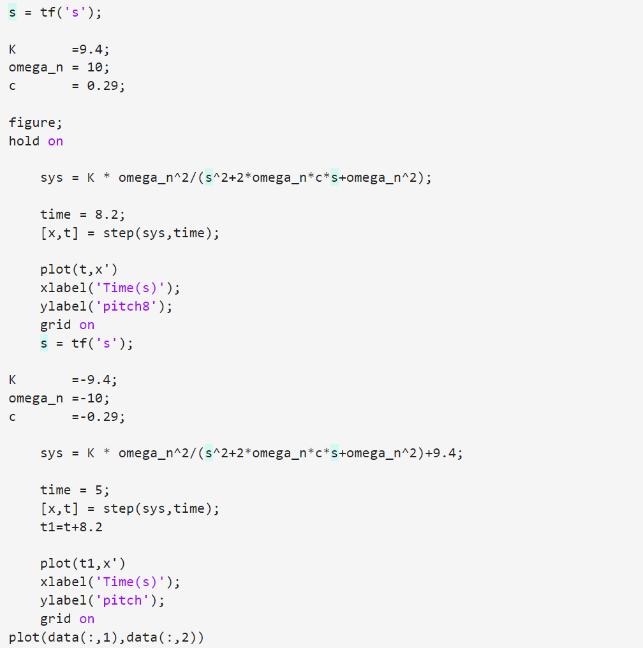
In order tofind these valuesI used the followingcode to create for loops(a loop that subs in a bunch of values into a function) to understand how each of these variables effects the output of the function
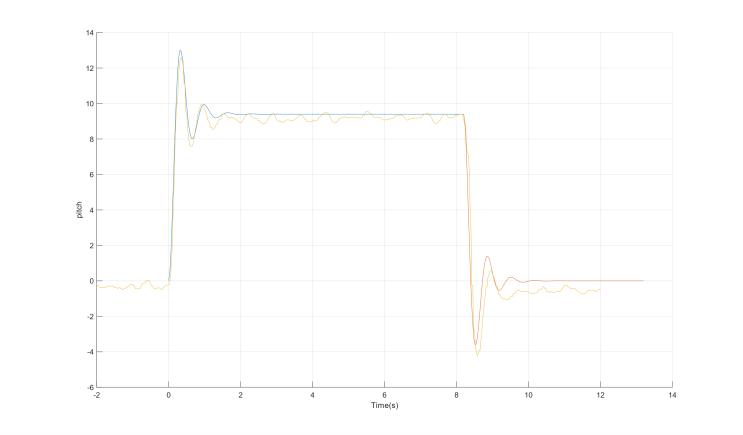
This showed that k changes the end value of the function, c changes the position of the x intercept and ωn change the damping force .After matching the response to the wind tunnel data I got the values as c=+-0.29, k=+-9.4 and ωn=+-10. The pluses and minuses are due to the fact that the values for the step up response need to be negative in order to properly model the step down response. The response for these valuesare seen above withthe yellow line beingthe real values and the red and blue lines being the recreated data.
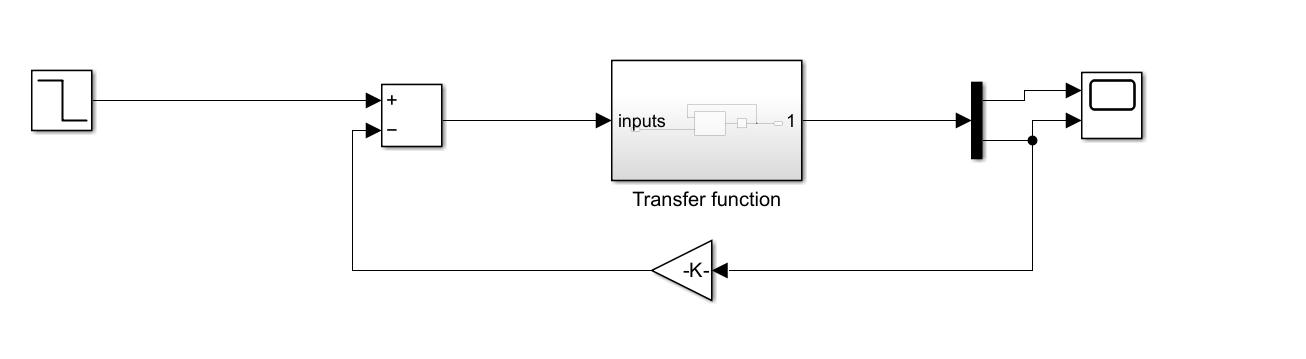
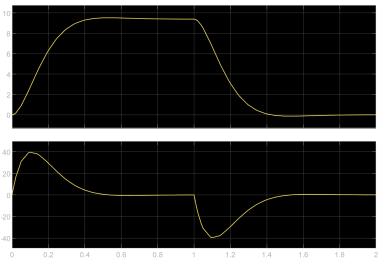
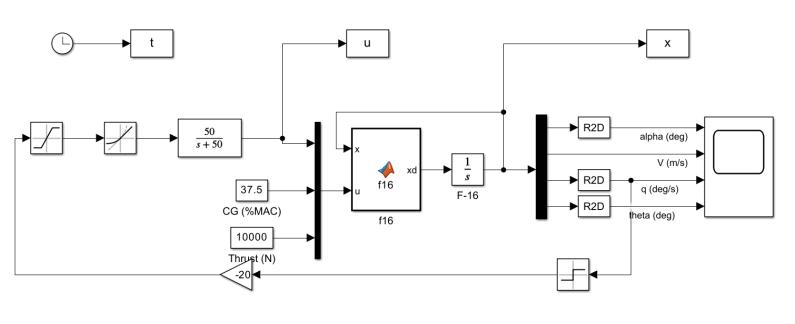
I then used the feedback control system in figure 4 in order to smooth out the pitch response so that there are no oscillations when the drone reaches the desired pitch angle. The pitch angle is shown in the top graph and the elevator response is shown in the bottom graph. The results are shown in figure 3.
Non linear systems
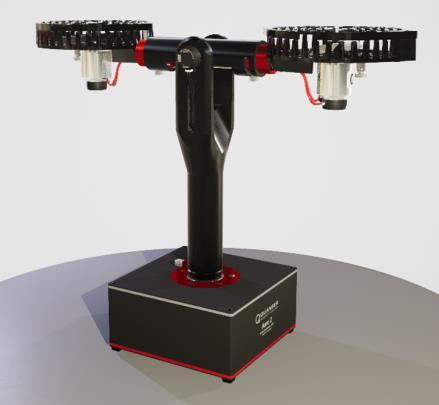
This sectiongot me towork with a non linear system of the Quanser aero2
Quanser aero2
This system’s non linearity is because of the electrical nature of this drone. This means that this drone is powered by voltage and the relationship between output pitch angle(a measure of force) and voltage is non linear.
In order toregulate thissystem I used a proportional, integral, derivative(PID) controller. The Proportional control works by producing a value that is proportional to the current error found by subtracting the desiredvalue from the current value. The integral control works by adding the errors over time and then multiplying it by a value so that the total error eventually reaches 0. The derivative control produces a damping effect by multiplying a value and the error’s derivative. The value does change with the error’s change.
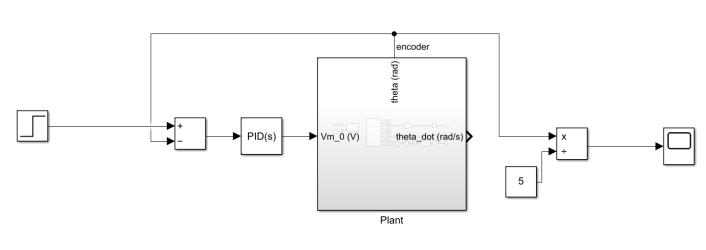
In the control system the input was the desired pitch angle. This then getsfed into the PID controller which then goes into the system of the Quanser Aero2. The output then creates a feedback control loop due to the subtract block.
F-16 deep stall recovery
The final part of my ORISwas engineeringa control system that can recover an f-16 from a deep stall. A deep stall is when an aircraft is pitched up at an angle of 60 degrees to the horizontal and the aircraft is travelling towards the earth which isn’t the direction of the earth. This is mainly because of slow speed.
The methodto get out of a deepstall involvesrockingthe nose back and forward in order to create enough momentum to get the nose down so that the aircraft can build up speed.
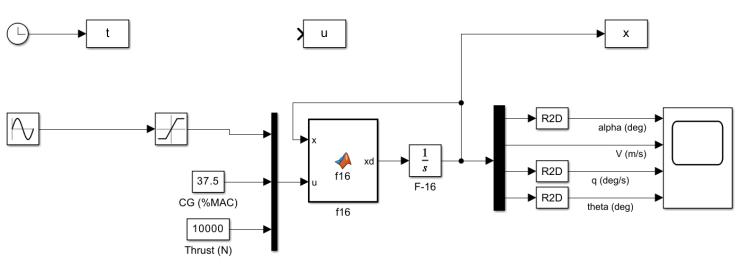
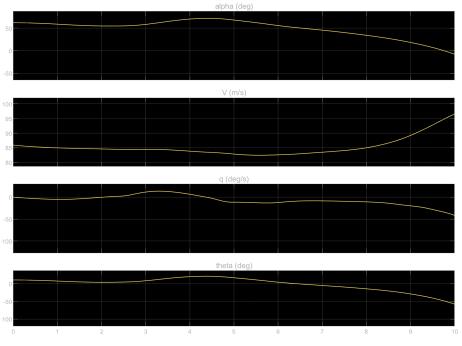
To make this happen I used 2 different control systems, one is a sine wave input of values of 20 degrees elevator pitch up and down and the other system was a closed loop system feeding back pitch rate into the model. Alpha is pitch angle, v is speed and q is pitch rate.
Closed loop system
The sine wave system works by isolating the system to an unstable section where the oscillations diverge to infinity. This means that the nose of the aircraft will be able to get down. The graphs for each system is below.
Dividing the output by the desired input would the pitch of the drone between 0 and 1. As seen in figure
closed loop system
Bibliography
Sine wave system
Graduated
In 2022, around a fifth of all fatal or serious injury crashes on British roads involved young drivers (The Guardian,24 November 2023). Therefore in a bid to mitigate these effects, Graduated Driving Licensing (GDL) schemes have been proposed, which allow young drivers, by the temporary retention of their full road rights, to gain experience and confidenceon the roads. This exemplifies a clear contention between the freedoms and rights of the individualand a need for social cohesion.
The Harm Principle – John Stuart Mill
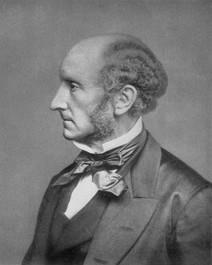
One answer was proposed by John Stuart Mill, in the form of his harm principle(On Liberty, John Stuart Mill, 1859).In its most basic terms this principlecan be verbalised as ‘your freedom to swing your fist ends where my nose begins’. It is the idea that the rights of individuals should only be restricted when their exercise may cause harm to another individual. For instance,the principlewould maintain that the act of smoking, as an expression of freedom, is perfectly fine. But at the point where this freedom causes material harm to others – the effects of passive or second-hand smokingwe must act. For example by banning smoking in cars with children (Children and Families Act 2014). In this way, the principleexpresses that the right to selfdetermination is not unlimited, at some point the individual must be regulated.
As a theory, utilitarianismprescribes moral merit to the situation in which pleasure or happiness has been maximised, often summarised as aiming to achieve ‘the greatest good for the greatest number’. In view of this, it is hastily assumed that a utilitarian perspectivewould always restrict individualfreedoms to the advantageof the majority. However, in truth the situation may be far more nuanced than this, as shown in analysis of the GDL scheme explained earlier. It may in fact be the case that the intensity of the displeasure caused in young drivers, at this restriction of their freedoms, aggregates to a greater extent than the minor pleasure elicited in each of the many drivers in favour of the scheme (in the comfort that they will be marginally safer on the roads)
Rights-Based Law, A Balancing Act
The Social Contract
What is uniqueabout this theory is its roots in Aristotelian ethics. For Aristotle, what was paramount was the development of virtues within the self that would, in combination with phronesis (practical wisdom), help us to flourish and achieve eudaimonia (ultimate happiness).Similarly, communitarianism stresses these virtues, but posits they might be obtained through communal participation. For the communitarian,a person is deeply embedded into their community and so it plays a fundamental role in the shaping of virtues. As such they advocatefor laws that enforce social cohesion to allow for more healthy communities that will, in turn, further develop the individual.
Liberalism (in particular liberal individualism) seems initially compelling due to its commitment to autonomy. Liberalism is a rights-oriented theory that champions freedom of the individual, arguing that everyone is entitled to certain rights that allow them to be free. In stressing this freedom of choice and expression it commits itself to autonomy which, as simply put by Rousseau, is the capacity for ‘obedienceto the law one has prescribed to oneself’(On the Social Contract, JeanJacques Rousseau, 1762). There are clear strengths for liberalism in this grounding in autonomy. It is often argued that our capacity for practical reason, as that which allows us to choose our course of action, presupposes that we understand ourselves as free - that we are naturally hardwired towards independence. Additionally, autonomy is valued in the political scene. The UK political system, and indeed any democraticsystem, is founded on the assumption that people know what is best for them, and can express this by voting accordingly for one out of a range of candidates.This is significant for the extreme liberal as it seems that even the state acknowledges that individuals (rather than a government) know how best to serve their needs.
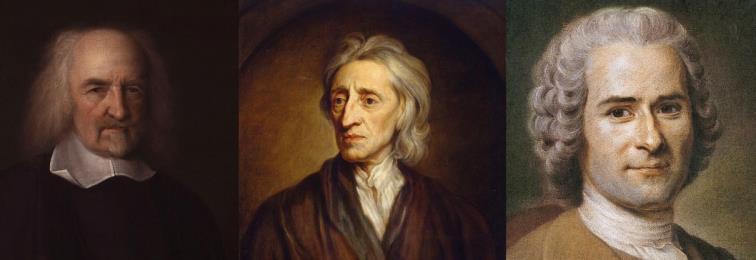
If we acknowledge a state of war, then more active and strict state intervention is needed to maintain order and protect individuals from each other. This points us towards social contracttheory. All of the major social contract theorists – Locke, Hobbes, Rousseau - maintain that, in order for the social contractto function,and for the state to hold legitimate political power over a society, every individual in that society must exhibit a degree of voluntarism (An Introduction to Political Philosophy, Jonathan Wolff, 2022) Correspondingly, a key part of the social contractis the concept of ‘tacit consent’- the idea that in acceptanceof the state’s protection and other benefits, we subjugatesome of our other rights in return. Craig Carr, in explanation of tacit consent, draws parallels to the game of chess; in engaging in the game, we tacitly consent to the rules of the game without the need for explicit verbal confirmationthat we are doing so (iapss.org, Noah Busbee, 2023).This idea of a consensual state can also be reconciled with autonomy. For Locke, as seen above, humans are naturally independent and autonomous, traditionally free from any form of political power. However, since individuals volunteer themselves to the state through their consent, it can, as an artificial human construction,be married with our autonomous nature. If the state is justified, it follows that we consent to its rulings.And since the state’s personnel are elected, by the majority, on the grounds of how well they can protect their people and enforce social cohesion, it is reasonable to posit that this is its main objective.As such, perhaps we should value social order over individual rights?