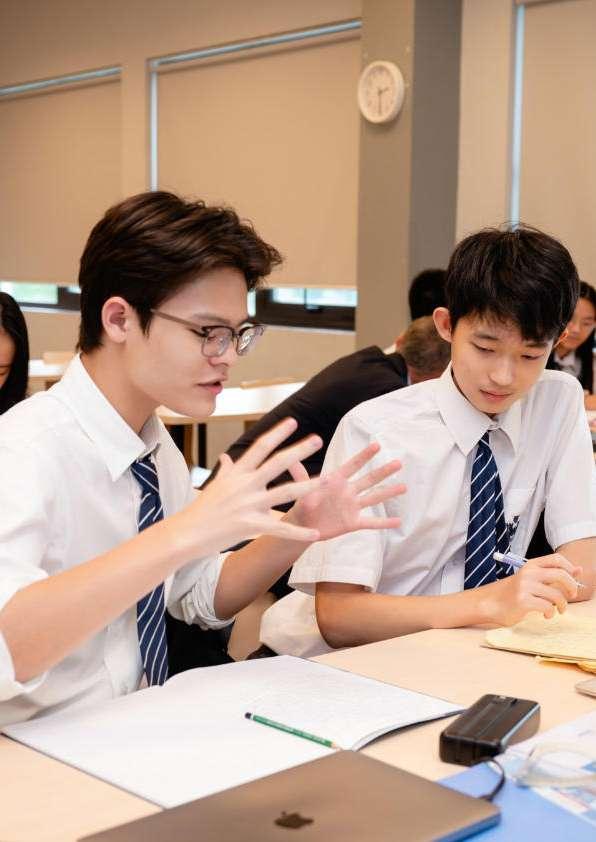
Selection Processes and Procedures
Year 11 students will begin learning about the International Baccalaureate Diploma Programme (IBDP) during Semester two of their Year 11 year. Please see the timetable below. This timetable outlines items to be focused on for subject selection and career focuses, and sets deadlines for information to be shared with parents.
During Semester two, Year 11 students will be introduced to the di erent programmes of study o ered at RGS Vietnam, and the various course options that all students have. Additionally, students will be researching and considering careers options to better inform them of how their future goals might impact their subject selection processes. These subject selection and careers-focused sessions will occur either during subject group classes or scheduled Friday homeroom times and invitation to special presentations. The Diploma Programme Coordinator (DPC) schedules these days and times into the overall homeroom calendars and coordinates the course presentations with the appropriate teachers and the careers focused events with the University Counsellor (UC). These are required components of the Year 11 Homeroom pastoral programme.
Year 11 students will:
• Attend the IBDP Subject Selection events in Semester 2
• Have their IBDP subject selection be finalised and approved by the Diploma Programme Coordinator (DPC) by the end of April
In selecting to pursue the Full IB Diploma students will need to:
• Have successfully completed Year 11( (with C grade passes)
• Select 3 Higher Level (HL) classes and 3 Standard Level (SL) classes
• Select a Language A as appropriate (Vietnamese passport holders must take Vietnamese A Language & Literature )
• Meet subject requirements as outlined in the DP Subjects Guide
IB Diploma Courses are appropriate for students who:
• Do not have a Language A
• Cannot access one or more courses at HL (the minimum entry of a B grade)
• Cannot access one or more courses at SL (the minimum entry of a C grade)
• Or are approved by the Head of Secondary
• If the school deems students not to be suited for the IBDP, the school may consider alternate graduation pathways including Diploma Courses
Students who would like to make changes to their subject selection after 1st May confirmations will need to do the following:
• If a change request occurs during the summer, students in combination with parents will need to email the DPC to request the change. The DPC will confirm the change and update relevant documents as soon as possible over the holiday period.
• During Semester 1 of the Year 12 IBDP students will have 4 weeks to make a subject selection and/or programmes change. In order to make the change students will have to:
◦ Have attended at least 3 lessons of the subject or 3 weeks in the programmes under consideration for a change
◦ Have a valid justification for the change
◦ Complete a subject change or programmess change form that will need to be signed by:
▪ Teachers teaching the classes connected to the change
▪ Diploma Programme coordinator
▪ University counsellor
▪ Form tutor
▪ Parents and student
◦ There will be no subject changes after Semester 1 of Year 12 unless exceptional circumstances are brought to the attention of the DPC and the Head of Secondary.
◦ Subject Level changes will be considered on an ongoing basis
◦ Any consideration of changes will be at the discretion and consultation of the DPC and Head of Secondary.
◦ If a change request is not approved students may appeal to the the Head of Secondary.
• New students will make their choices from 1st May by submitting their subject selection document before 1st June and confirmation will be made before the end of semester.
• If they have been enrolled for the next academic year at RGSV before 1st May then they will be invited to attend the subject selection evening.
Over the summer
• New students will make their choices by submitting their subject selection document before 1st August. Confirmation will be made after 1st August and by the start of the new academic year.
• Information about Subject Selection Process
• Workshop on Selecting subjects: Matching interests with university requirements
• Subject Selection evening *required*
New students:
Students who have completed an IGCSE 0500 course with a grade B or above or an equivalent IB MYP Year 3 course with a grade 5 or above.
Internal students:
Students who have completed IGCSE 0500 course with a grade C or above, or IGCSE 0511 with a grade A or above.
New student: Students who pass the entrance exam with the results of 70% or above and who have learnt Vietnamese in both primary and secondary school.
Internal students: Students who completed Vietnamese programme in previous classes with a grade C or above,
New student: Students who pass the entrance exam and who have learnt Korean in primary and secondary school
Internal students: Students who completed Korean programme in previous classes.
Students who intend to complete their Y12 and Y13 education with an IB Diploma.
Students who have confidence in reading, writing and speaking skills and wish to extend these skills through a rigorous DP, two year course.
Students who are organised to develop their own portfolio and are equipped to meet deadlines and reach standard or higher level course expectations.
Students who hold a Vietnamese passport and intend to complete a Bilingual Diploma Degree.
Students who have some proficiency in reading, writing and speaking Vietnamese at native speaker level.
Students who wish to extend their knowledge and skills in using Vietnamese as well as committed to put e ort to meet the requirements of the course.
Students who hold a Korean passport and intend to complete a Bilingual Diploma Degree.
“This course is very di erent from IGCSE. You are required to think di erently, you explore a variety of literary and non-literary texts and you prepare to write lengthy essays and an individual oral. Even the grading is di erent from IGCSE”.
"The IBDP Vietnamese: Language and Literature course is absolutely splendid in its own nature. The diversity, wide range of topics and mediums (photography, diary, caricature, novels,...) truly shows that it is not only rich and challenging in knowledge, but also extremely applicable and useful in many future career paths."
I really appreciate the experience that Vietnamese IBDP gives me. Self-study and time management are essential skills for university and we're able to practise all that in IBDP.
"Korean A L&L subject is an essential subject for developing logical and critical thinking. L&L subject is very helpful in future social life because they deal with not only literary works but also various non-literary texts such as movies and newspaper articles."
“I experienced various perspectives and learned about creative interpretation and critical acceptance.”
“Korean A L&L subject is not just a subject limited to language or literature, but a subject that studies how to logically organise our arguments and convey them convincingly.”
Language A: Language and Literature comprises four parts - two relate to the study of language and two to the study of literature.
Parts 1: Readers writers and texts
Study of one literary work and non-literary texts. Equal time should be arranged for literary works and non-literary texts.
Study of two literary works and non-literary texts. Equal time should be arranged for literary works and non-literary texts.
Parts 2: Time and space
Study of one literary work and non-literary texts. Equal time should be arranged for literary works and non-literary texts.
Study of two literary works and non-literary texts. Equal time should be arranged for literary works and non-literary texts.
Part 3: Intertextuality
Study of two literary works to prepare for the final exam paper 2.
Study of two literary works to prepare for the final exam paper 2.
Paper 1: Non-literary text analysis
An analysis of one non-literary text or extract (1 hour and 15 minutes)
A comparative analysis of a pair of texts, at least one of which is non literary (2 hours 15 minutes)
Paper 2: Literary essay
Write a literary essay about two works in response to a question (1 hour 45 minutes)
Write a literary essay about two works in response to a question (1 hour 45 minutes)
Individual Oral
15-minute individual oral exploring two of the texts in relation to a global issue of the student’s choice
15-minute individual oral exploring two of the texts in relation to a global issue of the student’s choice
Write a 1200-1500 word formal essay, following a line of inquiry of their own choice into one of the texts studied
The learner portfolio is not specifically assessed but it is an important tool in helping students prepare for formal assessment.
The learner portfolio is not specifically assessed but it is an important tool in helping students prepare for formal assessment.
Learner Portfolio
HL Essay
The study of the texts produced in a language is central to an active engagement with language and culture and, by extension, to how we see and understand the world in which we live. A key aim of the Language A: Language and Literature course is to encourage students to question the meaning generated by language and texts, which, it can be argued, is rarely straightforward and unambiguous. Helping students to focus closely on the language of the texts they study and to become aware of the role of each text’s wider context in shaping its meaning is central to the course.
The Language A: Language and Literature course aims to develop in students skills of textual analysis and the understanding that texts, both literary and non-literary, can be seen as autonomous yet simultaneously related to culturally determined reading practices. The course is designed to be flexible —teachers have the opportunity to construct it in a way that reflects the interests and concerns that are relevant to their students while developing in students a range of transferable skills. An understanding of the ways in which formal elements are used to create meaning in a text is combined with an exploration of how that meaning is a ected by reading practices that are culturally defined and by the circumstances of production and reception.
In view of the international nature of the IB and its commitment to intercultural understanding, the Language A: Language and Literature course does not limit the study of texts to the products of one culture or of the cultures covered by any one language. The study of literature in translation from other cultures is especially important to IB Diploma Programme students because it contributes to a global perspective, thereby promoting an insight into, and understanding of, the di erent ways in which cultures influence and shape the experiences of life common to all humanity.
The model for Language A: Language and Literature is the same at SL and HL, but there are significant quantitative and qualitative di erences between the levels.
In the literature sections the number of texts prescribed is greater at HL than at SL. In the language sections students are generally expected to cover many more texts of all kinds at HL than at SL.
Two of the assessment tasks at SL are significantly easier than the comparable tasks at HL. The first is the Paper 1 textual analysis, where SL students address and analyse only one passage, while HL students make a comparative analysis of two passages. The second is the HL Essay, where HL students must write a 1200-1500 word formal essay, following a line of inquiry of their own choice into one of the texts studied. HL Language A: Language and Literature candidates will have a choice between writing about a non-literary or literary text. Students can choose any of the texts studied during the course, with the exception of the texts they have used for their internal assessment or that they plan to use for their Paper 2.
Di erences between the HL and SL Language and Literature course
All Students:
The ability to write and read at a native speaker level in their own home language
Students who cannot access a language A in another language o ered.
Students who want to strengthen their home language
Students who enjoy studying literature and are able to do so in their own language.
Through the study of a wide range of literature, the Language A: Literature course encourages students to appreciate the artistry of literature and to develop an ability to reflect critically on their reading. Works are studied in their literary and cultural contexts, through close study of individual texts and passages, and by considering a range of critical approaches. In view of the international nature of the IB and its commitment to intercultural understanding, the Language A: Literature course does not limit the study of works to the products of one culture or the cultures covered by any one language. The study of works in translation is especially important in introducing students, through literature, to other cultural perspectives. The response to the study of literature is through oral and written communication, thus enabling students to develop and refine their command of language. It is a flexible course that allows teachers to choose works from prescribed lists of authors and to construct a course that suits the particular needs and interests of their students. It is divided into three parts, each with a particular focus.
“I enjoy being able to read and write in my own language again!”
aims to introduce students to the notion and purpose of literature and the ways in which texts can be read, interpreted and responded to. draws attention to the fact that texts are not isolated entities, but are connected to space and time. connecting texts focuses on the connection between and among diverse texts, traditions, creators and ideas.
SL students will study four literature works, whereas HL will study six literature works. This will include works written originally in the language studies, as well as works in translation.
External assessment (3 hours)
Paper 1: Guided literary analysis (1 hour 15 minutes)
Paper 2: Comparative Essay (1 hour 45 minutes)
Internal assessment
Individual oral (15 minutes)
35%
35%
30%
Group 2 Language acquisition consists of a foreign language course that is o ered in French, Spanish and English. Language AB INITIO & B are language acquisition courses designed to provide students with the necessary skills and intercultural understanding to enable them to communicate successfully in an environment where the language studied is spoken. This process allows the learner to go beyond the confines of the classroom, expanding their awareness of the world and fostering respect for cultural diversity.
The language course develops students’ linguistic abilities through the development of receptive, productive and interactive skills.
Placement onto Group 2 courses is designed to ensure that students are following the course that is most suited to their needs and that will provide them with an appropriate academic challenge whether it is at SL or HL.
At least 2 years of French at IGCSE level or equivalent are a prerequisite for non native speakers or / and students who did not study in a French school or with French language as a medium.
At least 2 years of French at IGCSE level or equivalent are a pre=requisite for non native speakers or / and students who did not study in a French school or with the French language as a medium.
Students who would like to take further studies in English.
Students should have completed IGCSE English Language or an equivalent course and have some proficiency in English Language.
External applicants will be required to take an admittance exam to determine suitability for the course.
Language B is an additional language-learning course designed for students with some previous learning of that language. It may be studied at either SL or HL. The main focus of the course is on language acquisition and development of language skills. These language skills should be developed through the study and use of a range of written and spoken material. Such material will extend from everyday oral exchanges to literary texts, and should be related to the culture(s) concerned. The material enables students to develop mastery of language skills and intercultural understanding. It should not be intended solely for the study of specific subject matter or content.
“The course covers many important topics and themes which are similar to other classes but from a di erent angle.”
“This helps both learn the language and gather new knowledge about France and culture in French-Speaking countries.”
“The course includes a lot of media (e.g. movies, music, etc.)”
“The topics are interesting and allow you to know more about the culture and life in French-speaking countries.”
There are 5 assessment objectives for the language B course. Students will be assessed on their ability to:
1. Communicate clearly and e ectively in a range of contexts and for a variety of purposes.
2. Understand and use language appropriate to a range of interpersonal and/or intercultural contexts and audiences.
3. Understand and use language to express and respond to a range of ideas with fluency and accuracy.
4.Identify, organise and present ideas on a range of topics.
5. Understand, analyse and reflect upon a range of written, audio, visual and audio-visual texts.
Presently at Reigate Grammar School Vietnam Language B is o ered at both HL and SL in French and in English
Priority for students with grade A* or A at IGCSE
Students with B at IGCSE with great motivation and work ethic
Five prescribed themes are common to the syllabi of Language B and Language ab initio; the themes provide relevant contexts for study at all levels of language acquisition in the DP, and opportunities for students to communicate about matters of personal, local or national, and global interest.
The five prescribed themes are:
•Identities
•Experiences
•Human ingenuity
•Social organisation
•Sharing the planet
The themes allow students to compare the target language and culture(s) to other languages and cultures with which they are familiar. The themes also provide opportunities for students to make connections to other disciplinary areas in the DP.
Language B assessment at SL and HL: All language B Courses follow a common Assessment structure and teaching sequence
Productive skills - writing (30 marks)
One writing task of 450-600 words from a choice of three, each from a di erent theme, choosing a text type from among those listed in the examination instructions.
Receptive skills - separate sections for listening and reading (65 marks).
Listening comprehension (1 hour) (25 marks). Reading comprehension (1 hour) (40 marks). Comprehension exercises on three audio passages and three written texts, drawn from all five themes.
Productive skills - writing (30 marks)
One writing task of 250 - 400 words from a choice of three, each from a di erent theme, choosing a text type from among those listed in the examination instructions.
Receptive skills - separate sections for listening and reading (65 marks) .
Listening comprehension (45 minutes) (25 marks).
Reading comprehension (1 hour) (40 marks). Comprehension exercises on three audio passages and three written texts, drawn from all five themes.
This component is internally assessed by the teacher and externally moderated by the IB at the end of the course.
A conversation with the teacher, based on a visual stimulus, followed by discussion based on an additional theme. (30 marks)
This component is internally assessed by the teacher and externally moderated by the IB at the end of the course.
A conversation with the teacher, based on an extract from one of the literary works studied in class, followed by discussion based on one or more of the themes from the syllabus. (30 marks)
Opened to all students new to this language or with a limited background in that language.
Opened to all students new to this language or with a limited background in that language.
Anyone who desires to learn a new language as a beginner and discover the culture from the di erent Spanish-speaking countries.
Language AB INITIO is an additional language-learning course designed for students new to a second language or with a limited background in that language. It may only be studied at SL. The main focus of the course is on language acquisition and development of language skills. These language skills should be developed through the study and use of a range of written and spoken material. Such material will extend from everyday oral exchanges to literary texts, and should be related to the culture(s) concerned. The material enables students to develop mastery of language skills and intercultural understanding. It should not be intended solely for the study of specific subject matter or content.
There are 5 assessment objectives for the language AB INITIO course. Students will be assessed on their ability to:
Communicate clearly and e ectively in a range of contexts and for a variety of purposes.
Understand and use language appropriate to a range of interpersonal and/or intercultural contexts and audiences.
Understand and use language to express and respond to a range of ideas with fluency and accuracy.
Identify, organise and present ideas on a range of topics. Understand, analyse and reflect upon a range of written, audio, visual and audio-visual texts.
Presently at Reigate Grammar School Vietnam Language AB INITIO is o ered at SL in Spanish.
Five prescribed themes are common to the syllabi of Language AB INITIO; the themes provide relevant contexts for study at all levels of language acquisition in the DP, and opportunities for students to communicate about matters of personal, local or national, and global interest. The five prescribed themes are:
Identities
Experiences
Human ingenuity
Social organisation
Sharing the planet
“Studying Spanish at RGSV is an amazing opportunity to discover not only a new language but also so many di erent cultures as we learn from all the Spanish-speaking countries.”
The themes allow students to compare the target language and culture(s) to other languages and cultures with which they are familiar. The themes also provide opportunities for students to make connections to other disciplinary areas in the DP.
All language AB INITIO Courses follow a common Assessment structure and teaching sequence.
Productive skills - writing (30 marks)
Two written tasks of 70-100 words from a choice of three tasks, choosing a text type from among those listed in the examination instructions.
Receptive skills - separate sections for listening and reading (65 marks) .
Listening comprehension (45 minutes) (25 marks).
Reading comprehension (1 hour) (40 marks).
Comprehension exercises on three audio passages and three written texts, drawn from all five themes.
This component is internally assessed by the teacher and externally moderated by the IB at the end of the course.
A conversation with the teacher, based on a visual stimulus, and at least one additional theme. (30 marks)
An interest in current a airs and real world events. A deep interest in the world around them to understand the connections between humans and their environment.
Strong and confident use of the English language.
IGCSE Geography or MYP 5 Individuals and Societies or other social science course at a ‘B’ grade or higher.
In addition to the above. Ambitious students who invest e ort into their own success.
IGCSE Geography ‘B’ grade students may consider SL IBDP Geography.
IGCSE Geography ‘A’ grade students may consider HL IBDP Geography.
Students interested in learning more about the world around them.
Students interested in challenging their own ideas as well as ideas of others.
Students who enjoy learning through discussion and debate.
Students who enjoy writing.
Students who enjoy considering a variety of di erent perspectives on the same issue.
Students who enjoy learning about current issues through real-life examples.
Students who enjoy science and the arts, looking to combine their interest in both disciplines.
“I never realised how broad Geography is and all it contains.”
“I like being challenged to think critically and develop my skills of evaluation.”
“I like learning through a variety of di erent media: watching, listening, reading and exploring graphical information.”
"I enjoy sharing my opinion and actively contributing to lessons. I like listening to what my classmates think and challenging their ideas.”
Geography is a dynamic subject that is firmly grounded in the real world and focuses on the interactions between individuals, societies and the physical environment in both time and space. It seeks to identify trends and patterns in these interactions and examines the processes behind them. It also investigates the way that people adapt and respond to change and evaluates management strategies associated with such change. Geography describes and helps to explain the similarities and di erences between spaces and places. These may be defined on a variety of scales and from a range of perspectives.
Within group 3 subjects, Geography is distinctive in that it occupies the middle ground between social sciences and natural sciences. The Diploma Programme Geography course integrates both physical and human geography, and ensures that students acquire elements of both scientific and socio-economic methodologies. Geography takes advantage of its position between both of these groups of subjects to examine relevant concepts and ideas from a wide variety of disciplines. This helps students develop an appreciation of, and a respect for, alternative approaches, viewpoints and ideas.
Students at standard level (SL) and higher level (HL) in Geography are presented with a syllabus that has a common core and optional themes.
HL students also study the higher level extension. The syllabus requires the development of certain skills, attributes and knowledge as described in the assessment objectives of the course.
Although the skills and activity of studying Geography are common to both SL and HL students, the HL student is required to acquire a further body of knowledge, to demonstrate critical evaluation, and to synthesise the concepts in the higher level extension.
In summary:
SL: students study two optional themes; HL students study three optional themes, providing further breadth
HL: students study the HL extension - global interactions, and examine, evaluate and synthesise the prescribed concepts, which by their nature are complex, contestable, interlinked and require holistic treatment. This provides further depth at HL.
The course consists of four sections.
SL and HL core
Geographic perspectives - global change
•Changing population
•Global climate - ulnerability and resilience
•Global resource consumption and security
HL extension - HL only
Geographic perspectives - global interactions
• Power, places and networks
• Human development and diversity
• Global risks and resilience
Optional themes (SL/HL)
Geographic themes - seven options
Two options are studied at SL, and three at HL
•Freshwater—drainage basins
•Oceans and coastal margins
•Extreme environments
•Geophysical hazards
•Leisure, tourism and sport
•Food and health
•Urban environments
Internal Assessment - SL and HL: Fieldwork
Fieldwork, leading to one written report based on a fieldwork question, information collection and analysis with evaluation
Very good command of English for both reading and writing
IGCSE English C or above
Everybody who is interested in what is happening around them since Business is everywhere and touches everything
‘I can no longer walk into a supermarket or convenience store without thinking business.’
‘Some of the articles we read are about issues I have never thought about before.’
‘I am learning about so many interesting topics.’
‘I always thought I would love Marketing most. I am doing my Internal Assignment on Financial tools.’
‘I did not realise how naive I was about what supermarkets do to entice me to buy from them.’
The business management course is designed to meet the current and future needs of students who want to develop their knowledge of business content, concepts and tools to assist with business decision making. Future employees, business leaders, entrepreneurs or social entrepreneurs need to be confident, creative and compassionate as change agents for business in an increasingly interconnected global marketplace. The business management course is designed to encourage the development of these attributes.
Through the exploration of four interdisciplinary concepts - creativity, change, ethics and sustainability - this course empowers students to explore these concepts from a business perspective. Business management focuses on business functions, management processes and decision-making in contemporary contexts of strategic uncertainty.
Students examine how business decisions are influenced by factors that are internal and external to an organisation and how these decisions impact upon a range of internal and external stakeholders. Emphasis is placed on strategic decision-making and the operational business functions of human resource management, finance and accounts, marketing, and operations management.
The business management course encourages the application of local, national and global examples to content and concepts; the internal assessment (IA) for both SL and HL is an individual business research project that allows greater analysis and evaluation of content, concepts and context. Students can develop a deeper understanding of an organisation by studying its processes through the lenses of creativity, change, ethics and sustainability.
Business management is a challenging and dynamic discipline that more than meets the needs of our students growing and developing in a complex business environment. This course prepares students to be global citizens ready to face up to the challenges and opportunities awaiting them in our ever-changing world.
The aims of the business management course at HL and SL are to:
• Develop as confident, creative and compassionate business leaders, entrepreneurs, social entrepreneurs and as change agents
• Foster an informed understanding of ethical and sustainable business practices
•Explore the connections between individuals, businesses and society
•Engage with decision-making as a process and a skill.
The SL course in business management di ers from the HL course in terms of the:
Recommended hours devoted to teaching (150 hours for SL compared to 240 hours for HL).
Extra depth and breadth required (extension material for HL only).
Nature of the examination questions in papers 2 and 3.
Paper 2 for both SL and HL focuses on developing quantitative skills; however, HL students will need to develop these further in greater depth.
Paper 3 is an HL-only paper based on a social enterprise, where students identify and describe a human need and the potential organisational challenges facing the social entrepreneur. Further to this, students are required to write a decision-making document that includes a business recommendation.
Unit 1: Introduction to business management
Unit 2: Human resource management
Unit 3: Finance and accounts
Unit 4: Marketing
Unit 5: Operations management
Business management toolkit
(4 hours 30 minutes)
Students with a strong grasp of Academic English (Good IGCSE English/History results)
Students with a strong grasp of Academic English (Good IGCSE English/History results)
Students who enjoy reading and writing, especially as related to non-fiction materials. You should have an interest in learning about past events. Previous experience with IGCSE History is an asset.
History is a great stepping stone for a career in fields such as diplomacy, education, politics, journalism and the law.
Students who enjoy asking big questions about society, power, how societies are formed and the importance of historical narratives.
Students who enjoy subjects such as English, TOK and the Humanities.
Students who want to study in USA should strongly consider taking History.
History is a dynamic, evidence-based, interpretive discipline that engages with the past. DP history is one of the courses in the academic area of individuals and societies.
The overarching emphasis of the DP history course is to help students develop as practitioners of history. This means engaging students in di erent forms of historical inquiry. The course allows students to explore the past through a variety of contexts, concepts, content and skills. In this interpretive discipline, students will engage with diverse perspectives and evidence to reach their own judgements.
The DP history course is grounded in a variety of global, regional and national themes, and allows for a mixture of comparative, thematic and in-depth studies. It provides a balance of structure and flexibility, enabling the course to be implemented in a wide range of contexts.
History is both an academic discipline and a part of the everyday, lived experience of all students. History informs identity, culture, society, politics, and the relationships between individuals and communities. Through the course, students will develop an understanding and appreciation of history in all these dimensions.
“In my previous years we had to just memorize dates and names…here however essays check how you understood and analyzed the events. I personally think it’s the best way to learn history.”
... International-mindedness is a multifaceted concept that captures a way of thinking, being and acting characterized by an openness to the world and a recognition of our deep interconnectedness to others. (IB, 2019, p. 2)
History has sometimes been used to promote simple narratives about the past, to marginalize some groups while elevating others, and to foster conflict. Fundamental to the DP history course is a recognition that there is no single, simple narrative of the past. The course encourages students to explore the past in all its complexity, including the complex causes and consequences of historical events, diverse perspectives on the past, and diverse lived experiences of people and societies.
The DP history course also supports the development of students as principled, informed actors in society. A key aspect of this development is cultivating an appreciation and understanding of human agency and its limits. The course encourages students to explore the ways that people in the past had agency yet operated within complex systems of power that could limit and shape their ability to e ect change.
Students at standard level (SL) and higher level (HL) are presented with a syllabus that has a common core consisting of prescribed subjects and topics in world history. In addition, students at HL are also required to undertake an in-depth study of three sections from one of the HL regional options. While many of the skills of studying history are common to both SL and HL, the di erence in recommended teaching hours at SL and HL signals a clear distinction between the demands made on students, with the greater depth of study required for HL.
Source-based assessment on the five focused studies, linked by an overarching inquiry question. Students respond to three static questions. Students answer all the questions for one of the focused studies. (24 marks)
Section A: two questions on the specified concepts. Students choose one question to answer.
Section B: two questions on each of the four thematic studies. Each question consists of two parts-a short response and an essay response. Students choose one of the two questions for their thematic study and answer both parts of that question. (25 marks)
This component is internally assessed by the teacher and externally moderated by the IB at the end of the course.
Students investigate a historical topic of their choice. They formulate an inquiry question, identify and choose sources, synthesize information and evaluate sources to produce a response. (25 marks)
Content Covered
1. Climate and innovation
a. Norse exploration (circa 982-1020)
b. The Aztec Empire (circa 1428-1469)
2. Authoritarian rule (from 1750 CE onwards)
a. Mao and Deng Xiaoping
b. Hitler’s Germany
c. Imperial Rule in Namibia
Source-based assessment on the five focused studies, linked by an overarching inquiry question. Students respond to three static questions. Students answer all the questions for one of the focused studies. (24 marks)
Section A: two questions on the specified concepts. Students choose one question to answer. Section B: two questions on each of the four thematic studies. Each question consists of two parts - a short response and an essay response. Students choose one of the two questions for their thematic study and answer both parts of that question. (25 marks)
Separate papers for each of the four regions. Two essay questions on each of the 12 regional studies within the selected region. Students must answer two questions, each from a di erent regional study. (30 marks)
This component is internally assessed by the teacher and externally moderated by the IB at the end of the course.
Students investigate a historical topic of their choice. They formulate an inquiry question, identify and choose sources, synthesize information and evaluate sources to produce a response. (25 marks)
1. History of Europe
a. European totalitarianism (1918-1941)
b. Europe and the Second World War (1918-1949)
NoneStudents who are interested in the impact of technology on society. The course is suitable for students with no prior knowledge or experience of ICT.
Digital Society is an interdisciplinary course within the Individuals and Societies subject group designed for young people interested in exploring the impact and importance of digital systems and technologies in the contemporary world. At its heart, digital society invites students to develop as ethical, empathetic and creative young people who address the changing world around them with understanding, imagination and action.
The aims of the Digital Society higher level courses are to:
• Focus inquiry using course concepts, content and contexts as well as real-world examples
•Explore diverse sources relevant to digital society
• Investigate impacts and implications of digital systems for people and communities
•Reflect on emerging trends, future developments and further insights.
•Share discoveries about digital society with others
“I thought I knew a lot about computers but the Digital Society course has made me realise that the way they are used is a lot more complex and interesting than I expected.”
1.1 What is digital society?
2.1 Change 2.2 Expression
2.3 Identity
2.4 Power
2.5 Space
2.6 Systems
2.7 Values and ethics
3.1 Data
3.2 Algorithms
3.3 Computers
3.4 Networks and the internet
3.5 Media
3.6 Artificial intelligence
3.7 Robots and autonomous technologies
4.1 Cultural 4.2 Economic 4.3 Environmental 4.4 Health 4.5 Human knowledge 4.6 Political 4.7 Social
5.1 Global well-being 5.2 Governance and human rights 5.3 Sustainable development
• Four structured questions that address the common SL and HL syllabus and real-world examples in an integrated way.
• Students answer two of four structured questions.
• Four source-based questions that address the common SL and HL syllabus in an integrated way. Sources may include text, audio, visuals, data, diagrams and/or infographics.
• Students answer all four questions.
• Students conduct an inquiry into impacts and implications of digital systems for people and communities. The submission requirements for the project include:
0 An inquiry process document not to exceed 1500 words.
0 A recorded multimedia presentation that does not exceed 10 minutes.
0 A list of references.
Six questions in two sections that address syllabus topics and real-world examples in an integrated way.
Section A
• Students answer two of four structured questions on the common SL and HL syllabus.
Section B
• Students answer one of two extended response questions based on the HL extension
• Four source-based questions that address the common SL and HL syllabus in an integrated way. Sources may include text, audio, visuals, data, diagrams and/or infographics.
• Students answer all four questions.
• Questions that address an intervention related to an HL extension challenge topic. A brief statement indicating the real-world nature of a selected challenge topic will be released prior to the examination.
• Students answer all four questions.
• Students conduct an inquiry into impacts and implications of digital systems for people and communities. The submission requirements for the project include:
0 An inquiry process document not to exceed 1500 words.
0 A recorded multimedia presentation that does not exceed 10 minutes.
0 A list of references.
New or internal students:
: B* grade in IGCSE* Biology, Co-ordinated or Combined Sciences.
: C* grade in IGCSE* Biology, Co-ordinated or Combined Sciences.
*or equivalent
Students who are looking at taking university courses in biomedical studies, pharmacology, environmental sciences, food sciences and psychology. Students taking this DP course will have a good background in Biology.
Biologists have accumulated huge amounts of information about living organisms, and it would be easy to confuse students by teaching large numbers of seemingly unrelated facts. In the Diploma Programme Biology course, it is hoped that students will acquire a limited body of facts and, at the same time, develop a broad, general understanding of the principles of the subject.
By studying Biology in the DP students should become aware of how scientists work and communicate with each other. While the scientific method may take on a wide variety of forms, it is the emphasis on a practical approach through experimental work that characterises the sciences. Teachers provide students with opportunities to design investigations, collect data, develop manipulative skills, analyse results, collaborate with peers and evaluate and communicate their findings
Through the overarching theme of the nature of science, the aims of the DP Biology course are to enable students to:
• Appreciate scientific study and creativity within a global context through stimulating and challenging opportunities.
• Acquire a body of knowledge, methods and techniques that characterise science and technology.
• Apply and use a body of knowledge, methods and techniques that characterise science and technology.
• Develop an ability to analyse, evaluate and synthesise scientific information.
• Develop a critical awareness of the need for, and the value of, e ective collaboration and communication during scientific activities.
• Develop experimental and investigative scientific skills including the use of current technologies.
• Develop and apply 21st century communication skills in the study of science.
• Become critically aware, as global citizens, of the ethical implications of using science and technology.
• Develop an appreciation of the possibilities and limitations of science and technology.
• Develop an understanding of the relationships between scientific disciplines and their influence on other areas of knowledge.
“I really enjoyed unit 2, particularly when we learned about Carbohydrates, Fats and Proteins, as I am interested in learning about nutrition in my own time so I found learning about the fundamentals of food beneficial.”
Group 4 students at SL and HL undertake a common core syllabus, a common internal assessment (IA) scheme and have some overlapping elements in the option studied. They are presented with a syllabus that encourages the development of certain skills, attributes and attitudes.
While the skills and activities of Group 4 Science subjects are common to students at both SL and HL, students at HL are required to study some topics in greater depth, in the additional higher level material. The distinction between SL and HL is one of breadth and depth.
Collaborative Sciences Project
All Diploma Course candidates must participate in an interdisciplinary investigation into the nature and process of science. This is a collaborative investigation including students from all four disciplines.
Unity & diversity
Form and function
A1.1 Water
A1.2 Nucleic acids
A2.1 Origins of cells [HL only]
A2.2 Cell structure
A2.3 Viruses [HL only]
B1.1
Carbohydrates and lipids
B1.2 Proteins
B2.1
Membranes and membrane transport
B2.2 Organelles and compartmentalization
B2.3 Cell specialisation
A3.1 Diversity of organisms
A3.2 Classification and cladistics [HL only]
A4.1 Evolution and speciation
A4.2
Conservation of biodiversity
B3.1 Gas exchange
B3.2 Transport
B3.3 Muscle and motility [HL only]
B4.1
Adaptation to environment
B4.2 Ecological niches
Paper 1 (1 hour 30 minutes)
Paper 1A: Multiple choice questions (30 marks)
Paper 1B: Data-based questions related to experimental work and syllabus (25 marks)
(Total 55 marks)
Paper 2 (1 hour and 30 minutes)
Section A: Data-based questions and short answer questions (34 marks)
Section B: Extended-response questions (16 marks) (Total 50 marks)
Internal assessment (10 hours)
The internal assessment consists of one task: the scientific investigation.
This component is internally assessed by the teacher and externally moderated by the IB at the end of the course.
(Total 24 marks)
Interaction and interdependence
C1.1
Enzymes and metabolism
C1.2 Cell respiration
C1.3
Photosynthesis
C2.1 Chemical signalling [HL only]
C2.2 Neural signalling
Continuity and change
D1.1 DNA replication
D1.2 Protein synthesis
D1.3
Mutations and gene editing
D2.1 Cell and nuclear division
D2.2 Gene expression [HL only]
D2.3 Water potential
C3.1 Integration of body systems
C3.2 Defence against disease
D3.1 Reproduction
D3.2 Inheritance
D3.3 Homeostasi
C4.1 Populations and communities
C4.2
Transfers of energy and matter
D4.1 Natural selection
D4.2 Stability and change
D4.3 Climate
Paper 1 (2 hours)
Paper 1A: Multiple choice questions (40 marks)
Paper 1B: Data-based questions related to experimental work and syllabus (35 marks) (Total 75 marks)
Paper 2 (2 hours and 30 minutes)
Section A: Data-based questions and short answer questions (48 marks)
Section B: Extended-response questions (32 marks) (Total 80 marks)
Internal assessment (10 hours)
The internal assessment consists of one task: the scientific investigation.
This component is internally assessed by the teacher and externally moderated by the IB at the end of the course.
(Total 24 marks) 20%
New or internal students:
: B* grade in IGCSE* Chemistry, Co-ordinated or Combined Sciences.
: C* grade in IGCSE* Chemistry, Co-ordinated or Combined Sciences.
*or equivalent
Students don’t have to become Scientists but should have a curiosity about the world around them. Also, many careers require a Chemistry background such as Doctors, Forensic Scientists, Chemical Engineers and so forth.
Chemistry is an experimental science that combines academic study with the acquisition of practical and investigational skills. It is called the central science, as chemical principles underpin both the physical environment in which we live and all biological systems. Apart from being a subject worthy of study in its own right, chemistry is a prerequisite for many other courses in higher education, such as medicine, biological science and environmental science, and serves as useful preparation for employment.
All students undertake both theory and practical work as they complement one another naturally, both in school and in the wider scientific community. The DP Chemistry course allows students to develop a wide range of practical skills and to increase facility in the use of mathematics. It also allows students to develop interpersonal and information technology skills, which are essential to life in the 21st century.
By studying Chemistry, students should become aware of how scientists work and communicate with each other. While the scientific method may take on a wide variety of forms, it is the emphasis on a practical approach through experimental work that characterises the subject.
Chemistry provides students with opportunities to develop manipulative skills, design investigations, collect data, analyse results and evaluate and communicate their findings.
“It’s not an easy ride, but well worth it!”
Through the overarching theme of the nature of science, the aims of the DP chemistry course are to enable students to:
Appreciate scientific study and creativity within a global context through stimulating and challenging opportunities
Acquire a body of knowledge, methods and techniques that characterise science and technology
Apply and use a body of knowledge, methods and techniques that characterise science and technology
Develop an ability to analyse, evaluate and synthesise scientific information
Develop a critical awareness of the need for, and the value of, e ective collaboration and communication during scientific activities
Develop experimental and investigative scientific skills including the use of current technologies
Develop and apply 21st century communication skills in the study of science
Become critically aware, as global citizens, of the ethical implications of using science and technology
Develop an appreciation of the possibilities and limitations of science and technology
Develop an understanding of the relationships between scientific disciplines and their influence on other areas of knowledge
Group 4 students at SL and HL undertake a common core syllabus, a common internal assessment (IA) scheme and have some overlapping elements in the option studied. They are presented with a syllabus that encourages the development of certain skills, attributes and attitudes.
While the skills and activities of Group 4 Science subjects are common to students at both SL and HL, students at HL are required to study some topics in greater depth, in the additional higher level material. The distinction between SL and HL is one of breadth and depth.
Collaborative Sciences Project
All Diploma Course candidates must participate in an interdisciplinary investigation into the nature and process of science. This is a collaborative investigation including students from all four disciplines.
New or internal students:
: B* grade in IGCSE* Physics, Co-ordinated or Combined Sciences.
: C* grade in IGCSE* Physics, Co-ordinated or Combined Sciences.
*or equivalent
Students who plan to study physical sciences or Engineering should take Physics. This course is also for those students who have a natural curiosity about how things work in the physical world, whether it’s at the classical or quantum level.
“What I like the most about the subject is that it has a strong and obvious connection to real life. Physics inspires me in a way that it makes me pay logical attention to my surroundings from the physics perspective. As a music lover, I am especially interested in waves and how they travel to make sound.”
Physics encompasses everything that we do as human beings. The very meaning of the word is “the study of nature”. As with the universe, physics knowledge is constantly expanding.
However, physics is not just about staring into the vastness of space or scrutinising the tiniest particles that make up the fabric of the universe. The fact is that discoveries in physics are the root of ideas that revolutionise the technology used in our daily lives. It is an everyday, grounded science encompassing advances in communication, medical technology and renewable energy.
It is above all a creative discipline. Physics requires solid knowledge of basic principles and a willingness to put them to the test in new ways. It requires curiosity and an appetite to explore what might be.
While the scientific method may take on a wide variety of forms, it is the emphasis on a practical approach through experimental work that characterises the subject. So the course also provides students with opportunities to develop manipulative skills, design investigations, collect data, analyse results and evaluate and communicate their findings.
The course enables students, through the overarching theme of the Nature of Science, to:
1.develop conceptual understanding that allows connections to be made between di erent areas of the subject, and to other DP sciences subjects
2.acquire and apply a body of knowledge, methods, tools and techniques that characterise science
3.develop the ability to analyse, evaluate and synthesise scientific information and claims
4.develop the ability to approach unfamiliar situations with creativity and resilience
5.design and model solutions to local and global problems in a scientific context
6.develop an appreciation of the possibilities and limitations of science
7.develop technology skills in a scientific context
8.develop the ability to communicate and collaborate e ectively
9.develop awareness of the ethical, environmental, economic, cultural and social impact of science.
Students at SL and HL share the following.
An understanding of science through a stimulating experimental programme.
The nature of science as an overarching theme.
The study of a concept-based syllabus.
One piece of internally assessed work, the scientific investigation.
The collaborative sciences project.
The SL course provides students with a fundamental understanding of physics and experience of the associated skills. The HL course requires students to increase their knowledge and understanding of the subject, and so provides a solid foundation for further study at university level.
Collaborative Sciences Project
All Diploma Course candidates must participate in an interdisciplinary investigation into the nature and process of science. This is a collaborative investigation including students from all four disciplines.
The structure of this physics syllabus is intended to promote concept-based learning and teaching that can be connected through three concepts: energy, particles and forces. These concepts appear throughout the five organising themes in the physics syllabus.
Paper 1 (1 hour 30 minutes)
Paper 1A: Multiple choice questions
Paper 1B: Data-based questions
(Total 45 marks)
Paper 2 (1 hour and 30 minutes)
Short answer and extended-response questions on standard level material only.
(Total 55 marks)
The internal assessment consists of one task: the scientific investigation.
This component is internally assessed by the teacher and externally moderated by the IB at the end of the course.
(Total 24 marks)
A.1 Kinematics
A.2 Forces and momentum
A.3 Work, energy and power
A.4 Rigid body mechanics
A.5. Galilean and special relatively
B.1 Thermal energy transfers
B.2 Greenhouse e ect
B.3 Gas laws
B.4 Thermodynamisc
B.5 Current and circuits
D.1 Gravitational fields
D.2 Electric and magnetic fields
D.3 Motion in electromagnetic
D.4 Induction
C.1 Simple harmonic motion
C.2 Wave model
C.3 Wave phenomena
C.4 Standing waves and resonance
C.5 Doppler e ect
E.1 Structure of the atom
E.2 Quantum physics
E.3 Radioactive decay
E.4 Fission
E.5 Fusion and stars
Topics with content that should be taught to all students
Topics with content that should be taught to all students plus additional HL content
Topics with content that should only be taught to HL students
Paper 1 (2 hours)
Paper 1A: Multiple choice questions
Paper 1B: Data-based questions
(Total 60 marks)
Paper 2 (2 hours and 30 minutes)
Short answer and extended-response questions on standard level and additional higher level material
(Total 90 marks)
The internal assessment consists of one task: the scientific investigation.
This component is internally assessed by the teacher and externally moderated by the IB at the end of the course.
(Total 24 marks)
New students:
HL & SL Level completed the IGCSE Computer Science course or any experience with Computing or Computer Science is an advantage.
Internal students:
HL & SL Level completed the IGCSE Computer Science course, a background in coding would an advantage.
Computing science is aimed at students who wish to study Computer Science at university level.
“It is an in depth course that covers many topics that we didn't study at IGCSE level.”
The DP Computer Science course requires an understanding of the fundamental concepts of computational thinking as well as knowledge of how computers and other digital devices operate. The course, underpinned by conceptual thinking, draws on a wide spectrum of knowledge, and enables and empowers innovation, exploration and the acquisition of further knowledge. Students study how computer science interacts with and influences cultures, society and how individuals and societies behave, and the ethical issues involved. During the course the student will develop computational solutions.
This will involve the ability to:
•Identify a problem or unanswered question
•Design, prototype and test a proposed solution
• Liaise with clients to evaluate the success of the proposed solution and make recommendations for future developments
The aims of the Computer Science courses are to:
• Develop conceptual understanding that allows connections to be made between di erent areas of the subject, and to other DP subjects
• Acquire and apply a body of knowledge, methods, tools and techniques that characterize computer science
• Analyse and evaluate solutions developed through computational thinking in a range of contexts
•Approach unfamiliar situations with creativity and resilience
• Use computational thinking to design and implement solutions to local and global problems
• Develop an appreciation of the possibilities and limitations of computer science
•Evaluate the impact of emerging technologies in computer science
•Communicate and collaborate e ectively
• Develop awareness of the environmental, economic, cultural and social impact of computer science, its applications and ethical implications.
Theme A: Concepts of Computer Science (HL/SL)
A1: Computer Fundamentals
A2: Networks
A3: Databases
A4: Machine Learning
Theme B: Computational thinking and problem-solving (HL/SL)
B1: Computational Thinking
B2: Programming
B3: Object Oriented Programming
B4: Abstract Data Types (HL Only)
Internal assessment
Solution
Practical application of skills through the development of a product and associated documentation
Group 4 project
Section A: theme A concepts
Section B: case study
Theme B : Programming (Java or Python)
Documentation as a single pdf Appendices as a single pdf.
Internally assessed, externally moderated.
Section A: theme A concepts
Section B: case study
Theme B : Programming (Java or Python)
Documentation as a single pdf Appendices as a single pdf.
Internally assessed, externally moderated.
Students will be able to choose from two courses. Mathematics: applications and interpretation, or, Mathematics: analysis and approaches. Both courses will provide the students the options of studying the subject at SL or HL.
These courses include core syllabus content for SL along with extended syllabus content within each topic for HL. Students wishing to study subjects with a high degree of mathematical content should therefore opt for a mathematics HL course rather than a mathematics SL course.
All topics are compulsory. Students must study all the SL sub-topics in each of the topics in the syllabus as listed in this guide.
Topic 1: Number and Algebra
Topic 2: Functions
Topic 3: Geometry and trigonometry
Topic 4: Statistics and probability
Topic 5: Calculus
Mathematical exploration: Internal assessment in Mathematics SL is an individual exploration. This is a piece of written work that involves investigating an area of mathematics.
The internally assessed component, the exploration, o ers students the opportunity for developing independence in their mathematical learning. Students are encouraged to take a considered approach to various mathematical activities and to explore di erent mathematical ideas. The exploration also allows students to work without the time constraints of a written examination and to develop the skills they need for communicating mathematical ideas.
These courses cater for students who already possess knowledge of basic mathematical concepts, and who are equipped with the skills needed to apply simple mathematical techniques correctly. The majority of these students will expect to need a sound mathematical background as they prepare for future studies in subjects such as Chemistry, Economics, Psychology and Business Administration.
The intention is to introduce students to these concepts in a comprehensible and coherent way. Students should, wherever possible, apply the mathematical knowledge they have acquired to solve realistic problems set in an appropriate context.
These courses cater for students with a good background in Mathematics who are competent in a range of analytical and technical skills. The majority of these students will be expecting to include Mathematics as a major component of their university studies, either as a subject in its own right or within courses such as Physics, Engineering and Technology. Others may take this level because they have a strong interest in Mathematics and enjoy meeting its challenges and engaging with its problems.
These courses focus on developing important mathematical concepts in a comprehensible, coherent and rigorous way. This is achieved by means of a carefully balanced approach. Students are encouraged to apply their mathematical knowledge to solve problems set in a variety of meaningful contexts. Development of each topic should feature justification and proof of results. Students embarking on this course should expect to develop insight into mathematical form and structure, and should be intellectually equipped to appreciate the links between concepts in di erent topic areas. They should also be encouraged to develop the skills needed to continue their mathematical growth in other learning environments.
applications and interpretation SL/HL
Mathematics: applications and interpretation focuses on introducing important mathematical concepts through the development of mathematical techniques, with a greater emphasis on Topic 2 (Functions) and Topic 4 (Probability and Statistics). Technology will play a large role in this course.
New students: Passing entrance test
Internal students: No specific requirements.
HL:
New students: Passing entrance test with a score of at least 80%
Internal students: Achieving at least a B in IGCSE Additional Mathematics OR an A* in IGCSE Mathematics (Extended)
Students who do not plan to take mathematics-related courses at the university level.
:
Students who consider mathematics as one of their strongest subjects but prefer technology to algebra.
“The Internal Assessment allows me to explore the area that I like and learn to connect mathematical theories with real-life situations.”