he Certi icateatte tin tothecondition o theimmova ehe dinco o ner hip: a mi e tone ormana ementand tran parenc i n ana
Q Québec e he on t or etthepena tie in o r dec arationo co o ner hip Mic a a i
Q u u e
Code harmonization: a proven practice Mic Mancini
ina ord revie : a ear o con o idation and o treach or the C
Ca endar pcomin activitie and trainin in
2025, a landmark year
by Yves Joli-Coeur, Ad.E., president of the RGCQ – Provincial
Another year is coming to a close, and what a year it has been. Among the highlights is the coming into force of the Regulation establishing various rules respecting divided co-ownership on August 14, giving effect to three key measures stemming from Bill 16 The preparation of a maintenance logbook, contingency fund studies, and a certificate attesting to the condition of the immovable held in co-ownership (CACI) is now part of the landscape.
You will also find in this issue of your Condoliaison a text presenting the CACI model certificate created by the RGCQ. This form is intended to provide prospective buyers with the greatest possible security in their transactions by supplying them with as much information as possible on the condition of the co-ownership. We also address in this edition the concept of calculating the maximum number of storeys a building may have in order to be eligible for a maintenance logbook review every ten years, rather than under the general five-year rule. Although seemingly simple, the words “no more than three storeys entirely above ground” conceal certain technical details that are worth understanding.
In addition to the usual columns, one article focuses on the “Balabanian case” (2024 QCCS 64), which has generated significant discussion in the realestatesector,althoughitdoesnotdealstrictly
with divided co-ownership. This issue also addresses a key and highly topical subject: artificial intelligence (AI) in co-ownership management. Whether we like it or not, this constantly evolving technology will transform all aspects of our lives, including the management of co-ownership properties. The introduction of various intelligent systems in buildings and in bookkeeping will raise numerous questions regarding compliance, accuracy, and data confidentiality. And this revolution is only just beginning.
To conclude, we must proudly highlight another significant event that took place in 2025: the creation of a new chapter within the organization, the RGCQ Estrie Chapter. Following Montréal, Québec, and Gatineau, a new forum for exchange has been established under the presidency of Me Alexandre Dumas, lawyer at Dunton Rainville in Sherbrooke. This new chapter will provide the region with a space for discussion, training, and support for the various stakeholders in co-ownership in Estrie.
I join the entire RGCQ team in wishing everyone a happy and prosperous New Year.
Enjoy your reading!
Regroupement des gestionnaires et copropriétaires du Québec Provincial — RGCQ Provincial
1200, avenue McGill College, bureau 1500
Montréal (Québec) H3B 4G7 T : 514 916-7427
www.rgcq.org
Executive Directior RGCQ Yves Nadon
Magazine Direction
Gabrielle Tournier
Coordination
Jade Serbah
Editorial Board
Me Michel Paradis
Gabrielle Tournier
Jade Serbah
Hélène Joli-Coeur
Richard LeCouffe, legal review
Caroline Martel Véronique Martel
Editorial Team
Caroline Martel Véronique Martel
Jade Serbah
Richard LeCouffe
Linguistic Editing and Layout Proofreading Frédérique LeBlanc
Advertising
Diane Ménard –d.menard@rgcq.org
Graphic Production
Bernard Lamy –blamylamy@gmail.com
Sophie Bellemare
Printing and Distribution
Imprimerie Solisco inc. Scott (Québec)
Deposit:
Bibliothèque et archives nationales du Québec et du Canada
Envoi de publication convention # 42063014
AU SERVICE DE MONTRÉAL DEPUIS PLUS DE 40 ANS
L'expert en rénovation et en gestion de sinistres en copropriété
Un sinistre va souvent au-delà des dommages matériels
il peut affecter les assureurs, les copropriétaires, les administrateurs, et peut nécessiter l'intervention d'un syndic d'assurance en cas de pertes importantes. Conscient de ces implications, Newsam Construction assure un contrôle de qualité irréprochable à chaque étape du processus.
Newsam Construction excelle dans la gestion des rénovations techniques et des sinistres complexes dans les copropriétés divisées, qu'ils soient causés par l'eau ou par le feu.
Newsam combine l'expertise juridique, les compétences techniques en matière de construction et la maîtrise de la dynamique de groupe pour apporter des solutions sur mesure.
Faites confiance à une équipe réputée pour son professionnalisme, son souci du détail et son respect des délais et des budgets. Newsam Construction transforme chaque défi en opportunité et redonne sérénité et éclat à votre copropriété.
Contactez Paul Schapira paul@newsam.ca ou au 514 969-8757
Newsam Construction 316, Avenue Victoria Westmount (Québec)
514 484-5020
www.newsam.ca
RBQ : 8279-2896-42
A wave of momentum bringing co-ownership together and helping it grow
by YvesNadon, executive director, RGCQ
Dmembers, partners, and friends of the coownership community, it is with great enthusiasm that I share these few words with you at a time of unprecedented momentum in our sector. The new regulatory framework governing co-ownership has sparked a genuine wave of mobilization. More than ever, the RGCQ stands out as a central player in supporting, informing, and assisting all stakeholders in the sector.
For several months now, our team and our regional chapters have been stepping up their efforts to listen to you and respond to your needs. Together, we have experienced a year rich in meetings, learning opportunities, and promising projects. The year coming to a close also ushers in new services designed to better support you based on your path and your aspirations.
HIGHLIGHTS THAT ILLUSTRATE OUR VITALITY
For the general public: co-owners and directors
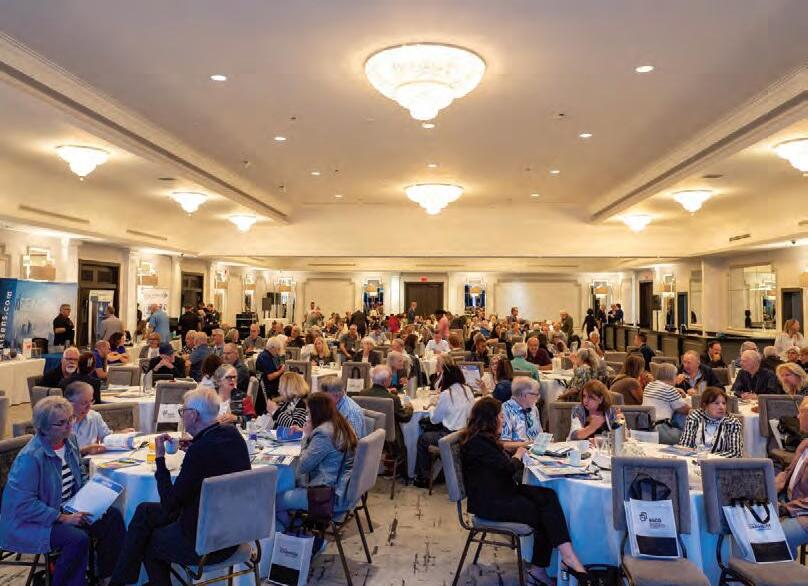
The conferences and symposia held in Montréal, Québec, Gatineau, Bromont, and Trois-Rivières were a resounding success, bringing together more than 1,500 participants. These events enabled co-owners and directors to become familiar with the new legal obligations, sound management practices, and practical tools for improving collective living. The discussions were rich and dynamic, clearly demonstrating a strong sense of community.
For
co-ownership
managers
Co-ownership managers took part in technical and strategic workshops focused on governance, the maintenance logbook, the contingency fund, and the certificate following the coming into force of the new regulation. These training sessions, led by seasoned experts, were designed to strengthen managers’ skills and reinforce their essential role in the long-term sustainability of buildings and the proper functioning of syndicates of co-ownership.
For real estate brokers
We also offered specialized workshops for real estate brokers. Their purpose was to provide a thorough understanding of how co-ownership operates so they can better inform buyers and sellers. These training sessions help build a more transparent real estate market and greater awareness of the responsibilities that come with co-ownership living.
A GROWING NETWORK: WELCOME TO THE ESTRIE CHAPTER
We are proud to announce the creation of the new RGCQ Estrie Chapter, an important step in our commitment to being ever closer to our members. With this new local hub, we will be able to provide close, regionally tailored support and create a forum for exchange among directors, co-owners, managers, and real estate brokers in the region.
SERVICES TAILORED TO EACH MEMBER PROFILE
The RGCQ is continuing its service segmentation approach: we are developing training programs and tools targeted to the specific needs of coowner directors, managers, and real estate brokers. This personalized approach is intended to increase the relevance of our support and to promote greater professionalization across the sector.
A WORD IN CLOSING
I would like to thank everyone who is actively contributing to this positive transformation: our trainers, our regional partners, our volunteers, and of course you, our members. Together, we are advancing Québec coownership toward stronger governance, better knowledge of the rules, and greater community cohesion.
I encourage everyone to continue building on this collective momentum. The coming year promises to be just as stimulating, with new projects, new collaborations, and the same conviction: co-ownership is above all a human adventure.
their perspectives on financial planning, transparency, and deposit protection. The day concluded with a networking cocktail.
QUÉBEC CONFERENCE
On September 14, the tour continued in Québec City under the chairmanship of Me Michel Paradis, Vice-President of the RGCQ. Participants deepened their knowledge of the new obligations: contingency fund studies every five years, a mandatory maintenance logbook, and the syndicate’s certificate provided at the time of sale. Presentations by Me Charlotte Fortier, Dominic Arès, and Julien Gobeil Simard, in the presence of Me Yves Joli-Coeur, combined legal expertise with practical field experience. The discussions highlighted implementation challenges as well as opportunities to improve building management.
GATINEAU CONFERENCE
In several regions of Québec, symposia and conferences brought together hundreds of co-owners and industry professionals. These gatherings made it possible to review heobligationsarisingfromBill16,exchangewithexperts,andstrengthen ties among members.
MONTRÉAL SYMPOSIUM
On September 12, the Montréal symposium launched the tour at the Metropolitan Golf Club in Anjou. The event, led by Ms. Valéry Couture and Mr. Richard Dubé, brought together several hundred participants around the three pillars of the reform: the maintenance logbook, the contingency fund study, and the Certificate attesting to the condition of the immovable held in co-ownership.
A notable new feature was the professional workshop reserved for sector stakeholders. It encouraged practical and technical exchanges. Experts such as Me Yves Joli-Coeur, Me Michel Paradis, Nathalie Bégin, and Julien Gobeil Simard shared
On September 27, the Outaouais Chapter held its own conference, chaired by Me Richard M. LeBlanc. Presentations by Me Yves JoliCoeur, Me Mathieu Turpin, and Me Gabrielle Papineau addressed, in practical terms, the maintenance logbook review, contingency fund planning, and the compliance of certificates. The event highlighted strong regional mobilization.
THAT’S NOT ALL
A conference was held in Bromont for the first time, marking the opening of a chapter in the Estrie region, where the RGCQ will soon be announcing new initiatives. On November 21, the tour also stopped in Trois-Rivières. Each of these two conferences brought together close to 100 participants.
A MISSION CONTINUED
These events, made possible through the collaboration of speakers, partners,andmembers,demonstratethevitalityof theRGCQnetwork.
Thanks to your commitment, the RGCQ continues to support, inform, and advocate for Québec co-owners in a rapidly evolving legislative environment.
Montréal Conference 2025
DU CONSEIL À LA COUR
Consultation et formation | Médiation et arbitrage | Représentation devant les tribunaux
Présidence d’assemblées | Recouvrement des charges communes | Assemblées de transition Modification de la déclaration de copropriété
Offrez le savoir en cadeau!
3e édition
législatifs
Entièrement mise à jour pour refléter les plus récents changements législatifs et réglementaires en matière de copropriété divise au Québec.
Pour commander utilisez ce code «R»
Me Yves Papineau
Me Olivier Charbonneau
Me Karl Michel
Me Philippe Gagnon-Marin
Me Maxime Laflamme-Leblond
Certificate attesting to the condition of the immovable held in co-ownership
Between mobilization and shock, a sector undergoing transformation
Based on key management tools such as the maintenance logbook, the contingency fund study, and contributions to the contingency fund, the Certificate attesting to the condition of the immovable held in co-ownership (CACI) proves to be the most comprehensive assessment instrument for measuring the overall health of a co-ownership, including its governance. Preparing this document is now required for the completion of any co-ownership real estate transaction.
Co-owners, syndicates of co-ownership, managers, brokers, and notaries all have a role to play. “All these obligations are intended to strengthen transparency and protect the public, while raising the bar in terms of sound governance. The smoothness of the purchase process depends more than ever on transparent, honest, and clear communication among all parties involved in transactions. Still, the new obligations must be known and understood,” summarizes Guillaume Leblond, Vice-President, Finance and Administration at Lafrance & Mathieu Property Management, and also a director of the provincial RGCQ and the QuébecChapter.
IL N'Y A PAS DE MEILLEURE ASSURANCE QUE VIGILANCE
Ce ne sont pas des mots en l’air. Nous nous appuyons sur plus de 20 ans d’expérience en protection contre les dégâts d’eau pour recommander le système NOWA 4S, le plus fiable sur le marché, et vous garantir une expérience d’installation absolument sans faille.
Certificate attesting to the condition of the immovable held in co-ownership
BETWEEN MOBILIZATION AND A STATE OF SHOCK, A SECTOR IN TRANSFORMATION
For years, the RGCQ has been laying the groundwork by promoting an incremental approach: small changes, slowly but surely, to continuously improve practices in Québec co-ownership properties. Since the coming into force of the first provisions of Bill 16, the organization has multiplied training sessions, meetings, and practical guides to distribute clear, practical, and accessible information as widely as possible. The reality of the legal obligations is creating a shockwave in the field.
A MECHANISM THAT IS STILL POORLY UNDERSTOOD
The regulation requires that the CACI be provided “to the promising purchaser in due time” and assigns the co-owner seller responsibility for requesting it from the syndicate of co-ownership. The CACI must be delivered to the “promising purchaser” within 15 days of the request. This mechanism is already creating confusion in the sector.
At what point in the transaction should the certificate be requested and provided?
Quite simply: as soon as possible. “In my training sessions, I encourage listing brokers to have their client’s certificate in hand at the time the brokerage contract is signed so it can be provided to buyers who are preparing to submit a promise to purchase, before it is drafted. A potential buyer can then say, ‘I’m not interested, I’m not moving forward,’ and thus avoid difficult discussions and complex negotiations over the conditions allowing withdrawal of the promise to purchase if the content of the CACI is not satisfactory,” according to Roch St-Jacques. The experienced real estate broker is affiliated with CENTURY 21 Élite, where he serves as Director of Training for all of Québec, in addition to chairing the board of directors of theOutaouaisRealEstateBoard.
This approach reflects the legislator’s intention to strengthen transparency. The contractual commitment represented by the promise to purchase can therefore be drafted with full knowledge of the facts.
All the individuals interviewed share this view, but at the same time report significant resistance within the sector, driven by concerns about providing “sensitive information.” They emphasized that misunderstanding this legislation creates risks for real estate transactions, particularly complications related to the absence of a maintenance logbook or a contingency fund, as well as special assessments.
In my training sessions, I encourage listing brokers to have their client’s certificate in hand at the time the brokerage contract is signed so it can be provided to buyers preparing to submit a promise to purchase, before it is drafted.
Roch St-Jacques
Real estate broker affiliated with CENTURY 21 Élite, Chair of the Board of Directors of the Outaouais Real Estate Board, real estate columnist (104.7 FM), director of the RGCQ Outaouais Chapter
A 15-day deadline that can play tricks
In practice, the interpretation of the 15-day deadline varies. Does it refer to business days or calendar days? Quebec legislation is nevertheless clear: by default, a “day” means a calendar day. The time limit does not include the day of the request, but it includes the last day, unless that day is not a court day, in which case the time limit is extended to the next court day. This legal interpretation is supported by case law.
For example, if the 15th day falls on a Sunday or a statutory holiday, the time limit is postponed to the next business or legal day (usually a Monday or the next weekday on which the courts are sitting).
However, the real estate market is active seven days a week, and its fast pace allows for very little downtime, even on Sundays. Aside from a few frictions, compliance with the time limit has not yet been identified as systematically problematic.
“By default, we always count 15 calendar days, but managers sometimes do not work on weekends. This creates friction, especially in situations where they wait until the last minute to start filling it out or to have it validated by the syndicate of co-ownership, whose volunteers are not always available or easy to reach.”
Parce que la copropriété, c'est aussi une question de chiffre!
-Certification d'états financiers (mission d'audit et d'examen)
-Mission de compilation (avis au lecteur)
-Déclarations fiscales
-Préparation de budget (incluant l'analyse de la déclaration de copropriété afin d'établir les clés de répartition
-Tenue de livre et gestion financière
-Consultations diverses
514 437-8800
info@dpcpa.ca www.dpcpa.ca
Certificate attesting to the condition of the immovable held in co-ownership issued by the
syndicate of co-ownership
Martin Lirette
Chargé de Projet et copropriétaire
Téléphone : 418-847-5556 p104
Cellulaire : 418-953-0612
martin@ventilation-ncv.com
Sans frais : 1 800 567-5557
562, avenue Notre-Dame,
514 619-6174 www.immoplex.com
BETWEEN MOBILIZATION AND A STATE OF SHOCK,A SECTOR IN TRANSFORMATION
“If we had to wait 15 days in the middle of the process and include this document among the conditions of the promise to purchase, sales processes would be extremely long, much more complex, and frankly frustrating for everyone!” explains Nathalie Bégin, Director of Brokerage Practices at the Professional Association of Real Estate Brokers of Québec (APCIQ). She also recommends that her members request and transmit the CACI as early as possible in the purchase process.
Managers interviewed expressed a similar view, investing six to eight hours of work per certificate. “The certificate forces us to validate everything: claims and insurance policies, contributions, the description of the private portions, the state of the contingency fund and the maintenance logbook, etc. In some co-ownership properties, obtaining all the information takes a lot of time. And even if we do not work on weekends, I have used personal time to complete several certificates within the deadline,” says with a smile Hugues Ouellette, property manager and partner at Proximmo, in Estrie. The young Bromont-based firm uses a secure, encrypted management platform where all documentation is collected and centralized, at the pace at which the syndicates of co-ownership transmit it.
In the Capitale-Nationale region, Guillaume Leblond’s experience is similar. “The main bottleneck is the lack of information. We saw it coming, and to get ahead, we chose to produce an initial certificate for each co-ownership, which we update before adding the details of the unit for sale when a brokerage contract is signed. We also adapted our working methods to facilitate the collection of information and the preparation of certificates within the company and with the syndicates of co-ownership.”
QUESTIONS AND ANSWERS FROM OUR EXPERTS
Leaders in their field and in their region, these individuals engaged in a process of excellence are helping to change mindsets. Condoliaison asked them the same questions to better understand what is happening in the field.
In short, despite the particularly turbulent transition period that the co-ownership sector is going through, this look at what is happening in the field reveals a sense of confidence among the actors already mobilized. They expect that beyond the next five years, beyond the current storm, the vision of transparency will gradually become a normal practice, stimulating a renewal and then growth in the co-ownership market.
(Results table on the following page)
Gestion de projets avec échéanciers Respect des budgets établis
Présentation des services aux administrateurs et gestionnaires
Inventaire complet des travaux à effectuer sur la bâtisse Plus de 20 ans d’expérience
REMPLACEMENT D’UNITÉS SCELLÉES
COUPE-FROID ET MÉCANISMES
CALFEUTRAGE
INSERTION DE PORTES ET VITRAUX
FABRICATION ET INSTALLATION DE MOUSTIQUAIRES
INSTALLATION ET REMPLACEMENT DE MIROIRS
INSTALLATION ET RÉPARATION DE RAMPES DE VERRE
DOUCHE
RÉPARATION DE SOLARIUM CLOISON VITRÉE
INSTALLATION ET RÉPARATION DE MURS-RIDEAUX
Certificate
attesting to the condition of the immovable held in co-ownership
BETWEEN MOBILIZATION AND A STATE OF SHOCK, A SECTOR IN TRANSFORMATION
CACI
NathalieBégin
Director of Brokerage Practices at the Professional Association of Real Estate Brokers of Québec (APCIQ)
RochSt-Jacques
Real estate broker affiliated with CENTURY 21 Élite, where he is Director of Training for all of Québec, and Chair of the Board of Directors of the Outaouais Real Estate Board
HuguesOuellette
Property manager and partner at Proximmo
GuillaumeLeblond, B.A.A.,Adm.A.
Vice President, Finance and Administration at Gestion immobilière Lafrance & Mathieu – real estate agency, director of the RGCQ (provincial) and of the Québec chapter
Which forms do you use or recommend using to produce the CACI?
“The APCIQ is calling for clarification on the harmonization between the CACI and the Request for information from the syndicate of coowners (DRCOP), since the first is mandatory and the second is strongly recommended. Producing several documents is difficult and demanding, may lead to omissions, and can create confusion.”
“The RGCQ form is the most comprehensive. It is more detailed than the SHQ’s and goes further than the DRCOP ”
“We drew inspiration from the RGCQ version to produce our in-house form, which is connected to the management platform we use, Uperbee, which does not currently allow the CACI to be generated.”
“We use the Québec platform Hoodie, which generates the CACI according to the highest standards and includes the information recommended by the RGCQ.”
When must the CACI be produced?
Final word
All answered in the same spirit, and without ambiguity: Upon request, for each transaction.
If significant changes occur between the acceptance of the promise to purchase and the notarized deed of sale, the seller must inform the notary so that an updated version is requested for signing. If changes occur while the co-ownership is on the market.
“At the APCIQ, we are monitoring this closely. We work extensively with the RGCQ. We share information in real time with our members, more than 15,000 brokers across Québec. Training is crucial, on all aspects of Bill 16, and we continue to develop new training based on our members’ needs and the reality in the field.”
“I encourage people, and brokers, to get more informed. I am also a syndicate of coownership director, and I make it a point to inform and educate myself about everything I know I have to do, and everything co-owners ask of us, in order to make the best possible decisions. I have been a member of the RGCQ for 12 years, and I continue to attend training sessions regularly and to read Condoliaison religiously.”
“Everyone now has greater responsibilities, and that is a good thing. I think this will restructure the sector and restore the reputation of coownership by having clear, verified, and reliable information on which to base transactions.”
“The certificate has created a certain insecurity, a concern about the disclosure of financial information, especially on the part of syndicates. But on the contrary, transparency in finances and governance will become a transactional facilitator that will eventually have an impact on the market.”
The Certificate in Co-owership (CACI)
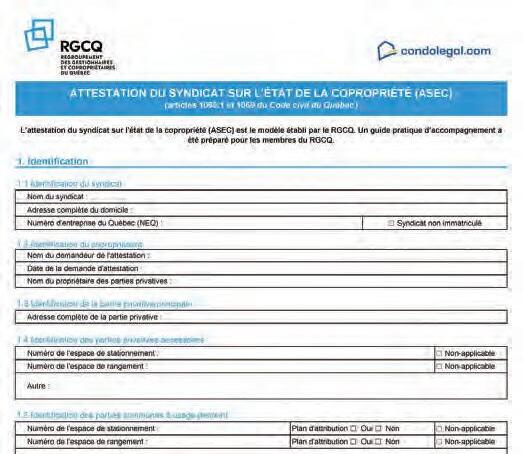
Visit our page: All you need to know about Bill 16, and simplify your process with our attestation template, designed to help you meet your obligations.
SCAN THIS QR CODE TO ACCESS IT
A practical guidance guide has been prepared for RGCQ members
RGCQ - Bill 16
New regulation
With the coming into force of the Regulation establishing various rules respecting divided coownership (O.C. 991-2025, Gazette officielle du Québec, Part II) on August 14, 2025, all syndicates of co-ownership will be required to have established a maintenance logbook within no more than three years, that is, by August 14, 2028.
Small co-ownership properties and revision of the maintenance logbook
This maintenance logbook is used in particular to plan and track the work required to ensure the preservation of the immovable. It must be prepared by n authorized independent professional (architect, engineer, chartered appraiser or professional technologist), updated by the board of directors of the syndicate of co-ownership at least once a year, and reviewed in due course by an authorized independent professional.
Section 5 of the Regulation provides that such a revision of the maintenance logbook must be carried out at least every five years.
However, it may be carried out at least every ten years when one or the other of the following conditions is met:
The immovable is made up of no more than eight private portions, excluding those that are accessory to them, such as storage and parking spaces;
No common portion of the immovable is located in a building. This therefore refers to a horizontal co-ownership.
The immovable has no more than three storeys entirely above ground.
Inspection en 20 points pour chaque unité de la copropriété
Rapport individuel envoyé à l'intérieur de 48 heures
Unités nécessitant une intervention corrective immédiate identifiées rapidement
Pour informations infos@vigilo-inspection.ca
www.vigilo-inspection.ca 438 507-8239
Programme d’inspection préventif au dégâts d’eau
LOI 16
SOYEZ CONFORME, SANS STRESS
comptables, admistratifs,
sinistres et techniques avec une approche humaine et un accompagnement complet pour repondre aux exigences de la Loi 16
New regulation
SMALL CO-OWNERSHIPS AND REVISION OF THE MAINTENANCE LOGBOOK
ATTESTATION, CARNET, FONDS DE PRÉVOYANCE
Simplifiez votre conformité avec Laucandrique.
Laucandrique Essentiel moins de 25 unités
Laucandrique Classique 25 unités et plus Laucandrique Maintenance tous types d’immeubles
Laucandrique Technique tous types d’immeubles
DIAGNOSTIC SUR LA LOI 16 GRATUIT
CALCULATION OF THE NUMBER OF STOREYS CONSIDERED BY SECTION5OFTHE REGULATION
With respect to this third possibility, the Regulation provides no definition of what must be considered a “storey.” We therefore considered it appropriate to examine more closely the meaning to be given to this possibility.
According to the Québec Construction Code:
Profitez d’un accompagnement personnalisé pour évaluer votre conformité à la Loi 16. Nos experts vous aideront à identifier les étapes essentielles pour sécuriser, planifier et valoriser votre immeuble dès aujourd’hui.
OFFRE LIMITÉE À 25 IMMEUBLES
CONTACTEZ-NOUS POUR EN SAVOIR PLUS Marketing@laucandrique.ca
ACADÉMIE LAUCANDRIQUE
Formations accessibles en ligne et en présentiel
Webinaires gratuits sur la Loi 16 et les bonnes pratiques de gestion Contenus pédagogiques pensés pour le terrain
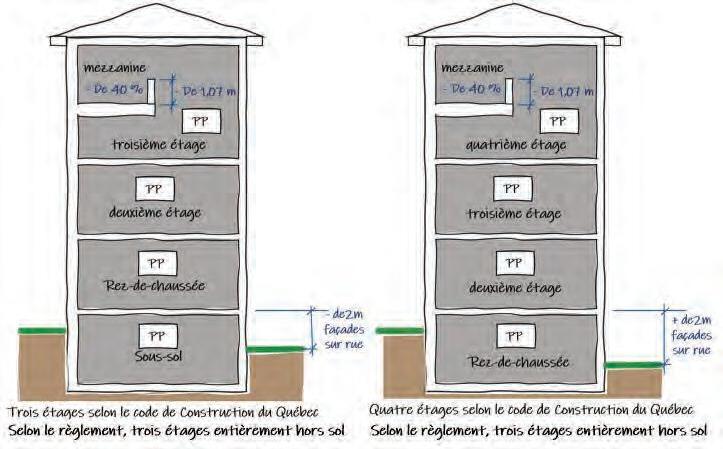
A “storey” is defined as the portion of a building bounded by the upper surface of a floor and the upper surface of the floor immediately above.
The first storey is the highest storey whose floor is located no more than 2 m above the average ground level. The first storey is important because it serves as the reference for determining the height of a building under the Québec Construction Code.
The average ground level (grade) is the lowest of the final average ground levels measured along each exterior wall of the building that faces a street.
If the floor of the private portions on the ground floor is located less than 2 m above ground level, the private portions
located below the ground floor are considered to be in the basement. Within the meaning of the Construction Code, a basement is not considered a storey. Under the Regulation, a basement is not a storey entirely above ground. A co-ownership with three storeys above ground that also includes private portions in the basement would therefore have four stacked private portions. Based on our understanding, such a co-ownership could therefore have its maintenance logbook revised every ten years.
However, if the floor of the first storey above ground is located more than 2 m above ground level, under the Construction Code, the storey located below that floor is not considered a basement, but rather the first storey. Now, under the Regulation:
If the first storey is not entirely above ground, it is not counted in calculating the building’s height. Such a co-ownership could have its maintenance logbook revised every ten years.
If the first storey is entirely above ground, it is counted in calculating the building’s height. Such a co-ownership must have its maintenance logbook revised every five years.
New regulation
Moreover, certain mezzanines are not considered a storey. The Construction Code allows the space above a mezzanine not to be counted as a storey in calculating the building height if that space is laid out in accordance with the following criteria:
The cumulative area of the mezzanine does not exceed 40% of the uncluttered floor area of the room in which it is located.
The space above the mezzanine floor is not divided by partitions or walls higher than 1,070 mm. However, that space may include an enclosed area whose floor area does not exceed 10% of the uncluttered floor area of the room in which the mezzanine is located.
The Regulation does not address this type of situation. However, it is clear that a mezzanine laid out in accordance with the above criteria is not counted in calculating the building height.
To better understand, we have prepared the drawings above, which illustrate these different situations.
This article was prepared in partnership with Condolegal, inspired by the practical guide available on its website, which highlights the main aspects of the maintenance logbook in co-ownership.
Three sub-fact sheets detail these elements:
The collective memory of the immovable;
Planning tools;
Governance and the legal framework.
We invite you to consult them directly on the Condolegal.com website.
To carry out a contingency fund study, a syndicate of coownership must first have established its maintenance logbook, which constitutes the mandatory documentary basis on which the professional retained relies to assess the useful life of the building’s components and plan future interventions.
However, thousands of syndicates of co-ownership have not yet completed this step, placing themselves in a difficult position. Although they have a three-year period to establish their maintenance logbook, that is, until August 14, 2028, they have every interest in acting now.
“When everyone wakes up, obviously at the last minute, the internal pressure to complete the process as quickly as possible will be high. There will also be a shortage of professionals to prepare the reports that quickly,” explains emeritus lawyer Yves Papineau, a specialist in co-ownership law in Québec.
Assurance Condo
Un programme d’assurance de copropriété exclusif
Nouveau programme disponible pour les syndicats de copropriété de 25 unités et moins
En tant que chef de 昀le en courtage d’assurance condo, BFL CANADA propose un programme d’assurance spécialement conçu pour répondre aux besoins des syndicats de copropriétés, o昀rant des couvertures d’assurance uniques et exclusives.
Adhérez à ce programme et pro昀tez gratuitement de nombreux services exclusifs :
Prix avantageux;
Courtiers spécialisés en assurance de la copropriété;
Remboursement des frais du gestionnaire lors des sinistres couverts;
Service d’accompagnement par un expert en sinistre pour vos réclamations et sinistres sous franchise, incluant un suivi personnalisé de vos droits et obligations, une assistance dans vos démarches auprès des assureurs, et un suivi de l’évolution du règlement a昀n de réduire les délais;
Optimisation des chances pour le syndicat de recouvrer la franchise auprès de la partie fautive;
Participation aux rencontres virtuelles avec les copropriétaires.
On vous assiste au-dessus et en-dessous de votre franchise dans les règlements des sinistres.
Chez DeRico Experts-Conseils, nous accompagnons les syndicats de copropriété dans leurs obligations légales en offrant deux services spécialisés et complémentaires
LOI 141 COÛT DE RECONSTRUCTION
LOI 16 FONDS DE PRÉVOYANCE
CARNET D’ENTRETIEN
BIENVENUE AUX PETITES COMME AUX PLUS GRANDES COPROPRIÉTÉS !
3200, ch. des Quatre-Bourgeois, bur. 300 Québec (QC) G1W 0G8 2, rue Saint-Germain Est, bureau 140 Rimouski (QC) G5L 8T7
info@drec.ca
418-780-2330
The Québec co-ownership property stock includes more than 40,000 buildings.
Overall, 90% are small co-ownerships, that is, 20 units or fewer (about 325,000).
Nearly 40% would not have a sufficient contingency fund based on a contingency fund study carried out in accordance with the standards imposed by Bill 16 (about 16,000).
Sources: Regroupement des gestionnaires et copropriétaires du Québec (RGCQ), Hoodie
A DAUNTING FINANCIAL CATCH-UP
Once it has all the documents in hand, a board of directors must adopt the budget. To do so, it must assess the amounts required to cover the current year’s expenses and present the projected budget for consultation by the meeting of co-owners. After this consultation, the board of directors sets the co-owners’ contributions on a final basis, including the contribution to the contingency fund, and prepares the assessment notices for each of them.
Syndicates of co-ownership with a professional manager are generally in a better position and are making good progress on their obligations; they will have established a contingency fund containing a reasonable amount. In such cases, the ten-year catchup is likely to be less painful and may not even extend over the full ten years. Management Column
Nettoyage Maxi
votre spécialiste du nettoyage des conduits de ventilation!
Conduits et système de ventilation
Chauffage et air climatisé
Échangeur d’air
Tout type de systèmes d’évacuation
Conduits de sécheuses et plus !
Service complet sur unité de climatisation mural
Service complet sur système de ventilation
Confiez
Nettoyage de conduits de sécheuses
For the others, there is no longer any way to avoid it, as Me Papineau points out. “Syndicates that are behind in funding their contingency fund will see their common expenses (condo fees) increase twofold, sometimes even threefold, to replenish reserves that were neglected for decades. Co-owners’ ability to pay is a real source of concern.”
The financial catch-up may also prove greater than expected due to urgent work that must be carried out and the imposed deadline.
A DISPROPORTIONATE BURDEN FOR THE SMALLEST CO-OWNERSHIPS
“Many types of work cost roughly the same for co-ownerships of two, three, or nine units, for example. But the number of shares among which the costs are divided makes a big difference per door!” notes emeritus lawyer Yves Papineau. Hence the importance of rigorous planning and diligent execution.
BETWEEN TRANSPARENCY AND VULNERABILITY
The inclusion of the total amount of the contingency fund and the total amount of common expense contributions for the previous three years in the Certificate attesting to the condition of the immovable held in co-ownership (CACI) increases transparency in the real estate market, but at the same time exposes underfunded co-ownerships to a potential decrease in value.
“Forget about $300 condo fees. Those who used to boast about having the lowest condo fees are now the most worried. On the one hand, many will not be able to keep up. On the other hand, buyers are likely to negotiate firmly, anticipating the significant upcoming contributions that ‘should have’ already been paid into the contingency fund,” predicts Me Yves Papineau.
Me Yves Papineau, partner, LJT Lawyers
Emeritus lawyer, leading authority in co-ownership and real estate law in Québec, accredited mediator, prolific author, speaker and trainer
“WE’RE
COLLECTING THE MONEY, BUT WHERE DO WE PUT IT?”
This question weighs heavily on Me Papineau’s mind, and he is reflectingonitclosely.“Toooften,contingencyfundssitinlow-yield separate accounts, hence the idea of pooling the amounts in a collectivefundmanagedbyastrongindependentorganization,such as the Caisse de dépôt et placement or the Fonds de solidarité du Québec. Such pooling would generate higher returns, professional management,and100%guaranteedinvestments,whilealsoeasing theburdenonvolunteerboardsofdirectors.”
Complete it in full confidence to help create training and tools tailored to your needs.
Rapports explicatifs envoyés aux administrateurs lors des déplacements de nos gestionnaires
Communications constantes avec les copropriétaires et les administrateurs
Rédaction d’études de fonds de prévoyance et de carnets d'entretien avant-gardiste
Culture d'entreprise de perfectionnement continu Nous remettons en question le statu quo
RGCQ SURVEY...
CHAQUE MINUTE COMPTE. CHAQUE DÉTAIL AUSSI.
En copropriété, un dégât dans une unité peut vite devenir un problème collectif.
Notre équipe intervient 24/7 pour contenir, réparer et restaurer — tout en respectant vos exigences, vos règlements, et la vie en communauté.
Restauration après un événement catastrophique
Recouvrement des pertes importantes et complexes
Récupération des dommages causés par le feu et la fumée
Récupération des dommages causés par l’eau et les inondations
FIRE SAFETY: A RESPONSIBILITY NOT TO BE UNDERESTIMATED
Afrequently overlooked issue concerns the compliance of fire separations in service shafts. Although invisible, they nevertheless play a crucial role in occupant safety and the building’s long-term integrity.
PROBLEMATIC LEGACY OF THE 1980s–1990s
Many buildings constructed in the 1980s and 1990s now show deficiencies. The installation of prefabricated fireplaces in combustible structures was becoming
widespread, but fire separation requirements were often ignored.
Claude Quirion, a fireplace and fire safety specialist and owner of the Greater Montréal Noréa Foyers branches and of Mughet, recalls: “Contractors installed several chimneys in the same service shaft, whereas the code required separate shafts with fire resistance equivalent to that of the apartment.”
Subsequent interventions — electrical cables, ventilation ducts, or communication systems — have often compromised the integrity of fire-rated compartments, creating invisible pathways through which fire could spread rapidly.
CERTIFICATE OF COMPLIANCE: A STEP THAT ENGAGES LIABILITY
Issuing a certificate without verifying the actual condition of the fire separations exposes the syndicate of co-ownership and its directors to legal risks. An incorrect attestation could be considered a false declaration, especially in the event of a loss.
It is crucial to ensure that inspections are carried out by qualified professionals, that the findings are documented, and that critical elements have been verified or corrected. Issuing a certificate with reservations or recommending corrective work protects the syndicate of co-ownership and the co-owners until the corrective work is completed.
CORRECTING THE SITUATION:
THE RBQ APPROACH AND OTHER POSSIBLE MEASURES
When a non-compliance issue is discovered, the first rule is to correct the problem in accordance with what should have been done, namely separate service shafts for each duct. However, this is often impossible in existing buildings.
This is where a “different measure” comes into play, developed with engineers and architects and recognized by the Régie du bâtiment du Québec (RBQ) in 2008.
iTHE PROCESS REQUIRES THE INVOLVEMENT OF A PROFESSIONAL:
1.An architect identifies the non-compliance.
2.The architect proposes the construction of compliant service shafts where space permits, or the use of the different measure when the layout makes this solution physically impossible.
3.The municipality and the fire department give their approval.
4.The corrective work is carried out by a licensed contractor.
5.The architect confirms the building’s safety.
Réfection d’enveloppe de bâtiment
Spécialiste en réfection de maçonnerie et autres travaux de réparation de l’enveloppe de bâtiment.
PAS DE HAUSSE ANNUELLE DE VOS HONORAIRES DE GESTION (GEL DE PRIX TANT QUE VOUS ÊTES GÉREÉS PAR A1 CONDO)
PAS DE FRAIS D'INTÉGRATION LORS DU DÉBUT DE NOTRE MANDAT (TRANSFERT DE VOS ARCHIVES ET DE VOS DOSSIERS)
TRÈS BON RAPPORT QUALITÉ/PRIX ET EXCELLENT SERVICE À LA CLIENTÈLE
7 JOURS SUR 7
POUR TOUS VOS COPROPRIÉTAIRES
PETITES COPROPRIÉTÉS
PREMIER MOIS DE GESTION GRATUIT
PAS DE HAUSSE ANNUELLE DE VOS HONORAIRES DE GESTION (GEL DE PRIX TANT QUE VOUS ÊTES GÉRÉS PAR A1 CONDO)
PAS DE FRAIS D'INTÉGRATION LORS DU DÉBUT DE NOTRE MANDAT (TRANSFERT DE VOS ARCHIVES ET DE VOS DOSSIERS)
TRÈS BON RAPPORT QUALITÉ/PRIX ET EXCELLENT SERVICE À LA CLIENTELE
7 JOURS SUR 7 POUR POUR TOUS VOS COPROPRIÉTAIRES
GESTION DE COPROPRIÉTÉS
Management
FIRE SAFETY: A RESPONSIBILITY NOT TO BE UNDERESTIMATED
It consists in building an enclosure around the service voids used for fireplace venting, in order to restore a fire resistance rating equivalent to or greater than that required for the building type, which may range from 45 to 120 minutes.
The process requires the involvement of a professional:
1.An architect identifies the non-compliance.
2.The architect proposes the construction of compliant service shafts where space permits, or the use of the different measure when the layout makes this solution physically impossible.
3.The municipality and the fire department give their approval.
4.The corrective work is carried out by a licensed contractor.
5 The architect confirms the building’s safety.
Some owners may also decommission their fireplace by sealing the service shaft at the floor and ceiling with fire-rated materials, thereby blocking communication between floors. Here again, however, an inspection by a professional would be required to ensure compliance.
INTEGRATING THE WORK INTO THE CONTINGENCY FUND AND BILL 16
This work can represent a significant cost, especially when it involves opening walls across several storeys. It is essential to include it in the contingency fund, in accordance with Bill 16, even if it does not involve recurring work.
“We must take advantage of the contingency fund study to include the inspection of service shafts and require an official document confirming their compliance,” Mr. Quirion reminds us.
The firms retained should identify these issues and recommend the necessary corrective measures. If their mandate does not cover this situation, they should at minimum specify that no certificate of compliance for the service shafts used for fireplace venting has been obtained, in order to anticipate expenses and avoid costly surprises.
Section
Missing or non-compliant fire separation between the service void and the attic
B
Discontinuity in the fire separation between the suites
Minimum clearance not maintained between the fireplace or chimney flue and a combustible material
C
Source: Info-RBQ | Qualité Sécurité, “Québec Construction Code, Chapter I – Building: Integrity of Fire Separations During the Installation of Smoke Flues Serving Combustion Appliances,” Régie du bâtiment du Québec, February 2008.
MORE RIGOROUS INSPECTIONS FOR BETTER PREVENTION
Bill 16 has established a culture of preventive maintenance, notably through the maintenance logbook, derived from the “inspection report.” It is in this report that it should be indicated whether certification confirming the compliance of fire separations has been obtained or not. This mention should become systematic in technical audits and contingency fund studies.
The service void contains more than one duct
The wall of the service void does not have the required fire-resistance rating.
Debris accumulation
Suite A
Suite
Suite
•Droit de la copropriété
•Droit notarial
•Droit de la construction
•Litige civil et commercial
•Arbitrage et médiation
•Vices cachés
• Baux commerciaux
NOUS SOMMES
LES EXPERTS
EN COPROPRIÉTÉS
Rapport d’état d’immeuble Plan de gestion de l’actif Fon s de prévoyance
Carnet d’entretien
5170, rue de Verdun Montréal (Québec) H4G 1N6 514 519-1573 514 768-8141 info@cossettetouchette.com
Cossette & Touchette inc. www.cossettetouchette.com
Management
FIRE SAFETY: A RESPONSIBILITY NOT TO BE UNDERESTIMATED
KEY TAKEAWAYS
oupe-feu sont des éléments in Fire separations are invisible but essential elements of the building. ,
Their failure can have human, legal, and financial consequences.
Les séparations c s éléments s conséquences es. alidité de
Before any attestation is issued, verify the validity of inspections carried out by a professional firm. fectuées par une firme
Include potential corrective work in the contingency fund (Bill 16).
Compliance is a matter of safety and a culture of proactive management.
To view the Info-RBQ bulletin (2008) “Integrity of fire separations during the installation of smoke flues serving combustion appliances”: https://acrobat.adobe.com/id/urn:aaid:sc:VA6C2:4f8a96d0f798-45c2-b08c-d1fb874cfac6
TOWARD A CULTURE OF PROACTIVE COMPLIANCE
Compliance must not be seen as a constraint, but as a lever for safety, transparency, and the enhancement of real estate assets. By integrating fire-separation issues into inspections, technical reports, and budget forecasts, syndicates of co-ownership equip themselves with an essential tool for risk management.
SAFETY AND LONG-TERM INTEGRITY: THE COMMITMENT TO COMPLIANCE
A certificate of compliance goes beyond an administrative requirement; it is a commitment to occupant safety and to the responsibility of managers. In co-ownership properties built primarily before 2000, verifying fire separations must be a priority. A rigorous, documented, and preventive approach ensures resident safety, the building’s long-term integrity, and the credibility of the management.
Protégez votre immeuble, sans même y penser!
Ne laissez pas un dégât d’eau mettre en péril votre investissement!
Offrez-vous une protection 24/7, même en cas de panne de courant*, avec Sedna Mesh.
Sécurité totale
Adieu les dégâts d’eau!
Protège l’ensemble des unités et les espaces communs, sans intervention manuelle
Gestion simplifiée
Contrôle et suivi en temps réel avec la plateforme Sinopé Smart Systems
Tranquillité assurée
Un système fiable et certifié, qui vous aide à préserver votre couverture d’assurance
Crack, tdamp stain, or spalling — sometimes subtle signs that nonetheless reveal processes related to material aging or to other building components. Some cracks or stains may have been present since construction without creating any issue, while others may appear over time. This column focuses on the latter. Between safety, prevention, and planning, proper concrete management remains a collective responsibility that requires rigor and understanding. With the support of engineer Patrick Ouellet’s expertise, this column provides an overview of common causes of deterioration, priority interventions, and best practices to ensure structural durability. Observe, understand, and act these are the keys to preserving the common property.
MATERIALS, WELL USED OR MISUNDERSTOOD
In a co-ownership property, each material tells a story: how it is used, how durable it is — and sometimes where it falls short. Concrete, wood, steel, or masonry — all have their strengths, but also their limits.
WHERE ARE THE RISKS IN CO-OWNERSHIP?
Concrete, meanwhile, is everywhere. Just think of parking structures, terrace slabs, foundation walls, and columns. It is strong, durable, and versatile but not eternal. When a crack appears, the same questions always come up: is it serious? And above all, what should be done?
“Concrete ages, like any material. What matters is understanding what we’re seeing, assessing why it is happening, and addressing the cause rather than the apparent symptom,” recalls building structural engineer Patrick Ouellet.
1.The quality of the mix; 2.Installation conditions;
3.Protection against water and deicing salts;
4.Regular maintenance; 5.Climatic conditions.
“A concrete structure may appear indestructible, but if it is poorly protected, water and de-icing salts will eventually reach the steel reinforcement, causing corrosion, cracking, and then surface spalling,” notes Mr. Ouellet.
1. Structural slabs (parking areas, terraces)
They are subject to vehicle loads, temperature variations, and salt infiltration.
Tobe monitored: corrosion, spalling, cracks, and the condition of joints and the waterproofing membrane.
Recommended maintenance: cleaning (CSA S-413; see also the RBQ guide – annual checklist), localized repairs, and localized repairs to the waterproofing membrane.
2. Slabs on grade (basements, mechanical rooms)
They rest directly on gravel, and their signs of deterioration do not affect the rest of the structure.
To be checked: moisture, through-cracks, heaving, and water accumulation (especially around column bases, which are essential structural elements).
3. Foundation walls;
They support the building and are visible in the basement.
To be observed: infiltration, efflorescence, and vertical or diagonal cracks.
Possible repairs: exterior waterproofing or improved drainage.
4. Columns and beams
Critical load-bearing elements.
Any crack warrants an evaluation.
Visible rust staining on the concrete is often the first sign of internal corrosion of the reinforcing steel.
5. Prefabricated panels
Widely used from the 1960s to the 1980s, they remain durable, but older generations present maintenance challenges. Bill 122 was adopted in part to regulate their monitoring. These panels must be inspected regularly, especially their anchors, which secure the panels to the structure.
Pour en 昀nir avec les dégâts d’eau
Un seul contrat, zéro casse-tête
Systèmes, plomberie et électricité : nous nous occupons de tout !
Protégez vos investissements et évitez les sinistres coûteux.
Noti昀cations en temps réel
Application gratuite perme琀ant de contrôler facilement votre système et de recevoir des alertes en temps réel sur votre cellulaire
Condo sécurisé, esprit en paix
Protection de votre investissement immobilier grâce au système installé par AquaDétect
Présence 昀able
Soutien technique par téléphone 24/7
Neuf années de spécialisation
Entreprise exclusivement consacrée aux immeubles à condos depuis 2016
Appelez-nous !
• Soumission détaillée sans frais
• Possibilité de 昀nancement
Saviez-vous que vous pourriez pro昀ter de RABAIS sur certaines polices d’assurance ?
securiteaquadetect.com info@securiteaquadetect.com 514 375-5678, poste 4
Membre installateur certi昀é
Entrepreneur en plomberie
WHY DOES CONCRETE CRACK?
Concrete is a “living” material, meaning that it contracts, expands, and reacts to its environment.
Cracks can have several causes:
Drying shrinkage (unsuitable temperature or humidity — a phenomenon that is particularly significant during placement of fresh concrete);
Freeze–thaw cycles, typical of Québec’s climate;
Corrosion of reinforcing steel due to water and salt;
Ground or structural movement;
Design or construction errors.
A crack is not always alarming, but it is never trivial. Only a professional can confirm whether it is superficial or structural.
“Before repairing, you have to understand. Too often, people turn to a contractor without analyzing the real cause of the problem,” insists Patrick Ouellet.
CAUSES OF CONCRETE DETERIORATION
Some typical phenomena to be aware of.
Reinforcement corrosion: the main cause of concrete delamination.
Alkali–aggregate reaction: cracking and long-term concrete deterioration.
Repeated freeze–thaw cycles: responsible for cracking and scaling if the concrete is not formulated to resist them.
De-icing salts, carried in by vehicles, accelerate corrosion. Since the 1980s, standards have required the installation of protective membranes to limit these effects.
Management tip: Co-ownership properties built before the 1980s should consider a concrete durability assessment and a preventive maintenance plan tailored to their building.
Tragic case:
a slab that should not have collapsed
In 2008, at 135 Deguire Boulevard in Saint-Laurent, a garage slab collapsed, resulting in one death. The investigation revealed that design defects, corrosion, and concrete delamination were determining factors. No detailed record of previous work was available.
FOUR TYPICAL PROBLEMS
1. Cast-iron drain corrosion: replacement.
2. Absence of membrane at the base of columns: postconstruction application.
3. Delamination: rapid action to limit deterioration of the repair surface and reduce costs.
4. Cracks allowing water infiltration: address the source — injection work should be avoided.
Lessons to remember:
Inspections and maintenance measures must be systematic and documented.
Only engineers or qualified professionals should oversee repairs.
INSPECTING YOUR PARKING STRUCTURE PAYS OFF
Bill 122 requires that multi-level parking structures be inspected every five years by an engineer. Beyond legal compliance, inspection makes it possible to detect problems early that, if corrected quickly, help avoid very high costs.
These measures show that professional inspection goes well beyond legal compliance; it protects user safety and preserves the value of co-ownership properties.
What should you do in the event of a crack?
1. Observe: note the location, length, and any signs of infiltration.
2. Document: take dated photos and record the context in which it appeared.
3. Consult: a professional — an engineer — will assess the severity and level of urgency.
4. Maintain: joints and membranes should be checked regularly.
Did you know?
Cracked concrete can generally be repaired without full replacement, provided action is taken in time.
THREE PRO TIPS
1. Inspect regularly: nothing replaces a professional’s eye.
2. Maintain before repairing: a membrane or joint maintained in time extends the life of the concrete.
3. Manage water: ensure the drainage system functions properly and that no water accumulates.
MANAGING WELL MEANS UNDERSTANDING WELL
Concrete management, like that of any material, is part of prevention and budget planning. An untreated defect can quickly become a major financial issue.
“We need to build awareness. Every material has its own logic, lifespan, and maintenance needs. It is by understanding these elements that we truly protect the value of the co-ownership,” summarizes Patrick Ouellet.
THE STRENGTH OF CONCRETE IS THE RIGOUR OF ITS MANAGEMENT
Concrete embodies strength, but its durability depends entirely on the attention it receives. In co-ownership, maintaining concrete means protecting safety, the collective asset, and the value of the units. A crack, a spall, or a sign of corrosion is not necessarily alarming, but it always calls for vigilance Good management is grounded in knowledge, prevention, and planning — three reflexes that make all the difference between a controlled repair and a costly emergency.
À INSTALTECH POUR LES PORTES ET FENÊTRES DE VOTRE IMMEUBLE
Produits de qualité supérieure
Durabilité à long terme
Entente d'escompte de volume pré-négociée avec les fabricants
Équipe d'installation expérimentée en règle avec la CCQ
Scellant extérieur avec les produits
Adfast garanti 50 ans
Planification des horaires d'installation faite directement avec les locataires et copropriétaires
Chantier laissé propre tous les jours
Garantie sans tracas de 10 ans (pièces et main-d'œuvre)
AAlthough Québec co-ownership properties are mostly modest in size (eight units or fewer), a significant number are nonetheless found in buildings comprising hundreds of residential units spread over ten, twenty, or even thirty storeys. Since water damage losses can be very costly, premiums are reaching record highs and deductibles can exceed one million dollars. Moreover, when a large proportion of units are rented, some insurers are reluctant to underwrite, considering the risk higher when many tenants are present.
Indeed, some believe — rightly or wrongly — that a tenant will generally not be as careful as a resident co-owner when it comes to preserving the building. They may disregard recommended precautions in maintaining appliances and equipment in the rented private portion and even in the common portions. Of course, not all losses involve tenants, but many syndicates of co-ownership are seeking various ways to limit rentals in their buildings, and in some cases prohibit them outright, in order to control insurance costs.
Since the coming into force of articles 1074.1 and 1074.2 of the Civil Code of Québec, many syndicates of co-ownership have struck out when trying to recover the amount of the insurance deductible from a co-owner or that co-owner’s tenant. When they are unable to prove the fault of the person occupying the unit where the loss originated, the courts reject their claims.
Even the addition, in article 1074.2 C.C.Q., of a reference to the liability of the custodian of property has provided little help where there has been human intervention or where the break occurs inside a wall or in a hard-to-access location. In such cases, it is held that the occupant, whether a co-owner or not, had no duty to investigate if there were no signs pointing to the leak or water damage that occurred.
In several recent decisions, the courts have therefore ruled against syndicates seeking to recover the amount of the insurance deductible from a leasing co-owner, despite the wording of declarations of co-ownership making co-owners responsible for the harmful consequences of their actions, or those of their employees, tenants, guests, or family members, or for damage caused by property for which they are legally responsible.
Instead, proceedings must be brought directly against the tenant. That tenant is often uninsured, making the claim largely futile, especially where damages are significant, even when fault can be proven, which is itself another major hurdle in many cases.
To avoid this problem, many syndicates prohibit Airbnb-type rentals or other short-term rentals, generally defined as fewer than 30 days. This is often possible. However, some syndicates also consider restricting all rentals by imposing a moratorium or limiting the percentage of units that may be rented at the same time in the building. There has even recently been a case where a syndicate adopted a by-law preventing co-owners from re-renting their unit if a tenant leaves before the end of the lease.
These approaches, however, often run up against the fundamental right to lease, which is one of the attributes of the right of ownership, even in divided co-ownership. In Mosca (2021 QCCA 874), the Québec Court of Appeal set aside a decision of the meeting of co-owners that limited the rental rate to 10 percent of the units in the building.
While many syndicate initiatives are failing, insurers continue to increase premiums and deductibles, when they do not simply decide to withdraw coverage altogether. Although article 1073 C.C.Q. provides that the insurance deductible must be “reasonable,” the legislator has not defined that term. It instead provided that regulations could establish cases in which a deductible is considered unreasonable, but this has not yet been done. As legal commentary points out, this is a very broad notion that ultimately says very little.
The self-insurance fund is intended to cover the amount of the highest deductible, excluding those for earthquake and flood. However, when that highest deductible reaches or exceeds one million dollars, it pushes co-owners to the limits of their ability to pay In small co-ownership properties, although the amounts are lower, the limited number of contributors is itself an obstacle.
Québec divided co-ownership is facing a growing risk of increased litigation and conflict between occupant co-owners and investor co-owners who rent their units. The RGCQ is therefore calling for reform, including a requirement that tenants carry civil liability insurance, a measure already in force in France. Such reform would also reverse the burden of proof, allowing for fairer and more effective recourses against leasing co-owners in the event of a loss, along with supplementary liability for the co-owner where the tenant lacks coverage.
Time will tell what happens next, but it is important to stress that the situation is presently urgent.
Pour les administrateurs, gestionnaires de copropriété et courtiers d’assurances
Formation sur la prévention des dégâts d’eau
• Apprenez à identi昀er les sources potentielles de dégâts d’eau
• Voyez comment un système de détection peut les prévenir
• Découvrez quelles caractéristiques rechercher
• Durée de 3 heures (en ligne et en différé)
• En anglais ou en français
• Formation reconnue par la CHAD, la RBQ, la CMMTQ et la CMEQ
• Prix : 120 $
Information : 514 375-4004 ou info@prevcan.org
The integration of artificial intelligence into the management of co-ownership properties in Québec
IIn Québec, this technological revolution is still in its early stages, but it is generating strong interest among managers and syndicates. Its experimental uses offer
significant potential: automation of repetitive tasks, analysis of complex documents, and improved communication with co-owners. Jean-Marc Welsch, president and co-founder of Immosquare, sheds light on how managers are exploring these technologies while highlighting the challenges related to security, data protection, and professional training.
Drawing on a survey conducted among roughly one hundred Québec managers and administrators, as well as on international feedback and case experience, Condoliaison provides an overview of current uses, expectations, challenges, and future directions for the profession in the face of AI.
CURRENT STATE OF AI IN CO-OWNERSHIP MANAGEMENT
According to Jean-Marc Welsch, the adoption of AI in Québec is still experimental and often driven by individual initiative. “Today, we are truly still at an early stage, with tools that mainly serve to make managers’ work easier,” he explains.
MAIN USES
Accounting and administration: used to allocate invoices, analyze financial documents, and produce reports.
Document analysis: some AI tools, such as ChatGPT or Google Gemini, analyze declarations of co-ownership, contingency fund studies, or meeting minutes.
The quality of the results depends heavily on the user’s skill; it is essential to know how to frame questions and interpret the answers. Few tools are yet integrated into management systems, apart from certain accounting solutions.
THE SURVEY: THE ERA OF AUGMENTED SYNDICATES
A survey conducted by Agconnect, in partnership with CondoLegal.com and the Regroupement des gestionnaires et copropriétaires du Québec, among approximately 200 respondents, provides insight into AI use, perceptions, and the digitization of the sector.
KEY FINDINGS
AI adoption: 38.6% of Québec managers use at least one AI feature, compared with 46.7% in France. Main uses relate to time savings, communication, legal support, and assisted drafting, with automated by-law analysis leading (30%).
Needs and expectations: There is broad agreement that AI proficiency will be essential in the coming years.
Outsourcing: Québec organizations mainly outsource legal services (60%). Accounting remains mostly inhouse (50% answer “never”), whereas in France outsourcing is more diversified, but less frequent overall (30%).
Digitization of general meetings: In Québec, general meetings are mostly held in person and in the evening (81.4%), with few hybrid formats (17%). In France, hybrid formats are more common (47%), and more meetings are held during the daytime.
CONCRETEUSESOFAI
Most-used features among Québec managers:
1. Time savings: processing emails, drafting and analyzing documents.
2. Communication support: clear and considerate wording of messages to co-owners.
3. Legal support: assisted reading of by-laws and legal provisions.
4. Assisted drafting: minutes, summaries, letters, and reports.
5. Automated by-law analysis: cited by 30% of respondents.
The main barriers to adoption remain the need for human verification, variable reliability of results, lack of training, and confusionbetweenAI,automation,andsimplecomputerization.
USESANDOPERATIONALCHALLENGES
AI is transforming certain day-to-day tasks.
Accounting: AI-enhanced character recognition automatically allocates invoices, reducing errors.
Communication with co-owners: Managers receive many recurring questions every day (pets, barbecues, private portions). Conversational agents (chatbots) can automate part of this workload, but they are often standalone tools and not well integrated into operational workflows.
Jean-Marc Welsch emphasizes: “For now, there are no structured tools to respond to co-owners. A chatbot could be set up, but it might generate additional tickets. Automation simply changes the method, not always the workload.”
He adds: “We need to stay open and curious, but with some distance. The goal is not to seek immediate results, but to learn and understand so that better-informed decisions can be made later.”
DATA PROTECTION AND SECURITY
Data protection is a major issue. The European experience with the General Data Protection Regulation (GDPR) shows that regulation and awareness are more advanced there than in Québec, where Law 25 is still struggling to gain full traction.
According to Jean-Marc Welsch: “Many Québec managers are not even fully aware of their obligations. The biggest risk remains human error, such as lost unsecured computers or phones, rather than the technology itself. A comprehensive and responsible approach is needed.”
LIMITS AND RISKS RELATED TO AI
THE RISKS:
Generation of incorrect content or entirely fabricated case law.
Spread of false or unverified information that may influence decisions.
Quality of answers dependent on the user’s level of skill.
A measured approach is essential: separate fact from fiction and maintain human oversight to ensure the reliability of the information
Living in co-ownership
THE INTEGRATION OF ARTIFICIAL INTELLIGENCE INTO CO-OWNERSHIP MANAGEMENT IN QUÉBEC
TRAINING, AWARENESS AND THE EVOLUTION OF THE PROFESSION
AI makes it easier to synthesize complex information (contingency fund studies, maintenance logbooks, budgets) and to transfer knowledge when there is a change in manager.
To make full use of these tools, training and awareness are essential: trial and error, understanding limitations, and gradual learning. “AI does not replace the profession, it complements it. It helps support informed decisions and better assist coowners,” emphasizes Mr. Welsch.
The manager’s role will evolve toward providing more strategic guidance and performing fewer repetitive tasks. This transition requires caution and ongoing training.
OUTLOOK
AND PROPOSALS
Several tools are currently being developed to analyze and classify co-ownership documents, notably for the Certificate attesting to the condition of the immovable held in coownership.
Jean-Marc Welsch proposes: “Creating a working group that brings together managers, syndicates, and experts twice a year to discuss experiences, progress, and challenges encountered. This would encourage the gradual and secure adoption of AI in the sector.”
TOWARD A THOUGHTFUL INTEGRATION OF AI
AI is in an emerging phase in co-ownership management in Québec. Current uses remain limited, but expectations are high for:
• Automating repetitive tasks,
• Facilitating document analysis,
• Improving knowledge transfer.
The main challenges remain training, data protection, and managing the risks related to the reliability of information.
The future of the management profession will depend on a balance between technological innovation and human expertise, supported by structured collaboration and shared experience to guide this transition.
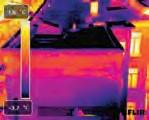
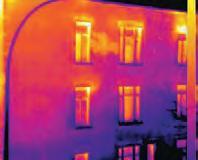
thermographie et Maîtres
Bilan de Santé Immobilier • Inspection de façades Inspection de toiture • Inspection intérieure Détection d'eau dans les revêtements Inspection d'équipements électriques pour assurance
Évaluation des pertes de chaleur
Détection d'eau
Détection d’eau
mur de briques
Confidentiality in coownership: are personal data too easily accessible? Sound management
Since March 31, 2023, new transparency requirements have required all enterprises registered with the Québec Enterprise Register(REQ)todeclarethedateofbirthandprovideacopy ofanidentitydocumentforeachmemberoftheirboardofdirectors.These new rules, introduced in the Act respecting the legal publicity of enterprises, are intended to strengthen the reliability of the data available in the register and to support efforts to combat tax evasion, money laundering, and corruption.
As legal persons, syndicates of co-ownership are no exception, and no exemption is provided for them, despite their unique organizational profile and greater exposure to errors. All of this is rather troubling.
While the objective of transparency is legitimate, it is also raising serious concerns in the co-ownership sector, particularly regarding the protection of personal information. These concerns have been brought to the attention of the Registraire by the RGCQ, which is advocating for a better balance between the need for transparency and the right to privacy of citizens who volunteer in the governance of syndicates
BROADENED ACCESS TO SENSITIVE DATA
The main issue raised by the RGCQ is access, through the “My Office” online platform, to the personal information of registered directors, both current and former. Any person declared as a director can therefore view their date of birth, without any restriction. This level of accessibility raises privacy concerns.
In this context, the risk of identity theft or malicious use of personal data is increased, particularly in the co-ownership environment, where turnover among directors is frequent and co-owners from one board to the next often know little or nothing about each other.
PROBLEMATIC TRANSMISSION OF IDENTITY DOCUMENTS
Another sensitive point is the circulation of copies of identity documents when updating information with the REQ. In practice, this task often falls to a director or the manager, who must collect and transmit supporting identity documents for all board members. This means that, in many cases, highly sensitive documents circulate between co-owners by email or through other informal channels.
Sound management
CONFIDENTIALITY IN CO-OWNERSHIP: ARE PERSONAL DATA TOO EASILY ACCESSIBLE?
Évaluateurs Agréés
LOI 16
Fonds de prévoyance
Carnet d’entretien
Attestation du syndicat
LOI 141
Valeur assurable (coût de reconstruction)
For now, the only ways for each director, on an individual basis, to securely submit their identity document directly to the Registraire are to send a paper copy by mail or deliver it at a Services Québec counter. These options are impractical and require additional coordination by the syndicate, which must ensure that all directors meet their obligations within the prescribed deadlines.
According to the RGCQ, these methods involve significant risk. It proposes a simple solution: allow each director to submit their identity document individually through the “My Office” platform.
SHARED RESPONSIBILITIES, BUT ONGOINGCONCERN
For its part, the Registraire notes that the current legislative framework relies on the responsibility of registered entities and their representatives: “Persons who have access to information within the enterprise must themselves handle the personal information they access with due care, in particular in compliance with the Act respecting the protection of personal information in the private sector.”
ANISSUETOWATCH
Failing a review of the underlying rules, technical adjustments could better protect former directors, notably by restricting access to certain data after the end of a mandate or by simplifying the secure, individual submission of identity documents. Such improvements would help ensure that transparency does not come at the expense of personal information protection and confidentiality.
In the meantime, boards of directors and managers must exercise caution and vigilance. Syndicates of co-ownership are now required to implement a governance framework for the protection of personal information and to publicly designate a person responsible for personal information protection. While transparency is essential to sound governance, it should never justify unnecessary exposure to fraud risk.
REMINDER!
In practice, however, directors are rarely trained to handle sensitive information, and in many syndicates no clear procedure governs the retention or destruction of transmitted documents. For the RGCQ, the solution therefore lies in revising data access rules so that the personal information of former directors does not remain accessible by default to their successors, especially where no direct relationship exists between them.
Read or revisit the article “Law 25 and the protection of personal data: A survival guide for directors,” published in the Winter 2023 edition (Volume 23, Number 4).
On January 15, 2024, the Superior Court of Québec issued a nearly 130-page judgment in the case Gestion George Kyritsis inc. v. Balabanian (2024 QCCS 64).
The Balabanian case is not only a legal victory, it is proof that human commitment can prevail over bad faith. After six years of procedural harassment, intimidation, and abuse of power, about twenty vulnerable co-owners prevailed against an all-powerful manager.
This case — a conflict involving undivided co-ownership in a 119unit building in Montréal became emblematic of how a poorly structured management system can go off track: concentrated power, lack of accountability, intimidation, and the maintenance of legal confusion between undivided and divided co-ownership.
A TWO-FRONT LEGAL BATTLE
An arbitration dispute
The case unfolds on two parallel fronts. An arbitration proceeding was launched as early as 2018, intended to resolve the dispute over how co-ownership fees were to be set. “Balabanian was at once the manager, a co-owner holding 80%
of the building’s shares, and a self-proclaimed lifetime director. He set the contributions per person. That is not only absurd, it is contrary to the law,” explains the co-owners’ lawyer.
What was meant to be a fast-track remedy turned into a nightmare. “When one party refuses to cooperate, arbitration becomes an illusion,” explains Me Ranger. Over four years, the process bogged down through repeated roadblocks, dilatory motions, and successive appeals. Everything was used to wear down the co-owners morally and financially, in the manner of a SLAPP-type strategy, since the opposing party was unaware that Me Ranger was working pro bono.
Experienced and seasoned arbitrator Me Michel Paradis ruled entirely in favour of the co-owners. “This decision gave the coowners momentum, but it will still be years before they actually recover their money,” notes Me Ranger.
* Editor’s note: The use of the term “co-owner” in this text should be qualified, since this case did not involve divided co-ownership governed by a declaration of co-ownership.
Profile
THE BALABANIAN CASE: AN EXCEPTIONAL CASE ESTABLISHING NEW PRINCIPLES IN CO-OWNERSHIP LAW
TimelineoftheBalabaniancase
2007-2016 Maher Balabanian converts a building into undivided co-ownership and amends the agreements to concentrate powers.
2018 Me Vincent Ranger accepts the mandate on a pro bono basis. Start of the arbitration dispute over co-ownership fees (arbitrator: Me Michel Paradis).
2018-2022 ALengthy arbitration, dilatory tactics by the ddddddddddddrespondent, and a proliferation of proceedings. ddddddddddddmultiplication des procédures.
2018-2024 In parallel, the main dispute is heard before the Superior Court. The preparatory phase lasts four long years, during which the applicants consider abandoning the case on several occasions.s.
15 janvier 2024 Final judgement $5.9 million awarded in compensatory, moral, and punitive damages against Maher Balabanian and his companies.
Orders for the sale of the building and distribution of the proceeds among the applicants.
3 février 2024 Publication of the judgment: the case makes headlines.
27 août 2025 Donation of $575,000 to the Collectif juridique by the co-owners and creation of the Les Copilotes program.
Balabanian’s ongoing back-and-forth on whether to proceed with arbitration revived the question of arbitrability in a co-ownership context. The case is instructive: certain matters — including the invalidation or annulment of notarial acts registered in the land register — cannot be submitted to arbitration because they involve matters of public order. In other words, declarations of co-ownership or undivided co-ownership agreements cannot bypass judicial oversight where real rights or issues of publicorderareatstake.
An unprecedented case before the Superior Court In parallel, the main dispute takes shape before the Superior Court of Québec, seeking recognition of the structural abuses of an oppressive and inadequate undivided co-ownership regime that had been turned into an instrument of control.
The lawyer quickly uncovered a carefully orchestrated fraudulent scheme deployed by the Balabanianbrothers,whomaintainedaclimateof fear in the building: psychological abuse, harassment, unsanitary conditions, intimidation through surveillance cameras, and more. “It was both complex and appalling,” recalls lawyer VincentRanger,whohadjustopenedhisfirm,Per Curiam,whentheCollectifjuridiqueentrustedhim with the case. “Maher Balabanian imposed arbitrary fines, sent unfounded and abusive demandletters,andpursuedresidentsassoonas they entered the building — all while avoiding his ownfees.”
Undivided
co-ownership and the blind spots of Québec law
Undivided co-ownership is a specific regime in which several persons jointly own a building, without physical division of the units. Each undivided co-owner holds a share of the whole and an exclusive right of use over a portion (often a dwelling). Unlike divided coownership, undivided co-ownership is not governed by a syndicate nor by equally strict financial transparency rules.
The Balabanian case shows how this flexible framework can become fertile ground for abuse: absence of a board of directors, inability to impose transparent contributions, and agreements drafted to suit the dominant co-owner. The RGCQ notes that this type of structure, common in Montréal due to conversion constraints, should be reserved for small buildings where the limited number of co-owners supports trust and respect for the spirit of the law.
Me Ranger first offered his assistance on a pro bono basis to a few co-owners before bringing together all the building’s co-owners, who until then had been isolated and distrustful. “The co-owners did not even know each other. There were major language barriers in this intercultural microcosm, making communication difficult. I realized the manager was using this to keep residents isolated,” he explains. Gradually, a sense of solidarity emerged. Modestincome families, newcomers, and seniors all discovered they were living the same daily ordeal, while also seeing theirfinancialsecurityerode.
Facing them, Maher Balabanian multiplied maneuvers to delay justice. The trial preparation phase dragged on: four years of case management, dilatory applications, counter-motions, adjournments, and hundreds of documents to be produced. “He changed lawyers seven times and ultimately represented himself, which further lengthened and complicated the proceedings,” notes Me Ranger. “He changed lawyers seven times and ultimately represented himself, which further lengthened and complicated the proceedings,” notes Me Ranger.
In 2024, the Superior Court finally ruled. The judgment denounced a “scheme to concentrate powers” and an institutionalized abuse by the majority co-owner who had manipulated the undivided co-ownership agreements. Articles 6 (good faith) and 1375 (performance of obligations) of the Civil Code of Québec now serve as guiding principles to correct inequitable agreements, even whentheywerefreelysigned.
Justice Janick Perreault ordered Maher Balabanian and his companies to pay nearly $5.9 million in compensatory, punitive, and moral damages, and ordered the sale of the building and distribution of the proceeds among the applicants.
For Me Ranger, it marked both the end of a long fight and a relief. “The co-owners used the word ‘deliverance.’ After years of fear, they could finally turn the page. I never wanted to make this a political symbol. I simply wanted them to be able to get out of there.”
LESSONS FOR LAW AND SOCIETY
Beyond the legal victory, the case exposes the weaknesses of a large-scale undivided co-ownership model designed for a few units but applied here to 120. With no board of directors and no contingency fund, the co-owners had no protection. “An undivided coownership with 120 units is a ticking time bomb,” summarizes Me Ranger.
WhoisMeVincentRanger?
Vincent Ranger is a partner at Per Curiam Avocats. Specializing in civil and administrative litigation, Me Ranger has developed recognized expertise in appeal strategy and the drafting of complex legal arguments. He combines his private practice with teaching law at the Université de Montréal and provides pro bono support to several community legal services. He currently serves as counsel to the Gallant Commission, which is mandated to review the management and security of Québec government information technology infrastructures.
Known for his rigor, commitment to the public good, contagious optimism, and genuine attentiveness, Me Vincent Ranger embodies a vision of law grounded in solidarity.
For the co-ownership sector, the Balabanian case sends a strong signal. It reminds us that undivided co-ownership remains a fragile framework where bad faith can take hold in the gaps of the law. It underscores the urgency of strengthening the oversight of agreements, clarifying arbitration rules, and promoting financial transparency.
Thesocialdimensionisjustassignificant.Byhighlightingthevulnerability of households faced with legal structures they poorly understand — legal complexity, cultural diversity, and fear of challenging a developer — the case reinforcestheimportanceofaccesstojustice.Mostofthewrongedco-owners weremodest-incomehouseholdsunabletosustainalonglegalbattle.Without pro bono counsel, the case would never have succeeded, as Justice Janick Perreault acknowledged in her judgment: “Without Me Vincent Ranger, this disputewouldlikelyneverhavereachedanoutcome.”
GOVERNANCE AND TRANSPARENCY: CASE LAW ALIGNS WITH THE REFORMS
Moreover, the Balabanian case affirms what the RGCQ has been advocating for 25 years, and what the new rules arising from Bill 16 are now putting into practice in order to prevent opacity and role confusion.
Full traceability of syndicate decisions, as well as a clear separation between directors, managers, and developers, is necessary.
Profile
THE BALABANIAN CASE: AN EXCEPTIONAL CASE ESTABLISHING NEW PRINCIPLES IN CO-OWNERSHIP LAW
VALEUR ASSURABLE ÉTUDE DE FONDS DE PRÉVOYANCE ET CARNET D’ENTRETIEN
Bureaux principaux : LAVAL - VILLE DE QUÉBEC
Sans frais 1 833 338-9710 info@gmaconsultants.ca www.gmaconsultants.ca
The maintenance logbook and the contingency fund study are not only management tools, but also tools for prevention and education.
Fromadvocacytosolidarity
Six years after the ordeal began, the co-owners regained a measure of peace. The saga concluded with an unprecedented gesture in the coownership sector. Part of the damages — those awarded for abuse of procedure and reimbursement of legal fees — was given back to the community.
In August 2025, the former co-owners donated $575,000 to the Collectif juridique to create the Les Copilotes program, dedicated to providing personalized legal guidance in coownership matters for citizens who cannot afford representation.
“On the one hand, I had not billed any legal fees. On the other, the justice system had been used against them. It seemed only right that this money should now help others defend themselves, especially given the prohibitive cost of justice, the endless delays, and the technical nature of co-ownership litigation,” explains Me Vincent Ranger.
The professionalization of the co-ownership property management profession continues to mobilize the RGCQ and its members. Recognized training and a proper legal framework will help prevent such excesses.
All things considered, the case will stand as a landmark — one in which the courts reaffirmed that co-ownership is not a private sphere beyond oversight, but a microcosm whose governance must be grounded in transparency, collegiality, and accountability. In a system often marked by mistrust, it shows that a well-founded judgment can still serve as a safeguard. Majority power does not grant the right to act above the law.
Info-management
Unlimited advice on co-ownership management
When it comes to co-ownership in Québec, it is best to rely on true experts. The RGCQ has brought together 13 experienced advisors whose mission is to answer members’ questions — free of charge. Here are some of the most frequently asked questions and our team’s answers.
Jean-Marie Dubuc Info-management advisor since 2017
Experience: RGCQ Management Info Advisor for more than six years (having answered more than 2,000 member questions to date).
Strengths: More than 12 years of study and networking in the co-ownership field through hundreds of RGCQ conferences.
Other involvement: Extensive and varied experience within syndicates of co-ownership: president of the board of directors of a 297-unit tower for six years; director of a horizontal syndicate of co-ownership with 857 units including three towers and a community and sports centre serving more than 1,800 residents, supported by an on-site management service with three full-time employees; director of a 33-unit co-ownership for five years.
Amember informs us that, in their building, many heat pumps have been installed over the years by co-owners, without any directives from the board of directors. These inconsistent installations have degraded the appearance of the exterior walls and led o issues such as:
visible and non-uniform ducts;
water runoff during defrost cycles affecting lower co-owners;
water infiltration in certain areas;
the presence of 19 units installed on the roof, with one co-owner now proposing that they be moved to the balconies.
The member is wondering what steps should be taken and what the board of directors’ actual role is in this situation.
1.The obligations set out in the declaration of co-ownership (DCO) Exterior walls, the roof, façades, and visible mechanical installations, such as heat pumps, are generally common portions or common portions for restricted use (CPRU). As such:
a co-owner may not install or modify a heat pump without formal authorization from the board of directors;
architectural harmony must be preserved, in accordance with the DCO;
non-compliant installations or those likely to damage the building may be subject to correction or removal requirements;
decisions affecting the building’s architecture and envelope fall under the authority of the syndicate of co-ownership, not individual initiatives.
2. Leadership rests with the board of directors
The disorganized installations described stem from a lack of oversight by the syndicate. The board of directors should take charge of the file and:
1. Have the existing installations and infiltration areas inspected.
2. Verify the obligations set out in the DCO.
3. Develop an overall plan covering location, appearance, ducting, water management, and noise.
4. Determine whether relocating the units installed on the roof is justified.
5. Obtain professional opinions on technical impacts, costs, and compliance.
6. Inform co-owners of the applicable rules for any future installation.
It is not up to a co-owner to propose or lead a collective project involving the common portions. The board of directors should first analyze the matter,thensubmitanyrequireddecisiontothemeetingofco-owners.
3. Additional elements
Once the legal framework has been clarified, the board of directors may also consider:
municipal regulations (noise, required clearances, required protections);
the availability and scope of installers’ insurance coverage;
potential grants, which should never replace proper planning.
CONCLUSION
The situation described clearly falls within the responsibilities of the board of directors, which should oversee, correct, and standardize installations affecting the building’s appearance and safety. The RGCQ would therefore recommend that the board undertake a structured approach, in compliance with the DCO, to ensure architectural consistency and the building’s long-term integrity
LEGAL NOTICE
This opinion is of a general nature and is based on principles applicable to divided co-ownership. It does not replace personalized legal advice or a full review of the declaration of co-ownership of the syndicate concerned.
Since the coming into force of Bill 16 in January 2020, the role of the co-ownership manager has evolved. The Certificate attesting to the condition oftheimmovableheldinco-ownership(CACI)isnolongerasimple administrative document; it is now an indicator of the quality of governance and the organizational maturity of a syndicate of co-ownership.
Preparing a compliant certificate is not just about filling out a form, but about conducting a genuine investigation. The manager must gather and validate a considerable amount of documentation, including the co-ownership register, the maintenance logbook, financial statements, the contingency fund study, engineering reports, minutes, the register of losses, etc. This work requires method, rigour, and an overall understanding of the building.
However, a major challenge remains: the lack of documented history. Changes in management, incomplete file transfers, and lost documents create gaps in the collective memory of syndicates of co-ownership. The manager then becomes a true “administrative archaeologist,” reconstructing the building’s history piece by piece.
This reality highlights the importance of a structured organizational memory. The certificate acts here as both a revealer and a catalyst, prompting syndicates of co-ownership to consolidate their records, correct their gaps, and establish lasting documentary continuity. This process, though sometimes demanding, becomes an opportunity for professionalization and accountability.
The certificate also raises a crucial issue — responsibility. Each item of information recorded may engage the syndicate and, by extension, the manager. Bill 16 introduces a new level of rigour that makes the manager the guarantor of the consistency and reliability of the information entered in the register. However, this responsibility has limits. The manager is
by SimonVanasse Director of the RGCQ —Montréal chapter
neither an engineer, nor an accountant, nor a notary; the role instead is to organize and present existing data while specifying its sources and limits. The manager attests to the rigour of the process, not to the absolute accuracy of the information.
A rigorous certificate therefore rests on transparency: documenting what is known, flagging what is not, and recommending the necessary corrective measures. This transparency does not weaken the syndicate of co-ownership; it strengthens its credibility. It reflects clear-eyed governance, aware of its strengths and of the areas that need improvement.
The manager thus acts as both conductor and ethical steward, balancing legal requirements, co-owners’ expectations, and on-theground realities. At CondoConsulte, we see this process as an opportunity for progress that fosters a culture of transparency, strengthens syndicate accountability, and builds trust in the professional management of syndicates of co-ownership.
Ultimately, the syndicate’s certificate is not a mere formality, but a tool for transparency, information consolidation, and protection of the collective asset. Behind each certificate lie hours of analysis and validation — patient, essential work that reflects a more structured coownership and more mature management.
Don’t forget the penalties in your declaration of coownership!
n divided co-ownership, the declaration of co-ownership constitutes the fundamental charter governing shared living and the use of private and common portions. Whitout an enforcement mechanism, however, the rules set out in the declaration risk remaining purely theoretical. The inclusion of penalty clauses helps ensure discipline and compliance with each party’s obligations by giving the syndicate of co-ownership concrete tools to respond to repeated breaches, whether they involve excessive noise, non-compliance with the by-laws, or interference with safety and enjoyment of the premises.
Penalties play, above all, a deterrent role. Their mere existence encourages co-owners to adopt behaviour that complies with the declaration, knowing that a breach will carry a financial consequence. When properly calibrated, penalties help maintain quality of life in the building. They also serve to recover legal fees that the syndicate must incur to initiate legal proceedings against co-owners who truly fail to meet their obligations.
However, penalty clauses must comply with civil law principles. It is therefore essential that the declaration clearly specify the offending behaviour, the procedure for imposing the penalty, the amount, and the methods of contestation in order to ensure transparency and avoid abuses of power by the syndicate of co-ownership. It should also be
by Me MichelParadis, partner at Therrien Couture Joli-Cœur S.E.N.C.R.L., president of the RGCQ — Québec chapter
remembered that judges called upon to rule on such matters have discretionary authority to reduce the severity of a penalty, where appropriate, depending on the circumstances.
Far from being a punitive instrument, penalties are an essential governance tool for effectively regulating coowners; every syndicate of co-ownership should include an applicable clause to this effect in its declaration. Such clauses must be adopted by a qualified majority (section 1097 C.C.Q.) and notarized, since they must form part of the constituting act of co-ownership. The effort is truly worthwhile.
Editorial | RGCQ – Outaouais chapter
Harmonizing codes: a proven practice
Under the Canadian Constitution, with respect to the division of powers, the field of construction fallsunderprovincialjurisdiction.InQuébec,theauthorityresponsible in this area is the Régie du bâtiment (RBQ). Its mission, functions, powers, and governance model are defined in the Building Act. As enabling legislation, this Act grants the Régie the authority to adopt, by regulation, a Construction Code as well as a Safety Code. The Construction Code applies to contractors and sets out the standards to be followed to ensure quality work. The Safety Code applies to owners and encourages them to keep their equipment in good condition through a rigorous maintenance program. It should be noted that section 9.1 of the Act treats a syndicate of co-ownership as an owner.
As for the federal government, it plays more of a regulatory role and acts through various organizations. Notably, the National Research Council of Canada (NRC) publishes, together with the RBQ, the Québec Construction Code Chapter I, Building. The Canadian Standards Association (CSA), in collaboration with the American Society of Mechanical Engineers (ASME), also publishes the ASME A17.1-2019/CSA B44:19 code on elevators, which has been incorporated into the Construction Code, as described in the following paragraph.
Provinces and municipalities, by adopting in their regulations a standard or code drafted by a recognized standards body, do not have to reinvent the wheel. They do so through a process that “incorporates by reference” the required standard or code, modifying it as needed to suit their requirements.
By way of example, let us review the harmonization process between the RBQ and certain standards organizations as applied to the new regulation on elevators and other lifting devices published in the Gazette officielle, Part 2, on May 29, 2024:
● Order in Council 848-2024
by MichelMancini, director of the RGCQ — Outaouais chapter
Regulation amending the Construction Code, Chap. IV, ss. 4.01 to 4.24
s. 4.16 : approximately 23 pages amending the ASME A17.1-2019/ CSA B44:19 code
● Order in Council 849-2024
Regulation amending the Safety Code, Chap. IV, ss. 90 to 99
● Order in Council 850-2024
Regulation amending the Construction Code, Chap. I.1, Building Energy Efficiency
ss. 1.1.1 and 1.1.6: approximately 203 pages amending the National Energy Code for Buildings (NECB), published jointly by the NRC and the RBQ
Finally, at the municipal level, the City of Gatineau states in By-law No. 774-2015 on fire prevention that the by-law provides for the “systematic incorporation” of the Québec Safety Code, Chapter VIII — Building, as well as the National Fire Code of Canada 2010 (as amended), into the regulatory text “as if they formed part of it,” subject to certain modifications.
2025 Review: A Year of Consolidation and Outreach for the RGCQ
The Info-management service, a true support pillar, handled nearly 2,272 requests from our members. Behind every call or email is a syndicate of co-ownership seeking clear, practical answers to better manage its building, along with dedicated volunteer advisors who show up day after day.
In terms of legal support, more than 534 free consultations were provided thanks to the valuable collaboration of our partners
These exchanges enable syndicate directors to better understand their rights and obligations and to act in an informed manner for the benefit of their co-ownership.
With respect to activities, the RGCQ offered more than 48 training sessions and events, bringing together 4,000 participants across Québec. These learning and networking opportunities helped build strong connections among stakeholders in the field and share essential knowledge on co-ownership management.
The year 2025 also marks an important milestone in the RGCQ’s development with the creation of a new chapter in Estrie. This expanded regional presence will make it possible to provide closer support to syndicates of co-ownership in the region and to strengthen our mission of being present wherever co-owners need support and information.
TOOLS TO UNDERSTAND AND INFLUENCE
The RGCQ also plays a role in representation and reflection on issues affecting co-ownership. With this in mind, we have made available to everyone a dedicated page bringing together our briefs and official submissions to governmental and public authorities. There you will find our positions, analyses, and proposals on the issues shaping the future of co-ownership in Québec.
Consult our briefs by scanning the QR code.
This space is intended to make our representation work more transparent and accessible, while enabling our members and the general public to better understand the positions defended by the RGCQ on behalf of co-owners and syndicates of co-ownership.
On the Road to 2026
The year 2026 is already shaping up to be promising. The RGCQ will continue its mission to provide you with the best possible support through our tools, training, activities, communications, and services. Our priorities remain the same: to keep you informed about everything happening in the field of co-ownership and to simplify your obligations and daily tasks.
Thank you for your loyalty and commitment throughout the year. Welcome to all the new members, partners, and collaborators who have joined our organization!
Theco-ownership referenceisbeing renewed
Discoverthe3rd edition!
We are pleased to announce the release of the 3rd edition of the book *Le condo: tout ce qu’il faut savoir*, fully updated to reflect the most recent legislative and regulatory changes affecting divided co-ownership in Québec.
An essential reference for co-owners, directors, and co-ownership managers, this new edition is also an excellent gift idea for anyone who wants to better understand and master co-ownership.
Order by scanning the QR code.
Fallah Architecte
mmeubles inc
Calendar I Upcoming Activities and Training
At the RGCQ, your reality is at the heart of our priorities. Each year, we design and deliver more than 50 practical training sessions covering technical, legal, administrative issues, and much more.
Whether you are a member or not, you can register. These training sessions are intended for all co-owners who wish to better understand their role and acquire the knowledge needed to support effective, informed, and sustainable co-ownership management.
Discover everything the RGCQ has in store for you this year!
Training, exclusive activities, and networking opportunities: A program designed to strengthen your expertise and energize your involvement in your syndicate of coownership.
Register now at rgcq.org and don’t miss a thing. We look forward to seeing you there!
Activities and Training from January to June 2026
DATE
8 janvier Provincial Webinaire Vitrine sur la copropriété – Portes et fenêtres : Éléments clés d’une gestion partagée en copropriété En ligne
13 janvier Provincial Webinaire Perte d’autonomie : Subventions et solutions pour votre copropriété En ligne
15 janvier Provincial Webinaire Crédit d’impôt et maintien à domicile En ligne
20 janvier Provincial Webinaire Déclaration de revenus et fin d’année financière En ligne
22 janvier Provincial Webinaire Aire commune : assemblée générale annuelle (en anglais exclusivement) En ligne
23 janvier Provincial Webinaire Midi Express : Protection des données personnelles – Comprendre et appliquer la Loi 25 en copropriété En ligne
27 janvier Provincial Webinaire La déclaration de copropriété : comprendre ses fondements, ses obligations et sa mise à jour En ligne
3 février Provincial Webinaire Gestion des parties communes en copropriété : comprendre ses fondements, ses obligations et sa mise à jours En ligne
17 février Provincial Webinaire Vitrine sur la copropriété – Débuter en copropriété : vos droits, vos devoirs et les clés pour bien s’orienter En ligne
19 février Provincial Webinaire Efficacité énergétique des bâtiments : à quoi s’attendre? – Appui du modèle français En ligne
24 février Provincial Webinaire Gestion des impayés : outils juridiques et leviers pour le syndicat de copropriété En ligne
3 mars Provincial Webinaire Cybersécurité et responsabilités en copropriété : éclairage juridique pour les syndicats En ligne
10 mars Provincial Webinaire Copropriété horizontale : démystifier un format méconnu En ligne
13 mars Provincial Webinaire Condo 101 – En deux modules En ligne
17 mars Provincial Webinaire Parties communes à usage restreint En ligne
7 avril Provincial Webinaire Rendre sa copropriété plus verte : innovations accessibles et subventions clés En ligne
14 avril Provincial Webinaire Vitrine sur la copropriété – Nuisances ordinaires : la vie en copropriété En ligne
17 avril Provincial Webinaire Tout sur l’assurance condo – En deux modules En ligne
21 avril Provincial Webinaire Premiers pas en administration de copropriété : les fondamentaux à connaître En ligne
28 avril Provincial Webinaire Finances en copropriété : de la base à l’efficacité fiscale En ligne
Problèmes de fenêtres ?
Ne les remplacez pas !
Services
Remise à neuf et réparation de tous types de portes et fenêtres
Remplacement de thermos et rampe de verre
Amélioration performance par insertion de thermos à la place de verre simple
Recherche et correction de problème complexe de l’enveloppe du bâtiment
Service spécialisé, solution et expertise unique (usinage pièce, impression 3D)