DowneastDog_April 2026

Page 1


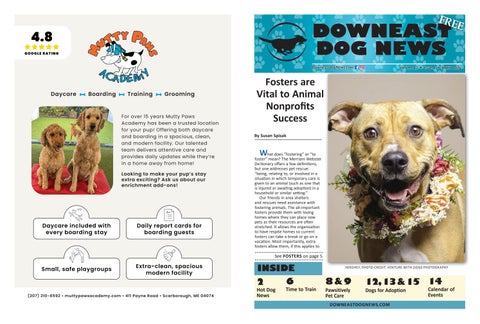
Fosters are Vital to Animal Nonprofits Success

What does “fostering” or “to foster” mean? The Merriam Webster Dictionary offers a few definitions, but one addresses pet rescue: “being, relating to, or involved in a situation in which temporary care is given to an animal (such as one that is injured or awaiting adoption) in a household or similar setting.”

Our friends in area shelters and rescues need assistance with fostering animals. The all-important fosters provide them with loving homes where they can place new pets as their resources are often stretched. It allows the organization to have respite homes so current fosters can take a break or go on a vacation. Most importantly, extra fosters allow them, if this applies to

HERSHEY, PHOTO CREDIT: VENTURE WITH DOGS PHOTOGRAPHY

Hot Dog News

Poem by RoscoeSoul Friends Pet Expo

As I trample through the spinach I think of all the Humans

All their chlorophyl dreams, Plant based fantasies

I remember their salads all their smoothies

That dumb look on their faces When they sauté chard

A heart-forward event dedicated to local rescues, second chances, and meaningful connections held at The Furniture Gallery in Bangor, May 17th, 11-3.

This expo is all about giving our amazing local rescues a space to shine. Come meet rescue groups, learn their stories, and connect with animals who may be searching for their future families. While there will be no onsite adoptions, attendees will have the opportunity to submit applications for pets they feel drawn to and want to learn more about.

Meet and connect with local escue organizations

• Learn about animals currently available through those rescues

• Submit adoption applications (no same-day adoptions)

• Support the rescue community in a calm, positive environment

Bringing your own pet? We’d love to have them—as long as they are petfriendly, well-controlled, vaccinated, and supervised at all times. We ask you to always keep your dog distance from the rescue dogs. Pet owners are fully responsible for their animals during the event.

Whether you’re hoping to adopt someday, support rescues, or simply show up for the animals who need visibility, this event is for you.

This is a space rooted in respect, safety, and love—for animals, rescues, and the people who care about them.

Let’s come together to support rescue, raise awareness, and help future soul friends find their way home.

Dogs of Freeport by Walter Bannon

er losing Tanner, I had a hole in my heart that I couldn’t seem to patch. Ten years of loving companionship passed so quickly. I wasn’t prepared for the days, weeks, and months of solitude that followed.

Driving south on the Maine Turnpike always required a stop at the Kennebunk rest stop. Tanner would sniff every tree base and leave his fragrance atop the zillion other scents there. This time in Kennebunk, however, I held no leash in hand and had no reason to walk around the dog park. Nevertheless, I felt compelled to go there and retrace the steps Tanner and I took so recently.

Hoping for more solace, I decided to drive to the ocean and reminisce. That’s when I realized that the community was very supportive of canines and seemed to cater to dog owners. I saw so many cute pooches walking the beach that I resolved right then and there to write a book about the immense love between pups and pup handlers. I planned to fill the pages with heart-touching images and short stories of personal experiences. Perhaps, in a way, it was my route to closure after my loss.

The project, unfortunately, sat on a shelf due to other priorities in life. That was until I moved to Freeport and was

slapped in the face by the amount of canine catering that I witnessed here. I knew right then that it was time to dust off my dreams and get my camera lenses ready.

The learning curve for approaching strangers with quadrupeds on a taut line was quickly dispatched. The laughable experiences could fill another book with interesting tales. I’ll save those stories for public speaking events while spending my retirement hours planning a movie plot or play script about comical canine adventures.

From the Publisher Downeast Dog News

PUBLISHER

Jenn Rich

COPY EDITOR

Belinda Carter

CONTRIBUTORS

Susan Spisak

Sara Moore

Judith Herman

Carolyn Fuhrer

Don Hanson

Brooke Chauncey

Rebecca Aube

Diana Logan

GRAPHIC DESIGN

NVDesigns • Nicole Vanorse

ADVERTISING

Jenn Rich 207-706-6765

jenn@downeastdognews.com

PRESIDENT Wendi Smith

PARENT & PUBLISHING COMPANY

Maine Pet News LLC

OUR GOALS

• Provide the latest in dog-related news and information.

• Encourage and support dog-friendly businesses and Maine-made pet products and services.

• Cultivate a community of responsible dog guardianship/ownership.

• Support animal welfare causes.

CONTACT US

Maine Pet News, LLC

16 Tannery Ln., Ste 21, Camden, ME 04843

Phone: 207-706-6765

jenn@downeastdognews.com www.downeastdognews.com

CIRCULATION

Downeast Dog News is distributed free of charge at grocery stores, pet stores and other Maine locations.

SUBSCRIPTIONS

Individual and gift subscriptions are available for $40 (includes tax) per year.

SPEAK!

Downeast Dog News welcomes submissions of local news, events and photos. Email: jenn@downeastdognews.com

COPYRIGHT 2006-2026

All contents of Downeast Dog News are protected under United States copyright law. The contents may not be reprinted or reproduced without the expressed written permission of the publisher. The views and opinions expressed within Downeast Dog News are those of its contributors and not necessarily those of the publisher. Content of ads is the sole responsibility of the advertiser. Every effort has been made to ensure the accuracy of the content and Downeast Dog News assumes no liability for any errors, omissions or claims made by its contributors or advertisers.

Dear Dog News Readers,

It is finally spring! For those of us that live here in Maine we know that does not mean we won’t see more snow or cold temps but let’s keep our fingers crossed. I am ready to spend more time outside and for the color to come back – green grass, leaves on the trees and flowers! Of course, with all of this also comes the ticks so be prepared. They can emerge even when the temps are in the 40’s.

My baby Pepper is turning 12 this month on 4/14! I cannot believe it. Time goes by way too quickly when it comes to our dogs. I feel so blessed to have this amazing girl in my world. Happy birthday Goosey! (one of her many names) I couldn’t love you more!!

To help break up the winter boredom, Pepper and I ventured to Gardiner to the new Mr. Dog Training Canine Enrichment Center. It was a perfect day for it as it was gray and kind of icky out. I booked us an hour and we had the place to ourselves. Pep tried out some of the agility equipment, fetched her ball and did lots of sniffing around. She had the biggest smile on her face on the ride home and we will certainly return. This is so great for us since we try to avoid other dogs due to Pepper’s reactivity from her dog park incident. Perhaps we’ll schedule something for this month to celebrate her birthday.

Cheers to spring!

Dog of the Month! AXHÜL

4 months old

He’s from Mississippi. He loves playing with his brother and loves all kinds of toys. He also loves chasing after squirrels.

If you’d like to submit a photo of your dog to be considered for Dog of the Month, send it with a small description of your dog (cool trick, silly thing he does, favorite toy) to jenn@ downeastdognews.com or mail it to: 16 Tannery Ln., Ste 21, Camden, ME 04843. Each month one will be selected to be printed in the paper.

Contact

Jenn Rich (207) 706-6765 or jenn@downeastdognews.com

Can you hear that? It’s the crocus and spring bulbs poking through the thawing earth!! Or it’s the sound of dogs covered in mud trampling through the house giddy that the snow has melted filled with bliss from finding forgotten toys that had been buried all winter. Either way I’m happy to be heading into the warmer months. In this column I use my psychic abilities to answer questions about your pups. I receive the reading through images that pop into my head like a movie, I feel what they are feeling physically and sometimes it’s like a conversation between the two of us. It’s never a replacement for licensed veterinary care but can be used in conjunction with it. Let’s get started!

Nakia C. asked about Dash, her Tzu’dle. “Why can’t he be left alone? I have to unvelcro him from me! Also, why does he pee so much during the night?” He says that he showed up when you didn’t really want to be here, and he’s your anchor. Be mindful of how you phrase your words. Even saying, “I’ll be happy when I get to heaven” (using a random example) makes him afraid you really want to go. He holds

Furry Words

I bet things will shift! Have a chat with him and let him know you’re not going anywhere, and he’s off the clock unless you tell him otherwise.

space for you all day to let you know you are loved and he takes his job very seriously. At night, you FINALLY let you guard down and that’s when he releases all of the pent-up energy he’s holding in his body. I see you doing breathwork to help you energetically stay in balance, and

Optimum Gut Health

Q.There is so much talk about gut health in people. What about dogs?

A. Like human medicine we are finding out how important gut health is in dogs. Environmental impacts and giving drugs, pesticides, poor diet, and water will affect a dog’s well-being. Besides the skin the gastrointestinal tract (GI) is a major line of defense against disease.

The GI tract begins in the mouth. Here the teeth, gums, saliva, and microbiome, the good bacteria normal in the mouth, start the process of digestion and health. Next is the esophagus and stomach. The stomach has a normal acidic environment to further break down food. The small intestines, pancreas, gall bladder are the next step in digestion but also, when healthy, prevent viruses, toxins, bad bacteria, and yeast from getting into the body. Now the last part of the GI tract is the colon. This final segment is important in absorbing water, nutrients like vitamins and electrolytes, and bacteria that further break down remaining material to be stored in the rectum until the dog defecates.

A s guardians of our best friends, we can maintain good gut health in several ways. The first being good food and a clean mouth. Dogs are non-obligate carnivores. Their mouth structure and teeth are made

Deb J. wants to know about Lilly, her Golden Retriever. “I feel as though she has a spirit inside her. She answers our questions by blinking.” Now this is an interesting answer, but it makes total sense to me. There’s a lot of energy of your loved ones in Heaven in Lilly, but they come through like the old gum that had striations of different colors. I want to say Juicy Fruit, but I’m not sure that’s right. Or picture a stack of different colored crepes or pancakes and layer them up. All of your elders are here to gently guide you on your path, and you’re choosing to live consciously, which is profound. So yup! They’re all in there but come through in the beautiful energy of Lilly!

Nedda J. wants to know if her black dog Sebago is in pain. I’m not a vet but when I feel her body, the left hip lights up first. It feels as though her hips are tilted down/forward and then slightly to the left. She says no to chiropractic but would love cold laser treatment if it’s available. Check

Ask the Vet…

for ripping up tissue and crushing soft bones. With strong chewing, dogs keep their teeth clean from plaque and gums clean. A health microbiome in the mouth will also regulate inflammation and support the immune system. Symptoms of dysbiosis (an imbalanced microbiome) are bad breath, gum disease, loose teeth, and potential disease in other areas of the body. To maintain good health adding oral products such as probiotic and enzymes can help prevent oral disease.

Feeding a balanced diet without sugars and additives will provide the nutrients to maintain good health. The term leaky gut is used when optimum gut health is lacking. The intestines are lined with little fingers called villi. These villi are lined up tight together to prevent big proteins, viruses, bad bacteria, and

with your vet first!

Tracy N. wrote, “My female Boston Terrier/Pug mix has started to limp and slow down. Her vet said she’s fine but I’m worried. Oh my. Your dog is getting older, but she is absolutely milking it! I joke that when I’m old and my grandkids are adults, I’ll happily have them bring me something, so I don’t have to get up if I’m comfy. She’s loving being old! So, I have to ask you, are you allowing yourself any grace or still trying to do it all yourself?

Lori B. lost her dog Frankie, a French Mastiff. “What caused her illness?” I get a weird cramping feeling below my left breast and possibly entangled with her ribs. She can’t tell me exactly what it is, but by the time she realized it wasn’t just gas, she was closer to heaven than healing. She’s going to fill your yard with blue butterflies this summer! My heart is with you, and she’s enjoying being in heaven, and you’ll see her when it’s your time.

FMI on Sara go to www. enlightenedhorizons.com and follow along on Facebook at Sara Moore Enlightened Horizons.

toxins from being absorbed into the blood stream. Digestive enzymes and a healthy microbiome are important to maintain good environment and health by breaking down nutrients so tiny they are easily absorbed through the villi. The most common reasons for dysbiosis are drugs and medicines taken during your dog’s life. When the gut is unhealthy, we can see diseases like allergies, liver inflammation, urinary track disease and GI symptoms. Sibo is a condition in the small intestines, where bad bacteria overtakes good bacteria and makes your dog sick. Signs of Sibo are abdominal pain, diarrhea, malabsorption. Also, we can see colitis, the inflammation of the colon, with symptoms of diarrhea, mucous, blood, and gas.

The major supplements to support a healthy gut are digestive enzymes, prebiotics, and probiotics. Prebiotics (fiber) are the food to feed the good bacteria. Probiotics are the good bacteria to support gut health, digestion, and the immune system. Digestive enzymes are needed to aid in nutrient absorption. These supplements help manage diarrhea, gas, and targeting 70% of the immune system in the gut. Prebiotics are found in pumpkin, psyllium, fructooligosaccharides (FOS). Probiotics have gotten a lot of press. Not all probiotics are the same. Select one that is formulated for dogs. Ask your veterinarian which ones she recommends. Digestive enzymes should also be formulated for your dog. Other soothing agents when gut disease is present are slippery elm, ginger, and turmeric. These will help calm the GI tract. Ask

your veterinarian to do a GI panel to assess the pancreas, folate, and vitamin B12 if your best friend is suffering from chronic diarrhea.

O ther diseases that have improved with a healthy gut especially concerning the microbiome, which we wouldn’t think of directly are allergies, not just gut but also skin. Ear infections are a common problem from leaky gut, also, liver, heart and kidney disease.

The last but important aspect of gut health is the emotional and mental stability of your dog. Research has found that the gut microbiome directly influences behavior, common problems as anxiety, aggression, phobias, and stress. This occurs via the gutbrain axis, where the gut bacteria produce neurotransmitters and influence immune function. Studies have linked specific gut profiles with aggression and phobias. Other studies show dogs with behavioral issues often exhibit dysbiosis with specific gut profiles linked to aggression and phobias.

To improve Fido’s overall mental, emotional, and physical health follow these simple rules: feed fresh, whole foods rich in polyphenols and fiber (berries, and vegetables). Adding probiotics and prebiotics will help. Allow your dog to interact with nature by sniffing and walking in grass and dirt.

Judith K. Herman DVM, CVH Animal Wellness Center Augusta, Maine 04330 www.mainehomeopathicvet.com

their mission, to bring in out-of-state dogs pulled from high kill shelters, truly saving them from euthanasia.

Fosters provide countless benefits to pets. If they’ve been relinquished, to have the comfort of a home, and a person again, is something they’re grateful for. If they were pulled from a shelter, to have a warm bed, to be able to relax, and to taste freedom is an unknown luxury. For dogs who have been mistreated, fosters are an important cog in dogs re-learning love and changing their mindset about people. While it may not be an immediate, easy road in any situation, the result is clear: the fosters are instrumental in their growth, and the bond between them is unmistakable.

Two organizations in desperate need of fosters to help with their intake population are Pittie Posse Rescue and Sanctuary and Catahoula Rescue of New England: Houlas and Healers. It’s important to note, they also need approved adopters who are willing to understand their unique breeds.

Pittie Posse Rescue and Sanctuary, a Portland area nonprofit committed to responsible dog ownership, was co-founded a decade ago by Britt Bolnick with her husband Sully Sullivan. They currently have sixteen fosters who help care for their intakes, primarily from Clayton and Fulton Counties in Georgia. Additionally, they take in local owner surrenders, and dogs seized in cruelty and criminal cases across Maine.

Britt wanted to reassure potential fosters and adopters about Pit Bulls, an umbrella term for breeds such as the American Staffordshire Terrier, American Bully, and American Pit Bull Terrier. These dogs are frequently misunderstood, and many have inaccurate impressions of them. Britt wanted to provide clarity for those considering fostering or adopting, emphasizing that understanding their true nature is essential.

“Dogs are a responsibility, just like children. They need love, veterinary care, training, exercise, enrichment, and respect. If you give them that, they will reflect that and be your best friend for their entire, too-short lives. If you neglect or mistreat them, they will reflect that instead,” explained Britt. And to tip potential fosters off on their overall personalities, Britt said they’re loving, smart, loyal, dedicated, goofy, and they can be

high energy, or couch potatoes.

She’s adamant about force and fear free, positive training (as all responsible nonprofits /breeders/ shelters are). “Dogs who have already suffered any combination of neglect and abuse need kindness, confidence, and to build trust in their trainers and family, not to be further intimidated, frightened, and hurt in the name of ‘training.’”

Britt said when you are a foster for the group, you get an entire team to support you, and with any need that arises. “Every foster of ours has a dedicated, private chat with an entire team of our inner circle for addressing training questions, needs for supplies, medical issues, behavior questions, and anything else you need as a foster.”

For people who are busy or work, and feel they couldn’t foster, Britt and Sully own The Bark Yard in South Portland, an award-winning daycare, grooming, training, and boarding facility. Fosters can utilize this and be comfortable knowing their charges are well-cared-for and receiving further socialization, an important part of fostering. (Note: fosters are not required to live in southern Maine.)

Warren-based Catahoula Rescue of New England: Houlas and Healers has been around for over twenty years. Founder and Director, Shannon Nachajko, said they currently have about thirty fosters, but their schedules fluctuate based on availability.

Their intakes include Catahoula Leopard dogs, Catahoula mixes, and Australian Cattle Dogs, and they’re from shelters, rescues, or are owner relinquishments. She said they also get calls from vet clinics that have had dogs surrendered to them and need help as well.

Shannon said they always need fosters. She admitted the breeds they specialize in are not for first time owners or those with zero experience. “If you want one because ‘they are pretty’ then get a doll. They are not for you. They come with a big attitude and require a lot of exercise daily!” Same would go for potential fosters. That said, they are loving, active, and are fiercely loyal.

But if you are dog savvy, she knows you’ll enjoy them. “These dogs are exceptional breeds. If you have experience, they are so much fun and they challenge you in ways that up the ante, making you a better dog owner and trainer, because you must be on

heart and home. “We stress that fostering is about teaching the dog to be a dog again, not teaching tons of tricks or obedience. We want the animal to decompress and breathe again. We want it to adjust to a home so we can see how it does and learn the pros and cons it has to living in a house. That way we know where it will do best when it comes to placement.”

They have a specific foster program. A few things fosters are asked to work on are housebreaking, socialization, and leash manners. She said they prefer not to totally train the dogs, instead they like for adopters to finish steps as it adds to their bond.

If you cannot foster, but would like to assist them, Pittie Posse needs supplies, and wet and dry dog and cat food for their free Pet Pantry.

Please Support Our Advertisers

Catahoula Rescue of New England needs volunteers for office and social media duties, fundraising, and events. For info on both, pittieposserescue. com/ and nehoularescue.com/.

"HONORARY CATAHOULAS"
CRNE WAS ASKED TO HELP THESE TWO BONDED WEIMARANER GIRLS.
TANK, PITTIE POSSE RESCUE & SANCTUARY

How one Trainer Prepares

It has been a while since we added a young puppy to the family, 2009 to be exact. Skipper was an “elderly puppy” at 4 months old when he joined us in 2019, plunging headlong into adolescence at the time. Astro, our resident dog, was 10, and it was hard on him to deal with such youthful energy and rudeness.

Skipper turns 7 in early April and has no idea that his birthday present will be a 10-week-old puppy. Oh yay?

The Unknown I ’m enthusiastically looking forward to meeting Puppy (we’ll refer to her as “Puppy” for now until we decide on a name). I confess, a certain level of trepidation is mixed in with my excitement. This is normal, even for trainers. No matter how much research, thought, and careful consideration go into making the decision to add a pup of any age to the family, it’s still a bit of a crap shoot. All the virtual boxes may have been checked, but each individual puppy is just that: an individual. She’s a product of generations of genetics, of extraordinarily

Time to Train

influential early experiences with her mamma and critical conditioning with the human(s) present early on. Every interaction counts and can have a significant and lasting effect on a puppy’s life. We are crossing our fingers that we’ve made a good decision.

Sit/Down/Stay/Heel: on Hold

Sure, I’ll blend some “obedience” skills into our day-to-day life, but they will all take a back seat to the much more important mission of building trust with our new friend and helping her feel safe in her drastically changed world. I will

work on discovering what brings her the most joy and integrate that as much as possible into her life. Safe confinement options Crates, pens and gates will be available on each floor of the house, and I will set some of them up in advance, so Skipper gets used to their presence. You never know when a marauding and bewitched knife-wielding Puppy devil will sprout from the sweet and innocent-looking floofball you just welcomed into your home. Confinement of said creature is essential for everyone’s welfare. The emergence of such a devil is part of living with a puppy, but it can be extremely challenging. I want Puppy to learn to feel comfortable separated from the action, whether she’s in a crate, a pen, or in a different room. This will take lots of intentional training and planning. She will already have had a head start at the breeder, but there will be lots more work to do to ensure she’s a happy camper. Separation will help with housetraining, set a pup up to learn how to selfentertain, learn to settle and to feel comfortable when she can’t access family members. Because I work primarily from home, I will have to make a concerted effort to work on separation.

of the resident dog(s) when we are considering adding another. How can we keep Fido happy?

Fortunately, Skipper is accustomed to interacting with puppies on a regular basis and has good dog communication skills. He thrives at playing host to guest dogs, but puppies can be incessant, loud, persistent harassing little monsters, too much to bear for anyone.

Unfortunately, he is terrible at setting boundaries. He risks teaching Puppy that she can do anything she wants, without consequence. Without careful management, he will become stressed and have no idea how to detach a little furry shark from his body. He, too, needs some training so that I can save him. I ’m working on teaching him a verbal cue to get onto the couch: a puppy-free zone. He is likely to be crated more often and in different situations, so he’s getting some practice with it.

A side from the above, Skipper is going to be very jealous. I've started to reward him for settling on his dog bed and to perch in different parts of the house. This attraction will become important when I want to work with Puppy but not him.

Puppy

Proofing

I will gate off our shoe rack, pull up throw rugs, and crawl around on the floor in an attempt to identify We’re Getting a PUPPY!

Don’t Forget the Resident Dog We must take into consideration the skills, temperament, and welfare

See TRAIN on page 14

Museum of Maritime Pets

Third Annual Mini-Golf Charity Benefit

Saturday, May 9 - 10AM to 2PM Golfer’s Crossing, 7 Country Way, Rockport

$20 for adults/$12 tots to age 17. Prizes - Refreshments Rain or shine.

9:30 AM Come play with Maine Mini Golf Tour Pros Register online:

Or call (207)390-5909 Deadline: May 7, 2026

• Overnight care

• Emergency surgery

• Exotic emergencies After-Hours and Weekend Veterinary Care

• Trauma stabilization

• Comprehensive in-house bloodwork & imaging

191 Camden Road Warren, ME 04862

MidcoastAEC.com 207-273-1100

See our ad on page 16

“I feel that dogs can teach children a whole lot about love and devotion, and I think this world could always use a ton more of that today.”

Photographs and short stories of dogs visiting Freeport.

Author is available to speak at schools and community events.

Book is available at Amazon.com

Hearing that your dog or cat has cancer can feel overwhelming and frightening. For many pet owners the diagnosis brings a wave of difficult emotions and questions about what to do next. When chemotherapy is recommended as a treatment option, it is common for owners to feel hesitant or uncertain. Many people immediately think about the challenging experiences that human cancer patients face during chemotherapy, including severe nausea, hair loss, and fatigue. Because of these associations, pet owners often worry that their dog or cat will suffer through similar side effects or have a poor quality of life during treatment.

However, veterinary chemotherapy is typically approached very differently from chemotherapy used in human medicine. The primary goal in veterinary oncology is not only to treat the cancer but to preserve the pet’s comfort and overall quality of life. Therapies are carefully designed to minimize discomfort and allow animals to continue enjoying their normal activities.

Chemotherapy in animal companions is different than in humans

When people think about chemotherapy, they often imagine

the intense side effects that many human patients experience. In human medicine, treatment protocols are often very aggressive because the primary goal is to eliminate the cancer and increase survival time. In contrast, veterinary chemotherapy usually follows a more balanced approach that focuses on both controlling the disease and maintaining a good quality of life for the pet.

One of the key differences is the dosage of chemotherapy drugs. Pets typically receive lower doses than those used in human patients. In many cases, the aim of treatment is not necessarily to cure the cancer entirely but to manage it as a chronic condition.

Because of this approach, many dogs and cats undergoing chemotherapy continue living happy, active lives and still enjoy activities such as going for walks, playing with toys, eating their favorite treats, and spending time with their families.

But what about side effects?

A common concern among pet owners is how their dog or cat will feel during chemotherapy. While side effects can occur, they are often milder than those experienced by human patients. According to guidelines from the American Animal Hospital Association, approximately 15 - 30% of dogs receiving chemotherapy

experience noticeable side effects during treatment.

Most of these side effects are temporary and manageable. Common signs may include vomiting, diarrhea, reduced appetite, and decreased energy. Some pets may also experience a drop in white blood cell counts, which can increase susceptibility to infections. Close monitoring during treatment is used to detect and manage these issues early on.

Serious complications are relatively uncommon. Research suggests that only about 5–7% of dogs undergoing chemotherapy develop severe side effects requiring hospitalization. If side effects do occur, veterinarians can often adjust the medications, dosage, or provide supportive treatments to help pets recover quickly. Is treatment right for my pet?

Deciding whether to pursue chemotherapy is a deeply personal choice for every pet family. Factors such as pet temperament, overall health, financial cost, and time investment should be considered.

Despite initial concerns about side effects, research consistently shows that many pet owners are satisfied with their decision to pursue cancer treatment. Surveys have found that approximately 70–90% of owners whose pets received chemotherapy or

other cancer therapies say they would make the same decision again if faced with the choice.

Many owners reported that treatment provided valuable additional time with their pets while allowing them to maintain a good quality of life. Talking to your veterinarian

If your dog or cat has been diagnosed with cancer, one of the most important steps you can take is to have a conversation with your veterinarian or a veterinary oncologist to discuss treatment options and help you understand what to expect throughout the process.

Some helpful questions to ask during your appointment may include:

• What is the main goal of chemotherapy for my pet?

• What side effects are most likely with this specific treatment plan?

• How will we monitor my pet’s comfort and quality of life during therapy?

• What symptoms or changes should I watch for at home?

Every pet and every type of cancer is different, so treatment decisions should always be tailored to the individual pet and family’s goals. By working closely with your veterinary team, you can make an informed decision that prioritizes your pet’s health, comfort, and well-being.

Canine Fitness 101: How a Fitness Routine Can Help All Dogs Live Healthy Lives

Did you know that doggie gyms exist? Many people are surprised when they first hear that, but canine fitness has grown tremendously over the last decade, and for good reason. Just like humans, dogs benefit from structured exercise, strength building, and recovery work. As the owner of Power Up K9, LLC in Portland, Maine, Rebeccah specializes in canine fitness and massage and sees firsthand how much of a difference it can make in a dog’s overall health and well-being. Most of us understand the importance of taking our dogs for walks or playing in the yard. Those activities are wonderful, but canine fitness goes a step further. It focuses on conditioning the body in a thoughtful way—building strength, improving balance, increasing flexibility, and helping dogs move more efficiently. Whether your dog is running an agility course, playing flyball, hiking a trail, enjoying daily walks, or a couch potato, a fitness program can help support its body so it can continue doing the things it loves.

A structured fitness program targets muscle development in a safe and

balanced way. Building muscle isn’t just about athletic performance; it also helps support joints and stabilize the body. Stronger muscles can allow dogs to train longer, play more safely, and recover better after activity. Over time, maintaining good muscle tone and body awareness can even contribute to a longer and healthier life.

One of the biggest benefits of canine fitness is injury prevention. When dogs develop core strength and balance, they move more efficiently and place less stress on their joints. A balanced fitness routine that includes strength work, flexibility exercises, and balance challenges helps improve something called proprioception. Proprioception is the body’s awareness of where its limbs are in space. Dogs with good proprioception are better able to adjust their movement, react quickly, and maintain stability on uneven surfaces. This becomes especially important for dogs participating in sports, but it also benefits everyday dogs who run, play, and explore.

Physical activity is not just about the body—it also engages the mind. Fitness exercises often require dogs to focus, think through movements, and coordinate their bodies in new ways. This type of mental engagement can significantly reduce stress and anxiety. For active dogs, fitness training helps support performance. Dogs

competing in agility, flyball, obedience, or other sports are athletes, and like any athlete, they benefit from conditioning and recovery. Strength and balance exercises can help them jump more efficiently, turn more safely, and maintain endurance during training and competition. But you don’t have to compete in sports for your dog to benefit. Senior dogs, young dogs, and family pets all gain advantages from structured fitness activities.

Fitness vs Therapy: While canine fitness and canine physical therapy may look similar on the surface, they serve very different purposes and are performed by different professionals. Canine fitness, on the other hand, is focused on prevention, conditioning, and overall wellness. It is not intended to diagnose, treat, or rehabilitate medical injuries. Physical therapy is a form of medical rehabilitation. The goal is to restore function, reduce pain, and help the dog regain mobility after an injury. Most certified canine fitness instructors offer a Rebuild After Rehab program.

When exploring canine fitness for

your dog, it’s very important to work with an instructor who is certified through a reputable program. Proper training ensures that exercises are appropriate, safe, and designed with a strong understanding of canine anatomy and movement. Ultimately, maintaining a fit and active lifestyle helps dogs live longer, healthier, and more comfortable lives. By combining structured fitness work with proper recovery and massage, we can support their bodies in ways that go far beyond a simple walk around the block.

Our dogs give us so much joy and companionship. Investing in their physical health is one of the best ways we can return the favor and ensure they stay by our sides for as many happy years as possible.

RUMBLY ON DOG WALK PHOTO CREDIT: NIKKI IRELAND

Daycare, Boarding, or a Sitter: Which Is Best for Your Dog?

When you need care for your dog during the workday or while you’re away traveling, you generally have three options: daycare, boarding, or hiring a pet sitter. Each option can work wonderfully for the right dog, but the best choice often depends on your dog’s personality, energy level, and comfort with new environments.

Some dogs thrive in busy, social settings, while others feel more secure staying in their own home with a familiar routine.

Understanding your dog’s temperament can help you make the best decision for their happiness and well-being.

Dogs That Do Well in Daycare

Dog daycare can be a great option for social, energetic dogs that enjoy being around other dogs and people. In a well-run daycare environment, dogs spend their day playing, exploring, and interacting under staff supervision.

If your dog loves greeting other dogs on walks, eagerly meets new people, and has plenty of energy to burn, daycare may be an ideal outlet. It can help prevent boredom and destructive behaviors that sometimes happen when dogs are left alone for long hours.

Younger dogs, active breeds, and dogs that enjoy group play often benefit the most from daycare. It provides both physical exercise and mental stimulation, which can help them return home tired and satisfied at the end of the day.

However, daycare works best for dogs that are confident and comfortable in a busy setting.

Dogs that are fearful or easily overwhelmed may find the constant activity stressful.

When Boarding May Be a Good Fit

Boarding facilities provide overnight care when owners are traveling or away for extended periods. Many modern boarding centers offer structured playtime, individual kennels or suites, and trained staff to monitor the dogs.

Boarding can work well for dogs that are adaptable and comfortable in new environments. If your dog has previously stayed overnight somewhere and handled the

experience well, they may adjust easily to a boarding stay.

Some facilities combine boarding with daycare-style playgroups during the day, which can be a great option for social dogs that enjoy interaction.

That said, boarding does involve a big change in routine. Dogs sleep in an unfamiliar place, hear unfamiliar sounds, and may be separated from their owners for several days. Confident, easygoing dogs tend to adjust the best to this environment.

Signs Your Dog May Be Happier With a Sitter

For some dogs, staying at home

with a sitter is the most comfortable option. A sitter can visit multiple times per day or stay overnight, allowing your dog to remain in their familiar environment.

This option can be especially helpful for dogs that are anxious, shy, or easily overstimulated. Instead of navigating a busy daycare room or kennel environment, they can relax in the comfort of their own home.

Senior dogs often benefit from this type of care as well. Older pets may prefer quiet companionship, shorter walks, and consistent routines rather than hours of group

• Fun-filled and action-packed day (with mid-day rest)

• Dogs are divided into small groups based on age, size, temperament and breed

• 3 vaccinations required

• Facility is owner-occupied and operated on 2 acres

• Separate indoor and outdoor play spaces

• Early morning drop-off and after-hours pick-up are allowed at no additional cost

Voted top daycare facility in Penobscot County by Business Rate

Pawsitively Pet Care

activity.

Dogs with medical needs, special diets, or medications may also do better with a sitter who can give them individualized attention.

Consider Your Dog’s Personality

When choosing between daycare, boarding, and a sitter, personality is one of the biggest factors.

Dogs that are social, playful, and confident are more likely to enjoy daycare or boarding environments where they can interact with others. Dogs that prefer quieter surroundings or one-on-one attention may feel more relaxed with a sitter.

It ’s also helpful to consider how your dog handles change. Some dogs adapt quickly to new places and experiences, while others take longer to feel comfortable outside their home.

Try a Trial Run

If you’re unsure which option will work best, consider starting with a trial experience. Many daycare facilities offer evaluation days

to see how a dog interacts with the environment and other dogs. Boarding facilities may also allow a short overnight stay before a longer trip.

Likewise, arranging a meet-andgreet with a sitter allows your dog to become familiar with the person before you leave.

Choosing What Makes Your Dog Feel Secure

Ultimately, the goal is to choose the option that keeps your dog comfortable, safe, and happy. For some dogs, that means spending the day playing with friends at daycare or staying at a boarding facility while their owners travel. For others, nothing beats the comfort of home and the calm presence of a trusted sitter.

By paying attention to your dog’s temperament, energy level, and preferences, you can find the care solution that works best for both of you—and gives you peace of mind while you’re away.

Offering luxury boarding, daycare, grooming, pet retail.

We’re here to make sure your pup feels right at home!

13 Contractor Dr.Hermon, ME 207-605-0020 www.thebarkhousemaine.com

Training Your Performance Dog

One of the greatest games you can play with your dog is teaching the dog to use its sense of smell to find a great reward. Dogs like to use their noses; it is the first way they identify things – and what dog doesn’t like to find something which results in a reward, be it food, a toy, or a game of tug or chase?

The sport of tracking uses the dog’s natural scenting ability to follow where a person has walked (the track) and find items that the

person has dropped (articles). Our job is to teach the dog to use its nose to follow the “track” and find the “articles” at which point the dog in training will be rewarded. The only way it can find the “articles” which pay the reward is to use its nose to follow the track. Sounds like a relatively simple formula –then why do so many people have so much trouble when they start

working?

The answers are the same as for any other type of training. To name a few:

• Poor motivation

• L ack of clarity on the part of the trainer

• Dog does not understand the reward system

• Increased difficulty too soon

• Making it a job instead of an enjoyable, rewarding task

• Poor understanding of the dog’s physical/mental stamina

• Poorly planned tracks

Starting out right with a qualified trainer who is also a good teacher and understands various breeds of dogs can help avoid so many problems.

There are many good books on tracking, but if you don’t have a solid foundation in training, they are not that helpful. Videos are fine but usually show the finished product and not how to deal with problems or may not deal with the problems you are having.

Going to a beginner’s clinic is a very good start, but it can only take you so far and depending on the skill and expertise of the instructors, you may or may not come away with a plan.

Continuity, consistency, and

motivation are the keys to developing a good tracking dog. If you are frustrated, it usually affects the dog. This is why follow-up sessions that allow for individual needs are very important especially for new trackers. As in any dog sport, there is a lot for the handler to learn, and if the handler cannot obtain the help he needs, progress will be slow at best. To make progress you need someone who cannot only identify the problems you may be having but who can also design training sessions to help you solve those problems and build the dog’s confidence and yours!

Training with a group of friends is fun and a nice social outing but may not address the needs of your dog; and poorly planned tracks can lead to more confusion. Look for instructors and clubs with a proven success rate and a broad foundation to address all problems. Nothing can take the place of competent proven experience and ability. Don't be afraid to ask any potential instructor lots of questions about why you should train with him and what his students have accomplished. Your dog will thank you!

Carolyn Fuhrer has earned over 200 AKC titles with her Golden Retrievers, including 4 Champion Tracker titles. She is also an AKC Tracking Judge.

Carolyn is the owner of North Star Dog Training School in Somerville, Maine. She has been teaching people to understand their dogs for over 30 years

You can contact her with questions, suggestions, and ideas for her column by e-mailing carolynfuhrer@gmail.com

Belly

Rubs:

The Compassionate Pet Guardian

Niki Tudge and Louise Stapleton-Frappell

How to Truly Connect with Kindness & Love – Your Guide to A Lifelong Bond

If you include a cat, dog, or horse as a family member, you and everyone who helps care for your companion animal will benefit from reading Beyond Belly Rubs: The Compassionate Pet Guardian by Niki Tudge and Louise StapletonFrappell. Your pet's physical and emotional well-being depends on how you and others interact with your pet. This book will teach you far more important things than how to teach your dog to SIT.

This book is so important that I require my team at Green Acres and ForceFreePets.com to read it. Additionally, it will be included in the materials for both our Puppy and Rescue Headstart-ONLINE and Basic Manners classes. I have also gifted copies to several veterinarians, encouraging them to share them with their staff and clients. Lastly, I encourage you to require any pet care professional who cares for your pet to read it as well, because sadly, many of them may lack knowledge in these areas.

This book is not about training your precious pet; it is about something even more important: living a full, harmonious life with them, mutually beneficial to you and your pet as family members and partners for life.

In the introduction, the authors clearly state why professing your love for a pet is not enough.

“ Love does not automatically teach us how fear works in the brain. Love does not explain why a dog can know a cue at home and seem to forget it outside. Love does not tell us how to respond when kindness alone doesn’t seem to help. That isn’t a failure of love. It’s a gap in guidance.”

What we know about our pets in 2026 has changed significantly from what we thought we knew or were told when I adopted my first dog in 1975. Neuroscience research has shown that the animals we choose

WORDS, WOOFS & MEOWS

BFRAP, CDBC,

as companions are far more like us than different from us. The cat, dog, and horse are all emotional, sentient beings with their own specific set of normal behaviors and emotional and physical needs. If we do not understand these things, we cannot provide our pets with the quality of life they need to thrive and live a life worth living.

The book lists the skills one needs to be a trusted companion to a pet as:

• Recognizing when our dog is experiencing either distress or eustress.

• Creating optimal conditions for your dog to learn.

• Understanding that a dog “misbehaving” is not being defiant or dominant.

• Being patient and teaching your dog at a pace where they can best learn.

• Controlling the environment to

minimize stress and distractions to optimize learning.

Sadly, many of the items on this list are not covered in many dog training classes. Even sadder, many pet care professionals, including veterinary staff and those who call themselves animal behavior experts, lack knowledge in these areas. This list applies to cats, horses, or any other companion animal we choose to include in our family. All these things are far more important than teaching our dog to sit, our cat to use a scratching post, or our horse to allow us to ride it.

The book is divided into three parts, and each chapter ends with a section called The Pet Parent’s Takeaway, which neatly summarizes what you need to know. I’ve included my two favorite takeaways from section one below, along with my thoughts on why this is so important highlighted in yellow.

You can find more detailed comments on all parts of the book on my blog at – https:// forcefreepets.com/blog/ BookReview-BeyondBellyRubMAR26/

Part I – The Science of Kindness (The Why)

Kindness is a doing word. It requires the courage to set boundaries, the discipline to follow a plan, and the integrity to advocate for your pet when the rest of the world is telling you to just be nice. Don’t just be a nice guardian. Be a kind one.

This takeaway emphasizes that being kind requires action on your part. You cannot just feel kind; you need to be kind. It also highlights that you must speak up for your dog when others are not kind, no matter who they are or what they do.

Before you ask your pet to do something, pause and ask yourself: Is my dog’s brain online? If your dog is panting, pacing, scanning the environment, or going still, they’re not in a state to learn. At that moment, training isn’t happening - you’re seeing a nervous system in survival mode. What to do instead:

• Pause the interaction and remove any expectations.

• Increase distance from whatever is causing stress.

• Focus on restoring a sense of safety first.

Whenever you give your dog a cue to do something, whether during training or throughout the day, you must first consciously make a connection with your dog after assessing its physical and emotional state and everything else going on in its environment. If you cannot make that connection, you cannot expect your dog to respond. If your dog is not feeling safe, it needs to trust you can and will keep it safe.

Beyond Belly Rubs: The Compassionate Pet Guardian by Niki Tudge and Louise StapletonFrappell, ISBN 979-8295640353, 124 pages, may be purchased at Green Acres Kennel Shop or online at Dognostics Education or Amazon.

Don Hanson lives in Bangor, Maine, where he is the co-owner of the Green Acres Kennel Shop ( greenacreskennel.com ) and the founder of ForceFreePets.com, an online educational resource for people with dogs and cats. He is a Professional Canine Behavior Consultant (PCBC-A) accredited by the Pet Professional Accreditation Board (PPAB) and a Bach Foundation Registered Animal Practitioner (BFRAP). A Pet Professional Guild (PPG) member, Don serves on the Board of Directors, Steering Committee, and chairs the Advocacy Task Force and Shock-Free Coalition. The opinions in this article are those of Don Hanson. ©2026, Donald J. Hanson, All Rights Reserved

photo credit: debra bell

Twenty years ago, Shannon Nachajko immersed herself in the world of Catahoula Leopard Dogs, also known as Houlas. This began after she adopted Poncho, a special black and white hunting and herding Houla who had landed in a Maine shelter following Hurricane Katrina. Her love for Poncho and the breed set her rescue journey in motion.

She worked to keep him mentally and physically stimulated and provided much loving guidance as well. She

Rescue of the Month

subsequently added Australian Cattle Dogs, “Heelers,” to her efforts.

They assist with purebreds and mixes, promote breed awareness, work on behavioral problems and challenges, promote responsible ownership, and place their intakes into permanent, loving homes. Their rescue efforts encompass primarily New England, the Eastern half of the US, and Texas.

New to their breeds? The Catahoula Leopard Dogs, Houlas, are named after Catahoula Parish in Louisiana where they originated. The leopard indicates

They’re loyal and faithful companions. Both of these breeds need a job, are smart, and are family- and dogfriendly.

Shannon offers monthly nail trim clinics, as they’re important ongoing fundraisers. She is searching for helpers, “I would love to train a backup nail trimmer or two, they can have prior experience or learn to trim! It is a volunteer gig.” For trim dates, nehoularescue.com/events.

She relies on Facebook posts for fosters and donations. Here’s a recent heartfelt post of hers: “We have a

care, and now they are going to die… We care. We want to help. We just need some help to do it. We absorb the fees. Heck, we will help you with the food if you need it. All you need to do is open your home, give love, listen to the training and advice we give you, and Save a Life. Please Help Us, some of the dogs we have do not even have until Monday.”

Shadow is everything that you read about Catahoula Leopard dogs. He loves his family but has energy that is endless! He loves to play, but he would be just fine being the only dog in the home, if you gave him a job! He is also the true essence of his name; he loves to be your Shadow! He has lived his whole life with this one family and unfortunately, due to life events that have nothing to do with him, he needs to be rehomed. This will be tough for him, so he will need a new family that understands the breed and knows this is not a ready-made dog; Shadow is a true cuddle bunny with people and does love to play with other dogs. Little dogs will not be an option but if you have a dog that likes to play and kids that like to cuddle this boy will be your boy for sure!

She’s puzzled why two of their dogs haven’t been adopted, Shadow and Latte. Unbelievably, Shadow has been in foster care since 2022! They’re wonderful dogs and will make great family dogs. Please see the info on these handsome boys below.

will foster, and then they can't for one reason or another. I get it. But you are not going to die. These dogs have been

For more info on fostering, adopting, volunteering, cash and tangible donations, and to see all their adoptables, nehoularescue.com/.

Latte is the epitome of a cattle dog. Energetic, vocal, strong, busy and very forthcoming with his affection towards people. He will even sit in chairs with you and get as close as possible in bed. Body slamming is another way he shows his love for you. If you're playing tug of war, he will always be the champ! Fetch is his all-time favorite, and he will go get the ball and bring it back for hours if you wanted. Anything you're doing he wants to do. Playing in or with water or even jumping on a trampoline. Latte loves children and their energy but older children only, due to his rough play. Recommend that he is the only dog or with another of the same nature. He is a great listener, and is crate trained!

CHUBBS & CHERRY

1 year olds, Mixed Breed

Chubbs & Cherry are siblings. They are both male. They are playful and very sweet. They get along with other dogs. They do not need to go home together, but also get along very well in case you’re looking for a pair! They only weigh about 33 lbs.

KYZER

3 years old, Mixed Breed

Dogs for Adoption

Some rescues do not offer phone numbers and require you apply online. Please see the contact info. highlighted in yellow below each dog.

Sponsored by: Anonymous

1 year old, Mixed Breed Opie arrived a short time ago from Texas. He loves playing with other dogs and has really been coming out of his shell after being a bit shy

A shy southern gentleman with the sweetest soul. Kyzer may take a minute to warm up, but once he does, he’ll absolutely melt into you and never look back. He has a special love for cats and would happily share his home with feline friends, he thinks they’re pretty wonderful.

FMI visit: pprorg.com

Sponsored by: Rising Tide Co-op 323 Main St., Damariscotta, (207)563-5556, risingtide.coop

OWEN

2 years old, Hound Mix

He has quickly become a favorite with the volunteer dog walkers. He loves people, gets along well with other dogs, walks politely on a leash, and is always ready to head out for an adventure. If you’re looking for a friendly dog who enjoys getting outside and spending time with his people, Owen could be a great fit.

ELOISE

Sponsored by: York Bark & Play 915 US Route 1, York,

FMI visit: popehumane.org

Sponsored by: Horch Roofing Warren, So. Portland, Ellsworth, 207-386-3765, horchroofing.com

OPAL

1-2 years old, Mixed Breed

Opal always has one of her toys nearby. Rides great in a crate in the car. Very sweet, energetic, and LOVES treats and toys!! Does well with kids and dogs given slow and proper introductions. She would probably do better with older kids due to her energy and because she is working on playing gently when she gets excited. Potty trained! FMI visit: blessedbethebullies.com

Sponsored by: Ridge Runner Veterinary Services 559 South Main St., Winterport, (207)223-2596, ridgerunnervet.com

2 years old, Boxer/ Terrier, AmStaff Mix

She is all about enjoying the simple things with her people. She’s the kind of pup who would be happy lounging with you on a covered deck during a rainy afternoon, tagging along for a stroll through the woods, or settling in for a cozy night by the campfire.

FMI visit: popehumane.org

Sponsored by: Green Tree Coffee & Tea 2456 Atlantic Hwy., Lincolnville, (207)706-7908, greentreecoffee.com

CASHUS

4 years old, Mixed Breed

He was invisible. Forgotten. Neglected. At last, his owner surrendered him, and Cashus finally has a chance. This boy deserves soft beds instead of cold dirt. Full bowls instead of scraps. Loving hands instead of loneliness. Please, give Cashus the home he’s been dreaming of his entire life. No small dogs or small animals.

OLLIE

3 years old, Goldendoodle Mix

He lives every day like the world is the best place — because to him, it truly is. Every person is a friend and every snack is a celebration. This smart, speedy boy would thrive in beginner rally or agility classes. He loves to learn and absolutely lights up when he gets to work with his person. No cats : pprorg.com

Sponsored by: Androscoggin Animal Hospital 457 Foreside Rd., Topsham, (207)729-4678, androscogginanimalhospital.com

SHADOW

4 years old, Terrier/Pit Bull Mix

With one striking blue eye, one brown eye, His absolute favorite thing in the world? Tennis balls. Seriously, this guy is ready to play fetch or simply entertain himself with all the tennis balls. His opinion? The more tennis balls the better.

FMI visit: blessedbethebullies.com

Sponsored by: First National Bank 18 Branches from Wiscasset to Calais, 1-800-564-3195, thefirst.com

Shepherd

Mix

From her foster family, Abby is an absolute ray of sunshine and will brighten anyone’s day with her constant upbeat and happy personality! She never has a bad day and is always excited to see you. Plays great with other dogs, as well as children of all ages. She’s crate trained and house broken. Abby loves her chew

FMI visit: luckypuprescuemaine.org

Sponsored by: Kompletely K-9 Dog Training and Rehab. 248 Choate Rd., Montville, (207)322-5111, kompletelyk9.com

FMI visit: popehumane.org

Sponsored by: Bagel Café 30 Main St. (207)236-2661, 5 Colcord Ave. (207)230-8120 Camden, bagelcafemaine.com

3-4 years old, Mixed Breed

Playful, fun, and ready for adventures, but with the bonus of being easy and well-mannered.She walks well on a leash, rides nicely in the car, does great with respectful kids, and can live with other dogs and cats (with proper introductions). She’s loving, affectionate, and just wants to be part of : blessedbethebullies.com

Sponsored by: Mason’s Brewing Company 15 Hardy St., Brewer, (207)989-6300, masonsbrewingcompany.com

JULIA

5 months old, Mixed Breed

Julia is one of a litter of precious little souls. Mom is a small terrier mix who is about 25 lbs, Dad is not fessing up. They are happy and healthy babies who love to run and play. They recently arrived in Maine and are blossoming in foster homes!

FMI visit: luckypuprescuemaine.org

Sponsored by: White Willow Retreat for Dogs 1761 Augusta Road, Belgrade, (207)495-3596, whitewillowretreat.com

FMI visit: grammyrose.org

April C lendar

These events are currently scheduled as of our production date however please check with the event organizers to ensure they are still taking place on these dates.

FMI & Tickets www.facebook.com/ grammyrosedogrescue/events

PAWS & CLAWS CLINICS

Saturday, April 11

Warren 11AM - 2PM

Bring your four-legged children over for their much deserved pedicures to the Old Brick School Community Center 44 School Street, Warren! Shannon Nachajko, Director of Catahoula Rescue of New England will be on hand to make your fur kids look their very best! We trim not only dogs, but cats, rabbits, guinea pigs, you name it! Nail Trimming and Ear Cleanings are available for a $10.00 each or combo price of $12.00 for ear cleanings. All funds raised go directly to rescue. In case of inclement weather - Always call ahead (207)9752909! If School has been cancelled for MSAD 40 then the clinic will be cancelled as well!

TDX OBSTACLES AND CROSS TRACKS WORKSHOP

Saturday, April 11

Somerville North Star Dog Training School Workshop with AKC Tracking Judge Carolyn Fuhrer. Introduction to TDX obstacles and cross tracks. Requirement: dog must have some tracking skills. Get started or refresh skills in obstacles and cross tracks. $195 dog/handler team. Audit: $100 Call Kathy: 207-691-2332 or email kduhnoski@myfairpoint.net FMI

TRAIN from page 6

what a puppy might find irresistible. I want Puppy to get a serious case of Floor Addiction… but not have access to unauthorized items. Prevention is the key to sanity!

Oh, I plan to catch up on my sleep, too.

Phew! There’s so much to think about and do.

Are you looking at adding a pup

headcount: https://www.zeffy.com/ en-US/ticketing/pajama-paw-ty

HAPPY RATTERS WORKSHOP

Saturday, April 25

Somerville, 9AM – 10:30AM Happy Ratters workshop with Kim Trafton. On Track Agility Club of Maine Event North Star Dog Training School, Somerville. $40.00 All levels - limit 10 dogs. Contact Kim Trafton, 478-2993815 (text), email- eshod1@yahoo.com

BARK IN THE PARK

Saturday, April 25

Portland, 1PM

Sunday, April 12

Thomaston 2PM - 4PM

Bring your four-legged children over for their much deserved pedicures. Generally, the clinic will be held directly at the Thomaston Dog Park, for this clinic we will be at the the Thomaston Academy Building on the basement level in the back! Shannon L. Nachajko of the Catahoula Rescue of New England will be providing professional nail trims and ear cleanings as a complete package for just $15.00. For more information and updates, please stay tuned to the Thomaston Dog Park page on Facebook! All funds raised go directly to rescue. In case of inclement weather - Always call ahead (207)975-2909!

PAWS & CLAWS CLINICS

Thursday, April 16

Warren 11AM - 1PM

Bring your four-legged children over for their much deserved pedicures to the Old Brick School Community Center 44 School Street, Warren! Shannon Nachajko, Director of Catahoula Rescue of New England will be on hand to make your fur kids look their very best! We trim not only dogs, but cats, rabbits, guinea pigs, you name it! Nail Trimming and Ear Cleanings are available for a $10.00

to your household? How do you prepare?

Happy Training!

we

each or combo price of $12.00 for ear cleanings. All funds raised go directly to rescue. In case of inclement weather - Always call ahead (207)9752909! If School has been cancelled for MSAD 40 then the clinic will be cancelled as well!

VST TRACKING TEST

Sunday, April 19

Augusta

On Track Agility Club of Maine AKC VST Tracking Test (Variable Surface), Viles Arboretum, Augusta. This test is for handlers and dogs working to achieve the coveted VST Title. If you are interested in tracking, come out and watch as the teams track human scent over vegetated and non-vegetated surfaces – a difficult and challenging test. Call Kathy: 207-691-2332 or email kduhnoski@myfairpoint.net FMI

GRAMMY ROSE PAJAMA

PAW-TY

Saturday, April 25

Acton 3PM - PM

Grab your favorite flannels, fuzzy slippers, or the silliest PJ set you own and come spend a cozy afternoon with us at Grammy Rose Dog Rescue & Sanctuary! We’ll have board games, crafts, and movies, plus adoptable pups ready to be your official snuggle buddies. Kids and adults alike are all invited to wear PJ's and share in the fun. Please RSVP here so we have a

The Portland Sea Dogs will host “Bark in the Park” games, presented by Mainely Veterinary Dentistry, in 2026, allowing fans to take their dog out to the ballgame. Start the game with a parade around the ball field led by Slugger, then enjoy the game in the special seating area in the Gifford’s Pavilion. Tickets are available at seadogs.com, or by calling 207-8799500. Only 300 tickets available. www.milb.com

THE 206 DASH FOR DOGS 5K

Sunday, April 26

Lewiston, 9AM – 12PM

The Dash for Dogs 5K is a popular, yearly event held right at the Greater Androscoggin Humane Society. on Strawberry Ave in Lewiston! It’s the perfect opportunity to kick off an active spring and summer by getting outside with our canine friends, while raising funds to help needy canines in the shelter! FMI: https://gahumane. org/dashfordogs/

FETCH WORKSHOP

Sunday, April 26

Somerville, 9AM – 11AM FETCH Workshop with Kim Trafton. North Star Dog Training School, Somerville. Learn what it takes to compete in one of AKC's fastest growing sports. Fetch with your dog for fun, for hunting skills and for FETCH competition. All levels - Limit 10 dogs. Contact Kim Trafton, 478-299-3815 (text), email- eshod1@ yahoo.com

HOT DOG from page 2

Dogs of Freeport has been published, and I am excitedly getting copies into public spaces, libraries, and waiting rooms all over town. I hope to offer free copies to young readers as well. I feel that dogs can teach children a whole lot about love and devotion, and I think this world could always use a ton more of that today.

See ad on page 11.

DOG NAIL TRIMMING & EAR CLEANING CLINIC
Photo: Skipper and Denali, a puppy who attended Puppy Power Hour, practicing duo perch with attention. Perch is a GREAT strategy to use when
want to interrupt our dogs (photo by Diana Logan)

4-6 years old, American Staffordshire Terrier

Ima is a sweet girl, with a touch of nervousness, and once you have won her trust, she will smother you with love! She really enjoys treats and tennis balls, and has been making strides in her leash training, so she is looking for a person with patience and drive to train and connect!

EGYPT

1 year old, Mixed Breed

He is shy but wants to love so much! He will follow his human around always wanting to be near, but is a bit shy with new people. He is always wagging his tail, hopeful someone will choose the shy guy in the back (him!).

7+ years old,

He is a senior hound dog who loves to sing the song of his people! He is looking for a family who loves to be outside having adventures, and who really understands his breed and all that comes : fcanimalshelter.org

FMI visit: thegratefuldogrescue.org

WINSTON

10 years old, Mixed Breed

Winston was in sad shape when we met him, but with months of love and vet care in a foster home, he is much healthier and happier! His foster parents emphasize that Winston has a hilarious sweet personality & is becoming more & more snuggly by the day. No cats for this guy but he might enjoy a largish dog buddy.

4 years old, She gets along with dogs cats and kids! She is a quiet girl, ready for a relaxing comfortable life, snuggling up next to you on the couch. Low energy. Loves everyone : thegratefuldogrescue.org

FMI visit: olddogsnewdigs.com

Daisy has a sweet, goofy and cuddly nature, infectious energy and is an intelligent quick learner. She adores walks and exploring the world. She can be shy at first, but is goofy and loyal when she warms up. She needs an adult-only home. She is selective with other dogs, and no cats, please.

FMI visit: olddogsnewdigs.com

Turn static files into dynamic content formats.

Create a flipbook
DowneastDog_April 2026 by Jennifer Rich / Wendi Smith - Issuu