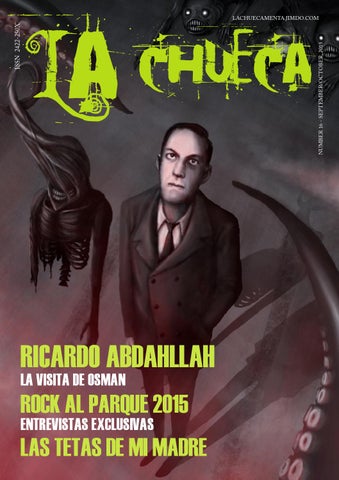
RICARDO ABDAHLLAH LA VISITA DE OSMAN
ROCK AL PARQUE 2015 ENTREVISTAS EXCLUSIVAS
LAS TETAS DE MI MADRE
NUMBER 16 - SEPTEMBER/OCTOBER, 2015
ISSN 2422-250X
LA
CHUECA
LACHUECAMENTA.JIMDO.COM
FotografĂa Rafa Gonzalez / Photography Rafa Gonzalez
Németh Attila-Levente - The Root Chakra II. (1st of Vortex project) – aquaforte, aquatint, blind embossing (80X60cm) – 2014
Németh Attila-Levente - El Chakra Base II. (1ro del proyecto Vortex) – aguafuerte, aguatinta, relieve en seco (80X60cm) – 2014
JUNG, LA CHUECA Y LA LITERATURA DIGITAL La
apertura de contenidos que nace como producto del mundo digital, esa nueva narrativa literaria, poética y audiovisual de difusión universal, es, al mismo tiempo, el origen de toda posible condena o de toda redención. El mundo actual es un mundo masificado y progresista, un mundo sin espíritu en el que el individuo no es otra cosa que un cliente o un usuario, siendo al final tan solo el código genérico de una sociedad caracterizada por la mímesis colectiva. Y la nuestra es una sociedad en la que la creación individual, y el pathos de la poesía misma, parecen haber sucumbido frente al facilismo de las redes sociales y la inmediatez de la tecnología: la pavorosa unicidad heideggeriana en la que el individuo no es otra cosa que un integrante inidentificable de la masa, y es esa (la masa) la que piensa y responde por sus actos. Sin embargo, ante la cobardía ontológica de la actualidad, y ya que el arte ha sido desde siempre aquél disruptor del statu quo que no admite requiebros; el esfuerzo de darle fuego una revista digital como La Chueca se transforma, entonces, en el bastión más importante de una guerra contra la apatía o la estupidez, siendo así nuestro frente de batalla. Y a lo largo de nuestras ediciones nos hemos ido apoderando de las líneas del enemigo, propagándonos por las mismas redes como un virus, que infecta a la masa y la disecciona nuevamente en individuos, que no logran permanecer incólumes frente al arte como denuncia, de sí mismos y de la sociedad. Por eso, como editores de la misma, asumimos La Chueca desde las filas de la contracultura, y lanzamos estocadas a los cerebros en masa esperando (ingenuamente) despertarlos un poco de la somnolencia de la cotidianidad. Con el arte intervenimos el entorno: la ciudad. Con el arte, buscamos transformarla, subvertirla, trastocarla; de modo que ya no pueda ser ese refugio de bendita ignorancia de la que muchos disfrutasen previamente. Así, nos arrojamos directamente al foso del inconsciente colectivo, tratando de encontrar allí lo que el hombre perdió a lo largo del ascenso. _
_
_
_
_
_
_
_
_
_
_
_
_
_
_
_
_
LA CONTRACULTURA Y SU INTERVENCIÓN EN LA SOCIEDAD DEL PROGRESO, CON RESPECTO A LA REVISTA LA CHUECA. John Gómez.
_
_
_
_
_
_
_
REVISTA LA CHUECA 5
JUNG, LA CHUECA AND THE DIGITAL LITERATURE The
openness to content emerges as final product of the digital world, the new poetical, audiovisual and world widely spread literary narrative, which at the same time is the origin of every possible sentence or any redemption. The current world is an overcrowded and progressive. A word with no spirit where the individual is not more than a client or a user, at the end being no more than the generic code of society which is characterized for the collective mimesis. Ours is a society where individual creations and the pathos of poetry itself seem to have succumbed to the easiness of the social networks and the immediacy of technology: the horrific Heidegger’s unity where the individual is not more that and unidentifiable member of the mass and it is this mass the one that thinks and has responsibility of her/his acts. However, towards the current ontological cowardice and due to the fact that has always been the status quo breaker, which doesn’t admit compliments; the effort of giving fire to a digital magazine as La Chueca then transforms into the most important bastion of a war against apathy and silliness, being in that way our frontline. Along our editions, we have empowered ourselves of the enemy lines expanding us through the social networks like a virus, which infects the mass and dissects them one more time into individuals, who are not able to stay unharmed in front of the art as a complaint of the society and themselves. It is why as La Chueca editors, we assume it from the counter-culture lines and throw thrusts to the massive brains, hoping to awake them of their everyday sleepiness. We intercede the surroundings with the art: the city. We intend to transform it with the art, to undermine it, to disrupt it, in a sense that it cannot be longer the refuge of blessed ignorance. Ignorance enjoyed previously by some of them. That way, we pounce directly towards the collective unconscious trench, trying to find over there what men missed through the ascent. _
_
_
_
_
_
_
_
_
_
_
_
_
_
_
_
_
_
THE COUNTER-CULTURE AND ITS INTERVENTION IN THE SOCIETY OF PROGRESS, IN REGARD TO LA CHUECA MAGAZINE. John Gómez.
_
_
_
_
_
_
Németh Attila-Levente - The Sacral Chakra II. (2nd of Vortex project) - aquaforte, aquatint, blind embossing (80X60cm) – 2014
Németh Attila-Levente - El Chakra Sacro II. (2do del proyecto Vortex) – aguafuerte, aguatinta, relieve en seco (80X60cm) – 2014
REVISTA LA CHUECA 8 FotografĂa Karen Fontes / Photography Karen Fontes
Inspiration rain Editorial La Semilla Amarilla
Other crimes of love Juan Carlos G贸mez Becerra
Beginings Editorial La Semilla Amarilla
Haikus for the moon Pablo Sergio Arias Barrera
Whispers Pablo Sergio Arias Barrera
Short Stories Digital Antology La Semilla Amarilla 2015
DIGITAL BOOKS
El arte es siempre el arte de lo absurdo, pues en lo inconsciente y tenebroso de lo humano es donde se expresan los elementos artísticos como símbolos de valor onírico; y son estos elementos, y estos símbolos, los que dan sentido a la Mitopoética: elemento integrador y constitutivo de La Chueca. El autodescubrimiento y la subjetividad son un mandala que consigue su forma original cuando hace su recorrido por El tiempo –no cronológico ni lineal, sino asincrónico–; y al igual que las ramas de un árbol, crece aislado de métodos aristotélicos. Para la revista, y como medio independiente, el lenguaje es una forma de interpretar el universo (lleno de equivalencias) sin los pretenciosos significados que suelen darse a las reglas o traducciones triviales. El hecho de poseer una Mitopoética propia nos ha permitido, en estos cuatro años, aislarnos de convencionalidades características del entorno cultural, en un contexto desde el cual asumimos a la sociedad no como un todo, sino como un proceso, un ser en transformación; conectando, dentro y fuera de ella, las líneas puntaedas de nuestra visión global, forjándonos una identidad propia con matices de psicología jungiana. La Chueca es, en suma (o al menos pretende serlo) un medio aislado de toda métrica, con un lenguaje natural, metafísico, y poético. Todo es una interpretación de Arquetipos: en los planos de una fotografía u obra cinematográfica, en el sonido de una marimba, en un saxofón, en un acorde punk, en un bajo de blues; en un graffitti, un dibujo, un ensayo, un cuento corto o en una ilustración editada en photoshop. Éste, más que un pensamiento estructurado o un mapa elemental, es el corazón metafórico del árbol chueco, haciendo germinar sus ramas en cada nuevo número. Y en ese sentido, damos inicio a estas páginas, con una nueva expresión.
Jose Girón Septiembre de 2015
EDITORIAL
REVISTA LA CHUECA 6
LA CHUECAMENTA EDICIÓN / EDITOR JOHN GÓMEZ DISEÑO / DESIGN JOSE GIRÓN JOHN GÓMEZ
NÚMERO 16 / NUMBER 16 SEPT/OCT 2015 www.lachuecamenta.jimdo.com
DIRECCIÓN / DIRECTORS JOSE GIRÓN JOHN GÓMEZ PRODUCTORES / PRODUCERS JOSE GIRÓN JOHN GÓMEZ TRADUCTORA / TRANSLATOR ALEJANDRA REYES ESCRITORES / WRITERS RICARDO ABDAHLLAH CARO GEISER JOHN GÓMEZ OSCAR ESTÉVEZ IMÁGENES / IMAGES NEMETH ÁTTILA-LEVENTE ALEJANDRO BARRÓN SAM DEXTER YAIRA DÍAZ ROBERTO FERRI KAREN FONTES RAFA GONZALEZ ANDRÉS LAMUS NATALIA LÓPEZ MANU MOJITO JORGE NAUTO DIEGO QUENTASI JULIANA SIERRA JOSE VIDAL BOL BET
IMAGEN DE PORTADA / COVER SAM DEXTER
18 VENTANA 46 URBANO NATURAL LA HUMANIDAD DE LA CÁMARA 66 78 TRAZOS 98 PSICOFONÍA REVISTA LA CHUECA 13
FotografĂa Juliana Sierra / Photography Juliana Sierra
Jean Baudrillard http://doloryarte.blogspot.com.co/
Kipi Montana Kipi Montana Andrés Durán
Kipi Montana Andrés Durán Andrés Durán
«…para que haya obras de arte, para que haya un fenómeno estético, se necesita un lugar, un creador, medios y, por su puesto, alguien del otro lado, en fin, se necesita al otro, el creador no puede estar simplemente encerrado en su creación.»
PINTURA/PAINTING
DIEGO
QUENTASI
REVISTA LA CHUECA 17
WINDOW
VENTANA
You know, The door is At the end of the rails Three times Of a dionysian week Go down Go To the theater And gods may speak Three times a week The door is there Where we eat and drink Three times Of a heathen Week in the inn, where Were, where is No truth But beatdown Proof Made out of flesh Books and ink And they’re high Three times a week The door is blue And shiny And red only Once it is a Christian Week It stinks of History Made up rituals And faded Candles, Sunday Melt in the heat Take a break Next week
Ya sabes, La puerta está Al final de las vías Tres veces De una semana dionisiaca Baja Ve Al teatro Y los dioses podrán hablar Tres veces por semana La puerta está allí Donde comemos y bebemos Tres veces De una semana Pagana en la posada, donde Estaban, donde No hay verdad Sino ataques Pruebas Hechas de carne Libros y tinta Y están drogados Tres veces por semana La puerta es azul Y brillante Y roja solamente Una vez que llega la semana Cristiana Apesta a historia Hecha con rituales Y velas Olvidadas, domingo Derrítete con el calor Toma un descanso La próxima semana
Caro Geiser
Fotografía Jerónimo López
Németh Attila-Levente - The Solar Chakra II. (3rd of Vortex project) - aquaforte, aquatint, blind embossing (80X60cm) - 2014
Németh Attila-Levente - El Chakra Solar II. (3ro del proyecto Vortex) – aguafuerte, aguatinta, relieve en seco (80X60cm) – 2014
REVISTA LA CHUECA 22
FotografĂa Rafa Gonzalez / Photography Rafa Gonzalez
Németh Attila-Levente - The Heart Chakra II. (4th of Vortex project) - aquaforte, aquatint, blind embossing (90X60cm) - 2015
Németh Attila-Levente - El Chakra del corazón II. (4to del proyecto Vortex) – aguafuerte, aguatinta, relieve en seco (80X60cm) – 2015
Un cuervo lanza su oscuridad al aire ** El mismo antiguo graznido escucho en pájaros nuevos El cuervo y su sombra siempre serán negros ** Un cuervo lanza su oscuridad al aire Herida de abandono la rama tiembla Amarilla humilde una hoja se desprende ** Como en un sueño breve y cambiante la hoja marchita abandona el mundo Senda incomprensible Mis ojos indagan la vertical escritura del aire abierto trás el aire en su caída
**
Sin ruido simples las hojas se desprenden de los arboles Por todas partes ese rumor a precipicio ese olor a hierba removida en lo hondo de la infancia ** Como encubriendo un diosecillo tímido la hoja seca se resiste al vuelco que la obliga el viento ** ¿Quién se acerca entres las hojas secas? Apuro el paso mis huellas se deshacen tras mi sombra y este sueño no se calma con ninguna hierba REVISTA LA CHUECA 25
** Yo me duermo en tu voz como bajo un manto de hojas muertas ** Un cuervo lanza su oscuridad al aire Desde lo hondo de la infancia fluye una luz que mece toda la hierba
Oscar EstĂŠvez
Németh Attila-Levente - The Throat Chakra II. (5th of Vortex project) - aquaforte, aquatint, blind embossing (90X60cm) - 2015
Németh Attila-Levente - El Chakra de la garganta II. (5to del proyecto Vortex) – aguafuerte, aguatinta, relieve en seco (80X60cm) – 2015
Németh Attila-Levente - The Third-Eye Chakra II. (6th of Vortex project) - aquaforte, aquatint, blind embossing (90X60cm) - 2015
Németh Attila-Levente - El Chakra del tercer ojo II. (6to del proyecto Vortex) – aguafuerte, aguatinta, relieve en seco (80X60cm) – 2015
A raven throws its darkness to the air ** The same antique cawing I hear from new birds The crow and its shadow will always be dark
**
A crow throws its darkness to the air wounded with abandonment the branch shakes Yellow humble a leaf detaches
**
Like in a dream brief and changeable the withered leaf abandons the world incomprehensible path my eyes explore the vertical writing of the open air behind the air in its fall
**
Without noise simple the leaves detach from the trees Everywhere that rumor of a cliff That smell of removed grass in the depth of my childhood
**
As hiding a little shy god the dried leaf resists to the spill that the wind forces it
**
Who is approaching in the dried leaves? I hurry up my traces disappear behind my shadow and this dream relieves with no herb. REVISTA LA CHUECA 29
** I fall asleep in your voice as under a mantle of dried leaves
**
A raven throws its darkness to the air From the depths of the childhood a light flows and swings the grass all
Oscar EstĂŠvez
Németh Attila-Levente - The Crown Chakra II. (7th of Vortex project) - aquaforte, aquatint, blind embossing (90X60cm) - 2015
Németh Attila-Levente - El Chakra de la corona II. (7mo del proyecto Vortex) – aguafuerte, aguatinta, relieve en seco (80X60cm) – 2015
FotografĂa Juliana Sierra / Photography Juliana Sierra
“el tiempo que me queda intentaré ser buen padre con ustedes”
REVISTA LA CHUECA 34
LA VISITA DE OSMAN Mi padre
vino a visitarnos hoy. La última vez que lo vi fue el día que terminé el Bachillerato. Él no estaba invitado a la graduación y no sé si vio la ceremonia, pero a la salida, cuando mi madre me dejó para ir a saludar a mis profesores, se me acercó y me dijo que estaba orgulloso de mí. No volví a tener noticias de él en los años siguientes, aunque recuerdo la impresión de que quien había ido a verme: era apenas un amigo de la familia. Hoy pensé lo mismo cuando se sentó a la mesa. Mi madre lo vio estacionar desde la ventana. Venía en un Dacia 1310, diferente al Renault 12 de toda la vida. “Un progreso, al menos” dijo mi madre. A pesar de que tres días antes la había llamado anunciando su visita a mediodía, lo que era una manera de decir que esperaba que almorzáramos juntos, mi madre apenas preparó café, compró queso en la tienda y uno de esos ponqués ramo que vienen precortados en seis piezas, y puso sobre la mesa una fuente con frutas que nadie tocó. Mi padre no nos miró mientras se explicaba. Dijo que a lo mejor tenía un cáncer, aunque no podía estar seguro hasta no tener los resultados de los exámenes.
“De la biopsia. Lo que me hicieron fue una biopsia” continuó mientras sacaba del
bolsillo de su camisa un paquete de marlboro rojo, le daba un golpe por debajo con la palma y encendía un cigarrillo.
Mi madre lo había visto hacer el mismo gesto desde siempre. “Si no es cáncer (y aquí
intentó dispersar el humo con la mano) ha de ser otra cosa. Ya no me queda mucho, pero el tiempo que me queda intentaré ser buen padre con ustedes”
Hasta ahora
pienso en lo fácil que le fue utilizar la palabra “Padre” que yo uso ahora sólo con propósitos narrativos, porque en casa, y desde de que mi madre claudicó en su idea de que, a pesar de todo le dijéramos papá, le decíamos “Osman” u “Osman Federico” si acaso había necesidad de ser específico para no confundirlo con los demás osmanes de la familia, yo entre ellos.
“Esas cosas que deben hacer los padres” repitió Osman “No sé si la salud me dé para
visitarlos, pero los llamaré seguido. Es fijo que los llamaré seguido”.
La visita
duró casi una hora más en la que Osman nos contó del viaje que haría a la Costa “los viejos recogemos los pasos” dijo “ustedes lo entenderán algún día” dijo “yo quiero que, si no pueden verme de otra forma al menos me vean como un amigo” Cuando lo acompañamos a la puerta, vi que ninguno de los cuatro cafés había sido bebido hasta el final y que la cuchara con la que debíamos poner el azúcar estaba seca y limpia al lado de la tacita plástica del Tía que había existido desde, no sé, tiempos inmemoriales.
En la puerta nos dio a cada uno un beso en la frente. Mi madre dijo que lo acompañaría
para mostrarle el camino hasta la autopista y volvería en taxi. Pensé que nos pediría que nos despidiéramos mejor de lo que lo hicimos, pero sólo subió en el asiento del pasajero y nos hizo una seña con la mano mientras el Dacia retrocedía para bajar del andén.
Mi hermana y yo salimos a tomar un par de cervezas en el Parque de Las Palmas
y regresamos a mi casa en el último bus de Igsabelar. Un tipo se subió a vender revistas, y un pastor cristiano se nos sentó al lado. Éramos los únicos pasajeros, y el vendedor nos amenazó por no comprarle una edición amarillenta que tenía una entrevista, supongo sacada de Internet, a Victor Daville; el cristiano nos dio folletos de la Sagrada Iglesia del Reino. Era casi la una de la mañana. Mi madre llegó apenas unos minutos después y pasó directo a su cuarto. En el siguiente desayuno dijo “Deberían haberlo llamado ‘papá’. Está viejo y hace lo que puede para estar pendiente”.
Ha pasado
ya un cierto tiempo sin que tengamos noticias suyas. No creo que se haya muerto en la Costa, ni que las biopsias hayan dado positivas para cáncer. Mi hermana ha empezado a salir con un tipo que tiene también un Dacia. Mi madre dice que debe ser casualidad.
Ricardo Abdahllah
“Mi madre dice que debe ser casualidad”
“I will try to be a good father in the time that is left”
PINTURA/PAINTING
NATALIA LÓPEZ
OSMAN’S VISIT My father came to visit us today. The last time I saw him was the day that I finished
high school. He was not invited to the graduation and I do not know if he saw it, but when my mother gave me time to go and greet my teachers, he approached and said he was proud of me. I never had any news about him again in the next years, although I remember me having the idea that the one who had gone to see me was just a family friend. Today I thought the same when he sat to the table. My mother saw him parking from the window. We was in a Dacia 1310, which is different to the lifelong Renault 12. “At least one progress” my mother said. Beside he had called three days before to announce his visit at noon. Being that a way to tell her that he hoped we could have lunch together. My mother only made coffee, bought some cheese at the store and one of those Ramo’s cakes that is divided into six pieces. She also put on the table a font full of fruits that anyone touched. My father did not look at us while he was explaining himself. He said that maybe he had cancer but he could not be sure until he had the results from the exams.
“From the biopsy, what they did to me was a biopsy”, he continue while he took
from his shirt pocket a red Marlboro packet, hit its bottom with his palm and lighted a cigarette.
My mother
had always seen him doing the same movement. “If it is not a cancer -said while he intended to move the smoke with his hand-, it must be something else. There is not much remaining, but I will try to be a good father in the time that is left.”
It is just
by now that I think about how easy it was for him to use the word “Father”, that I now only use with narrative purposes. Because although my mother insisted on we calling him father, at home we used to call him “Osman” or even “Osman Federico”.
“That kind
of stuff that fathers have to do” Osman repeated. “I don’t know if my health will allow me to keep visiting you, but I’ll call you frequently. I will definitely do so.”
His visit
lasted about an hour more in which Osman told us about a trip that he will make to the coast. “Old men collect our paces” he said, “You will understand it someday” he said, “I want that if you aren’t able to see me differently, you see me at least as a friend”. When we got to the door with him, I saw that none of the four coffees had been drunk completely and that the spoon, with which we were supposed to serve sugar, was dried and cleaned beside my aunt’s little plastic cup, which had existed from time immemorial. At the door he gave each of us a kiss on our forefront. My mother said that she will go with him to show him the road to the freeway and that she will come back by taxi. I thought that he will ask that we say good bye better than we did, but he just got into the passenger seat and make a gesture with his hand while the Dacia was going back to go down the sidewalk. REVISTA LA CHUECA 39
My sister and I went out to have some beers at Las Palmas park and we got back home
on the last Igsabelar bus. A man got on to sell magazines and a Cristian pastor sat next to us. We were the only passengers. The seller threaten us for not buying him a yellow edition which had an interview with Victor Daville, which I guess was taken from the internet. The Cristian gave us brochures from The Sacred Church of the Kingdom. It was about 1 a.m. My mother arrived just a few minutes later and got directly to her bedroom. On the following breakfast, she told us: “you should have called him ‘father’. He is old and tries his best to be attentive.”
It has been a long time since we do not have news about him. I do not think he has
died in the coast, nor that biopsies has been positive for cancer. My sister has started dating a guy who also has a Dacia. My mother thinks it may be a coincidence.
Ricardo Abdahllah
PINTURA/PAINTING
ALEJANDRO BARRÓN
“My mother thinks it may be a coincidence.”
PINTURA/PAINTING
DIEGO
QUENTASI
FotografĂa Katherinne Rangel / Photography Katherinne Rangel
RAMA
Es en el arte donde el espíritu del mundo se hace manifiesto. Las barreras invisibles de lo humano , aquellas que delimitan todo lo que creemos exclusivamente nuestro, se derrumban sin poder evitarlo en el momento en que nos enfrentamos a la expresión artística, y vemos que (desde su propia individualidad) la obra nos habla directamente, con voces que ninguno atinase a reconocer. Hay algo de locura en el arte, de esa locura sutil que integra todo cuanto hay. Hay algo de magia, también, en esa locura. Y mucho de poder.
REVISTA LA CHUECA 45
natural urban
urbano natural
REVISTA LA CHUECA 48
FotografĂa Manu Mojito / Manu Mojito Photography
Fotografía Yaira Díaz / Yaira Díaz Photography
FotografĂa Jose Vidal Bol Bet / Jose Vidal Bol Belt Photography
FotografĂa Juliana Sierra / Juliana Sierra Photography
FotografĂa Karen Fontes / Karen Fontes Photography
Fotografía Jose Vidal Bol Bet
Fotografía Yaira Díaz / Yaira Díaz Photography
Fotografía Paula Robles
Fotografía Rafa Gonzalez / Rafa Gonzalez Photography
REVISTA LA CHUECA 57
FotografĂa Manu Mojito / Manu Mojito Photography
FotografĂa Karen Fontes / Karen Fontes Photography
Fotografía Karen Fontes / Karen Fontes Photography
Fotografía Jose Vidal Bol Bet
Fotografía Paula Robles
Fotografía Manu Mojito / Manu Mojito Photography
REVISTA LA CHUECA 64
Fotografía Jose Vidal Bol Bet
FotografĂa Rafa Gonzalez / Rafa Gonzalez Photography
HUMANITY OF THE CAMERA
LA HUMANIDAD DE LA CÁMARA
EXPERIENCIAS EN FOCO FESTIVAL DE CINE DE NEUQUÉN La Revista La Chueca hizo presencia en el FECINEU, Festival de Cine de la ciudad de Neuquén, y estas fueron las conclusiones del mismo. Los festivales de cine son de gran importancia. Por un lado, funcionan como un espacio fundamental para la proyección de películas que, en muchos casos, son presentadas en sociedad, o que difícilmente puedan tener un estreno en salas comerciales. Por otro, permiten que el público pueda tener un contacto directo con los cineastas que suelen acompañar sus creaciones, generándose así un rico feedback. Además, es una gran oportunidad para que directores, productores y actores de distintas partes del mundo (o por lo menos, de diferentes ámbitos), puedan conocerse mejor, y hasta cranear juntos próximos proyectos. Argentina tiene festivales ya consagrados y legendarios, como el de Mar del Plata y el BAFICI, pero nunca dejan de aparecer nuevos, y en diferentes ciudades del país, lo que contribuye a enriquecer culturalmente a toda su geografía. Del 28 al 30 de agosto, Neuquén tuvo su primer festival de cine: FECINEU. Un evento que reunió cortos y largometrajes independientes, argentinos y del exterior, y también producciones que se vienen filmando en la región patagónica y que de otro modo no pueden alcanzar mucha difusión. Además, se puso especial énfasis en la cultura mapuche e indígena en general, a través de obras que permiten reflejar su cultura y su impronta.
El viernes 28 por la tarde, en el Teatro Ámbito Histrión, hubo proyecciones de trabajos orientados al público infantil y juvenil, entre los que se destacó Ronko, a cargo del neuquino Carlos Montoya. A las 19 hs., en la Sala Emilio Saraco, se realizó la presentación. Ante una sala repleta, Ricardo de la Vega (presidente del festival y de Tailu Documentales Educativos) y Héctor Massi (vicepresidente, director de Films Trains, guionista y miembro del jurado) dijeron unas palabras, presentaron a jurados y directores presentes, y enseguida comenzó la primera proyección de films de la competencia: Padre, multipremiado cortometraje de Santiago Bou Grasso, que ofrece una intimista mirada sobre la última dictadura militar, valiéndose de la técnica de animación stop motion. Llegaron más cortos, y luego, los platos fuertes de la jornada: Tembuchakua: Santa Fe de la Laguna, producción mexicana acerca del proceso de realización de una boda dentro de la comunidad indígena purhépecha. Le siguió la marplatense El Hombre que Cuenta, de Omar Magrini; un cautivante collage que combina influencias del cine ruso, la literatura de Eduardo Sacheri (en una versión pasada de ácido, por supuesto), Guy Maddin y hasta Oldboy, lo que da por resultado una obra que nunca deja de funcionar por sí misma. Al terminar la proyección, Magrini y parte de su equipo dieron una agradable charla en la que, entre otras cosas, hablaron sobre hacer cine con muy pocos recursos -aunque muchas ideas-, y aclararon que la película es la segunda parte de una trilogía denominada Cifras. Apenas concluyó la mesa, brindis con copas de Saurus, vino de la Bodega Familia Schroeder, de tierras neuquinas.
REVISTA LA CHUECA 69
El sábado 29 respetó la estructura de la jornada anterior: durante la tarde, proyecciones para chicos y jóvenes, incluyendo el documental Cine de Pueblo, Una Historia Itinerante, todo un homenaje en vida al director José Martínez Suárez, quien actualmente oficia como director del Festival Internacional de Cine de Mar del Plata. A partir de las 19 hs., la competencia oficial. Los cortometrajes ofrecieron propuestas tan diferentes como logradas: Él Piensa, Ella Piensa, de Federico Pozzi e Iván Stoessel; Retirantes, realización con marionetas dirigida por Maira Coelho, y el extravagante ¿Dónde está Jacobo?, de La Chacra Producciones, productora independiente de Río Negro
Por el lado de los largometrajes, dos documentales que invitan a tomar conciencia: Araucanía Herida, de Juan Krsulovic, acerca de uno de los nefastos episodios ocurridos en Chile durante la dictadura de Pinochet, y Ríos Libres: Se Hace Camino al Marchar, de Gustavo Adolfo Carbonell y Elián Guerin, que sigue a una multitudinaria marcha realizada en el litoral para que no se construyan más represas que afecten el medio ambiente.
Cada una de estas obras tuvo su posterior charla con momentos tan emotivos como enriquecedores. El público no dejó de hacer preguntas ni de manifestar cómo las imágenes los movilizaron en lo más hondo, mientras el dedicado personal de la Sala Emilio Saraco ofrecía café a los presentes.
El festival concluyó el domingo 30, ahora en la sala del Cine Teatro Español. Las primeras proyecciones tuvieron a El Secreto de Lucía, de Becky Garello, con Emilia Attias y Carlos Belloso, como su exponente más destacado. Pronto llegaron los últimos films de competencia. Entre los cortos resaltó el desopilante Hasta que la Celda nos Separe, de origen portorriqueño. En cuanto a los largometrajes, primero le tocó a Tejiendo Relatos, de Clara Calvet y Sebastián Riveaud; un documental sobre las mujeres tejedoras de la región andina de Bolivia. Y para finalizar, en carácter de preestreno, Eso que Llaman Amor, ficción que contó con la presencia de la directora Victoria Chaya Miranda y de Laura Cymer, una de sus protagonistas.
Esta película (Eso que llaman amor), al igual que gran parte de las producciones programadas, es de carácter independiente de verdad, ya que no cuenta con el apoyo de organismos fuertes y, como en la mayoría de los casos, obtuvo financiación mediante campañas por crownfunding.
Concluida la función, se realizó la ceremonia de premiaciones. Ricardo de la Vega agradeció a todas las personalidades y organismos que prestaron ayuda para la realización del festival, como Pablo Bongiovanni, Presidente de Fundación Banco Provincia, y Jorge Azcurra y Pablo Romero (nombres cruciales para poder usar el Español), y a la Subsecretaria de Cultura de la Municipalidad de Neuquén. También hubo agradecimientos a los sponsors, a los cineastas presentes, al público que estuvo acompañando cada cita cinematográfica. El jurado, compuesto por Massi, Luisa Huencho (Confederación Mapuche de Neuquén) y Matías Orta (director de A Sala Llena) otorgó los siguientes premios:
-Mejor Corto Indígena: Retirantes, de Maria Coelho (Brasil) -Mejor Largometraje Indígena: Araucanía Herida, de Juan Korselovich (Chile) -Mejor Director Corto: Santiago Bou Grasso, por Padre (Argentina) -Mención de Público y Jurado: El Hombre que Cuenta (Argentina) -Mejor Corto Libre: Él Piensa, Ella Piensa (Argentina) -Mejor Dirección: Victoria Chaya Miranda, por Eso Que Llaman Amor (Largometraje, Argentina) -Mejor Largometraje: Ríos Libres: Se Hace Camino al Marchar, de Gustavo Adolfo Carbonell y Elián Guerin (Argentina)
A modo de perfecto cierre, antes de la performance de la Compañía Fuera de Eje (dirigida por Facundo Rodríguez), Massi leyó un mensaje enviado por José Martínez Suárez, en el que le da su bendición al festival. “Si querés un trabajo horrible, probá ser pionero”, supo decir Julia Philips, productora de Taxi Driver y Encuentro Cercanos de Tercer Tipo, la primera mujer en ganar el Oscar en su rubro.
Si bien el trabajo de De la Vega y sus colaboradores fue placentero, siempre es duro ser los iniciadores de un emprendimiento novedoso o poco realizado. Pero el paso fundamental para la concreción de todo proyecto siempre es el primero. Y fue un primer paso muy alentador: 300 espectadores en tres días; siete premios (cuatro para directores y producciones nacionales, tres para films internacionales), largometrajes con charlas por parte de sus creadores; un público entusiasmado, pidiendo por más… FECINEU: Festival Internacional de Cine Independiente de Neuquén es una realidad, y no hará más que crecer. El recorrido apenas comienza. Texto de Matías Orta
REVISTA LA CHUECA 72
PINTURA/PAINTING
DIEGO
QUENTASI
LAS TETAS DE MI MADRE
LAS TETAS DE MI MADRE cuenta la historia de Martín, un niño de 10 años, que trabaja junto a su madre como repartidor de pizza, él quiere llevarla a Disneylandia. Una noche pide usar el baño de un burdel donde entrega una pizza y por error entra en una cabina de striptease. Aquí ve a una mujer desnuda por primera vez. Días más tarde, Martín regresa al burdel, sólo que esta vez encontrará algo que nunca esperó. Esta producción colombiana de Pinhole Films dirigida por Carlos Zapata y protagonizada por Paula Matura (María), Billy Heins (Martín), Santiago Heins (Martin) y Alejandro Aguilar (Alvaro). Cuenta con la producción de Ernesto Lozano y Alejandro Zapata, y Lucas Cristo Mirada como Director de Fotografía. LAS TETAS DE MI MADRE ha obtenido un estímulo de postproducción del Fondo para el Desarrollo Cinematográfico -FDC, recibió en 2014, el Work In Progress Latinoamericano en la 10° SANFIC - Santiago Festival Internacional de Cine en Chile, y el Premio del Jurado (Work In Progress) en la primera edición del Mercado Audiovisal Latinoamericano del FLICC en México. El FICS (Fetival Internacional de Cine de Santander) incluye a LAS TETAS DE MI MADRE dentro de su selección oficial de ficción y como parte de la retrospec tiva realizada en honor al actor Alejandro Aguilar. Para la película es un honor que el estreno nacional sea en un festival que le apuesta a la cultura del país. LAS TETAS DE MI MADRE tiene confirmada presencia en diferentes festivales de Europa y Latinoamérica, donde continuará dejando en alto la cinematografía del país y afianzando el talento nacional emergente
LAS TETAS DE MI MADRE tells a story about Martin, a ten-year-old boy who works with his mother as a pizza delivery boy. He wants to take her to Disneyland. One night he asks for using a whorehouse bathroom where he takes a pizza and by mistake, he gets into a striptease booth. There he sees a naked woman for the first time. Some days later Martin gets back to the whorehouse but this time he will find something that he’d never expected. This Colombian production from Pinhole Films, directed by Carlos Zapata, started in by Paula Matura (María), Billy Heins (Martín), Santiago Heins (Martín) and Alejandro Aguilar (Álvaro). It also counts with the production of Ernesto Lozano and Alejandra Zapata, and Lucas Cristo Mirada as Photography director. LAS TETAS DE MI MADRE has gotten an postproduction stimulus from the Fondo para el Desarrollo Cinematográfico – FDC (Cinematographic Development Fund); in 2014 they received the Latin-American Work in Progress at the 10th SANFIC - Santiago Festival Internacional de Cine en Chile (International Santiago Film Festival of Chile) and the judges award (Work in Progress) in the first edition of Mercado Audiovisual Latinoamericano (Latin-American Audiovisual Market) del FLICC in México. FICS (Festival de Cine de Santander) includes LAS TETAS DE MI MADRE in its fiction official selection and as a part of the retrospective made in honor to the actor Alejandro Aguilar. It is an honor that the national launch for the movie to be in a festival which bets for the culture in our country. The movie is confirmed in different festivals in Europe and Latin-American, where it will continue to let stood the Colombian cinematography and to consolidate national emergent talents.
Strokes
Trazos
PINTURA/PAINTING
ALEJANDRO
BARRÓN
PINTURA/PAINTING
NATALIA LÓPEZ
REVISTA LA CHUECA 81
ILUSTRACIÓN/ILLUSTRATION
SAM
DEXTER
PINTURA/PAINTING
ALEJANDRO BARRÓN
PINTURA/PAINTING
NATALIA LÓPEZ
ILUSTRACIÓN
DANIELA
CRUZ
REVISTA LA CHUECA 84
PINTURA/PAINTING
ALEJANDRO BARRÓN
PINTURA/PAINTING
ALEJANDRO
BARRÓN
ILUSTRACIÓN/ILLUSTRATION
SAM
DEXTER
ILUSTRACIÓN/ILLUSTRATION
SAM
DEXTER
PINTURA/PAINTING
NATALIA
LÓPEZ
ILUSTRACIÓN/ILLUSTRATION
NATALIA LÓPEZ
Roberto Ferri - ANIMA MUNDI - olio su tela
Roberto Ferri - IL SOGNO DI SANTA EULALIA
Roberto Ferri - VANITAS - olio su tela (50 x 70 cm) - 2013
REVISTA LA CHUECA 93
Roberto Ferri - L’ETA’ DELL’ORO
Roberto Ferri - ISHTAR - olio su tela (180 x 90 cm) - 2014
REVISTA LA CHUECA 96
Roberto Ferri - IL SEPOLCRO DEGLI AMANTI - olio su tela (100 x 130 cm)
PSICOFONÍA
PSICOPHONY
Fotografía Andrés Lamus / Photography Andrés Lamus
ATARI TEENAGE RIOT
Fotografía Andrés Lamus / Photography Andrés Lamus
La banda en sí es similar a lo que fue en los 90s. Nic Endo y yo estamos detrás de la producción de casi toda la música y las letras de las canciones, y el nuevo rapero Rowdy le da su toque a la banda. Lo que nos parece más importante es la era digital en la que estamos actualmente y este es uno de los asuntos tratados en las canciones nuevas, temas como la libertad y la libertad de expresión son muy importantes en la actualidad.
How does the new band’s formation influences the musical style in the last two albums?
Fotografía Andrés Lamus / Photography Andrés Lamus
¿Cómo influye la nueva alineación en el estilo musical de los últimos dos álbumes?
The band itself is pretty much the same as it was in the 90s. Nic Endo and me are behind almost all of the music and the lyrics. The new rapper Rowdy adds his voice to Atari Teenage Riot. What is more important is the digital age we are living in right now. This was the reason for writing all the new songs. Topics like freedom of speech online and freedom are very relevant now.
How do you feel about coming back to Colombia?
¿Qué sienten al regresar a Colombia?
Great! We totally loved the country and the people we met. So to return is inspiring and motivating. You see Colombia is a very different place compared to Europe and the people and their relentless energy about music is just awesome. Last time a kid gave me a 5 hour DJ mix he made just with all my music and songs as an mp3 on a tiny USB stick and that kind of stuff is just one example out of many. There is a special connection there.
¡Es genial! Nos encantó Colombia y la gente que conocimos allí, por eso, volver nos parece inspirador y motivador. Te das cuenta de que Colombia es un país muy diferente comparado con Europa, la gente y su implacable energía por la música es fantástica. La vez pasada, un chico me dio una USB con un mix de 5 horas que él mismo hizo con toda mi música, y ese tipo de cosas es sólo un ejemplo de muchos. Hay una conexión especial allí.
Fotografía Andrés Lamus / Photography Andrés Lamus
REVISTA LA CHUECA 103
Fotografía Andrés Lamus / Photography Andrés Lamus
It’s a longer story but it felt right. People wanted us to play shows again and hear new songs. It seemed like if suddenly there was a hole in the music scene because nobody approaches music like we do. I mean who still uses an Atari Computer from the 80s to program music? Yes, not really anyone. People buy vintage guitars and amps and all kinds of music gear from the past but they don’t see the computer as an instrument. We do. Every generation of computers is different. And that is reflected in the music that people make with computers.
¿Han pensado en tocar en otras ciudades de nuestro país?
Have you thought about playing in some other cities in our country?
Aun no pero sería una aventura que realmente quisiéramos tener, sé que al terminar ese viaje, nuestra música sería mejor.
Not yet, but that would be an adventure we would really want to experience. I know for a fact that our music would change for the better after this trip. I just know.
¿Por qué decidieron reagruparse como Atari Teenage Riot luego de una década? Es una larga historia pero terminó bien. La gente quería que nos presentáramos de nuevo y escuchar nuestras canciones pues parecía haber un hueco en la escena porque nadie aborda la música de la forma en que nosotros lo hacemos, quiero decir, ¿quién usa todavía un computador Atari de los años 80s para programar su música? Si, nadie en realidad. La gente suele comprar guitarras clásicas y amplificadores, y orientan los sonidos al pasado, pero no ven el computador como un instrumento y nosotros sí lo hacemos. Cada generación de computadores es diferente, y eso se ve reflejado en la calidad de la música.
Fotografía Andrés Lamus / Photography Andrés Lamus
Fotografía Andrés Lamus / Photography Andrés Lamus
Why did you decide to regroup after a decade?
Alec Empire: Creo que sería necesario vivir allí para opinar, pero hay algo que puedo decir: hay fuerzas poderosas que operan a nivel global que no actúan basados en nuestros intereses como ciudadanos y esta situación nos afecta a todos somos. Espero poder encontrar fans y escuchar sus opiniones. Sin embargo, creo que podemos usar la tecnología para hacer del mundo un lugar más justo, estamos perdiendo muchas mentes brillantes tan sólo por la forma en la que la economía está estructurada y eso no está para nada bien. Ya hemos visto como en tiempos pasados las élites globales han generado una guerra social contra de los pobres y debemos educarnos para luchar dicha guerra. Las ideología antiguas no nos ayudan mucho y la gente generalmente las retoma para encontrar respuestas, pero debemos ser más inteligentes en esta nueva era.
What do you think about the political and economic issues taking place in Latinoamérica right now? Alec Empire: I think I should live there to really form an opinion. But I can say this. There are powerful forces that operate on a global level and they don’t act in the interest of us citizens. We are all affected by this. I am really looking forward to meeting fans and hear their opinion. I still believe that we can use technology to make this world a fairer place. Right now we are losing many great minds just because of the way the economy is structured. That can’t be right. We have seen over the past years how the global elites are waging a class war against the poor. We must all educate ourselves to fight the right battle. Old ideologies are not helping. And often people return to those to find answers, but in this age we must be way smarter.
Fotografía Andrés Lamus / Photography Andrés Lamus
¿Qué opinan ustedes del conflicto político y económico en Latinoamérica (especialmente en cuanto a la corrupción)?
Fotografía Andrés Lamus / Photography Andrés Lamus
Fotografía Andrés Lamus / Photography Andrés Lamus
Fotografía Andrés Lamus / Photography Andrés Lamus
REVISTA LA CHUECA 110
¿Qué los motivó a regresar? Nos motivan mucho los recuerdos de todos los viajes, y como te decía antes, su gente su cultura, su música, su comida
In your opinion: what’s the best stage you have ever played on? why? We have visited many places and cities all around Colombia: we visited Bogotá, Medellín, Manizales, Pereira, Cali, and Barranquilla. All of them are charming, specially the people and their good vibration. I think the most important event has been Rock al Parque. In the rest of the world we have had the pleasure to play at Vive Latino México many times. We had a Rock in Rio in Lisboa in 2012 and also we have played in La Carlota in Venezuela, where we had about 180.000 people.
What motivated you to come back here to Colombia? We are very motivated from memories of all our trips and also, as I’ve just mentioned before, because of the people, its culture and its food, too.
En su opinión, ¿cuál es el mejor espacio en el cual se ha presentado la banda y por qué? Fueron muchos los lugares y ciudades de Colombia que hemos visitado: Bogotá, Medellín, Manizales, Pereira, Cali, Barranquilla... todos tienen su encanto, y sobre todo su gente y su buena vibra. Creo que lo más importante ha sido Rock al Parque. En el resto del mundo hemos tenido el gusto de tocar varias veces en Vive Latino México. En 2012 hicimos Rock in Rio en Lisboa y otro hito ha sido la Carlota en Venezuela con 180.000 personas.
Fotografía Andrés Lamus / Photography Andrés Lamus
Fotografía Andrés Lamus / Photography Andrés Lamus
LOS PERICOS
Por ahora no, pero esperemos, a partir de este Rock al Parque 2015, retomar nuestra relación de manera más fluida con el público colombiano, especialmente con las nuevas generaciones.
No. Not at this moment, but we hope that we are able to resume our relationship with the Colombian spectators more fluenty, especially with new generations.
Fotografía Andrés Lamus / Photography Andrés Lamus
Is there any other Colombian city you have considered to play in?
Fotografía Andrés Lamus / Photography Andrés Lamus
¿Hay otras ciudades colombianas en las que han pensado en presentarse?
How would you define the process of the band from the very beginning to the present?
¿Cómo definen la trayectoria de la banda, desde sus inicios hasta hoy?
It’s been an uninterrupted c a r e e r of almost 30 years. It is important to emphasize this because we have only stopped doing concerts for about 3 months during this three decades. An entire life dedicated to our band, to playing, recording, travelling, living off of what you better do, and living off of music with your best friends as colleagues is a luxury.
Son ya casi 30 años de trayectoria ininterrumpida, eso es bueno aclararlo ya que a lo sumo hemos parado apenas 3 meses de hacer conciertos en estas tres décadas. Toda una vida dedicada a la banda, a tocar, grabar, viajar... vivir de lo que haces es lo mejor, y vivir de la música con tus amigos como compañeros de ruta es un lujo.
Fotografía Andrés Lamus / Photography Andrés Lamus
Fotografía Andrés Lamus / Photography Andrés Lamus
REVISTA LA CHUECA 115
Fotografía Andrés Lamus / Photography Andrés Lamus
Fotografía Andrés Lamus / Photography Andrés Lamus
¿Cómo se sienten al reunirse, después de tanto tiempo, ante un escenario como el de Rock al Parque? Felices y honrados. Es un honor para nosotros haber recibido la invitación para participar en este festival. Sabíamos de su importancia y trascendencia, sabíamos que no es fácil llenarle el ojo al público Colombiano, pero siempre confiamos en nosotros. Coda siempre ha sido muy respetuoso con los compromisos y con el público; tomamos las cosas en serio, y en Rock al Parque no podía ser algo diferente a las creencias y el espíritu de esta banda, siempre ha sido de entrega total en el escenario y al final. Honor con Honor se paga.
Have you ever thought about playing on other Colombian sceneries?
¿Han pensado en tocar en otros escenarios colombianos?
Of course! Even more after having seen the attitude from the spectators in Bogotá. We are sure about the fact that after being present in Rock al Parque, we will open doors to get to other states in the country.
¡Claro!, y más ganas de hacerlo después de la respuesta que tuvimos del público en Bogotá. Seguramente el haber estado presentes en Rock al Parque nos va a abrir la puerta para poder visitar otros departamentos en Colombia.
How do you feel about getting together again in Rock al Parque after such a long time? We feel happy and honored. It’s a pleasure for us to receive the invitation to participate in this festival. We knew about its importance and transcendence. We knew it wasn’t easy to satis fy the Colombian audience but we always trust ourselves. Coda has always been very respon sible with commitments and also with the spectators. We take things so seriously and Rock al Parque couldn’t be different to our beliefs and to our essence. We have always given all that we’ve got on the stage and at the end. Honor must be paid with honor.
Fotografía Andrés Lamus / Photography Andrés Lamus
Fotografía Andrés Lamus / Photography Andrés Lamus
CODA
En realidad fue más de lo que esperábamos. Esta fue la primera vez que visitamos Colombia y fue increíble conocer a un club de fans ya organizado, que durante el show, en el público, cantó nuestras canciones. ¡Las sabían todas!, y terminamos tocando para cinco mil o seis mil personas que se reunieron mientras tocábamos. La verdad fue más de lo que pensamos
It was actually better than we expected. That was the first time we visited Colombia and it was incredible to get to know a fans club which is already organized and that was singing along our songs during the show. They knew them all and we ended up playing for 5 thousand or six thousand people that showed up during our performance. Yes, it was definitely more than we expected.
REVISTA LA CHUECA 120
What are your plans for the future as a band? What is coming is the promotion of our first disc. On August 21st we presented the new official video from “Muerte en el Muelle” song, from whose result we are so happy about. We will continue with the concerts tour and we will be in Central America, the United States, Ecuador, Peru, Mexico and we may go back to Spain, too. Our plan is not to stop playing!
Fotografía Andrés Lamus / Photography Andrés Lamus
Was the audience reaction the one that you spected?
Fotografía Andrés Lamus / Photography Andrés Lamus
¿La reacción del público fue la esperada?
¿Cuáles son sus planes a futuro con respecto a la banda? El futuro inmediato es promocionar nuestro nuevo disco. El día 21 de Agosto hicimos la presentación oficial del nuevo video de la canción Muerte en el Muelle, del cual estamos muy contentos con el resultado. Vamos a continuar con la gira de conciertos, vamos a Centroamérica, Estados Unidos, Ecuador, Perú, seguiremos por todo México y es muy probable que este año regresemos a España. ¡El plan es no parar!
Fotografía Andrés Lamus / Photography Andrés Lamus
Fotografía Andrés Lamus / Photography Andrés Lamus
Fotografía Andrés Lamus / Photography Andrés Lamus
Who are you usual spectators?
Sacred Goat va dirigido a todos los jóvenes y adultos que gusten del metal y la variedad de sus subgéneros.
Sacred Goat is intended for those young and adults who like metal and the variety in the sub-genres.
Fotografía Andrés Lamus / Photography Andrés Lamus
¿A qué público se dirigen?
How many musical productions do you have? We have the namesake demo Sacred Goat that was launched by 2013. Then, we have the single called Hierophany Torture, with a video produced by Dmente Audiovisual and directed by Andrés Burgos. It is available and moving on Youtube and the band’s website from last year. With this first single, Sacred Goat promotes its first album called Sinful Self, which will be launch by August this year.
Fotografía Andrés Lamus / Photography Andrés Lamus
SACRED GOAT
¿Cuántas producciones musicales tienen? Dentro de la producción musical se encuentra el demo homónimo Sacred Goat, lanzado en el 2013. Luego, el sencillo titulado “Hierophany Torture” con un video producido por “Dmente Audiovisual” dirigido por Andrés Burgos, que está disponible y circulando desde el año pasado en Youtube y la página oficial de la banda. Con este primer sencillo, Sacred Goat promociona su primer álbum titulado “Sinful Self ”, el cual será lanzado en agosto de este año
Fotografía Andrés Lamus / Photography Andrés Lamus
REVISTA LA CHUECA 127
Fotografía Andrés Lamus / Photography Andrés Lamus
¿Qué expresan sus letras?
Our lyrics express human’s duality: good and evil. They also reflect experiences, daily situations that are driven to the limits because of the irrationality and the agony, which are caused by social issues, politics, and religion. They contaminate and make people sick of it all. We can also see the hatred, the fear, and the frustration that can be caused by such contamination.
Nuestras letras expresan la dualidad existente en el ser humano: bien y mal, e intentan reflejar experiencias o situaciones “cotidianas” que son llevadas al extremo donde convergen la irracionalidad y la convulsión misma que produce una sociedad abatida a diario por diferentes males: problemas sociales, políticos, e inclusive religiosos, que producen una especie de contaminación que enferma la mente y el interior de los seres humanos. Allí encontramos el odio, los miedos, las aberraciones e inclusive las frustraciones que pueden derivar de estas situaciones.
The lyrics also reflect a critical view where the being itself is exposed. They are always inspired by a real situation or a character that personifies such duality that we have mentioned before. Our first album called Sinful Self is been created conceptually. On this album every song is a story, where ancient, as well as current duplicity are reproduced
Fotografía Andrés Lamus / Photography Andrés Lamus
Fotografía Andrés Lamus / Photography Andrés Lamus
What do your lyrics express?
Las letras reflejan, además de estas problemáticas, una postura crítica, donde se expone de forma abierta lo profundo del ser. Las letras siempre están inspiradas en alguna situación real o en un personaje que permite exponer las características de esa dualidad que tanto reiteramos. Nuestro primer álbum “Sinful Self ”, está construido de forma conceptual, donde cada canción es una historia entretejida que pretende describir a, través de ciertos, personajes toda la duplicidad que puede existir en la mente de las personas, desde la antigüedad hasta el día de hoy.
Are you influenced by other bands?
Sí claro, nos influencian muchas bandas, pero más que eso nos influencian los géneros y sus tendencias, que es lo que tratamos de acoplar a nuestro concepto visual y nuestra música, tales géneros son el death, el grindcore el black y el trash.
Of course, a lot of bands, actually. However, we are specially influenced by genres and their tendencies. This is what we try to adapt to our music, as well as our visual concepts. Those genres are for example death metal,grindcore, black metal, and trash metal.
Fotografía Andrés Lamus / Photography Andrés Lamus
¿Tienen influencia de otras bandas?
Fotografía Andrés Lamus / Photography Andrés Lamus
Fotografía Andrés Lamus / Photography Andrés Lamus
Fotografía Andrés Lamus / Photography Andrés Lamus
¿Por qué el nombre de la banda? Ubergehen es una palabra tomada del alemán, su significado más cercano en nuestro idioma es “pasar al otro lado” o “transitar”. Aparece en el texto de Nietzsche “Así habló Zaratustra”. Decidimos adop tar ese nombre por su significado, nos sentimos identificados.
What do you think about Rock al Parque?
¿Qué concepto tienen del Rock al parque?
We think it’s a great festival. For a band like ours, it’s an opportunity to share our work. To have the opportunity to play on a stage like that is a good experience. Also, it I good to be able to meet national and international organizers and businessmen, which is very important for the musical interests of our band.
Rock al Parque para nosotros es un gran festival, es una oportunidad muy grande para una banda como nosotros, de mostrar nuestro trabajo y compartirlo con el público. Poder tener toda esa gran infraestructura es una experiencia muy grata, además de tener la oportunidad de conocer empresarios, y organizadores de festivales a nivel distrital, nacional y mundial, que obviamente es muy importante para los intereses musicales y de proyección de la banda.
Why do you have this name?
Fotografía Andrés Lamus / Photography Andrés Lamus
Fotografía Andrés Lamus / Photography Andrés Lamus
UBERGEHEN
Ubergehen is a German word that means “to cross”. It appears on a Nietzsche’s text called “Thus Spoke Zarathustra”. We decided to adopt that name both, for its meaning and also because we feel identified.
REVISTA LA CHUECA 135
One of the coolest things is being able to express your feelings through the music, sharing ideas, agreeing, not agreeing. It is funny at the time of producing music, we start from cero and with time you start seeing a very personal song as a result. Then, it is played in a concert and we see our fans singing it along emotionally; that’s hard to describe. It’s one of the best experiences ever!
¿Qué crean en el público a través de su música?
What do you build in the spectators?
La intención es crear sentimientos, donde el público se sienta identificado con nuestras canciones, que las letras de una u otra forma generen conciencia, que se sienta adrenalina, felicidad, odio, unión, comprensión, etc…
We try to build feelings, we also want them to feel identified with our songs. We want to build consciousness, adrenalin, happiness, hatred, union, comprehension, etc.
¿ Cuál es la mejor experiencia de la creación musical? Una de las cosas más chéveres es poder expresar lo que se siente a través de la música, compartir ideas, estar de acuerdo, estar en desacuerdo. Eso es divertido a la hora de entrar en proceso de composición, cuando se arranca de ceros y al cabo del tiempo resulta una canción con propiedad y personalidad, y luego tocarla en un concierto y ver a nuestro público coreándola con tanto sentimiento es algo que es difícil de describir. Es una de las mejores experiencias que se pueden tener. Fotografía Andrés Lamus / Photography Andrés Lamus
Fotografía Andrés Lamus / Photography Andrés Lamus
What’s the best experience of creating music?
Fotografía Andrés Lamus / Photography Andrés Lamus
Fotografía Andrés Lamus / Photography Andrés Lamus
We have started to be recognized by people who like this genre. It is very gratifying as Ubergehen is something made with honesty and all the energy. Every time that we get to a concert and we see the logos of our band on some flags, and the people keeping our albums we can see we are leaving a trace. We greet all of the La Chuecha readers a nd we invite them to attend the 21st version of Rock al Parque 2015, as well as we invite them to get our contents. We will see you soon, “Thrash hasta el despenke.”
¿Qué les ha dejado esa trayectoria de más de diez años en la escena thrasher nacional? Nos ha dado reconocimiento dentro de la escena, lo cual es muy gratificante porque Ubergehen es algo que hacemos con honestidad y toda la energía. Cada vez que asistimos a un toque y vemos las banderas de la banda o los trabajos que hemos realizado, nos damos cuenta que estamos dejando huella. Saludamos a todos los lectores de La Chueca y los invitamos a asistir a la versión número 21 de Rock Al Parque 2015, así mismo a adquirir nuestro material. Nos vemos pronto. “THRASH HASTA EL DESPENKE”
Fotografía Andrés Lamus / Photography Andrés Lamus
Fotografía Andrés Lamus / Photography Andrés Lamus
What do your lyrics express?
REVISTA LA CHUECA 139
Fotografía Andrés Lamus / Photography Andrés Lamus
Which is the song that your fans enjoy the most?
Hemos notado una marcada preferencia de la gente por Weapons of Mass Paranoia, incluida en nuestro primer álbum, Justice of Chaos, editado el año pasado. Se trata quizás de la canción que con mayor claridad deja ver nuestra pasión por la música veloz y las tendencias más clásicas de la música pesada. En todo caso la respuesta ha sido favorable con todas nuestras canciones, nos gusta interpretarlas todas y sentimos que la gente también valora cada una de ellas.
We have noticed people tend to prefer “Weapons of Mass Paranoia”, which is included in our first album Justice of Chaos and edited last year. It may be the song that reflects the more our passion for music and the oldest trends of heavy music. Anyway, they have perceived well all of our songs. We like to play them all and we feel people appreciate each of the songs.
Fotografía Andrés Lamus / Photography Andrés Lamus
¿Cuál es la canción que más disfruta su público?
How was the process to end up in Rock al Parque? We postulated to the district call; then, after many filters and bands that were left out we felt grateful for such an opportunity. We have worked hard to get it and we have practiced and prepared ourselves to provide a great show.
Fotografía Andrés Lamus / Photography Andrés Lamus
RANDOM REVENGE
¿Cómo fue su llegada al repertorio de Rock al parque 2015? Accedimos a la edición 2015 de Rock al Parque a través de la convocatoria distrital. Luego de muchos filtros y tantas bandas increíbles que quedaron por fuera, nos sentimos muy agradecidos por la oportunidad de estar este año. Hemos trabajado duro para conseguir este nuevo paso y nos preparamos muy concienzudamente para ofrecer un gran show de metal.
Fotografía Andrés Lamus / Photography Andrés Lamus
Fotografía Andrés Lamus / Photography Andrés Lamus
¿Qué opinan de la nueva escena musical de su género en todo el país?
Thrash metal is one of the favorites of people and bands so there is many people producing the same kind of music, which makes it more difficult; but it is also a challenge as we have to create higher quality music and better concerts to stand out. We think it is important for the contest to be constructive and cooperative rather than competitive. Causing troubles to ourselves doesn’t help anyone but supporting the initiation of new bands and taking into account oldest bands’ work allows the scene to stay alive. We consider it should be the objective: working for relevance in the present and transcendence for the future.
El thrash metal es uno de los géneros favoritos de público y de las bandas, por lo que encuentras un medio muy reñido para trabajar. Pero eso, al tiempo, impone el reto de ofrecer productos musicales de mayor calidad,y conciertos mejores para destacar entre tantas buenas bandas.Lo importante es que esa competencia se maneje dentro de lo constructivo, incluso de lo cooperativo. Ponernos palos en la rueda no ayuda a nadie, mientras que alentar la formación de bandas nuevas y tener en cuenta lo que han hecho las bandas clásicas permite, por un lado, asegurar el futuro de la escena, al tiempo que se conserva la memoria del metal nacional, que es la base de todo. Creemos que ese debe ser el objetivo: trabajar por la relevancia en el presente y la trascendencia de cara al futuro.
Fotografía Andrés Lamus / Photography Andrés Lamus
Fotografía Andrés Lamus / Photography Andrés Lamus
What do you think about your genre’s new musical scene in Colombia?
REVISTA LA CHUECA 145
Are you trying to reach greater horizons?
¡Por supuesto! Rock al Parque es una tarima muy codiciada en Latinoamérica, pero es apenas un paso en la búsqueda de mayores metas. Quien caiga en el error de creer que se ha consagrado tras pisar la tarima de Rock al Parque puede estar logrando lo contrario, frenando su carrera. No queremos ser la banda que está en Rock al Parque y que en un tiempo nadie recuerda. Queremos escribir páginas importantes en la historia del metal colombiano y mundial, y eso se logra a base de constancia y no por un único concierto, por importante que este sea.
Of course! Rock al Parque is a very covet stage in Latinoamerica, but it is just a pace for reaching greater goals. The ones who think that they are done just by reaching Rock al Parque scenery may be doing the contrary, just holding back. We don’t want to be the kind of band that finally gets to Rock al Parque and that with some time nobody remembers. We are actually willing to write an important story on Colombian and global metal history and that needs persistence, not a single concert not matter how important it might be.
Fotografía Andrés Lamus / Photography Andrés Lamus
¿Buscan escalar nuevos horizontes?
Fotografía Andrés Lamus / Photography Andrés Lamus
Fotografía Andrés Lamus / Photography Andrés Lamus
Fotografía Andrés Lamus / Photography Andrés Lamus
Have you ever played on other scenes?
¿Se han presentado en otros escenarios?
First of all we want to thank Revista La Chueca for providing this space to promote independent national bands. In its career, MortuoruM has made three international tours and has played in countries such as Ecuador, Argentina, Uruguay and Mexico. Nationally, we have played on district events in different places in Bogotá, as well as on independent events.
Primero que todo, queremos agradecer a la Revista La Chueca por brindar espacios de difusión a bandas independientes de la escena nacional. MortuoruM cuenta en su trayectoria con 3 giras internacionales por las cuales tuvo shows en Ecuador, Argentina, Uruguay y México. A nivel nacional, en eventos distritales de diversas localidades de Bogotá y eventos independientes.
¿Cómo nace su propuesta musical?
How does your musical proposal was created?
Nuestra propuesta musical es el fruto de 10 años de trabajo, donde la banda -en su alineación inicial- comenzó de cero, explorando todo tipo de sonidos dentro del metal, pasando por el black metal, death metal para finalmente encontrar su sonido en el metal melódico en su formación actual.
It is the result of 10 years of hard work, as we started from cero. We explored every sound in metal music, including black metal and death metal, to finally find our style in the melodic metal.
Fotografía Andrés Lamus / Photography Andrés Lamus
Fotografía Andrés Lamus / Photography Andrés Lamus
MORTUORUM
REVISTA LA CHUECA 151
Fotografía Andrés Lamus / Photography Andrés Lamus
Dentro de nuestros proyectos, está la promoción de nuestro nuevo disco “In Dependence” y el poder participar en diversos espacios de gran afluencia de público para difundir nuestra propuesta.
Fotografía Andrés Lamus / Photography Andrés Lamus
Besides Rock al Parque, what other projects do you have?
¿Qué otros espacios, diferentes al de Rock al parque, están entre sus proyectos?
In our projects there is the promotion of “In Dependence” and our participation on different scenes with a lot of spectatorz in order to promote this new proposal.
How do you see MortuoruM in the future?
¿Cómo proyectan la banda a futuro?
We see it is still in generating musically
A futuro proyectamos a MortuoruM como una banda que sigue en su proceso de formación, generando nuevas propuestas a nivel conceptual y musical.
as a band which training and it is new offers both, and conceptually
Fotografía Andrés Lamus / Photography Andrés Lamus
REVISTA LA CHUECA 154
Fotografía Andrés Lamus / Photography Andrés Lamus
Fotografía Andrés Lamus / Photography Andrés Lamus
Fotografía Andrés Lamus / Photography Andrés Lamus
LA CHUECA CREW John Gómez (Bucaramanga) Jose Girón (Bucaramanga) Alejandra Reyes (Bucaramanga) Andrés Lamus (Bucaramanga)
ARTISTS Ricardo Abdahllah (Colombia) Oscar Estevez (Colombia) Caro Geiser (Switzerland) Juliana Sierra (Colombia) Yaira Díaz (Colombia) Manu Mojito (Colombia) Rafa Gonzalez (Colombia) Karen Fontes (Brasil) Jorge Nauto (Chile) Jose Vidal Bol Bet (España) Natalia López (Colombia) Sam Dexter (Colombia) Diego Quentasi (Perú) Alejandro Barrón (España) Roberto Ferri (Italia) Németh Attila-Levente (Romania) Carlos Zapata (Colombia) Atari Teenage Riot (Deutchland) Los Pericos (Argentina) Coda (México) Sacred Goat (Colombia) Ubergehen (Colombia) Random Revenge (Colombia) Mortuorum (Colombia)
EN ESTA EDICIÓN / ON THIS EDITION
Número 16 Septiembre/Octubre 2015 Number 16 September/October 2015 Revista digital / Digital magazine Dirección / Directors Jose Girón John Gómez Editor y Redacción / Editor John Gómez Diseño y Edición / Design and Editing Jose Girón y John Gómez Agradecimientos / Thanks to Dirt Silver Cynthia Escobar Angélica Castellanos Cabaret Voltaire Study Editorial La Semilla Amarilla Soundtrackers Salas de Ensayos lachuecamenta.jimdo.com lachuecamag@gmail.com Bucaramanga - Colombia 2015