CAVA MAGAZINE Volume 10 • No. 37 • September–December 2026 San Luis Potosí, SLP. EDITORIAL TEAM: Cecilia Valtierra - Deputy Editor-in-Chief Katia Hernández - Editor Andrea Méndez Aguiñaga - Writing and Style Ismael Posadas - Editorial Design Carla Montiel - Advertising Director Ana Suárez - Events Coordinator Mónica Velazco, Alejandro López - Correspondents EDITORIAL BOARD: Macaria Rodríguez, Salim Gutiérrez, Fernando Ramos, Ernesto Bravo, Irasema López, Roberto Montiel, Regina Alfaro, Eduardo González, Carlos Bailleres
Editorial
Beginner's Guide
CONTACT:
Wine Varieties
From the Screen to the Glass: Movies That Celebrate the World of Wine
6
More Than Just an Accessory: The History of the Tastevin
10
The Most Common Mistakes When Giving Wine as a Gift
14
Wine Varieties Wine Varieties About Wine
The Art of Storing Wine: Tips for Preserving Each Bottle
When Geek Culture Meets Beer
20
The First Female Master Brewers
24
Everything You Need to Know About Gose Beer
28
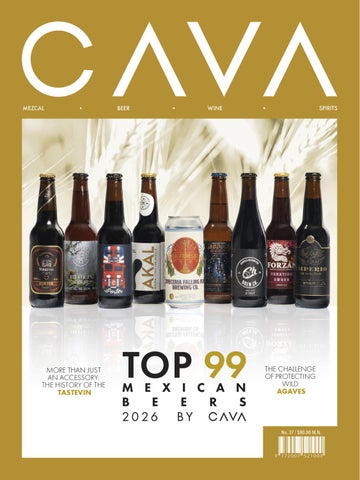
Mexican Beers 2026 by CAVA
32
Brewery
TOP 99
About Beer
STRICT AUTHORIZATION FROM THE PUBLISHER. THE CONTENT
What Does Your Favorite Type of Beer Say About You?
OF THE ARTICLES IS SOLELY THE RESPONSIBILITY OF THE AU-
With Humor and Without Stereotypes
THOR. CAVA MAGAZINE IS NOT RESPONSIBLE FOR THE INFO MATION CONTAINED IN COMMERCIAL AND/OR NONCOMMERCIAL ADVERTISEMENTS.
CAVA Magazine, Volume 10, Issue 37, September–December 2026, is a quarterly publication edited by Ariana Toscani, located at Calle 5 de Mayo #1035, San Miguelito Neighborhood, ZIP Code 78339, ca-
Mezcal Bar
Mezcal in Contemporary Mixology
48
The Challenge of Protecting Wild Agaves
52
Mezcal Bar
About Mezcal
The Agave Life Cycle and Its Relationship
Toscani. Exclusive rights reserved, granted by the National Copy-
to Mezcal
Institute: pending. Legality of title and content: pending. This issue was completed in September 2026 with a print run of 12,000 cop-
56
DISTILLATES Distillates Mx
ies. Calle L 22-2, Parque Industrial Puebla 2000, ZIP Code 72225,
The Role of Tequila in Mexican Parties and
Heroica Puebla de Zaragoza, Pue. The opinions expressed by the
Celebrations
authors do not necessarily reflect the position of the publisher. The
46
MEZCAL
varevista@gmail.com www.revistacava.com. Editor-in-Chief: Ariana
right Institute: pending. ISSN assigned by the National Copyright
18
BEER
Brewery
PARTIAL OR TOTAL REPRODUCTION IS PROHIBITED WITHOUT
5
WINE
Brewery cavarevista@gmail.com
4
Distillery
58
total or partial reproduction of the publication’s content and images
The difference between tequila and other
is strictly prohibited without prior authorization.
agave distillates
62
Orujo: The Grape-Based Spirit
63
DIRECTORY
69
Distillery
—www.revistacava.com —Facebook: /cavarevista —Instagram: revistacava —cavarevista@gmail.com
EDITORIAL There are drinks that are an integral part of a
what remains after wine is made. We then return
of time, and styles that find new ways to reach
cause confusion: What sets tequila apart from
celebration, ingredients that have stood the test a different generation. At CAVA Magazine, we
believe that exploring liquid and gastronomic
culture is also a way to understand who we are, where we come from, and how we transform our traditions to keep them alive.
In this issue, wine invites us on a journey
through the history of the Tastevin much more
than just an accessory, it’s an essential tool for
to Mexico to clarify a question that continues to other agave spirits? This distinction goes far beyond the name and involves origin, raw materials, processes, and tradition. Finally, we explore the role of tequila in Mexican parties and celebrations, because few drinks are so closely
linked to our moments of togetherness, joy, and fellowship.
Mezcal leads us to two conversations: on the
appreciating wine. We also tackle those small
one hand, we discover how mezcal has been in-
ing a bottle for someone else and the keys to
new paths without losing its character. On the
but significant dilemmas that arise when choosturning that gesture into a memorable experience. And because cinema has also helped
shape our imagination around this drink, we ex-
plore some films that have celebrated the world
corporated into contemporary mixology, finding other hand, we focus on one of the industry’s greatest challenges: protecting wild agaves in the face of growing demand.
Our gastronomy section takes us back to our
of wine, demonstrating that a glass of wine can
roots. The pre-Hispanic ingredients that are still
Beer comes in a variety of styles as diverse as
is a living memory: corn, chilies, seeds, herbs,
also be the star of a good story.
its consumers. We dive into the world of Gose, a refreshing, tart, and slightly salty style that has found a new niche among those who enjoy
exploring different flavors. Beer culture also in-
tersects with pop culture and technology in our look at geek culture. And we revisit a story that deserves greater recognition: that of the first female master brewers, women whose contributions were fundamental to the origins and development of this beverage.
In the world of spirits, we travel from Mexico
to Europe to discover orujo, a spirit born from the transformation of grapes and the use of
present on Mexican tables are proof that cuisine
and other products continue to be part of our
daily diet. And to wrap up this issue, we present our highly anticipated CAVA 2026 Top 99
Mexican Beers, a selection that seeks to recog-
nize the diversity, quality, and personality of the
beers that enrich the national scene today. More
than just a list, it’s an invitation to discover new brands, styles, and ways to enjoy a beverage that continues to evolve. We hope these pages
serve as a gateway to stories we may already be familiar with, but which we can now view from a different perspective. Cheers!
A BEGINNER'S GUIDE IF YOU’RE TAKING YOUR FIRST STEPS INTO THE WORLD OF WINE, DISTILLATES, BEER, AND MEXICAN CUISINE, THIS BEGINNER'S GUIDE WILL HELP YOU UNDERSTAND SOME TERMS YOU MAY NOT HAVE BEEN FAMILIAR WITH AND ENJOY THE ARTICLES YOU'LL FIND ON THE FOLLOWING PAGES EVEN MORE.
Sommelier
Mixology
vice, and appreciation of wine and other beverag-
of beverages and cocktails through the balanced
A professional specializing in the knowledge, seres. Their work involves understanding the charac-
teristics of these beverages, their regions of origin, production processes, and potential food pairings. Must
The liquid obtained by pressing or crushing fruit, especially grapes, before or during fermentation. In
winemaking, it is the juice containing water, sugars, acids, aromatic compounds, and other components
of the fruit that will later be transformed through fermentation. Geek
A term borrowed from English that, in the brewing
A discipline related to the preparation and creation combination of spirits, liqueurs, fruits, herbs, spices, bitters, sweeteners, and other ingredients .
Fructans
These are complex carbohydrates composed primarily of chains of fructose molecules. They func-
tion as storage compounds in certain plants and are especially important in agaves. Hoppy
An adjective describing beers that feature a pro-
nounced presence of hops (Humulus lupulus), whether in aroma, flavor, or bitterness.
world, is typically used informally and positively to
Brewsters
knowledgeable about beer, and who enjoys learn-
This term also has its own linguistic history and can
refer to someone who is very passionate about and
ing about styles, ingredients, brewing processes, yeasts, hops, malts, and sensory characteristics.
Anglicism used to refer to women who brew beer. be found in initiatives that specifically seek to high-
light women’s participation in the brewing industry.
Wine Varieties
FROM THE SCREEN TO THE GLASS: MOVIES THAT CELEBRATE THE WORLD OF WINE ON THE BIG SCREEN, WINE CAN BE A LANDSCAPE, A ROMANCE, A MEMORY, A BUSINESS, OR EVEN A WAY TO UNDERSTAND WHO WE ARE AND OUR CONNECTION TO THE PLACES WE TRAVEL TO. CINEMA HAS DISCOVERED THAT FEW THINGS TELL A STORY AS COMPLETE AS A BOTTLE OF WINE.
F
or Mexico, where wine growing regions have taken on increasing cultural and tourist significance, watching movies related to the world of wine also allows us to engage with these places in a more thoughtful way. Visiting vineyards and wineries isn’t just about learning how wine is made; it also involves experiencing the cuisine, the landscape, the history, and the identity of these regions. For this reason, we’re sharing a brief cinematic journey in which wine takes center stage and you can feel like just another character in each story. SIDEWAYS: WHEN WINE ALSO SPEAKS TO US In 2004, Alexander Payne released Sideways, a film that follows Miles and Jack on a road trip through California’s wine country. One is trying to get his life back on track; the other is about to get married. Amid highways, restaurants, and wineries, both find in wine a way to address their own insecurities. Miles feels an almost obsessive fascination with Pinot Noir. The choice is no coincidence; the film uses the characteristics attributed to this varietal (its delicacy, sensitivity, and difficulty in cultivation) as a mirror of the character himself. The Journal of Wine Economics documented the enormous interest the film sparked in Pinot Noir and the California wine industry.
BOTTLE SHOCK: WHEN A WINE TASTING CHANGES HISTORY While Sideways uses wine to explore emotions, *Bottle Shock* (2008) focuses on history. The film dramatizes the so called 1976 Judgment of Paris, a blind tasting in which wines from California competed against prestigious French labels. The result surprised the wine world: the judges awarded top honors to California wines, calling into question the notion that excellence belonged exclusively to traditional wine-producing regions. Bottle Shock follows the story of Chateau Montelena and depicts the clash between a well established European tradition and a young American industry. Although the film takes narrative liberties, its plot offers insight into a pivotal moment in the transformation of the international perception of wine. The question it raises is a provocative one at any point in human history: Who decides which wine is good? A GOOD YEAR: WHEN A BOTTLE CAN CHANGE A LIFE In 2006, Ridley Scott adapted Peter Mayle’s novel for the big screen with A Good Year. The film tells the story of Max Skinner, a successful London stockbroker who inherits a
7
Wine Varieties
“THESE MOVIES HAVE SOMETHING IN COMMON: NONE OF THEM PRESENTS WINE AS AN ISOLATED OBJECT; IT ALWAYS APPEARS CONNECTED TO DEEPER MEANINGS, PEOPLE, AND PLACES WHERE MAGIC HAPPENS.”
vineyard and a house in Provence, France. At first, Max views the property as a mere investment; his goal is to sell it and return to his fast-paced life in London. However, his experience with the vineyard, the landscape, and the people who live in the region begins to transform his understanding of success. Here, wine appears as more than just a drink or a commodity: it is a way of relating to time and to the land. Could wine change our lives? Probably not in such a cinematic way, but the film raises a real question: what do we lose when we turn agricultural land into nothing more than an economic asset? MONDOVINO: THE WINE BEHIND THE LABEL In 2004, Jonathan Nossiter released Mondovino, a very different kind of documentary not a comedy about two friends, but a critical look at the globalization of the wine industry. The documentary examines producers, consultants, critics, and large corporations to raise a concern: Is the international expansion of the market causing wines from different regions to become increasingly similar? Academic research on the film highlights precisely this dimension; Mondovino uses wine to discuss globalization, economic power, and the standardization of taste. The issue is particularly timely. If a consumer in Mexico, France, Argentina, or Australia begins to seek out exactly the same style of wine, what happens to the differences that make each region unique? Here a key term emerges: terroir. It refers not only to the soil but also to environmental conditions, human practices, and the historical relationship between a community and its territory. In that sense, a bottle can also be a cultural expression.
8
SOMM: LEARNING TO LOOK, SMELL, AND REMEMBER In 2012, Somm took the camera into the world of those aspiring to become Master Sommeliers. The documentary shows the intense preparation process of several candidates for one of the most demanding professional exams in the world of wine. What does it take to recognize a wine without seeing the bottle? The answer involves much more than memorizing names. Professionals train their perception of aromas, flavors, acidity, structure, texture, and other sensory characteristics. The science of sensory analysis confirms that the perception of wine depends on multiple stimuli and the interaction between the senses and the context in which it is consumed. Somm also offers a social lesson: behind the apparent ease with which an expert describes a glass of wine lies an enormous amount of practice. RED OBSESSION: WHEN WINE BECOMES DESIRE In Red Obsession (2013), director David Roach explores the global fascination with the great wines of Bordeaux and, in particular, the growing interest among Chinese consumers. Here, wine appears as a symbol of luxury, investment, and status. The bottle ceases to be merely a beverage and becomes an object of desire. These films have something in common: none of them presents wine as an isolated object; it always appears connected to deeper meanings, people, and places where the magic happens. Because cinema, like wine, has a unique ability to do something extraordinary with time: to preserve a story and allow us to revisit it every time we open a bottle.▼
Wine Varieties
MORE THAN JUST AN ACCESSORY: THE HISTORY OF THE TASTEVIN HAVE YOU EVER SEEN A SOMMELIER WITH A SMALL SILVER CONTAINER HANGING AROUND THEIR NECK AND WONDERED WHAT IT’S FOR? AT FIRST GLANCE, THE TASTEVIN LOOKS LIKE A MEDAL, A RELIC, OR EVEN A PIECE OF JEWELRY FROM A BYGONE ERA. HOWEVER, BEHIND ITS RELIEFS AND METALLIC SHINE LIES A STORY THAT BRINGS TOGETHER TECHNOLOGY, COMMERCE, AND A UNIQUE WAY OF UNDERSTANDING WINE.
T
he tastevin, also known as a tâte-vin or catavinos, is a small metal cup, typically shallow in shape and with raised patterns on the inside, used to take and examine a sample of wine. Its French name comes from the idea of “tasting” or sampling the wine. The National Center for Textual and Lexical Resources in France traces the term back to the 16th century; in 1517, it was recorded as “taste-vin d’argent,” meaning a small silver cup intended for tasting. A TOOL BORN IN THE DARKNESS To understand the importance of the tastevin, imagine a European wine cellar from several centuries ago, where the only light came from candles and wines were stored in barrels. How could a merchant tell if the wine was clear, bright, or cloudy before buying it? That’s where the tastevin came in. Its metal surface, especially when made of silver, could reflect the scarce available light, while the ridges and small indentations on the inside helped the taster better observe the color and clarity of the liquid. This is how, before wine tasting became a discipline filled with technical terms, the taster could do something much more intuitive: look, smell, and taste. Its shallow depth made it easy to observe the wine and drink small amounts directly from the sample drawn from the barrel. Over
time, different regional designs emerged. A French cultural heritage inventory preserves, for example, a tastevin crafted by a silversmith from Beaune during the second quarter of the 19th century, proof that the instrument also came to be regarded as a work of craftsmanship. FROM TOOL TO OBJECT OF PRESTIGE In the centuries that followed, the tastevin ceased to be merely a tool; its craftsmanship in precious metals and its decoration transformed it into an object to be displayed and preserved. And this is where an interesting question arises: When does an object cease to be merely useful and begin to represent an identity? In the case of the tastevin, this transformation took on particular significance in Burgundy. Over the centuries, this French region forged a close connection between its land, wine, gastronomy, and social prestige. The tastevin came to be associated with wine connoisseurs and, later, with the image of the expert capable of recognizing a wine’s qualities. In 1934, the economic situation in Burgundy was dire; the cellars were full, and wine was struggling to reach consumers. In Nuits-SaintGeorges, Georges Faiveley and Camille Rodier decided to create an organization that
11
Wine Varieties
“THE TASTEVIN ENDED UP BECOMING AN EMBLEM, HANGING FROM THE NECK OF A SOMMELIER, IT COMMUNICATES EXPERIENCE, TRADITION AND BELONGING TO A PROFESSIONAL CULTURE, IT NO LONGER NEEDS TO DEMONSTRATE THAT IT CAN ILLUMINATE A WINE IN A DARK CELLAR, NOW IT REPRESENTS THE MEMORY OF THOSE WHO DID IT.”
would revive the spirit of the ancient wine guilds and, at the same time, promote Burgundy wines. Thus, on November 16, 1934, the Confrérie des Chevaliers du Tastevin was born. The choice of name was no accident; the tastevin already evoked knowledge, tradition, and tasting, and making it an emblem allowed them to link the present to a supposed historical continuity. WINE AS A SOCIAL EXPERIENCE The founders understood something that is now commonplace in the world of food and beverages: people don’t just buy a product; they also buy a story, a region, and an experience. The Confrérie’s chapters brought together wine, food, attire, ceremonies, and public figures. Journalists played an important role in spreading this image. A study by the University of Burgundy notes that a considerable proportion of the early members were journalists, revealing just how integral communication was to the project. Does this sound familiar? Today we talk about designations of origin, gastronomic tourism, artisanal products, and experiences centered around a beverage. The strategy may seem contemporary, but the idea is nearly a century old. The tastevin thus went from being a tool for examining wine to becoming an object capable of conveying who the producers and lovers of Burgundy wine were, or who they wanted to appear to be. FROM THE CATAVINO TO THE SYMBOL OF THE SOMMELIER With the advent of modern lighting and the development of specialized glassware, the tastevin lost much of its practical utility; a transparent glass makes it easier to appreci-
12
ate the color and clarity of a wine and, above all, facilitates a more complete aromatic evaluation. So why do we still see tastevins? Because some objects survive even when their function changes. The tastevin eventually became a badge of honor; hung around a sommelier’s neck, it conveys experience, tradition, and belonging to a professional culture. It no longer needs to demonstrate that it can illuminate a wine in a dark cellar; now it represents the memory of those who did. The story didn’t end in Burgundy; the Confrérie expanded its activities internationally and now has thousands of members and numerous chapters outside France. Its influence helped make the tastevin one of the most recognizable symbols of wine culture. “Tastevinage” also emerged, a system for selecting Burgundy wines established in 1950, the ceremony once again transformed the act of tasting into a tool for legitimization; the selected wines receive a distinction associated with the Confrérie. Thus, the name of the small vessel came to designate not only a tool, but also a ceremony, a label, and an institution. KNOW BEFORE YOU DRINK This is perhaps the most interesting lesson the tastevin teaches: its history speaks of a time when getting to know a wine required observing it closely, but also of a modern era in which wine began to become a part of our heritage, identity, and experience. Today, we can easily pick up a bottle from a store, uncork it, and pour it into a glass. But behind that simple gesture lies a fascinating history of merchants, winemakers, artisans, tasters, and communities who learned to recognize wine through their senses.▼
Wine Varieties
THE MOST COMMON MISTAKES WHEN GIVING WINE AS A GIFT GIVING A BOTTLE OF WINE AS A GIFT SEEMS SIMPLE: GO TO ANY SUPERMARKET, CHOOSE A PRETTY LABEL, WRAP IT UP, AND HAND IT OVER. BUT HOW MANY TIMES HAVE WE CHOSEN A BOTTLE BASED MORE ON ITS APPEARANCE THAN ON THE PERSON WHO WILL RECEIVE IT? AND HOW MANY TIMES HAVE WE BOUGHT AND HOW OFTEN DO WE BUY A WINE TO LAY DOWN WITHOUT ASKING OURSELVES IF IT’S ACTUALLY MEANT TO AGE?
G
iving wine as a gift is, in reality, a small exercise in knowledge; it’s not about becoming wine experts or memorizing regions or varieties, it’s about understanding that a single bottle combines production decisions, storage conditions, and sensory characteristics that can determine whether our gift will be a memorable experience or a disappointment. Here are some of the most common mistakes people make when giving wine as a gift, and here’s how to avoid them. 1. CHOOSING A BOTTLE BASED SOLELY ON THE LABEL An elegant label may catch your eye, but it doesn’t necessarily tell you what the wine will be like. The design, price, or popularity of a region are no substitute for information about the wine’s style or the recipient’s preferences, in other words, do we know if that person prefers full bodied reds, crisp whites, rosés, sparkling wines, or sweet wines? If the answer is no, it might be best to first observe their habits; a good gift doesn’t have to be the wine we would choose, but rather one that they are likely to enjoy. The perception of wine depends on multiple sensory factors and the context
in which it is consumed. Studies in sensory analysis show that characteristics such as aroma, acidity, sweetness, bitterness, and temperature can significantly alter the consumer’s experience. 2. THINKING THAT “MORE EXPENSIVE” MEANS “A BETTER GIFT” Another common mistake is confusing price with quality; an expensive wine can be extraordinary, but that doesn’t mean it’s the right choice for everyone, the value of a bottle also depends on its style, the occasion, and the relationship between the giver and the recipient. For a casual meal, a fresh, versatile wine might be more appropriate than a complex bottle meant for long term aging. In other words, the best wine isn’t necessarily the most expensive one, but the one that makes sense for the occasion and for the recipient. 3. GIVING A WINE THAT NEEDS TO BE AGED AS A GIFT WITHOUT EXPLAINING HOW TO STORE IT Here lies one of the most significant mistakes: some bottles are meant to be enjoyed relatively young, while others can age favorably for years under the right conditions. The problem arises when we
15
Wine Varieties
“WINE CONVEYS AN INTENTION; IT CAN SAY ‘I WAS THINKING OF YOU,’ ‘I WANT TO CELEBRATE WITH YOU,’ OR ‘I REMEMBER THAT BEAUTIFUL MOMENT WE SHARED TOGETHER.”
buy a wine with aging potential and leave it in a warm place, subject to constant temperature fluctuations or exposed to light conditions that can accelerate chemical reactions and affect the wine’s color, aromas, and other characteristics. That’s why, if we’re giving a bottle that’s worth aging, we can also include a small card with instructions: “Store it in a cool, dark place with a stable temperature.” This thoughtful touch shows that we didn’t choose the bottle at random. 4. SERVE ALL WINES AT ROOM TEMPERATURE “Red wines are served at room temperature” is a popular saying, but what exactly does “room temperature” mean? For wine, it doesn’t necessarily mean the 22, 25, or 28 °C of a Mexican room. Chilling reduces the release of volatile compounds and, therefore, can alter perceived aromatic intensity; for many reds wines, approximately 15–18 °C is recommended, while whites and rosés are typically enjoyed at lower temperatures, around 4–10 °C. There’s no need to pull out a thermometer in the middle of a gathering. Just avoid extremes and remember that “colder” or “warmer” doesn’t automatically mean “better.” 5. DESPERATELY CHILLING A BOTTLE Let’s imagine we arrive at a dinner party and discover that the white wine is at room temperature. What do we do? Do we wait for hours, or do we quickly pop it in the freezer? The good news is that rapid cooling doesn’t necessarily ruin the wine. That said, the freezer requires attention, since
16
the real problem can arise if we forget about the bottle until the wine freezes, the bottle is damaged, or the seal is compromised. 6. THINKING THAT ANY WINE IMPROVES WITH AGE This is perhaps the most persistent myth: “Save it for a few years and it’ll be better”, but that’s not necessarily true. Bottle aging involves complex chemical changes that can alter astringency, bitterness, color, and aroma. But not all wines have the same ability to evolve favorably; aging potential depends on the style, composition, closure, and storage conditions. For this reason, giving a bottle with the phrase “so you can keep it for twenty years” can be ill advised if we don’t truly know its potential. 7. FORGETTING THAT WINE ALSO CONVEYS A MESSAGE Finally, there’s a mistake that’s less technical and more human: thinking that giving wine as a gift is simply about it being a “quick” or convenient choice. Wine conveys an intention; it can say “I was thinking of you,” “I want to celebrate with you,” or “I remember that lovely moment we shared it together.” That’s why the choice of wine and how we present it matter just as much as the bottle itself, a small card or beautiful wrapping can transform the gift, explain why we chose that particular wine, suggest what food to pair it with, or simply invite the recipient to open it together. In the end, what will the recipient remember most., the price of the bottle or the moment you shared it? ▼
About Wine
THE ART OF STORING
WINE:
Tips for Preserving Each Bottle Storing wine properly is just as important as knowing how to choose it. Temperature, light, and where we store each bottle can directly influence its development. In these pages, we explore the ideal storage conditions, the options available at home, and some simple tips for preserving the wine’s qualities until it’s time to uncork it.
10 °C
50 °F
15,5 °C 60 °F
DAN GE RO US ZO 21,1 NE ° 70 °F
4
26 ,6 80
°C
F
-6, 6 20 °C °
10 ° F
10
7 °C 37, 0 °F
-122 °C
°F
KS OO EC IN
,1 F -1 30 °
C
W
°C
°C 4,4 0 °F
SAFE STORAGE
°C ,2 32 90 °F
WI NE FR EE ZE S
US ERO G N DA
E ZON
(12-15 °C) 55-59 °F
Wine is best stored at temperatures between 12° and 15° C, with a relative humidity of 55% to 75%: conditions that promote its proper aging and help preserve its qualities.
About Wine
time (oxidation)
1. WINE STORAGE Wine can deteriorate up to four times faster at room temperature than in a climate. Controlled environment. If you don’t have a wine cellar or a specialized refrigerator, be sure to store the bottles in a cool, dark place protected from sudden temperature changes.
thermoelectric
condenser
2. WINE REFRIGERATORS There are two main systems: thermoelectric and condenser. The former are quieter, although their performance may vary with the ambient temperature. Condenser models offer a more stable temperature, but they generate more noise and require periodic maintenance.
3. WHAT IF YOU DON’T HAVE A WINE CELLAR? If you don’t have a wine cellar or a wine refrigerator, it’s best to drink the bottles within the first few years after purchasing them. Constant temperature fluctuations accelerate the wine’s aging process and can alter its qualities, affecting aromas, flavors, and balance.
Brewery
WHEN GEEK CULTURE MEETS BEER WHAT DO A CRAFT BEER, A VIDEO GAME, A SCIENCE FICTION MOVIE, AND A TABLE FULL OF PEOPLE DEBATING WHICH STAR WARS CHARACTER IS THE BEST HAVE IN COMMON? MORE THAN WE REALIZE.
T
he so called “geek culture”, that universe of comics, video games, science fiction, fantasy, technology, anime, board games, and online communities, has long since ceased to be a niche reserved for a select few and is now part of popular culture and, above all, a way of socializing. Beer, for its part, also has its own history, as it is linked to food, technology, commerce, and social interaction in nearly all settings of social entertainment. When these two cultures come together, an interesting phenomenon emerges, a traditional beverage becomes a medium for telling stories, expressing a sense of belonging, and building collective experiences. One aspect worth noting is the role of creativity in this convergence: geek culture not only consumes stories, but also transforms and reinterprets them, creating new forms of engagement. Something similar happens with craft beer, where brewers experiment with ingredients, techniques, aromas, and presentations to offer unique experiences. What happens when these two worlds collide? Collaborations, themed events, and products emerge that turn the con-
sumer into more than just a spectator, inviting them to explore, share their opinions, and participate. In this sense, beer can function as a social language, while the geek universe provides the symbols and narratives that transform a gathering of enthusiasts into a cultural experience. Beer is, in essence, the result of a biotechnological adventure, since all of its chemical processes and experiments (in the case of craft beers) can sometimes seem like something out of science fiction; that helps explain why a beer can become much more than just a drink. Imagine a bottle with an illustration of a dragon, a can inspired by a video game, or a label that evokes a superhero. Even before we take a sip, there’s already a story. Would our perception change if we drank the exact same beer from an unlabeled bottle? Sensory research has shown that external factors, such as labels that reference pop culture, geek culture, and music, can alter the way we consume and evaluate a beer. The image, the information on the packaging, and the context aren’t mere embellishments: they’re part of the experience, for geek culture, this is particular-
21
Brewery
“MAYBE THE MOST INTERESTING THING ABOUT THIS INTERSECTION BETWEEN BEER AND GEEK CULTURE ISN’T THAT THERE ARE DRINKS WITH FANTASTIC NAMES OR LABELS INSPIRED BY POP CULTURE, WHAT’S FASCINATING IS SEEING HOW TWO FORMS OF FAN CULTURE BUILD A COMMUNITY.”
ly powerful because its narrative worlds thrive precisely on symbols: a lightsaber, a fantasy castle, a character, or a specific typeface used in famous movie titles can trigger memories and emotions. The label thus serves as a gateway to our senses, which are about to experience a fine lager or stout. ONE BEER, A THOUSAND WORLDS For decades, the “geek” was portrayed as someone isolated in front of a screen or locked away in their room. That image is becoming less and less relevant in a world that is constantly moving forward and evolving; contemporary communities organize themselves around shared interests and find physical spaces where they can continue conversations that began on the internet. Craft beer culture is part of this same movement; social media, for example, serves as a space for exchanging knowledge about styles, flavors, brewers, and experiences. Recent research on beer culture specifically highlights the role of digital communities in building and disseminating collective knowledge. In Mexico, moreover, craft beer is no longer a phenomenon exclusive to a select few, as it has evolved from its early years as a niche market, highlighting the growing importance of variety in styles and flavors for consumers. Therein lies the social connection, both fandom and craft beer invite people to discover, compare, and converse. The geek universe has a unique relationship with objects: figurines, trading
22
cards, game consoles, special editions, and posters serve as tangible mementos of imaginary worlds. Beers can occupy a similar space, since a limited edition bottle, a label illustrated by an artist, or a collaboration between a brewery and a franchise can become a collector’s item even before it’s consumed. Perhaps the most interesting aspect of this intersection between beer and geek culture isn’t that there are beverages with fantastical names or labels inspired by pop culture; what’s truly fascinating is observing how two forms of fandom build community. A craft beer can embody chemistry, gastronomy, design, history, and conversation all at once. Geek culture can encompass entertainment, creativity, technology, memory, and identity. When they come together, they produce something very contemporary: experiences in which consumption also means interpretation, sharing, and a sense of belonging. So, if you ever come across a beer with an unusual appearance, you might ask yourself a few questions: What story is its label or recipe trying to tell? What aromas do you actually recognize? How much of your perception comes from the taste, and how much from your expectations? And, above all, with whom would you share that discovery? Because perhaps that’s where we’ll come to realize its true nature in something much simpler: a table, a conversation, and the chance to discover that what we’re passionate about can also become a point of connection with others.▼
Brewery
THE FIRST FEMALE BREWERS BEFORE THE ADVENT OF LARGE BREWERIES AND QUALITY CONTROL LABORATORIES, FERMENTED BEVERAGES WERE PRODUCED IN HOME AND COMMUNITY SETTINGS. AND IN MANY ANCIENT SOCIETIES, IT WAS WOMEN WHO WERE BEHIND THESE PROCESSES.
I
n the history of beer, accounts of its origins have paid little attention to the people who actually produced it; rediscovering the first female brewers means taking a closer look at the kitchens, courtyards, taverns, and workshops where knowledge about grains, water, fermentation, and preservation was passed down. This is not to claim that any specific woman invented beer; what can be reconstructed, however, is a long tradition of women involved in beer production across various ancient societies.
Beer is much older than the breweries we associate with it today; in Mesopotamia, there is evidence of beer production and consumption dating back to very early times, and archaeological research has uncovered facilities, vessels, and texts that shed light on its brewing techniques. Historian and archaeologist Tate Paulette, in her recent research on beer in ancient Mesopotamia, explains that production took place in various settings: breweries, taverns, and homes. Her analysis also shows that women played a significant role in these activities and that home brewing was part of daily life. Why women? One possible answer lies in the gender, based division of labor in
those societies: transforming grains into food and beverages was part of the domestic tasks associated with women, and beer brewing was closely linked to bread making. The same knowledge of grains, cooking, hydration, and fermentation could be used to prepare both products. In other words, beer may have originated and developed in a space that traditional history has considered too mundane to take center stage, namely, the kitchen. NINKASI: THE MESOPOTAMIAN GODDESS OF BEER In ancient Mesopotamia, a very interesting figure emerges: Ninkasi. She is the goddess associated with beer, and her importance is not merely mythological; her name is linked to a literary tradition that sheds light on certain aspects of the beverage’s production. The socalled “Hymn to Ninkasi,” preserved on cuneiform tablets from the second millennium BCE, poetically describes various stages involved in the preparation of the beverage.
Ninkasi’s existence and her connection to beer were not trivial matters; they were part of Mesopotamian diet, rituals, and social life. Thus, behind this goddess we find many anonymous women who ground
25
Brewery
“MAYBE THE BEST WAY TO LOOK AT WOMEN INVOLVED IN THE BEER INDUSTRY IS NOT AS A CURIOSITY FROM THE PAST, BUT AS PART OF A LIVING GENEALOGY THAT CONTINUES TO BE BUILT AND TRANSFORMED.”
grain, prepared the mixtures, oversaw the processes, and helped pass down practical knowledge. EGYPT In ancient Egypt, beer was a staple food and could be included in the rations given to workers; it also featured in banquets, rituals, and offerings. Archaeological evidence includes depictions of brewing activities and remains of ancient facilities, the Oriental Institute at the University of Chicago notes that beer production in Egypt reached a considerable scale and that there were breweries associated with palaces and temples, in addition to home brewing.
In the early stages, women were closely involved in home brewing; that is, images and funerary objects depict activities such as grinding grain and working with mixtures that could be used for both bread and beer. Can you imagine that a drink we now associate with bars, festivals, and social gatherings was once also an important part of the daily diet? As beer brewing became more specialized and commercialized, the division of labor also changed. In medieval Europe, women known in England as “brewsters” were involved for centuries in the production and sale of beer; home brewing could serve as a source of income for families, until economic, regulatory, and professional changes led to the activity becoming progressively more associated with men and commercial establishments. The result was
26
a historical paradox: an activity that had been carried out for generations by women ended up establishing a predominantly masculine identity. MEXICO Mexico also has a complex history of beer production, and today women are involved at virtually every level of the industry: brewing, sensory analysis, quality control, management, marketing, and entrepreneurship. The Mexican press has documented this growth within the craft beer movement, where women have moved beyond merely peripheral roles to become producers and specialists.
We even find examples that combine science, innovation, and entrepreneurship. Cristina Zenyaze Ramírez Pérez, a food engineer and graduate of the UAM, developed a craft beer project using seawater to brew Porter and Pale Ale styles. The project demonstrates how scientific training can engage with contemporary brewing creativity. For this reason, perhaps the best way to view women involved in the brewing world is not as a curiosity of the past, but as part of a living genealogy that continues to evolve and transform. Certainly, the greatest discovery is not identifying a specific woman behind the first beer, but rather understanding that beer originated in communities that experimented with the resources available to them and that, within those communities, women played a fundamental role in its production.▼
Brewery
EVERYTHING YOU NEED TO KNOW ABOUT GOSE BEER GOSE IS A SOUR, SLIGHTLY SALTY, REFRESHING BEER THAT, IN ITS TRADITIONAL VERSIONS, IS FLAVORED WITH CILANTRO. FOR THOSE ACCUSTOMED TO LIGHT, MODERATELY BITTER LAGERS, IT MAY SEEM LIKE A PUZZLING BEER.
G
ose is a historic top-fermented beer style originating in Goslar, Germany; its documented history dates back to the Middle Ages, and the style went on to become an iconic specialty of Leipzig. Furthermore, Gose is part of the international conversation about so called sour beers, and that’s where things really get interesting. WHAT DOES A GOSE TASTE LIKE? Imagine drinking a light beer that, instead of ending with the characteristic bitterness of many hoppy beers, leaves a tart sensation in your mouth, followed by a subtle salty note and, depending on the recipe, a citrusy or spicy note similar to cilantro. The current Brewers Association guidelines distinguish between Leipzig-Style Gose and Contemporary-Style Gose. The traditional version is typically brewed with barley malt and unmalted wheat; it features medium- to high-intensity lactic acidity, low bitterness, and high carbonation. Salt and cilantro may be present in small amounts, and its alcohol content typically ranges from approximately 4.4% to 5.4% alcohol by volume. Contemporary Gose significantly broadens the scope of the style, as it can incorporate fruits, flowers, herbs, spices, and other ingredients, as well as different combinations of grains;
for this reason, two beers that both bear the word “Gose” on their labels can offer very different sensory experiences. Its name comes from Goslar, a city through which the Gose River flows; over time, the beer spread to other German regions and reached Leipzig in the 18th century. By the late 19th and early 20th centuries, it had become one of the city’s most popular beverages, with dozens of establishments specializing in serving it. But beer trends changed; the rise of traditional Pilsner-style beers, economic and political upheavals, and production difficulties caused Gose to lose ground. Can you imagine if a drink that had been part of a city’s identity simply ceased to exist? That nearly happened, but the tradition began to make a comeback in the 1980s, and new brewers subsequently emerged, putting Gose back on the beer map. THE SCIENCE BEHIND ITS ACIDITY Here lies one of the most fascinating aspects of Gose: its acidity isn’t simply “a flavor added” at the end of the process; it’s generally the result of microbial activity, since traditional sour beers can involve complex communities of yeasts and bacteria notably lactic acid bacteria, which are capable of producing lactic acid during
29
Brewery
“THAT’S WHY A GOOD GOSE CAN FEEL ALMOST LIKE A CONVERSATION: FIRST THE TARTNESS SPEAKS, THEN THE SPICE APPEARS, FOLLOWED BY THE SALT, AND FINALLY A REFRESHING SENSATION LINGERS ON THE PALATE.”
fermentation. The accumulation of organic acids lowers the pH and creates the characteristic sour taste. In modern brewing, brewers can control this phenomenon much more effectively; they can use selected bacterial cultures, mixed fermentations, or specific techniques to acidify the wort or beer. Scientific research has shown that Lactobacillus species and other microorganisms can be used to achieve faster and more reproducible acidification. This matters because brewing an sour beer isn't simply a matter of “letting it go bad.” On the contrary, it requires an understanding of which microorganisms are involved, what nutrients are available to them, how alcohol, pH, and hops affect them, and when it's best to encourage or halt their activity. WHY DOES IT CONTAIN SALT AND CORIANDER? Salt is perhaps the most puzzling ingredient for those trying a Gose for the first time, but there’s a fundamental difference between a salty beer and one in which the salt is well integrated. In a traditional Gose, the amount should be moderate, since the goal isn’t to drink seawater, but rather to add a subtle mineral dimension that complements the acidity and the character of the grain. International expert guides specifically describe the restrained use of salt
30
and cilantro as characteristic elements of the style; the salty flavor should be subtle, not overpowering. From a sensory perspective, salt can also alter our perception of flavor, which helps explain why small amounts can have a greater effect than their concentration would suggest. Cilantro adds another layer of aroma; in a traditional Gose, it is expected to contribute fresh, citrusy notes more akin to lemon or bitter orange than to a pronounced herbal intensity. Herein lies one of the style’s greatest strengths: none of its elements necessarily aims to dominate. Acidity, salt, spices, grain, and carbonation must come together as a whole. That’s why a good Gose can feel almost like a conversation: first the acidity comes through, then the spice emerges, followed by the salt, and finally, a refreshing sensation lingers on the palate. For Mexican consumers, who are accustomed to a beer culture historically dominated by light, refreshing lagers, Gose can serve as a gateway to another world one where acidity isn’t a flaw, salt can be a sensory tool, and microorganisms cease to be invisible and take center stage. Gose also reminds us that beer is much more than a drink associated with the bitterness of hops and the sweetness of malt. It is an expression of microbiology, history, agriculture, technology, and culture. ▼
In recent years, craft beer has gained increasing prominence in Mexico, establishing itself as an expression of innovation, cultural identity, and economic development within the national brewing industry. Beyond offering an alternative to mass-produced beers, this sector is characterized by experimentation with ingredients, styles, and processes that revive local traditions while also responding to new consumer preferences. Its growth has also fostered job creation, supported local producers, and enhanced culinary and tourism experiences in various regions of the country. In this context, as it does every year, CAVA Magazine was honored to have the country’s most renowned judges participate in order to bring you the best of Mexican craft beers from 2026. The event took place on August 12 at Falling Piano Bodega, located in the Miguel Hidalgo district of Mexico City. Of all the participating beers, only 99 made it onto our renowned TOP list, which aims to guide readers in choosing their next great beer. Beers from the states of Baja California, Mexico City, Hidalgo, Jalisco, Michoacán, Morelos, Puebla, Querétaro, San Luis Potosí, Nayarit, Tlaxcala, Vera-
cruz, Yucatán, and Zacatecas were selected during our blind tasting. The method used during the tasting to properly rate the beers was the Beer Judge Certification Program (BJCP), which helps us describe the profile of each beer in detail. The beers evaluated stood out for their ingredients, the precision of the brewing process, and the final product; scores were divided into the following categories: outstanding, excellent, very good, good, fair, and problematic, according to BJCP standards. An “Outstanding” beer (45–50) has great character and is free of flaws. Beers rated in the “Excellent” range (38–44) may be free of flaws, but they may lack the intangible qualities of a world-class beer. The “Very Good” (30–37) range includes beers that may have a minor flaw (technical or stylistic) or may lack balance or complexity. A satisfactory beer that generally conforms to style parameters will fall into the “Good” (21–29) range. Scores close to the maximum score in this range may have only a few flaws. Meanwhile, beers close to 20 points tend to have more flaws and are also likely to exhibit style inconsistencies. Beers rated as “Regular” (14–20) have issues that may include a lack of style characteristics,
Top 99
unpleasant flavors and aromas, balance problems, contamination, or other significant flaws. Finally, a beer rated as “Problematic” (0–13) typically has contamination issues that affect its flavor and aroma. We thank the participants for continuing to bring honor to our country through the high quality of the beers they produce. The results make us proud because, as always, CAVA Magazine’s goal is to recognize the exceptional quality of Mexican-made products. We once again express our appreciation to the judges Abad Lira Conde, Alberto Suárez, Armando Ochoa López, Ana T. Moreno Vergara, Ana Viridiana Vargas, Antonieta Carrión, Atzin Herrera, Daniel Martínez, Emiliano Montes, Erick Novas Jaimes, Estefanía Sierra, Fernando Medina, Francisco Castañeda, Frida Balmori, Gustavo Rosendo, Itzel Hernández Torres, Javier López Goldpeza, Jesús Ivette Ramírez Contreras, Jorge Arturo Castillo Hernández, Jorge Abel Gamboa Valiente, Jorge Richenbach, Jorge Alberto
Reyes Rodríguez, Jorge Muro, José Luis Cabañez Castañedo, José Ortiz Esquivel, Jovanna Hernández Carrasco, Julio César Cruz, Liz Ramiro, Lucero Fuentes, Manuel Garibay, Marco Tello, María Zúñiga , Mario Alejandro Ponce Morales, Mark Medero, Rodolfo Téllez, Salvador Coss, Santiago Cortés Sánchez, Sheila Fernanda Martínez, Tania Álvarez, Viviana López and we would especially like to thank the tasting director, Víctor Fajer, and the stewards Carlos Cárdenas, Gabriela Burgos Sagan, José Antonio Vergara Aragón, Juan Rojas, Liliana Gudiño Neyra, Montserrat Hernández Murillo y Yozune García, Thank you to our entire team for making this tasting possible! We would like to thank the following for their support: FALLING PIANO BODEGA Located on Lake Manitoba, Granada, Miguel Hidalgo Zip Code 11520, Mexico City. Phone: 55 8783 9228
Top 99
SUMMER
TONATIUH ÁMBAR
AMERICAN STOUT IMPERIO
Style: Super Honey Saison
Style: Amber and Brown American Beer
Style: American Stout
Cervecería: MK Brewing Company
Brewery: Forzán
Brewery: Imperio de Maltas
Region: Estado de México
Region: Querétaro
MEDALLA
Medal: Gold
2
0
2
6
Medal: Gold
2
0
2
Medal: Grand Gold
6
ORO
ORO
VAGABUNDO, GOLDEN ALE
NAIPE SIERRA NEGRA
ORIGEN 9
Style: Cream Ale
Style: Commercial Specialty Beer
Style: Specialty IPA
Brewery: Cervecería Cholula
Brewery: Cervecería Naipe MEDALLA
Region: Puebla Medal: Gold
2
0
2
Medal: Gold
2
0
2
Medal: Silver
ORO
PUNTO MEDIO ÁMBAR
VIENNA LAGER
Style: American Amber Ale
Style: Vienna Lager
Brewery: Falling Piano
Brewery: Punto Medio
2
0
2
Medal: Silver
2
0
2
6
Medal: Gold
JUST ONE DARK EDITION
OHANA: SESSION NEIPA
Style: Weizenbock
Style: Commercial Specialty Beer
Style: Specialty IPA
Brewery: La Blanca
Brewery: MK Brewing Company
Medal: Gold
0
2
Medal: Silver
2
0
2
6
Medal: Silver
DANTE
Style: Specialty IPA
Style: Rauchbier
Style: Munich Helles
Brewery: Cervecería Hacienda
Brewery: Nika Brewing Company
Medal: Silver
0
2
P L ATA
Medal: Gold
2
6
2
0
2
6
Brewery: Sensavir Cervecería MEDALLA
Region: Ciudad de México 6
0
P L ATA
RAUCHBIER
MEDALLA
6
MEDALLA
2
P L ATA
NAHUAL BRUT IPA
2
2
Region: San Luis Potosí
MEDALLA
ORO
Region: Hidalgo
2
Brewery: Cervecería Canis Anima
Region: Estado de México 6
0
ORO
LA BLANCA BOCK
2
6
MEDALLA
P L ATA
MEDALLA
2
MEDALLA
2
Region: Ciudad de México
MEDALLA
ORO
Region: Jalisco
AN ORO
Brewery: Cerveza Lappa
Region: Querétaro 6
0
GR
P L ATA
Style: Czech Premium Pale Lager
Medal: Gold
2
Region: Baja California 6
PILSNER
MEDALLA
MEDALLA
Brewery: Cerveza Origen 57 MEDALLA
Region: Jalisco 6
ORO
Region: Ciudad de México
38
Region: Puebla
MEDALLA
0
2
ORO
MEDALLA
Region: Morelos 6
Medal: Gold
2
0
2
ORO
6
Top 99
OLD SKOOL
PORTER
BALTIC PORTER
Style: English Porter
Style: Historical Beer: Pre-Prohibition Porter
Style: Baltic Porter
Brewery: La Roma
Brewery: 8 Maltas
Brewery: Mozencahua Region: Tlaxcala Medal: Silver
Region: Ciudad de México
MEDALLA
2
0
2
6
Medal: Grand Gold
P L ATA
Region: Jalisco
MEDALLA
2
0
2
6
GR
AN ORO
Medal: Gold
ORIGEN 2
EK CHUAH
Style: Irish Stout
Style: Dark Mild
Style: Chocolate Imperial Stout
Brewery: Punto Medio
Brewery: Origen 57
Region Querétaro Medal: Silver
2
0
2
Medal: Silver
Region: Ciudad de México
MEDALLA
2
0
P L ATA
2
6
Medal: Silver
ESPADA
FUEGO DEL MAGUEY
Style: Oatmeal Stout
Style: Speciality Beer
Brewery: MK Brewing
Brewery: Cervecería Naipe
Medal: Gold
2
0
2
6
Medal: Gold
2
0
2
6
Medal: Gold
WEE HEAVY
GOLDEN ALE IMPERIO
Style: American IPA
Style: Wee Heavy
Style: Golden Ale
Brewery: Sensavir
Brewery: Nika Brewing Company
Brewery: Imperio de Maltas
Region: Ciudad de México
Region: Puebla
2
0
2
2
0
6
Medal: Silver
MEDALLA
2
0
P L ATA
2
6
Medal: Gold
2
0
P L ATA
CHARROS MANGO SMOKE SESSION IPA
Style: Weissbier/Hefeweizen
Style: Czech Dark Lager
Style: Specialty IPA
Brewery: Conde de Bernárdez
Brewery: Falling Piano
Medal: Silver
2
0
2
P L ATA
Medal: Grand Gold
6
Brewery: Serela Lab
Region: Ciudad de México 6
2
ORO
LAGER NEGRA
MEDALLA
6
MEDALLA
CERVEZA VIRREYES HEFEWEIZEN
Region: Zacatecas
2
ORO
SENSITIVA
Medal: Silver
6
MEDALLA
Region: Querétaro
ORO
MEDALLA
2
Brewery: Forzán MEDALLA
Region: Jalisco
ORO
Region: Morelos
0
P L ATA
Style: Commercial Specialty Beer
MEDALLA
6
MEDALLA
2
P L ATA
MEXICAN ENLIGHTENED GOAT
Region: Estado de México
2
Brewery: Falling Piano
Region: Baja California 6
0
ORO
PUNTO MEDIO STOUT
MEDALLA
MEDALLA
2
Region: Jalisco
MEDALLA
2
0
GR
AN ORO
2
6
Medal: Silver
MEDALLA
2
0
2
6
P L ATA
39
Top 99
MULATA, STOUT CON MOLE POBLANO
BAZAL/CONMEM. MUNDIAL MÉXICO 2026
COAHUILA
Style: Specialty Spice Beer
Style: Weissbier
Style: Irish Red Ale
Brewery: Cervecería Cholula
Brewery: Bazal
Region: Puebla: Medal: Gold
2
0
2
Brewery: Falling Piano
Region: Puebla
MEDALLA
6
Medal: Gold
2
0
2
Medal: Gold
6
KENTUCKY BLACK SNOW
GERMAN PILS IMPERIO
Style: Dark British Beer
Style: Commercial Specialty Beer
Style: German Pils
Brewery: Cervecería Canis Anima
Brewery:MK Brewing Company
MEDALLA
Medal: Silver
2
0
2
Medal: Gold
2
0
2
Medal: Silver
ORO
GINGER QUEEN
FLUWEEL DORADA
Style: Imperial Ginger Ale
Style: Belgian Golden Strong Ale
Brewery: La Blanca
Brewery: MK Brewing Company
Medal: Grand Gold
2
6
GR
AN ORO
Region: Veracruz
MEDALLA
Medal: Silver
2
0
2
6
Medal: Gold
CHARROS STOUT
Style: American Strong Ale
Style: Specialty IPA
Style: Tropical Stout
Brewery: 8 Maltas
Brewery: Sensavir Cervecería
Medal: Gold
2
0
2
6
0
2
6
Brewery: Serela Lab MEDALLA
Region: Morelos 6
2
ORO
BEATRICE
MEDALLA
0
MEDALLA
2
P L ATA
STRONG ALE
Region: Jalisco
2
Brewery: Nauyaca Cerveza Artesanal
Region: Estado de México
0
6
P L ATA
Style: Classic Style Smoked Beer
2
2
MEDALLA
Region: Puebla 6
LA BLANCA AHUMADA
MEDALLA
0
Brewery: Imperio de Maltas MEDALLA
Region: Estado de México 6
P L ATA
Region: Jalisco
2
ORO
HECATE: LATTE STOUT
Region: San Luis Potosí
MEDALLA
ORO
ORO
Medal: Silver
2
0
ORO
2
MEDALLA
Region: Jalisco 6
Medal: Gold
2
P L ATA
0
2
6
ORO
PAULA STOUT
PUNTO LIBRE
LANAASH
Style: Oatmeal Stout
Style: Specialty IPA
Style: Ale negra con cáscara de naranja
Brewery: Cerveza Xochimilca
Brewery: Punto Medio MEDALLA
Region: Ciudad de México Medal: Silver
40
Region: Ciudad de México
MEDALLA
2
0
2
P L ATA
Brewery: Cervecería Tenek MEDALLA
Region: Querétaro 6
Medal: Silver
2
0
2
P L ATA
MEDALLA
Region: Puebla 6
Medal: Gold
2
0
2
ORO
6
Top 99
IPA PERRONA
SANTA MARIA DE LA RIBERA
COLUMBA NEIPA
Style: Hazy IPA
Style: Experimental Beer
Style: American IPA
Brewery: Falling Piano
Brewery: UMANA colaboración con NIKA MEDALLA
Region: Ciudad de México 2
0
Medal: Gold
2
MEDALLA
Region: Ciudad de México 6
2
Medal: Silver
ORO
0
2
Brewery: Cerveza Xochimilca MEDALLA
Region Ciudad de México 6
2
Medal: Silver
P L ATA
0
2
6
P L ATA
PIA
AMERICAN I.P.A. IMPERIO
KUITOL
Style: Hazy IPA
Style: American IPA
Style: Blonde ale con menta y hierbabuena
Brewery: Falling Piano
Brewery: Imperio de Maltas MEDALLA
Region: Ciudad de México 2
0
Medal: Silver
2
Brewery: Cervecería Tenek MEDALLA
Region: Puebla 6
Medal: Gold
P L ATA
2
0
2
6
ORO
2
Medal: Silver
ENLIGHTENED GOAT
DOS LATIDOS
VIRREYES PORTER
Style: Commercial Specialty Beer
Style: Witbier
Style: English Porter
Brewery: MK Brewing Company
Brewery: Sensavir MEDALLA
Region: Estado de México 2
0
Medal: Gold
2
2
Medal: Silver
ORO
0
2
2
Medal: Silver
P L ATA
CORAZÓN
10 ORIENTE, OATMEAL STOUT
Style: Specialty IPA
Style: Irish Red Ale
Style: Oatmeal Stout
Brewery: Punto Medio
Brewery: Cervecería Naipe
Medal: Silver
2
6
0
2
2
Medal: Silver
P L ATA
BAZAL/COLD BREW
PIANITO LIGHT LAGER
Style: American Pale Ale
Style: Experimental Beer
Style: American Light Lager
Brewery: Bazal 2
0
Medal: Silver
2
0
2
MEDALLA
6
2
Medal: Gold
ORO
LA BLANCA NEGRA
QUEEN OF HEARTS
LAPPA IPA
Style: Sweet Stout
Style: Pilsner Ale
Style: American IPA
Brewery: La Blanca
Brewery: MK Brewing Company MEDALLA
Region: Jalisco Medal: Silver
2
0
2
P L ATA
2
Medal: Silver
0
2
6
ORO
Brewery: Cerveza Lappa MEDALLA
Region: Estado de México 6
6
Region: Ciudad de México 2
Medal: Gold
P L ATA
2
Brewery: Falling Piano
Region: Puebla 6
0
P L ATA
MEDALLA
MEDALLA
Region: Hidalgo
6
MEDALLA
6
JAGUAR
Brewery: Cervecería Hacienda
2
Region Puebla 2
Medal: Silver
P L ATA
0
P L ATA
MEDALLA
Region: Jalisco 0
6
Brewery: Cervecería Cholula
MEDALLA
2
2
MEDALLA
Region: Zacatecas 6
PUNTO MEDIO SESSION IPA
Region: Querétaro
0
P L ATA
Brewery: Conde de Bernárdez MEDALLA
Region:: Morelos 6
MEDALLA
Region: Puebla
0
2
P L ATA
MEDALLA
Region: Ciudad de México 6
Medal: Silver
2
0
2
6
P L ATA
41
Top 99
COFFEE IMPERIAL STOUT
MALANDRA
POKER
Style: Spice, Herb, or Vegetable Beer
Style: Blonde Ale
Style: International Pale Lager
Brewery: Nika Brewing Company
Brewery: Tenek MEDALLA
Region: Ciudad de México 2
0
Medal: Silver
2
6
2
0
Medal: Gold
P L ATA
2
2
PILSNER MX-ÁGUILA REAL
Style: Specialty IPA
Style: American Pale Ale
Style: Mixed-Style Beer
Brewery: Cervecería Canis Anima
Brewery: Mozencahua
2
0
Medal: Silver
2
Medal: Silver
P L ATA
2
0
2
6
P L ATA
Medal: Grand Gold
IPA CUADRICULADA
KÖLSCH
Style: Commercial Specialty Beer
Style: American IPA
Style: Kölsch
Brewery: MK Brewing Company
Brewery: Falling Piano MEDALLA
2
Medal: Gold
0
2
ORO
Medal: Gold
2
0
2
ORO
Medal: Gold
TUCÁN IPA
LA BLANCA LUPULADA
Style: Speciality Spice Beer
Style: Spice, Herb, or Vegetable Beer
Style: Mixed-Style Beer
Brewery: Imperio de Maltas
Brewery: Nika Brewing Company
Brewery: La Blanca
Region: Puebla 2
Medal: Gold
0
2
MEDALLA
Region Ciudad de México 6
ORO
Medal: Silver
2
0
2
P L ATA
Medal: Silver
DOBLE ANTÍDOTO
NAHUAL EXTRA STOUT
Style: Wild Specialty Beer
Style: Belgian Dubbel
Style: Foreign Extra stout
Brewery: Nauyaca Cerveza Artesanal MEDALLA
Region: Ciudad de México 2
Medal: Silver
0
2
2
Medal: Gold
0
2
Style: Double IPA
Style: Czech Premium Pale Lager
Style: American Lager
Brewery: La Roma
Brewery: Cervecería Cholula
Medal: Silver
0
2
P L ATA
0
2
6
MEDALLA
0
2
6
P L ATA
Brewery: Imperio de Maltas MEDALLA
Region: Puebla 2
Medal: Silver
6
P L ATA
MEDALLA
Region: Puebla 6
2
MEDALLA
2
Medal: Silver
ORO
AMERICAN LAGER IMPERIO
2
0
ORO
2
DOÑA PILS,CZECH PILS
MEDALLA
6
MEDALLA
2
Region: Hidalgo 6
DINAMITA
Region: Ciudad de México
2
Brewery: Cervecería Hacienda
MEDALLA
Region: Veracruz 6
P L ATA
AN ORO
Region Jalisco 6
FORT PIANO
Brewery: Falling Piano
0
GR
Region: Jalisco 6
COFFEE PORTER IMPERIO
MEDALLA
2
Brewery: 8 Maltas MEDALLA
Region: Ciudad de México 6
6
MEDALLA
Region: Michoacán
CARIBBEAN IDOL
Region: Estado de México
2
P L ATA
Brewery: Cervecería LA BRU MEDALLA
Region: Tlaxcala 6
0
Medal: Silver:
ORO
VERDES MALTA
MEDALLA
MEDALLA
Region: Jalisco 6
REDAMARE: RED IPA
Region: San Luis Potosí
42
Brewery: Cervecería Naipe MEDALLA
Region: Puebla
0
2
P L ATA
6
Medal: Silver
2
0
2
P L ATA
6
Top 99
DAY OF THE DEAD
TRÉBOL
PINEAPPLE IPA
Style: Specialty Spice Beer
Style: Munich Helles
Style: Fruit Beer
Brewery: MK Brewing Company
Brewery: Cervecería Naipe MEDALLA
Region: Estado de México 2
0
Medal: Gold
2
Brewery: Nika Brewing Company MEDALLA
Region: Jalisco 6
2
0
Medal: Silver
ORO
2
2
Medal: Silver
P L ATA
STEREO IPA
FLYING ENLIGHTENED GOAT
PRIMERA PINTA
Style: American IPA
Style: Commercial Specialty Beer
Style: Blonde Ale
Brewery: Falling Piano
Brewery: MK Brewing Company MEDALLA
Region: Ciudad de México 2
0
Medal: Gold
2
6
Medal: Silver
2
0
2
6
P L ATA
2
Medal: Silver
AKAL
CHARROS SESSION IPA
Style:Weissbier
Style: Imperial Stout con vainilla
Style: Specialty IPA
Brewery: La Blanca
Brewery: Cervecería Tenek MEDALLA
2
0
Medal: Gold
2
6
2
0
Medal: Gold
2
6
2
ORIGEN 17
RYE IPA
Style: German Pils
Style: Specialty IPA
Brewery: Punto Medio
Brewery: Cerveza Origen 57
Medal: Gold
6
0
2
2
Medal: Gold
P L ATA
MALINTZI
STRATA 74
Style: Hard Seltzer
Style: Oatmeal Stout
Style: Specialty IPA
Brewery: Mozencahua Brewery MEDALLA
Region: Baja California 2
Medal: Silver
0
2
2
0
Medal: Silver
2
Medal: Gold
P L ATA
DARK SUMMER
Style: Tropical Stout
Style: Cream Ale
Style: Alternative Sugar Beer
Brewery: Cervecería Hacienda
Brewery: Cervecería LA BRU 2
Medal: Silver
0
2
P L ATA
2
6
Brewery: MK Brewing Company MEDALLA
Region: Estado de México 2
Medal: Grand Gold
0
ORO
MEDALLA
Region: Michoacán 6
6
MEDALLA
2
MAÍZ AZUL
MEDALLA
2
ORO
Region: Veracruz 6
HIDALGO
Region: Hidalgo
0
Brewery: Nauyaca Cerveza Artesanal MEDALLA
Region: Tlaxcala 6
P L ATA
6
MEDALLA
6
HARD SELTZER ORIGEN 57 SABOR PIÑA
Brewery: Cerveza Origen 57
2
Region: Jalisco 2
Medal: Silver
ORO
0
P L ATA
MEDALLA
Region: Baja California 2
6
Brewery: Cervecería 8 Maltas
MEDALLA
0
2
MEDALLA
Medal: Silver
ORO
Style: International Pale Lager
2
0
P L ATA
Region: Jalisco
PUNTO MEDIO RICE LAGER
Region: Querétaro
6
Brewery: Serela Lab MEDALLA
Region: Puebla
ORO
2
MEDALLA
Region: Morelos
LA BLANCA ORIGINAL
Region: Jalisco
0
P L ATA
Brewery: Sensavir Cervecería MEDALLA
Region: Estado de México
ORO
MEDALLA
Region: Ciudad de México 6
GR
0
2
6
AN ORO
Medal: Gold
2
0
2
6
ORO
43
About Beer
WHAT DOES YOUR FAVORITE TYPE OF BEER SAY ABOUT YOU? (with a touch of humor and without stereotypes)
Science shows that consumer preferences may have a slight correlation with certain personality traits, but that doesn’t mean they determine who you are. Factors such as culture, where you live, your experiences, and your circumstances have a much greater influence. So this infographic can help you understand what the beer you choose says about you (or about the moment you’re enjoying):
1
2
LAGER OR PILSNER:
IPA (India Pale Ale)
I COULD SAY ABOUT YOU: “If something works, why complicate it?” You like to enjoy the moment without turning every outing into a professional tasting. Your favorite phrase: “Yeah, that one's good.”
FUN FACT: Lagers are the most widely consumed beers in the world thanks to their light and refreshing taste.
I COULD SAY ABOUT YOU: You like to try intense flavors. You're not afraid of new experiences. You once said, “It has citrus notes...” even though you were just trying to impress.
FUN FACT: Some studies have found that people who prefer more bitter beers tend to score higher on the trait of openness to new experiences.
About Beer
3
4
STOUT OR PORTER
WHEAT BEER (Weissbier, Witbier)
I COULD SAY THIS ABOUT YOU: You think coffee can also be a dessert.
I COULD SAY THIS ABOUT YOU: You enjoy fresh, fruity flavors.
You're not afraid of intense flavors.
You think a slice of orange is always a good idea.
If a beer tastes like an espresso, all the better. FUN FACT: These beers often feature notes of cocoa, coffee, and roasted malts.
You're the type of person who reads the entire menu “just in case.”
5 Handcrafted (regardless of style)
I COULD SAY THIS ABOUT YOU: There's always a new brewery you want to check out. You enjoy discovering different flavors. Your phone has more photos of beer bottles than of landscapes.
CONCLUSION: There is no beer that can accurately “reveal” someone's personality.
The studies identified by science are small and do not allow for predictions about an individual.
The best beer isn't the one that defines your personality; it's the one you enjoy with joy and in good company.
Mezcal Bar
MEZCAL IN CONTEMPORARY MIXOLOGY WHAT HAPPENS WHEN A DRINK BORN OF EARTHEN OVENS, SPONTANEOUS FERMENTATION, AND KNOWLEDGE PASSED DOWN THROUGH GENERATIONS MAKES ITS WAY TO A CONTEMPORARY COCKTAIL BAR?
M
ezcal now holds a prominent place in Mexican and global mixology; its presence in bars is no longer limited to the traditional “caballito” served with worm salt and orange it appears in reinterpreted classic cocktails, signature blends, low alcohol drinks, and culinary creations designed to highlight its aromas. To truly understand mezcal’s role in mixology, one must look beyond its popularity; mezcal is neither a single flavor nor a homogeneous category it is the result of the interaction between agave species, terroir, cooking, fermentation, distillation, and, above all, people. Behind mezcal lies an enormous diversity: different species of Agave, producing regions, and production techniques result in beverages with very distinct sensory profiles. Studies conducted on mezcals from Oaxaca have identified more than 80 volatile compounds, and their composition can vary depending on the agave species, the production location, the season, and the process used. This explains something fundamental for anyone who makes or enjoys a cocktail: not all mezcals behave the same way. A mezcal can offer smoky, herbal, fruity, mineral, floral, earthy, or spicy notes. The smoky character, so commonly associated with this category, should not be its only defining feature. The aroma of mezcal is much more complex than a simple hint of smoke. Have you ever tasted two mezcals and felt as though they were completely different drinks? Science confirms that this percep-
tion is not an illusion. The agave species and production conditions significantly alter the drink’s chemical composition; in fact, Mexican research has found significant differences between mezcals made from Agave angustifolia and Agave potatorum. FROM THE PALENQUE TO THE BAR Contemporary mixology has found a creative opportunity in this diversity. Instead of using mezcal solely as a substitute for tequila or whiskey, many bartenders use it as a tool to build layers of flavor. A young mezcal can add herbal intensity and toasty notes to a citrus based drink. Another, more delicate and floral one, can blend with fruits, herbs, or botanical ingredients without being overshadowed by them; it can also serve as a counterpoint to the sweetness of a syrup, the acidity of a citrus fruit, or the bitterness of an aperitif. Here we see one of the most interesting principles of contemporary mixology: mixing does not mean masking. A good drink does not necessarily aim to make the alcohol imperceptible; in many cases, the intention is to preserve the spirit’s identity and build around it. That's why the bartender becomes a sort of translator, taking the characteristics of a mezcal and transforming them into an experience that's accessible to those who may not yet be familiar with the drink. Chemistry helps us understand this process; the volatile compounds that reach our noses as we consume the product play a decisive role in our sensory perception.
47
Mezcal Bar
“A MEZCAL COCKTAIL CAN INCORPORATE LOCAL INGREDIENTS, CONTEMPORARY TECHNIQUES, AND INTERNATIONAL INFLUENCES WHILE STILL REMAINING MEXICAN. IT CAN INCLUDE NIXTAMAL, CACAO, CHILI PEPPERS, REGIONAL FRUITS, HERBS, HONEY, OR FERMENTED INGREDIENTS…”
Esters, higher alcohols, acids, and terpenes all contribute to the aromatic profile that we then interpret as fruit, herbs, spices, flowers, or fermented notes. That’s why choosing a mezcal for a cocktail shouldn’t depend solely on its price, alcohol content, or how “smoky” it seems to be. It's also worth asking yourself: What flavors do I want to highlight? What ingredient can complement them? What element could balance them out? Mezcal's popularity also comes with a responsibility: when a traditional drink takes center stage in international bars, there is a risk of reducing a complex culture to an exotic image. Mezcal is tied to specific regions, communities, traditional knowledge, and natural resources. In various regions of Mexico, its production is part of a biocultural heritage in which production practices and the environment are closely linked; research on mezcal-producing communities has also warned that growing demand may put pressure on wild agave populations and pose challenges for their conservation. So what does it mean to drink a mezcal cocktail responsibly? It’s important to realize that there’s a production chain behind the bottle and that our decisions as consumers have consequences. Asking who produced the mezcal, what type of agave was used, where it comes from, and how it was made can be a simple way to get a sense of that history. Mixology offers great potential here: rather than separating creativity from tradition, it can foster a dialogue between the two. Mezcal has also shifted the conversation about what a Mexican cocktail can be, since, for a long time, national identity at the bar was associated with certain iconic
48
drinks and recognizable combinations. A mezcal cocktail can incorporate local ingredients, contemporary techniques, and international influences while remaining distinctly Mexican. It can feature nixtamal, cacao, chili peppers, regional fruits, herbs, honeys, or fermented ingredients, all while drawing on traditions such as the sour, the highball, or the Old Fashioned. The key is balance. Mezcal has enough character to carry a drink on its own, but also enough complexity to complement other ingredients. The mixologist’s task is to decide how much to highlight and how much to transform. In this regard, scientific research offers a tool that we are only just beginning to fully utilize: understanding the chemistry of different mezcals allows us to approach mixology from the perspective of aroma, rather than solely from that of the recipe. If we know that the agave species and the stages of cooking, fermentation, and distillation alter the volatile profile, then we can also envision more precise pairings and combinations. Mezcal's current success presents both an opportunity and a challenge. Innovation shouldn't mean uniformity. If all bars end up using the same mezcal, with the same combination of citrus, chili, and syrups, the diversity that made the category appealing could be lost. Perhaps the future of mixology lies precisely in learning to listen to that diversity; mezcal can be smoky, yes, but it can also be floral, mineral, fruity, vegetal, or spicy. It can be part of a sophisticated drink without becoming a mere facade of luxury. It can travel the world while still belonging to the territories and communities that made its existence possible.▼
Mezcal Bar
THE CHALLENGE OF PROTECTING WILD AGAVES BEHIND EVERY DISTILLATE MADE FROM AGAVES LIES A STORY OF BIODIVERSITY, FARMERS’ KNOWLEDGE, INTERNATIONAL MARKETS, AND AN URGENT QUESTION: CAN WE HARVEST AGAVES WITHOUT DESTROYING THEM?
M
exico is the primary center of origin and diversity for agave; its species range from the arid regions of the north to the tropical forests and mountains of the south. Some are cultivated; others grow wild and are part of ecosystems in which they interact with birds, insects, bats, and other plants. For many rural communities, they also provide food, fiber, fuel, medicine, building materials, and raw materials for traditional beverages. But there is one biological characteristic that makes their cultivation particularly challenging: many agaves grow slowly and reproduce sexually only once before dying. Imagine an agave growing for years on a hillside; its leaves store water and sugars as it waits for the right moment to produce a massive inflorescence. When the quiote finally appears, the plant enters its reproductive stage. Its flowers provide food for pollinators, and after fertilization, they produce seeds. Now let's imagine that, just before it blooms, someone cuts down the plant to use its inflorescence in the production of a distilled spirit. Harvesting may be economically profitable, but there is an ecological consequence: that plant will no longer produce flowers or seeds. This problem has been documented in various mezcal-producing regions; research on wild agaves indicates that harvesting before flowering
interrupts sexual reproduction and can reduce the size and resilience of populations. In Mexico, at least 37 species of Agave have been identified that are harvested from wild populations to produce distilled beverages, and this raises an even more important point: it is not just a matter of how many plants remain, but which plants remain and what genetic diversity is being lost. WHEN MEZCAL'S SUCCESS BECOMES A CHALLENGE The national and international boom in mezcal has created opportunities for producers and communities, but it has also increased demand for certain species. In regions where distillation relies primarily on wild populations, the real problem arises. One example is Agave angustifolia, known as “espadín” and used in the production of bacanora in Sonora. Studies of wild populations have found signs of overexploitation and warned that harvesting plants before they reproduce could contribute to genetic erosion. In the case of Agave cupreata and Agave potatorum, two species important for mezcal production in southern Mexico, it has also been documented that the removal of reproductive individuals has led to declines in wild populations and poses risks to their long term conservation. So,
51
Mezcal Bar
" BEHIND EVERY DISTILLATE MADE FROM AGAVES LIES A STORY OF BIODIVERSITY, FARMERS’ KNOWLEDGE, INTERNATIONAL MARKETS, AND AN URGENT QUESTION: CAN WE HARVEST AGAVES WITHOUT DESTROYING THEM? "
what will happen to a species if the very plants that contain part of its genetic diversity disappear? This question matters because genetic diversity acts as a kind of biological insurance that is, it gives populations a better chance of coping with diseases, droughts, climate change, and other disturbances. Research shows that wild populations can exhibit significant morphological and genetic differences. In Sonora, differences were found among populations of A. angustifolia in leaf characteristics, inflorescence development, and sugar and fructan content. It was also found that in the state of Jalisco, there are various local varieties of A. angustifolia maintained by traditional farmers, which retained levels of genetic diversity comparable to those of wild populations, while the commercial blue agave system exhibited considerably lower diversity. This shows that traditional agriculture can be an ally of conservation when it maintains diversity, facilitates the exchange of plant materials, and manages natural populations. Cultivating agaves can reduce pressure on wild populations, but simply planting thousands of identical plants is not enough. A homogeneous plantation may be productive, but it can also deplete genetic and ecological diversity. Furthermore, not all agaves used for distillation can be easily replaced by a single cultivated species; each region has its own specific species, varieties, soils, climates, and local knowledge. For this reason, conservation requires more than
52
just expanding nurseries; it also involves managing wild populations, cultivating diverse plant material, and allowing agaves to continue reproducing in their natural ecosystems. CONSERVATION IS ALSO A SOCIAL ISSUE Protecting agaves does not simply mean prohibiting their use; for many communities, these plants are part of an economy and a culture that have been built up over generations. In Puebla, for example, studies on mezcal production have found that the scarcity of agaves is linked to the harvesting of wild plants without adequate techniques to allow populations to recover. The solution is not only to restrict harvesting but also to strengthen producers’ capacity to establish and manage their own crops. Conservation must be compatible with the lives of the people who inhabit the territories where agaves grow, and furthermore, as consumers, we must ask ourselves some essential questions: What would happen if the buyer knew the name of the species in their drink? What if they could distinguish between a spirit made from cultivated agave and one made from wild plants? Would they be willing to pay more for a beverage whose production helps conserve natural populations? The market can also become a conservation tool when it recognizes the value of responsible practices and rewards those who preserve biodiversity. ▼
About Mezcal
THE AGAVE LIFE CYCLE AND ITS RELATIONSHIP TO MEZCAL From the birth of the agave to the creation of mezcal, a cycle that connects nature, time, and tradition.
1 PROPAGATION: Agave can be propagated by seed, offshoots, or bulbils, depending on the species. The seed germinates and begins to form a rosette.
2 GROWTH: For several years, it develops its leaves and stores water and fructans, carbohydrates that serve as an energy reserve.
3 MATURATION: Agave can take several years to mature, depending on the species and environmental conditions. To produce mezcal, a physiologically mature agave must be used.
4 HARVEST: Before it completes its reproductive cycle, the mature agave is harvested. The leaves are cut off, leaving the head, or “pineapple,” which is rich in carbohydrates.
About Mezcal
5
HARVEST: It interrupts the reproductive cycle to produce mezcal.
COOKING: The pineapples are cooked. The heat converts the fructans into fermentable sugars, which are necessary for producing alcohol.
6 GRINDING: The cooked agave is ground to produce a mixture of fibers and sugary juices.
7 FERMENTATION: Microorganisms convert the sugars into ethanol and other compounds that contribute to the aroma and flavor of mezcal.
8 DISTILLATION: The fermented mash is distilled to produce mezcal, an alcoholic beverage made from cooked, mature agave heads.
9 MEZCAL: The result of time, knowledge, and respect for the agave.
NOT HARVESTED: The agave continues its natural cycle.
A INFLORESCENCE: The agave continues its cycle and produces a large flower in the shape of a quiote.
B REPRODUCTION: The flower produces seeds and bulbils that will give rise to new plants.
C DEATH: After reproducing, the agave completes its cycle and dies.
Distillates Mx
HE ROLE OF TEQUILA IN MEXICAN PARTIES AND CELEBRATIONS SOME DRINKS ACCOMPANY CELEBRATIONS, WHILE OTHERS SEEM TO BE PART OF A CULTURAL IDENTITY. TEQUILA FALLS INTO THIS SECOND CATEGORY; WE SEE IT AT NATIONAL HOLIDAYS, AT WEDDINGS AND BIRTHDAYS, AND IT IS A PART OF TOASTS, AFTER-DINNER CONVERSATIONS, AND FAMILY GATHERINGS.
T
he answer lies not only in its taste or in the way it is consumed, but also in its history, its region, its economic significance, and, above all, in the social meanings we have built around it. Tequila has a much longer history; agaves have been used in Mesoamerica for thousands of years for food, textiles, and rituals. Fermented beverages made from agave were part of social and ceremonial practices before the arrival of Europeans. Distillation, introduced during the colonial period, transformed these traditions and gave rise to various spirits that would eventually come to be known as tequila, mezcal, and other agave-based beverages. Modern tequila is the result of historical encounters namely, indigenous knowledge of the agave, New Spain practices, distillation technologies, and subsequent industrial processes. Anthropological research has shown that its history cannot be separated from the economic and social transformations of Mexico. Over the centuries, it made its way from working-class neighborhoods and workplaces to the dining tables of various social
groups, eventually becoming a national symbol and, later, a product with global reach. Mexican celebrations have one fundamental characteristic: they bring people together. Whether it’s a religious celebration, a wedding, a neighborhood party, a birthday, or a patron saint festival, the reasons and customs may vary, but elements such as food, music, conversation, dancing, and socializing remain constant. These celebrations serve as a space to strengthen bonds and reaffirm collective identities. In that setting, tequila can serve as a symbol of camaraderie something shared that helps mark certain moments of the gathering. We’re expressing a collective wish: for the bride and groom, for the birthday, for friendship, for the new year, or for someone who is no longer with us. Tequila is associated with Mexican food, mariachi music, the national colors, and the traditional cry of “¡Viva México!” It is no coincidence that in 2026, the Mexican Senate officially recognized July 24 as National Tequila Day; the Ministry of Ag-
57
Distillates Mx
“IT’S NOT JUST THE SPIRIT THAT ACCOMPANIES A CELEBRATION; IT’S A CULTURAL OBJECT AROUND WHICH LAND, HISTORY, IDENTITY, WORK, CUISINE, MUSIC, TOURISM, AND COMMUNITY LIFE INTERTWINE.”
riculture itself describes it as a beverage closely linked to traditional festivities and the country’s cultural identity. However, to speak of tequila is also to speak of a region. The agave landscape of Tequila, Jalisco, and the region’s historic industrial sites were designated as a UNESCO World Heritage Site in 2006. This distinction recognizes not only the agave fields, but also a cultural landscape shaped over centuries by agriculture, architecture, production, and ways of community life. This cultural dimension also carries significant economic weight, given that in 2024 the tequila industry produced 495.8 million liters of tequila and used approximately 1.8 million metric tons of agave; that same year, it exported 400.3 million liters to international markets. The production chain consisted of 42,441 agave producers, 206 tequila producers, and 2,991 brands affiliated with authorized producers. By 2025, exports had reached 397.1 million liters, while the Tequila Designation of Origin was already recognized and protected in 57 countries. These figures show that tequila transcends its symbolic value: it is also an industry that brings together agriculture, production, trade, and employment, and that showcases Mexican identity in international markets. This, in turn, allows us to view the tequila glass from a different perspective, since before it reaches a bar, a family dinner table, or a party, tequila has traveled through an agricultural landscape and a
58
chain of knowledge and labor. The blue agave, the soil, those who cultivate it, those who harvest it, and those who process the plant are all part of that story. Tequila is deeply Mexican, but it is also a global product; its international prestige has transformed the way it is consumed and portrayed, and it can simultaneously serve as an expression of popular identity, a symbol of sophistication, and a high value commodity. And what happens when a tradition becomes a tourist attraction? It can generate jobs, foster local pride, and create new economic opportunities, but it also raises questions about who controls that heritage and who reaps its benefits. Perhaps that is where tequila’s true significance in Mexican celebrations lies it is not merely the spirit that accompanies a party, but a cultural artifact around which land, history, identity, labor, cuisine, music, tourism, and togetherness intersect. When a bottle of tequila appears on a table, we might ask ourselves: What are we really celebrating? Independence, a birthday, a wedding, a friendship? Or are we also celebrating a history of lands, families, knowledge, and generations? Tequila has changed hands, settings, and meanings; it has moved from the local sphere to the global market and from an everyday drink to a symbol of national identity. But perhaps its most profound place remains where it first took on meaning in our country—that is, in the connection and intimacy between people who share a common reason to celebrate.▼
Destillery
THE DIFFERENCE BETWEEN TEQUILA AND OTHER AGAVE SPIRITS WHAT DO A GLASS OF TEQUILA, MEZCAL, AND BACANORA HAVE IN COMMON? THEY ALL COME FROM A PLANT THAT IS PART OF THE MEXICAN LANDSCAPE: THE AGAVE. IF YOU’VE EVE TASTED TWO AGAVE SPIRITS AND WONDERED WHY ONE TASTES LIKE VANILLA, ANOTHER LIKE SMOKE, AND ANOTHER LIKE DAMP EARTH, THE ANSWER MIGHT LIE ELSEWHERE.
T
he first difference lies in the raw material: Mexico is one of the major centers of agave diversity, and various species have historically been used to produce different spirits. Tequila, however, is made exclusively from the blue variety of Agave tequilana Weber. Research indicates that this plant typically reaches productive maturity after several years of growth and that, before flowering, its heart accumulates large amounts of fructans carbohydrates that must later be converted into fermentable sugars. Here we encounter a fundamental concept that may sound familiar to us in the world of tequila: the Designation of Origin. Tequila cannot be called tequila simply because someone distills agave; its production is tied to a specific territory. Currently, the Tequila Denomination of Origin encompasses 181 municipalities in five states: 125 in Jalisco, 30 in Michoacán, 11 in Tamaulipas, 8 in Nayarit, and 7 in Guanajuato. In other words, could a beverage made from blue agave anywhere else in the world be called tequila? The name is legally tied to the raw material, the territory, and the production process. But there is a second point that often goes unnoticed: not all tequila is necessarily “100% agave”. Mexican regulations recognize two categories; 100% agave tequila is produced exclusively with sugars derived from blue agave. In contrast, the category simply labeled “Tequila” allows up to 49% of the fermentable sugars to
come from sources other than agave; at least 51% must come from the blue variety of Agave tequilana Weber. This distinction can help us identify the products we’re buying when we see “100% agave” on a label. What about mezcal? This is where one of the most interesting differences begins: while tequila is limited to a single species of agave, mezcal can be produced using various species authorized by its designation of origin. Among the best known are espadín (Agave angustifolia) and tobalá (Agave potatorum), although the range of species used is considerably broader. Mexican research has shown that it is even possible to distinguish agave species based on morphological characteristics and molecular markers—a useful tool for verifying the identity of the raw material. The species matters because each agave is a kind of “natural recipe”; its chemical composition depends on genetic, environmental, and agricultural management factors. The sugars, acids, aromatic compounds, and other precursors present in the plant all contribute to the beverage’s final profile. That is why two mezcals can be very different from one another, even when both comply with the standard. A study of mezcals made from A. angustifolia and A. potatorum identified dozens of volatile compounds and found differences associated with species, geographic origin, and production season. Another major difference lies in how the agave is cooked.
61
Destillery
“ POSSIBLY THE BEST WAY TO UNDERSTAND THESE SPIRITS IS TO STOP THINKING THAT THERE IS A SINGLE ‘AGAWE FLAVOR’, SINCE THERE ARE MANY, AND TEQUILA REFERS TO A SPECIFIC SPECIES AND A REGULATED TERRITORY”.
In industrial tequila production, cooking can be carried out using technologies such as ovens and autoclaves, and there are modern processes that utilize extraction and diffusion systems to increase efficiency. Next, the complex carbohydrates in the agave are hydrolyzed to release sugars that yeast can convert into alcohol. The process continues with milling, fermentation, distillation, adjustment of alcohol content, filtration, and, depending on the product, aging. In much of traditional mezcal production, however, the agave is cooked in pit or masonry ovens, often using firewood; it is then crushed with a mallet or a stone mill, fermented in wooden containers, and distilled in stills. NOM-070-SCFI-2016 itself distinguishes between mezcal, artisanal mezcal, and ancestral mezcal based on the equipment and methods used in the different stages. In ancestral mezcal, for example, particularly traditional techniques are still used, such as cooking in a pit oven, grinding by hand, and distillation in a clay pot. So where does that famous smoky flavor of mezcal come from? Not all mezcals are intensely smoky, but the use of earthen ovens and firewood can produce compounds derived from the firing process that contribute to certain aromatic profiles. The chemistry behind the flavor is much more complex: during cooking, fermentation, and distillation, alcohols, esters, acids, aldehydes, ketones, furan compounds, and other volatile compounds are generated or concentrated. Scientific research has identified 84 volatile compounds in different mezcals and has shown that the agave species and the production process significantly influence their composition. Tequila is not chemically “simple” either; it has been found that its aromas depend on a combination of compounds produced during
62
cooking, fermentation, and distillation. Important components include alcohols, esters, and other volatile compounds; some studies have even developed analytical methods capable of distinguishing tequila from mezcal, raicilla, and bacanora based on their isotopic and chemical fingerprints. So, what about drinks like bacanora and raicilla? They, too, are regional expressions of Mexico’s diversity. Bacanora has a designation of origin and is produced in 35 municipalities in Sonora; it is traditionally associated with Agave angustifolia. Raicilla, on the other hand, is a spirit characteristic of Jalisco and Nayarit and has had a designation of origin since 2019; its flavor profiles depend on the species used, the region, and production techniques. There is also an interesting case: sotol often comes up in the same conversation, but botanically speaking, it is not an agave distillate. It is made from plants of the genus Dasylirion, known as sereques or sotoles; its production process may resemble that of other Mexican spirits, but its raw material belongs to a different plant group. A minor difference? Actually, it’s the key to understanding that “Mexican spirit” and “agave spirit” are not synonyms. Ultimately, perhaps the best way to understand these spirits is to stop thinking that there is a single “agave flavor,” since there are many, and tequila refers to a specific species and a regulated region; mezcal reflects a much broader diversity of agaves and production methods; and bacanora and raicilla each retain their own regional identities. Rather than competing to represent the same profile, these beverages showcase the richness of different traditions, regions, and ways of processing agave; therefore, getting to know them means recognizing their differences and the cultural heritage that each one preserves.▼
Destillery
ORUJO: THE GRAPE-BASED SPIRIT WHAT HAPPENS TO THE GRAPES AFTER THEY ARE PRESSED TO MAKE WINE? WE MIGHT THINK THAT THEIR STORY ENDS WHEN THE JUICE REACHES THE FERMENTATION TANK. HOWEVER, THAT IS EXACTLY WHERE A NEW PHASE BEGINS: THE SKINS, SEEDS, AND PULP REMAINS LEFT OVER AFTER PRESSING FORM WHAT WE KNOW AS GRAPE MARC.
I
64
n some places, “orujo” also refers to the brandy obtained by distilling previously fermented grape pomace in other words, what began as a byproduct of winemaking can, through fermentation and distillation, become an aromatic and more complex beverage. Did you know that in Spain it’s known as orujo, in Italy as grappa, and in Portugal as bagaceira? Let’s start at the beginning: when grapes are pressed to extract must, not everything turns into liquid; the solid residue consists mainly of skins, seeds, and depending on the production method also stems and pulp remnants. Mexican studies estimate that pomace can account for approximately 20% to 35% of the weight of the processed grapes; other reviews indicate that for every 100 kilograms of grapes, about 25 kilograms of this byproduct can be generated. Have you ever wondered how much material is left over after producing a bottle of wine? The answer helps explain why making use of the pomace is a much more important issue than
a mere culinary curiosity. The wine industry generates enormous amounts of byproducts, and if these are not managed properly, they can become an environmental problem. Pomace contains organic matter, fiber, seeds, phenolic compounds, and other components that can affect soil and water when they accumulate without proper treatment. For this reason, modern science has begun to view this material not as waste, but as a resource. To produce pomace brandy, the solid material must undergo fermentation. This marks the beginning of a second life for the grapes, as yeasts convert the available sugars into alcohol and also produce numerous secondary compounds that will later contribute to the distillate’s aroma and flavor. Factors such as the grape variety, its health status, storage conditions, and the microbial community present all play a role in this process. After fermentation comes distillation, a process that takes advantage of the differences among the components of
Destillery
“THE HISTORY OF ORUJO REFLECTS A PROFUND TRANSFORMATION IN OUR RELATIONSHIP WITH FOOD AND OUR EFFORTS TO MAKE FULL USE OF IT. FOR A LONG TIME, THE INDUSTRIAL APPROACH WAS SIMPLE: EXTRACT THE MAIN PRODUCT AND DISCARD THE REST.”
a mixture: when the fermented material is heated, certain compounds transition into the vapor phase; that vapor is then cooled and condensed, resulting in a liquid with a much higher concentration of alcohol and volatile compounds than the original raw material. The equipment used, the temperature, the still’s design, the speed of the process, and the fractions the distiller chooses to retain all influence the final composition. In Mexico, the term “orujo” can refer to the solid residue from winemaking, but also to the spirit produced from that material. Historically, Mexican regulations have even used the terms “aguardiente de orujo” or “destilado de orujo” to refer to the product obtained from grape orujo musts that have undergone alcoholic fermentation. WHAT'S REALLY IN A GLASS OF ORUJO? When we bring a glass of orujo to our nose, we may detect ripe fruit, flowers, herbs, or toasty notes. On the palate, there may be a warm, alcoholic sensation, accompanied by nuances that depend on the raw materials and the production process. The history of orujo reflects a profound transformation in our relationship with food and our commitment to making full use of it. For a long time, the industrial approach was simple: extract the main product and discard the rest. Pomace raises anoth-
er question: What would happen if we stopped calling everything that isn't the main product “waste”? In a bottle of wine, we see the result of grape fermentation; in a glass of pomace, we can discover a second transformation that of the material left over after pressing. And surrounding it is a third story, still in the making, related to the circular economy and the use of wine byproducts. Mexico also has reasons to participate in this conversation; our country has well established wine producing regions and a growing body of research on the use of agroindustrial waste. Some studies have documented both the volume of pomace generated and its chemical richness, as well as its potential for value-added applications in other industries, such as the pharmaceutical industry. So, if you ever find yourself with a glass of grape distillate in front of you, perhaps you can appreciate it in a different light: you’re not just looking at an alcoholic beverage; you’re looking at the result of a chain of transformations and processes namely, cultivation, harvesting, pressing, fermentation, distillation, and selection. And behind it all lies a question that science and society are increasingly asking with greater urgency in this global, capitalist world: Can we learn to make better use of what we once considered waste? Pomace seems to answer “yes.”▼
65
Directory
BEER
MEZCAL
CANIS ANIMAS
MEZCALES DE CALIDAD DON AURELIO
Address: Villa de Fray Mayor No. 480,
LA ROMA
CASA ESPIGA
LAMAS S.A. DE C.V.
Fraccionamiento Villantigua, San Luis Potosí, SLP
Address: Yucatán No. 84, Col. Roma, Alcaldía
Address: Av México No.2385, Col. Ladron de Guevara,
Address: Calle México S/N
CP. 78290
Cuauhtémoc, CP. 06700, Ciudad de México
CP. 44600, Guadalajara, Jalisco
Phone: (467)9527745
Phone: 444 707 6006
Phone: 555 454 7078
Phone: 333 376 1303
WhatsApp (467)1009248,
Email: cerveceriaalmadeperro@gmail.com
Email: hola@laromabrewing.com
Email: Ddiazcalderon@casaespiga.com
Web: donaurelio.com.mx
Facebook: Cervecería Canis Anima
Facebook: Laromabrewing
Instagram: @casaespigamx
Instagram: Mezcal Don Aurelio
Instagram: @cerveceriacanisanima
Instagram Laromabrewing
Web: casaespiga.com
Facebook: Mezcal Don Aurelio
Web: cerveceriacanisanima.com
Web: laromabrewing.com CAMINO BLANCO
CASA PRODUCTORA: MEZCAL XHANRU
CONDE DE BERNÁRDEZ
NAUYACA
Address: Carretera San Julian/San Miguel
Address: Av. universidad s/n Barrio la Asuncion,
Address: Bolaños No. 220 A, Col. 5 Señores,
Address: Calle Honorato Jiménez No.107, Col. Obrero
km 1.5, San Julián, Jalisco
Ixtlan de Juárez, Oaxaca
CP. 98089. Zacatecas, Zac.
Campesina, CP. 91020, Xalapa, Ver.
Phone: 476 100 6031
Phone: 9514147133, 9514290120
Phone: 444 447 9504
Phone: 228 360 6354
Email: administracion@tequilacaminoblanco.com
Instagram: @xhanrumezcalof
Email: dorianreyes@cervezavirreyes.com
Email: nauyacacerveza@gmail.com
Instagram: @tequilacaminoblanco
Facebook: @xhanrumezcalof
Facebook: @cervezavirreyes
Facebook: Nauyaca Cerveza Artesanal - Tap Room
Web: tequilacaminoblanco.com
Instagram: @cervezavirreyes
Instagram: nauyaca_cerveza
Web: cervezavirreyes.com
Web: nauyacacerveza.com
CASA PRODUCTORA: ALQUIMIA SPIRITS DESTILERÍA LA ROCA
GROUP SA DE CV
Address: Carretera Guadalajara-Nogales
Address: Nuevo León No. 89, Puerta del Sol, Mariano
FALLING PIANO BREWING CO.
SERELA LAB
Kilómetro 42.5. Amatitlán, Jalisco
Escobedo, Veracruz.
Address: Coahuila No. 99, Roma Norte, CP. 06700,
Address: Calle San Isidro No. 2367, Colonia El
Phone: 332 496 2861
Phone: H. A. Larrazábal: 272 236 1269 Guillermo
Ciudad de México.
campanario, Zapopan, Jalisco.
Email: contacto@laroca.mx
Arrioja Carrera 272 703 3433
Phone: 555 502 5492
Phone: 333 057 6863
Instagram: tequila_almonte
Web: moah.com.mx
Email: head@beerhub.mx
Email: ventas@serela-lab.com
Facebook: @fallingpiano
Facebook: Grupo serela
DESTILERÍA UNIÓN
Instagram: @fallingpiano
Instagram: Gruposerela
Address: Rancho los Olmos SN, Unión de San
Web: fallingpiano.com.mx
Web: Serelalab.com
Antonio, CP. 47570, Jalisco
MIL CUMBRES MEZCAL SA DE CV
Phone: 348 244 0675
Address: Brasil 221, Col San Rafael
Instagram: moah.mezcal/moahexperiencias Facebook: moahexperienciasmezcal
FORZÁN– PRODUCTOS MEXICANOS
TENEK
Email: contacto@spiritsps.mx
Phone: 4431289942
Address: Fidel Velázquez Sánchez No. 119,
Address: 2 Oriente, No. 414 B, Colonia San Andrés
Instagram: @folcklorejalisciense
Web: barricamilcumbres.com
Col. Luis Donaldo Colosio, Querétaro, México.
Cholula Centro, CP. 72810, San Andrés.
Web: folcklorejalisciense.com
Instagram: @barricamilcumbres
Phone: 561 021 9709
Phone: 222 598 7597
Email: mfg@forzan.com.mx
Email: contacto@cerveceriatenek.com
FACUALL
Facebook: @Marca_Forzan
Facebook: Cervecería Tenek
Address: Av. Tamaulipas No. 150 A. Piso 1301.
MEZCAL PA' LOS CUATES SAPI DE CV
Instagram: @Marca_Forzan
Instagram: cerveceriatenek
Col. Condesa, CP. 06140, CDMX
Address: Paseo de Las Lomas, Álvaro Obregón,
Web: forzan.com.mx
Web: cerveceriatenek.com
Phone: 555 401 7907
CDMX, 01330
Email: facuall@sietemachos.com
Phone: 55-52480383
Facebook: Tequila & Mezcal Siete Machos
Web: paloscuatesmezcal.com
Instagram: SieteMachos_mezcal_tequila
Instagram: mezcal.paloscuates
Web: agavesietemachos.com
Facebook: Mezcal Pa' Los Cuates
IMPERIO DE MALTAS Address: Calzada Colorines No. 3-B, Emiliano Zapata, CP. 72824, San Bernardino Tlaxcalancingo,
TEQUILA
Facebook: barricamilcumbres
Cholula, Pue. Phone: 221 650 6699
MEZCAL LA VENIA
Email: contacto@imperiodemaltas.com
12 LUNAS
Address: Calle Allende No. 8,Col Centro, Santiago
Facebook: Imperio Maltas
Address: Boulevard Lazaro Cardenas Nte. No.390
Matatlan, Tlac. Oaxaca
Instagram: imperiodemaltas
Sahuayo de Morelos, Michoacán
Phone: 9511236531
Web: imperiodemaltas.com
Phone: 564 698 6890
Email: laveniamezcal@gmail.com Instagram:
Email: contacto@12lunas.com.mx
laveniamezcal
Instagram: @eljefeluismx
Facebook: la venia mezcal
Web: eljefeluis.com