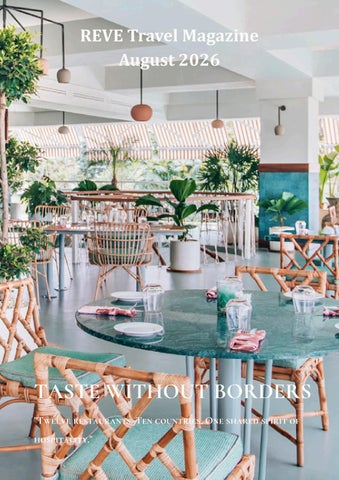
REVE Travel Magazine August 2026
TASTE WITHOUT BORDERS "Twelve restaurants. Ten countries. One shared spirit of hospitality."
01
Editor's Letter HEIDI AND TEAM
02
Edition Introduction flavour that knows exactly where it stands
06
GENJI Teppanyaki & Japanese Restaurant Bali, Indonesia
08
Food Capital Singapore
10
Le Pavillon Abidjan, Côte d'Ivoire
12
Lobbyto Heritage at Gran Hotel Inglés Madrid, Spain
REVE TRAVEL MAGAZINE
14
Food Exchange Singapore
◆ Contents
16
La Table d'Eva Silhouette Island, Seychelles
18
COYA Riyadh Riyadh, Saudi Arabia
20
Thai Square Putney Bridge London, United Kingdom
22
Osmanly Restaurant Cairo, Egypt
24
Flow Cafe Koh Phangan, Thailand
26
SanSara Singapore
28
GLORIA1937 Tallinn, Estonia
◆
REVE TRAVEL MAGAZINE
◆
Editor's Letter Dear Readers, Some journeys arrive with fanfare. Others slip in quietly — in the hush of a seventy-year-old dining room in Tallinn's Old Town, in the flicker of live music drifting through a Madrid lobby bar on a Thursday evening, in the moment a chef lifts a whole snapper from a teppanyaki flame and the whole table leans in at once. This is the travel that Taste Without Borders was made for. Our August edition began with a question we return to every year: what does hospitality look like when it refuses to borrow its identity from somewhere else? The answer, as you will find in the pages that follow, is that the finest restaurants in the world are rarely the ones chasing a global template. They are the ones that dig deeper into their own ground. Water runs through this edition the way it runs through so much of the world's great hospitality. Food Capital and SanSara sit within steps of one another along the Singapore River, each framing it through floor-to-ceiling glass in entirely different culinary languages. Thai Square Putney Bridge holds the Thames in a 180-degree embrace from the starting line of the Boat Race. Le Pavillon looks out over Abidjan's Ébrié Lagoon from what feels like a tree house suspended above the pool. And on Silhouette Island, La Table d'Eva asks something rarer of its guests: a forty-five-minute crossing by boat, rewarded with a dinner that could not exist quite the same way anywhere closer to shore. And then there is heritage, carried not as decoration but as something still working. Gloria has held its place in Tallinn for more than seventy years without ever settling into nostalgia. Osmanly brings Ottoman-era Turkish cooking to Cairo with a discipline that borders on reverence. COYA has carried a single Peruvian identity from London to Riyadh without losing what made it distinctive in the first place. SanSara does something similar in reverse, taking an ancient Sanskrit idea, to flow, and using it to keep North Indian cuisine moving rather than fixed. Alongside them, GENJI in Bali, Food Exchange in Singapore, Lobbyto Heritage in Madrid, and Flow Cafe on Koh Phangan remind us that hospitality does not require grandeur to be memorable. Sometimes it only requires a kitchen that knows exactly what it is trying to be, and the confidence not to be anything else.
Warmly, Heidi and Team
◆
◆
◆
EDITION INTRODUCTION
◆
From the Old Town of Tallinn to the Ébrié Lagoon, from the Singapore River to the Thames; flavour that knows exactly where it stands Taste Without Borders
There is a discipline to great restaurants that has nothing to do with plating or provenance, though both matter. It is the discipline of place — the understanding that a kitchen earns its meaning not by imitating what is fashionable elsewhere but in conversation with what surrounds it. The river it faces. The lagoon it overlooks. The heritage it carries forward. The community it feeds, night after night, for years or decades at a time. The twelve restaurants gathered in this August edition of REVE Travel Magazine share that discipline.
They are spread across ten countries and five continents. They range from a seventy-year-old dining room in Tallinn's Old Town to a lagoon-side pavilion above the pool at Sofitel Abidjan Hotel Ivoire; from a Peruvian pisco bar on a Riyadh evening to a minimalist café built for digital nomads on the shores of Koh Phangan. They include riverside dining halls in Singapore built for both abundance and intimacy; a Turkish table inside a Cairo hotel guarding Ottoman-era recipes with real discipline; a Madrid lobby bar carrying the glamour of the 1920s into the present; an island restaurant on Silhouette reachable only by boat; and a ship-shaped riverside address on the Thames with a ringside seat for the Boat Race. What unites them is flow — the movement of flavour across borders and generations, present in some form at nearly every property in this edition — and the table: the shared meal, the open kitchen, the dining room that treats history and landscape as ingredients in their own right. Together, these two elements form the axis around which Taste Without Borders turns. This edition is organised in the spirit of the journey itself: beginning in Southeast Asia, where the majority of our featured properties reside, before moving through South and West Asia, the Middle East, Africa and Europe. Each restaurant is presented not as a listing but as an encounter — written to give the reader not merely a menu but the particular atmosphere of a place. The sense of sitting down somewhere that knows exactly what it is trying to be, and has no interest in being anything else. We have always believed at REVE Travel Magazine that the finest hospitality is an act of generosity — toward the guest, toward the ingredient and toward the culture that shaped the recipe long before it reached the table. The restaurants in this edition make that belief easy to hold.
◆
◆
"True luxury lies not in opulence, but in the profound alchemy of restoration."
NIndonesia, Bali
GENJI Teppanyaki & Japanese Restaurant
REVE TRAVEL MAGAZINE
GENJI Teppanyaki & Japanese Restaurant There is a particular kind of quiet that settles over GENJI in the late afternoon, before the first reservations arrive and while the sunlight is still doing most of the work in the room. Set on the ground floor of Ayodya Resort Bali, only steps from the sand at Nusa Dua, the restaurant occupies a space that could easily have been designed as a formal, closed-off dining hall. Instead, it opens itself up. Natural light floods the room through the day, and the effect softens everything, turning a Tuesday lunch into something worth lingering over and a Saturday dinner into a proper occasion. What distinguishes GENJI most clearly from the wider field of resort dining rooms across Bali is the sheer range of ways a guest can choose to eat. This is not a restaurant offering a single format dressed up with different table settings. At the teppanyaki tables, the chef becomes part of the entertainment, working through knife technique and flame control just inches from where the food will be eaten, each dish finished to order and served the moment it is ready. It is theatre with genuine culinary weight behind it, the kind of dining experience that rewards guests who enjoy watching their meal come together as much as eating it. For those who prefer precision without performance, the sushi bar offers something quieter and more exacting. Here the focus narrows entirely to the fish: its provenance, its texture, the temperature at which it is served, and the balance struck between the rice beneath it and the seasoning above. And for guests marking something worth celebrating privately, whether an anniversary, a business milestone, or simply a night they want to remember, GENJI holds its Tatami Room in reserve. Low-lit and low-seated in the traditional style, it trades the energy of the open dining room for something closer to sanctuary. It would be easy to categorise GENJI as a hotel restaurant, a convenient dinner option for guests who do not feel like leaving the property. The reality is closer to the opposite. GENJI has built enough of a reputation on its own terms that outside visitors regularly make the trip specifically for what happens inside its dining room, treating it as a destination rather than a convenience. That distinction, between a restaurant guests settle for and one they seek out, is exactly the kind of quiet confidence that runs through this edition's strongest entries. Opening in the early evening and running late into the night, GENJI has become one of those addresses that regulars mention almost reflexively when asked where to eat well in Nusa Dua, a reputation built one precise, unhurried service at a time.
Singapore
Food Capital
REVE TRAVEL MAGAZINE
Food Capital Some restaurants earn the word "capacious" through sheer square footage. Food Capital earns it through ambition. Set along the Singapore River inside Grand Copthorne Waterfront Hotel, the restaurant is built around a main island counter where the Patisserie and Seafood-on-Ice sections take centre stage, flanked by buffet stations that range across continents without ever feeling scattered or disjointed. The architecture of the space does a great deal of the restaurant's storytelling before a single dish is served. Full-height, floor-to-ceiling glass windows run the entire length of the dining area, pulling in natural light through the day and softening into a warmer, more intimate glow once the sun drops behind the Singapore River. Diners seated near the glass find themselves watching the water shift colour as the meal unfolds, a backdrop that turns a buffet, a format that can occasionally feel purely functional in lesser hands, into something closer to an occasion worth dressing for. The main counter reflects that same ambition. Popular selections rotate through Canadian snow crab leg, Chilean scallop, oven-roasted chicken, and Australian beef rib eye finished with a red wine jus, each holding its own station and its own following among regulars. Alongside these sit crowd favourites that have become genuinely synonymous with the restaurant itself: fresh sashimi cut to order, and a signature laksa recognised locally as one of the better versions available anywhere in the city, hotel dining room or otherwise. A dedicated Tandoor Grill section layers Indian spice and smoke into a menu that already spans Asian and international ground, giving guests one more reason to return with an appetite for something specific. There is also a quieter thread running beneath the scale and spectacle of the operation. As part of a broader sustainability effort, Food Capital has removed plastic straws in favour of sustainable alternatives and does not serve shark's fin soup, decisions that reflect a wider shift in how hospitality brands are choosing to define quality today, not solely through range and flavour, but through the responsibility with which that range is delivered. It is a detail easily missed amid the abundance on offer, but one that speaks to a kitchen thinking beyond the next service. Taken together, the river views, the global spread, the rotating cultural showcases, and the environmental commitments make Food Capital considerably more than a convenient buffet stop along the Singapore River. It is a restaurant that has clearly decided abundance and intention are not mutually exclusive.
ZIvory Coast, Abidjan
Le Pavillon
REVE TRAVEL MAGAZINE
Le Pavillon Perched directly above the pool at Sofitel Abidjan Hotel Ivoire, Le Pavillon has been reimagined with a single clear intention: to put African flavour at the centre of the Sofitel identity rather than treating it as a regional footnote appended to a broader international menu. The restaurant's own description of itself as a gastronomic odyssey through the continent is not an exaggeration so much as an accurate summary of the ambition behind its recent redesign. The setting alone would justify a visit, before a single dish reaches the table. Lush vegetation wraps around contemporary architecture, and the restaurant looks out over the Ébrié Lagoon, creating what guests have taken to describing as an elegant tree house, open to the sky and thoroughly immersed in greenery. Light filters through the surrounding foliage differently at each hour, giving lunch, sunset dinner, and late evening service three distinct atmospheres within the same physical space. It is a room built for lingering, whether that means a slow family lunch stretching into the afternoon, a dinner among friends that outlasts its reservation window, or a quiet evening beside the pool as the light changes over the water. On the plate, Le Pavillon leans firmly into African and Ivorian cooking with a modern sensibility rather than a diluted, internationalised version built for unfamiliar palates. Attiéké, kedjenou, grilled meats, kebabs, and cassava or yam fries anchor a menu built around local produce and traditional technique, presented in a way that respects the gastronomic standards expected of the Sofitel name without softening the character of Ivorian cuisine to make it more familiar to visitors. That balance, honouring the source material rather than adapting it into something more palatable for an international audience, is what separates Le Pavillon from a generic hotel restaurant offering a token local dish or two alongside a largely European menu. Open daily to both hotel guests and the wider public, Le Pavillon has positioned itself as a genuine gathering place in Abidjan rather than a restaurant reserved solely for those staying at the hotel. Locals treat it as a destination in its own right, a place to bring visiting family or celebrate an occasion, which speaks to how thoroughly the restaurant has established its own identity separate from the hotel surrounding it. Between the lagoon views, the tree house atmosphere, and a menu unafraid to centre West African cooking on its own terms, Le Pavillon stands as one of the more distinctive and quietly confident dining spaces in the region.
Spain, Madrids
Lobbyto Heritage at Gran Hotel Inglés
REVE TRAVEL MAGAZINE
Lobbyto Heritage at Gran Hotel Inglés Gran Hotel Inglés carries the distinction of being the oldest hotel in Madrid, and Lobbyto Heritage, its restaurant-cocktail bar, treats that history as something to build with rather than simply preserve behind glass. Set in the heart of the hotel and recognised as one of the city's most iconic meeting points, Lobbyto merges traditional Madrid cooking with sharper, more contemporary technique, resulting in a menu that feels rooted without ever feeling dated or nostalgic for its own sake. The design leans deliberately into the glamour of the 1920s, an era the restaurant channels through noble materials, soft lighting, and classic architectural detailing rather than costume-like theming that can quickly feel gimmicky. Nothing about the room feels like a recreation; it feels like a space that has simply carried its history forward without needing to shout about it. At the centre of it all sits a large central bar, the true focal point of the grand hall, where guests can sit and watch some of Madrid's finest cocktails being built in real time, ice cracked and spirits measured with the kind of unhurried precision that suggests the bartenders here are not working to a clock. It is a room designed for a specific kind of evening: one built around conversation, laughter, and good company as much as around the food and drink themselves. The central bar arrangement means no table sits too far from the action, and the acoustics have clearly been considered carefully enough that conversation carries without shouting, even as the room fills toward the weekend. Live music runs Thursday through Sunday, giving the space a distinctly different energy across the week: quieter and more conversational at the start, livelier and more social as the weekend builds toward Saturday night. Regulars have learned to choose their evening based on the mood they are after, treating Lobbyto almost as several different restaurants inhabiting the same beautiful room depending on the night of the week. Lobbyto Heritage also sits within a broader network of event spaces at Gran Hotel Inglés, including the literary-themed Salón de las Letras and the Virginia Woolf Salon, making it a natural anchor for guests looking to host something larger within the same building. But it is the everyday version of Lobbyto, the evening drink at the bar, the shared plate over unhurried conversation, that captures what the hotel is genuinely going for: history worn lightly, and hospitality that still feels current rather than preserved in amber.
Singapore
Food Exchange
REVE TRAVEL MAGAZINE
Food Exchange Just minutes from Orchard Road and the UNESCO-listed Singapore Botanic Gardens, Food Exchange at Novotel Singapore on Stevens has built its identity around a simple promise: it should feel like an escape, even though it sits firmly within the city. The al fresco setting does the heavy lifting here, wrapping guests in greenery that makes the restaurant feel closer to a resort retreat tucked into rainforest than a hotel dining room squeezed between conference sessions. Arriving at Food Exchange, the shift in atmosphere is immediate. The surrounding foliage muffles the usual noise of Orchard District, and the open-air layout allows the breeze to move freely through the dining space in a way few restaurants this close to the city centre manage. It is a setting that rewards a slower pace, whether that means a two-hour lunch that drifts comfortably past its intended length or a dinner that starts at golden hour and continues well into the evening under string lighting. The weekly rhythm at Food Exchange has become part of its charm, almost a calendar of its own that regulars plan around. Wednesdays belong to The Midweek Catch, an evening built entirely around oysters served fresh and flowing for anyone in need of a midweek pick-me-up, the kind of event that turns an ordinary Wednesday into something worth looking forward to. Saturdays shift into something louder and more theatrical with Oh Shucks! It's LobsterMania!, a seafood-forward night where juicy lobsters and live oyster shucking take over the room, drawing a crowd that comes specifically for the spectacle as much as the seafood itself. Sundays close the week on a more composed note with the @Stevens Sunday Brunch, built around seafood towers, indulgent sweets, and genuinely unlimited champagne, a combination that has made it one of the more talked-about weekend fixtures in the neighbourhood, the kind of brunch guests plan entire Sundays around. Food Exchange also positions itself as a genuine celebration venue, hosting everything from intimate weddings and solemnisations to birthdays and private gatherings, with a team on hand to curate menus around each specific occasion. The natural setting lends itself particularly well to outdoor ceremonies and garden-style receptions, giving the restaurant a second identity as an events destination that operates alongside its daily service rather than in competition with it. Between the setting, the weekly programming, and Chef Chaw's kitchen, Food Exchange has built something that functions equally well as a quiet lunch spot for two and a full weekend destination for a crowd, a rare kind of flexibility for a restaurant this close to the centre of Singapore.
Seychelles, Silhouette
La Table d’Eva
REVE TRAVEL MAGAZINE
La Table d'Eva Reaching La Table d'Eva is itself part of the experience it offers. Silhouette Island sits roughly forty-five minutes from Mahé by boat, the third largest island in the Seychellois archipelago and a protected natural park in its own right. Within La Belle Tortue, an exclusive lodge with its own stretch of white sand beach, La Table d'Eva operates as the more refined of two dining concepts on site, a gourmet fusion restaurant built for evenings rather than passing lunches. The island itself sets an unusually high bar for atmosphere before a guest has even sat down to eat. Lush rainforest, striking biodiversity, and a genuine sense of remoteness surround the property, the kind of setting that makes phone signal feel almost beside the point. The restaurant's menu is built to match that environment rather than compete with it, favouring dishes that feel considered and unhurried over anything that might read as flashy against such a quietly dramatic backdrop. Two Kitchens, Two Moods By day, guests can opt for the relaxed, barefoot atmosphere of Kaz à Stan, the property's beach hut dining option, where lunch tends to mean something light, fresh, and easy to enjoy with sand still on your feet. By night, La Table d'Eva takes over with a more considered approach entirely: fresh, carefully selected ingredients, classic French dishes reworked with local flavour, and a wine list drawn from vineyards chosen with evident care from around the world. The shift between the two, from Kaz à Stan's easy midday rhythm to La Table d'Eva's more composed evening service, gives guests staying on the island two genuinely different dining personalities without ever leaving the property.
The kitchen's stated aim, introducing guests to local Seychellois flavours or helping them rediscover essential French cuisine, captures the balance the restaurant strikes throughout its menu. Nothing here feels imported wholesale from a European playbook, nor does it feel like a purely local menu dressed up for an international audience. Instead, La Table d'Eva sits comfortably between the two traditions, letting each inform the other across a four-course dinner built for slow evenings, with the ocean and the sound of the surrounding forest doing much of the ambient work that music might provide elsewhere. Given the effort required simply to arrive on Silhouette Island, whether by boat or the faster fifteenminute helicopter transfer, La Table d'Eva has the rare advantage of a genuinely captive and appreciative audience, guests who have already committed to the journey and arrive ready to be won over. The restaurant uses that advantage well, delivering a dinner that feels entirely worth the distance travelled, precisely because everything about the setting, from the lodge's private beach to the surrounding protected park, reinforces the sense that this is a meal that could not happen quite the same way anywhere else.
Saudi Arabia, Riyadh
COYA Riyadh
REVE TRAVEL MAGAZINE
COYA Riyadh COYA has never positioned itself as simply a restaurant, and its Riyadh location makes that clear from the first visit. Since opening its original site in London in 2012, the brand has expanded across Mayfair, Dubai, Abu Dhabi, Monte Carlo, Doha, Marbella, and now Riyadh, building a reputation less around a single signature dish and more around a complete sensory identity: Peruvian cuisine, inventive pisco, cultural programming, and an atmosphere that stays lively well into the evening, night after night, city after city. Riyadh's iteration carries all of that forward with clear intent. The kitchen focuses on authentic Peruvian cooking with genuine culinary innovation layered on top, giving the à la carte menu a sense of depth beyond the expected ceviche-and-pisco pairing that has become something of a shorthand for the cuisine internationally. Traditional techniques and ingredients form the backbone of the menu, with contemporary plating and presentation giving familiar Peruvian staples a distinctly current feel without losing the character that makes the cuisine recognisable in the first place. The pisco bar itself remains very much a centrepiece of the room, both physically and in terms of the experience it offers. Mixologists work through a wide range of COYA signatures, Peruvian classics, and dishes adapted specifically for the Riyadh market, giving the bar programme a local inflection within an internationally consistent brand. Watching a pisco sour built from scratch at the bar has become something of a ritual for first-time visitors, a small piece of theatre that sets the tone for the rest of the evening. The property also houses a growing art collection, work chosen to feel as fresh and surprising today as it would have felt decades ago, reinforcing COYA's self-description as a culture and a lifestyle rather than simply a place to eat. Pieces are rotated regularly enough that even frequent guests find something new to notice on each visit, a detail that speaks to genuine curatorial intent rather than art selected purely for décor. For a brand built on consistency across more than a dozen international locations, COYA Riyadh manages a genuinely difficult balance: it feels unmistakably part of the wider COYA identity, instantly recognisable to anyone who has visited a sister location abroad, while still carrying enough local character to belong specifically to Riyadh's rapidly growing dining scene. That combination, global brand discipline paired with local specificity, is precisely what has allowed COYA to expand as successfully as it has without diluting what made the original London location distinctive in the first place.
United Kingdom, London
Thai Square Putney Bridge
REVE TRAVEL MAGAZINE
Thai Square Putney Bridge Few restaurants in London can claim a view quite like the one from Thai Square Putney Bridge. Housed in an award-winning building shaped like a ship, and recognised for its architecture by the Royal Institute of Architecture, the American Institute of Architecture, and the Wandsworth Corporation, the restaurant sits directly on the Thames with a 180-degree panoramic outlook that has made it a fixture on Boat Race day and a long-standing favourite for weddings and private parties alike. The interior earns its own attention well before the food arrives at the table. A sweeping botanical staircase, antique Thai artefacts collected over years, and expansive floor-to-ceiling windows give the space a sense of occasion that few riverside restaurants in London manage to sustain across both a casual weeknight dinner and a full formal event. The upper floor houses an airy dining area built around those river views, while the ground floor bar comes equipped with karaoke and full audiovisual facilities, allowing the venue to shift easily between a refined dinner setting and a livelier private event space depending entirely on what the evening calls for. On the menu, Thai chefs work through a repertoire of dishes built for both comfort and precision: succulent jumbo prawns with glass noodles, crispy whole sea bass infused with Thai herbs, and spicy softshell crab with basil sit alongside the curry classics and Pad Thai that regulars return for again and again. The kitchen's clear grounding in traditional technique, rather than a Westernised approximation of Thai food built for unadventurous palates, has helped the restaurant earn its standing as one of the better Thai dining rooms in the city, a reputation reinforced by recognition from Thai Select and multiple Consumer Choice and Food & Drink Awards over the years. Ideally situated at the starting line of the historic Boat Race, the restaurant provides what may be one of the most sought-after ringside seats in the city each year, a spot where diners can watch the two university crews battle it out on the water without leaving their table. That single annual event has become something of a signature moment for the restaurant, drawing bookings months in advance from guests eager to combine the spectacle with a proper meal rather than simply watching from the riverbank. With seating for up to one hundred and fifty guests across the full restaurant, and a private area accommodating thirty, Thai Square Putney Bridge has built a genuine reputation as an events venue as much as a restaurant, hosting everything from intimate wedding receptions to larger corporate celebrations. But it is the combination of that river view, the architecture, and a kitchen unwilling to cut corners on flavour that keeps it firmly on London's list of destination dining spots, the kind of restaurant that draws guests back not for a single occasion but for a whole calendar of them.
Egypt, Cairo
Osmanly Restaurant
REVE TRAVEL MAGAZINE
Osmanly Restaurant Inside Kempinski Garden City, Osmanly has built its reputation on a simple idea executed with real discipline: bringing the flavours of the Ottoman Empire to Cairo without cutting corners on authenticity. Led by a Turkish chef brought in specifically to guide the kitchen, the restaurant serves traditional Turkish cuisine seven days a week for both lunch and dinner, treating each dish as a small act of culinary preservation as much as a meal to be enjoyed and forgotten. The menu covers familiar ground done exceptionally well: savoury kebabs, succulent grilled meats, and vibrant mezes built from fresh ingredients and time-honoured technique passed down through generations of Turkish kitchens. What distinguishes Osmanly most clearly from other Turkish restaurants operating outside Turkey is the level of care applied before anything even reaches the grill. Every piece of beef and lamb served in the restaurant is individually inspected, a detail the restaurant is clearly proud to share and one that speaks to a kitchen more concerned with consistency across every service than with shortcuts taken during a busy night. The signature dish, Hünkar Beğendi, a dish of tender lamb served over a smoky, creamy aubergine purée, alongside standouts like Kaşarlı Köfte, anchors a menu that rewards guests willing to move beyond the expected kebab plate and explore the deeper corners of Ottoman-era cooking. These dishes carry a sense of occasion in their own right, the kind of plates that arrive at the table looking unmistakably like the product of a kitchen with genuine specialism rather than a broadly international hotel restaurant offering a token regional cuisine. Set within a five-star hotel environment but carrying its own distinct culinary identity, Osmanly has become a genuine destination for Turkish cuisine in Cairo rather than simply a hotel dining option catering to whoever happens to be staying upstairs. Guests travel across the city specifically for a taste of the Ottoman table here, a pattern that speaks volumes about how thoroughly the restaurant has separated its own reputation from that of the hotel surrounding it, becoming, in effect, a restaurant that happens to sit inside a hotel rather than a hotel restaurant in the conventional sense.
Thailand, Koh Phangan
Flow Cafe Koh Phangan
REVE TRAVEL MAGAZINE
Flow Cafe Set at the entrance to Bay Villas and just moments from Haad Salad, Flow Cafe has built its identity around restraint. The design is minimalist, the pace unhurried, and the overall effect is a genuine escape from the busier corners of Koh Phangan, a rare thing to find well executed on an island better known internationally for its parties than for its quieter, more considered corners. Welcome to a space where design meets comfort in a genuinely deliberate way. The interior favours clean lines and a modern, stylish sensibility over the more rustic, driftwood-heavy aesthetic common to beach cafes across the region, giving Flow a slightly more polished feel without losing any of the relaxed island atmosphere guests come for. Comfortable seating, efficient air conditioning, and an outdoor patio area for guests wanting sunshine rather than shade all reflect a level of thought that goes beyond simply serving good coffee in a pleasant location, though the coffee itself remains very much the point. The kitchen works almost entirely with fresh, locally sourced ingredients, and the menu has been built deliberately wide to cover nearly every kind of craving and dietary need in one place. Vibrant smoothie bowls and wholesome salads sit alongside heartier à la carte dishes and indulgent desserts, giving Flow Cafe genuine appeal whether a guest is after something light and nourishing after a morning swim or something closer to comfort food with an inventive twist after a long day of travel. Vegetarians, vegans, and families with children all find something built specifically with them in mind rather than an afterthought squeezed onto the margins of the menu. What sets Flow Cafe apart within its category is the ambition behind an otherwise modestsounding concept. The café holds the distinction of being the only one on Koh Phangan to receive recognition from the World Luxury Hotel Awards, a marker that speaks to the level of consistency and service the team has built into what could easily have been a purely functional beachside stop rather than a genuine destination. A dedicated team ensures guests are looked after without needing to queue or chase down a server, a small operational detail that makes a noticeable difference during the island's busier stretches.
Singapore
SanSara
REVE TRAVEL MAGAZINE
SanSara SanSara takes its name from an ancient Sanskrit word meaning "to flow," and the restaurant, set inside Grand Copthorne Waterfront Hotel along the Singapore River, has built its entire philosophy around that single concept. Rather than presenting North Indian cuisine as a fixed, static tradition frozen at some point in the past, SanSara treats it as something continually moving: evolving, renewing, and carrying stories forward from one region to the next across a single, carefully constructed menu. That approach shows clearly in how the food is structured and, just as importantly, in how it is framed for guests before they even order. The menu traces a route through North India's culinary map, from the fragrant kitchens of Punjab and the spice-laden valleys of Kashmir to the regal traditions of Lucknow and the sacred ghats of Benares, with each dish framed as a tribute to a specific place and memory rather than a generic regional label applied loosely across the board. Dining at SanSara becomes, in this sense, less a single meal and more a compressed tour through several distinct culinary regions, each with its own history and its own reason for appearing on the table. Leading the kitchen is Chef Pannalal Nath, whose twenty-five-year career across India's diverse culinary landscape eventually settled on Awadhi cuisine as his specialism, an area he has since become known for interpreting with genuine elegance and modern technique. That kind of deep specialisation, rather than a broad but shallow familiarity with North Indian cooking generally, gives SanSara's menu a level of authority that is difficult to fake and immediately apparent to anyone who has eaten Awadhi cuisine elsewhere. The recognition has followed accordingly. SanSara has been named among Tripadvisor's top Indian restaurants in Singapore and has picked up a feature in Tatler Asia for its evocative approach to North Indian cuisine, external validation that matches what regular guests have clearly already understood. For a restaurant built entirely around the idea of movement, that ongoing recognition feels less like an endpoint and more like confirmation that the flow, as the restaurant's own philosophy would put it, is working exactly as intended.
Estonia, Tallinn
GLORIA 1937
REVE TRAVEL MAGAZINE
GLORIA1937 In the heart of Tallinn's Old Town, Restaurant Gloria has spent more than seventy years building something increasingly rare in hospitality: genuine longevity without stagnation. That span of time has hosted hundreds of thousands of memorable meals and, notably, a guest list few restaurants anywhere could match, including Prince Charles, Pope John Paul II, The Rolling Stones, and Sting, each drawn to a room that has clearly offered something worth returning for across decades of changing culinary fashion. Walking through Gloria's doors today, tucked into the cobbled heart of Tallinn's Old Town, carries a certain weight that only comes from genuine longevity. This is not a restaurant that opened last year and adopted a heritage aesthetic to feel established; it has actually earned the description over more than seven decades of continuous service, through periods of enormous political and cultural change in Estonia's own history. Few restaurants can claim to have operated across such a span while still feeling relevant to a contemporary Tallinn diner rather than existing purely as a nostalgic curiosity. Gloria describes its own approach as innovative in form yet conservative in content, and that phrase does real work in explaining why the restaurant has endured across generations of Tallinn diners. The menu leans on French cuisine and classic Old European cooking, but it is not frozen in a single decade or a single trend. Instead, the kitchen allows its offering to shift gently with Estonia's four seasons, reflecting the country's own natural rhythms rather than imposing a fixed, static concept onto the calendar regardless of what the season actually calls for. It is a restaurant that treats its own history as a foundation to build on rather than a script to repeat verbatim, service after service. What ultimately defines Gloria is its refusal to treat heritage as decoration, as something to be displayed rather than actively practised. The restaurant's mission, introducing diverse food cultures and classic Old European cuisine while reflecting the best of Estonian nature, has clearly guided decades of decisions, right down to how the menu changes with the seasons rather than staying fixed for convenience. The result is a restaurant that feels less like a monument to the past, preserved carefully but essentially unchanging, and more like a genuinely living, evolving part of Tallinn's present, one that happens to carry seventy years of history along with it rather than being defined solely by it.