retrofit May/June 2026

Page 1


Modern workplace security requires more than a single product. SafeSuite™ integrates retrofit security glazing, bullet resistant doors, and ballistic wall panels into a coordinated protection system designed to strengthen the most vulnerable parts of a building.

By reinforcing glass, doors, and surrounding surfaces, SafeSuite creates secure spaces that help delay forced entry and protect the people inside. The system installs into existing buildings without major reconstruction, allowing organizations to enhance safety while maintaining the architecture they value.

888.689.5502 • defenselite.com

Executive Office Protection Solution

DELAY AND DETER FORCED ENTRY

CORPORATE

Ideal Applications

BOARDROOMS HIGH-VALUE EXECUTIVE SUITES & MEETING SPACES WORK FLOORS

COMMAND

CRITICAL

GOVERNMENT CENTERS INFRASTRUCTURE FACILITIES

❶ RETROFIT SECURITY GLAZING

Impact Security pioneered retrofit over glazing systems that strengthen existing windows, doors, and curtain walls while maintaining visibility.

RiotLite®

Delays forced entry and smash and grab attacks

DefenseLite Pro®

Prevents forced entry and withstands repeated impacts

BulletShield™

Adds ballistic protection for high risk environments

❷ BULLET RESISTANT DOORS

DefenseLite® Bullet Resistant Doors provide reinforced entry points designed to resist ballistic and forced entry threats while integrating with existing building hardware and finishes.

Available with UL 752 ballistic protection levels and compatible with standard locking systems, these doors provide secure access without sacrificing design flexibility.

❸ BALLISTIC WALL PANELS

DefenseLite® Bullet Resistant Wall Panels add discreet protection to offices, reception areas, security stations, and executive suites. Lightweight ballistic materials integrate into walls, millwork, and furniture to create protective barriers where occupants need them most. Panels are available in multiple UL 752 ballistic ratings and are designed to capture projectiles.

Scan the QR code to learn more about SafeSuite.

Stainless Steel Tank and No Anodes

NEW NWP500 Heat Pump Water Heaters

The Navien NWP500 is built for efficiency, performance and durability with a stainlesssteel tank and aluminum refrigeration coils... no anodes needed. To learn more about all the advantages of the NEW NWP500, visit navieninc.com or scan the QR code.

Energy Star rating: up to 4.05 UEF.

Top and side connection options.

Built-in Wi-Fi powered by NaviLink® with over-the-air software updates.

Designed to meet NEEA AWHS Tier 4 requirements.

Quiet operation, less than 45dBA.

Ambient operating range of 41°F–113°F.

Architectural & Sun Screen Systems can transform the design of conventional structures, such as parking garages. On the exterior of a building surface, overhang, or walkway, these screens can provide energy-saving shade to reduce heat gain and protect from damaging UV light. Perforated steel panels can span longer distances with less structure, are available in multiple shapes, and can be color-matched for unlimited appearances.

Bloomington Parking Garage — Bloomington, Minnesota Product: EPIC Architectural & Sun Screen APEX Architect: Clow Berg Architecture — Minneapolis, Minnesota

Paper Towel Dispensers

Waste Receptacles

Soap Dispensers

Mirrors Grab Bars

Shelves and Hooks

Seat Cover Dispensers

Toilet Paper Dispensers

Napkin Disposals

The new Elvari® collection delivers on design — pairing refined aesthetics and finishes with the most comprehensive suite of commercial washroom accessories. The result is a washroom experience that feels elevated, cohesive, and unmistakably modern. Discover the beauty of unity, only from Bradley.

Stainless.

MAY-JUNE 2026 / / VOL 17 / /

Feature Projects

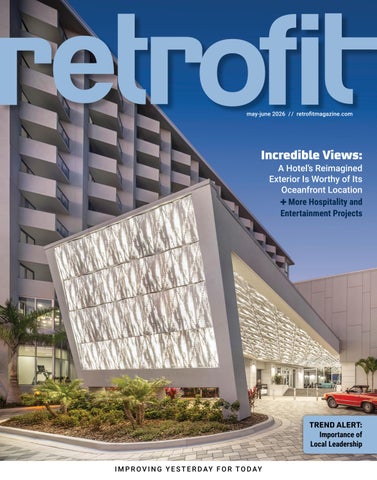
Aging Resort, Modern Escape

A hotel in Daytona Beach, Fla., is reimagined with a captivating exterior worthy of its oceanfront location.

Peruse innovative hospitality and entertainment facilities from across the U.S.:

• The Bustle, The Perch and The Landing, THE PENN DISTRICT, New York

• Little Coyote, St. Elmo, Tenn.

• Doberman Drawing Room, Las Vegas

• Vollmer Center, Clyburn Arboretum, Baltimore City, Md.

• Molly Moon’s Waterfront, Seattle

• The Naisho Room, Watermark Hotel, Tysons, Va.

COVER PHOTO : Jonathan Hillyer/Cooper Carry

INSIDE THIS ISSUE

BUSINESS

16 Decoded

Roofing and energy codes are missing balance.

BUSINESS

20 Acoustic Commissioning

Acoustic commissioning helps correlate a subjective experience with measurable data, so teams can make better decisions earlier—and avoid costly surprises later.

TRANSFORMATION

38

Designed for Connection

Targeted improvements at the Inn at Celebration in Celebration, Fla., recapture its place within the community.

COLUMN

12 Point of View

Editor Christina Koch’s summer vacation plans may include a visit with her astronaut name-twin.

TRANSFORMATION

44

New Beginnings

A two-year project culminates in moving and converting a historic barn into a unique wedding space in Morgantown, W.Va.

TRANSFORMATION

48 Hidden Potential Creative mass-timber code interpretation unlocks new life for a historic warehouse as a boutique hotel in Seattle.

DEPARTMENT

HISTORIC

52

Cultural Anchor

A theater inside a former power station in Milwaukee is updated to welcome every guest.

56 Local Leaders

County and local governments keep pragmatic climate momentum alive as federal priorities shift.

60 Products // View a roundup of the latest materials and systems for the industry.

66 Inspiration // An overlooked part of Dyersburg, Tenn., is reinvented and anchored with a farmer’s market.

TREND ALERT

please play video here.

https://www.msisurfaces. com/backsplash-tile/acoustic-

BEAUTY THAT PERFORMS

Stylish and practical, MSI’s acoustic panels add a chic touch to any wall while offering practical sound control with its cutting-edge acoustic fiber backing. Explore these ideal accent wall solutions and more—partner with MSI for on-trend materials, reliable distribution, and exceptional service.

SABLE ACOUSTIC WOOD SLAT PANELS

May-June 2026 // VOL 17 // ISSUE 3

PUBLISHER

JOHN RIESTER john@retrofitmagazine.com

ASSOCIATE PUBLISHER/EDITORIAL DIRECTOR

CHRISTINA KOCH christina@retrofitmagazine.com

DIRECTOR OF OPERATIONS

BECKY RIESTER becky@retrofitmagazine.com

CONTRIBUTING EDITOR JIM SCHNEIDER

ART DIRECTOR/DIGITAL DESIGN DIRECTOR

ERIKA NYGAARD

CIRCULATION MANAGER LYN URE lyn@retrofitmagazine.com

WEB ENGINEER DEREK LEEDS

SOCIAL MEDIA MAVEN

ROBIN GRABER

ADVERTISING SALES

JOHN RIESTER john@retrofitmagazine.com (919) 641-6321

BETH EMERICH beth@retrofitmagazine.com (781) 710-4745

BARRETT HAHN barrett.hahn@gmail.com (919) 593-5318

MIKE GILBERT treblig2023@gmail.com (847) 867-9615

EDITORIAL ADVISORY BOARD

NATHAN M. GILLETTE AIA, LEED AP, REALTOR Director, Natura Architectural Consulting LLC, Grand Rapids, Mich.

WILLIAM E. HOLLOWAY AIA, LEED AP Principal, BERNARDON, Wilmington, Del.

JOHN J. NOONAN Facilities Management Consultant, Durham, N.C

MICHAEL P. WASHBURN, Ph.D. Principal, Washburn Consulting, Scottsdale, Ariz.

RETROFIT // Vol. 17 // No. 3 is published bimonthly by Fisher Media LLC, 98 Booth Meadow Lane, Durham, NC 27713, (919) 641-6321. POSTMASTER: Send address changes to retrofit, 2409 High Point Drive, Lindenhurst, IL 60046. TO SUBSCRIBE or make

changes, visit www.retrofitmagazine.com, and click on the “Subscribe” button, or email lyn@retrofitmagazine.com.

E Q U I T O N E F I B E R C E M E N T P A N E L S

Specify EQUITONE with confidence: Access BIM files, technical documentation, performance data, and free material samples

Installation Flexibility: Lightweight fiber cement panels designed for ventilated facade systems

EQUITONE can be cut, shaped, and installed across a variety of substructures

Superior Performance: Resistant to moisture, UV exposure, and freeze‐thaw cycles

EQUITONE is noncombustible, impact resistant, and dimensionally stable for lasting building envelope protection

Design Options: Through‐colored panels offered in multiple textures and finishes Easily customized through perforation routing or shaping to support distinctive facade transformations

The Element Hotel I San Francisco, CA | Architect: AXIS Architecture + Design I Product: EQUITONE [natura] N251, EQUITONE [tectiva] TE20, TE90

Moon Joy

I spent the early part of April looking at the moon and watching news reports about Artemis II, the nine-day lunar flyby that set the record for human-distance from Earth—252,756 miles. The historic mission was crewed by the first person of color, first woman, first non-U.S. citizen and the oldest person to travel beyond low-Earth orbit. Many of you noticed the name of the first woman—Astronaut Christina Koch—because I enjoyed the emails, texts, phone calls and social-media messages about my name-twin in space. (She even pronounces her last name the same way I do: cook.)

I have followed Christina Koch’s career since 2019 when she set the record for the longest single space flight by a woman (328 days). I admit it was her name that inspired my curiosity about her, but I have been fascinated by the stars and planets my whole life. In second grade, I declared astronomy as my future career. I realized in high school I didn’t love physics; I loved English (and history), and voila: This Christina Koch is following her dreams writing and editing articles about renovating existing buildings with her feet firmly planted on Earth.

My career has led me to meet many fascinating people over the years and, in 2021, I communicated with Astronaut Christina Koch when I wrote about Apollo Mission Control in Houston being made to look as it did when Apollo 11 landed on the moon. (Read the story at bit.ly/4sPoqgh.) The NASA team connected us, and Astronaut Christina offered to take a photo with me when I come to Houston. Unfortunately, time has flown seemingly as quickly as Artemis II and it hasn’t happened. Instead, I have been focused on putting out stellar issues of retrofit—and this one is no different. For example, Jason Wilen, AIA, NCARB, CDT, RRO, a principal at Klein & Hoffman, underscores how building and energy codes often do not align based on his experience in the roofing and waterproofing industry. He says underperforming roof assemblies typically are caused by roof system designers’ focus on meeting environmental goals or local requirements without considering climate-zone realities or installation limitations. Read Wilen’s insight in “Business”, page 16.

Meanwhile, Ryan Biziorek, a project executive and the national leader of the Acoustics and Audiovisual practice at IMEG, writes about how acoustic commissioning helps correlate the subjective experience of sound with measurable data, so teams can avoid costly surprises later. Biziorek explains how acoustics testing can add value to a project in “Business”, page 20.

If you haven’t planned your summer vacation yet, there are many updated hospitality and entertainment projects in this issue that invite you to relax and prepare yourself for another year effecting change in this industry. As I finalize my own current trip around the sun—I have a milestone birthday coming up—I think a visit to Houston is in order. I would be honored to take a photo with Astronaut Christina Koch, and I have a daughter (see photo right) who would love to meet an American hero!

retrofit

Check out retrofit’s Latest Podcast Design and performance of commercial restrooms is important. This edition of The Retrofit Podcast discusses hygiene, sustainability, operations and design of commercial restroom spaces. Visit www.retrofitmagazine.com to view the podcast today.

Enhanced Carbon Reduction, Comfort, and Safety Through Building Retrofi ts

HVAC retrofits create opportunities to boost comfort, improve indoor air quality, and reduce energy use. With decades of expertise and a proven portfolio of high-performance solutions, Belimo is a trusted partner—whether you need quick wins, intelligent upgrades, or full-system modernization. Our solutions deliver consistent, scalable results across your entire building portfolio.

Through reliable products, expert support, and collaborative partnerships, Belimo helps reduce carbon footprints, meet environmental and economic goals, and elevate occupant comfort. With both standard and custom retrofit options, we ensure you get the right solution for long-lasting impact.

CONTRIBUTING WRITERS

Jason Wilen, AIA, NCARB, CDT, RRO, is a principal at Klein & Hoffman where he leads roof system and waterproofing rehabilitation projects, as well as consults on building- and energy-code development. Wilen shares insight into how building and energy codes, specifically for roofing, often do not align in “Business”, page 16.

Ryan Biziorek is a project executive and the national leader of the Acoustics and Audiovisual practice at IMEG. Leveraging nearly 20 years’ experience in acoustics and audiovisual technology design, he writes about how acoustic commissioning helps correlate a subjective experience with measurable data. Read “Business”, page 20.

Bob Neal (left), AIA, and T.Jack Bagby, AIA, LEED AP, are principals of Cooper Carry’s Hospitality Studio. The pair share their work on the Renaissance Daytona Beach Oceanfront Hotel, which has reemerged as a resort-style destination on Florida’s coast with a reimagined exterior. Read our “Cover Story”, page 24.

Elaina Lackaye, CID, NCIDQ, is design director at Baskervill, where her portfolio includes a diverse array of projects. In “Transformation”, page 38, Lackaye writes about the thoughtful renewal of the Inn at Celebration, a landmark for the community of Celebration, Fla.

In “Transformation”, page 44, Thomas Renner, who writes about buildings, construction and other industry topics, uncovers the two-year process to create White Oak 1838, a unique wedding venue in a historic barn, which was moved from Ohio to Morgantown, W.Va.

Mike Jobes (left), AIA, is a principal, and Tetsuo Takemoto, AIA, is an associate with The Miller Hull Partnership LLP. In “Transformation” page 48, they highlight Populus Seattle, a boutique hotel located in a 1907 warehouse, in which heavy-timber framework was preserved, structural upgrades were integrated and new mass-timber building codes were applied.

Jacquelyn Posselt (left), ASID, LEED AP ID+C, is a senior design principal at EUA. Melissa Vartanian-Mikaelian is the managing director of the Milwaukee Repertory Theater. The pair worked closely on the theater’s recent renovation, which appears in “Historic” page 52.

Flo Acoustic Wall Panels ©modularArts, Inc.
Ab Design Elements, Scottsdale | Eric Kruk Photography Flo™ Acoustic Wall Panel ©modularArts, Inc.

MASTERPIECE? NO, MARKERBOARD!

Introducing our exclusive Elite Reveal markerboard. You won’t believe your eyes. And ASI offers the most comprehensive selection of high-end Visual Display Products on the market. Visit asi-visualdisplayproducts.com to explore the standard for basis of design in markerboards.

Decoded

Roofing and Energy Codes Are Missing Balance

As architects, we continually strive to create buildings that are not only aesthetically pleasing and functional but also resilient and sustainable. One area that often poses challenges is the design of low-slope roofs because requirements set by building codes, energy-conservation codes and other standards are poorly coordinated, often making balanced designs difficult to achieve.

Why Balance Matters

In my experience as a forensic architect specializing in roofing and waterproofing systems, I have encountered numerous underperforming roof assemblies with reduced service lives, falling short of the typical 20-year manufacturer warranty period. The primary reason is the tendency of roof system designers to focus on one or two specific attributes while neglecting others. For instance, designers may opt for highly reflective surfaces or low-VOC materials to meet environmental goals or local requirements without considering climate zone realities or installation limitations. This can lead to omission or downgrading of critical roof system elements, resulting in roof systems that underperform over time.

Addressing this requires a new strategy encouraging balanced consideration across all categories, leading to sustainable and resilient roof assemblies. Achieving the right balance is crucial in new construction and equally essential in reroofing, where additional flexibility is needed to accommodate existing conditions, such as existing drain locations

and inlet heights, low curbs, parapet heights, windowsills and door threshold heights, and rooftop equipment and related supports.

The Building Code Framework

Since the International Codes (I-Codes) inception in 2000, the strategy for establishing minimum requirements for lowslope commercial roof assemblies has remained virtually unchanged. Chapter 15 of the International Building Code (IBC) outlines base requirements for designing low-slope roofs, referencing IBC’s Chapter 16 (Structural Design), other I-Codes and relevant standards from ASTM International, the Single-Ply Roofing Institute (SPRI) and the American Society of Civil Engineers (ASCE).

These provisions establish minimum requirements with the primary objective of providing reasonable life safety for building occupants, protecting property from hazards, and safeguarding firefighters and first responders during emergency operations.

The Energy Code Parallel Track

Energy-conservation codes have traditionally been developed separately from building codes. Most U.S. jurisdictions have adopted the International Energy Conservation Code (IECC), which generally applies at the state level with some local jurisdictions making local amendments. The IECC includes three principal requirements for low-slope roof assemblies: minimum thermal resistance, roof solar reflectance and thermal emittance, and air barriers. These requirements apply to roof areas above conditioned space across all state jurisdictions with the roof solar reflectance and thermal emittance requirements only being applicable over cooled conditioned space.

The Reroofing Dilemma

Replacement roof systems are often thicker than those being replaced, primarily because of increased required minimum R-values for roof systems installed entirely above deck. The minimum required R-value for most of the U.S. (Climate Zones 2-6) is R-25 to R-30, equating to approximately 4 1/2 to 5 1/2 inches of insulation, plus other components and flashing heights. This typically defines the thinnest part of roof

systems because additional thickness is often needed for slope to comply with drainage requirements. This is especially true for roofs with fewer drainage points; thickness increases the farther the distance from primary drains or scuppers. This additional thickness poses challenges with parapet wall heights, access doors, windowsills and existing through-wall flashing outlets, making it infeasible to adjust adjacent constructions to meet required terminations and flashing heights.

Balancing Energy Performance and Condensation Control

In Climate Zones 0-3, the IECC requires minimum roof solar reflectance and thermal emittance for roof surfaces above cooled conditioned spaces. However, highly reflective roofs make condensation issues within roof assemblies or spaces below more likely to occur during cold weather.

Research frequently cited by advocates for high roof albedo was conducted more than 20 years ago involving roof assemblies insulated to levels significantly lower than today’s requirements—typically R-8 and below—about three times less than current IECC requirements. The rationale was that reflective surfaces would reduce cooling costs by reflecting solar radiation. However, condensation potential was overlooked.

More recent studies conclude that mandates for reflective roofing in Climate Zone 4 and higher have preempted economic and science-based individualized design decisions based on critical factors, like local geography, building use or materials’ carbon footprint. Recent research repeatedly shows that mandatory reflective roofing has not delivered anticipated benefits for 25 years. Data suggests advantages of highly reflective roofing are best realized when applied selectively, particularly for certain building types in Climate Zones 0-2. The mandated requirement to use reflective surfaces in Climate Zones 3-8 seems outdated and inappropriate.

The Forgotten Factors: Longevity and Service Life

Service life and repairability protect the owner’s investment. When roof assemblies fail prematurely or require extensive maintenance, building owners face unexpected costs far exceeding initial savings. This justifies a fundamental shift from first-cost considerations to life-cycle cost analysis. A roof costing 20 percent more upfront but lasting twice as long delivers far greater value over its lifetime.

Despite its critical importance, service life remains consistently undervalued in building and energy codes because of quantification difficulties. Single attributes, such as R-value or solar reflectance, can be easily measured and mandated. Additionally, roof system resilience considerations have histor-

ically been separated from energy code discussions, creating a disconnect between immediate energy performance goals and long-term durability.

However, substantial evidence now supports integrating accurate service life data into balanced design decisions. EPDM roofing systems, for example, have demonstrated ex-

We should incorporate sciencebased minimum requirements into codes and standards, properly referenced to relevant I-Code sections.

ceptional longevity in real-world applications with many installations exceeding 30, 40 years when properly designed and installed. When combined with low maintenance and inherent repairability, durable materials, like EPDM, demonstrate how prioritizing service life creates measurable value for building owners while reducing waste and environmental impact.

Navigating Multiple Goals Simultaneously

When designing roof assemblies, several requirements must be addressed for code compliance. Beyond code concerns, roof system manufacturers have warranty requirements. Building owners may need to meet insurance-provider criteria

or environmentally focused guidelines. Furthermore, roofs frequently serve as platforms for amenity decks, rooftop equipment, roof anchors and solar-power systems.

The challenge is achieving owners’ program goals without compromising code compliance. Most jurisdictions require installed roof assemblies meet or exceed building code requirements, including minimum fire classification, drainage and

overflow capacity, and wind-uplift pressure resistance, plus energy-conservation code requirements, including minimum R-value, air barriers meeting specified air permeance standards and typically reflective surfaces in Climate Zones 0-3.

The Next Chapter in Code Developments

Integrating building and energy-conservation code requirements is just the first step toward achieving resilient roof assemblies. As new information becomes available, everyone involved in the built environment must remain open to considering the latest practices, products and technologies. We should incorporate science-based minimum requirements into codes and standards, properly referenced to relevant I-Code sections.

These improvements to model codes have another profound benefit. Because model codes are the starting point for most jurisdictions, improved language, pointers and flexibility will be distributed to all jurisdictions through the adoption process. Jurisdictions won’t have to find balance in their codes; the balance will come to them, and better, more resilient roof assemblies will be the result.

At Englert, innovation isn’t an option—it’s our standard. For over 50 years, we’ve led the way in high-performance metal roofing and gutter solutions for both commercial and residential applications.

From sleek architectural profiles to robust structural systems, our products are engineered to deliver lasting beauty and unmatched performance. We empower architects, contractors, and building owners with cuttingedge solutions backed by advanced on-site roll-forming technology.

What sets us apart? Our expert in-house engineering and technical support teams, the industry’s most comprehensive contractor certification program, and a customer-first approach that ensures every project gets the attention it deserves.

Acoustic Commissioning

Consider These Processes for Aural Success in Existing Buildings

Imagine you’re making plans for the weekend. You’re meeting up with friends you haven’t seen in a while and you’re picturing the kind of place in which you’d like to meet:

• Good food at a fair price.

• Comfortable seating.

• Some energy in the room—but not such a loud environment you can’t talk across the table.

The first two are easy to research. You can look up menus, photos and reviews in a few minutes. But the last one—how loud a place feels—is more difficult. Typically, you must rely on someone else’s description—or you find out the moment you sit down in the space.

Acoustics contribute to how we experience the built environment and are part of our multifactorial assessment of a space. However, acoustics are subjective: What sounds “lively” to one person might feel like pure noise to someone else. And

even when we try to describe it technically—decibels, reverberation time, sound transmission—it can be hard to connect those terms back to what people actually experience.

This is where acoustic commissioning becomes valuable. It helps correlate a subjective experience with measurable data, so teams can make better decisions earlier—and avoid costly surprises later.

Acoustic Categories and Standards

In buildings, acoustic design and evaluation generally fall into three categories:

• Room Acoustics How sound behaves inside occupied and transitional spaces.

• Sound Isolation How well walls, floors and the building envelope keep sound from traveling between spaces (or from outside to inside).

• Building Systems Sound and Vibration Control

Managing sound and vibration from MEP systems, indoors and outdoors.

Acoustics is a well-established discipline, and there are well-known standards that support design and field measurement. A few that commonly come up include:

• ASHRAE Handbook (2023), Chapter 49, Noise & Vibration Control, provides design guidance for background sound levels from MEP systems, vibration-control mounting standards, and calculation and techniques for implementation.

• ASTM E336-20 (2023) Standard Test Method for Measurement of Airborne Sound Attenuation between Rooms in Buildings provides testing methodology, post-processing calculation methodology and rating systems.

• ISO 3382-2 (2008) Acoustics— Measurement of room acoustic parameters specifies methods for the measurement of reverberation time in ordinary rooms. It describes the measurement procedure, equipment needed, the required number of measurement positions, and the method for evaluating the data and presenting the test report.

Although there are limited acoustic requirements in many building codes, these standards are often used to define design targets and commissioning benchmarks. With the right equipment—and a plan that follows applicable measurement procedures—acoustic testing can add real value to a project.

A Starting Point: Acoustic Benchmarking

Existing-building projects usually come with constraints. Some elements stay because they’re difficult to change, too expensive to replace, or are being reused to speed the construction schedule and meet sustainability goals.

Acoustic commissioning can start with a practical first step: Benchmark what’s already there. In other words, measure the existing performance so the team knows with what they’re working.

The following are a few scenarios where acoustic benchmarking may be beneficial:

• A warehouse building is being repurposed as an office, and the sound-isolation performance of the façade needs to attenuate sound from the neighboring railyard.

• Partitions within an existing office will be reused for a new office tenant who has a need for a high degree of speech privacy. The existing office speech privacy is unsatisfactory.

• An arena tensile roof, which has integral sound-absorbing elements, is being replaced. The owner/operator requires an understanding of the current acoustic performance with existing program uses and technical systems that will remain (audio system for amplified speech and music).

Alongside feedback from stakeholders, acoustic benchmarking provides a quantitative link to the subjective experience. This allows the design team to tailor solutions that align with the stakeholders’ needs and compare/contrast to typical industry practices.

Acoustic Commissioning: Challenges and Opportunities

Acoustic commissioning can happen at several points in a project: early on for benchmarking, mid-project for mock-ups and near the end to confirm final performance matches the design intent.

There are a few common challenges for which to plan:

• Measurement Conditions Acoustic measurements often need special conditions onsite (“noise-free” environments) to accurately capture existing conditions.

• Mock-ups Specialty mock-ups may be required to fully evaluate acoustic performance and the quality of construction. These may be atypical to a standard mock-up process and require scheduling and cost considerations.

AI IMAGE: fourtakig / Adobe Stock

• Budget Acoustic-commissioning scope isn’t always included as part of a standard commissioning package. In addition, it requires professional expertise, knowledge, and equipment that may be lacking within the existing project/commissioning team.

• Iterative Acoustic commissioning at times is an iterative process. Given the subjective nature of acoustic performance, quantitative data may be suitable, but the subjective feedback may not be. Key stakeholders may not be able to join on subjective testing simultaneously

and require education about acoustic principles to be able to confidently evaluate a space.

These challenges are manageable, especially when acoustic commissioning is discussed early, scheduled thoughtfully and clearly communicated to the team.

Key Takeaways

Acoustic commissioning helps determine whether a project meets functional—and sometimes regulatory—benchmarks. When teams engage early and plan intentionally, they can hit acoustic goals more reliably and improve user satisfaction while reducing the risk of expensive changes after completion.

CxEnergy

This topic was presented at CxEnergy 2026, the premier conference and expo in commissioning, building technology and energy management. Learn about next year’s conference at www.CxEnergy.com.

Aging Resort, Modern Escape

A Daytona Beach Hotel Is Reimagined with a Captivating Exterior Worthy of Its Oceanfront Location

After five decades beckoning visitors to Daytona Beach, Fla., with a central location and beachfront access, the Renaissance Daytona Beach Oceanfront Hotel has reemerged as a contemporary, resort-style destination nestled along Florida’s scenic coast.

Located a few blocks from the Ocean Center Convention Center and minutes from the Daytona Beach Speedway, Cooper Carry’s goal of repositioning the aging property was clear: transform the hotel into a contemporary, year-round resort that resonates with out-of-town visitors and residents seeking a unique experience in a historic beach town while elevating long-term asset value. Through a comprehensive renovation and a 2-story lobby and ballroom addition, Cooper Carry reimagined the entire guest experience—from arrival to departure and everything in between.

Cooper Carry was inspired to create an urban resort, recognizing that guests should feel isolated from the activities of the street and lulled by the romance of the place. The design team worked to reinforce this notion at every opportunity.

Cooper Carry’s overarching goal was to rethink how guests arrive and engage with the property in a way that delivers a vibrant hospitality experience.

Designing for Guest Experience

The rebirth of a former spring-breaker hotspot into a Marriott-branded resort required a strategic design approach.

Cooper Carry’s overarching goal was to rethink how guests arrive and engage with the property in a way that delivers a vibrant hospitality experience.

PHOTOS: Jonathan Hillyer/Cooper Carry

The pool and lounging areas offer multiple in-pool experiences, private cabanas, lounging and beach access, nestled among a grove of palm and olive trees.

Guests are welcomed by a bold, angular porte-cochere with glowing metal panels that offer privacy from Florida’s A1A highway and lead the guests into the resort. Inspired by tropical open-air lobbies, guests transition from this initial arrival up a grand stair, through an outdoor seating area to an outdoor bar, pool and event space, culminating in panoramic views of the Atlantic Ocean. The architectural gesture serves as more than just an entry feature, acting as a wayfinding element and an expression of the hotel’s brand—a key strategy in repositioning legacy hospitality destinations.

The hotel offers balconies in each of the 190 guestrooms and suites to provide every guest an opportunity to experience expansive views of the Atlantic Ocean. As part of the refresh, the balconies underwent extensive structural remediation. This transformation allowed for the addition of porcelain tile and glass railings at each balcony to elevate the guest experience. In addition, new windows and sliding glass doors were installed throughout the property to improve the energy efficiency of the building and protect against tropical storms. A new color scheme and decorative patterning at the ends of the tower tie the iconic sawtooth pattern of the tower to the new lobby and ballroom addition, which is enriched by several wood-screening elements.

Client: PRM Hotel Group, prmhotels.com

Architect: Cooper Carry, www.coopercarry.com

Landscape Architect: Innovations Design Group, innovations-design.com

Restaurant Consultant: Concentrics Restaurants, www.concentricsrestaurants.com

General Contractor: Infinity General Construction Services Inc., www.infinitygcs.com

Structural Engineer: PES Structural Engineers, pesengineers.com

MEP Engineer and Electrical: Barrett Woodyard and Associates, www.barrettwoodyard.com

Interior Designer: D’Amico Design Associates, (305) 945-1770

Envelope Consultant: Williamson & Associates, www.williamsonassoc.com

Cooper Carry was inspired to create an urban resort, recognizing that guests should feel isolated from the activities of the street and lulled by the romance of the place.

Near the main elevators, guests can find a floor-to-ceiling video projection that features a range of locally inspired videos—from a Dodge Charger Daytona racing along the shore to sea turtles heading out to the ocean on a moonlit night—creating a digital art experience. Every detail is carefully curated to have guests fully immerse themselves in the Daytona Beach atmosphere, including the Floridian-influenced interiors in every room.

Different parts of the hotel draw inspiration from Mediterranean resorts—from unique touches, such as seatoned blue and green carpeting to metallic headboards to the choice of palm and olive trees around the pool deck. Subtle Daytona-inspired additions also can be found, like tire-tread patterns and yellow traffic-lane lines. These juxtaposed inspirations were a pleasant challenge for Cooper Carry to make sure all parts of the design felt cohesive and complementary.

Hospitality-inspired Outdoor Amenities

The previous hotel had not been updated in several decades and lacked high-quality amenities. Drawing influence from Mediterranean resorts, Cooper Carry designed a lush, outdoor environment that encourages exploration and ease.

The pool and lounging areas offer multiple in-pool experiences, private cabanas, lounging and beach access, nestled among a grove of palm and olive trees. Situated next to the

Materials

Outdoor Lobby and Bar Perforated Metal Soffit Panels: Arktura, arktura.com

EIFS: Master Wall Inc., masterwall.com

Fiber Cement Panels: Swisspearl Group AG, www.swisspearl.com

Wood-look Aluminum Screens: Knotwood, knotwood.com

Aluminum Storefront and Sliding Glass Doors: US Glass, www.usglass.com

Balcony Glass Railings: Gelander Industries, www.gelanderindustries.com

Plumbing Fixtures: Kohler, www.kohler.com

VRF: Daikin, www.northamerica-daikin.com

TPO and PVC Roofing: GAF, www.gaf.com

Elevators: Thyssenkrupp, www.thyssenkrupp.com

Hollow Metal Doors and Frames: Mesker, meskerdoor.com

Retrofit Team

resort pool, a premier seafood restaurant, Cast & Crew, designed by award-winning Concentrics Restaurants, offers an upscale menu to guests with indoor seating and an all-season outdoor terrace to allow guests to dine and relax within a resort-like environment.

The rebirth of a former springbreaker hotspot into a Marriottbranded resort required a strategic design approach.

ocean-view ballroom, these spaces were designed not only to meet the operational needs of hotel staff, but also to deliver memorable moments for guests, a key differentiator in the competitive hospitality landscape.

Designing through Challenges

The project’s construction start date was delayed from 2019 to early 2021 because of revised FEMA regulations and COVID-19. Then came back-to-back tropical storms, Ian and Nicole, that hit the beach in Fall 2022. That left behind more exterior damage and further delays. In fact, Hurricane Ian knocked out the main electrical panel, and it took seven months to obtain a new one. Shortly before opening, Hurricane Milton blew away the property’s cabanas. Despite the adversity, Renaissance Daytona Beach Oceanfront Hotel persevered and opened in 2024.

The renovation also delivers new opportunities for revenue-generating events, such as the redesigned ballroom and meeting spaces. In addition, the grounds include a beachside activity lawn and fire pits. With a variety of indoor and outdoor meeting spaces, including an oceanfront event lawn and an

From navigating years of setbacks and the lengthy renovation process to now delivering a breathtaking escape, Cooper Carry has reimagined Renaissance Daytona Beach Oceanfront Hotel as a new, inspired getaway that blends beachside charm with refined elegance.

The Bustle, The Perch and The Landing, THE PENN DISTRICT

New York City

Retrofit Team

Owner and Developer: Vornado Realty Trust, www.vno.com

Masterplan Architect: Foster + Partners, www.fosterandpartners.com

PENN 2 Architect: MdeAS Architects, www.mdeas.com

PENN 2 and THE LANDING Interior Designer: Architecture Plus Information, architectureplusinformation.com

Materials

As part of Vornado Realty Trust’s revitalization of THE PENN DISTRICT, which is located above Penn Station (circa 1968), PENN 1, PENN 1 East and PENN 2 have created a place to meet, relax, shop and dine al fresco. MdeAS Architects overhauled the former 2 Penn Plaza into PENN 2, a 31-story building embodying the future of the workplace. Among its amenities are The Bustle, which welcomes tenants on its second floor into an inviting, light-filled lobby that connects to an expansive 1,500-square-foot outdoor terrace via seamless NanaWall SL70 glass doors. The two seven-panel folding-glass walls open to a verdant outdoor space for tenants to enjoy the open air through unobstructed ADA-compliant transitions.

Another key element of the PENN 2 expansion is the addition of a

The Bustle

17,000-square-foot rooftop park complete with a pavilion and restaurant. Known as The Perch, the sprawling open-air amenity space is located on the building’s 32nd floor with stunning views of the Empire State Building and beyond. Tenants enjoy a park-like space with a covered lounge and cocktail bar. A NanaWall cero minimal sliding glass wall opens the space to the outdoors and offers uninterrupted skyline views when lounging inside. The impressive 13-foot-tall system offers reinforced panels with optimal performance that meet the demands of a commercial space 32 floors above the city skyline.

The revitalization of THE PENN DISTRICT has drawn hospitality powerhouses, like Episcope Hospitality, to create amenity-driven spaces that blend business and leisure. One of these spaces is The Landing, a full-service restaurant at PENN 1, designed by Architecture Plus

Information. The Landing offers a warm, contemporary aesthetic, adaptable seating and disappearing NanaWall Stacking Glass Doors that enhance flexibility. The four-panel, 8-foot-tall door system connects the main dining area to a private event space, allowing for an easy transition between open and intimate settings. The system’s flush sill enhances accessibility while maintaining a seamless visual flow between spaces. When fully open, the panels disappear into two specified parking bays. When closed, the glass maintains an open, airy ambiance while providing sound separation, preserving the restaurant’s intimate yet flexible atmosphere. Framed in elegant European oak, the door provides durability while complementing the restaurant’s refined aesthetic.

SL70, cero and Stacking Glass Doors: NanaWall, www.nanawall.com

PHOTOS: courtesy Vornado Realty Trust unless otherwise noted
PHOTO: Magda Biernat/OTTO The Perch
The Landing

Little Coyote

St. Elmo, Tenn.

Retrofit Team

Architect and Interior Designer: Tinker Ma, www.tinkerma.com

MEP/FP Engineer: Compass Commissioning & Design LLC, www.compasscx.com

Structural Engineer: Barnett Jones Wilson, www.struct-engr.com

Civil Engineer: ASA Engineering & Consulting Inc., www.asaengineeringinc.com

General Contractor: Haskel Sears Design & Construction, www.haskelsearsdesign.com

Materials

The following is a sampling of materials used in the project:

Acoustic Ceiling: Armstrong World Industries, www.armstrong.com

Acoustic Panels: Kirei, www.kireiusa.com

Epoxy: Stonhard, www.stonhard.com

Transition Trim: Schluter Systems, www.schluter.com

Paint: Sherwin-Williams, www.sherwin-williams.com

Rubber Base: Johnsonite, commercial.tarkett.com/johnsonite

Tile: Louisville Tile, www.louisville-tile.com; Portobello America, www.portobelloamerica.com; and Wow, www.wowdesigneu.com

Countertops: Corian, www.corian.com

Laminate: Wilsonar t, www.wilsonart.com

The Retrofit

Little Coyote is a restaurant inspired by Caribbean, Mexican and TexMex cuisine. This is the third Chattanooga-area project Tinker Ma has partnered on with Eric and Amanda Niel. As a nod to his Texas roots, two-time James Beard Award Nominee Chef Erik Niel crafted a menu featuring smoked meats and house-made tortillas. The restaurant’s design was inspired by one of Amanda’s favorite homes in Marfa, Texas.

BEFORE
BEFORE
PHOTO: Tinker Ma

The renovation transformed the 4,200-square-foot former home of Mojo Burrito into an elevated yet relaxed eatery. The existing patio was enclosed and converted into a sunroom. An expansive exterior patio was added, more than doubling the outdoor-dining space and connecting guests to the vibrance of St. Elmo. The new patio features perforated metal that diffuses the daytime sunlight and softens its glare. Assembled out of steel to allow for a large expansive space, the angled roofline provides full views of Lookout Mountain and the sunset. In the evening, the LED lighting filtering through the perforated ceiling gives the space a warm ambiance

The interior design team partnered with Amanda Niel to achieve the Southwest/Caribbean, bohemian comfort she desired. The team wove white, green and copper finishes throughout the restaurant. In the dining room, suede light fixtures and plants on the ceiling complement the carefully chosen fabric for the upholstered booths. The artwork adds a pop of color. In the sunroom, tile flooring and a second, corresponding fabric continue the Southwestern-boho theme. Wood built-in shelving displays succulents and copper candles.

The layout is functional and aesthetic. The U-shaped bar creates a friendly atmosphere and allows easy service for the bar staff. A chef’s bar and a mid-height wall provide a glimpse of Chef Eric and his team at work.

Doberman Drawing Room

Las Vegas

Retrofit Team

Interior Designer/Creative Director: Ryan Doherty, Corner Bar Management, cornerbar.com

General Contractor: NUTONE Construction, nutoneconstruction.com

Materials

The interiors feature a layered collection of materials and found objects gathered during more than a decade of Ryan Doherty’s global travel. Dozens of antiques, artwork and decorative objects contribute to the venue’s “eccentric explorer’s estate” aesthetic. Doherty’s moody, Maximalist interiors include a curated maze of rooms, including the Blue Room, Library Room, Great Hall and Attic. Artifacts mingle with surrealist works by British artist Ben Ashton.

The project also includes multiple custom elements and materials, including custom millwork in several wood species and stain tones, a variety of tile installations, numerous fabrics and a broad palette of paint colors used to create the different rooms within the venue.

The Retrofit

Located in the Las Vegas Arts District, Doberman Drawing Room is a cocktail-driven venue with a refined selection of elevated bar bites. Tucked inside a richly layered, 3,400-square-foot space, it is a place where design and drinks converge.

A decade and a half after their first collaboration reshaped the city’s cocktail scene, award-winning Mixologist Juyoung Kang and Ryan Doherty have reunited to create their most ambitious project yet.

“To me, the best bars aren’t just places to drink, they’re worlds you step into,” Doherty says. “With Doberman, I wanted to create something transportive, something textured and timeless. Reuniting with Juyoung allowed us to build a space where design and cocktail craft speak the same language, where every detail, every sip, tells part of the story.”

“Doberman is the culmination of everything I’ve learned and loved about cocktail craft,” Kang adds. “It’s about balance, story and intention. Ryan and I have always shared a love for creating immersive experiences, and this space lets us push that further, blending design, flavor and emotion in every detail.”

PHOTOS: Anthony Mair

Molly Moon’s Waterfront

Seattle

Retrofit Team

Architect: Graham Baba Architects, www.grahambaba.com

General Contractor: Wilcox Construction LLC, www.wilcoxconstruction.com

Materials

The following is a sampling of materials used in the project: Tile: Le Café from Bedrosians, www.bedrosians.com

Counters: Black Diamond from Richlite, www.richlite.com

Lighting: T50 Track Heads from Lumenture, lumenture.com

Tables and Chairs: April Go from Vestre, vestre.com

Neon Signs: National Sign Corp., www.nationalsigncorp.com

Interior and Exterior Paint: Sherwin-Williams, www.sherwin-williams.com

Dutch Door and Windows: Bear Wood Windows, www.bearwoodwindows.com

The Retrofit

Set along Seattle’s reimagined central waterfront, Molly Moon’s Waterfront location brings the famous, locally made ice cream to the restored Washington Street Boat Pergola. The shop occupies less than 350 square feet, designed to fit within the existing historic pergola, which is listed on the National Register of Historic Places.

Built in 1920 by D.R. Huntington, the pergola served as a symbolic gateway to Seattle from Puget Sound and, at one point, housed the Seattle Harbor Master as a landing for ferries and ships and the U.S. Navy’s shore-leave entry point. By the mid-1970s, however, the structure had been vacated.

With the recent larger transformation of Seattle’s waterfront, Molly Moon’s Waterfront honors the ice cream shop’s brand with the mate-

rial palette of the landing’s architecture. Historic ticket windows have been repurposed as service counters, tying past and present together. Several damaged windows were replaced, matching the historic façade and meeting Pioneer Square Historic Preservation Board standards. The door on the customer-facing façade was replaced with a Dutch door to meet ADA service-counter requirements without altering the size or placement of existing openings. The pergola provides 850 square feet of covered outdoor space.

Given the venue’s scale and seasonal nature, thoughtful design solutions extend beyond the primary storefront. A pair of freestanding walk-in coolers, discreetly nestled under the protective pergola across from the main building, provide critical storage for ice cream and supplies. They are scaled to blend seamlessly with the site, adding to the sense of enclosure and intimacy while framing views out to the water.

HISTORIC
BEFORE BEFORE/HISTORIC
PHOTOS: courtesy Graham Baba
Photo Courtesy of Dan Ryan Studio

The Naisho Room, Watermark Hotel

Tysons, Va.

Retrofit Team

Architect: //3877, www.3877.design

The Retrofit

Twenty-five stories above the city streets, a speakeasy is unexpectedly concealed within the hotel’s fitness center. The Naisho Room, named after the Japanese word for hidden, transports guests to the streets of Tokyo with cocktails featuring Japanese spirits and small bites by Executive Sushi Chef Hobin Kim.

Architecture and design firm //3877 activated the area formerly used for storage with a vivacious dining experience inspired by cuisine. What appears as a sauna door in the back of the fitness center

opens into a retrofitted steam room, complete with a host stand and cedar-plank waiting bench.

Guests are then guided through a second door at the back of the sauna, which opens to the intimate lounge. Directly ahead, guests find a full cocktail bar and Omakase dining experience, outfitted with custom plum-toned back-bar shelving and swirling neon lights overhead. The main dining room is outfitted with plush, wrap-around banquettes, adding to the lounge feel.

The space boasts rich, dark tones with gritty metal accents and eye-catching, custom artwork, creating an underground vibe 25 stories in the sky. The aesthetic draws heavily from the jovial, casual atmosphere of Tokyo’s izakaya establishments—local spots with drinks and small bites that inspire late-night conversation. //3877 wanted to knit this same energy into the lounge design, layering it with colors and

PHOTOS: Joseph D. Tran unless otherwise noted

patterns reminiscent of streets where these izakaya are found. Toward the back, a custom mural mirrors graffiti found in the streets of Japan with depictions of traditional Japanese icons, such as tattoo-style waves and a paper crane.

The compact footprint demanded meticulous spatial planning. Despite the size constraints, the design successfully accommodates all intended dining experiences and bar functions while providing egress aisles, food-delivery paths, waiting space, comfortable and accessible restrooms, and a fully functional kitchen, as well as a concealed back-of-house area.

Designed for Connection

Targeted Improvements at the Inn at Celebration Recapture Its Place within the Community

In Central Florida, only a stone’s throw away from Orlando, lives a town built on the idea that design can shape daily life. In the 1990s, The Walt Disney Company founded Celebration, Fla., as an experiment in community planning. The theory revolved around creating an idealized town rooted in the traditions of classic American neighborhoods. Carefully planned streets strategically integrate colorful civic buildings—such as the post office by renowned architect Michael Graves and the old town hall by Philip Johnson—to encourage connection between neighbors through a shared sense of place. Over time, Celebration grew into a vibrant lakeside town where residents and visitors walk alongside tree-lined avenues, leafy paths and the calm waters of Lake Rianhard.

Overlooking that water is the Inn at Celebration, a 115room hotel that has long served as a unique destination for travelers and a familiar landmark for the local community. Designed by architect Graham Gund as a nearby retreat for those exploring the Disney parks, the hotel quickly became an integral part of the town’s daily life. Residents regularly gathered there for meals and events while out-of-towners experienced small-town life through the site’s laid-back lakeside setting.

At the heart of the lobby, a library wall promotes engagement while the original front desk was redesigned to improve guest flow and encourage personal exchanges.

Throughout the hotel, details drawn from the natural rhythm of the landscape help balance classic architectural elements with modern moxie. A palette of warm woods, quartz surfaces and brass accents introduces subtle texture.

After decades of steady use, however, the hotel began to show its age. The building remained structurally sound, but its interiors and amenities no longer aligned with the expectations of modern visitors. Public spaces were more transitional and closed off than social; guestrooms lacked the comfort and material curation travelers have come to expect; and back-of-house areas were not optimized for efficiency. Rather than fold under the pressure of these limitations, the conditions revealed an opportunity to reestablish the hotel’s identity, so it stands out in today’s travel industry.

A comprehensive renovation spearheaded by Vision Hospitality Group set out to refresh the property while preserving its one-of-a-kind charm. The hotel’s ownership partnered with architecture and design firm Baskervill to lead the design, bringing a strategy focused on thoughtful renewal rather than dramatic reinvention. Instead of altering the building’s key architectural characteristics, the team identified targeted improvements that could elevate the guest experience, support hotel operations and reconnect the inn to the community.

Common Areas for Connecting

Public spaces were among the first areas considered for renovation. The lobby was reimagined as the true “living room” of the town. Thoughtfully designed to reflect the town’s communal spirit, the open-concept space features layered seating, natural materials and abundant greenery that blur the line between indoors and out. At its heart, a library wall acts as a striking focal point. It promotes engagement by inviting guests to browse, borrow or leave behind stories of their own.

The original front desk, which created a physical and emotional barrier between staff and guests, was replaced with interactive, standing-height stations. This redesign was informed by staff input and improves guest flow, encourages more personal engagement and streamlines operations.

One of the most visible transformations occurred outdoors, where the design team reconsidered how the site’s most valuable asset—its lakefront setting—could be better utilized. The swimming pool, once a common hotel amenity, had gradually

An underused meeting room next to the original pool deck was converted into dedicated restaurant space to meet growing demand.

Two underutilized guestrooms and adjacent storage areas helped expand the fitness facility so it now can showcase lake views, emphasizing wellness in hospitality design.

Rather than maintain the underutilized pool, the team reallocated that space into an expanded dining patio overlooking Lake Rianhard.

fallen out of regular use. At the same time, the inn’s restaurant, Lakeside Kitchen & Bar, faced growing demand.

Rather than maintain an underutilized amenity, the team saw an opportunity to reallocate that space into something more aligned with what guests actually want. The pool was carefully infilled and replaced with an expanded dining patio overlooking Lake Rianhard. The new outdoor area offers flexible seating for everyday dining while accommodating

The lobby was reimagined as the true “living room” of the town.

weddings and community celebrations. Because of this, the outdoor transformation strengthens the inn’s economic sustainability by reinforcing its role within Celebration’s social life.

An underused meeting room next to the original pool deck was converted into a dedicated restaurant space. This change allowed the restaurant to function as its own destination while still connecting to the lobby bar and new outdoor dining patio.

Similarly, the original fitness center occupied a small, constrained room that no longer met guest expectations. By converting two underutilized guestrooms and adjacent

storage areas, the team created a larger, sun-soaked fitness facility that showcases lake views and supports the growing emphasis on wellness in hospitality design.

A Sense of Place

Throughout the hotel, details drawn from the natural rhythm of the landscape help balance classic architectural elements with modern moxie. A palette of warm woods, quartz surfaces and brass accents introduces subtle texture and depth, echoing the tones of the lakeside environment just beyond the walls. Soft earth tones and layered materials create a residential feel.

Artwork depicting familiar and famous landmarks from around Celebration reinforces the hotel’s connection to place, allowing the interiors to feel deeply rooted in the town’s identity.

In the guestrooms, small details make a big difference. Many of the existing casegoods were refurbished and reused, extending the life of quality furnishings while reducing cost and material waste. Paint was used strategically to brighten each room while creating a trendier atmosphere. A new bar-cart-style amenity station consolidates essentials— coffee, ice bucket, minibar and storage—into one efficient element tailored to today’s traveler. Lighting was addressed, particularly in the bathrooms, where a new illuminated trifold mirror significantly improves visibility and elevates the overall experience.

In the guestrooms, many existing casegoods were refurbished and reused, and paint brightens each room while creating a trendier atmosphere. BEFORE

Strategies of reuse and material efficiency supported the project’s sustainability goals. Measurable decisions helped the Inn at Celebration earn a 2026 Sustainable Hospitality Leadership in Design (SHLD) Award, a national award program that recognizes hospitality projects that demonstrate objective environmental, social and economic impact through design.

Careful Coordination

Executing the renovation required careful planning; the hotel remained open throughout the six-month construction period. With the assistance of S.G.V.L. Management, phasing became essential to the project’s success because it allowed work to proceed while guests continued to occupy parts of the building.

In many ways, the transformation still reflects Disney’s original vision behind Celebration itself: a place designed for connection. From outside on the sunny lakeside patio to inside its living-room-influenced lobby and cozy guestrooms, the Inn at Celebration is newly enhanced for the town’s daily activities, where visitors explore, neighbors gather and life unfolds beside the lake.

Retrofit Team

Owners: Vision Hospitality Group, www.vhghotels.com, Autograph Collection by Marriott, autograph-hotels.marriott.com

Management Company: S.G.V.L. Management, sgvlmgmt.com

Architect, Interior Designer and MEP Engineer: Baskervill, www.baskervill.com

General Contractor: Pinnacle 5 Group, mackerel-panda-jwsl. squarespace.com

Lighting Consultant: EXP, www.exp.com

Branding: The Saturday Crowd, www.thesaturdaycrowd.com

Materials

Carpet: Durkan, www.mohawkgroup.com/hospitality, and Surya, www.surya.com

Floor Tile: Creative Materials Corp., www.creativematerialscorp. com, and Architessa, architessa.com

Tubs, Sinks and Fixtures: Kohler, www.kohler.com

Wall Tile: Genrose Stone + Tile, www.genrose.com, and Architessa, architessa.com

Wallcovering: Graphix Fab, www.graphixfab.com, and HD Walls, www.hdwalls.com

The Inn at Celebration was designed by architect Graham Gund as a retreat for visitors of the nearby Disney parks and a familiar landmark for the local community.

New Beginnings

A Two-year Project Culminates in Moving and Converting a Historic Barn into Wedding Space

Rustic barn weddings captivate couples, and a newly restored barn in West Virginia is bringing new life to the trend.

White Oak 1838 is a 10,0000-square-foot facility that opened in October 2025 in Morgantown. The original structure was an Amish-built barn constructed in Navarre, Ohio, in 1838. The barn was disassembled, relocated, reassembled and enhanced in the form of a celebration venue that can accommodate up to 299 guests. The building includes a large prep/catering kitchen, bride and groom suites, indoor/ outdoor bar, and covered verandas.

The two-year process to create White Oak 1838 started

with disassembling the building in Ohio, transporting it nearly 200 miles and re-establishing the frame with 50- by 100-foot hand-hewn white oak beams at its new location. It now stands atop the scenic hills of West Virginia on land once owned by the late Pastor William Fichtner and where he married his bride Etta in 1949.

Remarkably, the transformation from an Amish-built barn to a brilliant events venue began on Facebook Marketplace. Dave Rosiello and his wife Cindy Walsh discovered the building on the social media website and embarked on an incredible journey to share their love of old barns with couples starting their lives together.

PHOTOS: White Oak 1838

Crews disassembled the barn in Ohio in 10 days. Then they loaded 100,000 pounds of building materials onto a tractor trailer headed to Pennsylvania where the wood was treated and restored before the same crews reassembled the barn in West Virginia.

Piece by Piece

Rosiello’s career as a skilled carpenter served as a starting point, but the scope of the project far surpassed any work he had done previously. Every part of the process, from disassembly, transportation and reassembly, required meticulousness.

Crews disassembled the building in 10 days. Workers stripped off the roof and wood from the existing frame in Ohio. Another crew took down heavy beams, carefully handling and tagging dowel pins as they went.

“With any barn, there are blind mortise and tenon joints,’’ Rosiello says. “They must be drilled out. Because this was built in the 1800s, some of them broke. That slowed us down a little bit.”

Crews loaded 100,000 pounds of building materials on a tractor trailer and transported the materials to State College, Pa. A team of Amish woodworkers then treated and restored the pieces that were ultimately incorporated into the wedding venue.

“They have all kinds of processing equipment,’’ Rosiello explains. “They fit beams into a kiln because, when you disassemble it, you want to make sure there aren’t any bugs inside. Powderpost beetles can bore their way in and can be active, though it doesn’t look like it. Putting it in a kiln for a week killed any bugs that might have infested the wood.”

While Amish woodworkers treated the wood, crews in Morgantown prepared the foundation. The barn pieces were then transported by truck to the site for reassembly.

Frame Flaws

Workers who disassembled the barn in Ohio traveled to West Virginia for reassembly and discovered an immediate problem. The frame was 5 inches out of square. Some roof purlins were not straight and required shims for proper fit.

The building reaches 37 feet at the peak, and roofers had to stretch stringlines from one gable end to the other. “We had multiple lifts, so the guys could work on each end at the same time,’’ Rosiello notes. “That took a lot of time and was one of the hardest parts of this project.”

With the frame in place, teams installed structural insulated panels (SIPs), which are high-performance, prefabricated pieces manufactured with foam core sandwiched between two layers of structural board. SIPs are about 50 percent more energy-efficient than traditional timber framing. Ultimately, the SIPs created a square building over a crooked frame.

“With a new house, it would have probably taken a week,’’ Rosiello says. “But this took about six weeks because we had to do so much with shims. You’re relying on the integrity of the frame to hold some of the SIPs up. We had to use long screws to go through the SIPs, the shims and then into the frame. We were able to get rolls and dips out, but it took a long time to get that done. I expected it to be done in 30 days, but it was more like 60 or 70.”

Silent radiant heating offers several advantages for White Oak 1838, including energy efficiency; radiant systems don’t heat air, which can escape through windows and doors. It also improves IAQ because allergens and dust don’t circulate.

Amenities Abound

Rosiello and Walsh poured their hearts into every detail of the project. The bridal suite includes makeup stations, dressing nooks, a private bathroom and kitchenette. For the groom, a suite features a pool table, pub table, private dressing area with private entry and full bathroom. The suites are named after Etta and William Fichtner, paying homage to the previous owners of the property. Some Fichtner heirlooms add to the historical link. In addition, a handcrafted bar designed with authentic items that might have been found in a working barn in the 1800s is a highlight of the space.

One of the challenges that faced mechanical teams was designing a system for an expansive building with old bones. “Integrating the heating with modern amenities, such as commercial-grade kitchens, bathrooms and dressing rooms, was a huge challenge,’’ recalls Garett Selestow of Emerson Swan, designer of the radiant heating system. “It required careful planning, piping, zoning and controls so that a radiant system

A team of Amish woodworkers treated and restored the pieces that were ultimately incorporated into the wedding venue.

could operate seamlessly alongside updated plumbing and HVAC components.”

Radiant systems offer several advantages for commercial buildings, such as White Oak 1838. From a business perspective, radiant systems provide energy efficiency because they don’t heat air, which can escape through windows and doors.

They also operate silently, which is critical for a wedding venue, and air quality is improved because allergens and dust

don’t circulate. They also eliminate the need for radiators or vents, allowing more flexibility in design.

Transformation Complete

There have been other projects in which barns have been converted to wedding venues. However, White Oak 1838 involved so much more than a renovation. The disassembly, transportation and reassembly processes make it stand out—as does the attention to detail throughout and its acknowledgement of the property’s history.

“When we saw the barn on Facebook Marketplace, we just wanted to go see it,’’ Rosiello recalls. “It’s not something that you duplicate, and I thought people would enjoy seeing this type of structure from the 1800s.”

Like couples who are starting their lives together, White Oak 1838 writes a new chapter filled with love, joy and promise. For any couple making a lifetime commitment, there can be no better starting point.

The bridal and groom suites, which contain all the amenities couples need on their big day, are named after Etta and William Fichtner, paying homage to the previous owners of the property. Some Fichtner heirlooms add to the historical link.

Retrofit Team

Owner and Developer: Cindy Walsh and David Rosiello, www.whiteoak1838.com

Architect: Paradigm Architecture, www.paradigm-arch.com

Exterior Porches, Timber Framing: OakBridge Timber Framing, oakbridgetimberframing.com

General Contractor: MJP Construction LLC, (314) 286-0869

Heavy Timber Deconstruction, Reconstruction: Heavy Timber Installers, heavytimberinstallers.com

Historic Barn Frame Restoration: Timber Home Services LLC, www.timberhomeservices.com

Interior Barnwood Supplier, Installer: Ohio Valley Barn Salvage, www.ohiovalleybarnsalvage.com

Mechanical Engineer: Harper Engineering, (304) 722-3602

Radiant Heating Designer: Emerson Swan, www.emersonswan.com

Rough/Finish Plumbing/Radiant Heat Contractor: Denali

Contracting, denali-contracting.com

SIPs Installer: Rising Sun, risingsunllc.com

Materials

SIPs: PanelWrights, www.panelwrights.com

Commercial Doors: Mountaineer Glass, mountaineerglasswv.com

Generator: Generac, www.generac.com

Radiant Heating and Water Heating: HTP Elite Ultra and HTP

SuperStor Ultra Max from HTP, www.htproducts.com

Signage: City Neon, www.cityneon.com

Standing-seam Roof: WV Metal, wvmetal.com

Windows: Andersen Windows & Doors, www.andersenwindows.com

Hidden Potential

Creative Mass-timber Code Interpretation Unlocks New Life for a Historic Warehouse as a Boutique Hotel

Adaptive-reuse projects often reveal hidden potential inside historic structures, but they also expose the technical and regulatory complexity of adapting buildings to contemporary uses. Populus Seattle, a 120-room boutique hotel located in the historic 1907 Westland Building in Seattle’s Pioneer Square neighborhood, illustrates how thoughtful design, collaboration and creative code interpretation can unlock new life for aging structures.

Constructed as a steam supply warehouse, the building’s heavy-timber structure and brick-masonry envelope embodied the industrial heritage of Pioneer Square. While those qualities give the building its character, they also posed significant challenges when converting the space into a modern hospitality destination. Deep floor plates limited daylight and ventilation; the structural system required seismic upgrades; and zoning

regulations restricted rooftop uses.

By preserving the building’s heavy-timber framework, innovatively applying new mass-timber building codes and carefully integrating structural upgrades, the team reimagined the warehouse as a vibrant hotel while maintaining its historic identity.

Adaptive Reuse in a Historic District

Pioneer Square is Seattle’s oldest neighborhood and one of its most historically protected districts. Many of its buildings date to the late 19th and early 20th centuries, but redevelopment has historically been slow because of the complexity and cost of renovating aging structures.

The Westland Building exemplified these challenges. The structure had been modified several times over its lifespan,

PHOTO: The Miller Hull Partnership LLP, Duy Dang

including a 1979 conversion from warehouse to office use that introduced a narrow interior lightwell and inserted an elevator into the center of the building. Although these interventions helped adapt the building to office use, they compromised the original structural rhythm and left the interior spaces poorly suited for hotel programming.

The design team approached the project with a guiding principle: preserve the historic structure wherever possible while introducing strategic architectural interventions that would support modern hospitality operations.

Working within the National Park Service’s Historic Preservation Tax Incentives Program, the team evaluated each modification against federal preservation standards. Interventions were designed to remain reversible whenever possible and to clearly differentiate new elements from historic fabric.

By retaining the original brick façades, Douglas fir heavy-timber framing and exposed structural decking, the project preserves the building’s industrial character while dramatically extending its functional life. The team worked with the City of Seattle Department of Neighborhoods Pioneer Square Preservation Board to ensure the renovation fit within the historic standards of the neighborhood for preserving historic sightlines and activating street-level uses.

Bringing Light into the Deep Floor Plate

One of the most significant design challenges involved the building’s deep floor plates. Industrial warehouses were designed for storage and manufacturing, not for spaces that require daylight and exterior views. For a hotel, however, all guestrooms must have access to natural light.

The solution was to expand the building’s existing lightwell—cut into the structure during the 1979 renovation—into a larger central atrium, known as the Sky Court, where 16 guestrooms could be located facing inward, away from the perimeter windows.

This expanded volume now serves as the organizational heart of the building. It draws daylight and fresh air deep into the interior guestrooms and brings natural illumination into the lobby and restaurant spaces below through a large skylight.

Creating the Sky Court required careful structural planning. Timber joists removed from other parts of the building during construction were salvaged and reused to support the skylight framing. This approach minimized the need for new materials while restoring structural continuity lost during the 1979 modifications.

The resulting space not only improves daylighting, but also creates a visual connection through multiple hotel levels, reinforcing a sense of openness within the historic structure.

DURING

Seismic Strength with Minimal Visual Impact

Like many historic buildings in Seattle, the Westland Building required substantial seismic upgrades to meet modern safety standards for hotels. However, introducing new structural bracing into a historic timber building can easily compromise its historic architectural character.

To address this challenge, the project team relocated the building’s vertical circulation core. This strategic move allowed the new elevator and stair system to function as a key structural element resisting lateral seismic forces.

By integrating seismic reinforcement into the circulation core, the design avoided the need for intrusive diagonal bracing at the historic façade that would have disrupted guestroom layouts or obscured the historic structure.

Additional concrete shear walls were inserted along the inside of alley-facing elevations where they would have minimal impact on the building’s historic street façades. These targeted interventions significantly improve seismic resilience while preserving the visual integrity of the original architecture.

To adapt a former warehouse into a hotel, the team expanded the building’s existing lightwell into a larger central atrium, known as the Sky Court, where 16 guestrooms could be located facing inward.
HISTORIC
BEFORE PHOTOS: courtesy
The Miller Hull Partnership

Applying Mass-timber Code to a Historic Structure

One of the most innovative aspects of the project involved the application of Seattle’s recently adopted mass-timber building codes. These codes—developed primarily for new construction—allow for taller mass-timber buildings by requiring higher fire-resistance-rated structural systems.

For Populus Seattle, the design team explored how these code requirements could be applied to the building’s existing

Interventions were designed to remain reversible whenever possible and to clearly differentiate new elements from historic fabric.

heavy-timber frame through careful consultation between the architect, fire-code consultant and the structural engineer. As the first project to apply the new mass-timber codes to an existing heavy-timber building, the team developed a code report that showed a strategy for compliance to formalize approval of this methodology with the City of Seattle.

The team determined that the substantial size of the original Douglas fir beams and columns could meet the

required two-hour fire-resistance rating under the mass-timber code when paired with the reduced structural loads associated with hotel occupancy compared to warehouse use. This allowed the building to be classified under a Type IV-C construction-type designation, which permits exposed structural timber while maintaining required fire performance up to 6-stories tall with assembly and hotel use.

Achieving this designation required detailed analysis and careful coordination between the architectural and structural teams. Existing cast-iron connectors and joist hangers required two-hour fire protection to meet the new mass-timber code. The team addressed this requirement through a combination of spray-applied fireproofing, where the connections were hidden, and custom-fabricated painted drywall wraps, where visible to the public.

This hybrid approach allowed the historic timber structure—including the exposed car decking—to remain visible throughout the hotel interior while still meeting stringent life-safety requirements.

Unlocking the Rooftop

Applying the mass-timber codes also made it possible to introduce a new rooftop hospitality space—an amenity increasingly expected in urban hotels but historically prohibited in Pioneer Square.

At the same time that the design team was navigating building-code requirements, the development team worked with city officials to amend local zoning regulations that previously prohibited rooftop food and beverage services in the neighborhood.

The resulting policy change cleared the way for Pioneer Square’s first rooftop bar, providing expansive views of the surrounding district and the nearby waterfront, as well as creating a destination for hotel guests and local visitors.

Beyond its role as a guest amenity, the rooftop space represents a broader precedent: demonstrating how adaptive reuse projects can work within evolving regulatory frameworks to expand possibilities for historic buildings.

A Catalyst for Neighborhood Revitalization

Populus Seattle is part of the broader RailSpur redevelopment, a micro-district designed to reactivate a historic rail corridor and network of alleyways in Pioneer Square. The hotel’s new alley-front restaurant and outdoor dining enclosure add to other alley-facing food and beverage establishments

Like many historic buildings in Seattle, the Westland Building required substantial seismic upgrades to meet modern safety standards for hotels.
PHOTO: Ric Stovall

within RailSpur, activating the once-overlooked passageways between buildings.

One of the project’s most unusual engineering challenges involved constructing the outdoor dining enclosure directly above an active Seattle City Light transformer vault. The structural system was designed so a portion of the roof can be removed in the future to allow maintenance or replacement of the transformers below without dismantling the entire structure. The existing windows around the exhaust vent for the transformer were required to be improved to meet an increased fire rating because of their unavoidable proximity on the constrained site.

This careful coordination between architecture, engineering, and city infrastructure demonstrates the complexity and opportunity of working within dense historic urban environments.

Retrofit Team

Owner and Developer: Urban Villages, urban-villages.com

Design Architect: The Miller Hull Partnership LLP, millerhull.com

Interior Designer: Curioso, www.curioso.us

General Contractor: JTM Construction, jtmconstruction.com

Structural Engineer: Coughlin Porter Lundeen, cplinc.com

Landscape Architect: Site Workshop, www.siteworkshop.net

Envelope Consultant: Stantec, formerly Morrison Hershfield, www.stantec.com

Acoustical Consultant: Tenor, tenor-eng.com

Historic Report: Kathryn Rogers Merlino

Art Curator: ARTXIV, www.artxiv.com

Materials

Access Control: VingCard from ASSA ABLOY, www.vingcard.com

Custom Front Entrance Door Pulls: Fire Horse Forge, www.firehorseforge.co

Locksets: Schlage, www.schlage.com

Closers: LCN, www.lcnclosers.com

Bath Fixtures: Waterworks, www.waterworks.com

Flooring: Worthwood End Grain Wood Flooring from Oregon Lumber Company, www.oregonlumber.com/end-grain

Acoustic Flooring Underlayment: GenieMat FF from Pliteq, pliteqacoustics.com

Guestroom and Corridor Carpet: Stark, starkcarpet.com

Library and Restaurant Reclaimed Wood Flooring (Locally Sourced): Pacific Northwest Timbers, pacificnorthwesttimbers.com

Polished Concrete Overlay: TruSP from CTS, www.ctscement.com/ product/tru-sp

A Model for Hospitality Adaptive Reuse

Populus Seattle demonstrates that historic preservation and contemporary hospitality design can work together to create buildings that are culturally meaningful and economically viable.

By preserving the building’s heavy-timber structure, creatively applying mass-timber codes and strategically integrating seismic and structural upgrades, the project extends the life of a historic warehouse while introducing new vitality to Pioneer Square.

As cities seek more sustainable development strategies, adaptive reuse will play an increasingly critical role in shaping urban growth. Projects, like Populus Seattle, show that with thoughtful design, technical collaboration and regulatory innovation, historic buildings can be reimagined to meet the needs of the present while preserving the stories of the past.

Paint: ProMar 200 from Sherwin-Williams, www.sherwin-williams.com

Wall Finishes: Lime Wash Paint from Color Atelier, www.coloratelierpaint.com

Fiber Cement Wall Panels: Cembrit Patina from American Fiber Cement Corp., www.americanfibercement.com

Metal Wall Panels: C-37 from Morin, www.morincorp.com

Custom Steel Plate: Naimor, naimormetalfabrication.com

Doors: Lift & Slide Doors from Panda Windows & Doors, www.panda-windows.com/doors/lift-and-slide

Glazing: 1-inch IGUs from Vitrum Glass Group, www.vitrum.ca, with Solarban 72 from Vitro Architectural Glass, www.vitroglazings.com/ products/low-e-glass/solarban-72-glass, and SuperLite II-XLB-60 from Safti First, safti.com/product/superlite-ii-xlb-60

Windows: Landmark 175 and One55 from Hope’s, hopeswindows.com; E-series from Andersen Windows & Doors, www.andersenwindows.com; TCR-250 from Oldcastle BuildingEnvelope, www.obe.com; and WinSert from Alpen, www.thinkalpen.com/winsert

Skylights: Longlight from VELUX, commercial.veluxusa.com

Rooftop Pavers: PA Bluestone from Hanover Architectural Products, hanoverpavers.com/porcelain-pavers, and Heron’s Egg Granite from Rhodes Architectural Stone, www.rhodes-stone.com/heron-s-egggranite

HVAC: DOAS from AAON, www.aaon.com; Condensing Units from LG, lghvac.com/commercial; ERVs from RenewAire, renewaire.com; and VRF Heat-recovery Units from Mitsubishi Electric, www.mitsubishicomfort.com

Cultural Anchor

A Theater inside a Former Power Station Is Updated to Welcome Every Guest

Milwaukee Repertory Theater (Milwaukee Rep) was founded in 1954 and is one of the nation’s leading regional theater companies. In 1987, the theater moved into the historic 1890s Oneida Street Power Station in downtown Milwaukee. In 2021, the board approved an extensive remodel and addition. The final approved project budget was $80 million.

Immediately defining the foundational program requirements was paramount for a successful project in this 152,500-square-foot complex:

• Refurbish and highlight the historic architecture.

• Design an expansion, including a new entry, larger

pre-function spaces and a VIP donor lounge.

• Renovate two of the three theaters to meet modern theatrical demands.

• Integrate inclusive design, creating a universal experience for everyone.

• Include an education and engagement center.

Milwaukee Rep could have chosen the easy path, relocating its operations to a new building in a new location. Instead, the organization made a deliberate choice to honor its past. Preserving the building’s original Neoclassical Revival architecture and maintaining its presence as a vibrant cultural anchor in downtown Milwaukee was never in question.

PHOTOS: Peter McCullough, Photo + Drone, unless otherwise noted

The design team at EUA responded by creating the main circulation pathway along the building’s classical façade, turning it into a main focal point that patrons and staff encounter throughout the space. Juxtaposed between two historic landmarks (Milwaukee Rep and the Pabst Theater), the interior expansion became a study in clean lines complementing the historic context.

Daylight pours into the expansion through a new linear skylight, illuminating and highlighting the original architecture. New acoustic doors and historically correct window replacements finished in cool iron-ore-gray paint further accentuate the red historic masonry of the 126-year-old building.

A VIP Experience

The expansion includes a modern glass entry, expanded bars and bathrooms, varied furniture groupings, and a dramatic staircase connecting each floor of the new addition in the Sandra & William Haack Galleria. At its centerpiece is the Lubar Lounge, giving VIP patrons exclusive access to a private bar, bathrooms and a coat room. Pendant lights and matching sconces, inspired by stage rigging and pulleys, accentuate the 22-foot ceilings and reinforce the theater’s influence.

Linear perforated metal ceiling tiles in a simulated walnut finish provide sound absorption while brushed gold accents on the quartz bar and backsplash, paired with vibrant purple custom carpet and furnishings, create a regal feel. A 25-footwide custom painting designed by two of Milwaukee Rep’s scenic artists crowns the space as a striking focal point.

Jewel-toned Elegance

Each space expresses its own variation on royal blue sapphire, burgundy garnet, ruby red, emerald green and rich purple. Cool gray on core walls and staircase railings grounds the palette against the historic red brick façade and weathered cream city brick. Thin, vertical, reclaimed walnut wood slat panels selected to subtly emulate drapery folds, frame new elevator doors and face guest-service desks, adding warmth and texture.

Original and new polished concrete floors, accented with carpet-tile insets at gathering areas, meet the budget and maintenance goals. Lighting is principal in any theater. Fixtures, including thin black LED wall washers, graze the historic brick façade while flush-mounted floor-to-ceiling linear slot lights highlight new columns, reinforcing the theatrical atmosphere.

The Associated Bank Theater Center’s 30,000-square-foot glass volume, which connects to Milwaukee Rep’s historic building, creates a new welcoming main entrance. BEFORE: Historic Oneida Street Power Station, housing the Powerhouse Theater with its 1987 addition that housed a two-floor lobby. BOTTOM RIGHT: The lobby today.
BEFORE
PHOTOS: courtesy Milwaukee Rep

A Powerhouse Theater Ready for World-class Shows

The Ellen & Joe Checota Powerhouse Theater now delivers on its mission of world-class theatrical experiences. A reconfigured seating bowl improves sightlines while a versatile stage shifts between thrust and proscenium formats, accommodating 568 to 671 patrons.

Exposed original cream city brick walls, revealed by removing drywall, highlight new corridors to accessible first-level seating and honor the building’s historic roots. Wider seats in burgundy garnet fabric with integrated cupholders echo the red brick while vertically reclaimed walnut slat panels span the height of the theater and frame the stage. A new fly loft with motorized battens allows scenic elements and lighting to be flown with ease.

Speakeasy Vibe

The main renovation of the Herro-Franke Studio Theater took place within its pre-function zone. Updated mechanical systems resulted in low ceilings and helped create the dark, moody speakeasy vibe envisioned by the design team. A new,

larger bar pairs matte and gloss black subway tile with black painted walls and ceilings while plush emerald-green velvet on the built-in banquette and side chairs enhances the intimate atmosphere.

Human-centered Design

Inclusion is a core value of Milwaukee Rep and guided the project’s design. Key features include a new accessible entry to first-level seating, all-gender restrooms, a universal toilet with adult changing table, sensory and wellness rooms, zero-sightline bathroom partitions, and bariatric and swing armchairs.

An accessibility focus group representing a wide variety of patrons across the ability spectrum shaped decisions on movement, accessible-height counters, new assisted listening and audio systems, and furnishings to create a space where people of all abilities can move comfortably and confidently.

Community Outreach

The Herzfeld Education & Engagement Center is a flexible, 2-story space housing community and youth outreach programs that teach all aspects of the theater. The venue also

The staircase on the third floor leading to the mainstage Ellen & Joe Checota Powerhouse Theater in the Associated Bank Theater Center showcases the new skylight.

An accessibility focus group representing a wide variety of patrons across the ability spectrum shaped decisions … to create a space where people of all abilities can move comfortably and confidently.

hosts a variety of events, from board meetings to black-tie dinners, so a neutral palette was intentionally chosen to create a versatile backdrop for a wide range of events. Located on the second level are two dedicated workshop rooms, freeing up rehearsal halls. Throughout the renovation, drywall was removed to highlight the original white and black glazed bricks. Where possible, these historic materials were restored, adding texture and character to the venue’s side walls.

Because the project was funded primarily by private donations, grants and historic tax credits, the design team understood that every dollar mattered. Every decision was carefully vetted, delivering a project completed on time and within budget. The expansion enables world-class theatrical experiences, inaugurated by Tony Award-winning actress Bernadette Peters. Milwaukee Rep continues to inspire and connect the community, providing access to diverse, high-quality productions while serving as a cultural cornerstone and catalyst for economic growth and positive change.

Retrofit Team

Client: Milwaukee Repertory Theater, milwaukeerep.com

Architect and Interior Designer: EUA, eua.com

Structural Engineer: Pierce Engineers Inc., pierceengineers.com

MEP Engineer: Ring & DuChateau, ringdu.com

Construction Manager: Hunzinger, hunzinger.com

Theater Designer: Fisher Dachs Associates, fisherdachs.com

Historic Consultant: Ramsey Historic Consultants Inc., ramseyhistoric.com

Materials

Custom Doors: Cathedral Builders, cathedralbuilders.com

Carpet: Interface, www.interface.com

The Ellen & Joe Checota Powerhouse Theater now delivers on its mission of world-class theatrical experiences with a reconfigured seating bowl that improves sightlines for 568 to 671 patrons.

BEFORE

BEFORE: The back of orchestra view from the Powerhouse Theater in the Oneida Street Power Station.

Tile: Porcelanosa, www.porcelanosa.com; Daltile, www.daltile. com; Iris Ceramica, www.irisceramica.com; and Platform Surfaces, platformsurfaces.com

Flooring: Forbo, forbo.com, and nora Rubber Flooring, www.interface.com

Acoustic Ceilings: Armstrong World Industries, www.armstrong. com, and USG, www.usg.com

Countertops: Cambria Quartz, www.cambriausa.com, and Diresco, diresco.be

Paneling: Urban Evolutions, urbanevolutions.com, and Cathedral Builders, cathedralbuilders.com

Decorative Metal: Banker Wire, www.bankerwire.com

Paint: Sherwin-Williams, www.sherwin-williams.com

TLocal Leaders

County and Local Governments Keep Pragmatic

Climate

Momentum Alive as Federal Priorities Shift

he last several years have been a yo-yo for sustainability policy in the U.S. The passage of the Inflation Reduction Act (IRA) in 2022 was largely celebrated by those in favor of climate action and raised hopes for significant investment in renewable energy, smart infrastructure and green buildings. The celebration was short-lived and political tides turned quickly. Dollars and programs allocated in the IRA were immediately rolled back in 2025 when a new administration stepped in. In word and deed, it became clear that the federal government was out of the climate business. Throughout this whiplash, a question loomed large: Without federal support, was climate action dead?

A year later, reality is more nuanced than optimists or pessimists originally predicted. It’s increasingly clear the work for climate mitigation and adaptation didn’t disappear, it just changed. As the saying goes, while climate change is global, the fight must be local. At a time when weather and society are changing rapidly, local governments are stepping up because their residents need roads that don’t flood, utility bills that don’t spike and neighborhoods that can survive an increasingly volatile climate.

“Local governments have historically been, and continue to be, a primary driver in sustainable, resilient development,” says Emily Freeman, circular economy policy advisor for the City of Boulder, Colo. “On the local scale, we are attuned to the needs of our community, businesses operating in our areas and the regional environmental impacts that shape our community.”

“At the local level, it’s less about politics and more about service delivery,” says Jordan Twardy, economic development

director for the City of Dearborn, Mich. “There’s more room for innovation, particularly on sustainability and resiliency. Ideology aside, when done right, these things drive better services for less money in the long run.”

“What we can do is play incubator. We can be an experimental shop to try sustainable practices, especially in low-risk settings,” says Ryan Krueger, senior project manager, Washington County, Oregon, Land Use & Transportation. “There are ways we can experiment within our engineering tolerances. The other thing that local and municipal governments can really do is highlight wins by being able to point to things that are driving that sustainable change and practice. It’s constantly doing those little things that start to really move that needle and shift the conversation.”

New Reality

Although the local work continues, it’s undeniable that shifting and disappearing federal programs and incentives have created challenges, particularly around funding. As a result, there has been an uptick in exploration of funding solutions that sustainability practitioners may have previously overlooked.

“The federal rollback has led to tighter budgets and conversations about how to fund and finance the work,” says Hilari Varnadore, vice president of State and Local Government, U.S. Market Transformation & Development at USGBC. “Leveraging traditional financing mechanisms, like general obligation bonds and tax increment financing, have been discussed more readily by climate and sustainability practitioners. Cities and counties around the country also seem keen to explore

PHOTO: Melinda Nagy / Adobe Stock

public-private partnerships and other creative or new models that involve the private sector.”

“Boulder continues to focus on the things within our control,” Freeman adds. “When the federal endangerment finding under the Clean Air Act was rescinded, Boulder’s climate initiatives director reminded staff that the science hadn’t changed and neither had the daily work around emissions, risk and resilience.”

Despite all the headline-grabbing changes, there are still areas where federal resources can be utilized and leveraged. Although not the deep support it once was, all help is good help.

“For projects we can still partner on, the federal government is still a great partner,” Twardy says. “Things like flooding mitigation, lead-line replacement, and traffic safety are areas where we can get assistance, and that frees up other resources locally. We also look to our state and to philanthropic partners to

Resident Resonance

Ask city sustainability driven by altruism, very consistent. residents. For Branch, Texas, lead with climate programs are and waste, people care

“As a city, the needs and which are focused and economics,” sustainability Farmers Branch. required reporting, certifications, SolSmart, we’re to ensure that practices or our sustainability good PR are our resources people who

The practical efficiency upgrades lations on city-owned delivered sustainability direct savings city hosts an

offers simplified access to renewable-energy contracts or provides rebates for water-saving fixtures, it’s not making an environmental argument. It’s removing barriers and creating opportunities for residents to take action.

“Don’t always tell people what to do,” Pharmakis advises. “Provide them a resource or example to help them.”

“Residents and businesses want a high quality of life; they want clean air, clean water, affordable housing, good schools and decent jobs,” Varnadore says. “A commitment to climate and sustainability is aligned directly with what constituents are asking for.”

Disaster as Driver

For many communities, climate goals have taken on a different framing because of circumstance. In Dearborn, that moment came in 2021 when severe flooding devastated homes

everyone understands that heavy rains flooding everyone’s basement is bad, and investing in systems that prevent or at least reduce that possibility is good,” Twardy says.

Rather than pursuing sustainability as a standalone initiative, Dearborn has made it a default condition of how the city maintains and improves its systems. Bioswales and rain gardens get designed into medians and streetscapes during routine road work. Land-use regulations are updated to make denser, more financially productive development easier to permit while making stormwater-intensive sprawl more difficult.

“Every shade of politics can agree that having more money means you can afford more things,” Twardy notes. “Smartly steering growth in a community is one of the most powerful ways to increase municipal revenue without increasing taxes.”

Varnadore sees similar stories playing out across the country. Phoenix, which experienced 122 days above 100 degrees F last year, adopted and fully funded the SHADE PHOENIX initiative to advance tree plantings and shade structures citywide. Miami Beach, Fla., has been raising streets and upgrading stormwater infrastructure to account for storm surge

and sea-level rise. After the Los Angeles wildfires in 2025, the “California Wildfire Rebuilding Guide” was developed to help homeowners, designers and contractors make homes more fire-resistant.

“Local governments are responsible for protecting the health, safety and welfare of the communities they serve,” Varnadore says. “They are on the frontlines of climate change.”

Materials Matter

In Boulder, climate accounting revealed the city’s embodied carbon—the emissions locked into the materials used to construct buildings—adds up to roughly 1.8 million metric tons. That figure exceeds all of Boulder’s local operational emissions combined.

The finding has reshaped how Boulder approaches its built environmental policies. It’s not so much sustainability in the aspirational sense, it’s accounting. The city’s 2024 Energy Conservation Code now includes credits for building products with low embodied carbon, and Freeman is working to explicitly include options for salvaged and reused materials, including lumber, as qualifying strategies. Boulder’s deconstruction ordinance and its collaborative work between Climate Initiatives and Planning and Development Services are oriented toward the same goal: protecting the natural resources already embedded in existing buildings.

“Even a small change in circularity can have an enormous effect on overall impact,” Freeman says. “We are working together to learn from the past and make our community stronger.”

Pragmatism versus Politics

Even with a resident-focused mission and pragmatic solution, there are often ideological and political obstacles for cities and communities. Varnadore points out many cities in conservative-leaning states face legal limitations on what they can require, even when local leaders and residents are aligned on sustainability goals.

For cities and local governments, the solution often is to do what is possible with the assets they do control. For example, Varnadore says Madison, Wis., recently updated its requirements for all city-owned facilities to require LEED Gold certification for all new-construction projects.

“A city, like Madison, may not be able to require green-building standards across the community, but it can certainly adopt standards for its owned and operated buildings and facilities,” she says.

“Local governments can embed sustainability in their operations and can also have a positive impact by engaging residents and businesses,” Pharmakis adds. “While there may be legislation or items at the state/federal level that are out-

“Local governments are responsible for protecting the health, safety and welfare of the communities they serve. They are on the frontlines of climate change.”
—Hilari Varnadore, vice president, State and Local Government, U.S. Market Transformation & Development, USGBC

side the scope of municipalities, local governments still play an important role. Energy-efficiency upgrades and installing solar panels on our city-owned buildings are strategies that Farmers Branch has undertaken that have a sustainability benefit but also a financial benefit to our taxpayers. When the city leads by example, it helps educate residents to do similar projects in their own homes.”

Nearly 2,000 U.S. cities and counties signed the Mayors Climate Protection Agreement nearly two decades ago. As Varnadore notes, these participants have been quietly building the institutional knowledge, emissions inventories, and policy frameworks to support this work and creating a foundation that doesn’t vanish with a change in federal administration.

What’s clear is that the most durable sustainability work at the local level was never really about climate politics. It is about managing stormwater, controlling costs, protecting property values, maintaining infrastructure efficiently and creating communities where people want to live. For cities that have been doing this work all along, the current moment is a clarifying one. It strips away performance and emphasizes substance.

“Look back and see what you’ve done for the last five years and compare,” Krueger says. “As we’re starting to step into more dedicated conversations around sustainability, you may have already accomplished a handful of sustainable projects and not even known it. Those projects can now be used as proof of concept as you consider future sustainability goals.”

“Sustainability does not have to be a partisan issue,” Twardy notes. “One ‘green’ everyone can get behind is the budgetary green of a healthy fund balance and investments that save money or even generate new revenue over time.”

Lightweight Slate Is Viable for Most Structures

North Country Slate has made available a lightweight slate roofing option that is 100 percent natural slate but up to 40 percent lighter than traditional slate roofing. Weighing less than 6 pounds per square foot, the product is viable for most structures and eliminates the need for added hooks, battens or rails that other lightweight systems require. It is comprised of two critical components: slate shingles and a patented interlayment. The shingles are 1/4- to 3/8-inch thick, 12- to 14-inches long and installed with a 4-inch overlap versus the comparable 10.5- to 13.5-inch overlap of a traditional slate roof. The 21-inch-wide HDPE interlayment is installed between each course of slate as a weather and UV barrier and reduces the quantity of slate required. The system offers savings in overall roof weight, installation labor and shipping costs. www.ncslate.com

HVAC Drives Save Energy in Demanding Applications

Schneider Electric has released its Altivar HVAC Drive family, including the ATH200 and ATH600. Engineered to deliver more than 30 percent energy savings, improved system uptime and seamless integration into modern building management systems, the range brings higher efficiency, smarter operation and built-in protections for demanding HVAC applications. The lineup combines smart connectivity, robust protection features, compatibility with sustainable refrigerants and cybersecurity-ready performance. Capable of operating in -10 to 60 C, the drives withstand mechanical, thermal, electrical and environmental stress. They simplify installation with built-in electromagnetic compatibility filtering, integrated motor thermal protection, and native Modbus and BACnet communication, eliminating the need for external contactors and reducing wiring complexity. Their consistent 200-millimeter cabinet size and use of REACH-, RoHS-, and ASI-compliant materials support faster deployment and more sustainable building practices.  www.se.com/ww/en

Waterborne Primer for Structural Steel Can Be Used in All Environments

PPG has introduced PPG AQUACRON Waterborne Shop Primers for structural steel. The technology is suitable for all climates and combines rapid curing (two minutes) with a smooth finish and low VOCs. Factory-applied to protect steel beams, purlins, joists and framing against flash rust and corrosion that may occur on job sites, especially when materials are stored outdoors, the primers feature a water-resistant layer that minimizes the need for sandblasting and surface preparation before top-coat application and installation, leading to substantial savings in time, labor and cost. The primers’ VOC emissions are like those found in standard residential-grade paints.  www.ppg.com/en-US/industrialcoatings/liquid-coatings/aquacron-waterbornesolutions/aquacron-wsp

Achieve Head-of-wall Deflection in Curved Walls

Flex-Ability Concepts has launched Slotted Flex-C Trac, which adds slotted legs for deflection to the original Flex-C Trac. The slotted legs give framing contractors an additional method to create high-quality curved walls, columns and S-curves in specific applications. The Slotted Flex-C Trac system is a head-of-wall deflection track that can be used for framing exterior curtainwalls and non-load bearing interior walls. The track, which can be curved into shape by hand, allows for vertical live-load movement of the primary structure without transferring axial loads to the studs in the wall. The Slotted Flex-C Trac system attaches to wall studs using the track’s vertical slots with wafer-head screws, creating a positive connection that allows for vertical movement. Slotted Flex-C Trac is available in 3 5/8- and 6-inch widths. Both options come in 16- and 20-gauge galvanized steel with a 3-inch leg. The 3-inch leg will allow up to 2 inches, plus or minus 1 inch, for vertical deflection. All track options are 10-feet long. www.flexabilityconcepts.com

The 2026 Metamorphosis Awards

Be recognized by retrofit for your outstanding work retrofitting commercial, industrial, institutional and residential buildings!

Submissions now are being accepted to enter our eighth-annual Metamorphosis Awards, honoring architects, designers and contractors for excellence in renovation, retrofits and more.

CATEGORIES

• Whole Building

• Historic

• Exterior

• Interior

• Residential

• Mixed Use

• Multifamily

• Adaptive Reuse

• Addition

•  WILD CARD: A creative improvement to an existing space/feature that doesn’t fit in the other categories.

DEADLINE FOR ENTRIES: July 17

Learn more at www.retrofitmagazine.com/metamorphosis-awards VIEW THE 2025 WINNERS AT www.retrofitmagazine.com/category/2025-awards.

Large-format Porcelain Slabs Include Decorative Technologies

XTONE, part of the Porcelanosa Group, has debuted six new designs—Andes Blue, Camouflage, Ceppo Carabelas, Mallorca Caliza, Negresco Texture and Vendome—for large-format porcelain slabs suited for walls, countertops and furniture pieces. Each design is available in a 6- and/or 12- millimeter thickness with dimensions of 160 by 320 centimeters. The bookmatch design provides visual continuity in large-scale compositions. Select styles are available in four different designs, depending on thickness. Xtone’s decorative technologies include ECLIPSE, which allows for concave and convex reliefs on the surface; Comet, which applies shiny particles to certain areas of the design; and Lumen, highlighting areas of the product through polishing. www.xtone-surface.com/en

Solar-racking Solution Allows Roof Repair, Replacement without Removing PV

Duro-Last has partnered with SWIF Rack, establishing a comprehensive solar-preferred solution designed around real-world roofing challenges. Traditional ballasted and low-profile racking systems can create access limitations, premature membrane wear and longterm service conflicts. SWIF Rack addresses these challenges by elevating solar arrays above the membrane using a Stanchion with Integrated Foot (SWIF) to attach the system through the roof assembly and directly into the building structure. This approach maintains unobstructed access to the roof while transferring photovoltaic loads away from the roof surface. The elevated design helps protect the roof assembly from compression and membrane degradation and supports the long-term performance expected from commercial roof systems. By pairing SWIF with custom-fabricated stack flashings and details, Duro-Last formalizes a more integrated relationship between roof systems and solar arrays. The system allows maintenance, repair and even roof replacement without removing photovoltaic panels, shifting the focus from installation convenience to life-cycle performance. www.duro-last.com

Ceiling Cloud Systems Are Fully Customizable

Turf has launched two ceiling cloud systems: Plate and Platter. Plate has been enhanced, creating a rigid felt panel without the need for external hardware. Available with Knife Edge and Chamfer Edge, Plate is offered in various standard polygonal shapes and provides an NRC of 1.05. Platter is available in a variety of rounded shapes and depths, offering an aesthetic with intersecting and overlapping panel options. The top side of each Platter panel includes a matrix of indentations that add structural strength. Its flat vertical edge is available in 2- to 6-inch depth options. As a folded panel, Platter’s NRC ranges from 1.15 to 1.30 (depending on depth and spacing). Both solutions are fully customizable and made with 9-millimeter, 60 percent pre-consumer recycled PET felt. They can be specified in any of Turf’s 9-mm colors, Grains and Textures. turf.design/products/plate, turf.design/products/platter

RTU Is Engineered for Small Commercial Spaces

Greenheck has expanded its rooftop unit line with its smallest unit, Model RT-20. The RT-20 delivers 3 to 5 tons of packaged DX cooling, 500 to 2,000 cfm of airflow, and up to 175 mbh of indirect gas heating. Greenheck’s RT rooftop units precisely control temperature and humidity with standard features, including inverter scroll compressors that maximize efficiency at part-load conditions, modulating indirect gas furnaces for tighter temperature control, direct-drive supply and exhaust fans that offer a wide performance range and standard modulation capabilities for variable-air-volume systems, and electronically commutated fan motors on condenser fans that modulate to save energy by controlling head pressure. The RT-20 joins models RT-40, RT-70 and RT-120 to deliver up to 13,000 cfm across the product offering. Model RT-20 is well-suited for retail, classrooms and small commercial spaces where energy efficiency and humidity control are critical.

www.greenheck.com/products/air-conditioning/rooftop-units

Andes Blue
Platter

Wireless Sensors for Boiler Control Systems Provide Accurate Adjustments

tekmar, a Watts brand, has made available a line of wireless mesh sensors designed to improve how hydronic and steam heating systems operate, especially in buildings where running new wiring is not practical. The sensors collect indoor and outdoor temperature data and communicate it directly to compatible tekmar controls. This gives the system a clearer understanding of real conditions inside the building, allowing it to adjust more precisely and avoid common issues, like uneven heating or short cycling. tekmar wireless mesh sensors integrate with Smart Boiler Control 294 and Smart Steam Control 289 and can be used across a wide range of boiler systems. www.tekmarcontrols.com

Porcelain Tile Meets Slip-resistance Recommendations for Interior Floors

AHF Products has launched Crossville Cleve, a carbon-neutral porcelain tile collection that captures the character of quartzite. Cleve is offered in four versatile colorways, each designed to support a broad range of aesthetics. Featuring Crossville’s proprietary Feather Soft finish, the tile feels soft underfoot while meeting Dynamic Coefficient of Friction recommendations for interior floor applications. Engineered through a manufacturing process, rather than a surface coating, FeatherSoft maintains visual refinement and tactile comfort without compromising performance. Cleve is responsibly made in the U.S. and supports whole-building life-cycle assessment pathways recognized by leading green-building certification systems. www.crossville.com

Decorative Tiles Become Architectural Element

Italian ceramic manufacturer Mirage has introduced TERRAE, decorative tiles available in three distinct designs: Atmo, Idro and Lito. Atmo transforms surfaces into light modulators that shift appearance throughout the day. Large 50- by 120-centimeter slabs ensure compositional continuity while 20- by 20-cm modules enable infinite combinations. Inspired by the aesthetics of industrial resins, Idro reinterprets this material typology through artisanal sensitivity. The Rain finish evokes the delicacy of rainfall on contemporary surfaces, creating textures that seem shaped by time and use. Inspired by the moucharabieh lattice screen, Lito consists of 3D decorative elements in extruded ceramics. Every 120- by 120- by 100-millimeter module is designed to provide light modulation, acoustic control and spatial definition without physical barriers. Intense color variations and natural or glazed finishes allow for endless expressive combinations. mirage.it

Finishing Products Are Designed for Any Low-slope Roof System

MuleHide has released Nailer-T wood nailer alternative and extruded fascia products. These protective, labor-saving finishing touches are for virtually any low-slope roof system. Nailer-T replaces nailers at the roof perimeter, increasing the roof’s structural integrity, reducing the risk of failure, protecting the entire roof system from damage or blow-off, and providing an opportunity to increase the roof’s energy efficiency. It is designed for use in single-ply systems and is a suitable solution when retrofitting metal roofs. Eight new extruded fascia products securely terminate single-ply, modified bitumen and builtup roof systems, providing maximum protection from wind-uplift damage while contributing to a building’s aesthetics. All the products are engineered for quick, easy installation to increase crew efficiency and installation quality. The range of sizes, cover materials, colors, finishes and other options available provides flexibility in designing the right roof for each building. www.mulehide.com

Lito

AD INDEX

AIA26 .................. Page 63 www.conferenceonarchitecture.com

American Specialties ..... Page 15 americanspecialties.com

Share this issue with a colleague and encourage him/her to subscribe for FREE at www.retrofitmagazine.com/subscribe.

MAY - JUNE 2026

Flex-Ability Concepts ..... Page 57 www.flexabilityconcepts.com

Georgia-Pacific .......... Page 67 www.gp.com

Belimo ................. Page 13 www.belimo.us

Bradley Page 6 www.bradleycorp.com

Dorlen Products .......... Page 58 www.wateralert.com

Hanover Pavers Page 10 www.hanoverpavers.com

IMETCO ................ Page 59 www.imetco.com

Impact Security ........ Pages 2-3 www.defenselite.com

Musson Rubber .......... Page 22 www.mussonrubber.com

NanaWall ............... Page 68 www.nanawall.com

Navien .................. Page 4 www.navieninc.com

Schweiss ............... Page 59 www.bifold.com

Weather Shield .......... Page 35 www.weathershield.com

Englert Inc. ............. Page 19 www.englertinc.com

Epic Metals .............. Page 5 www.epicmetals.com

Equitone ................ Page 11 www.equitone.com/en-us/

Modular Arts ............ Page 14 www.modulararts.com

MSI ..................... Page 9 www.msisurfaces.com

Wooster Products ........ Page 18 www.woosterproducts.com

W.R. Meadows ........... Page 23 www.wrmeadows.com

Zipwall ................. Page 27 www.zipwall.com

Prominent Place

An Overlooked Part of Dyersburg, Tenn., Is Reinvented, Anchored with a Farmer’s Market

The Forked Deer River served as the catalyst for the development of Dyersburg, Tenn., as a port city between the Tennessee and Mississippi rivers. Industrial rail lines connected Dyersburg’s economy to the inner lands of West Tennessee, but they also became a barrier between the river and Dyersburg’s downtown. As the city became less dependent on the river for commerce, this piece of land was gradually forgotten and ultimately abandoned.

Recently, the City of Dyersburg—supported by local, state and federal grants—set out to reclaim this forgotten area, revitalizing downtown and creating a hub for community life, economic growth and wellbeing. At the heart of this effort stands the Main Street Farmers Market, transforming an abandoned 20,500-square-foot pavilion owned by the local Chamber of Commerce. With a focus on resourceful design and quality, the city sought a design that ensured safety while bringing the park to life, day and night.

The solution was to reskin the structure with materials that allowed light and air to pass through, creating a nat-

urally ventilated space that glows like a lantern after dark. Transparency became the guiding theme—literal and symbolic. The market anchors a larger riverfront master plan that includes a playground, dog park, splash pad, walking trails, wash house and river overlooks. These simple, purposeful structures offer a beautiful backdrop for daily life in Dyersburg to unfold.

Retrofit Team

Architect: UrbanARCH Associates, www.uarch.com

Materials

Roof: 16-inch UltraLok from ACI Building Systems, www.acibuildingsystems.com

Wall Panels: PBR from ACI Building Systems, www.acibuildingsystems.com

Light-transmitting Panels: MBCI, www.mbci.com

Garage Doors: Raynor Garage Doors, raynor.com

A new cover board built to meet our industry’s highest standards: YOURS.

PRIME ROOF BOARD

PROFAST™ PRIME ROOF BOARD

Every commercial roofing innovation we make starts with you.

When roofing professionals told us they wanted a gypsum cover board that’s easier to handle and install without sacrificing strength or system compatibility, we listened.

DensDeck® ProFast™ Prime Roof Board is engineered to help streamline installations of partially adhered roof systems with the flexibility and performance you expect from DensDeck® Roof Boards.

It performs similarly to our 1/2″ DensDeck® Prime Roof Board, but requires 25% to 75% fewer fasteners and plates1. It’s also approximately 20% lighter2, which reduces the load on your roofing system.

So, you can design for efficiency without compromising rooftop resilience.

Stop by the AIA Booth #1711 for more details.

NANAWALL OPENING GLASS WALLS

Easy Operation: Smoothest and easiest operation of any folding glass wall as panels glide to their open or closed position.

Superior Performance: Exceptional resistance against wind-driven rain. Energy-efficient panels keep extreme weather out. Up to unit STC 45. Air, water, structural, forced entry, swing door and cycle tested.

Design Options: Customizable in folding, sliding, multislide, stacking, and frameless. Aluminum, clad, wood, or all-glass profiles. ADA, interior and exterior weather-rated sill options. Custom glazing and 50 standard colors.

Hula Lakeside | Location: Burlington VT | Architect: Smith Alvarez Sienkiewycz

Turn static files into dynamic content formats.

Create a flipbook