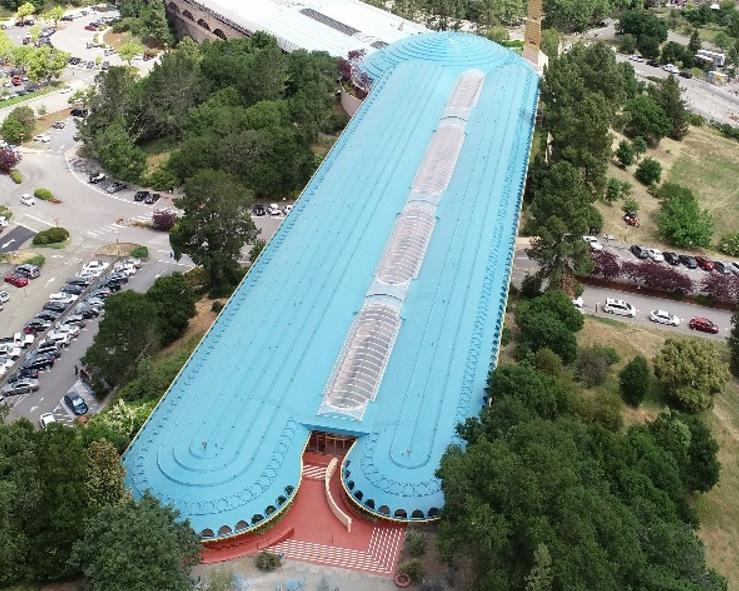
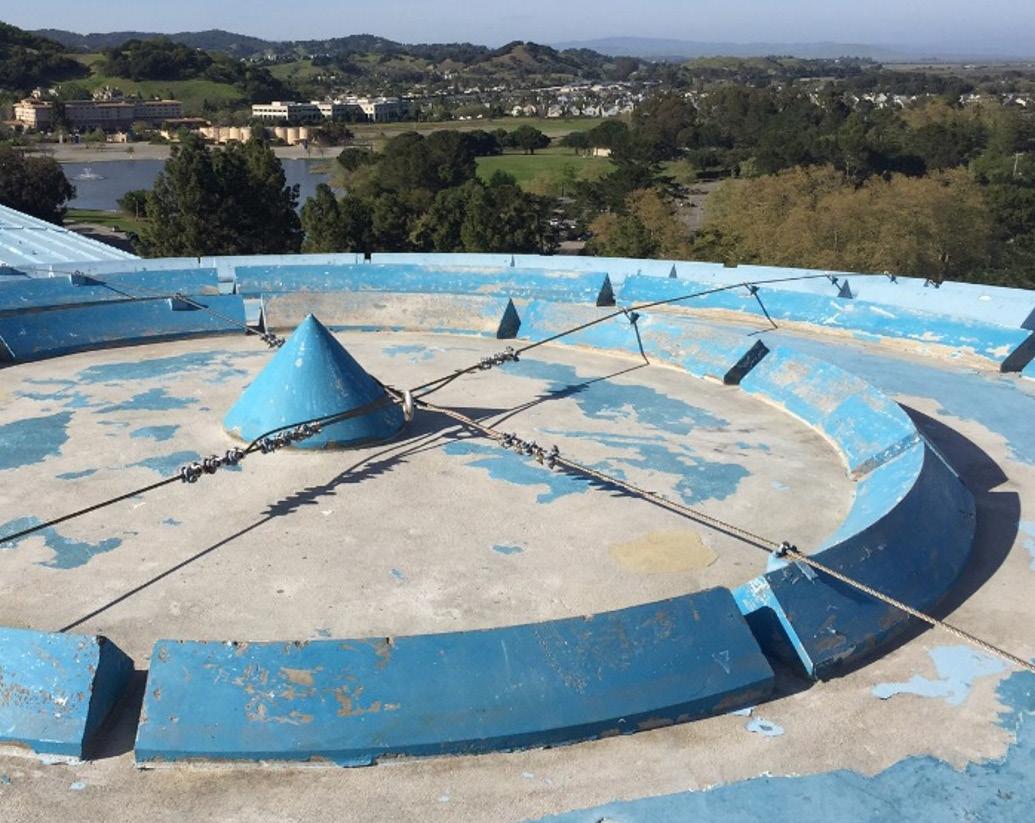
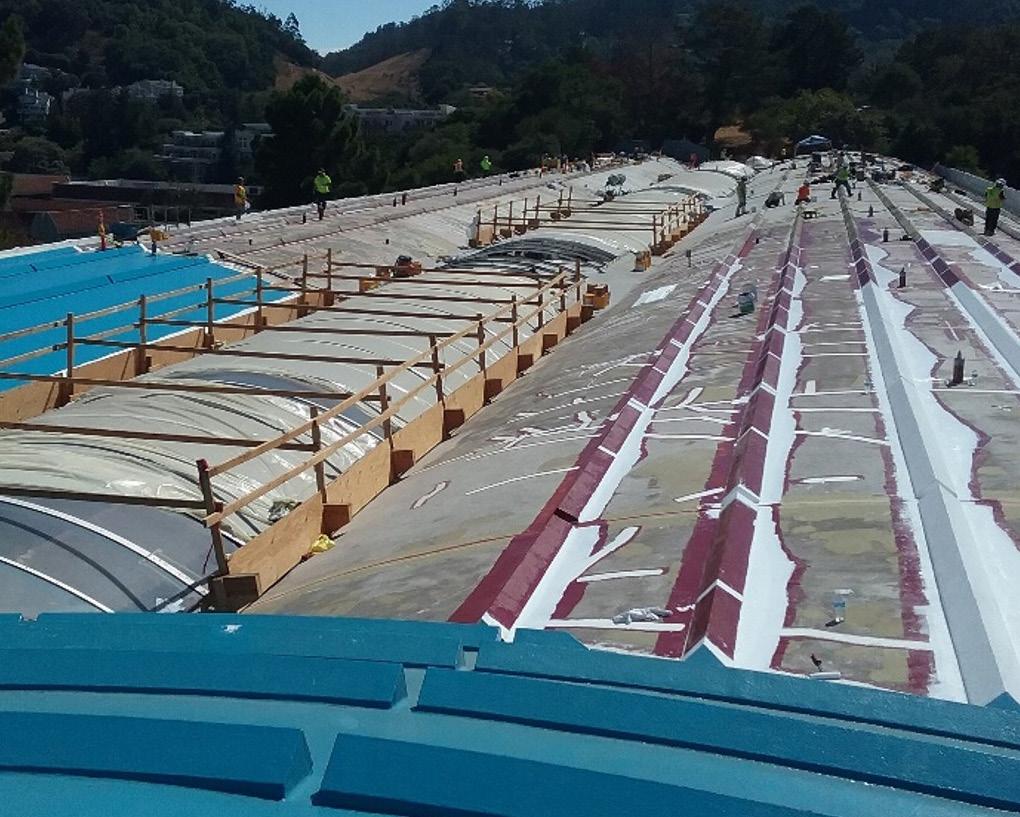

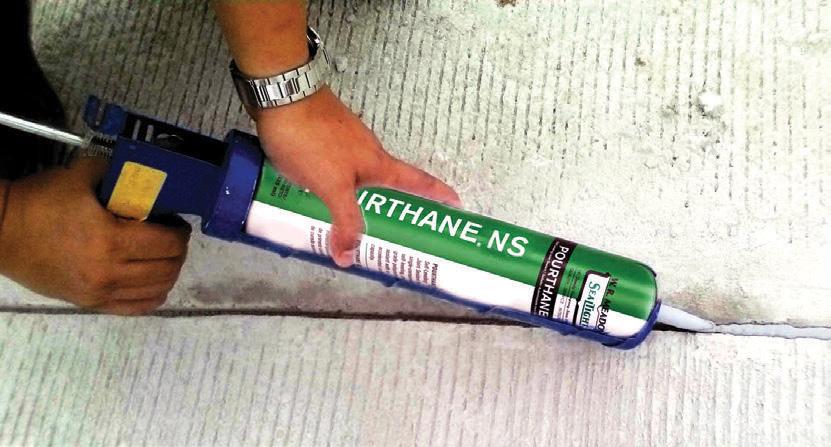
Whether you are recovering a historic landmark building or addressing complex substrate conditions, Sika has you covered. Choosing between either hot or cold-applied systems is simplified with the assistance of our local or corporate technical team. Owners can rest assured that their buidling will be protected from foot traffic and mother nature for decades to come.
Recover/Recoat System Benefits
• Extension of roof life up to 25 years
• Cost effective solution vs. tear-off and re-roof
• Fully adheres to substrate
• Suitable for many different roof structures and a multitude of substrates
• Available in reflective white, standard colors, and custom colors
Choose

The Navien NWP500 is built for efficiency, performance and durability with a stainlesssteel tank and aluminum refrigeration coils... no anodes needed. To learn more about all the advantages of the NEW NWP500, visit navieninc.com or scan the QR code.
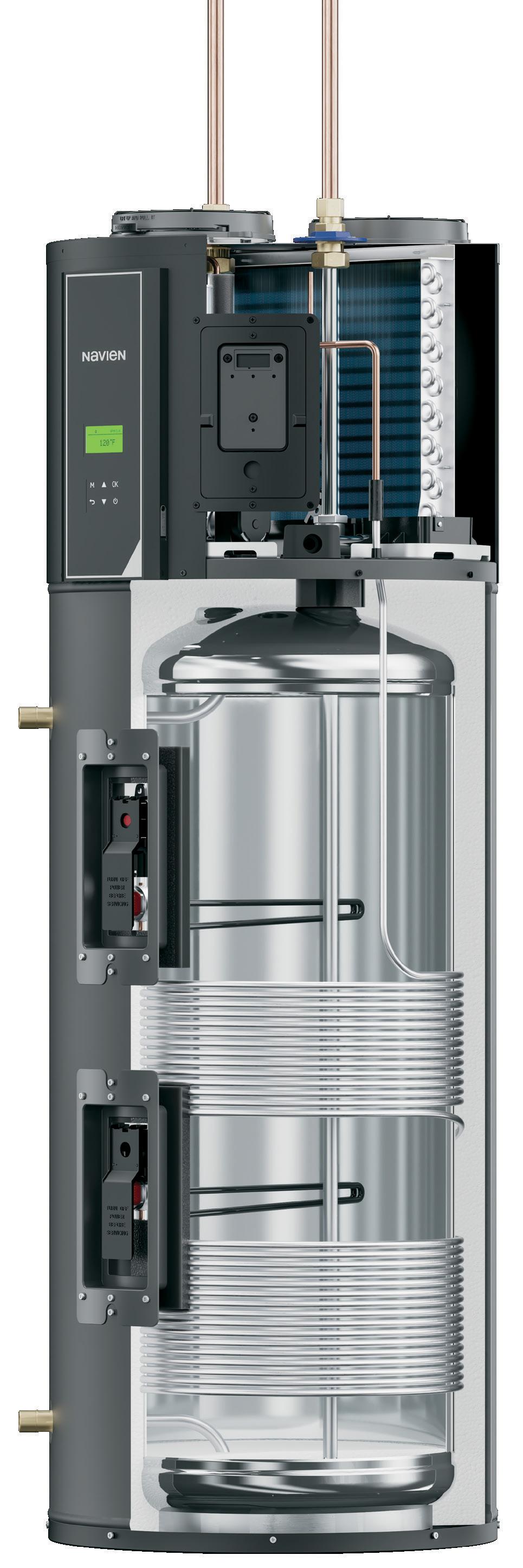

Energy Star rating: up to 4.05 UEF.
Top and side connection options.
Built-in Wi-Fi powered by NaviLink® with over-the-air software updates.
Designed to meet NEEA AWHS Tier 4 requirements.
Quiet operation, less than 45dBA.
Ambient operating range of 41°F–113°F.
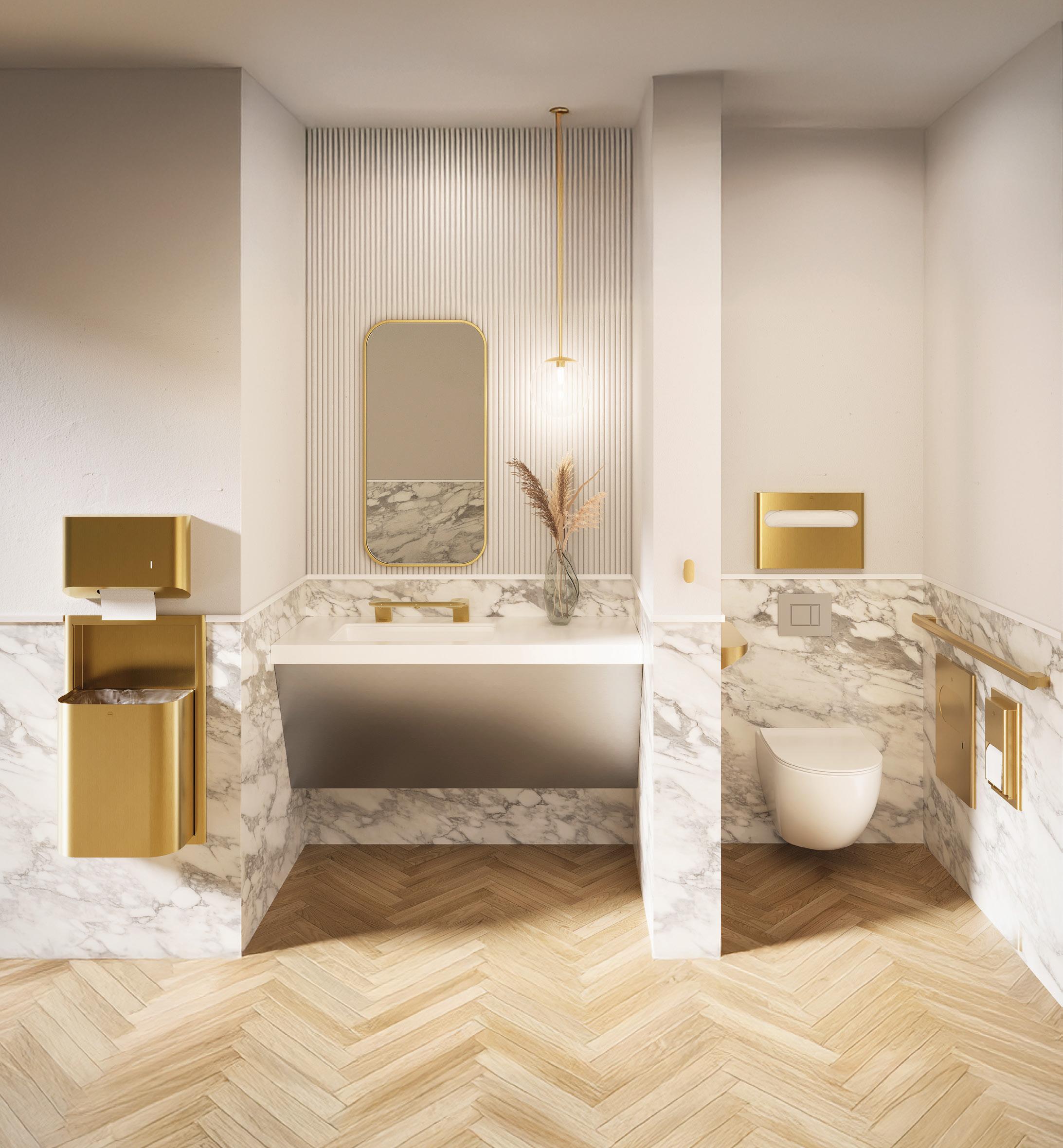
Beautiful Alone. Brilliant Together.
The new Elvari™ collection delivers on design — pairing refined aesthetics and finishes with the most comprehensive suite of commercial washroom accessories. The result is a washroom experience that feels elevated, cohesive, and unmistakably modern. Discover the beauty of unity, only from Bradley.
Paper Towel Dispensers
Waste Receptacles
Soap Dispensers
Mirrors Grab Bars
Shelves and Hooks
Seat Cover Dispensers
Toilet Paper Dispensers
Napkin Disposals


Available in 5 popular colors and satin stainless.
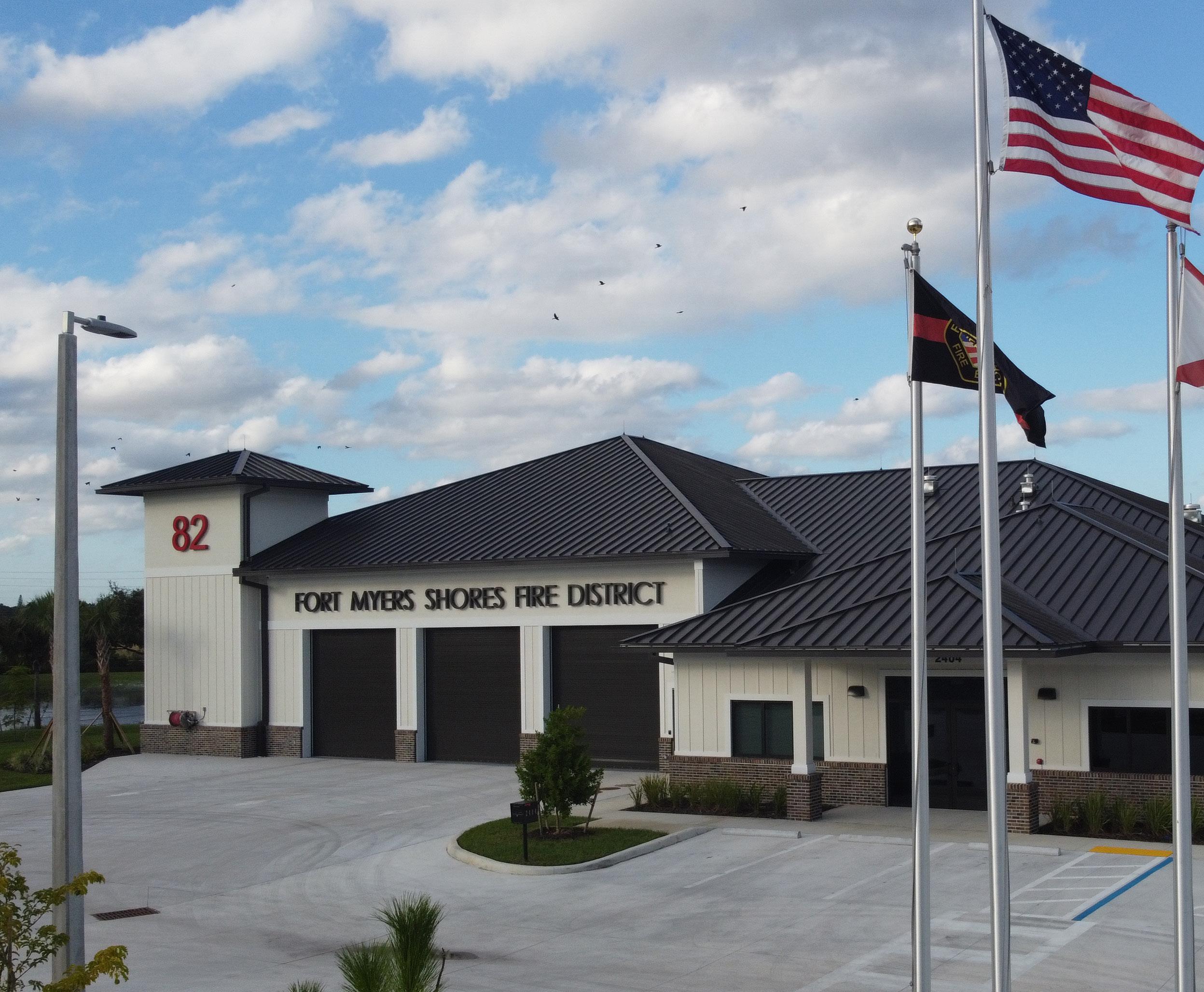
At Englert, innovation isn’t an option—it’s our standard. For over 50 years, we’ve led the way in high-performance metal roofing and gutter solutions for both commercial and residential applications.
From sleek architectural profiles to robust structural systems, our products are engineered to deliver lasting beauty and unmatched performance. We empower architects, contractors, and building owners with cuttingedge solutions backed by advanced on-site roll-forming technology.
What sets us apart? Our expert in-house engineering and technical support teams, the industry’s most comprehensive contractor certification program, and a customer-first approach that ensures every project gets the attention it deserves.

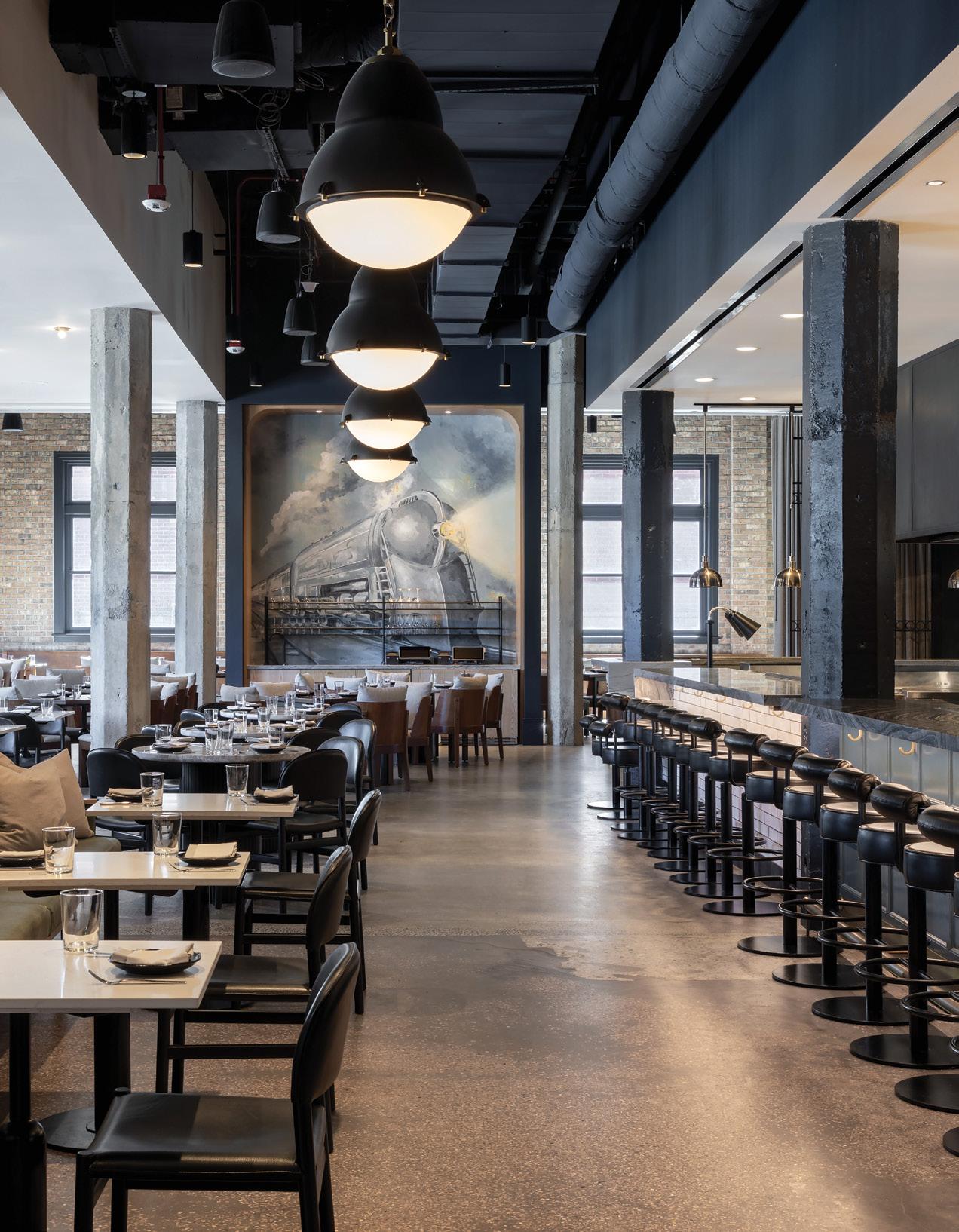
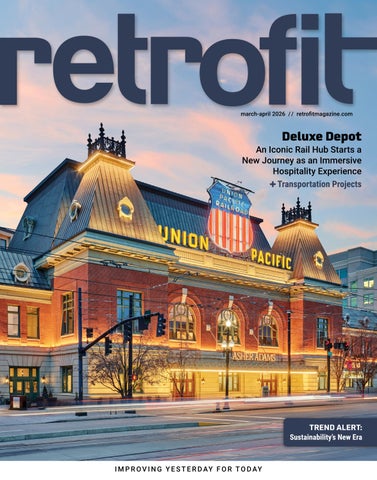
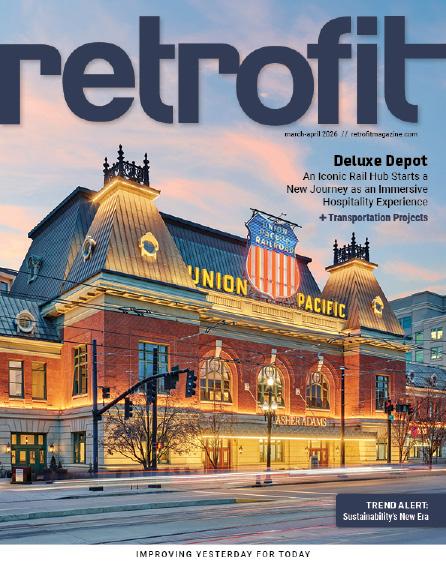
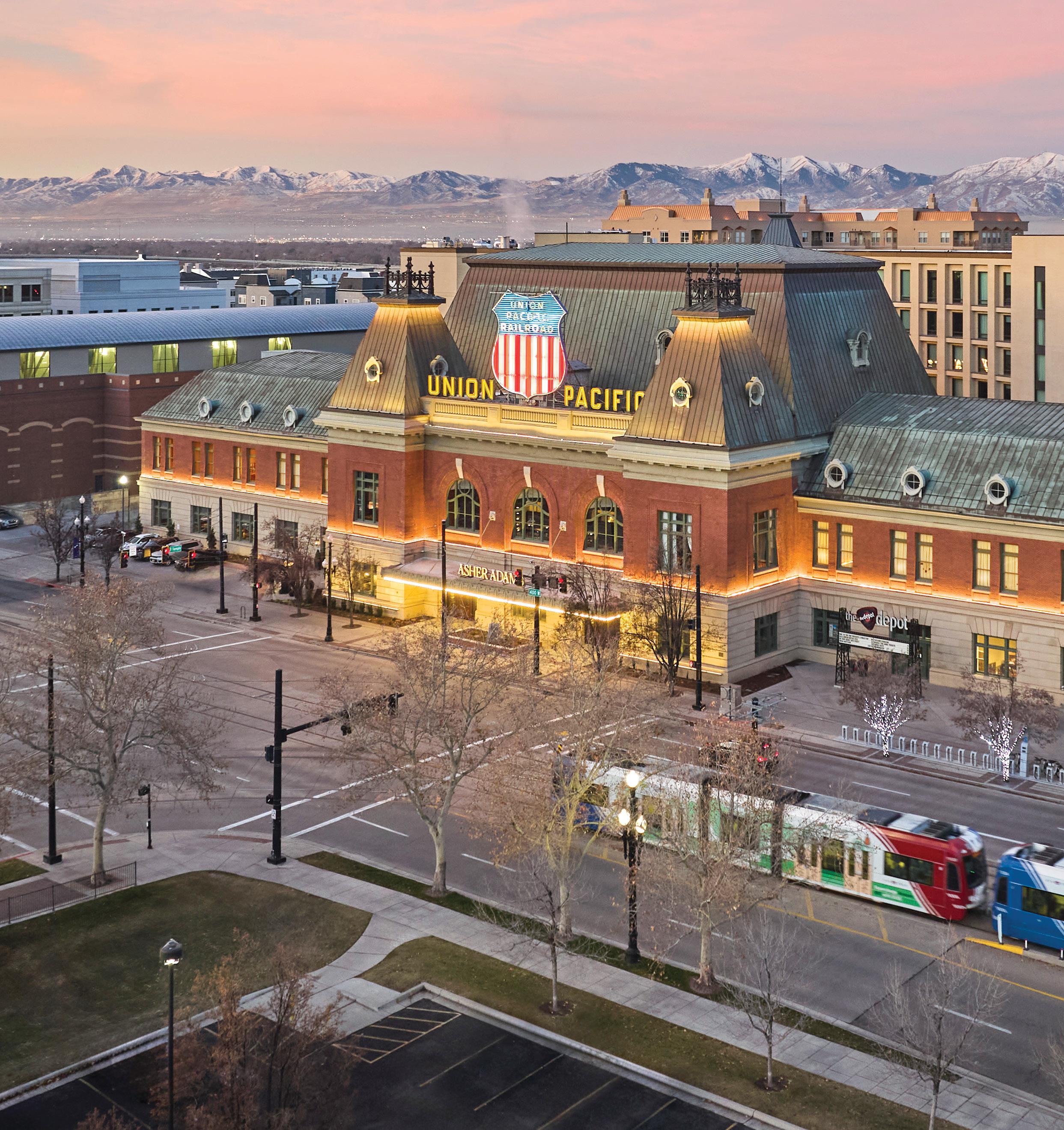
An iconic rail hub in Salt Lake City starts a new journey as an immersive hospitality experience rooted in place and architectural dialogue between eras.
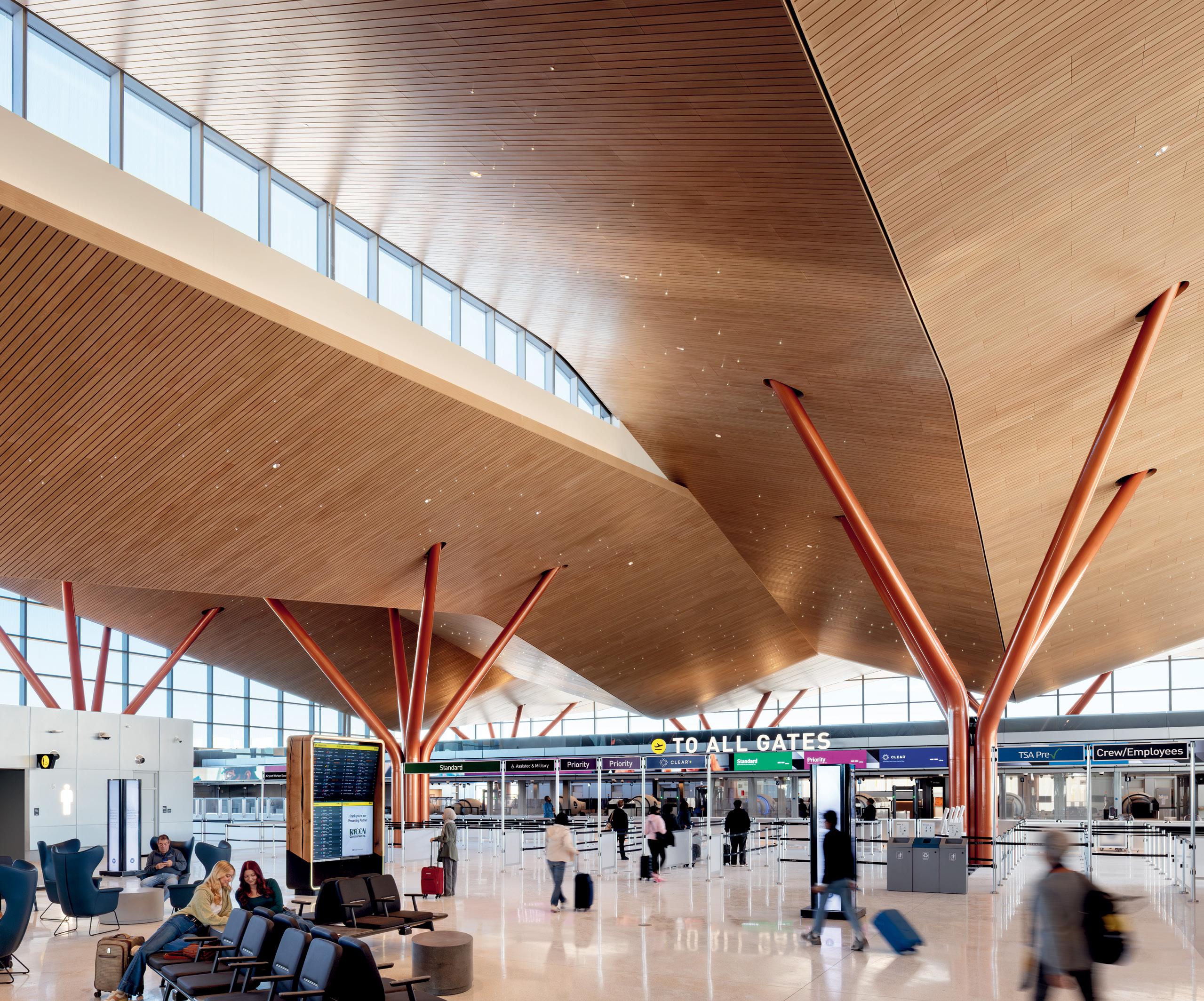
International Airport Concourse B Modernization, Tennessee
Airlines Lounge, San Francisco International Airport
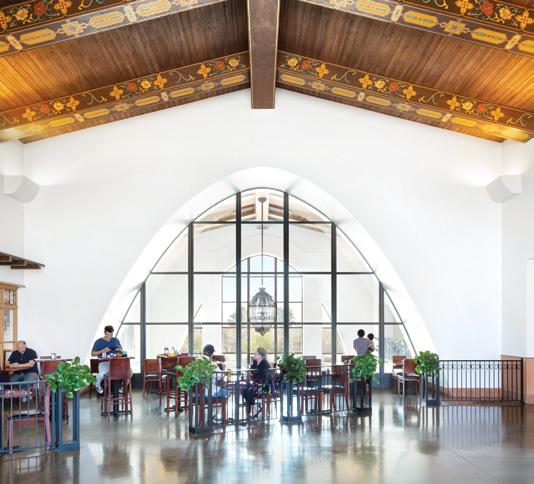
Barbara Municipal Airport, California
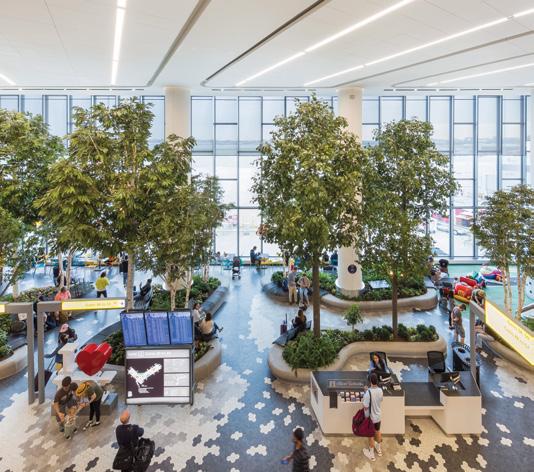
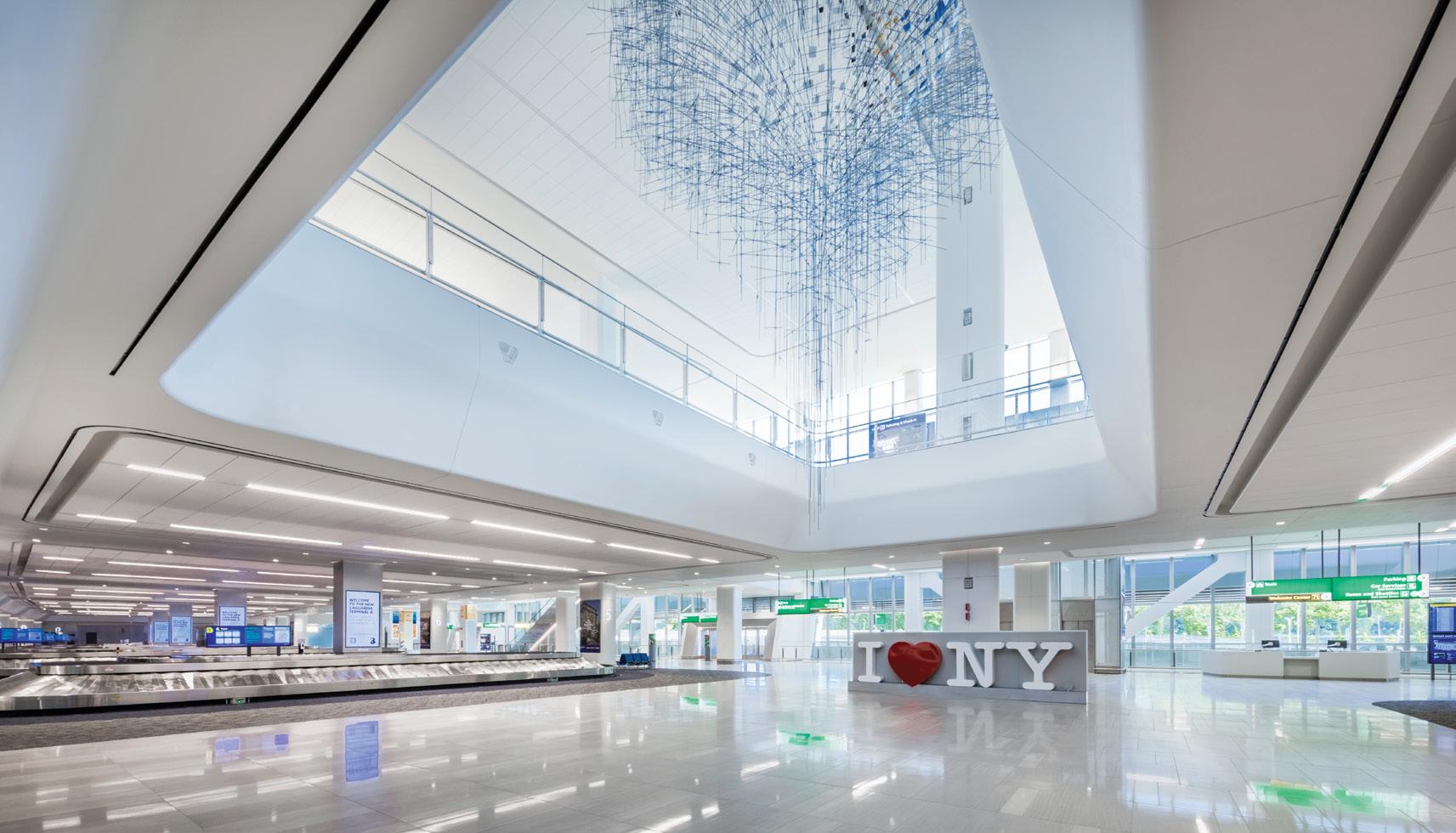
Airport Terminal B, East Elmhurst, N.Y.
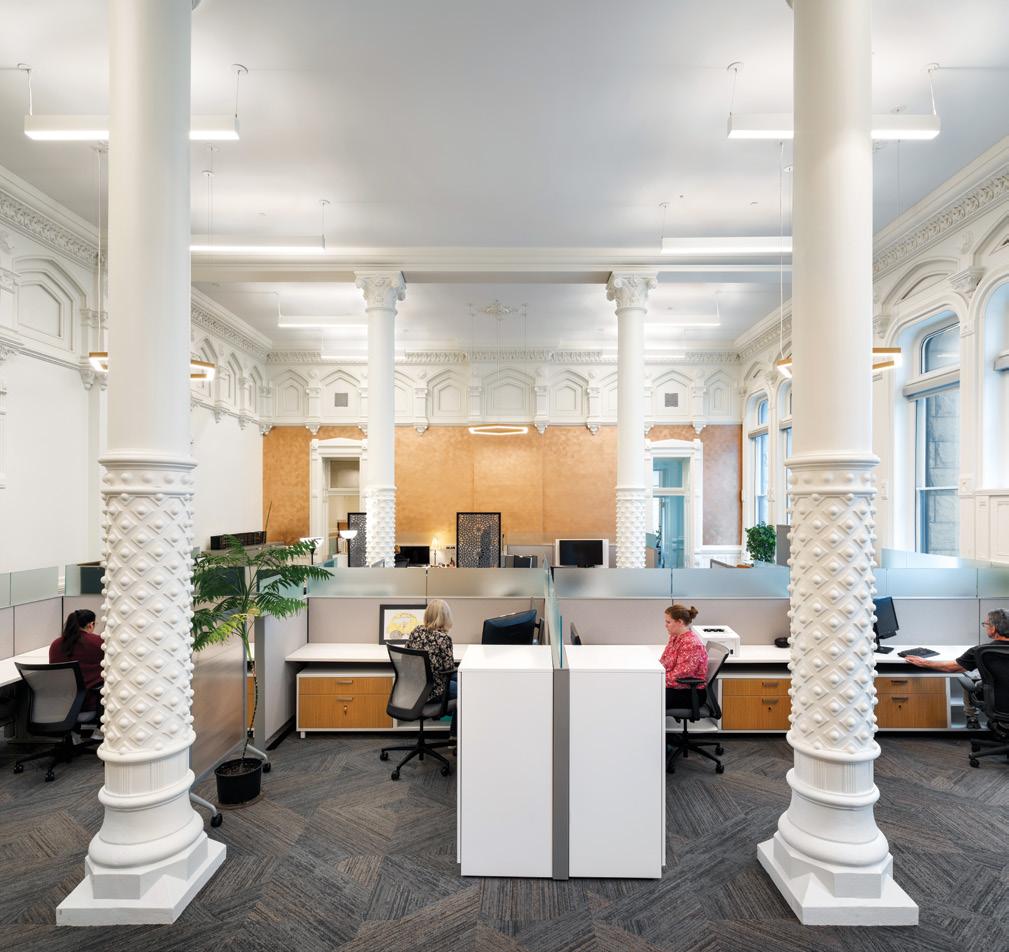
New research illustrates small-scale renovations can increase circadian health potential.
An interview with NCARB President Edward T. Marley, FAIA, NCARB, LEED AP, uncovers what the Pathways to Practice initiative will mean for architects who already are licensed.
If done right, AI can reframe stewardship of the built environment to be about people.
A non-profit center for communities of color is one of the lowest energy-use buildings in Seattle.
12 Point of View
The current turn away from all things “sustainability” provides real opportunity for the movement.
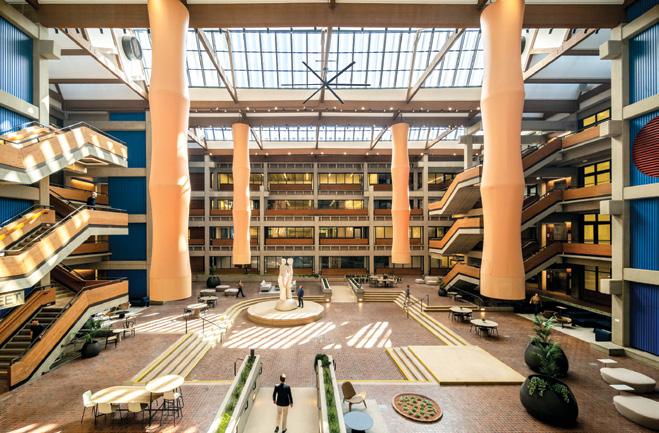
The Gregory Bateson Building in Sacramento, Calif., is revitalized for a new era of energy efficiency.
Political headwinds and cultural shifts are forcing a healthy rethinking of the nature of sustainability.
61 Products // View a roundup of the latest materials and systems for the industry.
66 Inspiration // Expansive skylights and mass timber celebrate Oregon’s natural beauty at Portland International Airport.
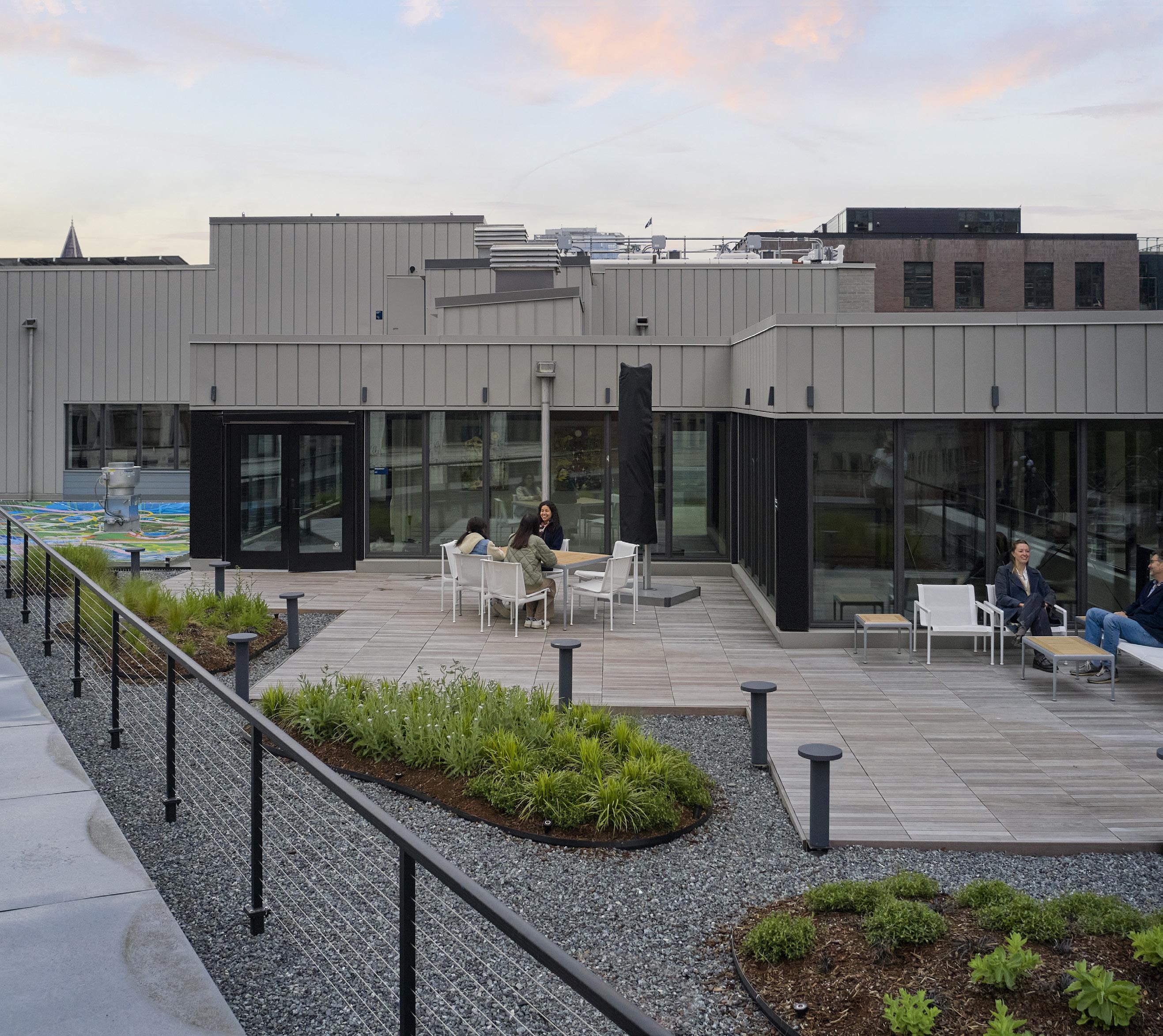
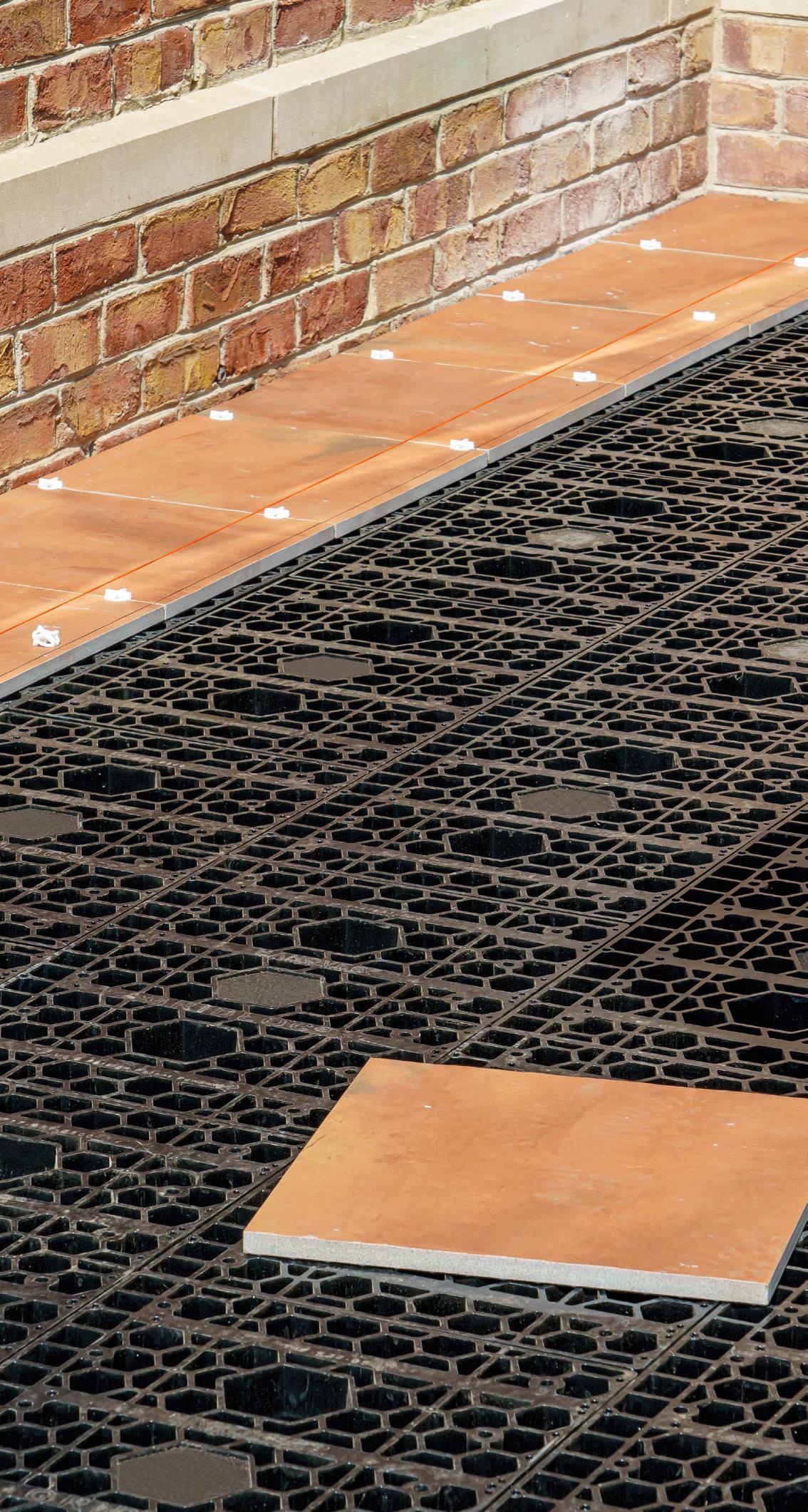
Engineered for strength, Hanover’s GRIDLOC® System opens up a world of possibilities. GRIDLOC® is a lightweight structural support underlayment made from 90% RECYCLED MATERIALS A continuous, fully-supported, monolithic floor surface supports anything from Porcelain Pavers to interlocking concrete Prest® Brick.

PUBLISHER
JOHN RIESTER john@retrofitmagazine.com
ASSOCIATE PUBLISHER/EDITORIAL DIRECTOR CHRISTINA KOCH christina@retrofitmagazine.com
DIRECTOR OF OPERATIONS
BECKY RIESTER becky@retrofitmagazine.com
CONTRIBUTING EDITOR JIM SCHNEIDER
ART DIRECTOR/DIGITAL DESIGN DIRECTOR
ERIKA NYGAARD
CIRCULATION MANAGER LYN URE lyn@retrofitmagazine.com
WEB ENGINEER DEREK LEEDS
SOCIAL MEDIA MAVEN ROBIN GRABER
ADVERTISING SALES
JOHN RIESTER john@retrofitmagazine.com (919) 641-6321
BETH EMERICH beth@retrofitmagazine.com (781) 710-4745
BARRETT HAHN barrett.hahn@gmail.com (919) 593-5318
MIKE GILBERT treblig2023@gmail.com (847) 867-9615
EDITORIAL ADVISORY BOARD
NATHAN M. GILLETTE AIA, LEED AP, REALTOR Director, Natura Architectural Consulting LLC, Grand Rapids, Mich.
JOHN J. NOONAN Facilities Management Consultant, Durham, N.C
WILLIAM E. HOLLOWAY AIA, LEED AP Principal, BERNARDON, Wilmington, Del.
MICHAEL P. WASHBURN, Ph.D. Principal, Washburn Consulting, Scottsdale, Ariz.
RETROFIT // Vol. 17 // No. 2 is published bimonthly by Fisher Media LLC, 98 Booth Meadow Lane, Durham, NC 27713, (919) 641-6321. POSTMASTER: Send address changes to retrofit, 2409 High Point Drive, Lindenhurst, IL 60046.






HVAC retrofits create opportunities to boost comfort, improve indoor air quality, and reduce energy use. With decades of expertise and a proven portfolio of highperformance solutions, Belimo is a trusted partner—whether you need quick wins, intelligent upgrades, or full-system modernization. Our solutions deliver consistent, scalable results across your entire building portfolio.
Through reliable products, expert support, and collaborative partnerships, Belimo helps reduce carbon footprints, meet environmental and economic goals, and elevate occupant comfort. With both standard and custom retrofit options, we ensure you get the right solution for long-lasting impact.

Back in 2003, I earned my first editor-in-chief role for a trade magazine called eco-structure (also launched by retrofit’s publisher, John Riester). Geared toward architects and circulated nationally, eco-structure was one of the first magazines dedicated to green commercial design and construction. Back then, sustainability was so new, I had the unique experience of learning along with the industry. I fell in love with the design and construction world because everyone was so open to sharing their knowledge with me and literally wanted to make the world a better place.
As time went on, readers began demanding proof green buildings were performing as intended. Finding projects with data to share proved difficult—because owners weren’t collecting or weren’t sharing. Regardless, sustainability became more of an everyday business practice.
And, yet, as Jim Schneider, our contributing editor, explains in “Trend Alert”, page 54, today’s political climate has made the terms “sustainability” and “climate change” radioactive in certain circles. Jim and I both firmly believe this turn away from “green” provides real opportunity for the movement. His article stresses that rather than focusing on the legacy arguments for health and climate, it is time to lead with the business case and demonstrate conservation is basic risk management.
I’m married to a conservative financier, and the “Trend Alert” quote from Nicolette Jaze, head of sustainability for Galvanize Real Estate, a global asset-management firm, is one that resonates with him: “We’re data-driven investors, and the numbers are clear. Energy costs are rising; renewable power is cheaper to deploy Profitable decarbonization isn’t an argument to be had—it’s math.”
Today, we have more tools to gather that math quickly and make buildings better than ever before—for humans, the environment and the bottom line. In “Component”, page 40, Jay Kline, P.E., LC, SA, Digital Technologies program director for the National Institute of Building Sciences, writes about how AI has made crunching building information data less time consuming. Kline notes this digital fabric provides immediate results for energy-use reduction and sets the stage for continuously evolving technology, benefits and capabilities, such as robotics and personalized experiences.
Not only will AI help us prove sustainability more easily, it may also weed out the technologies that don’t work as well. Consider the Gregory Bateson Building in Sacramento, Calif. Conceived in 1978 and completed in 1981, the project was quickly recognized as a landmark of progressive sustainability. It aimed to reduce energy use by an astonishing 80 percent below standard, but there were experimental ideas used in the building that did not endure. CannonDesign recently retrofitted the Gregory Bateson Building with mainstream, highly efficient technologies to reduce energy and water use, as well as focus on occupant wellness. Read the story in “Historic”, page 48.
It will be interesting to see 20 years from now how the current backlash against sustainability and the adoption of AI will change the way the design and construction industry operates. I look forward to continuing to witness these changes firsthand.

CHRISTINA KOCH
Associate Publisher/Editorial Director
retrofit
FOLLOW US


Check out retrofit’s Latest Podcast! Having a workforce of skilled contractors is vital to ensuring long-lasting, high-performing building envelopes. The Retrofit Podcast shares CertainTeed’s longtime efforts to support and educate the construction industry. Visit www.retrofit magazine.com to view the podcast today.
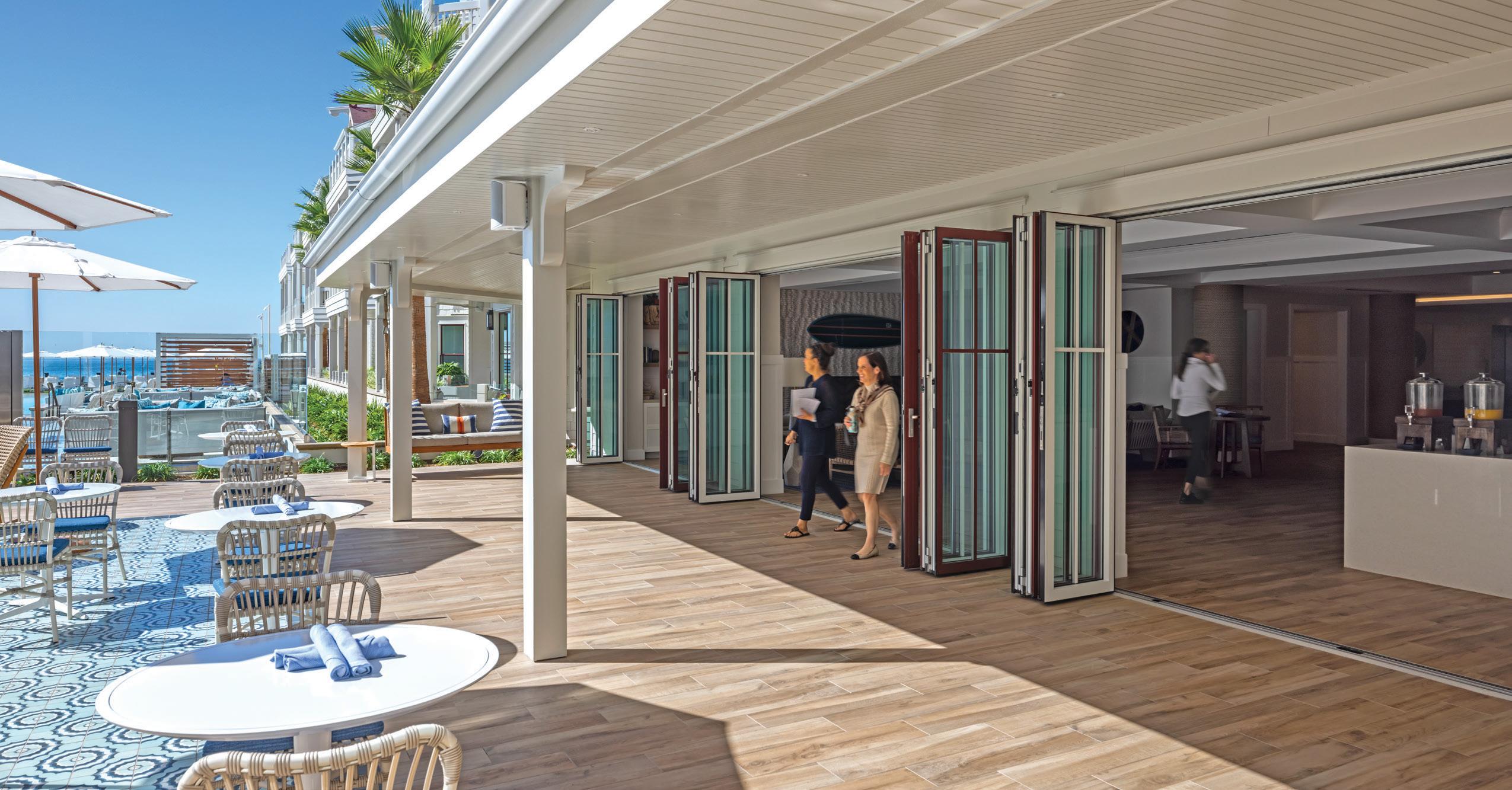
Easy Operation: Smoothest and easiest operation of any folding glass wall as panels glide to their open or closed position.
Superior Performance: Exceptional resistance against wind-driven rain. Energy-efficient panels keep extreme weather out. Up to unit STC 45. Air, water, structural, forced entry, swing door and cycle tested.

Design Options: Customizable in folding, sliding, multislide, stacking, and frameless. Aluminum, clad, wood, or all-glass profiles. ADA, interior and exterior weather-rated sill options. Custom glazing and 50 standard colors.



Julia Siple, AIA, LEED AP BD+C, WELL AP, is director of Sustainability at Quinn Evans and shares research by Quinn Evans and the University of Oregon Institute for Health in the Built Environment that demonstrates designers can increase the circadian health potential of existing buildings, even in small-scale renovations. Read our “Special Report”, page 16.

Emir Tursic, AIA, LEED AP BD+C, NCARB, is a principal and office director for HKS Salt Lake City. Tursic’s hospitality experience is on display in our “Cover Story”, page 22, in which he writes about a Salt Lake City transportation hub rooted in the golden age of American rail travel that now is charting a new journey as Asher Adams, an Autograph Collection Hotel.

Jay Kline, P.E., LC, SA, serves as a Digital Technologies program director for the National Institute of Building Sciences. He empowers building professionals in utilizing technology to advance the AECO industry and improve the built environment. Accordingly, he writes about how AI can help steward spaces that honor human experiences and community in “Component”, page 40.

Formerly an abandoned building in a National Historic District, Metropole now is a vital resource center for community, climate response and racial equity. Matt Aalfs, AIA, partner and founder of BuildingWork, uncovers how the building, which was in near-ruin, has become one of the lowest energy-use buildings in Seattle in “Transformation”, page 42.




Ian Merker, AIA, LEED AP BD+C, DBIA, is associate vice president of CannonDesign. In “Historic”, page 48, Merker writes about Sacramento’s Gregory Bateson Building, which aimed to reduce energy use by 80 percent below standard when it was constructed in the early 1980s. CannonDesign recently renovated the building with mainstream technologies that not only honor its pioneering origins, but also prepare it for decades of efficient service.






By Julia Siple, AIA, LEED BD+C, WELL AP
New research by Quinn Evans and the University of Oregon Institute for Health in the Built Environment shows that designers can increase the circadian health potential of existing buildings, even in small-scale renovations that do not include façade or envelope upgrades. The resulting report, which can be downloaded for free from the Quinn Evans website (www.quinnevans.com/news/daylighting-designfor-circadian-health), includes practical strategies that can be applied to any building, from new construction to listed historic properties.
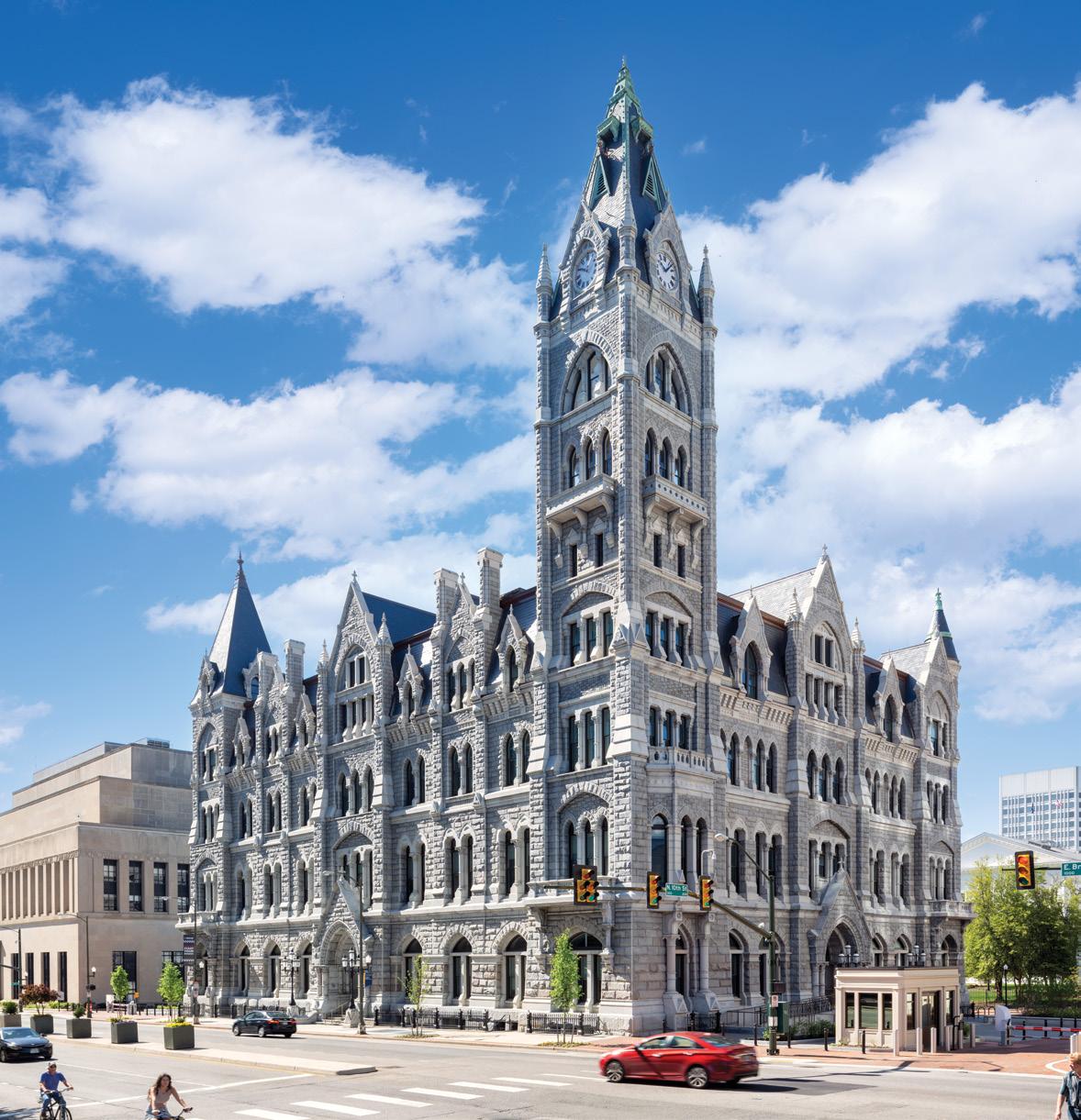
Circadian health, the alignment of our biological rhythms with the natural day-night cycle, is a growing area of research but is not yet widely understood or easily applied within architectural practice. Because we spend nearly 90 percent of our time indoors, it’s important that the spaces we design support occupants’ health.
While designers recognize that access to daylight contributes to wellness, few have clear guidance on how to intentionally support circadian health through design—particularly in the context of existing buildings. Green building rating systems, such as LEED, acknowledge daylight’s value, but their metrics primarily focus on visual comfort and energy performance rather than the timing, duration and quality of light
Supported by the AIA Upjohn Research Initiative, the team
set out to translate complex daylight science into clear, actionable design guidance for everyday practice.
that most influence circadian rhythms. The WELL Building Standard begins to address this connection through its equivalent melanopic lux (EML) metric, but that measure focuses largely on electric lighting and remains challenging for many projects to model or apply.
As a result, architects often lack straightforward, databacked strategies for improving circadian health potential in real-world projects. Supported by the AIA Upjohn Research
Initiative, the team set out to bridge that gap by translating complex daylight science into clear, actionable design guidance for everyday practice.
Working with researchers at the University of Oregon, Quinn Evans developed digital simulations to compare the circadian health impacts of practical design strategies. Together, the team established a representative test space—a 30- by 40-foot office with 16 desks and a single glazed façade—and identified design variables frequently encountered in existing buildings. These variables included window-to-wall ratio (WWR), furniture orientation, ceiling height, partitions and surface reflectance.
Each variable was tested independently with ranges informed by Quinn Evans’ experience working in renovation and historic contexts. The research team then quantified how each change affected circadian daylight exposure.
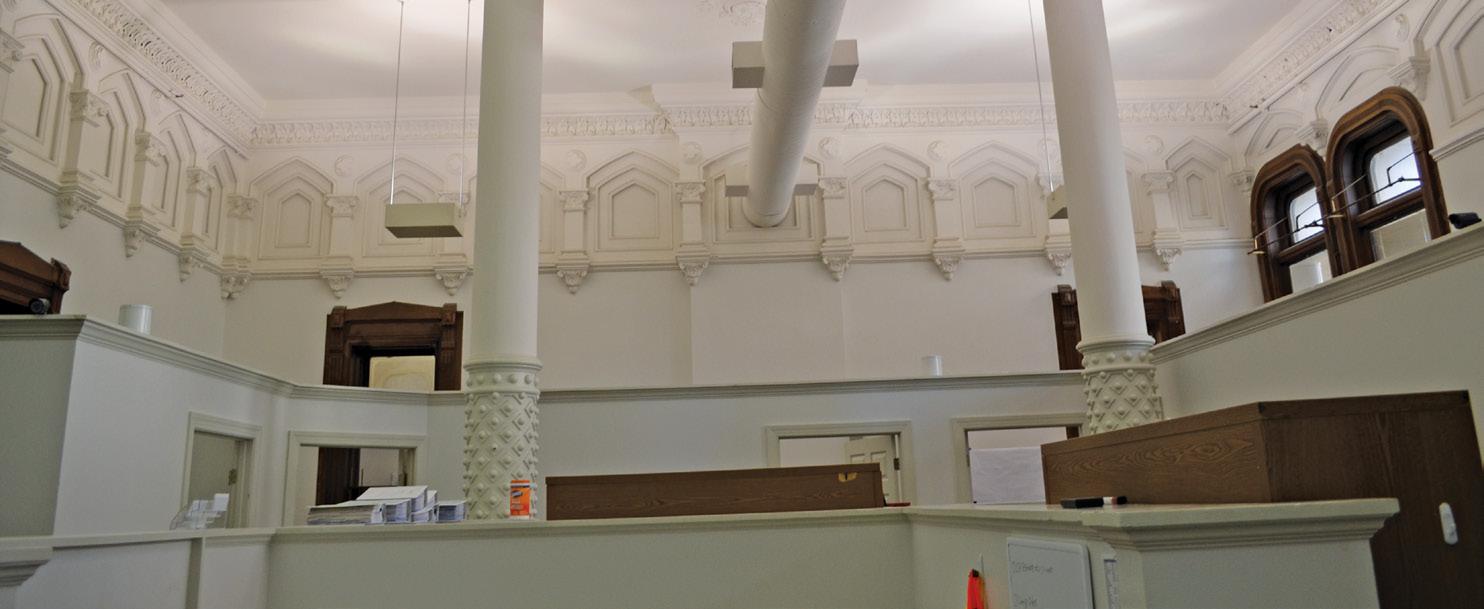
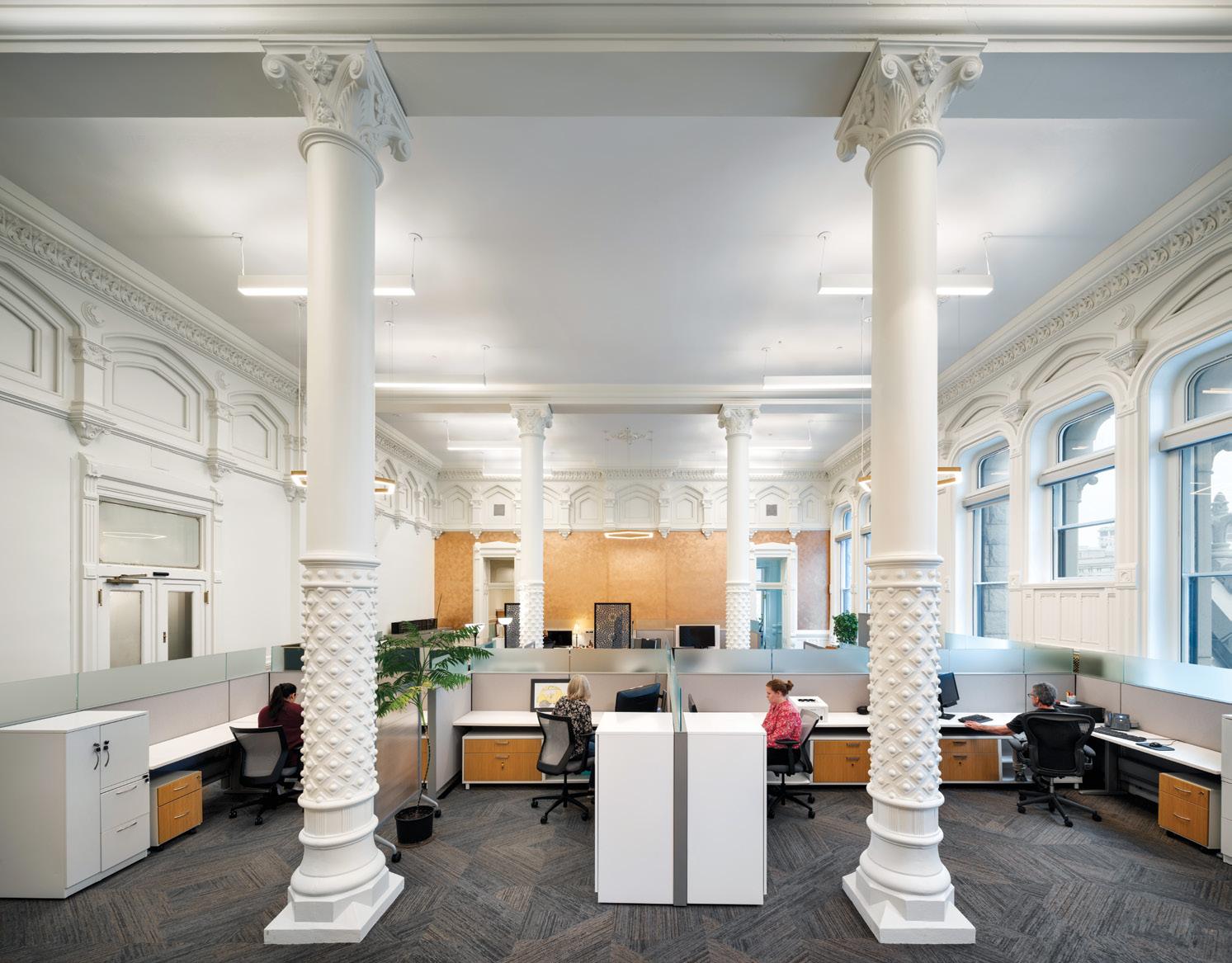
To ground the findings in real-world conditions, the team also analyzed three projects from Quinn Evans’ portfolio. These case studies measured circadian health potential before and after renovation in an elementary school, a government office building and commercial office tenant space.
In short, the study found that renovations and design decisions can meaningfully improve circadian health by providing enough daylight at occupants’ eye level in the morning hours. To better measure this potential, the research partners proposed a novel metric: spatial melanopic daylight autonomy (smDA EML 150/275/50 percent). This metric expresses the percentage of workstation positions within a space where an occupant’s
view position meets or exceeds 150 equivalent melanopic lux for at least 50 percent of the time between 9 a.m. and 1 p.m. over the course of a year.
As expected, increasing WWR had a big impact. But the team was surprised to find that optimizing the following key design variables was also very effective:
Finishes Using light-colored and reflective finishes on walls, ceilings and floors can improve a space’s circadian health potential nearly as much as increasing window size.


View Direction Positioning workstations perpendicular to the glazed façade results in the most equitable distribution of circadian daylight exposure. For occupants seated farther from windows, rotating desks to face the façade significantly improves exposure.
Shared Spaces Building occupants assigned to an office or desk with low circadian health potential can increase their exposure by temporarily moving to an area with more daylight. Designers should consider this when planning and locating shared spaces, like kitchens, break rooms and courtyards.


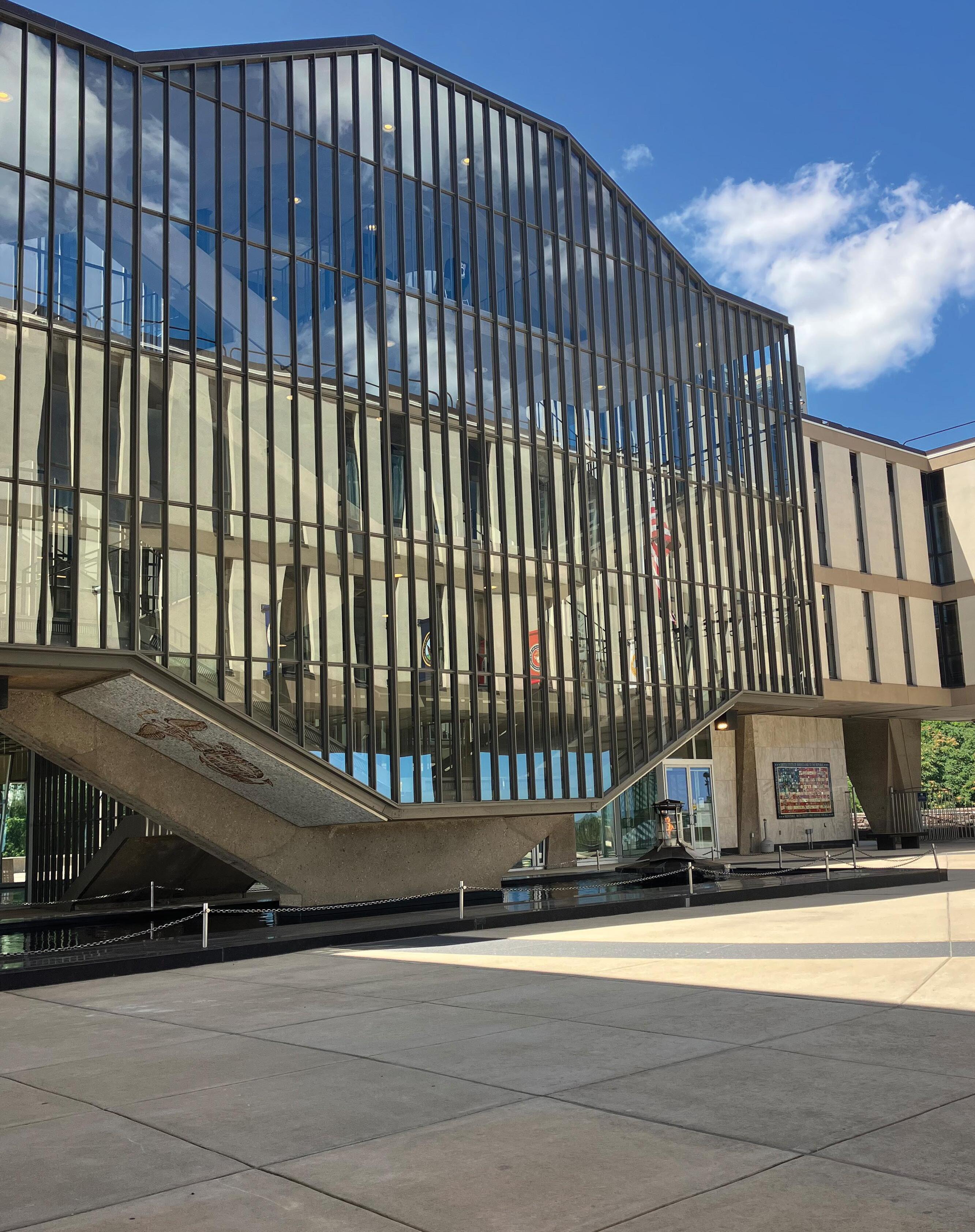
The world’s first commercially available vacuum glazing, Pilkington Spacia™ provides the thermal performance of conventional double glazing in the same thickness as a single glass pane.
Pilkington Spacia™ can be retrofitted into existing single-glazing frames, allowing for the potentional to reduce carbon impacts by utilizing existing materials and increasing energy efficency, mitigate outside noise, and preserve the past in historical restorations.
1.800.221.0444
buildingproducts.pna@nsg.com www.pilkington.us


FEdward Marley
or the past several years, NCARB has been focused on reimagining the path to earning an architect license. Through Pathways to Practice, the organization is exploring the creation of a flexible, modular licensure process—all founded on NCARB’s new Competency Standard for Architects (www. ncarb.org/sites/default/files/CompetencyStandard.pdf). To better understand how Pathways to Practice will impact licensed professionals who already are practicing architecture, retrofit connected with fiscal-year 2026 NCARB President Edward T. Marley, FAIA, NCARB, LEED AP. Marley is a practicing architect based in Tucson, Ariz.
r: NCARB has explained that future expectations for initial licensure will be founded on the new Competency Standard for Architects. But what about standards for reciprocal licensure or licensure renewal? Should architects expect those requirements to change?
EM: In terms of scale, Pathways to Practice is a massive undertaking. We expect it to take several more years to fully implement the NCARB Competency Standard for Architects. In the short-term, our focus is on updating our existing programs—the Architectural Experience Program, AXP, and Architect Registration Examination, ARE—to align with the Competency Standard. That work, which is already in progress, won’t have a significant impact on practicing architects.
At the same time, we’re also working on our long-term goal: expanding entry points into the profession to ensure that individuals of all career and educational backgrounds have a pathway to earn an architecture license. While we don’t expect any changes in the near future, this work will likely affect some practitioners. Here’s a little bit of insight into what architects might expect:
• Reciprocal Licensure As NCARB expands pathways to initial licensure, we anticipate similar updates to NCARB certification requirements. Individuals who may face challenges applying for an NCARB Certificate under our current requirements may find they are eligible to pursue a new pathway to earn the certificate. Because the certificate is required for reciprocal licensure in many U.S. jurisdictions, this might ultimately mean that quali-
Read part one in the series for an introduction to NCARB’s Pathways to Practice effort and part two for a deep dive into the Competency Standard.
• Part I: retrofitmagazine.com/ncarb-is-expandingaccess-to-the-architecture-profession-andprotecting-hsw-in-the-existing-built-environment
• Part II: retrofitmagazine.com/what-does-ncarbscompetency-standard-mean-for-licensure-and-thebuilt-environment
fied architects have the ability to expand their practice in new, exciting ways.
• License Renewal Similar to the AXP and ARE, we expect to align our guidelines for continuing education to the Competency Standard. As individual licensing boards adjust their CE requirements to match, architects might notice a slight expansion in what CE courses qualify for Health, Safety and Welfare credit in the future.
Although these changes are in the works, I want to encourage all architects to explore the skills and abilities outlined in the Competency Standard as you complete your professional development for the year. You might find an area worth exploring!
r: NCARB’s Pathways to Practice effort is focused on expanding entry points into the profession and specifically the licensure process. Why does NCARB believe that’s important?
EM: Earning a license is an important step in an individual’s architecture career. The current process typically involves earning a degree from a program accredited by the National Architectural Accrediting Board, documenting professional experience through the AXP and passing the ARE.
Since 2012, NCARB has been monitoring and analyzing trends on the path to licensure through NCARB by the Numbers [www.ncarb.org/nbtn2025]. Over the years, data has increasingly demonstrated that offering a single path to licensure creates a variety of unintended social and financial barriers—including an above-average level of student debt
[www.ncarb.org/press/rand-study-architecture-academia-andpractice] tied to architectural education requirements.
By offering multiple pathways to initial licensure through Pathways to Practice, NCARB can reduce the social and financial impediments attached to a single path, ensure that individuals of all professional and educational backgrounds are able to pursue a career in architecture, and establish consistent standards for initial licensure regardless of the level of education one has obtained.
In addition, offering multiple pathways creates greater flexibility and adaptability within the licensure process at the regulatory level—allowing NCARB and its member licensing boards to better meet the future needs of the public as practice evolves.
r: You’ve talked about entry points, but what does that mean for individuals who’ve already entered the profession? How will Pathways to Practice impact established professionals?
EM: Aside from the potential impacts to reciprocal licensure and license-renewal requirements I mentioned, we don’t expect that Pathways to Practice will have a huge impact on individuals who are already licensed. As NCARB has his-
“As NCARB has historically done with
previous programmatic transitions,
we’ll
create equivalency guides for licensing boards that detail how completion of previous iterations of each licensure program transfer under the new model.”
—
NCARB President Edward T. Marley, FAIA, NCARB, LEED AP
torically done with previous programmatic transitions, we’ll create equivalency guides for licensing boards that detail how completion of previous iterations of each licensure program transfer under the new model.
However, individuals who’ve been working in the architecture industry for years but haven’t earned a license under the current process might find that licensure is within their reach in the future, and we certainly hope they take advantage of the possibilities.







By Emir Tursic, AIA, LEED AP BD+C, NCARB
In the heart of Salt Lake City stands a transportation hub rooted in the golden age of American rail travel. Constructed in 1905 and designed by American architect Daniel James Patterson, the Union Pacific Railroad Depot served as a vital waypoint for travelers and goods connecting from East to West. Although rail travel to and from the depot ceased in the 1970s, the iconic building remains a historic landmark that still plays a key role in the city. Now, it is charting a new journey forward as Asher Adams, an Autograph Collection Hotel.
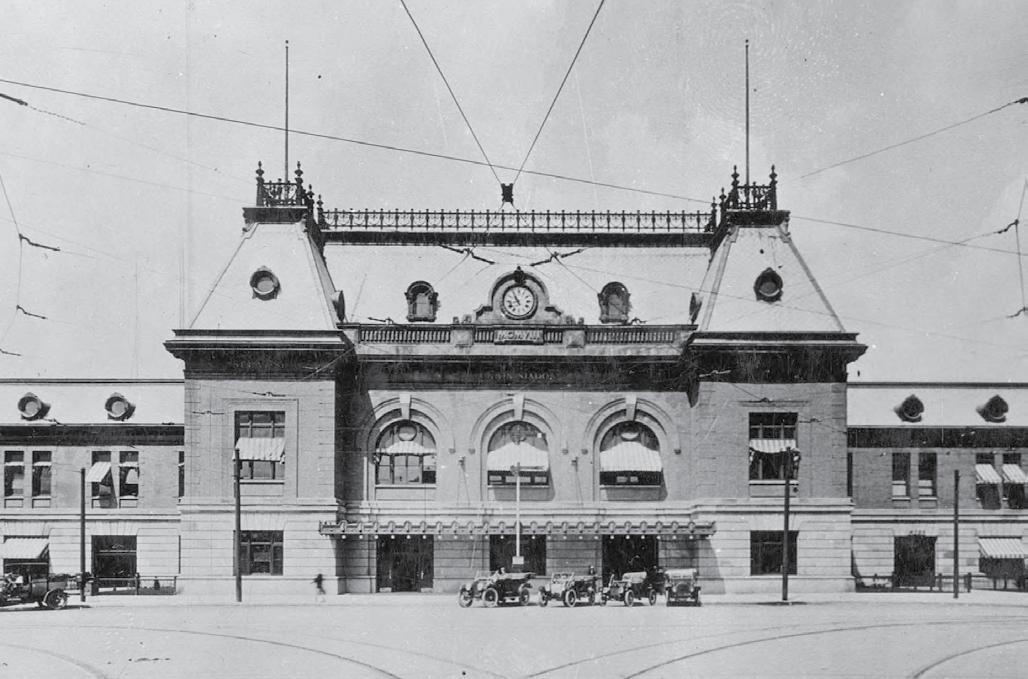
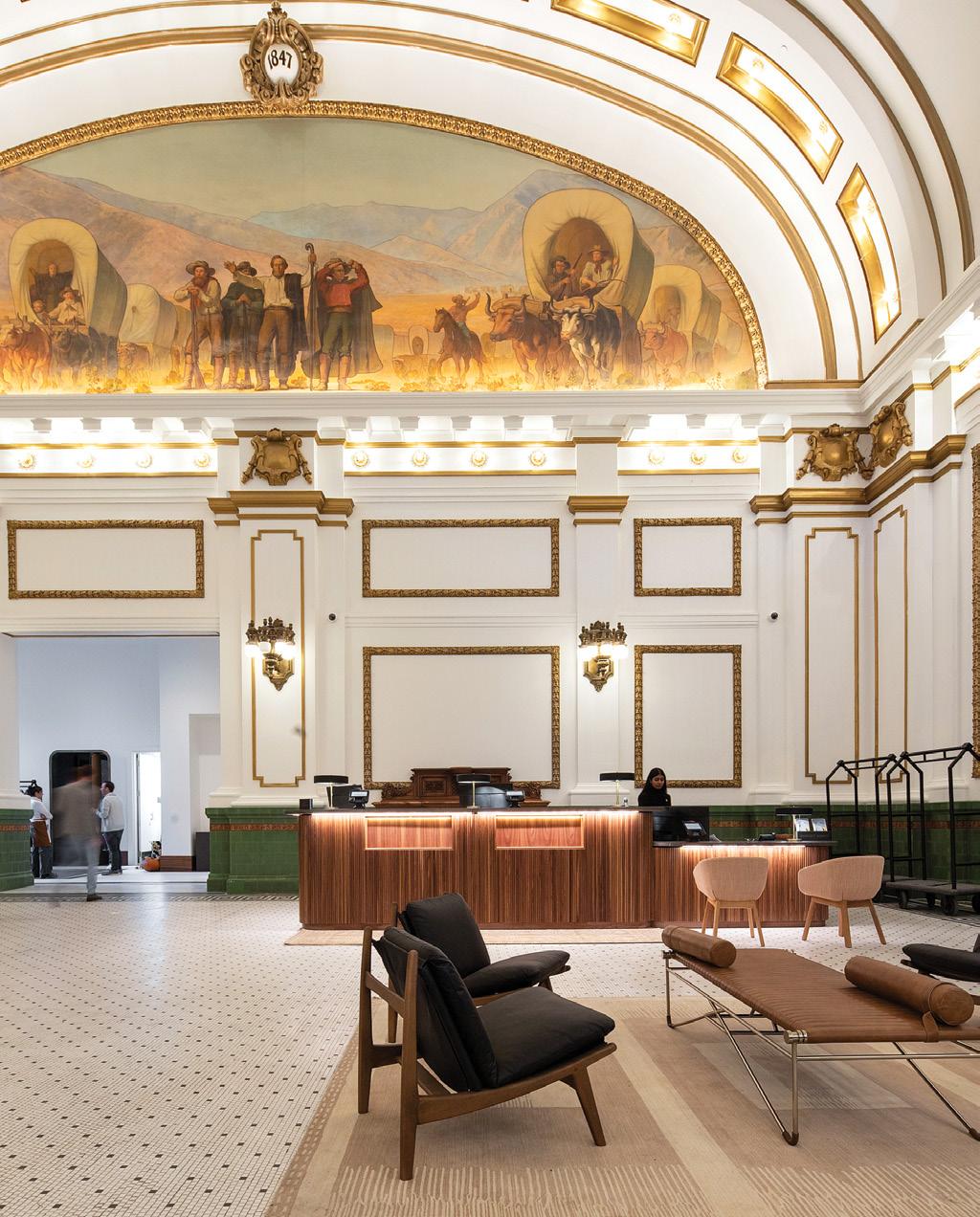
The Athens Group tasked an integrated design team to restore the grandeur of the original station building while transforming it into a modern, upscale hotel.
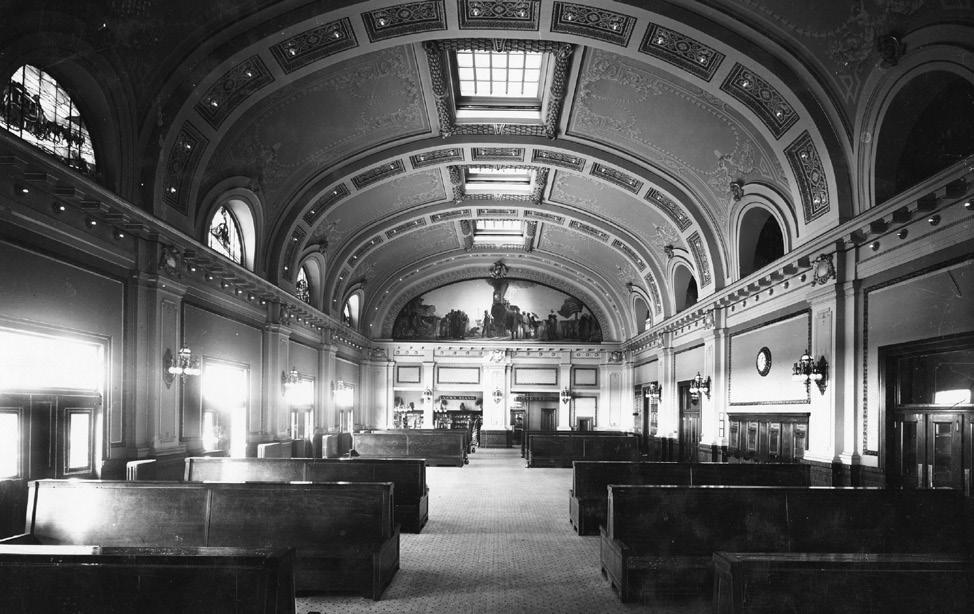
Built to facilitate a new rail connection between Salt Lake City and Los Angeles, the original depot saved passengers and freight more than 400 miles of travel and quickly became a bustling hub of activity. The depot was Salt Lake City’s gateway to the world, a civic landmark where families, travelers and city life converged. Its Second French Empire sandstone building welcomed visitors in style, anchored on a central pavilion with dramatically oversized openings, terrazzo flooring, stained-glass windows and revered murals depicting the completion of the first transcontinental railroad in 1869 and 1847 arrival of Mormon pioneers.
However, as rail travel declined, the station fell dormant. It was designated as a local landmark in 1972 and joined the National Register of Historic Places in 1975 to protect its architectural and cultural heritage. By the late 20th century, the structure was a shadow of its former self: The grand hall served as a public entrance into a mixed-use development established in the late 1990s. Recognizing the significance of the depot to local residents and regional visitors, developer The Athens Group tasked an integrated design team led by architecture and design firm HKS and JNS Architecture + Interior Design (for interiors) to restore the grandeur of the original station building while transforming it into a modern, upscale hotel that could not only attract visitors and residents of Salt Lake City, but also reinvigorate its role as a community hub.


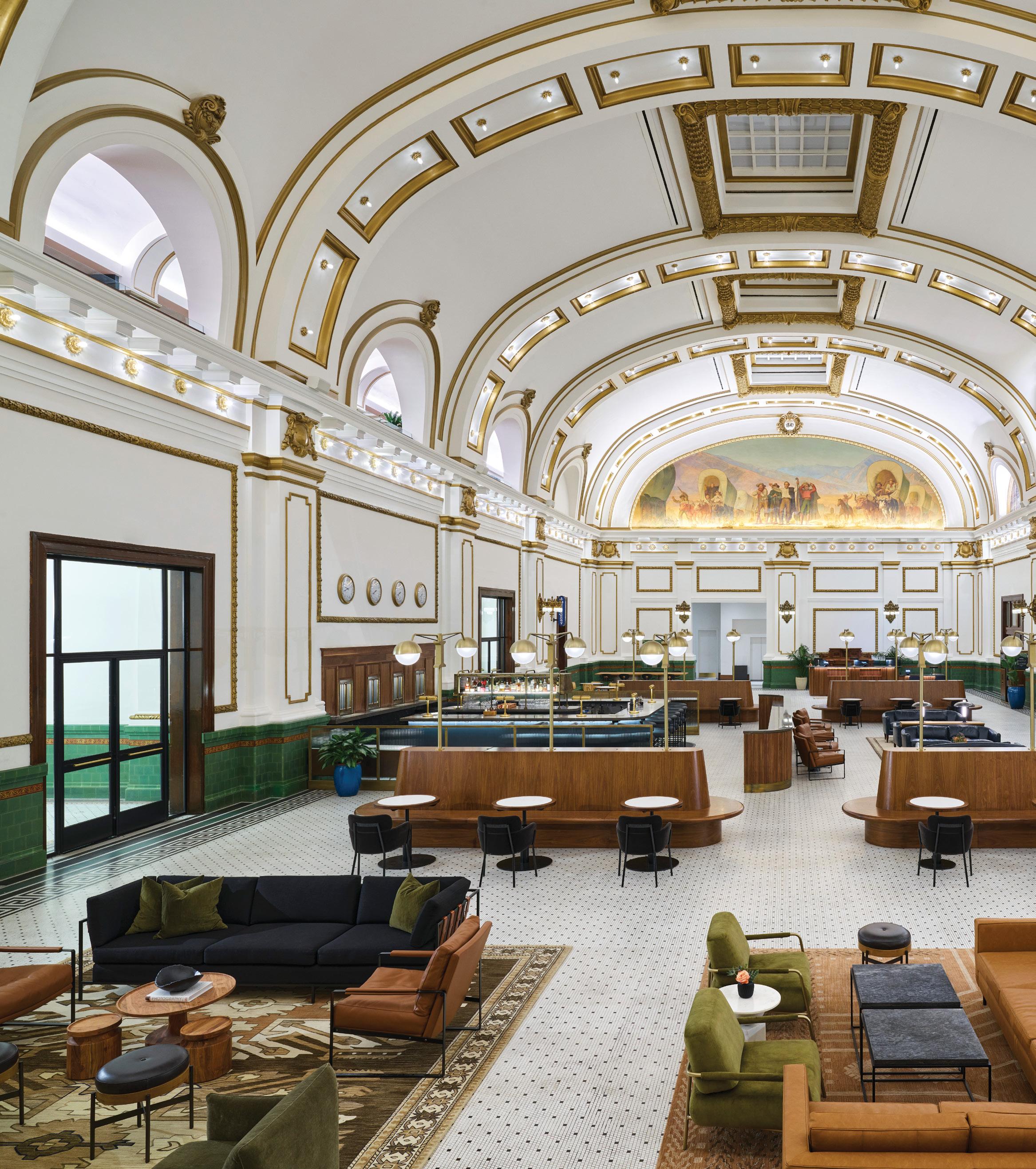
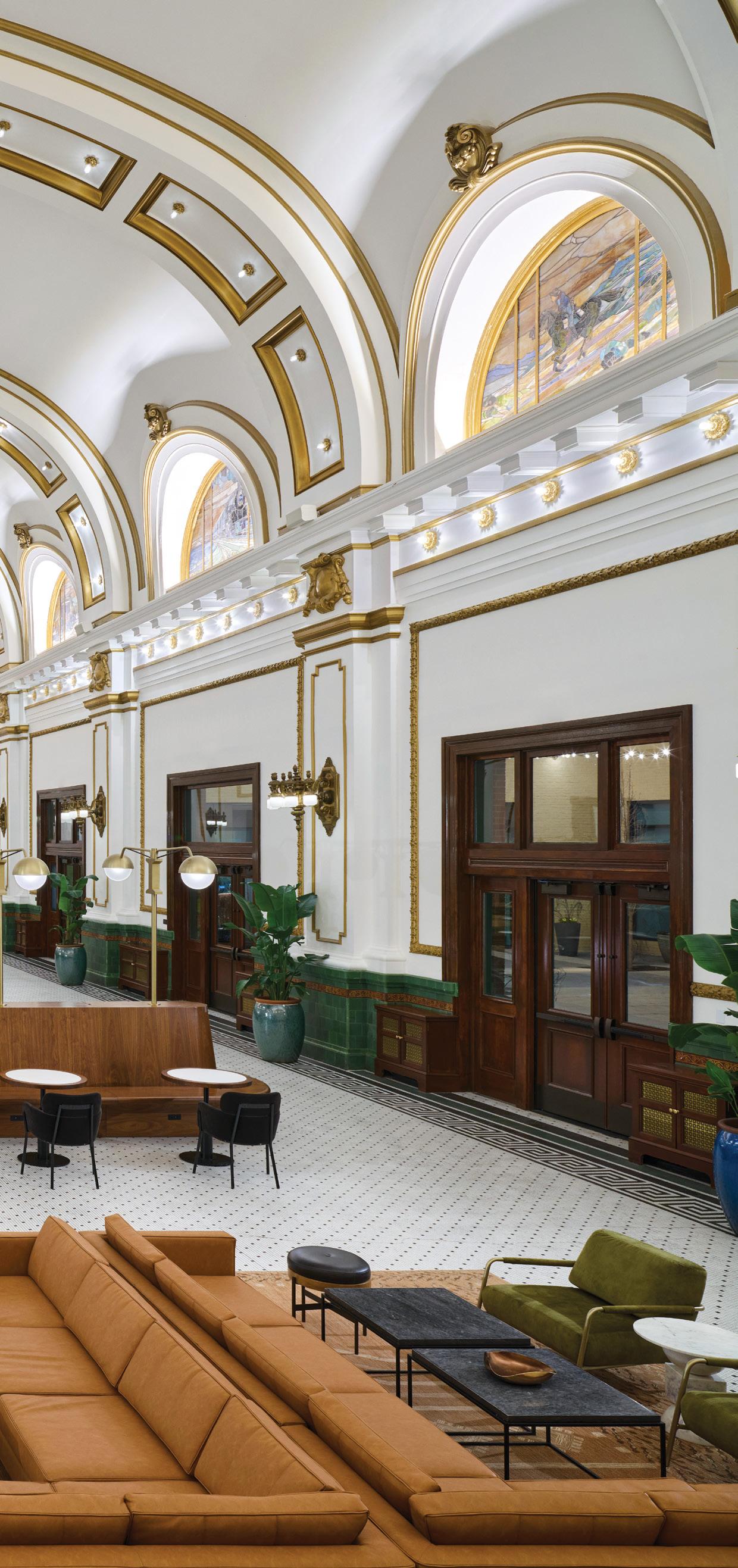

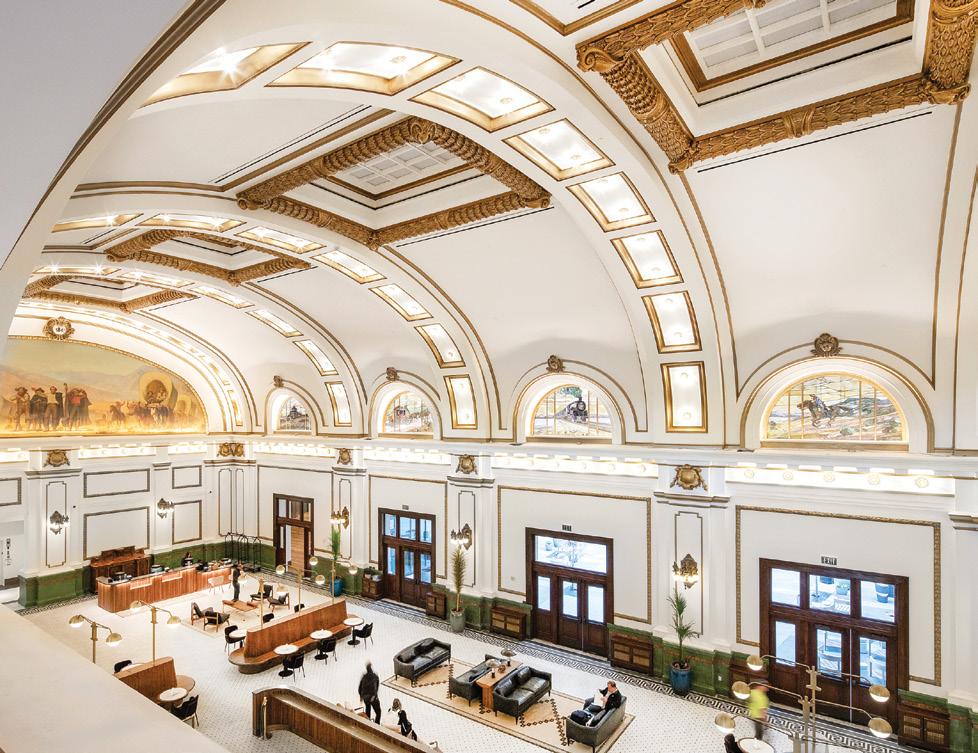
The design team took cues from the grandeur of early 20th-century train travel, preserving the depot’s original murals, stained glass, skylights and arched windows. These elements are showcased in the Grand Hall, the vibrant heart of the hotel, where restored details blend with modern luxury to create an extraordinary gathering space for visitors and locals alike.
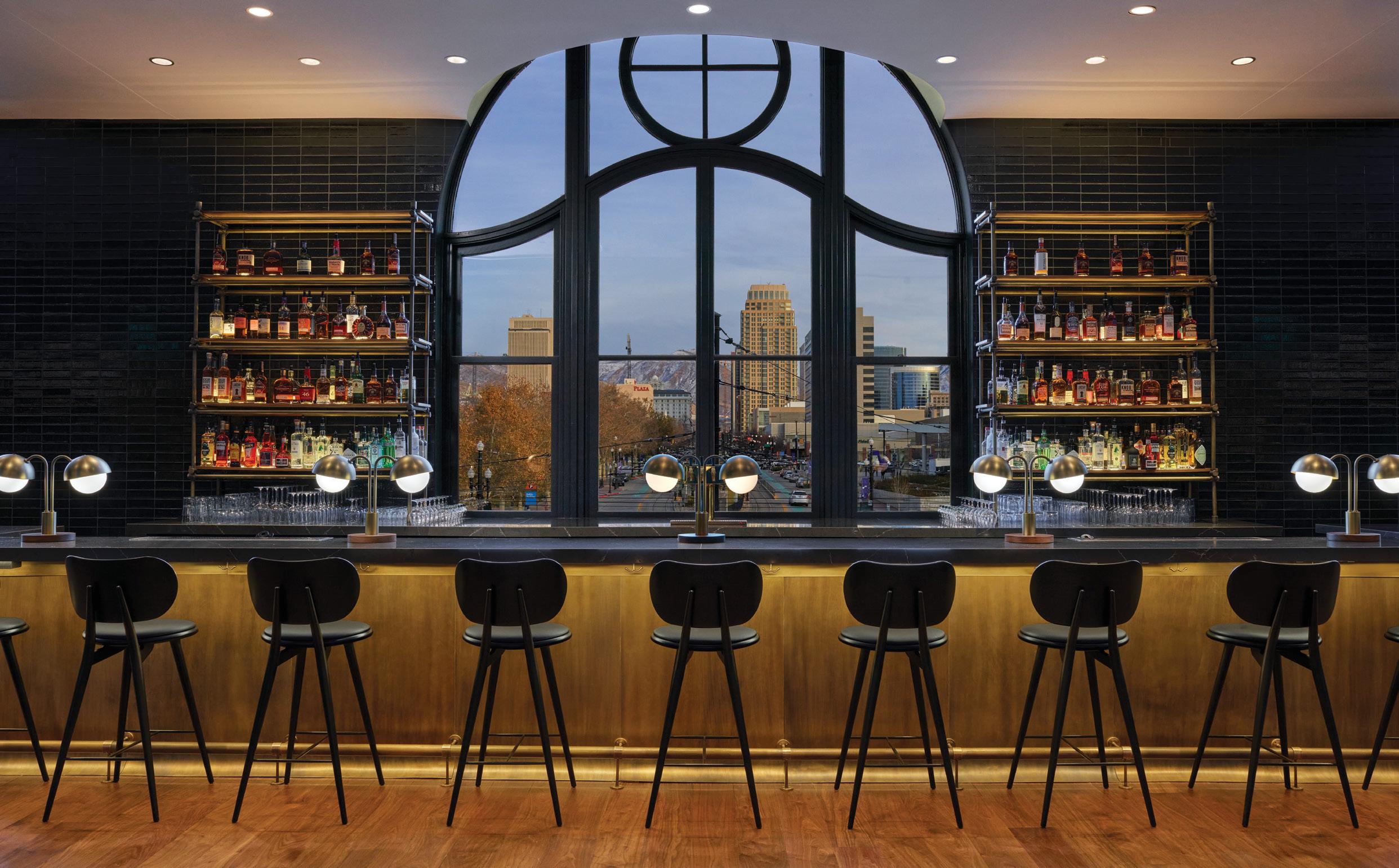
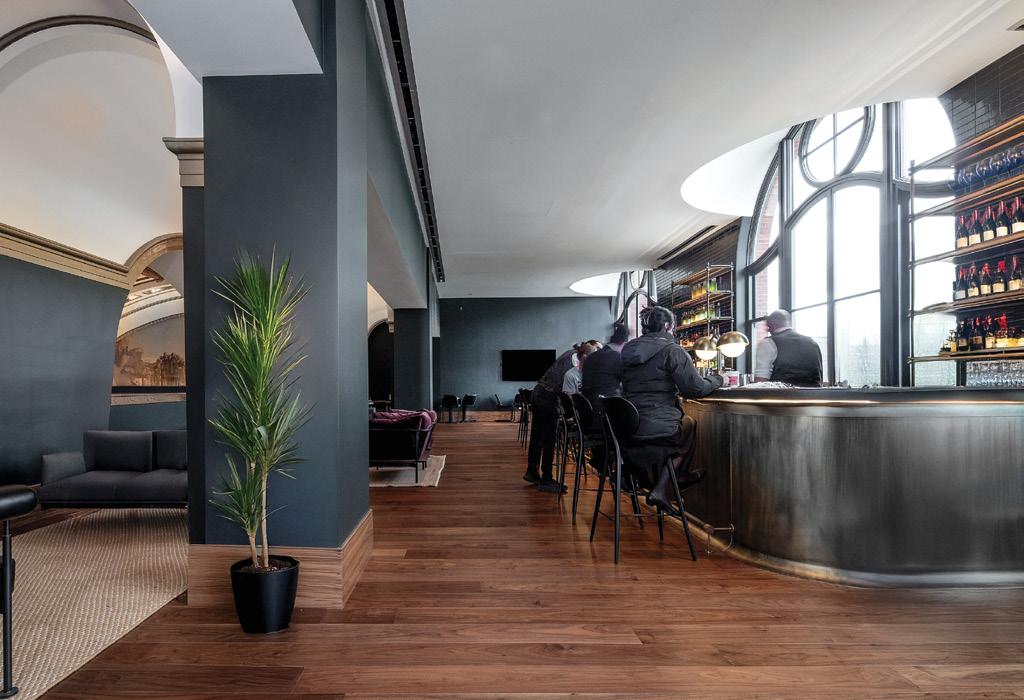
Around the hall, new modern hospitality amenities draw people in, including No. 119, a swanky, whiskey-forward cocktail experience overlooking the Grand Hall.
The core ethos of Autograph Collection Hotels is to champion the individuality of each destination; Asher Adams is no exception. Named after John R. Asher and George H. Adams, who first mapped railroad routes, the 225-room luxury hotel intentionally celebrates the depot’s history, starting with the incorporation and revitalization of 44,000 square feet of the historic structure. Inspired by the grand hotel lobbies of the past that served as the social center of their communities, the historic Grand Hall is now the hotel’s main lobby and the heart of the visitor experience.
Vaulted ceilings, original stonework, historic detailing and grand arched windows alongside restored terrazzo flooring, stained-glass windows and skylights recall the glamour of the past. New openings to the hall invite people in and reintroduce its civic role as a public living room while embracing the challenge of public-access easements (requiring it to always accommodate public access) running through the space.
Around the hall, new modern hospitality amenities draw people in, including Rouser, an upscale New American restaurant; No. 119, a swanky, whiskey-forward cocktail experience overlooking the Grand Hall; and the Gandy Dancer, a vinyl lounge offering an immersive music experience in an intimate setting.
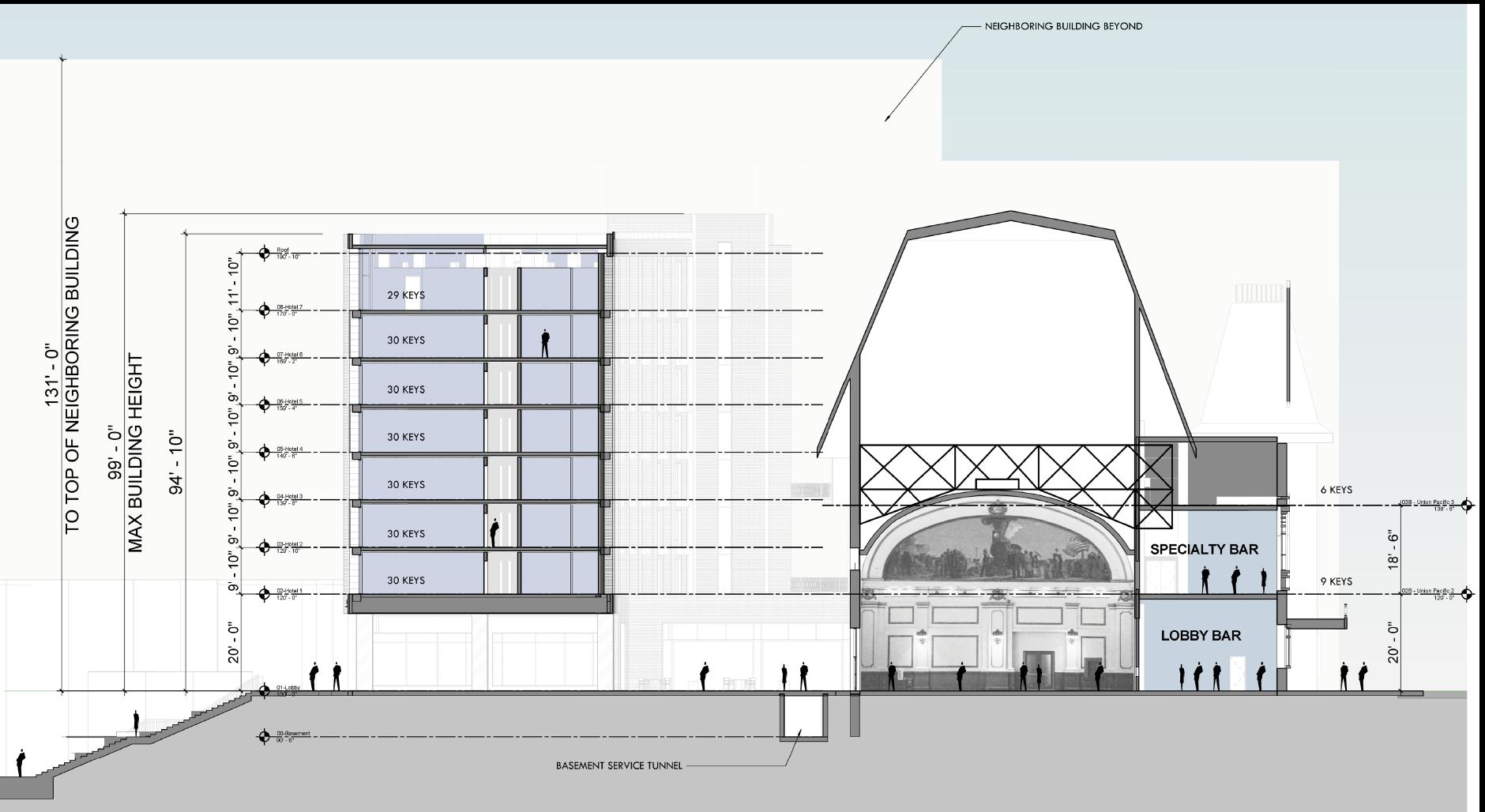
Although the original depot’s south wing now offers an intimate collection of 14 signature historic rooms and luxury suites, the remaining portion of historic building was undersized and inadequately prepared to accommodate the full needs of a modern hotel. The challenge was to design a sensitive extension on a constrained site—encumbered by the public-access easements—that would not detract from the historic structure.
Immediately to the west of the original structure, a new 8-story guestroom building features a curvilinear form that springs away from the historic building, allowing the original structure to maintain its integrity. The addition’s curvilinear form also created an opportunity for a dual façade expression. The east façade facing the depot features deeply recessed
Inspired by the grand hotel lobbies of the past that served as the social center of their communities, the historic Grand Hall is now the hotel’s main lobby and the heart of the visitor experience.
windows and simple brick volumes that echo the tones and rhythms of the original structure. The curved design of the new building contrasts the depot’s clean, symmetrical lines, creating a sense of architectural dialogue and, when viewed from South Temple Street, the new construction serves as a backdrop, allowing the depot itself to shine. It also preserves
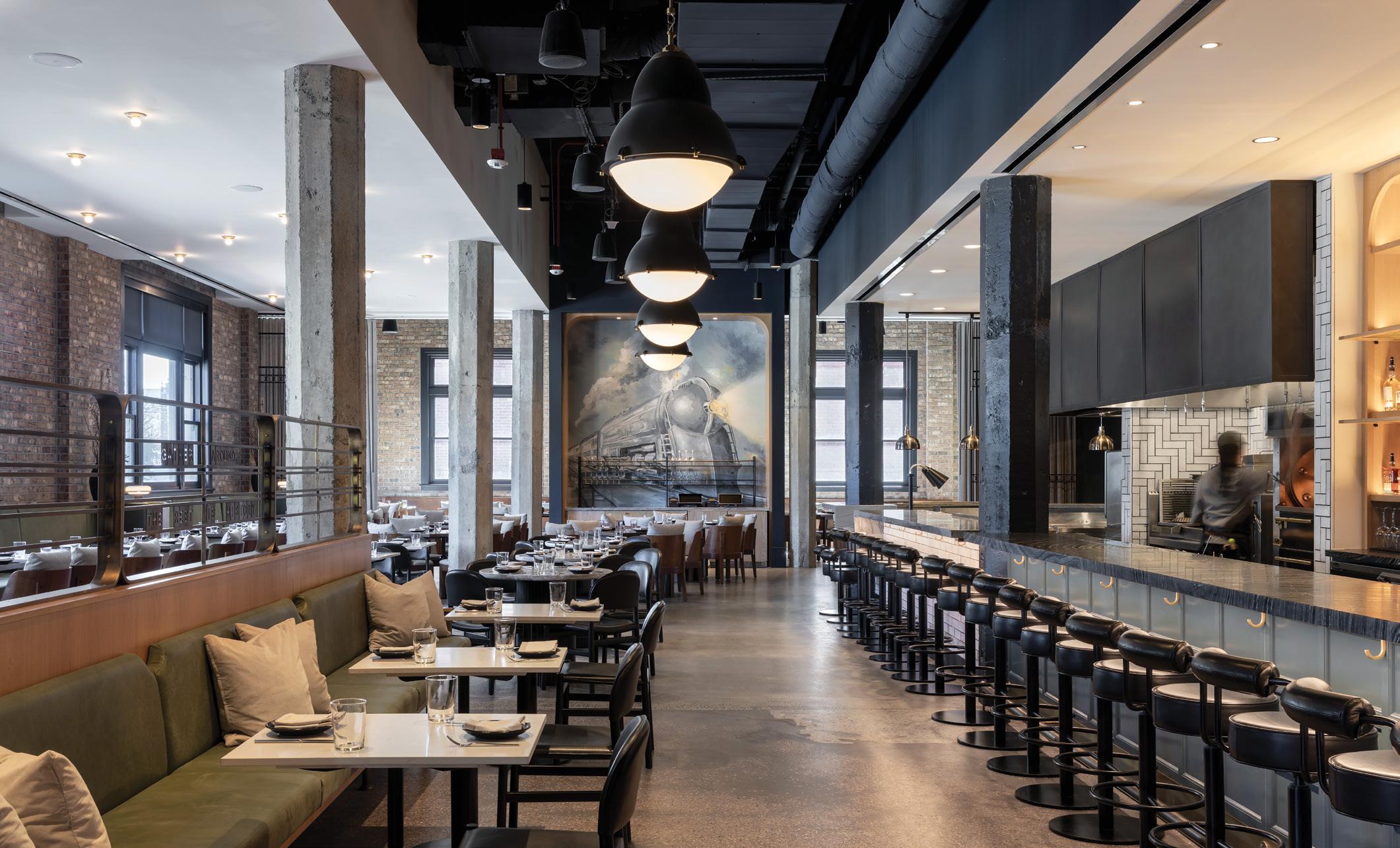
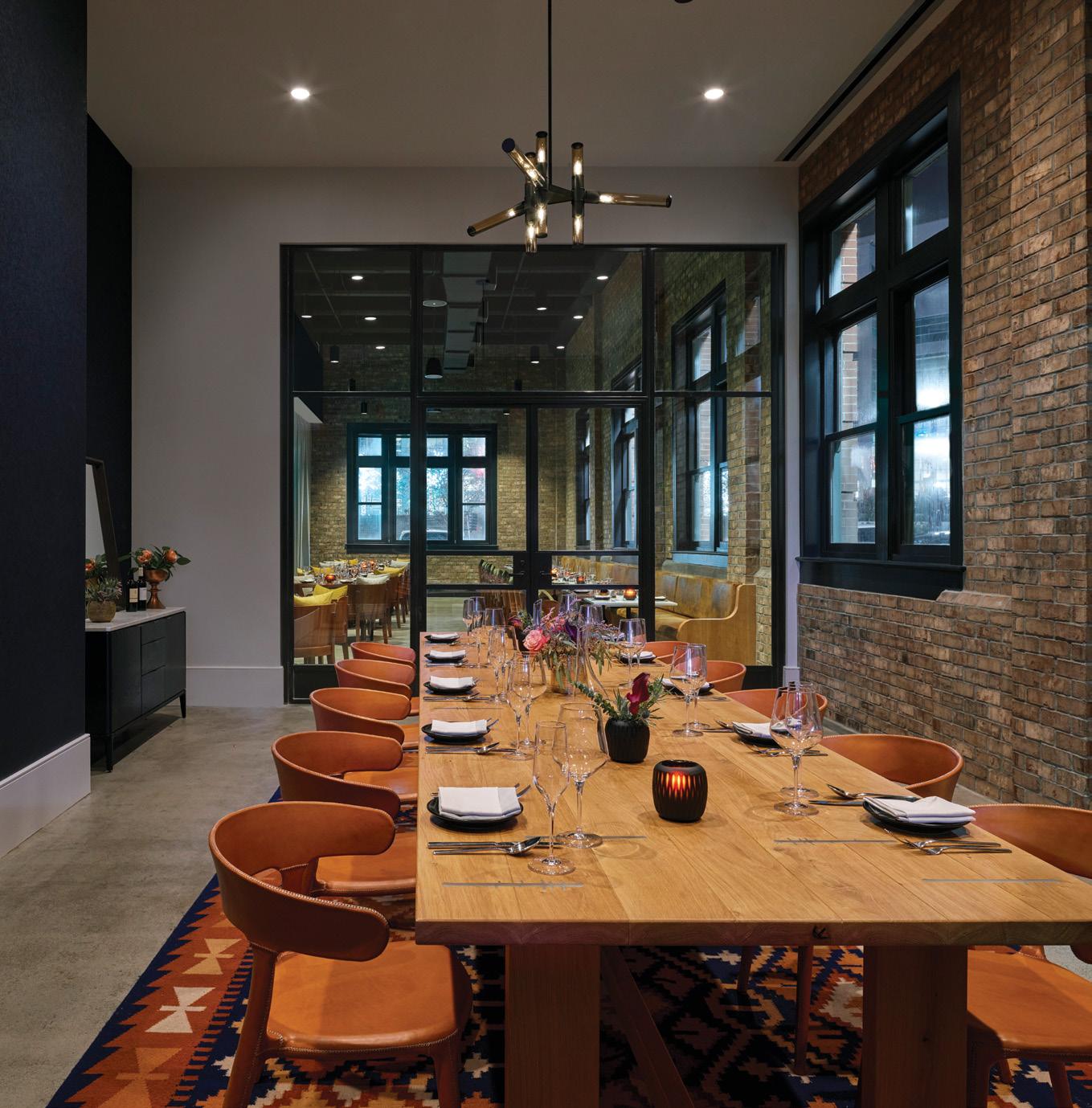
Approximately 44,000 square feet of historic structure was transformed into a vibrant hub where architecture, heritage and hospitality converge.
Retrofit Team
Architect and Designer: HKS, www.hksinc.com
• Emir Tursic, principal-in-charge
• Omar Hason, project designer
• Joshua Rushton, project designer
• James Olsen, senior project architect
• Patrick Ramstack, project architect
Interior Designer: JNS Architecture + Interior Design, www.jns.design
Developer: The Athens Group, athensdevco.com
Structural Engineer: Reaveley Engineers, www.reaveley.com
Civil Engineer: Great Basin Engineering, www.greatbasineng.com
Historic Building Seismic Updates: Holmes, www.holmes.us
MEP Engineer: Blum Consulting Engineers Inc., blumeng.com
Lighting Designer: Lang Lighting Design, www.langlighting.com
Landscape Design: MGB+A Studio, mgba-studio.com
the existing public easement through an intimate courtyard and a framed portal that invites passage into a public plaza, strengthening the connection between city, hotel and history.
On the addition’s west façade, contemporary architecture presents a fresh new face toward the public plaza that is in tune with the hotel’s more modern neighbors. This façade unfolds in a series of revolving panels that reduce scale and solar heat gain while creating visual depth.
Strategically located near major venues, like the Salt Lake City International Airport, Vivint Arena and Salt Palace Convention Center, as well as cultural institutions, such as Temple Square, Asher Adams stands poised to reconnect the city’s Gateway District to the city’s urban fabric.
By embracing the depot’s unique character and layering it with thoughtful modern elements, Asher Adams creates a venue that is as much a celebration of the past as it is a step into the future. Approaching its first anniversary, the hotel has transformed a dormant landmark into a vibrant hub. It doesn’t merely preserve history—it transforms it, creating an experience where architecture, heritage and hospitality converge and where the past meets the present.
Art Program: Nine Dot Arts, ninedotarts.com
Acoustics: Trinity Consultants, formerly Jaffe Holden, trinityconsultants.com
Materials
Masonry: Mutual Materials, www.mutualmaterials.com
Curtainwall: Kawneer, www.kawneer.com
Architectural Glass: Viracon, viracon.com
Façade Solutions: POHL Europlate from Pohl, www.pohl-facades. com/en/solutions/systems/pohl-europlate; Alucobond USA, www.alucobondusa.com; Direct-applied Exterior Finish System from Sto, www.stocorp.com; and TerraMai, www.terramai.com
Railing: Signature Series Rod Railing from Viewrail, www.viewrail.com
Porcelain Tile: Industrial Park from Daltile, www.daltile.com/ products/concrete-look/industrial-park
Pedestrian Waterproofing Solution: Vulkem 350/351 from Tremco, www.tremcosealants.com
THE PRODUCTS TO DO EVERYTHING. THE POWER TO DO EVEN MORE.
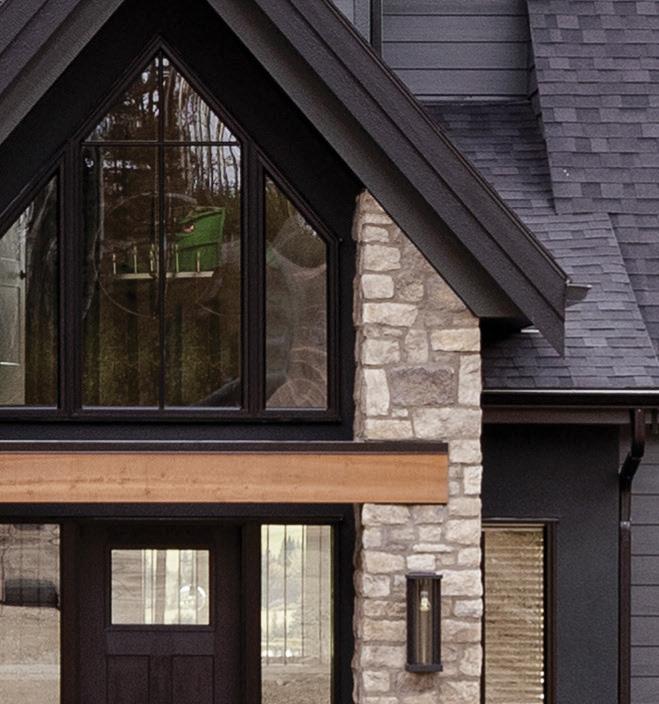

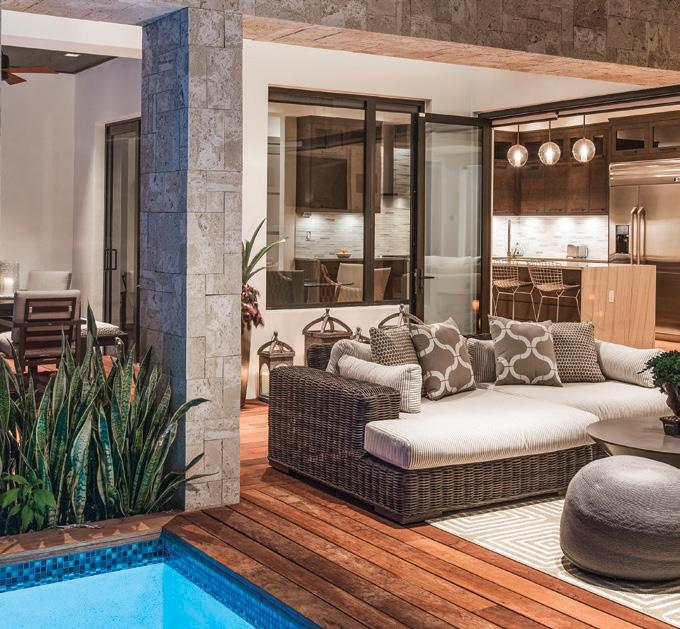

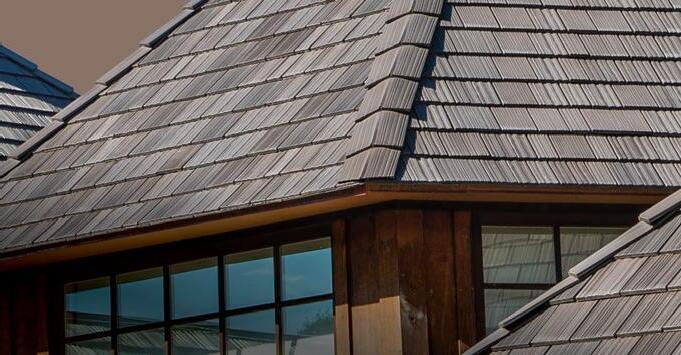

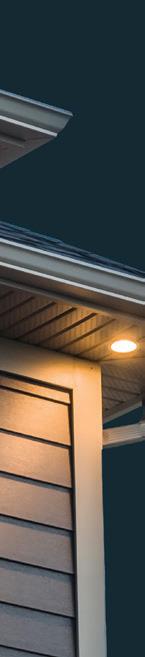
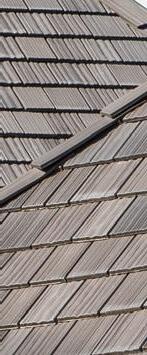


We’ve got the industry’s greatest collection of building products to bring any space to life, inside and out. Together, we’re just getting started in expressing, adapting and advancing. That’s what it means to Be Boundless ™
Tennessee
Retrofit Team
Architects: UrbanARCH, uarch.com, and Alliiance, alliiance.com
Structural, Façade and Sustainability Engineer: Thornton Tomasetti,www.thorntontomasetti.com
Materials
The following is a sampling of materials used in the project: Suspended White Acoustic Metal Pan Ceilings: Accent Ceilings, www.accentceilings.com
Flat, Lay-in and Linear Acoustic Ceilings: Armstrong World Industries, www.armstrongceilings.com
Curtainwall: Kawneer, www.kawneer.com
Carpet: Interface, www.interface.com
The Retrofit
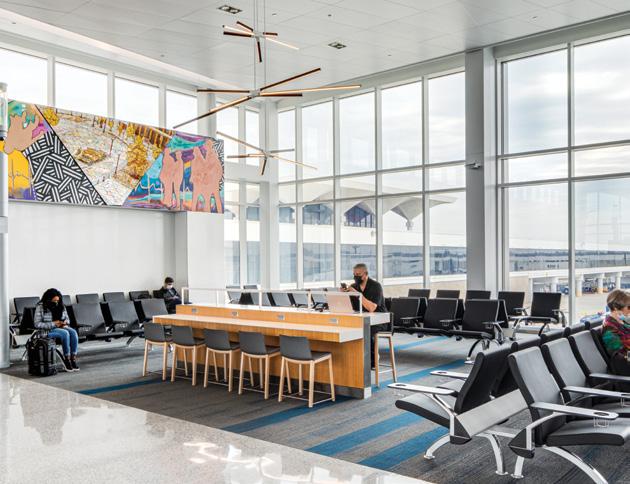
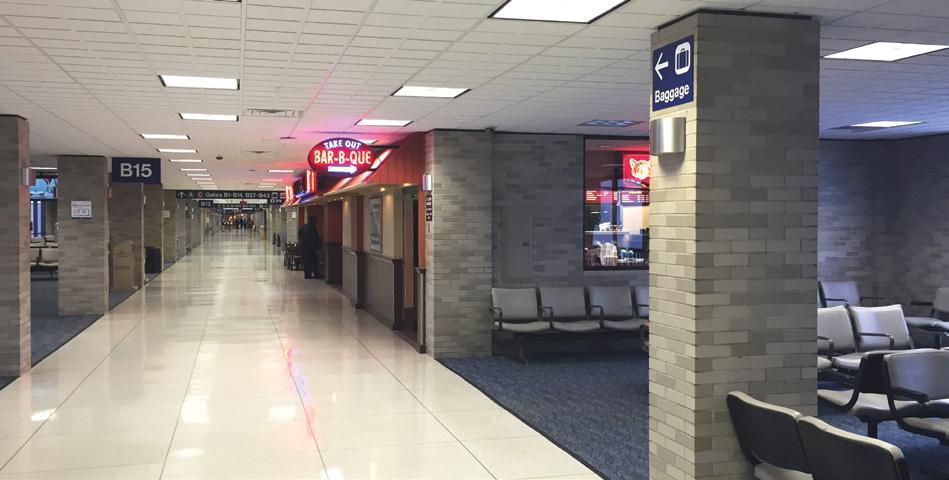
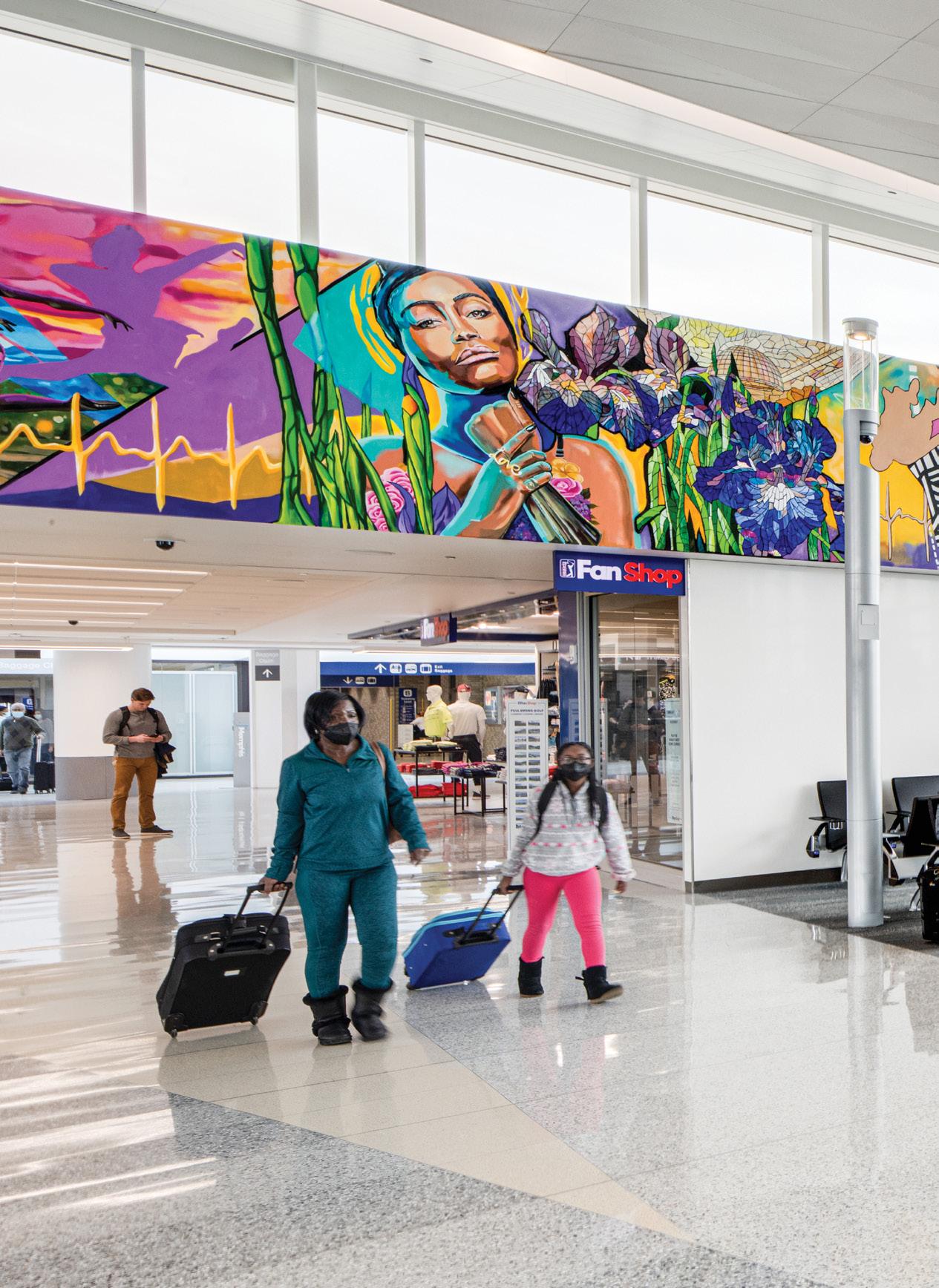
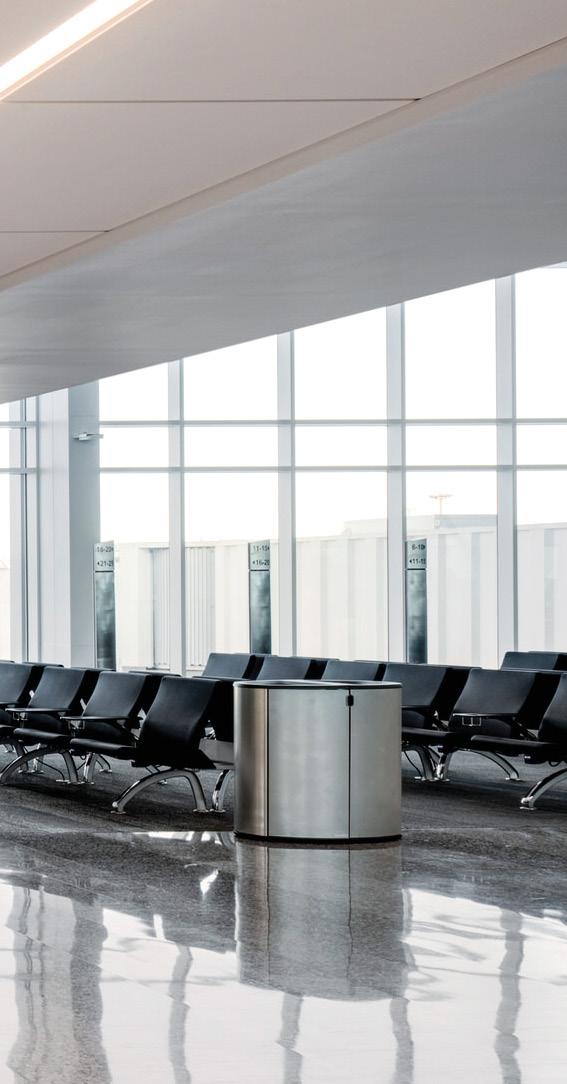
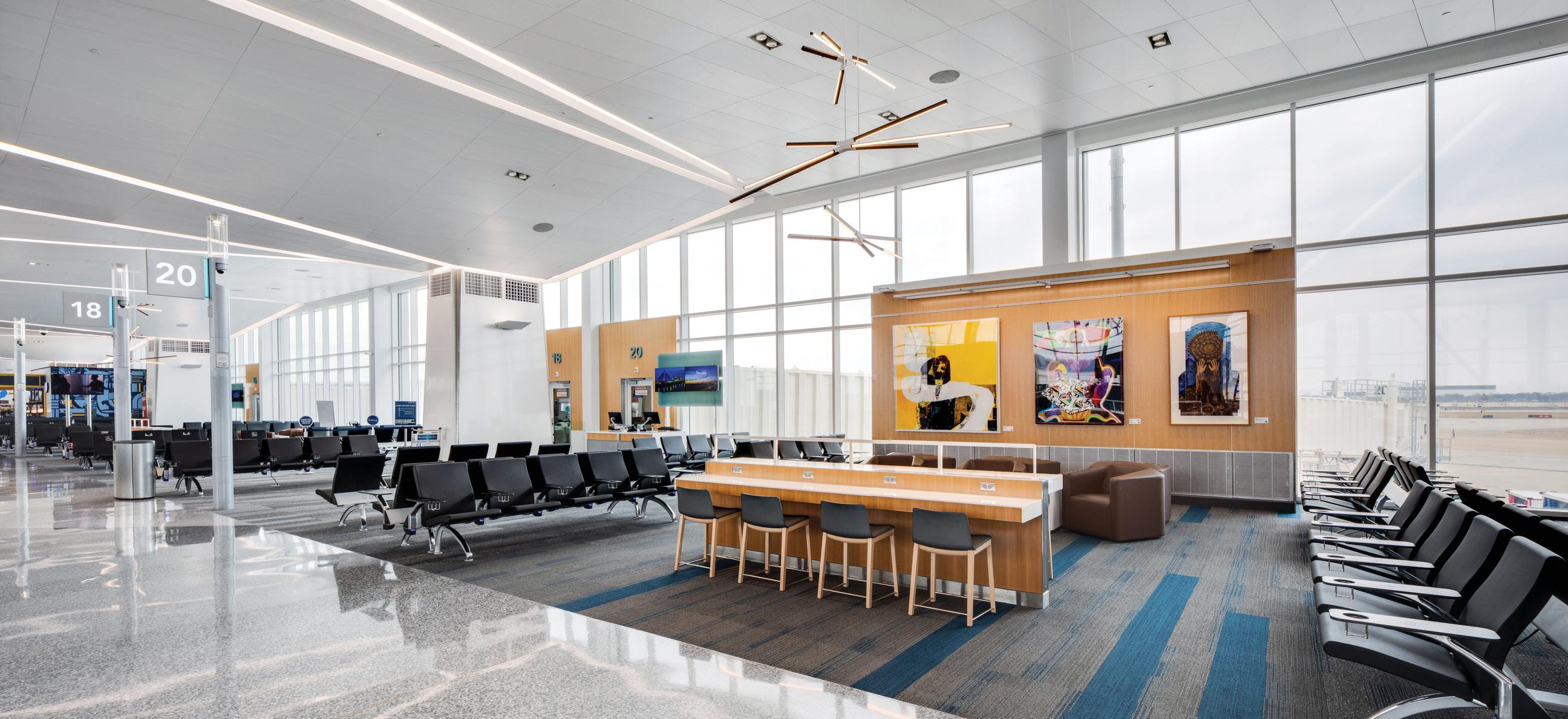
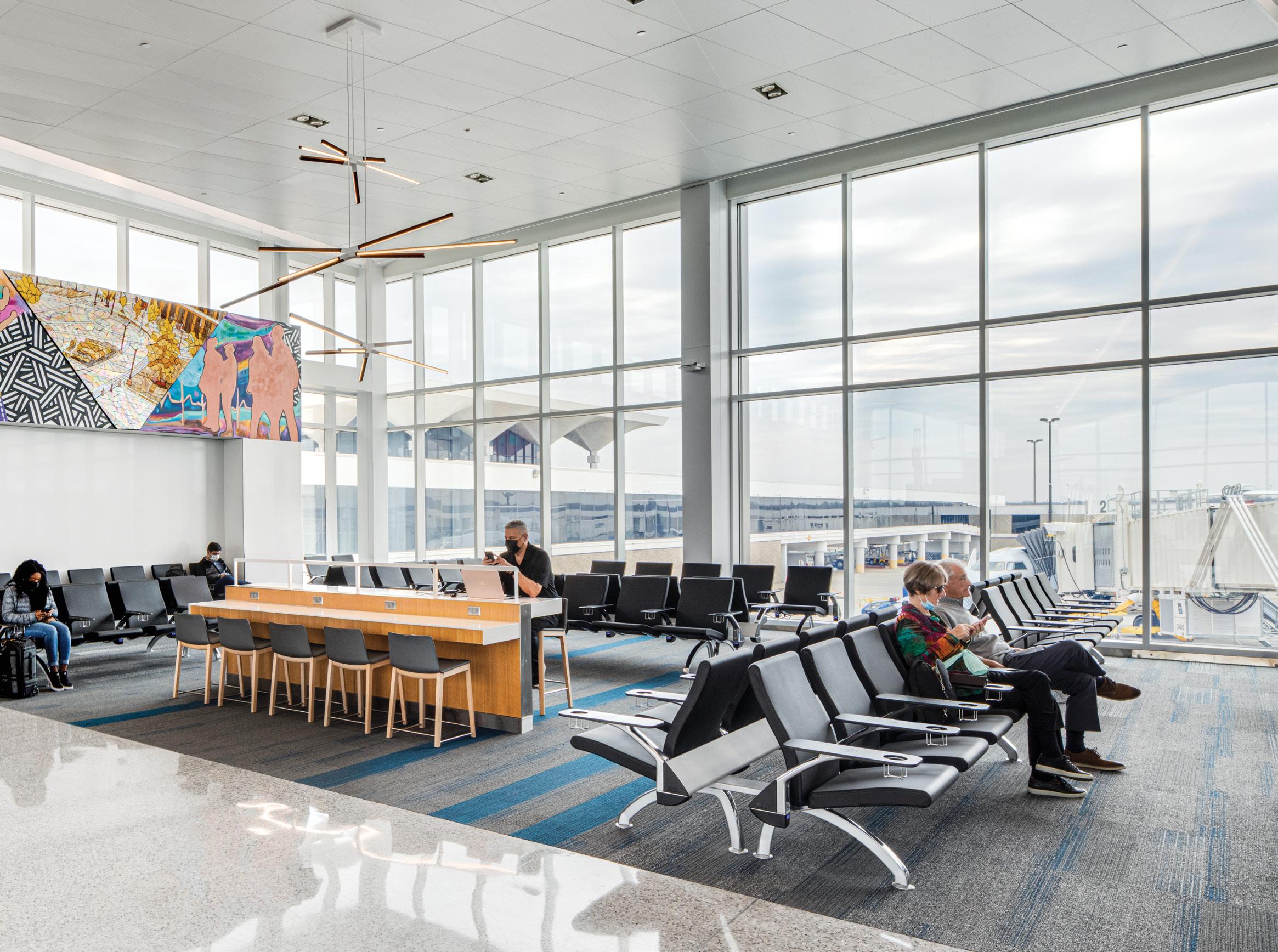
UrbanARCH partnered with Alliiance to transform a 1960s-style concourse into an inviting and contemporary facility of which all Memphians can be proud. The 183,000-square-foot concourse reconstruction incorporates 23 new/expanded gates, moving walkways, a seismic structural retrofit, an all-new concessions program, St. Jude Family Lounge, Military Lounge, world-class restroom facilities, live performance stage, and a $1.5 million investment in local/public art.
The 19-foot-tall, perforated metal ceilings fold and undulate to achieve an energetic design expression as travelers move underneath. The ceiling treatment respects and is complementary to the airport’s existing terminal buildings and the “martini glass” structural expression achieved there. Auto-tinting dynamic glazing reacts to time of day and sun angles to protect the occupants from harsh sunlight while achieving energy efficiency.
The project received an Award of Merit in the American Institute of Architects Memphis Chapter’s 2025 Design Awards.

San Francisco International Airport
Retrofit Team
Architect: William Duff Architects, wdarch.com
General Contractor: Turner Construction Co., www.turnerconstruction.com
Structural Engineer: KPFF, www.kpff.com
MEP Consultant: Interface Engineering, interfaceengineering.com
Acoustics, LEED Consultant and Enhanced Commissioning: ARUP, www.arup.com
Lighting Consultant: Studio Three Twenty One, studio-321.com
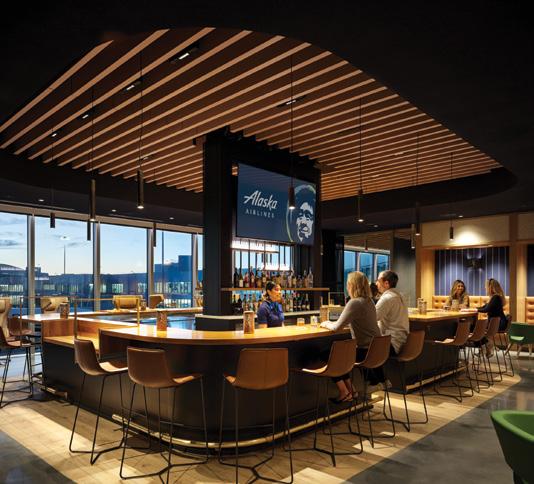
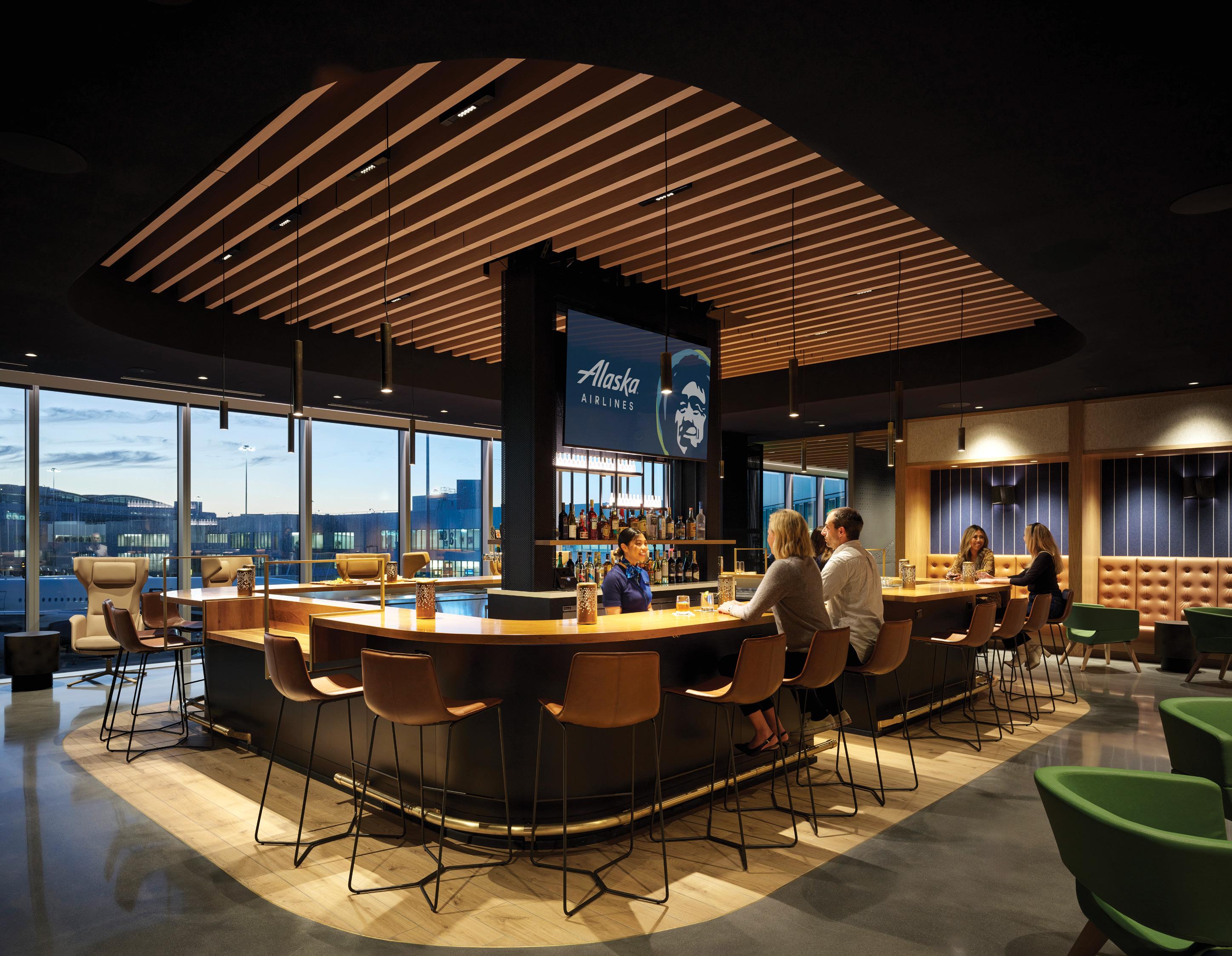
Sound control in the open lounge environment was a key challenge; voices could be heard clearly from 60-feet away. To help address this, William Duff Architects (WDA) designed a 40-foot laser-cut metal acoustic wall, located centrally as a buffer between the quiet lounge program and the active bar area. Featuring the Golden Gate Bridge enveloped in fog, it serves as a focal point and functional element. Custom metal twists and wood slats evoke movement while enhancing acoustics, alongside calculated partition framing, millwork and an acoustic ceiling. Every material was carefully selected, from custom pendant lights lining the space to the walnut bar countertop with brass accents and powder-coated metal die wall, framed by a matching tile surround. Custom booths offer flexibility, allowing lounge guests to face each other for conversation or turn to enjoy the views of the bustling airport
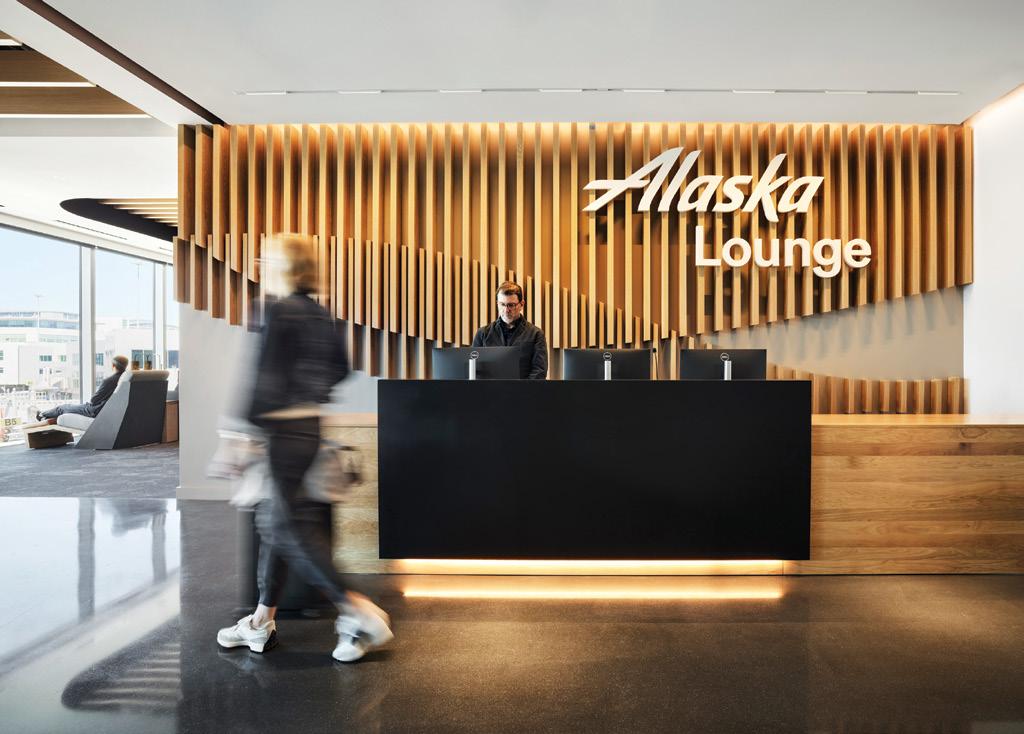

and skyline. Designed to LEED Gold standards, sustainable materials and practices were integral throughout.
The following is a sampling of materials used in the project: Tile Mural: Fireclay Tile, www.fireclaytile.com
Acoustic Ceiling: AcoustiBuilt from Armstrong World Industries, www.armstrongceilings.com
Paint: Benjamin Moore, www.benjaminmoore.com, and SherwinWilliams, www.sherwin-williams.com
Solid Surface: Caesarstone, www.caesarstoneus.com
Floor Tile: Atlas Concorde, www.atlasconcorde.com
WDA balanced a blend of Alaska Airlines’ brand identity with the Bay Area’s creative spirit for the airline’s 11,000-plus-square-foot lounge.
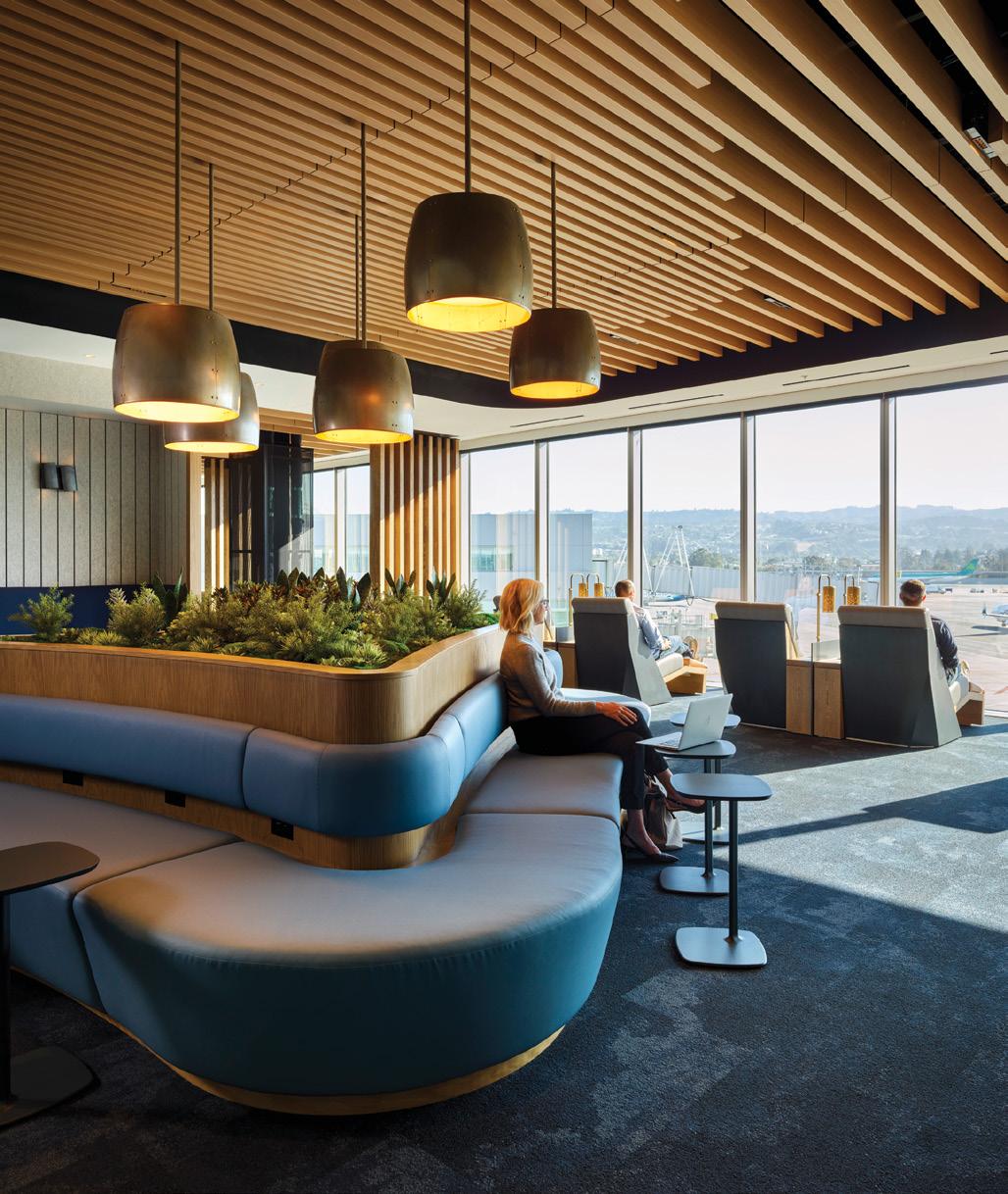
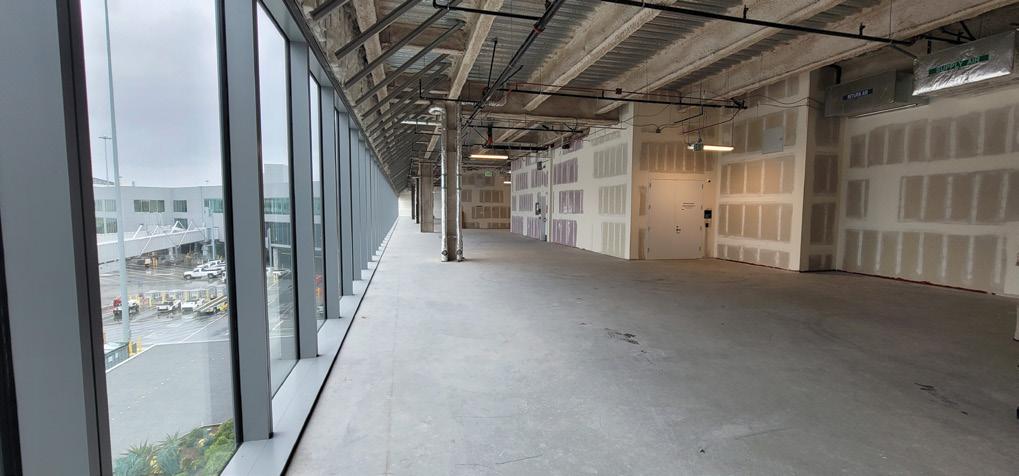
Presented with one long floor plan, WDA’s goal was to create distinct areas while incorporating Alaska Airlines’ existing hospitality program—featuring spaces to “Take a Breath”, “Help Yourself” and “Cut Loose”—while ensuring seamless transitions and maintaining a cohesive visual narrative. Each area is visually distinguished through use of unique ceiling treatments and furniture arrangements with curves softening the space and uniting the sections—from the asymmetrical sofa in “Take a Breath” to the curved aviation-inspired soffit over “Help Yourself” and the rounded bar in “Cut Loose”. A custom tile mural in the airline’s color palette and locally inspired design elements enhance brand recognition, character and depth. BEFORE
Located in Harvey Milk Terminal 1, clean lines combined with the inviting warmth and comfort of a hotel result in a welcoming, dynamic and sophisticated environment.
California
Retrofit Team
Architect: HNTB Architecture Inc., hntb.com
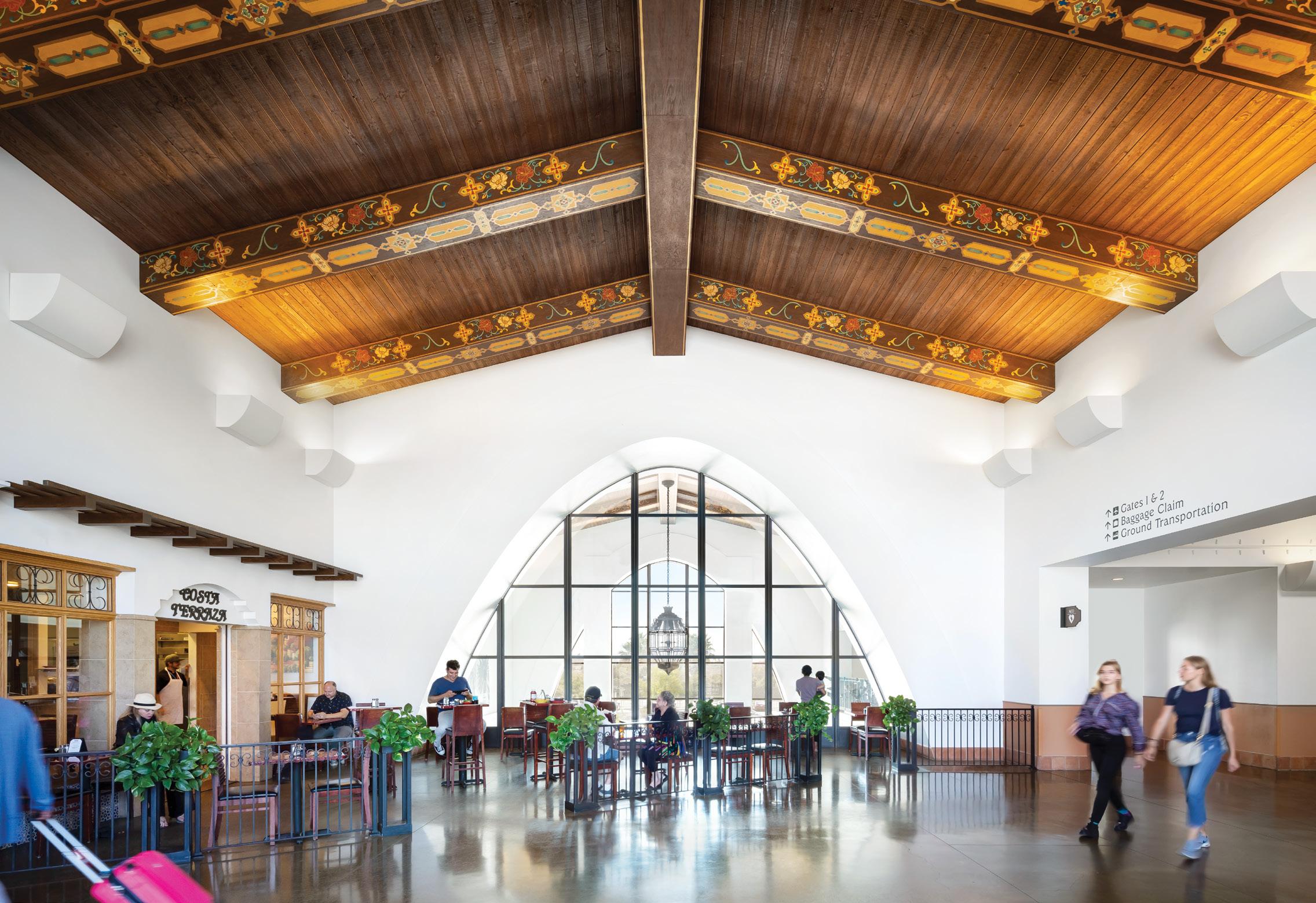
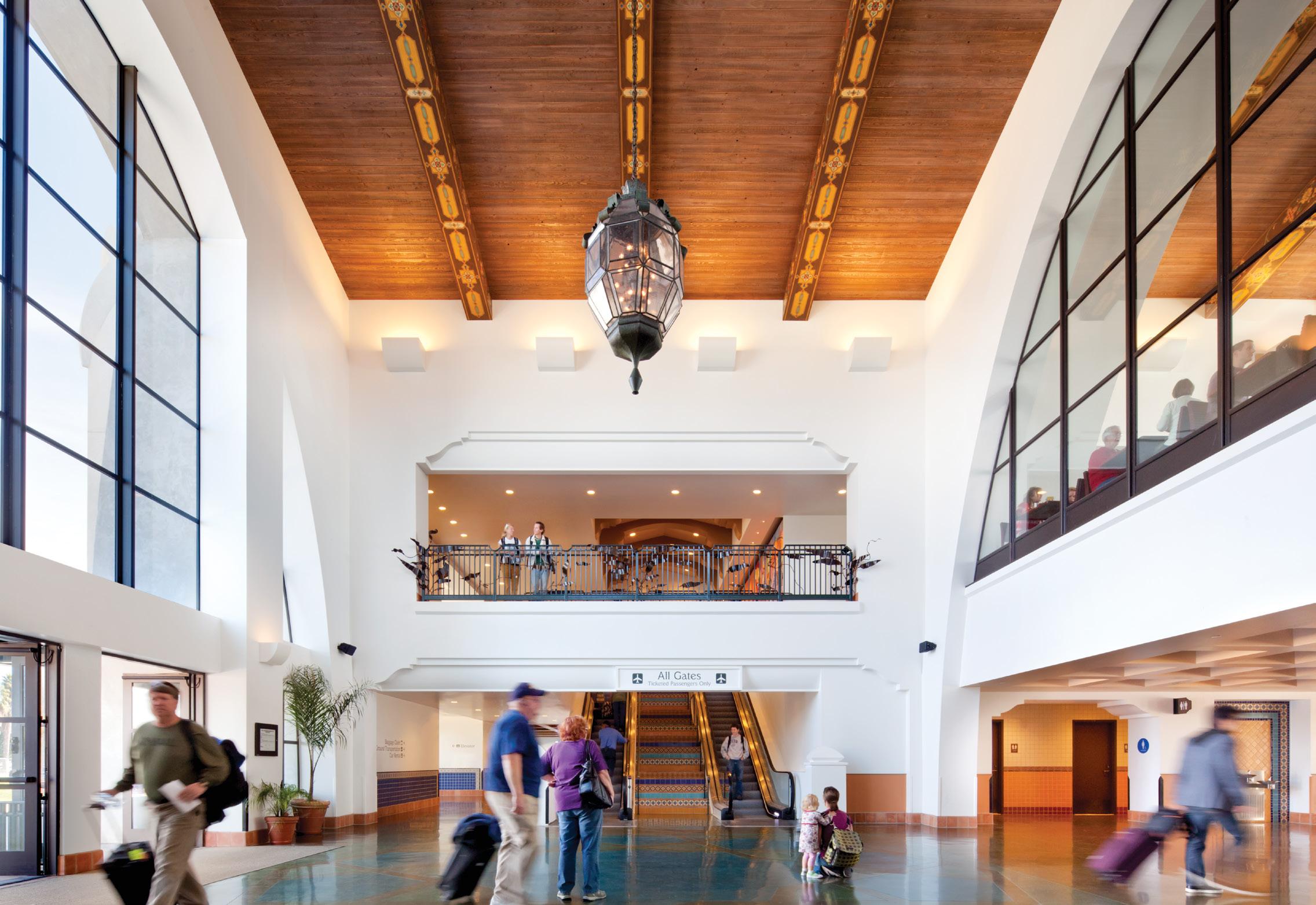
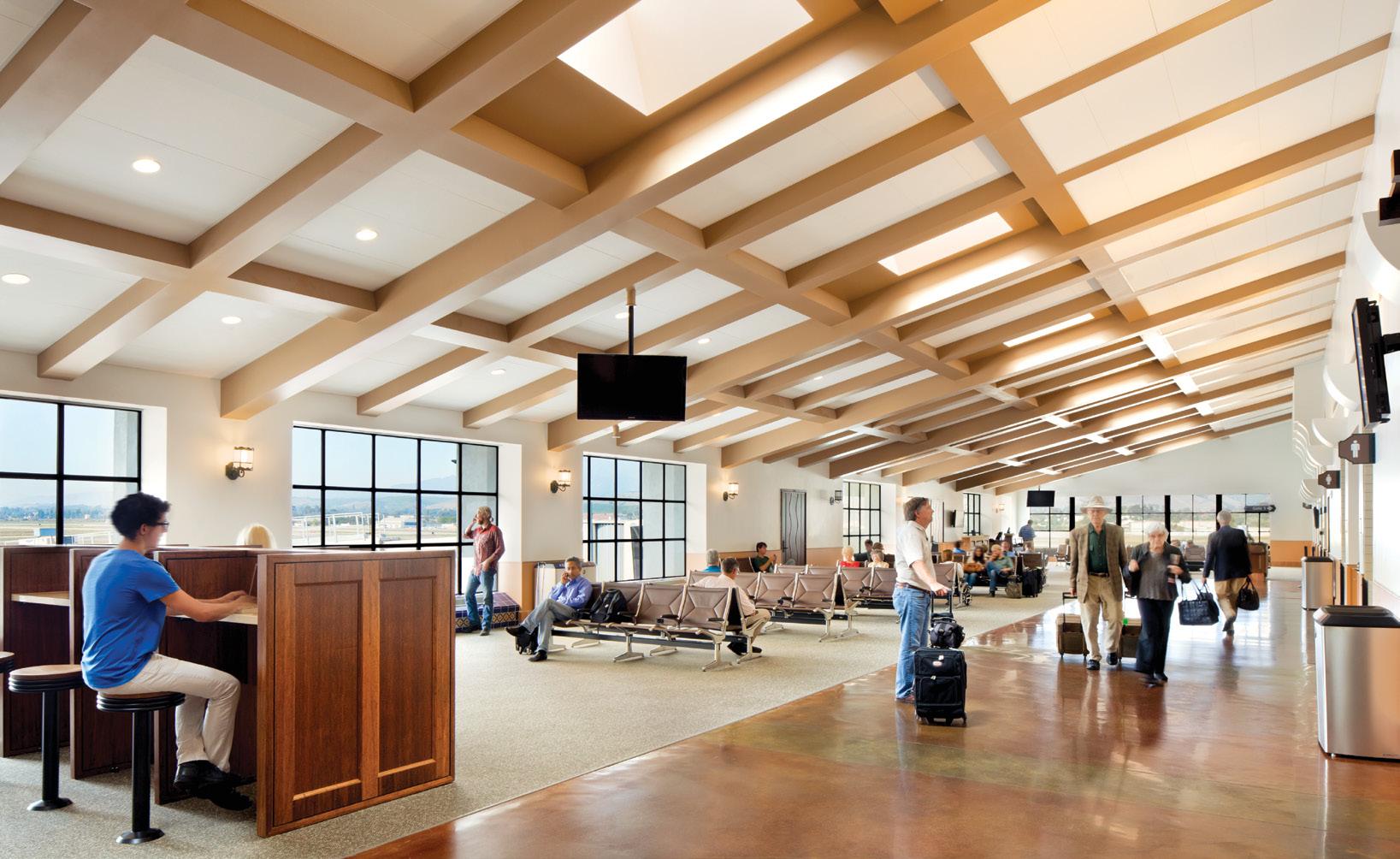
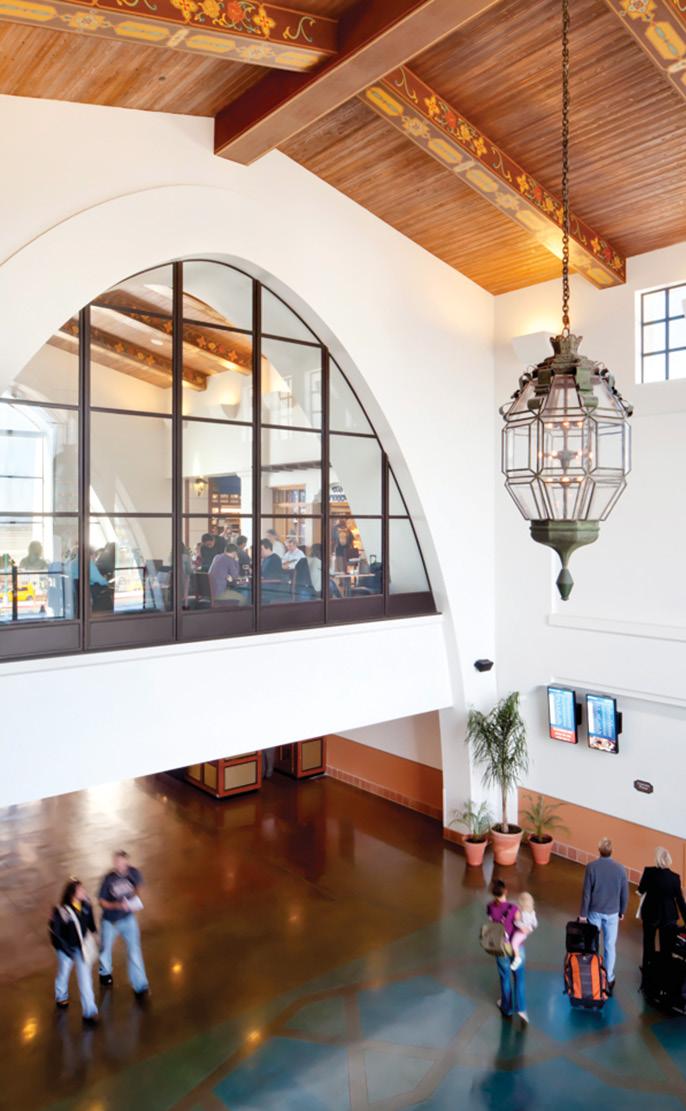
HNTB was challenged to relocate and rehabilitate the historic 1942 terminal, as well as design a new 70,000-square-foot terminal as part of the airport’s ongoing development. Unique elements include LEED Gold certification and a landscaped site and building scale that evoke the “Santa Barbara Experience”. The largest public project in Santa Barbara’s history, the terminal blends with the area’s historic, Spanish Colonial Revival architecture while providing state-of-the-art systems and modern amenities.
To ensure the “Santa Barbara Experience” in the terminal addition, the design incorporates established style features—white stucco walls and red tile roofs with accents in wrought iron, decorative tile, stenciled wood beams and traditional steel windows.
Jamestown175 Series steel windows were used throughout the airport concourse and gate areas. Hope’s Windows Inc. also custombuilt a dramatic arched entrance to the terminal—a feature that is repeated at the rear airfield-facing side of the building and on the interior upper floor restaurant and departure lounge area. These immense windows allow views of the Pacific Ocean, Santa Ynez Mountains and Goleta Slough State Marine Conservation Area. A ground-floor observation deck, surrounded by custom steel wind screens, was added to provide a place for the public to take in the scenery and watch airplanes arrive.
Custom Fire-rated Steel Windows and Doors, Sliding Baggage Doors, Automatic Sliding Entrance Doors and Wind Screens: Hope’s Windows Inc., hopeswindows.com
East Elmhurst, N.Y.
Retrofit Team
Electrical Engineer: WSP, www.wsp.com
Materials
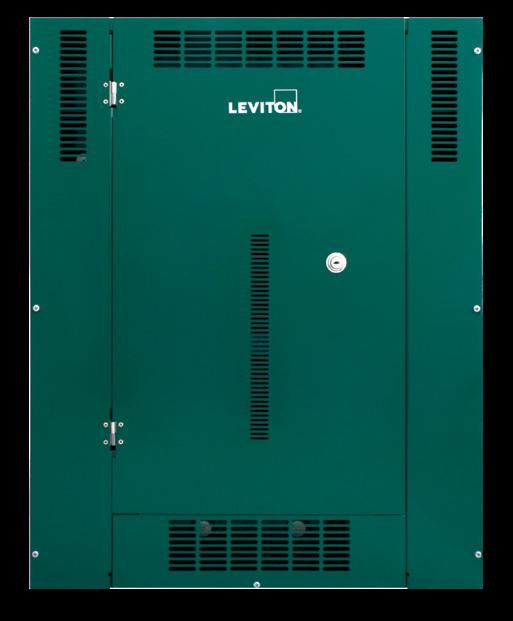
Leviton installed 75 custom-made GreenMAX Panels throughout Terminal B. Each panel was equipped with a main circuit breaker and 0-10V dimming relays determined by WSP, the consulting engineer.
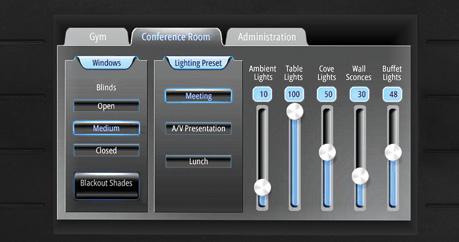
Commercial tenants in Terminal B had Sapphire Touch Screens installed to provide scene, scheduling and preset controls.
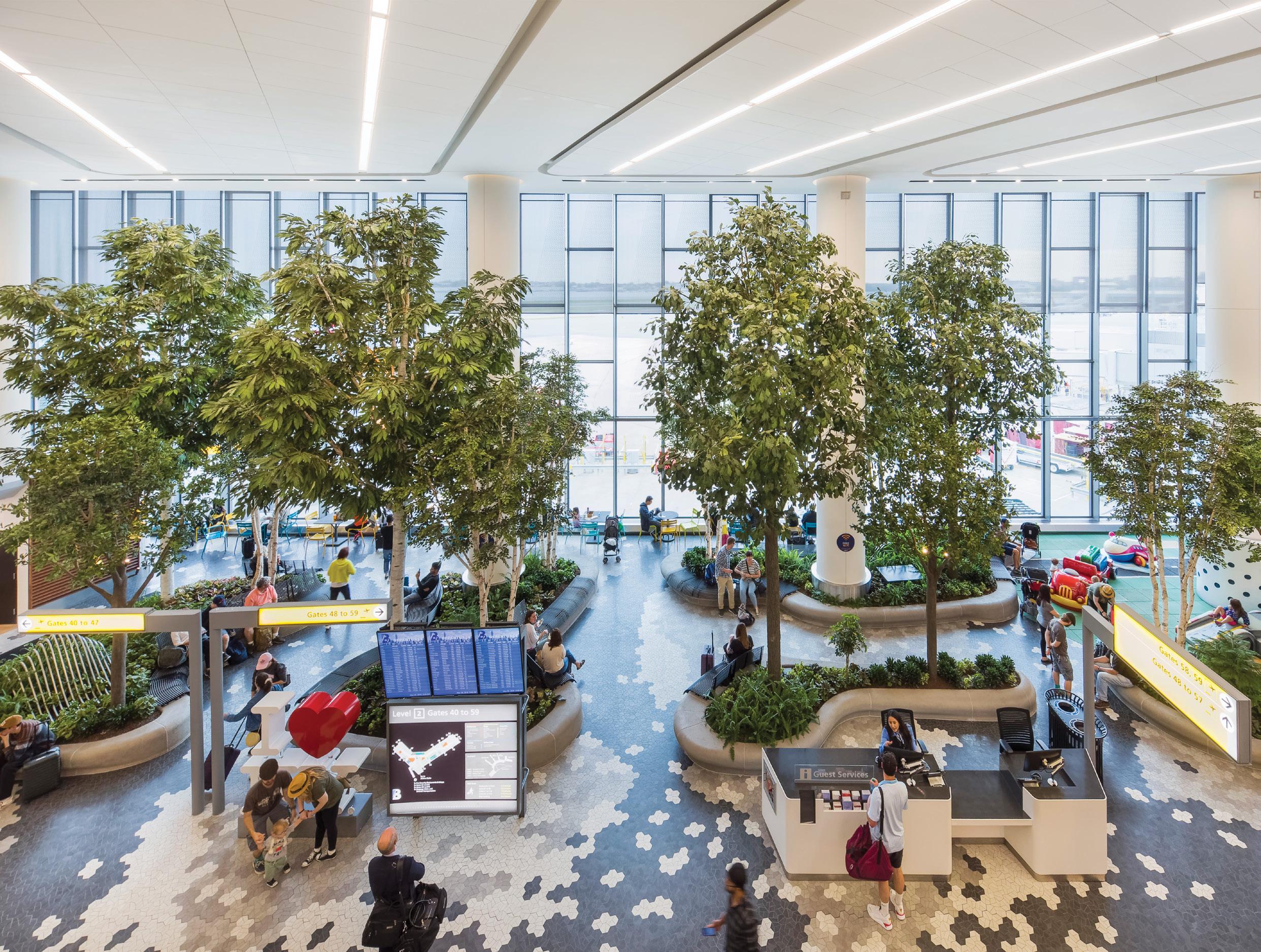
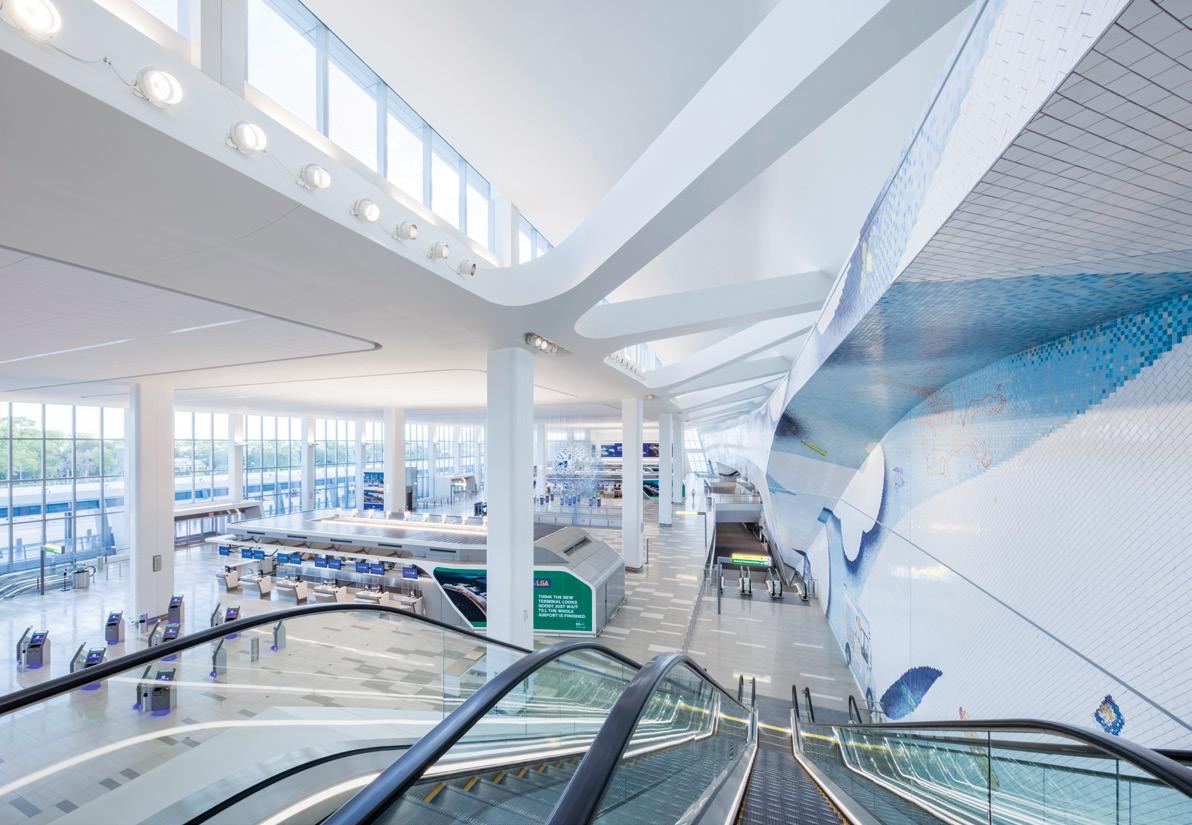
Leviton Multi-Tech Ceiling Mount Occupancy Sensors were installed to keep the lights on when needed and in accordance with energy codes. Leviton daylight harvesting and energy-saving photocells were added to Terminal B, which is brightly lit with floor-to-ceiling windows. The result is a seamless integration of a modern code-compliant lighting control system that enhances the passenger experience and state-of-the-art architecture.
“For a project as substantial and state-of-the-art as LaGuardia Airport’s Terminal B replacement project, the building’s lighting control system needed to be just the same. The Leviton GreenMAX control

system installed has proved to be as modular and expandable as the project needed it to be without introducing complexity,” explains Joe Szczechowicz, senior electrical engineer, WSP.
GreenMAX Relay Panels are a centralized lighting-control system, featuring dimming, partial-ON, partial-OFF, advanced scheduling, demand response and daylight harvesting capabilities. Native BACnet, Ethernet, and LumaCAN simplify configuration and BMS integration. GreenMAX Relay modules are rated at 30A General Fluorescent Ballast and 20A Incandescent.
The entire system was tied into the terminal’s BMS system resulting in no downtime or interruption of services despite multiple phases of the project.
Custom Lighting Control Relay Panels, Networking Equipment, Touch Screens, Emergency Controls: Leviton, leviton.com/products/ solutions/led-lighting
A vital part of the New York transportation system, LaGuardia Airport’s Terminal B needed to be modernized to meet the needs of travelers. Desperately in need of upgrades, airport officials took on a massive six-year renovation project, including a new terminal to meet passenger demands and energy codes. Officials also had to ensure operations were not interrupted during construction.
By Jay Kline, P.E., LC, SA

In a world increasingly shaped by data and automation, the vision of “smart buildings” is being redefined not just by sensors and systems, but by the human outcomes they enable. As a leader in digital transformation, I’ve seen firsthand how artificial intelligence (AI) can move beyond buzzword status to become a tool of stewardship helping us serve people better, make wiser use of resources and align infrastructure with improved quality of life.
Yet, to fully realize the potential of AI in the built environment, we could benefit from evolving the conversation. It’s not just about smart buildings. It’s about wise digital environments—a digital fabric that empowers leaders, engineers and facility managers alike; an ecosystem that is purpose-built with individual people and communities put first.
I have found that leading digital transformation in high-complexity environments requires more than technical acumen. It requires clarity of vision, a deep respect for those we serve and emotional intelligence. From a book I hold in high regard, Power vs. Force by David R. Hawkins, comes the following line: “Force knows all the answers; power is unassuming.” Now more than ever, prioritizing and spending more time on people and understanding their real needs, innovators can make the process of creating building intelligence more human and more impactful.
Have we not always done this? To a degree, yes, but the toil of compiling data and trudging through dashboard configuration limited our time and budget that could be spent on human-centered design for building intelligence. Also, the path
before was relatively clear: install sensors, get data, report data. What we could cost effectively develop for managers and occupants was relatively straightforward. However, now, we can build thousands of versions of tools specifically tailored to individuals easily using co-pilots and other AI development assistance tools.
Now more than ever, prioritizing and spending more time on people and understanding their real needs, innovators can make the process of creating building intelligence more human and more impactful.
The new paradigm of quick development allows us to create an intelligent fabric of data, powered by machine learning and natural language models, which help us find data anomalies, gaps and patterns to drive healthy data.
This digital fabric and healthy data provide immediate results, such as energy-use reduction, and set the stage for continuously evolving technology, benefits and capabilities, such as robotics, personalized experiences, blockchain and augmented reality.
The single best investment a facility owner can make today is partnering with a team of professionals who can cost-effectively—and in a use-case-driven way—put in place an enterprise-wide digital fabric.
As AI matures, the built environment is poised for a shift that mirrors the best of human-centered design: spaces that are not only smart, but meaningful and aligned with human purpose, not just performance metrics.
This moment invites a different kind of leadership: one that balances courage with humility, vision with focus. The future of buildings is not about domination of all available data, but the integration of intelligence with care.
The possibilities can be overwhelming. The questions today that our industry should be asking are no longer related to “what can we automate?” but “what should we automate?” and “how big can we dream?”.
Using AI tools, we now can clearly document use cases with ease and hand use-case requirements to AI to rapidly generate data-management plans, draft resourcing and staffing requirements, make recommendations for technology upgrades, track system data health and make recommendations for corrections, as well as generate training content for users. Maturing a facility’s operational intelligence—the combined intelligence of its staff and its systems—used to take significant resources and several years. Now, we can make buildings intelligent with just a small team and a few short months. We have the pleasure of interacting more as humans together to define outcomes because we can streamline the development and follow on system maintenance processes substantially.
A building’s true intelligence should be measured not by the complexity of the technology behind it, but by the clarity of the insights and benefits it offers to managers and occupants. AI gives us the capacity to make this happen.
The traditional approach to “smart buildings” often ends with data collection—motion sensors, HVAC optimizations, automated lighting. AI enables a shift from isolated optimizations to system-wide intelligence and a new, rapid path to that intelligence.
If we do it right, AI won’t just help us build smarter structures; it will help us steward spaces that honor human experiences and community.
This article’s author, Jay Kline, P.E., LC, SA, is a Digital Technologies program director for the National Institute of Building Sciences (NIBS). NIBS was created by an act of Congress in 1974 to be the nation’s authoritative source of findings and recommendations on the impact and improvement of the built environment for the American people. NIBS connects research, policy and practical application to advance innovation in the built environment. Its mission is to create a safer, more resilient, and technologically advanced infrastructure that serves American communities and strengthens the nation’s future. From shaping industry standards to guiding digital transformation, NIBS empowers building professionals, policymakers, and owners to make informed decisions that enhance sustainability, efficiency and resilience. The organization convenes experts across sectors to develop solutions that ensure construction, infrastructure and disaster preparedness keep pace with evolving challenges. Learn more about NIBS and its work at nibs.org.
otherwise noted
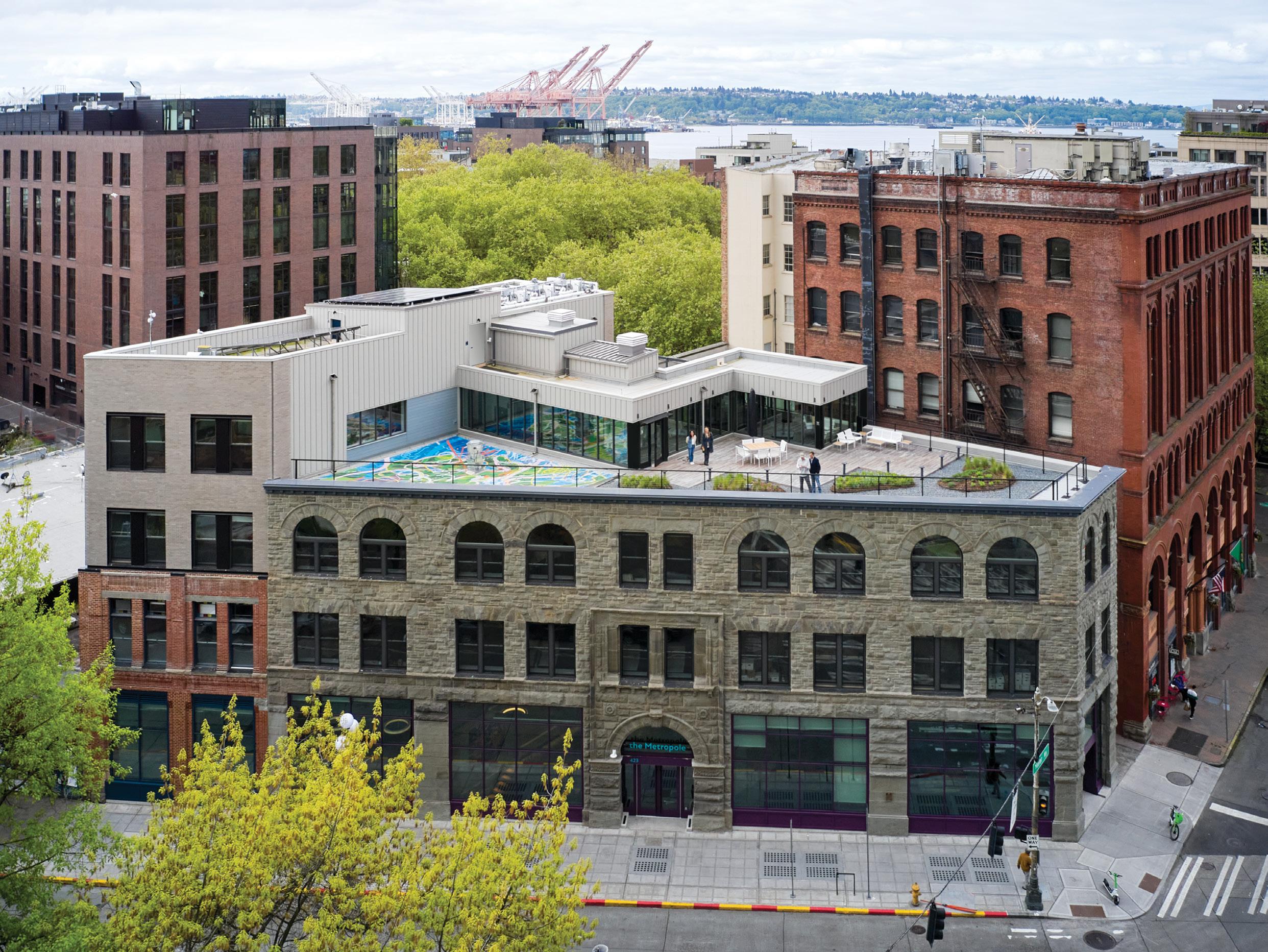
A Non-profit Center for Communities of Color Is One of the Lowest Energy-use Buildings in Seattle
By Matt Aalfs, AIA
Formerly an abandoned building in Seattle’s Pioneer Square National Historic District, the Metropole building now is a vital resource center for community, climate response and racial equity. Constructed in 1892, the building had been damaged by multiple earthquakes, fire and exposure to the elements during 17 years of vacancy. This highly sustainable adaptive-reuse project has transformed the 34,000-square-foot historic building into a center for non-profits, serving Black, Indigenous and People of Color communities, demonstrating that historic preservation, climate leadership and social justice can be simultaneously achieved.
Commissioned by the Satterberg Foundation, a Seattle-based philanthropic organization, the project supports the foundation’s mission to promote a sustainable environment and a just society.
“In funding this project, Satterberg was motivated to take action to help non-profits that could no longer afford downtown office space stay in our city,” says Sarah Walczyk, Satterberg Foundation’s executive director. “The Metropole building project sits at the nexus of our commitment to promoting a just society and a sustainable environment.”
The mixed-use program emerged from a 12-month community-engagement process in which historically marginalized communities were asked what they most needed to live and work in downtown Seattle. During this process, the team met with community advocates, non-profit organizations, and residents to ask what services and spaces were most needed. These focus groups, virtual meetings and in-person interviews engaged several hundred people.
The highest need was affordable childcare, followed by office spaces with shared common areas, conference/event/ meeting space, a commercial kitchen for meal programs, and spaces for arts and culture. These resources now located within Metropole ensure access and affordability in Seattle’s downtown core for people and organizations at risk of displacement.
Prior to this project, the building had been abandoned for 17 years and was in a state of near ruin. Windows and storefronts were missing; the historic sandstone and brick façades were deteriorated; and the building structure had been severely damaged.

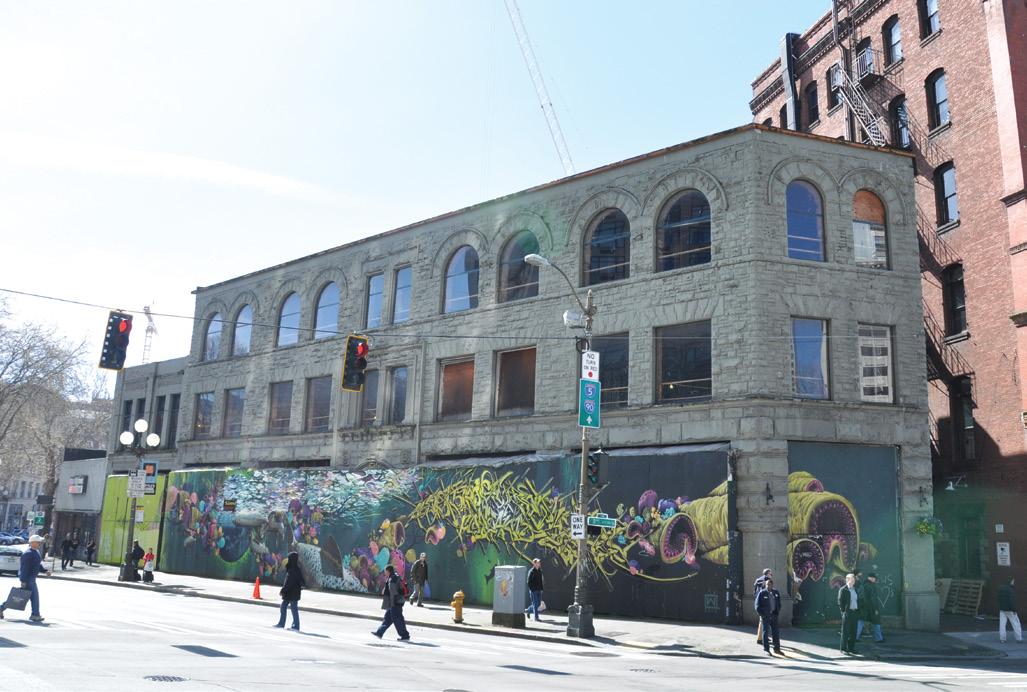

Prior to this project, the building had been abandoned and open to the weather; it was in a state of near ruin. Windows and storefronts were missing; the historic sandstone and brick façades were deteriorated from multiple layers of paint; and the building structure had been severely damaged from earthquakes, fire and neglect.
BuildingWork’s architectural solution was rooted in care, craft and restraint. 3D scanning documented and analyzed existing conditions and helped develop the as-built Building Information Model, which was used for design and documentation.
Work included removal of seven layers of paint from the rusticated sandstone and brick façades, revealing hidden architectural detail. A full restoration of the historic carved Tenino sandstone was completed. Brick was repaired, mortar replaced and the original cornice reconstructed. New tripleglazed double-hung wood windows were installed at upper floors while new triple-glazed wood curtainwall was placed at street level.
A complete seismic retrofit was part of the project. BuildingWork collaborated with Seattle engineering firm Swenson Say Fagét to design the seismic retrofit, which uses steel moment frames and concrete shear walls to strengthen and stabilize the more than 100-year-old unreinforced masonry building.
The adjacent street retaining wall and elevated sidewalk structure also were replaced. Two upper-floor levels that collapsed in the 1949 earthquake were reconstructed, using contemporary materials and details. The roof level now contains photovoltaic arrays, the air-to-water heat-pump plant, a new amenity pavilion and terrace, and artwork.
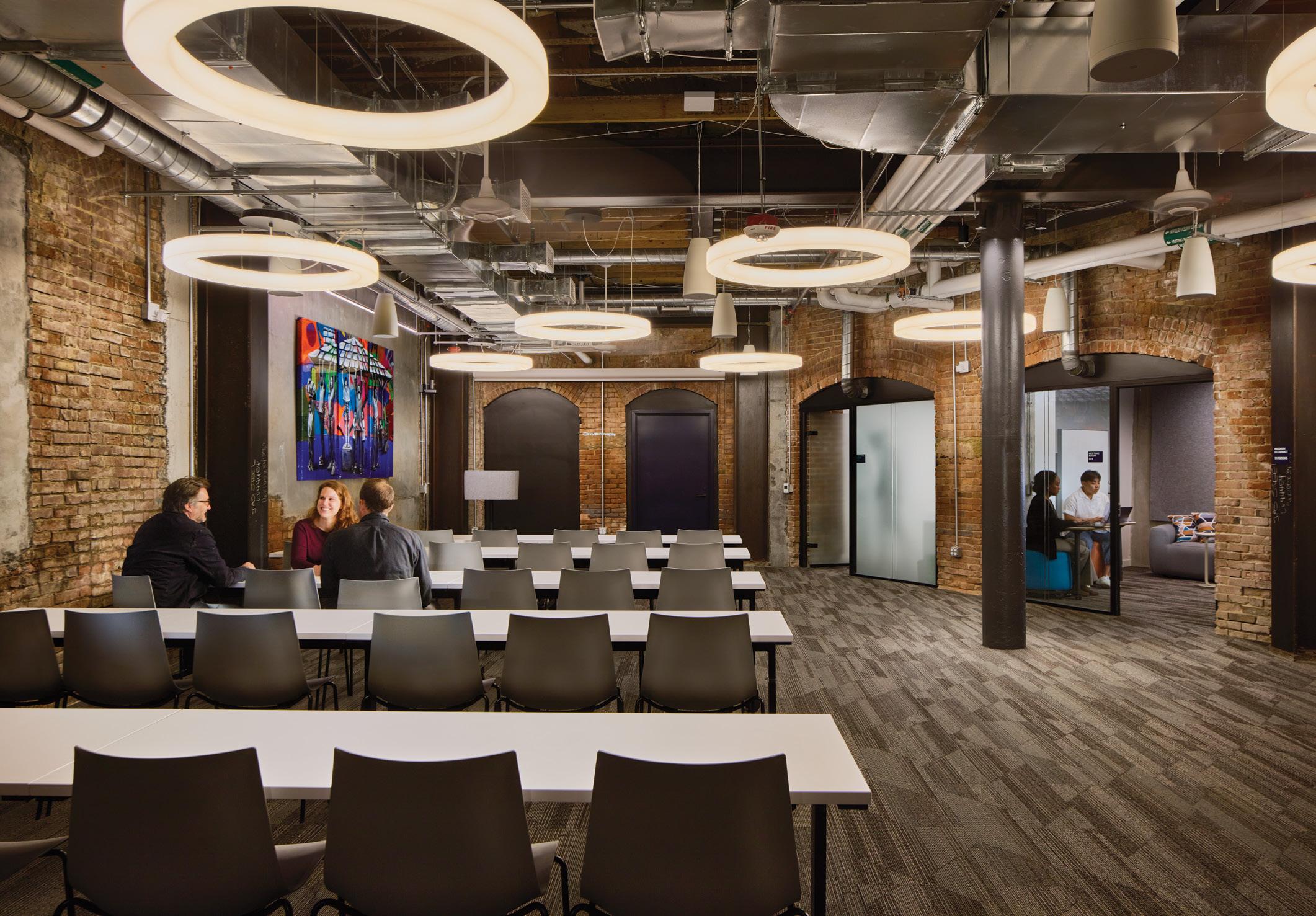
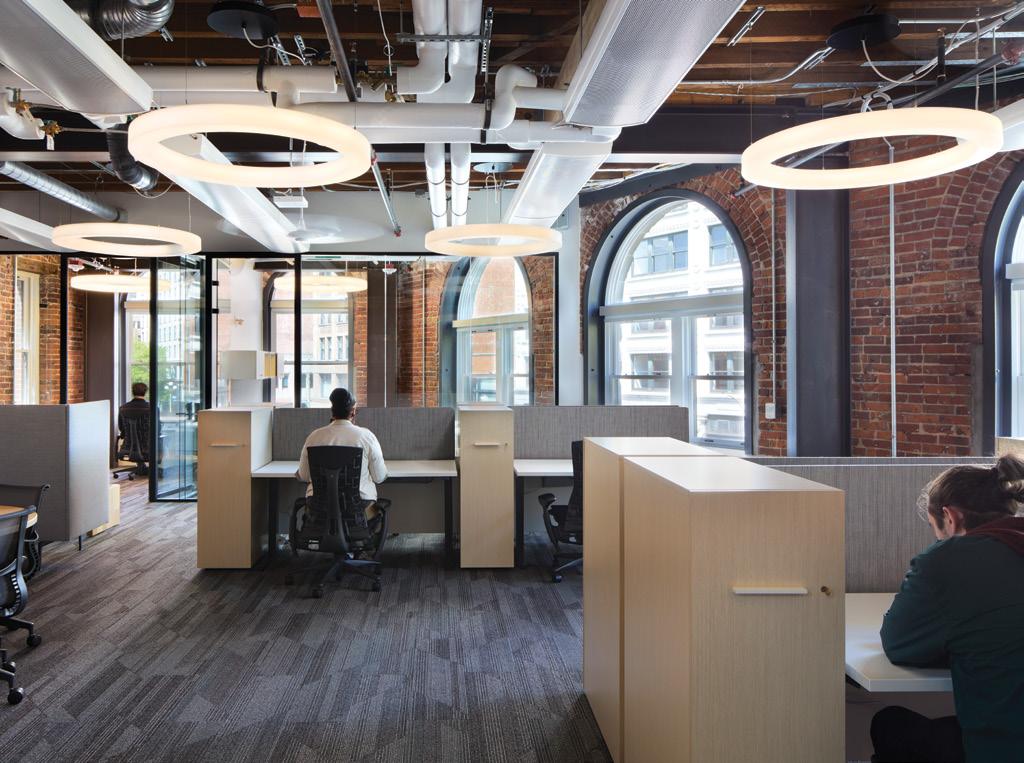
The design preserves and reuses historic cast-iron columns and timber framing while adding key interventions, like a fire-rated glass-enclosed stairwell, wood curtainwall system, and new rooftop terrace and pavilion. Interiors celebrate the building’s material legacy by leaving original stone, brick, timber and cast iron exposed, minimizing the addition of new finish materials.
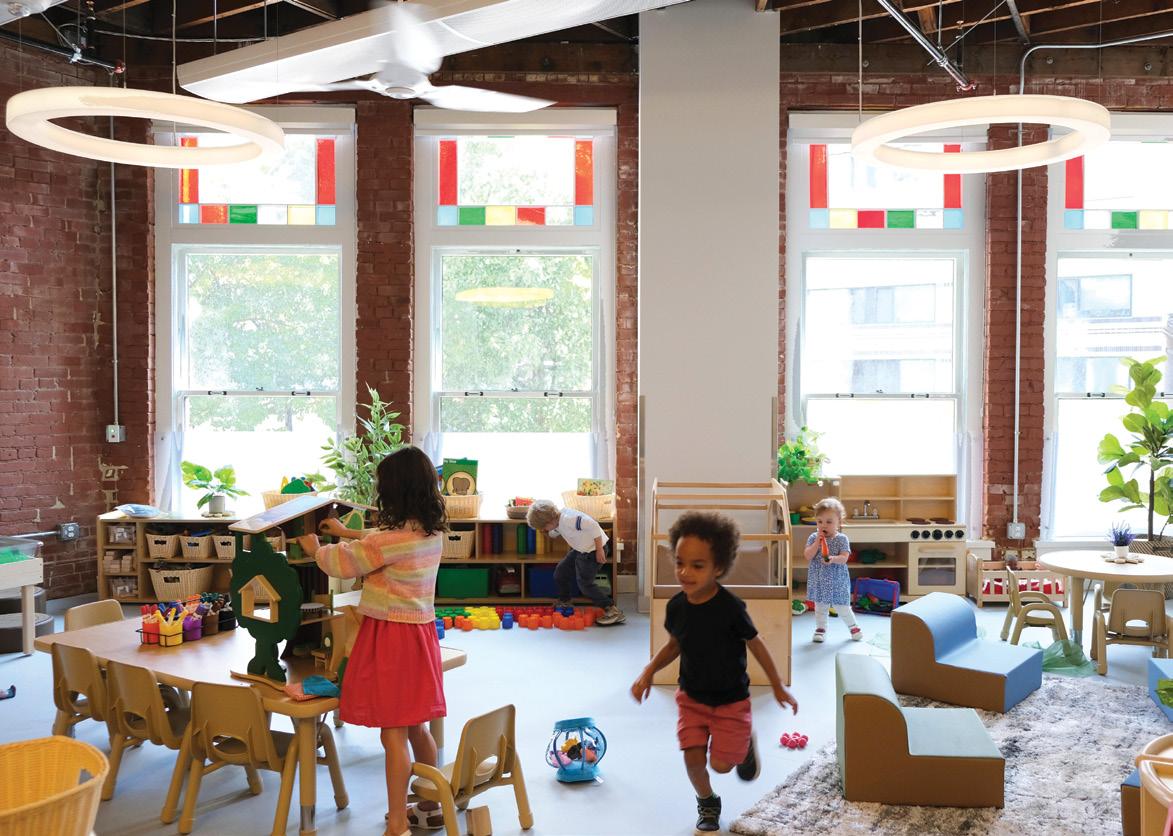
The mixed-use program emerged from a 12-month community engagement process.The highest need was identified as affordable childcare.
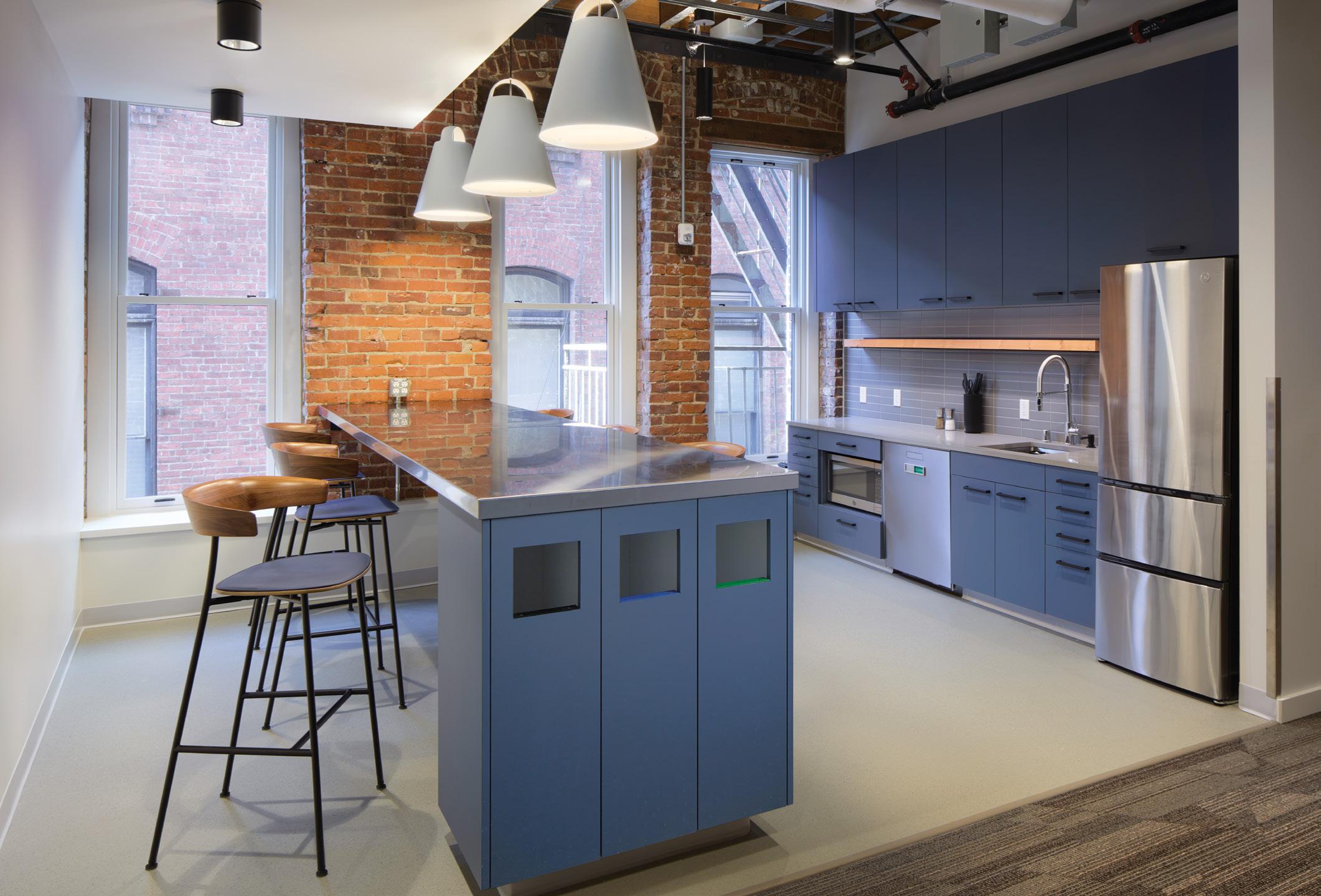
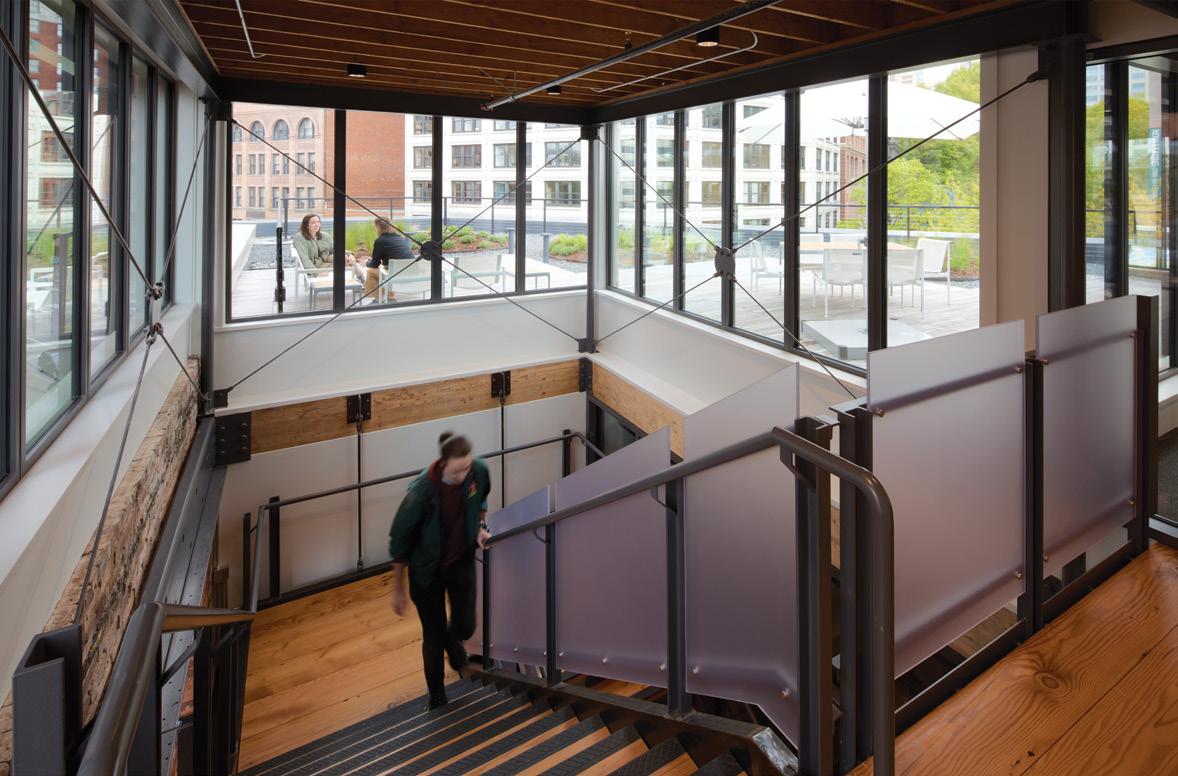
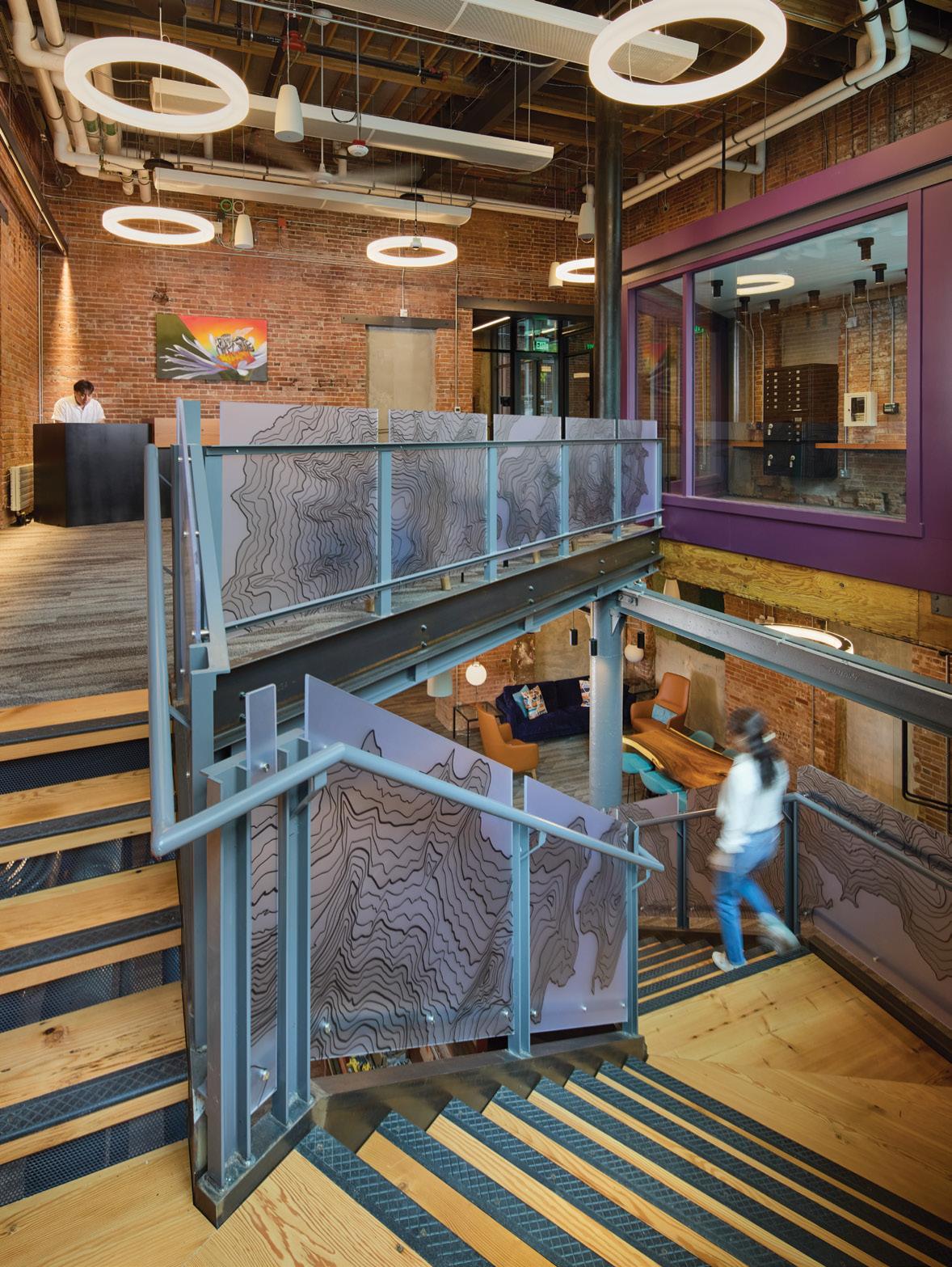
Sustainable design features include an innovative HVAC system that uses air-to-water heat pumps, driving hydronic radiant heating and passive chilled-beam cooling. Natural ventilation is supported with an LED display in each space that prompts occupants to open or close windows in coordination with the HVAC system. Photovoltaic arrays with battery storage, elimination of fossil fuels and Red List materials, and thoughtful daylighting strategies contribute to energy performance and occupant health.
“By reinvigorating a vacant building into a thriving hub for non-profits, serving BIPOC communities, Metropole illustrates what’s possible when preservation and purpose go hand in hand.”
—Lisa Howard, executive director, Alliance for Pioneer Square
With LEED Platinum certification and an extremely low Energy Use Intensity of 18, the Metropole building is one of the lowest energy-use buildings in Seattle—of any building type. Compared to current Seattle building code, the project achieves a 65 percent reduction in annual energy use and a 40 percent reduction in potable-water use. Alternative transportation is supported with bike storage, showers and proximity to multi-modal transit.
Metropole stands as BuildingWork’s most complex, innovative and ambitious adaptive-reuse project to date. Working closely with the owner, the architects led an intensive three-year process of community engagement, design and permitting, followed by a three-year construction effort, balancing client goals, community needs, historic-preservation requirements, mandatory building-code upgrades and technical innovation. The resulting building, which was completed in 2025, sets a precedent for what climate-responsive, community-first design can achieve through adaptive reuse.

The main stair arrives at the rooftop pavilion, which is enclosed in glass to admit daylight to the floors below. The pavilion leads to the outdoor terrace, which includes amenities and artwork.
“The Metropole’s restoration is a landmark moment for Pioneer Square, both literally and symbolically,” says Lisa Howard, executive director, Alliance for Pioneer Square, which is Seattle’s historic first downtown. “This project reflects our neighborhood’s values by honoring history while investing in a more equitable, sustainable future for all who live, work and visit. By reinvigorating a vacant building into a thriving hub for non-profits, serving BIPOC communities, Metropole illustrates what’s possible when preservation and purpose go hand in hand.”
Retrofit Team
Client: Satterberg Foundation, satterberg.org
Architect: BuildingWork, www.buildingwork.design
• Matt Aalfs, principal-in-charge
• Kate Weiland, senior architect
• RJ Van Liere, project architect
General Contractor: W.G. Clark Construction Co., wgclark.com
Structural Engineer: Swenson Say Fagét, ssfengineers.com
Civil Engineer: LPD Engineering, lpdengineering.com
Mechanical Engineer: Ecotope, www.ecotope.com
Electrical Engineer: TFWB, tf-wb.com
Lighting Designer: Dark Light, www.darklight-design.com
Acoustic Consultant: SSA Acoustics, ssaacoustics.com

Historic Masonry Consultant: Speweik Preservation, (224) 856-7449
Envelope Consultant: RDH, www.rdh.com
Landscape Architect: KKLA, kk-la.com
Materials
Wood Curtainwall: Unison Windows & Doors, unisonwindows.com
Windows: A-Series from Andersen Windows & Doors, www.andersenwindows.com/windows-and-doors/series/a-series
Concealed Fastener Metal Wall Panels: Versa-Seam from ATAS International Inc., atas.com/products/metal-wall-panels/concealedfastener/versa-seam
Brick Masonry: Mutual Materials, www.mutualmaterials.com
By Ian Merker, AIA, LEED AP BD+C, DBIA
In 1975, California’s power infrastructure was unprepared for the state’s rapid growth. Budgets were thin. Downtowns were declining.
Then came the election of Governor Jerry Brown and the appointment of UC Berkeley professor Sim Van der Ryn as state architect. These moves helped the state launch an ambitious initiative to rethink energy use in public buildings. A new agency, the Office of Appropriate Technology, emerged to identify opportunities for efficiency and resource-conscious design. This early commitment to environmental stewardship produced
11 pioneering energy-efficient workplaces across the state, a lineage that continues to inspire many of us who care deeply about sustainable design and regenerative development.
The first of these energy-efficient projects was the Gregory Bateson Building, originally called Site 1A, conceived in 1978 and completed in Sacramento in 1981. It aimed to reduce energy use by an astonishing 80 percent below standard. Brown’s enthusiasm for the project was so strong that 6,000 square feet of office space were dedicated to the governor’s office within the building.
The project was quickly recognized as a landmark of progressive sustainability and designated an eligible historic resource in 2016, only 35 years after completion—a testament to its bold, futurist vision.
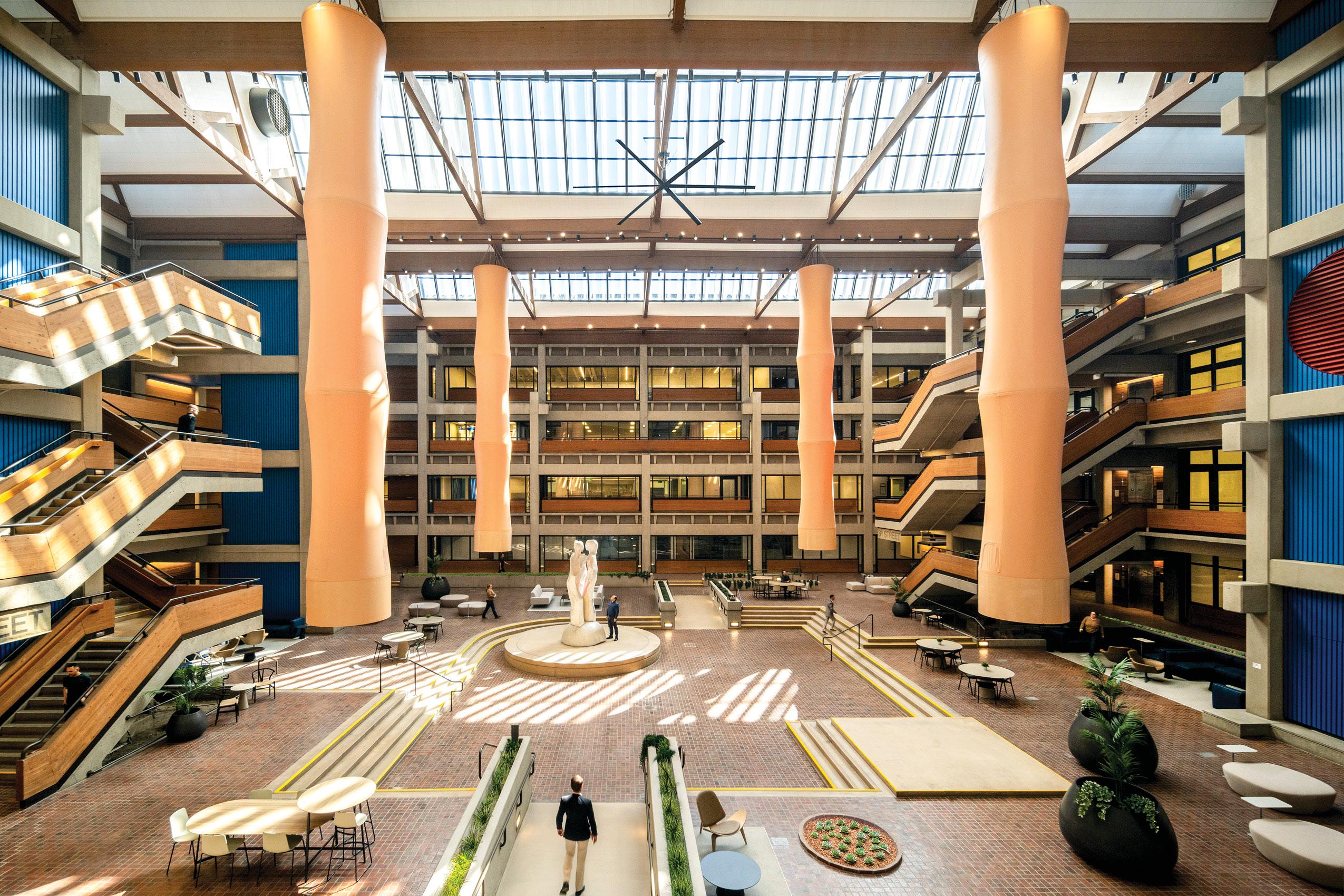
The 4-story building occupies a full downtown Sacramento block, surrounded by mature trees and shaded entry plazas. Its massing is organized around exterior decks, plazas and a central atrium inspired by courtyards, a precedent common in hot and dry climates.
The building’s exterior materiality focuses on concrete, wood and brick, and they flow uninterrupted into the atrium, which creates a spatial quality far more open and humane than the sealed office towers typical of its era. It is a gesture that values biophilic design and continues to resonate with architects around the world.
Although the structural grid is regular, each elevation responds uniquely to solar exposure. The south façade incorporates deep recesses and concrete trellises to filter intense summer sun. South-facing skylights include operable vertical louvers designed for seasonal adjustment. The original office suites embodied an early commitment to user-focused flexibility with open ceilings, acoustic baffles, and an underfloor electrical and telecom system.
The building exemplified systems thinking and environmental responsiveness through passive cooling, natural ventilation and a night-flush strategy tailored to Sacramento’s climate.
Not all the experimental ideas endured, however:
• The atrium’s rock bed thermal storage system was decommissioned early.
• Skylight louvers became inoperable with the exterior roof-mounted crank jammed shut.
• Destratification tube fans proved noisy and undersized and were shut off.
• The bright yellow exterior fabric shades blocked glare but hindered views.
• Roof-mounted solar thermal collectors demanded extensive maintenance and were removed.
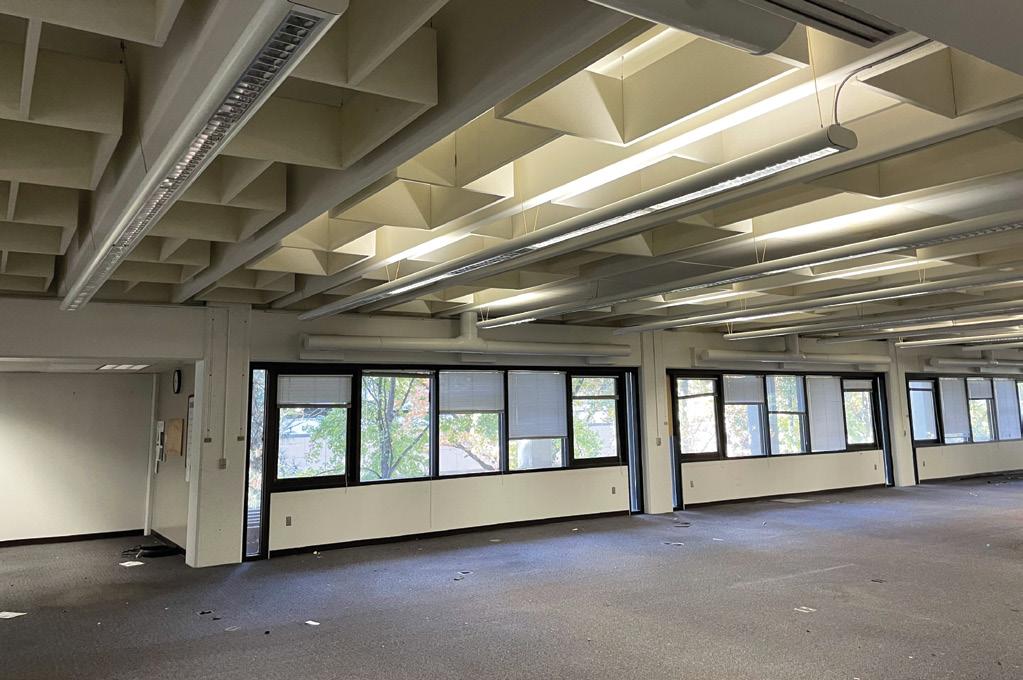
After four decades with minimal tenant improvements, the building showed significant wear. The aging envelope contributed to cladding failures and moisture infiltration. The atrium predated modern smoke-control codes, and accessibility improvements had not kept pace with contemporary standards. From the perspective of long-term maintenance, these conditions underscored the fragility and promise of the push to innovate with passive design on a large scale. It was time for the building to be rejuvenated.
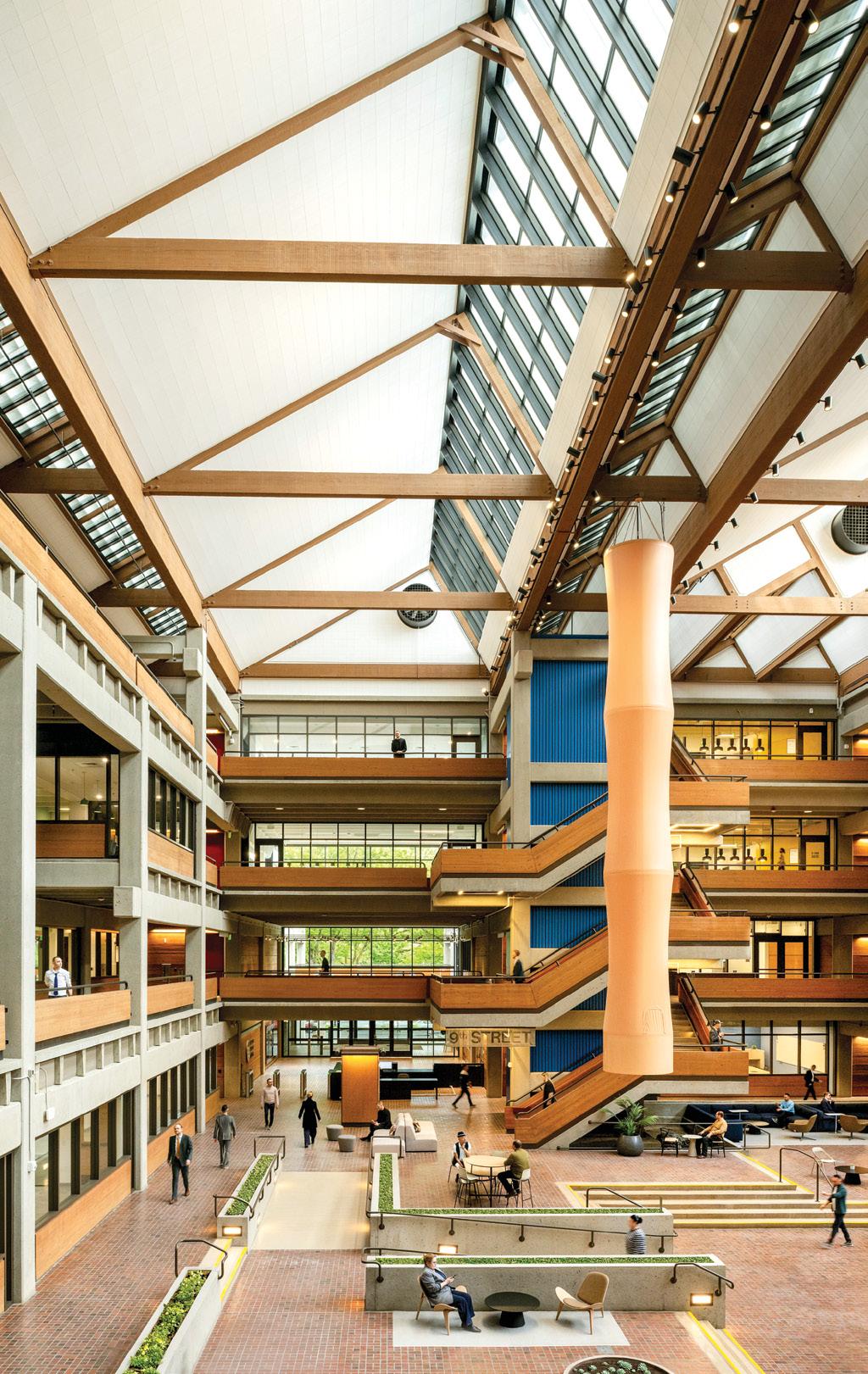
The atrium’s south-facing vertical louvers were originally designed to manually adjust, keeping direct sun out of the atrium in the summer and letting in winter sun for passive heating. The louvers failed over time, and the design team determined with computational daylighting analysis that the louvers may remain fixed at 90 degrees without compromising the solar heat gain or glare within the building.
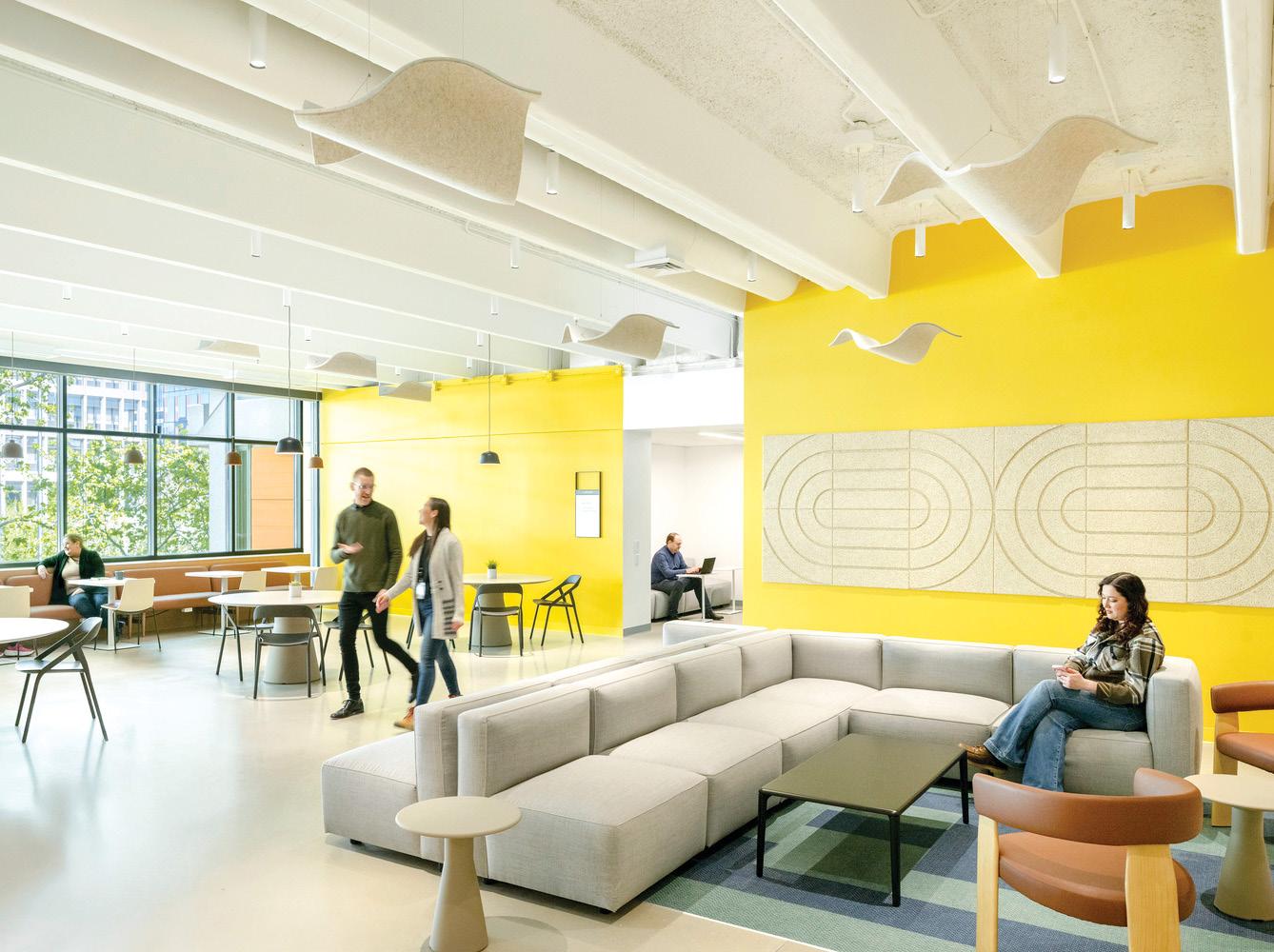
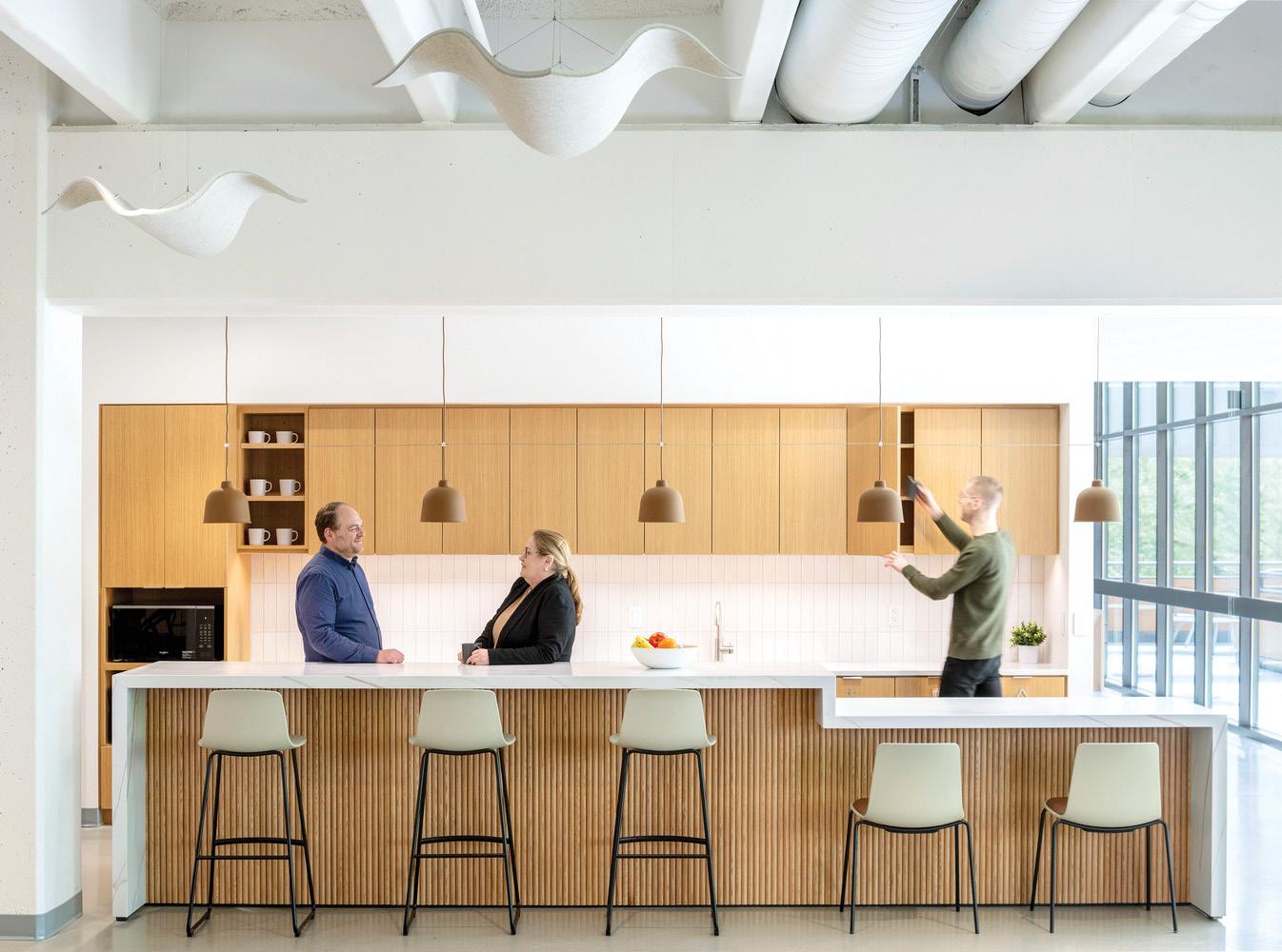
Human-centered amenities now include lounges, collaborative areas and decentralized convenience spaces. The former cafeteria was replaced by break rooms with modern appliances.
This balance between preservation and performance reflects a pragmatic approach to sustainable design that honors what worked about the building while improving what must evolve.
The renovation coincided with newly authorized progressive design-build (PDB) legislation, making this one of the California Department of General Services’ (DGS’) early PDB projects. PDB enabled design flexibility aligned with budget realities, creating a collaborative partnership between the design-build entity and DGS. The project became part of a broader investment in Sacramento’s state office infrastructure, supporting renovation and new construction to advance fiscal responsibility and the state’s mandate to transition to 100 percent
Architect of Record: CannonDesign, www.cannondesign.com
Project Owner/Developer: State of California Department of General Services, www.dgs.ca.gov
General Contractor: McCarthy Building Companies Inc., www.mccarthy.com
Preservation Architect: Architectural Resources Group, www.argcreate.com
MEP Engineer: Glumac, glumac.com
Structural Engineer: Forell | Elsesser Engineers Inc., forell.com
Building Enclosure Consultant: RDH Building Science, www.rdh.com
Acoustics, Noise and Vibration, and AV Designer: Veneklasen Associates, www.veneklasen.com
Civil Engineer: Siegfried Engineering, siegfriedeng.com Materials
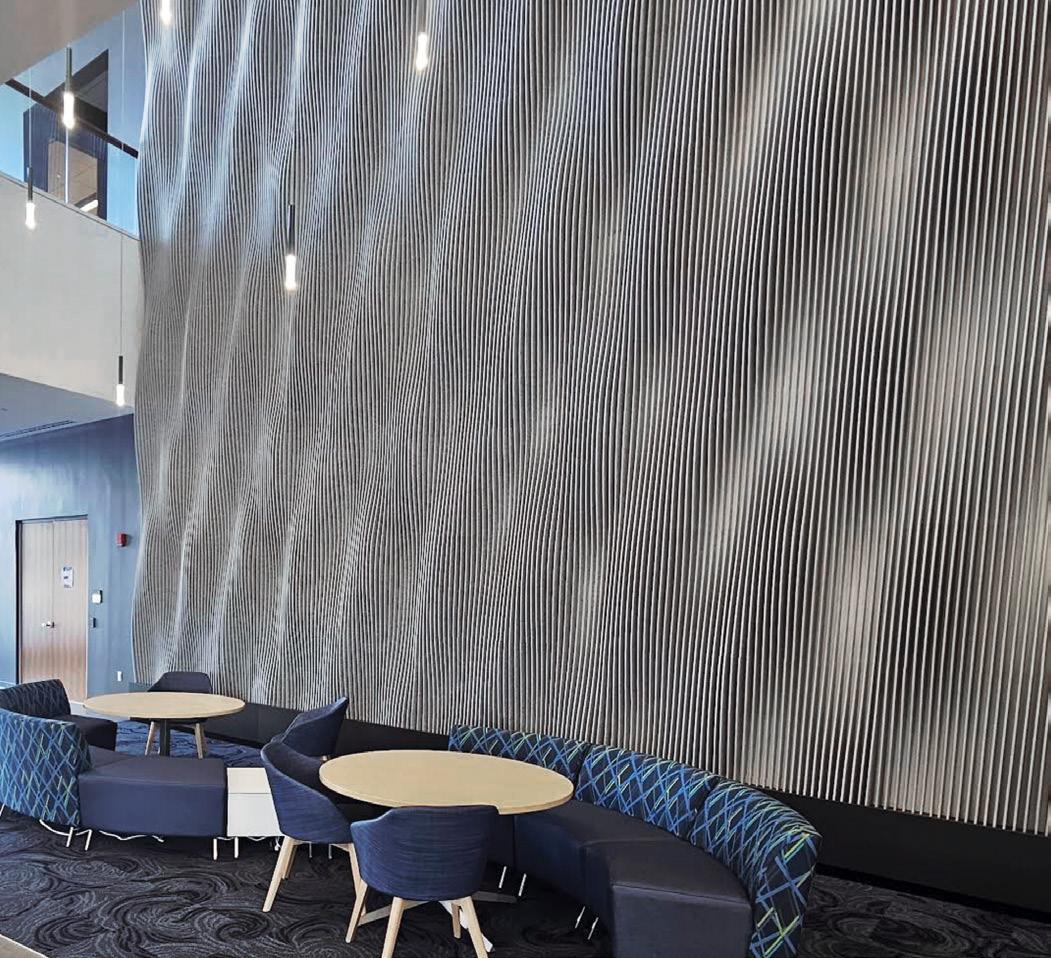
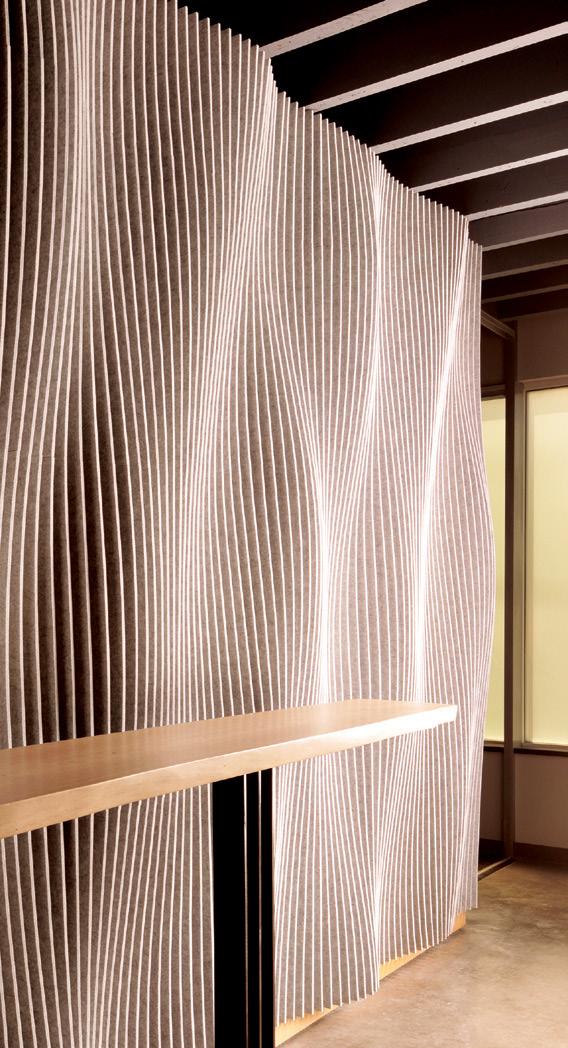
Acoustic Solutions: Wing from Filzfelt, www.filzfelt.com/shop/ product/wing; Quiet Technology Systems, qtechsys.com; and Tectum DesignArt from Armstrong World Industries, www.armstrongceilings.com
renewable energy. Working within this framework gave the design-build partnership the collective aspiration to complete this public project as a model of environmental leadership.
A fast-track six-month phase allowed detailed investigation of concealed conditions, demolition, systems selection and the development of a guaranteed maximum price. Originally targeting LEED Silver, the project now is on track to achieve LEED Platinum—an outcome that affirms how thoughtful technical decisions can elevate sustainability goals even within existing constraints.
Preserving the building’s legibility—distinguishing structure from infill—was essential to maintaining its historic character. Some infill areas were modified to accommodate modern window systems and life-safety improvements, but the overall aesthetic remains consistent with the original design intent. This balance between preservation and performance reflects a pragmatic approach to sustainable design that honors what worked about the building while improving what must evolve.
A major challenge was disconnecting the building from the state’s natural-gas-based central plant hydronic heat. The team introduced an all-electric mechanical system, using a water tower heat pump that captures and
Rubber Wall Base: Tarkett, commercial.tarkett.com
Carpet Tile: Landform, Process and Reworx from Shaw Contract, www.shawcontract.com
Ceiling Tile: Ultima, Optima and Calla from Armstrong World Industries, www.armstrongceilings.com
Wallcoverings: Koroseal, koroseal.com
Glass Film: Fasara from 3M, www.3m.com
Paints: Sherwin-Williams, www.sherwin-williams.com
Plastic Laminate: Wilsonart, www.wilsonart.com
Tile: Slate Attache and Color Wheel Linear from Daltile, www.daltile.com
Rubber Tile: Noraplan Environcare from Interface, interface.com
Concrete Stain: PROSOCO Consolideck from PROSOCO, prosoco.com
Walk-off Mats: Pedimat from Construction Specialties, www.c-sgroup.com
Window Shades: Draper, www.draperinc.com, and Mecho, www.mechoshade.com
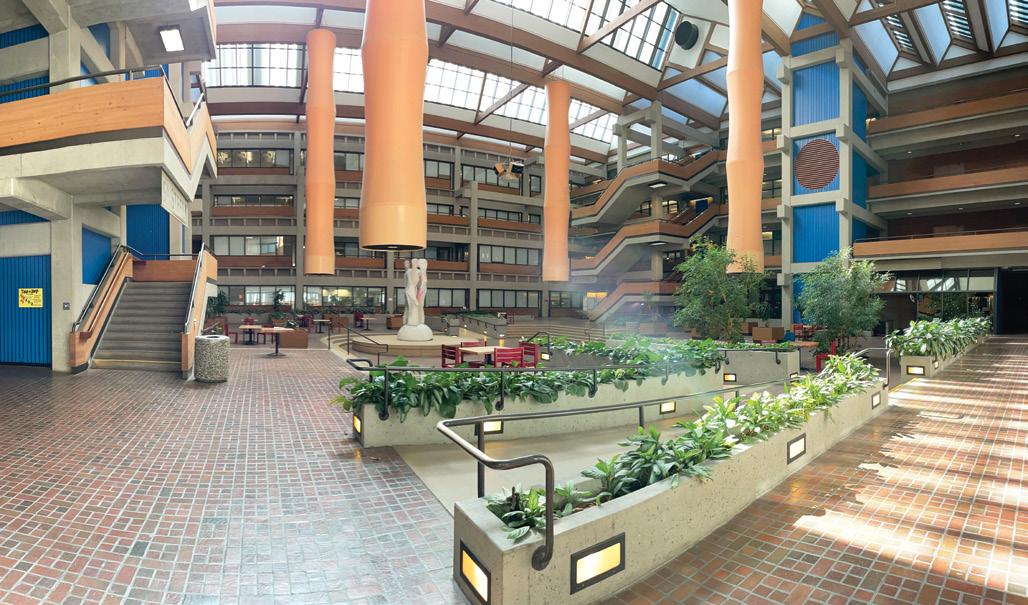
BEFORE: A rock bed beneath the atrium floor would use thermal mass to absorb and store heat energy during the day. This energy could be released on demand with the air over the rocks sprayed with water and circulated into or out of the occupied spaces. Vertical louvers on the skylights could be closed with a massive turn crank to reduce heat gain in summer.
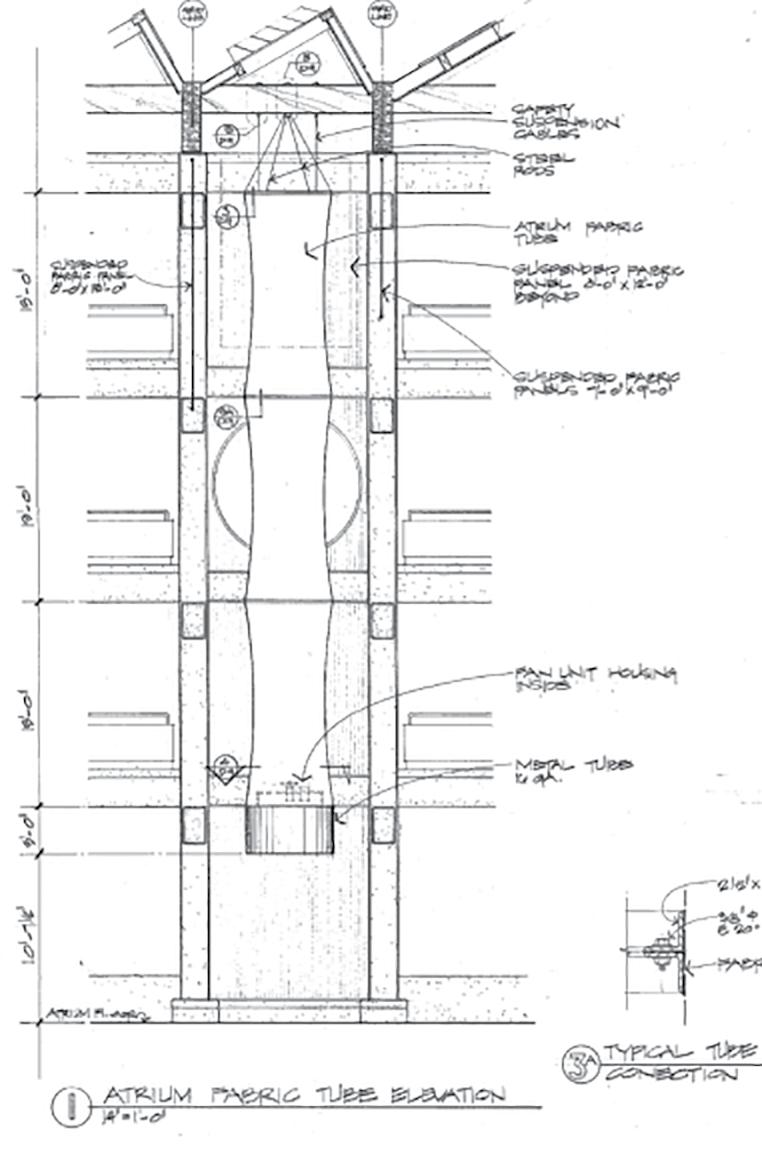
Large vertical canvas tubes hanging in the atrium were equipped with fans to destratify and recirculate air. Cool night air was drawn down large airshafts while hot air was purged through rooftop fans. Motorized fabric shades on the east and west exteriors could be adjusted to exclude solar heat or allow views, and water was heated by 2,000 square feet of solar collectors. Most of these systems were found to be ineffective or challenging to maintain over time and were repurposed or preserved in place under this project.
Wood Panels: Tambour Panels from Surfacing Solution, surfacingsolution.com
Exterior Sheathing: DensGlass from Georgia-Pacific Building Products, www.buildgp.com
Insulation: Owens Corning, www.owenscorning.com
Stone-wool Insulation: CurtainRock from Rockwool, www.rockwool.com
Metal Roof Panels: Metal Sales, www.metalsales.us.com
Roof Membrane: Siplast, www.siplast.com
Metal Doors and Frames: Curries, www.curries.com
Hardware: Allegion, www.allegion.com
Smoke-containment System: Door Systems, doorsysinc.com
Aluminum Entrances and Storefronts: 601T from Kawneer, www.kawneer.com
Glazing System: Solarban 70 from Vitro Architectural Glass, www.vitroglazings.com, and Oldcastle BuildingEnvelope, www.obe.com
Exterior Plaster: Weatherlastic from Dryvit, www.dryvit.com
Gypsum Board: USG, www.usg.com
reuses the building’s own waste heat. Designed for simultaneous heating and cooling loads required sophisticated engineering, and its success underscores the viability of all-electric retrofits in complex existing buildings.
To evaluate envelope upgrades, the team used the Choosing by Advantage method to assess benefits rather than simply weighing pros and cons. Criteria included historic significance, maintenance, failure modes, sustainability, warranty and compatibility with modern systems. Ultimately, the project selected a thermally broken storefront system with low-e glazing paired with a custom glulam-clad rainscreen over a fluid-applied air barrier. Retaining wood cladding in kind despite higher cost was considered essential for preserving the building’s defining character while significantly improving thermal performance. The alignment of sustainability and historic preservation throughout the project made it particularly rewarding.
In the atrium, the use of destratification tubes was replaced with a high-velocity/low speed fan for quieter, more reliable air circulation. Additional sustainable strategies included high-efficiency water fixtures, a zero-net-energy approach supported by offsite renewables, and reconfigured workspaces emphasizing health and collaboration.
Although the original building was celebrated for its experimental systems, the renovation emphasizes mainstream yet highly efficient technologies with these key outcomes:
• Preserved the historic exterior and central atrium while redesigning the interior for wellness and environmental performance.
• Achieved an 18 percent energy-performance improvement over baseline.
• Realized a 40 percent reduction in indoor water use.
• Established a pathway to net zero through the local utility provider’s SolarShares program.
• Continued revitalization of downtown Sacramento by promoting transit use and community engagement. Human-centered amenities now include lactation rooms, lounges, collaborative areas and decentralized convenience spaces. The former cafeteria was replaced by distributed break rooms with modern appliances, integrated seamlessly into the program.
The revitalized Gregory Bateson Building stands as a model for integrating rigorous sustainability goals into the renovation of historic structures, honoring its pioneering origins while preparing it for decades of future service. Contributing to a project that bridges history, innovation, and environmental responsibility has been a reminder of why sustainable design remains such an inspiring and urgent pursuit.
The renovated building now accommodates the California Natural Resources Agency’s (CNRA’s) Information Technology Division, other departments previously without programmed space at the adjacent CNRA headquarters, and DGS’ Facilities Management Division. New laboratories, workshops, and printing facilities support CNRA and California Energy Commission with improved safety and sustainability performance.
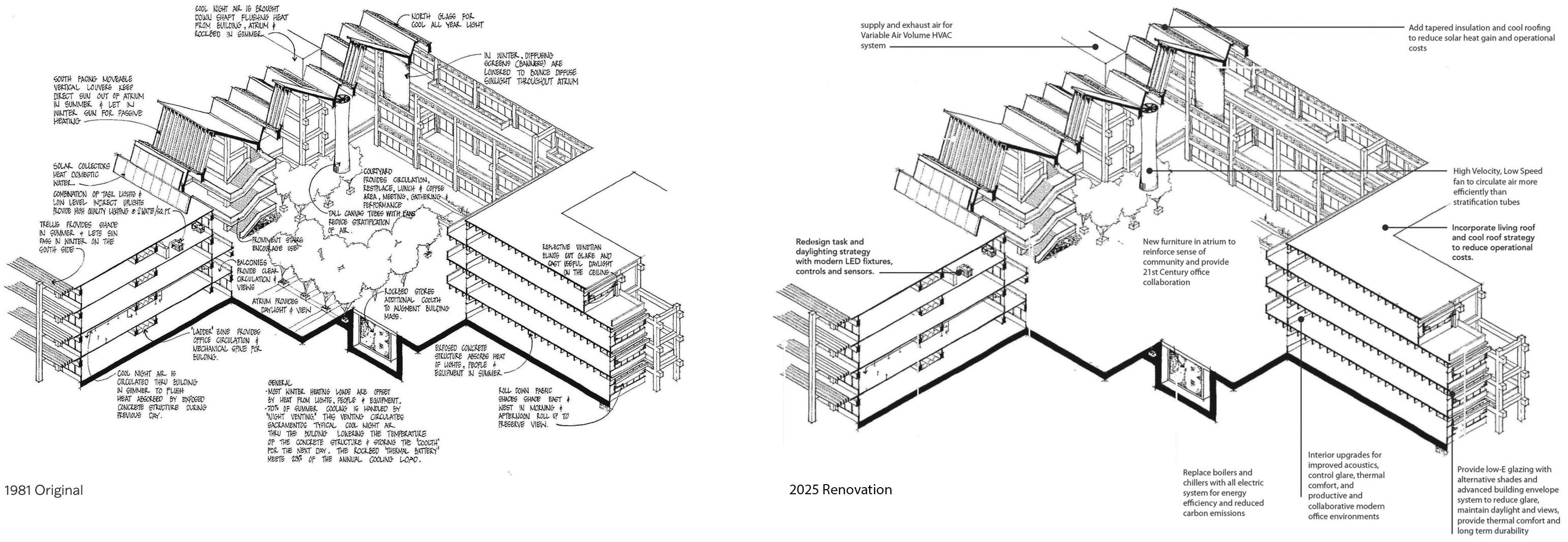
The original project vision included a design with natural energy flows that were sensitive to differences in temperature and light, connecting users to the patterns and flow of nature. Some were received better than others and posed maintenance issues for the state government. Modern mainstream methods were used to improve acoustics and thermal comfort, increase energy efficiency, maintain daylight and views, control glare, and provide productive and collaborative office environments.
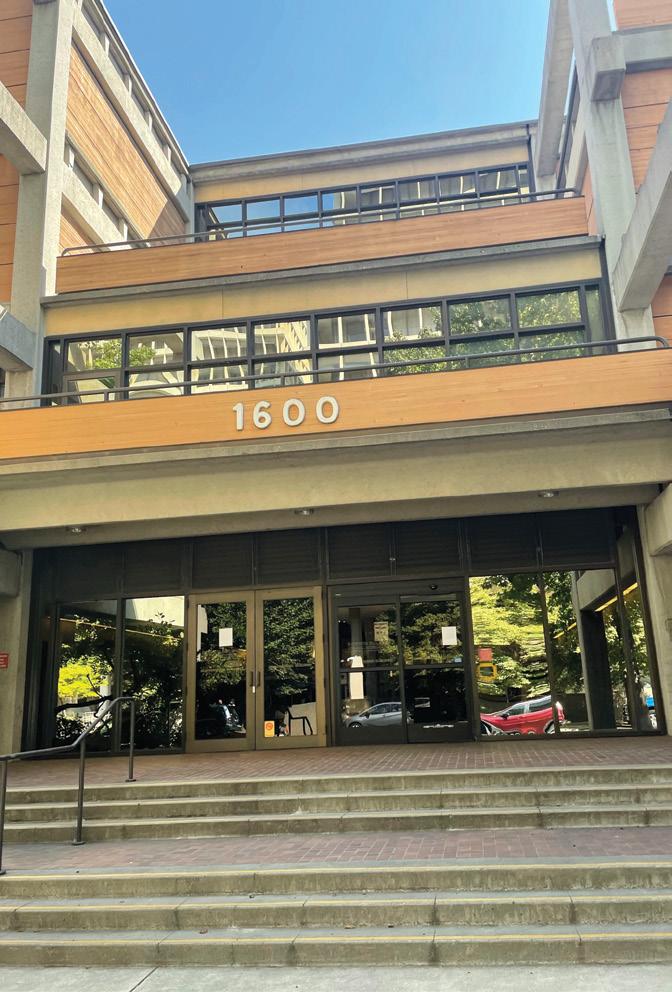
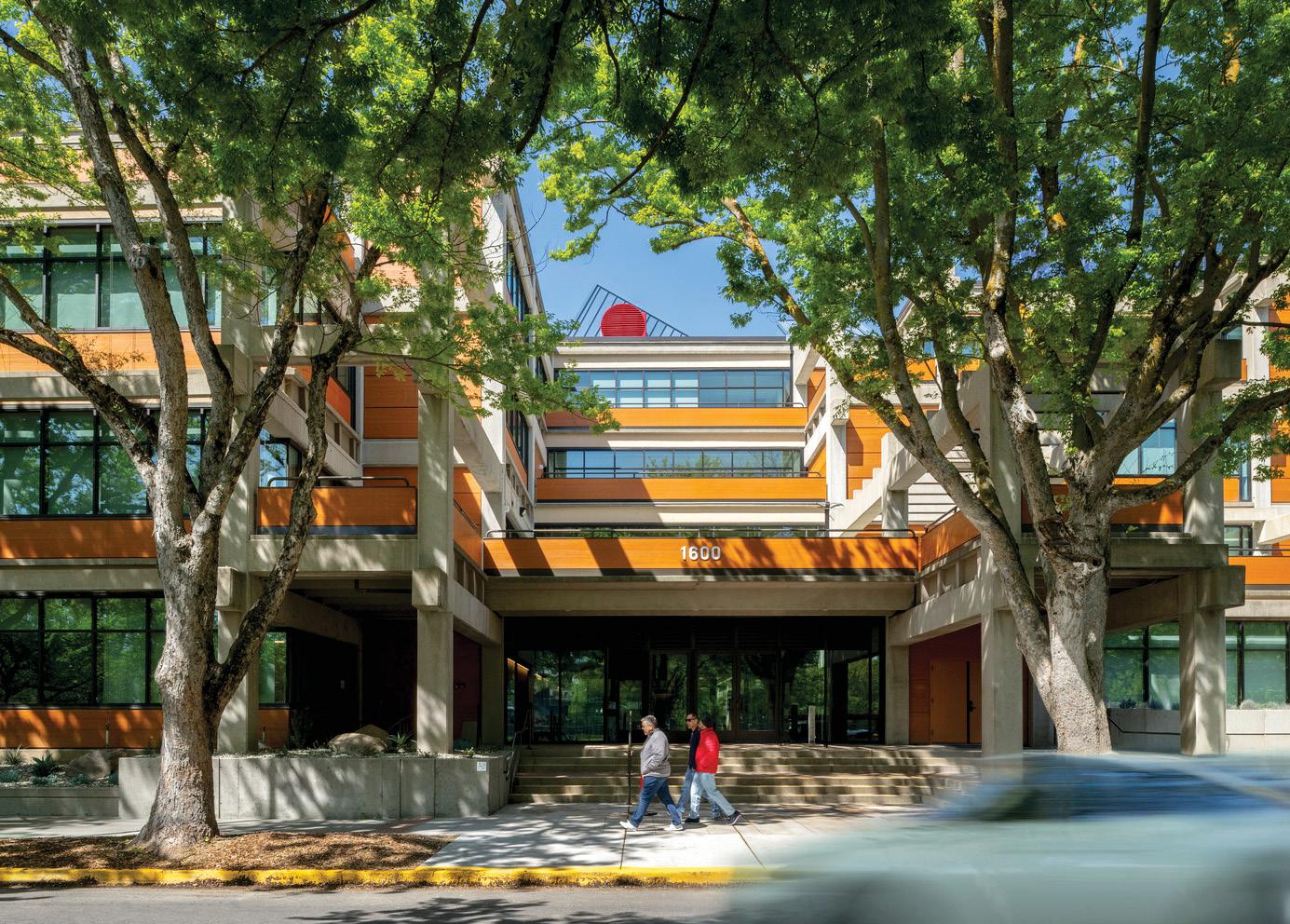
The project team selected a thermally broken storefront system with low-e glazing paired with a glulam-clad rainscreen over a fluid-applied air barrier. Retaining wood cladding in kind was considered essential for preserving the building’s character. BEFORE
By Jim Schneider
In the past year, the word “sustainability” has become radioactive in certain circles. Federal funding cuts, shifting political winds and companies retreating from climate commitments have created an environment where discussion of climate action is deprioritized, if not shunned.
Yet beneath the turbulence lies real possibility for fundamental change. The architecture, engineering, and construction community is shedding the performative aspects of “green building” and getting laser-focused on effective, efficient and economically viable solutions.
“I’ve heard talk that this shift is heralding the end of greenwashing,” says Annie Kell, sustainability services delivery lead at Burns & McDonnell. “There’s been a big drop-off in companies pursuing sustainability simply for public perception and popularity. Those that are still committed to sustainable practices are doing so because they see the value.”
Instead of leading with environmental responsibility, those interested in climate action are positioning sustainability as a practical or financial strategy that delivers climate benefits.
“Traditional sustainability narratives focused on climate or ethics have been losing traction,” observes Nicolette Jaze,
head of sustainability for Galvanize Real Estate, a global asset-management firm. “What I’m seeing is a growing appetite for data-driven arguments that demonstrate how decarbonization impacts asset value, operating costs and resiliency. We need to enable and enhance business outcomes. That means reframing sustainability as a financial strategy with climate benefits and not the other way around.”
“Successful companies have embedded sustainability practices because they have found them good for their performance,” explains Elizabeth Beardsley, senior policy counsel at the U.S. Green Building Council. “Once implemented, these changes become standard practice because the business case has already been made. Sustainability just means using resources wisely, so they don’t run out. It embodies a long view that aligns with many businesses’ strategies.”
Beardsley notes there is data to support the idea that sustainability leads to superior financial performance. A 2025 piece published by Trellis cites reports showing such practices boosting profitability by 21 percent (trellis.net/article/ the-sustainability-business-case-debate-is-over-heres-why), and a 2023 report from commercial real-estate firm JLL found
tenants are willing to pay 7.1 percent more in North America for sustainable buildings (www.jll.com/en-us/insights/ the-commercial-case-for-sustainable-buildings).
“We hear from many ULI members that want to better understand and communicate the business case for this work,” says Blakely Jarrett, vice president of the Urban Land Institute’s ULI Greenprint, an alliance of sustainability professionals. “We recently published a Net Zero Deal Profile [knowledge.uli.org/en/reports/research-reports/2025/netzero-deal-profile] to show the decarbonization strategies and the finances of how companies are achieving profitable decarbonization.”
Heidi Frasure, head of sustainability at Green Standards, a global provider of office decommissioning, says the conversation is basic risk management, a fundamental concern for any organization: “The legacy sustainability arguments—health, resilience, risk reduction—still resonate, but they’re landing best when we translate them into avoided costs and downside protection. In the long term, landfilling can be the higher-risk option whereas circular solutions reduce that exposure.”
“There comes a point at which we have to ask ourselves what the cost is to the business if we do nothing,” Kell says. “An absence of pursuing sustainable solutions can directly impact market competitiveness, operational costs, employee retention and rising insurance costs.”
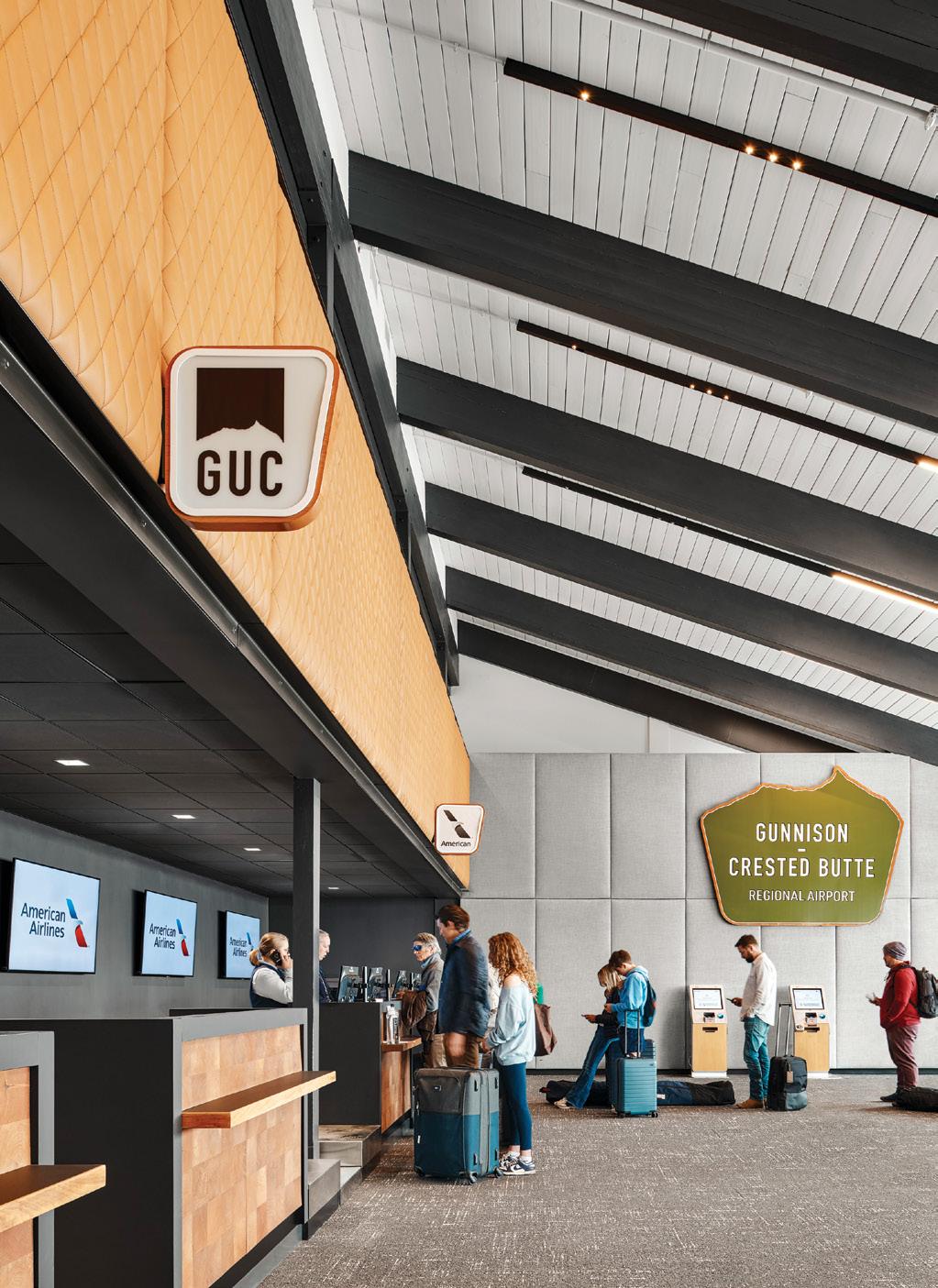
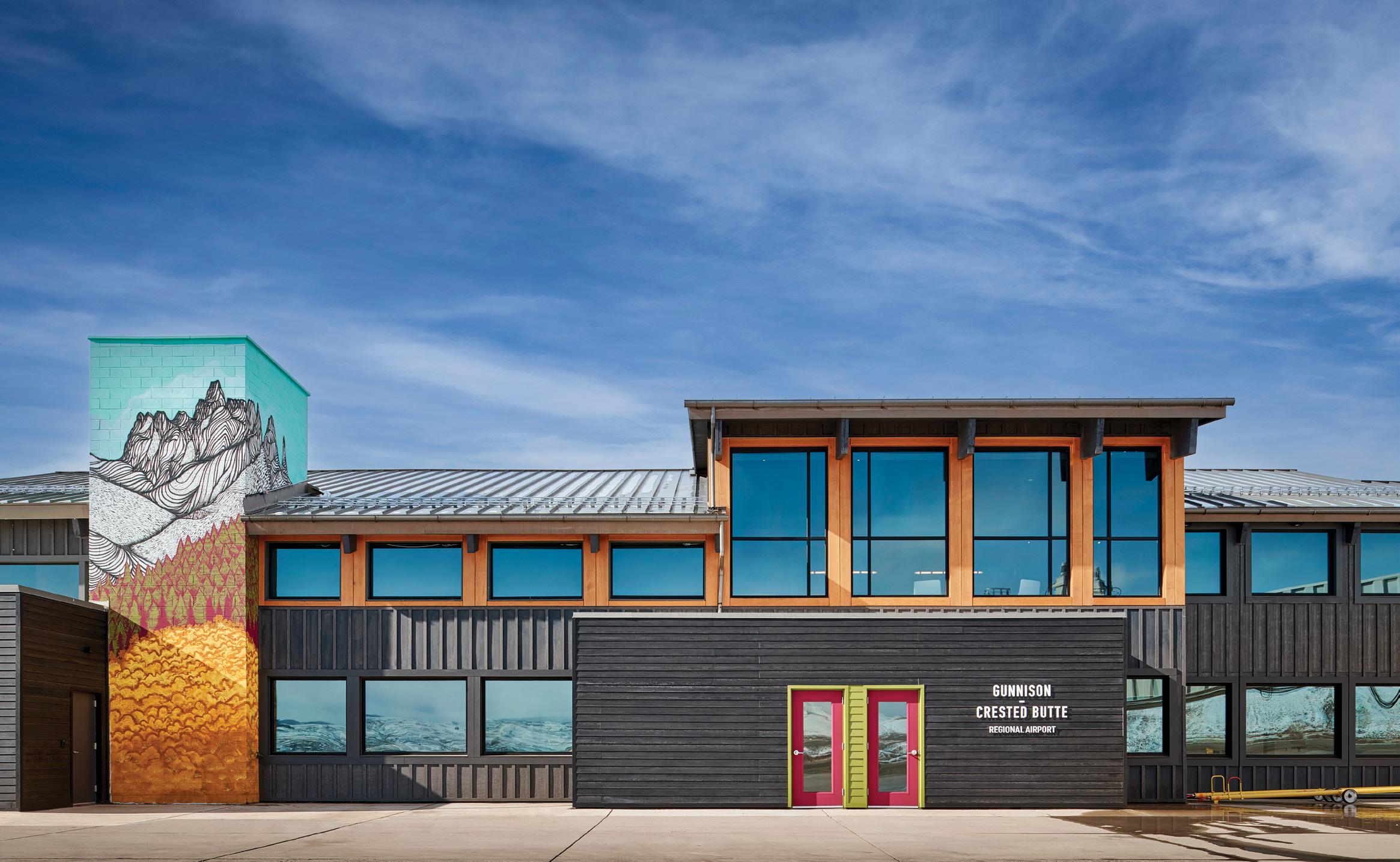
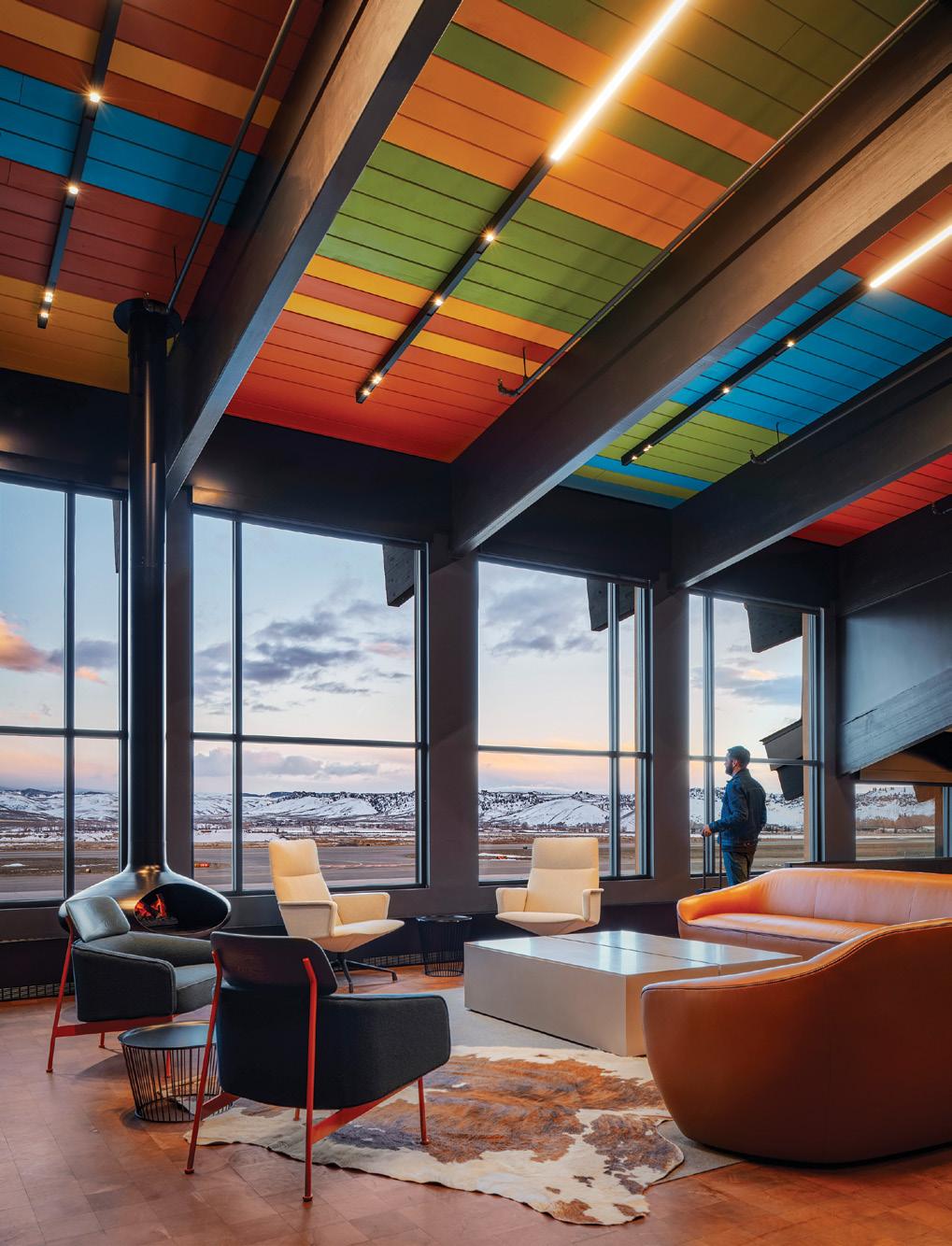
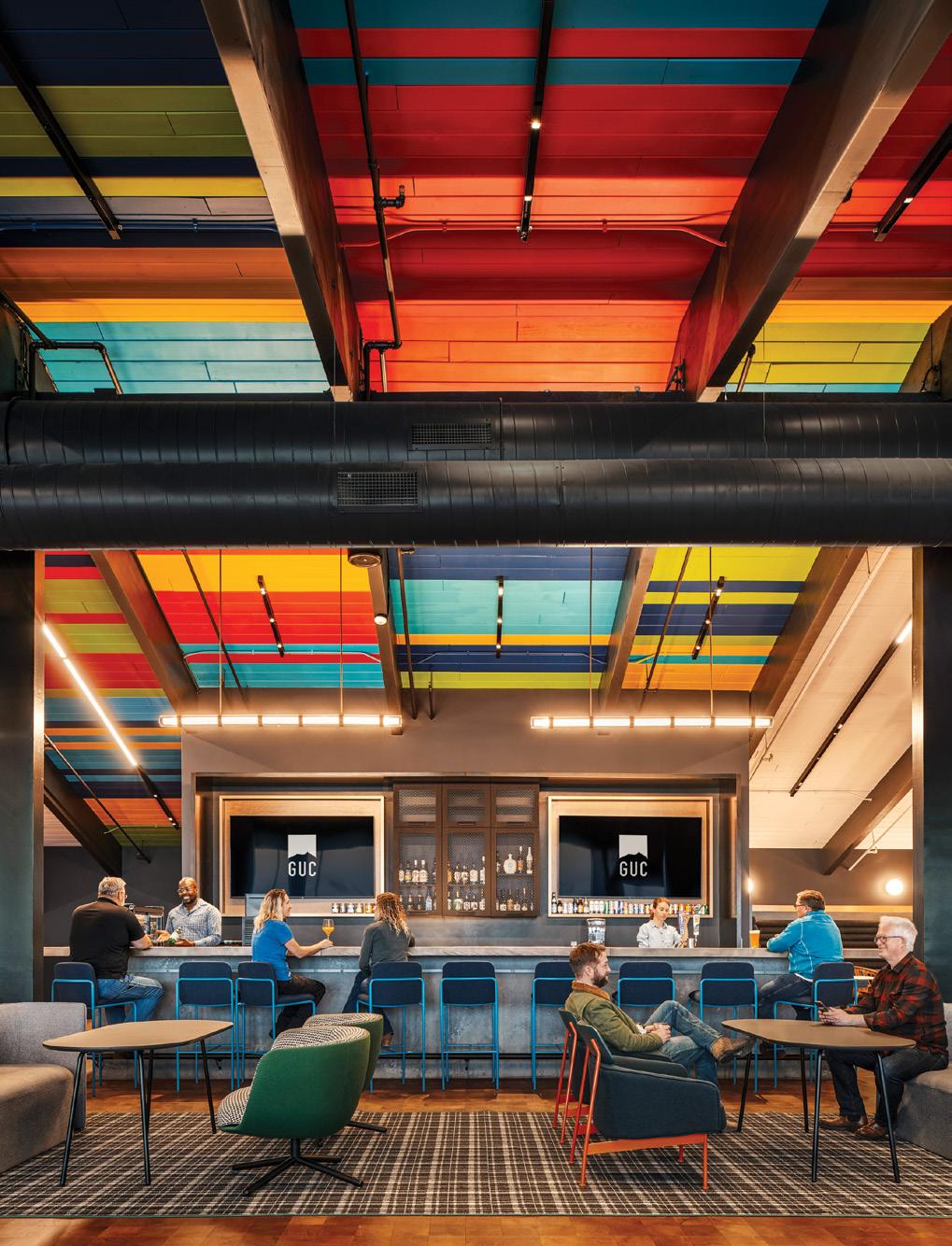
Gunnison-Crested Butte Regional Airport in Colorado planned to build new concourses. However, when Gensler considered what the airport was trying to achieve, the design team realized the airport simply needed to use what it already had in better ways.

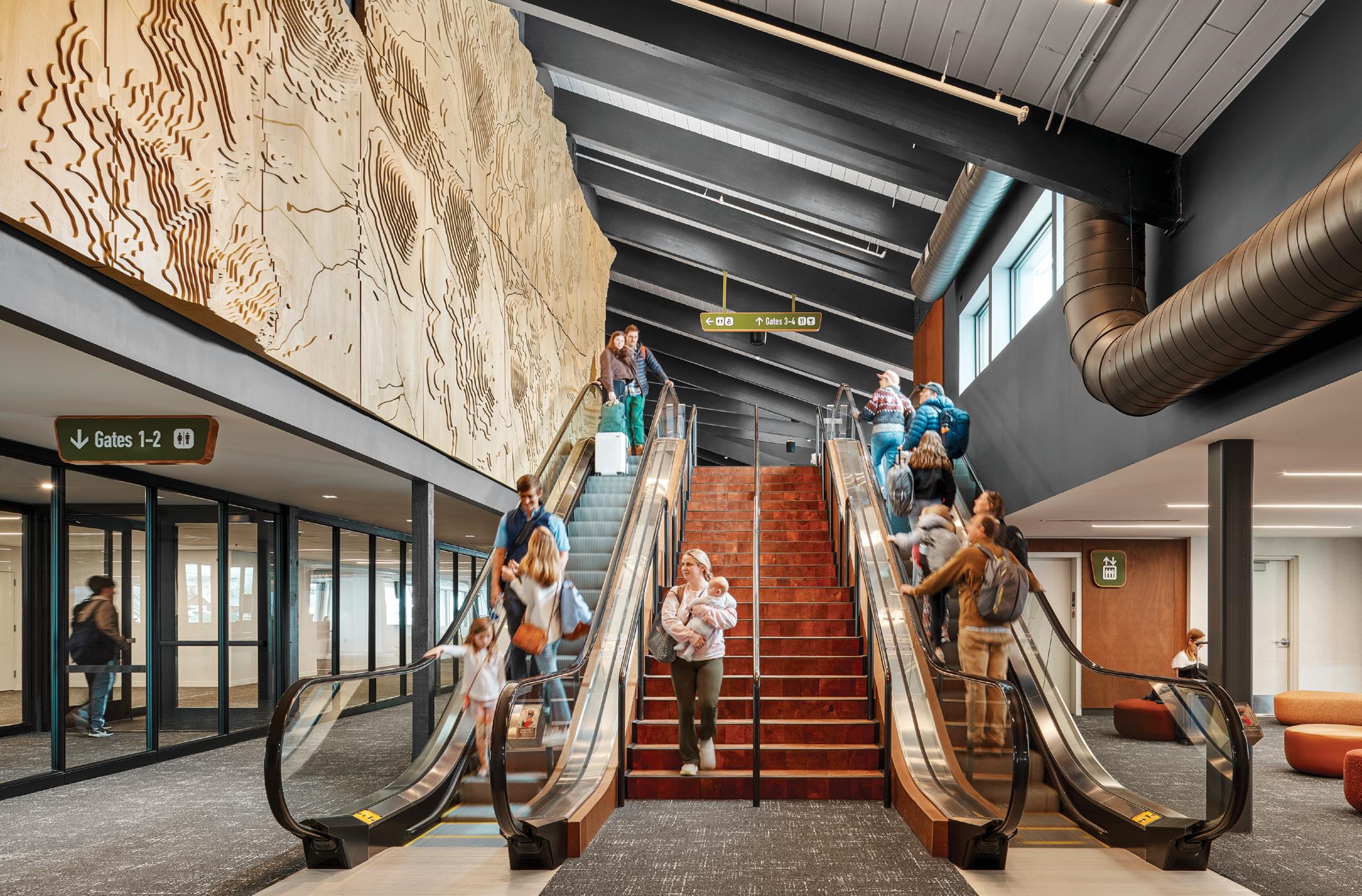
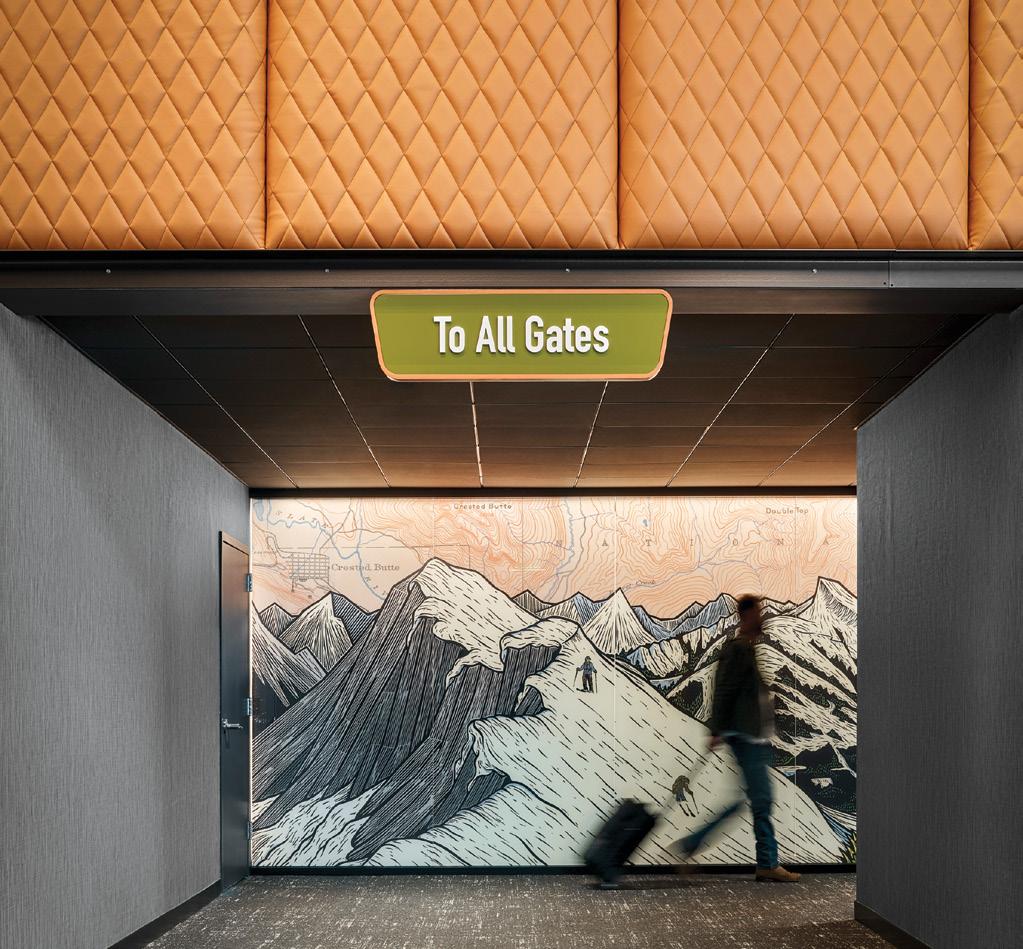
By reconfiguring Gunnison-Crested Butte Regional Airport’s existing building’s flow, the project was right-sized. Funding saved enabled geothermal systems and solar carports, creating a net-zero operating airport.
That risk extends to assets. “Owners who move quickly will reduce costs, increase resilience and secure long-term value. Those who delay will face higher costs, energy uncertainty and potentially find their asset uninsurable,” Jaze warns. “We’re data-driven investors, and the numbers are clear. Energy costs are rising; renewable power is cheaper to deploy; every unit of energy waste represents avoidable financial loss. Profitable decarbonization isn’t an argument to be had—it’s math.”
According to Jeffrey Hall, sustainability director at Gensler, effective strategies often don’t involve apparent “green technology.” Instead, real change begins with understanding needs and questioning basic assumptions.
“We build trust with our clients, and when we have that trust, we can have frank dialogue about what’s right for the projects,” Hall says. “Clients are more interested in conversations about what solutions look like and may choose something that might not make traditional payback sense. They make those choices because they’re seeing other values. Sometimes the most sustainable approach is radical simplicity. The building that you don’t build is the most sustainable project.”
He points to Gunnison-Crested Butte Regional Airport in Colorado. The original program called for building new concourses. “When we really looked at what the airport was trying to achieve, we realized we didn’t need to build anything new,” Hall recalls. “They just needed to use what they had in better ways.”
By reconfiguring the existing building’s flow, the project was right-sized. Funding saved enabled geothermal systems and solar carports, creating a net-zero operating airport. Plus, some sustainable strategies hide in plain sight. “People might not think of exposed ceilings as a sustainable strategy, but it’s an amazing sustainable strategy,” Hall observes. “By not specifying ceiling materials, projects reduce consumption without calling it ‘green’.”
Sustainability is so often thought of as technology and technique, but for any of that to happen first requires something more human and fundamental—communication. Making real progress means building understanding, bridging communication gaps and asking fundamental questions about a building’s true purpose.

“We’re
data-driven investors, and the numbers are clear. Energy costs are rising; renewable power is cheaper to deploy; every unit of energy waste represents avoidable financial loss. Profitable decarbonization isn’t an argument to be had—it’s math.”
— Nicolette Jaze, head
of sustainability,
Galvanize Real Estate
#1
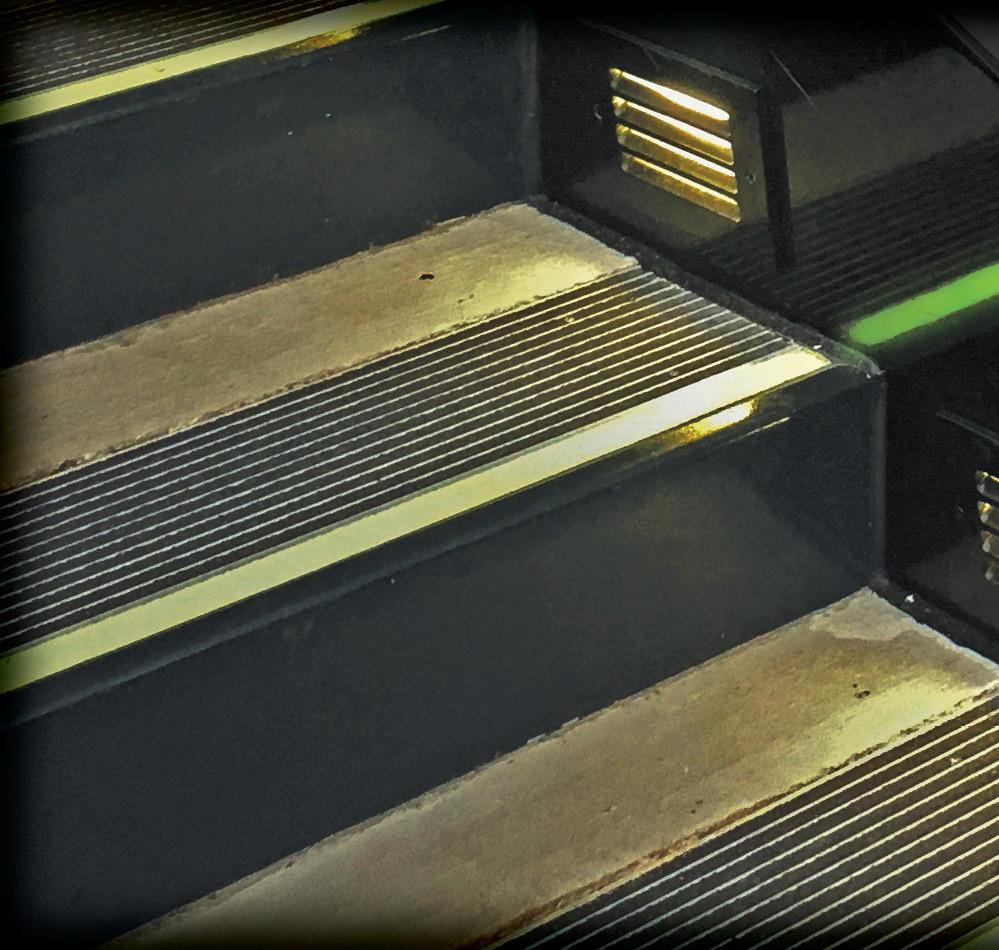




Conditions are strong for a potential resurgence in retrofit and built-environment conservation. With construction and capital costs high, repositioning existing assets will be attractive.
“Each stakeholder has a different view,” Frasure explains. “Frank in finance might care about ROI; Susie in sales cares about marketing; Fran in facilities wants the easy button; and Sam in sustainability wants to do the right thing. Finding a solution that meets all needs is the sweet spot. It’s the challenge of our lifetime to talk about technical topics with an executive focused on the bottom line.”
“We recommend talking about the outcomes you are trying to achieve,” Beardsley says. “Are you investing in efficiency to protect against rising energy prices? That is a story about financial security. Linking outcomes to what matters to your client or stakeholder is key: If you aren’t listening, you aren’t going to connect. Sometimes that means clear explanations. For example, if a company is focused on cost and is stuck on first cost, we can show how their ultimate goal benefits from a total cost of ownership approach, whereby the added cost is more than offset by monthly energy savings.”
“Fear doesn’t work. We cannot scare people into caring,” Kell emphasizes, pointing out that it is much more effective to help people recognize they already care. “Do you care about clean air, water, saving money? Then you care about sustain-
ability. Do you care about saving money through minimizing material purchasing or energy and water costs? You care about sustainability. Do you care about energy security? You care about sustainability.”
This pragmatic turn doesn’t mean abandoning environmental values—it means embedding them so thoroughly they become invisible. Hall observes that what was once innovative or cutting-edge years ago is now routine. “Much of it is even codified,” he says. “Still, I don’t think we should lose sustainability as a lens. It’s important to look at that set of considerations so you can confirm you are having impact.”
“Our challenge is to take all the benefits we know are there and tie them to the values of those we are communicating with,” Kell says. “There is opportunity in this moment. We’ll see progress as we talk about benefits without leaning on the term ‘sustainability’.”
The shift from altruism to pragmatism may prove liberating. By focusing on solutions that deliver measurable value, the AEC community can advance sustainable outcomes with-
out being mired in ever-intensifying debates about climate and the environment.
“Political and cultural headwinds don’t change the underlying business case,” Jarrett notes. “Companies that can articulate why their approach makes financial sense are the ones most likely to succeed in the years to come.”
The shift from altruism to pragmatism may prove liberating. By focusing on solutions that deliver measurable value, the AEC community can advance sustainable outcomes without being mired in ever-intensifying debates about climate and the environment.


“Let’s get the barriers on the table: budget, risk, operations, legal, brand, timeline,” Frasure says. “Once that’s in the open, we can work on solutions and sustainability becomes everyone’s job. Sustainable solutions are often the best business decision because they reduce risk and cost volatility over the time horizon the business must live with. The benefits don’t always show up in a 12-month ROI.”
Conditions are strong for a potential resurgence in retrofit and built-environment conservation. “We’re expecting a renaissance in existing-building investment,” Beardsley says. “With construction and capital costs high, repositioning existing assets will be attractive.”
By removing the altruistic veneer around sustainability and climate, the industry isn’t abandoning environmental responsibility. Far from it. It’s discovering that the smartest buildings have always been the most sustainable ones. Although there certainly are elements of moral responsibility and justice aligned with climate action, they are not the only factors at play, and they far too often attract outsized resistance and debate. Politics can and has gotten in the way, but it doesn’t have to. The math has been there all along, and our philosophies, strategies and messaging are catching up.
Be recognized by retrofit for your outstanding work retrofitting commercial, industrial, institutional and residential buildings!
Submissions now are being accepted to enter our eighth-annual Metamorphosis Awards, honoring architects, designers and contractors for excellence in renovation, retrofits and more.
CATEGORIES
• Whole Building
• Historic
• Exterior
• Interior
• Residential
• Mixed Use
• Multifamily
• Adaptive Reuse

• Addition
• WILD CARD: A creative improvement to an existing space/feature that doesn’t fit in the other categories.
Learn more at www.retrofitmagazine.com/metamorphosis-awards VIEW THE 2025 WINNERS AT www.retrofitmagazine.com/category/2025-awards.
Kingspan Insulated Panels North America has launched its KingRib Wall insulated metal panels (IMPs). The external profiles of the KingRib Wall panels feature external trapezoidal ribs: every 20 inches for the KingRib 3 and every 10 inches for the KingRib 5. The repetition of this motif creates powerful patterns that extend visual continuity on a façade, enhancing its aesthetic appeal and adding character. The interiors and exteriors of the IMPs can be customized with stucco or non-embossed finishes. Avail able in a variety of colors, KingRib Wall panels come in 2.5-, 4-, 5- and 6-inch thicknesses and R-values up to 7.2 per inch. The panels’ self-aligning overlapping joint simplifies sealant application, and the IMPs arrive pre-assembled, further cutting down construction time and project costs. www.kingspan.com/us/en/products/insulated-panel-systems/wall-panel-systems
Acoustic Benefits

Metallic
Submaterial has introduced Cork | Planar, a modular, tile-based wall solution crafted from natural cork. Available in square and rectangular tiles, ranging from 6 by 6 inches to 12 by 24 inches, Cork | Planar comes in a wide range of cork expressions, from natural and smoked cork to color-tinted composite cork and recycled sneaker cork with a confetti-like appearance. Each tile embraces natural variation, creating walls with depth, movement and visual interest. The tiles are backed with sound-dampening acoustic board made from Submaterial’s other product lines’ postindustrial waste. The PET-based substrate contains 60 percent post-consumer recycled content, is low-VOC, formaldehyde-free and contributes toward LEED certification. Handcrafted and made to order in the U.S., Cork | Planar is fully customizable in size, layout and color. submaterial.com
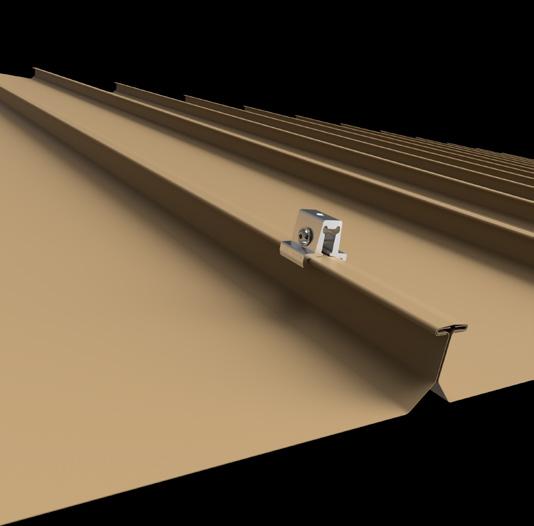
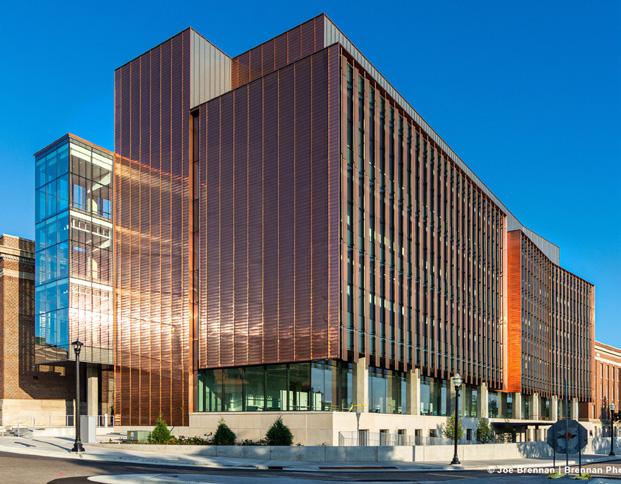
Linetec’s Copper Anodize was used on the recently renovated and expanded Fraser Hall at the University of Minnesota’s College of Science and Engineering.
Linetec’s Copper Anodize and Bordeaux Anodize for architectural aluminum products meet AAMA 611 Class I standards for color consistency, performance and longevity. Because it is an integral part of the substrate, the anodic coating results in a hard, durable substance providing excellent wear and abrasion resistance with minimal maintenance. The finishes retain their desired “shiny” appearance over time and under harsh environmental conditions. Anodize also is nonhazardous. The finished aluminum material is inert, noncombustible and 100 percent recyclable. Linetec’s anodize finishing for aluminum has earned a Declare Label as Living Building Challenge Red List Free. The finishes are available for extrusion, stretch-formed and flat sheet aluminum, before or after assembly. linetec.com
S-5! has released its S-5-TH clamp for attaching a wide range of rooftop accessories to T-shaped metal roof profiles, like the McElroy Metal Trap Tee and Morin SymmeTry. The S-5-TH—“H” stands for hinge—is a non-penetrating clamp that is designed specifically for solar PV and lighter-duty attachments, like conduit and piping. Ensuring a reliable connection that maintains the integrity of the roof system, its single-piece design clips over the roof’s rib and allows for thermal cycling of the roof panels. The zero-penetration clamp design eliminates the risk of leaks and leaves the roof manufacturer’s warranty intact. As with all S-5! clamps and brackets, the S-5-TH has undergone rigorous testing to meet the industry’s most stringent standards, ensuring a secure attachment with a product that is warranted for the life of the roof. www.s-5.com
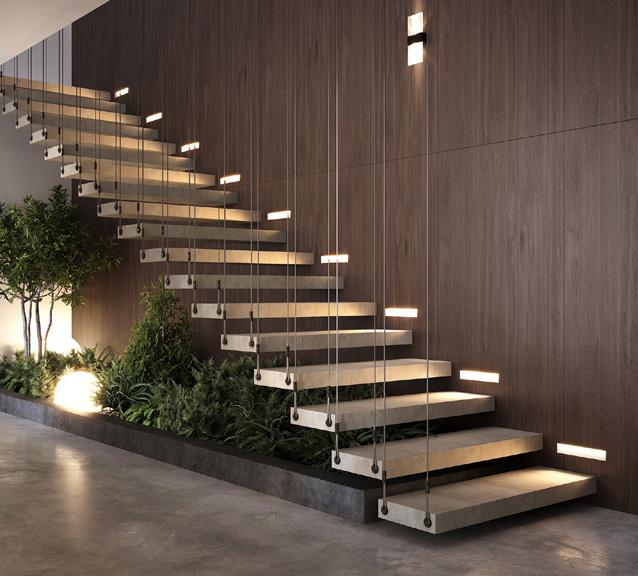
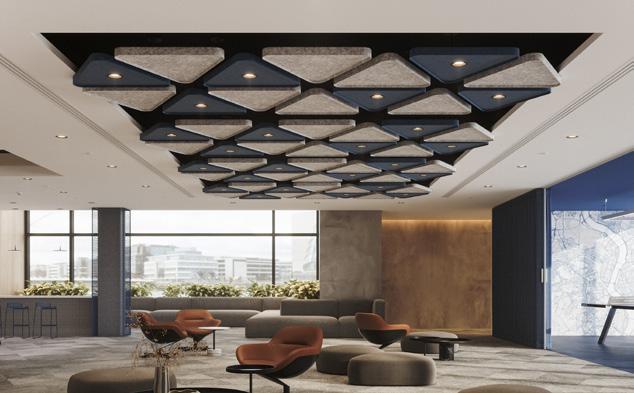
Sabin has made available LAYER, a series of planar fixtures that can be physically stacked—or layered—to build depth and create transitions. The series includes four shapes—DISC, OBROUND, RECTANGLE and TRIANGLE—each available unlit or with downlight, linear or diffuse illumination. The four shapes form a system that can be stretched, compressed, and proportioned to suit every environment and design language. Each fixture is built from two layers of 9-millimeter PET felt and finished with a sewn 1.5-mm edge that forms a subtle regress along the bottom plane. Because LAYER apertures are customizable, designers can locate light based on functional alignment—such as the centerline of a conference table or hallway—without limiting how the LAYER forms are arranged within the ceiling. Its track-based mounting system provides field flexibility for hang points, simplifying installation for tenant improvement projects and retrofits where existing mechanical conditions may limit suspension layouts. www.sabin.design
Optique Lighting has released its Perifina Wall Accent recessed mud-in family. Offered in 2, 3 and 4 inches, the family is crafted with a subtle scoop design that gently diffuses light, creating an attractive and smooth gradient. Easy to install, the Perifina Wall Accent collection can easily go around corners without light gaps or the need for complicated soldering. For added versatility, select models are compatible with 1/2-inch drywall, and all models are compatible with 5/8-inch drywall. Available with a frosted lens and in 1-inch incremental lengths, the luminaires’ paintable surface ensures seamless integration with any décor or color palette. The family features R9 and R13 values, and color variation is kept with a 2-step MacAdams ellipse for quality and consistency. Numerous lumen outputs and seven color temperatures, ranging from 2200K to 5000K, are available. optique-lighting.com/perifina-wall-accent
The award-winning TracSafe Anti-Slip Sealer reduces slips, falls and related injuries in senior living facilities, homes and other places. The clear, durable coating enhances traction while preserving the original appearance of floors. Its robust formula adheres to a wide variety of surfaces, including tile, vinyl, wood, concrete, stone and linoleum, making it suitable for indoor and outdoor use. Engineered for performance in all climates, the sealer maintains its effectiveness in rain, snow and humidity. TracSafe Anti-Slip Sealer is easy to apply and dries quickly, allowing facilities to improve safety with minimal disruption. daichcoatings.com/shop/tracsafe-anti-slipsealer
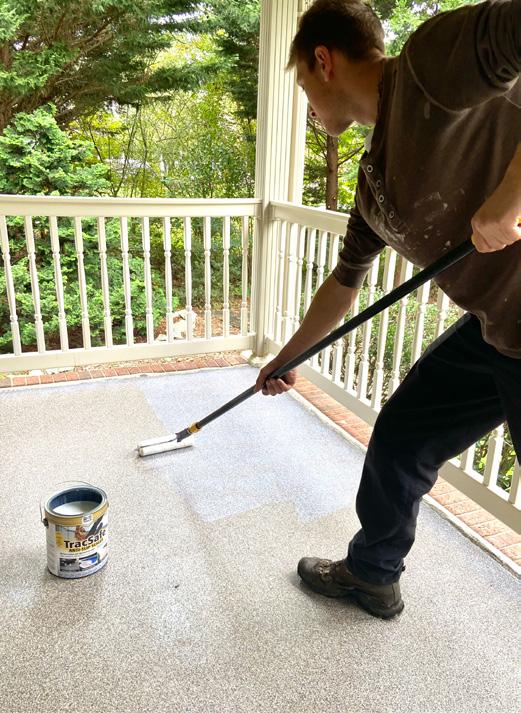
Guardian Glass has introduced Bird1st UV glass, which offers the least visible-tohumans option within Guardian Glass’ bird-friendly portfolio while meeting the Threat Factor ≤25 required by New York City’s Local Law 15 and other U.S. municipalities. A patterned UV-reflective coating is applied to the glass’ exterior surface, a placement shown through research to be the most effective for bird-friendly materials, where the patented coating can reflect upward of 75 percent of UV spectrum light. Bird1st UV also incorporates a laminated interlayer on the second surface that absorbs more than 99 percent of UV light outside of the patterned areas. These features remain discreet to occupants and support clear, open views, allowing architects to design a unified glazing appearance across the façade. In addition, the new pattern is non-directional and available in split jumbo, jumbo and super jumbo sheet sizes. The larger dimensions and non-directional pattern can help optimize cutting yields during fabrication and reduce the final glazing’s overall cost. www.guardianglass.com
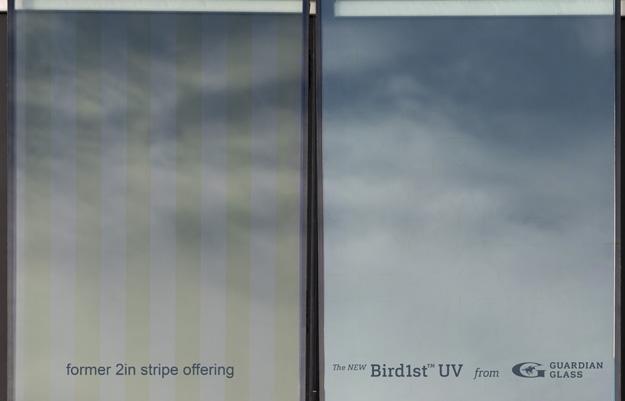
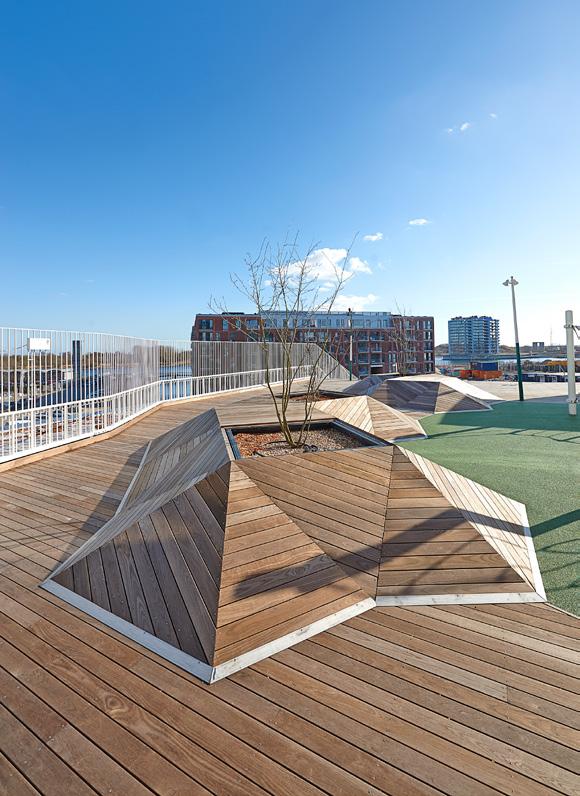
Thermory is redefining how real, natural wood performs in modern architecture, offering thermally modified decking, cladding, and premium sauna solutions engineered for durability, stability and long-term performance. Using a chemical-free thermal modification process, Thermory enhances the inherent properties of natural wood, improving resistance to moisture, decay and dimensional movement while extending service life. Thermory decking combines the warmth and character of real wood with dimensional stability, making it a reliable material for demanding residential and commercial outdoor environments. The company’s sauna collection pairs Nordic-inspired design and precision craftsmanship with responsibly sourced wood, creating wellness spaces that are architectural focal points and functional retreats. With a focus on material longevity, responsible sourcing and reduced maintenance over the product life cycle, Thermory offers architects, designers, and builders a premium natural wood solution that performs across climates and applications—from hospitality and multifamily developments to high-end residential projects. www.thermory.com
Porcelain and Ceramic Tile is Textured, Dimensional,
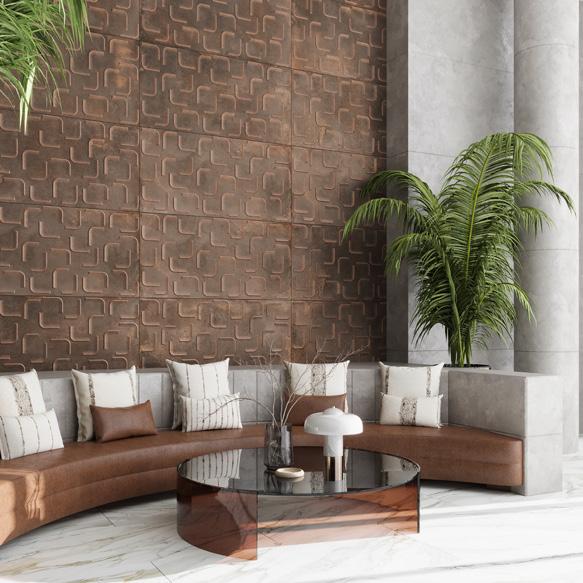
Tile Club has released two new collections: Circuit and Cayo. Featuring grooved textures, dimensional patterns, and geometric surfaces, the porcelain and ceramic tile collections bring durability and decorative visual interest to residential and commercial interiors. Circuit is inspired by raw industrial style and reimagined through high-performance porcelain construction. These large-format tiles (23.7 by 47.25 inches) are available in three colors—Acero, Bianco and Oxido—with refined matte and subtle metallic finishes that enhance the texture of the pattern. Cayo is an Italian-made ceramic tile in a modern elongated subway-style shape (3.94 by 11.81 inches). Each tile features a detailed triangular pattern set with a crackled glaze to add texture, depth and artistic flair. Cayo is available in four shades—Green, Sand, Sky and White. www.tileclub.com
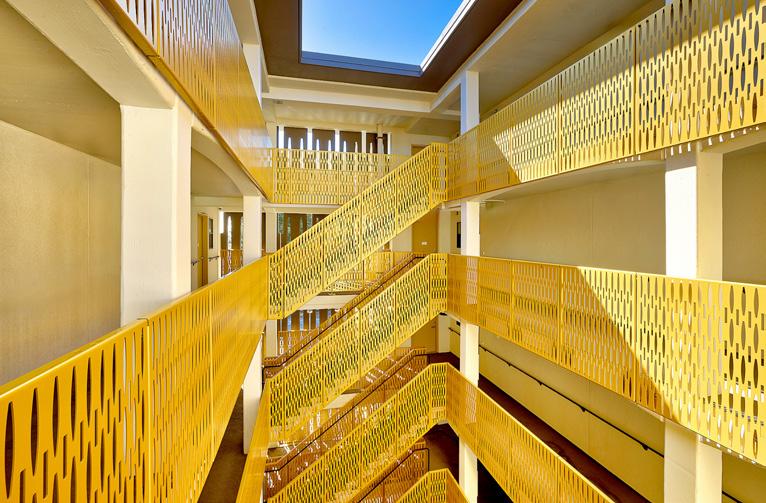
BŌK Modern has made available the Stair Guardrail Fascia Mount, a pre-engineered guardrail solution designed for interior and exterior use. The system mounts to the top or exterior of stair stringers with joints oriented at right angles to the stringer or perpendicular to the treads, providing architects and builders with flexible detailing options that avoid visual clutter. BŌK Modern’s Stair Guardrail Fasçia Mounts are engineered as part of the company’s patented Universal Mount system, where attention to detail shows up in everything from patented corner folding to self-holding signature carriage bolts that eliminate protruding bolt heads. The guardrail brackets fasten directly to the BŌK Universal Mount, which offers adjustability in all directions and in rotation, allowing installers to fine-tune each connection for a precise fit. bokmodern.com/products-standard/stairs
Mitsubishi Electric has released its ecodan Pro CAHV system, a modular air-source heat pump that uses low-GWP refrigerant R454C to deliver space heating and industrial hot water up to 165 F. Designed for three-phase hydronic heating and domestic hot-water applications, it is well suited for multifamily residences, hospitals, factories, dormitories, hotels and health centers. www.mitsubishicomfort.com
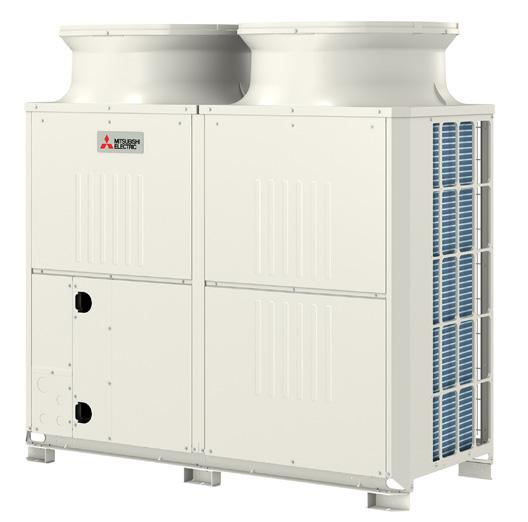

Part of Alloy LED’s new tunable line, the VariTune 4.3 COB Tunable Tape Light combines full-spectrum white control with the ultra-smooth output of chip-on-board technology. The tape light produces a continuous, dot-free line of illumination, ensuring uniformity and visual appeal in a wide range of applications. The 24-volt tape light is engineered for environments where consistent lighting and refined aesthetics are essential, such as cove lighting, custom millwork and contemporary designs. With a tunable range from 2700K to 6500K, VariTune 4.3 COB Tunable provides precise control over brightness and color temperature and is hotspot-free when paired with most Alloy LED channels—even in shallow or exposed installations. The dimmable tape light is designed for seamless integration with tunable white controllers and systems. Featuring a 90+ CRI, the tape light is field-cuttable every 1.04 inches and has a 20-foot maximum run length. alloyled.com/products/linear-light/varitune-4-3-cob-tunable-white-tape-light
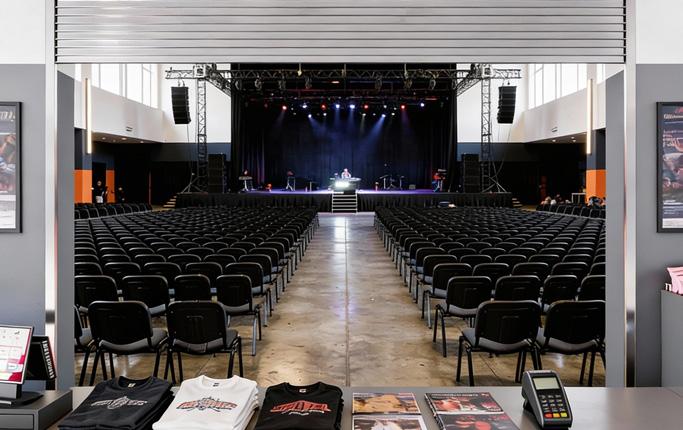
Clopay Corporation has introduced a compact solution for its Counter Fire Doors: the AlarmGard Conceal Motor Operator. Offered under the Clopay, Cornell and Cookson brands, the space-saving motor operator delivers dependable alarm-triggered closure during a fire event while streamlining aesthetics. By enclosing the motor and controller within the door hood, AlarmGard Conceal reduces headroom requirements for the coil and operator by 11 inches, representing a 34 percent reduction in space compared to standard operators. The product can be installed flush with the ceiling, concealing the motor and operator and delivering a clean, soffit-like appearance. For counter fire doors 10 feet and wider, AlarmGard Conceal also increases the bracket height and aligns the brackets with the stoppers for a seamless look. Providing 24VDC failsafe performance without fusible links, the operator ensures quick, reliable deployment in alarm mode. When the alarm clears or power is restored, the door automatically opens and resets to its programmed position. www.clopaydoor.com/counter-fire-door
KFI Studios has launched Canopy, a freestanding workstation developed in collaboration with Gensler’s product design team. Engineered to meet the demands of today’s evolving workplace, Canopy offers a refined architectural solution for organizing open-plan environments into thoughtfully defined personal spaces. With its distinctive upholstered privacy hood and integrated lighting, Canopy creates a dedicated zone for concentration, softening noise, buffering distractions, and providing a heightened sense of comfort and enclosure without complete isolation. The design is particularly well-suited for modern offices, coworking spaces, and education environments where unassigned seating and hybrid schedules require furnishings that can quickly adapt. Available with a height-adjustable work surface, dimmable lighting controls, power and USB ports, as well as optional occupancy sensors, Canopy is designed with user comfort and productivity in mind. kfistudios.com
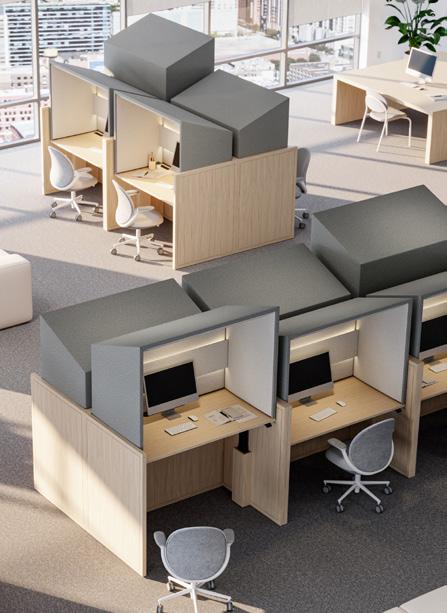
Noritz America has unveiled the NCC199 CDV Pro, a tankless water heater engineered for high-demand commercial and industrial water-heating applications. CSA-approved for common venting up to six units, this high-efficiency condensing water heater has a maximum input of 199,900 BTU per hour, a flow rate of up to 11.1 gallons per minute and an Energy Factor of 0.98 UEF. Incorporating two corrosion-resistant stainless-steel heat exchangers to maximize durability, the heater carries a 10-year warranty on these components. The NCC199 delivers scalable solutions by linking multiple units in a single system, ensuring uninterrupted hot-water flow, maximum efficiency and reliable longterm performance. noritz.com/commercial
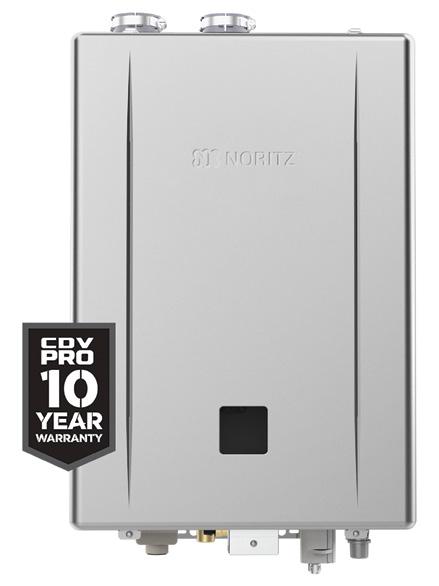

Armstrong World Industries.. Page 3 www.armstrongceilings.com

ATAS International Inc. ..... Page 9 www.atas.com

Belimo ................. Page 11 www.belimo.us

Bradley .................. Page 5 www.bradleycorp.com

CxEnergy ............... Page 67 www.cxenergy.com
Dorlen Products .......... Page 59 www.wateralert.com
SHARING IS CARING
Share this issue with a colleague and encourage him/her to subscribe for FREE at www.retrofitmagazine.com/subscribe.
MARCH - APRIL 2026
Englert Inc. .............. Page 6 www.englertinc.com (800) ENGLERT
Flex-Ability Concepts ..... Page 18 www.flexabilityconcepts.com

Hanover Pavers .......... Page 10 www.hanoverpavers.com
Sika .................... Page 2 usa.sika.com
Vitro Architectural ........ Page 68 www.VacuMaxVIG.com
Modular Arts ............ Page 14 www.modulararts.com
Musson Rubber .......... Page 53 www.mussonrubber.com

NanaWall ............... Page 13 www.nanawall.com

Navien .................. Page 4 www.navieninc.com
NSG Pilkington .......... Page 19 www.pilkington.com/en/us

Schweiss ............... Page 59 www.bifold.com

Westlake ............... Page 31 www.westlake.com

Wooster Products ........ Page 57 www.woosterproducts.com
W.R. Meadows ........... Page 15 www.wrmeadows.com

Zipwall ................. Page 21 www.zipwall.com
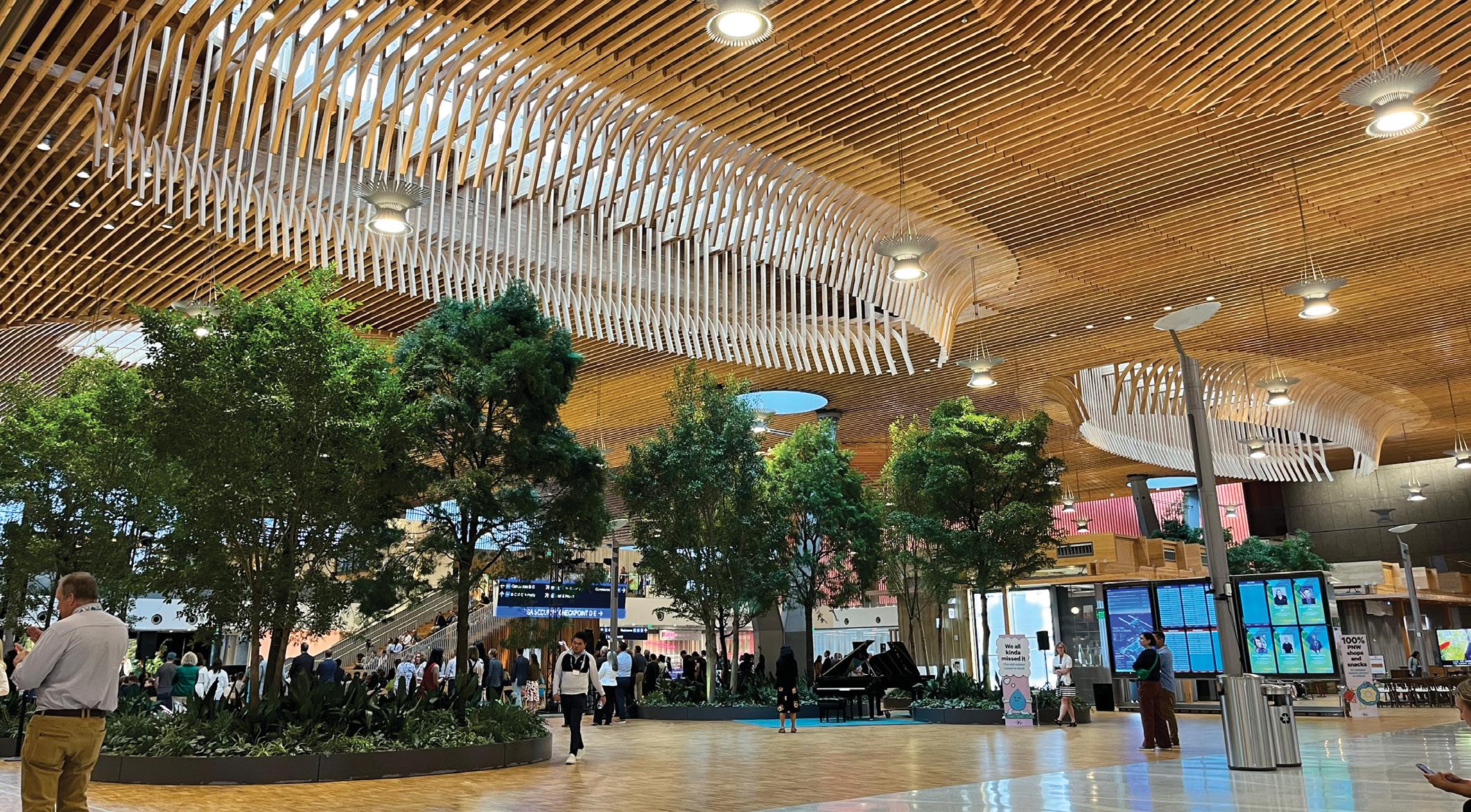
Portland International Airport’s (PDX’s) renovation of its main terminal to passengers was focused on sustainable design and construction. The project features mass timber sourced within 300 miles of the airport and more than 5,000 plants, including full-size trees.
Key to this design are 49 glass skylights that illuminate the soaring mass-timber ceiling throughout the terminal, provide natural light to support plant life, and create an open and comfortable environment. The thermally broken, structurally glazed, NFRC-certified skylights also help reduce the need for electric lighting, contributing to the project’s overall 50 percent reduction of energy use per square foot.
The 32,000 square feet of low-iron, high-performance low-e insulated glass has four different glass types located strategically to provide the right light at various points within PDX. Ranging from zero to 80 percent coverage, ceramic silkscreens applied to the glass help control glare and optimize lighting within the terminal. The result is an interior environment that is bright without being overwhelming and highlights

the warmth of the mass-timber construction.
The skylights—along with the roofing, mechanical and electrical work, the lighting and sweeping timber ceiling—were assembled and then moved into place right over the top of the existing terminal roof. The module movers were able to accomplish each move while keeping installed material movement deviations within approximately three hundredths of 1 inch.
Retrofit Team
Architect: ZGF, www.zgf.com
General Contractors: Hoffman Construction Co., www.hoffmancorp.com, and Skanska, www.usa.skanska.com
Skylight Erector: DeaMor Associates, deamor.com/products/ glass-skylights
Materials
Skylights: DeaMor Associates, deamor.com/products/ glass-skylights











CxEnergy is the premier event in commissioning, building technology, and energy management. The conference features 32+ technical sessions, 600+ participants, 35+ exhibitors, the certification CxA workshop and EMP seminar, and an Expo Hall showcasing the latest technology in the industry.
Commissioning Providers
Energy Managers
Building Owners & Facility Managers
MEP Engineers
Building Control & Automation Experts
HVAC Testing & Balancing Professionals
Building Enclosure Consultants
Code Consultants
Energy Service Providers
Utilities Personnel
Government Officials
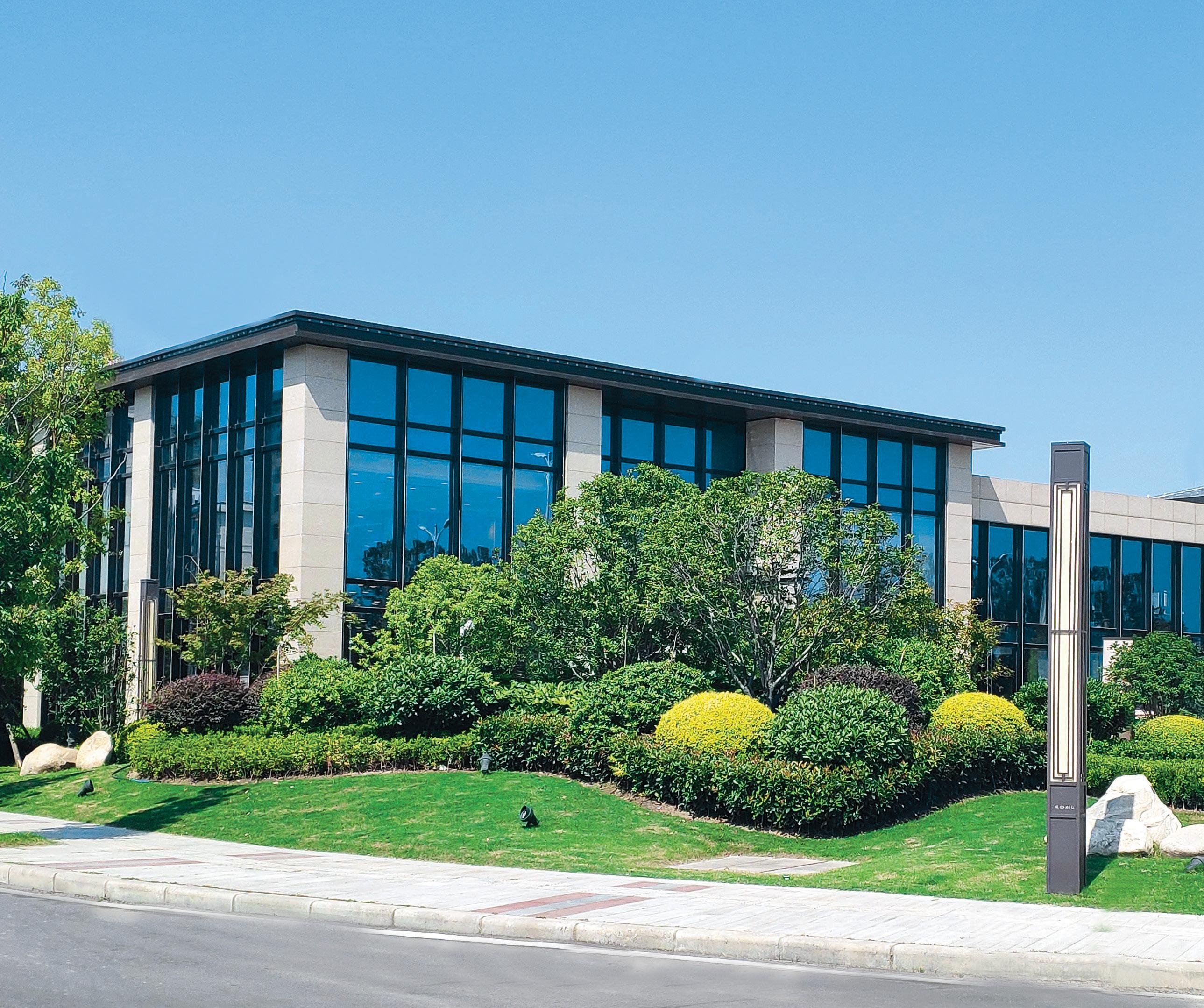
With VacuMax™ vacuum insulating glass (VIG) by Vitro, it’s possible to achieve R-values of up to R20 without needing to replace a window’s framing system—and even maximize energy efficiency with hybrid VIG units constructed with Solarban® low-e glass.
Visit VacuMaxVIG.com to contact a Vitro sales account manager.