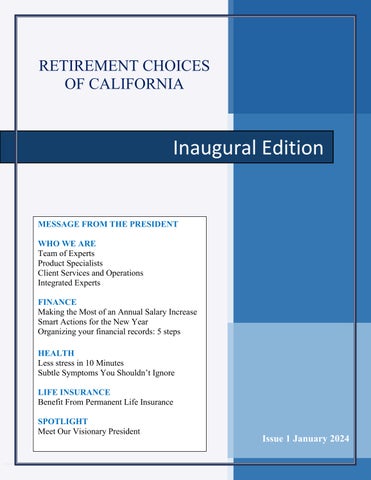
RETIREMENT CHOICES OF CALIFORNIA
Inaugural Edition
MESSAGE FROM THE PRESIDENT WHO WE ARE Team of Experts Product Specialists Client Services and Operations Integrated Experts FINANCE Making the Most of an Annual Salary Increase Smart Actions for the New Year Organizing your financial records: 5 steps HEALTH Less stress in 10 Minutes Subtle Symptoms You Shouldn’t Ignore LIFE INSURANCE Benefit From Permanent Life Insurance SPOTLIGHT Meet Our Visionary President
Issue1 1January January Issue 20242024 0|Page
MESSAGE FROM THE PRESIDENT
Embrace the First Edition: Warm Greetings and Fresh Insights Await! With great delight, we welcome you to the inaugural edition of our Retirement Choices of California newsletter! As we embark on this exciting journey together, we extend a warm embrace to each and every one of you. Your trust in us is the cornerstone of our dedication to providing you with the best financial management experience. At Retirement Choices of California, we believe that financial wellness is not merely a phase; it is a canvas for you to paint your dreams and aspirations. This newsletter aims to be your guide, your source of inspiration, and your window into the world of possibilities which await you. From insightful financial strategies to invigorating wellness advice, heartwarming tales of post-retirement exploration to stories of remarkable reinvention, our newsletters seek to be a mosaic of experiences waiting to be shared. Join us in celebrating this inaugural edition, as we set sail on a journey filled with enlightenment, community, and the joys of financial wellness and planning which reflect the uniqueness of you. Thank you for being a foundational part of RCC. J.P. Hamlett, Sr., Founder and President
2 | Page
MEET OUR TEAM OF EXPERTS
Jaron P. Hamlett, Sr Chief Executive Officer
Sue Chung Senior Financial Consultant
Patricia Dupree Financial Consultant
Michele EF Hamlett, MBA COO/CHRO
Gregory J. Sneed Senior Financial Consultant
Michael Griggs Financial Consultant
3 | Page
MEET OUR PRODUCT SPECIALISTS
Alian Aloian, Medicare Specialist President, Encore Plans
Rocio Bachman, Employee Benefits District Manager, PMA USA
Robert E. Drum President & CEO, Integrity West
Jerald Reed, Special Projects
Thelma Solis Employee Benefits Specialist
4 | Page
MEET THE BACKBONE OF OUR OPERATIONS
Brenda Guerra Client Services Manager
Sheri Pinkston Office Manger
Funmi Anjoorin
Client Services Associate
Ruth Alonzo
Office Assistant
Drew Martinez
Adriana Mariano
Operations Manager
Operations Assistant
Morgan Gordon
Client Services Associate
Jordan Wanambwa Executive Assistant
Elisa Ramos Intern
5 | Page
MEET OUR INTEGRATED EXPERTS
Laurence Demers, CPA DeMers & Associates
J’on Dennis CPA, MSA Dennis Duncan & Covington LLP
David Medina, CFP, CWS, AIF, CPFA Stewardship Financial
R. Steve Morris, CEO Intervention Point
Michael Perlmutter, CFA Lead Generation Heaven 6 | Page
FINANCE
Making the Most of an Annual Salary Increase Earning a raise at work is a great achievement. More money is always helpful, and a raise makes you feel like a valuable part of your company. It is tempting to take a salary increase and spend it as you please. While it is important to enjoy the success of your hard work, consider how you can benefit from your increased income. With the assistance of a professional and a little planning, a salary increase can become an opportunity to make a longterm impact on your quality of life. Here are several ways to spend your raise wisely. Contribute to Your Retirement Plan A salary increase is a great time to kick-start your retirement savings. If a 30-year-old invests an additional $1,000 per year in stocks, the future value could be $442,593 by age 70. For a 50-year-old, the future value of $1,000 per year could grow to an impressive $57,275. Pre-tax retirement account contributions grow tax deferred. You could tuck away the salary increase and not have to worry about any income tax liability on the money this tax year. Save for a Long-Term Goal It is easier and more rewarding to save money when you have a goal. Consider what is meaningful to you. Whatever your goal, you can make progress by creating an investment account and contributing regularly. Invest in Your Education One of the best ways you can increase your long-term financial success is by investing in yourself. Some of the ways you could invest in your education are with a new certification, a degree or designation relevant to your industry. See if your employer will help you pay for it! Pay Down Debt If you have debt, get rid of it! An annual salary increase can go right into a debt paydown plan. There is no one right way to pay off debt, and often, the best results are achieved with a coach in your corner. Boost your Emergency Savings One way to know if you have enough money tucked away for an emergency is to imagine the worst-case scenario. Usually, six months to two years of your living expenses are reasonable amounts of money to keep in safe (very low or zero interest) accounts at a bank. With your emergency savings intact, you can feel confident in your ability to get through unexpected challenges. Shore Up your Insurance A salary increase is a great time to think about whether or not you have the right amount of insurance for your situation. 7 | Page
FINANCE
Smart Actions for the New Year
Start 2024 on a strong note by reviewing this beginning-of-the-year financial checklist. The new year is a great time to reflect, revisit priorities and take actions — big and small — to help you stay on track to reach your financial goals. As you consider your financial situation for 2024, we are here to help identify strategies that can keep you focused and moving forward. Here are some smart actions to consider: Evaluate any changes to your financial situation. Your financial situation can change a lot in a year. Maybe you are pursuing an exciting new financial goal, such as renovating a home or early retirement. Or perhaps you are dealing with more subtle lifestyle shifts that affect your cash flow, such as workplace benefit changes, the childcare expenses, new car loan payments or the loss of a loved one. Whatever changes you are experiencing, please connect with us. We’ll offer recommendations and help identify opportunities to keep you on track to achieve your financial goals. Confirm your beneficiary designations. As such, all financial accounts should have specific beneficiaries named — and the beginning of the year can be a convenient time to review and update them. For help, consider reaching out to us. We are here to will help you review and if necessary, update your beneficiary designations on a regular basis. Assess your cash reserve. When a financial emergency arises, a cash reserve can help you pay for it and stay on track with your financial goals. Strive to keep three to six months of living expenses in a safe, liquid cash account that is generating interest. Because your cash reserve is the first line of protection against a financial setback, consider reviewing it annually to make sure it fits your current needs. Feel more confident about the year ahead. Be sure to meet with us on a yearly basis. Regular communication is key: We will likely cover many of the topics above and make tweaks to your plan based on your answers. We’re committed to helping you reach your financial goals. 8 | Page
FINANCE
Organizing your financial records: 5 steps Organizing your financial life begins with getting your records in order. But managing the constant flow of new documents, while also retaining the old, can feel overwhelming. Left unattended, pay stubs, financial statements and tax forms can quickly pile up. Thankfully, there are practices to help you manage these sensitive files efficiently and securely. Here are steps to help organize your financial records, so you can feel more confident about your financial life: 1. Gather your records. The first step to getting organized is gathering all your financial documents in one place to account for the breadth of records you’ve generated in the past and how often you receive them. Locate paperwork stored in physical or digital files, email or paper inboxes or other areas. Here are a few documents to look for: • • • • • • • • • • •
Tax statements / returns Retirement plan and investment statements Mortgage and personal property records Insurance policies Bills Receipts Financial account statements Checks Pay stubs Employee benefits Estate planning documents
2. Audit and dispose of outdated paper documents. While there will be numerous records you’ll need to retain, there are also likely many you’ll be able to discard. Remember to shred any documents containing account numbers, birth dates, Social Security numbers, or other potentially identifying information before you dispose of them. Review and purge your records annually. General retention guidelines for financial records A month or less
• • •
Credit card receipts (consider scanning and shredding) Bank withdrawal and deposit slips Utility, cable and cell phone bills (unless you are selfemployed and need them for tax purposes) 9 | Page
FINANCE 1 year
• • • •
7 years
Forever
• •
• • • • • •
Pay stubs Investment account statements Medical receipts Monthly bank and credit card statements Tax returns Supporting tax documentation, including W2s, brokerage statements, tuition payments and charitable donation receipts Annual statements for 401(k), IRA, Roth IRA and other investment accounts Mortgage records and other documents related to the purchase of your home Receipts for home improvements (until you sell the property) Receipts for valuable personal property (to establish value in case of loss or damage) Automobile records (until you no longer own the vehicle) Estate planning documents
3. Decide where (and how) to store your records. It’s easy to misplace documents if they don’t have a designated home, which is especially important for records that you may need on short notice or in an emergency. Consider the best location for your files: • •
Physical records: While a binder might be enough, consider a fire-resistant file cabinet or safe, to store original, hard-to-replace physical records such as a will or power-of-attorney. Electronic records: Storing records electronically can save space and provide added security. If you store your electronic records locally, create backup files on a portable storage device or on an encrypted cloud storage service.
4. Create a filing system that works for you. Whatever system you choose, consider organizing documents within each folder chronologically for easier access when you need them and to be consistent with file naming and location. 5. Make a list of accounts and passwords. In case you ever get locked out of your accounts or if a loved one needs access, create a list of all financial records and accounts, as well as instructions to access them, including usernames, passwords and PINs. Keep the list secure and updated, and share it only with those you trust, such as a spouse, partner or adult child. Manage your records effectively and safely. Organizing your financial records can give you clarity about your current financial situation, making it easier to reach your financial goals.
10 | Page
HEALTH
Less Stress in 10 Minutes Does thinking about finances turn your stomach into a knot? You're not alone. According to a recent American Psychological Association (APA) survey, money is a significant source of stress for about 75 percent of Americans. Soothe frazzled nerves with these five easy techniques that you can put to work in 10 minutes or less. Order the fish. While tension may have you craving carbs or sweets, eating three ounces of fatty fish, like salmon or tuna, twice per week will have a much more positive impact on your stress levels. Foods that are rich in omega-3 fatty acids help keep stress hormones (namely cortisol and adrenaline) from spiking. Talk to a pal. You might be reluctant to burden your loved ones with your problems, but a phone call or a chat with your BFF may be exactly what you need to feel better during rough times. The same APA survey mentioned above showed that people who have connections to turn to for emotional support, such as friends and family members, report lower stress levels than those without emotional support. LOL. Go ahead, click on the funny cat video that pops up in your social feed. A good laugh increases the release of feel-good endorphins. Chew gum. Did you know that chomping on a stick of gum may do more than just help bad breath? In an Australian study, gum chewers experienced reduced stress and lower levels of anxiety. Improve your view. It's tempting to stare at your smartphone when you need to zone out, but looking out the window at a tree or plants may make you feel better. In fact, when it comes to beating stress, nature trumps technology. Research shows that heart rates drop more quickly when people view real nature scenes versus ones that are watched on a screen.
11 | Page
HEALTH
Subtle Symptoms You Shouldn’t Ignore It’s normal to occasionally experience minor aches and ailments. But if you have persistent symptoms that are new to you, don’t be too quick to chalk them up to getting older. Here are four that could be red flags for your health—plus the condition each could be a sign of: Forgetfulness. Whether it’s a momentary mental block or general absentmindedness, there are plenty of normal aspects of forgetfulness that come with age. But if you are becoming lost in familiar places, forgetting steps to everyday tasks, or if friends and loved ones notice that you are repeating the same questions and stories more often, you should speak to your doctor, as these could be signs of dementia or other cognitive problems. Thirst. Some days you need a little more to drink than others. But excessive thirst paired with more frequent urination may be a sign of diabetes, which affects more than 27 million Americans. If you’re experiencing these symptoms, don’t wait for your next physical to talk to your doctor—early detection and treatment of diabetes can help you better manage the disease. Fuzzy vision. If the reading glasses you picked up at the local pharmacy aren’t quite cutting it anymore, you may want to see your eye doctor. A typical symptom of age-related macular degeneration, a common cause of vision loss in people older than 50, is a blurred area near the center of your vision. While this condition may progress gradually, it can also do so rapidly, which is why it’s important to speak to your doctor about small changes sooner rather than later. Fatigue. It’s normal to not have the same level of energy you had decades ago, but constant fatigue is not a part of aging. If you’re feeling tired all of the time and have difficulty with everyday activities, it could be an early sign of heart failure or other health issues. Don’t hesitate to speak with your doctor about your fatigue. If heart failure is found early, it could help make the treatment easier and more effective.
12 | Page
LIFE INSURANCE
Benefit From Permanent Life Insurance - While You're Living Permanent life insurance is the foundation of a financial plan, helping to protect your goals and take care of your loved ones should something happen to you. But the value of life insurance goes beyond risk protection. It can be an asset and offer other financial benefits throughout your life. There are two types of life insurance, term and permanent. Term life insurance provides protection for a specific period (e.g., 10, 20 or 30 years) and pays a benefit only if you die during the term. Permanent life insurance provides protection for the duration of your life. These policies build equity, known as cash value, over time. You can access it whenever you want. This cash value, along with tax advantages, means there are actual living benefits to a permanent life insurance policy. Here are some of them: Guaranteed Growth and Tax Advantages Permanent life insurance offers many tax advantages, including cash value that grows in a tax-advantaged way. Your cash value is guaranteed to grow and never decline in value and the death benefit is tax-free. Flexible Funds for Retirement In retirement, the cash value can serve as a stable part of your financial plan, helping you ride out market downturns. Long-Term Care Many policies include options that allow you to access your death benefit in order to pay for long-term-care expenses. Additionally, you can leave a legacy to provide for your spouse, family, and other heirs. If you have a favorite charity, you can
name the organization as a beneficiary. If you own a business, a policy could be part of a buy-sell agreement to ensure business continuity or to liquidate your ownership stake upon your death. College Savings Life insurance cash value is one of the few assets not considered in federal financial aid calculations for college. You can use the policy’s cash value to help pay for expenses. Permanent life insurance is a flexible asset that can add value to your financial plan. Just be aware how you use the living benefits to avoid tax consequences. Work with a financial professional to understand your options and determine the best course for your individual circumstances and needs. 13 | Page
SPOTLIGHT
Meet Our Visionary President Jaron P. Hamlett, Sr. is an experienced Managing Partner with a demonstrated history of helping individuals, families, businesses, and non-profits with financial planning strategies including retirement planning, insurance, and estate planning. Mr. Hamlett is committed to providing objective advice and guidance to his clients along with providing quality products and outstanding service within the financial services industry. As the founder of Retirement Choices of California, J.P. is involved in all aspects of company operations, including sales, marketing, recruiting, client management, and seeking out partners to expand the base and scope of the company. He and his team of experts have helped many business owners and individuals develop and implement forward-thinking financial and strategies that mitigate taxes and increase client asset valuations and estate values. J.P. and his team have a history of designing and implementing available solutions and strategies to achieve the client's most important financial goals and business objectives. Additionally, J.P. works with CPA's to deliver more value to their clients by offering more proactive and holistic business advisory services and financial strategies. His primary focus and objective is to help his clients create wealth and preserve assets while creating a legacy for their family. He earned his bachelor’s degree from Chico State University and completed post graduate work at the University of Southern California. J.P. was part of the founding committee which started the USC Minority Real Estate Development Program. He is also one of the founding board members of the National Black Business Council and founder and past president of M.E.N.T.O.R. Network, which was created in 1987 as a marketing and business development organization aimed at supporting and growing minority businesses. As president of the organization, J.P. created and managed small business workshops, luncheons, conferences, and awards programs sponsored by major corporations and public agencies. He is currently a board member with the YWCA of Greater LA and serves on the investment committee while being an advisor / consultant to several other non-profit organizations. J.P. also serves on the Board of Directors for RCC as well as several other insurance company advisory boards and has built a reputation of being honest and straight-forward. J.P. is an avid swimmer, cycler, golfer and enjoys music, cooking and yachting. He is married, has a son, grandson and granddaughter. 14 | Page