Radisson Blu Hotel & Convention Center Riyadh Minhal
In August, CPI will be hosting the inaugural Future Enterprise Awards in Riyadh. The awards are designed to recognize IT and business leaders that are driving rapid digital transformation across the Kingdom.
The KSA Awards want to acknowledge those who are championing change, whether it be from a private or public sector organization, we want to pay tribute to the fearless trailblazers forging a new path and a new identity for the KSA. For more information about the event and nomination details, please visit the event website below :https://tahawultech.com/ksa-futureenterpriseawards/2026/
JetBrains strengthens MENA channel as UAE pushes digitalfirst software agenda
Using AI to create a peoplefirst workplace ISSUE 335 // MARCH 2026
Industrialisation of ransomware reshapes CISO priorities, partner role, says Halcyon
SentinelOne, Cloudflare to deliver real-time threat detection and automated response for enterprisess
Sandhya DMello Editor
THE ERA OF INTENTIONAL INNOVATION
Welcome to the March edition of Reseller Middle East. International Women’s Day 2026 serves as our North Star this month, shifting the spotlight toward the architects of our digital future. This year’s theme, “Give to Gain,” reminds us that the technology industry’s greatest ROI stems from deliberate investment—not just in infrastructure, but in the people who lead it.
Our cover story features a collective of formidable voices across AI, cybersecurity, and digital infrastructure. The consensus is clear: inclusion is no longer a “diversity metric,” but a business imperative. Leaders across the UAE and the wider region argue that progress requires “deployment” rather than just “pipeline” fixes. We explore how opening doors to decision-making roles is the only way to build truly resilient and ethical technology ecosystems, ensuring that the people designing AI systems reflect the diversity of the people those systems affect.
Rise of AI Factory
Logical and physical architectures are evolving alongside these leadership shifts. The emergence of the “AI Factory” dominates this month’s news cycle:
• HPE and NVIDIA are accelerating turnkey systems to transform AI ambitions into real enterprise value.
• AVEVA and Vertiv are reimagining the digital twin and cooling infrastructures required to support high-density power demands.
E-mail: sandhya.dmello@cpimediagroup.com
Facebook: www.facebook.com/ TahawulTech
Twitter: @TahawulTech
Instagram: @TahawulTech
• Nutanix and Nintex are lowering the barrier to entry for Agentic AI, moving beyond simple automation toward autonomous business orchestration.
Connectivity and Readiness Gap
The regional landscape continues to shift as Sama X brings Starlink’s satellite constellation to Kuwait, providing high-speed connectivity to land and sea operations. However, scaling connectivity reveals a sobering reality: while 85% of enterprises view AI as central to their strategy, only 7% claim their data is fully ready for it. This “readiness gap” represents the channel’s greatest opportunity in 2026—guiding customers through the complexities of data silos and GRC. The most successful factories of the future will be those that combine cuttingedge silicon with diverse human intelligence. Enjoy the issue.
AVEVA UNVEILS DIGITAL TWIN ARCHITECTURE FOR AI FACTORIES
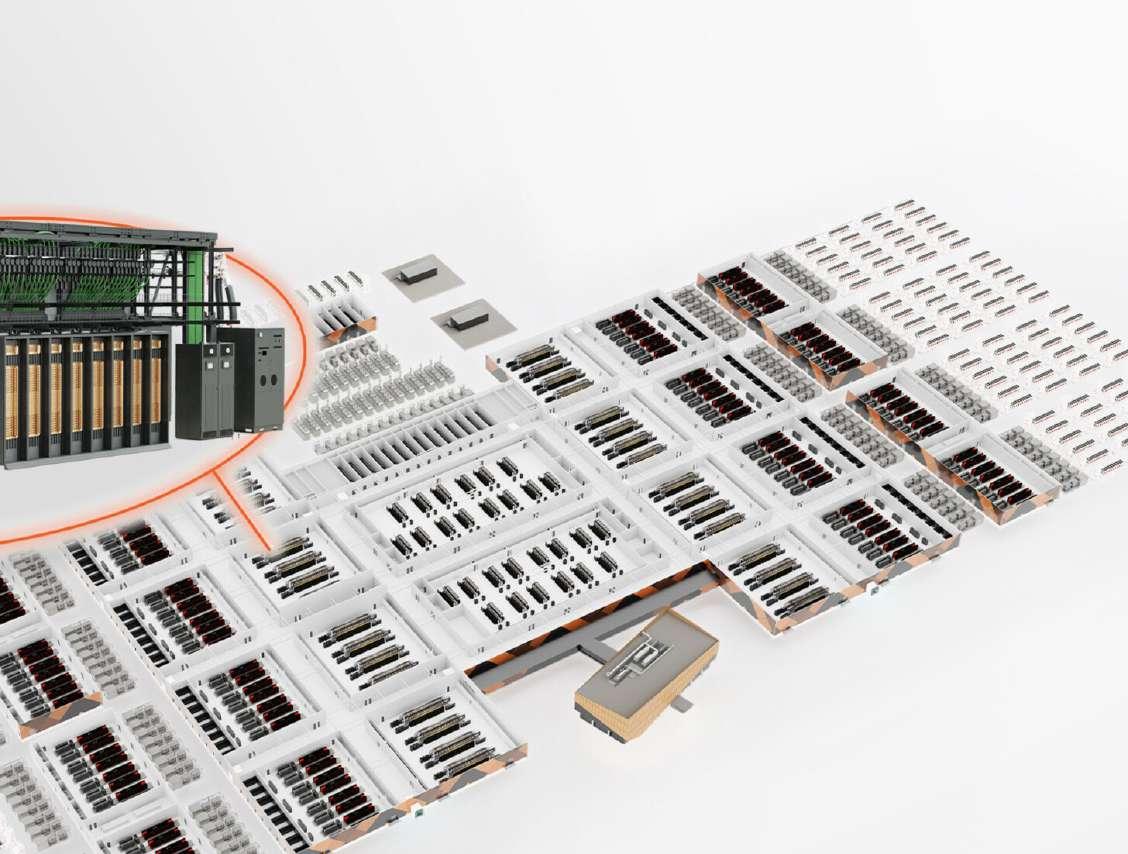
AVEVA, a global leader in industrial software, today announced a new collaboration with NVIDIA, where they’re integrating their engineering and operations software into the NVIDIA Omniverse DSX Blueprint. Together, the two companies are creating physical and digital modules that can be deployed in large-scale data centres, known as AI Factories.
The approach replicates the methods used in engineering, procurement and construction projects. The collaboration draws on AVEVA’s comprehensive portfolio, including the CONNECT industrial intelligence platform and industrial digital twin capabilities. It is projected to accelerate time-to-token for AI Factories, using domain-specific simulations, digital visualisation and collaborative design tools to maximise GPU efficiency and accelerate deployment of AI Factories at speed and scale.
Rob McGreevy, Chief Product Officer, AVEVA said: “AI Factories are fast becoming the industrial-scale engines of the global digital economy. To drive this transformation, AVEVA and NVIDIA are creating a new approach to digital twin deployments, founded on domainspecific expertise, pioneering software and operational excellence. Together, our companies are creating this new digital twin at scale, combining SimReady assets, NVIDIA hardware, and IT and OT data-driven insights to design, build and AI-optimise the intelligent industries of the future.”
AVEVA’s collaboration sits alongside its strategic partners Schneider Electric and ETAP. Together, they are jointly advancing the design, simulation, build, operation, and optimisation of the NVIDIA Omniverse DSX Blueprint for AI Factories. The collaboration extends the methodology and expertise that AVEVA is known for across many industrial sectors.
AVEVA is incorporating its solutions into the Omniverse DSX Blueprint, bringing benefits of digital twins to customers at every stage of the AI factory lifecycle:
• Customers may bring OpenUSD SimReady assets into AVEVA Unified Engineering through a new converter, enabling them to reuse existing assets, design new ones, and leverage high-fidelity SimReady data and environments built on NVIDIA Omniverse libraries.
• With a single source of truth from AVEVA Asset Information Management, customers can manage equipment, systems and make changes seamlessly, ensuring alignment from design throughout operations.
• With AVEVA Process Simulation, customers can model and run simulations of advanced liquidcooling networks for AI Factories to refine designs and maximise cooling efficiency.
• AVEVA’s PI System enables customers to aggregate IT and OT data across NVIDIA Omniverse DSX Exchange. In time this will be extended to include the NVIDIA NV-Tesseract model for anomaly detection and forecasting, enabling customers to interpret telemetry in real time from BMS, EPMS, cooling systems, server racks and workloads, all at giga-scale. This will transform efficiency throughout the lifecycle.
• Last, customers can use AVEVA Operations Control and Unified Operations Center to manage data centre infrastructure which comprises of electrical (UPS, switchgear, PDU, generator etc.), mechanical (chiller, CDU etc.) and safety systems into one scalable unified platform using a templatised situational awareness approach. This will enable operators to accelerate root cause analysis, recommend actions, monitor alerts and identify degradation trends as they push densities higher. This will enable customers to leverage AVEVA’s trusted expertise when delivering new high density AI Factories.
“The rapid rise of gigawatt-scale AI Factories requires a new class of industrial intelligence to optimize the entire lifecycle of these massive data centres, from initial design to real-time operations,” said Vladimir Troy, vice president, AI Infrastructure, at NVIDIA.
“By integrating AVEVA’s engineering and simulation software into the NVIDIA Omniverse DSX blueprint, we are providing developers with a unified digital twin architecture to accelerate the deployment and efficiency of the world’s most advanced AI infrastructure.”
Rob McGreevy, Chief Product Officer, AVEVA.
HPE ACCELERATES SECURE, SCALABLE PRODUCTIONREADY AI WITH NVIDIA
HPE announced a significant expansion of the NVIDIA AI Computing by HPE portfolio, redefining how enterprises deploy, operationalise, and scale AI. Through its deep partnership and co-engineering with NVIDIA, HPE delivers an advanced portfolio of integrated and validated systems that speed time to value for AI while addressing scale, security, and governance requirements.
“The AI race is fundamentally about speed, scale, and trust,” said Antonio Neri, president and CEO, HPE. “Our industry leadership across cloud, networking, and AI enables organisations to operationalise AI securely, efficiently, and at an unprecedented scale. Together with NVIDIA, HPE delivers turnkey AI factories and networks that transform AI ambitions into real enterprise value.”
“NVIDIA and HPE are setting a new standard for enterprise AI infrastructure,” said Jensen Huang, founder and CEO, NVIDIA. “HPE’s leadership across private cloud, networking, and secure on-prem systems uniquely positions them to make AI a core enterprise capability. Together, we are building AI factories and AI grids — foundational infrastructure to embed intelligence into every workflow.”
HPE expands secure, repeatable, and efficient AI architectures to simplify enterprise adoption While foundation models are driving massive scale with datacenters, enterprises face the challenge of securely operationalising AI across the organisation. HPE is addressing this challenge with a comprehensive refresh of security-focused AI solutions with NVIDIA for predictable, repeatable AI success for enterprises. HPE is expanding HPE Private Cloud AI, its turnkey enterprise AI factory co-engineered with NVIDIA, to deliver greater performance, scalability, and flexibility for enterprise inferencing. Industry leaders such as the Ryder Cup,
Danfoss, and the Dallas Cowboys are leveraging HPE Private Cloud AI to accelerate transformative AI initiatives across their organisations.
• New network expansion racks enable HPE Private Cloud AI deployments to scale up to 128 GPUs for customers to run larger, more demanding AI workloads with the same consistent operational experience.
• To meet increasing demand for secure, fully isolated or sovereign deployments, the large HPE Private Cloud AI system is now available in an air-gapped configuration, ensuring sensitive data is not exposed to external networks.
• HPE ProLiant Compute DL380a Gen12 servers and HPE Private Cloud AI systems based on the DL380a are being certified for Fortanix Confidential AI, a joint solution leveraging NVIDIA Confidential Computing, that enable secure on-premises deployments for AI models and processing of sensitive data without exposure.
• CrowdStrike delivers agentic security for HPE Private Cloud AI, providing AI-powered threat detection and response to protect AI infrastructure, models and the AI agents operating across enterprise environments, enabling organisations to operationalise agentic AI securely and at scale.
• HPE Private Cloud AI delivers a pre-configured hardware and software stack featuring the latest NVIDIA AI Enterprise software and blueprints, including the updated NVIDIA AI- Q blueprint for AI agents and new NVIDIA Omniverse blueprint for digital twins. The latest NVIDIA AI-Q blueprint enables developers to build fully customisable AI agents that they own, inspect and control.
• HPE is updating HPE Private Cloud AI, the latest HPE ProLiant servers and HPE AI factories to support the latest NVIDIA Nemotron open models — part of the NVIDIA Agent Toolkit — to simplify deployment of secure, on-prem and sovereign infrastructure and quickly deliver scalable, production-ready outcomes.
• NVIDIA RTX™ PRO 6000 Blackwell Server Edition GPUs are available across all configurations of HPE Private Cloud AI and HPE’s AI factory solutions.
HPE adds new AI solutions for retail, medical research, and manufacturing
New NVIDIA co-designed multiworkload solutions simplify deployment of AI use cases for autonomous edge intelligence, retail shopping assistance, video search and summarisation, biomedical research. Each of these solutions combine HPE ProLiant Compute servers with NVIDIA
accelerated computing, NVIDIA Spectrum-X Ethernet networking, BlueField DPUs, and Connect-X NICs –based on NVIDIA Enterprise Reference Architectures. The solutions also incorporate NVIDIA AI Enterprise software, NVIDIA CUDA-X libraries, blueprints, confidential computing, Multi-Instance GPU (MIG), and virtual GPU (vGPU) technologies with HPE chip -to - cloud security and AI- driven automation through HPE Compute Ops Management.
To complement these multi-workload solutions, HPE is adding the new NVIDIA RTX PRO 4500 Blackwell Server Edition GPU to HPE ProLiant servers for edge deployments, smalllanguage models, vector databases, and data analytics workloads. HPE is developing new solutions built on NVIDIA RTX 4500 Blackwell GPUs, including integrating the NVIDIA Retail Shopping Assistant Blueprint to streamline deployment across the retail sector. HPE is also expanding the portfolio of HPE ProLiant Compute servers that feature the NVIDIA RTX PRO 6000 Blackwell Server Edition GPU.
HPE advances AI networking and AI at scale with innovations at NVIDIA GTC 2026 In separate announcements at NVIDIA GTC, HPE is also introducing networking solutions focused on enabling service providers, sovereigns, and large enterprises to connect distributed AI deployments using HPE
Juniper Networking routers along with coherent optics. HPE also expanded its at-scale and sovereign AI factories for service providers, sovereigns, and large enterprises, along with a new generation of systems built on the NVIDIA Vera Rubin architecture and designed to run the most demanding AI workloads.
HPE enhances AI data pipelines with expanded NVIDIA integration
As AI infrastructure moves into production, data pipelines and specifically inference context have emerged as a critical performance bottleneck. HPE is working closely with NVIDIA to accelerate every stage of the AI data lifecycle, from ingest and vectorisation to inference and recovery. HPE continues to evolve the HPE Alletra MP X10000 with the goal to centralise intelligent data handling and optimise how AI workloads ingest, process, and deliver data. HPE is the first vendor to achieve NVIDIA-Certified Storage validation for object-based systems at the Foundation level with the X10000. This certification signifies that NVIDIA has validated and benchmarked the performance for loads of up to 128 GPUs, conducted functional tests for enterprise grade availability and reliability, and that the storage layer efficiently feeds data to accelerated computing resources to deliver faster model training, lower latency inference, and better overall utilisation.
To further expand the collaboration with NVIDIA, HPE will be supporting the new NVIDIA STX rack-scale reference architecture to develop new AI storage solutions powered by NVIDIA Vera Rubin, BlueField-4, Spectrum-X networking, Connect-X NICs, and NVIDIA AI software.
New HPE services, financing, and Unleash AI ecosystem solutions simplify AI adoption
• HPE Services is offering a new agents hub to ensure structured and scalable enterprise adoption of agentic AI. Within the hub, HPE is developing and validating agents powered by NVIDIA Nemotron models to establish reusable patterns to helps organisations adopt and operationalise intelligent agents.
• To optimise utilisation and ROI across shared HPE AI factories, HPE Services and Protopia AI are creating a blueprint for trustworthy, multi-tenant AI factories that enables full use of sensitive data in regulated and sovereign environments without exposure.
• HPE Financial Services is making it easier to advance AI and modernisation projects with a new 90/9 Advantage financing program, requiring no payments for the first 90 days, followed by monthly lease payments of 1 percent for the next 9 months. The offer is available across the networking, hybrid cloud, and compute server portfolios.
HUAWEI XMAGE AWARDS RETURN TO INSPIRE GLOBAL MOBILE PHOTOGRAPHY, WITH UPCOMING LOCAL CONTEST IN THE UAE
Huawei has announced the return of the global Huawei XMAGE Awards, inviting smartphone photography enthusiasts worldwide to showcase their creativity and visual storytelling between March 23 and August 16. The highly anticipated competition celebrates the art of mobile imaging and the power of photography to capture meaningful human moments. The announcement follows the remarkable success of the Huawei
XMAGE Awards 2025, which culminated in a prestigious ceremony at the iconic Grand Palais in Paris on November 12. The ceremony took place alongside the globally renowned Paris Photo, bringing together photography enthusiasts, artists, and industry leaders from across the world.
Last year’s awards saw an overwhelming response, attracting more than 740,000 submissions from creators across multiple countries and
regions. From this impressive pool of entries, 100 outstanding images were selected as winners, highlighting the extraordinary creativity and storytelling potential made possible through smartphone photography. The event also featured The World, You and Me Annual Imaging Exhibition, further reinforcing Huawei’s vision of expanding mobile photography beyond technology and into the realm of culture, creativity,
and global artistic dialogue. With around 100,000 visitors attending Paris Photo each year, the event provided a powerful international platform for photographers to share their perspectives and connect with the wider creative community.
Among the winners celebrated on the global stage were two talented photographers from the United Arab Emirates, Grace Montives and Mark Anthony Agtay, whose captivating images earned international recognition among hundreds of thousands of submissions. The achievement highlights the growing influence of mobile photography within the UAE and reflects the vibrant community of creatives who are using Huawei’s advanced imaging technology to capture authentic stories and everyday moments. The success serves as an inspiration for photography enthusiasts across the region to share their own perspectives through the lens of Huawei smartphones.
Building on this momentum, Huawei will also launch a dedicated local photography contest in the UAE, running in parallel with the global XMAGE Awards submission
period. The initiative aims to inspire photography lovers, creators, and emerging talents across the country to capture the beauty, diversity, and unique stories of life in the UAE. By encouraging Huawei smartphone users to participate and submit their best images, the local contest seeks to further strengthen the UAE’s presence in the global XMAGE community while celebrating the creativity of the region’s photography enthusiasts.
The UAE contest will feature exciting prizes for the most compelling photographs, offering participants
an additional platform to showcase their talent and creativity. Full details about the local competition, including categories, submission guidelines, and prize announcements, will be revealed soon across Huawei’s official social media platforms, where photography enthusiasts are encouraged to stay tuned for updates and participation opportunities. Through both the global XMAGE Awards and the UAE initiative, Huawei continues to empower users to transform everyday moments into powerful visual stories that connect people and cultures around the world.
NUTANIX AGENTIC AI TO UNLOCK POTENTIAL OF ENTERPRISE AI FACTORIES
Nutanix, a leader in hybrid multicloud computing, announced the Nutanix Agentic AI solution, a full software stack purpose built to help customers accelerate adoption of Agentic AI for business transformation. With the shift to Agentic AI, enterprise adoption has hit a tipping point where the barrier to success is no longer the model or building individual agents, but the complexity of managing the infrastructure required to securely run thousands of agents at scale. Infrastructure and platform teams need better solutions to build and operate AI factories, and provide shared access to their resources, while maximising performance, security, and compliance with sovereignty requirements. In addition, data
scientists and Agentic AI developers expect easy access to tools and services to run and fine-tune models, build agents, and securely connect them to enterprise data.
“Contrary to AI infrastructure for model training that was optimised to run ‘one big job,’ production Agentic AI infrastructure needs to handle scale and high rates of change for thousands of AI services, agents, and concurrent users and developers.
Nutanix Agentic AI extends AHV hypervisor, Flow Virtual Networking, Nutanix Kubernetes Platform, and Nutanix Enterprise AI to deliver a cloud operating model to enterprise AI factories. This enables infrastructure and platform teams to simply build, operate, and govern AI factories, while
providing Agentic AI developers with the performance and rich set of models and AI platform services they need,” said Thomas Cornely, Executive Vice President of Product Management at Nutanix.
The solution integrates with NVIDIA AI Enterprise at the Agent Builder layer and orchestrates the NVIDIAcertified ecosystem of AI factories for supported configurations. It enables customers with dynamic, multiuser AI environments to build, run, and protect agentic AI applications with a full suite of infrastructure orchestration and security software coupled with AI Platform Services (PaaS) and Models-as-a-Service (MaaS) for data scientists and Agentic AI developers. Nutanix and NVIDIA are also working
together to build the foundation for autonomous agents in the enterprise through integration with the NVIDIA Agent Toolkit including the NVIDIA OpenShell open source runtime.
Optimising Performance, Security, and Cost of AI Apps and Factories
The Nutanix Agentic AI solution reduces complexity, delivers optimised performance and security, and is designed to enable lower, predictable token costs by providing the following:
1. Agentic AI Services and a Kubernetes Platform: This AI PaaS and Kubernetes native software layer consists of:
a. An Advanced AI Gateway and Model-as-a-Service: The latest release of Nutanix Enterprise AI (NAI), version 2.6, now includes an AI Gateway service for unified policy control over cloud-hosted and private LLMs. New support for the Model Context Protocol (MCP) server and Fine Tuning extends its existing robust MaaS capabilities to enable agents to securely connect to enterprise tools and data sources. NAI also now includes support for the NVIDIA Nemotron family of open-source AI models, datasets, and training tools designed to help developers build agentic AI systems that can reason, securely access tools, and complete complex multistep tasks independently.
b. An Open Kubernetes Platform With a Rich AI Catalog: Nutanix simplifies the path to Agentic AI by extending its CNCF-compliant Nutanix Kubernetes Platform with a rich catalog of pre-built open source AI developer tools including Notebooks, Vector Databases, MLOps workflow engines, and Agentic frameworks. Because it is fully integrated with NVIDIA AI Enterprise software, developers can instantly deploy NVIDIA NIM microservices, including Nemotron, to accelerate the development of high-performance AI applications in production.
2. Infrastructure Optimisation and Security: In the early access version of NVIDIA topology aware AHV,
the Nutanix AHV hypervisor has been enhanced to automatically optimise allocation of physical resources to virtual machines on GPU dense servers and help maximise performance. The Nutanix Flow Virtual Networking solution has been enhanced to offload the network dataplane to NVIDIA BlueField, delivering highperformance networking while reducing host CPU and memory consumption. These enhanced capabilities bring all the benefits of virtual machines for workload and tenant isolation, day 2 operations, and infrastructure resilience to Agentic AI workloads with maximum performance, security, and resource utilisation to help achieve lower cost per token.
3. Foundational Data Services for AI: Agentic AI applications require foundational Data Services. As a
solution built on the NVIDIA AI Data Platform reference design, Nutanix Unified Storage delivers linearly scalable read/write performance for thousands of GPU clients. By providing a high-capacity tier for KV Cache offloading and support for S3 over RDMA and NFS over RDMA, Nutanix provides a scalable, low-latency data fabric that maximises GPU efficiency across all enterprise AI workloads.
The Nutanix Agentic AI solution operationalises and accelerates adoption of Agentic AI with NVIDIA-certified AI factories. Customers can deploy AI factories on hardware from Cisco, Dell, and Supermicro, supported with joint validation by Nutanix and NVIDIA.
The Nutanix Agentic AI solution comprises products that are either already generally available or currently in early access and are expected to be available soon.
Thomas Cornely, Executive Vice President of Product Management, Nutanix.
PRESIGHT UNVEILS FIRST AI FUND INVESTMENTS UNDER ITS
INTELLIGENCE INNOVATION ECOSYSTEM
Six AI startups aligned to next-generation intelligent systems supported through strategic capital and access to world-leading AI infrastructure and proven commercial pathways.
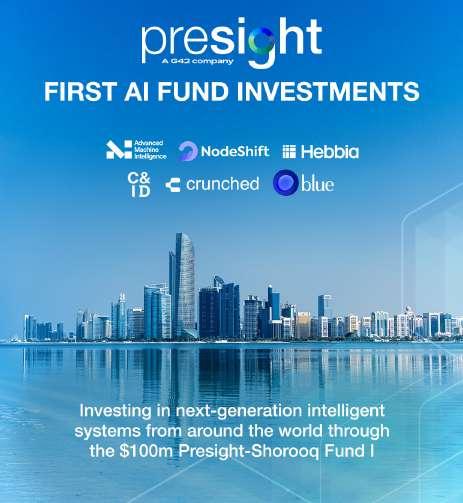
Presight has unveiled the first six AI companies selected to receive investment through its AI Innovation Ecosystem, strengthening the pipeline of technologies designed to power next-generation intelligent systems at national and enterprise scale.
The investments form part of the Presight–Shorooq Fund I (PSFI), a US$100 million global early-stage fund established in partnership with Shorooq.
The six companies to receive investment are located across the United States and UAE, and span sovereign AI infrastructure, vertical intelligence platforms for capital and industry, and edge-native intelligence systems. Together, these companies reflect Presight’s focus on identifying breakthrough applied intelligence systems primed for integration into complex, regulated environments where reliability, resilience, and governance are critical.
The first six investments World Model Architecture
• AMI-Advanced Machine Intelligence advances world model AI architectures designed to help machines understand and interact with the physical world, enabling deeper reasoning, planning, and real-world interaction beyond traditional predictive AI architectures. Founded by Turing Award winner and former Meta Chief AI Scientist Yann LeCun, AMI is developing a new class of AI systems that learn from spatial and real-world data to model cause and effect. Headquartered in Paris with offices in New York, Montreal, and Singapore, the company
is initially targeting enterprise applications across manufacturing, aerospace, robotics, and biomedical industries.
Sovereign AI Infrastructure
• NodeShift gives enterprises a secure, on-premises AI platform that enables users to use and deploy AI models while keeping all data within their own infrastructure. A participant in Cohort I of Presight’s AI Accelerator Program, NodeShift has now entered into a strategic commercial agreement with Presight to scale its solutions and pursue joint go-to-market initiatives, reflecting the continued collaboration between Presight and startups participating in the program.
Vertical Intelligence for Capital and Industry
• Hebbia enhances institutional research and financial workflows in regulated capital markets.
• Candid Intelligence applies AI to optimise procurement and bidding processes across infrastructure and public-sector environments.
• Crunched turns complex company/ market data into faster modeling, deeper insights, and decisiongrade analysis for investors and operators, using its advanced AI financial intelligence platform
Secure, Edge-Native Systems
• Blue utilises a voice-action model layer powering voice agents that can complete multi-step tasks directly on phones, avoiding APIs and integration overheads.
A Structured Pathway from Innovation to Intelligent Systems Presight’s AI Innovation Ecosystem is the company’s growth engine, designed to identify, acquire, invest, accelerate and incubate the next generation of breakthrough AI intellectual property to ensure that emerging technologies are developed with deployment in mind from day one. Presight’s AI Innovation Ecosystem consists of an AI Investment Fund, an AI Accelerator Program, and Research and Development Labs.
Through the Presight AI Accelerator Program, companies receive structured mentorship, access to world-leading compute infrastructure, fast-track commercialization pathways with enterprise and government clients within the G42 and Presight ecosystems, and technical integration support. This model ensures alignment with real operational and commercial requirements — enabling integration, contracts, and the development of defensible moats.
Strategic capital vehicles
such as PSFI strengthen this pathway by providing early-stage funding aligned to the same thesis, enabling companies to scale within sovereign and regulated environments.
Together, incubation, capital, and deployment create a coordinated model for translating AI innovation into intelligent systems that deliver real-world impact.
Magzhan Kenesbai, Chief Growth Officer of Presight, said, “AI only creates lasting value when it can operate within real systems. These first investments reflect that conviction – spanning secure AI infrastructure, vertical intelligence platforms for capital and industry, and edge-native systems. Each of these companies is building technology designed for integration into complex, regulated environments. By combining operational environments, structured incubation through the Presight AI Accelerator, and strategic capital via PSFI, we are creating clear pathways from innovation to implementation –translating frontier AI into intelligent systems at scale.”
As Abu Dhabi continues to strengthen
its position as a global hub for applied AI, Presight’s AI Innovation Ecosystem will expand through future cohorts and additional capital initiatives aligned to energy systems, industrial autonomy, sovereign data infrastructure, and AInative public services.
The first investments mark the beginning of a disciplined, deployment-oriented approach to ecosystem building - ensuring AI innovation strengthens the intelligent systems that power long-term growth and resilience.
Dr. Bilal Baloch, Partner at Shorooq, said,“When we launched this fund, our vision was to connect world-class AI innovators with the capital, regulatory support, and market access that our region offers. To have invested in six highly promising companies, after assessing over 1,000, outside our home market alongside leading peers in the US and Asia in 120 days is a marker toward that vision. We were most impressed that these founders are pushing the boundaries of what AI can do – from giving every app a voice interface to automating billion-dollar industries – and thereby allowing
us to back varying theses across the AI stack. This is just the beginning; we believe the fund can be a bridge between East and West for AI, and we’re committed to accelerating more breakthroughs that will transform businesses and communities.”
Dr. Bilal Baloch, Partner at Shorooq, said,“When we launched this fund, our vision was to connect world-class AI innovators with the capital, regulatory support, and market access that our region offers. To have invested in six highly promising companies, after assessing over 1,000, outside our home market alongside leading peers in the US and Asia in 120 days is a marker toward that vision. We were most impressed that these founders are pushing the boundaries of what AI can do – from giving every app a voice interface to automating billion-dollar industries – and thereby allowing us to back varying theses across the AI stack. This is just the beginning; we believe the fund can be a bridge between East and West for AI, and we’re committed to accelerating more breakthroughs that will transform businesses and communities.”
SAMA X BRINGS ADVANCED SATELLITE INTERNET TO KUWAIT VIA STARLINK
Alghanim Industries (Kutayba Alghanim Group) announced the official launch of Starlink services in Kuwait through its technology venture Sama X, bringing SpaceX’s satellite internet network and the world’s largest constellation of low Earth orbit satellites to customers across the country.
As an authorised global reseller of Starlink, Sama X provides access to high-speed satellite connectivity that delivers fibre-like performance without relying on traditional ground infrastructure. The service offers reliable internet on land and at sea with typical latency as low as 20 milliseconds, supporting remote operations, critical applications, and everyday connectivity needs.
Starlink currently operates the world’s largest LEO satellite network,
with more than 10,000 satellites launched since 2020. The system now delivers total network capacity of around 450 Tbps and serves more than 10 million users worldwide.
In Kuwait, Sama X will offer a range of subscription plans with download speeds exceeding 300 Mbps, along with fast delivery, professional installation, and local support, including a 24/7 bilingual call centre. The service operates in accordance with Kuwait’s telecommunications regulations and the approvals issued by the relevant authorities. For inquiries, customers can call 22055736.
“The launch of Starlink services in Kuwait through Sama X marks an important step in strengthening the country’s digital infrastructure,” said Kutayba Y. Alghanim, Executive Chairman of Alghanim Industries.
“At a time when reliable connectivity has become essential for business continuity and the effective functioning of key sectors, this technology provides advanced connectivity that helps organisations, governments, and communities stay connected wherever they operate — from remote worksites to critical sectors such as healthcare and education. Through this initiative, we continue to support the adoption of advanced technologies that strengthen Kuwait’s digital readiness and open new opportunities for innovation and growth.”
From remote offshore oil and gas installations and maritime fleets at sea to enterprises across the country, Starlink provides stable communications that support business continuity, enhance safety, and
improve operational efficiency. Reliable connectivity is also increasingly critical for essential services such as hospitals, schools, research institutions, and emergency response teams that depend on uninterrupted access to digital systems and data.
The service also enables high-speed connectivity for homes and businesses, supporting seamless streaming, cloudbased applications, and data-driven services across multiple industries.
By making Starlink available in Kuwait, Sama X supports the country’s ongoing efforts to strengthen its digital ecosystem and expand secure, reliable connectivity nationwide. Starlink services in Kuwait operate in accordance with the country’s telecommunications regulatory framework.
Customers can purchase Starlink services directly from Sama X or through Xcite, Kuwait’s leading electronics retailer, both online and in-store.
“Making Starlink services available in Kuwait marks an important step in expanding advanced connectivity options for businesses and individuals across the country,” said Amit Somani,
CEO of Sama X.
“At Sama X, we are focused on making this technology easy to access through fast installation and dedicated local support. Our partnership with Xcite further expands availability, allowing customers to purchase Starlink services easily through Xcite’s online channels and nationwide stores.”
Sama X was established by Alghanim
Industries as part of the Group’s broader expansion into technology and advanced connectivity solutions across the region. The company already operates in several regional markets and holds a global license to resell Starlink products internationally. The introduction of Starlink services in Kuwait follows the completion of the required regulatory approvals from the relevant authorities.
VAST DATA INTRODUCES FOUNDATION STACKS TO ACCELERATE ENTERPRISE ADOPTION OF NVIDIA BLUEPRINTS
New open source library delivers production-ready implementations for scalable pipelines on the VAST AI Operating System.
VAST Data, the AI Operating System company, today announced the availability of VAST Foundation Stacks, a new open-source library that augments and extends NVIDIA AI Blueprints into production-ready pipeline implementations that run natively on the VAST AI Operating System.
NVIDIA AI Blueprints provide developers with a foundational starting point for building advanced AI applications and intelligent agents, leveraging NVIDIA AI Enterprise software to rapidly prototype, customise, and deploy domain-specific AI workflows with minimal integration
effort. VAST Foundation Stacks extend these blueprints into production-ready templates, enabling organisations to deploy and operate NVIDIA-powered pipelines natively on the VAST AI Operating System. Developers can now focus on the business logic that connects AI to their environment instead of assembling the underlying infrastructure and platform layers required to support it, enabling teams to deliver AI applications faster.
Enterprises are racing to operationalise proven AI patterns, but many reference examples still require extensive integration before they can run securely and reliably in
production. Teams often must stitch together fragmented infrastructure, orchestration layers and data services to make these AI applications production-ready.
VAST Foundation Stacks address this challenge by extending NVIDIA AI Blueprints into repeatable, enterprise-ready implementations designed to run natively on the VAST AI Operating System. By unifying data access, database services, compute orchestration, eventing, and pipeline execution in a single environment, VAST enables organisations to deploy scalable AI pipelines without building complex infrastructure from scratch.
Kutayba Y. Alghanim, Executive Chairman, Alghanim Industries.
These Foundation Stacks can be seamlessly and repeatedly deployed anywhere the VAST AI OS runs, including in the cloud as well as on premises via VAST's newly announced CNode-X platforms, as part of the NVIDIA AI Data Platform reference design.
The first Foundation Stacks are based on NVIDIA AI Blueprints for Video Search and Summarisation (VSS) and NVIDIA AI-Q:
The VSS-based VAST Foundation Stack enables organisations to ingest massive volumes of live or archived video and extract insights through semantic indexing, summarisation, and interactive Q&A, powered by the highperformance data and pipeline services of the VAST AI Operating System.
The AI-Q based VAST Foundation Stack provides a foundation for building custom AI researchers that can operate across private, enterprise data sources, synthesising hours of research in minutes while leveraging the VAST AI OS for persistent and secure context, scalable reasoning pipelines, and trusted agent execution.
“NVIDIA AI Blueprints have given the market an important starting point for building next-generation applications, but enterprises still need a production-ready way to deploy and operate those capabilities at scale,” said John Mao, Vice President, Global Technology Alliances at VAST Data.
“With VAST Foundation Stacks, VAST is taking the architectural patterns behind leading NVIDIA Blueprints and giving customers a faster path from experimentation to production for scalable AI pipelines, video intelligence, and agentic AI systems.”
In addition to the available VSS and AI-Q implementations, VAST plans to release additional Foundation Stacks in the coming months, including industry-focused examples. VAST Foundation Stacks will be available through a public GitHub repository, with interactive demos and planned sandbox environments for customers and partners.
“As enterprises transition to production AI at scale, preparing enterprise data for AI has become one of the biggest challenges,” said Adel El Hallak, Vice-President, Product at NVIDIA. “Turning data into AI-ready pipelines needs to be done continuously and requires fullstack acceleration across compute, networking and software. By extending NVIDIA AI Blueprints with the VAST AI Operating System, customers can prepare and serve data so intelligent agents are always working off the most recent and accurate information.”
NINTEX UNVEILS AGENTIC BUSINESS ORCHESTRATION CAPABILITIES TO SCALE AI-LED AUTOMATION ACROSS ORGANISATIONS
Nintex unveils new native AI capabilities that enable organisations to build and orchestrate AI agents alongside people, workflows, and systems.
Nintex, a global leader in agentic business orchestration, today announced Nintex Agent Designer and Nintex Orchestration, new agentic AI and business orchestration capabilities available to select customers natively in Nintex CE. Together, these help organisations design and orchestrate AI agents alongside people, workflows,
and core systems to deliver consistent results at scale.
“Rather than replacing structured processes with fully autonomous systems, organisations today want platforms that support both deterministic and agentic approaches across a single orchestration framework,” said Arnal Dayaratna,
Research Vice President, Software Development at IDC.
“A blended approach allows organisations to apply agentic AI where judgment and interpretation add value, while maintaining conditional workflow control where precision and compliance are required. This ability to coordinate both models
John Mao, Vice President, Global Technology Alliances, VAST Data.
within business workflows is a critical requirement for scaling AI adoption.”
As organisations accelerate AI adoption, many are rethinking how it is embedded into day-to-day operations.
Nintex’s AI UNLESS report found that 64% of business leaders are embedding or consolidating AI into broader automation strategies to create unified platforms that orchestrate people, systems, and AI agents. However, without orchestration, AI initiatives often remain disconnected from workflows, human decision points, and core business systems, limiting business impact and creating governance risk.
Organisations now need platforms that support both deterministic and non-deterministic execution patterns, allowing AI agents to operate where judgment is required, while structured controls guide high-stakes transactions. To operationalise this blended model, organisations must be able to build, deploy, and orchestrate agents as part of governed orchestration design, not as standalone automation experiments.
New Nintex Agent Designer and Orchestration capabilities will enable enterprises to design, deploy, and coordinate AI agents within real business workflows.
Nintex Orchestration allows builders to transform complex monolithic processes into modular execution phases with dynamic progression between phases. Agent Designer allows builders to embed agents into this phase-based orchestration to ensure that AI agents, human decisionmakers, and business systems operate in a coordinated and governed manner.
This blended execution model enables organisations to:
• Apply AI where judgment and interpretation add value
• Preserve conditional workflow control where precision and compliance are critical
• Design for 24/7 intelligent execution
• Establish the foundation for measuring and improving agent performance over time “AI for modern business cannot be purely agentic, nor purely
deterministic; it must support both,” said Niranjan Vijayaragavan, Chief Product and Technology Officer at Nintex. “Our agentic business orchestration vision is built on enabling deterministic workflows and adaptive agents to operate within the same process framework, alongside human oversight. With Agent Designer and Orchestration, organisations can apply AI where judgment adds value while preserving control where precision and compliance matter most.”
Nintex Agent Designer enables teams to build adaptive AI agents, including supervisor and multi-agent patterns, that operate directly within orchestrated workflows.
These agents can:
• Plan and execute multi-step actions
• Retrieve contextual information to inform decisions
• Escalate to humans when deterministic control is required Nintex Orchestration enables dynamic case-based process execution that evolves over time. Instead of rigid, linear flows, orchestration supports modular workflow phases that can advance, repeat, escalate, or reroute based on real-time context.
This design allows organisations to:
• Support both deterministic rules-
based processing and probabilistic, agent-driven decision support
• Use enterprise tools and automation components such as RPA, document processing, and system connectors
• Maintain full visibility across longrunning process lifecycles
• Scale complex operations without sacrificing control
• Manage exceptions as a natural part of execution
By supporting multiple orchestration design patterns, including adaptive case management, organisations can structure work in a way that reflects how real business processes unfold. By embedding agents inside governed orchestration, rather than deploying them as standalone tools, organisations can balance autonomy with oversight, ensuring AI-driven actions align with business rules, compliance requirements, and operational goals.
“This is a game-changer. Nintex Agent Designer represents the future of workflow automation, combining intelligence with governance in a powerful new way,” said Kevin Schall, CEO, AiGS – Ai Global Solutions. “With capabilities such as supervisor agents, Nintex is enabling organisations to introduce advanced AI-driven automation while maintaining the oversight and trust that users expect from agentic AI systems.”
Niranjan Vijayaragavan, Chief Product and Technology Officer, Nintex.
INDIA ANNOUNCES DATES FOR 10TH EDITION OF IMC 2026 IN OCTOBER AT MWC BARCELONA
IMC 2026 to take place in New Delhi, India, from 7th to 10th October 2026, including participation from over 100+ countries and deeper collaboration with GSMA.
India has announced the dates for the 10th edition of India Mobile Congress 2026, set to take place in New Delhi from October 7 to 10. Unveiled during MWC Barcelona, the milestone edition will bring together global policymakers, industry leaders, startups, and investors, while deeper collaboration with GSMA is set to further strengthen its international positioning.
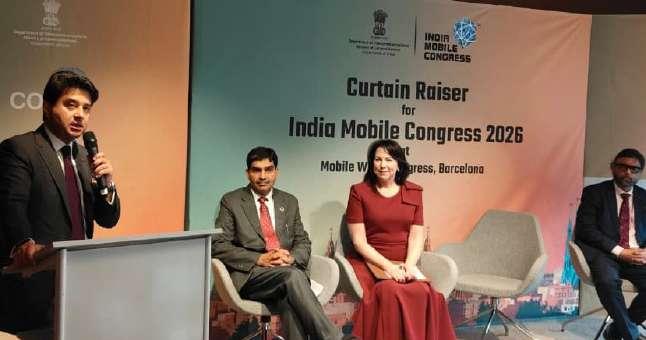
Taking on the world stage at MWC Barcelona, Jyotiraditya M. Scindia, Minister for Communications and Development in North East Region, Government of India, announced the dates for this year’s India Mobile Congress (IMC) 2026.
Organised by the Department of Telecommunications, Ministry of Communications, Government of India, and the Cellular Operators Association of India (COAI), IMC 2026 will bring together policymakers, industry leaders, global enterprises, startups, and investors from over 100 countries. The GSMA Board will participate in IMC 2026, lending its global expertise and strengthening the forum’s international reach.
IMC and GSMA also signed an MoU to strengthen strategic collaboration, enhance IMC 2026’s global positioning, deepen international industry participation, and align policy and technology dialogues with emerging global telecom priorities. The partnership will centre on curating high-level leadership engagements, facilitating global CEO and board-level participation, enabling cross-border knowledge exchange, and amplifying India’s role in shaping next-generation telecom, digital infrastructure, and connectivity frameworks.
Jyotiraditya M. Scindia, Minister for Communications and Development in North East Region, Govt. of India, said, “India stands as the second-largest telecom market globally, connecting over 1.2 billion citizens, with the fastest 5G rollout in the world, and
average mobile data consumption grown nearly 400 times in ten years. India is among a small group of nations that have developed its own indigenous, cloud-native 4G stack, upgradeable to 5G, positioning us not only as users of advanced networks but as builders of them. It is emerging as a trusted global source for telecom products, platforms, and solutions, and as a technology partner to the world, as a growth bed for innovation, and a global AI and deep-tech destination.”
Scindia further added, “India Mobile Congress also enters its 10th edition, enabling global launches, startup discovery, partnerships, and industry–government collaboration.
IMC’s journey mirrors India’s own digital journey from connectivity to intelligence and from access to impact and this edition will showcase AI-native networks, smart industries, sovereign platforms, startup innovation and global partnerships.”
This year marks a significant milestone as the platform completes a decade of shaping India’s digital and telecom ecosystem. The premier forum will bring together the brightest minds and leading innovators in the technology and telecommunications sectors. Announcing the dates, the Minister further unveiled that IMC
2026 is expected to attract over 150,000 attendees, with participation from over 300 exhibitors and partners, and to showcase over 1500 technology use cases.
This year’s edition aims to strengthen its position by showcasing use cases and innovations across Connectivity (5G & 6G), AI, Semiconductors, Electronics Manufacturing, Quantum Computing, Cybersecurity, Satellite communications, Deep-tech, Cleantech, Smart Mobility, Industry 4.0, and Enterprise transformation.
Julian Gorman, Head of Asia Pacific, GSMA, said, “India has firmly established itself as a global telecom leader, not only through the scale and speed of its 5G rollout, but through its ambition in 6G, AI, and digital innovation. Through our enhanced role at India Mobile Congress 2026, the GSMA is bringing its global network of operators and industry leaders together to deepen collaboration, share best practice and reinforce India’s position at the centre of the global digital ecosystem.”
The pioneering startup program of IMC, ASPIRE, is expected to witness participation from 400+ startups, more than 300 investors, incubators, accelerators, and VCs, over 700
Jyotiraditya M. Scindia, Minister for Communications and Development in North East Region, Govt. of India, at MWC Barcelona.
1-2-1 investor meetings, along with mentorship workshops, live pitches, networking, and partnerships. As IMC completes a decade, this edition will underscore its scale, institutional credibility, and sustained industry impact. The edition is expected to feature more outcome-driven enterprise and operator engagement, stronger buyer–seller interactions, and sharper startup-to-market linkages. IMC 2026 will also place greater emphasis on deploymentready technologies that are closer to adoption and scale, while global
participation will move towards more structured collaboration and long-term partnerships.
Abhijit Kishore, Chairman, Cellular Operators Association of India (COAI), said, “Right from its inception in 2017, India Mobile Congress has served as a crucial platform for dialogue, collaboration, and action, highlighting the pivotal role of technology and connectivity in nation building. It has grown significantly in stature and scale over the years and has become an active platform for knowledge sharing and thoughtful leadership. IMC stands
today as the largest digital technology forum in Asia, and a strategic partnership with GSMA also represents a quantum leap for this year’s edition.”
The last edition of the India Mobile Congress, held in October 2025, drew over 150,000 attendees over 4 days and featured participation from over 400 partners and exhibitors from over 100 countries. The event also showcased more than 1600 technology use-case scenarios and hosted more than 100 sessions, with over 800 distinguished global and Indian speakers participating.
SPOTIFY EXPANDS ARTIST AND FAN TOOLS WITH SONGDNA AND ARTIST PROFILE PROTECTION
New features aim to deepen music discovery for listeners in the UAE and Saudi Arabia while giving artists greater control over their identity on the platform.
Spotify has introduced two new initiatives designed to enhance music discovery for fans and strengthen profile control for artists. The launch of SongDNA and Artist Profile Protection reflects the platform’s broader effort to make music exploration more contextual while helping creators safeguard their identity in a crowded streaming environment.
Now available in beta in the UAE and Saudi Arabia for Premium Lite, Premium Standard, and Premium Platinum users, SongDNA offers listeners a richer way to engage with music. The feature reveals the network of writers, producers, collaborators, samples, interpolations, and covers connected to a track, turning a song into a deeper discovery experience.
Accessible through the Now Playing view in the Spotify mobile app, SongDNA enables users to tap into a dedicated card and explore the people and influences behind supported tracks. It is designed to show how artists, genres, and eras intersect, while also bringing more visibility to songwriters, producers, composers, and engineers.
Spotify said the feature is powered by information from artists and their teams, supplemented by communitysourced data. Eligible artist and label teams can also review and manage SongDNA elements through Spotify for
Artists. Mark Abou Jaoude, Spotify’s Head of Music for the Middle East, North Africa, Turkey, and Pakistan, said the feature is intended to make a song’s creative lineage easier for fans to explore while giving rightsholders and collaborators greater recognition. Alongside SongDNA, Spotify has also introduced Artist Profile Protection, an optional beta feature within Spotify for Artists that allows musicians to review, approve, or decline eligible releases before they appear on their profile. The feature addresses a growing issue across streaming platforms, where metadata errors, duplicate names, or misuse can result in music being placed
on the wrong artist page.
Once activated, artists receive an email when music is delivered to Spotify under their name and can decide whether to approve it. Approved releases appear as normal, while declined or unanswered releases do not show up on the artist’s profile. Spotify is also assigning artists a unique key that trusted providers can use to automatically pre-approve eligible releases.
Together, the two launches strengthen both discovery and trust on Spotify, giving fans more context around the music they love while offering artists more control over how their work is represented.
UAE ADVANCES WOMEN IN GENAI AS ACCESS GAP NARROWS
Strong completion rates and inclusive action position the UAE to lead the next phase of AI workforce transformation.
The conversation around women in artificial intelligence is shifting from capability to access. Fresh insights from Coursera’s latest report signal a decisive turning point, particularly in the UAE, where women are not only keeping pace in Generative AI (GenAI) learning but, in many cases, outperforming their male peers in course completion.
The challenge is no longer about whether women can succeed in AI, it is about whether they are given the opportunity to enter and thrive. In a nation that continues to position itself at the forefront of digital transformation, the UAE now stands at a pivotal moment, one where inclusive access to AI learning could unlock a powerful, future-ready workforce.
Dr. Alexandra Urban, Learning Science Research Lead at Coursera, said: “Across our data, we see a clear pattern: when women in the UAE gain access to GenAI learning, they not only keep pace with men — they often outperform them in completing courses. This tells us the issue is not capability or motivation, but access and opportunity. Closing the gap means making GenAI relevant to real jobs, easy to start, and visibly welcoming to
women at every stage of their careers. If those conditions are in place, the UAE has an enormous pool of motivated and resilient women ready to help shape the country’s AI-powered future.”
The data presents a compelling paradox as women in the UAE complete GenAI courses at rates 2.4% higher than men, yet they account for only 24% of total enrolments. Completion rates reflect commitment, capability, and follow-through with clear indicators that when women enter AI learning pathways, they succeed.
Globally, momentum is building as women’s participation in GenAI learning has risen from 32% in 2024 to 36% in 2025, with enterprise adoption accelerating even faster. The insight is clear: the gap is not one of performance, but of access.
The UAE’s commitment to bridging the gender gap in technology is commendable. A diverse and inclusive tech workforce is essential for driving innovation, especially in traditionally male-dominated fields like AI. While progress is evident, expanding opportunities for women in GenAI, equipping them with critical skills, and empowering them to lead in the digital
economy remains an urgent priority. The perspective reinforces a central theme emerging from both data and industry experience, when access is enabled, outcomes follow.
The UAE’s Strategic Advantage
The UAE enters this phase with a structural advantage. Women already represent a strong share of STEM graduates, supported by national initiatives that prioritise education, innovation, and inclusion.
This foundation places the country ahead of many global markets still building early-stage pipelines. In the UAE, the opportunity lies not in generating interest, but in accelerating participation and leadership.
Industry insights suggest that organisations making meaningful progress share a common trait— they act deliberately. Structured mentorship, clear career pathways, and leadership sponsorship are not optional initiatives but core strategies.
Equally important is recognising that representation is not only a workforce issue, it is a design imperative. When AI systems are developed without diverse perspectives, the risk of bias and misalignment increases, embedding inequality into the technology itself.
A significant shift is underway in how organisations view gender inclusion. The long-standing narrative of a “pipeline problem” is being replaced by a more accurate diagnosis:
a deployment challenge. The talent exists. The challenge is placing it where it matters.
Across AI ecosystems, spanning product development, cybersecurity, and infrastructure, diverse teams are proving to be more effective in solving complex problems.
Varied perspectives improve decision-making, strengthen governance, and enhance innovation outcomes.
Organisations leading this shift are
making deliberate choices by assigning women to high-impact transformation roles, increasing their visibility in strategic forums, and embedding sponsorship into leadership structures to ensure meaningful and sustained advancement.
Real progress is not driven by programmes alone but by consistent decisions about who is given access, visibility, and opportunity.
Designing AI Learning for Inclusion
The Coursera findings point to another critical factor—how AI education is designed. Programmes that are beginner-friendly, application-driven, and rooted in real-world use cases consistently attract higher female participation.
Courses that connect AI to tangible outcomes, such as productivity, creativity, and problem-solving, lower barriers to entry and broaden engagement. This aligns with broader industry observations. Accessibility is not simply about availability; it is about relevance. When learning pathways are intuitive and practical, participation
expands. For the UAE, this presents a strategic lever. Scaling inclusive AI education requires thoughtful design that meets learners where they are.
Beyond Skills: The Structural Reality
Access to learning is only part of the equation. Retention and advancement depend on workplace structures.
Several challenges continue to shape outcomes, including informal promotion pathways that often favour established networks over transparent merit, limited access to leadership roles where strategic decisions are made, and the unequal distribution of highimpact opportunities that are critical to career progression and long-term visibility.
Women often leave not due to lack of capability, but due to accumulated friction, subtle signals around recognition, inclusion, and progression.
A key distinction emerging from industry perspectives is the difference between mentorship and sponsorship. Mentorship supports development; sponsorship drives advancement by creating opportunities and advocating
for talent in decision-making forums. Transparent criteria, equitable systems, and flexible work environments are essential to sustaining participation.
‘Give to Gain’ in Action
The International Women’s Day theme, Give to Gain, resonates strongly within the GenAI narrative.
Across sectors, the message is consistent: inclusion must be intentional. This means investing in AI skills and certifications, providing women with access to leadership and transformation initiatives, embedding them in AI strategy, cybersecurity, and governance discussions, and establishing measurable accountability for diversity outcomes.
Equally important is cultural transformation. Inclusion must move beyond written policies and symbolic commitments into everyday decisionmaking environments, where women are trusted to contribute, challenge assumptions, and lead with authority. When organisations create cultures that offer genuine access, backed by trust and real influence, the gains extend far beyond representation
alone. Such environments tend to foster stronger innovation, build more resilient systems, and deliver a broader understanding of markets, customers, and the diverse communities technology is ultimately meant to serve.
The Leadership Imperative
A defining shift is taking place in leadership structures. Initiatives designed and led with lived experience are proving more effective in addressing systemic challenges. Leadership networks, sponsorship frameworks, and inclusive decisionmaking models are reshaping how organisations approach growth.
This shift is particularly critical in AI, where decisions made today will shape long-term societal outcomes.
Ensuring women are involved not only in execution but in design and governance will determine whether AI systems are inclusive, ethical, and aligned with real-world needs.
Building the Future Workforce
GenAI adoption is accelerating, and the future of work is becoming increasingly human-centric. Technical proficiency remains essential, but equally important are skills such as critical thinking, ethical reasoning, and contextual understanding, which enable professionals to apply AI responsibly, interpret outputs effectively, and make informed
decisions in complex real-world environments.
Women are engaging strongly in these areas, positioning themselves as key contributors to responsible AI deployment. This combination of technical and human capabilities represents a powerful advantage for the UAE as it builds its next-generation workforce.
ACROSS OUR DATA, WE SEE A CLEAR PATTERN: WHEN WOMEN IN THE UAE GAIN ACCESS TO GENAI LEARNING, THEY NOT ONLY KEEP PACE WITH MEN — THEY OFTEN OUTPERFORM THEM IN COMPLETING COURSES, DR. ALEXANDRA URBAN, LEARNING SCIENCE RESEARCH LEAD, COURSERA.
Dr. Alexandra Urban, Learning Science Research Lead, Coursera.
From Participation to Leadership
The UAE’s trajectory is clear as evidently the capability exists, commitment is visible and opportunity is significant. What remains is execution. Expanding access, removing structural barriers, and creating clear pathways to leadership will determine the next phase of progress.
The roadmap is clear and actionable: organisations must make AI learning accessible and relevant, build deliberate pathways into leadership roles, and align organisational systems with inclusive and measurable outcomes.
The UAE will not only close the gender gap in GenAI, it will set a global benchmark for inclusive innovation, if the necessary steps are taken to build future road map. The future of AI will not be shaped by technology alone, but by the diversity of those who build it. In that future, the UAE is well positioned not just to participate, but to lead.
JETBRAINS STRENGTHENS
MENA CHANNEL PUSH AS UAE ACCELERATES DIGITALFIRST SOFTWARE AGENDA
Nadia Rynskaya, Head of Business Development, MENA at JetBrains, outlines how AI-powered developer tools, strategic partnerships with DMCC and Ignyte, and a growing reseller ecosystem are positioning the company to support the UAE’s ambition to become a global software innovation hub.
International technology vendors are deepening their regional presence to support both enterprise and startup ecosystems. JetBrains, the creator of intelligent software development tools trusted by over 15 million users and 88 Fortune Global Top 100 companies , is expanding its MENA footprint with a channelled strategy focused on enhancing AI-driven productivity, developer upskilling and ecosystem partnerships. The company recently won the Reseller Middle East Partner Excellence Award 2025 in the “AI-Powered Developer Solution Vendor of the Year” category. With a portfolio of over 30 development tools — includes awardwinning IDEs like IntelliJ IDEA and PyCharm, as well as the JetBrains AI-powered coding assistant, coding agent Junie — JetBrains is aligning closely with national transformation agendas and the region’s fastgrowing software community. Through strategic collaborations with innovation hubs such as DMCC and Ignyte, the company is offering startup programmes, workshops and education initiatives designed to strengthen local capability.
Nadia Rynskaya, Head of Business Development, MENA at JetBrains, spoke to Sandhya D’Mello, Editor,
CPI Media Group, on AI’s role in modern development workflows, the importance of the reseller channel, and why the Middle East is emerging as one of the most dynamic software markets globally.
Interview excerpts:
How do you view the UAE’s ambition to become a digitalfirst nation?
The UAE’s transformation into a digital-first nation is truly remarkable. What is particularly impressive is the region’s shift from being a buyer of technology to becoming a creator of technology. The future of the UAE, Saudi Arabia, and the wider MENA region is being powered by code. We see global talent coming to the region to build and innovate, and that signals a strong future as a professional software development hub. At JetBrains, this aligns closely with our own heritage — growing organically for over 26 years through product excellence to become a global leader in developer tools.
How is JetBrains supporting the region beyond simply selling software tools?
We do not just build tools; we deliver an exceptional developer experience.
In the UAE, we want to contribute to national upskilling initiatives through JetBrains Academy, workshops, and educational content. There is a strong appetite for knowledge here, and we want to actively participate in building the next generation of developers.
What role do partnerships with DMCC and Ignyte play in your regional strategy?
These partnerships are strategic synergies. Through the DMCC AI Centre alliance, we ignite the startup ecosystem by offering six months of free tool access and 50% discount for the following five years. Our partnership with Ignyte allows founders to gain streamlined access to our world-class development environment. Early-stage companies are highly cost-sensitive, and this helps them scale faster. Beyond pricing, we are collaborating on workshops, challenges, and programmes in software development, AI, and FinTech.
How is JetBrains integrating AI into its developer tools? AI is fully embedded into our integrated development environments (IDEs). Powered by Mellum, our focal LLM purpose-built for coding, JetBrains AI provides intelligent
Nadia Rynskaya, Head of Business Development, MENA, JetBrains.
IN THE UAE, WE WANT TO CONTRIBUTE TO NATIONAL UPSKILLING INITIATIVES THROUGH JETBRAINS ACADEMY, WORKSHOPS, AND EDUCATIONAL CONTENT.
support directly in the workflow. Additionally, our smart coding agent, Junie, acts as a reliable collaborator that understands specific project architecture. It helps developers execute both routine and complex tasks, saving approximately five hours per week so they can focus on what matters most.
Do you believe AI will replace software developers?
No. Our philosophy is that AI empowers, not replaces. Software development requires creativity and human judgment. Interesting work remains for humans, while routine tasks are handled by AI agents. This reduces context switching, improves focus, and ensures that development workflows are faster, more productive, and enjoyable.
Which sectors in the UAE are driving software innovation?
Government digital transformation is a major driver, especially as the UAE integrates AI across services, education, and R&D. FinTech remains a strong area where we are highly active. We also see telecommunications companies building digital ecosystems that require the scalable, compliant, and secure software delivery our tools provide.
How important is the reseller channel to JetBrains in the region?
The reseller channel is a critical catalyst for value delivery. We offer our 130+ resellers more than just a software portfolio; we provide a high-margin framework to accelerate customer success. Resellers are strategic consultants who move beyond the license to provide specialised expertise in complex setups, pipeline configurations, and migrations.
Why is the partner ecosystem strategically important for JetBrains globally?
While we have 2,800 employees, our partners enable us to equip developers worldwide. Our UAE presence means resellers have a direct local partner to help them navigate high-stakes
digital transformation projects with the speed the market demands. We also collaborate with global giants like Google, OpenAI, Microsoft, Anthropic, and AWS to ensure our partners always offer state-of-the-art technology.
What distinguishes successful resellers in this market?
Successful resellers are relationshipdriven and deeply understand their clients’ technical needs. In the UAE, we see a strong hunger for education and new technology — not only among developers but also within the channel community. The most effective partners are those who continuously learn and bring the best value to their customers.
Can you outline JetBrains’ global footprint and product portfolio?
JetBrains is headquartered in Amsterdam. The company operates across 15 global offices, and we are expanding our presence in the UAE. Our portfolio includes over 30 products, such as award-winning IDEs like IntelliJ IDEA and PyCharm, productivity-boosting team tools like YouTrack and TeamCity. We are also
the creators of Kotlin, a cross-platform language used by more than 2.5 million developers a year.
What makes JetBrains commercially attractive for resellers?
We deliver a superior developer experience that significantly reduces development costs and boosts revenue. With 88 of the Fortune Global Top 100 relying on us, including names like Visa, NASA, and Tesla, our tools make software delivery scalable, compliant, and secure. This creates a measurable ROI for clients and a stable, high-value business for our partners.
What advice would you give organisations selecting a technology partner in the AI era?
Choose a partner that focuses on responsible innovation and measurable efficiency. In the AI era, you need a collaborator who ensures AI-generated code meets high security and quality standards before it goes to production. At JetBrains, we say: “Make it happen. With code.” Look for a partner that empowers you to build the region’s future.
STABLECOINS AND TOKENISATION SHAPE DIGITAL ISLAMIC FINANCE’S NEXT PHASE, SAYS FASSET OFFICIAL
Rafiza Ghazali, Managing Director, Consumer Banking at Fasset, explains how stablecoin-based settlement, tokenised real-world assets, and embedded Shariah governance are shaping the next phase of Islamic finance.
Islamic digital banking is entering a new phase as financial institutions explore how emerging technologies such as blockchain, stablecoins, and tokenisation can support more transparent and scalable financial systems while remaining aligned with Shariah principles. Fasset is among the companies seeking to bridge this gap by embedding compliance and governance directly into its digital infrastructure.
Rafiza Ghazali, Managing Director, Consumer Banking, Fasset, shared insights with Sandhya D’Mello, Technology Editor, CPI Media Group, about how the company is approaching the evolution of Islamic digital banking.
The discussion covers the regulatory, technological, and operational considerations behind building a stablecoin-based Islamic banking platform, the lessons emerging from Malaysia’s digital banking model, and the role governance, transparency, and technology will play in strengthening trust across the global Islamic finance ecosystem.
Interview Excerpts:
How is Fasset redefining Islamic digital banking beyond traditional Shariah compliance?
Traditional Islamic banking often treats Shariah compliance as a product-level validation step applied after structuring. At Fasset, we embed Shariah into the banking
infrastructure itself: the rails, ledgers, and controls are designed from the outset to exclude interestbased mechanics and enforce permitted uses of funds. Our stablecoin-based settlement layer provides continuous visibility of cash flows and reserve or asset backing, reducing ambiguity and strengthening traceability. This enables real-time Shariah governance across payments, treasury activity, and investment deployment, with rule-based controls that can prevent non-compliant routing, flag interestlinked payment components, and maintain auditable evidence for ongoing oversight.
Coupled with this, our tokenised products are structured around realworld utility, ensuring assets remain linked to tangible value. By embedding compliance across more than 50 banking corridors, Fasset supports cross-border scale without weakening ethical or regulatory standards, creating the foundations to serve markets of up to 2.5 billion global users.
What were the key regulatory, Shariah, and technology challenges in building a stablecoin-based Islamic bank?
On the regulatory front, the central challenge was translating the speed of blockchain into controls that meet bank-grade expectations. Supervisors are primarily concerned with the ability to demonstrate consistent fiscal discipline over time. This required
clear accountability for customer funds, rigorous reconciliation processes, resilient incident response, and well-defined governance over third-party dependencies — supported by auditability that withstands sustained scrutiny.From a Shariah perspective, the challenge was fundamentally operational. The real test lies in ensuring that product behavior, customer disclosures, and exception handling remain faithful to Islamic principles across every edge case. Technologically, this required integrating modern blockchain rails into traditional banking expectations while maintaining reliability, security, and predictable outcomes at scale.
From your experience, what differentiates digital banks that successfully scale from those that struggle?
Digital banks that successfully scale are the ones that solve real, everyday customer pain points intuitively. They focus on simple onboarding, a clear value proposition, and a product people use repeatedly effortlessly without being “pushed.” The winners, especially given that they are new to the markets, make an effort to build trust through reliable service and strong risk controls, and grow through clear benefits rather than short-term campaigns. Digital banks that struggle usually overcomplicate the experience and lack clear value. As a result, they struggle to retain users who sign up but don’t remain active, making growth costly and difficult to sustain.
How can Malaysia’s Islamic digital banking model influence markets in the GCC and wider emerging economies?
Malaysia is a prime example of how digital Islamic banking can gain traction when modern technology is paired with strong regulatory and Shariah foundations. The licensing of AEON Bank as a fully Islamic digital bank, alongside incumbents like Bank Islam launching digital-first platforms such as Be U, demonstrates how new and established players can modernise without diluting supervisory or Shariah standards. For regulators advancing digital assets and tokenisation agendas, this exemplifies
how digital delivery and institutional trust can evolve together. Malaysia, therefore, offers a practical reference for markets looking to modernise financial systems; early regulatory engagement combined with disciplined execution creates durable foundations for growth.
What will be the biggest driver of trust in Islamic finance: governance, transparency, or technology?
Governance is the foundational driver of trust, shaping how systems behave as they scale. At Fasset, we now process more than US$12 billion in annualised transaction volume
and serve an institutional user base that grew tenfold in 2025. Operating at this level demands consistent approaches to risk structuring and decision-making. This same discipline has guided strategic decisions such as our acquisition of DAO PropTech, which added proven real-world asset tokenisation capabilities to the platform. While technology delivers reach and velocity, governance ultimately determines whether scale strengthens confidence or introduces fragility. Nowhere is this more evident than in Islamic finance, where trust is built through repeatable, principled execution over time.
INDUSTRIALISATION OF RANSOMWARE RESHAPES CISO PRIORITIES, PARTNER ROLE, SAYS HALCYON
Jamal Al-Nabulsi outlines how the industrialisation of ransomware is reshaping CISO priorities, elevating partner responsibility, and creating a new growth opportunity for specialised, margin-protected cybersecurity ecosystems across METAIP.
Ransomware has transformed into a structured, servicedriven criminal economy, forcing a fundamental shift in how organisations approach cyber defence. Security is no longer confined to protecting a network perimeter; endpoints, identities, and data now sit at the centre of board-level risk discussions. In this environment, the role of the channel is expanding beyond infrastructure
deployment to strategic risk advisory.
Jamal Al Nabulsi, Regional Channel Manager for the Middle East, Turkey, Africa, India, and Pakistan, at Halcyon, shared insights with Tahawultech.com on how the industrialisation of ransomware is reshaping CISO priorities, where traditional security investments require specialised reinforcement, and how partners can position themselves as resilience experts.
The discussion also explores Halcyon’s complementary, non–ripand-replace approach, its marginprotection model built on controlled distribution, and a strong focus on data sovereignty and trust-led channel alignment across the region.
PARTNERS CAN INTRODUCE A NEW CATEGORY OF DEFENSE THAT DIRECTLY ADDRESSES
THE CUSTOMER’S TWO BIGGEST PRIORITIES: MAXIMUM UPTIME AND THE PROTECTION OF PROPRIETARY DATA.
Interview Excerpts
Ransomware is being described as the new perimeter — what does this shift mean for partners engaging today’s CISOs? As attackers bypass the static network edge and target users and endpoints directly, CISOs are facing an entirely new class of adversary. The challenge is that ransomware is no longer just malware; it is a highly organised economy. Cybercrime groups operate with corporate-level structures, featuring specialised divisions for initial compromise, vulnerability exploitation, and command-and-control, alongside ransom negotiators with advertised SLAs and dedicated moneylaundering arms. This ‘Ransomwareas-a-Service’ model is a primary reason we’ve seen a 104% increase in attack success rates over the past two years. For our partners, this shift represents a pivotal opportunity. It means moving beyond selling IT infrastructure to acting as true risk consultants. Partners are perfectly positioned
Jamal Al Nabulsi, Regional Channel Manager for the Middle East, Turkey, Africa, India, and Pakistan, Halcyon.
to educate their customers on this evolving threat landscape and advise them on the specialised defenses required to combat such a highly structured adversary.
Where is the traditional security stack failing, and how can the channel position itself as the resilience expert?
It’s not so much that the traditional stack is failing; it continues to be a foundational investment. The struggle arises when those legacy tools are expected to stop a threat they were never designed to defeat. No single solution can cover every security need, which is why a multi-layered defense is critical. The channel is the crucial link in evaluating a customer’s current posture and identifying these specific capability gaps. We are seeing incredible success with partners who conduct Vulnerability and Penetration Testing (VAPT) for their clients. By identifying where the traditional stack leaves endpoints exposed to encryption, partners can build robust, tailored recommendations, positioning Halcyon not just as a product but as a critical enhancement to the customer’s overall operational resilience.
You emphasise profitability through specialisation — how does Halcyon protect partner investment while avoiding over-distribution?
Building channel ecosystems across
this region for over two decades proves that long-term success requires a strict win-win philosophy. Our vision is not to recruit every reseller in the market, but to forge deep alignments with a select group of dedicated cybersecurity experts. We offer these specialised partners an advanced, highly efficient solution to a board-level business problem, positioned in a lowcompetition segment of the market. By strictly managing our distribution and avoiding channel saturation, we protect our partners’ margins and ensure that the time and technical resources they invest in Halcyon yield high-value and predictable returns.
What makes your antiransomware platform fundamentally different from existing EDR and XDR solutions in the market?
Halcyon operates as the ultimate last line of defense. Our objective is not to replace a customer’s existing EDR or XDR investments, but to work in seamless harmony with them. When a sophisticated attack bypasses those primary security layers, Halcyon steps in. We protect the endpoint through a combination of static and cloud analysis, actively blocking encryption, preventing data exfiltration, and halting lateral movement. Crucially, we also offer the ability to automatically decrypt the environment if an attack ever reaches that stage. This technology is backed by a 24x7x365 managed service manned by ransomware experts. For this region, a massive differentiator is our commitment to data sovereignty, highlighted by our local UAE cloud offering for regional
OUR OBJECTIVE IS NOT TO REPLACE A CUSTOMER’S EXISTING EDR OR XDR INVESTMENTS, BUT TO WORK IN SEAMLESS HARMONY WITH THEM.
customers, with further local deployments planned soon.
How does your complementary, non–rip-and-replace approach simplify the sales cycle for resellers across METAIP?
Convincing a CISO to rip out and replace a foundational security solution, one they have already spent countless hours evaluating, financing, and training their teams on, is an incredibly high-friction sales motion for any partner. Our complementary approach completely changes that dynamic. Partners can introduce a new category of defense that directly addresses the customer’s two biggest priorities: maximum uptime and the protection of proprietary data. Because Halcyon layers on top of the existing stack, the conversation shifts from a complex infrastructure overhaul to a high-value, rapid-deployment risk mitigation strategy. It simplifies the sales cycle and immediately elevates the partner as a strategic consultant solving a critical vulnerability.
In a trust-driven region, what concrete measures are you putting in place to ensure clear rules of engagement and predictable channel alignment?
Trust is the absolute foundation of business in this region, and trust is built on predictability. We maintain an honest, two-way line of communication with our ecosystem, ensuring that our rules of engagement are strictly followed, no exceptions, no surprises. This is structurally enforced through our partner program, which relies on a robust deal registration process to guarantee margin protection and preferential pricing for partners who drive opportunities. Beyond the platform, we are heavily invested in field alignment, ensuring that both our sales and technical teams are constantly communicating, collaborating, and building rocksolid relationships with their partner counterparts.
Give to gain. Powering women in tech Gala Dinner Event
Dubai April 2026 6:00 PM onwards
In alignment with International Women’s Day 2026, TahawulTech.com, organised by CPI, invites you to the Women in Technology Forum & Awards 2026 — a flagship platform dedicated to advancing leadership, inclusion, and impact across the technology ecosystem.
The forum brings together CEOs, technology decision-makers, innovators, policymakers, and trailblazers to explore how organisations that actively invest in women — through mentorship, leadership pathways, skills development, and visibility — gain stronger innovation, resilience, and long-term growth.
Whether you are a technology leader, changemaker, or organisation committed to shaping a more inclusive digital future, this forum offers a powerful space to contribute, connect, and lead.
We look forward to welcoming you to Dubai this April as we come together to Give to Gain.
OFFICIAL PUBLICATIONS
For more information about the event and nomination details, please visit the event website below :https://www.tahawultech.com/women-in-tech/2026/
75% OF FIRMS TO BOOST GRC INVESTMENTS AS FRAGMENTED AI GOVERNANCE AMPLIFIES ENTERPRISE RISK, SAYS OPTRO REPORT
New study by Optro finds nearly three-quarters of organisations expect to increase GRC spending, with 43% prioritising investment in AI governance solutions.
With 85% of enterprises reporting that artificial intelligence (AI) is now central to their business strategy, deployed across multiple functions or embedded in core operations, new research from Optro (formerly AuditBoard) reveals a deeply concerning structural mismatch at the heart of enterprise AI governance. According to the study, governance frameworks originally designed to oversee technology systems are now being applied to human behaviour, creating gaps that leave the most significant AI risk surface in organisations largely unmanaged.
The findings from Optro’s 2026 Risk Intelligence Report, “The AI Oversight Gap: Adoption is Scaling. Governance Controls Aren’t,” suggest that while enterprises are accelerating AI adoption, their greatest risk exposure does not lie in the models powering AI systems but in how employees interact with them. More than a third of respondents (34%) cited staff inputting sensitive data into AI tools as the primary driver of risky AIusage behaviour. A further 21% cited insufficient employee training rather than malicious intent, while another 21% highlighted the pressure to move quickly as a major contributor to unsafe AI use.
This behavioural risk is compounded by structural fragmentation in
governance. Responsibility for AI oversight is spread widely across organisations, meaning no single function has clear ownership. The IT department holds the largest share of responsibility at just 25%, followed by risk management at 18%, crossfunctional governance arrangements at 17%, and dedicated AI governance teams at only 10%.
The diffusion of ownership carries through to incident response. When AI-related issues arise, responsibility is shared between risk, compliance and internal audit functions (29%), executive leadership (27%), and IT and engineering teams (24%), with the remainder distributed across other departments. Even the authority to shut down an AI system is spread across multiple functions, including leadership, risk, IT, compliance and security, leaving many organisations without a clearly defined operational “kill switch”.
The severity of this governance divide is becoming increasingly significant as AI incidents continue to rise. Over the past 12 months, 40% of organisations reported inaccurate AI outputs, while 33% experienced policy violations, and 28% received customer complaints linked to AI systems.
“AI adoption is moving faster than many organisations’ ability to fully understand and govern how it’s being used,” said Kristin Colburn, Leader of Data and AI Governance at Dayforce. “To keep pace, governance needs
to evolve from reactive and become proactive oversight to a continuous, integrated capability that helps organisations better understand AI use across the enterprise and manage the risks that come with it.”
Despite these challenges, the research offers reason for optimism. Nearly three-quarters of respondents expect their governance, risk and compliance technology budgets to increase over the coming year, with top investment priorities including AI governance solutions (43%), regulatory compliance tools (41%), and upgrades to existing GRC platforms (38%).
The report also highlights what organisations view as the most valuable capabilities in future AI governance solutions, including integration with GRC platforms, automated risk assessments, regulatory mapping and tracking, and third-party AI assessments.
“Governance should not be viewed as a barrier to innovation, but as foundational for enabling organisations to deploy high-integrity AI,” said Guru Sethupathy, GM of AI Governance at Optro. “Our research shows when monitoring and oversight are integrated into the AI lifecycle, organisations move faster and more securely. As agents increasingly perform complex tasks, the core work of the organisation becomes the oversight and governance of those AI agents.”
Guru
GOVERNANCE SHOULD NOT BE VIEWED AS A BARRIER TO INNOVATION, BUT AS FOUNDATIONAL FOR ENABLING ORGANISATIONS TO DEPLOY HIGH-INTEGRITY AI
Sethupathy, GM of AI Governance, Optro.
UAE MARKETERS LEAD IN AI TRUST BUT STRUGGLE WITH DATA SILOS, NEW SALESFORCE RESEARCH FINDS
85% of UAE marketers trust AI to respond to customers versus 81% globally; yet 78% struggle to access customer context needed for personalised engagement.
Salesforce, the world’s #1 AI CRM, released findings from the UAE as part of its Tenth Edition State of Marketing Report. The research, based on responses from 100 marketing decisionmakers across the UAE, reveals a market that is embracing AI with greater confidence than global counterparts, yet facing significant data integration challenges that limit
personalisation effectiveness.
The UAE findings reveal a marketing community that has moved rapidly to embrace artificial intelligence. Eighty-six percent of UAE marketers say AI is raising customer expectations, matching the global average. Eighty-five percent of UAE marketers trust AI to respond to customer inquiries, significantly higher than the 81% global average. Seventy-three percent of UAE
Mohammed
SVP & GM, Salesforce Middle East and Africa.
marketers confess to running generic campaigns, compared to 84% globally, indicating stronger personalisation efforts.
Additionally, only 41% of UAE marketers have not figured out how to adapt their strategies to AI, compared to 48% globally, showing faster adaptation to the new technology landscape.
Despite their AI enthusiasm, UAE marketers face a critical challenge
Alkhotani,
that is even more pronounced than the global average: accessing the customer context needed for meaningful engagement. While 69% of marketers globally struggle to respond promptly to customers, this figure jumps to 78%.
This gap between AI ambition and data reality represents the central challenge for UAE marketing organisations. The research identifies siloed data across channels as the top barrier to AI-driven personalisation, followed by lack of overall strategy and difficulty scaling quality control.
The research highlights a fundamental shift in customer expectations. While 83% of marketers globally report that customers now expect two-way conversations, this figure stands at 76% in the UAE. However, the ability to deliver on this expectation remains limited.
When comparing UAE marketers to their global counterparts, several patterns emerge. Seventy-three percent of UAE marketers run generic campaigns compared to 84% globally, indicating stronger personalisation efforts in the region. Seventy-eight percent of UAE marketers struggle to respond promptly to customers versus 69% globally, showing a more pronounced data access challenge.
Eighty-five percent of UAE
marketers trust AI to respond to customers compared to 81% globally, reflecting higher confidence in AI capabilities. Both regions show identical rates of 86% regarding AI raising customer expectations.
Regarding customer expectations for two-way conversations, 76% of UAE marketers report this trend compared to 83% globally. When it comes to keeping up with changing customer behaviors, 61% of UAE marketers struggle versus 64% globally, showing slightly better alignment. Finally, 41% of UAE marketers have not adapted their strategies to AI compared to 48% globally, indicating faster adaptation in the UAE market.
The data reveals that UAE marketers are slightly more confident in keeping up with changing customer behaviors, but the gap between customer expectations and organisational capability remains significant across both markets.
“The UAE has always been at the forefront of embracing transformative technologies, and our marketing community’s confidence in AI reflects this forward-thinking mindset. However, the research clearly shows that technology adoption alone is not enough. The marketers who will win in this new era are those who can unify their data to deliver the personalised, conversational experiences that customers increasingly demand. Data is the foundation upon which all AI success is built,” said Mohammed Alkhotani, Senior Vice President and General Manager, Salesforce Middle
THE UAE HAS ALWAYS BEEN AT THE FOREFRONT OF EMBRACING TRANSFORMATIVE TECHNOLOGIES, AND OUR MARKETING COMMUNITY’S CONFIDENCE IN AI REFLECTS THIS FORWARD-THINKING MINDSET. MOHAMMED ALKHOTANI, SVP & GM, SALESFORCE MIDDLE EAST AND AFRICA.
East and Africa.
The research underscores how AI is fundamentally changing the marketing landscape. Half of all Google searches now feature AI summaries that displace traditional results. During the recent holiday season, AI and AI agents drove $262 billion in global sales, representing 20% of global orders and signaling a significant shift in how people discover and shop.
The top AI use cases in UAE marketing include personalising content, generating copy, and predicting campaign performance or ROI. However, significant barriers to personalisation remain, including lack of overall strategy, siloed data across channels, and difficulty scaling quality control.
The UAE data reveals several distinctive characteristics when compared to global trends. In terms of running generic campaigns, the UAE shows 73% compared to 84% globally, indicating better personalisation efforts in the UAE market. For trust in AI for customer response, the UAE demonstrates 85% versus 81% globally, reflecting higher AI confidence in the region.
When examining the challenge of responding promptly to customers, the UAE faces a greater hurdle at 78% compared to 69% globally, suggesting a more pronounced data integration challenge.
Regarding adaptation to AI, the UAE shows 41% have not adapted versus 48% globally, indicating faster adaptation in the UAE market.
For keeping up with changing customer behaviors, the UAE shows 61% struggling compared to 64% globally, suggesting slightly better alignment with market dynamics.
The analysis reveals that UAE marketers are ahead of the curve in AI trust and adaptation, but face similar or greater challenges in data integration and customer responsiveness. This suggests that while the UAE market is quick to adopt new technologies, the foundational data infrastructure may need additional investment to fully realise AI’s potential.
ONLY 7% OF ENTERPRISES SAY THEIR DATA IS COMPLETELY READY FOR AI, SAYS REPORT
AI adoption accelerates, but 73% say their organisation struggles with AI data preparation, highlighting need for unified, governed data across hybrid environments
Cloudera, the only company bringing AI to data anywhere, announced findings from a new global study conducted by Harvard Business Review Analytic Services with Cloudera, revealing that while enterprises recognise AI’s transformative potential, most remain unprepared to operationalise it due to persistent data readiness challenges. In the Middle East, where governments and businesses are aggressively driving AI adoption as part of digital transformation agendas, the gap between ambition and readiness is particularly pronounced. Despite strong investments in AI technologies, many organisations are still grappling with fragmented data systems, governance challenges, and skill shortages, which slow down the translation of AI potential into operational impact.
The report, Taming the Complexity of AI Data Readiness, surveyed more than 230 members of the Harvard Business Review audience, all involved in their organisation’s AI data decisions, in October 2025, and revealed a clear imbalance in enterprise AI progress. While organisations are accelerating AI initiatives, their underlying data foundations are not keeping pace. Only 7% say their organisation’s data is completely ready for AI adoption, and more than one-quarter (27%) report their data is not very or not at all ready, highlighting a growing gap between AI ambition and operational readiness.
Data Quality Perception Issues
Despite widespread AI experimentation, foundational data issues remain.
Seventy-three percent of respondents say their organisation should prioritise AI data quality more than it currently does, and an equal percentage report that their organisation has found the processing and preparing of data for AI to be challenging.
The biggest challenges organisations face in preparing data for AI start with siloed data and difficulties in integrating multiple data sources, cited by 56% of respondents. This is followed by the lack of a clear data strategy, highlighted by 44%, which suggests many businesses are still struggling to build a strong foundation for AI adoption. Data quality and bias issues remain another major concern for 41%, while 34% point to regulatory constraints on data use as a significant barrier. Together, these findings show that both technical and governancerelated issues continue to slow effective AI readiness.
Leadership Wants a Data Strategy
Enterprise leaders increasingly recognise that AI is no longer a future initiative; it is a present operational mandate. Yet most organisations are still formalising the data foundations required to scale it responsibly and effectively.
While only 23% say their organisation has an established data strategy for AI adoption, more than half (53%) are actively developing one. Protecting sensitive data and privacy
(59%), data quality (46%), and data governance (41%) rank as the most critical components of those strategies. Innovation may capture headlines, but durable competitive advantage depends on modern, governed data architectures capable of operating seamlessly across multi-cloud, data center, edge, and hybrid environments. At the same time, expectations for agentic AI are accelerating, reflecting a shift from experimentation to operational reinvention.
Nearly two-thirds (65%) of respondents expect many of their organisation’s business processes will be augmented or replaced by agentic AI in the next two years. 47% say their organisation believes agentic AI can solve its data quality issues.
As organisations shift from applications to intelligent agents, scalable data pipelines, consistent governance, and cloud-like experiences across environments are becoming increasingly essential.
“Across the Middle East, organisations are accelerating AI adoption as part of broader national digital transformation agendas. However, the challenge many enterprises face today lies in ensuring their data environments are ready to support AI at scale. Fragmented systems, evolving governance frameworks, and the complexity of operating across hybrid and multicloud environments continue to slow progress. As AI capabilities advance, particularly with the emergence of agentic systems, organisations will need to prioritise trusted data,
Ahmad
strong governance, and modern data architectures to translate AI ambition into measurable business impact,”
Ahmad Shakora, Group Vice President, South- META, Cloudera Middle East.
Today’s enterprises operate in complex, distributed data estates spanning clouds, data centers and edge environments, yet mission-critical data often remains in on-prem environments due to sovereignty, security, cost, and
compliance requirements. Bridging this divide requires architectures that can securely operationalise AI across hybrid environments without forcing data movement or compromising control. Cloudera addresses this challenge by converging public cloud and enterprise data centers to deliver a unified, cloud experience in hybrid environments across the entire data estate. Built on an open-source foundation, it powers
AI across more than 25 exabytes of enterprise data worldwide. “AI is only as powerful as the data behind it,” said Sergio Gago, Chief Technology Officer at Cloudera. “To move from pilots to production, organisations need secure access to 100% of their data, anywhere it resides. Bringing AI to data instead of moving data to your AI is what separates experimentation from enterprise-scale impact.”
Shakora, Group Vice President, South- META, Cloudera Middle East.
ZAIN OMANTEL INTERNATIONAL AND ZONG PARTNER TO EXPAND MIDDLE EAST–PAKISTAN
INTERCONNECT AND ROAMING
CORRIDOR
ZOI will provide mobility services that simplify cross-border voice and roaming operations as traffic volumes grow.
Zain Omantel International (ZOI) and Zong, a subsidiary of China Mobile Pakistan, have partnered to expand voice interconnect and roaming services between the Middle East and Pakistan. The partnership builds on an existing interconnect relationship where ZOI carries Zain Group and Omantel retail Pakistan traffic for Zong. The two companies will grow their cooperation across voice and mobility services and move toward consolidating roaming under a single group framework to simplify operations and strengthen commercial alignment across the corridor.
Pakistan is one of South Asia’s largest telecommunications markets, with more than 200 million mobile subscribers nationwide. Zong serves over 53 million subscribers and operates one of Pakistan’s most extensive 4G networks. Its parent company, China Mobile, is the world’s largest mobile operator by subscriber base, serving over one billion customers globally and operating one of the industry’s most expansive international network infrastructures.
“This partnership reflects our focus on quality mobility services and enabling customers growth,” said Sohail Qadir, Chief Executive Officer at ZOI. “Pakistan is a strategically important market for the Gulf region. By aligning with Zong and the wider China Mobile ecosystem, we are strengthening service quality, simplifying governance and creating a scalable model for voice and mobility services across one of the region’s highest volume routes.”
ZOI is an international carrier that provides unified, AI-ready digital
infrastructure in MENA and across the world. It provides international voice, roaming, IP and capacity services to carriers, hyperscalers, mobile network operators, neoscalers and a range of network-centric businesses. ZOI carries more than 10 billion international voice minutes across 200 roaming countries. It has the number one ranked ASN IP network in the Middle East and investments in more than 22 subsea cable systems globally.
“ZOI is a trusted partner that understands our operational and commercial priorities,” said Mr Khurram Ishaq, Head of International Business at Zong. “It delivers consistent, high quality mobility services across
the Middle East and provides the reliability and responsiveness we need to support our international growth. This partnership gives us confidence that our customers benefit from stable interconnect performance and a framework built for scale.”
Traffic between the Middle East and Pakistan continues to grow, driven by retail demand and crossborder mobility. ZOI and Zong will standardise how they manage voice and roaming traffic across the Middle East–Pakistan route. They will simplify interconnect processes, align roaming governance, and improve service stability as volumes continue to grow.
Khurram Ishaq, Head of International Business at Zong and Sohail Qadir, CEO, ZOI.
TECH MAHINDRA, FORTINET TO DELIVER MANAGED SASE SOLUTIONS FOR SECURED DIGITAL TRANSFORMATION
Tech Mahindra, a leading global provider of technology consulting and digital solutions to enterprises across industries, announced a partnership with Fortinet, the global cybersecurity leader driving the convergence of networking and security, to deliver a Managed Secure Access Service Edge (SASE) solution. The joint solution aims at enabling secure and scalable digital transformation for enterprises globally.
The partnership combines Tech
The partnership helps enterprises modernise networks with integrated security for hybrid and cloud-first environments. AS ENTERPRISES ACCELERATE CLOUD ADOPTION AND EMBRACE HYBRID WORK, THE BURDEN OF FRAGMENTED NETWORK ARCHITECTURE AND OPERATIONAL COMPLEXITY HAS BECOME A CRITICAL HURDLE. ABHISHEK MALHOTRA, GLOBAL BUSINESS HEAD - NETWORK SERVICES, TECH MAHINDRA.
Mahindra’s advisory, transformation, and managed services covering networking and security, with the Fortinet Unified SASE solution to help enterprises modernise and secure their networks in an increasingly hybrid and cloud-driven environment.
The Managed SASE solution integrates secure Software-Defined Wide Area Network (SD-WAN), Zero Trust Network Access (ZTNA), and advanced threat protection into a unified architecture, enabling seamless connectivity and robust security across cloud, Software as a Service (SaaS), and on-premises environments. The solution is also supported by 24×7 security operations centers, proactive threat hunting, and AI-driven intelligence to deliver continuous
protection across the enterprise network.
Abhishek Malhotra, Global Business Head - Network Services, Tech Mahindra, said, “As enterprises accelerate cloud adoption and embrace hybrid work, the burden of fragmented network architecture and operational complexity has become a critical hurdle. Through our partnership with Fortinet, Tech Mahindra is addressing this challenge by delivering a unified Managed Secure Access Service Edge (SASE) solution. It integrates secure connectivity, zero-trust network access and advanced protection into a single, scalable framework, empowering organisations to modernise their networks and drive business agility with confidence.”
In addition to strengthening security, the joint solution delivers measurable business outcomes, including reduced dependence on costly Multiprotocol Label Switching (MPLS) networks, lower total cost of ownership, and scalable network expansion across branch offices, edge locations, and remote workforces. Centralised policy management and a consistent user experience of the solution further simplify operations while maintaining strong security controls.
Landon Scott, Vice President, U.S. Channel Sales, Fortinet, said, “Enterprises are looking to simplify
ENTERPRISES ARE LOOKING TO SIMPLIFY INFRASTRUCTURE, LOWER OPERATIONAL COSTS, AND SECURELY SUPPORT HYBRID WORK.
LANDON SCOTT, VICE PRESIDENT, U.S. CHANNEL SALES, FORTINET.
infrastructure, lower operational costs, and securely support hybrid work. Our partnership with Tech Mahindra delivers a managed Unified SASE solution that replaces fragmented architectures with integrated networking and security, helping customers achieve significant efficiency gains while strengthening their security posture.”
The partnership further strengthens Tech Mahindra’s end-to-end Managed Network Services offering for global customers, enabling network modernisation, enhanced security posture, and cost optimisation. Together, Tech Mahindra and Fortinet make it easier to modernise networking and enhance protection for today’s hybrid environments and distributed workforce.
SENTINELONE, CLOUDFLARE TO DELIVER REAL-TIME THREAT DETECTION AND AUTOMATED RESPONSE FOR ENTERPRISES
SentinelOne’s Singularity AI SIEM integrates Cloudflare Logpush telemetry to strengthen enterprise security posture.
SentinelOne, the AI-native cybersecurity leader, and Cloudflare Inc, the leading connectivity cloud company, are expanding their partnership to give joint customers AI-driven insights in an intuitive, unified experience. The combination of Cloudflare’s global infrastructure network and SentinelOne’s Singularity AI SIEM will strengthen real-time threat detection and response for enterprises of all sizes.
Through a new integration, joint customers can automatically apply AI-driven correlation from Cloudflare Logpush telemetry and SentinelOne’s native signals across endpoint, cloud, identity, and AI. As a result, security teams can automate detection, investigation, and response to threats as they move from the internet edge into adjacent environments.
Security data is exploding and attack surfaces are expanding. To keep up, organisations are fundamentally rethinking autonomous threat detection. Security teams are moving beyond disjointed point products and siloed signals. Instead, they need integrated platforms that correlate data across edge, endpoint, cloud, identity, and more. This unified approach reduces complexity and improves outcomes. Most importantly, it frees security analysts to focus on the threats that actually matter.
The new integration brings Cloudflare’s Zero Trust and edge network telemetry data, including Gateway, Access, and WAF logs, directly into SentinelOne’s Singularity Platform. For joint customers, this creates a single, unified command center for better visibility, context, threat investigation and response for modern threats and sophisticated adversarial techniques. Customers can configure Singularity Platform in just a few clicks to become the native Logpush destination within the Cloudflare Dashboard, delivering immediate time-to-value.
“Our expanded partnership with Cloudflare shows what’s possible when two innovators come together with a common purpose,” said Melissa K. Smith, SVP, Global Strategic Partnerships & Initiatives, SentinelOne. “By unifying Cloudflare’s global network telemetry and AIdriven insights with the intelligence of our AI SIEM, we are enabling security teams to automate correlation and response across edge and enterprise, reducing manual effort and helping analysts focus on the threats that matter most. Together, we are delivering protection that is stronger, easier to operate and designed to scale with the needs of modern security teams.”
“Expanding our partnership with key technology alliance partners like
SentinelOne is core to how we are further interconnecting our global infrastructure network to secure even more customers”, said Tom Evans, Chief Partner Officer at Cloudflare.
“Organisations worldwide are facing a growing number of threat signals, and now with Cloudflare and SentinelOne’s intelligence, they can automate that action and analysis from a single platform. We want to make sure that organisations can clearly see the AI-driven correlations and enforce proper protections to improve their security posture.”
SentinelOne’s Singularity AI SIEM provides security teams with the essential technology that drives the vision for an Autonomous SOC, that is built to operate on live data, not static logs. With a built-in data pipeline, AI SIEM applies intelligence directly to streaming telemetry, identifying and filtering risk earlier in the attack lifecycle to reduce noise and enable faster, more efficient detection.
By fusing real-time telemetry with Agentic AI and Hyperautomation, Singularity AI SIEM automates investigation and remediation end-toend, removing manual steps between detection and action. The result is a SOC that moves from reactive alert handling, to proactive automated response, enabling analysts of any skill level to investigate and neutralise threats with speed and confidence.
WE ARE ENABLING SECURITY TEAMS TO AUTOMATE CORRELATION AND RESPONSE ACROSS EDGE AND ENTERPRISE, REDUCING MANUAL EFFORT AND HELPING ANALYSTS FOCUS ON THE THREATS THAT MATTER MOST.
SVP, Global Strategic Partnerships & Initiatives,
Melissa K. Smith,
SentinelOne.
Checkout.com, a leading global digital payment company, announced a strategic partnership with international travel service provider Trip.com. The collaboration supports Trip.com’s global expansion by enabling high performing payments and an effortless booking experience for its customers around the world as they plan their next adventure online.
Brian Sze, President of Checkout. com Asia Pacific, said: “As one of the fastest-growing travel platforms globally, Trip.com is at the forefront
CHECKOUT.COM’S GLOBAL ACQUIRING CAPABILITIES AND MODULAR TECHNOLOGY GIVE US THE FLEXIBILITY TO TAILOR OUR PAYMENT STRATEGY BY MARKET.
WANG ZHE, VICE PRESIDENT OF TRIP.COM GROUP
of digital travel, and we’re proud to support its global expansion with the payment infrastructure needed to thrive in today’s digital economy. Our collaboration goes beyond processing transactions – it’s about co-creating a payment strategy that drives performance, reduces friction, and supports the growth of the tourism industry through digital innovation.” Trip.com is a global travel platform offering hotel reservations, flights, trains, car rentals, attractions and more. Part of Trip.com Group, it operates in 24 languages across 39 countries and regions. With a mission to pursue the perfect trip for a better world, Trip.com Group is focused on enhancing travel experiences through innovation and localised service. The partnership with Checkout. com directly supports that goal by streamlining the payment journey across global markets. By leveraging Checkout.com’s flexible infrastructure and localised acquiring capabilities, Trip.com can deliver high performing, smooth transactions, enabling travelers around the world to book with greater ease.
The partnership marks a turning point in Trip.com’s global payment strategy. Through Checkout.com, Trip.com is implementing digital card payment services in key markets such as the UK, Japan, and Saudi Arabia, with plans to expand this offering into new regions including North America, Europe, Australia, and New Zealand. By deploying Checkout.com’s
localised acquiring solutions, Trip. com aims to significantly improve payment acceptance rates and reduce operational costs, while providing global travelers with more convenient payment options.
Looking ahead, both parties will explore the integration of diverse local payment methods beyond online card payments, including e-wallets and bank transfers, to meet the varied needs of consumers across different markets and accelerate Trip. com’s global growth. Having adopted Standalone 3DS for authentication to enhance payment performance and security, Trip.com will also explore Vault for secure card storage, Identity Verification (IDV), and issuing solutions. These technologies will help streamline payment flows and offer greater flexibility as Trip.com scales globally.
Wang Zhe, Vice President of Trip. com Group, said: “As a global travel platform, providing a fast and reliable payment experience is essential to meeting the expectations of our users and supporting our international growth. Checkout.com’s global acquiring capabilities and modular technology give us the flexibility to tailor our payment strategy by market – improving success rates, reducing costs, and ultimately delivering a better experience for our customers. This partnership strengthens our ability to innovate at speed and scale as we connect travelers with the world around them.”
USING AI TO CREATE A PEOPLEFIRST WORKPLACE
A look at how AI is transforming the workplace to create a more humancentered environment.
In the past years, we have seen Artificial Intelligence (AI) become an important part of daily business operations. What used to be an optional tool for content generation and automating tasks has now become a necessity. Surveys reveal that 80% of UAE professionals use AI tools regularly, which means that AI utilisation will soon be part of normal work routines. As more employees take advantage of AI’s capabilities, many still fear that a computer could soon replace them. This mindset should change, since AI was created not to replace people but to help them work faster and smarter so they can focus on more human-centric tasks.
AI Works Behind the Scenes
Workplaces have evolved from desks and cubicles to tech-enabled spaces built around people. With the rise of hybrid and remote working, teams are more distributed, and projects are now data-driven. Technology is now central to this working environment, where AI works as an invisible engine that helps people become more efficient and productive. Repetitive tasks are now automated, and insights are provided in realtime. 77% of workers in the UAE
reported that AI has already delivered strong gains in their operational productivity, proving that integrating AI can help enhance workflows. An AI assistant can help schedule, record, and summarise meetings and analyse customer feedback. AI Analytics tools can provide data to help leaders make informed decisions, and generative AI can create new ideas to deliver solutions faster. When used appropriately and ethically, AI can transform workplaces into environments that promote creativity and collaboration.
Building a More HumanCentered Experience
A smarter workplace should center on the human elements. This means that AI should help personalise each user’s individual needs and preferences. Moreover, AI tools should improve collaboration among teams – this can include improved communication through enhanced audio and video, real-time translation for global teams and smart note-taking features. These small improvements create a more human experience.
Responsible AI Usage
Trust and transparency are important in the process of integrating AI into
daily work. A survey reveals that workers in the Middle East are more confident in trusting AI compared to other regions. While that points to a greater confidence in what AI could potentially do, companies must ensure that their AI tools are used responsibly and adhere to strong privacy and security standards. As AI helps with decision-making, employees should still be in control and make the final call, especially when confidential data is involved. Responsible AI usage will further encourage its use, rather than creating skepticism about its benefits, and ultimately become a trusted tool in the workplace.
Using AI to Enhance, Not Replace
Having the most up-to-date AI tools and hardware will not define the quality of the work experience. Building a smarter workplace doesn’t mean replacing people with technology, but it is how technology can be utilised to make processes more efficient. With more companies embracing AI, they should ensure that it supports rather than controls their employees. The goal is to create not just a smarter workplace, but a place that puts people first.
Tolga Özdil
Regional Commercial Director, Middle East, Turkey & Africa (META) at ASUS.
AI ANALYTICS TOOLS CAN PROVIDE DATA TO HELP LEADERS MAKE INFORMED DECISIONS, AND GENERATIVE AI CAN CREATE NEW IDEAS TO DELIVER SOLUTIONS FASTER.
CUSTOMER ENGAGEMENT
ENTERS ERA OF CONTEXTUAL JOURNEYS
Sequential funnels no longer reflect modern digital behaviour. Context-driven orchestration allows brands to manage multiple simultaneous interactions while preserving intent and relevance.
Customer engagement strategies have historically been built around a simple assumption: customers move through defined, sequential journeys. A user enters a funnel, progresses step by step, completes an interaction, and only then begins another. This model held when digital behaviour remained relatively contained, but has become increasingly difficult to maintain today.
Consumers now interact across multiple touchpoints simultaneously, often browsing different product categories at the same time and managing several financial relationships in parallel. Engagement also spans apps, marketplaces, and messaging channels, frequently without clear transitions between interactions.
Traditional journey orchestration has hit its limits
Many customer journey platforms historically permitted only one instance of a journey per user. If a customer re-triggered the same workflow - for example, by viewing another product in the same category - they either re-entered the existing journey or were excluded altogether. Marketers often compensate through duplicated workflows, complex conditional logic, or manual segmentation.
Consider an online retail scenario. A shopper browses running shoes, then jackets, then fitness accessories over
several days. Traditional orchestration might treat these as a single interest stream. Messaging becomes generic because the system struggles to maintain separate contextual threads. The same challenge appears in financial services when customers apply for multiple loans or insurance policies simultaneously, or in subscription businesses where renewals, upgrades, and cross-sell cycles overlap.
Such limitations rarely appear as obvious platform flaws. Operational friction emerges instead through duplicated campaigns, conflicting communication, and difficulty measuring engagement accurately. Contextual journeys address the problem by preserving the specific trigger context throughout the engagement lifecycle.
Contextual journeys change engagement design
A contextual journey links each workflow instance to a unique contextual identifier - a product ID, policy number, transaction reference, or service category. A customer exploring three products enters three parallel journeys, each retaining its own behavioural context. Messaging can then reflect precise intent rather than averaged assumptions.
This approach reduces reliance on exclusions and workarounds. Teams no longer need to prevent one journey from interfering with another because each operates independently while
still contributing to a unified customer view. Measurement also becomes clearer. Engagement outcomes can be tied to specific contexts rather than aggregated across unrelated interactions.
The concept is particularly relevant for app ecosystems and marketplaces where customers frequently multitask. Super apps in regions such as the Middle East illustrate this well. Users may book transport, pay bills, browse retail offers, and engage with loyalty programmes within a single session. Contextual journeys allow each interaction to be treated as a discrete engagement thread without fragmenting the overall experience.
Role of AI and data architecture
Contextual journeys also intersect with broader shifts in data infrastructure. Composable customer data platforms and AIdriven orchestration systems are increasingly designed to accommodate concurrent behavioural signals rather than sequential ones. AI can optimise messaging cadence, channel selection, and content variation, but its effectiveness improves significantly when contextual clarity is preserved. Without context, AI-driven engagement often produces either excessive messaging or overly cautious suppression. With contextual identifiers embedded in journeys, automation becomes more stable and measurable. Decision-making shifts
Abhishek Balodi, Director, CS (MEA), WebEngage.
from reactive campaign management toward proactive orchestration.
This architectural evolution is already visible in sectors handling high interaction volumes. Digital marketplaces, travel platforms, financial services providers, and subscription-driven businesses are exploring ways to maintain engagement coherence as customer behaviour grows more layered.
Contextual journeys represent one practical mechanism for achieving that without introducing complexity for operational teams.
Structural evolution
Seen in isolation, contextual journeys might appear as an incremental product capability. Reality reflects a broader shift in how engagement infrastructure is conceptualised. Customers are no longer treated as moving through one funnel but as participating in multiple concurrent contexts that require simultaneous attention. For businesses, the impact is both operational and experiential. Engagement becomes more relevant because it aligns with actual customer intent. Teams spend less time troubleshooting automation
conflicts. Measurement improves because outcomes can be traced back to specific contexts. Over time, this supports better retention, more precise cross-sell opportunities, and reduced messaging fatigue.
Markets with dense digital ecosystems are likely to highlight this shift earliest, but the underlying behavioural trend is global. Digital services are converging, and interaction volumes are growing. The businesses that get this right will not need to shout louder - they will simply be more relevant, more often.
AI REDEFINES MSP
LANDSCAPE IN 2026 AS AUTOMATION, NEW REVENUE MODELS AND EMERGING SKILLS RESHAPE INDUSTRY
AI is already having a dramatic impact on the MSP business, and that impact will accelerate in 2026.
Over the past decade, the Managed Service Provider (MSP) model has undergone a significant evolution in the Middle East. The region’s enterprises have accelerated digital transformation at a pace far outstripping global averages, driven by bold government visions, hyper-scale cloud expansion and an increasingly sophisticated cyber threat environment. What began as a predominantly infrastructure-focused outsourcing model has matured into a strategic, value-driven partnership, with MSPs now supporting missioncritical workloads, zero-trust architectures and 24/7 availability expectations across both the public and private sectors.
Today, the convergence of AI adoption, rising cybersecurity complexity, and a persistent regional skills gap is amplifying demand for MSPs once again. Gulf enterprises, from financial institutions and healthcare providers to energy leaders and government entities, are seeking partners who can deliver automation, resilience, compliance, and digital innovation at scale. Saudi Arabia and the UAE, both among the world’s highest per-capita investors in AI, will act as early adopters of AI-driven MSP delivery models.
Against this backdrop, the MSP model is more relevant than ever, and 2026 is poised to become a pivotal year for how service providers operate, compete and deliver value.
AI opens new era for MSPs AI is already having a dramatic impact on the MSP business, and that impact will accelerate in 2026. For many MSP business owners and technicians who are already overwhelmed by customer
SAUDI ARABIA AND THE UAE, BOTH AMONG THE WORLD’S HIGHEST PER-CAPITA INVESTORS IN AI, WILL ACT AS EARLY ADOPTERS OF AIDRIVEN MSP DELIVERY MODELS.
issues and racing to close tickets swiftly, this shift can feel difficult to grasp fully. Yet AI is already here, transforming the industry. The most productive and profitable MSPs will redesign how they operate and use AI to automate their workflows.
As this shift gathers pace, the most immediate and visible change will be the rise of AI-driven automation across day-to-day MSP operations.
AI-powered support and automation
As AI takes over routine tasks, it also unlocks entirely new categories of services that MSPs will be expected to deliver. In 2026, AI will revolutionise MSP operations by automating much of the day-to-day work that once required heavy human involvement. Most Tier 1 support tickets will be handled by AI — resolved automatically, or AI will provide technicians with ready-toapprove solutions requiring just a few clicks. AI agents will reduce human effort by more than 50%, handling alert triage, noise suppression, script generation, documentation, and incident remediation planning. IT documentation will become a breeze with AI’s ability to generate runbooks, checklists, client reports, and update documentation in real time based on system events. MSP tools will become AI-powered or integrated with AI,
Gaidar Magdanurov, President at Acronis.
creating a seamless, highly automated ecosystem. Even MSP business operations, including contracts, planning, reporting, time tracking, and billing, will be managed by AI systems, reducing administrative overhead.
As AI takes over routine tasks, it also unlocks entirely new categories of services that MSPs will be expected to deliver.
MSP business model transformation
AI adoption will drive a shift in how MSPs charge for their services. Outcome-based pricing will become the dominant model, with contracts reflecting business impact and AIenabled results rather than hours worked or the number of devices supported. Small MSPs equipped with AI “virtual employees” will compete directly with larger firms, delivering the same level of service at a lower cost. This shift levels the playing field, enabling nimble providers to gain market share and expand their influence.
Alongside new service lines, MSPs will also need to rethink how
they package, price, and position these offerings in a rapidly evolving marketplace.
AI as new managed workload and offering
AI tools will become “yet another type of workload” that MSPs must manage and protect, just as they do with email or cloud services today. Almost every business will adopt AI tools, increasing demand for MSP expertise. AI adoption opens a new opportunity: MSPs will offer AI-powered products and services, helping clients implement, manage, and secure AI technologies. By taking on this role, MSPs will move from being reactive problemsolvers to strategic partners, reshaping how their clients operate and unlocking new business values. This deeper integration of AI into client environments will place new demands on MSP teams, reshaping the skill sets required to deliver value.
Talent evolution and new skills gap
With AI automating routine tasks, the primary talent challenge for MSPs
will no longer be finding qualified support engineers. It will be hiring professionals who can guide clients through AI transformation. To prepare, MSPs need to learn and test a variety of AI tools now. The most successful MSPs in 2026 will be those that invest in developing AI-savvy talent capable of designing, managing, and optimising AI-powered environments. By embracing this new skill set, MSPs can maximise the potential of AI while differentiating themselves in a rapidly evolving market.
As AI becomes deeply embedded in every business function, MSPs in 2026 will redefine their role from operational support providers to strategic partners driving digital innovation and resilience. In fastmoving Middle Eastern markets, where AI adoption, cloud modernisation, and cybersecurity investment are advancing at an unprecedented scale, MSPs that embrace automation, outcome-based delivery, and AI-native expertise will be best positioned to lead. The providers that adapt early will shape the next era of the region’s digital economy.
CONVERGED PHYSICAL INFRASTRUCTURE TO NVIDIA VERA RUBIN
DSX AI FACTORIES
Simulation-ready power and cooling infrastructure models, designed to accelerate deployment and reduce execution risk.
Vertiv, a global leader in critical digital infrastructure, today announced its role in advancing converged physical infrastructure designs for the NVIDIA Vera Rubin DSX AI factory reference design and the NVIDIA Omniverse DSX Blueprint.
As AI factories scale in density, complexity, and power demand, operators are under pressure to compress time to deployment, improve infrastructure utilisation, and reduce integration risk. A new infrastructure design approach that reduces complexity, improves confidence before buildout, and accelerates time to capacity is now available to meet these evolving needs. Through its work with NVIDIA, Vertiv is contributing simulation-ready, or DSX SimReady digital power and cooling assets, validated interfaces, and repeatable infrastructure building blocks designed to help customers deploy AI factories faster and with greater operational assurance.
This work reflects an expansion of Vertiv’s established approach to converged physical infrastructure—a system-level model that integrates power, cooling, controls, and services into interdependent designs optimised
across the full power train and thermal chain. This approach is enabled through five foundational elements: repeatable building blocks, defined interfaces, system orchestration, digital continuity, and lifecycle support. Together, these elements support more scalable AI factory execution by helping reduce design complexity, strengthen coordination across infrastructure domains, and improve confidence from initial design through deployment and operation.
At the core of this approach is a scalable building block architecture designed around the standardised 12.5MW infrastructure blocks of Vertiv OneCore integrated modular solutions that can be combined, configured, and extended to support deployments ranging from smaller AI clusters to gigawatt-scale AI factories. By establishing repeatable block-level designs with validated interfaces, Vertiv aims to simplify scaling while improving deployment consistency, system coordination, and operational performance.
“AI factories are forcing a fundamental change in how digital infrastructure is designed, validated, and deployed,” said Scott Armul, chief product and technology officer at Vertiv.
“Vertiv’s role is to help turn complex AI infrastructure from a collection of separate products into converged, simulation-ready physical systems. Working with NVIDIA, we are helping customers move faster from design to deployment. By combining our power and cooling portfolio with validated interfaces and digital models, we can help customers accelerate development, improve operational confidence, and unlock better output per watt.”
Vertiv’s collaboration supports the development of digitally validated AI factory infrastructure using real-time simulation and system-level modeling before physical deployment begins. This approach is designed to help customers:
reduce deployment complexity and field integration risk, accelerate time to operational readiness, improve infrastructure coordination across power, cooling, and controls, and optimise performance from grid connection through chip-level thermal management and heat-reuse pathways.
Vertiv’s contribution is grounded in its ability to bring together one of the industry’s most complete portfolios of critical power, thermal management, integrated controls, and lifecycle services into a cohesive converged physical infrastructure. Unlike conventional modular or prefabricated approaches that primarily compress schedule, converged physical
infrastructure is intended to deliver both deployment speed and compounding system-level gains. By standardising interfaces and creating repeatable building blocks, Vertiv aims to support more scalable AI factory execution while enabling improved performance, efficiency, and reliability.
“As AI factories scale to unprecedented levels of power and density, enterprises require a converged approach to physical infrastructure that unifies power, cooling, and digital twin simulation to reduce deployment risk,” said Vladimir Troy, vice president of AI Infrastructure at NVIDIA. “By integrating simulationready infrastructure models into the NVIDIA Vera Rubin DSX design, Vertiv is providing the repeatable building
blocks and validated interfaces necessary to accelerate the path from design to operational readiness.”
This collaborative output, Vertiv™ OneCore Rubin DSX, is a design outcome grounded in converged physical infrastructure that Vertiv will continue to iterate for multiple compute generations ahead. It is intended to support AI factory builders with parameterised infrastructure models and deployment-ready building blocks that span power, cooling, controls, and lifecycle services.
Vertiv expects this work to inform future converged infrastructure offerings across hyperscale, colocation, enterprise, and emerging AI deployment environments.
THIS PORTFOLIO OFFERS SUPERIOR DATA PROTECTION SOLUTIONS DESIGNED TO MEET THE SPECIFIC REQUIREMENTS OF CONSUMER, ENTERPRISE, AND GOVERNMENT CUSTOMERS.”
KINGSTON INTRODUCES NEXT-GEN XTS-AES 256-BIT HARDWAREENCRYPTED USB DRIVE
Kingston Digital Europe Co LLP, the flash memory affiliate of Kingston Technology Company, Inc., a world leader in memory products and technology solutions, announced the launch of the next-generation IronKey Locker+ 50 G2 (LP50G2) hardware-encrypted USB flash drive. The drive provides enterprise-grade security with FIPS 197 and AES 256-bit hardware encryption in XTS mode. It also safeguards against BadUSB with digitally signed firmware and against Brute Force password attacks.
LP50G2 features a premium space grey metal casing and supports both Admin and User passwords with options for Complex or Passphrase modes. Complex mode allows 6–16 character passwords using at least three of four character sets. Passphrase mode supports PINs, sentences, word lists, or other memorable phrases from 10–64 characters. Admin can enable or reset User passwords as needed. To aid in password entry, the “eye” symbol can be enabled to reveal the typedin password, reducing typos leading to failed login attempts. Brute Force
• FIPS 197 certification by NIST
• Brute Force Password and BadUSB attack protection
• Multi-password support with complex/passphrase modes
password attacks protection locks the User password after 10 failed password attempts in a row and crypto-erases the drive if the Admin password is entered incorrectly 10 times in a row. Additional safeguards include virtual keyboard to protect against keyloggers and screenloggers and anti-fingerprint coating on the casing which helps with resisting scratches
Designed for everyday convenience, LP50G2 is easy for anyone to setup and use, with no application installation required. It is compatible with both Windows® and macOS® systems so users can access files from multiple systems.
“With the LP50G2, the Kingston IronKey line up is all XTS-AES 256-bit hardware-encrypted with a baseline FIPS 197 certification by a NIST authorized lab,” said Oscar Escayola Kaloudis, EMEA Flash Business Manager and Sales Manager DACH, Middle East and Africa, Greece and Israel for Kingston, EMEA.
“In addition, IronKey leads the industry with three best-in-class FIPS 140-3 Level 3 validated drives. This portfolio offers superior data protection solutions designed to meet the specific requirements of consumer, enterprise, and government customers.”
Kingston IronKey Locker+ 50 G2 is available in capacities from 32GB –256GB and is backed by a limited fiveyear warranty, free technical support and legendary Kingston reliability.
Behnam Gurban-Zada as Executive Director, Islamic Finance and Banking.
Veteran Islamic finance executive brings two decades of banking and regulatory leadership.
www.tahawultech.com
Fasset, the Americanfounded banking and investment platform, has appointed Behnam GurbanZada as Executive Director, Islamic Finance and Banking. The appointment comes as the company bolsters its Shariah governance architecture and expands its presence across the Gulf Cooperation Council (GCC) and the Commonwealth of Independent States (CIS) regions. Behnam brings over 20 years of
ISLAMIC
FINANCE REQUIRES BOTH CONVICTION AND DISCIPLINE. I HAVE SPENT MUCH OF MY CAREER BUILDING FRAMEWORKS WHERE ETHICAL PRINCIPLES ARE TRANSLATED INTO PRACTICAL FINANCIAL SOLUTIONS.
BEHNAM
GURBAN-ZADA AS EXECUTIVE DIRECTOR, ISLAMIC FINANCE AND BANKING
experience in Islamic banking, capital markets, and regulatory advisory. He previously held executive leadership roles at Sberbank, the largest bank in Russia and Eastern Europe, and at Sberinvest Middle East. His tenure saw the establishment of Islamic banking units, including the structuring of large-scale Shariahcompliant financing and trade finance transactions, and the management of portfolios exceeding US$1.2 billion. His commitment to Islamic finance began much earlier. Earlier in Behnam’s career, he was among the pioneers of Islamic finance in Azerbaijan and Russia. He founded PayZakat.Global, an ethical finance and zakat-focused digital platform designed to expand access to compliant charitable giving, crucial at a time when Shariah finance infrastructure in the region was still nascent.
Behnam Gurban-Zada, Executive Director, Islamic Finance and Banking, said: “Islamic finance requires both conviction and discipline. I have spent much of my career building frameworks where ethical principles are translated into practical financial solutions. Fasset is at a stage where that alignment matters deeply, and I look forward to contributing to
its continued expansion across new markets and product categories for enhanced financial inclusion.”
At Fasset, Behnam will lead Islamic finance strategy and Shariah governance as the platform scales across new markets. His mandate focuses on strengthening capital markets capabilities, advancing regulatory engagement, and shaping asset-backed offerings for cross-border corridors. With experience spanning both the GCC’s established institutions and the CIS region’s developing frameworks, he brings a practical understanding of how Islamic finance evolves across different regulatory environments. This perspective supports Fasset’s efforts to connect mature and emerging markets with clarity and consistency.
Mohammad Raafi Hossain, CoFounder and CEO of Fasset, added: “Behnam has spent his career building Islamic finance where it did not yet exist. His deep understanding of Shariah compliance, structural rigor, and regulatory engagement with credibility will significantly enhance our capability to service the wider GCC and CIS regions. As we expand across new corridors, his experience will sharpen our execution.”
CLOUDERA APPOINTS NICK LOUMAKIS VP FOR UAE AND TURKEY, ACCELERATING REGIONAL AMBITIONS
Cloudera, the only company bringing AI to data anywhere, has appointed Nick Loumakis as Vice President (VP) for the UAE and Turkey, reinforcing its growth and AI-driven data strategy in the Middle East.
A proven leader in Data and Analytics, Loumakis joins Cloudera, bringing over 20 years of expertise in data, analytics, and enterprise software across the Europe, Middle East, Africa (EMEA) region.
Throughout his distinguished career, Loumakis has successfully transformed regional go-to-market strategies and cultivated enduring C-level relationships with major
regional enterprises. Holding a Master of Business Administration from the London Business School, he brings a deep understanding of open-source platforms and enterprise sales motions, uniquely positioning him to advance Cloudera’s vision in the UAE and Turkey.
“I’m excited to join Cloudera at a time when organisations across the region are accelerating their data and AI ambitions. Cloudera’s hybrid data platform is uniquely positioned to help enterprises unlock the full value of their data while meeting the security, governance, and scalability requirements of today’s most demanding environments. I look forward to working with our
customers, partners, and teams across the region to help drive the next wave of data-driven innovation,” said Nick Loumakis, Regional Vice President, Cloudera Middle East.
Loumakis’s appointment arrives at a crucial time. Cloudera recently entered its 2027 fiscal year riding the immense wave of its ELEVATE27 Sales Kickoff event, celebrating a record-breaking financial year. The company achieved over 50% year-over-year growth in new and expansion business, alongside more than 100% growth in new logos in the fourth quarter.
“The Middle East represents one of the most dynamic and fastgrowing markets for data and AI innovation. With Nick stepping into this role, we are confident that his leadership will help accelerate our regional momentum, deepen strategic partnerships, and support organisations across the region in unlocking the full value of their data. His appointment reinforces Cloudera’s long-term commitment to empowering businesses and governments with the platforms and expertise needed to drive AI-led transformation,” said Ahmad Shakora, Group Vice President South- META, Cloudera Middle East.
Deepening Strategic Regional Partnerships
This momentum is underpinned by substantial regional investments made throughout 2025. Last year, Cloudera established a powerful foundation for AI-driven digital innovation by signing a strategic Memorandum of Understanding (MoU) with Aramco. This landmark collaboration leverages Cloudera’s robust hybrid data and AI platform to build advanced AIpowered solutions for the digital oil and gas sector, while directly investing in the region’s future by actively upskilling local Saudi talent in data engineering, data science, and analytics.
Following the MoU signing, Cloudera further cemented its commitment to the region by opening a brand-new office in Saudi Arabia later in the year, adding to a global hiring push that welcomed over 570 new employees worldwide.
Nick Loumakis VP for UAE and Turkey.
25 hour battery life on one charge*
Meet the EM45
Serious about work and simple to use
The Zebra EM45 Mobile Computer brings all the features your workers need in a consumer style they’ll love to use. It’s quick to deploy and built for retail, hospitality, transport, healthcare, and mobile workforces.
• The power of Zebra with sleek consumer ergonomics
• Unmatched productivity and flexibility for your frontline
• Personalised user experience and an intuitive interface
• Latest and fastest wireless connectivity: 5G and Wi-Fi 6E
• Processing power unlocks AI potential
• Simple to set up and manage with Zebra DNA enterprise software