International Journal of Engineering Research and Reviews ISSN 2348-697X (Online)
Vol. 10, Issue 3, pp: (6-10), Month: July - September 2022, Available at: www.researchpublish.com

International Journal of Engineering Research and Reviews ISSN 2348-697X (Online)
Vol. 10, Issue 3, pp: (6-10), Month: July - September 2022, Available at: www.researchpublish.com
1Kashif R. Khawaja, 2Hulaiyel M. Khaldi, 3Majed I. Shukri, 4Baraka H. Mutairi, 5Fahad Nasser Al-Khaldi
Saudi Aramco, Information Technology, Saudi Arabia DOI: https://doi.org/10.5281/zenodo.6985144
Published Date: 12-August-2022
Abstract: The article focused on the usage of Multiprotocol Label Switching (MPLS) over VOIP network. One of the features that MPLS has is Traffic Engineering (TE) which can help overcome potential pot holes in the network or to circumvent sub-optimal paths, especially in a network consisting of a diverse geographical terrain. The prevalence of MPLS IP VPN networks make them the de facto transport for inter-connecting IMS based VoIP devices. Inevitably, this creates the need for a fundamental set of guidelines, which can ensure that the quality of service for real time traffic is acceptable. To that end, a systematic approach was taken to implement traffic engineering LSPs which enabled the real time multimedia traffic to be delivered with highest priority and minimal loss and delay. This helped provide tangible network operations benefits such as, early detection of service disruption because of faults in the desired end to end label switched paths, reduction of the Mean Time to Resolve (MTTR) and lead to proposals for further improvements which could produce a more intelligent re-routing of the LSPs
Keywords: Multiprotocol Label Switching (MPLS), Traffic Engineering (TE), Voice over Internet Protocol (VoIP), Internet Protocol (IP), Label Switched Path (LSP).
Nowadays the usage of internet become an essential part of our life where many services and application are provided through internet. This however brings a challenging factor for conventional IP network when dealing with real-time applications. These shortcomings of IP is mitigated by Multiprotocol Label Switching (MPLS) technology.
MPLS network runs over a fiber optic network which traverses perhaps one of the harshest terrains in the world. The tough geographical challenges are exacerbated by extreme desert climates and uncertain ground surfaces. To make things worse, some fiber corridors are crowded by multiple vendors and others services providers which makes coordinating maintenance activities a nightmare. This increases the tendency for fiber cuts or damage to the communications network infrastructure. Sometimes a combination of these factors leads to catastrophic fiber network disruption leading to disastrous voice (and/or video) service issues for corporate users.
The chronic fiber network challenges created link stability, quality and occasional bandwidth issues for the corporate IP core network. These issues directly impacted the service quality especially for real time multimedia traffic. Voice and video calling being some of the most frequently used services for both business and personal needs were easily impacted. Due to the real time nature of these services even the slightest network issue would be readily perceived by human eyes and ears. While the fiber network engineers worked on overcoming hurdles to make the transmission more robust the routing network engineering team explored higher layer workarounds. Due to the maturity they have achieved, MPLS IP VPN networks proved to be best suited to help mitigate the connectivity problems while the fiber network administrators searched for permanent solutions to provide stability of the underlying physical infrastructure. Specifically, the Traffic Engineering LSPs (label-switching paths) would be used to define stable end-to-end paths between MPLS Provider Edge (PE) routers. In a well-organized network, these paths need to be defined only for a subset of all the endpoints in the network. Particularly, the endpoints involved in carrying the voice and video traffic. This would significantly reduce the overhead of manually creating and maintaining these LSPs.
International Journal of Engineering Research and Reviews ISSN 2348-697X (Online)
Vol. 10, Issue 3, pp: (6-10), Month: July - September 2022, Available at: www.researchpublish.com
To create these TE LSPs we needed to lay down a fundamental set of guidelines, which would ensure the quality of service for this real-time traffic. These principles must act upon setting up, at least, those labeled switched paths through which the media (voice, video, chat, etc.) traffic is expected to flow
Internet Protocol (IP) allows a global network among an endless mixture of systems and transmission media [1]. IP governs how data is shared cross the internet. It is a set of rules for addressing and routing packets of data across networks till they arrive at correct destination.
Multiprotocol Label Switching (MPLS) is considered as latest technology which ensures high performance packet control and forwarding mechanism for routing the packets in the data networks [2]. It has evolved into an important technology for efficiently operating and managing IP networks by providing traffic engineering (TE) and virtual private network (VPN) services [3]. MPLS is not a replacement for the IP but it is an extension for IP architecture by including new functionalities and applications. The main functionality of the MPLS is to attach a short fixed-label to the packets that enter into MPLS domain. [3].
Traffic Engineering (TE) is a way that controls the traffic flows in the networks and provides the performance optimization by optimally utilizing the network resources [4]. Some of the main features of TE are resource reservation, fault-tolerance and optimum Resource utilization [5]. Traffic engineering refers to the process of selecting LSPs chosen by data traffic in order to balance the load on various links, routers, and switches in the network. This is most important in networks where multiple parallel or alternate paths are available. The goal of Traffic Engineering is to facilitate efficient and reliable IP network operations while simultaneously optimizing resource utilization and network performance [6]
5.1. (Audio/Video) calling network based on 3GPP’s IMS architecture:
The audio and video calling network can be broken into below two categories based on GPP’s IMC architecture.
5.1.1 Flat Network
In this specific category, the phones communicate directly to the call processing servers and then eventually with other phones after calls are established.
5.1.2 Hierarchical Network
In this category, the phones communicate only with a proxy (such as a session border controller – SBC). The proxy then communicates with the call processing servers and SBCs in other offices, areas, regions, etc. to help transport media (audio/video) from one phone to the other.
5.2. In an IMS-based Voice of IP (VoIP) network, the phones communicate with a variety of servers to achieve the following:
5.2.1Process signaling (setting up) of calls
5.2.2Process media (audio or video generated by users).
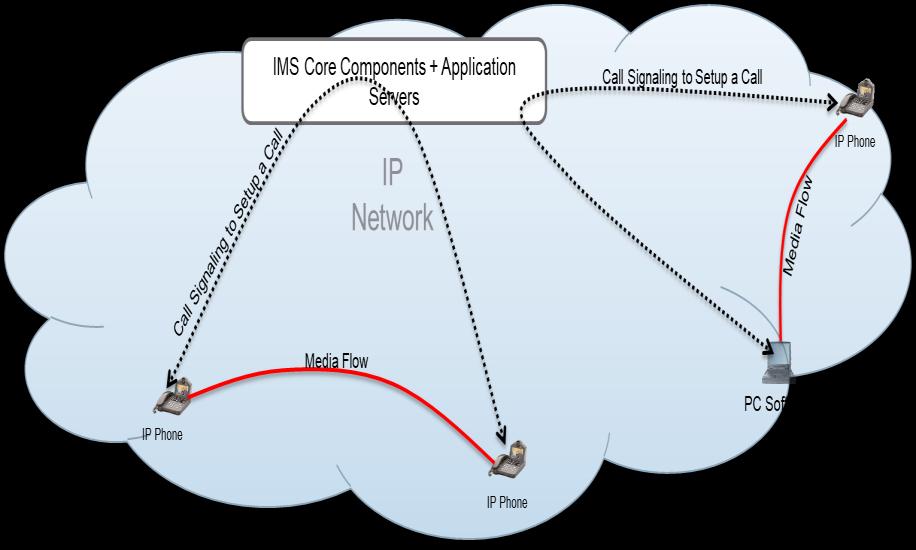
Figure A is a depiction of generally how a call is established and, subsequently, how the media flows. The black dotted line shows the path taken by messaging that takes place to establish a call while the red line shows the path for audio or video (or other) media which flows after the call is established.
In general, the User-Endpoints (UE) communicate with the IMS Core servers for call processing (i.e. setting up a call) and subsequently, communicate with other UEs for media (voice, video, etc.)
International Journal of Engineering Research and Reviews ISSN 2348-697X (Online) Vol. 10, Issue 3, pp: (6-10), Month: July - September 2022, Available at: www.researchpublish.com
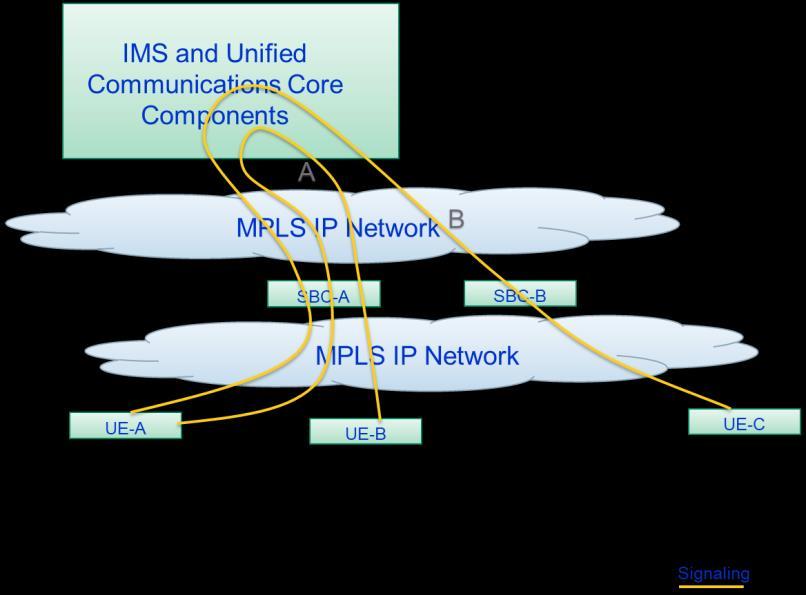
In a network with SBCs, a typical path for signaling to set up a call between two UEs may look like as shown in Figure B. A UE is only responsible to aim all traffic at the outside (access-side) interface of the SBC. SBC, subsequently, forwards the signaling traffic to IMS call processing servers in one or more geographic locations. These IMS servers eventually pass this signaling request on to the destination UE through an SBC. The traffic in response is typically sent through the same path in the reverse direction. This traffic – used to establish the multimedia call – does not have as stringent requirements for latency and packet loss as the media traffic does. Therefore, fundamental IP QoS measures such as prioritizing traffic as real-time using parameters, such as, IP DSCP values may be sufficient
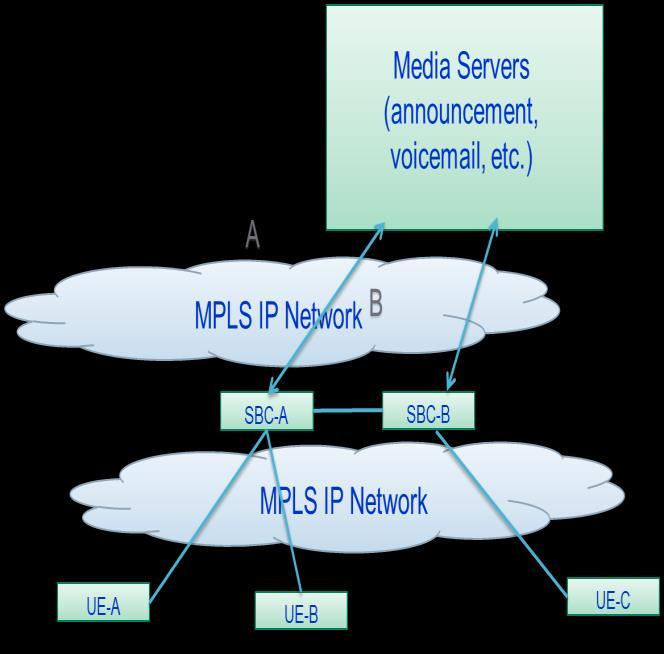
The media path is far simpler yet much more critical than signaling paths. It is the path between two UEs with one or more SBCs anchoring the media. Using Figure C as a reference, consider the following as an example. UE-A is trying to communicate with UE-C. As Figure Y shows, that the media path will include path segments from:
1. UE-A to the access side of SBC-A
2. SBC-A to SBC-B
3. SBC-B to UE-C
International Journal of Engineering Research and Reviews ISSN 2348-697X (Online)
Vol. 10, Issue 3, pp: (6-10), Month: July - September 2022, Available at: www.researchpublish.com
Similarly, if UE-A mis-dialed a number and an error message had to be played in the form of an announcement or if UEA was trying to retrieve voicemail, then the media would use the following path:
1. UE-A to the access side of SBC-A
2. SBC-A to the Media Servers
3. Return path in reverse order ( 2 followed by 1)
Media, as opposed to signaling, is susceptible to the smallest increase in latency, jitter and packet loss. Media is generally, transported over UDP. RTP is the industry protocol of choice for media as it is capable of carrying various protocols, specifically, the real-time traffic, such as, audio and video. There are no robust fault tolerance measures at the application level for these services. Therefore, it becomes imperative that the underlying transport network is highly reliable. MPLS Traffic Engineering (TE) LSPs are especially designed to accomplish this. Their versatility allows them to take a specific path (laid out even down at a layer-3 hop-level) while discerning and reserving specified bandwidth through the path. This can be further combined with QoS (Quality of Service) mechanisms such as, priority queueing and preferential treatment of specific traffic. Finally, of course, the hallmark of the MPLS reliability is the sub-second failover (healing) time of 50 ms. This means that the use of Fast-reroute (FRR) with link and/or node protection are virtually a given. The recovery from failure can be further enhanced with the use of Bidirectional Forwarding Detection (BFD) to provide quick Point of Local Repair (PLR) failure detection. In short, the exact mechanisms to create the LSP are numerous and are dependent upon the business preferences of the network operator.
To tackle the chronic fiber network issues, the service provider MPLS network administrators made the decision to use MPLS Traffic Engineering (TE) LSPs (Label-Switched Paths). These LSPs would have their routes pinned down over pathways known to traverse safe zones, relatively favorable geographies, well controlled corridors and through routers historically known to show good behavior consistently. In a network of close to one hundred thousand users creating and maintaining these LSPs could prove to be quite an administrative overheard. A plan was devised to selectively lay down these LSPs over those routes which are heavily used by only real-time voice traffic. As discussed previously, in an IMSbased VoIP implementation, the most critical flows occur between the UEs and the➔IMS Core sites (call signaling) and between the various UEs (for media: voice, video, etc.). All signaling and media for UEs MUST be anchored by the SBCs. The following design principles for creating the TE LSPs were followed. TE LSPs were created between.
1. All IMS Core sites (full mesh),
2. An SBC and➔each IMS Core site it uses.
3. An SBC and➔each PE, which homes a media server (servers that play announcement, servers that mix voice/video for multi-party call or any content servers). Generally, these servers reside with the IMS Core server complex referenced in (2) above.
International Journal of Engineering Research and Reviews ISSN 2348-697X (Online) Vol. 10, Issue 3, pp: (6-10), Month: July - September 2022, Available at: www.researchpublish.com
4. The different SBCs (full mesh),
5. The UE-PEs and each SBC (SBC-PE) the UEs are configured to use.
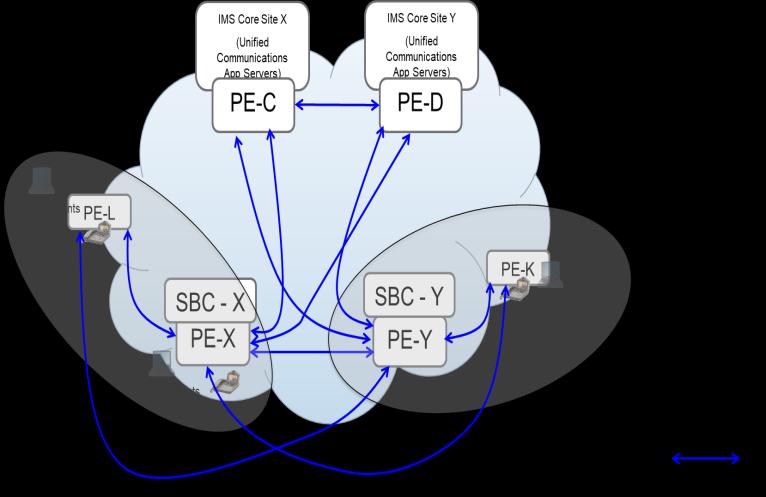
Figure D shows a diagrammatic depiction of these design principles.
The idea that MPLS was used to force real time traffic, which is highly sensitive to network delay and packet loss, over (Traffic Engineered) label switched paths which have pre-defined paths using very strict criteria ensured consistency of the service provides for a solid foundation for all large enterprises to follow. The number of disruptions that were categorized internally as outages essentially vanished. The goal of improving the user experience was decisively achieved.
[1] Mahesh Kr. Porwal., Anjulata Yadav., S. V. Charhate, “Traffic Analysis of MPLS and Non MPLS Network including MPLS Signaling Protocols and Traffic distribution in OSPF and MPLS,” International Conference on Emerging Trends in Engineering and Technology, ICETET, July 2008
[2] Nader F.Mir., Albert Chien, “Simulation of Voice over MPLS communications Networks,” IEEE ICSS‟02, conference
[3] Liwen He, Paul. Botham, “Pure MPLS Technology”. The Third International Conference on Availability, Reliability and Security, IEEE
[4] Xipeng Xiao, Alan Hannan, and Brook Bailey, Global Center Inc. Lionel M, NI, Michigan State University. “Traffic Engineering with MPLS in the Internet”
[5] Rahman M.A.,Kabir A.H., Lutfullah K.A.M., Hassan M.Z. and Amin M.R., “Performance analysis and the study of the behavior of MPLS protocols,” International Conference on Computer and Communication Engineering ICCCE, 13-15 May 2008, Page(s):226 – 229
[6] Web ProForum Tutorials, “Multiprotocol Label Switching (MPLS)”, Proc of the International Engineering Consortium, pp. 1-24, http://www.iec.org