ISSN 2348-3156 (Print)
International Journal of Social Science and Humanities Research ISSN 2348-3164 (online)
Vol. 10, Issue 4, pp: (31-47), Month: October - December 2022, Available at: www.researchpublish.com

ISSN 2348-3156 (Print)
International Journal of Social Science and Humanities Research ISSN 2348-3164 (online)
Vol. 10, Issue 4, pp: (31-47), Month: October - December 2022, Available at: www.researchpublish.com
1,2Jomo Kenyatta University of Agriculture and Technology, Nairobi, Kenya
DOI: https://doi.org/10.5281/zenodo.7148049
Published Date: 05-October-2022
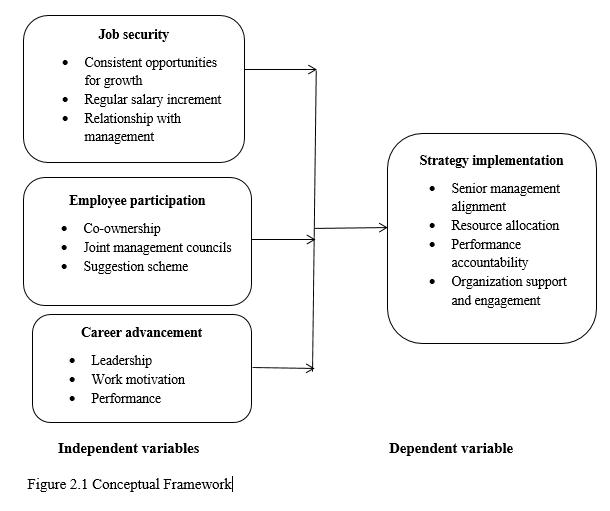
Abstract: Incentives play a significant role in ensuring the implementation of organizational strategies are successfully achieved. The success in the strategy implementation depicts the organization’s resolve to steer it towards the realization and achievement of its strategic goals. This study seeks to examine the influence of incentives on strategy implementation at the National Housing Corporation of Kenya. This study was guided by three specific objectives i.e. to determine the influence of job security, employee participation and career advancement on strategy implementation at the National Housing Corporation. The study used Expectancy theory of motivation and Kurt Lewis change implementation theory to unravel the underlying theoretical connection between the variables of the study. The adopted a descriptive design and targeted 76 management employees from the National Housing Corporation. The study employed a questionnaire as a tool that helped in gathering primary information from the respondents of the study. A small scale pilot study was performed to establish the reliability and validity of the research tool and the results were used in making the necessary adjustments to the tool in order to facilitate collection of reliable data for the study. Data analysis was performed through the use of statistical packages for social sciences and then presented in tables, charts and graphs. Results showed that job security, employee participation, and career advancement significantly influenced strategy implementation at the National Housing Corporation. The study recommended that organizations should offer employees consistent opportunities for growth, foster good relations and create joint management councils, formulate clear organization policies, offer leadership roles and adequately allocate sufficient resources towards strategic implementation organization projects and other strategic plans. The researcher suggested that further studies should be done other incentives that were not covered in the study, plus other sectors apart from the corporations.
Keywords: job security, employee participation, career advancement, strategy implementation.
High levels of competition, dynamism, and technological complexity characterize today's corporate climate. This is especially difficult for organizational managers, who must devise and implement strategies that will enable them to reach and maintain better levels of performance. Companies have been exposed to new competitors as a result of this transition, which has brought them new realities in the shape of new commercial chances for growth. This has prompted businesses to devote significant resources to developing new, effective methods to capitalize on new opportunities while safeguarding their market positions, which are critical to their future economic viability. Many firms have made it a goal to implement strategy effectively. However, unacceptably high rates of failure have been documented when it comes to putting their lofty plans into effect (Rotich, Swenaji & Were, 2017).
ISSN 2348-3156 (Print)
International Journal of Social Science and Humanities Research ISSN 2348-3164 (online)
Vol. 10, Issue 4, pp: (31-47), Month: October - December 2022, Available at: www.researchpublish.com
In today’s turbulent economic environment, many organizations in developed economies like China, the United States, Australia, and Vietnam are operating under constantly shifting demands (Imran, Rehman, Aslam, & Bilal, 2016).
Fernandez and Moldogaziev (2013) noted that Singaporean manufacturing companies were struggling to survive in a volatile business climate without the use of strategic implementation methodologies. Imran, Rehman, Aslam, and Bila (2016) made this observation in Finland and linked it to the expansion of the overall economy, technological improvements, high societal needs, and the necessity to meet expanding social service demands while working with limited resources.
According to Aarons, Ehrhart, Farahnak, and Hurlburt (2015), firm competition, globalization, shifting consumer needs, and the introduction of new technology all speed up organizations' desire to adopt change. Furthermore, Karuhanga (2015) in Uganda noted that leadership's strategic competences were believed to have an impact on plan execution. Alshaher (2013) in Somalia, noted that the majority of corporate and public institutions in Somalia were unable to execute new changes because of structural inertia and a lack of clear strategic planning
According to Mkandawire, Senaji, and Kirimi, (2020) almost 70% of strategies that are developed, according to the research, do not successfully implement for a variety of reasons. Despite the fact that top management develops the strategic direction, the organization's entire workforce must approve and agree to it before it can be implemented. To that end, some issues that prevent the successful implementation of strategy include, but are not limited to, a lack of or insufficient level of staff support, an inefficient allocation of resources, unrealistic deadlines, wide disparities between the present state and the desired condition, a tendency among staff members to favor the status quo, a lack of or inadequate level of monitoring, and a scenario in which the developed strategy does not engage and appeal to the target audience.
Omuse, Kihara and Munga (2018) support that employee commitment to strategy implementation, significantly has a positive impact on job satisfaction. An effective strategic plan implementation, with the ultimate goal of realizing improved organizational performance requires embracing factors that will entice leadership to motivate their employees to put in their best in order to enhance implementation practices (Ghuman, 2010; Gentry, et al.,2014). Strategies often fail not because they are poorly designed but because they are poorly implemented. This comes from the motivation that employees’ perception of their derived benefit in the implementation of the intended organization strategy. Many studies that talk about strategy implementation, have identified and described factors that cause problems in strategy implementation (Beer & Eisentat, 2000), and yet the issues are not only process related but also behavioral in nature. The ability of organizations to scan proactively and execute strategies for their performance improvement (Claus et al., 2015) while ensuring that strategy formulation and execution remain a "fair process" is the foundation of organizational competitive advantage (Mauborgne & Kim, 2015).
Uncontrollable external environment can sometimes make implementing a strategy more difficult (Lares-Mankki, 2014). This makes strategy implementation the most challenging phase in strategic management. The ideal strategy that addresses both the internal and external issues preventing the successful implementation of plans should be found by midsize businesses in order to overcome this difficulty. The McKinsey's 7s model is one of the models that details the crucial elements of successfully executing a plan. Seven variables that, when coupled, enable an organization thrive are identified using this approach. These seven factors are: strategy, organization, systems, personnel, skills, style, and common values. The model demonstrates how the seven factors impact a company's capacity to implement the developed strategies (Baroto, Arvand, & Ahmad, 2014) concentrate on people's integrity and morality.
Enterprises are developed to achieve the long and short-term objectives of its stakeholders, according to the cardinal rule of business. Most organizations utilize strategic planning to select the proper tactics and manage the internal environment which majorly is constituted by the human resource, in order to attain their goals and objectives. Businesses can also use the planning to identify their competitive edge and decide how they respond to changes in the economy and government policy (Katuse, Aiyabei, Karanja & Waititu, 2013). As envisioned by Valackiene (2021) that changes in a firm are evitable, generally they don't always correspond with employees' feelings of safety, such as whether they feel comfortable about their job, income, or future responsibilities in the company in the face of possible changes. According to Laszlo et al., (2010) the focus on strategic management necessitates a regular review of the company's strategy, corporate culture, evolving structures, coping programs for the possibility of a crisis, as well as those for management challenges, the preparation of change scenarios, providing resources for unexpected or unplanned changes, and training employees. Laszlo et al., (2010) further notes that when it comes to safeguarding employee job security, one of the needed measures
ISSN 2348-3156 (Print)
International Journal of Social Science and Humanities Research ISSN 2348-3164 (online)
Vol. 10, Issue 4, pp: (31-47), Month: October - December 2022, Available at: www.researchpublish.com
is including employees in the process of implementing change in the firm. Employee job uncertainty is described by researchers as a significant cause of stress for employees, one that can significantly impact their psychological health, as well as their attitude toward their work and, ultimately, their work efficiency.
According to the strategic plan of NHC of 2019-2023, some of the challenges to strategy implementation at NHC in achieving affordable housing programme are skill shortage, inadequate training, staff stagnation, and lack of career guidance to meet both the organization’s goals and individual aspirations. Other weaknesses the report highlights are the increased number of staffs working in acting capacities in various positions for long without regard to confirmation and career progression.
Successful strategy implementation is the result of careful alignment of an organization’s strategy to the various organizational dimensions such as its structure, culture, resources, leadership, human resources, systems and processes (Obewa, 2015). Studies done regarding strategy implementation points a glim picture on the management’s failure to recognize the contributions of their employees on the realization of these goals. For instance; Nyagi (2010) points that non-involvement of employees in strategy formulation has been identified as the main reason for the slow implementation of strategies, other challenges identified include non-commitment of senior staff and employees in general to support a new strategic plan, change of strategy mid-term to suit new focus, financial constraints, and inadequate analysis of progress made, among others.
Muteti (2017) on the study to investigate the barriers to strategy implementation among real estate companies in Kenya focusing on Suraya Property Group Limited, showed a lack of clear communication from top management to various operational units, allocation of adequate financial resources in the execution of strategic plans, relevant members of staff involvement during strategy planning and development, and recommended for staff motivation and sensitization on strategic plans, proper monitoring system for strategic plan implementation, and flexible strategic plan to deal with unforeseen events. Consequently, a study by Owoko (2013) on the determinants of successful delivery of housing projects in the Ministry of Housing in Nairobi, found that funding was a critical factor in the success of a public project implementation and that such project must have clear funding structures for their success.
Further studies conducted by Kiehne et al. (2017) and Barrows (2011) point that more than 90% strategies fail in their implementation stage not due to formulation but implementation challenges that range from employee involvement, job guarantees, structural inequities, and poor dissemination of strategic challenges intended by the organization. Finally, a study conducted by Titus (2014) points to a lack of reward structure linked to strategy implementation, lack of effective communication between different departments and vagueness in assigning responsibilities as key set-backs to strategy implementation. Michlitsch (2010) further says that manager’s failure to consider employee competencies and skills required in the execution of organization strategy significantly affect delivery of the strategy process and recommends for employee empowerment through training to enhance their career advancement and growth.
The above studies failed to corroborate the influence of employee incentives on strategy implementation which remains as a gap that needs to be researched on. Therefore, this research aimed at examining how incentives given to employees influence strategy implementation work and how this significantly contributes to overall performance of government corporations in Kenya.
The study was based on the following objectives;
The general objective of the study was to examine the influence of incentives on the strategy implementation at the National Housing Corporation.
i. To determine the influence of job security on strategy implementation at National Housing Corporation.
ii. To establish the influence of employee satisfaction on strategy implementation at the National Housing Corporation
iii. To assess the influence of career advancement on the strategy implementation at the National Housing Corporation.
ISSN 2348-3156 (Print)
International Journal of Social Science and Humanities Research ISSN 2348-3164 (online)
Vol. 10, Issue 4, pp: (31-47), Month: October - December 2022, Available at: www.researchpublish.com
i. How does job security influence strategy implementation at the National Housing Corporation?
ii. How does employee satisfaction influence strategy implementation at the National Housing Corporation?
iii. What is the influence of career advancement on strategy implementation at the National Housing Corporation?
The findings of this study will be instrumental to a number of stakeholders. In essence the management state corporations in Kenya will benefit from the study's findings. The findings will help them decide whether or how much employee participation in strategic management processes is appropriate and in particular on the significance of involving employees in strategy implementation. The study will be useful to academics as well. The study will advance scholarly understanding of strategy implementation. First, it will close the knowledge gap about incentives and their influence on strategy implementation on corporate firms. The fields of inquiry that any other academic or researcher can pursue will also be highlighted.
This study sought to examine the influence of incentives on the strategic implementation at the National Housing Corporation (NHC) in Nairobi, Kenya. The study specifically examined the influence of job security, employee satisfaction and career advancement on strategy implementation. The focus of the study was mainly concentrated on the strategy implementation at the NHC under the Ministry of Transport, Infrastructure, Housing, Urban Development and Public Works. The study targeted employees in the housing department in the ministry in order to get the relevant information concerning incentives and strategy implementation of the affordable housing programme in Kenya
The research was therefore be guided by the theoretical framework, which will specify which variables to assess and what will be looked for in statistical analysis. The following theories form the foundation of this work.
Kurt Lewin developed this paradigm in the 1950s. According to the notion, most people prefer to behave in particular safe zones and do so (Sarayreh, Khudair, & Barakat, 2013). Kurt Lewin suggested unfreezing, transitioning, and refreezing as the three phases for implementing reforms in any organization (Kariel, 2016). In order to change the status quo, managers must first unfreeze or disrupt any comfort zones that may exist. For the effective implementation of reforms, managers should discourage workers from engaging in antiquated behaviors and encourage the adoption of modern ones (Kariel, 2016).The theory is applicable to this study since it is predicated on the idea that public corporations are more likely to make changes if they successfully adopt strategic implementation methods that involve employee participation and empowerment, strategic leadership, and organizational culture that nurtures employee growth. State corporations just like any other organization or company should strive to incorporate elaborate incentives that make employees motivated.
The Expectancy Theory of Motivation (Vroom, 1964), which examines the connection between effort and expected results, and Hertzberg's two-factor theories, which examine elements relating to the workplace that would help employees perform at their best, served as the foundation for this study. These theories and the research variables are intertwined. While Herzberg Theory supports staff incentives (compensation, oversight, possibilities for growth, the value of work, and job security), performance (the implementation of a financial inclusion strategy) is supported by the Expectancy theory, which connects rewards to performance. The five incentives are the rewards in this study, and performance measures how successfully a plan is implemented.However, expectancy theory (also known as the theory of motivation) postulates that people behave or act in certain ways based on the expected outcomes of their chosen patterns of behavior. In other words, the reason for selecting a particular behavior is based on the expected result. The study hypothesized that incentives are associated with the implementation of the strategy, which includes offering employees guarantees for their job security and opportunities for growth in their careers.
ISSN 2348-3156 (Print)
International Journal of Social Science and Humanities Research ISSN 2348-3164 (online)
Vol. 10, Issue 4, pp: (31-47), Month: October - December 2022, Available at: www.researchpublish.com
A number of studies done on strategy implementation for instance, a study by Murugi (2018) reveal that for effective strategy implementation, organizations should strive to embrace strategic implementation practices such as employee empowerment, strategic leadership, and organizational culture. Further the study recommends that public institutions should seek to sponsor their staff, delegate responsibility, appoint employees on administrative posts based on implementation experience and encourage teamwork and communication by reorganizing the structures thus enhanced efficiency and effectiveness.
Nwanchukwu et al., (2018) carried a study on the relationship between employee commitment to strategy implementation and employee satisfaction among four telecommunication firms in Nigeria. The results showed a positive correlation between employee commitment and strategy implementation among the major telecommunication firms. This revealed that to achieve a desired success in strategy implementation, employee commitment is integral and can be achieved through offering them role plays, reward schemes, decision making roles to motivate them.
Karuiki (2020) on factors affecting implementation of performance-based reward strategies in Kenyan public sector, focusing on the Capital Markets Authority (CMA). The study explored factors affecting implementation of performancebased reward strategies and specifically examined organizational culture, external factors and employee participation and how they affect implementation of performance-based reward strategies in the Public Sector in Kenya. Findings revealed that CMA had integrated performance pay reward strategy, and relayed appropriate information on the implementation of performance-based pay strategy to their employees to enhance its implementation. Further, the findings also showed that organizational management offered guidance to the subordinate in the implementation of the performance-based pay strategies, hence they realized a good response, uptake and execution of the strategy from their employees.
Gezu (2018) on practices and challenges of implementing balanced scorecard in Wegagen Bank. The study assessed the challenges faced while implementing the balanced scorecard system particularly the four pillars of Balanced Scorecard in
ISSN 2348-3156 (Print)
International Journal of Social Science and Humanities Research ISSN 2348-3164 (online)
Vol. 10, Issue 4, pp: (31-47), Month: October - December 2022, Available at: www.researchpublish.com
the case of Wegagen Bank. Mutai (2016) carried a study on challenges of strategy implementation at Tullow Oil company. The study looked at insecurity, political instability and stakeholder involvement. The results revealed that poor means of communication between the head office and the drilling points led to lack of effective coordination of activities and information flow
A study by Mkandawire, Senaji, and Kirimi, (2020) on exploring staff incentives and strategy implementation in Commercial Banks in Kenya, assessed the perception of staff incentives and their relationship with implementation of financial inclusion strategy in commercial banks. The study laid emphasis on job security, employee growth, oversight and meaningfulness of work on strategy implementation. The study concluded that the execution of the financial inclusion strategy in the banks was fairly successful and that the staff incentives given to bank employees ranged from being unsatisfactory to somewhat satisfactory. Additionally, it was discovered that the execution of the financial inclusion strategy was linearly correlated with oversight and job security. Furthermore, the compensation had a negative impact on the likelihood that the financial inclusion approach would be implemented successfully, whereas job stability had a positive impact.
Mutuku (2018) examined the influence of internal factors on strategy implementation in Machakos County Government. The study looked at employee participation, leadership skills, resource allocation and employee training on strategy implementation and the results revealed that management lacked strategic formulation skills and knowledge making them unable to provide effective leadership to the process. The results further indicated that resource allocation, employee training and involvement were critical in enhancing strategy implementation at the county government.
A review of literature on strategy implementation tends to point that strategy implementation is the panacea to the organization's success in terms of superior performance and competitive advantage (Barnat, 2012). Statistical data from the literature also show that some of the strategy implementation drivers examined in this study are important for defining outstanding performance in organizations. According to Sorooshian et al. (2010), the literature also tends to support the idea that only organizations that pay special attention to strategic management processes are guaranteed success.
Kibicho (2015) conducted research on the factors that contribute to successful strategic plan implementation in the Kenyan insurance sector. 51 insurance companies that are active in Kenya were the study's target population. The study came to the conclusion that the success of the implementation of strategic plans among Kenyan insurance businesses is highly influenced by resource strength. Resources can be a serious obstacle to improving the efficacy of strategic plan implementation according to Abuya (2011)'s analysis of the problems associated with doing so at Action Aid Kenya. How a plan is carried out determines whether a company succeeds, endures, or perishes (Kihara, 2016). The study mainly focused on success factors that influence strategy implementation but left out those factors that would influence implementation in either way.
Abbas, Munga and Were (2017) on their study that focused on the relationship between strategy implementation and performance of county governments in Kenya, assessed the impact of training to facilitate employees with necessary skills and knowledge to ensure successful strategy execution. The study area of focus seemed to be biased in the fact not only training would enhance strategy implementation but there are internal environmental factors vis-à-vis motivation, remuneration and rewards, promotions etc. that would impact on the realization of the strategic plan execution.
The influence of incentives on an organization's implementation of strategy is not sufficiently demonstrated by available empirical studies. By identifying important factors that influence strategy implementation and examining their impact on the poorly executed organizational strategies at NHC, this study attempts to close this gap in knowledge.
According to Orodho (2004), research design refers to all of the processes used by a researcher to investigate a certain set of questions or hypotheses, while also serving as a guide for collecting, evaluating, and interpreting observed data. For this study, a descriptive design was used. Descriptive design is chosen because the design allows the researcher to define the qualities of the variables of interest and is ideal for characterizing demographic characteristics.
ISSN 2348-3156 (Print)
International Journal of Social Science and Humanities Research ISSN 2348-3164 (online)
Vol. 10, Issue 4, pp: (31-47), Month: October - December 2022, Available at: www.researchpublish.com
A population is any group of people, cases or objects who share at least one common trait (Busha & Harter, 2000). The study's participants was drawn from the National Housing Corporation (NHC) head office in Nairobi. NHC is a statutory body established by an Act of parliament Cap 117 of the constitution is under the Ministry of Transport, Infrastructure, Housing, Urban Development and Public Works in Kenya. Taylor, Bogdan, and DeVault (2015) define the target population as a group or category of people who share one or more traits and who can be selected as the study's focus. It is a group of people or elements who share at least one characteristic (Kombo & Tromp, 2006). The target population for this study consisted of all 76 management employees drawn from various divisional units; business development, finance and strategy, corporate communication, technical operations, corporate services and estates divisions at the NHC head office in Nairobi. (NHC report, 2021)
Department/ division No. of employees
Percentage of total
Business Development 17 22.4%
Finance and strategy 8 10.5%
Corporate communication 13 17.1% Technical operations 18 23.7% Corporate services 9 11.8% Estates division 11 14.5% Total 76 100%
Source: NHC Report, (2021)
The sample size represents the number of individuals that have been selected from the larger population to participate in the study. Mugenda (2003) defines a sample as portion or a subset of the entire population in a study who are selected to form part of the studyThe sample size for this study involved all the 76 management employees drawn from all the 6 divisions at the NHC head office.
The study adopted a census approach in conjunction with purposive sampling technique. The census approach allowed for inclusion of all cases or objects in the study. Therefore, all the employees of the aforementioned divisions at the NHC head office in Nairobi was involved in the study. According to (Kothari 2004), the census method is appropriate for studies where the respondents are known, few, and easily accessible. As a result, employees from the aforementioned divisions will be considered since they demonstrate the study's required criteria.
The researcher employed the use of structured questionnaires to aid in data collection for this study. Five scale Likert type of questions was used and this helped limit responses to a defined scope of range hence removing biasness and subjective aspect. In this type of questions, the respondents were required to rate their opinions on the prescribed scale provided. The questionnaire is preferred in this case because it permits collection of more information quickly and with less time required to distribute them. Questionnaire also reduces cases of biasness and is more objective compared to other forms of data collection (Kothari, 2004).
The main data collection method was administering the self-administered questionnaires. The researcher first obtained an introduction letter from the department of business, JKUAT Karen Campus before proceeding to the area of study where permission was sought and then appointments made for the day of data collection according to the availability and suitable time of the respondents but within their working hours. With their consent, the researcher proceeded to administer the questionnaire through a drop and pick method and allow them appropriate time to respond to the questions by filling them before collection. The researcher thereafter proceeded and collected the filled questionnaires ready for data analysis phase.
ISSN 2348-3156 (Print)
International Journal of Social Science and Humanities Research ISSN 2348-3164 (online)
Vol. 10, Issue 4, pp: (31-47), Month: October - December 2022, Available at: www.researchpublish.com
Piloting was carried out to improve the standard of the study. This aimed to guarantee that the study findings produce the anticipated kind of data, which is legitimate and reliable. Validity and reliability tests was the criterion employed in the piloting. 10% of the sample's population was used for the pilot study (Mugenda & Mugenda, 2003) representing a total of 7 respondents.
Data collected from the field was subjected to scrutiny to check for completeness and errors. This acted as precedence for data analysis. Both quantitative and qualitative analysis was used in the analysis. Descriptive and inferential statistics was used to analyze the data acquired. With the help of Statistical Package for Social Sciences (SPSS) version 23, the quantitative data was evaluated using descriptive statistics. In addition, correlation analysis and regressions was used in inferential analysis. The influence of the independent factors on the dependent variable was determined using multiple regression models. The strength of the association between the dependent variable and each of the independent variables was established and measured using this model. The qualitative analysis of the data was done through content analysis to quantify and analyze the presence, meanings and relationships of such certain words, themes, or concepts that shall be obtained from the data.
Multiple linear regressions was carried out to test the influence of incentives on strategy implementation. The study used the following linear regression model
Y = β0 + β1X1 + β2X2 + β3X3 +α + ϵ
Where;
Y = Strategy Implementation
β0 = coefficient
β1, β2, β3 = Coefficient of variables
X1 = Job Security
X2 = Employee Participation
X3 = Career Advancement
α = Is the constant or intercept
ϵ = residual (error)
4.1
A total of 76 questionnaires were administered to the target sample, who were employees of National Housing Corporation (NHC). An 86% response rate was realized with only 11 respondents (14%) failing to respond to the submitted questionnaires pertaining to the study. According to Mugenda (2010) a response rate above 50% is considered adequate enough for analysis and reporting. A response rate of 86% as has been displayed in the case of the current study was therefore judged as adequate for analysis and reporting.
4.2 Pilot Results
4.2.1 Reliability Results
Table 4.1: Reliability Results
ISSN 2348-3156 (Print)
International Journal of Social Science and Humanities Research ISSN 2348-3164 (online)
Vol. 10, Issue 4, pp: (31-47), Month: October - December 2022, Available at: www.researchpublish.com
4.3.1
The first specific objective of this study was to determine the influence of job security on strategy implementation at the National Housing Corporation. The findings have been sectioned based on the research questions. There was also a qualitative comments of the respondents.
4.3.1.1
The researcher sought the opinion of the respondents on how they would rate the following statements on job security. The respondents were required to use a Likert scale of 1 to 5 where; (1- Strongly Agree, 2-Agree, 3-Neutral, 4-Disagree, 5-Strongly Disagree).
Statement
The organisation has internal mechanisms/strategies that support good relations between employees
Management and organisation policies promote regular assessment and evaluation of employee performance to nurture opportunities for growth
1 % 2 % 3 % 4 % 5 % Mean Std Dev
0 4.2 17.8 52 26 3.81 0.988
0 10.4 28.5 41.3 19.8 2.87 0.863
Our HR policies offer foundation that complies with government regulations and policies on salary increment 0 0 18.7 31.5 49.8 3.31 0.876
Management provides funding for training on strategy formulation and career support to facilitate employee growth and delopment.
The organisation has elaborate strategic mechanisms for recognizing employee performance for rewards during strategy implementation
High performing employees are generally rewarded with promotions, leadership roles and sometimes offered sponsored schlarships
4.8 18.4 23.2 30.2 23.4 3.04 1.036
0 17.6 11.8 49.8 20.8 3.76 0.898
2.2. 12.4 14.8 53.6 17 3.68 0.971
The respondents were asked to suggest other job security factors that could be embraced to enhance strategy implementation at NHC. The qualitative comments were summarized in table 4.3 below, showing the main theme and their frequency.
Statements
Frequancy
Percentage (%)
Increased employee training 21 32.3
Retension bonuses 13 20
Streamlined work policies 9 13.8
Encourage communication between all levels of management on strategic changes 14 21.5
Offer meaningful employee recognition 8 12.4
Total 65 100
Cheruiyot (2016) describes strategy implementation as a dynamic, interactive and complex process, which is comprised of a series of decisions and activities by managers and employees meant to turn strategic plans into reality in order to achieve strategic objectives. The success of strategy implementation is depended on the integration of various components of the organization and the stakeholders for a sooth run off. These organization components which encomposses the security of the employees are integral among other factors like encouraging communication between levels of
ISSN 2348-3156 (Print)
International Journal of Social Science and Humanities Research ISSN 2348-3164 (online)
Vol. 10, Issue 4, pp: (31-47), Month: October - December 2022, Available at: www.researchpublish.com
management on intended changes and their expectations, increasing training of employees on new areas of performance that comes with new changes being introduced, employee retension bonusses, streamlined work policies and offering meanigful employee recognition for performance roles and achievements in liue of strategic changes in the organization. When a plan is operationalized, tasks are delegated to specific individuals, supportive finances are put in place, and personnel are coordinated with the strategy (Shields et al., 2015).
The second objective of this study was to establish the influence of employee participation on strategy implementation at the NHC. The findings were sectioned based on the research questions. There was also a qualitative comment of the respondents.
4.3.2.2
The respondents were asked to provide opinions on a Likert scale about how they can rate provided statements on employee participation. Respondents were to use 1- Strongly Agree, 2-Agree, 3-Neutral, 4-Disagree and finally 5Strongly Disagree.
Table 4.4: statements on whether employee particiaption influence strategy implementation at the National Housing Corporation
Statement
1 % 2 % 3 % 4 % 5 % Mean Std Dev.
The organization structure permits efficient communication and decision making processes among employees 0 0 8.6 64.2 27.2 3,83 0.79
The organization’s joint management council builds employee trust and management relations among organization workforce 0 6.4 20.2 53.4 20 3.80 0.91
Our organisation has high employee effieciency suggestion schemes introduced to employees 2.8 10.4 12.8 44.4 29.6 3.76 0.98
There is continuing capacity building to empower employees with requisite skills and knowledge for an enhanced participation in strategic activities of the organization.
0 20.6 9.8 22.4 47.2 3.74 0.96 Employees have co-ownership belief in the organization activities due to their involvement 1.2 16.8 27.2 45.8 9 3.68 0.85
Employee participation increases commitment to strategy execution 2.4 12.4 6.8 51.8 26.6 3.59 0.63
The third objective of the study was to assess the influence of career advancement on strategy implementation at the NHC. The findings were sectioned based on the research questions. There was also a qualitative comment of the respondents.
The respondents were asked to provide their opinions on a Likert scale about how they rated provided statements on career advancement. Respondents were to use 1- Strongly Agree, 2-Agree, 3-Neutral, 4-Disagree 5-Strongly Disagree
Statement
The organization structure provides for advanaceemnt of leadership roles for employees
Work motivativation is driven by the benefits of career growth in the organization
Performance recognition of employees motivate them in performing their roles
1 % 2 % 3 % 4 % 5 % Mean Std Dev.
0 0 8.5 47.6 43.9 3.83 0.87
0 9.7 24 46.3 20 3.57 0.89
0 0 18.6 48.3 33.1 3.94 0.84
ISSN 2348-3156 (Print)
International Journal of Social Science and Humanities Research ISSN 2348-3164 (online)
Vol. 10, Issue 4, pp: (31-47), Month: October - December 2022, Available at: www.researchpublish.com
Organisation identifies and manages employee expectations in relation to career advancement during strategy implementation processes.
Organisation engages and communicates with its key stakeholders to assure them of the benefits and guarntees with new strategies
0 5.8 33.6 50.9 9.7 4.28 0.61
4.8 18.8 22.5 30 23.9 3.3.3 1.02
The general objective of the study was to determine the influence of incentives on strategy implementation at the national housing corporation. The findings were sectioned based on the research questions and presented as under;
The respondents were required to rate their opnions based on the provided statements on strategy implementation. They were asked to use a scale of 1-5 where; (1- Strongly Agree, 2-Agree, 3-Neutral, 4-Disagree, 5-Strongly Disagree). The results were presented in table 4.6 below;
Statement 1 % 2 % 3 % 4 % 5 % Mean Std Dev.
The senior management alignment and commitment to strategy has a remarkable impact on the success of strategy implementation
0 8.4 18.5 54 19.1 3.87 0.75
There has been a noticeable increase in resource allocation on organization programs to steer their implementation 0 3.7 29.5 46.8 20 3.81 0.82
There is increased performance accountability due to stakeholders involvement in strategic process of the organization projects
3.8 16.2 18.4 47.2 14.4 3.86 0.93
There is increased engagement and support from all corporation stakeholders towards it strategic goals. 2.6 14.9 23.1 34.9 24.5 3.72 0.95
Effective HR empowerment and motivation influences implementation of strategic plans. 4.2 6.8 16.9 50.8 21.3 3.98 0.97
In this study, regression analysis was used to develop a model for the influence of incentives on strategy implementation at National Housing Corporation. The independent variables/ predictors (job security, employee participation and career advancement) were regressed with the strategy implementation. The results of the analysis have been presented in model summary, analysis of variance tests, and summary of coefficients.
Regression model summary table provides information about the regression line’s ability to account for the total variation in the dependent variable. Model summary demonstrates whether the observed y-values are highly dispersed around the regression line. Therefore, regression model explains proportion of the dependent variable’s total variation. The dependent variable’s total variation was measured by its variance. If the regression line is not completely horizontal that is if the b coefficient is different from 0, then sum of the total variance is accounted for by the regression line.
Table 4.7: Model Summary
Model R R Square Adjusted R Square Std. Error of the Estimate
1 .503a .492 .447 .659
a. Predictors: (Constant), JS- job security, EP- employee participation, CA- career advancement
b. Dependent variable – Strategy Implementation
ISSN 2348-3156 (Print)
International Journal of Social Science and Humanities Research ISSN 2348-3164 (online)
Vol. 10, Issue 4, pp: (31-47), Month: October - December 2022, Available at: www.researchpublish.com
As can be seen from Table 4.7 above, the value of R2 is 0.492, which means that 49.2% of the total variance in strategy implementation has been explained. This means the model provided a good fit in relating influence of incentives on strategy implementation.
The analysis of variance was performed to determine if there was a statistically significant difference between two or more of the categorical groups by testing for differences of means using variance.
Table 4.8: ANOVAa
Sum of Squares Df Mean Square F Sig. 1 Regression 5.662 3 1.887 2.053 .006b Residual 56.092 61 .920 Total 61.754 64
Model
a. Dependent Variable: X
b. Predictors: (Constant), JS, EP, CA
From the ANOVA analysis results on Table 4.8, the overall p value is equal to .006, which was less than .05. The regression analysis results in the ANOVA output table indicates that the overall regression model was significant in establishing the influence of incentives on strategy implementation at 95% confidence level. Summary of the model and ANOVA was that a significant regression equation was found F (3, 64) = 2.053, p ˃ .05 with R2 of .492.
The magnitude of the coefficient for each independent variable, or "beta coefficient," indicates the magnitude of the influence that variable has on the dependent variable. The direction of the influence is indicated by the sign of the coefficient (positive or negative). In a regression with a single independent variable, the coefficient shows how much the dependent variable is anticipated to change when the independent variable increases by one, depending on whether it is positive or negative.
Table 4.9: Beta Coefficientsa
Model
Unstandardized CoefficientsStandardized Coefficients T Sig. B Std. Error Beta
1
(Constant) 1.693 .382 4.432 .000 CA .130 .114 .142 1.137 .260 EP .224 .118 .235 1.894 .063 JS .208 .112 .119 0.958 .042
Y = 1.693 + 0.142X1 + 0.235X2 + 0.119X3
Results of the multiple linear regression indicated that there was a collective significant effect of F (3, 64) = 2.053, p ˃ .05 with R2 of .492 in the model for influence of incentives on strategy implementation using the predictors including job security, employee participation and career advancement. When individual predictors were examined further it was found that career advancement had (Beta = 0.142, t = 1.137, p = 0.260), employee participation had (Beta = 0.235, t = 1.894, p = 0.063) and job security had (Beta = 0.119, t = 0.958, p = 0.042). All factors were found to be good incentives for strategy implementation at NHC.
The first objective of the study sought to determine the influence of job security on strategy implementation at the National Housing Corporation. Findings revealed that organization structure permits efficient communication and decision making processes on strategic plans of the organization among employees as was opined by majority though a small percentage of the respondents disagreed to this fact. The researcher observed that joint management counils helped
ISSN 2348-3156 (Print)
International Journal of Social Science and Humanities Research ISSN 2348-3164 (online)
Vol. 10, Issue 4, pp: (31-47), Month: October - December 2022, Available at: www.researchpublish.com
in fostering good rapport between employee teams from different levels of management, promote healthy relations, welfare and employee efficiency. Strategy implementation demands the particiaption of employees in entire process to assure its success. The study also found that most of the respondents strongly agreed and agreed that their organisation had high employee effieciency suggestion schemes that were introduced to employees which enabled them to share their diverse ideas and create a sense of ownership in the startegic management process and the plans arrived at.
Moreover, the study also found that NHC had a continuing capacity building program that empowered employees with requisite skills and knowledge to enhance their participation in strategic activities of the organization, as represented by majority views. When the respondents were asked whether employees had co-ownership belief in the organization activities due to their involvement in strategic decisions of the organization’s strategic plans majority agreed and the study concluded that involving employees in decision making process greatly influenced the success of strategic implementation process of the strategic plans of the organization. Lastly, the respondents agreed that employee participation increased commitment to strategy execution as they felt part and parcel of the process and the success, as represented
The second objective sought to establish the influence of employee participation on Findings revealed that organization structure offered efficient communication and decision making process path for strategic plans of the organization. A small percentage of the respondents disagreed to this fact. This implies that organization should endeavour to have elaborate structures, and communication channels to ease decision making process and flow of information on their work tasks. This will enable employees execute their functions effectively during such process of strategy implementation.
The researcher also observed that joint management counils helped in fostering good rapport between employee teams from different levels of management, promote healthy relations, welfare and employee efficiency. The stduy rfurther noted that strategy implementation demands the participation of employees in entire process to assure its success. Moreover, the study established that majority of the respondents agreed that their organisation had high employee effieciency suggestion schemes that were introduced to employees
Moreover, the study also found that NHC had a continuing capacity building program that empowered employees with requisite skills and knowledge to enhance their participation in strategic activities of the organization, as represented by majority views only a small number of respondents disagred with the statement. When the respondents were asked whether employees had co-ownership belief in the organization activities due to their involvement in strategic decisions of the organization’s strategic plans, majority agreed while a considerable minority disagreed. The study concluded that involving employees in decision making process greatly influenced the success of strategic implementation process of the strategic plans of the organization. Lastly, the respondents agreed that employee participation increased their commitment to strategy execution as they felt part and parcel of the process and the success.
The third objective of the study sought to assess the influence of career advancement on strategy implementation at the National Housing Corporation. Results show that majority of the respondents agreed that organization structure of NHC provides for advancement of leadership roles to employees, with a minority objecting the fact. When the respondents were asked whether work motivation was driven by the benefits of career growth in the organization, majority agreed, though a few held a neutral opinion and another disagreed. The study further found that performance recognition motivated employees in performing their roles due to the rewards as opined by majority of the respondents, though a small number had a neutral view.
The respondents further opined that NHC identifies and manages employee expectations in relation to career advancement during strategy implementation processes as reflected by majority of the majority respondents. However, an average number of the respondents held a neutral view, while others disagreed with the statement. Lastly, the study results revealed that NHC engages and communicates with its key stakeholders to assure them of the benefits with new strategies that were being implemented as agreed by majority of the respondents, though a small number disagreed.
ISSN 2348-3156 (Print)
International Journal of Social Science and Humanities Research ISSN 2348-3164 (online)
Vol. 10, Issue 4, pp: (31-47), Month: October - December 2022, Available at: www.researchpublish.com
The study concludes that job security, employee participation and career advancement had a significant influence on strategy implementation. This therefore means that any unit change in either of the variables will significantly influence strategy implementation. Employee job security affected employee performance with a view that when changes are introduced in the organization, employees feel their jobs are not secured hence become reluctant in effecting the changes.
To enhance job security, organizations will have engage the employees through joint management councils to foster good relations and secure their welfare concerns in form of promotions, rewards etc.
Strategy implementation demand for employee participation in the entire process. Employees will only be motivated to implement strategies of the organization if they were involved from the initial stages of its inception. Empowering employees through joint workshops, suggestion schemes, clear organizational policies, trainings and apprenticeship could improve strategy implementation. Some of the strategies demand for specialized skills hence the need for training to ensure the employees understand every aspect of the strategic process.
On career advancement, assigning employees leadership roles, offering work motivations elaborate HR policies and performance recognition would serve better in ensuring successful strategy implementation.
On strategy implementation, senior management alignment, adequate resource allocation, performance accountability and organizational support and stakeholder engagement were found to be essential. Therefore, management of organizations should strive to strike a balance between nurturing an environment that recognize employees’ contribution and strategy implementation to attain their strategic goals.
The following are the recommendations of the study based on the conclusions derived.
Employee job security is an integral element that demands attention of management as it directly impacts on the employee job performance and general organizational achievements. With new changes being introduced in organizations, it is the management’s duty or responsibility to ensure the employees at the organization are made aware of the impending changes and their repercussion on their job security.
From the study, it can be observed that employee involvement and engagement in the strategic plans and other changes that the organization wants to implement is very critical and guarantees their job security with the organization in question. Engaging these employees’ means appreciating their efforts, which organization can pay back in form offering rewards. For the success of implementation of organization programs and strategies, employees must be fully involved in the processes stemming from formulation of strategic plans all the way to implementation.
Employees will feel safe at their workplace, when their efforts are recognized and their contributions towards the company achievements are appreciated. Good relations, rewards for good performance, training and elaborate HR policies are just but a few factors management should consider to retain their employees and make them possess the relevant skills to perform their strategic role plays. Management commitment, leadership roles and availing sufficient resources are key efforts that the organization should emphasize on to enable successful strategy implementation.
Employee participation is an important incentive that influences strategy implementation success. Organizations should endeavour to allocate responsibilities and other roles to their employees, by so doing employees will have a platform to share their ideas during decision making process and will enable them execute their functions effectively. Employees should be involved in strategy formulation of organizational goals and visions so that they can understand and own the process. This will lead to a success in the implementation phase of such plans and decisions.
Organization should also encourage joint management council to build employee trust and manage relations among organization workforce, this can help in fostering good rapport between employee teams from different levels of management, promote healthy relations, welfare and employee efficiency. Strategy implementation demands the particiaption of employees in entire process to assure its success, coupled with capacity building program to empower
ISSN 2348-3156 (Print)
International Journal of Social Science and Humanities Research ISSN 2348-3164 (online)
Vol. 10, Issue 4, pp: (31-47), Month: October - December 2022, Available at: www.researchpublish.com
employees with relevant skills and knowledge may enhance their participation in strategic activities of the organization. Co-ownership belief in the organization activities as a result their involvement in strategic decisions of the organization’s strategic plans, greatly improve employee participation and commitment to strategy execution.
Employees value their career advancement so much and it is the reason why organizations constantly experience employee turnover. From the results, the study recommends that should strive to put in place elaborate structures that permits employees to rise through in leadership roles. Employees will only work well when there are derived benefits that come along certain roles. Performance recognition motivates employees in executing their roles due to the rewards therefore organizations should embrace systems of rewards for their employees to reward performance through job promotions, assigning leadership roles, pay increments etc. Managing employee expectations in relation to their career advancement during strategy implementation processes is also critical and should be embraced. Bringing on board key stakeholders assure them of the benefits and guarantees with new strategies that are being implemented, hence need to maintain strong ties with key organization stakeholders to ensure smooth strategy implementation process.
Strategy implementation is an important stage in the strategy execution that require that organizations put more emphasis on. Organization management should be aligned and comitted to the strategy in order to have a remarkable impact on the success of strategy implementation. Strategies often fail not because they are poorly designed but because they are poorly implemented and lack management support. This comes from the motivation that employees’ perception of their derived benefit in the implementation of the intended organization strategy is lacking.
Adequate resource allocation on organization programs is key to steer implementation process of organizational plans. Therefore, organizations should aim at alluring the fear of lack of sufficient funds, knowledgeable employees, and other critical resources by availing them for a success in the implementation process. Performance accountability is also very important and all stakeholders should be involved in strategic implementation of the organization projects. This will allow them have co-ownership in the plans.
This study focused on the influence of incentives on strategy implementation at the National Housing Corporation of Kenya. It can be noted that the constructs of the study only accounted for 49.2% on the incentives that influence strategy implementation at the NHC. The remaining factors were not considered in this study, therefore, the researcher suggests that more research should be on these factors that were considered in this study but influence strategy implementation in one way or another. More studies can also be done on other sectors bearing in mind that NHC is a corporate entity and some of the incentives studied here might not influence strategy implementation in private sector entities depending on their nature of operations and span of control. Modern world demand for modern solutions to concerns of strategic management process especially the integration of modern technology. Future studies can also be performed on the influence of modern technological innovations on strategy implementation among online and web-based firms to unlock their success stories in drawing large market share with their products and services
[1] Barrows, E., & Neely, A. (2011). Managing performance in turbulent times: analytics and insight. John Wiley & Sons.
[2] Beer, M., & Eisenstat, R. A. (2000). The silent killers of strategy implementation and learning. IEEE Engineering Management Review, 28(4), 35-45.
[3] Bhatti, O. K. (2011). Strategy implementation: An alternative choice of 8S’s. Annals of Management Research, 1(2), 52-59. Ghuman, K. (2010). Management: Concepts, practice & cases. Tata McGraw-Hill Education.
[4] Clauss, S. B., Anderson, J. B., Lannon, C., Lihn, S., Beekman, R. H., Kugler, J. D., & Martin, G. R. (2015). Quality improvement through collaboration: the national pediatric quality improvement collaborative initiative. Current Opinion in Pediatrics, 27(5), 555-562.
[5] Cooper, D. R. en PS Schindler (2003), Business research methods.
ISSN 2348-3156 (Print)
International Journal of Social Science and Humanities Research ISSN 2348-3164 (online) Vol. 10, Issue 4, pp: (31-47), Month: October - December 2022, Available at: www.researchpublish.com
[6] Eccles, R. G., Ioannou, I., & Serafeim, G. (2014). The impact of corporate sustainability on organizational processes and performance. Management science, 60(11), 2835-2857.
[7] Graves, L. M., Cullen, K. L., Lester, H. F., Ruderman, M. N., & Gentry, W. A. (2015). Managerial motivational profiles: Composition, antecedents, and consequences. Journal of Vocational Behavior, 87, 32-42.
[8] Ghuman, K. (2010). Management: Concepts, practice & cases. Tata McGraw-Hill Education.
[9] Michlitsch, J. F. (2010). High-performing, loyal employees: the real way to implement strategy„. Strategy & Leadership, 28 (6), 28-33.
[10] Mwangi, M., & Kihara, A. (2021). Strategy Implementation Practices and Performance of Private Hospitals in Nairobi City County. Journal of Business and Strategic Management, 6(1), 1-22.
[11] Nwachukwu, C. E., Chladkova, H., & Olatunji, F. (2018). The Relationship between Employee Commitment to Strategy Implementation and Employee Satisfaction. Trends Economics and Management, 12 (31), 46.
[12] Kaplan, R. S., & Norton, D. P. (2011), The Strategy-focused Organization: How Balanced Scorecard Companies Thrive in the New Business Environment. Boston: Harvard Business School Press
[13] Katuse, P., Aiyabei, J. K., Karanja, P. K., & Waititu, G. A. (2013). Does the size of pension’s funds influence the adoption of risk management strategies among the pension schemes?.
[14] Kim, W. C., & Mauborgne, R. (2015). Stratégie océan bleu: comment créer de nouveaux espaces stratégiques Pearson.
[15] Kiehne, J., Ceausu, I., Arp, A. K., & Schüler, T. (2017, July). Middle management’s role in strategy implementation projects: a behavioral analysis. In Proceedings of the International Conference on Business Excellence (Vol. 11, No. 1, pp. 539-549).
[16] Kombo, D. K., & Tromp, D. L. (2006). An introduction to proposal and thesis writing. Nairobi. Kenya. Pauline’s Publications Africa, 165.
[17] László, K. D., Pikhart, H., Kopp, M. S., Bobak, M., Pajak, A., Malyutina, S., & Marmot, M. (2010). Job insecurity and health: A study of 16 European countries. Social science & medicine, 70(6), 867-874.
[18] Lewis, S. (2015). Qualitative inquiry and research design: Choosing among five approaches. Health promotion practice, 16(4), 473-475.
[19] Noble, C. H. (1999). Building the strategy implementation network. Business Horizons, 42(6), 19-19.
[20] Nyagi, S. (2010). Challenges of Strategy Implementation at Equity Bank Ltd. Unpublished MBA Project). School of Business, University of Nairobi.
[21] Mugenda, O. M., & Mugenda, A. (2003). G. (1999). Research Methods in Education.
[22] Muteti, F. N. (2017). Barriers to Strategy Implementation among Real Estate Companies in Kenya: A Case of Suraya Property Group Limited (Doctoral dissertation, United States International University-Africa).
[23] Obewa, J. (2015). Challenges of strategy implementation at Jamii sacco society ltd, Kenya (Doctoral dissertation, University of Nairobi).
[24] Omuse, G., Kihara, P., & Munga, J. (2018). Determinants of strategic plan implementation in public universities: a case of selected public universities in Nairobi County, Kenya. International Academic Journal of Human Resource and Business Administration, 3(2), 452-477.
[25] Owoko, R. (2012). Determinants of success in delivery of houses projects
[26] Rotich, S. K., Senaji, D. T., & Were, E. (2017). Factors Influencing Strategy Implementation Among Savings and Credit Societies in Kenya: A Survey of Deposit Taking SACCO’s in Nairobi County, Kenya. International Journal of Business Management & Finance, 1(22), 369-390.
ISSN 2348-3156 (Print)
International Journal of Social Science and Humanities Research ISSN 2348-3164 (online) Vol. 10, Issue 4, pp: (31-47), Month: October - December 2022, Available at: www.researchpublish.com
[27] Schermerhorn, J. R., & Chappell, D. S. (2010). Introduction to management. John Wiley.
[28] Sial, A., Usman, M. K., Zufiqar, S., Satti, A. M., & Khursheed, I. (2013). Why do public sector organizations fail in implementation of strategic plan in Pakistan. Public Policy and Administration Journal, 3(1), 33-41.
[29] Valackiene, A., Meidute-Kavaliauskiene, I., & Činčikaitė, R. (2021). Ensuring employee job security when implementing changes in the company: a case study of Lithuanian industry. Sustainability, 13(15), 8383.
[30] Titus, W. G. (2014). An evaluation of strategy implementation practices at the National Housing Enterprise (NHE) (Doctoral dissertation).
[31] Wachira, J. C. (2014). Strategic approaches to affordable houses in Nairobi County, Kenya (Doctoral dissertation, University of Nairobi).