ISSN 2348-1196 (print) International Journal of Computer Science and Information Technology Research ISSN 2348-120X (online) Vol. 10, Issue 4, pp: (33-37), Month: October - December 2022, Available at: www.researchpublish.com
Containerized-monolithic applications are different from microservices Aqeel Alkhawaja Computer Operations Department / Saudi Aramco DOI: https://doi.org/10.5281/zenodo.7261068
Published Date: 28-October-2022
Abstract: Monolithic applications have been developed for decades, satisfying market needs. Microservices add value for their service reusability, despite their long deployment process. But some legacy application developers have misunderstood the concept of microservices. Exposing an API service to other applications does not fulfill the microservices criteria. There are other factors such as the hosting platform and deployment method. Developers will normally need to refactor their applications to build structured microservices. Additionally, deploying a monolithic application using container technology, does not transform monolithic applications into microservices as containers. Keywords: Monolithic applications, Microservices, API service.
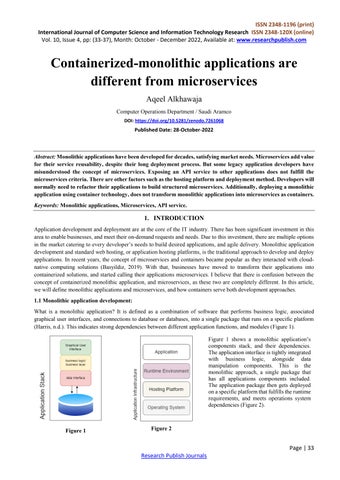
1. INTRODUCTION Application development and deployment are at the core of the IT industry. There has been significant investment in this area to enable businesses, and meet their on-demand requests and needs. Due to this investment, there are multiple options in the market catering to every developer’s needs to build desired applications, and agile delivery. Monolithic application development and standard web hosting, or application hosting platforms, is the traditional approach to develop and deploy applications. In recent years, the concept of microservices and containers became popular as they interacted with cloudnative computing solutions (Basyildiz, 2019). With that, businesses have moved to transform their applications into containerized solutions, and started calling their applications microservices. I believe that there is confusion between the concept of containerized monolithic application, and microservices, as these two are completely different. In this article, we will define monolithic applications and microservices, and how containers serve both development approaches. 1.1 Monolithic application development: What is a monolithic application? It is defined as a combination of software that performs business logic, associated graphical user interfaces, and connections to database or databases, into a single package that runs on a specific platform (Harris, n.d.). This indicates strong dependencies between different application functions, and modules (Figure 1). Figure 1 shows a monolithic application’s components stack, and their dependencies. The application interface is tightly integrated with business logic, alongside data manipulation components. This is the monolithic approach, a single package that has all applications components included. The application package then gets deployed on a specific platform that fulfills the runtime requirements, and meets operations system dependencies (Figure 2).
Figure 1
Figure 2
Page | 33 Research Publish Journals