ANTIQUES: Early 20th-century toy marks historic flight, F8
IN THE GARDEN: The right way to prune your hydrangea, F3
GARDENING: How to keep your soil healthy, F6






ANTIQUES: Early 20th-century toy marks historic flight, F8
IN THE GARDEN: The right way to prune your hydrangea, F3
GARDENING: How to keep your soil healthy, F6
By A lix Strauss
The New York Times
The New Year has come and gone and with it your resolutions for doing a deep, cleansing purge. What has stayed, however, is the clutter. Piles of clothing, boxes of books, bags of crafts and cords.
The start of spring offers a new opportunity to clean, well, everything, including your emotional and physical connection to your stuff.
“Not everyone knows how to edit and organize. Or to make room in their lives and in their homes for a fresh start,” said Christina Fallon, 46, owner of Dream It Done Organizing, a New York Citybased professional organizing company. She specializes in closet and space design, estate clearing and Swedish death cleaning, or decluttering before one’s own death.
“People get lost in the different chapters of their lives,” she said. “Spring puts people in a mood to take charge and action.” We asked Fallon how she approaches decluttering and how nonprofessionals can tackle their own homes.
This conversation has been edited and condensed.
Q. What makes people hire you?
A. Usually, they’re in the middle of a transition. They’ve lost a loved one and don’t know what to do with that person’s belongings. They’re having a baby or getting divorced and starting over. They’re working from home now and need to create an office. Or they’re overwhelmed by the chaos and amount of stuff they’ve accumulated. Many are stuck mentally, emotionally and physically.

Q. Why can’t they reorganize with a friend or partner?
A. I bring fresh eyes, a neutral energy. There’s sensory overload and emotional clutter attached to their physical clutter. I present solutions while holding them accountable. That’s something your friend, sibling or partner can’t do. They might be biased, and say, “You have to keep that dress. You wore it when we went to this or that event.” I don’t have an attached memory or emotion to your belongings.
Q. Do you dump and deconstruct, or go room by room?
A. I start in the bathroom because people don’t tend to have an emotional attachment to their expired NyQuil. Once they get used to saying “toss it,” and they’ve started to build a purging muscle, we move on to harder things.
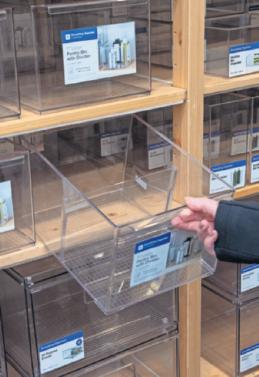
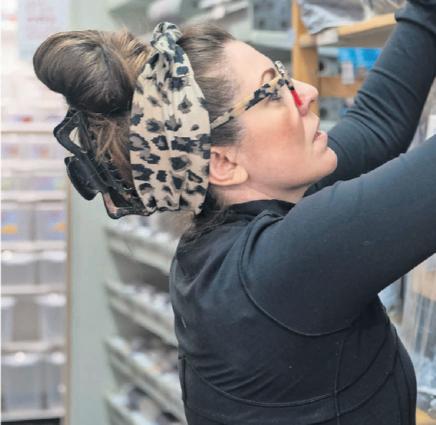
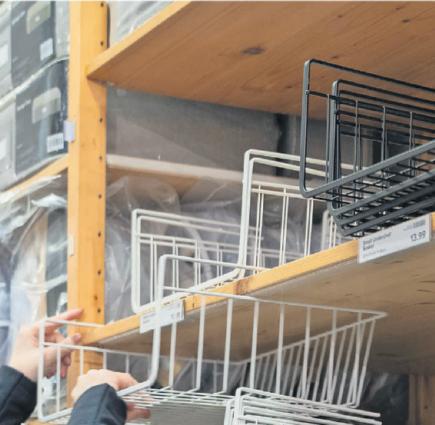
At left, above and front cover: Christina Fallon, owner of Dream It Done Organizing, at The Container Store on 6th Avenue in Manhattan, on March 19. Spring cleaning season is upon us and Fallon, who specializes in closet and space design, estate clearing and Swedish death cleaning (decluttering before one’s own death), recommends letting go of sentimental objects and creating a home that reflects who you are now.
Q. You also do Swedish death cleaning. How does that work?
A. Swedish death cleaning is the act of setting clear intentions for where your belongings will go once you pass away, which includes organizing and categorizing things to appraise and sell, charitable donations, gifting to friends and family and tossing. Usually, I do this with an older person or someone with a terminal illness who wants to get their belongings in order and not burden their loved ones with managing their possessions after they’ve gone. Younger people have started hiring me because they’ve gone through the process for their parents and realize they don’t want to burden their children.
Q. Tips or advice?
I don’t pressure anyone to get rid of anything, but I do shake up their home like a snow globe so I can put it back together.
People decide what to keep, throw out, give away or donate.
We look at usefulness and the feeling an item gives you. Say someone owns multiple pairs of stilettos from their 20s that they haven’t worn in 10 years. Maybe we keep one or two pairs and give away the rest. We are editing and curating for the version of you now.
Q. What room is most telling?
A. Closets are the heart of the home. They show you people’s lives, what they collect and what they’ve shoved in the corners: art supplies, memorabilia, gifts they plan to regift. Things that belong in different rooms get stuffed into one space. They close the door and forget about it.
Q. What do people have difficulty parting with?
A.
Books and souvenirs. Most people are sentimental and hold onto things, especially if they are attached to a good memory — a trip they took, a concert they went to, their kid’s artwork. They worry that if they give something away, that memory will fade. I suggest people take photos of these items and then let them go. We tend to make museums out of our lives.
A. Don’t use the dining room table as a storage unit. Things you use often, like coffee mugs should go above or next to the coffee maker. Shop for your space; for me, that means no Costco. I value the real estate in my apartment more than the deal on 30 rolls of paper towels. There’s the 20/ 20 rule: If you can get an item in 20 minutes for under $20, and you’re thinking of getting rid of it, get rid of it. We only use about 20% of our wardrobe, so if you haven’t worn or used something within six months, you’re probably not going to use it. This article originally appeared in The New York Times.












HYDRANGEAS ARE all the rage these days. If you do have a plant or plants, you may have to prune them. But hydrangea isn’t just one kind of plants; a number of species are popular. Before you approach your hydrangea or hydrangeas, pruning shears in hand, you’ve got to know what species you are growing. They differ in their pruning needs.
I’m going to give you a (figurative) hand by explaining how to identify each commonly grown species, and then guiding your hand holding the shears.
If you grow just one hydrangea, I’ll bet that it’s bigleaf hydrangea (Hydrangea macrophylla). This species is most recognizable for sporting electric blue or lively pink flower heads, blue when the soil pH is below 5.5 and pink when the pH is above 6.5. You can choose your color by adding sulfur for more acidity or limestone for less.
Bigleaf hydrangea develops its flower buds in late summer on into fall, and buds open in early summer. That is, unless a plant experiences a cold winter at the northern edge of its growing range (Zone 5), in
Applications are available for the Agawam Garden Club 2026 scholarship. To qualify for the scholarship students must be a graduating senior of Agawam High School or a college student who graduated
from Agawam High School and is planning to attend an institution of higher learning in the fall.
Applicants must be majoring in or planning on majoring in one of the following: botany, environmental engineering, environmental science, earths systems, forest management, natural resources, plant soil and insect science, sustainable agriculture, sustainable horticulture or food and farming, turf grass science and man-
agement, landscape design and management technology, clean energy, technology studies: waste water or other environmental related studies. The recipient will be awarded a $1,000 scholarship at the clubs annual May meeting. Completed applications along with transcripts and references must be submitted to Denise Carmody, 40 Primrose Lane, Agawam MA 01001 by April 1.
which case flower buds are killed. The plant still grows well but doesn’t flower. Flower buds are formed the previous growing season at or near the ends of branches. Leave old, dry flowers on the plant for winter interest and to protect the coming season’s flower buds.
Come spring, cut stems that have flowered back to the fat flower buds. Or prune after flowering. Also thin out excess twiggy growth to let light and air into the bush. If in doubt about pruning this species, don’t.
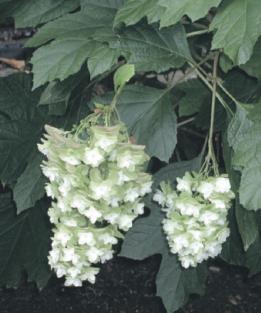
Oakleaf hydrangea (H. quercifolia) is a large, spreading shrub bearing white flowers in early summer and, just as pretty, are the leaves, which are shaped like oak leaves. The flower clusters are cone shaped, often turning an attractive rust brown color as they age. I wanted to grow this species but feared my cold winters would kill flower buds, in which case, as with bigleaf hydrangea, the plant would grow well, just not flower.
Prune oakleaf hydrangea just like bigleaf hydrangea, unless you are more interested in the decorative leaves than the flowers.





For leafy shoots rather than flowers, cut stems back by one-quarter in late spring. Oakleaf hydrangea can grow quite large and spreading, and little or no pruning is fine also if the size is fine with you.
Bigleaf and oakleaf hydrangea are the more difficult hydrangeas to prune. Now for some easy ones.
If your hydrangea produces large snowballs of white blossoms in late spring on new shoots, it’s smooth (Hillsof-Snow) hydrangea (H. arborescens). This botanical name always throws me off because “arborescens” means tree-like but the plant is most untree-like in the way it sends many succulent, green shoots up from ground level each spring. And why “smooth” in the common name when this plant’s bark is textured and peeling?
Before you approach your hydrangea or hydrangeas, pruning shears in hand, you’ve got to know what species you are growing.
At any rate, pruning is easier than remembering its name. Just lop the whole plant to the ground just before growth begins in spring. It could have been done back in winter, even late fall, but I like to leave the large, round clusters of dried, small flowers on the plant all winter. For a second show of new flowers, prune low right after the first show ends.
Also easy to prune is peegee hydrangea (H. paniculata ‘Grandiflora’), identifiable by its bearing flowers in mid to late summer. It’s a small tree eventually growing 15 or more feet high with multiple woody trunks. Its flowers form on new shoots up in the plant so, in spring, cut back young shoots to the framework of older limbs, leaving just a few young buds per shoot. Little
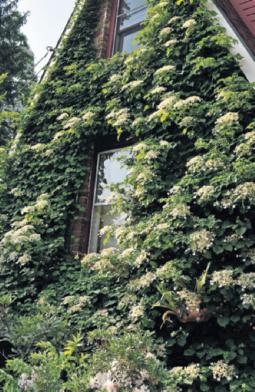
pruning is required. And finally we come to my favorite hydrangea, climbing hydrangea (H. anomala subsp. petiolaris).
Anomala in the botanical name refers to a plant with a vining growth habit. This vine blankets the north side of my home and decorates it year ‘round. Right now, the vine is leafless with its stems and their coppery, peeling bark forming a mesh over the entire brick wall. Leaves are soon to emerge on the short shoots that jut out from the wall, and those shoots will bear clusters of tiny, white flowers. The flowers sparkle against their darker leafy backdrop like stars in the night sky.
This vine needs little or no regular pruning — except that, left free to roam, it would engulf my whole house. So twice during the growing season I gather up various types of pruners so I can reach far and wide to confine the vine to that one wall. I also shorten some of the jutting shoots after they finish flowering to keep them from inching further and further off the wall over the years.
Growing up a tree or allowed to ramble over the ground, climbing hydrangea needs no such restraint.
So there you have it. Plant one of some species of hydrangea or identify what you already have. Then prune it, as needed, which it might not need.
Applications are available through Agawam High School or can be found on the website at agawamgardenclub.com.
Monson Garden Club is sponsoring its Guest Night program “Xeriscaping” with Master Gardener Kathi Gariepy on Monday, April 6, 7 p.m. in First Church of Monson on High St. Xeriscaping is the art of landscaping with plants that require little water for upkeep. This process helps with water conservation while beautifying an area.
Gariepy contributes to community enrichment and education as a lead teacher for Massachusetts Horticultural Society and education coordinator for Mass Audubon. She is actively involved in the Attleboro Garden Club and Massachusetts Master Gardener Association. As a master gardener she shares research-based horticultural knowledge and experience with the public.
This program is open to the public with light refreshments to be served. A suggested donation of $5 will include a chance to win plants for sustainable gardening.
The Springfield Garden Club is hosting a series of programs for anyone interested gardens and gardening or just escaping the winter for an hour.
The final program will be held at The Monkey House in Forest Park at 10 a.m. Admission is free to all with paid park admission. More information can be found on the club’s website www.springfieldgardenclubma. org or on Facebook.
Saturday, April 11, 10 a.m., “Planning and Growing a Bountiful Flower Garden” presented by Becky Sadlowski.
The Springfield Garden Club is accepting applications for its annual $2,000 scholarship awarded to a graduating high school senior, undergraduate or graduate college student majoring in a full-time plant science or environmental studies program, such as horticulture, floriculture, landscape design, conservation, forestry, botany, agronomy, plant pathology, environmental control, land management or other allied fields.
The candidate must be a resident of Hampden County, demonstrate financial need
and have adequate academic standing. High school seniors, undergraduate and graduate college students are eligible for consideration.
For additional information and to request a copy of the application contact Daniel Sheehy at SGCscholarship@gmail.com.
Scholarship applications are to be complete and meet the submission deadline of April 1 to be eligible for consideration.
The SGC has awarded over $90,000 to more than 60 students during the past 30 plus years. Funds for the scholarship are raised at the annual plant sale held each year in the Spring. The annual Plant Sale this year will be held at Forest Park on Sumner Avenue in Springfield on Saturday, May 30 from 9 a.m. to noon.
For more information on the Springfield Garden Club events go to www.springfield gardenclubma.org or visit them on Facebook at www.facebook.com/Springfield MAGardenClub.
Berkshire Botanical Garden presents the following upcoming program: Saturday, April 4, 9 a.m. to noon, “Food as Medicine: The Kitchen Qi Experience.” Experience the healing synergy of movement, food and intention in an immersive workshop developed by Carole Murko, healer, culinary instructor and founder of Love.Eat.Heal.
This spring session focuses on the wood element, supporting the liver and gallbladder organ systems and inviting growth, creativity and emotional flow. The workshop begins with a guided Qigong practice to awaken energy and connect with the season’s rhythm. Participants then move into the kitchen to cook and share a meal, exploring how conscious food preparation can nourish body, mind and spirit. Using vibrant greens, sprouts and sour flavors, you’ll learn seasonal techniques to energize the body, support detoxification and promote emotional renewal. Through this experiential class, you’ll leave nourished and grounded, with recipes, seasonal practices and a deeper understanding of how to use food as energy medicine. KitchenQi blends neuroscience, energy medicine and ancestral wisdom to cultivate wellness from within, making it perfect for anyone looking to align with nature’s seasonal flow while activating their own inner healer. Cost $100 members, $120 nonmembers. Saturday, April 4, 2 to 4 p.m., “Crafting Wellness from Nature: Fire Cider and Elderberry Syrup Make and Take Workshop.” Join herbalist, artist and ritualist Nicole Irene for a hands-on workshop featuring the enchanting world of herbal. Embark on a journey to create two powerful plant remedies, fire cider and elderberry syrup, time-honored elixirs celebrated for their immune-boosting properties.



































































I grew up in Ireland watching my father work hard and take pride in doing things the right way. He showed me early on that your word matters, that shortcuts aren’t worth it, and that good work speaks for itself. I came to America in the 1980s with $80 and my father’s work ethic. I’m thankful for the opportunities this country gave me, and proud to now call myself a "Yank."



By Jessica Damiano Associated Press
WE ALL DREAM
OF
it: A breathtaking, lush, verdant garden that nourishes our souls and makes us the envy of the neighborhood. And to make that dream come true, our first thoughts tend to focus on plants.
But the garden is a structure, and like any structure, it requires a good foundation. That’s where soil health comes in.
Soil is not just “dirt.” It’s a living ecosystem teeming with nutrients, organic matter and billions of organisms like bacteria, fungi, insects and invertebrates like worms. That ecosystem is estimated to be home to 59% of all life, “making it the singular most biodiverse habitat on Earth,” according to a 2023 research article published in the Proceedings of the National Academy of Sciences.
Soil organisms keep harmful organisms in check, break
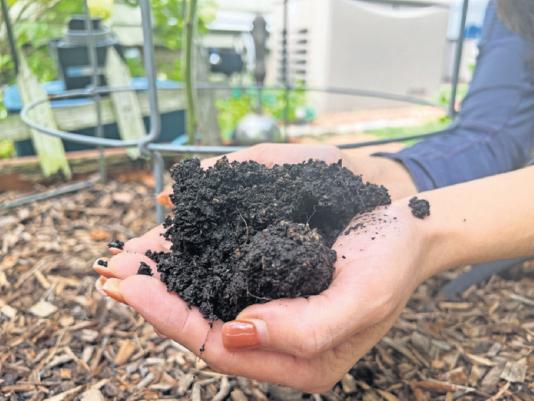
down organic matter into natural fertilizer, distribute oxygen and aerate the soil to optimize water drainage. Keeping it healthy is paramount to your garden’s success.
Make sure your soil meets plants’ moisture needs
Before planting, assess your soil’s structure. Sand drains too
quickly, while heavy clay retains too much water. Neither will properly meet most plants’ moisture requirements.
Improve either soil type by spreading 3-4 inches (8-10 centimeters) of compost, leaf mold or well-rotted manure over the area, then use a broad fork to gently turn it in 6-12 inches (1530 centimeters) deep.
Don’t overdo it; the end result should be lumpy, not powdery.
Aggressive turning or tilling harms microorganisms, kills beneficial insects and earthworms, increases erosion, removes air pockets, releases carbon into the atmosphere and brings dormant weed seeds to the surface, where
conditions are perfect for their growth. It also moves nutrient-rich topsoil down, replacing it with less-fertile soil from below.
In subsequent years, simply spread the organic matter over the soil and allow it to work its way down naturally as it decomposes.
By D ina C heney
MATH MIGHT SEEM FAR removed from interior design, but geometry is often the secret behind homes that sing. Decorators rely on formulas for determining the right size coffee table to pair with a couch and how many inches above a mantel to hang a painting. But they also turn to forms and formulas to achieve that certain je-ne-sais-quoi — those intangible qualities that differentiate the so-so from the scintillating.
“Honestly, as a creative person, mathematics has been my least favorite subject,” Frida Ramstedt, the Sweden-based author of “The Furniture Handbook” and “The Interior Design Handbook,” said in an email. “But in a business where everything is all about gut feeling, these proportions and formulas have been a great help.”
Washington, D.C.-based interior designer Christopher Boutlier agreed. “I don’t sit down and ‘do math’ in a literal way,” he said in an email. “But proportion and geometry guide almost
every decision I make. Good interiors borrow from the same ideas that make classical architecture work: harmony, rhythm and proportion.” He explained that when something is even a few inches off, you can feel it. “The room becomes restless. When it is right, the space feels quiet. That is the math doing its job.”
For design pros, these principles are often ingrained or instinctual. For the rest of us, they can be learned. Consider this your cheat sheet.
The Fibonacci sequence
In this series, each number is the sum of the previous two (as in 0, 1, 1, 2, 3, 5). Also known as the “golden ratio,” it can be expressed as 1.618 or 60/40. Associated with beauty since ancient times, these proportions comprise the blueprint behind natural forms such as nautilus shells, pinecones and sunflowers and architectural masterpieces like the Parthenon, the Great Pyramid, Notre-Dame Cathedral and the Taj Mahal.
Try applying them to your floor plan, furnishing 6o% of a room and leaving
the remaining 40% empty. You can also use it for a color scheme. For a client’s office, Ohio-based designer Autumn Pochiro chose medium-tone blue for 60% of the space and indigo for the remainder.
The 60/30/10 principle
This self-explanatory proportion can be applied to the amount of color, pattern or texture. For instance, in a color scheme, there can be a dominant hue (used in 60% of a space), a secondary hue (used in 30% of a space) and an accent hue (used in 10 % of a space).
In a bathroom she designed for a client, California-based designer Christine Markatos Lowe created a linear pattern using Mosaic House tiles in three tones of blue.
For a client’s bedroom, Boutlier went with a color scheme of 60% soft neutrals, 30% mid-tone woods and 10% darker accents.
Symmetry
Including elements that correspond to each other in a balanced way helps achieve a serene, predictable effect.
One way to accomplish this is with mirror symmetry, such as a bed flanked by nightstands or a couch bookended by matching works of art.
Another is radial symmetry, where elements radiate from a central point, as with chandeliers and round dining tables.
In plane symmetry, which is used in patterns for upholstery, tile, wallcoverings and art, motifs repeat (and sometimes transform) across surfaces in consistent ways. Patterns with symmetrical shapes from nature, like the Platonic solids, flower of life and fractals, bring even more orderliness. The Platonic solids appear in the crystalline structures of minerals. They include five perfectly symmetrical three-dimensional shapes, such as cubes and tetrahedrons. For a bold, graphic statement, consider the Nordic Knots Garden Maze rug. Present in honeycombs, snowflakes and flower petals, the flower of life pattern consists of evenly spaced overlapping circles, as in the Flower of Life rug line from Gordian Rugs.
This immersive experience combines traditional herbal medicine’s rich lore and wisdom with the joy of creative expression. In this make-and-take class, you will: Discover the history, medicinal properties, and health benefits of both fire cider and elderberry syrup; Participate in detailed stepby-step demonstrations on how to make these recipes from scratch; Enjoy a collaborative, fun, and creative environment while crafting your own bottles of fire cider and elderberry syrup; Take home a bottle each of Elderberry Syrup and Fire Cider, along with the knowledge and confidence to recreate them on your own. Cost, $50 members, $70 nonmembers. For more information, or to register visit www.berkshire botanical.org. Berkshire Botanical Garden is located at 5 West Stockbridge Road.
The West Springfield Garden Club has announced that two $2000 scholarships are available for qualified high school seniors or post-secondary students during the spring of 2026. Any West Springfield resident currently enrolled in an accredited institution of higher education with a focus in horticulture, agriculture, ecology, botany, environmental studies, landscape design or forestry, Applications are available on garden club or Park and Rec website and must be completed by April 10th.
Wilbraham
The Wilbraham Garden Club will hold its monthly meeting on April 2, 12 p.m., at the Saint Cecilia Parish Center. “Saving Nature, Ourselves in Our Own Back Yards” will be presented by Master Gardener Sharon Farmer. Ms. Farmer will show us how to make inexpensive modifications to our outdoor spaces to support pollinators and reduce our carbon footprint.
A light lunch will be provided prior to the speaker. Members are welcome to join us and there will be a $5 fee for guests. Please contact Anna Howell at 413 5375788 with questions or to reserve your spot.
The Wilbraham Garden Club is pleased to announce that applications are now being accepted for two, $1,000 scholarships. We are accepting applications from graduating high school seniors, undergraduates, and graduate college students majoring in or who plan to major in, one of the programs listed below. Eligible student must be residents of Wilbraham or Hampden, MA. All applicants must be enrolled in one of these fields of study: Botany, Horticulture, Conservation, Environmental Science, Earth Systems, Forest Management, Natural Resources, Plant, soil and Insect Science, Sustainable Agricultures, Sustainable Horticulture, Food and Farming, Turf Grass Science & Management, Landscape Design & Management Technology, Landscape Architecture, Oceanography, Clean Energy Technology, Floral Design or Land Management. Applicants must include a personal essay of 100-200 words, official high school or college transcript(s), two letters of recommendation, college acceptance letters(s) if available, along with the completed Wilbraham Garden Club Scholarship application. All required documentation must be received on or before April 30. Notifications will be made by mid-May and the recipients will be awarded their scholarships at the annual meeting of the Wilbraham Garden Club on June 5. Scholarship applicants will be available at the Wilbraham and Hampden Public Libraries, Minnechaug Regional High School and Wilbraham Monson Academy. They can also be found on the Wilbraham Garden Club Facebook page. Please contact howella413@gmail.com with questions or to receive an application.
Send items for Garden Notes to pmastriano@repub.com two weeks prior to publication.
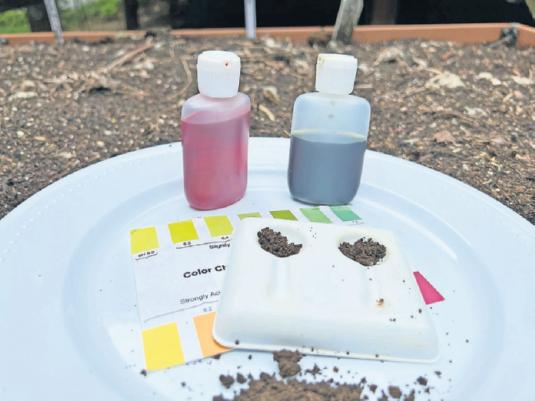
Check your soil pH
What is your soil’s pH level?
Each plant type thrives only within a specific pH range.
Learn your plants’ target range, then check your soil’s value with a home test kit.
If its level is outside the ideal range, raise it by incorporating garden lime or lower it with elemental sulfur, following the dosing directions on the package label.
While you’re at it, check nutrient levels to ensure the soil is rich in nitrogen, phosphorus and potassium — the three essential macronutrients for plant health.
The results will guide your fertilizer strategy. You can buy a separate test kit or look for a combination pH-nutrient kit. Both are inexpensive and widely available.
Alternately, call your local cooperative extension office; many provide soil tests and guidance for a nominal fee.
CONTINUES FROM PAGE F6

A shovel stands in a lumpy soil bed on Long Island, N.Y., on Sept. 11, 2021.
Healthy soil doesn’t happen overnight
For the best results, focus on building soil health slowly rather than relying on quick fixes, which are typically shortlived. This means opting for slow-release fertilizers and organic matter, such as compost, rather than using fast-release synthetic fertilizers. Save fast-release options for emergencies when you need to resolve a nutrient deficiency quickly to save a plant.
Avoid walking on soil in beds, borders and the
In fractals, the same pattern repeats at different scales, as with tree branching, river systems and fern fronds. Richard Taylor, professor of physics, psychology and art at the University of Oregon, has conducted research proving these patterns have calming effects. For your home, get the look with York Wallcoverings Tree Silhouette wallpaper or Etoffe Liquen wallpaper.
Be careful not to overly rely on symmetry, though; if a space is completely orderly, it can feel stiff and formal. For visual interest, add some asymmetry or unexpected elements. One way to achieve this is with groupings in odd numbers, like five vases on a mantel, seven glass balls in a bowl or three paintings.
The rule of thirds
For a balanced layout, divide your
lawn. Doing so risks compacting the soil, which closes vital air pockets, inhibits water flow and makes it difficult for roots to grow through. Most plants growing in compacted soil will be stunted or otherwise fail to thrive.
Bare soil leads to erosion, nutrient deficiencies, moisture loss and the death of microorganisms. It also rolls out the welcome mat for weeds. Plant something or cover the soil with a thick layer of undyed organic mulch like shredded bark, wood chips, straw or dry leaves.
Spread 2-3 inches (5-8 centimeters) of mulch around plants in beds and borders, too. It will retain moisture, keep soil temperature even and discourage weeds. Just keep it a couple of inches away from plant crowns and stems to avoid rotting.
Jessica Damiano writes regular gardening columns for The Associated Press. She publishes the award-winning Weekly Dirt Newsletter. Sign up here for weekly gardening tips and advice.
space into a 3x3 grid, with a focal point in the center. Scanning left to right and top to bottom, the colors, textures and lines should flow throughout. In a living room with a vaulted ceiling, New Jersey-based Blanche Garcia of Conscious Home split the room into thirds: furniture in the bottom, a custom bookshelf wall in the middle and empty space on top.
For a client’s living room, Boutlier divided the seating area into thirds (circulation, furniture and empty space).
The ideal equation for a space combines order with some disorder. A “balance of paired elements and singular accents” will provide “enough repetition to feel ordered and enough variation to feel human,” Boutlier said. When designing a room, start with a formula like the golden ratio or rule of thirds. Then add a touch of the unexpected, say by including an odd number of decorative objects.
Terry & Kim Kovel | Antiques & Collecting
TODAY’S TOY COMPANIES
might be fueled by flights of fancy, but, in the early days of flight, real-life aircraft were imaginative enough. Many toy airplanes of the early 1900s were miniature copies of existing airplanes, like a windup Bleriot airplane by Gunthermann that sold for $1,080 at Bertoia Auctions.
It was modeled after the Bleriot XI, which, in 1909, became the first airplane to fly across the English Channel. Its pilot, Louis Bleriot, had started his career as an electrical engineer, but, after a long fascination with aviation and several personal experiments, founded his own company to research, design and build aircraft. After his flight across the English Channel catapulted him to international stardom, many toy companies made copies of his plane that rolled, flapped their wings, spun their propellers, or revolved around a tower. When it comes to toy tributes, Bleriot had an advantage over other pioneering aviators like the Wright brothers: He created the first piloted monoplane, a style that proved much easier for toymakers to copy than biplanes.
Q.I would like to know the value of my Libbey wine glasses.
A.The value of your glasses will depend on their age, type of glass, pattern, and condition. Libbey Glass began in 1888 as W.L. Libbey & Son in Toledo, Ohio, and helped Toledo gain its reputation as “Glass City.” The company was a major maker of cut glass during the American Brilliant period, which lasted until about 1914. Sets of Libbey wine glasses from that period sell for about $150, although an individual glass can sell for that much, or even more, if it is an especially rare pattern or has a signature. Libbey made various other types of glass, including art glass in the late 1800s to early 1900s; pressed glass novelties; and decorated barware in the mid-20th century. These usually sell for lower prices than their Brilliant Period cut glass. The company is active today and makes glassware for retail and wholesale.
If your wine glasses are cut glass, you may be able to identify the pattern with help from the book “Identifying American Brilliant Cut Glass” by Bill and Louise Boggess or online resources from The American

It didn’t
take long after Louis Bleriot’s groundbreaking flight across the English Channel for toymakers to take inspiration from his plane. This wind-up version was made by Gunthermann. (BERTOIA AUCTIONS)
Cut Glass Association (cutglass.org). For other types of Libbey glass, the Toledo Museum of Art (toledo museum.org), which was founded by the Libbey family and has a collection of Libbey glass, may have more information. A collector’s club like the National American Glass Club (glassclub.org) or a book like “20th Century Factory Glass” by Lesley Jackson may also be helpful.
Q. I am 86 years old and want to have items that belonged to my grandmother appraised, particularly a large print of “The Horse Fair” by Rosa Bonheur dated 1853. How do I find a reputable appraiser who would be willing to come to my home for appraisal? Also, what is the cost of a standard appraisal?
A. Formal appraisals can be extremely expensive; over $100 per hour. It may not be necessary to have your print appraised. Rosa Bonheur (1822-1899), a French painter and sculptor known for her extremely realistic, lifelike depictions of animals, exhibited “The Horse Fair,” her most famous painting, at the Paris Salon in 1853. The print is probably later than that. The painting was an immediate success, and many famous printmakers, including Currier & Ives, made copies of it during Bonheur’s lifetime. Today, antique prints of “The
Horse Fair” have sold for anywhere from about $25 to $350 at recent auctions. The price will depend on many factors, including the age, size, condition, and type of print. If you do not have all this information, you may want to contact an art museum in your area. They may have a day for authenticating artworks for the public but will not be able to tell you the print’s value. An art or auction gallery in your area may have an event where they provide free appraisals. If you do need a professional appraisal, a good way to find a qualified appraiser is through a professional association like the American Society of Appraisers (appraisers.org), International Society of Appraisers (isa-appraisers.org), or Appraisers Association of America (appraisers association.org). Check reviews and ask for references before you hire anyone.
TIP: Don’t repaint old metal toys. It lowers the value.
Kovels answers readers’ questions sent to the column. Send a letter with one question describing the size, material (glass, pottery) and what you know about the item. Include only two pictures: the object and a close-up of any marks or damage. Be sure your name and return address are included. By sending a question, you give full permission for use in any Kovel product. Names, addresses
Current prices are recorded from antiques shows, flea markets, sales and auctions throughout the United States. Prices vary in different locations because of local economic conditions.
Fishing, lure, Michigan Tipper, wood, painted, yellow, red, two treble hooks, 1946, 3 1/2 inches, $25. Glass-midcentury, vase, swung, amber, Smoothie, tapered, rounded base, short foot, L.E. Smith, 16 inches, $85.
Porcelain-contemporary, Seder plate, fruit clusters and blue-ribbon bows around rim and in center, gilt trim, Hebrew text around inner rim, marked, Richard Ginori, Italy, 12 inches, $215.
Coffee mill, Enterprise, red paint, two wheels, green and yellow trim, decal, square base, 14 inches, $280. Disneyana, toy, Donald the Driver, Donald Duck, in red car, multicolor character images, tin lithograph, spring motor, windup, box, Marx, 1950s, 3 1/2 x 7 inches, $360.
Clothing, shoes, moccasins, Northern Plains, hide, laced, glass beads, light blue ground, red roses, green leaves, triangle motifs, hard leather sole, c. 1975, 11 1/2 inches, $385.
Pairpoint, lamp, dome shade, frosted glass, reverse painted island scene, palm trees, flying seagulls, marked, metal base, relief flower band, round foot, 22 x 16 inches, $420.
Georg Jensen, bowl, silver, hammered, turned in rim, pierced pedestal base, four stylized petals, round foot, marked, 5 x 5 1/2 inches, $625.
Rug, Cuenca, orange, yellow, cream, lattice pattern field, leafy scrolls around inner border, flowers in corners, wool, Portugal, c. 1920, 11 feet 10 inches x 17 feet 4 inches, $1,090.
Furniture, chest, Georgian, flame mahogany, overhanging top, two short over three graduated drawers, pendant pulls, bun feet, 18th century, 32 x 36 1/2 inches, $1,660.
or email addresses will not be published. We do not guarantee the return of photographs, but if a stamped envelope is included, we will try. Questions that are answered will appear in Kovels Publications. Write to Kovels, The Republican, King Features Syndicate, 300 W. 57th Street, 41st Floor, New York, NY 10019, or email us at collectorsgallery@kovels. com.
By A lex Veiga Associated Press
THE AVERAGE LONG-TERM
U.S. mortgage rate climbed this week to its highest level in more than six months, driving up borrowing costs during what’s typically the busiest time of the year for prospective homebuyers.
The benchmark 30-year fixed rate mortgage rate rose to 6.38% from 6.22% last week, mortgage buyer Freddie Mac said Thursday. One year ago, the rate averaged 6.65%.
This marks the largest one-week increase since April 2025 and the largest three-week increase since October 2024, according to Realtor.com.
The last time the average rate was higher was Sept. 4, when it was at 6.5%.
When mortgage rates rise, they can add hundreds of dollars a month in costs for home shoppers, limiting what they can afford to buy.
Only four weeks ago, the average
Alan James Desroches and Christina Marie Desroches to Brendan Hanna, 19 Greenwood St., $425,000.
Jon C. Daniels and Alana Parnell to Alana Parnell and James Parnell, 4 Sunrise Terrace, $190,000.
Jonathan Alicea and Maria Silva to Jonathan Alicea, 955 River Road, $50,000.
Welltower OM Group LLC, to Agawam 230-232 MP WRK7 LLC, 230-232 Main St., $5,250,000.
Christian G. Appy and Katherine G. Appy to Jonathan Blanchard and Elizabeth Jayne Murphy, 60 Red Gate Lane, $1,280,000.
ARPC LLC, to Aung Win and Ingyin San, 141 Tracy Circle, $440,000.
Katherine O’Neill and Katherine A. Duffy to Madison Shea Duffy, 97 South Washington St., $100.
Randy Hoffman and Andrea L. Hoffman to David M. Miller, trustee, Corey J. Miller Trust and Travis Pay-
rate had dropped to just under 6% for the first time since late 2022, but it has been rising as skyrocketing oil prices due to the war with Iran fuel worries about high inflation.
Meanwhile, borrowing costs on 15-year fixed-rate mortgages, popular with homeowners refinancing their home loans, also rose this week. That average rate rose to 5.75% from 5.54% last week. A year ago, it was at 5.89%, Freddie Mac said.
Mortgage rates are influenced by several factors, from the Federal Reserve’s interest rate policy decisions to bond market investors’ expectations for the economy and inflation. They generally follow the trajectory of the 10-year Treasury yield, which lenders use as a guide to pricing home loans.
The 10-year Treasury yield was at 4.39% at midday Thursday, up from around 4.26% a week ago.
Treasury yields have been climbing as higher oil prices increase expectations for higher inflation. As long-term bond yields rise, that pushes up mortgage rates.
Higher inflation could also keep the Fed from cutting interest rates. The
dos, 164 Railroad St., $560,000.
David D. Nauman, Lucille G. Nauman and Lucy Nauman to David D. Nauman, trustee, Lucille G. Nauman, trustee, and David & Lucille Nauman Revocable Trust, 32 Sylvan Circle, $100.
Josephine J. Taudel, Annamaria Taudel and Melissa J. Leonard to Farm East LLC, Off Nye Brook Road, $616,500.
James B. Hall, Kimberly J. Longval and Joanne Hall Stetson to Miranda Lynn LaPolice and Benjamin Roney-Yaeger, 102 Elm St., $363,000.
Olit 2024-HB1 Alternative Holdings LLC, to William F. Barry Jr., and Timothy Barry, 10 William St., $197,500.
Arelia G. Tumidajewicz to Hassan Saleh, 340 Pendleton Ave., $400,000.
Arelia G. Tumidajewicz to Hassan Saleh, Pendleton Avenue, Lot B,
central bank doesn’t set mortgage rates, but its decisions to raise or lower its short-term rate are watched closely by bond investors and can ultimately affect the yield on 10-year Treasurys.
At its meeting last week, the Fed decided to hold off on cutting interest rates. Chair Jerome Powell highlighted the increasingly uncertain outlook for the U.S. economy and inflation in the wake of the Iran war, suggesting the Fed could stand pat for an extended period.
The U.S. housing market has been in a slump since 2022, when mortgage rates began to climb from pandemic-era lows.
Sales of previously occupied U.S. homes were essentially flat last year, stuck at a 30-year low. They have remained sluggish so far this year, declining in January and February versus a year earlier.
The average rate on a 30-year mortgage remains below where it was a year ago, which should benefit home shoppers who can afford to buy at current rates. Such buyers stand to benefit from other buyer-friendly housing market trends: The pace of home price
growth has also slowed or fallen in many metro areas and there are more homes on the market than a year ago.
But for everyone else, the recent ramp up in rates only makes the affordability hurdles to homeownership more of a challenge, especially as wage growth has not kept up with surging home prices for much of this decade.
“Rising mortgage rates are a major barrier to what should otherwise be a very favorable spring homebuying season,” Joel Berner, senior economist at Realtor.com, said in an email.
Already, there are signs that the rising mortgage rates are giving prospective home shoppers pause just as the spring homebuying season gets going.
Mortgage applications fell 10.5% last week from the previous week, according to the Mortgage Bankers Association. Applications for both purchase and mortgage refinancing loans declined.
“Higher borrowing costs, affordability pressures and economic uncertainty are likely prompting some prospective buyers to delay purchase decisions,” MBA CEO Bob Broeksmit said in a statement.
$130,000.
Charles E. Bennett and Martha Sue Bennett to Alison Cavanaugh, 210 Johnson Road, Unit 23, $415,000.
DGL Properties LLC, to Philip Crump-Willis and Samantha Riley, 66 Bromont St., $500,000.
Elaine M. Goulet, trustee, and Eugene Kida 2023 Revocable Trust, trustee of, to Ryan Brunelle and Cheyenne Champagne, 16 Sesame Drive, $405,000.
Jennifer L. Gonzalez and Michael T. Gonzalez to Robert Beaulieu, 103 Lauzier Terrace, $305,000.
Kazimierz Borawski and Danuta Borawski to Jeu Petterson Oliveira Ribeiro, 341 Montcalm St., $349,900.
Leo Fugler Jr., to Joan M. Hernandez Martinez, 219 Clarendon Ave., $290,000.
Michael V. Kulisz to Michael V. Kulisz and Erika Holly Arrastia, 35 Dejordy Lane, $100.
Muni Management Inc., to Rihab Al Zubaidi, 26 Belcher St., $189,000.
Patricia A. Pasko, trustee, Patricia A. Deren, trustee, and Deren Realty Trust, trustee of, to Ibweam LLC, 5759 Stearns Terrace, $400,000.
Elizabeth A. West to Dacey Farm
Real Estate Holdings LLC, 85 Dacey Road, $1,100,000.
Ebak Projects LLC, to Huy Quoc Nguyen and Ha T Huynh, 62 Baymor Ave., $480,000.
Jonathan D. Stone to Susan J. Austin and Dave E. Austin, 55 Allen St., $370,000.
Lisa L. Scarnici and Gina G. Kenison to Pro Olive LLC, 118 Hampden Road, $545,000.
Luis Gutierrez to Frank Daniele and Amanda Rose Daniele, 3 Princeton St., $160,000.
Roy F Gelineau (JR COMMR) to Karen S Nash, 171 Maple St., $400,000.
Jaimie A. Golec and Jamie Golec to PAH Properties LLC, 7 Lawndale St., $185,000.
Faythe H. Hayes, “fka” Faythe H. Petrin, to Elizabeth West, 163 S. Shelburne Road, $550,000.
James R. Zehelski and Jeanette P. Zehelski to James R. Zehelski Jr., 18 King St., $100.
David J. Gates to Wendy M. Tomlinson, 2 Farar Drive, $410,000.
Albert E. Paone and Brenda A. Paone to Albert E. Paone, 693 Dwight St., $45,000.
Arrow Properties Inc., to Taber & Bishop LLC, 285 High St., $550,000.
Gallagher Properties LLC, to Travis Thompson, 1684 Northampton St., $515,000.
HHA-South Holyoke Homes II LLC, to Clara I. Almonte Almonte, 203 Clemente St., $240,000.
Kelly Dulude, representative, Gina Poole, representative, Rosemary T. Bey, estate, Susan Bey, Kristin Bey, Ellen Bey and Catherine Bey to Alice Kennedy, 33 Vassar Circle, $331,500.
Hatch Property Management LLC, to Mass Postal Holdings LLC, 534 Main St., $370,000.
DEEDS, PAGE F10
Mahmood Ahmad, Ghulam Mustafa and Sughran Bibi to AQ Properties LLC, 365-369 High St., $430,000.
Steven A. Smith Sr., and Alexander T. Smith to Nivian A. Lopez Molina, 72 Allyn St., $237,000.
MPOH Partners LLC, to Matthew W. Corcoran, 270 Montague Road, $183,333,33.
Bobby Loguidice and Jill Bradley-Graham to John Joseph Stout and Mia Gabrielle Nadia Cameron, 67 Shady Side Drive, $680,000.
Jose A. Cuevas Rentas to Bryan Denny and Kellen Denny, 1423 Longmeadow St., $382,000.
Tamara Marino to Musa Bas, 203 Green Hill Road, $550,000.
Amanda D. Lipson and Amanda Deanna Lipson to David T. Lipson, 136 East Akard St., $125,036.
Bretta Construction LLC, to Wisllen Queiroz Santos, 42 Loopley St., $599,900.
Jeffrey E. Salvador and Amanda R. Salvador to Daniel J. Kleeberg and Nanette Kleeberg, 45 Canterbury St., $300,000.
Joe Webb to Michelle Batista Pires and Alexander James Neshe, 88 Chapin St., $170,000.
Mark J. Palatino and Kim Sue Palatino to Mt Park LLC, 106 Moody Road, $100.
Robert Bator, Agata Bator and Agata Gadziala to Marcin Gadziala and Olga Gadziala, Woodland Circle, $20,000.
Nancy A. George, “fka” Nancy A. Dolan to Justin Killeen, Manley Phelps Road, $30,000.
Jean M. York to James M. Haug and Alexandra Kennedy, 412 Burts Pit Road, $200,000.
William H. Butcher, Richard Bruce Vincelette, personal representative, Craig E. Sonnenberg, estate, and Craig Sonnenberg, estate, to Elizabeth E. Powers, 44 Evergreen Road, $278,100.
Americamp Realty LLC, to Mark Lindsay and Jennifer Klahn, 35 Hubbard Ave., $498,000.
Tanya Rarick personal representative, and Lee Mary Collins, estate, to
James E. Foster and Rebecca M. Foster, 214 Audubon Road, $406,500.
James M. Grimley and Pamela M. Grimley to Dorothy Whiting, 51 East Road, $447,900.
Colleen L. Curtis and Robbi L. Curtis to Aiden Buckingham and Mariah Buckingham, 42 King St., $170,000.
Deborah M. Mackey and Brian A. Mackey to Alex R. Bellows and Julie A. Bellows, 257 Boston Road, $425,000.
Dominic Kirchner II, trustee, and Jehoram Realty Trust, trustee of, to Todd Peters, 29 Griffin St., $450,000.
Ghassan K. Ghrear and Ghada S. Ghrear to Ebert Dos Reis and Christinne Silva Dos Reis, 98 Mason St., $520,000.
Jane Belleville to David Depierro, 2136 Baptist Hill Road, $594,000.
Leslie M. Skowyra to John W. Ryan and Meredith M. Ryan, 1573 North Main St., $550,000.
M G Investments LLC, to Derek Beaulieu and Jerome Talbot, Fuller Street, Lot 9, $70,000.
Douglas Smith, personal representative, and Carolyn J. Dupuis, estate, to Joanne Brackett, 10 Young Circle, $312,000.
Patricia A. Bourassa to Patricia A. Bourassa and Amy B. Bourassa, 4 Linda St., $100.
GMS Properties LLC, to Steven Thompson, trustee, Mary T. Thompson, trustee, and Thompson Revocable Trust, 200 Old Lyman Road, $100.
Joel M. Estes and Patricia R. Estes to Theresa Horstmann and Rachel Hodges, 84 East St., $100.
Danielle B. Sullivan and Jeffrey M. Beebe to Jason G. Sexton and Joanna Sexton, 31 Woodland Ridge Road, $550,000.
Fitzgerald Home Solutions LLC, to YMS Property Leasing & Management LLC, 269 College Highway, $227,000.
1911 F T C Real Estate LLC, receiver, Springfield City, U S A Housing & Urban Development and Jonathan Jones to Real Estate Investments Northeast LLC, 196-198 Massasoit St., $80,500.
Amanda Rae Poirier, estate, Amanda R. Poirier, estate, and Anna Smith, representative, to Darlin Nahun Alvarado Erazo, 37 Middlebrook Drive, $295,000.
Anthony M. Santaniello to Dahiana Marie Gonzalez Carrasquillo, 151 Littleton St., $250,000.
Brian J. Nolan to Sarah Strangie and Jonathan Weiss, 67 Perkins St., $265,000.
Chandler C. King to Roselyn M. Ayala, 114-116 Sylvan St., $410,000. Cig2 LLC, to Luis A. Negron, 59 Pine Grove St., $365,000.
Darlene Smith-Ash to Veteran Stan LLC, 281 Laurelton St., $160,000.
Darrell K. Williams to Mark R. Draymore, trustee, and MRD Profit Sharing Trust, trustee of, 91 Spikenard Circle, $100.
Emtay Inc., to Post Investment LLC, 220 Ambrose St., $95,000.
Evelyn M. Moore to Centura Bay LLC, 97 Treetop Ave., $198,000.
Gillian Peters to Nick Hurley, 103 Ontario St., $320,000.
Hassle Free LLC, to Craig R. Godbolt, 47 Victoria St., $261,000.
J. Brown & Associates Inc., to Tikiko Gomez, 50-52 Savoy Ave., $350,000.
James L. Hernandez and Ashley E. Dejesus to Wilfredo J. Semidey and Sara Semidey, 150 Drexel St., $325,000.
Janusz Lecko to William Benjamin Brown, 19 Quincy St., $280,000.
JoeJoe Properties LLC, to Joshua Lantigua and Brianna Lee Lantigua, 97-99 Pine Grove St., $385,000.
Jose Silva, representative, and Emilia Silva, estate, to Francheska Reveron Warren, 54 Seymour Ave., $279,900.
Mackenzie E. Kerkhoff and Giovanni Venezia to Liberata Letteri, 235 State St., Unit 105, $205,000.
Mark Palatino and Kim Palatino to MT Park LLC, 47 Lyons St., $100.
Maureen Cratty to Marzena K. Sochacka Medina, 115 Tiffany St., $260,000.
Miciel Mariano and Alberto Nieves to Kelly Taylor, 173 Russell St., $365,000.
Minh Lam to Sarah Condon and Avery Paige Condon, 11 Herman St., $370,000.
Nancy Rygiel and Tina Lachance-Rygiel to Noel Investment Group LLC, 102 San Miguel St., $172,500.
Nishant Mathur and Deepika Mathur to Bloomfield Street LLC, 23 Huntington Road, $100.
RM Blerman LLC, to Charlie Rodriguez Otero, 15-17 Sycamore St., $390,000.
Robert S. Allen to Marcelo Gabriel Braga Goveia, 9 Murray Hill Ave., $410,000.
Roland Fils, Sylvia Brice Fils and Sylvia Brice-Blanca to Sylvia Brice
Fils, 205 Fairlawn St., $74,000.
Sarah J. Bousquet, Rachael A. DiGiovanni, Kristyana E. Daitch, Nicholas J. DiGiovanni, Amanda E. DiGiovanni, Samantha E. DiGiovanni, Regina M. DiGiovanni and Kristyana DiGiovanni to Rachael DiGiovanni, 23 Harper St., $195,908.
Sonia J. Harris and Berle Walter to Dnepro Properties LLC, 140 Chestnut St. Unit 607, $57,999.
Stanley Clerge to Gilberto Marquez Robles, 1988 Wilbraham Road, $220,000.
Wallace S. Olsen Jr., trustee, and Neslo Realty Co., trustee of, to 235 Cadwell Drive LLC, 0 SS Cadwell Drive, $3,250,000.
Welltower OM Group LLC, to Springfield 305 MP WRK7 LLC, 305 Bicentennial Highway, $7,700,000.
Christopher Lee Figueroa and Maiza Castro Silva Figueroa to Shellian Forsythe, 10 Church St., $439,000.
Bernadette M. Carberry to JMT Holdings LLC, 9 Walnut St., $175,000. Lori-Ann Reitsma, personal representative, and Sophie Constance Pawlowski to Rhiron Realty LLC, 84 Greenwich Road, $182,500.
Arianna R. Palazzi, Arianna R. Polazzi and Kaleigh G. Morgan to Alicia Melinda Gonzalez and Gunnar Tate Sagan, 29 Webster Ave., $343,000.
Barbara J. Gasperack to Brian K. Lapointe, 65 Churchill Road, $456,000.
Bette-Jo Clark to Cornerstone Homebuying LLC, 62 Talcott Ave., $200,000.
Fatima Masic, representative, and Diane E. Hall, estate, to Debra Ann Zides, 183 Craiwell Ave., $315,000.
Gail A. Stanton and Richard H. Johnson to Gail A. Stanton and William Stanton, 58 Farnum St., $100.
Johnna Fay, representative, and Christine L. Fay, estate, to Jocelyn Emily Rivas, 144 Almon Ave., $275,000.
Matthew Stetson to Mary Ann Theresa Biza, 750 Amostown Road, $370,000.
Michele Minniear, trustee, and Michele L. Minniear Family Trust, trustee of, to Domenic Amato and Katelin Wilken, 88 Verdugo St., $425,000.
Nicholas D. Lane to Lane Contracting Co. LLC, 596 Westfield St., $100.
Caroline Arbuzov, representative, and Nataliya Pavlov-Arbuzov, estate, to NZ Property LLC, 555 Russell Road,
Unit J-64, $100,000.
Christopher D. Hitas, representative, Donna F. Costa, estate, and Donna Costa, estate, to Matthew Keeney, 14 Loring Lane, $290,000.
Cycle Street Redevelopment LLC, to Aero Fastener Realty LLC, 0 Cycle Street, $382,375.
Joseph M. Bannish Jr., Leslie Bannish, representative, and Donald Bannish, estate, to JG Sigma LLC, 0 Little River Road, $800,000.
Keith E. Knowlton to AGI Home Solutions LLC, 1430 Russell Road, $180,700.
Marilyn D. Orszak, trustee, and Marilyn D. Orszak 2024 Trust, trustee of, to Peter Daws and Jennifer Daws, 161 Wildflower Circle, $610,000.
Matthew Gaw, representative, Jessica Grazio, representative, and David Joseph Gaw, estate, to Kathryn Meagher, 30 Llewellyn Drive, $360,000.
Mobius Real Estate LLC, to Michael D. Tirrell and Crist A. Myers, 26-28 Washington St., $300,000.
Cecilia Jablonski, Marcia Green, representative, Barbara Jablonski, estate, Barbara A. Jablonski, estate, Barbara Ann Jablonski, estate, Brenda L. Jablonski, representative, Robert Jablonski, estate, and Robert W. Jablonski, estate, to Hazel Zebian and Nazih Zebian Jr., 56 Weston St., $250,000.
James Moriarty III, Daniel T. Moriarty, Kathleen T. Moriarty and Thomas M. Moriarty to Brianna Gallucci and Andrew Moore, 5 Northwood Drive, $439,000.
Luke Ratcliffe to Nicole Graziano, 17 Mountain St., $235,000.