









By Jolie K err
The Washington Post
FLEX SPACES, THOSE MULTIuse areas that bend and grow to accommodate the disparate and changing needs of a household, took off during the pandemic. We had to get creative about how we used space when we were home 24/7, making room for work, school, hobbies, fitness and, well, everything else. But they’re still very much a part of how we live now.
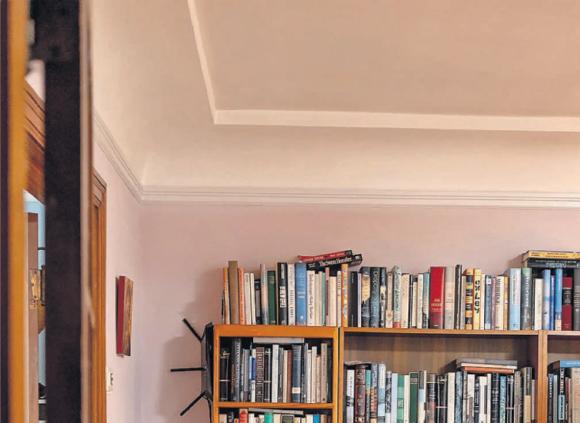
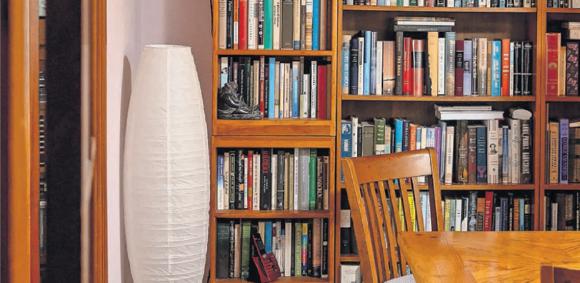
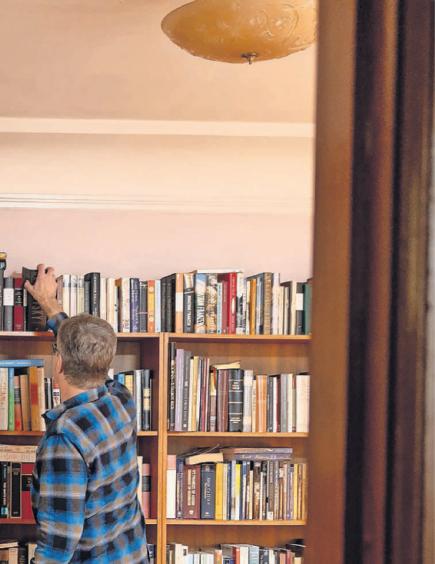
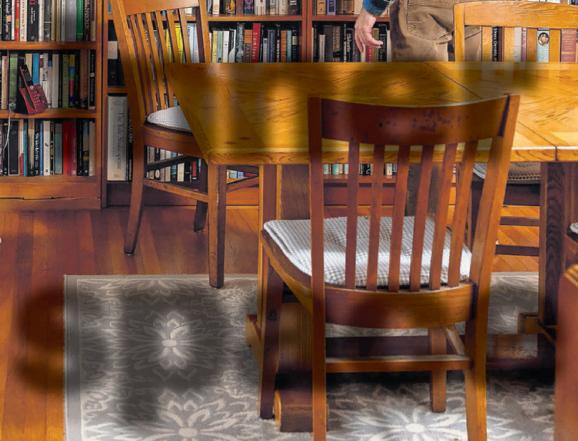
One of the hottest iterations of this outside-the-box thinking about space is the dining library, which is pretty much exactly what it sounds like: a hybrid of an elegant formal dining room and a cozy reading space. “The table is central, but so are the shelves that surround it,” says Cait Barker, the creative director and co-founder of Bessette. “A dining library brings character, warmth and purpose to a room that’s often underused.”
Jen Baxter, the founder of Baxter Hill Interiors, describes dining libraries as “intellectually and visually immersive” spaces that reflect your personality through your choice of books and collected objects, which can offer conversation starters for dinners with friends. Or they can morph into “a flexible place where the dining table becomes a surface for spreading out your reading, research or projects like puzzles, crafts or Legos.”
Dining libraries contain multitudes
There are multiple ways to approach the dining library. The more classic approach, Barker says, is “book-forward and formal, usually with floorto-ceiling shelves and a dedicated dining table. It’s designed primarily for reading, entertaining and quiet conversation.” By contrast, she says, “the multiuse dining library is more flexible, blending books with everyday activities like crafting, homework or working from home; and the entertainer’s dining library prioritizes hosting, incorporating bar storage, serving surfaces or display shelving for glassware alongside books.” Regardless of which style you choose, there are some fairly standard elements. “Shelving, layered lighting and a large communal table tend to anchor the space,” says Alice Moszczynski, an interior designer at Planner 5D. “Rich textures like wood, textiles and warm paint colors help
Cait Barker, the creative director and co-founder of Bessette, believes a dining library brings character, warmth and purpose to a room that’s often underused. Cover photo: The multiuse home space trend can help you get more mileage out of your dining room.
(BESSETTE / JASON DOIY / GETTY IMAGES)
create a cozy atmosphere that encourages lingering.”
How to create a dining library in your home
Adding a dining library to your home could be as simple — and relatively inexpensive — as rearranging some furniture or adding some DIY shelving. Or it can be a full-scale renovation led by contractors and designers. “A budget-friendly version, using prefabricated shelving, plug-in sconces, paint and thoughtful styling, can be achieved for $1,000 to $3,000,” Barker says. “At the high end, a fully custom dining library with floor-to-ceiling built-ins, detailed millwork, wallpaper, paint and custom lighting can range from $20,000 to $50,000-plus.”
If a full reno isn’t in your budget, these tips can help you turn your existing dining room into a book-centered flex space.
For inspiration, get out into the world. There’s no better way to get ideas than by looking at how other people and spaces display books. “Visiting libraries in person can be invaluable and often leads to more thoughtful design decisions,” Baxter says. And looking online is no substitute for seeing things in person, she adds. “Historic homes or well-de-
signed hotels are great places to see how light interacts with different finishes and materials. That kind of insight is difficult to capture online.”
Make it book-forward
“The most basic requirement of a dining library is a strong book collection,” Baxter says.
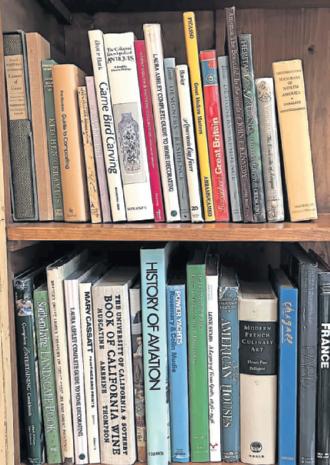
To design a room around books, mix them with ceramics, small pieces of art and objects to create depth.
“The goal is a collected look that feels personal rather than precious,” Barker says. “When in doubt, go vintage — timeworn pieces add instant character and keep shelves from feeling too polished or predictable.”
To bolster or build a book collection, “local estate sales, secondhand and online thrift shops are excellent resources for sourcing books affordably,” Baxter says. She recommends choosing hardbacks over paperbacks for a more elevated look. “Removing dust jackets can also help, particularly if the sleeves feel overly glossy or clash with the room’s palette. The clothbound cover underneath often feels more refined.” Designing with books also offers a lot of flexibility when it comes to styling a room. “They can be organized by color, size or theme, and rearranged over time,” Baxter says.
Add shelving
Built-in bookshelves lend architectural weight, but freestanding bookshelves offer more flexibility, leaning either formal or casual depending on the style and on the styling. “For a looser look,” Baxter says, “books can be stacked on side and console tables or low surfaces rather than relying solely on shelving.”
To mimic custom millwork on a budget, try using freestanding bookcases painted the same color as the walls. “There’s some great Ikea hacks for this,” Moszczynski says. Then accessorize. “Add a warm rug, a dimmable table lamp and curated books or objects to create a library-like atmosphere without construction,” she adds.
Choose your table wisely
A large central table is a staple of both dining rooms and libraries. “From formal rectangular to casual round, this is the room’s anchor,” Barker says. “Choose a table scale that leaves comfortable circulation around chairs.” To get the scale right and avoid a too-big table that leaves the
space feeling cramped, she says, “A trick I love is taping out the table’s size on the floor before buying to see how it actually looks and feels in the room. You want enough room to pull chairs in and out comfortably and still have easy flow around the table.”
Color is king
“Dining libraries tend to feel most successful when the palette is intentional and grounded,” Baxter says. “Deeper or more muted tones make sense in this context, but darker colors are by no means required.”
Color drenching — using one hue or a set of closely related shades to paint an entire room, including the walls, ceiling, trim, fixtures like radiators and even small pieces of furniture — is well-suited to a dining library, says Darlene Molnar, an interior designer in the D.C. area. Popular dark paint choices for a dining library include navy blue, rich chocolate brown or even a bold scarlet. Lighter tones that create richness include pearl gray, butter yellow, muted terra-cotta and sage.
The finish also matters
“For dining rooms, a matte, eggshell or satin finish if the room is humid, is typically recommended for its subtle sheen and durability,” says Chuck Reger of Five Star Painting. “Overly glossy finishes, or very bright, trendy shades may not suit formal spaces if they clash with the room’s style.”
Layer the lighting
You want multiple sources of lighting, rather than just one fixture in the middle of the room. “A stunning chandelier over the table sets mood,” Barker says, “then add sconces or picture lights to highlight shelves and sculptural objects.”
Get clever with storage
“In smaller spaces, a built-in banquette surrounded by shelving is a great way to save space,” Molnar says. Adding drawers or other storage spaces to lower shelves to hold linens and serving pieces “keeps the space beautiful and utilitarian,” Baxter says. “Some people even incorporate rolling carts or modular furniture so the room can transition from dinner party to reading nook seamlessly,” Moszczynski adds.
Jolie Kerr is a cleaning expert and the author of the best-selling book “My Boyfriend Barfed in My Handbag … and Other Things You Can’t Ask Martha.”
Lee Reich | In the Garden

LOOKING AT TREES that usually drop their leaves in winter, you might notice that some of them — especially beeches and oaks — wear skirts of foliage all winter long. I say
“skirts” because if the trees were human, the leaves would all be at skirt-level, proportionately. Rather than being lush and green, these skirts are dried and brown or gray, just like their counter-
Upcoming event at Berkshire
Botanical Garden
Berkshire Botanical Garden presents the following upcoming program: Thursdays, March 26 to April 30, “Landscape Design II.” Learn skills essential for functional garden design that honor the site and meet client needs. Led by Chuck Schnell and Walter Cudnohufsky of Cudnohufsky Associates, this course will cover a different topic or technique focusing on the importance of getting to know the client and site as a basis of effective and appealing design. Essential and easy-to-grasp design principles will be introduced throughout the course, with a form-finding approach to garden design. Acquire the vocabulary essential for assessing a property’s potential and problems, and the right questions to realize a
parts on the ground.
These trees, still clinging to their leaves, aren’t out of synch with the environment. Nor does this habit reflect the effect of climate change or nighttime lighting. The oak and beech branches cling to their leaves because the branches are “juvenile,” and
reluctance to drop leaves is one sign of juvenility in plants. (Artificial lighting and a warming climate have been shown, though, to delay leaf drop in autumn and advance the time when leaves unfold in spring, just how much depending on the tree species and the duration and the color
client’s wishes while avoiding common design mistakes. Learn how to make well-considered and sustainable choices for the elements and materials commonly used in the residential-scale garden. Students will complete a instructor-provided project and take it from creative concept to completed design plan, including site assessment diagrams, conceptual sketches and schematic drawings. Each class will involve instruction and evaluation of projects in progress. Group discussions and exercises will put theory into action. Students will make a formal presentation at the final class with the primary goal of conveying a coherent design narrative and process leading to proposed solutions. Cost is $215 members, $240 nonmembers. For more information or to register, visit www.berkshirebotanical.
org. Berkshire Botanical Garden is located at 5 W. Stockbridge Road.
of the light.)
Juvenility in plants is akin to prepuberty in humans: during this period plants grow but are incapable of sexual reproduction, that is, flowering, then setting seed. The duration of juvenility varies from plant to plant.





The Springfield Garden Club is hosting a series of programs for anyone interested gardens and gardening or just escaping the winter for an hour.
The programs will be held at the Monkey House in Forest Park at 10 a.m. Admission is free to all with paid park admission. More information can be found on the club’s website www.springfieldgardenclubma.org or on Facebook.
Saturday, March 28, 10 a.m., “Vegetable Gardening 101” presented by Gretel Anspach Saturday, April 11, 10 a.m., “Planning and Growing a Bountiful Flower Garden” presented by Becky Sadlowski.
The Springfield Garden Club is accepting applications for its annual $2,000 scholarship, awarded to a graduating high school senior, undergraduate or graduate college student majoring in a full-time plant science or environmental studies program, such as horticulture, floriculture, landscape design, conservation, forestry, botany, agronomy, plant pathology, environmental control, land management or other allied fields.
The candidate must be a resident of Hampden County, demonstrate financial need and have adequate academic standing. High school seniors, undergraduate and graduate college students are eligible for consideration.
For additional information and to request a copy of the application contact Daniel Sheehy at SGCscholarship@gmail.com. Scholarship applications are to be complete and meet the submission deadline of April 1, to be eligible for consideration.
The SGC has awarded over $90,000 to more than 60 students during the past 30 plus
years. Funds for the scholarship are raised at the annual plant sale held each year in the Spring. The annual plant sale this year will be held at Forest Park on Sumner Avenue in Springfield on Saturday, May 30 from 9 a.m. to noon.
For more information on the Springfield Garden Club events go to www.springfieldgarden clubma.org or visit them on Facebook at https://www. facebook.com/Springfield MAGardenClub/
The Western Massachusetts Master Gardener Association will hold their spring gardening workshops on Saturday, March 28, 9 a.m. to 1 p.m. at Westfield Middle School South, 30 West Silver St. Workshops feature 10 classes designed to educate and empower the home gardener. Choose one class for each session. The classes are “Using Trees and shrubs for Year Long Interest,” “Berry Delicious gardens,” “Practical Tips: Growing for a Changing Climate,” “Gardening in Small Spaces,” “From One Comes Many: Propagation Workshop” (Hands on), “Invasive Species 101: Identification & Management, ” “Vegetables vs Pests: Time to Win,” “Design Your Own Water Feature,” “Let’s Go Native: A Sustainable, Attainable Approach, ” and “Get Your Hands Dirty! Creating a Succulent Garden” (Hands On). Online registration is $35 through March 26; walk-ins’ day of workshop $40 (cash only). Register online at WM MGA.org. Register early as classes fill up quickly.
The Wilbraham Garden Club will hold its monthly meeting on April 2 at noon at the Saint Cecilia Parish Center. “Saving Nature, Ourselves in Our Own Back Yards,” will be presented by Master Gardener Sharon Farmer. Farmer will show guests how to make inexpensive modifications to their
outdoor spaces to support pollinators and reduce our carbon footprint.
A light lunch will be provided prior to the speaker. Members are welcome to join and there will be a $5 fee for guests. Contact Anna Howell at 413537-5788 with questions or to reserve your spot.
The Wilbraham Garden Club has announced that applications are now being accepted for two $1,000 scholarships. Applications are being accepted from graduating high school seniors, undergraduates, and graduate college students majoring in or who plan to major in, one of the programs listed below. Eligible students must be residents of Wilbraham or Hampden.
All applicants must be enrolled in one of these fields of study: Botany, Horticulture, Conservation, Environmental Science, Earth Systems, Forest Management, Natural Resources, Plant, soil and Insect Science, Sustainable Agricultures, Sustainable Horticulture, Food and Farming, Turf Grass Science & Management, Landscape Design & Management Technology, Landscape Architecture, Oceanography, Clean Energy Technology, Floral Design or Land Management. Applicants must include a personal essay of 100-200 words, official high school or college transcript(s), two letters of recommendation, college acceptance letters(s) if available, along with the completed Wilbraham Garden Club Scholarship application. All required documentation must be received on or before April 30. Notifications will be made by mid-May and the recipients will be awarded their scholarships at the annual meeting of the Wilbraham Garden Club on June 5.
Scholarship applicants will be available at the Wilbraham and Hampden Public Libraries, Minnechaug Regional High School and Wilbraham Monson Academy. They can also be found on the Wilbraham Garden Club Facebook page.
Please contact howella413@ gmail.com with questions or to receive an application.
Monson Garden Club is sponsoring its Guest Night program “Xeriscaping” with Master Gardener Kathi Gariepy on Monday, April 6, at 7 p.m. at the First Church of Monson on High Street. Xeriscaping is the art of landscaping with plants that require little water for upkeep. This process helps with water conservation while beautifying an area. Gariepy contributes to community enrichment and education as a lead teacher for Massachusetts Horticultural Society and education coordinator for Mass Audubon. She is actively involved in the Attleboro Garden Club and Massachusetts Master Gardener Association. As a master gardener she shares research-based horticultural knowledge and experience with the public. This program is open to the public with light refreshments to be served. A suggested donation of $5 will include a chance to win plants for sustainable gardening.
The West Springfield Garden Club has announced that two $2,000 scholarships are available for qualified high school seniors or post-secondary students during the spring of 2026. Any West Springfield resident currently enrolled in an accredited institution of higher education with a focus in hor-
ticulture, agriculture, ecology, botany, environmental studies, landscape design or forestry, Applications are available on the garden club or Park and Recreation website and must be completed by April 10.
Applications are now available for the Agawam Garden Club 2026 scholarship. To qualify for the scholarship, students must be a graduating senior of Agawam High School or a college student who graduated from Agawam High School and is planning to attend an institution of higher learning in the fall.
Applicants must be majoring in or planning on majoring in one of the following: botany, environmental engineering, environmental science, earths systems, forest management, natural resources, plant soil and insect science, sustainable agriculture, sustainable horticulture or food and farming, turf grass science and management, landscape design and management technology, clean energy, technology studies: waste water or other environmental related studies.
The recipient will be awarded a $1,000 scholarship at the clubs annual May meeting. Completed applications along with transcripts and references must be submitted to Denise Carmody, 40 Primrose Lane, Agawam MA 01001 by April 1. Applications are available through Agawam High School or can be found on the website at agawamgardenclub.com.
Send items for Garden Notes to pmastriano@repub.com two weeks prior to publication.













































































I grew up in Ireland watching my father work hard and take pride in doing things the right way. He showed me early on that your word matters, that shortcuts aren’t worth it, and that good work speaks for itself. I came to America in the 1980s with $80 and my father’s work ethic. I’m thankful for the opportunities this country gave me, and proud to now call myself a "Yank."




THE ALLEN BIRD Club of Springfield reminds area residents that early spring means hungry bears. If you enjoy feeding birds during the winter, it’s now time to bring feeders in at night or to put them away
entirely until next December. Black bears have an excellent memory and will return to feeders where they find easy meals. When that happens, bears can become a nuisance. In the worst-case scenario, they may have to be euthanized.
An excellent way to feed birds year-round is by planting native fruit and seed-bearing plants that provide food for wildlife. The Cornell Lab of Ornithology’s new citizen science initiative, Garden for Birds, offers regionally tailored tips on the
best plants to choose to help struggling wildlife to thrive. This program is free and participation can be cancelled at any time. Information on how to turn your yard into a bird-supporting habitat can be found at gardenforbirds. org.
By D ina C heney
The Washington Post
THE BEST-DESIGNED HOtel rooms often come down to the details. Blackout shades, well-placed light switches and other thoughtful features can make all the difference. “If someone has anticipated these things, that’s the biggest gesture of hospitality you can offer,” said Jo Littlefair, who with her husband, Martin Goddard, runs Goddard Littlefair, a London- and Portugal-based interior design firm that’s worked on projects like the Mandarin Oriental in Vienna and the Gleneagles Hotel in Scotland. Here’s how to upgrade your own bedroom by borrowing strategies from them and other top designers.
Consider how you use your space
“The strongest layouts are informed by how people move through a room over the course of a day,” said Barbara Best-Santos, director of interiors at Hart Howerton, in an email. The New York- and San Francisco-based firm has worked on projects like Miraval Austin Resort & Spa in Austin and Half Moon Resort in Montego Bay, Jamaica. “We begin by mapping the guest journey, from morning routines, to daytime living and working, to evening moments of rest, and use that understanding to guide spatial planning and amenity placement.”
You can follow suit by making sure your bedroom accommodates your routine.
For instance, if you read before bed and prefer to sit in a chair, carve out an area with an armchair, small table and lamp. Your bedside table should be roomy enough to fit nighttime essentials, like a charging device, reading glasses, lamp and alarm clock. A bench at the foot of your bed can hold the decorative pillows you set aside each night.
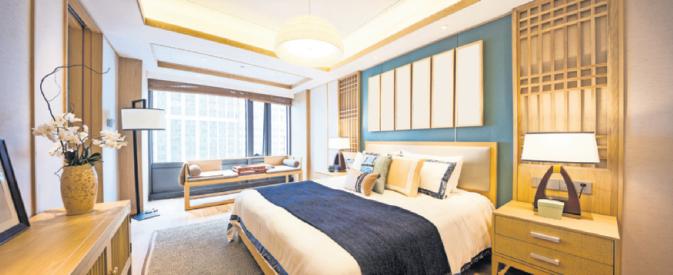
Make your bed the star
Like pop stars, the beds at luxury hotel brands can develop large followings. That’s largely because of their “multiple layers of comfort,” said Goddard. Each brand’s exact “recipe” includes a specific mix of components, from mattresses and mattress toppers to sheets and duvet covers. The acclaimed luxury resort Blackberry Farm in Walland, Tennessee, even offers an online shop, where you can purchase the makings of its beds, including its custom line of mattresses and toppers, Frette sheets, duvet covers, down pillows and throws.
White cotton sateen sheets, from brands like Frette, are “wonderful and pristine — there’s nothing like that lovely sateen finish to make you feel like a princess,” said Littlefair. But they look their best when ironed.
Linen is a soft, elegant and lower-maintenance alternative, pointed out Littlefair, who said she and Goddard make their own bed with linen sheets from the U.K. brand Piglet. “Linen looks good whether you iron or don’t, and it feels good — it’s body temperature-controlling,” she said. “It feels cool in the summer and warming in winter.”
In her own home in Tennessee, Christine Carney, director of design at Blackberry Farm Design, an
interior design firm affiliated with the resort, uses the 100 percent French flax linen sheets from Bed Threads. In winter, she makes her bed with the company’s Heavy Linen Bed Cover, which she said feels like a weighted blanket. “It’s never hot, and I love the way it drapes. It looks so elegant.”
Finally, add foam pillows for support, followed by softer foam pillows for comfort. Then accent with decorative pillows in an “interesting pattern or texture,” recommended Carney.
Avoid being too matchy-matchy
With furniture and decorative accents, “always look for a mix of new and old and high and low,” said Carney. “That leads to a collected, curated space rather than everything looking like it came from a chain store.” For nightstands, she said, it’s fine to use two different pieces of furniture, like a desk or dresser on one side and a nightstand on the other (for cohesiveness, choose pieces in a similar color or finish).
A dresser can be a smart place to save, especially if you don’t plan on opening the drawers frequently, said Laura Keeler Pierce of Keeler & Co. Interior Design, in an email. “It’s so charming to have to jiggle the dresser a little extra to get the drawers out.”
“Blackout is king,” said Littlefair. Blocking out light “affects your sleep as much as the mattress,” she said. For a true blackout effect, begin with blackout shades. Then add drapes long enough to reach the floor. Their panels should overlap at the center to prevent gaps when closed. A cornice or valance overhead will prevent light from seeping out the top.
Your walls also play a role in light management. Carney prefers the “cocoon-like” feel of bedrooms with walls in deep jewel colors like dark green. “Never use a sheen on your drywall. With sheen, all the imperfections will be reflected in the paint,” she said. Wallpaper or plaster are other good options.
Double-pane windows and wool drapes can help lessen noises (like your neighbor’s barking dog). So can area rugs, including in the hallway outside your bedroom, said Littlefair. You can also try a sound machine and, if all else fails, place a small bowl full of ear plugs on your nightstand. (While you’re at it, why not add some chocolates?)
Almost anything can be art
Art is the one area where many hotel rooms fall short: Generic abstract prints are all too common. Instead, try veering off script. “You can use unexpected accessories or collections as a series of art,” said Carney, who hung vintage oyster plates over a client’s bed. “That’s not what they were intended for, and that’s what makes them cheeky,” she said. In the bedroom of her Tennessee home, she hung an embroidered red satin robe she purchased in Hong Kong. Carney says something like a vintage textile found in Morocco or Japan could also “create a special moment.”
THE LINE BETWEEN furniture and fine art isn’t always clear. Artist Max Kuehne (18801968) is known for both.
Kuehne was born in Germany and immigrated to the United States with his family in 1894. He took an eclectic, energetic approach to life, trying several different jobs as a young man before he began formal training in art in 1907.
Kuehne spent years traveling between the U.S. and Europe, finding inspiration in the various art styles practiced at the time and in the landscapes and cities he visited. He painted landscapes, waterfronts, and city scenes, combining the light, color, and spontaneity of Impressionism with the subject matter of Realism.
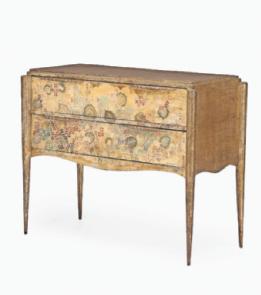
In the 1930s, during the Great Depression, Kuehne began making decorated furniture. He used materials and techniques he knew from making picture frames, like carved gesso, gilding, and silver leaf, and his designs featured flowers, trees, and nature scenes, reflecting his lifelong love of the outdoors.
Today, his furniture is prized by collectors, often selling for higher prices than his paintings. A cabinet that Kuehne signed, carved, gilded, and decorated with colorful flowers and leaves sold for $11,430 at Toomey & Co. Auctions.
Q. The time has come for me to let my wall hanging go. It is design 520 by Don Freedman from 1983. It has the original copyright and composition tags. However, in searching online for information as to its possible value, I’ve been unable to find a reference to or picture of this particular item. Can you provide any information or identify resources for me to check?
A. Don Freedman designed tapestries from about the
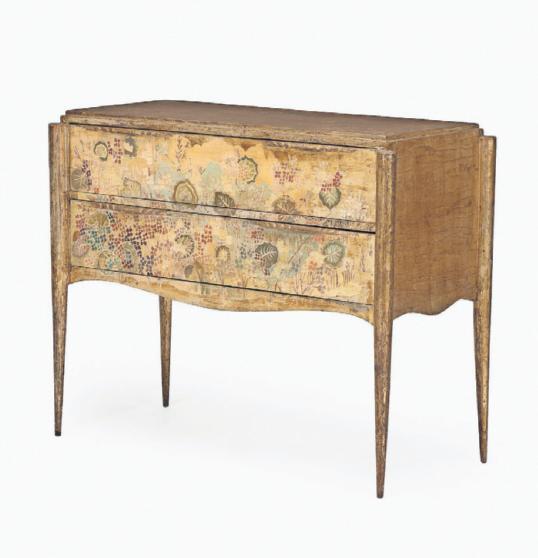
Max Kuehne initially trained as a painter, and later made painted, decorated furniture. The latter is what commands some of his highest prices today. (TOOMEY & CO. AUCTIONS)
1970s to the 1990s. The tapestries were handwoven in India from jute, wool, silk, and cotton, and sold in the U.S. in specialty stores. He designed many styles of tapestries. Some were round or rectangular and pictured plants, animals, or scenic designs. Others were irregularly shaped with abstract designs, sometimes with textured coils or hanging braids and tassels. They are usually natural colors, and can be recognized by tags on the back; one with Freedman’s name and the copyright date, and one with the design number, size, and composition filled in.
We have not found a price specifically for design 250, but similar styles have sold recently for about $150 to $250. Freeman’s tapestries are collectible and currently popular in mid-century and bohemian decorating styles.
Q. I was recently presented with an article from a syndicated paper where you featured a singing bird
most auction houses that deal in decorative arts. You might want to find one that has had a specialized sale of music boxes.
If you are planning to sell yours at auction, look up reviews and ask for references, if possible. Most reputable auction houses will appraise an item for you, and you are not obligated to sell through them if they do.
Current prices are recorded from antiques shows, flea markets, sales and auctions throughout the United States. Prices vary in different locations because of local economic conditions.
Imari, punch bowl, three interior panels, flowers, perching bird in center, short pedestal foot, 5 1/2 x 12 inches, $60.
box. I have a similar item as was pictured and was hopeful you could provide some direction as to where I might learn more about it as well as locate an appropriate auctioneer.
A. Singing bird boxes are collected as music boxes or automata. They were first made in Switzerland in the late 1700s and spread to France and Germany. They are sometimes called “tabatieres,” a French term for a small box. They are still being made today.
Singing bird boxes can be very valuable and can easily sell for more than $500. They frequently sell for over $1,000, and even more if they are made of precious metals or by a famous maker, or if they have unusual features like multiple birds.
Even modern replicas of antique singing bird boxes sell for high prices. Another popular variety of singing bird, where the bird is in a cage, generally sells for lower prices.
Singing bird boxes sell at
For more information about your box, or about selling it, you may want to contact the Music Box Society International (mbsi.org). There is a book on singing bird boxes, “Mechanical Singing-Bird Tabatieres” by Geoffrey T. Mayson, that is comprehensive but difficult to find. You may want to see if it is available at your library. If not, you may want to look for some of the many available books on music boxes and automata, like “The Musical Box Handbook, Vols. 1 & 2” by Graham Webb, “Musical Boxes and Other Musical Marvels,” edited by Angelo Rulli, or “Automata: The Golden Age, 1848-1914” by Christian Bailly.
TIP: Don’t use gummed labels on colored paint or gilding.
Kovels answers readers’ questions sent to the column. Send a letter with one question describing the size, material (glass, pottery) and what you know about the item. Include only two pictures: the object and a close-up of any marks or damage. Be sure your name and return address are included. By sending a question, you give full permission for use in any Kovel product. Names, addresses or email addresses will not be published. We do not guarantee the return of photographs, but if a stamped envelope is included, we will try. Questions that are answered will appear in Kovels Publications. Write to Kovels, The Republican, King Features Syndicate, 300 W. 57th Street, 41st Floor, New York, NY 10019, or email us at collectors gallery@kovels.com.
Silver plate, tray, rectangular, scalloped leafy rim, pierced handles, allover engraved scrolls, on copper, marked, Cheltenham, England, 17 x 29 1/2 inches, $135. Toy, wagon, horse drawn, raised lettering, Sand & Gravel, painted, red, green, wheels, driver, two horses, black, white, cast iron, Kenton, 4 x 10 inches, $155. Lamp, electric, slag glass shade, paneled, caramel, green trim, shaped edge, iron base, baluster shape stand, abstract ruffled foot, c. 1910, 20 inches, $185.
Basket, Native American, Southwestern, olla shape, coiled, red and black patterned panels alternate with columns of white human and animal figures, geometrics around shoulder, willow, 32 inches, $225.
Box, writing, two tiers, hinged top, fruitwood, Sorrentino inlay, figural scenes, leafy scrolls, interior compartments, velvet writing surface, Italy, 19th century, closed 7 1/2 x 18 1/2 x 14 1/2 inches, $325.
Furniture, cupboard, pine, two glass pane doors over hutch, three drawers over two lower doors, wood pulls, 19th century, 81 x 47 inches, $500.
Stevens & Williams, wine, emerald glass bowl, cut to clear, engraved flowers, faceted stem, lobed cut foot, 5 inches, $600.
Rug, Soumak kilim, five Tree of Life motifs, allover animal figures, ivory field, red, indigo, salmon, beige, geometric borders, flat weave, Persian, 9 feet 6 inches x 6 feet 6 inches, $1,000. Wristwatch, Rolex, Oyster Perpetual, stainless steel, beige dial, bar indices, chain strap, 1958, $1,950.
By A lex Veiga Associated Press
The average long-term U.S. mortgage rate climbed this week to its highest level in more than three months, a setback for prospective home shoppers this spring homebuying season.
The benchmark 30-year fixed rate mortgage rate rose to 6.22% from 6.11% last week, mortgage buyer Freddie Mac said Thursday. One year ago, the rate averaged 6.67%.
When mortgage rates rise, they can add hundreds of dollars a month in costs for home shoppers, limiting what they can afford to buy.
Only three weeks ago, the average rate had dropped to just under 6% for the first time since late 2022, but it has risen every week since the war with Iran started, rattling financial markets and stoking worries about higher inflation due to a spike in
energy prices.
Meanwhile, borrowing costs on 15-year fixed-rate mortgages, popular with homeowners refinancing their home loans, also rose this week. That average rate inched up to 5.54% from 5.5% last week. A year ago, it was at 5.83%, Freddie Mac said.
Mortgage rates are influenced by several factors, from the Federal Reserve’s interest rate policy decisions to bond market investors’ expectations for the economy and inflation.
They generally follow the trajectory of the 10-year Treasury yield, which lenders use as a guide to pricing home loans.
The 10-year Treasury yield was at 4.27% at midday Thursday, up from around 4.13% a week ago.
Treasury yields have been climbing as rising oil prices increase expectations for higher inflation. As long-term bond yields rise, that pushes up mortgage rates.
Higher inflation could also keep the Fed from cutting
Craig E. Miloz to Haley Begley, 192 Regency Park Drive, $205,000.
Todd V. Walker and Dymphna M. McWilliams to Claire Rosalinda Chester and Samuel Doyle Bromell, 60 Overlook Drive, $725,660.
Carmela A. Fraziero, personal representative, Yu-Van Suen, estate, and Yuman Suen, estate, to Liam Carolan and Sage Bailin, 39 Valley Lane, $700,000.
Preston Dortch and April Chalfin to David Schmidt, 11 Overlook Drive, $600,400.
John M. Gustin, personal representative, and Marshall Spaulding Gustin, estate, to Carrie-Lynn Saunders and Michelle Saunders, Leverett Road, $35,000.
Jason R. Edwards to 1730 South East Street LLC, 1730 South East St., $750,000.
Christine Acker to A1N1 LLC, Henry Street, $125,000.
Double Edge Theatre Productions Inc., to Mount Grace Land Conservation Trust Inc., 393 Baptist Corner Road, $125,000.
interest rates. The central bank doesn’t set mortgage rates, but its decisions to raise or lower its short-term rate are watched closely by bond investors and can ultimately affect the yield on 10-year Treasurys that influence mortgage rates.
At its latest meeting Wednesday, the Fed decided to hold off on cutting interest rates. Chair Jerome Powell highlighted the increasingly uncertain outlook for the U.S. economy and inflation in the wake of the Iran war, suggesting the Fed could stand pat for an extended period.
The U.S. housing market remains in a slump dating back to 2022, when mortgage rates began to climb from pandemic-era lows.
Sales of previously occupied U.S. homes have been hovering close to a 4-million annual pace now going back to 2023 — well short of the 5.2-million annual pace that’s historically been the norm. They sank last year to a 30year low and have remained sluggish so far this year, fall-
Daniel L. Baird, personal representative of the Estate of Lawrence J. Baird, and as trustee of the Irene F. Baird Testamentary Trust, to Emily Issaev and Michael Issae, 5 Clesson Brook Road, $325,000.
Andrew P. Boyko and Kelley A. Boyko to Sydney Jade Tonelli, 17 Maple St., $275,000.
Clifford B. Morcom III, Clifford B. Morcom III, trustee, and Clifford B. Morcom Revocable Trust to Sarah M. Morcom, 224 Mill Valley Road, $100.
B & B Realty Partners LLC, to Dade Scolardi and Gina Scolardi, 285 Granby Road, $427,500.
Alfred J. Albano Jr., commissioner, and John J. Buday to John J. Buday, 92 Five Bridge Road, $410,000.
Diana Weatherby to Brian Godin, 143 East Buckland Road, $340,000.
Daniel L. Baird, personal representative of the Estate of Lawrence J. Baird, and as trustee of the Irene F. Baird Testamentary Trust, to Emily Issaev and Michael Issaev, 5 Clesson
ing short of their year-earlier pace in January and February even as mortgage rates are lower than they were a year ago.
Data on home contract signings in February, a bellwether for future completed sales, was mixed last month.
A seasonally adjusted index of pending U.S. home sales rose 1.8% in February from the previous month, but fell 0.8% from a year earlier, the National Association of Realtors said Tuesday. There’s usually a month or two lag between a contract signing and when a sale is finalized.
Meanwhile, sales of newly built homes slumped nearly 18% in January from the previous month and were down 11.3% from January last year, the U.S. Census Bureau said Thursday.
The average rate on a 30year mortgage remains below where it was a year ago, which should benefit home shoppers who can afford to buy at current rates.
Still, the recent reversal in mortgage rates has clouded
Brook Road, $325,000.
Jennifer Margaret Smith, Margaret Towner Smith and Peter Smith to Jennifer Carcio and Marc Carcio, 87 State St., $325,000.
Casper Martin to Joia Verde LLC, 400 Zoar Road, $175,000.
Barbara M. Makrianis to Catherine A. Blunt, 179 Greenwood Terrace, Unit 6042A, $235,000.
Brian E. McKay, representative, Elizabeth E. McKay, estate, and Elizabeth Ellis McKay, estate, to Brian E. McKay, 81 Kirby St., $235,000.
Carl D. Roy, trustee, C. Llanor Roy, trustee, and Carl D. Roy Living Trust, trustee of, to Richard R. Lafleur, 29 Sunnymeade Ave., $309,900.
Hathi Nguyen to 346 Britton Street LLC, 90 West St., $600,000.
Roseann M. Sprayson, representative, and Helen Yelle, estate, to Janusz Baran, 35 Dublin St., $263,000.
Stephen Manioudakis, trustee, and Manioudakis Nominee Trust, trustee of, to Doloma Realty of Chicopee LLC, 438 Front St., $450,000.
the spring homebuying season, traditionally the year’s busiest period for the housing market.
Already, there are signs that the pickup in rates may be discouraging some prospective home shoppers, as well as homeowners looking to refinance their existing home loan to a lower interest rate.
Mortgage applications fell nearly 11% last week from the previous week, pulled lower mainly by a sharp drop in home loan refinancing applications, according to the Mortgage Bankers Association. Loan applications to buy a home remain ahead of last year’s pace, MBA noted.
“As rates approached multiyear lows, buyer interest began to show signs of life, but sustained momentum depends on more than just borrowing costs,” Anthony Smith, senior economist at Realtor.com, wrote in an email. “Elevated uncertainty could once again sideline both buyers and sellers, echoing the hesitant market conditions seen last year.”
Roger Freeman Clapp Jr., Roberta C. Phillips and Sydney C. Ramey to Ann Marie Ramey and Jack Arthur Ramey, trustees of the Ramey Revocable Trust, Off Main Poland Road and 559 Main Poland Road, $346,666.
Nancy J. Hayes and Philip C. Hayes to Elaine Henderson, 59 North Hillside Road, $399,000.
Cap Holdings LLC, to Winning Real Estate Holdings LLC, 200 N. Main St., Unit 11, $189,500.
Cash Solution LLC, to Aaron Champagne, 15 Lynwood Road, $295,000.
Deborah A. Basile, trustee, and Basile Family Realty Trust, trustee of, to Michael J. Grossane and Margaret B. Grossane, Pembroke Terrace Lot III-3, $190,000.
Elite Home Creation LLC, to Anthony Monteiro Gomes, 46 Holland Drive, $375,000.
Susan B. Galvin, trustee, and Francis A. Desautels Revocable Trust, trustee of, to Shaukat Matin, 101 Smith Ave., $310,000.
Trevor Devine and Lauren Devine to Dennis Henriques and Jessica Henriques, 101 Dearborn St., $480,000.
Christine M. Bednarz to Christine M. Bednarz, trustee, and 2025 Bednarz Revocable Trust, 24 Overlook Drive, $100.
Edward F. Sparko to Matthew L. Arnold and Kristen E. Zebrowski, River Street Off, $60,000.
Anne M. Flanigan, personal representative of the Estate of Joseph R. Flanigan, to Custom Art Construction LLC, 24 State Road, $175,000.
GC & RK LLC, to Cecilia M. Richards, Chicopee Street, $75,000.
Walter N. Leutz, trustee of the Walter N. Leutz Revocable Trust, and Elizabeth N. Leutz, trustee of the Elizabeth N. Leutz Revocable Trust, to Rachel S. Blain and Andrew C. Chase, 187 Plain Road, $850,000.
Stephen E. Walk to Caleb Walk, 18 Power Court, $330,000.
Carmela A. Fraziero, personal representative, Yu-Van Suen, estate, and Yuman Suen, estate, to Liam Carolan and Sage Bailin, 39 Valley Lane, $700,000.
Veteran Stan LLC, to John A. Pliska, Jr., 65 Chmura Road, $150,000.
Hadley Investment Partners LLC, and Torrington Properties Inc., to 424 Hadley LLC, 424 Russell St., $4,134,400.
Laura Lee Drouin-Bertram and Richard P. Bertram to Christine Eck and Justin Eck, Old Stage Road, $310,000.
Jane A. Corriveau and Gail M. Hickland to Seth Finley and Diana Usher, 7 Hisgen Road, $443,000.
Atom Fox and Sonya Fox to Round Two LLC, 9 Owens Place, $122,000.
Cameron C. Zweir and Bradley C. Zweir to Kathryn M. Zweir, 80 Lindor Heights, $300,000.
NKJ Investment Group LLC, to Timothy Durocher, 63 Pine St., $280,000.
Property Advantage Inc., to Rosalynn Hy-
att, 140 Sycamore St., $280,000.
Simple Times LLC, to Waqas Bhatti, 221 Bel Air Drive, $444,900.
Cynthia White, trustee, Ann Marie Opalenik, trustee, and Mary C. Cleary Revocable Indenture of Trust of, trustee of, to Tyler
Keith Markland and Venus L. Markland, 140 Waverly Road, $600,000.
Meghan E. Domingos and Meghan E. Meffen to Meghan E. Domingos and Ross Domingos, 205 Parker Lane, $100.
Sherry Carroll and Sherry Ann Carroll to Aldo Properties LLC, 56 Glenwood St., $166,000.
Jacob N. Masenior and Heather L. Punska to Charlotte F. Hazard, 53 East Center St., $580,000.
Ace Reinhardt Tayloe, Katherine E. Zdepski, Elizabeth L. Mackenzie and Stephanie L. Friedman to Ace Reinhardt Tayloe and Katherine E. Zdepski, 14 Fruit St., $115,000.
Eric H. Sanders, trustee, and Revocable Indenture of Trust of David Sanders to Judith R. Sanders, trustee, and Revocable Indenture of Trust of Judith R. Sanders, 650 North Farms Road, $100.
Clifford Madru, Clifford A. Madru Jr., and Lillian Madru to Samuel G. Taylor and Jacqueline D. Taylor, 751 Park Hill Road, $629,000.
Joan M. Stoia and Stephen J. Stoia to Purple Iris LLC, 94 Main St., $959,500.
Jeffrey J. Charron to Kathleen J. Coutu, East Northfield Road, $5,000.
Andrew S. Daisey to Andrew S. Daisey and Kimberly Daisey, 170 Main St., $100.
Megliola Realty LLC, to Melissa Edson and Manuel A. Figueredo-Chavez, 900 North Main St., $281,000.
David M. Bickford to Kevin F. Bickford, 49 Lincoln Ave., $70,000.
John A. Millet and Maryann Millett to Nadege Jeanclaude and Ernst Simon, 39 Terrace St., $264,900.
Crystal M. Pan to Raymond W. Hastings, 3078B Main St., $248,000.
Darrick T. Kustra to Pamela Southam, 2 Carter St., $324,250.
Naples Home Buyers Inc., to Alexander Cramm and Josephine Garland, 22 Crawford St., $260,000.
Sarah M. Morcom and Clifford B. Morcom III, to Trever Heffernan, 2064 Oak St., $285,000.
Sheila Marin and Jonathan Nater Rodriguez to Omar Richards, 1682 North Main St., $312,000.
Michael Nicholson and Ashley Stoothoof to John McMahon and Holly McMahon, 24 Grandview St., $410,000.
Mary Jane Heaner, trustee, and Mary J. Heaner Living Trust to Nancy Papalardo, trustee, Mary E. Norris, trustee, and Papalardo-Norris Family Trust, 117 Pine Grove, $453,000.
Michael Hooker, personal representative, Fredrick Marshall Sard, estate, and Fredrick M. Sard, estate, to Scott Family Properties LLC, 293 Morgan St., $265,000.
Paul J. Wanat and Kathleen Wild to Amy C. Rock, 10 Shadowbrook Estates, $309,000.
Yvonne C. Percy-Golas and Yvonne C. Percy to Yvonne C. Percy-Golas and Dennis J. Golas, 165 Lathrop St., $100.
Edward F. Mannix, Elizabeth Ferrando, Brian Mannix and Ann Marie Cunningham to Raymond J. Miner and Claudette C. Miner, 6 Waite Ave., $100.
Cindy L. Browning and Michael S. Browning to Peter R. Barr and Kathleen Rolfs Barr, 95 Gunn Road, $706,000.
Dena M. Cressotti, representative, and Ronald G. Cressotti, estate, to Nathaniel C. Goodrow, 195 Feeding Hills Road, $307,000.
Jalyn Sedor to Earl A. Sprague, 16 Renny Ave., $105,000.
Kelsey Smith and Zachary Smith to Xavier R. Curtis and Reigna E. Curtis, 37 Summer Drive, $330,000.
Aclesia L. Scotland to Oakland Street Properties LLC, 131 College St., $215,000.
Brianne G. Summers to Girish Badgi and Seema Dixit, 100 Wilmont St., $450,000.
Catherine M. Turgeon to Catherine M. Turgeon and Jeremy Turgeon, 47 Savoy Ave., $100.
CG Estates LLC, to Matthew Torres and Matthew L. Torres, 90 Cambridge St., $290,500.
Daniel Ayres and Nadya Ayres to Emily Agnello and Michael Chase, 128 Hadley St., $410,000.
Darinel Marte-Diaz to Francisco Perez, 7072 Manhattan St., $410,000.
DGG Realty Partnership LLP, and John E. Dowd Jr., to EVC Properties LLC, 485 Main St., $530,000.
Dominic Kirchner II, trustee, Lumturi Realty Trust, trustee of, and Lumtri Realty Trust, trustee of, to Tanya Marie Williams, 111 Malibu Drive, $300,000.
Elaine Fitchet to Evan Forte and Evan James Forte, 208 Tamarack Drive, $312,000.
Emtay Inc., to Manuela Olivares, 106-108 Breckwood Circle, $425,000.
Erik D. Petkus and Ayesha V. Camano-Petkus to Denise A. Bartels and Brian R. Bartels, 251 Rosewell St., $293,000.
Feliciano Associates LLC, to Patricia Lara, 107 Tyler St., $410,000.
Gemini Town Homes LLC, to Jennifer Palmer, 72 Central St., Unit 407, $206,000.
Gregory M. David and Linda J. David to Sell 2 Us LLC, 47 Notre Dame St., $130,000.
Hassle Free LLC, to Leahnora Anderson and Yavieska Alicia-Figueroa, 100 Abbott St., $333,000.
John J. Camardella and Pamela H. Camardella to Marlana J. Haas, 231 Dayton St., $310,000.
Judith F. Kennedy to Tyler Carlo, 27 Regal St., $275,000.
Linda A. Bianchi to Manchester Enterprises LLC, 47 Thorndyke St., $160,000.
Linda F. Ronen to Unique Design Real Estate LLC, 867 Boston Road, $750,000.
Naylor Nation Construction LLC, to Paula A. Knott, 30 Parkwood St., $339,900.
Nolava LLC, to Joedy Leonardo Cruz, 51-53 Eloise St., $400,000.
Onstar Properties AA LLC, to Aimia Humiston, 809 Carew St., $330,000.
Pah Properties LLC, to Maria Transito Guaman Castro, 35-37 Whittier St., $420,000.
Paul N. Bertera, representative, and Norman R. Bertera Jr., estate, to 1 Oak Enterprises LLC, 170 Newton Road, $205,000.
Regina Tartakovsky to Dora Malykin, Dora Tartakovsky and Ilia Tartakovsky, life estate,126D Jamestown Drive, $100.
Ryad Mouline to Jose C. Fernandes, 140 Chestnut St., 210, $81,000.
Ryan J. Lussier and Kathryn C. Lussier to MMM Home Buyers LLC, 163 Powell Ave., $235,000.
Ravello Rosa Realty Investments LLC, to Nishant Mathur and Deepika Mathur, 26 Huntington St., $460,000.
Shawn Summers and Brianne G. Summers to Girish Badgi and Seema Dixit, 104 Wilmont St., $430,000.
Stephanie Garner, Stephanie Barnes and Matthew Barnes to Mariah McNamara, 98 Fox Wood Drive, $415,000.
Virgilio Santos to Ezequiel J. Cintron Roman, 27 Nokomis St., $250,000.
Yotanya Hunnighan to Dominic Kirchner II, trustee, and Methuselah Realty Trust, trustee of, 207-209 White St., $290,000.
Robert Jackson Beaulieu to Jacob D. Morgan, 38 South Plain Road, $515,000.
to Egan
Radish seeds planted this spring will, a few weeks later, send up flower stalks if the roots aren’t harvested. Plant an apple seed and ten years or more might elapse before the tree first flowers.
Growing conditions influence the amount of time it takes a plant to reach sexual maturity. Wild plants on cold, windswept cliffs grow so slowly that they may still be juvenile after a century.
In a greenhouse, with supplemental artificial lighting, apple trees have been coaxed to flower within a couple of years. But no matter how much the scientists fiddled around with growing conditions, no apple plant would flower until its stem was at least 75 to 80 nodes long.
A juvenile plant not only doesn’t flower, but also may have a different form from a mature plant. My father had an English ivy plant that three decades of growth had changed from a creeping vine with lobed leaves, incapable of supporting itself, to a shrub with sturdy stems and rounded leaves — sure signs of maturity in this species. A horticulture professor of mine once described a gift he received of a “tree” English ivy plant, made by grafting a length of juvenile English ivy onto a robust length of trunk of mature English ivy; the juvenile portion grew vining stems that cascaded down from above the

on any grafted trees, though. Grafting wood is usually taken from mature portions of a stock tree, so a grafted tree is always mature above its graft union. An apple worthy of propagation by grafting is deemed so only because its fruit has been sampled and deemed worthy. It fruited; hence, it’s mature. Does knowing about juvenility make me a better gardener? Yes, when I propagate plants from cuttings. Juvenile shoots generally root more easily than do mature shoots. Juvenile shoots are those that originate near the base of a plant grown from a seed, or from a cutting made from a juvenile shoot. When I rooted cuttings of my father’s English ivy to make more plants, I made those cuttings from the still juvenile shoots growing near the base of his plant. Besides having rounded leaves and shrubby growth habit, mature portions of the plant are also easily discerned from juvenile shoots by bearing (toxic) fruit.
though, of course. You have to choose whether to let the plant mature to bear its smokey clusters of flowers, or whether you prefer smoke bush for its large bold leaves.
Knowing about juvenility also helps when I raise perennial flowers from seed. Perennials usually do not flower until their second season. But by sowing the seeds indoors in March and spurring the plants on with good growing conditions, they can make enough growth to mature and flower their first season.
Mature plants sometimes need just the opposite of the free and luxuriant growth needed by juvenile plants.
bare mature portion. Juvenile shoots also tend to hang onto their leaves, as is the case with those on beech and oak trees. Why, except when young, don’t these trees hang on to all, rather than just skirts, of leaves? The reason is because
the whole tree isn’t juvenile, just the lower branches, which were there when the plant was juvenile. Juvenile portions of a plant always remain so, as do mature portions whether or not they choose to flower.
You’ll never see leafy skirts
Clifford F. Wolfe and Irene M. Wolfe to Benjamin S. Lepage, 163 Prospect St. Extn, $363,000.
Ahmed Qays Aljarrah and Maryam Karam to Ryan Berthiaume and Mary Berthiaume, 67 Redden Road, $435,000.
John G. Kudlic to Nafees Awan, Hyde Road, Lot 1, $170,000.
Mark J. Walachy, Maureen Walachy, Michael A. Perrea and Sharon Perrea to Fatema Alhussein, 31-33 Boulevard St., $470,000.
Nusret Senderovic and Sena Senderovic to Alyssa C. Montagna and Michael A. Montagna, 43 Houston Road, $335,000.
David Perez to Paul Sullivan, 12 Sibley Ave., $285,000.
Jason A. Smidy to Robin R. Sheldon, 119 Union St., Unit 4, $145,000.
JJS Capital Investment LLC, receiver, Tevin Daniels, Keisha Moore and Westfield City to Daniel Hitchcock, 44 Church St., $150,000.
John L. Prystowski Jr., and James Prystowski to Halifax Capital LLC, 83 Mechanic St., $232,000.
Nathan D. Taylor, Melissa Taylor and Christa M. Berardi to Nathan D. Taylor and Melissa Taylor, 260 Buck Pond Road, $6,000.
Richard Grab and Shu Hui Ho to Jason Roy, 1430 Russell Road, Unit 35, $185,000.
In most plant species, juvenile shoots grow more vigorously than do mature shoots and have larger leaves. Juvenile sprouts on paulownia trees often grow 15 feet in one season, with leaves more than a foot across, an effect that is decorative in the right setting. Lopping back all new growth each winter keeps the plant in perpetual youth with a decorative encore each year. Lopping back is the pruning method sometimes used for maximum foliage effect from purple-leaved smoke bushes. No flowers develop,
Thomas E. McMahon and Lisa G. McMahon to Zygmont John Szczawinski III, and Laurel Marie Szczawinski, 77 Ridgecrest Circle, $475,000.
Westfield City to United American Muslim Association of Western Mass, 12 Casimir St., $215,000.
Betty L. Beaubien to Colette Valentine, 2205 Boston Road, Unit E43, $245,000.
Brandon McCarthy and Brandon Tyler McCarthy to Emily Manning, 2205 Boston Road, Unit M-120, $339,900.
Jodee M. Giroux and Steven N. Giroux to Peter Cain and Gina Uguccioni, 603 Glendale Road, $710,000.
Nuno M. Rodrigues to Khalil Walker, trustee, and KW Realty Trust, trustee of, 4-6
My pear trees, for instance, although mature (because they are grafted), often are reluctant to flower and fruit. The way to induce a mature plant which is not flowering to do so is with “discipline.” In the case of my pear trees, I could slow down growth by scoring the bark with a knife or by pruning the roots with a spade.
My method of choice for the pears was to capitalize branch orientation’s effect on flowering and growth. Natural hormones within plants make vertical branches more vigorous and less fruitful than more horizontal branches. I use strings to pull branches downward, but not quite to the horizontal. The trees also need to grow.
The above is adapted from my book “The Ever Curious Gardener: Using a Little Natural Science for a Much Better Garden.”
Dalton St., $380,000.
Eric Weber to Eric Weber, trustee, and Eric W. Weber Revocable Trust, 3 Valley View Road, $100.
Chelsea Savage Ting, personal representative, Paula A. Wentworth, estate, and Paula A. Lyons, estate, to Mark LaChance and Tammy LaChance, 100 South St., $412,000.
Jeffrey
trustee, and 95


MORTGAGEE’S SALE OF REAL ESTATE AT PUBLIC AUCTION
Tuesday, March 24, 2026 11:00 AM - HOLYOKE 344 Maple Street a/k/a 336-344 Maple Street Unit No. 344 (Library Park Condominium)
condo, 1,236 sf liv area, 6 rm, 3 bdrm, 1.5 bth, Hampden: Bk 15962, Pg 453 1:00 PM - GRANBY 149 Carver Street
sgl fam, 2,020 sf liv area, 5.55 ac lot, 3 bdrm, 2 bth, Hampshire: Bk 9004, Pg
www.baystateauction.com
www.posnik.com • E-Mail:info@posnik.com












THURSDAY, MARCH 26, 2026 1 PM 30 Circuit Avenue, Ludlow, MA 2 PM 57 Churchill Road, West Springfield, MA

Terms of Sale: Deposit by bank chk required to register to bid at time of sale. Visit website/call for deposit amt. Balance to be paid 30 days from sale date. Other terms announced at sale. Auctioneer makes




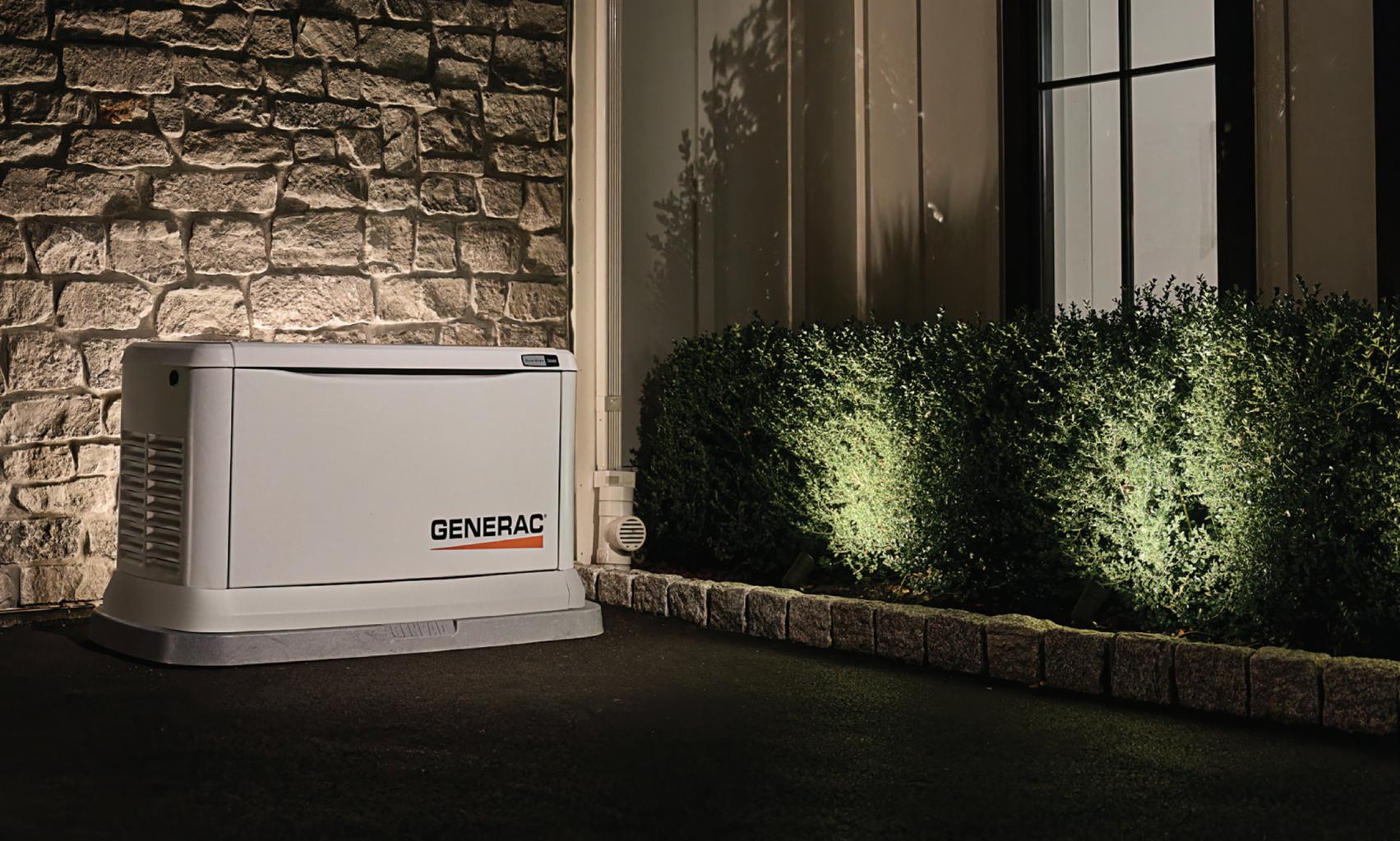
Receive a free 5-year warranty with qualifying purchase* - valued at $535. Be prepared before the next power outage. Call 413-930-9984 to schedule your free quote!