rental
Housing E A S T B AY R E N TA L H O U S I N G A S S O C I AT I O N | JA N / F E B 2 0 2 6 | $ 9 . 9 5
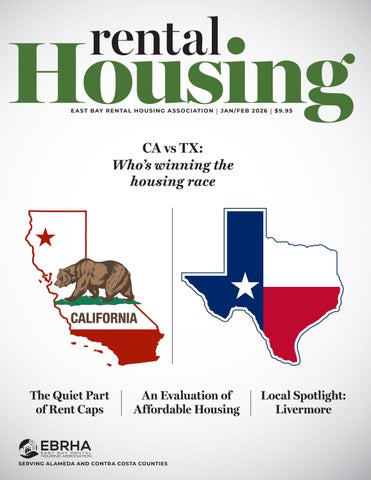
CA vs TX: Who’s winning the housing race
The Quiet Part of Rent Caps
An Evaluation of Affordable Housing
SERVING AL AMEDA AND CONTRA COSTA COUNTIES
Local Spotlight: Livermore
JANUARY+FEBRUARY 2026 / EBRHA.COM 1
WHAT'S INSIDE
Departments JANUARY/FEBRUARY 2026
6
MESSAGE
EBRHA president, Wayne Rowland
8
WELCOME EBRHA CEO, Derek Barnes
10 CALENDAR
EBRHA Events and Other Happenings
13 OUT & ABOUT
EBRHA Meetings, Special Events, and Member Mixers
14 LEGISLATION 18 LOCAL SPOTLIGHT Livermore
20 EDUCATE
Books to Help Retain Renters and Maximize Profits
24 INFORM
The Clean Fix: How Maintenance Builds Loyalty
26 ADVOCATE
The Quiet Cost of Rent Caps
30 CONNECT
Stronger Together: Building the Voice That Protects California Housing
32 INSPIRE
Interior Designs Transforms into Fresh, Artistic Ideas Swords to Plowshare
46 INDUSTRY PARTNERS EBRHA Directory
50 LAST LOOK
The Renter Retention Bingo Card
51 AD INDEX 2 JANUARY+FEBRUARY 2026 / EBRHA.COM
JENNIFER JEAN/ADOBE STOCK
36 MEMBER SPOTLIGHT
EAST BAY RENTAL HOUSING ASSOCIATION Volume XL Number 40 | Jan/Feb 2026 EBRHA OFFICE
3664 Grand Ave., Suite B, Oakland, CA 94610 TEL 510.893.9873 | FAX 510.893.2906 ebrha.com CHIEF EXECUTIVE OFFICER
Derek Barnes aemail@ebrha.com | 510.893.9873 COMMUNICATIONS AND MEDIA RELATIONS
Chris Tipton communications@ebrha.com | 510.893.9873 ext. 5 ADVERTISING AND MEMBERSHIP SALES
Danielle Baxter sales@ebrha.com | 510.893.9873 ext. 2 MEMBER SERVICES AND SUPPORT
membership@ebrha.com | 510.893.9873 ext. 1 BILLING AND ACCOUNTING
Ken Lam accounting@ebrha.com | 510.893.9873 ext. 3 EBRHA OFFICERS PRESIDENT Wayne C. Rowland FIRST VICE PRESIDENT Luke Blacklidge TREASURER Chris Moore SECRETARY Fred Morse EBRHA BOARD OF DIRECTORS
Francisco Acosta, Luke Blacklidge, Maya Clark, Jorge Jimenez Carmen Madden, Chris Moore, Courtney Morse, Fred Morse, Joshua Polston, Wayne C. Rowland, Jack Schwartz, Maria Recht, Aaron Young PUBLISHED BY
East Bay Rental Housing Association PUBLISHER Derek Barnes EDITOR Michelle Gamble ART DIRECTOR Bree Montanarello
STAY CONNECTED WITH EBRHA Call: 510.893.9873 Membership Questions: membership@ebrha.com Visit: ebrha.com Share Your Feedback: editor@ebrha.com Advertise: sales@ebrha.com Read: ebrha.com/news Learn: ebrha.com/faq Ask: ebrha.com/submit-your-questions Participate: web.ebrha.com/events GET SOCIAL @ebrha_rentrospect e G facebook.com/EastBayRentalHousingAssociation
@EastBayRHA
Rental Housing (ISSN 1930-2002-Periodicals Postage Paid at Oakland, California. POSTMASTER: Send address changes to RENTAL HOUSING, 3664 Grand Ave., Suite B, Oakland, CA 94610. Rental Housing is published bimonthly for $9.95 per issue by the East Bay Rental Housing Association (EBRHA), 3664 Grand Ave., Suite B, Oakland, CA 94610. Rental Housing is not responsible for the return or loss of submissions or artwork. The magazine does not consider unsolicited articles. The opinions expressed in any signed article in Rental Housing are those of the author and do not necessarily reflect the viewpoint of EBRHA or Rental Housing. This publication is designed to provide accurate and authoritative information in regard to the subject matter covered. It is sold with the understanding that the publisher is not engaged in rendering legal, accounting or other professional services. If legal service or other expert assistance is required, the services of a competent person should be sought. Acceptance of an advertisement by this magazine does not necessarily constitute any endorsement or recommendation by EBRHA, express or implied, of the advertiser or any goods or services offered. Published bimonthly, Rental Housing is distributed to the entire membership of EBRHA. The contents of this magazine may not be reproduced without permission. Publisher disclaims any liability for published articles. Printed by Sundance Press. ©2026 by EBRHA. All rights reserved. JANUARY+FEBRUARY 2026 / EBRHA.COM 3
WHAT'S INSIDE
Features JANUARY/FEBRUARY 2026
38 California Vs. Texas: 42 Retention vs
Turnover? What’s the right balance?
4 JANUARY+FEBRUARY 2026 / EBRHA.COM
EAD72/ADOBE STOCK
An Evaluation of Affordable Housing Models
,I . • PROVEN TRACK RECORD OF COST EFFECTIVE, SAFE DESIGN AND CONSTRUCTION • 24+ YEARS EXPERIENCE • OVER 500 SEISMIC RETROFITS COMPLETED • ADU DESIGN AND CONSTRUCTION • EXTERIOR ELEVATED ELEMENTS DECK/BALCONY REPAIRS PER SB721 GUARANTEED APPROVAL OF SOFT STORY APARTMENT BUILDING SEISMIC ORDINANCE IN OAKLAND, BERKELEY, ALAMEDA, HAYWARD, SAN FRANCISCO, AND MILL VALLEY Is Your Soft Story Rental Property in Compliance with Oakland’s Mandatory Seismic Retrofit? • Obtain a retrofit permit (Tier 3) • Complete retrofit if you have engineered plans (Tier 1 or Tier 2)
Soft Story Apartment Buildings: • 5 units or more • Wood framed • Built before 1978 CONTACT US FOR A CONSULTATION
510.271.0950 | info@wcpc-inc.com Design & Construction All Under One Company! www.wcpc-inc.com | 510-271-0950 | License: B797467
MESSAGE
Too Much Giddyup, Not Enough Whoa EBRHA BOARD PRESIDENT, WAYNE ROWLAND
L
ocal housing policy in California does not suffer from a lack of ambition. Cities have plenty of that. More than their share, perhaps, as new housing laws are churned out with such dizzying regularity that it’s hard for rental owners to keep pace with the constant changes. What’s missing Wayne Rowland is restraint. The willingness to stop, reassess, and remove policies that no longer, or never did, serve their intended purpose. After years of piling regulation on top of regulation, too many cities’ housing systems now resemble dense, overgrown regulatory thickets. Tangled, prickly and increasingly detached from the outcomes they were built to produce. Each new rule is rationalized, each fee is justified, and each mandate is declared necessary, until the point is reached where the system's most reliable result is the quiet funneling of rental owners toward the exits. All while insisting with great confidence that this is protecting the public.
accountability is rarely undertaken. The result is a system that can only grow, never correct. THE COURAGE TO REMOVE, NOT JUST ADD Still, housing laws in many California cities are in dire need of reform. But true reform calls for not just adding new laws or modifying old ones but also eliminating some as well. It requires identifying which policies actually improved housing outcomes and which ones merely created friction. It means distinguishing between oversight that prevents abuse and oversight that simply consumes time and capital. It demands humility to acknowledge that some well-intentioned rules now do more harm than good. This kind of reform does not lend itself to slogans. It does not generate applause lines. And it rarely fits neatly into campaign literature, which is all the more reason we don’t see it more often. HOUSING IS NOT A MORAL ABSTRACTION Housing policy is often discussed in moral terms, which is understandable. Shelter matters. Stability matters. Fairness matters. But housing is also physical. It is built, maintained, financed, and managed by people making decisions in the real world. Policies that ignore this, or that recast housing providers as adversaries instead of important contributors to the housing supply, eventually collide with reality itself. A flawed policy cannot fix its own failures by demanding that reality try harder. No amount of regulation can compel investment where risk is too high. No volume of paperwork can substitute for reinvestment. And no enforcement strategy can produce housing where incentives discourage its existence.
“A flawed policy cannot fix its own failures by demanding that reality try harder .”
REGULATORY MAKEWORK In policy circles, activity is often mistaken for progress. Passing a new law feels productive. Expanding enforcement signals resolve. Adding oversight reassures constituents that something is being done. By contrast, stopping, or even pausing, feels dangerous. Not dangerous in the human sense of the word, but politically dangerous. Repealing a rule suggests it may not have been necessary in the first place. Simplifying a process implies that complexity wasn’t required. Admitting that a policy missed its mark undermines the comforting belief that good intentions reliably produce good outcomes. All of these are inconvenient realizations, which helps explain why such 6 JANUARY+FEBRUARY 2026 / EBRHA.COM
THE QUIET EXIT NO ONE TRACKS One of the least discussed consequences of regulatory overreach is the quiet exit. Small housing providers sell. Investors redeploy capital to other cities or states. Owners stop improving properties and begin planning their departure. These exits rarely make headlines. There is no announcement. No violation. No enforcement action. Just the quiet
transition to a market in which fewer and fewer are willing to participate in a system that feels burdensome and relentlessly adversarial. By the time the city notices, the damage is already done, and the economic impact of quiet disinvestment is already being felt.
OLEKSANDR/ADOBE STOCK
A DIFFERENT MEASURE OF SUCCESS A serious housing policy would measure success differently. Not by the number of forms filed or penalties issued, but by whether housing supply grows or shrinks; whether maintenance improves or declines; whether reinvestment accelerates or stalls; and whether participants stay engaged or quietly leave. These are harder metrics. They invite uncomfortable answers. But at certain points in time, like now, they may be the only metrics that matter. THE REFORM CITIES AVOID … THE PAUSE The most meaningful reform that California cities with complex housing regulations could undertake is not a new law or new program, but a structured pause. A deliberate review of existing policies with one question in mind: Is this helping, hurting or doing nothing at all? And if the answer is “hurting” or “nothing,” the response should not be defensiveness. It should be repealed. At a certain stage, the problem is no longer insufficient regulation but insufficient restraint. Cities that refuse to examine the regulatory framework they’ve built will continue layering onto systems already straining under their own weight. The result will not be protection but attrition. Slow, quiet and rarely acknowledged. The choice for policymakers is not between compassion and protection, but between thoughtful correction and managed decline.
What are you risking in providing rental housing? Be prepared and join the community of rental housing providers at EBRHA.com NEW MEMBER PROMO
New members receive a $40 account credit when they join.
REFERRAL PROMO
Existing members refer a new member to EBRHA and receive a $50 account credit.
The leader and essential resource for the rental housing community for over 80 years. www.ebrha.com | 510.893.9873
JANUARY+FEBRUARY 2026 / EBRHA.COM 7
WELCOME
Happy New Year! EBRHA CEO, DEREK BARNES
L
et’s begin 2026 with a truth that few in government are willing to say out loud: Bay Area housing is governed by process rather than outcomes. When process becomes the product and shared theory and ideology are the amplifiers, we end up with a system where the loudest and least Derek Barnes informed voices believe they’re right, agendas are less transparentand more fractured, and real expertise and experience are not valued. Ultimately, problems don’t get solved, and our most vulnerable residents rarely get the help they need. The unhoused, Housing Providers, and their residents are treated like widgets in complex structures that few can navigate. After sitting in many Alameda County Supervisors’ in-district Measure W community meetings in late 2025 to help set priorities for allocating $1.8B in homeless services funds, this fact was abundantly clear from community feedback about current gaps in housing policy, programs and provider services throughout the county. This issue of Rental Housing Magazine is a flashlight cutting through this fog. Start with “The Cost of Rent Caps.” Read this article carefully like your balance sheet depends on it. Rent caps freeze the revenue side of the equation while operating costs keep rising. EBRHA and its CalRHA affiliates have been reporting this problem to legislators for over two years. Insurance premiums spike. Labor costs rise. Utilities increase. Material prices fluctuate wildly. Municipal fees and taxes are never-ending. Over time, the result doesn’t ensure housing stability. It’s deferred maintenance, fewer capital improvements, and more vacancies. This is the slow, quiet exit of small rental businesses and local owners who cannot absorb infinite economic and financial risk. DIRTY LITTLE SECRETS Ask any legislator or policymaker in cities with high property taxes, the most arduous forms of rent caps/control, 8 JANUARY+FEBRUARY 2026 / EBRHA.COM
and extreme renter protections if they would own a home or rental property today, and they will most likely tell you no. They know all too well what conditions these policies create. The question is: why continue to pull these levers, knowing full well they are not producing the intended outcomes and are hurting renters in the long term? The public debate often frames rent control and “eviction defense” as homeless/displacement prevention and a morality play: good versus evil, renters versus owners. That framing may be emotionally satisfying, but it’s fiscally irresponsible and intellectually dishonest given the available data. Example: EBRHA’s staff observations while assisting property owners at the Hayward Hall of Justice confirm what was already widely known. In many cases, a settlement agreement brokered by attorneys is reached in an eviction case. Even after thousands of dollars in attorney fees, relocation fees, and lost rent, the renter must vacate the property anyway and find other housing. We have argued that many cases could be resolved more quickly and cost-effectively before court by engaging mediation and other alternative dispute resolution methods. Policy drives human behavior, and housing cannot be sustained by ignoring math or economics. It is sustained by policies that incentivize low-cost development, preserve safe and habitable older properties, and protect local rental property owners—often our small mom-and-pop owners who typically offer the most affordable rents. Now layer in what many owners also experience firsthand: increasingly more expensive and dysfunctional rent programs, broken appeals processes, unequal and insufficient owner support resources. Too often, it feels like a maze designed by people who have never had to meet payroll, replace a roof, pass a fire and safety inspection, or carry the cost of a vacant unit month after month. When hearings take months (or years) and standards fluctuate, the system isn’t protecting anyone. There is no room for due process. It doesn’t create trust. It creates municipal paralysis, anchored by a “do-gooder” mindset among those responsible for improving conditions with public funding. OT AT THE TABLE N “Stronger Together: Building the Voice That Protects California Housing” is also a must-read and may be the most important piece we publish this year. Its message is
“Collectively, we can shape the future of housing in the East Bay.”
LUI SHTEIN/ADOBE STOCK
simple: representation is not a spectator sport. If Housing Providers don’t show up at commission, city council, county board, and Rent Board meetings, policy gets written about us, around us, and eventually through us. When you’re not at the table, you’re on the menu, and that’s even more true today. EBRHA tracks about 10 key cities across Alameda and Contra Costa counties. I attend many of these meetings myself, and I’ve seen the difference firsthand. When we don’t show up, the only voices in the room are those who mischaracterize our role and undervalue the service we provide to our communities. This is not theoretical. It is observable and fixable. HE EROSION OF SMALL BUSINESSES T There’s another story running through this issue that deserves attention. It’s one that connects urban housing to rural America. Across the country, distressed family-run farms are selling to giant agribusinesses because they can’t survive rising costs, regulatory complexity and market manipulation. Different sectors. Same outcome. Over the last few decades, we’ve seen private equity-driven consolidation in retail, healthcare, banking, and food industries. The same thing is happening in housing. Small, local Housing Providers are being squeezed out, not because they lack integrity or competence, but because the system increasingly rewards scale and value extraction over local decentralized stewardship. When small owners are forced to sell (their properties often undervalued), large institutional investors move in. Homes become assets in larger portfolios across different regions, states and sometimes counties. Neighborhoods become spreadsheets. Owner service and accommodation erode as decision-making moves farther from the people who actually live in these communities. This is not progress. It is value extraction, wealth consolidation and neighborhood busting masquerading as reform and inclusionary protection. Farmers and Housing Providers unite! MORE, PLEASE More than 2,800 bills were introduced in California last year alone. Each one carries potential new compliance requirements, costs or risks—often layered on top of
rules that already conflict or overlap. The regulatory load is accelerating, and small Housing Providers absorb it with fewer resources and thinner margins. At the same time, local conditions vary dramatically from city to city. Our Livermore spotlight makes that clear: no rent control, just-cause protections, relatively low vacancy rates, and rents shaped more by market reality than by political theater. It’s a reminder that policy choices and outcomes matter and can have an incredibly powerful impact. “The Clean Fix” and “Property Owners Pay It Forward” remind us that proactive maintenance, human connection and local stewardship still work. Housing Providers who reinvest, communicate and lead with professionalism build loyalty, reduce churn, and stabilize communities, even in complex policy environments. That’s the model we should be amplifying. Let’s courageously dive into 2026 and not treat civic engagement like a hobby. Showing up to meetings, submitting comments, supporting litigation, partnering with cities where collaboration is possible—this is how outcomes change. EBRHA will continue its mission to educate, organize and advocate to drive public-private partnerships that actually work. But no association, no matter how strong, can be a substitute for engaged members. Collectively, we can shape the future of housing in the East Bay. EBRHA is ready. The question is: are we ready together? JANUARY+FEBRUARY 2026 / EBRHA.COM 9
CALENDAR
Upcoming Events FIND THE LATEST EBRHA EVENTS & REGISTER AT WEB.EBRHA.COM/EVENTS
JANUARY 13 2-3:30PM The Roundtable Presented by Board President Wayne Rowland
*
JANUARY 19 Martin Luther King's Birthday JANUARY 20 2-3:30PM Member Orientation Meeting 10 JANUARY+FEBRUARY 2026 / EBRHA.COM
JANUARY 22 3-4:30PM Section 8 Update Presented by the Oakland Housing Authority JANUARY 31 10:00AM-3:00PM Annual Housing Collaborative 2026 FEBRUARY 10 2-3:30PM The Roundtable Presented by Board President Wayne Rowland
*
FEBRUARY 14 Valentine's Day FEBRUARY 19 2-3:30PM The Rental Housing Forum Presented by Dan Lieberman FEBRUARY 25 5:30-7:30PM February Monthly Mixer
* NON-EBRHA EVENTS If you would like to submit an event, please send an email to editor@ebrha.com.
ZENSTRATUS/ADOBE STOCK
*
JANUARY 1 New Year's Day
Selling an Investment Property?
Can Help You... Defer Capital Gains Tax Provide Geographic Portfolio Diversity Eliminate Your Maintenence Burden
1031 Exchange Experts miradorcp.com 925-621-1031 JANUARY+FEBRUARY 2026 / EBRHA.COM 11
Partnering with OHA comes with GOOD benefits!
GOOD for business, with guaranteed rent and signing bonuses GOOD for the community and builds our neighborhoods GOOD for families, individuals and workers who need homes
Owner Benefits Program * Leasing Bonus: $1,000 signing bonus to property owners who lease to a Housing Choice Voucher (HCV) family through OHA Apartment Repair Program: up to $2,250 reimbursement for verified and required repairs on new contracts. . . and more! *Specific program rules and conditions apply.
Oakland property owners and managers are invited to join us in helping to house families that need quality homes at affordable prices. The HCV (Section 8) program has other incredible benefits for property owners. To learn more, visit: www.oakha.org/propertyowners/becomealandlord
12 JANUARY+FEBRUARY 2026 / EBRHA.COM
OUT & ABOUT
EBRHA MEETINGS, SPECIAL EVENTS, AND MEMBER MIXERS
L-R Supervisor Nate Miley receives Man of the Year award from Council President Kevin Jenkins—BWOPA Power Up Summit (Oct), High 5ive Rooftop, Oakland
L-R EBRHA Board Members Chris Moore and Carmen Madden with Sabina Yoon and EBRHA CEO Derek Barnes—Gotham Oakland Halloween Party (Oct), Jack London Sq.
L-R EBRHA Member John Protopappas, County DA Ursula Jones-Dickson, Carrie McAlister— Support DA Jones-Dickson Event (Nov), Piedmont
L-R OAACC President Cathy Adams, Kiana Gums, EBRHA CEO Derek Barnes—CM Kevin Jenkins Turkey Giveaway (Nov), Arroyo Viejo Rec Center, Oakland
L-R Oakland Councilmember Zac Unger, Mayor Barbara Lee, OAACC President Cathy Adams—Annual Black Sunday/Shop Oakland (Nov), Kaiser Center for the Arts, Oakland
Congressman Eric Swalwell— Gubernatorial Candidate Meeting (Dec), NAACP Branch Office, Jack London Sq.
Supervisor Elisa Marquez and County Director Jonathan Russell with Community Leaders—Home Together Fund Community Session (Dec), Ruggieri Senior Ctr, Union City
Supervisor Lena Tam with San Leandro Mayor Juan Gonzalez, DA Ursula Jones-Dickson, Sheriff Yesenia Sanchez with Friends (Dec)—Dist 3 Toy Drive, District Office, San Leandro
L-R EBRHA CEO Derek Barnes, Council President’s Chief of Staff Patricia Brooks—100 Black Men Bay Area Gala (Dec), Marriott Marquis, San Francisco
L-R Paul Campbell, Oakland Councilmember Charlene Wang, John Takayama, Derek Barnes, and Chris Moore—EBRHA Winter Mixer (Dec), Eve's Waterfront, Oakland
L-R EBRHA Member John Williams and EBRHA Marketing & Comms Mgr Chris Tipton -- EBRHA Winter Mixer (Dec), Eve's Waterfront, Oakland
L-R Michele Haubert, Alameda County Supervisor David Haubert— Dist 1 Toy & Food Drive (Dec), Heritage House, Pleasanton JANUARY+FEBRUARY 2026 / EBRHA.COM 13
LEGISLATION
Breaking Down Bills 2,833 BILLS INTRODUCED IN 2025, PART I BY RON KINGSTON
WILDFIRE INSURANCE COVERAGE AND CALIFORNIA FAIR PLAN AB 1 (DAMON CONNOLLY) AB 1 (Connolly) was created in response to the wildfire crisis in California. The author and thousands of Californians rightfully argue that the state can be doing more to ensure homes are better equipped to manage wildfires. This bill requires the Department of Insurance regulations to consider whether to be updated to include additional building hardening measures every five years. This would be done to mitigate the causes and effects of wildfires in California. As a part of their consideration, the Department of Insurance Regulations must consult with different agencies to find the specific hardening measures to consider and implement a public participation component during the evaluation. This bill is important for those who 14 JANUARY+FEBRUARY 2026 / EBRHA.COM
are in the rental housing industry as they must be aware of the 5-year cycle of updated building hardening regulations. This bill could impact the industry through new mandatory building and real property upgrades through new requirements. AB 226 (LISA CALDERON) AB 226 (Calderon) addresses an issue with the Fair Access to Insurance Requirements (FAIR) Plan. The FAIR Plan is an association of all the insurance companies licensed by the California Department of Insurance that provides basic property and casualty insurance in California. Currently the FAIR Plan does not have a statute allowing them to use financial tools that assist in the
capacity of mitigating disasters. This bill would authorize the California Infrastructure and Economic Development Bank to issue bonds to increase liquidity, finance the cost of claims, and assist the claims paying capacity of the California Fair Plan Association. This bill authorizes the bank to loan the proceeds of issued bonds to the Association and authorizes the Association to enter into a loan agreement with the bank. This bill is important because it aids in lessening the financial burden wildfires have on the state. It does this by creating a funding buffer for the FAIR plan. It gives them access to bonds, loans, and lines of credit that specifically assist wildfire aid. It gives the
ROGELIO GONZALEZ/UNSPLASH
This article features key bills that were signed by the Governor this year. The bills are presented by subject area. It’s broken into part I and II since the sheer number of bills passed were so many different ones. To start, there were 2,833 bills introduced this year. We identified 157 bills pertaining to residential rental ownership, management and tenancy. We successfully opposed a whole slew of bills including permanent statewide rent control, identifying every cost that an owner could charge at the inception of tenancy, and giving renters 90 days to pay rent. Now we turn our heads to bills that became law on January 1, 2026.
California Fair Plan Association the tools necessary to fulfill and expand the FAIR plan mission. AB 1138 (STEVE BENNETT) AB 1138 (Bennett) addresses the wildfire crisis in California with an evidence-based approach. The wildfires are an increasingly big issue in the state and leaders feel the need to take action to protect their constituents. This bill requires that on or before January 1st, 2027, the State Fire Marshal’s Wildfire Mitigation Advisory Committee develop a home hardening certification program. This program could assist in preventing more wildfires in California as the program will identify home hardening measures, which include defensible space that can be implemented during renovation or home improvement projects. This bill aims to substantially reduce the risk of loss during a fire. This bill is important to property because it can identify home improvement measures and function as a guiding tool to ensure safety from wildfires. According to the supporters of the bill, “By establishing a comprehensive framework, this legislation will provide homeowners with clear guidance on how to effectively protect their properties from wildfire.” This bill unquestionably requires new compliance standards for the existing housing stock. SB 429 (DAVE CORTESE) SB 429 (Cortese) also works on addressing current safety measures aimed at assisting in wildfire prevention. This bill establishes the Wildfire Safety and Risk Program that develops, demonstrates, and deploys a public wildfire catastrophe model. This bill also establishes grant funding to one or more universities for eligible projects that require the university to research and develop wildfire catastrophe models that provide wildfire safety benefits to California communities and assists alignment between local, state, and federal wildfire safety ef-
East Bay Apartment Advisor As an owner of East Bay multiunit properties for 25 years, John Caronna has the knowledge and 14 years of invaluable experience to assist in anything regarding your property!
COMING SOON
5 units on Walker Ave, in Grand Lake neighborhood
328 Forest St. 4 plex in Oakland Sold over listing price. Represented Seller.
987 Vermont street, Oakland 4 plex in Oakland Sold! Represented Seller.
778 20th Street Oakland. Triplex. Represented Seller.
2303 Ivy Drive Oakland. 5 units. Represented Seller.
John Caronna
415.531.5225 | j.caronna@sbcglobal.net Eastbayapartmentadvisors.com JANUARY+FEBRUARY 2026 / EBRHA.COM 15
LEGISLATION
SB 547 (SASHA PEREZ) SB 547 (Perez) identified a lack of insurance coverage in the California 16 JANUARY+FEBRUARY 2026 / EBRHA.COM
Code. The author argues that due to the wildfires, most of the attention goes to the residential loss; however, there are 1,863 businesses located within the fire zones. These businesses employ 9,610 people and bring in $1.4 billion in annual sales. The purpose of this bill is to assist business owners in the same way residential renters are assisted during these crises. This bill expands on insurance moratorium laws that already apply to residential housing and apply it to commercial insurance. The purpose of this bill is to account for the impact that businesses, both small and big, have in communities. This bill ensures that the insurance benefits that are given to residential units also apply to commercial units. This bill does so by prohibiting an insurer from canceling or refusing to renew a commercial property insurance policy for one year from the declaration of the state emergency if it is
in a wildfire or wildfire adjacent ZIP Code. This bill helps incentivize Californians to open business in areas that are known to have wildfires as some of the fears or concerns about insurance availability and affordability in those areas are being eradicated. MORTGAGE FORBEARANCE AB 238 (HARABEDIAN) The bill provides that a mortgage borrower of a single family one to four property who is experiencing financial hardship through difficulties directly caused by the recent LA wildfire disaster may request forbearance on their residential mortgage loan. The borrower must submit a request to their mortgage loan servicer before the state of emergency declared by Gavin Newsom on January 7, 2025, has ended or by January 7, 2027. The borrower must also provide affirmation that the financial hardship
WARAKORN/ADOBE STOCK
forts. This bill also creates the Wildfire Safety and Risk Mitigation account within the Insurance Fund that assists in accomplishing this mission. Lastly, this bill requires that the Department of Insurance create a framework and plan that creates a catastrophe model that will be published on their website. This bill is valuable to property owners as they need more assistance in wildfire resistance and protection. This bill does so by creating models and new information that is necessary to keep their properties and homes as safe as possible. It will create catastrophe models that will help prepare home and property owners to understand the dangers associated with wildfire. This information will also be easy to access as it will be made available on the Department of Insurance website.
was due to the wildfire. This bill also creates forbearance extensions, as mortgage servicers must offer a forbearance period for an initial 90 days and extend the forbearance period in 90-day increments for up to a period of 12 months. If the mortgage servicer, acting on behalf of an investor, denies a forbearance request from a borrower, the servicer must provide a clear and concise explanation of the specific investor provision that is the basis for denial and the text of the specific investor guideline or contractual provision that is the basis for the denial. Other relevant information relating to AB 238 includes: During the period of forbearance, no late fees shall be assessed to the borrower’s account, and the borrower shall not be charged a default rate of interest. The mortgage servicer shall not furnish information to the credit bureaus of any adverse action during the forbearance period. Before 30 calendar days of the end of the initial forbearance period, a mortgage servicer must provide written notice disclosing: Any documents or forms that the mortgage servicer required for an additional period of forbearance. A description of dates and times for deadlines associated with consideration of forbearance extensions. SOCIAL SECURITY TENANT PROTECTION AB 246 (ISSAC BRYAN) AB 246 (Bryan) was created to address operational issues that hurt social security beneficiaries. According to the author, with this issue, eligible recipients could experience financial hardship. In practice, this bill would permit all residential renters that receive social security benefits regardless of circumstance to assert as an affirmative defense in an unlawful detainer action for the nonpayment of rent due to any interruption in the payment of social
The only way the property owner would be eligible to return a security deposit electronically would be if the property owner received the security deposit or the rental payments from a renter electronically. security benefits without question, the bill could delay if not stop residential rental payments. This bill punishes property owners for technological and administrative issues caused by the SSA or for the inaccurate information that the beneficiary provided to the SSA. This bill is important for property owners to be aware of as it gives renters a new and additional affirmative defense to unlawful detainer proceedings. If a renter can show difficulties with the SSA, then they can prevent an unlawful detainer and thus retain the right to stay at the property. SHORT-TERM RENTALS AB 299 (GABRIEL) AB 299 (Gabriel) was introduced in response to the needs of owners who supplied short-term rentals, motels, and hotels during the Southern California Wildfires. This bill prevents a landlord-renter relationship from forming for those who need temporary housing for longer than 30 daysdue to disaster. Prior to this bill, some property owners had concerns about lodging those who were displaced from their homes by the wildfires because staying longer than 30 days would establish a landlord-renter relationship and thus giving the renter, among other things, unlawful detainer protections. This bill would ensure that this sort of relationship would not transpire after a resident stays longer than 30 days. This bill is important for property owners in California to be aware of if they want to house or offer to house those displaced by a disaster. Landlord-renter relationship is not formed
thus legal remedies remarkably are changed due to the narrow carve out of law. RESIDENTIAL RESIDENCIES: RETURN OF SECURITY DEPOSITS AB 414 (GAIL PELLERIN) AB 414 (Pellerin) was introduced to address the issue of updating payment methods in rental housing. The author contends that California’s Civil Code is not up to date with the changing methods of payments for security deposits. This bill amends the California Civil Code to change the default return of a security return being deposited electronically, by personal delivery or by check. The only way the property owner would be eligible to return a security deposit electronically would be if the property owner received the security deposit or the rental payments from a renter electronically. This bill also amends the California Civil Code to authorize a property owner to provide an itemized statement by email or mail to an address provided by a renter. This statement would only be authorized by mutual agreement by the property owner and renter. This bill is important for property owners to be aware of because they may have to change their default method for returning security deposits. If they already do it, be it delivery or check it will be okay unless the renter turned in the deposit by electronic payment. If the default method is electronic, the property owner will have to change it unless the renter pays it electronically. JANUARY+FEBRUARY 2026 / EBRHA.COM 17
LOCAL SPOTLIGHT
Livermore BY MICHELLE GAMBLE
Population: 84,867 Average Rent for 1 or 2 Bedrooms: $2,827 Vacancy Rate: 3.3% Rent Control: No Just Cause Ordinance: Yes Rent Registry: No
L
18 JANUARY+FEBRUARY 2026 / EBRHA.COM
Attractive features include a robust and prospering wine industry and tourism. Surrounded by numerous vineyards, the area produces some of the best wines outside of Napa Valley. This industry also attracted supporting businesses in the areas of hospitality and tourism. HOUSING POLICIES The city has significant housing policies to know about if you’re a property provider. These include: Housing Element: This policy sets the city’s strategy to identify housing needs for all income levels, review constraints, and establish goals and programs to meet those needs. Affordable Housing Fee: The city requires residential development projects to contribute toward affordable housing. Chapter 3.26, which is part of the Affordable Housing Fee: This fee re-
quires residential and commercial/industrial developers to pay fees that go toward affordable housing. Developer Obligations and Programs: Developers are required to follow the city’s inclusionary and affordable housing programs. WHY INVEST IN LIVERMORE? Property owners should consider investing in Livermore because it combines a stable, high-income workforce with a strong demand, low vacancy rates, and desirable lifestyle that features an aesthetically beautiful wine country charm all around it. It also has a great revitalized downtown area. It’s a rare market offering economic stability, limited supply, and long-term resilience for rental and property values. Michelle Gamble is the editor of Rental Housing Magazine.
DAVID YAO/UNSPLASH
ivermore is its own suburb outside of the main Bay Area hub. It has a unique blend of old western charm, wine country opportunities, and a pleasant community vibe. It also has a science-driven industry that is anchored in national labs. It is considered family friendly and features a lot of heritage, innovation, and easy, calm livability. It is the perfect mix of California ranching, early viticulture, railroad-driven city formation, and a frontier history based on innovations. The city was founded in 1869 when the Central Pacific Railroad extended its line through the Livermore Valley where a train station was established and the town grew up around it. The area itself was named after Robert Livermore, an English immigrant rancher who settled there in the 1830s. Its key industries and job sectors include research and technology. The city hosts the federal labs Lawrence Livermore National Laboratory and Sandia National Laboratories. These labs attract large numbers of scientific, engineering and technical jobs. It also offers advanced manufacturing and high-tech production, including Gillig LLC (bus manufacturing) and Lam Research (semiconductor equipment).
DEMOGRAPHICS • RACE AND ETHNICITY White (non-Hispanic): Approximately 45.7%. Asian (non-Hispanic): Approximately 13.8%. White (Hispanic): Around 6.35%. Hispanic: Roughly 18.9% of the population in the broader Livermore/Dublin area.
CHRIS/ADOBE STOCK
Two or more races: About 13.8%. Other race: Around 6.8%. Other racial groups: Smaller percentages of Black, Native American, and Native Hawaiian or Pacific Islander populations are present
The Hiking Trails of Del Valle Regional Park
EDUCATE
A Good Read BOOKS TO HELP RETAIN RENTERS AND MAXIMIZE PROFITS
DJILE/ADOBE STOCK
In the rental property industry, retaining and managing reliable, loyal renters takes some strategic planning. The following books are written to help property owners maintain a balance between running the business while keeping the human needs in mind to keep renters happy.
20 JANUARY+FEBRUARY 2026 / EBRHA.COM
The Book on Managing Rental Properties: Screen and Manage Tenants
Every Landlord’s Guide to Dealing with Property: Best Practices, Moving in to moving Out Michael Boyer
Brandon and Heather Turner
DANIEL/ADOBE STOCK
Recommended by Patrick Goswitz, CEO, Sell My House Fast This book on managing rental properties should be read by every property manager or a new property owner. Co-authored by Brandon and Heather Turner, this extensive reference book explores the entire array of property management, from finding and screening tenants, maintaining the property, and resolving conflict management. I like this book as it simplifies complicated ideas into a step-by-step procedure to be taken. The authors are able to base the advice on their personal experiences and the successes as well as the errors they have made that makes the advice usable and interesting to relate to. The book focuses on systems and procedures, especially in renter screening procedures that can either make or break your renting business. With clear standards and consistency, you will be able to avoid late-night calls and avoid expensive errors. This book will make you a flyer in case you are new to the game; and if you are an experienced property owner, you can get new information to work harder and achieve higher returns. In case you are serious about having a smooth-running property management business, this book offers you the tools and the thinking power to succeed.
Home Buyers
Recommended by Dawson Skorczewski, Owner and CEO of Sioux Empire
Every Landlord’s Guide to Property Managementis a must-read. What better way to know how to be an effective property manager than to go to the one who is actually a property owner and college professor as well as an attorney and has worked on various condominium association boards. It is a comprehensive manual to the DIY property managers and property owners who are running or owning small rental buildings. The book Every Landlord Guide on How to Manage Property: Best Practices, From Move-In to Move-Out (4th Edition) is a book, which provides good tips, techniques and ideas on how a property owner needs to manage property in a successful, efficient and effective way. Learn the secrets of achieving success in rental property. Learn how to appeal to quality renters, maintain renters and manage vacancies. Study the art of keeping proper bookkeeping records. Learn how to handle poor renters and prevent the unnecessary turnover costs. Learn how to identify and recruit the correct contractors. Get yourself a soaking of new knowledge to ensure that you become the best property owner and rental property manager that you can be JANUARY+FEBRUARY 2026 / EBRHA.COM 21
EDUCATE
own to D Earth Landlording Donald Beck Recommended by Martin Orefice, Rent to Own Labs Down to Earth Landlording by Donald Beck has been especially 22 JANUARY+FEBRUARY 2026 / EBRHA.COM
“It doesn’t matter if you own a luxury high-rise or a single duplex, it’s possible to find reliable, responsible people to rent your properties...” helpful for me. It’s definitely geared more toward beginners and smaller property managers, but it serves as a great starting point for aspiring property managers at any level, and does a great job of reminding you of the renter’s perspective on the whole process. It also emphasizes the most important part of residential property management: finding good renters. It doesn’t matter if you own a luxury high-rise or a single duplex, it’s possible to find reliable, responsible people to rent your properties, and you really need to stick to this if you want to be successful.
Landlording on Autopilot Mike Butler Recommended by Nick Manfredi, CEO, As-Is Housebuyers Landlording on Autopilot is about automation. Imagine it as a toolbox that minimizes the eviction issues. It has a 24 hours pre-screen hotline script. The rate of first-year eviction of people using it falls by approximately 7.8 to 2.3 percent. The result is reduced everyday work and improved cash flow that any property manager will enjoy.
ABCREATIVE/ADOBE STOCK
(especially when you are in a day job). The fourth edition of this property management book is fully revised to contain the current issues that have an impact on the property owners. These include changes to the tax legislation, the new tools (both online and offline) to manage rental properties, and advice concerning making rental property management a side-hustle.
SPECIALIZING IN RENTAL TURNOVERS, RESALE, AND COMMERCIAL FLOORING Trusted by Property Managers for Rental Turnovers, Resale Prep & Commercial Installs Since 1972
TRUSTED BY BAY AREA PROFESSIONALS Your go-to flooring partner for rentals, commercial spaces, and more.
FAST TURNAROUNDS, LOCAL EXPERTISE Family-owned and built for speed — because timing matters.
FOCUSED ON WHAT YOU NEED We work the way you work — fast, flexible, and reliable.
PRODUCTS
CARPET
VINYL
LUXURY VINYL PLANK
SPECIAL PRICING FOR EBRHA MEMBERS WHEN THIS AD IS MENTIONED bayareacontractcarpets.com | kevin@bayareacontractcarpets.com | 510.613.0300 | Contractor License #: 714467
INFORM
The Clean Fix HOW MAINTENANCE BUILDS LOYALTY
A
sk any renter why they stay, and the answer isn’t complicated. They want things to work. They don’t want things like their heating to go out in a 30-degree cold snap. They don’t want their sewer backed up for days or even a week before it’s fixed. Therefore, it is extremely important that in order to retain excellent renters, property owners must do proactive maintenance — fixing issues early, following seasonal checklists, and keeping common areas fresh — not only avoids costly repairs later, but dramatically increases lease 24 JANUARY+FEBRUARY 2026 / EBRHA.COM
renewals. When renters see consistent care, they stay for the long haul. “Keeping a property in good condition is a simple yet powerful way to keep renters happy and reduce turnover,” said Dominic Leto, CEO, Sell My Home PA. “As renters observe their apartment owner doing something to take good care of the building, repairing leaky pipes, repainting, checking that the heating is functioning, they feel that they are being treated with dignity and that the building is theirs. It is the pride that causes them to renew more and to
refer their friends to the unit. “Regular maintenance prevents minor issues from developing into expensive catastrophes too,” added Leto. “An unchecked pipe may become an expensive water-damage disaster taking a unit out of the market several weeks. Early detection of problems prevents property owners from paying large sums of money to repair their properties and also maintain their rental income. Proactive maintenance ensures profitability and enhances tenant satisfaction and prolonged stay in the long run — this is revenue.”
SHISU_KA/ADOBE STOCK
BY BREA HARPER
ANGELOV/ADOBE STOCK
SAFETY AND SECURITY Your renters need to feel safe and secure where they live, and proper maintenance policies play right into that issue. Property maintenance isn’t just about curb appeal or preventing costly repairs — it’s a cornerstone of safety and security, two of the biggest drivers of renter satisfaction and retention. When residents feel protected, cared for and physically safe in their environment, they stay. When they don’t, they leave — often quickly. “A sense of safety can swing a decision of a renter to remain or to move,” said Patrick Goswitz, CEO Sell My House Fast. “Secured renters will renew and recommend the premises. Anxiety, dissatisfaction and eventual moves are a result of insecurity. Not only is the occupancy rate exhausted by that churn, but the property image is also tarnished. The focus on safety allows owners to establish trust and retain renters, satisfied and safe residents will become brand ambassadors of the building.” “By ensuring the area is in excellent condition, I am sending a message to the renter: Your safety is important,” said Dawson Skorczewski, owner, CEO, Sioux Empire Home Buyers. “One quick inspection, a repaired leak or even a new paint job helps renters to understand that I am not a property owner but a partner in their everyday life. Such minuscule measures are evidence that I am listening and taking actions before issues are made dangerous.” “Good security is dependent on intelligent technology, good maintenance, and effective emergency procedures,” added Goswitz. “The advanced systems such as keyless smart locks, HD cameras and built-in alarms provide the owners with controls and confidence to the renters. These tools are necessary, but human privacy must be the priority — surveillance is to be meaningful and non-invasive. “Maintenance ensures that equip-
ment is functional,” he continued. “Lock, camera and alarm inspections and audit common areas and points of entry. The winter and other seasonal accidents, such as wet floors, should be adequately addressed by removing the snow immediately and creating clear paths.” ISSUES OF HABITABILITY Habitability isn’t just a legal requirement — it’s the foundation of a renter’s daily experience. When a home is safe, functional and comfortable, residents stay. When habitability slips, turnover rises fast. Renters don’t just leave because of price; they leave because their quality of life is disrupted by problems that should never be ignored. “A habitable home signals that ownership takes its responsibility seriously,” said Dillon Cass, owner and CEO of True Home Offers. “Working plumbing, heat, electricity, and structural stability form a baseline of respect. When habitability issues go unresolved — leaking roofs, mold, pests, broken appliances — renters begin to feel abandoned. Once trust collapses, retention goes with it. “All leases imply that the unit is habitable,” Cass added. “It means that you as the property owner have to meet all the local building and housing codes
that include the structural soundness, health and safety. The warranty is applicable not only on the inside areas of the unit but also extends on to communal areas including entryways, stairwells and laundry rooms. “Habitability criteria necessitate, among other things, that renters be in a position to sustain a comfortable interior environment,” continued Cass. “Furnaces and air conditioners, as well as other climate-control systems, are to be maintained and in good operational condition. You also have the responsibility of keeping water heaters and immediately rectifying plumbing issues. There should also be good conditions in the roof, walls, floors, windows, and doors.” THE BEST RENTER RETENTION STRATEGY When maintenance is a priority, renter retention results naturally. “High maintenance standards signal professionalism and stability,” said Connie Lee, founder, CEO, Reffie. “Renters don’t want surprises. They want to know next year won’t be a fight. When everything is well-kept, they stop looking elsewhere because they already know what they’re getting.” Brea Harper is a Bay Area writer.
JANUARY+FEBRUARY 2026 / EBRHA.COM 25
ADVOCATE
The Cost of Rent Caps BY DAN LIEBERMAN
I
f you ask most people what they think about statewide rent caps, they’ll probably say something like: “It keeps rents under control,” or “It protects people from large rent increases,” or “It gives renters stability.” That’s the vision most lawmakers proclaim. They claim if we can just limit annual rent increases, we can keep housing
26 JANUARY+FEBRUARY 2026 / EBRHA.COM
affordable and all is good. But housing doesn’t run on slogans. It runs on math, maintenance, and the slow but steady grind of real-world expenses that don’t stop just because rent caps are put in place. The public hears “5% cap” and thinks “That sounds fair.” But the story behind that number, and what hap-
HE MATH PROBLEM T NOBODY TALKS ABOUT Over the past several years, housing providers across California have watched insurance rates spike 25% to over 50% annually (some have seen triple-digit increases). Labor and maintenance costs have risen significantly. Costs for building materials have risen 30-70% over the past few years. And water and sewer fees, garbage rates and administrative costs have all risen double digits.
BIGJOM/ADOBE STOCK
pens after five, 10 or 15 years of living under it, is a very different one. It’s really about how short-term solutions can quietly undermine the long-term quality of the places we call home. What rent caps do, more than anything else, is freeze one side of the equation (the income side), while leaving the expense side free to keep advancing. Imagine telling a small, local neighborhood coffee shop that the maximum they can raise prices is 5% even if the price of coffee beans jumps 30%, insurance doubles, or staff wages rise 15%. As a customer, you wouldn’t really notice the impact the first year. You might not even notice it the second year. But over time, the coffee shop starts looking a bit tired. The furniture is worn, but doesn’t get replaced. The staffing level gets reduced. And the owner keeps hoping his expensive espresso machine will last just one more year without needing a major repair. Housing works the same way. This isn’t a story of landlords v ersus renters. It’s about whether the math of rent caps supports the quality of our neighborhoods or erodes them over time.
New!
WHAT'S INSIDE
Promotional EBRHA Membership for Realtors Support Your Clients Protect Your Reputation Stay Ahead
Receive 50% off EBRHA memberships for your clients
LEARN MORE www.ebrha.com 510.893.9873 membership@ebrha.com
NOVEMBER+DECEMBER 2025 / EBRHA.COM 27
ADVOCATE things or work with vendors they’ve worked with for years who know the property. And, they’re the ones who feel rent caps most acutely. When you own two or three buildings, with perhaps a dozen units combined, you don’t have the reserves. You don’t have the economic scale. When the roof fails, that’s a huge expense. When insurance jumps 40%, that’s a crisis. When rents are capped but property taxes and utility bills aren’t, that becomes a slow bleed. Large corporations have the reserves to absorb a weak year. Most small owners can’t.
MALL HOUSING PROVIDERS S GET SQUEEZED THE HARDEST One of the great misunderstandings in the public conversation about rent caps is who gets hurt the most. Most of our natural affordable housing, especially the older buildings that serve working families, is owned by smaller local housing providers. These are the owners who live in the communities they serve. They’re the ones that know their renters by name. They’re the ones who personally fix
2) Fewer Capital Improvements. Owners have every incentive to improve their buildings, and by default, improve the community, when the math works. But if an owner can’t recoup a reasonable amount of his investment in higher rents, then they just won’t get done. That means fewer modernized kitchens and baths, fewer accessibility upgrades, and housing that is less sustainable and less resilient.
28 JANUARY+FEBRUARY 2026 / EBRHA.COM
HE LONG-TERM T CONSEQUENCES ARE NOT WHAT PEOPLE IMAGINE The public hears “rent cap” and imagines renters protected from unexpected rent increases and housing that is more affordable, but the long-term reality looks very different: 1) Deferred Maintenance Becomes the Norm. When revenue is capped but expenses are not, maintenance gradually becomes reactive rather than proactive. A hallway repainting becomes “maybe next year” and voluntary property upgrades all get deferred or fall into the “someday” list. Multiply that across tens of thousands of properties, and the quality of an entire region’s housing stock gradually declines.
3) Reduced Mobility and Fewer Available Units. This part often surprises people: rent caps frequently prevent owners from dropping rents in softer markets. Housing is cyclical. When a market is soft, owners want to lower rents to fill vacancies. However, with a rent-cap structure, doing so means they could be stuck with low rents for years, even once the economy recovers. This creates a rigidity on rents, while owners hold a vacancy longer. 4) The Disappearance of Local Ownership. As costs outpace allowed increases, small owners sell. Often to groups with deeper pockets, different priorities, and a more distant relationship with renters and with the community. This shift is already happening in many rent-controlled cities, and is one of the most overlooked consequences of onerous rent caps. HERE ARE BETTER WAYS TO T CREATE STABILITY Reasonable people can disagree about the best way to balance tenant stability with owner viability. But the current model of capping rents while letting expenses run hot, simply doesn’t work long term. Price controls didn’t work under Richard Nixon and they don’t work now. Better alternatives exist including targeted rent assistance for cost-burdened households or creating incentives for capital improvements. We want vibrant neighborhoods, healthy housing, and a future where both owners and residents can thrive. We have to design policies that encourage local reinvestment, not policies that quietly hollow it out. Statewide rent caps may provide short-term comfort and great talking points for politicians, but they carry a cost our communities can’t afford. Dan Lieberman is president of Milestone Properties.
ANGELOV/ADOBE STOCK
Rent caps don’t pause any of that. Maybe a 5% rent cap in a year when a building’s expenses increase 10% doesn’t seem like too much. It won’t break most owners in year one. But by year eight, the story is very different. Slowly, quietly, things erode. When an owner can’t keep up, they start deferring non-urgent items. Maybe the repainting cycle gets stretched out another year. The aging deck stays a little longer because “it’s still holding.” Landscaping doesn’t get refreshed. All the little things that make a building a pleasant place to live, slowly disappear. And gradually, the quality of the housing stock declines. Not because anyone is trying to neglect it, but because the math leaves no room to do anything else. What makes all of this even more disturbing is the conversation happening right now in Sacramento. When the statewide rent cap was passed (AB 1482), it was sold as a temporary pressure release valve, a stopgap measure that would sunset on January 1, 2030, so lawmakers could re-assess its impact. The goal was to encourage new construction in the interim years to alleviate the tight rental market. However, instead of acknowledging the financial strain this has created, some lawmakers are calling the caps “too generous“ and proposing even stricter limits and making them permanent.
WHAT'S INSIDE
JANUARY+FEBRUARY 2026 / EBRHA.COM 29
CONNECT
Stronger Together BUILDING THE VOICE THAT PROTECTS CALIFORNIA HOUSING
C
alifornia’s housing policies aren’t shaped in hearing rooms — they’re defined in the moments when property owners decide to show up. Individually, their voices can be dismissed. Together, they become a force that legislators can’t afford to ignore. As new regulations, rent mandates and compliance
30 JANUARY+FEBRUARY 2026 / EBRHA.COM
requirements stack higher each year, the most valuable asset a housing provider can protect isn’t property — it’s representation. And that begins with gathering, organizing and speaking with one unified voice. “Property owners’ voices are increased when property owners combine,” said Nathan Polatis, CEO, Home
Buyer Salt Lake City. “The concerns of one individual are turned into a collective strength in which everyone can get more out of.A team of owners benefits more when collaborating. It organizes society and makes you more powerful when you address policymakers. You do more good on behalf of us all.
MONKEY BUSINESS/ADOBE STOCK
BY B O B VAU G H N
“Policymakers respond to numbers, narratives and persistence — and a coalition offers all three.” “Speaking with one voice, the owners can access state and local officials,” Polatis continued. “The united front can shift the decision-makers and ensure that the housing providers are heard.Through the collaboration, the owners are able to acquire protections that would be inaccessible individually. Consider equitable regulations that make property ownership sustainable and solve such issues as rent control or zoning.” But gathering is only the first step. When property owners unite around shared concerns, organize their experiences into real-world evidence, and show up consistently in Sacramento, they evolve from observers into influencers. Policymakers respond to numbers, narratives and persistence — and a coalition offers all three. By developing a coordinated message, tracking legislation, partnering with legal and housing experts, and engaging early in the rule-making process, this collective can shape the conversations that create California’s housing future. “The property owners acquire actual influence with state and local authorities when they organize,” said Aaron Perez, CEO, Sell Your House San Antonio. “They are able to appeal to facts, demonstrate actual effects and get the attention of lawmakers.The group work allows the owners to struggle to secure rights and protection that they would otherwise not have. As an illustration, the group bargaining can improve the rules regarding the rights of r enters or zoning to ensure that all are fair. “A coalition will be able to fight against regulations that harm housing owners,” added Perez. “ They all work together to demand changes that are
market-appropriate and that which will sustain the habits of the owners and renters.The housing business is being strained by new regulations, such as increased taxes on rental houses. Owners should unite their resources and demand reasonable rules that would make housing stable and affordable.” “ When combined, the owners are able to lobby on rights that would otherwise be unattainable individually, such as equitable rental regulations or tax exemptions,” said Nick Manfredi, the CEO of As-Is Housebuyers. “Such solidarity usually results in policies which actually benefit housing providers. “A coalition can challenge or redefine regulations that jeopardize housing sustainability when it introduces actual facts and narratives. It is also difficult to refute the argument when both owners and renters are affected,” said Manfredi. “The industry has been pressured by rent-control policies and stricter regulations. Through targeted campaigns, the interested parties will be able to highlight the negative aspects and demand moderate solutions that will safeguard renters and owners equally.“ OW TO CREATE A COALITION H The question becomes how do you tactically organize your own coalition? You can join groups like the East Bay Rental Housing Association or you can join and work across other jurisdictions other than just the East Bay, which is more effective for state laws. Other methods include: Start Small · A few rental owners · Property managers · Local housing attorneys
· Small/medium property owners — often most impacted · Meet in person or on Zoom. Compare experiences. Identify common policy pain points. Build a Communication Hub · Before anything else, make it easy to stay connected: · Email list or newsletter · Private Facebook/WhatsApp group · Simple website or landing page · Shared Google Drive for documents Expand Membership Strategically Work Outward · Local apartment associations · Real estate investment clubs · Realtors · Small housing providers · Mom and pop property owners (most underserved voice) · Ask each new member to invite two more. Legislators listen to data + human stories: Gather · Rent control impact stories · Maintenance cost increases due to regulation · Units lost because owners left the market · Vacancy numbers · Compliance cost breakdowns · This becomes your influence toolkit. Many other ideas can apply. Consider it like building any club or group that has a common cause. You’ll accomplish much more together and work toward the same goals. Bob Vaughn is a Bay Area writer. JANUARY+FEBRUARY 2026 / EBRHA.COM 31
INSPIRE
Styling Your Space INTERIOR DESIGNS TRANSFORM INTO FRESH, ARTISTIC IDEAS B Y M I C H E L L E G A M B L E
I
MICRO LUXURY ZONES Have you ever heard the term “micro luxury zones” or spaces? This concept emerged in 2022 as a trend where luxury is added via fine detailing. These highly curated spaces deliver an aesthetic that suggests elegance, high-end perspectives, and small touches that use high-quality materials to build small places, like minbar alcoves, book and reading nooks, vanity corners, and more. These are areas that use lighting, finishes, and thoughtful detailing to give the feel of luxury in a contained footprint. “Micro-luxury lighting zones are becoming a major trend — even small rentals can feel high-end with a single handcrafted pendant or sconce placed over an entryway, reading nook, or kitchen corner,” said Mishal Uzma, Mishal Designs. “Mood-lighting packages are also gaining popularity, using warm-tone pendants and diffused 32 JANUARY+FEBRUARY 2026 / EBRHA.COM
glass shades to create a boutique, hotel-like feel. Natural materials such as terracotta, walnut wood and ceramic are also becoming essential in bio-design interiors because they bring a soft, grounded, nature-inspired look without any maintenance. Tech walls benefit from slim wall lamps around
the TV area to reduce glare and add a modern, high-value feel.” “Property owners can get the best returns if they focus on small upgrades that elevate how a space functions, rather than bigger ones that do nothing but improve aesthetics,” said Matthew O’Grady, director
ARCHIVIZ/ADOBE STOCK
nterior design is evolving into fresh ideas, new designs that resemble art more than just interior finishes, and home designs that tell a story about the structure. From creative ideas like sculptured lighting to handcrafted woodwork, curated spaces, and interiors worthy of great discussions about the design, this new perspective is permeating the property ownership industry that aims to not only attract but retain valuable renters. So, forget neutral or traditionally painted walls or homes and spaces that are no more than boxes when it could be beautiful and flowing with just the right touch. Here are some unique and contemporary ideas to inspire property owners.
“Looking out of a window at nature or a decorative planter or faux plants is better than staring at a brick wall.”
KARA EADS/UNSPLASH
es that are often the hardest to design, which is why this design style focuses on creating functional and cozy areas within small spaces,” explained Sebastian Jania, owner, Jania Group. “This design style is achieved primarily by using strategic lighting and multi-functional furniture to create a sense of warmth. Basically, this design style increases functionality, adds visual interest, and makes small spaces feel larger. “Installing mood lighting packages that impact the space, is also another feature that can help property owners attract and retain renters,” continued Jania. “With this design, property owners would enable renters to control the ambiance and improve the mood in the space, but most especially, they would be increasing their property’s appeal because this design also increases the perceived value of their property.”
of Thomas Matthew Kitchens and Furniture. “Creating micro-luxury zones like a reading nook or a compact breakfast bench with LED task lighting to turn unused corners into functional, valuable features your renters can actually use is recommended.” “Micro luxury Zones are small spac-
BIO DESIGN SPACES While bio-design has been developing since the 1960s, it came back into vogue in the early 2020s. Bio-design blends biology, spaces, materials, and products to create spaces that work with living systems instead of against them. It focuses on natural growth processes, organic materials, biological intelligence, regenerative design, and sustainability.
Common applications include building materials grown from mycelium (mushroom roots), algae-powered lamps, furniture made from bacterial cellulose, architecture shaped using biological growth patterns, and indoor spaces designed to mimic restorative natural habitats (think about the old 1970s homes built around courtyards). “Incorporating nature into your home can be as simple as selecting neutral colors or opening up the shades to let in natural light and a view of the outdoors,” said Sara Abate Rezvanifar, Ambience Design Group. “You can also include water features, such as an indoor fountain or an aquarium, as listening to the sound of water evokes a calming effect. “If your home doesn’t lend itself to taking advantage of a natural view, there are other ways to create the same therapeutic effects as viewing nature directly. You can use a mirror to reflect a window and double the natural light. Another way is by incorporating elements such as images, textures and colors reminiscent of nature, and selecting artwork with a nature theme.” BIOPHILIC DESIGNS Bio-design concepts can also embrace what are called biophilic designs, which according to Craig Gritzen, founder and principal designer, JANUARY+FEBRUARY 2026 / EBRHA.COM 33
INSPIRE
HOW IT APPLIES The future of interior design will always include basic spaces; however, forward-thinking property owners, who are ready to buy or renovate spaces, can not only differentiate their properties, but also retain progressive renters. It never hurts to be on the cutting-edge of an emerging culture. Michelle Gamble is the editor of Rental Housing Magazine.
34 JANUARY+FEBRUARY 2026 / EBRHA.COM
MAKE YOUR PROPERTY SHINE By Craig Gritzen, Founder and Principal Designer, Curated Style Collective Adding a Micro Luxury Zone to your small rental property can truly make it shine among the sea of basic rentals. Start with the entrance to the property, a space that often gets missed but is crucial in setting the mood for the entire home. A lack of visual interest here can make the property feel less inviting. Simple touches like a fresh coat of paint on the front door or a charming address sign with a small planter can create a welcoming atmosphere for your renters. These small upgrades not only enhance your property’s curb appeal, making it more attractive for future sales, but also contribute to raising the overall home values in the neighborhood. Designing a cozy and inviting drop zone right inside your front door can truly make a rental feel like home, echoing the welcoming vibe of the exterior. Adding a custom-built drop zone adds a touch of luxury to the area. Think natural wood shelves and a touch of sophistication by hanging brass hooks for storing personal belongings. Incorporating statement lighting, such as a charming semi-flush mount or sconces, helps further elevate the space. If your entryway is separate from the main living area, a delightful splash of color or even color drenching can infuse the space with personality, all while keeping the main area
neutral and serene. These upgrades help reduce clutter, add a touch of luxury and will make small spaces feel more high end to justify higher rents. Adding a built-in breakfast nook with a fold-down wall-mounted table is a luxury touch for renters. This feature is appealing to them because it eliminates the need to find a separate space for meals or enjoying a morning cup of coffee. Moreover, the fold-down table can be conveniently stored away to conserve space. The eating surface could be crafted from butcher block and paired with two small accent chairs upholstered in performance fabrics. To enhance storage and add a touch of coziness, wall-mounted shelves could be installed above the folding table. Wallpaper and scones could further contribute to the intentional and inviting atmosphere of the space. This micro-luxury zone not only enhances the cozy feel but also elevates the overall ambiance, which can improve rentability and rent rates.
LAURE SO/ADOBE STOCK
Curated Style Collective, “are the future of interior design. Researchers study how the built environment affects our well-being, and the findings suggest incorporating biophilic design improves occupant health, well-being, and productivity. “Consider adding touches like sheer light filtering linen curtains to control ambient light levels. The soft material improves acoustics and adds a touch of luxury to the space, something not often seen in rentals. “Not all renters would enjoy houseplants, so think about how you can bring nature inside by framing the view outside whenever possible,” continued Gritzen. “Looking out of a window at nature or a decorative planter or faux plants is better than staring at a brick wall. You could also add faux hanging plants in the space or low maintenance plants (Snake plant or Pothos) in living areas. “The goal here is to make the space feel relaxing and rejuvenating for renters. Touches of natural materials (think wood shelves, linen curtains, natural area rugs made of jute) help them feel safe, promote relaxation, and enhance the rentability of the space. Well-designed rentals that prioritize wellness and create a calming and relaxed atmosphere can help you secure more renters and reduce turnover compared to basic rentals that lack character and feel sterile.”
COMING SOON:
EBRHA Academy Our Courses Property Management
Legislation & Compliance
Estate & Financial Planning
Learn at your own pace with EBRHA Academy, our brand new online learning center.
“Short courses that prevent long term consequences.” -Derek Barnes, EBRHA CEO
www.ebrha.com | membership@ebrha.com | 510.893.9873 NOVEMBER+DECEMBER 2025 / EBRHA.COM 35
MEMBER SPOTLIGHT
Swords to Plowshares “EBRHA has been one of the strongest partners we work with when it comes to connecting veterans with housing resources...”
SWORDS TO PLOWSHARES War leaves wounds that last far beyond the battlefield. The mission of Swords to Plowshares—and my personal mission as part of this organization—is to heal those wounds by restoring dignity, hope and self-sufficiency to veterans most in need. For more than five decades, Swords to Plowshares has worked to reduce veteran poverty and homelessness through a comprehensive, wrap-around model that integrates housing, healthcare, employment assistance, and legal advocacy. We believe every veteran deserves safe housing, stable income, access to care, and the opportunity to rebuild a meaningful life. Our work is rooted in the belief that when you stabilize housing, you stabilize lives—and that veterans who served our country should never be left behind once they return home. 36 JANUARY+FEBRUARY 2026 / EBRHA.COM
What services and resources provide secure housing? My role focuses on bringing new housing stock into our SSVF (Supportive Services for Veteran Families) program. This includes identifying affordable housing opportunities, coordinating inspections, and matching units to individual veterans based on their specific needs. Swords to Plowshares also provides rental assistance, utility support, case management, and longterm housing stabilization services. Our goal is not just to place veterans into housing, but to ensure they remain housed and supported long-term. Are state and local governments doing enough? No. While there are programs in place, veterans are often not prioritized when it comes to affordable housing policies
and funding. Housing shortages, rising rents, and limited placement options continue to disproportionately impact veterans. That is where organizations like Swords to Plowshares play a critical role — by stepping in to fill the gaps and ensuring that veterans do not fall through the cracks of slow or fragmented government systems. What is your organizational vision to solve these problems? For nearly 50 years, the mission of Swords to Plowshares has remained consistent: to reduce veteran poverty, restore dignity, and significantly reduce homelessness in veteran communities. The organization’s long-term vision is built on creating permanent housing solutions, expanding access to healthcare and legal benefits, strengthening employment pathways, and advocating for systemic policy change that truly places veterans at the center of housing solutions. What value does EBRHA membership bring to your organization? EBRHA has been one of the strongest partners we work with when it comes to connecting veterans with housing resources and real rental opportunities. Through shared access, outreach, and collaboration, EBRHA plays a direct role in helping us secure units for veterans who are ready to transition into stable housing. That partnership translates directly into lives stabilized and veterans housed.
MONKEY BUSINESS/ADOBE STOCK
RANDALL FLAGG Housing Coordinator/ Landlord Engagement Specialist
Q: What are the main housing issues facing veterans? The largest barriers preventing veterans from securing stable housing are mental health challenges, substance abuse, extremely low income, and a general lack of awareness of available resources. Many veterans are unaware of the full range of services provided through both the VA and nonprofit partners like Swords to Plowshares. These challenges often overlap, making it difficult for veterans to navigate housing systems on their own. Without coordinated support, even veterans who qualify for assistance can struggle to access it in time to prevent homelessness.
JANUARY+FEBRUARY 2026 / EBRHA.COM 37
WHAT'S INSIDE
Texas State Capitol Building Dome
DAILYSTOCK/ADOBE STOCK
San Francisco Cable Car
California Vs. Texas:
An Evaluation of Affordable Housing Models BY MICHELLE GAMBLE
OPPOSITE, L TO R: MATTHIAS KUCKEN/ADOBE STOCK, JOHN SAUNDERS/ADOBE STOCK
A
s California strains under skyrocketing rents, rampant homelessness, and the slow creep of construction delays, cities in Texas are quietly building — and filling — homes at a markedly lower cost. A recent analysis published by the Rand Corporation found that the expense of building multifamily housing in California runs more than 2.3 times higher than in Texas, and subsidized affordable units in California can cost over four times more per unit than their Texas equivalents. As California continues to struggle with affordability, the answer comes from its sister state that is managing its housing challenges more effectively. According to CalMatters, that vast gulf isn’t just a matter of price — it translates into profoundly different realities for working families, renters and entire communities. As homelessness climbs and affordable units remain scarce in many California cities, Texas metros are seeing comparatively stronger housing supply and lower migration pressures. It’s time to seriously examine what California is doing wrong and right, and compare it to Texas, which appears to be managing housing more effectively. Because if California hopes to solve its housing crisis, we need to learn not just from well-intentioned reform, but from real-world models that deliver homes, not homelessness or poverty-level living. So, let’s compare two cities in California and two cities in Texas and give each a kind of scorecard for success. The two cities we’re going to discuss in California are the number one affordable place, Bakersfield located in the Central Valley, and San Francisco, which is the most unaffordable place to live in California. In Texas, we’ll compare Houston, which is considered to be one of the larger, more affordable cities in Texas, and then we’ll r eview Austin, where the average rents for a one-bedroom apartment run 15 percent below the U.S. average rent prices. CALIFORNIA Here in California, the state began facing major housing stressors after the Great Recession of 2010 that seriously hurt the housing market. The level of climbing rents
escalated since 2010 and remained high and climbing, according to the Gender Equity Policy Institute. The problem got exacerbated by a decline in available housing, restrictive regulations, and other social issues that made it difficult to find housing. However, a handful of places still exist in California that are considered affordable. BAKERSFIELD Bakersfield stands out because it does something most California cities don’t: It combines lower land costs, fewer regulatory obstacles, and steady new construction with a lower cost of living. This combination is rare in the state — and it’s the core of why Bakersfield remains affordable while coastal metros spiral upward. Lower Land and Construction Costs: Land in Bakersfield is dramatically cheaper than in coastal regions, allowing developers to build more units at lower total project cost. Lower prices per acre equals lower home prices and rents. Easier and Faster Building Process: The city has comparatively fewer regulatory hurdles and a more predictable permitting environment. This efficiency reduces: approval delays, legal roadblocks and development uncertainty. All of which normally add massive cost to California housing projects. High Housing Supply Relative to Demand: Unlike coastal metros, Bakersfield actually builds enough housing to keep up with population growth. When supply isn’t strangled, prices don’t explode. Bakersfield remains affordable because it operates outside the coastal scarcity model. It has land, builds more freely, avoids crushing regulation, and keeps its housing market aligned with local incomes. Across much of California — especially coastal metros — zoning remains locked to low-density, single-family or very restrictive housing types. That squeezes supply, drives up land value intensely, and makes it expensive to build lower-cost or high-density housing. Bakersfield avoids that dynamic. By allowing higher density and more flexible use of land, it doesn’t force new housing onto tiny lots or into expensive “infill” parcels only. Developers can build where it’s practical and economical. JANUARY+FEBRUARY 2026 / EBRHA.COM 39
“It’s time to seriously examine what California is doing wrong and right, and compare it to Texas, which appears to be managing housing more effectively.” SAN FRANCISCO San Francisco, located in the Bay Area and considered a major economic engine in the state, faces housing shortages and affordability issues. Chronic issues include soaring demand driven by high-income earners and a need for rental homes. As wealthier people compete for housing, they naturally push up prices — which then spreads downward and squeezes out lower- and middle-income earners, according to the Niskanen Center. The biggest problem involves limited housing supply. Housing production in San Francisco has consistently lagged job and population growth. Essentially, new housing hasn’t kept up with the number of people who want or need to live there, according to the San Francisco Board of Supervisors. OTHER BARRIERS INCLUDE: Zoning laws, land-use restrictions, and regulatory barriers make it very difficult to build enough housing — especially denser, more affordable housing. Permit/backlogs and environmental reviews further slow or discourage construction — limiting supply even when demand is high. High construction and land costs: The cost of building new housing in San Francisco is among the highest in the country, which means developers often build luxury or high-end units rather than affordable housing — because they need to recoup those costs, according to Marshall Education. Policy and regulation that further restricts affordability: The city’s zoning regulations historically prevented the kind of high-density development that could help relieve demand pressure — a lot of the city is zoned for single-family or low-density housing only. Local policies like strong renter protections, rent control for older buildings, and just-cause eviction laws can discourage new property owners and developers from entering the rental market or building more units. This limits supply even more, according to the Francisco Board of Supervisors. Inelasticity of supply — prices climb even when demand spikes. Because supply is so constrained, even small increases in demand (or income, or population) produce large spikes in price. The housing market in San Francisco doesn’t flex; it resists — so prices skyrocket, according to the Federal Reserve Bank of San Francisco.This inelasticity means that typical market dynamics that might moderate prices elsewhere — new construction, suburban sprawl or outward migration — don’t relieve the pressure enough here. 40 JANUARY+FEBRUARY 2026 / EBRHA.COM
Overall, San Francisco is a problematic California city. Many other California regions suffer from affordability stress; but in San Francisco, the combined weight of high demand, high incomes, limited land, restrictive zoning, high construction costs, and regulatory burdens creates a perfect stormof expensive homes that many people who work in the city cannot afford.
EXAS T The state of Texas has far more reasonable rents that create affordable housing. One of the key reasons Texas excels in getting ahead of the affordable housing issues in the U.S. is because it has been described as the state playing offense not defense like California. Texas gets out ahead of the problem by making it easier to build through fast zoning and permitting processes and lower restrictions that don’t bog building down through endless reviews, etc. Thus, easier processes make building easier, faster and more efficient, and this strategy allows the state to keep up with demand. Now let’s examine two big cities that have excelled at keeping rents reasonable, Houston and Austin.
REAGAN/ADOBE STOCK
Austin Aerial Skyline
HOUSTON Houston offers a wide range of rental housing options, including townhomes, multifamily buildings, cottage-style homes, mid-rise apartments, single-family infill, and accessory dwelling units. Many factors contribute to Houston keeping up with housing demands. A big one is that Houston has no traditional zoning code, which means developers can build apartments near offices, homes near transit, o r townhomes near retail. Land is used flexibly, which keeps prices down. Neighborhoods can densify organically, responding quickly to demand. Compare that to California where it can take anywhere between five and 10 years to approve large projects. Additionally, builders can get fast, predictable permitting through a streamline permitting system. This means fewer bureaucratic hurdles, fewer mandatory reviews, no CEQA-style lawsuits, and no endless appeals that delay construction. Developers can actually plan — and execute — without dealing with up to two years of paperwork. Solutions that also keep building abundant include: land supply and lower land costs, expansion outward is easy, land acquisition costs remain low, and developers aren’t fighting over tiny parcels. In contrast, cities like San Francisco are boxed in by ocean, mountains and political barriers or disagreement.Simply put, Houston has room to build, and it uses it.Other influences include cheaper labor costs, lower regulatory burdens, flexible building codes, fewer union restrictions, less expensive insurance and compliance requirements, and an abundance of mixed housing types everywhere. AUSTIN Austin makes an excellent comparison to places like Silicon Valley and the Bay Area, because similar to its Golden State counterpart, the city has a tech hub. However, unlike
California, the high demand has not made Austin impossible to afford to live in. Austin is more expensive to live in than Houston, but it still does better when it comes to overall affordability in the U.S. What makes Austin able to keep up with demand while maintaining reasonable rental prices? Here are some key factors: Austin Builds More Housing Than Most Fast-Growth Cities: Despite its popularity, Austin consistently ranks as one of the top U.S. metros for housing construction per capita. Austin Embraces Development, even with the tech boom. The city generally welcomes builders, streamlines the process, avoids the worst NIMBY obstruction, and is updating its code to allow more housing types. More Flexible Zoning Than Most U.S. Tech Hubs: Austin is reforming its land-use rules to allow:More multifamily buildings,Accessory Dwelling Units (ADUs), denser infill, and the “HOME Initiative,” which now allows two to three homes per lot in many areas. Lower Land and Construction Costs Compared With Coastal States : Texas, including Austin, still benefits from: Cheaper land, lower materials costs, lower labor costs, fewer bureaucratic barriers,this makes it financially viable to build high-density projects that remain affordable. No Rent Control, So Developers Want to Build Here: Rent control kills future investment. Overall, Austin and Texas have none. ONCLUSION C California state and local leaders could do well to closely study what Texas has done to keep people not only housed but at reasonable rents that make the overall cost of living much more affordable. Michelle Gamble is the editor of Rental Housing Magazine. JANUARY+FEBRUARY 2026 / EBRHA.COM 41
“NYC(#1) and San Francisco(#2) remain firmly at the top of the two most expensive rental markets in the country...”
42 JANUARY+FEBRUARY 2026 / EBRHA.COM
Retention vs Turnover
WHAT’S THE RIGHT
BALANCE? BY GRANT CHAPPELL
W
ith another year behind us, the holidays offer time to gather and reflect. As brokers, we look back on whether we executed our business plan and how to improve in 2026. For property owners, winter brings an array of issues with weather that impact operations, along with decisions on leasing. The real estate sales market historically cools off going into winter, along with some pause in the summer as well. Apartment leasing follows a similar trend, though leasing tends to be more active closer to the summer. NYC(#1) and San Francisco(#2) remain firmly at the top of the two most expensive rental markets in the country, both with heavy rent control laws and median 1-bedroom rents of $4300 and $3500. San Francisco is up 16% this year, while NYC is down 1%. The desire for turnover versus retention sways greatly depending on your competition from other buildings and demand for certain types of units, along with the job market/office vacancy rate (Oakland) or student population growth (Berkeley).
JANUARY+FEBRUARY 2026 / EBRHA.COM 43
“Building amenities and security, along with willingness to allow pets into a property, all weigh on renter’s decisions.” Until COVID, turnover was highly preferred as both Oakland and SF ranked in the top five most expensive cities in the US. With Oakland hanging steady at #14, it has a ways to go before moving back to the top 10. According to one SF property manager of 1,000 plus units I spoke with, their SF portfolio rents are up 13% this year across the board, minus the Tenderloin and surrounding areas. When asked about seasonality, they noted October was slower to move units, possibly indicating a surge in summer waning off a bit, but was overall pleased compared to other areas in their portfolio. Prior to submission, I had a good discussion with Wayne Rowland, board president of EBRHA, about the rental market outside of the Bay Area, and California to some extent. Wayne related experiences owning Georgia, along with stories of other property owners investing out of state. The ability to quickly add apartment supply via a less bureaucratic development process, along with cheaper land and labor, tends to push rents down in more tertiary markets. While Urban markets swing more dramatically due to employment losses, or during COVID -- a mass exodus with Work From Home (WFH) policies, the markets with the biggest 44 JANUARY+FEBRUARY 2026 / EBRHA.COM
losses right now are in states with abundant land. According to the latest Zumper rent report, Arizona is home to a number of the largest annual drops, primarily in Mesa(-9.8%), Glendale(-10.5%) and Phoenix (-7.7%), largely due to 27,000 units coming online since the summer. Salt Lake City declined close to 13%, along with Denver at 6.5%. With so many markets facing supply issues, are pockets of the East Bay facing a further, looming decline in rents? I remember a conversation with a Berkeley commercial property owner in late 2020 in which he commented, “Don’t be too leveraged as you never know when something like this will hit.” He relayed that he was not trying to collect rent on his long-term commercial renters in Berkeley as most of their customers(students) were studying remotely. Berkeley was a ghost town, but he wanted the businesses to survive. He was happy collecting their portion of NNNs to help pay some of his operational costs, but he knew that enforcing rent would put them out of business. The focus to get back to normal with a fully leased property outweighed a short-term outlook to “pay rent or get out.” Similarly, San Francisco(SF) experienced a large exodus in 2020, resulting in both high vacancy rates on apartments and declining rents. Renters who stayed in their same unit at the high pre-COVID rents held tremendous leverage over their property owners to lower their rents to market or threaten to move out. Oakland and Berkeley both dealt with higher vacancy and drop in rents, but SF’s elevated pre-COVID rents had more room to drop(and recover) than Oakland.
PREVIOUS SPREAD: ARCHJEFF/ADOBE STOCK; THIS PAGE: SITTINAN/ADOBE STOCK
WHAT'S INSIDE
RETENTION AS COMPETITIVE ADVANTAGE With Zillow raising advertising rates, along with the inflationary cost of nearly all aspects of turning a unit, these issues pose a dilemma for property owners on how much to invest on a unit turnover. The near record low average per/ unit values in Oakland taking place over the last year largely reflects significantly lower market rents, along with increased operational costs, squeezing profit margins. Building amenities and security, along with willingness to allow pets into a property, all weigh on tenant’s decisions. Many owners try to upgrade to near new construction, while offering rents 25% below new units. Adding laundry to the unit, as well as creating EV car charging and other modern amenities helped compete with the glut of new construction and two-to-three-month free rent move-in incentive offered by developers desperate to keep their buildings full. Safety and security became a more significant issue in 2020. I recall one local security company telling me in 2021 that home break-ins were at a low for them as burglars targeted building mailboxes for stimulus checks and packages more than homes. Retaining renters now required moving the mailboxes to a more secure location, dealing with the post office, and fortifying the property’s gate entrance to keep unwelcome guests out. Given all these operational costs and challenges, the ability to retain a strong renter base feels more like artform in this market. Some owners who self-manage, maintain closer relationships and a modest level of trust with their r enters via excellent service/response time, helping minimize turnover. URNOVER: MORE WORK THAN REWARD? T In a buyer’s market for home sales, property owners often make concessions to move a property whether it’s paying more toward closing costs, interest rate buy down or credits for repairs. In Oakland and Berkeley, we rarely see any for lease ads without a reduced deposit, a free month rent or pets allowed. In seeking quality r enters at decent market rents, owners are making concessions in other areas to keep their properties full. We’ve alluded to shadow inventory in prior articles, but it’s still a lingering issue. Oakland followed Berkeley’s lead in creating a Rent Registry for rent-controlled apartments. Owners who do not comply and register, cannot lawfully raise rents. The registry will, however, shed some light into how many unoccupied units are out there, assuming most owners comply. Berkeley passed a law that would fine owners for leaving a unit vacant for more than a year, with those penalties escalating the longer the unit is vacant. It’s often longer term, smaller property owners that get burnt out after dealing with a rough eviction or simply re-
alizing / accepting that rents have dropped well off preCOVID peaks. There’s also the element of operating in a more challenging environment with all that goes along with the rent board, the city’s various departments and police/ fire departments that are stretched thin. Turnover, especially when facing lower market rents, really stings when you factor vacancy and marketing cost, along with basic upgrades to get the unit rent ready. We connected with a buyer who recently purchased in Oakland, but suddenly found themselves with several vacancies, including two on long-term r enters they inherited. I referred them to a leasing company to assist in getting the rent ready units done, while they could focus their efforts on the rehab. In the years with higher market rents, a p roperty owner could recoup the turnover costs in three years or so, depending on the extent of Cap Ex needed. Now it can easily take double that time or longer as inflation on labor and material, along with stagnant rents, try to recoup. INDING EQUILIBRIUM ON MARKET RENT F Over the years, I have come across owners who always wanted to operate “just below the market rent.” They often self -managed and found turnover to be an annoyance. Mind you, the cost to operate and compliance pre-2008 pale in comparison to the pointless bureaucratic abyss Oakland and Berkeley have created. Renter retention largely boils down to two things: 1) market rent and 2) customer service. Having worked in restaurants back in the day, I remember a manager saying, “Some nights the kitchen is off, but you have to work harder at service, maybe throw in a free dessert, to keep them coming back.” And while no good deed goes unpunished, having the maintenance staff to quickly attend to fixes and keeping your residents safe goes a long way in holding on to good renters. Given the crime stats and media coverage of Oakland, anyone living in and doing business accepts a level o f risk compared to other surrounding cities. With political recalls of local DAs last year and a new Mayor, there is reason to be optimistic for Oakland. San Francisco seems to be turning a corner with new leadership and a boom from the A/I industry, resulting in rents in excess of early 2020. With a new vacancy, any rational owner will want to push rent as reasonably as possible. In SF, a major negative swing in employment could bring rents down. As we’ve said in this column, “History does not repeat itself, but it often rhymes.” Grant Chappell is principle at NAI NorCal. JANUARY+FEBRUARY 2026 / EBRHA.COM 45
INDUSTRY PARTNERS
Directory L E A R N M O R E : E B R H A . C O M / I N D U S T R Y- PA R T N E R S
BRAND PROMOTION MATERIALS Ohana Brand Promos 949.463.0605 bree@ohanabrandpromos.com ohanabrandpromos.com
Bay Area Community Services (BACS) 510.759.5534 bayareacs.org communityengagement@ bayareacs.org
BUILDING SUPPLIES & REMODELING Gatco 800.227.5640 robert@gatcoinc.co
Oakland African American Chamber of Commerce 510.268.1600 cathy@oaacc.org
US Superior Stone & Tile 510.895.8182 info@ussuperiorstonetile.com ACCESSORY DWELLING UNITS Adapt Dwellings, Inc. 510.749.4880 adaptdwellings.com ACCOUNTING, COLLECTIONS & TAX Balanced Asset Solutions 805.284.1950 balancedassetsolutions.com AFFILIATIONS ALN Apartment Data 800.643.6416 alndata.com ASSOCIATIONS Berkeley Property Owners Association 510.525.3666 bpoa.org
Concord Chamber of Commerce 925.658.1181 ATTORNEYS & LEGAL SUPPORT Burnham Brown 510.444.6800 burnhambrown.com
Barth Calderon LLP 714.704.4828 barthattorneys.com
Bernard, Balgley & Bonaccorsi 510.791.1888 dbonaccorsi@3blawfirm.com Bornstein Law 415.409.7611 daniel@bornstein.law California Strategic Advisors 916.447.7229 calstrategic.com Law Office of John Gutierrez 510.647.0602 jgutierrezlaw.com Shepherd Law Group 510.531.0129 theshepherdlawgroup.co The Law Offices of Alan J. Horwitz alanhorwitzlaw.com BANKING & LENDING Fremont Bank 510.305.0949 Julie.Zhu@fremontbank.com
JP Morgan Chase chase.com
46 JANUARY+FEBRUARY 2026 / EBRHA.COM
CLEANING, MAINTENANCE & REPAIRS Alameda Enterprises 510.504.0822 alamedaenterprises.com eduardoreynaga@ alamedaenterprises.com
Great Escape Service and Inspections 415.566.1479 service@greatescapeservice.com Greentree Property Maintenance 415.854.9495 greentreemaintenance.com info@greentreemaintenance.com COMMUNITY PARTNERS A-1 Community Housing Services 510.674.9227 a1chs.org
Abode Services 510.657.7409 abode.org Alameda County Housing Provider Resource Center 510.868.0070 achprc.org Berkeley Housing Authority 510.981.5483 bha.berkeleyca.gov
Swords to Plowshares 510.844.7500 rflagg@stp-sf.org TRiOPlus 510.517.5127 jack@trioplus.org Unincorporated Alameda County Code Enforcement 510.670.6556 edward.labayog@acgov.org CONSTRUCTION & RESTORATION C&A Painting 669.287.2206 andrew.schaper@ candapainting.com
Fire & Water Damage Recovery 510.826.5256 maria@waterdamagerecovery.net waterdamagerecovery.net Ox Construction Inc 510.290.4429 info@oxconstruct.com West Coast Premier Construction, Inc 510.271.0950 info@wcpc-inc.com wcpc-inc.com DOORS & GATES R & S Overhead Garage Door 510.755.2717 rsdoors.com ENERGY CONSERVATION Green Water and Power 818.582.3607 hana.wainstein@ greenwaterandpower.com greenwaterandpower.com
Continued on page 47
I BELIEVE I CAN FLY/ADOBE STOCK
Integrity Remodeling & Construction 925.660.0823 service@Cordialhomeservices.com
East Bay County, City, and Rent Board Meeting Schedules
WHAT'S INSIDE
COUNTY MEETINGS Alameda County Board of Supervisors Regular Meetings: Every Tuesday bos.alamedacountyca.gov
Emeryville City Council Regular Meetings: 1st & 3rd Tuesdays, 7:00 pm www.emeryville.org
Contra Costa County Board of Supervisors Regular Meetings: Every Tuesday www.contracosta.ca.gov
Hayward City Council Regular Meetings: 1st, 3rd, & 4th Tuesdays, 7:00 pm www.hayward-ca.gov
CITY COUNTIL MEETINGS
San Leandro City Council Regular Meetings: Mondays, 7:00 pm www.sanleandro.org
Concord City Council Regular Meetings: 1st, 2nd, & 4th Tuesdays, 6:30 pm www.cityofconcord.org Antioch City Council Regular Meetings: 2nd & 4th Tuesdays, 6:30 pm www.antiochca.gov Richmond City Council Regular Meetings: 1st, 3rd & 4th Tuesdays, 6:30 pm www.ci.richmond.ca.us Pittsburg City Council Regular Meetings: 1st & 3rd Mondays, 7:00 pm www.pittsburgca.gov Walnut Creek City Council Regular Meetings: 1st & 3rd Tuesdays, 6:00 pm www.walnutcreekca.gov
Pleasanton City Council Regular Meetings: 1st & 3rd Tuesdays, 7:00 pm www.cityofpleasantonca.gov
RENT BOARD MEETINGS Oakland Housing, Residential Rent & Relocation Board (HRRRB) Regular Meetings: 2nd & 4th Thursdays, 6:00 pm www.oaklandca.gov Alameda Rent Review Advisory Committee (RRAC) Regular Meetings: As Needed www.alamedaca.gov Emeryville Housing Committee Regular Meetings: 1st Wednesdays as scheduled www.emeryville.org
Oakland City Council Regular Meetings: 1st & 3rd Tuesdays, 9:30am, 1:30pm, or 3:30pm www.oaklandca.gov
Hayward Rent Review / RRSO program Regular Meetings: As Needed www.hayward-ca.gov
Fremont City Council Regular Meetings: 1st & 3rd Tuesdays, 7:00 pm www.fremont.gov
Fremont Rent Review Board Regular Meetings: 2nd Wednesdays, 6:00 pm www.fremont.gov
Alameda City Council Regular Meetings: 1st & 3rd Tuesdays, 7:00 pm www.alamedaca.gov
Richmond Rent Board Regular Meetings: 3rd Wednesdays, 5:00 pm www.ci.richmond.ca.us
JANUARY+FEBRUARY 2026 / EBRHA.COM 47
INDUSTRY PARTNERS Continued from page 46 EV Plugbox 510.383.6663 brycenesbitt@evplugbox.com evplugbox.com
Great Escape Service and Inspections 415.566.1479 service@greatescapeservice.com
ESTATE PLANNING & WEALTH MANAGEMENT Mirador Capital Partners 925.621.1028 carol.wikle@miradorcp.com
INSURANCE Acrisure 925.788.5558 rcallaway@pdins.com pdins.com
FLOORING Bay Area Contract Carpets 510.613.0300 kevin@bayareacontractcarpets. com bayareacontractcarpets.com
Commercial Coverage 415.436.9800 comcov.com
GOVERNMENT AGENCIES Alameda County Assessor's Office 510.508.5516 allassessorpru@acgov.org
BayRen / StopWaste 510.891.6558 City of Oakland Housing and Community Development 510.788.0462 oaklandca.gov/rap
Peter Kohly Insurance Agency, Inc. 310.641.3467 peterm@kohlyinsurance.com State Farm Insurance – Kelly Lux 510.521.1222 kellylux.com Walt Anderson Insurance 140.878.1575 walt@wandersoninsurance.com
City of Oakland The Malonga Center 510.238.7219
LEAD & MOLD Alameda County Healthy Homes Department 510.567.8282 healthyhomesadmin@acgov.org achhd.org
Oakland Housing Authority 510.587.2110 oakha.org
Fire & Water Damage Recovery 510.826.5256 maria@waterdamagerecovery.net
Oakland Rent Adjustment Program (RAP) 510.238.6246 oaklandca.gov/boardscommissions/housing-residentialrent-and-relocation-board
NON-PROFIT ORGANIZATIONS Home Match 510.424.1411 RAMATTHEWS@frontporch.net frontporch.net
Unincorporated Alameda County Code Enforcement 510.670.6556 edward.labayog@acgov.org HVAC & PLUMBING AireServ 925.217.7618 pleasanton.owner@aireserv.com aireserv.com/pleasanton
Central Boilers & Heating 510.381.8705 centralboilersandheating@ gmail.com centralboilersandheating.com INSPECTIONS & APPRAISALS DrBalcony 805.312.8508 info@drbalcony.com
Michelson Found Animals Foundation 503.407.6689 r.barker@foundanimals.org PAINTING C&A Painting 669.287.2206 andrew.schaper@ candapainting.com PESTS & TERMITES Bayside Building and Pest Elimination Services 510.717.3506 pestcontrol1@writeme.com
Marichals Pest Control 510.388.3644 marichalgilbert7@gmail.com PROPERTY MANAGEMENT Aventis Property Management 925.319.4600 aventismanagement.com
48 JANUARY+FEBRUARY 2026 / EBRHA.COM
Bay Property Group 415.409.7611 ethan@baypropertygroup.com
RentSFNow 415.902.9143 connect@rentsfnow.com
Beacon Properties 510.428.1864 beaconbayarea.com
Winkler Real Estate Group 510.528.2200
Lapham Company 510.594.7600 Parkade 253.495.7149 marissa@parkade.com Premium Properties & Concierge Services 510.594.0794 premiumpd.com ReLISTO 415.237.1819 relisto.com Seville Property Management 510.244.1289 sevillepropertymanagement.com PROPERTY MANAGEMENT RESOURCES RentSFNow 415.902.9143 rentsfnow.com
Rent Raisers 415.269.8803 michelle@rentraisers.com Zillow Rentals 206.757.4473 zillow.com PROPERTY MANAGEMENT SOFTWARE Beekin 312.320.0110 allison@beekin.co
Snappt 310.383.5465 snappt.com Yardi Systems 800.866.1124 yardi.com REAL ESTATE BROKERS & AGENTS Keller Williams David Weglarz 510.398.1027 david.weglarz@ theprescottcompany.com theprescottcompany.com
NAI Northern California – Grant Chappell 510.336.4721 nainnorcal.com Pacific Coast Real Estate pacificcoastre.com
RENT REPORTING Credit Rent Boost 480.360.6736 gregg@creditrentboost.com RENTER SCREENING & FRAUD DETECTION Intellirent 844.755.4059 support@myintellirent.com
TenantAlert 866.272.8400 ROOFING Fidelity Roof Company 510.547.6330 fidelityroof.com
General Roofing Company 510.536.3356 generalroof.com SAFETY & SECURITY Signal Security - Berkeley/ Oakland/Hayward 510.941.0500 eastbay@teamsignal.com SEISMIC ENGINEERING & RETROFITTING Quake Brace Manufacturing Company 510.495.1575 info@quakebracing.com quakebracing.com
West Coast Premier Construction 510.271.0950 info@wcpc-inc.com wcpc-inc.com WASTE & RECYCLING Bay Area Bin Support 888.920.2467 customerservice@ bayareabinsupport.com bayareabinsupport.com
California Waste Solutions 510.836.6200 Clean Composting 415.269.8803 michelle@cleancomposting.com cleancomposting.com Trash Scouts 510.788.0462 pedrito@bawaste.com trashscouts.com
City of Oakland Rent Adjustment Program
Rent Adjustment Program Housing & Community Development 250 Frank H. Ogawa Plaza Suite 5313 Oakland, CA 94612 oaklandca.gov/RAP rap@oaklandca.gov (510) 238-3721
*Announcements*
Recent Changes to Rent Increases For banked rent increases, property owners must provide a copy of their current Business Tax Certificate. For CPI only increases, property owners must provide a copy of their current Business Tax Certificate or a copy of a payment plan with the City for delinquent business taxes. Contact a RAP Housing Counselor at 510-238-3721 or rap@oaklandca.gov.
CPI Announcement Effective August 1, 2025 to July 31, 2026, the CPI is 0.8%.
Banking Effective January 1, 2026, banked rent increases will be reduced from ten (10) years to five (5) years. Banking is currently capped at 2.4%.
The RAP Notice Every rent increase notice must include the Notice to Tenants of the Residential Rent Adjustment Program form (known as the "RAP Notice").
RAP Appointment Request Portal To request an appointment with a RAP Housing Counselor or Rent Registry Staff, visit http://apps.oaklandca.gov
RAP FEE Increase
Council has approved an increase to the Rent Adjustment Program Fee from $101/unit to $137/unit. Collection at the new rate begins January 1, 2026. Owners who timely pay the annual RAP fee are allowed to pass on half of the fee ($68.50) to tenants for the current year.
Recent Change to Just Cause
Certain No-Fault Evictions for property owners who are delinquent on their business taxes are prohibited.
Rent Registration in Oakland
The City of Oakland requires rental property owners to register their units annually. The next Registration cycle begins January 1, 2026. The deadline to register or renew will be March 2, 2026. For more information on rent registration or renewal, visit RAP’s website at www.oaklandca.gov/RAP and click on "City of Oakland Rent Registry”.
JANUARY+FEBRUARY 2026 / EBRHA.COM 49
LAST LOOK
No Vacancy THE RENTER RETENTION BINGO CARD
R
etaining renters matters. It’s costly to have open vacancies, so it’s important to create loyal, lasting renters. Have some fun with it. Endearing renters doesn’t have to be serious business. Invite the human touch with warmth and connection by trying something unique. Make it a game based on entertainment, enjoyment and mutual connection. Here are some ideas. DOG TREATS IN THE RENTAL OFFICE People adore their furry family members. Most renters take their dogs out on walks. They might come into your office with their furry friends. Make them feel welcome. Offer doggy biscuits or treats. You would be surprised how well dog lovers will respond. They will talk to your staff about their mutual love of dogs. It’s not expensive, it’s bonding, and it will brighten your day, too.
OFFER FREE COATS OF PAINT AND LET THE RENTER CHOOSE THE COLOR Your properties likely need a fresh coat of paint when other renters vacate. Why not allow the new renter to not only get free, fresh paint on the walls, but also let them select the color. They can pick paint colors that match their decor and furniture. It will make them happy, and you have to do it anyway, why not let the renter guide the way? 50 JANUARY+FEBRUARY 2026 / EBRHA.COM
FEEY/UNSPLASH
PEOPLE TREATS AND GOODIES IN YOUR LOBBY Why not find some yummy treats to leave on the counter for renters to enjoy. Maybe leave some homemade cookies or cakes. Individually wrap them in plastic so it’s sanitary and encourage renters to take one. It makes people feel good.
HOUSE-WARMING PLANTS Welcome new renters with a nice plant for the patio or house. Welcome your new renter to his or her new home like a fancy resort would with a lovely plant delivered and a “welcome home” card. Renters remember these little touches. HIRE RESPECTFUL MAINTENANCE WORKERS Renters do not generally like strangers in their homes. Make sure your maintenance team acts respectful, especially toward single women who might feel vulnerable. Make sure the workers arrive on time, do not enter the property without an expressed invitation, and make sure they show up clean and ready to work. Encourage workers not disrupt the household, and if someone works remotely not to talk them up. HOUSING LISTINGS AS DATING PROFILES This idea welcomes a cute approach to endearing a space to a renter. Your listings could be like a dating profile describing things like, “I’m a reliable two bedroom with great light, open to availability, and I promise not to ghost you. I love animals, and I am very pet friendly.” It’s a cute idea.
ad index BUILDING SUPPLIES & REMODELING Faro Hardwood Floors, Inc.. . . . . . . . . . . . . . . . . . . . . . . . . . . . . . . . . . . p. 14 US Superior Stone and Tile. . . . . . . . . . . . . . . . . . . . . . . . . . . . . . . . . . . p. 21 Bay Area Contract Carpets. . . . . . . . . . . . . . . . . . . . . . . . . . . . . . . . . . . p. 23
LEAD, MOLD & PEST MANAGEMENT Alameda County Healthy Homes Department. . . . . . . . . . . . . . p. 37
CLEANING & MAINTENANCE Greentree Property Maintenance. . . . . . . . . . . . . . . . . . . . . . . . . . . . p. 29
SAFETY & SECURITY Signal Security - Berkeley/Oakland/Hayward. . . . . . . . . . . . . . . . . . . 11
CONSTRUCTION & RESTORATION West Coast Premier Construction . . . . . . . . . . . . . . . . . . . . . . . . . . . . p. 5
SEISMIC ENGINEERING & RETROFITTING Quake Brace Manufacturing Company. . . . . . . . . . . . . . . . . . . . . . . . . 11
CLEANING & MAINTENANCE Alameda Enterprises. . . . . . . . . . . . . . . . . . . . . . . . . . . . . . . . . . . . . . . . . p. 27
REAL ESTATE BROKERS & AGENTS NAI Northern California. . . . . . . . . . . . . . . . . . . . . . . . . . . . . . . . . . . . . . . . p. 1 East Bay Apartment Advisor (John Caronna). . . . . . . . . . . . . . . . p. 15
DAVID/ADOBE STOCK
ESTATE PLANNING & WEALTH MANAGEMENT Mirador Capital Partners. . . . . . . . . . . . . . . . . . . . . . . . . . . . . . . . . . . . . . p. 11 GOVERNMENT AGENCIES Oakland Rent Adjustment Program (RAP). . . . . . . . . . . . . . . . . . p. 49 OaklandHousing Authority . . . . . . . . . . . . . . . . . . . . . . . . . . . . . . . . . . p. 13
PROPERTY MANAGEMENT SOFTWARE Yardi Breeze. . . . . . . . . . . . . . . . . . . . . . . . . . . . . . . . . . . Inside Front Cover
WASTE MANAGEMENT Bay Area Bin Support. . . . . . . . . . . . . . . . . . . . . . . . . . . . . . . . . Back Cover Trash Scouts. . . . . . . . . . . . . . . . . . . . . . . . . . . . . . . . . . . . . . . . . . . . . . . . . . . . 37
Acceptance of an advertisement by this magazine does not necessarily constitute any endorsement or recommendation by EBRHA, express or implied, of the advertiser or any goods or services offered. JANUARY+FEBRUARY 2026 / EBRHA.COM 51
WHAT'S INSIDE
LOCAL KNOWLEDGE, LOCAL SUPPORT, LOCAL ADVOCACY, WHEN YOU NEED IT. EAST BAY RENTAL HOUSING ASSOCIATION (EBRHA) is a nonprofit trade organization representing rental owners and managers of apartment buildings and communities, small multi-unit properties (2-4 homes), condominiums, and single family homes. EBRHA members range in size from small investors with just one property to large property management companies that own or manage hundreds of units. Our membership consists of more than 1,500 rental housing owners, property managers, attorneys and other service contractors. Altogether, EBRHA represents over 43,000 rental units and serves over 25 cities throughout Alameda and Contra Costa counties.
Industry Partner Companies who provide products , services, and/or industry expertise for rental housing providers
Property Management Co. Businesses who manage/own 21+ rental housing units/homes in Alameda and/or Contra Costa counties
Rental Community Individual multifamily properties who typically have 10+ units and staff in Alameda and/or Contra Costa counties.
Independent Rental Owner An individual who owns/ manages 20 units or fewer in Alameda and/or Contra Costa counties.
EDUCATION, NETWORKING, & EVENTS: • Monthly Mixers to meet other housing providers in our community • Annual in-person events to learn about industry resources and trends • Open Q+A sessions with board members, industry experts, and other seasoned providers • Weekly Webinars featuring new services, products, laws, forms, and more! INDUSTRY UPDATES: • Subscription to bi-monthly Rental Housing magazine, monthly Rentrospect newsletter, and weekly digest. • Newsflash, Red Alerts, and more virtual message updates from EBRHA
COMPLIANCE • EBRHA RPM Certification Courses included with membership • 1:1 support to help you navigate current laws • The latest Rental Forms with optional 1:1 consultations (available 24/7 through our digital library) • Reliable renter screening services through Intellirent ADVOCACY • Committees organized around our efforts and mission • Legal & Political Action Funds • Rallies, designated lobbyist efforts, and active bill tracking
3664 GRAND AVENUE • SUITE B • OAKLAND, CA 94610
WHAT'S INSIDE
WHY SHOULD YOU RENEW YOUR EBRHA MEMBERSHIP? ASK YOURSELF: 1. Has managing rental property expectations/ relationships been a challenge in recent months?
4. Are you worried about the protection of your property rights?
7. Are you unsure who’s defending your business interests?
2. Are there unit vacancies you need to fill right now?
5. Do you have at-risk renters who have been paying rent reliably this year?
8. Are you concerned about the health of your rental housing business in 2025?
3. Is it difficult to constantly navigate all the housing legislative changes?
6. Have any of your renters not paid rent OR are they paying reduced rent?
Why not join EBRHA?
If you answered “YES” to any of the questions above, then EBRHA is a partner that you can’t afford to be without. Membership provides endless benefits!
DID YOU KNOW? EBRHA SERVES ALAMEDA AND CONTRA COSTA COUNTIES California: Alameda County
California: Contra Costa County
Founded: March 25, 1853 Population: 1,510,000
Founded: February 18, 1850 Population: 1,050,000
Area: 821 Seat: Oakland
Area: 804 Seat: Martinez
EBRHA IS RIGHT BY YOUR SIDE. RENEW YOUR MEMBERSHIP ONLINE AT EBRHA.COM -> MEMBER PORTAL OR CONTACT MEMBERSHIP@EBRHA.COM
WHAT'S INSIDE
ALL YOUR TRASH MANAGEMENT NEEDS. ALL YOUR TRASH MANAGEMENT NEEDS. ONE PROVIDER. ONE PROVIDER. Celebrating 10 years of proudly serving the San Francisco Bay Area
BAY AREA BIN SUPPORT helps rental property owners, property managers, businesses, and HOA boards with trash management services from start to finish!
Before
SERVICES Trash Valet
Push & Pull Service Junk Hauling In-Unit Junk Hauling Trash Cleanups Overflow Management Compactor Service Illegal Dumping Removal
Waste Sorting Decontamination Redistribution After Cardboard Breakdown Pressure Washing Hauler Liaison Customized Service
CONTACT US
1-888-920-2467 (BINS)
Call Now!
1-888-920-2467 (BINS)
• Push & Pull Service • Junk Hauling • In-Unit Junk Hauling
• Trash Cleanups • Overflow Management • Compactor Service
• Illegal Dumping Removal • Trash Valet • Waste Sorting
• Decontamination • Redistribution • Cardboard Breakdown
• Pressure Washing • Hauler Liaison • Customized Service
BAY AREA BIN SUPPORT helps rental property owners, property managers, businesses, and HOA boards with trash management services from start to finish! EBRHA Member Pricing Discounts Available