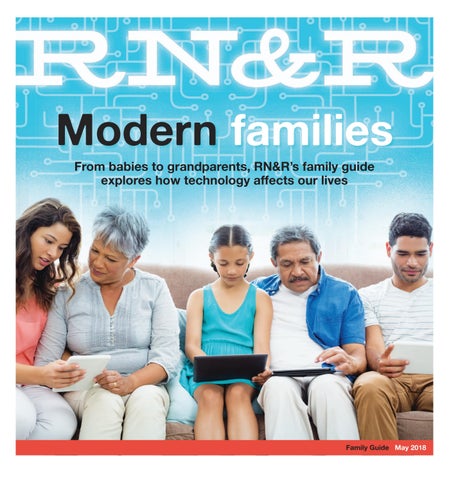
Modern families From babies to grandparents, RN&R’s family guide explores how technology affects our lives
Family Guide May 2018
GO-KARTS
MINIATURE GOLF
THERE’S FUN FOR THE WHOLE FAMILY AT GSR!
(775) 789-2000 • GrandSierraResort.com
CAMPINVENTION.ORG
2
RN&R Family Guide
05.10.18
TS
Ho
me Two RO
B
O
ke
ND
S-O
N STEM
Led by local educators Van Gorder Elementary | June 12 – 15, 2018 Hunsberger Elementary | June 18 – 22, 2018 A speciAl supplement to Reno news & Review
FU
N
a
H
In Partnership with the United States Patent and Trademark Office
ades
K–6
Ta
Gr
NEVADA’S FIRST AND ONLY
Modern Families
BIG PICTURE LEARNING SCHOOL
Welcome to our May 2018 Family Guide
T
hanks for grabbing a copy of our family guide. We do three or four of them every year, each with a different theme. We’ve explored a range of themes in past family guides—from daytrip destinations to civic engagement. And this time, we’re focused on technology, with stories exploring a range of topics from media literacy to medical advancements in local neonatal intensive care units. Can your family spot fake news? If you’re not sure, check out page 9, where we have a story from Arts Editor Kris Vagner about media literacy. Kids and teens need media savvy, so Kris asked local experts to weigh in on ways families can help. On page 4, you can read a story from contributor Matt Bieker about a program called Seniors to Seniors. It’s run by Incline High School student Matt Cornell, who, along with other high school volunteers, offers his time to help senior citizens with technology questions and troubleshooting. There’s a good chance you’ve heard people joke about how the internet is for porn. It’s funny, but it’s also kind of true. Even innocent Google image searches can return X-rated results. In fact, some people claim the abundance of porn on the internet has resulted in “porn addiction” for a subset of the population. To learn more about it, RN&R contributor Andrea Heerdt talked with a psychology professor at the University of Nevada, Reno. That story is on page 6. Have you checked your Facebook today? Or were you one of the people who were disgusted enough by the news that Cambridge Analytica was able to gain access to the private data of so many people that you decided to #deletefacebook? A lot of us have what we might call “complicated” relationships with the social media platform. Writer Tim Lenard explored his own in a piece you can read on page 14. For my part, I visited the NICUs at Saint Mary’s Regional Medical Center and Renown Regional Medical Center to see how new technologies are changing the ways doctors and nurses care for premature babies. You can read that on page 17. Regards, Jeri Chadwell RN&R Special Projects Editor
Big Picture Learning’s mission is the education of a nation, one student at a time. Big Picture Learning’s vision is to catalyze vital changes in education by generating & sustaining innovative personalized learning environments that work in tandem with the real world of their greater community.
WHY BECOME AN INNOVATOR? – – – – – –
Small School Setting on a Trimester Schedule Personalized Learning and Advisories Internships for every scholar! Peaceful, Positive Diverse, Accepting Culture AP and Honors Classes Service Learning’s-Digital Recording Arts Program (Full Recording Studio on-site) – Fine Arts Courses, Clubs and Community Opportunities – School of PEACE (Parent Education and Child Enrichment) – Authentic Assessment through Exhibitions Learn more about Big Picture Learning @ www.bigpicture.org
777 West 2nd Street | 775-333-5150 WASHOESCHOOLS.NET/INNOVATIONS
Come tour our Campus! Upcoming Shadow Day Window: May 21- June 1, 2018 05.10.18
RN&R Family Guide
3
Incline High School student Matt Cornell, 17, helps Carl Levinson, 81, with tech questions during a recent Seniors to Seniors event. PHOTO/MATT BIEKER
teenage
tech support Incline Village teens teach technology to senior citizens by Matt biekeR
4
RN&R Family Guide
t
he internet is full of memes about teaching old people to use technology. and many young people are, no doubt, less than enthused by time spent helping their elders figure out the newest technology. born and raised in the era of personal devices and internet culture,
05.10.18
most teenagers and young adults possess a level of technological proficiency that can be frustrating to communicate across the generational divide. at incline Village’s public library, however, local high school students dedicate several hours every other week to doing just that.
A speciAl supplement to Reno news & Review
The Seniors to Seniors program was restarted in February of this year by Incline High School student Matt Cornell, as a community service project for the National Honors Society. After learning about the program and discovering it was on hiatus, he felt it was a good application of his interests. “I’ve always been interested in the newest technology and just seeing what it can do, because right now any device can do just incredible things,” Cornell said. “I figured if there’s a way for me to bridge that gap between senior citizens and the newer technology, then that could be helpful.” Cornell and usually one other volunteer spend afternoons on the first and third Wednesday of each month in a shared space at the Incline Village Library, where local senior citizens are encouraged to bring devices or questions about technology. Ricky Resendiz most often accompanies Cornell. “Older people in my family always ask me for help and how to do something,” Resendiz said. “The first time I did it, I didn’t know what to expect—but when I was sitting down with another senior and showing them around, it was actually pretty fun.” The students said they get a range of different requests: from resetting a password and checking an email account, to helping one patron format the book he was writing. Occasionally, the fix can be more of a process, they said, in which case it’s important to remain calm and communicative. “I make sure they know how to do everything, step by step, and walk them through it,” Resendiz said. “Sometimes they might get a little frustrated or it might be a little harder for them to learn how to do it, but I just make sure that I’m polite as possible when I show them how to do it.” The conversations they have with senior citizens aren’t always difficult, though, and sometimes they find common ground in unexpected subjects. One particular couple, Cornell said, made an impression on him as they inquired about how to save and share their family photos. “We had a great conversation about how—through the history of technology—the different devices and stuff are phased out, like the floppy disk, and then CD, and now even the thumbdrive,” Cornell said. “We were just talking about what’s the safest way to make
sure whatever you save will stand the test of time and how you can sort of predict that.” While what Cornell and Resendiz do may resemble simple tech support, the service they’re providing is valuable to senior citizens who have few resources for help when more and more aspects of health and finance are digitally automated. Cornell helped one gentleman list a house online, the sale of which was necessary for his retirement fund. “I think it is one of the most important pieces of the library currently,” said Managing Librarian John Crockett of the Seniors to Seniors program. “Folks have to file their taxes online, have to get their forms online, have to apply for Social Security all online—so this is a vital role that the library wants to play.” Crockett said the program is valuable, both as a collaboration between the Washoe County Public Library System and Incline High School, and as a part of the library’s plan to foster digital literacy in the community. Resources like this, he said, will hopefully increase participants’ confidence in using technology—even in the library. He explained, “[With] libraries, in the past—it was very transactional, ‘I want this book.’ You give me the book. ‘I have this question.’ You give me the answer.’ Now it’s a lot more focusing on the learning and literacy aspect of it. It’s finding
“Older people in my family always ask me for help and how to do something ... when I was sitting down with another senior and showing them around, it was actually pretty fun.” Ricky Recendiz Seniors to Seniors volunteer
out how to get to the ‘Help’ menu so you can ask your own questions.” While some form of technology training is offered at most branches of the Washoe County library system, Seniors to Seniors is especially valuable to Incline Village because of its relative isolation from the rest of the county.
“There was this one guy I helped, and after I was done helping him, he said, ‘If I have any more problems, I’ll come back here because I really don’t know where else I can get this help,’” said Resendiz. Cornell said he plans to keep the program going into next year, when the term ‘Seniors to Seniors’ will be a little more factual. Technically, right now, he’s still a junior. After his own senior year, he’ll look for someone new to take over. From his time spent working with the senior citizens of his community, Cornell has some advice for making those intergenerational conversations a little easier: “I’ve found that, if someone has a problem and you look at it and see it’s super easy, you might not want to say, ‘Oh, yeah, you just do this.’ You let them talk out their whole problem, and then walk them through it. You don’t want to jump into it too fast, where maybe it’s not clear to them. You just want to make sure they get their ideas out there, so you can sort of figure out what they were doing first.” Ω
Learn more about the Seniors to Seniors program by visiting: https://bit.ly/2rijiVa.
K I A | L E X U S | M A Z DA | T OYO TA
05.10.18
RN&R Family Guide
5
the naked truth Internet porn poses challenges for obsessive viewers by ANdReA HeeRdt
t
here’s a fair amount of debate regarding how much of the internet’s content is really comprised of pornography. By some estimates, it’s 12 percent and, by others, 30 percent. Regardless, it can be viewed from nearly anywhere, at any time—frequently for free. According to dr. Steven Hayes, a clinical psychologist at the University of Nevada, Reno, it’s estimated that around 13 percent of the U.S. population regularly watches pornography, and, among these viewers, eight percent watch 11 or more hours per week.
6
RN&R Family Guide
05.10.18
Many researchers, including Dr. Michael Levin of Utah State University’s psychology department, have said that watching pornography online, even frequently, isn’t necessarily problematic. Sometimes pornography can even be beneficial or facilitate people’s relationships in a positive way, according to Hayes. Yet, for a portion of the population that struggles with compulsive watching, the wide availability of pornography via the internet can have serious consequences on their relationships, mental health, and overall ability to function or be productive, he said. Hayes said that in terms of brain processes for people who struggle with compulsivity, parts of the brain used in emotional regulation become active. He said people may compulsively watch to self sooth by trying to avoid loneliness, anger, anxiety or depression. Hayes said this is known as experiential avoidance—attempting to avoid thoughts, feelings or other experiences you don’t want to have by distracting yourself. “It’s self-accelerating,” Hayes said, “It doesn’t have a natural limit. Once you start avoiding, you’re going
A speciAl supplement to Reno news & Review
to want to avoid more because to turn around and face things you’ve been avoiding is hard, so you turn around and avoid them again.” Of course, people have struggled with compulsive viewing patterns since long before the internet, but now, according to Hayes, the chances of acquiring viewing habits that are out of control are much higher. “It’s like the way we have sweets and health problems,” said Hayes, “It has to do with the constant availability of sugar. The constant availability—that you’re just a click away, you know, nowadays, not necessarily even at any cost. So what’s to prevent you?” According to Hayes, if a person is thinking about porn all the time and how awful it is that they’re watching it, they’re still thinking about it. And this can push them to watch more. He gave the comparison of frequently thinking about food when dieting. The more obsessively a person thinks about it, the more likely they are to overeat.
“It’s only when you build habits that will sort of allow you to do well mindlessly, when you can build habits in diet and exercise, that lead to permanent weight loss,” said Hayes, “If you’re thinking about it all the time, it’s a really bad way to do it, and it’s the same way [for porn]. If you have a wagging finger of shame or blame in the back of your head, good luck with that.” One of the things Hayes has said he’s found in studying out-of-control viewing habits is that a reduction in a person’s sense of shame and guilt can lead to an increase in their ability to regulate their behavior. This is the central focus of acceptance and commitment therapy, or ACT. Hayes said this type of therapy is designed to help people become more emotionally open and less entangled with judgment, while building habits around values rather than phobias or judgments. According to research from Dr. Michael P. Twohig of Utah State, after eight one-and-a-half-hour sessions of ACT therapy, an 85 percent reduction in participants’ porn viewing was reported as a post-treatment result. And rather than trying to simply suppress the urge to watch, Hayes said a mindfulness-based therapy like ACT may lead people to become more open about porn and less obsessed with the negative emotions with which they associate it. And this can help them gain behavioral control. Although there’s no argument in the scientific community about the fact that people struggle with compulsivity, “pornography addiction” is not listed as a disorder in the most recent edition of the Diagnostic and Statistical Manual of Mental Disorders, published by the American Psychiatric Association—and some researchers have argued that it’s not a real condition at all. In the field of neuroscience, research published in 2015 by a team at the University of California, Los Angeles indicated that compulsive porn viewers’ brains don’t react like those of typical addicts. The researchers measured electrical activity in the brain when people were shown both sexual and non-sexual images. What they found was that— unlike your typical cigarette, cocaine or even gambling addict, whose brains show increased reactions when exposed to their drug of choice—people who struggled with excessive porn viewing had decreased brain reactions when viewing porn.
“It’s selfaccelerating. It doesn’t have a natural limit.” Dr. Steven HayeS Clinical psychologist
“This finding is important, because it shows a reversal of a part of the brain response that has been consistently documented in other substance addictions and gambling disorder,” Dr. Nicole Prause, who led the study, said in a press release following its publication. In the press release, the researchers concluded that putting the “addiction” label on excessive porn viewing may not be a wise move. “Labeling a person’s attempt to control urges a ‘sexual addiction’ may interfere with therapy approaches such as Acceptance and Commitment Therapy (ACT) that can reduce distressing sexual behaviors,” said psychologist and study co-author Cameron Staley. According to Hayes, the integration of technology into day-to-day life can be dealt with by people who develop what he calls “modern minds.” “The world is different now than it used to be, and it just isn’t exposure to porn, you’re exposed to horror for example,” said Hayes. Exposure to not only pornography but things like violence as well may be a fact of life in the internet age. But, according to Hayes, acceptance and commitment therapy is one way for people to develop modern minds of their own, while learning to keep a balance of self-control and openness, too. Ω
Dr. Steven Hayes has authored more than 600 scientific articles and written several dozen books, including Get Out of Your Mind and Into Your Life, which was featured in Time Magazine and spent time as the bestselling self-help book in the U.S. PHOTO/ANDREA HEERDT
05.10.18
RN&R Family Guide
7
9382_NHL_RNR_FamilyGuide_Ad_FIN.pdf
8
RN&R Family Guide
05.10.18
1
5/2/18
3:13 PM
A speciAl supplement to Reno news & Review
can your family spot
fake news? Studies show that kids and teens need to consume media more skeptically. Local experts weigh in on how to start. by KRis VaGNeR
C
an you tell whether the news you come across is biased? Can you spot a fraudulent social media post? Can your family? Current technology allows misinformation to spread far and fast. Social media is one obvious conduit—a study conducted at MIT concluded that false news stories are 70 percent more likely to be re-tweeted than true ones, for example. It’s also getting easier to make false news look all the more convincing. Artificial Intelligence researchers last year at the University of Washington showed a real video of Barack Obama giving a speech, side-by-side with a fabricated video of him uttering the same words. Even skeptical viewers would be hard-pressed to tell the two videos apart. Young media consumers have been deemed particularly easy to fool. Researchers at Stanford University surveyed 7,804 students from middle schools, high schools and colleges from 12 states, across a broad socioeconomic range, and found that students in every group they studied had trouble sorting media facts from media fiction. Middle schoolers couldn’t tell native advertisements from articles. High school students tended to believe that photographs are inherently credible even when they looked noticeably surreal. And about half of the study’s college students—when asked to evaluate the credibility of a tweet about gun owners’ voting habits—made their assessments without clicking on the link that the data supposedly came from. So how can kids and teens navigate through the daily barrage of information and misinformation? Here are a few things to keep in mind.
10
RN&R Family Guide
05.10.18
A speciAl supplement to Reno news & Review
05.10.18
RN&R Family Guide
9
E. L. CORD CHILD CARE CENTER
TRUCKEE MEADOWS COMMUNITY COLLEGE
Located on the Dandini Campus
Through a quality child care program, TMCC Child Care will provide care and education based on best practice.
The summer is here and it’s time for family adventure and fun! Remember to use The Children’s Cabinet as a resource for: • Free parenting and caregiver classes • Finding childcare • Early education resources and materials • Ideas for summer fun with kids
Check out details and links at www.childrenscabinet.org
Keeping children safe and families together.
Program Highlights • • • • •
Open to Community year round, Monday-Friday, 7am to 6pm Semester-Care and Extended-Care Well-developed policy guides High-quality Programming All employees meet state of Nevada Child Care Licensing requirements Accredited by the National Accreditation Commission (NAC)
Educating Children For Life E.L. Cord Child Care Center
7000 Dandini Blvd, Reno, NV 89512 775-674-7515, www.tmcc.edu/childcare 10
RN&R Family Guide
05.10.18
A speciAl supplement to Reno news & Review
“Fake News” continued from page 9
Fake News isN’t New Hug High School teacher Sonia Kretschmer, who teaches media literacy skills in her social studies classes, pointed out that there’s been misleading news for as long as there’s been news—and that the spread of misinformation has kept up with each era’s technology. Her 11th and 12th-grade students analyze Colonial-era pamphlets and yellow journalism—a nickname given to a rash of unsubstantiated, sensationalist reporting in the late 19th century, an early equivalent to today’s clickbait. To teach her students about bias, Kretschmer said, “We look at the media portrayal of the sinking of the Lusitania and our entry into World War I.” Her students read two different newspaper articles, looking at “what information they give and what they’re calling facts when the other newspapers report something totally different, but they say it’s fact as well. … So, students can really see this has been an issue throughout our history. It’s not just something that’s brand new.”
But today’s Fake News is diFFeReNt False or unsubstantiated reports can look exactly like honest, verified ones. In one recent example, the largest Black Lives Matter Facebook group had 800,000 followers. It looked and sounded legitimate, and it raised about $100,000. But it turned out to be a fundraising scam run from Australia, and none of the money went toward Black Lives Matter efforts. “The fake news that is generated as hoaxes or as satire or as propaganda or whatever, that has also exploded and is also being distributed at light speed,” said local journalist and author Frank Mullen. “It’s just the chaos of the whole thing—you don’t know what to believe any more, and when you get so many realities thrown at you, how do you pick one?” Contemplating these questions led him to schedule a three-hour class on the subject through Truckee Meadows Community College in June, geared toward both educators and the general public.
a study conducted at mit concluded that false news stories are 70 percent more likely to be re-tweeted than true ones. Read like a FactcheckeR The Stanford researchers who looked at middle-school, high-school and college students advised that the best way to wade through potentially false news is to learn to read like a fact checker. That’s exactly what Mullen plans to address in detail in his class. It doesn’t take any special training to get started, though. He shared some simple advice: For “something that kind of looks legitimate, basically, look at, number one, consider the source. Is it coming from a well-known media outlet, or is it coming from some obscure thing that sounds like a media outlet? And if you’re not sure … Google it. See what it is. Is it a satirical site? Is it a propaganda site? Is it a Russian bot? … If there are links in the story that supposedly support what they’re saying, click on the link, and see if it actually says what they claim it says.” There are also several sites dedicated solely to fact-checking. Among the biggest and most reliable are Snopes.com, Politifact. com and Factcheck.org. And if you’re unsure whether a photo is legitimate, Google Reverse Search can lead you to its original source, which should give you some clues.
kNow youR Biases “Social media reinforces what you already thought,” said Kretschmer. “It’s that hive mentality. You hang out with people that are likeminded. And now it’s just on a global scale, where you’re making friends with people across the United States … who are likeminded, so you’re kind of just reinforcing those thoughts that you already had.” There’s a scientific term for this tendency—confirmation bias. Kretschmer sees the phenomenon in her students often, and adults are subject to it, as well. Mullen has some advice for combatting it: “If you
say, ‘This confirms what I thought,’ you ought to be suspicious of that.” If something you read makes you think, “Dammit, I knew Trump had been in an insane asylum at some time in his life, I just knew it!” … that’s probably worth checking out. “And also be aware of the slant,” Mullen added. “The New York Post is a pro-Trump newspaper. The New York Daily News is an anti-Trump newspaper. So, know that going in. They’re both news sources, but you need to know what their agendas are.” If you’re not sure offhand what kind of political leaning a given media outlet has, Media Bias Fact Check is a helpful site that reveals which ones are left-biased, rightbiased and least biased. And if you’d like to learn more about what’s behind confirmation bias and why we’re subject to it, a 2017 episode of NPR’s Hidden Brain podcast expands on the topic briefly and clearly. It’s titled, “When It Comes To Politics and ‘Fake News,’ Facts Aren’t Enough.”
cultivate skepticism “The other part is just personal vigilance,” said Mullen. “You’ve got to just be more skeptical than ever, as individuals.” One way to do that is to make a rule for yourself and your family members: If you have a strong emotional reaction to a headline or meme, note that it was probably calculated more to elicit a gut reaction than to convey something accurately—and look into it. Find the data source that the statement came from, and assess its credibility. And Michelle Ciulla Lipkin, Executive Director of National Association for Media Literacy Education, gave some advice on that group’s site that can be applied to every media interaction, every day: “We focus on one simple piece of advice: teach your kids to ask questions.” Ω
Journalist and author Frank mullen will offer a onesession class on defending against fake news at tmcc’s Meadowood campus, 9 a.m. - noon, June 9. The cost is $39. to enroll, call the registration office at 829-9010.
05.10.18
RN&R Family Guide
11
sponsored content
How MucH is Peace of Mind wortH to you? Many people mistakenly think that estate planning only involves the writing of a will. estate planning, however, can also involve financial, tax, medical and business planning. a will is part of the planning process, but you will need other documents as well to fully address your estate planning needs. this is why you need to consult a qualified, experienced attorney like tory d allen, esq. to assist you with proper planning of your estate.
Who Needs aN estate PlaN? You do: Whether your estate is large or small. either way, you should designate someone to manage your assets and make health care and personal care decisions for you if you ever become unable to do so for yourself. If you fail to plan ahead, a judge will simply appoint someone to handle your assets, personal care, medical decisions, and to care for your children.
through estate PlaNNINg, You caN coNtrol: how and by whom your assets will be managed during your lifetime if you ever become unable to manage them yourself. You determine how and to whom your assets will be distributed after your death. You decide how and by whom your personal care will be managed and the health care decisions made during your lifetime if you become unable to care for yourself. Most importantly you decide who will be entrusted to care for your minor children after your death.
WhY do You Need aN estate PlaN? You need a trust or Will to plan for the management and protection of your most important asset- your family. contact tHe Law office of torY d aLLen todaY at 3715 LaKeside dr., suite a or caLL us at 775-823-2000
Party! Oh Yeah!
All New Party Rooms
Open 7 Days a Week • Up to 24 Guests Packages Include Video Game Plays and Midway Game Redemption Book Your Party Today! Call 775-325-7143 or circusreno.com
12
RN&R Family Guide
05.10.18
A speciAl supplement to Reno news & Review
W IN A
FAMILY MEMBERSHIP TO THE DISCOVERY!
TO ENTER: · Send an email to contest@newsreview.com · Put “DISCOVERY” in the subject line · Include your full name, day phone and birth date · DEADLINE to enter is 05/25/18 · Winner will be notified by phone and e-mail
VISIT ALL YEAR!
PROFESSIONAL EAR PIERCING FOR CH ILDREN
R N & R ’ s
ARTOWN
PROgRAm s p e c i a l s u p p l e m e N t i s c o m i N g !
AVAILABLE AT BLACK HOLE BODY PIERCING OVER 21 YEARS OF EXPERIENCE
Safe • Single use • Tandem appointments Highest quality bio-compatible jewelry Tons of jewelry styles to choose from
Discover the highlights of what’s planned for Artown’s 22nd year, along with other activities and the complete lineup for the RN&R’s 23rd Annual Rollin’ on the River music series! Look for it inside the June 28th RN&R!
912 S. Virginia St. • 775-329-6010 • blackholereno.com 05.10.18
RN&R Family Guide
13
in your
f ace
Like most, my relationship with Facebook is complicated My first Facebook profile, way back when you still needed a college email to create one, was a picture of one of those little dinosaurs that get bigger in water, which my brother kept in an old bottle of Colt 45. His name was Strumpet, and he was a stegosaurus. Although Strumpet has gone up north to live with a nice family on a farm, I still get birthday notifications for him occasionally.
Strumpet was my way of being on Facebook without actually putting myself out there. I was terrified people would pore over anything I posted and get the wrong impression. That hasn’t changed, but at least now I’m comfortable knowing none of my friends give a shit. I think this gets to the heart of what Facebook has become: A place where the only people actually paying attention to all the mundane things we post are the ones who work at Cambridge Analytica. Everyone on Facebook is creating a brand for themselves and selling it to their friends, desperately hoping they will buy it. I’m as guilty as anyone else. I share travel photos so my friends will think I’m some globe-hopping world traveler. I shamelessly pimp my journalism because likes and shares are what gets you work nowadays. And I try not to post about politics because I’m pathologically unable to resist an argument, and I don’t want to ruin my whole day. And it works. In May, I’m getting married to someone who I would never have kept in touch with if not for Facebook. I met her a few days before leaving on a yearlong deployment to Afghanistan, and Facebook was our primary method of communication. It could have been email, sure, but there is undeniably something more personal about messaging on Facebook. Afghanistan is 14 hours ahead of Hawaii, where she was living at the time. As the sun was setting on my little corner of the war, it was rising on a cramped, one-bedroom apartment in Waikiki. I would send her 14
RN&R Family Guide
05.10.18
embarrassingly sappy morning messages as often as I could—messages which will live forever in a server farm somewhere. I wonder what valuable advertising data is being gleaned from them as I write this. Maybe Facebook works because we think we really know someone when we see what they are eating and who they are hanging out with, what their political or religious beliefs are, what kind of relationships they’ve had in the past, how many pictures of cats they post per day. And the combination of people trying to sell an ideal image of themselves and other people using those images as a substitute for real connection, is why Facebook is the behemoth that it is. Facebook is like watching an episode of MTV Cribs starring your friends. I look at the picturesque lives of my Facebook friends—usually while I’m slouched over my desk, unshowered—and inevitably compare them to mine. I know it’s dumb, but I can’t help myself. Facebook is tapped into a part of my brain I can’t control. It’s the same part that forces me to watch movies starring The Rock. The problem with these comparisons is this: Real people are not who they are on Facebook. When I finally created a real profile for Facebook one of the rules I made for myself was that I would only ever friend people I had met face to face. This came in handy when I added U.S. Army as a job and was instantly barraged with random friend requests from scantily clad women. (These accounts are foreign intelligence agencies trying to trick dumb privates into giving away troop movements, and they work.) But friending only people I’ve met also means that when I see a meme about the shooting at Sandy Hook being a false flag operation or suggesting vaccines are causing autism in my feed, it isn’t the voice of some faceless other. It’s the opinion of someone I know, for better or worse.
A speciAl supplement to Reno news & Review
by TIM LeNARd
I grew up in a small college town in Wisconsin with hippies for parents. As a result, most of my Facebook friends from high school are of the liberal persuasion. The friends I made in the Army came from all over the United States and Texas, but in the military, there is definitely a conservative majority. However, for the longest time my feed actually demonstrated how alike we all were, regardless of political affiliation. We all posted baby pictures and wedding announcements, photos of family get-togethers and memories of the people we have lost. But in the last few years, something has changed. I think it had been simmering for long time, but the 2016 election saw the boiling point. Facebook was no longer a place to keep in touch with friends. It became a battleground to be won or lost. I got caught up in it as much as everyone else, posting in support of Hillary— despite serious misgivings. In the end, I got a bunch of praise from liberal friends, and my conservative friends just ignored it. I didn’t change anyone’s mind, and I certainly didn’t win an election for anyone. I just forked over more of my personal beliefs to some algorithm so it can more effectively categorize me for advertisers, Facebook’s true customers. In fact, if I’ve learned anything from having a diversified friend portfolio, it’s that what Facebook does best is chunk complex people up into monetizable parts. Since this is a guide, I suppose I should offer at least one piece of advice. Take Facebook off your phone. It’s a shitty app that uses a ton of storage and memory, even when you aren’t using it. Make being on Facebook a conscious choice, and if you find yourself mindlessly scrolling away, getting outraged at people thousands of miles away—you’re doing it wrong. Ω
Facebook is tapped into a part of my brain I can’t control. It’s the same part that forces me to watch movies starring The Rock.
. Ly L o v e d L a c o L . G iv e n L o c a L Ly . d e is a R L o c a L Ly Moms on the Run Mother’s Day May 13th www.momsontherun.info
get more, spend less. 10
$
20
89506 | reNo, NV rgiNia St. riZoo.org 10200 N. Vi w.SierraSafa ww | 1 10 Value. Cannot be Admissions. No Cash (775) 677.1 . for two Standard Adult change will be given Valid . No discounts or offers combined with other
gift certificates, gift cards and tickets to some of the best businesses, restaurants, theaters and concert venues in town.
sierra safari zoo $20 value, you pay $10
RnRsweetdeals.newsReview.com
05.10.18
RN&R Family Guide
15
. . . and Cats Too!
“The K-9 Nannies”
NOW
HIRI
NG
775.800.6710 · ProDogMom.com
Does your pooch need a spa day? 2 Locations to Serve You Friendly & Clean Toys & Treats Convenient Schedule Fresh Spring Looks
Alice's Pet Parlor & Midtown Mutts!
&
Parent participation preschool program Class of three students once a week for 30 minutes
Carol Clark – 702-286-7714 Member of the NNMTA, MTNA, and NMTA
$45/month per child in preschool class
CAMP STAR BOUND Spend a week with us and have the experience of a lifetime! Camp Overnight is a theatrical performance arts camp for grades 5-12. You’ll enjoy 7 days / 6 nights being coached and challenged by professional dancers, singers and actors with a traditional camp experience.
When: June 24-30th Where: Galena Forest Campground Come and join the fun!
www.campstarbound.com or 800-288-9197 16
RN&R Family Guide
05.10.18
A speciAl supplement to Reno news & Review
1
sign up for the newsletter at rnrsweetdeals.newsreview.com
Private instruction for beginning to advanced Lessons once a week for a half hour Scraps_RN&R_Ad_Dog_Wash_1.87x5.16_CMYK_outlines_REVISE.indd
rnrsweetdeals.newsreview.com
Piano Instruction in YOUR home!
exclusive deals right to your inbox.
Alice’s Pet Parlor Midtown Mutts 225 Redfield Parkway 1426 Tonopah St. 775.851.3625 775.322.2018 www.alicespetparlor.com
4/26/18 8:55 AM
Bright and
early
Local NICUs use innovative technologies and treatments to save premature babies’ lives by JeRi ChadWell
W
hen Gail Adler got her first job out of nursing school in 1978, neonatal intensive care units—which care for ill and premature newborns—had only recently been established at many hospitals. “Neonatal Units—we called them intensive care nurseries back then—were just coming into being,” she said. Adler has spent her entire career working in neonatal care for Renown Health, formerly Washoe Medical Center. Today, Renown Regional Medical Center’s NICU is equipped with advanced technology and capable of providing care for 39 infants at any given time. Adler said the advancements in technology during her nearly 40-year career have been astounding. She cited the incubators in which babies in the NICU are kept, calling them “Cadillac versions” of the models used in years past—with humidity control, radiant heat, special UV lamps for treating jaundice, and more. But even four decades ago, the hospital’s NICU was on the forefront of neonatal care. When Adler started, a local pediatrician named Dr. Donald E. Pickering was in charge of the hospital’s NICU and had developed a mobile life-support unit for transporting ill and premature infants from outlying areas to the hospital. In 1979, the Reno Evening Gazette ran a story about a baby who had, a few years earlier, been saved by Pickering and “his ‘miracle machine’ … a portable Infant Life Support Module (ILSM) … that can be tucked in a small airplane or van for quick transport of a tiny infant to an intensive care facility.” The ILSM was compact, with a ventilated carrier for babies and equipment to monitor their vital signs, including the heart rate, electrocardiogram pattern, respiratory rate and pattern, body temperature and blood pressure. For years,
Pickering would drive or fly his Kirk Smith, the head of respiratory own small plane to pick up infants, therapy at Saint Mary’s Regional taking along the ILSM and nurses Medical Center, stands next to the from the NICU to assist him. Adler hospital’s neonatal transport unit. photo by jeri chadwell was among those who joined him and recalled the sometimes tricky conditions under which it had to be done. “We used to fly to Lovelock, and they didn’t have any landing lights,” she said. “We’d call the fire department, and they’d call the firemen in, and they’d all put their headlights on the runway, so we could land.” The early models of the ILSM, Adler explained, could also present difficulties. “The transport unit—you couldn’t really secure it very well,” she said. “You had to take the wheels off. You had to hold onto it Adler explained that advancements in the NICU often when you went around corners.” result from improvements made to existing technologies and But it was a revolutionary technology, nonetheless, treatment methods. And—as was the case with Pickering in said Adler. She’s now Renown’s neonatal transport unit the ’70s—advancements in local NICUs are often driven by coordinator and in charge of training the medical profesthe medical professionals who work in them. This is true at sionals who use it. The unit in use today is an evolution of both Saint Mary’s and Renown, where the respective NICUs the first ILSM created by Pickering, who sold the patent rely on many of the same technologies and techniques but to a company called International Biomedical. According also branched out with new ones. to Adler, the latest iteration—called an AirBorn Transport Incubator—is a mainstay at many hospitals. In Reno, Saint Mary’s Regional Medical Center also has one, and the “Bright and Early” continued on page 19 two hospitals take turns being on call to the surrounding communities—switching off on a weekly basis. 05.10.18
RN&R Family Guide
17
Get ready!
Don’t miss out on aDvertising to rn&r reaDers in these upcoming issues! This magic momenT
HaRRy PottE R tuRNs 20 see arts&Culture, page
2018
Summer
Guide 2017
’18
RENo’s
Vote
for your favorite people, places and things throughout Northern Nevada.
1 2
first round Voting:
May 3 —June 7
NEws
&
ENtERta iNmENt
wEEkly
|
VolumE
Do summer like a superhero
23,
issuE
17
|
JuNE
Only One ballOt per email address. In order to qualify, a ballot must contain votes in a minimum of 10 categories. Casinos are only eligible in the “Casinos & Gambling” location, an address must be specified.
Go to bestofnorthernnevada.com RN&R Family Guide
05.10.18
A speciAl supplement to Reno news & Review
2017
summer guiDe may 31
we n t7 o Ar id u g 2 1 us Roll out: Join local foR even moRe ouR music duRing n’ new still Rolli s conceRt seRie
& Review t to Reno news A speciAl supplemen
artown program june 28
section. In cases where a business has more than one
18
8-14,
second round Voting:
June 28 —July 26
20
If you’re interested in advertising, call (775) 324-4440.
r e m m u S Guide
“Bright and Early” continued from page 17 MotheRs’ Milk In the NICU at Saint Mary’s, there’s a team of medical professionals who call themselves the “NEC team.” Their goal, according to NICU clinical dietician Margaret Olander, is to prevent babies from developing necrotizing enterocolitis—a condition where a portion of the bowel dies. And a key to preventing it, she said, lies in breast milk. In 2012, the American Academy of Pediatrics released a policy statement that recommended feeding premature babies human milk, based on findings suggesting it can have “significant short- and long-term beneficial effects,” including reducing the rate of NEC by a factor of at least two. But nurse Erna Cordeiro, Saint Mary’s NICU manager, explained that mothers of premature babies often don’t produce enough breast milk. Sometimes, she said, a mother might produce only 20 calories worth at a time. There are, of course, other ways to get breast milk to newborns. Donor breast milk programs have been popular for years, but according to Olander, they’re not all created equally, and some can pose risks for premature babies. To be safe, Olander explained, donor milk needs to be tested for blood borne pathogens and adulteration, and that’s why Saint Mary’s NICU began working with a company called Prolacta Bioscience. Its product, Prolacta Plus, is a 100 percent human milk-based liquid human milk fortifier. “So the reason we use it in the NICU is that it’s so highly tested,” Olander said. “We know that the likelihood of there being anything in the milk that could harm our babies is extremely, extremely low. There’s no HIV. There’s no hepatitis. There’s no cow’s milk. We know exactly what we’re getting.”
Photos show Alice Worthington when she was a newborn and as a 1 year old.
“And it helps improve their oxygenation,” she said. “We’ve seen babies go into kangaroo care and be able to decrease on their oxygen while they’re being held by their parents. It also decreases cortisol levels. They actually say that three consecutive hours of being in kangaroo mode equals two weeks of brain development that would happen in the incubator.” New poiNt oF view Miller-Hanna and other Saint Mary’s nurses have been helping parents engage in kangaroo care since 2015. In hospitals like Renown and Saint Mary’s, highly advanced Two-and-a-half years ago, Laurie Worthington and her incubators—the “Cadillac versions” as Adler calls them— husband, Robert, were among those parents. In a are pretty standard these days. Most are doublerecent phone interview, Laurie recalled the walled, to provide sound and temperature experience. insulation. In addition to humidifiers and “My pregnancy, until I went to UV lights, they often have built-in the hospital, was perfect,” she said. scales for weighing their occupants. “And then I went to the hospital, And at Renown, they recently got and they’re like, ‘You’re going yet another new feature. to have your baby right now.’ The NICview is a small, And I said, ‘No, I’m not—not adjustable web camera. me.’ They brought someone Clipped to an incubator, it in from the NICU. My provides a 24/7 livestreamhusband went for a tour of ing video that parents and the NICU. I wasn’t able to families can log in to a go, because I wasn’t able to website to view. The idea, get out of bed. So he went, according to NICU manager and I was still, like, ‘No, my Jessica Bakke, is to provide baby is not going in there. parents and families with a Jessica Baake We’re going to be fine. And little peace of mind. Renown NicU Manager when she’s born, we’re going “It has slowed down some to go home.’ I still remember of those phone calls,” Bakke said. thinking, ‘We’re going home. I don’t “You know, moms wake up at two know what they’re talking about.’” o’clock in the morning, and they can’t Laurie was only 27 weeks pregnant sleep. They’re panicked—because nobody when she gave birth to her daughter, Alice, wants to leave their baby here.” and the family ended up spending a total of 87 days Now, she said, they can log on any time and see that in the NICU. their child is doing fine Alice weighed less than two pounds when she was born. “They can see their baby and know that they’re sleeping For the first several days, the Worthingtons couldn’t even or resting and everything’s OK,” Bakke said. “So peace of hold Alice. But, when it was safe, they were taught about mind—and also I think it has really brought on a little bit kangaroo care. more family bonding.” “They make you put them on your chest—just their little Bakke explained that the visitation rules in the NICU bare bodies on your chest,” she recalled. “They put warm are strict. During flu season, for example, no one under the blankets over them and hats on them.” age of 18 is allowed to visit. This can be hard on siblings of Laurie and Robert would take turns holding Alice in premature babies. kangaroo mode—holding her against their bare chests for a “Babies can be here for three, four months, and their minimum of an hour at a time. siblings at home—they don’t understand,” she said. “They “It was a pretty big thing to even hold her,” Laurie said. have no idea what’s going on. Now, the siblings can log on “It’s overstimulating for them to be moved around a lot. So if and see the baby in real-time—also, grandparents across the we didn’t have an hour to sit there, we couldn’t hold her. She world, or if you have a dad that’s deployed.” was on lots of stuff to help her breathing and her nutrition. So she had all kinds of cords and wires and everything. … It was Back to Basics just a lot to make sure all of the cords and everything didn’t High-end technology plays a crucial role in modern come off. That was a lot.” NICUs, but not all of the advancements made in But, according to Laurie, it also paid off. Alice—who NICUs are tech-based. At Saint Mary’s, for examis the healthy older sister to twin 10-and-a-half month old ple, a new treatment was introduced a few years ago girls—now lives in Kentucky, where the family relocated in to the NICU that required no additional equipment. December. It’s called kangaroo care, and according the nurse At Saint Mary’s, more and more families are being Dawn Miller-Hanna, it’s remarkably simple. encouraged to try kangaroo care, and Miller-Hanna said the “Kangaroo care is the process of having a baby treatment is improving outcomes in the NICU. clothed only in a diaper go chest-to-chest, skin-to“When we initiated our kangaroo policy in 2015, we had skin with a caregiver,” she explained. “What that 33 percent of our babies going home before 38-and-a-half does is allow the baby to—for one—get contact with weeks,” she said. “After we initiated our kangaroo care a parent, but then there are about 30 other different policy, we now have 77 percent of our babies going home benefits that happen.” before 38-and-a-half weeks.” Ω According to Miller-Hanna, babies who are held in what she calls “kangaroo mode” on a mother or fathers chest receive benefits in the form of quickly stabilized vital signs. May 15 is international kangaroo And the product is only available to hospitals and NICUs, she said. At Saint Mary’s, Prolacta Plus has been in use for three years now. And, in the meantime, Olander and the NEC team have been exploring additional ways to supplement premature babies’ nutritional needs. Recently, they began adding probiotics to the diets of their NICU patients.
“they can see their baby and know that they’re sleeping or resting and everything’s ok.”
care awareness Day. learn more at: kangaroo.care. 05.10.18
RN&R Family Guide
19