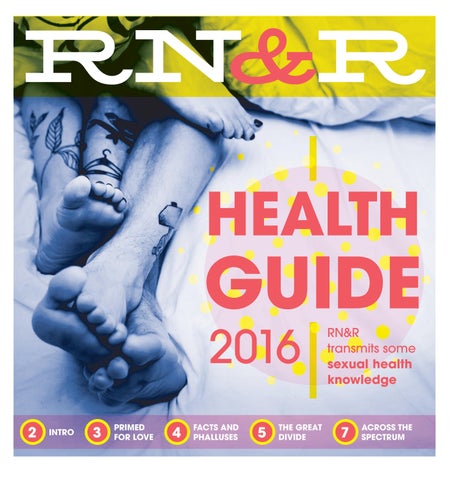
HealtH
Guide 2016
2
intro
3
Primed for love
4
facts and PHalluses
5
tHe Great divide
RN&R transmits some sexual health knowledge
7
across tHe sPectrum
o t p u e v a S ACCEPTING NEW PATIENTS IT IS TIME TO EXPECT MORE FROM YOUR PHYSICIAN
WE OFFER INDIVIDUALIZED WELLNESS PROGRAMS IN THE FOLLOWING:
50%
· PRIMARY CARE · ACUPUNCTURE · WEIGHT LOSS · NEUROLOGY · AGE MANAGEMENT · MASSAGE THERAPY · PAIN MANAGEMENT · DRUG & ALCOHOL DEPENDENCY
ts on restauran and events! RnRsweetdeals.newsReview.com
HealtH Guide 2016
NOW OFFERING YOGA, FITNESS CLASSES, UPGRADED MASSAGE SUITES & INFRARED SUANA AT OUR NEW LOCATION
RN&R transmits some sexual health knowledge
INSURANCE ACCEPTED CALL 775.853.7669 15 McCabe Dr Ste 203 · Reno, NV 661 Sierra Rose Rd · Reno, NV www.Renewed-Health.org
t
Syphilis is back. And on the rise. Syphilis and HIV are a dangerous duo affecting gay and bisexual men. Got a sore or rash? Get tested. Today For more information call (775)328-6147 This publication was supported by the Nevada State Division of Public and Behavioral Health through Grant Number 5U62PS003654-05 from the Center for Disease Control and Prevention. Its contents are solely the responsibility of the authors and do not necessarily represent the official view of the Divisionnor the Center for Disease Control and Prevention.
2
RN&R HealtH Guide
09.29.16
A special supplement to Reno News & Review
hanks for picking up a copy of our annual Health Guide. This year, we decided to focus our attention on sexual health. It’s an important topic, and one we believe people should be willing to have frank discussions about. Anna Hart gets the conversation started on page 3 with a story about the myth of sexual prime. And on page 7, I relate what I learned from a talk with Kim Nichols at Northern Nevada HOPES about some sexual health issues that are of particular concern for members of the LGBTQ community. And on a less serious note, we’ve got two pages of trivia that are sure to make you the life of your next dinner party. On page 5 you can learn some fascinating facts about vaginas—the kind of knowledge that will make you the envy of all your friends. And definitely take a look at page 4 to bone up on your phallic factoids, too. Happy reading, and, you know, practice safe sex and stuff. Regards, Jeri Chadwell-Singley RN&R Special Projects Editor
PRimed foR love
by AnnA HArt
exploring xploring the myth of sexual peaks
i
f women age like fine wine, what do men age like, fresh milk? This is the question I pose to myself in my head every time I hear about sexual prime, an idea that says men peak sexually when they are 18, while women don’t hit their stride until their mid-30s. So, how did this concept come to be? It basically started with Alfred Kinsey, a biologist who studied sexual activity and responses, and paved the way for much of what is done in sexology today. One of his most notable achievements was his groundbreaking discovery in the 1950s that women can and do have sexual urges and experience pleasure during sex. There is a good chance that women already knew this, but Kinsey was the first to get credit for saying it out loud. While his work radically shifted what people knew about women’s sexuality, it also made the idea of sexual peaks a widespread belief. Based on Kinsey’s reports, if sexual prime only referred to hormone levels, this myth wouldn’t be that far off.
“it wasN’t uNtil my eaRly 30s tHat i Realized How mucH PleasuRe i could Get fRom sex.” Lisa
Single mother of four
But what this fails to recognize is the personal health of the individual and psychological factors, both of which play a big part in sex. For me, this myth of sexual primes and peaks was a fairly new concept. But after I was introduced to it, it made sense. We see the myth as tropes in popular culture all the time, be it in those tender moments between a teenage boy exploring his sexuality with an apple pie or with everyone’s favorite cougar, Mrs. Robinson. But just how much does life imitate art? I decided that the first step toward breaking down the idea of sexual prime would be to first understand how it exists in our everyday lives. Over the course of a week, I spent time talking with quite a few people of different age groups, genders and cultural backgrounds about what their idea of sexual prime was. After the initial shock wore off, it was fascinating to see how much gender played a role in how people answered. Anecdotally, most men talked about sexual prime as being the period where they had the most sex, while women tended to talk about it as the time when sex finally started being enjoyable. “It wasn’t until my early 30s that I realized how much pleasure I could get from sex, once I started focusing on what was going on below me and stopped focusing on how I looked from that angle,” laughed Lisa, a single mother of four. So, bearing in mind these definitions of sexual prime, let’s go through what that would mean if it were true. If a man peaks at 18, does that mean his sex life is destined to get worse as time goes on? Do I as a woman need to trudge through a decade of bad sex before I start really enjoying it? If these were really the hard and fast rules, why would we not be up in arms, forcing science to give us solutions? I mean, I know that women’s sexual health isn’t at the top of the government’s list of priorities, but there are men involved, so we would definitely start to hear someone complaining about it. But maybe we don’t hear about it because, while there may be a kernel
09.29.16
of truth, it is buried under sweeping generalizations based on inaccurate perceptions of gender. Here is what we know to be true: Men reach their hormonal high at around age 18, while women’s hormonal high point arrives in their mid- to late-20s. To be sure, these high points can make a sexual desire stronger and more frequent. But though a strong sex drive can mean more sex, it doesn’t always mean good sex. And if the sex isn’t good, do you really want to call that your prime? A key facet to realize is that desire and sexual drive aren’t exactly concepts that work with a one-size-fits-all approach, so why treat them as such? Different genders may have different sexual problems associated with them, such as low testosterone levels for men, or insecurities around enjoying sex due to cultural stigmas for women. As Cookie Bible, a women’s health nurse practitioner who works with Gynecologists of Reno explained, sexual health, like any other aspect of wellness has to be evaluated for each individual. “Instead of looking at generalizing statements, we should determine sexual prime through each person’s specific health history, like lifestyle habits, diet and exercise and mental state, along with hormones,” said Bible. And while gender and age may affect our sex lives, that does not mean that we can only have sexual high points at certain times. Kathy Armbruster, the regional program manager of Planned Parenthood Mar Monte may have put it best, saying, “The lifespan of sexuality and the spectrum of sexuality that people experience is individual and evolves over time.” In reality, we do experience sexual peaks—but also valleys. Then a pattern continues until we realize that our sexual prime is not something that occurs for one period of our lives. Instead, it is a state of being that we tap into when we, as consenting adults, exhibit confidence in our own sexuality and speak honestly about what we want from a sexual experience. That is the same, regardless of gender or age. Ω
RN&R HealtH Guide
3
by Jeri Chadwell-Singley
Facts aNd pHalluses titillating trivia about penises From a museum in Iceland to a condition named after an Ancient Greek god, this collection of facts relating to the male member is sure to both delight and inform.
1
Penises are often pretty wonderful, some may even be deserving of accolades— perhaps even a parade. Well, once a year, in Kawasaki, Japan, they get one. The Kanamara Matsuri festival is held every spring. Locals and visitors parade through the streets with huge phalluses, enjoy penis-shaped lollipops, and watch competitors carve penises out of vegetables. Most online sources agree that the festival started in 1977 but is tied to a much older legend about a woman with a serious case of vagina dentata—thanks to a demon inhabiting her lady bits. And so she sought help from a blacksmith, who made a steel phallus for her, which broke the demon’s teeth and saved her vajayjay from forever being designated as a no man’s land— definitely an outcome worth avoiding.
2
we all know smoking is bad for a person, so maybe it’s not surprising that it may also be quite bad for a person’s trouser snake. If you open your internet browser and search “smoking and penis size” you’ll get over a million hits, including a lot of articles referencing “emerging research” or “recent findings” from a University of Boston School of Medicine study suggesting men who smoke have shorter erect penises due to damage done to their blood vessels. But it’s weird. The articles date from 2006, 2011, 2015. A look at the Robert Wood Johnson Foundation’s annual reports shows that the “emerging research” everyone’s citing was funded back in 1996 as a part of the “development of a national tobacco control world wide web site.” So maybe that study wasn’t exactly impartial. However, some other studies—more recent ones with less questionable funding sources—have indicated that quitting smoking may help with erectile dysfunction. Several showed a correlation between cessation and healthier nocturnal penile tumescence—a.k.a. morning wood.
4
RN&R HealtH Guide
09.29.16
3
you know those warnings at the end of commercials for drugs like Cialis, levitra and Viagra—the ones that warn users to contact their doctors in the event they experience an erection lasting longer than four hours? A persistent erection that occurs in spite of a lack of psychological or physical stimulation is a rare condition called priapism, which can be caused by a number of things ranging from spinal cord lesions to the side effects of drugs like certain antidepressants or—according to WebMD—even the bite of the Brazilian wandering spider. So perhaps you knew about priapism, but did you know the condition’s named after a Greek fertility god? According to the Theoi Project website, Priapus “was the god of vegetable gardens. He was also a protector of beehives, flocks and vineyards.” And he had one seriously enormous member. One particularly famous wall fresco depicting the god was found in Pompeii and shows him weighing his phallus against a large bag, presumably of coins. But if you experience an unstimulated erection lasting more than four hours, don’t conflate it with being a Greek god—seek medical help.
4
in iceland, there’s an entire museum devoted to penises. The Icelandic Phallological Museum in Reykjavík, according to its website, contains “more than 200 penises and penile parts belonging to almost all the land and sea mammals that can be found in Iceland,” including “one specimen taken from a rogue polar bear.” Rogue, huh? No, he hadn’t gone rogue. He was considered rogue because polar bears are not native to Iceland. A few—like this particularly luckless guy—turn up there after drifting over from Greenland on icebergs. But I digress, so back to the museum. The Phallological Museum was the subject of a documentary called The Final Member, which followed museum curator Sigurdur “Siggi” Hjartarson’s search for the final specimen he
A special supplement to Reno News & Review
needed to complete his museum collection—a human penis. It’s an hour and 15 minutes of often comic, squirm-inducing footage that includes plenty of facetime with Hjartarson and the two men vying for the honor to be the donor of the final member. You can rent the DVD from Netflix or pay to watch it by visiting the documentary’s website: www.thefinalmember.com. Just be warned—you can’t unsee this.
5
you’ve likely heard of pheromones, a chemical substance produced and released by some animals. They can affect the behavior of other animals of the same species. People often associate them with sex, despite the fact that scientists have yet to identify a human sex pheromone. Perfumes and colognes laced with natural and artificial pheromones became big in the ’90s, and people are still shelling out for them today in the hopes they’ll increase their odds of scoring. Now, pheromones are not so much smelled as they are detected, and there’s not any reliable scientific evidence that they’ll put a person on the path to pound town. So if you’re looking for an evidence-based olfactory bedroom booster, perhaps you should turn to the scents pumpkin pie or lavender instead. In 2014, a couple of researchers from Chicago’s Smell and Taste Treatment Research Foundation conducted a study in which they measured changes in subjects’ penile blood flow when exposed to different odors. Of the 30 scents they tested, the combination of pumpkin pie and lavender showed the greatest effect, “increasing median penile-blood flow by 40 percent.” Ω
tHe GReat divide Fascinating facts about vaginas b y Jeri Chadwell-Singley
Sharing these lady-centric factoids will ensure that you’re the life of the party at your next social gathering.
1
an old black-and-white ad advises readers on why a lovely wife might spend her evening alone: “Wives often lose the precious air of romance, doctors say, for lack of the intimate daintiness dependent on effective douching. For this, look to reliable ‘Lysol’ brand disinfectant.” That’s no joke. Advertisements dating back to the 1920s suggested that dutiful wives who wanted their lady parts to be pleasing should regularly douche with Lysol. Today, most health experts agree that douching with anything is a generally stupid idea, and the number of women who douche is declining. (A CDC survey in 2013 found that only 18 percent of respondents had douched in the last 12 months.) Why is douching a bad idea? Well, it’s because vaginas are kind of like selfcleaning ovens. The fluids they produce are not just for lubrication; they’re also a like a natural cleanser. And, normally, your vagina can do a pretty good job of keeping its natural flora—yeast and bacteria—in balance, thus keeping the situation downstairs copacetic. If that’s not the case, skip the douche, and go toyour doctor.
2
euphemisms for periods are kind of funny. The truth of the situation is that about once a month you bleed from your vagina, cry at commercials on the TV, and feel a deep and abiding hatred for most everyone you encounter. But, for some reason, if ever you dare to tell someone that you’re once again facing this chronic catastrophe, you probably say something that’s entirely too innocuous like “Aunt Flo is
visiting” or “It’s Mother Nature’s monthly gift.” Yep, that’s kind of funny—in, like, a sad way. You know what’s not funny? Cramps. They’re like having a girl-specific flu, and when the painkillers don’t put a dent in them, you might find yourself turning to any number of alternative remedies from acupuncture to drinking blackstrap molasses. Here’s another cure you can try, and this one might actually have some medical merit—have an orgasm. According to Doctor Debby Herbenick, a sexual health educator at The Kinsey Institute, there are likely several reasons why an orgasm might work: “One is that sexual excitement and orgasm involve muscular contractions—and eventual releases—that may help to make any muscular cramping feel better. Another possible reason is that during sexual excitement and orgasm, women’s minds may be distracted toward more pleasant, fun and arousing thoughts.”
3
in “Facts and phalluses” on the opposite page you can read about Priapus, the greek god for which priapism—those pesky erections lasting more than four hours—are named. But did you know that ladies can suffer from priapism as well? It happens when a clitoral erection just won’t go away. In a thought-provoking Men’s Health article, “Exploring the Science of Girl Boners,” Dr. Jordan Rullo, a Mayo Clinic sex therapist explained that “Just like men, women can experience genital arousal even when they’re not psychologically sexually aroused.” Often, it’s the result of a physiological response, like if your yoga
pants start rubbing in just the right—or in this case wrong—spot when you’re in the middle a cycling session at the gym. Other times, like with dudes, it just happens for no apparent reason. And in very rare cases a clitoral erection might last for hours or even days, at which point it’s a clitoral priapism. But according to a 2014 article in the Journal of Sexual Medicine, unlike in men, priapism in women doesn’t constitute a medical emergency. In fact, there’s a good chance that taking pseudoephedrine will resolve it. Still, on the off chance that it happens to you, call your doctor.
4
want to hear something creepy? Sure you do. Vibrators were originally medical devices. You see, female hysteria was, for many centuries, a very common medical diagnosis. People often associate female hysteria with the Victorian era, though it can be traced back to the ancient Greeks, as can one of the common treatments for it—genital massage aimed at inducing hysterical paroxysm, a.k.a. orgasm. For centuries, this was done by hand, but—as you might imagine—that could be a real task. And many postulate that an increasing number of diagnoses in the 18th century led to the invention of the vibrator. Doctor Rachel Maines wrote in a chapter of the book Longing: Psychoanalytic Musings on Desire that “the clockwork vibrator, or tremoussoir, was invented in France in 1734 and was available from medical instrument suppliers in the American colonies by the 1750s.” There’s a historical fiction movie called Hysteria about Doctor Joseph Mortimer
09.29.16
Granville, who filed the first patent for an electromechanical vibrator in the late 19th century. The DVD is available through Netflix. Should you decide to share this bit of titillating trivia at your next dinner party, be warned. There’s a whole subset of people who are adamant that the vibrator was actually invented to treat tight muscles. Sure, that’s totally what I use my Hitachi Magic Wand for.
5
according the internet Movie database, it is believed that the first film to use the word “vagina” was a 1946 walt disney production called The Story of Menstruation. You can actually watch it on YouTube. It opens with the female narrator asking the viewer to consider why nature is always called Mother Nature. “Perhaps it’s because, like any mother, she quietly manages so much of our living without our ever realizing there’s a woman at work,” she muses. The 10-minute animated film explains some basics of the endocrine system and, eventually, the female reproductive system. The narrator’s explanation of PMS and how one should deal with it is pretty entertaining (but might not be if you currently have PMS): “Some girls have a little less pep, a feeling of pressure in the lower part of the body, perhaps an occasional twinge or a touch of nerves. But don’t let it get you down. After all, no matter how you feel, you have to live with people. You have to live with yourself, too. And once you stop feeling sorry for yourself and take those days in your stride, you’ll find it’s easier to keep smiling and even-tempered.” Ω
RN&R HealtH Guide
5
The All-New
Carson Tahoe Breast Center Home of revolutionary 3D Mammography technology NOW OPEN Carson Tahoe’s comprehensive Breast Imaging Center at Sierra Surgery, located on the Carson Tahoe Medical Campus, enables patients to experience seamless integration of preventive and diagnostic services in support of the early detection of breast cancer – all under one roof. • 3D Mammography* • Breast Biopsy
• Dexa Bone Density Scans • Breast Ultrasound
• Breast MRI
A reminder that October is Breast Cancer Awareness Month. For more information or to schedule your mammogram, visit www.carsontahoe.com/breastcenter or call (775) 445-5500 *3D Mammography is critically important for women with dense breast tissue.
1400 Medical Parkway | Carson City, NV | www.CarsonTahoe.com
6
RN&R HealtH Guide
09.29.16
A special supplement to Reno News & Review
l
GBTQ individuals come from all walks of life—every race, ethnicity, religion and social class. Yet, according to the Healthy People campaign, launched by the Department of Health and Human Services in 2010, it is “difficult to estimate the number of LGBT individuals and their health needs,” because “sexual orientation and gender identity questions are not asked on most national or state surveys.” It’s a problem that’s been further exacerbated by societal stigma and discrimination, leading to health disparities for LGBTQ individuals, including some disparities in sexual health. The Substance Abuse and Mental Health Services Administration, a branch of the U.S. Department of Health and Human Services, created an information resource kit concerning the top health issues for LGBT populations, including the following:
1
According to SAMHSA’s report, Lesbians are less likely to have routine screenings such as Pap tests and mammograms than heterosexual women. These tests are an important for the prevention or early detection of cancers common among all women, including breast and cervical cancers.
2
Gay men are in some cases also at an increased risk for different types of cancer, including prostate, colon and testicular. The report also notes that gay men, “as well as anyone who has receptive anal sex, are at higher risk for anal cancer due to an increased risk of becoming infected with human papillomavirus (HPV)” but that access to screening services may be limited because of issues gay men have in receiving culturally sensitive care.
3
Another thing discussed in the report is gay men’s risk of contracting HIV. “In 2006, [men having sex (MSM)] with men accounted for 48 percent of the more than 1 million people living with HIV in the United States and accounted for 53 percent of all newly diagnosed HIV infections.”
leaRN moRe aBout lGBtQ caRe tHRouGH NoRtHeRN Nevada Hopes By visitiNG: NNHopes.oRG/ patieNts/seRvices/lGBtQ.
4
The report also states that intimate partner violence is, on average, a greater risk factor for LGBT individuals than it is for heterosexual individuals. According to the report, 17.5 percent of straight adults report experiencing violence from their intimate partners compared to 56.4 percent of lesbian or gay adults and 47.4 percent of bisexual adults. Unfortunately, the report doesn’t distinguish reporting percentages specifically for lesbians, gay men or bisexual men or women. Estimates for intimate partner violence and sexual violence against transgender men and women are even vaguer. According to the report, estimates of physical assault or abuse range from 16 to 60 percent. And estimates of sexual assault vary from 13 to 66 percent.
5
Another health issue for transgender individuals discussed in the report is a lack of clinical trials to examine the long-term effects of hormone therapies on overall physical health and often overlooked risks like smoking while taking hormone replacement medications. “These risks are similar to those faced by non-transgender women who smoke and take oral contraception or undergo hormone replacement therapy. … In addition, transgender men who take testosterone increase their risk of heart disease, and smoking further increases that risk.”
acRoss tHe spectRum
by Jeri Chadwell-Singley
lGBtQ sexual health
As health care providers and the news media shift toward an increasingly sex-positive point of view, discussions about sexual health are becoming increasingly frank but are still frequently heteronormative. And the truth of the matter is that the problem is exacerbated by wrongs the media has committed against the LGBTQ community. It’s only been a half a century since CBS anchor Mike Wallace told viewers of the television series CBS reports that, “The average homosexual, if there be such, is promiscuous. He is not interested or capable of a lasting relationship like that of a heterosexual marriage.” And people may want very much to think that this type of prejudice is confined to the annals of history. But it’s not. In 2015, after a man named Vester Lee Flanagan shot and killed two television news crew members, CNN reports made note of Flanagan’s sexuality and that he’d registered several gay porn sites under his name, which CNN correspondent Drew Griffin called “just another disturbing twist” in the story—as if the shooter’s sexuality was in some way related to the violence he perpetrated or somehow made his crimes worse. Bringing attention to this type of ongoing prejudice is one small step people can take toward correcting it. Another is to broaden discussions about topics like sexual health and make them less hetero-centric. And a good place to start with this is at the community level. Kim Nichols is the LGBTQ Community Relations Liaison for Northern Nevada HOPES, a nonprofit community health center that was founded in 1997 and opened the doors to its new facilities in downtown Reno on March 15, (“A new hope,” RN&R, March 10, 2016). Nichols works to help connect people to LGBTQ resources in the
community and care at HOPES. In a recent telephone interview, she explained some of the resources available through HOPES and other local groups that can help LGBTQ individuals manage their sexual health care and address some of the health concerns outlined in reports like the one from SAMSHA. When it comes to addressing intimate partnership violence, Nichols said HOPES starts by knowing what questions to ask people who come to them: “‘Are you safe?’ That’s one of the questions. ‘Where did you sleep last night?’ … Sometimes with that intimate partnership violence, you’ll have that perpetrator in the room with you, and you can’t talk.” HOPES can put victims of violence in touch with people who can help, including the Reno Police Department’s victim services unit, who Nichols said has been of great help to HOPES patients in the past. HOPES can also help people address sexual health concerns
Another service HOPES offers is help in managing hormone replacement therapy (HRT) for transgender individuals. And according to Nichols, they’re also able to help individuals in rural areas outside of the Truckee Meadows. Nichols explained that doctors in outlying areas who may not be as versed in transgender care sometimes call HOPES to speak with their health care providers about starting HRT. “Our providers are more than happy to do that over the phone,” she said, explaining that they advise doctors in doing the necessary blood tests to determine what levels of HRT to start patients on, and also advise them on offering patients behavior health support “for any anxiety and just the whole euphoria of transitioning—the happy and sad that you can go through and just the questioning, even.” Nichols also mentioned Sex Positive Reno as a resource. The group holds some meetings at
discussioNs aBout sexual HealtH aRe BecomiNG iNcReasiNGly fRaNk But aRe still fReQueNtly HeteRoNoRmative. surrounding HIV and AIDS. They offer free rapid HIV testing that can return results within 15 to 20 minutes. According to Nichols, they also offer the only clean needle exchange program in the state. And, they offer help with HIV and AIDS medicines. “We never turn away anyone that is in need of their HIV or AIDS medicine,” Nichols said. “If we have to help someone financially, we make sure that we do that. … If they can’t afford it, we’re going to find a way to get it to them.”
09.29.16
HOPES and is open to all members of the community who want to learn more about the sex positive movement. The group’s next meeting at HOPES will be held on Oct. 6 at 6:30 p.m. “They’re really just about the loving environment that we could all learn from and how to just be a little more accepting of individuals that you could come in contact with, because you just never know who the person beside you is and what their practice is,” Nichols said. Ω
RN&R HealtH Guide
7
Locals receive 20% off a la carte Spa and Salon services every day* *Must be a Passport Rewards member. Passport Rewards membership is free; sign up at the Passport Rewards Center.