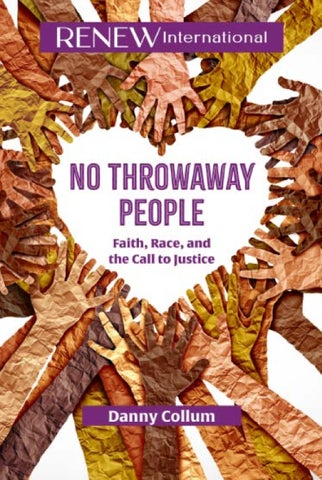
No Throwaway People
Faith, Race, and the Call to Justice
Danny Collum
Copyright © 2026 by RENEW International
All rights reserved. No part of this publication may be used, transmitted, or reproduced in any manner whatsoever except without the prior written consent of RENEW International.
Scripture passages are taken from the New American Bible, revised edition © 2010, 1991, 1986, 1970 Confraternity of Christian Doctrine, Inc., Washington, DC All Rights Reserved.
NIHIL OBSTAT
Rev. Msgr. C. Anthony Ziccardi, S.T.D., S.S.L.
Censor Librorum
IMPRIMATUR
Cardinal Joseph W. Tobin, C.Ss.R., D.D.
Archbishop of Newark
Cover and interior design by Kathrine Kuo
ISBN: 978-1-62063-223-9
RENEW International 1232 George Street Plainfield, NJ 07062-1717
RENEW International is a 501 (3) non-profit organization.
Printed in the United States of America
SESSION 1
Neither Jew nor Greek
FOCUS: To acknowledge the reality of racial divisions and conflict and to see the centrality of those problems in our Christian faith.
Opening Prayer
Pray together:
Lord God and Father, you created us in your image; you charged us with the care of the earth, and you commanded us to love and serve one another. Help us to see your image reflected in all the peoples of the earth. Make us truly one body, through your Son, Jesus Christ our Lord. Amen.
Introductions
Allow a few moments for participants to introduce themselves and, if they wish, share what prompted them to participate in this faith-sharing.
Scripture Passage Galatians 3:26-29
A member of the group reads the passage aloud.
Reader: A reading from St. Paul’s letter to the Galatians.
(For) in Christ Jesus you are all children of God through faith. As many of you as were baptized into Christ have clothed yourselves with Christ. There is no longer Jew or Greek, there is no longer slave or free, there is no longer male and female; for all of you are one in Christ Jesus. And if you belong to Christ, then you are Abraham’s offspring, heirs according to the promise.
Reader: The word of the Lord.
All: Thanks be to God.
What word, phrase or image from the scripture passage touched your heart or spoke to your life?
Reflection 1
Facebook founder Mark Zuckerberg famously has claimed that his company’s mission is to “bring the world closer together.” And in recent decades the internet in general and social media in particular seem, in some respects, to have contributed to that goal. We can instantly see, hear, and interact with people of every race and nation. However, in some ways this “closeness” seems only to have driven us further apart. For example, in Myanmar (formerly Burma), social media were used to inflame hatred and ultimately terrible violence against the country’s Rohingya Muslim minority. The software driving social-media platforms gives priority to posts that get the most responses, which are disproportionately ones that appeal to users’ anger or fear. In the United States, this has contributed to increasingly hostile attitudes that have us assuming the worst about anyone with backgrounds or ideas different from ours.
One could argue, in fact, that, despite its benefits, improved communications technology has poured gasoline on the kinds of divisions that have simmered throughout human history. Ever since the episode of the Tower of Babel in which, according to the book of Genesis, humanity was dispersed into different language groups, we have been creating in-groups and out-groups and blaming our problems on the outsiders. We can see this scapegoating phenomenon at work in the ethnic and religious conflicts that plague parts of Africa and the Middle East or in the fear and resentment about immigration in Europe and the United States.
The history of the United States has left us with an especially volatile mixture of social forces. The nation was founded on principles of pluralism and universal human rights, yet from its beginning it dehumanized and dispossessed native people and enslaved millions of Africans and their descendants. Today, disparities between racial groups persist, and so do disagreements about how, or whether, to address those disparities. We want to believe in individual responsibility. For example, we may agree that, after two centuries of enslavement, followed by another century of legal discrimination, steps such as affirmative action may be justified to give African Americans a fair chance at success. At the same time, some question why such measures should benefit the children of a black physician but not the white children of an unemployed former coal miner. We may acknowledge that we are a nation of immigrants with a history of giving refuge to the poor and persecuted, but some still object to people who have entered the country without proper documentation gaining the same status as immigrants who have waited years for approval.
Seeking justice on issues such as these requires that we look with open minds at the underlying causes of our divisions and their ongoing effects. It requires that we weigh principles such as equal justice for all against any biases we might harbor toward particular racial, ethnic, religious, or national groups. In addition, whatever our own group identity, we must be willing to sincerely try to see the world through the eyes of others who have a different heritage
and history. If we come to the table with that open and willing attitude, we may begin to see how our common interests
Invitation to Share
and values, as American Catholic Christians, can lead us to action for justice.
Take a few moments to reflect on the following questions. Then share from your reflection on any of them.
• Where do you get your ideas or information about people of other racial identities or nationalities? From TV? From social media? How much comes from a face-to-face interaction?
• Does your use of social media and/ or the internet expose you to different types of people and points of view? Or do you mostly hear from people like you who think as you do?
Reflection 2
When we hear talk of race or ethnic identity, we probably think first of the kind of social and political controversies mentioned in the first reflection. But these issues ultimately evoke religious questions that are at the heart of Christian faith. Christians affirm that God revealed himself to humankind most directly through a particular people, the Jews. In the ancient Middle East, every tribe or nation had a god or multiple gods, but it was revealed to the Jews that there was only one God, whose reign was universal. Furthermore, the God who revealed himself to the Jews chose to make them into a nation that showed the rest of humanity how God wanted everyone to live—justly, mercifully, and humbly (Micah 6:8).
• What biases, whether conscious or unconscious, might shape the way we see and interact with people from different racial, ethnic, or cultural backgrounds? How can faith help us challenge these biases?
• The concept of “in-groups” and “outgroups” has existed since the Tower of Babel. How have you seen this dynamic play out in your own community, workplace, or parish?
When God became incarnate in Jesus of Nazareth and lived among human beings, he came as a Jew. Jesus practiced all the customs and rituals of first-century Judaism and was well versed in Jewish history and Jewish scripture. He came as the Jewish Messiah to establish the long-promised Kingdom of God, and he gathered a community of Jews, led by 12 Jewish apostles, who would carry on the work of that Kingdom after his resurrection and ascension.
None of this prepared those first Jewish Christians for what happened next. First, at Pentecost, the divisions created at the Tower of Babel were reversed. When the apostles preached, Jews of every nationality were able to hear
them in their own languages. Very soon after that, the Christian community experienced exponential growth and began to attract non-Jewish (gentile) believers.
At first, the gentiles were told that to be Christians they had to observe Jewish religious law and customs, and that meant that men had to be circumcised. In an incident described in the Acts of the Apostles, however, Peter, the chief apostle, had a vision in which he was commanded to eat from a table filled with foods that were forbidden by Jewish law. He took this to mean that the Church should welcome all converts, but not all of the first Christians accepted this idea. Eventually, a council was called at Jerusalem to decide the issue, and the apostles and elders ruled that gentiles who became Christians
Invitation to Share
could remain gentiles, uncircumcised and without most obligations of the ritual law (Acts 15: 1-31).
With that, the Christian Church became something unprecedented in human history—a multicultural, multiracial movement in which the gods of ethnic identity and tribal custom were replaced by the one true God of the universal human family.
In the centuries since the Council of Jerusalem, the Church has spread across the globe. In the process, it has, as we’ll see in later sessions, sometimes failed to be a place where all are loved, honored, and respected, regardless of racial, ethnic, or cultural differences; nonetheless, that inclusiveness has always been, and still is, central to its identity and mission.
Take a few moments to reflect on the following questions and then share your reflection on any of them.
• Have you ever been in a situation in which you were in the minority and felt excluded? What caused you to feel that way? How did you react?
• Peter’s vision (Acts 15) led to a radical rethinking of who was welcome in the faith. Have you ever had an experience that changed the way you saw a group of people or challenged a long-held belief? If so, share what happened.
• How can our parishes and faith communities better reflect the multicultural and multiracial vision of the Church that was affirmed at the Council of Jerusalem?
• Are there things about your parish or community that might cause “outsiders” to feel excluded? If so, what needs to change; how could you participate or even initiate reform?
Invitation to Action
Discern a specific individual or group action that flows from your sharing. The most meaningful action will be based on your unique experience and perspective. The following are only examples.
• This week, intentionally engage in a conversation with someone from a different racial, ethnic, or cultural background. Approach the conversation with curiosity and openness and reflect on what you learned.
• Choose one action to make your faith community more inclusive— this could be learning about the cultural backgrounds of fellow parishioners, advocating for more diverse representation in parish ministries, or organizing a multicultural prayer service or event.
Looking Ahead
• Identify an area of racial tension or conflict in your community and consider ways your parish could play a positive role in addressing it. Take your recommendations to your pastor or parish council.
Read the scripture passage and reflections for the next session.
Closing Prayer
Pray together:
Father of all people, we give you thanks for the rich variety of our human family. Help us to rejoice in and celebrate our various racial and cultural heritages. We give thanks that you call us to be one family. In the midst of diversity and discord, help us to see our essential unity as your children. Form our minds and hearts so that our differences may become gifts we offer one another in love. Amen.