![]()


Staff
General Manager
Rick Nelson
Editor
Wayne Price
Editorial Assistant
Tina Schweitzer
President Vance McCoy
Midwest Electric Cooperative Corporation
Vice President/Secretary
Dan Scheer
Howard Greeley Rural Public Power District
Treasurer Stewart Huneke
Norris Public Power District
Published monthly by the Nebraska Rural Electric Association, 1244 K Street, Box 82048, Lincoln, Nebraska 68501, (402) 475-4988.
Advertising in the Nebraska Magazine does not imply endorsement for products by the Nebraska Rural Electric Association. Correspondence should be sent to Wayne Price, Editor, Nebraska Magazine, Box 82048, Lincoln, NE 68501.
The Nebraska Magazine is printed by the Aradius Group, 4700 F Street, Omaha, NE 68117. Form 3579 should be sent to Nebraska Magazine, Box 82048, Lincoln, NE 68501.
Periodicals postage paid at Lincoln, Neb.
POSTMASTER: send address changes to Nebraska Magazine, 1244 K Street, Box 82048, Lincoln, NE 68501.
Publication numbers are USPS 071-630 and ISSN 30697549.
Subscriber Services: Cost of subscription for consumers of participating member-systems is $2.14 per year (17.8 cents per month), plus periodicals postage paid from equity accruing to the consumer. For nonmembers, a subscription is $10 per year or $20 for three years, plus local and state tax. Single copy, $2.50.


6 ON THE COVER
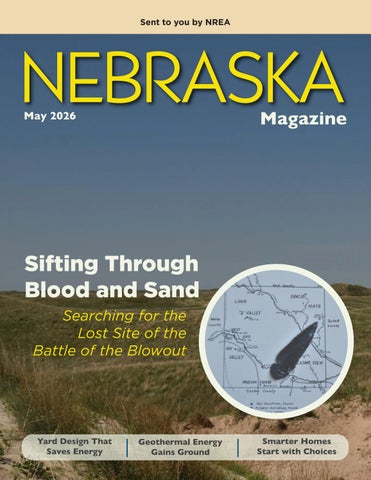
Freelance writer Alan J. Bartels recounts the little-known 1876 Battle of the Blowout, a brief but deadly skirmish between U.S. soldiers from Fort Hartsuff and a group of Sioux in Nebraska’s Sandhills, set against the broader tensions of westward expansion and survival.
Public power utilities are expanding energy portfolios with geothermal, a reliable renewable drawn from Earth’s heat. Advances like enhanced geothermal systems and new federal support are boosting investment, lowering costs and enabling broader development, positioning geothermal as a growing source of dependable, around-the-clock electricity nationwide.
Sarah Sortum begins a modern-day effort to locate an elusive battle site in Loup County. See the related article on Page 6. Photograph by Alan J. Bartels

For Nebraska’s public power utilities, the message of electric safety goes far beyond posters and reminders. It is part of an ongoing effort to educate the next generation about energy, safety, and responsibility.
Public power has always been rooted in community service. Because Nebraska’s electric utilities are publicly owned, they are closely connected to the people they serve. That connection often begins in classrooms, where utility representatives visit schools to talk with students about how electricity works and how to stay safe around it.
For many children, these visits are their first real look at the rural electric system that serves their homes and communities. Students learn why power lines should never be touched, why kites and drones should be kept far from electrical equipment, and why climbing trees near power lines can be dangerous. Simple lessons like these can prevent serious accidents.
Lineworkers and safety educators often bring visual demonstrations that leave a lasting impression. Using specialized equipment, like a high voltage demonstration trailer, they show how electricity travels through conductors and how quickly it can cause harm when safety rules are ignored. These presentations are designed to be clear and memorable, helping students understand that electricity is powerful and useful, but never something to take lightly.
Education also extends beyond safety. Many public power utilities offer programs that help students understand where electricity comes from and how it is delivered to homes, farms, and businesses. These lessons introduce young people to concepts like energy efficiency, conservation, and responsible energy use. Students may learn how small choices, such as turning off unused lights or adjusting a thermostat, can make a difference in both energy use and household costs.

Dawson Public Power District in Lexington, Neb., hosts a utility line camp in May for high school students that live in their service territory. The camp provides hands-on tasks that mirror a lineworker’s daily routine.
Programs like Youth Energy Leadership Camp and Youth Tour also help connect students with the future of the electric industry. For some young people, these experiences spark an interest in careers in energy, engineering, or linework.
The goal of all these efforts is simple: knowledge builds safety. When children understand the basics of electricity and how to respect it, they carry those lessons with them for life.
Through education and outreach, Nebraska’s public power utilities are making sure that the next generation grows up informed, prepared, and aware of the role electricity plays in their everyday lives. Visit our website at nebraskamagazine.org

Jayson Bishop
Electric cooperatives and public power districts across Nebraska are proud to note that Nebraska is the only state in the country served entirely by public power. Every meter in the state is served by an entity that is a political subdivision – a public power district or municipality – or a not-for-profit cooperative. This unique setup provides many benefits for the people and businesses in Nebraska.
The benefit that probably stands out the most to the average Nebraskan is cost control. As there are no companies trying to generate a profit from selling electricity, we can all be focused on delivering reliable electricity at the lowest reasonable cost. According to the United States Energy Information Administration, in 2025 Nebraska had the second-lowest cost of residential electricity of any state in the nation, right behind North Dakota (another state with a large public power presence). Nebraska’s average residential rate of 11.57 cents per kilowatt hour is 67 percent of the national average meaning residential bills in Nebraska are a third less than the national average.
Jayson Bishop is the General Manager of Midwest Electric Cooperative, headquartered in Grant, Neb.
Another factor that helps public power districts and electric cooperatives around the state stay focused on affordability is that the boards that oversee each utility are locally elected representatives of the customers and members that are served by the utility. The men and women who serve on these boards are also the ones paying electric bills, so they have a vested interest in making sure the utility is run safely and efficiently. And they also have a desire to see each system be financially sound and have well-maintained infrastructure to continue to be able to provide reliable and affordable power for generations to come.
Public power entities across the state benefit from the close working relationships we have with each other. As we all have similar goals, we often work together to help everyone achieve those goals. The most obvious example of systems helping each other the public would see is providing mutual aid when there is significant damage caused by storms. Tornadoes, ice storms and other extreme weather events can cause significant damage and extensive outages. When this occurs, neighboring systems send line crews to help rebuild neighboring systems and get everyone’s power back on. Systems are happy to send help as we know that at some point the shoe will be on the other foot and they’ll be the one needing help from others.
Systems across Nebraska also benefit from collaboration through the Nebraska Rural Electric Association (NREA). One of the biggest benefits the NREA provides is facilitating the statewide safety program that provides education and training to our lineworkers. Linework can be dangerous, so safe work practices are of paramount importance for all our employees. Collaborative training to make sure all our linemen go home safely each night makes sure our crews are able to keep the lights on for everyone. And the NREA provides many other benefits to utilities across the state to help us all do the best job we can do for all Nebraska.

by Alan J. Bartels

On the edge of the Nebraska frontier 150 years ago, Native Americans with ancient ties to the Sandhills were destined to meet more recent colonizers in a bloody skirmish with battle lines etched into the grains of a bare sand blowout.
In April 1876, US Army soldiers assigned to Fort Hartsuff – near the edge of the Nebraska Sandhills and the present day village of Elyria – were about to make their own chapter in the annuls of American military history.
Top left: Sarah Sortum, who ranches with her family in Loup County, took writer Alan Bartels off-road through the Sandhills in search of the lost location of the 1876 Battle of the Blowout. Top right: A large blowout near the Loup County and Garfield County line matches the location that some historians believe was the site where Sergeant William Dougherty lost his life during an 1876 skirmish with a band of Sioux.
Post on the North Fork of the Loup River was established after trapper Marion Littlefield was killed by Sioux braves north of Burwell, Nebraska, near Pebble Creek, in January 1874. Months later, the post was later renamed Fort Hartsuff, in honor of Major General George L. Hartsuff, who served with distinction during the American Civil War, and in the mid-1850s fighting the Seminole Tribe in Florida. The buildings at Fort Hartsuff were constructed using a cement/grout mixture that incorporated local sand.
Fort Hartsuff’s soldiers were only ever involved in one battle.
Accounts vary as to what ignited the altercation known today as the Battle of the Blowout. An authoritative description by historian Colleen Switzer in The


Left: While doing research to accommodate Bartels’ request for help in locating the lost location of the Battle of the Blowout, Sortum rediscovered the map, drawn by hand by her historian grandmother Colleen Switzer, which was included in Switzer’s 1977 book, The Settlement of Loup and Blaine Counties.

A commemoration of the 150th Anniversary of the 1876 Battle of the Blowout is scheduled for May 16th and 17th, 2026, at Fort Hartsuff State Historical Park. 82034 Fort Ave, Burwell, Nebraska.
Settlement of Loup and Blaine Counties reveals that all it took was for a band of Sioux to be seen near Jones Canyon (northeast of present day Burwell) to elevate concern among the local settlers.
Other trite accounts claim that the Indians had been attempting to steal from the white residents in the area. With their lands taken through force, broken promises, and flimsy treaties; their buffalo all but exterminated, and their culture teetering on the edge of extinction – if they were attempting to steal – it was likely a matter of personal survival. It’s not a stretch for this writer to imagine that similar straights could push just about anyone to similar actions.

A group of settlers and trappers began the chase. Most historical accounts also note that three prospectors enroute to the Black Hills detoured from their dreams of striking it rich and made it their business to help take up the trail of the fleeing Indians over hills of foreboding sand. Fearing for their lives and
outnumbered, those Sioux braves took up defensive positions in a large blowout – a wind-sculpted depression in the coarse sand that was nearly void of vegetation. While the Sioux were pinned down, one of the white men was sent to Fort Hartsuff for reinforcements, a straight-line distance of approximately 20 miles over dunes, through meadows, and across Dry Creek.
After the detachment arrived, its commander Lieutenant Charles Heyl, wasted little time in leading his men toward the blowout.
Sergeant William Dougherty crested a hill and was shot and killed. One of the Indians also lost his life in the exchange, and like Dougherty, left his lifeblood in the sand. The soldiers retreated and guards were posted as the sun arched toward the western horizon. In the inky black of the Sandhills night, the surviving Indians escaped.
Dougherty was buried with honors at Fort Hartsuff Cemetery. The US Army closed Fort Hartsuff in 1881, and Dougherty’s remains were re-interred at Fort McPherson National Cemetery near present day Maxwell, Nebraska.
Continued on Page 8
More of a skirmish than a full-fledged battle, what has become known as the Battle of the Blowout warrants barely a footnote when compared to the widespread death and devastation that occurred in the era widely known as the Plains Indian Wars.
Today, tourists visit Fort Hartsuff State Historical Park to explore the grounds and nine original buildings and observe re-enactors during living history events.
As part of my research on the Battle of the Blowout, I tracked down a local historian who had attempted to locate the original battle site. Over the phone, he gave me a general description of where he thought the battle took place, based on stories heard decades earlier, but the man declined to show me the location. Not to keep the location secret. No, he declined because of mobility issues due to old age. “If you need a picture of the blowout, just take a picture of any old Sandhills blowout,” he told me. “That’ll do.”
No, that wouldn’t do for me.
I asked for more details but the man was done talking. The description he had given me was vague, perhaps intentionally, but he indicated that the site was north of where Dry Creek enters Calamus Reservoir, and east of the road.
I’d been in that area before, so I contacted my friend Sarah Sortum, who lives in the area, and asked if she could get me access to that property. She did some checking for me, but imagine her surprise when she uncovered a map hand drawn by her grandmother –historian Colleen Switzer – decades earlier. In Switzer’s careful handwriting the map was clearly marked with a circled letter X and the words “Battle of the Blowout.” Even more surprising was that due to a land acquisition after completion of Calamus Reservoir, the historic spot shown on the map was now on her family’s land.
A couple weeks later, Sortum met me at a predetermined location near Dry Creek Road. I loaded my camera equipment onto her side-by-side and quickly headed off-road. Wildflowers were blooming across a blanket of lush green, and Sandhills meadows were flush with standing, life-giving water. A chorus of western meadowlarks, sandpipers, and other songsters called out from the grass and from atop fenceposts. Cows chewed their cud. Off in the distance, a mama cow bawled for
her calf.
After navigating valley after valley, and sandy ridge after sandy, grass-covered ridge – while checking Grandma’s map every quarter mile or so, a huge sandy chasm opened up like God had yanked a handful of Sandhills prairie from the sandy earth. I’d seen larger blowouts, but not one with such large size and extreme geography. Having some military experience myself, I could immediately see how the Native Americans involved in the Battle of the Blowout could have used the sharp upsweep of the blowout’s eastern rim as a defensive position.
Of course, the land has changed in the 150 years since the battle occurred. But judging it with Army eyes strengthened during my time in another sandy area –the windswept deserts of southwest Asia during Desert Shield/Desert Storm, I didn’t see a safe vantage point from which the soldiers could aim toward their targets without exposing themselves to enemy fire. I wondered where Dougherty was standing when he was hit; and tried to imagine from which part of this sandy grand canyon did the fleeing Lakota men make their desperate, hopeful escape and head out across the Sandhills.
Had Sarah and I discovered the blowout where a relatively small military engagement during Nebraska’s first decade of statehood left a large sandy footprint in the history and culture of this part of the Nebraska Sandhills? We didn’t find any bullets, bits of clothing, or other signs of mankind in that sandy bowl near the Loup County and Garfield County line. If anything was ever left there, time and wind-driven shifting sands obscured it from prying eyes long ago.
No matter. The people who make their living on this land keep its history alive. And on a Loup County cattle ranch within walking distance of Dry Creek, one important part of our nation’s 250-year history lies within the very grains of the Nebraska Sandhills.
Alan J. Bartels is a US Army veteran who served with the 2nd Armored Division during Desert Shield/Desert Storm. His latest book, Secret Nebraska Sandhills: A Guide to the Weird, Wonderful, and Obscure, was released in March 2026.
The author uses “Indian,” “Indians,” and “Sioux” to reflect common usage at the time of this historic incident.


Creating strong passwords is one of the most important ways to protect your personal information online. The challenge is keeping track of them all. Cybersecurity experts with the National Rural Electric Cooperative Association say there is no single perfect solution. What matters most is choosing a system that works for you and using it consistently.
One simple method is to create passwords from something familiar. You might use the first letters of a favorite song lyric, poem, or meaningful phrase. This makes your password easier to remember while still being difficult for others to guess. To keep your accounts secure, update your passwords every few months. You can do this by moving to the next line or verse. Adding a number or symbol that is meaningful to you can make your password even stronger.
Strong password security depends on choosing a method that is easy for you to manage.
Another option is to use a password manager. These tools store all your passwords in one secure place, so you only need to remember one master password. Many devices now offer features like fingerprint or face recognition, which can make accessing your accounts both safe and convenient. Experts often advise against writing down passwords. However, if that method works best for you, take steps to protect that information. Keep your list in a secure location, such as a locked drawer or safe, along with other important documents.
The key to password security is finding a method you will use every day. A strong system, used consistently, can help protect your personal information and give you peace of mind online.
By Larry Oetken

Working outside can be rewarding, but it also comes with risks you should not ignore. A few simple habits can help keep you and your family safe. Start by looking up. Overhead power lines can be easy to miss, especially when you are focused on a project. Always keep at least 10 feet between you and any power line. This includes anything you are carrying, such as ladders, poles, or tools. When moving long equipment, carry it horizontally to avoid accidental contact.
Next, check your outdoor outlets. Make sure they are protected by ground-fault circuit interrupters, also called GFCIs. These devices quickly shut off power if they detect a problem, helping prevent serious shocks.
Still
Collectors love “lasts” as no collection is complete without the last coin struck. Last year coins are often hard to find and always in demand. Little did master engraver George T. Morgan know the legacy he was creating when he designed what has become known as “The King of Silver Dollars” but it came to an end 104 years ago with the last-year 1921 Morgan Silver Dollar, the most beloved coin in American history.
Rarcoa®, America’s Oldest Coin Company, is announcing the public release of 832 of the very last year 1921 Morgan Silver Dollars, struck at the iconic Philadelphia Mint. Each coin today comes in Brilliant Uncirculated condition, pristine as the day they were struck!
Struck in 1921, each coin is one hundred and four years old. Could Charles Lindbergh have carried your coin in his pocket during his flight across the Atlantic? Or maybe your great-grandfather carried it while storming the beaches of Normandy during World War II before ending up in a small coin shop in Tuscaloosa, Oklahoma. Each coin has its own unique history and you can hold 104 years of American history when you buy yours today.
This same 1921 Morgan Silver Dollar sells elsewhere for as much
Before you dig, take time to plan. Call 811 to have underground utility lines marked. Buried electric, gas, water, and sewer lines are easy to hit if you are guessing. Striking one can be dangerous and costly. Keep in mind that some private lines may not be marked, so always dig carefully.
Weather is another important safety factor. If you see lightning, go indoors right away or get inside a hardtopped vehicle. Avoid open areas, high ground, and isolated trees. Stay away from metal objects like fences, which can carry electricity. If you are in water, such as a pool or hot tub, get out immediately.
A little awareness goes a long way. By staying alert and following these steps, you can enjoy your outdoor work while keeping safety front and center.
Larry Oetken is the Director of Job Training & Safety for the Nebraska Rural Electric Association.


as $239. But thanks to Rarcoa’s buying power and numismatic expertise, you can own one for as little as $89.95, in quantity while supplies last. That’s a difference of up to $149!
Because the precious metals market is always active and dynamic, prices may adjust to reflect the latest market opportunities.
1921 Morgan Silver Dollar Brilliant Uncirculated
1-4 $99.95 each
5-9 $94.95 each, save $5 each, save up to $45 10+ $89.95 each, save $10 each, save $100 or more.
FREE SHIPPING on 2 or More! Call 1-833-205-1371
Offer Code LMDP248-3
Please mention this code when you call.
by James Dukesherer, NREA Director of Government Relations
very large power plant, 1,000 megawatts and larger, in Nebraska. This is significant because LB 1261, for the first time since our public power model was adopted, provides a path for a large, nonrenewable, generation plant to be privately-owned in Nebraska.

Last month the Nebraska Legislature wrapped up this year’s 60-day legislative session. It was a busy year for public power. Energy is an important topic in our state and in our nation right now. Throughout the session, there was much rhetoric about the state of the electric industry in Nebraska. On several occasions we heard from a few elected leaders that Nebraska is “running out of power.” In fact, a number of legislative bills were introduced in order to address this perceived concern. Many of these bills, if adopted, would have been detrimental to our public power model. We will discuss one of these bills in this article. First, however, I must correct the record and address this misleading statement. Although it is true that Nebraska, and the entire country, is experiencing dramatic growth in our appetite for energy, public power stands ready to meet these demands. Nebraska, with our low electric rates and reliable service, is well positioned to attract economic growth and any electric demand that comes our way. Meeting the electric generation needs of companies that use as much electricity as a city the size of Lincoln, however, takes time. We do not speculatively build new multi-billion dollar power plants in the hopes that a new customer might come to Nebraska. Projects of this size have to be built to meet a known demand and in full partnership with the private customer wishing to locate in our state.
As we see potential economic growth coming from data centers and manufacturing plants that have very large appetites for electricity, we have also seen that some of these companies have voiced their desire to bring their own electric generation assets to Nebraska to meet their company needs and their project timelines. LB 1261 was introduced by Senator Barry DeKay, on behalf of the Governor, to establish a mechanism in statute that will allow this private development to occur. As adopted, LB 1261 will allow a private company to construct and own a
Allowing the private development of large, nonrenewable generation power plants in Nebraska is a significant issue and here at the Nebraska Rural Electric Association (NREA) we wanted to make sure we were active to protect the public power model as this bill found its way through the legislative process. In all of NREA’s communications regarding this bill, we insisted that our unique public power system and the customers it serves not be harmed by this legislation. All of public power was adamant that if a large privately-owned generation facility is going to be allowed to be built in Nebraska, it must be done in a way that protects the public power model and ultimately the customers served by public power. As such, under LB 1261, every customer in Nebraska will continue to receive their retail electric service from a public power electric supplier. The bill stipulates that the privately-owned generation plant must enter into a contractual relationship with public power to purchase the electricity it generates and public power will continue to serve the end-use industrial customer. The industrial customer cannot resell the electricity, and they must pay all the costs of any kind incurred by public power as a result of this project.
In addition to providing a mechanism for this development to occur, it is important to note that LB 1261 also protects Nebraska’s electric ratepayers. When we are talking about electric loads of this magnitude, we are also talking about potential financial risk for a public power utility and its customers. Building power plants of this size costs billions of dollars. Building a power plant of this size for a single customer carries with it significant risk to other electric consumers. LB 1261 provides a narrow exception in the statutes that allows private companies to make the large capital commitment that a project of this size poses reducing the financial risk to public power utilities and as such, protects Nebraska’s electric ratepayers while ensuring Nebraska’s unique

public power model remains fully intact.
Since this bill’s introduction in January there has been a great deal of misinformation communicated about LB 1261. This bill does not provide tax incentives to data centers. It does not provide corporate bailouts to those companies that might utilize this law. LB 1261 does not destroy our public power model. Every customer in Nebraska will continue to be served by a publicly owned electric utility. Despite all of the political rhetoric, LB 1261 is a simple four-page bill that allows very large private companies to pay the costs of building and owning their own electric generation facility. It does this with ample protections within the bill to ensure our public power model remains intact and Nebraska’s electric
consumers are shielded from the risks a project of this magnitude could impose on our state’s electric consumers.
Ultimately, LB 1261 passed on Final Reading by a vote of 33-16 and was signed by the Governor. The bill includes a sunset date of five years. This means our state has five years to test out this law and to see if the economic development pledged by private companies comes to Nebraska. After five years, without any additional legislative action, this law will revert back to the law as it existed prior to LB 1261’s passage. This sunset mechanism will give us all time to see if private development occurs and to reevaluate the bill after its impacts are better understood in the future.


The strongest geothermal resources in the U.S. are often found in regions with active geology, such as areas near major tectonic plate boundaries. The mud pots shown here are located outside the John L. Featherstone Geothermal Plant in California.
Public power districts and electric cooperatives focus on delivering safe, reliable and affordable electricity to the communities they serve––and they do that by utilizing a variety of energy generation resources, ranging from natural gas, coal, hydropower, nuclear, solar and wind. One energy source that is often overlooked is geothermal energy. Geothermal power has been used for many years and continues to improve as new technologies are developed.
Geothermal energy is a renewable source of power that comes from heat inside the Earth. Geothermal resources are natural or man-made pockets of hot water found at varying temperatures and depths below the ground. Wells, which can be just a few feet deep to several miles deep, are used to bring extremely hot water and steam to the surface for a variety of applications, such as heating and cooling, direct use in industrial processes and electricity generation.
The strongest geothermal resources in the United States are often found in regions with active geology, such as areas near major tectonic plate boundaries. These resources are not limited to one location but are spread across several western states. One well-known example is The Geysers in Northern California, the largest geothermal power complex in the country. Facilities like this use injected water to create steam from underground heat, which spins turbines to generate reliable electricity for the power grid.
In 2023, geothermal generation accounted for approximately 17 billion kilowatt-hours, the equivalent of a year’s worth of consumption for the city of Indianapolis.
The U.S. has about 3.9 gigawatts of geothermal power capacity. Most of this power is produced in California and Nevada, which together generate the majority of U.S. geothermal electricity. Smaller amounts of geothermal power are also produced in Alaska, Hawaii, Idaho, New Mexico, Oregon and Utah.
New ways of exploring geothermal energy, such as enhanced geothermal systems (EGS) and superhot rock technology, are helping developers access heat sources that were not possible to use before. These new methods are making geothermal energy available in more places across the country.
In early 2025, investment in geothermal energy grew

quickly, reaching $1.7 billion. One example of this growth is Fervo Energy’s Cape Station project in Utah. The project plans to produce 100 megawatts of power by the end of 2026 and increase to 500 megawatts by 2028. It already has approval to expand up to 2 gigawatts in the future. The project aims to produce electricity at a cost of $79 per megawatt hour, even without government subsidies.
Geothermal has a high-capacity factor, near 90%, which makes it a strong source for around-the-clock power. Electric co-ops in the western U.S. can benefit from existing geothermal plants, while new technologies like EGS and hybrid designs are helping expand geothermal energy across the country. Continued federal support for tax credits, permitting and research lowers the cost and risk of new projects.
Federal policy has helped drive recent growth in geothermal energy. The Geothermal Tax Parity Act (HR 6873), introduced in late 2025, aims to put geothermal projects on equal footing with oil and gas by extending important tax benefits, including exploration credits. Other proposed bills before the House Natural Resources Committee focus on improving permitting, reducing exploration risk, clarifying land use and supporting lease sales.
Together, these efforts help create a stronger path for geothermal energy development in the U.S.
When most people think about saving energy, they picture insulation upgrades, efficient windows and appliance swaps. But your yard can play a major role too. According to the U.S. Department of Energy, a well-planned landscape can reduce air-conditioning costs by up to 25% and pay for itself in less than eight years.
Because landscaping results vary by region, keep in mind that the United States has four main climate zones: temperate, hot-arid, hothumid and cool. Plant strategically for your zone.

Choose the right trees: Deciduous or evergreen
• Deciduous trees (those that lose their leaves in the winter) block sunlight in the summer and allow light in during the colder months, helping to regulate indoor temperatures year-round.
• Evergreen trees provide consistent shade and can serve as windbreaks, which is especially helpful in cool climates.
Tip: In hot climates, choose native or drought-tolerant species. They require less water and are typically more resilient.
Placement matters
• West and northwest sides: Plant trees to block
strong mid- to late-afternoon sun.
• East and west windows: Use deciduous trees to block summer sun but still allow winter light.
• South side: Tall trees planted at a distance equal to two to five times their mature height can shade your home without blocking winter sun.
• West side: Shorter trees and shrubs help shield against intense, low-angle afternoon sun.
• Patios and driveways: Shade these areas to reduce reflected heat.
• Home perimeter: Bushes can absorb sunlight and reduce heat transfer, but avoid dense plantings in humid climates, where airflow is important to prevent excess moisture.
Tip: Be mindful near solar panels. Avoid planting tall trees on the south side of panels to prevent shade during peak sun hours.
Plan for a tree’s mature height
• Avoid planting trees that will grow taller than 15 feet near power lines.
• For taller species, plant at least 20 feet away — 45 feet is even better — to prevent safety hazards and avoid future pruning.

SAFE. EFFICIENT. EXPERIENCED.
The program is nationally recognized for comprehensive utility line and job training safety. Classes are taught by expert faculty committed to student success.
HANDS-ON LEARNING.
Study and perform wiring, pole climbing, metering, operating bucket trucks and digger derricks, and line construction. Graduates have high job placement rates and the skills and confidence to excel on the job.


From a small garage to tinker on your vintage automobile to an elaborate workshop to focus on your woodworking hobby, a residential storage and hobby building designed and constructed by Morton is crafted to provide a stronger, longer-lasting,
structure customized to fit your needs. Don’t settle for second best — because Morton


by Miranda Boutelle
Let’s start by defining what “smart” means. Smart appliances—such as refrigerators, washers, ovens, thermostats and water heaters— connect to the internet. Typically, through Wi-Fi or Bluetooth, these appliances can be controlled using your smartphone, tablet or voiceassistant device. They are designed to optimize energy use and add convenience. Some smart devices can even learn your habits over time.

Are smart appliances right for your home? The answer depends on your preferences and types of appliances you already have. The better question might be: Are smart appliances right for you? Do you like the newest tech and typically keep your phone within arm’s reach? Do you enjoy the convenience of calling out commands to Alexa? Or do you prefer less technology or something in between? Personally, I’m somewhere in the middle.
Many smart appliances allow you to see how much energy each device consumes. That information can be helpful to better understand your energy habits and identify where energy may be going to waste.
Smart thermostats are a popular choice for managing energy use and reducing energy waste. Heating and cooling systems are typically a home’s biggest sources of energy consumption. According to Energy Star, you can save an average of 8% cost savings on heating and cooling with a smart thermostat. Savings depend on your climate, the type of system you have and how you currently use it.
Most energy savings from a smart thermostat come from automating temperature adjustments while you are sleeping or away from home. If you are already good at manually adjusting your thermostat, you likely won’t see big savings, but you might prefer the convenience of a programmable device you can control on an app.
Smart thermostats make it much easier to program your
heating and cooling schedule. Some have geofencing features that automatically adjust settings based on how far your phone is from home.
Coming in with the secondhighest energy user in most homes is the water heater. I like the smart controls on my heat pump water heater. Also called a hybrid water heater, it uses heat pump technology to move heat instead of using energy to create heat. That makes it two to three times more efficient than a conventional electric resistance water heater. You can save even more energy with smart heat pump water heaters.
I can monitor energy use, change settings if we need more hot water and check how much hot water is available before I jump in the shower after my kids have used it. The app notifies me when it’s time to clean the air filter on top of the unit. I can access that information without having to go down to the basement. I can even set it to vacation mode after I’ve left the house for a trip. Not all heat pump water heaters have smart technology, so be sure to check before buying.
My refrigerator is a different story. I like the ability to monitor energy use, but it can be annoying to have my phone notify me the door is open when I’m 3,000 miles away at a work conference. There are certain features that can only be controlled through the app, which I find frustrating. The next thing I know, my husband texts me to make more ice while he’s standing right next to it, and I’m on the other side of the country.
Monitoring energy use and making it easier to control your household devices are benefits of smart appliances. Before upgrading, do your research to understand how the features work and whether they benefit your lifestyle. Smart technology can help lower your energy use. But, in some cases, you’re better off improving your energy habits with the appliances already in your home.
You might think that a machine designed to wash clothes would stay clean on its own. Unfortunately, that’s not true. Here’s how you can keep your washing machine fresh and clean.
Do you need to clean your washing machine? Yes, you do! Washing machines can collect dirt, bacteria, and even fungus over time. Regular cleaning is important for a few reasons:
• Keeps it efficient: A clean machine works better and cleans your clothes more effectively.
• Prevents odors: Regular cleaning helps stop bad smells from building up.
• Extends its lifespan: Taking care of your machine can help it last longer.
There are two main ways to clean your washing machine:
• Run the cleaning cycle (if your machine has one)
• Use bleach with a hot water cycle
If your washing machine is newer, it probably has a cleaning cycle option. This is often labeled as “Clean” or “Tub Clean.” You can use a special washing machine cleaner or distilled white vinegar.
If your washing machine doesn’t have a cleaning cycle, you can use hot water and bleach. This method helps remove odors, mold, and detergent buildup. Follow these steps: Make sure the tub and detergent dispenser are empty. Add half a cup of bleach to the machine. For front loaders, use the detergent dispenser. For top loaders, pour it directly into the tub. Run the longest and hottest cycle possible to clean and rinse the machine. Once the cycle is done, wipe the inside of the drum with a clean rag or paper towel. To get rid of any remaining bleach, run an additional rinse cycle with water. Leave the door open to let it air dry.
If your washing machine still smells after cleaning, it might need a deeper clean.

towel to remove any sludge or water. Scrub the seal with bleach for a thorough clean. Remove the detergent drawer and soak it in hot water. Scrub all parts, and if you see mold, add bleach. Rinse and let it air dry.
For Top-Loaders: Wipe down the agitator and door edges with a damp rag to remove dirt and detergent residue.
Experts recommend running a bleach or cleaning cycle every month. Additionally, do a deep clean of both the inside and outside of your washing machine twice a year. Keeping your washing machine clean helps it run better and keeps your clothes smelling fresh. By following these simple steps, you can ensure your washing machine stays in top shape.
In the village of Deweese, Nebraska, where the population is just 67, a local restaurant has become much more than a place to eat. Down South Bar and Grill is a gathering spot and a second home for many in the area.
Owned by Andrew and Jaci Davis, the restaurant has a long history. It was once known as Wit’s End and The Mill before Andrew purchased it in 2018. The name “Down South” comes from a family saying. Andrew’s grandfather owned land south of Highway 74 and would often say he was “going down south” to check on the crops. The name stuck and now reflects both family roots and small-town pride.
Andrew’s path to ownership began early. At 19, he worked at The Mill and continued there part-time while attending college at Hastings and the University of Nebraska at Kearney. Though he studied communication disorders, he chose not to pursue graduate school. Instead, he and his wife took a leap and bought the restaurant. Today, Jaci works full-time in Gibbon and helps at the restaurant when she can. The couple lives in Clay Center with their three boys and two dogs.
Running the restaurant is a team effort. With eight full-time and six part-time employees, many of whom have been there from the beginning, the staff feels like family. Andrew often cooks, serves, and cleans alongside his team. He says their children have “eight grandmas and all sorts of aunts” at the restaurant.
Food is at the heart of the business. Everything is made from scratch, from soups and salads to hand-cut steaks. Friday favorites include homemade cinnamon and pecan rolls and a long-standing tradition of fried chicken, carried on from a former local bar. Weekly specials like meat loaf and pot roast keep


customers coming back, and Wednesday nights often fill the dining room to capacity.
With seating for 112, the restaurant still sees standing-roomonly crowds. Families appreciate a kid-friendly play space, while guests travel from nearby towns and even Kansas to dine there.
Beyond daily service, Down South Bar and Grill plays a key role in the community. The team caters weddings, fundraisers, and school events, including meals for Sandy Creek High School and large gatherings like the Clay Center Golf Course Gala fundraiser.
Down South is served electrically by South Central Public Power District.

1 1/2 pounds ground beef
1-2 tablespoons taco seasoning
1 package (8 count) flour
tortillas shredded cheese
lettuce
cilantro
sour cream
salsa guacamole (optional)
black olives (optional)
Heat oven to 350 F.
Brown ground beef with taco seasoning.
Cut tortillas in half then in half again, making four pieces. Place two pieces in each hole of muffin tin. Place browned ground beef in each hole then top with shredded cheese. Bake 15 minutes, or until tortillas reach desired crispiness.
Using knife, shred lettuce and cilantro. Top each cup with sour cream, salsa, lettuce and cilantro, as desired. Add guacamole and olives, if desired.
4 1/2 cups boiling water
3 cups oatmeal
1 cup brown sugar
1/2 cup oil
2 eggs, beaten
2 teaspoons baking powder
1 teaspoon salt
1/2 to 1 teaspoon cinnamon
1/2 cup milk
1/2 cup grated apples (or raisins/nuts)
Add the oats to the boiling water and let stand until all liquid is absorbed. Mix in the remaining ingredients and pour the mixture into a greased 9x13 pan. Place in the refrigerator overnight. In the morning, bake at 350°F for 30 minutes.
2 dozen hash brown patties
1 tablespoon butter, softened
2 thick slices corned beef
1/2 cup sauerkraut, rinsed and strained
2 tablespoons brown sugar
2 tablespoons cinnamon applesauce
1/4 cup Thousand Island salad dressing
1/2 cup finely shredded Swiss cheese
Place hash brown patties in a greased 11” X 7” X 2” baking pan. Spread each with butter, top with corned beef. In a bowl, combine the sauerkraut, brown sugar, and applesauce, then spoon over corned beef. Top with salad dressing and Swiss cheese. Bake uncovered at 400 degrees for 15 to 20 minutes or until headed thorough. Yields 2 servings.
3 cups rhubarb, chopped
3 cups miniature marshmallows
1 cup sugar
1 3 oz. package raspberry Jello
1 white cake mix
Mix rhubarb and marshmallows and put in a buttered 9” X 13” cake pan. Mix sugar and Jello powder together and sprinkle over rhubarb and marshmallows. Prepare white cake mix following the directions on the box. Pour cake batter over the mixture in the pan. Bake at 350 degrees for 40 – 50 minutes.


Why do we show up before the sun rises? Plan for tomorrow while keeping today running strong? And stand shoulder to shoulder when the path gets challenging?
Because every community our members serve deserves power they can count on. From energy planning to system reliability, we work as one connected cooperative family—sharing resources, expertise, and the strength that only comes from standing together.
So your co-op can deliver what matters most: reliable, affordable electricity that empowers every moment of life.

Scan to learn more or visit www.tristate.coop/powering-future

A Heat Pump Water Heater Helps You Use Less Energy.
Running showers, laundry, and dishes adds up — fast. Your water heater is your home’s second largest energy user. That’s a big impact on your electric bill. With a Heat Pump Water Heater, you get the same comfort as your existing water heater using only a fraction of the energy, helping you save month after month.