Published monthly by the Nebraska Rural Electric Association, 1244 K Street, Box 82048, Lincoln, Nebraska 68501, (402) 475-4988.
Advertising in the Nebraska Magazine does not imply endorsement for products by the Nebraska Rural Electric Association. Correspondence should be sent to Wayne Price, Editor, Nebraska Magazine, Box 82048, Lincoln, NE 68501.
The Nebraska Magazine is printed by the Aradius Group, 4700 F Street, Omaha, NE 68117. Form 3579 should be sent to Nebraska Magazine, Box 82048, Lincoln, NE 68501.
Periodicals postage paid at Lincoln, Neb.
POSTMASTER: send address changes to Nebraska Magazine, 1244 K Street, Box 82048, Lincoln, NE 68501.
Publication numbers are USPS 071-630 and ISSN 30697549.
Subscriber Services: Cost of subscription for consumers of participating member-systems is $2.14 per year (17.8 cents per month), plus periodicals postage paid from equity accruing to the consumer. For nonmembers, a subscription is $10 per year or $20 for three years, plus local and state tax. Single copy, $2.50.
Contents
American Stories
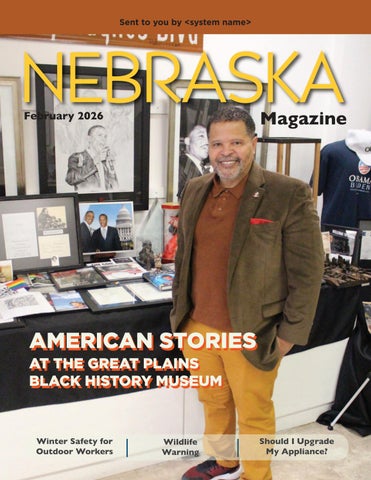
The Great Plains Black History Museum in Omaha shares American history through the experiences and contributions of African Americans in the Great Plains and beyond. Founded in 1975 and now welcoming visitors from across the nation and world, the museum offers free, inclusive access to exhibits that connect local stories to pivotal moments in U.S. history.
14 Wildlife Warning
Nebraska wildlife officials are warning the public about a strain of avian influenza, H5N1, currently circulating among wild birds and are asking for reports of sick or dead birds. People, hunters, and pet or livestock owners can reduce risk by avoiding contact, practicing good hygiene, and following safety guidelines when outdoors.
ON THE COVER
Eric Ewing, executive director of the Great Plains Black History Museum in Omaha, stands among exhibits that highlight African American history and its lasting impact on the Great Plains. See the related article on Page 6.
Photograph by Wayne Price
Editor’s Page
Wayne Price Power for the People of Nebraska
Nebraska is unique in many ways. It is the home of the Reuben, Carhenge and the College World Series. But there is one distinction that sets Nebraska apart from every other state in the country. It is the only state served entirely by public power. Every electric utility is owned by the people, not private companies. That fact did not happen by accident. It was built through decades of grassroots action and a belief that essential services should answer to citizens, not shareholders.
The story begins in the early twentieth century when private utility companies controlled electricity. Rates were high and service was inconsistent, especially in rural areas. Many Nebraskans had no access to electricity at all. Private companies simply did not see a profit in building lines across wide stretches of farmland. In response, local residents and community leaders organized public power districts. These new entities were operated without profits and governed by locally elected boards. Their goal was simple. Serve every Nebraskan fairly.
Visionary leaders like Senator George Norris championed the cause. Norris believed that electricity was a public necessity, much like education or roads. He helped pass the Rural Electrification Act, which made it possible for farmers and small towns to build their own systems. Nebraska communities took up the challenge. One by one, they formed utilities that were owned by voters. These utilities reinvested earnings back into the system rather than sending profits out of state.
Visit our website at nebraskamagazine.org
By the mid twentieth century, public power had reached every corner of Nebraska. Today more than one million people still receive electricity from utilities they own. Customers elect board members who make decisions in public meetings. They can attend those meetings themselves. They can hold their leaders accountable. There is no distant corporate office. There is no profit margin to satisfy. The focus is on reliability and affordability.
Why does this matter today. It matters because electricity is more essential now than ever before. Nebraska’s economy depends on farms, manufacturers, data centers and small businesses that need stable power. Public utilities consistently deliver some of the lowest electric rates in the nation. They plan for the long term because they answer to the people who rely on them. In a world that often feels controlled by large corporations, public power gives Nebraskans a voice in how their communities grow.
Public power is not a political slogan. It is a working model based on trust and transparency. It is proof that when citizens take responsibility for their own future, they can build something strong and lasting. Nebraska’s public power system is more than a utility grid. It is a reminder of what can happen when people put community ahead of profit.
Dennis Herman
Dennis Herman is the General Manager of Highline Electric Association, headquartered in Holyoke, Colo.
Guest Editorial
How Demand Shapes Power Reliability
You’re probably not thinking about energy costs, or what drives those costs, when you flip on a light switch or turn on an appliance. Demand, specifically peak demand, is a primary cost driver of electric bills and understanding this concept will help you to become a better informed consumer.
To help understand demand, here is a quick example. Electric energy consumption is measured in kilowatt-hours (kWh). Demand is measured in kilowatts (kW). Lightbulbs have varying power ratings, and for this example we’ll use a 100-watt bulb. If that lightbulb stays on for 10 hours, it “consumes” 1,000 watt-hours (or one kWh) but only demands 100 watts. Now, if you turn on ten 100-watt lightbulbs in your home for 1 hour, you are still consuming the same watt-hours (or one kWh). However, you are placing a demand 10 times higher on the utility to have those watts available to you over the course of 1 hour, instead of 10 hours. The demand would be 1,000 watts (or one kW). As more electric loads run simultaneously, your demand for power increases. This requires generators on the electric grid to produce more power to meet your demand. Peak demand is the maximum demand across some period of time.
It's easy to see why this is an important driver in the cost of providing electric service. The peak demand at your service dictates the size of wire and equipment necessary to serve you and also drives the size of equipment as we aggregate load all the way up to the transmission line and generation resource level.
Now take a moment to consider how weather affects your use of electricity. Electricity use naturally increases when temperatures reach high or low extremes. Heating and cooling systems run longer and more frequently to maintain comfortable indoor temperatures. Irrigation wells run longer during hot, dry spells to keep up with the needs of crops. During the summer and winter months, when homes and businesses across the country are using more electricity simultaneously, overall demand can approach—or occasionally exceed—available supply. This is especially true during severe weather events, such as winter storms, long hot spells, sudden temperature drops or equipment malfunctions that reduce generation capacity. In rare cases when demand threatens to outpace supply, the regional grid operator may call for temporary, controlled outages—often referred to as rolling blackouts—to prevent broader system failures. If such a situation arises, your power supplier will work to provide timely updates and information to members.
To prepare for these scenarios and minimize risks, utilities across the grid— from generation and transmission providers to your local distribution company—work together to implement proactive measures to strengthen
Continued on Page 11
Great Plains Black History Museum
American Stories
“Our purpose is to educate folks about the rich history of African Americans as it pertains to the Great Plains and throughout America. We tell American history because everything we talk about happened in America, through the lens of African Americans,” Ewing said.
On North 24th Street in Omaha, inside the historic Jewell building, the Great Plains Black History Museum offers visitors a chance to see American history through a fuller and more honest lens. The museum has been part of the community since 1975, when Bertha Calloway set out to create a place where the rich history of African Americans could be preserved, shared and understood. Nearly 50 years later, that mission continues to resonate with people from across the country and around the world.
“No one that comes in here leaves without not knowing something that they didn’t know when they first came in,” said Executive Director Eric Ewing. “Even folks that have been here before.”
Ewing, an Omaha native who has led the museum for nine years, describes the institution as first and foremost an American history museum. Everything on display happened in the United States, he said, and the stories are told through the experiences and contributions of African Americans who helped shape the Great Plains and the nation.
Continued on Page 8
The museum’s journey mirrors its resilience. It began in the historic Webster Building at 23rd and Lake streets, where it remained through the 1990s. After several years as a traveling museum, it opened a location at Crossroads Mall before settling into its current home on North 24th Street in 2017. Today, the museum welcomes visitors from more than 40 states and nine countries each year. In 2025, it recorded more than 13,000 interactions, the highest number in its history, and it has been a popular stop in the Nebraska Passport program.
Inside, exhibits connect local history to national movements. A condensed version of 24th and Glory uses photos and artifacts, including Johnny “The Jet” Rodgers’ Heisman Trophy and a baseball bat used by Bob Gibson, to explore the intersection of civil rights and a remarkable generation of athletes from one Omaha community. Other exhibits examine Black citizenship in the age of Jim Crow, the March on Washington, the Tuskegee Airmen, and themes of hate and hope that continue to shape the American story.
Above: An exhibit about the Tuskegee Airmen.
Left: Black citizenship in the age of Jim Crow exhibit.
Upcoming exhibits will expand that story even further, with a look at the Green Book in February, Negro League Baseball timed with the College World Series in June, a full March on Washington exhibit in August featuring a reading of Martin Luther King Jr.’s “I Have a Dream” speech, and an exhibit on the Buffalo Soldiers of the 9th and 10th U.S. Cavalry in October.
The museum is funded through donations, grants and foundations, and there is no cost to visit. It is open Wednesday through Saturday from 1 to 5 p.m., or by appointment. “Our goal is to include, not to exclude,” Ewing said. As plans move forward for a new facility in the future, the Great Plains Black History Museum remains a place where history educates, challenges and brings people together.
MarkeTech 2026
Ignite Your Business Potential with Industry-Leading Experts!
GROW Nebraska is excited to bring back MarkeTech, one of the Midwest’s leading marketing and leadership conferences, on March 24–25, 2026, at the Younes Conference Center in Kearney. This energetic day-and-ahalf event is built to equip business owners, rural communities, entrepreneurs, and marketing professionals with the tools, knowledge, and strategies they need to thrive in today’s rapidly evolving digital landscape.
Attendees will experience a dynamic blend of mainstage presentations, expert-led breakout sessions, hands-on learning, and high-impact networking. Whether your goal is to strengthen your online presence, integrate AI into your workflow, expand your customer base, or sharpen leadership skills, MarkeTech 2026 delivers practical takeaways you can implement immediately.
“It’s a great opportunity to learn and earn at the same time,” said Janell Anderson Ehrke, CEO & Founder, GROW Nebraska
More Ways to Learn AND Earn
Exhibitor booths are available and vendors are allowed to sell their products during the conference. This makes MarkeTech a rare opportunity to gain knowledge while generating revenue and showcasing your brand to hundreds of engaged attendees.
Group discounts are also available—making it easier than ever for your entire team or community to attend.
Highlighted Speakers for 2026
Keisha Mabry – Grow with Google Coach (Missouri)
A nationally recognized educator and digital strategist, Keisha helps entrepreneurs leverage Google tools to strengthen their online presence, streamline operations, and reach more customers. Her high-energy sessions will
focus on immediately actionable Google and AIpowered strategies that elevate business visibility and efficiency.
Judi
Fox – LinkedIn Strategist (Virginia)
A top LinkedIn expert, global speaker, and creator of the #FoxRocks program, Judi specializes in helping entrepreneurs grow their influence, generate leads, and build long-term momentum through strategic content and platform optimization. Her presentation will give attendees the confidence and tools to ignite growth on LinkedIn and beyond.
Conference Learning Tracks
• AI Tools & Automation
Practical demonstrations of AI tools that simplify workflows, increase productivity, and enhance daily operations.
• Social Media Strategies
What’s working RIGHT NOW across today’s platforms—content, engagement, algorithms, and growth.
• Leadership Development
Build stronger teams, navigate change, and lead with confidence.
• Marketing & Websites
Clear guidance on SEO, website best practices, branding, and digital marketing fundamentals.
Why Attend MarkeTech 2026? Participants will:
• Learn from nationally recognized experts and experienced Nebraska professionals.
• Gain immediately usable strategies for marketing, leadership, and business development.
• Network with entrepreneurs, small business owners, rural leaders, and service providers from across the region.
• Leave inspired, empowered, and ready to grow their business.
Register Now – We Anticipate Another Sell-Out! MarkeTech has sold out in previous years, and with expanded value, new speaker lineups, and exhibitor opportunities, we expect 2026 to fill even faster. Secure an exhibitor booth and gain direct access to Nebraska entrepreneurs and decision-makers.
From Page 5
reliability year-round. These include routine system maintenance, investments in grid modernization, comprehensive disaster response planning and extensive resource planning processes. These proactive steps are designed to ensure our portion of the grid remains resilient even under extreme conditions. Yet, maintaining a reliable electric system requires a collective effort and every member plays an important role in lowering demand when the grid is under stress.
Understanding how weather impacts electricity demand is key to maintaining system reliability. By practicing simple energy conservation habits at home, like shifting and staggering your energy use, you may not only save money on your monthly bill, but you will also help increase the resilience of the grid that powers our communities. Together, through small actions and shared awareness, we can ensure that our homes remain warm in the winter, cool in the summer, and that our lights stay on and our local grid continues to serve us reliably throughout severe weather events.
Powering Nebraska’s Grid: Why Batteries Matter Now
by James Dukesherer, NREA Director of Government Relations
The Legislature is back in full swing! Senators spent the first ten days of session introducing new bills and NREA is now busy attending public hearings and watching floor debate.
Emerging technology is always an interesting topic in the electric industry, often promising to have a dramatic impact on how we use and generate electricity. There is no doubt the electric industry is changing rapidly. Whether it be new developments in carbon capture technology, artificial intelligence, advanced nuclear reactors, personal generation, or even the better light bulb, our industry is working hard to better understand and integrate new advancements when they make sense for our customers and for public power.
Last month, this magazine ran a story on the rapidly evolving use of battery technology in the electric industry. This technology has emerged as a useful tool an electric utility can use to balance supply and demand while improving grid stability. The use of these resources, and who can own and operate them, will be front-and-center this year as legislation addressing this technology has been introduced in the Unicameral.
As we try to understand the impact batteries can have on our industry, it is important to first understand that Nebraska’s large generation utilities are members of a regional transmission organization called the Southwest Power Pool. This regional electric grid covers parts of North Dakota and Montana all the way down to portions of Northern Texas and Louisiana. This grid allows us all to pool together our generation and transmission resources in a way that makes us all more efficient, affordable, and reliable. The Southwest Power Pool is home to more than 35,000 megawatts of wind and solar capacity. Unfortunately, renewable resources are not always available when we need them. The sun does not
always shine, and the wind does not always blow. This is where large-scale batteries enter the equation. Batteries have many benefits ranging from voltage regulation to support during outages. A system of batteries can be used to balance a utility’s load profile; to reduce the need for more generation during peak times and to charge batteries during times of low demand. Batteries could even reduce the need to build a new power plant. In the case of renewable energy, a battery could store excess generation created when the sun is shing and the wind is blowing and discharge electricity at times when these resources are no longer available.
Beyond our public power electric utilities, private companies also see an opportunity to capitalize on this developing technology. These companies see an opportunity to locate their battery storage facilities in Nebraska to purchase Nebraska’s low-cost power and to sell electricity back into our regional market at times when generation is in high demand and prices have increased.
This brings me to the point of this month’s article. Nebraska should be open to the private development of large-scale battery resources, and any economic development benefits they may provide to our state. These resources, however, are best utilized in a system where both public and private companies work together for their deployment. Large-scale batteries can store enough electricity to run a large city for a short period of time. Discharging electricity on this scale is not a standard use of electricity and could have dramatic impacts on public power. A close partnership can ensure these resources are best utilized to benefit both the private company and all Nebraskans.
As you follow this issue, and the Legislature, please keep your eye on, and support, LB 1010 introduced by Senator Tom Brandt of Plymouth, Neb. This bill has the full support of our public power electric industry and would legislate a fair process that allows the private ownership and deployment of battery storage technology in a way that will not harm public power and our state’s electric consumers.
James Dukesherer
NREA Names Vance McCoy as Board President
Vance McCoy of Elsie, Neb., has spent his life rooted in the land, farming for more than 30 years and building a deep appreciation for the power that keeps Nebraska’s rural communities moving. McCoy joined the Midwest Electric board in 2016 after first declining a nomination in 2012 out of respect for the incumbent board president. When that director completed his term, McCoy stepped forward, was elected, and quickly discovered how
Vance McCoy
much he enjoyed the work. His interest in the electric industry began with the irrigation wells he depended on and grew through his service.
He was elected president of the Nebraska Rural Electric Association board of directors at the 89th Annual Meeting. He said the organization has evolved in meaningful ways since he joined and he hopes to help continue that progress. The friendships he has made with other directors are among the rewards he treasures most.
Away from board meetings, McCoy works as a transitional agriculture consultant with Graze
Master Genetics, helping producers adopt regenerative, profitable, and environmentally responsible practices. He also operates Triple Creek Cover Crops, a seed business that grew organically from customers seeking advice. His wife, Ronda, is a registered nurse with Perkins County Health Services. They have three children and eight grandchildren, a growing family rooted firmly in the rural life McCoy is committed to serving.
WILDLIFE WARNING
As people across Nebraska head outdoors to enjoy spring weather, state wildlife officials are asking for a little extra care. A strain of avian influenza, also known as bird flu, is currently circulating among wild birds in the state.
Nebraska Game and Parks has confirmed the presence of the H5N1 strain in several migrating birds. The agency is asking the public to help by reporting birds
that appear sick, are found dead, or are acting in unusual ways. Reports can be submitted through the avian influenza page at OutdoorNebraska.gov. Game and Parks staff will review reports and respond when testing is needed as they continue to watch for bird deaths across the state.
For most people, the risk remains low, but simple steps can help protect both people and animals. Avoid
touching wild birds, especially those that look sick or have died. Keep pets and livestock away from wild birds and areas where birds gather. After spending time near lakes, ponds or fields, wash your hands and clean shoes and gear. Bird droppings can carry disease, so good hygiene matters. Anyone who becomes ill after contact with wild birds should seek medical care and mention that exposure.
Hunters who pursue waterfowl should take added precautions. Wearing disposable gloves, a mask and eye protection while handling or cleaning birds can reduce risk. Birds should be cleaned in a well-ventilated area away from other animals. Hunters should avoid eating, drinking or touching their face while handling game. All waste, including gloves and masks, should be doublebagged and disposed of properly. Hands, equipment and footwear should be washed and disinfected right away, and meat should always be cooked thoroughly.
Pets and farm animals should never have access to wild birds, carcasses or droppings. If an animal becomes sick after possible exposure, a veterinarian should be contacted immediately and told about that exposure. Farmers and ranchers can find specific prevention guidance for poultry and cattle at NDA.Nebraska.org by searching for avian influenza.
According to the Centers for Disease Control and Prevention, avian influenza is widespread in wild and domestic birds around the world and has been found in every U.S. state. Since targeted monitoring began in March 2024, 71 people in the United States have been infected, and two have died.
By staying aware and following basic precautions, Nebraskans can continue to enjoy the outdoors while helping protect wildlife, animals and their communities. More information is available at OutdoorNebraska.gov by searching for avian influenza.
Photographs
Winter Safety for Outdoor Workers Safety Briefs
Working outdoors in the cold? Here’s how to protect yourself from frostbite and hypothermia this winter.
When the temperature drops, so does your body’s ability to stay safe. Outdoor workers — and those who enjoy outdoor sports like hunting, fishing or hiking — face added risks and must take extra steps to guard against frostbite and hypothermia. Follow these tips and have a plan to stay safe when working outdoors: Watch the weather. Monitor the temperature and wind chill. Take frequent breaks indoors to help prevent cold stress.
Stay warm and dry. Dress in loose, warm layers. Wear a moisture-wicking base, an insulating mid-layer, and a protective outer layer (flameresistant/arc-rated if required for your work). Use warm socks and waterproof boots. Remove any wet clothing as quickly as possible. Protect your head and face. Use
a hat, hood, or hard-hat liner. When required for your job, choose FR/AR-rated liners or balaclavas. Avoid bulky hats or loose scarves. Keep your hands safe. Wear insulated gloves or mittens to guard against frostbite. If working with electricity, always use voltage-rated protective gloves with approved liners — never substitute regular winter gloves in place of necessary personal protective equipment (PPE).
Fuel your body. Drink warm fluids, stay hydrated and eat highenergy foods such as granola bars, raisins and peanut butter.
Know the warning signs. Watch for frostbite (numbness, skin color changes) and hypothermia (shivering, confusion, slurred speech).
Be prepared on the road. Keep a winter emergency kit in your vehicle with blankets, traction aids, and extra PPE.
by
Photograph
Cory Lundgren
Good Neighbor Award Honors Life-Saving Heroes
Each year, the Nebraska Rural Electric Association presents the Good Neighbor Award to recognize people whose actions show service, courage and care for others. The award honors those who step forward in moments that matter, often without hesitation, to help coworkers, neighbors or strangers in need. This year, two groups were recognized for actions that saved lives.
The first recipients were Justin Comer, Jaden Gonnerman and Cole Johnson of Butler Public Power District. On December 13, 2023, their crew was replacing a utility pole when a sudden electrical contact left a coworker in serious danger. Without waiting, the crew acted. One lowered the bucket from the ground, others called for help, and when radios failed they reached out by any means available. They brought their coworker to the ground, began CPR and used an AED until emergency responders arrived. The injured worker was later treated and released, a result of quick thinking and teamwork.
The second recipients were Dustin Arduser and Chris Stutzman of Perennial Public Power District. Late one night in October 2025, they came upon a semi-truck that had tipped onto its side near McCool Junction. They secured the scene, called 911 and broke through the windshield to help two people escape the cab. Both occupants survived with only minor injuries.
Matt Clark, a McCool Junction Volunteer Firefighter and Perennial PPD board member said “Both lineman went out of their way when
From left: Lyle Jakub, Daryl Crook, Justin Comer, Mark Kirby, Cole Johnson. Jerry Abel, Jaden Gonnerman, John Schmid, Mark Blazek, and Jim Woita.
From left: Steve Gerken, Matt Clark, Dustin Arduser, Jeff Obermier, Chris Stutzman, Grant Schmidt, Steve Wright, Mark Becker, Brandon Lehman, and Dan Hendrickson.
they noticed something did not seem right about what they were witnessing. This is an example of our linemen going above and beyond to ensure safety for our communities.”
The awards were presented at the NREA Annual Meeting banquet in Kearney last December, honoring actions that reflect the very best of community service.
Energy Sense
by Miranda Boutelle
Buying a new appliance can feel daunting. Before you hand over your hard-earned money, here’s how to choose an appliance that will help you save money over time.
When shopping, keep in mind that not all new appliances are high efficiency and not all old appliances are inefficient. The less efficient your current appliance, the more you will save with an upgrade. The yellow EnergyGuide label on new appliances shows the yearly energy cost, kilowatt-hour electricity use and Energy Star logo, if certified.
Let’s look at some appliance examples to see how the costs and savings stack up.
Refrigerators have seen major efficiency improvements over the years. New refrigerators use up to 73% less energy than 1970s models and about a third less than 20-yearold models.
On a visit to my mom’s house, she proudly showed off her 1980s refrigerator she bought when her 1970s harvest gold model died. If her 80s fridge uses 2,000 kWh per year, at 14 cents per kWh, it costs $280 per year to operate. New Energy Starcertified refrigerator prices start at $500 with yearly energy costs ranging from $38 to $122. If mom buys a new Energy Star-certified refrigerator for $1,000 with $100 yearly energy cost—saving her $180 per year—it will pay for itself in about 5 1/2 years.
If you intend to keep your old appliance, be sure to weigh the additional energy costs. Maximize
Should I Upgrade My Appliance?
Buying a new Energy Star-certified refrigerator and putting the old one out in the garage won’t save energy. However, sometimes the secondary fridge or freezer allows you to save through groceries by stocking up on sales, preserving your own food and saving gas with fewer trips to the store. It’s all a balance.
efficiency and keep your food safe by setting your refrigerator to 37 degrees and your freezer at 0 degrees.
New Energy Star-certified clothes washers and dryers are also more efficient than older models. Use the Energy Star Product Finder at energystar.gov to compare products. Integrated Modified Energy Factor measures the washer’s energy efficiency. A higher number is better. Integrated Water Factor measures water efficiency. A lower number is better.
I recently bought a new washing machine when my old front-load machine died. I was considering a top-load machine. When I compared Energy Star-certified top loaders to front loaders, I changed my mind.
Energy Star-certified front loaders use about 50% less energy and water than top-load agitator washers and about 25% less energy and water than top-load impeller washers that don’t have an agitator.
My new washer cost $698. According to the appliance’s EnergyGuide, based on six loads of laundry a week and an electricity cost of 14 cents per kWh, the yearly energy cost is $15. Similar nonEnergy Star-certified models were $48 per year. Mine didn’t cost much more than non-Energy Star models and will help me save over time.
Then I had to make the decision about buying the matching dryer. My dryer was functional but had features I didn’t like. At 14 cents per kWh and running roughly six loads a week for an hour each, my old dryer used $131.04 per year.
The new matching Energy Starcertified dryer cost $698 and estimates annual energy use at 607 kWh, which is $84.98 per year at 14 cents per kWh. With an estimated savings of $46 per year, the dryer would take 15 years for the savings to cover the price. That’s a long time and not worth the cost.
To improve your washer and dryer efficiency, wash in cold water, don’t over dry clothes and clean your lint trap between every load.
Whatever appliance you are upgrading or replacing, make an informed decision by comparing the cost of operation and shopping Energy Star models to help lower your electric bill.
START THE NEW YEAR RIGHT SAFEGUARD YOUR WEALTH
In times of economic uncertainty—when inflation rises, markets fluctuate, and long-term financial stability feels less predictable— many investors turn to gold as a dependable store of value. By holding a portion of your wealth in gold, you can help safeguard your portfolio and preserve long-term financial security, even when broader economic conditions are unclear.
American Gold Reserve is releasing Government issued $5 Gold American Eagles completely free of dealer mark-up for only $459 each. These beautiful $5 Gold American Eagles are a perfect way to enter the gold market. They are set for immediate public release and will sell out fast.
Since 2015, gold has surged over 400% — outpacing both the S&P 500 and the Dow during the same period.
GOVERNMENT BACKED U.S. GOLD
• Teach the importance of wealth preservation.
• Great way to pass on wealth to children and grandchildren.
• A symbolic act of the commitment to your family.
• Gold provides your children and grandchildren with a built-in safeguard during times of financial instability.
HOMETOWN HOMETOWN
EATS
Located on Main Street in Milligan, Neb., Charlie’s Pub has become more than just a local eatery—it’s a destination. Originally opened as Evening with Friends and named after a Terry Redlin painting, the restaurant changed hands in 2017 when local couples—Tara and Eric Milton, Kevin and Leslie Songster, and Todd and Jodi Pribyl—brought new energy and a new name to the Milligan staple. Charlie Oelrich, the previous owner, had a love for Redlin’s art, and that tradition lives on: a cozy cabin, inspired by one of the artist’s paintings, sits in the center of the restaurant, comfortably hosting up to a dozen guests.
Megan Rumery, the pub’s manager, has been orchestrating the front of the house for three years, ensuring that every diner feels welcome. Behind the scenes, head chef Rick Rumery brings the magic to the kitchen. Self-trained but seasoned from years in the restaurant business— including a start at North Platte’s A&W at age 15—Rick has spent the past four years perfecting Charlie’s menu. He hand-cuts all the steaks, works the grill, and creates the weekend specials that keep customers coming back. His two daughters also work at the pub, helping out in both the kitchen and as waitstaff.
Charlie’s Pub thrives on its food. Prime rib, slow-roasted and available on Fridays and Saturdays, draws crowds from across the region. Steaks are top-of-the-line, and the weekend menu often features inventive specials like hand-breaded walleye, Bourbon Flat Iron Steak with shrimp, or honey garlic pork chops. Diners can choose from the main menu or a weekend menu board highlighting chef Rick’s latest creations.
The restaurant itself balances multiple experiences. A bar area invites casual visits, a dining space accommodates regular meals, and
Charlie’s Pub MILLIGAN, NEB.
a banquet room in the back hosts family reunions, Christmas parties, and wedding rehearsals. With around 30 employees, the pub runs like a well-oiled machine from Wednesday through Saturday, with Friday lunch service from 11 a.m. to 1 p.m.
Megan sees a mix of familiar faces and new ones every weekend. Visitors come from nearby cities like Omaha, Lincoln, and Beatrice, often making a special trip to taste the food that locals rave about. With its combination of warm hospitality, creative cuisine, and a nod to art-inspired charm, Charlie’s Pub continues to thrive as a cornerstone of community and culinary delight in Milligan.
Above: Rick Rumery, head chef (left), and Megan Rumery, manager
1/4 cup safflower oil
Minestrone Soup
4 cups water
1 pound lean ground turkey
5 bacon strips, diced
1/2 small onion, diced
2 cloves garlic, minced
3 tablespoons all-purpose flour
1 1/2 cups milk
1/2 tablespoon Worcestershire sauce
1 dash hot sauce
1 1/2 cups cheddar cheese, plus additional for topping (optional), divided
1 bag (6-8 ounces) frozen mixed vegetables
2 tablespoons sour cream nonstick cooking spray
1 bag (16 ounces) frozen tater tots
salt, to taste pepper, to taste
In large skillet over medium heat, brown ground turkey, bacon, onion and garlic until turkey is no longer pink. Sprinkle flour over turkey and stir well to combine. Stir in milk, Worcestershire sauce and hot sauce. Cook 2-3 minutes, or until thickened. Remove from heat and stir in cheddar cheese, frozen vegetables and sour cream.
Spray slow cooker with nonstick spray. Place some tater tots in bottom of slow cooker. Pour meat gravy over tater tots. Arrange remaining tater tots on top. Cover and cook on low 3-3 1/2 hours. During last 10 minutes of cooking, sprinkle with extra cheddar cheese, if desired. Cover and finish cooking.
Sauté onion in safflower oil; add garlic powder. Add carrots, celery, tomatoes, salt, white pepper, cayenne pepper and 4 cups water. Bring to a boil, then simmer 40 minutes. Add macaroni, green beans, zucchini, spinach and navy beans. Bring to boil, then simmer for 30 minutes more. Serve topped with a generous sprinkling of Parmesan cheese. Yields 2 1/2 quarts.
Julie Dubas, Fullerton, Nebraska
Mexican Corn Bread
2 packages (8.5 oz each) corn bread/muffin mix
1 medium onion, chopped
2 cups shredded cheddar cheese
1 14 oz can cream style corn
1 1/2 cups sour cream
4 eggs, beaten
1 4 oz can chopped green chilies
1/3 cup vegetable oil
In a bowl, combine corn bread mix and onion. Combine the remaining ingredients; add to the corn bread mixture just until moistened. Pour into a greased 13” X 9” baking dish. Bake at 350 degrees for 50 – 55 minutes or until lightly browned and the edges pull away from sides of pan. Serve warm. Refrigerate leftovers. Yields 18 – 24 servings.
Diane Cerny, Shelby Nebraska
Want Your
Send us your favorite recipes. Be sure to include a mailing address for payment purposes and a phone number in case we need to contact you. Recipes will not be returned and not all recipes will be used.
Mail: Nebraska Rural Electric Association, Nebraska Magazine Recipes, P.O. Box 82048, Lincoln, NE 68501 • E-mail: Tina Schweitzer at tschweitzer@nrea.org.
PROTECTING THE PRESENT TO POWER THE FUTURE
There’s strength in choosing the rural way of life— rising early, working hard, and building something that lasts. At Tri-State G&T, we share that commitment and are working with our members to protect your way of life and power what’s next.
Our business model drives how we plan our diverse energy mix—solar, wind, natural gas, hydro, and batteries—so we can weather any storm and meet the growing energy needs of the West. Now that’s reliability.
Scan to learn more or visit www.tristate.coop/powering-future
Tri-State is a not-for-profit power supplier to cooperatives and public power districts in Colorado, Nebraska, New Mexico and Wyoming.