WHERE THE WILD ONCE WAS
A Quiet Transformation at Oakley Seeks to Return the Landscape to the Richness Audubon First Encountered



May/June
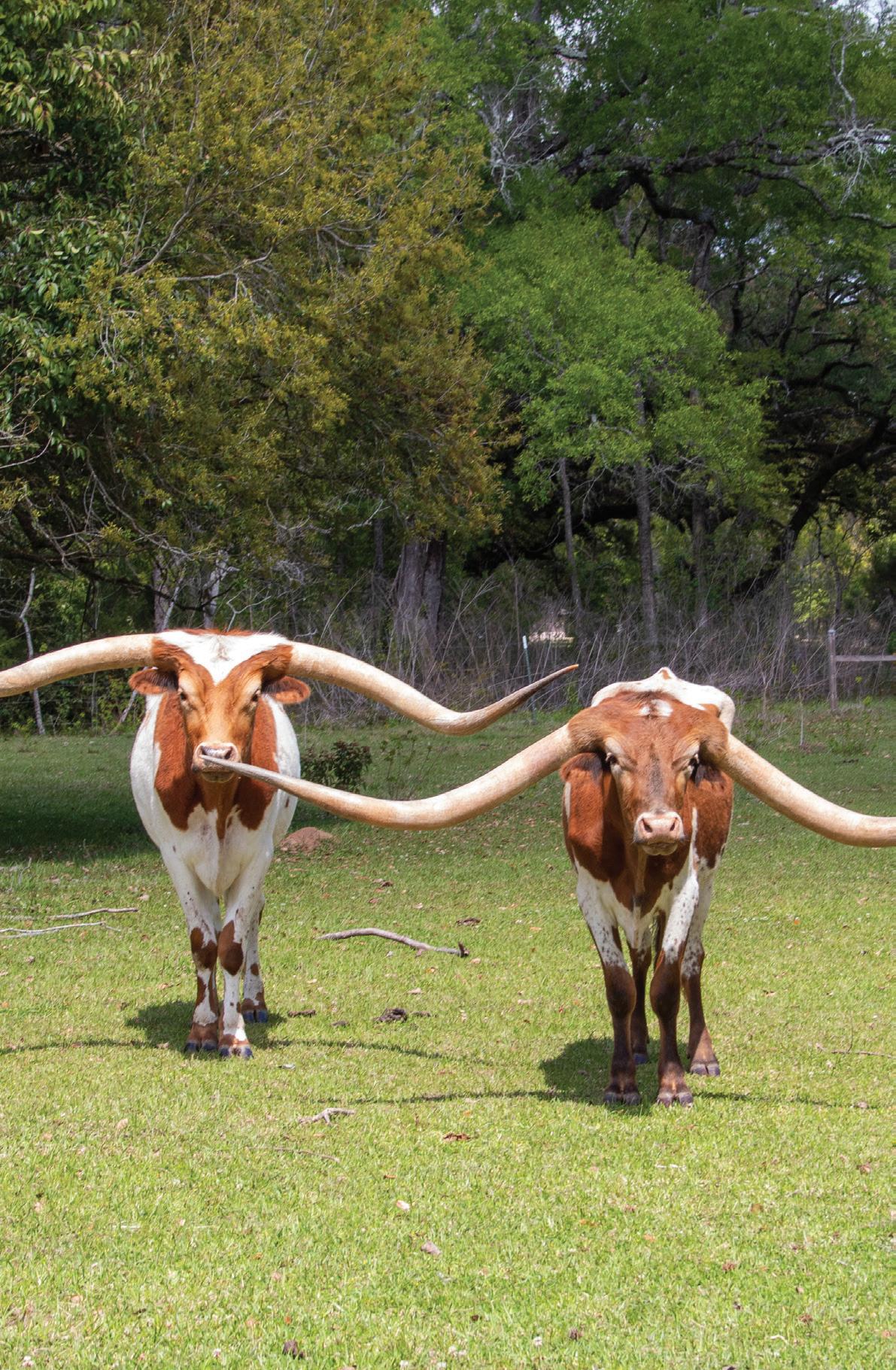
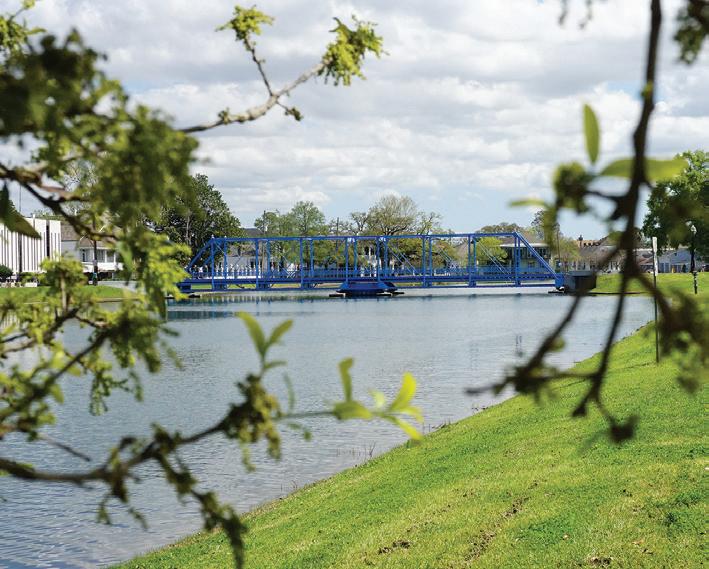
St. Martinville is nestled along the scenic Bayou Teche, is steeped in the complicated and beautiful heritage of Louisiana’s various cultures, home to the first of Louisiana’s State Parks and the best place to get fried gator.
EDITOR'S NOTE Oh, The Places To Go
PELICAN BRIEFS News and updates around the state
LITERARY LOUISIANA Stories of intuition, perserverance, and strength 16
IN TUNE
The Wonderful Happenstance of Lafayette’s Cashier 18
LOUISIANA MADE
New Orleans Record Press keeps vinyl albums alive and Louisiana music on turntables everywhere
KITCHEN GOURMET Louisiana’s food culture
CULTURAL STATE The Solomon Northup Trail
FARTHER FLUNG Visit Dauphin Island for the incredible Gulf beaches but don’t miss its natural side.
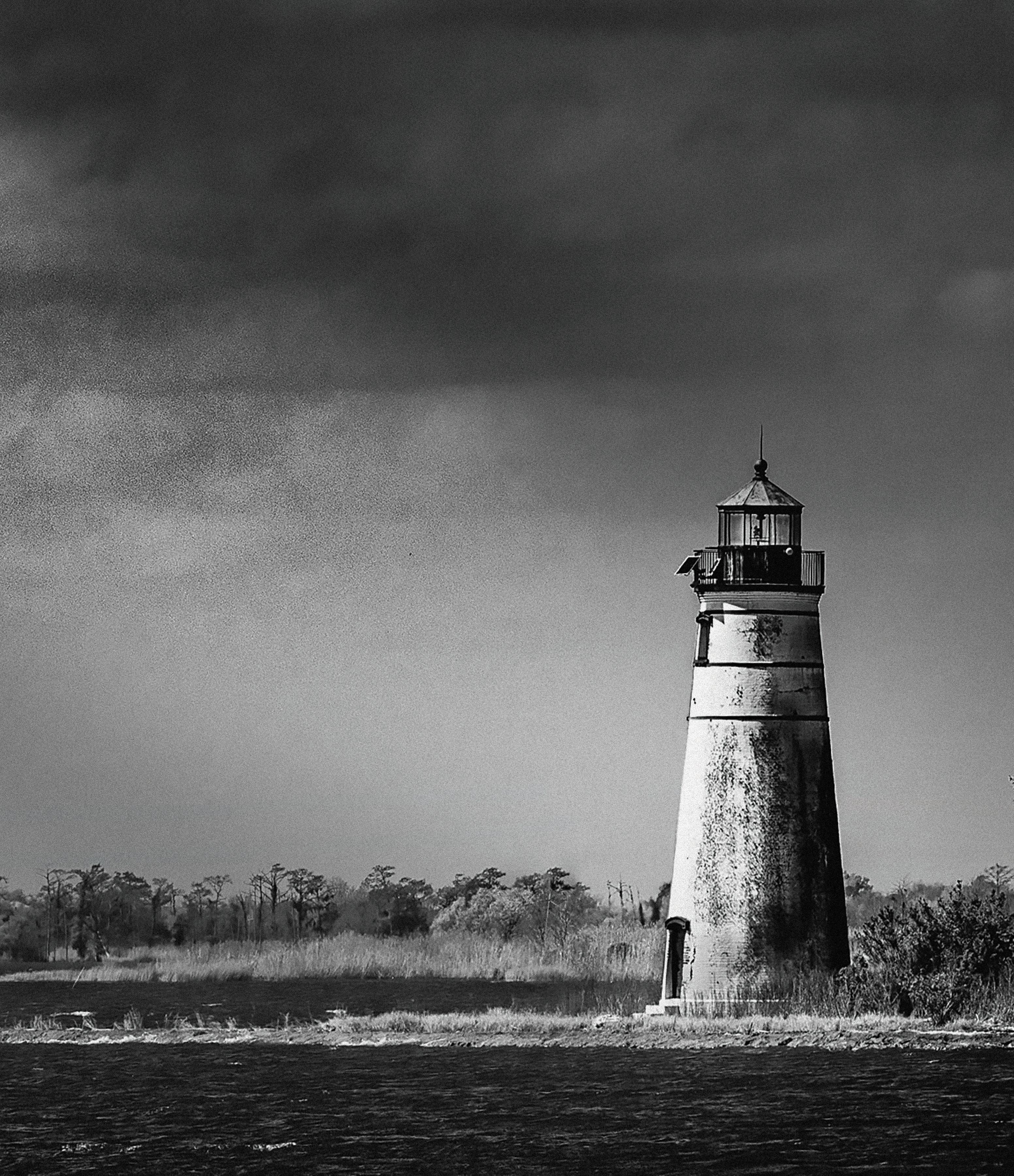
PHOTO CONTEST Efforts are underway to preserve the Tchefuncte Lighthouse
Artist’s “Starry Night” at the Waffle House
St. Martiville p. 58
Madisonville p. 64


Oh, the places to go

I LOVE READING BUCKET LISTS. Even if I’m not able to check o! every item on one, it’s fun to get ideas for places I would’ve never imagined. But if you don’t know, you can’t go, so it’s worthwhile to take a few minutes and read about all of the amazing things the state has to o!er. In this issue, Cheré Coen highlights several bucket list items to see and do around Louisiana.
Poverty Point has long been on my list of places to visit, and I was so close last time I was in Jackson — I just didn’t have the time. This UNESCO World Heritage site includes a 400-acre village that dates to between $6&0 and 700 B.C. It’s hard to believe that we have such a carefully preserved place like that here.
The next time I’m in Breaux Bridge, I’m definitely going to visit Buck & Johnny’s for their Saturday Zydeco Breakfast. While I don’t know how to two-step, I have no qualms about getting out there and giving it a try. Fueled by ca !eine and a quest for a good time, I’m betting it will happen.
I’ve done several on Cheré’s list, but one I can’t believe I’m confessing here in black and white is that I’ve never been to an LSU home game. I knoww! And I’ve lived here my whole life. It’s not for lack of wanting to — somehow it’s just never happened. But there’s still time. I’m adding it to my list.
Now I’ve got an app where I can pin places I’d like to go, things I want to do, co!eeshops I need to try, so every time I read about one, it gets pinned. And then when I travel, I can check my list out and see if any bucket list spots are there, take a little detour and make it happen.
Here’s hoping you have lots of new detours and adventures this month.
Cheers!
Reine Dugas EDITOR REINE@LOUISIANALIFE.COM
Follow Us Subscribe
louisianalifemagazine
louisianalifemag louisianalifemag
Preserve Louisiana, Save Big Today! Get 10% off a new subscription.
*Must order online, new subscribers only expires June 30, 2026.
EDITORIAL
Editor Reine Dugas
Art Director Sarah E.G. Majeste
Copy Editor Liz Clearman
Web Editor Kelly Massicot
Digital Editor Alyssa Schiaffino
Contributors Cheré Coen, John R. Kemp, Lisa Leblanc-Berry, Jeremy Marshall, Misty Millioto, Kevin Rabalais, Jeffrey Roedel, Christopher Louis Romaguera, Danley Romero, Melanie Warner Spencer, Eugenia Uhl, Liz Williams
SALES
Sales Manager Rebecca Taylor 337-298-4424 / 337-235-7919 Ext. 7230
Rebecca@LouisianaLife.com
Renaissance Publishing
PRODUCTION
Digital Director Rosa Balaguer Arostegui
Senior Production Designer Ashley Bravata
MARKETING
Marketing Manager Haley Nash
Sponsored Content Coordinator Jeremy Marshall
ADMINISTRATION
Office Manager Emily Ruiz
Chief Executive Officer Todd Matherne For Subscriptions Call 877-221-3512
110 Veterans Blvd., Suite 123 Metairie, LA 70005
504-828-1380
128 Demanade, Suite 104 Lafayette, LA 70503 337-235-7919 ext 7230
LouisianaLife.com








Melanie Warner Spencer
Writer and Photographer
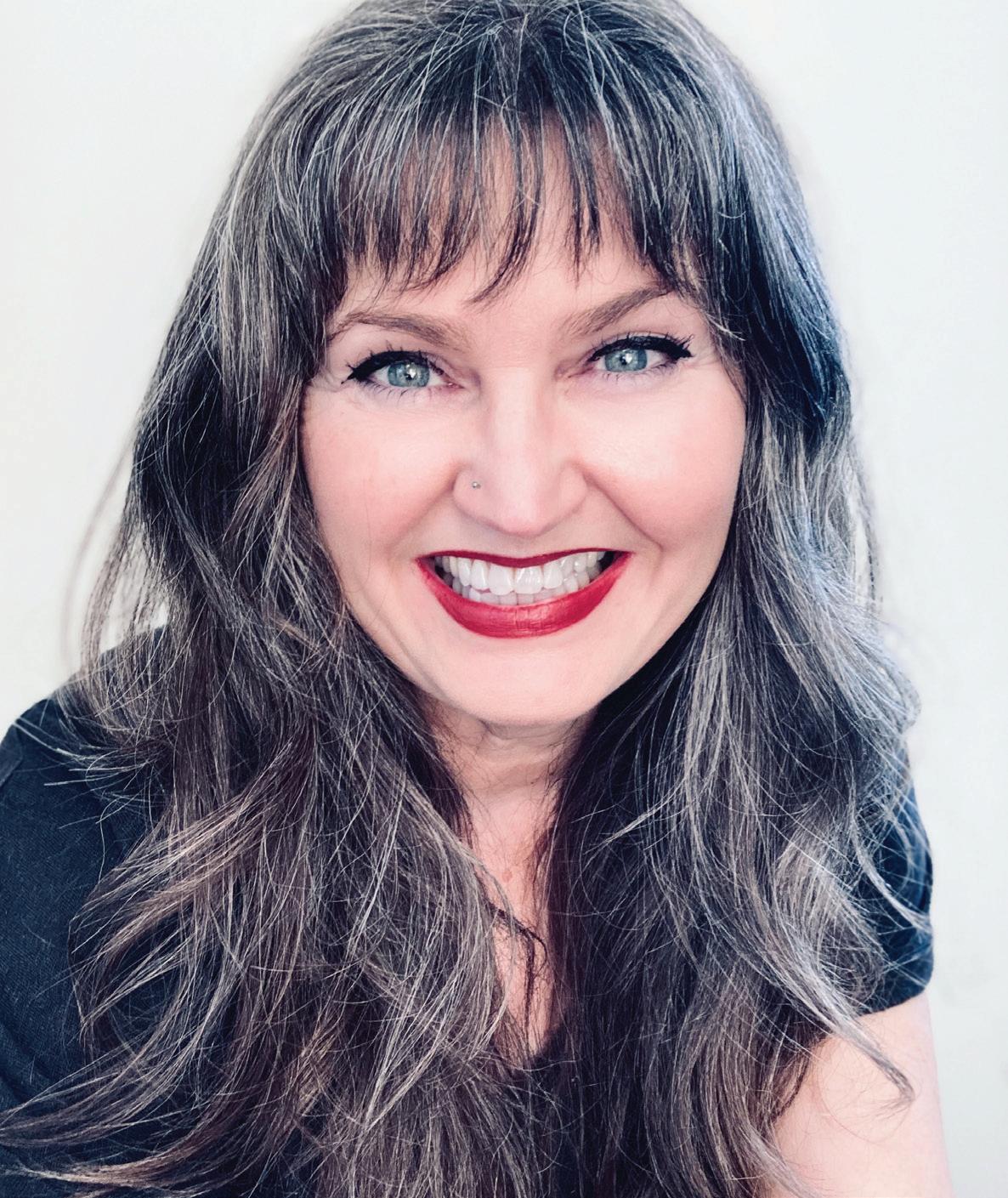
Melanie Warner Spencer is an award-winning journalist, editor and photographer whose work has appeared in publications, including Reuters, throughout the United States and around the globe. Spencer has been a sta ! features reporter and columnist at The Austin American-Statesman, a senior reporter at The Houston Chronicle and also served as editor of New Orleans Bride, New Orleans Homes, Acadiana Profile and Louisiana Life magazines. In her spare time, Spencer is a private yoga teacher and Ayurvedic nutrition counselor, cat mom and member of The Merry Antoinettes Mardi Gras marching krewe in New Orleans.
What Are You Reading?
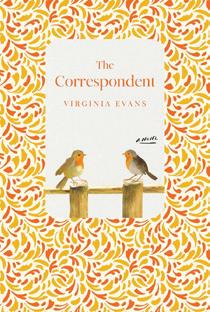
Melanie Warner Spencer The Correspondent by Virginia Evans
It’s a gorgeously written epistolary novel centered on a 70-year-old retired lawyer who does not suffer fools. Confession: I cried at the end.
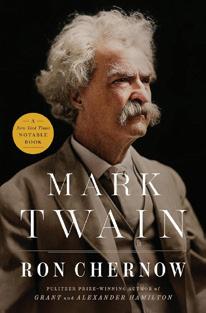
John Kemp
Mark Twain by Ron Chernow. This remarkable and beautifully written new biography creates a vibrant and at times tragic portrait of this American original with all his complexities, shadows, humor, faults, failings, brilliance and literary triumphs.
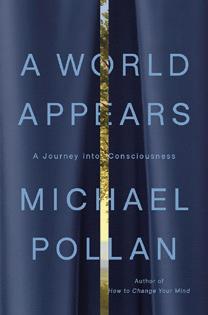
A World Appears: A Journey into Consciousness by Michael Pollan. He positions himself as both a guide and a guinea pig, this time stitching together personal experience with philosophy and neuroscience, suggesting that the deeper we look into the mind, the more it resembles a hall of mirrors.

For four decades, John R. Kemp has written about Louisiana artists and New Orleans history for numerous national and regional magazines, including New Orleans Magazine, Louisiana Life, and New Orleans Homes Magazine. He also has written and contributed to over 20 books about Louisiana art and history, including Expressions of Place: The Contemporary Louisiana Landscape and A Unique Slant of Light: The Bicentennial History of Art in Louisiana.
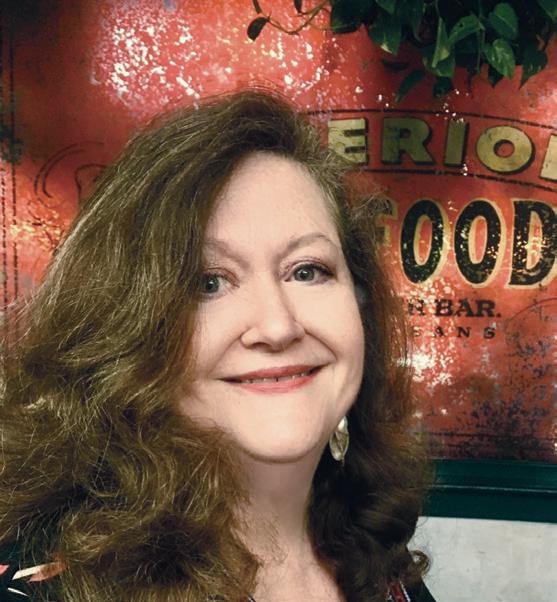
Lisa LeBlanc-Berry is an awardwinning writer and editor with a 34-year career covering food, travel, interior design and culture. A native of Acadiana and New Orleans resident, she’s been restaurant critic for Gambit, editor of Louisiana Homes and Gardens, Where New Orleans and Gulf Coast, and contributor to Fodor’s and Louisiana Cookin’. She earned a diplôme at Le Cordon Bleu and spent two years eating her way through Europe and West Africa—strictly for professional reasons, of course.
Lisa Leblanc Berry

A Leap Back in Time
Bigger, Better Dinos in Breaux Bridge
BY LISA LEBLANC-BERRY
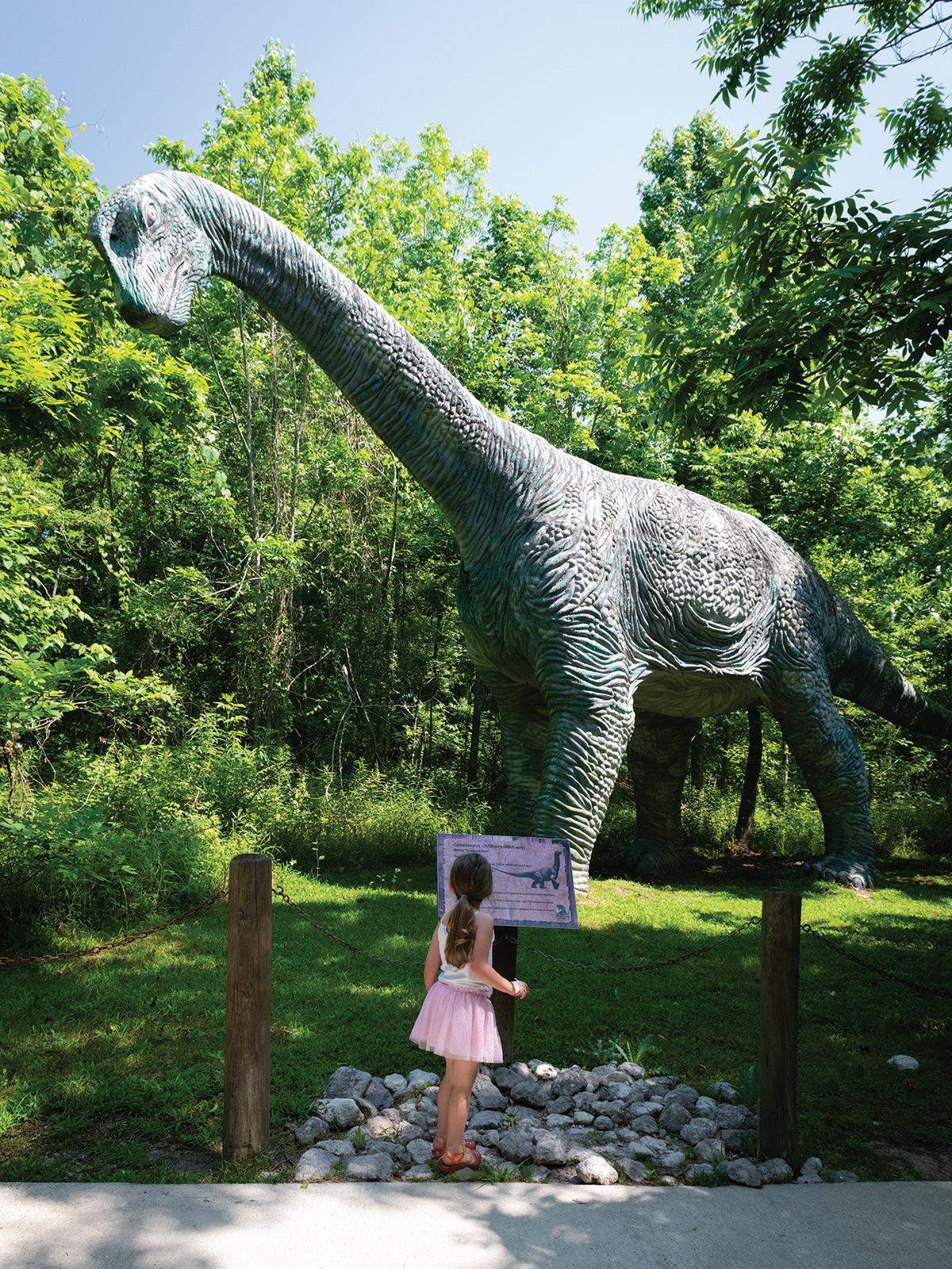
Prehistoric Park, Louisiana’s sole immersive dinosaur adventure, was recently transformed. Guests walking the trails will encounter (4 towering new dinosaurs tucked into the landscape. Five are fully robotic, with lifelike movements and sounds, including the must-see 40-foot Tyrannosaurus Rex with a lingering roar. Also new is the Safari Cruises experience, adding independence and adventure for children as they steer their vehicles along the track like real safari rangers.
BUNKIE Aw Shucks!
Follow the rows of corn to Bunkie’s 38th annual Louisiana Corn Festival (June 11-13) featuring a children’s parade, pirogue races, a statewide softball tournament and the annual corn shucking, cooking and eating contests. Nightly street dances include Ryan Foret’s swamp pop and the high-energy ‘80’s theatrics of The Molly Ringwalds.
LAKE CHARLES Crawfish Under the Knife
A Lake Charles surgical team recently decided to test the precision of the advanced da Vinci 5 (dV5) robotic surgical system at St. Patrick Hospital by using it to peel a crawfish. They found that the level of precision was unmatched. While dV5 excels at peeling crawfish, its primary use is assisting with human surgeries. Not to worry! The dv5 is only used on crawfish for training purposes, and can’t operate on people independently.
JEAN LAFITTE Fun in the Sun
Nestled beneath a 41-acre cypress swamp nature preserve, the unique Jean Lafitte Seafood Festival (May 29-31) honors the bayou culture with continuous live music, abundant fresh seafood, a festive wine walk through the swamp, local art, carnival rides, a kids’ zone, swamp tours and kayak rentals to explore adjacent waterways.
SHREVEPORT Under the Sea
CAMPAQUA is offering unique, interactive summer camps at the Shreveport Aquarium. During Scales & Tails: Reptiles of Louisiana and Beyond (June 15-26), campers will meet snakes, snapping-jaw turtles and crocodilians paired with hands-on experiments. Apex Alliance: Top Predators of Aquatic Ecosystems (June 29-July 10) delves into the science behind sharks, alligators and other top predators. Regular visitors can touch moon jellies and sea stars, feed stingrays and explore Louisiana’s only indoor, climate-controlled gemstone and fossil mining experience.

Changing Lives
Stories of intuition, perserverance, and strength
BY CHRISTOPHER LOUIS ROMAGUERA

Anatomy of an Alibi
“Anatomy of an Alibi” has a classic Hitchcockian premise: Camille Bayliss and Aubrey Price come from completely di !erent worlds, but they both believe the same man hold secrets that could irrevocably change their lives: Ben, Camille’s husband. So they make a plan together, where Aubrey will take Camille’s place for the day, while Camille will spy on her husband. The only problem: The next morning, Ben turns up dead, and now both women need an alibi, but only one has one. Ashley Elston was a wedding planner in Louisiana whose first adult novel became a New York Times Bestseller. )&( pages, $)0
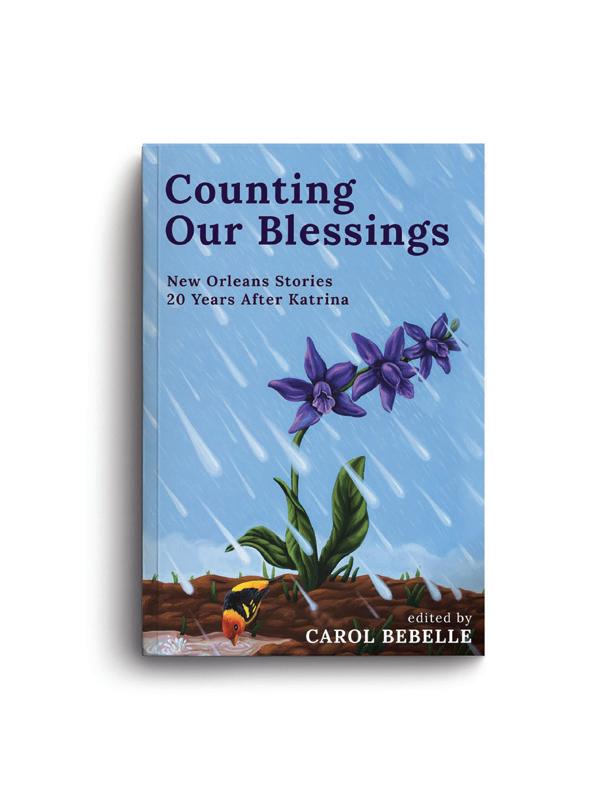
Counting Our Blessings
“Counting Our Blessings” takes us through the lives of 41 New Orleanians in the aftermath of the federal floods that followed Hurricane Katrina. The writings in this book share a glimpse into the struggle and perseverance of the people who survived this tragedy.

“Counting Our Blessings” is an important historical document not just for the city of New Orleans, but for everyone in the world curious about New Orleans culture, and about the power of the human spirit. Authors in this collection include Jarvis DeBerry, Kelly Harris-DeBerry, Cherice Harrison-Nelson, and José Torres-Tama. Edited by Mama Carol Bebelle, co-founder of the Ashé Cultural Arts Center, the book was published by UNO Press. 496 pages, $39.95
Called by Distance
Biljana D. Obradovi&’s “Called by Distance” is a poetry book that spans a variety of topics, from the fall of her native Yugoslavia to her displacement after the federal floods that followed Hurricane Katrina. In her poem, “Spiritual Baptism,” Obradovi& writes “I told the priest how people threw me in the waves / where I melted like the soft Ganesh figurines, the Arabian / Sea polluting what little spirit I had in me even then.” This is a great example of the self-reflection and earnestness in her poetry, and how her poems take the reader on her journeys all over the world. “Called by Distance” is part of the Southern Messenger Poets Series edited by Dave Smith from LSU Press. 100 pages, $21.95

The Roads We Travel
David Armand’s “The Roads We Travel” is a writing memoir in the style of classics such as Stephen King’s “On Writing.” Armand uses his life to teach what works (and what doesn’t) when it comes to writing. Partly a tutelage on how to be a writer, partly a memoir on a life well lived), Armand uses his vast wealth of knowledge to weave so much writing information in his memoir. Armand, a creative writing professor at Southeastern Louisiana University, has published books of fiction, nonfiction and poetry. He won the 2022 Louisiana Writer Award. 122 pages, $19.95
Cutting Edge
The Wonderful Happenstance of Lafayette’s Cashier
BY JEREMY MARSHALL
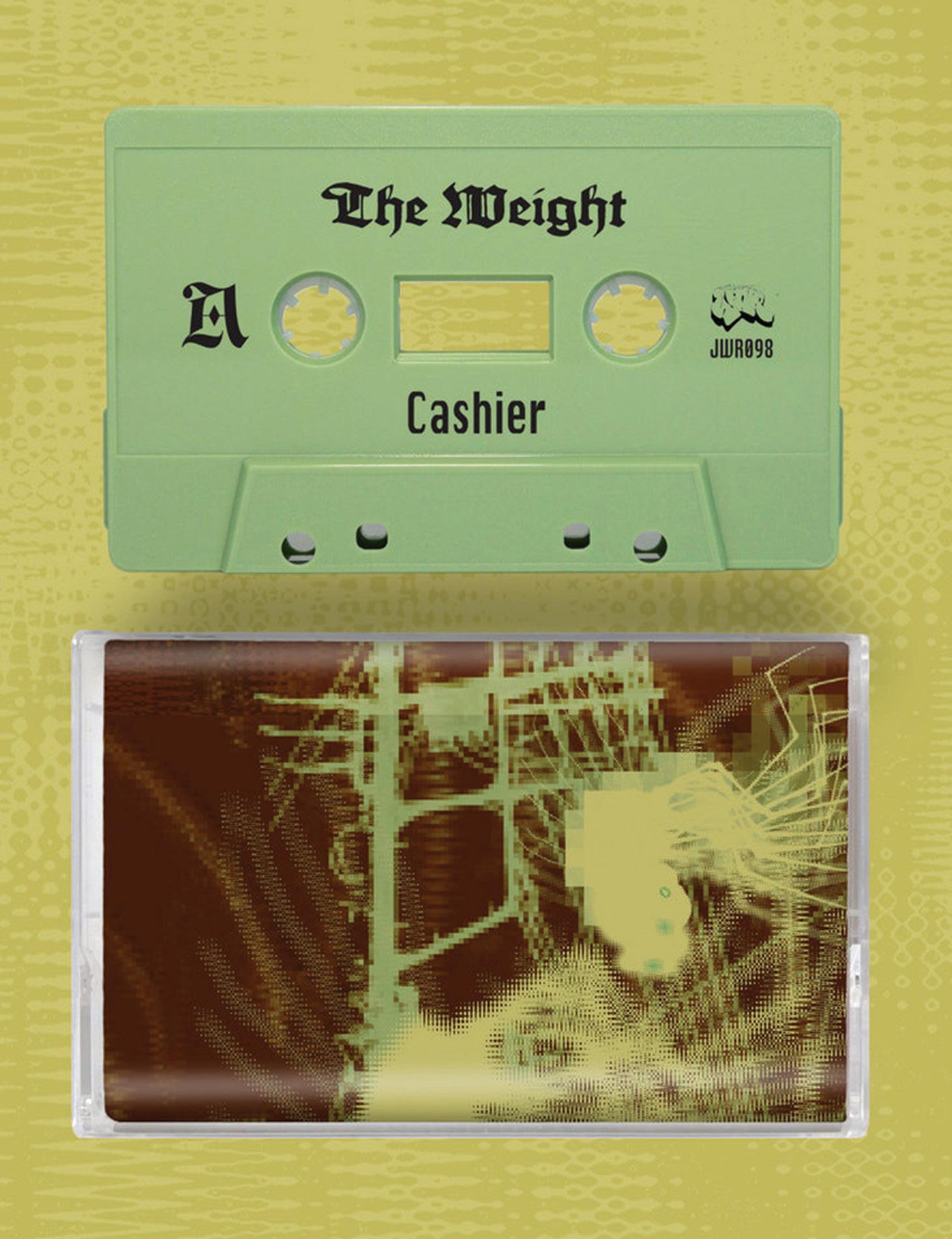
SOMETIMES THINGS JUST FALL INTO PLACE. Call it kismet, call it cosmic harmony, but whatever invisible force exists that brings people together in the right configuration at the right time knew what it was doing when it put the members of Cashier together. This Acadiana-bred guitar growling, four-piece rock group with vocalist and guitarist Kylie Gaspard, guitarist Joseph Perillo, bassist
Austyn Wood and drummer Zachary Derouen, just so happened to live in the same region, fostered on the same influences, and in so doing found an undeniable sound, a passion-fueled holler that smashes together NOLA punk and a zydeco wail that feels inevitable. Still, even on the back end of releasing their debut EP “The Weight” and a whirlwind coming-out party at the (0(6 SXSW Music Festival in Austin, Texas, Kylie Gaspard chalks their formation and musical symbiosis to nothing more than “wonderful happenstance.”
“Actually, all of us except Zachary went to high school together at LHS,” says Kylie. “We were all in a music class taught by our producer, Chad Viator, so we were all writing music as a class back then. With so much of the music around us, living in Lafayette, we are surrounded by amazing art that influences us every day.”
For Kylie, music has always been a language beyond easy expression, a chasm of feeling she first discovered at seven years old when she wrote and performed her first song for a babysitter. Luckily, life crossed her path with that of Perillo, Wood and Derouen, each not only like of mind and of music, who didn’t just speak her same language but found ways to explode their shared nomenclature into something grand, cutting, and new. By forming something tangible from the loose clay of youth and the bendable wail of an electric guitar, they found a style that was less orchestrated than ordained, something entirely their own that spoke to a primal instinct both in listeners and themselves.
“Playing guitar and getting the right formula for what makes a ‘Cashier song’ has been a beautiful journey for the rest of the band and me,” says Kylie. “We get along very well and know how to work with each other after playing together these past few years and touring, so the music will naturally reflect that compatibility.”
Their debut EP “The Weight” feels distinctive without overplaying its hand, familiar in a wholly unique way, like a sound you never knew you loved until you heard it. A clearly intentional statement of rollicking intent from the band, heralded by the crisp guitar ri !s that open “A Curse I Know So Well,” the voice of Cashier, it seems, was always ready to be unearthed; it simply needed the right avenue for its glorious excavation.
“We definitely wanted to make our sound more ‘known’ so to speak,” says Kylie. “We’ve always been sure of our influences, but we didn’t have a project that solidified what we were going for, so definitely there was intention behind it. I also think just touring and listening to so many bands has influenced us over time, so maybe a bit of a happy accident there as well.”
With a successful SXSW run in their rearview and planned performances in Europe set for fall (0(6, there seems to be nothing that can stifle where Cashier may go or who they might become by the time they get there. And why should it? Some things just feel as if they were always meant to be.
BY
PHOTO
JEFF FASANO

Pressing Matters
New Orleans Record Press keeps vinyl albums alive and Louisiana music on turntables everywhere
BY JEFFREY ROEDEL PHOTOS BY ROMERO & ROMERO
THERE’S LAUGHTER ON THE COUNT-IN but heartbreak in the beat, and as a deep, sliding guitar snakes beneath the start of Maggie Koerner’s fourth album “Upstate,” her voice tumbles and pierces. It’s a sound raw and close, and it’s the voice of a Louisiana songwriter baring her soul on the mic.
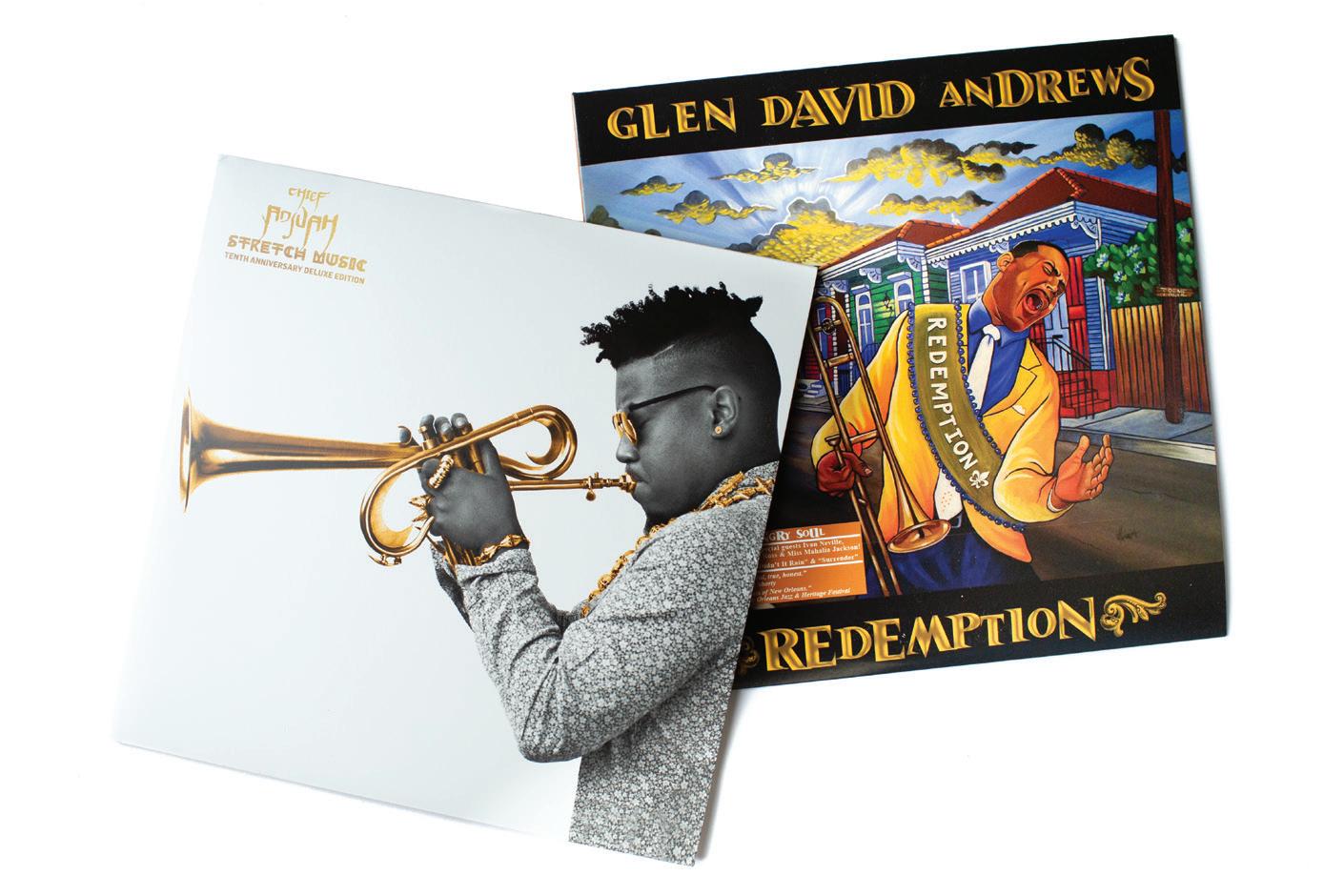
“It feels like I’ve finally tapped into my voice and understood fully who I am as an artist,” Koerner says of the gorgeously confessional songs she put on tape with co-producer Ajai Combelic at his Lil Squeeze Studio o! St. Claude Avenue and then on vinyl just a few blocks away at New Orleans Record Press. “This is definitely the first time I found joy in the recording process, and that’s everything to me. So, choosing where it got pressed was important. I like the idea of keeping my dollars in the community, but also this album that means so much to me staying in my local arts community for its final step.”
Bright aqua and purple brick stands out on most streets, but not in the Bywater of New Orleans where the city lays its character on thick across its colorful porches and storefronts. Here lies the ironic conver-

gence of two of Louisiana’s largest legacy industries: music and plastics.
Past some wrought iron and a pair of unassuming open doors, the early morning winter sun blankets tall stacks of large brown boxes packed with Preservation Hall Jazz Band’s new Christmas album.
“It’s chaos, but it’s controlled chaos,” says the Press’ co-owner Brice White, known on-air as Brice Nice, and looking like a silver-haired music prophet just struck by a new vision as he bounds into a labyrinthine two-story production space. “This is literally plastics manufacturing, but that’s not why any of us are really here. The only reason anybody cares about this PVC is because we put music on it that we all love.”
When the press began in (0$8, an album on Sinking City Records — the indie label White owns with fellow WWOZ DJ and Director Scott Borne — was one of the first out the door. After the pandemic hit and his club
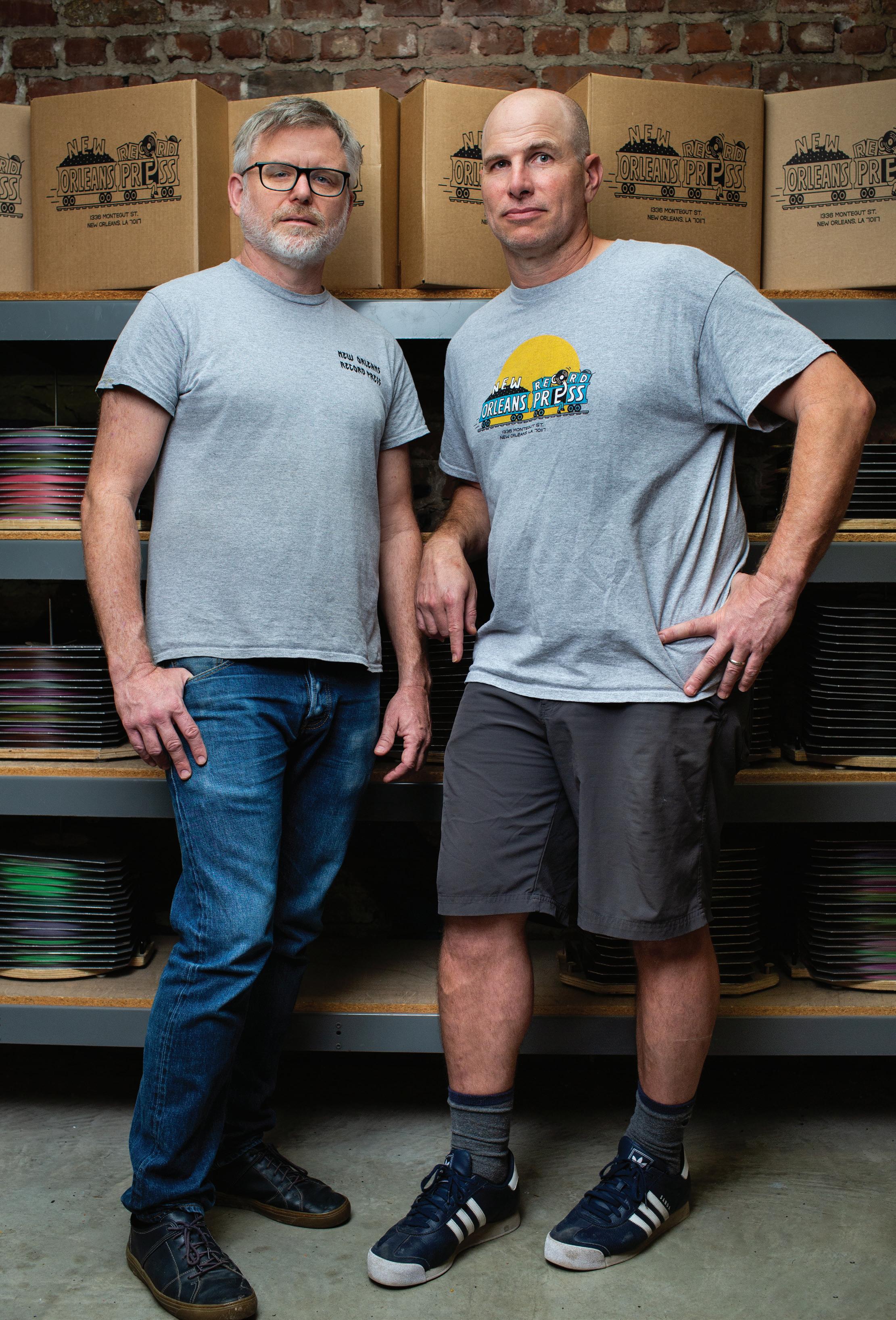
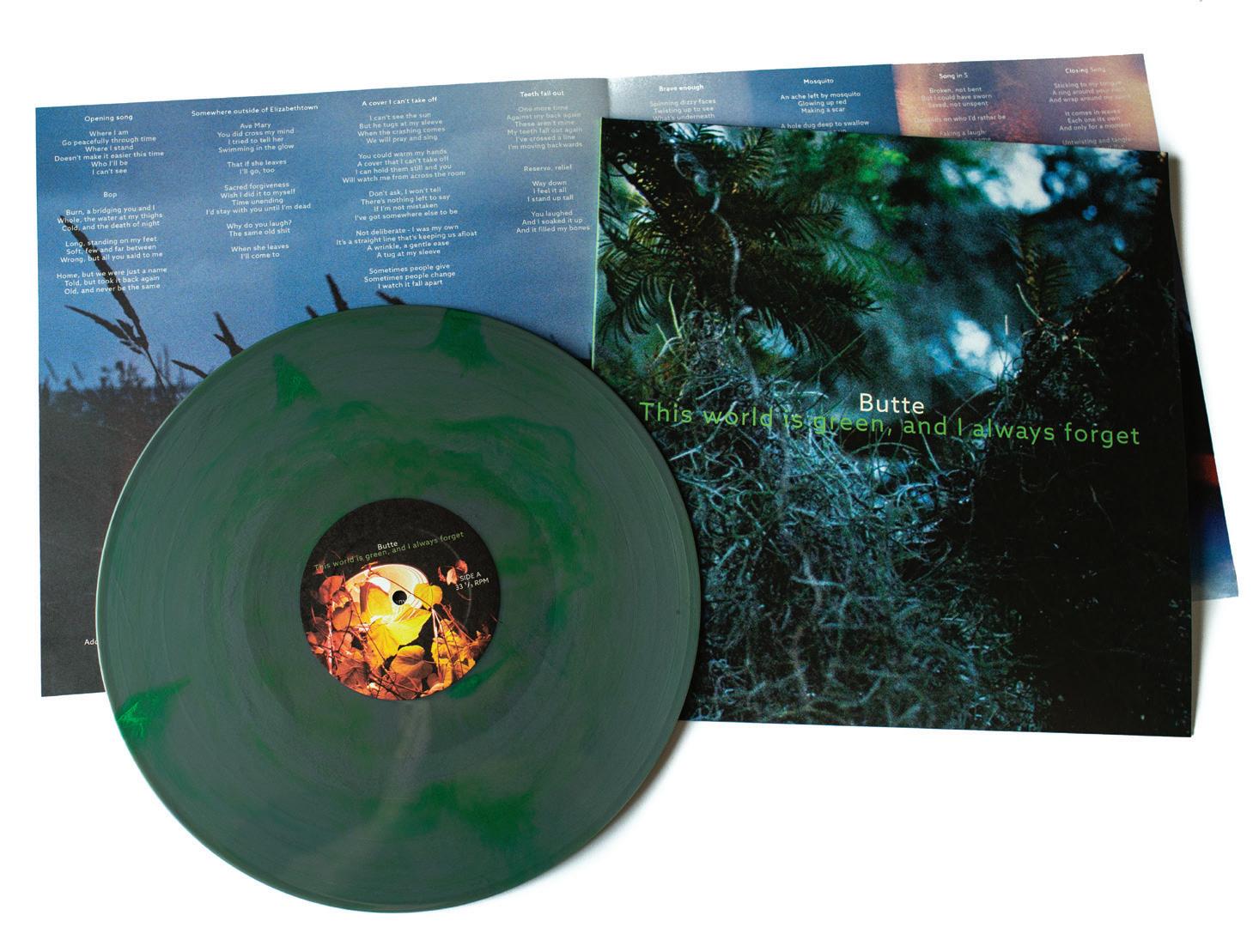
DJ gigs nearly vanished, White, an avid vinyl collector, thought about launching his own press with Borne to meet rising industry demand. After talking with New Orleans Record Press founder Dan Lauricella, they bought his majority stake and agreed to split duties on the daily operations.
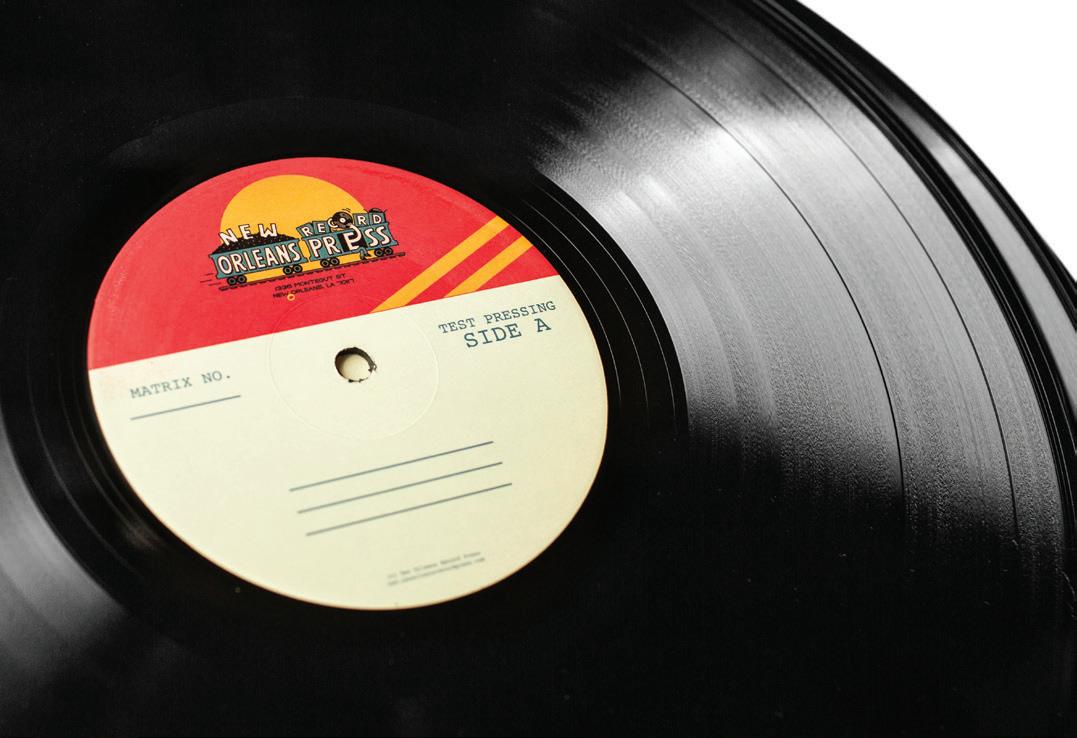
Now they manage nearly (0 employees and two presses. From hoppers full of virgin compound, to the vinyl hitting more than )00 degrees, to the hockey puck-sized hunk getting rolled by hand in plastic pellets that melt into enviable splatters and swirls, to master lacquer disc and metal stampers cutting the precise grooves that will vibrate a needle and, magically, make a righteous sound — it all happens here.
SCOTT BORNE & BRICE WHITE
OCCUPATION
Owners, New Orleans Record Press
SOCIAL MEDIA
@neworleansrecordpress on Instagram
RADIO
WWOZ New Orleans
90.7 FM
Listen to Scott Borne: The Morning Set with Scott Borne Thurs., 6 – 9 a.m.
Listen to Brice Nice: Block Party with Brice Nice Sat., 6 – 8 p.m.
Koerner praises the press for its attention to detail and speed, and says working with White and Borne feels like collaborating with friends.
“They’re the nicest and most helpful vinyl partners I could imagine,” Koerner says. “To get a text from the record press owner himself that your album is ready and picking it up the same day cuts out all the shipping costs — it saves a lot of time, too.”
For these music obsessives and business partners, expansion won’t be outward. It will be inward.
Pressing for Cajun stalwart Joel Savoy and soulful crooner Kristin Diable, to rootsy rockers The Deslondes, they have decided to put Louisiana’s people first.
“We don’t take major label work anymore, because we don’t want to have to tell local artists to wait,” White says. “The relationships here are too important to us. We want to press Louisiana artists, and we want to see their music spread.”
As (0(6 unfolds, the duo believes they can increase capacity by maintaining high standards and a strong connection to the music community they have poured into as WWOZ personalities and culture warriors for years.
“We definitely found our strength, and more of ourselves, in being local, in being in the New Orleans music economy,” Borne says.
And with icons like Jon Batiste, Big Freedia, Trombone Shorty, and the bayou’s latest newcomer, Lana Del Rey, enriching the musical soil, this growing press can always find a new groove.
“We do need to connect with Lana,” White says, looking over a bin of black and gold scraps destined to be recycled into a brand-new batch of records. “I know my daughter would freak out.”

Q&A SCOTT BORNE
What band or artist first really made you first fall in love with music? Run DMC. I remember hearing them on the radio, and then tracking down the cassette of Raising Hell. I poured over that album almost nightly ‘til I knew all the lyrics.
When you’re not working, what do you love doing for fun in and around New Orleans?’ I am a big fan of my neighborhood. I live in Mid-City (New Orleans). I love going to the Broadside for movies and shows, Cafe Degas and 1000 Figs for dinner. And I love taking my kids to City Park.
Give me three Louisiana artists, from any time period, that might not be household names in 2026, but that everyone should know. Jazz drummer James Black—who played with everyone from Cannonball Adderley and Ellis Marsalis in New York City, to Fats Domino and Dr. John in New Orleans; Clyde Kerr, Jr., a trumpeter and composer who played with Aretha Franklin and the Jackson 5, and taught at NOCCA, mentoring Trombone Shorty and many others; and “Creole Beethoven” Wardell Quezergue, an arranger and producer who collaborated with Dave Bartholomew, Otis Redding and Stevie Wonder.
Reality with a Twist
An Artist’s “Starry Night” at the Waffle House
BY JOHN R. KEMP
IF YOU ARE A FAN OF VINCENT VAN GOGH, Edward Hopper, Salvador Dalí or Sandro Botticelli, you certainly will take to Pineville artist Matt Dawson’s faintly familiar interpretations of these masters with his own visual twists and humor.
Dawson, a self-taught artist and full-time pharmacist who was born in Shreveport, grew up in Natchitoches and now resides with his wife Amber and two daughters in Pineville across the Red River from Alexandria, has created an impressive body of work that continues to bring him growing attention and honors. The (0(& Louisiana Book Festival, for example, featured his work and he was the artist chosen to create the (0()
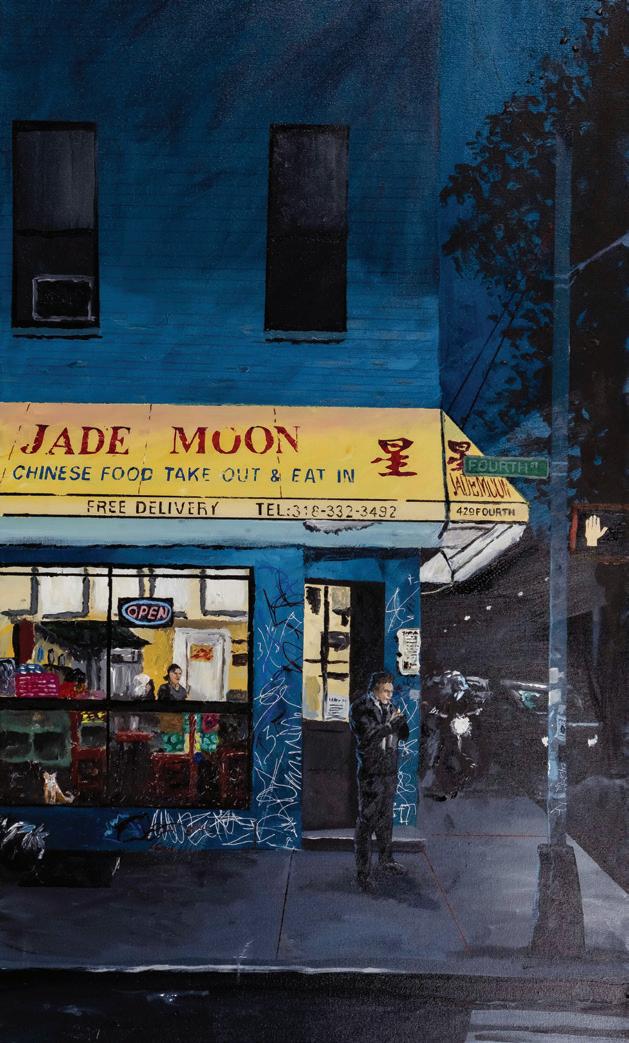
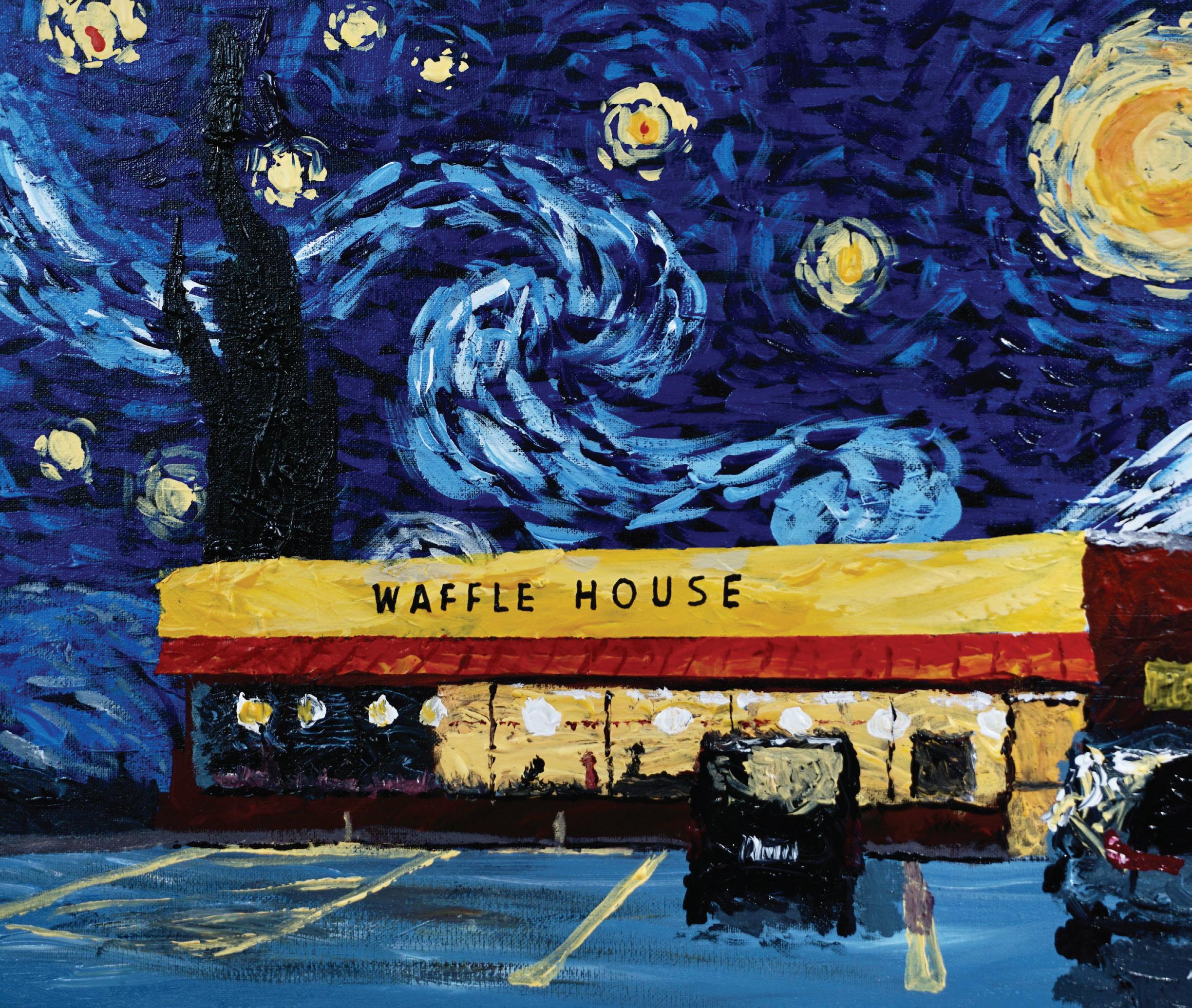
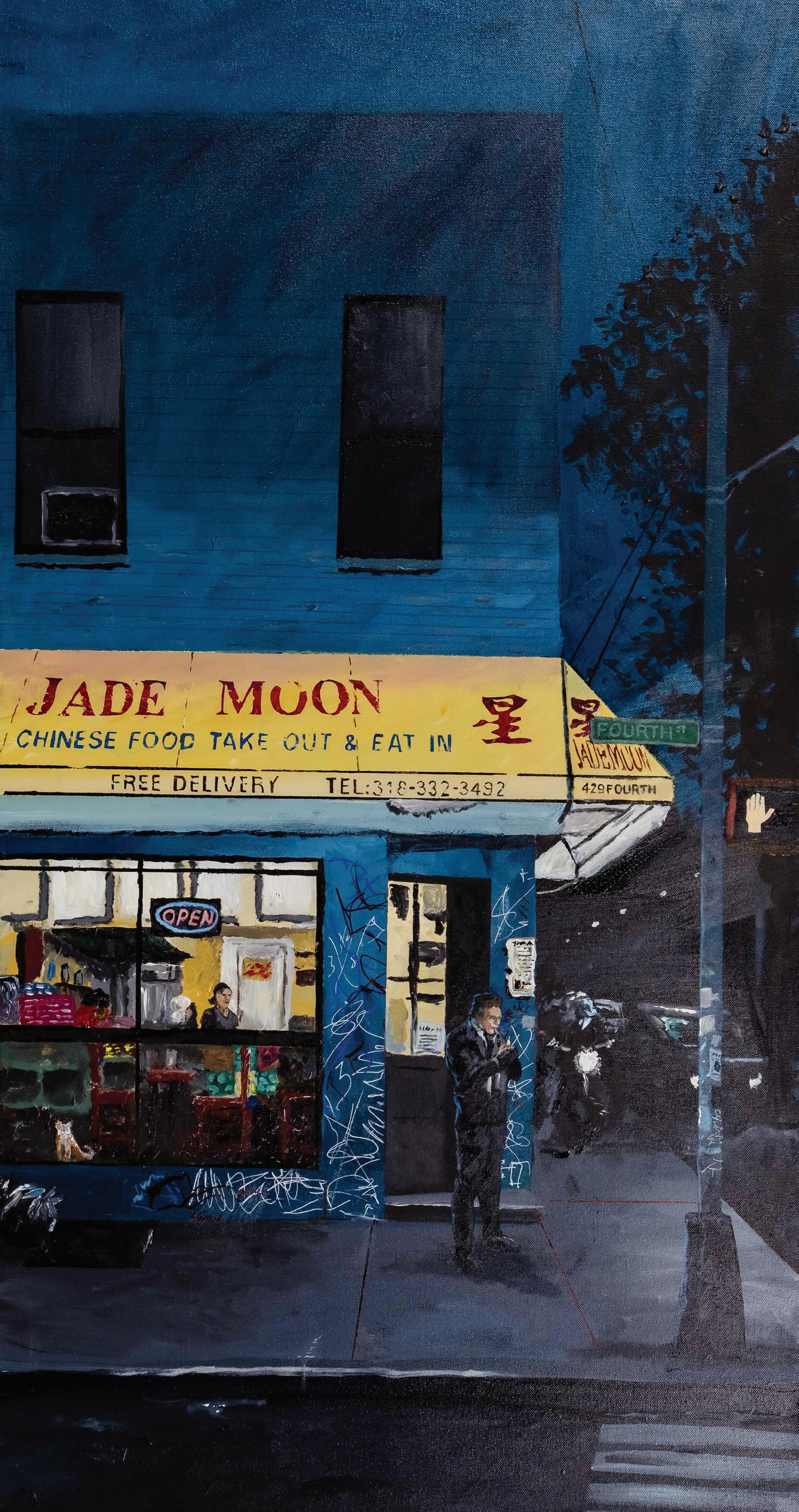
(Above) “Starry Wa es” (Right) “Night at the Jade Moon”
Exhibits
CAJUN
Rush Jagoe. Arnaudville photographer’s images of bayou and prairie cultural traditions, through July 25. Acadiana Center for the Arts, Lafayette. acadianacenterforthearts.org
CENTRAL
Now You See Me. Contemporary portraiture in Louisiana, through June 20. Alexandria Museum of Art. themuseum.org
NOLA
Sèvres Magnifique. French porcelain from the collection of Thomas B. Lemann, through Jan. 3, 2027. New Orleans Museum of Art. noma.org
NORTH
5000 More Years. Cosmological imagery by Canadian artist Summer Emerald, through July 18. Masur Museum of Art, Monroe. masurmuseum.org
RIVER PARISHES
Daphnis and Chloe and Other Lovers: Lithographs by Marc Chagall, through May 24. LSU Museum of Art, Baton Rouge. lsumoa.org
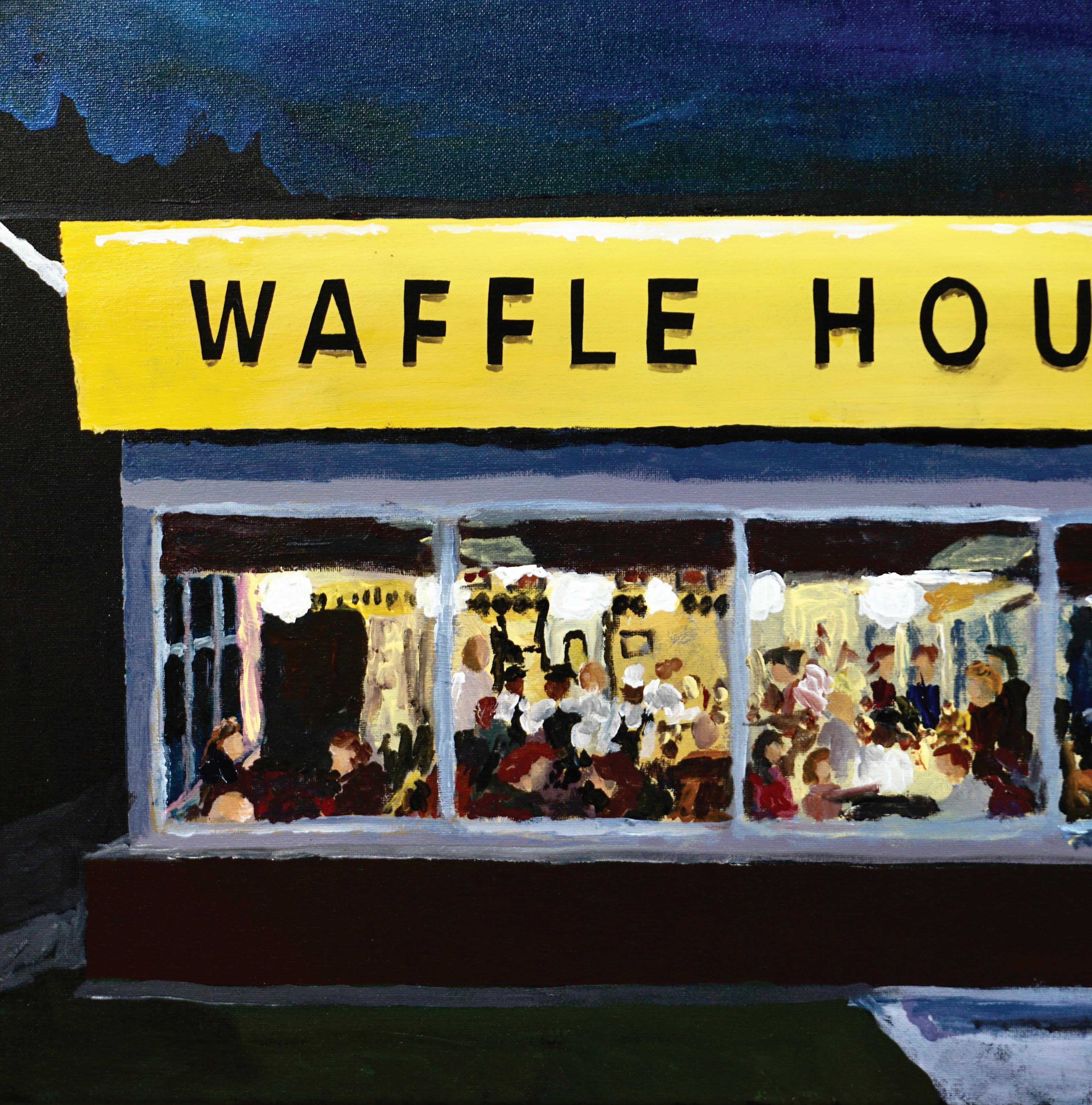
Natchitoches Christmas Festival poster. His paintings are now in collections in all &0 states as well as in Europe, Japan and Australia.
Aside from various accolades, Dawson, who keeps his studio at the River Oaks SquareArts Center in Alexandria, has a unique approach to painting. Artists often categorize their work as Impressionistic, Post-impressionistic, Surrealistic, Realistic or, perhaps, some other “-istic.” Dawson, however, opens his imagination,
palette and canvas to the subject before him without committing to a specific style. At times, he seems taken by Van Gogh’s mind-bending brushstrokes in “Starry Night,” Hopper’s tight realism in his moody “Nighthawks,” in the fluidity of Dalí’s iconic melting clock
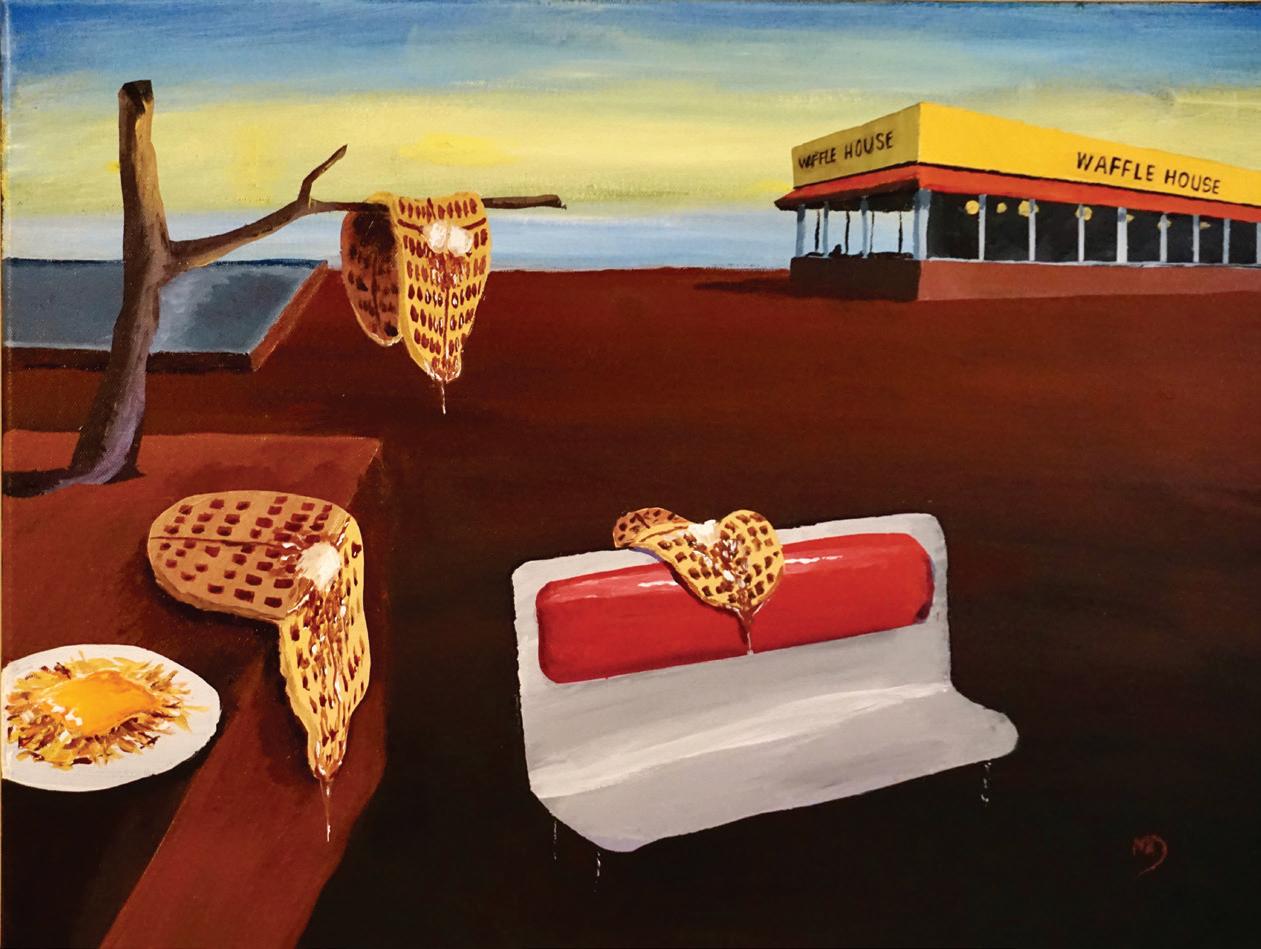
“The Persistence of Memory,” and Botticelli’s allegorical mythology in “Birth of Venus.”
In a sense, his paintings are a tribute to those artists and, at the same time, a means for him to take in and
(Above) “Wa e House Night” (Right) “Wa es of Memory”
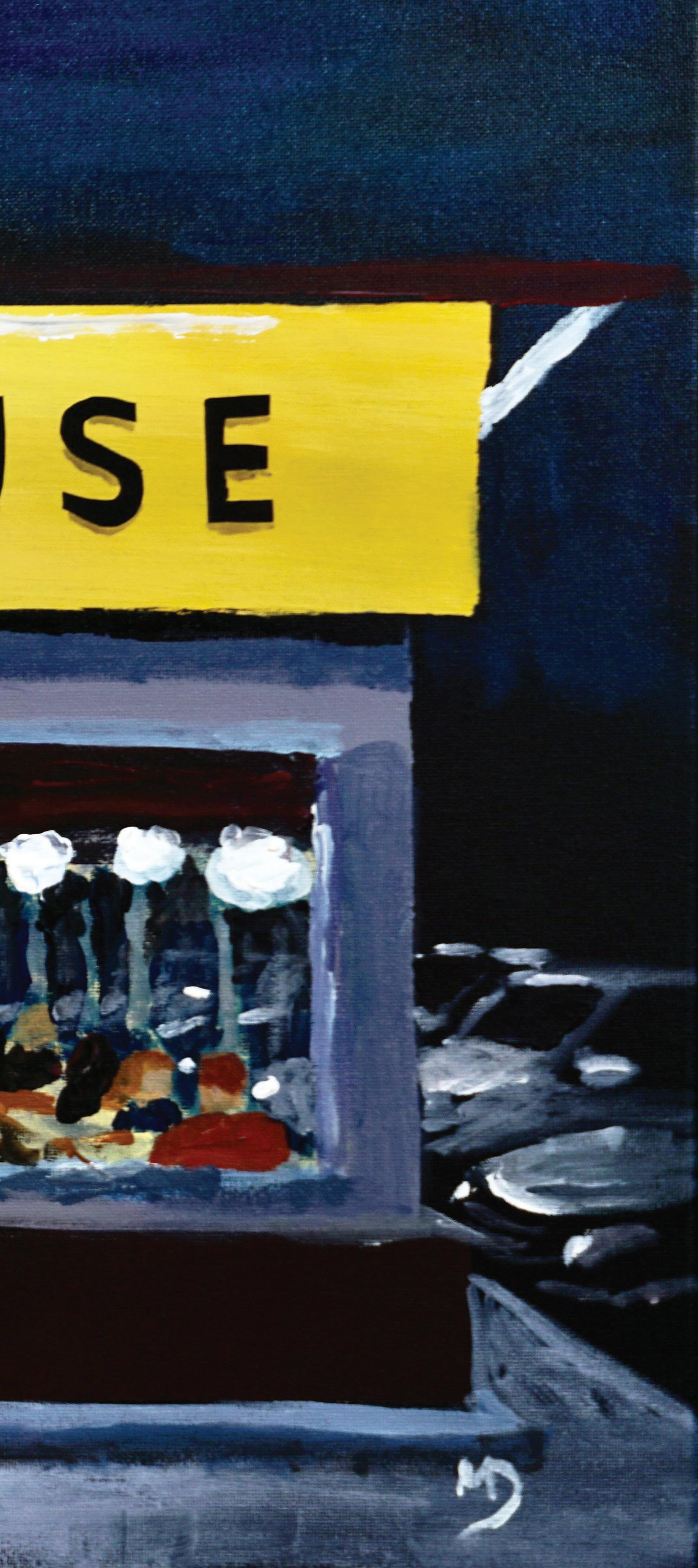
express what he sees and filters though his own imagination and experiences. Take, for example, his Wa ,e House series. In “Starry Wa ,es,” we see Van Gogh. Hopper is clearly evident in “Wa ,e House Night,” Dalí in “Wa ,es of Memory,” and Botticelli in “Birth of Tammany.” Aside from his references to art history, Wa ,e House restaurants have special meaning to him. The company’s museum has one of his Wa ,e House prints in its collection.
“The Wa,e House,” he says, “reminds me of a time when my wife and I were taking trips to New Orleans for doctor appointments. We’d
always stop at the Wa,e House in Donaldsonville on the way back. And it was just so comforting. And I love the minimalistic image the Wa,e House projects on a canvas. It conveys so much from that yellow rectangle with black letters. I wanted that on canvas, hanging in my house. Problem is, I can’t keep them in stock long enough to do that. A lot of people share that same love.”
Like many artists who paint urban landscapes, Dawson draws inspiration from the Ashcan School of art that developed in the United States during the early (0th century. It was a movement that portrayed the rawness of daily life in New York’s poor neighborhoods. Hopper was one of its disciples.
As to subject matter, Dawson says it can be anywhere but he finds it mostly in the South. “I love my state and the southern region most,” he explains. “There is beauty in places that are overlooked in life and maybe even touch on some nostalgia in their life.”
Looking over his portfolio, it becomes evident he prefers to paint night scenes such as his dimly lit sidewalk in Natchitoches or his dark, moody inner-city night images of a typically crowded and rainy Manhattan street.
Dawson says he likes “how light behaves at night” and by the “shadows” light casts. He loves “the mood of nighttime scenes” that comfort him. These images, he says, often appear in his imagination or places he’s been or in photographs he has seen. And then there’s the question of what drives him to create art.
“It’s the anticipation of what comes next,” says Dawson. “Sometime, I really don’t know where something is taking me and I need to finish it to find out. It’s like a puzzle. Also, I like to create things that people will see and make them smile.”
And he does.
For more information, visit mattdawson.art.
Preserve & Conserve Louisiana’s food culture
BY LIZ WILLIAMS PHOTOS AND STYLING BY EUGENIA UHL
THERE IS NO END to the food creativity of the people of Louisiana. We have tried to find ways to eat just about everything. There was even a campaign, albeit unsuccessful, in the early part of the century to encourage us to eat nutria as a form of nutria control. We fell in love with blackened redfish and we had to be restrained, so as not to wipe out the redfish population.
Food journalist, Poppy Tooker, has reminded us over and over, “Eat it to save it!” This can apply to things that are waning in popularity like Creole cream cheese. Without enough people continuing to eat it, local dairies began to discontinue the product. But enough demand by enthusiastic
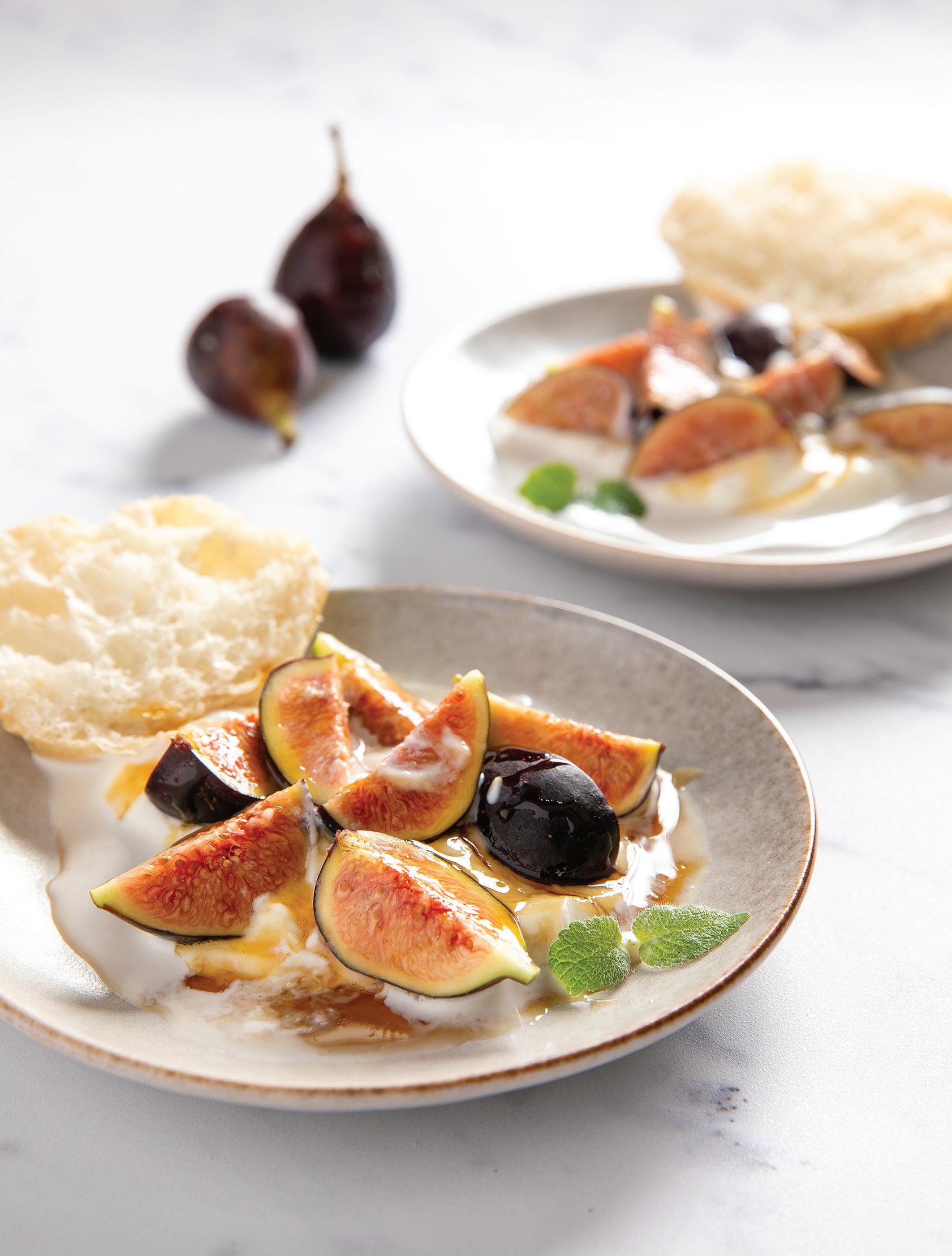
Creole Cream Cheese for Breakfast
CREOLE CREAM CHEESE
, gallon skim milk - cup buttermilk
1 rennet tablet TO SERVE
5 fresh figs washed and cut in half (My grandmother would send us to the fig tree in the back yard and tell us how many figs to bring back for breakfast)
2 tablespoons cream (I like to use half and half, but you can use heavy cream)
Piece of French bread
. . CREOLE CREAM CHEESE
Combine skim milk and buttermilk in a large pot. Stir to heat evenly. When it comes to heat to 85 F, remove from heat. Add about ¼ of the rennet tablet. Stir.
2 . TRANSFER to a glass bowl and cover with plastic wrap. Poke holes in the plastic wrap for steam to escape. Set aside for 2 days. Do not place in refrigerator.
3 . LINE a glass bowl with 2 layers of cheesecloth. Using a slotted spoon, transfer the curds to the cheesecloth. Gather the ends of the cloth, lift from the bowl and tie the top together. Using a dowel or the handle of a wooden spoon, hang the the curds over a deep bowl. Place in the refrigerator to drain overnight.
4 . TO SERVE Place (⁄) cup of Creole cream cheese in a bowl. Add figs or other fresh fruit. You can also use a drizzle of cane syrup, homemade fruit preserves or jam, or sprinkle a bit of sugar over the cream cheese.
5 . POUR cream over fruit and cream cheese. Dip French bread into the cream cheese like a scoop or spread the cream cheese onto the French bread and enjoy.
eaters encouraged Mauthe’s Progress Milk Barn to make the cream cheese available again. Today smaller dairies make their versions of the cream cheese, and many ice cream shops o!er Creole cream cheese ice cream.
Broiled or barbecued oysters were becoming hard to make at home in small family-sized quantities. You can’t get just two dozen oysters and shuck them yourself when they are sold by the sack or half-sack. You can buy a pint or two already shucked, but without the shells. These days it is possible to buy faux shells, some of which look real, which are oven and grill safe and can be used and reused in lieu of oyster shells. Let’s hope that all of the real oyster shells can be recycled to help conserve the coast.
Although children still climb Japanese plum trees to eat the fruit, we don’t really appreciate how special these trees are. They taste a bit like apricots. They look a bit like apricots. Many people call them nespoli or misbeliefs. This article isn’t about the true genus and species of this fabulous fruit, so let’s cut directly to the wonderful jam that it makes. Let’s not let this fruit go to waste.
Through animal farming of all types, we are keeping the cuisine of Louisiana fresh and sustained. Whether it is crawfish farming and its pairing with rice farming, turtle farming, or alligator farming, we are keeping our food culture alive.
Conservation is about conserving culture as well as the environment. That means protecting the foods that we eat to protect our culture. It means protecting the environment so that we can continue to eat the food and to live the way of life that is found in Louisiana.
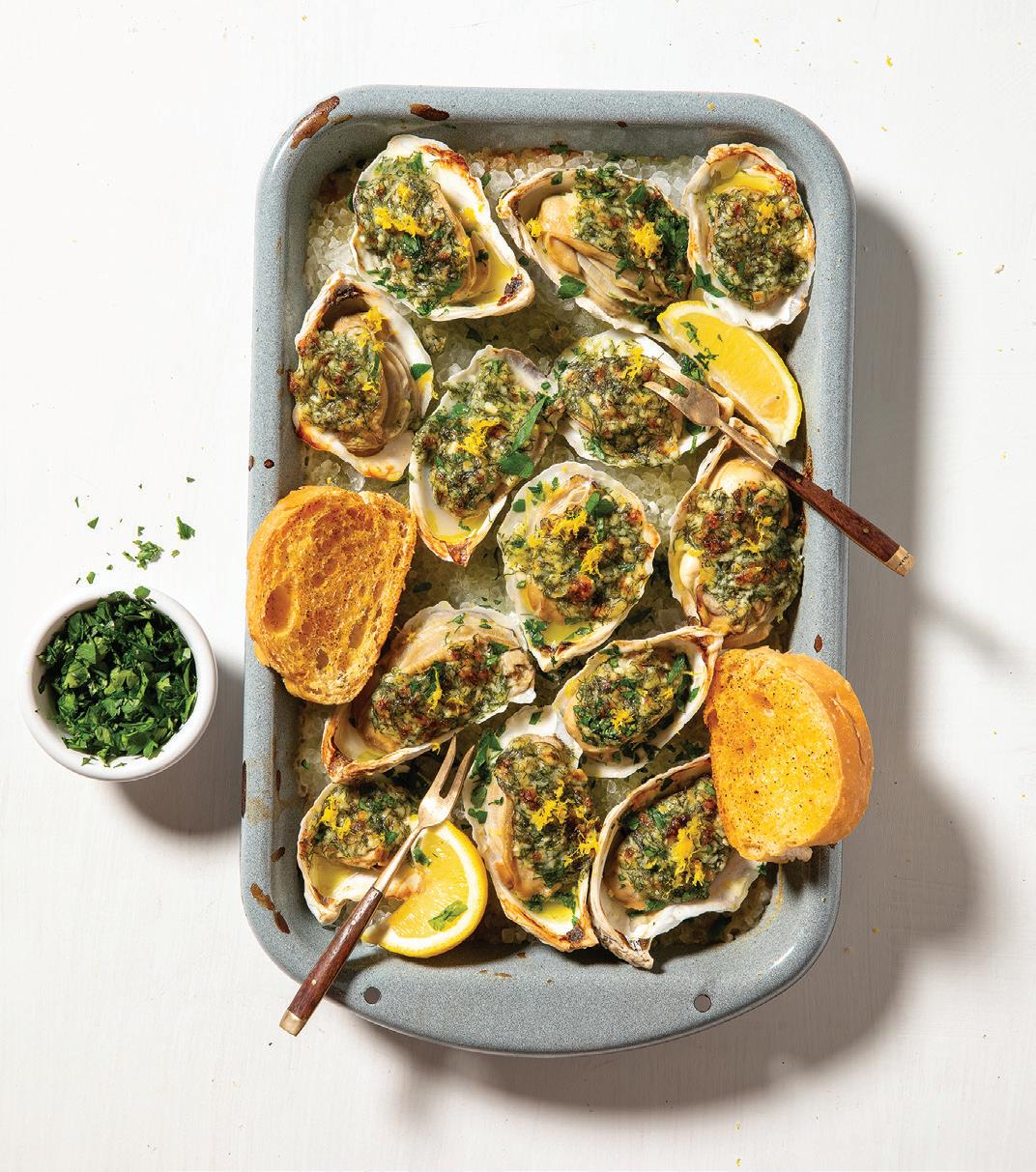
Broiled Oysters
1 tablespoon olive oil plus 5 tablespoons olive oil
1 pint raw oysters
3 or 4 cloves garlic, finely minced
- cup finely chopped fennel fronds
, cup grated Parmesan cheese
Zest of 1 large or 2 small lemons
- cup chopped parsley for garnish
. . PREHEAT broiler. Place one tablespoon of olive oil in a faux oyster shell or ramekin. With a pastry brush, brush the inside of the 12 oyster containers with oil so the oysters don’t stick. Then place one oyster in each faux shell. Place the shells on a cookie sheet. (You may end up with fewer than or more than 12 oysters unless you actually buy 12 oysters.)
2 . IN A BOWL add the liquid from the oysters, the 5 tablespoons of additional oil, (you can use butter, but if you do, roast the oysters in the oven and don’t broil them or the butter might burn), garlic, fennel, cheese and lemon zest. Mix well until the mixture is uniform. Divide the mixture into 12 and spread over the oysters.
3 . PLACE the cookie sheet into the broiler for 5 minutes. Check the oysters. The liquid should be bubbling and the cheese browning. If the cheese isn’t browning, return to the broiler for up to 2 more minutes. Check again. You will see the oysters begin to curl on the ends.
4 . REMOVE from the oven and garnish with parsley. Serve immediately.
Japanese Plum (Misbeliefs) Jam
Be sure to use unbruised fruit. And don’t use bottled lemon juice with any preservatives. The preservatives will interfere with the pectin in the lemon juice. Use freshly squeezed lemon juice instead.
5 , pounds fresh, washed and pitted Japanese plums
1/4 cup fresh lemon juice
1/4 cup water
4 pounds granulated sugar 5 tablespoons grated fresh ginger
. . PLACE a saucer in the freezer. Place the fruit and lemon juice with up to ¼ cup water in a pot. Add the lemon skins with the pulp, but without the seeds. Stir. Cook covered, on a very low flame for about 15 minutes. That will cause the fruit to give up its juices and the liquid will begin to simmer.
2 . ADD the sugar and stir. Cook about 20 minutes. Make sure that all of the sugar dissolves. Do not overcook.
3 . CHECK for the set point. Put about a tablespoon of the liquid from the pot onto the plate that has been in the freezer. Wait a minute, then push the edge of the puddle of sugar to the middle. If it remains folded up, it is done. If it immediately repuddles, cook it up to 5 more minutes and try again. Remove the lemon skins.
4 . PLACE in clean jars and place the lids on the jars. You can process the jam or do what I do. I just place it in the refrigerator to eat and give away to friends.
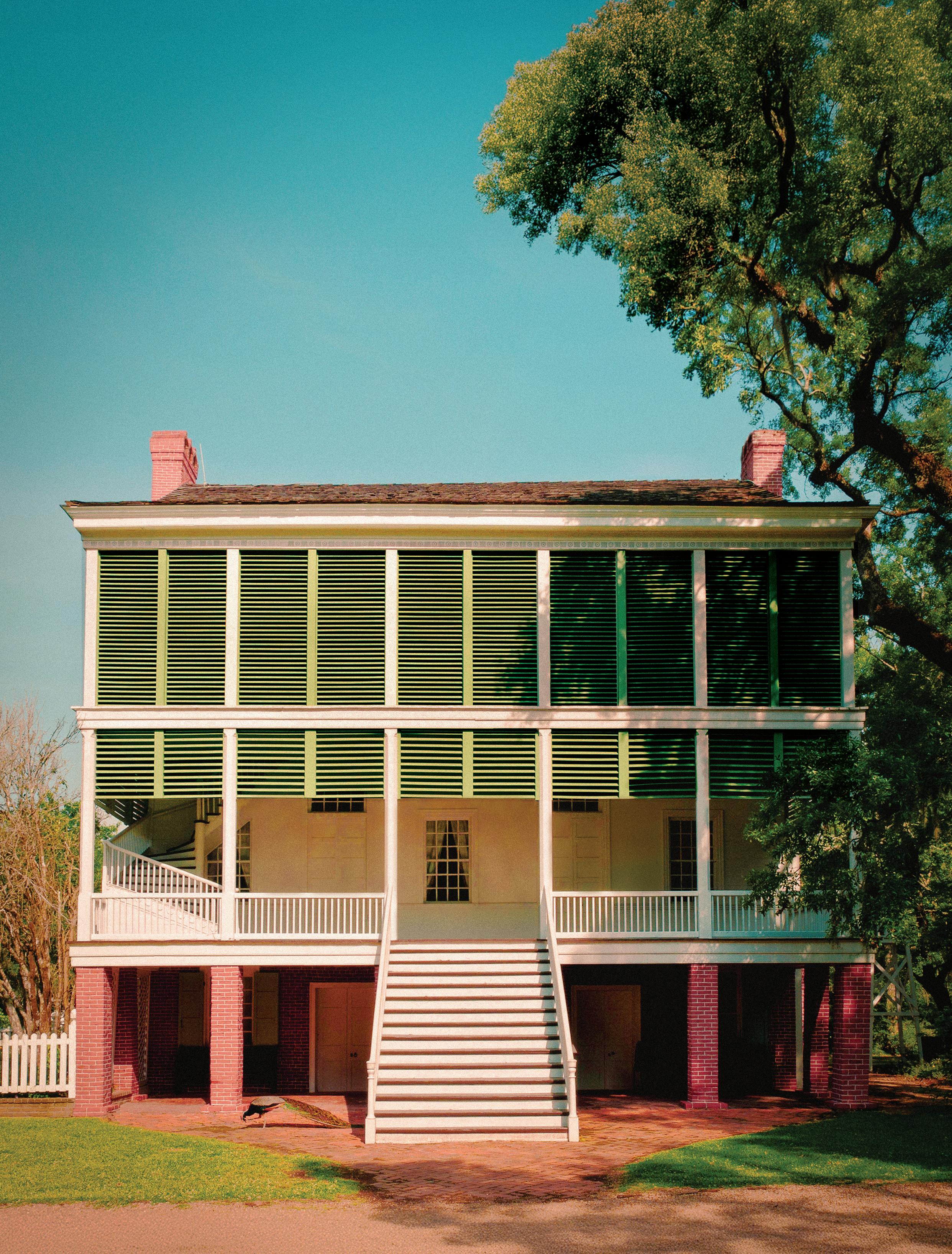
A Quiet Transformation at Oakley Seeks to Return the Landscape to the Richness Audubon First Encountered
STORY AND SELECT PHOTOS BY KEVIN RABALAIS

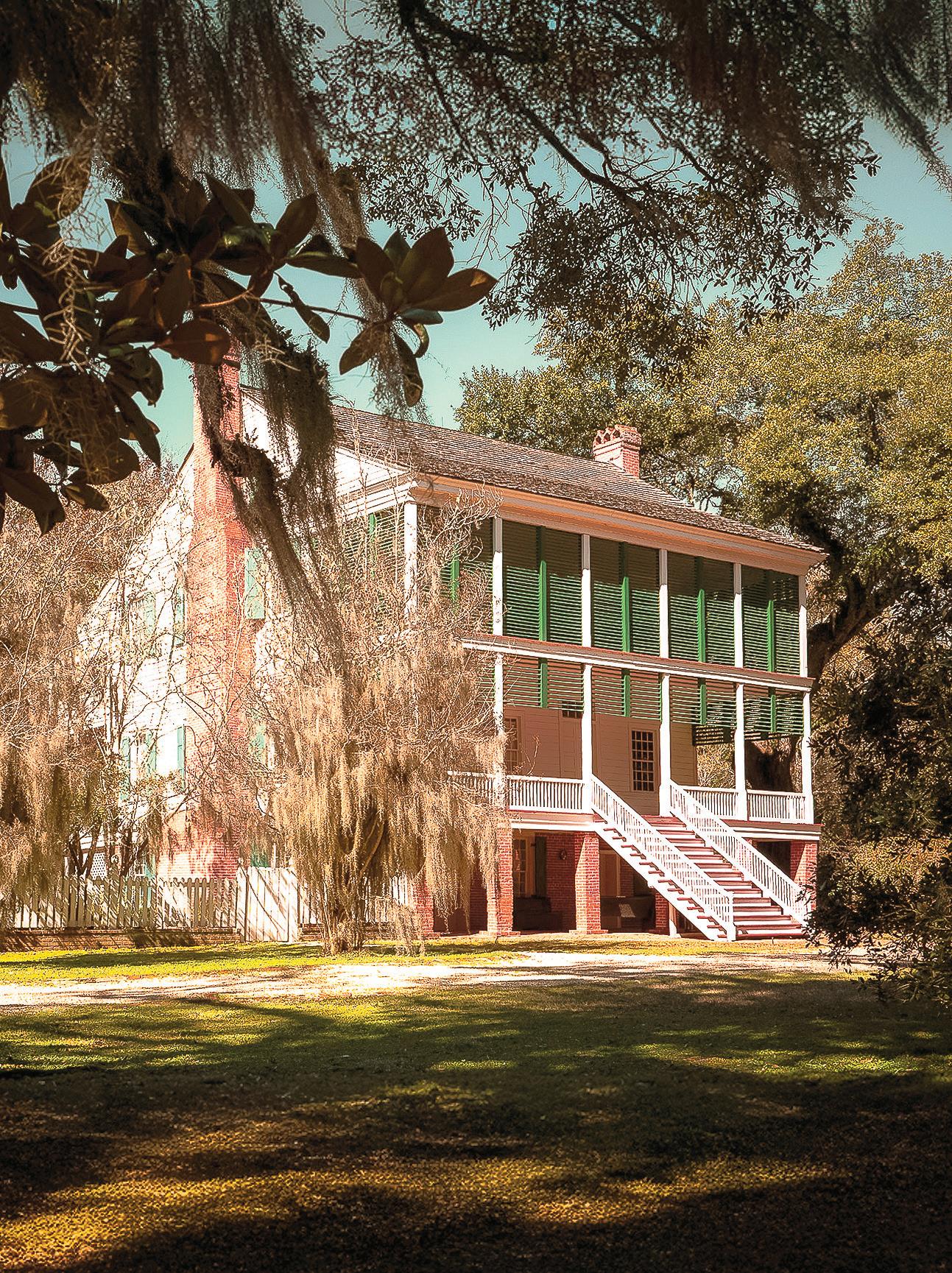
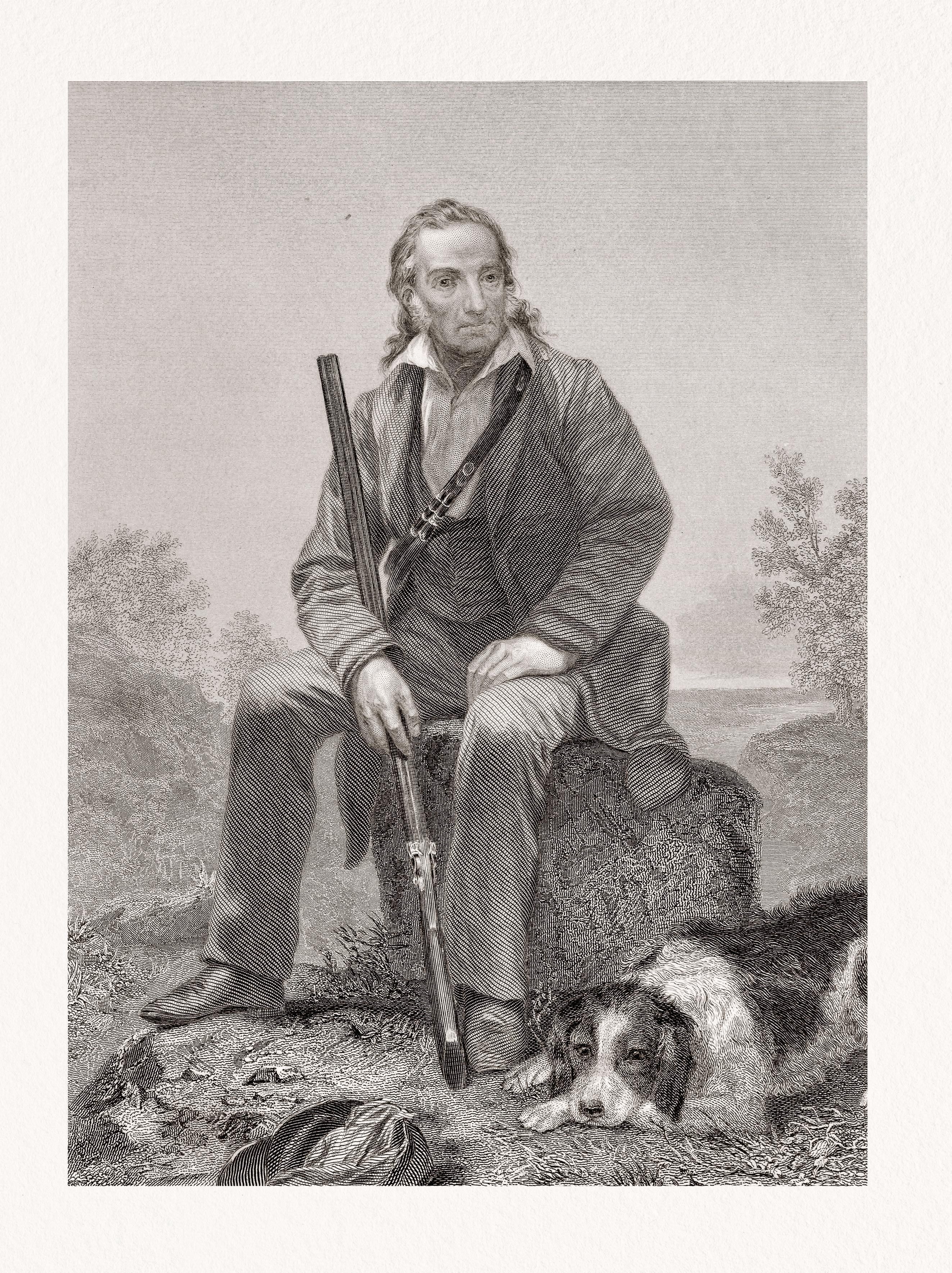
T-. /ooks pr.c.d. -.r. In her hands, they teeter, a miniscule leaning library of Pisa. Entering the Visitor Center at Audubon State Historic Site, six miles east of St. Francisville, Ann Reiley Jones stops to banter with the sta! before stepping into the conference room. There, she lets the books cascade onto a table. Directly above the freshly disordered pile, a small plaque details a few plot points in the epic life of John James Audubon, the Saint Domingue-born ornithologist and painter whose artistic vision ignited during the four months in $8($ when he lived at Oakley Plantation, less than $00 yards away.
“He was America’s greatest naturalist of the $9th century,” says Jones, chairperson of the Friends of Oakley, a group whose mission includes the preservation and restoration of the site that in $9&6 became a state park. More than (00 years after he lived here, Audubon’s presence lingers. It’s in the signage throughout the site named in his honor, of course, also in a life-sized reproduction, complete with signature frontiersman clothing, that presides over the museum. It’s also in the history that guests from around the world seek to unlock as they stroll through the $00 acres of property grounds, the very terrain Audubon traversed.
“He called it his happy land,” says site manager Daniel Wilcox.
“Feliciana,” says architect James Dart, a Friends of Oakley board member whose mother founded the organization. “That’s what it means in Spanish.”
O cially, Audubon came to Oakley, a cotton plantation at the time, to tutor the owners’ daughter. “Of course, he painted birds,” Jones says. “And he wandered.” The region’s landscape provided him with new ways of seeing. Arriving from New Orleans on June $8, $8($, Audubon recorded his first impressions in his journal,
long considered a landmark of environmental literature. “Such an entire change in the face of nature, in so short a time, seems almost supernatural,” he wrote. “The rich magnolias covered with fragrant blossoms, the holly, the beech, the tall yellow poplar, the hilly ground and even the red clay, all excited my admiration.”
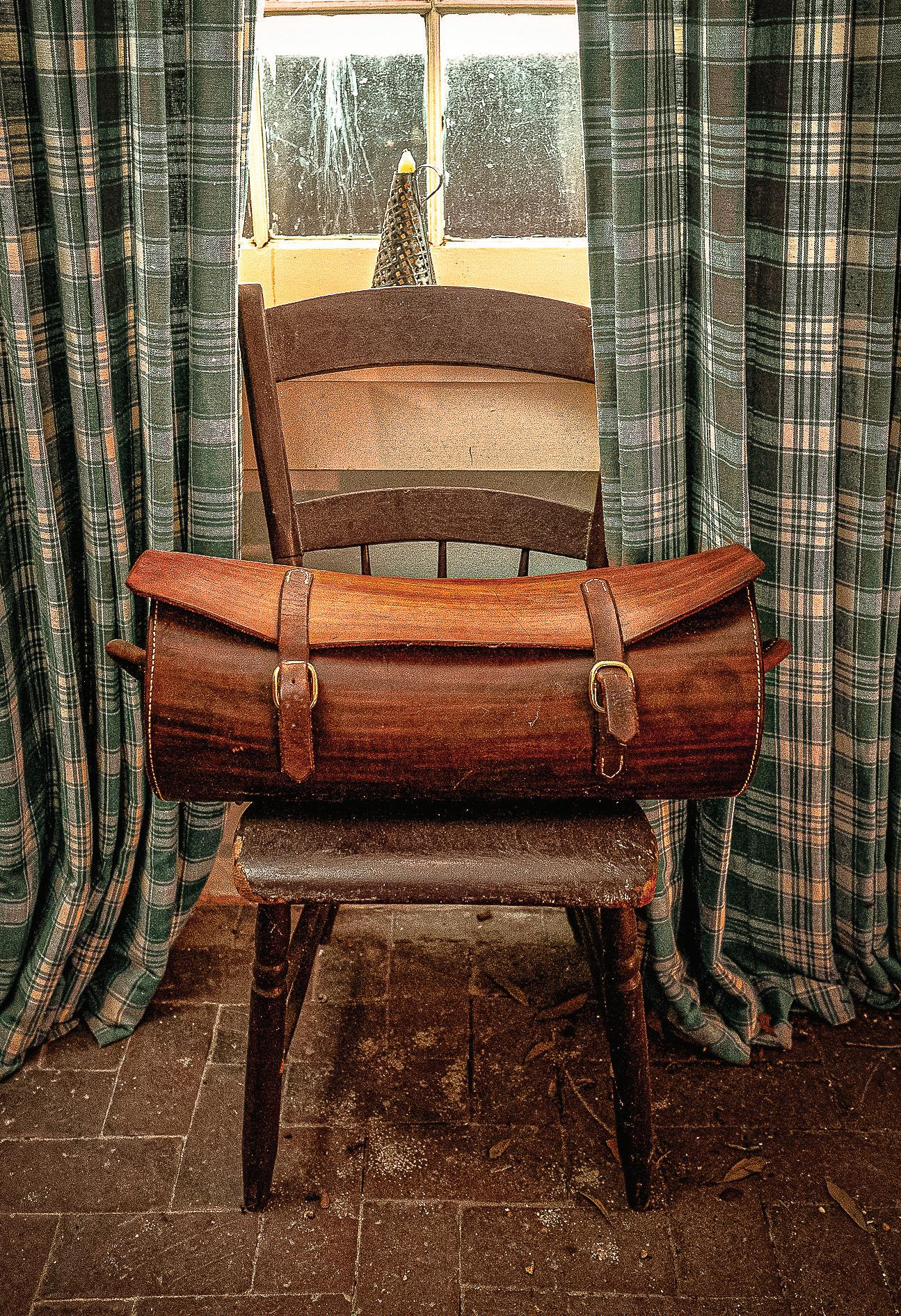
ABOVE Audubon used a specimen bag similar to this reproduction to transport birds and foliage from the field to his study.
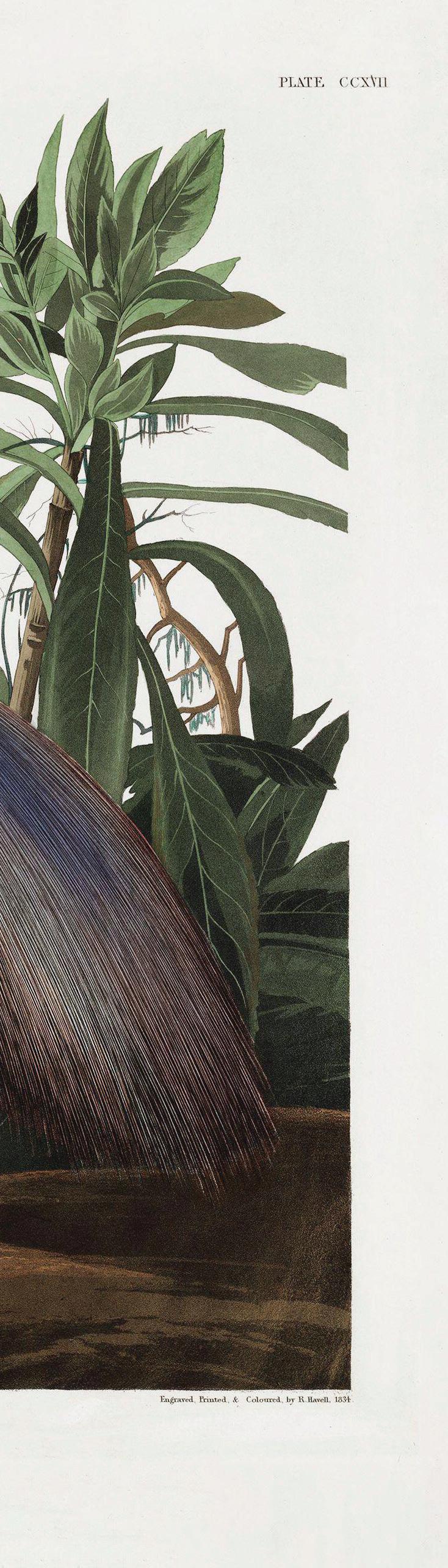
RIGHT About Audubon’s paintings, Friends of Oakley board member James Dart says, “He’s one of the first to put these creatures into context and be meticulous about it.”
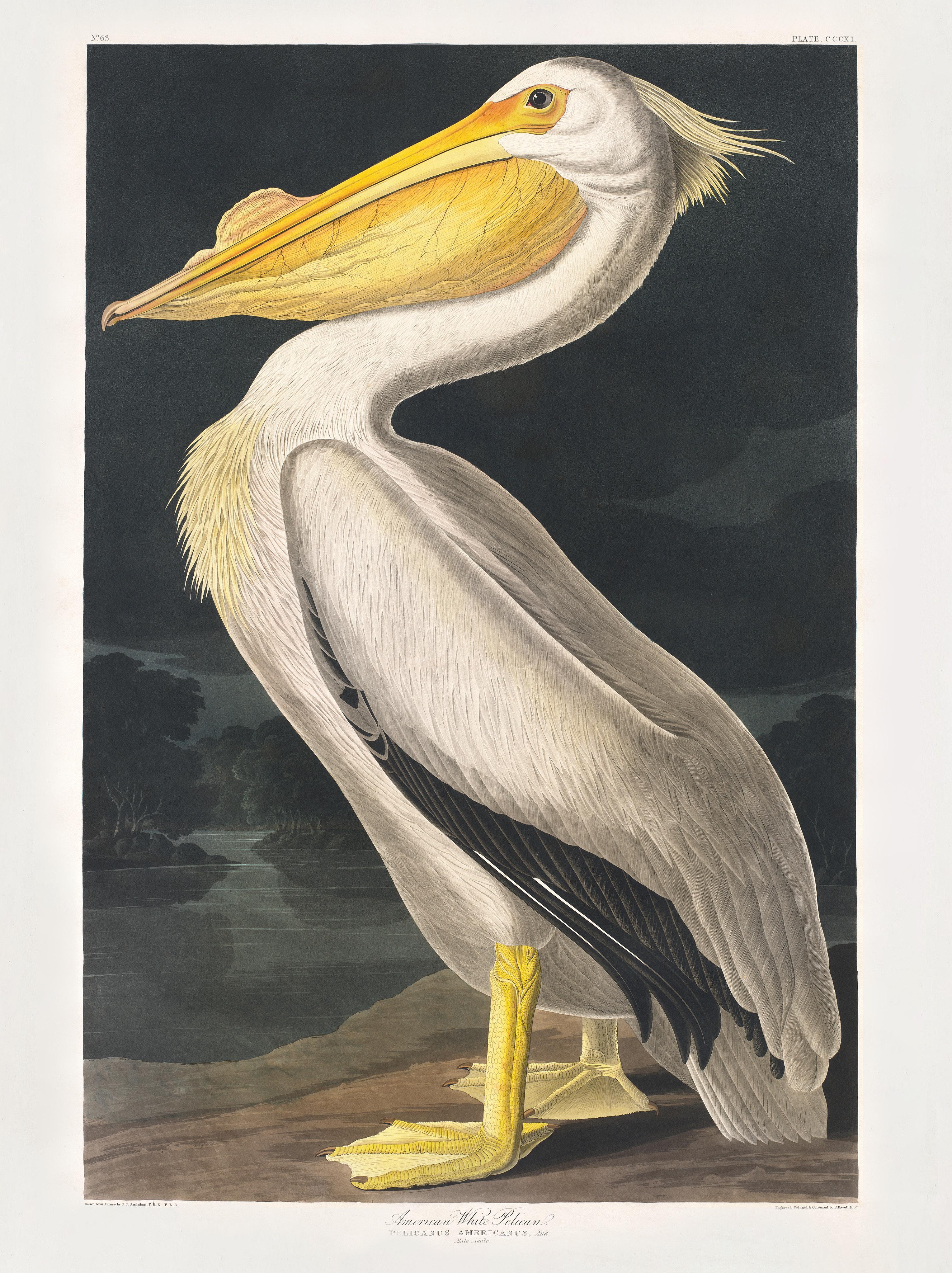
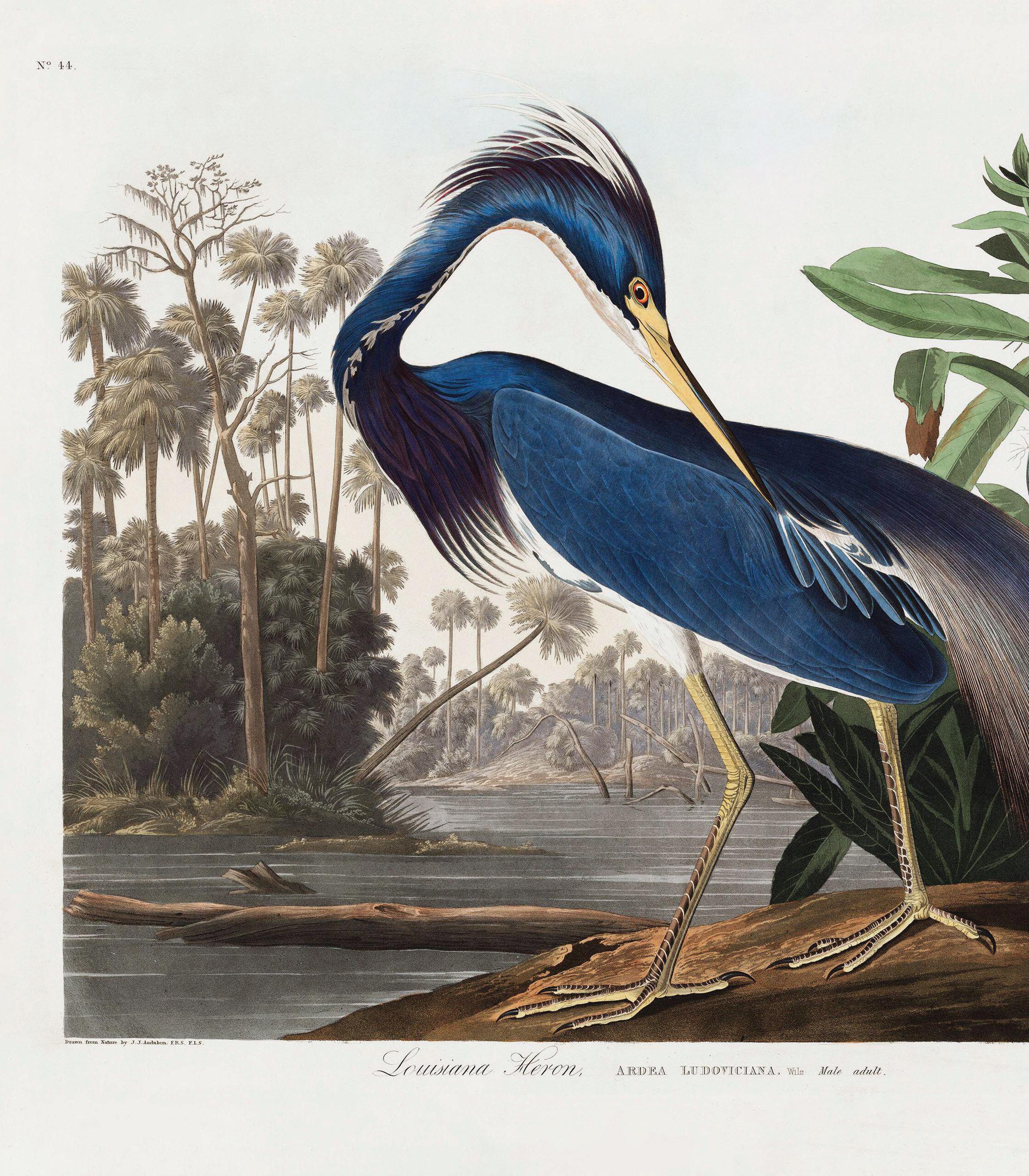
Beginning in $8(0, Audubon spent nearly (0 years traveling across North America to work on his monumental “The Birds of America” project. The book’s 4)& illustrations catalogue the continent’s birds, some now extinct, such as the great auk, the Carolina parakeet and the Labrador duck. We know about his methods. They start as you would expect, with Audubon venturing into the wild to study and sketch specimens. Next comes the detail that stings. After those initial sketches, Audubon shot the birds so he could later examine them more closely. He elicited advice about local fauna from Native Americans and enslaved people. He also enslaved at least nine people. “He mostly referred to them as ‘servants’ and ‘hands,’ but never seemed especially concerned that people helping him could be bought, sold, raped, whipped, or killed on a whim,” writes J. Drew Lanham in his Audubon magazine article “What Do We Do About John James Audubon?”
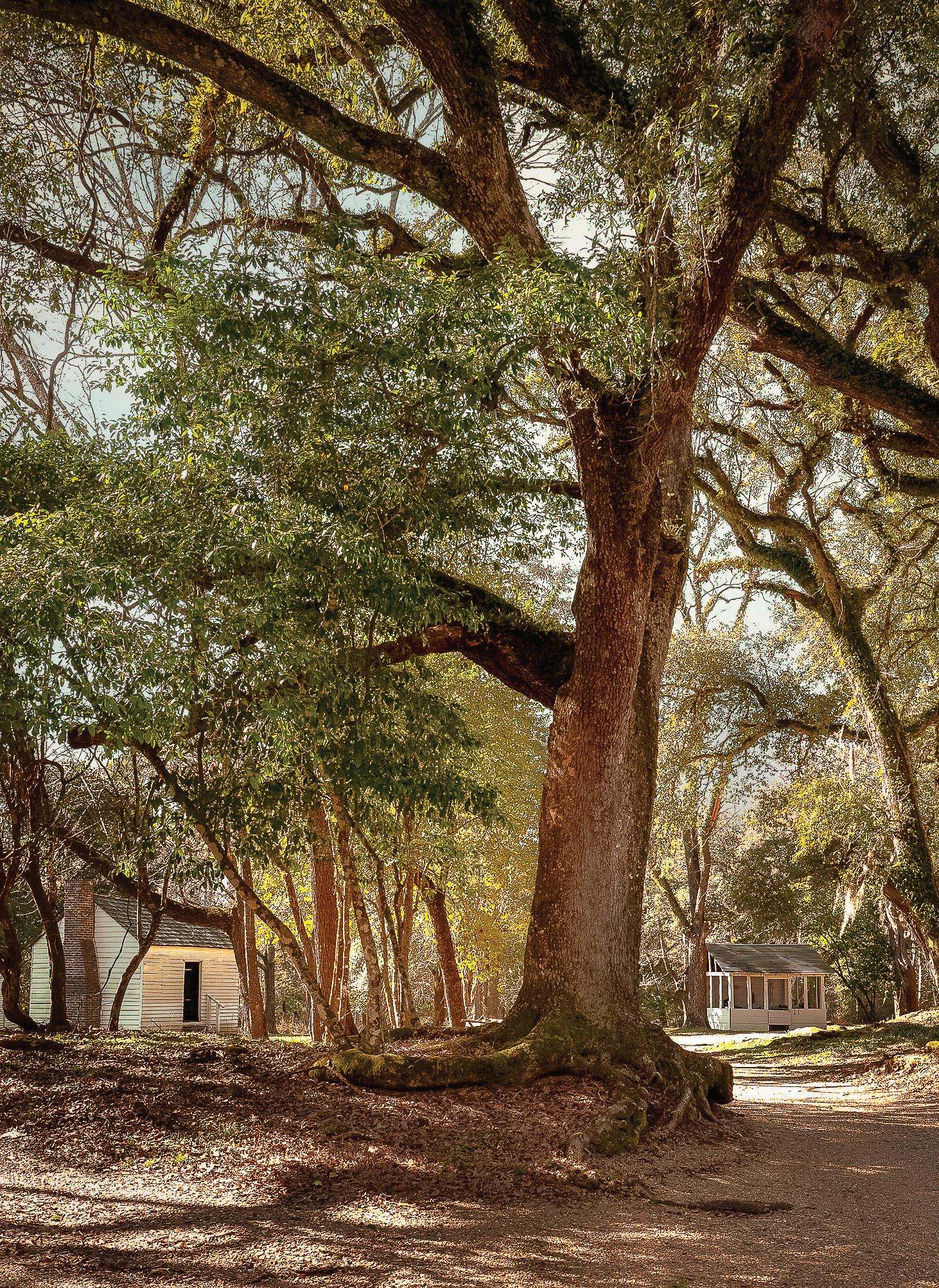
From sites around Oakley, Audubon and his apprentice Joseph Mason, aged roughly $( or $), collected foliage to render the native environment. Returning to their quarters, Mason illustrated the flora while Audubon put his taxidermy skills to practice. He then posed and painted the birds in life-size detail. Visitors to Oakley can step inside their reproduced quarters on the ground floor of the main house. The space includes two beds, a desk, cabinet and specimen bag. It’s one thing to see an original painting, another to encounter the place where the artist lived and worked, slept and dreamed. At Oakley, the visitor can do both.
“He’s the crown selling point for us,” says Jones. From the books on the table, she looks up at Audubon’s prints, original lithographs, nearly a complete set of the )( he painted during his time here. Even when reproduced as thumbnails on a computer screen, Audubon’s birds arrest a viewer’s attention. At )8 x (6 inches — the size of the originals that crowd the conference room walls—they carry a heightened charge. And that’s precisely what Audubon intended. Rather than reproductions of rigid, dead specimens, as artists had previously illustrated birds — “a manner he would find all too common in conventional ornithology,” as William Souder writes in “Under a Wild Sky: John James Audubon and the Making of ‘The Birds of America’” — he depicted each in natural poses. By doing so, he gave us new ways to comprehend the natural world.
The disordered books on the table are on a human scale. They’re not the double elephant folio of the original “The Birds of America” — a staggering four-and-a-half foot wingspan when open, or the length of the Statue of Liber-
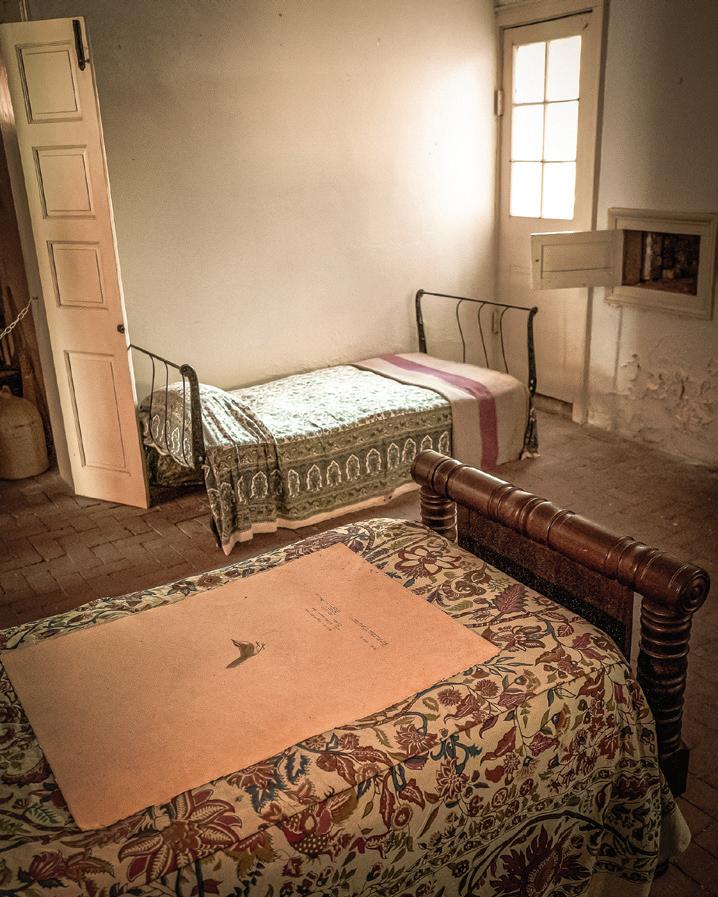
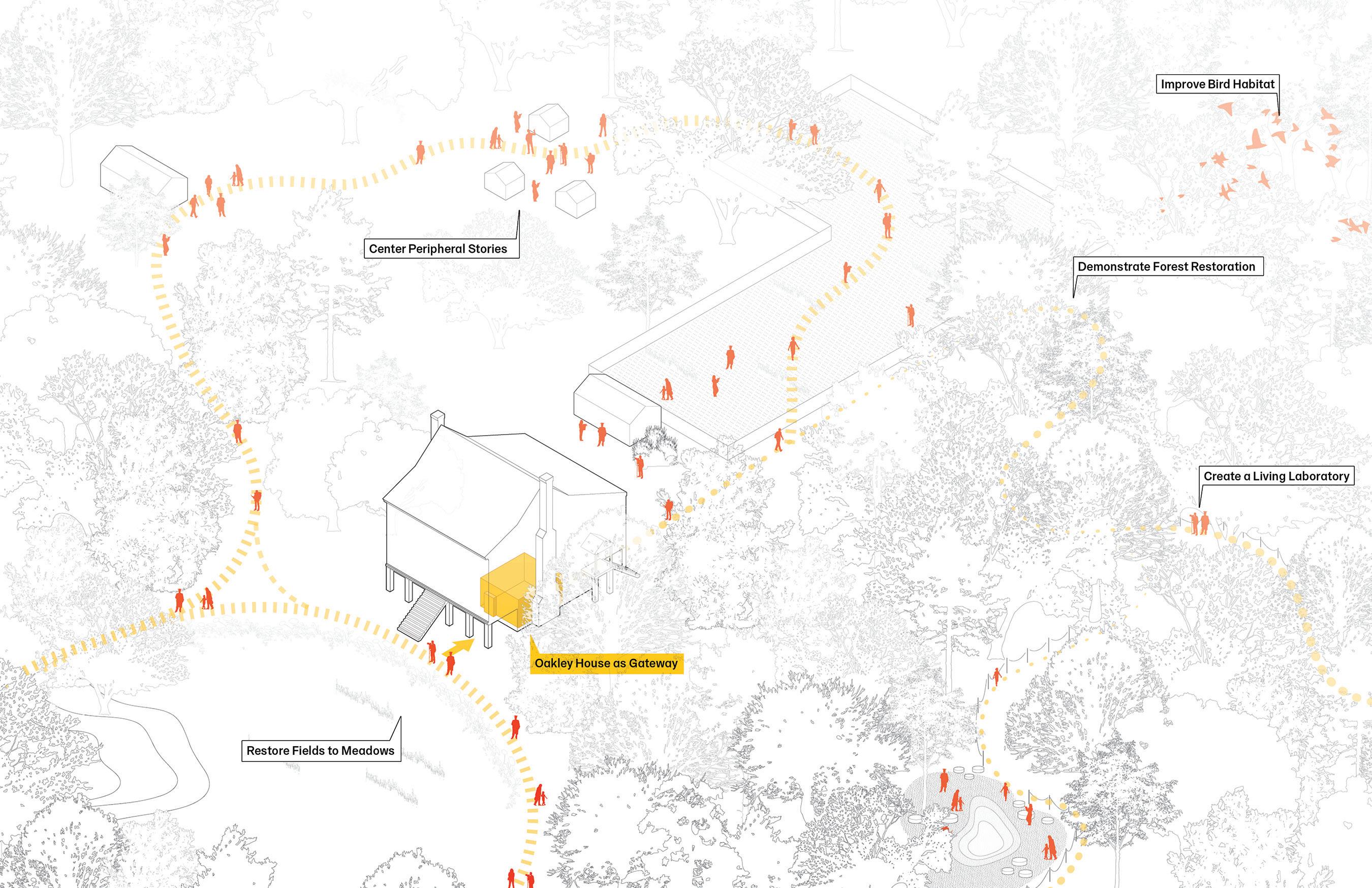
FACING PAGE Today, the grounds at Oakley cover 100 acres. TOP As part of its Vision Plan, Waggonner & Ball envision Oakley House as a gateway to an expanded Audubon Experience — foregrounding the site’s ecologically diverse landscape through restoration, enhanced access and stewardship. RIGHT While living at Oakley, Audubon worked and slept in a room on the ground floor of the main house.
ty’s nose. Friends of Oakley board member Joseph L. Boneno approaches the table and reads several titles: “Insects and Diseases of Trees in the South,” “A Management Guide for Invasive Plants in Southern Forests,” “Southern Hardwood Management.” They have nothing to do with Audubon — and yet. At Oakley, everything orbits the artist’s legacy.
With pressures of development in West Feliciana Parish threatening to endanger that legacy, the Friends of Oakley have engaged in an endeavor, at once urgent and endless, to protect the land. “There’s the house, the historical artifact that you can see and touch,” Dart says. “But there was willful disregard of the grounds from the beginning.” Some of this has to do with cotton, infamous for causing soil degradation, erosion and nutrient depletion.
As the land su !ered, so, too, did the house. From the beginning, Oakley’s owners were women, four generations in all. The last of them, Lucy Mathews, lived alone in the main house from $9)0 to $947. Dart describes the maintenance challenges: a four-story house with $7 rooms, its sole occupant a septuagenarian.
The Friends began asking questions: How do we preserve this land? How do we protect it? Another problem, in the wake of the global pandemic, involved a decline in annual visitors to Oakley while figures at Rosedown Plantation, less than two miles north of St. Francisville, continued to increase. All discussion led the Friends back to the same place: the four months when the artist lived here.
“He’s what distinguishes us from every other place,” says Jones. “There’s no question that he was deeply inspired by the landscape he roamed while living here.” In that inspiration, the Friends found the seed for their mission. Return the land to the virgin forest filled with beech and magnolia, poplar and oak, that Audubon knew and loved. With help from the cross-disciplinary architecture and environment practice Waggonner & Ball, they began working on a master plan.
“Restoring it to the era before Audubon situates the landscape over time,” Dart says. “And that is what makes this project unique. Nobody does this in the South. In European countries, yes, but not here.” The Friends understand the glacial process of this work, which they call a “$00-year mandate.” A century from now, they say, their legacy will reveal itself in every tree larger than two inches in diameter.
The titles of the books on the table contain the key to the first steps to this “forever project.” To begin, they must eliminate invasive species, including vines, shrubs, and trees that impair the forest’s long-term sustainability. “We need to identify the trees we can leave standing,” says Jones. “Having a storm come through to knock
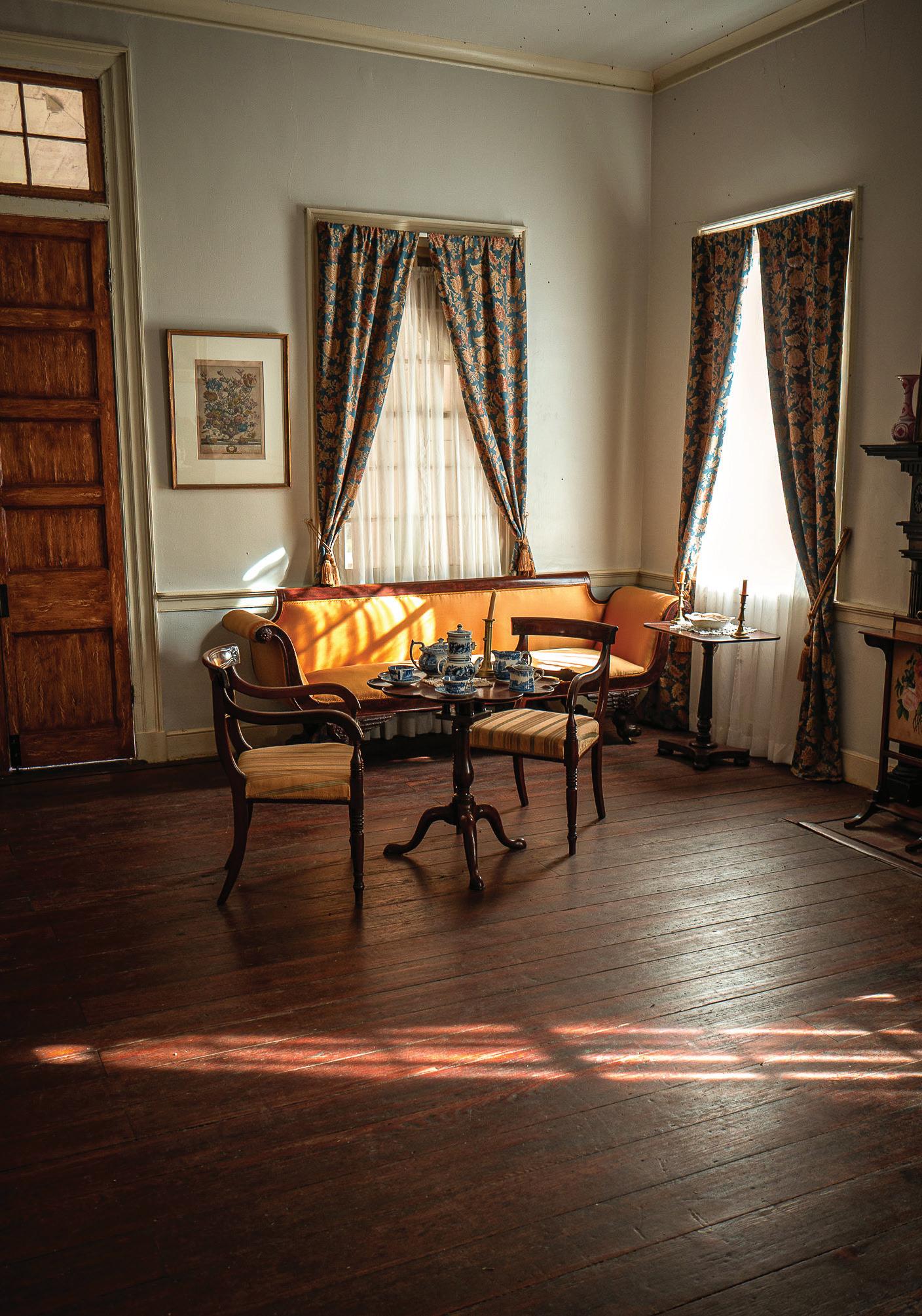
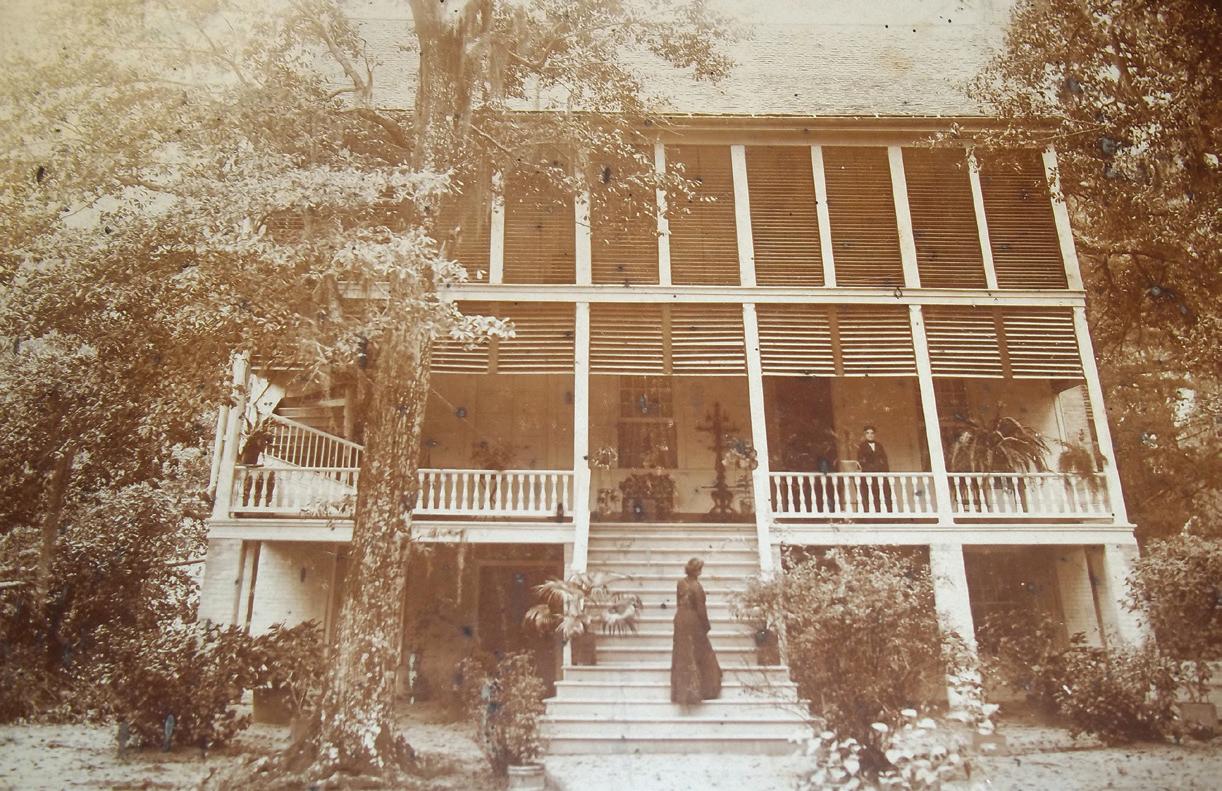
ABOVE Four generations of women owned Oakley Plantation. Today, visitors can explore its restored interiors. RIGHT While working on “The Birds of America,” Audubon painted more than 400 distinct species to scale. All told, he painted more than half of North America’s native birds.
down invasives wouldn’t be a bad thing, but if that doesn’t happen, we will just have to let the invasives fall.” Next comes the planting of native vegetation and hardwood trees, the creation of new wetlands and enhancement of existing ones, also the restoration of the site’s meadow and savanna.

LEFT Rather than reproduce rigid, dead specimens, Audubon combined his taxidermy and artistic skills to present his birds in dynamic, natural poses.
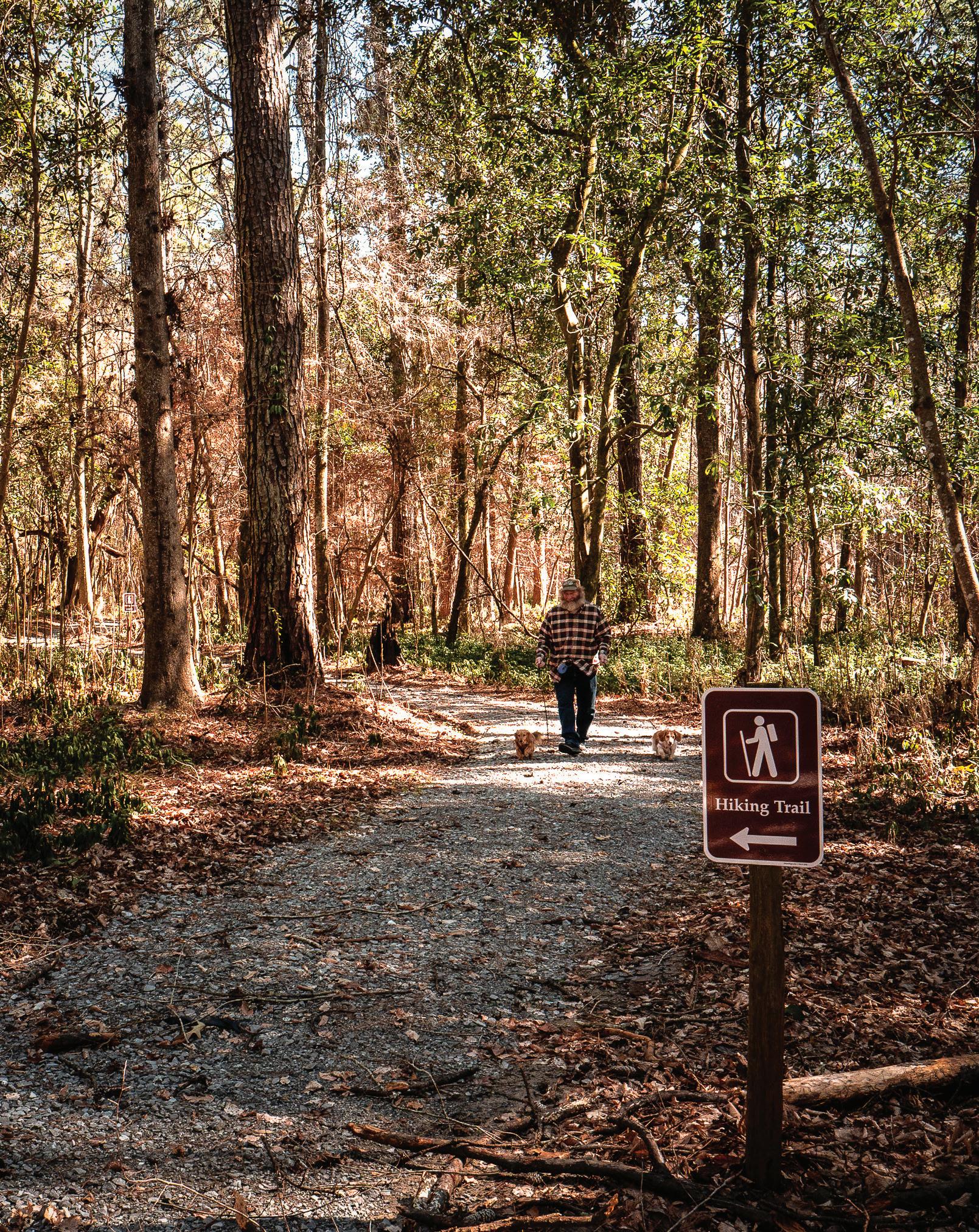
RIGHT A one-mile nature trail winds through Oakley’s 100 -acre grounds.
At t-. W:;;onn.r & o??ic.s in New Orleans, Sophie Riedel and John Kleinschmidt ponder their plans to “amplify the Audubon experience” at Oakley. “There is a quest for authenticity that is never as straightforward as one hopes,” Kleinschmidt says. “Can we bring the landscape up to the attention that’s been paid to the architecture?”
Riedel leans forward. “There’s a productive tension to recreate what it was like when Audubon lived at Oakley,” she says. “If we’re going to do anything to the landscape, how can we make sure it’s sustained over time? How do you make the most out of the visitor’s experience? How do you weave artifacts you find or learn about into the experience and make them part of the exploration of the site?”
The key to doing so often resides in old maps, Kleinschmidt says. In Audubon’s case, he found it in writing. “Audubon wrote a journal entry about woodpeckers that would hop up bricks in the room at Oakley,” Kleinschmidt says. He captured two red-cockaded woodpeckers, bringing one back to his
room, where he placed it in a wooden cage. The woodpecker escaped and scaled the bare brick wall.
“The snippet of the woodpecker goes straight into our work,” Riedel says. On a professional level, Audubon’s journal entry riveted Riedel. It revealed details about the original walls in Audubon’s room. On a personal level, she decided to design her Halloween costume around Audubon, stepping out as the artist, with a woodpecker perched on the brim of her hat.
“When architects preserve a building, few people get to visit the construction site,” Kleinschmidt says. “More often, things happen behind a curtain, with the unveiling only after years of planning, production and work. But landscape changes over time. It becomes this dynamic, evolving place.”
“Rarely does a building evolve like a landscape does,” Riedel says, noting that returning visitors to Oakley will be able to witness gradual changes to the grounds.
Single-minded in their mission, the Friends of Oakley remain certain and patient. “The refocusing and revitalization of hardwood forest, the removal of invasive species — to bring this land back to the precolonial era would be a service to Audubon, the legacy of naturalists and for the next generation,” Wilcox says. Jones, who is 8(, agrees. “I won’t live to see the results of what we’re doing.” Her hope echoes that of Riedel and Kleinschmidt: this work will serve as a model for
other historic sites, and that enhancements at Oakley will pave the way for the site to become a National Historic Landmark.
Fitting for a place named after Audubon, these plans will also improve avian habitat. Along the one-mile hiking trail that starts behind the Visitor Center, a chorus of birdsong fills the air. Mockingbirds, cardinals and hooded warblers flutter through hickories and oak, sycamore and magnolia. You hear the song around the main house and other preserved structures, the cookhouse and cabins, the garden and barn. It’s there, constant, in the parking lot, where four male cardinals, ignoring their territorial tendencies, perch within $0 feet of one another to o!er a soft symphony, here on these grounds where Audubon became Audubon.
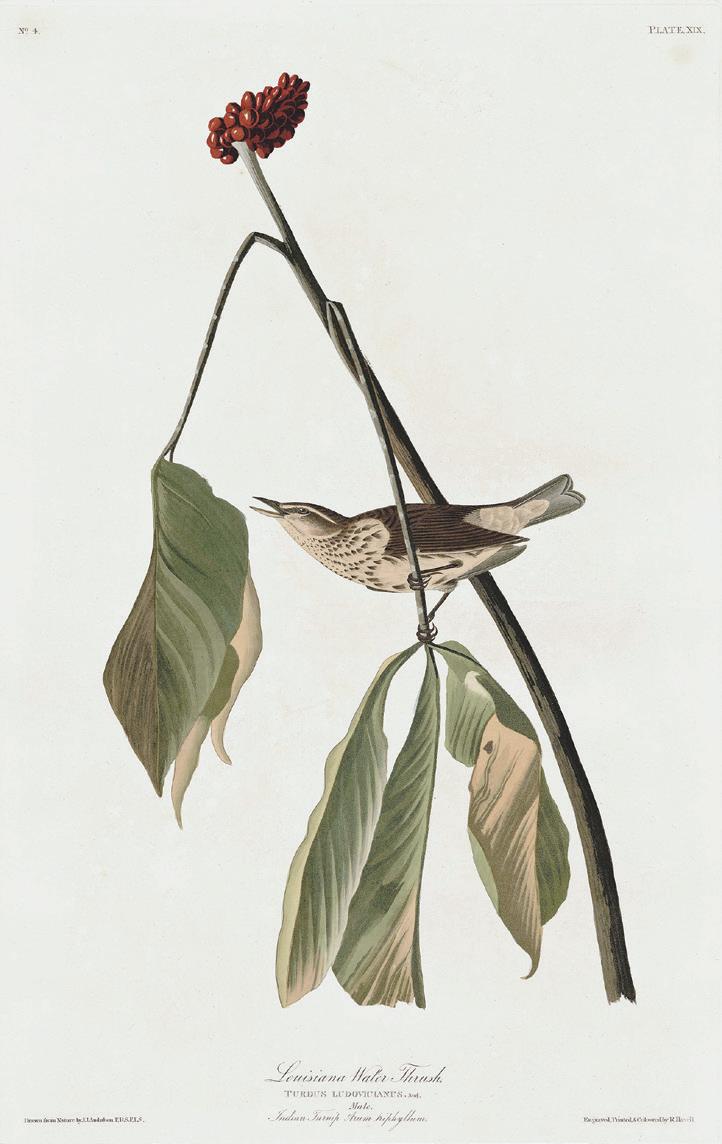
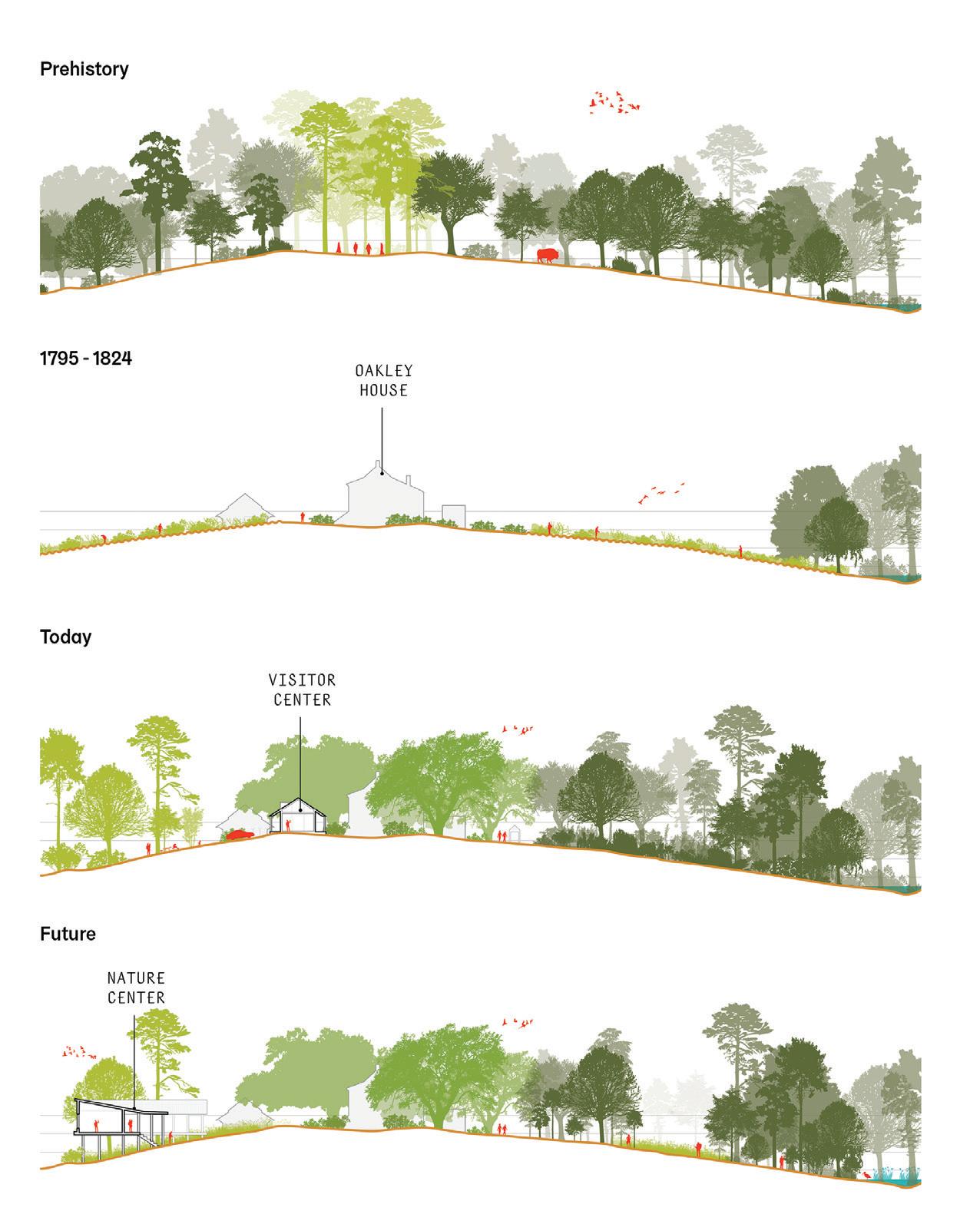
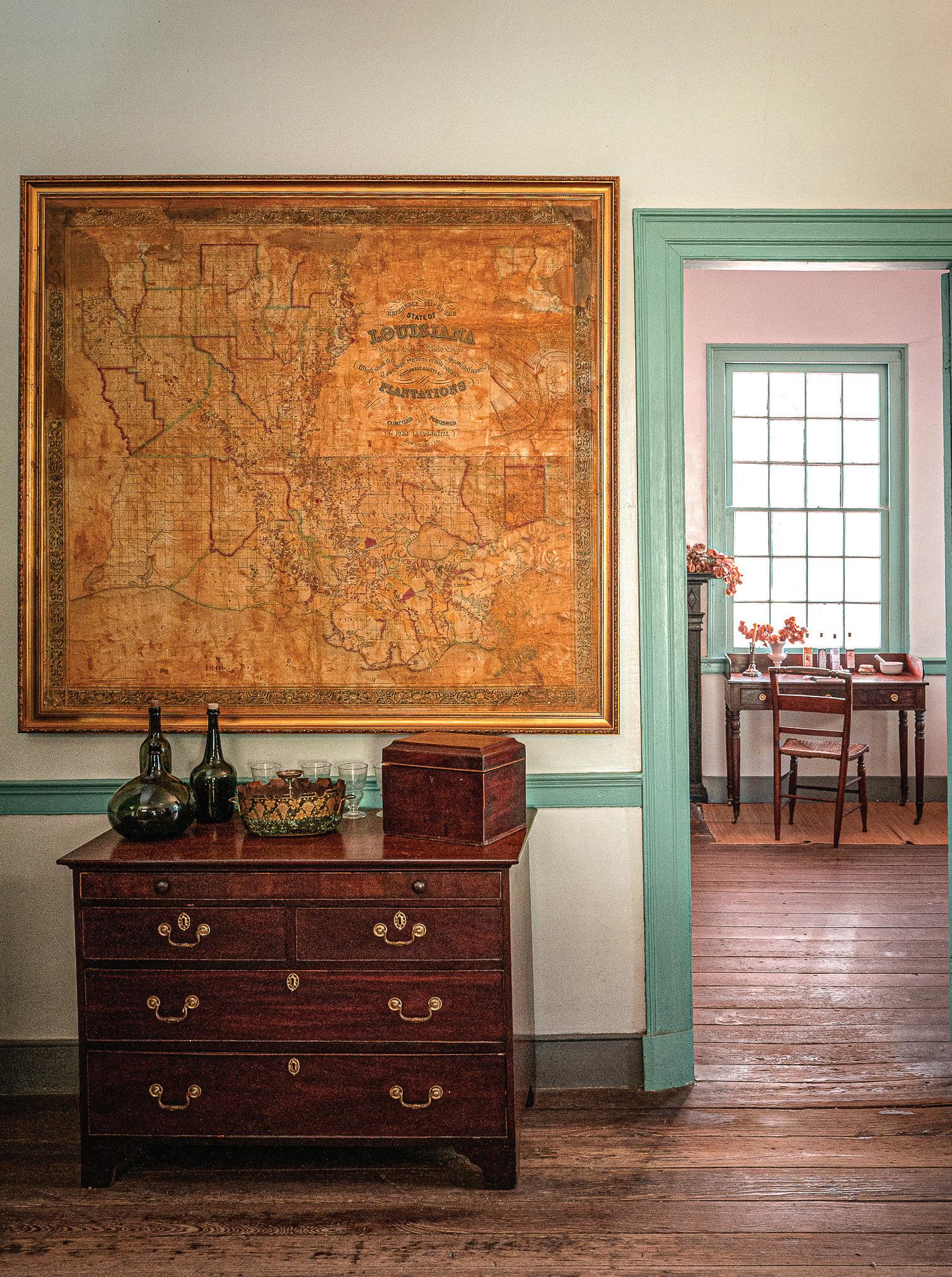
FACING PAGE Two copies of the 1&46 plantation census map are known to exist. One is at Oakley Plantation, the other at the Library of Congress. LEFT Illustration produced by Waggonner & Ball showing the land over time and the future plans. ABOVE To create his naturalistic paintings, Audubon would take foliage from the site where he sketched and shot specimens. His apprentices painted the foliage.
TAKE 20
A BUCKET LIST FOR LOUISIANA
20
THE UNIQUE DIVERSITY OF LOUISIANA, WITH ITS MELTING POT CULTURE, AMAZING CUISINE AND WILD NATURE, PROVIDES FOR ENDLESS EXPERIENCES. SO, WHETHER YOU CREATE BUCKET LISTS — THOSE EXPERIENCES YOU MUST HAVE BEFORE YOU DIE, OR KICK THE BUCKET — OR JUST NEED A HELPING HAND IN PLOTTING OUT NEW ADVENTURES, WE HAVE COMPILED A HANDY LIST. BY CHERÉ COEN
01
TAKE A SWAMP TOUR
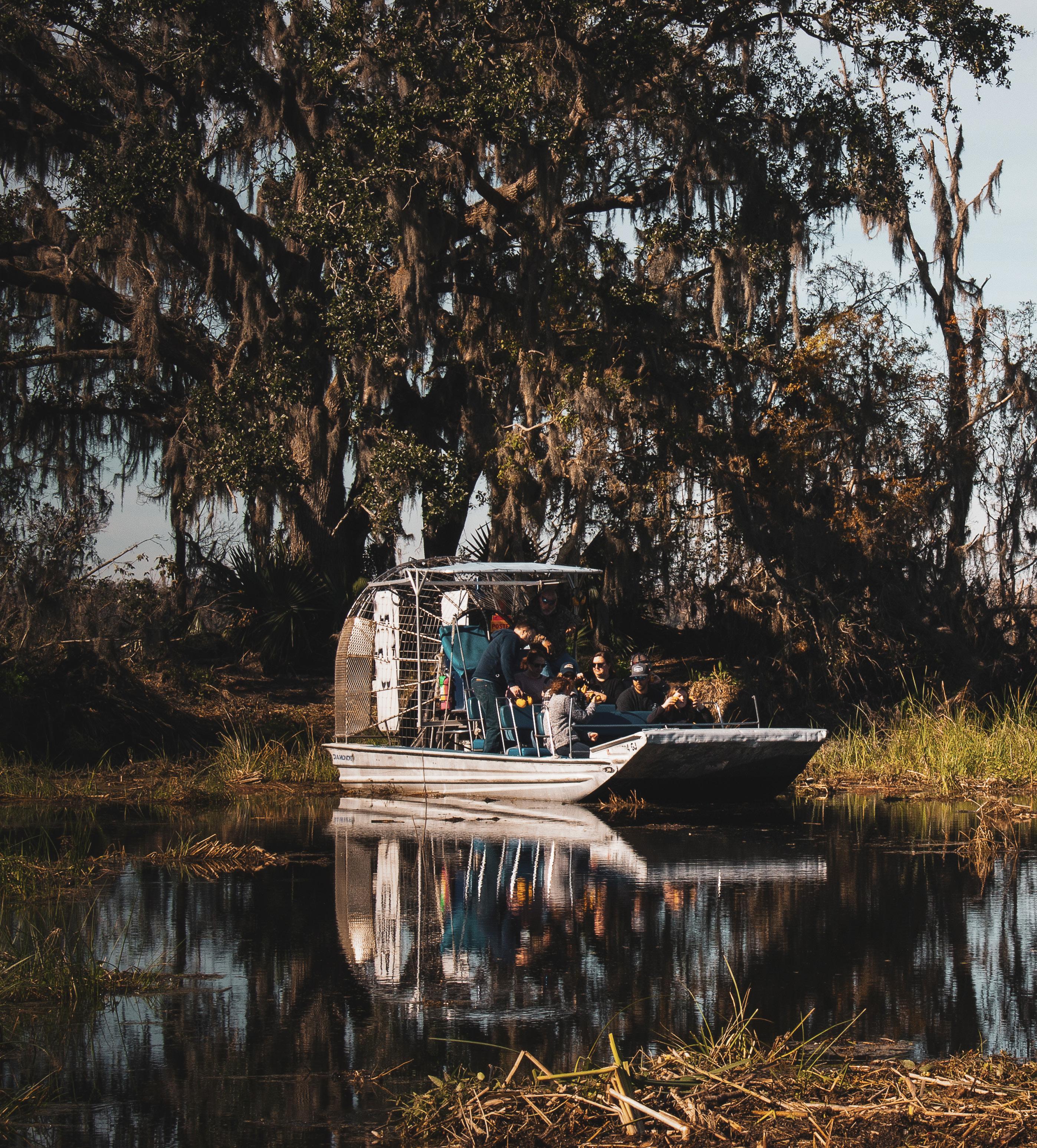
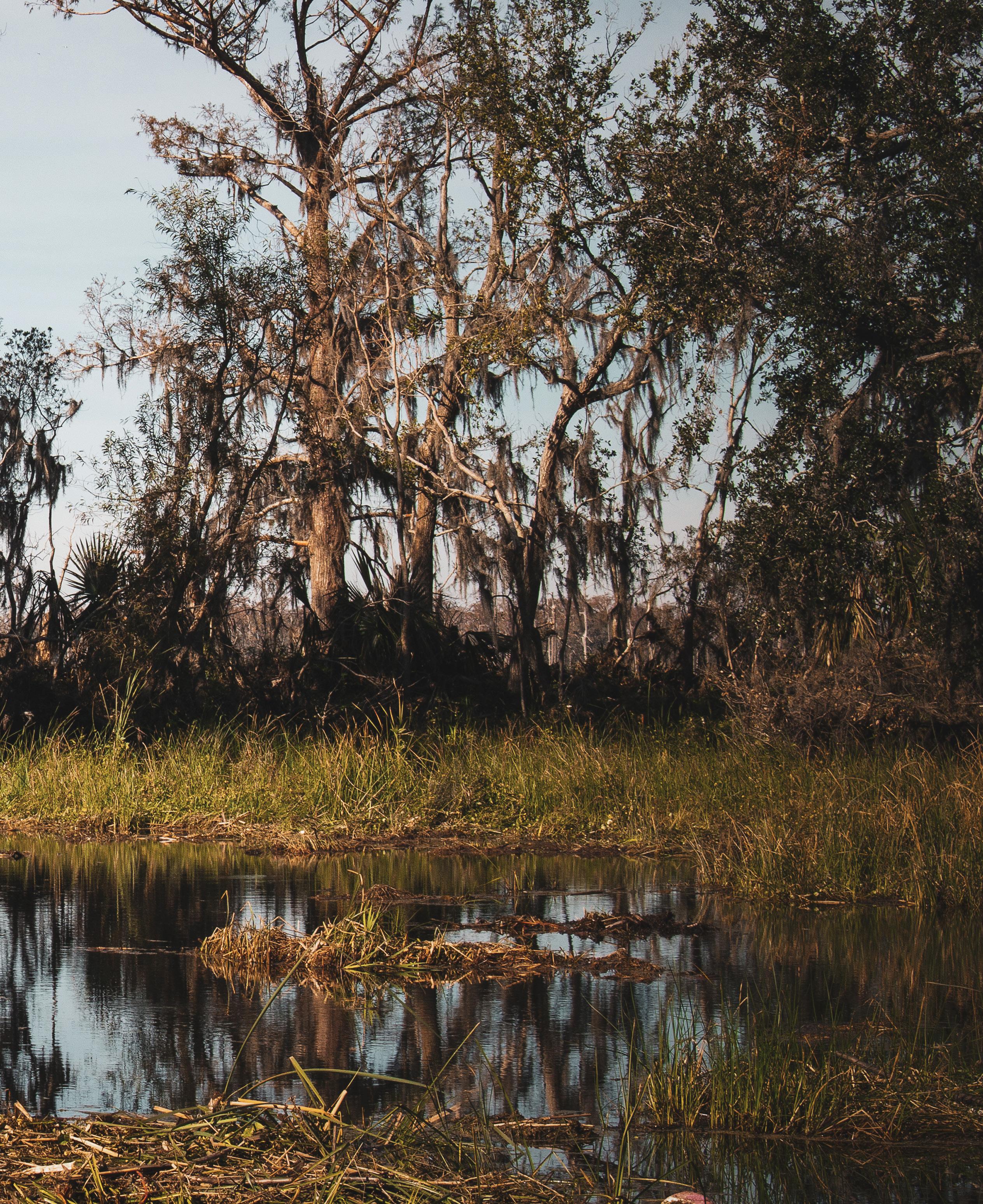
It’s so easy to enjoy the vast swamps and marshes of Louisiana, whether by a speedy airboat or something slow and nature-oriented. Swamp tours are available in the Atchafalaya Basin, Lake Martin near Lafayette and in the wetlands near Houma, Thibodaux and Morgan City. The parishes surrounding New Orleans offer tours as well, such as in the Honey Island Swamp and near LaPlace.
02
FISH AT TOLEDO BEND
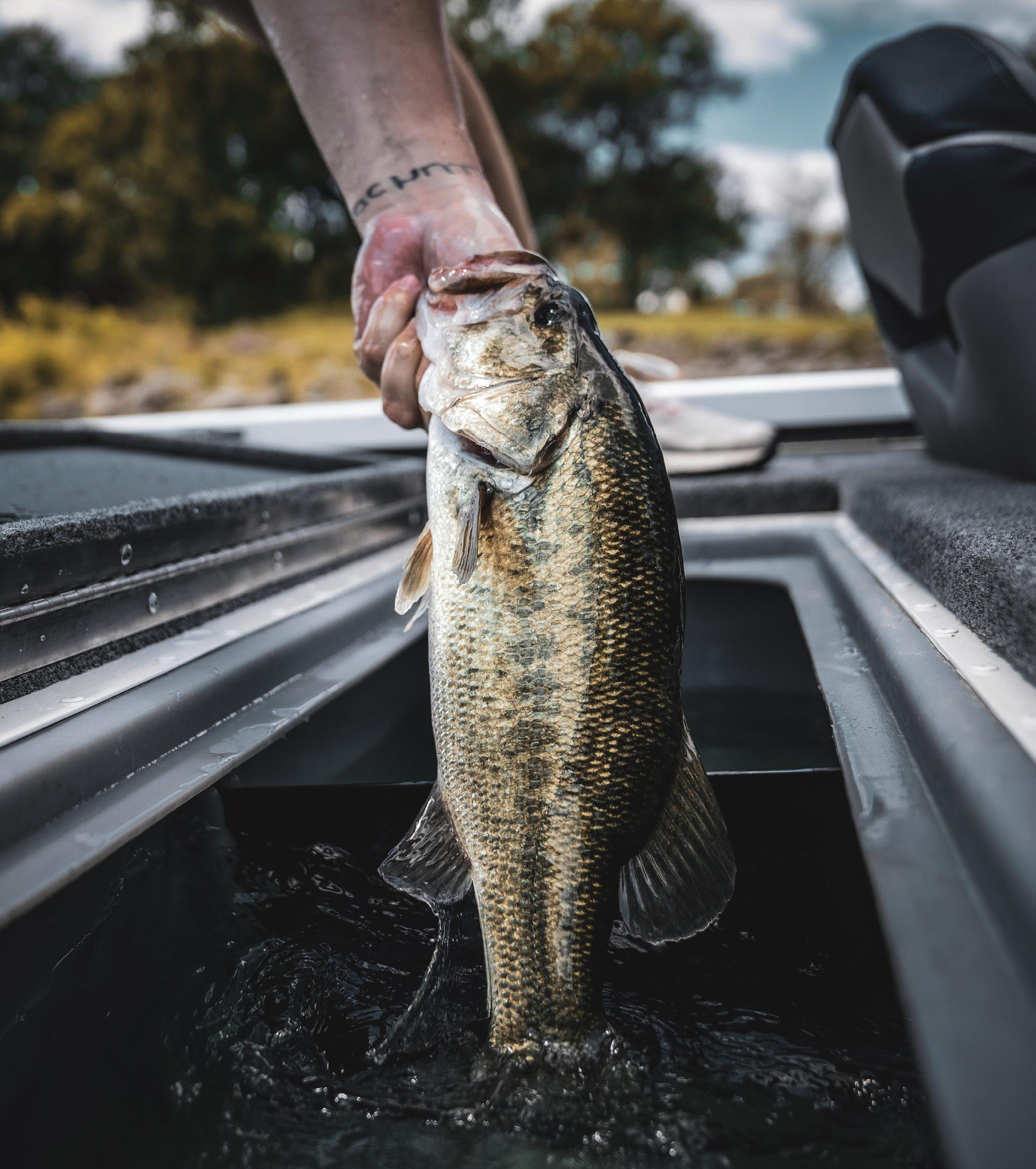
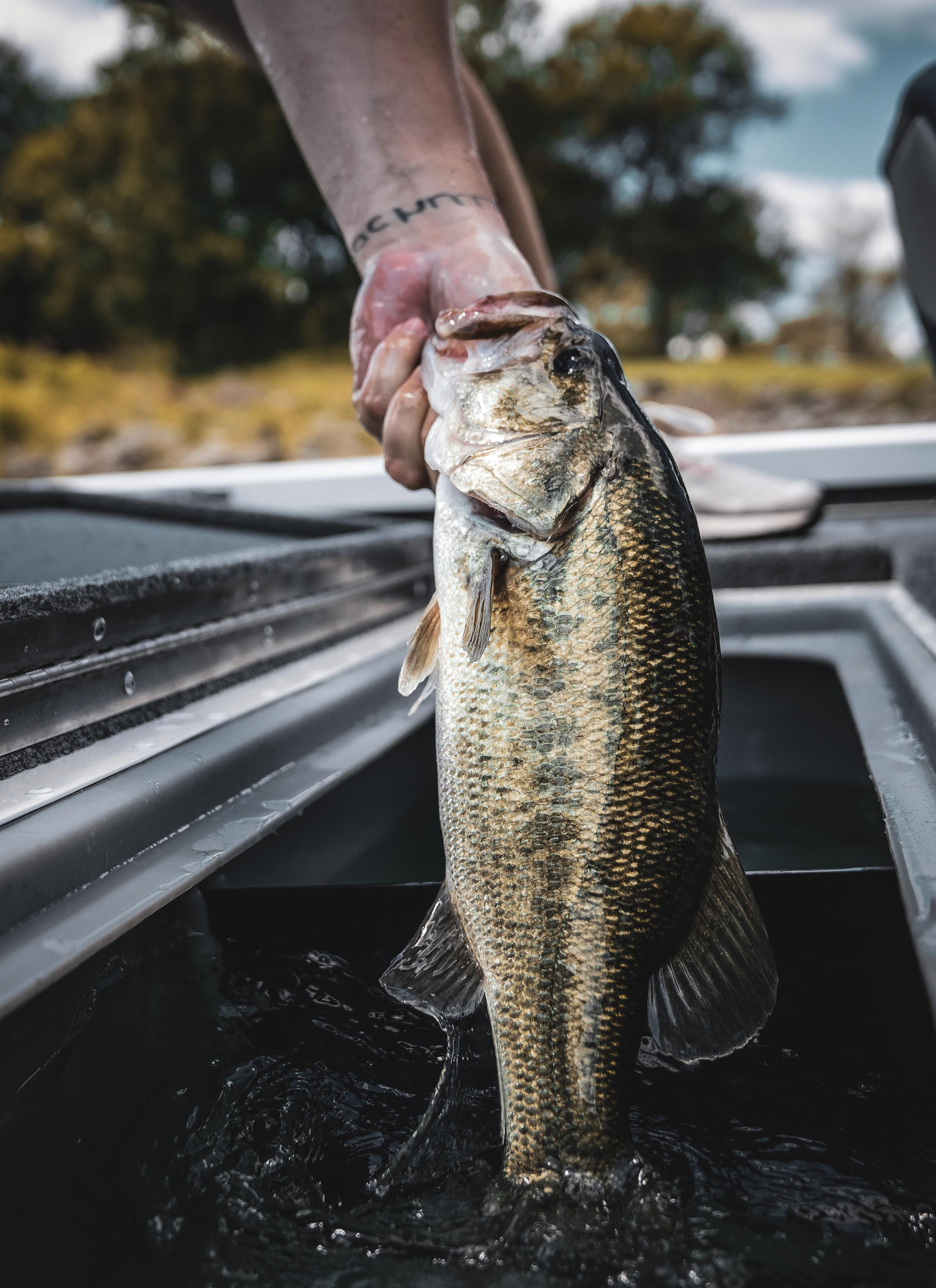
Farmers along the Sabine River in central Louisiana proposed a reservoir that would produce fresh water to both Louisiana and Texas. Each state put up funds for the construction of a dam and the project began. Only no one imagined the lake would fill as fast as it did in 1969, submerging 150,000 acres of timber land. But here’s the good news. Those stumps that line the 186,000-acre Toledo Bend provide ample spawning ground for bass and other fish species, why Toledo Bend hosts numerous fishing tournaments every year.
LOOK FOR PINKY
She’s a bit shy, or perhaps shunning the spotlight, but a rare albino pink dolphin swims the waters around Lake Charles. Places where folks have glimpsed “Pinky” are along the Creole Nature Trail, the Calcasieu River ship channel and surrounding waterways, swimming near the Cameron Ferry West Landing and in the Gulf of Mexico near Holly Beach.
04
GET ON THE WATER!
Black Bayou Lake National Wildlife Refuge outside Monroe is so named for the waters that form a 4,500-acre expanse of swamp, bottomland and upland hardwoods, which give kayakers endless opportunities to spot a variety of wildlife. Black Bayou Lake with its easy canoe launch is one of many ways spot alligators, herons, egrets and bald eagles. Most of the state’s bayous and small lakes feature placid waters so perfect for beginning paddlers and families and several Louisiana state parks include canoe trails, including the 8-mile path through a 1000-year-old cypress swamp at Chemin-A-Haut State Park in Bastrop.
VIEW GATORS—IN TOWN!
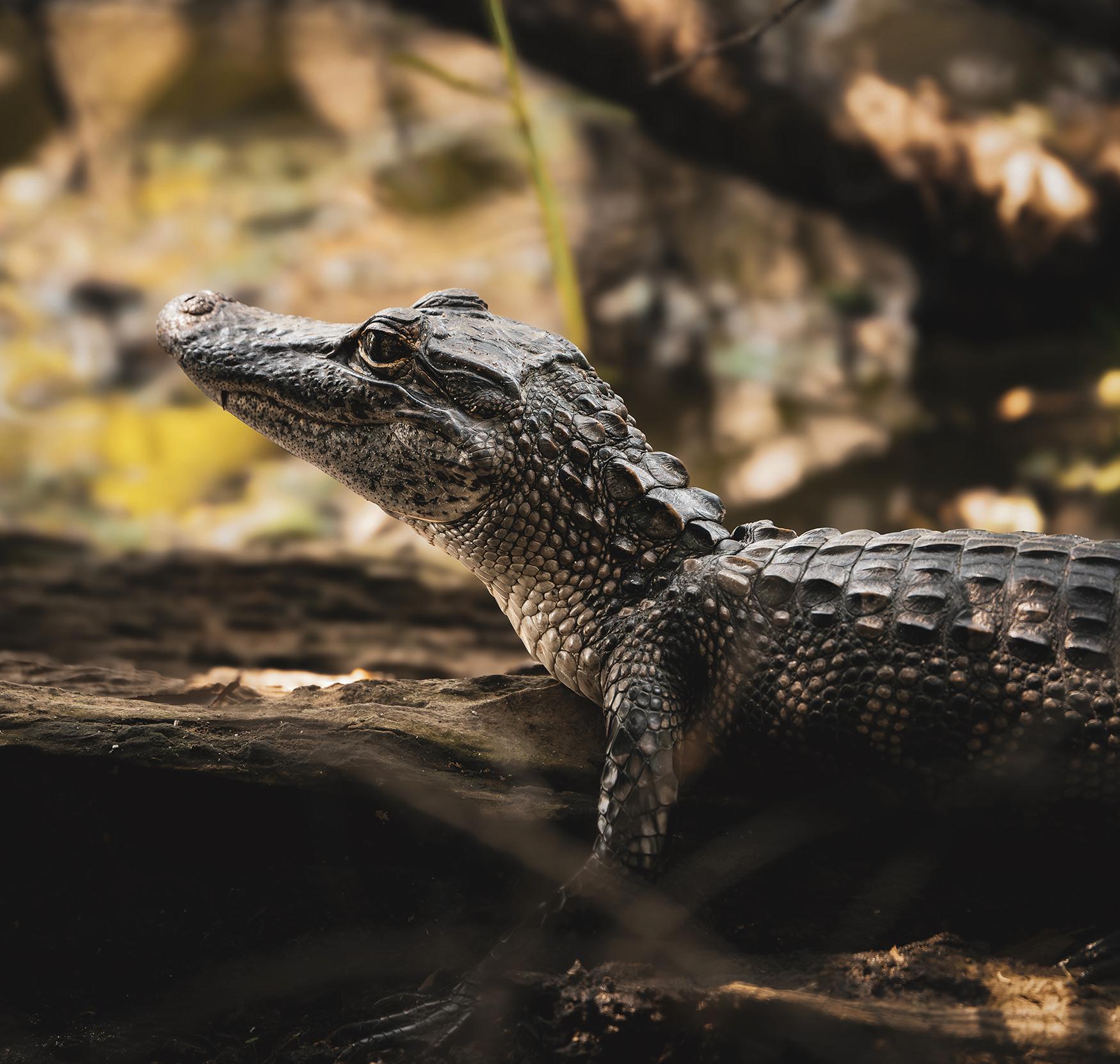
Our state reptile may be found in numerous places — the Creole Nature Trail outside Lake Charles, Jean Lafitte National Historical Park and Preserve, the Honey Island Swamp — but these creatures also exist within the city limits of Lafayette! Visit the University of Louisiana at Lafayette and you’ll find a 2-acre swamp smack dab in the center of campus. Walk the boardwalk that circumvents what is known as Cypress Lake (students call it the “Swamp”) and you’ll spot turtles, egrets and other wildlife. And alligators. They aren’t large — after they reach a certain size the gators are removed — but it’s not recommended to feed them or get too close.
05
TAKE A GHOST TOUR
Some believe New Orleans is the most haunted city in America. You might stretch that out to include other Louisiana cities, such as Shreveport’s haunted Municipal Auditorium or Alexandria’s Hotel Bentley. Tours abound to showcase the state’s haunted side, especially in New Orleans where they run the gamut including vampires and gruesome murders, some involving spirits of the liquid kind and historical explorations.
VISIT
THE RED
STICK
French Canadian explorers in 1699 spotted red poles erected by Native Americans along the Mississippi River and labeled the site “baton rouge,” with its literal translation to English, “red stick.” Today, the city of Baton Rouge serves as Louisiana’s capital with not one, but two capitols to visit — the Old State Capitol with its castlelike architecture and the country’s tallest state capitol that contains our current legislature. Visit the former for its history and the latter for its Art Deco designs and the site where Gov. Huey P. Long was shot. Be sure to take the elevator to the New State Capitol roof to get a view of Baton Rouge and beyond. That red stick is long gone but an artwork marking the spot can be found at Scott’s Bluff on the Southern University campus.
08
BE HUCK FINN
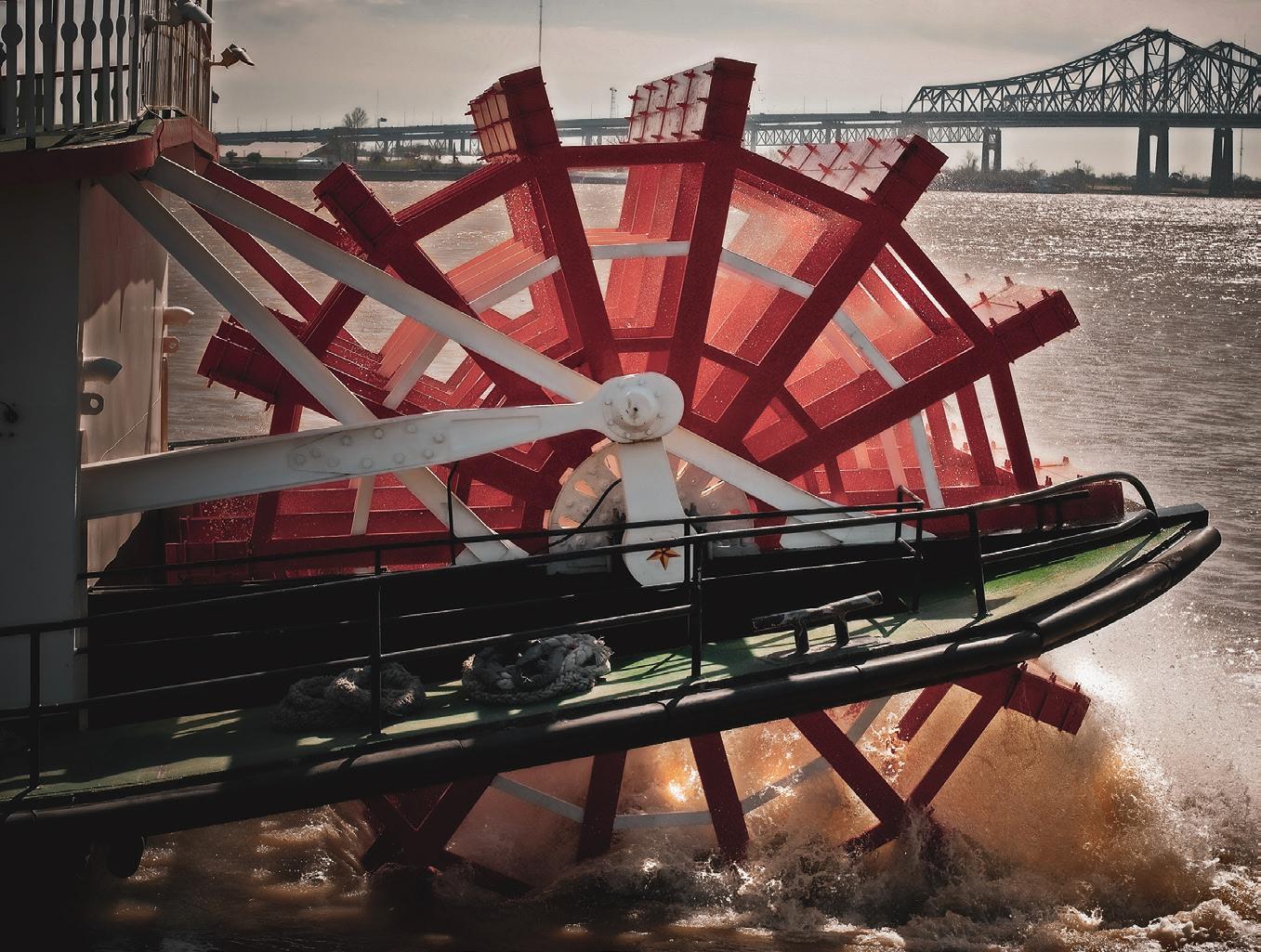
The Mississippi River stretches wide and deep as it approaches its delta to the Gulf. It’s one of the largest rivers in the world and made famous by Mark Twain’s “The Adventures of Huckleberry Finn” and other works. Visitors who want to imagine life during Twain’s days can purchase a ride on one of the many steamboats traveling up and down the river. For those who would rather park and ride, there are several ferries operating from New Orleans north to the Mississippi state line.
09
CLIMB MOUNT DRISKILL
Driskill Mountain in Bienville Parish clocks in at 535 feet above sea level, and even though you might think it’s a hill — there are buildings in downtown New Orleans higher — Driskill is the highest point in Louisiana and we’ll call it what we wish! Drive east of Shreveport on Interstate 20 then south through Arcadia and Oak Grove to Mount Zion Presbyterian Church. Park at the church and look for a trail sign that leads to the summit where rocks mark the high point. The mountain exists on private land so please be respectful of owners.
10
GET HOT
Louisianans love their hot sauce — and the most famous hot sauce brand is Tabasco with the magic happening on Avery Island, just outside New Iberia. Visitors may enjoy a self-guided tour of the Tabasco Museum and dine at Restaurant 1868. Avery Island is home to both the McIlhenny Company, which produces Tabasco, and the exquisite 170-acre Jungle Gardens, created by the McIlhenny family, so plan to spend a day exploring.
14
VISIT A CEMETERY
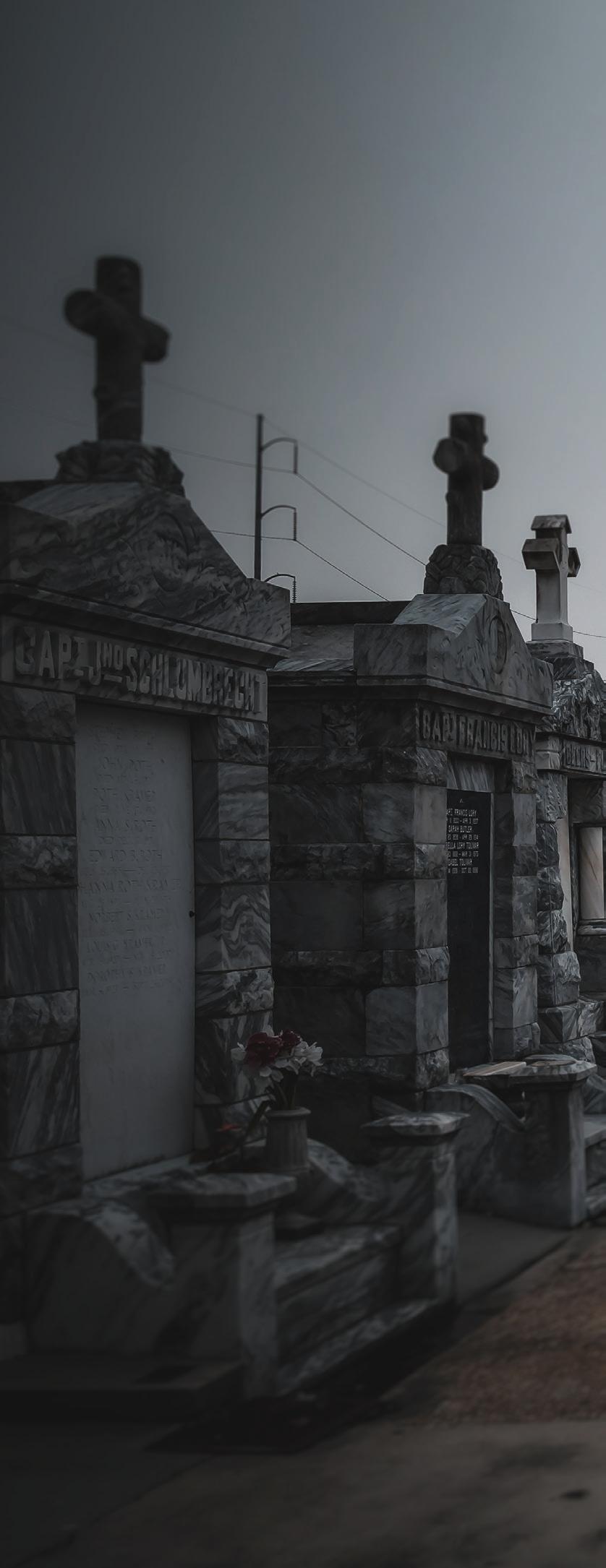
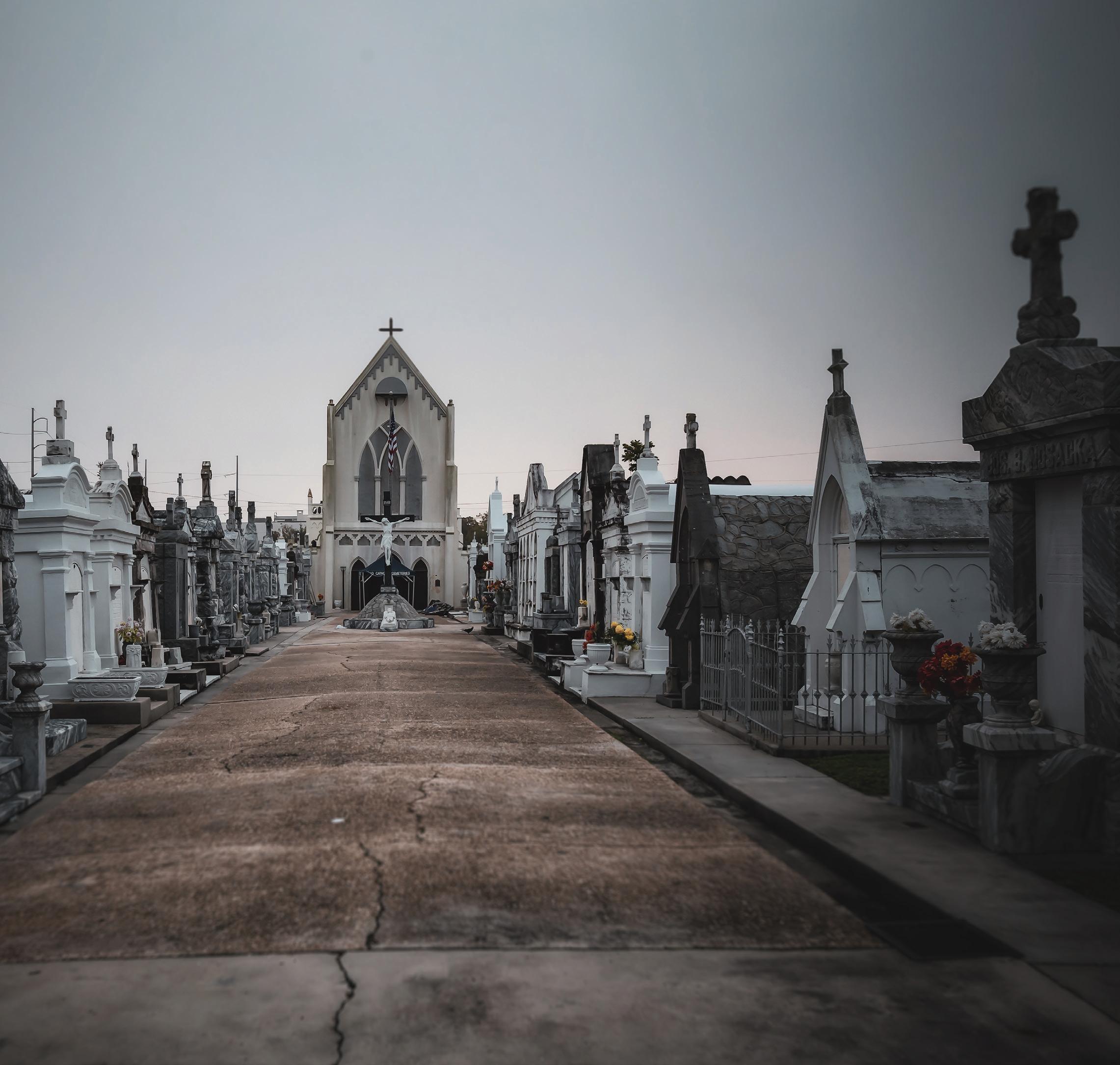
Parts of Louisiana lie below sea level, which is one reason why our cemeteries resemble “cities of the dead.” Walk through any New Orleans cemetery and you’ll find it’s more than grave markers, but architectural masterpieces, ornate reverence to families and occasionally weird and funky. Famous people have graced the city’s cemeteries, including musicians, a chess champion and civic leaders — even a tomb for Marie Laveau, the city’s “voodoo queen.”
11
SATURDAY NIGHT LIGHTS
Football reigns in the South and there’s nothing like the cheers of 90,000-plus fans in Tiger Stadium on a Saturday night in Baton Rouge, or the Tiger Band’s rousing pre-game show. Equally breathtaking is the longtime rivalry of Southern University and Grambling as they come together for November’s annual Bayou Classic, with their bands performing the roaring “Battle of the Bands” halftime show.
12
FOREST BATH IN KISATCHIE
Central Louisiana boasts of the Kisatchie National Forest with its 600,000 acres of pine forests and lakes. Scenic byway Longleaf Trail is popular among those looking to enjoy hills and vistas. A great place to hike and be one with nature is Longleaf Vista, where views stretch for miles and the 1.5-mile trail takes hikers to a small bayou. Bring a picnic and enjoy some of the Vista’s buildings built in the 1930s by the Civilian Conservation Corps.
13
FOLLOW IN HOLLYWOOD’S FOOTSTEPS
Thanks to the diversity of the state, its unique architecture and landscape and a few tax incentives, Louisiana has seen more than its share of Hollywood filming on location — more than 2,500 films have been shot here! In addition, there have been TV shows such as “NCIS: New Orleans” and HBO’s “Treme.” Follow along the Louisiana Film Trail with this handy map from Explore Louisiana at explorelouisiana.com/film.
15 VISIT
POVERTY
POINT ON AN EQUINOX
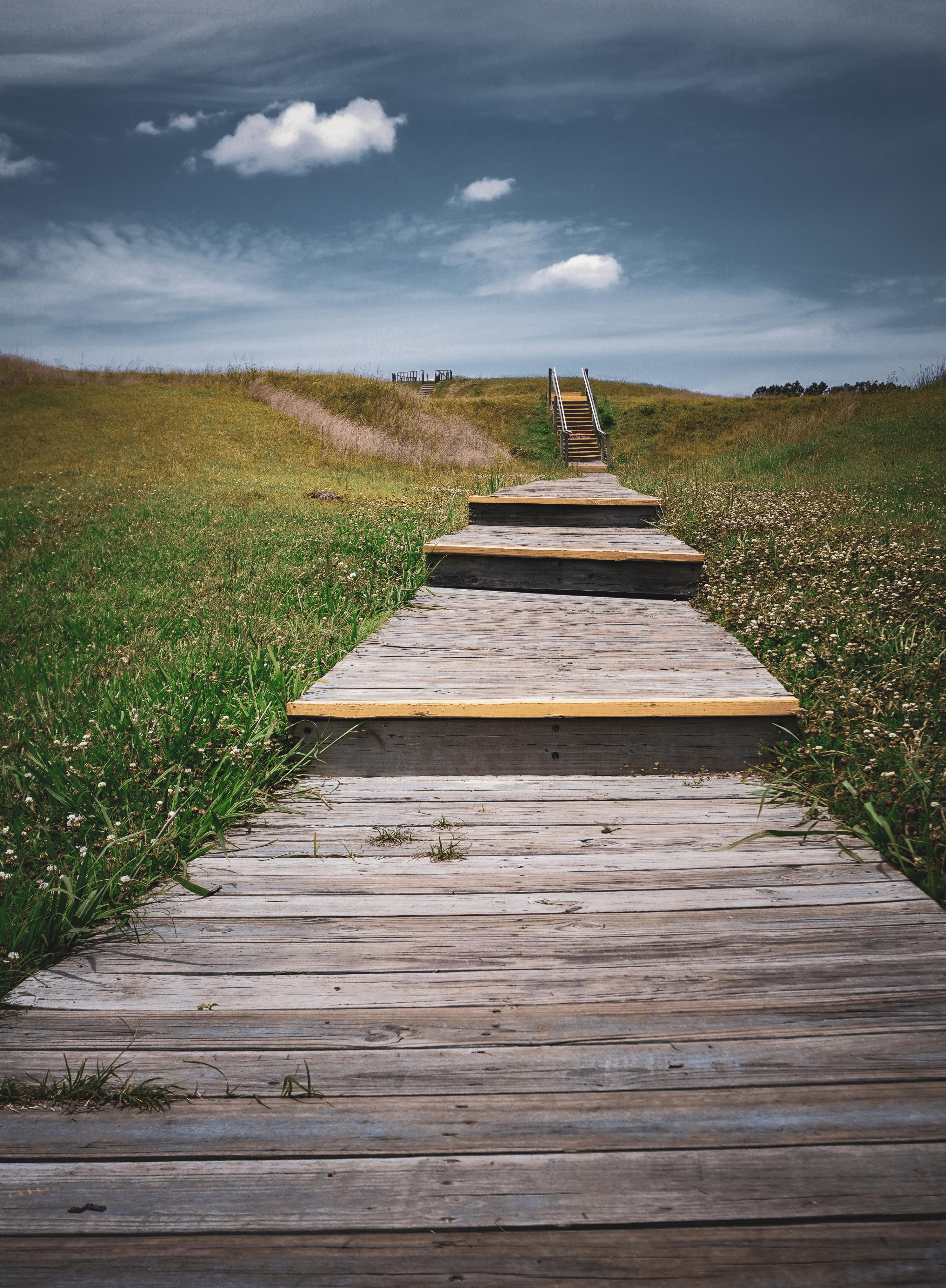
The earthen works in the northeast corner of Louisiana may not look impressive on first glance but throughout Poverty Point State Park lies a 400-acre village that dates to between 1650 and 700 B.C. The site is considered so historically important that Poverty Point is now a UNESCO World Heritage Site. Visit anytime but during the spring and fall equinoxes a solar ray extends from nearby Lower Jackson Mound, constructed around 1,500 years earlier, to connect with a mound at Poverty Point.
16
VISIT A SANCTUARY
For years, chimpanzees were used in biomedical research. When the National Institutes of Health decided to retire animals from laboratories, chimps had a lovely place to retire — in the northeastern corner of Louisiana in a plot of land featuring 200 acres of forest, outdoor play yards, veterinary care and a varied cuisine. Today, Chimp Haven is the world’s largest chimpanzee sanctuary, home to nearly 300 chimps formerly used in biomedical research. Visitors may schedule a private tour of the facility by visiting chimphaven.org.
17
TASTE SWEET SPIRITS
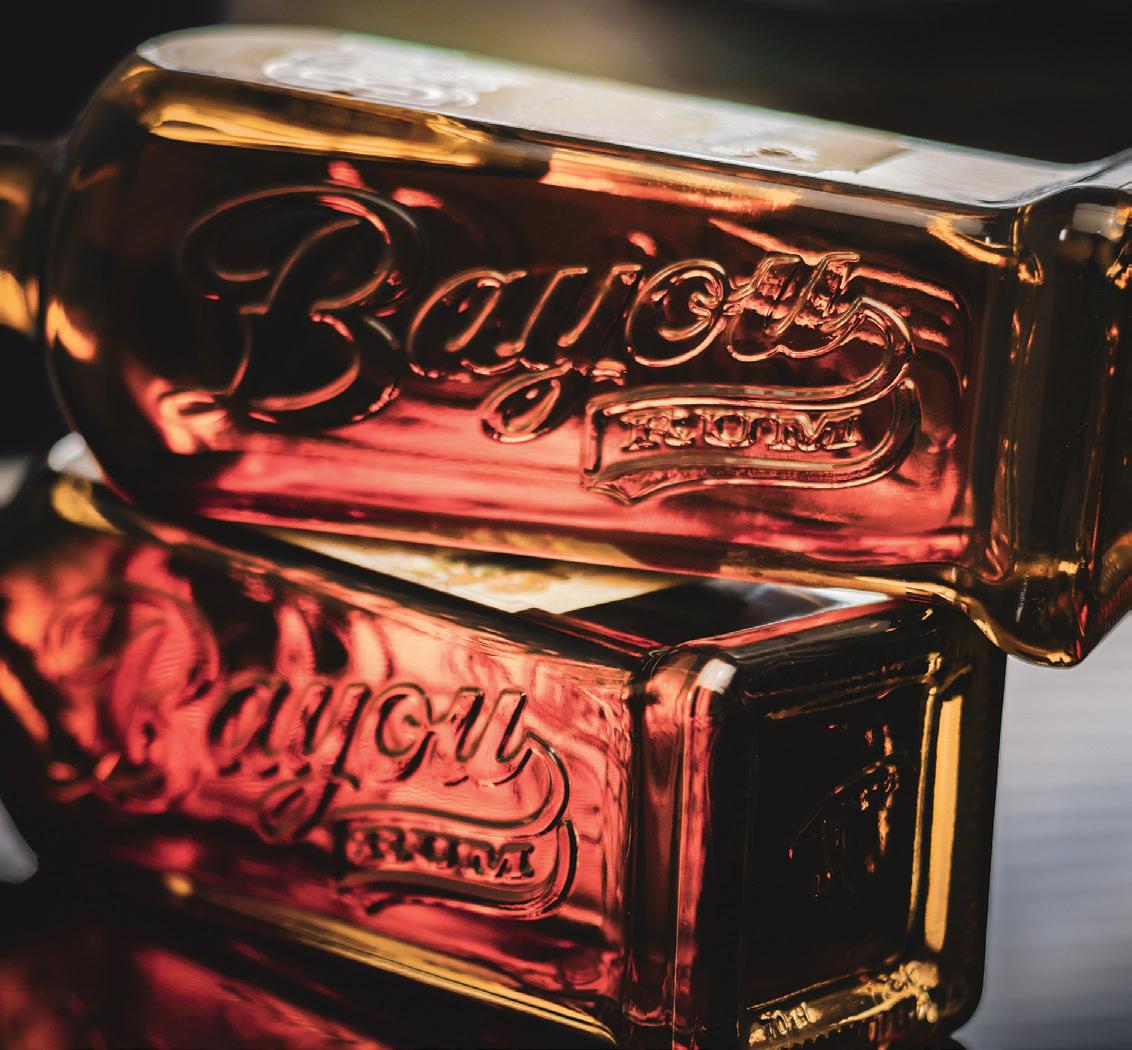
Louisiana is dotted with breweries and distilleries, but over in West Monroe, Army veterans are distilling something sweet. Two Warriors Meadery produces spirits derived from honey with profits helping local veterans’ charities. Outside of Monroe-West Monroe are two vineyards serving up a variety of wines in their tasting rooms. Even better, both Thirsty Farmer in Calhoun and Landry Vineyards host special events such as live music among the vines and wine pairing dinners. To continue a sweet tour of the state — mainly because the spirit’s derived from Louisiana sugarcane — take a guided tour of Bayou Rum in Lacassine, which concludes with a delicious rum tasting.
MEET YOUR MEALS
Agritourism allows people to not only pick their favorite food sources but learn how they’re grown and produced. In Acadiana, there are crawfish farm tours, some ending with a crawfish boil. On the Northshore, you can pick strawberries in the summer at several farms. Catahoula Parish has the family-owned Cross Creek Blackberry Farm allowing visitors to load up on berries. Outside of Ruston, juicy peaches turn ripe in summer at Mitcham Farms & Peach Store, plus the town celebrates its fruit with an annual Peach Festival in June.
19
DANCE AT A DANCE HALL
Cajun and zydeco dance halls existed throughout Acadiana, yet sadly many have closed. But don’t put away those dance shoes! ¶ “St. Landry Parish lost its landmark zydeco clubs — Richard’s Club and Slim’s Y-Ki-Ki, but neighboring St. Martin Parish still has some very cool places,” said Herman Fuselier, coauthor with photographer Philip Gould in “Ghosts of Good Times: Louisiana Dance Halls, Past and Present.” ¶ Places to dance include Buck & Johnny’s in Breaux Bridge for Saturday’s Zydeco Breakfast and La Poussiere in Breaux Bridge, one of the last of the old-school, Cajun dance halls. ¶ “Fiddler and Frenchspeaking heartthrob Jourdan Thibodeaux has a newer place, Cypress Cove Landing, which is partially outdoors,” Fuselier added. “It’s on the levee and overlooks the Atchafalaya Basin.”
CLOSE THE YEAR IN NATCHITOCHES
What began in 1927 as one man’s desire to give thanks to his beloved city by lighting up Front Street in the heart of Natchitoches has turned into one of the largest holiday festivals in the country. And long running! This year marks the 100th year of the Natchitoches Christmas Festival of Lights which begins on the Saturday before Thanksgiving and concludes after the New Year with more than 300,000 lights and 100-plus set pieces on display every night at dusk.

SOUTHERN SUMMER TRAVEL
SUMMER IS HERE, AND THE WORLD IS YOUR OYSTER. FIND YOURSELF A COZY HAMLET, A NEW FAVORITE RESTAURANT, OR A DESTINATION WITH MEMORIES THAT WILL LAST FOREVER WITH THESE SOUTHERN SUMMER TRAVEL LOCALES.
Lafayette CVC
Summer in Lafayette o!ers a mix of food, music, and outdoor experiences. Start with the EatLafayette app, your source for locally owned restaurants, food trails, things to do, events, and live music in and around Lafayette Parish.
Looking for more cultural and outdoor things this summer? Visit Vermilionville to explore Cajun and Creole history, then head to Moncus Park or the Acadiana Park Nature Station for walking trails and shaded outdoor spaces.
Cool off on the water with a guided swamp tour or rent a kayak and paddle the Bayou Vermilion. For art and culture, explore exhibits at the Acadiana Center for the Arts or the Hilliard Art Museum, and check out downtown’s growing public art.
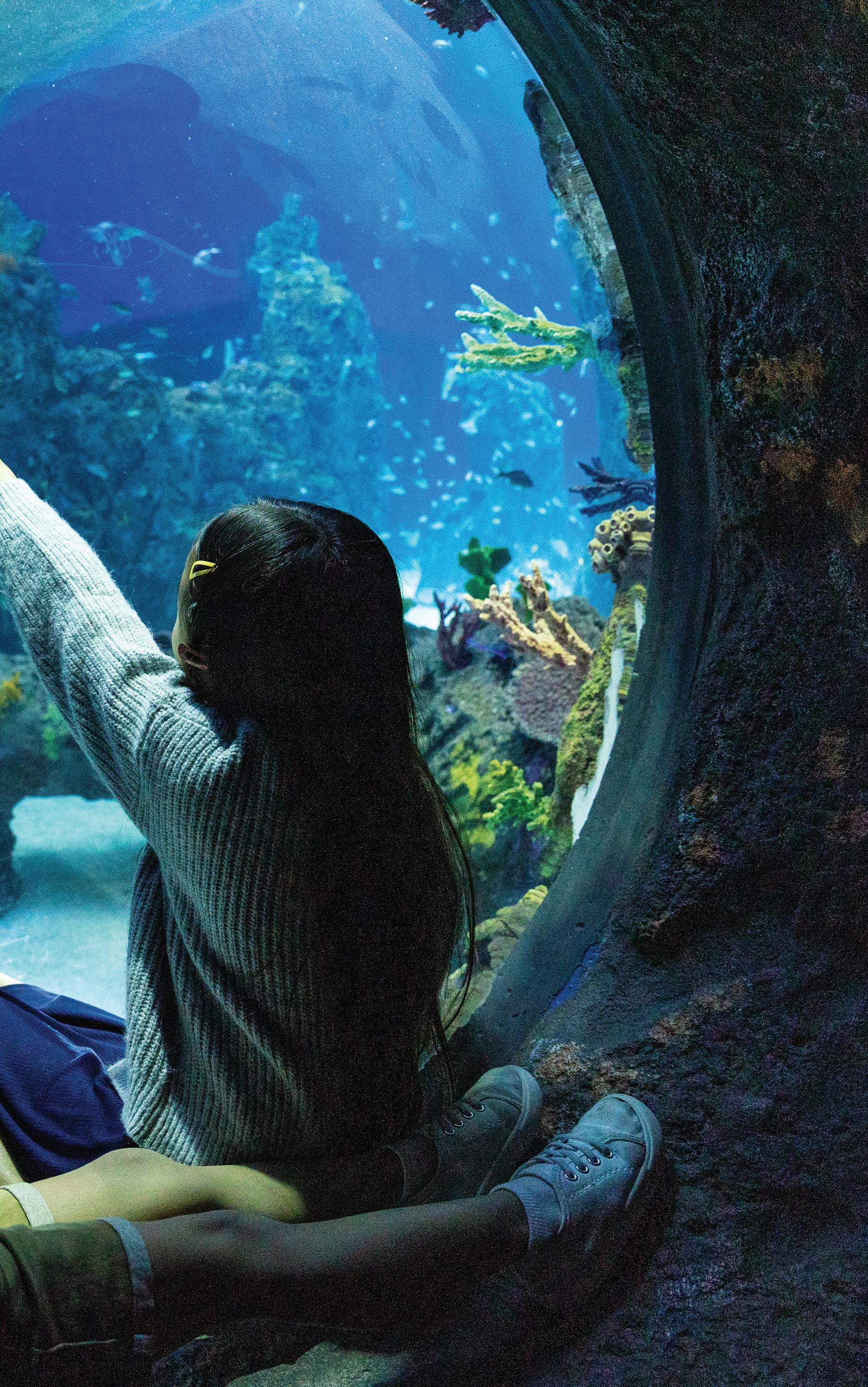
Evenings are built for dancing. Catch live music at Blue Moon Saloon, Rock’n’Bowl, or local restaurants if you’re dining with the family.
For even more ideas on what to do this summer, visit LafayetteTravel.com/Summer.
Port Arthur
Port Arthur is a paradise for outdoor enthusiasts, where wide-open waters, wild landscapes, and a vibrant coastal culture come together to create one unforgettable destination. Bordered by the Gulf of Mexico, Sabine Lake, and the Neches River, this Southeast Texas gem o!ers endless opportunities for boating, paddling, and worldclass saltwater fishing. Anglers can cast a line for redfish, trout, and flounder while paddlers glide through calm marshes alive with birds and Gulf breezes.
As the of A icial Cajun Capital of Texas, the city o!ers an irresistible mix of flavor, live music, and heritage. Explore it all at the Museum of the Gulf Coast, then savor spicy seafood and Tex-Mex, boudin, and Gulf-fresh delights on a waterfront patio while local musicians set the soundtrack.
Visit Port Arthur—true Texas with a Cajun twist!
Discover more at visitportarthurtx.com.
Visit Mississippi
From sun-soaked shores to hands-on museums, Mississippi delivers an easygoing summer escape where families can truly connect. Along the Gulf Coast, kids can splash in gentle waves, explore marine life, or dive into interactive fun at discovery centers and waterparks. Inland, cities such as Jackson and Tupelo o!er engaging museums, playgrounds, and wildlife encounters that spark curiosity for all ages.
Outdoor adventure is never far away— think kayaking calm rivers, biking scenic trails, or hiking through lush state parks before cooling o! with a picnic under shady pines. Whether your crew prefers beach days, creative play, or exploring history and music, Mississippi’s welcoming spirit and variety of activities make it easy to plan a trip everyone will love.
Start planning your next family getaway at: visitmississippi.org/go/family-adventure.
Canton, Mississippi
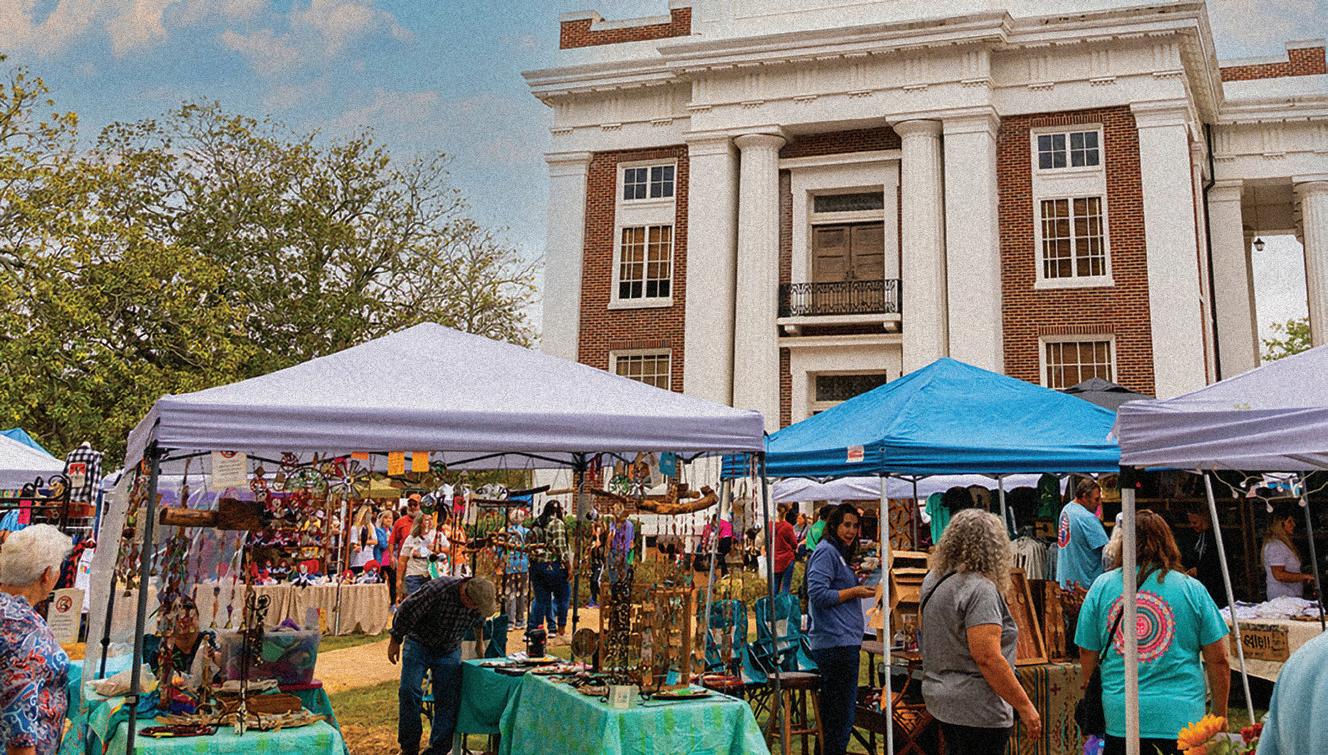
Visit Canton, Mississippi, this Summer for a day of small-town charm with a big southern heart. With a history as rich in food and culture, where timeless charm meets modernity around the glorious, beautiful Greek Revival Courthouse, there’s always something new and exciting happening in Canton.
The bi-annual Canton Flea Market and Arts & Crafts show is taking place on May $4th, featuring artisans from across the nation with handcrafted items like jewelry, pottery, and unique arts & crafts. With hundreds of superior artists and craftsmen within walking distance of the downtown area, the community comes alive with art and life.
This June, the 4$ st Annual Balloon Festival takes to the skies of Mississippi from the (6th through the (8th. Join the Canton locals and visitors from around the region at the Canton Multipurpose Complex to witness a wonderland of beautiful balloons light up the Summer skies.
To learn more, visit CantonTourism.com.
Beauregard Watermelon Festival
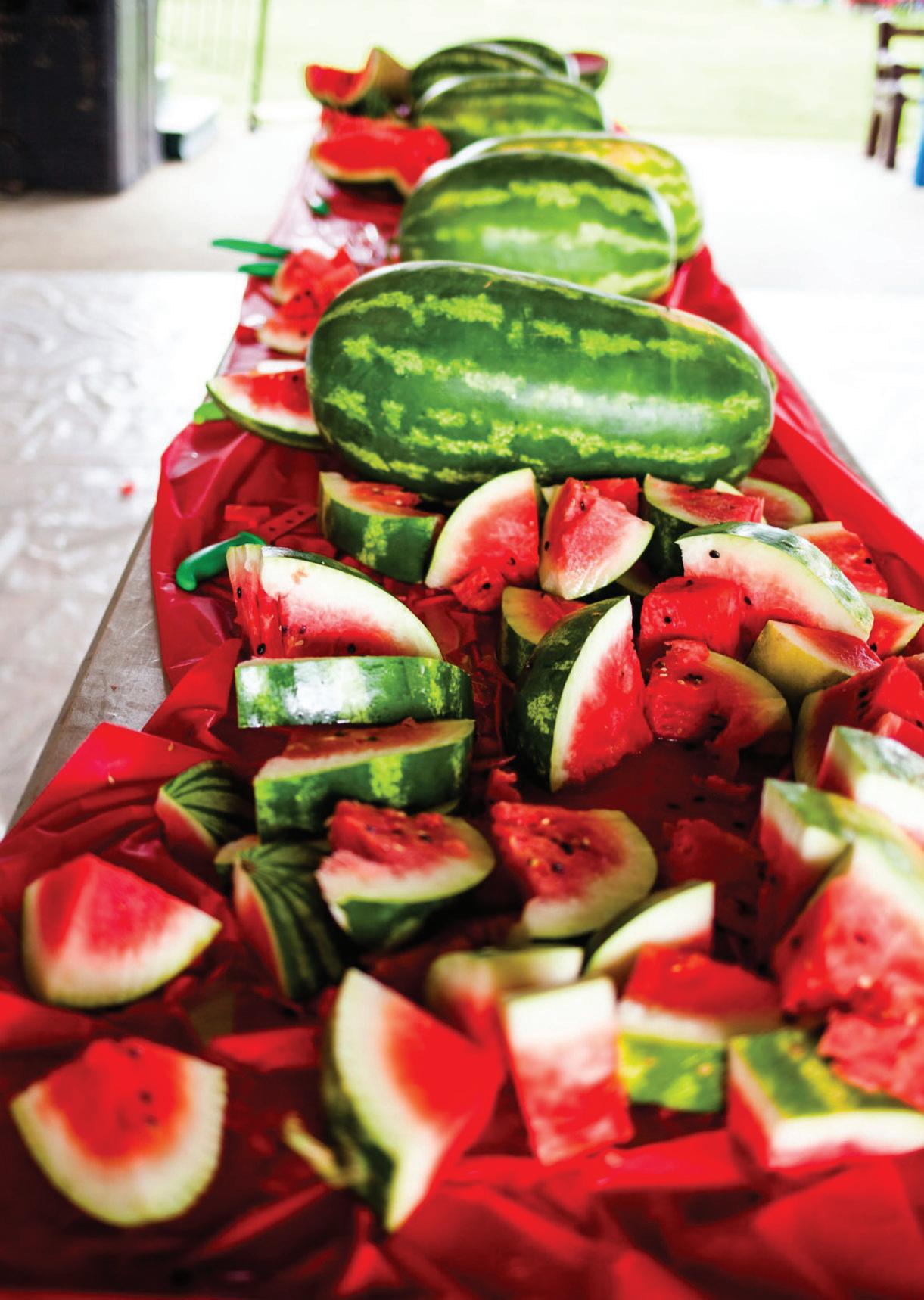
Join the sweetest celebration in the South this May ($ - () at the Beauregard Watermelon Festival in Deridder, LA. This year, the Beauregard Watermelon Festival is going patriotic to celebrate the (&0th birthday of the United States. Throughout the weekend, the festival pauses to honor the brave men and women whose sacri A ice made our freedoms possible — while bringing the community together for a full weekend of family fun and hometown pride.
With admission only $ &, and children under ) allowed in free, bring the entire family for a seed spitting, patriotic time amongst family, friends, and the most delicious watermelons you’ve ever had the pleasure to eat. Learn the Watermelon Crawl, enjoy the Melon Voice singing Contest, welcome the Watermelon Festival Queens, and partake in the showstopper Watermelon Eating Contest! There’s about as many ways to have fun as there are ways to slice a melon. From festival favorites to live entertainment, contests, and community traditions you know and love, the (0(6 festival is shaping up to be one to remember.
Learn more at beauregardwatermelonfestival.com

Hope Out of Darkness
The
Solomon Northup Trail
STORY AND PHOTOS BY KEVIN RABALAIS
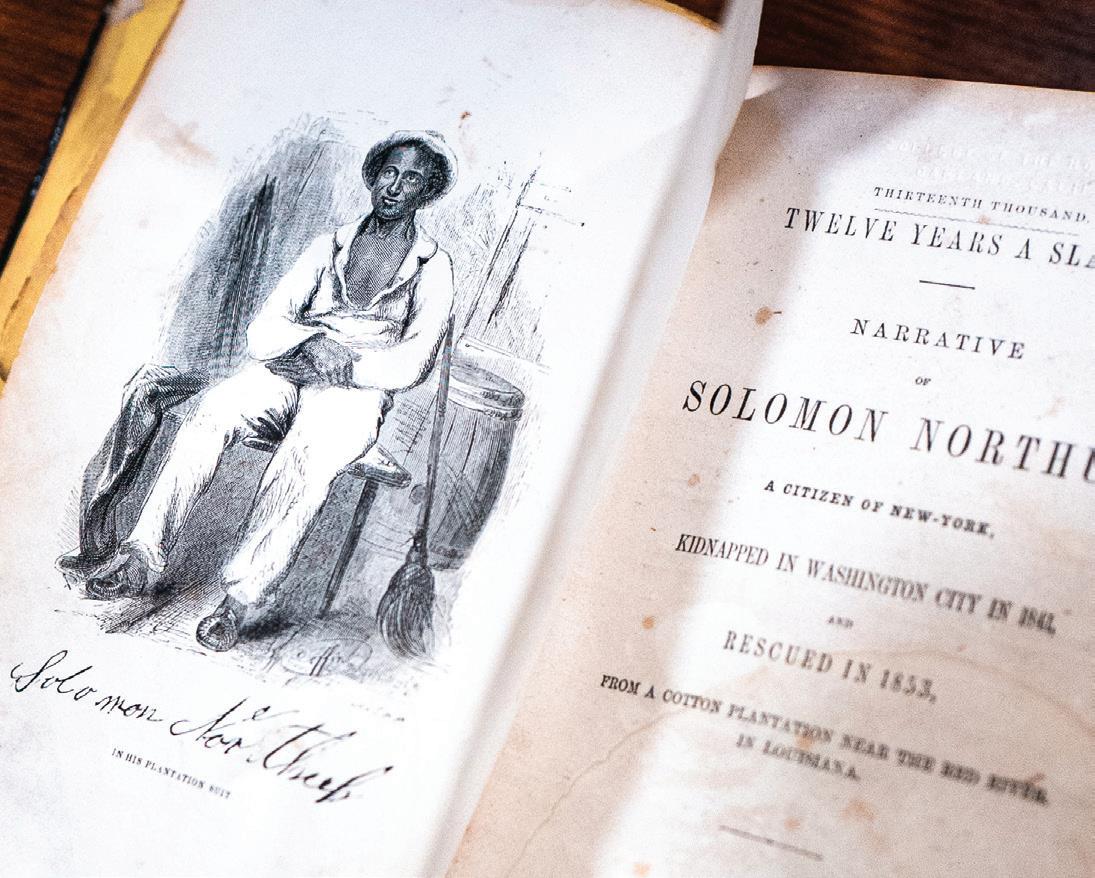
REVIEWING “TWELVE YEARS A SLAVE,” Solomon Northup’s $8&) memoir about being abducted and illegally sold into slavery in Louisiana, Frederick Douglass wrote, “It is a strange history, its truth far stranger than fiction.” Born in $807, Northup lived his first )) years as a free man in Upstate New York. He had a wife and three children. He played the violin, “the ruling passion” of his youth.
In March $84$, Northup’s musical talent intrigued two men who claimed they were hiring musicians for a circus. They lured him to Washington, D.C. After being drugged, he woke “alone, in utter darkness, and in chains,” with a new identity, that of a runaway slave named Platt Hamilton. For the next $$ years, eight months, and (6 days, he labored on cotton and sugar plantations in central Louisiana.
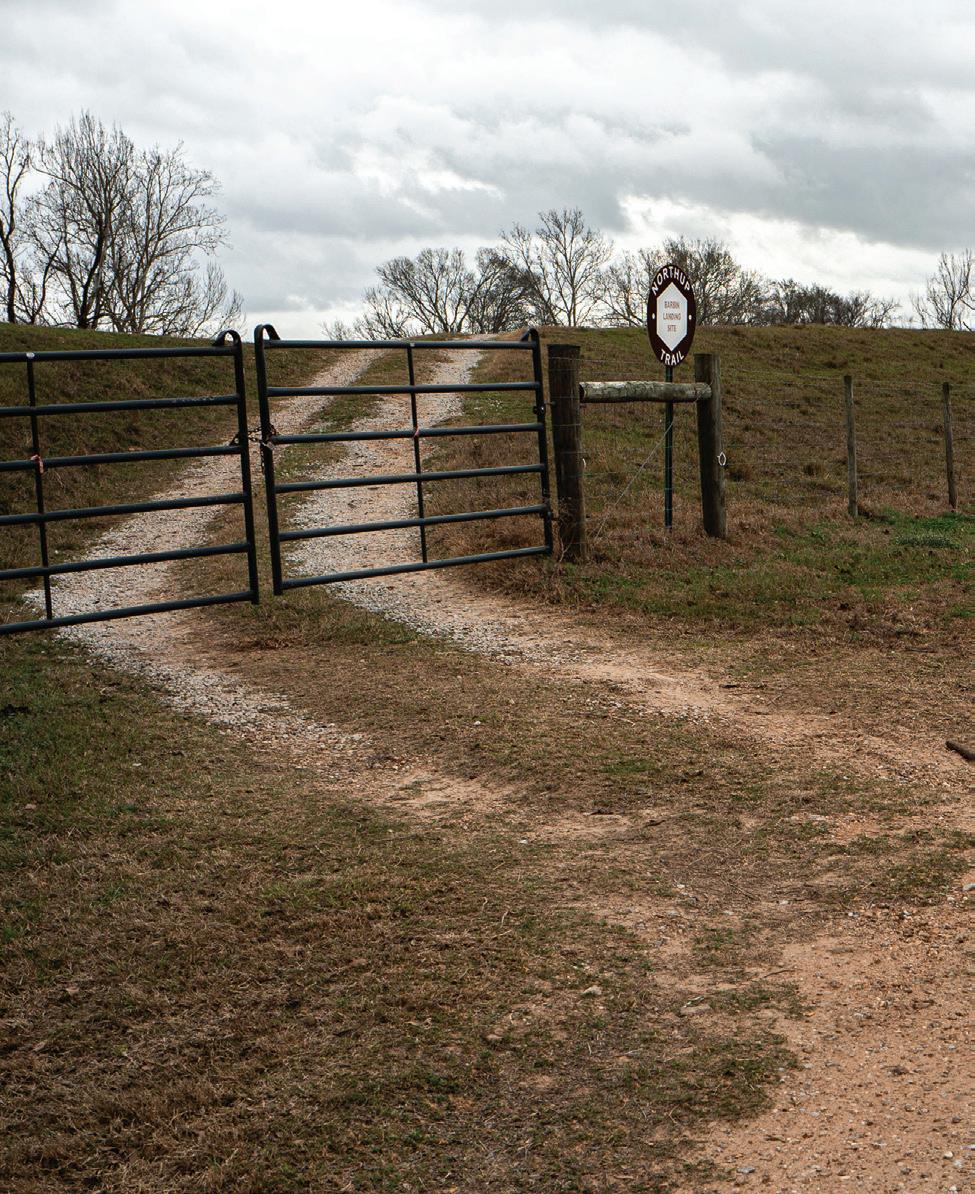
Northup’s story has been a feature of the Avoyelles Parish landscape for more than half a century. During that time, historic markers have identified significant locations in the life of the man who wrote one of the most singular narratives in our nation’s history, a book of loss and pain, dignity and perseverance. The Solomon Northup Trail includes signage at the following places: Bayou Boeuf, center of the region’s plantations, among them Epps, originally near Holmesville but since restored and moved to the LSUA campus in Rapides Parish. During his brutal life at the Epps Plantation, Northup began to share his story with Samuel Bass, a Canadian carpenter and abolitionist. At his own risk following the Fugitive Slave Act of $8&0, Bass wrote letters to New York o cials on Northup’s behalf. He mailed them at the Marksville Post O ce, across the street from the current Avoyelles Parish Courthouse. There, on January 4, $8&), a judge declared Northup free. He then journeyed four miles north to Ludger Barbin Landing
In 2005, Georgiaraised sculptor Wesley Wo ord received an Academy Award for Technical Achievement. His previous commissions include “The Journey to Freedom,” a ninefoot monument to abolitionist Harriet Tubman.
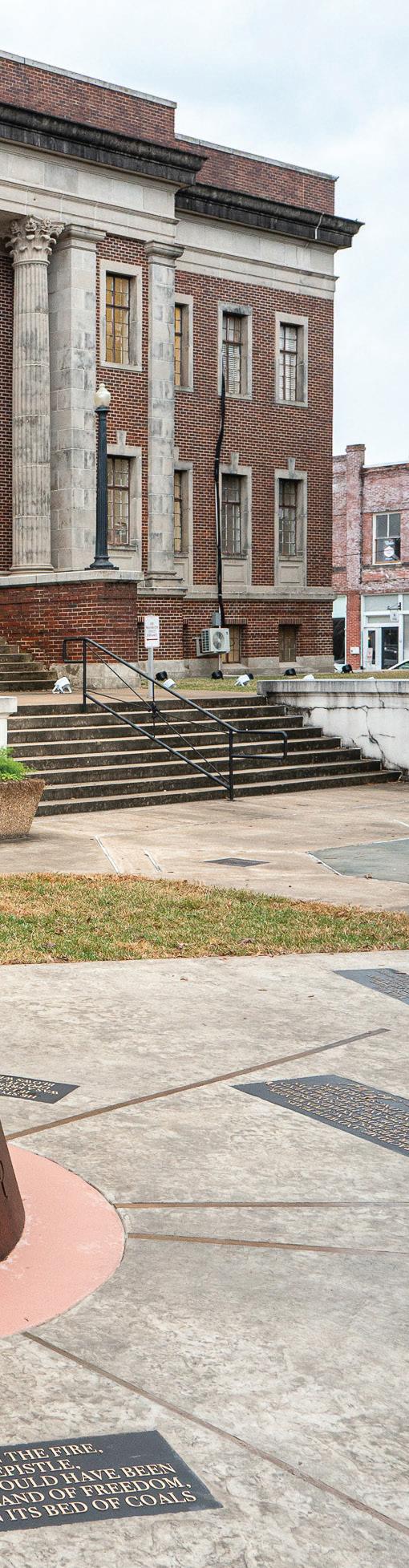
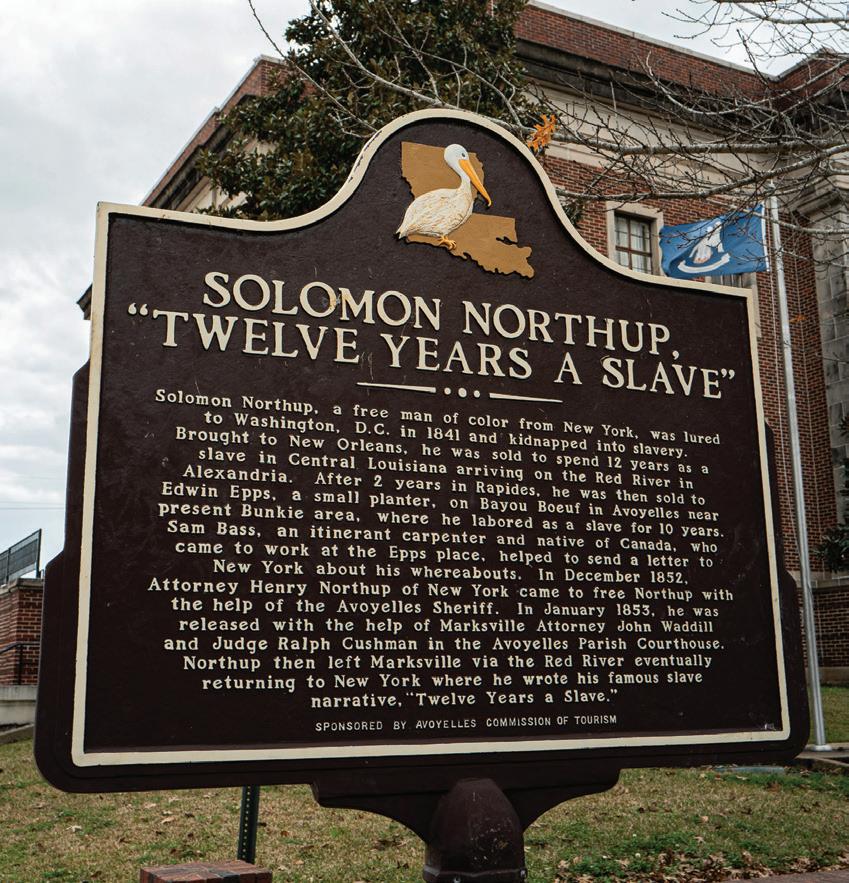
along the Red River, where he departed on a steamer for New Orleans. Sixteen days later, Northup’s story appeared on the front page of The New York Times.
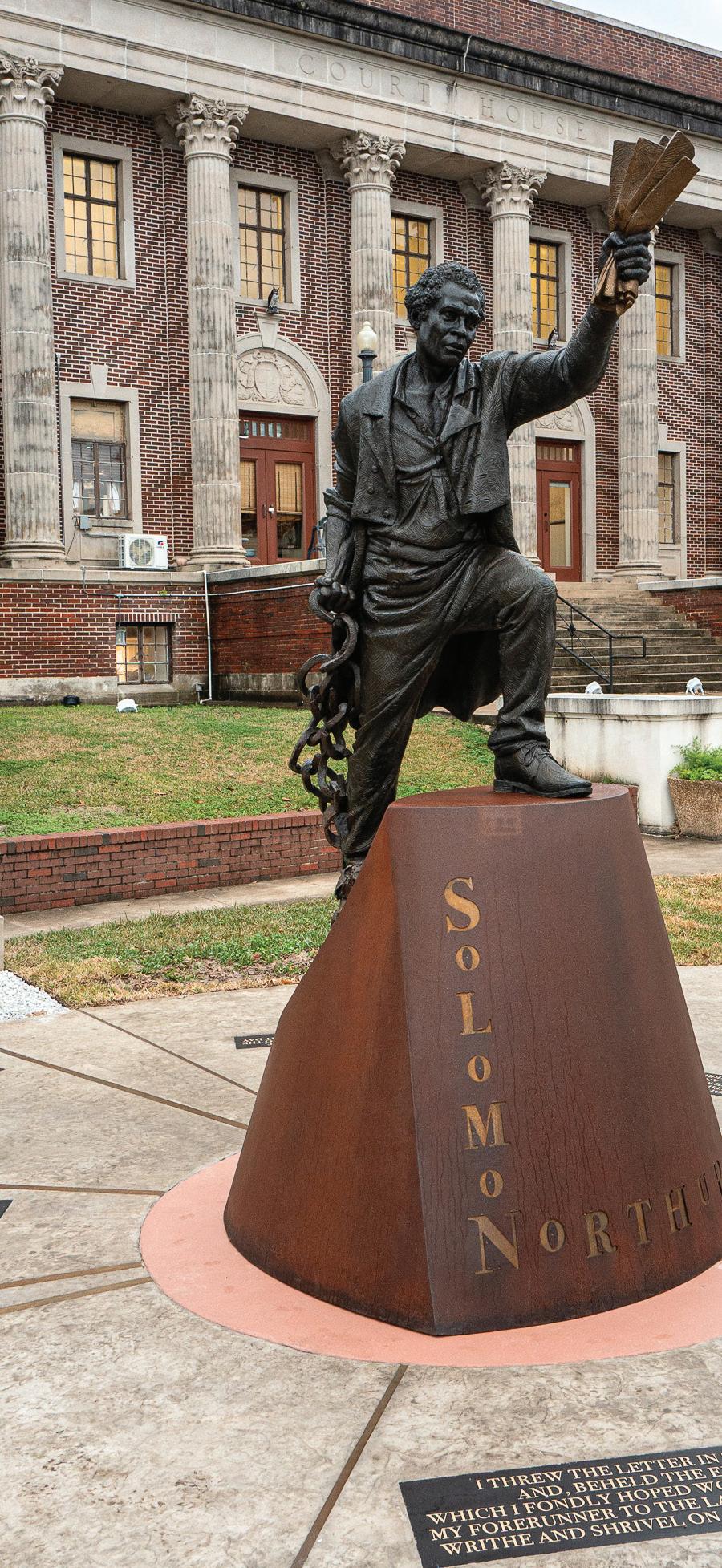
On January 4, (0(6, $() years after he regained his freedom, the Solomon Northup Committee for Commemorative Works unveiled a statue on the Avoyelles Parish Courthouse plaza. “Note that this is di !erent from other historic sites,” says committee member Jacques Goudeau. “You’re encouraged to enter from behind. In our early meetings, we had to decide which paths of Northup’s experience we wanted to highlight. Do we want it to begin in despair, or do we want to be inspired by him? Ultimately, we knew that it had to be both.”
LOCATION
Avoyelles Parish
DID YOU KNOW?
• Despite selling 17,000 copies in its first four months, “Twelve Years a Slave” went out of print around the turn of the 20th century, remaining so until 1968, when LSU Press published a new edition edited by Sue Eakin and Joseph Logsdon. Eakin grew up near Cheneyville, not far from the Epps Plantation on which Northup was enslaved. At age 12, she became fascinated with Northup’s story. When director Steve McQueen accepted the Oscar for Best Picture for the 2013 film version of “Twelve Years a Slave,” he thanked “this amazing historian Sue Eakin,” noting that she “gave her life’s work to preserving Solomon’s book.” • Due to his description of them in “Twelve Years a Slave,” Solomon Northup’s abductors were arrested in 1854. His legal case dragged on until 1857, the year the U.S. Supreme Court handed down its Dred Scott v. Sandford decision, which ruled that Black people could not sue in federal court. Northup, however, remained an active abolitionist. He lectured throughout the Northeast, staged and performed in two plays based on his story and aided fugitive slaves on the Underground Railroad.
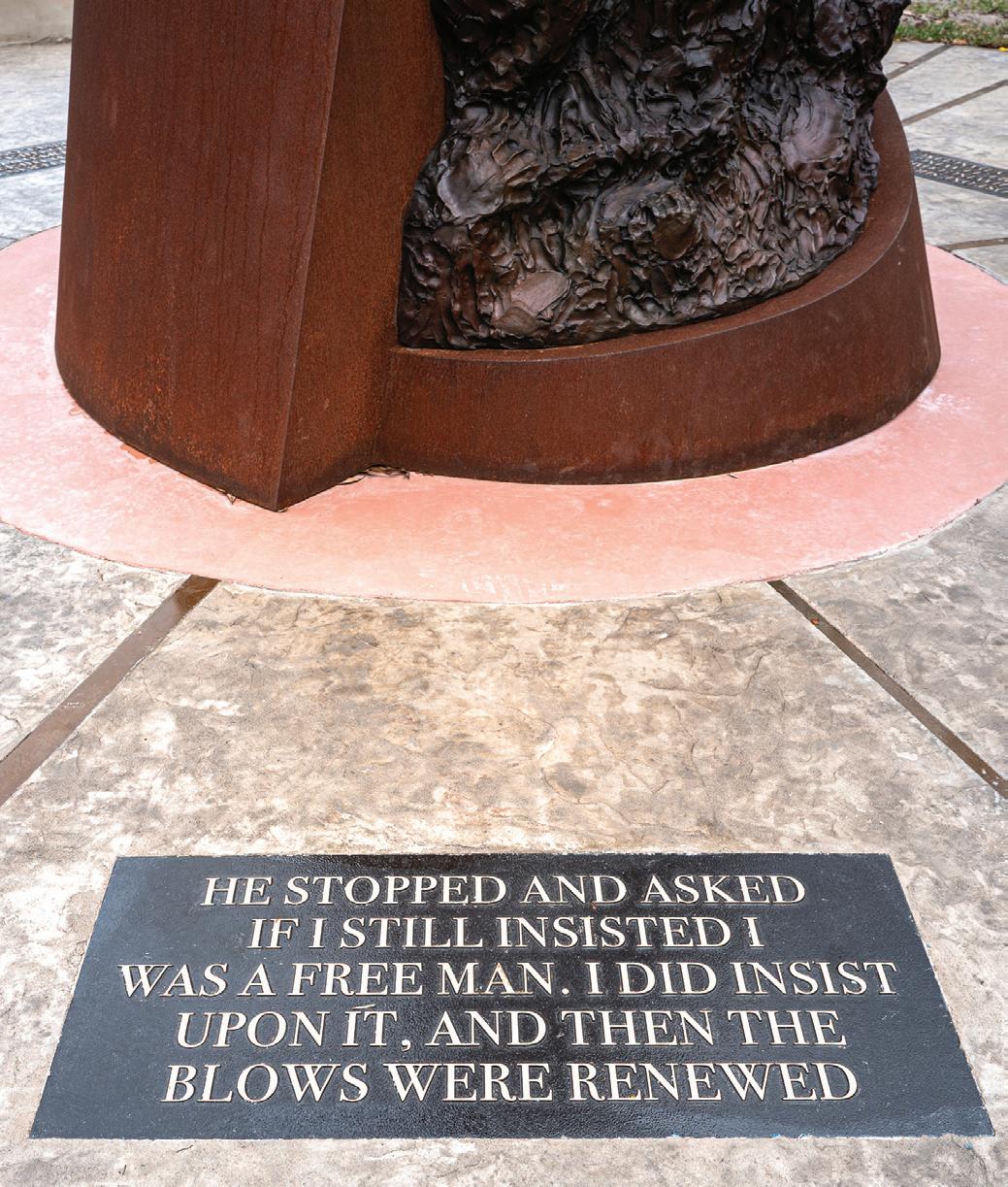
Approaching from behind means that the visitor first sees the base and back of Wesley Wo!ord’s statue, “Hope Out of Darkness.” Northup’s right leg is shackled. Beneath his bare foot are dozens of handprints, each from a descendant of enslaved people or someone connected to Northup’s story. “This detail reminds us that he didn’t do it all by himself,” Goudeau says. “He was helped all the way. The handprints are all Black, except for one. If a teacher comes here with children and asks them to identify the white handprint, they won’t be able to do it. We’re all the same.”
Melissa Howell, a New York native and direct descendent of Northup, calls the site “hallowed ground.” Here, her third great-grandfather re-earned his freedom. “Solomon’s experience of having been free, kidnapped, enslaved and living through that, becomes a story of one man who has continued to pay forward his fight for freedom. His life reflects something far greater than surviving slavery,” Howell says. “It reflects a commitment to truth, to community and to justice. Though he had been torn from his freedom, he never surrendered his humanity.”
As the visitor continues to round the statue, proceeding across nine evenly spaced engraved stones that contain passages from “Twelve Years a Slave,” the handprints give way to Northup’s full name. Witness, now, his left foot as it rises on the base, no longer bare and shackled. Instead, Northup wears a dress shoe. Above his head, in a clenched fist, he grasps a bundle of papers. “His pursuit of freedom lights the way like a torch,” Goudeau says. “He’s also now holding the shackles. The shackles are no longer holding him.”
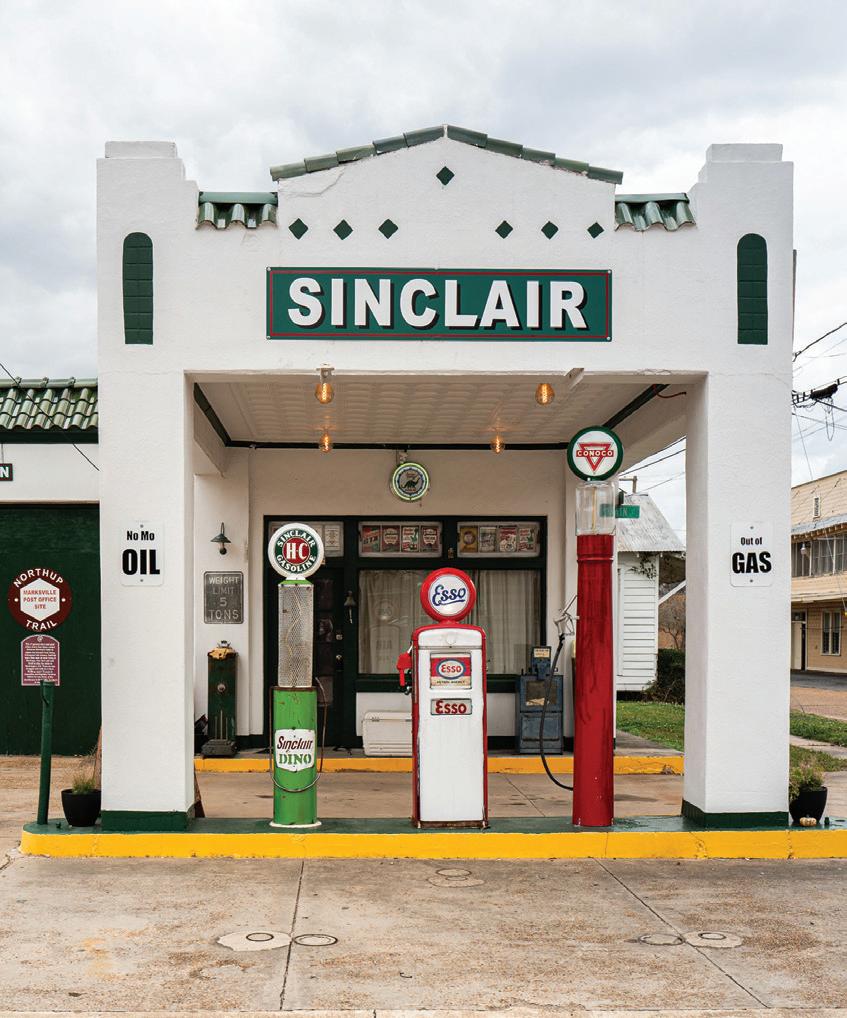
Signage marks signi cant sites in the life of Solomon Northup, including Ludger Barbin Landing on the Red River. From there, Northup traveled to New Orleans after a judge in Marksville set him free.
Goudeau, a Marksville native, first read “Twelve Years a Slave” in $997 during his summer between high school and college. He knows the history of his place. He readily provides the details, how Northup reunited with his family in New York on January ($, $8&), and how the first edition of “Twelve Years a Slave” appeared six months later. Northup gave talks about his story throughout the northeast. With members of the Underground Railroad, he aided fugitive slaves, helping others as men like Bass once helped him. “We feel this is something everyone can come here and be inspired by,” Goudeau says as he gazes up at Northup. “Note that he’s facing north,” he says. “Look at the determination in those eyes.”
Howell says, “There’s poetry in his figure and in his words, and you can see both in the plaza now. All of it is now living and breathing outside of a book.”
Living History
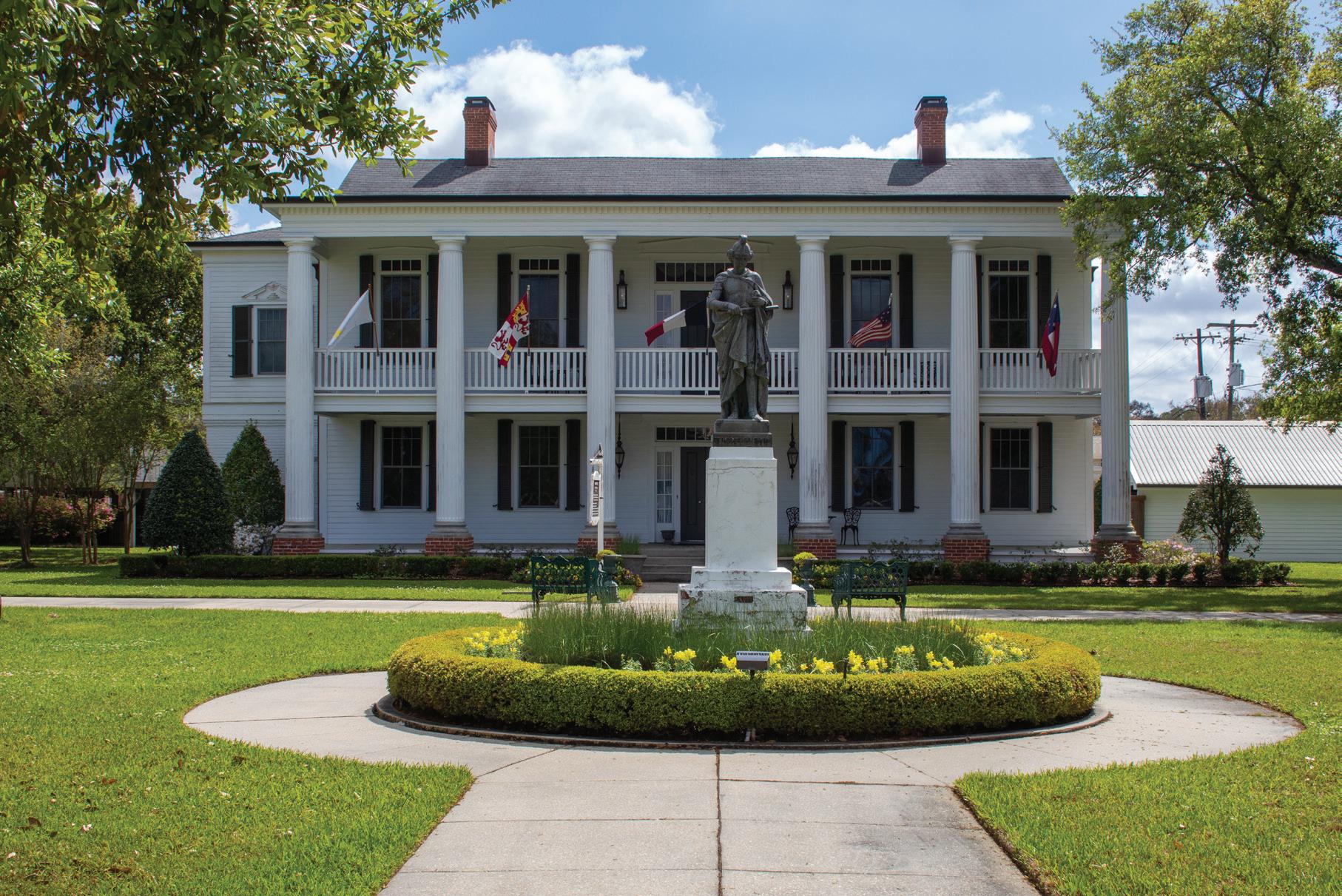
Nestled along the scenic Bayou Teche, St. Martinville is steeped in the complicated and beautiful heritage of Louisiana’s various cultures, home to the first of Louisiana’s State Parks and the best place to get fried gator.
STORY AND PHOTOS BY MELANIE WARNER SPENC ER
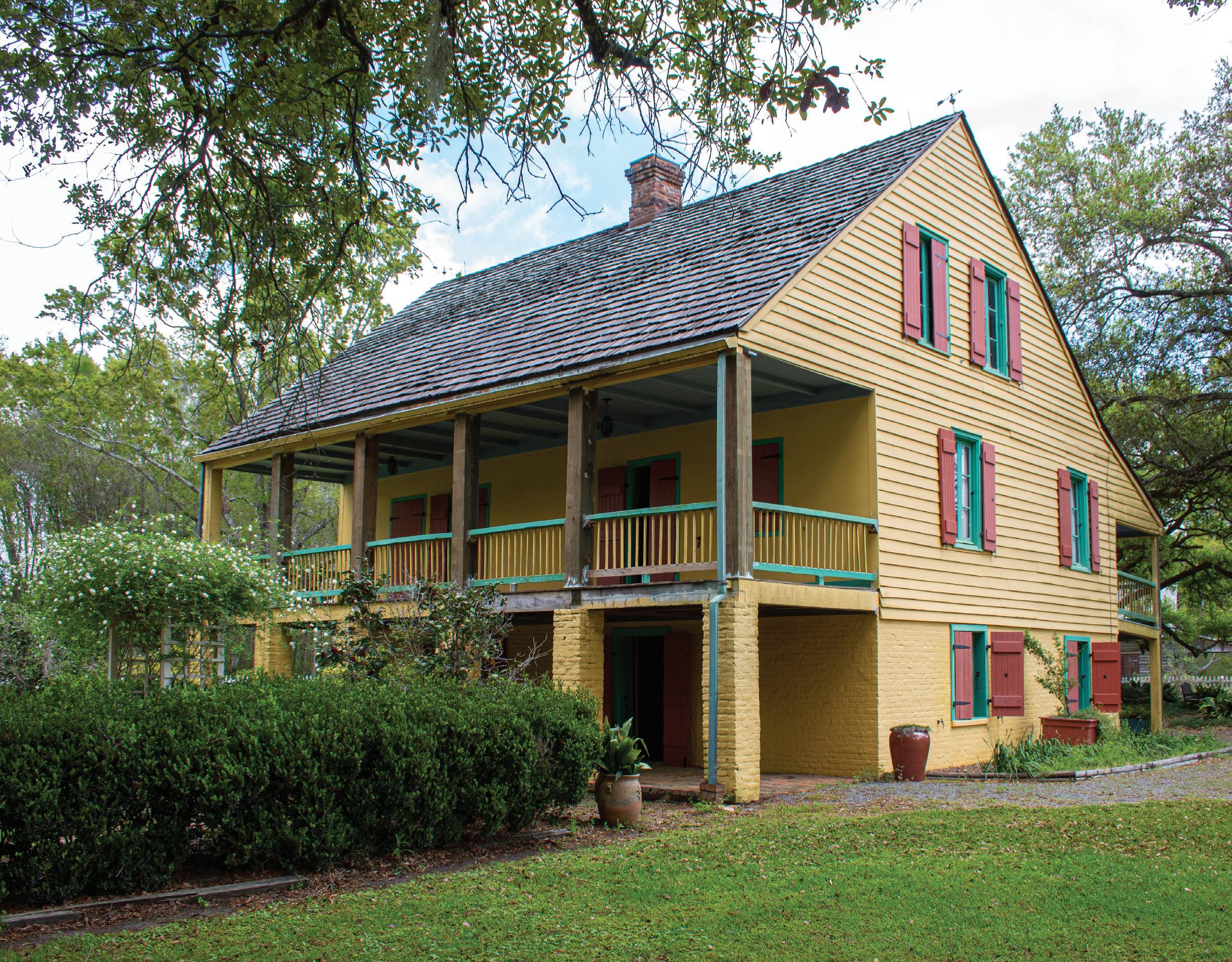
WANDERING THROUGH MAISON OLIVIER, the circa $8$& Raised Creole Cottage-style plantation house at the Longfellow-Evangeline State Historical Site, it’s easy to get the feeling you might bump into a member of the Olivier family. The home is decorated and staged as though the family — and people enslaved by them — are still in residence. This is my favorite type of museum, because it’s like time traveling and being plopped into another lifetime, à la the late ‘80s/early ‘90s TV series NBC’s “Quantum Leap.” Thus began my day in St. Martinville.
My husband and tried-and-true travel buddy, Mark, couldn’t join me on this jaunt to the seat of St. Martin Parish, which meant I could nerd out on the house
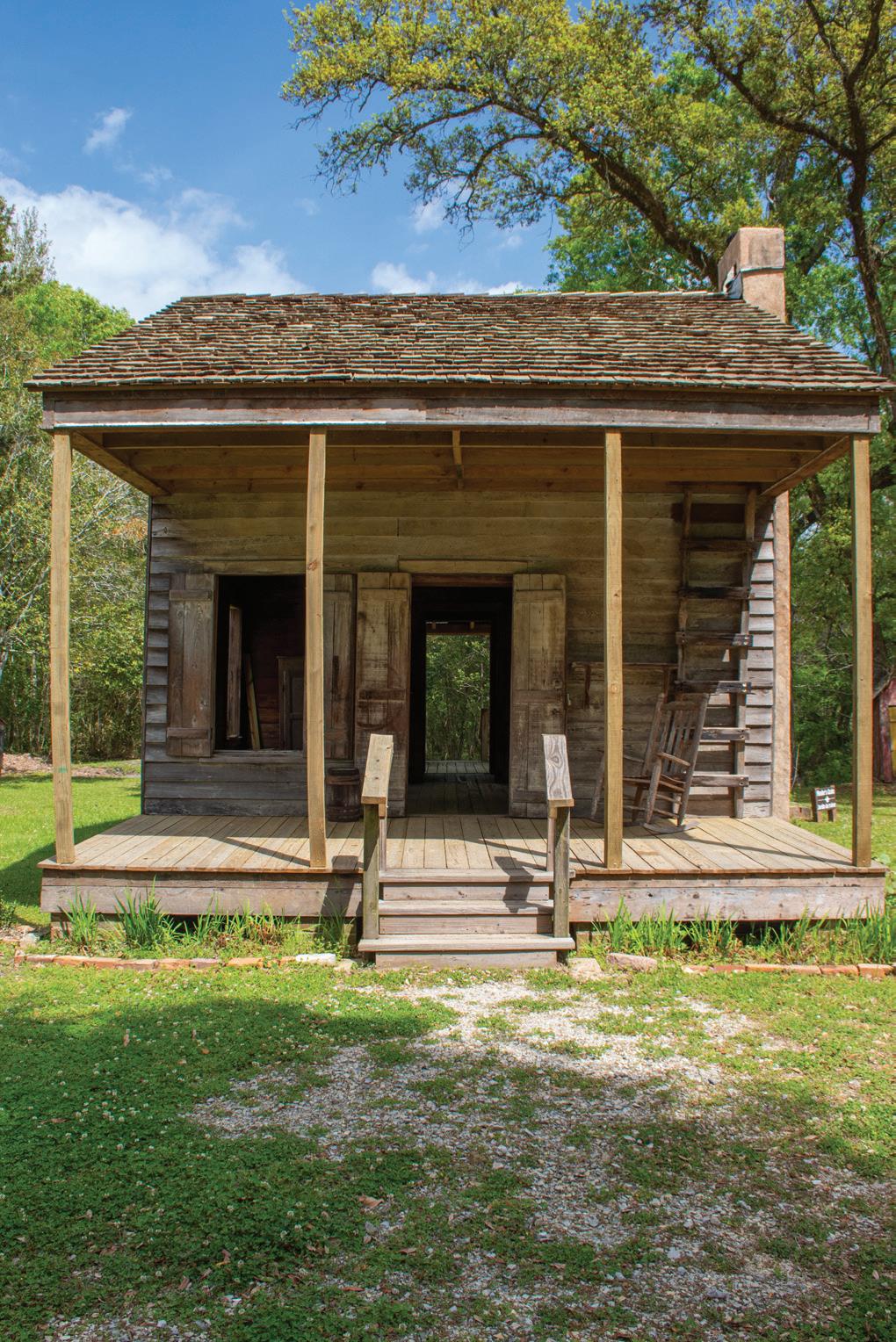
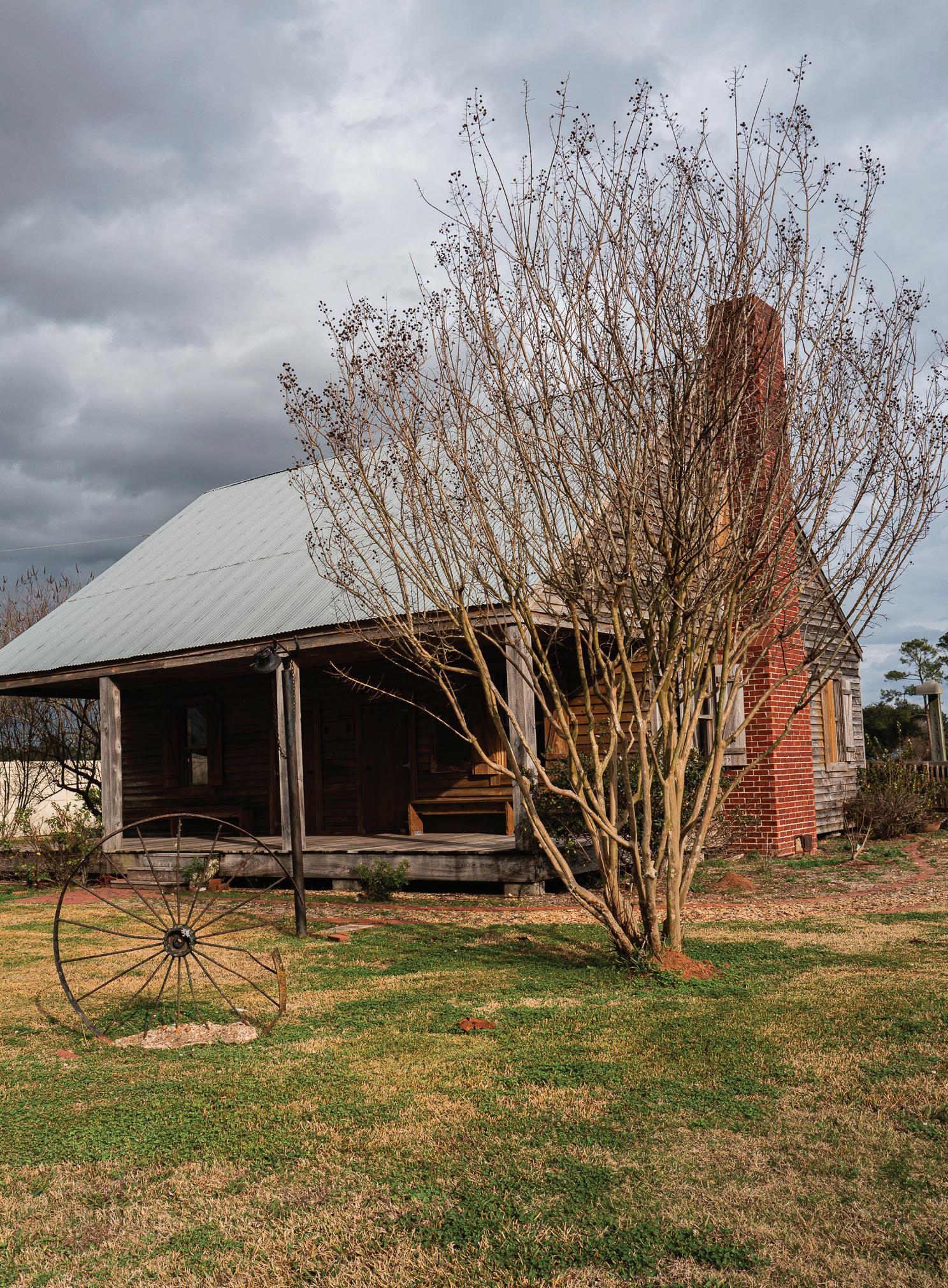
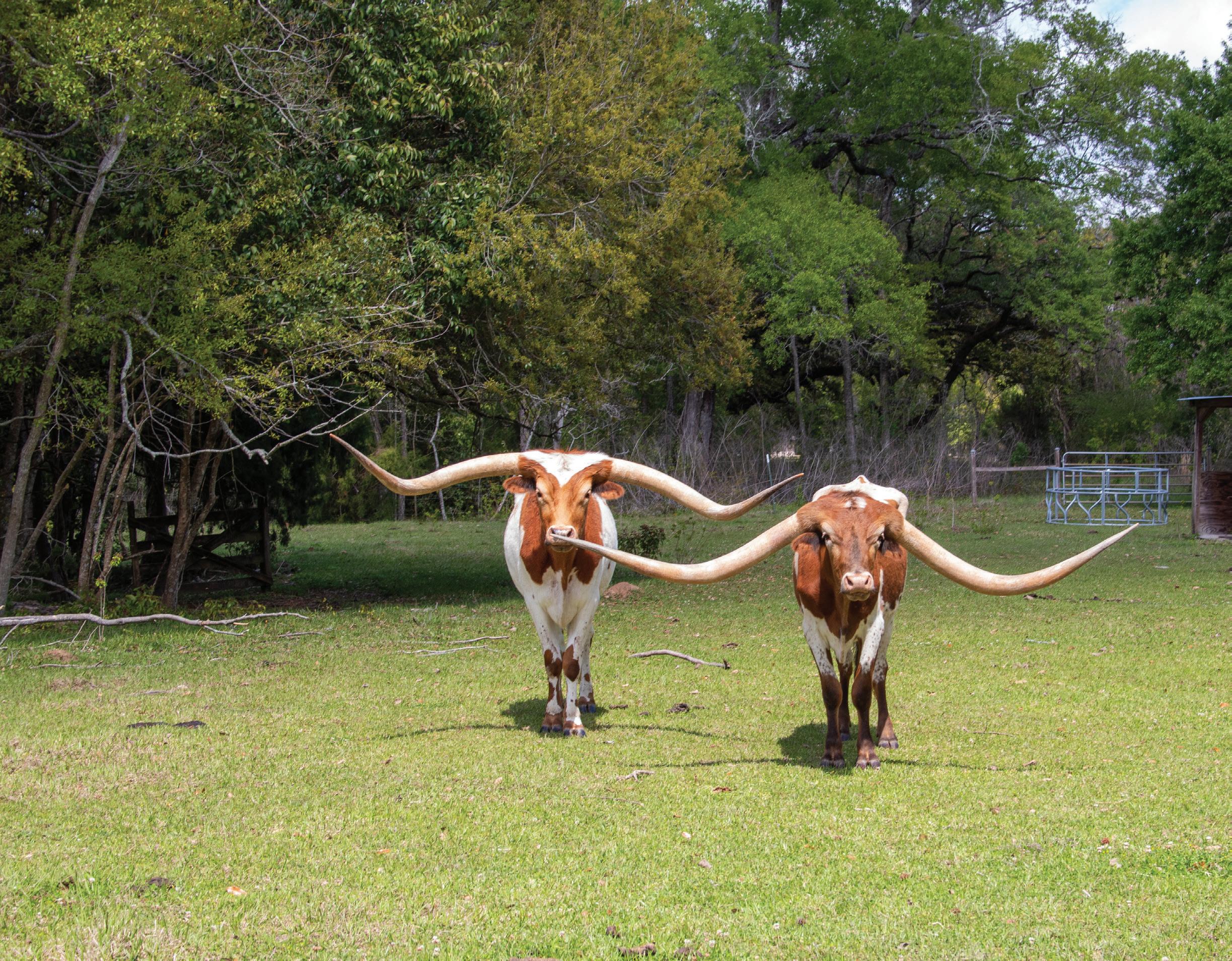
museum without interruption and at my leisure. The home is in pristine condition, so much so that I had to return to the visitor’s center to confirm it isn’t a reproduction. The visitor’s center also confirms that the site was once part of the hunting grounds of the Attakapas Indians. There are, in fact, two reproductions on the site’s grounds, an Acadian cabin and Acadian farmstead (complete with longhorn cattle), but Maison Olivier is indeed historic.
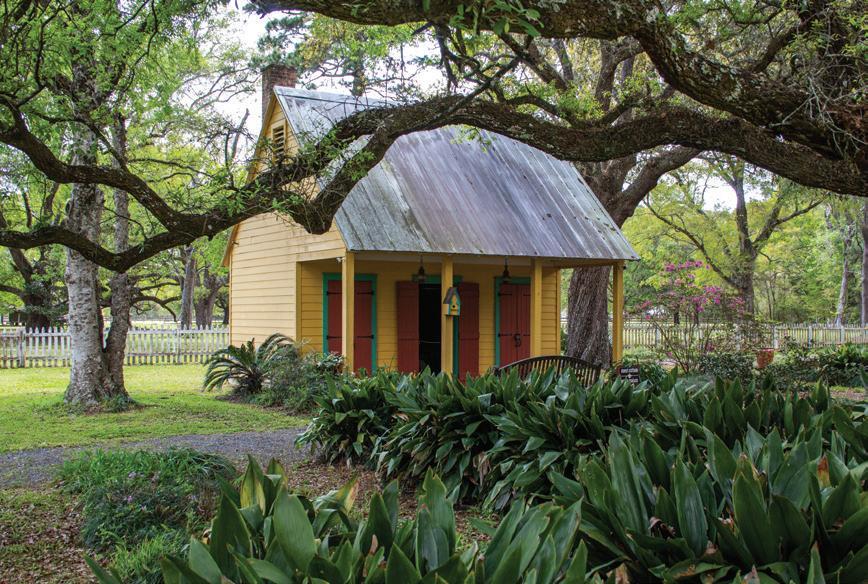
Nestled near the plantation home, behind a white picket fence, are an outdoor kitchen and bread oven, and slave quarters. A barn is situated closer to the road. The site also includes a nature walk with countless “save the bees” signs, as well as chimney swift towers and a
pollinator meadow. I’m not going to go too deeply into the rich and complicated history and detailed descriptions here, because every Louisianian (and tourist and transplant) should visit. Upon leaving, I saw a group unpacking picnic gear from their car and had regrets for not having had the same idea.
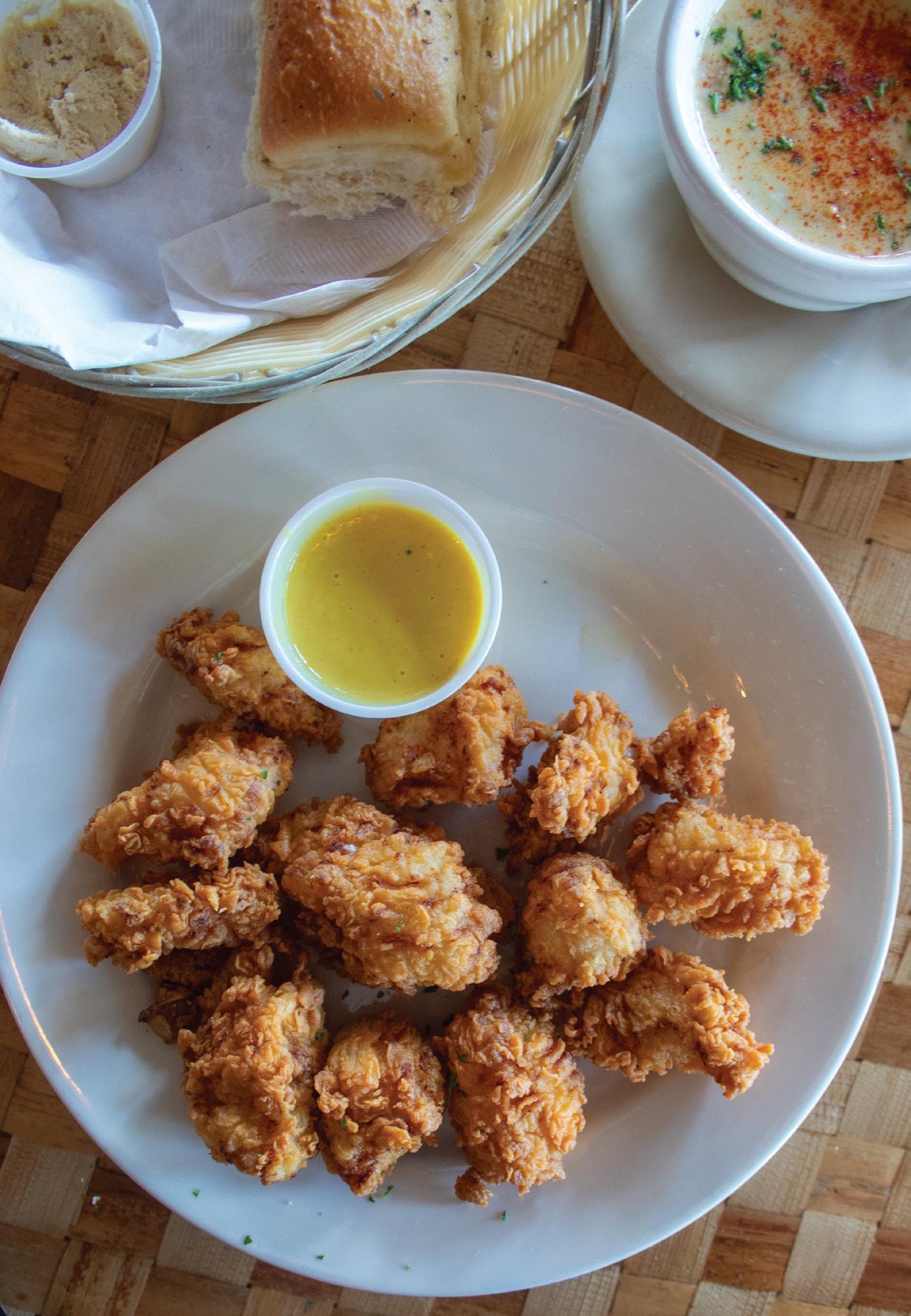
Once I started tucking into a big mess of fried alligator, corn and crab bisque, buttery yeast rolls and a large sweet tea at The St. John Restaurant (about a three-minute drive from the state historical site) overlooking Bayou Teche, my picnic regrets were long gone. It has been nearly a decade since Mark and I first dined at St. John, and we still talk about the fried alligator, because until then, we didn’t entirely care for this particular local delicacy. Too chewy, to be honest. I relayed this tidbit to my server, Jennifer, as I gushed about the flavor and tenderness of their version of the dish. Jennifer says it’s because they use
Maison Olivier at the Longfellow-Evangeline State Historical Site in St. Martinville includes the historic, circa-1815 plantation house, outdoor kitchen and bread oven, slave quarters and barn, as well as nearby reproductions of an Acadian cabin and Acadian farmstead. Nestled near the cabin is a Cajun traiteur’s healing garden, and inside vials of dried herbs and tinctures are displayed on a shelf.
jaw meat, which is either true or — in hindsight — she was messing with the out-of-towner. If it’s the latter, she got me!
After lunch, I walked over to the charming Studio Gallery & Co!ee Bar for a cuppa to go and made my way to Evangeline Oak Park. The sweet little park on the bayou is home to the beloved oak tree immortalized by Henry Wadsworth Longfellow in $847 in his epic poem “Evangeline.” The poem o!ers a fictitious account of the Acadians’ exile by the British from Nova Scotia in the mid-$700s. My visit was in March and happened to coincide with the Acadian Memorial Heritage Festival. During my visit to the park, a live band provided Cajun music as a soundtrack for my walk. I highly recommend engineering your visit similarly if, like me, you appreciate ambience.
History bu !s will also want to make the short walk (or two-minute drive) along the Teche to the St. Martinville Cultural Heritage Center, home to the African American Museum and the Museum of the Acadian Memorial.
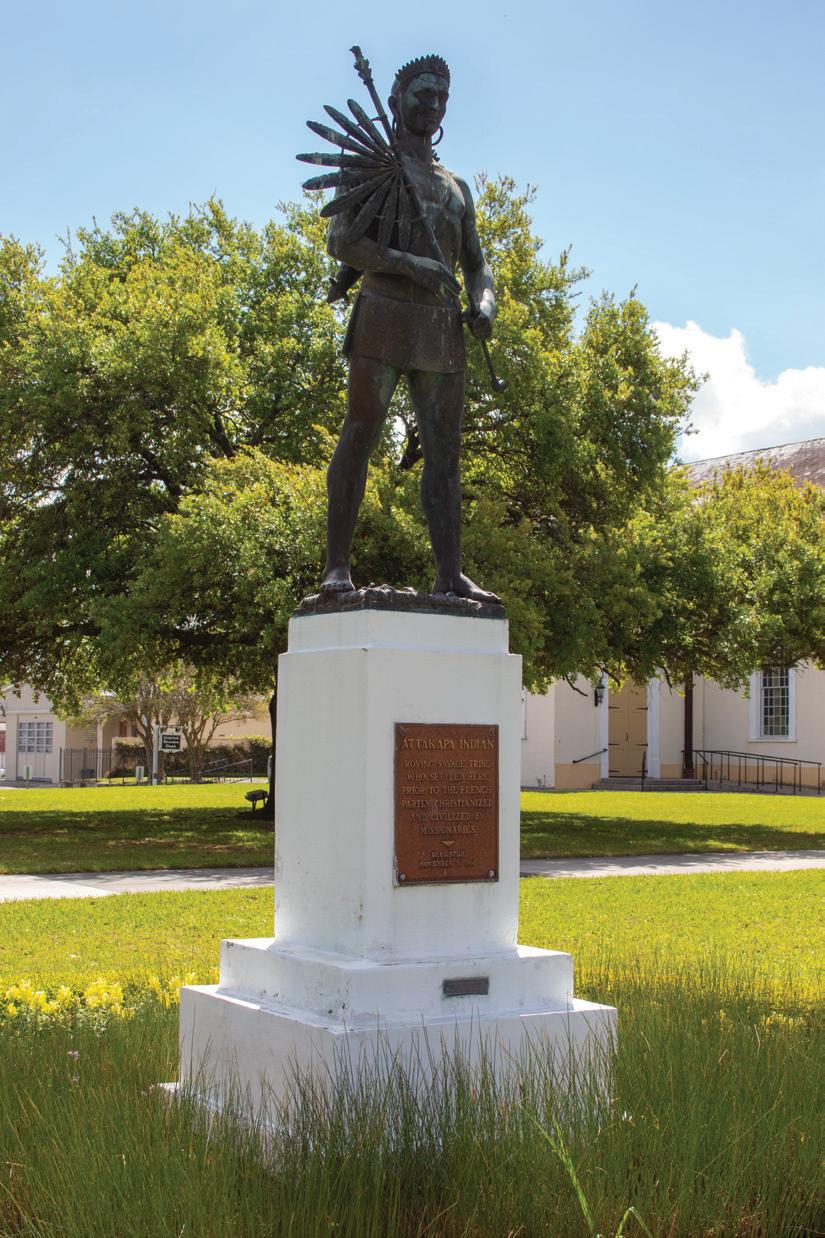
Impressive longhorn cattle are among the non-human residents at the LongfellowEvangeline State Historical Site’s Acadian farmstead reproduction. Downtown, the monument of an Attakapas man acknowledges that this area along the Bayou Teche was originally home to the Indigenous Attakapas people before the French created the Poste de Attakapas settlement, now known as St. Martinville.
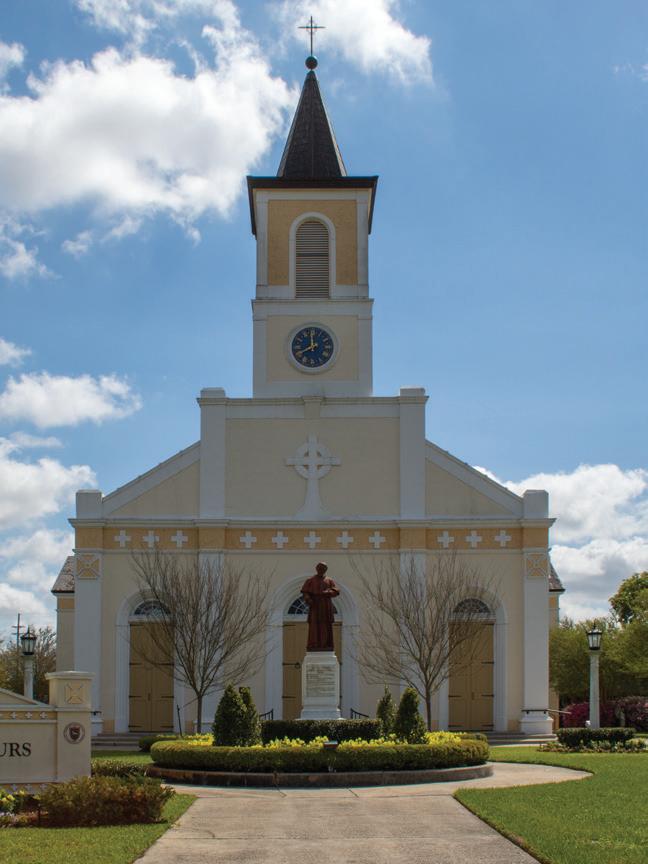
Next, I made my way a few blocks to Main Street to take in the circa $8)6 Saint Martin de Tours Church, which is the third-oldest Catholic church in Louisiana and one of the oldest in the United States. The verdant grounds also include the historic Presbytère and other buildings and monuments. The church faces a row of shops and businesses on Main Street, including Abathecary, an all-natural bath and body store, and YaYa’s Boutique, which has gifts and a co!ee and tea bar, as well as pastries. By now, it was high time I hopped in the car to make the two-ish hour trek back to New Orleans. But not before sending photos of that tasty fried gator and a few scenic snapshots, including one of the otherworldly longhorns, to Mark with texts letting him know he missed out on a day of culinary delights, history and adventure. Dear readers, I’m sure you won’t make the same mistake.
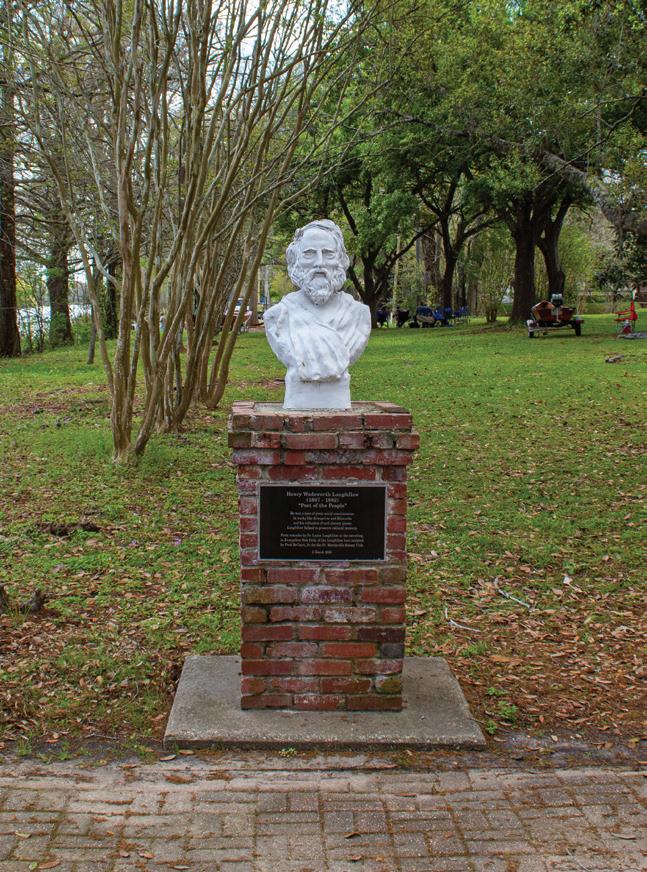
Evangeline Oak Park is home to the beloved oak tree immortalized by Henry Wadsworth Longfellow in 1847 in his epic poem “Evangeline,” as well as a bust of the writer. The nearby circa-1836 Saint Martin de Tours Church, which is the third-oldest Catholic church in Louisiana and one of the oldest in the United States, includes the historic, and stately, Presbyter on its grounds.
LOCATION
St. Martinville
1700s
In the mid-1700’s, what is now known as St. Martinville was called Poste des Attakapas. The area along the Bayou Teche was originally home to the Attakapas people before the French created the Poste des Attakapas settlement.
1765
After being expelled from Nova Scotia by Great Britain, Acadian exiles arrived in Louisiana, as part of what is known as the Grand Dérangement.
5,379
According to the 2020 Census, St. Martinville has a population of 5,379. While charmingly small, it is not the smallest town or city in the parish. That distinction goes to Arnaudville, with its population of 1,518.
A Quieter Beach
Visit Dauphin Island for the incredible Gulf beaches but don’t miss its natural side.
BY CHERÉ COEN
right)
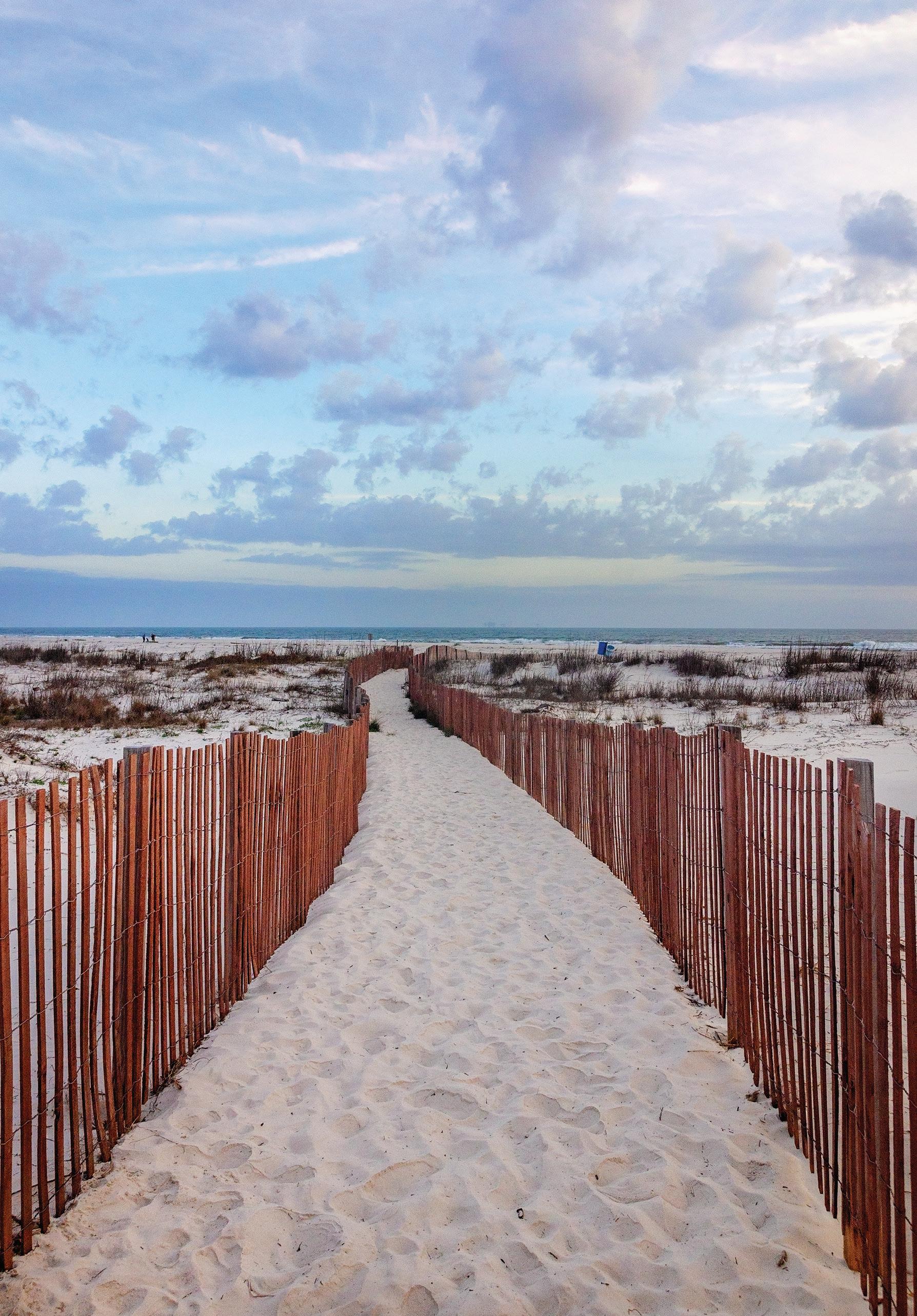
DAUPHIN ISLAND LIES ONLY 3 MILES SOUTH of Mobile Bay and a short drive from downtown Mobile. It’s an even shorter jaunt from the exquisite Bellingrath Gardens and its dramatic flowering gardens. Yet, the $4-mile-long barrier island with its small-town charm — only $,)00 permanent residents — and pristine beaches and parks seems a world away.
DAY ONE
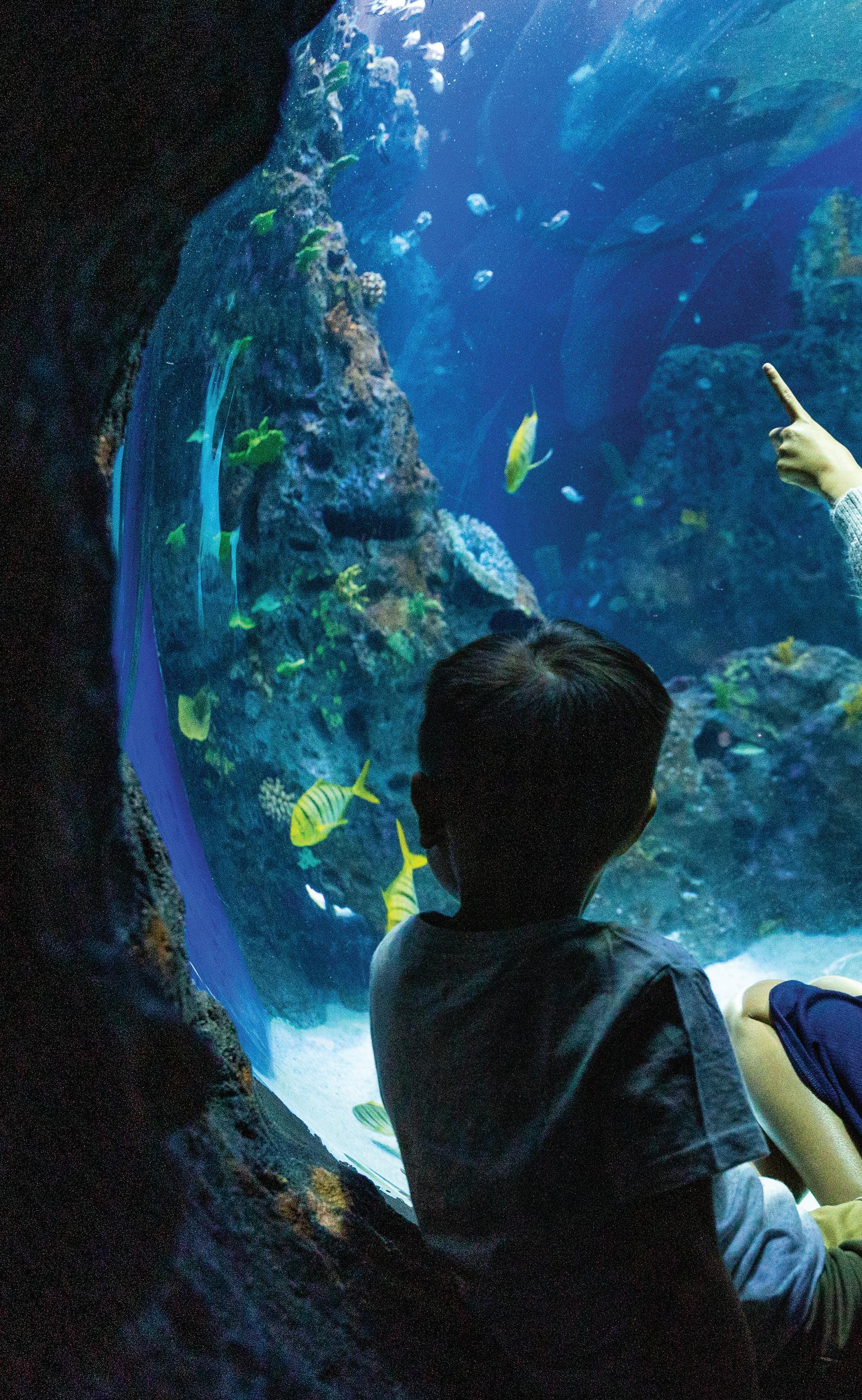
MORNING - What lies beneath Mobile Bay and other Alabama waterways is on display at the Alabama Aquarium on the east end of Dauphin Island. The facility, formerly named the Estuarium, highlights four key habitats of coastal Alabama: the MobileTensaw River Delta, Mobile Bay, the Barrier Islands of which Dauphin is one and the northern Gulf of Mexico. Visitors may view underwater creatures behind glass, touch a few such as the cownose stingrays or watch naturists feed the inhabitants. The Alabama Aquarium is part of the Dauphin Island Sea Lab which studies Alabama’s marine life as well as teaches a variety of students in marine education. Special events are o!ered regularly so check website for details.
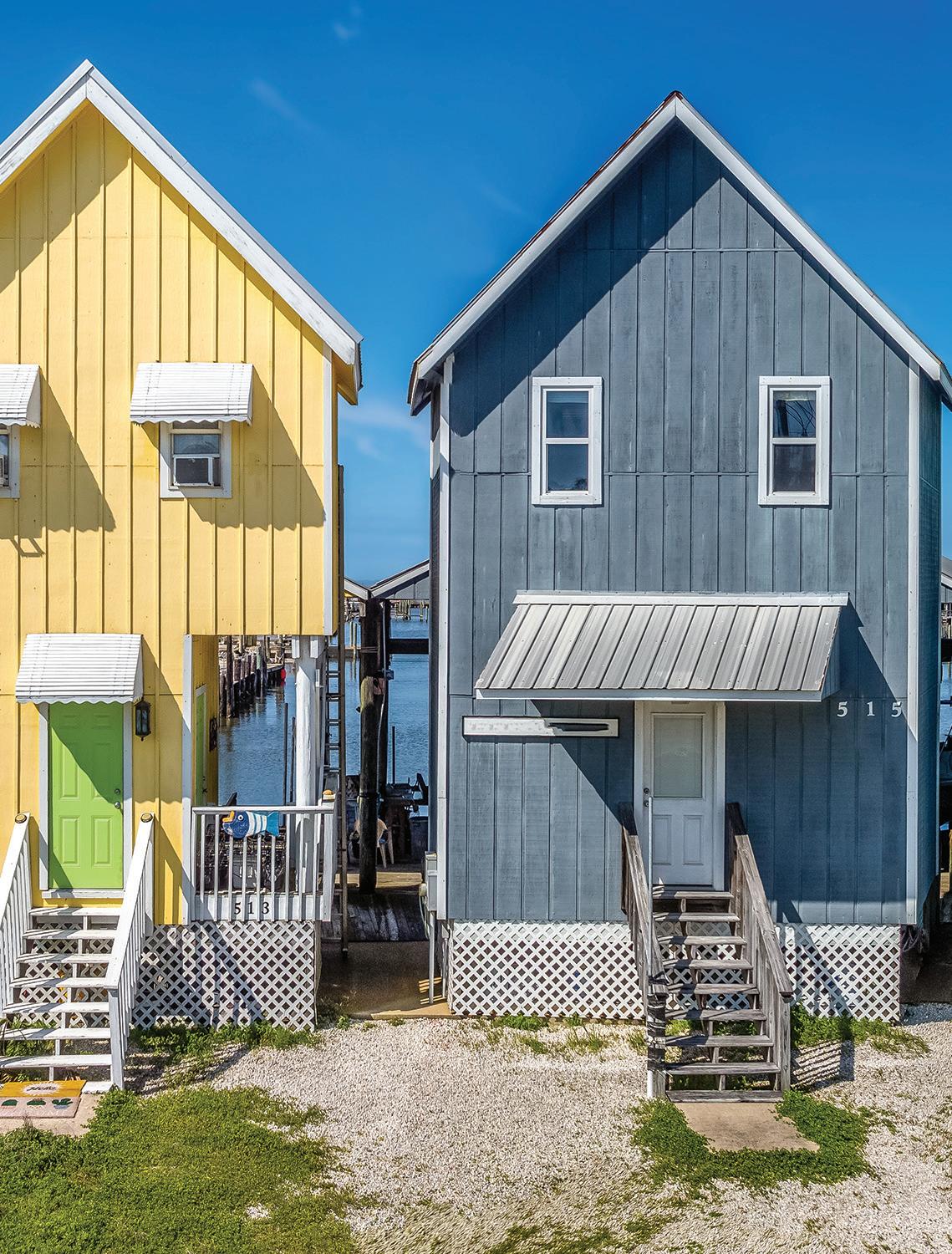
AFTERNOON - Accommodations run the gamut here — small family-owned hotels, motels, condominiums, campgrounds and private homes as rentals. First, determine what your needs are, whether a romantic night for two or a large rental for families, then peruse the handy list the town of Dauphin Island assembled at townofdauphinisland.org/where-to-stay.
(left to
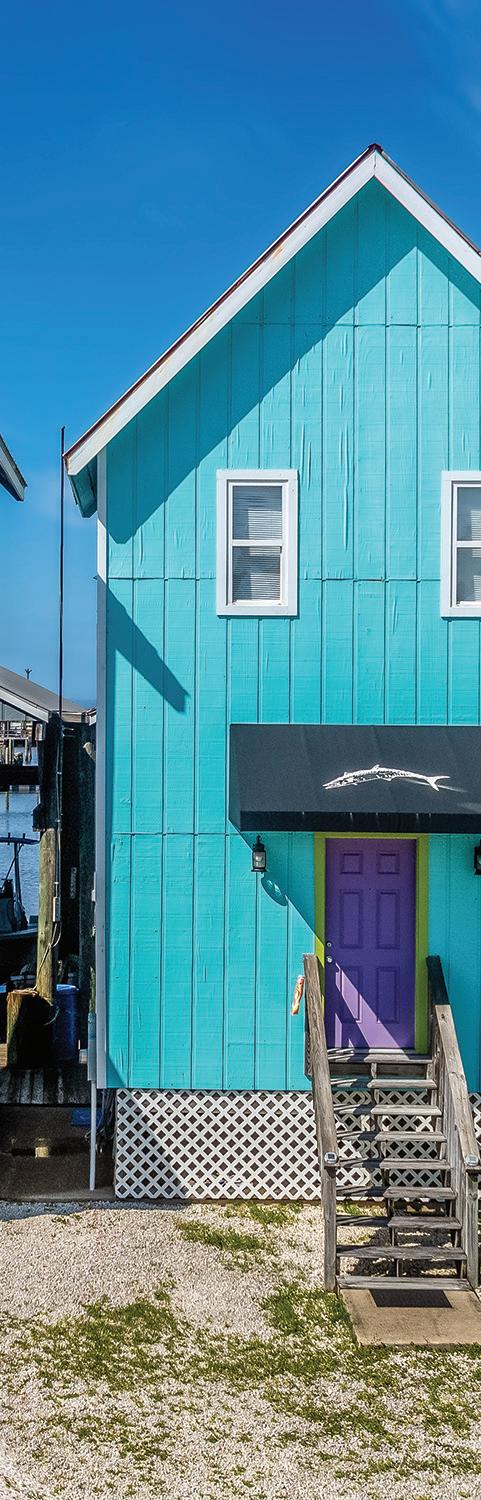
Bienville Beach; Colorful twostory vacation homes on Dauphin Island; The Carriage Wine & Market; Aerial view of Fort Morgan, Alabama
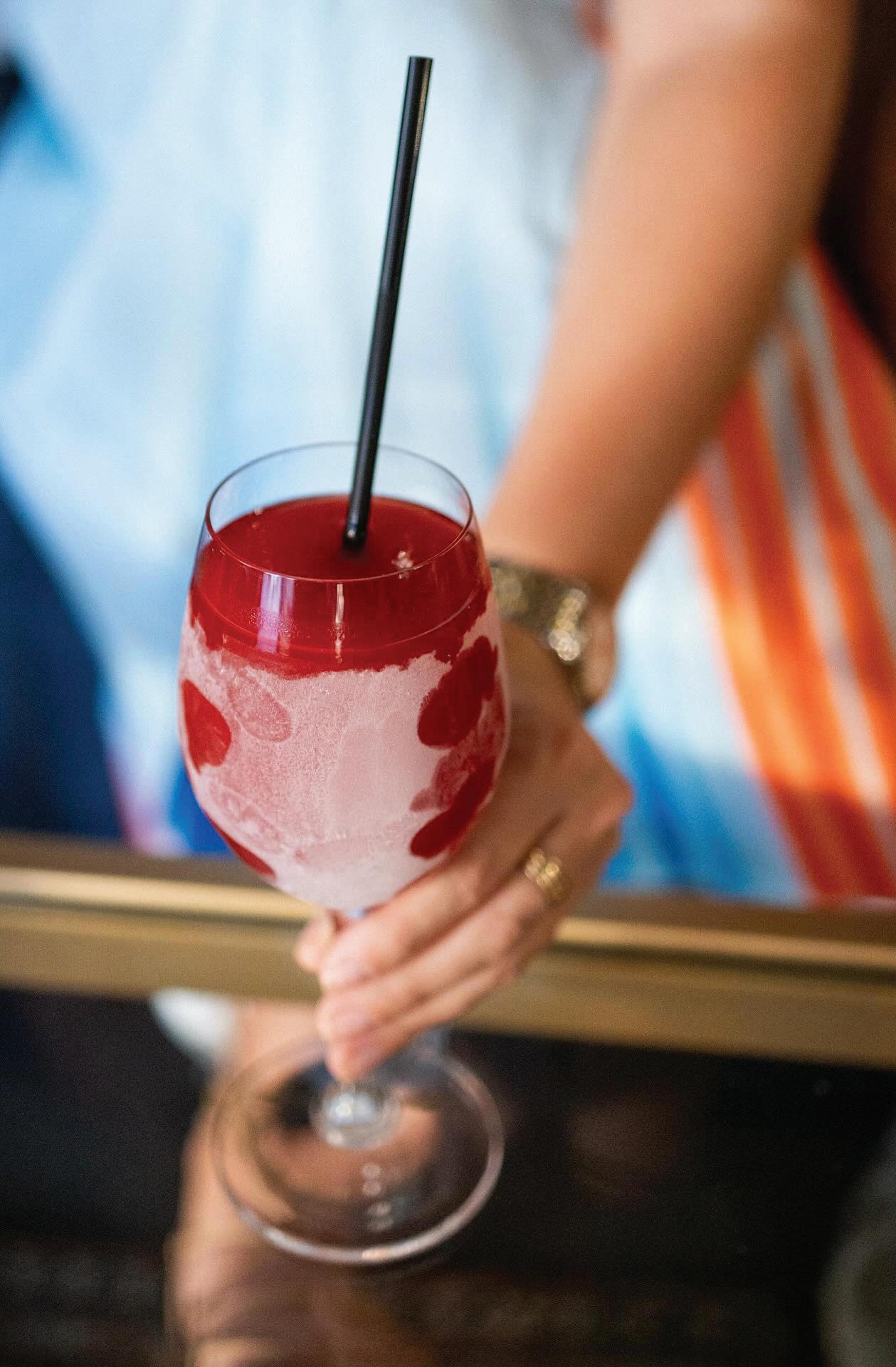
EVENING - Catch the sun disappearing over the Gulf at dusk and you’ll see why Dauphin Island has been designated the “Sunset Capital of Alabama.” One of the finest viewing spots is at Islanders Restaurant & Bar with its indoor and outdoor seating and a second floor of circular windows overlooking the Gulf waters. Islanders serves up fresh Gulf seafood, so order a seafood platter, craft cocktail and savor the show.
DAY TWO
MORNING - The roadside trailhead is unassuming so visitors may expect simple hikes through woods to a Gulf beach. But the Audubon Bird Sanctuary spans $64 acres of varied terrain, including maritime forests, marshes, pristine dunes, Gaillard Lake and yes, the Gulf seaside. It’s a peaceful walk through nature and the diverse ecosystems of the Gulf barrier islands, but a birder’s haven as well. Neotropical migrant birds rest here after a flight across the Gulf from Central and South America each spring and heading back in fall so bring your binoculars. Park at $09 Bienville Blvd. on the eastern end of the island and start exploring.
Don’t Forget
These live oaks once sheltered the wild goats grazing on the island, and it’s thought the goats would climb the trees at night to escape alligators. Today, the Goat Trees of Dauphin Island offer shelter to migratory birds. Dauphin Island Bird Sanctuary now owns the unique and historic wooded area featuring “goat” oaks on Cadillac Avenue east of Indian Shell Mound Park. It’s a short walk from the park.
AFTERNOON - Lace up those walking shoes again after pausing for lunch or gathering items from The Carriage Wine & Market for a picnic. But don’t worry, it’s an easy hike through Indian Shell Mound Park, where Native American tribes fished and roasted oysters around $$00 to $&&0 AD. Look for shell middens and ancient live oaks in this park on the National Register of Historic Places. Be on the lookout for unique birds for Shell Mound Park as part of the Alabama Birding Trails.
For more recent history, Fort Gaines remains on the eastern side of the island as a remnant of the Civil War Battle of Mobile Bay. Roam the preserved circa $8($ brick fort and you might hear U.S. Admiral David Farragut shout his now famous order in $864, “Damn the torpedoes … Full speed ahead!” Visitors may enjoy Civil War-era cannons, a blacksmith shop, museum, tunnels, guided tours and special events.
EVENING - Once is never enough so return for another round of the brilliance of Gulf sunsets. Enjoy Dauphin’s four public beaches anytime for sunbathing, swimming and beachcombing but stay at dusk for nature’s dramatic performance. West End Beach, Bienville Beach and Middle Beach lie closer to commercial attractions and East End Beach near the Alabama Aquarium and Fort Gaines face Mobile Bay as well as the Gulf.
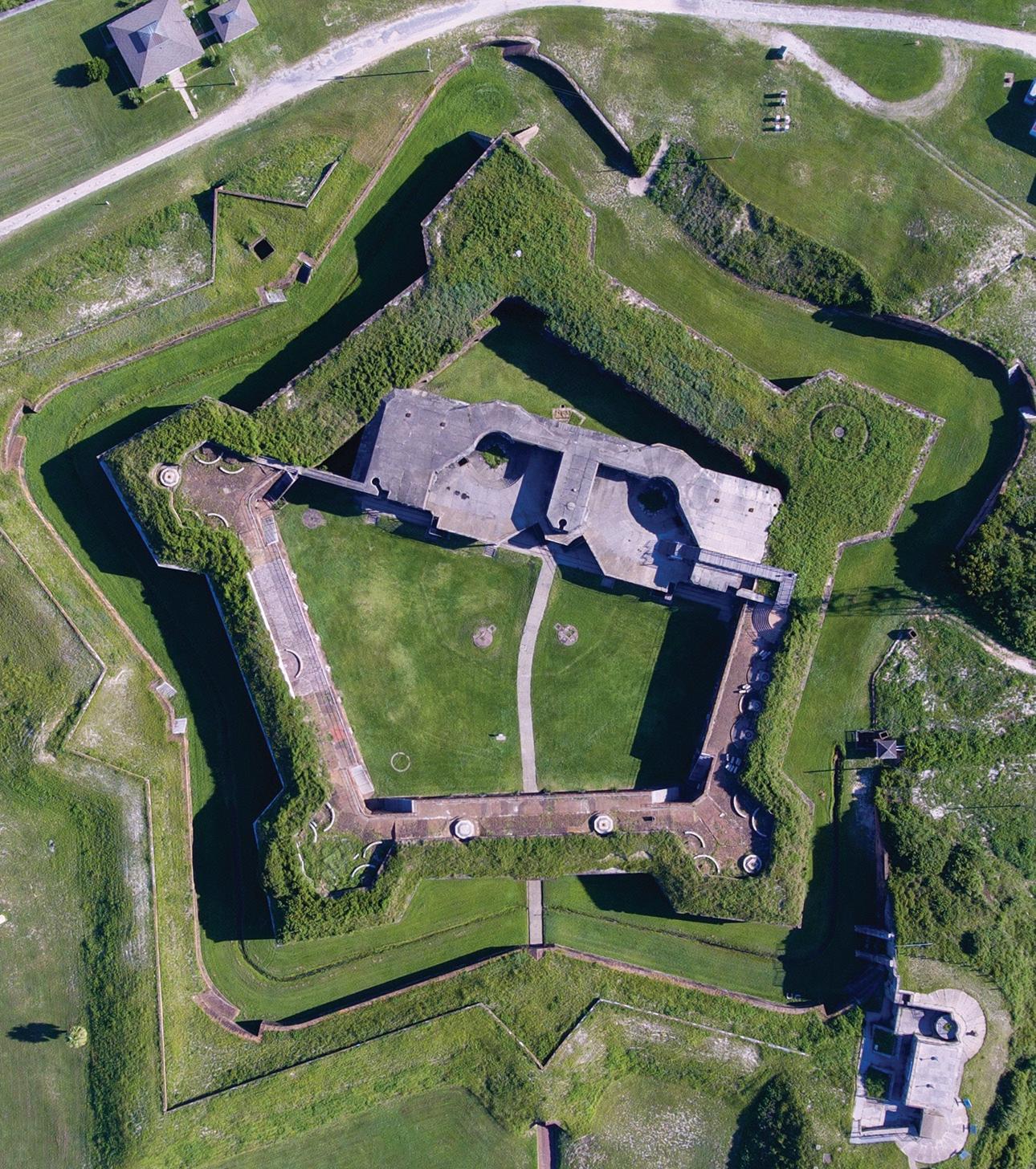
Standing on the Edge
Efforts are underway to preserve the Tchefuncte Lighthouse, a nearly 200-year-old landmark now facing the threat of slow, steady loss of the land beneath it.
BY DONALD DAHL, SLIDELL