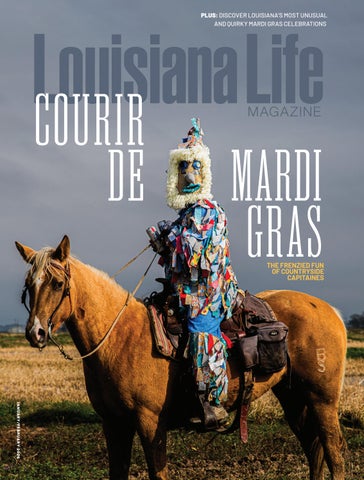
PLUS: DISCOVER LOUISIANA’S MOST UNUSUAL AND QUIRKY MARDI GRAS CELEBRATIONS
COURIR DE
MARDI GRAS
THE FRENZIED FUN OF COUNTRYSIDE CAPITAINES
JANUARY/FEBRUARY 2026
Features 30 THE WORLD INSIDE OUT
Louisiana’s Courir de Mardi Gras
46
FROGS, FLOATS AND FRIVOLITY
Discover Louisiana’s most unusual and quirky Mardi Gras celebrations.
Louisiana Life (ISSN 1042-9980) is published bimonthly by Renaissance Publishing, LLC, 110 Veterans Memorial Blvd., Suite 123, Metairie, LA 70005; (504) 828-1380. Subscription rate: One year $24; no foreign subscriptions. An associate subscription to Louisiana Life is available by a contribution to Louisiana Public Broadcasting. Periodicals postage paid at Metairie, LA, and additional mailing entry offices. POSTMASTER: Send address changes to Louisiana Life, 110 Veterans Memorial Blvd., Suite 123, Metairie, LA 70005. Copyright © 2026 Louisiana Life, all rights reserved. No part of this publication may be reproduced without the consent of the publisher. The trademark Louisiana Life is registered. Louisiana Life is not responsible for unsolicited manuscripts, photos, and artwork, even if accompanied by a self-addressed stamped envelope. The opinions expressed in Louisiana Life are those of the authors and do not necessarily reflect the views of the magazine or owner. Official digital reprint and framed content is only available from Renaissance Publishing, LLC by calling (504) 828-1380.
VO LU M E 4 6 N U M B E R 1
January/February 10
EDITOR'S NOTE
Mardi Gras Hoppin’ 16
PELICAN BRIEFS
News and updates around the state 18
LITERARY LOUISIANA
Tales of history, lore and myth 20
IN TUNE
Ruston’s D.K. Harrell Reaching Out 22
LOUISIANA MADE
Perique balances heat with hearty flavor for new sauces and spice blends 54
NATURAL STATE
Les Petites Maisons of Istre Cemetery
26 ART
Through the Eyes of West Monroe Artist Donna McGee
58
LA RAMBLER
Algiers Point offers a quaint, laid-back respite just a quick ferry hop away from New Orleans’ Mardi Gras revelry.
28
As we get deeper and deeper into Mardi Gras after January 6, and we are spending more time at parties, at balls and at parades, we sometimes need a bit of help keeping up with the celebrations. Party fatigue is real. And I consider Mardi Gras the signature holiday of Louisiana and the ideal example of a social holiday. What other state owns a holiday period?
62
FARTHER FLUNG
Ocean Springs offers art, ocean and unique accommodations, and it’s only a short drive away. 64
PHOTO CONTEST
Vietnamese Lion Dancing at the Mad Hatters Parade in Metairie
1
2
4 3 6
8 5
7
Featured Locations 1. Ruston p. 20 2. West Monroe p. 16 3. Mamou p.49 4. Alexandria/Pineville p.49 5. Houma p.51 6. Morse p. 54 7. Algiers p. 58 8. Metairie p.64
E D I TO R ’ S N OT E
Mardi Gras Hopping
EDITORIAL Editor Reine Dugas Art Director Sarah E.G. Majeste
Copy Editor Liz Clearman Web Editor Kelly Massicot Digital Editor Alyssa Schiaffino I HAVE HAD A LIFETIME of Mardi Gras celebra-
tions but only in New Orleans. Since I was a baby, we’d find a spot on St. Charles Avenue, spread out a big blanket, prop up our chair ladders and spend Fat Tuesday there. Over time and stages in my life, the look and feel of Mardi Gras has changed, but it’s always been in the same spot. Only, the more I learn about Mardi Gras in other places, the more I want to go explore. I’m not talking about Carnivale in cities like Venice or Rio de Janeiro. I mean, in my own backyard. Here in Louisiana, there are so many interesting, different celebrations that I feel curious to experience them all. One of them is Courir de Mardi Gras. I’d heard of it before but never witnessed it in person. But this year, Kevin Rabalais has taken us along with him for a peek at this old tradition. I can’t describe it nearly as well as he does, so I won’t even try. I will say that it seems like an ancient ritualistic, slightly frightening thing — there are whips involved, after all — and it gives an entirely different take on the Mardi Gras I grew up with. Honestly, it looks as though it could be out of a horror film. So of course, I want to go experience this once in my life. Also in this issue, Misty Milioto explores Mardi Gras celebrations in small towns—some with the same trappings as the Mardi Gras you might be used to, but others with surprising, unusual traditions. Most places celebrate in some way or other — you know there’s always a reason for a party. So whether your Mardi Gras includes chair ladders and boxes of Popeyes fried chicken or whips and a communal gumbo, I hope you enjoy a day that’s as Louisiana as it comes. Cheers!
Contributors Cheré Coen, John R. Kemp, Lisa Leblanc-Berry, Jeremy Marshall, Misty Millioto, Kevin Rabalais, Jeffrey Roedel, Christopher Louis Romaguera, Danley Romero, Melanie Warner Spencer, Eugenia Uhl, Liz Williams SALES Sales Manager Rebecca Taylor 337-298-4424 / 337-235-7919 Ext. 7230 Rebecca@LouisianaLife.com
Renaissance Publishing PRODUCTION Digital Director Rosa Balaguer Arostegui Senior Production Designer Ashley Bravata Production Designer Czarlyn Ria Trinidad MARKETING Marketing Manager Haley Nash Sponsored Content Coordinator Jeremy Marshall Visual Media Producer Mallary Wolfe CIRCULATION Distribution John Holzer ADMINISTRATION Office Manager Emily Ruiz Chief Executive Officer Todd Matherne For Subscriptions Call 877-221-3512
Reine Dugas EDITOR REINE@LOUISIANALIFE.COM
Follow Us
Subscribe
louisianalifemagazine louisianalifemag louisianalifemag
Catch This Deal Before It Rolls Away! Get 20% off a new subscription. *Must order online, new subscribers only. Expires February 26, 2026.
10
LOUISIANA LIFE
JANUARY/FEBRUARY 2026
110 Veterans Blvd., Suite 123 Metairie, LA 70005 504-828-1380 128 Demanade, Suite 104 Lafayette, LA 70503 337-235-7919 ext 7230 LouisianaLife.com
SALES
Rebecca Taylor SALES MANAGER (337) 298-4424 (337) 235-7919 EXT. 7230 REBECCA@LOUISIANALIFE.COM
Up Next Coming in March/April
Recipes
Travel to the Coast 12
LOUISIANA LIFE
JANUARY/FEBRUARY 2026
C O N T R I B U TO R S
What Is Your Favorite King Cake and from Where? Kevin Rabalais Cream Cheese king cake from Gracious Bakery I’m fairly simple when it comes to food and consider Tabasco the main course at most meals, but each January, I treat myself to at least one slice of the cream cheese king cake (simple, never simplistic) at Gracious Bakery.
Jeffery Roedel Classic king cake from Calandro’s Supermarket
Kevin Rabalais Writer and Photographer Kevin Rabalais, an Avoyelles Parish native, writes and photographs the Natural State series for Louisiana Life. His work has appeared in The Los Angeles Review of Books, The Australian, the New Zealand Listener, and the Argentine magazine Revista Ñ. He teaches in the Department of English at Loyola University New Orleans.
14
LOUISIANA LIFE
JANUARY/FEBRUARY 2026
Jeffrey Roedel is a producer, director and journalist focused on Southern makers, artists and creative thought. A graduate of LSU and the University of Southern California’s Production Workshop, he’s the former editor of 225 in Baton Rouge. In 2020, he released a collection of mantras for creativity called “Life Is Gonna Try to Put a Lot of Polo Shirts on You.” His album of pandemic poetry and music called “Distance” was released in 2021.
I love the classic king cake baked fresh at Calandro’s Supermarket in Baton Rouge. This traditional cake is heavy on the cinnamon, with tender and buttery brioche, but not too overloaded with icing. It’s the perfect balance for a little carnival indulgence.
Misty Milioto UniKakes Bakery Not only does the adorable UniKakes Bakery in my hometown of Laplace make gorgeous birthday and wedding cakes, but the king cakes are also a go-to for my entire family.
Misty Milioto is a freelance writer and editor with 22 years of experience working with publications across the country, including Sunset; U.S. News & World Report; and Modern Luxury’s suite of 80+ regional publications such as Aspen Magazine, San Francisco Magazine and Scottsdale Magazine. In her free time, she loves to travel and spend time with her Schipperke, Jax.
PELICAN BRIEFS
Carnival Updates
BATON ROUGE
From Gator to Gown
New Orleans, Lafayette, Shreveport, Thibodaux BY LISA LEBLANC-BERRY
The all-new Mystic Kings Krewe parade (January 5) kicks off Mardi Gras (February 17) with bejeweled co-ed riders prancing through the streets of New Orleans atop graceful Arabian stallions amid artful floats and twirling flambeaux. In Lafayette, Mardi Gras parades are returning to their historic downtown route for the first time in decades, rolling once again through the heart of the city along Jefferson Street. Native son Robert Parish, the 7’1”-tall nine-time NBA All Star and four-time NBA champion, is Grand Marshall riding in Shreveport’s Krewe of Centaur parade (February 7). Dozens of king cakes from top bakeries are available for sampling at the Louisiana King Cake Festival (January 31) in Thibodaux. Tip for sober-curious revelers: New Orleans’ first non-alcoholic cocktail bar, Mélange, recently opened on Frenchmen above the live music hotspot, Bamboula’s.
16
LOUISIANA LIFE
JANUARY/FEBRUARY 2026
Pawsome Fun Pet parents are unleashing their creativity for tail-wagging costumed revelry during Louisiana’s Carnival-themed pet parades, including the 2nd annual Krewe de Canines (January 24) in St. Francisville, Krewe de Paws of Old Towne Slidell (February 7), Mystic Krewe of Mutts in Baton Rouge (February 22), Mystic Krewe of Barkus in New Orleans (February 8), Krewe of Barkus and Meoux in Bossier City (past participants have included turtles, donkeys, cats, dogs, goats and chickens), Krewe of Barkus in Lake Charles (February 14), Mardi Paws’ “Howliday Parade” in Covington (February 22) and Mandeville’s “Krewe du Pooch Goes to HOWLywood” (February 28).
An LSU senior majoring in textiles, apparel and merchandising, Martha Rigney recently won the prestigious International Textile and Apparel Association Blanche Payne award for the “Bayou Bride” wedding gown she designed using alligator leather, inspired by her sister’s upcoming wedding. Rigney’s design tells the story of “a modern Louisiana bride” and includes a pearlescent magnolia with petals “made from the legs of the alligator hide.” Post-graduation, Rigney hopes to eventually own a custom couture business. SHREVEPORT
Singing the Dream The inaugural 2026 Voices of the Dream: MLK Regional Choir Competition (January 16-17) is a new two-day event in Shreveport featuring the timeless spirit of resilience through music. Choirs from across the region are lifting their voices in three categories: Gospel, Spirituals and Inspirational (Sacred/Secular) to honor Dr. Martin Luther King’s enduring message. ARNAUDVILLE
The Bamboo Tipi Unveiled An international bamboo master builder and designer, James Wolf, recently brought his skills to Arnaudville to work with local builders and 15 workshop participants to construct an extraordinary bamboo tipi-like structure for a striking new visual landmark and sacred gathering space, courtesy of Nunu Arts and Culture Collective. It was ceremoniously unveiled by an elder of the Chitimacha Indian Tribe of Breaux Bridge.
Additional news online at LouisianaLife.com
NEW EPISODES EVERY THURSDAY
CATCH UP AT LOUISIANALIFE.COM/LOUISIANAINSIDER
L I T E R A R Y LO U I S I A N A
Ways of Seeing Tales of history, lore and myth BY CHRISTOPHER LOUIS ROMAGUERA
Whitman. Cannonball. Puebla. “Whitman. Cannonball. Puebla.” is the latest book of poetry by New Orleans poet Rodrigo Toscano. Toscano’s book is split up into four parts, and as is his style, so many of his poems tie the physical to the philosophical, the contemporary to our shared history, the political to the people. Toscano’s poetics will often have you laughing and thinking, uncovering something new with each rereading of a poem. Picking up “Whitman. Cannonball. Puebla. ,” you can’t not feel the verve, and hear Toscano’s voice, as one poem bleeds into the next, and you have to finish it, before starting it all over again. 108 pages, $19.95
Sister Creatures Set in Pinecreek, Louisiana, Laura Venita Green’s “Sister Creatures” starts with the protagonist, Tess, encountering a stranger with her daughter and a friend. Venita Green writes the scene with equal parts wonder, terror and empathy. The encounter leaves Tess grabbing her daughter, running away and leaving blood on her cheek when she spots the stranger in her rearview mirror as she drives away. Venita Green’s writing keeps the reader engaged, as the story weaves in different genres and characters in ways that continue to grip the reader. A Pioneer Valley Writers’ Workshop alum, Laura Venita Green lives in New Orleans. 236 pages, $28
18
LOUISIANA LIFE
JANUARY/FEBRUARY 2026
Cajun South Brown Folk In Shome Dasgupta’s “Cajun South Brown Folk,” he uses his poetry in order to connect his East Indian roots with the Acadian setting he currently lives in. These poems are heavily embedded with place but also history. Dasgupta weaves the Cajun and Bengali cultures that have made up his life into beautiful poetics. Each line feels like it is filled with a dual consciousness, of his Asian and Acadian selves, as they combine to form beautiful poetry of a uniquely American experience. This is shown in poems like “A Louisiana Sestina,” where Dasgupta writes, “You—once a ghost, a myth, creating your own rougarou in a flooded history.” 72 pages, $16.95
The Furies Moira Egan’s “The Furies” conjures classic women characters from myths of old, including Medusa and Mary Magdalene, and breathes new life into them with her poetics. Egan’s voice, and how she lends her poems to these women characters, highlights and upholds women’s voices. Egan brings home this point in the title poem, “The Furies: a hero[in]ic sonnet crown, with index,” with the lines, “And yes, it’s plain, we must reclaim the names / they hurtle at us. Vixen, harridan, / virago, harpy, nag, hag...” This is Egan’s ninth book, and it is published by LSU Press. 92 pages, $20.95
Additional books online at LouisianaLife.com
SCAN TO ORDER
In Louisiana, we love to eat and celebrate, and no matter the season or time of year there’s always a special occasion to mark with food, family and friends. This 15-month calendar of Louisiana’s finest cooking highlights a recipe for each month, plus two bonus recipes to keep you cooking all year.
SCAN OR VISIT LOUSIANALIFE.COM TO ORDER
IN TUNE
Bringing the Blues Ruston’s D.K. Harrell Reaching Out BY JEREMY MARSHALL
THE BLUES IS A LIVING, breathing organism — the
lifeblood of the collective souls of the exultant, the downtrodden, the righteous and the damned. This past year has seen a bit of a blues resurgence into popular culture through Ryan Coogler’s rollicking Mississippi Delta Vampire blockbuster “Sinners,” a film steeped in the near-mystical ability of music to transcend time, space and generations, dating back to the dawn of man. For some, the blues might feel borderline archaic, perhaps entombed within the fabric of the past, the fodder of retrospectives merely, or the odd standards album revisiting the glory days of juke joints and old school dudes picking guitars gifted to them by supernatural entities on moon-drenched crossroads. Its influences are legion; with nearly every genre of American music having incepted the lyrics, bass lines and instrumentation of the blues into their core DNA in some manner. But the true blues, the soulful sound of gospel and wailing, is as alive today as it ever was through a brand new group of singer/songwriters heralding the dawning of a new age of musical innovation. One of
20
LOUISIANA LIFE
JANUARY/FEBRUARY 2026
those heralds, the brightest and most prolific of his generation, is D.K. Harrell. Born D’Kieran Harrell in Ruston, Louisiana, in 1998, D.K. found the rhythm that connects the blues and the divine early on, singing in his church choir around the same time he first heard the voice of B.B. King and sought to emulate him. D.K. found comfort and inspiration in many of the masters, with Albert King, Freddie King, Elmore James and Muddy Waters all flowing through his mind and guitar strings as he sought to find a sound as reverential to the past as it was forward-seeking and new. As D.K. preaches before “Praise These Blues”, the final track on his second studio album, “Talkin’ Heavy,” “If you listen to the blues, don’t be ashamed; for the blues and the gospel are just the same.” Already touted as a luminary at the young age of 27, D.K.’s talents are being celebrated around the world, from festivals in Mississippi and Louisiana to shows in Germany, Switzerland, the Netherlands, France, Belgium, Spain and Norway; spreading the good word of the blues while gleefully making it his own. From his first paying gig as an invited guest to the B.B. King Symposium in Indianola, Mississippi, where he played “The Thrill Is Gone” on his idol’s guitar, Lucille, to today, with the release of his second album, D.K. has been embodying the line between the saintly and the sacrilegious, the profane and the holy, that intangible imperfection that makes the blues played right sound so sweet. “The past gives a blueprint that you can add yourself to. I keep progressing by keeping all the genres in the mold,” says D.K. on dkblues.com, “and I keep exposing my music to younger folks everywhere I go. I am hell-bent on crossing the blues over to a new generation of fans.” The blues is alive, that much is for certain, and it’s soaring on the strings of D.K. Harrell.
Additional music news online at LouisianaLife.com
LO U I S I A N A M A D E
The Spice is Right Perique balances heat with hearty flavor for new sauces and spice blends BY JEFFREY ROEDEL PHOTOS BY ROMERO & ROMERO
L A S T S U M M E R , over the serenading crush of emerald Gulf waves, Alys Beach homeowners dining at The Beach Club devoured something new — a sweetheat cornbread concoction called Perique Creole Handshake Corn Beignets. The name is whimsical, but the spice kicking into those welcome newcomers to the restaurant’s late summer menu was a bold find by former Galatoire’s Executive Chef Michael Sichel. He and his wife, Lisa Tudor, now live near 30A, but on a trip back to the Crescent City she had picked up something she’d never noticed before: a bottle
MATT NICHOLS
of Perique Green Pepper Sauce, at long-time Metairie family grocery Dorignac’s. Soon her husband, lead chef at The Beach Club, was using that bottle of sauce, and a full run of OCCUPATION Perique products, too, for their home-cooked Co-owner and brand favorites. manager, Perique Pepper Think crispy Cajun fried chicken, tangy blackSauce ened shrimp salad and smokey grilled boudin. For Sichel, a French-trained fine dining SOCIAL MEDIA @periquepeppersauce specialist and cancer survivor who rose to fame competing on “Top Chef,” it was only a matter of WEBSITE time before Perique made its way into dishes he periquepeppersauce.com served at the Alys Beach restaurant. “Perique uniquely enhances flavors without having a specific, recognizable profile itself,” says Sichel, who led the kitchen at Galatoire’s for nearly a decade in the 2010s. “So it contributes the acid and the heat element in a new way that also feels connected to the past. I believe in the classics when it comes to cuisine, and that’s why I connect with Perique.” Most ambassadors are appointed, but Perique founder Matt Nichols became one for Creole cuisine and culture by choice — and long before he launched his suite of hot sauces and spices in 2018. Born in Chicago and arriving in late 1970s New Orleans when his surgeon father took a position with Tulane, Nichols talks about his first king cake as a child like a proud cardinal might refer to his first communion. He was served a slice in his kindergarten class, where he had already earned the nickname “Yankee.” Nichols will never forget the gleam of that colorful sugar, or the
22
LOUISIANA LIFE
JANUARY/FEBRUARY 2026
Additional images online at LouisianaLife.com
LO U I S I A N A M A D E
“I shrug my shoulders when people ask me about the Scoville scale ratings of our sauces,” he says. “Because I simply do not know.” Perique may be a David in a field of generations-old hot sauce Goliaths in the Deep South, but success for Nichols’ sauces and spices will come through the word Sichel uses to describe the products and something Nichols has proven skilled in doing — whether it’s dining with Dickie Brennan at Pascal’s Manale, or bantering with the clerks at the French Quarter gift shops stocking his sauces for tourists to take home. Nichols loves to connect. If the spice isn’t right, the people will let it be known, with their dollars — and their reviews. Few understand this better than Sichel. “My years at the helm of Galatoire’s were the most influential of my career because those customers in New Orleans were both so appreciative and had such high expectations, too,” he says. “Galatoire’s is a legendary institution because it embodies Creole cuisine, and so does Perique.” That comparison touches on a purpose beyond the plate, a worthwhile intention. Nichols holds his brands to strict standards, because he views Perique as not just a pepper sauce, but an elixir, and an ambassador. “Food is an essential part of life,” Nichols says. “But I hope Perique is a reminder that in New Orleans, in Louisiana, we take a lot of pride in it, and we bring food to a whole different level.” timid feeling of not wanting to stand out. Completely unfamiliar with Mardi Gras tradition, when he found the plastic baby buried in his brioche, he shoved it deep in his pocket and didn’t say a word. “That was my introduction to the mystique of New Orleans,” Nichols says. A natural storyteller steeped in the anthropology and ethnobotany — particularly Amazonian plant use — he studied at Tulane University, Nichols is speaking up plenty, now. The creative force behind Perique Pepper Sauces and Creole Handshake and Cajun Handshake spice blends has his Louisiana-made, classic-leaning brands in Rouses Markets across the state, and in a string of smaller, locally owned grocers in the New Orleans area. Inspired by perique tobacco, a unique strand born in St. James Parish, nursed by Mississippi Delta soil and aged in oak whiskey barrels, Perique Pepper Sauce leans into its Louisiana cane vinegar for a smooth heat without any regrettable bite. “It’s all about the balance,” says the 53-year-old entrepreneur who co-owns Perique with his father Dr. Ronald Nichols. “From the beginning, I said that this was more or less like an art project becoming real. I wanted to make a healthy, alluring, beautiful sauce that is emblematic of Louisiana.” And that balance means hotter isn’t always better. Drawing from his laboratory experience and botanical studies, Nichols approaches recipes like an apothecary more than a backyard cook. Both Creole Handshake powders — Dry Spice and Caribbean Jerk — are low sodium.
24
LOUISIANA LIFE
JANUARY/FEBRUARY 2026
Q&A If you could share a New Orleans meal using Perique with anyone, who would it be? Emily Poitevent Hayne Walker, who was the first woman to serve as Queen of Comus and Queen of Rex in the 1920s. I grew up in a house in the Garden District where she lived for decades. The majority of our brands and products were conceived in the kitchen there. I’d love a meal with her on the front porch at the Columns. Raw oysters with our red, seafood gumbo with our green, some maque choux with our Creole Handshake, and rack of lamb with our I Want My Farm Back herbes de Provence. Is there a cookbook you have a particular love for? I love “River Road Recipes” — published by the Junior League of Baton Rouge in 1959. We used that when I was growing up, and I still love it now. That’s been my go-to cookbook for a long time. Have you heard of any surprising uses for your spices or sauces? A lot of people mix the Caribbean spice with sour cream for a quick potato chip dip, which is creative. I’ve even heard some people add a little of our red in their cup of coffee. Now, I never thought of that one!
ART
The Natural World Through the Eyes of West Monroe Artist Donna McGee BY JOHN R. KEMP
W E S T M O N R O E A R T I S T Donna McGee looks to the works of earlier artists such as Vincent Van Gogh for their use of bright colors and their “unique vision” and to environmentalists, conservationists and poets for their love of nature. But most of all, she stresses the spiritual and aesthetic importance and inner peace of “being in the moment” when in nature and at her easel. “The artists who inspire me are those that have a unique vision and are seriously committed to the pursuit of that vision,” says McGee. “They all have helped me to see the world in a different way.” Born in 1953 in Kosciusko, Mississippi, McGee’s love of nature began while growing up on her family farm in Mississippi. From that early age, the photographs of Ansel Adams and the conservation work of John
(left) “Omen 3” (above) “A Little While,” Lake Jackson, Glen Allan, Mississippi (facing page, left) “Omen No. 2,” Petit Jean State Park, Arkansas (right) “Fishing for Gold,” Colorado
26
LOUISIANA LIFE
JANUARY/FEBRUARY 2026
Muir began to influence her ideas about conservation and the environment. Later she read Thoreau poems about living close to nature. “That made me feel good about how I grew up,” she recalls. “On the farm, we were [dependent] upon and aware of how important the earth and land were to us.” McGee also credits the life and work of artist Georgia O’Keefe. “She seemed independent, focused and takecharge,” McGee says. “O’Keefe camped and hiked in nature, and painted. It reminded me of my childhood and how I grew up,” she says. McGee also mentions her longtime friend, the late West Monroe teacher Ana Ham, who taught her to “be in the moment, enjoy the moment, not the destination” when in nature.
Additional images online at LouisianaLife.com
Exhibits CAJUN
Dark Wave/Light Room. Group show limiting color to amplify line, form, texture, through Jan. 10. Acadiana Center for the Arts, Lafayette. acadianacenterforthearts.org CENTRAL
Enduring Concepts. Artists approach themes of people, place, emotion, spirituality, permanent show. Alexandria Museum of Art. themuseum.org NOLA
Each One Teach One. 100 years of art from Xavier University of New Orleans, through Jan. Ogden Museum of Southern Art, New Orleans. ogdenmuseum.org
“I am interested in the beauty of nature, the colors and texture,” she says, “but my interest goes beyond the surface. I enjoy how light or night affects how we see the world. My interest is more about the moods or mystique of nature. I love the time between day and night when the world changes, when reality opens the door to dreams. I like night and the mystery of what happens in the night. I am very responsive to the moods of nature. When I paint plein air, the goal is to learn more about what is happening with nature. The knowledge gleaned from plein air paintings becomes a part of my studio work, but I rarely paint a studio version of the same scene.” Though McGee’s intensely bright and colorful palette is about nature, it’s not in the traditional sense an exact representation of what she sees, but what flows through her imagination, observations and sense of social responsibility. She creates images of the land, flowers, birds and “forces shaping the land.” But if you look closely into those images, you will find embedded in the paint cuttings from recycled plastic water bottles, candy bags and other discarded plastic waste. “I wanted to be a bit more pro-environment with my work,” she says. “I want them to be beautiful, not angry, art but still carry a message. I asked friends to save their pretty pieces of plastic that they were going to throw in the trash. I’ve got boxes full of plastic packaging. They might have recycle symbols that show as a society we have an interest in the environment. But at the same time, they are plastic packages or plastic bottles that
go into the trash. My art becomes a talking point for responsible use of natural resources. That’s where I am. We can’t live without plastic but there are all kinds of research for creating plastics that are biodegradable. There’s hope.” Like most artists, McGee has a message in her art. It’s about nature and responsible living. She wants to inspire people. “We are part of nature and should be respectful all that nature gives us,” she says. “I think we have become distanced from the fact that our lives really depend on nature and the environment. I want my art to speak more strongly for nature, for ideas of conservation and responsible use, but I also want it to be beautiful.” Wanting her art to be responsible and beautiful has brought McGee considerable attention. In addition to advanced degrees from Louisiana Tech in Ruston and Mississippi State University and over three decades teaching art at Grambling State University, where she also served as department head, McGee has received numerous awards and honors, and her work has been included in a number of national and international juried exhibitions. But with that said, McGee is most at peace and in her “most real place” when painting and creating art. “Time really has no meaning,” she says. “It is a very meditative experience for me. It is very therapeutic, but this is probably because I just love the process. It makes me happy. It’s part of me and what I do.” For additional information, visit donnafmcgeefineart.com.
NORTH
Clyde Connell and Pat Sewell. Work by two renowned North Louisiana artists, permanent show. Louisiana State Exhibit Museum, Shreveport. laexhibitmuseum.org RIVER PARISHES
A Bayou State of Mind. Louisiana artists explore Louisiana culture, through Jan. 4. LSU Museum of Art, Baton Rouge. lsumoa.org
LOUISIANALIFE.COM
27
K I TC H E N G O U R M E T
Purple Sweet Potatoes 3 purple sweet potatoes, scrubbed 1 tablespoon olive oil 1 4- or 5-ounce package goat cheese, at room temperature 3 tablespoons softened butter Zest of 1 large orange 1 . PR E H E AT the oven to
350F. With a pastry brush, paint the skin of each sweet potato all over with oil then wrap in aluminum foil. Cook in oven for 45 minutes to an hour, depending on the size. If a sharp knife pierces the potato easily, it is done, otherwise continue to cook for another 15 minutes. Remove the potatoes and unwrap them. Allow to cool. 2 . W H I L E the potatoes
are cooling, mix cheese and butter together thoroughly. 3. CU T the potatoes
in 2 from one end to the other. Slit the the flesh from one end to the other without piercing the skin. Open the slit and stuff each of the potato halves with 1/6 of the mixture. About 5 minutes before serving return the potatoes to the oven for 5 minutes to warm and soften the filling. 4 . R E M OV E the potatoes
Mardi Gras Mood Purple, green and gold on a plate!
from the oven and grate the orange peel over the potatoes right before serving. Serves 6 A S W E G E T D E E P E R A N D D E E P E R into Mardi Gras
after January 6, and we spend more time at parties, at balls and at parades, we sometimes need a bit of help keeping up with the celebrations. Party fatigue is real. And I consider Mardi Gras the signature holiday of Louisiana and the ideal example of a social holiday. What other state owns a holiday period? It is the kind of holiday that you can celebrate a little bit or a lot. You can alternate based on your mood. You can even build it up to a planned frenzy.
Remember that every dish doesn’t have to contain 3 colors. Think of the table as a whole. Remember to use the serving dishes to make the third color. The theme can also be enhanced by a pewter tray with a jester or a crown.
BY LIZ WILLIAMS PHOTOS AND STYLING BY EUGENIA UHL
28
LOUISIANA LIFE
JANUARY/FEBRUARY 2026
Additional recipes online at LouisianaLife.com
I like to start simple — overnight oats with three-colored sugar. Begin your day thinking of Mardi Gras. My mother used to cut a piece of king cake and using a biscuit cutter she’d remove a circle of it. Then, she’d put it into a buttered pan, crack an egg into the hole and cook it. That was Mardi Gras breakfast. Toad in hole with attitude. That led me to Mardi Gras breakfast pudding for Mardi Gras breakfast or after parades. Last year, I ate a boudin sandwich made with a generous piece of king cake. I found it outlandish, even for Mardi Gras, but it made me think more broadly about Mardi Gras eating. I tried to get creative making stuffed peppers — yellow, green, and purple ones — stuffed with a shrimp-studded dressing. If you have trouble finding purple peppers, serve the yellow and green ones on a bed of shredded red cabbage. It’s hard to be imaginative every day during the Mardi Gras season, and when my children were little, I made a deal with them. There would be Mardi Gras-themed lunch in their lunch box once a week. It was a time that my boys would eat anything that was purple, green and gold. A plastic sandwich bag with golden cherry tomatoes cut in half, with green pepper strips, wrapped in red cabbage, to dunk into another bag with a dressing made of yogurt and mayonnaise with cheese sticks on the side. It was simple, but fun. And that was the spirit of Mardi Gras that we kept stoking all through the season. For parties, you can find many dishes to serve on the right color paper plates to make the feeling festive. Enlist everyone in the spirit and offer imagination, generosity and fun.
Orange Tart CRUST 2 cups flour
Mardi Gras Stuffed Peppers
1/2 cup powdered sugar
2 tablespoons of olive oil, and more for drizzling
¼ cup chopped crystallized ginger
1 small onion, finely chopped
3/4 cup (11/2 sticks) cold butter, cubed (use salted butter instead of adding more salt)
1 stalk celery, finely chopped 1 bunch Italian parsley, finely chopped, divided in half
11/2 tablespoons cold water taken from a cup of ice water
1 cup grated Parmesan cheese, divided in half
FILLING
1 pound of shrimp, peeled and chopped
11/4 cups granulated sugar
2¾ cups stale breadcrumbs
4 large eggs
1 tablespoon Creole seasoning without salt
1/3 cup freshly squeezed orange juice
½ teaspoon salt
1/3 cup salted butter, melted 2 tablespoons heavy cream 11/2 tablespoon orange zest 1 teaspoon lemon zest 1 teaspoon powdered ginger Colored sugar for garnish 1 . FO R T H E C R U S T Preheat
oven to 350F. Spray tart pan with cooking spray. Place all of the ingredients except the water into the a food processor. As the processor is blending add the water. Pulse until the mixture resembles wet sand. Be sure that there are no large chunks of unincorporated butter. 2 . PR E S S the dough into the tart pan so that it covers the pan evenly on the bottom and the sides. Place into the refrigerator until ready to fill. 3. FO R T H E F I L L I N G Beat all of the ingredients together with a whisk or immersion blender until the mixture is thick and uniform. 4 . PL AC E the tart pan on a
sheet pan. Pour the filling into the tart pan and place into preheated oven. Cook for 25 minutes. Check to see that it is well-set. If it seems jiggly, cook another 5 minutes or so. After it is done, remove it from the oven and allow to cool. 5. PL AC E a cut-out of a crown on the tart and sprinkle with colored sugar. Carefully remove the paper and leave the sugar crown to make people smile. Makes a 10- or 11-inch tart pan, 10 to 12 slices
Hot sauce to taste ½ teaspoon ground black pepper ½ cup shrimp stock or chicken stock 3 bell peppers of yellow, green and purple 1 . PR E H E AT oven to 325F. Place the oil in a skillet and allow to heat until it begins to shimmer. Add the onions and cook, stirring occasionally. Cook for 5 minutes. Add the celery and cook for 10 more minutes. Remove from heat and place in a large bowl. 2 . A D D half of the parsley, the breadcrumbs, half of the cheese, the shrimp, Creole seasoning, hot sauce (if using), salt and pepper to the mixture. Mix the ingredients thoroughly. If it seems dry, add about a quarter cup of the stock. Mix again. Keep adding stock until the dressing sticks together. 3. CU T the peppers into halves from the stem to the bottom. Clean out the seeds and stuff the peppers with the dressing. Use your hands to press as much as you can into the curves of the peppers. Place each stuffed half into an ovenproof pan. Sprinkle the remaining cheese over all of the peppers. Drizzle with olive oil. Cover the pan with aluminum foil and place it into the oven for 30 minutes. After 30 minutes, remove the aluminum foil and cook for 5 to 10 minutes to brown the cheese. Serve warm. Serves 6 half peppers
LOUISIANALIFE.COM
29
30
LOUISIANA LIFE
NOVEMBER/DECEMBER 2025
INSIDE OUT LOUISIANA’S COURIR DE MARDI GRAS
STORY AND PHOTOS BY KEVIN RABALAIS
THE
three capitaines are busy working on their whips. Astride horses, they wear jeans, boots, button-down shirts, black hats. From their shoulders hang lustrous capes. They flutter, purple, green and gold in the February chill. A quick shriek like scratching against the dawn and two men sauntering past in quilted costumes turn as a capitaine tears duct tape with his teeth. Linger beside them for a moment, those two costumed men. In local parlance, they are the Mardi Gras, for here, the name of the reveler replaces that of the revelry. Watch with them as the capitaine molds tape around the whip, his face fixed in mischievous grin. He works like a surgeon layering strips of plaster onto a cast while each of the other men braids two whips into one, doubling their size to three inches in diameter, four. Another shriek from beside them and the capitaine resumes his molding and shaping. Once satisfied that the whip is nearly equal parts gray and brown, he offers the tape to the others. “Try some of that,” he says. “It hurts more this way.” Admiring this new creation, they break into laughter. Then another sound reaches from behind. Horse hooves shovel-slush
32
LOUISIANA LIFE
JANUARY/FEBRUARY 2026
Various courirs, or runs, take place in Southwest Louisiana during carnival season. They typically occur on weekends and finish on Mardi Gras day.
over loose gravel and one by one, the capitaines turn to greet their reflection, an approaching rider in jeans and boots and button-down shirt. This one presses his palm atop the black hat to prevent it from sailing away. Pausing beside the others, he examines the Frankensteined whip. “You don’t want to be on the other side of that,” he says. And again it comes, a chorus of laughter, the lifeblood of Carnival.
In its costumes, capuchons, clowning, begging, gender and role reversal and mock flagellation, the courir resembles festivals from medieval Europe.
IF
there’s one certainty on a day when anything can happen, it’s this: Set out into the countryside with these capitaines and Mardi Gras and you will eventually become the bull’s-eye for of one of those whips. You may even commit acts that warrant it. Beside a crawfish pond, say, you will feel a sudden urge to wade in and pilfer a trap simply because it is there and you are here, and this is the day of days. “Mardi Gras, put that trap back,” a capitaine will say, and the only question then is how far you’re willing to push against the fabric of order. All the world may be a stage, but even Shakespeare at his most imaginative couldn’t have envisioned an annual ritual such as this. If he’d had the good fortune to participate in Louisiana’s Courir de Mardi Gras, he might have composed sonnets about how everything on this day becomes a potential prop, the entire procession an epic that every participant composes and performs
LOUISIANALIFE.COM
35
with each step. Even if you’ve run the route a dozen years straight, each time is always the first time. So maybe it’s not the trap. Maybe midway through the journey, you find yourself sneaking behind a capitaine to pluck that black hat from his head. In the world of the Courir, such a violation provides a glimpse into immortality, and at some point, you decide it would be wrong if you didn’t try. Now you’ve got that hat in hand and you didn’t think you could run this fast, but since this isn’t the real world, anything is possible. Your feet float across a soggy field, and then you pirouette to avoid colliding into a Mardi Gras who’s waterskiing behind a horse, and in that moment, you hear them coming for you — two capitaines, one sans pseudo Stetson — their whips cutting through the air. Horse hooves slap against the waterlogged earth, but that sound seems muffled compared to the samba-blast of your heart. And you run, clutching the hat to your chest, more certain than ever that life is short and Carnival is long. The first whip misses. It’s merely a rumor, hot breath teasing flesh, but the second one connects. You feel the pop, also the one that comes a moment later, nothing more than temporary tattoos, and as you toss the hat and continue your mad dash across that field, all you can do is laugh.
WELCOME
to the Courir — French for run. This is the carnivalesque in its purest sense. It’s what Russian philosopher Mikhail Bakhtin had in mind when he deemed Carnival “the world inside out,” a parallel realm whose true nature “frees human consciousness, thought and imagination for new potentialities.” On this single day of the year, you can be anyone, do anything. Unlike the unmasked capitaines, the Mardi Gras move anonymously through the countryside, unknown — at least that’s the idea — among those who congregate on the sides of roads and at homestands to bathe in the performance of their motley procession. It begins shortly after dawn and winds its way deep into the afternoon, all the singing and dancing, the begging for ingredients to make a gumbo for everyone to enjoy at the end of the run, the dozen miles of traversing thin and busted country roads on foot, horseback and by wagon — but first, they will stand atop horses and chase chickens until the capitaines lead them back onto the road, headed for the next stop.
36
LOUISIANA LIFE
JANUARY/FEBRUARY 2026
Once there, the band will strike up a song while the Mardi Gras slither across the lawn and shriek like swamp creatures, begging for money and ingredients for that communal gumbo, chiefly a prized chicken, and soon a capitaine will give the order: “Mardi Gras, y’all dance with the women.” And they dance with the women. They dance with the men. They dance with the children, and they dance with one another.
Some runs are for men only, others for women alone. A few welcome any adult, while some allow only children under age 16.
LOUISIANALIFE.COM
37
Distances vary for each run. Some traverse more than a dozen miles. Capitaines typically ride horseback. The revelers, known as Mardi Gras, either ride horseback, walk, or sit in wagons. At each stop, the band plays and sings for homeowners and the community while the Mardi Gras dance, perform, and beg for ingredients to make a communal gumbo. The ultimate prize is a chicken, which the Mardi Gras chase.
AT
the outset, you should know a few things about what you’re getting into if you choose to don a mask and capuchon, the conical hat that once mocked the nobility in medieval Europe, where this tradition started and continues its mocking each year throughout various communities in Southwest Louisiana. Since you’re going to maraud and plunder your way through the countryside, tight roping the gray area of the law at times just to see if those capitaines can control chaos, it only seems fair, at the outset, to provide a few facts. This isn’t a parade on St. Charles Avenue. You won’t find any beads or doubloons here. No bejeweled men or women sit atop ornate floats to mime the stilted coronation wave. No. You’re going to have to slip into a new skin to participate in
this one. You’re going to need a new imagination. Gus Gravot, who works with the U.S. State Department in the real world and often runs as a capitaine in the dreamscape of the Courir, explains it this way: “In New Orleans, you go to the procession. Here, the procession comes to you.” When his job permits, Gravot returns home and, wearing his hat and cape, mounts a horse with his corne de vache, blowing into that horn to provide the traditional signal that the Courir has commenced. “In
A Mardi Gras must have New Orleans, the procession gives to you,” he says. a costume to run. This “Here, you give to the procession.” typically includes a But to be in this procession also means to give — to mask and a capuchon. the community and to one another. By the end of the Capitaines may whip run, everyone takes part. In the spirit of anything a Mardi Gras who fails to wear a mask. goes, you shouldn’t worry about appearing foolish when, in local parlance, acting the fool resides near the top of the day’s unspoken commandments. There are no boundaries here, no divisions between reveler and spectator. So this is where you’ve found yourself, a traditional Courir in Southwest Louisiana. Various runs take place here throughout Carnival season. Most are male only. Some are for women alone, others mixed, a few for those under age 16. Today, you’re among Les Malfecteurs — the Outlaws — a male-only run that started in 2021 after organizers of the Church Point Courir de Mardi Gras cancelled their event due to COVID. Unable to fathom
LOUISIANALIFE.COM
41
Some Mardi Gras buy their costumes. Others make them. Many refashion old quilts or construct a new costume each season.
a year without a run, Les Malfecteurs organized a one-off, thinking they would return to the larger, less traditional Church Point Courir once it resumed. But during that first run, they sensed the birth of a ritual. And why stop a good thing? Now, a group of about six dozen men — capitaines, musicians and Mardi Gras — daydream their way through the calendar, anticipating the morning they find themselves in the parking lot of a ranch four miles outside Church Point, making their final preparations to set out. It’s still too early for those capitaines to get philosophical about much other than inflicting pain, but later, farther down the road, when they start ruminating about what all this means and how the day binds them to ancestors who once wore similar capes and hats and ran some of these same roads, one of them might provide a Courir mantra: “If we threw this party anywhere else, we would all get arrested.” And there’s a glimmer in his eye, just a flicker, but enough to make you understand that he’s considered what it would mean to take this party on the road. Set out with them from Church Point, Mermentau Cove, Elton, Lejeune Cove or Mamou. See what happens when the rest of the country—even those other parts of Louisiana where residents remain unaware that one of the world’s most authentic Carnival traditions
LOUISIANALIFE.COM
43
44
LOUISIANA LIFE
JANUARY/FEBRUARY 2026
The origins of this tradition lie in Catholicism, and the morning of a run typically begins with a priest who prays over the Mardi Gras, asking God for a safe run.
takes place in their own back yard — finally witness what it means to truly pass a good time. First, you need a priest. Here he comes in cassock and collar. He makes his way toward the wagon, and one by one, the Mardi Gras part. Silence settles over the morning while the priest asks God for a safe run. Since it’s your first time, you will have those words in
mind when, hours later, the Mardi Gras identify you as a “fish,” and a scrum of men carries you toward your baptism. By then, you will have begged and danced and thieved your way across nearly a dozen miles of countryside. You’ve been soaked for hours, but staying safe and dry is for the other days of the year and after all, it is written somewhere, or maybe not: every novice must swim. As you plunge into the murky water, you will remember the phone in your pocket. Resurfacing, gasping for breath, you hear the musicians’ instruments settle over the tableau: a flurry of dancing Mardi Gras. And for a moment, you wonder why you ever worried about something as ephemeral as a gadget. Drenched, shivering, you thank the homeowners and with the procession, move to the next stop. You are exalted, exhausted, but the time for rest and repenting will come later, when on Ash Wednesday the priest presses a cross upon your forehead. Now is the hour to hang upside down from limbs slimmer than your forearm, to ascend houses and barns and basketball goals and drum your palms against rusted roofs and fiberglass, to pluck another of those black hats from a capitaine’s head before it’s too late. So here you are, walking among the column of Mardi Gras, each of you conspiring to tune the world to the frequency of the Courir, this opera of mayhem in which song and laughter fall like hard rain across the Louisiana landscape. S
FROGS, FLOATS AND FR BY MISTY MILIOTO
46
LOUISIANA LIFE
JANUARY/FEBRUARY 2026
DISCOVER LOUISIANA’S MOST UNUSUAL AND QUIRKY MARDI GRAS CELEBRATIONS.
RIVOLITY LOUISIANALIFE.COM
47
W
WHEN MOST PEOPLE THINK OF MARDI GRAS, images of Bourbon Street revelry and towering floats most likely come to mind. But venture beyond the Big Easy, and you’ll discover a Louisiana where Mardi Gras traditions run deeper than beads and cocktails. From rural Cajun prairies where masked horsemen chase chickens at dawn, to Central Louisiana communities inventing new traditions, the state’s smaller celebrations offer something the big city can’t. These lesser-known celebrations invite visitors to experience Mardi Gras as locals do — not as tourists watching from behind barricades, but as participants in something unique.
TRADITION MEETS MAYHEM IN EVANGELINE PARISH , the town of Mamou hosts what many consider the crown jewel of traditional Cajun Mardi Gras. The action begins around dawn when costumed revelers mount their horses and embark on the Courir de Mardi Gras, the centuries-old Mardi Gras run through the countryside.
WHERE TO STAY
The parade is led by the capitaine of the Mardi Gras, with masked participants (top) Mamou Courir de performing an ancient ritual: begging Mardi Gras(bottom) from house to house, singing and dancing Women Courir de Mardi Gras Tee for homeowners to collect ingredients Mamou-Iota for a communal gumbo to be served that evening. But the real spectacle comes with the chicken chase, where participants have reported being accidentally run over or punched during the somewhat controlled chaos. The parade arrives in downtown Mamou around 3 p.m. Just be sure to watch where you step — horses have been known to enter the bars at the end of the celebration. Also, swing by Fred’s Lounge, known as the home of “the real Cajun Mardi Gras.” This is where the traditional courir’s revival took place in the 1950s, and the bar opens only once a week on Saturday mornings, hosting live Cajun bands from all over the state. Mardi Gras weekend leading up to Fat Tuesday is the only time that Fred’s Lounge is open Friday and Saturday nights. The town’s celebration lasts until 8 p.m., providing plenty of time
W H E RE Hotel Cazan, Mamou WHY It’s located in the heart of Mamou, making it perfect for Mardi Gras visitors who want to be in the center of the action. hotelcazan.com
W H E RE The Main House at Cypress Grove, Eunice WHY Le Village at Cypress Grove is a bed and breakfast on nearly six acres of pine-shaded land featuring a circa 1910 Main House. cypressgroveplace.com
to visit the bars along 6th Street and sample homemade dishes sold by local organizations.
BO N US Thibodaux’s Louisiana King Cake Festival kicks off the official Mardi Gras season in Lafourche Parish on Jan. 31, so get your hands on Louisiana’s signature Carnival pastry from bakeries across the region. louisianakingcakefest.com
THE PURIST’S PARADISE
IF MAMOU REPRESENTS TRADITION with a touch of wildness, Tee Mamou-Iota takes authenticity to another level. This year marks the 38th anniversary of the festival in downtown Iota, with festivities kicking off at 9 a.m. on Mardi Gras Day and continuing until 5 p.m. This is a traditional Mardi Gras “where you won’t see a bead,” as organizers proudly declare. All participants must wear traditional handmade costumes and masks, preserving customs that date back generations. The day begins with Catholic mass on stage at 9 a.m., followed by opening ceremonies and live entertainment (this year’s acts include Horace Trahan & The Ossun Express, Scotty Pousson and The Pointe Aux Loups Playboys, and the Revelers). The courir, which was once run on foot and later on horseback, transitioned to trucks in the 1940s. Once the capitaine raises a flag, the runners dismount their trucks and approach houses while chanting the traditional begging song, “Le Chanson de Mardi Gras.” An all-women’s courir conducts their run on the Saturday before Mardi Gras, and the Children’s Courir takes place the following Sunday.
BUILDING NEW TRADITIONS
W H E RE Hotel Bentley, Alexandria WHY Built in 1908, the Hotel Bentley has long been the flagship luxury hotel in Central Louisiana. visithotelbentley.com
IN 1994, a consortium of local business leaders, the Alexandria-Pineville Convention and Visitors Bureau, Mardi Gras enthusiasts and existing krewes began the Alexandria Mardi Gras Association. The first parade was held that year, growing from 10 floats and four krewes to presently having 23 floats and krewes. What Central Louisiana lacks in centuries of tradition, it makes up for with creativity and inclusivity. The Pineville Night of Lights Parade features festive floats, marching bands and colorful krewes that make their way from the Riverfront through Downtown Pineville and up Main Street to Louisiana Christian University, creating a stunning visual as illuminated floats cross the bridge linking the two cities. Meanwhile, the Classic Cars and Cheerleaders Parade (held this season on Feb. 13) showcases restored vehicles that take attendees on a journey through automotive history. The Children’s Parade brings festive cuteness to the streets of downtown with an estimated attendance of 45,000, while the Krewes Parade draws an estimated 150,000 partygoers. The Woodworth Parade also embodies the region’s inclusive spirit, welcoming any and all entries from go-karts to elaborate floats. The Alexandria Zoo even hosts a Mardi Gras Party, combining carnival excitement with familyfriendly animal encounters.
RICE CITY’S CARNIVAL SPIRIT IN THE HEART OF ACADIANA, the Rice Capital of Louisiana applies the same community spirit that makes its International Rice Festival famous to its Mardi Gras celebration. Carnival D’Acadie began in 2001 and has grown into a
WHERE TO EAT W H E RE Krazy Cajun Cafe Mamou WHY Known for excellent fried shrimp po’boys and daily specials, like chicken and sausage gumbo or fried pork chops, this small cafe offers attentive service in a casual atmosphere. facebook.com/ krazycajuncafe
W H E RE D.I.’s Cajun Restaurant Basile WHY Located among the rice fields and crawfish ponds between Bayous des Cannes and Nezpique, D.I.’s is an authentic Cajun family restaurant with live music and a menu focused on fresh seafood. The restaurant even has its own airstrip for fly-in diners. discajunrestaurant.com
W H E RE Quebedeaux’s Boudin & Cracklins Alexandria WHY Quebedeaux’s, features pastas, seafood and steak along with many traditional Creole and Cajun staples like boudin rolls, gumbo and crawfish corn bisque. quebedeauxscajuncafe.com
WHERE TO EAT W H E RE Local Carnival D’Acadie vendors Downtown Crowley WHY On Mardi Gras Day, Carnival D’Acadie features multiple food vendors along historic Downtown Main Street serving authentic Cajun cuisine.
W H E RE Chef Roy’s Frog City Cafe Rayne WHY Expect awardwinning Cajun dishes like crab cakes, gumbo and crawfish étouffée, plus frog leg dishes like the fried frog leg platter and frog leg étouffée. chefroy.com
W H E RE Boudreau & Thibodeau’s Cajun Cookin’ Houma WHY Locals love this restaurant thanks to its indoor and outdoor seating, plus the menu of fried seafood po’boys, boiled and fried seafood dishes, and “slow pot Cajun cookin’” dishes like alligator sauce piquant. bntcajuncookin.com
beloved tradition hosted by the City of Crowley in downtown between Front and First streets every year on Mardi Gras Day. Local music begins at 10 a.m., with the parade rolling at 3 p.m., creating a full day of music, dancing and food in a street fair atmosphere. Entertainment by multiple bands keeps the energy high throughout the day. This celebration represents a mixture of Cajun Mardi Gras traditions and carnival-style New Orleans Mardi Gras — a familyfriendly affair that blends the best of both worlds. The agricultural heritage of this rice-farming community adds distinct character, where workingclass pride meets Carnival festivities. The Carnival D’Acadie parade rolls through the celebration and along downtown, transforming Crowley’s historic Main Street into a hub of color, culture and Cajun fun. Between the live music stages and the parade route, visitors discover why small-town Louisiana knows how to celebrate. Not only is everyone welcome, but the food is authentic and the experience feels truly down home rather than manufactured for tourists.
WHERE FROGS MEET BEADS AS THE FROG CAPITAL OF THE WORLD, Rayne brings
its unique identity to Mardi Gras with events that span multiple days and showcase community spirit. The season begins with the Frog Di Gras Grande Fête — an evening filled with live music, delicious local cuisine and lively fellowship. Here, locals and visitors gather to celebrate the start of Carnival season in true Louisiana fashion. What makes Rayne special is its inclusive approach. The Rayne Chamber of Commerce Mardi Gras Parade is open to everyone from businesses and school organizations to church groups and anyone else who wants to participate. It features a vibrant procession of floats, marching groups and colorful costumes alongside vehicles, decorated cars and dance teams. Families line the streets ready to catch beads and cheer on the krewes as they roll through downtown Rayne, creating a grassroots DIY atmosphere that feels more like a community gathering than a formal event. After the parade, the fun continues with the After Party and Gumbo Cook-off, where local chefs and teams compete for the title of best gumbo in town. In addition to gumbo, the live music and dancing also captures the true taste and soul of South Louisiana. The celebration reaches its grand finale with the Krewe de Joie de Vie Mardi Gras Ball. It’s a dazzling event featuring the presentation of the krewe’s royal court, stunning costumes and a night of dancing and festivity that beautifully blends pageantry with community gusto.
WHERE TO STAY
“With 14 krewes and three different parade routes, there are so many options for everyone,” Morvant says. Houma’s Mardi Gras is a true Cajun celebration with more than a dozen parades full of colorfully themed floats, scores of marching bands and an array of throws. Visitors can watch the parades, stuff themselves full of king cake and let the good times roll in an atmosphere that’s safe, economical and genuinely welcoming. In addition to parades, tourists can immerse themselves in Bayou Country culture to experience Houma’s cuisine, scenic waterways and outdoor adventures.
COMMUNITY CELEBRATION ON THE BAYOU JUST UP THE ROAD FROM HOUMA, Thibodaux offers its
LOUISIANA’S SECOND-LARGEST CELEBRATION IN BAYOU COUNTRY, Houma proudly claims the title of Louisiana’s second-largest Mardi Gras celebration behind New Orleans. “It’s actually the only time we are okay with being No. 2,” says Tara Morvant, director of marketing and communications for Explore Houma. However, what Houma lacks in size compared to the Big Easy, it more than makes up for in family-friendly atmosphere, accessibility and authentic Cajun hospitality. “Our celebrations are more family-friendly and have [a] longer stretch of parade routes, which offer more room to spread out and enjoy time with family and friends,” Morvant says. “We have free parking and plenty of restaurants along the route.” Unlike the crowded streets in New Orleans, Houma’s setup makes experiencing Mardi Gras with family easily manageable. The celebration runs for two weeks leading up to Mardi Gras Day, oftentimes with parades running back-to-back for a full day of fun.
own unique take on bayou country Mardi Gras. The celebration officially kicks off with the Louisiana King Cake Festival, marking the beginning of Mardi Gras season in Lafourche Parish. This beloved celebration spotlights Louisiana’s signature Carnival pastry before the parades even begin to roll. “Our Mardi Gras parades in Thibodaux can be described as (top) Thibodaux more family-friendly than New (bottom) Houma Orleans with the same comparable extravagant floats and Mardi Gras throws,” says Ian Wallis, sales and marketing manager for Louisiana’s Cajun Bayou Tourism. Five krewes roll through town during the 2026 season: Krewe of Shaka and Krewe of Ambrosia on Feb. 8; Krewe of Cleophas and Krewe of Chronos on Feb. 15; and Krewe of Ghana on Mardi Gras Day, Feb. 17. “The parades will start at Nicholls State University, trek across town and pass along Bayou Lafourche where families will be lined up downtown,” Wallis says. Each parade usually consists of 16 floats per krewe alongside local high school bands and performers. Some krewes, like the Krewe of Cleophas, come up with creative themes for their floats (last year featured famous cartoons). “With Thibodaux being such a tight-knit community, it is a time of camaraderie and meeting up with friends and family to celebrate,” Wallis says. “Oftentimes, the people on the floats are your local doctors, your landscaper, the guy you know that works at your bank, your community and chamber leaders and then some.” The parades always fall on the same days of the week depending on when Mardi Gras Day falls, with the Krewe of Ghana always parading on Fat Tuesday itself. This is Mardi Gras where everyone knows everyone, making visitors feel less like tourists and more like honored guests at a family celebration.
•
W H E RE The Juliet Hotel Lafayette
W H E RE Carriage House Hotel Lafayette
W H E RE Courtyard by Marriott Houma
W H E RE Hampton Inn & Suites Thibodaux
WHY The Juliet Hotel, Lafayette’s only downtown boutique hotel, offers 20 culturally inspired rooms with exceptional personal service and home-like comfort. juliethotels.com
WHY The Carriage House Hotel offers all-suite accommodations featuring marble showers, separate bedrooms, private parking and personalized concierge services. thecarriagehousehotel.com
WHY The hotel is just a one-minute walk from Houma-Terrebonne Civic Center, placing visitors at the heart of Houma’s Mardi Gras celebration. marriott.com
WHY This hotel puts visitors smack dab in the middle of Thibodaux’s Mardi Gras celebration and only 68 miles from New Orleans. hilton.com
52
LOUISIANA LIFE
JANUARY/FEBRUARY 2026
N AT U R A L S TAT E
Three Remain Les Petites Maisons of Istre Cemetery STORY AND PHOTOS BY KEVIN RABALAIS
“ I C A N ’ T F I N D M Y F R E N C H M U S I C ,” says Shane
Vincent. And then, so there’s no confusion about where we find ourselves, geographically or culturally, he repeats his name: “That’s Vansohn.” In the 90-degree shade, he’s pacing between two burial sections at Istre Cemetery. Five months earlier, he and other volunteers started construction on a new pavilion here. Now, he’s back to paint the foundation. But first he needs his radio, and it’s not where he left it.
54
LOUISIANA LIFE
JANUARY/FEBRUARY 2026
Scanning the cemetery, Vincent stops his search and gestures to one grave after another. His family members, several generations of them, lie buried here, also there. “Someday I’ll be here too,” he says. Then he points out recent work he and other volunteers have completed at this cemetery in the southwestern nook of Acadia Parish. There’s the statue of Christ, so brittle the arms and fingers were falling off, the chest split open when he found it in the cemetery. Vincent patched it with epoxy and mixed cement. It now rises above the concrete altar that collapsed and which he repaired with rebar and more epoxy. He runs his palm over the altar’s flawed surface, a Cajun version of wabi-sabi, the grace and beauty that Japanese find in imperfection. “Everybody tells me, ‘But you don’t get paid for all the work you do,’” Vincent says. “I say, ‘That’s not what it’s about. This is about family.’” At the sound of a car entering the arched entry with the cemetery name, pronounced “east,” in large letters overhead, Vincent turns to watch an SUV approach. Out of it step two members from the family he’s been describing, one so vast that Shane and his cousin
Derek Vincent, President of Istre Cemetery, and his wife, Catherine, inspect the Little Houses regularly to see what upkeep is necessary. They also hold an annual auction to raise money for the cemetery’s preservation.
PARISH
Acadia
DID YOU KNOW?
In 2009, Donny and Zach Broussard released their documentary about Istre Cemetery, “Little Houses” — cowritten with Zach’s brother Jeremy, whose book, “Grave House Legends,” examines the grave houses at Istre and considers similar structures called grave shelters found in Protestant cemeteries in the Upland South. Grave shelters typically lack sides and are not fully enclosed. The grave houses at Istre, on the other hand, resemble their moniker. Their origin remains a mystery. In the documentary, after viewing photographs of the grave houses at Istre for the first time, cultural geographer Dr. Greg Jeane says, “I have been a student of Southern burial landscapes for over 30 years. I have never seen anything like this.”
56
LOUISIANA LIFE
Derek need Derek’s wife, Catherine, to help them weed through the exact lineage. As members of the Krewe de Feaux, Derek and Catherine hold an annual auction to raise money for the cemetery’s preservation. In 2008, three distinct architectural structures — Les petites maisons, or the little houses — earned Istre Cemetery a listing on the National Register of Historic Places. In their 2009 documentary, “Little Houses,” Donny and Zach Broussard estimate that nearly 40 of these structures once stood here. Three remain. They are the last known of their kind in Louisiana. “The grave houses were a common site in country cemeteries across Acadia, Evangeline and northern Vermilion parishes through the 1930s,” writes Jeremy
JANUARY/FEBRUARY 2026
Additional images online at LouisianaLife.com
Broussard in “Grave House Legends.” The oldest at Istre Cemetery dates to around 1900. The little houses contain what you would expect from a typical home in South Louisiana: cypress beams, metal or shingled rooftops, hinged doors, windows and inside, candles, rosaries and religious icons. Besides the three historic houses, there are three newer structures, each built to honor the dead and protect them from the elements. That’s how locals tell it. The origin of the houses, however, remains a mystery. Despite its historic importance, Istre Cemetery relies completely on donations and volunteers for all maintenance. “We give back to the community,” says Derek Vincent, President of Istre Cemetery. That community also gives. Besides participating in an annual cleanup day, friends and neighbors gather here for the most solemn moments during Carnival Season. The stop at Istre Cemetery marks a high point in the routes of Krewe de Feaux, a Mardi Gras parade with floats and no horses, and the Cadien Toujours Courir de Mardi Gras de l’Anse, the traditional Cajun “run” with no floats but horses and chickens galore. During the latter,
all carousing ceases when revelers cross the cemetery threshold. They remove their masks and capuchons and gather before a priest. For the sole time during their bacchanal, there is no dancing, no drinking, no mischief. There are prayers, somber songs, all in Cajun French. Then the Mardi Gras and capitaines and band members disperse to visit graves of ancestors, some of whom lie buried in les petites maisons. As president of Istre Cemetery, Derek Vincent uses funds from the annual auction and donations from the community for necessary preservation. He also recently purchased 134 U.S. flags that now fly throughout the cemetery. Derek and Catherine check on those that have faded or frayed, noting that they will need to buy new ones after next year’s auction. Then they say goodbye to Shane. Car doors close. Tires crunch across the gravel road, onto asphalt, and the cemetery welcomes a new sound. First comes the accordion, next a fiddle, then a voice, high-pitched, wailing in Cajun French. With the handle of a paint roller in one hand, Shane Vincent bends to adjust the volume of his radio. The music rises, rhythms that those buried here would easily recognize. Then he gets to work.
“Neighbors built the coffin,” writes Jeremy Broussard of the Little Houses. “Friends built the tomb. Families constructed their own memorials.” He and other historians believe that hundreds of other grave houses succumbed to age and weather.
LOUISIANALIFE.COM
57
LA RAMBLER
Village People Algiers Point offers a quaint, laid-back respite just a quick ferry hop away from New Orleans’ Mardi Gras revelry. STORY AND PHOTOS BY MELANIE WARNER SPENCER
I F, L I K E M E , you live in or are visiting a Louisiana city that is positively taken over by parties and parades during Carnival season, respite from the whirl sounds beyond appealing. Especially if it can be reached in 15 to 20 minutes. I’m talking about Algiers Point, the second oldest neighborhood in the City (established in 1719) with history, architectural charm and unbeatable views of the Mississippi River. This tight-knit riverside community is laid-back, family-friendly, infinitely walkable (and accessible by ferry from the French Quarter) and the place my husband Mark and I flee to when we want to get away from New Orleans — but not too far — for a few hours. If we are able to get there early enough for breakfast, our first stop is the funky, homie and delicious Tout de Suite Cafe on Verret Street. (The cafe is open Tuesday to Sunday from 8 a.m. to 1 p.m.and the kitchen closes promptly at 12:40 p.m. so don’t dilly-dally, y’all.) Here you can nosh on Southern, Cajun and Creole break-
58
LOUISIANA LIFE
JANUARY/FEBRUARY 2026
Additional images online at LouisianaLife.com
fast fare, salads and sandwiches. My go-to order is the cinnamon, vanilla and orange zesty almond brioche pain perdu, but the Atchafalaya (crawfish étouffée over grits with two eggs) is unbeatable. After stuffing yourself uncomfortable, consider a stroll through the neighborhood and along the river. Due to a devastating fire in 1895 that destroyed more than 200 homes, the majority of the architecture in the neighborhood is Victorian. Colorful cottages and Queen Annes dominate the tree-lined streets with gabled roofs, turrets and gingerbread fretwork as far as the eye can see. Grab a cuppa joe at Congregation Coffee Roasters on Pelican Avenue and hit the riverwalk and bike path via the neighborhoods or near the
The Drift Inn Diner is a recent addition to the Algiers Point dining scene. Bring the kids for Ice Cream Happy Hour featuring housemade soft serve and come back with your grown friends for craft cocktails and burgers or a boozy weekend brunch.
LOUISIANALIFE.COM
59
ferry landing. Your reward will be expansive views of the New Orleans skyline (and an incredible photo opp of the St. Louis Cathedral in the French Quarter). The Robert E. Nims Jazz Walk of Fame on the riverwalk begins at the Louis Armstrong statue and extends from the ferry landing to De Armas Street. Listen to audio about jazz greats via interactive lamp posts along the walking path. By now the shops are probably opening their doors. Just off of the walking path is Bargeboard Mercantile & Millshop. Owned by Kristin Gisleson Palmer, an historic renovation pro, the millshop and architectural salvage business is also a must for vintage and antique lovers. Shop the old stuff, as well as new stuff including locally-made candles, ceramics and bath and body products. If you visit on a weekend, be sure to check Bargeboard’s social media channels for events such as neighborhood garage sales and the Bounyful Green Market farmers market. If you miss the weekend market, get local gourmet goodies at Faubourg Fresh Market on Bermuda Street. Beans from French Truck Coffee, dairy goods from St. James Cheese and New Orleans Ice Cream and local craft beer are all on offer. Be sure to save time to brouse the wares at Electric Lemonade, a vintage boutique and gift shop on Morgan Street.
60
LOUISIANA LIFE
JANUARY/FEBRUARY 2026
Colorful and quaint, Algiers Point is made for walking. Amble around the neighborhood spying charming Victorian homes, pop into the Crown & Anchor Pub for a pint and grab tacos at Barracuda.
Have you worked up a hunger for lunch yet? If so, make it tacos at Barracuda. Fun fact: There is a Barracuda location near our neighborhood in Uptown, New Orleans, and yet we venture across the river to this one more often than not. The vibes, as the kids say, are immaculate. The taco stand is located in a renovated Gulf service station (the sign is still there), surrounded by tropical plants and loads of outdoor seating. It’s directly across the street from a playground, so you run the kids plum out of gas then fill ‘em up with tacos (go for the crispy fish), street corn and hibiscus aqua fresca. Save room for dessert, if possible, and hit the ice cream happy hour at The Drift Inn Diner on Verret (behind the playground). The root beer float, created with house-made soft serve, was so good it prompted me to send a photo to my dad and reminisce about the ice cream floats of my youth. This could also be your dinner destination if you are making a full day of it or staying over night. The lunch counter burger does not
LOCATION
Algiers
200
Near Algiers Point, the Mississippi River is approximately 60 meters, or 200 feet deep.
1895
disappoint. Nor does the patty melt, if Mark is to be believed, and the BLT impressed the heck out of our friend Nicki. The décor is old school diner nostalgia with a hipster twist and has crowd pleaser written all over it. A thoughtful cocktail menu rounds out the experience for those who imbibe. (Why yes, you can make your ice cream boozy.) If ice cream sounds a bit much after pain perdu for breakfast, coffee during your walk and lunch tacos, waddle over to The Little House. This charming wine garden, which also serves beer, small plates and appetizers opens at 4 p.m. (and 2 p.m. on Saturday) and is a quaint, hyper-casual neighborhood oasis. For those opting to stay over night, the House of the Rising Sun Bed and Breakfast on Pelican Street can’t be beat. Owned by a music-loving couple (the husband is a jazz researcher and involved in the Jazz Walk as well as other similar walking tours), the circa 1896 double shotgun offers three rooms themed after local jazz and blues performers. Guests enjoy daily continental breakfast and use of the pool.
Nightlife is abundant in Algiers Point, if you like cozy British pubs, dive bars and pizza joints. Which Mark and I do, so win-win. No trip to the Point is complete without visits to Crown & Anchor English Pub, on Pelican Avenue, The Old Point Bar, on Patterson Road, and Nighthawk Napoletana, on Delaronde Street. Crown & Anchor opened in 1998 and has all the right trappings of a British pub, including entrance through a blue telephone box. At Old Point Bar, enjoy live music Thursdays through Sundays and the atmosphere that only a bar that has been pouring drinks for at least a century can provide. Neapolitan-style pizza is a personal favorite in our house and Nighthawk, which opened at the end of 2023, scratches the itch — it is wood-fired and fantastic. There are a few more things you could do in Algiers Point while you’re there, but exploring is half the fun, so I’ll leave you with the above and the rest can be a choose your own adventure. But you really can’t go wrong in a place that has both big city convenience and quaint village vibes.
In 1895, the Great Fire of Algiers devastated the neighborhood, destroying about 200 structures. The area’s Victorian architecture belies its 1719 founding date.
2,455
According to 2020 census data, the population of Algiers Point is 2,455 people.
LOUISIANALIFE.COM
61
FA R T H E R F LU N G
The Perfect Getaway Ocean Springs offers art, ocean and unique accommodations and it’s only a short drive away. BY CHERÉ COEN
LOUISIANA LIFE
M O R N I N G – Start the day with a craft brew at Bright Eyed Brew Co., a small family owned and operated coffee shop that delivers big flavors. There’s outdoor seating so visitors may sit, sip and watch the folks strolling along Government Street. Once fully caffeinated, head to picturesque Ocean Springs Front Beach, only a few minutes away. You can dip your toes in sea water, lounge in the sand or stroll along the paved walkway that parallels the Gulf waters. Bird watching is ideal here, as well.
Sit inside or out and enjoy craft beer, cocktails, tapas and vegan options at the eclectic Mosaic Tapas Restaurant, routinely a winner in the local newspaper’s “Best of” awards. After resting up with a great meal, spend the afternoon enjoying the town’s unique art scene. Ocean Springs was once home to equally eclectic artist Walter Anderson and his work is honored at the Walter Anderson Museum of Art. Don’t miss the exquisite “Little Room” — Anderson’s art studio that was moved intact to the museum from his residence. Walter’s cousin Peter Anderson worked in clay and his legacy continues at Shearwater Pottery, a short drive from town. There, you’ll find Anderson’s distinctive pottery, much of which is for sale, and sometimes watch current potters in action. AFTERNOON –
IN THE 1950S, my mother and grandmother used to steal away to Gulf Hills Hotel & Resort in Ocean Springs where they lounged by the pool and rode horses. Harkening back even further, the resort attracted the likes of Al Capone and Elvis Presley. Today, the refurnished hotel is one of many in the quaint Coastal Mississippi town, where unique accommodations have become the norm. There’s the Beatnik modern cabins, the ‘80s Bird House, The Hemingway atop a bank building in downtown Ocean Springs and the new boutique OS Hotel in the historic art district. And those are just some of the new offerings happening right now in Ocean Springs.
62
DAY ONE
JANUARY/FEBRUARY 2026
PHOTOS COURTESY: GULF HILLS HOTEL & RESORT; BRIGHT EYED BREW CO.; MOSAIC TAPAS RESTAURANT; VESTIGE
From Left to Right: Gulf Hills Hotel & Resort; Bright Eyed Brew Co.; Mosaic Tapas Restaurant; Vestige
Need some down time? Zen Den spa provides holistic experiences such as hot and cold plunge therapy, Himalayan salt chambers, infrared sauna and more. Once refreshed, explore Ocean Springs’ new gathering spaces. The creative hub of The Collective opened this past fall, bringing together local artists and makers, in addition to the second restaurant for chefs Alex Perry and Kumi Omori, the husbandand-wife duo behind James Beard finalist Vestige on Government Street. There’s also indie bookstore The Book Porter and Corktown Wine Shop curated by local sommelier Sean Perkins to peruse. Another newcomer to town is os1515 Downtown, a collection of locally owned business filling a full city block. Crave Food Hall contains eight chef-driven concepts and an indoor/outdoor bar and courtyard.
AFTERNOON –
Don’t Forget In addition to the Andersons, Ocean Springs offers a host of art galleries, with approximately 300 artist members in the Ocean Springs Art Association. E V E N I N G – New to Ocean Springs is The Coffee Vineyard, a chic coffee-to-cocktail bar that’s true to its name. It’s a place to relax, enjoy a glass of wine and soak in the sophisticated atmosphere. (You can also come back for a morning joe or coffee after dinner.) For an elegant evening meal, Maison de Lu serves classic dishes with a dash of Mississippi flavor, everything from local shrimp to New Zealand lamb chops.
Steal away to Ocean Springs for a respite from the hurried life, but if you need some seasonal fun, the town hosts the first parade of the Coastal Mississippi Mardi Gras season.
E V E N I N G – Stop at The Wilbur Bar for a pre-dinner cocktail by candlelight within a hidden speakeasy. Then head to Vestige, where James Beard nominee Chef Alex Perry serves up seasonal menus sourced from local purveyors. For more information on Ocean Springs and Coastal Mississippi, visit coastalmississippi.com.
DAY TWO M O R N I N G – Forget the diet. You’ll want to try more than one donut at Tatonut Shop with its signature potato flour donuts. Their unique creations — with names like maple bacon and root beer float — are cooked up daily and served with hot or iced coffee and espresso drinks. Burn off those calories with a hike through the Gulf Islands National Seashore, part of the National Park System. The park’s Davis Bayou, a short drive from downtown Ocean Springs, features a campground, visitor center, walking trails and several boardwalks overlooking bayous. A boat launch and pier extends into the Gulf.
LOUISIANALIFE.COM
63
P H OTO C O N T E S T
Prosperity Moves Vietnamese Lion Dancing at the Mad Hatters Parade in Metairie BY RICK MAJESTE, METAIRIE
64
LOUISIANA LIFE
JANUARY/FEBRUARY 2026
Submit your images online at LouisianaLife.com