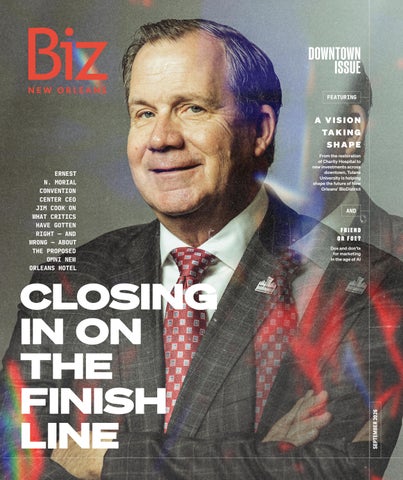
DOWNTOWN ISSUE FEATURING
A VISION TA K I N G SHAPE
CLOSING IN ON THE FINISH LINE
AND
FRIEND OR FOE? Dos and donʼts for marketing in the age of AI
SEPTEMBER 2026
ERNEST N. MORIAL CONVENTION CENTER CEO JIM COOK ON WHAT CRITICS HAVE GOTTEN RIGHT — AND WRONG — ABOUT THE PROPOSED OMNI NEW ORLEANS HOTEL
From the restoration of Charity Hospital to new investments across downtown, Tulane University is helping shape the future of New Orleansʼ BioDistrict
SEPTEMBER EVERY ISSUE
PERSPECTIVES
10 PUBLISHER’S NOTE
26
HEALTHCARE
Downtown New Orleans healthcare institutions are expanding their role beyond traditional healthcare
14 TOURISM A trio of events this fall with include an option for local companies to compete against each other for fun and fitness
16 ENTREPRENEUR This local nonprofit not only helps students get into college, it supports them through graduation and, if they want, with becoming their own boss
FROM THE LENS
58 WHY DIDN’T I THINK OF THAT? On the heels of the biggest sports betting event in American history, the World Cup, this local company is continuing to carve out a space in a multibillion-dollar industry.
08 EDITOR’S NOTE
12 SPORTS With an estimated $40 million+ roster, LSU football is eyeing a return to the top
VOLUME 12 ISSUE 12
62 NEIGHBORHOOD GEM This restaurant and wine bar is an Algiers Point treasure worth crossing the bridge for
64 NEW ORLEANS 500 Frank Rabalais, director and historic preservation specialist at Crescent Growth Capital
22 TECH/FINANCE What is the municipal bond market and how can it benefit entrepreneurs, developers, investors and us all?
30
24 MARKETING Dos and don’ts of marketing in the age of AI
28 ECONOMIC DEVELOPMENT Our city center is growing and catalytic investments lie ahead
29 GUEST Want employees that are motivated to do their best work? You need these seven practical strategies to create a strong company culture
54
GREAT WORKSPACES
Perrier Esquerré Contractors marks its 10th anniversary with a new Jefferson Parish headquarters
A Vision Taking Shape
From the restoration of Charity Hospital to new investments across Downtown, Tulane University is helping shape the future of New Orleans’ BioDistrict
36
Closing In On The Finish Line
Convention Center CEO Jim Cook on what critics have gotten right — and wrong — about the proposed Omni New Orleans hotel
EDITOR’S NOTE
Biz Talks
Each week, “Biz Talks” reaches beyond the pages of Biz New Orleans’ magazine to bring you in-depth conversations with leaders in our community.
Heart Healthy
A
city’s downtown is its heart. It is the lifeblood of its economy, its identity. It is its cultural and commercial hub. It is the hub in the wheel from which the rest of the city branches out. While the pandemic wreaked havoc on downtown areas — rendering them essentially ghost towns — they have been rebounding. Recent data found 85% of downtowns in America gained population between 2019 and 2023, growing at a median rate of 11% – far outpacing their respective cities. It’s no surprise that investment has been a part of this growth. Between 2020 and 2021, Kansas City, Kansas approved 28 redevelopment projects and announced 18 more — a total of $110 billion in investment. Cleveland, Ohio has $4.8 billion in development planned and underway. Closer to home, Atlanta is in the middle of an $8.2 billion investment in their downtown area. New Orleans recently spent more than $20 million on preparing for the last Super Bowl, not including an additional $70 million on infrastructure improvements. Fortunately, that momentum — notably through two big projects that we are excited to share more about in this, our annual Downtown issue. As a downtown goes, so goes its city, and ours is going in the right direction. On a smaller note, if you haven’t yet become a listener of our BizTalks weekly podcast — which I can’t believe will mark 300 episodes on
Episode 297 Is There Another Way Louisiana Homeowners Can Get a Grant to Pay for a Fortified Roof?
Sept. 1 — it’s time to, quite literally, see what you’ve been missing. As of episode 296 we’ve started recording not just audio, but video of my approximately 20-minute conversations with local movers and shakers who share their expertise and opinions on the issues affecting all of us. Each week, we invite you to get to know the issues, and the people doing the work to solve them — from the Alliance for Affordable Energy sharing their insight on the costs of the upcoming META data center and BGR’s data-driven take on cutting the number of New Orleans judges to what’s coming soon to Lakeside Shopping Center and French Truck Coffee’s new leadership sharing their future plans. As business is about not just what you know but who you know, I’ve also started asking each guest some fun, get-to-know-you-style questions at the end of each podcast. You can find every episode on our website, BizNewOrleans.com, and wherever you get podcasts. As always, thanks for reading!
KIMBERLEY SINGLETARY Editor Kimberley@BizNewOrleans.com
THE ALLIANCE OF AREA BUSINESS PUBLISHERS AWARDS 2026 Silver Best Overall Design Silver Best Feature Layout 2025 Silver Best Overall Design Silver Best Feature Layout 2024 Silver Best Daily Newsletter Silver Best Feature Layout Silver Best Beat Reporting, Real Estate 2023 Gold Best Feature Layout Gold Best Beat Reporting, Real Estate Silver Best Feature Series Silver Best Personality Profile Silver Best Cover Silver Best use of Photography/Illustrations Bronze Best Overall Design 2022 Gold Best Feature Gold Best Recurring Feature Silver Best Feature Layout 2021 Gold Magazine Design Gold Best Explanatory Journalism Gold Feature Design Silver Best Feature Bronze Best Use of Multimedia 2020 Silver Best Recurring Feature 2019 Gold Best Recurring Feature Gold Best Explanatory Journalism 2018 Gold Most Improved Publication Silver Best Recurring Feature 2017 Silver Best Recurring Feature Bronze Best Daily Email 2016 Bronze Best Feature Layout
08
B IZ NE W ORL E AN S
S EPT2 6
For those that haven’t won the Louisiana Fortify Homes Program’s lottery to assist with installing a Fortified roof, or who received a grant but it fell short of covering the costs, FHLB Bank of Dallas is offering grants of up to $17,000 per home through its area member banks. Greg Hettrick, senior vice president and director of community investment at FHLB Dallas, shares more and why interested homeowners should move quickly. Episode 296 What Will Be the Real Cost of the META Data Center?
The Alliance for Affordable Energy (AAE) works to ensure that Louisianans have an equitable, affordable and environmentally responsible energy system. As one of the largest data centers ever to be built heads to Louisiana, the AAE has big concerns, and they are far from alone. Senior Government Affairs and Policy Advisor for AAE Jackson Voss shares his thoughts on last week’s New York Times article, what worries him the most, and why it’s not too late to take action.
AVAILABLE ON: Spotify, Apple, Audible, Amazon Music, Anchor, Overcast, Pocket Casts
Publisher Todd Matherne EDITORIAL Editor Kimberley Singletary Art Director Sarah E.G. Majeste
Digital Media Editor Kelly Massicot Associate News Editor Kelly Hite Research Alex Jorns
Contributors Krystal Hardy Allen, Damon Burns, Amy Boyle Collins, Seth Knudsen, Walt Leger III, Ashley McLellan, Misty Milioto, Chris Price, Keith Twitchell ADVERTISING
Senior Account Executive Meghan Schmitt 504-830-7246 Meghan@BizNewOrleans.com Senior Account Executive Lauren McCanse 504-830-7249 Lauren@BizNewOrleans.com
RENAISSANCE PUBLISHING
PRODUCTION Digital Director Rosa Balaguer Arostegui Senior Production Designer Ashley Bravata MARKETING Marketing Manager Haley Nash Sponsored Content Coordinator Jeremy Marshall ADMINISTRATION Office Manager Emily Ruiz VP of Sales and Marketing Kate Henry Chief Executive Officer Todd Matherne For subscriptions, call 504-830-7231
110 VETERANS BLVD., SUITE 123 • METAIRIE, LA 70005 • 504- 828-1380 Biz New Orleans is published monthly by Renaissance Publishing, LLC, 110 Veterans Memorial Blvd., Suite 123, Metairie, LA 70005; 504- 828-1380. Subscription rate: one year $48, no foreign subscriptions. Postage paid at Metairie, LA, and additional mailing entry offices. POSTMASTER: Send address changes to Biz New Orleans, 110 Veterans Memorial Blvd., Suite 123, Metairie, LA 70005. Copyright 2025 Biz New Orleans, all rights reserved. No part of this publication may be reproduced without the consent of the publisher. The trademark Biz New Orleans is registered. Biz New Orleans is not responsible for unsolicited manuscripts, photos, and artwork, even if accompanied by a self-addressed stamped envelope. The opinions expressed in Biz New Orleans are those of the authors and do not necessarily reflect the views of the magazine or owner. Official digital reprint and framed content is only available from Renaissance Publishing, LLC by calling 504- 828-1380 or visiting bizneworleans.com/frames.
B I Z N E WORLE AN S.C O M
09
PUBLISHER’S NOTE SALES TEAM
Lucky No. 7
S
eptember always feels like a month of transition. As another long New Orleans summer slowly begins to give way to fall, football returns, school is back in session, and here at Renaissance Publishing, we settle into the rhythm of another busy season as we head toward the home stretch of the year. This September, I find myself especially grateful — for family, for New Orleans and for the opportunity to continue learning and serving our community. Our family recently celebrated one of life’s greatest blessings with the arrival of our seventh grandchild, Paige Prière Jaquillard. There is something remarkable about welcoming a new baby into the family. No matter how many times we experience it, the joy never gets old. Becoming “Pop” for the seventh time, while also watching Penelope head off to kindergarten, reminds me just how quickly life moves and how important it is to appreciate these special moments. Andrea and I are incredibly blessed by our growing family, and Paige has already brought even more love and happiness into our lives. Another memorable moment recently came from someone who has meant so much to this city and region. Listening to Drew Brees’ Hall of Fame speech, I was struck not only by his passion, but by how beautifully he articulated his love for New Orleans, the Saints and, especially, the Who Dat Nation. Drew arrived in New Orleans at a time when our city needed something to believe in. What followed became much bigger than football. He became part of the fabric of this community, and New Orleans became part of him. Hearing him express that
connection reminded me why sports can be so powerful. They create shared experiences, bring people together and give a community something to rally around. Drew’s words captured the special relationship between a player, a team and a city — one that will always hold an important place in New Orleans history. On a personal and professional note, I am also honored to have been accepted into Leadership Jefferson, a program of the Jefferson Chamber and its foundation. After spending my entire career in the Greater New Orleans business community, I know there is always more to learn — about our businesses, our government, our challenges and, most importantly, the people working every day to move our region forward. I look forward to the experiences, conversations and relationships that will come from the program over the year ahead, and to finding new ways to contribute to a community that has given me so much. From welcoming Paige, to celebrating a Saints legend, to beginning a new leadership journey, this September gives me plenty of reasons to be grateful — and excited about what comes next.
KATE HENRY
VP of Sales and Marketing 504- 830-7216 kate@bizneworleans.com
MEGHAN SCHMITT
Senior Account Executive 504- 830-7246 meghan@bizneworleans.com
Todd Matherne
TODD MATHERNE CEO and Publisher Renaissance Publishing
LAUREN MCCANSE
A DOWNTOWN DEAL THAT WORKS FOR YOU! GET 15% OFF A NEW SUBSCRIPTION. *Must order online, new subscribers only expires September 30, 2026.
10
B IZ NE W ORL E AN S
S EPT2 6
Senior Account Executive 504-830-7249 Lauren@BizNewOrleans.com
B I Z N E WORLE AN S.C O M
11
12
B IZ NE W ORL E AN S
S EPT2 6
IN THE BIZ
14 18
16
This local nonprofit not only helps students get into college, it supports them through graduation and, in some cases, with becoming their own boss
A trio of events this fall will include an option for local companies to compete against each other for fun and fitness
ENTREPRENEUR
TOURISM
SPORTS
With an estimated $40 million+ roster, LSU football is eyeing a return to the top
IN THE BIZ SPORTS
CHRIS PRICE is an award-winning journalist and public relations principal. When he’s not writing, he’s avid about music, the outdoors, and Saints, Ole Miss and Chelsea football.
Great Expectations With an estimated $40 million+ roster, LSU football is eyeing a return to the top BY CHRIS PRICE
A 14
B IZ NE W ORL E AN S
S EPT2 6
year, $91 million deal, making him one of the highest-paid coaches in the sport. Kiffin immediately went to work rebuilding the team. He brought in more than 50 new players, building a roster worth an estimated $40 to $50 million coming from a mix of school-funded revenue sharing and third-party NIL compensation. He signed the nation’s top-ranked transfer class, including QB Sam Leavitt, who inked an estimated $6 million deal, and seemed to shift the Tiger rebuild into high gear. Entering 2026, LSU is ranked No. 13 in the preseason coach’s poll. Once again, the team has a head coach who left his previous school because he thought Baton Rouge was the place he could win a national championship as well as a quarterback being mentioned in the Heisman race. Tiger fans are again boisterous. While Kiffin has tried to temper expectations for this season, there is no doubt the team is in a white-hot spotlight. The expectation is not just to be competitive, but to win — which may be easier said than done. By the end of September, the Tigers may know whether this season will be about excitement or exacerbation. They start at home against No. 23 Clemson and Louisiana Tech, then go to Oxford to play No. 10 Ole Miss — in arguably the most anticipated game on the college football calendar. LSU will then return
2026 LSU FOOTBALL SCHEDULE Date
Opponent
Sept. 12
LOUISIANA TECH
Sept. 5
Sept. 19 Sept. 26 Oct. 3
Oct. 10 Oct. 17 Oct. 24 Oct. 31 Nov. 7
Nov. 14 Nov. 21 Nov. 28
(23) CLEMSON
at (10) Ole Miss (8) TEXAS A&M
McNEESE STATE at Kentucky
MISSISSIPPI STATE at Auburn
Open date
(11) ALABAMA (4) TEXAS
at (18) Tennessee at Arkansas
I L LU S T R AT I O N BY PADDY MILLS
year ago, LSU’s football team was in the middle of pundits’ conversations about being one of college football’s best teams. The team’s head coach Brian Kelly had left Notre Dame for LSU because he thought Baton Rouge was the place he could win a national championship, and LSU’s quarterback was considered not just a Heisman Trophy candidate, but a frontrunner. The Tigers started the season ranked No. 9 in the preseason AP Poll and enjoyed a 17–10 opening day victory over No. 4 Clemson on the road. Tiger fans were boisterous as their team continued a winning streak over its first four games. But the winning ways didn’t last. LSU went 1-3 in their next four games, losing to Ole Miss, Vanderbilt and Texas A&M. Before the end of October, Kelly was fired a day after the Tigers lost at home to the Aggies, 49–25. Quarterback Garrett Nussmeier, who appeared injured, struggled and was benched. The team’s run game and defense never seemed to come together, and by the end of the regular season, LSU’s record stood at 7-5. Despite owing Kelly a contract buyout of $54 million, the powers-that-be in Tiger Town decided to double down and lure Ole Miss head coach Lane Kiffin — who was poised to make a deep playoff run — to campus with a seven-
home to seek revenge against No. 8 Texas A&M for the 49-25 lashing the Aggies gave them last year in Tiger Stadium. While the team’s talent says they should compete, that’s a tough opening for a team looking to jell. After that opening gauntlet, the schedule looks good for the Tigers: McNeese, at Kentucky, then Mississippi State, at Auburn. Assuming they avoid injuries that could shake up their roster, LSU should be able to go undefeated in October. It is November that will make or break the 2026 season when LSU gets No. 11 Alabama and No. 4 Texas at home before closing the season with No. 18 Tennessee and Arkansas on the road. Whoa! The team’s goal is to make the College Football Playoffs, which they can do with a 10-2 record, maybe even 9-3. But after the hype the Tigers received this offseason, every team they play will give them their best effort. Fans will be looking forward to singing “Victory for LSU” often, and that may well happen. Some pundits believe LSU could go 10-2 and land a playoff spot, but it’s not out of the range of possibility that the team could go 8-4 or even 7-5. If Kiffin wins, LSU will be vindicated. If he doesn’t, the talk out of Baton Rouge sure will be interesting. T
B I Z N E WORLE AN S.C O M
15
IN THE BIZ TOURISM
WALT LEGER III is president and CEO of New Orleans & Company, the official destination sales and marketing organization for the New Orleans tourism industry. He may be reached via email at walt@neworleans.com.
The New Team Building
A trio of events this fall with include an option for local companies to compete against each other for fun and fitness BY WALT LEGER III
N
16
B IZ NE W ORL E AN S
S EPT2 6
they become stronger teammates, more engaged neighbors and more active citizens. Fit Fête brings those ideas together through three experiences: the New Orleans Community Games, the return of the New Orleans Marathon and WellNXT New Orleans x Fest. For our business community, the Community Games offer something many organizations are searching for today: authentic team building. Culture isn’t created by mission statements or email signatures. It grows through shared experiences that build trust, strengthen relationships and remind people they are part of something larger than themselves. Whether workers are earning points during the weeks leading up to the games or competing together in City Park in challenges ranging from fishing, to tug-of-war, to obstacle challenges, they’ll be doing more than playing, they’ll be investing in one another. The return of the New Orleans Marathon offers another opportunity to build those connections. Whether running the full marathon, half marathon, 5K, or marathon relay, participants will discover something every successful organization already understands, meaningful accomplishments rarely happen alone. A relay team is a simple but powerful metaphor for every great workplace. Success depends on preparation, communication,
I L LU S T R AT I O N BY PADDY MILLS
ew Orleans has once again been recognized for something those of us who call it home have always known: There is nowhere else quite like it. Our city was recently named to the World Monuments Fund’s “Irreplaceable America” list, recognizing 10 places whose preservation is essential to telling the American story. What makes the recognition especially meaningful is that it wasn’t a single building, landmark or historic district that was honored. It was the whole city. That distinction reminds us that our greatest asset has never been bricks and mortar alone. It is our people. It is the neighborhoods we build, the traditions we share, the music we create, the meals we gather around and the relationships that connect us. The same spirit is at the heart of Fit Fête, a new citywide celebration of health, wellness, teamwork and community taking place Nov. 13-14 in City Park. At first glance, Fit Fête is about fitness. In reality, it’s about something much bigger. Healthy communities are built the same way healthy economies are built, by creating opportunities for people to connect, support one another and invest in a shared future. When people are healthier — physically, mentally and socially —
accountability and trusting that each person will do their part. Businesses that train together, encourage one another and cross the finish line together often discover that those lessons carry back into the office long after race day. Not everyone defines wellness the same way, and Fit Fête recognizes that. Throughout the weekend, WellNXT New Orleans x Fest will transform Tad Gormley Stadium into a free wellness experience centered on movement, nutrition, recovery, mindfulness and family activities. Some people may never run a marathon, and that’s perfectly fine. Wellness is not one-size-fits-all. The important thing is creating opportunities for everyone to find a healthier path. What I appreciate most about Fit Fête is that it reflects the way New Orleans approaches life. We rarely do anything alone. We celebrate together. We solve problems together. We welcome visitors together. Our culture has always been rooted in bringing people together, and there’s no reason health and wellness should be any different. Investing in wellness isn’t simply about reducing healthcare costs or encouraging exercise. It’s about creating a city where people want to live, work, learn, invest and prosper. That benefits our businesses, our people, and every neighborhood across New Orleans. As business leaders, we all have a role to play. Form a team. Challenge another organization. Enter a marathon relay. Invite your employees and their families to experience the wellness festival. However you choose to participate, you’ll be investing in something larger than a weekend event. You’ll be investing in a healthier, more connected New Orleans. Because cities become extraordinary not simply because of the places we preserve, but because of the people we inspire to build the future together. Learn more and register at NewOrleans.com/ Fit-Fete. T
B I Z N E WORLE AN S.C O M
17
IN THE BIZ ENTREPRENEUR
KEITH TWITCHELL spent 16 years running his own business before serving as president of the Committee for a Better New Orleans from 2004 through 2020. He has observed, supported and participated in entrepreneurial ventures at the street, neighborhood, nonprofit, micro- and macro-business levels.
From Student to Entrepreneur
This local nonprofit not only helps students get into college, it supports them through graduation and, in some cases, with becoming their own boss BY KEITH TWITCHELL
W 18
B IZ NE W ORL E AN S
S EPT2 6
networking are,” said Anthony Brock, program participant and founder of AKBill creative studio. “It has also helped me strengthen my organization, planning and time management skills. College Beyond has encouraged me to think beyond simply earning a degree and instead focus on building a meaningful career and entrepreneurial future.” Brock’s enterprise works on 3D design, fabrication, character design, animation and custom prosthetic development. “As someone who wears a prosthetic leg myself, one of my long-term goals is to create custom prosthetic legs that combine comfort, functionality and personal expression,” he explained. College Beyond’s programs address specific years in a student’s journey, beginning with high school seniors. The program focuses on things like college applications and preparing for education at the next level. For college freshmen, the emphasis is on navigating that difficult transition and adjusting to college life. Sophomore through senior students receive more general, as-needed support, and an alumni network connects graduates to
I L LU S T R AT I O N BY PADDY MILLS
hile there are many stories of successful entrepreneurs who never went to college, statistics indicate that they are in the minority. Depending on whose data you believe, between 68% and 95% of entrepreneurs have a college degree. Getting into college is challenging enough. Getting through college is even more difficult, especially for students from disadvantaged backgrounds. Nationally, 60% of low-income freshmen do not graduate; in Louisiana, only 30% of Black college freshmen will earn degrees within six years. If a college degree is a pathway to entrepreneurship, assistance navigating that path is clearly a community need. Stepping in to address that is College Beyond, a New Orleans nonprofit organization that not only helps area students get into college, but also provides support for success in college and – as the name suggests – beyond graduation. This includes developing skills essential to successful entrepreneurism. “One of the biggest things College Beyond has taught me is how important relationships and
career opportunities, business resources and more. The program serves approximately 350 students per year. College Beyond’s success is evidenced by the graduation rates of its students: 79% at LSU New Orleans, 94% at Southeastern and 100% at LSU — rates far higher than for the general student population at each institution. Microgrants are also available to assist students things like books, transportation, and personal coaching. Coaching is also available for the families of students aimed at helping them to be more supportive of their child’s needs and participate in their success. Lyric Lee is a second-year art student at LSU New Orleans who is developing an entrepreneurial venture with her mother. “It will be an affordable entertainment and trade school,” she explained, “a trade school for the arts, and for other careers that people can move into easily like technology, beauticians, culinary. The goal is to give people as many opportunities as possible.” For Lee, the most valuable aspect of the College Beyond program was the mentoring and coaching component. “It’s having someone to talk to when everything in school becomes really stressful,” she noted. “For me, it has been an emotional tool to help me get through college.” For D’Mario Daniels, the constant presence of College Beyond beginning in high school and continuing through his years at University of Louisiana-Lafayette was a major asset, and the alumni network continues the benefits. With College Beyond’s assistance, Daniels parlayed his passion for business and clothes into a clothing brand he launched in high school which he said “began to blow up in college. “Seeing people wear the clothes I made is great,” he added. “I’m looking forward to keeping in touch with my success coach and everyone going forward.” T
B I Z N E WORLE AN S.C O M
19
PERSPECTIVES
22
24
What is the municipal bond market and how can it benefit entrepreneurs, developers, investors and us all?
Dos and don’ts for marketing in the age of AI
TECH/FINANCE
MARKETING
28
ECONOMIC DEVELOPMENT
Our city center is growing and catalytic investments lie ahead
29
GUEST
Want employees that are motivated to do their best work? You need these seven practical strategies to create a strong company culture
26
HEALTHCARE
Downtown New Orleans healthcare institutions are expanding their role beyond traditional healthcare
PERSPECTIVES TECH/FINANCE
DAMON BURNS is the founder of Munivestor, an online marketplace that enables cities to raise capital directly from investors of all sizes to finance public infrastructure projects through a more affordable, accessible and transparent municipal bond market. He may be reached via email at damon@munivestor.io.
Building the Future What is the municipal bond market and how can it benefit entrepreneurs, developers, investors and us all? BY DAMON BURNS
W
22
B IZ NE W ORL E AN S
S EPT2 6
ENTREPRENEURS AND DEVELOPERS
Municipal governments typically rely on qualified entrepreneurs and developers to bring projects to life. In certain cases, the same financial benefits offered to state and local governments through the municipal bond market can be passed on to private companies, for example to a private housing developer building 100 housing units, or a solar farm developer. Entrepreneurs, developers and innovators focused on improving quality of life have an opportunity to use the municipal bond market to drive change in places that don’t often see investment, or perhaps where investment is long overdue. These types of projects should seek to partner with growth-oriented municipal governments. BOND INVESTORS
Municipal governments that borrow money pay billions in interest payments annually to investors, which creates a wealth-building opportunity for investors providing capital to cities. While investment returns tend to be lower than other asset classes (e.g., stocks and real estate), investors receive reliable and steady, tax-free income. Typical investor groups include banks, insurance companies and mutual funds, but the average individual investor is usually left out of this process due to the high costs of municipal bonds. The minimum denomination of a municipal bond is normally $5,000, but an investment firm’s minimum order size may be much larger. As such, purchasing individual bonds is usually reserved for high-net-worth individuals and institutions. The average individual must access the municipal market through mutual fund companies like Vanguard and BlackRock.
Despite limited access for the average person, innovations in financial technology are making previously inaccessible investment opportunities more available, and the dynamics of the municipal market investor landscape will continue to evolve as financial markets digitize. Regardless, individuals of all backgrounds should seek to participate in the wealth-building process provided by the municipal bond market. COMMUNITY MEMBERS
We all pay taxes and user fees to keep our municipal governments running, and if we as taxpayers are dissatisfied with the services we receive from our local and state governments we can organize, vote and influence. As it relates to municipal bonds, we get to vote on our city’s ability to incur debt, as well as voice concerns, if desired, about a private company’s ability to use municipal bonds to build a specific project. As private citizens, we must hold elected officials and municipal leaders accountable for delivering the best quality of life possible to our communities. This means showing up to public board meetings to express approval or disapproval of a project. It means showing up to the voting booth to decide if a city should increase your property taxes to pay for new debt. Many questions should be asked when a municipal bond issue is presented to a community. Namely, how does this financing benefit the community? Does it increase our debt burden without enhancing our quality of life? Does the project truly need public resources to work? These questions and many others should be resolved before a municipality finalizes funding for a project. Cities of the future are being built from the inside out, meaning communities everywhere are becoming more engaged in their city’s financial well-being. We as individuals can play critical roles in changing communities even if we don’t have much change in our pockets. It’s all about getting active to influence what a city builds, who builds it and how it gets funded. The quality of life in the places we love will be determined by the quality of activity we bring to the municipal bond market. T
I L LU S T R AT I O N BY S.E. GEORGE
hen I speak to friends and family about the municipal bond market, their faces go blank. But the average person knows more about the $4.7 trillion municipal bond market than they realize. Municipal bonds are loans that municipal governments — local governments responsible for providing services to a specific geographic area, or municipality — borrow from individuals, banks, insurance companies and mutual funds to pay for infrastructure projects. The income investors receive from these loans is mostly exempt from federal taxes, providing investors with highquality tax-free income and municipalities with lower interest costs. In 2025 alone, U.S. municipal governments borrowed more than $500 billion from investors — a number that is expected to grow as cities race to address failing infrastructure and growing climate challenges.
A variety of public, private and philanthropic partners are needed to successfully execute municipal infrastructure projects including street construction, water management solutions, mass transportation, affordable housing and healthcare facilities. These projects are the lifeblood of our communities, and they also present opportunites for those in our community.
PERSPECTIVES MARKETING
AMY BOYLE COLLINS is CEO at Gambel Communications where she leads an award-winning, multi-talented team of communications and public relations strategists who work with corporations, small businesses and nonprofit organizations on campaigns that power visibility, credibility and growth. She may be reached via email at amy@gambelpr.com.
Friend or Foe?
Dos and don’ts for marketing in the age of AI BY AMY BOYLE COLLINS
Use AI as a partner, not a replacement. It is exceptional for brainstorming, streamlining workflows, research (but check original sources) and repetitive processes that consume time without requiring deep human judgment. It can accelerate execution in ways that free your team to focus on what they actually do best. What it cannot do is replace professional intuition, institutional knowledge, human creativity or authentic voice. SOME DOS AND DON’TS OF USING AI IN MARKETING — OR ANY INDUSTRY
T
here’s a new shiny object in the boardroom, and it seems like everyone is reaching for it. Artificial intelligence (AI) has arrived with incredible promise. As someone who has spent 30 years leading marketing and communications strategies across multiple organizations, I’m no stranger to industry disruption. And if there’s one pattern I’ve learned to recognize, it’s this: When a new tool arrives, the leaders who win are the ones who understand what it can and cannot do.
The most common error I see right now is one of two extremes. Either folks are dismissing AI entirely, missing real competitive advantages, or they are relying too much on it for generative
24
B IZ NE W ORL E AN S
S EPT2 6
I L LU S T R AT I O N BY S.E. GEORGE
AI IS A TOOL — A REMARKABLE ONE, BUT A TOOL NONETHELESS.
content in ways that are visibly, sometimes painfully, obvious to their audiences. LinkedIn recently added a button that flags content that “seems like AI slop.” I am here for it. Because when AI misses, it misses badly, and people sniff it out. Customers and clients are increasingly skeptical of content that feels manufactured and that skepticism erodes trust — your most precious commodity. (Note: This is a non-AI generated em dash.) In a city like New Orleans, where business runs on relationships, trust isn’t a soft concept, it’s the currency. I have embraced AI, and at my firm we encourage our clients to do the same. We have an internal policy to guide employee use, we are ahead of the curve on its applications and we are actively helping clients understand how to deploy AI strategically. When used well, AI is a gamechanger, with the key word being strategic.
Do use AI to brainstorm, organize and streamline. Apply it to repetitive, administrative tasks, where appropriate. Do establish a company policy so employees have clear guidelines on appropriate use. Do clarify what success looks like when using AI in your marketing program and be transparent about it. Don’t copy and paste from AI. It will not be authentic, and it will dismantle your credibility. Don’t deploy AI in the creative space where human intuition, emotion and experience produce far superior results. Don’t confuse volume with value. AI just gets it wrong sometimes. Don’t ever release AI-generated material without a human filter. By its very name AI is artificial. There is no feeling behind it. No creativity. None of the things that drive human connection, which is the heart and soul of communications. When we try to replace what is inherently human with AI it breeds inauthenticity and erodes the trust we have worked years to build. The leaders who will navigate this moment most successfully are the ones who protect and prioritize the human advantage while thoughtfully embracing what AI does well. You will never build or maintain the rich business relationships that drive growth in this community, or anywhere else, by outsourcing your voice to a machine. Authentic leadership and communication will always outperform AI. T
PERSPECTIVES HEALTHCARE
THINKING BEYOND THE HOSPITAL WALLS Downtown New Orleans healthcare institutions are expanding their role beyond traditional healthcare BY KELLY HITE
H 26
B IZ NE W ORL E AN S
AUG 2 6
potential to grow into new companies, while the institutions spend millions of dollars with regional businesses. Increasingly, that economic role is being viewed through a longer lens: What does it take to build healthier families and a stronger workforce for the region’s future? BUILDING HEALTH FROM THE BEGINNING
For Erin M. Dugan, PhD, dean of the LSU Health New Orleans School of Allied Health Professions, the answer begins remarkably early. “At LSU Health New Orleans, we believe workforce development begins long before someone enters a professional program or chooses a career. It begins in early childhood,” Dugan said. One example is Tigers & Tots, an LSU Health initiative that combines developmentally focused play with education and screenings for families.
“Through this program, families have access to developmentally focused play experiences, educational seminars, and screenings offered by faculty and clinicians across multiple allied health disciplines,” Dugan said. Parents can learn about speech and language development, hearing health, sensory processing, developmental milestones, positive parenting practices and early identification of potential problems. The initiative also gives LSU Health students hands-on experience while addressing practical barriers that can keep families from accessing care. “Many of the barriers families face are not medical in nature,” Dugan said. “Transportation, childcare responsibilities, work schedules, financial pressures, and limited awareness of available services can all make it difficult to access preventive care and developmental support.”
I L LU S T R AT I O N BY S.E. GEORGE
ealthcare has long been one of Downtown New Orleans’ economic anchors. Now, some of its largest institutions are looking beyond their traditional roles to the broader issue of the health and stability of the people who make up the region’s workforce. “Hospitals and healthcare institutions, including universities, have long been considered ‘anchor institutions’ for the communities they serve due to their stability and long-term planning horizon compared to other industries,” said René C. Pastorek, chief economic development officer for the New Orleans Downtown Development District. Beyond providing thousands of jobs, Pastorek said, medical schools and research programs educate students and produce research with the
KELLY HITE is the associate news editor for Biz New Orleans, responsible for delivering daily business news on BizNewOrleans.com, focusing on developments that impact the greater New Orleans area and southeast Louisiana. She may be reached via email at KellyH@BizNewOrleans.com.
WHEN ECONOMIC PRESSURES BECOME HEALTH ISSUES
Dugan said those economic pressures are increasing, with families contending with rising childcare and housing costs while trying to balance work and family responsibilities. That can make it harder to prioritize preventive care, developmental monitoring and other wellness needs. Manning Family Children’s is seeing similar challenges, including transportation, work and school schedules, childcare, insurance coverage, language differences and uncertainty about where to go for care, according to Kalyn A. Green, senior project manager for community impact. The hospital has responded by working through schools, community organizations and neighborhood events. Its annual Back to School Boogaloo, for example, brings free healthcare services and other resources directly into the community. This year’s event offered immunizations for qualifying families, sports physicals, primary care services and dental resources, along with school supplies and enrollment in Manning Family Children’s ThriveKids student wellness program. At University Medical Center New Orleans, those economic pressures are showing up in growing food insecurity and challenges managing chronic health conditions. “We have seen increasing needs related to food insecurity, chronic disease management, and access to supportive services,” said LaDana Williams, vice president of community engagement at University Medical Center. “Economic pressures have made it more difficult for many families to meet their basic needs, which directly impacts their health.” UMC addresses those needs in part through UMC HEALS, its community strategy focused on health access, wellness education, advocacy and equity, prevention and social support. In May, UMC opened the Heart & Harvest Pantry, a hospital-wide food pantry for patients experiencing food insecurity. It complements the hospital’s Cancer Center food pantry, which provides nutritional support for patients undergoing cancer treatment. “These efforts reflect our commitment to food as medicine by ensuring patients have access to
As employers compete for talent, the organizations that invest in the communities where their employees live and work will have an advantage. Michael Williamson president and CEO of United Way of Southeast Louisiana
nutritious foods that support healing and better health outcomes,” said Williams. COMMUNITY HEALTH AS ECONOMIC INFRASTRUCTURE
Taken together, the programs point to a larger shift in how healthcare institutions view their role in the community. Michael Williamson, president and CEO of United Way of Southeast Louisiana, sees a direct connection between the stability of working families and the strength of the workforce. “For ALICE families, workforce well-being is more than a paycheck or healthcare benefits,” Williamson said, using United Way’s term that refers to people who are asset-limited and income-constrained but also employed. “People also need the stability and support that allows them to show up for work, care for their families, and plan for the future.” “Helping working families thrive isn’t just good corporate citizenship,” he said. “It’s a smart workforce strategy that strengthens our economy and creates more pathways to prosperity.” BUILDING THE HEALTHCARE WORKFORCE
Downtown healthcare institutions are also
working to build the pipeline of people who will fill healthcare jobs in the future. Manning Family Children’s works with the New Orleans Career Center to help recent graduates begin healthcare careers and with YouthForce NOLA to provide high school students with hands-on experience in clinical and non-clinical departments. “Investing in children’s health and investing in the future workforce go hand in hand,” said Green. “These programs help build a stronger pipeline of local talent while giving young people the opportunity to see a future for themselves in healthcare.” LCMC Health, meanwhile, partners with Warren Easton Charter High School to provide students with shadowing experiences, internships and exposure to healthcare careers at University Medical Center and Touro. Students can also earn certifications to prepare them for future careers. The health system has invested in its current workforce as well, raising its minimum wage earlier this year to $15 an hour, a 30% increase. That combination of community investment and workforce development reflects what Pastorek sees as one of healthcare’s key advantages as a Downtown economic driver: its staying power and potential to generate further growth. “Many successful cities and their downtowns have invested in healthcare and related research as a prime driver of growth due to its ‘stickiness’ and exponential nature,” said Pastorek. Medical schools and research programs, he noted, employ hundreds of faculty members, serve thousands of students and can produce research that develops into companies and jobs. “All of this plays a strong role in attracting new residents providing opportunity for existing residents, and building a diversified economy for the next generation of New Orleanians,” said Pastorek. For Williamson, the implications extend beyond healthcare. “As employers compete for talent,” he said, “the organizations that invest in the communities where their employees live and work will have an advantage.” T
B I Z N E WORLE AN S.C O M
27
PERSPECTIVE ECONOMIC DEVELOPMENT
Downtown is Entering a New Era
Our city center is growing and catalytic investments lie ahead BY SETH KNUDSEN
D
BUSINESS INVESTMENT BUILDS MOMENTUM
The impact of Louisiana Economic Development (LED) incentive programs on the Downtown office market is growing. From the founding headquarters of Delta Utilities to Saronic Technologies’ new satellite office, state incentives and private investment are creating high-quality jobs and reinforcing confidence in Downtown as a business destination. These investments not only strengthen today’s office market but also lay the groundwork for continued corporate growth in the years ahead.
S EPT2 6
Together, these projects and programs leverage public investment for job creation and population growth that benefit the entire region. Downtown remains Louisiana’s greatest concentration of economic activity, jobs, investment, innovation and culture. Its unique mix of housing, healthcare, education, entertainment and recreation continues to attract residents and businesses alike. Recent data is promising, with the 2023–24 American Community Survey reporting 7% population growth, showing Downtown New Orleans reemergence as a neighborhood of choice. PUBLIC INVESTMENT MAKES PRIVATE GROWTH POSSIBLE
Downtown’s progress has been made possible through strong public-private partnerships and investment from every level of government. While the area’s post-Katrina momentum was interrupted by the COVID-19 pandemic, stabilization has created an opportunity to return to sustained growth. We must continue to support the transformation of vacant buildings and underutilized properties into productive assets with targeted public investment. Investment in Downtown strengthens the entire city and region.
THE DDD’S WORK HAPPENS EVERY DAY
The Downtown Development District continues to make Downtown cleaner, safer and stronger every day. Working around the clock, DDD supplements city services with Public Safety Rangers, armed private security patrols, off-duty NOPD officers, homeless outreach teams, and a dedicated “Clean Team” responsible for litter removal, pressure washing and graffiti removal. DDD also continues to invest in public infrastructure. The first phase of Canal Street improvements has been completed, new lighting at Molly Marine Plaza is nearing completion, and additional infrastructure and lighting improvements are planned for this fall. INNOVATIVE PROGRAMS SUPPORT LOCAL BUSINESS
Beyond maintenance and public safety, DDD is helping drive economic development through targeted programs that address today’s challenges. Our inaugural Summer Starts Downtown campaign united more than 50 businesses and parking partners in a collaborative marketing initiative that encouraged residents and visitors to support Downtown during the traditionally slower summer months. Meanwhile, the Activate Downtown Tenant Improvement Grant Program is providing up to $20,000 in matching funds to help small businesses transform long-vacant storefronts into active retail spaces, reducing one of the biggest barriers to opening a business Downtown. THE FOUNDATION FOR OUR FUTURE
Downtown is entering a new era, and the Downtown Development District is committed to helping shape what comes next. While our priorities remain consistent — creating a cleaner, safer and stronger Downtown — we also recognize the tremendous opportunity ahead. By continuing to improve the environment, support catalytic investment and strengthen partnerships across the public and private sectors, DDD is building the foundation for the next generation of growth. Downtown is the foundation for our future — our neighborhood, our city, our region and our state — and DDD is proud to help lead the way. T
I L LU S T R AT I O N BY S.E. GEORGE
B IZ NE W ORL E AN S
hotel that will bring 1,400 new jobs and allow the city to compete for meeting and event business that current facilities cannot accommodate. Together, these catalytic projects represent nearly $2 billion in new investment, positioning Downtown for long-term growth.
A NEIGHBORHOOD POSITIONED FOR GROWTH
owntown New Orleans is on the precipice of a new era. Tulane University has executed a purchase agreement to become the anchor tenant of the 1-million-square-foot Charity Hospital redevelopment, which will bring 2,500 new jobs, a major increase in research expenditures, and the potential to spin off new businesses that can become tenants in existing office space and drive new development. The Charity Hospital project is also expected to include hundreds of housing units. Once complete, the Tulane Innovation Institute, New Orleans BioInnovation Center, and Xavier Ochsner College of Medicine will expand opportunities to drive growth where Downtown meets the BioDistrict. Just next door, the Louisiana Stadium and Exposition District and New Orleans Pelicans are developing conceptual plans for a transformational renovation of the Smoothie King Center and surrounding area. On the opposite side of Downtown, the Ernest N. Morial Convention Center has received entitlement and nearly finalized financing for a 1,000-room convention center
28
SETH KNUDSEN is president and CEO of the Downtown Development District (DDD). He may be reached at sknudsen@downtownnola.com.
PERSPECTIVE GUEST
The Culture Advantage
Want employees that are motivated to do their best work? You need these seven practical strategies to create a strong company culture. BY KRYSTAL HARDY ALLEN
E
very organization has a culture. The question is whether you have intentionally built the culture you want or simply allowed one to develop around you. You can have an incredible mission. You can recruit talented people. You can have beautiful values displayed on your website. However, if employees consistently experience poor communication, unclear expectations, unresolved conflict, inequitable treatment, burnout or a lack of trust, those things will eventually impact performance and create an unhealthy work culture. Culture always shows up in the work. So, how do organizations actually improve it? After years spent working with organizations across sectors and industries to strengthen leadership, improve organizational effectiveness and build healthier workplaces, I have found these seven things to be critical to improving company culture.
KRYSTAL HARDY ALLEN is the founder and CEO of K. Allen Consulting, a globally recognized management consulting firm serving clients across industries and sectors. She may be reached via email at info@kallenconsulting.com.
1. GET HONEST ABOUT THE CULTURE YOU CURRENTLY HAVE.
Before deciding where you want to go, you have to understand where you are. Leaders often assess culture based on their own experience of the organization, but leadership’s experience is not necessarily everyone’s experience. Ask your people. Use employee surveys, listening sessions, interviews, stay interviews, exit data and other feedback mechanisms to understand what employees are experiencing. Then — and this is important — be willing to believe what you hear. Feedback is useless if we only accept the parts that make us comfortable. 2. MAKE YOUR VALUES OPERATIONAL.
Your organizational values should not simply be words on a wall. If you say you value collaboration, how are decisions made? If you value equity, how are opportunities distributed? If you value excellence, what happens when expectations are consistently unmet? If you value people, what does that look like during periods of high demand? There should be alignment between the values you proclaim and the behaviors you practice. Alignment builds credibility. 3. INVEST IN YOUR MANAGERS.
One of the greatest influences on an employee’s workplace experience is their direct manager, yet organizations routinely promote people into management because they are excellent individual contributors and then provide little training on how to actually lead people. Managing people is a skill. Managers need development around communication, emotional intelligence, delegation, accountability, conflict, feedback, performance management, project management and relationship building. If you want a healthier culture, develop healthier leaders. 4. CREATE CLARITY.
Sometimes what gets labeled a “culture problem” is actually a clarity problem. People need to know: What am I responsible for? Who owns what? How are decisions made? What does success look like? How will I receive feedback?
What happens when something goes wrong? Clarity reduces unnecessary tension and creates the conditions for accountability. 5. STOP AVOIDING ACCOUNTABILITY.
Healthy culture does not mean everybody is comfortable all the time. In fact, one of the fastest ways to damage morale is allowing poor performance or harmful behavior to continue unchecked. Your strongest employees are watching what leadership tolerates. Accountability should be fair and consistent, and when done right, it shows that you really do care for the person by being willing to in my opinion “call them higher.” In other words, pushing the person to become their best self in their role. 6. PAY ATTENTION TO THE EVERYDAY EXPERIENCE.
Culture is built in the small things. It is how meetings are facilitated, how emails are written, whether people receive credit for their work, whether leaders follow through, how mistakes are handled. It is whether employees feel safe asking questions and whether good work is acknowledged. Culture is rarely transformed through one retreat or training. It changes through repeated behavior. 7. START WITH YOURSELF AS A LEADER.
Perhaps the hardest truth about improving company culture is that leaders must be willing to examine themselves. We cannot ask employees to communicate better while leadership communicates poorly. We cannot ask teams to embrace accountability while executives avoid it. We cannot demand trust while operating without transparency. Culture change requires organizational change, but it also requires leadership change sometimes. Healthy organizations are built intentionally, and when organizations invest in their people, strengthen their systems, develop their leaders and align what they say with what employees actually experience, culture becomes more than a workplace initiative — it becomes a competitive advantage. T
B I Z N E WORLE AN S.C O M
29
BY KEITH TWITCHELL PHOTOS BY JEFFERY JOHNSTON
From the restoration of Charity Hospital to new investments across Downtown, Tulane University is helping shape the future of New Orleans’ BioDistrict.
jobs. Tulane is already the largest employer in New Orleans, and Norton estimated that the completed Downtown campus will engage 2,400 new personnel over the course of the coming decade. Included will be physicians, nurses, researchers and related medical and scientific personnel, backed by a wide array of support and administrative positions. Norton noted that the Charity building alone will be home to approximately 700 researchers, which he termed “the largest collection of research talent in the Gulf South.” Research, teaching and innovation, not direct medical care, will be the focus of the campus — which now includes 17 buildings, with plans to grow to at least 25 (including the Charity expansion). While the existing emergency room will continue operating on Tulane Avenue, most of Tulane’s hospital services have moved to East Jefferson. The former Downtown hospital will become the campus center, including a food court open to the public. However, noted Fitts, “We are being faithful to the history of Charity as a medical building. You don’t have to have gone through COVID to appreciate how important public health is. We will be thinking constantly about ways to improve health
It is potentially the largest single impactor for Downtown New Orleans since the Superdome. It will generate far more permanent jobs and local revenue than any mega data center, and it has been more than 20 years in the making. “It” is the massive expansion of the Tulane University Downtown campus, with redevelopment of Charity Hospital as the centerpiece. Thousands of new jobs, hundreds of millions of dollars of new economic activity, and the creation of a new neighborhood are just some of the outcomes anticipated from this enormous undertaking. While Tulane assuming the lead role in the Charity project is a relatively recent development, the relationship between the two institutions goes back nearly two centuries. Tulane was founded in 1834 as the Medical College of Louisiana, largely in response to a yellow fever epidemic. In 1843, it began providing free medical care to residents — which it continued for more than 100 years. The current Charity building — an art deco masterpiece completed in 1939 — quickly became the focal point of community health and medical professional training for the greater New Orleans region. Its devastation in the post-Katrina flood left a gaping hole in local health care and a giant eyesore in the heart of Downtown.
32
B IZ NE W ORL E AN S
S EPT2 6
Despite the loss of Charity Hospital, however, a substantial medical presence has remained in the surrounding area. Tulane has long been a significant part of that presence, but now it is expanding its reach to include Charity and several other nearby properties. The idea is to create a unified campus and serve as a major component of the growing BioDistrict. “For Tulane, this is the largest and most consequential investment in our history,” stated university President Michael Fitts. “It will change our relationship with the city.” The financial investment is indeed huge, an estimated half a billion dollars just for the Charity building. According to Patrick Norton, Tulane’s senior vice president and COO, the university’s own equity will be augmented by state and federal historic tax credits, state and local public investment, and philanthropy, along with a lead gift from the Goldring Family Foundation. While the project has gone through several starts and stops and major renovations cannot begin until all the complex financial details have been finalized, mitigation and security work is already underway, and Norton envisions beginning the move into the building in 2029. At the height of the construction, approximately 1,000 workers will be utilized, and that number pales compared to total long-term
care in New Orleans, across the Gulf South and around the world.” As evidence of this, Fitts noted that along with the research, 100,000 square feet of Charity will be dedicated to the medical school and will include a wide range of patient clinic trials. “We will be staying true to our roots in public health,” added Norton. “The discoveries made in our labs will be brought to the bedside for our patients while creating economic impact for our city.” Both leaders emphasized the economic benefits
It will be like Rockefeller Center without the skating rink.” — Michael Fitts, president of Tulane University, speaking about the university’s planned reimagining of Charity Hospital
that will accrue from the campus and the vast amount of research that will be conducted there. In addition to the Charity building research areas, the renovated J. Bennett Johnston Health and Research building on Tulane Avenue will is devoted almost entirely to lab space. The neighboring Hutchinson Memorial Building — which cut the ribbon on a $35 million renovation of its seventh floor research lab this past February — houses nearly 50,000 additional square feet of lab, office and collaborative workspace. The goal is real-world impacts. “It used to be that university research stayed within the university; it didn’t translate into changing the world,” Fitts explained. “Our research improves our understanding of the world, but it also translates into business opportunities.” Fitts projected that over the next decade, research on campus will result in approximately 100 spinouts – enterprises whose intellectual property is still owned by the university – and 100 startups, private enterprises supported by the university. “The cures and treatments we discover will benefit society,” added Norton, “and by taking these innovations, commercializing and scaling them, we will diversify the New Orleans economy.” Retaining the new businesses that will be formed is a crucial part of the plan. “One problem we have here is that startups don’t view New Orleans as a place to nurture and grow,” Fitts said, citing biomedical innovation, engineering and technology as major sectors that will benefit from the research. “This will change that. We will have a real focus on keeping them here.” Economic impacts are also expected to grow beyond creating intellectual property and startups. The newly imagined Charity will include approximately 250 residential units for staff and students and Tulane is also leasing the former Warwick Hotel on Gravier Street and transformed it into a multipurpose facility that includes another 154 furnished apartments. “Housing is an important part of creating a Downtown campus and a neighborhood,” noted Norton. “It reduces commuting time and transport demand, and it also creates business activity beyond normal business hours. It supports local restaurants and retail. Having more people around makes an area safer.”
We’re one of the few institutions of higher education in the world that can create an entire neighborhood, because we’re a 24/7 operation.” — Patrick Norton, senior vice president and COO, Tulane University
The notion of creating a campus integrated into a surrounding neighborhood is central to the entire project, a focus resulting from a master planning process conducted a few years back. “We’re one of the few institutions of higher education in the world that can create an entire neighborhood, because we’re a 24/7 operation,” Norton continued, pointing out the proximity to the Downtown sports arenas and the French Quarter as added amenities. “We want to create a safe, pleasant, walkable environment.”
34
B IZ NE W ORL E AN S
S EPT2 6
Items on the to-do list include considerably enhancing lighting in the area — which will include the use of special green LED lighting designed to not only brighten the streetscape but connect to the university’s official color and branding. Improved sidewalks and crosswalks will increase pedestrian safety, as will the addition of bridges to connect many of the buildings, which will also provide refuge against summer heat and frequent rainfall. More accommodations for bicyclists are also part of the plan. Further enhancing the neighborhood feel will be the streetscaping, which will be designed to reduce the amount of paved surface area in what is now largely a concrete canyon. Trees, bushes, bioswales and a retention pond in the plaza in front of the LaSalle Garage are just some of the projects that will be aimed at beautifying the area while slowing the flow of water into the city’s drainage infrastructure. In addition, the tree canopy, combined with the reduced presence of concrete and the use of reflective materials will be aimed at decreasing the amount of heat absorbed and radiated, thus helping to mitigate the urban heat island effect. The centerpiece, of course, will remain the revived Charity Hospital, for which Fitts has very high expectations. The first floor is intended to be a public place, with a courtyard, retail space, cafes, an exhibition area, civic engagement and meeting rooms, and a 170-seat auditorium designed for health-related and cultural programming. “Charity is going to be magnificent and cool,” he proclaimed, “a building that will draw you in, a place where people will want to be and hang out. It will be like Rockefeller Center without the skating rink.” While providing added value to the surrounding community, incorporating the public areas is also an important aspect of Tulane’s overall strategy for the project. “Creating a contemporary Downtown campus — which will be an urban jewel — is key to becoming a center of research and innovation,” explained Norton. “With the Tulane brand and the appeal of New Orleans, we already do a great job of attracting and retaining top talent.” He added “Tulane is one of the few private universities in the country that is growing, which also attracts people.” “You need to establish an environment of creativity, of education, of academic excellence to attract people,” explained Fitts. “We are bringing together interrelated disciplines, which creates cross-pollination where faculty, students, entrepreneurs can all interact with each other. People want to be in an environment like that.” The Downtown campus will house a variety of Tulane operations. The Celia
Scott Weatherhead School of Public Health and Tropical Medicine will be the first to move into the revitalized Charity as the building is ready. The Tulane School of Medicine nursing program and School of Social Work, as well as the School of Science and Engineering, will also be key components in creating a multi-disciplinary experience designed to lure the best and brightest in their fields. These entities will all be supported by an administration building, the campus center in the former hospital, a fitness center, and an extensive amount of parking, both in garages and on surface lots. Tying everything together and serving as the launch pad to success beyond the boundaries of the campus is the Tulane Innovation Institute on Gravier Street. Founded in 2022, it has already generated several spinouts and startups and was central to NASDAQ’s recent ranking of New Orleans as No. 14 among the nation’s top metro areas for innovation and growth. The entire project interfaces with the New Orleans BioDistrict, a 1,500-acre area created by the state in 2005 to be a spur for economic growth and diversification, and to position New Orleans as a global center of excellence for medical fields such as obesity, diabetes and cancer treatment. Tulane’s investment represents one of the largest expansions of research infrastructure in the district’s history. “The vision of the BioDistrict is to be an area focused on research, creativity and startups,” Fitts elaborated. “Charity is the geographic and symbolic center of that and will become the largest research facility in the Gulf South.” The project is also expected to add to the ongoing reenergizing of Downtown New Orleans. “For generations, Charity Hospital was where New Orleanians came into the world,” noted Seth Knudsen, executive director of the Downtown Development District. “It is only fitting that Charity is poised to once again deliver our city’s future — this time, new ideas, new businesses, and new industries. Charity will also serve as the catalyst for additional investment in the surrounding neighborhood, supporting a new generation of students, researchers and entrepreneurs who choose to live and work in Downtown New Orleans.” For generations of New Orleanians, whose mental picture of Tulane University may be a verdant campus of epic buildings stretching from St. Charles Avenue at Audubon Park to Claiborne Avenue, the concept of a Downtown campus may be difficult to grasp. When completed, the Downtown campus will
actually be larger than the Uptown site, which has welcomed 11 new buildings over the last decade. Fitts emphasized that both pieces of the university are integral to its success. “The two are connected in so many ways,” he said. “They’re only 10 minutes apart, and there will be a lot of back-and-forth between the two campuses.” The Downtown expansion, however, represents a new opportunity and a new day for the university, as well as for the city and state. Economic investment and diversification are ongoing goals for both, and the estimated impact of these projects is massive: The Charity renovation alone is anticipated to have a $1.2 billion dollar impact, and once completed, an expected $530 million annual impact. The price tag for the entire campus development is over $10 billion. Add to this the expansion of the LSU Health Sciences Center, the future Xavier University College of Medicine, and the many and assorted businesses these institutions and their personnel will attract, and the combined impact is transformative. President Fitts quoted the late U.S. Sen. Daniel Patrick Moynihan in articulating the overall effect. “’How do you found a great city?’” he asked. “’Found a great university and wait 200 years.’” T
CLOSING IN ON THE FINISH LINE BY MISTY MILIOTO
PORTRAITS BY THERESA CASSAGNE
G
AFTER BECOMING PRESIDENT AND CEO OF THE ERNEST N. MORIAL CONVENTION CENTER LAST AUGUST, JIM COOK TOOK OVER THE REIGNS OF A HEADQUARTERS HOTEL PROJECT THAT STANDS TO BE THE LARGEST NEW HOTEL BUILT IN NEW ORLEANS IN NEARLY 50 YEARS. HE SHARES WHAT HE FEELS CRITICS HAVE GOTTEN RIGHT — AND WRONG — ABOUT THE PROPOSED OMNI NEW ORLEANS HOTEL.
FOR NEARLY A DECADE, New Orleans tourism officials have delivered the same warning — without a hotel attached to the Ernest N. Morial Convention Center, the city will keep losing conventions to competitors that already have one. Orlando and Atlanta are the most direct competitors in the region, and both are actively expanding. Atlanta recently added the Signia by Hilton, giving it a headquarters hotel on either side of its convention center, and Orlando already has two hotels connected to its convention center, plus a third within walking distance. Las Vegas, San Francisco, San Diego, Chicago and Philadelphia are all adding hotel inventory and convention space of their own. Las Vegas, for instance, just completed an expansion of their convention center and has announced another is in the works. In New Orleans, discussions with Omni Hotels & Resorts began in 2018. An earlier version of the project — planned for a site upriver — stalled over financing. That changed when Omni’s parent company, Dallas-based TRT Holdings, agreed to fund the project itself rather than relying on outside lenders. At the time the site also shifted to the block now occupied by the Sugar Mill event venue, directly across from the convention center. The current project is a $600 million, 27-story, 1,000-room hotel. It will be the largest new hotel built in New Orleans in nearly 50 years, and one of the largest public-private partnerships in state history.
On June 24, the New Orleans City Council unanimously approved the zoning changes needed to move the project forward, clearing a major hurdle toward a construction start this fall. But the project has also drawn scrutiny over its financing, including a state sales tax break estimated at roughly $265 million over 45 years and a rebate of hotel taxes that could add another $250 million or more, prompting an independent watchdog group to question whether the public is shouldering too much of the cost. Jim Cook took over as the convention center’s president and CEO in August 2025 after a decade as general manager of the Sheraton New Orleans Hotel and more than two decades in hospitality leadership with Marriott. He inherited a project with its core business terms already in place and spent his first year steering it through zoning, tax and community approvals. “The core business terms of what it would take to bring the Omni investment to bear ... had been struck between the authority and Omni [by the time I arrived],”
Cook said, describing a minimum $550 million cash commitment from Omni alongside a package of tax incentives and a payment-in-lieuof-taxes, or PILOT, agreement. Unlike many PILOTs that waive property taxes altogether, this one has Omni paying taxes comparable to competing hotels. “They’re simply seeking to not be penalized for being brand new,” he added. Since Cook’s involvement in the project his team has created the economic development subdistrict needed to levy a new 2% tax on hotel sales, worked through zoning and historic preservation approvals — including clearing the demolition of the Sugar Mill site with the Historic District Landmarks Commission — and continued negotiating with the state and the Louisiana Stadium and Exposition District over additional incentives. “A lot has happened,” Cook says. “The good thing is we’re still on track.”
39
BIZ NEW ORLEANS / SEPT2026
ROOM FOR MORE ROOMS?
BIZ NEW ORLEANS / SEPT2026
The case for a headquarters hotel comes straight from the customers the convention center is trying to win. A survey by the Professional Convention Management Association found that 82% of members reported a headquarters hotel would make them more likely to consider New Orleans for a future convention. Cook said planners who have held conventions in New Orleans have expressed a hesitancy to return due to the lack of hotel rooms close to the convention center. But would adding 1,000 new rooms hurt existing area hotels? According to Hotel Valuation Systems (HVS) — a firm the convention center hired to study whether the market could absorb 1,000 new rooms — adding more rooms would lead to more business, specifically the
attraction of 20 to 27 new existing events to the city over time. “Let’s say the market right now is at 68% occupancy,” Cook explained. “We add 1,000 rooms to the market, and for the first couple of years, without new demand, we might drop — so we’ll go from 68, maybe down to 65 or 66. Within four years, we’ll be back to 68, and then we’ll grow from there as those new groups become part of our new normal.” That growth is projected to generate an estimated $213 million in annual economic activity — a figure that encompasses the combined value created at the Omni and at other hotels, restaurants and transportation businesses that benefit when new
groups and individual travelers come to the city for conventions. Cook — who has worked as a hotelier in multiple markets — feels the additional capacity will not only not harm the hotels already in operation, it will benefit the local hotel industry as a whole. “When new inventory arrives in a market, owners become more aggressive in investing in their hotel to retain competitiveness,” he said. “I think that this will act as a catalyst for all of the other hotels ... and we will benefit as a community when a larger portion of our hotels are showing as best as they possibly could.” Cook said that he was struck by the breadth of support the project drew at meetings before the City Council, including from hoteliers who might otherwise see a new headquarters hotel as competition. “They all understand that for our city to be successful, and for each individual hotel and
each restaurant to be successful, we as a city need to win business against other cities first,” he said. “Then we figure out where the business goes…We let the customers decide that.”
ADDRESSING CONCERNS Cook said the earliest and most persistent concerns about the headquarters hotel project came from neighbors in the condominium buildings that ring the site, many of whom
expressed concerns about the proposed hotel’s parking demands and the sheer scale of a 27-story tower moving in next door. Omni responded by increasing the number of parking spaces in the building and redirecting garage access, so it opens onto Convention Center Boulevard rather than the residential side of South Peters Street. The design team also reworked the building’s base to better fit the existing aesthetic of the Warehouse District.
“[Omni was] thoughtful about recognizing that they’re new and paying homage to the community,” Cook said, noting the tower will shift to “a much different look, sleeker glass” above the podium. Cook noted that similar care went into the project’s local-hiring commitments. Omni agreed to using a specific percentage of small and emerging businesses on the construction side, and its contractor hosted a subcontractor meeting at the convention center that drew more than 200 local firms. “It’s hard to break through with local talent” when large national developers already have their
41
own partnerships in place,” Cook noted. “I really feel confident that they’re working hard to do that.” Much of the rest of the project’s final design was shaped by the Neighborhood Participation Program, which drew participation of more than 450 locals. The biggest change, Cook shared, involved the Mississippi River Heritage Park. The original design called for using roughly half of the park for a resort-style entrance between South Peters Street and Convention Center Boulevard. “There was fierce resistance to that among the neighborhood,” he said, “and Omni went back and redrew the design. It’s why the design is now shorter than it was.” The two ballrooms, a 30,000-square-foot grand ballroom and a 15,000-square-foot junior ballroom, were originally going to be stacked one above the other, adding roughly 40 to 50 feet to the building’s height. They will now share a floor. “We actually like the results ... now we’ve got a space adjacent to the convention center and the hotel that could be activated for events,” Cook said, adding that Omni has floated ideas for connecting to the park directly, potentially with a coffee shop facing it, though nothing is finalized. “We think it’s a win-win,” Cook added, noting that neighbors will also benefit from having a place to walk, sit or spend time outdoors. Cook was quick to praise District B Councilmember Lesli Harris for playing a central role in the project. “Councilmember Harris has been a champion all the way on this project,” he said. “She really understands the value of the economic development, [but] I really give her credit because she acted as a champion for the neighbors as well.” Cook recalled Harris telling him at one point that the project “could not touch a blade of grass”—a line the project ultimately honored, even though it meant a taller building. When neighbors objected to the height, Cook said, Harris was the one who helped explain the trade-off, noting “There’s a project that looks like there’s a good chance it’s going to happen, and we all need to work through our priorities.” Omni’s willingness to self-finance the project is what ultimately made the deal possible. The brand was originally selected around 2017 to manage a hotel planned for a different site upriver, under separate ownership. When that location became less viable, Omni stayed in the conversation as the convention center searched for alternatives. When the Sugar Mill site emerged as an option, Omni’s parent company went further than anyone expected.
“Our ownership, TRT Holdings, would like to be the investor and will own the hotel and operate it,” Cook recalls the company telling him — an offer that he said became “the genesis of the development agreement that we have now.” Taking financing risk off the table, explained Cook, changed everything. “Projects like this all make sense until you try and figure out how to give the bank confidence to loan the money,” he added. “In this case, TRT Holdings, I like to say, has $550 million in their mattress in Texas, and they’re willing to
bring it to New Orleans.” Cook said the site’s proximity to the Warehouse District, the Central Business District and the French Quarter made it especially attractive to Omni. The Convention Center Authority is matching Omni’s development and construction costs dollar-for-dollar up to $80 million — a direct cash investment Cook said the Authority expects to recoup over time through land rent.
WORK IN PROGRESS The state, meanwhile, is being asked to support the project using new sales tax revenue gener-
than half of the project’s cost under the incentives proposed at the time. “I think mathematically it’s accurate,” Cook said of BGR’s findings, though he notes the exact dollar figures depend on which financial projections are used. “[Regarding] the concept, we completely agree with them, and that’s why we’re trying to use their recommendation.” BGR recommended buying down the incentives with an up-front payment, which Cook calls the most efficient use of public funds, provided the authority has the borrowing capacity to do it.
ated specifically by the hotel over a 45-year term. Cook said the Convention Center is discussing an alternative with Omni — paying the net present value of that 45-year stream upfront, which he estimates at just under $36 million, rather than stretching it out. “It’s just like if you buy a house for $300,000; and you don’t actually pay $300,000, you pay a lot more than that by the time you pay it off,” he explained. Borrowing the roughly $35 million needed to cover the state’s obligation would ultimately cost around $118 million if financed over time rather than paid in cash up front. That financing structure is at the heart of the criticism the project has faced. A report last year from the Bureau of Governmental Research (BGR) found the public could end up covering between one-third and more
With zoning approval secured, the next steps before construction can begin include securing final City Council approvals and permitting, followed by work among the authority, other taxing bodies and Omni to finalize the commitments already made. Once underway, construction is expected to take about four years, during which the project is estimated to generate more than 2,500 jobs, with 300 to 350 workers on-site at peak — a number Cook said could grow once the building is enclosed. The goal is to begin site work, including pilings, this fall, in part to reduce the risk that high river levels could halt subsurface construction. “We saw this when the [nearby] Shell Gulf of America headquarters was first being built, and the pilings were going in — there were several delays,” Cook explained. Barring similar setbacks, he expects the hotel to open in late 2029 or early 2030. Because the hotel isn’t physically connected to the Convention Center, he doesn’t anticipate major disruptions to normal operations, though there could be temporary lane closures on Convention Center Boulevard as materials are delivered. Cook said he hopes the project sends a broader message about New Orleans. “It’s been a long time since we’ve done a project of this scale, and I think the way that the whole community came together to support this project hopefully sends a message to other developers that New Orleans can do big projects, and we can get things done when we all see the true value for the community,” he said. “We’re definitely a community that can pull together when we see that everybody can benefit.” T
BIZ NEW ORLEANS / SEPT2026
NEXT STEPS
43
B I Z N E WORLE AN S.C O M
49
B2B SERVICE GUIDE Whether you are searching for accounting expertise, accomplished project managers, or IT wizards, these B2B service providers can ease pain points in your company and prove that New Orleans businesses are better when they work together.
ARTHUR J GALLAGHER RISK MANAGEMENT
LOUISIANA BLUE
AJG.COM
LABLUE.COM
Gallagher is one of the world’s largest insurance brokerage, risk management and consulting firms and is the largest broker in Louisiana. As a community insurance broker and trusted local consultant, we help people and businesses move forward with confidence. We have over 53,000 people working around the globe, who are connected to the places where we do business. Managing risk with customized solutions and a full spectrum of services is what we do, we help our clients foster a thriving workforce, and our team always holds ourselves to the highest standards of ethics to help you face every challenge – that’s The Gallagher Way.
Blue Cross and Blue Shield of Louisiana (Louisiana Blue) is focused on serving our home state as we fulfill our mission to improve the health and lives of Louisianians. Celebrating a 92-year legacy of meeting Louisiana’s healthcare needs, we offer numerous health plans and products statewide, including large employer and small group coverage options, HealthCare.gov plans, Medicare plans, and a full suite of ancillary products including vision, dental, life, and disability. We have been recognized for the past eight years as an honoree of The Civic 50, named by Points of Light as one of the 50 most community-minded companies in the country. Visit www.lablue.com or our social media @MyLouisianaBlue to learn more. Louisiana Blue members can use the MyLABlue app and digital platform to easily and securely access their health plan information. Sign up at lablue.com, with the MyLABlue mobile app or link it through an existing MyChart account.
SPONSORED
GULF COAST BANK
ONPATH CREDIT UNION
GET ONLINE NOLA
LOUISIANA NOTARY & INSURANCE, INC.
GULFBANK.COM
BEONPATH.ORG
GETONLINENOLA.COM/AI-WINS
LANOTARYINS.COM
Gulf Coast Bank & Trust Company combines the personalized service of a community bank with the capabilities businesses need to grow. With more than $3.8 billion in assets, the bank serves businesses and individuals throughout the Gulf South while continuing to expand its regional presence.
OnPath Credit Union prides itself on being true financial advocates for our members, offering honest and transparent guidance to help them grow and empowering them toward financial freedom.
Founded in 2013, Get Online NOLA was built from a love for New Orleans and the businesses and nonprofits that make the city thrive. The woman-owned agency helps organizations grow through thoughtful website design, ongoing website maintenance, and resultsdriven digital marketing strategies.
For more than three decades, Louisiana Notary & Insurance, Inc. has proudly served St. Bernard Parish and the surrounding communities with trusted, convenient service. Established in 1992, this family-owned and operated business has grown to provide a unique combination of notary, insurance, and Louisiana Office of Motor Vehicles services under one roof.
For business clients, Gulf Coast Bank offers local decision-making and dedicated banking relationships backed by a broad range of financial solutions. Services included commercial lending, working capital and lines of credit, commercial real estate financing, SBA lending, treasury and cash management, digital banking, fraud protection, equipment financing and other specialized business solutions. Gulf Coast Bank operates locations across southern Louisiana, Mississippi, Alabama, and Florida, along with loan production offices and a nationwide family of specialty finance companies. From local businesses and nonprofit organizations to larger commercial clients, Gulf Coast Bank provides personalized financial solutions designed around each client’s needs. Visit GULFBANK.COM to learn more.
OnPath Credit Union offers a variety of tiered account options that are tailored to your unique needs, from an Advantage Business Checking account for clients with a high volume of monthly transactions to an Organizational Club Account, perfect for any non-profit, civic club, or qualified group. For those looking for a flexible business loan, OnPath Credit Union also provides several options as well: a Business Rewards Mastercard, Small Business Loans, Business Vehicle Loans, Business lines of credit, and much more. OnPath Credit Union’s mission is to be a trusted guide for individuals and small businesses throughout Louisiana hoping to achieve more and secure their future stability. Visit us at any of our 18 locations throughout the Greater New Orleans Area, the River Parishes, and the Northshore.
As customers increasingly turn to AI tools like ChatGPT to find local businesses, Get Online NOLA is helping clients show up in those results. Its new Generative Engine Optimization (GEO) service positions organizations to be found and recommended by AI-powered search, not just traditional search engines. GEO builds on strong SEO fundamentals, structuring content for how AI models read and summarize information, so customers find your business whether they search or ask an assistant. Get Online NOLA’s mission is to empower organizations to take control of their online presence and grow their bottom line. Ready to future-proof your visibility? Reach out today!
As an authorized Public Tag Agent, Louisiana Notary & Insurance assists individuals and businesses with vehicle titles, registrations, license plates, driver’s license and identification services, reinstatements, and other motor vehicle needs. The agency also offers personal and commercial insurance solutions, including auto, flood, boat, and commercial coverage, along with a full range of notarial services. Built on generations of experience and a commitment to its community, Louisiana Notary & Insurance continues to combine personalized local service with the convenience and capabilities today’s customers and businesses need—all from one trusted office in Chalmette.
FROM THE LENS
54
58
62
64
This local company is continuing to carve out a space in a multibillion-dollar industry
This restaurant and wine bar is an Algiers Point treasure worth crossing the bridge for.
Frank Rabalais, Director and Historic Preservation Specialist at Crescent Growth Capital
WHY DIDN’T I THINK OF THAT?
NEIGHBORHOOD GEM
NEW ORLEANS 500
GREAT WORKPACES
Perrier Esquerré Contractors marks its 10th anniversary with a new Jefferson Parish headquarters
FROM THE LENS GREAT WORKSPACES
PERRIER ESQUERRÉ CONTRACTORS 4900 Jefferson Hwy. // Jefferson // 504-324-5818 PECGC.com // @perrieresquerrecontractors
HOME BASE REIMAGINED Perrier Esquerré Contractors marks its 10th anniversary with new Jefferson Parish headquarters BY MISTY MILIOTO
PH OTOS BY SARA ESSEX BRADLEY
54
B IZ NE W ORL E AN S
S EPT2 6
P
errier Esquerré Contractors is settling into a new home. The designbuild firm, known as PEC, recently completed a full renovation of an aging commercial building on Jefferson Highway, transforming it into a permanent corporate headquarters as the company celebrates 10 years in business. For Brett Perrier, principal and director of pre-construction, the timing of the move was no accident. “As PEC reached this milestone, we wanted our headquarters to reflect not only where the company started, but where we are headed,” he said. PEC began as a small, self-funded, two-person startup construction company and has since grown into a team of 30 construction professionals working with design partners, subcontractors and trade partners across Southeast Louisiana. “[The new building] represents the trust and relationships that made that growth possible, [and is] a visible reminder that the next chapter of PEC will be built on the same values that got
us here: honesty, integrity, hard work, quality, collaboration and relationships,” he said. Serving as its own client changed PEC’s approach to pre-construction. “It definitely changed the mindset,” Perrier said. “On this project, we had to apply that same process to ourselves and our team members but with an added level of ownership because every decision reflected who we are as a company.” Perrier said Jefferson Parish was the natural choice for PEC’s permanent base. “This region has supported our growth, created opportunities for our company and allowed us to build lasting relationships with clients, public partners, design professionals and subcontractors.” The facility project encompasses 11,400 square feet, split between a 5,400-square-foot office and a 6,000-square-foot fabrication facility. “That balance was important because PEC is both relationship-driven and execution-focused,” he noted. “We needed a headquarters that reflects both sides of the company.” Renovating an existing structure, rather than building new, also fits the company’s identity as
One of the biggest priorities, and challenges, was transforming the aging commercial building’s facade. Polygal translucent panels played a big role and were a more economical option than glass.
resourceful design-builders. When PEC took on the building, Perrier said it was “an aging and deteriorating large metal/commercial building with a failing front façade.” Transforming the street-facing storefront became a priority both to bring natural light into the building and to create a stronger first impression. “The façade was one of the biggest opportunities on the project because it was the first thing clients, partners, employees and visitors would see,” he added. That transformation required relocating the building’s electrical service and rerouting power underground with Entergy — work that Perrier called one of the more complex planning items. Demolition also uncovered problems the team hadn’t anticipated. Once the original front wall came down, crews found a concrete slab nearly 18 inches thick, more than double what they expected, as well as significant termite damage and a structural column that appeared to have
B I Z N E WORLE AN S.C O M
55
sustained vehicle impact damage years earlier. To manage the storefront’s long-lead materials and the utility work, PEC intentionally completed nearly 90% of its interior renovations before removing the existing façade. The $1.41 million project also involved value-engineering decisions. Rather than installing extensive interior glass storefront systems as originally planned, PEC substituted Polygal translucent panels after the unforeseen structural repairs shifted the budget. “That decision worked in our favor, as the material complemented the building’s industrial-modern aesthetic better than a traditional glass storefront system would have,” Perrier explained. The team also swapped planned luxury vinyl tile flooring for polished concrete once floor leveling proved cost prohibitive. “The subtle imperfections and variation in the floor tell the story of the building’s history,” Perrier said. Now that PEC’s roughly 30-person team has moved in, Perrier said the difference is noticeable. “This space gives us more room to collaborate, host clients and partners, support internal
meetings, and create a stronger connection between the office and operations,” he said. “It feels like a headquarters.” Interior designer Wendy Kerrigan of Atelier Design said her goal was to make the office feel authentic rather than like a conventional corporate space. “The biggest opportunity was to transform it into a headquarters that felt specific to PEC — one that celebrated what they build, the materials they work with and the practical, hands-on nature of the company,” she said. Because the building also houses a fabrication facility, Kerrigan carried an industrial material language into the office to connect the two sides of the operation, using exposed structural elements, steel, raw wood and construction-related finishes. Existing steel I-beams were left exposed and painted in the orange used in PEC’s logo, which, Kerrigan noted, turned “a structural element into an important visual feature.” In the conference room, exposed Tectum panels were used for acoustic absorption that also reinforce the interior’s raw character, while warm wood tones and comfortable furnishings keep the materials from feeling cold. Natural
light from the new storefront helps maintain that balance. “It helped make the raw and industrial materials feel warmer and created a much more open, inviting atmosphere throughout the workspace,” Kerrigan explained. Collaborating with PEC’s own construction team aided in shaping the design. “The team brought a very practical understanding of materials, fabrication, installation and how the building would be used day-to-day,” Kerrigan noted. The project exhibits the same design-build philosophy that PEC brings to client work across healthcare, education, nonprofit and commercial sectors, and sets the company up for its next decade. “It reflects our commitment to Jefferson Parish,” said Perrier, “as well as our investment in our people and our belief that PEC’s best years are still ahead.”T
QUICK LOOK Number of years in operation 12 Square footage 11,600 Number of Employees 29
Persons in Charge Brett Perrier / Keith Esquerre Architect Flynn Designs
General Contractor Perrier Esquerre Contractors, LLC Interior Décor Atelier Design
Art Chad Duvernay
Furnishings purchased through online vendors and PEC built several pieces
56
B IZ NE W ORL E AN S
S EPT2 6
B I Z N E WORLE AN S.C O M
57
FROM THE LENS WHY DIDN’T I THINK OF THAT?
OUTLIER Outlier.bet // @OutlierDotBet @outlier_sports_research
PLAYING TO WIN
On the heels of the biggest sports betting event in American history, the World Cup, this Downtown company is continuing to carve out a space in a multibillion-dollar industry BY ASHLEY MCLELLAN
PH OTOS BY EDMUND D. FOUNTAIN
BY THE NUMBERS Sports-betting apps in the United States brought in $13.7 billion in revenue in 2024, a 25.6% increase on the previous year.
Basketball is the most bet on sport in the U.S., followed by national and college football.
FanDuel is the most popular sports betting app in the United States.
S
ports betting is big business, with a record-breaking number of fans getting involved beyond merely spectating and cheering for their favorite team. In 2025, the sports betting industry hit its highest revenue figure on record, $16.96 billion. This meteoric uptick in sports betting has changed the game for technology and apps aimed at making wagering easier. For technology developers, riding the wave of sports-betting popularity is paying off, and New Orleans is quickly becoming an important development hub for that thanks to sports-betting innovator Outlier. Co-founded by Evan Kirkham and Peter Reggio, both of whom are based in Austin, along with New Orleans-based Luis Lafer-Sousa, Outlier quickly grew from the original core
Americans legally bet $166.94 billion on sports in 2025, an 11% increase from 2024.
team’s web app, launched in September 2022, to an iOS app in December 2022, as the demand for a more robust product became apparent. “Three years ago, we had fewer than 1,000 paying subscribers,” said Kirkham. “Today, we have tens of thousands of paying subscribers. We now send tens of millions in bets to our Sportsbook partners, including DraftKings, FanDuel, Caesars, Kalshi, PrizePicks and about a dozen other sportsbooks.” Outlier’s technology is subscription-based, with a user-forward approach to betting that sets it apart from other sports betting platforms. The company’s team is headquartered in Austin, with its development and product engineering based in New Orleans. Kirkham said Outlier sets itself apart from other platforms by focusing on its connection with users. “We’re aligned with the bettor,” he said. “We simply provide data to the bettor to help them
SOURCE: BUSINESS OF APPS, JAN. 2026; AMERICAN GAMBLING ASSOCIATION, FEB. 2026
B I Z N E WORLE AN S.C O M
59
make smarter decisions. We charge bettors $20-$80 per month for access to that data. As such, we win when the bettor wins. If they’re more successful, they will continue to subscribe to our tool.” Kirkham said Outlier has succeeded by finding a hole in the market and filling it. “The idea was pretty simple — we knew that bettors desired to be more data-driven, but they either (A) had no idea where to find relevant data to evaluate their picks or (B) even if they knew where they could find the data, they had no idea how to digest the data (eliminating the noise, finding the signal) to inform their betting decision,” explained Kirkham. “Our solution: a consumer sports-intelligence tool that functions like a Bloomberg terminal for sports betting.” Big, prime-time sporting events have played a huge part in the popularity of accessible betting platforms like Outlier. Take for example the recent FIFA World Cup series. According to post-series analysis from the BBC, the 2026 World Cup is on track to be the biggest gambling event of all time, with an estimated $50 billion placed in bets — around $500 million wagered per match. Some sports
60
B IZ NE W ORL E AN S
S EPT2 6
reporters have even compared the World Cup to 10 Super Bowls, becoming the biggest betting event in U.S. history. Being on the cusp of the sports-betting technologically trend has been a win-win for both Outlier and New Orleans, where development of the app continues, according to Kirkham. “We currently have 18 employees and are hiring pretty aggressively,” he said. “Five of those employees are based in our New Orleans office. But our New Orleans office serves as a critically important physical commons for the company — we meet there regularly for all staff retreats, ‘hackathons,’ and even just for fun (for example, meeting up for a Saints game). The New Orleans office is also an awesome recruiting tool for us.” Last December, Outlier announced $10.7 million in Series A funding including $5.7 million in equity financing led by Discerning Capital and an additional $5 million in dedicated user acquisition financing arranged to accelerate subscriber growth. “The city of New Orleans continues to provide support both through access to economic opportunities, but also for its repu-
tation for hospitality, openness to supporting new projects and ideas, and access to high-level sports franchises, with GNO, Inc. playing a big role,” said Kirkham, who added, “We have successfully relocated employees due in large part to GNO’s hospitality — they’ll show the prospective employee around New Orleans, help them get acclimated to the city, help them find housing, etc. GNO has also been a fantastic recruiting resource for Outlier. They’ve written about Outlier, furnished us with resources to help pitch employees on NOLA, and have even made intros to prospective employees.” Looking to the future, Outlier is promising the debut of live betting and more availability of their product for new users. “We’re very excited to be hard launching our live-betting analytics tool this fall,” he said. “We’re also about to launch on Android.” T
From left to right: Outlier founders Luis Lafer-Sousa (based in New Orleans), and Evan Kirkham (based in Austin) along with Matt Corley, head of engineering
FROM THE LENS NEIGHBORHOOD GEM
THE LITTLE HOUSE 640 Bouny Street // Algiers Point 504-302-1926 // @thelittlehousenola
The Little House that Family Built This restaurant and wine bar is an Algiers Point treasure worth crossing the bridge for BY KEITH TWITCHELL
M
y goal is for you to feel like when you walk in the door you’re walking into my living room.” These words from Hilary Hanning, owner of The Little House, a restaurant and wine bar in Algiers Point, eloquently characterize the family-oriented aspect of her operation. The staff of four includes her mother, who bakes a cake for the restaurant daily; and her husband, who built the bars and wine shelves. The cabernet sauvignon on the by-the-glass wine menu was a favorite of her father. The entire space is designed to be family-friendly, especially the outdoor wine garden. Even the décor includes family heirlooms such as her father’s boat oar and her mother’s sewing tin. Hanning moved to New Orleans from Biloxi to go to school in 1997. She said she immediately jumped into the service industry, rising to the position of beverage program manager for Susan Spicer’s Mondo restaurant while also starting a family. Eventually, she began eying business opportunities herself. The family purchased a house in Algiers, in part because Hanning’s brother and sister-in-law were living there, and then acquired the Vine
62
B IZ NE W ORL E AN S
S EPT2 6
and Dine restaurant, which she converted to Tavolino Pizza. While the business would eventually become a casualty of the pandemic, there was a silver lining. “The pandemic offered us a little bit of time to figure things out,” she recalled. “My dream was always to have something very small, very manageable, and surrounded by things that reminded us of family. “I also wanted to be here in my neighborhood and give something back to it,” she continued. “This is the best neighborhood ever. We all take care of each other — like Mayberry with an edge. We are definitely very neighborhood-centric.” Opened in the spring of 2023, The Little House is the only wine bar in the neighborhood. It caters to a variety of tastes. “We have a very open, easy approach to wine,” said Hanning. “Part of the fun is the adventure of experiencing and learning about wine.” The warm local climate inclines Hanning toward whites and rosés, but she is adamant that “everyone should do it however they want to. Don’t let anyone steal your wine joy!”
Complementing the wine is a menu of boards, snacks and a few seasonal special dishes. Restaurant offerings are augmented by frequent pop-ups and occasional boils, comprising everything from crawfish to peanuts. While Hanning loves Algiers Point, she acknowledges that its separation from the rest of the city does create challenges. “All the businesses in this neighborhood need more people to come across the river,” she said, noting that most of her clientele hails from the surrounding area. “I can’t count on my immediate neighbors to keep me in business.” Hanning said she has hope, however, as she sees more people taking the ferry over from Downtown. Her plans include adding a bottle shop and expanding her hours into the daytime to increase business. It also helps that the business community in Algiers is close-knit, collaborating to put on several events each year. “This is a special spot,” she said, referencing both her business and her community. “Everyone here is family. Cross the damn bridge and come see us!” T
FROM THE LENS NEW ORLEANS 500
LOVED THIS PODCAST
The EconTalk podcast, hosted by Russ Roberts, is terrific. I feel like every episode boosts my IQ.
HIDDEN TALENT
I speak French.
Frank Rabalais
PH OTO BY JEFFERY JOHNSTON
B IZ NE W ORL E AN S
PASSION
Brainstorming with like-minded people on how to fix New Orleans
FAVORITE CONCERT
Anything with well-played horns and good singing in an intimate setting. Arena concerts are not my jam — unless Paul McCartney is playing.
Rabalais joined Crescent Growth Capital in 2008 and is now a director of the firm, where he sources tax credit equity to help fund projects sponsored by nonprofit, governmental and for-profit entities. He also authors historic preservation certification applications and National Register of Historic Places nominations to secure federal and state historic tax credit equity.
Director and Historic Preservation Specialist at Crescent Growth Capital
64
FIRST JOB
Lifeguard
AUG S EPT2 UST2 6 6
ADDITIONAL Q+A ONLINE AT BIZNEWORLEANS.COM