Biz New Orleans March 2026

Page 1


the Entrepreneur issue

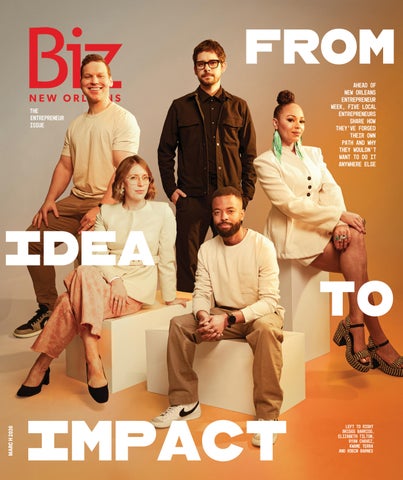
from impact idea to

Ahead of New Orleans Entrepreneur Week, five local entrepreneurs share how they’ve forged their own path and why they wouldn’t want to do it anywhere else

Left to Right Briggs Barrios, Elizabeth Tilton, Ryan Chavez, Kwame Terra and Robin Barnes

Ahead of New Orleans Entrepreneur Week, five local entrepreneurs share how they’ve forged their own path, and why they wouldn’t want to do it anywhere else

Feeling Festive

Ilove getting the chance to talk to entrepreneurs. They’re always so passionate, so excited about what they’re doing. So, it was especially exciting to get to talk to five of them for this, our annual entrepreneur issue.

I must admit I fangirled a bit getting to chat with New Orleans Songbird Robin Barnes, who was as delightful as I’d hoped. I’m thrilled she is finally coming out with her debut album! It was also amazing to chat with Briggs Barrios, who I’ve seen many times when I drive out to Jefferson Highway to pick up — I admit, sometimes multiple pints — each week of his incredible ice cream. If you have yet to discover Super Witch, well I’m sad for you, but happy for me because it increases my chances of scoring more pints. His Biscoff cookie concoctions are my kryptonite, and his business model is pure genius.

I was also excited to catch up with Elizabeth Tilton, who has been a friend of the magazine since we proclaimed her one of our New & Notables for 2024, plus I was able to get to know two new entrepreneurs in the music and healthcare space — Ryan Chavez and Kwame Terra. All five of these dynamos are out there bringing their dreams to life and we’re lucky to be having them do that here in New Orleans. I learned a lot listening to them share their experiences, and I hope you do too.

While New Orleanians knew Feb. 17 this year as Mardi Gras Day, many people around the world were celebrating another occasion — the

Lunar New Year or Chinese New Year. Fun fact — just like our schools close the whole week for Mardi Gras break, Chinese New Year is not just one day, the legal holiday is seven days long! And, just like Mardi Gras, the date changes every year.

This year the Chinese zodiac calendar moves from the year of the snake to the year of the horse, which makes it fitting that we’ve chosen to check in on our Fair Grounds Race Course and Slots. Jazz Fest is coming up fast, but this beloved venue is more than just home to this world-renowned celebration, it’s also a powerhouse in the world of horse racing. This month, we look at how Fair Grounds went from almost shutting down just last summer, to debuting a new look and focus on the future.

Festival season is here, which includes the 15th anniversary of New Orleans Entrepreneur Week and the fifth annual New Orleans Book Festival at Tulane University. Hopefully, I’ll see you at both.

Thanks for reading,

KIMBERLEY SINGLETARY

Biz Talks

Each week, “Biz Talks” reaches beyond the pages of Biz New Orleans’ magazine to bring you indepth conversations with leaders in our community.

Episode 273

Start Building Your Future Workforce Now – The New Tax Credit for Louisiana Employers

Having workforce challenges? There’s a new tax credit for Louisiana employers who provide work-based learning experiences for apprentices, interns and youth workers. Now you can build your future workforce while saving money. To explain how this works, we’re joined by two members of Leaders for a Better Louisiana who took the lead drafting this legislation and working to pass it — Barry Erwin, chief policy oficer, and Sheree Blanchard, director of policy

Episode 271

A Big Copyright Win for Musicians and Creators

Two New Orleanians — attorney Tim Kappel, and his client, Cyril Vetter — are at the heart of a high stakes legal battle that has been waging for years between musicians and music publishers/studios. On Monday, Jan. 12, a federal appeals court upheld a major ruling in U.S. copyright law affecting the ownership rights of songwriters over their songs, and all creators over their work. In this week’s podcast, Kappel explains how this landmark decision could significantly affect long-standing agreements across the music industry.

Anchor, Overcast, Pocket Casts

Publisher Todd Matherne

EDITORIAL

Editor Kimberley Singletary

Art Director Sarah E.G. Majeste

Digital Media Editor Kelly Massicot

Associate News Editor Kelly Hite

Research Alex Jorns

Contributors Carla Marie Cochran, Jesse Hoppes, Ralph Howerton, Andy Kopplin, Ashley McLellan, Misty Milioto, Chris Price, Keith Twitchell, Ralph Whalen

ADVERTISING

Senior Account Executive

Meghan Schmitt

504-830-7246

Meghan@BizNewOrleans.com

Account Executive

Lauren McCanse

504-830-7249

Lauren@BizNewOrleans.com

RENAISSANCE PUBLISHING

PRODUCTION

Digital Director Rosa Balaguer Arostegui

Senior Production Designer

Ashley Bravata

Production Designer Czarlyn Ria Trinidad

MARKETING

Marketing Manager Haley Nash

Sponsored Content Coordinator

Jeremy Marshall

Visual Media Producer Mallary Wolfe

CIRCULATION

Distribution John Holzer

ADMINISTRATION

Office Manager Emily Ruiz

VP of Sales and Marketing Kate Henry

Chief Executive Officer Todd Matherne

For subscriptions, call 504-830-7231

As we close the chapter on another unforgettable Carnival season and look ahead to Jazz Fest, there’s a powerful sense of momentum building across our region. March arrives not with a slowdown, but with energy — an unmistakable signal that our business community is leaning into a new era of leadership, innovation and collaboration.

With new civic leadership, fresh ideas and a shared commitment to accountability and growth, there is a spirit of alignment that feels different. It feels focused. It feels intentional. And it feels like opportunity.

That spirit is on full display throughout March. Don’t miss the following events:

• St. Tammany Chamber State of Economic Development Breakfast (March 4)

• River Region Chamber Jumpstart: Your Gateway to Success (March 5)

• Junior League of New Orleans Women’s Summit (March 6)

• New Orleans Entrepreneur Week (March 9–14)

• New Orleans Chamber Power Up: Women’s Leadership Conference (March 13)

• Jefferson Chamber Annual Black & Gold Gala (March 20)

• Hispanic Chamber of Commerce Job Fair (March 28)

Each of these events reflects the diversity and strength of our regional economy — from startups and workforce development to women’s leadership and economic expansion.

We are also proud this month to publish the International Freight Forwarders & Customs Brokers Association of New Orleans (IFFCBANO) Annual Directory — one of the many custom publishing partnerships Renaissance produces each year. Telling the stories of the organizations that move commerce forward remains central to our mission. You can see all our custom publishing titles at https://bizneworleans.com/custom-publishing/.

Twenty years ago, we believed in the power of storytelling to shape a stronger New Orleans. Today, that belief is even stronger, not only in our core products but also in those we produce for others.

We’re all in — for growth, for progress and for a New Orleans that works for everyone.

SALES TEAM

KATE HENRY

VP of Sales and Marketing

504- 830-7216

kate@bizneworleans.com

MEGHAN SCHMITT

Senior Account Executive

504- 830-7246

meghan@bizneworleans.com

LAUREN MCCANSE

Account Executive

504-830-7249

Lauren@BizNewOrleans.com

IN THE BIZ

Lessons in Leadership

he’s avid about music, the outdoors, and Saints, Ole Miss and Chelsea football.

March On!

End of Saints’ 2025 season gives hope for 2026

Fans knew the New Orleans Saints’ 2025 season would be one of rebuilding. The team was coming off a 5–12 record in 2024. The roster was in turbulence, starting quarterback Derek Carr announced his retirement after the draft and finding key players to build a foundation was of utmost importance. With a new coaching staff, led by rookie head coach Kellen Moore, expectations were low. Then the season started.

Moore named Spencer Rattler the starting quarterback, with the expectation that he would find his footing in his third year in the NFL. Unfortunately, that didn’t happen. The Saints stumbled out of the gate winless in September. They picked up a win the first week of October, Rattler’s first as a pro, but lost the next three.

In Week 9, Moore named rookie Tyler Shough the Saints’ starting QB for the Nov. 2 road contest against the Los Angeles Rams. The Saints lost again, 34-10, and sat at 1-8, but the season took an unexpected turn.

Shough won his second game as a starting QB and breathed life into what had been an anemic offense for the previous few seasons. The team lost their next two and were eliminated from playoff contention for the fifth consecutive season after a Week 13 loss to the Dolphins but then rattled off a four-game win streak before falling in the final game of the season.

The Saints finished the 2025 season with a 6-11 record — a game better than their 5-12 record in 2024 – but their rookie starting quarterback posted a 5-4 record and gave hope for what’s to come.

Selected by the Saints with the 40th overall pick in the second round of the 2025 NFL draft, Shough became the face of the franchise by season’s end. He finished the season with a Quarterback Rating (QBR) of 91.3, completing 221 of 327 passes (67.6%) for 2,384 yards with 10 touchdowns and six interceptions. He also moved the ball when it mattered. He had a 66.7% third-down completion rate and 103.3 QBR. In the fourth quarter, he completed 62.8% of his passes, had an 87.7 QBR, and led three game-winning drives. He also rushed 45 times for 186 yards and three touchdowns. He set the team’s record for wins by a rookie quarterback and became the first rookie quarterback with 300-plus passing yards in a game in Week 16’s matchup against the New York Jets. He was voted 2025 Pepsi Zero Sugar NFL Rookie of the Year by fans nationwide.

Shough wasn’t the only rookie to shine. First-round draft pick (No. 9 overall) Kelvin Banks Jr. was a stud at left tackle, third-round defensive tackle Vernon Broughton played well, and linebacker Danny Stutsman, picked in the fourth round, showed promise as a future defensive star.

The Saints finished the season ranked 28th out of 32 teams in total offense, 28th in rushing offense, 13th in passing offense and 16th in scoring offense.

On the other side of the ball, the Black and Gold finished 16th in total defense, fourth in passing defense, 19th in rushing defense and 16th in scoring defense.

Entering the 2025 season, the offensive line, made up entirely of first- and second-round draft picks, was considered a potential bright spot for the team, but they allowed 49 sacks, resulting in a loss of 299 yards. While some of that can be explained by inconsistency on the line due to injury, the OL will have to improve its play in the trenches to see the Saints reach a higher potential.

As the Saints head into the offseason to prepare for 2026, there is hope that they can make a quick turnaround and become a playoff-caliber team once again. No team in their division, the NFC South, had a winning record in 2025. The Panthers, Buccaneers and Falcons all went 8-9, just two games better than the Saints overall, and all finished with a 3-3 record against divisional opponents. That means it won’t take a huge jump to get to the top of the division again.

As they prepare for the draft and free agency, the Saints are a little more than $6 million over the league-mandated salary cap, according to overthecap.com. Expect the team to revamp its roster. That may mean some fan favorites may have played their last game for New Orleans, but if the right players are brought in, winning will be the only thing that matters. T

CHRIS PRICE is an award-winning journalist and public relations principal. When he’s not writing,

KEITH TWITCHELL spent 16 years running his own business before serving as president of the Committee for a Better New Orleans from 2004 through 2020. He has observed, supported and participated in entrepreneurial ventures at the street, neighborhood, nonprofit, micro- and macro-business levels.

Lessons in Leadership

Who said it best?

As someone who has designed and conducted leadership trainings, I’d like to share some leadership concepts I’ve encountered that seem particularly applicable in entrepreneurial settings.

“Leaders are those who empower others.” — Bill Gates

While every leader must ultimately take charge, make decisions and chart the course, leadership is less about exercising power than it is about aiding others in finding their power. Look at it this way: Would you rather have people who work for you or with you? Providing people with genuine opportunities to be innovative, actively seeking their input, means that they become much more invested in your enterprise. They work harder and contribute more — all of which benefits you and your business.

“Don’t tell people how to do things, tell them what to do and let them surprise you with their results.” — Gen. George Patton

This reflects the same sentiment but makes the point that you as the entrepreneurial leader

set the overall objectives and operating structure. Yet, even in this context, opening the door to participation from staff, a board or investors builds engagement and buy-in. It’s your vision; you are accountable for it and maintain it, but enabling others to help refine and advance it is beneficial to all involved.

“A genuine leader is not a searcher for consensus but a molder of consensus.” — Martin Luther King Jr.

Consensus is a powerful, and very challenging thing to build. In almost every group setting — a team, a business, a nonprofit — there is a defined leader and others who are substantial influencers. When there are important decisions to be made, directions to be taken, a good leadership tactic is to determine your preferred approach then consult individually with the key influencers in the group. Get their input, and if they seem not to align with your viewpoint, do what you can to bring them on board. That way, when the decision is made, the most important voices in the organization will be supportive.

Of course, consensus cannot always be achieved. In those situations, leadership requires moving forward anyway, ideally providing a good ratio-

nale for why differing ideas were not accepted and being willing to take the bullets that will inevitably fly from those who disagreed rather than blaming the circumstances or other people involved.

“Anyone can hold the helm when the sea is calm.” — Publilius Syrus, circa 75 BC

When things get tough true leaders emerge. And since it’s inevitable that things will get tough sooner or later, leaders are well served to have some plans in place for likely challenges. (“Be prepared” is the very useful Boy Scout motto). Seeing the big picture enables entrepreneurs to anticipate many problems before they arise, or at least before they get out of control. At the same time, when circumstances are rough, identifying and taking the immediate next steps is vital. Enlisting key staff and supporters in solving the problem is much better than going it alone. Believing in oneself and believing in the existence of a positive outcome are keys to weathering the storm.

“A good leader is a person who takes a little more than his share of the blame and a little less than his share of the credit.” — John Maxwell

Pretty self-explanatory. The objective of entrepreneurship is to develop and maintain a successful enterprise not to bask in some transitory glory.

For entrepreneurs looking to explore the qualities and techniques of leadership more deeply, there are several high-quality leadership trainings in our region. As the former executive director of the Committee for a Better New Orleans, I can strongly endorse that organization’s annual Bryan Bell Leadership Forum, but many other options abound. Yes, these things take your precious time, but it’s likely time well invested. T

PERSPECTIVES

JEREMY MARSHALL was born and raised in Baton Rouge before moving to New Orleans with his wife, Kristin, in 2018. Beginning his career in the Film/TV industry, Jeremy worked steadily on over a dozen projects before transitioning to Renaissance Publishing as their Sponsored Content Coordinator. You can reach him at jeremy@myneworleans.com.

New Options for Depression and Cardiac Care

A look at some of the latest treatments available at local facilities

Local healthcare facilities are using some of the latest techniques and tools to treat patients in the realms of mental health and cardiac care.

NEW DEPRESSION TREATMENT

At University Medical Center (UMC), physicians have been using a new tool to treat depression that builds off procedures that have been performed for several hundred years. Transcranial Magnetic Stimulation (TMS) and Electroconvulsive Therapy (ECT) — colloquially known as “electroshock therapy” — use targeted stimulation via electric or magnetic pulses, to trigger a seizure in patients that can help alleviate depression. While films like “One Flew Over the Cuckoo’s Nest” portray the practice as archaic, the modern implementation

is not only a safe outpatient procedure under general anesthesia, but also medically sound as a means of strengthening the nerve connections that regulate one’s emotional control.

Both, however, have involved some educated guessing when determining the optimum portion of the brain to stimulate. That is, until recent years, with the creation of Stanford Accelerated Intelligent Neuromodulation Therapy (SAINT), a new technique that allows physicians to accurately pinpoint within a millimeter the ideal treatable location.

With SAINT, a functional MRI scan is used to map each individual’s brain before an analysis generates a precise target.

“That leads to a much more accurate placement of the coils and more effective treatment,” said Dr. Brian L. McGee, a consultation liaison psychiatrist at University Medical Center (UMC), the first medical center in Louisiana to offer SAINT.

“I tell everybody that comes for a consultation that I don’t have a cure-all,” said McGee, “But we have options, and SAINT is the most individualized option we currently have with the best data and risk profile for improvement.”

CARDIAC CARE ADVANCEMENTS

Cardiovascular health can be easily overlooked, especially for aging patients, even though venous disease is the second leading cause of sudden death worldwide.

As a leading expert in the field and the founder of the Cardiovascular Institute of South Louisiana, interventional cardiologist Dr. Craig Walker has been educating the public on the importance of regular cardiovascular care and early prevention for more than 30 years. He is a leading force in groundbreaking research and crafting techniques now used around the world.

“For me, education is really innovation because these common diseases are often hidden in plain sight,” said Walker. “New treatments can heal, for example, even a massive blood clot with very soft, very flexible devices. These developments are not for everybody, but in cases of severe pulmonary emboli, they can be lifesaving.”

The inability of blood to work its way back to the heart is the main cause of venous disease, including venous varicosities, venous ulceration, or even pulmonary emboli, which affects up to 650,000 Americans each year. While Walker’s treatments can range from a simple walking program to implanting soft, flexible stents, knowledge and advocacy are his most potent methods for keeping the blood in his patients’ veins flowing in the right direction.

At Manning Family Children’s Hospital, interventional cardiologist Dr. Ernesto Mejia is at the forefront of utilizing Realize Med, the only FDA-approved virtual reality software for medical use, as a way to not just see inside the hidden crevices of the heart, but to pre-plan procedures to save valuable treatment time for newborns as young as 3 days old.

“We can take CT scans, MRI scans and sometimes 3D echoes that are like heart ultrasounds and recreate them in a virtual space — from just one artery to the whole heart,” explained Mejia. “This allows us to look inside a 3D model using the Oculus. We can rotate, flip it around, even slice through it to see different corners of the heart to see how blood should be flowing.”

In a recent patient born with only one pumping chamber, a lifetime with only half a working heart was avoided with the help of a Realize Med virtual diagram, which offered Mejia and colleagues the chance to see inside the heart ahead of time.

Ultimately, the team was able to reconstruct the heart with two working chambers, allowing the child the chance at a more normal life. But this is just the start. Mejia believes this technology’s applications will reach far beyond pediatric care to enhance procedures for patients of all ages and maladies.

“It has been used in brain neurosurgery, orthopedics and even oncology surgery because it allows an understanding of what exists around a growing tumor or even to help decide the right prosthesis for a bone,” said Mejia. “This platform has devices built into it so I can go into my procedure planning the equipment I need and knowing what sizes I need. It really sets us up for success.” T

PERSPECTIVES ENGINEERING

JESSE HOPPES is a co-owner of Leaaf Environmental and works with public and private clients across the greater New Orleans area to identify and manage environmental risk in support of responsible development. Leaaf Environmental is among the most active firms in Louisiana in this work. Hoppes may be reached via email at jhoppes@leaaf.com.

You Can Minimize Environmental Risk Without Stopping Development

Environmental issues are not the enemy, unknown environmental risk is.

At some point, almost every developer in New Orleans looks at the same kind of property — a corner site that has been vacant for years, sometimes decades. The location is strong. Traffic counts are solid. The neighborhood has changed around it. Whatever once held the site back no longer seems relevant.

Eventually, the decision is made. This is the one. Plans move forward. Architects are hired. Permits are secured. After months of work, construction finally begins. The site looks clean. Nothing obvious raises concern. Whatever happened here before must have been dealt with long ago.

Then pile driving starts.

On the sixth or seventh pile, the equipment hits metal. A few minutes later, there is a smell of gasoline in the air. Work stops. Phones come out. People gather. Someone remembers hearing that there used to be an auto mechanic on the property in the 1970s. No one is sure where that story came from, but suddenly it matters.

This is how environmental risk usually appears. Not as a warning sign, but as a surprise.

It rarely announces itself. It is buried underground, hidden behind walls, or tied to past uses that ended long before current owners were involved. Most of the time, everyone assumes someone else already checked.

Once something unexpected shows up during construction, the conversation changes. Are there more tanks? How long has this been here? Who is responsible? What does this mean for the schedule, the budget and the deal itself? Even issues that are technically manageable become complicated when they surface at the wrong time.

This is how deals quietly start to unravel. Not because contamination exists, but because uncertainty does. Undefined risk shifts leverage. Lenders hesitate. Investors grow cautious. Potential tenants pause. Construction schedules slip while answers are chased down and next steps are debated. What could have been planned for early becomes a source of delay and frustration.

In New Orleans, this happens often because of how the city has evolved. Many properties being redeveloped today have lived several lives already. A site that looks ordinary now may once have been an auto shop, a dry cleaner or a small industrial operation. Schwegmann’s

grocery stores — remembered simply as neighborhood supermarkets — often had fuel stations on site. A canal once connected Lake Pontchartrain to Downtown industrial uses before it was buried. Buildings transitioned from coal to fuel oil to natural gas, leaving old underground storage tanks behind at many buildings. Many older structures were built before asbestos-containing materials were regulated out of common use.

Most people understand inspections. A civil engineer checks whether the soil can support a building and how many piles are needed. A building inspector looks at the roof, structure and electrical systems. Environmental inspections are another tool that focuses on what a property used to be and what environmental concerns may still need addressing.

Banks generally understand this, which is why environmental reviews are common on financed transactions. Problems show up more often on cash deals and smaller projects where early evaluation is skipped. When a site looks inexpensive or too good to be true, environmental uncertainty is frequently part of the explanation. Skipping early review may save time or money up front, but it increases the likelihood of surprises later.

Not every environmental issue requires removal or massive cleanup. Many risks can be managed. Lead can often be addressed through encapsulation. Asbestos can be handled through maintenance and controls. Vapor barriers can limit exposure to subsurface contamination. Brownfields programs can help define site conditions, clarify liability and make projects feasible that might not otherwise be penciled out.

When questions are not addressed early, properties can sit vacant or be passed like a hot potato from owner to owner without resolution.

Minimizing environmental risk is not about slowing development. It is about understanding what is there, what it means, and how to move forward before timing and cost start working against you. That clarity is the difference between a site that sits vacant and one that returns to productive use. T

PERSPECTIVES

BANKING + FINANCE

KELLY HITE is the associate news editor for Biz New Orleans, responsible for delivering daily business news on BizNewOrleans.com, focusing on developments that impact the greater New Orleans area and southeast Louisiana. She may be reached via email at KellyH@BizNewOrleans.com.

AI IN BANKING

Local banks are being strategic in how they adopt the latest technology

and surface insights, firms are moving carefully to meet regulatory expectations and manage data risk. Rather than substituting for expertise, AI is being deployed as a tool that supports professional judgment and helps staff focus on higher-value work. The transformation is real but largely happening in internal operations.”

That balance — between unprecedented speed and deliberate adoption — is increasingly evident in how individual institutions are putting AI to work.

At Gulf Coast Bank & Trust, that tension is playing out through a targeted approach to AI

For years, financial institutions have relied on advanced computing to build algorithm-driven credit, avoid fraud and create trading models. But the recent surge in artificial intelligence — particularly large language models (LLMs) — is substantially reshaping how banks use technology, speeding up work that supports employees while retaining human oversight.

What is distinguishing the current wave of technological adoption is not how organizations are reacting to new technology, but how quickly the change is unfolding.

“The technology is accelerating, not plateauing,” said Henry Hays, AI strategy consultant and owner of Henry Hays Consulting out of Baton Rouge. “Human reactions to technological change are remarkably consistent. What makes this moment different is the speed. The Model T moved at 36 mph and that felt revolutionary. With AI, the pace of change is unlike anything in human history.”

Despite that acceleration, financial institutions are not adopting AI indiscriminately. Regulatory requirements, data security and risk management continue to shape how and where the technology is deployed.

“Financial institutions across Southeast Louisiana are taking a measured approach to AI,” said Marc Katsanis, senior vice president at Chaffe & Associates, Inc., a New Orleans–based investment banking and financial advisory firm. “While the technology can streamline processes

designed to keep human oversight and governance firmly in place.

“We have adopted AI in recent years, primarily through the use of large language models,” said Jason Shields, chief operating officer at Gulf Coast Bank. “The most immediate impact has been within our software development and broader technology functions where AI has helped automate routine tasks and accelerate development cycles.”

He said the changes have delivered clear efficiency gains.

“Tasks that previously consumed significant time from highly skilled employees have been reduced or automated, allowing those teams to focus more on decision making, oversight and strategic direction,” said Shields. “For example, our developers now spend far less time on repetitive coding tasks and more time guiding, reviewing and refining outputs, resulting in higher quality work and faster turnaround.”

Beyond technology teams, Gulf Coast Bank is using AI in customer-facing functions.

“We’ve seen strong early results on the marketing side of the bank, where AI is helping us move toward more personalized, relevant client communications and experiences,” said Shields.

Even as those tools expand into areas closer to customers, Shields emphasized that AI is being used to support employees, not replace them.

“All outputs remain subject to human review and decision-making.”

That emphasis on human oversight reflects the regulatory environment in which banks operate.

“Data security, regulatory compliance and cybersecurity were top priorities,” said Shields, “and we took additional steps to ensure that any solutions we implemented were secure and tailored to clearly defined use cases. We also established governance and usage guidelines alongside deployment so that adoption scaled in a controlled and responsible way.”

To preserve flexibility as its AI use evolves, Gulf Coast Bank has avoided committing to a single technology provider.

“We have intentionally taken a platform-agnostic approach to avoid vendor lock-in and to ensure we can select the right model for each specific use case,” explained Shields.

The bank has also remained selective about expanding its use of AI.

“In areas where AI has not yet been deployed, the primary limiting factor is ensuring a clear return on investment,” said Shields. “We’ve found that smaller, targeted implementations deliver the strongest results, particularly when tied to specific business problems.”

We have been able to move employees from handling driveup transactions to working inside branches where they can have deeper conversations with members about bigger financial decisions.
Kevin Plaisance, chief information officer at OnPath Federal Credit Union

peak periods. Member-facing intelligent assistants help cut down wait times and keep service moving smoothly when branches are busy.

OnPath has complemented its digital tools with new self-service options inside branches.

“Beyond AI specifically, OnPath has also installed interactive teller machines, or ITMs, throughout their branches,” said Plaisance. “These are like enhanced ATMs with video screens that let members do their own transactions or connect with a live teller whenever they need help.”

Together, those technologies have shifted how work gets done across the organization.

“The technologies have delivered real improvements across the board,” said Plaisance. “Staff work more efficiently because they spend less time on repetitive tasks and can focus on work that matters more. Members experience shorter wait times and more convenience, especially with the ITMs and mobile banking options.”

That shift has changed how staff spend their time inside branches.

“We have been able to move employees from handling drive-up transactions to working inside branches where they can have deeper conversations with members about bigger financial decisions,” said Plaisance. “Members can take care of quick tasks on their own but still have people to talk to when they need guidance on important matters like buying their first home or dealing with fraud.”

Plaisance said the biggest challenge wasn’t the technology itself, but helping both staff and members grow comfortable with new tools and workflows.

OnPath Federal Credit Union has taken a similarly practical approach to AI, focusing on targeted operational and service improvements.

Across its technology and security functions, the credit union has deployed automated tools to identify issues earlier, sort through system alerts and handle repetitive tasks, allowing staff to concentrate on higher-value work.

“In the IT department, automated tools catch problems early, sort through alerts and take care of repetitive tasks so staff can focus on more important work,” said Kevin Plaisance, chief information officer at OnPath.

Those same capabilities extend beyond internal systems into member-facing operations, where technology is being used to manage demand and support smoother service during

“We discovered that just installing new technology isn’t enough,” said Plaisance. “You have to help people understand it with patience and empathy. The IT team had to learn the ins and outs of the new systems and figure out how to make them work for the credit union’s specific needs. Branch employees had to shift their mindset and learn to become teachers and guides for members using the new ITMs.”

That hands-on approach proved critical to maintaining trust as technology became more visible inside branches.

“Some people initially worried that machines would take away personal service, but the staff proved that wasn’t the case,” said Plaisance. “The technology handles the routine stuff so the team has more time for the important conversations. Members are happy to use technology for quick transactions but still want to talk to a real person for big life moments. The relationship didn’t go away — there’s just more time for it now.”T

KARLA MARIE COCHRAN is the founder and CEO of Studio Shakti, editor at InTheSpotlight504, and a board member and PR/ community outreach volunteer for ByMBO. She has built a 26-year career helping businesses and organizations gain visibility and grow through her work in strategic planning, marketing and fundraising. She can be reached at karlamarie@studioshaktinola.com

A Better St. Claude Avenue is Coming

A newly formed business organization has launched a community-led revitalization of this beloved corridor

Igrew up in New Orleans, shaped by both the city’s culture and its infrastructure. My father — a Tulane-educated engineer who worked internationally with USAID and later served as parish engineer for St. Bernard Parish — often brought discussions of roads and development to our dinner table.

When our family moved to Violet, traveling down St. Bernard Highway through the Lower Ninth Ward, across the bridge, and onto St. Claude Avenue became part of my daily life and family discussions. Crossing the train tracks and moving through the rhythm of the Bywater and Marigny neighborhoods, I developed a lifelong connection to this corridor.

This area of the city has been part of my life for half a century, and today I am honored to serve on the board of the new Bywater-Marigny Business Organization (ByMBO) and as a business owner at Studio Shakti on St. Claude Avenue in the Marigny. Here, I collaborate with local entrepreneurs who pour creativity and care into building a vibrant, resilient and economically thriving neighborhood.

Seven months ago, local business owners and residents formed ByMBO to address the corridor’s challenges. The organization unites businesses, fosters community involvement and advocates for responsible, sustainable development. At its core, ByMBO believes revitalization works best when shaped by the people who live, work and create here every day.

Historically, St. Claude Avenue was a main commercial street through the Marigny, St. Roch and Bywater neighborhoods, supporting shops, markets and services for residents. Streetcar service operated along the corridor from 1926 until 1949, connecting these neighborhoods and anchoring local commerce. Like in much of New Orleans, as cars became dominant in the mid-20th century the streetcar was replaced by buses. In 2016, however, the Rampart–St. Claude Streetcar Line restored rail service, reconnecting the corridor and reinforcing its role as a vibrant neighborhood artery.

These neighborhoods developed alongside riverfront, rail and port-related commerce that shaped New Orleans’ working-class economy, fostering artisans, merchants and small businesses. Over time, car culture and industrialization transformed St. Claude into a fast, state-managed roadway that prioritized traffic over safety and local commerce.

Today, while the corridor remains home to galleries, music venues, restaurants, bars and community spaces, safety hazards and fragmented oversight have slowed its full economic recovery.

On January 10, 2026, ByMBO launched SPARK: Light Up St. Claude, celebrating the corridor’s creativity and reintroducing it as a place of possibility, safety and shared ownership. The event featured two large-scale

light installations and an evening of programming that welcomed hundreds of attendees, including volunteers, artisans, business owners and community advocates. SPARK also helps build awareness through ongoing community outreach, connecting neighbors and stakeholders to ByMBO’s work, and encouraging continued engagement.

While several organizations and government entities already have master plans, ByMBO’s goal is to continue collaborations and identify where additional advocacy, support and community input are needed. These efforts — including community conversations, planning and funding — lay the groundwork for a unified, resident-led master plan developed alongside neighborhood associations, city leadership, artists, planners and funders.

ByMBO’s vision goes beyond beautification, addressing safety, walkability, bike infrastructure, economic development and cultural identity. We aim to position St. Claude as a model for equitable revitalization alongside corridors like Magazine Street, Freret Street and Canal Street. By centering small businesses and community voices, ByMBO bridges the gaps left by past underfunded plans and supports a stronger path forward.

St. Claude is already a destination, home to long-time residents, musicians, artists, restaurateurs and entrepreneurs who give the corridor its soul. ByMBO seeks to support and amplify ongoing efforts by fostering coordinated visibility, community input and investment aligned with local values. This approach shows that when revitalization is rooted in grassroots collaboration, creativity and shared stewardship, it can strengthen safety, bolster local economies and help the corridor realize its full potential.

Community involvement is key. ByMBO welcomes neighbors, businesses, advocates and community organizations to join the conversation, offer perspectives and help shape St. Claude Avenue’s future. Even small contributions — sharing ideas or supporting projects — can make a lasting difference in creating a vibrant, safe and thriving corridor. T

RALPH WHALEN is the founder and CEO of BENZAIT, a healthcare IT consulting firm based in New Orleans specializing in data intelligence, AI governance and digital transformation. With extensive experience at the intersection of healthcare delivery, informatics, and operational strategy, he is recognized as a leader in advancing responsible innovation across complex health systems. He may be reached via email at ralph.whalen@benzait.com.

Should We Be Using AI in Healthcare?

A look at the ethics and realities we can’t afford to ignore

Conversations around artificial intelligence in healthcare often focus on potential harms — privacy risks, biased algorithms or the fear of replacing human judgment. While these are valid concerns that deserve attention, there is an equally important question that is often overlooked: What are the ethical consequences of not using AI in healthcare when the tools already exist to save lives, reduce disparities and improve outcomes?

Let’s look at four areas where AI is delivering positive impacts in healthcare.

IMPROVING PATIENT OUTCOMES

AI can help achieve improved patient outcomes by dramatically surpassing human diagnostic capabilities in critical areas. In 2025, Microsoft’s AI Diagnostic Orchestrator correctly diagnosed 85.5% of complex medical cases from the New England Journal of Medicine — cases so challenging they typically require teams of specialists. In contrast, experienced physicians working individually achieved only

20% accuracy on the same cases. This isn’t a marginal improvement, it’s a four-fold increase in diagnostic accuracy at 20% lower cost.

INCREASING OPERATIONAL EFFICIENCY

In healthcare, where diagnostic errors affect millions annually and can mean the difference between life and death, the opportunity cost of not adopting AI is measured in preventable suffering and lost lives.

AI can provide healthcare systems with revolutionary operational efficiencies that directly impact patient survival. Medical professionals are drowning, spending nearly twice as much time on paperwork as with patients, according to a landmark Annals of Internal Medicine study. This isn’t just an inconvenience, it’s a crisis.

I’ve seen this firsthand through my work at Benzait, where we’re building AI agents for rural health systems like Newman Memorial Hospital in Oklahoma. These hospitals operate with skeleton crews serving vast geographic areas, yet their staff spends hours on patient scheduling, insurance verification, prior authorizations, referral coordination and appointment reminders — tasks that AI can handle in seconds.

Every hour our AI agents free up is an hour returned to patient care in communities where every provider counts. AI-powered ambient clinical documentation tools from companies like Nuance, Ambience and Suki can reclaim even more lost hours, capture conversations and generate clinical notes in real-time.

By refusing to embrace these technologies, we aren’t just perpetuating clinician burnout, we’re actively choosing a system where exhausted doctors make more mistakes, miss more diagnoses, and have less time for the human connection that heals.

EXPANDING EQUITABLE ACCESS TO CARE

AI can also expand access to specialist-level healthcare in underserved regions. In India and Thailand, where diabetic retinopathy threatens the vision of millions, Google’s AI can detect the disease with accuracy comparable to top ophthalmologists, specialists who are scarce in rural

areas. In sub-Saharan Africa, where maternal mortality rates remain tragically high, AI-driven mobile apps are enabling prenatal monitoring that was previously unavailable. These aren’t incremental improvements, they represent fundamental shifts in healthcare accessibility.

Without AI, geographic location significantly influences the quality of care patients receive. The longer we delay deploying these proven tools, the longer these communities must wait for equitable healthcare access.

Additionally, AI gives us powerful capabilities to identify medical emergencies before they become critical. Healthcare systems generate vast amounts of data: vital signs, lab results and clinical observations that exceed human capacity to monitor comprehensively. At Johns Hopkins, the AI-driven TREWS system detects sepsis, a leading cause of hospital deaths, hours before human clinicians typically recognize it. Those hours can make the crucial difference between successful treatment and serious complications.

The ethical debate surrounding AI implementation in healthcare should not be restricted to fears of misuse. It must also address the consequences of delayed adoption.

Diagnostic errors remain a significant challenge in U.S. hospitals, affecting thousands of patients daily. Medical errors continue to be a leading cause of preventable harm, impacting hundreds of thousands of lives annually. While not all of these could be prevented by AI, evidence suggests that many could be reduced through AI-assisted decision-making. These examples represent real patients and families affected by potentially preventable medical events.

Ethics isn’t just about preventing harm, it’s also about preventing neglect. If AI can help save lives, reduce disparities and ease burdens on healthcare systems, then not using it carries its own profound ethical risks.

The real challenge is not whether we should use AI in healthcare, but how we can integrate it responsibly, transparently and equitably. Our goal should be ensuring all patients have access to the best possible care, enhanced by every proven tool at our disposal. T

o m m u n i t y s u p e r p o w e r is our

Ahead of New Orleans Entrepreneur Week, five local entrepreneurs share how they’ve forged their own path and why they wouldn’t want to do it anywhere else.

SINGLETARY
portraits by THERESA CASSAGNE

FROM MARCH 9-14, New Orleans Entrepreneur Week (NOEW) — the Gulf South’s premier celebration of entrepreneurship, innovation and business growth — will once again take over the city. Each year, this weeklong experience brings together founders, creatives, investors, students and community builders to celebrate the strength and success of our entrepreneurs.

For this, our annual entrepreneurship issue, Biz New Orleans spoke with five entrepreneurs who will be featured during the Summit at Loyola University on March 12 and 13. Each represents a different sector of the New Orleans economy: hospitality consulting, food/consumer products, health tech, entertainment tech and culture/music, but they all share characteristics that NOEW celebrates: innovation, community focus, growth mindset, and deep roots in New Orleans. They each demonstrate how entrepreneurs can build successful ventures while maintaining strong connections to the local community and contributing to the city’s diverse economic ecosystem.

Words of Wisdom

Early on, you won’t have mastery yet, and that’s normal. When you’re early, you have to make up in numbers what you lack in skill — more attempts, more conversations, more reps in the real world. If someone else can get a customer every 10 conversations, you might need to have 100. That’s not a failure, that’s the learning curve. Volume becomes your teacher, and each iteration sharpens your understanding of what actually works.

THERE ARE SEVERAL PEOPLE WHO HAVE WALKED DOWN OR OFF THEIR MEDICATIONS IN A MATTER OF MONTHS, JUST BEING INSPIRED BY OTHER PEOPLE ON OUR PLATFORM. IN 2024, SIX PEOPLE COMPLETED 1 MILLION STEPS IN 30 DAYS, ALL OF THEM LOSING 20-PLUS POUNDS, ALL OF THEM IMPROVING ON ALL THEIR MARKERS.

What He’s Doing

Terra has created the only whole-health platform using a community-based participatory research (CBPR) approach to designing precision health solutions for the Black community. To complement his system, in November he opened a coworking wellness health studio on Bayou Road called bEHR Connect.

How It Started

Terra was in the pre-med program at Xavier University on his way to becoming a physician when he began, instead, to become interested in the root causes of the biggest health issues in the Black community — conditions like hypertension, heart disease and type 2 diabetes.”

He knew he wanted to take action.

“My first thought was that we don’t know how bad we’re doing as it relates to our health in the Black community,” he said, “and someone needs to communicate that clearly to us. Sixty percent of health disparities are driven by social determinants of health — education and income levels, access to healthy food, things like that. I didn’t want to just do another workshop or webinar series where you get people excited for a moment and then they fall off once they get back into their normal environments. I wanted to build a system so that when they do fall off, we can re-engage them.”

When Xavier reached out and invited him to become its track and crosscountry coach in exchange for covering his costs for its master’s in public health program with a concentration in health equity, Terra happily accepted.

In the program he learned about community-based participatory research.

“In startup language, that’s customer discovery, where you invite the community in as equal partners in the design and development of solutions designed

for them instead of just coming up with your own ideas and trying to deploy it on the community,” he explained.

The idea for bEHR (Black Electronic Health Records) was born, and its first users were 50 Xavier students.

The main feature of the app is a health score, like a credit score for your health, which goes up and down depending on your health choices.

“If you go on a run or a walk one day, your score goes up a few points,” explained Terra. “If you get three hours of sleep one night, your score goes down.” The idea is to both educate and encourage healthy choices.

After he received his MPH, Terra started applying to accelerator and incubator programs.

“We participated in probably in 12 or so… probably brought in $250,000 in grants and investments, which allowed us to stay afloat while we were a pre-revenue company.”

Not a tech person himself, Terra attracted the attention of a Swiss technology company called Dacadoo, which invested $50,000 in technology assistance to get the beta app up in 2024.

“We did this major challenge at the beginning of the year in 2024 where we gave away $5,000 to whoever took the most steps on our app during Mardi Gras season,” he said. “It was very successful, and based on the traction, Dacadoo made a $200,000 donation of technology and in-kind contributions to migrate us over to our official app, which happened at the end of the year in 2025.”

How It’s Going

The app is free for the first 30 days, and then it’s $40 for 90 days, or $100 for the year.

“It gets you access to our experience, which is this space, the challenges on the app, the comprehensive health-

Kwame

tracking discounts at different restaurants and juice shops that we partner with throughout the city, and whatever else we add to it over time.”

Terra has been encouraged by its effectiveness thus far.

“There are several people who have walked down or off their medications in a matter of months, just being inspired by other people on our platform,” he said. “In 2024, six people completed 1 million steps in 30 days, all of them losing 20-plus pounds, all of them improving on all their markers.”

Where It’s Going

Right now the focus is on collecting as much data as possible, with the goal of eventually leveraging that data.

“We’re creating the kind of data that you need in order to go and get grants and financial support to change the things that need to change in communities to make them healthier, to improve these neighborhoods…Get sidewalks there if necessary, get a hospital there if necessary — work with the community to solve the problems that are important to them.”

His ultimate vision is to have an integrated health system for the Black community.

“We’ll have a mini clinic in the back of bEHR Connect where people can do maybe rapid screenings, blood pressure, cholesterol, glucose, things like that,” he said. “And we’ll connect them with advanced care if needed from there.”

Next up, however, is a month-long movement challenge that starts in April.

“This year, since this is the official launch of bEHR Health; we’re going trying to go to the moon. We’re going to try to cover 239,000 miles as a community in a month, and we need about 2,000 people to join, at least, to make it to work.”

elizaBeth

Words

of Wisdom

Stay insatiably curious and don’t think you’re the best in the room because you should not be. My engineers and my salespeople and project managers are far superior to me at what they do, and I’m the first one to put my hand up and say I need help. If I don’t show that vulnerability, that willingness to ask others for their guidance, then no one else will.

elizaBeth t i l t o n

What She’s Doing

A veteran of the hospitality industry, Tilton created her own consultant company, Oyster Sunday, in 2019 to help businesses be more successful. It has since served more than 300 businesses across the country. Recognizing that one of the industry’s biggest challenges has been access to affordable healthcare, she launched OS Benefits in 2023, which uses a membership model to allow businesses to join a collective to access ACA-compliant health insurance.

How It Started

From back of house, to the corporate offices of Momofuku, to a culinary design company, Tilton amassed a wealth of experience in different roles in the hospitality industry before striking out on her own with Oyster Sunday in 2019. The company focuses on fractionalizing key leadership roles in hospitality businesses, assisting with finance, operations, HR, marketing and branding.

“I made my first hire in January of 2020 — Jessica Abell, who came from Union Square Hospitality Group out of New York — and we hit the pandemic running,” said Tilton. “We quickly became a pressure cooker for what hospitality businesses really needed. At the beginning, it was finance and HR, then it was digital marketing to get loyalty and CRM development, and then it became creating alternative revenue streams for long term sustainability.”

Oyster Sunday has found quick success and grown via word of mouth.

tends to be three different companies into one.”

How It’s Going

Unsurprisingly, OS Benefits is thriving.

“Currently our insurance is bound in 20 states, and we have thousands of employees in the association and we’re growing quickly,” said Tilton.

The company is now going out for its seed round and Tilton said she’s been amazed by the traction it had in just its first week.

“We’ve decided to go out now, as everything around the health insurance is chaotic and we are well positioned to be prepared for it,” she said.

Where It’s Going

Tilton said OS Benefits is a great example of where she wants to go as an entrepreneur.

“OS Benefits is solving problems,” she said. “It is a solution to a big, big problem that’s causing friction in our industry, and we will continue to [find solutions].”

Both companies have embraced remote working, with the three fulltime employees at OS Benefits and five at Oyster Sunday spread across the country. Tilton also frequently uses independent contractors.

Tilton plans to use OS Benefits’ seed round to “invest in people and invest in the company to meet the demand that’s coming at us. The demand right now is far bigger than what we can handle.”

For Oyster Sunday, the focus for the immediate future will be on technology.

MY PRE SEED I RAISED MOSTLY HERE, AND I DID THAT ON PURPOSE TO INVEST IN NEW ORLEANS. I MOVED DOWN FROM NEW YORK TO NEW ORLEANS TO BUILD MY BUSINESS HERE BECAUSE I THINK THAT THE ECOSYSTEM CAN THRIVE...

“We’ve had the pleasure of working with many local businesses — like opening The Chloe New Orleans and The Will & the Way and working with Commander’s Palace — as well as other projects across the country and abroad, including Noma in Copenhagen, which is arguably the No. 1 restaurant in the world.”

Amid growing Oyster Sunday, Tilton realized she was spending ample time trying to support owners and operators with finding medical plans and health insurance to support their teams.

Thus OS Benefits was born, but it has since gone beyond just offering access to insurance; it built technology to administer the plans — normally a PDF-exchanged application process — thus simplifying the process for users.

“We also become the payment processor,” explained Tilton. “We centralized what

“We’ve always been very tech enabled,” she said, “and it’s something that we’re doubling down on in 2026 — thinking through automation and finding efficiency where labor may be lacking in hospitality businesses.”

While she has plans to grow her businesses, she doesn’t see moving either of them.

“My pre seed I raised mostly here, and I did that on purpose to invest in New Orleans,” she said. “I moved down from New York to New Orleans to build my business here because I think that the ecosystem can thrive; going to NOEW and participating is crucial for us to become a true player when a lot of investment is hopefully moving away from the two coasts. I think people are looking for alternative markets, and I think New Orleans can be primed to be one.”

What He’s Doing

A veteran entertainment entrepreneur, Chavez launched Imprinted in 2022. A venture studio, the company is designed to systematically start other companies within the music and entertainment space. In the past year, Imprinted has launched three startups in the areas of healthcare, workflow improvement and business management.

How It Started

Long Beach, California native Ryan Chavez always knew he wanted to be an entrepreneur. According to him, he “just kind of fell into the music industry.”

ryan c h a v e z

Throughout college, Chavez managed music venues and promoted events. After graduated, he launched a music venue in Mobile called the Alabama Music Box around 2010, which is still in operation. When some friends who were concert promoters had ambitions to start a music festival, he was asked to join. The result was The Hangout Festival in Gulf Shores, Alabama. After its success, he moved to New Orleans to help the company — HUKA Entertainment — launch other festivals. In 2015, realizing he wanted work more closely with talent, Chavez launched a talent management firm, The MGMT Partners, and a creative agency, Wrangler Creative.

When the pandemic hit, he pivoted and co-founded a company that repurposed furloughed music industry professionals into frontline workers to help with mass testing sites.

“We were doing the entire state of Alabama, the state of Nevada’s public school system, Maricopa County in Phoenix,” he said. “It enabled our

community to be able to make a living during this really scary time.”

When things started opening back up, Chavez was ready for a new challenge. It was then he founded Imprinted, a venture studio to launch startups in the entertainment space.

So far, Imprinted has created three startups. The first, Stagecare, aims to close the health insurance gap in the music industry.

“There’s 2 1/2 million music industry professionals in the U.S., and 1 million of them, 40%, do not have any insurance,” he explained. “Stagecare is a subscription-based supplemental benefit program.

Members who enroll for $75 a month receive $0 co-pays for primary care, mental health therapy and prescriptions with “no eligibility hurdles, no hidden fees and nationwide access.” The company’s website also advertises a 6-minute average wait for telehealth urgent care. Coverage also includes “family, whatever ‘family’ means to you — meaning the creative plus “up to four family members living in the state, defined on your terms.”

Imprinted has also launched a workflow automation platform called Trainable and a company called FASE, which stands for financial administration for sports and entertainment.

“Traditionally artists, music industry professionals, have two options,” explained Chavez. “Option A is they find a business manager if they’re making enough income to warrant one, and that manager is going to essentially offer full-service business management, financial administration for 5% of their gross income. And the other option is they work with a neighborhood CPA or someone who doesn’t necessarily have

Words of Wisdom

Surround yourself with people who are better than you. Be self-aware enough to understand your strengths and weaknesses, and intentionally build teams with complementary skills. And finally, failure isn’t an option. You adapt, learn and keep moving forward until it works.

MY PARTNERS AND I HAVE BEEN IN THIS SPACE FOR SO LONG AND HAVE BEEN SO HANDS-ON THAT WE’RE KEENLY AWARE OF ALL THE PAIN POINTS. EVERYTHING STARTS WITH, ‘WOULD I USE THIS? WOULD WE USE THIS?’

the nuanced understanding of royalty deals or things of that nature. It’s our argument that there’s a large segment of the industry that needs something in-between.”

FASE is a flat-fee-based system that leverages technology to allow the user to self-serve as much as possible, but get a very real world snapshot of where their businesses are at any given time.

How It’s Going

Chavez said that one of his biggest challenges has been finding people that buy in to Imprinted’s vision and are able to kind of work in a startup environment, but he feels like he’s finally found those people. The company has a core team of seven — two people in New Orleans, where Imprinted is based, with the rest of the team distributed across Mississippi, Mexico, New Jersey, and Brazil. In addition to the core team, they work closely with a broader network of parttime and offshore talent.

“Finding our head of engineering and bringing him on was an absolute game changer for us,” he said. “Until then, it was really difficult to take something from concept to something that’s material. Once we found the right person, we just been flying...”

He said it helps that the people on his team have industry experience and insight.

“We are the target market,” he said. “My partners and I have been in this space for so long and have been so hands-on that we’re keenly aware of all the pain points. Everything starts with, ‘Would I use this? Would we use this? Ultimately, we look for something that is not only applicable but as frictionless as possible, in terms of adoption and truly useful to the end user.

Where It’s Going

Imprinted started with a holding company structure but is currently raising money at the portfolio level to help take their companies to market.

“We’ve been operating in stealth for the past few years, just trying to get things to a place where we could kind of have a coming out party and announce ourselves, announce these companies,” said Chavez. “Now it’s about integrating within the community, networking, letting people know we exist and what we’re working on.”

Robin

SINGER/ SONGWRITER

FOUNDER

Words of Wisdom

Recognize your worth and your brand. Don’t limit yourself to what your day job is or your gig is until you get to the next level. And trust your gut. Every single time I paid for someone to do what I thought was them taking me to the next level I learned I could do it on my own.

MOVE YA BRASS

What She’s Doing

Branded “the songbird of New Orleans”

Robin Barnes is an internationally recognized, Billboard Top 10 charting artist, award-winning contemporary crossover singer and one of New Orleans' biggest cultural ambassadors. For 12 years she’s also run an organization that provides free community workout classes.

How It Started

Born and raised in the Lower Ninth Ward, Barnes grew up the oldest daughter of seven kids in a family of musicians. Her first solo was at age 6 in church, and she performed in her family’s jazz band. While her siblings all went to school for music, her parents made her study business. After double majoring in

I FEEL LIKE I’M READY TO FINALLY DO THIS ALBUM BECAUSE I HAVE THE CITY BEHIND ME. I HAVE THE PEOPLE WHO WANT TO SEE ME WIN.

marketing and management at UNO, she was pushed again into getting her MBA.

When she finally felt free to get back into performing she wasn’t greeted in the way she had hoped

“I was out on my own now and I quickly realized I wasn't the band, I wasn't the brand,” she said. “Everyone was saying, ‘Who are you? Do you have a fan base? What do you have?’”

After going six months without a gig, Barnes got a corporate job but immediately knew it wasn’t a fit. At that point she decided to use her background and education and manage herself.

“One of the first things I did was create a manager. I made an email address and chose the name Mark — a man’s name, a strong name,” she said. “If I reached out to people, I never got a response, but Mark always got a response.”

When she finally got a gig in 2010, she called in all of her family and used Facebook to reach everyone she knew and tell them to come see her perform.

“When I tell you those places were packed for the like, the first three weeks,” she said, “instantly, the venue was like, ‘Let's renegotiate. Let's pay you more.’”

Drawn by the crowds, people she didn’t know eventually started attending her shows. Soon she became a headliner at the Hotel Monteleone, and then the Windsor Court.

When the mayor at the time started calling her “the songbird of New Orleans,” she grabbed the opportunity.

“I went, ‘Amazing!’ ‘Trademark!’ and I was able to leverage that title into marketing deals and brand deals.”

During her first international tour, however, Barnes got hit with bad news. She was diagnosed with a rare strain of a kidney infection that left her right kidney permanently damaged.

“So suddenly, at the age of 23, I can't drink alcohol, I can't drink caffeine, I was on eight medications, four painkillers and I was walking with a cane.”

Barnes was encouraged to start working out but had no money for a gym. Instead, she reached out again through Facebook,

shared her situation, and asked if anyone wanted to come exercise with her.

“And 10 people I never met in my life showed up at City Park at 6 p.m.,” she said.

Realizing the demand for a free, community-centered exercise option, Barnes created Move Ya Brass in 2013. After self-funding the program became too challenging, she decided to start creating custom fitness events.

“Coca-Cola hired us for Essence Fest, companies hire us for corporate wellness, bachelorette parties hire us,” said Barnes, “and the funding from that helps support free community classes.”

How It’s Going

With all her success over the past 15 years one thing Barnes has yet to do is release a debut album.

“Everything has been EPs and singles,” she said. “I have never had a label because I didn’t want to give up my brand, my worth.”

She recorded the album but is still working on the funding to release it, which is set for early May. The album is a love son to her home and family.

“We're nine generations of Louisianians, and this album goes through the entire lineage, from the all the music of Louisiana, the sounds of Louisiana, not just New Orleans,” she explained. “I’m trying to amplify that through the marketing, but I am up against major labels who have all the money in the world. I have got to be scrappy. I've got to figure out pivots. I've got to figure out angles.”

She’s also creating a docuseries with the album that she plans to start shopping to investors.

Where It’s Going

“I feel like I'm ready to finally do this album because I have the city behind me,” she said. “I have the people who want to see me win. But I've got to show them what this music means. I've got to show them what our culture means and how standing behind me is really amplifying the beauty and the love of what we are and why we live where we live, in this amazing city, in this amazing state.”

Barnes

What He’s Doing

This small batch, custom ice cream maker has achieved cult status in the past few years. The product is not sold in stores; customers compete to purchase limited stock of craft ice cream for $14 a pint. every Wednesday night at exactly 7 p.m. through the Hot Plate website. Flavors sell out within moments. Lucky winners then must pick up their orders within three days at the company’s kitchen on Jefferson Highway. Super Witch sells more than 1,000 pints a week using this model. In December, the company opened a storefront inside Il Supremo Pizza in Old Metairie that sells soft serve and cookies.

How It Started

A New Orleans native, Briggs Barrios always loved ice cream. So much so that it was more than a treat to him, it was a hobby.

“I had an Instagram account when I lived in Tampa where I would review ice creams,” he said. “I would post pictures of ice cream — anything you can get from the store and even have some shipped from small batch makers from across the country. Those small makers really opened my eyes to what ice cream could be. It could be a lot more than what we get in the grocery store.”

Working as a stock and then commodities trader, Barrios said he never had an interest in making ice cream himself until he joined his family on a trip to Fort Walton Beach and visited Pink Coyote Dessert Co.

“I had a blueberry Biscoff flavor and a cookie monster flavor and that was it,” he said. “I ordered eight books on how to make ice cream from Amazon on our

I THINK SUCCESS IS BASED ON HOW POSITIVELY WE CAN IMPACT AND GIVE BACK TO THE COMMUNITY. IT’S MAKING SURE THAT MY EMPLOYEES ARE ALWAYS TREATED WELL, NUMBER ONE, AND NUMBER TWO, THAT OUR CUSTOMERS FEEL LIKE THEY’RE SEEN AND THEY’RE CONNECTED WITH US, AND, OF COURSE, TO MAKE THE BEST ICE CREAM IN THE COUNTRY.

Words of Wisdom

It’s gonna be hard. I think that’s one thing that social media does that’s not great — it glamorizes a lot of things. A lot of people see the end product, but they don’t see all the work that went into it. You have to be willing and able to do hard things if you want to put yourself in a situation where you could potentially be successful.

g s B a r r i

way back to the condo. I made my first ice cream that week and immediately I thought, ‘I love this. I need to do this.’”

Drawing on his longtime four-tofive-pints a week habit, Barrios soon began creating his own recipes, as well as his own inclusions (ingredients mixed in to increase flavor and texture).

“For a year it was a seven-days-a-week passion project,” he said. “I would work all day at my job and then come home and make ice cream from like 5 p.m. to 10 p.m., and then on weekends from 7:30 a.m. to 5 p.m.”

Finally, Barrios made the leap — he quit his job and signed a five-year lease on a 1,200-square-foot space in a strip mall on Jefferson Highway that serves as his commissary kitchen and pickup space.

“We opened in June 2023, and it was just me for the first nine months, seven days a week, working like 80-to-90-hour weeks, hand-packing every single pint, making all the inclusions.”

All of Super Witch’s marketing has been through social media and word of mouth.

“Everyone I’d see I’d say, ‘Hey, have y’all tried the ice cream?’” said Barrios. “In fact, one of my best friends in the world now is from one of those early relationships — Jason Gonzalez with Gonzo’s SmokeHouse. I loved his craft barbecue and so I made him some ice cream. We ended up doing some collaborations.”

How It’s Going

Super Witch hired its first employee in October 2024 and now, combined with its new soft-serve location in Old Metairie, has 10 employees and is looking to hire more.

“We’ve been busting at the seams for about a year now,” said Barrios. “We're really at an inflection point right now where we're trying to look for a bigger space that is a little bit more accessible for people.”

Never content with his product, Barrios said he regularly makes incremental improvements.

“We changed the ice cream base recipe last week,” he said. “We probably did that 20 times last year.”

Where It’s Going

“Success for me I don't think it's going to be counted in opening a new location or growing the business to a certain revenue number,” he said. “I think success is based on how positively we can impact and give back to the community. It’s making sure that my employees are always treated well, number one, and number two, that our customers feel like they're seen and they're connected with us, and, of course, to make the best ice cream in the country.” ♦

FROM BRINK

TO BREAKTHR O UGH

The second-oldest continuously operating racetrack in America, Fair Grounds Race Course and Slots has gone from almost shutting its doors last year to doubling down on its future. With derby season starting this month and Jazz Fest right behind it, Fair Grounds is eager to show off its new digs.

photos by Sara Esssex Bradley

On a crisp November morning in Mid-City, the Fair Grounds Race Course comes alive with the ritual of thoroughbred horse racing. For 154 consecutive seasons, this storied venue has served as the home of winter racing in the Southeastern United States, weathering fires, wars, hurricanes and now the modern challenges of a changing industry.

“When you consider the long history since 1872, you appreciate what we consider is our motto: resilience,” said Jason Boulet, senior director of racing at Fair Grounds. “From devastating fires that have destroyed the grandstand areas twice to world wars and hurricanes that have seen our city have to fight back repeatedly, the Fair Grounds is still here.”

With the recent closing of Freehold Raceway in New Jersey, Fair Grounds now holds the distinction of being the second-oldest continuously operating racetrack in America. For Cathy Beeding, president and general manager, that legacy comes with a profound duty.

“We take the responsibility for carrying on that legacy very seriously,” she said. “As the property’s leader, I study our business as well as the landscape in which we operate every day with a focus on making strategic decisions to assure that Fair Grounds — the jewel of New Orleans — will serve future generations.”

Not just a good time, horse racing is big business.

“Horse racing is ranked as the third biggest industry in the state behind only oil and gas and tourism,” noted Boulet. “The horse breeding industry in Louisiana has gained in status that compares to Kentucky and Florida.”

The ripple effects touch numerous sectors throughout the state.

1837

1872

Horse racing began on the site
Fair Grounds racetrack officially opened

“The racing industry provides thousands of job opportunities ranging from agriculture vendors for feeding and bedding supplies; blacksmiths, veterinarians, grooms, exercise riders and racing officials are just a few examples,” Boulet says.

The Fair Grounds itself is far more than just a racetrack.

“Fair Grounds is a complex business, kind of like a play in three acts, all of which occur simultaneously,” Beeding explained. As a whole, Fair Grounds includes thoroughbred racing from November through March, a slot facility featuring about 600 slot machines with an on-site sportsbook at the Gentilly Boulevard location, and a network of 13 off-track-betting facilities throughout the region offering year-round, simulcast wagering on horse racing and video poker.

As such, the Fair Grounds employs about 500 fulland part-time year-round team members, a number that grows to almost 1,000 during racing season. Career opportunities range from cashiers to IT professionals, from stall superintendent to internal auditor.

“While it helps to have a personality suited to customer service, the gaming and horse-racing industry is one of the few where we value experience over tons of formal education or training,” said Beeding.

There are also a few jobs you wouldn’t expect.

“We have a full TV production crew at Fair Grounds,” said Beeding. “Our team works to send out our racing signal throughout the world, receive signals from other tracks, and distribute those signals to the OTB (off-track betting) network as well as produce a fullscale show every day we race with on-set talent, camera operators and even a TV set.”

Operating in Many Lanes

Understanding the financial engine that powers Fair Grounds requires looking at multiple revenue streams.

“The majority of our purses come from handle [wagers], video poker, slots; and a small portion comes from sports betting,” said Racing Secretary Scott Jones.

The gaming component has fundamentally transformed the business model.

“Having a casino-style gaming option on the property gives us the advantage of having yearround operations to support our team members as well as take care of the property,” said Beeding. “Fair Grounds sits on about 150 acres in Mid-City, and it takes a lot of teamwork and effort throughout the year to keep things looking sharp.”

The importance of gaming to the financial success of Fair Grounds is so strong that when the Louisiana Supreme Court ruled one type of betting machines — HRM (historic horse racing machines) — were unconstitutional in 2025. HHR machines account for nearly half of Fair Grounds’ off-track betting revenue. As a result, Churchill Downs, Inc. (CDI) — the corporate parent that acquired Fair Grounds in the mid-2000s — started talking about surrendering its racing license, a move that would have shut down the venue.

Fortunately, the Louisiana Horsemen’s Benevolent and Protective Association (a nonprofit organization that represents the interests of horse owners, trainers, and backstretch personnel in Louisiana) and CDI were able to come to an agreement that allowed racing to continue.

“There were some moments of uncertainty in the wake of the Supreme Court decision, but we were happy that all stakeholders were able to sort things out in a way that allows Fair Grounds to carry on its rich tradition of horse racing in New Orleans,” said Beeding.

Investing in the Future

Despite these challenges, Fair Grounds has pushed forward with sizable renovations. This season brought a major facelift including a new paddock, winner’s circle, Ultra Lounge, production area, slot floor renovations, new flooring and seats in the Clubhouse, a refresh of the Tenacious Bar, and the creation of Louisiana Derby Hall.

“Fair Grounds has made substantial and meaningful investments in the property to compete in the market and attract the highest caliber of Thoroughbred racing in Louisiana,” said Beeding, who noted that while guest-facing improvements get the most attention, investing in less visible improvements like HVAC, horse washing stations and track maintenance equipment are highly impactful.

The paddock renovation alone represented an investment of nearly half a million dollars.

“Our paddock surface and drainage were completely renovated,” said Boulet. “The final product has received nothing but positive reviews as we addressed a much-needed facelift as well as a safer area for our horses and horsemen.”

These improvements also serve a strategic purpose beyond aesthetics.

“I think anything we do to enhance the accessibility and attractiveness of the track benefits the overall business and our community,” said Beeding.

1970

First Jazz Fest (held at Congo Square)

1972

Jazz Fest moved to Fair Grounds

1997

Current grandstand opened after fire destroyed previous structure

2004

Churchill Downs Inc. acquired the Fair Grounds

2005

Hurricane Katrina damaged the grounds

2006

First post-Katrina Jazz Fest

“Creating spaces where everyone feels welcome has been one of our priorities, such as the development of our Ultra Lounge group sales space, and the results are apparent as we look around the track and see new faces and differing demographics.”

The Competitive Landscape

Fair Grounds occupies a unique position in the national racing calendar, operating when much of the country faces harsh winter weather.

“The weather we have here is very favorable, so horses generally thrive over our racetrack, and that’s why we have some of the best horses in the country and have for many years.”

According to Boulet, three fundamental recruiting tools allow Fair Grounds to attract top trainers and jockeys.

“The first, and probably most important recruiting tool, is the reputation of having one of the best surfaces for racing and training,” he said. “There is an old folklore — a legendary tale of where Fair Grounds obtains our dirt-surface materials that involves the Mississippi River. True or myth, we will take it and will keep that secret ingredient hush-hush.”

The second recruiting advantage is winter turf racing opportunities.

“Turf racing plays a vital role in daily wagering of our racing product,” said Boulet.

The third tool?

“New Orleans! There isn’t a better time of year to be in the Big Easy when it comes to the weather or enjoying Carnival season and the best food and culture in the world.”

This recruiting strategy appears to be working.

“We have 10 of the top trainers by wins and purse earnings [including returning trainers like Joe Sharp, Steve Asmussen and Brad Cox] stabled here for the current racing season,” noted Boulet.

Last season, Fair Grounds attracted Jose Ortiz, a 2017 Eclipse Award winner who became the leading rider with 97 victories.

“Jose is a perfect example of Fair Grounds being relevant on the national stage,” said Boulet. “Beyond Jose being one of the top riders in the world, he is a great ambassador for our sport and is well respected by his fellow jockeys. By having such a successful winter season at Fair Grounds, he was able to propel that to a riding title at Churchill Downs and top three finish at the premier Saratoga meet.”

Industry Challenges

While Fair Grounds maintains its competitive position, the broader industry faces significant headwinds.

“The biggest challenge by far is the dwindling foal crop,” said Jones. “[This year] is

03/2025

Louisiana law authorized HRM (historic horse racing machines) — slot-like machines that give players the chance to bet on replays of horse races and dog races

Louisiana Supreme Court ruled the HRM authorization unconstitutional

expected to be less than 18,000; 20 years ago, it was close to 40,000. It’s getting increasingly difficult to maintain field size.”

The consolidation of the industry also has taken its toll.

“Lots of small owners, trainers and breeders have left the game on a local level due to the economics of the business, and we have also lost many racetracks over the last 20 years,” said Jones.

Competition with other regional tracks also presents challenges.

“Oaklawn Park [in Hot Springs,Arkansas]has a very healthy purse structure due to [horse racing managers] and we also have Delta Downs [in Vinton, Louisiana] running at the same time, which reduces field size and hurts our Louisiana-bred races.”

Jones said if he could change one thing about the Louisiana racing environment it would be to improve coordination among the state’s four tracks.

“Stop running two in-state tracks against each other — we just don’t have the horse population anymore,” he said. “The HBPA, LSRC and racetracks need to come together to align race days for all four racetracks in-state, so we are not competing against each other. The two best racing jurisdictions in the country are Kentucky and New York, and they have a circuit with only one racetrack running at one time.”

The Road to the Kentucky Derby

Despite these industry challenges, Fair Grounds remains a crucial stop on the road to the Kentucky Derby. This season features 57 stakes races offering $8.75 million in purses, with the crown jewel being the Louisiana Derby.

“The Louisiana Derby is the Fair Grounds showcase race that represents some of the best three-year-old horses competing for a spot six weeks before the running of the Kentucky Derby,” explained Boulet. “The 2026 race will be the 113th edition of this historical race with the winner receiving 100 points—50 points for second place, 25 points for third place, 15 points for fourth place and 10 points for fifth place.”

The race carries a purse of $1 million and offers a unique test.

“The distance the horses run in the Louisiana Derby is unique to other prep races as it runs 1 mile and 3/16, which makes it the longest distance for a Derby prep race,” said Boulet. “The distance has attracted several owner/trainers as a true test of their horse’s

05/2025

Churchill Downs talks about surrendering its racing license

06/2025

Deal reached to continue racing; Racing Commission approved 2025-26 dates

11/2025

154th season opened with new renovations

endurance to compete at a mile and a quarter in the Kentucky Derby.”

The Fair Grounds has sent two Louisiana Derby winners on to Kentucky Derby glory —Grindstone and Black Gold. In fact, Black Gold is buried in the infield of the Fair Grounds, along with two other famous local horses, Tenacious and Pan Zareta.

The Jazz Fest Partnership

Perhaps no relationship better illustrates Fair Grounds’ integration into New Orleans culture than its 50-plus year partnership with Jazz Fest.

“Jazz Fest is an important strategic partner for Fair Grounds, and we really go hand-inhand to make sure the festival is a positive and safe experience for all attendees, as well as our neighbors,” said Beeding. “Jazz Fest has described Fair Grounds as its home, and we think of Jazz Fest as another critical aspect of our business and our personality.”

However, the partnership creates a unique operational challenge.

“Fair Grounds is known for its turf racing, yet, because of Jazz Fest, Fair Grounds is the only racetrack in the country that has to fully renovate its turf track every year after Jazz Fest departs the property,” said Beeding. “This is a process that takes a lot of resources and work from our track maintenance team, as well as a cooperative Mother Nature.”

The logistics involved with hosting Jazz Fest on the property are staggering.

“The coordination of transforming a racetrack to one of the world’s biggest music festivals is a behind-the-scenes story that most would never realize or imagine could be possible,” said Boulet. “Before the racing season is even completed, Jazz Fest begins the transition with the arrival of equipment and machinery. There is a short time span in which the horses vacate, and Jazz Fest begins their transformation that must be completed in less than four weeks.”

Community Connections

Beyond Jazz Fest, Fair Grounds maintains deep community ties through various partnerships and charitable activities. Recent initiatives have included collaborations with the Jazz Fest Foundation, Fair Grounds Community Clean Up, Covenant House, LTBA Champions Day Scholarships, Backside Community Holiday Meal and Mardi Gras Parade, a breast cancer awareness event to benefit the Shantel Lanerie Breast Cancer Foundation, HBPA Horse Racing Aftercare/ New Vocations, NOPD Mounted Patrol, and Community Halloween Trunk or Treat.

The track also hosted its inaugural Jockeys and Jills Dinner this season.

“It was a great opportunity to recognize the accomplishments of the Fair Grounds jockey colony with dinner and awards,” said Beeding. “We also held a meet-and-greet event for our racing fans with all proceeds donated to the Permanently Disabled Jockey Fund. This is an event that we want to build on in future years.”

An Invitation to Experience History

For New Orleanians who have never experienced Fair Grounds racing, Boulet has a simple message.

“If you are from or living in our great city, you should experience racing at the Fair Grounds at least once,” he said. “Through my travels in the city, when I say I am part of Fair Grounds, it seems everyone has a story about a relative that worked here or was a patron at some time in their life. The Fair Grounds is timeless. The Fair Grounds reminds us of our resolve and resilience as it defied all obstacles throughout its history.”

As the 154th season unfolds, Fair Grounds continues to navigate the complex intersection of history and modernity, tradition and innovation, local culture and national competition. And through economic challenges and industry changes, one constant remains—the thunder of hooves on that legendary racing surface, carrying forward a legacy that has endured for more than a century and a half. H

LOUISIANA BLUE – PUTTING LOUISIANA FIRST!

LABLUE.COM

B2B SERVICE GUIDE

Whether you are searching for accounting expertise, accomplished project managers, or IT wizards, these B2B service providers can ease pain points in your company and prove that New Orleans businesses are better when they work together.

Atlantic hurricane season is June 1 – Nov. 30. Blue Cross and Blue Shield of Louisiana (Louisiana Blue) reminds you to make health needs part of your family’s hurricane preparation plans. Keep your health plan information handy, and get a digital member ID card if possible. Make a list of your family’s health information, including which medications everyone takes. Store the list in your phone or keep a written copy in your wallet or something else you’d take with you if you leave. If you take prescriptions regularly, see if you can get a 90-day supply to have on hand in the event of evacuations or extended closures. Sign up for telehealth services, so you have options to get care remotely. Visit lablue.com or connect with us on social media @MyLouisianaBlue to see more health-related hurricane preparedness tips. Visit our website www.lablue.com or social media @ MyLouisianaBlue.

GULF COAST BANK

With over $3 billion in assets, Louisiana-based Gulf Coast Bank & Trust Company serves its business and personal banking clients through its bank branches, loan production offices, trust and investment offices, and business credit offices.

Gulf Coast Bank & Trust Company has more than 900 employees across 21 branch locations in Southeast Louisiana, including a new branch location in Miramar Beach, Florida, as well as more than 48 total locations in 11 states. Locally, Gulf Coast Bank & Trust Company branch offices are in Orleans, Jefferson, St. Bernard, St. Tammany, Tangipahoa, and East Baton Rouge cities.

As a community bank, Gulf Coast Bank & Trust Company commits itself to nonprofit organizations in Southeast Louisiana through sponsorships and charitable giving. Each year, Gulf Coast Bank & Trust Company hosts a fundraising event, Auctions in August, for local and national organizations, schools, churches, and community groups. Since its inception in 2008, Auctions in August have raised almost $1.6 million for nonprofits.

Founded in 2013, Get Online NOLA was built from a love for New Orleans and the businesses and nonprofits that make the city thrive. The woman-owned agency helps organizations grow through thoughtful website design, ongoing website maintenance, and results-driven digital marketing strategies.

The annual Get Online NOLA Grant, now in its fifth year, is an extension of the firm’s commitment to the community. The grant awards one deserving organization a custom website valued at up to $3,000, with a runner-up receiving a marketing strategy audit worth up to $1,000.

Get Online NOLA’s mission is to empower organizations to take control of their online presence and grow their bottom line. Businesses and nonprofits are encouraged to nominate themselves or another deserving organization to help spread the love and shine online.

Apply at getonlinenola. com/biz-grant.

Jessica LeBlanc and her husband, Greg LeBlanc, owners of CPA Realty, LLC, are celebrating ten years in business. A boutique Real Estate Brokerage Firm, CPA Realty helps various clients pursue their interests in real estate and/or expand their real estate portfolio, through commercial, residential, or investment properties.

Over the years, Jessica and Greg have assembled a team of highly skilled real estate professionals to guide clients toward their goals, including Jessica’s son and Marketing head Trey LeBlanc, Realtor Colby Wenck, Realtor Wes Franatovich, Realtor Bobby Sylve, and Executive Office Assistant Megan Bardales. In addition to CPA Realty, LLC, Jessica also leads Jessica D. LeBlanc, CPA, LLC, a boutique Certified Public Accounting Firm offering forensic accounting, outsourced accounting, and general business consulting services, and is also marking its own 10-year milestone. The talented and dedicated accounting team features Staff Accountants Sue Gironda and Trey LeBlanc, Executive Office Assistant & Staff Bookkeeper Megan Bardales, and Jessica’s Daughter/Accounting intern Tristin LeBlanc.

ARTHUR J GALLAGHER RISK MANAGEMENT

Gallagher is one of the world’s largest insurance brokerage, risk management and consulting firms and is the largest broker in Louisiana. As a community insurance broker and trusted local consultant, we help people and businesses move forward with confidence. We have over 53,000 people working around the globe, who are connected to the places where we do business. Managing risk with customized solutions and a full spectrum of services is what we do, we help our clients foster a thriving workforce, and our team always holds ourselves to the highest standards of ethics to help you face every challenge – that’s The Gallagher Way.

At Ener Systems, we know you want your business to run smoothly and feel secure. To do that, you need more time for your business—not tech headaches. But slow Wi-Fi, lost files, and system crashes are frustrating and disruptive, especially when you’re hacked or miss a deadline.

We believe your technology should work for you—not against you. With over 25 years of experience, we keep your systems running and your data safe, so you can focus on your work, not the glitches.

We’re the only local tech company featured in three documentaries streaming on Amazon. Our proven track record means you can trust us to handle your IT while you lead your team and grow your business.

Schedule a call today—stop letting bad tech cost you bids or sleep. Become the hero your business deserves by spending less time on tech problems and more time building your success. Learn more by visiting enersystems.com or calling 985-871-0333.

With more than 100 years of building history, Woodward Design+Build has long helped shape the New Orleans skyline—and today, the firm is actively delivering projects across the Gulf South, from Texas to Florida. Headquartered in New Orleans with offices in Covington, Louisiana, and Mobile, Alabama, Woodward is increasingly selected as a true design-build partner for commercial businesses, light industrial users, and operations-driven organizations. Woodward specializes in fully integrated, turn-key designbuild services—designed and built for business. The firm’s approach aligns inspired design with construction realities, prioritizing speed to market, cost certainty, and long-term operational performance. Clients value Woodward’s disciplined pre-construction process, transparent budgeting, and ability to translate complex business requirements into buildable, efficient facilities.

Serving markets that demand precision and reliability—including healthcare, education, distribution, and manufacturing—Woodward delivers solutions grounded in constructibility, sustainability, and lean construction principles.

Learn more at woodwarddesignbuild.com.

The Internet can be a dangerous place, especially now that hackers are taking advantage of advanced tools and threats. New types of malware, ransomware, and viruses are being created every day for the express purpose of seeing your organization fail. Virtual Business Solutions has been serving the Louisiana area since 1999, providing IT, technical help desk, and computer support, along with consulting to small and medium-sized businesses to keep their software one step ahead of hackers. By managing your security from one location utilizing Unified Threat Management (UTM), Virtual Business Solutions is able to provide 24-hour network support and monitoring while updating security software to maximize protection. With a UTM from Virtual Business Solutions, your security is never in question.

For more information about our network security solutions, including the UTM, call us today at (504) 840-9800.

Digital Engineering is an award-winning program management, water resources, transportation, and construction administration firm dedicated to enhancing infrastructure where we live, work, and play. Since 1990, we’ve grown from our headquarters in the greater New Orleans area to serve communities across Louisiana and the Mississippi Gulf Coast.

We deliver end-to-end solutions — from planning and design through construction and program delivery — that improve safety, resilience, and mobility while supporting long-term community goals. Our expertise spans stormwater management and coastal resilience to transportation and roadway safety, aviation facilities, federal projects, and port infrastructure.

What sets DE apart is our collaborative, client-centered approach. We combine the technical depth of a large firm with the agility and personal attention of a trusted partner, grounded in communication, coordination, and collaboration. Our team’s deep regional knowledge and commitment to community impact create smarter, faster, and more meaningful outcomes for clients and the people they serve.

FROM THE LENS

58 WHY DIDN’T I THINK OF THAT?

Have a LEGO fanatic in the family? You need to head to this Old Metairie shop.

GREAT WORKSPACES
Dillard University’s Innovation Collective both creates, and was the result of, great collaboration 62 NEIGHBORHOOD GEM
Mona Lisa Restaurant
64
NEW ORLEANS 500 Vaughn Fauria, CEO of NewCorp

LET’S GET TOGETHER

Dillard University’s Innovation Collective both creates, and was the result of, great collaboration

When Dillard University opened its Innovation Collective last August, the four-story, 251-bed residence hall created far more than additional student housing. The project embodied what the university calls its “communiversity model” — an approach that unites living, learning and community service within a single environment.

“To our design team, living, learning and community service had to be considered at the root of all

Both a residential and public space, the building’s open, doubleheight design was crafted to encourage interaction and collaboration within its various spaces.

architectural decisions,” said Raymond Armant, senior architect at Trapolin-Peer Architects, “from determining the building programming and programmatic layouts to how those spaces were developed and detailed.”

In addition to Trapolin-Peer Architects, the collaborative design-build project brought together Landis Construction, CDW Services and AOS Interior Environments to create a facility that serves both Dillard students and the surrounding Gentilly neighborhood.

As Louisiana’s oldest HBCU, Dillard University carries a profound historical legacy that the design team worked carefully to honor while creating a distinctly contemporary building. The result balances tradition with innova -

tion through thoughtful material choices and building form.

“For our team this meant that the exterior façade needed to incorporate a white palette on a primarily masonry façade, which is prevalent across the main campus,” said Armant. “Change of materials and planes at defined openings in the façade were inspired by the historic conditions found across campus. Ribbed fiber cement panels or different plans of masonry were used in lieu of the more traditional wood panels.”

The building is L-shaped with two residential wings intersecting to form a central hub.

“The north wing of the L is scaled to three stories to better fit with the adjacent residential district, while the southern wing stands at

four stories and takes on a ‘kinked’ form with a curved façade to reflect the curvature of the more commercially oriented Norman Mayer Avenue,” explained Alan Wold, project architect at Trapolin-Peer.

The first floor of Innovation Collective serves as the building’s heart. It features a student lounge, communal kitchen and dining area, recreation room and multipurpose space for university and community events. The second floor includes a conference room with an open balcony overlooking the main lounge below — a design decision with clear intent.

“The utilization of a double-height space in this area opens a dialogue between these two spaces emphasizing it as a zone for interaction and collaboration to occur for all building guests and residents,” Wold noted. “The placement of this double-height space between the main public and student entries also enhances a sense of arrival to the building, giving users the immediate impression that the Innovation Collective is not just a residential facility, but a place for learning, collaboration and community service as well.”

Throughout the building, students have access to various study environments — from private rooms to open gathering areas, wellness spaces and phone booths. Interior designer Alex Pappas, who led the interior design for Trapolin-Peer, faced the challenge of creating distinct atmospheres while maintaining visual continuity.

“The main challenges were acoustics and flexibility,” said Pappas. “The building had to support both quiet study and active collaboration in very open spaces, so we layered in soft surfaces like carpet, upholstery and acoustic ceilings to control sound, while designing layouts that could easily adapt as needs changed.”

Color played a crucial role in both wayfinding and creating appropriate moods for different spaces.

“We started with Dillard’s brand identity standards, which were helpful in guiding our color language throughout the building,” explained Austin Hogans Menold, project designer at Trapolin-Peer. “We were inspired by the ‘Dillard Blue’ identity and wanted to expand on the palette.”

The team assigned specific meanings to different hues throughout the building.

“We had the greens represent circulation, areas of egress and travel — the stairs and the

elevator lobby,” said Hogans Menold. “The blues generally represent areas of gathering, both formal and informal.”

Color choices were also informed by behavioral research.

“We knew from research that color affects how people feel and how they behave in a space, so we used that to guide our decisions,” said Pappas.

“Social areas got richer, more energetic vibrant pops, and quieter areas shifted into softer greens and blues to help support focus and calm.”

AOS Interior Environments also partnered with the design team to provide furniture and furnishings for the communal spaces.

“When we were brought onto the project, what immediately stood out was the strength of Trapolin-Peer’s design vision and Dillard University’s commitment to creating an environment where students could truly thrive,” said Suzanne Dumez, business development lead at AOS Interior Environments. “As the FF&E [furniture, fixtures and equipment] partner, our role was to support that vision through thoughtful furniture solutions that elevate the student experience.”

The furniture supports the communiversity concept in multiple ways.

“We weren’t designing the architecture or interiors, but we helped reinforce the design team’s intent by selecting pieces that supported connection and flexibility; soft seating to encourage gathering, ergonomic solutions for focused work and multipurpose furniture that adapts to community events,” noted Julia Stefanski, design and project manager at AOS.

For the study and social spaces, Pappas prioritized adaptability.

“The primary goal [in these spaces] was to support both collaborative work and individual, focused study,” she said. “That drove us toward modular, lightweight furnishings that could be easily reconfigured while still feeling stable and substantial.”

Armant said the design-build delivery method with Landis Construction and CDW Services created a uniquely collaborative dynamic.

“It allowed us to collectively understand and commit to the goals of the project and use our different professional backgrounds and experience to help achieve them,” he said. “Having contractor input and guidance on cost, alternative systems and constructability was a great benefit throughout all stages of design.”

This collaborative approach led to real-time problem-solving that might not have occurred under traditional delivery methods. For instance, early in the project, budget considerations required switching the primary structure from cold-form metal framing to wood construction — a significant change that the integrated team navigated successfully.

Now operational for several months, the Innovation Collective is fulfilling its mission of supporting student life.

“It has been such a joy seeing the students take ownership of the spaces,” said Hogans Menold. “We have seen the students rearrange the furniture to support their needs. It’s nice to see the study rooms and gathering spaces serve multiple forms of function and see how easy it is for the students to do this.” T

QUICK LOOK

Number of years in operation

Building opened in August 2025

Style of architecture contemporary/ contextual

Square footage 71,415

Architecture

Trapolin-Peer

Architects

General Contractor

Landis

Construction, LLC + CDW Services, LLC

Interior Décor

Trapolin-Peer

Architects

Art and furnishings

AOS Interior

Environments and GBP Direct

Soft surfaces like carpet, upholstery and acoustic ceilings control sound, while furnishings were chosen to be both comfortable and easy to move to allow for flexibility.

FROM THE LENS WHY DIDN’T I THINK OF THAT?

BRICK BY BRICK

Have a LEGO fanatic in the family? You need to head to this Old Metairie shop.

Kids love our two, life-size store mascots — ‘Roger’ is a 3D printed droid that is over 6 feet tall, and then ‘K2’ hangs out in our party room supervising the parties and stands a towering 7 feet, 2 inches tall. They make for some great selfies!”

After 20 years in the industrial equipment rental field, Luke Fontenot is delighting in having found a second career as the owner of Louisiana’s first Bricks & Minifigs.

A LEGO resale shop — Bricks & Minifigs Metairie, launched in the Old Metairie Village shopping center in 2024 — looks to cash in on the nostalgia with opportunities for LEGO fans to buy, sell and trade items while also inspiring new generations of little makers.

Since its inception in 2010, the Bricks & Minifigs franchise (short for the popular LEGO “minifigures”) has grown to more than 200 locations across the U.S. and Canada. The Old Metairie shop was joined in late January by a second Louisiana store in Covington.

Fontenot said he became inspired to open a location after observing his own young LEGO fan at home, and then a summer trip to Houston sealed the deal.

“My wife and I were looking for a family-friendly franchise investment, and on a trip to Houston over the summer I saw an ad for Bricks & Minifigs in Houston. The moment I walked in, I knew that New Orleans needed a store like this. I was [a LEGO fan] off and on during my childhood, but

my son — who was 5 at the time — was quickly moving into the LEGO zone and I knew the brand was well respected and a household name.”

According to the Bricks & Minifigs national website, the principles of the company include three R’s: rebuild, reuse and reimagine.

“We’re the largest toy store of our kind, specializing in only new and used LEGO® items.

We buy, sell, and trade all LEGO® products! LEGO® resellers can earn cash for their old bricks and make sure they go to someone who appreciates them. From unopened sets to bulk tubs of loose pieces to storage unit-sized collections, we’ll take it if it’s the LEGO® brand,” the company notes.

For Fontenot, connecting with Bricks & Minifigs has been a rewarding process from the very beginning.

“‘BAM’ — that’s the shortened version — offers tremendous support, training and some proprietary tools that allow us to make fair offers to our customers who wish to sell or trade us their previously owned LEGO sets,” he explained.

The LEGO brand dominates the toy field globally and continues to grow. In 2024, the company announced it had created its largest portfolio of offerings to date, with 840 products designed for builders of all ages and interests.

Partnerships with iconic entertainment brands like Star Wars™ and Harry Potter™ have helped drive success. In 2024, consumer sales increased by 13%, resulting in nearly $12 billion in revenue.

While working with LEGO is big business, it’s the interaction with customers, new and old, that is the fun part for Fontenot.

“There is something for toddlers all the way to grandparents,” he said, “from the beginning hobbyist to the experienced collector. We offer brand-new, currently available LEGO sets, similar to the big box stores and the LEGO retail store, but from there we tend to stand out. For example, customers can browse over 5,000 categorized minifigures or ‘minifigs.’ We also carry dozens of brand-new, retired sets for the collector customers.”

It’s this all-inclusive approach that makes Bricks & Minifigs a must-visit for any LEGO lover.

“My favorite is our massive selection of pre-owned, built sets,” Fontenot said. “I know it sounds a bit odd, but it is one of the things that makes us unique. Customers can browse hundreds of sets to stroll down memory lane and remind them of the sets they had when they were younger or simply get a good visual of a set that they might have been considering, and the best part is that they are a fraction of the price compared to brand-new or retired sets.”

Looking for a specific piece to finish a masterpiece? Bricks & Minifigs has a bulk table you can browse. Looking to spend a little allowance money? The shop as a case of options that range from 25 cents to $10.

In addition to retail sales, Bricks & Minifigs hosts camps, special events, birthday parties, corporate gatherings and more. The shop’s 600-square-foot party room can accommodate 15 participants and a variety of programs for each occasion.

“All the parent have to do is bring the food, the kids and the gifts,” explains Fontenot. “We handle the decorations, the cleanup and the fun.

“Our main attraction for the parties is our 30-foot-long racetrack where the birthday guests see who can build the fastest cars and compete for prizes. During holiday breaks and summertime, we also host a variety of LEGO-inspired educational camps and classes throughout the year.”

Fontenot also uses contests and promotions to engage customers and encourage new visitors to the website and brick-and-mortar location. One example was a Carnival float-building contest.

Bricks & Minifigs currently has 10 employees, “eight of whom have been with me since we started the adventure at my dining room table over two years ago,” said Fontenot.

Employees are on hand to guide newcomers, answer questions and help with putting it all together, both literally and figuratively.

“After a few visits, our team will likely greet you by name or remember what you selected on your last visit,” he said. “If it’s your first time,

they will likely take a few minutes and give you a tour of the store to make sure you don’t miss something special.”

For Fontenot, social media outreach has been an essential part of spreading the word about Bricks & Minifigs and to draw in customers from across the area and online.

“Something else our customers comment on all the time is our lighthearted, comical, silly, and downright ridiculous posts and reels, that are all done in house by our team,” he said. “They have so much fun with that. We focus most of our attention on Instagram and Facebook. We are looking to expand in the TikTok realm later this year. We also love that we have the opportunity to support so many customers hours or states away that visit our store. We have an online store with everything on the showroom, plus way more that we don’t have room to display. Customers can simply browse our selection before they come in or, they can secure their purchase of those desirable, and rare sets as soon as they see them. We offer nationwide shipping or in store pick up.”

When asked what’s next, Fontenot promises to build on his store’s success and hinting at plans for new projects in the near future.

“We are looking to always improve on that customer experience and build a closer relationship with all the folks who have supported our small little dream,” he said. :There are plans in the works to branch out and support other ‘capital’ markets in the very near future. Wink, wink.”T

A Restaurant with a Certain Smile

Last summer’s almost shutdown was just the latest challenge New Orleans’ Mona Lisa has met and conquered.

There’s no name on the sign in front of the restaurant, but when the image is arguably one of the most recognized in the world, who needs one?

Welcome to the Mona Lisa restaurant, located at 1212 Royal Street in the French Quarter.

Opened in 1987, the restaurant is truly a neighborhood institution. Current owner Farrow Stephenson purchased the establishment in 2005 — interesting timing to say the least.

“We were supposed to close on the day of Katrina,” he recalled; the deal ultimately concluded on December 23. Despite some understandable misgivings, “it ended up being a good opportunity.”

Stephenson has observed changes in his clientele over the years.

“When we first bought it, it was 75% local,” he recounted. “Of course, after Katrina, there weren’t many tourists. About 10 years in, it went to about 75% tourists. Now, after COVID, it’s about 65% local and 35% tourists.”

Stephenson has his own way of defining “local.”

“If I recognize you and know what you’re probably going to eat, I consider you a local,” he said.

The restaurant bills itself as “a taste of Italy in the French Quarter,” and the menu supports this motto. Among the specialties are calzones and pizzas that customers can design to their tastes. Stephenson’s personal favorite items are the eggplant Parmesan and the shrimp scampi, but he notes that the two lasagnas — beef and spinach — are the biggest sellers.

Patrons can count on the same quality each time they dine.

“We’ve been told by chefs we know, some of them from the high-end restaurants, that what they’re amazed by is our consistency.”

The décor of the cozy interior is almost entirely Mona Lisa. DaVinci’s mysterious maiden appears in multiple settings, sometimes with company — anything from a cat to a dinosaur to a glass of wine and a pizza — and even wearing a New York Mets jersey.

Stephenson oversees a staff of eight, and notes that he has seen labor issues abate. The bigger challenges, he said, arise from the city’s infrastructure problems, including boil water

advisories and a water leak in front of the restaurant that, after several repair attempts, escalated into a small geyser, a street closure and a large “revenge hole,” in his words, that remained for many weeks.

Another challenge is the location.

“The French Quarter is not made for 21st century living,” he pointed out. There’s no parking for delivery trucks, repair people or any other types of business services.

All of these challenges paled, however, to what happened last August, when the building housing the restaurant was purchased by an out-of-town investor. The investor gave Stephenson 60 days to vacate the premises. Word quickly spread, and a few weeks later, hundreds of supporters participated in the “Night of a Thousand Mona Lisas” protest. They got a permit to close the block, and everyone wore Mona Lisa masks. As a result, the new landlord backed down, and Stephenson ended up with a new five-year lease with an additional five-year option.

“I had no idea that people thought as highly of us as they do,” he recalled gratefully. “I try to live up to that every day.” T

Vaughn Fauria

CEO of NewCorp

Since 1997, Fauria has led an economic development nonprofit that promotes the advancement of small, minority- and womenowned businesses. During her tenure, NewCorp has provided nearly $30 million in loans, earned designation as a federal Community Development Financial Institution (CDFI) and served as the SBA’s microlender for Louisiana.

PHOTO BY JEFFERY JOHNSTON

Turn static files into dynamic content formats.

Create a flipbook