A NEW ERA
OCHSNER’S NEW NEUROSCIENCE CENTER WILL UNITE THE GULF SOUTH’S PREMIER BRAIN RESEARCHERS IN ONE SHARED SPACE

OCHSNER’S NEW NEUROSCIENCE CENTER WILL UNITE THE GULF SOUTH’S PREMIER BRAIN RESEARCHERS IN ONE SHARED SPACE
JEFFERSON



The average age of the residents of Jefferson Parish’s second-largest city has dropped 20 years in the past decade. What’s drawing the younger crowd? Mayor Belinda Constant’s forwardthinking efforts.
Ochsner’s new neuroscience center will unite the Gulf South’s premier brain researchers in one shared space.
Outside of a billboard on the I-10, you may not have heard or seen much about the Debra H. and Robert J. Patrick Neuroscience Institute that’s coming this fall to the Ochsner Jefferson Highway campus, which is honestly crazy. This institute will mark a prominent entrance for our region into an area of healthcare that is growing at an astounding rate.
Driven by the fact that the number of Americans age 65 and up is expected to grow by 42% between 2022 and 2050, mixed with a wave of technological advancements, the neurology market just in the United States is expected to almost double in less than 10 years — from $4.19 billion this year to $8.07 billion in 2035. Neurosurgery is also counted among the most soughtafter procedures by international patients.
The numbers are impressive, but they make sense. What didn’t make sense to me when I read the great piece by Keith Twitchell this month is that there is a massive shortage of neurologists. By 2036, the field is expecting shortages of anywhere between 13,500 and 86,000 physicians.
Why don’t we have enough practitioners? There are many reasons, from the rapid rise in our aged population, to the concentration of practitioners in urban areas to the need for

better compensation — according to a 2024 compensation report by Medscape, pay for neurologists ranks in the bottom half of all specialties.
In addition, Congress put a freeze on federal support for residency programs back in 1997 that is still in place. This year, almost 9,700 physicians didn’t match into a residency. There’s much that can be done to ensure those who need care in this country receive it. I hope this new institute makes a real difference for those in our region and helps advance care for all.
Thanks for reading,

Editor Kimberley@BizNewOrleans.com
Each week, “Biz Talks” reaches beyond the pages of Biz New Orleans’ magazine to bring you in-depth conversations with leaders in our community.
Beverages in Louisiana?
Local businesswoman and alcoholic alternatives advocate Monica Olano — owner of three businesses, including Cali Sober Market in Metairie — has experienced firsthand the effects of the changes Louisiana’s legislature made to the hemp-based product industry in 2024. The changes, she said, are negatively impacting local bars and restaurants, as well as consumers, and causing the state to lose money. When HB539 was introduced this session, it aimed to correct some of the damage, but earlier this month the bill was pulled. Where does that leave the industry’s future? Olano shares her thoughts.
Episode 287
NOLA Native Creates Program to Help Minorities Improve ACT Scores
Only 5% of Black students in the U.S. meet ACT college-readiness benchmarks, which means missing out on college acceptances and scholarships. After New Orleans native Angelica Harris — a straight-A student — scored a 16 out of 36 on the ACT, she built her own test-prep system, raised her score to a 32 and earned more than $1.5 million in scholarships. Harris then took her system and built a nationwide business providing free, culturally responsive test prep to minority students. In this week’s Biz Talks, she shares how and why her system is different and how local schools and parents can access it.
Pocket Casts
Publisher Todd Matherne
EDITORIAL
Editor Kimberley Singletary
Art Director Sarah E.G. Majeste
Digital Media Editor Kelly Massicot
Associate News Editor Kelly Hite
Research Alex Jorns
Contributors Jerry Bologna, Dr. James Gray, Dickson Griswold, Samantha Hindman, Matthew Mancheski, Ashley McLellan, Misty Milioto, Judy Reese Morse, Chris Price, Keith Twitchell
ADVERTISING
Senior Account Executive
Meghan Schmitt
504-830-7246
Meghan@BizNewOrleans.com
Senior Account Executive
Lauren McCanse
504-830-7249
Lauren@BizNewOrleans.com
PRODUCTION
Digital Director Rosa Balaguer Arostegui
Senior Production Designer
Ashley Bravata
MARKETING
Marketing Manager Haley Nash
Sponsored Content Coordinator
Jeremy Marshall
ADMINISTRATION
Office Manager Emily Ruiz
VP of Sales and Marketing Kate Henry Chief Executive Officer Todd Matherne
For subscriptions, call 504-830-7231


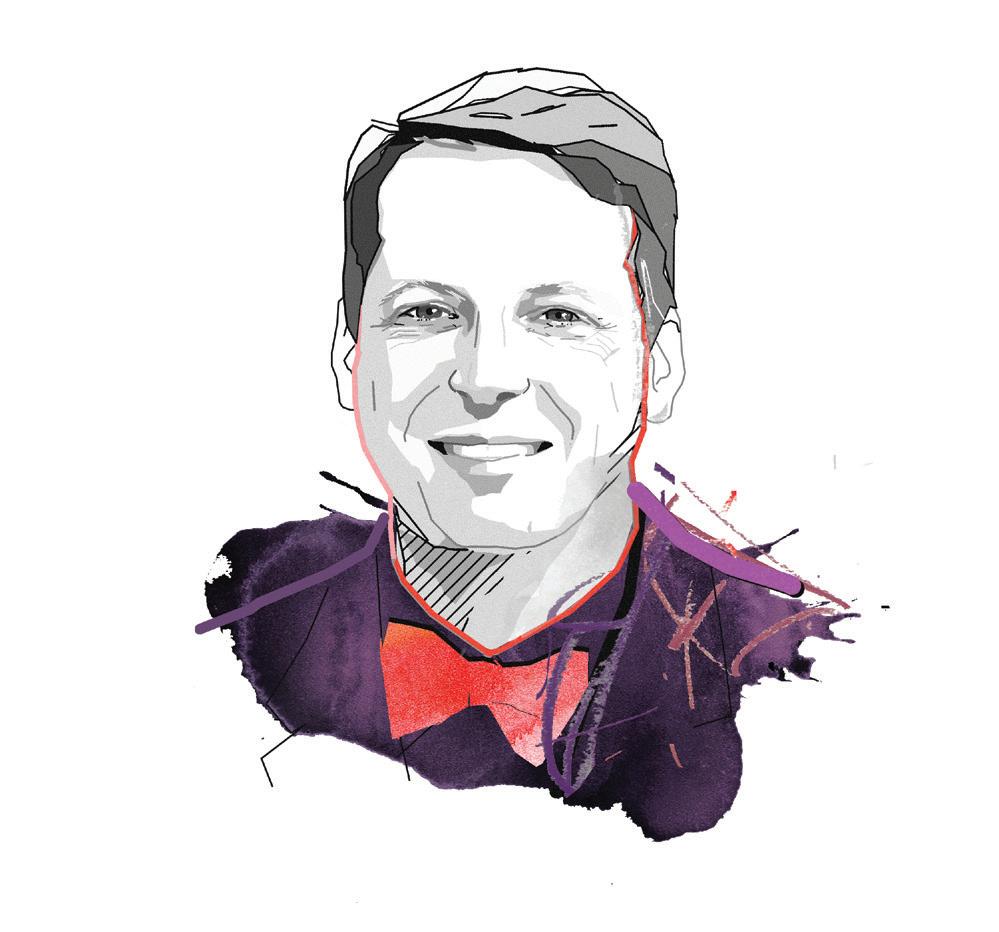
July in New Orleans is hot—and not just the weather.
The first half of the year is behind us, and for businesses across the region, summer provides an important opportunity to prepare for the fall and fourth quarter. Planning now creates momentum for a strong finish and positions organizations for growth in the months ahead.
This issue of Biz New Orleans shines a spotlight on Jefferson Parish, one of the region’s most important economic engines. From major infrastructure projects and business expansions to entrepreneurship and workforce development initiatives, Jefferson Parish continues to demonstrate the resilience, innovation and determination that have long defined our region. What is particularly encouraging is the growing sense of optimism across Greater New Orleans. Conversations with business leaders, elected officials, entrepreneurs and community advocates all point to a common theme: opportunity. While challenges remain, the focus today is increasingly on solutions, collaboration and creating a stronger future for everyone who calls this region home.
Throughout the year, I have had the privilege of attending chamber events, economic development forums, nonprofit gatherings and business celebrations across the region. The one constant is the passion of the people in the room. Their commitment to building stronger companies, creating jobs, supporting communities and investing in the future continues to move our region forward. I hear the work “region” daily.
This month, I encourage you to take a moment to recognize the progress happening around us. New businesses are opening. Companies are expanding. Entrepreneurs are pursuing bold ideas while communities are investing in their futures. These stories deserve to be celebrated because they remind us that growth doesn’t happen by accident — it happens because people choose to invest their time, talent and resources in making our region better.
If you’d like to follow these stories as they unfold, visit the live news feed at BizNewOrleans.com, where the latest business news from across the region is updated daily.
July also marks the nomination season for the 2027 New Orleans 500. As you visit Biz New Orleans online, I encourage you to nominate a business executive you believe deserves recognition among the region’s most influential and inspiring leaders. The New Orleans 500 has become an important resource for our business community, and your nominations help ensure we recognize the leaders shaping our future.
Stay cool, enjoy the summer and start preparing now for a successful finish to 2026.

TODD MATHERNE CEO and Publisher Renaissance Publishing

KATE HENRY
VP of Sales and Marketing
504- 830-7216
kate@bizneworleans.com

MEGHAN SCHMITT
Senior Account Executive
504- 830-7246
meghan@bizneworleans.com

LAUREN MCCANSE
Senior Account Executive
504-830-7249
Lauren@BizNewOrleans.com



This month we celebrate the success of an entrepreneurial venture that had all the odds stacked against it.
BY CHRIS PRICE
The New Orleans Saints start training camp this month, and anticipation for the 2026 season is growing by the day.
It’s been five years since the Saints won the NFC South, but thanks to a lack of quality across the division a championship could potentially be within arm’s reach.
The Black and Gold stumbled to a 2–10 start last season but finished strong, winning four of their last five games. Much of the credit for the team’s improved late season play and excitement for the coming season is due to the play of quarterback Tyler Shough.
While the team finished with a 6-11 record, it should be noted that no team in the division had a winning record. The Carolina Panthers barely won the division with an 8-9 record over the Tampa Bay Buccaneers (8-9) and Atlanta Falcons (8-9).
However, for a team that finished last in the worst division in pro football, there is obvious need for improvement.
According to Pro Football Reference, the 2025 Saints ranked 28th in total offense in the NFL last season (306 points scored, 5,331 yards
gained, 5.0 yards per play), 13th in passing offense (67.2 completion rate, 3,728 yards, an average of 219.3 yards per game, 19 touchdowns, 12 interceptions, and 49 sacks allowed), and 28th in rushing offense (1,603 yards on 435 attempts, nine TDs, 3.7 yards per attempt, and 94.3 average yards per game).
New Orleans’ defense ranked 16th in the NFL overall, giving up 383 points, 5,096 yards, and an average of 4.8 yards per play. Passing defense ranked fourth in the league (based on total yards gained), giving up 3,046 yards (an average of 179.2 yards per game) and 25 TDs, allowed opposing QBs to complete 63.5 percent of their passes, and had 10 interceptions. Rushing defense ranked 19th, surrendering 2,050 yards on 517 attempts, 12 TDs, and an average of 4.0 yards per attempt and 120.6 yards per game.
This offseason, general manager Mickey Loomis and head coach Kellen Moore looked to solidify the team through free agent signings, trades and the draft. The Saints’ four biggest free agent signings were running back Travis Etienne Jr., guard David Edwards, and linebackers Kaden Elliss and Anfernee Jennings.
During the draft, the Saints swapped the 150th overall pick with the Las Vegas Raiders
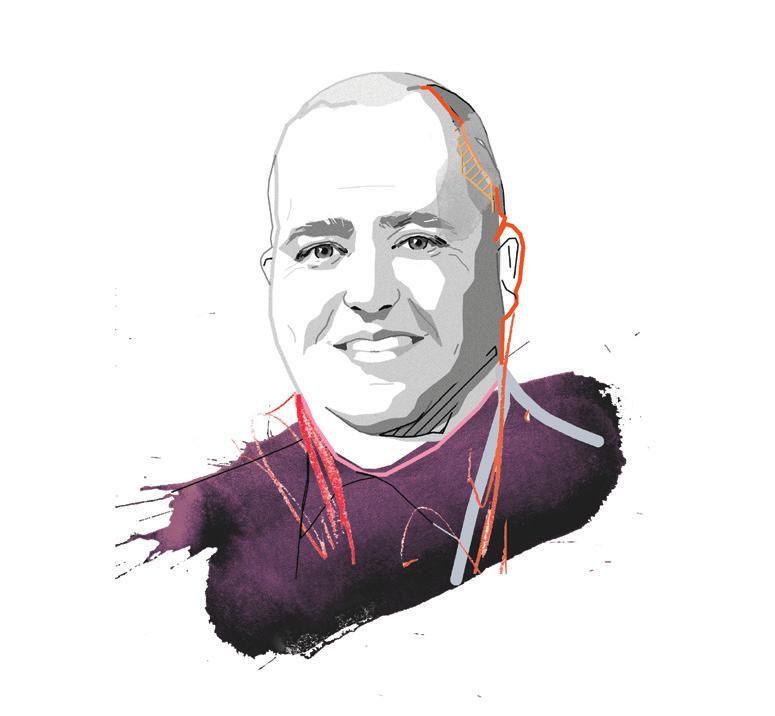
for defensive end Tyree Wilson and the 219th overall pick. Wilson was the seventh overall pick in the 2023 NFL draft but struggled to develop as a consistent pass rusher in the Raiders’ scheme. There is hope, however, that he can fulfill his initial promise under defensive coordinator Brandon Staley.
In the draft, the team focused on filling needs and doing it with a lot of speed. They surprised by picking three wide receivers. In the first round, they selected WR Jordyn Tyson (6’2”, 203 lbs.) with the eighth overall pick. Arguably the best wide receiver in the 2026 class, he should become an immediate threat paired opposite WR Chris Olave. His 4.4-second 40-yard-dash will help stretch the field and open the passing game for Shough.
In the second round, New Orleans picked defensive tackle Christen Miller (6’4”, 320lbs.), who will be looked to to collapse pockets and stuff the run. Third-round pick, tight end Oscar Delp (6’4”, 245 lbs.) is expected to help edge blocking in the running game while his 4.49 speed will provide separation from linebackers down the seam and in the flat on passing plays.
The Saints added two players in the fourth round; guard Jeremiah Wright and WR Bryce Lance. Wright (6’0”, 338 lbs.) will help solidify the interior offensive line as a dominating run blocker and stalwart pass protector. Lance (6’3”, 204 lbs.) posted a 4.34-second 40-yard dash time at the scouting combine and will provide another speedy option for Shough.
Fifth-round pick defensive back Lorenzo Styles Jr., (6’0”, 194 lbs.) will need some development to adjust to the pro game but his sub-4.3 speed adds to the Saints coverage team.
Wide receiver Barion Brown (5’11’’, 177 lbs.) has 4.4 speed. Look for him on special teams as kick and punt returner, and as a situational player as a slot receiver. The Saints took DB T.J. Hall (6’1”, 189 lbs.) in the seventh round. He’s a physical, technically sound player who is solid against the run and will likely see action when the Saints play a nickel defense.
Will we see a faster, more effective team this fall? We don’t have long to wait to find out. T



ANDY KOPPLIN is president and CEO of the Greater New Orleans Foundation (GNOF), dedicated to driving positive impact through philanthropy, leadership and action in the Greater New Orleans Region. He may be reached via email at Andy@GNOF.org.
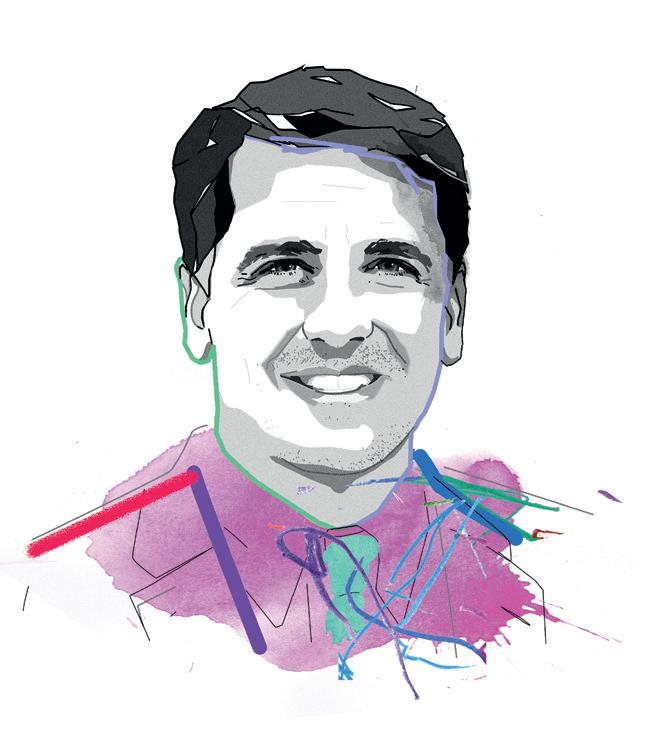
The Greater New Orleans Foundation and Jefferson Community Foundation are working in partnership to create a stronger, more resilient parish
BY ANDY KOPPLIN
For the last two decades, the Jefferson Community Foundation (JCF) has served as the backbone of philanthropy in Jefferson Parish.
As an affiliate of the Greater New Orleans Foundation (GNOF), JCF has championed early childhood education and charter schools, spearheaded race equity dialogues, and created programs to support seniors while also standing up their own youth leadership program.
In all of these activities, JCF provides a vital bridge to connect generous donors with programs addressing the parish’s most pressing needs. We at GNOF could not be prouder of the accomplishments of JCF and their partnership with us as one of our affiliated supporting organizations.
For more than 100 years, the Greater New Orleans Foundation has served the 13 parishes of Southeast Louisiana by promoting charitable giving, strengthening nonprofit organizations and leading transformational civic projects. Our partnership with JCF has helped deepen the impact of our philanthropy because local community leaders from Jefferson Parish are
leading the way on projects that are close to home for them.
Particularly when it comes to civic projects, we have been inspired by JCF’s innovative ideas. The first idea we invested in was JCF’s master plan for Hope Haven, the former Archdiocese of New Orleans orphanage, which JCF has proposed be turned into the Southeastern LA Regional Aquatics Center, a regional, competition-level pool complex and natatorium.
Jefferson Parish has now acquired the Hope Haven property and has activated it with new walking trails that the community has embraced as JCF and its partners work to attract the capital needed to fully build out the natatorium. Once finished, it will be a transformational amenity for the community and the entire region.
Following the devastation of Hurricane Ida in 2021, GNOF raised and awarded $150,000 to support JCF’s response and recovery grantmaking activities on the ground in Jefferson Parish. We then further extended that impact by giving another $75,000 to JCF to match their $75,000 investment enabling us to award $150,000 in recovery grants to support
rebuilding efforts throughout Jefferson Parish. These funds supported rebuilding homes and providing employment opportunities for residents affected by the storm.
Our partnership with JCF in the wake of Hurricane Ida is a shining example of the impact of our relationship through shared investment, local strategy to address specific needs within Jefferson Parish, and a long-term commitment that emphasizes recovery and resilience over one-time aid.
JCF also won a $100,000 grant in 2023 from GNOF’s Next 100 Years Challenge, a regional competition that invited proposals for community-centered, cost-effective infrastructure improvements—including nature-based solutions—across the 13 parishes of Southeast Louisiana to reduce storm and disaster risk that could attract local, state and federal funding. JCF won this grant based on its great idea for creating a community oasis at the Ree Alario Special Needs Center and Miley Playground. Step by step and dollar by dollar, JCF and the Jefferson Parish government are working to make that vision a reality.
The Jefferson Community Foundation also spearheaded Jefferson Parish’s Bicentennial Ball, a landmark party at Lakeside Shopping Center in celebration of 200 years of Jefferson Parish, whose proceeds went directly to strengthen educational opportunities and critical social initiatives parish wide.
The connection between the Greater New Orleans Foundation and the Jefferson Community Foundation is defined by strategic partnership, shared philanthropy and aligned community goals. We provide back-office support and host the Jefferson Community Foundation’s endowment, freeing up JCF to focus their efforts directly on civic projects.
During a time when many social and economic challenges exceed municipal capabilities, this relationship between our two organizations exemplifies how regional institutions and local organizations can work together to create meaningful, sustained impact. T

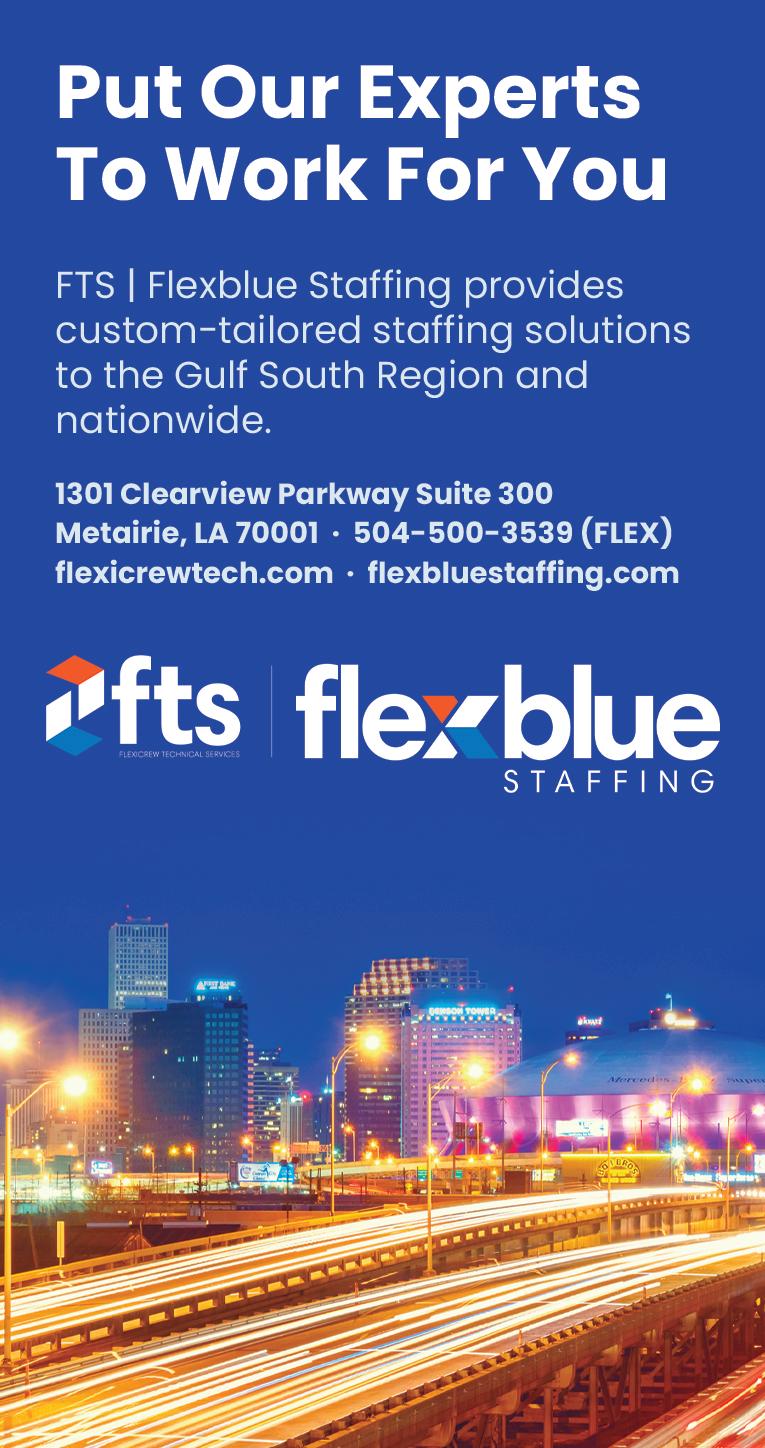

KEITH TWITCHELL spent 16 years running his own business before serving as president of the Committee for a Better New Orleans from 2004 through 2020. He has observed, supported and participated in entrepreneurial ventures at the street, neighborhood, nonprofit, micro- and macro-business levels.
This month we celebrate the success of an entrepreneurial venture that had all the odds stacked against it.
BY KEITH TWITCHELL
On July 4, the United States will celebrate its semiquincentennial – a very clunky word that basically means half of 500 years. In short, our 250th birthday.
Our founding fathers’ audacious act of declaring independence from England was both an extraordinary leap of faith and the launch of the greatest entrepreneurial enterprise the world has ever seen.
Consider the circumstances in 1776, which were anything but ideal for a bold new venture. At that time, the 13 colonies comprised a thin strip of eastern North America stretching from present-day Maine to Georgia. The total population was 2.5 million; if that seems like a lot, consider that England’s population at that time was 6.5 million.
For starters, the new nation had no money and was in fact deeply in debt. As there was no central government, no authority or mechanism existed for raising revenues. Further, the ongoing resistance to Britain had been funded with money
borrowed from other countries for several years with no obvious means for repayment. The Continental Congress printed substantial amounts of currency, but with nothing to back it up, it depreciated almost instantly.
Consequently, much of the burgeoning nation’s economic burden fell on individual states, many of which had been issuing their own currency and/or levying their own taxes. However, most of them were also struggling financially, and taxes were generally paid in goods rather than cash. Adding to the problem, counterfeiting and smuggling were rampant — to the degree that when payments were made by the Congress, they were typically made in nearly worthless cash.
To make matter worse, no manufacturing infrastructure existed in any modern sense. The economy at that time was almost entirely farming-based. Blacksmiths, coopers, shipbuilders and other tradespeople were individual artisans operating in independent workshops with very limited mechanization. To outfit the War of Independence, a small quantity of weapons, ammunition and uniforms
were made, but most supplies were imported from abroad, even from England.
In fact, the colonies struggled to craft 27 American warships in 1776 — a total equal to roughly one-tenth of the British navy.
There was, however, one useful infrastructure asset in place at the time: a decent road system, largely developed by the nascent U.S. Postal Service under the guidance of Benjamin Franklin. But even with that, travel was entirely on horseback or in horse-drawn conveyances, meaning that it took between one and three days just to get from New York to Philadelphia. This seriously impeded everything from shipping of supplies to basic communications, which had to be hand-delivered. In some places, waterways provided useful alternatives, but transit by water was even slower than by land.
Compounding the near-total absence of meaningful resources were the vast cultural dissimilarities between the colonies. Settled at different times by people from different places, they had their own customs, practices, religions, economies and institutions. Finding enough common ground among these disparate entities — and the many different personalities that represented them in the Continental Congress — to form a single nation may have been the greatest achievement of all.
To top it all off, the founding fathers chose a thoroughly radical “business model” for their entrepreneurial venture: democratic government. At the time it was the only significant democracy on the planet; the concept was completely untried and unproven.
While we can look back from the present and point out numerous deficiencies in the democracy they constructed, the fact remains that this was an unprecedented experiment in nation-building.
No money. Precious few other resources. Virtually no infrastructure. Extensive disharmony. A totally unproven organizational structure, competing violently with the most powerful country in the world. And somehow, the founding fathers turned these United States into the greatest success story in history. T


22 HEALTHCARE
Our community is only as healthy as its people, which is why we created this life-changing event.
24 MARITIME+PORTS Avondale Global Gateway is reshaping Jefferson Parish.
26 BANKING+FINANCE
A financial advisor shares his top 10 smart midyear moves
28 ECONOMIC DEVELOPMENT
Jefferson Parish’s new campaign is focused on bringing attention to the parish’s big wins — and there’s plenty.
30
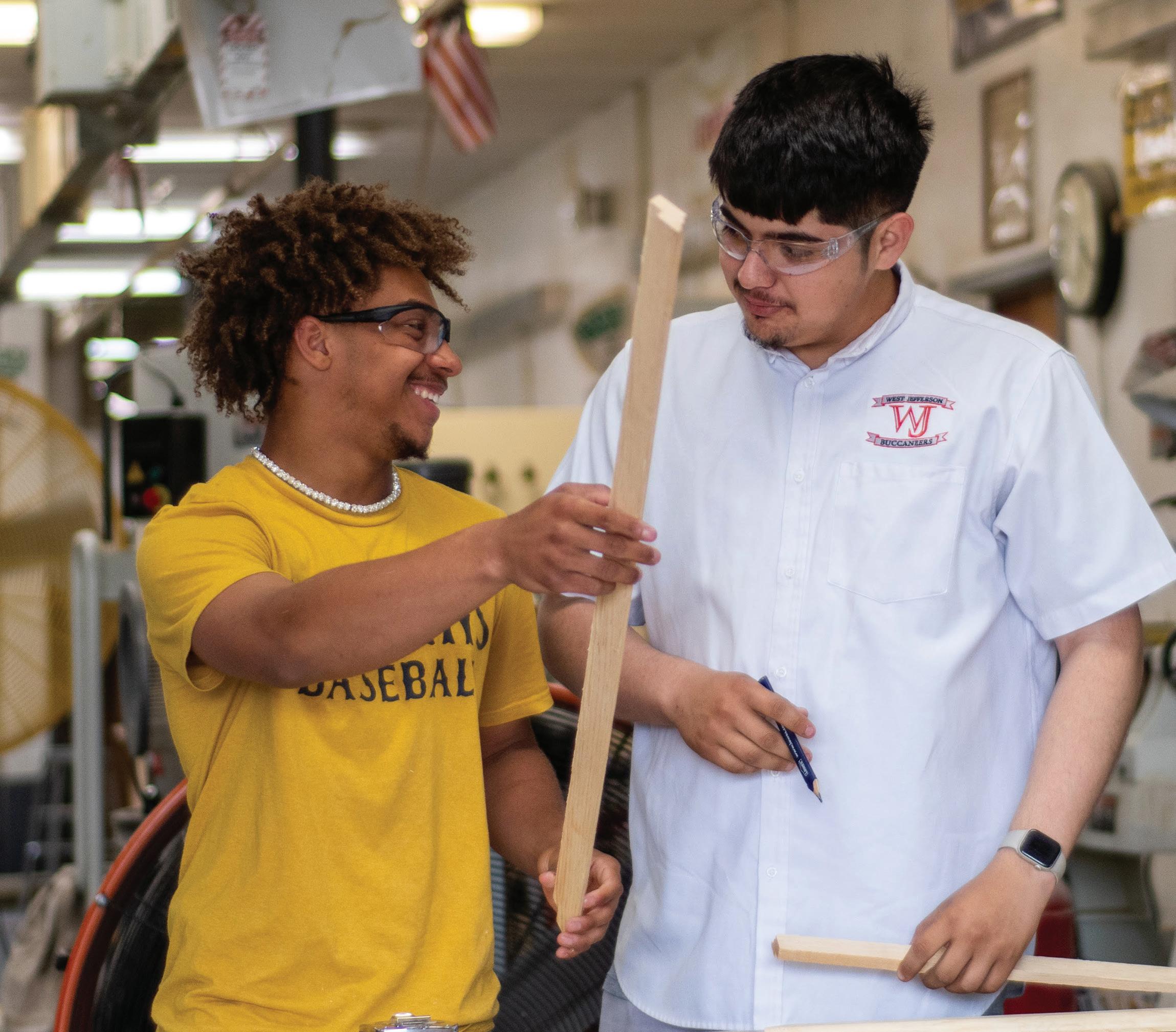
Maritime, manufacturing, healthcare, IT — Jefferson Parish Schools is working with these industries and more to start young people on solid career paths.
Our community is only as healthy as its people, which is why we created this life-changing event.
BY JUDY REESE MORSE
On a Saturday in September 2022, the Ernest N. Morial Convention Center was buzzing with energy and anticipation as The Urban League of Louisiana and Ochsner Health came together for the first time to offer the community a unique wellness experience that provided health access, information and expertise designed to improve the lives of residents and their families.
On that day, adults and children received free health screenings, watched some of Louisiana’s best chefs create nutritious versions of their favorite dishes, exercised as they learned new fitness moves from personal trainers, learned about jobs and procurement in the healthcare sector and sought personal advice from medical experts.
For one woman, the event the inaugural Big Health Event was potentially lifesaving. She had attended the Big Health Event after having
tried several places to get a mammogram and was hoping to finally get one in the Mammogram Mobile Unit that had been driven onto the floor of the convention center the day before. She received a screening that Saturday and learned that she had Stage 1 breast cancer. That screening allowed her to then seek the treatment she needed for her diagnosis.
In the modern economy, a city’s prosperity depends not only on its industries and infrastructure but also on the health of its people. Now in its fifth year, the Big Health Event has emerged as a strategic investment in human capital. By increasing access to healthcare, promoting wellness, and connecting career seekers and entrepreneurs to the economy, the Big Health Event contributes directly to the city’s economic resilience and long-term growth.
While Louisiana is rich in culture, resilience and community strength, it also faces significant health challenges. According to the United Health Foundation’s 2025 America’s Health Rankings, Louisiana ranked 50th in overall health among all 50 states. The report highlights persistent challenges across multiple areas that shape health outcomes including social and economic conditions, health behaviors, physical environment and overall health outcomes.
These rankings underscore the urgency of expanding access to health education, care and wellness resources to residents, particularly for those who are uninsured, underinsured or living in asset-limited households, to lower rates of chronic disease and poorer health conditions.
The Urban League of Louisiana, a historic civil rights and economic empowerment organization founded in New Orleans in 1938, created the Big Health Event to address generational health disparities in Louisiana. The event offers a wide range of free health screenings, healthy cooking demonstrations, fitness demonstrations, educational resources, STEM activities, health and wellness expert panels, giveaways and more for everyone in the family. The Big Health Event
is designed to ensure that health and wellness education resonates with residents and leads to healthier lifestyles and communities.
The event is also a contributor to the factors that make the phrase “health is wealth” have true economic meaning.
Preventive care through screenings and interactions with health experts can reduce long-term financial burden on individuals, families and the public health system. By catching health issues early, residents can avoid costly emergency care and maintain productivity in the workforce.
A healthy workforce is a productive workforce. Chronic illness is one of the leading causes of absenteeism and reduced work performance. By equipping residents with tools to manage and prevent disease, the Big Health Event contributes to labor force participation and efficiency.
The Big Health Event also serves as a marketplace for local and regional small businesses and corporations. Small businesses and companies gain exposure to thousands of attendees, creating opportunities for sales, partnerships, visibility and brand recognition and the opportunity to make a meaningful community impact.
The Morial Convention Center is the gathering space for residents from different neighborhoods and backgrounds who come together to improve their own health conditions but also the health conditions of their social, educational and faith institutions. This strengthens social cohesion, which is itself a determinant of community health. Since its founding, the Big Health Event has served thousands of residents in New Orleans, Baton Rouge and Shreveport. This year’s experience will take place in Hall J of the Morial Convention Center, on August 15 from 10 a.m. to 2 p.m. and is free to the public. The Big Health Event Zones include Health Screening, Health & Wellness, Main Stage, Fitness & Movement, Culinary Demonstration, Youth & Family, and Community Resource. For sponsorship or other information, please contact cwashington@urbanleaguela.org. T



MARITIME+PORTS
MATTHEW MANCHESKI is the president of T. Parker Host, which includes Avondale Global Gateway, United Bulk Terminals, Host Terminals, LLC and Host Agency, LLC. He may be reached via email at marketing@tparkerhost.com.

Avondale Global Gateway is reshaping Jefferson Parish
BY MATTHEW MANCHESKI
Not long ago, the Avondale Shipyard stood as a symbol of what had been lost.
For decades, it was one of Louisiana’s largest employers and was synonymous with careers and thriving local businesses. When the shipyard closed, it left behind a gap in the economic fabric of Jefferson Parish. Today, that story is being rewritten. Avondale Global Gateway has emerged as one of the most active and fastest-growing logistics hubs on the Mississippi River, transforming a once-dormant site into a modern engine for trade, investment and job creation.
Importantly, this transformation isn’t a future vision — it’s happening right now. On any given day, Avondale Global Gateway is alive with activity and over 600 people working on the site. Vessels move along the river while cranes lift aluminum, copper, wood pulp, sugar and other break bulk and bulk materials with precision. Trucks, barges and railcars cycle in and out, connecting Avondale to supply chains across North America. It’s humming as a highoutput operation handling dozens of commodities and supporting hundreds of jobs.
This level of activity is the result of a deliberate strategy: Build a logistics platform that combines scale, flexibility and connectivity in one place. Avondale Global Gateway offers direct access to one of the world’s most critical trade corridors, paired with multimodal infrastructure that connects river, rail and road. With multiple deepwater docks, over 1 million square feet of warehouse space and room to grow, the site is designed to handle complex, high-volume cargo efficiently.
Notably, that combination is already attracting global partners. A recent milestone is the partnership with Suzano, the world’s largest wood pulp supplier based out of Brazil, which selected Avondale Global Gateway as a key Gulf Coast hub after a multi-year evaluation process. The agreement brings regular wood pulp imports back to Louisiana for the first time in more than three decades, introducing new cargo flows, supporting additional jobs and reinforcing the region’s role in global trade.
This partnership reflects confidence in both Avondale Global Gateway’s current capabilities and its future trajectory as a scalable, servicedriven platform for modern industry. That growth is translating directly into opportunity for Jefferson Parish.
When visiting the site today, it’s clear how much has changed in just a few years. Hundreds of workers carry out high-quality jobs such as equipment operators, logistics and business professionals, and numerous skilled trades — driving household incomes and fueling broader economic growth across the region. Continued hiring in underway. For residents of Jefferson Parish, what was once a symbol of economic loss is now a hub of bustling commerce and renewed opportunity.
The impact of Avondale Global Gateway extends beyond jobs, cargo volumes and infrastructure investments. Since reopening the site in 2018, Avondale Global Gateway and its parent company, HOST, have remained committed to supporting the communities they call home through volunteerism, local partnerships and charitable giving. In recent years, that commitment has included significant support for organizations such as the Youth Empowerment Project, Jefferson Dollars for Scholars and Angel's Place. For more than a century, HOST has recognized that long-term success is tied to the strength of the communities it serves, and that philosophy continues to guide Avondale Global Gateway’s role on the West Bank today.
At the same time, investment continues. Rail expansion, additional warehouse capacity and new dock development are all underway, enhancing throughput and reinforcing long-term growth. Just as important, the site’s available industrial footprint, alongside hundreds of undeveloped acres of industrial land, creates room for future tenants and large-scale expansion, offering a rare opportunity for companies to grow alongside an active, multimodal logistics hub.
Avondale Global Gateway represents more than infrastructure and activity. It stands as proof that Jefferson Parish remains a place where industry can grow, innovate and create lasting impact. As more partners come online and capacity expands, Avondale Global Gateway is positioned to play an even greater role in connecting Louisiana to global markets. T

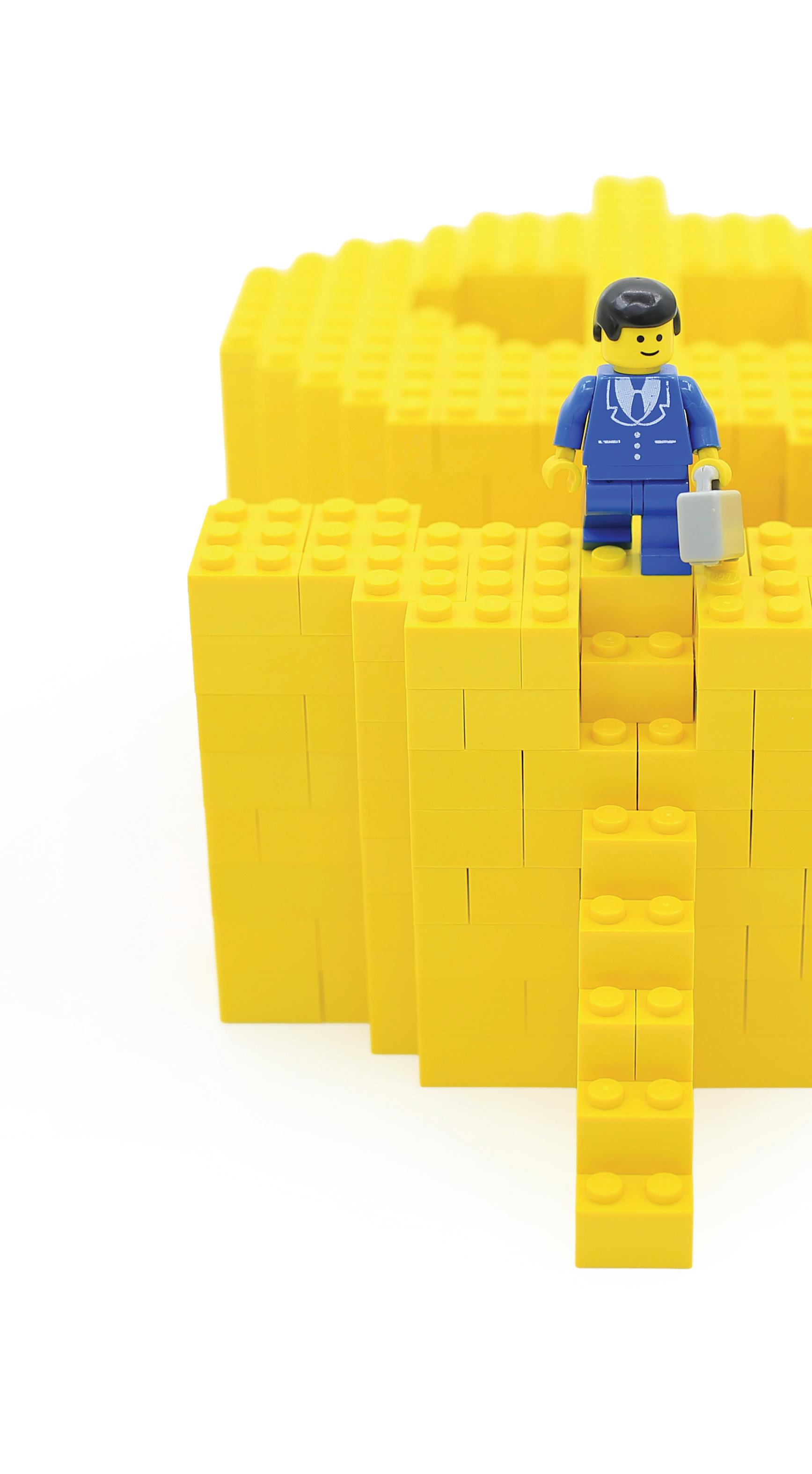
A financial advisor shares his top 10 smart midyear moves
BY DICKSON GRISWOLD
An ounce of prevention is worth a pound of cure" was coined by Benjamin Franklin in 1735. While Ben was likely referring to preven tative medical practices, this saying also applies to your finances. Much like you have annual medical visits, you should also have regular checkups with your financial advisors. Here are 10 financial subject areas that merit a summertime review:
INVESTMENTS Do you have multiple investment accounts or retirement accounts from previous employers? For ease of management, you should consider consolidation. Even if you are a long-term investor, you should regularly review your invest ment performance. After three years of positive stock returns, portfolio rebalancing may be merited. Are your investments still meeting your needs, or have your needs changed?

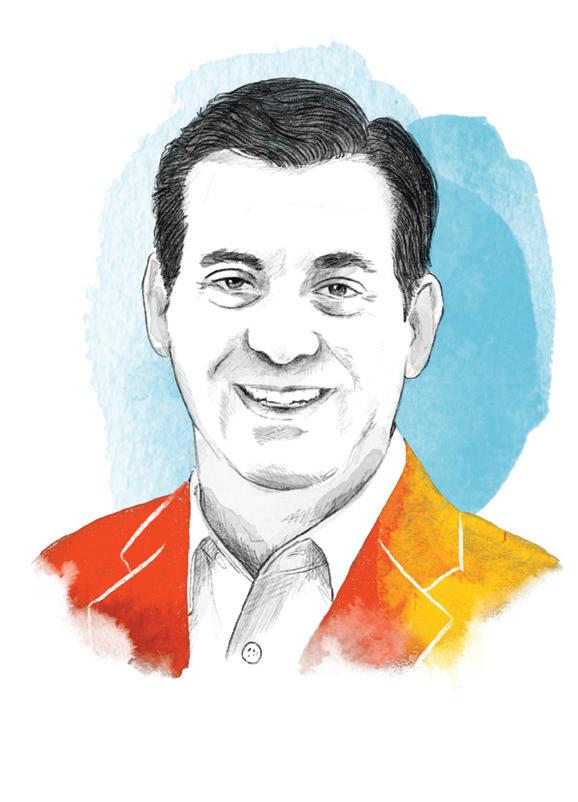
DICKSON GRISWOLD is a senior vice president and financial advisor at Captrust, one of the nation’s largest financial advisory firms. He operates out of the firm’s New Orleans office and may be reached via email at dickson.griswold@captrust.com.
4
DEBT REDUCTION If you have outstanding loans, first pay off the highest cost debts – like credit cards. If you must borrow through the year, a HELOC may carry a much lower interest rate than credit cards. Still have a mortgage? Consider additional strategies to reduce the principal and interest. Because of the way a mortgage amortization schedule is structured, early repayment of principal can also greatly decrease your total interest cost. Consider making extra principal payments, paying bi-weekly, or rounding up your monthly payment. However, do not make additional payments at the expense of retirement savings.
5
EDUCATIONAL SAVINGS If you have children or grandchildren headed to college, consider making tax deductible contributions to a college savings plan. Louisiana residents can deduct contributions to the START Savings 529 plan from their state taxable income - up to $2,400 per year per beneficiary for single filers and $4,800 for married couples filing jointly. The deduction that you get in 2026 can be carried forward to future tax years.
6
RETIREMENT SAVING PLANNING Are you taking full advantage of your retirement saving options? Contributions to a traditional 401k are made with pre-tax dollars, so not only do you build retirement savings but also potentially reduce your income taxes. Ask yourself: Can I save more? Better yet, ask your advisor: Do I need to save more to reach your retirement goal?
7
ESTATE PLANNING It is no fun facing our own mortality, which means that estate planning is often neglected. You should have the proper estate documents – a will or trusts, a living will, financial or healthcare powers of attorney. I advocate that estate documents be revised regularly — at least every 5 years. Having your estate plan in order should be important to you. It will certainly be important to your heirs and the trusted individual who will work to settle your estate.
8

ASSET TITLES The distribution of a person’s property after death is known as the probate process. How you title your assets directs who inherits what via that process. For example: Do you have an asset that you want to place into a trust? If so, the ownership title of that asset needs to be updated. Specific titling can potentially minimize estate taxes and / or protect your assets from creditors.
9 CHARITABLE GIVING Supporting your favorite charities is admirable and can also lower your taxes. For those who itemize, charitable gifts can provide a tax deduction. Rather than making cash gifts, donating shares of appreciated stock directly or via a Donor Advised Fund can reduce capital gains taxes. Your financial manager can identify what holdings would be the best to donate.
10
Your insurance needs will change during your lifetime. Younger folks may have unfunded liabilities such a large mortgage or future college tuition. For your peace of mind, you might want life insurance to protect your family from these large expenses should you die suddenly. Consider carefully what type of insurance policy - permanent or term – is most appropriate. Depending on your profession you might consider disability insurance. If you have longevity in your family, you might shop for long-term care insurance. Lastly, to bolster your homeowners and auto insurance coverage you might consider additional general liability “umbrella” insurance.
Your finances are complex. They will change over your lifetime and should not be neglected. A mid-year review with your advisors can identify potential issues and allows enough time to correct them by year-end. Ben Franklin would agree: Much like seeing your doctor regularly, annual summer consultations with your advisors can keep you financially healthy all year long. T
Jefferson Parish’s new campaign is focused on bringing attention to the parish’s big wins — and there are plenty.
BY JERRY BOLOGNA
At JEDCO, we often talk about creating the conditions for businesses to succeed. That means investing in infrastructure, supporting workforce development, building partnerships and telling the story of Jefferson Parish in a way that reflects both who we are and where we are headed.
That vision is reflected in our “More Here” campaign, a message rooted in the idea that Jefferson Parish offers more opportunity, more innovation, more culture and more room to grow. It reflects the momentum happening across our community and our belief that economic development should strengthen both industry and quality of life.
That momentum is especially visible at the Churchill campus. Located on 480 acres on the West Bank of Jefferson Parish, Churchill represents one of the region’s most significant opportunities for long-term economic
JERRY BOLOGNA is president and CEO of the Jefferson Parish Economic Development Commission (JEDCO). He may be reached via email at JBologna@jedco.org.
growth. Recently designated as a Louisiana Economic Development Certified Site, Churchill continues to gain momentum as a strategic hub for innovation and research and development. Infrastructure improvements are already underway, including the construction of new roadways designed to support future development opportunities and improve connectivity across the campus.
Those investments are helping position the site to accommodate projects like the planned Greater New Orleans Food & Beverage Incubator, a firstof-its-kind facility designed to support food entrepreneurs, manufacturers and consumer packaged goods companies across the region.
The incubator will provide commercial kitchen space, technical assistance, cold and dry storage, packaging resources and business development programming to help emerging brands move from concept to commercialization. In a region known globally for its food culture, this project represents a strategic investment in one of Louisiana’s most authentic economic assets.
Food is one of the ways we tell the story of our region. It is culture, tourism, tradition and business all at once. Yet many food entrepreneurs face significant barriers to growth — from access to licensed production space to navigating distribution and scaling operations. The Greater New Orleans Food & Beverage Incubator is designed to help close those gaps while creating new opportunities for innovation, job creation and small business development.
Importantly, the project also reflects how economic development is evolving. Today, communities compete not only on incentives and infrastructure, but on authenticity, entrepreneurship, placemaking and the ability to support creative industries. The future economy belongs to places that know how to invest in what makes them unique.
That same philosophy inspired the creation of Grand Isle Jewels.
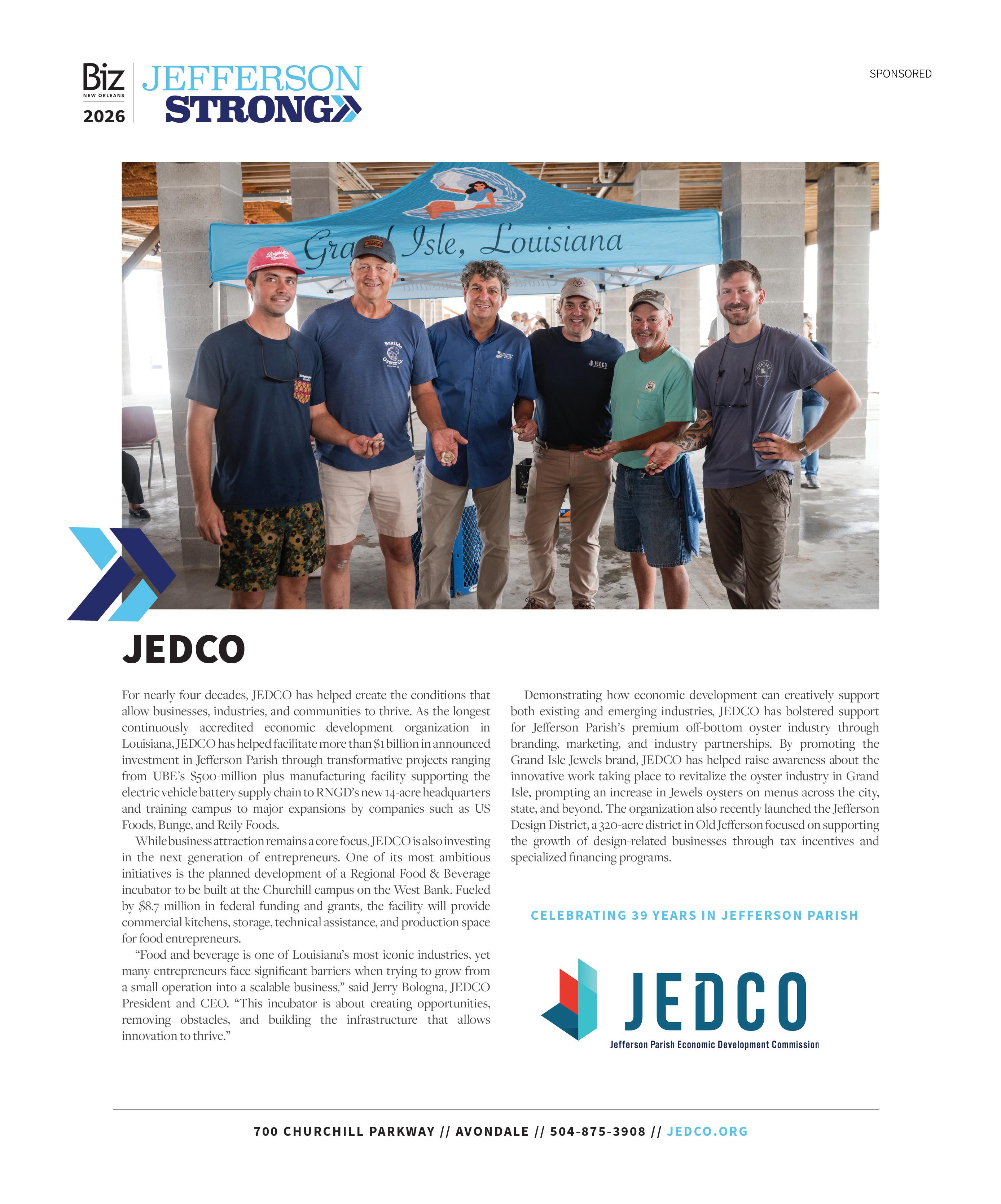
Last year, JEDCO partnered with Grand Isle’s off-bottom oyster farmers and regional stakeholders to launch a unified umbrella brand
designed to elevate one of Louisiana’s most innovative seafood industries.
The goal was not simply to market oysters. It was to tell a story about sustainability, resilience, innovation and the hardworking people behind an emerging industry with tremendous growth potential.
In just one year, Grand Isle Jewels has already created meaningful momentum. Farmers are building new relationships with distributors and restaurants, the brand is gaining recognition throughout the region, and local chefs are embracing the product in exciting ways. Partnerships like OysterNight with Chef’s Brigade have helped connect consumers directly to the farmers and businesses driving this work forward while creating greater visibility for Louisiana-grown oysters.
Projects like these reflect what “More Here” truly means.
It means investing in the industries that define our region while creating pathways for future growth. It means supporting entrepreneurs and innovators while preserving the culture and traditions that make Jefferson Parish unique. And it means recognizing that economic development is ultimately about people, creating opportunities, strengthening communities and building a place where businesses and families want to stay and grow.
Jefferson Parish is uniquely positioned to do that.
We are home to global manufacturing and logistics assets, cutting-edge energy projects, growing innovation districts and entrepreneurial momentum. At the same time, we are home to fisheries, restaurants, family-owned businesses and cultural traditions that cannot be replicated anywhere else.
That combination is our competitive advantage
As we continue building momentum across Jefferson Parish, our focus remains clear: support innovation, strengthen small businesses, create opportunities and ensure the next generation sees this community as a place where they can build careers, launch companies, and shape the future. There is MORE HERE in Jefferson Parish. T
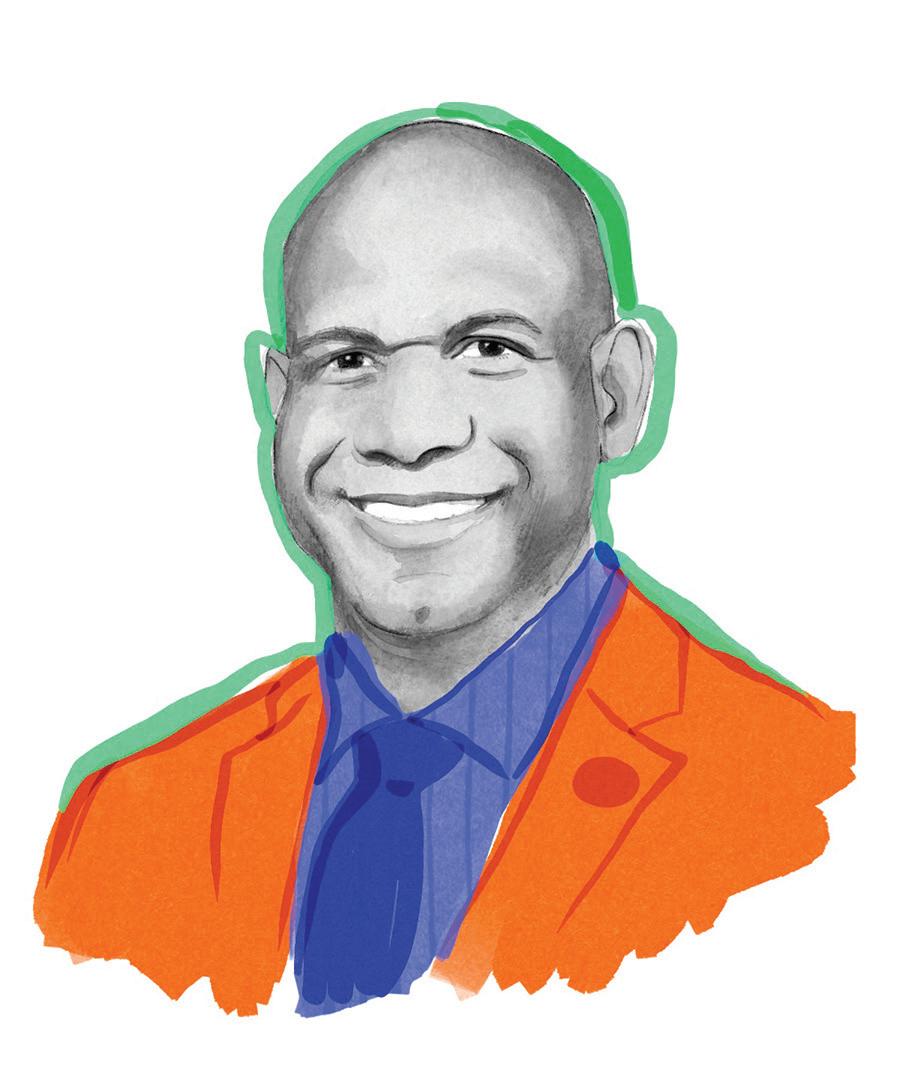
DR. JAMES GRAY is the superintendent of Jefferson Parish Schools, the largest public school system in Louisiana. He may be reached via email at superintendent@jpschools.org.
Maritime, manufacturing, healthcare, IT — Jefferson Parish Schools is working with these industries and more to start young people on solid career paths.
BY DR. JAMES GRAY
Jefferson Parish’s future workforce is sitting in our classrooms today — approximately 45,000 students who will shape the future of our economy and community. Jefferson Parish Schools has now earned and sustained a districtwide B rating for two consecutive years, reflecting continued academic progress and a stronger future for our students and community.
Across Jefferson Parish and the region, business and industry leaders face workforce shortages. Our goal at Jefferson Parish Schools is not only to educate students, but also to help build a workforce that will sustain and strengthen our parish for generations to come.
For some students, a meaningful path forward is a path that leads directly to a four-year university. For others, it may include community college, technical training or immediate entry into the workforce. As such, we are investing in Career and Technical Education (CTE) programs.
Through CTE, students gain hands-on experience and industry-based credentials in fields that are in high demand, including advanced
manufacturing, healthcare, welding, culinary arts, IT, automotive technology, digital media and construction.
CTE programs give students tangible skills and a competitive advantage before they graduate. In many cases, they are earning certifications and credentials that allow them to move directly into careers with strong earning potential. Just as importantly, they are discovering purpose and confidence through work-based learning that shows them what is possible for their future.
Jefferson Parish Schools collaborates closely with local businesses, industry associations, higher education partners and workforce development organizations to ensure the CTE programs align with current and future labor market needs. For example, Jefferson Parish Schools’ partnership with UA Local 60 continues to grow through the Pipefitters Apprenticeship Program, which is entering its fifth year and has provided employment opportunities with member contractors to 100% of participating students who chose to continue in the industry.
Building on this success, the partnership has expanded to include an HVAC Apprenticeship
Program, which is now entering its second year and continues to create additional career pathways for students interested in the skilled trades.
Additionally, our multi-year partnership with We Work the Waterways has increased student awareness of and engagement with careers in the maritime industry through hands-on learning experiences, workforce exposure opportunities and career exploration activities. These experiences help students understand how the course progressions and industry-based credentials they are earning connect directly to careers within the maritime industry.
When businesses engage with schools through internships, mentoring, advisory councils, job shadowing opportunities and classroom partnerships, students gain valuable exposure to career paths and workplace expectations. Employers, in turn, help shape the talent pipeline they will depend on in the years ahead. That collaboration strengthens the entire parish.
The stronger our public schools, the better we fare in economic growth. Companies considering investment or relocation look closely at the quality of local schools and the strength of the workforce pipeline. Families looking to build their lives here want confidence that their children will have access to quality education and opportunity. The success of Jefferson Parish Schools impacts property values, business recruitment, workforce retention and overall quality of life across our community.
At the same time, we know workforce development is about more than technical skills. Employers consistently tell us they value communication, teamwork, problem-solving, professionalism and adaptability. Those foundational skills are developed every day in classrooms, extracurricular activities, fine arts programs, athletics and student leadership opportunities across our district.
Education builds capable workers, but it also builds engaged citizens and stronger communities. Jefferson Parish has enjoyed tremendous momentum and opportunity. Our public school system is proud to be part of that progress. T

BY Samantha Hindman


THE AVERAGE AGE OF THE RESIDENTS OF JEFFERSON PARISH’S SECOND-LARGEST CITY HAS DROPPED 20 YEARS IN THE PAST DECADE. WHAT’S DRAWING THE YOUNGER CROWD? MAYOR BELINDA CONSTANT’S FORWARD-THINKING EFFORTS.
still lives on the same street she grew up on, five blocks from Gretna’s City Hall. She now works daily in that very building to revitalize the vibrant community she remembers from her childhood.
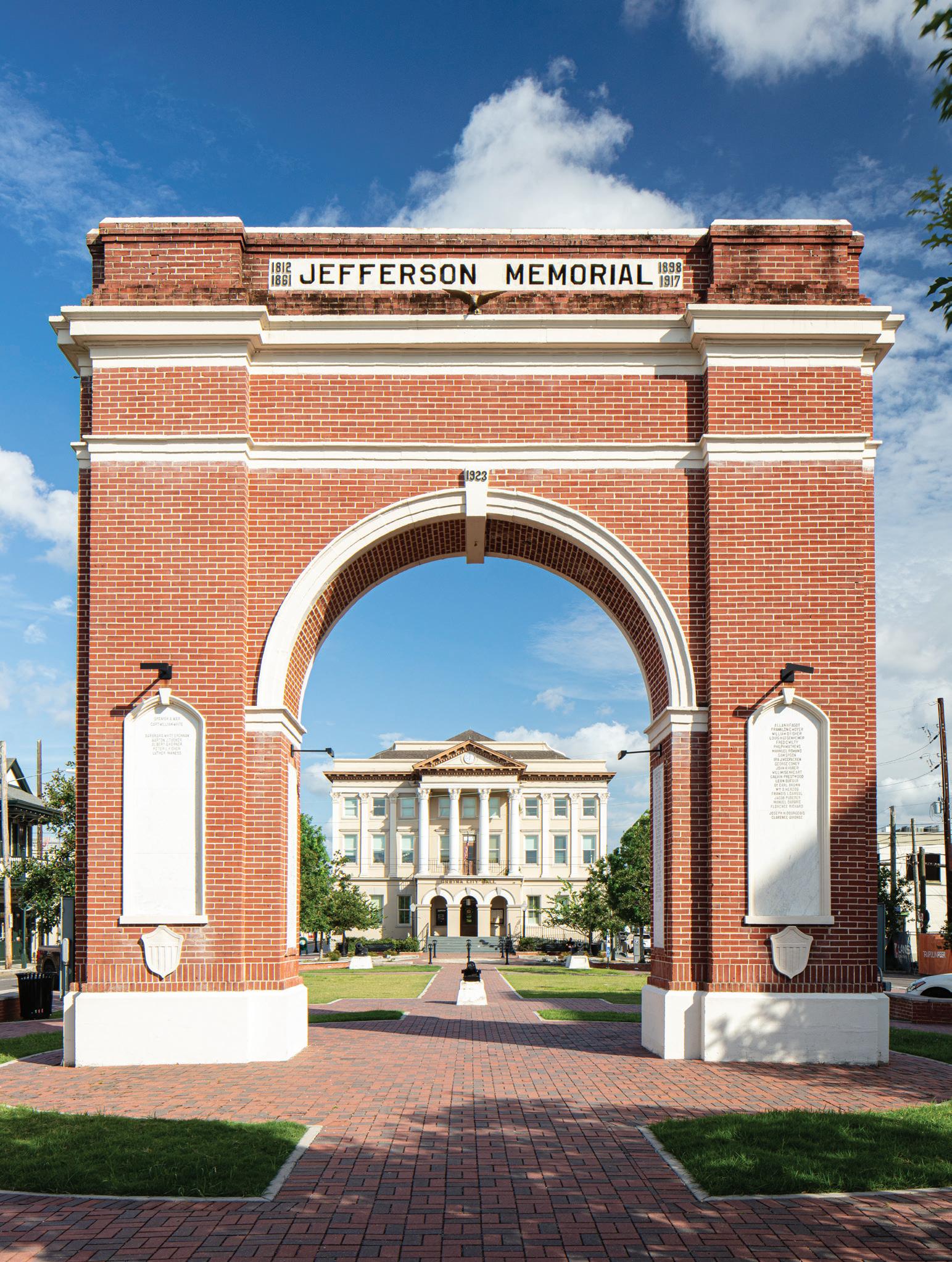
Gretna is the second-largest city in Jefferson Parish and sits just across the Mississippi River from New Orleans. When the oil busts of the late ’70s and ’80s hit the West Bank hard, businesses shuttered, and what had once been a bustling, walkable downtown went quiet. Gretna then spent decades playing the role of bedroom community to its famous neighbor.
Constant watched it happen; she was raised in the middle of it. Her grandfather owned one of the corner grocery stores that once anchored the neighborhood, and she has a distinct memory of what it felt like when the city was alive.
She said those happy memories were what later propelled her into public life — first to the city council in 2005, where she became Gretna’s first female elected official, and then to the mayor’s office in 2013.
Constant didn’t come from a political family. In fact, her parents, she’ll tell you, would have preferred she stayed out of it entirely. But in the 1990s, she and her husband bought a historic home on Huey P. Long Avenue, and the renovation process pulled her straight into the machinery of city government.
To work on a historic property, residents must first go before the Historic District Commission and make a case to the commissioners. When Constant approached the commission, she found a city at a crossroads. A conversation about historic preservation was gaining momentum; thenMayor Ronnie Harris had created Gretna’s first historic district, and people were starting to talk about what the city’s past could mean for its future.
But Constant said she noticed that quality of life wasn’t yet a municipal priority. Things like walkability and landscaping, for instance, weren’t a part of the conversation.
“That wasn’t a focus at the time,” Constant said, “from any of the elected officials.”
Thinking she could bring a different perspective, when the councilman in her district retired, Constant ran, and won.
After her victory, her first meeting as a councilwoman set the tone for everything that followed. Two controversial items were on her plate back-to-back.
The first: a moratorium on oil tank farm expansion along the riverfront. The tank farms had long been a fixture of Gretna’s industrial identity, but they were consuming the most valuable land in the city, right along the river, and Constant wasn’t willing to let that continue.
The second: a historic home slated for demolition to make way for condominium development on the water. She moved the house, which later became the city’s welcome center, and the development went forward as planned.
It was, in miniature, the approach she would apply to everything: Progress and preservation don’t have to be enemies, but someone has to hold the line.
That instinct now has a formal name. The Gretna Comprehensive Plan, developed with extensive

community input and supported through federal and state partnerships, lays out a vision for the city’s next 20 to 30 years. Specifically, it aims to “build upon the City’s strong foundation of community, while respecting the past and embracing the future, to improve existing infrastructure, enhance commercial corridors, and promote walkable and bikeable neighborhoods.”
Gretna 2030, the current master plan, is that vision in action. Every development, from new businesses to improved canals, is a line item in an argument Constant has been making since before she held her title.
In South Louisiana, infrastructure is never just infrastructure — it’s a negotiation with water, knowing that every city in the region shares the same vulnerability.
Constant understood early that Gretna couldn’t build its way out of that reality.
“We’re not going to pipe and concrete our way out of flooding,” she said. “The region shares the canals, the region shares every place from the smallest collection basins to the largest canal. We’re all sharing that same space for water.”
The only viable path forward was green infrastructure projects that managed water and, by design, improved quality of life.
That philosophy is built into every major infrastructure project her administration has undertaken. The Gretna Resilience District, which centers on improvements to the 25th Street Canal and Gretna City Park, is the clearest expression of it.
With roughly $20 million assembled from federal and state partners — including FEMA, HUD, and the Louisiana Department of Transportation and Development — the district addresses longstanding flood mitigation needs in the city’s Jonestown neighborhood while simultaneously expanding recreational amenities for residents.
The same logic runs through the Fifth Street Redevelopment, an $8 million investment by the LaDOTD that resurfaces and reimagines a corridor that Constant describes plainly as depressed.
“It’s been a plan of action to increase development here for commercial,” she said, “because what does that do? It increases our tax base.”
The project includes new bike lanes, a center median, drainage landscaping and on-street parking.
The city didn’t wait for funding to start positioning itself; it acquired vacant properties along Fifth Street over several years as part of the 2020 and 2030 master plans, holding them until the right moment.
“Individually, the projects don’t make for a great city, but collectively they tick all the boxes for why somebody would want to either live here or do business here,” Constant explained.
From the beginning, Constant was set on one fiscal principle: grow the tax base without asking residents to pay more.
“We live and turn the lights on here in government from sales tax and property tax,” she said. “My commitment to the people is to never have to raise millages.”
In 13 years, she hasn’t had to. But that discipline required a cleareyed approach to growth.
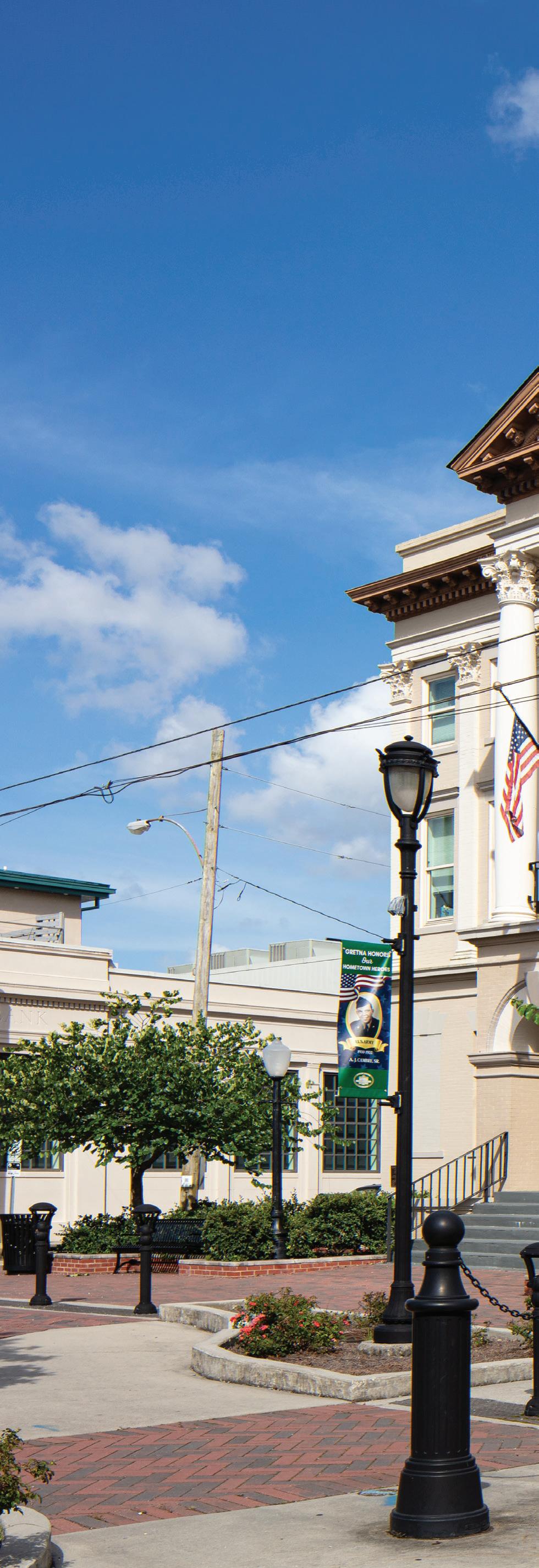
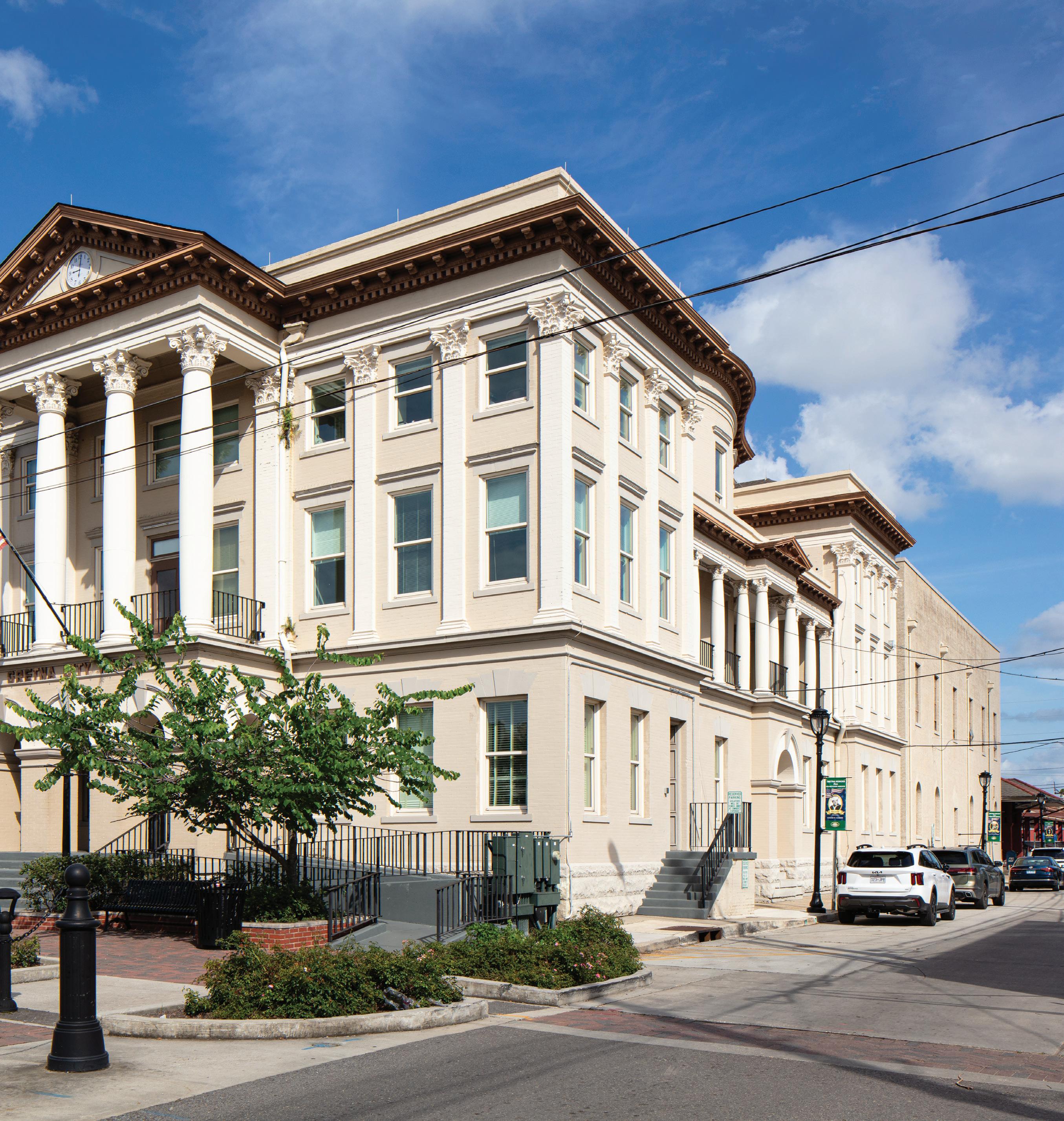
One of her first targets was Fleurty Girl, a woman-owned boutique that had outgrown its origins as a T-shirt operation run out of the trunk of a car. Constant recruited the business to downtown Gretna. Today, the owner has invested in and owns her building.
“I knew small cities need small retail to keep people local,” Constant said. It was a repeatable strategy: find businesses with roots, bring them in, give them a reason to stay. Several more such businesses have since followed.
Another transformation has happened at the table. Constant doesn’t hesitate when she describes that Gretna has become, in her words, the “culinary mecca of the West Bank.” She notes that it didn’t start that way. For years, downtown operated almost entirely on the lunch traffic generated by the Jefferson Parish government complex and the courthouse.
“After 4 o’clock, it was a ghost town,” she said. But eventually, restaurants began making the change to stay open into the evening. “That was a huge risk,” she said. “Ton Ton was the first restaurant, along with Common Grounds, to stay open at night.”
Commercial change, of course, must be balanced by residential change.
The city’s population of approximately 17,000 has grown by roughly 1,500 over the last decade — modest in absolute terms, but meaningful given that it’s happening in tandem with an aging population cycling out. The average resident age has dropped from the mid-60s to the mid-40s.
Young families are moving in, drawn, Constant says, by walkability, safety and the events calendar that has made Gretna a place worth showing up for.
Investment is starting to show up at a larger scale, too. A $25 million mixed-use development at the corner of Huey P. Long Avenue and 2nd Street — a public-private
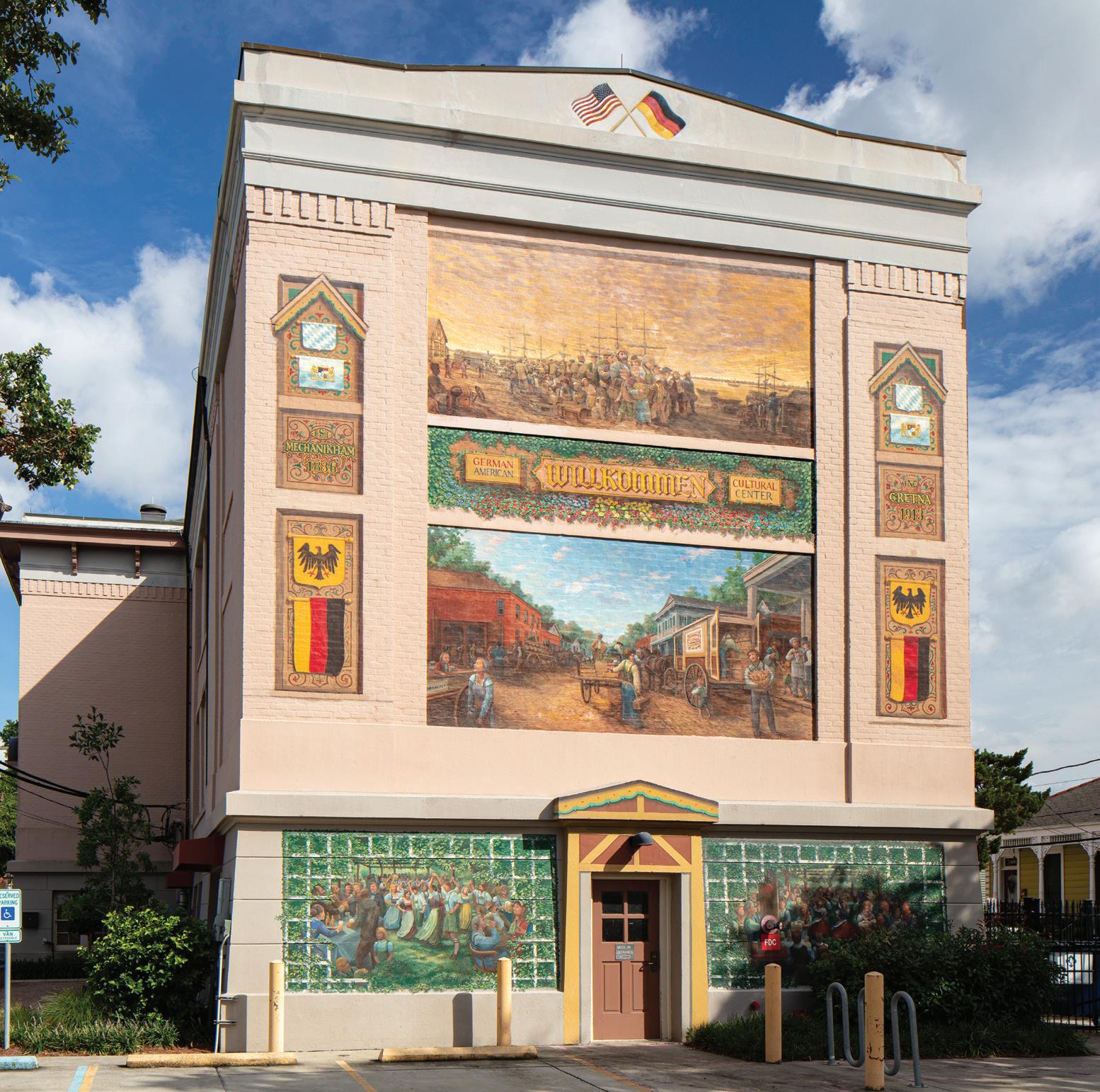
partnership between the city, Jefferson Parish and Jefferson Facilities Inc. — broke ground in late 2024.
It will bring a second location of Port Orleans Brewing Company, the Avo Taco restaurant, a 148-space parking garage with EV charging stations and green stormwater infrastructure. The project is projected to generate $9 million in local and state taxes over 10 years and create 55 permanent jobs.
“Growth comes from the infrastructure components we’re putting together,” Constant explained. “Getting to the place where you’ve put out a product that people want to be a part of… which creates the growth necessary to maintain the city in a way that people choose to be here.”
If infrastructure projects are Gretna’s bones, then the Marketplace is its pulse.
Every Saturday morning, rain or shine, vendors set up along Huey P. Long Avenue between 3rd and 4th streets for the Gretna Farmers Market, a volunteer-run institution that just celebrated its 20th anniversary.
Gretna Fest, which has been running for more than 30 years, is the event that first put the city on the regional map. “If I had to point to something, that would be what really put Gretna’s name out there,” Constant said.
What sets it apart from other regional festivals isn’t just the music; it’s the setting. Gretna Fest is held in the middle of downtown, which means attendees can experience the fullness of the city while enjoying the festivities.
“It showcased the city in a fabulous way,” Constant said.
Which makes what’s happening right now a big gamble, though a necessary one. On May 1, the city began a major renovation of the Marketplace itself, transforming aging infrastructure into a modernized gathering space worthy of everything it hosts. The project is expected to take four to six months.
The timing, Constant acknowledges, wasn’t ideal.
“We were hoping it wouldn’t have interfered with Gretna Fest,” she said. But state funding doesn’t wait for convenient calendars. “The why is because of funding. We never had the money before.” When the opportunity came, the city pounced.
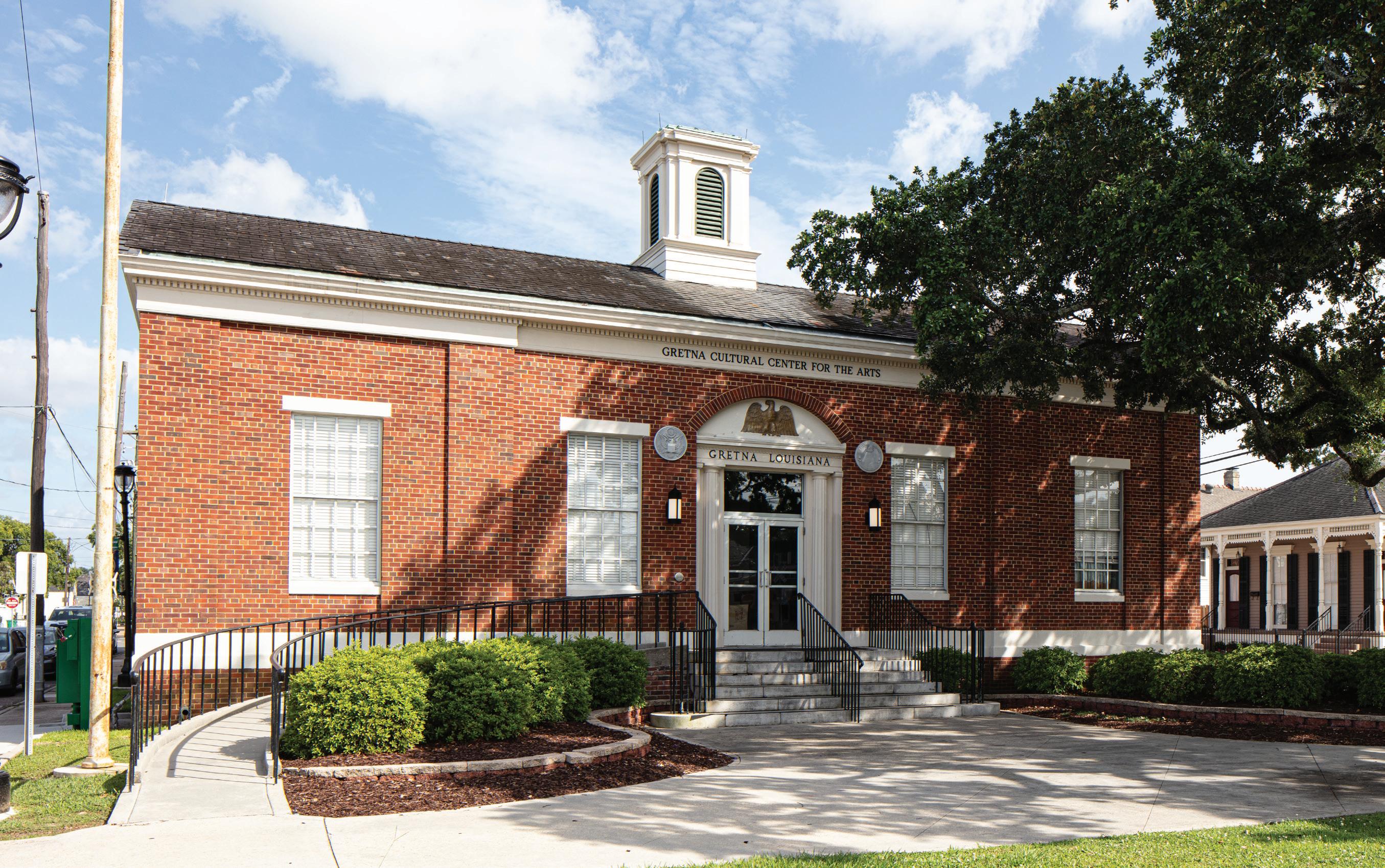
Gretna Fest will look different this year. In place of the traditional three-day festival, the city and the Gretna Economic Development Association have created Gretna Festin’, an expanded Friday night concert series that will bring festival-caliber entertainment to downtown over four Saturdays in October. Each weekend will feature a local opener and a nationally recognized headliner, with the full lineup set to be announced this month.
Without festival vendors taking over the streets, the city’s restaurants will become the main draw. The businesses, Constant said, are excited about the opportunity.
“We’re going to have four bites of the apple instead of just one weekend,” she said.
Gretna Fest will return in 2027 in its full three-day format, this time with the newly renovated Marketplace as its front door.
“When this project is finished, every event we host here will be better,” Constant said. The short-term inconvenience, she’s betting, will make everything that follows permanently stronger.
Constant has a line she returns to when people ask her what kind of city she’s trying to build. “Governments build cities,” she says, “and people build communities. That’s what Gretna is. It’s the Gretna community.”
It’s a distinction that shapes how she governs. Since taking office, Constant has held regular district meetings, public informational sessions and community outreach events — keeping residents inside the process of transformation rather than presenting them with its results after the fact.
The people who watched the city go quiet in the ’80s have watched it come back. The young families who moved in for the walkability and the safety have watched it keep going.
“Our residents have enjoyed seeing the transformation as we move through time,” she said.
The work isn’t finished. It never quite is in a city this old, with this much history to honor and this much ground still to recover. But the momentum is clear.
“Historic cities can be left behind based on no changes,” Constant said. “We want to ensure that we’ll continue to evolve as our generations continue to evolve. Our biggest goal is ensuring that this city is ready for the next generation.”
Constant has lived her entire life in a city she has spent her entire career refusing to give up on. That hasn’t changed. Neither, it turns out, has the city itself. It’s just finally becoming what she always knew it could be. T
OCHSNER’S NEW NEUROSCIENCE CENTER WILL UNITE THE GULF SOUTH’S PREMIER BRAIN RESEARCHERS IN ONE SHARED SPACE

BY KEITH TWITCHELL

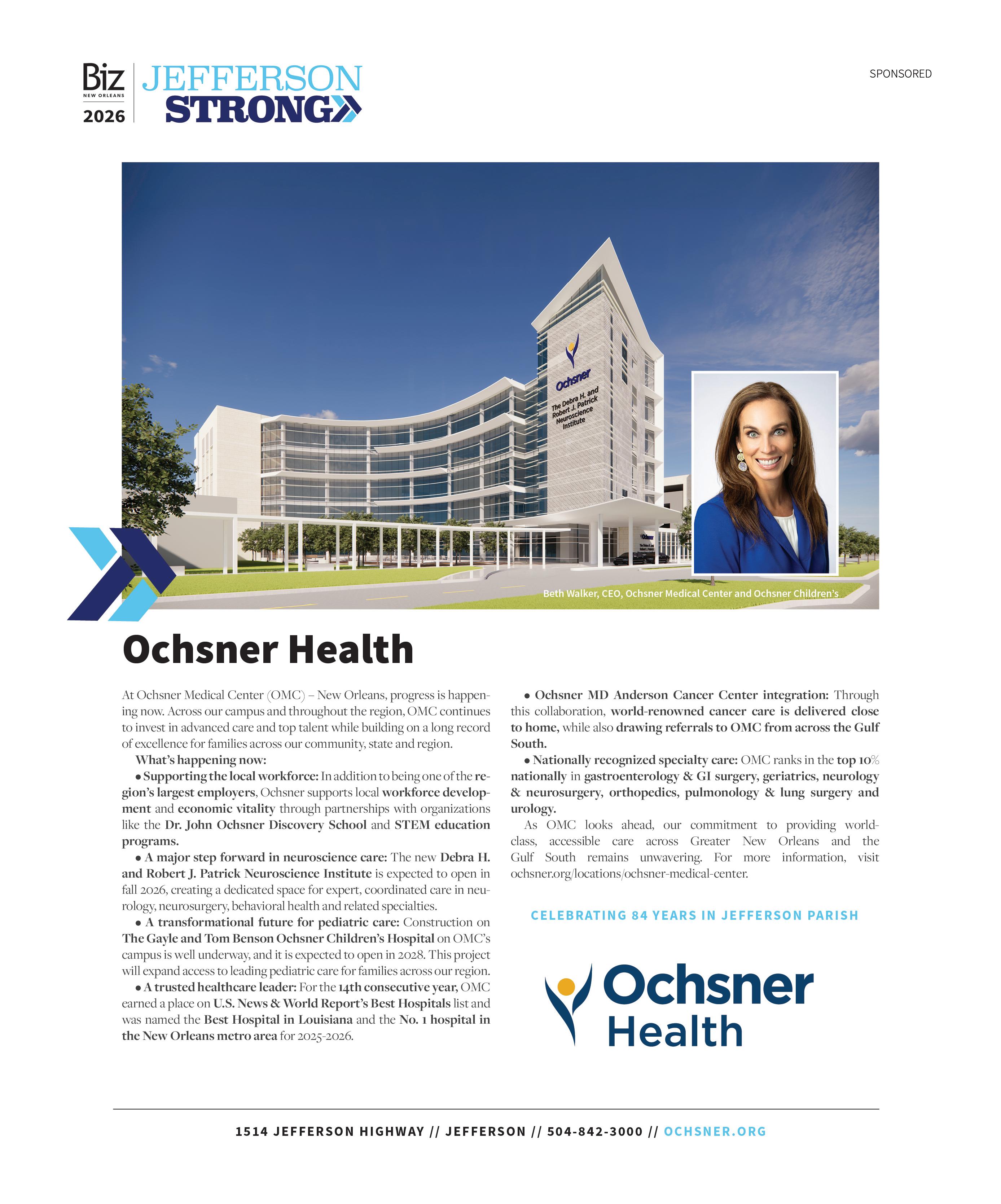
This fall, with the opening of the Debra H. and Robert J. Patrick Neuroscience Institute at the Ochsner Jefferson Highway campus, the region will take another major step toward that goal.
The $120 million, 132,000-square-foot facility seeks to answer a global need while serving as the only facility of its kind between Atlanta and Houston.
“The idea for the Institute came about over 10 years ago and started from a simple question: How do we make complex, multidisciplinary care for neurological patients easier and more accessible to all who need it?” explained Dr. Cuong Bui, system chair of neurosurgery, and co-service line leader for neurosciences at Ochsner Health. “Patients living with conditions such as stroke, epilepsy, Parkinson’s disease, Alzheimer’s disease, brain tumors, spinal disorders, traumatic brain injury, and behavioral health conditions often require lifelong, multidisciplinary care.”
Brain disorders are currently the leading cause of disabilities and second-leading cause of death worldwide. Estimates suggest that close to one billion people — nearly one-eighth of the global population — suffer from various brain-related diseases.
The study and treatment of these disorders is neuroscience. Conditions essentially fall into two categories: neurological, or physical illnesses, and neuropsychiatric, or mental illnesses. However, both types of ailments are present in many patients.
“People are living longer, which equates to a growing incidence of neuroscientific disorders,” explained Todd Mule, vice president of neurosciences at Ochsner Health. “This is a familial disease; it impacts the whole family.”
The Institute will marry current best practices in the treatment of neuroscientific disorders with the latest technological advances.
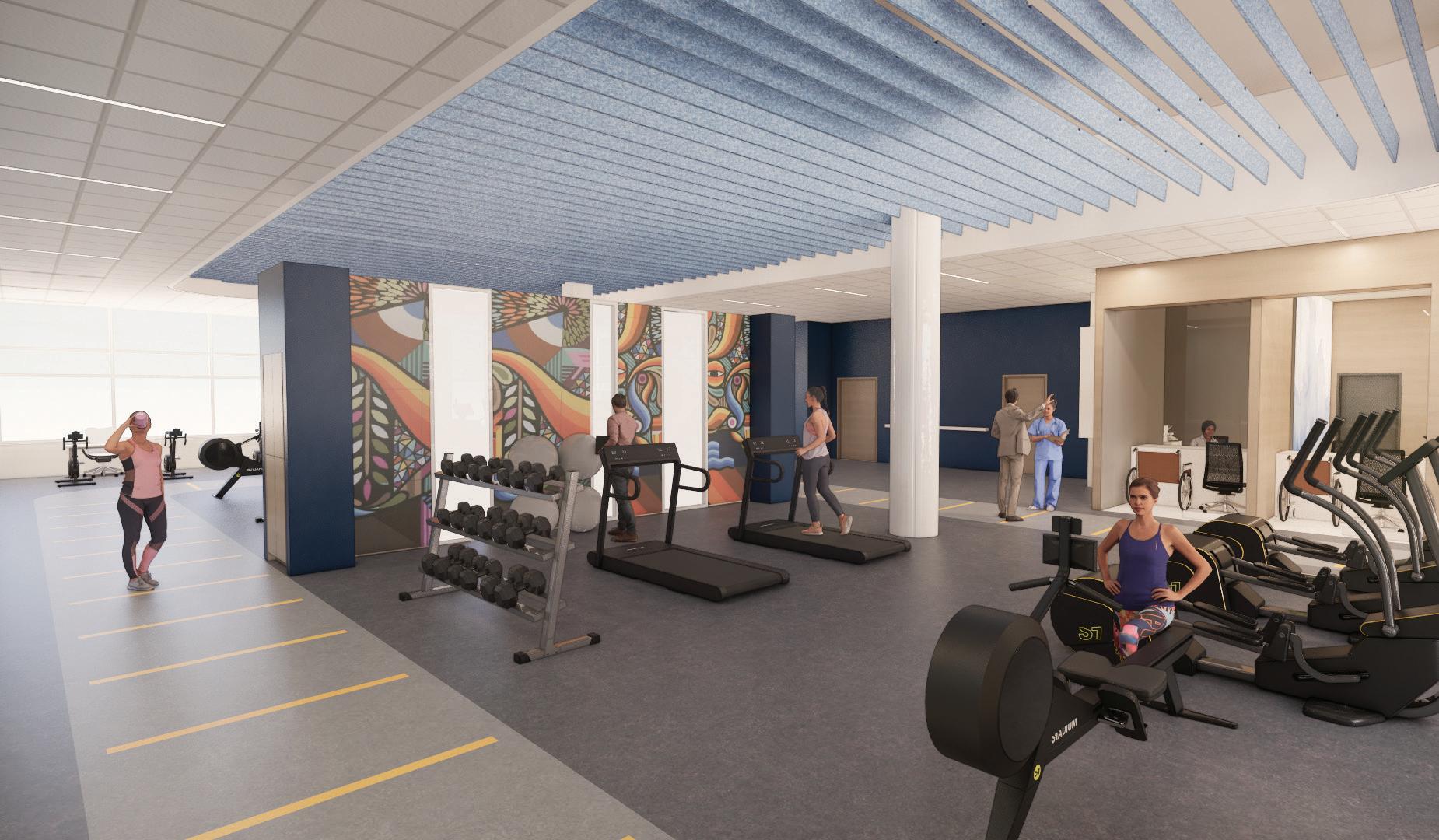
“The space design, equipment and technology all represent the leading edge of the field: augmented and virtual reality to enhance neuroplasticity, exoskeleton technology for gait training, body weight support systems, functional electrical stimulation, biofeedback tools, and a rehab pool all designed to maximize recovery, improve quality of life and restore independence,” explained Rebecca Courtney, vice president of the therapy service line at Ochsner Health.
The facility will also allow Ochsner to make its own mark in the field.
“[This] allows us to innovate at the intersection of brain health and behavioral health,” added Lisa Gentry, vice-president of behavioral health at Ochsner Health, “bringing advanced treatments, collaborative care models and emerging technologies together in a way that has not existed before in our region.”
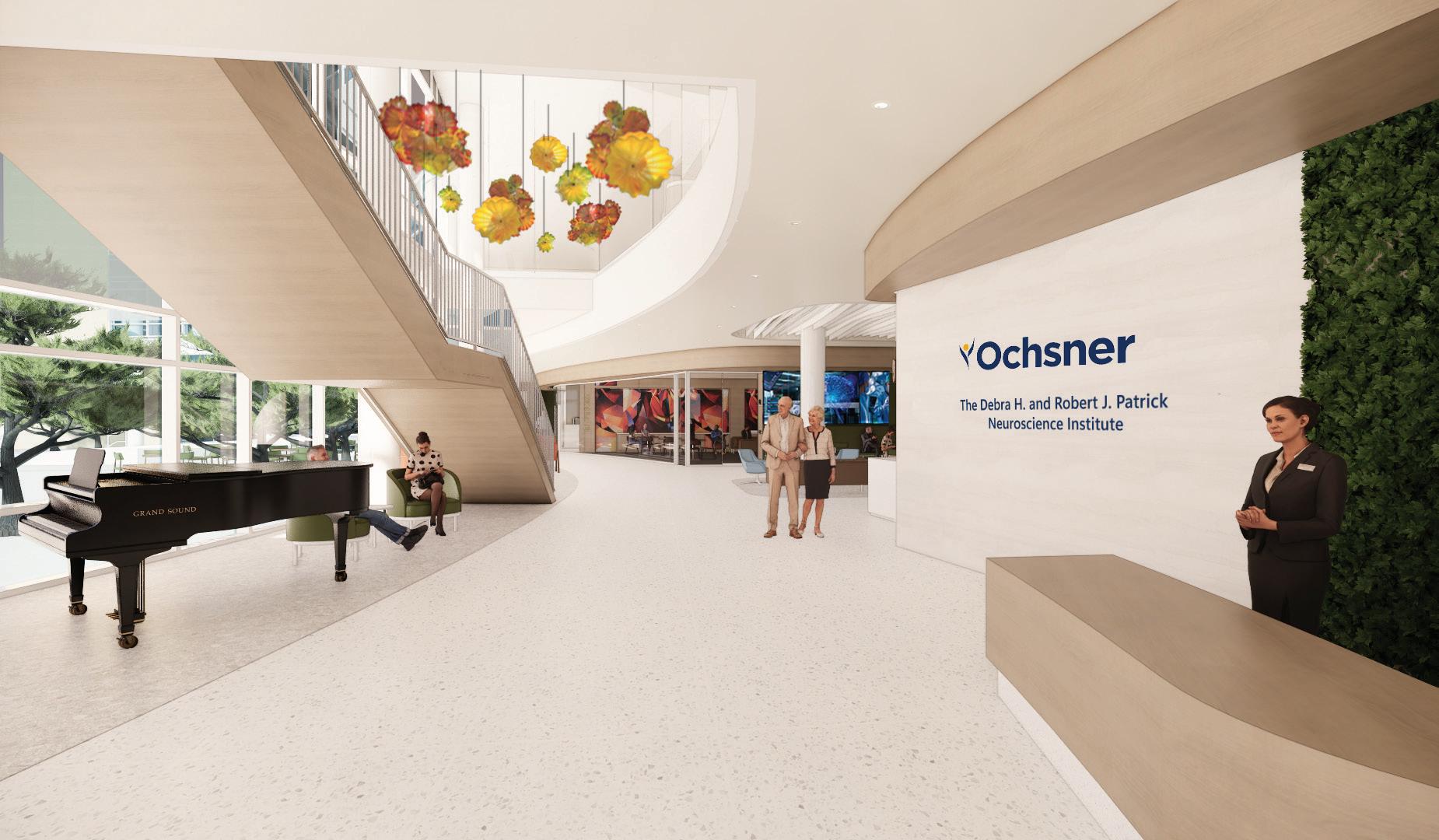
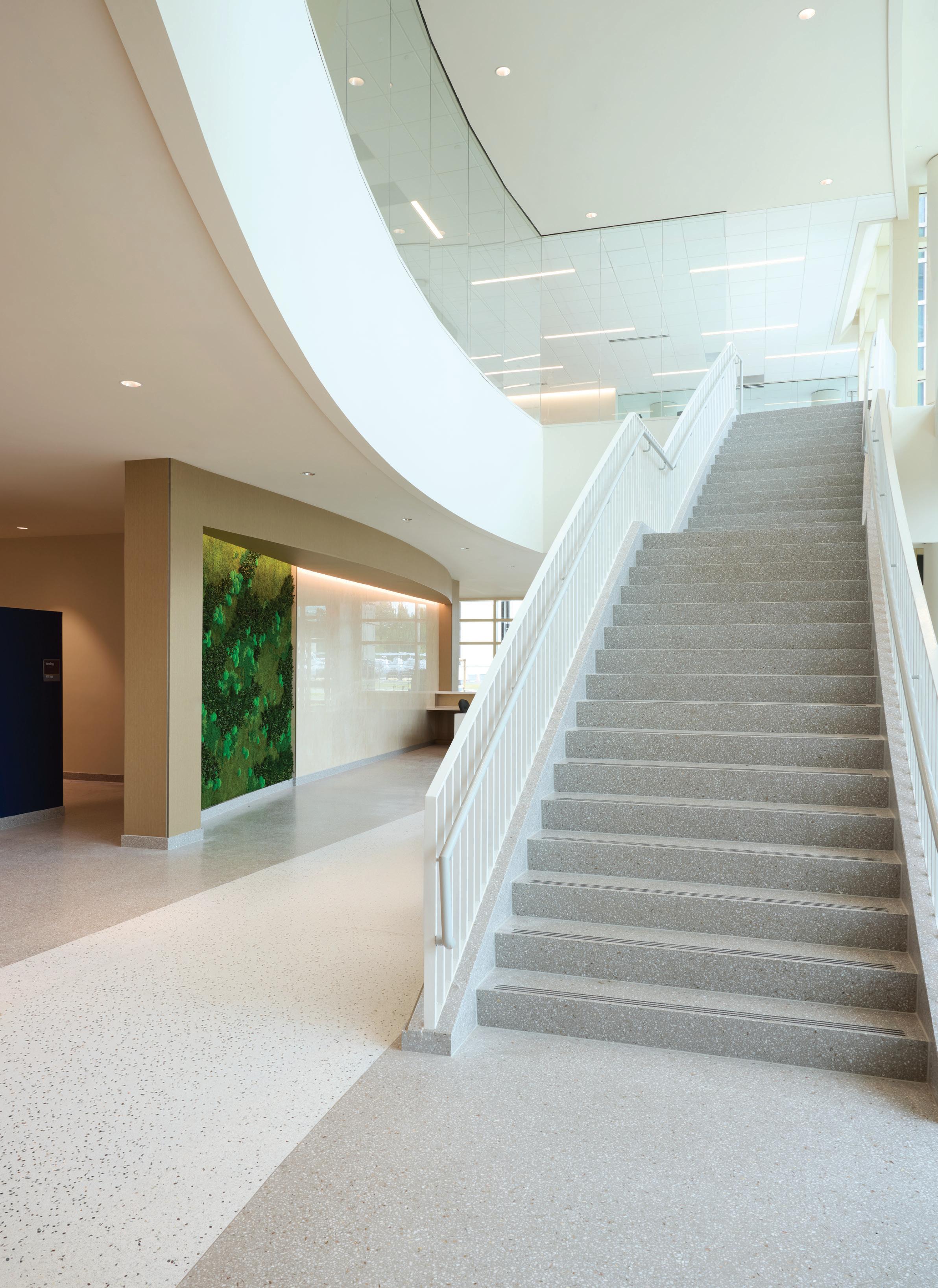
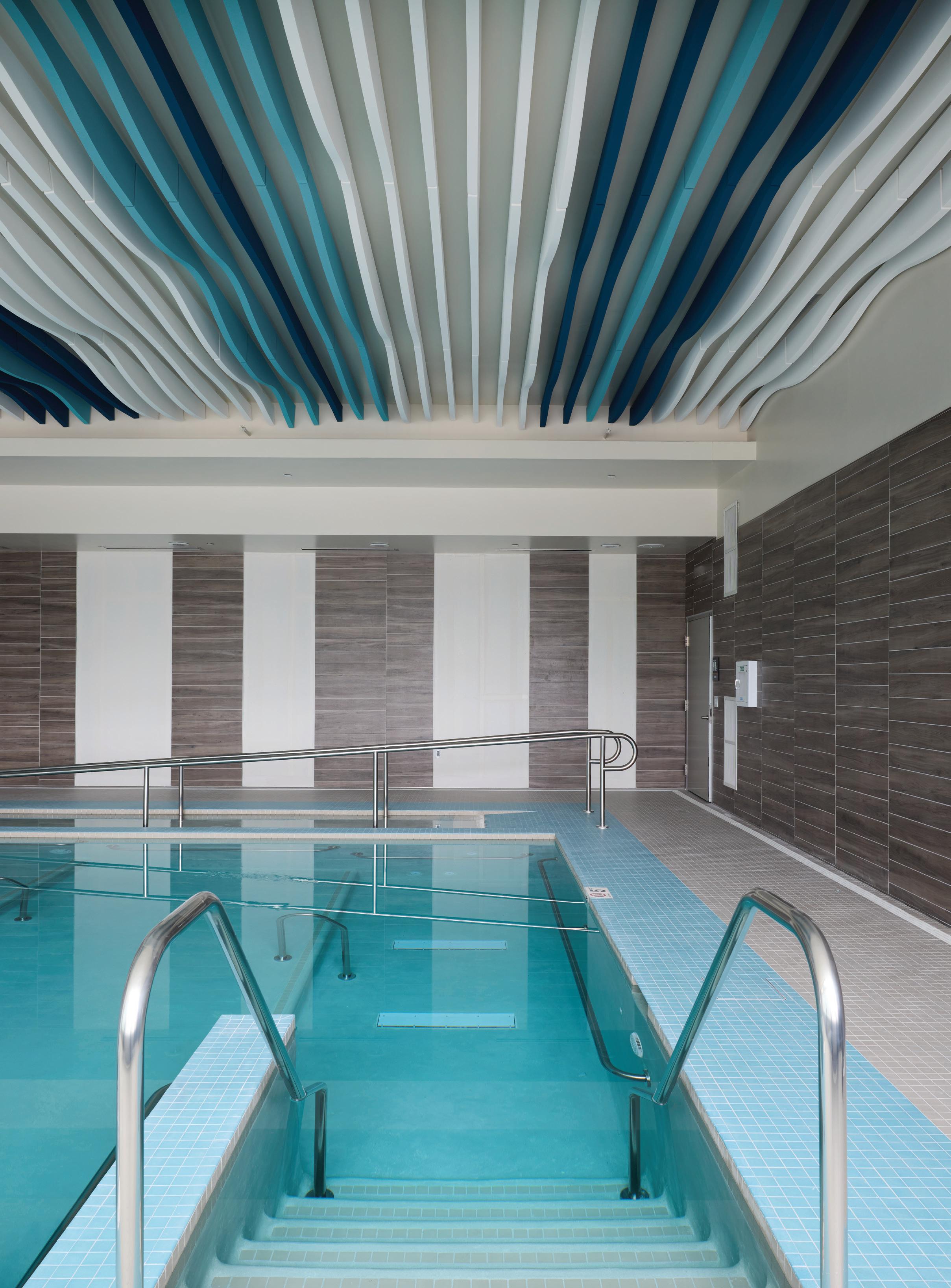
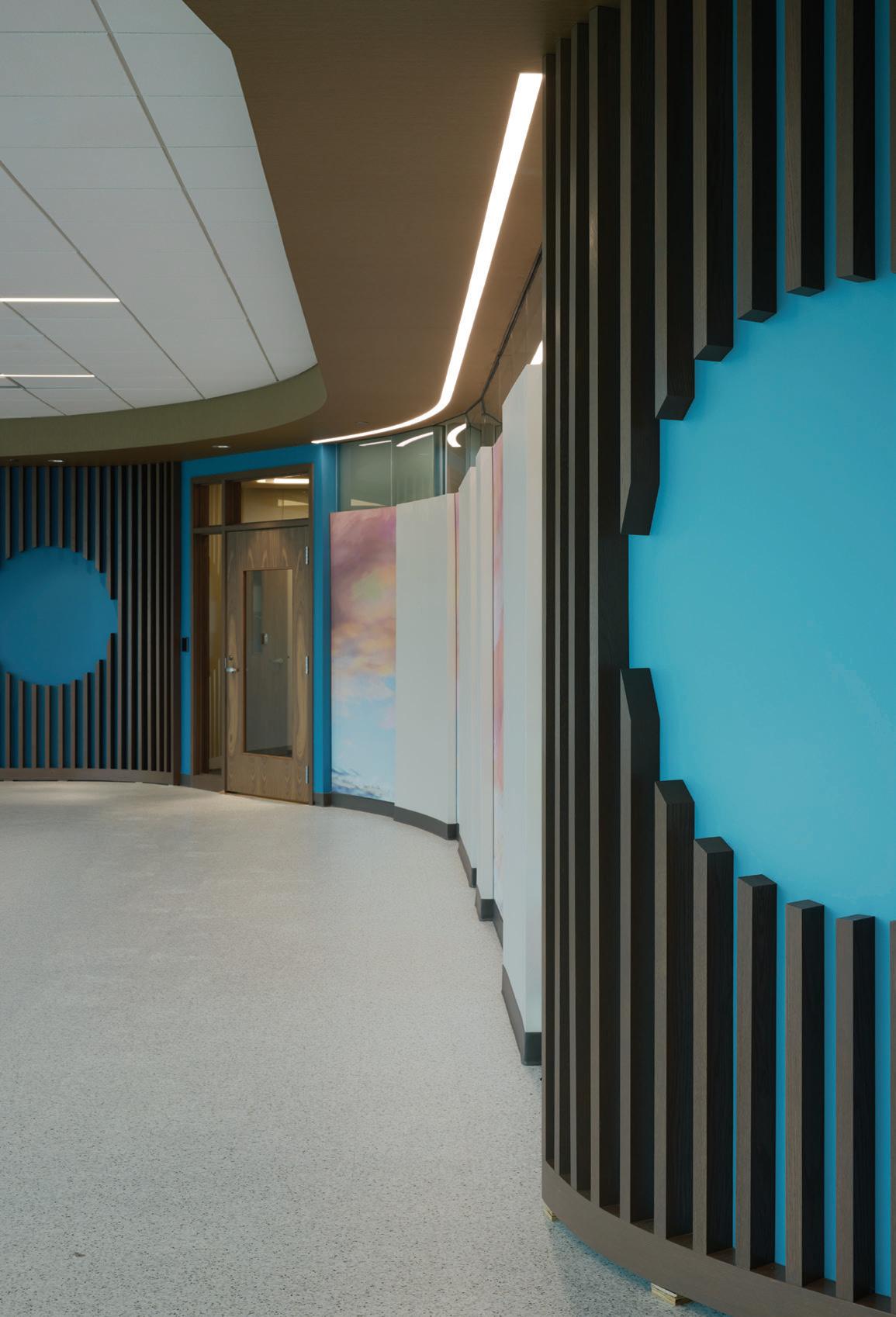
As an example, one of the institute’s innovation centers has 3-D printing capabilities which will enable treatment teams to create models of individual patients’ brains that show the precise locations of tumors or aneurysms. This will help physicians plan the surgery, as well as allow patients to more clearly understand their ailment.
The Institute will also be employing cutting-edge, incisionless brain surgery using focused ultrasound. It will be the only facility in the region with this technology.
Treatment, however, will seek to address more than just the physical brain. The Institute will employ psychiatrists and psychologists with specialized training in neurological conditions and their specific challenges, as well as multiple forms of rehab and therapy including speech, physical, musical, occupational and movement. The focus on improving patient quality of life will extend to classes such as yoga and creative writing, with many therapies also offered to caregivers to aid them in dealing with stress.
Long-term thinking is key as very few neurological disorders are curable.
“We manage these diseases over different stages of life,” Mule elaborated. “But with these new therapies, people can live more effective, rewarding, independent lives.”
Multiple partnerships will play a big role in making all of this a reality. One example is the Team Gleason Assistive Technology Lab. Mule described Team Gleason as “a convener of technology,” and the Lab will provide patients and families with access to everything from advanced communication aids to mobility solutions to environmental control equipment.
While Team Gleason is specifically focused on ALS, Mule noted that the partnership will “bring together technologies that will evolve to go beyond ALS to treat other neuro-degenerative diseases.
“Too often, life-changing assistive technology never reaches patients simply because clinicians haven't been trained on it or funding pathways haven't caught up with innovation,” noted Blair Casey, CEO of Team Gleason, “and Ochsner understands that closing that gap requires a real commitment to clinical education regardless of whether a technology is funded or not. That shared belief is why Team Gleason partnered with Ochsner, and why we are so excited about what the Assistive Technology Lab and this building mean for people living with neurodegenerative diseases who deserve access to the best emerging solutions available.”
Other collaborations will similarly provide patient access to the latest technologies and collectively advance the treatment of neuroscientific diseases. Among these is a specialized headset developed by medical device manufacturer Cognito Health that generates sound waves that have been found to be beneficial to patients with diseases like dementia and Alzheimer’s.
Another example is a partnership with a company called Synchron. Just named one of the “Top 10 Most Influential New Frontiers Companies of 2026” by Time Magazine, Synchron is pioneering the use of brain-computer interfaces — computer chips embedded in the brain using a catheter instead of brain surgery. The chip allows the patient to translate their thoughts into digital commands on anything with a screen. The goal is to help people with paralysis communicate and regain at least partial autonomy.
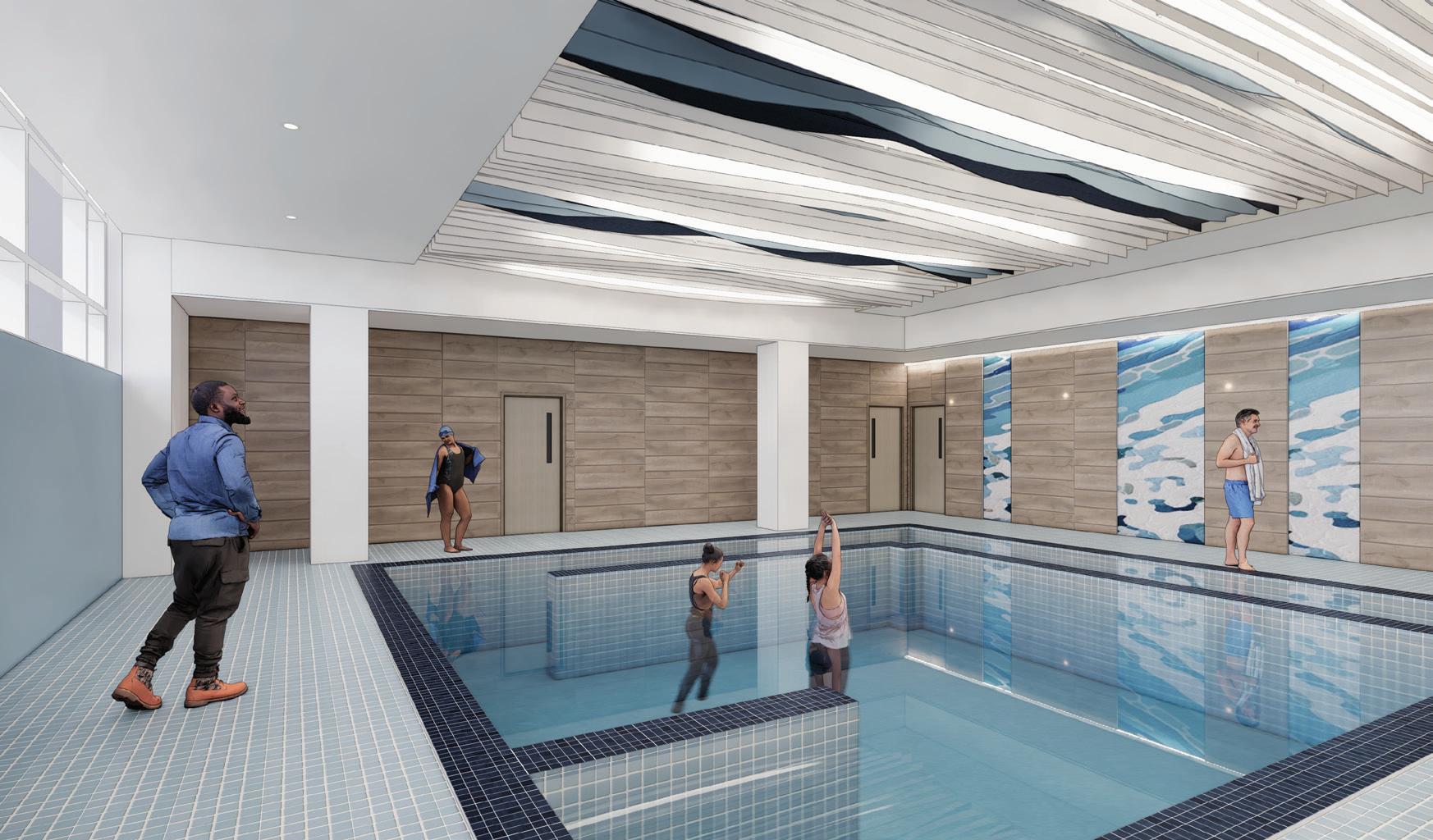
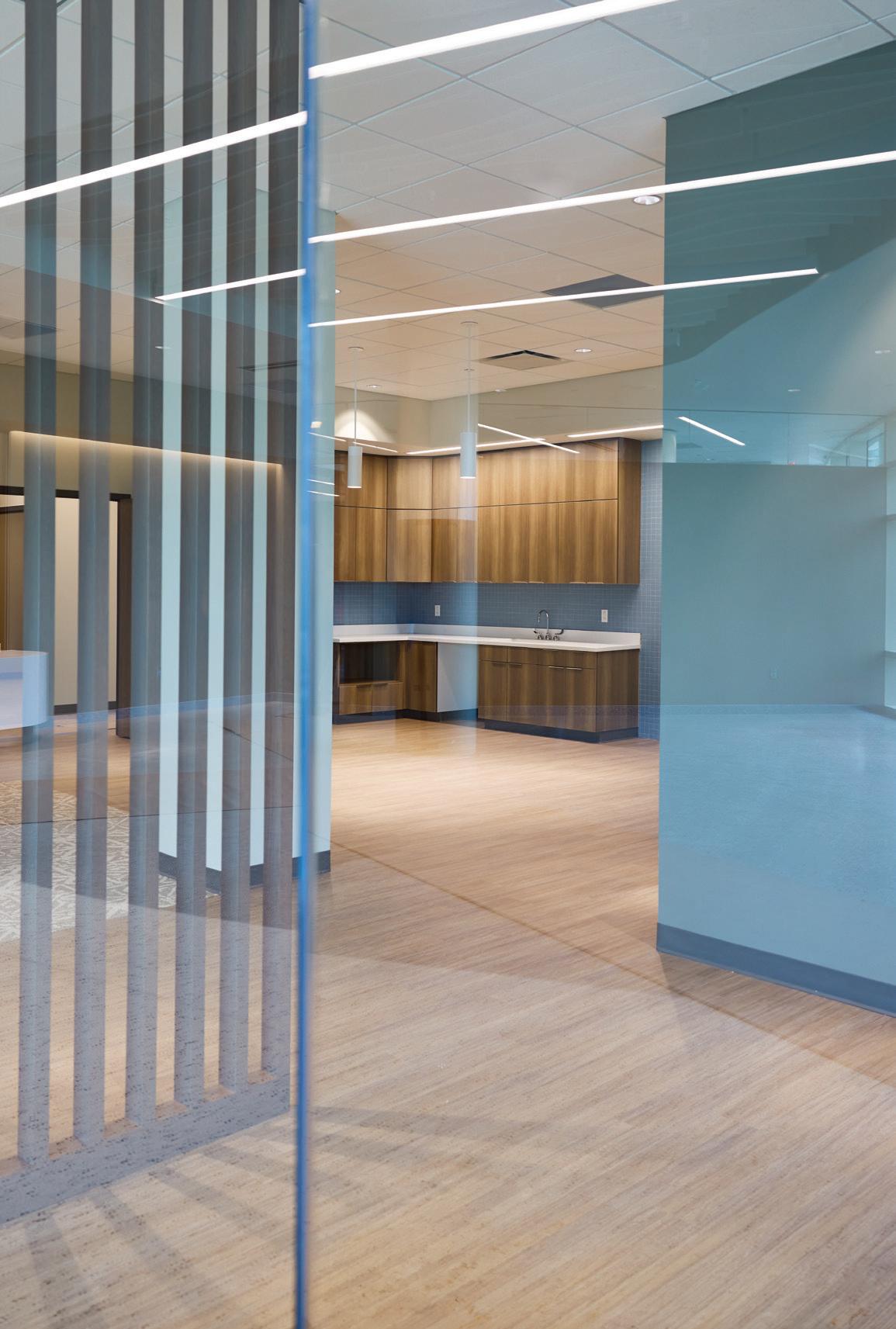
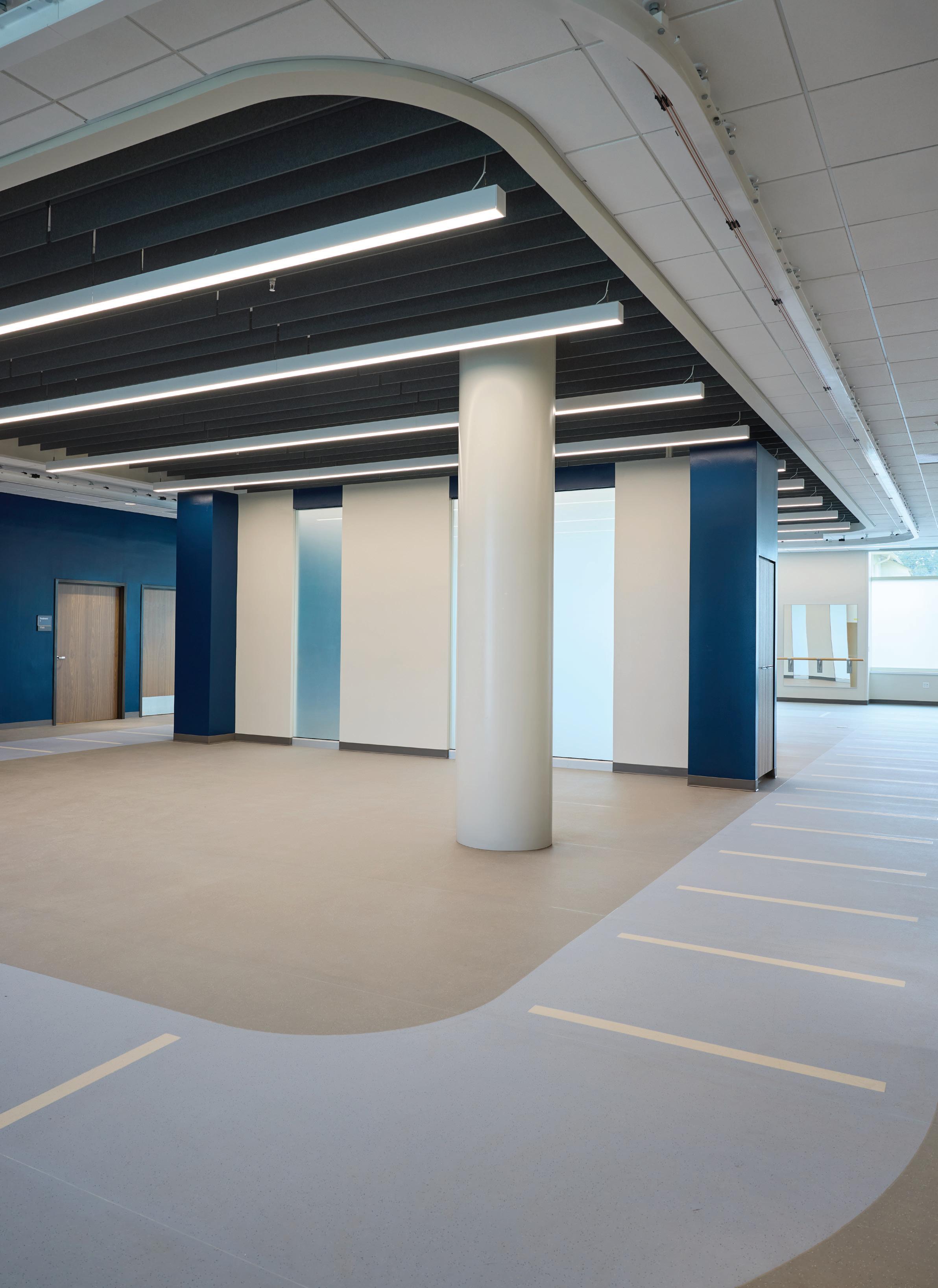
Making this approach work requires a broad spectrum of professionals and practitioners.
“At the heart of the Institute is a highly integrated multidisciplinary team of neurologists, neurosurgeons, psychiatrists, physiatrists, neuropsychologists, advanced practice providers, rehabilitation therapists, nurses, technologists, researchers and allied health professionals,” said Dr. David Houghton, neurology system chair for Ochsner Health. “This collaborative model is designed to enable coordinated, patient-centered care, and the development and evaluation of innovative therapies and technologies.”
It's estimated that about 100 new jobs would be created on top of the existing staff of about 160 people, but with the facility nearing completion, staffing could be a bit of a challenge. Although the project integrates numerous existing Ochsner neuroscience programs and services, it also expands on them considerably. And remarkably, given the widespread prevalence of brain disorders, there is an extreme dearth of practitioners in the field.
“Since 2023, nationwide 83% of posted positions remain unfilled,” reported Mule. “There are a limited number of people going into the field.”
Houghton feels, however, that the Institute will have inherent advantages as it works to attract staff.
“Across the country, the demand for neurologic care is outpacing the number of neurologists available to available to provide it,” he said. “The Institute will enable us to recruit nationally recognized physicians, scientists, and therapists while also serving as a major training and educational hub for the next generation of neuroscience professionals.”
Added Courtney, “While therapists are in high demand, Ochsner’s role as a teaching institution positions us well for the long term.”
Houghton said the primary challenge has been not just constructing a new facility but reimagining how care is delivered.
“Aligning clinical strategy, operations, research and physical design around an integrated model requires collaboration. Every square foot of the building was intentionally designed with the patient journey in mind and the goals of improving outcomes and creating a more seamless experience for patients and families.”
Dr. Richard Zweifler, Regional Medical Director and co-service line leader for Neurosciences at Ochsner Health, said the Institute will serve as even more than a major regional destination for comprehensive mind, brain and spine care.
“It also creates an important platform for engagement with the broader neuroscience community, including academic collaborators, technology innovators, patient advocacy organizations, rehabilitation partners, and community groups focused on brain health and neurological disease awareness,” he said. “The Institute will help attract highly specialized physicians, scientists, therapists, trainees, and biotechnology partnerships to the area.”
Mule also cited regional economic benefits that will result from the new facility as it works to draw international patients as well as those from around the region. The time patients and their families stay in the area, he noted, will increase local spending on everything from meals and accommodations to transportation.
One further benefit is that, with Ochsner’s existing neuroscience operations transferring to the new building, their current locations on the campus will need to be backfilled. As other medical specialties expand into these areas, more patient care will be offered and more providers will be hired, strengthening the region’s healthcare workforce.
Ultimately, the Patrick Neurosciences Institute has the potential to transform patient care for neuroscientific disorders, both individually and globally, while also providing positive ripple effects across the entire regional health care ecosystem.
“For the first time in our region, we are bringing together the largest multidisciplinary neuroscience group in the Gulf South into a single, state-of-the-art destination designed specifically around the needs of neurological patients and their families,” said Bui. “Care here will flow across a seamless continuum — from prevention and diagnosis to acute treatment, rehabilitation, neuro-restoration, research and lifelong brain and spine health without the fragmentation of the traditional care mode. It’s a single destination. And for patients who need it most, that makes all the difference.”
CELEBRATING 201 YEARS!
As one of the largest parishes in the state, Jefferson Parish is home to a wide array of businesses and families that make it the amazing place it is today to live, work and play. In this section, hear from the businesses themselves, and learn more about their incredible stories and all they’re doing to serve the parish.


70 GREAT WORKSPACES
78
80
74 WHY DIDN'T I THINK OF THAT?
Through meticulous craftsmanship and a passion for the past, a local man transforms vintage travel trailers into road-ready treasures.
THE
SOMA 798 S. Rampart Street, New Orleans 504-517-1200 // ShopWorkspace.com // @ShopWorkspace
The Shop SOMA opens with light, art and local craft, setting the tone for South Market’s growing professional community.
BY MISTY MILIOTO
PHOTOS BY SARA ESSEX BRADLEY
The Shop Workspace opened the doors to its new South Market location June 3, marking the coworking brand’s second footprint in New Orleans and its return to the city following national expansion into Brooklyn and Salt Lake City.
The Shop SOMA, located on the ground floor of The Standard condominium building at 798 S. Rampart Street, offers 5,400 square feet of coworking space, 11 private offices, 12 dedicated desks, 30 commons memberships and two conference rooms, plus event space, phone booths and an array of amenities.
The opening ribbon cutting was hosted alongside the New Orleans Chamber, the New Orleans Downtown Development District and TrayAway, a local tech firm expanding within the new space.
Demand remains so strong at The Shop’s first New Orleans coworking space at the CAC that a new location opened June 3 at The Standard condominium building.
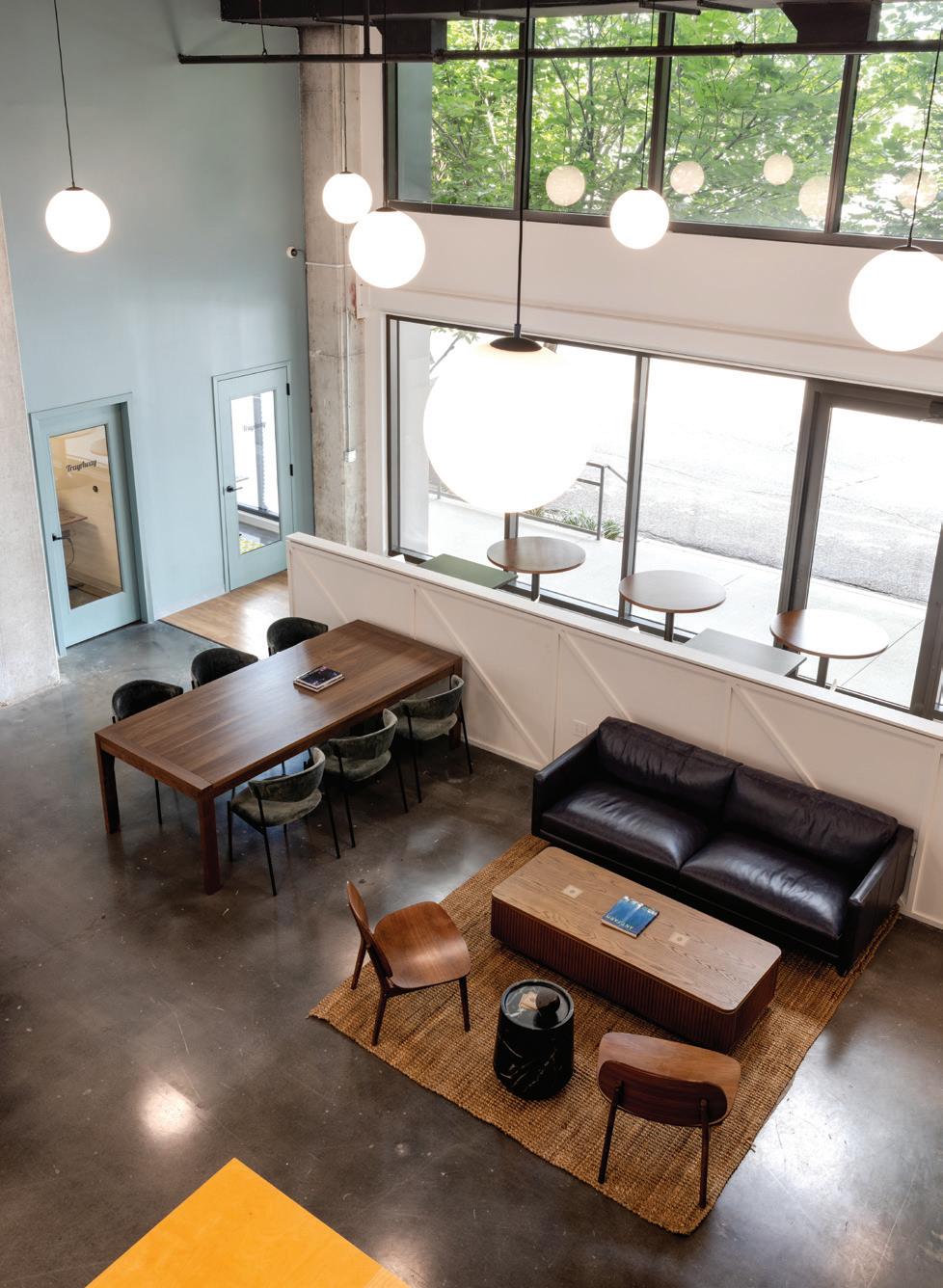
The launch arrived with strong early momentum, with more than two-thirds of private offices leased before the doors opened.
“Cutting the ribbon on The Shop’s new SOMA workspace will deepen our roots in New Orleans where we started, while also offering an exciting new space for the most innovative professionals to grow their businesses,” said Anne Olsen, director of co-working at The Shop Workspace.
The Shop’s first New Orleans location, situated at the Contemporary Arts Center, has operated since 2017 and currently counts more than 500 members, with 100% of office space fully leased for the past year. That demand underscored the need for a second location.
EskewDumezRipple — the same firm behind The Shop’s CAC location and its Salt Lake City outpost — designed the SOMA location in collaboration with The Domain Companies. The guiding concept, developed by EDR, is called “Dawn and Dusk Downtown,” a direct reference to the Crescent City Connection bridge and the quality of light over the Mississippi River at the edges of the day.
“The steel truss structure, the quality of light over the river, the sense of the city in motion are all images that drove the palette, the materiality and the mood we were after,” Olsen said. “It’s a space that feels like it belongs to this specific place at this specific time of day.”
The Standard’s double-height ground-floor volume shaped the design from the outset. Rather
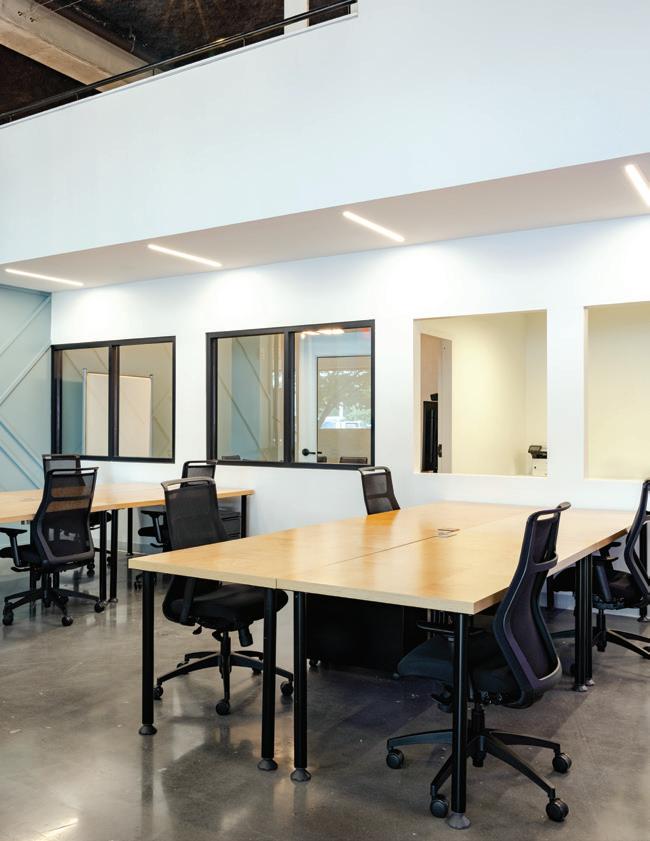
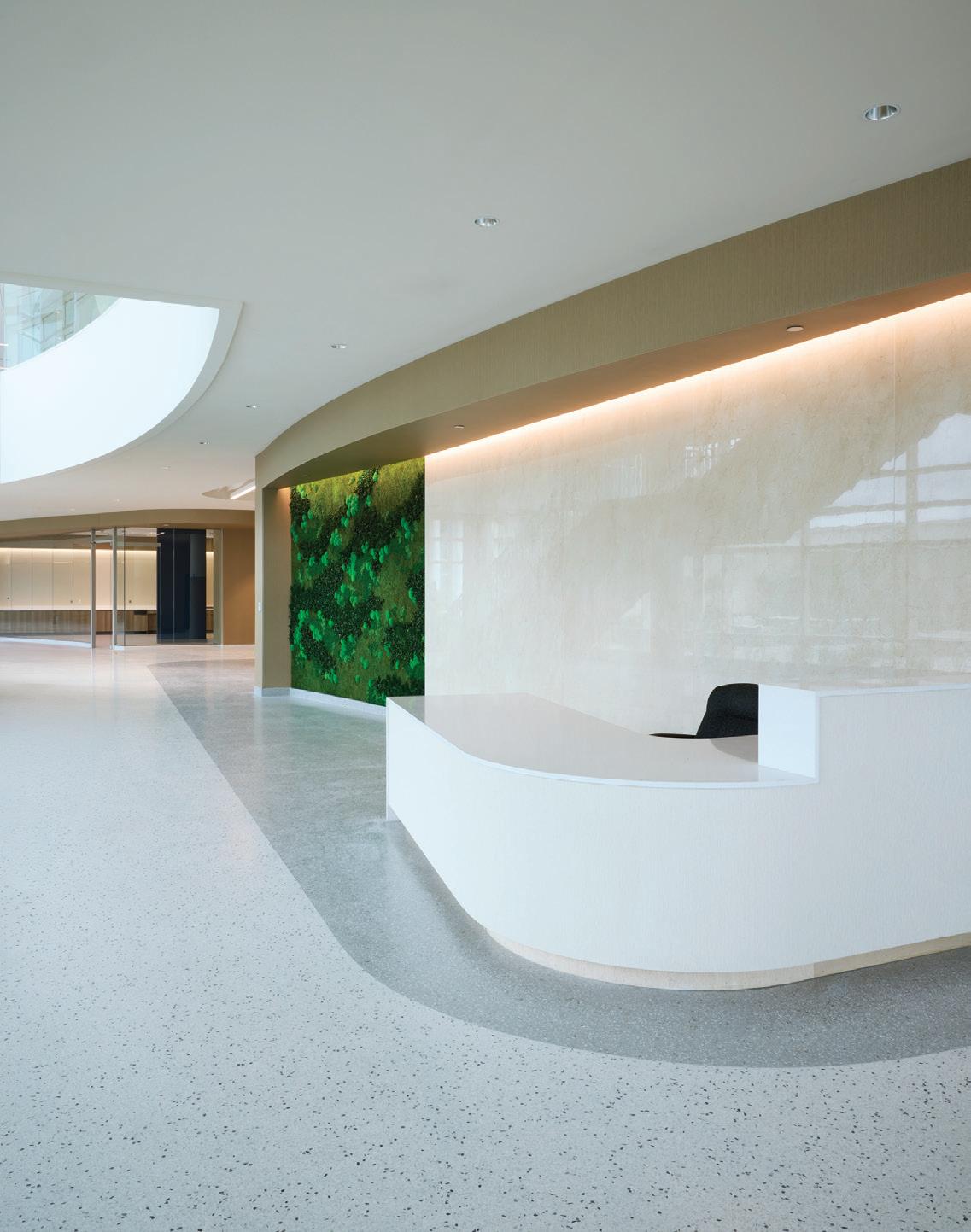
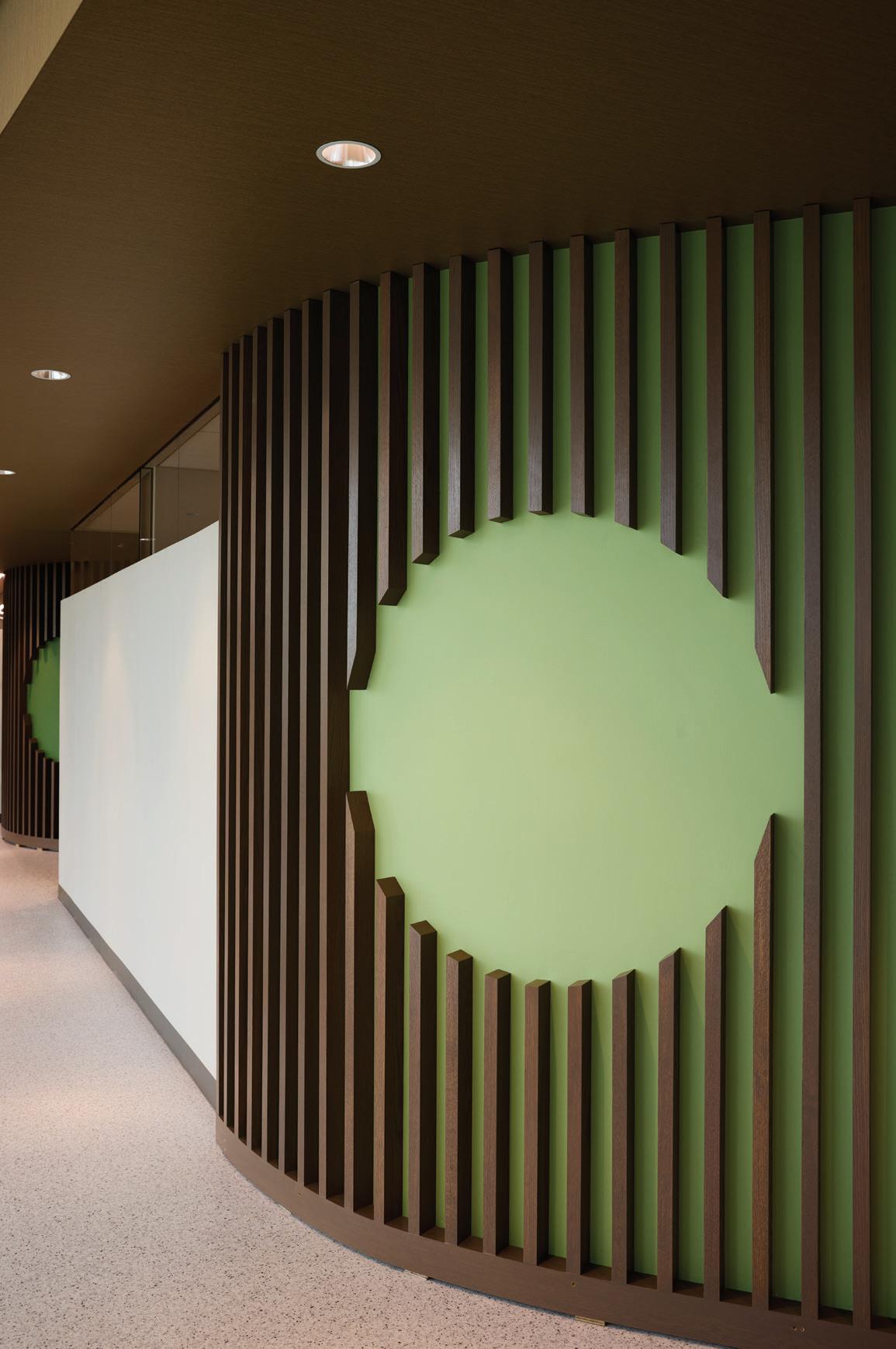
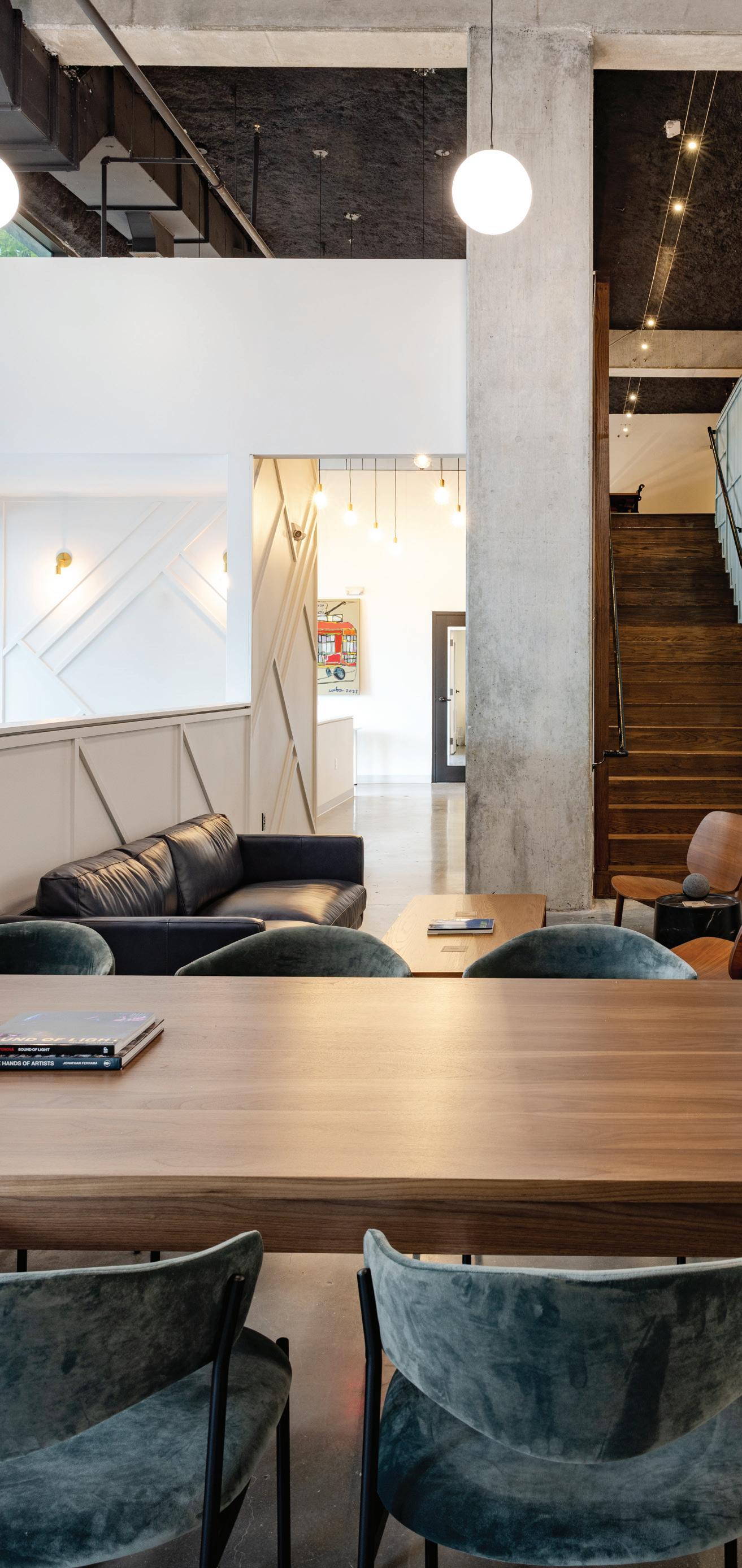
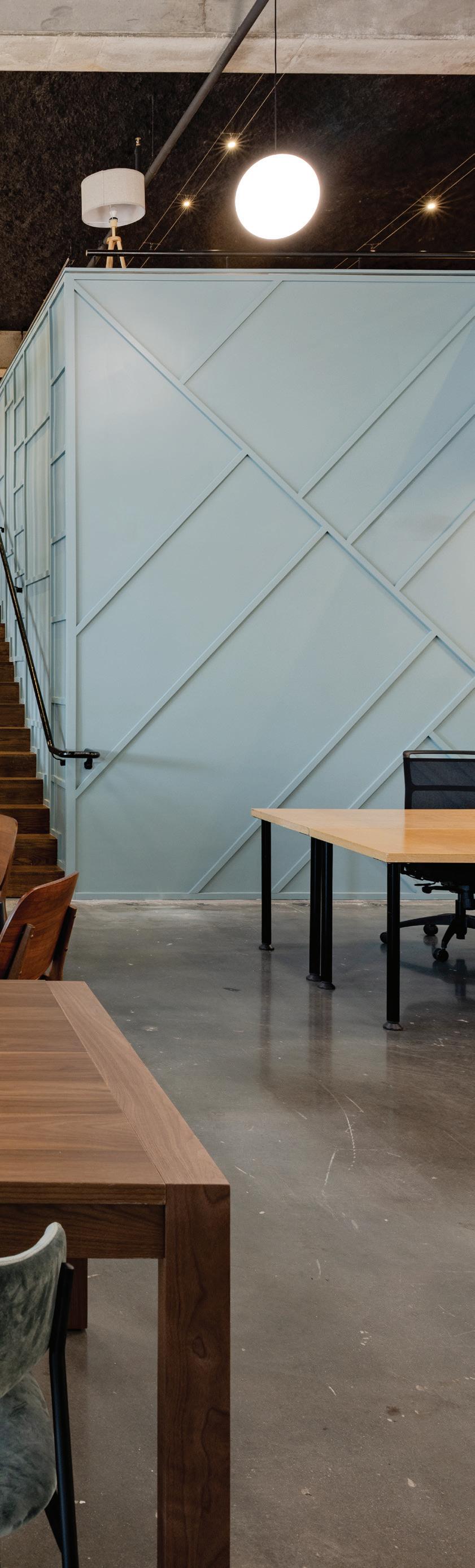
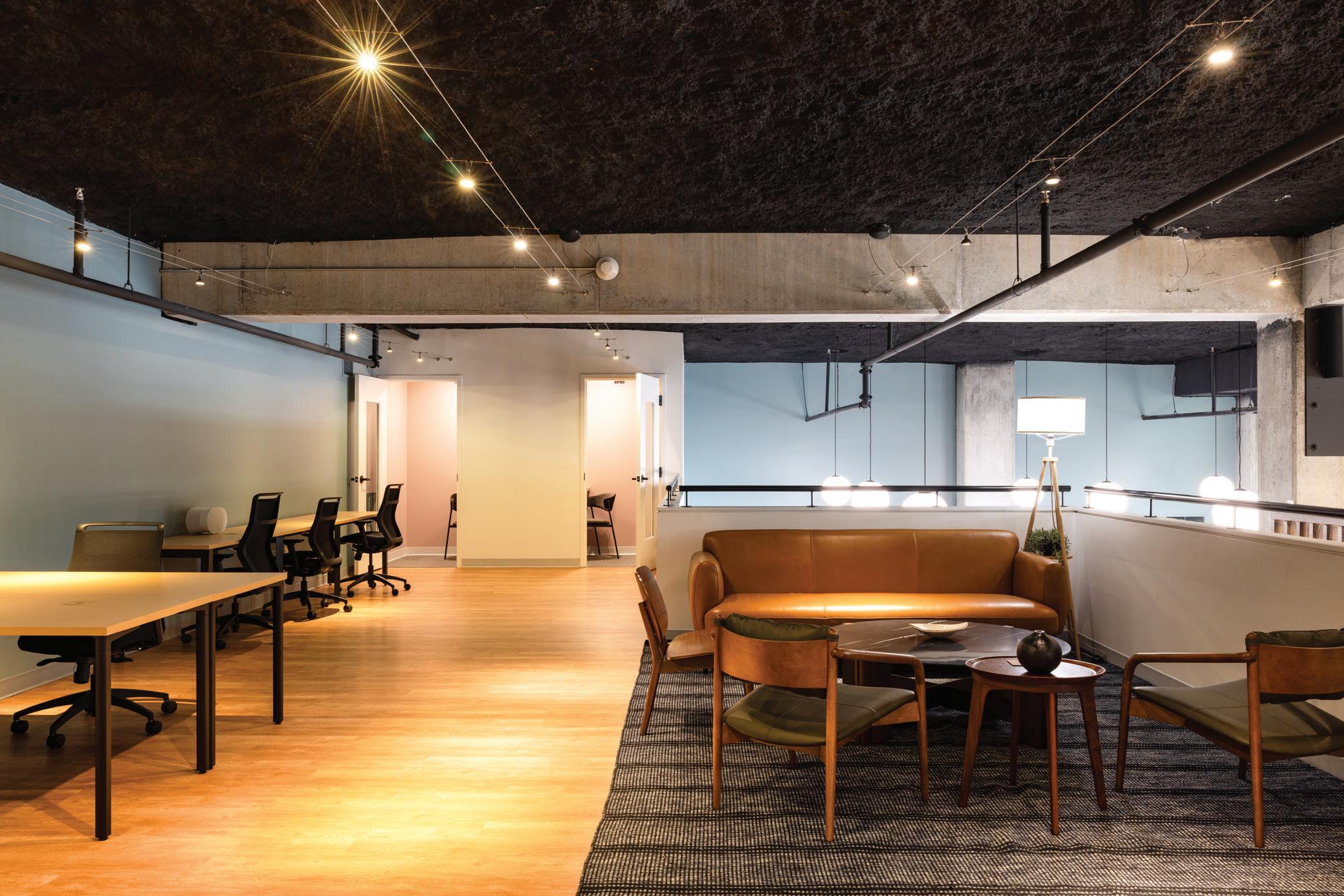
than treating the soaring walls as a challenge, the design team used them as a canvas by incorporating decorative lighting, artwork and a feature wood wall to create warmth within the larger architectural shell. The mezzanine level, made possible by the building’s height, provides open hot-desking with a breakout lounge area, while the main floor holds higher-traffic communal zones, conference rooms, private offices and a streetfacing area the team calls The Sunroom.
“The Sunroom, which integrates the coffee and social zone, is designed to be the place you actually want to spend time, not just the place you pass through to get somewhere else,” said Olsen.
Jill Traylor, principal and director of interior design at EDR, noted that rather than placing private offices along the perimeter — where they would capture daylight and prevent it from reaching the interior — the layout keeps open work areas along the windows, allowing natural light to travel deeper into the space.
The color palette also takes its cues from the dawn-and-dusk concept: warm neutrals and wood-trimmed wall details form the base, with accent moments in blues that reference the river at dusk and warmer tones evoking the bridge at golden hour.
Traylor described the palette as inspired by the Downtown skyline at dawn and dusk, with pale blushes, dusty blues and a neutral backdrop, alongside warm leathers, textured woods and marble accents. The double-height walls on
Acoustical wall panels were added to high-use zones. Area rugs also help with sound absorption.
Square footage
5,400
Number of Employees
3
Persons in Charge
Hugh Breckenridge
Architect
EskewDumezRipple
General Contractor
Labadot
Interior Décor
EskewDumezRipple and In-House
Initial Brand
Development
SquareFeet Design and In-House
Art and furnishings
EskewDumezRipple and In-House
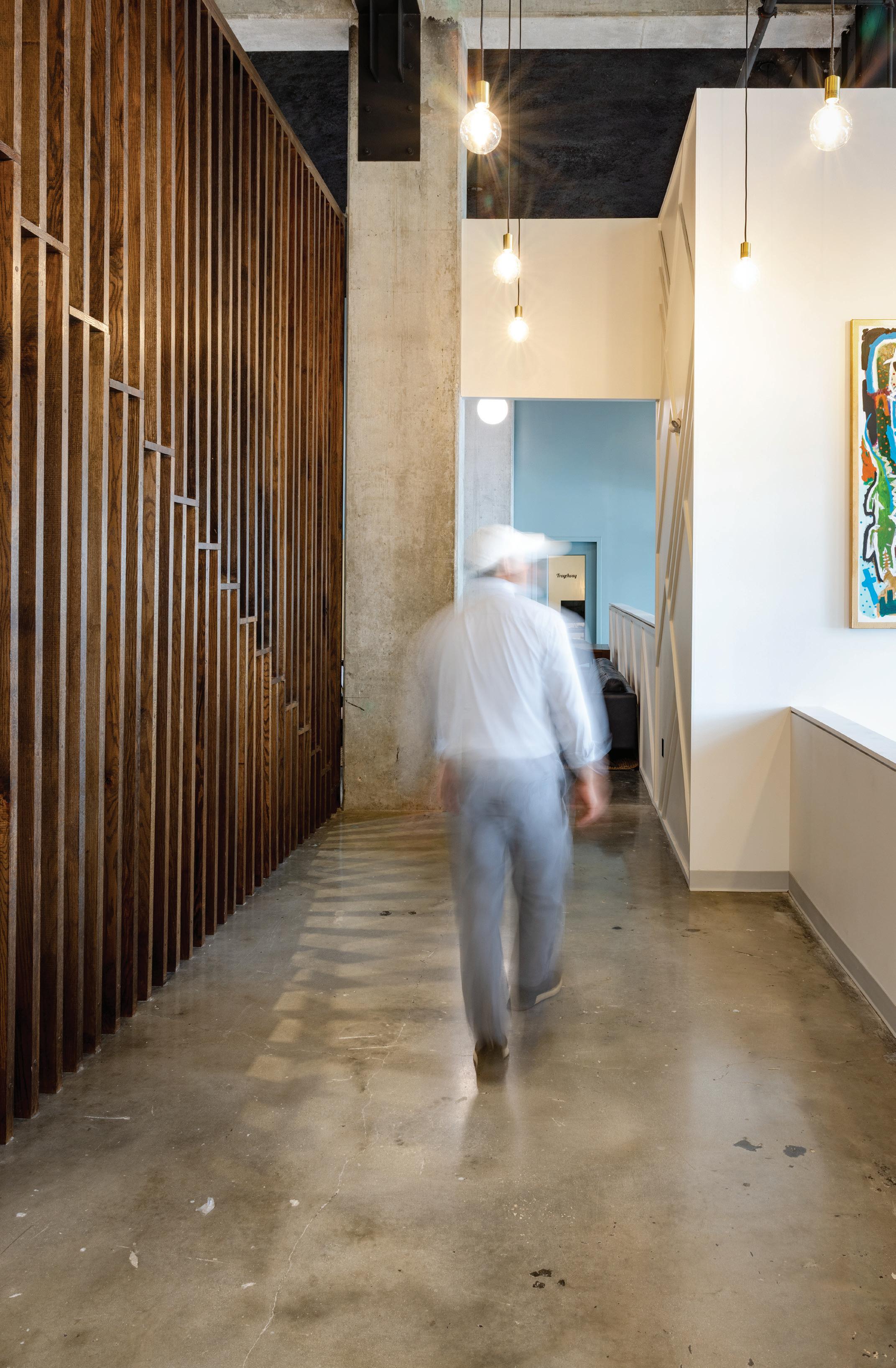

the first level are designed to eventually incorporate a painted mural.
Another primary design consideration came in the form of acoustic performance. The space uses acoustical wall panels in high-use zones, structure-integrated phone booths for improved sound performance, acoustic dampening wall coverings, and a solid partition between the conference room and adjacent spaces. Area rugs and carpet tiles in select areas provide additional absorption.
The Shop SOMA partnered with Ferrara Showman Gallery and Wayne Clark of Wolf & Co. on art curation. Every piece on display is available for purchase, directly benefitting local artists and creating a rotating collection from the start.
“Rather than treating art as an afterthought, the goal was to create moments throughout the space that feel layered, collected and distinctly local,” noted Olsen.
The Shop SOMA plans to work with neighboring South Market tenants for catered conference lunches and member events, with a dedicated set of perks and discounts tying members into the broader neighborhood.
“Downtown New Orleans continues to attract companies and entrepreneurs looking for dynamic spaces that foster collaboration and innovation,” said Seth Knudsen, president and CEO of the New Orleans Downtown Development District. “The expansion of The Shop further strengthens the ecosystem of businesses, talent and flexible work environments that are helping drive Downtown’s growth.”
Matt Schwartz, co-CEO of The Domain Companies, echoed that sentiment.
“In creating and growing South Market, we’ve sought to bring the restaurants, retailers and services that continue to make Downtown a vibrant and engaging place to live and work,” he said. “The Shop SOMA is an exciting addition to the fabric of the Downtown community.”
Members of The Shop SOMA receive access to networking events and programming at the CAC location, as well as The Shop’s Brooklyn and Salt Lake City spaces. Through the League of Extraordinary Coworking Spaces (LeXC), members can also access more than 100 coworking spaces globally. T
“The expansion of The Shop further strengthens the ecosystem of businesses, talent and flexible work environments that are helping drive Downtown’s growth,” noted Seth Knudsen, president and CEO of the DDD.
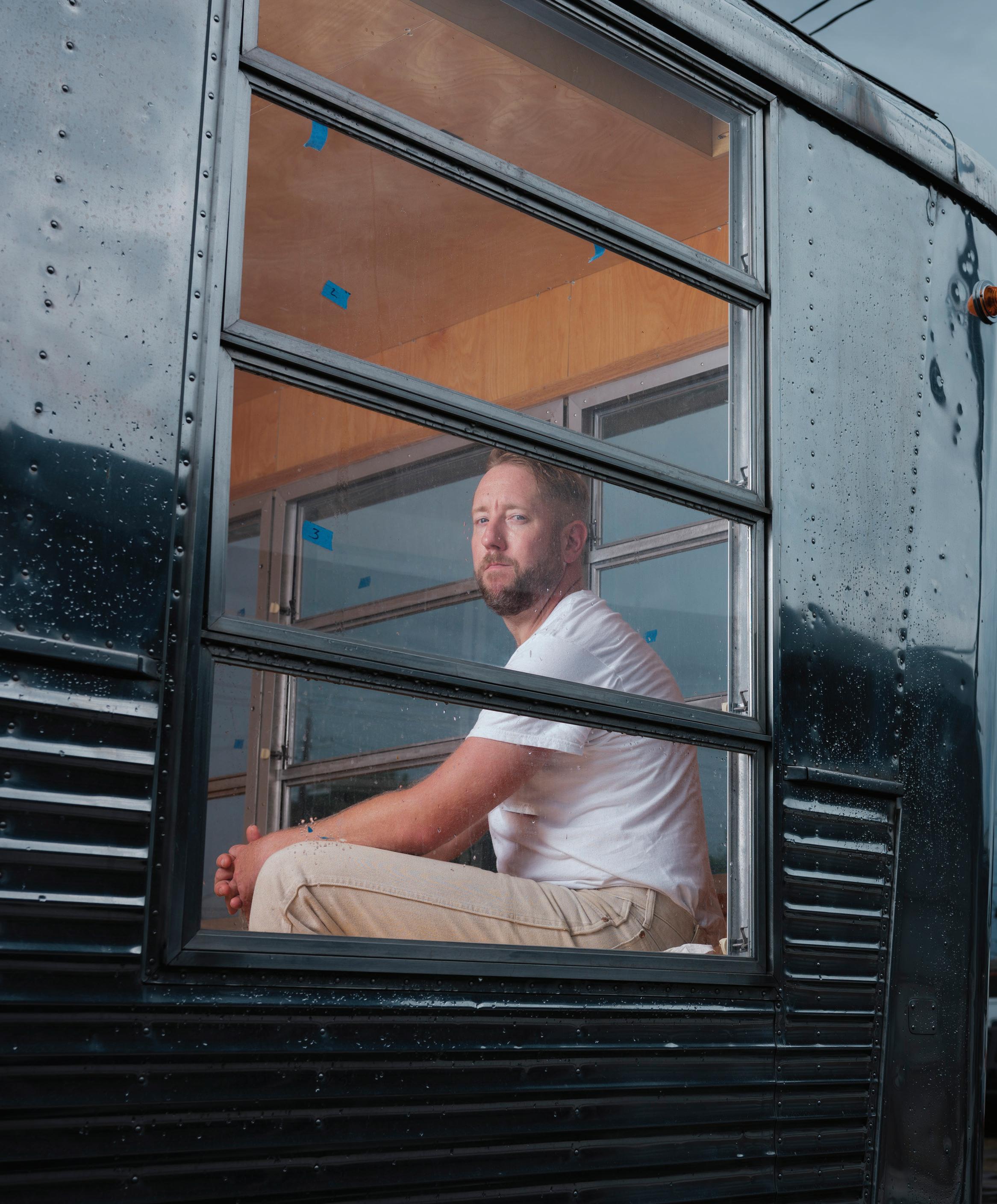
Through meticulous craftsmanship and a passion for the past, a local man transforms vintage travel trailers into road-ready treasures.
BY ASHLEY MCLELLAN
PHOTOS BY EDMUND D. FOUNTAIN
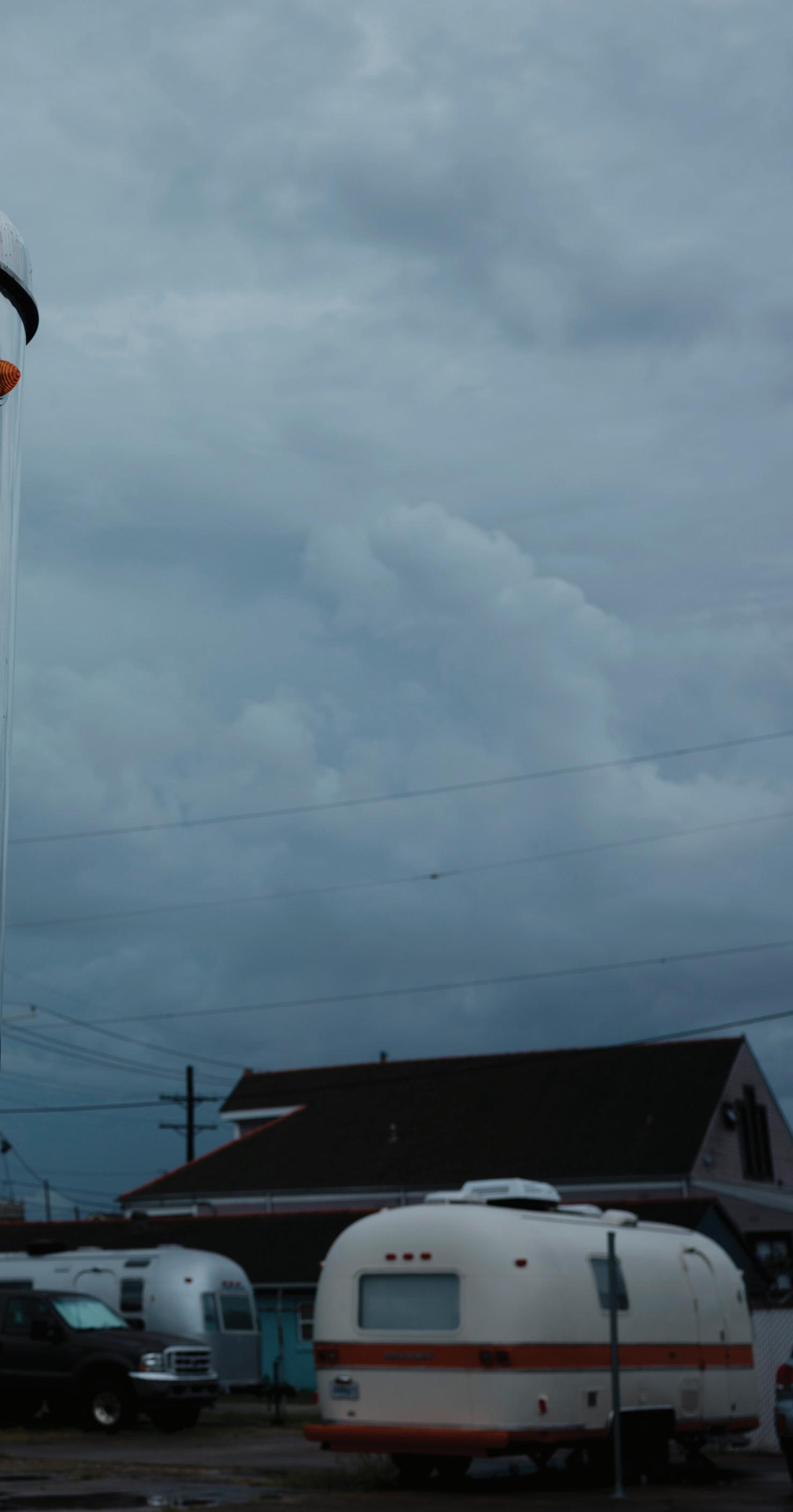
Sleek. Charming. Classic.
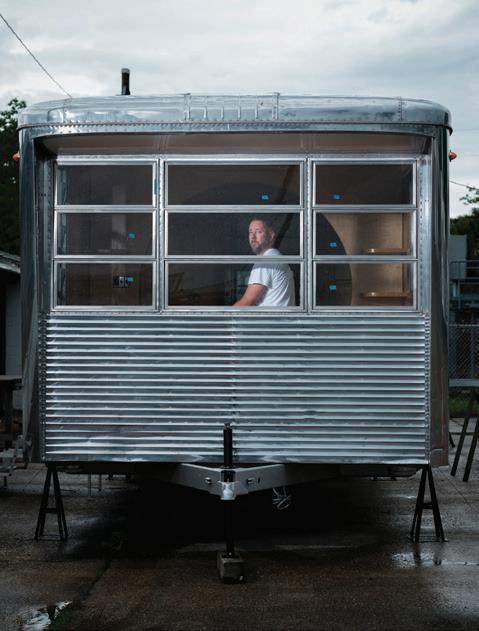
These are not words you’d typically use to describe the monstrous recreational vehicles you see cruising down the highway, but that’s what makes an Andy’s Trailer stand out from the crowd.
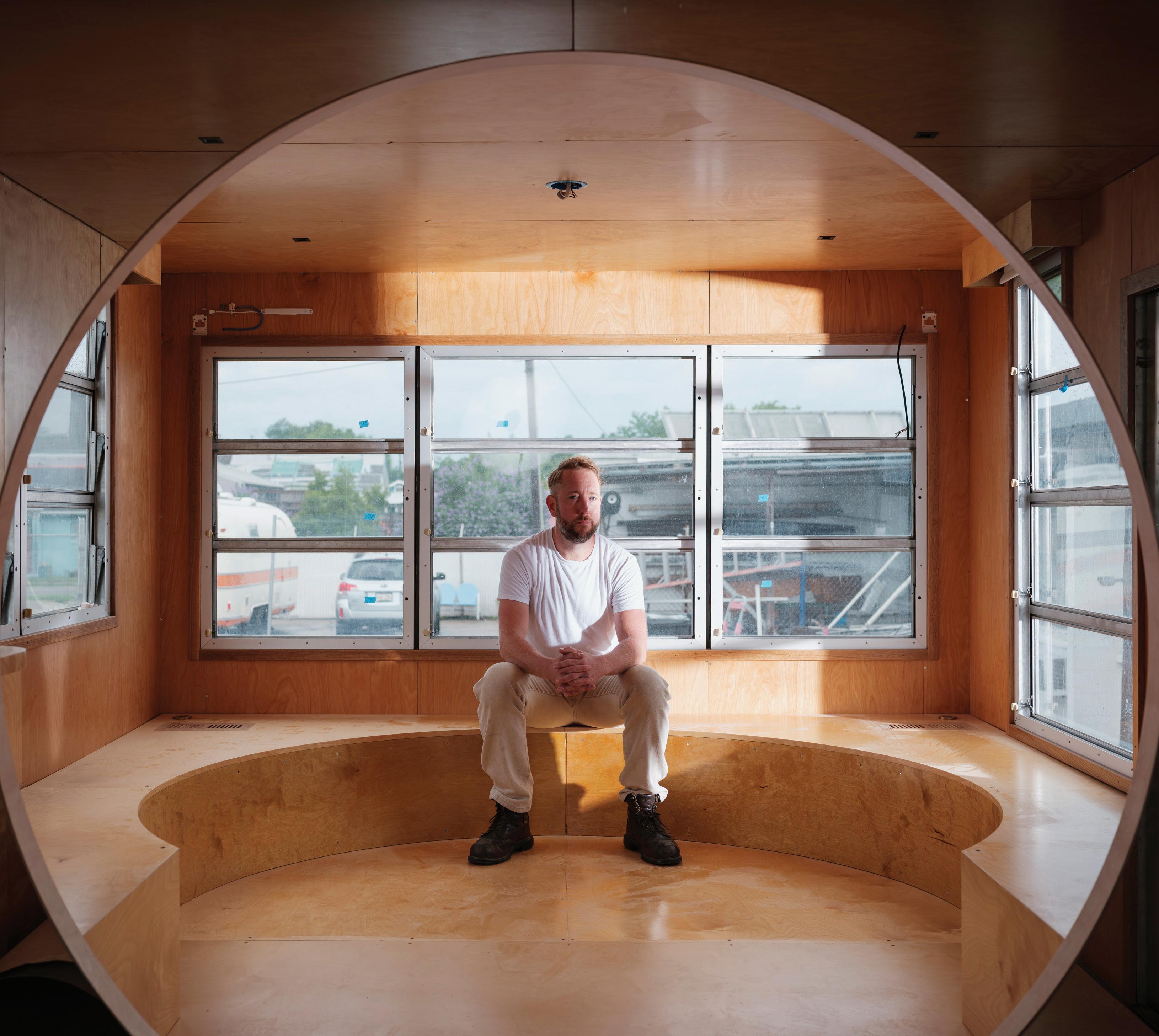
Andy’s Trailers both are, and are not, your dad’s RV. Back in 2013, Andy Schnack decided to buy a vintage Airstream trailer and renovate it for his own use.
“After living in it a short time, I decided I wanted a larger model,” he said. “And when I went to sell it, it proved very easy. At that point I realized there was a business here.”
With a multifaceted background in philosophy, carpentry and general contracting, Schnack said his knowledge of travel trailers has been gained through hands-on experience.
“We work specifically on trailers built like airplanes with riveted aluminum construction, so it’s a very specialized trade,” he said. “Over the years, our projects have become more and more ambitious, requiring me to buy tools to do aircraft style riveting, aluminum polishing, etc.”
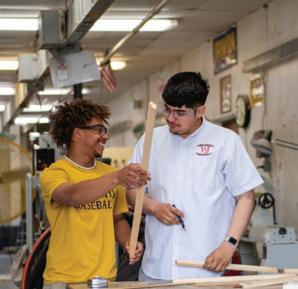
Schnack has two employees and hires local fabricators as needed for certain aspects of each build, such as welding, glass and mirror, home automation technology, and CNC fabrication. He dedicates up to a full year to renovate and revive trailers he acquires sometimes through luck and persistence. Completed projects include detailed renovations of Airstream, Argosy, Spartan and other vintage makes and models. His specialty is 1950s and 1960s Airstream and Spartan trailers.
“These, in my opinion, are the best travel trailers ever manufactured,” he said.
Before the hands-on work begins, Schnack must first find his diamonds in the rough, which he said typically involved a nationwide search through a combination of classified ads, internet forums and word of mouth.
“We’re fortunate to have reached a point where people contact me when they’re looking to sell, which is how I’ve found most of our latest projects,” he added.
Andy’s Trailers range in price from $50,000 to $300,000 for his largest and most luxurious designs. Each is a labor of love.
“We typically spend six to 12 months on a project,” he said. “All our trailers are fully rebuilt, which means taking them down to the frame, and rebuilding them with modernized
running gear, electrical, plumbing, appliances etc. This is a big difference from other renovators, who may only focus on cosmetic details and surface level details.”
Some of our Andy’s Trailers are spec builds — where he designs the interiors, and his team builds them out to sell as completed projects. Others are custom jobs.
“Someone might be looking for a hotel suite, vacation rental, home office, mobile studio, etc.,” he said. “In which case I will find a good project trailer to purchase as the base for their concept. I prefer this over people bringing a trailer they bought themselves, as I can do a pre-inspection that can spot any major issues and ultimately save money down the line. I will travel all over the country to find project trailers.”
The company specializes in rebuilds and reconstructions but not repairs.
“We don’t offer repair services or partial renovations because it’s important to our process to ensure all the frame and structural components are in good condition before working on the interior design (which is what most people are interested in),” he explained. “These old trailers almost always have deeper issues that make repair work untenable — think, ‘can of worms.’ You start taking something apart and you will find 10 other things that need addressing. I’ve found it’s difficult to make a profit or provide a service that people can afford when it comes to repairs.”
Schnack said the lack of technicians who do repair work on vintage trailers is the reason he has a closed shop and doesn’t post business hours.
“The fact we don’t do repairs is often disappointing news to people who find us online,” he said.
Andy’s Trailers does, however, offers a diverse portfolio of other services. The business has a small fleet of vehicles available for rent locally as backgrounds in feature film, TV projects and photo shoots, and can provide services for those looking for guidance with their own DIY trailer restoration.
“For TV/film, [the rental rate] varies based on the project and how they intend to use the trailer,” he said. “Sometimes it is simply a scenic background, and other times it’s a bigger part of the storyline. Those rates are typically $500 to $1,400 per day. The rate is normally set by the studio and is a take-it-or-leave-it situation.
For technical consultations, he charges $100 per hour.
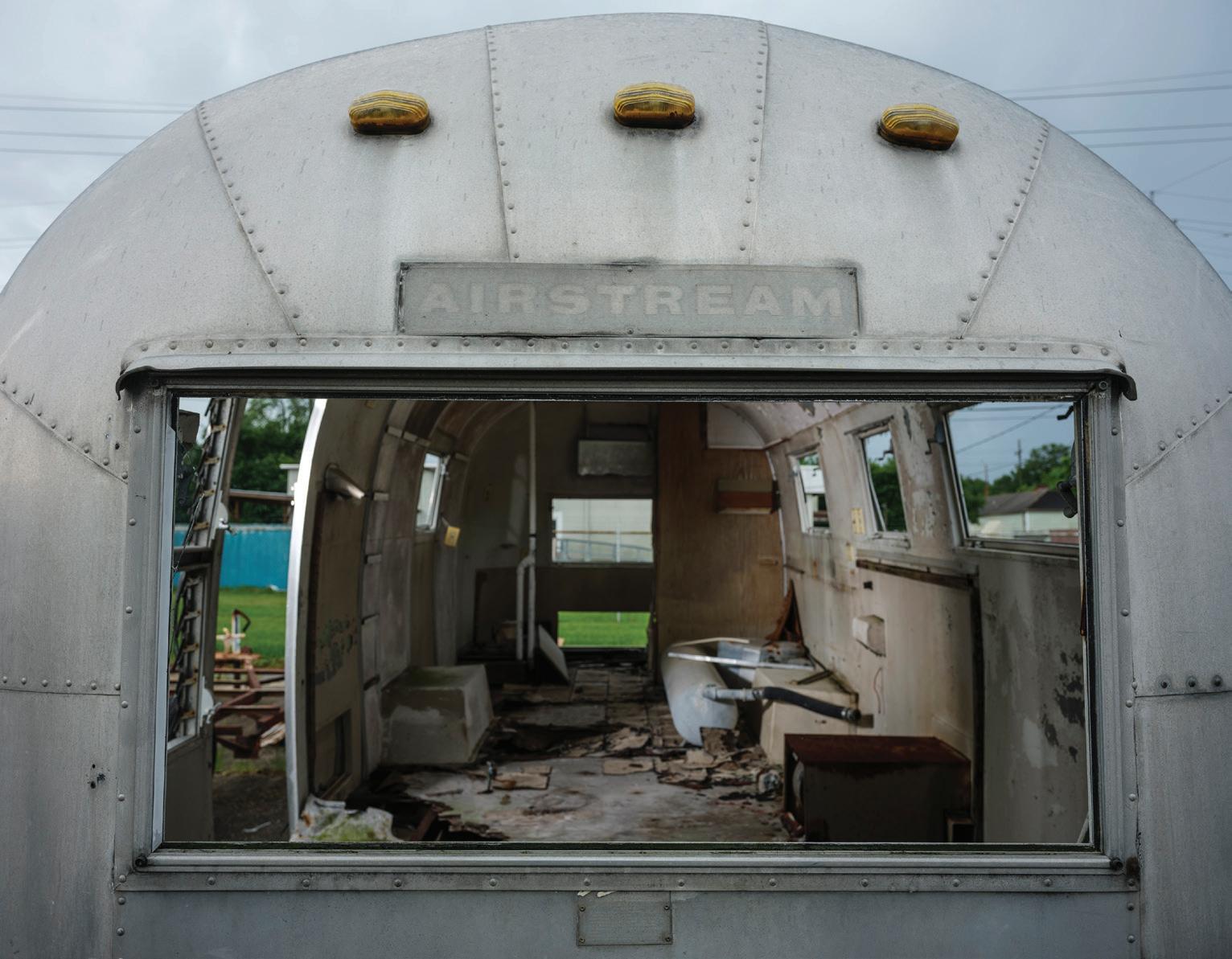
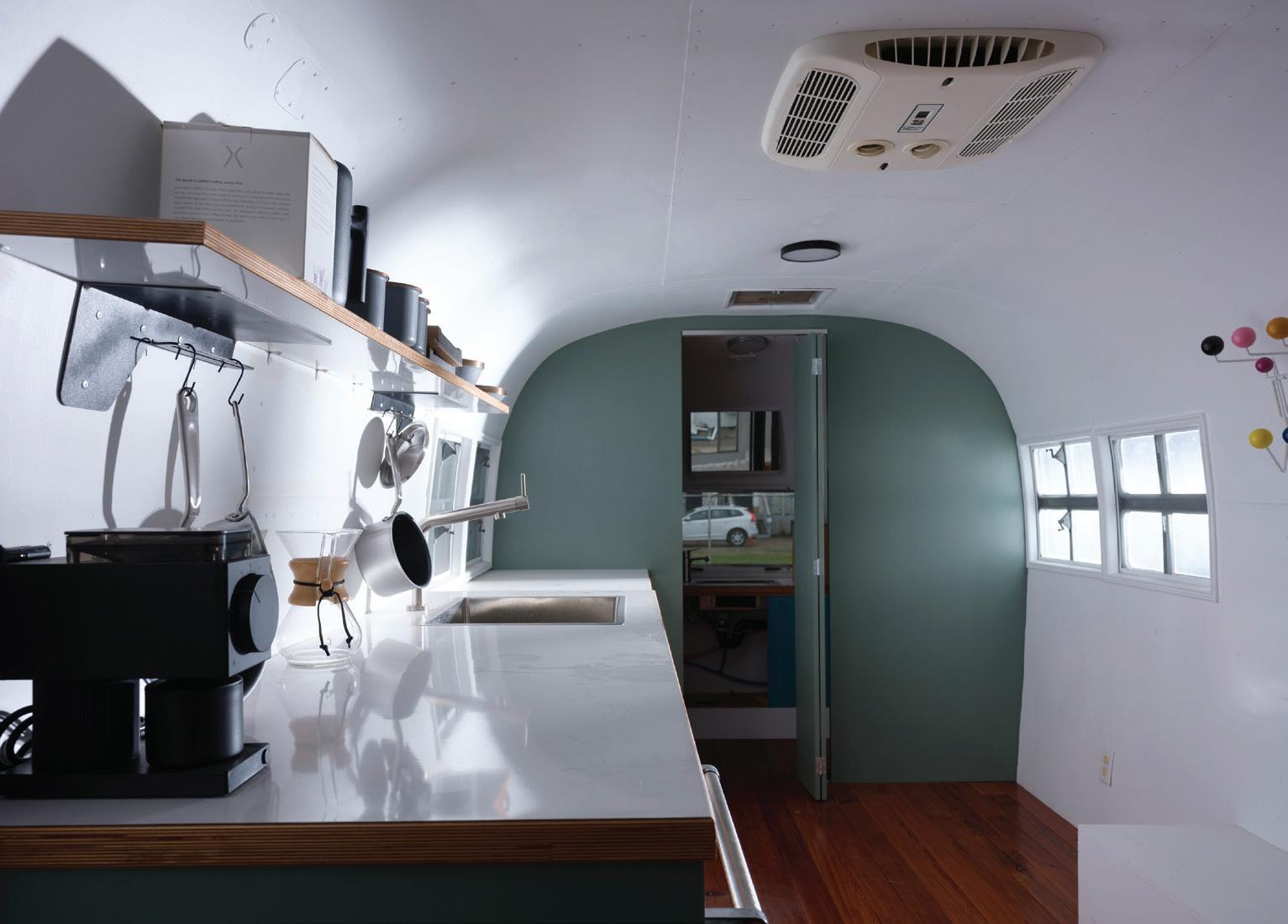
37 million Americans plan to take an RV trip this summer, with travelers increasingly prioritizing road trips, closer-to-home destinations, and vacations that provide greater control over spending and schedules
58% of leisure travelers saying they want to take an RV trip because they see it as a more affordable way to travel.
SOURCE:
More than 55% of travelers plan to bring pets on vacation this summer, seeing RVing as a convenient and cost-effective way to travel with animals.
49% of travelers said they plan to work remotely by RV this summer, a slight growth from last summer (46%).
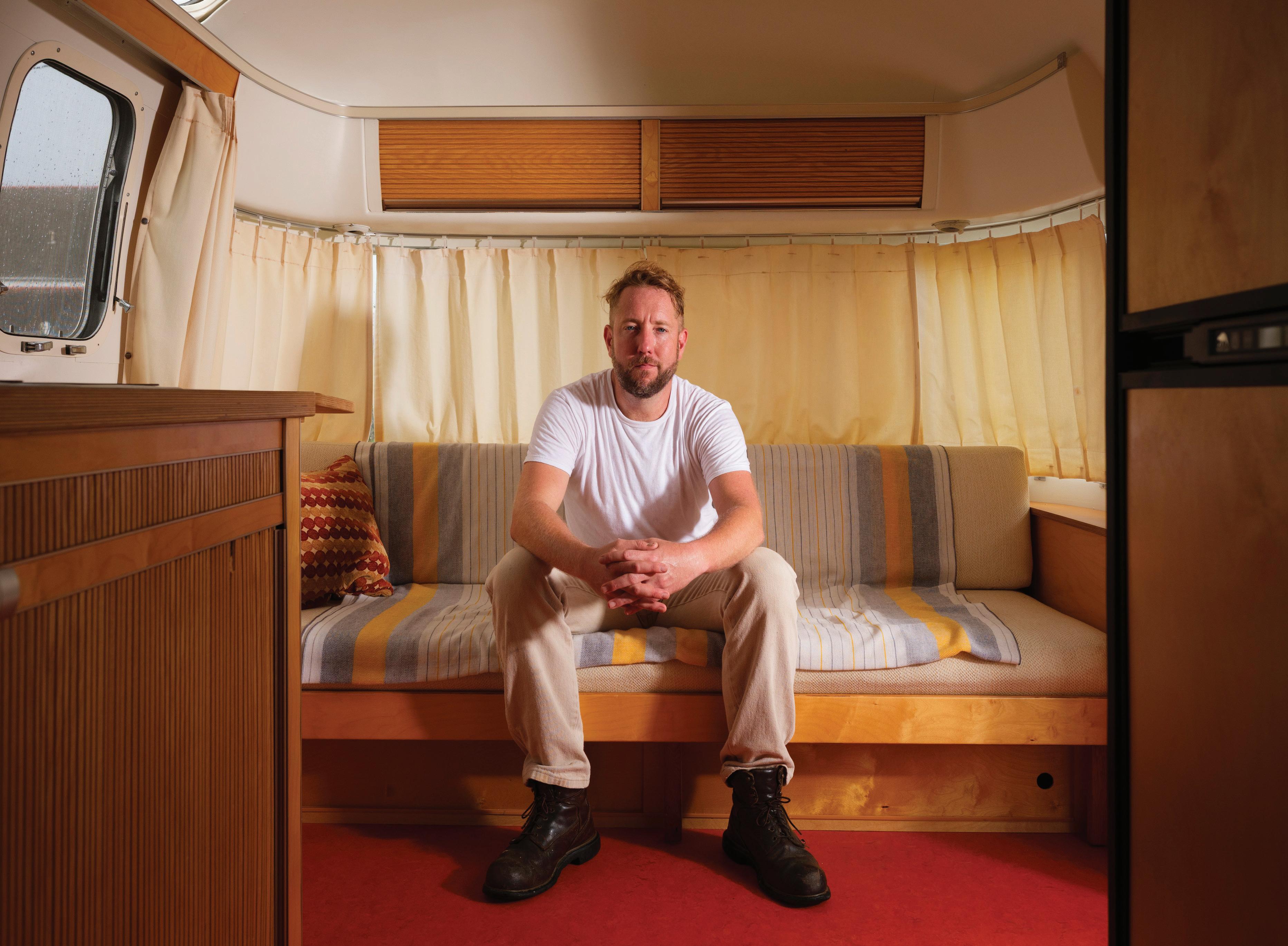

“We also do pre-purchase inspections for people who’ve found a trailer they want to buy,” he noted. “That entails going over the systems, running gear and frame/chassis and writing a report. The rate for that is $200 to $400.”
Lately, Schnack has been thinking big.
“We’ve focused on very large Spartan trailers that are 50 feet long, making them more of a mobile home than something you would tour the country with,” he said. “These trailers will become part of a hotel project in California.”
Schnack’s love for travel and all things vintage continues to be the main motivation behind the business.
“I love the backroads and exploring the smaller and less known parks, like national forests. Small towns also fascinate me. Anything you could call a ‘time capsule’ is an immediate pit stop for me.” T
Working Hands uses the past to build the future
BY KEITH TWITCHELL
At the intersection of art, history and practicality lies Working Hands NOLA, a company that produces beautiful, hand-crafted kitchen and household items primarily out of salvaged woods.
Working Hands is co-owned by Julia McLanahan and Garen Walker, whose diverse backgrounds blend well into their work. Walker served 15 years in the U.S. Army. His final post was in New Orleans, and he said he fell in love with the city. After working stints in residential and then commercial construction for years, he decided to scale back to fine carpentry and woodworking.
McLanahan has her state horticulture license and worked in landscaping and plant sales. The two met at a work site and soon found their interests and talents offered promising possibilities, ultimately leading to the establishment of Working Hands in early 2025.
Among those interests is a love of New Orleans history, particular as a place of architectural craftmanship, hence the focus on reclaimed and repurposed wood.
“We take whatever we can and refinish it,” explained Walker. “It adds to the beauty of New Orleans.”
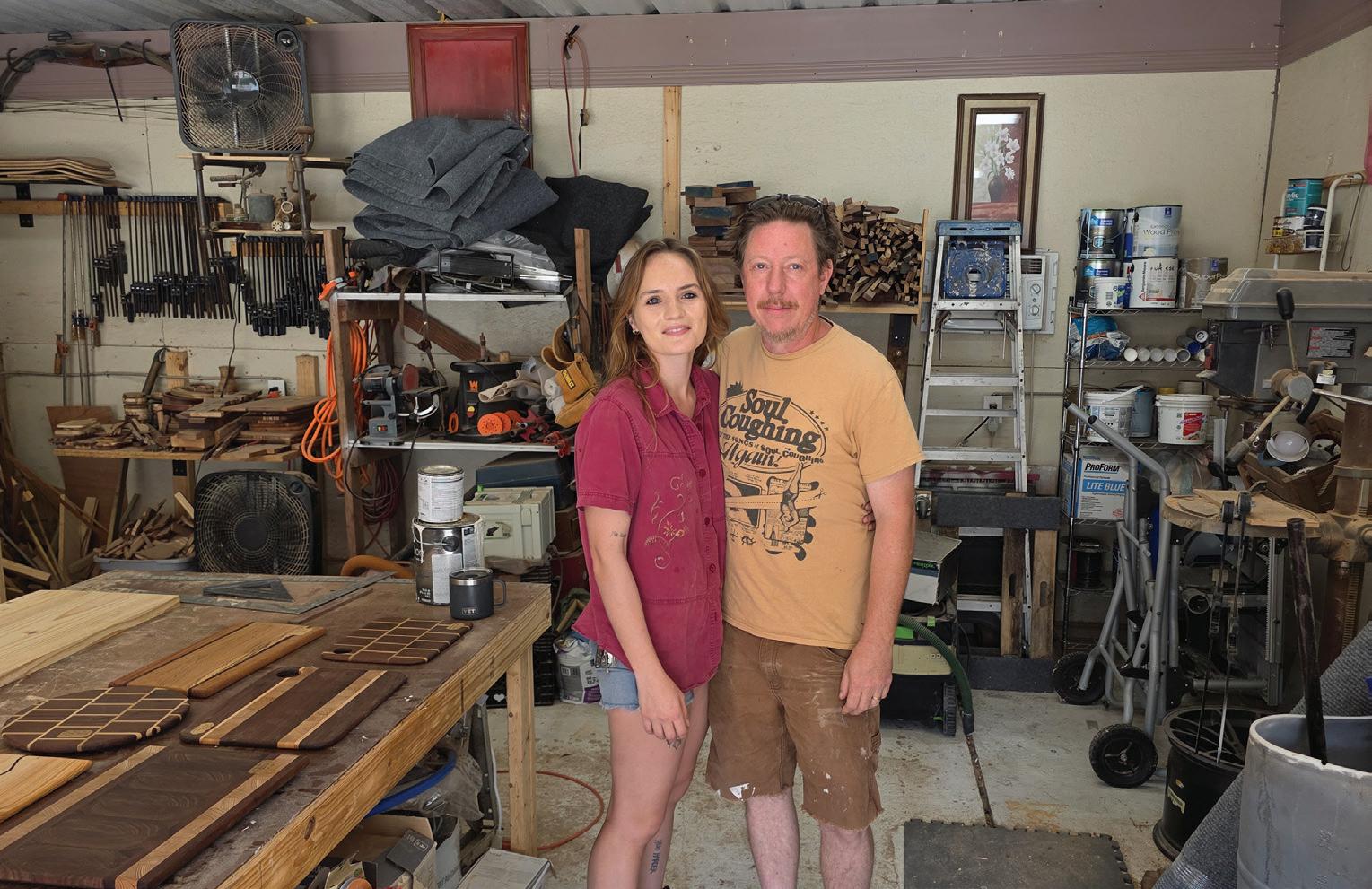
“We are giving the wood new life and reincorporating it into the city we all love so much,” added McLanahan, showing off some examples in their Broad Street workshop. Those that have been to the popular Bywater restaurant N7 have likely seen some of the company’s handiwork — Working Hands constructed the restaurant’s driftwood wine bar.
Much of their material is obtained from demolition at job sites, but they admit to occasional dumpster-diving.
“If you see a beautiful piece of wood, you can’t just leave it there!” Walker exclaimed. The two have even pulled flotsam from the Mississippi River, such as a piece of spalted maple. The term “spalted” refers to wood that has begun to deteriorate in a way that leaves it still workable for furniture but with unusual patterns and colors.
Walker said the company never uses treated lumber for their products and avoids new growth wood where possible, noting that after 12 years in woodworking “you learn what the good wood is, and you have an eye for the old growth.”
Working Hands’ most popular items include cutting boards, roux spoons, coasters and other kitchen items. They also build furniture, mostly custom. While offered at a higher price point than
big box items, their handcrafted furniture and household items, Walker argued, last much longer.
“You buy this one time and you’ll have it for the rest of your life,” he said.
Despite the popularity of their work, McLanahan said it’s been a really hard year for small businesses.
“People are cautious; no one knows what the economy is doing,” she said. “The price of gas and groceries can be the difference that stops someone from buying an artisanal cutting board.”
To meet this challenge, Working Hands is thinking big: The company recently obtained its interior/exterior remodeling license and is expanding into smaller scale, non-structural renovations. Drawing on McLanahan’s landscaping experience, this will include building planters, pergolas, decks and other backyard enhancements.
“People really need those places where they can go to relieve all that stress,” she noted.
By reusing historic New Orleans materials in modern ways, the couple reaffirms traditional craftmanship and architecture in a very locally focused way.
“It’s more important than ever to stay local and build your community,” said McLanahan. “We’re just happy to be here and happy to be building things.” T

LOVED THIS BOOK
“The Fish that Ate the Whale” by Rich Cohen. Fascinating true story much of which takes place in New Orleans!
Norma McClain President/CEO of Tekchix
BY JEFFERY JOHNSTON
GOAL FOR THE NEXT YEAR Establish Tekchix offices in Chicago, Dallas and Denver.
PRODUCTIVITY HACK
Focus. I can get more done in one hour than I can in eight when I remove all distractions.
HOBBY Photography! I wish I had more time to dedicate to it.
FAVORITE RESTAURANT
Sneaky Pickle. Everything I order there makes me so happy!
McClain has spent her 30-plus-year career in IT, staffing and recruiting. In addition to founding IT recruitment agency Tekchix, she is a member of the Fidelity Bank POWER Advisory Board for Women Entrepreneurs, Southeastern Louisiana University’s Computer Science Advisory Board, the LED CEO Roundtable, Tulane’s SOPA Advisory Board, New Orleans Opera Board and Second Harvest Operations Committee.